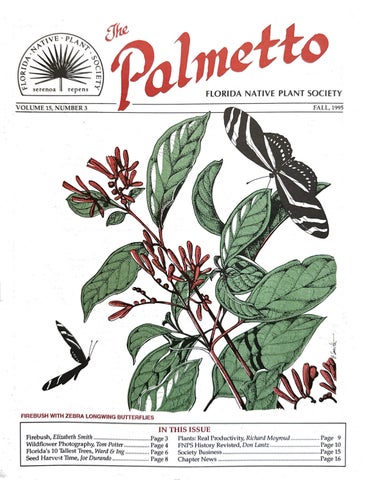
Firebush, Elizabeth Smith. Wildflower Photography, Tom Potter
FIREBUSH WITH ZEBRA LONGWING BUTTERFLIES
The purpose of the Florida Na tive Plant Society is the preservation, conservation, and restoration of the native plants and native plant communities of Florida.
ALIVE PLANT
serenoa repens
THE PALMETTO (ISSN-0276-4164)
Florida Native Plant Society P.O. Box 6116 Spring Hill, Florida 34606
Copyright 1995 by The Fiorida Native Plant Society Peggy S. Lantz, Editor 2020 Red Gate Road, Orlando, FL 32818
Associate Editor: Cameron M. Donaldson 2112 Helen St., Melbourne, FL 32901
The Palmetto is published quarterly by the Florida Native Plant Society as a membership benefit. Memberships are: Individual, $20; Double, $25; Organizational, $50; Supporting, $100; Donor, $250; Library, $10.
We encourage the reuse of the articles appearing in The Palmetto in order to disseminate information on Florida native plants as widely as possible; but, in accordance with the copyright law, permission must be granted in writing by the Editor or the Publisher, credit must be given to The Palmetto and the Florida Native Plant Society, and the notice of copyright must appear in the reprinted article.
Submissions
Articles on any aspect of Florida native plants are invited. Include drawings or photos, if possible. They will be handled with care, and will be returned if you include a self addressed, stamped envelope. Send to Peggy S. Lantz, The Palmetto, 2020 Red Gate Road, Orlando, FL 32818. Phone: 407/299-1472.
Advertising
You are invited to place an advertise ment for your company in The Palmetto.
Rates for camera-ready copy are $200 for a full page, $110 for a half page, $75 for one-third page (two columns wide by 4"" high), $60 for one fourth page (two columns wide by 3 5" high), and $40 for one-sixth page (one column wide by 4 "g" high, or two columns wide by 2 %%" high)
For running the same display ad in two issues, there will be a 20% discount, and for three issues a 30% discount. Business card rate is $20 per issue (no discount)
Copy that needs special photography or set-up will be billed at cost.
FPS OFFICERS AND BOARD OF DIRECTORS
President: David Pais, 2306 N.W. 47th Terr., Gainesville, 32604; 904/372-3899. Vice President-Administration: Janice Broda, 9335 Frangipani Dr., Vero Beach, 32963; 407/589-0319. Vice President-Finance: Kim Zarillo, 7.60 Cajeput Cir., Melbourne Village, 32904; 407/727-1713
Treasurer: Candace Weller, 1515 Country Club Rd. N., St. Petersburg, 33710; 813/345-4619.
Administration: Betsy Bicknell, P.O. Box 6116, Spring Hill, 34606; All FPS calls: 813/856-8202. Bookkeeping: Susan Wilson, P.O. Box 76292, St. Petersburg, 33734; 813/527-3232.
Membership: Don Lantz, 2020 Red Gate Rd., Orlando, 32818; 407/299-1472
Publications: Peggy Lantz, 2020 Red Gate Rd., Orlando, 32818; 407/299-1472
Rick Joyce, 123 W. Mariana Ave., N. Fort Myers, 33903; 941/995-4489. (94-96)
Gary Patterson, 1209 Ridge St., Naples, 33940; 941/262-3602. (95-97)
Larry Thompson, 1229 Sarasota Dr., Tallahassee, 32301; 904/222-2473. (94-96)
Walt Thomson, 1581 Arden St., Longwood, 32750; 407/935-0002w, 331-1715. (94-96)
Richard Workman, 1705 Maple Ave., Ft. Myers, 33901; 941/936-8282. (95-97)
Richard Wunderlin, 2013 Curry Road, Lutz, 33549; 813/974-2359. (95-97)
FNPS CHAPTER INFORMATION
Big Scrub (Marion & Citrus counties): 2nd Tues., 5:30 p.m.; Silver River Museum & Environmental Center, 7189 N.E. 7th St., Ocala. Director: Denver Raney, 5525 S.E. Maricamp Rd., Ocala, 34480; 904/624-0002
Broward: 2nd Tues., 7:30 p.m.; Secret Woods Nature Center, 2701 W. State Rd. 84, Ft. Lauderdale. Director: Ann Murray, 608 S.W. 7th Ave., Ft. Lauderdale, 33315; 954/523-0288
Charlotte Harbor: 4th Tues., 6:30 p.m.; Call for location of meeting in Port Charlotte. Director: Dave Wilson, 22212 Little Falls Ave., Pt. Charlotte, 33952; 941/625-4402.
Coccoloba (Lee County): 2nd Thurs., 7:30 p.m. (Oct, thru April); lona House, Nature Center of Lee County, Fort Myers. Chapter Mail: P.O. Box 1942, Fort Myers, 33902. Director: Robert Irving, 941/472-1932
Conradina (South Brevard): 2nd Fri., 7 p.m.; United Church of Christ Congregational, Melbourne. For directions, call 407/259-2813. Chapter Mail: P.O. Box 1543, Melbourne, 32902. Director: Sharon Dolan, 407/729-6857
Dicerandra (Highlands County): 2nd Wed., 7 p.m.; Conference Room, Home Savings Bank, 3200 US-27 S., Sebring. Director: Ruth Haynes, 941/471-2021
Eugenia (Indian River & St.Lucie counties): 3rd Thurs., 7:30 p.m.; Library, Fla. Medical Entomology Lab., 200 9th St. S.E., Vero Beach. Director: Peggy Brinson, 566 6th Ave., Vero Beach, 32962; 407/567-1802
Heartland (Polk County): Has monthly field trips and meetings. For information and directions, contact: Bill Bissett, 2929 J.B. Carter Rd., Davenport, 33837; 941/422-6664. Director: Orrinna Speese, 941/646-7074
Martin Cocoplum: 3rd Tues., 7:30 p.m.; Environmental Studies Center, 2900 Indian River Dr., Ocean Breeze Park, Jensen Beach. Chapter Mail: P.O. Box 801, Jensen Beach, 34958. Director: Cheryl Friend, 407/229-5122
Nature Coast (Pasco & Hernando counties): 2nd Tues., 7 p.m.; Concourse Bldg. & Nature Center; Director: Robert Bareiss, 1031 Bellwood Ave., New Port Richey, 34654; 813/842-3133
Palm Beach: 3rd Mon., 7:30 p.m.;Auditorium, Mounts Botanical Garden, 531 N. Military Trail, West Palm Beach. Director: Dan Boyar, 712 S.W. 3rd Ave., Boynton Beach, 33426; 407/737-3958.
Paynes Prairie (Alachua, Putnam, Columbia): 3rd Thurs., 7:30 p.m.; Matheson Center, 513 E. University Ave., Gainesville. For information/directions, contact: Ann Williams, 6117 S.W. 170th St., Archer, 32618; 904/495-9615
Pinellas: 1st Wed., 7:30 p.m.; Pinellas County Coop. Extension Serv., 12175 125th St. N., Largo. Director: Chuck Parsons, 8581 Kumquat Ave, Seminole, 34647; 813/392-7842 For information call: 813/544-7341.
Sea Rocket (North & Central Brevard County): 4th Mon., 7 p.m.; Rec. Center, Manatee Hammock Park, 7275 S. US-1, Bellwood. Director: Jennifer Bruckler, 4010 Barr Ct., Titusville, 32796; 407/268-0690
Volusia Pawpaw: 3rd Tues., 7 p.m.; River Bridge Meeting Hall, 1 N. Beach St., Ormond Beach. Director: Larry Sauter, 3639 Conifer Ln., Ormond Beach, 32174; 904/677-3488,
Firebush, Hamelia patens, is a member of the Rubiacee, or coffee family, which also contains madder. The genus name, Hamelia, honors Henry L. Duhamel du Monceau, an early French botanist; the species name is from the Latin patens meaning "open" or "spreading."
Firebush is a showy tropical shrub with cymose clusters of bright red to orange, tubular flowers, 1 to 2 cm long. (A cyme is an infloresence that has a series of more or less equal branches that bear the flowers.) The elliptic leaves are entire (with smooth edges) and variable in size - from 7 to 15 cm long - and may be opposite or in whorls. The young leaves often are red from tomentum (hairs), and the full sun will tint the older foliage red. The berries are red to black, almost sessile (without stalk or stem), about 6mm in diameter.
In the wild, firebush is found in hammocks, coastal dunes, and shell mounds, and - not surprisingly - is lime- and calcium-tolerant. It is a very good plant for xeric landscaping, and it is tolerant of salt drift. Firebush makes a good accent shrub, and the upright, spreading shape is also good for barrier plantings
Firebush is cold sensitive, but will grow back from the roots if nipped by a frost. It is also damaged by high winds, and the slender branches are easily broken, which might dictate planting in a sheltered location. Firebush looks its best in semi-shade and flourishes in moist, slightly enriched soils, but will do well in a wide range of conditions. If you want to attract butterflies, try for a location that is sunny for part of the day.
Firebush is native to south Florida, the Florida Keys, the West Indies, and tropical America. Its range in Florida is north to about the latitude of Tampa in central Florida. There it typically is seen as a smaller shrub - 1 to 2 meters high as opposed to 3 to 4 meters in its southern range. Firebush can be propagated by seed or cuttage.
Firebush South Florida's Plant for All Seasons
Art and text by Elizabeth Smith
About five years ago, I planted three small firebushes within view of the kitchen window; today they are approximately fifteen feet high.
One of the things I love about my firebushes is how they ? and the wildlife attracted to them - change with each season. Seasonal changes are subtle in Florida, so it was a year or two before I recognized the patterns of life revolving around these shrubs.
During the summer when the tubular red and orange flowers are plentiful, this tropical shrub attracts many species of nectaring butterflies ? Zebra Longwings, Gulf Fritillaries, Julias, swallowtails, sulphurs, and whites. Passion vine butterflies such as the Zebra Longwing and the Julia seem to have an affinity for the firebush; they are almost always seen in abundance. There is no more beautiful sight to me than these profuse flowers covered with flashing bits of yellow, orange, black, and white.
Ruby-throated Hummingbirds visit regularly summer and fall. I see them appear as I leave for work in the morning and when I return home, and again at dusk. They are very precise in their flight-hovering, assessing, nectaring, occasionally pausing in flight to rest on
a nearby branch, their tiny bodies outlined against the sky. Their tininess and iridescent colors make me marvel at the infinite variety of life.
Summer is glory time for the firebush, but even during the winter months - when blooms are not as prolific, when the hummingbirds pay a cursory visit and move on, when it seems that only the long-lived Zebra Longwings are left - there is still life. Brown Thrashers scratch in the leaf and twig litter below, while tiny Blue-gray Gnatcatchers skitter in and out of branches looking for insects. A pair of cardinals come at dusk for the fruit, cheeping back and forth to one another as they rustle the branches and twist the berries off. Mockingbirds flash in and out, bolder than the cardinals, sometimes comically creeping out too far on a slender, brittle branch so they have to fly away before it breaks.
Last winter a pair of Painted Buntings stayed for a week, making the shrubs their base of operation. Lizards and anoles of all sizes are found on the branches and the ground, hunting for insects. Dragonflies light on the wide flat leaves while they pause in their quest for mosquitoes. Firebush leaves that catch the full sun are suffused with red pigment; the shaded leaves are a velvet green accented by the red petioles.
Although my observation times are limited, I pause and wonder at the life that revolves around this one particular species - life that wasn't a part of the sandy lawn that was there before.
Elizabeth Smith, a past president of the Naples Chapter, has illustrated two FNPS books as well as writing and illustrating articles for The Palmetto.
Wildflower Photography
by Tom Potter
Late summer and fall pose special challenges to wildflower photography. A cluttered image is the most common problem at this time of year. The fundamental rule of good wildflower photography is keep it simple!
As we all know, the flowers of late summer and fall are, for the most part, composites. These plants tend to have numerous flowering stalks and heads, making it difficult to capture the essence of the structure and the beauty of the flower in an uncluttered image. You will need to seek out plants in a somewhat isolated setting. This is not easy, but they are out there, and the effort will pay off.
When you look through the viewfinder, be sure to look edge to edge and see the entire image area, not just that to which your eye and brain are psychologically tuned at the moment. Your eye can easily isolate what you like, but the film records all detail in a scene. That is why so many anticipated images come back from the processor as disap pointments. It takes only a second to click the shutter - but more time to achieve the composition that will provide a lasting, high quality image. Photograph your subjects early or late in the day. The light is warmer then,
adding to the richness of color saturation. The breeze is generally lighter, causing less swaying of the flowers. (Movement precludes the use of slower shutter speeds, which help define the depth of focus.) When you isolate a
sunlit subject from a shaded background, the situation is ideal. That can happen when the sun is at a low angle, in early morning or in late afternoon. Often in the fall, a morning dew will enhance the subject, adding a special
Magnolia grandiflora
Deer tongue (Carphephorus paniculatus) at Kissimmee Prairie Sanctuary.
dimension to the image, such as a jewelled spider web or insect.
For the detail and snap that you want in the photos of these complex flowers, use a slow-speed film that provides both high resolution and fine grain. The slower films also produce the best color saturation. Choices include Kodachrome 25 and 64, Kodak Ektachrome 100, Fujichrome Velvia, and Fujichrome Provia 100.
For a more ethereal look, consider a high-speed film providing more grain to the image. The same result can be obtained by using a finely meshed screen material or special filter over the front of the lens. The viewfinder should allow you to see the results before shooting.
To photograph an entire field of ironweed or daisies, the control of field depth is important, so use as low an fstop as possible, say f11-f22, depending on your lens of choice. Wide-angle lenses provide the best depth and allow you to place the near objects very close to the front of the camera. This will provide a seemingly vast sweep of flowers, often exaggerating the scene ? a great technique. If you tilt your camera to show just a little sky, the flowers will seem to sweep to the horizon! It is best
Native wildflowers in bloom along Tampa's interstate highway.
to use a tripod at all times, especially when you are using slow shutter speeds with low f-stops.
A telephoto lens can provide a tighter image for a field of composites. This type of lens compresses images, creating a sense of compactness. Try putting this lens on and observing the image it creates in the view finder. A good technique is to alternate the telephoto and wide-angle lenses when working in a field of flowers.
Since many fall flowers are tall, consider a vertical format. Try setting up your equipment at a low level to give an even setting for the tall plant, placing the flower head toward the top of the scene.
In conclusion, to create the desired images for this season, remember to:
? Work early or late.
? Select uncluttered scenes.
? Watch for, and use, dark backgrounds.
? Select a high-quality, low-speed film.
? Use a tripod.
? Try a wide-angle lens for sweeping fields of flowers.
? Use a telephoto lens for compressing a scene.
? Use a vertical format for tall plants. Above all, be patient!
Tom Potter is a professional photographer and charter member of the Indiana Native Plant and Wildflower Society. Article reprinted, with permission, from the Autumn 1995 issue of Indiana Native Plant and Wildflower Society News.
WatchWhatYou'reDoing!
As concerned environmentalists, we're upset when we read or hear of stealing or destruction of endangered plants or rare habitats. But sometimes we fail to pay attention to what damage our activities may cause in protected
Even just taking pictures.
We get excited about the opportunity to take a photograph of a special blossom or maybe of a common flower in an uncommon light. We become oblivious to the surrounding herbs and shurbs and trample them thoughtlessly, tearing the grasses as we dig in our toes to kneel, or mashing mosses and lichens as we circle for the best angle.
Bird photographers, too, in their obsession to take photos of nestlings, sometimes forget that the nestlings need protection and care. If the parents are kept away for too long a time, baby birds may suffer from dehydration, heat, or predation. Even those who are only birdwatching can cause environmental damage if they barge through bushes, down stream banks, and through frag ile habitats, following the elusive addition to the life list.
Be aware of even your seemingly harmless actions. All our good intentions can be undone if we fail to "see" what we are doing.
Rein orchid (Habenaria repens)
Florida's Ten Tallest Native Tree Species
by Daniel B. Ward and Robert T. Ing
The Champion Tree data may be just what is needed to supply the "data set" from which to draw calculations.
The Florida Champion Tree Project defined a "tree" as having a height of has now reached the stage where inter- "at least 13 feet (4 meters)".) Or perhaps esting and often useful information may only those old enough to reproduce? be drawn from the voluminous file of And what do we mean by "old enough" measurements of individual trees. This ? those just big enough, or those actuproject, sponsored jointly by the Depart- ally reproducing? Or should we perment of Botany, University of Florida, haps measure only the tallest one of and the Florida Division of Forestry, has each species? But how many hundreds been active in locating and document- of trees must we measure before we are ing the largest trees of each species confident we have the tallest one? Also, throughout the state. with only one tree to represent each spe-
Of the different types of informa- cies, how can we compute any estimate tion that can be derived from the cham- of variance, that is, how can we calcupion tree data, we are most intrigued at late whether the observed differences our capability to answer a question that are real or just chance? And finally, who is rarely asked and has never before is going to measure all those trees? been answerable in quantitative terms. Clearly we need a "data set" ? This is the seemingly simple question: some agreed-upon sampling of trees How tall is Species X, and how does it that can be used as the assumed popucompare in height with Species Y? lation from which our calculations are
To see the subtlety and inherent dif- drawn. A data set that is already in exficulty of this question, try rephrasing istence and collected independently of our intended use, thus unbiased. A data it this way: How tall is Loblolly Pines set that will permit estimates of vari(Pinus taeda), and how does it compare in height with Flowering Dogwood ance. And a data set that includes all (Cornus florida)? (If you wish, substifutea species. any other two tree species, native to
Well, the champion tree data, colFlorida.) Obviously ? to anyone whos * Vected over a period of more than knows these trees the pine is taller rtwenty years, throughout the state, and than the dogwood. But just how tathis. for most (not quite all) of the native tree the pine, and how tall the dogwood?.*species, may be just what we need. We And where are the numerical data top. need only to make the assumption that back up your answer? each species is represented at its maxi-
Well, let's see. We can measure all mum size by those individual trees the loblollies in a given area and com- nominated as champions. We must acpare their average height with all the knowledge, of course, that champion dogwoods in the area. But how do well trees are nominated on the basis of do that? Do seedlings count? Or do we trunk circumference and crown spread, tabulate only those trees 13 feet tall and as well as height, and that it is thus posabove? (The U.S.D.A. Forest Service has sible there are taller trees in the area that
were not selected. And we must also acknowledge that the recorded measurements are perhaps not accurate, and that they may not have been consistently taken by different observers.
But these imperfections in the data set are modest in comparison to those of any other data set that is available, or, indeed, any other data set that we can realistically visualize. Therefore, we are in a position to calculate the mean height and standard deviation for each species and to rank the species in descending order.
We don't have space here to give the mean heights for all the Florida species, and indeed the ranking changes daily as new records come in. But, as a sample, a listing of the ten tallest species may be of interest.
Loblolly Pine appears to be the tallest tree species in the state, with a mean height (at maximum) of 122.1 feet, based on the 7 trees in the champion files. If we had continued the ranking, we would find Live Oak (Quercus virginiana) at rank 41, with a mean height of 81.1 feet, based upon 22 trees. And yes, you were right ? loblollies are taller than dogwoods; Cornus florida doesn't appear until rank 118, with a mean height of 40.3 feet.
But be cautious in accepting these rankings and measurements as absolute values for each species. Note the accompanying standard deviations. The size of the standard deviation is a measure of the variability of the sample; the height measurements of those species with large standard deviations are prob-
The Ten Tallest Native Trees of Florida,
Ranked by Mean Height of Champions
Species
Pinus taeda L.
Carya aquatica Loblolly Pine Water Hickory
(Michx. f.) Nutt.
Carya cordiformis Bitternut Hickory 120.0 (Wangenh.) K. Koch
Pinus elliottii Engelm. Slash Pine 116.3 (var. elliottii)
Liquidambar styraciflua L. Sweet Gum
Ulmus crassifolia Nutt. Cedar Elm
Fagus grandifolia Ehrh. Beech
Pinus glabra Walt. Spruce Pine
Quercus shumardii Buckl.Shumard Oak
Liriodendron tulipifera L.Tulip-tree
ably more variable than those with small standard deviations. As a general guide, one may expect the true mean - that is, the average of all the trees that could be nominated as champions ? to fall within one standard deviation about two-thirds of the time. Thus, if we were to make a sample of large loblollies many, many times, instead of just once as we have done, we should expect that about two-thirds of the time the average height of these many samples would be within about 17 feet of the 122 feet of our sample, or between 105 and 139 feet in height.
The consequence of this variability, as measured by the standard deviation, is that the height measurements given here, though they seem most precise, are subject to revision with additional sampling. Not only might the values for absolute height be changed, but the relative ranking of the different species might also be changed. But in the words of the statistician, such a sample as we now have is a "best estimate" of the mean height of our tree species and may serve in that capacity until some other, perhaps better, estimate is devised.
Daniel Ward is Professor of Botany and Robert Ing is Adjunct Assistant in Botany at the University of Florida. They are working together on the Florida Champion Tree Project for the Florida Division of Forestry.
The Palmetto is printed on recycled paper with soy ink.
It's Seed Harvest Time!
by Joe Durando
It's that time of year again, for those of you squirrelly folks that didn't realize it-peak seed-gathering time has arrived! From now through October and even into November, the fruit of many of our native plants will be maturing. When collecting, do not be overzealous in your efforts. Always leave a substantial percent of the fruit behind, especially if there are only a few plants of the species you are collecting in the area. Not only are those the seed of the next generation, but some critter may be depending on that fruit as a food source.
Here are some tips to help you get positive results.
Dry fruit should be broken apart. It is not necessary to separate all of the "wheat from the chaff," but the cleaner the seed, the easier to plant. The seed of fleshy fruits should be fairly well cleaned.
Most seeds should be planted immediately to closely mimic their natural cycle. The only seeds that may actually benefit from being stored prior to planting are those of the coontie (Zamia spp.), as they often go through a process called "after-ripening." This is accomplished at room temperature, in a paper bag.
Always use commercial potting mixes for starting seeds in flats or containers.
After sowing, keep the seed outside, protected from heavy rain, wind, and critters, but exposed to natural fluctuations in temperatures.
Some species germinate immediately, requiring no stratification. Stratification is measured in chilling hours, which is the accumulation of hours a seed in moist conditions is exposed to temperatures between 32 F-45 F. Generally, seeds in north Florida require 300-500 hours.
Many species will not germinate until spring, after chilling. Some species, such as members of the Oleaceae (fringe tree, viburnums), have complex double
dormancies that must be broken. Under natural cycles, this takes two years, although it is possible to force the situation.
Some of the very small-seeded wildflowers, such as columbine and pine lily (Lilium catesbaei), need to be exposed to the light to germinate. The
rule of thumb is to bury the seed at a depth of one-half the diameter of the seed. I always leave some of the seed exposed when planting very small seed that I am not familiar with.
Seeds with hard, waxy surfaces, such as coral bean (Erythrina herbacea) or other members of the Fabacee, require scarification. Essentially, this means damaging the seed coat to allow water to penetrate and start the germination cycle. This is most easily accomplished using a file or sharp clippers to nick the seed coat.
This should help get things going for you. For more detailed information, I recommend the book, Growing and Propagating Wildflowers, by Harry R. Phillips. Or attend chapter meetings, ask questions, and share your knowledge and expertise.
Joe Durando is president of the Paynes Prairie Chapter and owner of Possum Hollow Nursery. (Reprinted from the Rhexia newsletter, Paynes Prairie Chapter.)
Pine Lily
Coontie
Plants: Real
Productivity
Still wondering about the meaning of life? Read on...
Thanks to an unfortunate lack of basic biological education, there is a widely held, but bizarre, view that our world economy is supported by the frenetic activities of cities, factories, shops, and offices in which raw materials are noisily hammered into shapes while scraps of paper are exchanged with great import. This constant busy work is often termed "productive" but is in fact no more than consumption and transformation of energy from one form to another, most often with disastrous results for the planet.
There is in fact only one form of productive life on this planet: green plants. All other organisms are directly or indirectly parasitic on green plants. Unfortunately, our attitudes and daily actions tend to deny this simple truth, while we destroy more forests, pave over grasslands and farmlands, and consume the diminishing petroleum resources that are actually the condensed and stored end results of millions of years of cyclic growth, death, and decomposition of earlier organisms derived from captured sunlight. We are consuming past, present, and probably future green plants at a rate that cannot be sustained. This is the front page news story for the world press, and should be repeated daily until it sinks in.
? Richard Moyroud, from The Dahoon, Palm Beach County Chapter.
" The first field guide of its kind... a book that botanists can respect and nature lovers can understand."
....Miami HERALD
In 220 pages, with over 490 color plates, 170 trees and shrubs native to the Florida Keys are illustrated and described Includes characteristics, growth habits, and close-ups of each in leaf, flower and fruit. Identification keys and indexes to scientific and common names. Authoritative, yet easy to read.
SPECIAL PRICE FOR MEMBERS
Native Trees and Shrubs of the Florida Keys retails for $32.95
Native Trees and Shrubs of the Florida Keys plus tax. But FPS members can save $6.50 by sending $28.75 (includes sales tax, handling & postage) to Laurel & Herbert Press, P.O. Box 266, Sugarloaf Shores, FL 33044. Laurel & Herbert Press is a member of FPS.
also have the state's largest supply of seed-grown silver saw palmetto for upland restoration and xeric landscapes. Many other species are also available. If you need a quality native planting or plant supply please call.
* Pral Scurlock
FNPS HISTORY
by Don Lantz
The Florida Native Plant Society is fifteen years old this year. It was in 1980, in August and September, that a handful of concerned environmentalists met to organize the society.
On the occasion of the tenth anniversary, in 1990, I wrote an article for The Palmetto sketching the history of the first decade. It seems appropriate now to bring that up to date - to document the significant events of the past five years.
1990.
The FNS officers during 1990 were Steve Farnsworth as president, with Blaine Williams as vice president, and Carol Lotspeich as treasurer. Carol introduced the system of numeric codes for financial accounts, which has greatly benefited FPS.
The FNPS Endowment Fund was established early in 1990. Its initial growth was slow, but by the spring of 1991 a list of contributors to the fund was included in The Palmetto.
FNS memberships had reached 1700 in June of 1990. FNPS first achieved its 1800th current membership in November, 1990.
Two new chapters were formed in the autumn of 1990. The Pinellas Chapter was formed by FPS members in Pinellas County. In Highlands County, an existing native plant organization formed the Dicerandra Chapter. The chapter in Volusia County amended its name to become the Volusia Pawpaw Chapter. FNPS now had 20 chapters.
1991.
A new chapter was formed in Duval County in March, 1991, centered in the Jacksonville area. It was known for a while as Duval Ixia; but it soon became the Ixia Chapter, covering all of northeast Florida.
NPS achieved its 1900th current membership in April, 1991.
The 11th annual Spring Conference, hosted by the Tarflower Chapter, was held at Orlando in early May, 1991, at a Holiday Inn and the UCF campus. Debbie Butts was elected president, with Rick Joyce as vice president, and Paul Davis as treasurer.
The second new FNPS book was
published in time for the 1991 Conference. Butterfly Gardening With Florida Native Plants, by Craig Huegel, was an
instant success; it has been a popular book ever since, and is now in its sixth printing.
A new chapter was formed in Marion County, centered in the Ocala area. It was organized in August, 1991, and was soon named the Big Scrub Chapter. FNPS now had 22 chapters. A new chapter was formed in
Palmeto Scrapbook
Items from early issues of The Palmetto ? including original artwork and the invoice for printing the first issue - were displayed at the 1990 conference.
Tarflower Chapter built a butterfly exhibit for the 1991 conference.
Craig Huegel autographing Butterfly Gardening with Florida's Native Plants, first sold at the 1991 conference.
REVISITED
Osceola County in the late fall of 1991. Named the Kissimmee Prairie Chapter, most of its members had not been previously in FPS. Meanwhile, the Pinellas Chapter had grown to over 100 members after only one year of existence.
FNPS selected a new Executive Director late in 1991 to replace Bob Craig, who had held the post for five years. Mike Mingea of the Orlando area became Executive Director in January, 1992.
1992.
FPS achieved its 2000th current membership in March, 1992.
The 12th annual Spring Conference, hosted by the Pinellas Chapter, was held at St. Petersburg Beach in early May, 1992, at the Dolphin Beach Resort. Debbie Butts was elected to a second
term as president, with Rick Joyce as vice president, and Paul Davis as treasurer.
FPS achieved its 2100th current membership in May, 1992.
At ATarflower, Pinellas, and Suncoast Chapters combined to make a team that defeated Palm Beach County Chapter for first place in the volleyball tournament at the 1992 conference.
A new chapter was formed in Pasco and Hernando counties in the summer of 1992. It was soon named the Nature Coast Chapter, and brought the number of FNS chapters to 24, the society's high-water mark.
FNPS joined the newly-established Environmental Fund of Florida (EFF) in the summer of 1992. This association of environmental groups acts as a fundraising body, similar to United Way.
FPS achieved its 2200th current membership in October, 1992.
1993.
Early in 1993, FNPS lost a chapter when Uniola in St. Lucie County was dissolved. Its members were absorbed by the Eugenia Chapter, with some going to Martin Cocoplum.
FPS achieved its 2300th current membership in April, 1993.
The 13th annual Spring Conference, hosted by the Heartland Chapter, was held in Polk County in mid-May, 1993, at the Grenelefe Resort. Rick Joyce was
FLORIDA
Don Gann and Brightman Logan discussing the damage to Gann's Nursery caused by Hurricane Andrew in 1992.
Dick Deuerling and Peggy Lantz autographed Florida's Incredible Wild Edibles at the 1993 conference.
elected president, with David Pais as vice president, and Paul Davis as treasurer.
The third new FNPS book was published in time for the 1993 Conference. Florida's Incredible Wild Edibles, by Dick Deuerling and Peggy Lantz, was well received and is now in its second printing.
Late in 1993, FNPS decided not to continue Mike Mingea as Executive Director, but to leave the position vacant while the goals, structure, and administration of FNPS were restudied.
FNPS achieved its 2400th current membership in November, 1993.
1994.
The Strategic Plan, developed by a committee late in 1993, was adopted by FNPS in 1994 to guide the society in reaching its goals.
The 14th annual Spring Conference, hosted by the Sea Rocket Chapter, was held at Cocoa Beach in late April, 1994 at a Holiday Inn on the ocean. David Pais was elected president, with Janice Broda as vice president, and Candace Weller as treasurer.
FPS achieved its 2500th current membership in May, 1994.
In the 4th quarter of 1994, Claudia Guest, who had been the FNPS bookkeeper for six years, resigned for health reasons.
Late in 1994, FNPS lost a chapter, when the Kissimmee Prairie Chapter in Osceola County was dissolved. Its
NATIVE GREEN CAY
FIELD AND CONTAINER GROWN NATIVE FLORIDA TREES AND SHRUBS
MICHAEL JAMESON
SYLVIA WINSBERG
(407) 496-1415
Rte. 1 Box 331 B Boynton Beach, FL. 33437 (All Messages Are Promptly Returned) Reg.# 04719881
members were absorbed by the Heartland Chapter, with a few going to Tarflower. This left FNPS with 22 chapters across the state.
1995.
Early in 1995, FNPS employed a new administrative secretary, Betsy Bicknell. At this time, the FPS mailing address and telephone number were changed, after having been the same for seven years.
Working in her home, Ms. Bicknell receives all FNS mail and telephone calls, answers inquiries, fills book orders, and inventories and forwards checks received.
The 15th annual Spring Conference, hosted by the Magnolia Chapter, was held at Tallahassee in early May, 1995. David Pais was elected to a second term
PLANTS OF THE SOUTHERN PIEDMONT & COASTAL PLAIN
MANY FLORIDA ENDEMICS ALL NURSERY-GROWN
We ship Oct.-March. Send $2.00 for mail-order list to:
1128 COLLETON AVENUE AIKEN, S.C. 29801
Grand prize winner in the 1994 Landscape Awards was Gratigny Expressway Wetlands in Dade County.
Participants on one of the field trips during the 1995 conference ate lunch overlooking the Apalachicola River near Alum Bluff.
as president, with Janice Broda as vice president, and Candace Weller as treasurer.
At the 1995 conference, President David Pais introduced a new award. The first Mentor Awards were given to Angus Gholson and Robert Godfrey.
FPS achieved its 2600th current membership in May, 1995.
The fourth new FNPS book, published in June, 1995, was Florida Plants For Wildlife, Craig Huegel's second book for FNPS.
For similar highlights of the history of FNS during its first 10 years, see the "Founding FPS" article in The Palmetto, Summer 1990.
Here are some significant milestones of FNS for the past 15 years:
PRESIDENTS
1981 - 1983 Bill Partington
1983 - 1984 Richard Workman
1984 - 1986 Sherry Cummings
1986 - 1987 Terry Mock
1987 - 1989 Richard Wunderlin
1989 - 1991 Steve Farnsworth
1991 - 1993 Debbie Butts
1993 - 1994 Rick Joyce
1994 - 1996 David Pais
TREASURERS
1982 - 1985 Gen Pratt
1985 - 1986 Terry Mock
1986 - 1987 Dexter Bender
1987 - 1989 David Drylie
1989 - 1990 Blaine Williams
1990 - 1991 Carol Lotspeich
1991 - 1994 Paul Davis
1994 - 1996 Candace Weller
ENPS FOUNDERS STILL MEMBERS
Franklin Adams (Naples)
Taylor & Edith Alexander (Dade)
Jane Brooks (Eugenia)
Ella Clark (Martin Cocoplum)
June Cummings (No chapter)
Margaret Gilbert (Heartland)
Charles & Carol Harper (London)
Alyene Hays (Tarflower)
Allen & Mary Jelks (Serena)
Carol Lotspeich (Tarflower)
Jean & Carlton Lynn (Conradina)
Harold Nett (Volusia Pawpaw)
Bill Partington (No chapter)
Karsten Rist (Dade)
Daniel Ward (Paynes Prairie)
David Wilson (Charlotte Harbor)
Richard Workman (Coccoloba) The PALMETTO, Fall 1995,
GREEN PALMETTO AWARDS
1986 - Georgia Tasker; David Wilson
1987 - David Hall; Bill Hammond
1988 - Steve Christman; Margaret Hames
1989 - John Beriault & Elizabeth Smith; Joyce & Don Gann
The Orlando Sentinel, Tuesday, September 26, 1995C-5
Price soars for 'aphrodisiac' palmetto berry
ASSOCIATED PRESS
IMMOKALEE - The secret to incredible sexual powers, or so some in the Far East believe, is the berry of thesaw palmetto, a plant that grows in abundance from South Florida to southern Georgia.
European pharmaceutical companies also buy the berry to make an extract for a drug that combats inflammation of the prostate.
In this small farming community, a shortfall during the berry harvesting season from July through Sep tember sent prices soaring to $3.50 a pound - briefly. When that hap-
30 ACRES CONTAINERS
Acer rubrum
Acoelorrhaphe wrighti
Annona glabra
Bumelia tenax
Byrsonima lucida
Callicarpa americana
Canella winterana
Capparis cynophallophora
Chrysobalanus icaco
Citharexylum fruticosum
Clusea rosea
Coccoloba uvifera
Conocarpus erectus
Conocarpus erectus var. sericea
Diospyros virginiana
Eugenia axillaris
Eugenia confusa
Eugenia foetida
pened, homes emptied on week- its sawlike, razor-sharp thorns. Deends as entire families beat the velopers annually bulldoze thoubushes to make as much as $200 to sands of acres of saw palmettos.
$300 a day harvesting the berries. The drug made from the berries
The berries also are a money- and sold in Europe is not available maker in areas around Daytona in the United States. But U.S. Beach, Tampa and Albany, Ga., said health food stores, capitalizing on a buyer for a North Carolina com- the palmetto berry's fame in the Far pany. A French buyer who has been East as a cure-all and an aphrodisicoming to Immokalee for 14 years ac, offer the crushed-up berries as a says his company also buys the ber- food supplement. ries in Jacksonville and Lake City. For many years, the berries sold
The saw palmetto's scientific for 10 cents a pound, but that name is serena repens.It also is changed this year when something called the "plant from hell" by those made the plants' flowers drop off who try to exterminate it because of too early in May.
Field trips on Thursday and Sunday. Workshops and programs on Friday and Saturday.
Host: Serenoa Chapter
Contact: Leah Wilcox, 941/366-9716
NEW EDITOR FOR THE PALMETTO
Cameron Donaldson has been selected by the FNPS board of directors to succeed Peggy Lantz as editor of The Palmetto. Cammie was the top contender in a field of over a dozen applicants. She has 14 years' experience in editing, writing, and publishing, including editing and proofreading, technical writing, typesetting, and layout.
Cammie has been a member of FNS for five years, serving as chapter director and president for Conradina Chapter and editor of the chapter's newsletter, Conradina News, as well as editing and publishing newsletters for other non-profit organizations. Since becoming a member of FNPS, she has converted her urban lot from all-sod to an all-native, neighborhood botanical garden that attracts many species of butterflies, birds, and insects.
Cammie has worked with Peggy on this issue of The Palmetto, will assist with the Winter 1995 issue, and will take over full editorial and production duties for the Spring 1996 issue.
Administrative Change in Membership Services
Betsy Bicknell of Spring Hill has been serving as the FNPS administrative secretary for the past six months. She has been receiving all FNPS correspondence and telephone contacts, answering inquiries, and filling book orders. She is now assuming additional duties for the administration of FNPS.
During October and November, the membership services function will be transferred from Don Lantz to Ms. Bicknell. She will become responsible for maintenance of all FNPS membership records, mailing renewal notices, acknowledging payments, making monthly and quarterly reports to chapters, and printing mailing labels for The Palmetto magazine and for the annual spring conference.
These membership services have been provided by Don Lantz since the spring of 1988. He will continue to be involved in FNPS, advising and assisting Ms. Bicknell as appropriate. Remember that all mail sent to
FNPS should be directed to: P.O. Box 6116, Spring Hill, FL 34606. This now includes address changes and inquiries about membership status.
The FNPS telephone number is 813/ 856-8202.
Membership Status
The Florida Native Plant Society membership records usually have presented a rosy picture when viewed from a long perspective, but frequently an unsettling one when considering the short term. FNPS gains many members and loses few in the spring and fall; it loses many and gains few during the summer.
Membership growth was a satisfying 16 to 18 percent per year during the 1988-1991 time frame. It slackened severely during the recession of 1991, down to about six percent. Growth during 1992 and 1993 recovered slightly to around 10 percent. But for the past two years, annual growth has been down around six percent, and in 1995 it now
Page 16, The PALMETTO, Fall 1995 appears to be some hat less than that. We understand that other environmental groups are having worse problems.
As noted in the Summer issue of The Palmetto, renewal by members has been holding fairly constant at about 75 percent. The decline has been in the addition of new and rejoining members.
The current number of FNPS memberships is 2495, compared to 2440 memberships at this time one year ago; not much increase, about two percent. The past-member database now contains about 2740 items; FNPS has had more past members than current members for at least the last four months.
Turning Kids on to Native Plants ? Can You Help?
Cammie Donaldson, new Associate Editor of The Palmetto, is beginning an after-school educational program on Florida native plants in South Melbourne, Brevard County. The program will target teams of economically disadvantaged African-American children between the ages of 10 and 19. Children will be introduced to Florida native plants through a combination of presentations and field trips. In the spring, the teams will design and install small native habitat gardens in community parks.
If you can advise in any way - for example, suggest speakers or instructional material or even techniques for keeping kids interested - please contact Cammie at 407/951-1741, 2112 Helen St., Melbourne, FL 32901. Of particular interest are materials not generally available and tips on working with minority communities. Thanks!
UPCOMING EVENTS
Oct. 14 - Fall Plant Festival and Plant Sale, University of South Florida, Pine Avenue and Alumni Drive, 10:00 a.m. to 3:00 p.m. Admission free, parking $1.00. 941/974-2329.
Oct. 28 -Coccoloba Chapter's First Annual Native Plant Sale, Edison Community College, Ft. Myers, 941/ 395-9336.
Nov. 13-14 - 20th Annual Conference on Water Management, Center for Professional Development, Tallahassee, 904/385-1790.
May 16-17, 1996 - 23rd Annual Conference on Ecosystems Restoration and Creation, Environmental Studies Center, Hillsborough Community College, Tampa. Contact: Frederick J. Webb, 813/757-2104.
Call for Papers
23rd Annual Conference Ecosystems Restoration and Creation
May 16-17, 1996
Hillsborough Community College, Tampa
Deadline: January 29, 1996
Send to Frederick J. Webb, Hillsborough Community College, Plant City Campus, 1206 N. Park Rd., Plant City 33566.
CHAPTER NEWS
COCCOLOBA
Five members of the Coccoloba Chapter assisted in the rescue of plants
of endangered Beautiful Pawpaw (Deeringothamnus pulchella) in a Lee County pineland in danger of destruction from a mining operation. The plants were transplanted in the Corkscrew Marsh by students from Lehigh Senior High School.
from Coccoloba Jam
NAPLES
Elizabeth Smith, whose artwork has appeared on the covers of the last two issues of The Palmetto, has been presenting a series of classes in botanical illustration.
The chapter's newsletter, Zamia, con-
Native Plant Nursery Internships
Positions available for Winter 1995
? Assist in all areas of non-profit Native Plant Nursery operation.
? Student of horticulture/botany or related field preferred.
? On-site housing and stipend provided.
? Send resume and 2 references to: The Sanibel-Captiva Conservation Foundation, Native Plant Nursery, P.O. Box 839, Sanibel, FL 33957. (941)472-1932 Reg.# 04714975
TROPICAL PLANT SEED
Reg.# 11124000
tained an item about plants that survived and succumbed to the deluge this past August in Naples. Apparently only a few hours of flood killed Yellow Elder: Blue Porterweed didn't like the water; either. Pond Apple is very happy, and Wild Coffee, Buttonwood, Live Oak, and Satinleaf all seem to be doing well. One Golden Dewdrops plant wilted badly, while another of the same species was fine. Apparently a few inches
Bissett of The Natives. Each teacher received a copy of Butterfly Gardening with Florida's Native Plants and Florida Plants for Wildlife, purchased from Heartland Chapter by the school board.
This seminar also marked the unveiling of Heartland Chapter's native plant bookmarks featuring plant illustrations and information. Bill Bissett
IXIA
in elevation can be critical. Gumbo Limbo in only the wettest places showed wilted leaves.
from Zamia newsletter
DICERANDRA
Dicerandra Chapter lost a valued leader just at press time. Natalie Patton, last year's president of the Dicerandra Chapter and representative to the FPS board of directors, died suddenly on September 27. She will be sorely missed by native plant people in Highlands County.
Ruth Haynes (941/471-2021) is now president and chapter director.
HEARTLAND
In September, Heartland Chapter put on a butterfly gardening seminar. Co-sponsored by the Polk County School Board, the seminar was attended by over 70 people, 50 of whom were teachers. Featured speakers were Craig Huegel, author of two of FPS' most popular books, and Nancy and Bill
After a lull in activities, the Ixia Chapter is reorganizing for elections and programs for the coming season. New and revitalized members are making plans for meetings, field trips, plant sales, and community involvement. A reorganizational meeting was held at the Mandarin Branch Public Library, October 5. from Ixia newsletter
CONRADINA
Conradina Chapter FNPS Inc. has been awarded a grant to install a handicapped-accessible native plant landscape adjacent to the new auditorium
Florida Native Plant Society Endowed Native Plant Research Award
DEADLINE EXTENSION
MARCH 1, 1996
Purpose: To fund basic and applied research with Florida native plant species in a manner consistent with the goals of the Florida Native Plant Society (FNPS). Awards are intended to partially defray the cost of research and are not for salary.
Eligibility: Applicant must be a student at a college, university, or junior college. Membership in the Florida Native Plant Society is not required; however, for proposals of equal merit, preference will be given to FNPS members.
Amount of Award: One-year awards typically are up to $300. Awards may be given for up to two years if it is demonstrated that additional time is needed to complete the research objective.
at Eau Gallie High School in Melbourne. The grant is administered by Keep Brevard Beautiful under Brevard County's 1995 Xeriscape and Beautification Program. from Conradina News
FLORIDA
SCRUB GROWERS
A Native Plant Nursery Reg.# 04717763
Application: Applicants are requested to submit a brief research proposal by March 1, 1996. For proposal guidelines or other information, please contact:
Dr. I. Jack Stout, Chairperson Florida Native Plant Society Research Awards Committee Department of Biology University of Central Florida Orlando, FL 32816-2368
(941) 322-1915
730 Myakka Road Sarasota, FL 34240
In Memory of Timothy Neal Cash Born July 3, 1954 Died October 2, 1993
CONTRIBUTORS
FNPS recognizes here those members who provide additional financial support by acknowledging them in The Palmetto.
Supporting Members
FNPS gratefully acknowledges the following Supporting ($100) memberships that were renewed or have begun since the Summer 1995 issue of The Palmetto:
June Black of Atlanta GA (Tarflower Chapter)
Thomas & Martha Farabee of Kissimmee (Heartland Chapter)
Harry Jackubiak of Seminole (Pinellas Chapter)
Karen McKinley & Russell Hibbard of Lake Worth (Palm Beach Chapter)
Organizational Members
The following are Organizational ($50) memberships which were renewed or have begun since the Summer 1995 issue of The Palmetto.
Aqua-Terra Services, Inc. (Jay & Elizabeth Heidt), Seffner (Suncoast)
Environmental Consulting Group (Reese & Helen Kessler), Fern Park (Tarflower)
Peace River Growers (Donnis & Kathleen Barber), Zolfo Springs (Dicerandra)
S.W. Fla. Water Management DistrictMC.:PRJ (Lou Kavouras), Brooksville (Nature Coast)
Seminole Development Review Div.* (im Duby & Bill Barnard), Sanford (Tarflower)
Jim & Johnnie Swann,# Merritt Island (Conradina)
** Organizational member is new to FNPS
* Regular member now is Organizational
# Former member has now rejoined FNPS
Endowment Fund
FNPS also wishes to recognize those members who have contributed to the FNPS Endowment Fund. The following list includes all those who have contributed to this fund since the Summer 1995 issue of The Palmetto. Endowment contributions are separate from and in addition to membership dues, but may be included in the same check with your dues.
Lee Miller, Medical Examiner, Tampa (Suncoast) $50
Gary Patterson, N.A.M.Co, Naples (Naples) $50
Veola Lung, Lakeland (Heartland) $30
Mary Wigton, Spring Hill (Nature Coast) $30
Noel Haskins-Hafer, Casselberry (Tarflower) $25
Margaret & S.M. Pikarsky, Miami (Dade)
Mary Johnston, Avon Park (Dicerandra) $20
Harold Nett, Ormond Beach (Volusia Pawpaw) $20
Gordon & Doris Thomas, Orlando (Tarflower) $20
The following members gave $5, $10, or $15 to the Endowment Fund: Sam Allison, Dale Barnhart, Christina Bellamy, Gwen Burzycki, Norma Clous, Sue Cornell, John Costello, Daniel Culbert & Miriam Soto, Rae Cummings, Margaret Delp, Carolyn Dickson, Mary Engstrom, Richard Ferriss, Jayne Frye, William Grey, Cathy & Michael Grogg, William Hortos, Gloria Hunter, Susan Kimball, Sheila & William LaRosa Janice O'Donnell, Ronald & Chery Oswald, Russell & Maryanne Owens, Joan & Richard Paul, Christina Purinton, Francis Putz, Pauline Record, Toni Robinson, Janice Rosier, Pete Schroeder & Joan Browder, Ann & Timothy Seidenkranz, Linda Sonenstahl, George Stansbury, Lynda & Ronald Strickler, Joseph Tooke, Darla VanEerde, Renee Verel, Mark Weinsier, Harold Wiedemann, Ted & Judith Woods, Bill Young.
Total given to the FPS Endowment Fund during this period was $575.
ENPS most sincerely appreciates the extra financial support provided by all of the above contributors.
?Don Lantz
Adopt-A-Manatee.
The "Natural" Cift for the Holidays
Are you looking for a thoughtful and unique gift this holiday season? You can help to save this endangered species by adopting a manatee for someone you love. "Par ents" receive an adoption certificate, a photo and biography of their manatee, and a newsletter subscription. Your contribution will go toward education and public awareness, research, rescue and rehabilitation, and lobbying efforts to protect manatees and their habitat
Subtropical Trader
Books published by FPS should be requested on the order
form. ENPS is required to collect sales tax on book sales. Therefore, to make FNPS pricing consistent with non-FPS books, published prices no longer include 10% member discount, shipping costs, and sales tax. These must be calculated on the order form. You may use the designated code letters of the FPS books instead of the full title in "Description" space.
Books by other publishers, listed below, may be ordered on this form also. If you are a member of FPS, deduct the 10% member discount. Add $3.00 shipping for the first book and $.25 shipping for each additional book, add 6% state sales tax on the subtotal, and send your check for the total amount to FNPS, P.O. Box 6116, Spring Hill, FL 34606.
NEW BOOKS
Yankee's Guide to Florida Gardening, by Hank and Marlene Bruce. Winner Enterprises, 1995. 168 pages. Paperback, $11.95.
This is not a Florida native plant book, but it has a wealth of entertainingly written information on gardening in Florida, including warnings about bugs, plants that grow too rampantly, sand, and seasons. Sections include The Tarzan Complex (or, expecting a tropical paradise), The Florida Lawn (or, it won't be Kentucky bluegrass), Florida Soils Are Unique, The Florida Landscape (or, trees, shrubs, vines, and roses for Florida), What's for Dinner? (or, eating your garden), and Uniquely Floridian (which includes information on cold, heat, drought, and salt).
Betrock's Reference Guide to Florida Landscape Plants, by Timothy K. Broschat and Alan W. Meerow. Betrock Information Systems, 1991. 428 pages. Hard-
Scientific information on over 1200 Florida landscape plants, including 26 specific facts about each plant, such as growth rate, salt and drought tolerance, nutritional requirements, etc. Includes 384 color photos, and a 10-page listing by botanical name of 2000 native species.
Swamp Song: A Natural History of Florida's Swamps, by Ron Larson. University Press of Florida, 1995. 248 pages. Paperback, $19.95.
A personal account of a biologist's romance with Florida's forested wetlands. The first five sections describe the different kinds of swamps and hydric hammocks, where they occur, and how to explore them. The last four chapters discuss the myriad species of flora and fauna that live in the swamps. Includes artwork, diagrams, and maps, as well as black-and-white and color photos.
Florida Plants for Wildlife: A Selection Guide for Trees and Shrubs by Craig Huegel
How to design your wildlifegardenand descriptions of over 200 trees and shrubs that can be planted in your home landscape to attract wildlife. 120 pages, illustrated. FPW, $10.00 + $2.00 shipping.
Butterfly Gardening with Florida's Native Plants by Craig Huegel
How to design and plant your gardentoattractthespeciesof butterflies in your part of Florida. 40 pages, illustrated. BFG, $5.00 + $1.00 shipping.
Planning and Planting a Native Plant Yard by John Beriauht
Crammed into its 24 pages are illustrated suggestions for turning your entire house lot into a native habitatsuitableforyourFlorida location. Includes list of suggested native plants. NPY, $2.50 + $1.00 shipping
Florida's Incredible Wild Edibles by Dick Deuerling and Peggy Lantz
Chapters on gathering and preparing salad greens, potherbs, and potato substitutes; drying wild plantleaves for beverages; recipes for jellies and syrups, pancakes, and candies. 72 pages, illustrated. IWE, $6.00 + $1.50 shipping.
813/856-8202 P.O. Box 6116 Spring Hill,
Butterfly Gardening with Horida's Native Plants
? Scientific Information and Color Photographs for 1o2 Landscape Palms
? Palm Fertilization Section
? Insect Pests of Landscape Palms
? Transplanting and Care Of Palms
? Disease Problems
? Also Salt and Drought Tolerances, Scientific and Common Name Cross References and much more...