The Quarterly Journal of the Florida Native Plant Society
Intern Spotlight ● 2025 FNPS Photo Contest Winners ● Hog Plum ● Spatterdock
By Kristin Luckock
Introduction
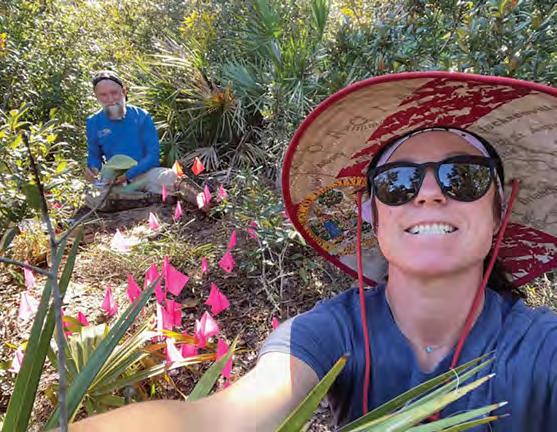
I a m grateful for the opportunity to have interned with the Florida Native Plant Society as supported by the Florida Wildflower Foundation in honor of Carolyn Schaag, Nancy Bissett and Anne MacKay. Little did I know that blushing scrub balm (Dicerandra modesta) and its last wild habitat that we have been restoring and monitoring, was going to come into the public eye because of a toll road that threatens it and Nancy’s property. Before starting the internship, I had been volunteering on plant rescues and D. modesta monitoring, and had a relationship with both the Tarflower and Pine Lily Chapters of FNPS, so I was thrilled to be able to join the team. FNPS Director of Communications Valerie Anderson was my direct supervisor for the internship that ran from January to June. Most recently, I have been employed as an operating room nurse. Looking for a career change more aligned with my soul’s purpose, I am attending Valencia College with the goal of earning a Bachelor of Science degree in Plant Science.
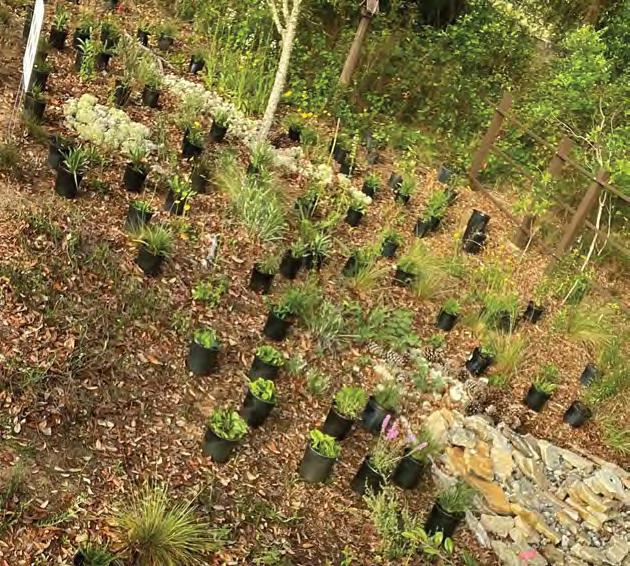
We developed the following goals for the internship: Support FNPS’s federally-funded restoration and monitoring of Dicerandra. I transitioned from volunteering to interning in January 2025, with that came
more responsibilities: Recruiting and managing volunteers, collecting and digitizing datasheets, and assisting in planning monitoring days for D. modesta. I had to catch up on the recovery plans for both D. modesta and D. cornutissima as well as the history of FNPS involvement in restoration and monitoring at the Marjorie Harris Carr Cross Florida Greenway and the Horse Creek Tract of Lake Marion Creek Wildlife Management Area.
Support FNPS’s conservation programs in Central Florida. The Central Florida plant rescue and restoration program is robust and volunteer-run and centered around the former Castle Hill Florida Forever Project site and nearby sandhill sites that the lead volunteers, Laura Bennett-Kimble and Rosi Mulholland, procure and maintain dig access to. I was able to work five plant rescue digs and two planting days. Plant rescues are physically and emotionally very difficult but are incredibly rewarding and I have a mountain of respect for
FNPS Team
Executive Director Melissa Fernandez-de Cespedes
Director of Communications
...................................................Valerie Anderson
Director of North Florida Programming
................................................... Lilly Anderson-Messec
Director of Operations
...................................................Cherice Smithers
Board of Directors
President ............................................................Eugene Kelly
President-elect...............................................Ann Redmond
Vice President, Administration .............Athena Phillips
Interim Vice President, Finance ...........Ann Redmond
Treasurer ............................................................Chris Moran
Secretary ...........................................................Bonnie Basham
Council of Chapters Chair ............................Rebekah Kaufman
Directors at Large:
..................................................................................Raelene Crandall
..................................................................................Richard Hamann
..................................................................................Gage LaPierre
..................................................................................Paul Schmalzer
..................................................................................Melanie Trexler
To contact board members
FNPS Administrative Services: Call (321) 271-6702 or email info@fnps.org
Committee Chairs
Conservation ...................................................John Benton
Council of Chapters .....................................Rebekah Kaufman
Education...........................................................Vacant
Policy and Legislation................................Eugene Kelly
Science................................................................Paul Schmalzer
Society Services
Administrative Services............................Cherice Smithers
Editor, Palmetto ..............................................Marjorie Shropshire
Webmaster........................................................Paul Rebmann
Make a difference with FNPS
Your membership supports the preservation and restoration of wildlife habitats and biological diversity through the conservation of native plants. It also funds awards for leaders in native plant education, preservation, and research.
Memberships are available in these categories: Individual; Multi-member household; Sustaining; Lifetime; Full-time student; Library (Palmetto subscription only); Business or Non-profit recognition.
To provide funds that will enable us to protect Florida's native plant heritage, please join or renew at the highest level you can afford.
To become a member:
Contact your local chapter, call, write, or e-mail FNPS, or join online at https://www.fnps.org/
The purpose of the Florida Native Plant Society is to preserve, conserve, and restore the native plants and native plant communities of Florida.
Official definition of native plant:
For most purposes, the phrase Florida native plant refers to those species occurring within the state boundaries prior to European contact, according to the best available scientific and historical documentation. More specifically, it includes those species understood as indigenous, occurring in natural associations in habitats that existed prior to significant human impacts and alterations of the landscape
Follow FNPS online:
Blog: https://www.fnps.org/from-the-field-blog Bluesky: https://bsky.app/profile/fnps.bsky.social Facebook: https://www.facebook.com/floridanativeplantsociety Instagram: https://instagram.com/floridanativeplantsociety/ LinkedIn: https://www.linkedin.com/company/florida native-plant-society-inc-/ YouTube: https://tinyurl.com/yx7y897d
2 Florida W ildflower Foundation – Florida Native Plant Society Internship Program Article by Kristin Luckock 4 2025 Florida Native Plant Society Photo Contest Winners
Palmetto
Editor: Marjorie Shropshire ● Visual Key Creative, Inc. ● palmetto@fnps.org (ISSN 0276-4164)
Copyright 2026, Florida Native Plant Society, all rights reserved. No part of the contents of this magazine may be reproduced by any means without written consent of the editor.
Palmetto is published four times a year by the Florida Native Plant Society (FNPS) as a benefit to members. The observations and opinions expressed in attributed columns and articles are those of the respective authors and should not be interpreted as representing the official views of the Florida Native Plant Society or the editor, except where otherwise stated.
Editorial Content
We welcome articles on native plant species and related conservation topics, as well as high-quality botanical illustrations and photographs. Contact the editor for guidelines, deadlines and other information.
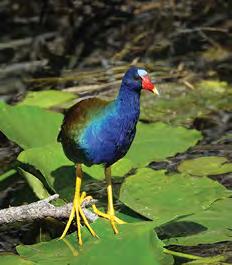
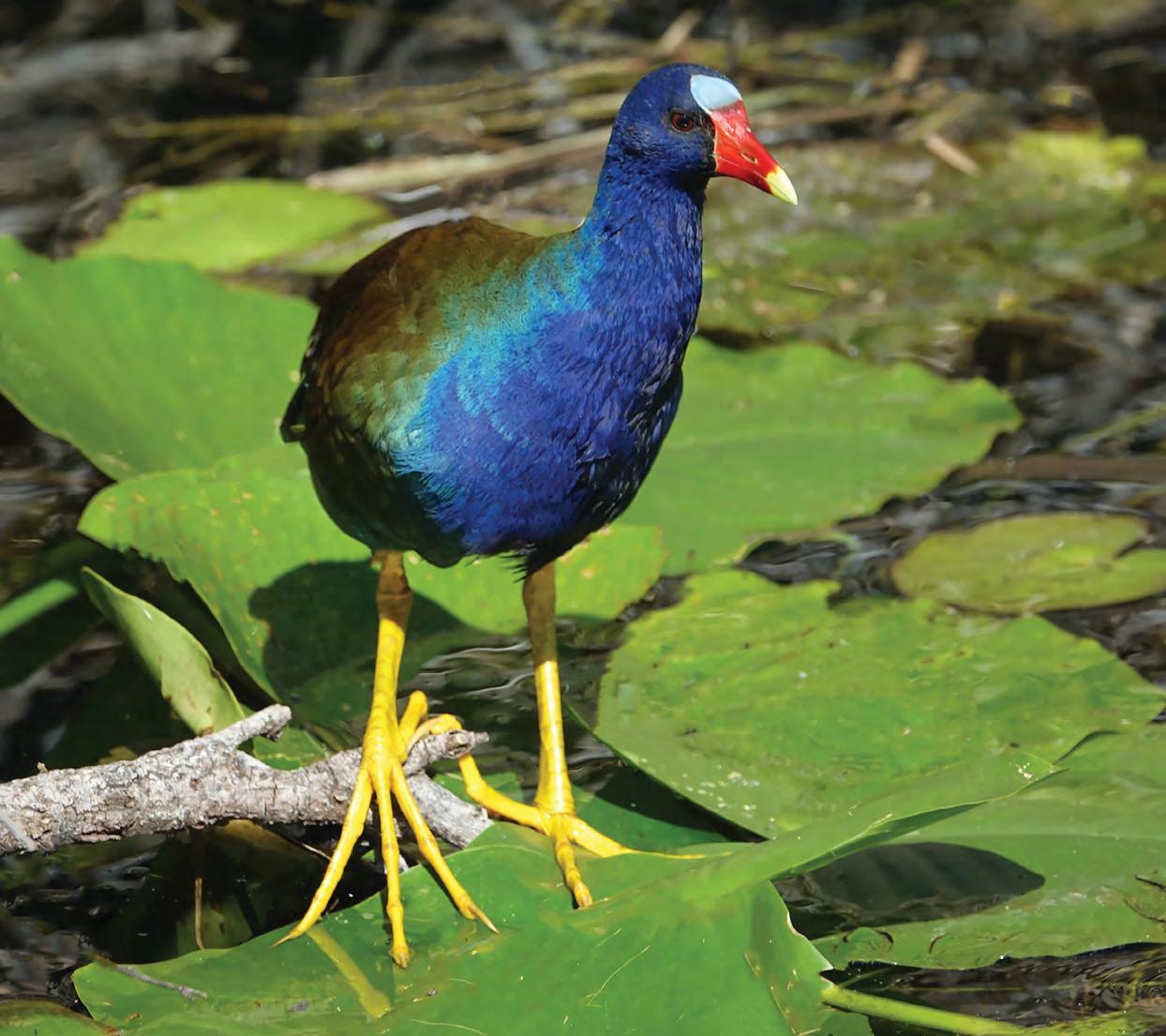
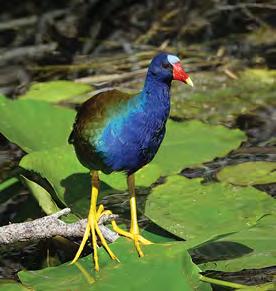
11 Hog Plum: Local Glimpse of a Cosmopolitan Celebrity Article by George K. Rogers 14 Spatterdock Article by Roger L. Hammer ON THE COVER: A Purple Gallinule walks across spatterdock leaves at the Anhinga Trail in Everglades National Park. Photo by Roger L. Hammer. See story on page 14.
Get Palmetto in print, delivered right to your door. Visit the FNPS website to sign up: https://fnps.app.neoncrm.com/forms/palmettoprint-and-ship-form
Access recent back issues of Palmetto at: https://www.fnps.org/Palmetto
Access more Palmetto articles here: https://www.fnps.org/article-index
Last summer, FNPS hosted its f irst photo contest in recent history as a way to engage with our membership, showcase the beauty and diversity of Florida native plants, and raise funds for our Internship Program. There were over 65 submissions in seven categories: Native Plants in Their Habitat;
Wildlife and Plant Interactions; Wide-Scale Landscapes Featuring Native Plants; Home Landscapes Featuring Native Plants; Artistic Interpretations; Advocacy in Action; and Youth Category.
The photo contest raised more than $1,200 for the FNPS Internship Program, which will help support
Stay tuned for the next photo contest opening later this summer. Visit https://www.fnps.org/photo-contest for more details.
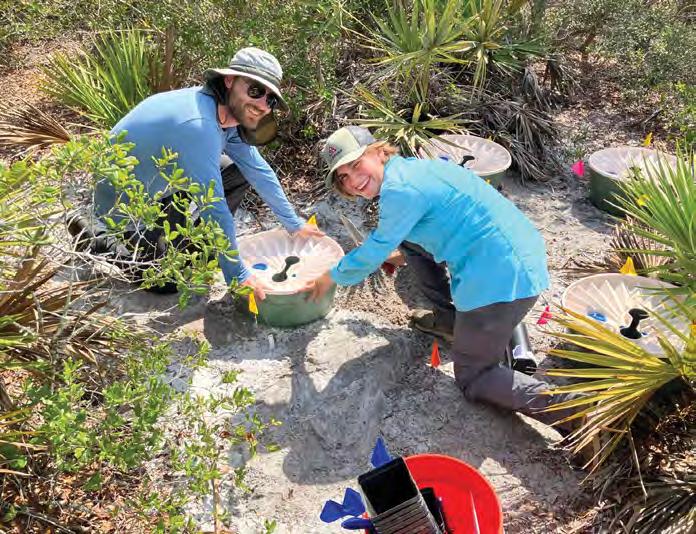
This photo was taken in July 2025 at the Silver Lake tract of the Lake Wales Ridge Wildlife and Environmental Area (Florida Fish and Wildlife property), at a new introduction of the endangered Avon Park harebells (Crotalaria avonensis). The photo documents Research Assistant Steven
various intern projects including scientific research, education, outreach, and digital storytelling. Thank you to all who participated in the 2025 Photo Contest. We also extend our gratitude to the judges – Adam Arendell, Danny Goodding, Cindy Liberton, and Linda Wilinski for their time and expertise.
Wagner (left) and Intern Avery Brooks (right) planting individuals of C. avonensis in a suitable scrub gap, with a passive watering box irrigation system. Introductions such as these are crucial to the persistence of this species due to it having only three naturally occurring wild populations, one of which is located on roadsides of a disturbed, unprotected neighborhood, a population which we are actively trying to rescue. C. avonensis is just one of many plants endemic to the Lake Wales Ridge which require long-term, active conservation efforts to protect and preserve. Entry submitted by Steven Wagner.
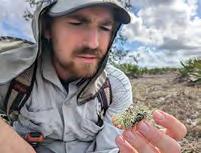
Sterling Herron is a Research Assistant in the Plant Ecology Program at Archbold Biological Station, where he has worked since 2021. Prior to that he earned a Ph.D. from St. Louis University and a B.S. from Milligan University. He has been interested in plants since his teens when he began exploring the Southern Appalachian ecosystem around his house in eastern Tennessee. His passion is to document and conserve the remaining, extraordinary biodiversity in Florida, with a special focus on the Lake Wales Ridge. His favorite native Florida plant is roundleaf bluet (Houstonia procumbens), and he enjoys going on nature walks with his dog "Monkey." He is a member of the Highlands Chapter of FNPS. Portrait by Hannah Bowen.
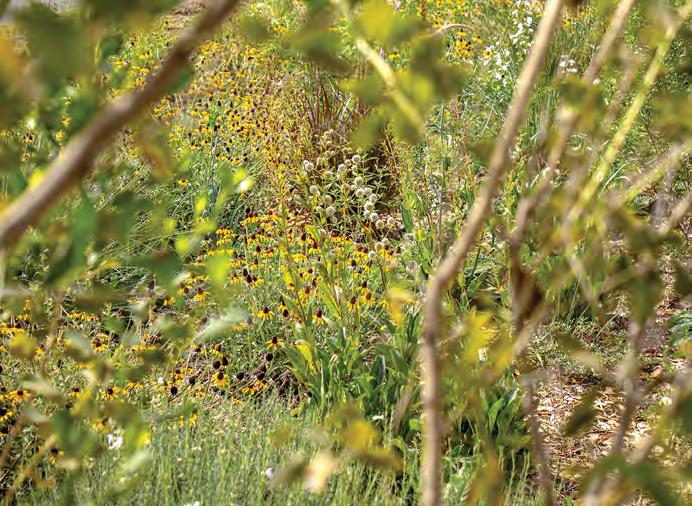
Home Landscapes Featuring Native Plants – Shelby Radcliffe
This photo was taken in early summer in my home garden, a suburban front lawn converted into my laboratory. The foreground shows the branches of a saltbush (Baccharis halimifolia). I keep the bottom four feet of the saltbush branches clear of foliage to show off the form and open up the inside of the shrub to view the rest of the garden easily. The background is full of black-eyed Susans (Rudbeckia hirta) that I allow to reseed to fill gaps in this young garden as well as provide some recognizable, long-blooming plants for my skeptical neighbors. False rosemary (Conradina canescens), manyflower beardtongue (Penstemon multiflorus), pink muhly grass (Muhlenbergia capillaris), rattlesnake master (Eryngium yuccifolium), and tall elephant’s foot (Elephantopus elatus) are also visible.
I grew many of the plants in my garden from seed, divisions, and cuttings. Most live plants that are added come from my favorite native nurseries, are shared with me by other gardeners, and sometimes are rescues. A few non-native plants are in the mix for contrast, structure, and sentimental value. For additional context, this garden sits on a slope in full sun without mulch, soil amendments, or canopy.
Shelby Radcliffe is a landscape designer and horticulturist based in Ocala. She co-leads Emergent Gardens, a design and build studio. Her favorite plants are native grasses and grass-likes. Currently, Carex cherokeensis sits at the top spot. Shelby is a member of the Marion Big Scrub Chapter of FNPS. Self-portrait by Shelby Radcliffe.
Native Plants in Their Habitat – Brian Podlisny
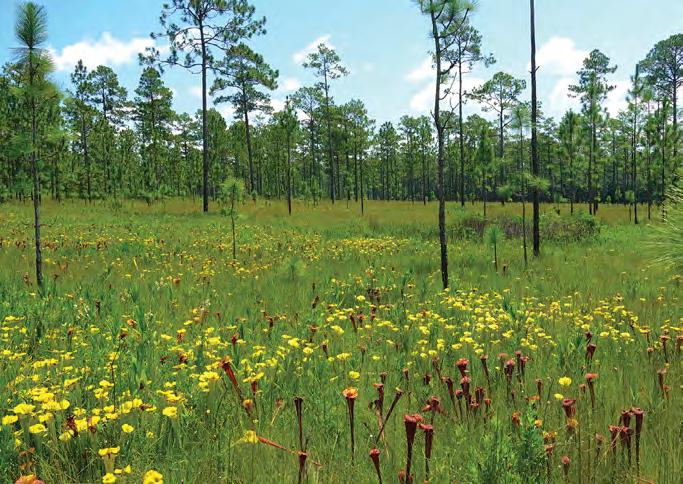
This photo was taken at Blackwater State Forest. I try to visit the Panhandle once a year. It was my first time going there and I was blown away by the amazing diversity and health of the forest.
I went with my partner, and we were cruising around the park appreciating various plants such as Platanthera ciliaris, Lilium iridollae, Liatris spp., Sarracenia spp., Sabdariffa aculeata, and many others. We decided to turn down a random forest road. Eventually we got to a huge pothole and got out of the car to walk the rest of the way. I vividly remember encountering my first Asclepias obovata there — that summer I had been captivated by milkweeds, so stumbling onto a species I’d never seen before felt like a real discovery.
At the end of the road, we saw a clearing with a creek. This clearing was filled with Sarracenia flava along with a few S. leucophylla. It was an amazing sight to see a field of Sarracenias, and it was unlike anything else I had experienced before. I hope that this field will continue to be protected for other people to enjoy.
Brian Podlisny has been fascinated by the natural world since childhood. Growing up in the north, he fell in love with plants and became obsessed with identifying them. Something about the pink lady’s slipper, Cypripedium acaule, really resonated with him, and he ended up learning everything he could about North American orchids. His interests gradually broadened to plants in general, and he was fortunate to eventually find himself in Florida for a teaching job — an incredible place for native plant diversity. In his free time Brian enjoys botanizing, tending his garden, and starting new horticultural projects. He is a member of the Paynes Prairie Chapter of FNPS. Portrait by Sean Candelaria.
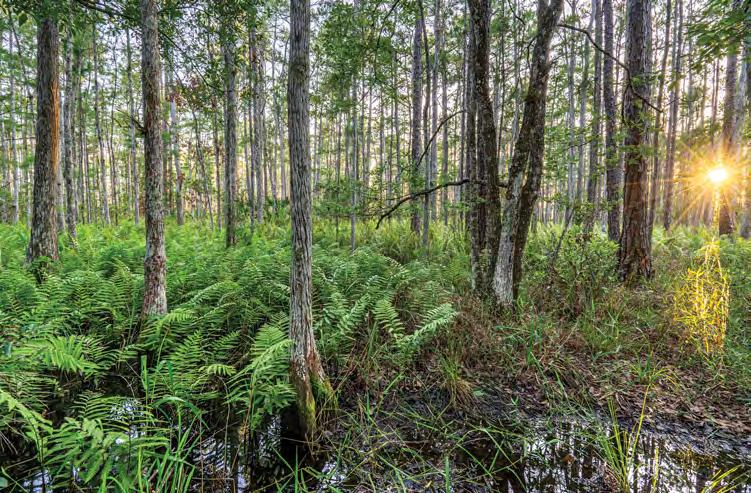
Hal Scott Regional Preserve and Park is a location I frequent each August and September for its beautiful wildflowers, with my personal favorite being the pine lily. On this particular day in June, I was on a different mission. We had a dry spring, and the summer rains had finally arrived, so my main goal was to photograph the Econlockhatchee River. Once I finished in that area of the park, the sun began to set, and on my way out of the park I passed by a patch of cypress trees and ferns brimming with life from all the rain.
I wandered around the cypress trees until I found an area that allowed the sun to burst between the trees. I set my camera up at a low angle to help accentuate the ferns and capture the setting sun.
C ypress swamps are an important ecosystem within Florida’s overall ecology and they provide habitats for numerous animals as well as water filtration. I enjoy this image because I hope it helps people see the beauty that exists in these swamps and in turn, inspires them to want to protect them for future generations.
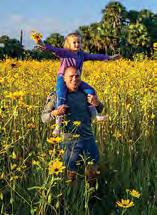
Brian Kamprath is an Orlando-based photographer whose work focuses on capturing the beauty, emotion, and wonder he encounters in wildlife, landscapes, and cultures around the world. Inspired to travel in 2003 by his wife, he discovered photography as a natural way to document his experiences, a pursuit that grew into a lifelong passion. Having visited all seven continents and both polar regions, Brian draws from his journeys to create images that foster a connection between viewer and subject. His images invite curiosity, empathy, and imagination while encouraging conservation and a deeper appreciation for the natural world. These days, his favorite pastime is enjoying nature alongside his wife and their 6-year- old daughter, watching her love for the outdoors grow with every adventure. Self-portrait by Brian Kamprath.
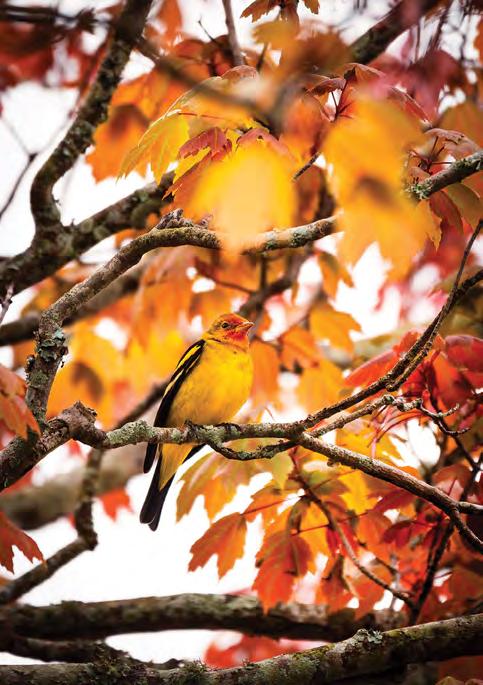
Artistic Interpretations – Mike Franqui
I was standing in my front yard when I took this photo, which makes it especially meaningful to me. A Western Tanager had perched in the red maple along our property line just as the leaves were beginning to change. What struck me right away was how perfectly it blended in — the yellow and orange feathers nearly disappearing into the tree if you weren’t really paying attention.
I captured the image with a Sony A7 IV and a 400mm lens, but it was really one of those moments that comes from simply being present. I spend a lot of time sitting outside, scanning the canopy, and this was a reminder of why.
A few years ago, we reduced our lawn and planted mostly native species, and the change in wildlife has been incredible. This photo feels like a reflection of that shift, proof that when you create the right conditions, nature shows up. It’s funny — there have been plenty of times my wife and I have gone out birding, only to come home and find something just as remarkable waiting for us here.
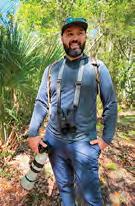
Mike Franqui is a Florida native, originally from Miami, who has lived in the Jacksonville area for the past 20 years. He works in the creative field and pursues nature photography as a passion, often finding inspiration right in his own backyard. With a camera in one hand and binoculars in the other, he spends his free time observing birds, butterflies, and other wildlife, especially in native landscapes. Having grown up in the city, his connection to nature came later in life, which may be why he approaches it with a sense of curiosity — always learning and seeing something new. Mike is a member of the Ixia Chapter of FNPS. Portrait by Amy Franqui
Wildlife and Plant Interactions –Kristina Gavigan
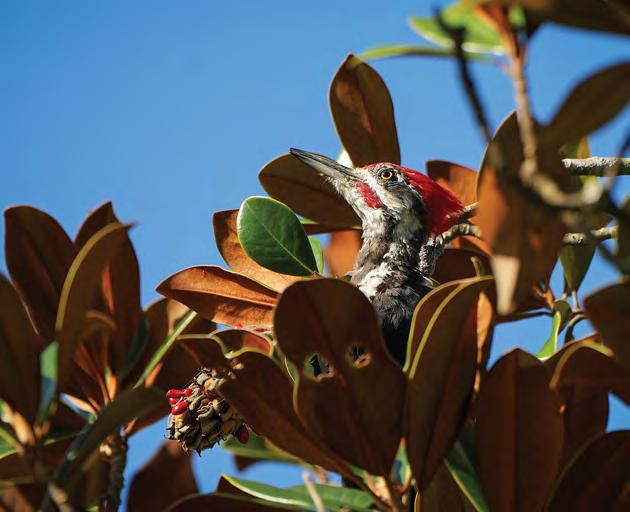
On an early September morning I was walking at the St. Johns County Agricultural Center, one of my favorite local spots to enjoy nature. As I walked along the lake, I heard the long chirpy call of a Pileated Woodpecker. By following the sound I was able to find him near the top of a southern magnolia (Magnolia grandiflora) surrounded by the tree’s lovely leaves. I moved slowly and quietly, and was able to capture a few photographs without disturbing him. He stayed there for a little while then flew on to another tree.
I named this photo Nestled because the male Pileated Woodpecker looked like he was sitting among the magnolia leaves, in his own little comfy chair. I thought to myself, how perfect! He looked so adorable with his head popping out from the bunch of leaves. This has become one of my favorite photos because I really like woodpeckers and the setting was perfect. Also I find it interesting that both the woodpecker and the magnolia have been viewed as symbols of strength.
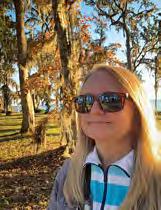
Before starting her photography business, Kristina was a stay-at-home mom who enjoyed getting out in nature for walks and adventures, taking photos, and blogging and crafting. Living in Florida created a love for birds, and in 2022, photography and birding meshed and she founded Enchanting Florida Photography. Her goal as a nature photographer is to share what she sees, and her hope is that people take time to appreciate the simple natural beauty that is all around us. She likes to describe nature as “free therapy” — a getaway, and
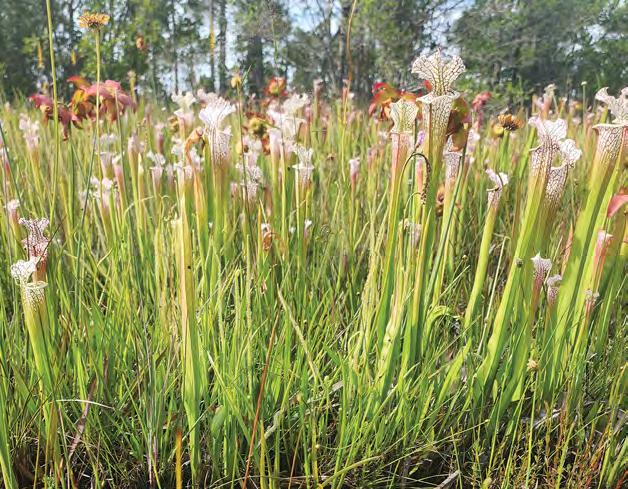
The photo I submitted for the photo contest was taken during a trip up to the Panhandle, and depicts Sarracenia leucophylla at Yellow River Marsh Preserve State Park in Santa Rosa County. Admittedly, it was taken by my phone, and since then I have gotten a camera and have
place to reset the mind. Kristina's personal motto is “not all who wander are lost — because sometimes getting lost in nature is the perfect place to be". Kristina is married, has two grown sons, and resides in St. Augustine, Florida. She has a B.S. in Education and worked with children for many years prior to starting a family. She is an at-large member of FNPS. Self-portrait by Kristina Gavigan.
been learning how to use it. I remember the drive there getting more and more exciting as we saw the Sarracenia begin to pop up alongside the road — I had my face basically pressed up against the window in excitement! It was our last stop of the entire trip and quite possibly the best in terms of the amount of Sarracenia. I wandered among the plants in pure bliss for a few hours and probably could have continued longer if the sun hadn’t begun to set.
I look back at those photos fondly as it was a special trip for me. It was my first time going on a trip just to see these plants in the wild and a very memorable vacation because of the memories I made with my dad. The experiences I had on that trip awakened a passion for these vital habitats that has stuck with me ever since and is continuously ever-growing as I spend more and more time out in nature.
Merranda Docksey is a high-school student from Citrus County. She loves Florida's native carnivorous plants, with Sarracenia psittacina and Pinguicula planifolia being her absolute favorites (though she finds it very difficult to choose). Her adoration for these beauties has led to a strong interest in Florida's wetlands; more specifically seepage wetlands. Learning more about these natural wonders has recently pulled her into researching, spotting, and photographing all of Florida's amazing flora and fauna. Portrait by Jayson Docksey.
Native Plants in Their Habitat –
Julie Mitchell
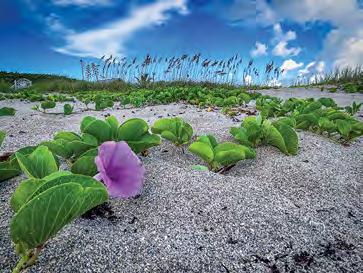
Beach morning glory. The name couldn’t have been any more telling of this morning on the beach last summer. I made a quick stop and everything was absolutely perfect — the sky, the sand, and the flower. I snapped this beauty with my son’s iPhone, and then set off to my day with a spring in my step and a smile on my face.
Julie Mitchell is a nature photographer, environmental scientist, and mom living in Stuart, Florida. Blending her love for the outdoors with a passion for storytelling, Julie likes to capture the quiet beauty of Florida’s wild spaces — coastal waters, hidden trails, and wild skies. With a scientist’s eye and an artist’s heart, she inspires others to slow down, look closer, and reconnect with the natural world. Self-portrait by Julie Mitchell
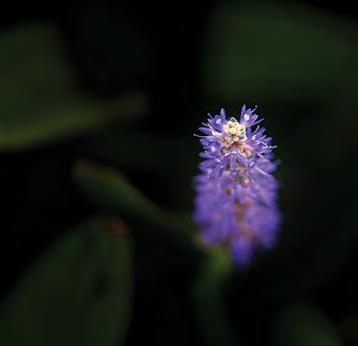
on one part of the flower while everything else fell into a soft blur. I loved how clean and minimal the image felt. At the time, I thought having a bee land on the flower would be the perfect finishing touch but the bees weren’t cooperating. In the end, I’m glad they didn’t, because it let the flower stay the true star of the shot.
Satesh Ramjattan has photographed the natural world for almost 20 years. His journey started by taking photos of flowers in his backyard, and has since blossomed into capturing landscapes and wildlife across Florida. He uses photography to help people connect with nature and understand why it’s so important to protect Florida's remaining wild places. He is a member of the Broward Chapter of FNPS. Find him online at https://satesh.com/ and https://www.youtube.com/@SateshRamjattan (educational videos). Portrait by Keila Ramjattan.
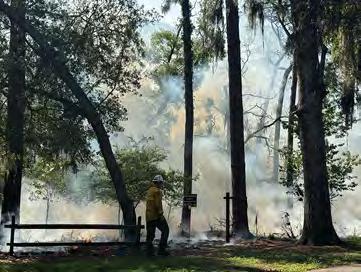
This photograph was taken at Mead Botanical Garden during a prescribed microburn. The land was in active transition, with flame moving low across the ground, consuming thatch and exposing the sandy soil beneath. In these upland systems, fire moves across the surface while water moves below it. The same deep, well-drained sands that carry flame also allow rapid infiltration, contributing to the recharge of water systems below. The photograph shows that intersection — fire above, water below, and the space between where change is actively unfolding.
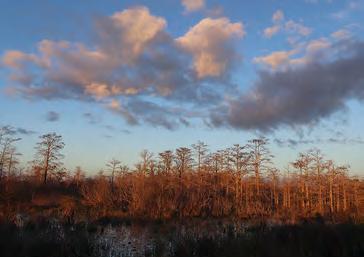
This image of a cypress stand at dawn, with fog still clinging to the ground, was taken at Loxahatchee Slough Natural Area during a Palm Beach County School District environmental day to introduce students and school district leaders to the marvels of Florida wetlands. Everyone enjoyed a swamp tromp, knee-deep in a wetland surrounded by cypress trees and epiphytes, and a canoe adventure through the adjacent slough.
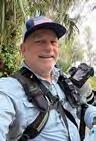
Paul Strauss's interest in nature imagery began in a high school photography class. After moving south to attend the Florida Institute of Technology, he encountered Florida's incredible mosaic of natural habitats that fueled years of exploration and adventure. A retired environmental administrator, he now captures Florida's magnificent flora and fauna as the owner of Osprey Nature Photography. Paul also volunteers for organizations such as the Florida Park Service, North American Butterfly Association, Florida Trail Association, Audubon of Florida and the Florida Native Plant Society. He is a member of the Martin Chapter of FNPS. Self-portrait by Paul Strauss.
I took this photo in late spring at Green Cay Wetlands in Delray Beach. When the pickerelweed was in full bloom, it looked like a giant purple blanket stretching across the marsh. At first, shooting in the early morning light, I wasn’t capturing the plant’s true beauty. I decided to simplify the scene by photographing a single flower. I used a 135mm lens at f/1.4, which let me focus

MAC Camacho-Viera is an environmental educator, natural areas interpreter, and allegory artist based in Central Florida. She draws inspiration from the landscapes she moves through, where fieldwork and art begin in the same place. She focuses on connecting people to natural systems through restoration, conservation, education, and access to nature for all. She is a UF/IFAS Master Gardener, Florida Master Naturalist, is on the board of the Oakland Nature Preserve, and is president of the Tarflower Chapter of FNPS. Self-portrait by MAC Camacho-Viera.
Wildlife and Plant Interactions –Lora Lekos
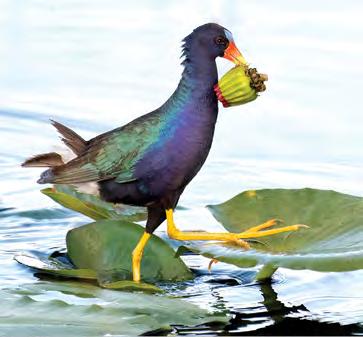
Purple Gallinule walk across water on the leaves of spatterdock in search of food. Being omnivores, these birds eat the fruit of aquatic plants, snails, fish and insects. Here the flower of spatterdock will provide a good meal. These native plants are prevalent in the Arthur R. Marshall Loxahatchee National Wildlife Refuge
and help support the life of these beautiful birds and other Florida wildlife.
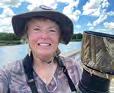
Lora Lekos is an award-winning photographer and member of the South Florida Nature Photography Club. She is a retired biologist and microbiologist and past president of the College Health and Environmental Safety Society of New Jersey. Lora and her husband volunteered as sea turtle rangers, working under a permit in Highland Beach, Florida for 5 years. Currently they volunteer for the US Fish and Wildlife Service giving free photography tours at Loxahatchee National Wildlife Refuge every Sunday, where both of Lora's winning FNPS Photo Contest photos were taken. Self-portrait by Lora Lekos.
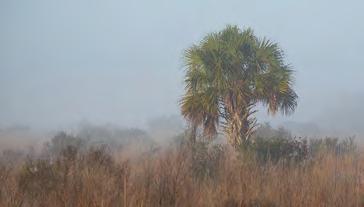
The cabbage palm, or “tree of life”, is the Florida State Tree. It is often the last tree standing after a bad storm. It provides shade, anchors the soil, and creates hiding places and refuge for animals. It was stunning in this foggy Everglades landscape observed at sunrise in Arthur R. Marshall Loxahatchee National Wildlife Refuge. See Lora’s profile above.
Plants
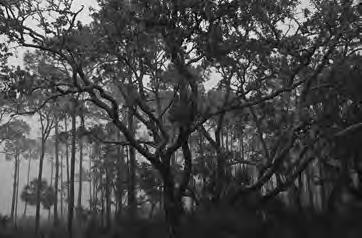
I upgraded my camera in July 2025 to a Nikon Zf, and a couple days later, I had a day off. The same day, some very strange weather was rolling through the Big Bend region. It was windy, rainy, much cooler, and very foggy, so I figured that would be a
good day to take my new camera for its first spin at St. Marks National Wildlife Refuge. St. Marks is an amazing place but its landscape really shines on gloomy, rainy days. Some of my favorite trees at the Refuge are the scraggly sand live oaks. I’ve driven by this particular tree dozens of times on sunny days, but the combination of daylight, fog, and rain completely changed how these oaks looked, and it seemed like the perfect lighting to test out some black-and-white photography. This picture stood out as particularly striking and eerie (it’s unedited and was taken with manual ISO and shutter speed settings). Florida’s swamp goth side is highly underappreciated.
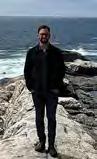
Garret Hall and his wife are native Illinoisans who moved to Tallahassee in 2020. He has been interested in photography since taking film photography classes in high school, but didn't pick up the hobby again until 2024 after finally purchasing a camera that wasn't just a cell phone. Coming from a landscape of corn as far as the eye can see, he is continually captivated by Florida's extremely unique ecology and the amazing photography opportunities it provides. Portrait by Stacy Kelly.
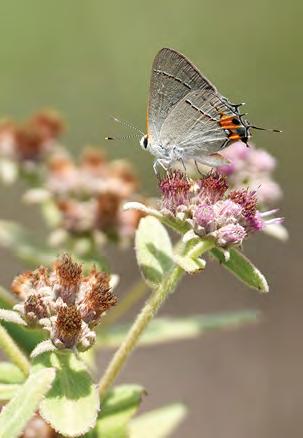
Photographing butterflies is one of my favorite pastimes; their shapes, sizes and vibrant colors are thrilling. I have travelled widely throughout the United States and Central and South America in pursuit of Lepidoptera species, from the Canadian border to the mountains of Colombia. Florida is blessed with a wide variety of native flowering plants that attract a diverse collection of butterflies, skippers
and other pollinators. Capturing this Gray Hairstreak butterfly as it was collecting nectar at Kissimmee Prairie Preserve State Park in Okeechobee County was fortunate indeed.
See Paul’s profile on page 8.
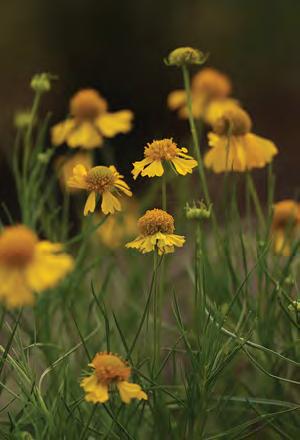
This photograph captures a blooming yellow sneezeweed (Helenium sp.) after we installed it in a native roadside pollinator habitat in a residential neighborhood. This was part of the Tierra Buena Project, a regenerative pollinator habitat initiative I co-founded with my friend Amira. This image represents a project where I spent significant time learning about Florida native plant species and the interconnected relationships between wildlife and habitat. This experience influenced my approach as an artist and designer, encouraging me to work with ecological awareness across disciplines.
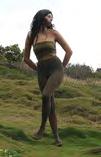
Janae Hernandez is a botanical artist and designer based in South Florida. Through her studio Plant Psyche she explores the relationship between artistic expression and ecological awareness by working across entomology, horticulture, landscape design, floristry, and photography. Her practice is guided by sustainability and shaped by years spent working in nurseries and closely observing both cultivated gardens and wild ecosystems. She uses photography to document unique plant encounters and landscapes, which later become reference points for identifying species and informing her botanical design work. Self-portrait by Janae Hernandez.
Continued from page 2
the long-time volunteers who keep these weekly rescues going. I learned a lot about the root structures and underground storage organs of many native sandhill plants and was able to see the small-but-mighty results that long term rescue and restoration projects have had at both Lake Apopka’s North Shore and Lake Louisa State Park.
Support public education about the rare mints and the threats they face. I was preparing to support FNPS’s annual educational program about the Dicerandra genus, Dicerandra Day, but due to a family issue, had to step back from the internship before I was able to begin to plan in earnest. Before this was necessary, however, we learned of the Florida Turnpike Enterprise’s plans to put a toll road not only through Horse Creek Scrub, the site that we have been monitoring and restoring D. modesta at since 2018 and that is the last remaining wild population of the species, but also through The Natives, the native nursery owned by FNPS founding member Nancy Bissett. I was able, through this internship, to speak up professionally opposing this road on ecological grounds. As FNPS is the only organization opposing any route of the Polk Parkway Eastern Extension that harms blushing scrub balm, it was empowering to be at the front of this issue in the face of so much unchecked development in the Orlando metro area.
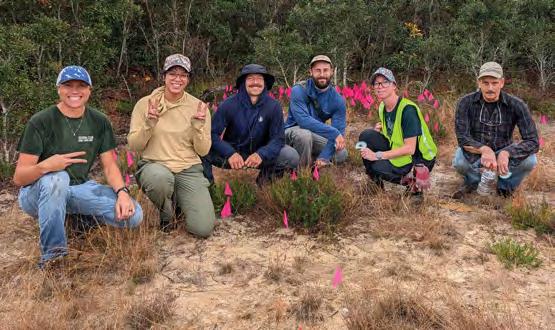
D espite having to step back from the internship early, I was able to make sure the 2024 D. modesta monitoring season was successful, support other FNPS conservation efforts, and support public education about the rare mint genus Dicerandra and the threats to these species, including a proposed toll road through our project site. I am grateful for the experience in rare plant conservation and environmental communication as I start on my new career journey.
Experts recommend making a will or reviewing your existing will when you:
l acquire assets or property
l get married or divorced
l have a child
l move to a new state or country
l change your mind about something important
l haven’t reviewed your will for five years
Without a will, your assets will get tied up in probate and be distributed based on the inheritance statute of the state where you live.

By George K. Rogers
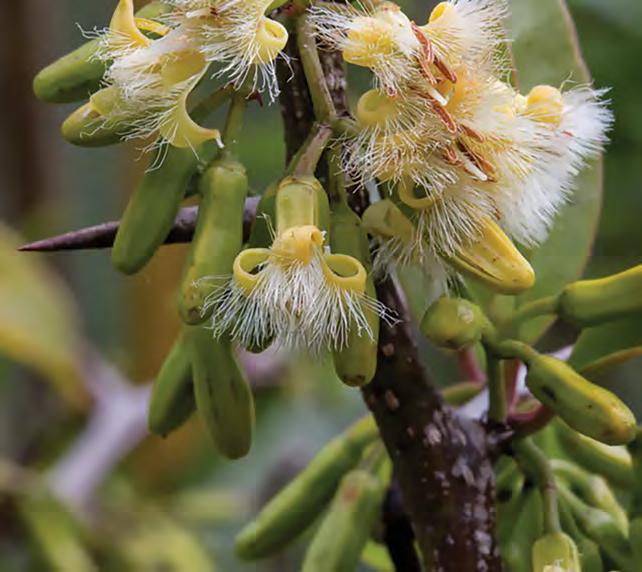
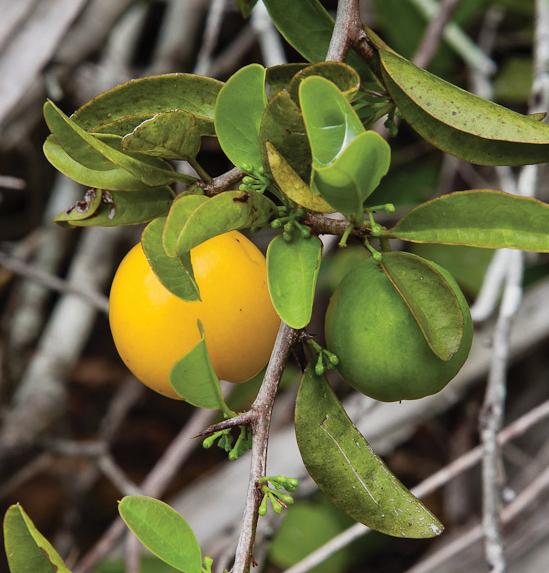
Hog Plum (Ximenia americana) is a compelling though thorny friend of Florida scrub-lovers, especially when its fuzzy fragrant flowers are in full bloom (Figure 1). With the assistance of a wide range of pollinators, those transform into yellowish-orange “plums” (Figure 2) which eventually litter the ground below. The parent plant seemingly can discourage competition from its progeny, and the seeds almost never sprout. The plums do, however, feed gopher tortoises, raccoons, and additional creatures that scatter the inner pits, allowing the plant to repopulate after a long delay. Judging from scat in places where hog plums are found, raccoons must be superspreaders. Beyond dispersal by creatures, the nearly indestructible pits are also able to float across oceans.
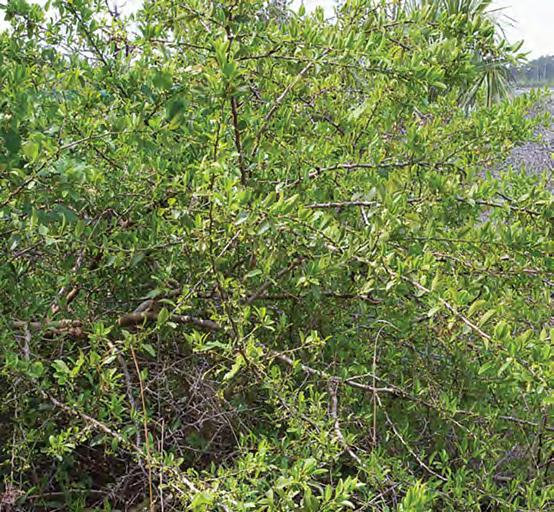
Hog plum thrives in unforgiving scrub habitats, gnarled and prickly on dry sugar sand tortured by relentless sun and wind. The contorted branches can rise up at wacky angles (Figure 3), lean on neighbors, or sprawl across the sand. Individuals found in hammocks are greener and less weatherbeaten. One special harsh-habitat adaptation is hemiparasitism, described and nicely illustrated for hog plum by Teo (1997). The roots have suckers (haustoria) to steal sustenance from neighboring plant roots, about which the parasite is not selective, sometimes attaching to itself. How much the thievery benefits the hog plum and hampers the host is not well known. Robertson (1982), points out that they can attach to hosts hundreds of the largest haustoria (3 cm diameter) of any North American parasite, causing apparent losses in some
forestry contexts. Interestingly, hog plums can also grow in containers with no host plants present.
A lso helpful for hog plum survival are expendable branches reminiscent of blackberry thickets and Smilax tangles. Rough times may kill branches, but hog plum plants simply replace
them when conditions improve. As demonstrated over decades of repeated research (Hacke et al., 2022), plants from harsh droughty habitats typically have narrow internal water pipes (vessel elements) as a safety feature against drying, which damages wide pipes. From data I compiled recently for a separate project (Rogers, 2025), hog plum pipes appear to be surprisingly broader-diametered and drought-susceptible than those of its scrubby shrub neighbors. In the graph below (Figure 4) based
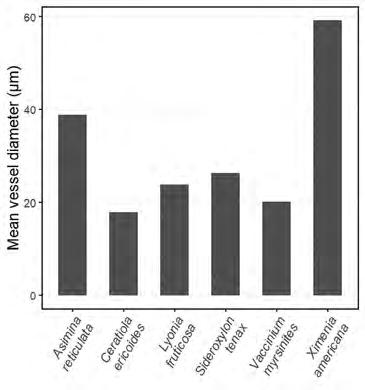
on 542 measurements on local scrub shrubs, hog plum has the widest pipes. To speculate a moment, could the shrub need high-risk high-volume plumbing to fill those watery plums? If so, it seems the big pipes deliver water during the wet season until dry times kill the stems after fruitdrop. Then replacement branches sprout forth when summer rains return (Figure 5). Netted pawpaw (Asimina reticulata) in second place for perilous pipe diameter is interesting, because it has drought protection from dry-season dormancy. Sand live oak (Quercus geminata) and myrtle oak (Q. myrtifolia) have average pipe diameters approaching those of hog plum but are deep-rooted trees.
S ome Florida scrub dwellers are limited to skimpy localized distributions, such as four-petal pawpaw (Asimina tetramera) or red widow spiders (Latrodectus bishopi). By contrast, hog plum is a globalist, despite the misnomer Ximenia americana (Figure 6).
How does it achieve intercontinental migration and residency on oceanic islands? Self-compatible flowers often help lone pioneers found a new population, but despite reasonable expectations of
this, over 300 experimental self-pollinations in hog plum failed (Robertson, 1982), although perhaps there’s room for another look at this. Birds may help, but the main long-distance mover is the buoyant fruit stone with an inner airspace. Adapted to establishment in nasty places, the seedlings have an unusual adaptation, the first two little leaves, instead of rising to face the brutal sun, retreat down into safe spaces in the seed.
By making plums, offering wood where wood is precious, feeding livestock, and treating ailments, today’s species has deep historic roles in human affairs worldwide. Safety note: Although the fruits are used as food in regions with cultural knowledge of preparation, hog plum makes cyanide and other compounds, so don’t consume the fruit or other hog plum products.
There is a lot of hog plum across sub-Saharan Africa, and it has been around there awhile. Fossil Ximenia pollen in Tanzania is over 1.6 million years old (Bonnefille et al., 1982). In Ethiopia, hog plum has declined in recent decades due to over-harvesting wood for kitchen utensils, tool handles, and charcoal (Fewssa et al., 2012). A hog plum problem in Africa we don’t experience in the
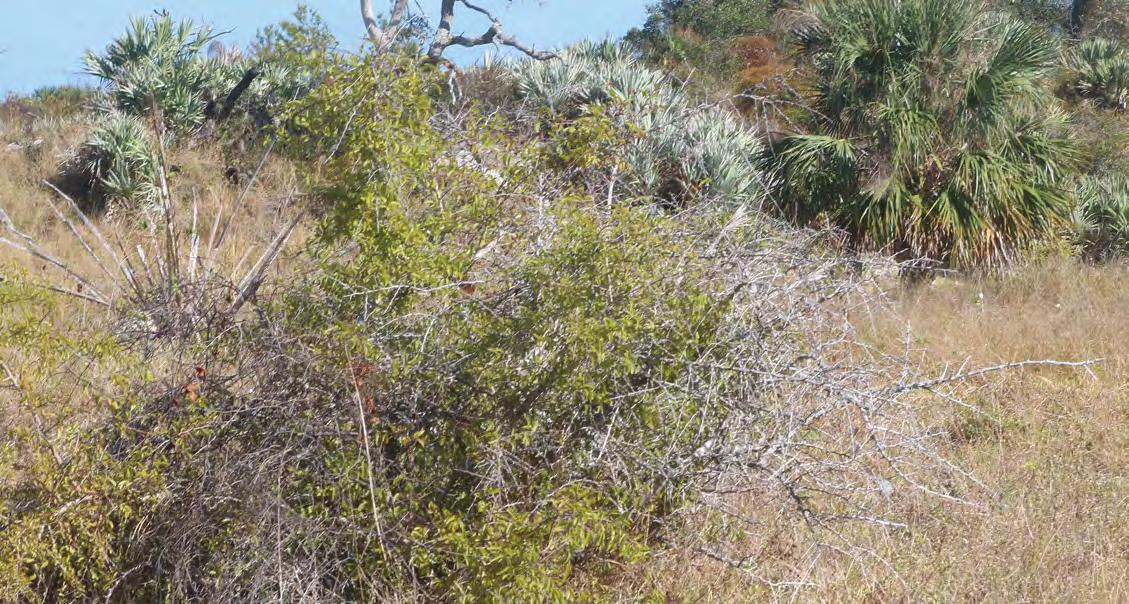
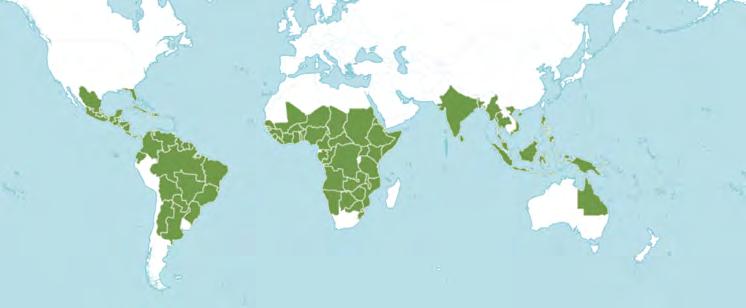
Figure 6: Despite the name Ximenia americana, hog plum ranges widely across the world. The map above shows its native range. Source: Kew Backbone Distributions, The International Plant Names Index and World Checklist of Vascular Plants 2026. Published on the Internet at http://www.ipni.org and https://powo.science.kew.org/ © Copyright 2023 World Checklist of Vascular Plants. http://creativecommons.org/licenses/by/3.0
Sunshine State is competition for the plums with baboons. And speaking of pesky safari wildlife, one of many reported hog plum applications is to counter cobra venom. Additional past and present medicinal uses are too numerous to list here, but a sampler includes application to fight constipation, fleas, leeches, leprosy, hemorrhoids, and staphylococcus infections. In India there’s Ximenia incense. The fermented fruits are ingredients in beers, and as flavor in specialty gin. Indonesian cooks grind the leaves into a condiment, and in Tropical Asia it turns up in jellies and preserves.
The seeds are rich in oil serving every oily use you know and more: For hair, for antisepsis and healing, as lip balm, for that soft youthful complexion, for cooking, and as lamp fuel. The oil also has industrial value as a binder for pills.
Our little globalist has even garnered climate change attention. Burkina Fasso
is well endowed with Ximenia americana where it offers all those benefits noted above. A single tree there can generate 50 kg of plums, feeding families and creating vendor opportunities along rural roads and in urban markets. Moreover, the year-round foliage is a mainstay for livestock herders. A recent study (Lompo et al., 2021) showed about 62% of the land area to be proper habitat, but there is a fly in the ointment: Climate change models reduce that area by up to 25% by 2070. That matters because the hog plum fruiting peak hits seasonally when other gathered foods are scarce.
L et’s return to the smooth handsome wood. Before WWII it was an export to Japan from the Yap Islands east of the Philippines. Arguably the most remarkable use for Ximenia americana wood comes from Pacific Islands, mainly Fiji. There wooden stands called kali serve as neck pillows that elevate the head to
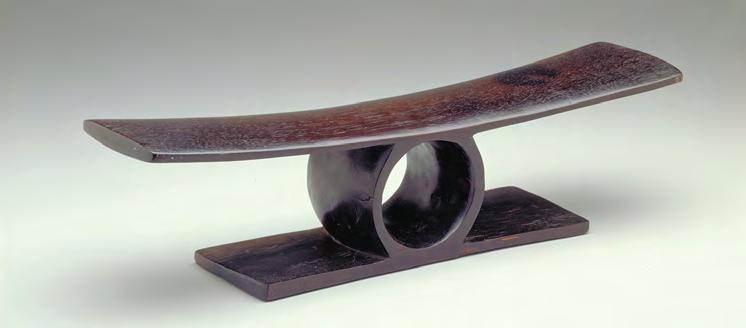
Figure 7: A Fijian neckrest carved from the wood of Ximenia americana. Such headrests were reserved for chiefs. Photo courtesy of the Minneapolis Institute of Art. Public Domain (CC PDM). https://collections.artsmia.org/art/5680/neckrest-fiji.
avoid mussing elaborate hair styles on sleeping nobility (Figure 7). The favorite hardwood for kali was, you guessed it, Ximenia americana, being glossy, tough, and fragrant. Artisans polished the wood to a fine finish using shark skin.
To sum it up, in Florida scrub, hog plum is not merely an ankle-poker with perfumed flowers and raccoon food. It is a living museum piece of worldwide significance. And I’ll bet there’s plenty we don’t know about its storied history in human affairs where its colorful plums, fancy wood, and multipurpose oil have served since antiquity.
NOTE: Uses of Ximenia americana are included for cultural context only. Ximenia americana generates cyanide and other compounds. Fruits and other products should not be consumed or used. Medicinal uses mentioned in the article are not approved treatments in the United States.
Bonnefille, R., Lobreau, D., & Riollet, G. (1982). Fossil pollen of Ximenia (Olacaceae) in the Lower Pleistocene of Olduvai, Tanzania: Palaeoecological implications. Journal of Biogeography, 9 (6), 469. https://doi.org/10.2307/2844614
Fewssa, D.H., Njoka J.T., Asfaw, Z., & Nyangito, M. (2012). Uses and management of Ximenia americana, Olacaceae in East Shewa, Ethiopia. Pakistan Journal of Botany, 44, 1177–1184. https://www.academia.edu/78955762/Uses_and_ management_of_ximenia_americana_olacaceae_in_semi_ arid_East_Shewa_Ethiopia
Govaerts, R. (editor). 2024. WCVP: World checklist of vascular plants Facilitated by the Royal Botanic Gardens, Kew. Retrieved February 21, 2026, from http://sftp.kew.org/ pub/data-repositories/WCVP/
Hacke, U. G., Jacobsen, A. L., & Pratt, R.B. (2022). Vessel diameter and vulnerability to drought-induced embolism: W ithin-tissue and across-species patterns and the issue of survivorship bias. IAWA Journa l, 44(3) 1–16. https://doi.org/10.1163/22941932-bja10107
Lompo, O., Dimobe, K., Mbayngone, E., Savadogo, S., Sambaré, O., Thiombiano, A., & Ouédraogo, A. (2021). Climate influence on the distribution of the yellow plum ( X imenia americana L.) in Burkina Faso. Trees, Forests and People, 4, 100072. https://doi.org/10.1016/j.tfp.2021.100072
Robertson, K. R. (1982). The genera of Olacaceae in the s outheastern United States. J ournal of the Arnold Arboretum, 63 (4), 387–399. https://doi.org/10.5962/p.37035
Rogers, G. K. (2025). Variation in vessel element diameters and densities across habitats at the community and species levels in Southeast Florida. Biology, 14 (4), 391. https://doi.org/10.3390/biology14040391
Teo, S. P. 1997. Root hemi-parasitism in Malayan Olacaceae. Gardens’ Bulletin Singapore 49 : 7-13
George K. Rogers was Professor and Department Chair for Horticulture at Palm Beach State College. Now retired, his current research interests involve relating xylem anatomical traits to environmental parameters in South Florida, and studying the floristic ecology and system sustainability in a local forest remnant that supports a population of gopher tortoises. He writes about native plant topics on his blog, Treasure Coast Natives, https://treasurecoastnatives.com/
By Roger L. Hammer
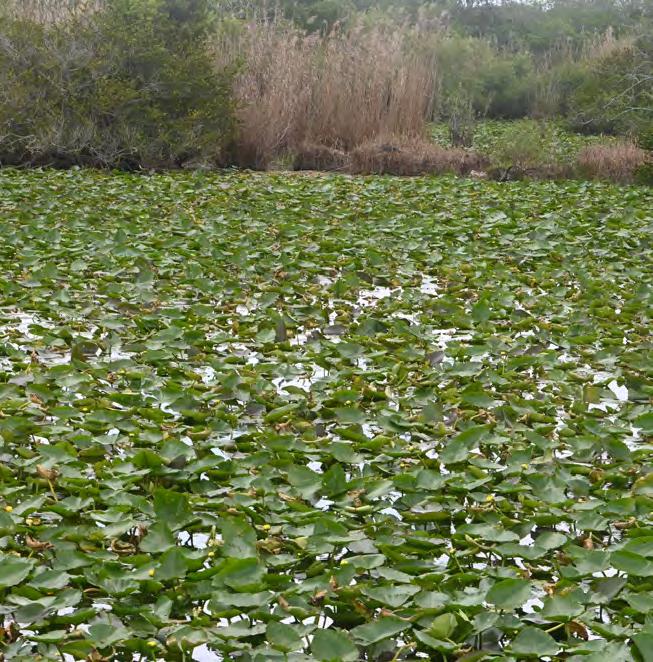
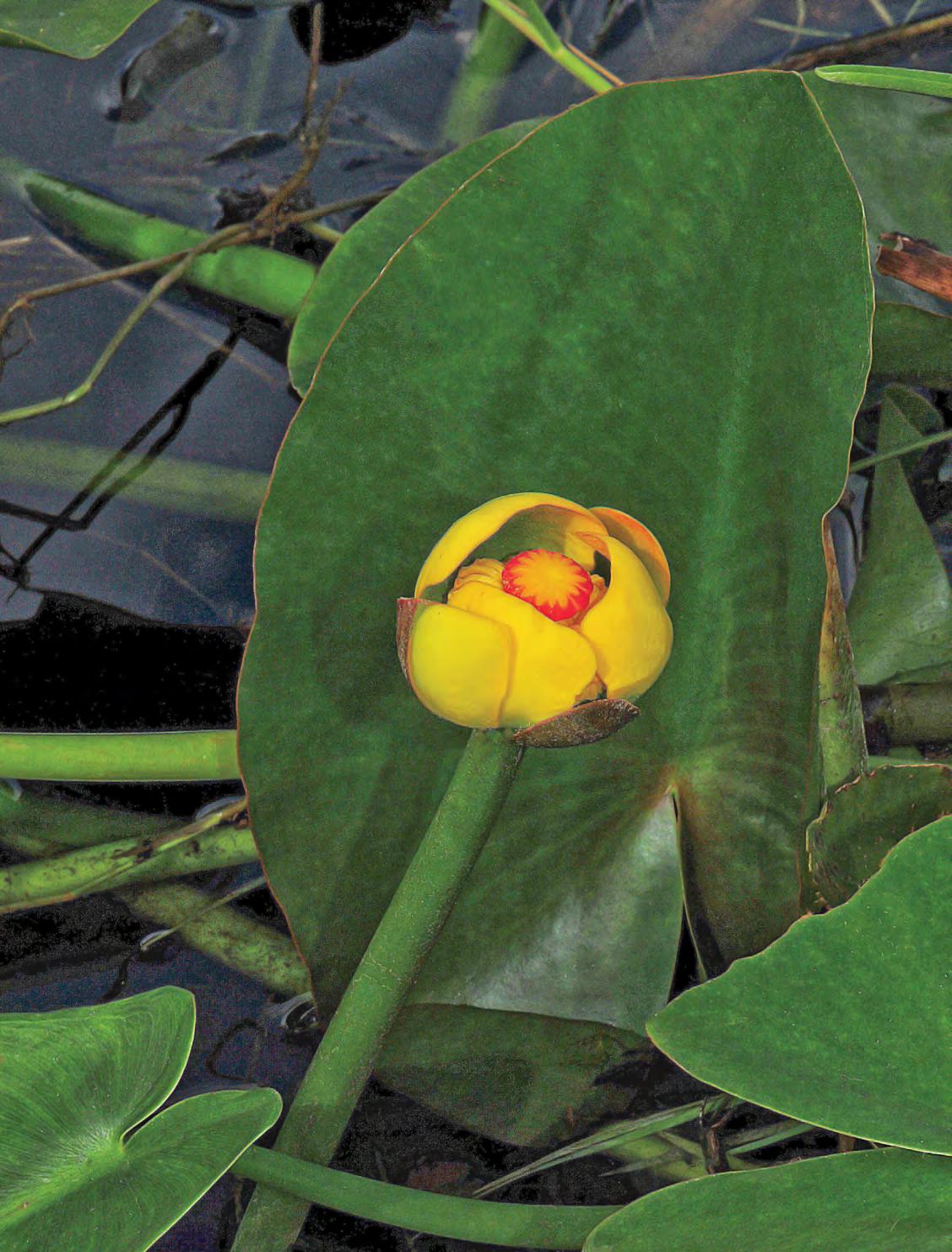
Florida’s waterways, lakes, ponds, and roadside ditches are often adorned with the native spatterdock (Nuphar advena), which is also known by the names cow-lily, yellow pond-lily, immigrant pond-lily, alligator bonnet, and brandy bottle.
The name spatterdock was first used in 1813 and alludes to the manner in which the seed capsules burst open, spattering the seeds across the water surface. The name “cow-lily” reflects the habit of cows wading out into shallow water to graze on the leaves, and then we have the name “immigrant pond-lily,” referring to the species name, advena, which is Latin for immigrant, outsider, or stranger, and relates to spreading from one place to another by any means, but can also allude to spreading into regions outside of its native range, which this species has done. And the name “alligator bonnet” alludes to alligators that are frequently seen among the plants, with leaves that sometimes cover their head like a bonnet. And finally, we come to the name “brandy bottle,” referring to the seeds that are shaped like small flasks. Historically, spatterdock had been an important source of food and medicine for Native people, who moved it around during their travels. The rhizome was added as a starchy
vegetable in stews and other dishes, or sun-dried and ground into flour. Also, the seeds were roasted over campfires and eaten. As a medicine, the juice from crushed leaves was used to stop bleeding from small cuts and scrapes.
Wildlife, such as deer, hogs, marsh rabbits, and turtles will feed on the leaves and, during times of drought or low water levels, they will eat the spongy rhizomes.
Spatterdock is in the Nymphaeaceae, or waterlily family, with broad, somewhat heart-shaped leaves that are typically held above the water surface. The yellow, cupped flowers stand above the leaves with yellow, petal-like, inner sepals. And, due to its aggressive nature, it is seldom purposely cultivated because it would overwhelm a water garden, or even shallow ponds, in short order.
Taxonomists once divided Florida plants into the subspecies advena, orbiculata, and ulvacea, with the latter two restricted to northern Florida northward, but in the Flora of the Southeastern United States (Weakley, 2022), they were given species status as Nuphar advena, Nuphar orbiculata, and Nuphar ulvacea. The common species in Florida is Nuphar advena, with a range that stretches across eastern North America from Labrador, Nova Scotia and New England south through mainland Florida and west to Texas. Some botanists also consider it native to Eurasia. It was first described as Nymphaea advena in 1789 by Scottish botanist William Aiton (1731–1793). A botanical synonym is Nuphar lutea, with the species name being Latin for yellow, in reference to the flower color. Flowering is typically from March through July.
Take a walk around the boardwalk at Anhinga Trail in Everglades National Park during winter and spring and look for Purple Gallinules walking across the spatterdock leaves as they search for snails, small frogs, and insects.
References
Dressler, R.L., Hall, D.W., Perkins, K.D., and Williams, N.H. (1987). Identification manual for wetland plant species of Florida (SP-35). University of Florida, Institute of Food and Agricultural S ciences.
Hammer, R.L. (2018). Complete guide to Florida wildflowers Rowman & Littlefield.
Weakley, A. Flora of the Southeastern United States. (2022). University of North Carolina. https://fsus.ncbg.unc.edu/cust/2022/main.php?pg=request-flora-pdf.php
Roger L. Hammer is an award-winning professional naturalist, author, botanist and photographer. His most recent books are Paddling Everglades and Biscayne National Parks and Foraging Florida – Finding, Identifying, and Preparing Edible Wild Foods in Florida Find him online at https://www.rogerlhammer.com/
FNPS Chapters and Representatives CHAPTER ......................................... REPRESENTATIVE......................................E-MAIL
1. Beluthahatchee.......................Kelly Tesiero & Laura Swartz .......................beluthahatchee@fnps.org
2. Broward .......................................Tiffany Duke ............................................................broward@fnps.org
3. Citrus ............................................Ellen McNally ..........................................................citrus@fnps.org
4. Coccoloba .................................Sara Burke & Ben Johnson.............................coccoloba@fnps.org
5. Conradina ..................................Beth Blackford .......................................................conradina@fnps.org
6. Cuplet Fern.................................Alan Squires ............................................................cupletfern@fnps.org
7. Dade ..............................................Riki Bonnema .........................................................dade@fnps.org
8. Eugenia .......................................David Martin ............................................................eugenia@fnps.org
9. Heartland ...................................Samuel Igo & Gregory Thomas ...................heartland@fnps.org
10. Hernando ...................................Janet Grabowski ...................................................hernando@fnps.org
11. Highlands ..................................A aron David .............................................................highlands@fnps.org
12. Ixia ..................................................Cate Hurlbut ............................................................i xia@fnps.org
13. Lake Beautyberry .................Tina Mertz .................................................................lakebeautyberry@fnps.org
14. Longleaf Pine ............................K imee Bremner .....................................................longleafpine@fnps.org
15 Magnolia ....................................James Cooper .........................................................magnolia@fnps.org
16. Mangrove ...................................Kristin Hoffschmidt .............................................mangrove@fnps.org
17. Marion Big Scrub ..................Deborah Curry........................................................marionbigscrub@fnps.org
18. Martin County .........................Pete Grannis ..........................................................martincounty@fnps.org
19. Naples ..........................................Sara Burke & Ben Johnson.............................naples@fnps.org
20. Nature Coast ............................Carol Malfa & MaryKay Zimmerman ........naturecoast@fnps.org
21. Palm Beach County .............Vacant .........................................................................palmbeachcounty@fnps.org
22. Passionflower...........................Marty Proctor .........................................................passionflower@fnps.org
23. Pawpaw ......................................K aren Walter & Amy Legare ..........................pawpaw@fnps.org
24 Paynes Prairie .........................Sandi Saurers .........................................................paynesprairie@fnps.org
25. Pine Lily ......................................Dana Sussmann....................................................pinelily@fnps.org
26. Pinellas ........................................David Perkey ...........................................................pinellas@fnps.org
27. Sarracenia .................................Lynn Artz ...................................................................sarracenia@fnps.org
28. Sea Rocket ...............................Elizabeth Bishop & Alyssa Sferrazza ......searocket@fnps.org
29. Serenoa .......................................Trent Berry ................................................................serenoa@fnps.org
30. Suncoast ...................................Michelle Anaya ......................................................suncoast@fnps.org
31. Sweetbay ..................................Rhonda Hoeckley .................................................sweetbay@fnps.org
32. Tarflower ....................................Deborah Ferencak ...............................................tarflower@fnps.org
33. The Villages ...............................Diane Caruso ..........................................................thevillages@fnps.org

It's easy! Simply contact your local Chapter Representative, or call, write, or e-mail FNPS. You can also join online by using the QR code, or visiting https://www.fnps.org/support/membership
Contact the Florida Native Plant Society: PO Box 5007 Gainesville, FL 32627. Phone: (321) 271-6702 Email: info@fnps.org Online: https://fnps.org
Submit materials to PALMETTO: Contact the Editor: Marjorie Shropshire Visual Key Creative, Inc. Email: palmetto@fnps.org