
Palmetto 42(1)

Page 1


The Quarterly Journal of the Florida Native Plant Society

Michaux and Florida Orchids ● 2025 FNPS Landscape Awards ● Elderberry or Water Hemlock?
Save the date for the FNPS Biennial Conference

April 1-4, 2027

Daytona Beach, Florida

A Living Mosaic –Connecting People, Plants, and Places

FNPS is special because it unites people from all walks of life to advocate for what is many times an overlooked piece of the picture. Mosaics have long been a tool in land management for prescribed burns and to understand how landscapes function in larger ecosystems and their interconnectedness. The vast diversity of Florida is a living mosaic that we are part of, and it deserves attention.

The conference venue will be the beautiful Shores Resort and Spa. Located right on the ocean, it offers fantastic views and a pledge to sustainability. The resort is certified by the Florida Department of Environmental Protection as a Florida Green Lodging, and they are also a member of the Coastal Connections Partnership to provide safe beaches for sea turtles. They offer two EV charging stations, free WiFi,

morning beach yoga, monthly sunset sound bath sessions, complimentary bike rentals, bocce ball, pickleball, tennis courts, shuffleboard, an on-site arcade, and more. There are also pet friendly lodging options.

If you prefer to camp, private campgrounds are located nearby, and Tomoka State Park and Canaveral National Seashore are about a half an hour away.

Visit https://www.fnps.org/conference to find out more. To be considered for a presentation spot, join the conference committee, volunteer, or create our conference logo, email Athena Philips at conferencechair@fnps.org.

FNPS Team

Executive Director Melissa Fernandez-de Cespedes

Director of Communications

Valerie Anderson

Director of North Florida Programming

Lilly Anderson-Messec

Director of Operations Cherice Smithers

Board of Directors

President Eugene Kelly

Past President Mark Kateli

President-elect Ann Redmond

Vice President, Administration Athena Phillips

Interim Vice President, Finance ...........Ann Redmond

Treasurer Chris Moran

Secretary Bonnie Basham

Council of Chapters Chair ............................Rebekah Kaufman

Directors at Large: Raelene Crandall

Susan Earley

Richard Hamann

Gage LaPierre

Paul Schmalzer

Melanie Trexler

To contact board members

FNPS Administrative Services: Call (321) 271-6702 or email info@fnps.org

Committee Chairs

Conservation John Benton

Council of Chapters .....................................Rebekah Kaufman

Education Vacant

Policy and Legislation Eugene Kelly

Science................................................................Paul Schmalzer

Society Services

Administrative Services Cherice Smithers

Bookkeeping Care Accounting

Editor, Palmetto Marjorie Shropshire

Webmaster Paul Rebmann

MEMBERSHIP

Make a difference with FNPS

Your membership supports the preservation and restoration of wildlife habitats and biological diversity through the conservation of native plants. It also funds awards for leaders in native plant education, preservation, and research.

Memberships are available in these categories: Individual; Multi-member household; Sustaining; Lifetime; Full-time student; Library (Palmetto subscription only); Business or Non-profit recognition.

To provide funds that will enable us to protect Florida's native plant heritage, please join or renew at the highest level you can afford.

To become a member: Contact your local chapter, call, write, or e-mail FNPS, or join online at https://www.fnps.org/

The purpose of the Florida Native Plant Society is to preserve, conserve, and restore the native plants and native plant communities of Florida.

Official definition of native plant:

For most purposes, the phrase Florida native plant refers to those species occurring within the state boundaries prior to European contact, according to the best available scientific and historical documentation. More specifically, it includes those species understood as indigenous, occurring in natural associations in habitats that existed prior to significant human impacts and alterations of the landscape

Follow FNPS online:

Blog: https://www.fnps.org/from-the-field-blog Bluesky: https://bsky.app/profile/fnps.bsky.social Facebook: https://www.facebook.com/floridanativeplantsociety Instagram: https://instagram.com/floridanativeplantsociety/ LinkedIn: https://www.linkedin.com/company/florida native-plant-society-inc-/ YouTube: https://tinyurl.com/yx7y897d

Features

4 Illustrious Plant Explorer André Michaux and Florida Orchids

Article and illustrations by Mary Ruden

8 What Defines Excellence in a Florida Landscape?

Article by Natalia Manrique

12 Common Elderberry or Water Hemlock?

Article by Roger L. Hammer

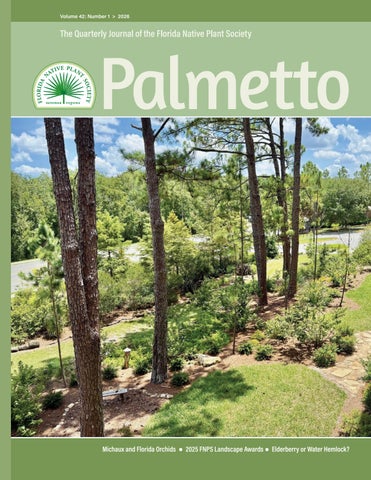
ON THE COVER:

Palmetto

Editor: Marjorie Shropshire ● Visual Key Creative, Inc. ● palmetto@fnps.org

(ISSN 0276-4164) Copyright 2026, Florida Native Plant Society, all rights reserved. No part of the contents of this magazine may be reproduced by any means without written consent of the editor.

Palmetto is published four times a year by the Florida Native Plant Society (FNPS) as a benefit to members. The observations and opinions expressed in attributed columns and articles are those of the respective authors and should not be interpreted as representing the official views of the Florida Native Plant Society or the editor, except where otherwise stated.

Editorial Content

We welcome articles on native plant species and related conservation topics, as well as high-quality botanical illustrations and photographs. Contact the editor for guidelines, deadlines and other information.

The University of North Florida Botanical Garden's Bioswale Garden transformed a flood-prone campus corridor into a functioning stormwater system planted with native species. Photo by Rhonda Gracie. See story on page 8.

Get Palmetto in print, delivered right to your door. Visit the FNPS website to sign up: https://fnps.app.neoncrm.com/forms/palmettoprint-and-ship-form

Illustrious Plant Explorer André Michaux and Florida Orchids

André Michaux (1746-1802) was a French plant explorer, and among his vast botanical discoveries were orchids. He made plant discoveries in North America, including Canada, Florida, and even the Bahamas, totaling approximately 742 vascular plant species. A range of plant species, including several species of orchids found in Florida, bear his name with the suffix “Michx.” (see the table below).

Florida has over 100 species of native orchids, more than any other state, and many are threatened or endangered. Crested yellow fringed orchid (Platanthera cristata) is one of the most spectacular. In Michaux’s time it was classified as Habenaria cristata. It inhabits bogs, marshes, and prairies and can have blooms up to three feet in height. It can form natural hybrids with other Platanthera species such as P. ciliaris, P. blephariglottis, and P. chapmanii. Its numerous apricotcolored flowers are delicately fringed and have a short nectar spur. It is also referred to as crested fringed orchid and is found in mid and northern Florida as well as the eastern and southeastern parts of the United States. It is a summer bloomer. Green wood orchid, also called green reinorchid or little club spur bog orchid (Platanthera clavellata), is also a bog or

Florida orchids with the suffix "Michx."

Platanthera cristata (Michx.) Lindl.

Platanthera clavellata (Michx.) Luer

Malaxis unifolia Michx.

Habenaria quinqueseta (Michx.) Eaton

A note about scientific names and authority names:

In many publications, the scientific names of plants are followed by the name of the author of the scientific description of the species.* Older author's names may be abbreviated, as in the case of Michaux, written as Michx. When a plant is reclassified, more than one author's name will be used.

To learn more, visit: https://libanswers.nybg.org/faq/223266

*Palmetto does not follow this convention.

marsh dweller with bloom spikes of small pale green flowers with a nectar spur. Michaux’s description reflects its clavellate spur, which means club-shaped and rather small. It is a summer bloomer and can self-pollinate. Green wood orchid is found in the Florida Panhandle and throughout the United States and Canada.

Green adder’s-mouth orchid (Malaxis unifolia) has numerous tiny pale greenish-yellow flowers and is a bog dweller. The plant can be one and one-half feet high and blooms in the summer. In Florida, it can be found in the Panhandle and in Alachua, Marion and Hernando Counties. It is also widely seen in the United States and Canada.

The commonly called Michaux’s orchid, or longhorn false reinorchid (Habenaria quinqueseta) is perhaps his best-known orchid discovery. It inhabits bogs, damp woodlands and pine forests, and can be seen throughout Florida and in southeastern states such as South Carolina, Georgia, Alabama, Mississippi, Louisiana, and Texas. It is also found in Central America, Mexico, the Caribbean, and the northern portion of South America. Its characteristic spidery-looking white flower has a nectar spur up to about 10 centimeters long, and it may include about a dozen flowers on the bloom spike. The famed botanical artist Blanche Ames illustrated it in her book Drawings of Florida Orchids, published in 1947, which includes two other orchids discovered by Michaux. The other Michaux orchids she illustrated are Platanthera cristata and Malaxis unifolia. To view Ames’s illustrations, visit https://catalog.hathitrust.org/ Record/006826411. In 1921 she also designed the official cast bronze seal for the American Orchid Society, which depicts a Native American man holding the native Florida butterfly orchid (Encyclia tampensis) and a lady slipper orchid (Cypripedium sp.). Her fame as an artist is well known, and she was married to the botany professor and Director of the Botanical Museum at Harvard University Oakes Ames.

A long-spurred version of Michaux’s orchid may be an ecotype or related species of Habenaria quinqueseta Habenaria quinqueseta var. macroceratiti s is its name, although the Atlas of Florida Plants lists this name as a synonym**. It has a characteristic long spur measuring 12 to 18 centimeters, and is found in mid and central Florida and Central and South

Facing page, left to right, top row: Florida orchids and pollinators: Cranichis ladiestresses (Cyclopogon cranichoides); Habenaria quinqueseta var. macroceratitis**; waterspider false reinorchid (Habenaria repens); bearded grasspink (Calopogon barbatus); green wood orchid (Platanthera clavellata). Left to right, bottom row: Tall neottia (Cyclopogon elatus); Carter’s orchid (Basiphyllaea corallicola), Chapman’s fringed orchid (Platanthera chapmanii). Illustration by Mary Ruden. **See note at: https://florida.plantatlas.usf.edu/plant/species/958

America. One of its known pollinators is the night-flying giant sphinx moth (Cocytius antaeus). This moth also is known to pollinate the ghost orchid (Dendrophylax lindenii), one of Florida’s most illustrious orchids that is mostly seen in the Fakahatchee Strand Preserve State Park.

Several species of Florida orchids are mentioned in Michaux’s journal, such as pinepink (Bletia purpurea), an orchid that grows in moist areas and bogs, with long stems and hot pink flower clusters. The flowers have a yellow center, and it is easily recognized by its long strap-like leaves. It is often grown in bog gardens, as it makes a good backyard orchid for a water feature. Threebirds orchid (Triphora trianthophoros) was mentioned in his journal and is found in mid and northern Florida. It has delicate white to pale pink flowers and very small leaves on short stems. Rose pogonia (Pogonia ophioglossoides), found widely throughout Florida, has small, beautiful pink flowers with a showy, large lower lip that resemble a miniature Cattleya orchid. It is also found in woodlands and swamps throughout the United States and Canada. Hairy shadow witch (Ponthieva racemosa) grows throughout Florida in shady forests. It has a rosette of wide leaves and small, hairy, white and green flowers. Non-Florida orchids mentioned in Michaux’s journal are showy lady’s slipper (Cypripedium reginae), showy orchid (Galearis spectabilis), and Loesel’s wide lipped orchid (Liparis loeselli ). They have been renamed since his original journal entries were made. Ragged fringed orchid (Platanthera lacera) is one of Michaux’s discoveries that is found in the southeastern, mid, and northeastern United States and Canada. According to the Atlas of Florida Plants, it was previously reported in Florida, but no specimens are known from Florida at this time. In 1802-1803 Michaux’s expedition took him across Ohio, Kentucky, Tennessee, and the Carolinas. In his journal, he reported seeing colonies of yellow lady slipper orchids and terrestrial orchids. Travels to the West of the Allegheny

Mountains was published by his son, Francois André Michaux, and André Michaux authored two books, The History of North American Oaks and Flora Boreali-Americana, in Latin. He died of a fever in 1802 on the island of Madagascar, where he was exploring after previously collecting plants in Australia. Native orchids are an indicator of ecosystem health as they require specific conditions to survive. Their presence or absence can be a telltale sign of a well-functioning ecosystem with high biodiversity. Orchids’ intricate relationships with pollinators sometimes have specialized mechanisms to ensure their survival. By creating and maintaining habitats, we expand the diversity of plant life and pollinators.

Above: A ghost orchid and pollinators. Left to right: Giant sphinx moth (Cocytius antaeus); ghost orchid (Dendrophylax lindenii); fig sphinx moth (Pachylia ficus). Illustration by Mary Ruden.

Above, left to right: Michaux’s orchid (Habenaria quinqueseta); crested yellow orchid (Platanthera cristata); ragged fringed orchid (P. lacera); green adder's-mouth orchid (Malaxis unifolia). Illustration by Mary Ruden.

References

Ames, B. (1947). Drawings of Florida orchids: With explanatory notes by Oakes Ames Ormond, Florida. [Cambridge, Mass: Printed at the Botanical Museum]. https://catalog.hathitrust.org/Record/006826411

Luer, C. A. (1972). The native orchids of Florida The New York Botanical Garden. Michaux, A. (1805). Flora boreali-americana [Parisiis et Argentorati, pp. 193-194]. https://catalog.hathitrust.org/Record/102969106

Michaux, F. A. & Thwaites, R.G Travels to the west of the Alleghany Mountains (1805). [Cleveland, Ohio : The Arthur H. Clark Company, 1904]. https://www.loc.gov/item/04017886/ Rembert, D. H. (2004). André Michaux’s travels and plant discoveries in the Carolinas. Castanea 69, no. sp2 (December): 107–18. https://doi.org/10.2179/0008-7475(2004)sp2[107:amtapd]2.0.co;2

Uttal, L. J. (1984). The type localities of the Flora boreali-americana of André Michaux. Rhodora, 86 (845), 1–66. https://www.biodiversitylibrary.org/page/6716085

Wunderlin, R. P., B. F. Hansen, A. R. Franck, and F. B. Essig. (2025). Atlas of Florida plants. https://florida.plantatlas.usf.edu/

About the Author

Mary Ruden has authored and illustrated two folding field guides on native orchids of North America for the Waterford Press’s A Pocket Naturalist series. Native Orchids of North America has 75 species illustrated with descriptions of them and their habitat, and Native Orchids of Florida covers 83 species. She has produced two posters on native orchids and does educational displays to help with conservation. She was featured in the September 2024 issue of the American Orchid Society’s magazine, Orchids Mary is a member of the American Society of Botanical Artists. Visit her website at: https://www.maryruden.com/

What Defines Excellence in a Florida Landscape?

In a state defined by water, wind, salt, heat, and relentless development, excellence can no longer be measured by neat hedges and clipped lawns.

The 2025 FNPS Landscape Award winners remind us that the most beautiful landscapes today are not about ornament alone. They are about resilience, about function, about protecting what remains of Florida’s native ecosystems and restoring what we can.

Excellence as Residential Restoration

The Wellendorf Plantation –Tallahassee, Florida

Applicants: Nia and Shane Wellendorf Category: Residential Landscaping, Homeowner-Created Native Landscapes

On three suburban acres in Tallahassee, biologists Nia and Shane Wellendorf asked a radical question: What if a yard could function like a habitat?

At The Wellendorf Plantation, over 100 native plant species now thrive not as decoration, but as structure. Meadow replaces lawn. Shrubs and forbs replace exotics. Mature trees anchor a bird-friendly sanctuary designed for flight access, food, and water.

They removed invasive species and replaced the lawn with meadow. They established native plant species sourced thoughtfully and locally, and created habitat for birds, pollinators, and wildlife. What was once a conventional yard is now a sanctuary not just for themselves, but for the broader Tallahassee community. And in doing so, they created something increasingly rare in Florida’s suburban matrix – a functioning ecosystem.

Excellence here is not measured in symmetry or surface polish. It is measured in species richness. In bird flight paths. In the return of insects. Elevated into the dynamic luxury of a living system.

Above: The Wellendorf Plantation in Tallahassee, Florida was designed to create habitat for birds, pollinators, and wildlife. Photo by Nia Wellendorf.

Excellence as Coastal Resilience

Marine Discovery Center Native Wildflower Demonstration Garden – New Smyrna Beach, Florida

Applicant: Marine Discovery Center and Lindley’s Nursery and Garden Center

Category: Pollinator and Wildlife Demonstration or Community Gardens

On the coast in New Smyrna Beach, the Marine Discovery Center’s Native Wildflower Demonstration Garden tells another story.

Installed, expanded, disrupted by renovation, and then rebuilt, the garden stands as a testament to coastal resilience. Designed for full sun, sandy soils, low nutrients, and salt-laden winds, it demonstrates that native plants are not fragile alternatives. They are, in fact, Florida’s most durable design solution.

When significant plant loss occurred during a 2022 entrance renovation, the response was not to replace the garden with something easier or more conventional. Instead, it was restored thoughtfully and intentionally.

That decision matters. Today the garden serves as a public classroom, showing that coastal landscapes can thrive without excessive inputs, irrigation, or chemical dependence.

Public landscapes teach by example. They quietly set standards for what is possible, what is appropriate, and what is valued. By choosing native coastal plants again, the Marine Discovery Center reaffirmed that resilience, not trend, defines excellence.

The Marine Discovery Center's garden features native coastal plants that can thrive in full sun, sandy soils, and tolerate salt-laden winds. Photos by Karen Walter (above) and Sonia Guidry (below).
Photo by Karen Walter.

Excellence as Infrastructure

University of North Florida Botanical Garden: Bioswale Garden – Jacksonville, Florida

Applicant: Rhonda Gracie and Kelly Tesiero

Category: Commercial and Institutional Landscaping

On the campus of the University of North Florida, a flood-prone corridor became an opportunity.

Co-designed by Rhonda Gracie and Kelly Tesiero, the Bioswale Garden transformed stormwater from liability into design driver. Gravel channels, diverse native plantings, preserved mature trees, and a cut-and-fill approach reduced runoff by approximately 31%.

Here excellence took the shape of water, transforming a flood-prone campus corridor into a functioning stormwater system planted with native species.

But perhaps more importantly, it became a living laboratory.

Students planted. Staff participated. The broader community engaged. The landscape does not simply manage water; it demonstrates how water should be managed in Florida.

For too long, we have separated beauty from utility as if landscapes must choose between being ornamental or functional – the idea that we thought we had to choose between a pretty yard and a healthy planet. The bioswale rejects that false choice.

Excellence here is measurable. It slows water. It reduces waste. It invites community.

Redefining the Standard

For decades, Florida landscapes have been judged by polish, turf uniformity, and imported aesthetics disconnected from place. But in an era of stronger storms, biodiversity loss, water pollution, and habitat fragmentation, those standards feel outdated.

Continued on page 14

Above: The University of North Florida Botanical Garden's Bioswale Garden transformed a flood-prone campus corridor into a functional, educational landscape. Photos by Rhonda Gracie.

Common Elderberry or Water Hemlock?

A Question of Life or Death

Above, left to right: Common elderberry (Sambucus nigra subsp. canadensis). Elderberry flowers have smooth tips, and the fruits are fleshy, one-seeded drupes. Photos by Roger L. Hammer.

In June 2015 I was working as a survivalist instructor on the Discovery Channel’s reality TV show, Naked and Afraid, being filmed on a 6,000-acre ranch in Lake County, Florida.

My job was to choose the site where the two contestants should build a camp as their home base for the 21-day episode, so I chose a location next to a spring run that meandered through the surrounding forest. The most redeeming aspect about that location was them having fresh drinking water from a nearby crystal-clear spring, plus a place to bathe, and where they could harvest plenty of freshwater mussels from the spring run to steam on their campfire.

Also, growing alongside the spring run were flowering plants of common elderberry (Sambucus nigra subsp. canadensis) with small, white flowers in flat-topped clusters called umbels. The flowers are edible, or they can be used to brew an herbal tea. And, although the small, black fruits are edible, it is not recommended to eat them in quantity because they contain alkaloids called hydrocyanic acid and sambucine, both of which can cause nausea and vomiting when consumed in quantity.

However, growing among the elderberries along the spring run was another native plant with small, white flowers produced in umbels, called spotted water hemlock (Cicuta maculata), and any part of this plant can be fatal if eaten. So, another task I had as a survival instructor was to ensure that the two naked contestants didn’t eat the wrong plant and create a life-threatening medical emergency.

It reminded me of a book I read by Jon Krakauer, titled Into the Wild, about a guy who dropped out of society to go live off the land in Alaska, and who would later misidentify a toxic plant called wild sweet pea (Hedysarum mackenzii ) for an edible relative called wild Eskimo potato (Hedysarum alpinum), and that mistake may have cost him his life.

Elderberry is found in every county in Florida except the Monroe County Keys, and spotted water hemlock is found discontinuously across the Florida Panhandle south down the peninsula to Collier and Broward counties.

An important key to separating common elderberry flowers from those of spotted water hemlock is that the flower petals on spotted water hemlock are notched at the tip, while those on

Left and above: The flowers of spotted water hemlock (Cicuta maculata) are notched at the tip. Photos by Roger L. Hammer.
Above: The leaves of spotted water hemlock (Cicuta maculata) are alternate. If you have a hand lens, look at the bottom of the lance-shaped, serrate leaflets and you will see that the veins terminate between the marginal teeth. Photo by Roger L. Hammer.

Common Elderberry or Water Hemlock?

common elderberry are not. Also, elderberry is a woody species, reaching 12’ tall or more, while spotted water hemlock is typically four to five feet tall with hollow, herbaceous stems mottled with purple. Another identifying key is that the compound leaves of elderberry are opposite, whereas those on spotted water hemlock are alternate. And, if you have a hand lens, look at the bottom of the lance-shaped, serrate leaflets on spotted water hemlock and you will see that the veins terminate between the marginal teeth, while the veins on elderberry terminate at the tips of the teeth.

The fruits of each species are vastly different, with spotted water hemlock producing dry capsules compared to the elderberry’s fleshy, one-seeded drupes.

There is at least one nice thing to mention about spotted water hemlock, and that is it’s a larval host plant of the black swallowtail butterfly (Papilio polyxenes). However, there are numerous other native species in the same family (Apiaceae) that can be grown to attract female black swallowtails looking to lay eggs, as well as garden herbs like fennel, dill, and parsley.

If you grow common elderberry, it will prefer reliably wet soil, and you will be able to harvest the flowers to make herbal tea, use the fruits to make elderberry pie, or even wine, made famous by Elton John when he sang his hit song, “Elderberry Wine”.

References

Krakauer, J. (2020, December 5). How Chris McCandless Died Medium. https://medium.com/galleys/how-chris-mccandless-died-992e6ce49410

Morton, J. F. (1968). Wild plants for survival in South Florida Hurricane House Publishers. Nelson, G. (1996). The shrubs and woody vines of Florida Pineapple Press Inc.

About the Author

Roger L. Hammer is an award-winning professional naturalist, author, botanist and photographer. His most recent books are Paddling Everglades and Biscayne National Parks and Foraging Florida – Finding, Identifying, and Preparing Edible Wild Foods in Florida Find him online at https://www.rogerlhammer.com/

Continued from page 11

What Defines Excellence in a Florida Landscape?

The 2025 FNPS Landscape Award winners redefine excellence as:

● Ecological restoration in residential spaces

● Demonstrated resilience in coastal environments

● Infrastructure that works with natural systems

● Community engagement through living landscapes

● Protection of Florida’s native plant heritage

These landscapes are ornamental – yes. They are beautiful. But their beauty is rooted in function.

We can continue to replicate models imported from climates and ecosystems unlike our own. Or we can cultivate landscapes that reflect this place, its soils, its hydrology, its wildlife, its history.

The 2025 FNPS Landscape Award winners point clearly toward the latter.

Their work reminds us that the most compelling landscapes today are not the most controlled. They are the most alive. If this is what excellence looks like; layered, adaptive, biodiverse, and rooted in place, then the future of Florida landscapes is not just beautiful. It’s resilient. The 2025 winners prove that we no longer have to choose between a landscape that looks good and one that does good. In Florida, if it isn’t functional, it isn’t excellent.

About the Author

Natalia Manrique is a member of the FNPS Landscape Committee and co-owner of NaMa Native Landscapes and Flora of Miami.

FNPS Chapters and Representatives CHAPTER ......................................... REPRESENTATIVE...................................... E-MAIL

1. Beluthahatchee....................... Kelly Tesiero & Laura Swartz ....................... beluthahatchee@fnps.org

2. Broward ....................................... Tiffany Duke ............................................................ broward@fnps.org

3. Citrus Ellen McNally citrus@fnps.org

4. Coccoloba Sara Burke & Ben Johnson coccoloba@fnps.org

5. Conradina Beth Blackford conradina@fnps.org

6. Cuplet Fern Alan Squires cupletfern@fnps.org

7. Dade Riki Bonnema dade@fnps.org

8. Eugenia David Martin eugenia@fnps.org

9. Heartland Gregory Thomas & Samuel Igo heartland@fnps.org

10. Hernando Janet Grabowski hernando@fnps.org

11. Highlands Aaron David highlands@fnps.org

12. Ixia Cate Hurlbut ixia@fnps.org

13. Lake Beautyberry Tina Mertz lakebeautyberry@fnps.org

14. Longleaf Pine Kimee Bremner longleafpine@fnps.org

15 Magnolia James Cooper magnolia@fnps.org

16. Mangrove ................................... Linda Wilson ........................................................... mangrove@fnps.org

17. Marion Big Scrub .................. Deborah Curry........................................................ marionbigscrub@fnps.org

18. Martin County ......................... Pete Grannis .......................................................... martincounty@fnps.org

19. Naples .......................................... Sara Burke & Ben Johnson............................. naples@fnps.org

20. Nature Coast ............................ Carol Malfa & MaryKay Zimmerman ........ naturecoast@fnps.org

21. Palm Beach County ............. Vacant ......................................................................... palmbeachcounty@fnps.org

22. Passionflower........................... Marty Proctor ......................................................... passionflower@fnps.org

23. Pawpaw Karen Walter & Amy Legare pawpaw@fnps.org

24 Paynes Prairie Sandi Saurers paynesprairie@fnps.org

25. Pine Lily Dana Sussmann pinelily@fnps.org

26. Pinellas David Perkey pinellas@fnps.org

27. Sarracenia Lynn Artz sarracenia@fnps.org

28. Sea Rocket Elizabeth Bishop searocket@fnps.org

29. Serenoa Trent Berry serenoa@fnps.org

30. Suncoast Michelle Anaya suncoast@fnps.org

31. Sweetbay Rhonda Hoeckley sweetbay@fnps.org

32. Tarflower Deborah Ferencak tarflower@fnps.org

33. The Villages Diane Caruso thevillages@fnps.org

BECOME A MEMBER OF FNPS:

It's easy! Simply contact your local Chapter Representative, or call, write, or e-mail FNPS. You can also join online by using the QR code, or visiting https://www.fnps.org/support/membership

Contact the Florida Native Plant Society: PO Box 5007 Gainesville, FL 32627. Phone: (321) 271-6702 Email: info@fnps.org Online: https://fnps.org

Submit materials to PALMETTO: Contact the Editor: Marjorie Shropshire Visual Key Creative, Inc. Email: palmetto@fnps.org

Turn static files into dynamic content formats.

Create a flipbook