

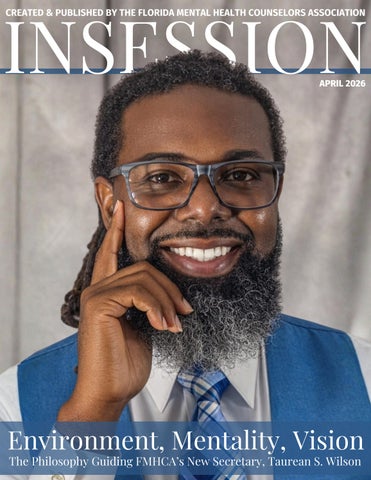
Environment, Mentality, Vision
The Philosophy Guiding FMHCA’s New Secretary, Taurean S. Wilson
President’s Column
Greetings! Our annual conference, held February 5–8 in Orlando, was a tremendous success. Thank you to everyone who supported this event especially our exceptional FMHCA staff, Board members, and volunteers. We truly could not have done it without you.
Even with the conference just behind us, the momentum has not slowed We moved immediately into our annual Virtual Summit, and planning is already underway for the 2027 conference Presentation proposals are now being accepted, and we encourage you to consider submitting
My primary focus post-conference is the continued revision of the FMHCA By-Laws and the development and publication of FMHCA’s new Policies and Procedures Manual. I also had the privilege of representing FMHCA at the annual full board meeting of the Counseling Compact, held in Orlando on February 25, 2026 I am pleased to share that the Compact’s CEO, Greg Searls, announced his expectation that Florida will
begin issuing privileges to practice mid-year. FM a free webinar for members on what counselors s
As many of you know, I also serve on FMHCA’s G Relations Committee (GRC). While this legislativ not unfolded in our favor, your GRC is already strategizing for the summer and preparing for the next session with renewed focus

As I often say, this is your organization, and it is an honor to represent you. My door is always open, and FMHCA welcomes your ideas, questions, and feedback. If you ever need information or wish to discuss an issue, please reach out to the FMHCA office or any Board member.
Respectfully Submitted,
Laura Peddie-Bravo
Laura Peddie- Bravo, LMHC, NCC FMHCA President


INSESSION
Page 8
What Couples Therapy Taught Me About the Myth of “Good Communication”
Page 10
The Burnout We Don’t Talk About: Working With Medical Trainees
Page 13
In the Space Between Heartbeats: A Counselor’s Role in the Cardiac ICU

Page 16

Where Safety Is Still Possible: A Reflection on Anxiety in an Age of Constant Threat
Page 18
The Hidden Stress of Success: What Therapists Should Know About Working With High-Achieving Clients
Page 21
Listening to the Systems Around Our Youth: A Mental Health Professional’s Perspective on Equity & Development
Page 24
When Bodies Speak: Chronic Pain and Accessibility in the Counseling Room
Page 26
Environment, Mentality, Vision: The Philosophy Guiding FMHCA’s New Secretary, Taurean S. Wilson
Page 30
When Self-Care Treats the Symptom but Not the System


MAGAZINE
Page 32
Leveraging AI in Therapy: A Shift in Perspective
Page 38
Conceptualizing the Essence of Coping for Spanish-Speaking Clients
Page 41
The Missing Conversation in Eating Disorder Treatment: Sexuality
InSession Magazine is created and published quarterly by The Florida Mental Health Counselors Association (FMHCA)
FMHCA is a 501(c)(3) non for profit organization and chapter of the American Mental Health Counselors Association.
FMHCA is the only organization in the state of Florida that works exclusively towards meeting the needs of Licensed Mental Health Counselors in each season of their profession through intentional and strengthbased advocacy, networking, accessible professional development, and legislative efforts.
Let your voice be heard by becoming a FMHCA Member today!
Click here to view FMHCA's current Bylaws.
CONTRIBUTE:
If you would like to write for InSession magazine or purchase Ad space in the next publication, please email: Naomi Rodriguez at naomi@flmhca org
THE INSESSION TEAM:
Naomi Rodriguez- Editor
Victoria Siegel, LMHC- Expert Advisor
Page 44
The Hidden Mental Health Crisis of Pregnancy
Page 46
The Burnout Crisis Among New Clinicians: What Supervision Must Do Differently
Page 50
Systems Thinking Understanding and Application: A Guided Learning Journey of Graduate Students
ANTI-DISCRIMINATION POLICY:
There shall be no discrimination against any individual on the basis of ethic group, race, religion, gender, sexual orientation, age, or disability
DISCLAIMER:
Information in InSession Magazine does not represent an official FMHCA policy or position and the acceptance of advertising does not constitute endorsement or approval by FMHCA of any advertised service or product. InSession is crafted based on article submissions received Articles are categorized between Professional Experience Articles & Professional Resource Articles
Professional Experience Articles are writer's firstperson pieces about a topic related to their experience as a mental health professional, or an opinion about a trend in the mental health counseling field.
Professional Resource Articles are in-depth pieces intended to provide insight for the author's clinical colleagues on how to be more effective with a particular type of client or a client with a particular disorder, or tips for running their practice more efficiently

FMHCA's Mission Statement
The Florida Mental Health Counselors Association (FMHCA) is the State Chapter of the American Mental Health Counselors Association (AMHCA). FMHCA is the only organization dedicated exclusively to meeting the professional needs of Florida’s Licensed Mental Health Counselors.
The mission of the FMHCA is to advance the profession of clinical mental health counseling through intentional and strengthbased advocacy, networking, professional development, legislative efforts, public education, and the promotion of positive mental health for our communities
Its sole purpose is to promote the profession of mental health counseling and the needs of our members as well as:
Provide a system for the exchange of professional information among mental health counselors through newsletters, journals or other scientific, educational and/or professional materials
Provide professional development programs for mental health counselors to update and enhance clinical competencies
Promote legislation that recognizes and advances the profession of mental health counseling
Provide a public forum for mental health counselors to advocate for the social and emotional welfare of clients
Promote positive relations with mental health counselors and other mental health practitioners in all work settings to enhance the profession of mental health counseling
Contribute to the establishment and maintenance of minimum training standards for mental health counselors
Promote scientific research and inquiry into mental health concerns
Provide liaison on the state level with other professional organizations to promote the advancement of the mental health profession
Provide the public with information concerning the competencies and professional services of mental health counselors

Promote equitable licensure standards for mental health counselors through the state legislature
The FMHCA Team


Kathie Erwin
President-Elect
Secretary
Taurean Wilson
NE Regional Director
Grace W Cantor NW Regional Director
Joseph P Skelly SE Regional Director
Liza Piekarsky SW Regional Director
Kerry Conca

What Couples Therapy Taught Me About the Myth of
“Good Communication”
When people learn that I’m a couples therapist, they usually say some version of the same thing “You must be great at communication ” I smile when I hear that, because the truth is both simpler and more complicated This work has taught me that communication isn’t the superpower people imagine it to be. In fact, our field’s emphasis on ‘better communication’ can sometimes miss what couples actually need most.
Most partners who sit on my couch already know how to talk things through They can explain their frustrations clearly and in detail They’ve read the books, listened to the podcasts, practiced “I” statements, and learned the language of healthy conflict. And still, they find themselves stuck, having the same painful conversations, feeling misunderstood, and growing further .
What they’re missing isn’t skill. It’s safety.
A lot of relationship advice assumes that if partners choose the right words and use the right tone, connection will naturally follow But relationships aren’t instruction manuals When someone feels judged, dismissed, or emotionally alone, their nervous system takes over Voices tighten and defenses come up, listening becomes selective. Even wellintended conversations can go sideways quickly.
I see it all the time. One partner says, calmly and thoughtfully, “I feel like I’m not a priority ” It’s a well phrased statement, clear feeling, no blame, respectful tone But the other partner doesn’t hear vulnerability, they hear
But intimacy isn’t efficient, it’s layered, apart
criticism Their body reacts before their mind has time to process; heart rate rises, muscles tense and the moment shifts from connection to protection
Experiences like these have made me more cautious about how casually we prescribe communication tools. Skills absolutely matter but timing and emotional context matter more. Without a sense of safety even the most careful wording can feel like an attack.
I’ve also noticed how much pressure couples feel to resolve conflict quickly and efficiently. Our productivity culture seeps into relationships, creating an expectation that disagreements should be handled with the right framework and wrapped up neatly. When issues resurface, partners often worry they’re failing.
Professional Experience Article
cyclical, and deeply human Couples rarely argue about what they’re arguing about The surface issue, dishes, schedules, finances, usually carries deeper questions underneath such as; Do I matter to you? Do you see how hard I’m trying? Are we really in this together?
No communication formula can rush those answers
Over time, my clinical approach has shifted. I spend less time coaching couples on what to say and more time helping them experience each other differently. I pay attention to the small, telling moments, a softened expression, a pause instead of a quick rebuttal, a shaky voice that reveals fear beneath frustration. Those moments often do more to build connection than perfectly structured sentences
When partners feel seen in those vulnerable spaces, something opens. Conversations stop being debates to win
and start becoming opportunities to understand
I’ve also come to appreciate how real connection often looks messy. Tears interrupt sentences, long silences fill the room, words come out wrong. Earlier in my career, I might have tried to smooth those moments over Now I recognize them as signs that something honest and important is happening
And perhaps the most meaningful lesson has been this, repair matters more than perfection. Every couple gets it wrong sometimes. Voices rise and feelings get hurt. What builds resilience isn’t flawless communication but the willingness to turn back toward each other to acknowledge the misstep, to take responsibility, and to try again
As mental health professionals, we’re trained to organize healing into clear language and helpful frameworks. Those tools have value, but love, in practice, is
rarely tidy It’s awkward, courageous, and deeply vulnerable
So when someone tells me I must be great at communication, I gently offer a different perspective. I’m not an expert in perfect conversations. I’m a student of emotional safety, repair, and the quiet courage it takes for two people to keep choosing each other, especially when it’s hard
That’s where real connection begins.
Written By: Amelia Gold, LC


Amelia is a therapist specializing in anxiety, attachment, and relationship dynamics. She helps clients deepen self-understanding and build healthier, more connected relationships. Outside of work, she enjoys the beach, time with loved ones, reading, and everyday adventures with her golden retriever.

Working With Medical Trainees

The Burnout We Don’t Talk About
Professional Experience Article
For twelve years, I worked in graduate medical education overseeing residency programs I sat in meetings about accreditation standards, budgets, recruitment, remediation, and performance metrics I also sat across from medical students and residents in therapy who were barely holding it together.
I completed doctoral research exploring the lived experiences of internal medicine residents during the COVID-19 pandemic, including a literature review on suicide prevalence and mental health in residency training What I learned in research and administration, I now see confirmed in therapy. The burnout we talk about in medicine is rarely the burnout we treat.
At the systems level, burnout is framed as workload, documentation burden, call
schedules, curricular disorganization, or inefficiency During COVID, it was framed as rapid transitions to remote learning and operational instability Those stressors are real In my research, residents described isolation, decreased interaction, and educational disorganization during an already highstakes period.
Beneath these structural challenges lies something deeper an emotional suppression culture embedded early in medical training
Medical trainees are taught to diagnose and treat, assess risk, manage crisis, and maintain composure. When they need treatment themselves, many feel they have crossed into dangerous territory as though needing care makes them suspect. In graduate medical education, we evaluate competence,
professionalism, and resilience We don’t reward emotional vulnerability When trainees require care, many experience a destabilizing identity conflict The healer is not supposed to become the patient
I’ve had residents cry in my office not only from exhaustion, but from fear. Fear of being labeled or seen as unstable. Fear that a diagnosis could follow them into credentialing, licensing, or fellowship applications. Some say, “I don’t want this on record ” Others avoid using insurance Many ask detailed questions about privacy before disclosing anything meaningful, seeking repeated reassurance that what is said here will not travel beyond the room.
There is an unspoken belief that seeking treatment will mark them as weak that while they are trusted to diagnose and treat others, needing treatment
themselves makes them a liability rather than the healer
By the time they enter therapy, many say, “I’m just burned out.”
Sometimes they are Burnout is situational exhaustion tied to rotation schedules, sleep deprivation, and administrative load. Depression, however, persists beyond the shift. It presents as anhedonia, cognitive slowing, hopelessness, irritability, and self-doubt that does not resolve after a vacation block.
High-achieving trainees are particularly skilled at masking this distinction Their performance often remains intact long after their emotional health has deteriorated. They still show up, round, and score well. The system sees competence and assumes stability.
As therapists, we must look beyond burnout and assess for mood disorders without pathologizing normative stress We must understand their context Confidentiality concerns are not hypothetical; they feel existential The stakes are high
Establishing safety is paramount. I am explicit about confidentiality limits. I normalize the fear and validate the
tension between professional identity and vulnerability I often ask, “If you would not judge your patient for needing care, what makes this different for you?”
These clients respond well to structured, goal-oriented interventions. They value clarity and measurable progress. Yet beneath the cognitive work is often identity fused with achievement, perfectionism reinforced by competition, and the belief that emotional expression threatens professional legitimacy
There is also ethical tension in treating colleagues in medicine. Given my background in graduate medical education leadership, I’m mindful of boundaries. Dual relationships must be avoided. Institutional knowledge cannot bleed into therapy Protecting the therapeutic space requires clear separation
At the same time, systems awareness is an asset. Understanding call schedules, evaluation pressures, and training hierarchies allows us to contextualize distress rather than individualize it. Burnout in medicine is not only about hours worked It is emotional incongruence the widening gap between the physician they are expected
to be and the human they are allowed to be
Medical trainees are taught to tolerate suffering, rarely taught how to tend to their own.
As counselors, we may be one of the fe places where they do not have to perform competence. Sometimes the most radical intervention we offer is n a technique it is permission. Permission to be competent and struggling at the same time
Written By: Stephanie RiveraVelazquez, EdD, NCC, LMHC-QS, LMFT-QS


Stephanie, is a licensed mental health counselor and marriage and family therapist and the founder of AnewU Counseling She works with highachieving professionals, such as attorneys and medical trainees, navigating life transitions. She also works with couples on communication and load distribution. She specializes in adjustment disorders, burnout, relationship dynamics, and performancerelated identity stress. In addition to her private practice, she held a leadership role within graduate medical education.


A Counselor’s Role in the Cardiac ICU

In the Space Between Heartbeats
When most people think of a cardiac ICU, they picture ventilators, alarms, and teams of physicians moving quickly between rooms What they don’t often picture is a licensed mental health counselor sitting beside a family helping them make sense of words like “life support,” “transplant list,” or “no further options.”
My role as a Licensed Mental Health Counselor embedded in a cardiac ICU is still emerging I work with patients who are on mechanical circulatory support, awaiting heart transplant, or facing the possibility that their heart will not recover I also work closely with their families, who are often thrust overnight into a world of complex medical decisions and unimaginable uncertainty.
In this setting, therapy does not look traditional. Sessions happen at the
bedside, in family consultation rooms, or in quiet corners of a hallway They are rarely scheduled and often begin with a simple question: “Can you help us understand what’s happening?”
A central part of my work involves supporting end-of-life conversations. Physicians and nurses provide the medical facts, but families often need space to process what those facts mean. I help them slow down the moment. We explore what their loved one would want, what quality of life means to them, and what fears are underneath the surface Often, families are carrying guilt, conflict, or unresolved history into these decisions. Giving those emotions room to be acknowledged can reduce later regret and complicated grief.
Anticipatory grief is constant in the cardiac ICU. Families grieve while their
loved one is still alive They grieve the loss of the life they had, the future they imagined, and sometimes the version of the person who existed before machines and sedation I normalize this grief I name it when they cannot I remind them that hope and sorrow can coexist. A family can hope for a transplant and still prepare for the possibility of death.
Uncertainty is its own kind of trauma. Patients waiting for a transplant often live in a suspended state, unsure if the call will come in time Families live on edge, watching numbers on monitors and interpreting every shift in condition as a sign My role is to help them regulate in real time. We focus on grounding techniques, clear communication, and manageable next steps. Sometimes the intervention is brief and practical. Sometimes it is
Professional Experience Article
This position also supports the medical team. ICU staff face repeated exposure to high acuity cases and loss. When psychosocial care is integrated into the team, it allows physicians and nurses to focus on medical decision-making while knowing that emotional care is not being overlooked It also creates opportunities for interdisciplinary collaboration around complex cases
As heart failure interventions advance, hospitals are seeing more patients sustained on life support while awaiting transplant. The psychosocial demands of
this care are significant Embedding licensed mental health counselors in cardiac ICUs acknowledges that lifesaving treatment and emotional support are not separate needs. They are intertwined.
My hope is that this role becomes standard rather than novel Families facing life support decisions should not have to navigate anticipatory grief, ethical dilemmas, and uncertainty alone Mental health professionals are uniquely trained to sit in that space between hope and loss. In the cardiac ICU, that space exists every day.
Written By: Stephanie Jacques, LMHC

Stephanie is a Licensed Mental Health Counselor and Qualified Supervisor curren in a cardiac ICU, where she supports individuals and families navigating medical trauma, life support, and transplant care Her theoretical background includes CBT, existential, and solution-focused approaches She has over a decade of experience in substance abuse treatment and residential care for individuals with chronic mental illness.


A Reflection on Anxiety in an Age of Constant Threat

Where Safety Is Still Possible
We live in an age where threat never takes a break We are warned about contaminated food, random violence, endocrine-disrupting chemicals, social unrest, the cognitive cost of constant phone use, political division, war, and an ever-climbing cost of living.
The news cycle and endless scrolling of social media, often referred to as doom scrolling, amplify fear and anxiety as we attempt to navigate the ordinary stresses of daily life Our nervous systems are not designed to tolerate constant bombardment; to be tethered to our phones from the moment we wake until we finally set them down at night
In the early stages of my career, I helped clients combat anxiety-provoking catastrophic thoughts (overestimations of threat) by flipping the narrative. We worked to replace fear-based thinking
with rational, realistic thoughts that restored a sense of soundness and safety
For example, if someone came in with a fear of flying, I would use cognitive behavioral strategies to examine statistics and reinforce how safe air travel truly is. Often, that reframing brought meaningful relief.
Today, however, it is much more challenging to rely solely on that approach. With the consistent and immediate reporting of airplane emergencies across the globe at our fingertips, many fears are not distortions but rather they are constant exposures When news cycles deliver plane malfunctions daily and political unrest and social instability hourly, it becomes harder to argue that the anxious brain is simply being irrational. The nervous system is reacting to repeated cues of
danger
The result is a heightened sense of dysregulation and a persistent undercurrent of fear, discomfort, and disconnection. It is a different clinical landscape; one in which purely cognitive reframing has limits. Anxiety today feels less episodic and more like nervous system saturation. We live in a time where threat is not merely misperceived but ambient and ongoing. The brain is wired for survival Constant exposure to alarming stimuli keeps it activated We cannot reason a body out of a survival response if it never stands down
Being distanced and divided is not how we are wired to exist.
Clients do not just need new thoughts; they need calm, regulated nervous system experiences As a clinician, I have had to expand beyond cognitive
Professional Experience Article
restructuring to include boundaries around information intake, greater tolerance for uncertainty, grounding in nature, tangible practices that slow physiological arousal, and, perhaps most importantly, cultivating meaningful connection.
As human beings, we have a deep need to belong; to feel safe within community Yet today we are fed a steady stream of personal, social, cultural, and political division that erodes our sense of empathy and shared humanity Our nervous systems regulate in
togetherness, in connected relationship Regulation requires connection Togetherness regulates anxiety
In an era defined by division and digital saturation, therapy offers something increasingly rare: a regulated relationship. A space where fear is not amplified but understood Where uncertainty is tolerated together Where the nervous system learns, through connection, that it is not alone While we may not be able to quiet the world, we can create spaces within it where safety is still possible.
Written By: Mona A. Nasser, LMHC


Mona is a Florida Licensed Mental Health Counselor with 25+ years of experience. She owns Restoring Hope of the Palm Beaches in West Palm Beach, specializing in anxiety, depression, trauma, and couples counseling She uses evidence-based approaches like CBT, EMDR, DBT, and the Gottman Method, and has served as an adjunct professor and clinical supervisor for counseling interns

What Therapists Should Know About Working
With High-Achieving Clients

The Hidden Stress of Success
Over the past several years in my clinical practice, I’ve noticed a pattern among a particular group of clients: highachieving individuals who look successful on paper, but are quietly struggling behind the scenes from the pressure that often comes with success. As expectations around productivity, availability, and leadership continue to rise, more high-performing professionals are seeking therapy to navigate the psychological and emotional demands of success
These individuals can be C-suite executives, middle managers, public figures, athletes, and entrepreneurs. High performers are typically used to solving problems quickly and operating with confidence under pressure. However, when they step into roles that demand greater visibility, responsibility,
and constant decision-making, the mental, emotional, and physical stretch can increase significantly, often triggering an activated stress response in their nervous system
Being in a leadership role, or a role that comes with more responsibility and visibility, can trigger past negative beliefs to arise, such as “I’m not good enough” or imposter syndrome, causing self-doubt in decision-making and taking action
When these clients arrive to therapy, they appear to have everything under control outwardly, but describe internal challenges-brain fog, feeling overextended, bracing for impact, mental fatigue, “functional freeze”where individuals continue to perform at a high level while feeling internally overwhelmed or depleted. They also
report difficulty slowing down, delegating, or trusting others
One of the challenges in supporting these clients is that they may minimize or intellectualize their problems. Some have difficulty connecting with their mind-body signals after years of prioritizing performance and productivity. Their identity can feel deeply tied to their careers, which can make shifting beliefs, thoughts, and behaviors surrounding their current performance patterns challenging
These high-performing individuals spend much of their time making decisions, supporting others, and managing a large mental load. Due to the demand on their internal resources, many clients notice exhaustion, irritability, physical tension, and sometimes strain on their intimate or
Professional Experience Article
social relationships
Clients often benefit from reconnecting with their bodies and learning how to read their physical cues, which many have learned to ignore while pursuing external goals and output. Exploring the root of the beliefs that surface under pressure can also be helpful Understanding how past experiences or unresolved trauma manifest mentally, emotionally, physically, and behaviorally can provide important insight into current patterns
Clinicians may also find value in expanding their knowledge of polyvagal theory, somatic responses, and traumainformed approaches to better support clients navigating these challenges.
In many cases, high-performing clients can benefit from understanding stress
cues, their nervous system responses, and learning how to shift out of constant activation Practical tools such as calming techniques, grounding exercises, and intentionally scheduling more breaks during the day can help disrupt the patterns that brought them to therapy in the first place.
As mental health professionals, we have an opportunity to support this population in meaningful ways When high-achieving individuals learn to care for their mental and emotional wellbeing more intentionally, the impact often extends beyond the individual. Leaders who become more regulated and self-aware tend to show up differently in their workplaces, families, and communities creating a powerful ripple effect across the people and
systems they influence
Written By: Angela Williams, LCSW, LISW, LICSW
Angela is a licensed clinical social worker, leadership consultant, and speaker specializing in the intersection of mental health, leadership, and performance She works with high-achieving professionals, entrepreneurs, and executive leaders navigating stress, burnout, and major life transitions. Angela integrates evidencebased therapy, mind-body approaches, and emotional regulation strategies to help clients build resilience, clarity, and sustainable success in both their personal and professional lives.


A Mental Health Professional’s Perspective
on Equity and Development

Listening to the Systems Around Our Youth
As a mental health professional working with diverse youth populations, I am often reminded that the emotional and psychological wellbeing of young people cannot be separated from the environments in which they grow and have developed in. My doctoral research examining positive youth development among urban minority youth in Miami reinforced something many clinicians already observe in practice: mental health outcomes are deeply influenced by social systems, community conditions, and structural inequalities.
In clinical settings, we often focus on individual symptoms, like anxiety, depression, and behavioral concerns, but the stories behind those symptoms frequently reveal broader systemic realities. Youth growing up in underresourced urban communities (or cities)
experience multiple stressors simultaneously These often include exposure to neighborhood violence, environmental pollution, overcrowded housing, and limited access to recreational spaces or safe community environments. Each of these factors contributes to chronic stress, which in turn affects cognitive development, emotional regulation, and long-term health outcomes.
My research explored how social agents, including community leaders, educators, health professionals, and policymakers, all play a role in shaping youth development through program design, data management, and community engagement. What became clear during my research and interviews with community stakeholders was that youth development is not simply the product of
individual resilience or family support; it is also shaped by policies, neighborhood infrastructure, and institutional practices
To date, urban minority youth frequently encounter systemic barriers that limit access to quality education and healthcare. Schools in low-income neighborhoods are often underfunded and rely heavily on disciplinary practices that disproportionately affect minority students These disciplinary patterns can contribute to academic disengagement and negative identity development Similarly, healthcare systems sometimes lack culturally responsive approaches, leading to misdiagnoses or underutilization of mental health services among minority populations. One concept that consistently emerged throughout the research was the
Professional Experience Article
importance of social determinants of health These determinants include economic stability, educational access, healthcare availability, neighborhood conditions, and social relationships. When these factors are unfavorable, they can create cascading effects across generations. For example, economic instability can limit housing options, which may place families in neighborhoods with environmental hazards or limited school resources. Over time, these conditions compound and contribute to disparities in both physical and mental health
As clinicians, we sometimes feel removed from policy conversations or community planning discussions. However, the ecological perspective offered by Bronfenbrenner’s Bioecological Systems Theory reminds us that development occurs across interconnected systems, from family relationships to neighborhood structures and national policies Youth development is influenced not only by what happens in therapy sessions or classrooms but also by the broader social and political context in which youth live
Another key insight from the study involved the role of community-based
data and needs assessments Effective youth programs must be informed by the lived experiences of the communities they serve. Too often, intervention models are designed using data drawn primarily from non-urban or majority populations, which limits their effectiveness when applied to minority youth. Community participation in data collection and program design can help ensure that services reflect true individualized approaches.
Data collection should guide meaningful action, improving resource allocation, identifying service gaps, and shaping policies that address systemic inequities. From a practitioner’s perspective, these insights reinforce the need for mental health professionals to adopt a broader systems-oriented lens. Supporting youth wellbeing requires collaboration across sectors including education, public health, community organizations, and local government. Interventions that focus solely on individual behavior change may overlook the structural conditions that continue to shape developmental outcomes and mental health quality in our society
Working with youth in urban communities has taught me that
resilience is abundant, but resilience alone cannot compensate for systemic inequities When communities have safe spaces, equitable school funding, accessible quality healthcare, and supportive social networks, youth and families are better positioned to thrive. Ultimately, promoting positive youth development requires both clinical insight and systemic awareness. As mental health professionals, we have a responsibility not only to treat symptoms but also to advocate for the environmental and policy changes that support healthier developmental pathways for the youth we serve
Written By: Ashley Dominguez, MS., LMHC-QS


Ashley is a behavioral health executive with 18+ years of experience in clinical care, leadership, compliance, and interagency collaboration. A doctoral candidate in Counseling and CEO of The Counselors Care, she specializes in behavioral health administration, program development, policy, and legal systems, and is dedicated to advancing clinical excellence and strengthening systems of care across sectors


Chronic Pain and Accessibility in the Counseling Room

When Bodies Speak
Professional Experience Article
There are days when my body feels like it has betrayed me Despite every effort to push through, I sometimes have to cancel sessions because I cannot be fully present for a client
The decision is never casual. I exhaust every adjustment first shifting positions, standing, pacing, negotiating with pain before acknowledging my limits. Often, I notice the guilt before I fully register the pain. As counselors, we are trained to be steady, present, and reliable When chronic pain interrupts that image, it can quietly challenge our sense of professional identity
Living with chronic pain has reshaped not only how I move through the world, but also how I understand clients whose bodies have become unpredictable, unreliable, or misunderstood.
Chronic pain was not something that
developed after I entered the counseling profession; it was something I carried with me into it Long before I sat in a therapist’s chair, I was already learning how to navigate a body that did not always cooperate with my plans This perspective has made me increasingly aware of how often counseling spaces unintentionally assume that bodies will behave predictably.
Therapy sessions are typically structured around the expectation that both counselor and client can sit comfortably for nearly an hour, maintain consistent schedules, and move through the day without interruption For many individuals living with chronic pain, however, these assumptions can quietly become barriers to care.
As the counseling profession continues to expand its awareness of diverse client
experiences, chronic pain deserves greater attention Clients who live with chronic pain may need to shift positions during sessions, stand instead of sit, or occasionally cancel appointments when symptoms flare Greater awareness of chronic pain also invites counselors to think creatively about how therapy spaces can become more physically accessible. Small adjustments can make a meaningful difference: allowing clients to stand or stretch during sessions, providing supportive pillows or blankets, adjusting lighting, or simply normalizing movement when pain makes stillness difficult. Counselors may also consider the impact of pain-related fatigue by allowing additional time for processing or brief pauses when needed
Many individuals living with chronic pain already carry a deep sense of shame
about the ways their bodies limit them When therapy environments quietly assume physical endurance and consistency, that shame can follow clients into the room. Thoughtful flexibility from counselors can help reduce this burden, signaling that clients do not need to ignore their bodies in order to participate in their own care. By acknowledging the realities of chronic
pain and adapting therapy spaces accordingly, counselors can create environments that are not only emotionally safe, but physically compassionate as well. In doing so, counselors move one step closer to a profession that recognizes not only emotional diversity, but the diversity of bodies that enter our therapy rooms each day.
Written By: Kristin M. Murr
Registered Mental Health Co
/ Registered Marriage a d F Therapy Intern


Kristin is a registered mental health and marriage and family therapy intern focused on embodiment and accessibility, helping others understand how health, neurodivergence, and lived differences shape therapy


Environment, Mentality, Vision
The Philosophy Guiding FMHCA’s New Secretary, Taurean S. Wilson
Taurean S Wilson’s leadership journey grew from lived experience long before professional titles or board service Raised in Crescent City, Florida, Wilson was shaped by the strength of his grandmother and by personal loss that deeply influenced his understanding of grief, resilience, and purpose. Those early experiences ultimately guided him into the field of mental health, where his work now spans clinical counseling, forensic evaluation, community advocacy, and professional leadership. At the center of Wilson’s philosophy is a framework he developed through his own life lessons: Environment, Mentality, and Vision. The model reflects how circumstances influence development, how perspective shapes growth, and how purpose guides the direction of one’s life.
Lessons from Home
Wilson grew up in a household defined by resilience. His grandmother raised six children as a single parent despite having an education that ended in the sixth grade. She worked in the local fern fields and took on whatever work was necessary to support the family.
At times, as many as nine people lived under the same roof
“Regardless of what was going on, she was going to provide,” Wilson recalls. “She was the backbone of the family.”
When Wilson’s mother was unable to care for the children, his grandmother stepped in. Watching her navigate hardship while maintaining stability left a lasting impression on him. Her example shaped his understanding of responsibility and showed him how
families can draw strength from one another
Those early years also offered perspective. Seeing the challenges his grandmother endured helped Wilson think about the kind of life he hoped to build in the future. The household environment taught independence and routine even when circumstances felt chaotic.
While his grandmother played a central role in his upbringing, Wilson is equally intentional about recognizing the presence and influence of both of his parents. He describes his mother as a source of strength and resilience whose faith became a bridge for healing in their relationship, and his father as a steady presence who supported him during some of his most difficult moments.
Feture Article
A Loss That Changed Everything
During high school, Wilson experienced a tragedy that profoundly shaped his outlook on trauma and grief. His brother, who was close to him in both age and relationship, was involved in a car accident only a few miles from their home
Wilson was in tenth grade at the time. After a football game one evening, he stayed with a friend while a police officer went to his grandmother’s house to deliver the news of the accident. His brother remained hospitalized for two weeks and initially appeared to be recovering.
Then one day everything changed
“I remember hearing my grandmother screaming and crying,” Wilson says. “The light in the kitchen went dark.”
The loss was devastating Wilson struggled with the reality that he had not visited his brother in the hospital because he believed he would recover. For years, that decision weighed heavily on him.
The two brothers had shared many childhood memories They played basketball together, climbed trees, and built bows and arrows Wilson remembers his brother as someone who brought humor and energy into the family. He was also an avid fan of Florida State University, a passion that Wilson later adopted himself.
“It felt like my protector was gone,” he says “Nothing has been the same ” The loss also changed the way Wilson understood grief. Over time, it became part of his personal and professional story. His family continues to celebrate his brother’s memory, and Wilson named his youngest son in his honor.
Understanding the Role of Environment
In Wilson’s framework, environment refers to the context in which people grow and develop Through his clinical work, he sees how environments can influence behavior, emotional development, and responses to trauma.
He describes environments as both delicate and powerful When circumstances are unstable or harmful, they can create barriers to healing Yet the same environment can also motivate individuals to seek change
Wilson often uses the image of an abandoned building to illustrate this idea. Some people may see only a structure that has deteriorated beyond repair. A carpenter might see potential for rebuilding.
“Our environment affects how we respond,” Wilson explains. “But we also have the ability to change it.”
This belief informs the way he works with clients Many arrive feeling trapped by their past experiences or by the circumstances around them Wilson encourages them to recognize that their current situation does not define their future
“I am the architect of my life,” he says.
The Power of Mentality
The second element of Wilson’s framework, mentality, reflects the role mindset plays in personal transformation.
One moment in particular helped him recognize how powerful perspective can be. Following his divorce, Wilson spent time walking through his neighborhood processing his thoughts. During one walk he found himself watching birds building nests in nearby trees.
He began wondering how birds knew how to survive and create shelter without anyone teaching them
“They don’t have hands like we do,” he
says “But they still find a way ”
The observation led him to a realization. Although he had not chosen many of the hardships he faced, he still had the ability to determine how he responded to them.
“I realized that changing my thinking could change my direction,” he says.
Wilson now shares this insight with clients who feel stuck in cycles of trauma or behavioral patterns. He encourages them to view struggle as movement rather than failure
“Struggle is still progress,” he explains. “It means you’re proceeding with difficulty.”
He sometimes compares adversity to weight training Resistance can feel heavy, but when it is used intentionally it can strengthen the person carrying it
Another important step in the healing process is learning to release what cannot be changed. For Wilson, this included forgiving himself for not visiting his brother in the hospital.
“Real strength is shown when we learn to let go,” he says.
Developing Vision
The final component of Wilson’s framework is vision, which represents the ability to see possibilities beyond present challenges.
As Wilson grew older, he began recognizing how past experiences had shaped his responses to stress and relationships Understanding those trauma responses allowed him to see his life with greater clarity
Faith also plays an important role in how he approaches adversity. A passage from scripture often guides his perspective:
“Your word is a lamp to my feet and a light to my path ” (Psalm 119:105)
The verse reminds him that clarity often
arrives one step at a time
“Once I understood what I had experienced, I could begin moving forward,” he says. “I started to see myself as someone who had overcome challenges.”
Expanding His Professio l I t
Wilson’s career has grown traditional counseling pra addition to his clinical wo involved in forensic evalu assessment, training, and advocacy
His interest in assessment and psychometrics began during his undergraduate studies in psychology. Later, mentorship introduced him to forensi evaluation, an area that allowed him to expand hi analytical and diagnostic skills
Working within school systems also contributed this growth. While participating in threat management efforts in th Flagler County school district, Wilson recognized the importance of structured assessment and prevention strategies. Each new opportunity expanded the scope of his professional work and deepened his commitment to serving both individuals and communities.
counselors are recognized and supported ”
He is particularly focused on strengthening support for Registered Mental Health Counselor Interns, who sometimes face misunderstandings about their professional role and
people, you begin to see the difference,” he says
Encouraging the Next Generation
For emerging counselors who worry that their personal struggles might disqualify them from the profession, Wilson offers nt

to advancing the field “What we do today shapes the future of our profession,” he says.
Measuring Impact
Leadership Through Service
Wilson also serves as Secretary of the Board for the Florida Mental Health Counselors Association (FMHCA). In this role, he views leadership as an extension of service to the profession.
“FMHCA represents the voice of clinicians across the state,” he says “It helps ensure that mental health
Wilson approaches recognition with humility. Rather than focusing on awards or titles, he pays attention to the influence his work has on others.
He sees impact reflected when colleagues seek collaboration, when conversations about mental health advocacy grow stronger, and when the communities served by counselors feel supported
“When your actions resonate with
qualify ourselves,” he says. ur past experiences make e ”
ose same experiences often hy and understanding.
They provide perspective that can strengthen therapeutic relationships and professional growth
Drawing on a biblical story about perseverance, Wilson reminds new counselors that value does not depend on perceived status.
“Even crumbs share the same ingredients as the whole loaf,” he says.
“You are enough.” Wilson continues to apply his framework of Environment, Mentality, and Vision in both his personal and professional life. During the COVID-19 pandemic, his family faced another difficult chapter when his wife was diagnosed with Stage IV cancer.
Despite the uncertainty, he remains grounded in the same principles that guided him through earlier hardships
“We’re still enjoying the view of this journey,” he says
For Wilson, resilience is not defined by the absence of adversity. It grows through the ability to learn, adapt, and continue moving forward with purpose.
Taurean, his wife Jessica, and their children (left to right): Joseph, Brooklyn, Jayden, Taurean Jr., and A’Maya.


When Self-Care Treats the Symptom but Not the System
Self-care has become a widely promoted concept, often accompanied by familiar recommendations: drink more water, go for a walk, journal, meditate, unplug, get more sleep These practices can be genuinely beneficial They can regulate the nervous system, interrupt stress cycles, and offer moments of restoration. Yet many people discover that even when they practice these habits consistently, they still feel exhausted and depleted.
When this happens, the problem is rarely a lack of discipline or commitment More often, it reflects the difference between first-order change and second-order change. First-order change focuses on modifying behaviors within an existing system. Second-order change alters the system itself.
Consider the experience of a former
Consider the experience of a former client in her late thirties who came to therapy describing what she called “lowlevel depression ” She reported persistent background anxiety, poor sleep, and the sense that she was always running on empty. On paper, her life looked stable. She worked as an emergency room nurse, had been married for fifteen years, and was raising three children ages four, seven, and eleven. Her days were organized around caring for others.
During our early sessions she described a pattern familiar to many caregivers At work she frequently skipped meals because she was attending to patients. She told herself she would eat later, but later rarely came. When her shift ended, the second shift began: helping with homework, cooking dinner, mediating
sibling disputes, preparing everyone for the next day There was almost no transition between the roles she occupied
The only time she could reliably claim for herself came late at night. She often stayed awake until one or two in the morning scrolling on her phone or watching television. Together we coined it “sleep rebellion,” because it felt like time she was secretly stealing for herself. Even though was the one who ultimately paid the price By the time she entered therapy she felt defeated Her life felt immovable and so ordinary that she wondered if the problem was simply her inability to keep up.
Our early work focused on the most visible pressures. Together we introduced practical self-care strategies and these changes helped in small ways.
Professional Experience Article
She was eating more regularly and getting closer to seven hours of sleep, which eased some tension But when she still did not feel restored, she concluded she was “failing” at self-care. When in reality, we had simply reached the limits of first-order change. We were adjusting behaviors while the deeper system organizing her life remained untouched.
Uncovering the System Beneath the Symptoms
As we continued exploring her story, several patterns became clear. She had grown up with a strong message about motherhood: a good mother sacrifices. Resting while others still needed something was framed as selfish. Caregiving meant enduring exhaustion without complaint Even when she intellectually understood the importance of self-care, another part of her felt uneasy prioritizing it Real change began when the focus shifted from managing
her exhaustion to examining the conditions producing it This required questioning deeply embedded beliefs, inviting her to reconsider the assumption that good mothers function without support. These realizations opened the door to structural change and moving from coping to care. Coping is a short-term strategy designed to help a person move through distress, threat, or overwhelm. It is often reactive, situational, and survival-oriented. Care is a long-term, relational practice that builds both internal and external resources It is intentional and capacityoriented The two often overlap Both can reduce distress Both can help regulate the nervous system Both can be protective in difficult moments In fact, coping is often necessary before deeper forms of care become possible.
In the case of this client, the early adjustments helped her cope. Packing
snacks, improving sleep habits, and adding small restorative practices reduced some of the immediate strain They helped her stabilize enough to keep moving through her demanding life. But restoration began only when care extended beyond individual habits and into the broader system organizing her life. She went from merely coping, to extending care that became the foundation that supported her life.
Written By: Tiffanie Trudeau, LMHC, LPC


Tiffanie is a licensed mental health counselor, educator, and author who works with adults and couples navigating trauma, relationships, and life transitions. A U S Air Force veteran, she uses a traumainformed, relational approach focused on nervous system stability, authentic connection, and helping clients move from survival to secure, embodied living

A Shift in Perspective

Leveraging AI in Therapy
There has been rapid advancement of artificial intelligence (AI), such as ChatGPT, Copilot, and Claude As a mental health therapist and educator, I observed that both providers and clients were starting to interact with AI in ways that were impossible to ignore. I was 100% against its use in therapy, schools, and work when I became aware of the increased use of AI in different areas of life.
For me, I was singular in my focus I was basing my reasoning on the fact that if people used AI, they would not want to come in for therapy from a professional I saw it as an “attack” on my ability to make a living. Boy, was I wrong!
Like you, I am constantly trying to balance client care with documentation, treatment planning, and administrative. I found that using AI can be helpful for. It
has become quite useful for me to help generate ideas, plan, and organize, as well as figure out ways to be more efficient and create a template that helps me to complete notes more quickly
I have a handful of clients who use ChatGPT to help them process, research different tools, and explore aspects of their symptoms prior to coming to a session. At first, I was wary of using AI in therapy due to HIPAA compliance and worries about confidentiality I am still cautious, and I do not use it in sessions for my private practice, but I work with a couple of platforms that have integrated AI I have found it to be helpful there
My perspective has shifted a bit because clients will do what they need to do for their own healing. Since they are using AI to help themselves, I have learned to collaborate with them by asking what
they learned, how it made them feel, and addressing any questions or misunderstandings they might have As a clinician, I cannot tell them what to do I now have the perspective of since they are using AI, I need to educate them on how to do so properly. incorporate what they learned in-session as a way of processing what they found and digging deeper into any questions that they have.
AI is here to stay, and it is best that we leverage it to enhance what we already offer in therapy sessions It can be useful in getting clients to do homework since they are mostly on their phones anyway However, it is not effective for all clients I noticed that for clients who tend to overthink and spiral, have moments of mania, and are inclined to isolate, it exacerbates their symptoms.
One client tended to go down a rabbit
Professional Experience Article
hole with what she discovered What she found caused her to hyperfocus on figuring out deeper root causes of what is going on with her. It was a challenge finding answers since she keeps “going around in her own head.” She reported that she just “couldn’t understand what was wrong” and that what she found made her “feel even worse” about herself.
Another client went to AI prior to engaging in therapy Based on its recommendation, she came to me wanting confirmation of a specific diagnosis. She also had the specific modality of treatment recommended by AI and requested it from me. After
completing the intake and meeting for two or three sessions, I let her know that the symptoms she had did not meet the criteria for the diagnosis she was looking for, which upset her. She stopped coming to therapy after that. That is one downside I have encountered with the use of AI in therapy.
As we move forward in this field, AI is going to become even more prevalent, and I am not sure how long we can hold out from incorporating it in our work I am learning that it is quite useful for me Hopefully, what I shared in this article gives you more insight. With this in mind, if you are not already using AI, you can make your own decision as to whether you will start using it.
Written By: Paula Robinson, EdD, LMHC, LPC, NCC, CCMHC, BC


Dr. Robinson is an Army veteran and trauma‐informed mental health counselor licensed in Florida, Arizona, and Virginia She specializes in trauma recovery using cognitive behavioral, dialectical behavior, and person‐centered approaches In addition to clinical practice, she creates therapeutic journals and resources She is an active member of the American Counseling Association, NBCC, FMHCA, and the American Association of Christian Counselors.

Ask the Expert
FMHCA Member Questions Answered by President and Managing Partner of The Health Law Firm, George F. Indest, J.D., M.P.A., LL.M.
AQAs a Qualified Supervisor, can you bill insurance using your credentials for your supervisees / Registered Mental Health Counselor Interns?
Yes, as long as your contract with the paying insurance company does not state that it is prohibited In the case of a Medicaid managed care insurance company, this is allowed by Medicaid laws and guidelines
It is probably better to have a group provider number, and make sure the intern is signed up as a provider within the health insurance company and with the Medicaid Program, with their provider number re-assigned to the group The group should then bill for the services
AQWhen treating a minor child of divorced, separated or never married parents, what type of consent is necessary and from whom? and services.
Unless there is an order from a court providing otherwise that you are aware of, each parent of a minor child is considered the natural guardian of a minor child Either parent can sign a consent form and authorize any and all care
Mr. Indest is board certified by The Florida Bar in the legal specialty of health law. He is the President and Managing Partner of The Health Law Firm, based in Orlando, Florida. The information provided in this article is for educational and informational purposes only and does not constitute the provision of legal advice.
Want your question featured in the next InSession issue? Submit Here
Must be a FMHCA member to submit Become a FMHCA member by clicking here


FMHCA's Favorites

Dakari Moon
Dakari Moon is all about celebrating the beauty, joy, and complexity of Black womanhood. Rooted in the meaning “rejoice,” we create space for Black women to embrace their stories, reconnect with their inner child, and prioritize self-care. Through thoughtfully curated products from coloring books to trivia and games we spark creativity, honor our history, and bring joy to everyday moments More than a brand, Dakari Moon is a movement centered on self-care, sisterhood, and reclaiming joy

Mini Thank Your Lucky
Stars Desk Jar
This sweet little jar offers a gentle pause, a place to consider the bright moments and small joys that make everyday life so meaningful Resting on a desk, nightstand, or kitchen counter, it becomes a little ritual of gratitude that grows more beautiful with every star dropped inside.
Transcendence Coffee Syrup
Transcendence Coffee was founded by two female engineers who met working as baristas in college. Derived from their love of specialty lattes and their frustration with artificial syrups dominating the flavored coffee industry, they decided to brew something better. They began crafting their own coffee brand that combined diverse, global syrup flavors with specialty techniques and all-natural ingredients.

SugarStix Candies
Sugarstix is a mom-and-daughter duo crafting small-batch treats from our home kitchen in Central Florida. Everything we make is created with care to ensure quality, freshness, and a little extra love in every bite.

Lavender & Bergamot Pillow Spray
Aromatherapy can be a powerful tool in your relaxation repertoire, using natural plant extracts to help with stress reduction and better sleep. Create a calming bedtime ritual with the soothing aromas of lavender and bergamot in this dreamy pillow mist, designed to cue the body and mind that it’s time to unwind.


Anxiety Oracle
Developed by a clinical counselor with over 20 years of experience, this 50-card oracle deck explores a range of emotions by flipping perspectives to offer meaningful insight. We all experience moments of worry or anxiety, but this deck provides practical, perspective-shifting guidance to help navigate those feelings whenever they arise
Mini Desktop Affirmation
Word Stack Sculptures
Everyone could use a little more encouragement in their day, so artist Matthew Hoffman created some small sculptures with big impact Laser cut and hand-painted, each of his desktop-sized artworks features a different phrase of affirmation Designed to create moments of joy and remind us that we’re doing our best, these little keepsakes brighten up spaces and bring smiles to faces when they need it the most.

Shake a Shelf Stress Relief Nook
Scott Calzolaio invites you to give your bookshelf a little shake and watch the stress tumble away. Inside each miniature wooden shelf, dozens of individually folded books wait to be rattled, rearranged, and lovingly organized, creating a soothing ritual that feels part art piece, part playful therapy

12 Days of Self-Care Tea Gift Set
This mindful collection of teas encourages care through connection— both with yourself and those around you. As you pop open each door to sample the day’s tea, you’re greeted with a prompt with the theme "selfcare" (stop and feel the breeze; invite a friend on a walk) or "share" (send a nostalgic song; leave a note) They’re thoughtful suggestions to consider during your daily cuppa, and inspire the strengthening of your relationships with yourself and others.

12 Months of Reading Watercolor Bookmark Kit
Quiet reading moments meet a splash of color with this thoughtfully designed watercolor bookmark kit. Each bookmark becomes a tiny canvas, inviting readers to paint their way through a full year of books while tracking their progress month by month With artist-grade paints, premium cotton paper, and beautifully illustrated floral designs, every page turn feels a little more creative

DIY
Craftsman Planter Birdhouse Kit
This thoughtfully designed kit includes everything needed for a full backyard renovation, no power tools required. Follow the stepby-step instructions to screw or glue the pre-cut and pre-drilled cedar pieces into place, then add built-in planters for a touch of life inside and out. Finish with a colorful coat of paint and a bit of landscaping before welcoming your local feathered residents to nest and rest.


Conceptualizing the Essence of Coping for Spanish-Speaking Clients
The Spanish translation of cope may obscure the clinical function of coping mechanisms, creating barriers to the accurate delivery and understanding of therapeutic interventions for Spanishspeaking clients The clinical function of cope bolsters the capability to mitigate while improving functioning. When coping and coping mechanisms are not accurately depicted in Spanish, treatment may omit the therapeutic technique itself. When coping is not conveyed through the Spanish translation, treatment may obscure the therapeutic utility of coping strategies. As a result, Spanish-speaking clients may not fully recognize coping mechanisms as purposeful clinical interventions designed to improve functioning and reduce symptomatology Clarifying the intended clinical meaning of cope, therefore, becomes an important
component of culturally responsive mental health practice
In clinical psychology, coping mechanisms refer to structured cognitive and behavioral strategies used to mitigate stressors, attenuate distress, and restore adaptive functioning. The role of coping mechanisms in clinical practice is to ameliorate symptomatology. Coping skills, therefore, are implemented to mitigate stressors that elicit mental health conditions and to attenuate symptoms The term cope is used in clinical practice as a practical standard, aligning the treatment focus with improving functioning. Translations such as “mecanismos de afrontamiento” or “estrategias para manejar” misconstrue the clinical essence of cope and coping mechanisms. Those clinical differences
can diminish the perceived validity of coping mechanisms and limit engagement in treatment
Coping skills are central components of many evidence-based therapeutic approaches and are utilized frequently by clinicians to provide responsive and individualized services for clients experiencing varied mental health conditions. These skills assist individuals in attenuating anxiety, depression, trauma-related symptoms, and interpersonal stressors As mental health services continue to address culturally and linguistically diverse populations, coping skills serve an important role in supporting clinicians in responding to the increasingly diverse needs of clients. When clients clearly understand the purpose and benefits of coping strategies, they are more likely to engage
Professional Experience Article
in treatment and apply these skills beyond the therapeutic setting
Culturally responsive practice, therefore, requires mental health professionals to advocate for alternative translations and communicate the clinical application of coping using language that reflects its evidence-based function Explaining cope as “estrategias para mitigar el estrés y atenuar las emociones difíciles” (strategies to mitigate stress and attenuate difficult emotions) may more accurately convey the concept's clinical essence. Clear conceptual explanations can help clients recognize coping strategies as purposeful clinical interventions rather than general advice.
Further research is needed to examine
how the therapeutic construct of coping can accurately reflect clinical significance in Spanish-language and cultural contexts. Without conceptual clarity, Spanish-speaking clients may receive psychoeducation that inadequately conveys the therapeutic function of coping mechanisms.
Investigating how translation influences therapeutic understanding may help clinicians refine psychoeducational approaches for Spanish-speaking populations. Developing responsive terminology is essential for improving access to mental health services, strengthening psychoeducational engagement, and ensuring that therapeutic concepts are communicated in ways that support meaningful
participation in treatment
Written By: Maria Collar, M.S.ED, LMHC, TRPC


Maria is a licensed mental health counselor and telehealth psychotherapist She earned an A.A. in Psychology from Miami Dade College, a B.A. in Psychology from Florida International University, and an M.S.Ed. in Community Mental Health Counseling from St. Bonaventure University. She also completed a graduate certificate in Marriage and Family Therapy from National University. Her clinical specialties include anxiety, interpersonal dynamics, wellness, and culturally responsive mental health care for diverse client populations.


The Missing Conversation in Eating Disorder Treatment: Sexuality
As a sex therapist working at the intersection of eating disorders and sexuality, I often hear clients say, “No one ever talked to me about how my eating disorder affected my sexuality ” Eating disorders can significantly affect sexual functioning, desire, and intimacy. Hormonal changes, malnutrition, and shifts in neurochemistry all play a role, but the impact goes beyond physiology.
Eating disorders often train the nervous system to monitor the body rather than inhabit it Sexuality requires the opposite: presence, sensation, and responsiveness For someone who has learned to override hunger, suppress needs, and distance from bodily signals, this shift can feel threatening.
Yet sexuality is rarely addressed in recovery. Many clients only notice these impacts after other symptoms improve.
They may want closeness but struggle with desire or feel disconnected during intimacy These experiences are common and deserve space in the recovery conversation
Why Sexuality Often Goes Unaddressed
Treatment Models Prioritize Stabilization. Eating disorder treatment understandably focuses on medical and behavioral stabilization. Sexuality can appear secondary or irrelevant. Over time, this creates an implicit message: Food first. Sex later. But sexual functioning and embodiment do not automatically recover once weight is restored. When sexual health is consistently framed as something to address later, it may never get addressed at all.
Sexuality Is Seen as Outside the Scope
of ED Treatment. Sexuality training is rarely included in eating disorder specialization programs Even highly skilled therapists may feel uncertain about how to assess sexual concerns or integrate them into treatment Without training, clinicians may worry about opening conversations they feel unprepared to address. As a result, sexuality can quietly fall outside the perceived scope of eating disorder care.
Cultural Discomfort Around Desire. There is also enduring cultural discomfort around discussing sexuality, particularly with clients who may already feel vulnerable in their bodies. Some clinicians worry that sexual topics may feel too personal, inappropriate, or unrelated to treatment goals. But avoiding the topic can unintentionally reinforce the very disconnection
Professional Experience Article
recovery seeks to repair
Body Shame and Dissociation. Eating disorders frequently involve body shame, disgust toward the body, and dissociation from sensation. Discussing sexuality requires talking about pleasure, sensation, and intimacy. These are experiences that depend on inhabiting the body For someone who feels alienated from their body, these conversations can feel deeply vulnerable Clinicians may avoid introducing them too early in treatment
A Focus on Control, Not Desire. Many eating disorder models focus on control, perfectionism, cognitive distortions, and trauma, which are critical elements for understanding the disorder. However, desire and pleasure are rarely included in these frameworks Without language for desire, clinicians may feel unsure how to explore changes in arousal, erotic identity, or fears around intimacy that often emerge in recovery.
The Silence Loop. Another common dynamic is what I think of as the silence loop. Clinicians may assume, “If sexuality is important, the client will mention it ” Clients often assume the
opposite: “If it mattered, my therapist would ask ” As a result, both sides wait and the conversation never happens
What Providers Can Do
Addressing sexuality in eating disorder treatment does not require every clinician to become a sex therapist But it does require acknowledging that sexual health is part of whole-person recovery.
Small shifts can make a meaningful difference:
Normalize the topic early. Simple questions such as, “Have you noticed any changes in desire or intimacy since your eating disorder began?” can open the door without pressure.
Link embodiment to sexuality. When discussing interoception, body awareness, or nervous system regulation, clinicians can explain how these same systems influence sexual response.
Address body monitoring during intimacy. Many clients continue evaluating their bodies during sexual experiences long after treatment ends. Naming this pattern can reduce shame and increase awareness
Collaborate when appropriate. Referral to sex therapists or medical providers can support more comprehensive care when concerns become more complex.
When sexuality is excluded from eating disorder treatment, clients may leave recovery believing something is still wrong with them When it is included, recovery expands beyond symptom reduction into something fuller: a life where the body is not only nourished, but also felt, trusted, and capa connection.
Written By: Jessica Singh, PhD, LCSW, CST


Jessica is a certified sex therapist and clinical sexologist specializing in the intersection of eating disorders, embodiment, and sexual health. She is the author of Nourishing Desire, which explores how disordered eating and body control can disrupt sexual desire and connection to the body. Dr. Singh provides psychotherapy, consultation, and training for clinicians on trauma-informed sexuality, interoception, and the role of embodiment in eating disorder recovery


A Mother’s Story of Prepartum Depression

The Hidden Mental Health Crisis of Pregnancy
The doctor stated that my baby had a 98% chance of fatality Which also meant that there was only a 2% chance of her surviving On February 15, 2022, the doctor gave it a name, Trisomy 18 By giving it a name, it became real He said that if these babies make it full term, they have challenging births and very challenging lives if they make it out of the delivery room.
While standing at the checkout counter making my next appointment, I could not breathe My heart pounded so hard through my chest that I thought I was dying I was having a panic attack and nearly passed out My body felt light as a feather as it went limp as a nurse caught me. I don’t remember the words the nurse spoke at that moment, but she helped me back to the room and into a chair. I am not sure if I responded when
she asked if I wanted water, but I looked down at a cup of water in my hand I was in disbelief How could this be happening? As a first-time expectant mom this was supposed to be a joyous time
A few weeks later, while reviewing the ultrasound report and the baby’s wellness check, I was surprised to hear that the baby was doing very well. I began to feel hopeful. But then the doctor said, “I don’t want you to get your hopes up, but I will try to get you to full term.”
Those words were so harsh My small glimmer of hope disappeared I felt sick The doctor stamped negative words on my baby’s future and she wasn’t even born yet. How many other moms heard such negative words while trying to care for their mental health, learn their new
identity, navigate this journey, all while growing a person and preparing to give life?
During my pregnancy, Covid restrictions were still in place in medical facilities, so I attended all doctor’s appointments alone. This was difficult while facing something so painful. I became anxious for each weekly appointment, so I allowed my mind to go blank and turn off my emotions. I did not want to feel sad, and I definitely did not want to feel happy in fear of hearing more negative words that would crush my spirit again I was broken all the way down I stopped rubbing my belly, playing music, and stopped reading and talking to her. I did not want to remember those horrible words or bond with my baby anymore. It all hurt too much. I went as far as canceling my baby shower. My mental
Professional Experience Article
health was severely at risk
One day my baby didn’t move as much. I realized that my current state may be affecting my baby’s health and possibly mental health. I began to realize that mental health concerns during pregnancy can be just as significant as after pregnancy My doctors never mentioned that prepartum (prenatal) depression was real or a possibility This was never a topic mentioned during any of the parenting or birthing classes Everyone talks about postpartum depression, but you hardly hear mention of prepartum depression. I decided to get help and continue loving my unborn child no matter what the future would bring.
According to Cleveland Clinic,
Prepartum is the period immediately before childbirth, characterized by significant physical, hormonal, and psychological adjustments to prepare for labor. One of the common experiences of prepartum is mental health challenges. Prepartum depression causes extreme sadness, anxiety, and fatigue. If it goes untreated, it increases risks for preterm birth, low birth weight, and postpartum depression, which also affects the baby's long-term emotional and behavioral development. For the sake of all mom’s mental health, we need to have this conversation more
As a new mental health registered intern, I advocate for moms’ and infants' mental health. There is a correlation between the mother’s mental health and the
child The importance of seeking m health assistance during pregnanc should be an ongoing discussion f the mother’s health care providers wish to best position infants and y children for mental stability, we m first start with the mothers who c them.

Written By: Krystle Caffie, Registered Mental Health Counseling Intern

Krystle is a Registered Counseling Intern who supports clients in building insight, resilience, and tools for lasting growth. She has experience working with children, families, individuals, groups, and co-parents, and takes a warm, collaborative, and empowering approach, meeting clients where they are

What Supervision Must Do
Differently

The Burnout Crisis Among New Clinicians
When I began supervising early-career clinicians, I expected to support their clinical growth, case conceptualization, ethical decision-making, and the development of therapeutic skills What I did not expect was how much of our supervision time would be spent helping clinicians survive their work environments.
Increasingly, new clinicians are not just overwhelmed by clinical complexity. They are overwhelmed by systems that expect emotional endurance without providing emotional infrastructure Many enter the field deeply committed to helping others, only to find themselves navigating high caseloads, productivity pressures, administrative burden, and limited support for their own psychological well-being. Burnout is often framed as an individual
failure, a lack of resilience, insufficient self-care, or poor boundaries But what I have witnessed tells a different story Burnout is frequently the predictable outcome of organizational cultures that prioritize output over sustainability and productivity over humanity.
Supervision, in its traditional form, has not always been structured to address this reality
Historically, supervision has focused on risk management, clinical documentation, and compliance. While these functions are necessary, they are not sufficient New clinicians need supervision that also addresses the emotional impact of holding trauma, managing uncertainty, and navigating professional identity formation
Many clinicians I supervise carry not
only their clients’ pain, but also their own internal pressures to perform perfectly They question themselves constantly: Am I helping enough? Am I missing something? Am I good enough to do this work?
Without space to process these questions, clinicians internalize distress as personal inadequacy rather than recognizing the systemic conditions contributing to their exhaustion.
Reflective supervision offers an alternative. It creates space not only to discuss what clinicians are doing, but also how they are experiencing the work. It acknowledges that clinical work is relational, emotional, and inherently human. When clinicians feel seen, supported, and safe to express uncertainty, their capacity to remain present with clients expands rather than
Professional Experience Article
contracts
This approach is not simply supportive; it is protective.
I have seen clinicians move from the brink of leaving the profession to rediscovering meaning in their work when they are provided with consistent, emotionally attuned supervision. They become more confident in their clinical judgment, more grounded in their professional identity, and more capable of sustaining the emotional demands of the field.
This is particularly critical for clinicians from marginalized and historically underrepresented communities, who often carry additional cultural and systemic stressors. For many, supervision may be one of the few professional spaces where they can speak openly about their experiences
without fear of evaluation or consequence
If we want to address the workforce crisis in mental health, we must look beyond recruitment and examine retention. We cannot sustain a profession that relies on the quiet endurance of its newest members
Supervision must evolve from a purely administrative function into a relational and restorative practice.
Organizations must recognize that supervision is not simply a requirement to maintain licensure; it is a central mechanism through which clinicians develop resilience, competence, and longevity in the field
The future of our profession depends not only on how we care for clients, but on how we care for those who provide that care.
When we invest in meaningful supervision, we are not only supporting clinicians, but we are also protecting the integrity and sustainability of mental health care itself.
Written By: Yurilka A. Hernandez, LCSW
Yurilka is the Founder and CEO of Psychotherapy & Consultation Group Services PLLC and founder of Alta Vida Wellness. She specializes in trauma-informed care, clinician supervision, and culturally responsive mental health services for adolescents and adults. Her work focuses on burnout prevention, professional identity development, and supporting clinicians from historically underrepresented communities through reflective supervision and sustainable practice models


FMHCA Committee Updates
Provided by Committee Chairs
Get Involved! View all of FMHCA’s Committees here.
Registered Intern & Graduate Student Committee
Committee Chair: Lauren Malone, Registered Mental Health Counselor Intern
Following a recent transition in leadership, the committee was excited to connect with both current and prospective members for the first time at the annual FMHCA Conference During the committee roundtable, the newly appointed chair and co-chairs had the opportunity to introduce themselves, engage in meaningful dialogue, and begin building relationships with FMHCA members.
The committee remains steadfast in its commitment to advocating for the interests, concerns, and professional development of graduate students and registered interns. To support this mission, we continue to meet regularly on the fourth Thursday of each month from 11:00 AM to 12:00 PM The monthly meeting link is available here
Below are the remaining meeting dates for the year:
April 30, 2026 | 11:00 AM–12:00 PM
May 28, 2026 | 11:00 AM–12:00 PM
Guest Speaker Session: Dr. Hutchinson
June 25, 2026 | 11:00 AM–12:00 PM
Note: This meeting may shift to align with LMHC Prep & Connect dates
July 30, 2026 | 11:00 AM–12:00 PM
August 27, 2026 | 11:00 AM–12:00 PM
September 24, 2026 | 11:00 AM–12:00 PM
October 29, 2026 | 11:00 AM–12:00 PM
We also encourage all committee members to keep an eye out for an upcoming survey. Your feedback is invaluable as we plan future topics and identify speakers that best reflect your interests and professional needs.
Government Relations Committee (GRC)
Committee Chair: Aaron Norton, PhD, LMHC, LMFT, MCAP, CRC, CCMHC
The legislative session ended on 3/13/26, and it was an unusual session, widely regarded as a particularly contentious session. Very little emphasis was placed on healthcare-related bills, partially due to significant disagreements between the House and Senate on other legislative issues such as the budget that
absorbed significant legislative focus.Of the 14 bills that FMHCA’s Government Relations Committee (GRC) was tracking due to their potential to impact our profession, only 1 bill was passed, and it did not end up being a bill that would significantly impact our profession. The primary issues that FMHCA supported this legislative session, including renaming registered interns as registered associates, redacting a statute that requires interns to have a licensed mental health professional on the premises when providing clinical services, and adding 491 Board licensees to a list of professionals who can be appointed by the Court to conduct evaluations and provide expert testimony for criminal cases involving competency, criminal responsibility, and civil commitment, were not accomplished Due to the lack of bills promoting our priorities this session and the lack of progress with bills related to our profession, we abstained from the “Legislative Days” event, reserving our funds for the next legislative session. The GRC is recommending a spring/summer campaign in which FMHCA members and regional chapters contact legislators between sessions, introduce FMHCA and the local chapters as resources, and discuss our legislative priorities for the 2026-2027 legislative session, setting the stage for a productive session next year.
GRC AI Policy Subcommittee
FMHCA’s GRC expressed significant concerns about SB 344 and its companion bill, HB 281, which did not pass this legislation. We believe that AI regulation in the mental health professions is coming to Florida soon, as seems to be the trend nationwide. We also recognized the good intentions behind this bill (i.e., to protect the public and to prevent human therapists from being replaced by AI therapy bots) However, this bill deviated significantly from bills passed in other states (e g , Illinois) in that it would effectively restrict the use of AI to administrative purposes in a counseling practice, perhaps unintentionally illegalizing multiple safe, ethical, and appropriate uses of AI in clinical practice The GRC formed an AI policy subcommittee composed of FMHCA members who have experience and expertise with the use of AI in counseling practice. That subcommittee is working on an analysis report and recommended course of action for FMHCA for the 2026-2027 legislative session. We will then launch a survey to our
members and offer a recommendation to the FMHCA Board of Directors
491 Board Disciplinary Report Taskforce
FMHCA’s GRC and the Florida Family Therapy Alliance (FFTA) created a joint taskforce that published an annual report on the disciplinary proceedings involving 491 board licensees in the 2023-2024 fiscal year, which is available here The subcommittee is now working on the annual report for the 2025-2026 fiscal year.These reports should be helpful resources for counselor educators and qualified supervisors training emerging counselors, as well as for practicing counselors who want to stay updated on legal and ethical issues in the field.
DOE Rules Excluding LMHCs
Last summer and fall, FMHCA sent a letter to Florida’s Board of Education, Department of Education, and the Governor’s Office in an effort to advocate for revisions to the Florida Administrative Code that would (a) add LMHCs to the list of professionals whose diagnoses can be used for eligibility purposes for vocational rehabilitation services, and (b) add LMHCs to the list of professionals whose records may be used
for ESE program eligibility in public schools Between legislative sessions, the GRC intends to follow-up on these recommendations
Military Services Committee Committee Chair: Joshualin “Jay” Dean, MS, LMHC, NCC
My name is Joshualin “Jay” Dean, and I am honored to serve as the new chair for the Military Services Committee We kicked off our first meeting of the year on March 4, 2026, during which, committee members had the opportunity to discuss topics that were important to them, discuss training needs and interests, seek information about resources and treatments that would be beneficial to Veterans and Service Members, and share information about existing community resources.
The Military Services Committee will meet on the first Wednesday of every month at 11am As we continue the journey ahead, I look forward to collaborating with members of the greater FMHCA community to share updates and continue to discuss ways to support our Veterans, Service Members, and their families.

A Guided Learning Journey of Graduate Students

Systems Thinking Understanding and Application
The family unit is a complex system that embodies more than the sum of its individual members Perceptions, assumptions, interpretations, rituals, behaviors, and assigning meaning to experiences within a particular family system comprise a distinct microculture. Family units are part of larger community and society systems. If members, or the whole unit, move to a different community or country, they will contend with acculturation issues that may impact the system’s level of overall adaptability and functioning. In light of the increasingly diverse communities that counselors and counselors in training serve, gaining a deep understanding of systems thinking theories is critical to their ability to provide effective services Cross Cultural Considerations
Building cultural competence is crucial to effective multicultural training programs Both the graduate marriage and family therapy students in practicum training, and the populations seeking services at their sites were diverse. Beyond their understanding of family unit dynamics, these students were expected to navigate multicultural contexts to better serve their clients. The M.S. in Psychology Practicum Coordinator and practicum course professor at Albizu, Miami Campus designed a guided learning activity for the students.
Learning Framework
The Practicum Coordinator provided a learning framework for the students to engage in the application of systems thinking. They provided counseling services under supervision at a variety of
community agencies in the South Florida area, and attended the practicum seminar course at the university weekly over the span of two academic sessions The Coordinator provided the students with two guiding questions for weekly reflections to be recorded in their learning journals.
1.How has your understanding of therapy changed since the introduction of systemic themes in course discussions?
2.In what ways have you changed your case conceptualizing as a marriage & family therapist in training as a result of the class discussions about systemic themes?
The Practicum Coordinator met regularly with the Program Director to discuss the students’ progress in developing their level of skill mastery.
Professional Resource Article
Each practicum student kept a weekly journal and discussed it in class. At the end of the course, the students provided their professor with their reflections on their learning journey. Several student responses are included, with their permission, for illustrative purposes
Silvia Aronson
When my professor first started talking about systemic thinking in the therapeutic setting, I was puzzled Isn’t everything part of a system? Aren’t we all immersed in many different systems as early as we are formed in the uterus? What is she talking about? She would go on and on about how to address our clients through the lens of systemic thinking. During mock-therapy exercises, she would call on us when we steered away from it. I remember feeling confused. I wanted to understand the narrative model of therapy better before I could implement it in my practicum therapy sessions.
Finally, the opportunity to try it out came when I started seeing clients at a trauma survivor facility All my clients were survivors of some type of trauma: domestic violence, human trafficking, violent crimes, physical and sexual violence, and survivors of homicide victims, among many others. There were many different “systems” to explore and learn about. How was I supposed to effectively apply what my professor was so passionately teaching us about the narrative systemic therapy model to serve them?
Systems thinking within narrative therapy involves viewing individuals and their problems as interconnected within a larger context of relationships and social systems. It emphasizes understanding how different elements within a person ' s life, such as family dynamics, social networks, and cultural
influences, interact and impact their experiences and narratives I felt this model would help my clients explore how these systems shape their identity, behaviors, and issues, enabling a more comprehensive and holistic understanding of their lives and challenges. Treating survivors of external traumatic experiences was the ideal situation for me as a therapist to examine the interconnectedness of the individuals and the systems (family, community, society) they were part of. We worked on their issues collaboratively, and the systemic approach helped them understand and reframe their narratives within the context of their systems
Nina Moreno
Before enrolling in the marriage and family therapy program, and prior to being exposed to the concept of systems thinking, I viewed therapy as a 1-on-1 experience. I assumed that the sole focus of therapy was to understand the client. As I began learning more about the complexities of human interaction and tying in systemic themes, I realized that I had always viewed my own life from a perspective of interconnectedness. My culture inevitably shaped my beliefs and behaviors greatly, upholding a theme of closeness and loyalty to my family. As I began to explore systems thinking, I began to understand the world around me more comprehensively
Systems thinking has been instrumental in helping me make sense of our experiences by recognizing the interconnectedness of various factors and the complexity inherent in human behavior. A crucial aspect of systems thinking is acknowledging the complexity of privilege and its impact on our lives In my view, we need to address these uncomfortable conversations about privilege and inequality, especially
as mental health professionals This approach not only enhances our ability to provide effective support but also contributes to the broader goal of creating a more just and equitable society.
Reflecting on my journey, the integration of systems thinking into my approach to marriage and family therapy has been transformative I have come to appreciate the profound interconnectedness that underlies human behavior and relationships
Embracing systems thinking has allowed me to move beyond a simplistic, individualistic view of therapy and recognize the broader patterns and dynamics that influence my clients' experiences It has equipped me with a more comprehensive toolkit for addressing the complexities of human interaction, fostering a deeper sense of empathy and insight Ultimately, this shift in perspective has not only enriched my professional practice but also reinforced the values of connection, loyalty, and holistic understanding that are central to my cultural heritage.
Margaryta Zelena
Systemic family therapy involves a holistic perspective that considers the broader context of relationships between the client and therapist. In each session, the therapist becomes part of this context, bringing their own emotional and sensory experiences, biological data, values, and unique therapeutic style into the therapeutic alliance. Having worked with families for some time, I have a strong understanding of the concept that a family is a system composed of interconnected components with specific purposes and functions and influenced by various dynamics
Transitioning to work in the United States presented a professional shock. I encountered a multitude of cultural
fields vastly different from mine This experience was akin to the culture shock faced by immigrants integrating into a new environment, with the added challenge that understanding cultural diversity was crucial to my practice. The world I had known and shaped through years of practice appeared distant from the unfamiliar and diverse world I now faced. This upheaval challenged my concept of Self as a therapist.
My professor listened to my doubts with a friendly smile “I wonder,” she said thoughtfully, “what part of your experience are you willing to dismiss as irrelevant? Perhaps the first year of your practice? Or the last? Which aspect of yourself do you want to give up because it now seems useless to you?”
That conversation put a lot into perspective and made me realize the value of being myself with the clients I don't know what part of my experience will be helpful to my clients or what characteristics of mine will have a positive impact on their well-being. What I do know is that our encounter, if I allow myself to look systematically, is a complex interplay of stories, mine and the client's, which, for a time, will be our shared story. Perhaps this story will put something in place in the client's life. This shared narrative may offer the client the precious privilege of being truly themselves a privilege that is universal yet often challenging to attain Denise Martinez
Systemic therapy, a form of psychotherapy, emphasizes the intricate web of relationships, behaviors, and life choices that interlace with our personal experiences In our quest for understanding, we assign meanings and form beliefs about our surroundings and ourselves. These beliefs profoundly influence our everyday decisions and shape our reality. Imagine each person
as a unique puzzle piece Alone, a piece is interesting but incomplete; together, these pieces create a complete picture Each of us brings our distinct thinking patterns, traits, knowledge, talents, and beliefs to the table. Collectively, we form a vibrant and dynamic system. What one person lacks, another possesses, making us inherently interdependent. This interdependence is the essence of systems thinking.
In a society that often glorifies individualism and self-reliance, we are led to believe that independence is the ultimate virtue. However, this illusion of separateness breeds wars, starvation, and loneliness. Some people believe that personal success and happiness are all that matter. Yet, true happiness and societal well-being depend on recognizing our interconnectedness and taking each other’s best interests as our own. Systems thinking offers a transformative perspective, reminding us that, like a car needing tires and gas to function, our society cannot thrive without each of its members Every person, every puzzle piece, is essential We must move beyond the illusion of separateness and embrace our roles in the collective human experience.
Recognizing that we are part of a larger system encourages empathy, collaboration, and mutual support. Embracing systems thinking allows us to see the bigger picture, fostering a sense of unity, connection, and purpose Patricia Serrano
When I embarked on my practicum, my grasp of systems thinking was limited, largely influenced by my experiences as a psychodynamic therapist in my home country The transition from what I perceived as a culturally uniform environment to the diverse landscape of the United States was both fascinating and daunting. The majority of my clients
were of Hispanic descent, like me, but they came from different countries, each with its own unique cultural backgrounds and narratives. This diversity forced me to reevaluate my approach to therapy and client interactions. Systems thinking broadened my perspective as a psychodynamic therapist, shifting my focus from individual intrapsychic processes to the complex interplay of familial and environmental systems that shape behavior. Moreover, it prompted me to consider how changes in one part of a system can reverberate and affect others, leading to a more comprehensive understanding of my client's challenges and potential solutions
I learned to view clients as part of open systems, interacting with their environment and being influenced by cultural values, economic conditions, legal and political conditions, and the quality of education, and to see myself as part of a system, observing how my subsystem and those of my clients overlapped and intertwined as therapy progressed throughout the practicum
Educating myself about my clients' diverse backgrounds and traditions became not just essential, but a natural part of my practice. Reflecting on my brief yet profound journey, systems thinking provided me with a crucial piece of the therapeutic puzzle: the broad-scope vision necessary to enhance my previous psychodynamic practice It instilled in me the importance of integrating cultural nuances and environmental influences into my practice, ensuring that I can better support and empower the diverse individuals, couples, and families I will work with in the future.
Pamela Gonzalez
Before taking this class, I saw systems thinking as a broad idea. It meant
looking at problems as a whole and understanding that different parts of a system are linked and affect each other While I knew this was useful for complex problems, I didn’t fully see how it applied to everyday situations or personal issues.
I experienced systems thinking in action through a case involving a 4-year-old child in a school setting The child had difficulty adjusting to the classroom environment and exhibited disruptive behavior By applying systems thinking, I considered not just the child’s behavior but also the interactions between the child, teachers, and family. I realized that changes in the classroom environment and improved communication with the family could help address the child’s struggles more effectively. This experience showed me that understanding the whole system and how its parts are connected can lead to better solutions for complex issues.
Alfonso Harry Milson
Initially, during the practicum class, I needed more substantial knowledge about systemic thinking therapy, and I was a little skeptical about incorporating it into my therapy sessions I started to understand that systematic thinking emphasizes empathy, active listening, and demonstrating genuine interest in the client's experiences I've found it surprisingly manageable to integrate into my family sessions.
Learning that systemic thinking involves comprehending the interconnectedness of relationships and the complexity of the world as holistic entities, rather than isolating individual techniques in my therapeutic approach and eagerly anticipate deepening my understanding further
Paulina Sanabria
Viewing humanity as a system, from my
perspective, gives us both the responsibility and the power to act within the system What blew my mind is how simply changing the perspective on a system, in this case, a family system, can lead to a profoundly positive change by merely observing something that had not been seen before.
By looking at and naming what was previously avoided, the family dynamics inevitably change I experienced this in a case where an adolescent patient was avoiding talking about a painful event related to the loss of a loved one. By naming the word "death," we gave a place to what had happened, and even the behavior within the family changed. This leads me to believe that any action within the system matters. Therefore, Practicum was a turning point in my professional career. Now, I strive to understand how the individual is reacting to the system and how the system can benefit the therapeutic process, rather than the other way around I also believe that this perspective allows us to avoid labeling anyone and instead focus on observing and adjusting what isn't working towards therapeutic goals.
Conclusion
The students’ reflections on their guided learning activity evidenced growth both at the personal and professional levels They reconstructed their own case conceptualizations from a wider systems’ lens perspective. At a programmatic level, this clinical training activity during practicum proved to be meaningful and useful for the students. It could also be used as a tool in the supervision of novice counselors to assist them in bridging theory into practice while honoring the complexities of serving a diverse clientele
References
Becvar, D.S., & Becvar, R.J. (2023).
Systems Theory and Family Therapy: A Primer (4th ed ) University Press of America ISBN 978-1538185674
Corey, M , Corey, G , & Corey, C (2025) Counseling for Groups: Process and Practice (11 ed ) Cengage Learning ISBN 978-8214112696 th
Goldenberg, H , & Goldenberg, I (2016) Family Therapy: An Overview (9 ed ) Brooks/Cole Cengage Learning ISBN 978-1305092969 th
Hanna, S M (2018) The Practice of Family Therapy: Key Elements Across Models (5 ed ) Routledge ISBN 9781138484719 th
Lebow, J.L. & D.K. Synder, D.K.. (2022). Clinical Handbook of Couple Therapy (6 ed ) Guildford Publications ISBN 978-1462550128 th
Sue, D.W., Sue, D., Neville H.A., & Smith, L. (2022). Counseling the Culturally Diverse: Theory and Practice (9th ed ) Hoboken, NJ: John Wiley & Sons ISBN 978-111-9-86190-4
Written By: Diana Barroso, EdD., LMHC & Ronie Gomes, PhD. LMFT


Dr. Barroso is a licensed mental health counselor and Board approved clinical supervisor in Florida. She is the Director of the Master’s in Psychology Programs at Albizu University, Miami Campus.


Dr. Gomes is a licensed marriage and family therapist and Board approved clinical supervisor serving as faculty and Practicum Coordinator in the same program
