The Publisher and Editor do not necessarily agree with the content and opinions in editorial contained in Sprinkler Outlook.
issue 5/2025
Welcome to the fifth edition of Sprinkler Outlook! In this issue we focus on quality assurance… Essential to the reliability of sprinkler systems which sit unobserved for years until there is a fire and then must work first time, every time. The sprinklers themselves are a key part of any system. If they fail, there is no protection, as was sadly apparent in a recent fatal care home fire in the USA in Fall River, Massachusetts. Kerry Bell of UL opens with an account of the sprinkler testing regime required in NFPA 25 and what UL has learnt from testing thousands of old sprinklers, in particular those with o-ring seals such as installed at Fall River, which were recalled over 20 years ago.
Pipe networks must also be well-made, and Marta Cagiao of Tubasys introduces a new Spanish standard for prefabricated pipe, which sets out measures to achieve a consistent, high quality of prefabrication. Quality can also be improved by products that simplify installation work on site, reducing errors. Graeme Leonard introduces the Victaulic range of Installation-ReadyTM products.
Mark Fessenden of the International Fire Suppression Alliance discusses remote inspection and testing, which records what has been done and can be used to measure trends in performance to anticipate and avoid failure. Third party accreditation of installers and inspection helps ensure competency among designers and fitters and is likely to pick up errors on site or changes in hazard. Many countries have third party schemes and there is evidence it reduces failures. I present the latest survey of practice across Europe.
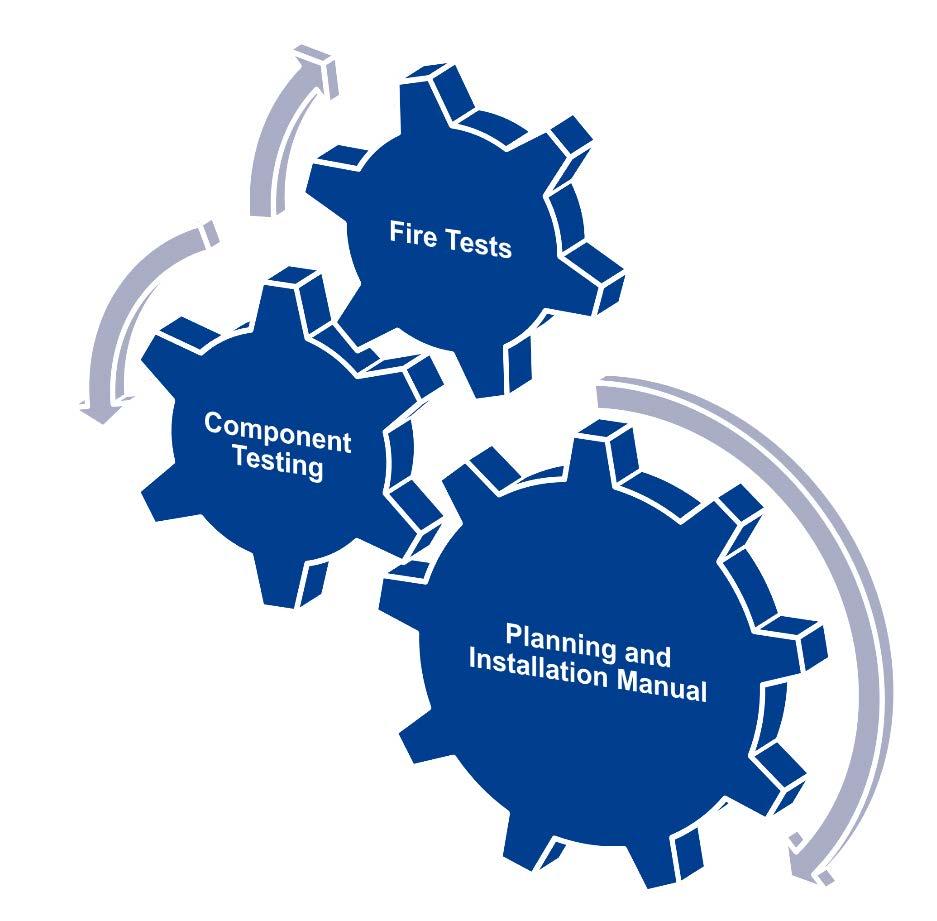
Quality assurance is just as important for water mist systems as for sprinkler systems. Christian Kopp of VdS introduces the VdS approach, which covers fire tests of the water mist system, component tests, review of the company design, installation operation and maintenance manual and accreditation of the installing company.
Fire safety building codes in some countries forbid automatic operation of smoke control systems where ESFRs are present. Although FM no longer refers to ESFR sprinklers, Ludger Tegeler of FM explains how these sprinklers can be used in non-storage protection designs.
Melissa Rodriguez of Johnson Controls completes the technical papers section with an insightful overview of the unique fire protection requirements for data centres, setting out the key considerations and available solutions.
The core mission of the EFSN is to develop the widespread use of sprinklers across Europe. We do this through national campaigns and continue to make great progress. Every year there are new requirements or incentives for sprinklers introduced in fire safety building codes. We have national updates from Inge Devalez for Belgium, Giorgio Franzini for Italy, John van Lierop for The Netherlands, Alfredo Álvarez for Spain and Alisdair Perry for the UK.
I hope you enjoy this edition of Sprinkler Outlook!
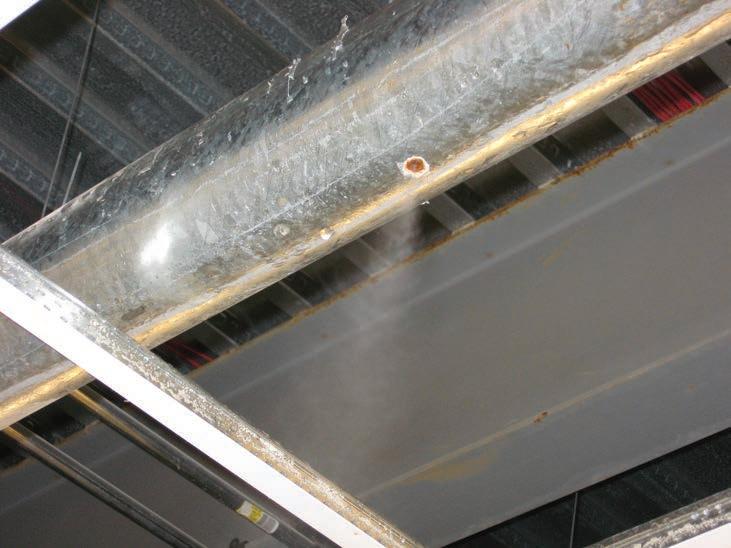
Oxygen Corrosion
In many countries the sprinkler market is regulated by a quality assurance scheme, often administered by an organisation owned by or with strong links to insurers. The EFSN asked its members for some details, summarised for 14 countries in this article and divided in Tables 1 and 2 under sprinkler systems installed for insurance purposes or those for regulatory compliance, these being the drivers for the installation of most systems.
Ludger
Operational testing of sprinklers sampled from existing facilities
Kerry Bell, PE, UL Solutions
For several decades, UL Solutions has examined and tested sprinklers sampled from field installations in accordance with the recommendations and requirements of applicable National Fire Protection Association® (NFPA®) standards.
To be effective in controlling or suppressing a fire, a sprinkler system is required to be designed and installed to provide protection against the magnitude of the anticipated fire risk. For example, the amount of water required to be discharged from a sprinkler protecting a warehouse with high-piled storage is multiple times greater than the amount of water required to be discharged from a sprinkler protecting an office facility with a smaller fire load. While it is critical for sprinkler systems to be properly designed and installed, it is equally important for these systems to be periodically inspected, tested and maintained to help ensure that the system equipment will perform as intended when a fire occurs. The primary focus of this article is on the examination and testing of the sprinklers sampled from a sprinkler system as referenced in the 2023 edition of NFPA 25: Standard for the Inspection, Testing, and Maintenance of Water-Based Fire Protection Systems 1
Inspection, testing and maintenance requirements for sprinklers
Periodic inspection of field-installed sprinklers is an important element of a comprehensive maintenance programme for fire sprinkler systems. As specified in NFPA 25, sprinklers showing signs of leakage, field painting, physical damage, loss of fluid in the glass bulb heat-responsive element, as well as corrosion or loading considered detrimental to sprinkler performance are to be replaced. All of these conditions can lead to the degradation of sprinkler performance during a fire condition.
In addition to the periodic inspection of field-installed sprinklers, the 2023 edition of NFPA 25 also requires replacement or representative sample testing of sprinklers based on the length of time in service. The frequency for sample testing or replacement depends on the sprinkler type and installation environment. While many sprinklers do not require representative testing or replacement until they have been in service for 50 years, sprinklers with fast-response elements are required to be tested or replaced at a shorter time interval. Earlysuppression, fast-response (ESFR) and control-mode specific-application (CMSA) sprinklers with fast-response
elements are required to be tested or replaced after 20 years in service and at 10-year intervals thereafter. Other types of sprinklers with fast-response elements are to be tested or replaced after 25 years in service and at 10year intervals thereafter.
Due to the relatively complex construction of a dry-type sprinkler, as well as some of the challenging installation environments where many of these sprinklers may be installed, dry-type sprinklers are required to be tested or replaced after 20 years of service and at 10-year intervals thereafter, regardless of the sprinkler response type. It is also noteworthy that NFPA 25 indicates that sprinklers installed in extraordinarily harsh environmental conditions, such as foundries, fertiliser facilities or areas exposed to outside weather conditions, are to be replaced or have representative samples tested at five-year intervals. The frequency for sample testing or replacement of some of these sprinklers has been revised over the years in consideration of their overall performance during representative sample testing. Sprinkler samples selected for testing are to be representative of the sprinklers installed in the system. As noted in NFPA 25, no fewer than four samples, or 1% of the number of sprinklers per sample area, whichever is greater, are to be tested. The sprinkler samples removed from the system for testing need to be immediately replaced with new sprinklers. Each sample received by UL Solutions is visually examined before testing to ascertain the sprinkler manufacturer, model or sprinkler identification number, style, type of heat-responsive element, temperature rating and year of manufacture. The condition of the sprinkler is also noted based on visual evidence of corrosion, loading, leakage, physical damage, loss of fluid in a glass bulb heat-responsive element or field painting. The testing of the sprinklers involves an assessment of the ability of the sprinkler to operate and allow the discharge of water.
Process to submit samples for testing
The UL Solutions field sprinkler testing programme is intended to assist property owners and other interested parties in assessing the operating characteristics of fire sprinklers in service. UL Solutions’ online tool for requesting operational testing of sample sprinklers provides a quick, simple means for initiating this process. Users can access this tool by visiting the UL Solutions website at https://fieldsprinklertesting.UL.com/ dashboard. Registration to initiate this testing process
Criteria description and sprinkler type
Maximum response time index (RTI) for standard-response (SR) sprinklers 350 (meters-sec)1/2
Maximum RTI for quick-response (QR) and residential sprinklers 65 (meters-sec)1/2
Maximum RTI for ESFR sprinklers
is necessary if an account has not been previously established. Once signed in, the menu prompts provided within the tool request the basic information required to submit samples to UL Solutions for testing.
As part of the UL Solutions field sprinkler testing service, identification tags are available for use at no charge. Sprinkler samples submitted for testing should be identified with the name and address of the building’s occupant, location of the sample within the building, type of room environment — e.g., office, warehouse, factory, etc. — and information on the party submitting the samples for testing. These identification tags can also be requested online.
Sample testing and report
To assess the operating characteristics of sprinklers sampled from field installation environments, the samples are subjected to the sensitivity oven heat test as described in ANSI/CAN/UL/ULC 199: the Standard for Automatic Sprinklers for Fire-Protection Service 2 During this test, the inlet of the sample is pressurised to approximately five pounds per square inch (psi) (0.35 bar) and quickly plunged into an oven that circulates heated air at a constant temperature and velocity. The actual temperature and air velocity used for the test are selected based on the temperature rating of the sprinkler. Each sprinkler sample is observed for proper operating characteristics, including the release of operating components and the time of operation. If the heat-response element functions but the water seal does not release, the sample is exposed to a water supply to determine if the sprinkler’s water seal releases at seven
Typical sensitivity test oven configuration
psi (0.5 bar). See Figure 1 for a diagram of an example of a test oven apparatus.
The submitter receives the test report for the samples. It describes the condition of each sprinkler and the results of the operation test as either normal or abnormal. The as-received condition of each sprinkler sample described in the report is based on a visual examination. The information included in the report is intended to be considered by other parties in determining whether other sprinklers in the system require replacement.
Acceptance criteria for the operational testing of sprinklers sampled from field installations
UL Solutions has implemented several changes to the service for testing sprinklers sampled from field installations over the years. One of the changes recently implemented was to align the acceptance criteria values with NFPA 25, which included guidance for the criteria to be used for evaluating the operating performance of the various types of sprinklers. Table 1 summarises the suggested criteria described in A.5.3.1.1 of NFPA 25. This NFPA 25 annex information provides guidance for testing laboratories to determine whether a sprinkler is considered to operate in a “normal” or “abnormal” manner. The UL Solutions test report references the RTI for each sprinkler tested in the plunge oven test. The RTI is calculated using the sprinkler’s operating time and marked temperature rating as well as the standardised velocity and temperature conditions used during the test. The UL Solutions test report also provides information about the laboratory’s visual observation of the condition of each sample sprinkler received.
Figure 1: Diagram of sensitivity oven test apparatus (not to scale)
Table 1: Sensitivity and operating pressure criteria
2: Field sprinkler test results summary — 2023
Statistical information on test results
The results from the testing of sprinklers sampled from installation sites also provide valuable information to UL Solutions in assessing the operating performance of a broad range of sprinkler constructions. In the late 1990s and early 2000s, this data was useful in identifying the concerns associated with the operating performance of dynamic O-ring-sealed wet- and dry-type sprinklers. This data and subsequent research led to substantial revisions to UL Standards for sprinklers that included a ban on the use of dynamic O-ring water seals and more stringent corrosion exposure testing of dry-type sprinklers that were implemented in early 2003.
If sprinkler inspection, testing and maintenance were performed in accordance with NFPA 25 since 2003 for all installation sites, every field-installed O-ring-sealed sprinkler would have been identified and likely replaced by this time. However, a substantial number of dynamic O-ring-sealed sprinklers still remain in existing facilities, even though UL Solutions has not certified these sprinklers since 2003. In fact, during 2023, approximately 15% of the dry-type sprinklers received for testing incorporated a dynamic O-ring seal.
In more recent years, the data on testing sprinklers sampled from field installations was useful in identifying a level of degraded operating performance of ESFR sprinklers. This finding provided technical support for revisions to ANSI/CAN/UL/ULC 199 that added requirements for more challenging corrosion exposure testing for ESFR sprinklers as well as revisions to NFPA 25 that referenced new thermal sensitivity acceptance criteria.
To assist the NFPA 25 technical committee members in understanding the operating characteristics of inservice sprinklers, UL Solutions has shared statistics from our testing of sprinklers sampled from field installations with the technical committee and others within the fire protection community. For the year 2023, an extensive analysis of the data from samples tested during that year was conducted, which was shared with the NFPA 25 technical committee during the revision cycle for the 2026 edition of NFPA 25. Table 2 provides an overview of the test results for the various types of sprinklers that were submitted to UL Solutions from existing facilities. Except for the known concerns with sprinklers having dynamic O-ring seals, the test results indicate
a high level of operating performance even after the sprinklers have been in service for many years. The majority of the SR sprinklers tested were at least 50 years old. The majority of the QR and ESFR sprinklers were at least 20 years old, and most of the dry-type sprinklers were at least 10 years old.
Related European standard
The requirements in NFPA 25 for the periodic sample testing and replacement of field-installed sprinklers are substantially different from those described in CEN EN 12845: Fixed Firefighting Systems – Automatic Sprinkler Systems – Design, Installation and Maintenance 3 The representative sample testing and replacement of sprinklers at specific intervals are included as mandatory requirements in NFPA 25, whereas CEN EN 12845 provides guidelines in an informative annex (Annex K) for testing sprinklers sampled from buildings after 25 years in service. CEN EN 12845 does not include any reference to the replacement of sprinklers at specific intervals.
In addition, the testing specified in NFPA 25 evaluates the operating characteristics of the sampled sprinklers compared to more extensive testing described in the annex of CEN EN 12845. While UL Solutions has the technical expertise and testing capabilities to conduct the suggested testing described in CEN EN 12845, these tests are not part of the NFPA 25 testing service described herein.
Summary
NFPA 25 includes detailed requirements for the inspection, testing and maintenance of sprinkler systems (as well as other water-based fire protection systems) that are intended to support system performance in achieving the expected function under specified conditions. The operating characteristics of sprinklers can degrade over time when exposed to a broad range of internal and external environmental conditions, and a cost-effective means to assess the operating characteristics of field-installed sprinklers is to conduct representative sample testing. UL Solutions’ service for testing sprinklers sampled from systems is intended to be a valuable tool to assist property owners, inspection authorities, the insurance industry and others in making important assessments of the operating characteristics of sprinklers in existing facilities.
The statistical analysis of the data generated from testing sprinklers sampled from field installations indicates that a very high percentage of these sprinklers operate in a normal manner even after being installed in challenging environmental conditions for many years. The data generated from this testing are also useful in identifying opportunities for developing proposed revisions for safety standards such as ANSI/CAN/UL/ULC 199 and NFPA 25. Based on the data collected, several revisions have been made to UL Standards that have been instrumental in maintaining the extraordinarily high level of performance that sprinkler systems have demonstrated over decades of use.
1. “Standard for the Inspection, Testing and Maintenance of Water-Based Fire Protection Systems,” NFPA 25, National Fire Protection Association, Quincy, MA, 2023 Edition.
2. “Standard for Automatic Sprinklers for Fire-Protection Service,” UL 199, UL Standards and Engagement, Evanston, IL, Thirteenth Edition, June 27, 2025.
3. “Fixed Firefighting Systems – Automatic Sprinkler Systems – Design, Installation and Maintenance,” CEN EN12845:2015+A1:2019, European Committee for Standardisation, Brussels, Belgium.
Table
Quality assurance of sprinkler systems
Alan Brinson, Executive Director, European Fire Sprinkler Network
The European market for fire sprinkler systems has more than doubled since the European Fire Sprinkler Network (EFSN) began operating in 2003. This has come about as the EFSN and our members across Europe have successfully campaigned to see changes in national and local building codes that recognise the benefits of sprinklers to fire safety. Those campaigns rested on the outstanding performance record of sprinkler systems over more than 150 years.
While sprinkler systems are a robust technology, for the highest reliability they should be installed and maintained under a strict quality assurance scheme. Statistics from many countries and organisations typically report a 97% or 98% success rate. However, the range is from 88% to 99.5%. Although at first glance the difference between 88% and 99.5% may not seem significant, the ratio of the corresponding failure rates is 24.
In many countries the sprinkler market is regulated by a quality assurance scheme, often administered by an organisation owned by or with strong links to insurers. The EFSN asked its members for some details, summarised for 14 countries in this article and divided in Tables 1 and 2 under sprinkler systems installed for insurance purposes or those for regulatory compliance, these being the drivers for the installation of most systems.
Quality does not come without a cost so companies can only offer the above services and win business if they form part of a quality control scheme that is strictly enforced, ideally through third party assessment of individuals and companies. The outstanding success of sprinkler systems depends on such schemes. Where a quality assurance scheme is not in place we can expect the long-term performance of sprinkler systems to be inferior.
Insurance Market
Fire sprinkler systems are often installed in Europe either to obtain an insurance discount or because insurance cover is otherwise hard to find. Respondents to this survey either claimed that the insurance-driven market is static or that it is declining. In Spain it was claimed no longer to exist. Fortunately, across Europe many of the buildings that in the past were protected with sprinklers only at the request of insurers now must be protected to comply with building codes.
Design
In most countries insurers no longer use the European insurers’ standard CEA 4001 but now use EN 12845, often with local additional requirements. Insurers in all countries allow the use of the internationally-recognised NFPA or FM design standards. Some will also accept LPC or VdS, although these are not often proposed outside the UK & Ireland and Germany respectively. All these standards are based upon many years of experience, which have shown that if a system is designed in accordance with the standard and maintained ready to function, it will control or extinguish fire in all but the most exceptional circumstances.
In most countries insurers require a review of system designs. This can pick up errors made either through ignorance or to cut costs. If insurers do not require a review of designs or conduct it themselves, their requirement for installer third party accreditation includes a review of a sample of the designs by those installers.
Installation
Inspection of finished systems will uncover most errors made during installation but not all errors, since some will be hidden. Most insurance bodies recognise this and so in addition to inspections of finished systems they supervise the competence of installers through an accreditation scheme. In the UK, many system inspections are performed by the installer under a supervised scheme, so that only a sample of sites is inspected by an independent party. This reduces the cost of the scheme and accommodates the reality of an insufficient number of inspectors.
Periodic Inspection
Over time a system could become nonoperational or the hazard may change so that the sprinkler system can no longer protect it. The European standard, EN 12845, requires quarterly reviews of the hazard and extensive inspections. Only UK insurers enforce this frequency, although in Belgium, France, Germany and The Netherlands systems are typically inspected every six months. Systems in the UK are not usually inspected by third parties and fire brigade data suggests reliability of 94-95%, lower than in countries with third party inspection regimes. CEN does not allow a standard to specify who should assess conformity so instead EN 12845 calls for a qualified person to conduct the inspection, referring to an informative annex to suggest what would make someone qualified. That annex recommends the inspection be conducted by an independent body.
Design
Which is the usual design standard?
Which other design standards are accepted by insurers?
Do insurers require project designs and drawings to be reviewed?
(NO/YES/SOMETIMES)
Who carries out this review?
BelgiumDenmark
or FM
For what % of projects is this review performed (<20; 20-40; 40-60; 60-80; >80)?
Installers
Do insurers usually require sprinkler system installers to be certificated by a third party? YESYESYESYES
Who carries out the certification? ANPIDBITUKESCNPP
How many certificated installers are there? 20-2518 41 21
For what % of projects do insurers require a certificated installer? (<20; 20-40; 40-60; 60-80; >80)
Inspection
Do insurers usually require an inspection of newly completed sprinkler systems? YESYESYESYES
Who carries out these inspections?
For what % of projects is this inspection performed? (<20; 20-40; 40-60; 60-80; >80)
Do insurers require periodic inspections of existing sprinkler systems? YESYESYESYES
How often?
VdS CEA 4001
FMNFPA 13 EN 12845 NFPA 13 FM EN 12845EN 12845 VdS 4001 EN 12845SBF 120:8VKF 19-15
NFPA 13 FM LPCB NFPA 13
FM VdS, EN 12845+ NEN 1073 NFPA 13 FM, VdS NFPA 13FM NFPA 13 EN 12845 NFPA 13 FM CEA 4001 VdS FM VdS CEA 4001 NFPA 13 SN EN 12845 NFPA 13 FM
Code Market
Today many more fire sprinkler systems are installed because they are required by building codes and this part of the market is growing as legislators recognise the role that sprinklers can play in improving fire safety.
Design
In most countries EN 12845 is the usual design standard, although national insurance standards, NFPA standards or FM data sheets are also accepted in many countries. Residential sprinklers are now being installed in Belgium, France, Netherlands and the Nordic countries in accordance with EN 16925 and in the UK and Ireland in accordance with BS 9251. In five countries the authorities require a review of designs while they sometimes require it in four others.
Installation
In half the countries the authorities require that sprinkler contractors be accredited by a third party and in 11 of the 14 countries installed systems must undergo an inspection. In countries without widely applied installer accreditation schemes the code market is sometimes served by different companies than the voluntary or insurance market. The quality of the systems installed in the code market is then suspect.
Periodic Inspection
In 11 of the 14 countries the authorities require periodic inspection of all sprinkler systems. The frequency of these inspections varies around Europe from every six months to every five years, sometimes varying depending on the protected occupancy. French regulations require an inspection every three years (and list what should be inspected) but French end users often require more frequent inspections to cover their potential liability. In some countries these inspections are conducted by the installer, while in others they are done by a third party.
Design
Which is the usual design standard?
What other design standards are accepted by government?
Does the government require project designs and drawings to be reviewed? (NO/YES/ SOMETIMES)
Who carries out these reviews?
For what % of projects is this review performed (<20; 20-40; 40-60; 60-80; >80)?
Installers
Does the government usually require sprinkler system installers to be certificated by a third party?
Who carries out the certification?
For what % of projects does the government require a certificated installer? (<20; 20-40; 4060; 60-80; >80)
Inspection
Does the government usually require an inspection of newly completed sprinkler systems?
Who carries out these inspections?
or Vinçot
For what % of projects is this inspection performed? (<20; 20-40; 40-60; 60-80; >80)
Does the government require periodic inspection of existing sprinkler systems?
Components
High quality components are essential to the reliability of sprinkler systems. Key sprinkler system components are covered by the EN 12259 series of standards. Parts 1 to 5 address a basic range of fire sprinklers, alarm valve assemblies, water turbine alarms and flow switches and are harmonised, meaning that they have been referenced in the Official Journal of the European Union. Components covered by these standards must be tested against them and be CE-marked. Further standards exist for other sprinklers and sprinkler pumps, with EN 17451 for pump sets. These standards are voluntary and cannot be used to confer the CE mark. EN 12845 is currently being amended to refer to them, so that any contract that requires compliance with EN 12845 will also require compliance with these standards.
Installers of sprinkler systems all use products that have been independently tested and approved against these standards and insurance test protocols by third party laboratories. There are relatively few suppliers and the quality of their supply is tightly controlled. This is the most
rigorously and consistently enforced part of the quality assurance system. Counterfeit and unapproved products are not installed in the countries covered by this survey, but they are installed in Turkey.
Other components such as pipe, fittings and pipe supports are supplied to comply with national or international standards. Installers have little incentive to use substandard supply of these products and quality issues are rare.
Installer Accreditation Schemes
Most countries have at least one national installer accreditation scheme. In many countries the authorities do not require the installer to be accredited but to cover potential liability and show all reasonable steps to ensure system effectiveness have been taken, end users and consultants generally specify that an accredited installer should install the system.
The different schemes address many of the same aspects of quality control. Some important differences are whether the installer performs the design and whether the sprinkler fitters may be sub-contractors. In the past all the accreditation
Paris Marriott Rive Gauche Hotel & Conference Centre
Wednesday 22nd & Thursday 23rd April 2026
Connect with global sprinkler experts, practitioners, legislators and influencers in Paris in 2026
schemes only applied to a company. This is now changing, with personal qualifications available and required under some accreditation schemes, such as in the UK. Some of those schemes also comply with EN 16763 Services for fire safety and security systems, published in 2016, which introduced guidance for qualifications for key people.
Recommendations
Sprinkler systems are already very reliable, but data suggests that they are more reliable in some countries than others. Countries seeking to reduce the risk of sprinkler system failure should adopt a comprehensive system of quality assurance, comprising:
Design in accordance with an appropriate standard
Review of all designs by a competent person
Use of appropriate, approved components
Third party accreditation of all installers
Annual inspection of each system by a competent person, ideally a third party Service and maintenance in accordance with EN 12845, insurance guidelines or NFPA 25
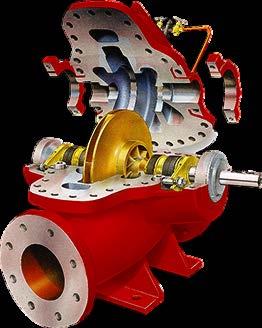
Patterson Pump Ireland is a complete pump manufacturer, offering our customers some of the most reliable pumping solutions available. Our fire pumps stand over life and property throughout the world.
HORIZONTAL SPLIT CASE (HSC)
LESS COST IN LESS SPACE
Reduce on-site labor time, engineering and installation time and associated costs. Choose a system that arrives on-site in fully enclosed ready for use pump house. This pre-engineered pumping system saves time and money for our customers.
+353 (0)44 934 7078
company/patterson-pump-ireland-ltd
www.ie.pattersonpumps.com
ppi.sales@ie.pattersonpumps.com
VdS guidelines for water mist systems – added value for manufacturers and users
Christian Kopp, Product Manager, VdS
In today’s world, where fire protection is playing an increasingly important role and complex construction projects need to be managed, innovative solutions are required to ensure the long-term safety of people and property. The installation of water mist systems has established itself as an effective technology for firefighting in various areas of application. In order to guarantee the effectiveness of these systems, it is essential that they are subjected to strict testing and approval procedures and that these systems are subject to precise specifications with regard to planning and installation.
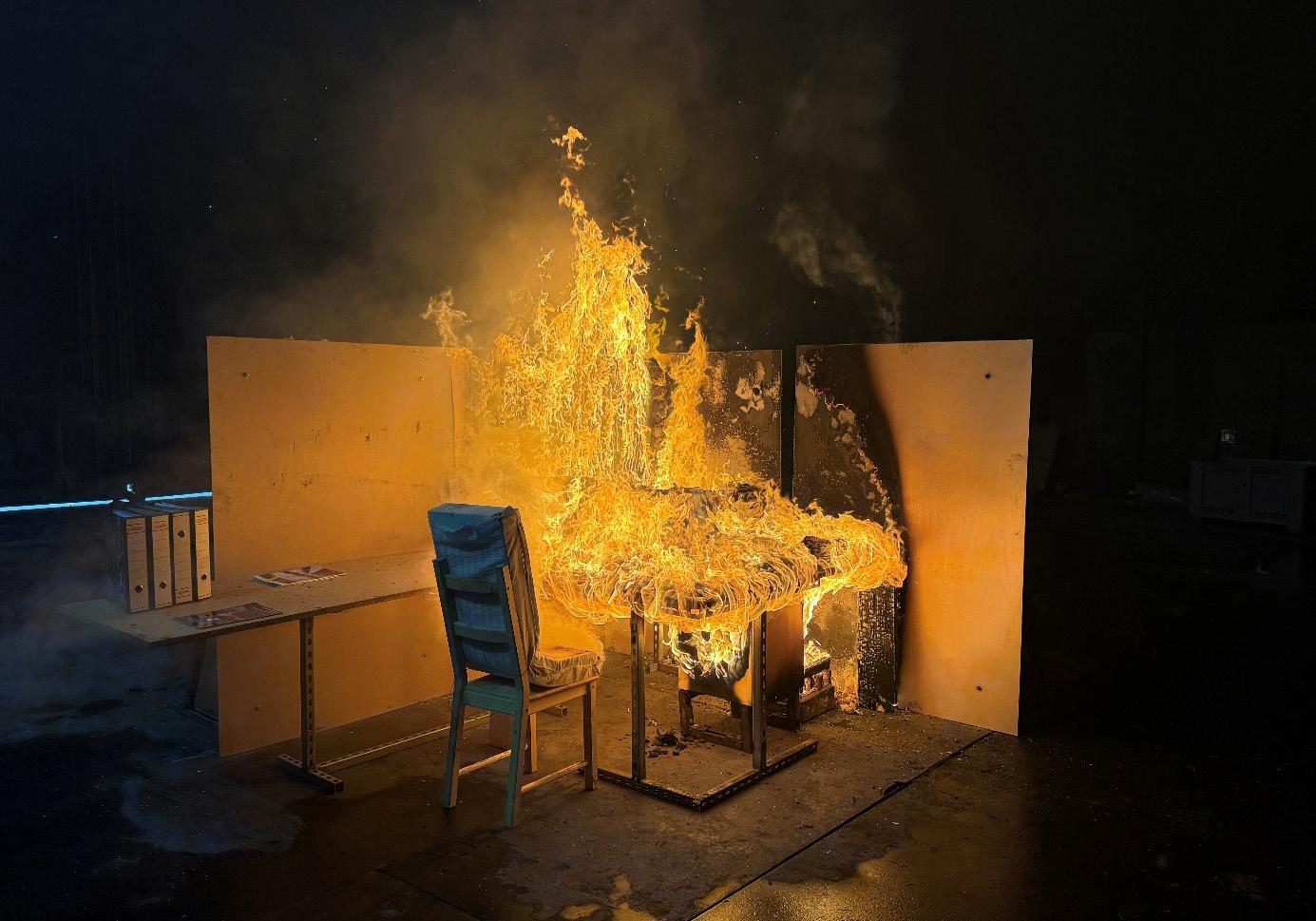
This is why it was important for VdS Schadenverhütung to revise and update all standardised VdS fire test protocols that have been used for many years to prove the effectiveness of water mist systems in VdS 3883 - VdS Guidelines for Water Mist Systems – Fire Test Protocols for Water Mist Systems, and to publish them in a bundled series of guidelines.
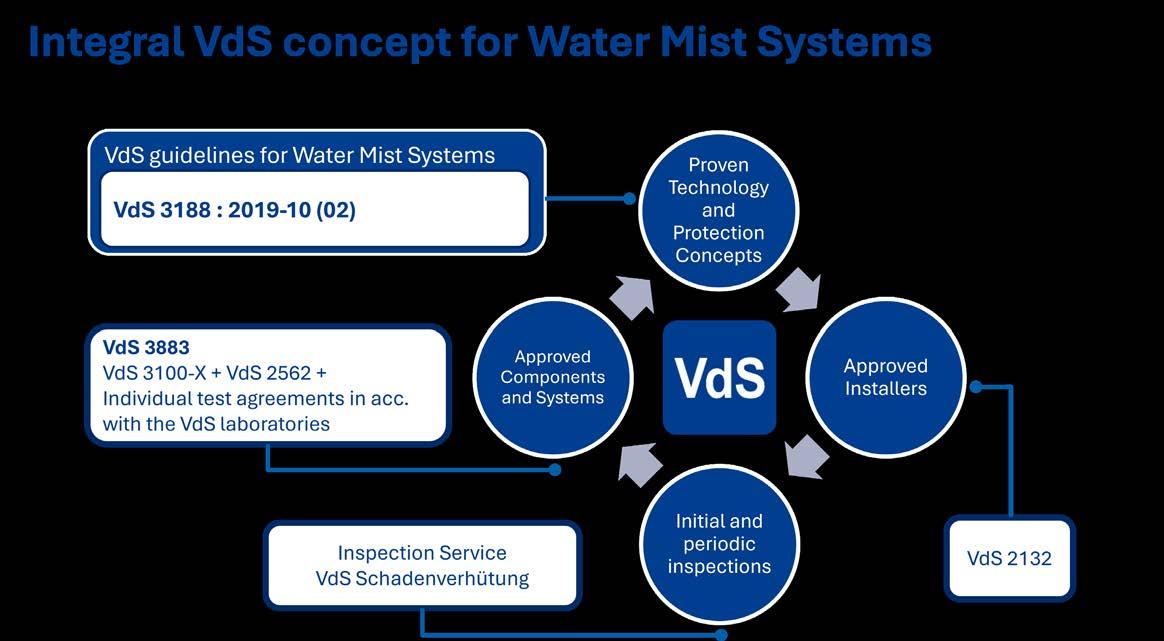
As Figure 1 illustrates, VdS 3883 plays therefore an important role in the evaluation of the effectiveness and reliability of water mist systems as part of an approval procedure at VdS Schadenverhütung, which is supplemented by extensive component and system tests in the VdS laboratories and the revision of the system-specific manual for planning and installation.
The connection between individual guidelines and their interdependence is illustrated in Figure 2 “Integral VdS concept for water mist systems”, which can also be applied for other types of extinguishing systems. VdS Schadenverhütung’s philosophy is that maximum operational safety and reliability of tested components and systems can only be achieved if this technology
is planned and installed in accordance with recognised protection concepts, guidelines and regulations by installers who have the necessary technical expertise. Finally this process is determined in the course of an initial and periodic field inspection by VdS Schadenverhütung Technical Inspection Service on site.
Planning and installation of fire extinguishing systems by VdS-approved installers.
Figure 2 already shows that the planning and installation of fire extinguishing systems is a central part of the integral concept for water mist systems. Ultimately, however, it is merely the consistent implementation of the VdS quality standard, which is taken into account by the VdS 2131 guidelines for the approval of installation companies for fire extinguishing systems.
The VdS 2132 guideline specifies the requirements for companies that plan, install and maintain fire extinguishing systems. It serves as the basis for VdS Approval of such installation companies. In order to achieve such approval, various proofs must be provided, e.g. a quality management
system in accordance with EN ISO 9001; sufficient public liability insurance; appropriately qualified specialist personnel including the necessary tools and software programs; as well as a guaranteed stock of spare parts for specified parts and components.
The approval procedure then comprises the following key steps:
1. Examination of documentation, reference projects and qualifications of employees
2. Construction site inspections and inspection of the operating sites
3. Continuous verification that all work is carried out in accordance with VdS specifications and accompanying regulations
The approval is ultimately only granted if all requirements are met
Always required: proof of effectiveness in course of fire tests
The requirement to carry out fire and extinguishing tests as proof of effectiveness is not a special approach taken by VdS Schadenverhütung. Rather, this is also required in other standards and guidelines such as DIN EN 14972-1 or NFPA 750 (National Fire Protection Association).
The system parameters of a water mist system, such as the minimum operating pressure, K-factor or maximum permissible spacing between water mist nozzles or sprinklers, are always verified individually for each water mist system by means of efficacy tests. Instructions for carrying out these tests and the evaluation criteria are described in application-specific fire test protocols. As fire test protocols and installation guidelines correspond directly with each other, they must be properly coordinated and, above all, must not contain any contradictory requirements.
This is reflected not least in the structure of VdS 3188 - VdS guidelines for water mist systems. The main part of these guidelines describes general requirements for the water supply, distances, spacing and arrangement of water mist sprinklers and nozzles, alarm devices and measures to maintain operational readiness. Various appendices deal with areas requiring special regulation. For example, the use of foaming agents or requirements for the protection of multi-story buildings. Appendix K, which should be emphasised here due to its central
Figure 1 Interaction of various approval processes (Copyright VdS Schadenverhütung GmbH)
importance, provides additional information and requirements for selected areas of application of water mist systems. Broken down into areas of application, it contains detailed regulations, for example on restrictions regarding storage or the use of flammable liquids, parameters for the design of the water mist system or special measures that must be initiated automatically in the event of a fire.
In order to take account of the aforementioned integral concept, the fire test protocols of VdS 3883 and the regulations of VdS 3188 are precisely coordinated in terms of content.
VdS 3883 in detail
VdS 3883 is a guideline that summarises all standardised fire test protocols for water mist systems at VdS Schadenverhütung. These fire test protocols were developed to ensure that water mist systems are capable of effectively fighting fires while at the same time guaranteeing the safety of people and property. Some of these test protocols have been
available for many years and have long since established themselves as valid verification methods.
However, in the past the individual fire test protocols sometimes differed significantly in terms of structure, type and scope of the description of the test procedure. A uniform test protocol structure, standardised requirements for the measurement technology to be used or requirements for the test report have significantly simplified handling for the user and set future-oriented standards for test execution.
Depending on the planned area of application of the water mist system to be approved, only the relevant part of VdS 3883 needs to be observed as part of a VdS approval procedure.
Proof of the effectiveness of each water mist system is not only important for the manufacturers of these systems as a quality feature of their systems, but also in particular for insurers, planners and ultimately the operator, who must rely on the safety and reliability of the installed fire protection solutions in the event of an emergency.
The application of VdS 3883 in conjunction with VdS 3188 ensures that all water mist systems planned, installed and tested in accordance with these guidelines meet the high safety and reliability requirements of VdS Schadenverhütung.
Areas of application of VdS 3883
The areas of application for VdS 3883 are diverse and range from industrial applications to offices, recreation areas and parking garages. In detail, these are:
Part 1: Protection of office and accommodation areas
Part 2: Protection of offices and accommodation areas with water mist sidewall nozzles
Part 3: Protection of false ceilings and false floors in OH1 risks
Part 4: Protection of parking garages
Part 5: Protection of selected sales, storage and technical areas
Part 6: Protection of paint booths
Part 7: Protection of areas with flammable liquids
Part 8: Protection of cable ducts
Figure 2 Integral VdS concept for water mist systems (Copyright VdS Schadenverhütung GmbH)
It is important to emphasise that, regardless of the areas of application listed here, individual protection and test concepts can of course also be developed with VdS Schadenverhütung. In the past, application-specific fire protection solutions with water mist systems have already been successfully tested and implemented several times in coordination between the manufacturer, operator and VdS Schadenverhütung.
Advantages of VdS 3883
The implementation of VdS 3883 brings numerous advantages:
1. STANDARDISED TEST METHODS
By providing standardised fire test protocols, VdS 3883 enables a uniform evaluation of water mist systems. This makes it easier for users and manufacturers to access reliable information on the performance of different water mist systems, even though the documentation (e.g. the test report) is the property of the manufacturer. However, all VdS-approved water mist systems can be listed and some system parameters can be viewed on the website www.vds.de.
2. CONFORMITY TO EN 14972
Another significant advantage is that some fire test protocols from VdS 3883 have now been implemented in DIN EN 14972. For example, VdS 38831, the content of which is reflected in DIN EN 14972-3, or VdS 3883-8, which has been implemented in DIN EN 14972-11. A sign of the high status that the VdS fire test protocols have at European level.
This means that after completing successfully a VdS approval procedure and making sure compliance with all requirements, conformity with the corresponding parts of (DIN) EN 14972 can also be confirmed by VdS. For manufacturers, this can be a decisive competitive advantage, which can be noticeable in public tenders, for example, if they explicitly require water mist systems that comply with an EN or DIN standard.
Operators and insurers in particular need to know, that with approval procedures carried out by VdS Schadenverhütung, every step of the project is supervised by the same contacts within VdS: Monitoring of the proof of effectiveness by two experienced VdS engineers,
Component tests in our own VdS laboratories, Examination of the documentation (incl. test report, systemspecific manual for planning and installation), Certification of the system.
In order to meet the high quality standards of VdS, proofs of effectiveness are only accepted when conducted by our own personnel. Approval procedures based purely on a document check are never accepted.
The situation is completely different when it is only checked that a water mist system complies with a standard. In these cases, the manufacturer of the water mist system is responsible for carrying out the proof of effectiveness and preparing the documentation. Compliance with all requirements as part of the procedure by independent approval bodies such as VdS and the associated necessary quality assurance can can therefore not be provided in many cases..
3. INTERNATIONAL ACCEPTANCE
The inclusion of all VdS 3883 fire test protocols in the current NFPA 750 also significantly increases the international status of VdS 3883. Wherever required, manufacturers of water mist systems benefit from increased market acceptance and can offer their products worldwide with the proven VdS seal of approval.
4. VdS 3883 IN THE CONTEXT OF VdS 3188
The planning and installation of water mist systems is always subject to standards, regulations and building and insurance law requirements. In addition to the VdS guidelines for water mist systems, there are other European and international regulations that can be used as guidelines for installers, insurers and operators of water mist systems.
VdS 3188 serves as a guideline for installers, planners, insurers and operators of water mist systems for the planning and installation of water mist systems. In order to link the application-specific requirements of a water mist system, e.g. for the protection of a parking garage, with the general requirements, e.g. the water supply, all relevant and application-specific requirements and instructions for planning and installation are given in Annex K of this guideline. The requirements
described there are largely derived from the fire tests described in of VdS 3883.
5. ADVANTAGES FOR MANUFACTURERS AND USERS
VdS 3883 offers numerous advantages for both manufacturers and users of water mist systems. For manufacturers, compliance with this standard means that their components and systems meet a high level of quality and that they can market them accordingly. VdS certification is a recognized seal of quality that creates trust among customers and increases competitiveness.
For operators, e.g. of office complexes with corresponding office and recreation areas as well as parking garages or public buildings, the use of VdSapproved water mist systems means increased safety. You can rest assured that the systems have been tested under realistic conditions and will function reliably in case of an emergency. In addition, conformity with standards simplifies the planning and approval of fire protection measures, as the systems comply with the applicable regulations and standards.
Conclusions
In a world full of risks, it is crucial to fall back on proven standards - the VdS guidelines provide a solid basis for this and help to protect lives and preserve property.
With VdS 3883, the existing VdS fire test protocols for water mist systems have been standardised, further developed and summarized in a guideline.
Standardised test methods not only ensure the quality of water mist systems, but ultimately also promote their international acceptance.
VdS acts as a competent partner in recognition procedures and customers can benefit from its many years of experience in the field of water mist systems.
If you have any general questions or are interested in a new approval procedure or construction project, please do not hesitate to contact our Technical Inspection Bodies or the Product Management of the Technical Inspection Body.
Further details on contact persons or general information on our services can be found at www.vds.de.
How manufacturer involvement can mitigate labour risks
Graeme Leonard, EMEA Fire Protection Division Manager, Victaulic
The construction industry’s labour woes continue. In May, the Office for National Statistics (ONS) in the UK reported that 21% of businesses with 10 or more employees, including in construction, were experiencing worker shortages. Meanwhile, the Construction Skills Network (CSN) projected a need for an additional 251,000 construction workers in the UK by 2028 to meet anticipated demand.
The situation is similarly challenging across the EU. Also, in May this year, the European Employment Services Network (EURES) reported construction as having the fourth highest job vacancy rate in the EU for Q2 2023, with vacancy rates rising faster than any other sector since 2016.
The main challenge faced by the construction industry when tendering for projects has always been predicting project timelines and costs. However, the reality of potentially having to deploy less skilled crews is putting even more pressure on budgeting.
Is a less experienced crew going to be able to deliver the project on time, or should additional crew members be factored in? Can the crew ensure a reliable system or will there be a risk of a recall to make corrections due to lack of installation experience? These are critical questions, especially in the fire protection sector, where the proper installation of systems is required to safeguard not only property but also human lives.
It’s clear the construction industry needs to do more to attract new people who are willing to invest time in developing their skills. While the
industry grapples with attracting and developing talent, clever product design and manufacturerled training can go a long way towards boosting productivity and quality.
Suppliers such as Victaulic can play an important role in mitigating the effects of labour shortages or inexperience through innovative product design and targeted training programmes.
Designing for ease of use and increased productivity
Listening to customers to pinpoint the issues they have on site and addressing them with new innovations is just a start. Developing products that are designed to speed up the installation process while making it easier and more reliable is certainly one thing that can help to mitigate the risk of having less skilled labour and provide the contractor with more certainty about the time spent on site.
A key innovation we have developed at Victaulic to help overcome installation challenges and avoid potential incorrect installations is our patented Installation-Ready™ technology. These products arrive on site ready to be installed and don’t require disassembly prior to installation. The products spread right across our full range, from couplings and fittings to even some of our sprinklers.
The idea behind InstallationReadyTM products is really quite easy to follow: how can we make the installation process more efficient while reducing the risk of incorrect installation? The design of our Installation-ReadyTM products allows an installer to join pipes by simply pushing the couplings or fittings onto the grooved end of a pipe, fitting, valve or accessory, connecting it to, for instance, a second grooved-end pipe, and then tightening the nuts using standard hand tools or an impact wrench. Installer confidence and reliability are also built into these products. When the bolt pads touch metalto-metal, a proper, leak-free installation is guaranteed without having to meet a specific torque requirement. While precision and attention to detail are still a must, such as tightening the nuts evenly by alternating sides and making sure the bolt pads touch, the process removes the need for more skillintensive techniques and helps to speed up the installation process.
Incorrect sprinkler installation also entails big risks for contractors because it always involves having to revisit the site and renting scissor lifts again, thus adding additional costs to the project. We try to address this as well with our Installation-ReadyTM sprinkler. This grooved sprinkler with a coupling already attached is designed so it can be installed quicker and more reliably than a threaded sprinkler, while also avoiding the risk of installers suffering repetitive strain. This in turn helps contractors to better control their labour and optimise the number of workers on the ground.
Setting a benchmark with manufacturer training
Ultimately, we’re trying to provide an ideal scenario for contractors: products that reduce time on the jobsite and save them money by mitigating the problems posed by the shortage of skilled labour. And while we’re very happy for our products to be a solution, I still believe there is more support the industry can provide contractors in the form of training standards, and here Victaulic is keen to play its part too alongside other industry stakeholders.
Undoubtedly, real value can be derived from manufacturers taking on a mandatory role in training. The manufacturers are the specialists in their own products and can
disseminate product-relevant knowledge to labourers on the worksite. That is why we are driving the industry towards training programmes, both on the jobsite as well as in our training facilities.
During these training sessions, we cover a broad range of topics such as how to properly groove pipe, measure the groove depth, install and service our alarm valves, and install couplings, sprinklers and valves. If we’re talking about ideal scenarios for contractors, I believe the industry should strive to have at least one member of an installation team hold training certification from the manufacturer for the products they’re handling. That way the contractor can rest assured knowing that a specialist with the relevant skills and knowledge is always available on site to help and support other members of the installation team whenever required.
Bidding for a construction project will always entail some level of uncertainty, but as a manufacturer looking to support our customers and the industry, we are helping to mitigate risk and to build up a force of knowledgeable people in the field. We are keeping our finger on the market pulse to deliver high quality products that increase efficiency and reduce the chance of incorrect installation while making sure that their users receive the necessary training about them.
www.virotec.de
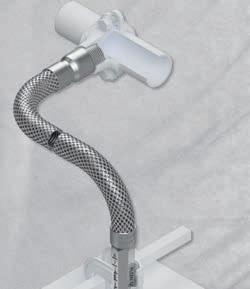
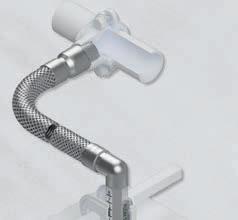
FLEXHOSE AND FIXTURE - THE NEW GENERATION!
The VX-Flexhose/-Fixture product line contains more than 100 new product types. So we can always provide you with the perfect solution, tailor-made for your sprinkler project.
All System VIROTEC products are VdS and FM approved.
The importance of pipe prefabrication
Marta Caigiao, Tubasys
All active systems for fire protection have a common element to join different parts and conduct the extinguishing agent from its source to the fire: piping. In this article I will discuss the importance of pipe prefabrication and examine UNE 23450-1:2022 Prefabrication of piping for fire protection installations. Part 1: Non-alloy steel tubes.
The failure of the piping network would leave the fire protection system, or a part of it, out of service, such is the importance of this element. Most water-based fire protection systems use non-alloy steel pipes referenced in fire protection standards or guidelines. These pipes are chosen for their performance and durability.
Years ago, before prefabrication and grooved system became available, these pipes were supplied on site as black or galvanised steel pipes at commercial lengths. Workers had to measure the different lengths in the pipe network design and the position of outlets; cut and weld the outlets; prepare pipe ends for weld or thread connections; check; test; and repair any leaks before applying corrosion protection. For that, workers had to clean the pipe surface and apply several layers of liquid primers and paints, allowing each layer to dry before applying the next.
With the advent of the grooved pipe and fitting system, the machining of pipe networks was considerably simplified, and worker safety was improved. This system avoids welding in the workplace, reduces the need for cutting and eliminates the need for specialised labour (welders). Work is reduced to cutting, grooving and, sometimes, painting. Grooved connections also facilitate assembly and disassembly of the network, reduce assembly time and, consequently, bring significant cost savings.
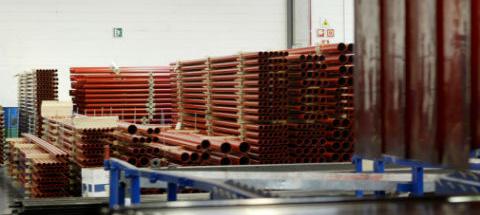
Following this development came prefabricated pipes as one more piece of the fire protection system ready to install without onsite processing. Prefabricated pipe is a pipe cut to length, including welded outlets for
sprinkler heads and branch connections, grooved ends for assembly using grooved couplings and corrosion protection as needed.
A prefabricated pipe complements the grooved system. Production of these pipes is carried out in a controlled environment including proper quality controls. It is a product made for each specific piping design after a specialised preliminary study phase.
Nowadays, prefabricated piping can have certifications such as FM and VdS.
There are many advantages to assemblies using prefabricated pipes, such as those listed below, which are continually increasing the demand for this product:
Eliminates on-site welding
Reduces cutting work to minor adjustments
Facilitates assembly and disassembly for maintenance, renovations or repairs
Guarantees anti-corrosion treatments
Eliminates specialised labour and reduces onsite staffing, which takes on greater importance today when finding workers is becoming increasingly difficult
Installation work is reduced to the assembly of pipe connections guided by an assembly drawing, created in technical offices by experts
Factory prefabrication reduces errors on site
S aves time (near 40%) and money
Nowadays, there are several manufacturers who specialise in this product, using robotic cells and certified welders, offering additional control and quality advantages. For example, it is possible to know the complete traceability of each prefabricated pipe and its components; the technical documentation generated from a customer’s request to delivery to the site; the carbon footprint; the personnel involved in its production; the machinery; the quality controls carried out etc.
The technical offices have also improved, working with 2D or 3D models, with the ability to solve potential interferences and obstructions before beginning on-site assembly. They are staffed with personnel specialised in fire protection and specifically in prefabricated pipe design.
Although it is difficult to find a fire protection installation that does not use prefabricated piping, there
is no standard to ensure consistency and minimum quality requirements. It is up to each manufacturer to obtain certifications to assure their customers that the product is suitable for their use. Most factories in Europe are subject to ISO 9001.
It was in 2004 that a European factory achieved, for the first time, Factory Mutual (now FM) approval for prefabricated pipes as another piece of the system. This opened a way for all prefabrication manufacturers to establish their suitability for fire protection installations and have the quality of their production recognised.
Because of the popularity of prefabricated steel pipes and their rising demand due to their advantages in construction, in 2022 a working group of the Spanish technical committee CTN23 Fire Safety, whose secretariat is held by Tecnifuego, collaborated to draft a standard for the prefabrication of pipes for fire protection installations. This standard was named UNE 235401:2022 Prefabricación de Tubería para Instalaciones de Protección contra Incendios. Parte 1: Tubos de acero no aleado (Prefabrication of piping for fire protection installations. Part 1: Non-alloy steel tubes).
UNE 23540-1 aims to homogenise and standardise this product, ensuring minimum quality conditions during manual, semi-automatic, or robotic production. This standard allows for the adaptation of the prefabricated characteristics to the different Fire Protection (FP) design standards (EN12845, FM, NFPA, VdS, …). It describes the design, controls, processes, tests, marking, and documentation necessary for the prefabrication of pipes for FP from black steel tubes (Part 1). The standard specifies that the pipes must be protected against
corrosion and requires traceability of the products used. Pipes under UNE 23540-1 are issued for fluid conduits at ambient temperature as FP installations such as water supply systems for FP, hydrants, hoses, sprinklers, water spray, mist, foam, and others that can be likened to these uses. They are suitable for the working pressures of the systems in which they are used and, at a minimum, 20 bar.
UNE 23540-1 also establishes that the prefabrication company must have a management system in place that covers the quality of its processes according to UNE EN ISO 9001 or similar.
UNE 23540-1 covers all the required processes starting with raw materials and their suppliers, design, marking of pipes for traceability and for location over a cutting drawing on site, through to packaging specifications to secure bundles while in transport and to protect pipes on site. It also covers sheets to register processes, checking and tests as well as personnel involved at each point, or documents to send with prefabrication to customers. It enables the issuance of Certificate 2.1 Declaration of Conformity with the Order (Annex I) according to UNE EN 10204. Other quality certificates for the company and product that are available can be included.. Production records must be kept during the warranty period with these records being the property of the manufacturer. Ultimately, this is a very comprehensive document that is open to different prefabrication processes and represents a step forward in the standardisation for this particular product and for the grooving system in general; therefore, it is expected to be adopted by other countries and to achieve the status of an EN Standard in the future.
Selecting a water-based fire suppression system for a data centre
Melissa Rodriguez - Senior Manager, Industry Relations at Johnson Controls
This article will focus on water-based fire suppression options – specifically preaction sprinkler systems and water mist systems – and when one might be more appropriate than the other as the system of choice to protect a data centre (DC).
As global demand for data storage and processing power accelerates, the construction of DCs is experiencing rapid growth, both in scale and complexity. These mission-critical facilities are evolving to support high-density computing, edge capabilities, and sustainability initiatives, pushing the boundaries of conventional building systems. Amid this evolution, fire protection remains a paramount priority. With billions of euros of digital infrastructure and up time at stake, fire protection strategies must adapt alongside DC design.
When it comes to traditional water-based sprinkler systems, the most basic type is a standard wet sprinkler system. This is a network of pipes filled with water that is ready to discharge as soon as the rising temperature from a fire reaches the point where the individual sprinkler element activates, allowing water to be discharged directly at that point.
In cases where it is either not possible or desirable for there to be water present in the pipes, such as in a freezing environment or in sensitive spaces, the pipes are instead filled with pressurised air and the system outfitted with a specialised valve that only releases water into the piping system when a sprinkler activation allows that pressurised air to be released. This type of system is referred to as a preaction system.
In both instances, there can be some concern of accidental sprinkler operation and the impact of this water discharging onto sensitive equipment – such as that present in a DC – could result in unnecessary downtime. In these situations, a preaction system is often the solution to these concerns.
A preaction system is like a dry system in that the pipe is filled with pressurised air (or nitrogen to avoid internal corrosion), but the valve will not release water into the system unless an actual fire is verified, often by utilizing what can be compared to a two-factor authentication process. This means that the presence of a real, active fire is verified before water is released through the system valve and discharged from the sprinklers.
Preaction systems can be either single-interlock or double-interlock, with either one or two verifying events required before the valve releases water into the system. The method of verification can vary and can be via detection of smoke, detection of heat, release of pneumatic pressure from system piping or a separate airline, or a combination of these events. This verification ensures that a fire is occurring, and that water is needed to contain and control that fire. This can prevent accidental discharge of water due to a mechanical failure and provide additional peace of mind that there aren’t pipes filled with water above the sensitive equipment inside the data centre. While a doubleinterlock system can provide additional safety against an accidental discharge, a single-interlock system is also an appropriate choice for a data centre.
Particularly in the United States (U.S.), these preaction systems have been the most common type of system chosen to protect DCs due to their long history of use.
In most cases in the U.S., buildings are required to be “fully sprinklered” per the adopted building code, meaning every space, including the data halls of a DC, must be protected by a fire sprinkler system. Preaction systems satisfy this requirement which then permit the trade-offs in building construction and size allowed for fully sprinklered buildings.
Key considerations for preaction ysstems in DCs
1. Water Delivery Time: Preaction systems must be hydraulically calculated as dry systems. A critical factor in their design is the water delivery time, which must meet stringent standards to ensure timely water delivery for fire control. Utilising approved hydraulic calculation software enables accurate modelling of water delivery time without the need to physically fill the system, streamlining both design and compliance.
2. Nitrogen Use In Dry Systems: Integrating nitrogen into dry sprinkler systems offers significant longterm benefits. Nitrogen displaces oxygen, which slows corrosion inside the piping network. This not only prevents leaks but can also extend the system’s operational lifespan. Furthermore, sprinkler standards recognise hydraulic advantages when nitrogen is used consistently throughout the system’s life cycle, helping to meet water delivery time requirements.
3. Insurance Requirements And Stakeholder Involvement: Insurance companies often mandate active fire protection measures, especially in highrisk or high-value environments. It is essential that all
stakeholders are involved from the earliest stages of planning. This collaborative approach ensures that the system meets both regulatory and operational expectations.
In many areas of the US, alternative suppression systems such as a gaseous or water mist system do not meet this “fully sprinklered” requirement, though there are some jurisdictions that do permit alternate suppression systems to still satisfy this need. This is less common in other parts of the world; it is important to remember that meeting prescribed code requirements and satisfying the Authority Having Jurisdiction (AHJ) in the U.S. is very different to the rest of the globe, where protection requirements and base fire legislation/regulation is quite different. For example, in the Europe, Middle East and Asian Pacific regions, gas and water mist systems are commonly used to protect DCs. They might be the preferred solution before sprinklers, as low or no water for the protection of these sensitive areas may be necessary.
Also, the AHJ in these regions can accept alternate solutions beside sprinkler systems. This has opened a huge market over the past decades to utilise all possible solutions (sprinklers, water mist and gas) to protect DC environments worldwide.
Water mist systems can offer compelling fire protection advantages. By optimizing droplet size to enhance heat absorption, these systems operate on a principle that has rightly earned them a place in the fire protection landscape. This is why they are often referred to as “suppression” systems rather than fire “control” systems, a distinction that implies a more proactive role in fire mitigation.
Using less water brings tangible benefits: reduced storage requirements (smaller tanks or lower supply demands), maybe less pooling, and potentially faster recovery post-incident. However, these advantages come with important caveats that must be carefully considered - especially in complex environments like DCs.
Key considerations for water mist in DCs
1. Airflow Sensitivity: Fine droplets are highly susceptible to air movement. Modern DCs often feature high airflow rates, yet many test protocols (e.g., FM 5560) assume relatively low velocities (typically ≤1.5 m/s.) It is imperative these actual conditions prevail during a fire and system discharge. One needs to ensure that the chosen water mist system has been fire tested in accordance to FM 5560, as airflows are considered in the FM testing method.
2. Mist Delivery And Fire Location: The enforcement of maximum airspeed is even more imperative in hot/cold aisle configurations typical of modern DCs or when similar turbulent or compartmentalised environments exist. Safeguarding those limits in the actual system per the maximum of the test arrangement (e.g., FM 5560) is fundamental.
3. Residual Wetting And Recovery: While water mist uses less water, it does not eliminate wetting. Contamination risks remain, but the reduced flow may allow for quicker drying and faster recovery - a key consideration for uptime-sensitive environments.
4. Power Shutdown Protocols: Power removal prior to or during discharge is often a prerequisite, yet many DC operators rightfully want to resist abrupt shutdowns. To mitigate this, again one needs to understand the real-world conditions vis-à-vis the test procedures. FM-approved water mist systems, like
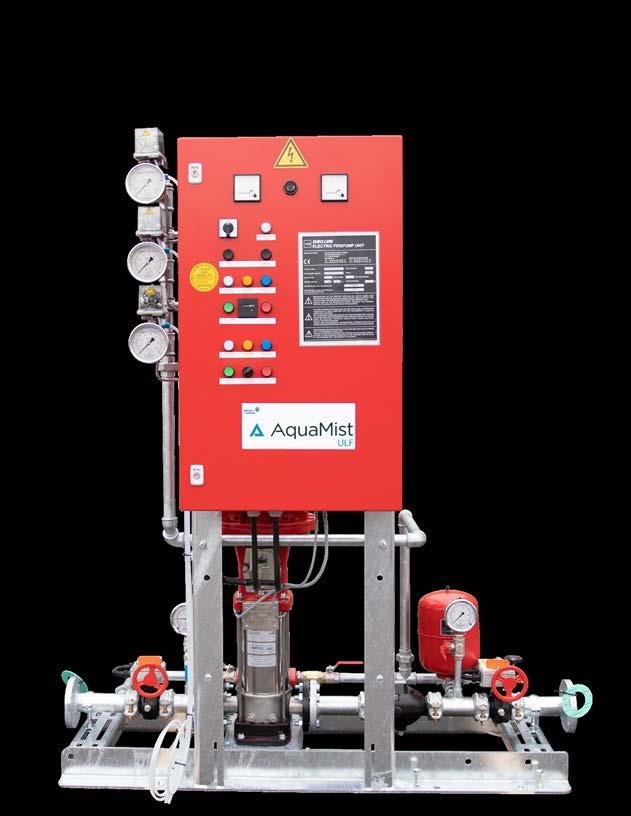
the AquaMist ULF system from Johnson Controls, can balance the operator’s requirement for ventilation in a fire incident with proven protection.
5. Obstructions And Shadowing: IT racks, dense cabling and congested voids can create shadowing effects, impeding mist distribution. These challenges apply to all water-based systems and must be factored into design and testing.
Strategic fire protection requires collaboration
It is essential to consider the fire growth scenario in relation to fuel load, human intervention, power and service interruption, and more. This underscores the need for a broad stakeholder group to develop – and regularly review – the fire protection strategy. Changes in site staffing; security protocols (which may delay intervention); airflow patterns; and cooling technologies (for example, introduction of hydrocarbon-based immersion cooling) can all undermine previously sound strategies.
Invariably, there will be many stakeholders. Trust in one type of system over another may be beyond the buyer’s control. An AHJ may not accept in one jurisdiction what is adopted elsewhere. Local knowledge with regards to listings and regulations is invaluable, which can include needing a long-standing rapport with the AHJ themselves.
Key Takeaways
• Define Acceptable Loss: stakeholders must agree on what constitutes an acceptable loss in terms of both asset damage and service availability/outage.
• Plan For Multiple Scenarios: fire strategies should address a range of fire growth and suppression outcomes, from control to full extinguishment (including brigade intervention) and business recovery.
• Review Regularly: Fire protection is not static. Regularly reassess the strategy against evolving risks, technologies, and operational changes.
How Johnson Controls helps drive data centre success with innovation, scalability and consistency
There are many challenges to overcome while building and operating data centres. From hundreds of client engagements, we have learned that these challenges fall into three main categories: How to keep up with constant advancements in technology; how to reliably source products, parts and services around the world; and how to implement design requirements when local regulations, resources, and environmental constraints cause complications.
We solve these challenges firstly with our commitment to innovation in thermal management, controls, facility security, fire protection and services. Next, the scalability of our global footprint of manufacturing and services provides the required global and local coverage. Finally, with our ability to satisfy requirements consistently despite local challenges, we help clients get their data centres into service and running effectively anywhere in the world.
With decades of experience, we can help accelerate time to deployment, enhance operational efficiency, reduce MTTR and ensure the reliability, safety and security of your data centre.
We connect and protect
We Make Seismic Simple
Stamped seismic bracing for fire sprinklers
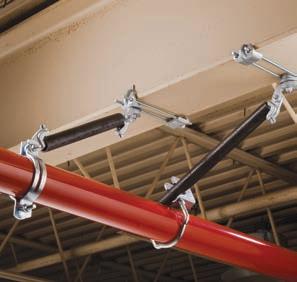
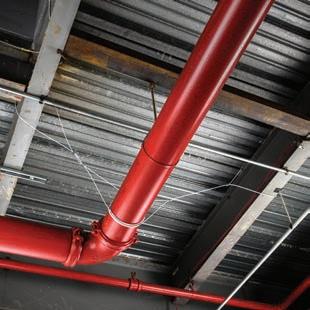
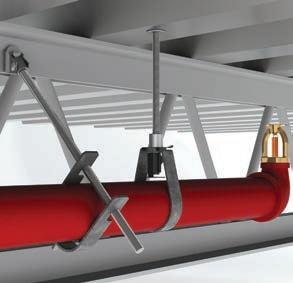
nVent CADDY seismic experts are dedicated to supporting contractors and engineers at every stage of their projects. From initial design and planning to installation and final inspection, our team ensures compliance with the latest EN 12845-3, and the most important sprinkler guidelines used worldwide.
Get access to the nVent CADDY Bracing Calculator and schedule one-on-one training on seismic design with our experts.
SAFE
We comply with FM DS 2-8M, CEN/TS 17551, NFPA13
FAST
We design turn-key, fully engineered, complete bracing systems
We offer a transparent process to ensure your full understanding EASY
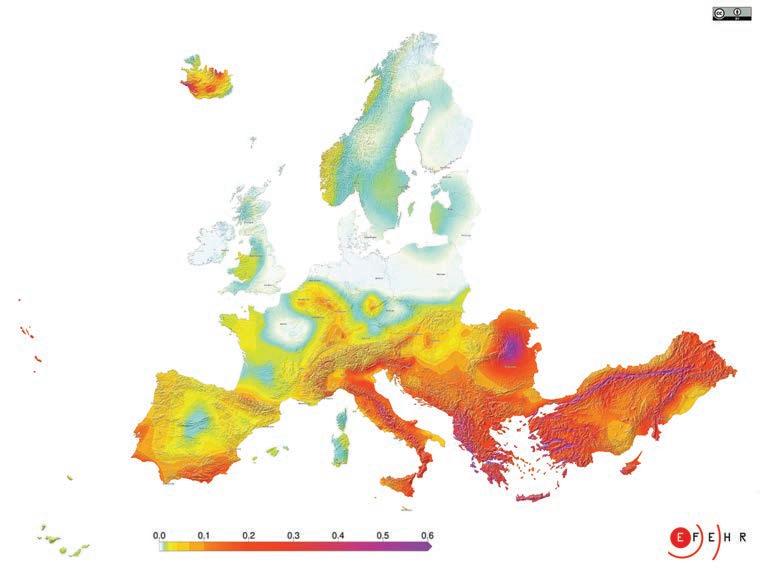
Danciu L., Nandan S., Reyes C., Basili R., Weatherill G., Beauval C., Rovida A., Vilanova S., Sesetyan K., Bard P-Y., Cotton F., Wiemer S., Giardini D. (2021) - The
Seismic Hazard Model: Model Overview. EFEHR
Can ESFR Sprinklers be installed in non-storage areas in accordance with FM Data Sheets at 4.6 m spacing?
Ludger Tegeler, MSc, BEng, Dipl-Ing, Assistant Vice President –Senior Advisor Technical Relations/Specifications/Standards, FM
This article looks at the application of an ESFR Sprinkler used in accordance with table 2.5.2.3.1.1.a of FM Data Sheet 2-0 in relation to FM Data Sheet 3-26 – Non-Storage Occupancies. Based on the five sprinkler criteria: k-factor; orientation; RTI rating; sprinkler spacing (extended coverage (EC) or standard); and temperature rating, FM Data Sheets apply sprinklers either as nonstorage sprinklers or as storage sprinklers. FM has long given up on the idea that one sprinkler type can only be used for one purpose.
Unfortunately the new EN128452 still follows this approach, so misunderstandings still occur. The above five different criteria that define a sprinkler indicate that one sprinkler type can be used for different protection applications.
The key protection mode in a storage application is based on large k-factor sprinklers, i.e. the design is based on a number of sprinklers with minimum head pressures providing adequate performance for a specified storage risk. These applications are found in FM Data Sheet 8-9. Protection of non-storage risks is described in FM Data Sheet 3-26, whose scope clarifies when to use FM Data Sheet 8-9. How to install non-storage sprinklers and storage sprinklers is set out in FM Data Sheet 2-0. Its table 2.5.2.3.1.1(a) states that you can install a quick response sprinkler with a k-factor of 80 or more at a spacing of 4.6 m. An ESFR sprinkler with a k factor of 200 would meet this. Can it really be installed at 4.6 m spacing?
FM Position
The ESFR sprinkler is for FM not an ESFR sprinkler. It is a sprinkler with a non-EC deflector type, quick response, a k-factor of 200 and a temperature rating of about 70 °C. That’s it.
An application in accordance with Data Sheet 3-26 means that we use the non-storage sprinkler in the control mode density area design. Let’s suppose we need a density of 8 mm/min. For a sprinkler coverage area of 20 m2, this would mean 160 l/min per sprinkler head. Using a k-200 with a minimum head pressure of 0.7 bar (you need to
consult the product data sheet) will give you 167 litres – so the density area criteria are fulfilled. If you then reflect that in practice a system design has a 50 % safety factor, i.e. if you design for 8 mm/min over 230 m2, testing has shown that in a reasonable worst-case fire about 160 m2 of sprinklers open. When considering the pump curve and reduced hydraulic losses at lower flow you can easily see that under these conditions you would have about 1 bar head pressure. Since in most real fires six or fewer sprinklers open in the first 10 minutes, you would even end up with 1.5 bar head pressure, resulting in 12 mm/min, when you only required 8 mm/min.
This demonstrates that there is not a large concern about using a sprinkler with the attributes of an ESFR in a non-storage occupancy in accordance with table 2.5.2.3.1.1(a). Furthermore, the spray pattern of an ESFR sprinkler will cover such a spacing (see image). However, an FM Risk Engineer would consider this a waste of money. From FM Data Sheets it is better to protect a non-storage facility in accordance with table 2.3.3.1 and install it in accordance with storage sprinkler requirements. Where there is no storage use non-storage obstruction rules and where storage is present use obstruction rules for storage sprinklers. Then if in the future the storage area is expanded,
This is because automatic fire suppression systems are recognized as capable of keeping fires small, restricting both smoke production and spread, and reducing the likelihood of multiple exits blocked by smoke and fire.
you only need to compensate for obstructions in accordance with storage sprinkler rules. Using sprinklers based on their five criteria is the most versatile approach. FM Data Sheets are the most advanced in their application of sprinklers.
The provision of a complete fire sprinkler system can also offer operational benefits. Normally, the MI standards require that, in the event of smoke detector activation, the entire building’s occupant notification system needs to be activated. This is necessary because smoke from an uncontrolled fire might spread between floors and it is therefore necessary to alert occupants not only on the floor of original fire alarm, but also on other floors. In a building equipped with automatic fire suppression systems, one can expect that fire and smoke spread will be limited to one floor; therefore, in buildings protected throughout by automatic fire sprinklers, the standards allow for fire alarm occupant notification only on the floor of fire alarm. This allowance provides for better operational functionality because in the event of a smouldering fire, which might cause a smoke detector to alarm, or in the case of an unintentional alarm, only the floor of alarm is notified, sparing the need to notify and possibly evacuate the entire building unnecessarily.
However, there needs to be one comment: if an installation is based on FM Data Sheets and an ESFR type sprinkler is used in a non-storage application, then it is being used as a control mode density area sprinkler. A subject matter expert would not see this sprinkler as an ESFR sprinkler. In the FM world an ESFR sprinkler does not exist, so therefore the subject matter expert cannot refer to other standards or regulations citing requirements for ESFR sprinklers (smoke vents). That is a misapplication.
Final recommendation
Non storage occupancies HC 2 and HC 3 up to 9 m in height are best protected per table 2.3.3.1 with upright or pendant sprinklers: UUP, 25 k-160 at 3.4 bar. This will give most industrial occupancies the maximum freedom to utilize the building.
Another benefit automatic fire suppression systems offer in MI European properties is flexibility for existing hotels wishing to convert to a Marriott brand. In existing hotel properties undergoing a conversion, MI’s fire life safety professionals review the building holistically and when the building is provided with an automatic fire suppression system throughout, there are increased options for addressing existing conditions. This holistic approach is only permissible as long as the building also meets the fire safety requirements of the local codes and standards, an overriding principle required by the
Marriott standards. In this way, Marriott encourages the installation of automatic fire suppression systems. In turn, existing building owners wishing to engage Marriott can save money and enjoy enhanced operations which can offset the cost associated with the sprinkler system installation and its maintenance.
Another benefit sprinkler systems provide is often overlooked: they are a sustainability feature. Sprinkler systems protect structures from fire and smoke damage and therefore act to reduce the amount of materials needed to rebuild after a fire. And in comparison to the water amount needed by fire fighters to control building fires with their hoses, the amount used by automatic fire suppression systems to control fires is comparatively small. This is because such systems act with far more precision. In most fires, it can be expected that no more than 2-3 sprinklers will be activated, only in the area of the fire, resulting in far less water usage than in manual firefighting. Also, with less water needed to control a fire, less water run-off, potentially contaminated by combustion products, is expected. This is better for the environment. MI expects that as awareness about the improved safety and sustainability of sprinkler systems grows, more government and non-governmental organizations will look to prioritize patronizing hotels with sprinkler systems.
As Marriott branded hotels expand in Europe, MI looks forward to sharing its global experience with automatic fire suppression systems with its industry and business partners. Marriott believes in the protection provided to hotels by properly designed and installed automatic fire sprinklers and would support efforts in helping promulgate automatic fire sprinkler protection in all hotels, not just Marriott branded hotels.
Fomtec Enviro USP is designed to be an effective fluorine-free alternative for sprinkler systems, type II and III discharge devices. ICAO level B. NEW GENERATION FLUORINE FREE FOAM • APPROVED FOR SPRINKLER, UL 162 LISTED FM 5130 APPROVED • VDS APPROVED Superior Fire Performance: EN 1568 Part 1, 2 & 3 (Rate 1A), ICAO Level – B and IMO1312 and MED for marine use: FOR CLASS A & B FIRES • 100% BIODEGRADABLE • LOW, MEDIUM & HIGH EXPANSION For full specifications, please visit Fomtec website or scan the QR code www.fomtec.com
Remote inspection and testing of fire suppression systems
Mark Fessenden, Managing Director, International Fire Suppression Alliance (IFSA)
The fire protection industry is undergoing a profound transformation driven by digital technology, more advanced building management strategies and increasingly stringent regulatory requirements. At the forefront of this evolution is the growing adoption of remote inspection and testing capabilities – tools that promise to make systems safer, more reliable and more efficient to maintain.
The fire protection industry is undergoing a profound transformation driven by digital technology, more advanced building management strategies and increasingly stringent regulatory requirements. At the forefront of this evolution is the growing adoption of remote inspection and testing capabilities – tools that promise to make systems safer, more reliable and more efficient to maintain.
These innovations include automated fire pump testing, cloudbased diagnostics and remote visual inspections, all of which are redefining how professionals approach fire safety management. By reducing manual touchpoints, enabling real-time monitoring and supporting streamlined compliance workflows, remote technologies are proving essential to a modern fire protection strategy.
Yet, with these advances come important questions: Which codes and standards govern remote inspection and testing? How can technology be deployed effectively without compromising reliability or safety? What practical steps should facility managers, engineers, service providers and Authorities... Having Jurisdiction (AHJs) take to integrate remote capabilities into their operations responsibly?
Ultimately, stakeholders require a clear, practical framework to understand and implement remote inspection and testing technologies. This includes reviewing applicable standards, assessing enabling technologies and potential constraints and adopting best practices to help ensure these tools fulfill their promise of safer, more resilient buildings.
A strategic necessity
The shift toward remote inspection and testing is not simply a technological upgrade— it is a strategic necessity in an increasingly interconnected world. The broader testing, inspection and certification (TIC) industry is expanding rapidly, with a recent Custom Market Insights report projecting annual growth of 3.4%, driven by globalisation, regulatory pressure and the need for greater operational assurance across sectors such as automotive, energy and construction.
In fire protection specifically, regular inspection, testing and maintenance (ITM) is critical to ensure systems remain functional when needed most. Data from the National Fire Protection Association (NFPA) shows that in 59% of cases where sprinkler systems failed to operate during a fire, the system had been shut off – often for maintenance. Such statistics highlight the importance of maintaining active, reliable systems through disciplined ITM practices.
Remote inspection and testing technologies offer practical solutions to longstanding challenges in the field. By reducing the need for on-site staff to perform routine checks, these tools help keep systems live and ready, even during maintenance activities. They also support faster issue identification and resolution, reducing risk while improving cost-effectiveness.
Codes and Standards: a global perspective
International Fire Code (IFC)
and
US Standards
In the United States, the code and standards framework is a key driver of this shift. The International Fire Code (IFC), developed by the International Code Council (ICC), establishes minimum fire safety requirements. It mandates proper installation, inspection and maintenance of fire protection systems in accordance with referenced standards such as:
NFPA 13
Design and installation of sprinkler systems
NFPA 14
Standpipe and hose systems
NFPA 20
Fire pumps
NFPA 25
ITM of water-based fire protection systems
NFPA 72
Fire alarm and signalling systems
The IFC requires new fire protection systems to undergo acceptance testing to verify they meet design and code requirements before occupancy is granted. It also mandates ongoing ITM to maintain system operational integrity throughout its service life. Failure to maintain records or perform required inspections can result in enforcement actions by AHJs.
Recognising the growing importance of remote solutions, the ICC has published Recommended Practices for Remote Virtual Inspections (RVI). This guide helps jurisdictions and industry professionals implement remote inspection programmes responsibly. It covers everything from scheduling and preparation to documentation and record-keeping, ensuring remote inspections meet the same standards of accuracy, safety and legal defensibility as traditional site visits.
European Standards – EN 12845
While US standards such as NFPA 25 and NFPA 915 define clear expectations for ITM and remote inspections, European codes offer equally rigorous guidance. EN 12845:2015 governs the design and installation of fixed sprinkler systems across much of Europe.
Chapter 20 of EN 12845 focuses specifically on maintenance, requiring the system owner to appoint a trained individual to oversee system readiness. It emphasises ongoing inspections and testing to ensure reliability requirements that align with NFPA 25 but is tailored to European regulatory environments.
Remote inspection and testing practices can support compliance with EN 12845 by providing better visibility, documentation and consistency in ongoing monitoring. For European facility owners and service providers, this alignment demonstrates that adopting remote solutions is not a departure from best practice, but an evolution of it.
NFPA
915:
Framework for Remote Inspections and Tests
NFPA 915 is the first comprehensive standard specifically addressing remote inspections and testing. Rather than replacing existing standards like NFPA 25 or NFPA 72, NFPA 915 complements them by defining how technology can replicate or support required tasks remotely.
NFPA 915 establishes clear roles and responsibilities for all parties involved, including property owners, contractors, inspectors and AHJs. It emphasises:
Ensuring visual clarity for camerabased inspections
Using timestamping and geolocation to validate inspection authenticity
Maintaining data accuracy and security throughout collection, transmission and storage
Chapters within NFPA 915 provide structured guidance on: LOCATION AND TIMESTAMP REQUIREMENTS (Chapter 5): ensuring records are reliable and legally defensible DATA COLLECTION/ TRANSMISSION DEVICES
(Chapter 6): defining categories of tools, from wireless and digital equipment to vehicles and drones DATA COLLECTION FORMATS
(Chapter 7): standardising video; audio; photography; written logs; and automated testing data DATA PROTECTION, RETENTION AND OWNERSHIP (Chapter 8): managing the lifecycle of inspection data responsibly
This structure ensures remote inspections maintain the same rigour as in-person evaluations while unlocking new efficienciesparticularly valuable in hard-to-reach or hazardous environments.
Technological enablers and device classifications
Remote inspection and testing rely on diverse technologies. NFPA 915 categorises these tools to guide designers, installers and AHJs in assessing suitability and compliance:
WIRELESS DEVICES: smartphones, cellular tablets and other devices using WLAN or WPAN networks for real-time data transmission
DIGITAL DEVICES: cameras, video recorders and computers capturing, storing and sharing inspection data
NON-DIGITAL DEVICES: legacy tools such as analogue radios
or film cameras, still relevant in specific settings
VEHICLES: both aerial (drones) and ground-based platforms for accessing challenging locations
DATA COLLECTION FORMATS: Video; audio; photography; written logs; and automated testing data for standardised, reliable records
NFPA 915 also distinguishes between approved and listed equipment. While devices must be suitable and AHJ-approved, they are not always required to be listed (certified to a specific standard), offering flexibility to adopt emerging technologies while maintaining oversight.
Best practices for data integrity and security
Remote inspections generate increasing volumes of sensitive data—video feeds, sensor readings and automated test logs. Protecting this information against loss, corruption, or misuse is critical.
NFPA 915 provides precise requirements for:
DATA AUTHENTICATION: timestamping, geolocation and secure transmission to validate inspections and ensure trustworthy records
RETENTION POLICIES: storing data for required periods in line with regulatory expectations
ACCESS CONTROL: preventing unauthorised access or tampering
These requirements reflect the growing importance of data in maintaining life safety. Just as physical inspections must be thorough and well-documented, digital records must meet high standards of accuracy, accessibility and legal defensibility.
Supporting tools and platforms
To meet these requirements, many companies have developed cloudbased platforms simplifying remote inspection, monitoring and testing workflows.
Potter Signal offers the Facility Management Tool (FMT) and InteliView platform, providing realtime data dashboards on system performance, maintenance needs and diagnostics. These solutions allow remote visibility into fire pump operation, valve positions and alarm conditions, streamlining ITM activities while supporting compliance with evolving standards.
AGF Manufacturing’s Remote TEST technology enables remote initiation of the inspector’s test function on wet systems, simulating sprinkler activation without needing a technician at the riser. Their COLLECTanDRAIN assemblies, with integrated water detection sensors, alert staff to accumulating water in dry or pre-action systems, preventing freeze damage or corrosion while supporting remote oversight.
Johnson Controls’ Connected Sprinkler service uses smart sensors, wireless communication and advanced analytics to remotely measure system pressure, pipe temperature and water presence. This service exemplifies nextgeneration connected fire protection aligned with NFPA 915’s vision.
Who does the monitoring? Facility staff or third-party services?
Remote inspection and testing technologies provide facility owners with flexibility in managing fire protection ITM. Tools such as Potter’s Facility Management Tool or AGF’s RemoteTEST give the capability for building maintenance staff or facility management teams to perform in-house monitoring and testing, as long as they are appropriately trained and understand what to look for. These companies typically do not offer a staffed monitoring service themselves—they sell the technology that the third-party service providers use to monitor the facility.
By contrast, companies like Johnson Controls, through their OpenBlue Connected Sprinkler Service, offer an integrated solution that includes both the remote monitoring technology and professional monitoring as a service. This means the building owner can outsource continuous system oversight to a trained team.
Ultimately, responsibility for remote monitoring rests with the system owner, who must decide whether to invest in in-house capability or engage a qualified third-party service provider. Both models are viable if personnel are trained, the AHJ approves the approach and all inspections and tests meet the relevant standards (NFPA 25, NFPA 915, EN 12845 and others). This choice should be part of the facility’s broader ITM planning and risk management strategy.
FM Data Sheets: enhancing risk management
Beyond codes and standards, insurers such as FM set high expectations for ITM practices. Their Loss Prevention Data Sheets (LPDS) often supplement building codes with stricter best practices aimed at minimising risk.
Key documents include:
FM DATA SHEET 2-81: Focuses on the ITM of fire protection systems, emphasising routine inspections, testing, documentation and impairment management. FM 2-81 often specifies more frequent testing intervals than NFPA 25, reflecting a conservative approach to risk reduction.
FM DATA SHEET 3-7: provides guidance for evaluating fire protection systems in new construction or major modifications, ensuring systems meet FM’s high standards before occupancy.
For facilities insured by FM, meeting these expectations is crucial for securing coverage and managing risk. Integrating remote inspection and testing capabilities enables building owners to demonstrate compliance, enhance reliability and minimise system failures.
FM Approvals has also advanced the field with FM 1330, an Examination Standard for Fire Pump Monitoring and Automated Testing released in 2024. FM 1330 defines certification criteria for systems monitoring or automatically testing fire pumps, including:
Performance testing to verify accurate flow and pressure measurements
Cybersecurity safeguards to protect data integrity
Third-party audits and quality control to ensure consistent system performance
By enabling automated diagnostics, FM 1330 supports more frequent and reliable fire pump testing while maintaining alignment with NFPA 20 and 25 requirements.
Integrating the Internet of Things (IoT)
The integration of IoT marks a major shift in fire protection system design and management. By embedding sensors, automated controls and real-time communications, IoTenabled fire protection transforms static infrastructure into intelligent, connected networks.
Key benefits include:
Real-time monitoring and alerts for rapid intervention
Improved threat detection with reduced false alarms
Remote access and control for decentralised management
Predictive maintenance to address issues before failure
Automated testing and reporting for consistent compliance
These capabilities improve safety outcomes while reducing operational costs and downtime. For facilities with limited staff or complex infrastructure, IoT offers invaluable visibility and control.
Challenges to address include:
Installation complexity, especially in legacy or historic facilities
Cybersecurity risks from increased connectivity
Costs for hardware, software and ongoing maintenance
Managing large volumes of data effectively
Ensuring reliable network access
To fully realise these benefits, facility managers and designers must take an holistic approach that includes robust planning, skilled installation and ongoing training.
Best Practices for Implementation
Successfully adopting remote and automated inspection technologies requires careful planning and execution. Industry professionals should:
UNDERSTAND APPLICABLE
STANDARDS: build compliance into plans by thoroughly understanding NFPA 25, NFPA 915, EN 12845 and jurisdiction-specific requirements.
ENGAGE THE AHJ EARLY: collaboration ensures acceptance of remote inspection plans, reducing the risk of costly redesigns.
SELECT APPROVED EQUIPMENT: devices must be AHJ-approved and demonstrate equivalent performance to traditional methods.
ENSURE DATA INTEGRITY: use robust processes for authentication, storage and access control.
TRAIN PERSONNEL THOROUGHLY: equip all stakeholders, technicians and building staff with the skills to use new tools effectively.
PL AN FOR MAINTENANCE AND UPDATES: remote systems require ongoing updates, maintenance and testing to maintain reliability.
Case Study: Meydenbauer Center
Conclusion: leading the transformation
The adoption of remote inspection and testing technologies represents more than just incremental improvement—it is a transformative shift in safeguarding lives and property. By leveraging automation, IoT and cloud-based platforms, the fire protection industry can deliver safer, more reliable and more efficient systems while supporting regulatory compliance and reducing operational burdens.
However, success demands thoughtful planning, close collaboration with AHJs and strict adherence to standards such as NFPA 25, NFPA 915 and EN 12845. It also requires commitment to data integrity, cybersecurity and continuous training. Ultimately, embracing these technologies is not just about keeping up with change; it is about leading it. By doing so, facility owners, designers, service providers and regulators can help build safer, more resilient communities for everyone.
A compelling real-world example of the benefits of remote monitoring comes from the Meydenbauer Center in Bellevue, Washington, USA - a major convention and performing arts venue with a 5,000m2 footprint that hosts more than 300 events annually.
Facing ageing fire protection infrastructure and increasing demands for efficient inspection, testing and maintenance (ITM), the center partnered with a local fire protection contractor to modernise its system. The upgrade centred on the Potter P400R analogue addressable fire alarm panel, fully integrated with Potter’s Facility Management Tool (FMT). This transition replaced outdated manual processes with a modern, fully addressable platform that enhances both daily operations and emergency readiness. Key features of the upgrade included: REAL-TIME MONITORING: Security staff now receive automatic email alerts for alarm, supervisory and trouble conditions. They can view alarm details remotely using keypad emulation, supporting faster, more informed responses.
STREAMLINED OPERATIONS: Tasks such as disabling zones for testing that previously took several minutes can now be completed in seconds. The system supports up to 31 remote annunciators, enabling staff to manage alarms quickly from anywhere in the facility.
POSITIVE ALARM SEQUENCE: This feature provides a 15-second verification window before initiating a full building alarm. In a high-occupancy venue, this reduces unnecessary evacuations while maintaining safety.
Beyond these technological improvements, the project underscores the broader value of integrating remote monitoring into comprehensive fire safety strategies. The FMT system’s intuitive interface, paired with training provided during implementation, boosted staff confidence and ease of use. The centre now benefits from simplified ITM workflows, improved code compliance and enhanced overall readiness. The Meydenbauer Center’s experience demonstrates how remote monitoring and testing technologies can transform safety management for large, complex facilities, setting a new standard for modern, code-compliant fire protection that other venues can emulate.
Non-fluorinated foam concentrate for fixed systems
FXS AR 3/3 F-0
VdS approved for sprinkler systems on various fuels. vaPUREx® FXS AR 3/3 F-0 #2365 is a non-fluorinated, alcohol-resistant foam agent for use in critical risk areas where polar liquids (e.g. alcohols, ketones, organic acids etc.) or non-polar hydrocarbons (diesel, kerosene, gasoline etc.) are produced, processed, transferred, transported or stored.
• VdS approved
Disseminating sprinkler knowledge is crucial
Inge Devalez, Country Manager, Belgium
Exponential growth of BFSN members
The Belgian Fire Sprinkler Network (BFSN) has had a fantastic year and has significantly expanded its membership. Key players in the sprinkler market, including installers; distributors; inspectors; insurers; and training centres, are now well represented within our organisation. BFSN offers its members an important platform for exchanging ideas as well as supporting and promoting their shared interests and the goal for 2026 is to expand this platform.
I have built strong representation in the past year through participation in standards committees, technical committees and partnerships with other fire safety organisations. Regular company visits keep my finger on the pulse as I build an important network within the fire safety sector.
Disseminating sprinkler knowledge is crucial for BFSN. Following last year’s success, BFSN held the National Sprinkler Congress 2025 on 7th October in the recently restored Winter Circus Gent which brought together experts, policymakers and professionals from the fire safety and sprinkler industry to discuss current issues, regulations and innovations, including: “Sprinklers and fire safety in car parks with EVs,” “The transition to PFAS-free foam applications for sprinkler systems,” and “Sprinkler protection of storage spaces with Li-ion batteries.”
An impressive list of experts from Belgium and abroad shared their latest insights and explain the challenges within their fields during the congress.
This year, for the first time, a two-day training course for BFSN members was organised in collaboration with new BFSN member, FM. Day 1’s theme was “Specifying Sprinkler Protection to FM Standards.” This focused on sprinkler design, providing an overview of the key hazards and considerations involved in designing a sprinkler system. Day 2 focused on “Installation, Design, and Considerations,” delving deeper into sprinkler plan design and hydraulic calculations. Initiatives like these are highly valued by members, and we will organise similar training courses in the future.
Sprinkler knowledge days for various target groups is an activity that BFSN hopes to develop further.
BFSN also aims to play a key role as a discussion partner for government agencies and policymakers. In 2026, we expect the publication of new regulations regarding fire safety in car parks and healthcare facilities and sprinklers will be included as a fire safety measure in both regulations. BFSN supports these publications and in collaboration with the various government agencies will offer its services to explain them, including by organising workshops and seminars.
EFSN Country Managers
In March, the first meeting was held with the EFSN Country Managers. The overall goal of this meeting was to exchange ideas and inspire one another. Each Country Manager explained their organisational goals, how they work to achieve them, and the challenges they face.
Information was exchanged on various campaigns to spread knowledge about sprinklers, and training programmes for firefighters and designers were explained. The legislative framework for fire safety was also examined in more detail by country, highlighting the significant differences in the legislative framework across European countries.
Success stories like those of BAFSA, VSI, and EFSN France clearly demonstrate that promoting sprinklers through these organisations can make a difference. Therefore, raising awareness of sprinklers among governments and policymakers is a key objective for all of us. The initiative was greatly appreciated, and it was decided to continue organising these Country Manager meetings in the future.
BFSN and JOIFF – mutual membership
JOIFF is a non-profit organisation for Industrial Emergency Service Management dedicated to developing the knowledge, skills, understanding, and competencies of emergency services in high-risk industries. Their primary objective is to achieve a safer working environment and risk management to prevent future incidents.
BFSN’s participation in the International Congress, held on April 8th and 9th in collaboration with the University of Antwerp and the Port of Antwerp Bruges, proved valuable. This has paved the way for future collaboration, especially given our shared interests in industrial environments. A reciprocal membership agreement has been established, and BFSN is preparing to publish an initial article in the next issue of The Catalyst magazine.
Global economic prospects for the construction sector
At the request of IFSA, BFSN prepared a report in May outlining the expected economic prospects and developments within the Belgian construction sector. According to recent data from the International Monetary Fund (IMF), the current moderate growth in Belgium reflects a cautious economic recovery influenced by international uncertainties and domestic political challenges. Clear regional differences are evident within Belgium: Flanders is an industrial-focused region, Wallonia relies heavily on goods exports, and Brussels has a primarily service-based economy.
Within the construction sector, infrastructure, energy and industrial projects are currently showing strong momentum. The residential construction sector is lagging behind for the time being, with a noticeable decline in the
number of new homes in Flanders and a generally slow renovation activity. This slowdown is partly due to the complex and administratively cumbersome permitting policy, and partly to a sharp rise in material and labour costs.
Despite this slowdown, the housing shortage in Belgium will be significant in 2025 and will pose a growing social challenge. In Flanders alone, it is estimated that no fewer than 500,000 new homes will be needed by 2035, and there is also a need to renovate 1 million homes for energy efficiency. For years, the sector has therefore been advocating for a shift in the vision of housing policy, integrating spatial planning, mobility, biodiversity, the aging population, and affordability.
BFSN is sharing knowledge with government agencies and policymakers. We are convinced that sprinklers play a vital role. A sprinkler system can provide a powerful response to increased fire risks in older and densely populated residential areas. Sprinklers offer both a preventative and compensatory solution within the broader framework of fire safety and sustainable living.
Future new regulation for car parks with EVs
The second edition of the “Rules of Good Workmanship – Electric Vehicles in Car Parks” (RVG) is available on the Belgian FireForum website. This RVG was reviewed and approved by the High Council for Fire and Explosion Protection and aims to provide guidance for assessing the risk of electric vehicles.
RVGs are guidelines and not legally binding in themselves, yet they serve as a benchmark and can be applied generally. For car parks built from 2022 onwards, specific guidelines were provided in the Royal Decree of 7 July 1994 establishing the basic standards for fire and explosion prevention that buildings must comply with. Depending on the surface area and depth of the car park, smoke control systems and/or sprinkler systems are required.
For existing car parks (building permits submitted before 2022) where new risks arise due to the presence of EVs and charging infrastructure, the RVG assumes a risk analysis to map the consequences. In addition, the RVG provides fire safety guidance, such when to install smoke control and/or sprinkler systems.
The Interior Minister has asked the Supreme Court to propose a draft law that will require the performance of a risk analysis, a needs assessment, and an action plan demonstrating that the achieved safety level is sufficient.
Publication of this new regulation is expected in mid2026. At the BFSN conference Jan De Saedeleer of the Federal Government outlined the current status and the draft of this new legislation.
PFAS regulation in Flanders – status of enforcement
BFSN is regularly consulted on the status of the PFAS transition in Flanders, and in particular the transition to non-fluorinated foam for sprinkler systems. To address this BFSN contacted the Enforcement Department of the Flemish Government about existing and future legislation on the use of PFAS-containing fire extinguishing agents. The new amendments to the POPs Regulation (and the concentrations) are particularly relevant to our sector. We focused on the future assessment and organisation of enforcement for sprinkler systems using foam. It was another topic at our conference, where a Flemish Government representative shared information and explained the latest developments.
New regulation for healthcare buildings –focus on sprinklers
The Technical Fire Safety Committee of VIPA (the Flemish Agency that coordinates fire safety policy for healthcare infrastructure) recently published a draft text with new fire regulations for buildings for people with disabilities and for youth care facilities. These regulations will form the basis for issuing a legally required fire safety certificate. Publication is scheduled for early 2026. Sprinklers will be mandatory in open-plan living spaces within sub-compartments occupied at night. The standard refers to NBN EN 16925 and NBN EN 12259-14 for residential sprinklers. This standard will also provide a broader framework for all future fire safety regulations for healthcare buildings (excluding hospitals).
The regulations supplement the generic basic fire safety standards (Royal Decree Basic Standards 1994 and subsequent publications). In particular, the package of measures imposed for communal living settings with open-plan living spaces, which includes the requirement to equip the compartment with residential sprinklers, is a significant change. In the past, Alan Brinson of EFSN, among others, supported the importance of sprinklers in
elderly care through his contribution to the VIPA studies that formed the basis for the current revision of the regulations. In the future, BFSN will continue to support VIPA by organising knowledge seminars on the correct use of sprinklers. Final publication of the new regulations is expected in early 2026. The new draft text is currently available on the VIPA website.
To support this, BFSN will establish a knowledge forum in collaboration with VIPA once the standard comes into effect. BFSN will participate in knowledge seminars for government agencies, fire departments and architects, sharing general knowledge about the operation and integration of sprinkler systems and their application in residential homes.
Firefighting water and public water supplies
BFSN has launched a study of the plans of Belgian water companies and the need to connect sprinkler systems directly to the public water network. BFSN believes there are opportunities with the new legislation for car parks and healthcare facilities. For example, a direct connection to the public water network would allow a relatively simple system to be installed in small (existing) car parks, as described in the FireForum Code of Good Workmanship.
The drinking water network and water demand are currently undergoing rapid changes. For water companies to guarantee the quality of drinking water in the future, new self-cleaning drinking water networks with smaller diameters will be installed, and they will switch from mesh networks to branch networks. This will have a major impact, particularly on connections to industrial estates. In future the available flow rates will solely be based on water consumption, not on fire risk. This means that the public water network will no longer automatically provide fire-fighting water. Consequently, in certain cases where increased water demand is necessary for firefighting, companies will have to source alternative water supplies themselves (e.g. via water buffering, water tanks, or tapping into open water).
Given the importance of this for our sector, BFSN is taking the lead and is committed to serving as a discussion partner in consultation with the various water companies. BFSN will continue to monitor this development.
Call for Papers
Fire Sprinkler International 2026
Paris, 22-23 April
We are delighted to announce a call for papers for Fire Sprinkler International 2026. Our conference and exhibition, the largest event in Europe dedicated to water-based fire protection, will be held in Paris on 22-23 April. Following record attendance this year in Salzburg, with over 450 delegates, we are expecting a similar response in Paris. All the sponsorship options have already been taken, as have half of the exhibition spaces.
We always host an ambitious programme, with some 40 presentations in three parallel streams. Presentations can be in English or French, with interpretation available.
Nous sommes ravis d’annoncer un appel à propositions pour Fire Sprinkler International 2026. Notre conférence et exposition, le plus grand événement européen consacré aux systèmes de protection incendie à base d’eau, se tiendra à Paris les 22 et 23 avril. Après une participation record cette année à Salzbourg, avec plus de 450 participants, nous attendons une participation similaire à Paris. Toutes les options de sponsoring sont déjà prises, ainsi que la moitié des espaces d’exposition.
Nous proposons toujours un programme ambitieux, avec une quarantaine de présentations réparties en trois volets parallèles. Les présentations peuvent être en anglais ou en français, avec interprétation disponible.
Please click here for further details of how to submit your proposals.
Cliquez ici pour plus d’informations sur la soumission de vos propositions.
The Italian Grand Tour
Giorgio Franzini. Co-Ordinator, IFSN
Born as the Italian “branch” of the European Fire Sprinkler Network (EFSN), the Italian Fire Sprinkler Network (IFSN) aims to fill a historical gap in the Italian associative landscape by building a competent and cohesive community that brings together companies, professionals, and stakeholders interested in promoting water-based fire protection systems—sprinklers and water mist—as an effective tool to save lives, protect the environment, and reduce the economic damage caused by fires.
After an initial preparatory phase, which included the launch of the website, the opening of a LinkedIn page, the preparation of promotional materials, and participation in Safety Expo 2024—Italy’s leading fire protection event— the association consolidated its structure in 2025.
On 30th January, 2025, the first operational meeting was held: more than 40 companies, insurance firms, and professionals took part in this “founding moment,” which confirmed the determination to provide stable representation to the world of water-based fire protection systems in Italy, in order to develop a more mature and qualified market.
This meeting provided an opportunity to gather opinions and needs from industry operators, along with expressions of interest in joining IFSN. From there, the association established its Board of Directors and its Technical Committee, and began defining initiatives to raise awareness of IFSN. This included commenting on significant incidents with strong public relevance, such as the fire at the “Casa per Coniugi” nursing home in Milan,
where in 2023 six elderly people lost their lives and 81 were injured due to a fire started by a cigarette. Earlier this year, when the report of the Polytechnic professor appointed as consultant by the Milan Prosecutor’s Office was released, it emphasised how automatic extinguishing systems could have reduced the severity of the event and saved lives. This is a concrete example of how IFSN has taken on the task of highlighting, at the national level, those events that should serve as lessons, transforming them into stricter policies and practices.
On 18th June, 2025, at the FAST Conference Centre in Milan, IFSN organised its first national conference, “Let’s Talk About Sprinklers Again,” entirely focused on regulatory updates and new technologies. The programme addressed the most relevant topics: the new edition of EN 12845 (parts 1, 2, and 3), updates on fire pumps (EN 12259-12, EN 17451), system inspections and criteria for enhanced availability systems, and the EN 14972 standard on water mist. The agenda placed design quality and compliance with European standards at the centre, with contributions from leading experts in the field, Italian representatives in CEN working groups, and a keynote speech by the Commander of the Milan Fire Brigade.
The conference was very well attended, with companies – not only from the fire protection sector - insurance firms, engineering companies, and fire safety professionals present in the room. Many others joined remotely, ensuring participation from across Italy. Feedback was extremely positive, confirming that the conference responded to a strong, previously unmet need. The event also received broad coverage in the technical trade press, which highlighted its value as IFSN’s “first” public appearance and as a signal of openness and concreteness toward the entire fire protection ecosystem.
The second major appointment with the fire protection community has been IFSN’s participation in Safety Expo 2025, the most important national event in the sector, where it engaged with the entire fire prevention ecosystem (designers, installers, safety managers, risk managers, firefighters, insurers). Beyond having its own booth, IFSN was represented both by its President’s intervention in the plenary session dedicated to administrative procedures—discussing the importance of professional qualifications in fire safety—and by a twohour training slot on the effects of the Green Economy
on fire safety. Topics included lithium-ion batteries in storage and mobility applications, as well as evolving protection requirements for large parking structures. The programme also featured contributions from Jensen Hughes, FM Global, Guidi & Partners, and IFSN.
Throughout the year IFSN has been promoting a technical seminar inspired by the regulatory updates presented at the June national conference. This seminar will provide an opportunity to delve deeper into one of the covered topics, with a pragmatic approach aimed at quickly addressing the market’s most pressing questions while guiding professionals towards up-to-date design and maintenance standards.
By the end of the year, a Round Table event in Milan will be organised with opinion leaders (professionals, firefighters, technical press) on the “state of the art” of automatic fire protection in Italy, focusing on specific case studies. The goal is to further promote IFSN’s mission of improving safety through the wider adoption of sprinkler and water mist systems.
Looking ahead to 2026, IFSN plans to establish both the National Conference and the Round Table session as annual fixtures for the Italian fire safety ecosystem. In addition, two technical events in other Italian cities and a series of webinars are planned, with the aim of expanding IFSN’s geographic reach and strengthening its authority, positioning it as a credible interlocutor for the National Fire Corps.
In this regard, coordination with the European Fire Sprinkler Network, which has been active for years at the European level with the goal of saving lives and reducing the social cost of fires, allows IFSN to bring to Italy - and make available to its members - technical papers, expertise, data and training courses already tested elsewhere, helping to close the gap with “bestperforming” countries.
One of the major challenges in the coming years will be to broaden the audience of end users (hoteliers, logistics operators, builders, etc.) and fire safety professionals who understand water-based fire protection technologies and appreciate their safety potential (life, property, environment, business continuity) when properly applied. Achieving this goal will require extensive awarenessraising initiatives, carried out through meetings across the country with trade associations and professional bodies.
The Italian Grand Tour has only just begun.
Positive developments in the application of sprinklers
John van Lierop, Country Manager, EFSN and VSI
The Dutch sprinkler market continues to develop, despite the environmental and nitrogen issues that make construction extremely difficult. The Netherlands is densely populated and the shortage of building land, combined with rising construction costs, is slowing progress. For example, despite the severe housing shortage, it has not been possible to achieve the target of 100,000 new homes each year. Nevertheless, there are positive developments in the application of sprinklers. Denser and taller building means that
sprinklers are increasingly being considered as a solution. Timber construction is also driving growth in sprinkler and water mist systems. Furthermore, the legal requirement to use specific standards for large fire compartments is accelerating sprinkler adoption. It has also become clear that when advisers and authorities are more knowledgeable about sprinklers, they have more confidence to accept them as an equivalent safety solution to the passive measures in the building regulation.
Legislation and regulation
On 1 January 2024 new legislation came into force that, for the first time, included a sprinkler mandate – in car parks under sleeping risks. The impact is only now becoming visible, as many permits were rushed through before the law took effect. For the two Dutch standards for large fire compartments – NEN 6060 and NEN 6079 – equivalence no longer needs to be demonstrated. Politics also influence developments. A populist minister commissioned a plan to accelerate housing construction. Among the many proposals that are highly concerning from a fire safety perspective – such as abolishing the requirement for a second escape route and undermining existing regulations – research into sprinklers is also included. This research should focus particularly on the acceptance of sprinklers as an equivalent solution, their use in modular construction and the protection of the rapidly growing group of vulnerable people.
Timber Construction
Buildings with a timber structure without sprinklers present a significantly greater risk of total loss in the event of fire. Sprinklers should therefore be considered a basic measure to compensate for these extra risks. Increasing numbers of stakeholders recognise this, although some still regard sprinklers as a threat. The Dutch NEN working group Timber Construction, commissioned by the Ministry, is developing the Dutch standard NTA 6125 in two phases. TNO, RISE and ARUP are drafting the standard, while the NEN working group is providing comments as representatives of the various stakeholders. Sprinklers and water mist in combination with plasterboard are included as measures to reduce risks. Based on expert sessions and international research, the first draft of the standard was published in summer 2024. In the current draft of NTA 6125, buildings up to 13 metres high with sprinklers do not require additional fire-resistant cladding of timber. Up to 20 metres, this applies for compartments of up to 150 m2, while up to 35 metres partial cladding with plasterboard is still required. Under this draft, the Dutch standard would already allow taller timber buildings than many other countries. Nevertheless, the Dutch Sprinkler Industry (VSI) believes that with sprinklers even more is possible. There is still a great deal of unfamiliarity with both sprinklers and fire behaviour in timber buildings. This can result in poor decision-making or a limited support base for the use of sprinklers. One major concern often raised is water damage from sprinklers – yet people frequently overlook the facts that the fire brigade typically uses far more water than a sprinkler system and buildings already contain many water pipes for domestic plumbing and heating.
Fire Service operations in sprinklered buildings
In the past year, the Dutch Sprinkler Industry (VSI) supported the Dutch Institute of Physical Safety (NIPV) in developing training modules for the fire service. At the end of 2023, a Guideline for Fire Service Operations in Sprinklered Buildings was published by the NIPV. It helps the fire brigade to work more safely and effectively at all stages of a fire. The need for such guidance has grown as sprinklers are increasingly installed. Internationally too, there is interest in this approach. The NFPA Research Foundation previously launched a study, and FM Global
has also produced materials. VSI is currently promoting closer cooperation between building owners or users, insurers, and the fire service. With improved access to information about sprinkler systems, the fire brigade is expected to respond more efficiently and effectively.
Monitoring and remote inspections
A VSI working group has started developing a European standard for remote inspection and monitoring. In the Netherlands, several VSI members already provide monitoring and remote inspection solutions for complete sprinkler systems – not only for pump sets. The aim of the new standard is to ensure that sprinkler systems remain at least as reliable and effective as they are today.
High-rise buildings
Buildings higher than 70 metres are almost always equipped with sprinklers, based on the national high-rise guideline. However, this threshold is very high compared to many other European countries, where the limit is usually 30 metres or lower. The NEN standards committee is therefore seeking funding for a literature review to develop a risk-based standard for buildings between 20 and 70 metres. Funding for this research is still pending, although the government has already launched a study into the 70-metre threshold – partly because external firefighting at such heights is impractical. To raise awareness, the VSI organised a roundtable meeting last year and is currently producing an awareness video, scheduled for release at the end of this year.
Large fire compartments
The two standards for large fire compartments, NEN 6060 and the risk-based NEN 6079, have been given a stronger position in the building regulations. Because these standards are now directly referenced, equivalent solutions based on them no longer need to be demonstrated. However, updating both standards is proving difficult and is being carried out in phases. This has delayed efforts to make NEN 6060 more sprinkler friendly. For example, compartments larger than 20,000 m2 must still provide 240 minutes of fire resistance, even when sprinklers are installed. This is economically unattractive for clients and hard to justify. Over the past year, the default values in the risk-based NEN 6079 were reviewed. Following this evaluation, sprinklers continue to be regarded as highly reliable, with reliability levels of 98%, 99% and 99.5%, depending on the water supply.
Car parks
As stated above, sprinklers are now mandatory in car parks located beneath certain buildings where people sleep. The government introduced this measure because of the increased risk of casualties in case of fire. Fires in car parks also regularly cause major economic losses, destruction of buildings, and long-term displacement of residents. In the summer of 2024, the standards committee approved NEN 6067 Fire Safety in Car Parks. However, due to a formal complaint and procedural requirements, publication of the standard has been delayed. It offers several solutions, but as anticipated, sprinklers and water mist provide by far the most attractive solutions compared to other options. The VSI has commissioned an engineering firm to investigate whether, and under what conditions, it would be
acceptable to classify small car parks as a lower hazard category (OH1). The aim is to make such installations more cost-effective and therefore more widely applied.
Sprinklers and smoke compartments
The cooling of sprinklers in the event of a fire ensures that the temperature in the room of fire origin remains low. This reduces pressure differences between the room of fire origin and adjacent areas, significantly limiting smoke spread. Since 2021 new requirements for smoke compartments have been in effect. These differ from those in other European countries, resulting in considerable extra investment, maintenance and inspection costs for smoke control measures in many types of buildings – such as hospitals and hotels. Research commissioned by the sprinkler industry confirms that a sprinkler system can serve as an alternative to meet the smoke control requirements set out in NEN 6075, which is itself referenced in the Dutch building regulation.
Sprinklers are now included in the draft revised NEN 6075, which is expected soon to be released for public consultation. This is particularly good news for hospitals, care homes and hotels.
Sprinklers in historic buildings
Since around 1938, more than 200 Dutch historic buildings – mainly churches – have been partly equipped with sprinkler systems at government expense. Several devastating fires that caused irreversible loss of heritage have brought fire safety back on the agenda. The need for knowledge about the maintenance of sprinkler systems has led to closer cooperation with the government. In 2024 the sprinkler industry produced a publication on fire safety and the use of sprinklers (and water mist) in historic buildings. This will form the basis of a series of knowledge articles to be published on the government’s website.
Quality Assurance
The reliability of sprinklers in the Netherlands is particularly high, partly due to the inspection and certification instruments used. These instruments are supervised by the Dutch Accreditation Council. Independent inspection of sprinkler systems is mandatory, and new inspection schemes came into effect in summer 2024.
Building owners benefit financially and in terms of quality when working with certified companies, as a less intensive inspection is required if the system is installed by a certified company. On 1 January 2025 updated certification schemes for the installation and maintenance of sprinkler systems came into effect, incorporating numerous adjustments that have improved certification. The scope has also been expanded to include water mist systems, which can now also be delivered under certification. In addition, the VSI spent more than five years developing competency profiles for all professions in the sprinkler industry. The qualification requirements for staff in the certification schemes are now based on these professional competency profiles.
Attracting employees
There is intense competition in the technical labour market. To address this, the VSI launched ‘Mobilising Technical Talent’. The aim of this programme is to position the sprinkler industry as an attractive employer and to encourage people to join it. The campaign highlights career opportunities within the industry.
Through this campaign the VSI seeks to inform potential candidates about careers in the sprinkler industry and encourage them to apply. A social media campaign was launched in January 2025. However, finding suitable candidates has proven challenging. More information is on sprinklerwerkt.nl
Conclusion
Sprinkler systems are becoming an increasingly integral part of fire safety solutions. Automatically suppressing a fire is, by definition, more effective than relying solely on passive measures. Nonetheless, there are still areas where sprinklers are seldom used, even though they can make a decisive difference in saving lives, reducing damage, enhancing sustainability, and protecting business continuity – particularly in healthcare and in protecting vulnerable people. The VSI represents the sprinkler industry in the Netherlands and actively promotes the use of sprinklers. The VSI works closely with other European trade associations under the umbrella of the European Fire Sprinkler Network. Through our initiatives, the VSI and EFSN develop and share knowledge about sprinkler applications. By collaborating with various fire safety stakeholders and actively contributing to the development of standards, we are confident that buildings will become safer from fire and more valuable, at lower cost. An overview of sprinkler applications and related research is available at: https://sprinkler.nl/ overzicht-van-de-toepassingen-van-sprinklers/
PUMPS
SPP Pumps is the world’s leading specialist manufacturer of quality fire protection pump packages.
Our unrivalled experience in design and manufacture together with advanced testing, accreditation and lifetime global support for all fire pumps and fire pump equipment ensures the utmost in fire pump reliability.
SPP Pumps Fire Pumps are designed specifically for the very particular needs of fire protection and are approved by major fire protection bodies around the world. As the first company to achieve fire pump approval and listing by the Loss Prevention Certification Board (LPCB), SPP Pumps have more approved and fire pump listed equipment than any other manufacturer.
SPP project: Elizabeth Tower (Big Ben) - London
SPP project: The Shard - London
SPP project: Marina Bay Sands - Singapore
SPP project: Flame Towers - Baku
SPP project: The Leadenhall and The Gherkin - London
Focussed national campaigns
Alfredo Alvarez, Country Representative
It is now just over five years since the EFSN started local activities, and we have now gained the trust of decisionmakers and our message is being used by others with influence; we are part of most of the forums and debates and support our campaigns with presentations, demonstrations, extensive technical articles and other initiatives. As a result, we are close to double the original number of our stakeholders in the region.
Our national campaigns are focused on increasing the presence of sprinklers in private residential buildings over 28m in height; care homes for the elderly; hospitals; and car parks below blocks of flats. National regulations do not currently require sprinklers in these applications – the height threshold is currently 80m. In the last few years, private residential buildings over 28m in height and care homes for the elderly average the largest number of victims in a single fire.
We have continued to take relevant action and record the latest fire incidents showing the need for extra protection in buildings and therefore the revision of the Building Code (CTE).
The summer of 2024 ended with our sprinkler courses being registered at the Emergency Integral Madrid Training Centre (CIFSEM). Since then, over 30 Officials from Madrid Council Fire Brigade registered and participated in the October and November sessions.
Last autumn the Ministry of Housing (MIVAU) opened a draft revision of the Building Code (CTE) to public enquiry and received a large number of comments. Many respondents, including us, expressed their surprise at the limited scope of the revision and shortness of the enquiry phase. The Ministry planned to revise only a few aspects, mostly to incorporate the new Construction Products Regulation (CPR) in the CTE. On the other hand, the public comments to the enquiry were directed towards a deeper revision of the requirements for fire protection measures under (DB-SI4), since these have not changed since the CTE was first published in 2006.
Since publication of a revision to the Industrial Code (RSCIEI) was still some months off, last November the Ministry of Industry (MINTUR) published a Technical Note agreeing FM designs were equal or superior to those
covered in the Spanish Royal Decree for fire protection installations (RIPCI). Later in the year this Technical Note would become part of Annex I of the RIPCI, a big change since until then the national regulators had only considered European or Spanish Standards. www.mintur. gob.es/es-es/publicaciones/paginas/detallepublicaciones. aspx?cod=indus549
Sadly, in November a fire in an Elderly Care Home in Zaragoza killed 10 residents. In the same month the 2023 fire victims report was presented by the Fire Fighters Technical Association (APTB) and Fundación Mapfre, showing a 6% increase over 2022. In the last seven years the deaths related to fires in buildings have nearly doubled.
Just before the end of 2024 we began conversations with the Consortium of Fire Fighters in Málaga to agree a location where we could conduct fire tests to support a sprinkler system cost-benefit analysis. Also during December we had our last stakeholder online meeting and sent our comments and sprinkler pictures to finalise production of the Fundación Mapfre “white book” on fire safety.
2025 started with the submission of our proposal of cooperation for training and investigation to the Consortium followed by our attendance at the “Fire Day”, coincidently organised by Tecnifuego in Zaragoza. The Observatory of New Risks (OBS) held a first followup meeting with all the main associations to inform a presentation at the Spanish Parliament scheduled for the following month. In the meantime, due to the 25th
Training Centre Viking, Madrid
anniversary of the Windsor fire in Madrid, I had the opportunity to appear briefly on national news with a sprinkler. At the end of January, MINTUR and UNE organised a presentation on the new CPR requirements and how these had to be considered in our Codes.
Bearing in mind that Spain does not require sprinklers in hospitals and care-related uses, when in February I was invited to present at the General University Hospital Gregorio Marañón in Madrid I stressed the importance of protecting these building with sprinklers. The technical seminar organised by Fundación Mapfre and APTB included a presentation by the Valencia Chief Fire Officer on the tragic fire and procedures followed in January 2022 at the home for the elderly in Moncada, Castellón, where 9 residents lost their lives.
Also in February the OBS presentation took place at the Spanish Parliament. The main fire associations and three political parties totalling 175 votes signed a nonlegislative proposal (PNL) calling for a more in-depth revision of the CTE.
We could not end the month of February without remembering a fire in a luxury block of flats in the Campanar area of Valencia, which started in an old fridge and propagated inside the building and through the ventilated façade, killing 10 people a year ago. As in 2024, we organised with the OBS a technical seminar inviting the AHJ, but this time also the engineering company in charge of Campanar building refurbishment and the End User Association. The event focused on the need to remediate building facades and implement additional fire protection measures. Tom Roche from FM Global travelled to Madrid to share his knowledge of façade testing and regulatory requirements. We also made sure many in the room reflected on the need for sprinklers, since the rebuild plan only considers installing fire detection throughout the building.
During March the Spanish Government approved and published the new Industrial Code. By coincidence the first meeting of EFSN Country Managers was held in Madrid and our stakeholders met online. I was invited to present at Fire Protection Engineering Association (APICI) International Congress, where I covered the environmental benefits of sprinklers. Also during the month Fundación Mapfre and the APTB presented www. fundacionmapfre.org/blog/prevencion-incendios-112recomendaciones with a main message to AHJs in the room calling for smoke alarms in dwellings and sprinklers in care buildings and high residential blocks of flats. To end the month we submitted to the Consortium the sprinkler system design that will protect the facility for our cost-benefit analysis, in order to define the equipment to be installed at the Fire Park.
Antequera Fire Park, Málaga
In the early spring, while we were celebrating FSI 2025 in Salzburg, very sad news arrived from Spain. When an electric vehicle crashed in an underground car park, the fire and deflagration killed two fire fighters from Alcorcón Fire Park, Madrid. In response I prepared a technical article based on the EFSN 2023 position paper for Sprinkler Protection in Car Parks, for publication the following month in 112 Emergency Fire Fighters Magazine. Although Spain does not yet require sprinklers in car parks, we had two sprinkler saves in underground car parks in recent months related to fires involving EVs, one in Barcelona and one in Madrid. These two cases, and surely others, are well known by fire-fighters since sprinklers have helped them to control the fire and
they have been able to enter the car park to complete extinguishing and extract the vehicle.
To end the month, we made arrangements for something you should note in your calendar: FSI 2027 will take place in Madrid, the 21st and 22nd of April, at the NH Collection Eurobuilding.
During May we had our first firefighters training for Barcelona Council. As in Madrid we had good feedback, so we expect more officers to come through. MINTUR organised with Tecnifuego a working group to revise a draft of RSCIEI and RIPCI Annex II, the performancebased design guide; we are contributing with comments in the ongoing online meetings. APTB invited us to attend the National Emergency Congress in Soria, where many Fire Chiefs from major Councils were present. To end the month, I visited Málaga to attend a second “Fire Day” organised by Tecnifuego and again to visit the Fire Park in Antequera nearby to finalise arrangements with the Consortium to deliver the sprinkler system.
In June, APICI and the Madrid Industrial Engineering Colleague (COIIM) organised a presentation with MINTUR, the Madrid Community and Madrid Council Fire Brigade to cover the differences between the old and new RSCIEI. Also in June, the OBS held a meeting where we were invited to discuss progress, although there was none from the PNL submission to the Spanish Parliament.
In July we had our third stakeholder online meeting and finalised the list of parts to complete the sprinkler system for our study. Most parts have been delivered, with the pump and tank due in October for installation that month.
We expect before the year ends to hold more firefighter sprinkler training both in Madrid and Barcelona, to open a new training location in Burgos, commence the sprinkler tests and give presentations in Valencia and Bilbao.
Amongst other things we look forward to the progress the PNL will make in the Spanish Parliament and the government’s response to the enquiry comments from last autumn. We are also waiting for the Ministry of Education to certify the Professional Qualification AMI_502_2 for installers and maintainers of fire detection and extinguishing systems.
I trust we will be able to report progress with these and other topics in a future Sprinkler Outlook number. In the meantime, I wish you all the best.
Antequera Fire Park, Málaga
Pivotal time for fire safety
Alisdair Perry, Chief Executive Officer, British Automatic Fire Sprinkler Association
The long-awaited Grenfell Tower Inquiry Phase 2 report, published in September 2024, has sharpened focus on systemic failings across the built environment in the UKwhile notably failing to make strong recommendations on automatic fire suppression.
Against this backdrop, the British Automatic Fire Sprinkler Association (BAFSA) has continued to make significant progress — engaging with Government; Fire and Rescue Services; housing providers; and the wider construction sector to advocate for greater deployment of water-based fire suppression systems.
Throughout the year, BAFSA has actively promoted real-world evidence of sprinkler effectiveness and sought to position sprinklers not as obstacles, but as key enablers of safe, low-carbon, resilient construction. This national update outlines major developments in regulation, advocacy, system performance, and industry engagement across the UK.
Regulatory developments
The UK’s fire safety regulatory landscape remains fragmented. Scotland and Wales continue to lead with comprehensive sprinkler requirements in new
residential buildings, while progress in England has been slower.
Nevertheless, BAFSA welcomed the announcement that, from March 2025, all newly constructed care homes in England will require sprinkler systems - a change brought about through coordinated pressure and evidence from across the fire safety sector.
However, many other high-risk settings - including schools, large warehouses and industrial premisesremain unprotected by default. BAFSA continues to press for greater consistency across the devolved nations and clearer guidance in Approved Document B (ADB).
While the Grenfell Inquiry report powerfully condemned systemic failures, it made no firm recommendations on the retrofitting of sprinklers. Through active engagement with the All-Party Parliamentary Fire Safety & Rescue Group (APPG), BAFSA is working to ensure that fire suppression features more prominently in future building safety reforms.
Sprinkler Saves: real-world impact
BAFSA’s ongoing work to document and publicise UK Sprinkler Saves — incidents where water-based systems
operate and either suppress or extinguish a fire — continues to demonstrate the life- and property-saving value of automatic fire suppression. See https://www. sprinklersaves.co.uk/
Over the past year, our team has gathered verified case studies from care homes; schools; factories; and high-rise residential buildings where fires were successfully controlled or extinguished before the arrival of fire crews. These interventions have not only prevented injury and death, but also helped buildings remain operational, avoiding costly displacement or reconstruction.
Our “Sprinkler Saves” library is now one of the largest publicly accessible collections of its kind. We continue to work closely with fire and rescue services and insurers to ensure these examples inform both policy and project-level decisions. These insights underpin our communication campaigns and technical briefings for local authorities, housing providers and insurers.
We actively share these success stories with local Members of Parliament and Chief Fire Officers, using tailored communications to promote political support and wider awareness of the benefits of sprinkler systems.
Industry competence
BAFSA remains committed to ensuring the competence of all those working in the sprinkler industry.
I am a member of the Industry Competence Committee, a statutory body established under the Building Safety Act 2022 to oversee improvements in competence across the built environment in England. I also chair the committee’s Setting Expectations working group. While my membership is as an individual, it reflects BAFSA’s strong commitment to raising industry standards.
This year, BAFSA redesigned and relaunched the ABBE Level 2 Certificate in Fire Sprinkler Installation. Following a comprehensive review, the course was brought inhouse and moved to an online delivery model via BAFSA’s own training centre. This change has improved quality, consistency, and learner support — with enrolments in the first six months four times higher than anticipated.
To meet rising demand, BAFSA is also expanding its range of commercial sprinkler training courses. All programmes have seen increased uptake, reflecting growing recognition of the need for formal, high-quality training. Income generated from courses is being reinvested into the sector through the development of new qualifications to address identified skills gaps.
In response to interest from architects; building control officers; business owners; and others who engage with sprinkler systems, BAFSA has also launched two new CPD courses:
Awareness of Automatic Fire Sprinkler Systems (AFSS) Principles and Practices of Automatic Fire Sprinkler Systems
Both are independently approved by the CPD Certification Service, and the AFSS course alone has already attracted 617 registered candidates in its first nine months. To support this growth, BAFSA has launched a dedicated e-learning portal for course registration; payment; learner support; and administration.
Technical challenges
With Richard Cebreiro now firmly established as Technical Chair, BAFSA’s Technical Committee remains a cornerstone of our work.
BAFSA recently contributed to the Scottish Building Standards Building and Fire Safety Expert Group, which
was formed in response to the Cameron House Hotel fire. Our focus was on the use of fire suppression in historic buildings being converted into hotels. We hope the group’s recommendations will lead to a requirement for water-based fire suppression systems in all such conversions across Scotland. This work was supported by Alan Brinson and the European Fire Sprinkler Network (EFSN).
BAFSA also remains committed to UK involvement in the CEN process and the revision of BS EN 12845. We have formed a working group of members and experts to examine proposed changes — particularly relating to pipework — and to develop an informed, collective UK response.
Challenges and priorities ahead
Despite strong progress, significant barriers remain. BAFSA continues to work with partners - including the APPG - to seek a requirement for sprinklers in all new-build schools in England. The continued disparity between nations (with Scotland and Wales mandating sprinkler protection in schools but England not) creates confusion and undermines a unified national approach. Looking ahead, BAFSA’s priorities include:
Championing third-party accreditation for installers
Supporting insurers in articulating the business continuity case for sprinklers
Advocating for resilience and sustainability to be embedded in fire safety policy
Engaging with the new UK Government to ensure fire suppression is integral to upcoming reforms
Working Together
As ever, BAFSA welcomes collaboration across the UK and Europe. Sharing data, technical solutions, and policy strategies strengthens our collective voice and furthers our shared mission: to make automatic fire suppression systems a mainstream, trusted safeguard in all buildings where people live, work, and gather.
Drencher system buys vital time for firefighters
In March 2025 Lancashire Fire & Rescue Service (LFRS) responded to a massive industrial blaze involving large quantities of plastic stored in the external yard of an industrial estate, adjacent to the main building.
Fire crews raised concerns that the intense heat could cause the fire to spread and compromise the primary building, which contained additional combustible materials. Initially, the heat was so severe that firefighters were unable to get close enough to apply firefighting measures to the structure until the external blaze was brought under control.
The building’s drencher system was manually activated and played a critical role in shielding the external surfaces - including walls, roofs, windows, soffits, and fascia boards - from radiant heat and direct flame exposure.
The operation of this system bought vital time for the incident commander to develop and implement a tactical plan, including the deployment of a high-volume pump to establish a water main and maintain an effective water supply for firefighting.
SPRINKLER SAVE
Stopping corrosion before it starts: why nitrogen is the solution for Dry and Pre-Action systems
Figure 1 – Original Galvanised Main (2014 Assessment)
Initial observation of the galvanised mains revealed severe corrosion damage, with large iron-oxide deposits and pitting underneath. These conditions led to multiple leaks within just a few years of operation.
Mathias Young, Engineered Corrosion Solutions
Introduction
Corrosion inside fire sprinkler piping is one of the most persistent – and preventable – threats to system reliability. In dry and pre-action systems, where air under pressure is used to supervise the piping network, oxygen and trapped water create ideal conditions for rapid deterioration. The result is a cycle of pinhole leaks, costly repairs, and in the worst cases, impaired operation during a fire event.
Industry data and decades of field experience show these failures are not a matter of if, but when. Yet the same research also points to an equally clear solution: remove the oxygen, and you remove the primary driver of corrosion. Nitrogen inerting, now widely recognised by insurers,
Figure 2 – Replaced Black Steel Pipe (2020 Assessment) In an adjacent section where galvanised mains were replaced with black steel and nitrogen protection was applied, observation of the piping shows only minimal corrosion. Six years later, the piping remains in good condition, demonstrating the effectiveness of nitrogen protection.
engineers, and standards bodies, is the most effective way to achieve this. By replacing oxygen with high-purity nitrogen gas, corrosion rates can be reduced dramatically, extending system life from just a few years to multiple decades.
Engineered Corrosion Solutions recognised this challenge in 2008 and developed a patented solution that makes corrosion practically impossible in dry and pre-action systems. This article explains the science behind oxygen corrosion, why nitrogen has emerged as the preferred control method, and how it is implemented in practice.
The Problem: Corrosion in Fire Sprinkler Piping
Corrosion has three major impacts on sprinkler systems:
Leaks: Internal corrosion eventually causes leaks which at best are a nuisance, and at worst
damage property and disrupt building operations. Repairs are costly and intrusive. FM Data Sheet 2-1, Corrosion in Automatic Sprinkler Systems, July 2022, notes that leaks can develop in as little as two to three years in galvanized dry and pre-action systems.
• Obstructions and Flow
Restriction: Corrosion products accumulate inside piping, creating deposits that restrict flow and obstruct sprinklers. NFPA 25, Standard for the Inspection, Testing, and Maintenance of Water-Based Fire Protection Systems, 2023 Edition, highlights that corrosion obstructions are a recognised factor in impaired sprinkler performance.
Operational Concerns: Repairing leaks takes systems offline, leaving facilities unprotected. In mission-critical environments,
even short outages are unacceptable.
Allowing corrosion to advance leaves the building vulnerable, while fixing existing damage is costly and difficult to manage in live facilities.
The Science Behind the Problem
At its core, corrosion is simply a rust reaction: when oxygen, water, and steel are present together, metal loss will occur. All sprinkler systems inherently contain these elements. Thin-walled piping, increasingly used since the 1990s, only accelerates the problem.
Prevention methods commonly thought to work often fall short. Galvanized piping, for example, quickly corrodes when persistently wet. Dry and pre-action systems always contain water from hydrostatic testing, and fully draining is virtually impossible. As a result, unless corrosion control measures are implemented proactively, severe damage and leaks will inevitably occur.
Nitrogen is The Solution
Corrosion prevention mirrors the “fire triangle”: just as removing heat, fuel, or oxygen stops fire, removing oxygen from water–metal contact stops corrosion.
Other methods have been tried, but each has limitations:
Metallurgy: Using exotic alloys is prohibitively expensive. Coatings: Can delaminate and are difficult to apply consistently.
• Chemical inhibitors: Risk misapplication in stagnant systems and pose environmental/ safety concerns.
By contrast, nitrogen inerting is straightforward and effective.
High-purity nitrogen displaces oxygen in the piping, halting the electrochemical reaction at its source. Its use is supported across the industry:
FM Data Sheet 2-1 recommends nitrogen as a primary mitigation method.
• NFPA 13, Standard for the Installation of Sprinkler Systems, 2025 Edition, permits use of a higher C-factor when nitrogen is applied, reflecting its effectiveness.
High-risk facilities such as data centers now mandate nitrogen for their most sensitive environments.
Implementation is Straightforward
Using a nitrogen generator is as simple as using an air compressor in a dry or pre-action system. A single unit can serve multiple systems, installed within the riser room. Modern generators are FM Approved and UL Listed, ensuring compliance.
Effectiveness is also easy to confirm. Oxygen levels, the variable that matters most, can be monitored continuously and automatically. Nitrogen is safe and environmentally friendly – it already makes up 78% of the air we breathe, requires no chemicals, and adds no additional design burden.
Less obstruction risk – ensuring reliable water delivery when sprinklers activate.
• Extended service life – extending system lifespans by a factor of 4X or more.
Corrosion in fire sprinkler piping is inevitable unless actively controlled. Nitrogen offers the most effective, proven solution, and its use is no longer optional in facilities where reliability and longevity are required.
Building owners, contractors, and insurers should evaluate their systems and consider nitrogen implementation – particularly where leaks or damage have already occurred.
Case Study: Engineered Corrosion Solutions
• Facility: Data Centre
• Location: Atlanta, Georgia metro area, USA
Cri tical Space: 19,500 ft2 (1,800 m2)
Building Size: 80,000 ft2 (7,400 m2)
Cri tical Power: 10 MW
• Construction Date: 2009
Sprinkler System Information
• 10 Pre-Action Systems, originally installed with compressed air. Schedule 10 galvanised main piping, Schedule 40 galvanised branch line piping.
Project Timeline
• Sprinkler systems were installed and commissioned in 2009.
• Pin-hole leaks developed on the main piping of five (5) of the ten (10) pre-action systems by 2013, within four (4) years of installation. A ni trogen generator was installed in October 2013. Gas analyser equipment was installed to monitor that system purity remained above 98% nitrogen.
• The first Corrosion Assessment was performed in June 2014 to identify the extent and severity of corrosion damage. Following the Corrosion Assessment, partial replacement of the original galvanised main piping was performed in accessible areas. The new piping that was installed was black steel.
• Subsequent Corrosion Assessments were performed annually between 2016 and 2022 to evaluate corrosion in additional areas and ensure the nitrogen was working as expected. Results confirmed that nitrogen had arrested further corrosion damage.
• Only four (4) leaks have occurred since nitrogen was installed in 2013, all occurring since 2020. These leaks occurred only on original galvanised piping that had been left in place due to access constraints. Yet, it took over seven (7) years for additional leaks to develop after nitrogen was adopted.
Foam water spray nozzles: testing, performance and transition challenges
The role of spray nozzles in foambased fire protection has long been a subject of technical debate. According to UL 162, a spray nozzle is defined as “a device attached to piping intended to discharge foam in a fixed spray pattern.” Yet, as the same standard also defines sprinkler, foam-water type, and standard sprinkler, there is room for discussion on whether spray nozzles might encompass both sprinklers and dedicated water spray devices. Within the fire protection community, it is generally accepted that the nozzles used in NFPA 15-compliant water spray systems, when adapted for foam application, fall within the scope of UL 162’s definition.
Spray Nozzles in Foam Applications
Unlike standard sprinklers, spray nozzles are not inherently designed for foam expansion, as they lack an air-aspiration zone. Instead, they rely on the velocity and projection of the foam solution to generate finished foam at the point of impact. Despite this limitation, *foamassisted spray systems* have been deployed for decades across sectors such as process industries, tank farms, marine installations, and military applications. The historical effectiveness of fluorinated foams— AFFF, FFFP, and their AR variants— owed much to their film-forming properties, which compensated
for the limitations of spray nozzle application. Spray nozzles are available in a wide range of sizes, orientations, and spray patterns, with many designed to operate at significantly higher pressures than foam-water or standard sprinklers. This has led to the common classification of medium velocity (MV) and high velocity (HV) nozzles. Evaluating nozzle performance with modern foams, therefore, requires a holistic testing approach, similar to sprinkler validation, particularly as the industry transitions away from PFAS-containing agents. Notably, UL 162:2024 acknowledges spray nozzles but specifies in Section 11.4.2 that “Foam water spray nozzles are to be arranged in a configuration recommended in the manufacturer’s instructions,” underscoring the importance of tested, listed configurations.
Recent Test Programmes
In 2024, Fomtec, in collaboration with Viking EMEA, conducted initial trials using Viking Model E MV nozzles. Tests employed the UL pan and heptane fuel, with nozzle layouts based on pendant foam-water sprinklers at a 10-foot grid spacing. These trials confirmed the critical influence of discharge angle and nozzle elevation on foam distribution and application density—highlighting
the complexity of adapting spray nozzles for foam. Building on this momentum, 2025 marked an important milestone in the ongoing expansion of fire protection testing under the LASTFIRE programme. A series of large-scale, carefully controlled evaluations were carried out at two key locations: a major UK refinery and the CNPP/GESIP test facility in France. These trials were designed not only to generate real-world performance data but also to validate new approaches against established fluorinated foam benchmarks.
UK Refinery Trials
At the UK site, testing focused on challenging crude oil fire scenarios that replicated realistic refinery hazards. An eight-nozzle grid system was deployed to protect a 54 m2 pan fire, fed with crude oil and complicated further by the use of seawater as the firefighting water supply. Although the dataset remains relatively limited at this stage, the findings are encouraging. The trials demonstrated that effective fire control and full extinguishment can be achieved at application densities broadly comparable to those associated with traditional fluorinated foams. Crucially, this was dependent on the specific nozzle types, agent formulations, and discharge configurations applied
during the test series—highlighting the importance of system design in achieving reliable results.
GESIP Truck Loading Simulation
In parallel, a complementary programme of tests was undertaken at the CNPP/GESIP facility in France, simulating a truck-loading rack fire involving gasoline pool hazards. A direct comparison was drawn between two approaches: in 2024, aspirated foam-water sprinklers operating with Fomtec Enviro USP had successfully achieved extinguishment at an application density of 6.5 lpm/m2. Building on this, a second series in April 2025 deployed Viking E K33.1 MV nozzles, operated at approximately 4 bar and combined with low-level supplementary coverage, raising the effective density to around 8 lpm/m2. The performance of this non-aspirated approach proved highly consistent, with control and extinguishment times matching
those recorded with the earlier aspirated system.
Implications for Fluorine-Free Transition
These early findings are undoubtedly encouraging, but they should be regarded as an initial step rather than conclusive evidence. A single successful data point, while valuable, cannot be equated with a repeatable standard or a universally applicable solution. Fire protection performance is influenced by a wide range of variables—including nozzle geometry, inlet pressures, foam formulation chemistry, and system layout—and consistent results across multiple test conditions will be essential before robust guidance can be established. Nevertheless, these outcomes highlight the real potential of spray nozzle technology to deliver meaningful fire control and extinguishment capabilities in a post-PFAS environment, provided that systems are engineered with
It all started with a flexible sprinkler
Established from the IFI Group in 2005, Rapidrop Global Ltd (Rapidrop) is a UK-based manufacturer and supplier of highquality fire protection products.
Since launching Rapidrop with one product, the Flexible Sprinkler Connection, we have continued to grow the product range and now manufacture our sprinkler heads at our Peterborough site. This unique facility is a certified sprinkler manufacturing facility, approved by multiple international bodies and insurance companies.
Over the past year there have been further additional developments within the business and in February 2025, new CEO, Chris Shelley joined the team. Chris has brought with him extensive industry experience from his previous role as Chief Commercial Officer at ENVEA Group. In July this year we also announced that BGF had made a significant investment in Rapidrop.
The capital injection from BGF will provide a springboard for further growth, allowing Rapidrop to accelerate its international expansion into new European and global markets.
Additionally, with access to BGF’s extensive network and valuecreation expertise, Rapidrop will be able to strengthen its product portfolio, remain at the forefront of technical innovation, and deepen its customer base.
As a business we are very aware that we need to work to reduce the impact we have on the environment and as a manufacturing business there are many different areas that need to be considered. Having identified these areas, we have implemented new systems and processes within the business to help minimise our impact on the environment.
Integral to this process is our #ISO14001 accreditation which was renewed earlier this year. The accreditation demonstrates our commitment towards environmental management to our staff, our suppliers and most importantly our customers.
In achieving this accreditation, we are able to work with our customers and suppliers to meet their environmental and legal obligations, which vary from country to country, as well as ensure that we continue to reduce our environmental impact.
care and supported by rigorous validation.
For end users currently navigating the complex transition away from fluorinated foams, this emerging dataset provides a degree of reassurance. It signals that viable alternatives are beginning to demonstrate comparable performance and that investment in carefully designed test programmes is justified. Importantly, spray nozzles—traditionally deployed in water spray and deluge applications—are proving adaptable, with the flexibility to be tailored to new foam chemistries and evolving hazard scenarios. As industry standards develop and regulators push for demonstrable evidence of effectiveness, these findings suggest that spray nozzles could form a central component in forward-looking fire protection strategies, bridging the gap between legacy systems and next-generation fluorine-free solutions.
connection
However, achieving accreditation is only the first step on a long journey. As a business we are committed to reducing our environmental impact and our carbon footprint and are on a journey to work towards achieving net-zero.
We believe working to reduce the environmental impact is one area that we can develop, one that will further support our continued growth over the coming years both at our UK headquarters in Peterborough and across our global markets.
Minimising fire risks in photovoltaic installations with PVProtect
As the world transitions to greener technologies with the installation of photovoltaic panels and the increase in electricity prices, Viking EMEA launches Viking PVProtect, a comprehensive system designed to safeguard roof structures from fire hazards and to mitigate risks.
PVProtect is a specialised waterbased fire protection system that safeguards the roof structure from the potential of fire spread and subsequently the operations within the building envelope, particularly those with combustible insulation materials. Because photovoltaic panels are installed in series, a single ignition point can develop into a long continuous flame. PVProtect is specifically engineered to stop this linear spread before it causes extensive damage.
The system provides a complete approach that not only detects, locates, and suppresses fires but
also alerts emergency services. It is divided into two distinctive parts: the first relies on specially developed and patented water spray nozzles, while the second works with traditional Viking valves and water spray components.
Highly sensitive heat detection sensors ensure rapid intervention. This quickly identifies abnormal temperature increases and pinpoints the location of the threat. The system then automatically activates targeted suppression to the affected zone, preventing and suppressing fire growth. Water flows through the pipework and is evenly distributed via the patented PV nozzles. At the same time, a warning signal is triggered to support safe personnel evacuation.
PVProtect offers several key strengths:
• Effective protection against extensive fire damage to the roof structure
• Improved insurability for buildings with photovoltaic systems
• Reduction of follow-up costs from operational downtime
• Automatic detection and suppression of incipient fires
• Cost-effective integration with existing sprinkler systems
• Even water distribution across the roof surface via PVProtect nozzles
As photovoltaic installations become increasingly common, more insurers are recommending such systems as an effective countermeasure against the heightened fire risk. Recent fire incidents in Europe have highlighted these risks, as cables, connectors, and electrical components remain exposed to changing weather conditions and become more vulnerable over time. PVProtect addresses these challenges and is the first VdS-approved system with automatic fire suppression for photovoltaic installations.
Record numbers at FSI 2025
Fire Sprinkler International 2025, held in Salzburg, Austria, attracted record numbers of delegates and exhibitors. 460 attended the event in the Salzburg Congress, hearing about the latest innovations in water-based fire protection. Top international speakers presented their research findings, new technologies and updates to important standards. There were ample opportunities for networking, including among the 60 exhibition stands on the first evening. Almost 250 delegates stayed for the gala dinner in the Stiegl-Keller to round off the conference.
Paris Marriott Rive Gauche
Hotel & Conference Centre
Wednesday 22nd & Thursday 23rd April 2026
Connect with global sprinkler experts, practitioners, legislators and influencers in Paris in 2026