South-eastern Asia (see Table 1). The absolute decrease in the under-five mortality rate between 1990 and 2019 among the SDG regions ranged from 6 deaths per 1,000 live births in Australia and New Zealand to 104 deaths in sub-Saharan Africa. The gap between the highest and lowest regional under-five mortality rates has lessened over time from a difference of 171 deaths per 1,000 live births in 1990 to 73 in 2019. Children in fragile contexts are particularly vulnerable. On average, in 2019, the under-five mortality rate in the 36 countries classified as ‘fragile’ based on the World Bank definition9 was almost three times higher than in ‘non-fragile’ countries. The under-five mortality rate for fragile countries was estimated at 83 (74, 97) deaths per 1,000 live births in 2019, more than double the global average of 38 deaths per 1,000 live births, and nearly 40 per cent of the global under-five deaths in 2019 occurred in fragile contexts. The annual rate of reduction for the last decade (20102019) in fragile countries was 25 per cent slower than the world average—2.6 per cent in fragile countries, compared to 3.4 per cent globally.
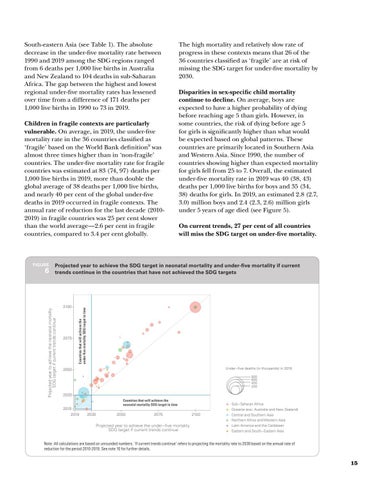
On current trends, 27 per cent of all countries will miss the SDG target on under-five mortality.
Projected year to achieve the SDG target in neonatal mortality and under-five mortality if current trends continue in the countries that have not achieved the SDG targets
Projected year to achieve the neonatal mortality SDG target if current trends continue
6
Disparities in sex-specific child mortality continue to decline. On average, boys are expected to have a higher probability of dying before reaching age 5 than girls. However, in some countries, the risk of dying before age 5 for girls is significantly higher than what would be expected based on global patterns. These countries are primarily located in Southern Asia and Western Asia. Since 1990, the number of countries showing higher than expected mortality for girls fell from 25 to 7. Overall, the estimated under-five mortality rate in 2019 was 40 (38, 43) deaths per 1,000 live births for boys and 35 (34, 38) deaths for girls. In 2019, an estimated 2.8 (2.7, 3.0) million boys and 2.4 (2.3, 2.6) million girls under 5 years of age died (see Figure 5).
2100
2075
Countries that will achieve the under-five mortality SDG target in time
FIGURE
The high mortality and relatively slow rate of progress in these contexts means that 26 of the 36 countries classified as ‘fragile’ are at risk of missing the SDG target for under-five mortality by 2030.
Under−five deaths (in thousands) in 2019
2050
800 600 400 200
2030 Countries that will achieve the neonatal mortality SDG target in time
2019 2019
2030
2050
2075
Projected year to achieve the under−five mortality SDG target if current trends continue
2100
Sub−Saharan Africa Oceania (exc. Australia and New Zealand) Central and Southern Asia Northern Africa and Western Asia Latin America and the Caribbean Eastern and South−Eastern Asia
Note: All calculations are based on unrounded numbers. ‘If current trends continue’ refers to projecting the mortality rate to 2030 based on the annual rate of reduction for the period 2010-2019. See note 10 for further details.
15