Tony Philippou from Chela, speaks to us about the company’s innovative Pure range
Corps Security Managing Director, Paul Lotter, reflects on his journey through the security industry
Also featured: PTSG, SSIP, Oscar Acoustics, Lucion, ABM and more.
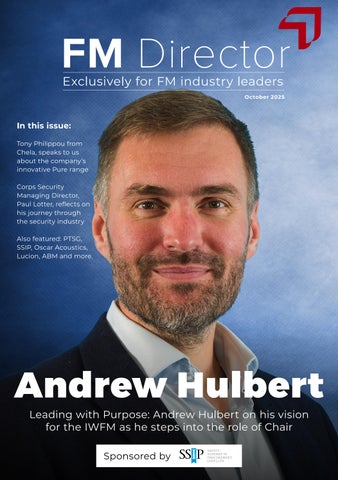
Andrew Hulbert
Leading with Purpose: Andrew Hulbert on his vision for the IWFM as he steps into the role of Chair
Sponsored by
Welcome to October’s issue of FM Director
Ican’t believe we’re already in the tenth month of 2025. It’s been such a busy year and has absolutely flown by! This month we’ve been as busy as ever gathering all the latest FM stories to keep you updated and sourcing the most insightful interviews and features from thought leaders across the sector.
Our cover star this month is the newly appointed IWFM Chair, Andrew Hulbert. As he takes over from Mark Whittaker, Andrew tells us about his priorities and goals for his time at the helm, and what he hopes his legacy will be.
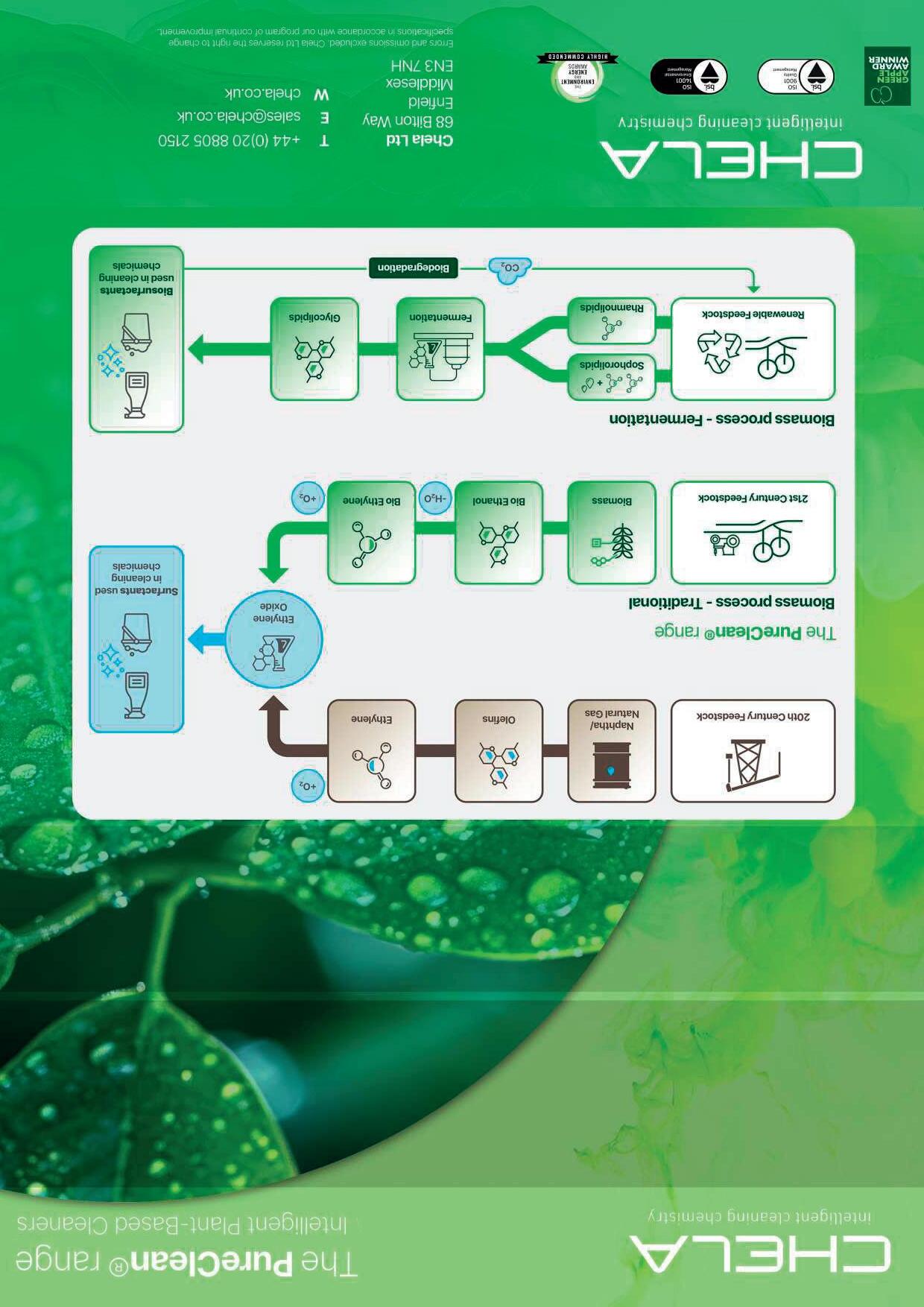
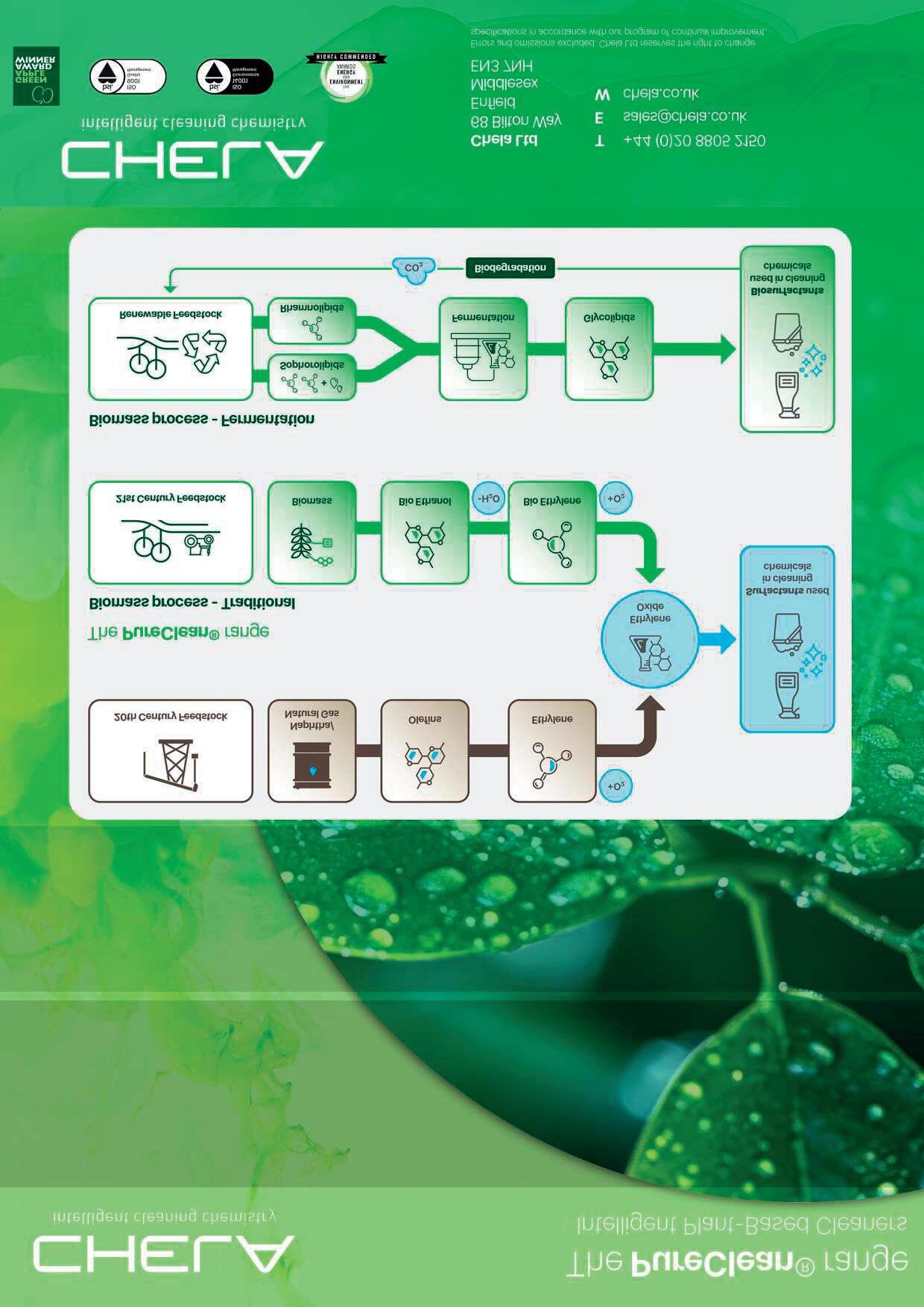
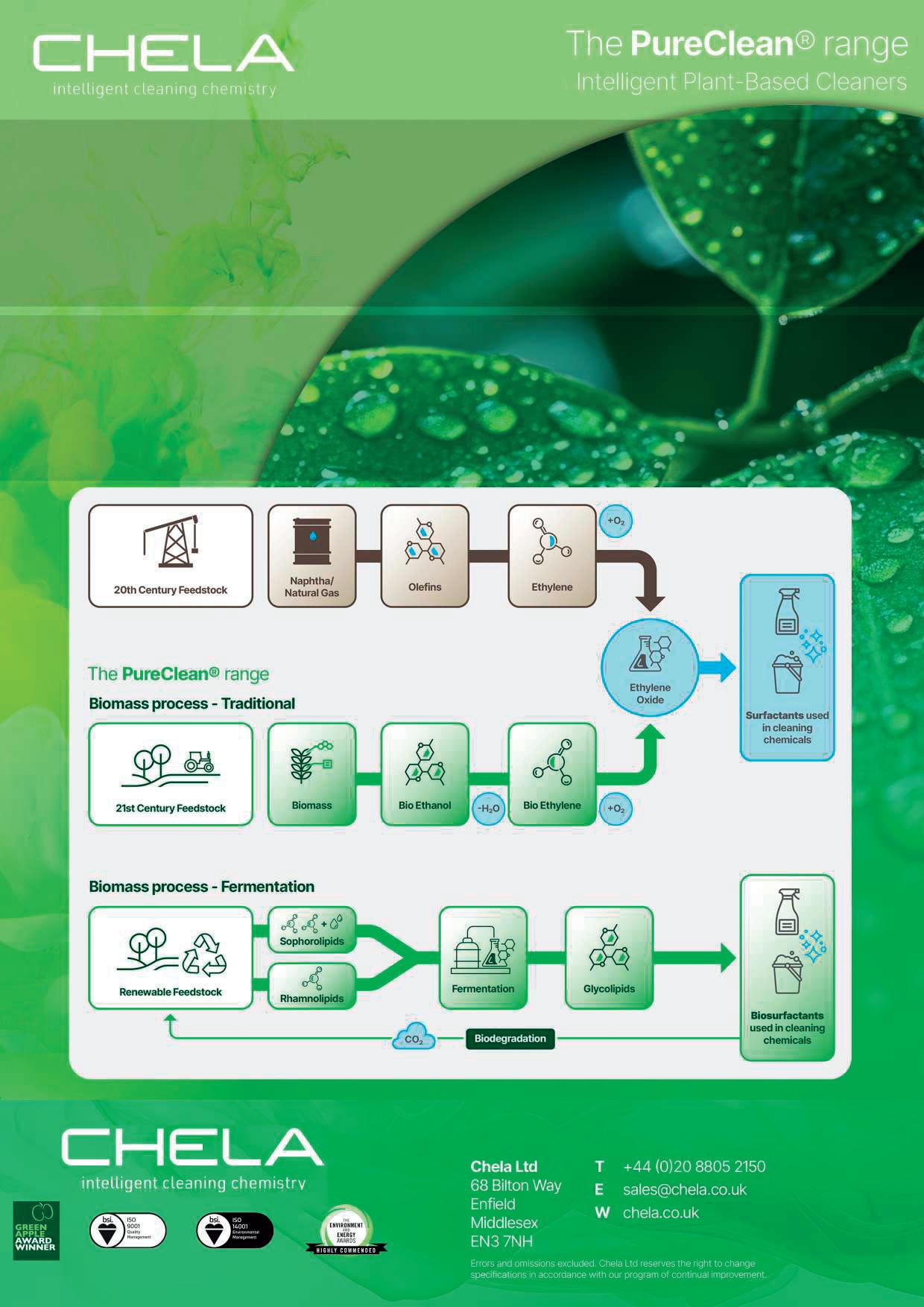
Tony Philippou, Sales & Marketing Director at Chela, speaks to us about the company’s innovative Pure range – a comprehensive line of 100% plant-based cleaning products that’s setting new standards for sustainability in the facilities management industry.
In addition, Corps Security Managing Director, Paul Lotter, reflects on his journey through the security industry and advises on how to identify opportunities depending on security officers’ skills, create frameworks that value people over qualifications, and adapt to evolving challenges in the industry.
We also hear from other industry leaders such as PTSG, SSIP, Oscar Acoustics, Lucion, ABM and many more.
As always, I hope you enjoy this edition of FM Director and remember, if you have anything you’d like to discuss with me, please drop me a line at claire.middleton@businessdailygroup.co.uk .
Thanks
Claire Middleton
fmdirector@fmbusinessdaily.com
Leading with purpose: Andrew Hulbert on his vision for the IWFM
Following on from our recent interview with outgoing IWFM Chair, Mark Whittaker, FM Director’s Claire Middleton recently caught up with his successor, Andrew Hulbert.
When a Director is not a Director – and why it could land you in legal trouble
From impressive job titles to informal leadership roles, many individuals in UK companies act like directors without ever being formally appointed. But under UK company and insolvency law, this can be a high-risk position – one that may expose them to personal liability, financial penalties, or disqualification
‘Curry queen’ – Dipna Anand shares her recipe for success with Eurest chefs
Renowned chef, author and culinary instructor Dipna Anand has always blended tradition with innovation, from growing up at the legendary Brilliant Restaurant in Southall to running gastropubs, cookery schools and her own restaurants.
Managing Editor
Claire Middleton
Managing Director
Cheryl Ellerington
artificial intelligence technologies or systems. For
and
make sure you get your
please ring
or email fmdirector@fmbusinessdaily.com The views expressed in the articles reflect the author’s opinions and do not necessarily reflect the views of the publisher and editor. The published material, adverts, editorials, images and all other content is published in good faith.
James Jackaman
Louise Bristowe-Harrison
Leading with purpose
FM at the Heart of the UK’s Data Centre Boom
Pure innovation: Bringing 100% plant-based cleaning to the FM sector
A solar bullet for price increases, energy security and sustainability targets
Unlocking Efficiency: How SSIP’s Mutual Recognition Simplifies Compliance for Suppliers
How to weatherproof your property this winter
Paul Lotter: Building expertise through experience
The Winter Crisis Hiding in Plain Sight
The Q4 Compliance Crunch: Why October Separates the Prepared from the Panicked
When a Director is not a Director – and why it could land you in legal trouble
The Sound of Silence: Why Acoustic Design is the Unsung Hero of Business Performance and Retention
‘Curry queen’ – Dipna Anand shares her recipe for success with Eurest chefs
Public sector organisations at risk of pump failures during winter, warns expert
Leading with purpose
Andrew Hulbert on his vision for the IWFM
There are skills available within the sector. It’s about how you find the right talent and attract it to yourself
Following on from our recent interview with outgoing IWFM Chair, Mark Whittaker, FM Director’s Claire Middleton recently caught up with his successor, Andrew Hulbert.
Here, as the newly appointed Chair of the IWFM, Andrew shares his priorities for the institute, his views on the FM industry’s biggest challenges, and what he hopes his tenure legacy will be.
After five years on the board of the Institute of Workplace and Facilities Management, Andrew has stepped into the role of Chair at a pivotal moment for the organisation. With a commerciallydriven focus and entrepreneurial background, he brings a fresh perspective to an institute that has recently returned to financial surplus for the first time in seven years.
“I’ve been on the board for the last five years, so I have some concept of where we are as an institute,” Andrew explained. “Those that know me within the board know I have an incredibly driven commercial focus. And that’s what I bring to the table.”
The institute’s improved financial position represents a significant milestone, one that Andrew viewed as essential for future ambitions. “We are back in surplus for the first time in seven years, and that’s a really important position for us to be in because our future aspirations for chartership depend on us having positive financials and good cash flows,” he stated.
This financial stability has been largely driven by the success of the IWFM Academy and IWFM Direct training programmes. However, Andrew was candid about the work still required. “There is still more work to do on the membership side in terms of retention levels,” he said.
A strategic moment
Andrew’s appointment coincides with the development of the institute’s next five-year strategy. “Our current strategy ends in 2025, so we’re now looking at our five-year plan moving forward,” he said. “It’s very fortuitous timing that I joined at the beginning of that, so I’m able to have some input into what that strategy looks like.”
When asked about his number one priority, Andrew was clear: maintaining commercial success whilst revitalising the membership proposition. “We’ve done an amazing job at getting the training element of it and the IWFM Directs and the Academy. That part is going really well,” he said. “We need to just make sure this next strategy focuses on what the value of being an IWFM member is and how we can enhance that as much as possible.”
Andrew also praised the diversity and calibre of the executive leadership team. “This is one of the most diverse boards I’ve ever worked on,” he said. “There are some amazing leaders, doing great things.”
This is one of the most diverse boards I’ve ever worked on. There are some amazing leaders, doing great things
Addressing the skills shortage
The ever-present challenge of skills shortages in the FM sector remains a concern for all involved. When asked for his thoughts, Andrew said: “I think there are skills available within the sector. It’s about how you find the right talent and attract it to yourself.”
He pointed to Brexit as a significant setback for the industry. “Brexit really wasn’t useful for the FM sector because so many brilliant skills amongst our European friends were lost as they went home,” he said.
Andrew’s solution focuses on developing talent from within. “For me, it’s about growing your own - going back to apprenticeships, back to degree-qualified people and trying and get them in early,” he stated. Drawing on his own experience, he added: “I was a graduate who came out of university with no idea about FM. And over the last 15 years, I’ve just been on this crazy journey that’s ended up creating so many opportunities for me.”
Andrew’s passion for apprenticeships stems from his working-class background. “My dad was a factory worker for 46 years, so that was a real fundamental engineering background,” he explained.
I don’t think there’s that much tolerance left within organisations to keep throwing more nice ideas to get people back in
During his time as CEO at Pareto, the company reached double digits in apprentice numbers despite being a relatively small business.
Andrew highlighted the frustration around unused apprenticeship levy funds. “There are millions, if not billions, of pounds of wasted apprenticeship levy that service providers pay that never gets used. It’s such a waste of money because it’s just a tax effectively that the government has put on,” he said. He noted that some larger FM companies have been lobbying government to allow the levy to be used for salaries rather than just training costs.
Return to office and sustainability concerns
When discussing current industry challenges, Andrew identified two critical areas: the return-to-office dynamic and sustainability targets.
“I see organisations have sort of thrown the dice on the return to the office now,” he observed. “They’ve done all the nice things.
The puppy therapy, they’ve got people coming in to talk, the extra beers on a Thursday, whatever it is. I don’t think there’s that much tolerance left within organisations to keep throwing more nice ideas to get people back in.”
He suggested the sector has reached a tipping point. “Amongst the people that I talk to, a defined number of days you have to go into the office is starting to increase from what I see,” he said. “We’re at the top of what organisations are willing to do to get people back in.”
On sustainability, Andrew expressed scepticism about net zero commitments. “I am sceptical that all these organisations are going to be net zero by 2050. I just don’t think it’s going to happen,” he stated.
“You see slippage on a country level across almost every country, and I think, with Scotland a famous example, many keep moving their targets back.”
However, he sees this as an opportunity for FM professionals. “FM could not be better positioned to support organisations in this. Because most likely we’re the ones that are confirming the utility bills, we’re managing the BMS, we’re managing the output. We’re just so well positioned, but we keep having to muscle in to make sure that we’re the ones that they’re talking to about sustainability.”
Andrew pointed to Pareto’s commitment to achieve net zero by 2027-28 as an example of what’s possible. “You need mediumsized businesses and SMEs to be committing to better things than the big businesses are, because that’s what innovation looks like from an entrepreneurial perspective,” he argued.
Building on strong foundations
Speaking of his predecessor, Mark Whittaker, Andrew described him as “an incredibly competent, calm, strategic individual that can really see the strategy piece.”
“What we’ve achieved under his tenure is brilliant. He will have a positive and lasting legacy for IWFM, least of all for bringing it into a positive position,” Andrew said. “He hands the IWFM over in a great state for me to pick up and run with.”
A legacy of inclusion
When asked about his own desired legacy, Andrew returned to his core priorities. “I’d love my legacy to be that we make some really impactful strategy choices that last for the next five years or so around what the membership proposition means,” he said.
He also emphasised his commitment to inclusive leadership. “I’m known for doing things slightly differently. I have a slightly different voice within the sector. I’m a very social mobility-led and ESGled leader,” he explained. “I want to be known as someone that brought a very inclusive vibe to what we were trying to do, making sure everybody had a voice and that we represented the sector in a very diverse way from the top.”
True to his collaborative approach, Andrew is already thinking about succession planning. “I’m already focusing on who we are trying to get ready for the next chapter, when the chairs change again in the future,” he said.
In closing, Andrew issued an invitation to IWFM members. “I’m trying to be as immersive as possible. I want to be out there, and I want to chat to people,” he said. “I’d love to hear from people that are delivering it day-to-day around what IWFM means to them. That’s important to me.”
With financial stability restored, a new five-year strategy on the horizon, and a chair committed to listening and innovation, the IWFM appears poised for an exciting period of growth and development.
Elevate Your Business with UKMDA
Join the UK Metal Decking Association (UKMDA) and place your business at the forefront of the industry. UKMDA offers a powerful network and essential resources to help your company and contracts be successful. Why Join UKMDA?
Leadership & Influence:
Be part of a powerful network that shapes industry standards and works with key bodies like HSE, CITB and CSCS
Credibility & Safety:
Demonstrate your commitment to excellence with our rigorous audits and access to authoritative safety guidance.
The UKMDA is committed to raising the bar for safety and competency. Our comprehensive training programs provide your team with the skills and qualifications they need.
Core Training: Our scheme covers all aspects of metal decking and stud welding installation, taught by licensed trainers.
Nationally Recognised NVQs:
We provide NVQs that allow you and your installers to demonstrate technical competence.
A UKMDA-qualified workforce means fewer accidents, greater efficiency, and an enhanced reputation for quality.
FM at the Heart of the UK’s Data Centre Boom
The Tech Prosperity Deal between the UK and the US promises to drive billions into new data centre infrastructure; supporting Kier Starmer’s vision of turning the UK into an ‘AI Superpower.” For facilities management (FM), this expansion represents both a vast opportunity and a complex challenge. Richard Sykes, SVP & President, ABM UK & Ireland, explains more
At ABM, we already service more than 4.5 million square feet of data centre space across the UK and Ireland annually, supporting over 600 large-scale client facilities. With more than 30 years of experience in critical environments, our teams know how crucial FM is to maintaining uptime and safeguarding growth.
Opportunity and Risk: A Critical Balancing Act
One of the biggest challenges — coordinating multiple suppliers and systems while scaling rapidly— also marks the greatest opportunity. The providers who succeed will be those with deep understanding of critical spaces who can provide multiple service lines while offering support from construction phase through to business-as-usual operations and predictive maintenance.
But the challenges don’t stop there. Skills shortages in engineering are intensifying, while scrutiny of energy use and carbon impact cannot be ignored. Providers who are unable to deliver measurable gains in efficiency and sustainability will quickly be left behind.
Data centres are notoriously energy-intensive. Cooling systems alone represent a major share of power use Strong ESG credentials will be essential for FM providers looking to take advantage of the boom. Clients will expect partners who can enhance their own reporting and demonstrate measurable progress on sustainability goals. Operating in a space under a sustainability magnifying glass, it’s possible that cost and efficiency will be secondary to how actively suppliers can minimise the environmental impact of digital expansion. Those who can prove they are embedding ESG into every aspect of service delivery will be the ones who stand out.
The Unseen Importance of Post-Construction Cleaning Air contamination is the enemy of data storage — only spaces that are technically cleaned can be cleared for use. With 30 years of experience, our Critical Solutions team know the risk which invisible particles pose to the uptime of digital infrastructure. Even 30 minutes of unscheduled downtime can cost businesses dearly.
With the Tech Prosperity Deal promising to fund significant numbers of new data centres; involvement during the construction phase is vital. If the builders’ clean is done thoroughly, it significantly decreases the work needed later. Dust, debris, and microscopic particles left behind during construction can infiltrate sensitive equipment.
Industry specific qualifications are essential, but so too is specialist knowledge of the unique environment data centres present. Cleaning teams must balance rigorous safety standards with precision techniques designed to protect high-value assets. The process goes beyond the visible — targeting subfloors, overhead voids, and the smallest of particulates that could compromise air quality.
Ultimately, effective builder and post-construction cleaning lays the foundation for operational resilience. By ensuring a facility is contamination-free from day one, FM providers reduce the risk of disruption and give clients the confidence that their investment in digital infrastructure will deliver at full capacity from the outset.
Skills for an AI Superpower
As the UK positions itself as an “AI superpower,” expectations on supporting infrastructure are immense. FM must adapt fast.
Technical depth in high-voltage systems, advanced cooling, and critical environments remains non-negotiable. But digital skills are equally essential: data analytics, cyber-aware maintenance, and compliance monitoring.
The ability to maintain power redundancy — backup and fail-safe systems that ensure no single point of failure — is also critical. In data centres, even a momentary lapse can cause massive disruption.
Building these capabilities requires investment in apprenticeships, reskilling, and partnerships with technical institutions today — not tomorrow.
Preparing for Variable Demand
Some are already warning that the AI boom could be overhyped, with infrastructure investment outpacing demand. If history has taught us anything it’s that staying adaptable is key. Plan for growth, yes, but be prepared to evolve the plan in meeting that growth. Even if AI adoption slows, digital infrastructure demand will keep rising. The key is building scalable, efficient, and sustainable models that add value in any scenario. The skills needed for data centres are transferable across a number of sectors such as life sciences and healthcare and increasingly relevant to the built environment in general.
FM providers cannot predict cycles, but they can design for resilience.
A Defining Inflection for FM
The Tech Prosperity Deal is a catalyst, but the long-term test is whether FM evolves into a true strategic enabler of the digital economy. Uptime, sustainability, and cost efficiency are converging — and FM sits at the intersection.
At ABM, our ability to mobilise across the UK & Ireland, coupled with our 100,000+ delivered projects in live and critical environments, gives us a unique vantage. From winning major contracts like Iron Mountain to supporting new builds with Winthrop Technologies, our record speaks for itself.
The opportunity is enormous, but it will only be realised by providers who combine technical depth with adaptability, innovation, and sustainability leadership.
If history has taught us anything it’s that staying adaptable is key
Pure innovation: Bringing 100% plant-based cleaning to the FM sector
Tony Philippou, Sales and Marketing Director at Chela, recently spoke to FM Director about the company’s innovative Pure range – a comprehensive line of 100% plantbased cleaning products that’s setting new standards for sustainability in the facilities management industry
Part of the Fisher Darville Holdings Group, Chela has been manufacturing chemicals since 1988, serving various industries across the UK with a particular focus on transport and facilities management.
Still family-run, the group maintains a turnover of just over £11 million and operates three facilities in Enfield.
Tony Philippou, who has been with the company for almost 20 years in a sales capacity, explained how the Pure range came into existence approximately 12 months ago following a specific client request.
“One of our transport clients came to us and said they wanted more sustainable solutions for cleaning their trains,” he said.
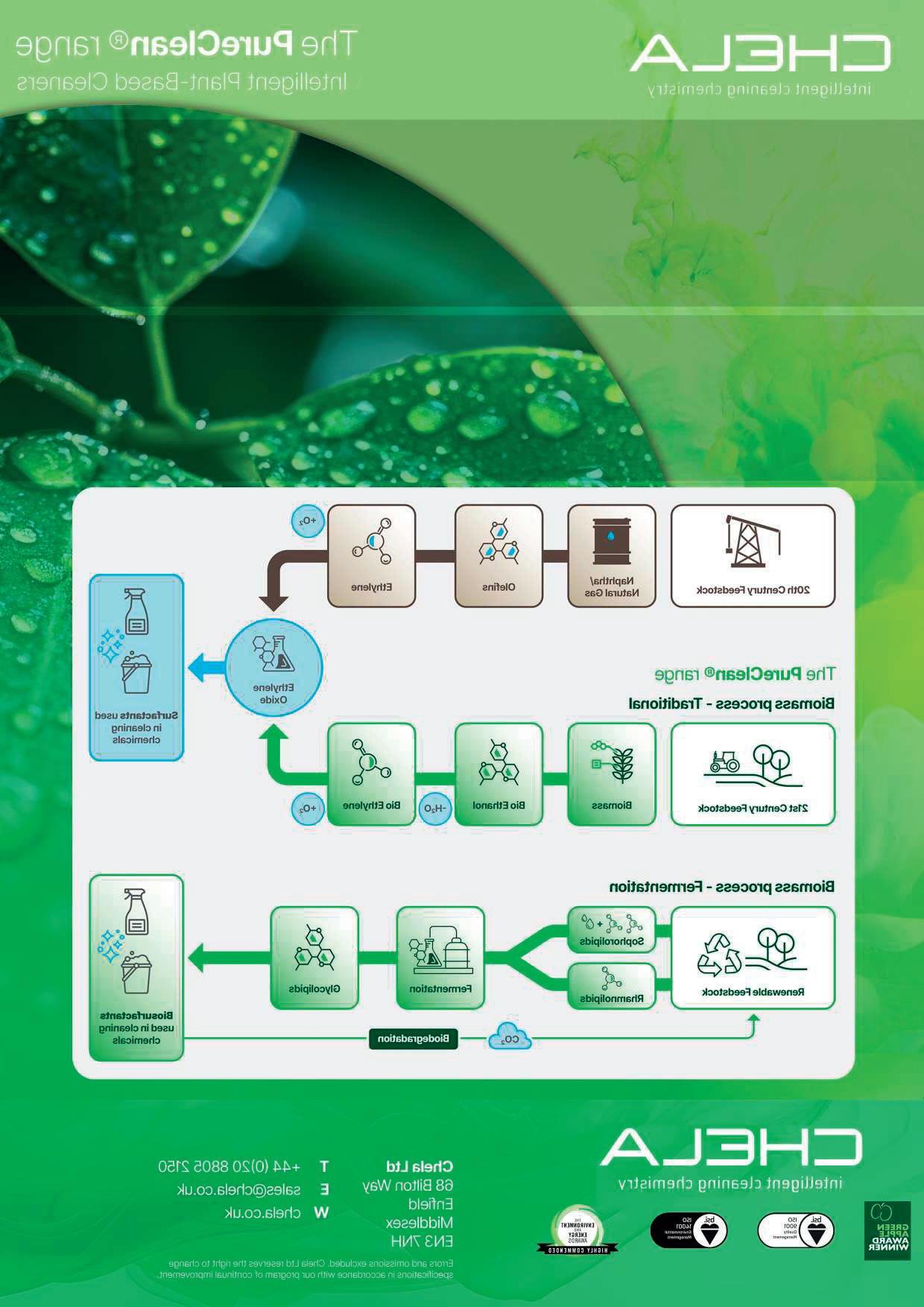
“We sat around the table and tried to establish what sustainability meant. Ultimately, in our industry, the gold standard for sustainability is eradicating petroleum-based raw materials from your supply chain.”
A comprehensive solution
Tony explained that all chemicals – from washing-up liquid to domestic products – traditionally start their life in petroleum form, usually as gas or oil. The Pure range represents what he described as “the first of its kind” – a genuine industrial cleaning range based solely on plant-based technology.
“We have a product to cover every facet of cleaning, whether it be cleaning the outside of a train or mopping down a hospital,” he said. “The range has grown from one product to about 12.”
We’re one of the only UK manufacturers that have 100% plant-based solutions to cover all facets of cleaning
What truly sets the Pure range apart from competitors is its comprehensiveness. “Plant-based solutions aren’t really anything new, but finding solutions which are 100% plant-based is,” Tony explained.
“We’re one of the only UK manufacturers that have 100% plantbased solutions to cover all facets of cleaning.”
Overcoming development challenges
The development process presented its own unique challenges. “In the beginning it was quite tricky because even now the raw material market isn’t hugely mature,” Tony said.
“The raw material choice compared to petroleum raw materials isn’t massive, but it has come a long way.”
A solar bullet for price increases, energy security and sustainability targets
The UK has some of the highest industrial electricity prices in Europe, with prices 46% above the median of International Energy Agency member countries , and it’s set to remain this way due to global market shifts and the electrification of heat and transportation.
Energy management has always been part of the facilities management remit, but in recent years it has taken on a new urgency.
For businesses working on tight margins, these rising and unpredictable costs pose a serious risk. And whilst you battle energy costs, carbon emission targets in contracts and procurement frameworks make environmental performance an emerging commercial concern too. If that wasn’t enough, power resilience is also creeping up the priority list.
With this backdrop, it’s not surprising that renewable technologies like solar PV are becoming the go to solution for controlling costs, ensuring resilience and achieving a commercial advantage.
The financial benefit
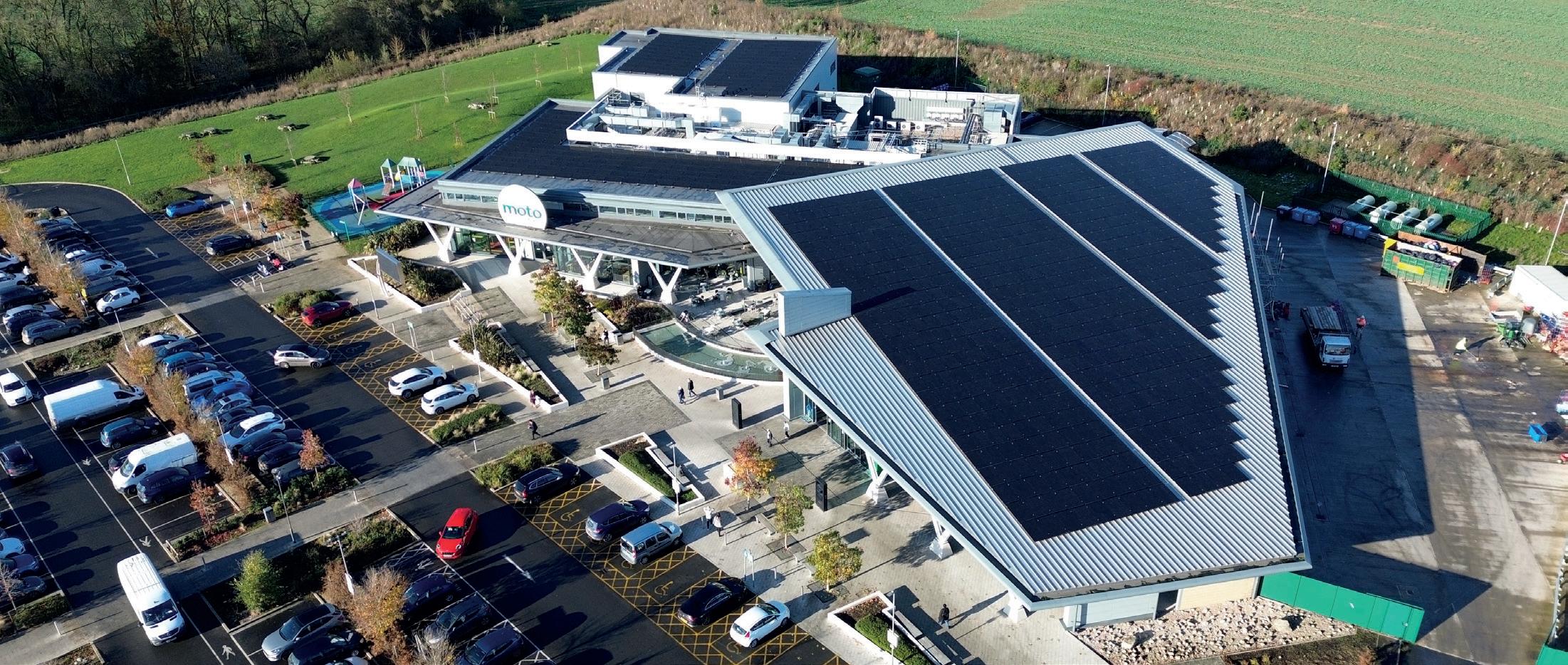
Solar PV has the potential to save businesses thousands, if not millions in energy bill reductions. An installation of a 480kWp solar PV system at Fluke, a manufacturer and distributor of electronic tools and software, for example, is saving the business more than £3 million over its life-time by generating over 380,000kWh of energy every year.
Installing solar PV allows businesses to generate a significant portion of their electricity onsite, cutting energy bills and reducing their business’s exposure to volatile market rates.
Working with an installer, such as Geo Green Power, Facilities Managers can rely on a well-designed system delivering stable, low-cost electricity for 25 years and more.
In sectors such as manufacturing and warehousing, where usage aligns with daytime generation and roof space is readily available, solar PV can meet a substantial share of total demand, resulting in a payback period of between three and five years.
Resilience and reputation
The financial case is compelling, but it’s not the only driver behind a solar PV investment. The National Grid has repeatedly warned of localised grid constraints, and although upgrade plans are in place, your own expansion or desire to electrify may be impacted. In these cases, solar PV and potentially battery storage, will reduce grid reliance, maintain load levels and protect continuity of supply.
Installing solar panels will also significantly reduce the carbon footprint of your operations, a factor that’s becoming increasingly important in securing everything from procurement contracts to accessing finance. Scope 2 emissions reporting is becoming standard with companies being asked to provide auditable progress on carbon reduction strategies.
Owner vs tenant
For owner-occupiers, these drivers alone provide a strong business case, whereas in tenanted sites there’s more challenge involved in making it commercially viable for the landlord as well.
Fortunately, solar PV appeals to the three factors most landlords consider: value, risk and compliance. A building with solar PV benefits from improved EPC ratings and lower running costs, which strengthen its marketability. And it helps landlords stay ahead of tightening environmental performance standards, such as Minimum Energy Efficiency Standards (MEES) and net-zero reporting expectations.
Installing solar PV allows businesses to generate a significant portion of their electricity onsite
Solar PV can also generate new revenue streams, depending on how the deal is structured.
Structuring the deal
One route is to introduce a third-party funder via a Power Purchase Agreement (PPA). They install and own the system and the tenant purchases the electricity it generates at a fixed rate. This rate is below market cost and agreed for a period of between 10 and 15 years or more. With no upfront investment or maintenance responsibilities for either party, PPAs offer immediate energy savings and long-term price certainty for tenants, and no exposure for landlords.
Alternatively, landlords can take a more active role by funding the system themselves, either directly as the PPA funder or through asset finance. In doing so, they become the energy provider to their tenants, charging a reduced rate for the electricity and creating a new income stream. This model is especially appealing for landlords with long-term holdings or multiple tenants, enhancing asset value and delivering a return on investment.
There’s also potential to negotiate a hybrid agreement where both parties contribute to the cost of installation, with repayment mechanisms structured into adjusted rent or service charges.
PPA and asset finance agreements are of course also available to companies who want to investigate solar on their own properties, for their own use.
Shared priorities, multiple benefits
Regardless of individual circumstances, and funding options, the key to success is to start discussions with a commercially sound proposal that includes funding routes, performance data and clearly modelled outcomes.
Solar delivers multiple benefits, and it’s crucial to select a partner that understands your priorities and works with all parties to structure proposals that deliver environmentally and commercially.
To help facilities managers understand and develop a business case for solar, Geo Green Power has created a series of sector-specific guides available online throughout the autumn at www.geogreenpower.com
Unlocking Efficiency: How SSIP’s Mutual Recognition Simplifies Compliance for Suppliers
For construction suppliers navigating the complex landscape of health and safety compliance, the traditional approach of completing multiple, often repetitive, pre-qualification assessments have long been a source of frustration and inefficiency.
However, a powerful solution exists: SSIP (Safety Schemes in Procurement) certification, particularly through its groundbreaking principle of Mutual Recognition.
This innovative system allows suppliers to simplify their compliance efforts, save significant time and money, and focus on what truly matters – delivering safe and quality work.
The Power of “Deem to Satisfy”
The core benefit of SSIP for suppliers lies in its unique “Deem to Satisfy” process. Once a supplier achieves approval from one SSIP Member Scheme, they are never required to undergo a full assessment with another.
This revolutionary approach is underpinned by SSIP’s strict Core Criteria, which are consistently applied across all Member Schemes.
What this means in practice is profound: if a buyer or client requires you to register with their preferred SSIP scheme, your existing certification can be used to satisfy that requirement without the need for a full re-assessment.
This eliminates the redundancy that has historically plagued the industry, allowing for a much more streamlined and efficient compliance journey.
A “Deem to Satisfy” Certificate recognises your existing SSIP member certification and fully aligning with the originating assessment – scope, trade and expiry date.
Tangible Benefits for Suppliers
The advantages of SSIP’s Mutual Recognition are far-reaching:
Operate to the Highest Health and Safety Standards: By achieving SSIP certification, suppliers demonstrate a commitment to rigorous health and safety standards, aligning their operations with industry best practices and legal requirements.
Save Time and Reduce Costs: The “Deem to Satisfy” principle directly translates into tangible savings. By avoiding duplicate assessments, businesses can dramatically cut down on the administrative time and financial expenditure associated with multiple pre-qualifications. In 2024 direct savings of over £5.5 million could be attributed to Deem to Satisfy Certificates.”
Avoid Duplicate Assessments: This is the cornerstone of SSIP’s efficiency for suppliers. Once certified by one scheme, that approval is recognised by all other SSIP Registered Member Schemes, freeing up resources that would otherwise be spent on redundant paperwork.
Enhanced Value through CAS Exemption: SSIP certification offers an additional layer of value by being recognised as an exemption against Section 4 (Health and Safety) of the Build UK Common Assessment Standard (CAS). This further streamlines compliance efforts, particularly for those operating within the construction sector’s standardised assessment framework.
Once a supplier achieves approval from one SSIP Member Scheme, they are never required to undergo a full assessment with another
Choosing Your Ideal SSIP Member Scheme
Suppliers maintain the freedom to select the SSIP Member Scheme that best aligns with their specific business needs.
When making this choice, key factors to consider include the scheme’s fees, the scope of its assessment, and whether it covers your particular duty holder role (e.g., Contractor, Designer).
This flexibility ensures that the chosen scheme is a perfect fit for your operational requirements.
Navigating Requests for Different Schemes
Should a buyer request that you register with an SSIP scheme different from your current certification, there’s no cause for concern.
The Mutual Recognition principle, through “Deem to Satisfy,” allows for a seamless recognition of your existing approval. This ensures that you avoid additional full assessments, continuing to save valuable time and money.
SSIP certification, through its Mutual Recognition and ‘Deem to Satisfy’ process, offers suppliers a smarter route to health and safety compliance
Beyond Compliance: Client Confidence and Smoother Collaboration
While third-party conformity assessments like SSIP are not a legal requirement, they represent industry best practice. Obtaining SSIP certification provides clients with invaluable confidence that suppliers meet essential competence standards.
This independent verification paves the way for smoother project collaboration, fostering trust and efficiency within the supply chain.
For suppliers, SSIP certification simplifies the often-onerous prequalification process, allowing them to redirect their focus to what truly matters: delivering safe, high-quality work.
To explore the full range of benefits, search over 90,000 SSIP Certified Suppliers, or learn more about scheme registration and mutual recognition, visit the SSIP website today www.ssip.org.ok.
Eleanor Eaton SSIP Chair comments “ SSIP certification, through its Mutual Recognition and ‘Deem to Satisfy’ process, offers suppliers a smarter route to health and safety compliance.
Once approved by one SSIP Member Scheme, that certification is recognised across all others - eliminating the need for costly, timeconsuming duplicate assessments.
This not only saves significant time and money but also boosts client confidence and supports smoother project collaboration.
With over £80 million saved since 2016 through DTS alone, and overall savings to industry of £1,759 million SSIP empowers suppliers to operate to the highest standards while focusing on delivering safe, high-quality work. It’s compliance made efficient –without compromise.”
SSIP: Compliance Made Efficient Stop the Duplication. Start Saving.
Are you a construction supplier wasting time and money on repetitive health and safety pre-qualification assessments?
SSIP (Safety Schemes in Procurement) offers a smarter solution through Mutual Recognition and the “Deem to Satisfy” principle.
Key Benefits:
Avoid Duplicate Assessments:
Get approved by one SSIP Member Scheme, and your certification is recognised by all others.
Boost Client Confidence:
Demonstrate commitment to the highest health and safety standards and ensure smoother project collaboration.
SSIP simplifies your compliance, allowing you to focus on delivering safe, high-quality work.
Certify Once. Satisfy Everywhere.
Save Time & Money:
Eliminate redundant administrative work and assessment fees. This process attributed to over £5.5 million in direct savings in 2024 alone.
Streamlined Compliance:
SSIP certification is recognised as an exemption against Section 4 (Health and Safety) of the Build UK Common Assessment Standard (CAS).
Learn more and find your ideal SSIP Member Scheme today: www.ssip.org.uk
How to weatherproof your property this winter
Nicholas Donnithorne, UK Technical Manager at Peter Cox, provides his insight on how to keep properties in good condition
While we can wrap up to brace for winter conditions, many properties face the harsh elements without additional protection. The UK has among the oldest housing stock in Europe, so many of our properties aren’t built to withstand increasingly frequent storms, intense bursts of torrential rain, and harsh, changeable weather conditions.
It’s good practice to ensure your property is in good condition while the weather is still relatively mild and dry, since winter elements can exacerbate existing property issues. For example, penetrating damp occurs when water enters through a property’s exterior walls or defects. Harsh winter winds and rains exploit these defects, and can easily push water inside your property.
Spotting the signs of damp
It’s important to learn how to spot the warning signs of problems in your property, so that you know when to take preventative action. If you spot symptoms of a bigger problem, it’s important to act fast, as ignoring the issue could lead to irreversible damage to the property infrastructure, and ultimately be a large financial hit.
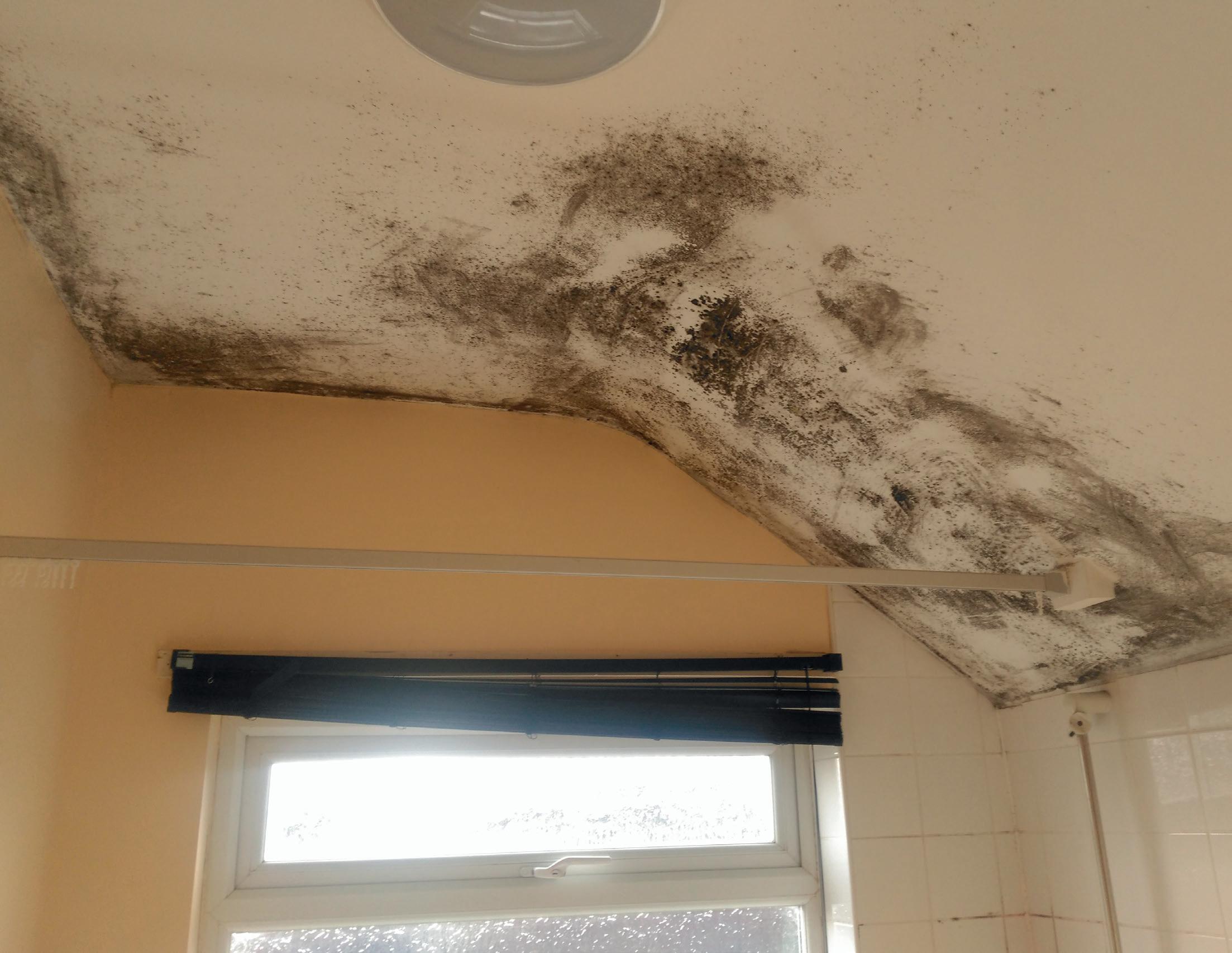
The easy-to-spot signs of damp are aesthetic – cracked plaster, peeling wallpaper, and stains and discolouration of walls are all suggestive of an issue. The presence of black mould also tells you something isn’t right, and needs to be checked out.
Serious damp problems can cause rotting skirting boards, rotting structural timbers, and mould on your leather goods. Leather goes mouldy at around 70% humidity whereas other surfaces start at 80% humidity, so if you see any spots on furniture or other surfaces, you need to take measures to correct the humidity balance of your property immediately.
Signs of damp can also be more transient. While they can be tempting to ignore, they are no less serious.
When wet or damp patches appear on the property walls after rain and then disappear on drier days, it may indicate the presence of hygroscopic salts, which pull in excess moisture from the air, or it may be caused by penetrating damp through a property defect. This is indicative of longer-term damp problems in your walls.
Be aware that not all damp is easily visible. Don’t ignore any musty smells you can’t identify. Excess moisture that leads to damp often smells distinctive and can help you identify issues that may be building up out of sight.
Preventing problems with weatherproofing
Penetrating damp is a major culprit when it comes to winter property challenges. Property defects such as leaking roofs, gaps around windows, and even plants growing on buildings can all provide avenues for water to enter the property.
As the premier body for Temporary Safety Systems, FASET is dedicated to ensuring unparalleled safety standards across the industry.
The Future is Digital: Benefits for FASET-Qualified Operators
All our qualifications now exclusively issue digital cards, offering a wealth of benefits:
Convenience: Easily add new qualifications as you progress.
Streamline Your Checks: For Employers and Site Supervisors
Security: Enhanced protection against loss or forgery.
We achieve this through our robust partnership with CSCS, delivering comprehensive training, rigorous assessment, and the issuance of industryrecognised competency cards. enquiries@faset.org.uk
Verify an operator’s competency instantly! Download the CSCS Smart Check App to your mobile device.
Stay Updated: Receive timely alerts for expiry dates and crucial safety notifications.
Paul Lotter: Building expertise through experience
When Corps Security Managing Director Paul Lotter came to the UK from Zimbabwe, he needed to find work to support his family.
Without the formal qualifications many industries in the UK require, he struggled to find a job where qualifications weren’t necessary, but work was regular. He says himself that he “fell into” the security industry, finding an officer position with good pay and regular shifts. But once he was “in,” he realised how varied the opportunities are.
your
Paul started off guarding corporate sites and on sites under renovation. In these changing environments, he noticed how security required learning on the ground, thinking on your feet, and finding the right fit for individual skillsets.
We spoke with Paul about his insight into the industry – how new starters can evolve, how the industry itself is changing, and how his company, Corps Security, is adapting.
Opportunities for officers
When I first started out, my path for progression wasn’t immediately clear. In this industry, growth often depends on your personal drive, both to develop your skills and to advance in your role.
Much of it comes down to mindset and taking the time to understand your wider team, maintaining a commitment to do the right thing even under pressure, and balancing both officer and company perspectives. Being a strong cultural fit with your employer, and with the customers you serve, can open doors to new opportunities.
It’s not necessarily about how long you’ve been in a role, how much experience you have, or how many qualifications you have. I think the hard question we have to ask ourselves is, “am I the right fit?”
For example, if you work better in sociable roles, you might be best suited to a customer-facing, corporate environment.
If your strengths are being on your feet and adaptable to change, you might be better in a retail space. Can your skills adapt, from being someone within a team to becoming a leader who manages them?
People should come to work with the drive to do a good job. If they are struggling, that might mean they aren’t motivated, that they don’t feel supported, or maybe the role doesn’t best serve their abilities.
A leader can have all the functional qualifications under their belt, but ultimately, good management comes down to understanding what motivates your people, what makes them tick? If you can’t understand that, you can’t manage different people in the different ways they need.
Finding the right fit
I remember when I was still fairly junior in a management position, and I had an appraisal with my line manager. My previous appraisals had focused on what I wasn’t good at and needed to improve on, and it wasn’t always constructive. How can you improve if you don’t know where you are going wrong?
I wished that instead of just focusing on those negatives, I was given motivation by being offered ways to develop what I was good at and play to my strengths.
To grow in a role as a leader and to provide new opportunities for your colleagues, you need to communicate regularly, understand each person beyond their job title, and attune your approach to their personality and motivations.
Today, I still see some managers reviewing someone’s strengths and misjudging their next step. For example, if someone works well with scheduling, screening and vetting on an individual customer account, their manager may think that they could naturally transition into a contract manager role.
Though there is a skill overlap, you need to see whether they can take on a much larger role with multiple moving parts, and more people to answer to.
If they transition well into that new responsibility? That’s a job well done. But if you move someone up because you presume their skillset will align with a new role without properly reviewing their needs first, you risk damaging someone’s career by putting them in a position they might not be able to handle yet.
My advice would be to be careful and ensure you can confidently identify the right path for yourself and the colleagues you manage.
Providing the right framework
Providing individual support is key to workplace development, but individual growth is only as strong as the organisational culture itself. I think a holistic approach is best, to provide community support, advocate for industry-wide best practice, and ensure employees have a say in the future of the business.
Investing in your people means investing in your organisation across all levels and locations
To maintain best practice, businesses need to advocate for their colleagues’ best interests. At Corps, we are a Living Wage Recognised Service Provider, and 97 per cent of our colleagues earn at or above the Real Living Wage.
Organisations should facilitate platforms that allow employees to share feedback and find their own communities. For example, our equality, diversity, and inclusion initiative Corps Together aims to break down workplace barriers through community structures.
Our Corps Veteran Association (CVA) is an example of one of those communities. As an organisation founded nearly 170 years ago to provide opportunities for veterans, the CVA upholds that value by providing a space for ex-forces men and women to meet, share their experiences and fundraise for wider initiatives.
These actions are all reflected in our status as a social enterprise, where all of our profits are reinvested into the business or donated to a number of military charity partners.
Investing in your people means investing in your organisation across all levels and locations. Frontline employees need to know that their employer advocates for their best treatment, beyond oneon-one opportunities and support.
Adapting to change
To best support colleagues, stakeholders and customers, we need to understand the complex threats they face and use the right tools to our advantage. That could mean many things: Redeploying and training officers under new legislative guidance, embracing technology, updating monitoring equipment and emergency response strategies, or developing regular threat bulletins for customers aligned to their location and possible threats, like protests in inner city locations.
It also means investing. At Corps, our drone service was developed to add a new protective layer to the robust emergency response procedures that customer sites need.
By targeting key vulnerable areas overhead, this technology can act as a visual deterrent to discourage potential intruders, offer round-the-clock surveillance, detect and evidence incidents beyond human capability. This technology can use AI smart-tracking to lock onto intruders and follow their pathways more comprehensively than static cameras.
By embracing these enhancements, implementing them in the right environments, and focusing on the human expertise that brings them to life, security providers can strengthen their service offering and expand what colleagues can achieve.
Making people a priority
When I look back at my own journey, I am reminded that the security industry’s greatest asset isn’t technological integration or organisational direction. It’s our people. I might have fallen into this industry, but I’ve found that it is full of opportunities. As a leader now, I know that when we create environments where colleagues feel genuinely understood, we can unlock potential, provide new opportunities and build better businesses.
The challenges facing our industry will continue to evolve, but I believe success ultimately comes down to asking the right questions. Am I truly listening to my teams? Am I actively exploring new technologies and opportunities? Am I creating frameworks that enable my colleagues to thrive?
If you can confidently answer “yes” to these, you’re not just leading within your organisation, you’re helping to shape the future of our entire industry.
ECO Property Maintenance is an environmentally friendly and cost-effective way to bundle non-business critical jobs of compatible trades.
It is a simple way to reduce the number of attendance fees and lower your carbon footprint for non-urgent works such as minor repairs or minor decorative fixes.
For more information contact info@msl-ltd.co.uk
HOW IT WORKS
Low urgency maintenance issues at the same site are grouped as Eco tasks and stored on the inSYNC portal for up to 21 days.
inSYNC recognises compatible trade tasks and calculates estimated labour timescales to complete.
Any of the following three triggers then apply: A standard priority job is raised - any compatible Eco tasks are bundled to this work order.
Four estimated labour hours are reached to complete compatible Eco tasks - one bundled work order is created
21 days are reached - one bundled work order
The Winter Crisis Hiding in Plain Sight
Every autumn, thousands of property managers across the UK make the same costly mistake: they wait. They watch the leaves fall, feel the first chill in the air and tell themselves there’s still time to address those niggling building maintenance issues. By the time the first winter storm hits, it’s already too late.
The numbers tell a sobering story. Emergency roof repairs during winter months cost 300% more than planned maintenance. Water ingress incidents spike by 400% during peak winter weather. Yet year after year, commercial properties remain woefully underprepared for the seasonal onslaught that’s as predictable as the calendar itself.
“Every October, we receive the same calls,” says Phil Seaton, Managing Director of NSS, a PTSG Company. “Property managers suddenly realise their gutters are blocked, their drainage systems haven’t been checked, and winter is days away. The tragedy is that these emergencies are entirely preventable. We see buildings that haven’t had a roof inspection in years, and the owners are shocked when a single storm causes tens of thousands of pounds in damage.”
The Perfect Storm Brewing Above Walk onto any commercial roof in October and the signs are everywhere. Months of summer heat have left materials expanded and contracted to their limits. Gutters overflow with autumn’s debris. Drainage systems that coped admirably during summer’s gentle showers are about to face their annual trial by fire – or rather, by water.
The cruel irony is that most building failures during winter aren’t caused by extraordinary weather events. They’re caused by ordinary winter conditions meeting neglected maintenance. A blocked gutter becomes a structural threat. A small membrane weakness becomes a catastrophic leak. A drainage system operating at 70% efficiency becomes completely overwhelmed.
The
Anatomy of Winter Building Failure
Modern commercial buildings are marvels of engineering, but they’re also complex ecosystems where every component depends on every other. When one element fails, the cascade effect can be swift and devastating.
Take siphonic drainage systems, for instance. These engineering solutions can drain rainwater up to ten times more efficiently than traditional gravity-fed systems.
They’re installed in retail parks, industrial estates, and office complexes across the country. Yet many installed before 2007 are operating below current British standards, ticking time bombs waiting for the next intense downpour.
The problem isn’t always obvious to the untrained eye. A siphonic system might appear to function perfectly during moderate rainfall, only to fail catastrophically when truly tested. By then, of course, finding emergency contractors becomes both urgent and expensive.
The Contractor Conundrum
Here lies another uncomfortable truth: not all emergency contractors are actually equipped for emergencies. When your roof fails at 2am on a Saturday, discovering that your “24/7” contractor actually means “we’ll get back to you on Monday” becomes an expensive lesson in due diligence.
The roofing industry has seen significant consolidation in recent years, with national players acquiring regional specialists. This has created a two-tier market: contractors with genuine nationwide capabilities and round-the-clock response teams, and those who simply claim to offer these services whilst relying on a network of subcontractors they can’t directly control.
The difference becomes apparent only when you need them most. Proper emergency response requires in-house operatives, company-owned equipment, and the infrastructure to deploy both at short notice. It’s an expensive capability to maintain, which is why genuinely capable emergency contractors charge premium rates and why they’re worth every penny when disaster strikes.
“We’ve built our entire operation around genuine 24/7 response capability,” explains Seaton.
“That means employed operatives, not subcontractors. Our own fleet of access equipment, from truck-mounted platforms to scaffolding systems.
Regional teams positioned across the country. It’s a significant investment, but when a roof fails at 2am in Leeds or Plymouth, our clients need someone who can actually respond, not a call centre promising to get back to them on Monday morning.”
The Hidden Cost of Reactive Maintenance
Property management has become increasingly sophisticated, with planned preventive maintenance programmes and predictive analytics helping to optimise building performance. Yet when it comes to weather protection, many organisations still operate in reactive mode.
The financial mathematics are stark. Consider these facts:
70% of commercial roof leaks are caused by blocked or poorly maintained gutters. Blocked gutters lead to water pooling and penetrating roof membranes, causing damage to internal structures.
Water ingress is one of the top three causes of commercial property insurance claims in the UK. A comprehensive gutter cleaning and inspection programme might cost a few hundred pounds per building. The water damage from a single gutter failure can run into tens of thousands.
Unmaintained gutter systems can lead to repairs costing 5-10x more than scheduled cleaning. Reactive fixes due to water ingress, damaged fascias, or internal ceiling collapse can far exceed the annual cost of a PPM contract.
1 in 3 commercial properties in the UK experience preventable drainage-related roof damage annually. Factor in business interruption, emergency accommodation for displaced operations and reputational damage and the true cost becomes eye-watering.
Standing water from blocked gutters can add up to 20% extra weight load to the roof structure, especially on flat and industrial roofs, leading to long-term structural stress or collapse risk.
Businesses with active roof and gutter PPM see up to 50% fewer emergency call-outs annually. Planned maintenance extends asset life and reduces reactive costs significantly.
More troubling is the trend towards treating building maintenance as a commodity service. The lowest tender wins, regardless of the contractor’s actual capabilities or track record. This race to the bottom works adequately for routine maintenance during calm weather. It fails spectacularly when conditions deteriorate.
A Different Approach
Forward-thinking property managers are beginning to recognise that weather protection isn’t maintenance – it’s insurance. They’re moving away from reactive call-outs towards strategic partnerships with specialists who understand that preventing problems costs less than solving them.
This shift requires a different mindset. Instead of seeking the cheapest contractor, they’re seeking the most capable. Instead of managing individual call-outs, they’re establishing ongoing relationships. Instead of waiting for problems to develop, they’re actively preventing them.
The results speak for themselves. Buildings with proactive weather protection programmes report significantly fewer emergency incidents, lower maintenance costs over time, and fewer operational disruptions. Their insurance premiums often reflect this improved risk profile.
The Window is Closing
As I write this article, weather forecasters are predicting another challenging winter ahead. For property managers reading this, the critical question isn’t whether severe weather will arrive – it’s whether your buildings will be ready when it does.
The window for preparation closes quickly. Quality contractors become booked up. Emergency response teams are deployed to actual emergencies. Materials become harder to source. What seems like a manageable maintenance task in October becomes an urgent crisis in January.
Perhaps most importantly, the cost of preparation – both financial and operational – increases exponentially as conditions worsen. Work that can be carried out safely and efficiently in dry conditions becomes hazardous and expensive once the weather turns.
The Choice Ahead
Every property manager will make a choice this autumn, whether consciously or by default. They’ll choose to prepare their buildings for winter, or they’ll choose to hope for the best. They’ll choose to invest in prevention, or they’ll choose to gamble on reactive solutions.
The only question is whether that choice will be made deliberately, based on clear understanding of the risks and options available, or whether it will be made by inaction, with consequences becoming apparent only when the first winter storm arrives.
History suggests that those who choose preparation will sleep better this winter. Those who choose to wait may find themselves making rather different choices, at rather different prices, when the weather finally turns.
FIRE & SMOKE DAMPER
COMPLIANCE GUIDE
Why It Matters
Fire & smoke dampers are critical safety components in your building’s ventilation system. Regular inspection and testing are required to prevent the spread of fire and smoke.
SURVEYS
Identify all dampers via schematics or physical inspection.
Use specialist tools to locate hidden dampers.
REPORTING
Comprehensive report with:
- Damper locations & IDs
- Test results & photos - Remedial actions
Data available in CSV/XLSX formats for system integration.
TESTING
Annual testing required (BS 9999:2017).
Includes drop test (fire dampers) & activation test (smoke dampers).
Cleaning and resetting included.
REMEDIAL WORKS
Repair or replace faulty dampers. Ensure fire compartment integrity.
All work completed under strict safety guidelines.
The Q4 Compliance Crunch: Why October Separates the Prepared from the Panicked
As autumn settles in, facilities managers face an uncomfortable reality: year-end compliance deadlines are closer than they appear. Andrew Dack, Group Sales Director at PTSG, explains why the next 90 days will make or break your 2024 audit season
October brings more than darker evenings and heating system start-ups for facilities managers. It brings the sobering realisation that Q4 compliance deadlines are approaching fast – and for many, preparation time is running dangerously short.
“We see the same pattern every year,” says Andrew Dack, Group Sales Director at Premier Technical Services Group (PTSG).
“Facilities managers who thought they had plenty of time suddenly discover they’re staring down insurance renewals, annual safety assessments and regulatory reviews with a stack of certificates that looked organised in January but feels like a ticking time bomb by October.”
It’s a scenario playing out across the UK right now. Fire safety certificates that expired during the summer chaos. Electrical testing overdue by months rather than weeks. Water treatment records that would make any auditor reach for their red pen. Access equipment that hasn’t seen a proper inspection since spring.
The 90-Day Window
According to Dack, October represents a critical inflection point.
“Ninety days is enough time to fix everything properly. Thirty days isn’t.
“The difference between those who enter 2025 with confidence and those who enter with dread often comes down to decisions made right now.”
The mathematics of compliance create their own pressure. With contractor availability declining as Christmas approaches and budget cycles forcing use-it-or-lose-it decisions, October becomes the last realistic window for comprehensive action.
“Smart facilities managers aren’t scrambling in December,” Dack observes. “They’re conducting rapid compliance audits now, identifying gaps, prioritising critical paths and partnering with specialists who can deliver quickly without compromising standards.”
The Five Critical Areas
PTSG’s experience across 30,000 customers and 300,000 buildings reveals consistent patterns in year-end compliance failures. Five areas demand particular attention as Q4 approaches.
Fire safety compliance tops the list. Detection systems requiring annual testing, suppression systems needing servicing to BS standards, fire doors awaiting surveys – all generate certificates that auditors will scrutinise closely.
“Fire safety failures don’t just risk penalties,” Dack warns. “They risk lives and reputations. There’s no room for cutting corners or hoping nobody notices.”
Electrical safety follows closely behind. Fixed wire testing to BS 7671 standards, portable appliance testing schedules, lightning protection system verification – each creates documentation trails that must withstand audit scrutiny. “We’ve seen facilities managers discover that EICR certificates expired months ago or that identified C1 and C2 defects were never properly resolved,” says Dack. “Those conversations with insurers and regulators are never pleasant.”
Access and safety equipment presents its own challenges. Fall arrest systems requiring six-monthly testing, lifting equipment needing annual LOLER inspections, access platforms and cradles demanding thorough examination by competent persons – the regulatory framework leaves little room for interpretation.
Water safety and legionella control increasingly command attention. Risk assessments required every two years, temperature monitoring records, water sampling results, tank inspections and cleaning schedules – all must demonstrate consistent management rather than last-minute panic.
Building fabric and maintenance rounds out the compliance picture. Structural surveys, roof and gutter inspections, ventilation system maintenance, environmental controls – each contributes to the overall compliance story that year-end audits will examine.
The Contractor Availability Factor
Dack highlights a factor many facilities managers overlook until too late: contractor availability collapses as Q4 progresses. “Book specialists in October and you still have options. Wait until November and you’re competing with everyone else who delayed. Wait until December and you’re often out of luck entirely.”
The scale challenge compounds availability issues. “A single building might need services across all five critical compliance areas,” Dack explains. “Coordinating multiple contractors, each with their own schedules and standards, becomes a full-time project management exercise. That’s why more facilities managers are moving toward comprehensive partnerships where one organisation handles everything.”
The Documentation Dimension
Beyond physical inspections and testing, documentation readiness often determines audit outcomes.
“We regularly encounter facilities managers who completed the work but can’t produce properly organised certificates when auditors arrive,” says Dack. “Digital storage systems, expiry date tracking, contractor credential verification – the administrative dimension matters as much as the technical work.”
Emergency procedures, regulatory alignment, insurance company requirements – all demand current documentation readily available for inspection. “The time to organise your compliance records isn’t when the auditor arrives,” Dack notes. “It’s now, while you still have breathing room.”
To help facilities managers assess their readiness, PTSG has developed a comprehensive Q4 Compliance Checklist covering all five critical areas. The checklist provides a systematic framework for auditing current compliance status and identifying priority actions before year-end. It can be downloaded free from the PTSG website at www.ptsg.co.uk.
The Strategic Advantage
Forward-thinking facilities managers are discovering that yearend compliance readiness creates advantages beyond avoiding penalties. “Clean compliance records influence insurance premiums,” Dack points out.
“They strengthen relationships with building owners and tenants. They provide peace of mind that lets you focus on strategic initiatives rather than firefighting emergencies.”
The investment case extends beyond risk mitigation. “Facilities managers entering 2025 with comprehensive compliance documentation already in place can focus on innovation and improvement rather than scrambling to meet basic requirements,” says Dack. “That strategic positioning is worth more than the cost of getting organised now.”
The 90-Day Sprint
As October progresses, the window for comprehensive action narrows daily. The facilities managers who will enter 2025 confidently are making decisions today – conducting audits, booking contractors, addressing gaps systematically rather than hoping problems resolve themselves.
“December arrives whether you’re ready or not,” Dack concludes. “But being ready is a choice you make in October, not a miracle that happens in November.” For facilities managers across the UK, the question isn’t whether year-end compliance matters – it’s whether you’ll be prepared when scrutiny arrives.
and
When a Director is not a Director – and why it could land you in legal trouble
From impressive job titles to informal leadership roles, many individuals in UK companies act like directors without ever being formally appointed. But under UK company and insolvency law, this can be a high-risk position – one that may expose them to personal liability, financial penalties, or disqualification
Business owners, founders and senior managers must be cautious about how responsibility and job titles are distributed. Whether someone is handed the word “Director” in their job title, or they become the go-to decisionmaker behind the scenes, the Companies Act 2006 and Insolvency Act 1986 may still treat them as directors in law, with all the statutory duties and personal liabilities that go with it.
Nick Porter, Legal Director at Buckles Law, explains more...
In facilities management, job titles often carry weight. It is not unusual for a senior manager to be described as “Operations Director,” or for a family-run FM firm to hand out director titles as a mark of status. Clients may expect to see “directors” fronting tender presentations, and employees often take pride in titles that suggest seniority.
But in law, labels matter far less than actions. Someone who behaves like a director, or is treated as one, may shoulder the same legal duties and liabilities as if they had been formally appointed.
For FM companies and the individuals within them, misunderstanding this distinction can expose both business and career to serious risk.
De facto and shadow Directors
The law recognises two categories of “non-directors” who may nevertheless be treated as such. A de facto director is someone who makes decisions, gives instructions or presents themselves as a director, even without formal appointment.
A shadow director is a person whose guidance the appointed directors routinely follow, often a founder, investor or family member who prefers to remain behind the scenes.
Both categories are treated in law as if they were formally appointed. They are subject to the same duties under the Companies Act 2006 and, in some circumstances, the Insolvency Act 1986 and the Company Directors Disqualification Act 1986.
In other words, it is possible to shoulder the risks of being a director without enjoying the protections of the role. For FM businesses, where projects are high-value, contracts complex, and responsibility often shared across teams, the potential for this confusion is significant.
Fiduciary duties and risks of breach
Once the law regards someone as a director, they must comply with the same fiduciary duties as any other board member. That means acting in the company’s best interests, avoiding conflicts and not exploiting opportunities for personal gain. In FM, this might mean ensuring procurement processes are transparent, declaring supplier links, or resisting the temptation to divert a client opportunity into a side business.
Breaching these duties can have severe consequences. Companies may sue to recover losses, courts may order repayment of profits, and reputational damage can be lasting. In a sector where longterm contracts depend on trust, being associated with a breach can make it difficult to win future work.
Once the law regards someone as a director, they must comply with the same fiduciary duties as any other board member
Insurance is another danger. Formally appointed directors often benefit from Directors’ and Officers’ insurance. But those who are only “directors” in practice may find themselves excluded from cover. If claims arise, the costs and damages may fall on them personally. More damaging still, courts can disqualify individuals from acting as directors for up to 15 years. Even an association with disqualification can make senior FM roles impossible to secure.
Even without allegations of fraud, individuals may be criticised in insolvency practitioner reports
Insolvency
Insolvency risk is a well-recognised feature of the FM sector. High-profile collapses, most notably Carillion, showed how fragile long-term service contracts can become when margins are tight and costs escalate. Smaller firms, which lack the financial buffers of larger competitors, are especially exposed. Even modest overruns or delayed client payments can push a contract from profitable to loss-making.
When financial distress emerges, scrutiny falls on those in control. De facto or shadow directors may be held personally liable for wrongful trading, where a business continues despite no reasonable prospect of avoiding insolvency, or for fraudulent trading, where debts are incurred dishonestly.
For an FM professional, this might mean personal liability for continuing a maintenance contract when the company cannot pay staff or suppliers. Courts can order individuals to contribute personally to company assets for the benefit of creditors.
Even without allegations of fraud, individuals may be criticised in insolvency practitioner reports, referred to the Insolvency Service for investigation, and disqualified.
SMART PEST SYSTEMS
Digital, intelligent, and always one step ahead.
Transform the way that you protect your premises from pests with the proactive Smart system.
24/7 Remote Monitoring
Spots problems before you do— no more nasty surprises
Eco-Friendly Solutions
Protecting your environment while eliminating pests
Custom Service Plans
Tailored solutions for your unique business needs
THE SMARTER APPROACH TO PEST CONTROL
Round-the-clock monitoring keeps you protected
Identify hidden problem areas before they become costly
Prevent expensive infestations with early intervention
Automated reporting & compliance saves you time
Hassle-free protection so you can focus on your business
READY TO SEE THE FUTURE OF PEST CONTROL? expensive
smart247@pestokill.co.uk pestokill.co.uk
These outcomes are often public, leaving reputational damage that can last long after the company itself has disappeared.
Titles and contracts
Perhaps the most common route into accidental directorship is through titles. In FM, “Contracts Director,” “Projects Director” or “Technical Director” are everyday labels, used to impress clients or reflect seniority. But if someone is described publicly as a director, a court may treat them as one, regardless of Companies House records.
The risks are not abstract. A manager styled as Contracts Director may be found to have bound the company in negotiations. A Projects Director listed on tender documents may later be drawn into disputes about delivery. Even internally, the use of director-level titles can create the impression of board authority that never truly existed.
An employee treated as a director without recognition may argue they were unfairly burdened with responsibilities
Employment law issues may also follow. Someone given the status of director without the rights that usually come with it may later claim their role was misrepresented. Conversely, an employee treated as a director without recognition may argue they were unfairly burdened with responsibilities.
Protecting FM businesses
The lesson for FM companies is clear. It’s wise to align titles with responsibilities. If someone is carrying out the work of a director, formalise their appointment and ensure they understand their obligations. If not, avoid the director label altogether.
Practical steps include reviewing titles and responsibilities across the business, training senior managers on the limits of their authority, and seeking advice where responsibilities are blurred. In a sector where governance structures are often informal, taking time to establish clarity can prevent disputes and liabilities later.
Conclusion
Facilities management thrives on teamwork and agility. But when loosely applied titles are added into the mix, the risks of shadow and de facto directorship rise sharply. In law, it is not the job title that counts but the reality of the role. Many FM professionals drift into directorships unknowingly, particularly in entrepreneurial or family-led firms, yet ignorance is no defence. Yet the consequences can be devastating.
The safest answer to the question “When is a director not a director?” is this: When they do not realise they are one, until it is far too late.
The Sound
Why Acoustic Design is the Unsung Hero of Business Performance and Retention
By Ben Hancock, Managing Director of Oscar Acoustics
The corporate world is witnessing an unprecedented paradox. While a shift for the return to the office continues momentum, employee resistance to full-time office hours remains fierce, and occupancy rates are still relatively low.
The fundamental issue isn’t philosophical – it’s practical. Many offices are simply no longer fit for purpose, and at the heart of this environmental failure lies a consistently overlooked factor: acoustic design.
The Deafening Disconnect: Why Acoustics Remain an Afterthought
Despite overwhelming evidence of its business-critical importance, acoustic design continues to be treated as a luxury rather than a necessity. Many office workers – more than half, according to our recent research of over 2000 UK employees– still describe their workplace as too noisy. Even more telling, over a third of employees now work from home specifically to escape office noise, directly undermining the very return-to-office policies companies are desperately trying to enforce.
This persistent neglect of acoustics occurs despite the implications it can have if not prioritised. Acoustic treatments are consistently viewed as dispensable when budgets tighten, but if companies are cutting the acoustic package due to budget constraints, they’re overlooking the bigger picture. This short-sighted approach ignores the mounting evidence that poor acoustics is costing businesses far more than the initial investment in sound management would require.
The Ripple Effect: How Poor Sound Management Devastates Performance
The impact of inadequate noise control extends far beyond mere annoyance – it’s creating a cascade of business-damaging behaviours and outcomes. In 2023, we found that a staggering 81% of employees reported that excessive noise negatively impacted their work, and the picture is no less bleak today. The primary casualties are the cognitive functions essential for knowledge work, including struggling with concentration, feelings of irritation, and experiencing rising stress levels.
Many employees across UK workspaces still resort to wearing headphones or working in isolation to escape noise. While this might seem like an individual solution, it’s actually undermining the collaborative culture that return-to-office mandates aim to foster. These audio barriers create silos within open spaces, stifling the spontaneous interactions and team cohesion that justify the expense and inconvenience of centralised workplaces.
Designing-In Acoustic Comfort: A Strategic Approach
The solution isn’t simply adding more sound-absorbing materials –it requires a fundamental shift toward acoustic-first design thinking. Effective sound management should be integrated into the earliest planning stages through three key strategies.
Acoustic zoning forms the foundation, creating distinct areas for different work modes. Quiet zones for focused work should be physically separated from collaborative spaces, with transition areas that allow for gradual sound level changes. This approach acknowledges that modern work requires different acoustic environments for different tasks.
Strategic material choices can dramatically impact sound quality without compromising aesthetics. Unobtrusive yet highly effective solutions, such as the versatile SonaSpray® range of acoustic sprays, absorb sound energy rather than reflecting it; reducing reverb and helping to create calm, relaxing spaces. Available in a range of textures and styles, SonaSpray transforms noisy interiors into welcoming, acoustically balanced environments, integrating seamlessly with contemporary design.
Activity-based planning ensures that the noisiest activities –from phone calls to brainstorming sessions – are contained in appropriate spaces with adequate sound isolation. This means designing meeting rooms with sound absorption, creating phone booth areas for private calls, and positioning collaborative zones away from concentration-dependent work areas.
These frameworks emphasise acoustic zoning as a cornerstone of effective office design, while giving employees control over their auditory environment, recognising that one size does not fit all when it comes to optimal working conditions.
The Retention Crisis: Acoustic Design and the Generational Divide
Poor acoustic design isn’t just a performance issue – it’s become a critical retention threat, particularly among younger workers who have the highest expectations for workplace quality. The statistics are sobering: two-thirds of workers aged 25-34 say they would quit if required to return to poorly designed offices full-time, with only one in 10 Gen Z employees preferring full-time office hours, according to The Times. Companies face an acute challenge in creating environments that can compete with the comfort and control of home working.
Companies face an acute challenge in creating environments that can compete with the comfort and control of home working
As companies continue pushing for office returns the quality of the physical environment becomes the determining factor in success or failure
This generational divide reflects different expectations around workplace quality and personal preference. Younger workers, having experienced the benefits of quiet, controlled home environments, are less willing to accept the sensory chaos that characterised pre-pandemic offices. For businesses already reporting that eight in 10 employers have lost talent due to returnto-office mandates, ignoring acoustic comfort is equivalent to accepting continued talent loss.
The False Economy: Why Cutting Acoustic Treatments Costs More Than It Saves
The tendency to sacrifice acoustic treatments when budgets tighten represents a classic false economy. While the upfront costs of sound management solutions are visible and immediate, the long-term costs of poor acoustics are often hidden but far more substantial. The wider economic context makes this particularly damaging, with workplace challenges widely described as anti-growth factors for UK businesses, at a time when GDP growth forecasts are being downgraded.
The health implications alone justify acoustic investment. We have found that one in 14 employees (7%) report hearing damage from workplace noise, creating potential liability issues and certainly contributing to increased healthcare costs.
Meanwhile, the market is increasingly rewarding acousticconscious design. The growing demand for WELL and BREEAMcertified buildings, which prioritise occupant-focused solutions including acoustics, is driving rental yields that can be up to 41% higher than non-certified projects.
Companies that invest in acoustic comfort are not only protecting their talent pipeline but positioning themselves in premium property markets.
The Sound Investment: A Strategic Imperative
The evidence is overwhelming: acoustic design is not a nice-to-have amenity but a business-critical component of competitive workplace strategy. As companies continue pushing for office returns the quality of the physical environment becomes the determining factor in success or failure.
The path forward requires treating acoustic comfort as a strategic investment rather than an optional expense. This means integrating sound management into the earliest design phases, budgeting for quality acoustic treatments as non-negotiable infrastructure, and recognising that the cost of poor acoustics – in lost productivity, talent attrition, and health implications – far exceeds the investment in getting it right.
For business leaders serious about making return-to-office policies successful, the message is clear: you cannot mandate presence in environments that undermine performance and wellbeing. The sound of success, it turns out, is the sound of a workplace where talent chooses to stay and thrive.
‘Curry queen’ Dipna Anand shares her recipe for success with Eurest chefs
Renowned chef, author and culinary instructor Dipna Anand has always blended tradition with innovation, from growing up at the legendary Brilliant Restaurant in Southall to running gastropubs, cookery schools and her own restaurants.
Her latest venture with Compass Group UK & Ireland’s Business & Industry division, which includes contract caterer Eurest and integrated FM provider 14forty, brings her signature low-fat curries and Indian snacks to workplace pop-ups across the country.
We caught up with Dipna to find out what the partnership is all about and to hear more about her story.
Everyone thinks of The Brilliant Restaurant in Southall when they hear the name Dipna Anand. Now you have announced a new partnership with contract caterer Eurest and integrated FM provided 14forty. What is it about delivering food concepts in workplaces that attracts you?
“It’s all about bringing my brand, expertise and offer to a new audience. Not everyone can get to my restaurant and this is a wonderful way of reaching more people.
“It’s also fantastic to work with a contract caterer that shares my values and my love of food.”
What does your offer for Eurest and 14forty clients look like?
“It’s an exciting Punjabi food offer and the menu I put in place will change.
“On top of that I will train 30 chefs on my recipes and specs each year, so that they are familiar with the recipes and can go away to their workplaces and make all those dishes using the Dipna branding.
“I’ll also be doing a lot of pop-ups at businesses across the country. That’s exciting – it allows me to take my expertise and my food directly into workplaces for clients and customers to enjoy.”
Is there anything you can learn from the chefs you meet at Compass B&I?
“Of course. When I’m there, people always ask me: How did you learn? How did you come to know so much about cooking?
“But the reality is I’m still learning, including from the chefs at Compass.
“I can go to a site and see a chef doing something and it’s me that wants to know: How did you do that?
“I learn from the team and hopefully they learn from me, too.
“This whole chef world is about leaning and valuing at the same time so that we can all grow together.”
What kind of reception do you get when your turn up at pop-ups in the workplace?
“It’s amazing – there’s a real buzz when we’re in town and clients tell us that more and more people are coming into the office because we’re there. It’s one of the coolest things we do.
“The people at Eurest and 14forty are honestly fantastic and are always welcoming and supportive.
“They also know that when Dipna comes, her food always sells out! So, they order 20% on top of what is usual.”
How did you first become a chef? Can you tell us a bit of your story?
“I grew up in and around a family of chefs and restauranteurs. My dad started The Brilliant Restaurant in Southall in 1975 and we were there for 50 years, until April 2025.
“Right now, we’re evolving. We’ve opened a new Brilliant Gastropub, five minutes down the road instead, because we’ve noted that casual dining is on the rise. But it’s very much an Indian gastropub and we’re still serving authentic curry dishes.
“It’s a big move for us after so long!
It’s all about bringing my brand, expertise and offer to a new audience. Not everyone can get to my restaurant and this is a wonderful way of reaching more people
“I also have a new restaurant at Unity Place in Milton Keynes, the Dipna Bar & Kitchen, so there’s lots going on.”
How did you become part of the business and how did you learn the ropes?
“Back when my dad started the restaurant, my mum was also in the kitchen, helping prepare all those wonderful dishes – and she learned everything herself.
“Then in 1984 I came along and I remember going to the restaurant as a child when I was just seven or eight years old, and we used to look forward to the weekend because we knew mum would have to help out in the restaurant.
“So, we would tag along with her, me and my brother, and try and make ourselves useful, whether it was just laying the tablecloth, stacking the bottles, or looking over what my dad was doing in the restaurant.
I’m very thankful I got my education. I got first class honours and was offered a master’s scholarship, too
“I think that was very important for me to see what dad was doing, because I was always desperate to be like him, and that’s still the case today.
“I saw this superman who could run the front of house and the back of house with his eyes closed. And he was an all-rounder – he ran the business so perfectly.
“So, I was very fortunate growing up.”
What kind of advice did you get from your dad when you eventually took over the restaurant?
“He always described the restaurant as a ship. He’d say: This is your ship – you’ve got to steer it in the right direction. I’ve done the hard work making this business, laying the foundations. Now it’s your turn to steer it where you want to take it.”
You’ve since become a famous chef, an author and a television star. You’ve even been called the “Curry Queen!” What have been the highlights?
“Well, it was always my dad’s dream for a Brilliant cookbook to be written. So, in 2014 I did exactly that. That was a big step. Also, setting up a cookery school and of course the success of The Brilliant Restaurant, too.
“I’ve since written two more books and I take copies with me to the Eurest pop-ups so people can get them signed.”
You started by working for your father very young, but did you still focus on education in those early years?
“I did. I wasn’t very academic at school but I was very good at Food Technology.
“It paid off because I won my first national award from the British Nutrition Foundation for a project I did on low fat Indian food.
“I then went on to do Hospitality & Catering at the University of West London – and that helped me put my theory into practice at Brilliant.
“Dad always said he didn’t have a chance to study, it took him years to gain the knowledge and expertise that I got over four years at university.
“So, I’m very thankful I got my education. I got first class honours and was offered a master’s scholarship, too.
“After that I began to teach at the university.”
So, is that where the idea for your cookery school came from?
“Yes, because when I started teaching at university, customers in the restaurant began asking: Can you teach me, too?
“That’s how The Brilliant School of Cookery was formed – and it was the first step to working with Compass, too.
“Another exciting thing is that I’ll be training Compass B&I’s chefs on my recipes and specs, so that they are familiar with the recipes and can go away to their workplaces and make all those dishes using the Dipna branding.”
You’ve talked about your work with Eurest, what else do you do with Compass Group UK & Ireland?
“It’s a fantastic collaboration which has now been in place for 12 years – and it gets stronger year upon year.
“I met with Eurest’s Culinary Director, Ryan Holmes, put together a presentation and it all kicked off from there.
“Together we’ve been dishing out some seriously delicious Punjabi cuisine across various sectors.
“Compass is a major part of my business plan and over the years we have built up a very strong partnership.”
Picking up on the theme of low-fat Indian cuisine, is that something which features in your menu at Eurest and 14forty?
“Yes, it is – and a lot of people are intrigued by that. It was obviously a quite a few years ago when I first started talking about low fat, because I was in college at that time doing my A levels!
“But maybe I was ahead of the game because these days it’s a big trend. I remember that during the pandemic I did a lot of interviews about it and got a lot of press coverage.
“These days, it is very off-putting to have a curry which is unhealthy or unattractive to look at because of all that grease and fat. Healthy food is important to people and I know that’s true for Eurest and 14forty, too.
“Of course, many of our dishes are a bit of a treat – they fit the indulgence curve of wanting something exciting to eat at work on a Thursday or Friday. But we are very careful to reduce the fat content without impacting the amazing taste.”
These days, it is very off-putting to have a curry which is unhealthy or unattractive to look at because of all that grease and fat. Healthy food is important to people
Public sector organisations at risk of pump failures during winter, warns expert
Across the UK, hundreds of organisations could face emergency call-outs or even closure if their pump systems aren’t checked before winter
The UK is set to face more extreme weather before the end of the year, with plummeting temperatures, storms and heavy rainfall –conditions that can cause pumps to freeze, blockages to form and energy efficiency to drop.
For public sector organisations, the risk of pump failures is heightened as many systems will have been sitting idle over summer, increasing the likelihood of sudden failure under the pressure of winter demand and freezing temperatures.
Drawing on 15-plus years of experience, John Calder, technical director at Dura Pump, has urged facilities teams to act now, with proactive maintenance tips to safeguard critical systems.
He said: “Every winter we see situations where a small fault has spiralled into a full system breakdown because it wasn’t checked in time.
“Thinking ahead of time and proactively checking key infrastructure now can significantly minimise downtime and prevent any interruptions this winter.”
Heating pumps under pressure
Pumps are central to the operation of heating and stormwater systems, but they can seize or fail to start after periods of inactivity, while hard water deposits can build up, cause brittle seals and costly leaks once the system is under pressure.
“Start with a visual inspection, looking for signs of weeping or leaks around seals, flanges and gaskets”, said John. “Manually switch the system on and listen for unusual noises. Check for vibration and dry bearings.”
Even a minor leak or faulty sensor can escalate into full pump failure once demand spikes, so John advised, “Make sure your checks include monitoring the system’s pressure, testing thermostats and building management controls, and verifying antifreeze levels in external pipework”.
“Routine preventative maintenance for a site’s pump system might cost facilities teams in the region of £2,500 to £10,000 annually, depending on scale, whereas a single mid-winter pump failure could mean emergency call-out fees, replacement equipment, including labour bills coming to £15,000 to £30,000. Not to mention the additional cost of disruption.”
Keeping wastewater and stormwater moving Wastewater and stormwater systems run constantly throughout the year, but winter weather (heavy rainfall, snow and freezing temperatures) adds extra strain and increases the risk of operational failure.
“Fats, oils and debris that build up over summer can cause float switches to stick and pumps to block,” said John. “Facilities teams should test the level control, run each pump manually and check that alternation between duty and standby pumps is working correctly to prevent system breakdowns.”
John added, “Additional steps such as checking valves, alarms and control panel heaters, alongside insulating any exposed pipework to prevent freezing, make a huge difference in ensuring reliability during peak demand.”
Pump damage or failure can be catastrophic in education settings, forcing schools, colleges and universities to face disruptive downtime or possible closures. Earlier this year, several schools in Boston had to shut due to a pump failure that reduced water pressure and created hygiene risks – showing how essential reliable water systems are to day-to-day educational operations.
“For universities, the financial impact can be even greater,” John added. “A maintenance programme costing around £5,000 a year may prevent failures that could otherwise spiral into tens of thousands of pounds in emergency repairs and temporary solutions if sites have to close unexpectedly.”
Hospitals and care facilities face additional pressure, as heating pumps must keep wards and clinical areas at specific ambient temperatures depending on their purpose. “A failed heating system in these environments is more than an inconvenience; it’s a compliance and patient safety issue,” John added.
“In hospitals, the indirect costs can overshadow the repair bill. While replacing a failed pump might run to £20,000, the knock-on effect of cancelled procedures, staff overtime and potential patient relocations could push the total cost into six figures.”
Organisations cannot afford to wait and see if their heating and water systems are able to survive winter – emergency callouts are expensive, downtime is disruptive, and the safety risks are high.
John said, “Taking action could save upwards of £50,000 in emergency repairs and downtime if a major failure hits in the middle of winter, but proactive maintenance isn’t just about avoiding repair costs – it’s about ensuring continuity, protecting people and reducing energy waste.
“By investing just a few hours in proactive checks and maintenance, facilities teams can safeguard operations and ensure systems are ready to perform when they’re needed most.”
To find out more about Dura Pump, visit: durapump.co.uk
Start with a visual inspection, looking for signs of weeping or leaks around seals, flanges and gaskets
School Closure Over Legionella Highlights Need for Proactive Water Safety Management
The recent temporary closure of Hazeley Academy in Milton Keynes, following the detection of Legionella bacteria in its water supply, has brought national attention to the risks and health and safety concerns facing schools and other large buildings and their water systems
While no illnesses have been reported, the case has demonstrated the importance of routine monitoring and swift action when potential risks are identified.
Kieran Irving, Legionella and Water Treatment Manager at Lucion Services, explained: “Legionella is a natural environmental bacteria that can be found in man-made water systems.
“The bacteria become more dangerous when it is given the correct breeding grounds, multiple of which can be influenced by poor management of the water systems.”
“When water droplets containing the bacteria are transmitted into aerosol form, individuals can inhale these droplets and potentially can develop Legionnaires’ disease, a serious form of pneumonia that can be particularly dangerous for vulnerable individuals.”
“With the recent temporary closure of Hazeley Academy, it should also be made aware that there are no parameters in place within the water quality regulations surrounding waterborne pathogens like legionella, pseudomonas, etc, therefore it is the Duty Holders’ responsibility to ensure water systems are safe to anyone who can come into contact with them”
The risk is not limited to educational institutions, but schools often face unique challenges due to complex domestic water systems on larger premises, intermittent usage due to half terms, resulting in the likelihood of system stagnation. All buildings, including leisure, industrial, retail, office, care homes, hospitals and even domestic properties can face similar risks from poorly installed and maintained systems.
With proper management and regular attention, the risks associated with Legionella can be effectively controlled
“Schools present unique challenges for water management,” says Kieran. “The combination of complex domestic water systems, varying usage patterns throughout the academic year, and due to public access, the chance of any susceptible persons coming into contact with the water systems creates a perfect storm of risk factors.”
Extended shutdowns, whether school holidays, seasonal building closures, or hybrid work patterns, require particular vigilance. Larne Fuller, Area Director at Lucion Services, added: “Schools need specific strategies for managing water systems during extended breaks. This might involve scheduled flushing programmes, holiday sampling regimes, and careful recommissioning procedures before terms begin.”
Kieran added to this by stating, “Sampling is the perfect way to see if bacteria is present, but a strategic sampling plan should be implemented using the correct methods as detailed within the British Standard 7592”.
Kieran has also recommended all Duty Holders and Responsible Persons should review ‘INDG458 – Legionnaires’ Disease: A Guide For Duty Holders’ for a brief understanding of the overarching responsibilities.
Under UK health and safety law and COSHH regulation, all organisations are legally required to assess and manage the risks from waterborne pathogens such as Legionella, ensuring systems remain safe and compliant.
This includes regular risk assessments, ongoing monitoring, and keeping detailed records of actions taken. For offices, hospitals, leisure centres, and other facilities, the requirements are just as critical.
“What we’re seeing should serve as a catalyst for other schools and organisations to review their water safety protocols,” adds Irving. “With proper management and regular attention, the risks associated with Legionella can be effectively controlled.”
With over a decade of expertise in Legionella and water management, Lucion Services delivers end-to-end solutions across education, healthcare, commercial, and public sectors.
Their approach combines risk assessments, monitoring and inspection, servicing, disinfection, and long-term management strategies, going beyond compliance to provide proactive support, training, and consultancy. This ensures organisations can not only meet their legal obligations but also confidently safeguard the health of their communities.
The closure of Hazeley Academy demonstrates how robust monitoring can catch problems early, but prevention is always the better strategy. Lucion is urging schools, businesses, and building operators to review their water safety protocols now, before issues arise.
For further information on Legionella risk management and water safety services, visit: luciongroup.com/ services/legionella-and-water-services/
Latest appointments of senior FM professionals
Savills has strengthened its property management team with the appointment of Terri Mattison, who joins as a director at the firm’s Finsbury Circus office in the City of London.
Terri has a wealth of experience in UK real estate, specialising in facilities management. She joins from Knight Frank where she held the position of regional head of facilities management for Yorkshire and the Northeast, as well as national head of shopping centres. Prior to this, Terri spent seven years at CBRE where she was national head of facilities management operations.
At Savills, Terri will hold the position of demised services retail director, which will see her launch and grow the retail demised services offering across the national shopping centre portfolio. A key focus is to expand the service offering to retailers directly and integrate alongside the retail operations team within property management. Alongside this, Terri will focus on engaging with centre management teams to identify opportunities for business growth within Savills.
Empower Technical Services is pleased to announce the appointment of Adam Hodson as Chief Operating Officer (COO), further reinforcing the company’s strategic leadership team as it enters its next phase of growth.
Adam joins Empower Technical Services with an impressive track record in business integration, change management, and operational leadership. Most recently serving as Operations Director at Compass Group PLC, Adam has overseen large scale business integration projects, driven operational efficiency, and led diverse work streams across finance, engineering, administration, and technology. His earlier leadership roles include Managing Director, where he spearheaded a successful merger, and senior operational positions. Adam’s strong financial acumen, client relationship expertise, and proven ability to deliver results will play a pivotal role in scaling Empower Technical Services’ operations.
Hospitality business
BaxterStorey has promoted Dan Wilson to head of food UK to support the group’s strategic growth and drive its sustainable nutrition food movement and culture.
Wilson previously oversaw BaxterStorey’s London region as head of food, where he supported the growth and mobilisation of new business as well as menu development and due diligence for three years. In this role, he supported day to day operations across 300 kitchens in the capital.
This new role will support a key period for the business as it launches its sustainable nutrition movement across client operations UK-wide over the next three years. The strategy will deploy a science-backed approach to food and beverage that prioritises health and the planet.
The definit ive FM industry newsletter
Monday
Hard services and construction focus
Wednesday
Soft services focus
Friday
A combo of the week’s biggest stories, video interviews and exclusive features from across the FM industry
Premier Technical Services Group Ltd (PTSG), one of the UK’s leading providers of specialist compliance and safety solutions, has announced the appointment of Adam Davies as Group Aviation Director – a newly established role created to support its strategic expansion in the airport sector across the UK and Europe.
With over 20 years’ experience in highly regulated aviation environments, Adam is recognised as a compliance and operational expert, having led award-winning programmes at major international airports, including Heathrow. Under his leadership, Trinity Fire and Security (a PTSG company) has delivered complex fire, life safety, PAVA and alarm systems across critical airport infrastructure, most recently at Heathrow Terminal 3.
In his new role, Adam will lead the commercial and operational strategy for PTSG’s aviation division, mobilising new airport contracts, overseeing transformation projects such as D365 implementation and 3PL logistics, and ensuring consistently high standards of regulatory compliance and customer delivery. His expanded position will also include promoting and selling the full spectrum of 170 services across PTSG’s five business divisions
For airport operators, the appointment signals PTSG’s enhanced focus on helping clients navigate complex regulatory requirements, reduce risk and future-proof their life safety systems.
Munnelly Support Services has appointed
Meg Reed to the role of Managing Director as part of a new strategic focus on growth and innovation.
With rising compliance expectations and the increasing complexity of airport infrastructure, PTSG’s offering, underpinned by Adam’s leadership, is positioned to deliver both assurance and innovation at scale.
This move aligns with PTSG’s broader strategy to deepen its presence in critical infrastructure sectors where safety, resilience and performance are paramount.
With a wealth of senior leadership experience from across construction, logistics, aviation and infrastructure, Meg has been tasked with leading the business into an exciting new era with key goals in digitalisation, sustainability, client partnerships and service excellence.
The leading UK provider of construction logistics services, Munnelly Support Services, has provided innovative solutions to some of the most prestigious construction and infrastructure projects in the UK, including Heathrow Terminals 2A and 2B, the Olympic Athletes Village, Lord’s Cricket Ground, and the ‘Walkie Talkie’ building in London.
pphs Compliance, one of the UK’s leading providers of FM and compliance services, has appointed Jonathan Mackie as Managing Director.
Based in Warrington, phs Compliance works with over 35,000 business sites across the country providing everything to stay safe and compliant, including electrical testing and remedial services and fire systems service and maintenance.
Jonathan Mackie joins phs Compliance, which is part of the phs Group, with over 25 years’ experience as a commercial director and an extensive background in global service links. Prior to joining phs Compliance, Jonathan was global commercial director for a major multinational company and has spent the majority of his career working in commercial facilities management services.
The Chartered Institution of Civil Engineering Surveyors (CICES) has appointed qualified teacher Rachel Hames to the role of education outreach manager; a newly created role designed to expand the institution’s engagement with the education sector.
With more than three years’ experience as a primary school teacher, Rachel, from Leicester, has also served as a mentor and school history lead. Additionally, Rachel is an active STEM ambassador.
Rachel will work closely with Dominic Lane, development manager at CICES, to strengthen the institution’s connections with schools, colleges and universities.
24-7 Group, one of the UK’s most ambitious Total Facilities Management and technical services providers, has appointed Charis McLean as Chief Revenue Officer (CRO) — a strategic move marking the next phase in the Group’s mission to build a new kind of FM business: self-delivered, circular, and built for scale.
Charis joins the executive team to design and drive the Group’s growth engine — uniting sales, marketing, client success, and strategic partnerships under one mission: to create compounded value through creativity, control, and performance.
Recognised across the industry for blending strategic vision with commercial precision, Charis has a proven record of building high-performing teams, developing client-centric propositions, and delivering sustainable revenue growth. Her appointment signals 24-7 Group’s commitment to scaling its model, deepening client relationships, and driving consistent, high-impact growth.
As CRO, Charis will lead all revenue-generating functions, building integrated strategies that unlock new opportunities, expand market presence, and strengthen long-term client value.
This appointment reinforces 24-7 Group’s commitment to building a category-defining TFM platform — one that turns technical delivery into strategic advantage, and growth into a by-product of excellence.
Specialist contractor Composites Construction UK operates throughout the UK and Europe. Using innovative methods, we carry out structural strengthening and repairs to concrete, timber, and masonry structures. contact@fibrwrap-ccuk.com www.fibrwrap-ccuk.com 01482 425250
Integral Cradles Ltd. delivers permanent façade access solutions across the UK, specialising in high buildings with unique specifications and demands. A whole life-cycle solution. kevin@i-cradles.com www.i-cradles.com 0845 074 2758
FASET is the established trade association and training body for the safety netting and temporary safety systems industry. We support members with guidance, training, and exclusive benefit schemes. enquiries@faset.org.uk www.faset.org.uk 01948 780652
For almost 30 years Julius Rutherfoord has been passionate about providing professional cleaning services to some of the most prestigious organisations in the London area. info@juliusrutherfoord.co.uk
GIND UK delivers ambitious projects in challenging environments. Our London-based engineering and design team specialises in bespoke access system maintenance for the world’s most iconic buildings. info@gind.uk www.gind.uk
0800 448 8884
Lemon Contact Centre is a leading contact centre for the FM industry. Leveraging 20 years’ of expertise, our 24/7 contact centre services provide unparalleled flexibility, scalability and resilience for your business.
Lemoncontactcentre.co.uk
0800 612 7595
neutral carbon zone (NCZ) is a full-service platform that gives you the tools your company needs to make the transition to a carbon neutral business and beyond. gozero@neutralcarbonzone.com www.neutralcarbonzone.com
0845 094 5976
SAEMA has a long history in delivering the best training and guidance in the temporary and permanent suspended access industry. We are committed to advancing safety through raising the standards in best practice. info@saema.org https://www.saema.org/ 01948 838616
Project Management Global is a media platform and community for professional project managers. Providing informative news, industry insights, career support, resources and jobs for project managers across the globe. news.pm-global.co.uk
Seddon Management Services strives to offer the best solutions for trade associations to keep their members safe and compliant. becky@managementandauditing.co.uk www.seddonmanagementservices.co.uk 07854 226251
Premier Technical Services Group Ltd (PTSG) is the UK’s leading provider of specialist services to the construction and facilities management sectors. info@ptsg.co.uk https://www.ptsg.co.uk/ +44 (0) 1977 668 771
YorPower is one of the industry’s most trusted providers of back-up power solutions (generators and UPS) for customers in a wide variety of sectors, both in the UK and around the world. sales@yorpower.com www.yorpower.com 01977 688155
We know our customers in all industry sectors face everyincreasing demands around cost-efficiency, health and safety compliance, sustainability and resilient supply chains.
Our role is not just to respond, but to anticipate. By understanding our customers’ pressures and goals, we can tailor unique service packages that combine flexibility and total reliability.
If you need a specialist partner who gives you a mix of technical strength, customer insight and flexible delivery, talk to PTSG.
Contact us today for a free, no obligation chat about how we can help you to keep your buildings safe and compliant.