



In this issue:
Special Focus: Workplace Wellbeing


The Right Time, the Right Team: Why Water Risk Has Moved Up the FM Agenda –SOS Leak Detection

February 2026


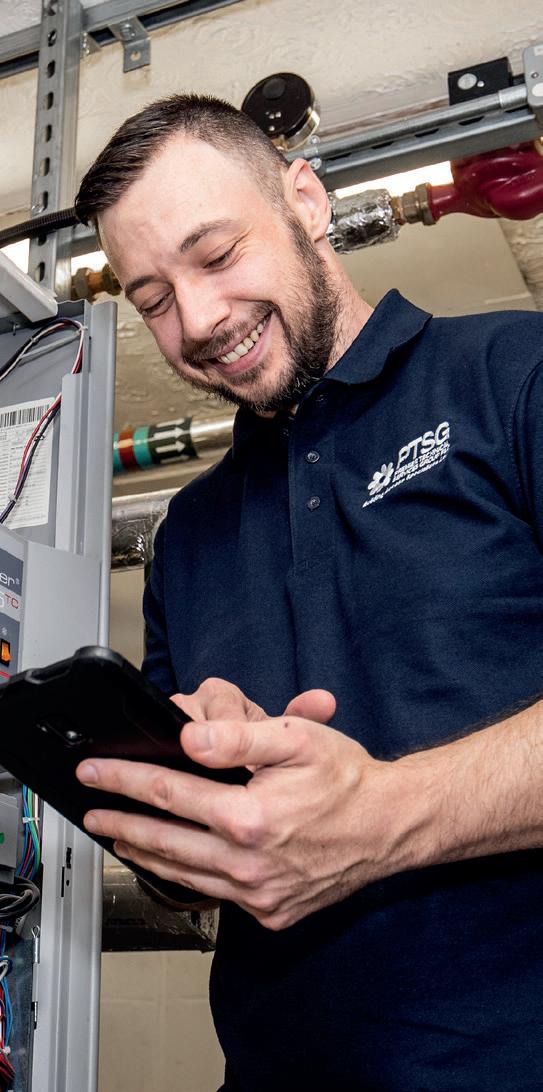
Why PTSG’s CEO Still Thinks Like an Apprentice















In this issue:
Special Focus: Workplace Wellbeing
The Right Time, the Right Team: Why Water Risk Has Moved Up the FM Agenda –SOS Leak Detection
February 2026
Why PTSG’s CEO Still Thinks Like an Apprentice
As February is the month of love, it seems apt that I’ve absolutely adored putting together this edition, full to the brim with exclusive features and interviews from some of the FM industry’s most respected leaders.
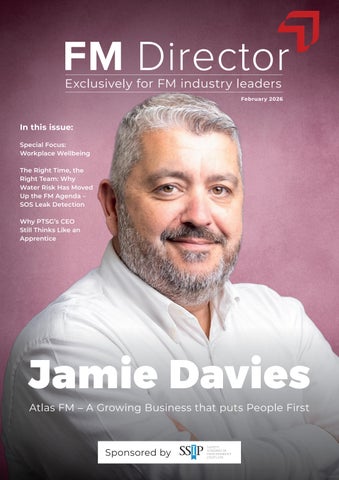
Our cover feature this month is from Jamie Davies, Group Commercial Director at Atlas FM, who explores how the right blend of innovation and people power delivers smarter, more efficient results.
We also speak to Chris Poole, Business Development Manager at SOS Leak Detection about how after more than two decades in FM recruitment, he has seen the sector evolve in waves. New regulations, new tech, new pressures landing on already stretched FM teams mean his recent move to SOS feels timely.
Our special focus this month is on the theme of Workplace Wellbeing. As part of this, we hear from MHFA England about why psychological safety is important for facilities leaders, following research which found that nearly half of UK employees say they don’t feel able to speak up when they spot mistakes or risks at work. Jeff Dewing, CEO & Founder of CloudFM Group also talks to us about how wellbeing isn’t a perk and how culture-first FM leadership creates better workplaces.


And as if that wasn’t enough, this edition also features several other key voices in the industry such as PTSG, BPMA, Mark Whittaker, Empro and more
As always, I hope you enjoy this edition of FM Director and remember, if you have anything you’d like to discuss with me, please drop me a line at claire.middleton@businessdailygroup.co.uk
Thanks
Claire Middleton



























fmdirector@fmbusinessdaily.com




Atlas FM –a growing business that puts people first Jamie Davies, Group Commercial Director at Atlas FM, explores how the right blend of innovation and people power delivers smarter, more efficient results
Speaking exclusively to FM Director, Emma Armstrong, Founder of Empro, shares her journey from a life-changing health crisis to building a female-led consultancy that’s revolutionising how the FM industry approaches mobilisations and TUPE transfers
The Road Ahead: Mark Whittaker’s 2026 Industry Forecast
We recently spoke to former IWFM Chair Mark Whittaker, when he reflected on 2025 and shared his predictions for the FM industry for the year ahead…
Managing Editor
Claire Middleton
by
FM
Designer and Production Manager
Chris Cassidy
Phil Loades
. All rights reserved. Reproduction of the contents of this magazine in any manner whatsoever is prohibited without prior consent from the publisher. No part of this magazine may be used or reproduced in any manner for the purpose of training artificial intelligence technologies or systems. For subscription enquiries and to make sure you get your copy of FM Director please ring 01482 782287 or email fmdirector@fmbusinessdaily.com The views expressed in the articles reflect the author’s opinions and do not necessarily reflect the views of the publisher and editor. The published material, adverts, editorials, images and all other content is published in good faith.
Atlas FM – a growing business that puts people first
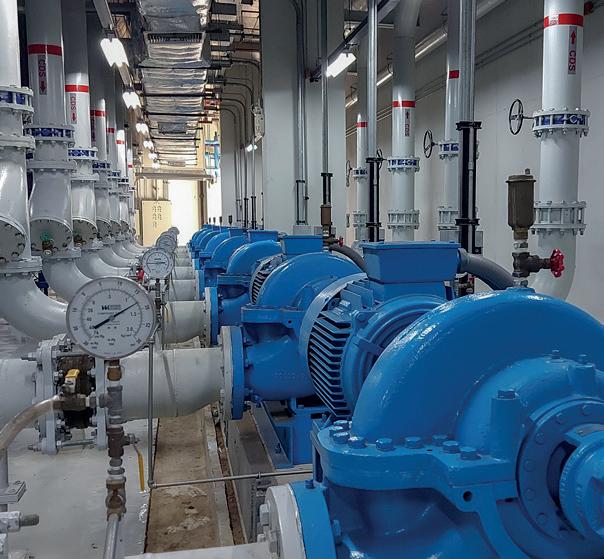
Adapting to Change: The Key Trends Defining the UK Pump Industry
Pioneering Sustainable Floorcare Solutions
The Right Time, the Right Team: Why Water Risk Has Moved Up the FM Agenda
The Conflict Avoidance Pledge: What is it and what’s it for?
Transforming Mobilisation Through Empathy and Technology
February’s Wake-Up Call: Why Smart Facilities Managers Are Booking Summer Slots Now

Jamie Davies, Group Commercial Director at Atlas FM, explores how the right blend of innovation and people power delivers smarter, more efficient results
Atlas FM is the UK’s fastest-growing, privately owned, facilities management company. Atlas’ purpose is to create happiness for its people, customers and communities.
Founded almost 40 years ago, it has grown from being a small local business to a nationwide facilities and support services company. It prides itself on having a great culture and values, characterised by a family feel and passionate people. Atlas transitioned into a full Employee Ownership Trust in late 2024, becoming the first facilities management company to be 100% owned by its employees.
The company maintains many long-standing relationships with clients, which it attests to the time it takes to understand the specific needs of every business it works with.
From cleaning and security to engineering maintenance and pest control, the company delivers services for offices, factories, sporting venues, schools, universities, hotels and retail spaces.
Atlas FM provides tailor-made solutions, underpinning them with industry leading communication and reporting tools, including SmartTask.
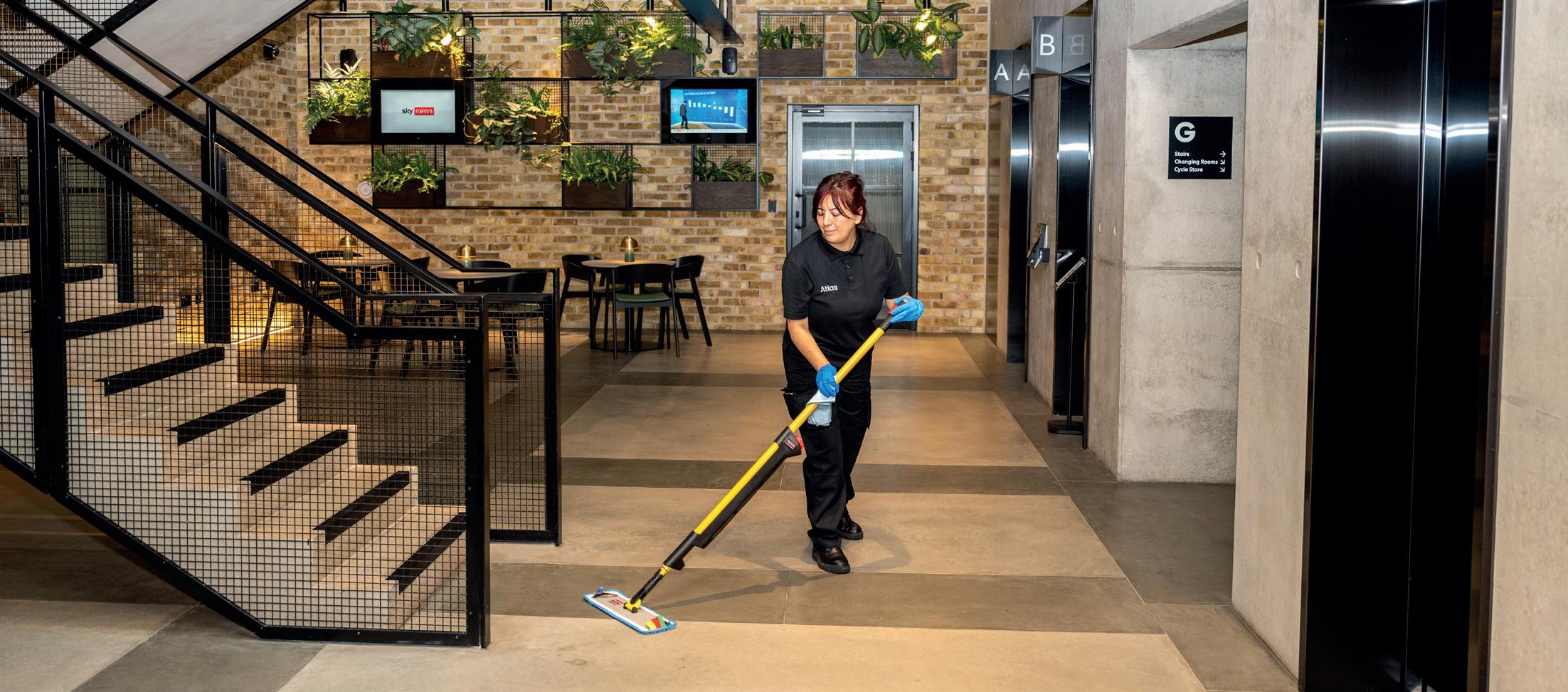






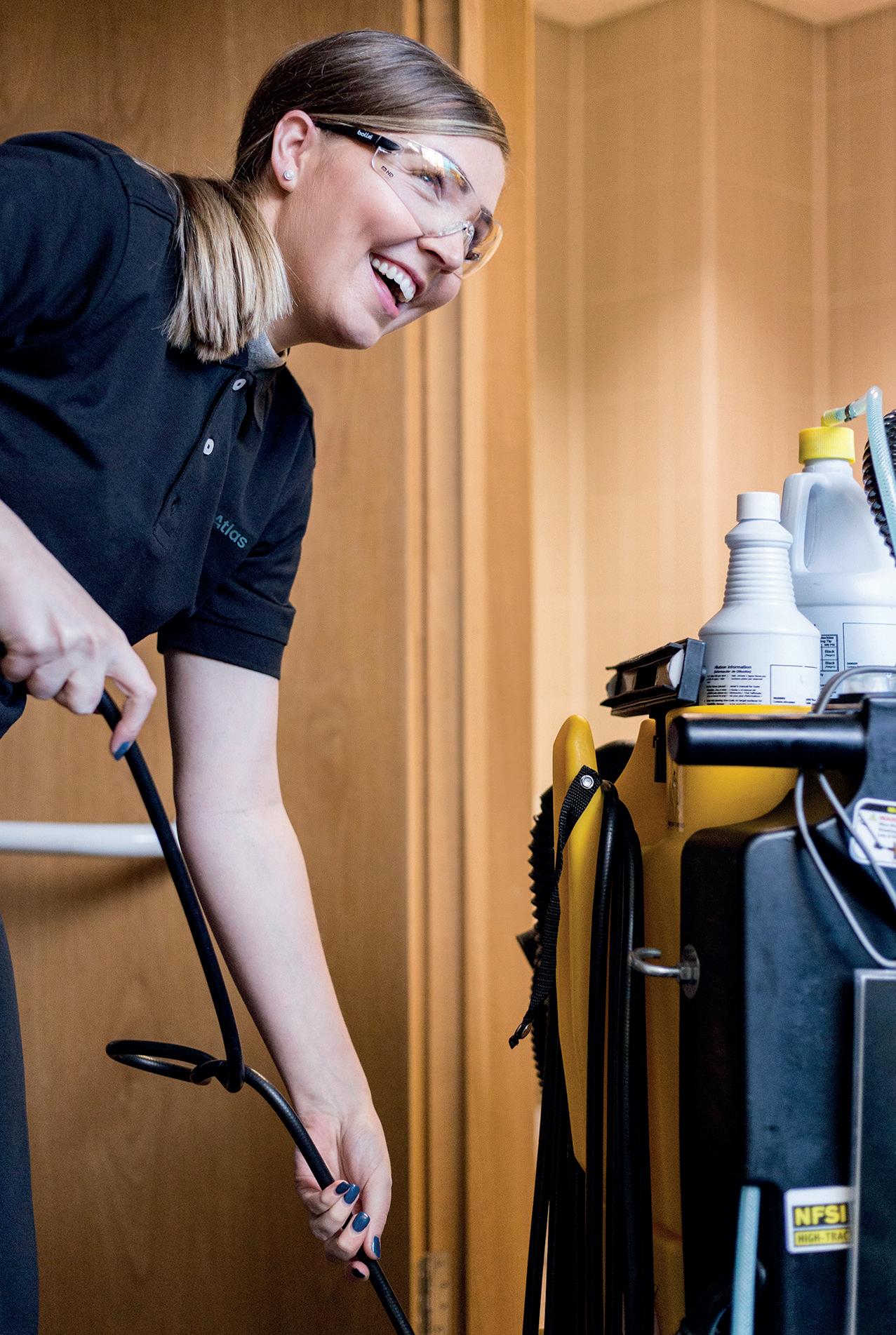
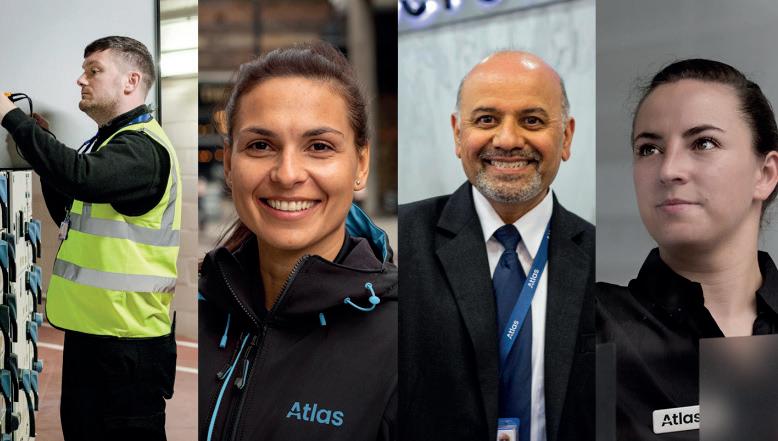
We have over 15,000 colleagues working across over 7,000 customer sites, but thanks to SmartTask we have full visibility of our operations, helping us look after our staff and deliver the service that we promise




Initially Atlas FM selected SmartTask workforce management software to manage schedules, rostering and Time and Attendance for over 3,500 staff, for its ease of use, both for the operations team and employees working in the field.
Its intuitive app and geo-location features make it easy for staff to book on and off, and for the control team to manage and monitor site visits. With rapid growth over recent years, Atlas FM has now rolled out the software across its workforce of over 15,000 colleagues.
“Our employees are the beating heart of Atlas FM. We have committed, passionate people that ensure over 7,000 client sites across the UK remain safe, clean and secure. SmartTask helps us look after our people, ensuring accurate payroll and efficient management of training and certification. We are proud of the services that we deliver, demonstrated with our average contract length of more than 10 years with our largest fifty clients,” said Jamie.
Staff can book in either using the app, with facial recognition or with a freephone automated system. A 24/7 support desk and email are on hand for any staff having problems booking on. Staff are also able to book holidays using the app, which keeps accurate, electronic records essential both for scheduling and accurate pay.
“By an absolute mile, SmartTask was the simplest and most intuitive product that I’d seen. We started using it for the cleaning teams but have now rolled it out to our security officers as well,” said Jamie.
Managing
Atlas FM uses SmartTask to manage staff certifications, such as SIA licences and DBS checks, particularly important for staff working at schools. The software enables them to keep oversight of renewals and training or enhanced DBS checks, while the scheduling features ensures that the appropriately qualified staff are assigned to the right client sites.
Business benefits
Accurate payroll with reduced number of queries
Complete visibility of service delivery across the business
Detailed reports for decision making
Full control and oversight of wages and budgets for planning
Ability to respond and resolve any issues quickly
Easy for staff to clock on/off and book holidays
On-boarding and vetting module makes recruitment and background checks faster
Certifications and qualifications renewals easily managed with automated alerts
With so many employees on the payroll and as a People First organisation, ensuring staff are fairly paid and receive appropriate benefits is a priority. Working with the SmartTask team, Atlas has tailored the system to allow managers in the field to sign off pay and compensation within set parameters, keeping the process flexible and efficient and minimising any delays.
SmartTask enables Atlas to manage payrolls on a weekly, fortnightly and four weekly basis. The accuracy of the working hours and payrates has significantly reduced queries to the payroll team and resulted in happier staff. The management team has monitored staff engagement with the SmartTask app and found that there is a direct correlation with those who use it and fewer payroll queries.
“We have a very strong people-focused culture in our organisation. Our values are to look after our people and SmartTask allows us to do that. We can clearly demonstrate that staff who use the SmartTask app definitely see the benefits with more accurate salary calculations and faster payment. We are proud that we have a very low percentage of people querying their pay,” said Jamie.
Since deploying SmartTask, Atlas has found many of the features invaluable for budgeting and planning wage costs and working hours. This has been particularly useful for some specialist clients and school sites where staff are not required during the school holidays, enabling the company to adjust schedules to accommodate and deploy staff elsewhere.
Using SmartTask has enabled Atlas to respond quickly to incidents at client sites, improving customer service. With specific customised features, the Atlas support desk can quickly identify if a problem is raised by a client, which manager has the responsibility for that site, right up to the Regional Director or Contract Manager, to get authorisation to mobilise a team and resolve the issue.
Our colleagues are the beating heart of Atlas FM. We have committed, passionate people that ensure over 7,000 client sites across the UK remain safe, clean and secure
Faster onboarding helps get employees in the field
As well as managing expiry dates and renewals of ongoing employee certification and licences, Atlas has created a graded system for employees, related to their qualifications and industry approved licences.
This enables them to quickly deploy staff to clients where there may be particular requirements, or vetting required as part of the contractual obligations.
An API integration between SmartTask and an applicant management and tracking system called Eploy also enables Atlas to check requirements and onboard staff quickly.
Applicants can complete their details which are checked and then data is passed through to SmartTask for staff to be deployed, within 15 minutes of completing the process.
Atlas also has a benefits package called Wagestream which provides employees with the flexibility to access, check and manage their pay, which is populated with data from SmartTask.
Successful long term partnership with SmartTask
Atlas FM has seen exponential growth over recent years, acquiring and integrating new businesses, throughout which time it has worked closely with the SmartTask team to develop the product further and support the operations.
Jamie added; “The relationship that we’ve had over the years with SmartTask has been fantastic. It’s been very open and honest and we have collaborated with the SmartTask team to help develop the product to mutual benefit.
“Beyond just technical support and knowledge of the software, the team has been exceptional at diagnosing and suggesting solutions to keep our business running smoothly.”
By Wayne Rose, Chief Executive, British Pump Manufacturers Association
The UK pump industry is operating at a pivotal moment. Long recognised as a critical enabler of sectors ranging from water and energy to manufacturing and building services, the industry is now being reshaped by powerful forces including sustainability, regulation, skills shortages, and digital transformation.
While these trends present challenges, they also create opportunities for innovation and growth. As the industry’s trade body, the British Pump Manufacturers Association (BPMA) works closely with its members to help navigate this evolving landscape and to ensure the UK pump sector remains competitive, resilient, and future-ready.
Energy Efficiency and Sustainability as Strategic Priorities
Energy efficiency continues to sit firmly at the top of the industry agenda. Pumping systems account for a significant share of global electricity consumption, meaning even modest efficiency gains can have a substantial impact on operating costs and carbon emissions.
Manufacturers are responding through innovation – improving hydraulic performance, integrating intelligent controls, and focusing on system-level optimisation rather than standalone components. At the same time, decarbonisation measures such as the Carbon Border Adjustment Mechanism (CBAM) are advancing rapidly, reinforcing the need for demonstrable environmental performance and transparency throughout the supply chain.
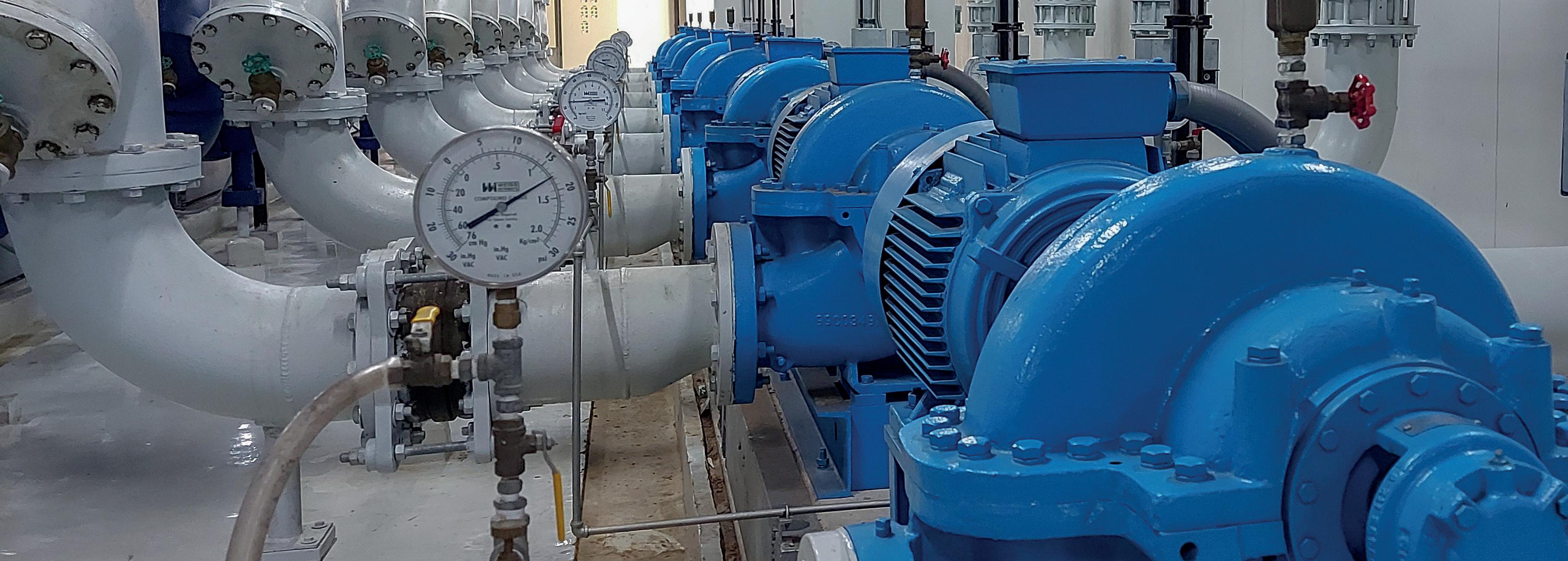
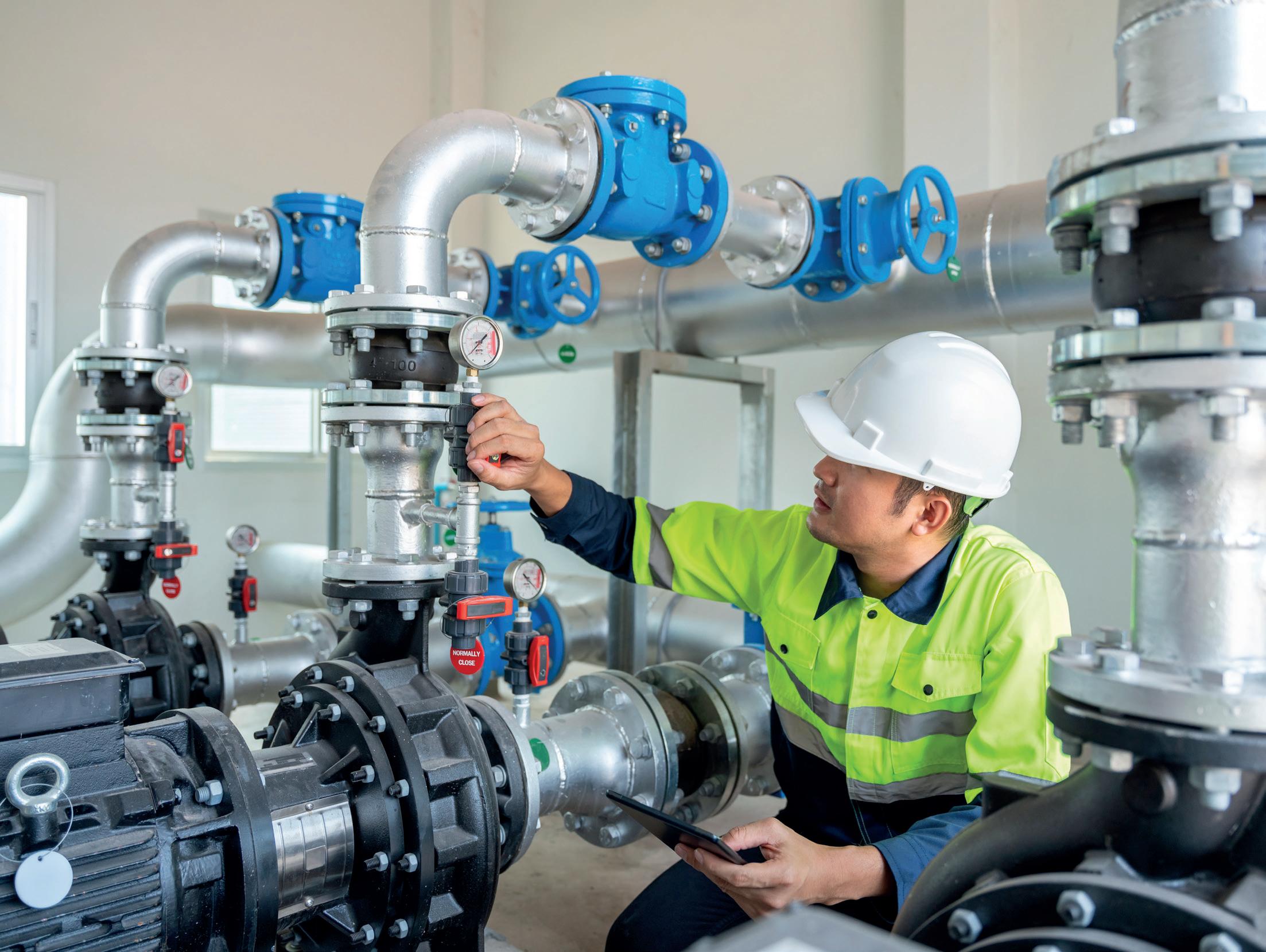
Sustainability is no longer simply a matter of regulatory compliance. For many customers, it has become a key purchasing criterion, making energy-efficient, low-carbon solutions a source of competitive advantage for UK manufacturers.
Alongside sustainability, regulation remains a defining issue. The European Union is progressing the Ecodesign for Sustainable Products Regulation (ESPR), a wide-ranging framework that will influence how products are designed, documented, and placed on the market. Its scope extends beyond energy efficiency to include durability, reparability, data transparency, and lifecycle considerations.
In the UK, the Government is considering legal alignment with aspects of ESPR through an extension of CE recognition. While alignment can reduce barriers to trade, it also introduces complexity for manufacturers operating across multiple markets.
The BPMA continues to play an active advocacy role in this area, engaging with UK policymakers and working at a European level through Europump. Our focus is on ensuring that regulation is proportionate, practical, and supportive of innovation, while providing manufacturers with the clarity and certainty they need to invest for the long term.
Our focus is on ensuring that regulation is proportionate, practical, and supportive of innovation
The pump industry, like much of UK engineering, faces an ongoing shortage of skilled personnel. An ageing workforce, combined with intense competition for engineering talent, means attracting and retaining new entrants is a growing concern.
Throughout 2026 and beyond, the BPMA will place increased emphasis on careers, skills and training through its Recruitment Committee and the continued development of its comprehensive training programme.

Join the UK Metal Decking Association (UKMDA) and place your business at the forefront of the industry. UKMDA offers a powerful network and essential resources to help your company and contracts be successful. Why Join UKMDA?
Leadership & Influence:

Be part of a powerful network that shapes industry standards and works with key bodies like HSE, CITB and CSCS
Credibility & Safety:
Demonstrate your commitment to excellence with our rigorous audits and access to authoritative safety guidance.
The UKMDA is committed to raising the bar for safety and competency. Our comprehensive training programs provide your team with the skills and qualifications they need.
Core Training: Our scheme covers all aspects of metal decking and stud welding installation, taught by licensed trainers.
Nationally Recognised NVQs:
We provide NVQs that allow you and your installers to demonstrate technical competence.
A UKMDA-qualified workforce means fewer accidents, greater efficiency, and an enhanced reputation for quality.
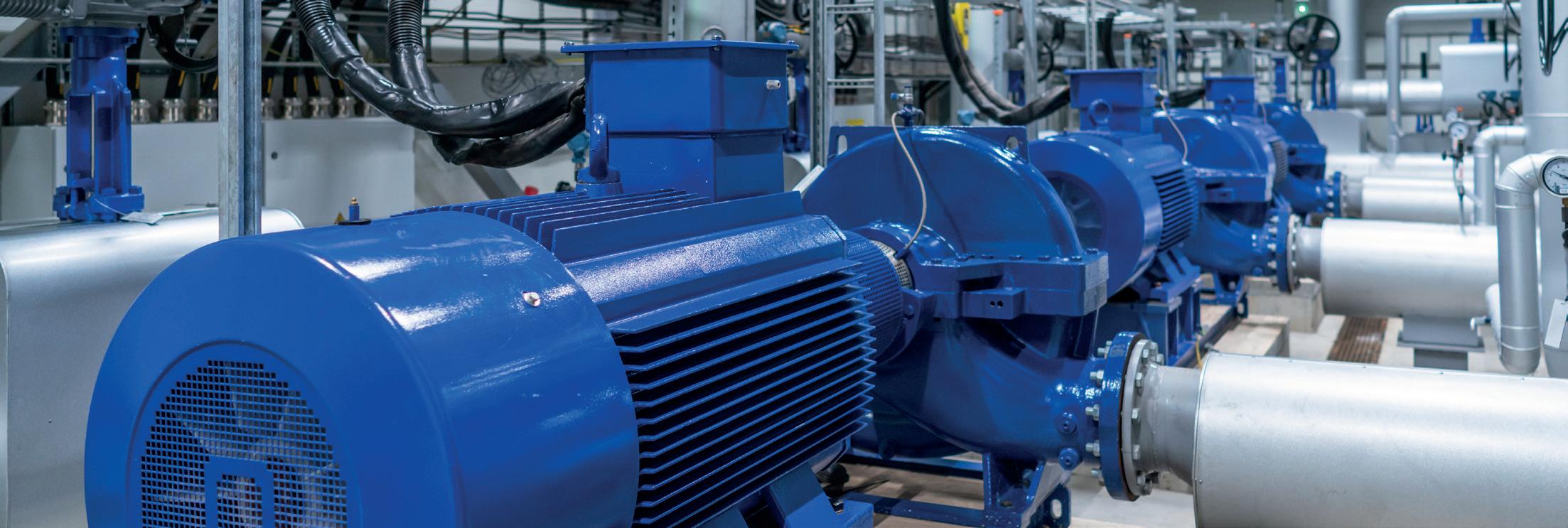
Sustained collaboration between industry, education providers and government will be essential to building a robust talent pipeline
These initiatives are designed to upskill the existing workforce while promoting the pump industry as a modern, technology-driven sector offering long-term career opportunities.
Sustained collaboration between industry, education providers and government will be essential to building a robust talent pipeline capable of supporting future growth.
Digitisation is accelerating across the pump sector. Under ESPR, manufacturers will see increasing requirements for digital product information, leading to electronic nameplates and Digital Product Passports. These tools will improve traceability, compliance, and access to product data across the entire lifecycle.
Beyond regulatory drivers, digital technologies, including artificial intelligence, are being adopted to improve design, manufacturing, predictive maintenance, and business decision-making. When implemented effectively, these technologies can enhance efficiency, quality, and competitiveness in both domestic and global markets.
The trends shaping the UK pump industry are significant, but they point towards a sector that is adaptable, innovative, and increasingly strategic in its role. With the right support, skills and regulatory frameworks, the industry is well positioned to contribute to the UK’s industrial resilience and net zero ambitions. The BPMA remains committed to supporting its members through leadership, advocacy, and practical guidance – ensuring the UK pump industry is not just responding to change, but helping to shape it.

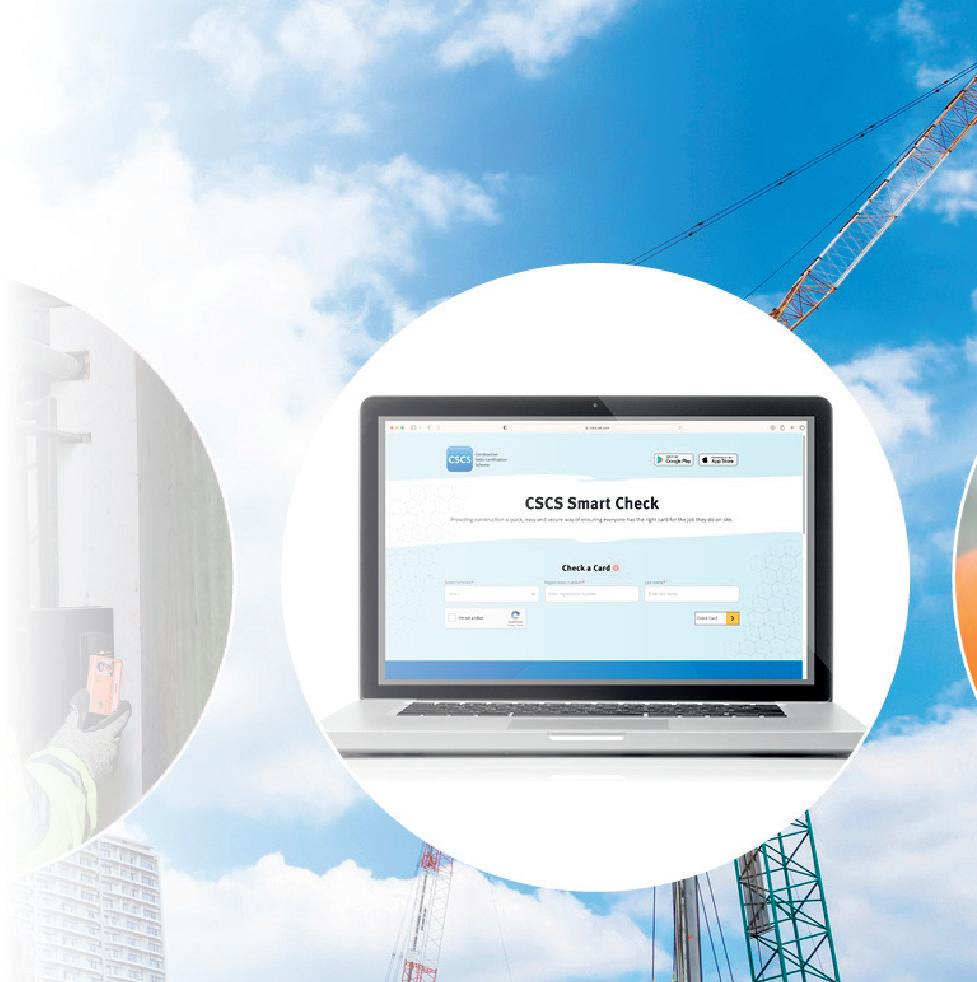

As the premier body for Temporary Safety Systems, FASET is dedicated to ensuring unparalleled safety standards across the industry.
All our qualifications now exclusively issue digital cards, offering a wealth of benefits:
Convenience: Easily add new qualifications as you progress.
Streamline Your Checks: For Employers and Site Supervisors
Security: Enhanced protection against loss or forgery.
We achieve this through our robust partnership with CSCS, delivering comprehensive training, rigorous assessment, and the issuance of industryrecognised competency cards. enquiries@faset.org.uk
Verify an operator’s competency instantly! Download the CSCS Smart Check App to your mobile device.
Stay Updated: Receive timely alerts for expiry dates and crucial safety notifications.
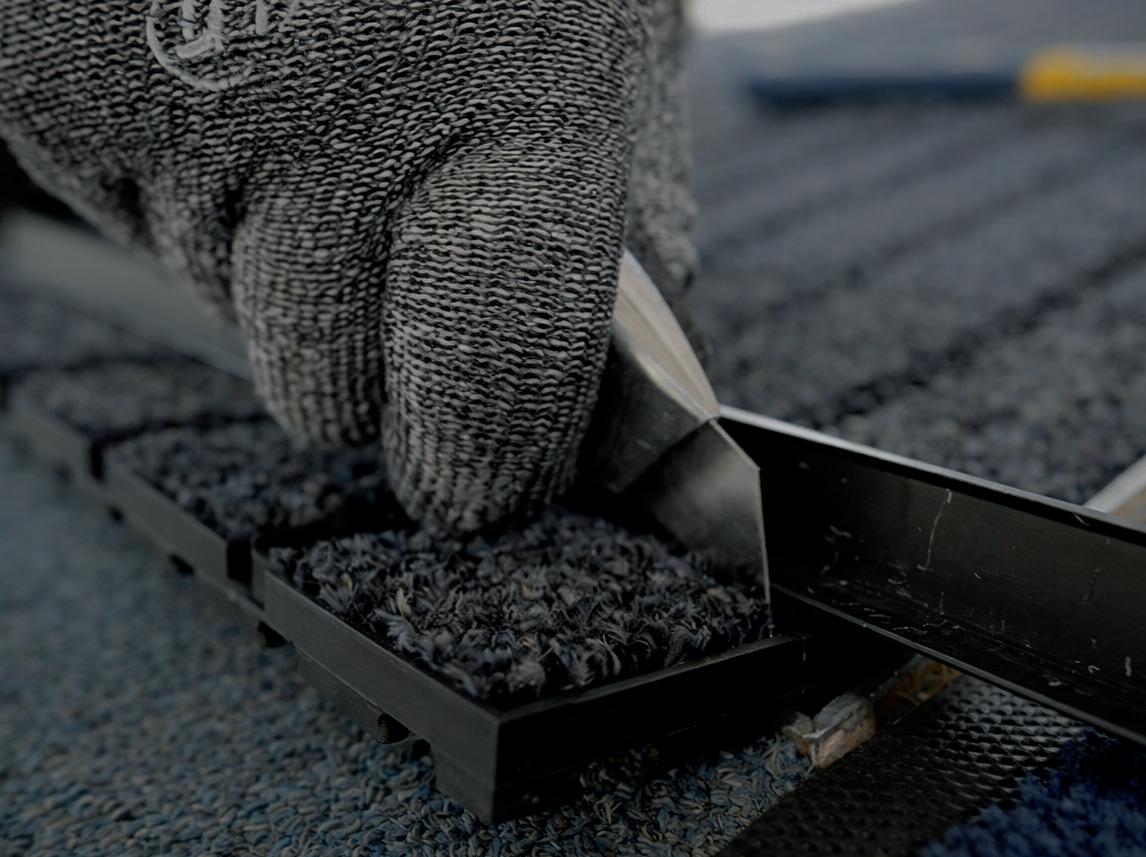
Speaking exclusively to FM Director, John Morgan, Head of Floorcare Commercial at phs, discusses the company’s ESG-focused floor care range and how it’s helping FM professionals meet their sustainability targets without compromising on performance
With ESG requirements increasingly dominating tender specifications and procurement decisions, facilities management professionals are under growing pressure to demonstrate their environmental credentials.
For John Morgan, Head of Floorcare Commercial at phs, this shift has driven innovation across the company’s entire product range, resulting in solutions that protect both the planet and people whilst addressing the practical challenges FM teams face daily.
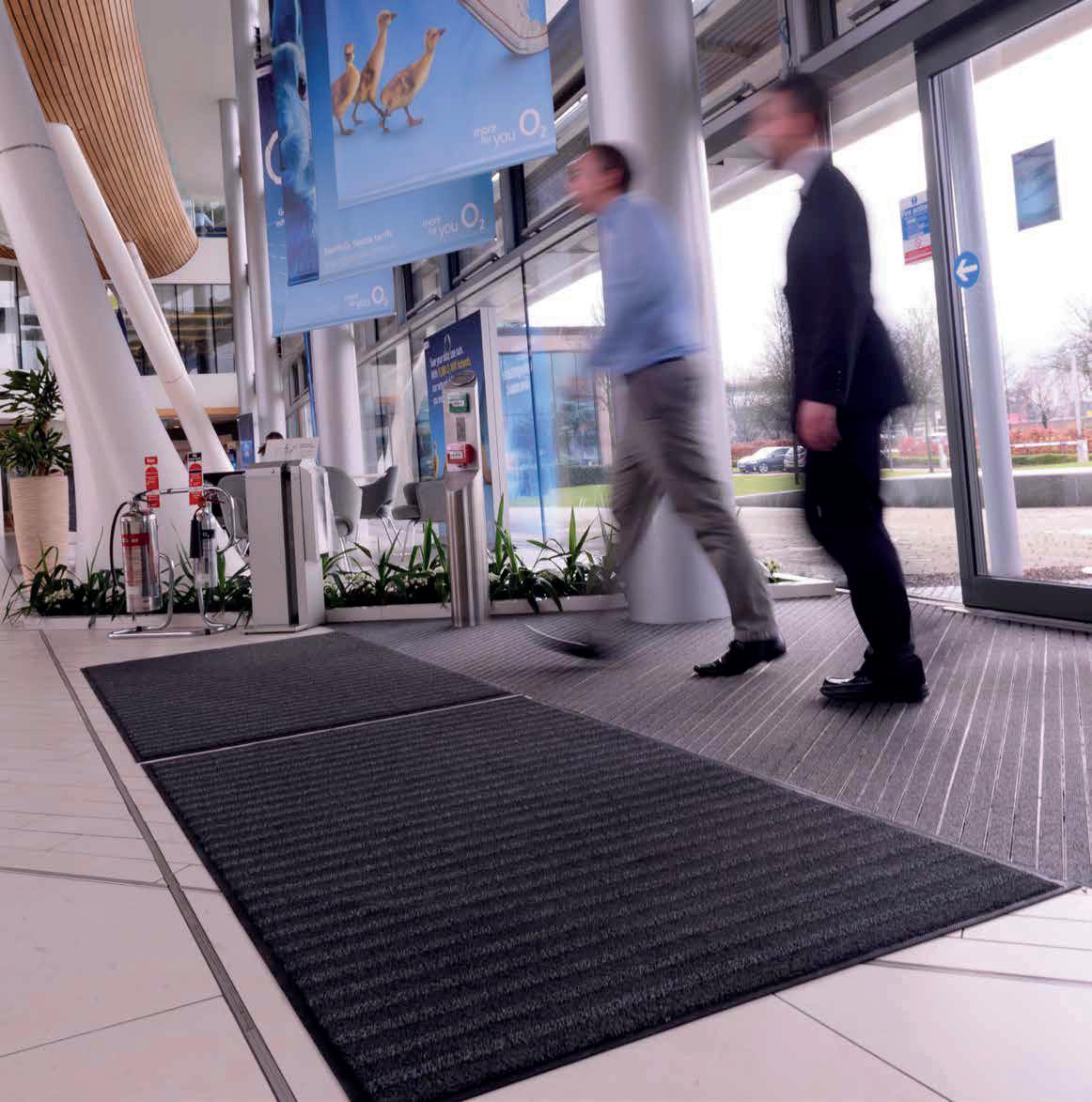
The company’s floorcare range has been developed with sustainability at its core, utilising innovative materials that deliver environmental benefits without sacrificing quality. John explained that phs had pioneered the use of Econyl in its entrance matting – a regenerated nylon made from depolymerised fishing nets recovered from the ocean.
“The fishing nets get pulled out of the ocean, then they get depolymerised and turned back into caprolactam, which is the pure form of nylon. Then, they get repolymerised and made into our mats,” he stated.
The initiative, which phs calls “Save Steve” after their ocean turtle mascot, began around 2018 as the company started exploring sustainable manufacturing methods.
John noted that the technology had “really come to the fore over the last three or four years”, with partners like Aquafill in Italy handling the complex logistics of recovering waste from the oceans and processing it into usable materials.
Critically, John emphasised that these recycled materials maintain their quality through multiple lifecycles.
“The problem with a lot of recycled products is when you recycle them you downgrade them because you get the original product and you recycle it and it’s less quality as you go down,” he explained.
“But what we’ve been trying to do is find products that when they are depolymerised and repolymerised, they stay constantly as good as they were, so the quality is always there.”

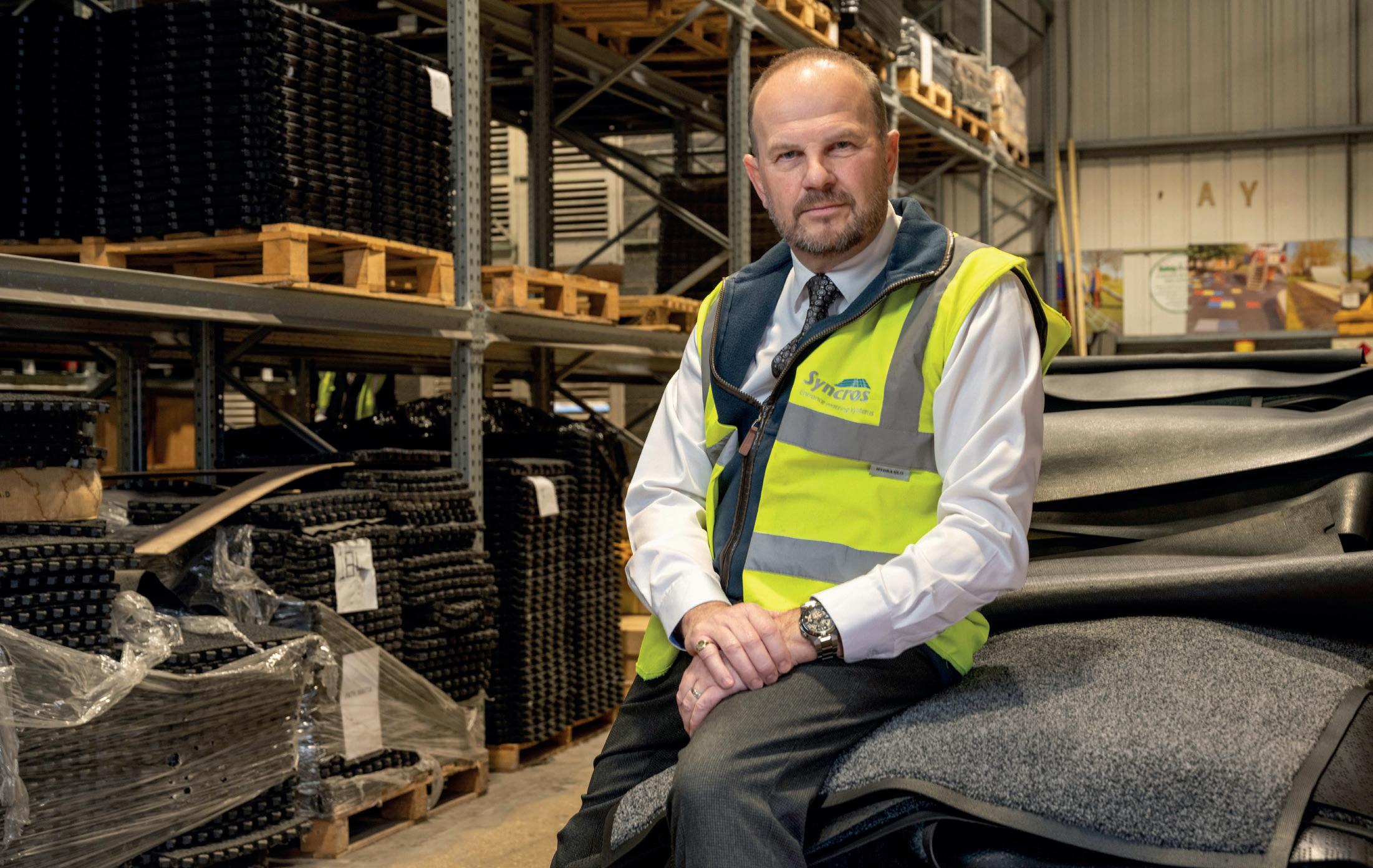
This commitment to maintaining quality whilst pursuing environmental goals extends throughout the product lifecycle. At the end of their useful life, many of the company’s products are recycled again, creating what John described as a “constant loop” where materials are either recycled or converted into energy, ensuring nothing goes to waste.
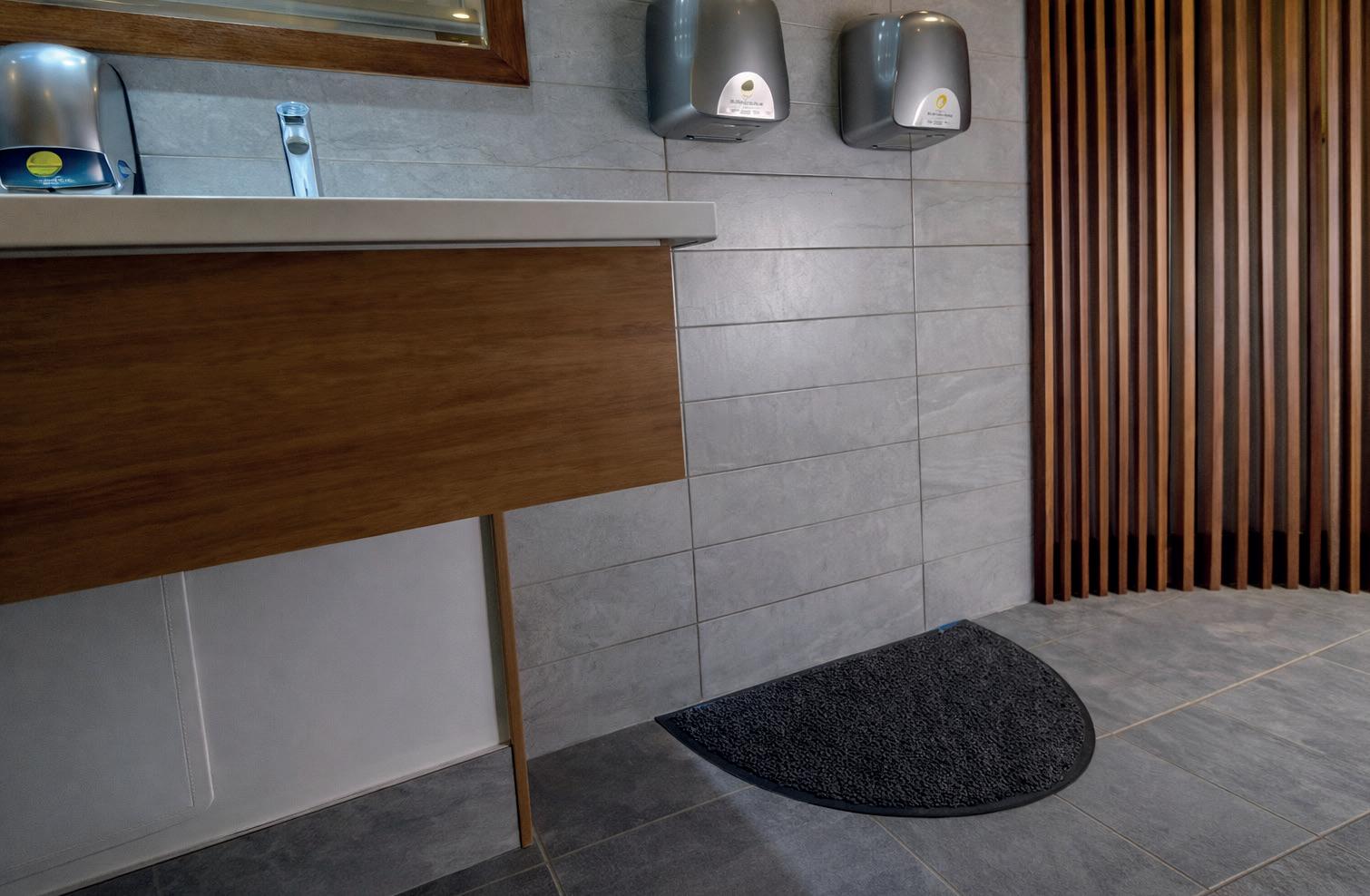
The comprehensive nature of the floorcare range addresses protection needs throughout entire buildings, from entrance matting and mat wells through to washroom hand dryer mats, lift car mats, wet area matting for swimming pools and shower areas, warehouse antifatigue matting, and specialised solutions for specific applications.
John described the company’s approach as providing a “map of mats” that helps customers identify problem areas and implement appropriate protection.
One recent innovation particularly demonstrates this problemsolving approach. John explained that phs had developed urinal mats – products many people were unfamiliar with – to address hygiene issues in gents’ toilets.
Made from recycled plastic bottles and designed to be serviced monthly alongside feminine hygiene bins, these mats not only solve a practical problem but feed into the recycling loop, with waste converted into electricity.
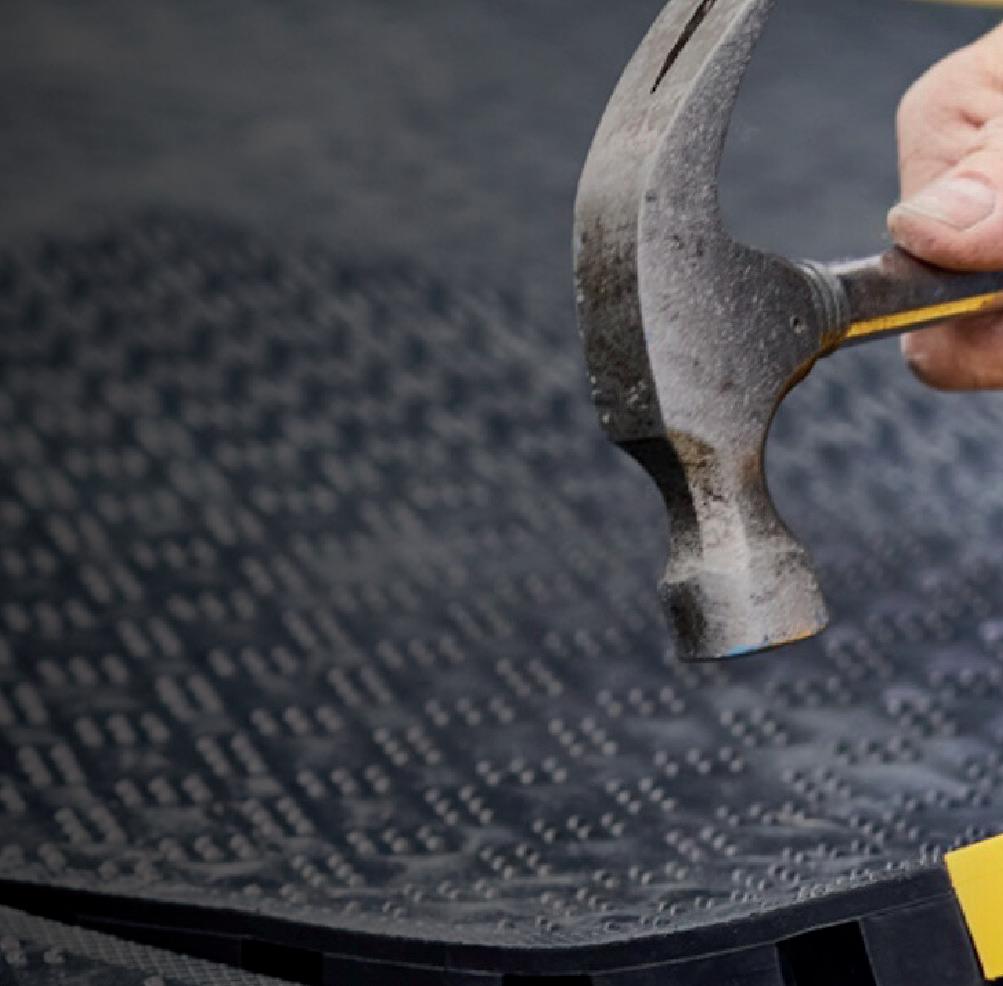
The development of new products continues in response to customer challenges. John revealed that phs had recently created magnetic mats that stick to floors in locations where mat movement is problematic, demonstrating the company’s commitment to “constantly bringing new innovations to the market to solve those issues.”
People require ESG and they need to know where their mats will be sourced from and that they’re sustainable
The response from the marketplace has been overwhelmingly positive, John said, noting that ESG requirements now feature prominently in tender specifications.
“People require ESG and they need to know where their mats will be sourced from and that they’re sustainable,” he stated.
“So bringing that story to them is so important these days. And it’s not just about performance of the product, it’s about where it’s sourced from and where it’s going to end up.”
This holistic view of sustainability extends to service delivery, John explained, encompassing water recycling in the servicing process, fleet management considerations, and the transportation methods used to move products between locations. The entire supply chain is evaluated through an environmental lens.
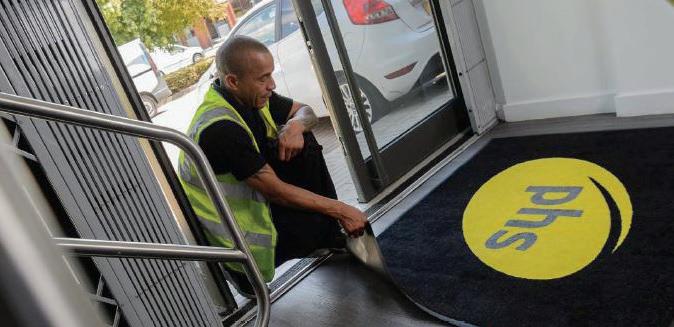
Underlying the entire range is a focus on addressing what John identified as the biggest health and safety risk in FM: slips, trips and falls, which account for 41 per cent of all workplace accidents.
He also stressed that 90 per cent of dirt entering buildings comes through entrances and then gets distributed throughout facilities, making appropriate entrance protection crucial. Different areas require different solutions, he emphasised, with the company taking a prescriptive approach to matching products to specific applications.
“It’s not one generic mat that fits everything,” John said. “It’s prescribing.
“Customers come to us and tell us what their problem is. Then it’s down to us to find the right solution, even if we have to innovate something new for them.”
This solution-focused approach reflects what John described as the essence of the company’s offering: working closely with clients to create bespoke packages that address their specific challenges, whilst meeting their ESG requirements and protecting their budgets.
With Europe’s largest range of floorcare products behind them, phs continues to innovate in response to customer needs, ensuring that sustainability and performance go hand-in-hand.


41% of workplace injuries are caused by slips, trips, and falls.
90% of dirt enters and goes to floor maintenance.
40 phs Group mats help reduce these risks while supporting sustainability
• All plain mats are made from 100% ECONYL® regenerated nylon, reclaimed from abandoned fishing nets
• Logo & Image mats are made from rPET, produced from recycled bottles

From entrances to washrooms, we help you cut costs while keeping every space clean and professional. Protect your people.
Latest Innovation in Washroom Hygiene

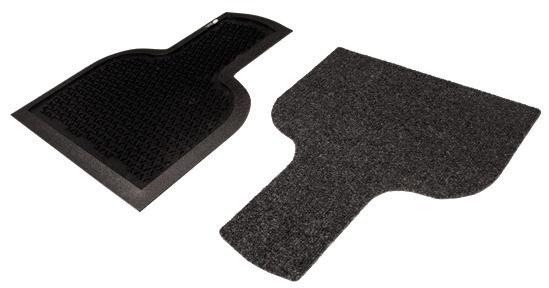
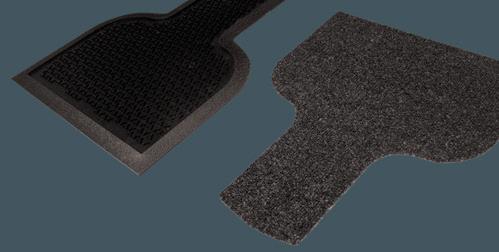
The phs Urinal Floor Mat neutralises odours, reduces splashback, and aligns ESG compliance in one solutions. Allowing you to meet standards effortlessly and is ideal for high-traffic environments.






After more than two decades in facilities management recruitment, Chris Poole has seen the sector evolve in waves. New regulations. New technologies. New pressures landing on already stretched FM teams. His recent move to SOS Leak Detection feels timely for exactly that reason



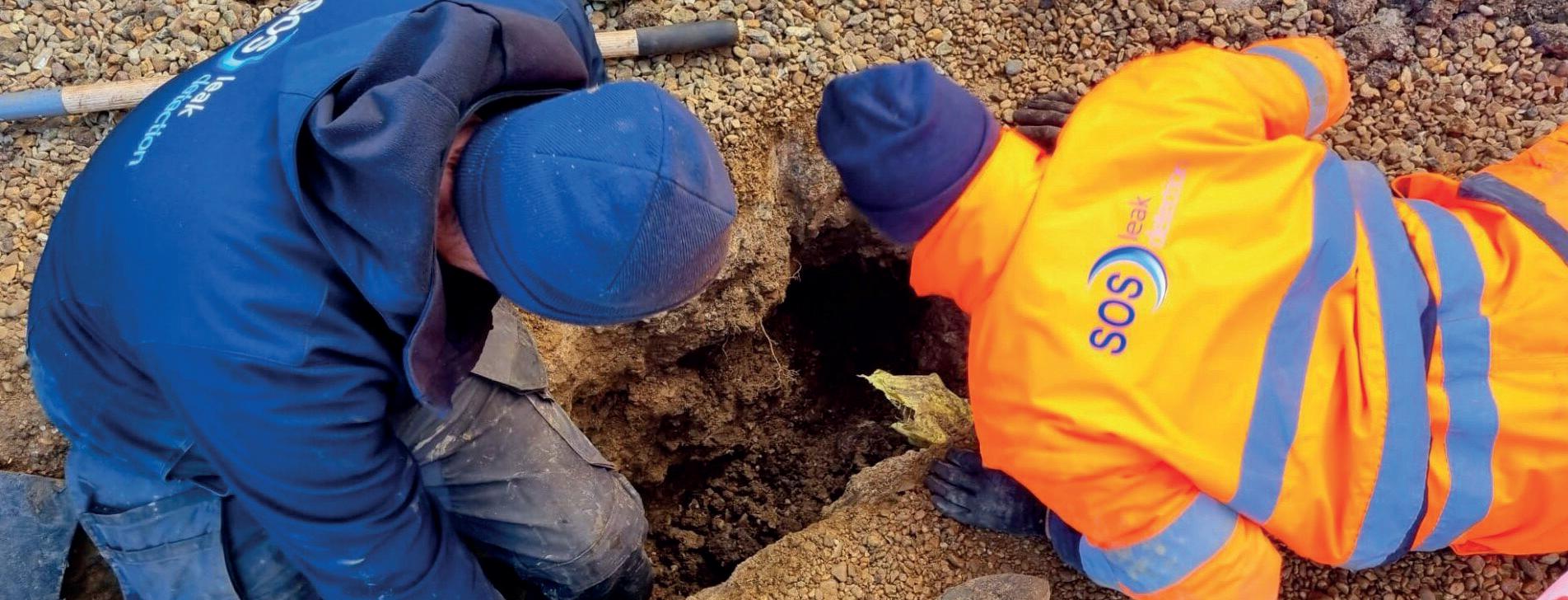
“I’ve spent 23 years building relationships and understanding how FM really works,” Chris says. “When I looked at SOS, I saw a business that already does the hard part brilliantly. It responds quickly, it does what it says it will do, and it brings order to situations that quickly become messy. That’s exactly what the market needs right now.”
Chris joined SOS in November 2025 as Business Development Manager, bringing deep sector knowledge and a clear view of where FM pressures are heading next. His role is not about reinventing SOS’s service, but about guiding it into the places where it matters most.
Why Water Has Become
Facilities teams are under constant pressure to reduce downtime, control costs, and prove compliance. Energy has dominated that conversation for years, but water is now catching up fast.
“What’s changing is the level of scrutiny,” Chris explains. “Energy management has been measured and managed for a long time. Water hasn’t. Historically, it’s just been there. Moving forward, organisations are going to be expected to understand their usage, justify it, and demonstrate control.”
That shift matters because water problems rarely announce themselves loudly. Hidden leaks quietly erode budgets, damage assets, and create claims nobody wants to manage. They also create reputational risk, particularly in environments where compliance, reporting, and ESG commitments are under the microscope. SOS’s role, Chris says, is to step into that pressure and remove uncertainty.
“We understand the cost and disruption leaks create, whether that’s for FM teams, landlords, or insurers. Our job is to restore control quickly and professionally.”
A Simple Plan for a Complicated Problem
At the heart of SOS’s approach is a deliberately simple three-step plan: Detect, Resolve, Report. Detection comes first, and it is often misunderstood.
“When people think of leaks, they imagine gushing water and obvious failures,” Chris says. “In reality, many leaks are small, hidden, and persistent. Water goes straight back down the drain, so nobody notices. But you’re still paying for it.”
Using non-destructive technology, SOS can pinpoint leaks precisely without unnecessary disruption. That accuracy matters, because it prevents over excavation, protects building fabric, and reduces secondary damage.
Resolution follows quickly. Repairs are coordinated efficiently, with the aim of restoring normal operations rather than prolonging disruption. Finally, reporting closes the loop.
“We provide board- and insurer-ready documentation within 48 hours,” Chris explains. “That gives FM teams clarity, evidence, and confidence. It turns a problem into a resolved incident, not an ongoing concern.”
Moving from Reactive to Preventative
While emergency response remains critical, SOS is increasingly focused on helping clients prevent issues before they escalate. Condition surveys are one example.
“We’re asking organisations to look at their water usage before something goes wrong,” Chris says. “A building might have hundreds of taps. If half of them are dripping every 20 seconds, the cost adds up quickly. Most people never see it, but the bill certainly does.”
These surveys assess internal systems, plant, roofing, gutters, and specialist assets such as swimming pools. The outcome is practical and measurable: lower bills, less downtime, improved efficiency, and restored confidence.
We understand the cost and disruption leaks create, whether that’s for FM teams, landlords, or insurers
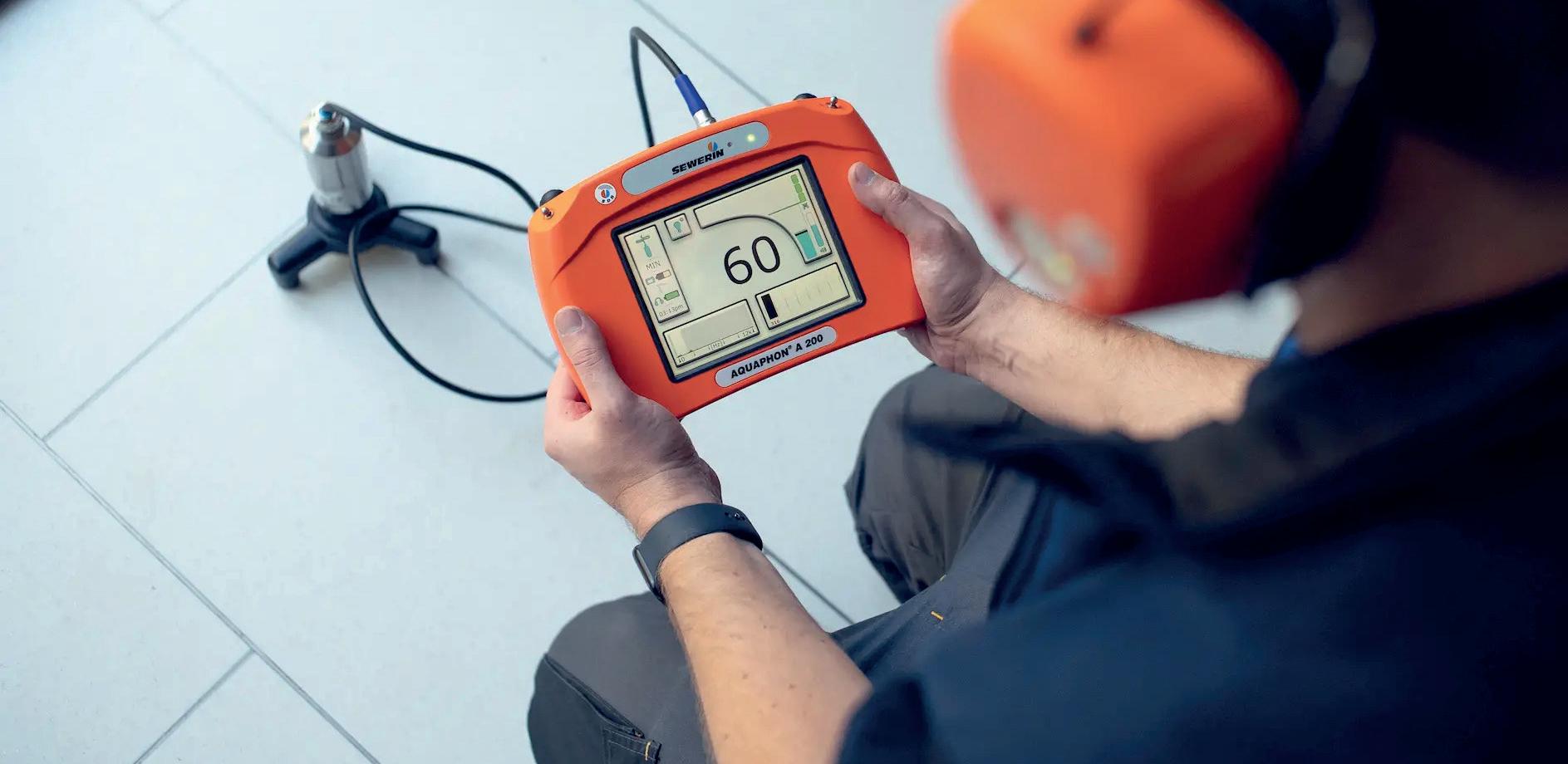
We can pinpoint a leak to a two-inch square. On roofs, we can use electrical current to track where water is travelling and identify the source, not just the symptom
For FM teams, that shift from reaction to foresight can make a significant operational difference.
One of Chris’s priorities is education, particularly around first response. “A lot of people assume the first call should always be a plumber,” he says. “Plumbers do vital work, but not all leaks are plumbing problems. Not all plumbers have the equipment or methodology to locate leaks non-destructively.”
SOS’s role is complementary rather than competitive. The focus is on diagnosis first, so repairs are targeted, proportionate, and effective. “We can locate a leak and leave a building exactly as we found it,” Chris says. “Often, clients don’t even realise we’ve been there until they see the report.”
Precision is where SOS quietly sets itself apart.
“We can pinpoint a leak to a two-inch square,” Chris explains. “On roofs, we can use electrical current to track where water is travelling and identify the source, not just the symptom.”
That capability is backed by performance data. SOS delivers thousands of jobs nationwide each year, maintains a 4.9-star Trustpilot rating, meets 98 per cent of SLAs, and achieves a 99 per cent first-visit success rate.
“Our statistics show we locate the vast majority of leaks we’re instructed to find,” Chris says. “That consistency matters in FM environments, where uncertainty is the real cost.”
Commercial and FM settings bring additional operational and reputational considerations. Downtime affects people, processes, and perception.
“In those environments, clients don’t want noise or drama,” Chris says. “They want a partner who brings calm, control, and confidence, even when the situation itself isn’t calm.”
That partnership mindset shapes how SOS works, from first contact to final report.
Looking ahead, Chris is clear-eyed about technology. IoT and preventative detection tools are becoming more relevant, particularly in high-risk environments such as data centres.
“They’re not right for everyone,” he says. “But where they are appropriate, they can prevent catastrophic damage and save serious money.” The emphasis, again, is judgement rather than novelty.
Chris’s advice to FM directors dealing with water risk is straightforward.
“Work with people who understand the problem, have the right tools, and know when to act and when not to,” he says.
SOS’s ambition is to support clients from first detection through to full recovery, leaving buildings and operations exactly where they were before an issue emerged.
“Ultimately, we’re a savings investment,” Chris adds. “Get ahead of the problem, and the long-term cost is always lower.”
For an initial conversation about water risk, compliance, or preventative leak management, Chris Poole is happy to talk through the options and pressures you are facing. Contact him on 01480 225533 or at chris.poole@sos-ld.com






























This month we are delighted to publish an exclusive article from Martin Burns Head of ADR Research and Development, RICS, with an introduction from Len Bunton FRICS FCIArb Hon FRIAS, President of the Conflict Avoidance Coalition.
Len said: “I am delighted to say a few words about Conflict Avoidance Coalition in my role as President. The Conflict Avoidance Coalition now comprises over 100 organisations involved in the procurement of construction projects in the UK.
Conflict Avoidance promotes early intervention to prevent issues on projects escalating into costly and time-consuming disputes. It is about removing conflict from the industry and I am sure this will be of interest to the FM sector.
As part of this, businesses are invited to sign the Conflict Avoidance Pledge. In the article below Martin Burns of the RICS explains how the process operates.”









Conflict Avoidance Pledge By Martin Burns Head of ADR Research and Development, RICS
The Conflict Avoidance Pledge was conceived in 2017 at a meeting jointly arranged by the Royal Institution of Chartered Surveyors and the Institute of Civil Engineers.
Senior executives and members from RICS and the ICE, along with representatives of four other professional bodies and two major infrastructure employers attended the meeting and formed a coalition.
They had gathered at the ICE’s wonderful headquarters in central London to discuss how they could work in harmony to tackle the rising financial and resource costs of disputes in the construction industry.
I was at that that first meeting of the Conflict Avoidance Coalition, and I recall there was immense enthusiasm around the room for us to do something big and ambitious that would change the industry forever.
It became clear that our immediate challenge was to harness all that enthusiasm and form it into a cohesive and effective campaign. Ideas for what we should do were floated.
I recall a motion was made along the lines of: “Let’s all write to the Construction Minister”. This was discussed at length.




The rationale was that a letter signed off by the ICE, RICS, RIBA, DRBF, ICES, CIArb along with Directors from Transport for London (TfL) and Network Rail (NR), would be impactful.
Much more so than if only one of the above wrote to the Minister. But what would the letter say? What would be the “call to action”.
The “letter” idea sounded good at first but the more we talked about the content and what we wanted it to achieve, the less enthusiastic we became about it.
Confl ict Avoidance promotes early intervention to prevent issues on projects escalating into costly and time-consuming disputes
After about 20 minutes, the meeting room fell silent. Then someone proposed that we develop and promote a Pledge which would commit businesses and organisations to working proactively to avoid conflict and to facilitate early resolution of potential disputes. Eureka!
When the coalition met for the second time, the Conflict Avoidance Pledge had been drafted. It was reviewed, finessed and approved.
We knew the Pledge would be a success because, only two weeks after it was unanimously signed off by the coalition, and before it was formally launched in January 2018, TfL, Network Rail and around 40 contractors had signed up to it.
At the time of writing this article, nearly 500 businesses, large, medium and small have now signed the Pledge. Each signatory expresses their support for collaborative working and the use of early intervention techniques to resolve differences before they become full blown disputes.
Pledge signatories explicitly state their commitment to identify, control and manage potential problems and avoid getting embroiled in adversarial procedures.
The coalition has grown since it first came together in 2017. It is now comprised of around 70 businesses and organisations, all of whom are actively promoting and supporting the Pledge.
The Pledge has also received official support from central and devolved governments across the UK and it is embedded in the Construction Playbook.
The coalition has grown since it first came together in 2017. It is now comprised of around 70 businesses and organisations
My employer, RICS, has been charged with administering the Pledge Directory of behalf of the Coalition. The Directory is a published list of individuals, businesses and organisations that have signed the Pledge. There are three levels of commitment that Pledge signatories commit to, and these are labelled “bronze”, “silver”, and “gold”.
The three levels indicate the extent to which each Pledge signatory has taken steps to give effect to their promise to avoid and manage conflict. Gold level is an indicator that a business has not just signed the Pledge but has informed and obtained buy-in from their internal management teams and external clients and has actively adopted conflict avoidance measures in their day-to-day operations.
For more information about the Pledge and to see who has signed it to date: www.rics.org/capledge






















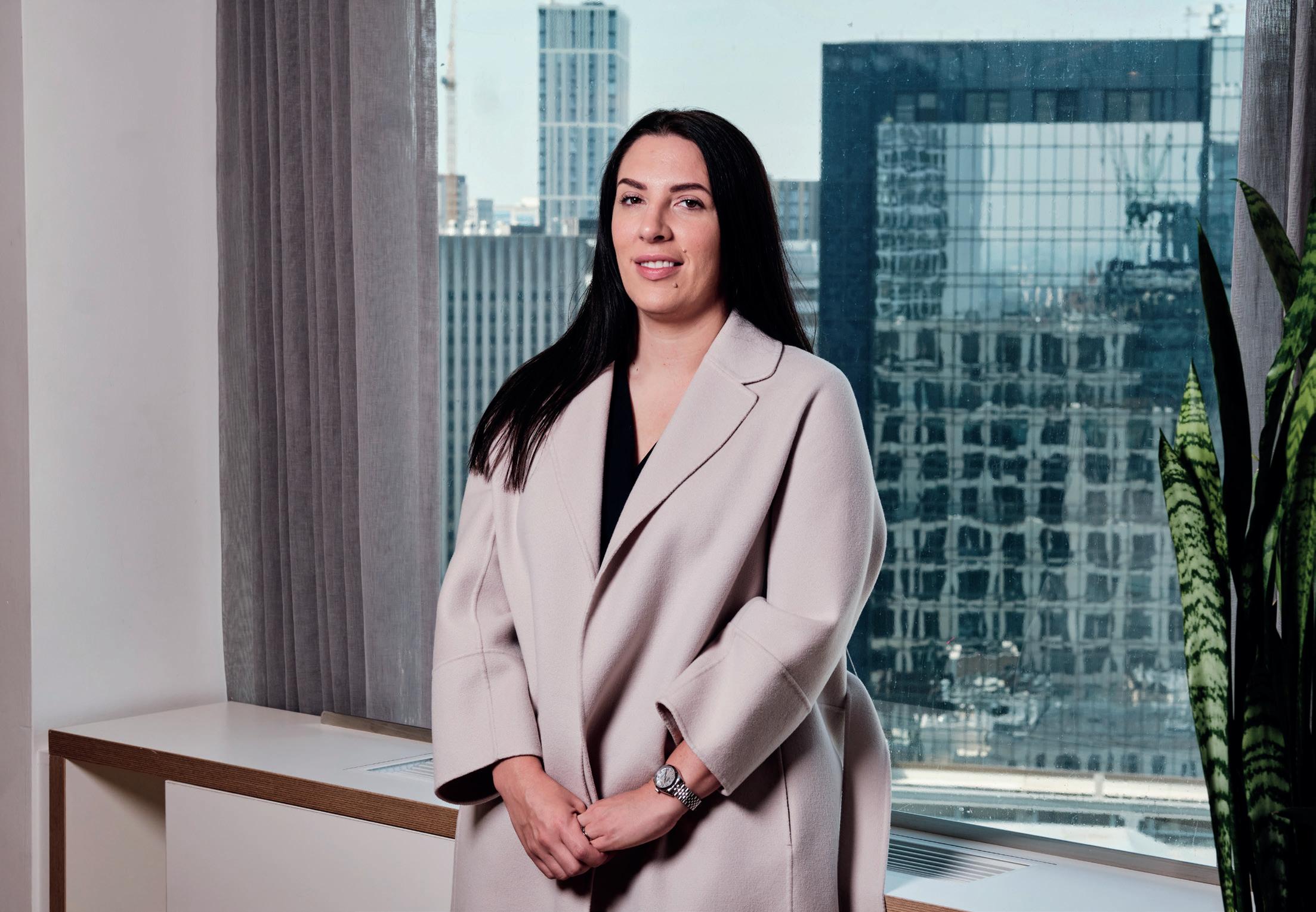
Speaking exclusively to FM Director, Emma Armstrong, Founder of Empro, shares her journey from a life-changing health crisis to building a female-led consultancy that’s revolutionising how the FM industry approaches mobilisations and TUPE transfers










After spending six months in hospital, paralysed and on a life support machine and tracheostomy, Emma Armstrong returned to work in January 2023 with a renewed sense of purpose. The experience prompted a fundamental question about her legacy and what she wanted to build in the facilities management sector.
“I thought, what do I want to do? How do you want to leave a legacy?” she said. “So I’ve been building Empro because I want to leave a legacy and build something worthy and fundamentally good.”
That vision has manifested in a business focused squarely on improving the mobilisation experience for everyone involved, particularly the thousands of people who transfer between organisations through TUPE processes each year.
Digitising the Mobilisation Process
Emma’s background is firmly rooted in mobilisations, having mobilised several major contracts over the years, including DWP in 2018. Throughout her career, she has helped approximately 60,000 people through the TUPE process, an experience that has given her unique insight into the pain points of the procedure.
“If you look back to around five years ago, we were using pen and paper, driving up the motorway and scanning the passports and sending emails to welcome people to businesses” she explained. “It’s such a long-winded way to do it. And I thought, there’s got to be a better way to transfer.”
The challenge, she noted, is that mobilisations are fundamentally different from standard business-as-usual onboarding processes. “It’s hundreds, if not thousands of people joining a business on the same day, at the same time. And if they don’t, then the business is in trouble because they haven’t got the staff around to keep service continuity.”
In response, Empro has built a platform that focuses exclusively on TUPE transfers, designed around the user experience. The platform recognises that in total facilities management contracts, different service lines (cleaning, security, engineering, workplace services) all have different processes and different types of people.
“We’ve digitised it; and we’ve put it all into one place,” Emma said. “And because it’s tech, you can change the language at the press of a button. So if you’re a cleaner and you speak Portuguese and you don’t really want to use English as a first language, you can just change it.”
















For FM providers, the platform is white-labelled to match their branding, and bespoke to each transfer and personalised to each employee and their role, providing a unique selling point for FM providers in tenders and work winning. The client-facing admin side offers solutions to analyse model organisational design changes, redundancy costs, salary increases and automatically identify differences between various versions of employee liability information and flag discrepancies, without manual comparison.
The platform has already demonstrated impressive results. Last year, Empro deployed it for a major mobilisation involving one main client and six suppliers, managing a TUPE transfer from two incumbents that had been in post for several years into a completely different model.


Every one of the providers deployed their own version of the app. It was all branded specifically to their businesses
“Every one of the providers deployed their own version of the app. It was all branded specifically to their businesses,” Emma explained. “So the experience for everyone was the same, no matter the business, role or language. You get the same style invite to the platform, with the same information, providing the same user journey.”
The results were striking. A pre-transfer survey showed an engagement index averaging in the high range. From the point that employee liability information was provided to the point of transfer, within the 28-day window, the platform achieved a 94% transfer rate.
“We’ve just done a post-transfer survey, checking where everybody’s at. We asked how useful did you find it? How are you feeling now? And again, we got really, really high results and excellent feedback,” Emma said.
Some organisations are still using pen and paper. So you can imagine the amount of errors, data loss, GDPR, all of the potential risks that come with that
The success has led to repeat business, with one client already returning to request another version for a new project!
Emma identified several critical pain points that the technology addresses. First is the ability to see the entire journey in a digital format, whether transferring 50 people or 1,000 people, with clarity on exactly where everyone is in the process.
“Some organisations are still using pen and paper. So you can imagine the amount of errors, data loss, GDPR, all of the potential risks that come with that,” she said. She noted that failing right-towork checks now carries an on-the-spot fine of £60,000.
To address this, Empro has partnered with One ID to digitise all right-to-work and DBS checks, as well as bank verification, eliminating payment and payroll errors.
Having a digital platform that can communicate with hundreds of people across different sites in different languages addresses what she described as a “massive pain” in the mobilisation process.
“People get scared of tech,” she acknowledged. “Some of the feedback we’ve had is that companies still want to engage with people in person. And so the point of what we’ve done isn’t to take that away, it just takes away some of the process and admin. So you’ve got more time to have a conversation.”
“I think smaller organisations in particular can harness and adapt much quicker than some of the larger organisations because they’re so bureaucratic and they’ve got so much red tape,” she said.

Looking back at the development journey, she reflected: “We started building this solution two years ago and obviously it’s just been deployed in practice now.
“If I’d have started building this six months ago, I probably would have been able to have done it by now because technology has advanced that quickly.”
“If I was a bigger organisation, I would probably be wanting to look into unlocking some of that red tape. Otherwise, you’re going to get overtaken by cost leadership because these smaller organisations are going to be able to do the same better and faster,” she advised.
An All-female Team
Empro’s team is entirely female, which Emma acknowledged is “quite unusual in our industry”.
However, she was quick to clarify this wasn’t by design: “It’s just an accident that the nature of what we do, it’s very in tune to a female leadership style.
After navigating a more challenging period in 2024, particularly between April and August when businesses appeared to be bracing for National Insurance changes, the company has experienced explosive growth since the late 2025.
“I feel so much more confident,” Emma said. “This year has been huge for us already. It’s down to the standard of work we deliver. We wouldn’t get callbacks and referrals if we weren’t doing good things.”
This year has been huge for us already. It’s down to the standard of work we deliver
“Everything we do, whether it’s a consulting project, whether it’s recruitment or whether it’s the technology that we create, it’s all around transformation and improving the industry that we work in. Fundamentally our guiding purpose is about creating better experiences and attracting people into the sector,” Emma said.
With clear plans to grow the business organically and continue supporting more organisations through change, Emma’s focus remains on delivering work that makes a genuine difference. “We want to continue to be different in the industry and deliver some really good work,” she said. “If I can pass the baton on and help somebody progress their career and give them confidence, that’s a lovely legacy to leave. To touch somebody’s life like and make it a pleasant experience, what could be better?”
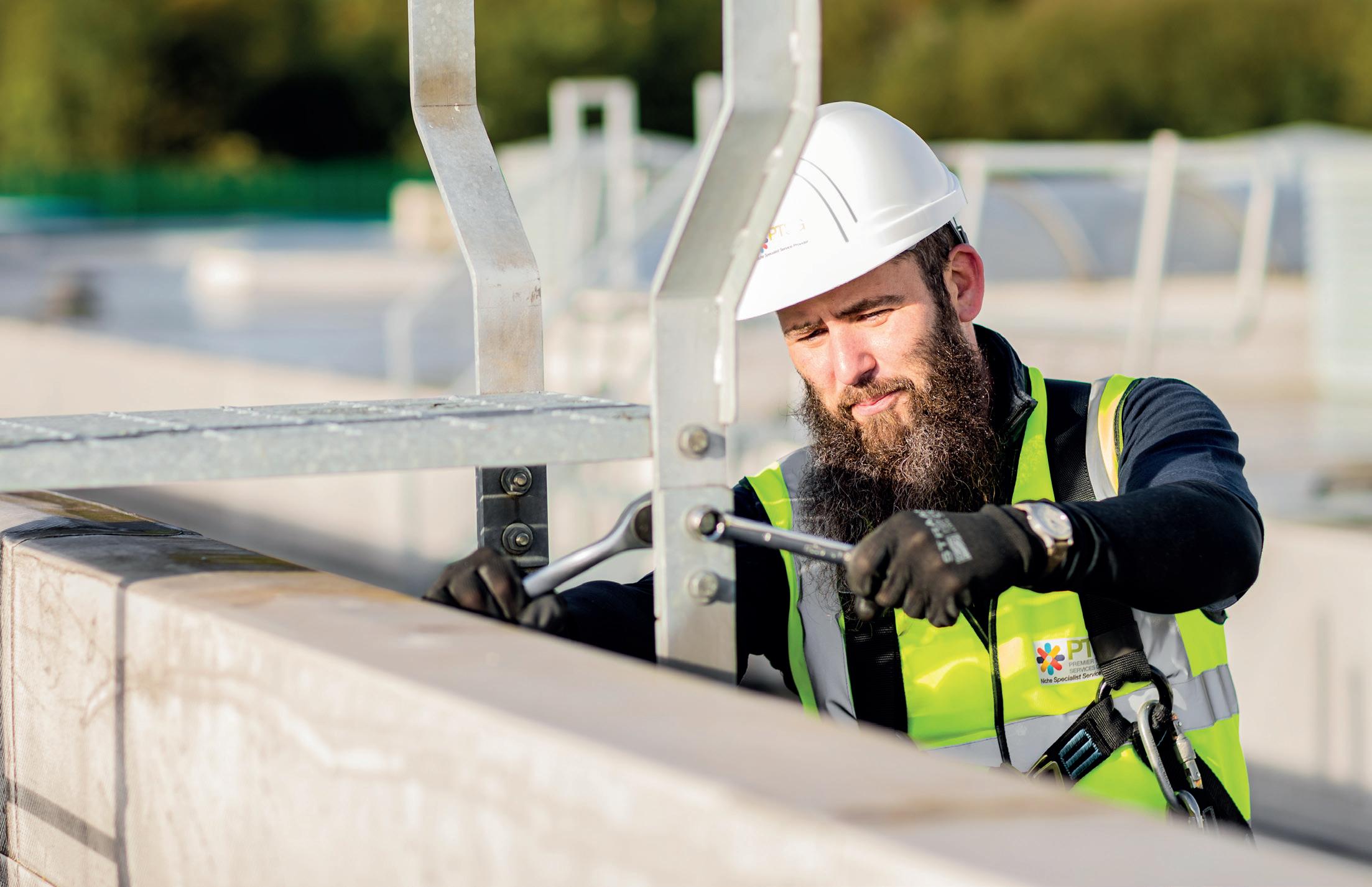
Every February, a peculiar split emerges across UK facilities management. While some teams are still firefighting winter emergencies, the sharpest operators are quietly locking in their summer maintenance programmes – six months ahead. By the time May arrives and panic sets in about that six-week school closure or the stadium’s off-season, these early movers are already sorted.
Their contractors are booked, programmes are planned and budgets are allocated. Meanwhile, everyone else is scrambling for whatever availability remains, often paying premium rates for the privilege.
The difference isn’t luck. It’s understanding a fundamental truth: summer maintenance isn’t planned in summer. It’s planned in February.
Why Summer Is Non-Negotiable (And Why February Matters More)
Educational institutions face a compliance paradox
The six-week summer holiday should be downtime, but it’s actually when risk escalates. Water stagnates in pipes throughout empty schools, creating ideal conditions for Legionella bacteria. Kitchen extract systems accumulate grease with reduced ventilation. Fire doors in vacant accommodation blocks can finally be accessed without displacing residents.
For universities, the challenge multiplies. Campus-wide electrical testing, water treatment programmes, fire safety works – all need to happen when thousands of students aren’t occupying the very buildings you need to access.
Stadiums and sports venues face identical constraints
During the football season, Celtic Park hosts match days with 60,000 spectators. Try conducting structural inspections in that environment. But during the off-season, Pendrich Height Services, a PTSG Company, completed comprehensive structural inspections and painting of steel support purlins without a single match-day complication.
The summer window looks generous – twelve weeks of relative quiet
But factor in pre-closure activities, contractor mobilisation, weather dependencies, pre-return verification and the fact that every other facilities manager wants the same window. That twelve-week window shrinks to perhaps six weeks of genuinely productive time.
Which brings us back to February. The facilities managers who secure premium contractors aren’t calling around in May. They’re having detailed planning conversations right now.
The Hidden Risks of “Quiet” Buildings
Summer maintenance isn’t just “doing the same work when buildings are quieter.” The occupancy patterns themselves create unique risks.
The Legionella Time Bomb
When buildings close for summer holidays, something counterintuitive happens. The building doesn’t become safer because it’s empty – it becomes more dangerous.
Water sitting stagnant in pipes for weeks creates perfect conditions for bacterial growth. PTSG Water Treatment’s works across educational institutions reveals a pattern: schools that treat summer as “low risk” because buildings are empty are precisely the ones facing the highest Legionella risk.
That means pre-closure baseline assessments, systematic flushing programmes throughout the holiday period, continuous temperature monitoring, and pre-return verification. It’s a comprehensive programme requiring scheduling, resourcing, and expertise.
The six-week summer holiday should be downtime, but it’s actually when risk escalates
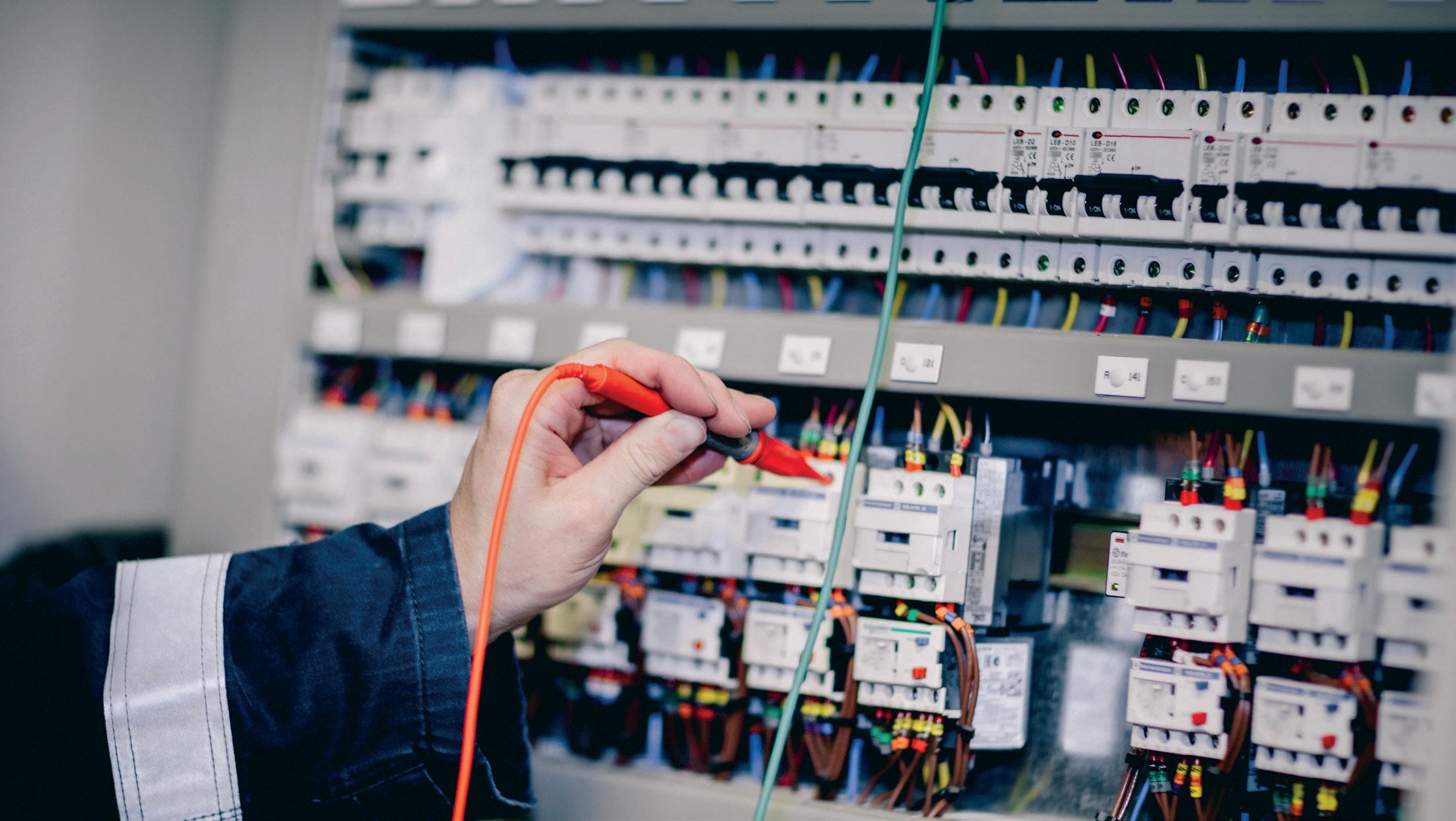
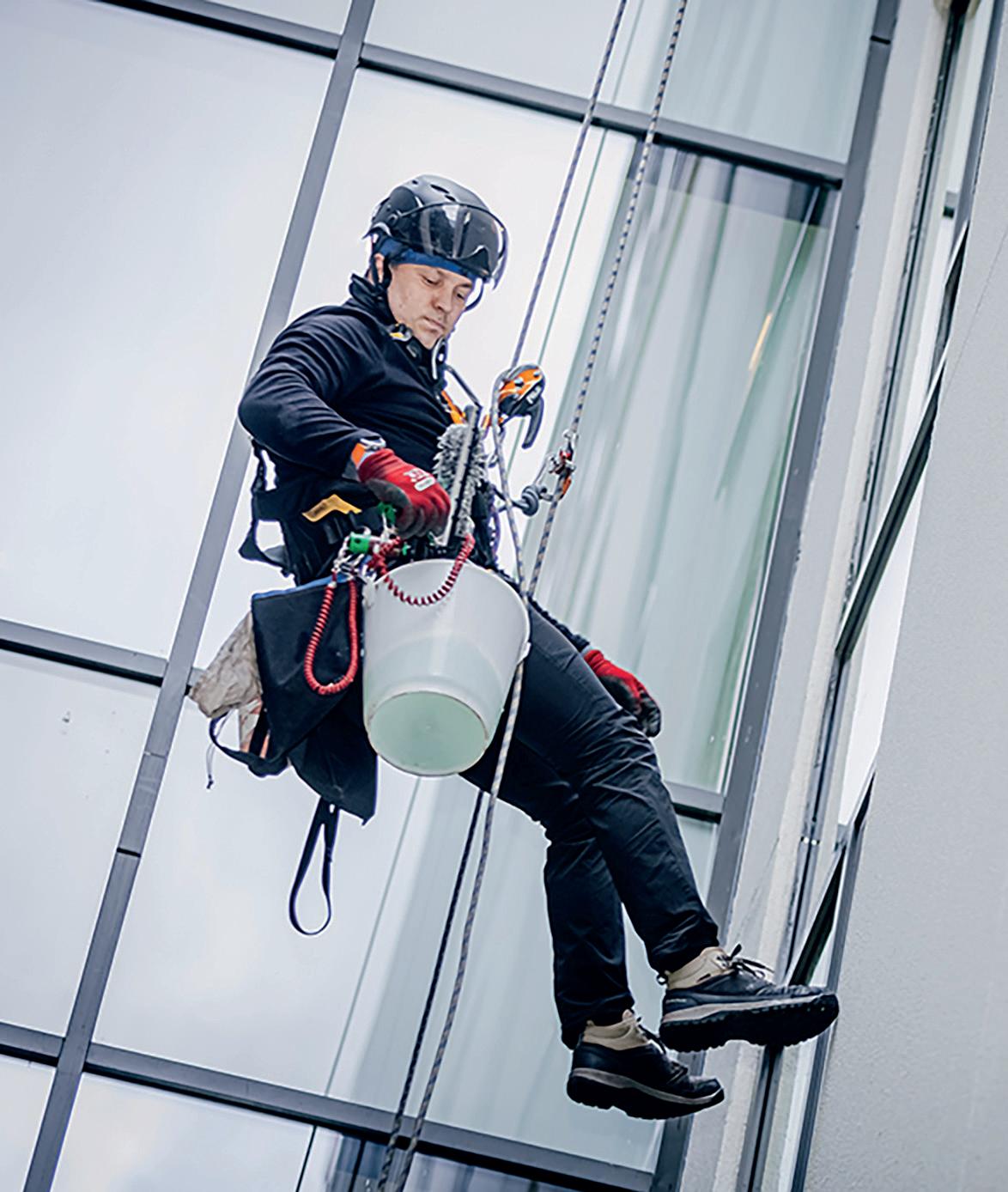
The Fire Safety Window
When Neo, a PTSG Company, completed work at the University of York, the scope was substantial: over 1,000 service penetration fire stops across multiple residence blocks. What made it achievable was summer access – unrestricted entry to every corridor, room and service riser without displacing students.
Before any remedial work could begin, comprehensive fire risk assessments had to map every defect across the entire estate. That assessment work alone is a summer project in itself.
The Electrical Testing Reality
PTSG Electrical Services has worked with the University of Bath since 2011. Fifteen years of partnership has taught both sides something valuable: electrical testing across a university campus isn’t quick.
PAT testing every piece of portable equipment. Fixed wire testing requiring access to distribution boards and circuit isolation. Emergency lighting tests needing darkness to be effective.
During term time, you’re constantly negotiating access. During summer, the estate is yours. The same work that might take twelve weeks of disrupted term-time access can be completed in six weeks of summer efficiency.
The February Advantage: Strategic Planning Now
The facilities managers who consistently deliver successful summer programmes follow a specific sequence that begins in February.
1. Strategic Asset Review
Before contacting contractors, the best FMs conduct comprehensive reviews. Which buildings have the highest Legionella vulnerability? Where did last year’s fire door inspections flag concerns? Which electrical installations are approaching test intervals?
This isn’t wishlist creation. It’s understanding priority, risk, and dependencies. When summer arrives and time is limited, you need to know definitively what must happen.
February is when you can have transparent conversations about scope and cost. Not June, when you’re backed into emergency procurement.
2. Contractor Engagement
February conversations are strategic discussions. You’re exploring approaches, comparing methodologies. Contractors have time to properly scope work and provide accurate pricing.
May conversations are transactional. “Can you fit us in? How much?” You’re accepting whatever availability exists.
Multi-service coordination becomes possible. When you’re working with a specialist across disciplines, shared site inductions save time.
3. Resource and Documentation
Internal resources matter as much as external contractors. Who from your estates team needs to be available? What about security, cleaning, IT systems?
February planning means you can allocate resources properly. June planning means discovering resource gaps when work is already scheduled.
Successful programmes are built on information: accurate building plans, up-to-date asset registers, previous inspection reports. February is when you gather and verify. June is when you’re emailing “I think we have plans somewhere” while contractors pad prices to account for uncertainty.
The PTSG Difference: Integration That Actually Works
170+ Services in Practice
PTSG operates across over 170 specialist services. That’s a capability statement with specific practical implications:
Single mobilisation covers multiple scopes. When our teams arrive, they’re not there for one isolated task. Fire risk assessments happen alongside building fabric inspections. Water treatment surveys coordinate with electrical testing schedules.
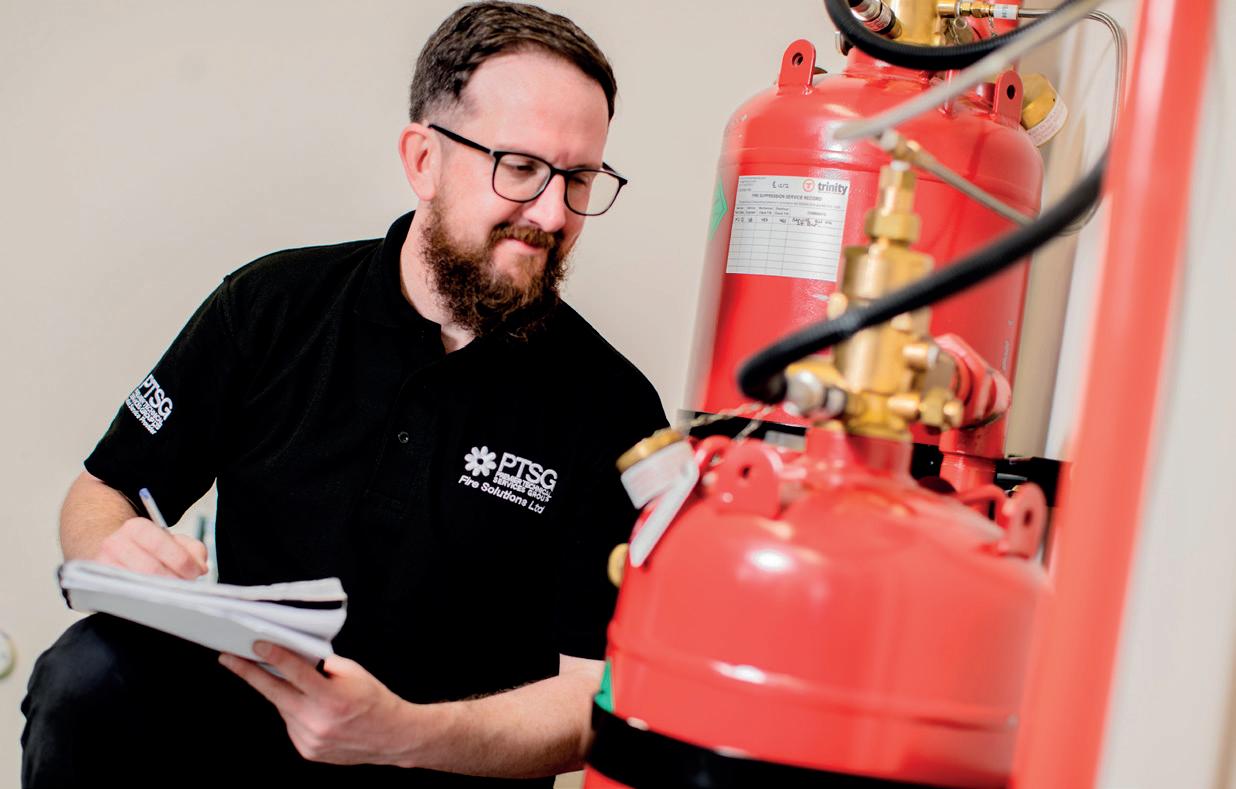
Shared intelligence across disciplines. When fire safety specialists identify service penetrations, that information flows to water treatment teams and electrical specialists. When building access teams identify structural concerns, information reaches whoever needs it immediately.
Unified documentation. One system. One approach. One audit trail. Not separate records from six different contractors.
PTSG Electrical Services has been trusted by the University of Bath since 2011. That longevity means our teams know the campus, understand the buildings, and have relationships built on delivery. When summer planning happens, there’s no learning curve.
Our work spans universities, schools, sports stadiums and facilities with seasonal occupancy patterns. That breadth means we understand common patterns across sectors. The Legionella risks that schools face during holidays apply equally to stadium facilities during off-season.
By May, the best contractors are booked. What remains is either less capable contractors, premium rates from capable contractors juggling schedules, or compromise solutions with reduced scope.
When time is short, something gives. Fire door surveys become “high-priority areas only.”
Water treatment skips systematic flushing. Electrical testing defers non-essential equipment. Individually, each compromise seems reasonable. Collectively, they leave compliance gaps.
Emergency procurement costs more. Beyond direct costs, late planning creates inefficiency through multiple mobilisations, access duplication and missed opportunities for combined surveys.
The genuinely concerning consequence is incomplete compliance. When programmes get compressed, things get missed. Most of the time, nothing happens. But “most of the time” isn’t a risk management strategy.
PTSG operates across over 170 specialist services spanning every aspect of building compliance. From fire risk assessments and fire door surveys, to Legionella management, electrical testing to kitchen extract and building access - you’re covered.
Contact PTSG this month. Let’s have strategic conversations about your summer programme while there’s still time to plan properly.
Because the only thing worse than planning summer maintenance in February is trying to arrange it in June.
Contact PTSG today, email shaun.caddick@ptsg.co.uk or visit www.ptsg.co.uk
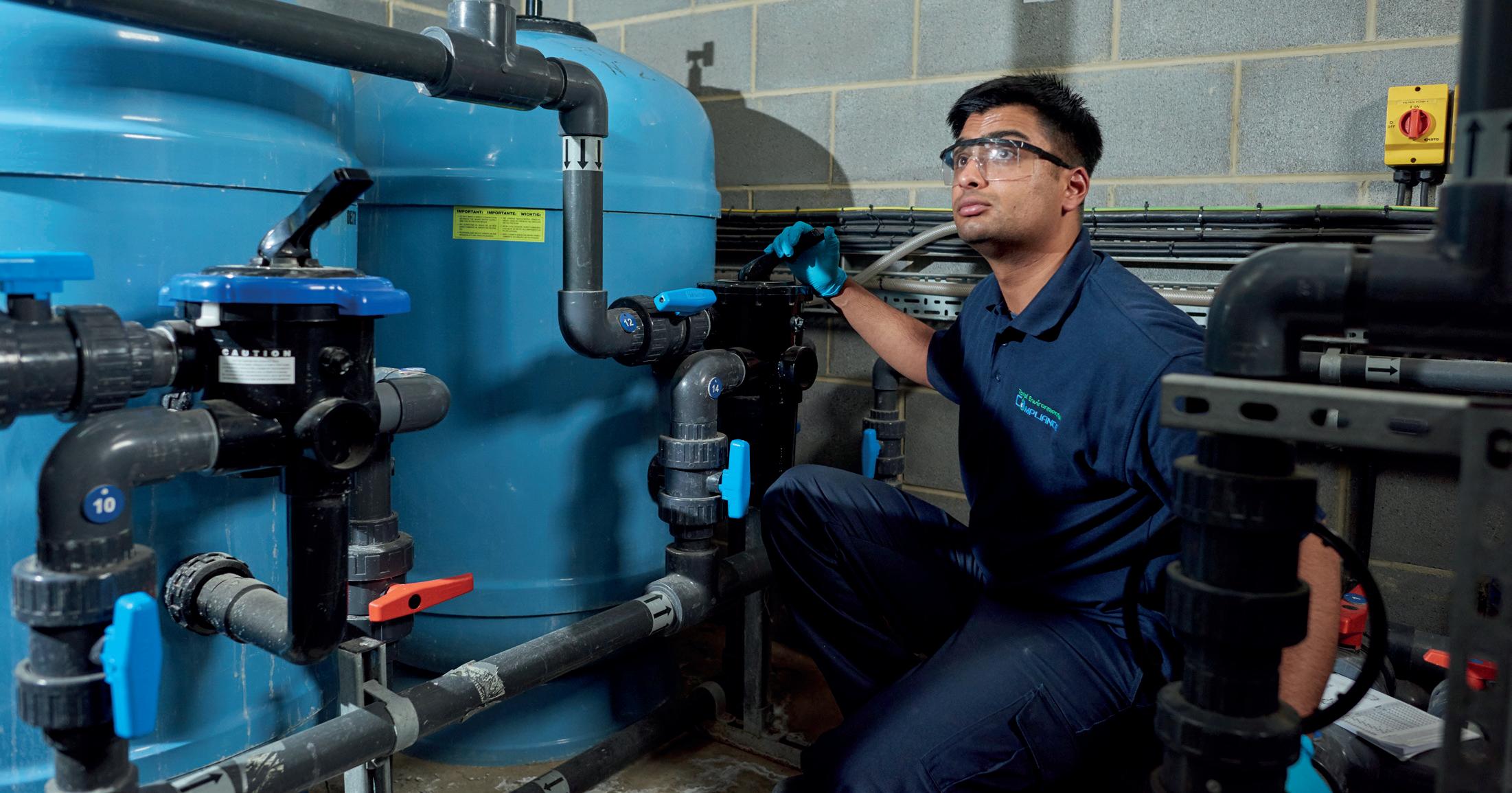
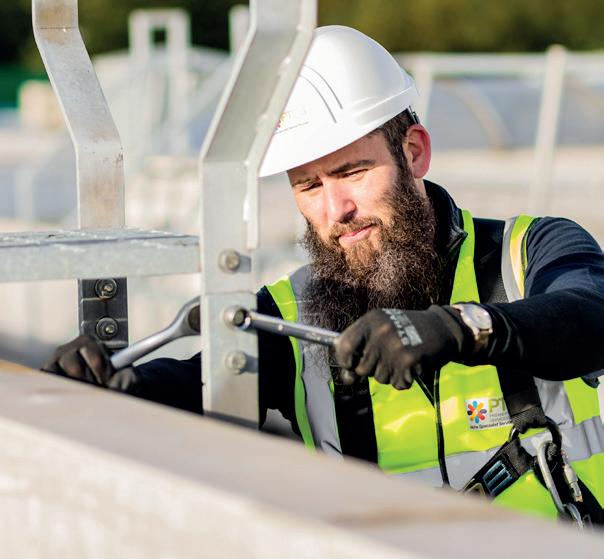
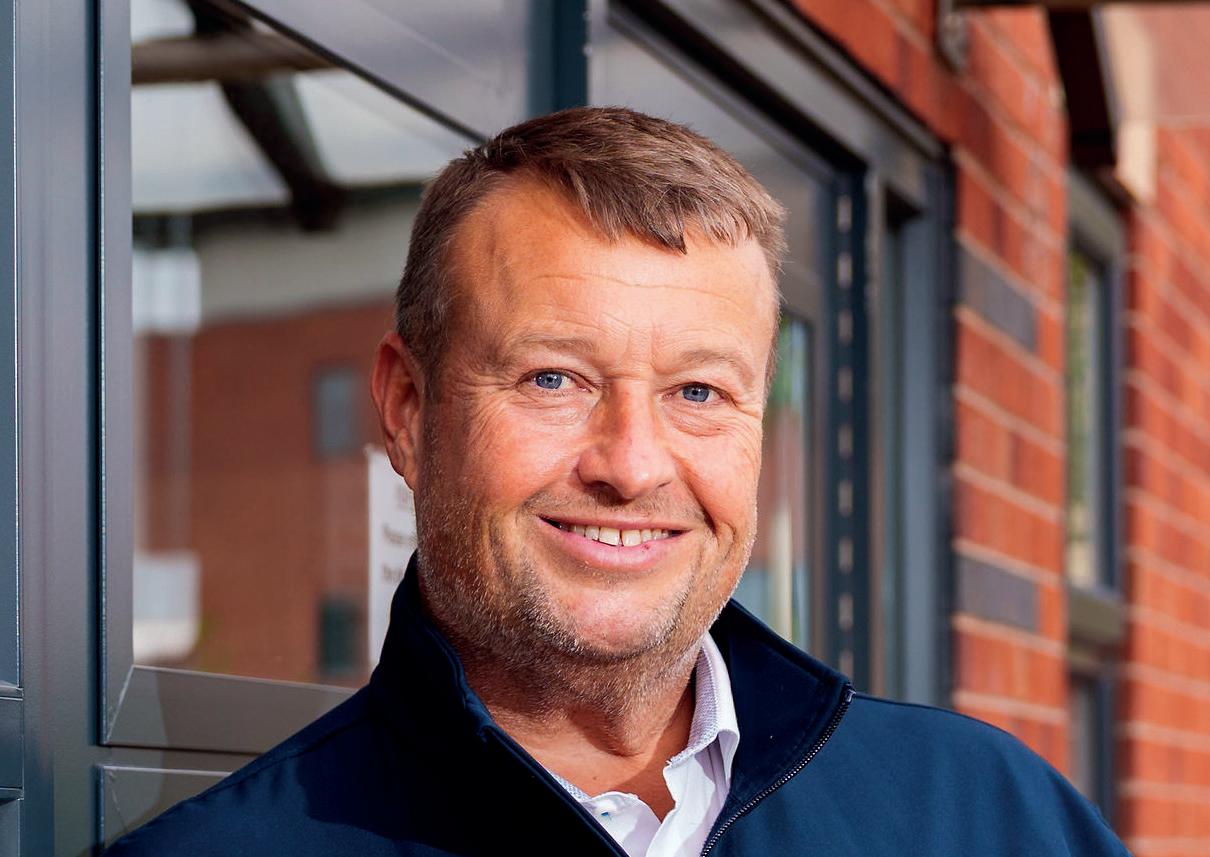
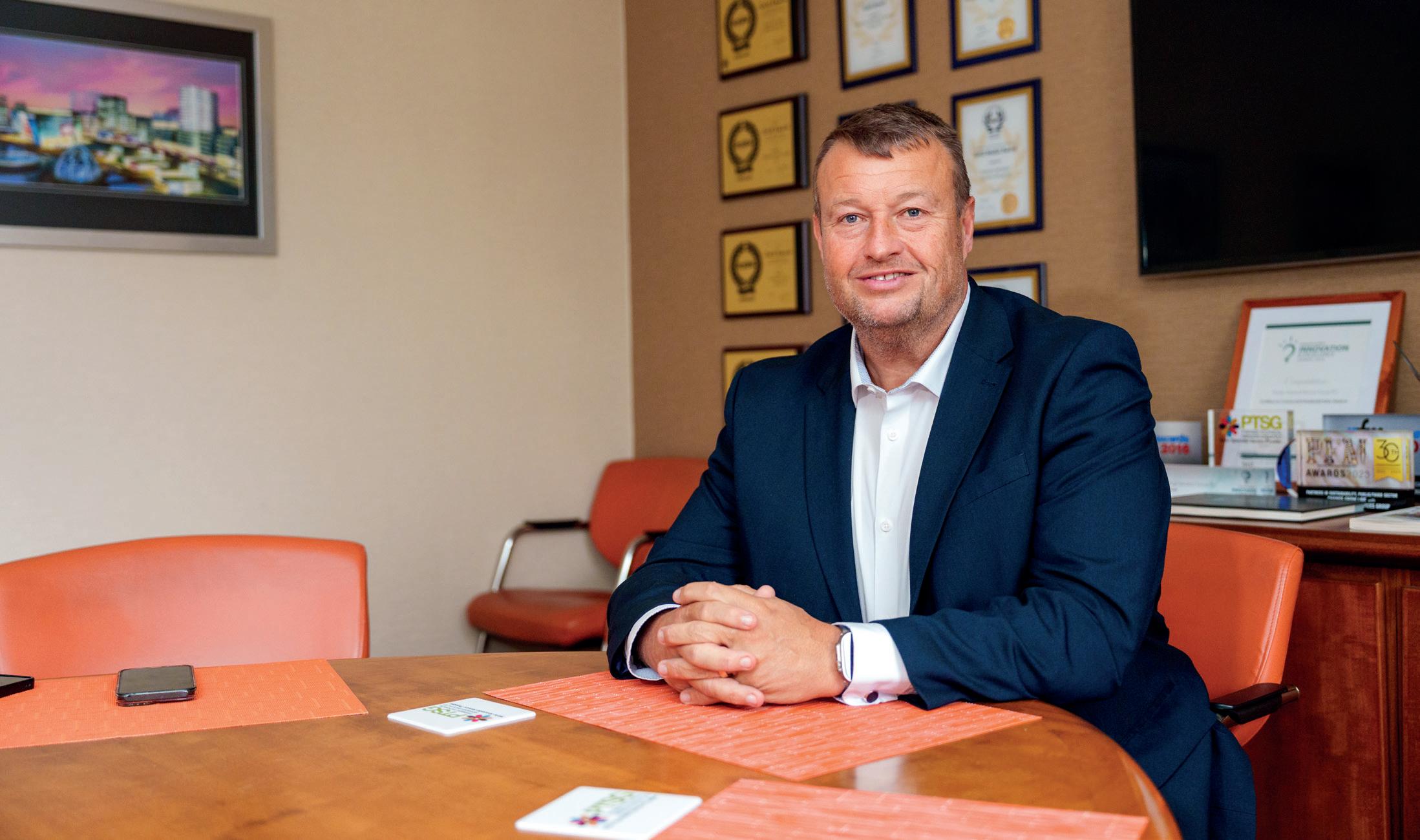
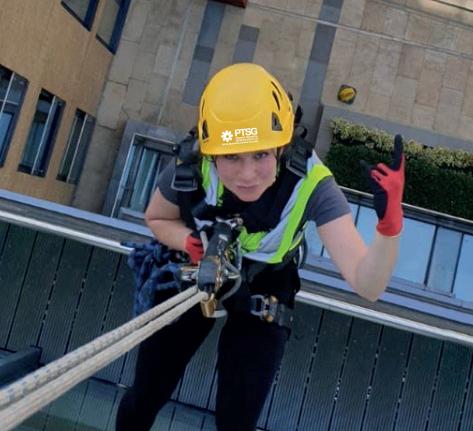
As National Apprenticeship Week shines a spotlight on early careers and skills development across the UK, Greg Ward, CEO of PTSG, offers a timely reminder that apprenticeships are not just a route into work – they are a mindset for life





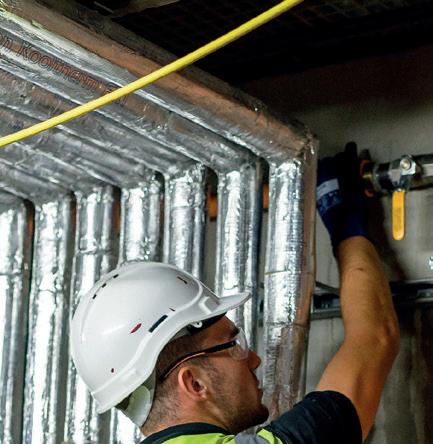



“I
’ll always think like an apprentice,” says Greg. “Stay curious. Stay hungry. Keep learning.”
It’s a philosophy shaped not in a boardroom, but on the tools.
Built on the tools, not the title
Greg’s career began as one of 60 apprentices selected from thousands of applicants at Ford. Fresh out of school, he entered a structured programme that combined practical experience with formal education - engineering, electrical and mechanical disciplines, alongside college and degree study funded by the employer.
“It was like school, but better,” he recalls. “You were learning real skills, earning money and understanding how the working world actually works.”
More importantly, it shaped his attitude.
“You learned discipline, respect and how to be part of a teamthings that stay with you for life.”
Apprenticeship values at the heart of leadership
For Greg, the values learned as an apprentice - respect, work ethic, curiosity and resilience - still define leadership today.
“If you can’t speak to the cleaner and the shareholder with the same respect, you can’t work for me.”
That belief runs through PTSG’s culture. Greg is known for replying to emails from anyone in the business and for spending time with frontline teams.
“The people on the tools know what’s really happening. They have the best ideas because they live the reality every day.”
Ownership, effort and resilience
Greg challenges people at every level to think like owners, not employees.
“I work as if it’s my business and I expect people to do the same.”
One of his favourite tests is simple: would you spend your own bonus on that decision? Hard work, not luck, remains central to his message - particularly during National Apprenticeship Week.
“Nothing falls into your lap. Even to win the lottery, you still have to buy the ticket.”
Mistakes are part of the process, he adds, as long as people learn and get back up again.
“It’s not about how many times you fall. It’s about how many times you bounce back.”
Creating purpose beyond the job title
For Greg, apprenticeships are about far more than skills.
“Work gives people purpose. Without it, confidence and wellbeing suffer.”
That belief underpins many of PTSG’s people initiatives – including the recent Mission to the Moon challenge, which encouraged employees across the business to take part in a shared wellbeing goal.
If you can’t speak to the cleaner and the shareholder with the same respect, you can’t work for me
Inspired by a 30-day fitness initiative Greg saw overseas, the challenge asked teams to commit to daily activity throughout November.
When the marketing team calculated that collective steps could theoretically reach the Moon, the initiative took on a symbolic life of its own – bringing people together across locations, roles and divisions while raising money for charity.
“People were downloading the app and motivating each other before it even launched,” Greg says. “That’s what happens when people feel part of something bigger.”
Why National Apprenticeship Week matters
For someone whose career began as an apprentice, Greg believes National Apprenticeship Week is an opportunity – and a challenge – for the UK.
“We talk constantly about skills shortages, but we underinvest in apprenticeships.”
Nothing falls into your lap. Even to win the lottery, you still have to buy the ticket
In his view, apprenticeships offer one of the strongest returns of any investment the country can make.
“They create skilled workers, taxpayers and confident people with purpose.”
At PTSG, that belief translates into real opportunity. The group continues to invest in apprenticeships, trainee roles and early careers pathways across its specialist services businesses, developing people from entry level through to leadership.
Always an apprentice
So why does a CEO still describe himself as an apprentice?
Because learning never stops.
“I learn every day - from my teams, from the businesses we bring into the group, and from the next generation coming through.”
As National Apprenticeship Week highlights the importance of early careers, Greg Ward’s message is clear: “Once you stop being curious, you stop growing. If you’re looking for a new opportunity come see what we’re all about you may be surprised. ”
PTSG is actively recruiting into entry-level and trainee roles across the UK. From apprenticeships and early careers positions to technical training pathways, there are many opportunities for people looking to begin a career in the built environment.
The group is known for its entrepreneurial culture and strong commitment to developing people.
For current vacancies and trainee opportunities, visit the careers section of the PTSG website






We recently spoke to former IWFM Chair Mark Whittaker, when he reflected on 2025 and shared his predictions for the FM industry for the year ahead…
On a personal note, the summer of 2025 saw my four-year tenure as Chair of the Institute of Workplace and Facilities Management (IWFM) come to end, as I passed the reins to the more than capable hands of Andrew Hulbert.
After over fourteen years volunteering for the Institute, six of which has been on the IWFM Board, it has been a huge personal honour to hold such an important and high-profile role and hope I have made a positive contribution to the Institute and sector over that time.
Another challenge in 2025, which will continue to be faced in 2026 and beyond, is the worsening skills
2025 had its challenges within the sector. Thankfully inflation rates in the UK economy stabilised throughout the year, but the biggest cost pressure was the rise in the Employer National Insurance rate from 13.8% to 15% from 6th April 2025 and the employer contribution threshold reducing from £9,100 to £5,000 per annum.
Another labour market cost pressure was the 6.7% increase in the National Living Wage (NLW) to £12.21 per hour from 1st April 2025. These increases have had a particular impact on soft FM service providers where there are a larger number of workers on the NLW, such as cleaners, porterage and catering staff.
Service providers in the sector, already operating on tight net profit margins of between 3% and 5%, needed to find ways to achieve internal cost efficiencies, without compromising service delivery and also being mindful of maintaining pay differentials between different job grades.
The situation was exacerbated by many service providers being unable to pass these increased costs on to their customers.
Another challenge in 2025, which will continue to be faced in 2026 and beyond, is the worsening skills shortage within the sector. Currently the average age of someone working in the facilities management sector is 49-50 years old and it is widely recognised that we are lacking a young, diverse range of people coming into the sector.


This situation has been exacerbated by reduced numbers of under-19s taking apprenticeships and the perennial problem that the industry is still not effective in showcasing the opportunities for young people in the sector, particularly by getting in to the schools and speaking to young people.
This is despite IWFM having their ‘Career of Choice’ resources available to the sector and the fact that there are schools across the country teaching Class of Your Own’s ‘Design-Engineer-Construct’ courses, which have facilities management in the curriculum!
On the more positive side, another prediction for 2026, which I am already seeing in my consultancy work for Thomson FM (thomsonfm.co.uk) is that an increasing number of organisations are looking to develop and document their ‘Asset Management Strategies’.
The are many facets to developing such a strategy which can include ensuring they have up to date and accurate asset information, a robust planned maintenance (PPM) regime aligned to an industry standard, such as SFG20, the creation of asset life cycle modelling based on their condition data to improve the accuracy of their asset replacement plans/budgets, greater visibility of all their statutory compliance records and the optimisation of their Computer Aided Facilities Management (CAFM) systems, exploiting this improved data.
The difficulty in developing and implementing such a strategy is that it takes time, money, training and expertise to effectively deliver this.
With many organisations tightening their FM budgets, particularly within the public sector, the challenge as always will be to put a compelling business case forward internally to secure the required funding.
In predicting future market trends in FM, it would be remiss of me not to mention Artificial Intelligence (AI). It is also important to stress that the sector historically does not have the reputation of being early adopters of technology and many are still grappling with the basics of good asset and service performance data and compliance records.
AI is already widespread in the sector by service providers in writing their tender submissions and it will be interesting to see how AI can be used within CAFM systems to optimise PPM regimes and asset fault diagnosis, for example.
Finally, the handback of PFI schemes as the contracts reach maturity, will be a continued major area of focus for the sector in 2026.
How facilities management companies are able to meet their contractual handback obligations will be interesting, as will how Trusts and Authorities decide which future facilities management service delivery model meets their needs, post PFI.
The industry is still not effective in showcasing the opportunities for young people in the sector



















The definit ive FM industry newsletter
Monday
Hard services and construction focus


Wednesday
Soft services focus



Friday
A combo of the week’s biggest stories, video interviews and exclusive features from across the FM industry


This month’s special focus is Workplace Wellbeing. We speak to several industry leaders about how the Facilities Management sector can help to foster positive workplace environments and increase productivity and staff retention. Read on...


Workplace Wellness Must Become A Core Business Strategy, Not A Perk





Wellbeing at Work Starts with the Office Why psychological safety is important for facilities leaders


The Role of FM in Employee Retention and Productivity



As employee expectations continue to rise, Oliver Corrigan, Managing Director at WorkWell, explains how wellness-led workplaces are helping employers create offices their people are proud to work in
Workplace wellness has become central to how organisations attract talent, retain their people and support long-term performance. As working patterns continue to evolve, the physical workplace has taken on a new role, not just as a place to work, but as a tangible statement of how much an employer values the wellbeing of its employees.
For serviced office providers, this responsibility is particularly significant. We are not simply delivering space, but instead we are creating environments that represent dozens, sometimes hundreds, of different employers. Each one wants to feel confident and proud that their teams are spending time in a space that supports health, focus and overall quality of working life, with workplace wellness being embedded into the very fabric of the building.
Wellness at the core
True workplace wellness starts with understanding how people experience a space, not just how they use it. Employees today are more attuned than ever to their surroundings. They notice air quality, lighting, noise levels and access to natural elements, often subconsciously, but with very real impacts on mood, energy and productivity.
Filtered air
At a serviced office level, this places facilities management at the heart of the wellness agenda. Facility management teams influence everything from environmental conditions to how intuitive and welcoming a space feels day to day. Clean air, for example, has become a baseline expectation rather than a hidden technical detail. High-performing ventilation systems, air filtration and ongoing monitoring are now essential in creating spaces where people feel alert, comfortable and reassured about their health.


When employees feel physically well in an office, trust in both the building and their employer grows.
Lighting plays a similarly powerful role. Poor lighting contributes to fatigue, headaches and disengagement, while thoughtfully designed lighting supports concentration and natural energy levels throughout the day.
In a hybrid world, where employees may be working irregular hours or moving between locations, this consistency becomes even more valuable. One way we’ve tackled this here at WorkWell is by introducing adjustable lighting across all offices, allowing users to tailor light intensity to their specific needs throughout the day.
Wellness-focused workplaces are not about constant stimulation but are instead about balance. One of the most important shifts we have seen is the need for spaces that actively reduce stress.
At our newest location, Copthall Bridge in Harrogate, we’ve introduced a dedicated wellbeing suite which comprises individual fitness rooms, a treatment space, and a calming lounge area.
True workplace wellness starts with understanding how people experience a space, not just how they use it
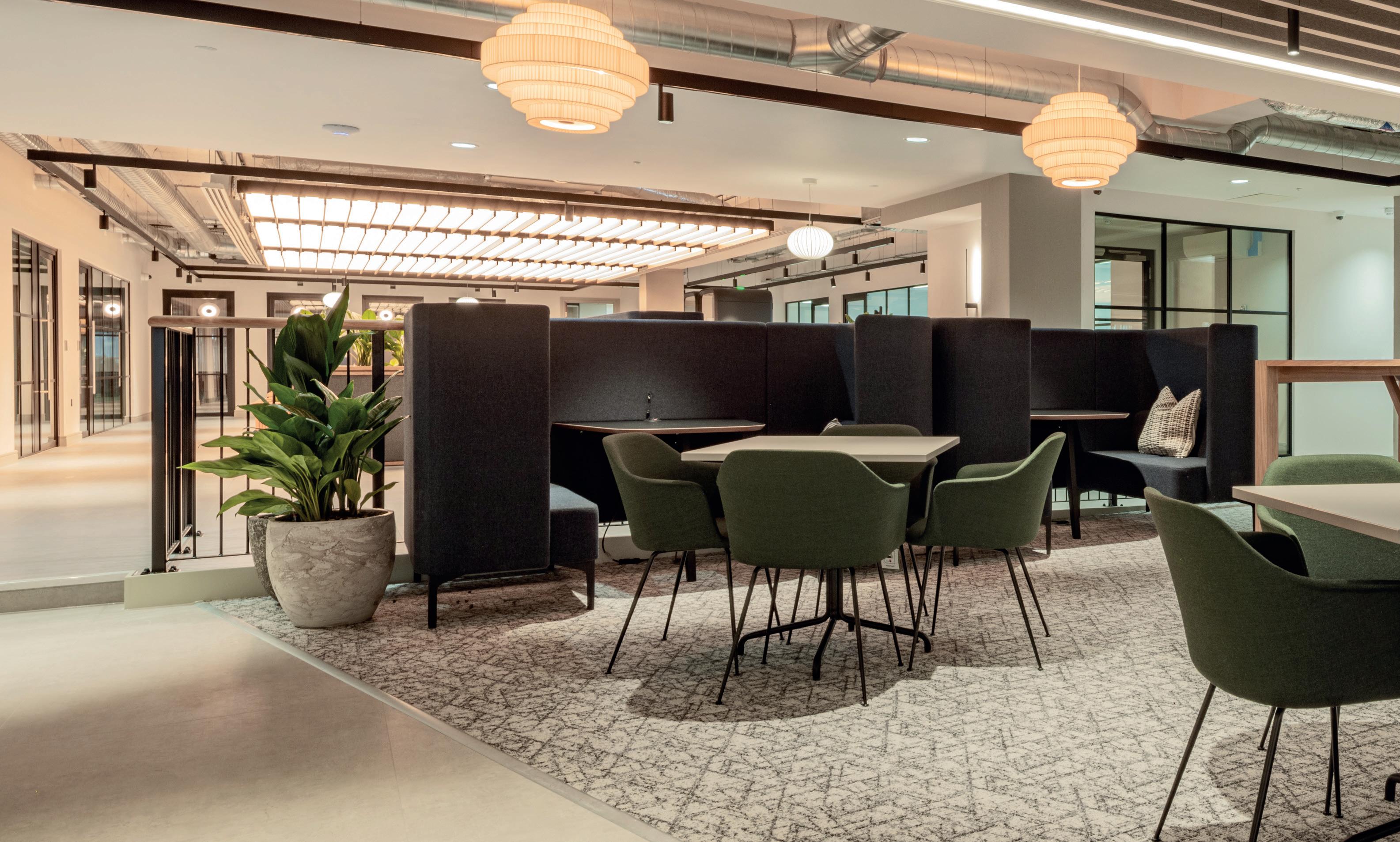
This offers our tenants a restorative environment away from screens, addressing both mental and physical wellbeing within the workplace itself.
Equally important is acoustic comfort. Open-plan environments can be energising, but without careful management they can also be overwhelming. Providing a mix of quiet zones, collaboration areas and private spaces allows employees to choose environments that suit their task and their mental state, which is a critical factor in preventing burnout.
Employers want their people to walk into the office and feel positive about being there. That sense of pride comes from the overall experience, from how the space looks and functions, to how it makes employees feel.
Healthy workplaces
In serviced offices, FM teams play a vital role in maintaining this experience consistently. From cleanliness and maintenance to wayfinding, temperature control and shared amenities, every detail contributes to whether a workplace feels cared for or compromised. When employees enjoy being in the office, attendance becomes a choice rather than an obligation. That shift is incredibly valuable for employers navigating hybrid work policies and cultural cohesion.
There is a growing recognition that workplace wellness is not just a people issue – it is a performance issue. Healthier environments support clearer thinking, stronger collaboration and higher engagement. Over time, this contributes directly to retention, productivity and organisational resilience.
Facilities management sits at the intersection of all these outcomes. By using data, technology and ongoing feedback, FM teams can continually refine the workplace experience, adjusting layouts, environmental settings and services to better support wellbeing as needs evolve.
For serviced office providers, this is also a key differentiator. Employers are increasingly selective about where they locate their teams, and wellness-led environments help them demonstrate care for their people without the complexity of managing buildings themselves.
Increased expectations
As expectations continue to rise, the most successful workplaces will be those designed around people, not policies.

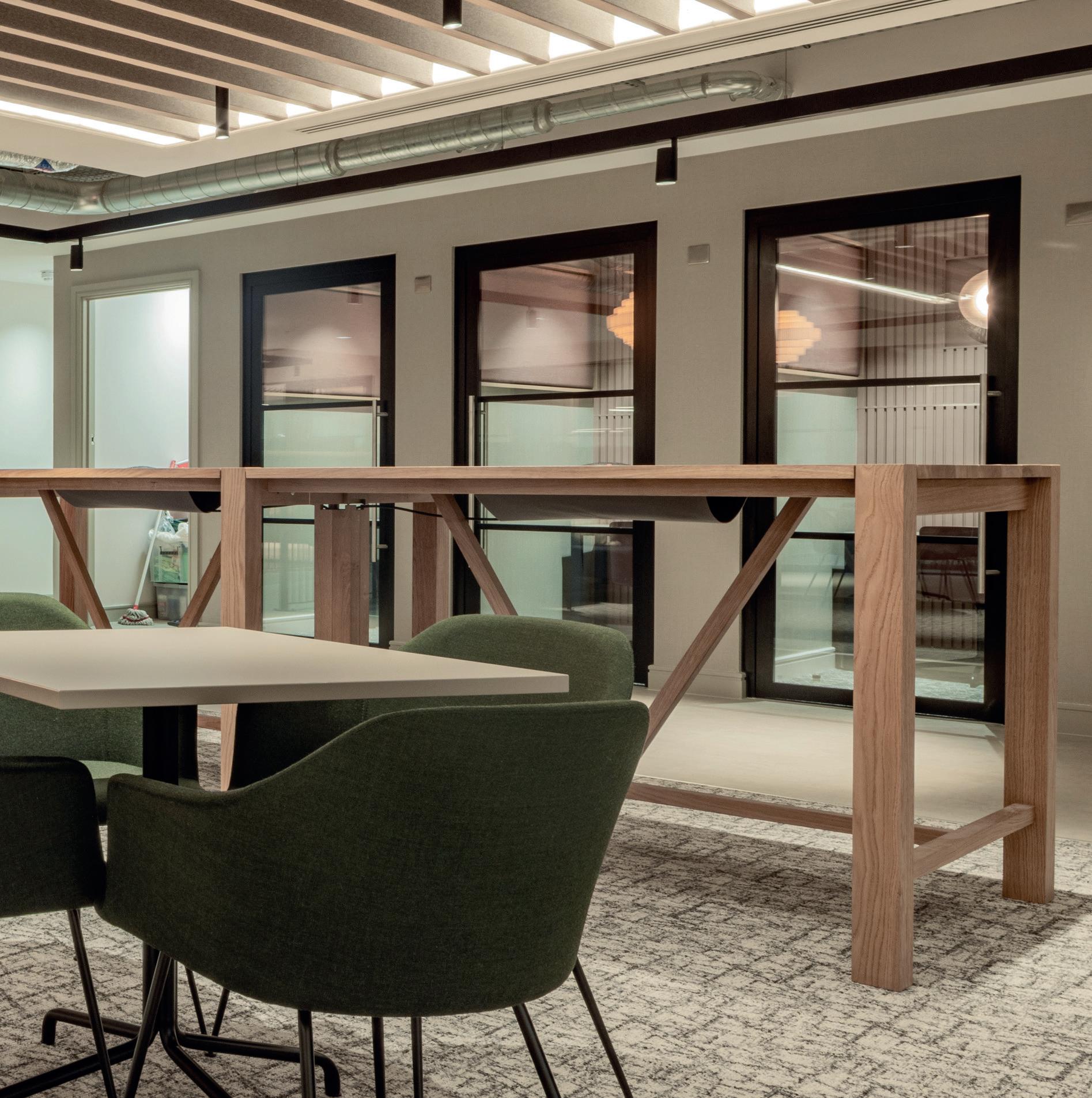
Offices that prioritise wellness send a clear signal: that work does not have to come at the expense of health. For employers, choosing a serviced office that embeds wellbeing into its design and FM strategy is a statement of intent. For FM professionals, it is an opportunity to shape environments that genuinely improve working lives.
Ultimately, creating spaces employers are proud of is about more than design excellence. It is about delivering workplaces where people feel well, supported and motivated – and where coming to work feels like a positive part of the day, not a compromise.

Nearly half of UK employees say they don’t feel able to speak up when they spot mistakes or risks at work. At MHFA England, recent research of 2,000 working adults found that 45% feel unsafe raising concerns, and 15% say they have made preventable mistakes as a result
That silence carries an opportunity cost. When concerns go unvoiced, small issues escalate. Errors slip through, and quality suffers. Under pressure, the consequences can be huge.
Psychological safety is the feeling that you can speak up, ask questions, admit mistakes, and share ideas without fear of embarrassment, rejection, or punishment. It is closely tied to productivity, performance, and employee wellbeing.
We know managers play a central role in building psychologically safe teams. However, culture doesn’t exist in isolation. It’s reinforced every day by how work is structured and experienced.
That’s where facilities and workplace leaders have influence.
The workplace sends signals
The physical environment cannot create psychological safety on its own. Yet it can strengthen or quietly undermine the conditions that allow it to grow.
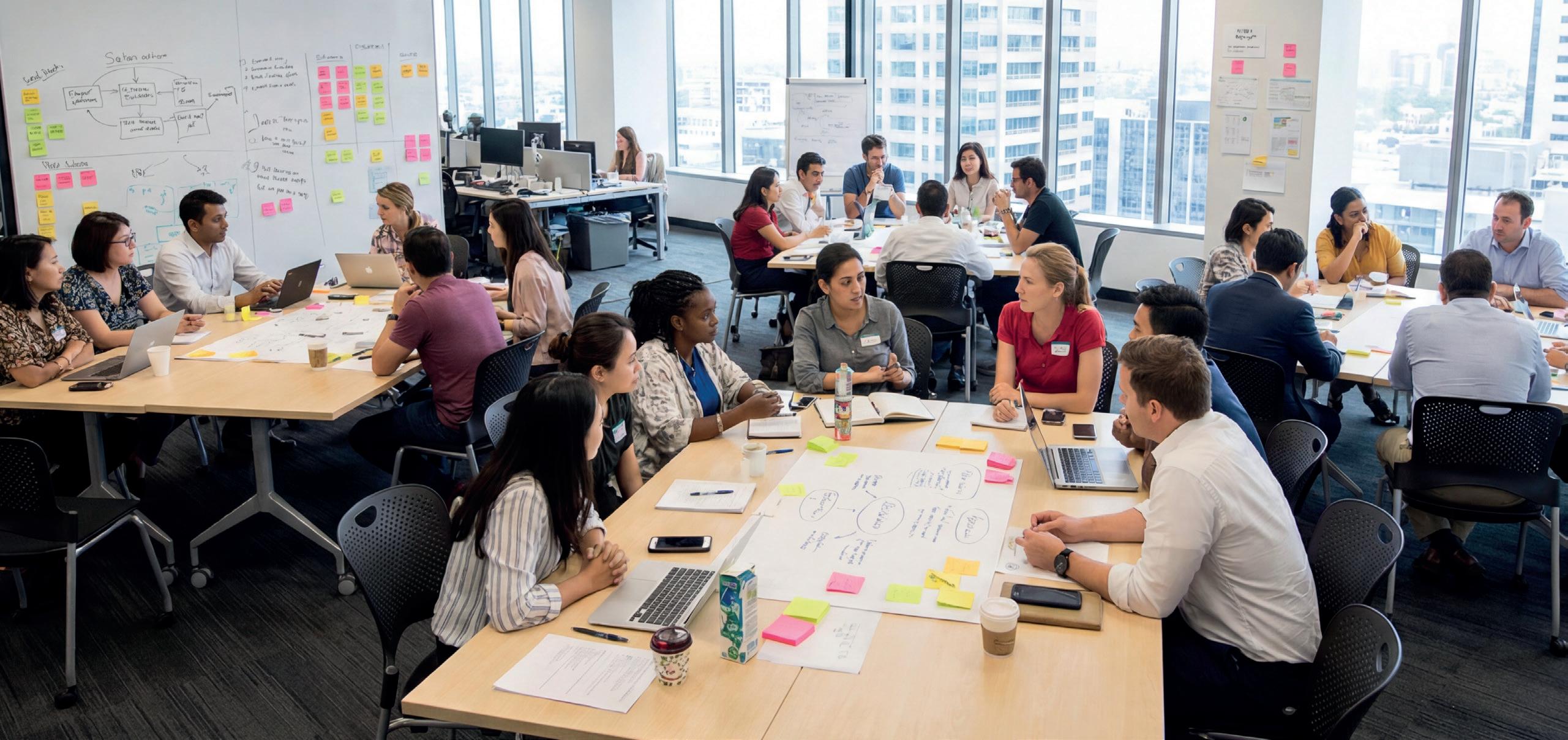
For example, we must consider where conversations happen. Are there spaces where someone can raise a concern privately? Are managers visible and accessible? Do hybrid or remote workers feel present in meetings, or peripheral? Does the layout encourage collaboration, or does it reinforce hierarchy and separation?
These signals add up. Over time, they inform how confident people feel asking for help or flagging a risk.
Hybrid working adds another layer. Our research also found that 35% of employees don’t feel safe asking for help. Informal reassurance can be harder to come by when you are not together day to day. It’s more difficult to read when someone is under pressure, and raising a concern can feel more challenging and exposing.
With the evolution of technologies and systems that workplaces increasingly use, human judgement remains the final layer of safeguarding
A facilities team isn’t responsible for solving this alone. Managers remain one of the largest influences on team culture, but leadership intent, workplace design and operational decisions either support them in creating psychologically safe teams or make that task harder.
With the evolution of technologies and systems that workplaces increasingly use, human judgement remains the final layer of safeguarding. That depends on people feeling confident enough to speak up when something doesn’t look right.
Psychological safety in operational settings Silence can have a very direct impact in facilities and estates environments, meaning a maintenance issue goes unreported or a safety concern is left unchallenged.
These are rarely the result of indifference. More often, they reflect uncertainty about whether raising the issue will be welcomed.
Communication gaps widen easily in complex estates with multiple sites, contractors, and shift patterns.

For facilities professionals, the question is not how to own psychological safety, but how to support it
This might mean reviewing whether there are appropriate spaces for sensitive conversations. It may involve examining how meeting rooms are configured for hybrid participation.
It could require collaboration with HR and operational leaders to ensure that policies around space usage, booking systems, and visibility don’t inadvertently sideline certain groups.
Small, consistent adjustments can have a meaningful impact. Ahead of My Whole Self Day on 10 March, MHFA England’s My Whole Self campaign continues to explore how psychological safety strengthens wellbeing and performance.
Frontline teams may not interact regularly with senior leaders. Hybrid colleagues may feel removed from operational discussions. Without deliberate effort, it becomes harder to ensure every voice carries equal weight.
Facilities leaders already think carefully about physical safety. The same discipline can be applied to psychological safety: where might reporting feel difficult? Who has fewer informal routes to speak up? Which roles experience the workplace differently?
Many facilities teams also ensure physical first aid provision is in place to meet health and safety responsibilities. Mental health deserves the same practical consideration. Trained people with clear reporting routes can prevent issues from escalating, just as early as physical intervention can.
These are operational questions, and addressing them strengthens performance along with wellbeing.
Supporting culture, not owning it
For facilities professionals, the question is not how to own psychological safety, but how to support it.
This year we’ve made a free evidence-based toolkit available to organisations looking to strengthen psychological safety and workplace culture.
More than 200 organisations across sectors – from manufacturing to public services – have taken part, recognising that productivity and wellbeing fuel one another.
Psychological safety is about creating the conditions where issues are surfaced early, when they are easier to resolve. In operational settings, that can mean the difference between minor course correction and major disruption and risk.
Facilities professionals already think in terms of risk mitigation, optimisation, and long-term performance. Psychological safety belongs in that conversation.
Managers must be equipped with the confidence and capability to lead well. Leaders must model openness. And the workplace, physical and hybrid, should be designed to make it easier, not harder, for people to contribute fully.
Facilities leaders may not own culture. But they play a real, meaningful role in shaping the environment in which it lives.
Are you a construction supplier wasting time and money on repetitive health and safety pre-qualification assessments?

SSIP (Safety Schemes in Procurement) offers a smarter solution through Mutual Recognition and the “Deem to Satisfy” principle.
Key Benefits:
Avoid Duplicate Assessments:
Get approved by one SSIP Member Scheme, and your certification is recognised by all others.
Boost Client Confidence:
Demonstrate commitment to the highest health and safety standards and ensure smoother project collaboration.
SSIP simplifies your compliance, allowing you to focus on delivering safe, high-quality work.
Certify Once. Satisfy Everywhere.
Save Time & Money:
Eliminate redundant administrative work and assessment fees. This process attributed to over £5.5 million in direct savings in 2024 alone.
Streamlined Compliance:
SSIP certification is recognised as an exemption against Section 4 (Health and Safety) of the Build UK Common Assessment Standard (CAS).
Learn more and find your ideal SSIP Member Scheme today: www.ssip.org.uk



Matt Bailey, Workplace Specialist at Matrix Booking explores why organisations need to reimagine their spaces to put people first



The way we work has changed. Hybrid schedules, shared spaces and shifting employee habits have introduced greater flexibility, but they have also added new complexity to the everyday working experience. For many employees, that complexity shows up in small but constant moments of friction.
While employees value choice and autonomy, the systems and spaces that support hybrid work have not always kept pace. The office is no longer a fixed destination where every desk is occupied from nine to five.
Instead, it is a blend of home, hubs and headquarters, with different people using space in different ways at different times – often with very different expectations of what a “good” working day looks like. This flexibility brings opportunity, but without the right foundations in place, it can also undermine wellbeing.
Today, workplace wellbeing is increasingly shaped not by policies or perks, but by how the office actually works day to day.
Without the right systems in place to manage the workspace, hybrid working can shift from empowering to exhausting. Teams arrive to find overcrowded meeting rooms on peak days, empty desks midweek, or travel to the office only to discover there’s no parking or free space.
Despite the realities of modern hybrid, the realities of modern hybrid work, many organisations are still relying on rigid or outdated booking systems that were never designed for this level of flexibility.
In fact, a quarter of hybrid organisations continue to use general office tools such as calendars and spreadsheets to manage desk and meeting room needs.
These workarounds lack real-time visibility and create unnecessary friction for employees simply trying to plan their working day. The impact is both measurable and human. Over a third of businesses (38%) say poor workspace management is costing them up to a full day (24 hours) of operational time each week. A further 28% report that simply being able to find an available desk or room when needed is directly impacting productivity.
But the consequences extend beyond efficiency. Workplace wellbeing is often discussed in terms of benefits or culture initiatives, yet it is shaped by everyday experience.
The office is no longer a fixed destination where every desk is occupied from nine to five

When employees do not know whether they will have a desk, when meetings are double-booked, or when they arrive to find spaces louder, busier or more crowded than expected, stress levels rise. When the office feels unpredictable, people disengage and, in many cases, stop coming in altogether.
Over time, this kind of uncertainty erodes trust in the workplace and leaves people feeling unsupported.
Hybrid work has transformed the office into a flexible, continually evolving space
These challenges are often treated as inevitable side effects of hybrid work, but they are not. They are the result of workspaces and systems that have not evolved to support how people actually work today.
Encouragingly, the appetite for change is clear. More than half of businesses (51%) are now considering improvements or add-ons to their workspace management systems over the next 12 months. At the same time, a quarter have a plan in place to actively review or replace their systems.
This shift reflects a growing recognition that offices must now earn the commute. They need to feel seamless, supportive and purposeful – places where people feel confident that the day will work, rather than anxious about whether it will.
The value of technology in this context is not innovation for its own sake, but its ability to reduce uncertainty and mental load for employees. Smart, configurable workspace systems play a critical role in making this possible. When used effectively, these tools give employees real-time visibility into factors like space availability and noise levels. Being able to gauge these factors minimises uncertainty, helping people to make informed choices about when and where they work best.


People spend less time searching for space and more time focusing on meaningful work. Teams can confidently plan in-office collaboration, from core team meetings to cross-functional groups such as finance, CSR, or Mental Health First Aiders, knowing the right space will be available when it matters. Individuals who need quieter environments can also plan their days around spaces that better support focus, comfort, and wellbeing.
As friction is removed, the working experience becomes calmer and more intentional. Hybrid work only succeeds when it feels seamless.
Configurable booking software, visitor management systems and occupancy insights eliminate daily frustrations such as double bookings and overcrowding, creating smoother in-office experiences. Happier employees are more engaged, more collaborative and less likely to burn out.
This people-first approach also delivers operational benefits. Smarter space utilisation allows businesses to do more with less, while creating environments that feel calmer, less crowded and more intentional for the people using them.
By accurately tracking how space is used, organisations can rightsize their offices, reduce wasted resources and cut unnecessary overheads. With rising rents and utility costs, this kind of optimisation has become critical.
Hybrid work has transformed the office into a flexible, continually evolving space. Without the right systems in place, this flexibility leads to wasted time, lost productivity and frustrated employees.
By investing in smarter, adaptable workspace systems, businesses can unlock both efficiency and wellbeing. With future-ready features such as AI, real-time analytics and seamless integrations, the office can once again become a driver of collaboration, engagement and performance.
Wellbeing at work does not start with policies or perks. It starts with spaces that work – consistently, predictably and safely – for the people who use them. The organisations that act now will not only improve efficiency. The organisations that act now will not only improve efficiency, but set the standard for a modern, humancentred hybrid workplace.
By investing in smarter, adaptable workspace systems, businesses can unlock both efficiency and wellbeing

Facilities management isn’t just about ensuring a workplace meets all regulatory requirements – it has a fundamental impact on the people who use the building day-in day-out, meaning its importance far surpasses that of a simple tick box exercise.
Adam Atkins, Group Chief Executive at Coat Facilities Group, explains how and why businesses must view good FM practices as a core asset in boosting retention and productivity.

Alongside considering morale-boosting initiatives like wellbeing programmes and job benefits, it’s vital that businesses see the value of good FM practices when it comes to increasing retention and productivity, especially in a world where budget constraints can mean fewer financial perks are on offer for staff.
“Managers may be unable to change external factors like the current economic situation, but this only heightens the importance of positive changes they can affect, which will drive up the happiness, motivation and loyalty of employees,” he said.
Adam explained: “Our physical surroundings are intrinsically linked to our health, as anyone who has been forced to work in unsafe or unsatisfactory conditions can attest.
“Not only can poor lighting, ventilation or cleanliness levels cause a wealth of symptoms like headaches, fatigue and nausea, air circulation issues can also affect the spread of illnesses around the workplace, and existing conditions like asthma or allergies can also be worsened by the environment around us.
“It’s clear how all of these factors can impact work rates, especially when sickness absences rise as a result, and academic studies back up the correlation: almost seven in ten employees report that poor lighting is among the issues which affect their productivity, according to Idox, and The Times reports that optimised workplaces could actually increase productivity by up to 7%.
“Forward-thinking businesses will already have realised it is not just about keeping spaces maintained and clean.
The design and layout of their headquarters has almost as big an impact: enabling productivity, for example, by providing different spaces for different functions.
Incorporating quiet spaces for concentrated work; break out spaces for downtime; and places where teams can come together for collaborative work and meetings acknowledges the wide-ranging needs employees may have to complete all aspects of their job, and increases productivity by ensuring all of those requirements are met.”
Adam continued: “Teams are also impacted emotionally by the environment around them. When good FM practices are in place, including factors such as green spaces and wellness-focused facilities, we see a positive correlation with staff wellbeing.
“And we know that when staff feel good, they are more likely to be productive and remain loyal to the company – in fact, it is perhaps surprising how much of an impact happiness has at work.
“Research undertaken by Oxford University’s Saïd Business School and BT found the productivity of ‘happy workers’ was around 13% higher, while other studies broadly agree that they are around 59% less likely to find a new job at a different company than their unhappy colleagues.
Our physical surroundings are intrinsically linked to our health, as anyone who has been forced to work in unsafe or unsatisfactory conditions can attest

“Keeping staff safe and healthy is really the bare minimum any company should aim for when it comes to their FM function or outsourcing
“Furthermore, implementing sustainability initiatives as part of the wider FM strategy has a profound impact on staff turnover rates, with Deloitte reporting more than 70% of younger workers would factor a company’s environmental practices into their decision to stay in a job long-term, while a Nutritics study specifically looking at the hospitality sector indicated 43% of staff would considering resigning due to poor sustainability practices, and 19% had already done so.
“Facilities Management is about so much more than ensuring that the workplace is safe and compliant: done right, it showcases the pride an employer has in their business, which naturally trickles down to their teams. A well-maintained, well-thought-out office reflects well on the company for staff and visitors alike, projecting the right kind of image both internally and externally. That first walk through the office into a meeting room will shape the overall impression a candidate at a job interview or a potential new client at an introductory meeting forms of the business. And while that is important for recruitment and business development, it is also crucial to promote retention and productivity among existing employees who may be sitting in that environment for the majority of their waking hours during the week.”
“Ultimately, being willing to invest in FM services which include prompt maintenance, proactive upgrading of equipment, and a comfortable space which is fit for purpose shows that the company not only values itself as being worthy of a first-class headquarters, but also that they value employees too,” Adam said.
“Conversely, a run-down, unkempt office may give the impression that managers think neither the business nor its staff are worthy of a more appealing space. Not ideal for companies looking to motivate and retain their teams.”
Adam continued: “Having peace of mind that equipment and utilities will operate reliably – and the proper checks are being done to ensure functionality and compliance – cannot be underestimated when it comes to the impact on staff wellbeing: a fundamental component of how well they perform at work. A proactive approach to regular maintenance can also reduce the frequency of unexpected problems – reducing the downtime associated with repairs, thus negating regular dips in productivity due to issues outside of staff control.
“Those working for businesses where FM is not prioritised may face coming in to work each day wondering if the heating will still be broken, if lights may be malfunctioning, or if anyone has even considered the impact of unsatisfactory conditions. That kind of environment breeds negative mindsets, which are hardly ideal conditions for creativity, team morale and productivity to flourish.”
Adam added: “Keeping staff safe and healthy is really the bare minimum any company should aim for when it comes to their FM function or outsourcing. The employers who attract and retain productive staff go well above and beyond this, recognising the fundamental links between physical environment and wellbeing.
“By ensuring all aspects of facilities management – from building design to sustainability initiatives – are in place and working well, employers can reduce physical and emotional problems associated with issues such as lighting, air quality, and inadequate resource provision. Creating workplaces which are both pleasant and professional can boost wellbeing, project a positive image of the company internally and externally, and positively impact employee satisfaction, absence rates, and team morale.
“Those who fail to give FM adequate consideration, budget and emphasis are unknowingly negatively impacting everything about their employees’ experience at work: from how often they fall ill, to how likely they are to search for a new job. Whereas employers for whom FM is a priority are setting their staff up for success, directly impacting not only individual wellbeing and career development, but also boosting the company’s productivity and retention rates.”
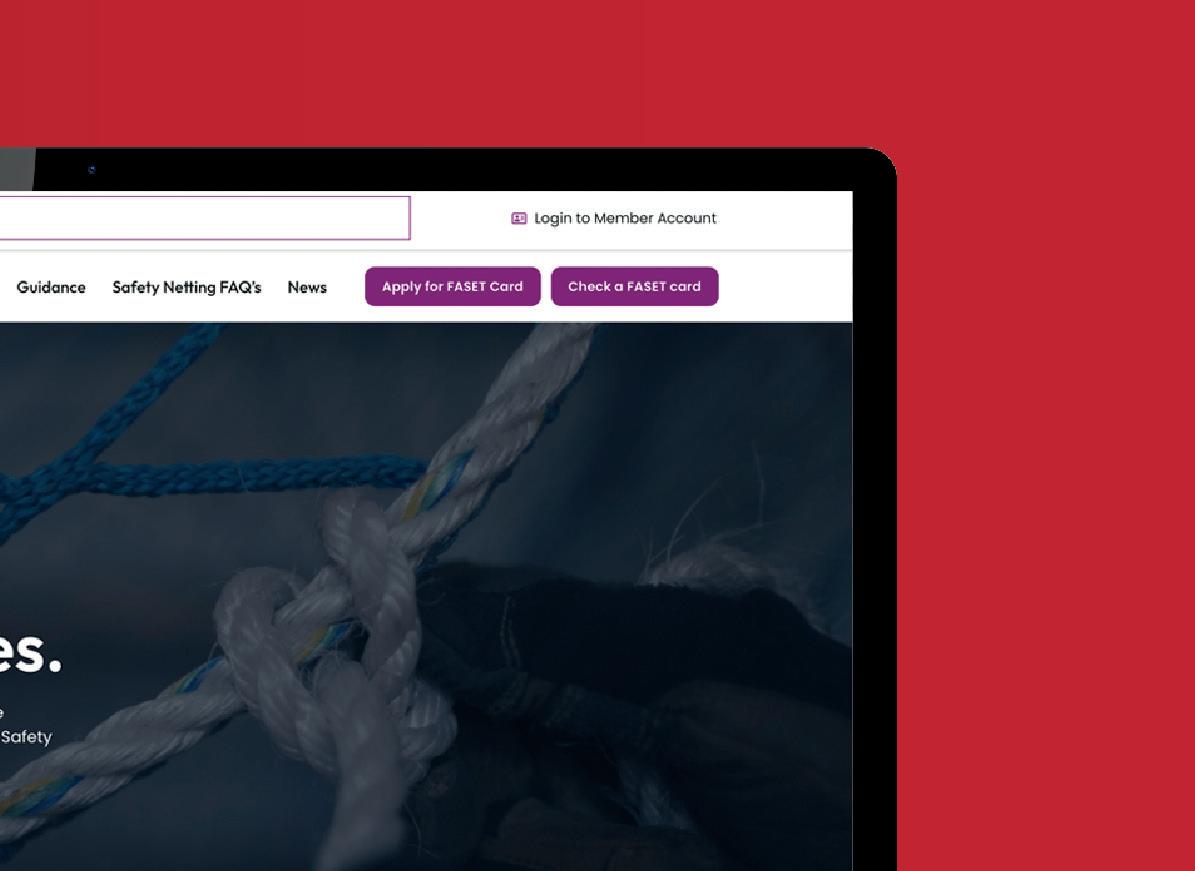
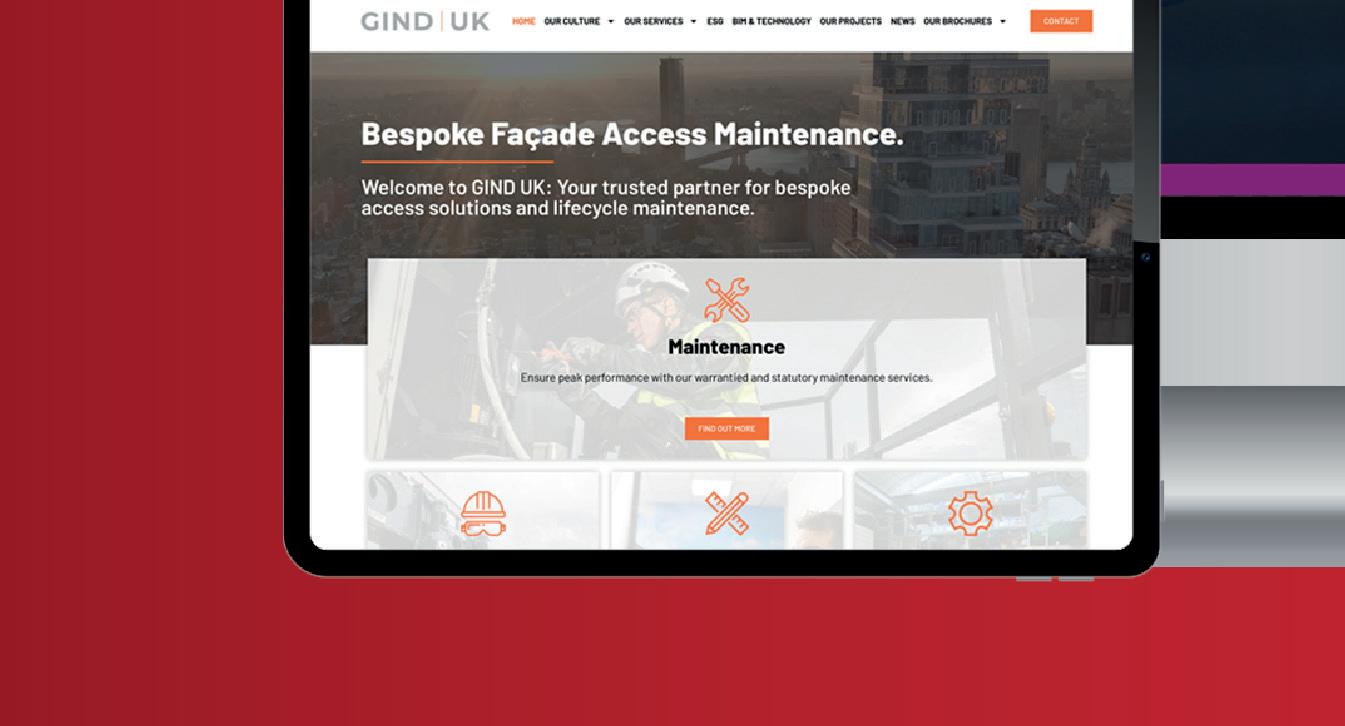
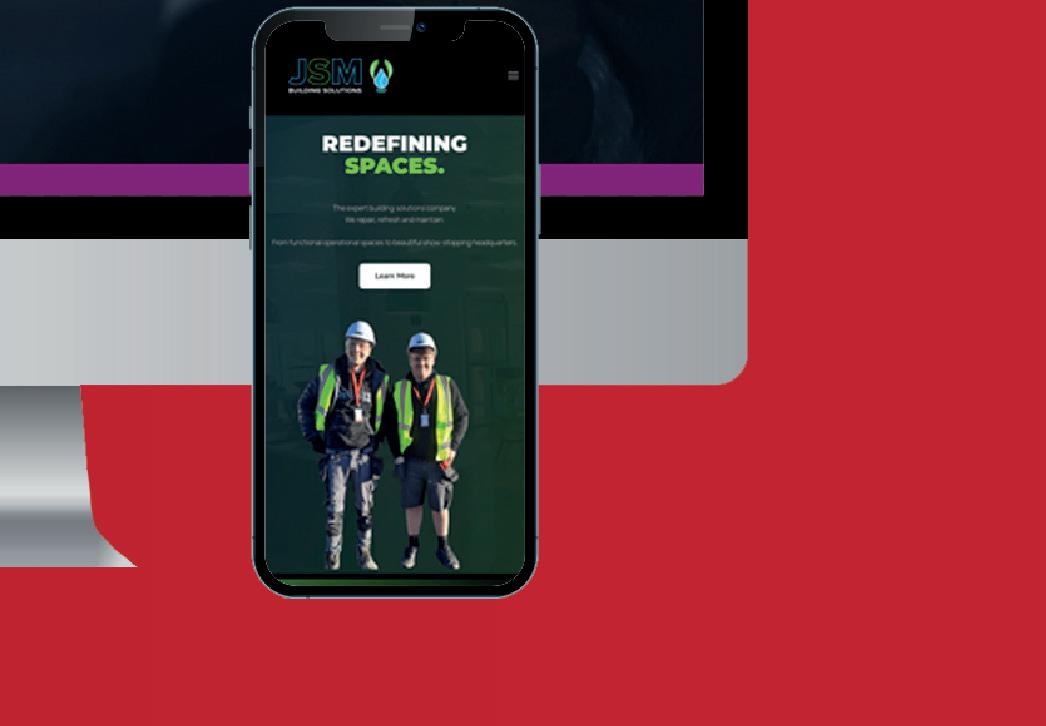
By James Massey at MRI Software
Hybrid working was meant to offer flexibility. Instead, for many facilities management (FM) teams, it has introduced a paradox: buildings designed for predictability now operating under constant fluctuation.
On paper, offices are less busy than they were pre-pandemic. In reality, they are under more pressure than ever. Peak days feel overcrowded meanwhile quiet days feel wasteful. Services, energy use and space provision are often misaligned with actual demand. Yet, real estate costs remain largely fixed.
For FM leaders, the challenge is no longer simply about reducing space but more about understanding how space is actually used, day by day, hour by hour, and responding in a way that balances cost control with employee experience, wellbeing and inclusivity.
Why Traditional Utilisation Metrics No Longer Work
Historically, utilisation was measured through static indicators: desk counts, headcount ratios, lease square footage per employee.
These metrics demonstrated consistency; five days a week, predictable occupancy, stable patterns.
Hybrid working has broken those assumptions. Attendance now varies dramatically by day of the week, by team, and even by season. A single weekly snapshot can misrepresent reality. Averages flatten peaks and troughs, masking overcrowding on collaboration days and underuse at other times.
For FM teams, this makes decision-making far more complex. Cutting space based on headline utilisation risks alienating employees when demand spikes. Maintaining surplus capacity “just in case” drives unnecessary cost and energy consumption.
The result is a growing disconnect between what usage data appears to say and what people actually experience when they come into the office.
How Can Real-time Data and Insights Help
To resolve this paradox, FM teams are shifting away from retrospective reporting and more towards real-time, actionable insight.
Occupancy sensors, desk and room booking systems, and integrated building data are providing a far richer picture of how workplaces function in practice. Not just how many people come in, but when, where and how long they stay.
This data allows FM teams to move from reactive to proactive: Adjusting cleaning, catering and security services in line with real demand
Managing heating, lighting and ventilation dynamically to reduce waste
Identifying which spaces genuinely support collaboration and which do not i.e hot spots vs dead spots
Understanding accessibility and inclusion challenges that static plans may overlook
Crucially, this isn’t about surveillance. When implemented transparently and ethically, utilisation data can empower organisations to create environments that work better for everyone.





For FM leaders, the challenge is no longer simply about reducing space but more about understanding how space is actually used

One clear example comes from our own London office. Like many organisations, we also faced rising operational costs alongside inconsistent attendance patterns. Traditional assumptions about space no longer held true.
By using occupancy and utilisation data, the business quickly gained clarity on how its workspace was actually being used; not just desk occupancy, but meeting rooms, collaboration areas and shared amenities.
The result was a data-led decision to rethink the office footprint, cutting operational costs while simultaneously improving sustainability performance. Importantly, this wasn’t a blunt reduction. Space was reconfigured to support the types of work people came into the office to do: collaboration, connection and focused activity. It also allowed certain floors to be closed off on low occupancy days leading to savings in energy costs.
This approach demonstrates a key lesson for FM teams: utilisation data is most powerful when it informs design and experience, not just cost reduction.
FM’s Expanding Role in the Employee Experience
As hybrid working matures, FM is no longer operating behind the scenes. Facilities teams are increasingly central to employee experience strategies.
Employees judge the office differently now. If they are commuting in, the experience needs to justify the journey. Overcrowded collaboration spaces, unavailable meeting rooms, poor air quality or underwhelming amenities may undermine engagement levels.
At the same time, inclusivity and wellbeing expectations have risen. Neurodiverse needs, accessibility, quiet space, prayer rooms and flexible environments all need to be balanced within finite square footage.
Insights on office use helps FM leaders navigate these competing demands. It highlights where demand consistently outstrips supply, and where space can be repurposed to better serve different user groups.
This shifts FM from cost centre to strategic enabler, shaping workplaces that are not only efficient, but genuinely supportive.
Across the FM sector, there is growing recognition that standalone workplace tools are no longer sufficient in a hybrid environment. Leading organisations are moving towards integrated building management platforms that connect utilisation, energy, maintenance, and user experience data into a single operational view.
Amey’s decision to work with MRI Software to launch an integrated building management technology platform reflects this shift. By connecting workplace systems, FM teams gain a holistic view of how buildings perform; from occupancy and energy use to maintenance and user experience.
This integration enables smarter, faster decisions. For example: Anticipating peak occupancy and pre-emptively adjusting services
Linking utilisation trends to maintenance planning and asset lifecycle decisions
Supporting long-term estate strategy with credible, evidencebased insight

In a hybrid world, disconnected systems create blind spots however integrated platforms create clarity.
The bigger picture of the hybrid paradox goes beyond how individual organisations use their buildings, almost reshaping entire markets. In cities like London, the shift in how space is used is so profound that entire office buildings are being converted into entirely new functions, such as hotels and hospitality assets.
According to a recent Bloomberg article, investors have purchased millions of square feet of office space that remains under used with the intention of repurposing it for hotel development, driven by lower office demand and stronger tourism fundamentals.
This trend isn’t about reducing space in the simplistic sense of “less office equals lower cost.” It reflects a broader recognition that traditional office models no longer align with how people work and that fixed, uniform space allocations are giving way to adaptive reuse based on real economic and behavioural signals.
For FM leaders, this highlights that space demand is not disappearing; it’s evolving. Pure desk-centric design fails to capture the value people seek when they choose to come into the office; value which comes in the form of the 4 C’s – connection, collaboration, culture, and community.
Without real insight into usage, organisations risk owning space that is functionally obsolete in today’s hybrid landscape. As some buildings exit the office market entirely, facilities teams focused on outdated metrics may find themselves managing assets that no longer serve organisational or employee needs.
The London office-to-hotel narrative may well serve as a catalyst. It reminds FM leaders that data and insights into usage shouldn’t just inform how much space we need but what kind of space we need, and why people come into it. Rather than simply cutting capacity, the most successful workplaces are being redesigned to reflect behaviours, preferences and organisational goals, transforming static offices into dynamic environments where purpose, performance and experience blend.
The hybrid office paradox will not disappear. Attendance will remain fluid, and real estate costs will remain fixed.
But FM teams now have better tools, and a stronger mandate, than ever before.
By embracing real-time data and insights, integrating building systems, and focusing on experience as much as efficiency, facilities leaders can turn uncertainty into advantage.
The offices that thrive in the hybrid era will not be the biggest or the busiest. They will be the most intelligently managed, responsive to how people actually work, not how we once assumed they did.

FM is evolving... so are we! As part of our new look, Business Daily will provide smarter, more targeted news and insights three times per week, on Mondays, Wednesdays and Fridays.
Three per week
• Monday: hard services and construction focus
• Wednesday: soft services focus
• Friday: a combo of the week’s biggest stories, video interviews and exclusive features from across the FM industry
As our name – FM Business Daily – suggests, we’re still updating our website every single day with all the latest stories and updates from all the FM sectors. Check it out to stay in the loop!
We hope you are as excited as we are about the new look FMBD newsletter, and we’d love you to get in touch if there’s anything you’d like to discuss or feature in an upcoming issue.
Subscribe here
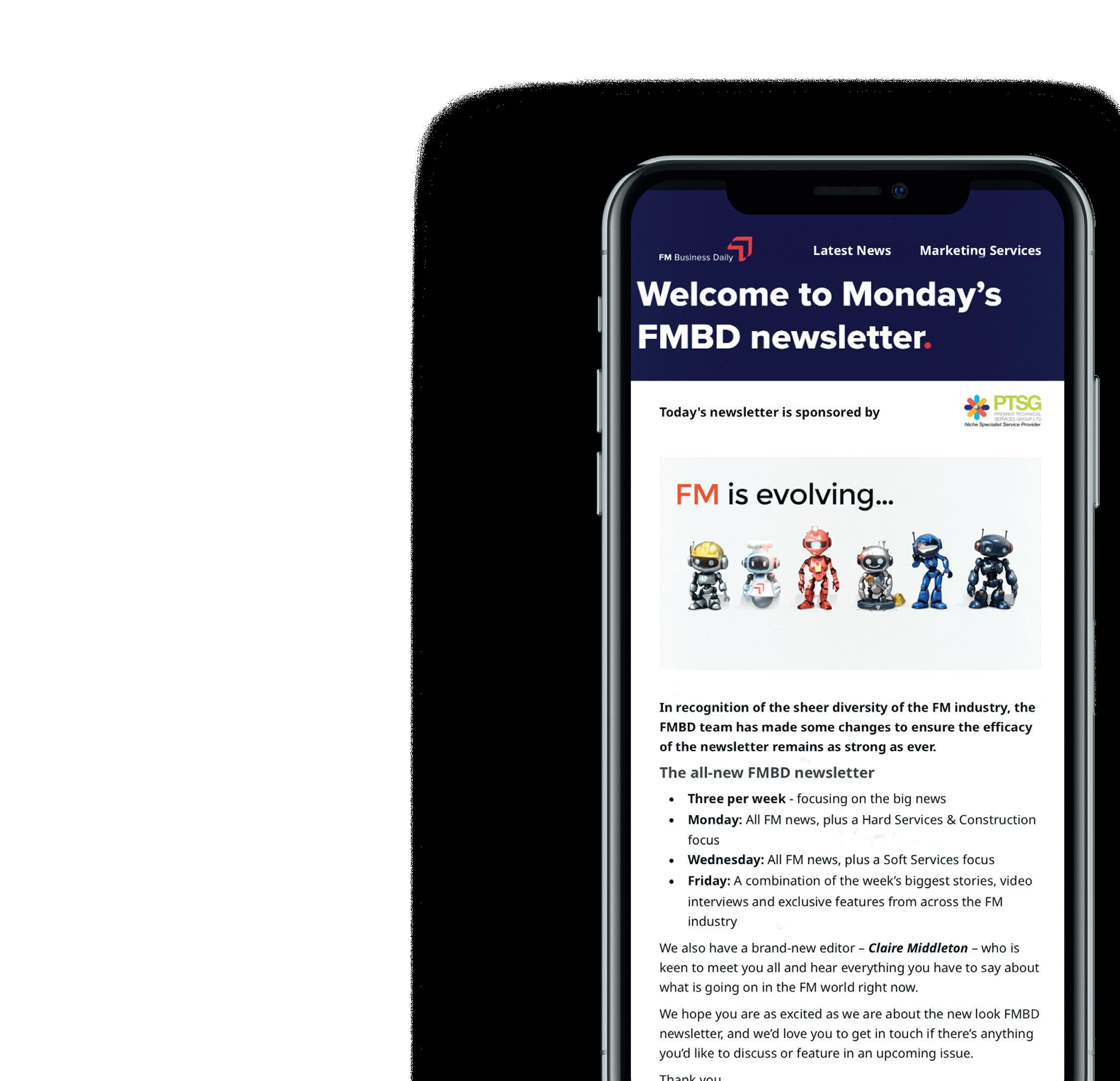
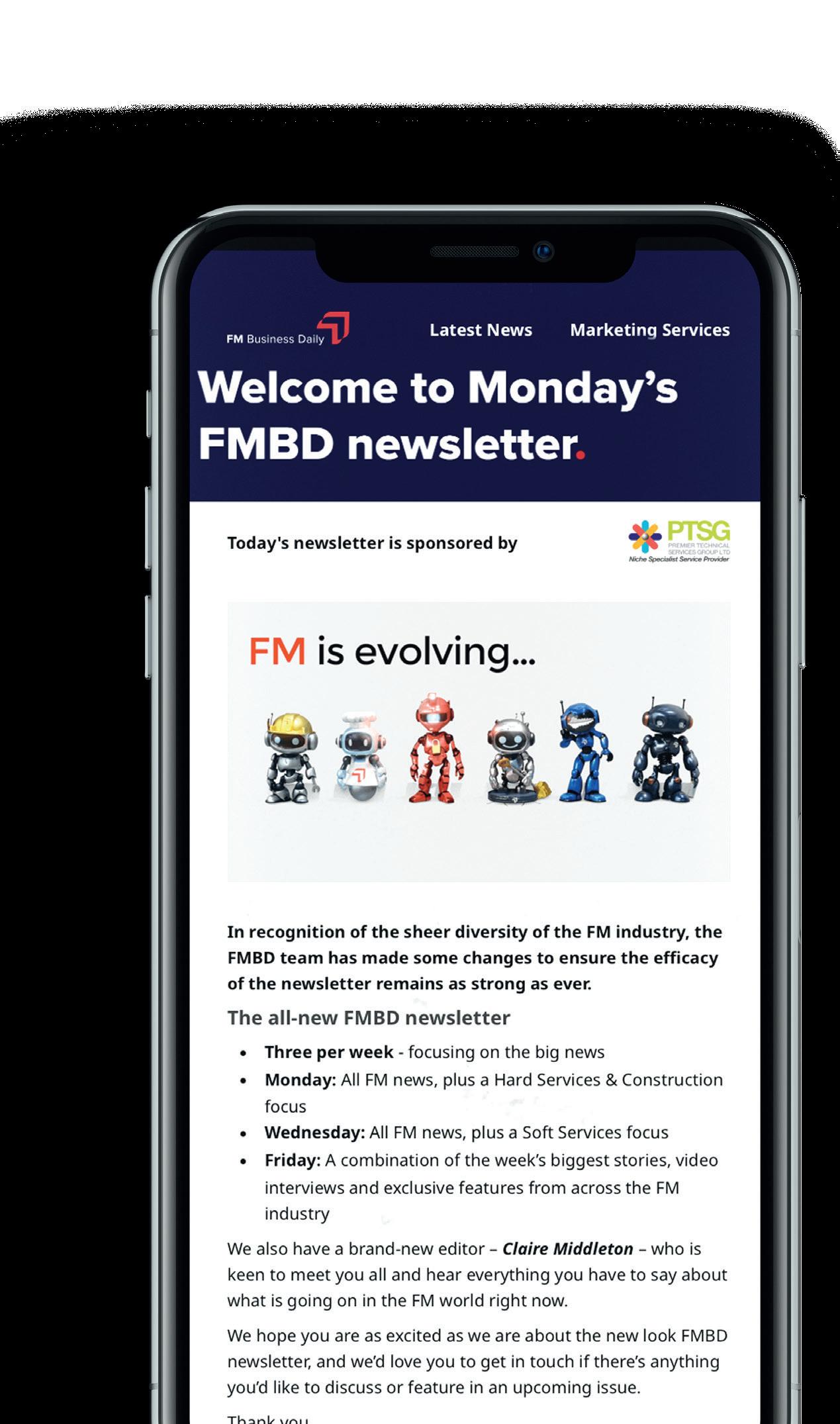
By Jeff Dewing, CEO & Founder of CloudFM Group
Today’s workplaces are in crisis. According to Gallup’s latest State of the Workplace report, 90% of UK people are disengaged at work.
The FM industry is no exception; high workload, unpredictable demand and reactive maintenance can drive stress, burnout and turnover, with poor mental health and job strain recognised as major issues for facilities professionals.
At the same time, the FM and PropTech sector is under pressure to create healthier, more engaging workplaces for everyone else, whether that is through air quality and space design to amenities, making the wellbeing of FM and PropTech professionals a critical part of the story. Across sectors, leaders need to wake up and smell the coffee: wellbeing isn’t a perk, it’s a crucial driver of employee engagement, productivity and business success. Sustainable wellbeing comes from how work is designed, led and measured every day, not from bolt-on initiatives.
Why people really leave
This year, we’re already seeing a rise in culture rot, leaders bringing back unreasonable office mandates, and a lack of employee engagement. This issue starts at the top and once it becomes toxic, trickles down into every aspect of an organisation, rotting it from the inside out. The truth, so often, is that people don’t leave a company; they leave a boss. Lack of trust, poor communication, invisible or unreasonable rules, and pressure to hit unrealistic targets can damage well-being and loyalty. If the values on the wall don’t match the behaviour in the office, then you’ve got a problem.
Leaders must recognise that psychological safety, trust and belonging are non-negotiables if you want engaged, healthy teams.
Culture you can feel, not just see Culture is not always seen, but it is always felt. It shows up momentto-moment on a site, during a helpdesk visit, or during an engineer visit. In my keynote and workshop sessions, I often liken culture to a garden – it only thrives when leaders (the gardeners) create the right soil. The key is to bring employees on that journey with you; they want to feel part of a purpose, not a means to an end.
Something I always say to my team is, “We’re not just a PropTech or maintenance company; we’re a people company.” The business thrives when the people do.
We’re already seeing a rise in culture rot, leaders bringing back unreasonable offi ce mandates, and a lack of employee engagement

“In practice, that means treating them like the adults they are. By empowering your team with autonomy, mastery and purpose, and fostering a culture where failure is recognised as a vital part of growth, you’re already on the path to building a truly high-performing workplace.
Designing work for wellbeing in FM starts with stripping out chaos. When people have clear priorities, realistic workloads and the right information at their fingertips, stress drops and quality rises. Processes, technology and data should remove friction, from smarter scheduling and predictive maintenance, through to joining up helpdesk, site and client communications, so people can focus on work that uses their skills rather than firefighting. By building in clarity, autonomy and progression into every role, wellbeing stops being an add-on and becomes a natural outcome of how the job is designed.
Wellbeing leads to good business outcomes
A culture-first, wellbeing-centred approach leads to tangible outcomes: higher engagement, better retention and improved client outcomes. I’ve seen this firsthand at Cloud, where we have an average employer Net Promoter Score of 80.
Wellbeing is a core value for us, and our culture supports mental health, with a dedicated health and well-being hub, internally appointed Wellbeing Guides, and a monthly wellbeing calendar.
We also embrace flexible, remote-first working instead of performative hybrid policies.
The truth, so often, is that people don’t leave a company; they leave a boss
This approach has led to us being awarded Gold by Investors In People for our People Strategy and Culture, successfully attracting, onboarding, engaging, developing, motivating, rewarding, and retaining colleagues.
By connecting wellbeing to everyday leadership behaviours and actions, including empathy, flexibility, transparent communication and genuine listening, you create a high-performing team that not only goes above and beyond, but is also engaged and healthy.
We need to reframe work as not just somewhere tasks get done, but as a place where people come together around a shared purpose and goal.

OCS has confirmed the appointment of Jonathan Gawthrop as Group Chief QSHE Officer at OCS Group, with responsibility for oversight across the organisation’s global operations.
Jonathan’s approach to QSHE aligns closely with OCS’s people-led culture and its mission that every person deserves the best conditions and opportunities to thrive, with safety and service at the heart of everyday business decisions.
Jonathan transitions into this group role from EMCOR UK, where he joined the business in 2011. Most recently, he served as Executive Director, Safety, Quality and Risk, overseeing safety, quality and risk across operational settings, with responsibility spanning both operational and executive levels.
Jonathan has a long and well-established career across quality, operations, safety and sustainability, with experience spanning the UK & Ireland and APAC. His background includes account, regional, managing director and executive roles, developed in customer-facing environments with international and regulatory exposure.

Independent B Corp caterer Houston & Hawkes has partnered with chef and restaurateur Nicholas Balfe. The collaboration will play a key role in the company’s commitment to British seasonality, showcasing how thoughtful, ingredient-led cooking can elevate food experiences across its operations.
Balfe, co-founder and chef director of HOLM in Somerset and a former South West representative on the BBC’s Great British Menu, will lead Best in Season, a monthly spotlight celebrating a hero British ingredient at its peak. Each instalment will explore provenance, sustainability, flavour and practical application in a professional kitchen, delivered through blogs and video features filmed at HOLM’s open kitchen.
The series will provide inspiration and practical guidance for chefs and clients across the business. Alongside the monthly series, Balfe will also offer optional seasonal development experiences at HOLM, including foraging trips, supplier visits, workshops and stages.

Corps Security, the social enterprise security specialist, strengthens its board by appointing Kathryn Fleming as Non-Executive Director (NED).
As an experienced NED and Chief Financial Officer, Fleming brings over two decades of senior financial leadership experience from complex, multi-entity organisations. She is currently the CFO of the Devonshire Group and holds an NED role at FRP Advisory, alongside being a Trustee of Hampstead Theatre.
Fleming has a proven track record of leading intricate financial strategies, modernising reporting systems, managing risks, championing data-driven decisions, and ensuring long-term stewardship of assets. Fleming builds and continuously improves financially resilient, future-fit organisations, with a particular focus on commercial finance, operational optimisation, investment oversight, and multi-stakeholder reporting. Under Fleming’s leadership, she has developed sustainable growth strategies across the legal, technology, security, retail and charity sectors.
Mark Little has been appointed as the new Chief Executive Officer of multi-award winning national commercial cleaning and FM company Cleanology.
He will be playing a pivotal role supporting the £25 million turnover company’s ambitious plans to double in size. A successful 2025 has seen Cleanology win dozens of new contracts across 11 sectors, including the company’s biggest ever mobilisation with over £2 million of new contracts mobilised in just one month.
Cleanology – which operates in 24 cities across the UK and employs over 1,000 people – has also reported several notable achievements for 2025 including:
A total of £151,000 raised in total from its five annual fundraisers for The Hygiene Bank, including nearly £15,000 generated in social value.
32.9 percent less carbon produced across its national teams as well as the development of an official sustainability committee delivering exciting projects.
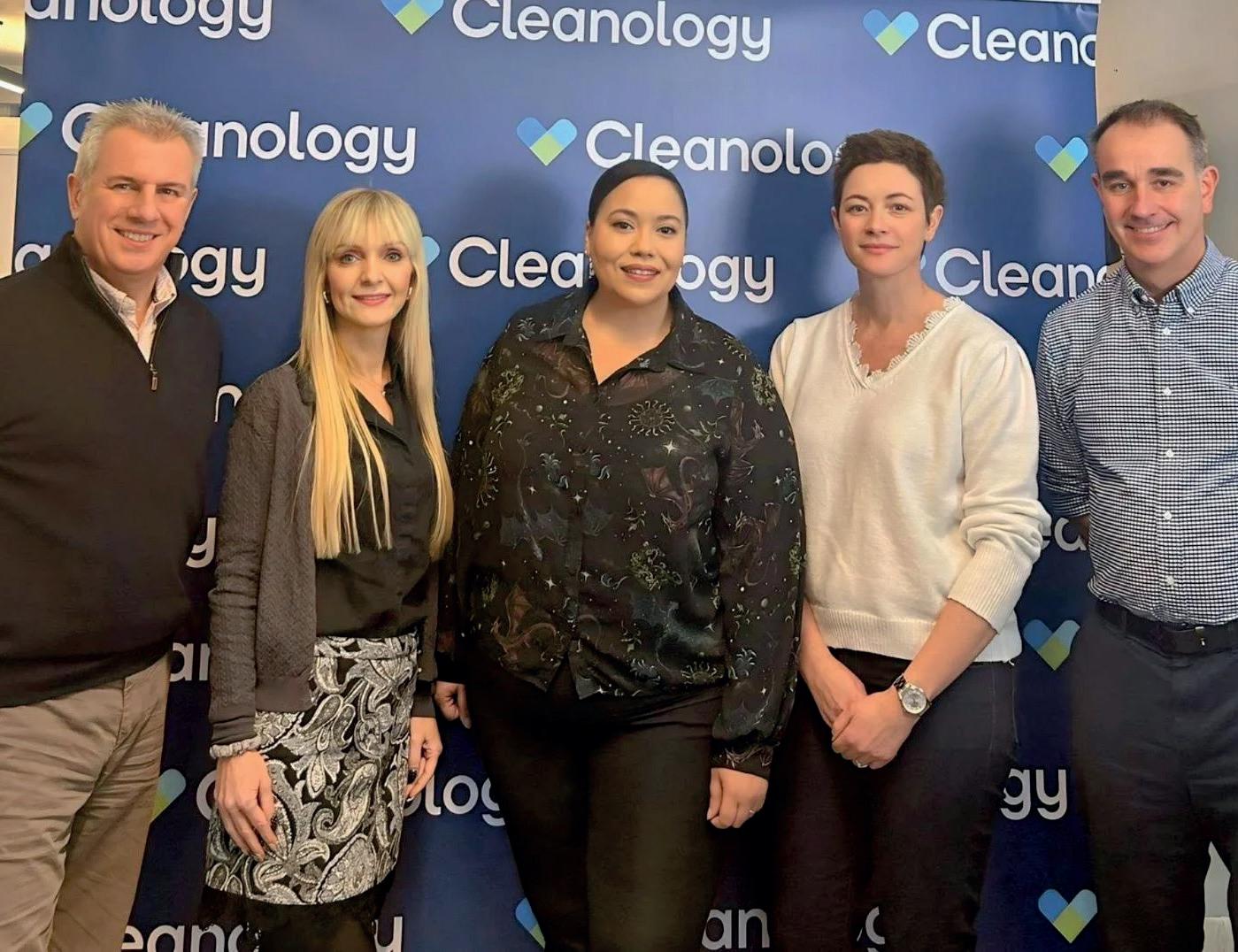
AThe launch of its new rebrand in a bold and exciting live launch marked by the projection of its vibrant new logo against iconic London landmarks.
ward-winning Swedish air handling unit (AHU) manufacturer IV Produkt has appointed two further Area Sales Managers as it continues to build a strong presence in the UK.
Ricki Horsington takes responsibility for the London & South-East region, while George Bradley covers the M62 Corridor & NorthWest. They join Darren Fereday and Adam Isherwood (Midlands), James Stafford (SouthWest England) and Peter Wilson (Scotland & North-East England).
Ricki Horsington has spent almost 14 years working with AHUs, including a previous spell with IV Produkt, gaining extensive technical experience in production and controls. He joins from ECE UK where he sold bespoke solutions, working with M&E consultants and contractors, particularly in the healthcare sector.
Prioritising fair pay, with 99% of employees receiving the Real Living Wage, a significant rise from 18% in 2017.

George Bradley has a background in architectural/modular buildings and arrives from mechanical ventilation manufacturer Nuaire, where his focus was on specification sales.
His role at IV Produkt is to build up a new sales territory via consultants and contractors.


Manuel Swärd, Export Director West Europe, said: “We have shown through the success of the ThermoCooler HP that our products are perfect for the UK market. We are always looking for new, talented salespeople to join our UK team as we drive that message home and help more customers to enjoy improved efficiencies and cost savings.
Jane Leese has joined phs Greenleaf as its Biophilic Design Consultant as the interior and exterior planting business continues to grow across the UK.
Jane has 12 years of experience in the horticulture market and has worked with some of the world’s biggest brands and multinational companies to bring ambitious biophilic designs to life.
Jane’s role at phs Greenleaf will see her deliver interior and exterior schemes from concept to installation, including multi-site customers across the UK.
“Biophilia is the concept that humans have an innate connection to nature,” explains Jane. “In commercial and public spaces, biophilic design aims to bring elements of the natural world inside because there is strong evidence that this improves health, wellbeing, performance and organisational outcomes.

“Including plants, trees, flowers and other natural materials into interior spaces serves a greater purpose than creating a nice aesthetic. It can deliver real tangible benefits, including improved productivity and reduced sick days.
Facilities management specialists, Coat Facilities Group, have announced the appointment of Robert Wollerton as its new Group Business Development Manager to drive the next phase of its ambitious growth strategy.
Co-founded by Adam Atkins and Helen Cooper, Coat Facilities Group provides industry-leading expertise across all aspects of facilities management and comprises of five individual brands: Diamond Facilities Support, Jet Through, Nationwide Roofing Repairs, Nationwide Property Clean and Sanctuary Fire & Security.

REven NASA has advocated for plants to be used in offices to help purify air.
ob Jepson has been appointed as CEO for Sodexo UK & Ireland’s Health & Care business with Philip Leigh leading on strategic projects across the region.
Before joining Sodexo Rob was group director of estates and facilities at Manchester University NHS Foundation Trust (MFT), one of the largest acute Trusts in the UK with 10 hospitals across seven separate sites and a long-standing client partner of Sodexo.
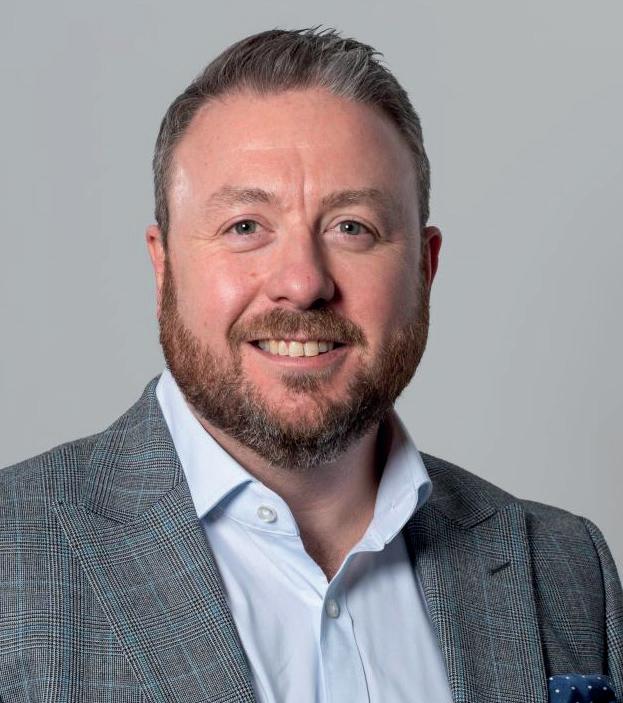
Having held multiple sales positions within the air and water hygiene sector, together with a commercial management role for specialist cleaning, sealing and maintenance firm, Hey Services Group, Robert brings a wealth of experience to Coat Facilities Group spanning 20+ years.
In joining the business, not only will Robert oversee the sales and commercial activity for each individual brand but will also play a vital role in ensuring Coat Facilities Group is established as a leading name in the Facilities Management sector, while scaling revenue by over 100% within the next 5 years alone.
Rob has extensive operational and leadership experience in facilities management across the public and private sectors. He is passionate about people development and an advocate for apprenticeships for people at all levels.
Sodexo Health & Care has a workforce of over 7,500 who every day delivers people-centred care through a balanced portfolio of food and FM services including patient nutrition, retail services, environmental care and infection prevention; technical services; facilities management, estate management, and property management; hotel services, security, and portering services.



Building Transformation simplifies building envelope repairs and maintenance through safe specialist access, technical insight and a collaborative approach. enquiries@buildingtransformation.co.uk buildingtransformation.co.uk 01234 589 807
GIND UK delivers ambitious projects in challenging environments. Our London-based engineering and design team specialises in bespoke access system maintenance for the world’s most iconic buildings. info@gind.uk www.gind.uk 0800 448 8884
For almost 30 years Julius Rutherfoord has been passionate about providing professional cleaning services to some of the most prestigious organisations in the London area. info@juliusrutherfoord.co.uk https://www.juliusrutherfoord.co.uk/ 020 7819 6700

Specialist contractor Composites Construction UK operates throughout the UK and Europe. Using innovative methods, we carry out structural strengthening and repairs to concrete, timber, and masonry structures. contact@fibrwrap-ccuk.com www.fibrwrap-ccuk.com 01482 425250
FASET is the established trade association and training body for the safety netting and temporary safety systems industry. We support members with guidance, training, and exclusive benefit schemes. enquiries@faset.org.uk www.faset.org.uk 01948 780652

Integral Cradles Ltd. delivers permanent façade access solutions across the UK, specialising in high buildings with unique specifications and demands. A whole life-cycle solution. kevin@i-cradles.com www.i-cradles.com 0845 074 2758

neutral carbon zone (NCZ) is a full-service platform that gives you the tools your company needs to make the transition to a carbon neutral business and beyond. gozero@neutralcarbonzone.com www.neutralcarbonzone.com
0845 094 5976
SAEMA has a long history in delivering the best training and guidance in the temporary and permanent suspended access industry. We are committed to advancing safety through raising the standards in best practice. info@saema.org
https://www.saema.org/ 01948 838616


Project Management Global is a media platform and community for professional project managers. Providing informative news, industry insights, career support, resources and jobs for project managers across the globe. news.pm-global.co.uk
Seddon Management Services strives to offer the best solutions for trade associations to keep their members safe and compliant. becky@managementandauditing.co.uk www.seddonmanagementservices.co.uk 07854 226251
Lemon Contact Centre is a leading contact centre for the FM industry. Leveraging 20 years’ of expertise, our 24/7 contact centre services provide unparalleled flexibility, scalability and resilience for your business. Lemoncontactcentre.co.uk 0800 612 7595

Premier Technical Services Group Ltd (PTSG) is the UK’s leading provider of specialist services to the construction and facilities management sectors. info@ptsg.co.uk
https://www.ptsg.co.uk/ +44 (0) 1977 668 771



YorPower is one of the industry’s most trusted providers of back-up power solutions (generators and UPS) for customers in a wide variety of sectors, both in the UK and around the world. sales@yorpower.com www.yorpower.com 01977 688155



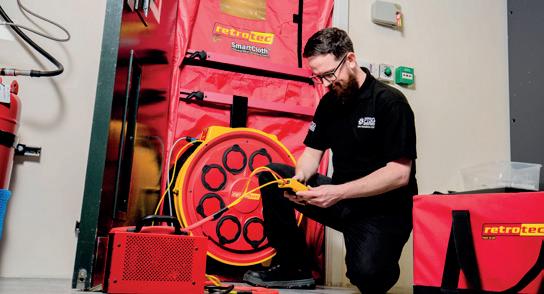

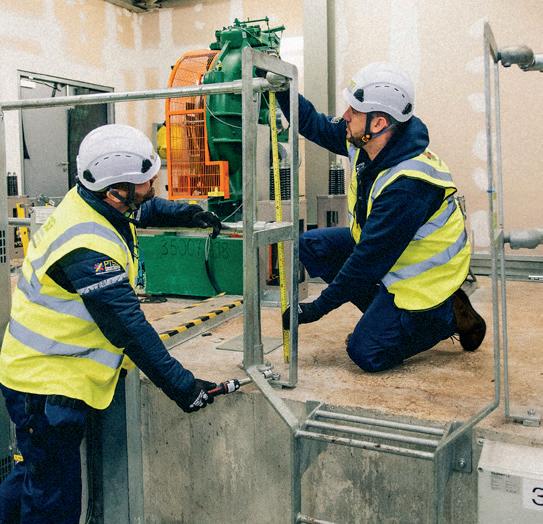
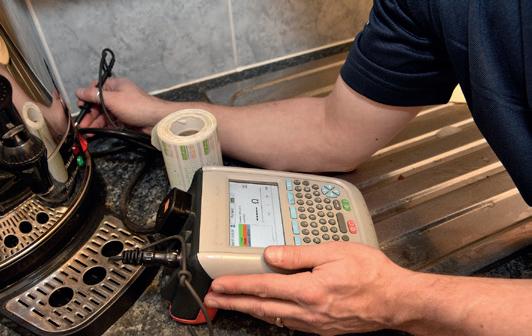

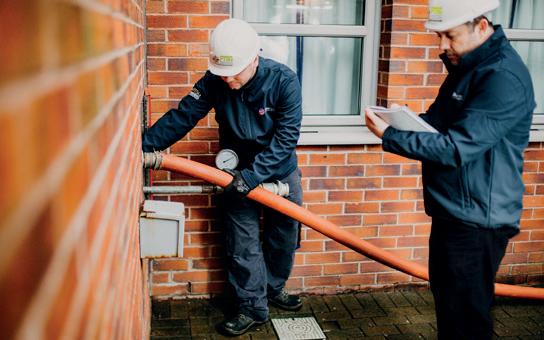
Managing multi-disciplinary building compliance shouldn’t mean managing multiple contractors. PTSG delivers integrated specialist services across five critical disciplines – Access & Safety, Electrical Services, Building Access Specialists, Fire Solutions and Water Treatment – giving you total visibility, consistent standards and single-point accountability.
Over 3,200 specialists. 90,000+ customers. 400,000+ buildings served nationwide. One partner you can rely on for complete building compliance.