While the FSA makes every reasonable attempt to ensure that the information contained in this document is accurate and current, the FSA, its officers, directors, volunteers, and authorized agents are not responsible for any errors or omissions contained therein nor are they responsible for any results obtained from the use of or reliance upon its content. All information is provided “AS IS,” with no guarantee of completeness, accuracy, timeliness or of the results obtained, and without warranty of any kind, express or implied. In no event shall FSA or its officers, directors, volunteers, or authorized agents be liable to you or anyone else for any decision made or action taken in reliance on the information con tained herein or for any for any consequential, indirect, special, or similar damages, even if advised of the possibility of such damages. The informa tion contained in this document is for informational purposes only and does not constitute professional advice. It also includes references to certa in standards that may change over time and should be interpreted only in light of particular circumstances. It is your sole responsibility to confi rm the current state of any referred to standards. FSA reserves the right to modify or update the document content and to modify this Disclaimer at any t ime, effective upon posting of an updated version of this Disclaimer.
This Fluid Sealing Association Knowledge Series training presentation introduces API Piping Plan 74. A description is provided on:
▪ What is an API Plan 74?
▪ How an API Plan 74 Works
▪ What does an API Plan 74 do?
▪ What an API Plan 74 cannot do
▪ Optional Features for an API Plan 74
▪ Cost to Operate with an API Plan 74
▪ How to Size an API Plan 74
▪ How to Install an API Plan 74
▪ General API Plan 74 Commissioning Guidelines
▪ How to Operate API Plan 74
▪ General Troubleshooting of API Plan 74
▪ Alternatives to API Plan 74
What Are Piping Plans?
▪ Piping plans collectively are different piping arrangements of fluid used to improve the conditions the mechanical seal operates in with the objective of improving the mechanical seal’s life.
▪ The American Petroleum Institute adopted numbers and created definitions for each piping plan configuration, thereby allowing a common language across the industry to simply describe a particular configuration.
▪ The American Petroleum Institute standard API-682 is where the definition of each piping plan can be found and where they may periodically be updated.
What is an API Plan 74?
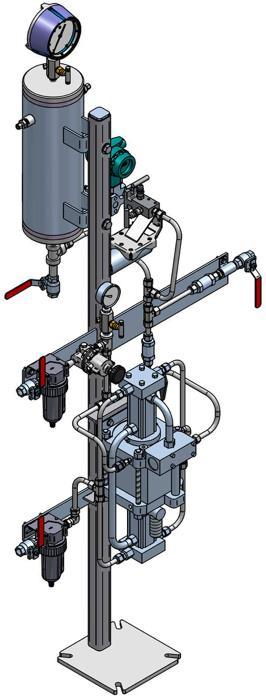
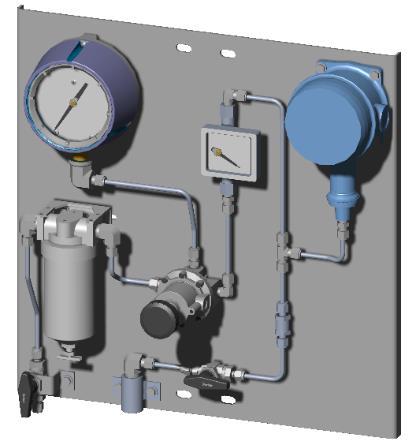
API Plan 74 delivers filtered, pressure regulated barrier gas to a dual pressurized noncontacting pump gas seal. An API Plan 74 is panel mounted and features instrumentation to monitor barrier gas pressure and flow rate.
Flow transmitter with local readout
FIT PIT
How an API Plan 74 Works
Through the shaft sealing industry, dual pressurized pump gas seals are increasingly more common. These seals feature non-contacting seal face technology adapted from centrifugal compressor gas seals and allows a sealing solution that provides zero emissions of the pumped fluid to atmosphere.
These seals work by introducing an external source of pressurized (barrier) gas between the inboard and outboard seal face pairs. Special surface topography features on the seal faces further pressurizes the barrier gas causing the seal interface to separate, resulting in the seal faces floating on a film of gas.
Barrier gas flows across this film at a low flow rate, consuming the barrier gas which appears in the form of leakage, the majority of which is leakage across the outboard seal faces to atmosphere. The balance leaks into the seal chamber and is eventually carried away in the process stream.
How an API Plan 74 Works
An API Plan 74 support system is often a panel mounted group of instruments and valves that cleans the barrier gas, regulates the outlet pressure, and measures gas pressure and flow being delivered to the mechanical seal.
Typically, nitrogen is used as the barrier gas since it is readily available, is inert, and does not create any adverse chemical reactions in the pumped fluid. Less readily available inert gases, such as argon, can also be used.
Following the flow path of the barrier gas through the API Plan 74 system:
Isolation valve – Isolates the barrier gas source from the mechanical seal to allow for maintenance or filter replacement.
Coalescing filter - A 2 to 3 micrometer (μm) coalescing filter traps liquids and particles that potentially can damage the seal face topography features that create the gas film at the seal face interface.
How an API Plan 74 Works
Pressure regulator – Regulates the gas pressure being delivered to the mechanical seal.
Flow Transmitter – The performance of the seal is monitored by barrier gas consumption rate using flow measurement. Deviations over time from the normal barrier gas consumption rate provided by the mechanical seal manufacturer indicates degrading seal performance. Local flow readout is used during routine maintenance inspections.
Pressure Transmitter – Local pressure readout is used when adjusting the pressure regulator. Alarms are set in the data acquisition system to ensure barrier gas pressure meets the minimum pressure differential above seal chamber that is required by the seal.
Check valve – Prevents back flow of process fluid in the event of loss of barrier gas pressure or an abnormal process upset.
What does an API Plan 74 do?
An API Plan 74 together with a dual pressurized non-contacting pump gas seal provides a pressurized barrier to prevent the escape of pumped fluid to the atmosphere, resulting in zero emissions of the pumped fluid to atmosphere.
An API Plan 74 delivers clean pressure regulated barrier gas to the dual pressurized non-contacting pump gas seal to allow the non-contacting features of the mechanical seal to function.
Instrumentation in an API Plan 74 provide the ability to monitor the gas pressure being delivered to the mechanical seal and can detect loss of gas supply. Flow measurement provides an indication of the health of the mechanical seal. Deviations from normal barrier gas consumption rates can give an early indication of the deterioration of seal performance.
What an API Plan 74 cannot do
During normal operation of a dual pressurized non-contacting pump gas, barrier gas is consumed and migrates into the process and to the atmosphere. There are unique and uncommon scenarios where an API Plan 74 is not suitable:
▪ Closed loop pumping systems where the accumulation of barrier gas that has been consumed into the process fluid can create problems with circulation of the pumped fluid. Typical closed loop systems can be found in heat transfer loops.
▪ Pumping systems where barrier gas that has been consumed into the process fluid can impact a chemical reaction, contaminate a catalyst, or dilute the quality of the pumped fluid.
▪ Pumps in confined spaces where barrier gas that has been consumed to the atmosphere can potentially create an oxygen deficient space around the pump.
▪ Pumps where no barrier gas source is available.
Optional Features
for an API Plan 74
Optional features for an API Plan 74 include:
▪ Instrumentation - Pressure: Analogue versus digital instruments: barrier gas pressure measurement and alarms can be achieved with analogue instruments, pressure gauge and pressure switch. These achieve a simple and low-cost option, however, lack the ability to trend measurements over time that can be achieved with a pressure transmitter with local readout providing a digital feedback to a data acquisition system.
▪ Instrumentation - Flow: Analogue versus digital instruments: barrier gas flow measurement and alarms can be achieved with an analogue flow meter, typically a low and high range variable area flow meter with a flow switch fitted to the high range flow meter. A digital variable area flow transmitter has the ability trend measurements over time, enabling early detection of seal performance deterioration.
Optional Features for an API Plan 74
▪ Instrumentation – Flow Transmitter: The simplest and most cost-effective flow transmitter type is a variable area. This type of transmitter has a dead zone between zero flow and the minimum detectable flow. In order to size a flow transmitter to measure both the normal flow and high flow alarm, the dead zone can become quite large and extend into the normal operating flow rate. To overcome this issue, a second high range flow transmitter or flow switch can be added or change the flow transmitter to a more precise device such as a thermal mass or Coriolis flow transmitter.
▪ Pressure regulator – A regulator with a locking mechanism is recommended to ensure that the control point cannot shift or be changed inadvertently.
Optional Features for an API Plan 74
▪ Filter differential pressure – Adding a differential pressure switch to the filter can be used to provide an indicator for changing the filter element.
▪ Duplex filter – Enables changing the filter element without the need to depressurize the system.
▪ Dual outlet for between bearing pumps: For pumps with a seal at each end of the shaft, a second outlet can be added to the API Plan 74 providing instrumentation that can monitor the performance of each seal independently.
Optional Features for an API Plan 74
▪ Check valve – Check valves are available with a variety of materials for their internal seals. The seal material should be selected for compatibility with the process fluid and process temperature. Non elastomeric check valves are available for high temperature fluids. A check valve with a low cracking pressure should be selected.
▪ Pressure booster - At facilities where insufficient barrier gas pressure is available, or the barrier gas pressure is unreliable, a pneumatic pressure amplifier can be used to boost high pressure barrier gas into a receiver that feeds the API Plan 74. The pneumatic pressure amplifier can be driven by either plant compressed air or the barrier gas.
Optional Features for an API Plan 74
▪ Backup barrier gas bottle rack – A bottle rack with multiple gas bottles can be incorporated into an API Plan 74 design to provide an alternate temporary source of barrier gas should the primary source fail. Using bottled gas as the primary gas source is not recommended.
▪ Weather enclosures – For facilities that experience extremes of weather environments, an API Plan 74 can be mounted in a weatherproof enclosure protecting the instruments from extremes of cold, dust, salt air, and humidity. Heaters can be added in the enclosure for cold environments. Sunshades can be added to the instruments, or the entire API Plan 74, for hot environments
Cost to Operate with an API Plan 74
Dual pressurized pump gas seals operate with a thin film of barrier gas separating the seal faces. As the faces are not in contact with each other, frictional drag is extremely low. Compared to an equivalent dual pressurized contacting wet seal, the energy loss from frictional drag that the motor needs to overcome is reduced by ~90%.
The thin film of barrier gas that separates the seal faces flows into the pump and to atmosphere. This barrier gas consumption has a cost to supply the barrier gas.
Refer to the Fluid Sealing Association’s Lifecycle Cost Calculator (LCC) for a more detailed analysis.
How to Size an API Plan 74
Sizing an API Plan 74 is determined by selecting components rated to the pressure rating of the pumping system, and selecting instruments that can measure the pressure and flow rates at the operating conditions and at the high flow alarm conditions.
Barrier gas pressure
Dual pressurized pump gas seals operate with the differential pressure between the barrier gas pressure and the seal chamber pressure above a minimum established by the seal manufacturer.
▪ Minimum barrier gas pressure = Maximum seal chamber pressure + minimum differential pressure.
▪ Maximum barrier gas pressure = As established by the seal manufacturer.
How to Size an API Plan 74
Barrier gas consumption rate
The gas consumption rate is provided by the seal manufacturer based on the pump operating conditions (seal type, shaft speed, seal size, and seal chamber pressure).
Instrument set points and alarms
▪ Pressure set point – The recommended set pressure for the pressure regulator is at or above the minimum required barrier gas pressure.
▪ Low pressure alarm point – An alarm should be triggered if the barrier gas pressure drops below the minimum barrier gas pressure.
The pressure gauge and pressure switch, or pressure transmitter, can be sized based off the barrier gas pressure set and alarm points.
How to Size an API Plan 74
Instrument set points and alarms - continued
▪ High flow alarm point – The set point for the high flow rate alarm is typically in the range of 10 to 100 times the normal barrier gas consumption rate, and it generally is not determined by the mechanical seal manufacturer but rather how much gas leakage into the pump can be tolerated.
Selecting a flow meter/transmitter that is capable of measuring flow at both the normal barrier gas consumption rate and high flow alarm rate often is challenging and may require 2 separate flow measurement devices, a low flow range and a high flow range.
How to Install an API Plan 74
The API Plan 74 valves and instruments are panel mounted. This panel should be mounted on a stand at a comfortable height to operate the valves and read the instruments.
The stand can be mounted on the pump baseplate or adjacent to the pump in a location that does not interfere with inspection and maintenance activities for the pump. Unlike liquid barrier systems, an API Plan 74 support system does not need to be immediately adjacent to the mechanical seal.
Avoid creating trip hazards with the pipe/tube that connects the API Plan 74 panel to the mechanical seal.
How to Install an API Plan 74
▪ Install ground wires to all electrical instruments, the API Plan 74 panel, and to the stand.
▪ Caution should be used where the distance between the API Plan 74 panel and mechanical seal is large. A pressure drop between the API Plan 74 panel and seal can occur in the small-bore tubing during high flow (deteriorating seal performance) events that can reduce the barrier pressure being delivered to the seal. Increasing the tube size can eliminate this concern.
General API Plan
To commission an API Plan 74:
1) Connect the API Plan 74 panel to the barrier gas source and to the mechanical seal.
2) Purge air out of the API Plan 74 panel and interconnecting piping using the barrier gas. A fitting near the mechanical seal may need to be cracked open or disconnected.
3) Pressurize the API Plan 74 system and check for leaks.
4) Purge the filter drain connection.
5) Adjust the pressure regulator to the pressure set point. Pressure must be delivered to the seal before introducing pressure or fluid into the pump casing otherwise damage to the mechanical seal will occur.
6) Complete the pump venting and commissioning procedures.
7) The seal and API Plan 74 are ready for startup.
How to Operate API Plan 74
With the pump in operation, the only maintenance item is the filter. After one month of operation, the filter element should be inspected, and if no contamination is detected, inspection should occur every six months. The filter element replacement interval will be dictated by the cleanliness of the supply gas but should be no more than three years.
The barrier gas consumption rate should be checked and recorded during routine inspections.
Small pulsations in the barrier gas flow rate are normal as they are the result of the cycle of the check valve cracking open, allowing gas to flow, and then re-seating.
General Troubleshooting of API Plan 74
Symptom Potential causes
▪ Zero flow
▪ Low flow
▪ Increasing/high flow
Barrier gas isolation valve closed
Barrier gas pressure below seal chamber pressure
Flow indicator malfunction
Pump not in operation
Filter clogged
Barrier gas pressure too low
Normal when pump not in operation
Seal performance deteriorating
Contamination of seal faces
Hang-up of seal flexible element
Leaks in interconnecting tubing
General Troubleshooting of API Plan 74
Symptom Potential causes
▪ Low Pressure
▪ High Pressure
Barrier gas isolation valve closed
Barrier gas supply pressure too low
Pressure regulator set incorrectly
Excessive seal leakage
Leaks in interconnecting tubing
Pressure regulator set incorrectly
Heat exposure / solar radiation
Alternatives to API Plan 74
Alternative piping plans that provide a pressurized barrier liquid:
Alternatives to API Plan 74
Plan 53C
Liquid filled piston accumulator charged with pump pressure
Plan 54
Pressurized fluid from an external system
API Plan 74 Summary
The combination of dual pressurized pump gas seals together with the API Plan 74 support system offer operators a shaft sealing solution that provides:
▪ Zero emissions to atmosphere
▪ Lower capital investment (compared to seals with a liquid barrier system)
▪ Lower life cycle cost
▪ A small footprint for the support system
▪ Low maintenance requirements
When installed and operated with best practices this sealing solution can deliver long term reliability and improved rotating machinery availability.