What to know about Alachua County’s persisting K-12 racial achievement gaps
SCHOOLS CONTINUE EQUITY WORK AS STRUCTURAL AND HISTORICAL BARRIERS PERSIST
By Julianna Bendeck Alligator Staff Writer
On the first day of kindergarten, teacher Caitlin Gallingane recalls stark differences among her students: Some could read full sentences, while others had never held a pencil.
While the 49-year-old now works as a clinical associate professor in UF’s College of Education, she previously taught in the early 2000s at what’s now Duval Early Learning Academy in East Gainesville.
For decades, Alachua County’s schools have faced scrutiny over stark racial achievement gaps that have proven difficult to narrow. Despite various initiatives, community members and education experts say disparities persist, — shaped by ineffective state policy,
high staff turnover and historic inequities.
Almost a decade ago, Alachua County held the state’s largest achievement gap between Black and white students, prompting the district to address those disparities with an equity plan in 2018.
The plan aimed to narrow or eliminate the achievement gap between white and Black students by 2028. It included raising the reading achievement of Black learners and participation in advanced programs.
To do this, schools in Alachua County implemented college readiness classes, credit retrieval programs and individual learning plans for students who aren’t on track to graduate.
Nearly eight years after the equity plan was introduced, those gaps remain among the largest in the state.
In 2025, Alachua County had the second-highest achievement gap statewide between white and Black students in ELA achievement and is tied for the second-
K-12, PAGE 5
UF fires second Honors leader in 4 years, raising questions about program’s future
INTERIM HONORS PROGRAM DIRECTOR WAS ISSUED
NONRENEWAL IN NOVEMBER
By Nevaeh Baker Harris Alligator Staff Writer
The UF Provost’s Office removed Melissa Johnson from her role as interim director of the UF Honors Program in November 2025. It’s the second time in just four years the university has removed an Honors leader, leaving lingering questions about the program’s future and its usefulness to participating students.
The university provided Johnson with a notice of nonrenewal Nov. 18, 2025, according to an internal email obtained by The Alligator. Kellie Roberts, a formerly retired UF professor, took over the role of acting director Jan. 16.
Leadership changes
Johnson served as interim director for three years after Honors Program Director Mark Law was fired in August 2022. At the time, UF Provost Joe Glover took responsibility for the decision and said he lost trust in Law and his vision
SPORTS/SPECIAL/CUTOUT
Speeding
Speeding cameras in school zones raise privacy concerns for Gainesville residents. Read more on pg. 2.
for the program.
Yet Law said the UF Board of Trustees, not the provost, made the decision to fire him. The termination, which he said came with no stated reason, “bitterly disappointed” him, he wrote in an email to students Aug. 15, 2022.
Law kept his position at UF as a professor in the Wertheim College of Engineering, but his salary was halved after his position loss, according to previous reporting from The Alligator. Law had been making another $240,000 a year on top of his salary as a professor.
Law declined to comment on his firing and the honors program for this story.
Johnson's departure from the interim director role also came with a salary decrease of more than 25%. She was earning over $161,000 as of Fall 2025, according to publicly available UF salary data. Her salary was reduced to $120,000 after her removal from the Honors Program, according to the obtained emails.
It’s unclear whether Johnson is still a UF employee following her removal from the Honors role. She is not registered to teach any classes in Spring 2026 or Fall 2026. The memo did not provide a reason for Johnson’s
removal.
Johnson did not respond to multiple requests for comment via phone call, text message, email and a letter left at her home address.
In the memo, Interim Associate Provost Matthew Jacobs told Johnson her final day of employment with the university would be Dec. 31, 2026, and that her position would become 100% remote in her final year.
Johnson began as an adviser with UF Honors in 2005 and maintained a hands-on presence with the program throughout her three years as interim director. Johnson sent a weekly “Honors on Wednesday” email, taught classes ranging from professional development to a lyrical analysis of Jimmy Buffett and hosted Honors on Thursday, or “H.O.T.,” coffee chats with students.
In a LinkedIn post Jan. 14, 2025, Johnson wrote she jokingly refers to her time as interim as “my term as the fake director.”
“20 years is a long time, right?” she wrote of her years at UF. “Never imagined I would be here this long - and who knows how long it will last. I get regular inquiries from search firms about open honors positions - some I
entertain, and others I do not (always nice to be contacted though - validation that someone out there values my experience). But for now, we're pushing onward to year 21…” In another post, dated Aug. 21, 2025, she called the first day of Fall classes her fourth “& final” as interim director.
UF spokesperson Cynthia Roldán said the university does not comment on personnel matters in a statement to The Alligator. Kellie Roberts, the current acting director of the honors program as of January, clarified in an email that she’s helping the program with day-to-day activities until a permanent director is appointed, “likely within the next six months or so,” she wrote. Roberts wrote she has no plans to become the permanent director of the program.
‘Don’t really see the benefits’ The UF Honors program is structured in two parts: the First-Year Honors Program — for incoming freshmen — and the University Honors Program, for current UF students. Any honors student can receive tailored
Published by Campus Communications, Inc. of Gainesville, Florida
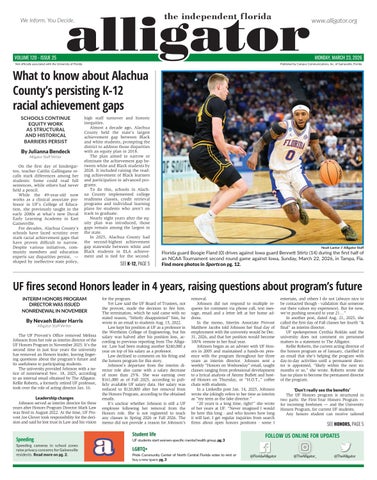
Noah Lantor // Alligator Staff
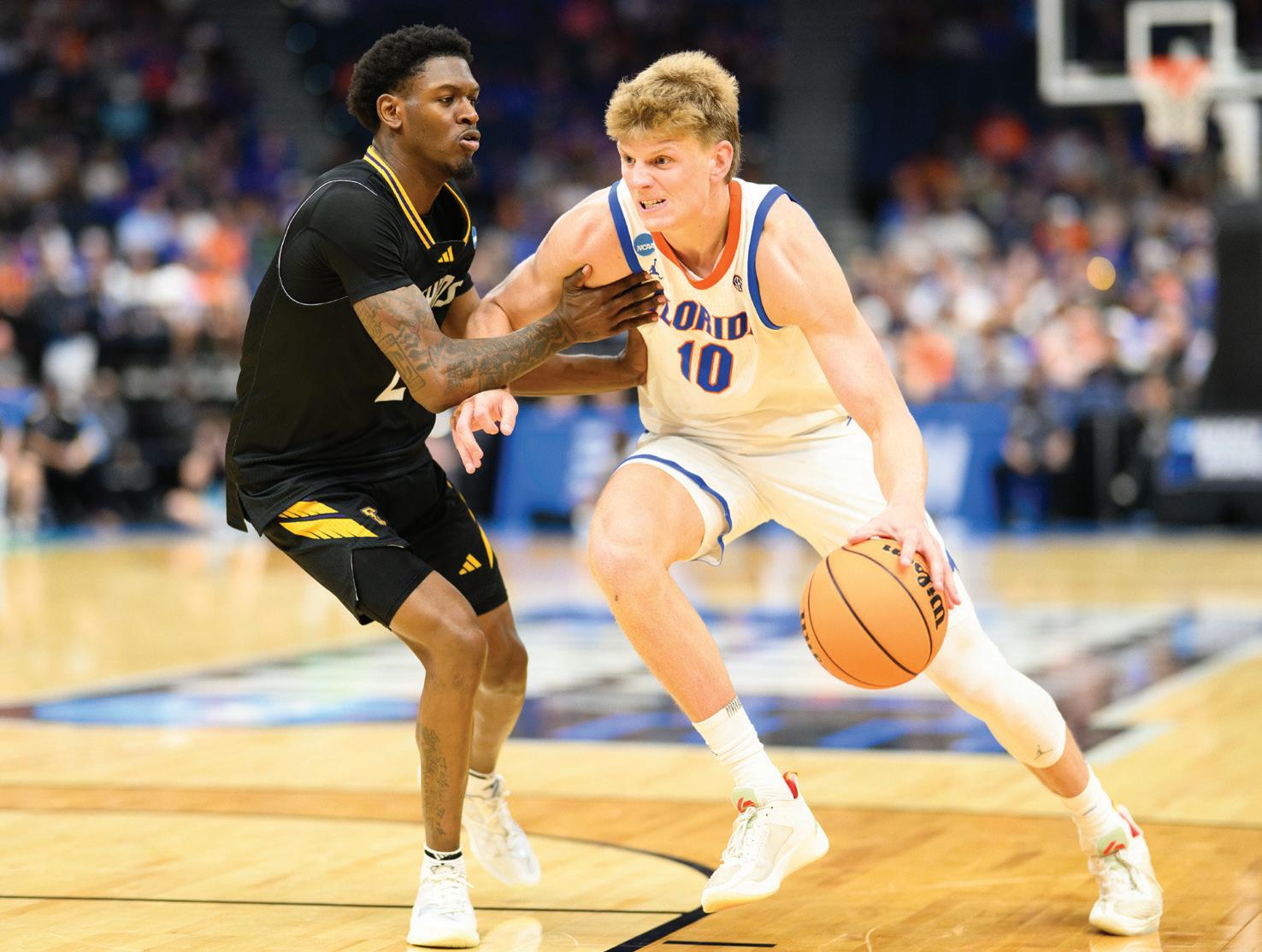
Florida guard Boogie Fland (0) drives against Iowa guard Bennett Stirtz (14) during the first half of an NCAA Tournament second round game against Iowa, Sunday, March 22, 2026, in Tampa, Fla. Find more photos in Sportson pg. 12.
Today’s Weather
Speeding cameras to be installed in Gainesville school zones
GAINESVILLE AND ALACHUA COUNTY CHOSE DIFFERENT CAMERA VENDORS TO MONITOR 5 SCHOOLS
Drivers passing through four Gainesville school zones will soon be monitored with speeding cameras.
The Florida Legislature legalized speeding cameras in school zones in 2023. Since then, law enforcement agencies across the state have partnered with a variety of companies to install and manage the cameras, including RedSpeed USA and Altumint.
Speeding cameras have faced scrutiny for false ticketing in cities like Cape Coral, and critics accuse the cameras of serving as a new revenue stream for counties rather than a safety measure.
Amid uncertainty, the Gainesville Police Department and Alachua County Sheriff’s Office chose different companies. GPD opted for RedSpeed USA, while ACSO chose Altumint because of recommendations from other Florida law enforcement agencies.
Gainesville Police Department: RedSpeed
The speeding cameras in Gainesville will scan license plates of vehicles passing through school zones and report speeding violations to GPD.
Talbot Elementary School and Lincoln Middle School will see the first camera implementation, though the exact date they’ll begin being used is unclear, said Art Forgey, GPD’s public information officer. The locations were chosen based on historical traffic data gathered from the GPD traffic unit. Once the cameras are installed, Forgey said, they will turn on 30 minutes before the school day
starts and turn off 30 minutes after the school day ends.
RedSpeed cameras use Automated License Plate Readers from Flock Safety, a private technology provider controversial for privacy concerns. The cameras scan license plates of vehicles going at least 10 miles over the speed limit.
Once a violation is recorded, RedSpeed will send the license plate number, make and model of the vehicle to GPD to verify.
A GPD infraction enforcement officer will review and confirm the violation before mailing a $100 ticket to the vehicle owner, Forgey said.
“The speed detection is verified with each vehicle, and there’s a picture that goes with it,” Forgey said. “If you’re speeding, you’re speeding.”
Florida law requires a 30-day grace period after the camera’s implementation. During that time, drivers won’t receive a ticket for speeding but will be sent a warning from GPD. The department is required to conduct a public awareness campaign during the period to ensure drivers know about the cameras.
The cameras cost nothing to taxpayers, Forgey said. RedSpeed USA will get a portion of each fine, and the rest will be distributed between the county, the Florida Department of Revenue, the school district and school crossing guards, according to Florida law.
GPD will monitor the cameras’ impact over time, tracking any changes in speeding violations. If the cameras slow people down, Forgey said, the department hopes to install them in every Gainesville school zone.
“We hope that it just slows everyone down,” Forgey said. “That’s the whole target of this.”
Alachua County Sheriff’s Office: Altumint
ACSO chose a different camera vendor for other schools within Gainesville.
ACSO plans to add speeding cameras outside Kanapaha Middle School, Kimball Wiles Elementary School and Lawton M. Chiles Elementary in early April.
The program will eventually expand to all schools in Alachua County.
The sheriff’s office chose Altumint as a camera vendor. Other law enforcement agencies spoke highly of the company, according to Capt. Chris Sims, ACSO’s public information officer.
ACSO will have two trained civilians confirming each citation and sending tickets to violators. Violations aren’t added to driving records, so getting ticketed won’t affect car insurance if tickets are paid on time, Sims said.
“This isn’t about building revenue,” Sims said. “This is about ensuring that people slow down.”
Jason Norton, Altumint’s chief revenue officer, said the company’s speeding cameras are different from RedSpeed’s because they don’t use Flock’s Automated License Plate Reader technology.
Altumint’s cameras only capture a license plate if the vehicle is speeding more than 10 miles over the speed limit, he said. A RedSpeed ALPR camera can document every license plate that passes by.
“Even in a school zone, you could be going 25 in a 15 … but I can’t capture that plate,” Norton said. “ALPR can capture that plate.”
Documenting every license plate passing by raises a few concerns about remote surveillance, according to UF law professor Derek Bambauer.
Under Florida law, speed cameras in a school zone can’t be used for remote surveillance, and data recorded on a speeding camera can only be used to document speeding violations or incidents that happen in the footage.
The term “remote surveillance” isn’t strictly defined in the statute, but if RedSpeed’s ALPR cameras store data collected outside school hours or use it for purposes other than ticketing, the cameras could be practicing remote surveillance, Bambauer said.
“The concerns here are less about the cameras themselves and are more about the underlying policy questions,” Bambauer said. “Do we want local law enforcement using data that they’re gathering for purposes other than just enforcing the 20 miles an hour in school zones?”
RedSpeed USA didn’t respond to multiple requests for comment, and it’s unclear whether the speeding cameras are capturing data 24/7.
The Alligator strives to be accurate and clear in its news reports and editorials. If you find an error, please call our newsroom at 352-376-4458 or email editor@alligator.org 352-376-4458
Noah Lantor // Alligator Staff
A speed camera on Northwest 43rd Street outside William S. Talbot Elementary School, Saturday, March 21, 2026, in Gainesville, Fla.
UF students celebrate ‘women supporting women’ through new mental health group
UF WOMEN’S MENTAL HEALTH ALLIANCE FOSTERS A SAFE ON-CAMPUS COMMUNITY FOR FEMALE STUDENTS
By Alabama Weninegar Alligator Staff Writer
Mental health resources are a growing need for college students — especially women. According to the Healthy Minds Network’s data interface, a little more than one in three female college students suffered from anxiety in 2025, compared to a little under one in four male students.
Liel Shachr, a 22-year-old UF natural resource conservation senior, has experienced those struggles firsthand.
Shachr looked for support groups relating to anxiety, depression and OCD through UF’s Counseling and Wellness Center while she was battling her own mental health issues, she said. But none of the universityled groups fit her schedule, and she couldn’t find any student-led alternatives. So, she decided to start her own.
In September 2025, Shachr and four other students formed UF’s first women student-led support group: the Women’s Mental
Health Alliance.
Shachr said she started the club in hopes of creating a space for women to connect, encourage each other and be themselves.
“I haven’t had a perfect four years here,” she said. “I thought by starting this, I could maybe help future generations of students have a community.”
The alliance offers free mental health support groups in five categories: eating disorders, OCD, abusive relationships, anxiety and depression. Meetings are held biweekly and are open to any female UF students.
Each group is led by an officer who has personal experience with the specific mental health challenges discussed in that group. During each meeting, students are encouraged to discuss their experiences.
One of the most important aspects of the club’s identity is that it is women-only, Shachr said. Creating a safe space for women to share their feelings is an environment she said couldn’t have been facilitated in a mixed-gender room.
The group often talks about topics that directly affect women, such as menstruation, which she said men do not experience and might not understand. Having a women-only club also ensures members’ feelings are taken seriously, Shachr said.
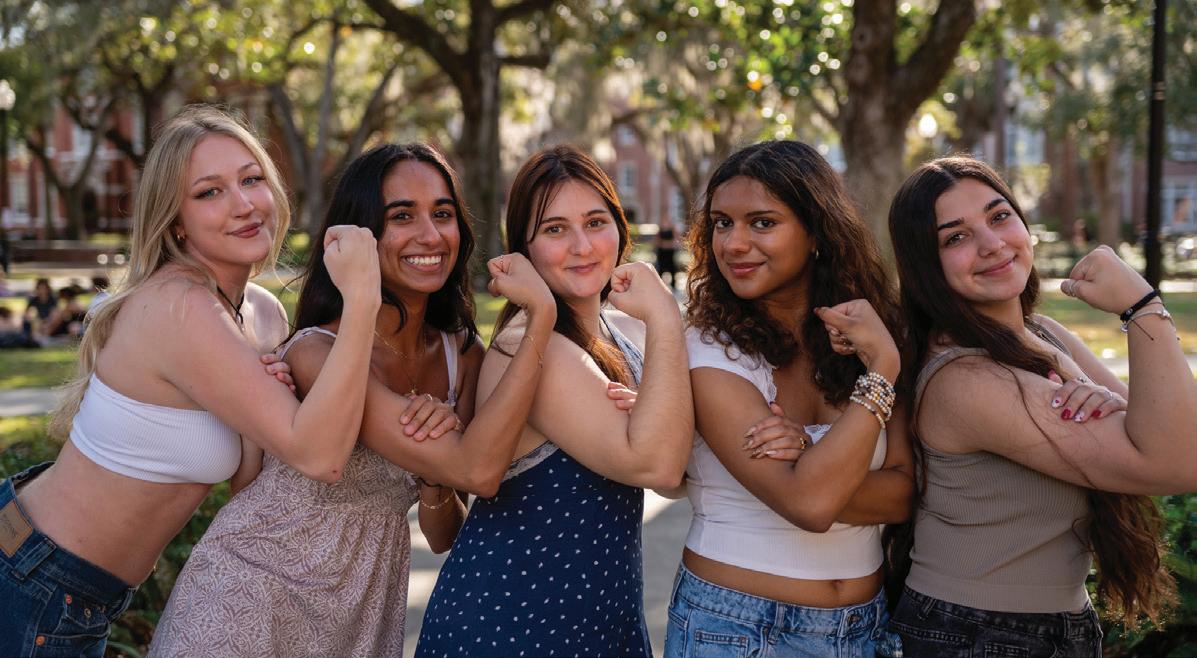
The Women’s Mental Health Alliance meets up on Plaza of the Americas in Gainesville, Fla., Thursday, March 5, 2026.
While the team doesn’t offer professional support, Shachr said it offers other women company and understanding.
Jamie Primosch, a 44-year-old psychiatric physician assistant at Healthy Mind Florida and UF alumna, said peer support groups complement what people learn in individual therapy.
“It provides a safe place for students to practice the skills, the tools that they’re gaining in therapy,” she said.
Primosch said mental health con-
Pride Center in transition after closure of the
BOARD MEMBERS MOVED FORWARD WITH $525,000 BUILDING OFFER DESPITE FINANCIAL CONCERNS
By Alabama Weninegar Alligator Staff Writer
The Pride Community Center of North Central Florida voted March 20 to rent or buy a new space after the closure of the Gainesville Community Counseling Center.
The pride center’s board voted in favor of the motion to offer $525,000, with a down payment of $200,000, on a building for sale at 1204 NW 10th Ave. The board made the decision on the basis that the center would have a 30-day inspection period, during which the board isn’t obligated to purchase the property if the center decides it cannot afford the building.
The Pride Community Center is a nonprofit organization committed to fostering safe environments for LGBTQ+ members,
according to its website. The center serves counties near Gainesville at its current location and offers spaces and support for LGBTQ+ groups, ranging from youth groups to senior groups.
The pride center has subleased with GCCC since 2023 and is expected to move out by the end of April.
Commercial inspection costs are estimated at $3,550, according to Zach Bongiovanni, PCCNCF assistant vice president and volunteer coordinator.
An anonymous donation of $50,000 would be allocated toward the building’s down payment, Bongiovanni said.
The building’s owners offered the pride center a 24-month initial owner-financed loan with a 7% interest rate.
Board members discussed the risks of moving forward with the offer. There were conflicting opinions between the board and community members.
At the meeting, Bongiovanni advocated
ditions like OCD, anxiety and depression can lead to “social withdrawal” and feelings of isolation.
Being engaged in a peer group, like the Women’s Mental Health Alliance, can create a safe community to discuss issues that disproportionately affect women, such as gender discrimination and disordered eating, she said.
Each year, one in five women in the U.S. experiences mental health issues, such as depression, PTSD or an eating disorder, according to the American Psychiatric Association.
Women are more likely to seek help than their male peers, with a little over 71% of female college students receiving professional guidance compared to about 60% of male college students in 2025.
Melanie Murrillo, a 26-year-old UF alumna and licensed mental health counselor at Sage Wellness, said she’s noticed the difference between genders. Murillo works with college students and said she sees more female students in her practice than males.
Murillo, who specializes in teens experiencing depression, trauma, OCD and anxiety, said a womenonly support group can provide a supportive framework that encourages women to gradually open up about vulnerable experiences, similar to the process used in exposure therapy.
“Women students at UF campus, there probably is a lot of similarities and experiences,” she said. “The kind of comfort that can provide — to just know that you’re not alone, that you aren’t abnormal.”
Read the rest online at alligator.org.
@AlabamaW40513 aweninegar@alligator.org
Gainesville Community Counseling Center
for moving forward in the vote because he said the building is located in a great location and is spacious. He also said the 30-day inspection period would allow the center to gather quotes for property insurance and utilities, giving the board time to consider all the facts available and explore other options, like leasing.
Dex Lewis, the pride center’s vice president, agreed with the convenience of the building’s location.
“It would have very high visibility,” they said, “which is something we haven’t had in a really long time, or maybe ever.”
Other board members argued the pride center cannot afford a down payment on the new building before fundraising.
Florida Sun, the pride center’s assistant treasurer, voted against the motion to make an offer. Sun said their decision was mostly based on finances.
“I need to see more concrete numbers and actual answers before I can vote yes,”
they said.
Aldo Garza, the pride center’s president, expressed concern about the board’s infrastructure — and described the members as “very young.” Garza also said he would rather the center take more time in making this decision.
“Why can’t we wait a year and hopefully more real estate will come up, and our infrastructure is correct and we have a capital campaign?” Garza said.
Dozens of community members gathered at the meeting to express their concerns. Jan Zumbrun, a 74-year-old member of the Pride Community Center Senior Group, said she recommended that the board vote to make an offer on the building. Zumbrun said she understood the board’s hesitation.
Read the rest online at alligator.org.
@AlabamaW40513
aweninegar@alligator.org
Matthew Quesada // Alligator Staff
Why do Florida lawmakers retry bills they know won’t pass?
ONE REPRESENTATIVE’S ABORTION ACCESS BILL OFFERS A HINT TO UNDERSTANDING RETRIED LEGISLATION
By Alexa Ryan Alligator Staff Writer
When it comes to introducing legislation, many Florida lawmakers know the third time — or sometimes even the fourth or fifth — can be the charm.
Former state Sen. Nan Rich, D-Broward, proposed one bill three times before it passed in 2007. Though it changed slightly over the years, the final version allowed foster children to remain on Medicaid until the age of 21.
“You have to have stamina,” said Rich, who left the Legislature in 2012 and now works in local government.
The key to her success was collaborating with other legislators on both sides of the aisle, she said, but it’s also about tenacity and determination.
“It’s such a wonderful thing to be able to, and exciting to be able to say, we did it,” she said about finally passing the bill. “We did it all together.”
Over a decade later, Florida Rep. Fentrice Driskell, D-Tampa, is trying to replicate this success for a bill to expand abortion access. She
introduced the same bill to the Legislature three times — in 2024, 2025 and 2026.
The bill would “establish the fundamental right to reproductive health care” by prohibiting the government from blocking access to abortion procedures.
This session, the bill died in the House Health Professions & Programs subcommittee.
Bills can die in committees when opposing legislators refuse to act on the measures or push to not have them heard, until it’s too late for the bills to pass. However, experts say reintroducing legislation often results in certain parts of the bill being adopted into larger initiatives that eventually do make their way to the governor’s office.
This legislative tactic has been used for decades, and it’s often unsuccessful, but Driskell said she will not stop until this bill is passed.
“It’s important to continue the fight for reproductive freedom and bodily autonomy,” she said, adding the government should not have a role in these decisions.
Driskell said she doesn’t think the bill will pass with the current Legislature, but she will continue to file it every year. Even if the bill never reaches the governor’s desk, Driskell said introducing it still serves a purpose.
“It would be great to get this bill signed into law,” she said. “But I also recognize that it is a tool that allows us to have important conversations that are worth having.”
Democrats hold a minority in the Florida House and Senate — making largely partisan issues supported by the Democratic Party, like abortion access, difficult to pass.
Another bill Driskell’s been fighting for since her first year in office is aimed at protecting students from discrimination in school based on their hair styles. It’s been introduced four times but never passed.
Driskell said the experience has taught her legislative momentum can come unexpectedly.
“We also just have to remember that some fights are worth fighting no matter the outcome,” she said.
Repeatedly introducing legislation is common in lawmaking, said Alan Wiseman, the codirector for the Center for Effective Lawmaking at Vanderbilt University.
The success of the tactic really depends on the bill sponsor, how much they care about the issue and why they are using the tactic, he added.
Based on an analysis of the U.S. House of Representatives from 1973 to 2008, Wiseman said lawmakers who continuously introduced similar bills year after year were more likely to see parts of those proposals eventually move through the legislative process.
Over time, bill sponsors can build support among colleagues and incorporate elements of their proposals into larger legislative initiatives.
“By plugging ahead and continuously trying
to cultivate different coalitions across congresses, they ultimately are able to achieve their goals of moving their legislation,” Wiseman said. He said two main factors can cause a bill to succeed after repeated failures: coalition-building among lawmakers and increased awareness of the issue.
As legislators become more familiar with a topic or as external events draw attention to it, opinions within the Legislature might shift.
Adam Zelizer, an assistant professor at the University of Chicago’s Harris School of Public Policy, said repeated bill filings can also function as a political strategy.
With highly visible issues such as abortion access, Zelizer said legislators often already know where their colleagues stand.
In these cases, repeatedly filing a bill can force opponents to publicly vote against it, a record lawmakers can point to during election campaigns.
“I would imagine just refiling it over and over is an electoral tactic to try to make the legislators who oppose it come out on record and oppose it,” he said.
Lawmakers can then show voters they attempted to pass legislation but were blocked by political opponents — a tactic Zelizer described as an “electoral strategy” rather than a genuine effort to appeal to fellow lawmakers.
@AlexaRyan_ aryan@alligator.org
UF researchers build AI system to bring mobile clinics to doctor-starved rural areas
Technology could guide nonspecialists through blood tests and diagnostics
By Swasthi Maharaj Alligator Staff Writer
Nearly 92% of rural counties in the U.S. lack enough primary care physicians needed to serve their populations, leaving some communities without a single doctor.
In Florida, 23 counties qualify as “rural,” according to a study from The Commonwealth Fund using 2023 data. At least part of every rural county was designated a health professional shortage area — and in 12 of them, the entire county received that designation.
Researchers at UF believe artificial intelligence could help close the gap.
One year into a federally funded research initiative, UF scientists say they have developed an AI system that can guide nonspecialists through basic medical tests — a step toward creating mobile clinics capable of delivering hospital-level care in remote areas.
The program, called the Platform Accelerating Rural Access to Distributed and Integrated Medical Care, or PARADIGM, aims to build a fleet of mobile medical units equipped with diagnostic tools and AI systems designed to assist patients, social workers and community health staff.
But before those clinics can reach rural communities, researchers must solve several challenges, including limited computing power inside the vehicles, unreliable internet connections and strict privacy regulations governing medical data.
A growing rural care gap
Rural physician shortages have intensified in recent years.
Federal workforce data show rural areas average one physician for every 2,881 residents, and roughly 20 counties have no primary doctor at all.
Those shortages often force patients to travel long distances or delay
care altogether.
Urban areas have nearly three times as many physicians per capita as rural communities, according to national research.
Alachua County, which is not considered rural, doesn’t face the same shortage and has the highest ratio of physicians to residents in Florida. Local workforce data show roughly 730 physicians for every 100,000 residents.
But the same can’t be said for surrounding rural counties like Levy, which has about 26 physicians for every 100,000 residents, and Gilchrist, which has 30.
Training AI to guide medical procedures
UF researchers and their partners are developing an AI platform trained to recognize medical terminology, lab procedures and images.
The system aims to guide nonspecialists through tests that normally require trained clinicians.
“We were able to deliver an AI system that can automatically instruct family members or social workers to perform [a] blood draw on the chemical analyzer,” said Yonghui Wu, a lead researcher on the UF team.
The system builds on GatorTron, UF’s clinical language model, expanding it into a multimodal system capable of processing both medical language and visual data.
“So we can instruct the patients,” Wu said. “If they have questions, they can ask the AI.”
The program receives funding from the Advanced Research Projects Agency for Health, a federal agency that supports high-risk biomedical research. Wu declined to disclose the project’s total funding.
Over the past year, researchers trained the system using simulated procedures, including artificial arms with embedded vessels. The team
has since incorporated clinical data from Mayo Clinic’s Jacksonville campus.
Building the mobile clinic
While the AI software has advanced quickly, partner institutions like California-based research center SRI and Mayo Clinic Jacksonville continue building the project’s physical infrastructure.
Five teams are responsible for developing different components, including compact CT scanners, ultrasound devices and the mobile clinic vehicle itself.
Wu said hardware development takes longer than software development, and integrating all components will take several years.
Under the current timeline, researchers expect to complete system integration in four years. Clinical testing would begin in rural regions — including sites in Utah — in the fifth year.
The mobile units have limited electrical capacity, which may prevent the largest AI models from running at full capacity. Lighting conditions inside the vehicles could also affect camera accuracy if they differ from the data used to train the system.
To address those limitations, the team is considering satellite-based connections that would allow more powerful AI models to run remotely in the cloud.
But reliable internet access remains inconsistent in many rural areas.
Regulatory hurdles
AI-based medical technologies are typically regulated as medical devices by the U.S. Food and Drug Administration, which evaluates their safety and effectiveness before clinical deployment. This means the technology would have undergone a formal assessment process to ensure
it meets safety and quality standards and is not a source of risk to patients or users.
Wu said the PARADIGM system will follow the same regulatory pathway.
Researchers say the goal is to expand access to care, not replace health care workers.
“What happens is not AI replacing people,” Wu said. “It’s people who are good at using AI replacing people who don’t use AI.”
Researchers expect that process to begin after the project’s prototype phase.
Patient privacy and development limitations
While researchers say the project is advancing well, they said there remained several challenges that arose during the process, especially concerning protection of patient privacy.
“You cannot provide patient information to commercial models,” said Mengxian Lyu, a doctoral researcher on the project developing a companion system that focuses on language and clinical decision support for health care workers.
Federal regulations such as the Health Insurance Portability and Accountability Act, or HIPAA, restrict how medical data can be shared or stored.
Those restrictions can limit the amount of clinical data researchers can use to train advanced AI systems.
The model links medical images and text with natural-language guidance, Lyu said, allowing clinicians to confirm which steps are necessary for a procedure.
However, deploying these tools in a mobile environment requires balancing computing power with strict privacy protections.
Another challenge that came up, Lyu said, was the training of the AI system. Researchers are currently working with health care providers
to expand the system’s knowledge base.
“With only limited knowledge,” Lyu said, “we cannot build a very powerful AI system.”
Lyu said “using an AI system to assist, we build an AI system” after collecting data from health care providers.
This creates what Lyu called a “loop.” Once the first model exists, the AI then helps speed up the training process and the cycle continues.
“We try to train the AI to help us further view the AI,” Lyu said.
Testing the concept in real clinics
For community health workers who already operate mobile clinics, the technology could expand what nonspecialists can do in the field.
Mya Maybank, a 21-year-old UF public health graduate student, works as a community health worker with UF Street Medicine and Mobile Outreach Clinic.
The clinic provides rapid hepatitis C testing for residents experiencing homelessness in Gainesville, including outreach at encampments and GRACE Marketplace.
Workers conduct initial screenings and then connect patients who test positive with treatment.
Maybank said most workers don’t have medical backgrounds, which limits the procedures they can perform.
Some equipment requires training from medical professionals, and only a small number of staff receive that instruction.
She said an AI system capable of guiding workers through technical steps could make mobile clinics more efficient. Still, she said AI should remain a support tool rather than replace health care workers.
@s_maharaj1611 smaharaj@alligator.org
highest in math, according to the most recent data from the Florida Department of Education. The data was measured from mandatory state exams.
Learning disparities start young
During Gallingane’s final year teaching at Duval in 2004, two kindergarten classes swelled to nearly 28 students each for two weeks until the district hired another teacher — far above the Florida class size maximum of 18 for pre-K through third grade classes.
Many of her students, she said, had never attended preK.
“Not only are you trying to teach them, starting on day one, academics, but you are also teaching them how to be at school,” Gallingane said.
In Florida, where pre-K is voluntary and hours-based, the quality and accessibility of its program may present challenges to working parents. Although free pre-K programs started in Florida in fall 2005, funding has historically lagged behind other states.
Gallingane said her class at the East Gainesville school was mostly Black, and many families faced economic hardship. She recalls students not having access to school supplies or needing health screenings at school.
About 70% of the school’s students were Black as of the 2024-25 school year, according to the National Center for Education Statistics.
“There were things that presented challenges to my kids that I had never even considered before,” she said. “It was very humbling.”
East Gainesville is home to several predominantly Black neighborhoods and faces higher rates of poverty compared to the west, a disparity often linked to historic housing segregation, redlining and uneven investment in infrastructure and economic opportunities.
Researchers say those structural factors often shape the educational resources available to children long before they enter a classroom.
Susan B. Neuman, a childhood and early literacy professor at New York University who previously served as assistant secretary in the U.S. Department of Education, said poverty is one of the strongest predictors of student success.
According to Neuman, poverty affects learning in many ways, including food insecurity and housing instability.
“It’s not just money — it’s books, opportunities for children to be read to,” she said. “Some of the benefits we expect children to get in those very early years.”
Steven Barnett, the founder of the National Institute for Early Education Research at Rutgers University, said Florida’s Voluntary Prekindergarten Education Program, or
VPK, is underfunded.
Barnett compared Florida’s program to higher-funded early education programs in other states, such as New Jersey, where the state spends nearly $18,000 per child in preK — far more than Florida’s $2,838.
“What can we expect with about $2,800 bucks in Florida?” he said. “The answer would be not very much.”
Early education programs need sufficient funding to have long-term impacts, Barnett said. Higher funding allows for smaller class sizes and ongoing professional development for teachers. By contrast, Florida teachers have low salaries and limited classroom support, he said.
Across Florida, there are 30 early learning coalitions that work with the state to provide access to Florida’s VPK program and other early childhood readiness curriculum.
Alachua County spends about $2,700 per child on VPK. It ranks 24th out of the 30 coalitions in the state for perpupil spending, according to data from the Florida Department of Education.
Teachers in Alachua County have a median salary of around $51,000, placing the county among the lower third in teacher pay in the state.
Policy pressures strain schools
Alachua County School Board member Tina Certain called the district’s achievement gap “cyclical.”
Appointed in 2018, Certain became involved in local advocacy after volunteering at Williams Elementary, a Title I school in East Gainesville, where she saw disparities compared to her own children’s education in west Gainesville, she said.
She said schools in East Gainesville had older facilities compared to the west and experienced frequent turnover in leadership and staff.
The instability in staff retention, which Certain attributes to state policy surrounding teacher evaluation, limits the district’s ability to close racial achievement gaps, she said.
Under Florida state law, teachers are evaluated every year on factors including student testing and classroom observation. In low-performing schools, students may enter already behind — putting their teachers at a disadvantage as they work to improve their test scores.
Teachers who score poorly on these annual evaluations can be removed from their schools.
Generally, research shows that low-performing and high-poverty schools experience significantly higher teacher turnover — especially under state accountability policy — and have difficulties replacing teachers with equally effective ones, creating ongoing instability.
Four Alachua County schools — Lake Forest Elementary, W.A. Metcalfe Elementary, Chester Shell Elementary and Idylwild Elementary — have been identified by the Florida Department of Education as persistently low-performing.
UF Honors Program sees changing leadership
advising, unique courses, early registration privileges and priority housing in the new Honors Village dorm. The program has become increasingly competitive in recent years alongside general admissions. Only 9% of applicants were admitted to Honors in the 2025-2026 cycle, according to the program’s website. Five years ago, the rate was above 13%.
In order to graduate from the program, students must earn “academic points” by taking classes specifically catered to Honors students and “enrichment points” by completing extracurricular opportunities like studying abroad or volunteering. Successful students earn an Honors Medallion in a special ceremony at the end of four years.
Yet the number of students who actually receive the medallion is low. The program accepts about 700 to 750 students each year, according to its website. Last Spring, 285 students received their medallions — a program completion rate of about 38% to 41%.
Mallory Tyler, a 22-year-old UF
data science senior and Honors student, said she’s noticed many of her peers don't use the program to its full extent.
“I guess they just don't really see the benefits of going through with it,” she said.
Personally, she doesn’t take full advantage of the five full-time advisers employed by the program and “may have had one” sit-down meeting with them during her time at UF, she said.
Adiana Reyes, a UF 19-year-old microbiology freshman, believes the problem with the Honors Program comes from the lack of diversity of honors classes offered.
“I feel like … they don’t really have a lot of options for a wide variety of classes,” Reyes said. “I don’t meet a lot of humanities people around here.”
Honors-specific courses — those being the smaller honors sections of courses — are largely STEM, with about half of the 17 courses offered during Spring 2026 being in STEM fields, including Physics 1 and Physics 2.
Honors also offers unique courses that focus on a wider variety of topics than regular courses,
According to Certain, two years ago, the entire third grade teaching staff at Marjorie K. Rawlings Elementary was replaced due to low performance ratings, leaving students with a substitute teacher for about a month. A 2023 “turnaround plan” for the school said its third grade teaching staff faced several challenges because “there were many changes in staff.”
The following year, Certain said, the same cohort of students experienced another round of teacher turnover after moving into fourth grade.
“There’s no continuity in those high-need schools,” Certain said. “If you’re constantly changing the teaching staff, constantly changing the principal, the principal cannot make and build relationships with their staff.”
Who gets in?
The most recent Department of Education enrollment data, from the 2024-25 school year, shows 29% of graduating white students participated in the Cambridge AICE program, compared to 13% of Black students.
Similar trends appear in student enrollment in International Baccalaureate and dual enrollment programs.
Nasseeka Denis, the interim supporting executive director of Aces in Motion, a nonprofit that provides academic support and resources to middle and high school students, said she mostly works with Black students in East Gainesville.
From her work at AIM, Denis said, she’s seen schools struggle to build relationships with families. Caregivers are often unaware of available resources and intimidated by the schools themselves.
“The misconception is that the students don’t want to learn, when in reality, for a lot of students, it’s survival,” she said.
She recalled visiting a middle school in East Gainesville for her thesis project, when she said she noticed the magnet side of the school looked more appealing than the general side — creating a divide between students.
“Talking to the students, interviewing them, I’m like, ‘Hey, why do you think that is?’” Denis said. “They’re like, ‘Well, Ms. Nasseeka, that’s for the smart kids.’”
Denis’s observations reflect a longer history in the district: Following desegregation, advanced programs were often placed in historically Black schools to attract white students.
Nancy Dowd, a retired UF law professor, said even decades after desegregation, the structure of gifted and magnet programs create “islands” of white students within predominantly Black schools, mirroring historic divides of segregation.
“You're operating against a context that is not designed to achieve equality,” she said. “It's designed to perpetuate hierarchy, and that hierarchy is a racial hierarchy.”
jbendeck@alligator.org
rently led by interims.
many of which focus on particular books or film genres. There are about 57 IDH courses, many only one credit each, for both semesters. They range in subjects from health to history to business.
Honors programs increasingly relevant
Honors programs are becoming increasingly common in U.S. higher education. Eleven out of 12 state universities in Florida, including UF, offer special honors studies.
But the programs differ in their intensity and structure, with some being fully fledged colleges and others, like UF’s, remaining as programs.
In 2026, Florida State University, Florida Atlantic University, the University of Central Florida and the University of South Florida made College Transition’s first-ever list of the top 50 honors colleges nationwide. UF didn’t make the cut.
Many of the state’s honors programs offer similar benefits, like early registration, exclusive housing and scholarship opportunities. Of the 11 honors opportunities across state universities, only those at UF, Florida Gulf Coast University and the University of North Florida are cur-
When honors programs lack permanent leadership, keeping momentum and focusing on the best ways to support students becomes more difficult, said Tiffany Sippial, dean of the University of Alabama’s honors program.
When Sippial was hired, UA was experiencing a period of high turnover for its honors program, similar to UF, she said.
“It's hard to keep momentum and focus when there's that amount of turnover,” she said. "You're always in this kind of holding pattern for the next new leader that would be coming in with potentially a new vision for the direction of the college.”
Sippial said honors colleges can be important to students when they choose their universities, because they can give students, especially those at large schools, the big college environment while also having small and more personal classes.
Philip T. McCreanor, the director of Mercer University’s engineering honors program, said students tend to drop out of the program during their second year, as that's when engineering gets “real serious.” The private university in Macon, Georgia, accepts about 110 students into the program each year.
McCreanor has made community
in the program a priority, he said, because he believes it’s what contributes to a strong honors program.
McCreanor also said he hopes collaboration in a student-to-student mentor program gives new students the confidence to continue through the program and seniors the last burst of energy they need to make it to the end.
Not having a permanent leader can influence the direction of the program, he said.
“If you don’t have leadership, what path your honors program is taking is unclear,” he said. “How are students being managed and shepherded through? You know, that’s the way I see it.”
Despite this, Esha Gokulram, a 19-year-old UF computer science sophomore, believes UF's program lives up to its promises. While Gokulram is still new to the honors program, she has taken classes such as UnCommon Reads, which are book club-style classes focusing on one book per semester.
“It encourages me to do more and … helps me reflect on what I’ve done,” Gokulram said. “I feel like it does help you a lot with all academic opportunities.”
El Caimán
23 DE MARZO DE 2026
www.alligator.org/section/spanish
Como la salsa ha formado una comunidad en Gainesville
INDIVIDUOS DE TODAS LAS EDADES Y ORÍGENES
ENRIQUECEN SU CULTURA A TRAVÉS DE LA SALSA
Por Ariana Badra Escritora de El Caiman
El movimiento rápido de los pies y el ritmo constante de la salsa llenan el estadio Bell Hill Griffin todos los martes a las 6:30 p.m.
Este ambiente vibrante en el estadio se debe al club Gator Salsa. Las reuniones del club ofrecen a estudiantes y a residentes locales la oportunidad de mejorar sus habilidades en salsa mientras crean una comunidad a través del baile.
Jasmine Martinez, una estudiante de segundo año de estudios internacionales en la UF de 20 años y la copresidenta del club Gator Salsa, dijo que la organización hace que el baile sea accesible para todos.
“Lo especial de nuestro club es que puedes venir y aprender estos estilos de baile completamente gratis”, dijo Martinez. “Todos pueden seguir regresando porque quieren aprender. Y están emocionados de hacerlo sin una barrera monetaria”.
El club de Gator Salsa fue fundado en el verano de 2009. La organización se enfoca en varias formas de baile latino, principalmente salsa casino y bachata, mientras educa a sus miembros sobre la historia de la música latina y su modernización, según su constitución.
Martinez dijo que ser copresidenta del club le ha dado la plataforma para compartir el conocimiento y amor que tiene por la salsa, el cual ha cultivado durante los años al crecer en una familia de bailarines. El baile en su familia le ayudó a aprender sobre su propia herencia cubana, dijo.
Cuando se inscribió en la UF, Martínez temía que mudarse a Gainesville significaría perder contacto con sus raíces hispanas, dijo.
La ciudad tiene una población hispana de 13,6%.
En comparación con su ciudad natal, Hialeah, Florida, que es aproximadamente 95% hispana, Martinez dijo que imaginaba que Gainesville solo tendría “estadounidenses que no sabían nada sobre la cultura hispana”.
Gator Salsa ayudó a aliviar sus temores, dijo.
“[La salsa] realmente me ayudó a conectarme con mis raíces y con quién soy como persona”, dijo Martinez. “Estoy agradecida de haber venido a la UF y haber conocido el club de Gator Salsa… Pude encontrar una comunidad de bailarines que comparte conmigo este amor por el baile y por nuestra cultura”.
Después de las clases de salsa, el club organiza bailes sociales, donde otros clubes de baile pueden enseñar sus estilos. Gator Salsa
también organiza un baile social todos los jueves en The Bull en el centro de Gainesville. El club está estructurado para acomodar bailarines de todos los niveles, ofreciendo diferentes clases dentro de cada sesión. Los niveles van desde principiante hasta avanzado.
Liv Jimenez, estudiante de primer año de higiene dental en Santa Fe College de 23 años, fue a su primera sesión de Gator Salsa este martes.
“Creo que es muy bueno que la gente pueda venir e integrarse a esta cultura”, dijo. “Vine porque soy cubana, y estoy cansada de quedarme sentada en la esquina durante las fiestas. Necesito empezar a bailar”.
Dijo que al principio, dudó en asistir al club, pero tenía la sensación de que iba a pasar un buen tiempo si iba, así que finalmente se animó. Dijo que el ambiente es acogedor para cualquier tipo de persona.
How salsa has formed a community in Gainesville
PEOPLE OF ALL AGES AND BACKGROUNDS
ENRICH THEIR CULTURE THROUGH SALSA
By Ariana Badra Alligator Staff Writer
The quick shuffle of feet and steady pulse of salsa fill the Ben Hill Griffin Stadium every Tuesday at 6:30 p.m.
The vibrant atmosphere at the stadium is thanks to the Gator Salsa Club, which offers a chance for students and locals to enhance their salsa skills while creating a community through the dance.
Jasmine Martinez, a 20-year-old
Sports
UF international studies sophomore and the co-president of Gator Salsa Club, said the organization makes dancing accessible for everyone.
“The thing about our club that’s very special is the fact that you can come and you can learn these styles of dance completely free,” Martinez said. “Everyone’s able to … keep coming back, because they want to learn. And they’re excited to do so without the monetary barrier.”
Gator Salsa Club was established in Summer 2009. The organization focuses on various forms of Latin dance, most prominently casino salsa and bachata, while educating members about the history of Latin music and its modernization, according to its constitution.
Gator track athlete adjusts training schedule for Ramadan fasting. Read more on pg. 11.
Martinez said serving as copresident of the club has given her the platform to share the knowledge and love she has for salsa, which she’s cultivated over her years growing up in a family of dancers. Her family’s dancing helped her learn about her own Cuban heritage, she said.
When she enrolled at UF, Martinez worried that coming to Gainesville meant she would lose touch with her Hispanic roots, she said. The city boasts a Hispanic population of 13.6%.
Compared to her hometown of Hialeah, Florida, which is around 95% Hispanic, Martinez said she imagined the town would only contain “Americans that didn’t
Asistir a esta clase de salsa le dio ganas de dominar el casino y la bachata, por lo que dijo que regresará a más clases en el futuro. Organizaciones fuera de la UF también están haciendo su parte para promover la salsa. Koji Hosaka lidera este esfuerzo a través de su estudio de baile, Salsa Mundial. Hosaka, el dueño y director artístico de Salsa Mundial y científico en el departamento de neurociencia de UF, se mudó a Gainesville desde Japón en 2005 como estudiante de posdoctorado.
Aunque no es de ascendencia latina y nunca había tenido contacto con las prácticas de baile latino antes de llegar a Gainesville, la salsa se ha convertido en una parte central de su vida debido a la comunidad que le ha permitido formar, dijo.
Hosaka comentó que llegó a Gainesville después de conocer a un profesor de UF en Tokio que lo invitó a unirse a su grupo de investigadores. Mudarse tan lejos de casa fue aislante para él, lo que lo llevó a asistir a un estudio de salsa ahora cerrado llamado Ritmo y Sabor, dijo.
“Fui salvado por esta comunidad de salsa en Gainesville porque no tenía amigas y no podía hablar nada de inglés”, dijo. “Al bailar, técnicamente, uno no necesita hablar”.
Comenzó a bailar salsa cuando un compañero de trabajo le habló de una clase que ofrecía UF. Decidió acompañar a su amigo por impulso. Hosaka dijo que “le encantó” de inmediato.
Dijo que el apoyo de su instructor durante su primera clase lo ayudó a sentirse bienvenido, por lo que considera una importante característica de un buen instructor, especialmente para principiantes.
Lea el resto en línea enalligator.org/ section/spanish.
@arianavbm arianabadra@ufl.edu
know anything about Hispanic culture.”
Gator Salsa helped assuage her fears, she said.
“[Salsa] truly helped me connect with my roots and with who I am as a person,” Martinez said. “I’m thankful to have come to UF and been presented to the Gator Salsa Club. … I found a community of dancers that shares with me this love for dance and this love for our culture.”
After salsa classes, the club hosts social dancing, where other dance clubs can teach their styles. Gator Salsa also hosts a social dance every Thursday at The Bull in Downtown Gainesville.
The club is structured to accommodate dancers of all skill levels by offering different classes within each meeting session. The levels range from beginner to
advanced.
Liz Jimenez, a 23-year-old Santa Fe College dental hygiene freshman, came to Gator Salsa March 17 for the first time.
“I think it’s really cool that people get to come and get into this culture,” she said. “I came because I’m Cuban, and I’m tired of sitting on the corner at the parties. I need to start dancing.”
She said she initially hesitated to attend class, but she had the feeling it was going to be fun, so she pushed through. She said the atmosphere is welcoming to all sorts of individuals.
Read the rest online at alligator.org. @arianavbm abadra@alligator.org
Síganos para actualizaciones Para obtener actualizaciones de El Caimán, síganos en línea en www.alligator.org/section/spanish.
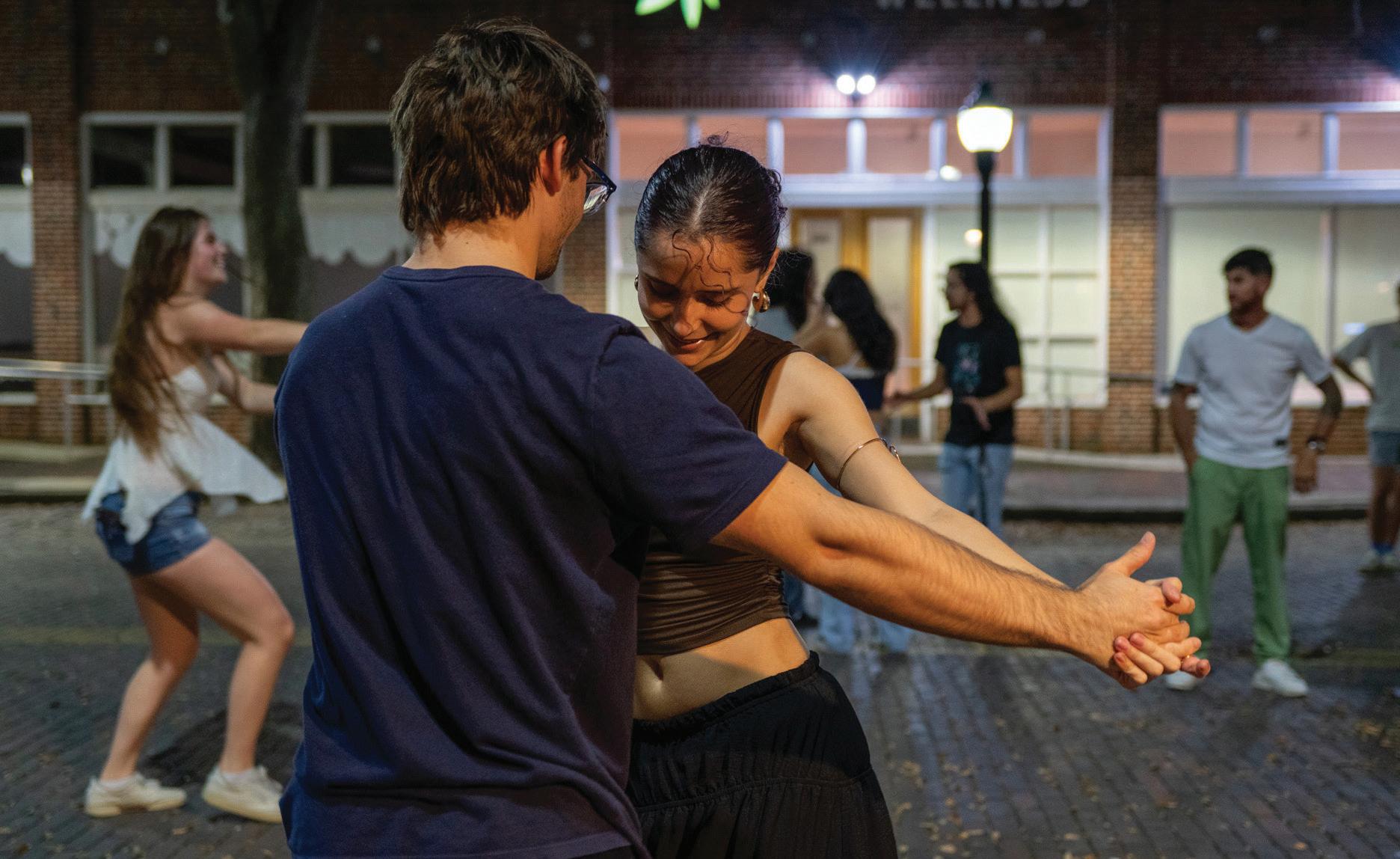
Matthew Quesada // Alligator Staff
Gator Salsa se reúne para bailar en The Bull, el 5 de marzo de 2026, en Gainesville, Fla.
Las iglesias locales combinan espiritualidad y servicio para la comunidad latina de Gainesville
LOS INMIGRANTES RECIENTES ENCUENTRAN AYUDA A TRAVÉS DE MINISTERIOS LOCALES
Por Dulce Rodriguez-Escamilla Escritora de El Caiman
En todo Gainesville, iglesias y ministerios basados en la fe están trabajando para apoyar a los residentes necesitados, ofreciendo alimentos, oración y ropa. Algunas iglesias trabajan específicamente para servir a la comunidad latina.
Defensores comunitarios dicen que estos programas desempeñan un papel importante para las familias que pueden enfrentar barreras del idioma o acceso limitado a recursos.
Domingo García, un residente de Gainesville de 69 años, dijo que descubrió los servicios ministeriales cuando emigró de Venezuela y estaba en necesidad. Otros venezolanos en el condado de Alachua le presentaron a García lugares como Catholic Charities Bureau y The Children’s Table, una despensa en Bronson.
“Mientras estaba desempleado, me resultaba difícil comprar alimentos como leche, pan, carne o pollo”, dijo García.
The Children’s Table en Archer, un banco de alimentos sin fines de lucro, sirve a cualquier persona necesitada. Muchas personas latinas frecuentan este lugar y un par de voluntarios hablan español y ayudan a brindar los servicios. Dijo que podía obtener verduras, pollo y jamón a cambio de una donación de $5 en ese momento. Ahora, los miembros de la comunidad pueden recibir estos artículos a cambio de una donación de $10.
“Eso me ayudó a ahorrar algo de dinero para un día lluvioso cuando finalmente conseguí trabajo”, dijo García.
Ahora, García trabaja como conductor de Lyft y Uber. Cuando tiene inmigrantes en su auto, dijo que a menudo los conecta con los mismos servicios en los que él confió.
“Veía que necesitaban ropa o comida, y los llevaba a los lugares y les daba indicaciones, y allí se vestían y comían”, dijo García.
Un ministerio al que Domingo García suele llevar a las personas es el ministerio de Oración y Liberación de Lynndetta Spann.
Spann solo habla inglés, por lo que García acompaña a los
inmigrantes y les ayuda a comunicarse.
Spann inició su ministerio en 2015. Es un gran agente de cambio para la comunidad, dijo.
Ella va a diferentes complejos de apartamentos y áreas de bajos ingresos para distribuir cajas de alimentos. También lo hace frente a su casa.
La información sobre sus servicios se difunde en la comunidad a través de Facebook, WhatsApp y el boca a boca, dijo. Cuando las personas la llaman por necesidad, ella trabaja rápidamente para preparar artículos para ellas.
Otros líderes ministeriales esperan ampliar su impacto en el futuro cercano.
Naomi Bernice Pérez, de 45 años, es parte de la Iglesia de Dios Pentecostal Movimiento Internacional Espíritu de Vida en Gainesville. Su esposo, Pedro Acevedo, es pastor en la iglesia. Brindar ayuda material va de la mano con ofrecer orientación espiritual, dijo Pérez.
“Como iglesia sentimos en nuestro corazón tomar esta iniciativa, entre otras, para seguir fomentando la idea de que hay una iglesia que ofrece cuidado espiritual, pero también apoyo a las familias necesitadas”, dijo Pérez.
Para hacerlo, Pérez dijo que la iglesia está en proceso de mudarse a un lugar más grande para poder distribuir más alimentos.
“Todo depende de qué tan pronto podamos mudarnos, y una mudanza de iglesia no es algo que suceda de la noche a la mañana”, dijo Pérez. “Tan pronto como tengamos el lugar, esperamos mudarnos ese mismo mes y luego organizar todo”.
@DulceRodrigueze drodriguez@alligator.org
530 N MAIN STREET
Anime Statues ~ Blind Boxes ~ RoLife
Gachapon ~ Gundam ~ Pokemon ~ MTG
One Piece ~ toki doki ~ Hello Kitty ~ and more
Bayden Armstrong // Alligator Staff
La Iglesia Bautista Ridgeview se encuentra en 3508 Calle 19a Noroeste, el 12 de febrero de 2026, en Gainesville, Fla.
MONDAY, MARCH 23, 2026
www.alligator.org/section/opinions
‘Evelyn Goes Gator’: American spring break and St. Patrick’s Day through an Irish student’s eyes
Spring break is one of those American traditions that feels familiar before you ever experience it. Films, TikToks and Instagram have already done the work. I thought I knew what it was: a week of sun and travel, all contributing to the sort of freedom nobody photographs.
But being here in person, what stands out is not the partying. It’s how much structure there is.
Spring break is not just a holiday. It’s a fixed institution of American student life, complete with its own aesthetic and expectations. Coming from Ireland, that’s what makes it fascinating, simply because we have nothing like it.
Irish students get breaks. We have reading weeks, summers, weekends away, post-exam trips and the occasional bank holiday, which is the U.S. equivalent to a federal or public holiday. But none of that carries the same weight. In Ireland, time off is just time off. Here,
spring break feels like an event with its own script. It’s planned around, talked about in advance and sold back to students as something larger than a week without classes.
Part of that is how completely imagined it already is before it even begins. There is already a whole visual language attached to it: beaches, airports, matching outfits, crowded bars, boat days and bad sunburns. Even people who do not take part seem to know exactly what spring break is supposed to look like. I noticed Fort Lauderdale locals would frequently call us “spring breakers” as we passed by.
Places like Florida already look the part. The weather is not just a bonus; it’s the whole premise. Ireland has no equivalent moment where the season, the academic calendar and the collective desire to flee all align at once. Our breaks happen in spite of the weather, not because of it.
The gap between the two became sharpest for me on St. Patrick’s Day in Fort Lauderdale.
It should have felt familiar. There was still the green, the crowds, the drinking and the general sense that everyone had decided to become Irish for the afternoon. But something was off.
At home, St. Patrick’s Day is a public occasion first. Even if most people spend it in a pub, there is still a shared sense of participating in the same national event. In Fort Lauderdale, it felt folded into the existing spring break atmosphere. The Irishness was there, but it read more like a theme layered over a party that was already happening, rather than something rooted in tradition.
That is the clearest way I can put the difference. In Ireland, St. Patrick’s Day is a national ritual with a party attached. In Fort Lauderdale, it felt like a party with Irish symbols attached. That’s not a criticism. It’s just a different kind of celebration, and one that borrows the iconography without needing the history behind it.
What sharpened the realization was flying
Evelyn O’Carroll opinions@alligator.org
to Puerto Rico the day after. Even though it is a U.S. territory, the atmosphere felt completely different and louder in some ways, quieter in others; less choreographed, more alive to itself.
The polished, performative version of spring break I had been watching all week in Florida suddenly looked exactly like what it was: a very specific product. One built around tourism, spectacle and the shared expectation that fun should look a certain way.
That was the moment the whole thing clicked. What I had been watching in Florida was not just young people enjoying time off. It was a particular version of leisure that has been packaged, exported and recognizable from a thousand miles away before you ever arrive.
@evelynocarroll eocarroll@alligator.org
For many UF freshmen, there’s no room in the inn
This year, the west side of campus has a new look. Trusler, Simpson and Graham halls have been demolished.
Both the memories and the foundations of the dorms were ripped from the ground. In their place stands mounds of sand, a blank space in the former campus landscape.
Meanwhile, as the dorms were being torn down, about 7,500 freshmen flocked to campus. UF was aware the class of 2029 would be a behemoth. It wasn’t just Florida, either — this class was acknowledged as the peak of high school graduates nationwide; a “cliff” of underenrollment will follow.
In response to this influx of students, UF has created a paradoxical, poorly thought-out solution. As more students come in, fewer dorms are available.
And the logic makes sense, doesn’t it? Take, for example, when a city knows it will
host a Super Bowl. The hotels of that city start closing rooms, correct?
No. But for some reason, UF decided to. As it took in more students than ever before, it also took away several dorms.
Improving the number of student housing units is a priority for UF, but its approach to this is misaligned. Its 10-year, $1.1 billion plan will increase the number of student beds from 9,316 to 12,493.
But that growth is expected to happen by 2035. For reference, a student entering college in 2035 would have only been born nine years ago.
Herein lies the problem with UF’s approach to improving campus housing: It requires a great detriment to current students.
The theft of dorms won’t stop, as Tolbert and Rawlings are expected to have the same fate by late 2029 as Graham Area did in Fall
2025.
As these dorms are torn down, students resort to finding spaces off-campus. For some, this is a better option; they prefer the refuge from campus, their own kitchens and a private bathroom. For others, however, this option is not only more expensive but undesirable.
For some, living on-campus is the ideal version of college. It’s in these oft-loathed communal bathrooms and shared kitchens that many friendships can be made, and dorm locations offer walkability to classes, student events and libraries.
While these factors can be found elsewhere, on-campus housing provides them in unparalleled ways.
UF is a school set on keeping college traditions alive, from a century-old Homecoming to a book on student life given to every freshman. The best conversations between current
The views expressed here are not necessarily those of The Alligator.
Gators and alumni are those relating to these traditions.
Among these conversations is a question of dorms.
Timothy Dillehay opinions@alligator.org
Gator alumni from southwest Florida to Washington have asked me whether X dorm still exists, or if Y dorm still has communal bathrooms.
These dorms are a part of the Gator tradition, and UF’s decision to destroy them before replacing them with more living spaces reflects a decision made by university leadership’s elites, a decision with no regard for students.
@timothydilleh
tdillehay@alligator.org
The Alligator encourages comments from readers. Letters to the editor should not exceed 600 words (about one letter-sized page). They must be typed, double-spaced and must include the author’s name, classification and phone number. Names will be withheld if the writer shows just cause. We reserve the right to edit for length, grammar, style and libel. Send letters to opinions@alligator.org, bring them to 2700 SW 13th St., or send them to P.O. Box 14257, Gainesville, FL 32604-2257.Columns of about 450 words about original topics and editorial cartoons are also welcome. Questions? Call 352-376-4458.
Los Angeles Times Daily Crossword Puzzle
How to Place a Classified Ad:
● UF Surplus On-Line Auctions ● are underway...bikes, computers, furniture, vehicles & more. All individuals interested in bidding go to: SURPLUS.UFL.EDU 392-0370 4-20-26-14-10
Donate your vehicle to help find missing kids and keep kids safe. Fast free pickup, running or not, 24 hr. response. No emission test required, maximum tax deduction. Support Find the Children Call – Call 1-833-546-7050 3-23-44-12 ¿hablas español? lee el periódico universitario independiente mas grande de estados unidos. You need the money to do what you will Rich at Best Jewelry and Loan has
When the heat is on and it's bucks that you need, Best Jewelry and Loan your requests we will heed. 523
3-23-39-13
We Buy Vintage Guitar's! Looking for 19201980 Gibson, Martin, Fender, Gretsch, Epiphone, Guild, Mosrite, Rickenbacker, Prairie State, D'Angelico, Stromberg. And Gibson Mandolins / Banjos. These brands only! Call for a quote: 1-833-641-6789 3-23-39-13
15 Services
Ave 352-371-4367 4-20-14-15
BATH & SHOWER UPDATES in as little as ONE DAY! Affordable prices - No payments for 18 months! Lifetime warranty & professional installs. Senior & Military Discounts available. Call: 1-833-754-2465 3-23-93-15
your ad today!
ATTENTION OXYGEN THERAPY
HIV ANTIBODY TESTING
Alachua County Health Dept. Call 334-7960 for app’t (optional $20 fee)
Help for the family and friends of alcoholics Find a local Al-Anon Meeting at our website: alanonfla2.org 12-1-15-16
Attention: VIAGRA and CIALIS USERS! A cheaper alternative to high drugstore prices! 50 Pill Special - Only $99! 100% guaranteed. CALL NOW: 1-877-349-1243 3-23-22-16 STOP OVERPAYING FOR HEALTH INSURANCE! Reduce premiums and out-ofpocket costs while getting the coverage you need! Call now for a competitive free quote. 1-877-351-3442. Plus... Income based government subsidies are available for those that qualify! 3-23-22-16
SUBMIT YOUR AD TO ONE OF THE FOLLOWING CATEGORIES TODAY!
FOR RENT (UNFURNISHED) 3: SUBLEASE
FURNISHINGS
COMPUTERS
BICYCLES
FOR SALE
1. GEOGRAPHY: Which Canadian province lies to the north of Washington state?
2. MOVIES: In the "Star Wars" movies, which character wields a purple lightsaber?
3. GAMES: In Monopoly, how much money do players get when they pass "Go"?
4. FOOD & DRINK: Which fast-food chain's 1970s jingle began, "Hold the pickles, hold the lettuce, special orders don't upset us"?
5. TELEVISION: What holiday did George's dad invent in the sitcom "Seinfeld"?
6. ANATOMY: How many skin cells does the average human being shed in a minute?
7. U.S. PRESIDENTS: How many presidents have won the Nobel Peace Prize?
8. ASTRONOMY: How many moons does Mars have?
9. LITERATURE: What is the name of Harry Potter's pet owl in the novel series?
10. SCIENCE: What is the boiling point of water in Celsius?
2025 King Features Synd., Inc.
Trivia Test Sports Quiz
1. Name the Italian racecar manufacturer that became the sole chassis supplier for the IndyCar Series starting in 2007.
2. What team won the NCAA women's bowling championship six times from 2004 to 2021?
3. What Vancouver stadium was home to the BC Lions of the CFL from 1954 to 1982, hosted seven Grey Cup games from 1955 to 1974 and was demolished in 1993?
4. Name the Dallas Cowboys cornerback who set an NFL single-season record with his fifth interception returned for a touchdown in 2023.
5. He played college basketball for the Duke Blue Devils and was drafted by the Cleveland Cavaliers in 2002. He has fraternal twin sons who also play basketball at Duke. Who are they?
6. John Landy, the second person to run a mile in under four minutes (following Roger Bannister), served as a state governor in what country from 2001 to 2006?
7. How many times did Wayne Gretzky achieve the NHL's rare "50 goals in 50 games" feat - scoring 50 goals in his team's first 50 games of the season?
Dallara.
The University of Nebraska Cornhuskers.
Empire Stadium.
DaRon Bland.
Carlos Boozer and sons Cameron and Cayden.
7. Four: Theodore Roosevelt, Woodrow Wilson, Jimmy Carter and Barack Obama.
Fasting while getting fast: How a 3:57 miler trains during Ramadan
FLORIDA’S OUSSAMA ALLAOUI COULDN’T EAT OR DRINK BETWEEN SUNRISE AND SUNSET FOR 30 DAYS
By Paul Hof-Mahoney Sports Writer
When the sun set on March 19, the Muslim holy month of Ramadan ended. For Florida freshman distance runner Oussama Allaoui, it symbolized not just the fulfillment of the fourth pillar of Islam, called “sawm,” but also a return to a normal training regimen after just over four weeks of daily fasting.
During the ninth month of the Islamic calendar, adherents must fast from sunrise to sunset. Lack of proper daily fueling brings a host of challenges for athletes — especially endurance athletes, like Allaoui.
“Their window of fueling, opportunity to fuel and recover for training out on the track, weights … is shortened,” said Lauren Perez, UF’s senior performance dietician. “It poses some challenges just with changes to sleep schedule, changes to training schedule, and then their fueling strategy throughout the day also changes too.”
Given the shorter timeframe of the Islamic calendar, with either 354 or 355 days in a year compared to 365 or 366 in the Gregorian calendar, the start date of Ramadan changes every year. This winter, the beginning of Ramadan on Feb. 17 happened to coincide with the most important part of Allaoui’s and Florida’s indoor season.
SOFTBALL
Four days before Ramadan began, on Feb. 13, the 21-year-old Moroccan ran a 3:57.47 mile at the BU
David Hemery Valentine Invitational, marking his place as the thirdfastest man in UF history and one of the top contenders at the upcoming SEC Indoor Championships.
With that performance under his belt, Allaoui then had to make his familiar annual transition to a lighter training load in response to his fasting obligations.
“We’ve cut out a couple of his training efforts in the week,” Florida assistant distance coach Will Palmer said. “He’s not running twice in a day right now, just with the added stress of fasting consistently.”
The biggest change to Allaoui’s training came in the timing of his workouts, given his restricted windows to eat food. He completed easy runs to stack mileage in the morning, right after consuming his morning meal, known as “suhur.”
Harder workouts were reserved for the evening, after he breaks his fast with his evening meal, known as “iftar.”
“I go with coach Palmer — we talked about that before Ramadan,”
Allaoui said. “He asked me about ‘What time do you want?’ … If we have a hard workout, we do it in the evening.”
Timing meals close to exercise ensures Allaoui can get the most out of his workouts and start his recovery from a less depleted state.
Despite Allaoui’s evening sessions consisting of more challenging workouts, night training presented an easier solution for nutrition from a fasting perspective than the morn-
ings. Palmer said Allaoui typically would warm up just before breaking his fast, then take iftar before commencing the evening workout.
In the morning sessions, after Allaoui ran, he couldn’t replenish the energy exerted for nearly 12 hours. This meant suhur, the morning meal, had to contain optimal nutrition on the days when he ran in the morning.
“We try to get that first meal to be probably his biggest meal of the day,” Perez said. “Really hitting carbohydrates, protein, and then also typically trying to get in some kind of easy carbohydrate drink.”
While shifting training schedules, which are typically rigid and unyielding, can be uncomfortable for any runner, Allaoui has become accustomed to the changes.
Nearly all of Morocco’s population is Muslim, according to the U.S. State Department data from 2022 — including Allaoui’s training group at home. Adjusting training plans is nothing new, and he typically experiences this month alongside training partners who are fasting as well.
“I have good energy in Ramadan,” Allaoui said. “I think all Muslims are like that. My teammates in Morocco, we get good energy in Ramadan, because you train before sunset, and you go directly to eat. … I never feel bad in Ramadan.”
Allaoui is the first athlete Palmer has ever coached who observes Ramadan, but he sees benefits from the practice of fasting that could reflect in other aspects of distance running.
“It sounds like culturally, with training, Oussama said there are
holds his medal during the 2026 SEC Indoor Track & Field Championship on Saturday, February 28, 2026 at RA "Murrary" Fasken '38 Indoor Track & Field at Texas A&M University in College Station, Texas.
just droves of people training at night,” Palmer said. “A lot of times, if you find success in distance running, it’s through shared suffering and shared hard work. So I don’t know, it seemed really cool how it culturally kind of works in Morocco.”
There are provisions in Islam’s
holy book, the Quran, that allow for circumstantial exceptions from fasting during Ramadan. At the SEC Championships in College Station, Texas, from Feb. 26-28, Allaoui’s racing fell under one of these exceptions.
Before he broke his fast, however, Allaoui had to check in with one person to ensure it was inside the parameters of Ramadan.
“I need good energy if I want to compete good,” Allaoui said. “I called my mom, I asked about that, and she said, ‘You can eat.’”
When an athlete who has been in an extended period of daily fasting begins fueling normally for a competition, Perez said, responses can vary from athlete to athlete. Potential drawbacks could include gastrointestinal issues and a sleep schedule the athlete isn’t used to.
If Allaoui was experiencing any side effects from eating on race day, he didn’t show it. On the anchor leg for Florida’s distance medley relay, he anchored the Gators to a runnerup finish prior to their disqualification. Two days later, he matched that finish in the mile, placing second at 4:02.80.
With both Ramadan and the indoor season over, Allaoui’s attention turns toward the outdoor season, where he hopes a normal training load can help push him to success during the spring.
“I want to qualify to nationals in the outdoor season,” Allaoui said. “And I want to run my PB [personal best] in the 1,500 meters.”
@phofmahoney phof-mahoney@alligator.org
Top softball recruit graduates high school early to train in Orange and Blue
CAROLINE STANTON, THE NO. 1 PLAYER OF HER CLASS, WILL MAKE HER GATOR DEBUT IN SPRING 2027
By Zach Moore Sports Writer
Stepping onto a college campus as a freshman is already a challenge. The transition from home life to college life is something people anticipate for years.
When you’re the No. 1 recruit in America, sometimes that moment comes early.
Eager to begin the next chapter of her softball career, Caroline Stanton graduated from Buford High School in her hometown of Bu-
ford, Georgia, in December 2025 and enrolled at Florida a month later.
"It was a good opportunity, once I finished my high school season, to just come in and train and just be developed before next year,” Stanton said.
However, Stanton’s softball career began long before she stepped into the Orange and Blue.
Growing up, Stanton participated in a multitude of sports, but from the moment she stepped onto the diamond, she knew softball was what she wanted to play, she said.
Stanton was always surrounded by highlevel talent at Buford, a nationally renowned school with 13 softball state championships. She wanted to continue being surrounded by talent, leading to a visit at UF in her junior year
of high school.
From that moment onward, she knew she wanted to be a Gator.
“I always loved it,” Stanton said. “But once I came on my visit, I knew this is where I wanted to be.”
However, she had to complete high school before she could get to Gainesville. Despite hurrying to finish as quickly as possible, she still left with her share of athletic accomplishments.
In her high school career, she captured three state championships, capping it off with a perfect 36-0 record in her senior season last fall.
The number three became a trend in her high school career. She was a three-time MaxPreps first team All-American and a three-time first team All-State selection.
Follow our newsletter Love alligatorSports? Stay up to date on our content by following our newsletter. Scan the QR Code to sign up.
Over the four years, Stanton only surrendered three losses in the circle. Most notably, she holds the Buford single-game strikeout record of 20, which she recorded in the state tournament on Oct. 30, 2025, against Brookwood High School in Snellville, Georgia. When not dominating in the circle, the right-handed hurler can be found in the outfield, as she played right field throughout her high school career. She excelled at the plate during her junior year, posting a .409 batting average and hitting 13 home runs.
Read the rest online at alligator.org/section/sports. @zach_moore27 zmoore@alligator.org
Follow us for updates For updates on UF athletics, follow us on Twitter at @alligatorSports or online at www.alligator.org/section/sports.
Courtesy of UAA Communications photo by Dylan Cannella Oussama Allaoui
Gators men’s basketball falls short against Iowa in Tampa
GATORS LOST 73-72 AGAINST IOWA ON MARCH 22
By Max Bernstein Sports Writer
No. 1 seed Florida was eliminated from the NCAA Division I Men’s Basketball Tournament on March 22, falling to No. 9 seed Iowa 73-72 in the Benchmark International Arena in Tampa. Florida defeated No. 16 seed Prairie View A&M 114-55 on March 20, setting a new March Madness record for the largest margin of victory in a 1 vs. 16 seed matchup.
Iowa moves on to play No. 4 seed Nebraska on March 26 at a time yet to be determined as of March 22, with the winner of that matchup playing either No. 2 seed Houston or No. 3 seed Illinois on March 28. The third and fourth rounds of the tournament take place at the Toyota Center in Houston.
Florida guard Xaivian Lee (1) drives during the second half of an NCAA Tournament first round game against Prairie View A&M, Friday, March 20, 2026, in Tampa, Fla.
Photos by Noah Lantor // Alligator Staff
Thomas Haugh (10) drives
second half of an NCAA
Prairie View A&M, Friday, March 20, 2026, in
Florida guard Isaiah Brown (20) dunks during the second half of an NCAA Tournament first round game against Prairie View A&M, Friday, March 20, 2026, in Tampa, Fla.