Nikki Fried, Danielle Hawk on abortion access

HAWK’S RUNNING FOR U.S. HOUSE SEAT
By Heather Bushman Alligator Staff Writer
For decades, they thought it was a bluff.
Democrats like Nikki Fried and Danielle Hawk never believed the U.S. Supreme Court would overturn Roe v. Wade — the landmark decision that secured the right to an abortion.
Though a looming threat in every elec tion cycle, Fried said progressive poli ticians never imagined the reversal would happen.
Democrats subsequently took their feet off the gas, said Fried, the Florida commissioner of agriculture and a for mer Democratic gubernatorial candi date. They took votes for granted and didn’t campaign as intensely as they should’ve during election season, al lowing a conservative majority on the court that put years of talk into action.
The overturn happened in June, and Gainesville protestors took to the
streets to express their outrage. At a Heartwood Soundstage forum Sept. 24, Fried said nationwide Democratic denial is to blame.
“We got here because we thought we never would get here,” she said.
Now, Democrats are rallying to re verse the Supreme Court’s decision. In Florida and across the country, can didates are running on platforms that spotlight reproductive health care and the right to an abortion.
Fried and Hawk brought that plat form point to Gainesville as they en gaged with voters on the issue.
Fried and Hawk, the Democratic candidate for the U.S. House seat in Florida’s 3rd Congressional District, hosted a discussion on reproductive freedom for a crowd of about 20 peo ple. The pair emphasized the impor tance of reproductive health care and mobilizing voters ahead of Novem ber’s general election.
Both Fried and Hawk’s platforms put abortion rights as a top issue. The
UF students express voter apathy for Student Government elections
STUDENTS REPORT MIXED FEELINGS FOR FALL ELECTION
By Alissa Gary Alligator Staff Writer
With Student Government elections Sept. 27 and 28 right around the corner, UF students have varying opinions on how SG should func tion — that is, if they have an opinion at all.
Several UF students have heard about SG but never looked into how, when and where to vote. Lack of interest or incentive is often the main culprit, which contributes to exceedingly low voter turnout for SG elections.
Yonash Petit, an 18-year-old computer sci ence freshman, said he doesn’t know anything about SG. However, he said he might vote in the election if he’s near a polling place at the right time. But, he wouldn’t know which candidates to vote for.
“If it’s convenient, then I’ll vote,” Petit said.
Despite weeks of election-season campaign ing every year, voter turnout in Fall SG elections has historically been low, wavering between 13% and 20% between 2012 and 2019, accord ing to university enrollment rates and SG voting records.
The pandemic knocked that percentage down to 4.2% in 2020, and it has since climbed back up to 13.6% in 2021. Only about 136 in every
SPORTS/SPECIAL/CUTOUT

Far from home, making an impact
1,000 students tend to vote, according to the most recent data from 2021.
Kris Lobo, a 20-year-old UF political science junior, said they might vote in next week’s elec tion if they have time. They’re busy doing school work and running their club: Students versus Zombies. Lobo can’t afford the time to learn about student politics, they said.
“In class no one really informed us about it,” Lobo said. “You kind of have to go out of your way to learn about it.”
In an effort to engage students in the SG pro cess, party representatives often flag down pass ersby in Turlington or in front of the Reitz Union. This campaign strategy consumes more time from students like Lobo — a quality they said was annoying. If candidates handed out simple fliers instead, Lobo said they’d be more likely to review SG information on their own time.
“I feel like it’s better than having to actually interact with someone and take time out of your day because we’re all busy,” Lobo added.
Pedro Manzato, a 19-year-old UF business administration sophomore, said he had a similar experience with representatives who table. He knows absolutely nothing about SG, aside from being approached by students canvassing while rushing across campus, he said.
“I feel like they could do just a better job of getting their points out,” Manzato said.
OPINION:

Charlie
City’s anti-riot suit advances
CITY’S MOTION ADVANCED IN COURT SEPT. 20
By Aidan Bush Alligator Staff Writer
The city of Gainesville won its first vic tory in what’s expected to be a prolonged battle against Florida’s anti-riot law cham pioned by Gov. Ron DeSantis.
In a Sept. 20 hearing, the city advanced a motion from the state to dismiss its multicity lawsuit. Three cities didn’t enjoy the same success, being dropped from the case.
Now, Gainesville and its partners will have time to reorganize their case before litigation proceeds. The state and dismissed members of the suit will also have time to appeal the court’s decision.

House Bill 1 — also known as the “antiriot” or “Combatting Public Disorder” bill — took effect April 2021. The law created new criminal charges for non-peaceful pro tests including felony offenses for violently rioting and damaging monuments. The bill also required local governments to seek ap proval from the state before defunding po lice budgets.
Gainesville was the first to challenge the law and recruited other city governments to file a suit against HB 1 in November. Its pri mary concern was if the bill would hinder local government by limiting cities’ control over budget.
The case is deeply tied to racial justice protests, as the legislation became DeSan tis’ priority in September 2020 in response
to nationwide riots following the murder of George Floyd and death of Breonna Taylor.
Critics of the bill claim HB 1 has seen in consistent enforcement, as Cuban protests in July 2021 blocked major streets in Miami with no criminal citations under the bill, as reported by The Washington Post.
Since Gainesville initiated the suit, eight other municipalities joined to file similar complaints. In an attempt to dismiss the lawsuit, the state filed a motion to drop the case in May on the grounds of lack of cause.
North Bay Village left the case volun tarily prior to the dismissal.
Leon County Judicial Circuit Court Judge J. Lee Marsh ruled in favor of ad vancing a majority of the suit challenging HB 1.
Gainesville remains one of the five cities advancing in the case. Lake Worth, North Miami and North Miami Beach were dis missed as a result of not having direct plans to act in a way that would see limitations from HB 1.
Jonathan Miller, a lawyer representing Gainesville and chief program officer of nonprofit legal team Public Rights Project, said the suit’s survival in any capacity was a massive success.
“This is a very tough political environ ment right now to push against this legis lature and this governor,” Miller said. “It’s incredibly brave and powerful what these cities are doing.”
FOLLOW US ONLINE FOR
Sophia Abolfathi // Alligator Staff
Florida Commissioner of Agriculture Nikki Fried discusses reproductive rights with congressional nominee Danielle Hawk at Heartwood Soundstage Saturday, Sept. 24, 2022.
We Inform. You Decide. www.alligator.org VOLUME 117 ISSUE 6 Not officially associated with the University of Florida
Story description finish with comma, pg#
Student Government parties make their case Gator, Change and Liberation have candidates slated for the Fall election , pg. 8
Crist makes campaign stop in Gainesville He discussed abortion access, education and gun reform, pg. 5
Gators setter Alexis Stucky is already playing in big moments after coming to UF from Wyoming. Read more on pg. 11
UPDATES @FloridaAlligator @TheAlligator_ @TheAlligator @thefloridaalligator
SEE SG OPINIONS, PAGE 4
SEE HB 1, PAGE 5 SEE FORUM, PAGE 5
Tropical Storm Ian expected to become hurricane, make landfall in Florida
STORM MAY HIT FLORIDA LATER THIS WEEK
By Fernando Figueroa Alligator Staff Writer
As Florida prepares for its first major storm of this year’s hurricane season, Gainesville officials urge res idents to prepare for heavy rainfall and potential flooding.
As of 8 p.m. Sunday, the National Hurricane Center said the storm maintains maximum sustained wind speeds of 60 mph and is expected to reach major hurricane strengths Monday night. AccuWeather said the storm could reach Category 4 wind speeds between 130 and 156 mph.
Gov. Ron DeSantis declared a state of emergency for all of Florida ahead of Tropical Storm Ian’s poten tial landfall in Florida later this week. The announcement was made mere days after Hurricane Fiona caused the entire island of Puerto Rico to lose power.
The tropical storm is expected to produce two to four inches of rain between the Keys and into Central Florida, which may lead to urban and flash flooding through the mid week, according to the NHC.
The storm’s exact path is yet to be determined, but the latest models by the NHC predicts the eye will land somewhere above Lake Okeechobee, as of Sunday.
Even if the storm doesn’t make
landfall, its effects may still be felt up to 150 miles away from the eye, said Jeff George, UF chief meteorolo gist and director of the Florida Public Radio Emergency Network.
In the scenario the storm stays offshore, George said residents should still expect dangerous, lifethreatening storm surge, high ripcurrents and high surf all along the Gulf Coast.
Fort Myers and Tampa should have their preparations ready by Tuesday afternoon and those in the Florida Panhandle no later than Wednesday afternoon, George said.
Staying up to date with the latest forecast and reaching out to friends and family is essential, George said.
Alachua County has no plans to close schools, Alachua County Public Schools spokesperson Jackie Johnson said. That could change depending on what the storm does and whether schools are called into service as shelters.
UF also isn’t planning on cancel ing classes as of Sunday, spokesper son Cynthia Roldan said.
The university posted Sunday urging members of the community to prepare by building an emergency kit, downloading the GatorSafe app and checking UF emergency weather updates for the latest developments on the storm.
If shelters are required, Gainesville Mayor Lauren Poe said the Senior Center will be available for people with special needs. The
location of other shelters will be an nounced this week.
“I think our folks here in Gainesville are accustomed to this, and we have been through this,” Poe said. “It’s really about just mak ing sure you’re prepared.”
Alachua County also sent out a press release telling residents how to prepare for the storm, including removing obstructions around win dows, trimming branches, securing lawn furniture and storing grills.
The release shared a three-min ute video explaining how to properly interpret the “Cone of Uncertainty.” The video explains that the center of the storm will stay inside of the cone in two out of three weather fore casts. It also recommends using the cone to see where the center may go, how big the storm is at that moment and where coastal wind watches and warnings are in effect.
“As a community, we are stron ger than the individual,” Alachua County Emergency Manager Jen Grice said in a press release. “We encourage all of our residents to reach out to their friends, families and neighbors to provide help and encouragement to those that may have a more difficult time getting prepared.”
@fernfigue ffigueroa@alligator.org
Not officially associated with the University of Florida
352-376-4458NEWSROOM:
FINAL BARGAINING SESSION WILL BE OCT. 5
Siena Duncan Alligator Staff Reporter
UF graduate assistants will like ly have eight weeks of paid family leave starting mid-October.
Graduate Assistants United and the UF bargaining team met Thurs day for a 30-minute meeting to discuss amending Article 8 of the graduate assistant contract, which currently allows for five days of paid leave for any reason and six weeks of unpaid family leave. GAU opened Article 8 for bargaining Sept.1 when it proposed a change to eight weeks of paid family leave. The union modeled its proposal on what was granted to the UF faculty union in 2020, said GAU Co-Presi dent Rachel Hartnett.
The UF bargaining team — Ryan Fuller, Brook Mercier, Judy Traveis and Tom Kelleher — took four weeks to read over the pro posal. On Thursday, Fuller, deputy general counsel for UF, said it’s willing to support the proposal, but as a pilot program, meaning it will be flexible to changes if any prob lems arise.
This is so there can be room for alterations to fix any unexpected expenses to UF, Fuller said.
This caution comes from an ex
perience when the two parties bar gained for paid graduate student medical fees with GatorGradCare insurance, he said. After the terms were agreed on, GatorGradCare went into debt because the pack age overestimated what UF could budget toward graduate students. The issue was renegotiated to put GatorGradCare back in the green.
“I think we learned our lesson there,” Fuller said.
However, GAU Co-President Ra chel Hartnett said she doesn’t ex pect any language relating to a pilot program in the UF team’s upcom ing counteroffer.
All articles in the graduate as sistant contract are reopened every three years during a process called full book bargaining – where any of the articles can be renegotiated. The last session occurred in 2020.
The reasoning behind making paid family leave a pilot program is faulty because Article 8 will still be reopened a year from now regard less, Hartnett said.
But the paid family leave the faculty received was also consid ered a pilot program, Fuller said, and it passed, so he doesn’t an ticipate any issues with GAU’s pro posal.
“There’s only been support for this,” he said.
The bargaining team plans to accept GAU’s proposal as long as it
doesn’t find any underlying issues while writing some of the language for Article 8, Fuller said.
The two parties scheduled an other bargaining session for Oct. 5 at 11 a.m.
Amanda Markee, GAU’s bar gaining chair, said she hopes the session will be the last one for Ar ticle 8. This is because the union plans to reopen Article 10, which deals with the graduate assistant minimum stipend.
There are a few subjects that could affect the new proposal, Full er said, such as part-time graduate assistant taxes and international visas. Those factors don’t apply as much to the paid leave the faculty received, Fuller said, which is what the graduate assistant proposal is modeled after. There are more part-time and international gradu ate assistants than faculty, which complicates the UF team’s financial analysis of the proposal.
However, he said, he doesn’t anticipate them to be stumbling blocks for the final outcome of eight weeks of paid family leave.
Mercier, assistant vice president for UF Human Resources, said he agrees.
“There are a number of vari ables,” Mercier said. “I don’t think any of those are insurmountable.”
@SienaDuncan sduncan@alligator.org. family leave likely for UF graduate assistants
Engagement Managing Editor
Editor-In-Chief Digital Managing Editor
Senior News Director Enterprise Editor University Editor Opinions Editor
the Avenue Editor Metro Editor
Assistant Sports Editor Sports Editor Editorial Board Multimedia Editors
Makiya Seminera, mseminera@alligator.org
Alan Halaly, ahalaly@alligator.org
Jiselle Lee, jlee@alligator.org Nora O'Neill, noneill@alligator.org
DISPLAY ADVERTISING
Halima Attah, hattah@alligator.org Isabella Douglas, idouglas@alligator.org
Aurora Martinez, amartinez@alligator.org
Jackson Castellano, jcastellano@alligator.org Joseph Henry, jhenry@alligator.org
Ashleigh Lucas, alucas@alligator.org
Namari Lock, nlock@alligator.org Luigi Bencosme, lbencosme@alligator.org
Copy Desk Chief Michael Miller, mmiller@alligator.org Veronica Nocera, vnocera@alligator.org
Makiya Seminera, Alan Halaly, Isabella Douglas, Halima Attah Lucille Lannigan, llannigan@alligator.org
352-376-4482
Advertising Office Manager Intern Coordinator Sales Representatives Cheryl del Rosario, cdelrosario@alligator.org Ellen Light, elight@alligator.org Brooke Tymoniewicz, Qingyu Yang, Matthew Powell, Paulina Navarro, Sophia Handley, Kyle Weiner, Avery Brennan, Madison Kahn 352-376-4482 • info@sparkitcreative.org
SparkItCreativeAdvertising
SparkIt Team Managing Director Aarin Rutkin, Adriana Colón, Dalia Rubinowicz, Jenny Gomez, Levi D'Amato, Maria Vanderbilt, Melanie Peña, Nazil Ahmed, Samadu Adeyemi, Sammy Fadool, William Chen, Skyler Davis
CLASSIFIED ADVERTISING
Skyler Davis 352-373-3463
Classified Advertising Manager Ellen Light, elight@alligator.org 352-376-4446BUSINESS

Administrative Assistant Ellen Light, elight@alligator.org Comptroller Delia Kradolfer, dkradolfer@alligator.org Bookkeeper Cheryl del Rosario, cdelrosario@alligator.org 352-376-4446ADMINISTRATION
General Manager Shaun O'Connor, soconnor@alligator.org
Administrative Assistant Lenora McGowan, lmcgowan@alligator.org
President Emeritus C.E. Barber, cebarber@alligator.org
SYSTEMS
IT System Engineer Kevin Hart
PRODUCTION
Production Manager Jordan Bourne, jbourne@alligator.org
Publication Manager Deion McLeod, dmcleod@alligator.org
Got something going on? Want to see it on this page? Send an email with “What’s Happening” in the subject line to engagement@alligator.org. To request publication in the next day’s newspaper, please submit entries before 5 p.m. Please model your submissions after the above events and keep them to 150 words or fewer. Improperly formatted “What’s Happening” submissions may not appear in the paper. Press releases will not appear in the

The Independent Florida Alligator is a student newspaper serving the University of Florida, published by a nonprofit 501 (c)(3) educational organization, Campus Communications Inc., P.O. Box 14257, Gainesville, Florida, 32604-2257. The Alligator is published Monday mornings, except during holidays and exam periods. The Alligator is a member of the Newspaper Association of America, National Newspaper Association, Florida Press Association and Southern University Newspapers.

The Alligator offices are located at 2700 SW 13th St. © Copyright 2020. All rights reserved. No portion of The Alligator may be reproduced in any means without the written consent of an officer of Campus Communications Inc.
Subscription Rate: Full Year (All Semesters) $60
The Alligator strives to be accurate and clear in its news reports and editorials. If you find an error, please call our newsroom at 352-376-4458 or email editor@alligator.org
Published by Campus Communications Inc., of Gainesville, Florida ISSN 0889-2423
VOLUME 117 ISSUE 6
2 ALLIGATOR MONDAY, SEPTEMBER 26, 2022
8 weeks of paid
Death of Mahsa Amini sparks action from UF Iranian community

 Sophia Abolfathi & Anushka Dakshit
Alligator Staff Writers


Minah Nayeri was scrolling on Instagram when she found out about the brutal death of Mahsa Amini in the custody of Iranian police last Friday. For Nayeri, who grew up in Iran, this is nothing new. The way Amini was treated is commonplace.
The 25-year-old first-year gradu ate pharmacy student was one of a handful of Gainesville students who came together at the UF Iranian Stu dent Association memorial service outside the Reitz Union in honor of Amini, a 22-year-old Iranian woman who died after being arrested Sept. 16 in Tehran for allegedly breaking hijab rules.
On a table laid with black cloth, UF Iranian students arranged candles to form the initials “MA” in front of boards with pictures of Amini and protests around the world. Attendees brought roses and laid them next to the candles.
Halva and dates filled with wal nuts, dishes traditionally eaten when someone passes in Iranian culture, were set out for attendees.
Amini was arrested by Iran’s “morality police” — armed officers who arrest women not following the government’s dress code — while in her brother’s car, according to Lon don-based outlet Iran International.
She was unresponsive when she was taken from the Vozara Deten tion Center to a hospital in northern Tehran two hours after her arrest, where she later died.
Her father, along with eyewit nesses, asserts she was beaten to death by Iranian police, according to an NPR report. Police refute that idea, instead suggesting Amini suf fered from a heart attack. She ul timately died of brain trauma from multiple blows to the head and blood in her lungs, Iran International reported.
In response to Amini’s death, Iranians have taken to the streets of Tehran to protest, calling for an end to gender-based violence from government groups like the morality police.


Iranian students arrange candles, flowers and a traditional dessert called halva on a black-draped table in memory of Mahsa Amini, Thursday, Sept. 22, 2022.
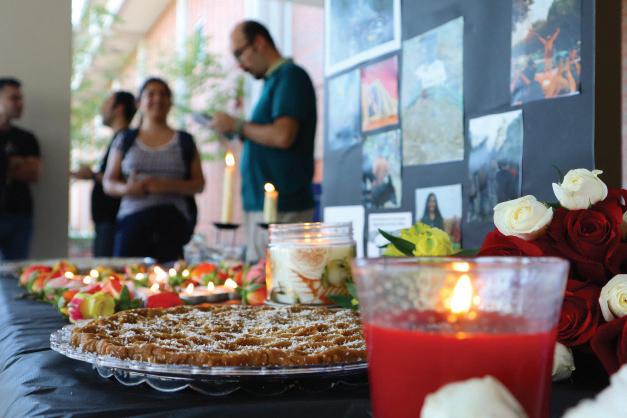
Some women have also cut their hair or burned their hijabs in protest of Amini’s death.
Nayeri is busy with school and can’t physically go to Iran, so the ISA memorial was a way to show
solidarity in a time of need, she said. She said she fears for her mother and brothers in Iran as the protests spread to more cities other than Teh ran.
“I’m sad I can’t be there to fight with them,” Nayeri said. “But I’m
happy that this generation is willing to make a change and is willing to fix the mistakes that were made by generations before us.”
ISA began planning the memo rial Saturday, said Reza Esmaeeli, a 29-year-old Ph.D. student in the chemistry department and ISA presi dent.



“This was a clear violence of the basic rights of every human being to be free to choose their own lifestyle.” Esmaeeli said. “We are all standing by that.”
The protests in Iran have oc curred alongside Iranian President Ebrahim Raisi’s visit to New York for the United Nations General As sembly.
The U.S. Treasury Department accused the Iranian police of being responsible for Amini’s death and vi olating the rights of peaceful protes tors. The agency imposed sanctions on seven high-ranking Iranian mili tary and security officials Thursday.
Read the rest on alligator.org









@SophiaAbolfathi @Anushkadak
 Sophia Abolfathi // Alligator Staff
MONDAY, SEPTEMBER 26, 2022 ALLIGATOR 3 ALDI IS AN EQUAL OPPORTUNITY EMPLOYER. Ready to put your ambition to work? District Managers lead and inspire teams across an entire district - all while managing millions in revenue. It’s a tremendous responsibility. That’s why you’ll be supported by our award-winnng 44 weeks of training to gain a solid understanding of how we operate our business. And the minimum $90K salary with an increase to $100K starting January 1, 2023 (inclusive of $5K signing bonus), and advance up to $120K after four years is a great way to start your future (*salary varies by market) FUTURE IT’S BRIGHTER WITH ALDI. ENVISION YOUR Learn more and apply online at: careers.aldi.us You Matter. JOIN THE ARTHREX TEAM Our headquarters is located in beautiful Naples, FL, with additional locations in Fort Myers, FL; Ave Maria, FL; Sandy Springs, SC; Santa Barbara, CA; and City of Industry, CA. Full-time opportunities, internships, and co-ops are available. Apply online at www.arthrex.com/careers Arthrex, a world leader in orthopedic surgical device design, research, manufacturing, and medical education, is committed to one mission: Helping Surgeons Treat Their Patients Better™. Arthrex has pioneered the field of arthroscopy, developing more than 1,000 innovative products and procedures each year. AD1-000255-en-US_A All qualified applicants will receive consideration for employment without regard to race, color, age, religion, sex, national origin, disability, veteran status, or any other classification protected by federal, state, or local laws and ordinances. first time orders SAVE20 save 20% Fresh laundry & cafe Get your Laundry done *20 lbs Minimum charge Gummies and More! We’re a Tampa, FL manufacterer offering potent CBD Topicals, Tincture & Gummies. No doctor’s recommendation needed. CBDBotanicalTherapy.com • (727) 365-6612 Aches & Pains? vape company MUST BE 21 AND UP WITH VALID ID 407 NE 23RD AVE GAINESVILLE, FL 32609 (352) 672-6799 •CBD•DELTA8 •KRATOM WECARRY: POLICE CLAIM AMINI, 22, BROKE IRAN’S HIJAB RULES
• • •
A voter’s guide to Fall Student Government elections
Learn more about where, when and how to vote
By Alissa Gary Alligator Staff Writer
As Fall UF Student Government elections approach in the upcoming week, students will head to the polls to cast their votes for the new cohort of 50 student senators.
The Student Senate is SG’s prima ry legislative body, which proposes, debates and passes legislation. Legis lation and decisions led by the Sen ate can impact student organization funding and other aspects of student life.
Fall elections will take place Sept. 27 and 28. Students vote for their senators based on living areas.
Each on-campus residence hall
receives one senator. Each off-cam pus district receives a number of senators proportional to their popu lation, as outlined by the Senate Re apportionment Act of 2022:
District A: ZIP Codes 32601, 32609, 32614
11 senators
District B: ZIP Codes 32603, 32605, 32606, 32653
7 senators
District C: ZIP Codes 32607
6 senators
District D: ZIP Codes 32608
12 senators
District E: All other locations not included within the ZIP codes listed above - 1 senator
Students can vote Sept. 27 and 28 from 8:30 a.m. to 8:30 p.m. at any of the following polling loca tions: Bryan Hall, Broward Recre ation Room, Health Science Cen ter Library, Levin School of Law, Norman Hall Educational Library, Reitz Union Computer Printing Lab, Southwest Recreation Center or Springs Library and Recreation Room.
A valid ID and GatorLink user name and password are required to vote.
The Gator Party, which currently holds the majority in the Senate, has slated candidates for all 50 available seats. The Change Party, who holds the minority, slated all but five
seats. A third party, the Liberation Party, slated eight candidates.
The full slate of candidates is available through the SG website.
In order to maintain an official caucus in the Senate, a party must win eight seats. The Change Party currently holds eight Senate seats and risks losing their standing as minority caucus if they don’t main tain or gain seats in next week’s election.
Gator Party’s platform features a football ticket grant program, con struction of electronic charging sta tions at the Reitz Union and the do nation of unused flex bucks to the UF Field & Fork Pantry.
The Change Party’s platform includes 24-hour library access, an equity reform in student organiza tion funding and eco-friendly initia
tives across campus.
The Liberation Party’s platform introduces free on-campus laundry, funding for reproductive and sexual healthcare and abolishing namechange fees on GatorONE cards.
For any questions about the up coming election, students can con tact Supervisor of Elections Ethan Halle or visit the SG office on the third floor of the Reitz Union.
In Spring 2023, students will vote for the 50 remaining student senators who represent different colleges rather than by living area, as well as for Student Body Presi dent, Vice President and Treasurer.
The Senate meets Tuesdays at 7:30 p.m. on the ground floor of the Reitz Union in the Senate Chamber.
@AlissaGary1 agary@alligator.org
UF hasn’t begun formal search for new honors director
INTERIM DIRECTOR CURRENTLY FILLS THE ROLE
Christian Casale Alligator Staff Writer
It’s been more than a month since Mark Law’s termination as UF Honors director, and UF administration still hasn’t begun a formal search for a new one.
UF administrators told The Alligator no formal timeline has been established, but they expect to permanently fill the position by the end of the 2022-2023 academic year. The new search gives UF an opportunity to find a direc tor whose vision better aligns with theirs af ter Law’s termination in August for what the administration felt was lackluster leadership.
Angela Lindner, the associate provost for undergraduate affairs who oversees the Hon ors ProgramCollege and the search, said she expected to find a permanent replacement to Law by the end of the academic year.
“UF will follow the standard process in
searching for a position that has such a strong influence on our students and university,” Lindner wrote in an email. “This typically en tails establishing a committee and a chair.”
The process will begin with the position’s advertisement and recruitment of candidates, Lindner said. The applicant pool will be short ened after remote interviews and a final stage of the short-list candidates visiting campus for open forum discussions will start then.
The search comes concurrently with UF trying to find its 13th university president.
“UF traditionally has selected a leader who is in a faculty classification,” Lindner said. “Ideally, this individual has experience in leading staff and developing undergraduate student programs and with good experience in working with Honors students.”
Melissa Johnson, the former senior associ ate director, has been appointed to lead the program in the interim.
“We at UF are quite fortunate to have Dr. Johnson serving as interim director,” Lindner wrote. “She has served in our Honors pro gram for many years, and she is familiar with
the current programming and strategic goals for the program.”
Lindner went on to write she has con fidence Johnson will continue to focus on current programs and initiatives within the Honors Program, such as care for current stu dents, recruiting and applications and the fi nal planning of the new Honors Village.
Whoever steps into the vacant role will need to fulfill UF administration’s expecta tions for the program.
After the firing of Mark Law as the hon ors director in August, both Board of Trustees Chair Morteza Hosseini and UF Provost Joe Glover made it clear they didn’t feel Law’s plans for the program were sufficient.
“The Board of Trustees believed that our ambitions for UF’s Honors Program were greater than what we saw from Dr. Law,” Hosseini said during August’s State of the University address.
After Dr. Law’s last two presentations to the Board of Trustees, Hosseini added that the board believed the university could be doing a better job of recruiting top students into the
Honors Program.
In August, Glover took personal responsi bility for Law’s firing in both a statement to The Alligator and in a letter to the Honors Program community. Glover, who will put together the search committee with Lindner, emphasized the program’s importance.
As far as growth, Glover said he’d like to see more honors students compete for top national scholarships, such as Rhodes Schol arships. He’d also prefer an expansion of undergraduate research opportunities, more international opportunities and more integra tion with other UF departments.
“I think the Honors College at UF serves the same purpose that honors colleges serve in many universities in the nation,” Glover said. “It helps us to attract really high-per forming students here who are interested in having an opportunity to do more than just pick a major.”
@vanityhack ccasale@alligator.org
He likely won’t vote in the elec tion, Manzato said. If he didn’t have to go to a physical polling station — if he could vote online, for instance — he said he’d be more inclined to do so.
“It’s not that I don’t think it’s valuable,” Manzato said, “but where it ranks in what I have to do during the day, it’s probably at the bottom of the list.”
Manzato’s friend, 20-year-old UF biology sophomore David Diaz, said canvassers aren’t interactive enough at their tables. Comparing the Gator and Change parties’ ta bling, Diaz found Change more in teractive. They also explained more of their platform than Gator did, he said, and he will likely vote in this election.
“I feel like the involvement to wards students and the support they want to get is probably the best thing you can do,” Diaz said. “At the end of the day, the overall well being of a student is the most important part.”
Although several students are on the fence about voting, 19-year-old UF economics and geography soph omore Tejaswi Polimetla treats SG elections as an investment towards the future. She sees a UF SG-to-state government “pipeline” — she said she’s noticed students who take part in SG often go on to have posi tions of power in the state.
“There’s such a prerogative to vote in actual elections,” Polimetla said. “Voting for student govern ment is just a step in that direction.”
Being involved in several stu dent organizations including The atre Strike Force, Polimetla said she’s concerned with budget cuts to performing arts organizations. She hopes SG will distribute funding more similarly to how the students see best fit in the future.
“Especially with performing arts on campus,” she said, “it’s just been really sad seeing those budget cuts.”
Accountability and transparency within SG is also important to Po limetla, she said. Polimetla wants to understand better why SG makes the decisions it does, and for that to
SG Fall Voter Turnout
Alissa
Voter turnout for Fall student government elections over the past 10 years has traditionally remained between 13% and 20%. It hit a historic low in 2020 at 4.2%, and it peaked in 2015 at 19.5%
happen, she said she finds it impor tant to vote.
If students assume their vote doesn’t matter, she said none of them end up making an effort to
vote.
thousand, I still want to exercise that power.” low turnout
“You just become a bunch of voiceless people,” Polimetla said. “Even if my voice is one out of fifty
4 ALLIGATOR MONDAY, SEPTEMBER 26, 2022
@AlissaGary1 agary@alligator.org SG OPINIONS, from pg. 1 Historically
Voter Turnout (percent) 0 5 10 15 20 2012 2013 2014 2015 2016 2017 2018 2019 2020 2021
Gary // Alligator Staff
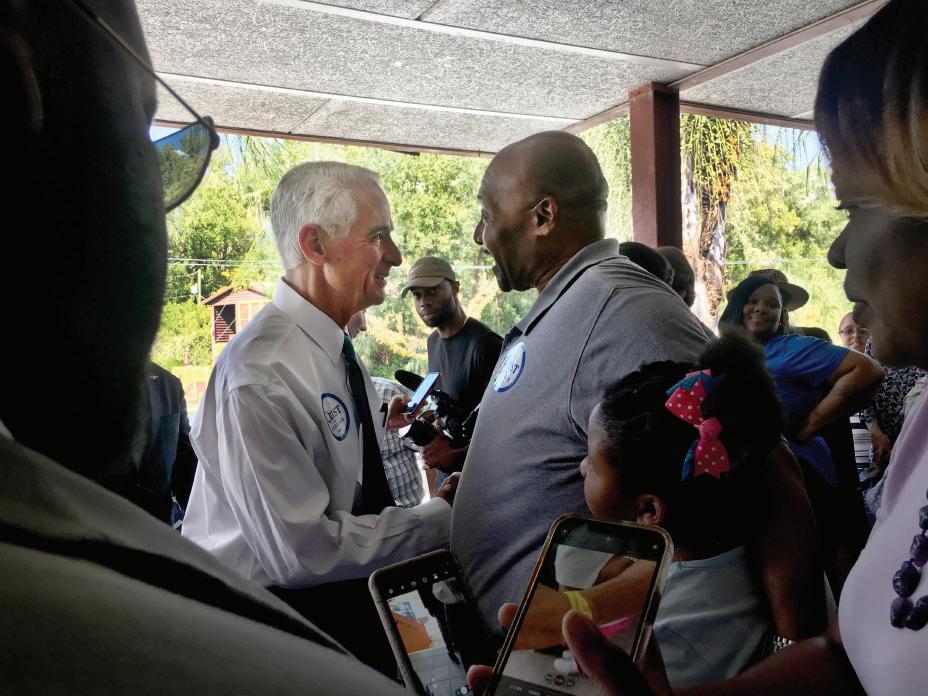
Charlie Crist stops in Gainesville ahead of gubernatorial election
 Heather Bushman Alligator Staff Writer
Democratic gubernatorial hopeful former Rep. Charlie Crist fielded big questions — on reproductive health care, climate change, gun reform and other issues.
Big questions need big answers, Crist said. He advocated for state wide solar panel installation, educa tion reform and an executive order securing the right to an abortion as he offered responses to voter ques tions.
The biggest answer of all, he said: a win against incumbent Gov. Ron DeSantis Nov. 8.
Crist, a former governor and U.S. House representative, stopped at the Alachua County Democratic Party headquarters Sept. 24. A crowd of about 50 people came to listen to him speak about his platform, where he tackled common concerns and emphasized his political experience. He also urged attendees to vote.
The appearance comes more than a month ahead of the general election and behind Crist’s primary win, where he defeated Florida Com missioner of Agriculture Nikki Fried with almost 60% of the vote. Crist now faces DeSantis in the general election.
Projections from Politico predict Florida voters will likely choose De Santis in November. DeSantis’ $166 million in campaign contributions dwarfs Crist’s $18 million, according to campaign finance data.
But Crist told the crowd he’s op timistic.
“The closer we get, the better it’s
FORUM, from pg. 1
getting,” he said. “You feel it? I feel it too.”
Crist’s platform highlights Demo cratic ballot measures like expand ing Medicare and protecting LGBTQ rights. His self-described “common sense” provisions have drawn the support of Democratic voters like Su san Bottcher, a 65-year-old volunteer with Alachua County Democrats, member of Equality Florida and for mer candidate for the Gainesville City Commission.
She hopes Crist’s platform will mitigate the widespread conserva tive influence in Florida, Bottcher said.
“It pushes back against the over reach from the Republicans, particu larly our governor, who seems to be doing his best to out-extreme every other Republican in the country,” she said. Democratic voters have criticized Crist for his past term as governor, when he ran and won as a Republican in the 2006 election. He’s faced backlash for past comments on abortion — he once described him self as “pro-life” — and his relatively moderate views.
Still, voters like Bottcher view his light blue as the best alternative to DeSantis’ deep red.
“I may not agree in deep detail with everything Charlie Crist says or does,” she said. “But he is heads and shoulders above anything that the Republican party’s offering.”
The right to an abortion is his top priority, Crist said, promising to sign an executive order protecting it on his first day in office if elected. He pointed to his track record on abor tion legislation and said he would
carry those values to office again.
“When I was a Republican gov ernor, I vetoed an anti-abortion bill,” he said. “What else do you need to know?”
Crist’s education plan includes repealing legislation like the “Stop WOKE Act” and the “Parental Rights in Education” Act — dubbed the “Don’t Say Gay” bill by critics — two policy initiatives that limit what teachers can discuss in classrooms. He will also declare the teacher shortage a national emergency and allocate state funding to recruitment and hiring efforts.
He also vowed to fight censor
wants to broadcast her platform points.
candidates ran on codifying Roe into law and extending abortion access beyond the state’s current 15-week law, which was legalized with the passage of House Bill 5 in July.
That bill has since been challenged by state healthcare providers and will undergo review by the Florida Supreme Court, which Fried said will likely uphold the ban.
Instead of relying on the ruling, Fried said residents need to lobby their representatives for legislative action to protect the right to an abortion. She discussed plans to consider pro posing a constitutional amendment that pro tects reproductive rights, though details are unclear, she said.
“I don’t have any faith in this Florida Su preme Court, which means that we’re going to have to go back to the people,” Fried said.
Fried lost the Democratic gubernatorial pri mary to former Rep. Charlie Crist. Despite not currently running a campaign, she said she still
Supporting candidates like Hawk is of the utmost importance in an election cycle with major issues like reproductive freedom on the line, Fried said.
“That’s what democracy is about,” she said. “One election doesn’t mean the things that I was fighting for end.”
Attendees like Holly Marino, a 25-year-old mortgage company employee and Gainesville resident, support similar legislative action to what Fried and Hawk promoted. She hopes to see Roe reinstated, she said, and for the legisla ture to expand abortion protections.
After a year of setbacks in abortion legis lation, Marino said she holds onto candidates like Hawk to deliver on their promises if elect ed.
“I’m just hoping for the best at this point,” she said. “It’s been a hard road.”
Though abortion rights have traditionally fallen under Democratic campaigns, Hawk said she views the right to an abortion as a nonpartisan policy point. Liberal or conserva
ship in schools, which is propelled by House Bill 1467. The bill, ap proved by DeSantis, keeps books like “Maus” by Art Spiegelman and “Beloved” by Toni Morrison off the shelves for some school libraries.
It’s an issue on the minds of vot ers like J.W. Honeysucker, a 58-yearold pastor at Grace United Ministries and Gainesville resident.
Honeysucker, whose 7-year-old daughter, Jaehannah, is in first grade at Cornerstone Academy, said the widespread ban on books and lack of resources for teachers concerns him.
“I’m supporting him for the
tive, urban or rural, woman or man, Hawk said everyone should advocate for reproduc tive health.
“It is not a partisan issue anymore,” she said. “We are up against extremists who are in our state legislatures, who are in our Congress, and they are coming for all of our personal lib erties.”
Hawk’s opponent in the general election, Republican incumbent Rep. Kat Cammack, is co-chair of the U.S. House Pro-Life Caucus and has voted against reproductive health legisla tion like the Women’s Health Protection Act, according to her Congressional voting record. She’s running on a platform of “defending life,” according to her campaign website, and she advocated for the reversal of Roe earlier this year.
Cammack leads Hawk in projected results, according to campaign finance data from the Federal Election Commission. Cammack’s as sets total almost $2 million, while Hawk has collected almost $32,000 in finances.
The right to an abortion hits home, Hawk
stance and for the platform he’s run ning on,” Honeysucker said. “Hope fully to help make a change.”
Parents expressed concern over not just school content, but also school safety. Amid a surge in mass shootings — including the Uvalde, Texas, school shooting that left 21 dead in May — voters are calling for stricter gun laws and reform to school safety.
• • • Read the rest on alligator.org
@hmb_1013 hbushman@alligator.org
said. As a woman of reproductive age, she said she’s advocating for reproductive health for both herself and her constituents.
“We’re talking about my rights being taken away from me,” she said. “It’s not just person al for me, but it’s also personal for a lot of the women who are here in our district.”
Legislative changes to secure reproductive rights are only possible if voters turn out, Fried and Hawk said. They warned of the apathy that allowed the overturn of Roe to transpire in the first place and encouraged voters to stay motivated for November’s election.
After years of electing Democrats only for little to change, Fried said she encountered many voters who were exasperated with the stagnation of the legislature. Despite the fa tigue, she urged attendees to vote with more fervor instead of stepping back.
“That doesn’t mean you have to stop vot ing,” she said. “That means we need to vote more.”
Clearing the first major hurdle in the lawsuit revitalized advocates’ en ergy to make sure their case sees its day in court.
Gail Johnson, a former city com missioner who led the city’s deci sion in pursuing the lawsuit against the state, said the issue quickly tran scended local government powers.
“As local legislators, we would have been unable to respond to com munity needs,” Johnson said. “It’s beyond the city of Gainesville.”
David Arreola, District 3 city com
missioner, said the state should have no say in Gainesville’s budget, given the city earns the revenue itself. The city levies its own taxes and decides how to spend its money, he said, just as the state gets to do the same.
The Gainesville City Commission has actively considered changing the funding of youth programs, which are currently under law enforce ment’s budget, to instead receive funding elsewhere. Under HB 1, this change would require approval from the state level, according to the city’s legal complaint.
“That’s not defunding the po lice,” Arreola said. “That’s enhancing
youth services.”
Supporters of HB 1 feel the legis lation helps protect law enforcement, following calls for defunding the po lice from social justice activists.
Ed Braddy, Republican nominee for the County Commission District 2 seat and former Gainesville mayor, said the bill’s purpose is to help en sure residents remain safe, criticizing the city’s plans for defunding.
“HB 1 does not prevent local gov ernments from funding public safe ty,” Braddy said. “The issue is how they divert money away from public safety.”
Given Gainesville’s active protest
culture, social activists within the community have expressed concerns over HB 1’s potential effects.
Laura Blecha, a 39-year-old Gainesville resident and National Women’s Liberation member, said the bill is an effort to stifle dissenting speech from Floridians.
“It is a very blatant attempt to limit the first amendment rights of Floridians,” Blecha said.
Others agree the legislation fails to address why protests often turn con frontational.
Ruka Scarlett, a 33-year-old Gainesville resident and National Women’s Liberation member, said
demonstrations become violent out of necessity when citizens’ needs are not being met.
“We need to fight it, and obvious ly we’d prefer this peaceful,” Scarlett said. “But they’re giving us no other choice.”
As of Sunday evening, the next court appearance for the lawsuit doesn’t have a published date. Both parties have time to make appeals to the motion and otherwise reorganize their case in the meantime.
@aidandisto abush@alligator.org HB 1, from pg. 1
@hmb_1013 hbushman@alligator.org

YOUR CARE IS OUR PRIORITY. GET CARE.
Gainesville HempFest calls for legalization of cannabis
THE FESTIVAL FIRST TOOK PLACE IN THE 1990S
By Luna Boales
Alligator Staff Writer
A giant banner adorned in rainbow canna bis leaves hung above the stage at Bo Diddley Plaza, with bold text reading: “It’s a plant, not a crime.” Navy-blue cabanas full of meditation books, hemp-themed clothing, crystals and CBD products surrounded the lawn.
Nearly three decades since the festival first took place, Gainesville HempFest returned to downtown Saturday, featuring a wide array of bands, vendors, food trucks and speakers — all advocating for the legalization of cannabis. Hundreds of attendees gathered in support.
Robert “Hutch” Hutchinson, a former Ala chua County commissioner of 12 years, attend ed HempFest as both a speaker and keyboard player for the band “Weeds of Eden,” which performed at the festival.
In 2012, Hutchinson said he ran on a plat form of reforming drug laws. He said he per sonally saw the effects of low-level marijuana possession arrests on the community — with residents losing their licenses, being denied a position at work or in the military and being incarcerated.
“It should be legalized because the harm of keeping it illegal is a greater risk to people than the harm of actually using it,” he said.
This year, HempFest was sponsored by lo cal and state organizations including the Flor ida Cannabis Action Network, Depot Village, VidaCann, Bad Fish Smoke Shop and Aesthetic Print and Design.
The festival also celebrated the 30-year an
niversary of the nationally recognized “doobie toss.”
The doobie toss first took place at Hemp Fest in 1994 and was organized by activist Dennis “Murli” Watkins, according to a 1996 Associated Press report. Local cannabis grow ers illegally provided thousands of hand-rolled joints, and dozens of people tossed them in the air to the HempFest crowd.
Watkins was arrested and sentenced to four months for organizing the event, the Associ ated Press reported. Following his release, he continued to fight for cannabis to be legalized recreationally, insisting it was a human right.
Watkins attended this year’s HempFest, settling into Bo Diddley Plaza in his specially constructed makeshift living room. The setup, which was shielded from the sun by a cabana,
featured a large couch and wooden coffee table placed on top of a rug.
HempFest is important because it brings ac tivists together to connect, plan strategies and share information, Hutchinson said.
“It demonstrates to elected officials, the police, prosecutors and judges that there are people of all walks of life who don’t believe this should be illegal,” Hutchinson said. “It sort of normalizes the fact that cannabis is part of our culture, and shouldn’t be something where there is criminality and stigma associ ated with it.”
Tom Miller, a 56-year-old artist, hosted sev eral HempFests in the past — returning this year as both the host and a speaker at the fes tival.
Beyond activism, Miller said the right to
use cannabis recreationally is a First Amend ment right activists will fight for until changes are made. The Florida Compassionate Medical Cannabis Act of 2014 legalized non-smoked marijuana, but it wasn’t until 2019 that the smokable medical marijuana bill was put into
HempFest is more than just a celebration of hemp, he said.
“If you tell us we can’t have a free speech event, we’re gonna remind you we live in America and have it anyway,” Miller said. “I think everybody feels good that we’re begin ning to see the value of this plant — the socio economic value and for stress, for food, fuel, fiber and medicine.”
The Gainesville HempFest is known for bringing the community together in a singu lar spirit, Miller said. It’s an educational and enlightening experience, encouraging the com munity to put down their cell phones, listen to music and have some fun, he added.

Kyree Dion, 30, is the owner of Kyria’s Crystals and Curiosities — one of many ven dors at the festival. She participated in Hemp Fest because she said she believes all cannabis should be legalized.
“The plant alone can be used in many dif ferent ways to help reduce waste, and it helps with pain,” she said. “I think it honestly would get rid of a little bit of Big Pharma, medicine and things like that.”
Speakers at the festival included former and current politicians such as Florida House Rep. Yvonne Hinson and attorney Gary Wainwright.
Read the rest on alligator.org
@LunaBoales lboales@alligator.org
THE APP BRINGS DISCUSSIONS OF AUTHENTICITY, SOCIAL MEDIA TO CAMPUS
By Lauren Brensel
Alligator Staff Writer
In the span of two minutes, UF stu dents across Gainesville ask themselves one of the most philosophical questions any 20-something has ever considered: What does it mean to ‘be real’?
Usually, it’s a selfie in bed.
BeReal is a social media app where users have two minutes to snap an unfiltered front-and-back-fac ing photo once a day. All 10 million of its daily active users receive the BeReal notification at the same time, but the alert is sent at different times every day — ideally offering a candid glimpse into the average person’s life.

The app prides itself on its au thenticity, but some UF faculty and students aren’t confident that goal is possible in a developed, digitalized world.
Benjamin Johnson, a UF adver tising professor, said he believes au thenticity is important among BeRe al’s young demographic, but it’s often difficult to define.
This disparity can be explained by the concept of social comparison, or how people perceive their own lives in reference to those of others. As social media allows individuals to interact with increased numbers of people online, social comparison also changes, he said.
“On social media, people are very careful about presenting their best selves, so I might think that my friend dresses poorly or doesn’t have [a] nice hairstyle or he’s awkward,” Johnson said. “But online, maybe he can edit that and look much more charming than he really is.”
But, BeReal has features to coun teract that. There are no filters on the app and you only have two minutes to post one photo. It’s also more com mon to follow only a handful of close
friends. In fact, under its description on the Apple app store reads a warn ing: “BeReal doesn’t care if you have millions of followers or if you’re veri fied.”
A smaller social network, like those on BeReal, can make social comparison more accurate, Johnson said.

“It might not be people assuming that this acquaintance is an amazing person when they’re not,” he said.
Taimoor Nawaz, a 19-year-old UF economics sophomore, said he once posted his BeReal while on the toilet.
“For me, it’s just do it as soon as possible,” he said.
Despite BeReal’s premise of au thenticity, it’s still possible to remove and retake photos — although users can view how many times someone retakes their photo. Users can also upload their BeReals late, allowing people to intentionally delay posting until the perfect photo opportunity arrives.
BeReal was founded by French entrepreneur Alexis Barreyat, who launched the app in 2020. It didn’t take off until 2022, reaching 56 mil lion downloads this year.
Lauren Gabbe, an 18-year-old UF political science freshman, said she joined BeReal in August after notic ing the app gaining popularity. She thought BeReal sounded similar to other one-second-a-day apps, but she loves it nonetheless, she said.
“It’s fun to see exactly where everyone is, especially if you have friends that don’t live in the same place as you,” she said.
As BeReal’s user base grows, oth er social media platforms have cre ated new features to mimic the app.
On Sept. 15, TikTok announced TikTok Now, where users take a front-and-back-facing photo or video after getting a notification that reads “Time to Now.” Instagram is cur rently testing IG Candid, where users share a photo at a different time every
day.
Still, some UF students were hesi tant about BeReal’s originality when they first downloaded the app.
Coral Rodriguez-Lipstein, a 20-year-old public relations junior, said BeReal sounded similar to Po parazzi, an app where users have their friends post to their profiles, similar to how paparazzi snap can dids of celebrities.
Andrew Selepak, a UF professor who specializes in social media, said BeReal asks its young users to change the way they use social media.
“It’s saying, ‘Hey, don’t post when you are doing something inter esting — when you’re on vacation, when you’re having fun — but post the mundane moments of your life,’” he said.
Read the rest on alligator.org
Gators’ miracle falls short on Rocky Top Florida football remains winless in SEC play after trip to Tennessee Pg.
Scan
MONDAY, SEPTEMBER 26, 2022 www.alligator.org/section/the_avenue Keep up with the Avenue on Twitter. Tweet us @TheFloridaAve.
11
to follow the Avenue on Spotify
LIFESTYLE
@laurenBrensel lbrensel@alligator.org Gators get real: UF professors, students reflect on social media app BeReal SOCIAL MEDIA • • • • • •
Change Party: Moving UF forward, together
SG’S $23 MILLION BUDGET NEEDS SOME CHANGE
Our Student Government and our elections are supposed to reflect the interests of the entire UF student body, no matter who you are. Unfortunately, there has been persistent misal location of student funding, prioritizing a slim number of in terests. The inequitable distribution of our student budget was most recently manifested in the recruitment of Accent speaker Josh Richards for $60,000.
Public outrage became imminent, with student organiza tions, academic resources and mental health outlets struggling to meet the demand of the student body, given their scarce funding.
Change Party fights to restore and protect the voices of students that are often tactically dismissed. We exhibit demo cratic integrity through our caucus’ commitment to enacting social justice legislation.
Despite only compromising 18% of seats in the Student Senate, the Change caucus has authored or sponsored around 73.1% of legislation on the Senate floor during Summer 2022. Our initiatives are often met with unjust bureaucratic block ades.
For example, the Change caucus has a pass rate of 31.8% on the Senate floor and the Judiciary Committee, in contrast to the Gator caucus, which has a pass rate of 100% due to the im mediate dismissal by the majority party due to partisan lines. However, the Change caucus has successfully put up more than 50 pieces of legislation. This reflects the passion and drive of such a small group of individuals to overcome the in stitutional barriers set in place to hinder democratic processes.
Change Party has strictly enforced accountability and trans parency across the Senate in order to rebuild legitimacy with UF students and protect the needs of our constituents from unjust political practices. We stand united against the opposi tion that is determined to disenfranchise voters.
Our initiatives, such as our “Legislative Public Awareness Intensification” Amendment and “The Internet Voting Acces sibility” Act, have been blocked by the Gator-filled Judiciary Committee. Progressive voting measures should never be in hibited, especially when we’re the only Southeastern Confer ence university without access to online voting.
We believe the students’ interests and voices should deter mine our interests as elected officials. Political corporations should serve no role in the agenda of the Senate. That said, our senators host a number of meetings to interact with their constituents and uphold their needs. UF students deserve as surances that their representatives work for them, not in their own special interests.
To ensure that funds are invested efficiently and equitably, Change Party has made several attempts to use the best avail able evidence when making spending decisions. For example, Change has conducted an extensive report of library hours and associated funding to display our commitment to this cause. We later proposed the “Twenty-Four Hour” Amendment, with the support of the dean of libraries, which would have allo cated $130,000 of SG funds to use for Marston Science Library.
Ultimately, our party is vital because it’s built on the foun dations of our pillars: social justice, equity and representation.
As Change Party, we believe every student in this univer sity should be treated with respect and dignity, and this in cludes being heard. Our platform serves to establish grounds regarding accountability and transparency, ensuring each stu dent is truly advocated for. Change Party seeks to achieve en vironmental, racial and sexual justice on campus by informing individuals about SG and presenting tangible and equitable solutions.
Change Party is a Student Government political party with candidates slated for the Fall 2022 election.
GatorPartyaimstocontinueenhancingstudentexperience
GATOR REFLECTS WHILE LOOKING TO FUTURE INITIATIVES
Gator Party is proud to have led Student Govern ment for the last two years. It has been an honor to generate long-lasting impacts for the Gator community through the executive and legislative branches.
The executive agencies have been spearheading groundbreaking initiatives. Class Councils have worked to ensure the next generation of student leaders are prepared for the challenges ahead by establishing the Freshman Leadership Experience (FLEX) program. Nightlife Naviga tors has been investing in students’ security by providing drink cover scrunchies.
Moreover, Gator Party believes that all students de serve to feel welcome at UF regardless of their socioeco nomic status, political ideology, gender, sexual orienta tion, race or ethnicity; Students Taking Action Against Racism (STAAR) created the first Diversity, Equity and Inclusivity curriculum.
Under this administration, the cabinet is constantly in vesting in funneling resources to different campus com munities. Believing in service through innovation, the newly created Out of State Affairs Cabinet works so those students who are joining the Gator Nation from outside of Florida will feel right at home the moment they step
The need for liberation in SG
IT’S TIME TO END ONE-PARTY RULE AT UF
Aspecter haunts the University of Florida. The specter of liberation.
Our university and our democracy is under at tack. On a broad scale, assaults on our academic freedom by Tallahassee have gone unchecked by the UF Board of Trustees, creating an atmosphere of fear and censorship. The graduate assistants who help produce UF’s prized research and teach numerous courses continue to be underpaid and overworked, while graduate housing is being destroyed and outsourced to for-profit corporations.
Meanwhile, our Student Government, led by a Gator Party supermajority, continues to set aflame the values of freedom, diversity, and democracy — whether it’s through bullying and racially microaggressing a Black queer student, Jonathan Ste phens, or coercing their senators to vote against their will. Ad ditionally, the authoritarian Senate recently passed a reappor tionment bill that disenfranchised thousands of UF students who live outside of Gainesville by eliminating their one-seat district.
Data provided in a case that will be heard by the UF Su preme Court suggests District E should make up the largest share of the 50 geographically based Senate seats, and yet it has now been eliminated. This entire situation is made worse by the continued ban on online voting, which Gator Party has failed to address.
However, there is hope.
We, the student body, cannot afford to continue letting cor rupt autocrats control more than $23 million of our student fees and trample over the values that define us as students and as a university.
Candidates who believe in democracy reform must be sup ported by students. That could mean implementing ranked choice voting to help abolish the one-party system, creating finance equity for SG parties, or lifting the harsh restrictions on free speech that essentially ban Gator Party dissenters from offering an alternative SG vision.
SG also has the power to make a better campus possible. We need to call for the mass expansion of student services,
foot on campus. Furthermore, we helped found the First Generation Living and Learning Community at Thomas Hall, which provides a hub for first-generation students on campus.
In the Senate, our members strive to improve cam pus every week. It was Gator Party senators who led the way on historic investments including allocated more than $500,000 to upgrade Newell Hall and to enhance the Brown Center for Leadership & Service operations.
Likewise, we invested more than $1,400,000 in re pairing machines and expanding the Southwest Recre ational Center and Lake Walburg. Additionally, Senate under Gator Party’s leadership has invested more than $1,200,000 in structural upgrades and repairs to the Reitz Union, a hub for student life.
We also recognize the importance of our students’ mental well-being by promoting the 988 hotline as a men tal health resource and working with our campus partners to secure funding for the CWC’s Consultation and Referral Team (CART). This has helped bolster the support avail able for our students.
While Gator Party has achieved a lot over the past year, there is still so much more to be done. We look forward to getting back to work so we can continue to serve students as we always have: faithfully done.
Gator Party is a Student Government political party with candidates slated for the Fall 2022 election.
which could include making laundry, a necessary service for students, free of charge. Abolishing name change fees on Ga torONE cards would uphold UF’s commitments to inclusivity for transgender and married students.
Additionally, SG must pass the Pregnancy Healthcare Au thorization, which would empower students and allow them to have freedom over their reproductive healthcare.
At the polls, students must also let SG know how important the university’s labor unions are. Graduate Assistants United, United Faculty of Florida and United Campus Workers are all important organizations that have uplifted worker voices. They’ve also won material changes for workers who make UF a better place to work. Their work is far from done, and the student body must stand firmly behind them as they continue to work toward their goals.
To this end, students should vote for candidates who sup port solidarity with unions and pro-labor policies. This in cludes pushing SG to buy products made by unions in Ameri ca, establishing a Senate committee to review worker benefits and pay and encouraging SG and other workers to unionize.
We the students have an immense duty to repel the forces of authoritarianism that hang like a stormcloud over our cam pus. If we’re to honestly espouse the university’s values of inclusion, freedom & civility, community and stewardship, we cannot let stand the one-party system that currently corrupts SG. We must liberate our campus, and we must liberate SG.
The Liberation Party, founded by activists with years of organizing experience, aims to be a force for the freedom of SG from the shackles of the system. Working under the Young Democratic Socialists of America, we have already started a movement for liberation that encompasses all of campus, not just the corrupt Senate.
Student Government elections are Sept. 27 and 28, from 8:30 a.m. to 8:30 p.m. on both days. The Liberation Party is running eight candidates, mainly in District D, zip code 32608, and is endorsing several Change Party candidates and inde pendent candidates for Senate. Students can view this infor mation and more about the party on our Instagram.
Our alternative vision for SG is completely within the bounds of what the Senate can do and well within its budget. A better campus is possible!
Liberation Party is a Student Government political party with candidates slated for the Fall 2022 election.
The views expressed here are not necessarily those of The Alligator.
Column Column St., or send them to P.O. Box 14257, Gainesville, FL 32604-2257.Columns of about 450 words about original topics and editorial cartoons are also welcome. Questions? Call 352-376-4458.
Column
MONDAY, SEPTEMBER 26, 2022 www.alligator.org/section/opinions
The Alligator encourages comments from readers. Letters to the editor should not exceed 600 words (about one letter-sized page). They must be typed, double-spaced and must include the author’s name, classification and phone number. Names will be withheld if the writer shows just cause. We reserve the right to edit for length, grammar, style and libel. Send letters to opinions@alligator.org, bring them to 2700 SW 13th
NOTE:
SS & VA ARE WELCOME! $560/BedRoom for Sublease
Running or Not. Top Dollar Paid Call 352-259-2020 12-5-16-13 For Rent furnished
The American Cancer Society Road to Recovery Volunteers Needed! VOLUNTEER DRIVERS NEEDED to transport cancer patients to treatment. Flexible schedule. Training and liability insurance provided. Please call 800-227-2345 if interested.
CASH FOR UNWANTED CARS TRUCKS
St. Francis House is a homeless shelter located in downtown Gainesville.
Our mission is to empower families with children to transition from homelessness to self-sufficiency by providing case management, housing, food, training and educational resources in a secure environment.
If interested in volunteering please contact the volunteer coordinator at 352-378- 9079 ext 317 or sfhcoor@stfrancis.cfcoxmail.com
St Francis House depends on monetary support from individual donors and community businesses in order to provide meals to the homeless and the hungry.

To make a donation by mail, please send checks payable to St. Francis House P.O. Box 12491 Gainesville Fl 32604 or our website at Stfrancishousegnv.org

Los
Edited by Patti Varol and Joyce Nichols Lewis
BUY IT. SELL IT. FIND IT. 373-FIND MONDAY, SEPTEMBER 26, 2022 www.alligator.org/classifieds How to Place a Classified Ad: Corrections and Cancellations: Cancellations: Call 373-FIND M-F, 8am - 4pm. No refunds or credits can be given. Alligator errors: Check your ad the FIRST day it runs. Call 373-FIND with any corrections before noon. THE ALLIGATOR IS ONLY RESPONSIBLE FOR THE FIRST DAY THE AD RUNS INCORRECTLY. Corrected ads will be extended one day. No refunds or credits can be given after placing the ad. Corrections called in after the first day will not be further compensated. Customer error or changes: Changes must be made BEFORE NOON for the next day’s paper. There will be a $2.00 charge for minor changes. Online: w/ major credit card at www.alligator.org/classifieds In Person: Cash, Check, MC, Discover, AMEX or Visa @The Alligator Office: 2700 SW 13th St. M-F, 8am - 4pm By E-mail: classified@alligator.org By Fax: (352) 376-4556 By Mail: P.O. Box 14257 G-ville 32604 See alligator.org for more information Call 352-373-FIND for information. Sorry, no cash by mail. Credit cards or checks only. BCI Walk In Tubs are now on SALE! Be one of the first 50 callers and save $1,500! CALL 888-687-0415 for a free in-home consultation. 9-26-9-10 Goats for Sale & Lease Horse Boarding - 7 miles to UF Charlie - 352-278-1925 12-5-16-10 ●UF Surplus On-Line Auctions● are underway…bikes, computers, furniture, vehicles & more. All individuals interested in bidding go to: SURPLUS.UFL.EDU 392-0370 12-5-16-10 When the heat is on and it's bucks that you need, Best Jewelry and Loan your requests we will heed. 523 NW 3rd Ave 352-371-4367 12-5-16-10 Submit your ad today! www.alligator.org/classifieds 12 Autos CASH FOR UNWANTED CARS / TRUCKS Running or Not. Top Dollar Paid Call 352-259-2020 12-5-16-12 13 Wanted The surf's up at "Pawn Beach" we're all making the scene. If you're in need go see Rich, Best Jewelry and Loan's got the "green". 523 NW 3rd Ave 352-371-4367 12-5-16-13
/
1
This newspaper assumes no responsibility for injury or loss arising from contacts made through advertising. We suggest that any reader who responds to advertising use caution and in vestigate the sincerity of the advertiser before giving out personal information or arranging meetings or investing money.
● No Deposit! ● Furnished Cable ● Internet ● Utilities “Call or Text” 352-246-3418 12-5-13-1 Got a place
rent? Submit your ad today! www.alligator.org/classifieds 3
Apartment for rent Opportunity to sublease my brand new apartment at the Legacy at the Standard. The rent is $1192, including a parking space, but it you are interested I will get you a rent reduction. Four great roommates come with the unit and you have your own bedroom and bathroom. Please reply quickly as this will go fast. Contact me at 305-915-5770. Exnet@usinternet.com 10-17-22-4-3 5 Real Estate NEW CONDOS-WALK TO UF For Info on ALL Condos for Sale, Visit www.UFCONDOS.COM or Matt Price, University Realty, 352-281-3551 12-5-16-5 6 Furnishings You need the money to do what you will. Rich at Best Jewelry and Loan has the cash for those bills. 523 NW 3rd Ave 352-371-4367 12-15-16-6 1 Y Yeaarlly y 1 Frreenncch 5 Hiidddeen s suppplly 2 Cyprrus s capitaal 6 Tank t top, , f for r e example 3 C Centtral 7 Yelllow w s songgbbirrd 4 Exxpeenssive A L N A U N N C T C A E H C A E C R T I S H S C A O I N I M I E A C R A C A A Y N R L Y O S C T EWSNAA1:SREaunnAACA5acaCCA7trhSA6ehcnaCyran D1ADccAciND2tnecasocD3aADemAD4acireCDnoCByltsoCnnenitceucitu t 9 26 2 22 2 ACROSS DOWN CLUE CLUE ANSWER ANSWER by Daavid L H Hooyt Comp p ete e the crosswwoord puzzzlle by y loook ng at the e clues annd d unsscrammb i ing the answwers s Whheen n the puzzlle s coompllette, unnscrambble e the e circleed lettteers s to solvve thhe BONUS Hoow w to plaay y & Hooyyt Des s gns A R g ghhts Reserved d 2022 T b buune C Con n en n A Agency LLC Send commen s to TCA 160 N S Sttetsson C Chiicago l no o s 600601 or r DLHoy @HHooytInnterractiveMeedia c com m J U M B L JE U M E R M 1 6 2 5 3 7 4 CLUE: The e prrayinng g maanttis s h has b beeen n the e o offfiiccial state i inssecct of s sinnce 1 19777 7 BONUS
¿hablas español? lee el periódico independienteuniversitario mas grandede estados unidos. 10 For Sale By Emet Ozar ©2022 Tribune Content Agency, LLC 09/26/22
Angeles Times Daily Crossword Puzzle
09/26/22 ANSWER TO PREVIOUS PUZZLE: Release Date: Monday, September 26, 2022 ACROSS 1 Symbol on an Angels baseball cap 5 “Lucy and __”: 2022 documentary about a classic sitcom couple 9 Awaken 13 Trendy purple berry 14 Top __: instant noodle brand 15 “Yeah, try again” 16 *Fancy costume party 18 Snap up 19 Pulls, as a camper 20 Wyo. neighbor 21 Top-notch 22 Run out, as a subscription 24 *Colorful garden plot 26 Tribute poem 27 2016 Summer Olympics city 29 Letters on a car dealership sticker 30 Ritz-Carlton competitor 32 Mourning dove sound 34 Messy stuff 37 Out of favor with one’s partner, and where to find the ends of the answers to the starred clues 41 Bygone toy company 42 Winter malady 43 Future dr.’s exam 45 Woeful cry 48 “How repulsive” 50 Blackjack card 51 *Sensitive spot on the elbow 55 Shake hands (on) 57 “__ it first!”: “Dibs!” 58 Bird who is the only player to win WNBA titles in three different decades 59 CNN’s “__ Burnett OutFront” 60 2021 Pixar movie set in Italy 61 *Annual Florida college football game 65 Fish often grilled for tacos, informally 66 Label again 67 Actress Falco 68 Mailbox opening 69 Forehead 70 Govt.-issued IDs DOWN 1 Meat in a croquemonsieur 2 Obama-era health law, for short 3 Final funds 4 Brand of Greek yogurt 5 Tiny amount of eye cream 6 Inbox accumulation 7 Not frequently 8 Relatives acquired by marriage 9 Sweet treat in a Christmas poem 10 Pulsate 11 Foolish 12 Dressed for choir 14 Hwys. 17 Decorative pitcher 22 British lav 23 Confess 24 Grub 25 Thus, in logic 28 Freezer cubes 31 “No rush on this” 33 “That’s gotta hurt” 35 Prestigious showbiz nominations 36 “Later” 38 “__ Toledo!” 39 Collage application 40 Squeeze 44 Summer shirt 46 Soak up 47 More tart 49 Tortoise’s race rival 51 Movies 52 Run-of-the-mill 53 Chip with cheese 54 “Super cool” 56 Taunts 59 Frittata ingredient 62 Opposite of “yep” 63 Take first prize 64 “__ Misérables” By Amie Walker ©2022 Tribune Content Agency, LLC 09/20/22 Los Angeles Times Daily Crossword Puzzle Edited by Patti Varol and Joyce Nichols Lewis 09/20/22 ANSWER TO PREVIOUS PUZZLE: Release Date: Tuesday, September 20, 2022 ACROSS 1 Snorkeler’s destination 5 Challenging H.S. science class 10 Chef’s meas. 13 Musical “Jeopardy!” category that’s tough for many contestants 15 Swampy area 16 Rower’s blade 17 Showers someone with money? 19 Undivided 20 Lead-in to gender 21 Use when there are no better options, say 23 City in northern Illinois 26 Breakfast chain with bottomless stacks 27 “Spit it out!” 32 Sheltered, at sea 33 Beef and pork 34 Clock-setting std. 37 “Top Gun” nickname 38 Poolside structures 40 __ Grande 41 Potato spot 42 Prepares for a recipe, as onions 43 __ one’s time: be patient 44 Cheese, beans, guacamole, sour cream, etc. 48 Car 50 Creamy chocolate dessert 51 Sidelong glances 56 Afore 57 “Is that __?”: “Are you declining?” 58 Voter’s crossover ballot, and what can literally be found in the circled letters 63 Journalist Rather 64 Linney of “Ozark” 65 Peak in Greek myth 66 Portland’s st. 67 Early Mesoamerican 68 Puny pencil DOWN 1 __-com: date movie, maybe 2 Clean air org. 3 Cartoon shriek 4 Skin spot that may be darkened by sunlight 5 Acct. balance, e.g. 6 “The Incredibles” family name 7 Scottish hillside 8 Egyptian fertility goddess 9 “That’s not good!” 10 Wide smiles 11 __ Domingo: Caribbean capital 12 Hosp. stop before surgery 14 “Take me __” 18 Small landmass 22 Free (of) 23 Make late 24 Bilbo Baggins’ age at the start of “The Lord of the Rings” 25 Panda’s diet 27 Domesticated 28 Jumped 29 Kidnapper’s demand 30 Incoming flight stat 31 Pack animal 35 Gnatlike insect 36 Pedicure targets 38 Junk bond rating 39 “That hits the spot!” 43 Divides equally 45 IM pioneer 46 Bard 47 Jewish festival when the Book of Esther is read 48 Pollo __: grilled chicken dish 49 Of a forearm bone 52 Norway’s capital 53 Milky white gem 54 Supermodel Heidi 55 “Your Majesty” 59 Tic-__-toe 60 Assemblyrequired boxful 61 School URL ending 62 Indent key 09/19/2022 solution on page 10 13 Wanted answer on page 10 ©2022 King Features Synd., Inc.
14 Help Wanted
Part time help wanted for yard work in SW Gainesville. Flex hours. Experience required. $11 - $13/hr. Call Mr. Z. 352-278-8071 10-10-22-8-14
WALDO FARMERS & FLEA MARKET Vintage & Unique - Like EBay in 3D Sat & Sun www.WaldoFlea.com 8-15-13-21
HIRING OFFICE CLEANERS
M-F & every other Sat. Night shift starting at 5:30 p.m. Must own a car / lots of driving. Weekly pay. $14/hr. If interested please call 352-214-0868 8-15-22-13-14
NEED HELP DEVELOPING WEBSITE InspirationPointers.com as an online affiliate bookstore. Contact TomPrahl@outlook.com 9-26-22-3-14

Want to be the change in the world? Join our team of youth development profes sionals in out of school programs! Seeking classroom counselors for girls ages 5-14 & tutors in our academic program. Ideal can didate is available M-F afternoons. Learn more & apply at girlsplace.net/employment 9-26-22-5-14
PT / FT CAR WASH ATTENDANTS
Apply online at: www.parkplacecarwash.com 9-26-22-8-14
TRAIN ONLINE TO DO MEDICAL BILLING!
Become a Medical Office Professional online at CTI! Get Trained, Certified & ready to work in months! Call 855-738-9684. (M-F 8am6pm ET). Computer with internet is required. 9-26-7-15
Foreclosure and Eviction Assistance A+Rated, HUD-Approved (Lic.83706) NonProfit offering Assistance for Eviction and Foreclosure Avoidance. Free & Confidential Call: 561-472-8000 Debthelper.com 9-26-13-15
16 Health Services
Attention: VIAGRA and CIALIS USERS! A cheaper alternative to high drug store prices! 50 Pill Special-Only $99! 100% guaranteed. CALL NOW: 866-259-6816 9-26-15-16
Surf on down to "Pawn Beach" when the tide seems too high. We're your summer cash friends so your blues will be all sky! 523 NW 3rd Ave 352-371-4367 12-5-16-21
24 Pets
Use Happy Jack® Skin Balm® on cats and dogs to promote healing & hair growth due to hot spots & fleas without steroids! At Tractor Supply® (www.happyjackinc.com) 9-26-7-24
OPERATION CATNIP
Spaying/Neutering Free-Roaming Cats Borrow a Trap / Make a Clinic Reservation Make a Donation / Volunteer New Expanded Hours Lots of NEW info at http://ocgainesville.org/
Looking for English to various language trans lators for a worldwide educational project about carbon. $25/hr, plus $10 bonus for each script completed. Project will be about 12 scripts 500700 words each. Languages needed: Bengali, Hindi, Portuguese, Russian, Urdu. Please con tact: carboneducation2022@gmail.com 10-3-22-8-14

ATTENTION OXYGEN THERAPY USERS! Inogen One G4 is capable of full 24/7 oxygen delivery. Only 2.8 pounds. FREE information kit. Call 866-925-2362. Inogen 9-26-33-16
HIV ANTIBODY TESTING
Get Paid for gathering contact information for various climate, environmental, agricul tural, and educational groups all over the world! Our goal is to notify interested par ties of our educational carbon project, so if you want to earn $25/hr for Googling, please email: carboneducation2022@gmail.com 10-3-22-8-14

STEVE SPURRIER is looking for a part time IT person for Spurrier's Gridiron Grille. 5-10 hrs/ wk. Fix TVs, audio, and simple network issues. Email freddie@spurriers.com 10-3-22-3-14
SOUTHEAST CAR AGENCY IS LOOKING FOR FULL/PART-TIME CAR WASHERS. Flexible around school schedules and hours. Please come fill out an application in person. 310 NE 39th Ave Gainesville Fl 32609. 11-14-22-8-14
15 Services
Alachua County Health Dept. Call 334-7960 for app’t (optional $20 fee) Anonymous 24-hour hotline #352-372-8091 www.aagainesville.org No dues or fees PROBLEM? WE CAN HELP! 24 HOURS 7 DAYS
NEED NEW FLOORING? Call Empire Today® to schedule a FREE in-home esti mate on Carpeting & Flooring. Call Today! 855-919-2509 the 9-26-33-15 10-10-22-5-15 888-460-2264 9-26-8-15 to liquidate stereos, TV's, instruments and tools? See Rich At Best. He'll give cash for your jewels. 523 NW 3rd Ave 352-371-4367 12-5-16-15
CALL NARCOTICS ANONYMOUS 352-376-8008 www.uncoastna.org pr@uncoastna.org (352) 727-4733 www.GatorCPR.com CNA Prep Classes from GatorCNA.com 12-5-16-16 of 523 NW 3rd Ave 352-371-4367 12-5-16-18 523 NW 352-371-4367 12-5-16-19 Best Jewelry Loan is the "PAWN BEACH". 523 NW 3rd Ave 352-371-4367 12-5-16-20
Adult Children of Mon 6pm & 7pm and Fri 6pm at Westminster Presbyterian Church in NW Gainesville. Email aca.gainesville@gmail. com for more info. 9-26-22-1-20
1. U.S. STATES: Which state's official ani mal is a panther?
1. MEASUREMENTS: How many inches are in a mile?
2. ASTRONOMY: What does the acronym SETI mean to the scientific community?
3. LANGUAGE: What does the Lat in prefix “sub-” mean in English?

2. LITERATURE: What was the color of the man's hat in the "Curious George" book series?
3. TELEVISION: Chuck Woolery was the original host of which TV game show?
4. U.S. PRESIDENTS: Who was the only president to serve two noncon secutive terms?
4. GENERAL KNOWLEDGE: What was the lo cation of the first White Castle restaurant?
5. LITERATURE: Which 20th-cen tury movie star penned the autobiogra phy “Me: Stories of My Life”?
6. HISTORY: What was the first National Monument proclaimed in the United States?
5. COMICS: What's the name of the newspaper where Clark Kent works?
7. GEOGRAPHY: Where is the island of Luzon located?
6. MOVIES: Which 1980s movie features a character named Aurora Greenway?
8. MOVIES: Which sci-fi movie has the tagline, “Reality is a thing of the past”?
7. PSYCHOLOGY: What fear is represented

9. GENERAL KNOWLEDGE: What was the name of the United States’ first
15 Services
9-26-16-15 DirecTV Satellite TV Service Starting at $74.99/month! Free Installation! 160+ chan nels available. Call Now to Get
Most Sports & Entertainment on TV! 844-614-2532
● ● LET ME HELP YOU WITH THAT ● ● Residential & Commercial Cleaning, Mobile Vehicle Detailing, Pressure Washing. DISCOUNT FOR COMBINED SERVICES. Call / Text Delton at 352-283-0179
UPDATE YOUR HOME with Beautiful New Blinds & Shades. FREE in-home estimates make it convenient to shop from home. Professional installation. Top quality - Made in the USA. Call for free consultation: 866-6361910. Ask about our specials! 9-26-16-15 Trivia Test answers 1.Florida.2.Yellow.3."WheelofFortune." 4.Wichita,Kansas.5.TheDailyPlanet. 6."TermsofEndearment."7.Afearofmirrors. 8.Six.9.About15hours.10.Seven. YOUCANACTTOCHANGEAND CONTROLYOURLIFE;ANDTHE PROCEDURE,THEPROCESSIS 21 Entertainment BATH & SHOWER UPDATES in as little as ONE DAY! Affordable prices - No payments for 18 months! Lifetime warranty & profes sional installs. Senior & Military Discounts available. Call:
WANT THE ALLIGATOR DELIVERED TO YOUR INBOX? scan the code to SUBSCRIBE to our NEWSLETTER! Planning
Alcoholics
DRUG
Need CPR Training?
18 Personals When you're stuck out in Oz and you need cash to get home, click your heels three times and think
Best Jewelry and Loan.
19 Connections The end of the term and the end of your rope, Best Jewelry and Loan is the needy Gator's hope!
3rd Ave
20 Events/Notices When cash is low and the bills seem out of reach,
and
surfer's
Alcoholics & Dysfunctional families meets weekly:
January 27, 2020 King Features Weekly Service by Fifi Rodriguez 10 ALLIGATOR MONDAY, SEPTEMBER 26, 2022 Sudoku solutionScrabbleGrams solution solution below puzzle solutions(from page 9)
VOLLEYBALL
Mountains to the Swamp: Wyoming volleyball player takes on Gainesville
As her mother and former varsity high school coach Jill Stucky recalls, Alexis always welcomed the op portunity to compete on the biggest
Jill spent 10 years as an assistant coach at the University of Kansas and coached at the University of Wyoming. She remembers taking 7-year-old Stucky along on a recruit ing visit, where she said Stucky first caught her volleyball fever.
After 12 minutes of watching the older girls showcase their talents, her jaw dropped.
“Mom, when can I play?” Stucky asked her mother with astonished
Despite her mother introducing her to other sports, like softball and basketball, Stucky knew volleyball was the sport for her.
Volleyball brought Stucky to Gainesville, but she’s used to living in a college town.
“I’m really happy with how vol leyball is going,” Stucky said. “When volleyball is going well, life is just go ing well.”
Instead of staying close to home and attending the University of Wyo ming, Stucky chose to play for Flor ida after being recruited by Gators head coach Mary Wise. Stucky found it hard to say no to a coach with more than 30 years of experi ence with the Gators, she said.
“Who better to learn from than Mary Wise,” Stucky said. “Come on now.”
Gators volleyball, currently sitting at No.12 in the American Volleyball Coaches Association rankings, has found recent success with a squad of eight new faces: five freshmen and three transfers. Despite minimal col legiate experience on the roster, the Gators’ chemistry has attributed to an aggressive offensive mindset ev ery match.
Saturday, Aug. 27, 2022.
GATORS VOLLEYBALL FRESHMAN ALEXIS STUCKY IS CARVING HER OWN PATH
By Brandon Hernandez Sports Writer
Elevated 7,220 feet above sea lev el and hidden behind snow-covered mountain ranges, Laramie, Wyo ming, is a small, upbeat college town with deep Western roots. It’s found in a part of the country where there’s more short-grass prairies than peo ple — with a population of a little
FOOTBALL
more than 31,000, Laramie is home to proud small-town Wyomingites.
It’s also where Florida Gators freshman setter Alexis Stucky calls home.
“It’s awesome,” the UF social and behavioral sciences freshman said. “It’s a really close community, and I think it’s really cool for me to come to Florida representing it.”
Standing tall at 6-foot-2 with curly red hair, Stucky has already become a familiar face for Florida volleyball fans. For others, the Stucky name is etched around the volleyball land scape of the Cowboy State.

Stucky made a name for herself at Laramie High School by earning 4A All-State honors four times, being named the 2020 Wyoming Gatorade Player of the Year and winning two Wyoming 4A state championships in 2020 and 2021, including some in ternational experience representing USA Volleyball in the 2022 Women’s U21 Pan American Cup.
With only 135 high schools in the state, Stucky always competed against the best. Now, she competes in packed venues and against some of the most skilled programs college volleyball has to offer.
Even though Stucky is far from her hometown that houses the Uni versity of Wyoming, she’s starting to understand the motions of her new home; however, Stucky acknowl edges how the two cities are far from identical.
“There’s so many more people [in Gainesville],” Stucky said. “The town I lived in, Laramie, is a college town but nothing compared to this.”
Moving from a place where traffic would take five minutes at worst to a bustling, growing city comes with its own cultural shocks for Stucky, like most out-of-state students. Especial ly with the challenge of living 1,815 miles away from her family.
With three to four phone calls from her mother, and her family’s support and fulfillment on the vol leyball court, Stucky said she has been adjusting pretty well.
From her middle blockers Gabri elle Essix and Bre Kelley to her con nection with outside hitter Merritt Beason, Stucky has found a circle of support in her teammates as well.
“I just love spending time with them, they’re great on and off the court,” Stucky said. “I feel like we have such good chemistry. It’s so fun to play with [them] and so easy to fit on this team.”
For the last few months, Stucky has found some balance in her tran sition from Laramie to Gainesville. The kind of balance that can only come from a tight family circle and a love for a genuine leather ball. Away from the mountains of Wyoming, Stucky is beginning to thrive in her new environment. bhernandez@alligator.org
Florida overwhelmed by defensive shortcomings, still winless in SEC
THE GATORS FAILED TO COMPLETE A 17-POINT COMEBACK AGAINST TENNESSEE
By Jackson Castellano Sports Writer
Football is a game played in three phas es.
If you ask any head coach in the NCAA, they will stress the importance of thriving on offense, defense and special teams. The Gators squeezed every ounce out of their offense and special teams unit to put to gether a 17-point near comeback against the Tennessee Volunteers Sept. 24.
Defensively, however, UF was far from perfect. Mistakes made by defensive co ordinator Patrick Toney’s unit were too much to overcome as the Gators were sent home from Knoxville still winless in the Southeastern Conference.
Now-unranked Florida fell to now-No. 8 Tennessee 38-33. Despite the close score, the game seemed all but over heading into the fourth quarter. The Volunteers held a three possession lead over head coach Billy Napier.
Napier employed the talents of Anthony Richardson to complete a miraculous near comeback. The redshirt sophomore threw for a career high 453 yards and scored
alligatorSports has a podcast!

The alligatorSports Podcast releases episodes every Wednesday and can be streamed on Spotify, Apple Podcasts or your other preferred streaming platform.
Follow our newsletter
four touchdowns, with two through the air. Following two games in a row with momentum-changing interceptions, Rich ardson only tossed one pick while taking his last shot at the win; however, he did lose a fumble in the early minutes of the fourth quarter.
“I just prepared hard. I focused a lot more,” Richardson said during the post game press conference. “One of my coach es told me that preparation is key, and pressure is for the unprepared, and I feel like I was prepared for this game.”
The Gators’ comeback was assisted by an onside kick recovery and a defensive stop on fourth down. Nevertheless, one
Love alligatorSports? Stay up to date on our content by following our newsletter. Scan the QR Code to sign up.

clutch drive defensively couldn’t redeem Florida of its earlier mishaps.
Volunteers quarterback Hendon Hooker torched UF as he pleased. The senior threw for 349 yards and two touchdowns. He also led Tennessee in rushing with 112 yards and a touchdown.
Florida’s defense was seemingly unable to contain Hooker from scrambling out of the pocket. Members of the Gators second ary — specifically sixth-year senior Trey Dean III — were responsible for multiple blown coverages that led to huge gains and eventual scores.
The Volunteers notched two scoring
Follow us for updates
For updates on UF athletics, follow us on Twitter at @alligatorSports or online at www.alligator.org/section/sports.
@BranH2001
MONDAY, SEPTEMBER 26, 2022 www.alligator.org/section/sports
SEE FOOTBALL, PAGE 12
Gators comeback falls short on Rocky Top
FOOTBALL,
drives of five plays or less. Their shortest drive was 62 yards. UF’s defense allowed Tennessee head coach Josh Heupel’s prolific offense to drive up the field with ease and efficiency. Despite having a time of possession nearly 10 minutes less than the Gators, UT emerged victorious and equaled Florida’s production offensively.
“I think when we evaluate the tape, like I men tioned earlier, there’s going to be things we can do better in all three areas of our team — players, coaches, in-game decision-making, funda mentals, communication.,” Napier said. “And that’s where we’re at. That’s exactly where we’re at as a football team.”
Napier and UF get another break from high-level play next week, hosting Eastern Washington (1-2, 0-1 Big Sky) back in Gainesville. Even so, the Gators can not avoid SEC play for long.
Following the in-conference break, Florida is tasked with finishing out its SEC schedule. Three
of those opponents — Georgia, Louisiana State and Vanderbilt — currently outrank the Gators in total of fense.
Napier is in a position where he has experienced the floor and ceiling of each part of his team. At one point or another in the season, the offense has needed to carry the defense and vice versa. Synergy is the missing piece to Florida finding success in the SEC.
The Gators aren’t necessarily doomed, but the road from here won’t be easy. It’s difficult to point to what the team can improve on when its weaknesses seem to change on a weekly basis.
Napier is at a crossroads — the direction he chooses will decide the fate of his team this season.
“I’m confident in our process, and I’m confident in this group and their attitude towards the work, and I know they’ll respond the right way,” Napier said.
Florida kicks off against Eastern Washington Oct. 1 at noon. The game will stream on SEC Network+.
SOCCER
Florida soccer collapsesagainst Georgia
THE GATORS ALLOWED THREE GOALS IN 10 MINUTES
By Jose Tovar Sports Writer
The Georgia Bulldogs en tered Donald R. Dizney Stadium Sept. 25 with one mission: snap a 15-game drought against the Gators. Since 1995, Florida has had a 13-0-2 record when host ing the Bulldogs.
It only took Georgia 10 min utes to make history.
The Gators (2-8, 0-3) allowed three goals in that span, leading to a 3-0 loss to Georgia (8-3, 2-1) at the Diz.
Following the trio of goals, the Gators looked for solutions but couldn’t find any. Georgia
kept on applying pressure and sending shots at UF junior goal keeper Alexa Goldberg, who fin ished the match with six saves.
Florida’s losing streak now stands at five matches.
“I’ve challenged our staff to go back and figure out [should] we have done something dif ferently because this was our worst performance of the sea son,” said Gators head coach Samantha Bohon. “It’s very dis couraging.”
Florida will return to the pitch Friday at No. 8 South Car olina. The match is scheduled for 7 p.m. and will stream on SEC Network+.
• • • Read the rest on alligator.org
@jose___tovar jtovar@alligator.org

@jaxacastellano jcastellano@alligator.org
“One of my coaches told me that preparation is key, and pressure if for the unprepared, and I feel like I was prepared for this game.”
— Quarterback Anthony Richardson
12
from pg. 11
