DeSantis challenges federal college accreditation rules
Governor believes accreditation boards carry excessive power over schools
By Nicole Beltrán
Alligator Staff Writer

Gov. Ron DeSantis and his administration sued the U.S. Department of Education and top federal officials June 21 for delaying Florida universities from switching accreditors, which are agencies ensuring higher education institutions.
DeSantis believes the federal rules governing accreditation boards hold excessive power over institutions and avoids approval from state officials.
“Within the next couple of years, I think we're going to see this accreditation cartel basically come crumbling down and more freedom in higher education reigning supreme,” DeSantis said at a June 22 event in Tampa.
The lawsuit targets Education Secretary Miguel Cardona along with other Biden officials, claiming the administration is violating the private non-delegation doctrine, the Appointments Clause and the Spending Clause.
Having an accrediting agency is also mandatory for a school to ensure its students are eligible for federal financial aid.
Florida’s conservative
approach to education has highlighted officials’ concerns over the state’s current accreditor, the Southern Association of Colleges and Schools Commission on Colleges.
A build-up of disagreements led to the landmark 2022 law forcing every state school to find a new accreditation board. More than half of Florida’s state colleges and universities are expected to change accreditors in the next two years.
In response to the 2022 law, the Department of Education developed a new policy, stating that universities must provide the Education Department with reasonable cause for switching accreditors and receive approval. Universities then must apply for and receive membership to their new accrediting body before formally notifying USDOE of the change.
“Governor DeSantis is now bringing his culture wars, like book bans, to the long-standing system that helps ensure students receive quality college education,” the White House wrote in a statement.
Florida Republicans separate the Southern Association
SEE DESANTIS, PAGE 4
Concerned community members share thoughts on potential impacts
By Amanda Friedman Alligator Staff Writer


Roughly a month before schools go back in session, a new law restricting K-12 sexual and health education looms over the heads of school staff, students and parents. As an expansion of last year’s controversial “Don’t Say Gay” law, House Bill 1069 took effect July 1. The sweeping legislation limits K-12 classroom instruction on various topics like reproductive health and gender identity, prohibits schools from enforcing policies requiring the usage of individuals’ preferred pronouns and extends classroom
material-challenging powers for parents.
Also dubbed the “Don’t Say Period” law, the legislation most notably bars instruction on human sexuality, sexually transmitted diseases and other related subjects, including menstruation, before sixth grade.

Alachua County public school staff, teenagers and activists are concerned about how the law will impact the education and well-being of K-12 students.
Supervisor of Health Services at Alachua County Public Schools, Johnelly Green, worries the law will worsen the stigma surrounding
menstruation as children increasingly start their periods at younger ages, she said.
Research suggests puberty begins approximately three months earlier each decade for children since the 1970s. The average age a girl starts their period hovers around 12.
“They're going to think that their body is not normal because they won't be able to talk to an adult about it,” she said. “I think the more transparent we can be, the better it is for them.”
To comply with the law, Alachua County Public School nurses will call a child’s parents if a student below
SEE K-12, PAGE 4
We Inform. You Decide. www.alligator.org Not officially associated with the University of Florida Published by Campus Communications, Inc. of Gainesville, Florida SPORTS/SPECIAL/CUTOUT Story description finish with comma, pg# Jalen Kitna takes deal UF enrollment remains uncertain, pg. 3 UF Solar Gators First-place win in Topeka, Kansas, pg. 5 Germany
Alex Szymczyk adjusts to college ball. Read more on pg. 11 MONDAY, JULY 10, 2023 VOLUME 117 ISSUE 39
US ONLINE FOR UPDATES @FloridaAlligator @TheAlligator_ @TheAlligator @thefloridaalligator
to Gainesville
FOLLOW
“Don’t Say Period”: law restricting K-12 reproductive and sexual health instruction takes effect
Marcus Rojas // Alligator Staff
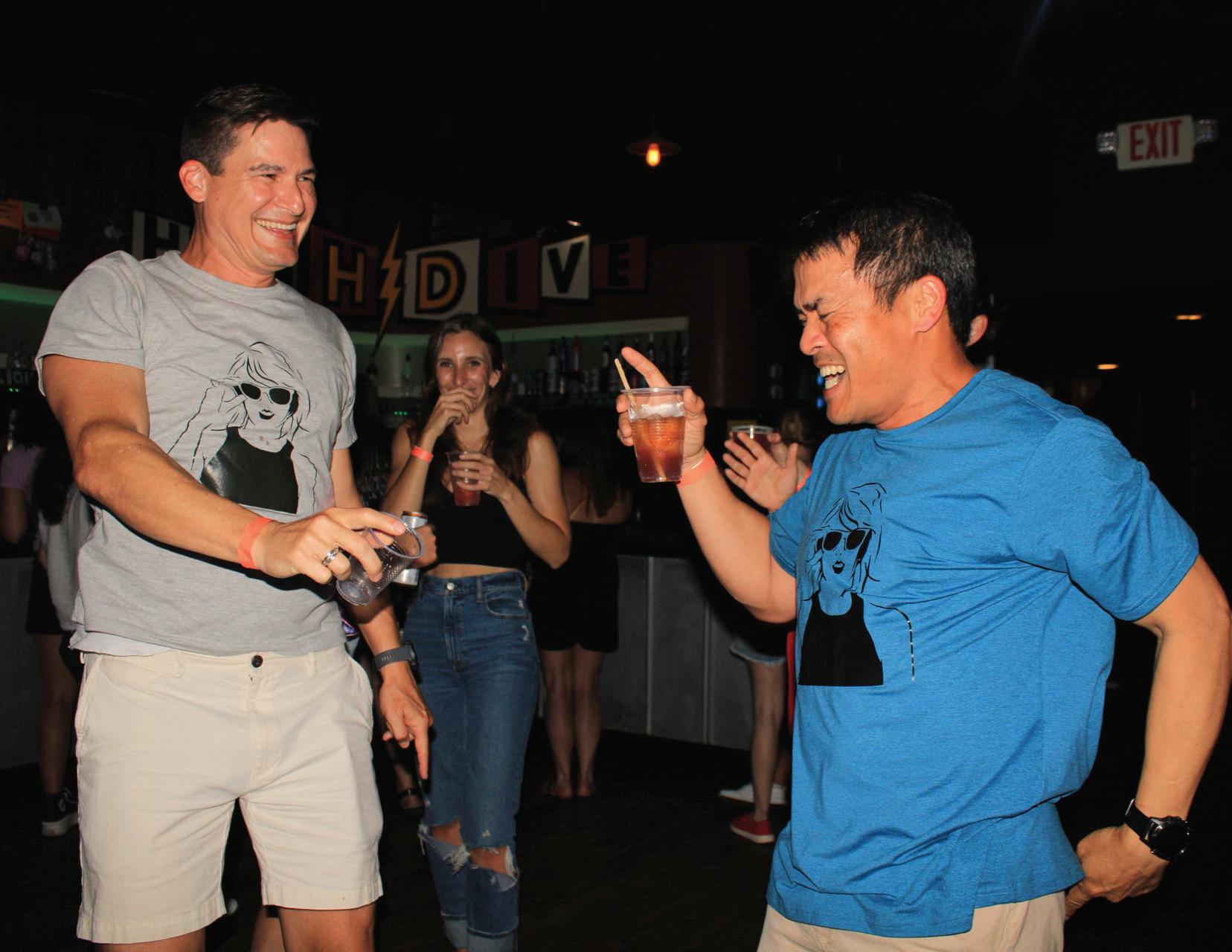
From ballads to bangers, audience members dance to Taylor Swift's discography at the High Dive on Thursday, June 6, 2023. Read more in The Avenue on page 6.
Student body president vetoes bills, former Communist Party leader files case
THE VETOED BILLS HAD LEGAL, TECHNICAL AND GRAMMATICAL ISSUES
By Vivienne Serret Alligator Staff Writer

Student Body President Olivia Green reviewed 18 bills, approving 14 and vetoing four due to issues with legality, separation of powers or grammar.
One of the four bills included the Graduate and Professional Student Summer Vacancy Requirements, which was vetoed due to a legality issue surrounding student enrollment. The bill sought to alleviate the Senate Summer enrollment requirement for all graduate and professional students as long as they enroll for the following Fall semester.
The next bill was the Indigenous Land Acknowledgement Act, which Green vetoed for its alleged inappropriate overreach by the Legislative Branch and appearing to violate the separation of powers. The bill sought to require the reading of an Indigenous Land Acknowledgement before some Executive and Judicial Branch events.

Green also vetoed the Accountability Law For Regulating Election Disruption and Oppression “ALFREDO” Act for its potential to infringe on the First Amendment rights of the student body. The bill sought to eliminate possible threats, coercion or intimidation throughout the election period — the UF Supreme Court may disqualify the offending candidate or political party.
Green vetoed the Budget Online Resources Accessibility Act due to a grammatical error within the bill. The bill sought to require the Budget and Appropriations Committee to routinely update the 800 Codes summary document for student
organizations to utilize.
“I wholeheartedly agree with the contents of this bill and look forward to this bill being resubmitted, passed and approved,” Green wrote. “Other than [the error] I support Student Senate Bill 2023-1067 and look forward to signing it once reintroduced.”
Not long after the vetoes were submitted, former Progressive and Communist Party leader Alfredo Ortiz sent an email to Green disagreeing with the exercise of her veto power over the ALFREDO Act. He plans to challenge it in the UF Supreme Court, he wrote.
Ortiz first became involved in Student Government by authoring legislation to extend financial aid to survivors of Hurricane Maria, he said, and was presented with the opportunity to join the Senate as a Summer term replacement in 2019.
“I proposed the original version of the act during my freshman year,” Ortiz wrote in his email to Green. “Like you, my friends and I experienced threats and intimidation for our decision to run as third-party candidates.”
Ortiz also disagreed with Green’s concerns about the bill infringing on First Amendment rights, he wrote.
“It has taken years to finally bring the Senate together and pass these reforms by unanimous consent,” Ortiz wrote. “My only intention with this bill is to offer students a remedy so that they never have to experience what my friends and I did.”
In the memorandum filed by Ortiz to the UF Supreme Court July 2, he claims Green vetoed the bill past the veto deadline.
“The student body president has subverted the student body’s legislative process by exercising her veto power after the deadline, or by exercising her veto power over legislation not subject to veto,” Ortiz wrote.
Have an event planned?
Add it to the alligator’s online calendar: alligator.org/calendar
Acting Chief Justice Julia Van De Bogart told Ortiz the Court will not be hearing cases until the start of the Fall semester because other members of the Court are not in town.
“Gathering everyone together for a hearing is not feasible at this time,” De Bogart wrote. “When the Fall semester is approaching, the Court will address your case.”
Senate President Oscar Santiago Perez (Change-District D) commented on the case filed by Ortiz and said Green has the authority to issue the vetoes the date she did.
It was the last day Green could sign, veto or ignore before automatically going to the university president's designee as mandated by the Student Body Constitution, Santiago Perez wrote.
Santiago Perez believes the argument Ortiz is presenting isn’t valid and relies on legal theories that have been turned down in real life situations, they wrote.
“The Student Body President has historically been able to veto legislation relating to our election law, and I don't see how that should be any different in the future,” Santiago Perez wrote.
Santiago Perez hopes to see the fate of the vetoes handled within the Senate instead of the Supreme Court, they wrote.
Green has the opportunity to provide a presentation on the vetoes at the July 11 Senate meeting.
@vivienneserret vserret@alligator.org
NEWSROOM:
Editor-In-Chief
Engagement Managing Editor
Digital Managing Editor
Metro Editor News Director University Editor
the Avenue Editor
352-376-4458
Jiselle Lee, jlee@alligator.org
Kristine Villarroel, kvillarroel@alligator.org
Jackson Reyes, jacksonreyes@alligator.org
Fernando Figueroa, ffigueroa@alligator.org
Aidan Bush, abush@alligator.org
Claire Grunewald, cgrunewald@alligator.org
Lauren Whiddon, lwhiddon@alligator.org
Jackson Castellano, jcastellano@alligator.org
Assistant Sports Editors
Multimedia Editors
Brandon Hernandez, bhernandez@alligator.org
Marcus Rojas, mrojas@alligator.org Diego Perdomo, dperdomo@alligator.org
Copy Desk Chief Mia Schneider, mschneider@alligator.org
Sports Editor Editorial Board
DISPLAY ADVERTISING
Advertising Office Manager
Jiselle Lee, Kristine Villarroel, Jackson Reyes
352-376-4482
Sales Representatives Cheryl del Rosario, cdelrosario@alligator.org
Sales Interns
CLASSIFIED ADVERTISING
Tessa May, Sydney Thieman, Sophia Handley, Nicole Hausmann, Avery Brennan
Kate McCroy, Brianna Rivera, Anna Grace Coffing, Madison Kahn
352-373-3463
Classified Advertising Manager Ellen Light, elight@alligator.org
352-376-4446 BUSINESS
Comptroller Delia Kradolfer, dkradolfer@alligator.org
Bookkeeper Cheryl del Rosario, cdelrosario@alligator.org
Administrative Assistant Ellen Light, elight@alligator.org
352-376-4446 ADMINISTRATION
General Manager Shaun O'Connor, soconnor@alligator.org
Administrative Assistant Lenora McGowan, lmcgowan@alligator.org
President Emeritus C.E. Barber, cebarber@alligator.org
SYSTEMS
IT System Engineer Kevin Hart
PRODUCTION
Production Manager Jordan Bourne, jbourne@alligator.org
Production Staff Member Deion McLeod, dmcleod@alligator.org Namari Lock, nlock@alligator.org
Publication Manager

Got something going on? Want to see it on this page? Send an email with “What’s Happening” in the subject line to engagement@alligator.org. To request publication in the next day’s newspaper, please submit entries before 5 p.m. Please model your submissions after the above events and keep them to 150 words or fewer. Improperly formatted “What’s Happening” submissions may not appear in the paper. Press releases will not appear in the paper.
The Independent Florida Alligator is a student newspaper serving the University of Florida, published by a nonprofit 501 (c)(3) educational organization, Campus Communications Inc., P.O. Box 14257, Gainesville, Florida, 32604-2257. The Alligator is published Monday mornings, except during holidays and exam periods. The Alligator is a member of the Newspaper Association of America, National Newspaper Association, Florida Press Association and Southern University Newspapers.
Subscription
The Alligator strives to be accurate and clear in its news reports and editorials. If you find an error, please call our newsroom at 352-376-4458 or email editor@alligator.org

Today’s Weather
Rate: Full Year (All Semesters) $75 The Alligator offices are located at 2700 SW 13th St. © Copyright 2020.
The
in
the
an
All rights reserved. No portion of
Alligator may be reproduced
any means without
written consent of
officer of Campus Communications Inc.
Not officially associated with the University of
Published by Campus Communications Inc., of Gainesville, Florida ISSN 0889-2423
Florida
2 ALLIGATOR MONDAY, JULY 10, 2023
VOLUME 117 ISSUE 39
Kate McNamara // Alligator Staff
Jalen Kitna charges dropped, Alachua County residents weigh in Five
By Gabriel Velasquez Neira Alligator Staff Writer


Former Florida Gators quarterback Jalen Kitna’s student enrollment remains uncertain days after taking a plea deal for his initial arrest for suspicion of child pornography possession.
The 20-year-old’s five felony charges were dropped in court July 5, and Kitna will no longer have to register as a sex offender. In return, the former quarterback pleaded no contest to two misdemeanor counts of breach of peace, which is disorderly behavior amounting to a minor offense.

He will face one year of probation rather than jail time.
Ron Kozlowski, Kitna’s lawyer, said the state attorney agreed it was a fair result, which led to the outcome.
“[It is] unfortunate that it went down the way it did,” he said.
He hopes Kitna can put the case behind him.
Students and locals are divided on the outcome of Kitna’s case.
Antonio Saladrigas, an 18-year-old UF finance sophomore, thought the sentencing was fair, and Kitna didn’t deserve to be on a registry, he said.
“I think this is something that happens a lot with a lot of people,” Saladrigas said.
“Obviously it is illegal in some ways, but for the most part, it’s nothing where he has to register for anything.”



Maverick Prince, a 20-year-old sports management junior, said he trusts in the justice system. He is also pleased with UF’s response to the case.
“I’m happy that the team had the foresight to handle it immediately,” Prince said. “They quickly got him off the team and made sure he wasn’t involved with the university … It’s embarrassing that we were associated with that, but I’m glad
that it was handled in the way that it was.”
Tyrone Johnson, a 41-year-old Newberry resident, felt the plea deal was too light. The case showed that having enough wealth could allow someone to escape the harshest of criminal charges, he said.
“Jalen Kitna’s plea deal is the second worst given by the State of Florida to a child sexual predator next to Jeffrey Epstein,” Johnson said. “It’s a slap in the face to the most vulnerable of victims: our children … it’s a perfect example of two justice systems in America: one for the privileged elite, [and] a different one for minorities and the poor.”
Kitna apologized to family, friends and those who care about him in court July 5.
“Their support through this whole ordeal has meant a lot to me,” he said.
Kitna was arrested Nov. 30 on suspicion of exchanging child pornography through the online social platform Discord.
Officers initially found three child pornography images on his phone, according to his December arrest report, though he told law enforcement he believed the images were legal.

He was dismissed from the football team days later.
Kitna remains actively banned from campus until 2025, though his student enrollment status isn’t known.
UF was not able to provide any information to The Alligator in accordance with the Family Educational Rights and Privacy Act.
“Any reports alleging Student Conduct Code violations received by the Office of Student Conduct and Conflict Resolution are handled in accordance with UF Regulation 4.040,” according to a UF statement.



@gvelasquezn gvelasquezneira@alligator.org

MONDAY, JULY 10, 2023 ALLIGATOR 3
charges reduced
misdemeanors 9 PLEASE MAKE SURE THE PHONE NUMBER, SPELLING AND CONTACT INFO IS CORRECT. $ 1 50 /LB* *20lbs Minimum charge 3830 sw 13th st, 32608 Fresh laundry & cafe first time orders SAVE20 save 20% ROOMMATE MATCHING 8 LARGE STUDY ROOMS & QUIET LOUNGE AREAS KEYCARD SECURE ENTRY FREE GUEST PARKING PRIVATE BEDROOMS, BATHROOMS & CLOSETS 3 FITNESS CENTERS RESORT STYLE POOL AND MUCH, MUCH MORE! RATES AS LOW AS SAVE OVER $4,200 $499 EXTRA PERKS, NOT EXTRA PRICE: SCAN HERE COME TOUR 7 DAYS A WEEK FOR MORE INFO
felony
to two
College accreditation
of Colleges and Schools Commission on Colleges. The
move comes after UF’s decision to block three professors from testifying as experts in a legal case challenging a GOP-backed
Health education
sixth grade arrives at the nurses’ office with questions about topics like menstruation, Green said.
Students left with unanswered questions will most likely turn to their peers, which isn't always safe, Green said.
“Unfortunately, [school staff is] going to be limited as to sharing our expertise with these girls who need it,” she said. “So they're gonna hear their peers telling them ‘Oh, you're not normal. There's something wrong with you.’”
While Green hopes HB 1069 inspires parents to initiate conversations about menstruation with their children, she said she predicts the legislation will most likely elicit conflict between Florida parents and schools.
Teenagers across Alachua County fear the effects of the law as well.
Isana Schroder, an 18-year-old recent graduate of F. W. Buchholz High School and incoming UF political science freshman, has been a peer health educator for Planned Parenthood’s Leaders Igniting a Generation of Healthy Teens initiative since 2020.
The LIGHT program seeks to train and supply teenagers with reproductive and sexual health knowledge so they can help support their peers.
The extent of the sexual and reproductive health education Schroder received in school before joining the LIGHT program was a short, incomprehensive fourth-grade unit on human growth and development, she said.
Only 25.1% of Florida secondary schools provided students with instruction on all 22 critical sexual health education topics in a required course for sixth, seventh or eighth grade,
voting bill.
UF President Ben Sasse shares a similar viewpoint to DeSantis, writing in a 2022 op-ed that student-debt bailout rewards wealthy kids at the cost of middle-class families and gives in to the assumption the current
system is sufficient. “We should instead admit to our underperformance and find ways to introduce alternative approaches — overhauling everything from the credithour system to the accrediting cartels,” he wrote.
@nicolebeltg nbeltran@allligator.org
according to The Sexuality Information and Education Council of the United States.
Schroder expects HB 1069 to worsen the already poor quality of education K-12 students receive on reproductive and sexual health, she said.
"More people are going to have to take sexual health education back into their own hands for their children and themselves because the state of Florida isn't providing it," she said.
K-12 students must learn about topics like sexually transmitted diseases and birth control methods so they can make well-informed decisions for their bodies, she said.
“Sex education should be both medically accurate and developmentally appropriate,” she said. “Moving sex education up to sixth grade, limiting the ability to talk about it and limiting the materials you use to talk about it cannot have a positive outcome.”

Navya Goyal, a 14-year-old incoming freshman at Gainesville High School, volunteers with the Alachua County Chapter of Days for Girls International. The organization aims to improve access to menstrual hygiene resources worldwide.
Having started her period in fifth grade, Goyal opposes HB 1069 because she believes schools should serve as a safe haven for students to learn how their bodies function, she said.
“Not everyone has the parental guidance that they need at home to be able to learn and understand what periods are and manage them properly,” she said.
Goyal overcame the shame she previously felt about her period by participating in informative discussions about menstruation with Days for Girls International staff and volunteers.
Everyone starting their periods should have similar in-depth conversations, she said.
“I've learned that it's okay to talk about [menstruation] with anybody as long as you're comfortable,” she said. “Many of us
don't really talk about it and think it should be kept a secret.”
Local activists are also anxious about HB 1069’s provision banning schools from enforcing policies that require the usage of a student’s preferred pronouns.
Elizabeth Husband, an 80-year-old former elementary school counselor, is the secretary for the Gainesville chapter of Parents, Families and Friends of Lesbians and Gays. Husband also sits on PFLAG’s Inclusive Schools Committee, which strives to advocate for LGBTQ rights in Alachua County Public Schools.
Husband worries the law will encourage school staff to discriminate against LGBTQ students and promote selfcensorship.
Her 14-year-old granddaughter, who goes to school in Duval County, told Husband her teachers stopped asking students about their preferred pronouns after the bill was introduced.
“But they can say, ‘If you have something that you'd like me to know about you write it down and give it to me,’ and kids understand that,” she said.
Various studies have found that using a child’s preferred pronouns has positive effects on their mental health, Husband said.
“LGBTQ students, especially transgender students have a much higher rate of suicide and suicidal ideation,” she said. “Having affirming adults in their lives reduces that risk considerably.”
Although the law allows school staff to disregard students' preferred pronouns, Husband said it has brought LGBTQ students and supportive teachers closer together.
“Teachers are going to find a way to be supportive of their students, even if they have to be a little more indirect about it,” she said. @amandasfriedman
4 ALLIGATOR MONDAY, JULY 10, 2023
The accreditation lawsuit is set to unfold in the U.S. District Court Southern District of Florida in Ft. Lauderdale.
afreidman@alligator.org
DESANTIS, from pg. 1 K-12, from pg. 1
Namari Lock // Alligator Staff
UF Solar Gators win Electrek Formula Sun Grand Prix
SOLAR GATORS WIN THE 2023 SUN GRAND PRIX FOR THE FIRST TIME
By Sally Brown Alligator Staff Writer
Powered by the sun and innovation, the UF Solar Gators took home a first-place trophy from the Electrek Formula Sun Grand Prix for the first time.
The Solar Gators competed against 11 other colleges, including Ohio State and Northwestern University, from June 27 to July 2 in Topeka, Kansas.
Competing teams were judged on car dynamics, safety and driver’s skill during the three-day event. The prix had two driving classes: single-occupant vehicle and multi-occupant vehicle.
The team that drove the most miles over three days won the race.
The Solar Gators placed first in the single-occupant vehicle race. The car, Sunrider, completed 283 laps.
The team also won the awards for “Most Improved” and “Aesthetics.”
Sunrider lasted almost 200 miles longer than last year’s single-occupant winners and this year’s second-place victors, Principia College’s RA XI team.
In years prior, the Solar Gators and its car struggled to perform and often finished last or second to last in the race.
Similar to other areas of
motorsport, the technology developed for the solar powered cars goes beyond the collegiate competition. Instead, it shows the possibilities created by solar cell and battery technology advancements and other possible innovations made available by developing technologies.
Christian Michaelis, a 22-year-old UF electrical engineering senior, believes the success of the race came from the car’s mechanics. In past races, the car’s speed maxed out at 30 miles per hour. Now, with better technology, the team has pushed the car up to 60 miles per hour.
“Our entire electrical system is pretty proprietary and advanced,” Michaelis said.

Ellie Alderman, a 19-yearold UF mechanical engineering junior, recently joined the team and had a great first experience at the race despite initial struggles, she said.
“Everyone just had a big relief moment,” Alderman said. “I just had a blast, honestly.”
The Solar Gators aren’t stopping at the grand prix. Going forward, the team’s sights are set on the American Solar Challenge, a cross-country endurance race spanning more than 1,500 miles held every two years. The grand prix served as a qualifier for the race, and this year would be the first time the team could compete in the challenge.
The Solar Gators dealt with several issues leading up to the competition, from teammates graduating to supply chain de-
lays. Despite the challenges, the team won the competition for the first time.
Leading up to the races, the cars undergo a “scrutineering” process to qualify. The Solar Gators were one of only five teams that passed without needing to improve its car, which granted the team an extra day to prepare.
Irene Chung, a 21-year-old UF chemical engineering senior and incoming Solar Gators president, said the extra day helped the team to prepare them for the race after they finished screening.
The competition was the first time the entire car had been assembled, Chung said.
Chung and her other teammates are thankful for the alumni network’s support and advice on the race day. The network, composed of alumni who haven’t been on the team for years but keep returning to the event because of their love for the Solar Gators and their work, were crucial to this year’s success.
“They keep helping us and we think that’s really great,” Chung said.
She also accredited the success of the team to its diversity.
“The sharing of new ideas, new perspectives, helps us be a better team overall and helps us do better and innovate,” she said.
@sabrown_22 sbrown@alligator.org
Gainesville camps provide a fun-filled summer for children
LOCAL K-12 SUMMER CAMPS CREATE A SAFE, EDUCATIONAL ENVIRONMENT
By Emma Parker Alligator Staff Writer
As parents search for a way to entertain their children during the summer break, community organizations and businesses are opening their doors and curating various programs that allow kids to socialize and learn a new talent while out of school.
The Cade Museum, located at 811 S Main St., hosts various exhibits and has created a week-long program extending throughout the summer to teach children about science, technology, engineering, art and mathematics and encourage them to become forward thinkers.
Amanda Bernavil, the program and internal events manager for the Cade Museum, is proud of the long-lasting impact the museum’s summer camp has had on campers over the years.
“It’s really cool to see these kids that I’ve known for the last four years come back every year and just be excited about the new topics that we offer and also see them grow,” Bernavil said.
Bernavil has worked with the museum since 2018 and has coordinated different learning activities and themes to expose children as
young as first-graders to STEAMrelated topics.
One program includes bringing real-world inventors to guide fourth to sixth-graders through experiments and let them present their own inventions to the museum.
To Bernavil, teaching STEAM allows students to explore critical thinking and creative opportunities.
“We want kids to be able to tap into every side of their brain and know that you can be any part of [STEAM] and still be an inventor, a creator and a thinker,” she said.
Scholarships covering the payment for one full-week program were available for campers who needed financial aid. The museum provided the scholarship through a partnership grant program with the Children’s Trust of Alachua County.
Scholarship applications open annually each April and recipients are notified the first week of May.
For more artistic children, ceramic workshop Studio T/M, located at 1854 NE 2nd St., Suite A, is hosting a weekly program throughout July, where students have access to hands-on activities and creative projects.
Read the rest online at alligator.org.
@emmaparkerg eparker@alligator.org
MONDAY, JULY 10, 2023 ALLIGATOR 5
MUSIC
Swifties ‘enchanted’ with “Speak Now (Taylor’s Version)”
By Aubrey Bocalan Avenue Staff Writer
As the clock ticked closer to midnight and the release of “Speak Now (Taylor’s Version)” neared, people fearlessly began to dance to the beloved Taylor Swift songs they knew all too well.
When the High Dive doors opened July 6, people ran to jump, twirl and scream to the music as multi-colored strobe lights pierced through the smoke.
About 100 Swifties of all different levels of devotion came to High Dive on the eve of the “Speak Now (Taylor’s Version)” release to celebrate the re-release of the 2010 album. The entire night, the venue played songs from Swift’s discography.

Some attendees, like Taylor Mulholland, a 20-year-old Santa Fe accounting junior, have followed Swift since her debut album.
Mulholland knew she was destined to love Swift.
“My name’s Taylor,” she said. “I had to be a Taylor Swift fan.”

Mulholland attended “The Red Tour” that spanned from 2013 to 2014. When she was in the fifth grade, she sang “We Are Never Getting Back Together” at a talent show. Now, she continues her
appreciation as an adult.
“There’s been times in my life where I kind of stopped listening to Swift, but I always come back,” she said.
At the release party, Mulholland loved being able to dance to songs from her favorite album, “Reputation,”, in a floral red dress — an ode to one of Swift’s outfits from the “Speak Now World Tour.”
Many other attendees carefully crafted outfits inspired by Swift’s albums or tour outfits. Caroline Hartley and Sophia Vernon, two 18-year-old Gainesville residents, wore bright pink and pastel dresses and covered themselves in body glitter.
Pammy Brugger, a 24-year-old Ocala resident, wore dangly ghost earrings in reference to Swift’s song “Haunted.”
Brugger also made friendship bracelets to exchange with other people she met at High Dive. Fans trade friendship bracelets in reference to a lyric from Swift’s song “You’re On Your Own, Kid” from the “Midnights” album released last October.

She loves Swift’s ability to tell captivating stories and appeal to many different people, she said.
“Her music can span a lot of different genres and everything,
and I love that,” Brugger said. Brugger brought her friend Jay Isaacs, a 23-year-old Orlando resident, an unexpected Swift fan. Isaacs describes herself as “more of a metalhead,” but still likes Swift’s music. Her favorite song by Swift is “Long Live” from “Speak Now,” and she was excited
to hear the re-released version, she said.
After seeing a video of Swift singing at a Stand Up to Cancer telethon in 2012, Isaacs was moved by Swift’s kindness and started listening to “Speak Now.” She has kept up with Swift’s music ever since. She remembers her
excitement when “Midnights” dropped while she was at work.
“I just remember all of us out there and the second it dropped we opened up Spotify,” Isaacs said. “We were just playing it and screaming the whole time.”

Isaacs drove all the way from Orlando to attend the release party with Brugger and their other friend, 24-year-old Ocala resident EK Melendez. Melendez really looked forward to hearing the new version of the “Speak Now” song “Back to December,” she said.
She was introduced to Swift by Brugger a few months ago when “Midnights” came out.
“I just remember [Brugger] playing the album again and again in the car when the new album dropped,” Melendez said. “It was the only thing we listened to.”
Another trio of unconventional fans, Mendel Zhang, Alex Jamison and Josh Reeve, are proof Swift can appeal to different people.
Zhang, a 21-year-old UF math and philosophy junior, invited Jamison and Reeve to the release party. The three stood in the middle of the room, singing and dancing to almost every single song.
Zhang grew up listening to Swift on the radio and found his way back to her music when “Midnights”
Keep up with the Avenue on Twitter. Tweet us @TheFloridaAve. MONDAY, JULY 10, 2023 www.alligator.org/section/the_avenue UF players get drafted Gators turn pro in MLB Draft. Read more on page 11. Scan to follow the Avenue on Spotify
Marcus Rojas // Alligator Staff
A group of attendees show off their friendship bracelets at the High Dive on Thursday, June 6, 2023.
SEE SPEAK ON, PAGE 7
Marcus Rojas // Alligator Staff Speak Now Release Party brought together fans from many walks of life at the High Dive on Thursday, June 6, 2023.
Marcus Rojas // Alligator Staff
Dozens of attendees swarm the dance floor at the High Dive on Thursday, June 6, 2023
About 100 fans celebrated the album release at High Dive
Speak Now
SPEAK NOW, from pg. 1
came out. Similarly, Jamison, a 19-year-old UF computer science sophomore, also grew up jamming to Swift with his mom in the car. For Reeve, the 26-year-old UF alumni, Swift’s music just hits different, he said.
“Her music is really powerful,” Reeve said. “It’s very emotional. I don’t listen to it all the time, but I was excited to come out here.”
As the countdown to “Speak Now (Taylor’s Version)” reached its end at midnight, High Dive played through the entire re-released version of “Speak Now” and attendees got to listen together to the new album for the first time.
The album saw some changes from the 2010 version. One change was the addition of six new “vault” songs that weren’t on the
original album. Swifties also noticed a lyric change in the song “Better Than Revenge.”
The lyrics changed from the original “she’s better known for the things that she does on the mattress” to a reworked “he was a moth to the flame, she was holding the matches.”
Some fans found this change to be less misogynistic while others thought it was unnecessary.
Swift’s voice also sounds older and more mature, giving the songs a warmer sound, Mulholland said.
“They’re a little bit softer than they used to be,” Mulholland said.

Though there were changes and the album has seen mixed reviews from fans all over the world, attendees of the High Dive release party still loved Swift’s more mature version of the classic album.


“She really just can’t go wrong,” Mulholland said.
@aubreyyrosee abocalan@alligator.org
MONDAY, JANUARY 16, 2023 ALLIGATOR 7
Marcus Rojas // Alligator Staff
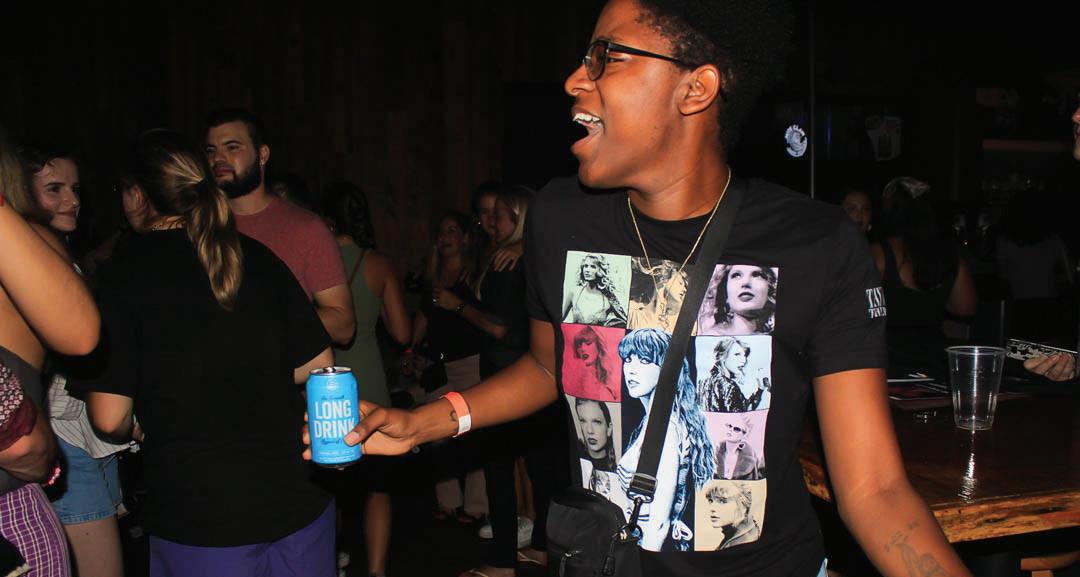
Nishauntae Johnson, 27, sports an Eras Tour T-shirt among other attendees at the High Dive on Thursday, June 6, 2023. Johnson saw Taylor Swift live in Tampa during her tour, she said.
Marcus Rojas // Alligator Staff
Sophia Vernon (left) and Caroline Hartley (right) pose for a selfie at the High Dive on Thursday, June 6, 2023.
Marcus Rojas // Alligator Staff
A group of attendees shout along to the chorus of “Dear John” by Taylor Swift at the High Dive on Thursday, June 6, 2023.
Actors, patrons and subscribers celebrate 50 years of Hippodrome memories
MATHESON MUSEUM SHOWCASES BOOK ABOUT THE HIPPODROME
By Aubrey Bocalan Avenue Staff Writer
In downtown Gainesville, a pale, columned building looks almost out of place among the brick facade of surrounding streets. Though it visually stands out, the Hippodrome Theatre has been the heart of downtown.
For nearly 50 years, it has welcomed new and familiar faces to its seats and its stage and played an important role in Gainesville culture, bringing new businesses and expanding nightlife as swarms of people discovered the city’s downtown area.
Author Richard Gartee talked to about 100 people about the Hippodrome Theatre’s impact on the community during a July 8 Matheson History Museum event. In his talk, he presented his latest book, “The Hippodrome Theatre First 50 Years.”
“If we don’t record this now, we will not know,” Gartee said. “This information will be lost forever.”
Gartee’s book tells the long story of the theater, starting at its original Hawthorne Road location and following the move to its
current location at the old Post Office building in downtown Gainesville. The book contains information from every show the Hippodrome has ever put on and analyzes how the theater brought more businesses downtown to accommodate for the developing nightlife.
Gartee had two clear main reasons for writing this book, he said.
“One was to preserve this information for the future,” Gartee said. “The second was to help reinvigorate the interest in the Hippodrome, which COVID kind of knocked out.”
When the author walked into the museum with his book, Kaitlyn Hof-Mahoney, the 30-year-old executive director of the Matheson Museum, knew it would be a popular event.
“The Hippodrome is a very popular subject here,” Hof-Mahoney said. “People really love the Hippodrome in Gainesville.”
The Hippodrome has been a valuable partner for the Matheson Museum for years. Whenever it hosts shows, visitors sometimes will come to Gainesville earlier in the day to explore the city. Sometimes they will go to downtown restaurants or bars, but other times they will visit the museum located less than half a mile away.
“They are such a wonderful anchor for downtown and bring all sorts of people in to
visit the area,” Hof-Mahoney said. “That is something that we can benefit from as well.”
The Hippodrome has attracted millions of visitors, bringing business to other downtown spaces. In Gartee’s book, he writes this is what helped revive downtown and spark the historic preservation effort of the area.
One attendee, Nell Rainsberger, a 68-yearold Gainesville actor, has been involved with the Hippodrome from the very beginning. She has been in several shows and also works as a developing consultant for the theater. She just finished a show called “Native Gardens” where she played the role of Virginia Butley, the wife of character Frank Butley, played by her husband, Kevin Rainsberger.
She believes Gartee’s talk and book will bring awareness to the Hippodrome’s importance.
“The Hippodrome is such an integral part of Gainesville, certainly in the downtown and the arts,” Rainsberger said. “Having that documented certainly makes a big difference.”
It was nice celebrating the impact of the Hippodrome with so many friends and people, she said. Many other actors, patrons and Hippodrome subscribers attended the event and reminisced on stories from the past. One attendee shared a story of how they worked at a hotel where actors would stay. Another still has
posters from decade-old shows.
The loyalty of these Hippodrome followers is what keeps it alive.
Jessica Hurov, former managing director of the Hippodrome, said there is still a lot of work to be done to keep it that way.
“The billing of today’s talk is how it saved the downtown. I don’t know if it’s fully saved,” Hurov said. “The Hippodrome to me is a real living breathing entity. What it needs to survive is people, and it needs revenue.”
She knows it’s been hard to return to these spaces since the COVID-19 pandemic, but she encourages people to go back to the theater, she said.
Besides the economic and cultural value it brings, the Hippodrome and local theater in general also has spiritual importance that needs to be preserved for future generations, she said.
“When the people can come together into one sacred space, which is the main stage at the Hippodrome and all participate in hearing a story and experiencing joy, pain, tragedy, laughter, together, that’s what makes us human and elevates us out of the daily grocery run,” Hurov said.
@aubreyyrosee abocalan@alligator.org
Rate and Review: ‘Past Lives’ is fresh take on love and destiny
MOVIES Celine Song’s directorial debut tells the story of old friends
By Jackson Reyes Avenue Staff Writer
Spoilers follow for the film “Past Lives.”
The highly acclaimed film, “Past Lives,” delivers one of the most heartfelt and honest portrayals of love and how fate and destiny factor into real life.
Celine Song dazzles in her directorial debut, “Past Lives.” The movie made its premiere at the 2023 Sundance Film Festival Jan. 21. It expanded to a nationwide release June 30.
Song masterfully tells a story about two childhood friends who reconnect periodically as they move through different chapters of their lives.
The movie is a slow burn as many scenes involve the characters sharing looks with each other or scenes are drawn out. However, the beautiful score, powerful performances and stunning cinematography all make for one of the most tender and beautiful films of the year.
The idea expressed throughout the movie is “in yun,” a Korean word referencing fate and reincarnation. If two people meet in a crowd and their sleeves touch, this must have been caused by events of thousands of years ago, as explained by the Rev. Sun Myung Moon.
“Past Lives” opens with the two main characters Na Young, played by Greta Lee, and Hae Sung, played by Teo Yoo. The pair live in South Korea and are 12-years-old at the time, and despite their young age, there is an obvious connection between them.
It’s quickly revealed that Na Young and her family are immigrating to Canada. To help Na Young make
the most of her time left in Korea, her mother lets her go on a date with Hae Sung.
The two children play around a statue of two faces against each other. The framing shows a tree dividing them. The statue helps show that even though the pair are connected at some level, they are separated from truly being together.
In a short but sweet scene in a local park, it’s evident even as kids, the two share a special bond and connection with each other.
In Na Young and Hae Sung’s final interaction with each other as children, the movie hits one of its most beautiful and impactful scenes. As they reach the diverging paths to their homes, Hae Sung stops Na Young.
Hae Sung’s path stays very smooth and straightforward as he will continue to live a traditional Korean life. Na Young stands before a staircase moving up, as she begins to start a new life and chase after her ambitions.
The visual of the scene is enough to move someone. Hae Sung and Na Young simply say “bye” to each other before going on their way, and the movie jumps 12 years.
Na Young, now known as “Nora Moon,” lives in New York as she pursues her dream of being a writer.
Hae Sung is finishing his mandatory military service for males in Korea and is in school to be an engineer.
Nora finds Hae Sung on Facebook and reaches out to him. The two quickly begin to video chat with each other despite the time difference between New York and Seoul.
Building chemistry and a connection between video calls can be hard to do in real life and even harder to portray in a way that
connects with audiences in a movie.
However, the two, especially Nora, are able to express so many emotions through subtle facial expressions and the tone of their voice. Their relationship progresses over video calls, but the long-distance relationship faces hardships as the two discover it will be more than a year before either can visit and see each other in person.
Nora eventually breaks things off with Hae Sung because she wants to focus on her writing career and the two have to wait to see each other in person. In the beginning, the calls radiate an energy of joy as the two reconnect. In the final call, the two are immersed in dark rooms, where the others can barely make each other’s faces out as they express their sadness.
The two continue to root themselves deeper into the lives they want to live outside of each other. Nora continues to chase her ambitions while Hae Sung follows the path leading to his future job.
The movie poses the question that if they were meant for each other would the two have abandoned their lives or was it always meant to be this way?
There is one final time jump — another 12 years — where Nora is married to someone else and Hae Sung has a full-time job in Korea.
However, Hae Sung finally makes it to New York where the childhood friends are united in person for the first time in 24 years. Nora and Hae Sung walk around New York, which leads to one of the most powerful scenes in the movie.
As the pair catches up with each other in a park, they’re not so subtly surrounded by couples all around them. The two eventually sit down in front of the carousel and Greta Lee’s
acting abilities are put on full display.
She makes the most of her subtle eye movements and by the way she looks at Hae Sung, the viewer can see in her eyes everything she wants to tell Hae Sung but doesn’t. She only asks why he looked for her all those years ago.
On Hae Sung’s last day in New York, he, Nora and her husband, Arthur, spend time in a bar as the movie culminates in its beautiful ending.
Nora and Hae Sung share a conversation that hammers home one of the movie’s main ideas: not everyone we love is meant to be the one we spend the rest of our lives with.
The special connections we make can help shape us into the people we are but that doesn’t mean it’s meant to last.
As Hae Sung speaks to Nora he explains how he imagined a life where they end up together. But he realizes that it could never happen because she is “someone who leaves,” and the reason he likes her is because she’s her.
For Arthur, Nora is someone who stays, Hae Sung said.
Love is a special connection not often held between two people. While people move on from others as they progress through life, that love is something that can never be let go of.
Hae Sung and Nora part ways knowing they aren’t meant for each other, but the love they hold for each other is a beautiful representation of the lifelong bond and instant connection two humans can hold.
At the bar, Hae Sung and Nora joke about how they simply didn’t have the 8,000 layers of in yun to be together in this life. They imagined what their past lives could have
looked like with connections from being in a forced political marriage, the bird and the branch it sat on or simply two people sitting next to each on a train just because that’s what numbers their tickets read.
In the final scene, Hae Sung and Nora look at each other as he waits for his Uber.
There is a flashback to when they were kids at diverging paths.
They stand in silence, and you can feel the tension as you can see them trying to find the right words to say to each other. They embrace each other, and it’s a simultaneous feeling of happiness and heartbreak. Although they will always feel a connection, they know they will never be together.
They part ways, and Nora embraces her husband in tears as she slowly walks back to her home. Arthur and Nora walk up the steps as the closing scene illustrates the idea they truly love each other despite Nora’s past relationships.
The movie leaves the audience wondering what the pair could have done differently to be together or if they made the right or wrong decisions along the way.
Song tells a tale of the unpredictability of life and love. We love people because of who they are, and sometimes that person wouldn’t be who they are if they stay in our lives.
Letting go and moving on is a necessary aspect everyone goes through, but the feelings and experiences don’t always need to be forgotten. It is human to miss that love and cherish it but know it wasn’t meant to be for the rest of your life.
Rate: 10/10
@JacksnReyes
jacksonreyes@alligator.org
8 ALLIGATOR MONDAY, JULY 10, 2023
THEATRE
How to Place a Classified Ad:

BUY IT. SELL IT. FIND IT. 373-FIND
● are underway…bikes, computers, furniture, vehicles & more. All individuals interested in bidding go to: SURPLUS.UFL.EDU
Autos
CASH FOR UNWANTED CARS / TRUCKS
Running or Not. Top Dollar Paid Call 352-259-2020
8-16-23-12
DONATE YOUR VEHICLE to fund the SEARCH FOR MISSING CHILDREN. FAST FREE PICKUP. 24 hour response. Running or
7-10-29-12
The surf's up at "Pawn Beach" we're all making the scene. If you're in need go see Rich, Best Jewelry
/ TRUCKS Running or Not. Top Dollar Paid Call 352-259-2020 8-16-23-13
SONGWRITING SENIOR with radio hits on the LA. And Nashville music charts Shel Silverstein, co writer, looking to rent a room with music folks will teach the biz and critique Mickey. 352-999-7232
7-3-3-13
RETIRED GENTLEMAN SEEKS ROOM in the Duckpond area. Non-smoker, quiet, no pets, 3 plants, a poet by nature. 443-254-4239 7-24-5-13
14 Help Wanted
STUDENT - PT YARDWORK for retired UF grad. A few blocks from UF. $16 / hr. Some experience helpful. All equipment furnished. Reply with short resume to ghpolkgator@gmail.com
7-17-23-7-14
DONUT CONNECTION
Los Angeles Times Daily Crossword Puzzle
Los Angeles Times Daily Crossword Puzzle
Edited by Patti Varol and Joyce Nichols Lewis
Edited by Patti Varol and Joyce Nichols Lewis
The American Cancer Society Road to Recovery Volunteers Needed! VOLUNTEER DRIVERS NEEDED to transport cancer patients to treatment. Flexible schedule. Training and liability insurance provided. Please call 800-227-2345 if interested.
Donut Baker, willing to train. Salary depends on experience. donutconnection1@aol.com or 352-214-1506
7-10-23-3-14
● CLEANING HELP
●
● ● Need help cleaning Airbnb properties and homes. 6-8 hours of cleaning per week at different locations. $25 - $30 pr hr. Contact biopressadmin@gmail.com
8-7-23-5-14
www.alligator.org/classifieds
Corrections and Cancellations: Cancellations: Call 373-FIND M-F, 8am - 4pm. No refunds or credits can be given. Alligator errors: Check your ad the FIRST day it runs. Call 373-FIND with any corrections before noon. THE ALLIGATOR IS ONLY RESPONSIBLE FOR THE FIRST DAY THE AD RUNS INCORRECTLY. Corrected ads will be extended one day. No refunds or credits can be given after placing the ad. Corrections called in after the first day will not be further compensated. Customer error or changes: Changes must be made BEFORE NOON for the next day’s paper. There will be a $2.00 charge for minor changes. Online: w/ major credit card at www.alligator.org/classifieds In Person: Cash, Check, MC, Discover, AMEX or Visa @The Alligator Office: 2700 SW 13th St. M-F, 8am - 4pm By E-mail: classified@alligator.org By Fax: (352) 376-4556 By Mail: P.O. Box 14257 G-ville 32604 See alligator.org for more information Call 352-373-FIND for information. Sorry, no cash by mail. Credit cards or checks only. MONDAY, JULY 10, 2023 Corrections and Cancellations: Cancellations: Call 373-FIND M-F, 8am - 4pm. No refunds or credits can be given. Alligator errors: Check your ad the FIRST day it runs. Call 373-FIND with any corrections before noon. THE ALLIGATOR IS ONLY RESPONSIBLE FOR THE FIRST DAY THE AD RUNS INCORRECTLY. Corrected ads will be extended one day. No refunds or credits can be given after placing the ad. Corrections called in after the first day will not be further compensated. Customer error or changes: Changes must be made BEFORE NOON for the next day’s paper. There will be a $2.00 charge for minor changes. 1 For Rent furnished NOTE: This newspaper assumes no responsibility for injury or loss arising from contacts made through advertising. We suggest that any reader who responds to advertising use caution and investigate the sincerity of the advertiser before giving out personal information or arranging meetings or investing money. SS & VA ARE WELCOME! $660/BedRoom ● No Deposit! ● Furnished Cable ● Internet ● Utilities “Call or Text” 352-246-3418 8-16-13-1 2 For Rent unfurnished 2BR FOR RENT 2BR $500/mo Call: 352-647-6632 8-16-23-13-2 5 Real Estate NEW CONDOS-WALK TO UF For Info on ALL Condos for Sale, Visit www.UFCONDOS.COM or Matt Price, University Realty, 352-281-3551 8-16-23-13-5 6 Furnishings You need the money to do what you will. Rich at Best Jewelry and Loan has the cash for those bills. 523 NW 3rd Ave 352-371-4367 8-16-13-6 When the heat is on and it's bucks that you need, Best Jewelry and Loan your requests we will heed. 523 NW 3rd Ave 352-371-4367 8-16-13-10 1 Word connectoor 1 Obstacle 5 Perch 2 court 6 Type of scarf 3 Lured 7 Spot 4 Musician Ian P H H Y E N E R U D H L R T O S O S O A T C B R E T O P A D E I T N C E D R E E L W E R N T U H :SREWSNA nehpyH-A1 tsooR-A5 tocsA-A6 eW-A7 red druH-D1 e etaborP-D2 tnE-D3 dec retnuH-D4 oH-B doowyl 7-10-23 ACROSS DOWN CLUE CLUE ANSWER ANSWER by David L Hoyt Complete the crossword puzz e by looking at the c ues and unscrambling the answers When the puzzle is complete unscramb e the circled etters to solve the BONUS How to play & Hoy y Des gns A R gh s Rese ved 2023 Tr bune Con en Agency LLC J U M B L E J B L R TM Send comments to o TCA - 560 W Grand Avenue, Ch cago, I no s 60654 or DLHoy @Hoyt nteract veMed a com 1 6 2 5 3 7 4 CLUE: was incorporated as a municipality y in 1903 BONUS 10 For Sale solution on page 10 13 Wanted 13 Wanted Submit your ad today! www.alligator.org/classifieds Submit your ad today! www.alligator.org/classifieds By Karen Lurie ©2023 Tribune Content Agency, LLC 07/10/23
07/10/23
Release Date: Monday, July 10, 2023 ACROSS 1 Deep fissure 6 “Permission to Dance” K-pop band 9 Tiny bit of matter 13 Baffling question 14 Tear to bits 16 Gift wrapper’s adhesive 17 Physical therapy, informally 18 Opera solo 19 Hits the slopes 20 *Vegetable tops used in soups and stews 23 Promos 26 Skin care brand with a Retinol Correxion line 27 Chin beard 28 *Comedian who hosted “Full Frontal” 32 Strange 33 Door openers 34 Pop, as a bubble 36 Stuffing herb 37 Outstanding bills 39 “Pronto!” letters 43 Motif 45 Dried chili in mole sauces 46 Lively Irish dance 49 *“Quite the slump there, huh?” 52 Infuriate 54 Inn divs. 55 Got together 56 Happy cry on a fishing trip, and what can be said about the end of the answer to each starred clue? 60 News story intro, in journalism jargon 61 Hailed vehicle 62 “Swell!” 66 __ of expertise 67 Skidded 68 Typical film festival entry 69 Disinfectant target 70 Uber driver’s guess, for short 71 Folklore brutes DOWN 1 Lifeguard’s lifesaving skill: Abbr. 2 Long-handled garden tool 3 Marshmallow roast residue 4 Stock exchange membership 5 Owner of the Springfield Nuclear Power Plant on “The Simpsons” 6 Tree limb 7 Hatcher of “Desperate Housewives” 8 Scissors sound 9 Hopelessly lost 10 Develop a fondness for 11 Expressed a view 12 Fiddled (with) 15 Sharp knives 21 Decompose 22 Some reddish deer 23 Requests 24 “SNL” alum Carvey 25 Air quality concern 29 Aid and __ 30 Monastic headquarters 31 “However ... ” 35 Zest 37 Takes down 38 “Unbelievable” rock band 40 Swindle 41 World-weary sigh 42 Ada Limón, e.g. 44 Monopolizes 45 Hall of “Coming 2 America” 46 Fatigue after a long flight 47 Vague reply to “Where are you?” 48 Teacher, during exam week 50 Tater Tots maker 51 MLB official 53 Starting squad 57 Cabbagelike vegetable 58 Offramp 59 Circle 63 POTUS on a dime 64 Attach (to) 65 “Count me in!” By Ella Dershowitz ©2023 Tribune Content Agency, LLC 07/04/23
ANSWER TO PREVIOUS PUZZLE:
07/04/23 ANSWER TO PREVIOUS PUZZLE: Release Date: Tuesday, July 4, 2023 ACROSS 1 Many a maid of honor 7 Engrave 11 “Saving Lives, Protecting People” govt. org. 14 Taco kit brand 15 “Beat it!” 16 Small inlet 17 Purposely cause a delay 19 Seer’s claim 20 Portion out 21 Not superficial 22 Tingling feeling caused by whispery videos: Abbr. 23 “Do-Re-Mi” critter 24 Dismissive sendoff that originated in an Ice Cube film 26 401(k) kin 28 Valleys 29 Tankard beer 32 Flee to wed 36 On edge 38 Annual celebration involving a pink, purple, and blue flag 41 Mold-to-be 42 Food flavoring 43 Fútbol fan’s cry 44 High tea snack 46 Indoor rower, familiarly 48 Generally speaking 52 Bike storage aid 56 Tunneling insects 57 Ballet bend 58 Indian lute 59 Bill Nye’s subj. 60 Drink with São Paulo Strawberry and Burundi Blueberry flavors 62 Minister’s title: Abbr. 63 “Understood” 64 Spider-Man player Garfield 65 “__ we good?” 66 Name said twice in an introduction 67 Fool’s gold DOWN 1 “The worst!” 2 Triumphant cry 3 Fashionista’s focus 4 “Fun Home” composer Jeanine 5 “Grand slam” awards acronym 6 Aries animal 7 First name in the perfume aisle 8 Many an “Ocean’s Eleven” character 9 Provided for free 10 Weeder’s tool 11 Orchestral climax 12 “Please pack your knives and go,” for one 13 “It’s a Wonderful Life” director Frank 18 Ice cream maker Joseph 22 Dance company founder Alvin 24 Indonesian island in the Coral Triangle 25 Former’s counterpart 27 Email again 29 Core muscles 30 Performer who pretends to sing 31 Stirring strong emotions 33 Delivery room docs 34 Small fruit seed 35 Yale alum 37 Pupil locale 39 Flat __: hair tools 40 Cold drink brand 45 Texas city on Mountain Time 47 Gay dating app 48 Iraqi port 49 Otherworldly 50 Agitated 51 “__ whiz!” 53 Game company with a “Fuji” logo 54 Coast Guard Academy student 55 Mardi Gras paradeorganizing group 58 Walkman maker 60 Marathoner’s wear 61 AllTrails download 7/3/2023
on page 10
King Features Synd., Inc.
answer
©2023
Tax Deduction
No
Call
not. Maximum
and
Emission Test Required!
24/7: 866-471-2576
523 NW 3rd Ave 352-371-4367 8-16-13-13
UF
On-Line Auctions
392-0370 8-16-23-13-10
for Sale & Lease Horse Boarding - 7 miles to UF Charlie - 352-278-1925 12-5-16-10 12
and Loan's got the "green".
●
Surplus
Goats
FOR UNWANTED CARS
CASH
Aleks Szymczyk adapts to brand-new ballgame in Gainesville
THE 20-YEAR-OLD FORWARD PLAYED BASKETBALL IN GERMANY BEFORE JOINING UF LAST SEASON
By Brandon Hernandez Sports Writer
Gators rising sophomore forward Aleks Szymczyk watched videos of Gainesville on a one-way flight from Frankfurt, Germany, to Florida. The opportunity to play Division I college basketball for UF was too big to miss out on.

“It took one phone call from coach [Todd] Golden, and I was on a flight,” Szymczyk said.
Aleks Szymczyk looks to pass the ball in the Gators men's basketball's 81-60 win against the South Carolina Gamecocks on Wednesday, Jan. 25, 2023.
BASEBALL
The 20-year-old German talent arrived in Gainesville with a solid resume, but a huge challenge awaited him. Szymczyk then began the journey all international players in the states go through: learning U.S. college ball
— fast-paced, uptempo, no-time-tothink basketball, where skilled players devour those that can only use their size and strength to operate on the court.
Szymczyk felt this difference the moment he stepped into his first practice on campus.
“You gotta make way faster decisions,” Szymczyk said. “In Germany, when you play against older players … you can just blow by them. But here you actually have athletes that can block your shots.”
No Ceilings draft analyst and former international coach Tyler Rucker took multiple part-time jobs in the NBA before working overseas as an assistant coach in Prague’s Get Better Academy from 2017 to 2018.
“In a weird way it’s great [playing] overseas for those players to zero in on fundamentals, but at some point when
SEE BASKETBALL, PAGE 12
Three Gators selected opening night of 2023 MLB Draft
HEAD COACH KEVIN O’SULLIVAN HAS PRODUCED 103 DRAFTEES WITH UF
By Jackson Castellano
Sports Writer Florida baseball is no stranger to the major leagues. Since head coach Kevin O’Sullivan took over in 2008, the Gators have seen the second-most first-round selections. UF is tied for third in active MLB players with seven.
The legendary pool of Florida pros grew July 9 when three Gators were selected on the opening night of the 2023 MLB Draft. O’Sullivan’s tally of drafted players moved to 102 and first-round selections grew to 13.
UF’s run of picks in the first and second rounds began with star outfielder Wyatt Langford. The Trenton, Florida, native dominated last season at UF with a .373 batting average. He slugged 21 homers and 57 runs batted in on the way to a College World Series final berth in his junior season.

“Wyatt had four at-bats his freshman year,” O’Sullivan said. “Now, in my opinion, you can flip a coin between him and Dylan Crews.”
Langford entered the 2023 season as a projected top-three pick and held firm behind Louisiana State stars Paul Skenes and Dylan Crews all year.
Following a stellar CWS run and in the days leading up to draft night, Langford became the betting favorite to be selected first overall.
Skenes and Crews would eventually fall in place and leave Langford available at third as expected. He instead fell to the Texas Rangers at fourth after the Detroit Tigers took high school phenom Max Clark. Langford is the highest-drafted UF player since Mike Zunino went third to the Seattle Mariners in 2012.
MLB experts consider Langford a prospect who can make an immediate impact once called up. His steady approach and pro-level power make him a dangerous batter and he is sure to make noise at the plate.
The Gators’ first-round selections didn’t end at Langford. Next to hear his name called was junior right-handed pitcher Hurston Waldrep. The Atlanta Braves selected the Gators ace with the No. 24 pick.
With Waldrep’s selection, the Gators marked their first multi-draftee first round since 2018.
Waldrep spent his first two years at Southern Mississippi before transferring to UF for 2023. He boasted a 10-3 record and finished one strikeout short of tying Alex Faedo’s single-season record.
The Thomasville, Georgia, native will return to his home state and provide plenty of upside for the Braves.
"This whole experience has been awesome,'' Waldrep said. "It means the world to me to be able to pitch in this environment, to help these guys. And I couldn't have done it without a single one of them, from the coaches all the way down to the bullpen catchers and the managers."
He struggled with consistency at times last
season, but wowed scouts with a nasty splitfinger pitch that recorded a 65 percent whiff rate. He recorded 10 or more strikeouts in seven of his 19 starts this season.
Junior Brandon Sproat rounded out UF’s draft class for night one. Sproat was selected
by the New York Mets with the No. 56 pick. Sproat, selected in the third round last year by the Mets, chose to come back and compete for a national championship after falling to Oklahoma in the 2022 NCAA Regionals.
He led the Gators in innings pitched and walks and hits per inning as UF made its deepest postseason run since 2017.
Junior shortstop Josh Rivera returned to Gainesville undrafted but with MLB offers on the table. He is looking to hear his name called early on in the week after being ranked in the top 100 of most draft boards.
He rebuilt his approach at the plate and became one of Florida’s most consistent players. He finished second in nearly every major batting statistic while serving as the Gators’ best defensive glove.
A draft selection would mean significantly more compensation and a more straightforward path to the majors for Rivera.
“Josh has been in our program for four years,” O’Sullivan said. “And you’ve seen him not only develop as a baseball player, we’ve talked about the hitting and the defense, but the maturity level.”
The Gators have big cleats to fill with the loss of its draftees and graduating seniors.
Former freshman standouts Cade Kurland and Luke Heyman, alongside the fifth-ranked recruiting class in 2023, will look to replicate the 2023 draft class’ production in 2024 and beyond.
@jaxacastellano jcastellano@alligator.org


MONDAY, JULY 10, 2023 www.alligator.org/section/sports Follow us for updates For updates on UF athletics, follow us on Twitter at @alligatorSports or online at www.alligator.org/section/sports. Follow our newsletter Love alligatorSports? Stay up to date on our content by following our newsletter. Scan the QR Code to sign up. alligatorSports has a podcast! The alligatorSports Podcast releases episodes every Wednesday and can be streamed on Spotify, Apple Podcasts or your other preferred streaming platform. BASKETBALL
Ryan Freidenberg // Alligator Staff
Chloe Hyde // Alligator Staff Florida outfielder Wyatt Langford during the Gators' 3-0 win against Florida A&M Friday, June 2, 2023.
Florida dream comes true
SOFTBALL, from pg. 11
BASKETBALL, from pg. 11
el, so he had an impact on my growth as a person and an athlete," Reagan Walsh said.
Her fellow Gators have noticed her confidence in her ability to change positions on the field when things get tough.
said.
Szymczyk adjusts to college ball
Walsh was set to fill the hole left by the departure of former Florida graduate student infielder Hannah Adams as she entered her sophomore season.
the same recruitment or shine on them that players do here [in the U.S].”
be hard on her so she will succeed, he said.
European counterparts.
you get to college basketball — in that type of grind — the speed is gonna be a different world,” Rucker said.
in the ProB league, a third-tier professional league in Germany, in 2020.
Her growth as an athlete and as a Gator was made possible by the support of her parents and teammates, she said.
"I've seen her work and the growth she has had,” UF shortstop Skylar Wallace said. “I think she's known you're not going to be perfect at all times."
in the ProB league and went on to graduate from Gymnasium Munchen-Nord while he still competed in the IBAM.
Szymczyk received his scholarship offer at UF’s practice facility with his parents in attendance. It was a proud moment for the family, Szymczyk said.
Walsh — who’s near the end of her second year — recognized she has support from her father, teammates and coaches, she said.
Szymczyk is no stranger to change.
Growing up in a suburb outside of Frankfurt, Szymczyk spent most of his days on the soccer pitch. Until his neighbor, a coach for a local basketball team, convinced the teenage soccer player to switch to basketball and try out for his team.
The ProB league introduced Szymczyk to professional basketball. The European professional rookie played against a wide variety of talent, from former Division I athletes to 35-year-old veteran players with multiple years of experience playing in leagues across Europe.
"The people at the University of Florida are great and have definitely impacted me as a player, but also as a person," Walsh said.
Szymczyk gained a liking from a few mid-major programs late in his 2022 recruitment. It wasn’t until an agent made a quick phone call across the Atlantic to UF head coach Todd Golden that Florida set its sights on Szymczyk.
Walsh has displayed confidence and an eagerness to win to the fans who come out to support her in Katie Seashole Pressly Stadium. She batted in a season-high six runs against Illinois State Feb. 11 and has a batting average of 0.353 this season.
Szymczyk, who was 18years- old at the time, said the physicality of playing against the professionals in the league was
Her control at bat and ability to find the right pitch is big in late innings, Wallace
“Working with Coach Walton every single day at practice, and him killing me at second base, I think, is all worth it,” Walsh said. “Hannah was such a great athlete; it's an awesome experience to be able to play second.”
Walsh and her father share a passion for sports and the competitiveness that comes with it. However, a line is drawn between his support for her as a father and giving her advice as a former athlete who understands the hardships of being an athlete, John Walsh said. He has to push her and
The agent knew Golden from back when he was a director of basketball operations at Columbia University, Szymczyk said.
Golden has always been
“I would even say that people are more skilled over here,” Szymczyk said. “They just know how to use their athleticism; they are more efficient with their moves, more efficient with their steps.”
"As a parent, I just want to love and support her — tell her it's all right,” he said. “Then on the other hand, you have to be competitive, and you have to push her to make sure she knows you have to do better, and you can do this.”
He will forever support his daughter, he said. As a former athlete playing at a competitive level, he’s been hard on Reagan and understands the tough times she might face, he said.
International players such as former Gators forward Christian Drejer and former Tennessee forward Yves Pons have flocked to the Southeastern Conference more in recent years.
"It's a tough balance,” he said. “But I love her and let her know that.”
It’s a trend that is growing in one of the friendliest conferences for international players transitioning to the next level of basketball in the U.S., Rucker said.
Szymczyk stayed in Gainesville throughout the summer while others went home to rest. He’s the type of player that is willing to put in hours of extra work if he’s not satisfied after a day's training, Szymczyk said.
@abrittonharr
It's something he’ll never change because it’s what got a kid from Frankfurt the opportunity, he said.
“I will not switch up my habits because that’s what brought me here,” Szymczyk said. “I will not
Szymczyk begins his sophomore season with the Gators this fall. He is one of six returning
@BranH2001 bhernandez@alligator.org

12 ALLIGATOR MONDAY, JULY 10, 2023
12 APRIL 24, 2023
abritton-harr@alligator.org
