UF pursues new accreditor
FLORIDA LAW PROMPTED CHANGE
By Alissa Gary Alligator Staff Writer
For the first time in its history, UF will be mandated to shop for accreditors between now and 2025.
Accreditation systems provide a list of standards to guarantee a high quality of education, which member universities must abide by to maintain their accreditation.
Aside from lending credence to the institution, accreditation also ensures students have access to federal financial aid, said Andrew Gothard, president of United Faculty of Florida.
“It's a very big deal,” Gothard said. “And not something that ill-informed politicians should be playing games with.”
The changes to accreditation come in light of Senate Bill 7044, which requires Florida universi -

SPORTS/SPECIAL/CUTOUT
ties to seek new accreditors every five years and prohibits them from maintaining the same accreditor two cycles in a row.
The first to face new accreditation are the University of Central Florida and Florida Polytechnic University, which will transition in 2023. UF and three others will make the change in 2025.
The Florida Board of Governors is tasked with finding potential accreditors for universities, a list from which universities can choose which accreditation to apply for, according to SB 7044.
Universities aren’t all required to choose the same accreditor, said Renee Fargason, a Florida BOG spokesperson.
Some Florida university presidents, including UF President Kent Fuchs, discussed accreditation during a closed-door meeting in Tallahassee in December, according to reporting from the Tallahassee Democrat. UF officials declined to comment on the
Preserving a painful history
DESCENDANTS KEEP STORY OF ROSEWOOD MASSACRE ALIVE 100 YEARS LATER
By Jack Lemnus Alligator Staff Writer
While driving along Florida State Road 24, Marvin Dunn noticed a humble sign that read “Rosewood,” and he decided to turn left.
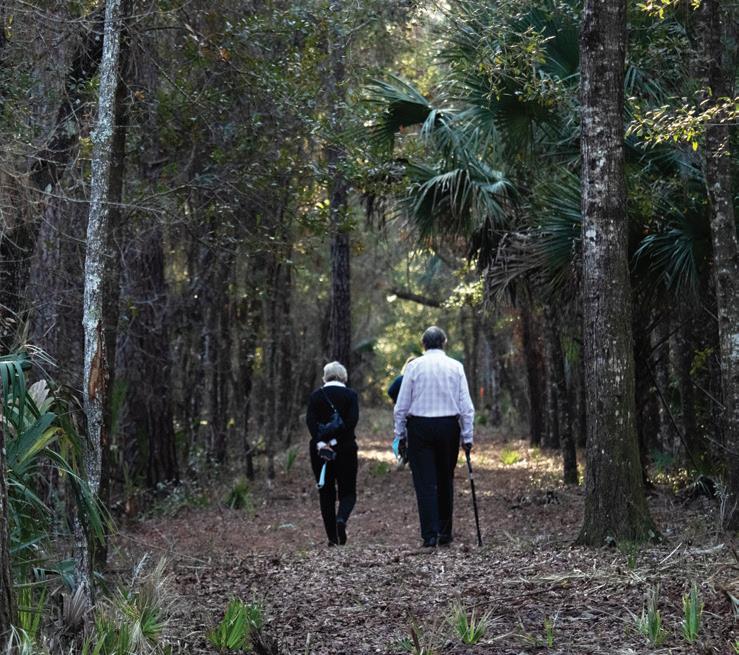
As an author and historian of Florida’s Black history, Dunn knew of the atrocities committed in the north Florida town so long ago. He hiked on foot, deep in the palmettos and pines, along the railroad track he knew once served as a vital escape route. Then, he discovered the graveyard.
“I had a very strange feeling,” Dunn said. “Like spirits were reaching out to me.”
Among the tombstones was the name “Goins,” which he recognized as one of the original families at the time of the Rosewood massacre.
Dunn later purchased a piece of property in Rosewood, where a wreath laying ceremony took place Jan. 8 for the massacre’s centennial. Though not a descendant
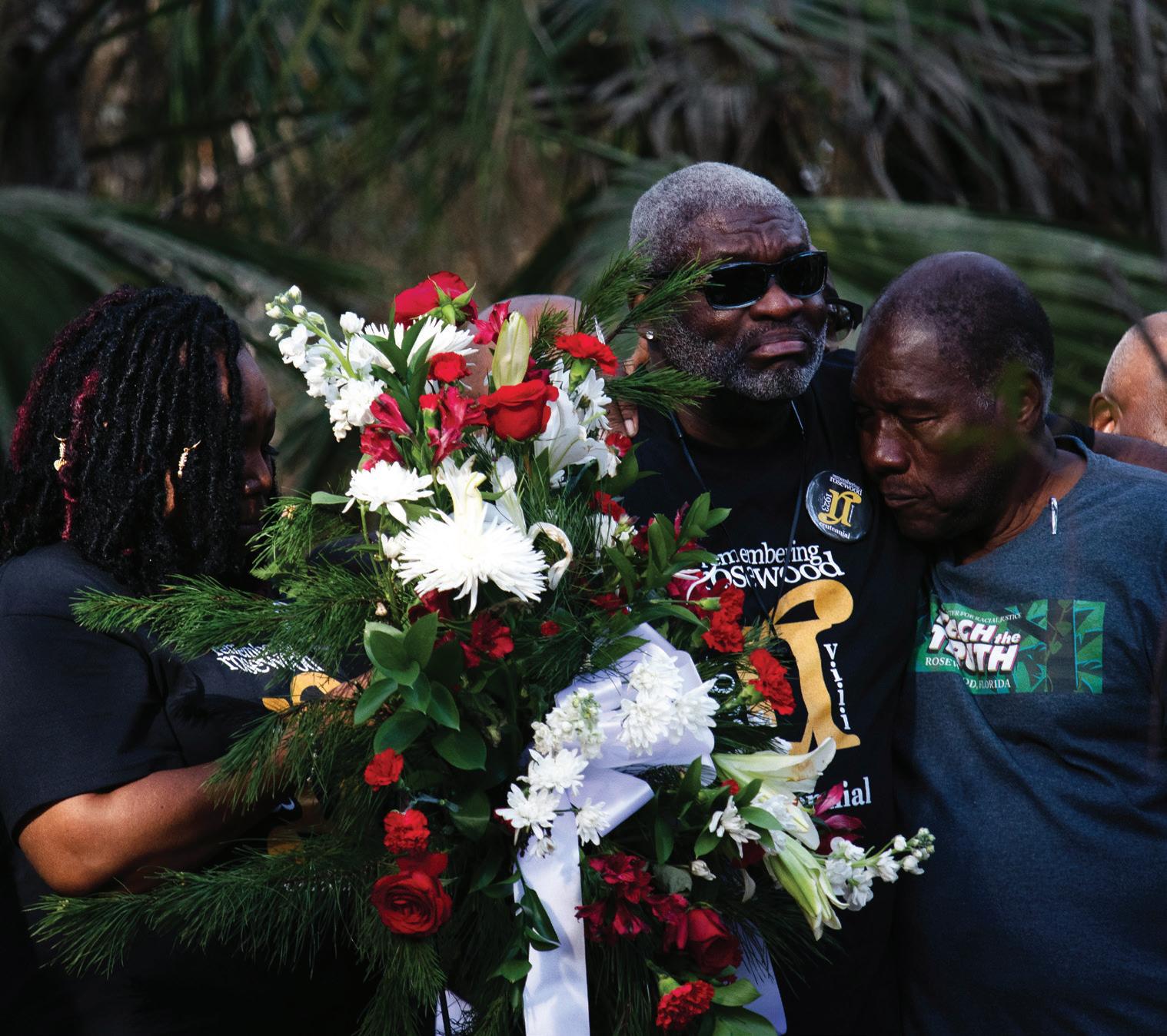
himself, Dunn bought it because many of the original Black families had left, and Rosewood is today a white community.
“African Americans need to own the blood land,” Dunn said. “We need to own some of the places where these terrible things happened so we can retell these stories — not to make anybody feel bad, but to preserve the history for its own sake.”
During his experience in the graveyard, he sensed the history beneath his feet.
One hundred years ago, Rosewood, Florida, was a thriving Black community just under 50 miles west of Gainesville that provided residents decent jobs and land ownership opportunities — an anomaly nestled in the Jim Crow South. That was until Jan. 1, 1923, when a white mob invaded, murdered inhabitants and set the town ablaze.
Survivors sought refuge in the swamp as they watched their lives be destroyed in a spontaneous act of hate. Law enforcement wouldn’t come to the rescue.
The mob’s rage was spurred after a white woman in neighboring Sumner claimed that an unidentified Black man had attacked her. The search for the al-
Muslim residents reexamine hijab amid international protests
Mahsa Amini's death triggered protests
By Zarin Ismail Alligator Staff Writer
In her sophomore year at UF, Iman Zawahry stepped into a Walmart with her friends sporting a hijab for the first time as they shopped for groceries.
Now a UF media production, management and technology lecturer and filmmaker, Zawahry was thrilled to wear the Muslim head covering and even sent a mass email to her loved ones announcing her decision to wear it.
To her, the hijab was a way of standing out.
“I’ve always been a big personality and outgoing — very American. I really wanted to portray that,” Zawahry said. “I’m going to wear a hijab to dispel these stereotypes.”
The hijab, a head covering often worn by Muslim women as a symbol of modesty, has been at
the forefront of global conversations regarding women’s rights since the death of 22-year-old Mahsa Amini, who died while in Iranian police custody Sept. 16.
Three days prior, Amini had been arrested for not wearing her hijab properly. Iranian police claimed the cause of her death was heart failure from preexisting health conditions, but eyewitness reports and hospital scans suggest Amini had physical injuries to the head and body.
Amini’s death led to worldwide anti-hijab protests in countries like France, Italy, Turkey and the United States. Decades-long protests primarily organized by Iranian women to abolish the 1983 hijab law developed into a nationwide movement in Iran against the Islamic Republic.
The republic has been accused of suppressing freedom since its establishment in 1979. To
prevent Iranians from spreading anti-government messages, it has restricted internet access, jailed over 18,000 individuals and sentenced at least 100 protestors to prison or execution.
As of Dec. 27, according to Iran Human Rights, Iranian security forces have killed 476 people — including 64 children and 34 women — involved in the 2022 protests.
Following Amini’s death, some like Zawahry are still steadfast in their commitment to wearing a hijab. Others like Nabiha Nur, a 21-year-old UF advertising senior, never enjoyed wearing it since her mother made her at age 10. Once she reached college, she stopped wearing it.
“My relationship with the hijab has always been conflicted,” Nur said.
Story description finish with comma, pg#
UF tennis freshman duo succeeds Tokac, Nirundorn ranked as No. 10 doubles pair in NCAA Read more on pg. 11

Journalism dean and professor John Wright dies at 73 Wright pioneered early WUFT News properties, pg. 6
EDITORIAL: Covering Rosewood 100 years later The Editorial Board reflects on the pitfalls of previous local coverage, pg. 7
We Inform. You Decide. www.alligator.org
officially associated with the University of Florida Published
Campus Communications, Inc. of Gainesville, Florida
Not
by
MONDAY, JANUARY 9, 2023 VOLUME 117 ISSUE 17
US
FOR UPDATES
FOLLOW
ONLINE
@FloridaAlligator @TheAlligator_ @TheAlligator @thefloridaalligator
Caia Reese // Alligator Staff
SEE ROSEWOOD, PAGE 4 SEE HIJAB, PAGE 5 SEE ACCREDITATION, PAGE 5
Historian Marvin Dunn (right) stands with Rosewood descendant Gregory Doctor (center) during the Rosewood wreath laying ceremony Sunday, Jan. 8, 2023.
State removes Alachua County Public Schools LGBTQ support guide
Guide in violation of new state law
By Peyton Harris Alligator Staff Writer
At Gainesville High School, students could choose to use whichever bathroom best aligned with their gender identity. But Katherine Canev, 18, fears this and other rules contributing to an LGBTQ-friendly climate might change.
“I know that in my school there are safe people and safe teachers and safe counselors,” said Canev, a senior who identifies as pansexual. “But I can't say that for every school, which worries me.”
In mid-November, Alachua County Public School and other districts in the state received instruction from the Florida Board of Education to cease using LGBTQ support guides because some of the policies were inconsistent with the state’s Parental Rights in Education Act — a controversial law some critics dubbed the “Don’t Say Gay” bill.
After the school board removed the guide from its website in a Dec. 14 meeting, some students were concerned. Without a standard response to LGBTQ issues, students and faculty could be at risk, Canev said.
“I think that we should prioritize the safety of our teachers and the safety of our students over this overreach of government,” she said.
Alachua was one of 10 counties to appear before the Florida Department of Education for similar support guides.
The district’s support guide, 25 pages in length, includes information on establishing school chapters of the Gay-Straight Alliance, examples of common anti-LGBTQ rhetoric
and instruction on bathroom use for transgender students and staff.
While national laws such as Title IX and FERPA outlaw discrimination for students based on sexuality, FDOE doesn’t have similar statewide support guides.
The ACPS support guide was developed with input from organizations like Equality Florida, the Safe Schools initiative and other LGBTQ groups, as well as a legal team. It was adopted by the School Board in December 2021.
But Gov. Ron DeSantis signed the Parental Rights in Education bill into law last March, which requires school boards to notify parents of changes in material or curriculum and specifically addresses sexual and LGBTQ education.
Superintendent Shane Andrew received a letter from the FDOE on Nov. 18 that highlighted policies in the guide such as preferred gender and pronoun usage and restroom and locker room policies as inconsistent with the law.
FDOE Senior Chancellor Jacob Oliva pointed out rule 6A-10.086 of the FDOE guidance on the law requiring parental notification of any change in bathroom or locker room designation. The listed violations in the letter weren’t exhaustive, ACPS spokesperson Jackie Johnson said, and the district is unclear on the full extent of the state’s complaints.
The guide provided standardized ways to handle decisions related to the LGBTQ community, such as disciplinary measures against LGBTQ based discrimination or how to respond to a student’s coming out, said GHS senior Colleen Anderson, 17.
Have an event planned? Add it to the alligator’s online calendar: alligator.org/calendar
The district’s priority should be providing a safe environment for students to express ideas about gender and sexuality, Anderson said.
“Removing it will allow teachers to make the decisions on their own,” she said. “It won't be as reliable, making everybody feel a little bit less comfortable.”
The district will reconvene in a February workshop to discuss and implement a replacement.
But with a lack of clarity on what was wrong with the last guide and conflicting state and federal guidelines, creating a new one will be difficult, said Sarah Rockwell, a newly elected school board member.
Members will develop this replacement with the help of experts and the public, she said.
“Making sure we meet the requirements of all those laws will be very challenging,” she said. “It’s going to create more work for school counselors, teachers and administrators.”
At the Dec. 14 meeting, Andrew told the state board ACPS will work on revisions to present a new draft of the guide on Feb. 8.
@peytonlharris pharris@alligator.org
Library West partially reopens after water damage
happened.”
Servpro, a fire and water cleanup restoration company, had crew members from Jacksonville sent to Gainesville to help with renovations.
Not officially associated with the University of Florida Published by Campus Communications Inc., of Gainesville, Florida
352-376-4458 NEWSROOM:
Alan Halaly, ahalaly@alligator.org
Veronica Nocera, vnocera@alligator.org
Aurora Martínez, amartinez@alligator.org
Jiselle Lee, jlee@alligator.org
Emma Behrmann, ebehrmann@alligator.org
Christian Casale, ccasale@alligator.org
Elliot Tritto, etritto@alligator.org
Selin Ciltas, sciltas@alligator.org
Kristine Villarroel, kvillarroel@alligator.org
By Sophia Bailly Alligator Staff Writer
Library West remained closed through Jan. 8 after a break in the waterline caused an estimated 60,000 gallons of water to flood the library’s first, second and third floors for several hours, according to a UF press release.
The library, located at 1545 W. University Ave., was set to reopen Jan. 3. The total cost for replacing damaged computers, furniture, ceilings and carpets is not yet known.
About 6,000 of the more than 1 million books in the library were damaged by water. The damaged books are being assessed for inventory and replacement.
Staff noticed the waterline break Dec. 26, when the early morning temperature in Gainesville dropped to the low to mid-20s. Staff and contractors are working to repair parts of the first, second and third floors of the west end of the library.
Affected areas on the building’s west side are closed indefinitely while ceiling tiles, carpet tiles, drywall and other construction materials arrive for refurbishment. Plastic construction barriers close off these sections.
The library may be open to its full capacity by midFebruary, said Patrick Reakes, the senior associate dean of UF libraries.
“It creates a pretty good barrier in between where people are sitting and studying, and these guys are on the other side doing whatever they're doing,” Reakes said. “The rest of the library looks like nothing ever
“They brought in a massive crew of people and all the equipment and everything because they're the ones that dealt with the actual flooding,” Reakes said.
To alleviate book damage based on humidity and temperature, large tubes efficiently dried the building and removed water. Reakes likened them to a giant vacuum that sucks up water.
Judith Russell, the dean of UF’s library systems, said there was also a crew stationed in the library to wipe down shelves, tables and floors.
“We scanned the barcode on every single book that we removed,” Russell said. “But we haven't had time yet to see about what the replacement cost of those books will be.”
Although parts of Library West are now open, the first, second and third floors will still be refurbished to account for computers, furniture and books that were lost.
“We have a whole process where we're all aggregating costs and forwarding them to a central office that handles the insurance for the university,” Russell said.
UF had environmental and safety experts assess the situation, Reakes said.
Normal hours are expected to resume Monday. Students can still drop off books at Library West’s drivethru drop box location on the east side of the library facing Anderson Hall.
DISPLAY ADVERTISING
Advertising Office Manager Intern Coordinator Sales Representatives
SparkItCreativeAdvertising
Jackson Reyes, jacksonreyes@alligator.org Topher Adams, tadams@alligator.org
Ashleigh Lucas, alucas@alligator.org Minca Davis, mdavis@alligator.org
bweiner@alligator.org
Kyle Bumpers, kbumpers@alligator.org Alan Halaly, Veronica Nocera, Aurora Martinez, Selin Ciltas
352-376-4482
Cheryl del Rosario, cdelrosario@alligator.org Ellen Light, elight@alligator.org
Brooke Tymoniewicz, Qingyu Yang, Matthew Powell, Paulina Navarro, Sophia Handley, Kyle Weiner, Avery Brennan, Madison Kahn 352-376-4482 • info@sparkitcreative.org
SparkIt Team Managing Director Aarin Rutkin, Adriana Colón, Dalia Rubinowicz, Jenny Gomez, Levi D'Amato, Maria Vanderbilt, Melanie Peña, Nazil Ahmed, Samadu Adeyemi, Sammy Fadool, William Chen, Skyler Davis
CLASSIFIED ADVERTISING
Skyler Davis 352-373-3463
Classified Advertising Manager Ellen Light, elight@alligator.org 352-376-4446

BUSINESS
Comptroller Delia Kradolfer, dkradolfer@alligator.org Bookkeeper Cheryl del Rosario, cdelrosario@alligator.org
Administrative Assistant Ellen Light, elight@alligator.org
352-376-4446 ADMINISTRATION
General Manager Shaun O'Connor, soconnor@alligator.org
Administrative Assistant Lenora McGowan, lmcgowan@alligator.org President Emeritus C.E. Barber, cebarber@alligator.org
IT
SYSTEMS

PRODUCTION
Production Manager Jordan Bourne, jbourne@alligator.org
Publication Manager Production Staff Member Deion McLeod, dmcleod@alligator.org Namari Lock, nlock@alligator.org
The Independent Florida Alligator is a student newspaper serving the University of Florida, published by a nonprofit 501 (c)(3) educational organization, Campus Communications Inc., P.O. Box 14257, Gainesville, Florida, 32604-2257. The Alligator is published Monday mornings, except during holidays and exam periods. The Alligator is a member of the Newspaper Association of America, National Newspaper Association, Florida Press Association and Southern University Newspapers.

The Alligator offices are located at 2700 SW 13th St. © Copyright 2020. All rights reserved. No portion of The Alligator may be reproduced in any means without the written consent of an officer of Campus Communications Inc.
Subscription Rate: Full Year (All Semesters) $60
The Alligator strives to be accurate and clear in its news reports and editorials. If you find an error, please call our newsroom at 352-376-4458 or email editor@alligator.org
Today’s Weather
ISSN
0889-2423
2 ALLIGATOR MONDAY, JANUARY 9, 2023
VOLUME 117 ISSUE
Got something going on? Want to see it on this page? Send an email with “What’s Happening” in the subject line to engagement@alligator.org. To request publication in the next day’s newspaper, please submit entries before 5 p.m. Please model your submissions after the above events and keep them to 150 words or fewer. Improperly formatted “What’s Happening” submissions may not appear in the paper. Press releases will not appear in the paper.
17
System Engineer
Kevin Hart
Managing Editor Editor-In-Chief Digital Managing Editor Assistant Sports Editors Sports Editor Editorial Board
Editors the Avenue Editor Metro Editor News Director Features Editor University Editor Opinions Editor
Desk
Engagement
Multimedia
Copy
Chief Bari Weiner,
LIBRARY MAY FULLY OPEN IN FEBRUARY, ASSOCIATE DEAN SAYS
@sophia_bailly sbailly@alligator.org

MONDAY, JANUARY 9, 2023 ALLIGATOR 3
Hundreds celebrate resiliency through Rosewood wreath laying ceremony
City Commissioner Cynthia Chestnut, historian Marvin Dunn among speakers
By Siena Duncan & Jack Lemnus Alligator Staff Writers
A wreath of white roses now sits on what once was the railroad used by Black women and children to flee the violence of the Rosewood massacre 100 years ago.
The Sunday wreath laying ceremony commemorated the Black residents who lost their homes and lives to the massacre. Alongside the wreath, descendants of the survivors filled nine urns with the soil of the lost town — eight for the original families at the time of the massacre and one for unknown residents who lost their lives in the bloodshed.
Nearly 200 people attended, some bussing in from Jacksonville, Miami and Tallahassee to observe the ceremony.
The keynote speaker at the event was Gainesville City Commissioner Cynthia Chestnut, who argued the importance of preserving this painful story.
“The fight goes on, the battle continues,” Chestnut said. “The mantra must be ‘never again.’”
The ceremony also served to celebrate the surviving families of the Rosewood massacre, where a white mob descended upon the Black community of Rosewood, Florida, murdering residents and razing the town.
The terror ensued from Jan. 1-7, leaving the town of roughly 200 people homeless. Many fled by train to Gainesville, nearly 50 miles west. The violence began after a white woman in neighboring Sumner alleged an unknown Black man had assaulted her, and whites from surrounding towns and even Georgia invaded in retaliation.
During her speech, Rabbi Robyn Fisher, of Beth Or in Miami, stressed
the country won’t be able to heal without reconciling its troubling past.
“We cannot wipe away and clean from the history books the bloody truth,“ Fisher said. “We don’t get to experience reconciliation and redemption without first acknowledging the truth.”
Masons from the Most Worshipful Grand Union Lodge also participated. Because many men from the original Rosewood families were masons, members of the modern lodge laid the wreath.
An opening prayer from Fisher and a closing prayer from Rosewood descendant Paris Murphy-Doctor bookended the ceremony. The ceremony included several speakers: Chestnut, Florida International University professor Marvin Dunn, former state Sen. Tony Hill, chaplain Elvin Lee Jr. and co-founder of Ayoka Gifts International Cultural Center Nii Sowa-La.
Chestnut spoke about her experience in the Florida House of Representatives attempting to pass a bill to give Rosewood descendants compensation for the past — the first bill across the country to ever afford Black people reparations.
She also brought up the recent restoration of exclusionary zoning in Gainesville. It stands as an example of Black people like herself fighting to build wealth, she said.
“We can pass our homes onto our children,” she said.
Education is the next step to protect the legacy of the Rosewood residents, she said.
During her time as a legislator, Chestnut helped to begin a program called the Rosewood Scholarship for direct descendants. As of 2020, 297 students have received the scholarship since 1994, according to reporting from The Washington Post.
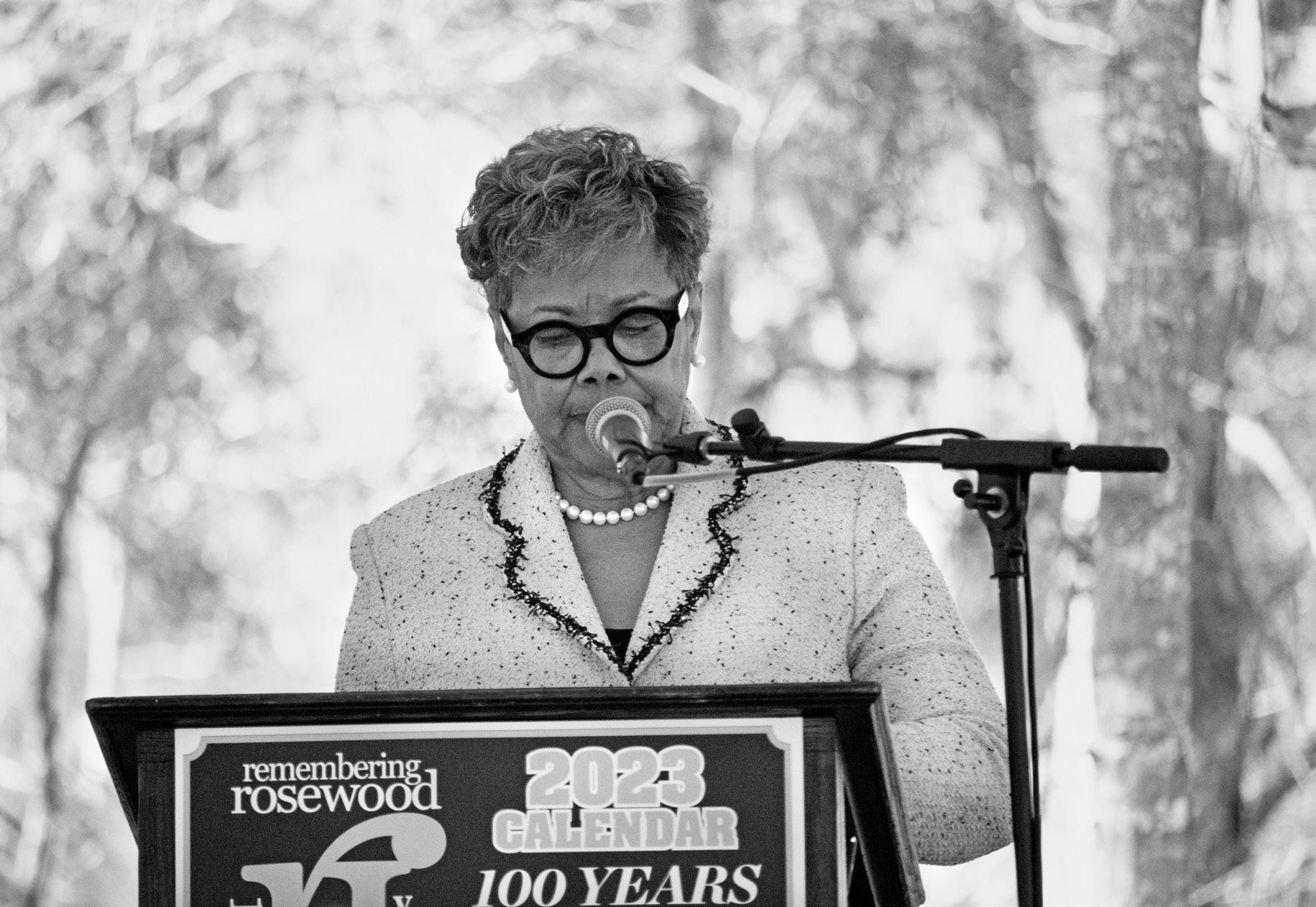
To see more Black wealth accu-
mulated in America, Chestnut said, a new start for those descendants must be built.
After working with Rosewood descendants for almost 30 years to pass the bill, Chestnut said she sees the ceremony as a celebration of resiliency.
“This really just grabs my heart,” she said. “One hundred years — we can’t go back there. We can’t go back.”
A choir made up of Rosewood descendants sang the hymn “How Excellent” during the middle of the event.
Pain lingers for descendants
a history professor at Florida State University and former researcher for the reparations bill.
Many of the descendants were children below the age of 12, said 38-year-old Benea Denson, a descendant of the Evans family and the president of Rosewood Family Reunion Inc. Denson, actor in “Rosewood”, has been involved with Rosewood descendant reunions for most of her life.
She helped prepare the choir of friends and family members for the event.
“We come from a singing family,” she said. “Singing comes like second nature to us. We learn it from the time that we can speak.”
in 1982 that he discovered the harrowing truth about his family’s history.
leged attacker began in Rosewood, and when one family, the Carriers, defended themselves, whites from neighboring counties and members of the Ku Klux Klan from Gainesville descended upon the town.
John Wright, the white owner of the Rosewood general store, helped arrange the evacuation of women and children by train, but there was no saving the town or its dreams of opportunity. After seven days of terror, official reports say eight people died from the violence — six Black, two white — though other estimates claim dozens more.
It wouldn’t be until 70 years later that anyone tried to right the wrongs of the past.
In 1994, the state of Florida granted reparations of $150,000 to each survivor and scholarships to their descendants. But this is likely a one-time deal, as it is the only time Black people have received formal compensation for past racial violence.
Discussions of reparations persist, though white Americans generally don’t look on them favorably, said Maxine Jones,
Only 28% of white Americans approve of reparations for Black people with enslaved ancestors, but 86% of Black Americans do, according to a University of Massachusetts Amherst/WCVB poll.
“There’s a debate over what reparations should look like,” Jones said. “Reparations don’t have to be money, but opportunities. For me, the real win is that they got a chance to tell their story.”
Though the survivors are gone, the scholarship continues to aid their families, like descendant Raghan Pickett, 20. With her tuition covered, Pickett is studying political science at Florida A&M University. While at FAMU, she met someone who also received the scholarship.
“It was such a crazy coincidence,” Pickett said. “We still talk to this day.”
Despite the reparations, the pain is still raw within the descendants’ families a century later. For descendant Gregory Doctor, Rosewood haunted his childhood home, but it was never discussed. It wasn’t until the remaining survivors broke their silence
“Growing up, I knew something wasn’t right,” Doctor said. “When the adults would talk, I saw sadness and tears. But I was always told ‘It’s not a conversation for children.’”
Whenever Doctor asked his grandmother about their extended family, he noticed her deep sorrow, but he didn’t understand its source. After learning the truth, it made sense why the women had been so protective over the boys in the family, Doctor said.
When he discovered descendants of the mob in his own neighborhood, the grief was overwhelming.
“Can you imagine my mom knowing these people lived nearby?” Doctor said, “I played with their kids.”
Many survivors remained silent for decades after the massacre in fear of the original perpetrators tracking them down. Others couldn’t bear to relive the trauma they’d endured.
Doctor’s eyes still well with tears to think of how his grandmother suffered, he said.
To keep the story alive, Doctor and other descendants established Remembering Rosewood, an organization that will host a
Through music and ceremonies like these, the children who come from Rosewood families can learn how to take pride in their history, Denson said.
“We’ve been able to rise from the ashes,” she said. “We’ve been able to bring our family back together, reunite, become stronger and make history with our family.”
@SienaDuncan sduncan@alligator.org @JackLemnus jlemnus@alligator.org
series of events Jan. 8-14 for the massacre’s centennial. Among the ceremonies are discussion panels and film showings at UF, a traveling museum, an awards gala and the wreath laying ceremony on Dunn’s property.
Though there’s been progress since 1923, descendants worry that many still avoid the tough conversations around Rosewood and resist learning its history.
Jonathan Barry-Blocker, a descendant and UF professor, stressed that Black Americans must have the power to tell their history because so much is often left out.
“The South is notorious for hiding these stories,” he said. “And I’m not going to let someone’s existence be erased because it makes people uncomfortable.”
But Barry-Blocker has faith the next generation will preserve these stories. It’s the ability of young people to protest, ask questions and push back that gives BarryBlocker hope for change.
“It’s as though they’re collectively saying ‘That ain’t right,’” Barry-Blocker said. “This is a whole generation that isn’t going to take it anymore.”
4 ALLIGATOR MONDAY, JANUARY 9, 2023
Caia Reese // Alligator Staff
Gainesville City Commissioner Cynthia Chestnut discusses the process of proposing legislation on behalf of Rosewood descendants Sunday, Jan. 8, 2023.
@JackLemnus jlemnus@alligator.org ROSEWOOD, from pg. 1
Issues go beyond hijab
In response to Amini’s death and the Iranian government’s repression, protests have even made their way to Gainesville.
Ziba Ahmadi, a 44-year-old business owner and community leader, decided to start protests in Gainesville after seeing videos about Iranian protesters who died. Ahmadi sympathized with the mothers who lost their children and couldn’t sit back without trying to do something about it, she said.
Since Oct. 22, she has organized weekly protests for Iran at the corner of Southwest 13th St. and West University Avenue. The protests usually draw the local Iranian community together.

But Ahmadi hopes for more outsider involvement.
“Unfortunately, I had maybe one or two Americans who joined,” she said. “It’s not just about the country Iran. It’s about women’s rights. It’s about humanity.”
Maryam Tehranipoor, a 46-year-old UF information technology professional and regular attendee of Ahmadi’s weekly anti-hijab protests, saw people in cars honk their horns and hold their fists out in solidarity. She was happy to receive the support, but she wished for a way to get bystanders invested in what’s happening in Iran.
“What I think is missing is how we can make this thing speak to their minds,” Tehranipoor said.
By the end of 2022, Time magazine declared the women of Iran as heroes of the year, highlighting their bravery and resistance to the Islamic Republic.
Tehranipoor was initially happy to see Time recognize her people, she said, but she found its coverage on Iran inadequate. Strict government regulation of news in Iran and little coverage of Iran in the U.S. has made it difficult for non-Iranians to become better informed about the regime’s actions, she said.
Sarra Tlili, a 58-year-old UF associate professor of Arabic language and literature, believes the issue behind the protests mainly lies within government corruption.
“The hijab is the tip of the iceberg,” Tlili said.
The anti-government protests have ultimately drawn attention to the hijab, engendering conversation about whether it infringes on women’s rights and whether anti-hijab protests hurt women who wish to wear it.
Some Muslims, like Tlili, believe the hijab is mandated according to the Quran, a principal scripture in Islam. Tlili, however, disagrees with the premise that Iranian women should be forced to wear the hijab because they live in an Islamic country.
“It’s something between that woman and God,” Tlili said. “If a woman is not wearing the hijab as an act of faith, it loses its meaning — it’s as if she’s not wearing it.”
Though Iranians like Ahmadi and Tehranipoor stress these protests exist to highlight their government’s oppression, some Muslims may feel their beliefs are put at risk of being trivialized because the hijab is at the center of the debate.
Zainab Asad, a 21-year-old UF sociology senior, said people
are quick to speak for women who don’t want to wear the hijab. But when it comes time to stand up for women who are fired for wearing one or told they can’t, people rarely speak up.
“It sometimes boils down to this white savior type — people being like, ‘Oh no, we’re freeing you, sweetie,’” Asad said. “No ma’am, thank you so much, I would like to wear it.”
In her course “The Arab Woman,” Tlili observed that some students assume Muslim women wear the hijab against their will, she said.
The real problem Muslim women deal with is having to fight to wear the hijab, Tlili said.
From 1936 to 1941, before its current hijab mandate, Iran banned women from wearing the hijab to make them dress more like Europeans in an effort to modernize. The burqa, another type of Muslim veil, is currently banned in 16 countries.
Both hijab bans and hijab mandates exist to control women, Zawahry said.
She also sees a problem with overgeneralization.
“This is the worst thing. It’s pinning Muslim women
Search until 2025
Gothard said.
meeting or its topic.
UF declined to comment on the status of the search for new accreditors.
UF shares its current accreditor, the Southern Association of Colleges and Schools Commission on Colleges, with 108 other Florida colleges and universities. SACSCOC is one of six regional accreditors whose member universities typically reside within their region.
Accreditors may investigate universities for potential breaches of contract, as was the case for a suspected conflict of interest during Florida State University’s 2021 presidential search and during a potential restriction of academic freedom at UF later that year. Universities are also partially protected from government influence by such investigations,
All regional accreditors must meet the U.S. Department of Education’s standards, including those outlined for faculty, student achievement, and academic programs, according to a BOG information packet.
To switch accreditors, universities must provide the USDOE with a reasonable cause for the change and receive its approval. They then must apply for and receive membership to their new accrediting body before formally notifying USDOE of the change.
Since a 2020 change allowing universities to seek accreditation outside their region, some universities have transitioned to different accreditors. The change paved the way for Florida’s SB 7044, which allows accreditation changes outside the region and bars universities from using the same accreditor in consecutive
cycles.
Past clashes between the Florida government and SACSCOC, including over the UF and FSU investigations, have been Gothard’s suspected causes of the bill, he said.
“This was a reaction to punish SACSCOC for enforcing rules that would keep politicians out of our higher education classrooms and off of our campuses,” Gothard said. “It came from a place of bitterness and anger, and that's why it is not helpful.”
One possibility remains for Florida institutions to remain with SACSCOC: SB 7044 allows universities to stay with the same accreditor “under certain circumstances,” provided they exhausted every other option. The amendment ensures Florida universities would not lose accreditation entirely in case no other accrediting institution accepts them, Gothard said.
Gothard and UFF worked hard to add the amendment to SB 7044, he said. Potentially losing
against each other,” Zawahry said. “Muslim women are not a monolith. There’s no model of what a Muslim looks like.”
Ahmadi and Tehranipoor believe the situation in Iran is a human problem that transcends boundaries, politics and religion.
“It’s not hijab,” Tehranipoor said. “It’s just facing a government that, if being left unchecked, it’s going to spread what it’s been doing to its own country to others.”
Ahmadi emphasizes urgency in her weekly protests.
One sign that Ahmadi and fellow protesters wave every Saturday reads, “Act today, tomorrow is too late,” in bold red letters.
As protesters of all ages in Iran continue to lose their lives, Ahmadi vows to continue holding protests for Iran until her country sees victory. Freedom.
@zarintismail zismail@alligator.org
accreditation would disqualify students’ degrees and revoke access to federal financial aid.
“Even if some of our legislators are blinding themselves to the consequences of this, we wanted to make sure that Florida students were protected,” Gothard said.
Changing accreditors will cause a temporary rise in university expenses, according to the BOG presentation. While the presentation claims the change shouldn’t cause major expense changes long-term, SACSCOC requires the lowest cost in dues and fees of any other regional accreditor. A change to any other accreditor will result in a rise in costs for the university.
SACSCOC would suffer a loss of over $1 million — or 8.6% of its 2021 revenue — if all Florida universities transition away from the organization, president of SACSCOC Belle Wheelan wrote in an email.
UF President-elect Ben Sasse finds accreditation systems limit
a university’s potential and stifle innovation, he wrote in a 2022 article for The Atlantic. He called for either radical reform or a complete overhaul of accreditation “cartels,” he wrote, to encourage individuality in higher education.
“Much of the monotony in higher education is a result of the accreditation process,” Sasse wrote. “Accreditation should protect students from snake-oil salesmen, but unfortunately it has become its own racket.”
But UFF-UF Vice President Meera Sitharam sees accreditation as a long-term process during which a university repeatedly self-evaluates and makes changes to improve its quality, she said.
“It's not like somebody coming and giving you a golden seal of approval,” Sitharam said. “It's like a feedback cycle. You do something, you see what the effect of that is and then you change it.”
MONDAY, JANUARY 9, 2023 ALLIGATOR 5
pg. 1
HIJAB, from
@AlissaGary1 agary@alligator.org ACCREDITATION, from pg. 1
Courtesy of Roz Zekavat
Protesters gather at West University Avenue and Southwest 13th Street following the death of Mahsa Amini.
Remembering John Wright — former UF journalism dean, professor Community remembers Wright for his kindness, leadership
By Naomi Volcy Alligator Staff Writer
During his time as dean of the UF College of Journalism and Communications (CJC), John W. Wright II and his wife, Pamela “Pam” Wright, traveled the country visiting UF alumni.
Pam, Wright’s wife of 41 years, said that her husband’s motivation to help students stemmed from him valuing his role as an educator and mentor, and he empathized with students based on his own experiences as a student. Wright worked at UF for 36 years.
“He always saw his job as students-first,” Pam said. “All the accolades would follow when necessary.”
Wright, a former dean and professor, died Dec. 31 at 73. When his passing was announced by the CJC on Jan. 2, the article circulated across the college’s social media accounts. UF faculty and alumni flooded the comments with their condolences, kind words and fond memories of Wright.
At 14, Wright began working at his father’s radio station reading the news on air and acting as a DJ, Pam said. That was the beginning of a long, successful career in broadcast news. Wright would go on to work as a news and sports reporter, news director, program director, production manager, music director and DJ for many other stations.
Pam reminisced about memories of her husband that may be unknown to others –such as the depth of his fondness for The Beatles, sports and his students. The couple went to Liverpool and toured to listen to The Beatles. He played football in high school and coached his son’s Little League team until his son was 15. During Wright’s time as a dean, he and his wife traveled around the
country and visited alumni.
Wright worked in various leadership roles at UF, such as dean, executive associate dean, associate dean for graduate studies, graduate coordinator and interim department chair. He retired in 2018 and assumed a professor emeritus role, which is an honorary title given to retired professionals for the last rank of the office held.
As dean, Wright advanced development of the Innovation News Center; improved management of the college’s media properties; spearheaded the college’s partnership with the University Athletic Association, which allowed GatorVision to move to Weimer Hall; opened the College’s Research Lab and AHA! CoLab; and launched WUFT Noticias, the Spanish-speaking newscast.
As Director of Sports Journalism and Communications, Wright worked with Ted Spiker, professor and journalism department chair, to design the sports and media specialization.
“Part of his vision for what we did with sports was to make it as grand and big as possible,” Spiker said. “He did that with everything.”
Spiker described Wright as a champion for students and faculty and a person who thought of others.
“He wondered what was best for our students,” Spiker said. “He always valued your ideas. He wanted to lift up as many people as possible, whether it was students, faculty, staff or anybody.”
Mike Gillespie, a 33-year-old UF alumnus and sports anchor at ABC Columbia in Columbia, South Carolina, said he experienced the sports journalism program’s beginnings, which greatly impacted his ability to hone his craft and gain industry experience.
“I don’t think the right amount of resourc-
es were put into sports, and I think John really tried to change that when I was there – he really spearheaded the effort,” Gillespie said. “I think that had a huge impact.”
Chris Peralta, a 32-year-old UF alumnus and executive producer at WESH 2 News in Orlando, Florida, describes his success as a direct result of Wright curating programs and opportunities for student success.
“I feel I had a very rewarding college experience and was able to get experience at the media properties and that one hundred percent turned into valuable experiences that I was able to use to land my first job and beyond,” Peralta said.
Beyond curriculum and industry opportunities, alumni are grateful to Wright for advocating for students. Wright’s motivation was to serve the student body, which he kept as the focus of his efforts.
Sasha Muradali, a 38-year-old UF alumna and current creative director, recounted that Wright assisted her in her application for a study abroad program in London. Muradali was able to gain life-changing experiences that changed the trajectory of her career path and life.
“Going to London set up the framework for me pursuing international public relations agencies, careers, clients and the type of work I was interested in when I came back [to America],” Muradali said.
David Ostroff, professor and chair of the media, management and technology department, notes that Wright was a leveled leader who maintained his composure even in difficult times.
“John was a very calm, steady leader,” Ostroff said. “There were difficult times, particularly when we had financial problems in 2008. But he was always calm and steady.”
Alumni remember Wright as a kind and
approachable person. It was easy to interact with him because it always felt that he was on your side and an aura of warmth was around him, Gillespie said.
Faculty who have worked closely with him attest to Wright’s kind nature as well.
Wright left behind an invaluable legacy that will be felt by students and faculty for years to come. His impact on the lives of those who knew him is evident in their descriptions of him — a kind leader who enjoyed people, strived to create the best opportunities for students and advocated for them.
“John’s legacy is impacting students today and tomorrow because that’s the foundation [of the CJC] and everything he brought into the world when he was at the University of Florida,” Muradali said.
@volcyn_ nvolcy@alligator.org
NEW BUILDING WILL HOUSE EXTENSIVE WET COLLECTIONS
By Halima Attah Alligator Staff Writer
The Florida Museum of Natural History is undergoing a longawaited makeover.
The state-sponsored museum has become the latest subject of UF expansion, with the finished construction of its Special Collections Building set for September.
Located next to the museum’s exhibit hall, the new facility will serve as a hallmark of the Florida Museum’s departments of ichthyology (involving fish), herpetology (involving amphibians and reptiles) and invertebrate zoology. It will house the wet collections that have propelled student researchers’ work, with more than 23,000 square feet of laboratory spaces, concentrated shelving systems and offices.
The creation of the Special Collections Building represents a significant change for those involved in specimen-assisted research, Florida Museum Director Douglas Jones said.
“It’s really a big step forward,”
Jones said. “We’ve already gotten one grant from the National Science Foundation to help in the curation of the specimens.”
The Florida Museum’s wet collections — the extensive selection of all its specimens preserved in alcohol — comprise nearly 9,300 different fish species and varying types of reptiles, amphibians
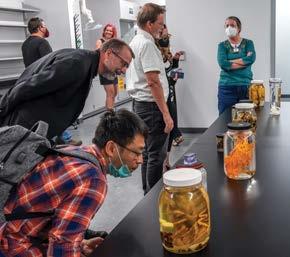
and insects. Once they are moved from their original location at Dickinson Hall to the Special Collections Building, they’ll represent an ever-growing collection of species from around the world.
Robert Robins, the museum’s Ichthyology Collection Manager, said transporting such a large volume of specimens requires
meticulous barcoding and storage efforts. The fish collection involves more than 190,000 jars of alcohol and up to 120,000 stainless steel tanks of the same liquid, each containing various fish specimens.
“We are putting a barcode label on every single container so that we can reorganize them in the new building in a more spaceefficient arrangement,” Robins said.
Before specimens arrive at the Special Collections Building, collection assistants arrange them by jar sizes ranging from four ounces to five gallons. They are then entered into a database to be packaged into dish barrel boxes and transported to the new building through box trucks.
“The move is a huge opportunity to improve the organization of this collection and make [its] … access to researchers far more efficient than it has ever been,” Robins said.
Marcel Kouete, a research assistant at the Florida Museum of Natural History, said the Special Collection Building’s wet collections play a large role in sample acquisition for his research.
Focused on amphibians in
Central African regions, he relies on the new building for access to otherwise unattainable materials.
“[In] Central Africa, for example, there’s no salamander as of now,” Kouete said. “But through the museum, I have access to … the frogs and salamanders … that people have collected in some other part of the world.”
Kouete commended the Special Collections Building for its functionality, noting that its size and specimen organization system have improved his on-campus research experience.
“We used to be crammed into a small space,” Kouete said. “It [was] difficult to have a space for yourself to be able to work … The space for collection is much more accommodating.”
While the Florida Museum’s wet collections haven’t yet fully completed their transfer, researchers like Kouete appreciate the progress of the large-scale endeavor.
“It’s kind of rewarding … to be able to have an environment which is conducive for research,” he said.
@HalimaAttah hattah@alligator.org
6 ALLIGATOR MONDAY, JANUARY 9, 2023
Courtesy to The Alligator
Courtesy to The Alligator John W. Wright II
Florida Museum of Natural History to rehouse nearly 200,000 jars of preserved animals
Newspapers failed Rosewood 100 years
To understand the Rosewood massacre, first we must remember its impact.
This month marks 100 years since the event that destroyed a thriving predominantly Black community in the Jim Crow South. As an injustice to Black Floridians statewide, its importance strikes relevance today more than ever.

A hundred years ago, white supremacists from neighboring areas terrorized the individuals within the town of Rosewood, Florida, which lies just under 50 miles west of Gainesville.
Resulting from a claim concerning the assault of a white woman by a Black man, hundreds of Ku Klux Klan members left a Gainesville rally to storm the area, killing at least six individuals within the community.
Churches, homes and places of refuge were some of the areas burned by the KKK during this horrific attack. Though their goal may have been to destroy the town, the sudden displacement of countless individuals displayed residents’ unwillingness to give up hope for a brighter future.
But at the time of the massacre, this tragedy wasn’t fairly represented in local media.
On Jan. 6, 1923, The Gainesville Sun — then The Gainesville Daily Sun — published an opinion piece setting the tone for the paper’s coverage of the Rosewood massacre. At the time, one of the outlet’s editors was openly a member of the KKK.
In a short blurb positioned under the masthead, the piece described the attack as the result of a “criminal assault on an unprotected white girl,” writing that as long as these crimes
continued, “lynch law will prevail, and bleed will be shed.”
“We do not know how to write about it,” the 1923 piece continued.

But a century later, The Alligator disagrees. Instead, we’re committed to fairly and accurately covering racial tension as it persists in north central Florida and beyond — dealing with tragedies like the Rosewood massacre.
Though the massacre may seem far gone, it lingers as harrowing local context for racial justice issues that our country has only begun to reconcile with or look straight in the eye.
Descendants like Lizzie Robinson Jenkins, the founder of the Real Rosewood Foundation who now lives in Archer, Florida, where her family fled after the massacre, are living reminders of the tragedy’s lasting impact.
In 1982 — just over 40 years ago — coverage of the Rosewood massacre shifted. That year, St. Petersburg Times reporter Gary Moore published an investigation spotlighting the erasure of the predominantly Black town rather than focusing on the alleged crime that spurred the attack.
Newspapers don’t just inform communities; they also help build and preserve history.
But newspapers have failed the Black community before — especially in their real-time coverage of Rosewood.

A white Associated Press reporter covered the massacre as a peaceful encounter where police asked around about the alleged attack. This was the narrative pushed out to the world through the nation’s leading wire service.
Media buried the town’s history and kept it in silence for over 60 years, a mistake we are
committed to never repeat again.
It’s our responsibility as a newspaper run by young adults to keep Rosewood alive — to reconcile with the past, to acknowledge how previous generations failed to show tolerance and to honor those we’ve lost.
Learning from history is the only way forward. And actions taken to come to terms with these injustices have continued as well.
As recent as 2020, leaders took bipartisan efforts to ensure the protection of Rosewood. In House of Representatives Bill 8502, Rep. Ted Yoho, alongside numerous Floridian cosponsors, introduced the Rosewood Study Act, which would make the site a national landmark. Though no current action has been taken, in a succinct statement, the bill states, “Our society cannot be complacent in senseless acts of violence. In order to learn from history, our society must make sure to remember it.”
Alongside national legislation, prominent work has been established through the Florida House. Enacted in House Bill 591, the Rosewood Family Scholarship Fund provided $150,000 to survivors, alongside post-secondary scholarships to surviving students.
Within the past few years, laws such as Florida’s Gov. Ron DeSantis’ “Stop W.O.K.E. Act” have restricted public education related to racism. However, experts — and even college preparatory nonprofit College Board — continue to advocate that discussions around racism
Alan Halaly EDITOR-IN-CHIEF
Attendees of the wreath laying ceremony walk through the five-acre Rosewood property after the conclusion of the ceremony Sunday, Jan. 8, 2023.
should have a space in classrooms nationwide.
Coverage of racial injustice has changed and will continue to as a new generation of journalists mostly utilize a framework more concerned with justice and diversity.
Rosewood will again disappear from headlines after its centennial. But what lingers is hope for fair, realistic coverage of the realities of what it means to be Black in this country.
Nocera ENGAGEMENT MANAGING EDITOR
 DIGITAL MANAGING EDITOR


 Selin Ciltas OPINIONS EDITOR
Editorial
9, 2023
ago. Here’s how it’s different today
MONDAY, JANUARY
www.alligator.org/section/opinions
The Alligator encourages comments from readers. Letters to the editor should not exceed 600 words (about one letter-sized page). They must be typed, double-spaced and must include the author’s name, classification and phone number. Names will be withheld if the writer shows just cause. We reserve the right to edit for length, grammar, style and libel. Send letters to opinions@alligator.org, bring them to 2700 SW 13th St., or send them to P.O. Box 14257, Gainesville, FL 32604-2257.
Columns of about 450 words about original topics and editorial cartoons are also welcome. Questions? Call 352-376-4458.
The views expressed here are not necessarily those of The Alligator.
Aurora Martínez
Veronica
Download the FREE TapRide App to Get a Ride! University of Florida SNAP Student Nighttime Auxiliary Patrol or call 352-392-SNAP (7627) 1128 NW 13 th Street, Gainesville, FL 32601 (352) 372-8004 AcademyOfMusicAndArtGainesville.com Academy of Music and Art Gainesville Guitar Academy &
Caia Reese // Alligator Staff
MONDAY, JANUARY 9, 2023 www.alligator.org/section/the_avenue
Gainesville mourns beloved downtown restaurant Crane Ramen
fan favorite permanently closed Dec. 31
By Loren Miranda Avenue Staff Writer
Before Crane Ramen, Juanita Colorado had never stalked a restaurant before it opened.
The 29-year-old UF alumna passed by the restaurant’s storefront for weeks before its 2014 opening to see when she could finally get her hands on ramen that didn’t come in a plastic cup.
Now, after countless date nights and spicy kara-age chicken appetizers, Colorado and her fiance’s special spot in Gainesville won’t be waiting for them when they return from their new home in Oklahoma.
Crane Ramen, Gainesville’s first specialty ramen restaurant, shut its doors permanently Dec. 31.
“It’d been there for us throughout our entire relationship and our chunk of time in Gainesville,” Colorado said. “Saying goodbye in that way was rough.”
The restaurant bore witness to many memories for the couple, who had relied on it for special celebrations and weekday meals. It was the last restaurant they visited before leaving Florida in late 2020.
Crane announced its closure via Instagram on Dec. 12. What followed was an outpour of nostalgic comments from regulars who mourned the shop’s closure.
Former owner Fred Brown explained that keeping affordable prices on the menu while paying employees a living wage was becoming close to impossible alongside an onslaught of increasing food and labor costs.
“I’m still heartbroken, and I’m definitely feeling melancholic about it,” Brown said. “It’s sad because so many people love Crane.”
There are no plans to reopen the restaurant to maintain the integrity of its original business model, Brown added.
Adverse effects of the COVID-19 pandemic on the locally-owned restaurant made the business unsustainable, Brown said. The transition from only offering to-go orders to reopening its open-air patio area for “dine out” in September 2020 wasn’t enough for Crane to continue its tradition of high-quality service.
Dealing with inflation and increasing labor costs proved to be the white flag that signaled the end for the business, Brown said.
Crane Ramen provided a first-of-itskind escape in a downtown dining scene that hadn’t yet explored the world of Asian soup cuisine.

The hole-in-the-wall space, the local artwork and artisanal carpentry from Gainesville artists and the lovingly crafted origami animals all alluded to eating in a major urban city while incorporating the charm that makes Gainesville home.
“We really loved the ambiance, even though it could get a little crowded,” Colorado said. “It was basically the only place where if I got sat at the bar, and I was literally rubbing elbows with a stranger, I didn’t even care. It was fine.”
Former Crane bartender, host and server Renee Hancock said she made some of her closest friends while working there in 2021.
Despite her affinity for her time there, Hancock said restaurant closure is unfortunately common.
Crane joins a list of restaurants in downtown Gainesville that have faced closure in 2022 – including Madrina’s and Mother’s Pub and Grill.
During her seven-month employment, Hancock saw the prices of certain imported items increase as much as 25 cents.
The expense increase for a locally owned business across the world from its cooking’s homeland affected some integral ingredients in common orders, such as the

Japanese citrus yuzu used in various cocktails, Hancock said.
“For a restaurant that has a specific cuisine — especially an American restaurant that has an international cuisine — it’s even more difficult to continue serving that food when food prices increase,” Hancock said.
Some specials the beloved restaurant hosted included weekly deals like the $10 Tuesday bowl and special events like the Street Fighter Ramen Tournament. During the event, customers selected menu items named after Street Fighter characters to battle in a March Madness-style tournament to determine the winning ramen for that week.
Although both Crane Ramen locations had a special place in his heart, former coowner Bill Bryson resonated more with the atmosphere Crane created in downtown Gainesville.
“This one hurts a little more than Jacksonville to see go,” Bryson said. “It was kind of an escape from the outside world.”

Despite the bittersweet feelings that came with its closure, Crane had a great run, he said, and left its wedge in the city’s culinary scene.
What Crane brought, Colorado and oth-
er ramen lovers agree, was a unique, savory glimpse of life outside of Gainesville that inspired a host of new culturally inspired kitchens to take root.
Colorado hopes as Gainesville continues to develop into a larger city, investors and community members will place more value on supporting locally operated businesses and continue evolving the city’s flavor palate.
Crane Ramen’s sister location in Jacksonville also announced its closure in November – albeit more suddenly than the Gainesville location. Crane Ramen Jacksonville posted on Instagram that Nov. 13 would be its last day of operation, and thanked its followers for their support.
The Gainesville location announced its closure with more leeway, giving Crane fanatics two weeks to get their final fixings in before the year ended. The restaurant even hosted an “End of an Era” party on Dec. 31, offering a champagne toast at midnight and the chance to say one last goodbye to the Crane Ramen crew.
As the clock ticked away the final seconds to the new year, ramen lovers raised one final glass. They saluted to the close of a chapter that, although wistfully concluded, will not be forgotten.
@LorenMiranda13 lmiranda@alligator.org
Keep up with the Avenue on Twitter. Tweet us @TheFloridaAve.
Read more on pg. 12. Scan to follow the Avenue on Spotify FOOD & DRINK
Gators basketball struggles at beginning of SEC play Florida loses first two conference games before beating rival Georgia and former head coach Mike White.
Gabriella Aulisio // Alligator Staff
Crane Ramen prepares for a celebratory New Year’s Eve party the night before its official closing Saturday, Dec. 31, 2022.
Local
The surf's up at "Pawn Beach" we're all making the scene. If you're in need go see Rich, Best Jewelry and Loan's got the "green". 523 NW 3rd Ave 352-371-4367 4-24-15-13
CASH FOR UNWANTED CARS / TRUCKS
Running or Not. Top Dollar Paid Call 352-259-2020 12-5-16-13
The American Cancer Society Road to Recovery Volunteers Needed! VOLUNTEER DRIVERS NEEDED to transport cancer patients to treatment. Flexible schedule. Training and liability insurance provided. Please call 800-227-2345 if interested.
St. Francis House is a homeless shelter located in downtown Gainesville.
Our mission is to empower families with children to transition from homelessness to self-sufficiency by providing case management, housing, food, training and educational resources in a secure environment.
If interested in volunteering please contact the volunteer coordinator at 352-378- 9079 ext 317 or sfhcoor@stfrancis.cfcoxmail.com
St Francis House depends on monetary support from individual donors and community businesses in order to provide meals to the homeless and the hungry.
To make a donation by mail, please send checks payable to St. Francis House P.O. Box 12491 Gainesville Fl 32604 or our website at Stfrancishousegnv.org

BUY IT. SELL IT. FIND IT. 373-FIND MONDAY, JANUARY 9, 2023 www.alligator.org/classifieds How to Place a Classified Ad: Corrections and Cancellations:
Call 373-FIND M-F, 8am - 4pm. No refunds or credits can be
Alligator errors: Check your ad the FIRST day it runs. Call 373-FIND
any corrections before noon. THE ALLIGATOR IS ONLY RESPONSIBLE
THE FIRST DAY THE AD RUNS INCORRECTLY. Corrected ads will
extended one day. No refunds or credits can be given after placing the ad. Corrections called in after the first day will not be further compensated.
error or changes: Changes must be made BEFORE NOON for the next day’s paper. There will be a $2.00 charge for minor changes. Online: w/ major credit card at www.alligator.org/classifieds In Person: Cash, Check, MC, Discover, AMEX or Visa @The Alligator Office: 2700 SW 13th St. M-F, 8am - 4pm By E-mail: classified@alligator.org By Fax: (352) 376-4556 By Mail: P.O. Box 14257 G-ville 32604 See alligator.org for more information Call 352-373-FIND for information. Sorry, no cash by mail. Credit cards or checks only.
and Cancellations: Cancellations: Call 373-FIND M-F, 8am - 4pm. No refunds or credits can be given. Alligator errors: Check your ad the FIRST day it runs. Call 373-FIND with any corrections before noon. THE ALLIGATOR IS ONLY RESPONSIBLE FOR THE FIRST DAY THE AD RUNS INCORRECTLY. Corrected ads will be extended one day. No refunds or credits can be given after placing the ad. Corrections called in after the first day will not be further compensated. Customer error or changes: Changes must be made BEFORE NOON for the next day’s paper. There will be a $2.00 charge for minor changes. BCI Walk In Tubs are now on SALE! Be one of the first 50 callers and save $1,500! CALL 888-687-0415 for a free in-home consultation. 1-9-20-10 ●UF Surplus On-Line Auctions● are underway…bikes, computers, furniture, vehicles & more. All individuals interested in bidding go to: SURPLUS.UFL.EDU 392-0370 12-5-16-10 When the heat is on and it's bucks that you need, Best Jewelry and Loan your requests we will heed. 523 NW 3rd Ave 352-371-4367 4-24-15-10 11 Motorcycles/
2020 HONDA METROPOLITAN SCOOTER Like new - only 421 miles. Tan. Located in Crystal River. $3000. Call 352-302-0889 1-30-23-4-11 12 Autos ●HEADLINERS SAGGING? ● ● ● Power Windows Don't Work? ● ● On site available. Call Steve 352-226-1973 4-24-23-15-12 DONATE YOUR VEHICLE to fund the SEARCH FOR MISSING CHILDREN. FAST FREE PICKUP. 24 hour response. Running or not. Maximum Tax Deduction and No Emission Test Required! Call 24/7: 866-471-2576 1-9-8-12 CASH FOR UNWANTED CARS / TRUCKS Running or Not. Top Dollar Paid Call 352-259-2020 4-24-23-15-12 1 For Rent furnished NOTE: This newspaper assumes no responsibility for injury or loss arising from contacts made through advertising. We suggest that any reader who responds to advertising use caution and investigate the sincerity of the advertiser before giving out personal information or arranging meetings or investing money. SS & VA ARE WELCOME! $560/BedRoom ● No Deposit! ● Furnished Cable ● Internet ● Utilities “Call or Text” 352-246-3418 4-24-15-1 2 For Rent unfurnished 2BR FOR RENT 2BR $500/mo Call: 352-647-6632 4-24-23-15-2 5 Real Estate NEW CONDOS-WALK TO UF For Info on ALL Condos for Sale, Visit www.UFCONDOS.COM or Matt Price, University Realty, 352-281-3551 4-24-23-15-5 House for sale 3 bed 2.5 bath, Fletcher's Mill community, excellent private yard, large living room, cove for playing children deck $385,000 leave message to view 352 331 0523 1-9-22-2-5 6 Furnishings You need the money to do what you will. Rich at Best Jewelry and Loan has the cash for those bills. 523 NW 3rd Ave 352-371-4367 4-24-15-6 10 For Sale Goats for Sale & Lease Horse Boarding - 7 miles to UF Charlie - 352-278-1925 12-5-16-10 1 Immunne, absolved 1 Reason explanation 5 Tiny bit 2 Imitate 6 Line up coordinate 3 Issue 7 Deadly 4 Warn, beckon, wave M T E E X P S C E E U X R B M U C N I L G A L T U E A E M B I L U H P S E L H L A T N G L S A I :SREWSNA tpmexE-A1 bmurC-A5 A-A6 ngi ahteL-A7 esucxE-D1 etalumE-D2 lbuP-D3 hs S-D4 lang grubmexuL-B 1-9-23 ACROSS DOWN CLUE CLUE ANSWER ANSWER by David L Hoyt Complete the crossword puzz e by looking at the c ues and unscrambling the answers When the puzzle is complete unscramb e the circled etters to solve the BONUS How to play & Hoy y Des gns A R gh s Rese ved 2023 Tr bune Con en Agency LLC Send comments o TCA - 160 N Stetson Ch cago, I l nois 60601 or DLHoyt@Hoyt nte act veMed a com J U M B L E J B L R TM 1 6 2 5 3 7 4 CLUE: was a founding member of the United Nations BONUS
Cancellations:
given.
with
FOR
be
Customer
Corrections
Mopeds
Sale solution on page 10 13 Wanted By Lynn K. Watson & Will Nediger ©2023 Tribune Content Agency, LLC 01/09/23 Los Angeles Times Daily Crossword Puzzle Edited by Patti Varol and Joyce Nichols Lewis 01/09/23 ANSWER TO PREVIOUS PUZZLE: Release Date: Monday, January 9, 2023 ACROSS 1 Rainbow flag letters 5 Too sure of oneself 9 “The Vampire Diaries” actress Dobrev 13 Vicinity 14 Play button’s alternate function, often 15 More than one 16 Open-air alehouse 18 __ of approval 19 Cul-de-__ 20 Goddess who wears a headdress with cow horns 21 Underdog victories 23 Waters down 25 Like fastspreading TikTok videos 26 Kathleen Turner comedy featuring super intelligent infants 31 Fruit-flavored drink brand 34 Hollered 35 CPR pro 36 Largest Greek island 38 “Hold on a __!” 39 Nemesis 41 Untouched serve 42 Eritrea’s capital 45 Black gemstone 46 Eggplant appetizer 49 Actress Barkin 50 Attempts 53 Shrub with colorful flowers 55 Slugger Juan who won the 2022 Home Run Derby 57 “When will u b here?” 59 Snoozefest 60 Rock and Roll Hall of Fame trio, and an apt name for a trio of answers in this puzzle 63 __ 500 64 Surround 65 Ginger cookie 66 Model Holliday 67 Sign above a door 68 Questions DOWN 1 Science workshops 2 Australia’s __ Barrier Reef 3 Tree with smooth gray bark 4 Roofing material 5 South Asian wraparound dress 6 Some spa applications 7 “__ only as directed” 8 Bona fide 9 Largest city in the Bahamas 10 “You really understand me” 11 Well-organized 12 Hole-making tools 14 Elapse, as time 17 Actress Lollobrigida 22 Start of a title by 44-Down 24 “As if!” 25 Shoelaces alternative 27 Guy who always agrees with the boss 28 Gather a bit at a time 29 Award for TV excellence 30 Mythical river of the underworld 31 Wound covering 32 Black-and-white sea creature 33 Buzzing facial adornments 37 Sharp-eyed bird 40 L.A. arts district 43 Put away, as a sword 44 “Emma” novelist Jane 47 Places for bowling 48 Espadrille, e.g. 51 Frigid temps 52 T-bone, for one 53 “This won’t hurt __!” 54 Tune (out) 55 Big rig 56 Solemn bio 58 Egyptian serpents 61 Magic spell 62 Fed. property agency By Beth Rubin ©2022 Tribune Content Agency, LLC 12/06/22 Los Angeles Times Daily Crossword Puzzle
12/06/22 ANSWER TO PREVIOUS PUZZLE: Release Date: Tuesday, December 6, 2022 ACROSS 1 Gave money to 5 Shawkat of “Being the Ricardos” 9 Bygone Swedish automaker 13 Icelandic saga 14 Code creator 16 Canyon comeback 17 Thelma’s “Wow!”? 19 Site with handmade goods 20 Ilana of “Broad City” 21 “__ Lot”: Stephen King novel 23 Raises one’s voice 24 Astronomer’s “Wow!”? 27 British prep school 29 Property manager’s sign 30 Like memories to smile about 33 Badminton target 37 Fertility clinic cells 38 Smog watchdog org. 39 Saint’s “Wow!”? 40 Religious sister 41 Bolivia neighbor: Abbr. 42 File manager menu option 43 Requirement 44 Stark daughter played by Sophie Turner on “Game of Thrones” 46 Canadian gas brand 48 Safari guide’s “Wow!”? 52 Scarecrow innards 56 “Jinkies! That’s out of the question!” 57 Loosen, as a corset 58 “Lip __ Battle” 60 Chameleon’s “Wow!”? 62 Enjoy a bath 63 “Me too” 64 Change direction suddenly 65 Pulls (at), as heartstrings 66 Gentle throw 67 Whirlpool DOWN 1 “__ Sue Got Married” 2 “Rolling in the Deep” singer 3 Like a best-case scenario 4 Really wowed 5 Spanish for “love” 6 Singer Rawls 7 Notre Dame Fighting __ 8 Tea region of India 9 Appear that way 10 Has no help 11 Tonsils-checking sounds 12 Son 15 Too wiggly to hold 18 “__ we forget” 22 Cosmetician Lauder 24 Scallion kin 25 Variety show 26 Kiosk 28 Orchestra pitch setter 30 Sumptuous meal 31 Media mogul Winfrey 32 “I heard you the first dozen times!” 34 Dietary guideline letters 35 Like some all-weather stadiums 36 Trésor spokesmodel Sastre 39 Wimbledon playing surface 43 Prerecorded 45 Wall Street investments 47 IRS IDs 49 “__’ve thought it?” 50 Arctic natives 51 Numbers game 53 Threw a fit 54 Had sore muscles 55 Humble reply to “Great work, team!” 57 Sci-fi hoverers 58 Old ultrafast plane, briefly 59 “__ and me both!” 61 Bonus WNBA periods 12/05/2022 answer on page 10 ©2023 King Features Synd., Inc.
10 For
Edited
by Patti Varol and Joyce Nichols Lewis
● GATORS FOOTBALL MEMORABILIA ● Cash paid by collector for Game used jerseys, helmets, rings, LMK what u have.All transactions held in confidence. Call or text (352) 672-1569 2-6-5-13
14 Help Wanted
MARKETING/FILM MAJOR
Need marketing/film major for personal project $30 an hour. Very part time hours of your choosing. Call:352-215-5060 2-13-23-6-14
HIRING OFFICE CLEANERS
M-F & every other Sat. Night shift starting at 5:30 p.m. Must own a car / lots of driving. Weekly pay. $14/hr. If interested please call 352-214-0868 4-24-23-15-14
Understaffed?
Submit a Help Wanted ad today! www.alligator.org/classifieds

NOW HIRING
Biology/Chemistry graduates for Medical Technologist Student training program! Training provided with pay and benefits. Visit lifesouth.org/careers for more information. 1-9-22-2-14
PART-TIME positions available! Scheduling/Records/Hospital Services Visit lifesouth.org/careers to apply today! 2-13-23-6-14

15 Services
BEAUTIFUL BATH UPDATES in as little as
ONE DAY! Superior quality bath and shower systems at AFFORDABLE PRICES! Lifetime warranty & professional installs. Call Now! 888-460-2264 1-9-5-15
NEED NEW FLOORING? Call Empire Today® to schedule a FREE in-home estimate on Carpeting & Flooring. Call Today! 855-919-2509 1-9-27-15
UPDATE YOUR HOME with Beautiful New Blinds & Shades. FREE in-home estimates make it convenient to shop from home. Professional installation. Top quality - Made in the USA. Call for free consultation: 866-6361910. Ask about our specials! 1-9-27-15
Planning to liquidate stereos, TV's, instruments and tools? See Rich At Best. He'll give cash for your jewels. 523 NW 3rd Ave 352-371-4367 4-24-15-15
TRAIN ONLINE TO DO MEDICAL BILLING!
Become a Medical Office Professional online at CTI! Get Trained, Certified & ready to work in months! Call 855-738-9684. (M-F 8am6pm ET). Computer with internet is required. 1-9-18-15
DISCOUNT AIR TRAVEL. Call Flight Services for best
HIV ANTIBODY TESTING
Alachua
by Fifi Rodriguez
1. TELEVISION: Which TV game show features a "Daily Double" to increase potential winnings?
1. MEASUREMENTS: How many inches are in a mile?
2. FOOD & DRINK: What kind of poisoned fruit does the fairy-tale character Snow White eat and fall into a deep sleep?
2. ASTRONOMY: What does the acronym SETI mean to the scientific community?
3. LANGUAGE: What does the Latin prefix “sub-” mean in English?

3. ADVERTISING: Which cereal features a character named Seadog?
4. U.S. PRESIDENTS: Who was the only president to serve two nonconsecutive terms?
4. U.S. PRESIDENTS: Which president officially named the executive mansion the White House?
5. LITERATURE: Which 20th-century movie star penned the autobiography “Me: Stories of My Life”?
5. MOVIES: What is the name of the most famous Wookiee in the "Star Wars" movies?
6. HISTORY: What was the first National Monument proclaimed in the United States?
6. MONEY: What is the official currency of Nigeria?
7. GEOGRAPHY: Where is the island of Luzon located?
7. ANIMAL KINGDOM: How many legs do shrimp have?
8. MOVIES: Which sci-fi movie has the tagline, “Reality is a thing of the past”?
8. HISTORY: How many states did Alabama Gov. George Wallace win as a third-party candidate in the 1968 presidential primary?
GENERAL KNOWLEDGE: What was the name of the United States’ first nuclear-powered submarine?
9. MEDICAL: What is the common name for the human trachea?
GAMES: What are the four railroad properties in Monopoly?
10. GAMES: How many suspects are in the board game "Clue"?
answers below
1. Who won the women's gold medal at the U.S. Figure Skating Championships eight consecutive times from 1998-2005?
1. Tommie Aaron, brother of Hank, hit how many home runs in his seven-season Major League Baseball career?
2. Bill Chadwick, the NHL’s first U.S.-born referee and later a broadcaster for the New York Rangers, went by what nickname?
2. What player, nicknamed the "Latvian Laser," made his NBA debut with the San Antonio Spurs in 2016?
3. The name for the Albuquerque Isotopes Minor League Baseball club was inspired by a fictional team from what TV comedy series?
3. Name the actor who starred as diminutive golf instructor Derk Dorf in the 1987 comedy short "Dorf on Golf."
4. Jim Covert and Ed Sprinkle, two members of the Pro Football Hall of Fame Class of 2020, spent their entire playing careers with what NFL franchise?
5. What traditional Japanese martial art is literally translated as “the way of the sword”?
4. What wide receiver, the New England Patriots' first-round NFL Draft pick in 1989, had his career cut short by a twice-broken kneecap from football and an eye injury from a bar fight?
6. Floyd Mayweather Jr. defeated what mixed martial arts superstar in a 2017 boxing megafight in Las Vegas?
5. Poland's Anita Wlodarczyk is a threetime Olympic gold medalist in what track and field event?
7. What Croatia-born basketball player won three NBA championships with the Chicago Bulls from 1996-98 and was the 1996 NBA Sixth Man of the Year?
Answers
6. Heisman Trophy winners Larry Kelley (1936) and Clint Frank (1937) both played for what college football team?
1. 13. He hit eight of them in his 1962 rookie season.
2. The Big Whistle. 3. The Simpsons.
4. The Chicago Bears.
5. Kendo.
7. What two NHL teams combined for 11 ejections and 252 penalty minutes in a fight-filled 1984 playoff game known as "The Good Friday Massacre"?
6. Conor McGregor. 7. Toni Kukoc. © 2020 King Features Syndicate, Inc.
16
Services 13
Health
Wanted
pricing on domestic & international flights inside and
the
Delta,
and many more airlines. Call for free quote now! Have travel dates ready!
VIAGRA and CIALIS USERS! A cheaper alternative to high drug store prices!
Pill Special-Only $99! 100% guaranteed.
from
US. Serving United,
American & Southwest
866-245-7709 1-9-7-15 16 Health Services Attention:
50
CALL NOW: 866-259-6816 1-9-26-16
No dues or fees DRUG PROBLEM? WE CAN HELP!
County Health Dept. Call 334-7960 for app’t (optional $20 fee) Alcoholics Anonymous 24-hour hotline #352-372-8091 www.aagainesville.org
24 HOURS 7 DAYS CALL NARCOTICS ANONYMOUS 352-376-8008 www.uncoastna.org pr@uncoastna.org Need CPR Training? (352) 727-4733 www.GatorCPR.com CNA Prep Classes from GatorCNA.com 4-24-23-15-16 18 Personals
stuck out in Oz and you need cash to get home, click your heels three times and think of Best Jewelry and Loan. 523 NW 3rd Ave 352-371-4367 4-24-15-18 19 Connections The end of the term and the end of your rope, Best Jewelry and Loan is the needy Gator's hope! 523 NW 3rd Ave 352-371-4367 4-24-15-19 20 Events/Notices When cash is low and the bills seem out of reach, Best Jewelry and Loan is the surfer's "PAWN BEACH". 523 NW 3rd Ave 352-371-4367 4-24-15-20 21 Entertainment WALDO FARMERS & FLEA MARKET Vintage & Unique - Like EBay in 3D Sat & Sun www.WaldoFlea.com 8-15-13-21 Surf on down to "Pawn Beach" when the tide seems too high. We're your summer cash friends so your blues will be all sky! 523 NW 3rd Ave 352-371-4367 4-24-15-21 24 Pets 5: REAL ESTATE 6: FURNISHINGS 7: COMPUTERS 8: ELECTRONICS 9: BICYCLES 10: FOR SALE 11: MOTORCYCLES/MOPEDS 12: AUTOS 13: WANTED 14: HELP WANTED 19: CONNECTIONS 20: EVENTS/NOTICES 21: ENTERTAINMENT 22: TICKETS 23: RIDES 24: PETS 25: LOST & FOUND alligator.org/classifieds classified @alligator.org (352)373- FIND CryptoQuote solution MUSIC IS YOUR OWN EXPERIENCE, YOUR OWN THOUGHTS, YOUR WISDOM. IF YOU DON'T LIVE IT, IT WON'T COME OUT OF YOUR HORN. —CHARLIE PARKER Sudoku solution ScrabbleGrams solution solution below © 2023 King Features Synd., Inc. answers below
When you're
10.
Answers 1. 63,360 inches 2. Search for extraterrestrial intelligence 3. Below or insufficient 4. Grover Cleveland 5. Katharine Hepburn 6. Devils Tower, 1906 7. The Philippines 8. “The Matrix” 9. The USS Nautilus 10. Pennsylvania, Short Line, Reading and B&O © 2020 King Features Synd., Inc.
9.
© 2023 King Features Synd., Inc. 1. Michelle Kwan. 2. Davis Bertans. 3. Tim Conway. 4. Hart Lee Dykes. 5. The hammer throw. 6. The Yale Bulldogs. 7. The Quebec Nordiques and Montreal Canadiens. 1. "Jeopardy." 2. Apple. 3. Cap'n Crunch. 4. Theodore Roosevelt. 5. Chewbacca. 6. The naira. 7. Ten. 8. Five. 9. Windpipe. 10. Six. Sports Quiz answers Trivia Test answers 10 ALLIGATOR MONDAY, JANUARY 9, 2023 scan the code to SUBSCRIBE to our NEWSLETTER! GET THE ALLIGATOR IN YOUR INBOX! alligator classifieds (352)373-FIND / classified@alligator.org
MONDAY, JANUARY 9, 2023 www.alligator.org/section/sports
FEATURE
Tanapatt Nirundorn, Togan Tokac flourish as best friends, doubles partners
day,” Nirundorn said.
By Kyle Bumpers Sports Writer
While adjusting to life at UF, two Florida freshman tennis players have strengthened their relationship as teammates on the court and roommates off the court.
Tanapatt Nirundorn and Togan Tokac, known as T&T to Gators fans, both come from international backgrounds. The two were the only Gators to play every doubles match with each other in the Fall 2022 season, and they were the only freshman pair to rank in the top 10 of the Intercollegiate Tennis Association (ITA) Final Fall Rankings for 2022.
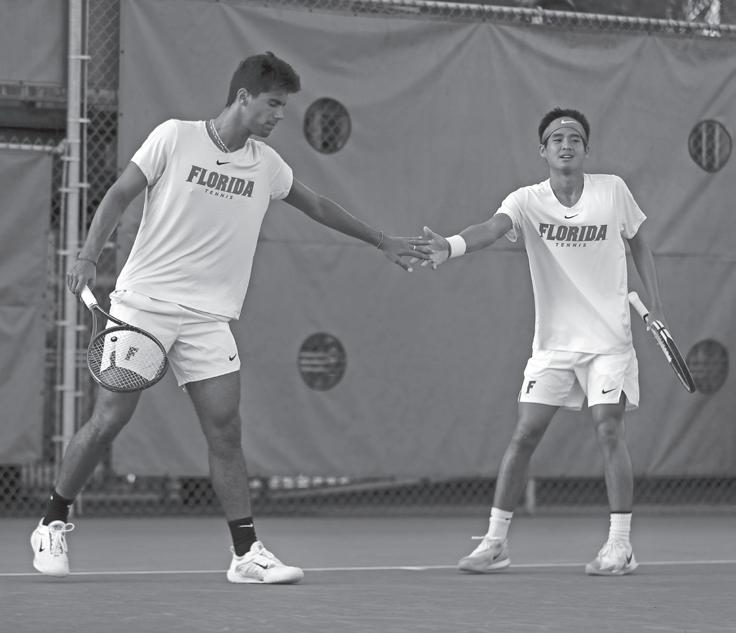
The pair met in January 2021 when they started playing in the same tournaments on tour, Nirnundorn said.
“We were just two guys at a tournament, just trying to get to know more people,” Nirundorn said.
Nirundorn was the first to commit to UF. Tokac knew Nirundorn had committed, which was one of the reasons Tokac decided to become a Gator.
Now, the two live together, and despite the occasional mess, they enjoy their time together as Gators.
In their first tournament together, the ITA
All-American Championships, T&T finished with six doubles wins. The pair went on to finish the fall season with eight doubles wins – the most of any Florida pair.
The pair found comfort in their shared international backgrounds. Nirundorn spent time living in Thailand; Tokac lived in Turkey for most of his life.
Nirundorn was originally born in Thailand, but after living there until the age of two, he moved to Kentucky. He stayed in Kentucky until 2016, when he moved back to Thailand.
Six months before he started at UF, Nirundorn lived in South Carolina as Thailand struggled with the COVID-19 pandemic, he said.
The time back in the U.S. after living in Thailand for six years took some adjustment. However, he acclimated quickly because of his previous time living in Kentucky.
“It's a different world over in Thailand,” Nirundorn said. “It's been a little tough.”
Tokac, on the other hand, only visited the U.S. a few times — typically to compete in tournaments — before he started school in Gainesville.
His family, Turkish cuisine and everything in between are in Turkey. But he’s started anew as he adjusts to life in Gainesville and
6, 2022.
the U.S.
“Here, I'm just by myself,” Tokac said. “But now I'm with the team, so they are like my new family.”
Nirundorn and Tokac pointed to their teammates as sources of advice and support. Players like Lukas Greif and Will Grant have become experienced Gators. Nirundorn said they know what they should and shouldn’t do, how to act and where to find everything.
“We're learning something almost every
GYMNASTICS MEN'S BASKETBALL
Living on UF’s campus has given them the opportunity to meet more athletes from international backgrounds. They’re close with the women’s tennis team, which has three international players.
The men’s team recently saw two more players come from overseas to join Florida. Polish freshmen Aleksander “Olek” Orlikowski and Borys Zgola have committed to UF and will compete in the Spring 2023 season. Nirundorn and Tokac have already met the two new Gators and look forward to playing alongside them.
Nirundorn played with Zgola in Egypt for four weeks and even teamed up with him on the same doubles team in the Roland Garros Junior Championships. While they didn’t know Orlikowski as well before his arrival, both Nirundorn and Tokac anticipate both players’ roles on Florida’s team.
“It's really exciting to get some new faces on the team,” Nirundorn said.
The team is readying for the beginning of its spring season and will play Texas at noon on Jan. 15. The Gators’ first match of the season against the Longhorns will kick off in Gainesville in the Alfred A. Ring Tennis Complex.
@BumpersKyle kbumpers@alligator.org
Florida gymnastics starts season with dominant victory Gators start SEC play with heartbreak, resolve
NO. 2 GATORS, NO. 1 ALL-AROUND GYMNAST TRINITY THOMAS START 2023 STRONG
By Kyle Bumpers Sports Writer
Florida Gators gymnastics’ dominant opening meet lived up to its lofty expectations and No. 2 ranking.
The Gators competed in a fourteam meet against the West Virginia Mountaineers, the Ball State Cardinals and the Lindenwood Lions. They were playing at home, and they were the only ranked team competing. Florida came into the meet as the heavy favorite, and its performance reflected that.
It finished with a score of 197.750, almost three points higher than the next-best team. The Gators won each event and broke their season-opening score record for the fifth year in a row. They looked the part of the No. 2 team in the nation.
Going into its eighth season under head coach Jenny Rowland, the
University of Florida has established itself as a gymnastics powerhouse. The 2022 team earned two of the top five highest team scores in National Collegiate Athletic Association history, and it lost to Oklahoma in the 2022 national championship.
Despite its recent success, fifthyear Trinity Thomas said the 2023 squad is the hardest-working team she’s seen.
“Bringing all of us together and having so much passion and so much grit to work towards a national championship is incredible,” Thomas said.
Thomas has become the face of Florida gymnastics throughout her time in Gainesville. The Gators have been home to many great players for more than a decade, but Thomas has cemented herself as an all-time great.
She enters the season as the No. 1 all-around player in the country, according to the NCAANational Collegiate Athletic Association’s preseason rankings. Thomas was also the only player in the country to rank in the top six in all four events
alligatorSports has a podcast!

The alligatorSports Podcast releases episodes every Wednesday and can be streamed on Spotify, Apple Podcasts or your other preferred streaming platform.
— uneven bars, balance beam, vault and floor.
The 2022 Southeastern Conference Gymnast of the Year came up big in the first meet of the year. She earned the highest score in every event she competed in and earned her 21st career perfect 10.
Thomas has a near-endless amount of accolades, but she’s missing one piece to round out her trophy case — an NCAA team championship.
“This team deserves it more than you know, and we're going to work for it,” Thomas said. “That's exactly why I came back.”
However, the team has a major hurdle to overcome. Graduate student Savannah Schoenherr broke her foot in a non-gymnastics-related incident, she announced on Twitter Thursday.
Read the rest online at alligator.org/section/sports.
@BumpersKyle kbumpers@alligator.org
FLORIDA’S FIRST TWO CONFERENCE GAMES DECIDED BY ONE POSSESSION
By Brandon Hernandez Sports Writer
After a tough loss to the Oklahoma Sooners Dec. 20, Florida head coach Todd Golden and the Gators flew back to Gainesville to spend time with family for the holidays.
However, with the impending start to SEC play in the schedule, Golden told the Gators to come back on Christmas night to prepare for the then No. 20 Auburn Tigers Dec. 28.
“Are we going to come back and continue pouring in what we’ve been doing for the past month?” Golden said. ”That has kind of got us in this position of getting right at the cusp of being a really good team.”
Florida came into its SEC opener on the road against Auburn with a
Follow us for updates
7-5 record. The game was a reunion for Golden, who worked under Tigers head coach Bruce Pearl as an assistant coach from 2014-2016.
The Gators have struggled early in games so far this season. The Tigers took advantage of the Gators’ troubles to take an early 7-0 lead to start.
However, UF’s defense kept the game within reach. It held Auburn to a 38.2% shooting performance from the floor and less than 22% from three.
Despite a stifling defensive performance against one of the best teams in the nation, UF found difficulty scoring and rebounding. Florida graduate student forward and season-leading scorer Colin Castleton scored only six points in the game.
Unable to overcome the 59-58 deficit, Florida turned the ball over on the last possession of the game. Auburn junior guard Wendell Green
Follow our newsletter
Love alligatorSports? Stay up to date on our content by following our newsletter. Scan the QR Code to sign up.
For updates on UF athletics, follow us on Twitter at @alligatorSports or online at www.alligator.org/section/sports.

SEE MEN'S BASKETBALL, PAGE 12
Pair
Sydney Calle // UAA Communications Florida tennis freshmen Tanapatt Nirundorn and Togan Tokac share the court at the Gator Fall Invite Sunday, Nov.
ranked No. 10 in latest ITA rankings
Florida's first SEC win
Jr. stole the ball and scored to give the Tigers a 61-58 victory.
The Gators weren’t going into panic mode following the loss, graduate student guard Myreon Jones said. However, he acknowledged the importance of playing well against conference opponents, he said.
“It’s important, especially these games coming up,” Jones said. “They’re must-win games for our resumé.”
UF traveled back to Gainesville to host the Texas A&M Aggies at the Stephen C. O’Connell Center Wednesday, Jan. 4.
Florida started with a 1-0 lead before tipoff; the Aggies were issued an administrative technical foul because they forgot their jerseys at the hotel. Despite this, Florida’s offense appeared insufficient to start the game.
The Gators committed a season-high 20 turnovers that turned into 21 points. Texas A&M double-teamed Castleton in the low post and forced him to throw the ball away all night.
UF came back to tie the game late in the second half after a barrage of threes. The Aggies survived the run with a floater and a free throw in the final seconds. Texas A&M gave Florida its second SEC loss in as many games, 66-63.
Many Gators are in their first season in the

SEC. Trey Bonham, a junior transfer from the Virginia Military Institute, said opponents in the conference are entirely different from his prior matchups.
“Mainly athleticism, quickness, height, length of all the players,” Bonham said. “Gotta just fight through all of that.”
The Gators welcomed back former head coach Mike White and the Georgia Bulldogs Saturday, Jan. 7. A win would give Florida its first conference win.
Florida threw the first punch, something Golden emphasized to his team. UF led 8-4 and shot 50% from beyond the arc in the first three minutes.
UGA responded with 13 unanswered points, forcing the Gators to play catch-up.
However, UF completed a comeback behind a 15-2 scoring run in the final minutes of the first half. Florida protected its lead to se-
cure an 82-75 victory for its first SEC win.
Five Gators scored in double-digits against Georgia. Graduate student guard Kyle Lofton led the team with 18 points and orchestrated the offense with three assists.
After starting conference play with back-toback losses by three points each, the veteran guard said the win against the Bulldogs is a huge confidence boost moving forward.
“Just winning a game is tough,” Lofton said. “Hopefully, we carry this on and win the next couple.”
Florida’s next five games will be against SEC teams, starting with Louisiana State in Baton Rouge, Louisiana, at 7 p.m. Tuesday, Jan. 10.
@BranH2001 bhernandez@alligator.org
12 ALLIGATOR MONDAY, JANUARY 9, 2023
BASKETBALL, from pg. 11
MEN'S
