www.alligator.org
We Inform. You Decide.
VOLUME 115 ISSUE 29
MONDAY, APRIL 12, 2021 Published by Campus Communications, Inc. of Gainesville, Florida
Not officially associated with the University of Florida
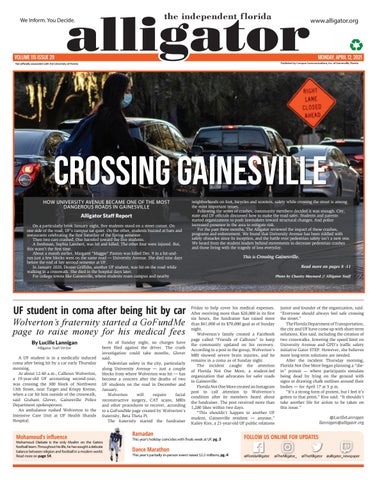
HOW UNIVERSITY AVENUE BECAME ONE OF THE MOST DANGEROUS ROADS IN GAINESVILLE Alligator Staff Report On a particularly brisk January night, five students stood on a street corner. On one side of the road, UF’s campus sat quiet. On the other, students buzzed at bars and restaurants celebrating the first Saturday of the Spring semester. Then two cars crashed. One barreled toward the five students. A freshman, Sophia Lambert, was hit and killed. The other four were injured. But, this wasn’t the first time. About a month earlier, Margaret “Maggie” Paxton was killed Dec. 9 in a hit-andrun just a few blocks west on the same road –– University Avenue. She died nine days before the end of her second semester at UF. In January 2020, Denise Griffiths, another UF student, was hit on the road while walking in a crosswalk. She died in the hospital days later. For college towns like Gainesville, where students roam campus and nearby
UF student in coma after being hit by car
Wolverton’s fraternity started a GoFundMe page to raise money for his medical fees By Lucille Lannigan Alligator Staff Writer
A UF student is in a medically induced coma after being hit by a car early Thursday morning. At about 12:40 a.m., Calhoun Wolverton, a 19-year-old UF accounting second-year, was crossing the 300 block of Northwest 13th Street, near Target and Krispy Kreme, when a car hit him outside of the crosswalk, said Graham Glover, Gainesville Police Department spokesperson. An ambulance rushed Wolverton to the Intensive Care Unit at UF Health Shands Hospital.
SPORTS/SPECIAL/CUTOUT Mohamoud’s influence
As of Sunday night, no charges have been filed against the driver. The crash investigation could take months, Glover said. Pedestrian safety in the city, particularly along University Avenue — just a couple blocks from where Wolverton was hit –– has become a concern after the deaths of two UF students on the road in December and January. Wolverton will require facial reconstructive surgery, CAT scans, MRIs and other procedures to recover, according to a GoFundMe page created by Wolverton’s fraternity, Beta Theta Pi. The fraternity started the fundraiser
Mohamoud Story description Diabate finish is the withonly comma, Muslim pg#on the Gators football team. Throughout his life, he has sought a delicate balance between religion and football in a modern world. Read more on page 14.
neighborhoods on foot, bicycles and scooters, safety while crossing the street is among the most important issues. Following the series of crashes, community members decided it was enough. City, state and UF officials discussed how to make the road safer. Students and parents started organizations to push lawmakers toward structural changes. And police increased presence in the area to mitigate risk. For the past three months, The Alligator reviewed the impact of these crashes, programs and enforcement. We found that University Avenue has been riddled with safety obstacles since its inception, and the battle over pedestrian safety isn’t a new one. We heard from the student leaders behind movements to decrease pedestrian crashes and those living with the tragedy of loss everyday. This is Crossing Gainesville. Read more on pages 8 -11 Photo by Chasity Maynard // Alligator Staff
Friday to help cover his medical expenses. After receiving more than $20,000 in its first six hours, the fundraiser has raised more than $41,000 of its $70,000 goal as of Sunday night. Wolverton’s family created a Facebook page called “Friends of Calhoun” to keep the community updated on his recovery. According to a post in the group, Wolverton’s MRI showed severe brain injuries, and he remains in a coma as of Sunday night. The incident caught the attention of Florida Not One More, a student-led organization that advocates for safer roads in Gainesville. Florida Not One More created an Instagram post to call attention to Wolverton’s condition after its members heard about the fundraiser. The post received more than 1,200 likes within two days. “This shouldn’t happen to another UF student, Gainesville resident — anyone,” Kailey Kiss, a 21-year-old UF public relations
Ramadan
This year’s holiday coincides with finals week at UF, pg. 3
junior and founder of the organization, said. “Everyone should always feel safe crossing the street.” The Florida Department of Transportation, the city and UF have come up with short-term solutions, Kiss said, including the creation of two crosswalks, lowering the speed limit on University Avenue and GPD’s traffic safety initiative Gator STEP. However, she believes more long-term solutions are needed. After the incident Thursday morning, Florida Not One More began planning a “diein” protest — where participants simulate being dead by lying on the ground with signs or drawing chalk outlines around their bodies — for April 17 at 5 p.m. “It’s a strong form of protest, but I feel it’s gotten to that point,” Kiss said. “It shouldn’t take another life for action to be taken on this issue.” @LucilleLannigan llannigan@alligator.org
FOLLOW US ONLINE FOR UPDATES
Dance Marathon
This year’s partially in-person event raised $2.2 millions, pg. 4
@FloridaAlligator
@TheAlligator_
@TheAlligator @alligator_newspaper @alligator_newspaper
2 ALLIGATOR MONDAY, APRIL 12, 2021
Guy FieriToday’s talks Weather food and future at virtual event for UF students THE “DINERS, DRIVE-INS AND DIVES” STAR IS THE FIFTH ACCENT SPEAKER THIS SPRING
By Carolina Ilvento Alligator Staff Writer
On Thursday night, UF students had all their cooking, spice and food coma questions answered by the one and only Mayor of Flavortown. Accent Speakers Bureau, a UF Student Government agency funded by student fees, hosted the renowned chef, restaurateur, author and TV host Guy Fieri to speak to students at a free, virtual event. Fieri won a Daytime Emmy Award in 2013 for his show “Guy Fieri’s Family Reunion.” He is also known for his other Food Network shows including the popular longrunning series “Diners, Drive‑Ins and Dives.” This was the third day of Accent events this semester. On Feb 3, the organization hosted YouTube stars Cody Ko, Noel Miller and David Dobrik in a $120,000 show, and Tiffany Haddish and Tabbitha Brown March 24. Accent paid Haddish $75,000 and Brown $35,000 for their appearances. The event was announced on Accent’s Facebook page Wednesday morning, less than 48 hours before the show. Nearly 300 students attended the event, according to Accent Chair Steven Wolf. He did not answer questions about why it was announced lastminute nor the potential decrease in turnout because of the delayed announcement. Wolf also did not answer questions regarding how much money Fieri was paid. The Alligator submitted public records requests for Fieri’s contract. The show consisted of a 45-minute conversation moderated
by UF’s Department of Journalism Chair Ted Spiker followed by a 15-minute Q&A session. Spiker asked Fieri about the COVID-19 pandemic, his relationship with food and the critical New York Times review his restaurant received in 2012. Fieri, who is known for traveling across the country and trying all different types of foods, revealed the one food he won’t eat: beef liver. "You could hide the keys to a new Ferrari under a plate of beef liver, and you wouldn't have to worry about me driving it," he said. With more than 100,000 restaurants closed last year due to the pandemic, owners and workers felt a huge financial impact. Seeing so many restaurants shut down, Fieri set a personal goal to raise $100 million to help, he said. Although he fell short of this goal, Fieri was able to raise more than $20 million and helped more than 43,000 unemployed restaurant workers with a $500 grant per worker. Fieri garnered support from major sponsors, such as Pepsi and UberEats. “No, I didn't hit my $100 million. And no, I didn't get everybody money,” Fieri said. “But what we did do is we set an example that we could make an impact.” Fieri also talked about his time and eating habits as a college student at University of Nevada in Las Vegas. He advised students in college to learn how to cook as early as they can. “It is a life skill you need to know,” he said. “All of the stuff you put in your body has an end result on what it does to it.” Cooking can save people, Fieri said. With the money someone would spend on a cheap fast food burger, they could buy brown rice, vegetables and a nice steak, and
VOLUME 115 ISSUE 29
ISSN 0889-2423
Not officially associated with the University of Florida Published by Campus Communications Inc., of Gainesville, Florida
NEWSROOM: Editor-In-Chief Engagement Managing Editor Digital Managing Editor Senior News Director
Have an event planned? Add it to the alligator’s online calendar:
alligator.org/calendar
make themselves a week’s worth of diversified meals, he said. Spiker asked about the 2012 New York Times review criticizing the food and service in Fieri’s Times Square restaurant that had been recently opened. Fieri said even though he doesn’t agree with 100% of what it said, he learned from it. “It is not what happens to you. It is how you choose to handle it," Fieri said. During the Q&A, a student asked for a piece of advice he would like to give his younger self. "Keep doing what you're doing, you know. Live the way you've been living," he said. “Take the bumps, take the bruises, take the cuts and the scratches and smell the roses.” Kawali Gokool, a 21-year-old master student of marketing, asked Fieri to give UF his most highenergy welcome to Flavortown. While Fieri didn’t do it right away, he promised he would before the end of the conversation. And he kept his word. As Spiker concluded the show, Fieri bid farewell by giving a final send-off: "My brothers and sisters of Flavortown: You rock, Gators!" he shouted. J.P. Oprison contributed to this story @CarolinaIlvento cilvento@alligator.org
352-376-4458 • Fax: 352-376-4467 Karina Elwood, kelwood@alligator.org Kaelyn Cassidy, kcassidy@alligator.org Payton Titus, ptitus@alligator.org Alex DeLuca, adeluca@alligator.org
Metro Editor
Asta Hemenway, ahemenway@alligator.org
University Editor Investigations Editor
Meghan McGlone, mmcglone@alligator.org
Sports Editor Assistant Sports Editor Online Sports Editor
Thomas Weber, tweber@alligator.org Christian Ortega, cortega@alligator.org Declan Walsh, dwalsh@alligator.org Grethel Aguila, gaguila@alligator.org
Multimedia Editor
Karina Elwood, Kaelyn Cassidy, Payton Titus, Makiya Seminera Julia Coin, jcoin@alligator.org
Audience Director
Alyssa Feliciano, afeliciano@alligator.org
Opinions Editor the Avenue Editor
Makiya Seminera, mseminera@alligator.org
Editorial Board
Copy Desk Chief
DISPLAY ADVERTISING
Advertising Office Manager Intern Coordinator Sales Representatives
Morgan Goldwich, mgoldwich@alligator.org Renee Hancock, rhancock@alligator.org
352-376-4482 • Fax: 352-376-4556 Cheryl del Rosario, cdelrosario@alligator.org Ellen Light, elight@alligator.org Lily Laserna, Lori Sharabani, Rodolfor Lauzrdo, Lucas Smith
SparkIt Creative Advertising Creative Director Outreach Director Lead Strategist Interns
CLASSIFIED ADVERTISING
Classified Advertising Manager
BUSINESS
Comptroller Bookkeeper
Administrative Assistant
ADMINISTRATION
General Manager Administrative Assistant President Emeritus
SYSTEMS
IT System Engineer
239-980-6995 • info@sparkitcreative.org Michael Weinberg, weinbergm@ufl.edu Brian Gurges, brian.gurges@gmail.com Richard Forbes Adam Cohen, Ella Choi, Ian Baldwin, Donya Mansoorian, Sarah Bhatt, Ella Kulak Matthew Ohlhaber, Baemnet Abetew 352-373-FIND • Fax: 352-376-3015 Ellen Light, elight@alligator.org 352-376-4446 • Fax: 352-376-4556 Delia Kradolfer, dkradolfer@alligator.org Cheryl del Rosario, cdelrosario@alligator.org Ellen Light, elight@alligator.org 352-376-4446 • Fax: 352-376-4556 Shaun O'Connor, soconnor@alligator.org Lenora McGowan, lmcgowan@alligator.org C.E. Barber, cebarber@alligator.org Kevin Hart
PRODUCTION Production Manager Assistant Production Manager
Jordan Bourne, jbourne@alligator.org Deion McLeod, dmcleod@alligator.org
Got something going on? Want to see it on this page? Send an email with “What’s Happening” in the subject line to engagement@alligator.org. To request publication in the next day’s newspaper, please submit entries before 5 p.m. Please model your submissions after the above events and keep them to 150 words or fewer. Improperly formatted “What’s Happening” submissions may not appear in the paper. Press releases will not appear in the paper.
The Independent Florida Alligator is a student newspaper serving the University of Florida, published by a nonprofit 501 (c)(3) educational organization, Campus Communications Inc., P.O. Box 14257, Gainesville, Florida, 326042257. The Alligator is published Monday mornings, except during holidays and exam periods. During UF summer academic terms The Alligator is published Monday mornings. The Alligator is a member of the Newspaper Association of America, National Newspaper Association, Florida Press Association and Southern University Newspapers.
The Alligator offices are located at 2700 SW 13th St. Classified advertising can be placed at that location from 8 a.m. to 4 p.m. Monday through Friday, except for holidays. © Copyright 2020. All rights reserved. No portion of The Alligator may be reproduced in any means without the written consent of an officer of Campus Communications Inc.
Subscription Rate:
Full Year (All Semesters) $100
The Alligator strives to be accurate and clear in its news reports and editorials. If you find an error, please call our newsroom at 352-376-4458 or email editor@alligator.org
MONDAY, APRIL 12, 2021 ALLIGATOR 3
Muslim UF students balance studies and spirituality during Ramadan FINALS WEEK TAKES PLACE DURING THE ISLAMIC HOLY MONTH OF RAMADAN
By Sofia Echeverry Alligator Staff Writer
Mahian Chowbhury joins billions of Muslims around the world to fast for a month each year in observance of Ramadan as a way to focus on humility, religion and self-control. Ramadan is the ninth month of the lunar Islamic calendar, in which every month begins with a new moon. Muslims who observe Ramadan fast from dawn to sunset every day of the month, eating one meal before dawn and another after sunset. But this year, the 18-year-old UF health science freshman is concerned about balancing his fast with finals. The holiday begins Apr. 12 and ends May 12, meaning it overlaps with UF’s finals week Apr. 29-30. Chowbhury is taking Chemistry 1 and Biology 1 — both of which hold their exams at night, usually after sunset. This means he won’t be able to break his fast before his exam. “It’s going to be tough to balance and find the time for both of those things,” he said. “We can’t eat because we have to take our tests, and we’ll be starving and dehydrated for the entire day.” Fasting while studying means Chowbhury will be drained of energy during the exam, he said, likely leading to poorer performance — especially if his exams are at night. Because he is a premedical student, Chowbhury said there’s no room for error when it comes to his academics, and it’s discouraging that his final grade could be jeopardized because of the conflict with Ramadan. In a January administrative memo, Provost and Senior Vice President for Academic Affairs Joseph Glover addressed UF’s religious observances policies. Glover said students and faculty
must share the responsibility of religious observance: students should inform their professors of their religious holidays, and professors must accommodate those holidays. This includes excused absences from class and “a reasonable amount of time” to make up missing assignments and material. If a faculty member is aware of a religious event that impacts a “significant number” of students, they shouldn’t schedule major academic requirements on those days. However, because UF isn’t able to adjust its schedule for all religious observances, Glover said, individual students must reach out for accommodations. But Muslim students aren’t the only ones feeling overlooked by the university during their religious holidays. Emma Hicks, an 18-year-old UF health science freshman, said she also felt let down by UF’s treatment of religious holidays when last semester’s finals conflicted with Hanukkah. When Hicks found out UF’s delayed start to the Fall 2020 semester shifted finals to occur during Hanukkah, she was extremely disappointed. “I could go to Target and get a menorah and feel special and all, but that’s not the same as being at home with your family and actually being able to fully observe the holiday,” she said. Hicks said she wants the university to acknowledge religious minorities, even with something as simple as sending a message to professors informing them of upcoming religious holidays. Tasnim Thakur, a 21-year-old UF business junior, echoed that sentiment. About 1.8 billion people in the world are Muslim, 3.45 million of which live in the United States, according to Pew Research Center. Despite Islam’s status as a major world religion, Islamic holidays aren’t rec-
ognized with the same significance often allotted to religions like Christianity and Judaism, said Thakur. “Islam is a huge major religion,” she said. “So, the fact that our holidays aren’t recognized with the same significance as those Christian holidays is definitely something I’ve faced my entire life.” When she reached out to instructors about missing classes for religious holidays in the past, Thakur said they were understanding. Despite the accommodations, she wishes instructors were more aware of Islamic holidays — especially Eid Al-Fitr, which concludes the month of Ramadan, and Eid Al-Adha, which marks the conclusion of pilgrimage rites, when Muslims from around the world travel to Mecca in Saudia Arabia. Since the Islamic calendar is lunar, the dates shift every year, which means Eid Al-Adha can also land during the academic year. “Those are the two most significant and celebrated holidays in our
religion,” she said. “For us, for Muslims, it’s always us reaching out to the professor, not the professor being proactive like with major religious holidays in other big religions.” Although she doesn’t strictly follow all of the religious aspects of Islam, Thakur said her religion has always been a major part of her life since childhood, providing security, comfort and moral principles. “When my mom would read us bedtime stories, she would read us stories about the Prophet,” she said, referring to Islam’s founder, Prophet Muhammad. “My religion has been my life since the very beginning. I never really felt like I needed to make time for it because it was always there.” When she started fasting for Ramadan in elementary school, her mother taught her to start by fasting half of the day, then the majority of the day. Once she became comfortable with that, she started fasting full days non-consecutively. Eventually, after she reached
middle school, Thakur began fasting for the whole month. But once she reached high school, Ramadan overlapped with the end of the school year. “It definitely has been an adjustment trying to fast while classes are going on,” she said. Her concentration usually wanes at about 4 p.m. or 5 p.m. during Ramadan due to the lack of food and water, Thakur said. She worries this will be especially difficult this year because one of her final exams lasts from 5:30 p.m. to 7:30 p.m. — right on the cusp of sunset. She plans to reach out to her professor about changing the exam date. If that’s not possible, she would abstain from fasting the day of the exam. “I would rather do well on the exam than force myself to fast and not do well on it,” she said. @sofecheverry secheverry@alligator.org
Aubrey Bocalan // Alligator Staff
Now recruiting those keeping nightlife alive for a COVID prevention study near you QUALIFIED PARTICIPANTS MAY BE COMPENSATED
CONTACT:
You may be eligible if:
Timothy Elder, MD (352) 727-7000
• You socialize without masks or physical distancing three times per week
4343 W. Newberry Road Gainesville, FL 32607
• You are at least 18 years of age
4 ALLIGATOR MONDAY, APRIL 12, 2021
East Gainesville pastor joins Black clergymen to lobby against Florida Senate vote-by-mail bill STATE LEADERS BELIEVE CONTROVERSIAL SENATE BILL 90 WOULD MAKE IT HARDER FOR BLACK VOTERS TO CAST BALLOTS
By Alan Halaly Alligator Staff Writer
Florida lawmakers are looking to make revisions to vote-by-mail. But an East Gainesville pastor worries these revisions could be restrictive to voters in vulnerable communities. Senate Bill 90, filed by Sen. Dennis Baxley, R-Ocala, would eliminate vote-by-mail drop boxes and make it so voters have to re-register for vote-by-mail ballots more frequently. “We see this past campaign as a stellar one, bringing out record numbers of people,” Karl Anderson, a 47-yearold senior pastor at Upper Room Ministries, said about record Black voter turnout in November’s presidential election. “Others see it as a threat, unfortunately.” Senate Bill 90 matches a trend of what many see as restrictive voting legislation throughout the United States meant to suppress voters of color. So far, 28 states have introduced, prefiled or carried more than 100 voting bills that restrict voting access this year, according to a January report from the Brennan Center for Justice. This is three times the number of bills the center classified as restrictive from the previous year. Anderson’s signature is the third of 13 on a letter sent to the Florida Senate March 16, written by Black Florida clergymen calling for the bill to be amended. He is the area organizer of the Equal Ground Action Fund, a group promoting equal access to education about voting and empowerment. Some Black voters are hesitant to trust vote-by-mail because of research suggesting their ballots may be rejected at a higher rate. Despite the threat of contracting COVID-19, six in 10 Black voters said they voted in person during the 2020 election compared to five in 10 white and Latino voters and three in 10 Asian voters, with most voting early, according to a report from the Pew Research Center. But for some Black voters, locating a polling place is more difficult than it is for their white counterparts on election day, according to the American Bar Association. Research from the University of Maryland shows areas with less access to public transportation may see less turnout. Some lawmakers have closed polls in historically Black neighborhoods, forcing Black voters to travel further to cast their vote. Vote-by-mail drop boxes can alleviate the stress of commuting to a precinct for voters of color, those in lowincome communities, disabled people and those in quarantine, the clergymen’s letter read. If the bill is passed and vote-by-mail drop boxes are eliminated, the only alternative to mailing an absentee ballot would be for a voter or an immediate family member to deliver the ballot to the Supervisor of Elections office. It also would require voters to request mail-in ballots each election cycle, whereas the request was previously valid until the end of the year of the following general election. For instance, voters who requested a mail-in ballot in 2020 would have continued to receive them until 2022, the year of the midterm elections. Senate Bill 90 has been compared to a bill passed in Georgia March 26 that made it a misdemeanor to give voters food and water while they’re in line. Championed by Georgia Republicans, the bill also limited drop boxes to the inside of early voting locations in the state and makes it a requirement to have a photo ID to vote as an absentee. “We find that such a bill will cause undue confusion and exacerbate a prevalent narrative of voter suppression against certain communities,” the letter read, signed by the Florida State Network of African American Clergy Alliances in reference to Senate Bill 90. The group is demanding the legislature amend the bill to give voters more time to return their vote-by-mail ballots, have more flexible pickup locations, expand the number of optional days to vote early and require the state to perform capacity tests of voter equipment before each election. The group would also like the bill to allow same-day voter registration and require automatic voter registration — a measure that would make voting an “opt-out” system versus “opt-in,” Orlando Pastor Marcus McCoy, 33, said. As the organization’s Florida Faith outreach director, McCoy said the letter was meant to reach out to law-
makers on behalf of Black state voters while showing the group is willing to work with legislators. “We don’t want to come across as if we’re not able to reason,” McCoy said. “But we’re not going to sit quietly as they try to take us back to 1965.” Some Florida Republicans have thrown their support behind Senate Bill 90 because of national discourse surrounding vote-by-mail potentially increasing voter fraud. In 2016, former President Donald Trump falsely suggested that ballots were being cast by illegal immigrants and deceased people and voter fraud was common in the United States. However, a 2017 Brennan Center for Justice report revealed the actual rate of voter fraud in the country was less than 0.01%. In the 2020 presidential election, vote-by-mail became a talking point for Trump as he consistently tried to diminish trust in mail votes. Although he tweeted returning a ballot through a third party was “rampant with fraud,” the former presidential candidate used this method himself, NPR reported. Baxley said in a Senate Governmental Oversight and Accountability Committee meeting on March 10 he wants to curb potential voter fraud with Senate Bill 90. “I am all about staying ahead of whatever problems could develop,” he said. “So, it’s not that there was a debacle and we have to fix it. Do we have to wait for a debacle? Why can’t we take something that is working well and put guardrails on it and keep it safe.” The pastors’ letter prompted responses from members of the Rules Committee, including Baxley, who met with the group March 23. During the meeting, Baxley brought up concerns of voter security, though McCoy said Baxley would not answer the group’s question about what data prompted the elimination of drop boxes. The group of pastors also arranged meetings with four other state senators. Anderson said he fears what kind of precedent Senate Bill 90 could set in Florida policymaking when it comes to early voting. In October, Anderson, whose church is located in East Gainesville, encouraged voters in his congregation to vote early after a Sunday service in a “Souls to the Polls” rally. Voting data shows 15% of Alachua County voters were Black in the 2020 presidential election — an increase of less than 1% compared to 2016. Similar events to increase Black voter turnout have been held throughout the country during every major election cycle since 1962 to bolster voter turnout in communities of color. “We want to educate and engage our people,” Anderson said. “If we don’t vote, we don’t have a voice.” Anderson worries an amendment may be added to close the early voting window before the last Sunday before election day because a similar bill introduced in Georgia proposed the elimination of all early voting on Sundays, sandwiched among other provisions. This would be a pointed attack on the voting rights of Black Floridians due to the importance of Souls to the Polls events on that Sunday to increase turnout, Anderson said. “I see it as an attempt to take us back to the early 1900s era of Jim Crow,” he said. “There’s really no other way of looking at it.” However, during his meeting with the clergymen, Baxley promised he would oppose any amendments that might have this effect. Former Alachua County Democratic Party Chair Cynthia Chestnut, 71, agrees the bill is unnecessarily restrictive. She said in her more than 30 years in Florida politics, she’s never seen a bill that is as limiting to the state’s voters. Chestnut and her husband used vote-by-mail drop boxes in the November election. To her, taking them away would dissuade vulnerable voters from dropping off their ballots. “It appears that the legislation is designed to punish people for voting and to curtail their involvement in the democratic process,” she said. “It’s a step backwards.” Anderson’s concern of having an amendment added at the last minute excluding the last Sunday before an election in the early voting period is not unfounded, Chestnut said. “Nothing in the legislature has ever been this severe in cutting the voting rights of Floridians,” Chestnut said. The fate of the Florida bill is now in the hands of the Senate Rules Committee. The committee will hear the bill on Wednesday. @AlanHalaly ahalaly@alligator.org
Dancing “For The Kids” during a pandemic: UF’s Dance Marathon raises over $2.2 million DANCERS PARTICIPATED IN SHIFTS OF 13 HOURS AND SIX MINUTES
By Sofia Echeverry Alligator Staff Writer
Despite aching legs and feet after standing for 13 hours and six minutes straight — or 13.1 hours, a nod to the length of a half-marathon — Brooke Peck knew she had to see the challenge through to the end. The 20-year old UF psychology sophomore was a dancer at UF’s 27th annual Dance Marathon fundraiser, where she helped raise money for children at UF Health Shands Children’s Hospital. However, the event that normally packs hundreds of students into the Stephen C. O’Connell Center was physically distanced and split into two parts this year because of COVID-19. Dance Marathon raised $2.27 million dollars this year, about $250,000 less than last year. The amount was announced at the main event, held both at the O’Connell Center and virtually April 10 and 11. The 26-hourand-12-minute event — meant to simulate the 26.2 miles of a marathon — was the culmination of a yearlong effort to collect funds for the Children’s Miracle Network Hospitals. Dance Marathon recommended anyone attending the event to quarantine for at least two weeks beforehand. The organization enforced UF Screen, Test and Protect protocols, such as physical distancing, face coverings and frequent sanitation. UF students were required to wear a face covering at all times and show a “Cleared” status on their ONE.UF portal to participate, according to the Dance Marathon website. The event also underwent changes to accommodate safety precautions. Instead of staying on their feet for 26.2 hours, dancers participated in two shifts of 13.1 hours each. The first shift was April 10 from 8 a.m. to 9:06 p.m., and the second was April 11 from 6 a.m. to 7:06 p.m. Peck was impressed with Dance Marathon officials’ efforts to keep participants socially distanced, including dancer relations captains, who work throughout the year to communicate information about Dance Marathon’s events to dancers. At the O’Connell Center, officials separated participants by dancer groups, and dancers stood on spaced-out floor markers during events, she said. The groups were made up of
about 20 dancers who stayed together while physically distancing themselves from other groups and rotating through different activities at the O’Connell Center, according to the Dance Marathon website. “I didn’t feel unsafe at any time,” Peck said. Participants were allowed to drink water inside but had to go outside to eat. Some exceptions were made due to rainy weather, she said. Once outside, groups ate together at distanced tables. While outside, Peck got a chance to play Frisbee with a “miracle child,” one of the children meant to benefit from Dance Marathon’s fundraising. Miracle children were only able to attend if their medical team approved, according to the Dance Marathon website. Throughout the day, miracle families shared their stories, either in person — on the stage or floor, surrounded by only Dance Marathon officials — or virtually. “It’s insane to hear some of the things that they’re going through and how brave and strong they’ve been throughout it,” Peck said. After the two-day marathon, participants involved in the event reunited in person at the O’Connell Center for the “Total Reveal” moment, which was also live-streamed for those at home. During the total reveal presentation, Holly Bogart, mother of 17-year-old miracle child Kinsey Bogart, recounted Kinsey’s story of years with kidney failure and dialysis for the in-person and virtual crowd. After a failed kidney transplant, Kinsey started dialysis treatments at UF Health Shands Hospital, which is an hour-long drive from her house. Holly teared up while recalling how her daughter lost consciousness on the way to a dialysis treatment in 2019. She remembered thinking Kinsey would die that day, she said. “But once again, we received another miracle,” Holly said. Since then, the Bogart family has been making thrice-weekly visits to Shands for four-anda-half-hour long dialysis treatments on machines funded by Dance Marathon. “Our story continues, but we’re not alone,” Holly said. “I’m not saying we don’t struggle, we absolutely do, but we focus on tackling the issues at hand and we stay positive.” @sofecheverry secheverry@alligator.org
MONDAY, APRIL 12, 2021 ALLIGATOR 5
UF holds mass COVID-19 vaccination effort for campus community at Ben Hill Griffin Stadium AS OF FRIDAY, MORE THAN 15,000 PEOPLE RECEIVED A VACCINE AT THE STADIUM
By Manny Rea Alligator Staff Writer
For Merrill Garlington, normalcy waited three escalator rides above her at Ben Hill Griffin Stadium. The last year has been difficult for the 19-year-old UF psychology freshman, searching for a normal college experience with good times and new friends. She’s only had one in-person class in her two semesters here. But on April 5, she was able to help correct the course of her and her classmates’ future by getting the COVID-19 vaccine. “I’m just excited for the world to hopefully go back to close to normal,” Garlington said. An area of Ben Hill Griffin Stadium normally designated for Gators football fans on game days became the setting for COVID-19 vaccines Monday, Wednesday, Friday and Saturday. Scheduling will continue for at least five more weeks at the stadium according to Vice President of Student Affairs D’Andra Mull. The same day Florida opened vaccine eligibility to people ages 16 and up, UF opened its landmark stadium to students, staff and faculty to receive the PfizerBioNTech COVID-19 vaccine. Students and student-athletes were among the first in line to get the shot in the Champions Club at 9 a.m. Appointments ran until 9 p.m. While the excitement may not have matched the energy that normally filled The Swamp on game day, the foot-tap fidgeting and phone browsing in line
showed students were ready to walk away with protection from the virus. Prepping upper arms and watching for allergic reactions made up Rohan Johnson’s first day of vaccinating against COVID-19. The contributions of the 26-year-old UF PharmD senior candidate are a slice of what volunteers, students and organization leaders do to make the vaccination process work, he said. “Everyone’s stepping up to the plate in terms of trying to get us back to a sense of normalcy,” he said. UF sent an email to students, faculty and staff March 30 announcing they could schedule an appointment through ONE.UF for a first or second dose of the Pfizer-BioNTech vaccine at the Champions Club. About 3,000 appointments were scheduled within the first hour of the portal opening that evening, Dr. Michael Lauzardo, the director of UF Health’s Screen, Test & Protect program, said. About 20,000 people scheduled vaccine appointments the week of April 5. UF Health will collaborate with the Florida Department of Health in Alachua County to accommodate about 20,000 appointments four days a week. The two entities have worked together for decades, but the COVID-19 pandemic marked a new level of partnership in contact tracing and vaccinating people on- and off-campus, Paul Myers, the administrator for the County health department, said. About 80% of people 65 and older in Alachua County have been vaccinated as of April 5, Lauzardo said. UF plans to start Summer B
classes June 28 at regular capacity for in-person classes. As of Sunday, it is still unclear whether social distancing or masks will be required. “I know people are impatient and want to get back to normal,” Lauzardo said. “Just hang on for a little bit longer.” It’s unclear what percentage of the county population needs to be vaccinated to reach herd immunity; however, he said eligible people should get the shot. While the university doesn’t plan to require vaccines for students, UF President Kent Fuchs still wants to see members of the community get it. “It’s really up to the voluntary decisions of everyone, all the employees, all the students,” Fuchs said. As she registered consent forms for vaccine recipients, Gabrielle Ray, a 19-year-old UF anthropology sophomore and event volunteer, said she wanted to contribute to the greater immunization effort. Having worked the past month to help immunize older people, she said the recent eligibility expansion to college-aged students is an important moment. “It’s just really exciting how quickly everything changed,” Ray said. “Literally last week, I was writing birthdays that were in like 1930 and now it’s 2000.” Students walked through the Champions Club gates and up several escalators to get to their inoculation destination. It took about four months since the first dose was given in the U.S. to officially reach the upper arms of the university’s younger population. “I’ve been anticipating [getting the vaccine] since the start of the pandemic, but I was more than
Julia Cooper // Alligator Staff
Albert Gator gets vaccinated alongside students at Ben Hill Griffin Stadium on Monday, April 5, 2021. Monday was the first day COVID-19 vaccines were made widely available to UF students. happy to wait my turn in line,” Alexandra Benedit, a 21-year-old UF public relations senior, said. “It was the most painless shot I’ve ever done.” Some people were able to leave as soon as they were vaccinated. Administrators will still require people with a history of vaccine allergic reactions to be observed for 30 minutes, Lauzardo said. However, the 15-minute observation for everyone else became optional because immediate reactions to the COVID-19 vaccine are even less common than the flu shot, he said. The Centers for Disease Control and Prevention still recom-
mends these intervals for the post-vaccine process. As students left Ben Hill Griffin Stadium after receiving their shots, volunteers offered them shirts with just two words printed next to a picture of Albert, UF’s alligator mascot: “Beat COVID.” Andrew Girard, a 22-year-old UF forestry senior, said getting the vaccine protects his peers and his grandparents from the virus. “Hopefully, this is the beginning of returning to normalcy,” Girard said. “This is the beginning of the end in a good way.” @ReaManny mrea@alligator.org
Julia Cooper // Alligator Staff
Julia Cooper // Alligator Staff
Carlos Aleman (left), 25, a graduate pharmacy student fills a syringe with a dose of the Pfizer BioNTech vaccine on Monday, April 5, 2021.
Isabel Crist, 19, (left) a UF telecommunication freshman receives her first dose of the Pfizer-BioNTech COVID-19 vaccine on Monday, April 5, 2021.
MONDAY, APRIL 12, 2021 www.alligator.org/the_avenue
NATURE
Keep Alachua County Beautiful hosts 29th annual Great American Cleanup LOCALS PLANTED TREES, PICKED UP LITTER, PAINTED OVER GRAFFITI AND PULLED INVASIVE PLANTS
By Katie Delk Avenue Staff Writer
Alachua County participated in the nation’s largest community improvement program for the 29th year in a row. Saturday’s Great American Cleanup took place from 9 a.m. to noon and started at Massey Park, located at 1001 NW 34th St. Locals planted trees, picked up litter, painted over graffiti and pulled invasive plants with Keep Alachua County Beautiful (KACB). “The four P’s,” Gina Hawkins, executive director of KACB, called them. Hawkins, who has been involved with the event since its start, said it began as the “Neighborhood Cleanup” and “Great Florida Cleanup.” Six years later, the environmental
organization Keep America Beautiful adopted it. “It went national,” Hawkins said. “We like to think we had a role in that.” Volunteers were given supplies including gloves, grabbers, masks, hand sanitizer, trash bags, safety vests and first-aid kits. After meeting at the park, volunteers dispersed to their service sites. As a safety precaution, Hawkins said she ordered 500 triple-layered masks with filters, KACB logos and storage bags and 1,000 white cotton reusable ones. She said volunteers had to remain six feet apart and could remove their masks if more than 10 feet apart. The county waived trash-transfer fees for the event. Hawkins said there were more than 300 volunteers at the event. As many as 800 people have attended in previous years. She attributed their consistently large turnout to the local organizations KACB partners with. “I think that’s where our organization is particularly strong in that
we partner with other organizations,” she said. Over 100 organizations teamed up with KACB for the cleanup. The Grow Hub, a nonprofit that trains disabled adults for sustainable living, gardened with volunteers at Saturday’s event. Another group plucked invasive species, such as Carl Ardisia, which has scarlet berries, at Hogtown Creek. “If you’ve ever tried to pull a Carl Ardisia plant, you’re probably disappointed when the berries fell off and crawled under the leaves,” Hawkins said. “We instruct people how to put a trash bag over the plant before they give it a yank.” She defines invasive species as those that aggressively compete for space with native and desirable plants. In her yard, she corners invasive lantana by mowing around it. Other volunteers collected trash where private trucks dropped their trash. She said KACB relies on the community to notify her of these sites
and graffiti around the city. A lot of graffiti is on dumpsters, she said. So volunteers painted over vandalization with buckets of blue and green paint to match the color of the dumpsters. Hawkins said KACB saves walls or fences people graffitied for the cleanup. Unlike public art, graffiti artists did not have permission, she said. “We love murals. We love the 34th Street wall,” Hawkins said. “We just dislike when people don’t show a regard for other public and private property.” Brandon Tran, a 19-year-old UF business administration sophomore, attended the event with his fraternity, Delta Sigma Pi. As the fraternity’s vice president of community service, he helped raise $1,500 for KACB through a virtual voting contest hosted by Radiant Credit Union. Tran said he focused on KACB because of its lasting sustainability impact. “I see their efforts. I see what they do,” he said. “And I see how it truly does make an impact throughout Gainesville.” Recently he and Delta Sigma Pi volunteers planted around 800 trees in the Little Orange Creek Preserve with KACB. Volunteering with
SPOTIFY
Scan to listen to the Avenue’s favorite songs for spring.
them is a rewarding experience, Tran said. “I think every person that makes an effort counts, and it goes towards something,” he said. Volunteers received T-shirts, water bottles, shopping bags and food, and all of them were entered for various prizes. “These people work hard. People who do the right thing deserve to be recognized,” Hawkins said. @katie_delk kdelk@alligator.org
Chasity Maynard // Alligator Staff
Isabella Prieto-Bueno, 7, (left) and Samuel Prieto-Bueno, 8, (right) help their mother Laura Bueno (center) plant at Loblolly Woods Nature Park. The family participated in the Great American Cleanup on Saturday, April 10, 2021, hosted by Keep Alachua County Beautiful..
Keep up with the Avenue on Twitter. Tweet us @TheFloridaAve.
Dominating the competition
Florida’s men’s tennis team continues finding ways to succeed on the court. Sports writer Jesse Richardson breaks down why the Gators are doing so well on page 16.
Scan to listen to The Avenue’s podcast on Spotify
MONDAY, APRIL 12, 2021 ALLIGATOR 7
FOOD & DRINKS
Goldie’s Burgers is bringing new flavors to Depot Park THE NEW RESTAURANT OFFERS VEGAN MENU ITEMS AND SOCIALLY DISTANCED SEATING
By Kristin Bausch Avenue Staff Writer
From burgers to po’boys, nachos to french fries, Goldie’s Burgers is bringing another food option to Gainesville’s Depot Park. The new burger joint sits in what looks like an old train car, also known as the Depot Station, located at 201 SE Depot Ave. Goldie’s Burgers opened in late March and is owned by Top Hub. The company owns several local businesses around Gainesville such as Boxcar Beer & Wine Garden, Pop-ATop and The Top. Bailey Bruce, 32, events director for Top Hub, said the company has been fortunate to lease the historic depot building, which includes a bar, an event space and a general store. But according to Bruce, the idea had been in the works for a couple of years. “We know that there’s such a necessity for food while people are in the park,” she said. “So although we’ve been talking about it for a couple years, we’ve kind of nailed down what we think is best down there, and that’s where the burger idea came from. It’s easy, it’s handheld, people can grab it and go.” Bruce said in light of the pandemic, Depot
Park has become a common place to hang out in Gainesville, where people have access to a bar, lots of spaced-out seating and multiple food options, such as Humble Wood Fire Pizza and a rotation of local food trucks. Josh Palmer, a chef for Top Hub and Goldie’s Burgers, said the Depot Station originally had snack items like chicken tenders, Tater Tots and nachos, which remained on the menu for a sense of familiarity. They also valued the community’s feedback, Palmer said. “People would come into the convenience store and ask if we have fries,” he said. “They would come to the bar and ask if we had burgers, so it’s like ‘Eh, give people what they want.’” Palmer helped develop the menu and said a favorite so far has been the patty melt and the tofu po’boy, a vegan option with pressed tofu marinated in pickle brine and fried in a ‘blackening mixture.’ Andrew Chadwick, 46, heard about Goldie’s via Instagram and ordered the tofu po’boy and fries during his visit. “The po’boy had a great combination of flavors and felt fresh and filling,” he wrote in a message. “I noticed I was trying to take smaller bites to savor the taste. The crinkle-cut fries had some sort of spice on them that was delicious and addictive.” With Goldie’s as the newest food addition to the area, Chadwick said he’s thankful there’s another food option on the east side of
Gainesville where “delicious” vegetarian and vegan options are available. Palmer said he hopes people see Goldie’s as a quick and easy way to safely enjoy a meal. “I think right now it’s important to have a restaurant that has outdoor seating, and it’s just easy and convenient to grab and go to the park,” Palmer said. “I think people really need that now. It’s good to take a break. I mean, even if you’re not at the park, to come
eat at Goldie’s and just sit outside, it’s kind of therapeutic.” Goldie’s Burgers is open every day from noon to 8 p.m. except Tuesdays. More information about the restaurant can be found on its Instagram, @goldiesdepot. @BauschKristin kbausch@alligator.org
Photo by Melissa Hernandez De La Cruz
The new restaurant opened in late March.
MUSIC
‘Forever & Always’ Swifties: UF students reflect on Taylor Swift’s new release “FEARLESS (TAYLOR’S VERSION),” THE FIRST OF SIX RERECORDS, DROPPED FRIDAY AT MIDNIGHT
By Veronica Nocera Avenue Staff Writer
Few artists can boast a range of genres diverse enough to represent each distinct stage of childhood, adolescence and young adulthood. Taylor Swift is an exception. “Fearless (Taylor’s Version)” dropped Friday at midnight, beginning Swift’s venture to rerecord her first six albums. The country-turned-pop-turnedelectropop-turned-folk artist has been topping the charts since her selftitled debut album, “Taylor Swift,” premiered in 2006. Since then, Swift has accumulated 11 Grammy wins, written seven No. 1 hits and released nine studio albums — all while solidifying her place as one of the most influential singer-songwriters of all time. On Feb. 11, Swift announced her plan to re-record the six studio albums she released between 2008 and 2017. The decision followed an ongoing conflict between Swift and artist manager Scooter Braun, who recently sold the master recordings for all of Swift’s music prior to “Lover,” her 2019 studio album. Swift kicked off the re-recording process with the new deluxe version of “Fearless.” The album includes all 19 of the original songs, one 2010 soundtrack single and six previously unreleased tracks. “Fearless,” Swift’s second studio album, was originally released in November 2008 and has since
been credited as her mainstream breakthrough beyond country music. For fans new and old, Swift rerecording those songs nearly 13 years later has evoked nostalgia and reminiscence. Kendall Brockelman, a 19-yearold UF natural resource conservation sophomore, has been listening to Swift’s music since the artist’s debut album. She said her older sister first introduced her to Swift, and almost 15 years later, she’s still a fan. “She’s been there for each stage of my life,” Brockelman said. “Anything I’m going through, there can be a Taylor Swift song I can put on.” Brockelman was only seven years old when “Fearless” first dropped, but she said she vividly remembers watching the “You Belong With Me” music video on a loop when it was released. Now, she said she’s excited to revisit these old favorites and feel like a little kid again. The album was formative for many soon to be mega-fans of Swift, or Swifties; now it holds a special place in their heart. Sydney Pappas, an 18-year-old UF business management freshman didn’t get into Swift’s music until around 2010, but she said she still considers “Fearless” a defining album in her life. Pappas said she always resonated with Swift’s songs, especially those that address themes of struggling with belonging and navigating high school. “Everyone has this idea that Taylor Swift sings about breakups and relationships,” she said. “But she really sings about so much more than that — she tells stories in her songs.” One memory Pappas recollected was her 15th birthday, which she
described as far from celebratory. The day took a turn for the better, she said, when her mom picked her up from school — and the song “Fifteen” by Swift was playing. Over the past decade, Pappas has attended eight Swift concerts, even traveling to Nashville, where Swift kicked off her music career, several times with her family to see Swift perform. While at her Reputation Stadium Tour in Miami, Pappas said Swift performed “Breathe” as a surprise song. The night added another level of nostalgia to the track, and Pappas said she’s excited to hear it re-recorded. Pappas also said she’s astonished by the fact that she’s currently the same age Swift was when “Fearless” was first released. “It’s like a full circle moment,” she said. “She recorded it when she was 18, and now she’s rerecording it when I’m 18.” For fans of all ages, Swift’s music has become a core memory in their lives. Tanya Charan, a 19-year-old UF biomedical engineering freshman, said she didn’t listen to a Swift album all the way through until middle school, when Swift’s fifth studio album, “1989,” was released. Still, she said she remembers many iconic images of pop-era Swift, such the artist writing 13, her lucky number, on her hand during concerts and quotes on her arms during the Speak Now tour. Charan said the “You Belong With Me” music video was one of the only videos she and her friends would watch on Youtube when on playdates. Ryan Felton, a 22-year-old UF criminology senior, has a similar
relationship with Swift’s music videos, which marked his first introduction to the artist in the seventh grade. He said he considers “Love Story,” a track from the album “Fearless,” one of Swift’s best. Toward the climax of the song, the music rises to a crescendo — an element Felton said is his favorite crescendo out of any other song. Despite not being a fan when “Love Story” first dropped, Felton said the song still sparks happy memories for him, including a road trip where he had control of the music. He recalled singing along to “Love Story” with his friends as they pulled into the airport parking lot — building up to the well-loved crescendo — when the driver shut off the van seconds before the song’s climax. “Everyone in the van just kind of moans in desperation,” Felton said. Basel Hussein, a 21-year-old UF architecture junior, is also a more recent fan of Swift. They said they first got into her music after “Reputation,” Swift’s sixth studio album, was released in 2017. Six months later, Hussein said their Spotify Wrapped listed Swift as their top artist that year — and it’s stayed that way ever since. Now a self-proclaimed “student of Taylor Swift,” Hussein said they consider “Fearless” their favorite album of hers, as it captures the energy of reading from diary entries and sets the stage for the rest of Swift’s music. “As someone who didn’t get to experience being an 18-year-old girl — the honesty and the complete melodrama and unabashedness of it — it’s very endearing,” Hussein said.
“It’s really an album only somebody could write in that era, in that very hyper-emotional time in your life.” As someone who once fell victim to stereotyping Swift’s discography as “teenage girl music,” Hussein said embracing Swift as an artist was monumental in their “journey of accepting pop music as a valid music form.” “Growing up, it’s very much like ‘pop music is bad,’” they said. “To dispel that kind of came hand in hand with becoming a Swiftie.” As the clock struck midnight Friday, fans across campus — and across the globe — were united as they prepared to stream “Fearless (Taylor’s Version)” for the first time. Brockelman danced along to the album in her room, careful to not wake up her roommate. Pappas tuned in with her AirPods while texting her friends from home. Felton listened in his room with his headphones, having a nice drink. Hussein live-tweeted and treated the album like a celebration, like they do every Swift song. And Charan streamed the album on Spotify, awaiting the arrival of the CD she preordered. “I bought a CD player because my laptop doesn’t have one,” Charan said. “I didn’t think I’d have to do that in 2021 — but here we are.” Whether someone is a decadelong Swiftie or a more casual listener, “Fearless (Taylor’s Version)” offers fans the opportunity to revisit the soundtracks of their past — and maybe add a few new songs to the playlist, as well. @vernocera vnocera@alligator.org
8 ALLIGATOR MONDAY, APRIL 12, 2021
CROSSING GAINESVILLE
“Death by Design”: University Avenue’s problems began with its construction City and state officials ignored pleas to prioritize pedestrians By Lianna Hubbard Alligator Staff Writer
For decades, experts warned University Avenue wasn’t safe. They warned the road was too fast and pedestrians were too exposed. But the city and state ignored their caution. Traffic thickened, the road expanded, development boomed and foot traffic increased. Then the crashes started. Lives were lost, and the warnings came too late. University Avenue, one of the main east-west arteries running through the city, evolved from a dirt road into a four-lane highway bordering UF’s campus. It’s now the heart of the UF community — the north side of the road boasts nightlife at Midtown, a complex of bars, clubs, late-night restaurants and growing student apartments. UF campus and Midtown pack the road’s sidewalks with pedestrians day and night. Yet, it is one of the most dangerous roads for pedestrians in Gainesville. Since 2016, it’s seen the highest number of the city’s pedestrian crashes — 70, according to data from the Gainesville Police Department. Seven have been fatal. It ties with Waldo Road as the deadliest road in Gainesville. University Avenue’s crashes are also more likely to create incapacitating injuries, injuries that are non-fatal but prevent the injured person from continuing normal activity. Crashes on the road resulted in 12 incapacitating injuries in the past five years — the most of any road in Gainesville. University Avenue’s expansion in the 70s and 80s began a decades long battle over driver comfort versus pedestrian safety. National city planners, local pedestrian activists and the Gainesville government have waged war over the road’s design ever since, but most attempts to dramatically change University Avenue’s design failed –– until this year. The state and city stayed
stubborn about the road for decades before. Driver-oriented politicians and businesses in fear of losing customers fought city planners to keep the roads wide and fast. And even when Gainesville made efforts to protect pedestrians, Florida state agencies shut down redesigns to the statecontrolled road. Following crashes that killed two UF first-year students and injured five more within two months, along with weeks of community outrage, the city and state finally started to change the road. What makes University Avenue dangerous?
Local politicians, design experts and national city planners point to the road’s speedy design as the culprit behind its danger. Chris Furlow, the president of Gainesville Citizens for Active Pedestrian, believes University Avenue treats pedestrians as obstacles to cars moving across town as quickly as possible. A road’s design can prioritize drivers over pedestrians and give drivers cues to slow down, speed up or pay attention, Furlow said. More and wider lanes tell drivers it’s okay to go fast. University Avenue’s wide 11-foot lanes give drivers those cues to speed without concern. A lack of cues to slow down and be aware like raised crosswalks, roundabouts and speed tables — wide, flattop speedbumps — tells drivers they don’t have to pay attention. Something as subtle as roadside parking and median trees can give drivers unconscious cues to slow down. The more that is blocking drivers’ views, the more likely they are to slow for what they can’t see, Furlow said. He described high-speed highways like University Avenue as “death by design.” “They assume there won’t be a lot of pedestrian traffic or people on bikes,” Furlow said. “The
Photo courtesy of the Matheson History Museum
An undated postcard of University Avenue before the 1970s and 1980s renovations that eliminated on-street parking along the road.
Graphic by Ashley Hicks // Alligator Staff
Data of crashes in Gainesville. state roads are the biggest safety problem right now in Gainesville.” University Avenue began as a two-lane, pedestrian-friendly road. But by the 1970s, the Florida Department of Transportation began the decadeslong transformation into a four-lane highway. Mark Barrow, a local historian and founder of Historic Gainesville, has watched University Avenue change since he began his degree at UF in 1953. “When I got here, University Avenue was lined by big oaks on either side of the street,” said Barrow, who has lived in Gainesville for 68 years. “It was a two-lane road, not a four-laner.” It was once a dirt road called Alachua Avenue and Liberty Street, Barrow said. The city paved the road after Gainesville was established as the seat of Alachua County in 1854 and renamed the street University Avenue in 1911 after UF was established. FDOT stripped on-street parking and added lanes throughout the ’70s and ’80s, according to Gainesville Sun archives. “It was all in the name of progress,” Barrow said. “You’ve got to build, build, build.” The justification for reconstruction was not unique to Gainesville. Pedestrian safety wasn’t a priority when University Avenue was expanded, said Victor Dover, one of Gainesville’s former city planners. “All over America, streets like University Avenue were disfigured in the name of happy motoring and made faster and faster,” he said. Engineering attitudes focused on cars, businesses and moving quickly, Dover said. Cities and states wanted wide and fast-moving roads to keep congestion from building up in rush hours, Dover said. These roads were meant to support the economy by getting people to places faster. Gainesville’s roads host thousands of students in foot traffic from UF. Increasing road widths to ease rush hour left pedestrians
exposed for the other 23 hours of the day, he said. “When a road is too wide, when congestion dies down and you’re off-peak, it becomes a road that is too fast,” he said. Ignoring the experts
Experts warned about the dangers of University Avenue for decades — but city officials didn’t listen. The city hired national planners to renovate neighborhoods along the road in the ’80s and ’90s. City planners cautioned the road was dangerous to pedestrians and stunted economic growth. David Coffey, who served as a city commissioner from 1986 to 1993, was appointed mayor in 1988. During his mayorship, he brought in a city planner, Andrés Duany, to redesign the College Park neighborhood. This neighborhood stretches east from 13th Street to 20th Street and encompasses Midtown and student housing complexes. Despite being hired to plan a student housing development, Duany took an interest in University Avenue. He saw the road as an obstacle to the neighborhood’s growth. “His observation was, until you do something about the condition on University Avenue, you’re never going to be very successful creating a quality place for people along its edge,” Coffey said. Duany immediately noticed the road was hostile for pedestrians and lacked cues to slow down, Coffey said. “People will drive as fast as the road feels comfortable driving. And then some,” Coffey said. “The best way to modify that behavior is not by issuing tickets and yelling at people. It is to modify their comfort level.” Duany recommended onstreet parking, which could have shielded pedestrians from traffic, cued drivers to slow down and bolstered economic development, Coffey said. Allowing University Avenue to act as a highway severely hindered business development in the area,
Coffey said. “The potential of pedestrian activity there is about as high as you’ll ever find in a town this size,” he said. “The quality of that space is still so severely compromised by the fact that it really is functioning as a highway.” Duany’s interest in University Avenue wasn’t in the scope of the plans Gainesville hired him to make. The time and money to rebuild the road, plus the energy to overcome political opposition, were too daunting for the city to take up, Coffey said. Duany saw the same problems with the road that another city planner would point out 10 years later. Gainesville hired Victor Dover, a city planner with international firm Dover, Kohl & Partners, to redesign College Park and University Heights neighborhoods for Gainesville in 1999. “Too wide, too fast. All about cars,” he said about the road. “As for pedestrians, their safety is very much an afterthought.” Dover included a University Avenue redesign in his plan that would have cut it to two lanes with a shared turning lane. The extra room would have been used for bike lanes, pedestrian walkways, shop fronts and trees. One alternative even reinstated slanted, on-street parking. Dover traced the road’s problems back to FDOT, the state agency that owned the road, and left Gainesville city officials relatively powerless in their ability to reform it. University Avenue, which is part of State Road 26, was controlled by FDOT until the state agency handed over responsibility to Gainesville in February following community outrage over the UF freshmen’s deaths. Gainesville now controls the stretch of University Avenue from 34th Street to 13th Street. The state agency was responsible for the road’s expansion and designed the road for fast cars. In 2019, FDOT classified University Avenue as a road for drivers going 30 to 45 mph. Since the crashes that killed UF freshmen in December
MONDAY, APRIL 12, 2021 ALLIGATOR 9
One of the most dangerous roads and January, the community has been calling for a speed reduction to 20 mph. Faster roads make crashes deadlier and more dangerous, according to the European Commission on Mobility and Transportation. “The state has this overarching regional responsibility to keep things moving for the economy,” Dover said. “The cross-town mobility needs are more important than the close-up experience of life lived in the neighborhood.” Pegeen Hanrahan said opposition to University Avenue’s redesign also came from a local level. She served terms as Gainesville’s mayor and commissioner from 1999 to 2010 and hired Dover. University Avenue hasn’t changed in Hanrahan’s 55 years as a Gainesville native. “It’s been this big wide expanse of asphalt with relatively narrow sidewalks, not many street trees, not many crossing points,” she said. Hanharan saw pedestrians stream to the road since the 1999 plan as students ditched their cars in preference for walking and public transport. During the early ’90s, RTS annual ridership ranged from 1.3 to 2.9 million people, according to data from Gainesville’s Department of Transportation & Mobility. Ridership climbed before it peaked in 2013 at 10.9 million and dipped to 9.2 million in 2019, according to the data. Students pushed to have transportation included in tuition fees in 2001. Now that students can ride anywhere with their Gator Card ID, fewer cars are on the road. More students are living closer to campus, too, Hanharan said. Several student-housing projects have risen on campus’ borders in recent years, which means more foot traffic on the road. More than 11 new residential construction plans have been approved for the neighborhood around the intersection of University and 13th Street, according to Gainesville’s project dashboard. Hanharan said local business opposition and inertia of political
action froze any plans to redesign the road for these pedestrians. Some University Avenue businesses feared losing customers with slower roads, and some drivers balked at more traffic. Redesigning University Avenue would have cost upwards of $10 million, she estimated. “There were a lot of people who liked to get from point A to point B as fast as they possibly can and to heck with anyone who gets in their way,” she said. Those people are the majority of Gainesville citizens, according to Ed Braddy, who served terms as commissioner and mayor from 2002 to 2016. “There’s a big difference between some activists who will show up at a planning charrette in the middle of the week versus the vast majority of people who go to their jobs, work hard — they come home at night and just try to go about their business,” Braddy said. Braddy opposed many plans for improving University Avenue during his terms, including reducing lanes and creating oneway pairs. This would have made University Avenue a one-way road heading west with a new, parallel one-way road heading east. He said the “radical” plans weren’t supported by the community but concocted by bureaucratic city planners in Gainesville. Any community support for the changes was cherry-picked by the planners to drown out the silent majority. Braddy considered city planners to be overreaching what’s necessary. “It’s not enough for some to simply say, ‘Maybe we should reduce the speed limits, and maybe we should improve the bicycle facilities,’” he said. “Instead, it becomes almost anti-automobile hostility. ‘How can we make those who drive more miserable?’” He sees these improvements as a recipe for more traffic congestion. Fewer lanes won’t keep pedestrians safe, Braddy said. He wants plans that move pedestrians and sidewalks away from the roads and reduce lane capacity. He thinks this can be achieved by retiming traffic signals and
Photo courtesy of the Matheson History Museum
An undated illustration of Alachua Avenue before it was paved in 1854 and renamed University Avenue in 1911. bringing traffic to other east-west roads. The long struggle
Some Gainesville residents have resisted University Avenue’s expansion since its proposal. Over the years, the Gainesville government and pedestrian advocate groups joined the efforts to make it a safer road. Until this year, all attempts failed. Local opposition and FDOT inaction have kept University Avenue locked in as a fast-moving road. The Metropolitan Transportation Planning Organization oversees the urban transportation planning program used to receive state and federal funding for Gainesville’s roads. The organization releases a list of traffic projects each year to FDOT requesting funding, which ranks projects the city wants the state to fund in order of importance. While University Avenue projects have been on MTPO’s list of priority projects for decades, FDOT hasn’t complied, said City Commissioner David Arreola, who chaired MTPO from 2020 to 2021. “For years now, this section of the roadway has been our number
one funding priority given to the state of Florida for them to fund. And they’ve done nothing with it,” Arreola said. MTPO requested funding for projects expanding the road, updating infrastructure and making the road safer for pedestrians for decades. Following a 2015 study of University Avenue, pedestrianrelated solutions have remained a top priority, according to MTPO priority lists from 1995 through 2020. The study proposed more sidewalks, bike lanes, pedestrian crossings, redesigned intersections for pedestrians, improved bus stops and added raised medians. None of the projects were funded by FDOT, Arreola said. FDOT spokesperson Troy Roberts could not immediately comment on these specific projects. “FDOT funds projects based on the priorities of the MTPO,” he wrote in an email. Arreola believes FDOT sees the road in a different way than the city. “We believe that it’s about moving people, not about moving cars,” he said. “We don’t think that local roadways should be built like interstate highways.”
A safer, slower future ahead
Over the decades, sentiments about Gainesville city design have changed. States and cities became friendlier to ideas that seemed too difficult 20 years ago, such as widening sidewalks and repurposing lanes, city planner Dover said. University Avenue hasn’t updated as fast as Gainesville’s other roads — the asphalt has been laid, and it can take decades for changes to be made again. “Unlike the software in your computer or the programs on your streaming service, the built environment changes very slowly,” Dover said. “It takes a long time to build things, have them wear out and get around to have them being replaced.” Roads are rebuilt during once-in-two-decade repavings or subterranean cable replacements, Dover said. “Twenty years is the blink of the eye in city-planning times,” he said. “For the parents of those kids, it seems too late.” @HubbardLianna lhubbard@alligator.org
Photo courtesy of the Matheson History Museum
An undated illustration of Liberty Street before it was paved in 1854 and renamed University Avenue in 1911.
Photo courtesy of the Matheson History Museum
An undated postcard of University Avenue in Downtown Gainesville.
10 ALLIGATOR MONDAY, APRIL 12, 2021
CROSSING GAINESVILLE
Gainesville community reflects on changes to traffic safety on University Avenue COMMUNITY MEMBERS, STUDENTS AND PARENTS SAY THERE IS STILL A LONG WAY TO GO
By Anna Wilder and Emil Munksgaard Grosen Alligator Staff Writers
When Fernando Ocon walks or drives to UF’s campus, he avoids University Avenue and takes another route. It’s an inconvenience, but he feels it may save his life. The 21-year-old information systems sophomore believes for pedestrians like him, the road between Southwest 34th Street and 13th Street is dangerous and confusing after this semester’s fatal crashes. “The loss of fellow students feels personal to all of us,” Ocon said. “I just don’t feel safe walking on that road, and I know I am not alone.” After years of student deaths on University Avenue — most recently the deaths of UF students Sophia Lambert and Maggie Paxton — the road may finally see reform after community cries caught the attention of city, county, UF and state officials. Following the crashes, organizations like Florida Not One More and Gators Against Student Pedestrian Deaths quickly made phone calls and flooded UF and the Florida Department of Transportation with emails asking for speed limit reductions, pedestrian barriers and clear signage to ensure pedestrian safety. Residents, activists and students have demanded structural changes like speed bumps and raised crosswalks. Prompted by the tragic loss of life, city commissioners responded to the incidents and the city took control of a stretch of University Avenue from 34th to 13th Street, which was formerly a state road. The Gainesville Police Department created a traffic enforcement initiative called Gator STEP, while UF Student Government also proposed to make sections of University Avenue a school zone with reduced speed limits to improve on-campus road safety. Despite these efforts from authorities to improve safety on the road and across the city, doubts over pedestrian and cyclist safety persist. Concerned parents, students and citizens remain skeptical of the road’s design and constant construction along it, as well as the safety of the sidewalks. Lisa Hammer, mother of a UF sophomore, helped start Gators Against Student Pedestrian Deaths (GASPD), a parent and student group that advocates for traffic safety on University Avenue and Gainesville after the car crash that killed 18-year-old first-year UF student Sophia Lambert. When Lambert was hit by a car along with four other students on the night of Jan. 16, parents took to Facebook and made posts encouraging each other to check in with their children, she said. Hammer, who lives in Chicago, was worried about her daughter’s safety. “Fear just instills in you,” she said. “You send your kid away for college. Your main hope — No. 1 — is that they come back alive.” Hammer couldn’t stop thinking about how horrible the crash was, so she emailed Gainesville and UF officials asking them to create a safer road. “You can not be a top 6 university and then have two student pedestrian deaths,” she said. Hammer helped create GASPD after she and about 20 parents attended a virtual Gainesville Citizens for Active Transportation meeting. She and other members realized there needed to be a group for students, parents and Gainesville citizens to discuss pedestrian safety. Within a week, GASPD had over 1,000 members after Hammer and others created Facebook posts to spread awareness about the dangers of University Avenue.
Although the City of Gainesville, UF, the state and advocacy groups have made progress toward a safer road, Hammer said there is still a lot left to be done. GASPD plans to continue to pressure UF and FDOT to make necessary changes. Many students cross West University Avenue by foot to get to their homes, buy groceries and visit restaurants and bars. Although the road is not part of UF’s campus, it connects the College Park, University Park and Palm Terrace neighborhoods with the university. More than two months ago, GPD implemented the Gator STEP traffic safety program, which aims to increase high-visibility traffic enforcement on busy streets around campus. GPD pulled over about 2,951 people between the start of the program and March 14, according to the GPD Daily Bulletin. The same bulletin shows there were 191 law enforcement interactions with drivers on University Avenue between March 22 and April 5 — slightly under the 131 interactions recorded in the first week of March alone. Speeding was the most common reason for pulling over drivers. But on the street, pedestrians are unhappy with the overwhelming focus on enforcing laws already in place. Kailey Kiss, a 20-year-old UF public relations junior who advocates for changes to University Avenue, believes senseless deaths should not be so common at UF.
“If my life were lost, I would expect my mom to advocate on my behalf, because I’m her daughter,” Kiss said. “With UF, if your students are dying, you know, that’s your issue. That’s your responsibility to advocate on their behalf and make sure not one more life is lost.” Kiss said she was in her car at the stoplight of Buckman Drive on the night of Jan. 16 and saw the two-car crash that killed Lambert. “I saw all the moments before, and for some reason I took everything in, and I blinked my eyes, and it was just like complete chaos the next seconds,” Kiss said. Just over a month before, she mourned with her sorority sisters in Kappa Kappa Gamma over the loss of fellow sorority member Maggie Paxton, an 18-year-old UF natural resource conservation freshman. After these two deaths, she said she couldn’t sit around waiting for someone else to take charge. “That’s not ever going to be anything that I’ll erase from my memory, and I wanted from that moment on to make a difference,” she said. “I knew I was placed in both of those positions for a reason.” Kiss led the initiative behind Florida Not One More, a student-run advocacy group for safety on University Avenue. She said the organization is pushing for speed bumps, speed tables and reducing the speed limit from 30 mph to 20 mph. UF sent multiple emails to students and the UF community about the actions it would take
to protect pedestrians, such as adding lighted message boards, permanent signage and repainting crosswalks to improve visibility. Other organizations like GCAT have very similar requests, she said. The group she started is pushing for these changes to happen. Kristen Young, vice president of GCAT, an organization that advocates to expand access and create safer paths, especially for bikers, said the dangers of University Avenue have been problematic for a while. In the 22 years she’s lived in Gainesville, she has witnessed and heard the community’s pain after yearly fatal crashes. These include when a driver crashed into a group of cyclists in 1996 on Paynes Prairie killing two people and injuring others. She also remembers when a driver hit and killed a GPD officer, Lt. Corey Dahlem, after a Gator’s Basketball Championship game in 2007. Students are transient, Young said, so it’s hard to maintain momentum toward change along University Avenue when students pass through the university every four years. “There’s no steel cage around pedestrians and bicyclists, so there needs to be special advocacy for these road users,” Young said. @anna_wilderr awilder@alligator.org @EmilMunkGrosen emgrosen@alligator.org
Julia Cooper // Alligator Staff
Sydney Kaskin (left), 19, a neuroscience freshman and former roommate of Sophia Lambert holds a sign that says “I should still have a roommate!” as she speaks with another member of the Florida Not One More student group during a press conference on Wednesday, March 3, 2021. The press conference was held by two attorneys representing the families of Sophia Lambert and Maggie Paxton in two wrongful death lawsuits that were recently filed.
MONDAY, APRIL 12, 2021 ALLIGATOR 11
CROSSING GAINESVILLE
“It definitely changed my outlook on life”: The lasting impact of crashes on families and victims UF STUDENTS AND FAMILIES ADVOCATE FOR TRAFFIC SAFETY
By Abigail Hasebroock and Juliana Ferrie Alligator Staff Writer
Harsh ceiling lights illuminated a room in a Melbourne rehabilitation center. Bryanne Parks fought through bleary eyes and extreme pain throughout her body. It was 4 a.m., but she had to stay awake to have her blood drawn and receive a shot. The 20-year-old UF marketing sophomore said she was the only person in the center under the age of 80 and was released early because the miserable atmosphere inhibited her recovery. Rehab was Parks’ third stop after being hit by a driver who ran a red light at the intersection of Diamond Road and Northwest 13th Street while she was on her scooter Feb. 7, 2020. She spent about a week and a half at UF Health Shands Hospital and then another week in rehab. “I was just so unhappy,” she said. Parks suffered a traumatic brain injury, two collapsed lungs, a broken collar bone and rib, a ruptured spleen and a broken frontal sinus. She was in her freshman year of college at the time. The crash occurred less than a year before the deaths of Maggie Paxton and Sophia Lambert, two UF students killed in pedestrian crashes on West University Avenue. The frequent pedestrian fatalities and injuries around UF campus have incited calls for legislative action from students and faculty. This semester, students at the university created Florida Not One More, a UF student organization advocating for safer roads. Parks serves on Florida Not One More’s executive board as a part of the state outreach team, which is responsible for finding the contact information for district representatives and assigning the information to members for callin days. She said she’s grateful for the opportunity because it allows her to advocate for people like Lambert and Paxton, who no longer can. “I wouldn’t change what happened to me because I wouldn’t be doing this if it didn’t,” she said. “It definitely changed my outlook on life.” This year, 24 pedestrian crashes have already occurred in Alachua County — three of which were fatal, according to the Florida Highway Safety and Motor Vehicles crash dashboard. These incidents uproot the lives of victims, their families and leave lasting impacts on the Gainesville community.
Parks said she navigated through a season of survivor’s guilt after hearing about Lambert and Paxton’s deaths. “Why me? Why am I still alive, but why did they have to lose their lives?” she said. “That’s what drives me to want to make a difference so this doesn’t happen to anyone else.” Parks said she’s lucky that she is still able to walk and function normally throughout the day. She said the incident no longer consumes most of her waking moments the way it did for the first year after the crash She still feels its impact, though. Focusing on classwork and even finding items in the grocery store are now more strenuous activities because of the damage her brain endured, she said. “It was very mentally taxing getting back into school and going from being a straight-A student with not an extreme amount of effort to now I have to really try to remember things,” she said. Graylin Skates, Parks’ second cousin and roommate at the time of the crash, had just said goodbye to Parks and was headed out of town for a concert when she noticed someone lying on the ground. While stopped at a traffic light, the 20-year-old UF microbiology sophomore couldn’t take her eyes off of the crash. She soon realized it was Parks and her scooter lying in the road. “You always think that these things can’t happen to you, and they can’t happen to your loved ones, but it definitely is something we’re not immune from,” Skates said. “You can be doing everything right, and these tragedies can still happen.” A member of Maggie Paxton’s sorority Kappa Kappa Gamma, Skates said her chapter’s loss was an emotional time for her — especially after her personal experience with Parks and the proximity of Paxton’s and Lambert’s deaths. “I think that’s kind of why we resonated and decided to join Florida Not One More,” Skates said. “Because we feel so strongly that nobody else should have to be affected by this and lose loved ones and spend weeks in hospitals kind of having to deal with the aftermath of all these traffic issues.” A little over a week before Parks was hit on her scooter, Denise Griffiths was hit by a car while crossing East University Avenue. Unlike Parks, she did not live to share her story. Griffiths, a 21-year-old UF English language and literature senior, was hit by a car while walking onto a crosswalk Jan. 27, 2020. She died almost two days
Chasity Maynard // Alligator Staff
A pedestrian jaywalks across West University Avenue on Wednesday, Feb. 17, 2021, nearly a month after Sophia Lambert, an 18-year-old UF student, died after being hit by a car along the road. later. The incident occurred at 2500 E University Ave. as Griffiths made her way home from school. Griffiths’ grandmother Cynthia Gainey said she doesn’t want anyone else to feel the pain she and her family have endured. “It’s been hell,” Gainey said. Gainey said her heart goes out to the two young ladies who were killed this year. Something has to be done, she said. She believes every light needs its own camera and that if police were visible on the road, people would slow down. “I can’t bring Denise back, but hopefully we can protect somebody else’s babies,” Gainey said. In February, the Florida Department of Transportation and UF announced plans to increase pedestrian safety. After installing temporary speed tables, FDOT plans to lower University Avenue’s speed limit from 30 mph to 25 mph by Summer 2021 and collaborate with UF to create two new crosswalks on the road. The Gainesville Police Department also began the Gator Special Traffic Enforcement Program (STEP) in January, which increased the presence of patrol officers and took other measures. Gainey and her family honor Griffiths every day of their lives, she said. Following the first anniversary of Griffiths’ death, Gainey told others to allow her granddaughter to live on by being kind and picking up others. They honor her by doing the right thing, she said. “Denise wouldn’t want me sitting here crying,” Gainey said. “She’d want me to be rejoicing
in her name by doing something constructive that she does.” At the time of her death, Griffiths lived with Gainey, she said. Her grandmother thinks about Griffiths all the time, and Gainey’s favorite thing about Griffiths was how intelligent she was from a young age. Griffiths was the one who helped Gainey use her phone, made her tea and sat with her when she didn’t feel well. Some days, Gainey forgets and still calls Griffiths’ phone. “I think about who [is going to] take care of me when I’m too old to take care of myself, and it was her,” Gainey said. “But she’s gone now.” Gainey would not allow her family to mark where Griffiths died, and she has moved since her granddaughter’s death. “I cannot stand to go cross that spot where my baby laid in that road,” Gainey said. “I had to move. I couldn’t deal with it.” Some students are still in recovery from recent traffic incidents. On March 2, Khoury Kennedy was hit by a car while biking in a roundabout on Depot Avenue. The 21-year-old UF telecommunications junior said the collision left her with a broken collarbone, which she had to get surgery for and is still healing from. Kennedy said she was only a block away from completing the biking portion of a Dry-Tri, an event where people time themselves either swimming; biking and running or rowing; biking and running certain distances. “I’m an active person, and so
it’s just frustrating,” she said. “It’s a three-month recovery before I can start picking up things again.” The injury has impeded Kennedy’s ability to grow as a telecommunications major, too. As a videographer for RecSports, she said the job requires holding a camera to film, which she currently cannot do. “That’s what I’m studying, and that’s what I want to do, so it gets rid of all that experience,” she said. Instead, Kennedy will focus on video editing, which does not require lifting any objects. Kennedy is glad people appear to be more cautious, and cycling groups like TriGators and the UF cycling club have urged members to stay safe by giving out free helmets and bike lights. The community services division of UFPD also gives out free bike lights and helmets. “I have a lot of friends who are like ‘Hey, whenever I go through that roundabout I look for bikers,’ and I’m like ‘Oh good, just that one roundabout? Maybe look at the other ones, too,’” she joked lightly. Kennedy said the three-month recovery process is not long in the grand scheme of her life, and she is grateful to have survived the crash, unlike other students who have not. “I’m the luckiest of the unlucky,” she said. @abbeyhasebroock ahasebroock@alligator.org @juliana_f616 jferrie@alligator.org
How to Place a Classified Ad: Online: w/ major credit card at www.alligator.org/classifieds
In Person: Cash, Check, MC, Discover, AMEX or Visa @The Alligator Office: 2700 SW 13th St. M-F, 8am - 4pm By E-mail: classified@alligator.org Call 352-373-FIND for information. By Fax: (352) 376-4556 Sorry, no cash by mail. By Mail: P.O. Box 14257 G-ville 32604 Credit cards or checks only.
BUY IT. SELL IT. FIND IT. 373-FIND MONDAY, APRIL 12, 2021
Corrections and Cancellations: Cancellations: Call 373-FIND M-F, 8am - 4pm. No refunds or credits can be given. Alligator errors: Check your ad the FIRST day it runs. Call 373-FIND with any corrections before noon. THE ALLIGATOR IS ONLY RESPONSIBLE FOR THE FIRST DAY THE AD RUNS INCORRECTLY. Corrected ads will be extended one day. No refunds or credits can be given after placing the ad. Corrections called in after the first day will not be further compensated. Customer error or changes: Changes must be made BEFORE NOON for the next day’s paper. There will be a $2.00 charge for minor changes.
www.alligator.org/classifieds
See alligator.org for more information
For Rent
For Rent
2
furnished
Unique artistís studio conversion, available April 10. Furnished apartment upstairs, sleeping loft, large windows, lots of light. $1,050/mo. includes electric and WiFi. 352-372-5733 4-12-21-4-1
SS & VA ARE WELCOME!
unfurnished
Great Location 2br 1ba Apts. available immediately or Fall 2021. 1/2 block north of UF O'Dome Clean, Modern, Well Maintained $700/month total rent. Call K & M Properties 352-372-1509 4-19-21-13-2
★★ ELLIE’S HOUSES ★★
$460/BedRoom ● No Deposit! ● Furnished Cable ● Internet ● Utilities www.campuswalk.co 352-337-9098 4-19-15-1
Quality single family homes. Walk or bike to UF. www.ellieshouses.com 352-215-4991 or 352-215-4990 4-19-21-15-2
Sublease
3 Furnished townhouse in SW neighborhood. 18 min. from campus. $420/week. Utilities and internet included. Quiet, cozy, washer/dryer, high ceiling, front garden, back porch, parking spaces. No pets. Available from April 4. Email: vchow331@yahoo.com. phone:352-256-1211 4-19-21-6-1
answer on page 9
Los Puzzle Los Angeles Angeles Times Times Daily Daily Crossword Crossword Puzzle Edited Lewis Editedby byRich RichNorris Norris and and Joyce Joyce Nichols Nichols Lewis 70 Arterial implant DOWN 711Seeks *Flakyanswers type 722Doe or stag Cheerios grain 3 Came down in DOWN flakes Plastering 14“Porgy and strip __” Value 25Half a system 6McDonald’s Tied, as a score logo “Seats all taken” 37Old Italian money sign 4 Definition 8 Archrivals 59Manually Asian laptop 6 “__ you comfy?” brand 7 Venetian 10 Barrett ofblind piece gossip 8 Promote big-time 11 Tolkien tree 9 Italian race lawn 12bowling Macedonian neighbor 10 Book of maps 15Small MLB’sorder Astros, 11 of on scoreboards pancakes 16FedExed, “Fiddle-__!” 12 say 17 Trifling 13 22Unrefined Battering __ 24minerals Spot on the 18 ATM tube code 22 __-hair 26 Vote ofpasta support 24 Extremely harsh 28 *Employment field 26 Fit for a monarch 29Nuclear Keats works 27 reactor 30Get-well Vets’ concerns 29 31program, Rave’s partner briefly 32Banished Dog in thefrom 30 comics one’s country 34 Brouhaha 32 Greek i’s
33 37 Golfer’s Owner’spegs 34 Doily trim document 35 38 Needing Blunder no Rx 37 fox, it’s 39 Like Mad aMagazine mascot Alfred said E. __who sang 41 Lena 42 “Stormy Idle talk Weather” 44 Bounced-check 46 Took a drive letters 49 Wood-shaping 46 Reckless machines 47 Racer’s bathing 52 Place suit of refuge 53 49 Chemically Naturally brewed nonreactive beverage
unfurnished
Available Immediately. Blocks away from UF & shopping. 2BR units. Rent includes utilities & wi-fi. Shared W/D on-site. Call Brenda 352-672-8657 5-10-21-6-2
Release Date: Monday, April 12, 2021 Release Date: Tuesday, April 6, 2021
55 Animal Fish eggs 51 with a 56 snout Traffic tie-ups 57 Vitality Touched down 53 58 Santa Gingerhelper ale or root 54 55 Palindromic pop beer 59 group “The Catch” 56 Steady guy actress 57 Toward Mireille sunrise __ 59 Speedy 61 Liver secretion 62 “Do or do not. 62 Shipwreck site There is no __”: 63 Yoda Stick shift choice 63 Title for Paul or 66 Ringo “Shame on you!”
Great house in great location 4br 3ba available immediately or Fall 2021. 1/2 blk north of O'Dome on NW 21st St. Big nice modern home w/ many amenities. 4 unrelated roommates ok as per city code. Call K & M Properties 352-372-1509. 4-19-21-13-2
1BR $455/mo Call:. 352-647-6632
4-19-21-15-2
J UMB L E by David L. Hoyt
ANSWER PREVIOUS PUZZLE: PUZZLE: ANSWER TO PREVIOUS
1
2
Real Estate
5
NEW CONDOS-WALK TO UF For Info on ALL Condos for Sale, Visit www.UFCONDOS.COM or Matt Price, University Realty, 352-281-3551 4-19-21-15-5
Furnishings
6
BEDS - Brand Name, Brand NEW Pillowtop Mattress & Box Set: Twins $89, Fulls $100, Queens $120, Kings $200. Can Deliver 352377-9846. Gainesville Discount Furniture. 4-19-15-6
TM
R
4-12-21
3
4 5
6
7
04/05/2021 04/06/21
04/12/21
ACROSS CLUE 1. ____ River 5. Right, genuine 6. Claw 7. Actually DOWN CLUE
1. 2. 3. 4.
Pub Preserve Luxuriate in Autographed
ANSWER GRSITI D A I LV TOANL ENIDED ANSWER R N AV T E G A E N I LT ULINGDE DEISGN
CLUE: ____ National Park is the largest tropical wilderness in the United States.
BONUS
How to play By Gary Larson ©2021 By FredTribune Piscop Content Agency, LLC ©2021 Tribune Content Agency, LLC
04/06/21 04/12/21
Complete the crossword puzzle by looking at the clues and unscrambling the answers. When the puzzle is complete, unscramble the circled letters to solve the BONUS.
ANSWERS: 1A-Tigris 5A-Valid 6A-Talon 7A-Indeed 1D-Tavern 2D-Gelatin 3D-Indulge 4D-Signed B-Everglades
ACROSS ACROSS 1 1Soothing Shipwreck signal 4ointment Stan of Marvel 5 Criticize Comicsharshly 9 7Deep-voiced Catch in a trap 12singer Time period Off-roader’s 1413Great Lake that purchase, for stretches from short New York to 14Michigan Quest for intel 15 *Instant in 15 Every 12 mos. which emotional 16 Significant decisions __: are partner made 1718Place for junk Middle-earth 19 Genetic menacetwin 2019“Honey, FemaleI’m surfer 20Home” Timessinger to remember Twain Got a lift, 2121Wagons atin a way 23midday Popularsocials mints 2325BTea andcontainer B’s, e.g. 27 Gradually come 25 Home to be of twigs 2631Did a marathon, Wander about 33say Pasture 2835Relaxation Where oneofmay govt. rulesto be be taken reprimanded 31 Skip, with “out” Verbloose in a recipe 3436Turn 37 Like jobs with 36 Annoys no future and 38 Oft-stubbed...digit start 39 Inwhat timethe gone byof each answer to a 40 U.S. Congress, starred clue can informally be? 4240Enjoyed a meal Tennis court 43 Web or nanny divider 41follower Family gathering 44 Reef makeup attendee Pacific Coast st. 4543Some youth 44ctrs. Loch with a legend 47 Cotton gin 45inventor Ties to a post Whitney Rene of “Get 4848Defy authority Shorty” 50 Approves 50 Show flexibility 5152Dimpled facial Dampen, as feature, sound perhaps 5455Game room Help in a bad missile way? 5658From CoralTokyo, namedsay for its shape 60 Overly large Wheaton who 6460Still in the game played himself 65 Increasing, and on “The Big Bang a hint to 17- and Theory” and 40-Across 61 *Defeat soundly 11anddespicable 27-Down 64 More 6765Distance runner Talk trash to 6866Prescription Cork’s country 67amount Cowboy singer 69 “Enchanted” Gene girl morsel 68movie Uneaten 69played Ship inbyGenesis Anne Hathaway
For Rent
2
©2021 King Features Synd., Inc.
Sublease in LynCourt Square 1st Floor, furnished 2br/2ba, W/D, Male, Individual lease required. $500/month 1blk from UF SW 3rd Ave & SW 12th St. Call 407-234-7438. 5-16-21-4-3
2021 Tribune Content Agency, LLC
& Hoyt Designs. All Rights Reserved.
Send comments to TCA - 160 N. Stetson, Chicago, Illinois 60601 or DLHoyt@HoytInteractiveMedia.com
scan to subscribe to the alligator newsletter
1
For Sale
10
●UF Surplus On-Line Auctions●
are underway…bikes, computers, furniture, vehicles & more. All individuals interested in bidding go to: SURPLUS.UFL.EDU 392-0370 4-19-21-15-10
Goats for Sale & Lease Horse Boarding - 7 miles to UF Charlie - 352-278-1925
12
4-19-15-10
Autos
● We Buy Junk & Used Cars ● ●Trucks, Vans - Titled only ● KT 352-281-9980 sunnyman352@gmail.com 4-19-15-12
★★Cash Today★★
For your unwanted auto running or not. Call anytime 7 days a week 352-642-5000 4-19-15-12
13
Wanted
● ● ● ● NEED CASH? ● ● ● ● Buying ★ Gold ★Jewelry ★ Coins, ★ Exchangable Currency.★ Call 352-554-4654. Coin Kingdom 3446 W. University Ave. 4-19-15-13
attention: Starting April 5, all Floridians age 18 and older became eligible to receive the COVID-19 vaccine. Get vaccinated today!
scan
to find a vaccine location near you
:
by Fifi Rodriguez 1. MEASUREMENTS: How many
1.inches GEOGRAPHY: What is the deepest point are in a mile? 2. ASTRONOMY: in Earth's oceans? What does the acronym SETI mean to the scientific 2.community? COMICS: What is the name of the 3. LANGUAGE: What does the Latnewspaper in themean "Shoe" comic strip? in prefix “sub-” in English? 4. U.S. PRESIDENTS: Who was the 3.only LITERATURE: Which 19th-century president to serve two noncon- novel secutive the terms? features characters Catherine and 5. LITERATURE: Which 20th-cenHeathcliff? tury movie star penned the autobiography “Me: Stories of My Life”? 4. MOVIES: What was the was nametheof first Yoda's 6. HISTORY: What National Monument proclaimed in the series? home planet in the "Star Wars" movie United States? 7. GEOGRAPHY: is the 5. BUSINESS: When didWhere the social media island of Luzon located? service Facebook launch? 8. MOVIES: Which sci-fi movie has the tagline, “Reality is a thing of the 6.past”? MUSIC: How many strings does a cello have? 9. GENERAL KNOWLEDGE: What 7.was FOOD & DRINK: kind of alcohol is the name of theWhat United States’ first nuclear-powered submarine? distilled from juniper berries? 10. GAMES: What are the four railproperties in Monopoly? 8.road HISTORY: In what year did the first Answers take place? human heart transplant 1. 63,360 inches 9. SCIENCE: plant can beintelliprocessed 2. Search Which for extraterrestrial gence to make linseed oil? 3. Below or insufficient Grover Cleveland 10.4. LANGUAGE: What is the scientific 5. Katharine Hepburn study of diseases and their effects on 6. Devils Tower, 1906 7. The Philippines population called? 8. “The Matrix” 9. The USS Nautilus 10.© Pennsylvania, Short Line, Read2021 King Features Synd., Inc. ing and B&O
© 2020 King Features Synd., Inc. answers on pg. 13
MONDAY, APRIL 12, 2021 ALLIGATOR 13
Help Wanted
14
HIRING home/office/apartment cleaners(m-f and every other sat). Day and night shifts available. Must own a car. weekly pay $10.00/hr. if interested please call 352-214-0868. 4-19-21-15-14 Commercial painting contractor looking for help. Work consists of prep work and possible painting. Hours negotiable. Call 386-418-1177. 5-11-21-3-14 Gwinnett County Schools will host Virtual Bilingual Teacher Interviews on April 20, 21 & 24. Interested? Complete application at: www.gcpsk12.org/Page/28008. 4-19-21-2-14 University of Florida Survey Research Center 720 SW 2nd Ave. Suite 156 Mon-Fri 9am-9pm 352-392-2908 ext. 105 $10.00 - $10.50 per hour + performance incentive + Paid Training REMOTE POSITION; COMPUTER AND RELIABLE INTERNET REQUIRED Search ‘Telephone Interviewer’ on Gator Jobs! http://jobs.ufl.edu 4-19-21-15-14 Cafe Risque 24/7 NUDE Entertainment Micanopy, FL 352-466-3803 Performers Audition NOW Cooks / Managers / Waitresses APPLY IN PERSON 7-19-20-14
solution below
Wanted
13
The American Cancer Society Road to Recovery Volunteers Needed!
VOLUNTEER DRIVERS NEEDED to transport cancer patients to treatment. Flexible schedule. Training and liability insurance provided. Please call 800-227-2345 if interested.
DONATE YOUR CAR TO KIDS. Your donation helps fund the search for missing children. Accepting Trucks, Motorcycles & RVs too! Fast Free Pickup -Running or Not -24 Hour Response - Maximum Tax Donation Call (888) 515-3443 4-12-1-13
Ginnie Springs Outdoors Now Hiring Receptionists, Cashiers, Night Gate Attendants and Grounds Maintenance Staff Applicants must be outgoing and enjoy working with the public. High energy and low drama is a must! Must have your own transportation and availability to work nights, holidays and weekends. Full or Parttime positions available. Apply in person ONLY 9 am - 4 pm weekdays - NO phone calls! ****GPS Address:**** 5000 NE 60th Ave. High Springs, FL 32643 5-10-21-6-14
Services
15
Want to be a CNA? Don’t want to wait? Express Training Services now offers a CNA class which can be completed in one weekend. Perfect for busy college students. www.expresstrainingservices.com/ww 4-19-21-15-15
16 Health Services DRUG PROBLEM? WE CAN HELP! 24 HOURS 7 DAYS
solution below Stickelers answer 1-c, 2-e, 3-a, 4-f, 5-b, 6-d
Trivia Test answers 4. Dagobah 3. "Wuthering Heights"
CryptoQuote answer
2. The Treetops Tattler
Truth often suffers more by the heat of its defenders than from the arguments of its opposers — William Penn
1. The Mariana Trench in the Pacific Ocean
10. Epidemiology 9. Flax 8. 1967 7. Gin 6. Four 5. 2004
ScrabbleGrams solution
[Correction For Last Week]
Sudoku solution
St. Francis House is a homeless shelter located in downtown Gainesville. Our mission is to empower families with children to transition from homelessness to self-sufficiency by providing case management, housing, food, training and educational resources in a secure environment. If interested in volunteering please contact the volunteer coordinator at 352-378- 9079 ext 317 or sfhcoor@stfrancis.cfcoxmail.com St Francis House depends on monetary support from individual donors and community businesses in order to provide meals to the homeless and the hungry. To make a donation by mail, please send checks payable to St. Francis House P.O. Box 12491 Gainesville Fl 32604 or our website at Stfrancishousegnv.org
Help Wanted
14
Sunoco across the GPD is looking for a reliable clerk to ring up customers and restock coolers. Flexible schedule. Call Nita (352-514-6022) to schedule appt. 4-12-21-4-14 Sun Country Sports is hiring for summer! Camp Counselors, Gymnastics, Office, Rockwall. Apply today at suncountrysports.com/jobs! 4-19-21-5-14 Say:
the
"I
FOUND IT IN
alligator"
CALL NARCOTICS ANONYMOUS 1-866- 352-5323 352-376-8008 www.uncoastna.org pr@uncoastna.org
HIV ANTIBODY TESTING Alachua County Health Dept. Call
334-7960 for app’t (optional $20 fee)
Need CPR Training?
(352) 727-4733 www.GatorCPR.com CNA Prep Classes from GatorCNA.com
4-19-21-15-16
Alcoholics Anonymous 24-hour hotline #352-372-8091 www.aagainesville.org No dues or fees
21
Entertainment
WALDO FARMERS & FLEA MARKET Vintage & Unique - Like EBay in 3D
Sat & Sun 4-19-21-15-21
24
www.WaldoFlea.com
Pets
OPERATION CATNIP
Spaying/Neutering Free-Roaming Cats Borrow a Trap / Make a Clinic Reservation Make a Donation / Volunteer New Expanded Hours
Lots of NEW info at http://ocgainesville.org/
20 Events/Notices NOTICE OF ON-SITE/VIRTUAL HYBRID PUBLIC MEETING The Metropolitan Transportation Planning Organization for the Gainesville Urbanized Area announces a hybrid - on-site and virtual public meeting via communications media technology to which all interested persons are invited. DATE AND TIME: April 26, 2021 at 3:00 p.m. ON-SITE John R. “Jack” Durrance Auditorium, County Administration Building, Gainesville, Florida VIRTUAL: Audio/Video - Cox Channel 12, Facebook and the Alachua County Video on Demand Website [link below] www.alachuacounty.us/video Audio-only - call 301.715.8592, and when prompted use code 670 965 3024 and participant identification code 2522482 Live Broadcast Public Comment Call-In - Call 1-800-876-7516 PURPOSE: Regular Business Meeting of the Metropolitan Transportation Planning Organization for the Gainesville Urbanized Area A copy of the agenda may be obtained by visiting our website at www.ncfrpc.org (click Metropolitan Transportation Planning) or may be seen posted at 2009 NW 67th Place, Gainesville, Florida one week prior to the meeting. Due to the COVID-19 Public Health Emergency, the Metropolitan Transportation Planning Organization for the Gainesville Urbanized Area will conduct a hybrid on-site and virtual meeting via communications media technology. Public participation for this meeting on-site for this meeting is accommodated, but is limited due to social distancing requirements. On-site public participants are required to wear a face-covering mask at all times. For on-site public comment, participants will be prompted and should follow the direction of the Chair to participate. The public is encouraged to participate in the virtual public meeting. The public may submit comments to the Metropolitan Transportation Planning Organization for the Gainesville Urbanized Area through email (escalante@ncfrpc.org) or by calling into the public comment message line when prompted to call during the meeting. Public comment will be taken by telephone for all nonministerial items on which the Metropolitan Transportation Planning Organization for the Gainesville Urbanized Area votes. Once public comment is opened for an item under discussion, please call the public comment telephone number. In addition, the Metropolitan Transportation Planning Organization will open telephone lines for a public comment session for the public to discuss items not on the Metropolitan Transportation Planning Organization for the Gainesville Urbanized Area agenda. Virtual Citizens Comment agenda item calls should be limited to transportation planning issues within the Gainesville Metropolitan Area. Duration of the Citizens Comment agenda item may extend as long as calls are received. For all Call-In Comments, Callers will be put in a queue, and prompted when it is their turn to speak. TO AVOID FEEDBACK, CALLERS TO THE PUBLIC COMMENT MESSAGE LINE MUST TURN DOWN THEIR MEETING SOUND WHEN ADDRESSING THE COMMISSION. Both call-in and on-site participants should state their names and limit comments to three minutes. The public is encouraged to submit any written or photographic documents prior to the meeting to escalante@ncfrpc.org. Any questions regarding participation should be directed to the Metropolitan Transportation Planning Organization for the Gainesville Urbanized Area Office at 352.955.2200, extension 114. Public participation is solicited without regard to race, color, national origin, sex, age, disability, familial status, religious status, marital status, sexual orientation, or gender identity. Persons who require special accommodations under the Americans with Disabilities Act or persons who require translation services (free of charge) should contact Michael Escalante at 352.955.2200, extension 114, at least 48 hours prior to the public meeting. 4-12-21-1-21
MONDAY, APRIL 12, 2021 www.alligator.org/sports
FOOTBALL
Mohamoud Diabate: More than an athlete THE LINEBACKER IS THE ONLY MUSLIM ON THE GATORS FOOTBALL TEAM
By Grethel Aguila Sports Writer
The roar of masked Florida fans drowned out a rather unusual celebration on the sidelines on a late November afternoon. The Gators were in the second half against the Kentucky Wildcats when Florida linebacker Mohamoud Diabate intercepted the ball and rushed it for 14 yards. His teammates swarmed him as Diabate darted off the field in celebration. “Mabrouk! Mabrouk! Mabrouk!” That’s not a word commonly heard on the gridiron. It’s Arabic for “congratulations,” and ask God to boost the good things in life. But that’s what Diabate’s teammates yelled as his first-ever collegiate interception resulted in a touchdown three plays later and secured the Gators’ game against Kentucky 34-10. The junior is the only Muslim on the Gators football team. Throughout his life, he has sought a delicate balance between religion and football in a modern world. Linebacker Derek Wingo remembers when Diabate sprung up next to the coaches and stood before his teammates at practices. Like a preacher, he repeated the word and urged them to shout it after good plays. “Mohamoud is a guy who steps on the field, and you really notice his presence,” Wingo said. “Regardless if he’s the one making t h e
interception, he’s the guy whose influence everyone to be in a positive vibe.” With every practice and game, the team’s Arabic repertoire increased. It embraced Diabate’s identity and became a team tradition. “He brings his culture into the team,” Wingo said. “He brings his culture out of the team when we’re off the field. That’s a big part of his life.” Diabate grew up like any other child in Auburn, Alabama. He played sports, hung out with friends and attended a religious Sunday school. Except he wasn’t like the others. His parents immigrated to the U.S. in the late ‘80s from the west African nation of Mali. His father washed dishes until he earned bachelor’s and master’s degrees from Tuskegee University and a Ph.D. from Auburn University. His home heard a mixture of languages, including English, French, Arabic and Bambara, Mali’s national language. But Diabate links his success to an epiphany in 10th grade. After he shed 30 pounds in a week-long hospital visit to treat an injury, he questioned why God snagged his sophomore football season. In that dreaded room, he reflected and realized he wasn’t heading down the path he wanted. He watched sermons, picked up a Quran and even a Bible, too. With every letter he read,
Courtesty to The Alligator
AlligatorSports has a podcast. The AlligatorSports Podcast releases episodes every Wednesday and can be streamed on Spotify, Apple Podcasts or your other preferred streaming platform.
Follow our newsletter
Islam drew him in. He grasped onto it like a restraint on a loopy roller coaster. It kept him strong and hopeful as he sat out the rest of the season. He noticed how his view of Islam diverged from what people said about the religion; he isn’t the type to blindly follow along. “I stopped listening to what people told me here and there,” Diabate said. “You see one thing in the media about Muslims and one thing that you’re taught. The two things are opposite.” His faith sprouted like a seed in rich soil. God will give him what he needs, what’s maktuub, or written for him. Now, he instills his trust in God, completes the five daily prayers and counters people’s misconceptions about Islam. Since that hospital visit, Diabate connects the Bible to the Quran and uses every opportunity to combat the false, negative rhetoric that surrounds Islam. In his view, one teammate might share information with three more, who, in turn, tell others. And it trickles down. “I feel like it’s my job as Muslim for people to understand this is what Islam is,” Diabate said. “I’m a face, I’m an advertisement for Islam with the way I act, the way I conduct myself, the way I compete, the way I do things.” In sixth grade, Diabate heard teases, taunts and tales that stereotyped Muslims as terrorists. He grew afraid to share his identity. One of his friends, Ahmed, blabbed to fellow classmates that Diabate was a Muslim. Petrified, he stuttered until he reminded Ahmed that he was Muslim, too. Even close friends participated in the jeers out of ignorance. After track practice in eighth grade, Diabate remembers that one of his friends called him a terrorist in between laughs. With thick skin developed after years of torment, he sternly told the 13-year-old not to say that again. In a moment of reflection, Diabate said these experiences may have pushed many children away from Islam. But the jabs pulled him in because he knew his religion encouraged treating others well. As time continued, challenges morphed. But he reminded himself about an ayah, or Quranic verse, in Surah ash-Sharh: surely with hardship comes ease. Auburn High School never had a Muslim on its football team. The coaches didn’t know how to deal with Muslim student-athletes’ needs. They failed to accommodate his porkfree diet and ignorance persisted in school. Diabate’s athletic gift enthralled former Auburn High School head coach Adam Winegarden. He recalls a game where Diabate sprinted to the opposite side of the field to catch a SEC-caliber running back. “His mindset goes beyond the field and goes into everything he does,” he said. “He's somebody that has high expectations for himself.” From high school to college, Diabate remained a constant in different environments. “I went from a place like Auburn, Alabama,
Love alligatorsSports? Stay up to date on our content by following our newsletter. Scan the QR Code to sign up.
in the middle of Alabama, to one of the most diverse universities,” Diabate said. Coaches at Florida understand and respect his dietary restrictions, and teammates are more open-minded. Staff knows what to do during Ramadan, the holiest month in Islam. To fast from dusk to dawn, Diabate receives a specialized meal plan tailored to keep him in shape, and coaches reduce his practice workload. While a lot shifted when Diabate came to Florida, his faith stuck. “His faith is a big part of his life,” Winegarden said. “He’s always placed a great deal of value in that, and that’s one thing that has been a backbone of who he is. And I think you see that in other parts of his life.” Despite the night-and-day difference, Diabate feels people have a predisposed opinion of him because he’s a 6-foot-3-inch Black man with hair twists who uses slang. They don’t see the smart, educated introvert who enjoys cracking jokes. But he reminds himself that Allah is the best of planners. No matter what someone else does to deviate him from the right path, no one can overpower God’s plan. That’s why Diabate greets the purple hues of dawn when he wakes up to pray the first prayer of the day. When most remain sound asleep under their blankets, he fights the urge to close his eyes. He then takes his two puppies out and rests until he eats breakfast. He gets treatments in the afternoon, prays the second prayer of the day and heads to spring practice in the evening. When he returns home, he makes up the third and fourth prayers of the day, does schoolwork and prays the last prayer of the day. As the orange sky darkens, he reflects. The light has too many distractions. Islam keeps Diabate focused on the game rather than the glitz and glam that pairs with Gator football — assorted bottles of alcoholic drinks, nights out at bars and rowdy behavior. Memories flood his mind. He carefully ponders every moment. He fixates on minor details like why his feet pointed a certain way at practice. He’s critical of himself but also thinks of ways to improve his interactions with his team and coaches. Linebacker coach Christian Robinson remembers something Diabate told him early on — he yearns to wear a gold jacket. “He’s got just a level of seriousness with his craft…. He’s driven,” Robinson said. “He knows what he wants. If I know that he wants to be one of the best, everything that I say to him should be accepted with the right attitude. He’s done that from the moment he’s walked in.” At the South Carolina game last season, Diabate made a blunder in a play, went up to Robinson on the sidelines and reassured him he would fix it. “Obviously, guys are going to make mistakes,” Robinson said. “But the desire to fix those and to improve and to push yourself forward; that’s what he has.” Read the rest online at alligator.org/sports
Follow us for updates
For updates on UF athletics, follow us on Twitter at @alligatorSports or online at www.alligator.org/sports
@GrethelAguila gaguila@alligator.org
MONDAY, APRIL 12, 2021 ALLIGATOR 15
FIELD HOCKEY
UF club field hockey team overcomes pandemic challenges to get ready for next season TEAM WELCOMES NEW MEMBERS By Josh Kapke Contributing Writer
Britney Bunbanlu packed her bag for the two-hour trip to Tampa in late March 2020. Bunbanlu, a defensive UF club field hockey player, looked forward to high-caliber competition against the University of Tampa. The game never happened. They never drove to Tampa. The COVID-19 pandemic swept across Florida and suspended travel for the UF club field hockey team. With only four or five games a year, the players felt crushed and hoped for a short-lived pandemic. “It was very disappointing,” Bunbanlu said. They looked forward to the national field hockey tournament in Virginia Beach that fall. It too fell victim to the pandemic. “It is what we work towards for the end of
the season every year,” team president Gina Allegrini said. A year later, the team still waits for authorization to travel outside of the state of Florida again. The season ends April 23, and the team has yet to travel. Their last game was Fall 2019. Despite the roadblocks the pandemic created, they didn’t stop Allegrini from setting up an offseason conditioning program. Allegrini had the team use an app called “Social Steps.” They exercised from home, tracking each others’ steps while running and doing other workout activities. Ashley Memmolo, a 20-year-old UF zoology junior, competed virtually with her teammates as the app tracked their progress. The remote group workouts kept everyone involved with the team, Memmolo said. Allegrini even rewarded the winner of the weekly challenge with a gift card. “It was a nice alternative to practice, and we could still in essence be connected,” she said.
A Boston native, Memmolo was hooked on the game in high school after trying it out a single time. She liked how strong she felt when she played. ”I actually had no idea what it was, but I just went to the first tryout anyways,” she said. “I fell in love with it, so I’m still playing.” Field hockey is an endurance sport, and Memmolo likes being able to grow and sharpen her skills. Allegrini and Memmolo both planned to continue playing field hockey in college. Bunbanlu, however, had other plans. “I never wanted to play in college,” Bunbanlu said. “I wanted to go to college strictly for academics.” In middle school, Bunbanlu had to choose between two sports: volleyball and field hockey. When she started high school, she moved to the field hockey varsity team as a freshman. The team had about 30 players and only pulled up three players, the 20-year-old UF marketing junior said. When Bunbanlu attended the club teams
Faith Buckley // Alligator Staff
Twenty-year-old UF junior defender Britney Bunbanlu trails behind 21-year-old UF junior Alexis Bernard as the midfielder dashes toward the goal.
fair in the fall, she signed up on the spot. In field hockey, a defensive player like Bunbalu can score goals. She clinched four over the course of last season. The sticks are designed so that only one side is effective at hitting the ball whereas in ice hockey both sides work, Bunbanlu said. The goals are larger than hockey’s or lacrosse’s but smaller than soccer’s, even though the sport uses the same boundary lines as a soccer field. The team, Bunbanlu said, has a real sense of camaraderie that stems from their love of the sport, eating together and sharing where they’re from. The team is populated by players from the northern U.S., which gave them common ground. One thing they all agree on is that pizza is far superior up north. Allegrini and Bunbanlu are both from Connecticut. “We always compare the pizza from up there to down here because Florida pizza is, like, trash compared to up there,” Bunbanlu quipped. Allegrini’s path to field hockey took longer than most. The 20-year-old UF business management senior spent countless hours training for competitive gymnastics since she was three years old. She was tired of spending all her time in the gym. Then, she discovered the sport when practicing with a friend the summer before her freshman year of high school. Eight years later, Allegrini transformed from a player to a coach. During the pandemic, Allegrini scheduled team practices every Monday at 6 p.m. for one hour. Memmolo believes Allegrini emphasizes mental health when she encouraged team members to come to practice. “It’s a good environment,” Memmolo said. “It’s a healthy team aspect, so I really do enjoy coming to practice because of that.” The UF club field hockey team has an assortment of skill levels, with players who played in high school and others who never played before. Only one player is from Florida. The team also claimed upward of 10 international players, too, said Allegrini. While there are no international players on the team now, Allegrini hopes there will be in the future. The sport is popular abroad, and she enjoyed learning new techniques from international players. Despite the challenges, the team continues to look forward to travel for tournaments once the pandemic is behind them.
SOFTBALL
Florida softball sees less team chemistry with COVID-19 protocols UF SCHEDULE INCLUDES SEVEN FEWER ROAD GAMES THAN LAST SEASON By Rachel Slay Sports Writer
Players rest their heads on bus windows, alone in rows typically shared with teammates. Half of the team scatters throughout the seats as the other half rides a separate bus. The distance between them stretches beyond six feet – it extends into every aspect of team activity. Florida softball modified travel routines with COVID-19 protocols and notes their effect on road games’ intangible aspects. The team’s 2020 schedule featured 25 games outside of
Gainesville, including two neutral tournaments. The Gators played 10 before the COVID-19 pandemic canceled the season. UF plays at Katie Seashole Pressly Stadium for the majority of the season to minimize health risks. This year’s schedule includes just 18 away games and no neutral tournaments except for the SEC and NCAA tournaments. It played just two game in Tampa before a 12-game homestand compared to last year’s first five games in Tampa followed by an eight-game homestand. The No. 5 Gators hold a 30-4 record, but three of their four losses came on the road. In their third road game against FSU, the Seminoles cracked Florida’s perfect record with a 7-2 win. Florida brought 35 people,
split between two buses, to Tallahassee. Players who live together are broken into pods and ride the bus with one another. Position groups stick together as much as possible. Staff and players don masks or face coverings for the trip’s duration. Raucous pre-game chatter transforms into murmurs of mild conversation across aisles. “It’s not as great for team chemistry or maybe some other bonds that you might build on the road,” head coach Tim Walton said. “But I think, overall, the things in place are necessary adjustments for all of our travel.” Most precautionary measures taken on the road also apply to home games, Walton said. Pregame meals and congregation look different, too.
Play-by-play broadcaster Kyle Crooks reported to the ESPN radio broadcast that the two UF buses arrived 30 minutes apart before the FSU matchup. A correlation between the delay and the loss to FSU appears shaky, if it exists at all. But to Walton, it remains a possibility. “You just don’t have the normal conversations on the bus with people that you don’t know or that you’re not as close with,” Walton said. In normal seasons, senior pitcher Natalie Lugo and the staff ask each other for feedback. Fifthyear left fielder Jaimie Hoover encourages and challenges underclassmen to handle failure onand-off the field. This season, those valuable exchanges happen outside of bus
rides. Freshman infielder Avery Goelz entered the season with foggy expectations, prepared for COVID-19 to reshape the typical freshman experience. “I’d still say that a lot of people on the team are really trying to make sure that you feel at home here,” Goelz said. “So it’s been a little different, but I still really love it here.” Despite the challenges health protocols pose, socially distanced seating can’t contain the Gators’ competitive energy. Florida remains steadfast in its mission to approach every game, home or away, with tenacity @racheljslay rslay@alligator.org
16 ALLIGATOR MONDAY, APRIL 12, 2021
MEN’S TENNIS
Gators ride win streak into the SEC Tournament NO. 1 FLORIDA RALLIES AROUND ELITE SINGLES PLAY TO BUILD A CHAMPIONSHIP TEAM
By Jesse Richardson Sports Writer
Last weekend at the Alfred A. Ring Tennis Complex, the Florida Gators defended their home turf successfully and for the cherry on top: earned the right to claim the SEC regular-season crown. When a final serve from senior Josh Goodger failed to return, the Florida sideline rushed to the court to leap and celebrate before dousing head coach Bryan Shelton with Cool Blue Gatorade. But just a few months ago on the fourth day of the campaign, Florida suffered its only defeat at the hands of the Texas Longhorns after four of the six Gators singles dropped games. Since their loss to the Big 12 foe, the No. 1 Gators annihilated 14 straight opponents and posted an undefeated record against SEC adversaries to claim the regularseason crown. But how did a one-point loss to an out-of-conference opponent transform into a monumental win streak? The sails caught wind when coach Bryan Shelton made major lineup changes. The Florida doubles shuffled around more than a
deck of cards and solo players were demoted from their starting courts. The final score relies upon the performances of each matchup that transpires throughout a duel. For every individual win, the team gets a point on the scoreboard to add on a possible doubles point advantage. Week after week, singles performers like junior Duarte Vale, freshman Ben Shelton, and senior Andy Andrade formulated their own ways to beat down the opposition and widen the final margins. Before an interconference duel with the UCF Knights in Lake Nona, Florida, Bryan Shelton substituted players to complete an elite singles squad’s spinal cord. Bryan Shelton removed redshirt senior Johannes Ingildesen from the starting lineup and promoted sophomore Blaise Bicknell from the sixth court to the fourth. Flashback to last year, Bicknell sparked a fire that failed to extinguish even during the COVID-19 shutdown. When spring sports resumed in January, the sophomore returned to the court to finish what he started: a perfect season. Bicknell found himself in trouble while a few of his opponents found a way to keep the red-hot speedster grounded to a scoreless first set. But every obstacle comes with a solution, and for the secondyear star, it’s his speed. “Naturally, people don’t love
playing me because they know they’re gonna have to run,” Bicknell said. No matter the placement of his opponents’ returns, Bicknell accelerates with every ounce of energy left in his tank to create even the smallest opportunity to stay on top of the score. Teammates like Ben Shelton look up to Bicknell’s playstyle. “He’s on fire,” Ben Shelton said. “He has such an explosive game. I really try to do the same things he does.” Ben Shelton envies Bicknell’s magic touch, his ability to place the ball after his forehands and backhands. If the opposition is stuck in a rut and tries to unravel Bicknell’s strategies, the hike uphill gets steeper when they overthink their steps Goodger was the final domino to fall in place. He didn’t see the court until a Feb. 21 battle with Auburn sophomore Spencer Gray. The Englishman’s efforts impressed coach Bryan Shelton in practice, and the sixth spot was up for grabs since sophomore Will Grant failed to produce results. Bryan Shelton’s final decision created a new perspective for the team and led to a spike in total points. Goodger hopped on Bicknell’s momentum train to take down all of his opponents and maintain a perfect 6-0 mark in 2021.
Grethel Aguila // Alligator Staff
Ben Shelton celebrates during a match against Texas Christian University on March 27. In six matchups this season, the Gators singles combined their talents to compile shut-out wins over foes like No. 31 Arkansas, No. 14 Georgia, and No. 6 Texas Christian. In other duels against Alabama and Auburn, the solo competitors held their SEC rivals to only one point. The Gators enjoy an extended break until their road trip to Fay-
etteville, Arkansas, on April 19 for the SEC Championship. While they claimed the regular-season crown, Florida hopes to smash the accelerator and keep the energy for the NCAA Tournament in May. @JesseRich352 jrichardson@alligator.org