

PREVIEWS:

PREVIEWS:
EVENT DATES VENUE WEBSITE
Mid-American Trucking Show 2026 21-23 March Kentucky Exposition Centre, Louisville, USA www.truckingshow.com
LogiMat 2026 24-26 March Stuttgart Trade Fair Centre, Germany www.logimat-messe..de
IFOY Intralogistics Test Days 2026 13-16 April Messe Dortmund, Germany www.ifoy.org
RTX Expo Northern Ireland 2026 15-16 April Eikon Exhibition Centre, https://roadtransportexpo. Lisburn, Northern Ireland co.uk/northernireland
UKIFDA Conference & Show 2026 15/16 April Exhibition Centre, Liverpool, GB www.ukifda.org
UKIFDA Expo & Conference 2026 15-16 April Exhibition Centre, Liverpool, GB www.ukwa.org.uk
SEAI Energy Show 2026 22-23 April RDS Simminscourt Pavilion, Dublin www.seai.ie
CV Show & Bus/Coach Expo 2026 22-23 April NEC, Birmingham, GB www.cvshow.com
ITS European Congress 27-29 April Istanbul Congress Centre, Turkey www.itseuropeancongress.com
NME – Next Mobility Exhibition 13-16 May Fiera Milano Italy www.fieramilano.it
TraffEx 20-21 May CBS Arena, Coventry, GB www.traffex.com
Busworld Türkiye 2026 17-19 June Istanbul Fuar Merkezi) in Istanbul, Turkey www.busworldturkey.org/en
Hillhead 2026 23-25 June Hillhead Quarry, Buxton, Derbyshire, GB www.hillhead.com
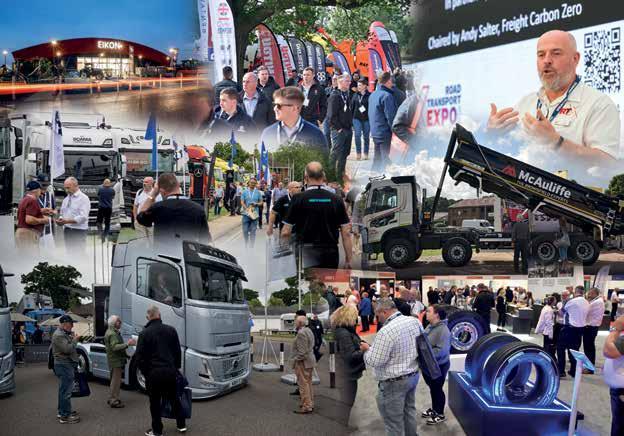
Road Transport Expo – RTX 2026 30 June-2 July Stoneleigh Park, Warwickshire, GB www.roadtransportexpo.co.uk
Multimodal 2026 30 June-2 July NEC, Birmingham, GB www.multimodal.org.uk Convoy in the
55th IRHA Conference 2026 11/12 September INEC Gleneagle Arena, Killarney, C0. Kerry www.irha.ie
IAA Transportation 2026 15-20 September Hannover Messe, Germany www.iaatransportation.com
RWM Expo 2026 16-17 September NEC< Birmingham, GB www.ess.expo.co.uk
National Ploughing Championships 2026 15-17 September Screggan, Tullamore, County Offaly www.npa.ie
FIAA: International Bus/Coach Trade Fair 22-24 September IFEMA Madrid, Spain www.ifema.es
Innotrans 22-25 September Messe Berlin, Germany www.innotrans.de FTA Ireland Sustainable TBC Johnstown Estate Hotel, Enfield www.ftai.ie Transport Seminar
Fleet Transport Awards 2027 15-October Johnstown Estate Hotel, Enfield www.fleet.ie
CILT Awards 2026 24-October Malhide Castle, Dublin www.cilt.ie
Paris Motor Show 2026 12-18 October Porte de Versailles, Paris www.mondial.paris
EuroBus Expo 2026 3-5 November NEC, Birmingham, GB www.eurobusxpo.com
Intermodal Europe 10-12 November Rotterdam Ahoy, Netherlands www.intermodal-events.com
RTX Expo Scotland 2026 18-19 November SEC, Glasgow, Scotland www.roadtransportexpo.co.uk
LiftEx 2026 24-25 November Exhibition Centre, Liverpool, GB www.liftex.org
CTTC Coach & Bus Show 2026 27-28 November RDS Simmonscourt Pavilion, Dublin www.cttc.ie

Fleet Transport Magazine, D’Alton Street, Claremorris, Co. Mayo, Ireland. F12 E7P2
Tel: +353 (0)94 9372819/ 9372826
Email: enquiries@fleet.ie Web: www.fleet.ie
Subscription Hotline: 094 93 72827
Editor: Jarlath Sweeney - editor@fleet.ie
Contributors: Cathal Doyle, Sean Murtagh, Paul White, Donal Dempsey, Howard Knott, Rob Van Dieten, Joe O’Brien, Cyril McGuinness, SMMT/Transport News Brief
Photography: Jarlath Sweeney, Paul White, Cathal Doyle, Howard Knott, Newspress, ASO – Dakar, Garbe, Transaid
Administration: Orla Sweeney Email: orla@fleet.ie Email: enquiries@fleet.ie
Advertising: Mary Morrissey Email: mary@fleet.ie
Design: Crackerjack Design House
Printed in Ireland











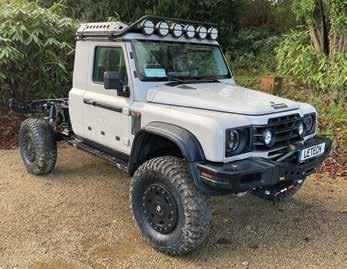
Yet another variant of the all-purpose, all-wheel-drive INEOS Grenadier is being launched with the development of the Lennson Pro Single Cab — a customisable conversion based on the INEOS Grenadier Quartermaster, which was recently nominated as a finalist in the International Pick-up Award and finished runner-up in the competition.
“We worked with customers to design the perfect module to create the most capable vehicle in their fleet. Whether for medical response, communications, utilities, or overlanding, the Lennson Pro is built to maximise functionality and usability,’ explained David Bassett, Managing Director, Orangeworks Automotive, the INEOS importers and distributors in Ireland.
LeTech x INEOS ‘Lennson Pro’ Single Cab – Merits
n Flexible construction for maximum usability
n The modifications to the body open up numerous possible uses, from conversion into an expedition vehicle with a cabin to an extended load area.
LeTech equipment highlights:
LeTech winch attachment made of steel consisting of: Winch bracket, license
plate holder and underride guard
LeTech roof rack QM
LeTech planking aluminum quintet plate for roof rack
LeTech headlight bracket round headlight kit
LeTech multifunctional rear ladder with 20l canister holder, powder-coated
LeTech Off-road – running board with anti-slip embossing, jack holder made of stainless steel LeTech multifunctional rear ladder with 20l canister holder plastic-coated
Suspension & Wheels: ChassisLETECH X Reiger Perfomance suspension: consisting of: n 4 –suspension springs
n 2 front axle shock absorbers 4 compartment compression and rebound adjustable
n 2 shock absorbers rear axle 4 compartment compression and rebound adjustable
Rims: 18-inch bead-lock ring rims
Tyres: 115Q BF Goodrich
Mud-Terrain T/A 37×12.5 R18
inline-six-cylinder BMW B57 diesel.
The modifications made by LETECH increase ground clearance by 186mm to 450mm, and wading depth from 800mm to 1,050mm. As a result, off-road geometry is significantly enhanced. These engineering modifications also result in a wider vehicle footprint, optimised weight distribution, greater wheel travel and improved axle articulation, ensuring the Grenadier can successfully traverse deep sand, severely flooded terrain or extremely rocky environments.
The Grenadier’s impressive towing (3,500kg braked trailer) is retained
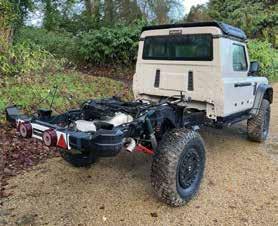
LeTech portal axles with increased ground clearance of 450 mm in total Tyre pressure control system enables pressures to be lowered to zero bar while driving
Developed and supplied exclusively by LeTech GmbH, the conversion is based on Grenadier and Quartermaster Trialmaster vehicles straight from the Hambach factory. Vehicles are transferred to LeTech’s facilities near Stuttgart, Germany and fitted with a new heavy-duty five-link front and rear suspension layout, portal axles with wheel hubs offset from the main axle and larger 37” BFGoodrich Mud Terrain off-road tyres, while the drivetrain remains unchanged.
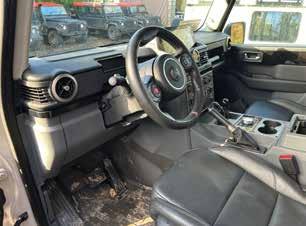
Like all Grenadier vehicles the Lennson Pro Single Cab versions are powered by a 3.0-litre turbocharged
for the LeTech versions, with payload capacities extending the vehicles’ GVM to 4.25-tonnes. The standard vehicle’s five-year, unlimited mileage mechanical factory warranty remains, and a two-year warranty is offered by LeTech on the conversion parts.
Founded in 2009 by Andreas Lennartz, LETECH GmbH made its name restoring and modifying classic off-road vehicles. Since then, it has established a reputation for developing one-off, custom off-roaders and low-volume production vehicles for global manufacturers from its modern manufacturing facility in Welzheim, Germany (near Stuttgart). LETECH also offers a wide range of off-road accessories, including roof racks, off-road protection and suspension kits.
LETECH has been an official INEOS Grenadier sales and service partner since 2021.

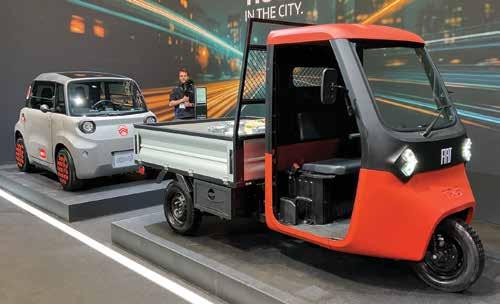
And now for something completely different from a mainstream light commercial manufacturer! At the Brussels Motor Show, Stellantis ProOne showcased the FIAT Professional TRIS, an exciting new solution for micromobility.
Fiat Professional’s take on the philosophy: ‘Build it and they will come’ is “You need it. We build it”. The new TRIS, is a fully electric three-wheeler making its European debut.
With 500 kg payload in a compact size, this original, 100% eco-friendly concept expands Stellantis Pro One’s already extensive line-up, addressing new urban mobility needs and last-mile delivery challenges.
TRIS is specially created for the urban micromobility segment. Developed by the Stellantis Design Centre in Italy, it was launched in Morocco few months ago.
With a 90 km range, ultra-lightweight design, and low running costs, TRIS can carry over 500 kg of payload and offers a spacious cargo area, with approximately 2.25 square meters of load space and the ability to accommodate a standard euro pallet. It also boasts an RCE-homologated payload capacity of maximum 540 kg. Available in three configurations – chassis-cabin, flatbed, and pick-up– it delivers total versatility, enhanced by the Stellantis CustomFit programme, which provides extensive customization options, such as box body, mobile vendors and even people carriers (with up to 7 seats).
Its design prioritises ease of use. It is simple to drive as there is no clutch or gearbox, while its integrated charging capability allows seamless recharging with a built-in 220V plug, eliminating the need for an external charger. Designed
with durability in mind, its chassis and tubular structure are protected from corrosion with an automotive-grade zinc coating, complemented by full LED lighting at the front and rear for enhanced visibility and safety.
One of the key strengths of TRIS is its compact size - just 3.17 meters in length - combined with a tight 3.05-meter turning radius, allowing it to navigate narrow city streets with ease.
Power accessibility is also a priority, with a USB-C port and a 12V socket ensuring that devices can be charged on the go. The lithium battery, with a capacity of 6.9 kWh, provides a homologated range of 90 km (WMTC), ensuring sufficient autonomy for daily professional use.
Thanks to its integrated smart charging system, TRIS can be charged from 0 to 80% in just 3.5 hours, reaching the complete recharge in 4 hours and 40 minutes, using a standard domestic plug. Regenerative braking offered as standard completes the efficiency package, helping to maximize range and reduce energy consumption during everyday use.
the digital dash is easy to see and engage.
Being doorless allows for immediate entry and exit but leaves it exposed to the elements. The installation of at least one door, for security reasons and weather resistance is being considered.
Another plus factor is the low cost, circa €8,000.
Tris will be launched solely by Fiat Professional during 2026 in the relevant European markets starting from Italy.
At the Brussels Expo, Eric Laforge, newly appointed Global Responsible of Stellantis ProOne business unit, said: “I’m truly proud to present such a wide and flexible range, constantly updated to meet our customers’ needs. Beyond the CustomFit products – showcasing the in-plant customization and conversions made possible thanks to our certified partners, the latest addition is Fiat Professional TRIS, an unusual and surprising vehicle thanks to its features and performance, designed to capture a
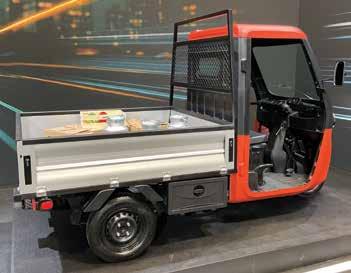
TRIS is powered by a 48-volt electric motor delivering 9 kW (peak power) and a maximum torque of 45 Nm, capable of reaching a top speed of 45 km/h.
With moped style steering and brake controls positioned in the centre, it eliminates the left-hand-drive/righthand-drive conversion saga. In addition,
rapidly growing market segment: urban micromobility and last-mile delivery. All this built on the huge experience and legacy that each Brand of Stellantis Pro One business unit have accumulated over many years in the LCV industry, always staying close to customers – from small businesses to large companies.”
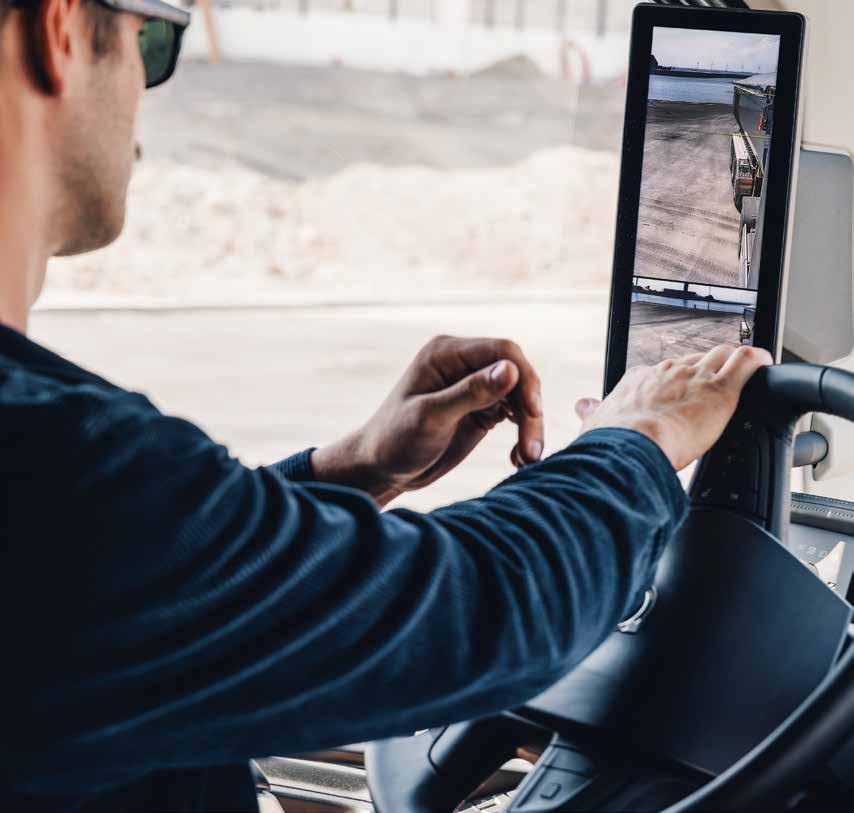
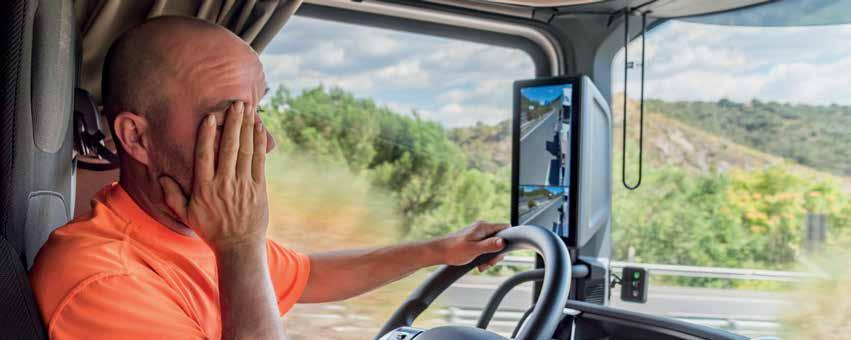
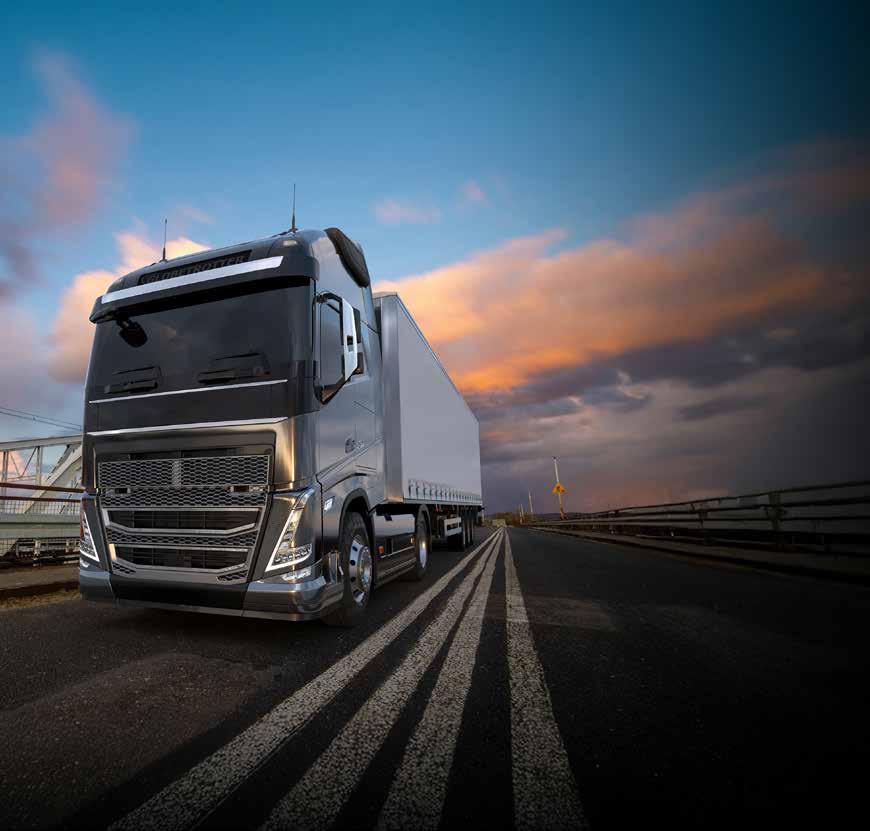
The Camera Monitoring System replaces the rear-view mirrors, using cameras on the side of the truck, improving the aerodynamics of the truck to save energy. It also opens up your visual field in both good and challenging conditions. Using infrared technology to improve night time visibility. The views on the displays adapt to the driving situation. Your efficiency. Extended.
Contact your local Volvo Trucks dealer or visit volvotrucks.co.uk
Britta Sprey has been Managing Director of Cargobull Parts & Services since July 2020. She has held various positions at Schmitz Cargobull since February 2007.
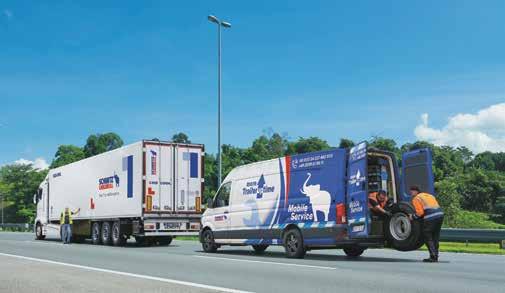
Schmitz Cargobull relies on a comprehensive network of over 1,400 service partners in Europe. What makes this network so special?
Our service partners are not just workshops – they are real problem solvers for our customers. They know the vehicles, the components and often the people behind them. Their experience and expertise enable them to minimise trailer downtime and extend the service life of the trailers. This is a real added value for fleet operators.
How do you manage to make spare parts supply so quick and reliable –even across national borders?
Our spare parts are available locally through a Europe-wide network of qualified service partners. This ensures proximity to the customer, quick availability and high-quality advice directly on site. Thanks to our 29 distribution centres throughout Europe and our central warehouse in Altenberge, we can usually deliver to service partners and customer-owned workshops within 24 hours.
What role does the EPOS database play in this process?
EPOS, the Electronic Parts Documentation and Ordering System, is our online database, which now contains over 1.4 million documented Schmitz
Cargobull trailers. By entering the VIN (vehicle identification number), the required spare part can be easily and specifically identified and ordered via our web shop. This saves time, reduces errors and can be done at any time, regardless of opening hours or call centre availability. The web shop contains around 80,000 spare part items from both Schmitz Cargobull and other brand manufacturers.
Over 80,000 items – including for other manufacturers. Why is this important?
Many of our customers operate mixed fleets. That’s why it goes without question that we also offer spare parts for other manufacturers. Our goal is to create a genuine one-stop shopping experience – regardless of the brand.
Schmitz Cargobull also offers ‘value parts’ for repairs at fair market value. What is the idea behind this?
With our value parts, we offer an economical solution for repairing older vehicles at fair market value. This is our response to the trend of trailers remaining in operation for significantly longer these days – and our customers expecting suitable, cost-effective repair options.
Both original parts and tested, fair-value Value Parts can be easily identified and ordered via our web shop. This enables workshops to reliably repair older vehicles while keeping repair costs within reasonable limits. This offer has been very well received by our customers – especially in a challenging market environment.
One-to-One with Britta Sprey, Managing Director, Cargobull Parts & Services
“As a full-service provider, we ensure high trailer uptime”

How do you ensure that the quality of your service partners remains consistently high?
Our service managers are in close contact with the workshops, selecting new partners and developing existing ones. In addition, we are setting up a field service team to support our partners and strengthen the connection to end customers. One highlight is our annual ‘Service Partner of the Year’ award, which recognises service partners in every European country for their outstanding commitment.
What is your vision for the future of the aftermarket business at Schmitz Cargobull?
We want to continue offering our customers a comprehensive, worry-free package – with quick solutions, high quality and personalised support. As a full-service provider in the workshop and service sector, we are ideally positioned to do so.
With
Rob Van Dieten – rob@fleet.ie

Brigade’s Driver-safety cameras and IP driver distraction cameras are designed to mitigate driver fatigue. Using AI technology, the cameras provide driver warnings against potential issues caused by inattention, distraction and tiredness.
• Lane departure warning (LDW)
• Headway monitoring warning (HMW)
• Forward collision warning (FCW)
• Drowsiness
• Distraction
• Yawning
• Mobile phone use
• Not wearing a seatbelt
• Smoking
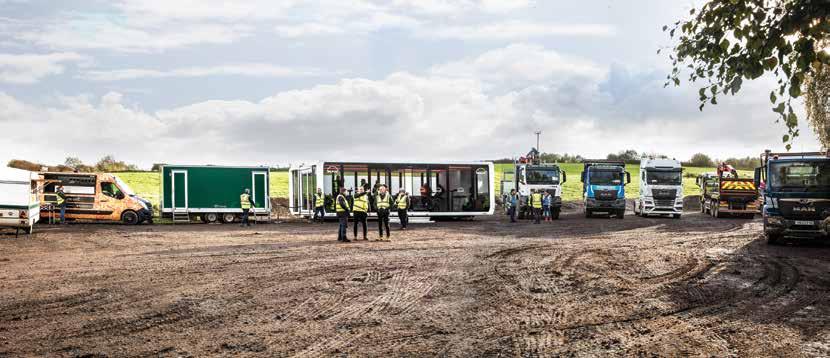
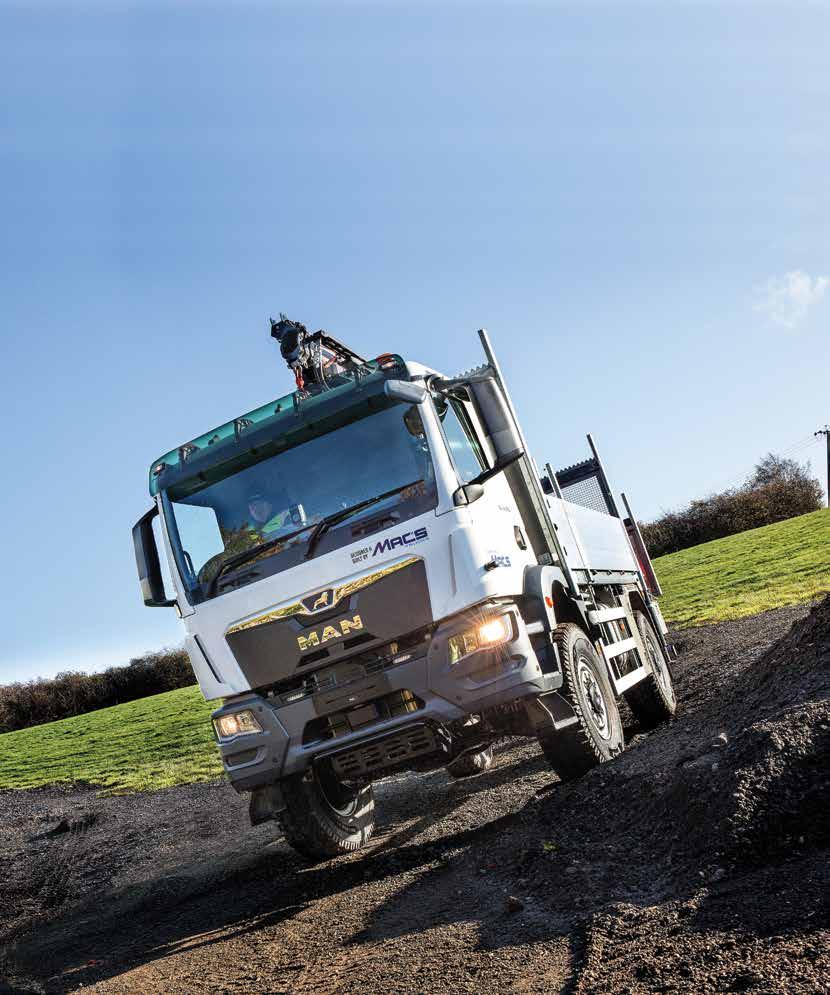
Showcasing product to potential customers is a proven and worthwhile exercise for vehicle manufacturers. MAN Truck & Bus UK undertook a three-week tour of Britain to demonstrate the off-road performance, durability, and innovation of its construction-focused range. Fleet Transport was among a select group of journalists who joined existing and potential MAN customers at Parkwood Outdoors, near the West Yorkshire village of Tong for the MAN Lion’s Off-Road Experience where we put the German brand’s finest through their paces.
Warm jackets and sturdy footwear were the order of the day on a crisp autumnal Tuesday morning at the end of October. A team of MAN ProfiDrivers were on hand to showcase the capabilities of the various MAN products as we gathered at the off-road track comprising some gravel roads and other more muddy trails. Thankfully the overnight rain had abated, but conditions were wet and slippery enough to make this a genuine test of capability.
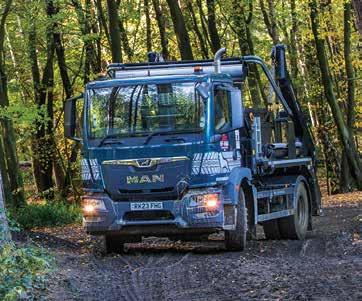
Drive 1: MAN TGM 18:250
With a selection of TGS 8x4 tippers awaiting, the first vehicle driven was the only TGM model present, an 18.250 4x2 Skiploader, fitted with a Boweld SL14 and plated at 18-tonnes GVW. Power output from the 6.9-litre D08 six-cylinder engine was rated at 250 PS and 1050 Nm of torque, fed through a 12-Speed MAN TipMatic (ZF) automated transmission. With a CC Day cab, its specification was among the more basic of the vehicles on-site this day, with manual parking brake and analogue instrumentation, but with comfort driver’s seat and excellent ergonomics there would be little hardship in spending a day in this vehicle.
With only one driven axle and the ground at the wettest it would be all day, any concerns about traversing the course were quickly allayed as the TGM felt sure-footed throughout, never breaking traction. As the shortest truck present with a wheelbase of 3,875mm, there were no major challenges manoeuvring through the trees, with good visibility all-round. With a flexible lightweight chassis that can support any number of bodies, and its ease of operation it’s not hard to see how the TGM can suit a wide range of uses and applications.
Straight into the most powerful truck available for the next drive, a MAN TGS 35.480 8x4 Tipper. As the nomenclature suggests, the 12.4-litre D26 6-cylinder unit pumps out 480 PS
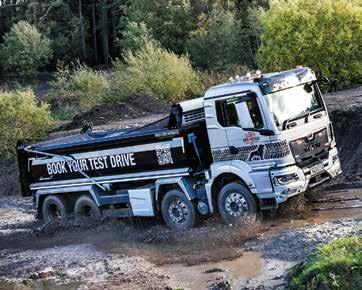
and an impressive 2,450 Nm of torque. It’s not even the most powerful unit MAN offers, as there is also a 540 PS variant, as well as a 440 PS version of the same engine, driven subsequently.
GVW rated at 32-tonnes and fitted with a Boweld Mightylite HD body with Edbro CX15 tipping gear, this 8x4 with a wheelbase of 3,205mm made short work of ascending hills, maintaining strong momentum without dropping down the gearbox. Using the retarder, it felt equally secure and under control going downhill. In the more twisty stuff its ability to get around tight corners impressed, as did its ability to keep moving through muddy sections. While we tried it initially in off-road mode which changes the gear shifting strategy for better traction through faster shifting at higher engine speeds and a more aggressive torque delivery for pulling away (as well as an automatic rocking-free function to help get unstuck), the TGS performed equally well in normal drive setting.
The TGS cabin provides a pleasing blend of robustness with ergonomically friendly controls. Additionally this well specified 35.440 was fitted with extras like MAN’s Navigation Professional media system with 12.3” touchscreen, 12.3” Professional instrumentation screen and air-sprung Comfort driver’s seat, all helping to make the driver’s working day more pleasant.
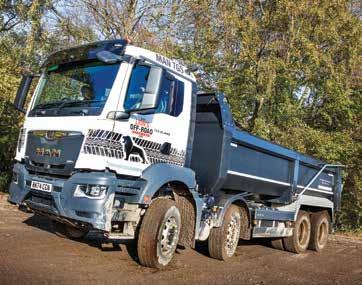
powerful brother was negligible - both vehicles were loaded, but to what extent was not stated - this vehicle was notable for what was attached - a recyclable high-density polyethylene (HDPE) tipper body featuring an exoskeleton frame, designed by Goliath and built under licence by Meiller-Boweld.
A HDPE body offers a number of advantages over conventional steel bodies; lighter, thus offering better payload possibilities, environmentally friendly, while the inner body is recyclable. Another advantage is that thanks to the slippery nature of the plastic body, loads will come out more easily, so there isn’t a need to tip beyond an angle of 40 degrees. Which makes it possible to take a stage out of the tipping ram, thereby improving safety and reducing the amount of oil needed to operate.
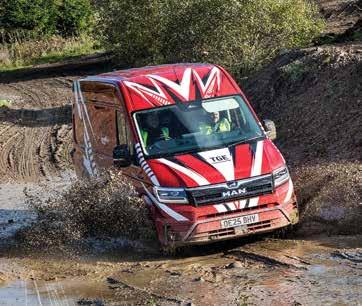
Drive 4: MAN TGE 3.200 4x4
Last up was an all-wheel-drive version of MAN’s van product, the TGE. With 200 PS on offer from the Volkswagen Group 2.0-litre bi-turbo diesel driven through an 8-speed automatic transmission, and fitted with all-terrain tyres, this well-specified 3.5-tonne all-wheel drive panel van is more than capable off-road, and is ideal as a service support vehicle or lighter off-road solution, It certainly made light work of the test course, while the premium specification would make it a very pleasant environment in which to spend extended time.
Speaking about the MAN Lion’s Off-Road Experience, Tracey Perry, Sales Director at MAN Truck & Bus UK Ltd, said: “These roadshows give us the perfect opportunity to meet both our existing and new customers face-to-face, share the latest developments across our product range, and really demonstrate what makes MAN vehicles stand out. Having our ProfiDrivers showcase the capability of our trucks on the off-road tracks was a real highlight, it’s a great way to see first-hand the performance, durability, and innovation that MAN is known for.”
this and its more
Tipping gear
Type SL14
Lifting capacity 14000 kg
Features Sheeting System
Edbro CX15 Front end
Procover Sheeting System Sheeting System On-board weighing Chapter 8 Markings
Infotainment MAN Advanced Basic MAN Navigation Professional MAN Advanced Basic system Digital instrument cluster MAN Sound system media system, 12.3” MAN Sound system MAN Media Van Nav
Bluetooth® phone integration MAN Advanced sound system MAN SmartSelect infotainment Navigation Business with MAN SmartSelect infotainment control with touchpad and 12.9” touchscreen control with touchpad and direct access buttons Multifunction direct access buttons Smartphone integration steering wheel
Smartphone integration
Cab interior Analouge instrumentation 12.3” Professional Analogue Electronic parking brake Multifunction steering wheel instrumentation instrumentation with Auto-Hold function
Comfort driver’s seat Leather multifunction Multifunction steering wheel Column mounted gear control
Manual air conditioning steering wheel
Comfort driver’s seat Keyless Start
Comfort driver’s seat, Manual air conditioning air-sprung, with lumbar support and shoulder adjustment
Climatronic air conditioning
Cab exterior Vertical exhaust Sun shade Sun shade Beacons MAN OptiView
Door extensions
Beacons
Assistance systems Cruise control
Cruise control Cruise control
Turn Assist
MAN AttentionGuard
Front Detection
Traffic sign recognition
Reversing Motion System
Fatigue detection
Traffic sign information
Intelligent speed assist
Cruise control
Emergency brake assist
Active lane guard system
Tyre pressure monitoring system
Parking assist




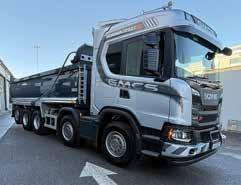
Gerry McCabe, (GMCS) Construction Limited, Aughnacliffe, County Longford, purchased this new Scania 560G 10x4, complete with a Fitzgerald Body.
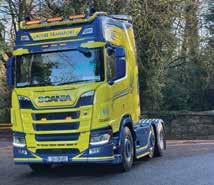
Kolbe Transport, the County Cavan based familyrun haulage and logistics specialist recently bought this new Scania R560 tractor-unit.
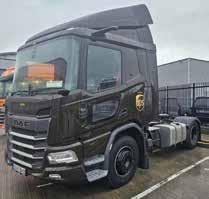
Global shipping and services provider UPS has used several taglines, with current branding highlighting “Customer First, People Led, Innovation Driven, hence the addition of a new DAF XD 4x2 tractor-unit, with additional direct vision type fittings specified.
The deal was part of a global procurement with UPS Ireland through DAF Trucks Ireland.
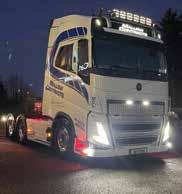
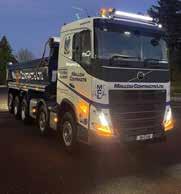
Two new trucks for Mallow Contracts Ltd., Burnfoot, County Cork: A new Volvo FH13 540 6x2 Tag and an FH13 540 10x4 rigid with Gleeson Tipper Body.
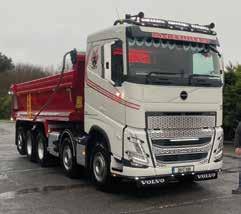
Denis McKennedy, Caheragh, County Cork: New Volvo FH13 500 10x4 rigid with Gleeson Tipper Body.
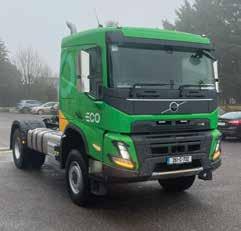
Eco Timber System, Carrigaline, County Cork: New Volvo FMX13 460 4x4 Tractor-unit. Michael McCarthy, Sales Director, McCarthy Commercials conducted the deal.
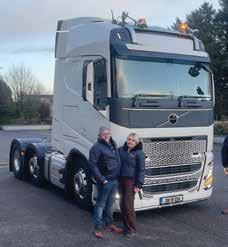
Dromana Haulage, Cappoquin, County Waterford: New Volvo FH13 500 6x2 Mid-Lift. Pictured alongside are Peter & Clarice O Brien, Dromana Haulage. Gerard Sheehan, Sales Executive, at McCarthy Commercials conducted these deals.
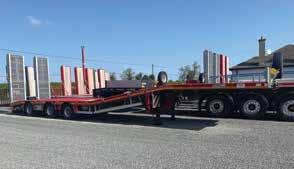
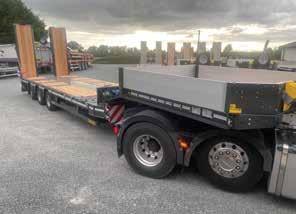
2026 MAX Trailer, 3 axle, Hydraulic lifting floor to gooseneck, safe & easy loading of neck Rear steer axel Double flip ramps with hydraulic side shift Flooring options available, hardwood timber or steel grating
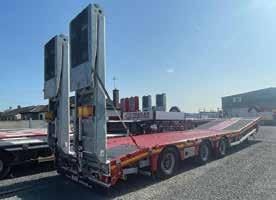
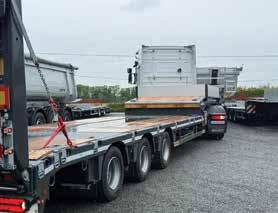
2026 Faymonville 3 axle 9ft wide in stock, fixed bed or extendable, available Now, out riggers, double flip ramps, hydraulic rear legs, full spec
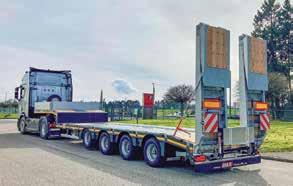
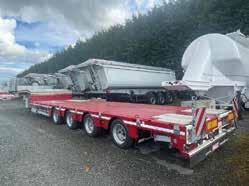
2026 MAX Trailer 4 axle step frame low loader, in stock ready to go, choice of hydraulic ramps or hook on alu ramps, extendable in length, out riggers, container locks, marker boards, etc. Also available with 800mm travel height.
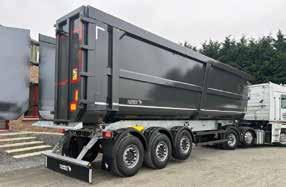
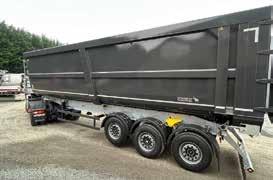
2026 Schmitz steel bulker for scrap metal, in stock available immediately
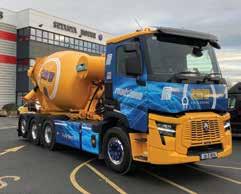
A major milestone for the Irish construction sector. Roadstone Ltd., acquired this new Renault Trucks C 8x4/4 E-Tech Tridem mixer, fitted with an 8m³ cement mixer. This 100% electric heavy-duty vehicle proves that electrification is not just a vision for the future, but a reality for today’s demanding applications.
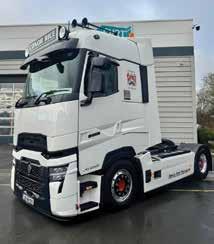
Rice Transport, Navan, County
New Renault
T High 520 4x2 tractor-unit, with paintwork by ABR Signs
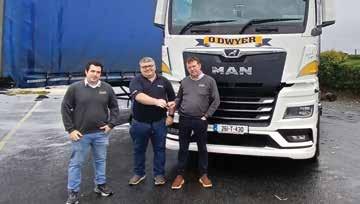
O’Dwyer Transport, Littleton, County Tipperary, continues to trust with MAN, purchasing the first of two new TGX. 26.520 with GX continental spec cabs, air-con, night heater, microwave, top bar and lights. Pictured at the handover were Phil Wheatley, Mark Ryan and company owner Brendan O’Dwyer.
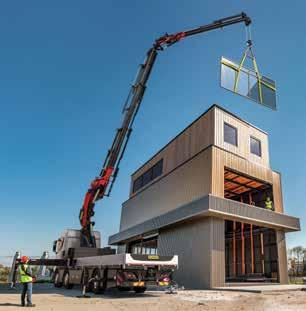
Truck Mounted Cranes & Hoists, are very useful items of lifting equipment for the delivery and collection of a variety of load types, but employers and operators must make sure that lifting operations are carried out safely. The crane or hoist are items of work equipment and any employee assigned to the task of operating that equipment must receive training for the task. It is also an item of lifting equipment and an employer has a duty to ensure that lifting equipment is suitable for the intended lifting task and is operated by a person competent to do so.
All lifting operations are potentially hazardous and should be planned and risk assessed to make sure that they are carried out safely and that all foreseeable risks have been taken into account and effectively controlled. The first step in the process is to ensure that the equipment is appropriate for the intended purpose and that it is in good condition. Start by retaining a competent person to ensure that the crane is properly mounted to the vehicle in accordance with the vehicle manufacturer’s bodybuilding

Are any of your vehicles fitted with
If so, are you adequately managing the risks?
guidelines. Truck Mounted Cranes & Hoists should not be taken into use in any place of work for the first time unless it is CE marked or has been examined and certified by a competent person. Subsequently, they must be thoroughly examined by a competent person at least once in every 12 months, and a report of thorough examination completed. Any lifting accessory (e.g. grapple, grab, slings, chains, etc.) used with the crane must be thoroughly examined every 6 months. Copies of the relevant Reports of Thorough Examinations should be kept with the lifting equipment and accessories, ideally in the cab of the truck or readily available via electronic means.
The operation of Truck Mounted Cranes & Hoists requires a written risk assessment to identify the relevant hazards and associated controls to achieve safe systems of work. Safe systems of work must include safe ways of operating the crane. Suitable instruction and training must be provided to all persons who work with, on and around loader cranes.
All lifting operations must be properly planned as poor planning is one of the major causes of accidents arising from lifting operations. The most common causes of Truck Mounted Cranes & Hoists accidents are:
n Partial or complete loss of load through incorrect handling methods
n Overturning of vehicle through:
n lifting of loads in excess of lifting capacity of the loader crane/ vehicle assembly.
n Failure of the crane, attachment or lifting accessories.
n inability of the ground to take load, and
n failure to use or the incorrect use of vehicle stabilizers or spreader plates.
n Loader crane striking: pedestrians, other vehicles, and overhead power lines.
Truck Mounted Cranes & Hoists should only be operated by trained competent persons. A person is deemed to be competent if they are trained and experienced, and know how to safely carry out Truck Mounted Cranes & Hoists operations, having regard to the nature of the hazards involved. Training should cover, as a minimum:
n the controls,
n instruments,
n working load limits,
n load assessments and load charts,
n safe working procedures for slinging and lifting, including hand-signals,
n operating limitations of each type of crane and accessory they operate, and
n in-service checks.
The operator should wear a hard hat, hi-visibility clothing and safety footwear when operating the crane.
An information sheet, providing further information on the safe use of Truck Mounted Cranes & Hoists, is available on the HSA website at: https://www. hsa.ie/eng/Publications_and_Forms/ Publications/Information_Sheets/ Safe_Lorry_Loader_Crane_Operations_ Information_Sheet.html
Be part of the UK’s leading event for liquid fuel distribution — where innovation meets industry. Discover new technologies, meet suppliers and connect with the voices driving change.
Exhibit. Attend. Network. Influence.
Showcase your products, demonstrate services and engage face-to-face with decision-makers across the sector.
Event: 15-16 April 2026, Exhibition Centre Liverpool
Visit: www.ukifda.org
Contact:
Ireland’s damp climate and fluctuating winter temperatures create ideal conditions for contamination inside diesel fuel systems. Even when vehicles appear to be operating normally, water ingress and micro-condensation can allow microbial growth to develop inside tanks, filters, and fuel lines.
Dark deposits or excessive sludge are often not caused by fuel quality alone. In many cases, the issue is biological contamination — commonly known as diesel bug.

Microbial contamination thrives wherever moisture is present. Left untreated, it can:
n Restrict fuel flow
n Block filters
n Increase injector and pump wear
n Accelerate corrosion
n Cause unexpected vehicle downtime
Short journeys, cold starts, and irregular fuel turnover — common in fleet operations — further increase exposure during winter and early spring months.

ACTIOIL A550: P REVENTIVE AND CORRECTIVE F UEL S YSTEM P ROTECTION
Actioil A550 is a multifunctional diesel fuel system treatment designed to both prevent and eliminate microbial contamination while protecting the complete fuel system.
It works directly within the fuel to control biological growth, manage moisture, clean deposits, and stabilise diesel quality — helping protect engines before damage occurs.
Diesel Bug Control
Controls bacterial and fungal growth and helps prevent recurrence in moisture-prone systems.
System Cleaning
Cleans injectors and fuel components, restoring consistent fuel delivery and maintaining reliable engine performance.
Corrosion Protection
Forms a protective layer on internal metal surfaces, reducing corrosion caused by water contamination.
Improved Combustion Performance
Increases cetane level, supporting smoother combustion, quieter operation, and improved efficiency.
Cold Weather Reliability
Prevents fuel gelling and flow issues at temperatures as low as -28°C, supporting winter fleet reliability.
Preventive Use vs Corrective Treatment
Actioil A550 can be used proactively to reduce the risk of contamination or as a corrective treatment in systems already showing sludge or microbial growth.
Professional dosage:
1 litre per 100 litres of diesel (1% of total tank volume), combined with filter replacement and periodic maintenance treatment every 6–12 months for best results.
Actioil A550 is available in 1L, 5L, 20L, 200L and bulk supply from Finol Oils — the authorised Actioil distributor in Ireland.
With nationwide delivery and technical support, Finol Oils works with Irish hauliers and fleet operators to help improve reliability, reduce maintenance costs, and protect fuel systems year-round.
For more information visit www.finol.ie or call +353(0)1 223 8842.

Dual-action formula to prevent & eliminate diesel bug in any diesel vehicle






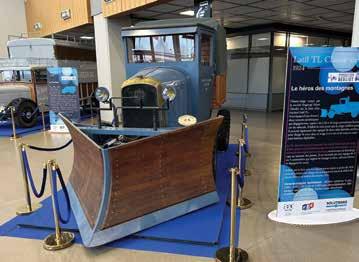
1924 Latil TK Chasse Neige –3.0-litre – 4 Cylinder – 4.65 ton
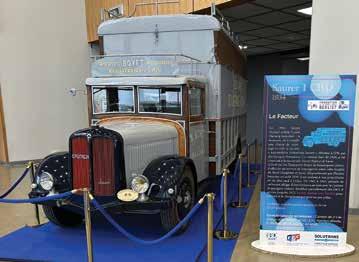
1934 Saurer 1 CRD –4.5-litre - 4 Cylinder – 3 ton
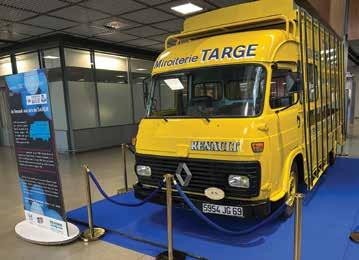
1967 Saviem (Renault) SB2 M35 Miroitier –3.2-litre - 4 Cylinder – 6 ton
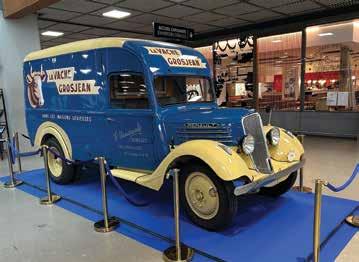
1938 Renault AGC 2 –2.4-litre - 4 Cylinder – 1.5 ton
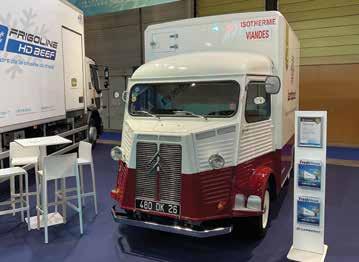
1947+ Citroen H Van –1.9-litre 11D & 1.6-litre petrol
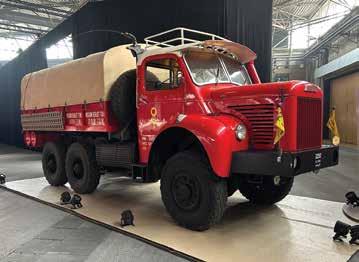
1958 Berliet GLR 8M –7.9-litre - 5 Cylinder D – 13.5 ton
& Photos: Jarlath Sweeney – editor@fleet.ie




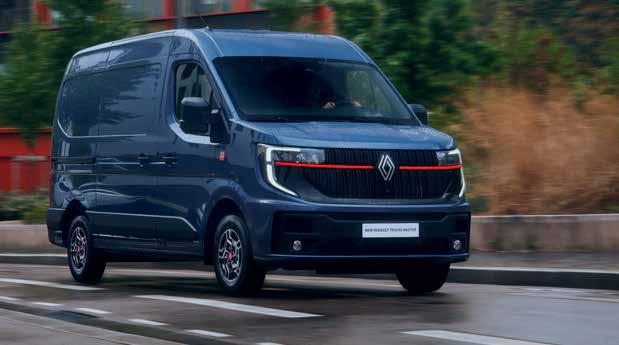
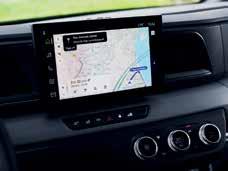





The 2026 Dakar Rally, held in Saudi Arabia for the seventh time, (from January 3-17), covered approximately 8,000 kilometres in total, with about 5,000 kilometres of timed special stages. This year’s event featured a challenging loop starting and finishing in Yanbu, a port city on the Red Sea western coast, and included new marathon stages and diverse terrains like dunes, rocky paths, canyons and gravel plains.
In all 317 vehicle entries were received (564 competitors) for the 48th running of the Dakar Rally – 115 bikes, 147 cars and 67 trucks plus others in various categories. 247 finished - 90 bikes, 133 cars and 22 trucks.
DAKAR 2026 - K EY D ISTANCE & R OUTE D ETAILS:
n Total Distance: Around 8,000 km (including liaison and timed sections).
n Special Stage Distance: Roughly 4,800 - 5,000 km.
n Duration: 14 days, from January 3-17, 2026, with a rest day in Riyadh.
n Route: A large loop from Yanbu, taking in AlUla, Riyadh, Wadi Ad-Dawasir, Bisha, and Al Henakiyah before returning to Yanbu.
n Marathon Stages: Two gruelling marathon stages (Jan 7-8 & Jan 13-14) where crews camp overnight without assistance.
S IXTH TITLE FOR N ASSAR = F IRST FOR DACIA S ANDRIDERS
The Ultimate Car class did not go right down to the wire like many thought heading into the second week, as Qatari Al-Attiyah drew on all his rally-raid experience to keep a comfortable cushion in his Dacia Sandrider from the main

Victory once again for Nasser Al-Attiyah (Dacia) with Luciano Benavides (KTM) and Vaidotas Zala (De Rooy) recording maiden wins

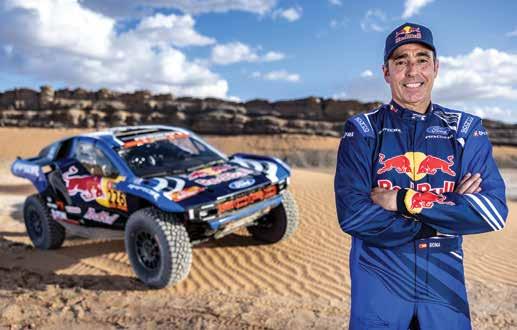
challengers behind to record the maiden victory for the Renault Group owned Romanian brand. The Ford Racing Raptor T1+ of Spaniard Nani Roma secured second and his Swedish teammate Mattias Ekström came home third - just like his 2025 result. Other top name challengers to finish strongly included multi-World Rally Champions Sebastian Loeb (Dacia) and Carlos Sainz (Ford), who finished 4th and 5th respectively.
At the finish line, Nasser, 55, revealed: “From the start we believed we could win this race. We started from zero with this Dacia project and we’ve developed the car so much. Now we’ve won the Dakar. Thank you to my co-driver Fabian Lurquin thank you to the team. I’m so happy to win the Dakar for the sixth time.”

It was a surprisingly disappointing 2026 event for the all-conquering Toyota Gazoo Racing Hilux GR W2RC, with two-time Bike winner Toby Price the best of the crews participating, bringing home the 4WD pick-up in 8th position. Hilux has won this cross-country marathon race on four occasions since 2019.
Rokas Baciuška (Lithuania) with three overall Dakar podium finishes to date - two in the SSV class and one in Challenger - went one better with a dominant Stock class performance. Over the two weeks he banked seven stage victories in the new Defender Dakar D7XR which was making its Dakar debut. Teammate Sara Price (USA) made it a Defender 1-2 with the third member of the team, 14-time Dakar champion Stéphane Peterhansel (France), finishing in fourth.
M OTORBIKE TITLE DECIDED BY JUST TWO SECONDS
Argentina’s Luciano Benavides hit back from a 3m20s deficit at the start of the final Stage 13 to win the 2026 Dakar Rally Bike title in thrilling fashion by just two seconds - the smallest margin in Dakar history - for Red Bull KTM Factory Racing.
Benavides in the 450 Rally Factory motorbike looked to have blown his chance the day before as Monster Energy Honda HRC rival Ricky Brabec (USA) overtook him in the overall standings in his CRF 450. However the 30-year-old was in no mood to back down and rode superbly on Saturday in the final sprint to the Yanbu finish and pip the American - who made a late navigational error - to take glory by just two seconds.
The result added another page in the Dakar history books, as Luciano joined his older brother Kevin as Dakar champions on two wheels after Kevin’s title wins in 2021 and then 2023, also for KTM.
DAKAR 1-2 FOR T EAM D E R OOY IN T RUCK C ATEGORY
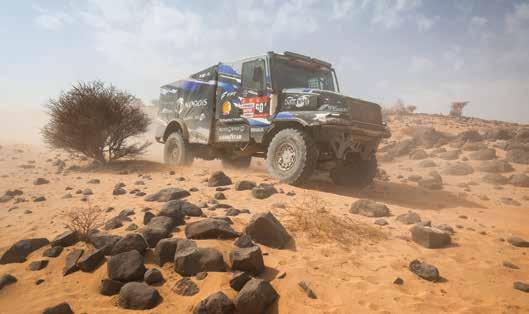
Yet more success for Team De Rooy FPT on the dunes as Vaidotas Zala (Lithuania) wrapped up the Dakar Rally Truck class in spectacular fashion with a 20 minute gap on teammate Ales Loprais (Czech Republic) who finished second, also in the 8,500kg Iveco Powerstar bonneted race truck powered by the FPT Cursor 13 developing 1,000hp, The Netherlandsbased team also managed to win six of the thirteen stages, including five one-two finishes.
Another Iveco, a Powerstar EV04, prepared by MM Technology had Dutch driver Mitchel Van Den Brink completing the podium positions.
“When I started eleven years ago, my dream was just to compete in the Dakar, and now all of a sudden I’m coming home with the trophy. Life’s funny like that,” said an elated Zala upon arriving at the final bivouac in Yanbu.
“I’ve done the Dakar ten times in a car, but competing in a truck is a whole different ballgame. It was two very long weeks, but I’m really happy I made it here without any problems. The truck performed incredibly well. The team pulled several all-nighters to keep us on the road.”
Consistency was the key to his first Dakar victory, Zala explained: “We only had one major stop—thirty minutes early in the rally. After that, we were solid day in, day out. Our competitors had some ups and downs.”
“The Dakar is a tricky beast that way. You can have great days, but one bad day can wreck your result. This year we were fortunate enough to go two weeks without hitting any major snags.”
Checkout www.irishmotorsportnews.com for more details on Dakar Rally 2026
Text & Photos: Jarlath Sweeney – editor@fleet.ie

Perhaps we can start a debate. As you know I have always had a green outlook and policy in my road haulage business.
At the time of writing diesel is going up again by multiple of cents in one go, making Ireland the most expensive for combustion fuels in all of Europe. For HGVs, most of the operators in the road transport sector is phasing out Euro 5 diesel engines and are now battling with the upkeep of the ‘cleaner’ Euro 6s. Yes, the word to use is battling, as there is no doubt in the world we live in that Euro 6 has its fair share of issues, despite being on the market for over ten years.
And soon we will have Euro 7 thrust upon us, most manufacturers will try to tell us the new emission controlled truck models will be better, more fuel efficient and lower cost to run. So imagine reading Karin Radstrom, Chief Executive of Daimler Trucks (Mercedes), in reply to a question posed by Fleet Transport, in a recent ACEA webinar, stating that Euro 7 is “a distraction”.
Speaking at the briefing she stated that existing Euro 6 rules are already pushing diesel engines close to their technological limits and that there


By Cyril Mc Guinness · Wm Cyril Mc Guinness Ltd., Dublin
is little environmental gain to be achieved in reaching the next level. She continued by saying that each truck manufacturer would have to invest around €500 million into developing the new technology, while knowing that over time diesel powered trucks will disappear.
At the moment, Zero Emission Heavy Duty vehicles accounts for less than 2% of the European fleet, due partially to its price point and also due to the lack of sufficient and high powered public charging points.
On the far side of the ‘pond’, the Trump administration has introduced policies that ease the enforcement penalties associated with Diesel Exhaust Fluid (DEF) and have a clear Deregulatory Philosophy to roll back the environmental regulations since 2010, although not law yet, Bills have been introduced by members of the Republican party such as the proposed (Diesel Truck Liberation Act).
Back to tax. It is often said that the only sure things in life are Death and Taxes. Years ago when Willie Walshe, the then CEO of Aer Lingus was asked about

the issue of no tax on aviation fuel, he said: “we can’t pay tax and invest in new technology”.
In light of haulage being the cash cow, running a fleet just keeps getting harder. We all know diesel will be here for at least the next twenty years, after that well, it’s anyone’s guess, but just look at how slow we are to build infrastructure for the alternatives.
So would it be mad to suggest we go back to building Euro 5s? After all there are bullet proof engines with very little difference in the level of emissions, fuel economy compared to Euro 6 yet unreliable.
The high cost of road tolls is also a big issue. For any operator travelling regularly on the motorway from the West to the Capital has to endure three tolls before getting to Dublin Port (M6 Galway-Ballinasloe, M4 Enfield & M50).
Adding up to €22.80 - Very expensive. It’s the most efficient and safety route but why are trucks heavily penalised in this manner? Those that bypass regularly Enfield, endure more fuel costs and additional wear and tear on the whole unit due to the inferior roadway.
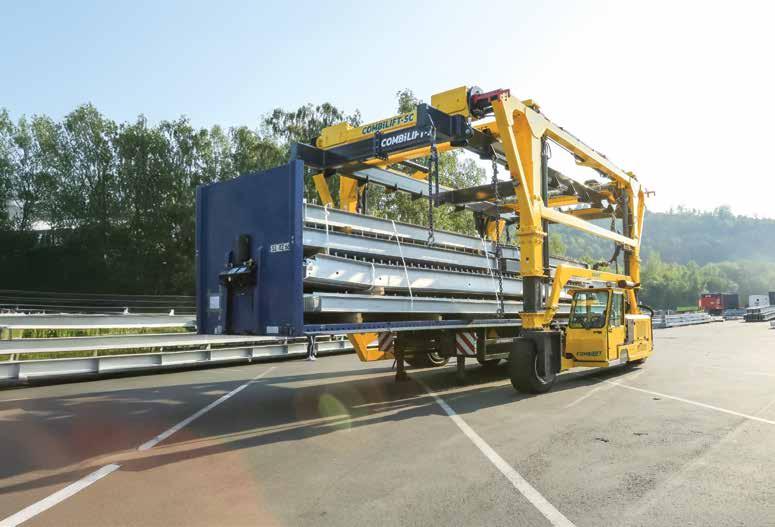
ENHANCE THE SAFETY, STORAGE & EFFICIENCY OF YOUR LOGISTICS WITH COMBILIFT
Combilift’s range of multidirectional forklifts, pedestrian reach trucks, straddle carriers and container loaders will allow you to maximize the capacity, improve efficiency and enhance the safety of your facility.
Contact Us Today
To find out how Combilift can help you unlock every inch of your storage space.
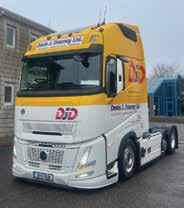
Denis J Downey
New Volvo FH13 500 6x2 Aero Turbo Compound.
Sold & Delivered by Gerard Sheehan.
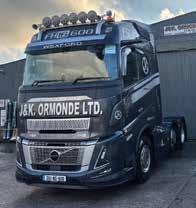
J & K Ormonde Haulage
New Volvo FH16 600 6x2 Aero with Camera Monitoring System. Sold & delivered by Joe Baker.
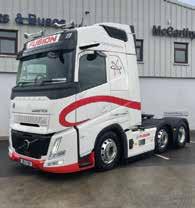
Fusion Logistics
New Volvo FH13 6x2 Aero Turbo Compound with Camera Monitoring System. Sold & Delivered by Michéal Walsh.
CORK Watergrasshill, County Cork Tel: 021 4889800 McCARTHY COMMERCIALS KILKENNY Danville Business Park Ring Road, Kilkenny Tel: 056 7734200 McCARTHY
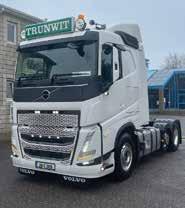
Trunwit Transport
New Volvo FH13 500 6x2 Turbo Compound. Sold & delivered by Gerard Sheehan.
Gillogue, Clonlara, County Clare Tel: 061 356360


2025 will go down as a topsy-turvy year for new commercial vehicle registrations across Ireland. End of year figures released by the Society of the Irish Motor Industry (SIMI), sales of new Light Commercial Vehicle (LCV) increased by 7% (32,779) compared to 2024 (30,669), while new Heavy Commercial Vehicle registrations (HGV) decreased by 5.1% (2,715) in comparison to 2024 (2,862). There was an even a more significant downturn in the passenger transport sector, with an almost 29% decline in numbers.
n New Light Commercial Vehicles sales (2025) = 32,779 v (2024) 30,669 +7%
n New Heavy Goods Vehicle total sales (2025) = 2,715 v (2024) 2,862 -5.14%
n New Buses/Coaches sales year to date (2025) = 410 v (2024) 576 -28.7%
Reflecting on the State of the Nation with regards to the sector, Brian Cooke, Director General, SIMI said: “For the Irish Motor Industry, 2025 can be described as a fair year, as the new car market finished in line with projections, with 124,954 registrations showing a 3% increase compared to 2024. In the commercial sector, new Light Commercial Vehicles (LCV) registrations, despite 13% decline in Q1 of 2025, sales recovered strongly and by the end of 2025 actually finished 7% (32,779) ahead of 2024 (30,669). This represented the highest level of LCV sales for the past decade, with diesel remaining the preferred engine type of choice, retaining the majority of market share (91.27%). EV vans showed some growth and accounted for 6.15% of the market.
New Heavy Commercial Vehicle registrations (HGV) decreased by 5.1% (2,715) in comparison to 2024 (2,862). The mixed results in commercial registrations highlight the current uncertain and challenging economic climate for business, a trend which has also been a feature of the EU’s commercial vehicle market.
Last year, the Irish domestic economy experienced robust growth, with a strong labour market operating close to capacity and at record levels of employment. However, cost-of-living increases continued to impact consumers, while businesses also faced significant pressures from rising costs. Looking ahead to 2026, both the global and national environments remain challenging. Many economists are forecasting that the outlook for the Irish economy in 2026 will be similar to that of 2025. For the Irish Motor Industry, the 261 sales period has now commenced, and the Industry is optimistic for the year ahead.”
In order to provide a comprehensive analysis, we asked all of the main truck brand distributors on their thoughts on how the new and used HGV markets performed, compared to 2024 relative to expectations, and how their brand fared relative to the competition. Among the questions issued included:
n Predictions for the overall HGV market in Ireland for 2026
n Identify any particular trends, for instance with regards to types of vehicles being purchased, or the category of customers?
n With a number of new players entering the marketplace, particularly in the EV light truck segment, what impact is expected from these new manufacturers in 2026?
n What about Electric BEVs and the infrastructure required?
n What new truck models are planned to launch in Ireland during 2026
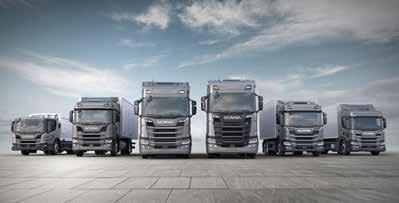
Westward Scania, the long standing leading truck brand in Ireland, caters primarily at the heavier end of the sector according to Thomas Diffley, Sales & Marketing Manager, at the Strokestown, County Roscommon based importer and distributor for the famed Swedish truck and coach marque.
“As usual we measure HGVs as trucks being over 17 tonne GVW, and whilst the SIMI HGV stats include some lower weight segments we consider that the medium to heavy duty market declined by about 4%. We were pleased with our performance which by any measure showed us retaining the Number 1 position for 11 years in a row. We do not take this success lightly and it is the result of an excellent product, but most importantly dedicated back up support from the Scania dealer network.
With ongoing global trends and disturbances, who can predict more than for the first quarter or two? But we have a strong order book for those quarters and would be optimistic about the total market remaining fairly stable for 2026.
There are no particular trends changing, except for some continued consolidation in the road haulage business.
The myriad of new electric brands that have entered the car and lighter commercial sectors hasn’t manifested so much in the heavy segment, so for now we haven’t seen any major new contenders.
The customers’ interest in BEVs is weak, and many have expressed concern at the rapid development of products which could mean that their truck would be outdated within a few years.
Without substantial grants this segment would appear to be of limited interest for now, so the commerciality of BEVs in the heavy segment looks limited for now.”
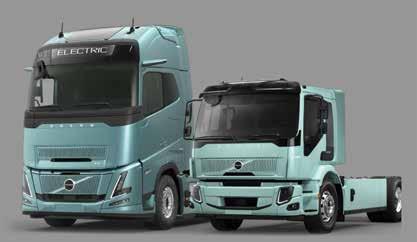
Martin Tomlinson, Head of Media & Truck Demonstration Marketing; Volvo Trucks UK & Ireland addressed these questions: “We’ve had another strong year in 2025 and expect demand to stay strong for 2026 and believe it will remain very similar to 2025
Nothing in particular [stands out] regarding changing trends; sales of 6x2 tractor-units still dominate and we also have a very strong 10x4 & 8x4 rigid market, catering for the construction sector, which we expect to remain strong into 2026
Obviously we only sell heavy duty trucks so don’t really see any impact on the electric commercial market in general. BEV’s still doing okay for us in Ireland and with growing infrastructure, we expect this to remain stable. Currently we have evolutionised our FH and FM electric truck line-up with longer range distance and introduced the Low Entry versions also.”
“Current indicators suggest the market will settle closer to a more sustainable long-term average. This adjustment is being driven by a combination of factors, including more cautious capital investment by operators, ongoing cost pressures across transport businesses, and a degree of fleet renewal having already taken place over the last two to three years. While economic uncertainty remains, underlying freight demand is expected to remain stable, which should help support consistent replacement activity.
Overall, 2026 is likely to be a year of normalisation rather than contraction, with steady demand from core sectors and a more balanced supply chain compared to recent years.”
“Several clear trends are emerging. We are seeing continued strength in demand for fleet-specification tractor units, particularly from larger and more professionalized operators who remain focused on total cost of ownership, fuel efficiency, and driver comfort. Aerodynamic specifications and highly efficient powertrains are increasingly standard rather than optional.
There is also a noticeable shift towards longer replacement cycles among smaller operators, with some opting for quality used vehicles instead of new purchases. This has supported demand in the used HGV market and reflects a more cautious approach to capital investment.
From a customer perspective, compliance, safety, and sustainability are playing a growing role in purchasing decisions. Advanced driver assistance systems and connectivity features are now expected as standard, while interest in alternative fuels and zero-emission solutions continues to grow—particularly among urban and contract-driven fleets, although widespread adoption remains dependent on infrastructure and total cost considerations.
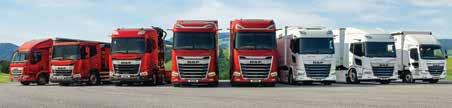
John McCann, Sales Manager, DAF Trucks Ireland gave his insight to the present and future marketplace.
“Despite the overall market softness, the performance of the new HGV market was broadly in line with expectations, particularly given the exceptional volumes seen in recent years. Used HGV demand remained relatively resilient, supported by operators delaying replacement cycles and seeking value in a more cautious economic environment.
For the DAF Truck brand, 2025 was another very positive year in terms of new HGV registrations in Ireland. DAF further strengthened its already strong market position, registering 452 units for the year, up from 430 units in 2024. This performance compares very favourably against a declining overall market and reflects continued customer confidence in the brand.
Encouragingly, bodybuilder lead times and workshop capacity have begun to ease, helping to support smoother fleet replacement planning. Looking ahead, we expect the overall market in 2026 to moderate further, returning closer to a more traditional industry norm of approximately 2,300-2,400 units. DAF enters 2026 with a healthy order bank, placing us in a strong position relative to the wider market and our competitors.”
Overall, purchasing behavior is becoming more disciplined and data-driven, with customers placing greater emphasis on operational efficiency, uptime, and long-term value rather than headline purchase price alone.”
On the electrification transition, Light Commercial EV sales are also growing, albeit from a smaller base. Continued improvement in availability of electric vans and light trucks will likely support fleet electrification in 2026 — especially as businesses look to reduce operating costs and meet sustainability goals. BEV adoption in Ireland is expected to continue rising as more models become available (including affordable BEVs and light-truck variants).
Government incentives remain in place (e.g., purchase grants, tax relief). Consumer confidence grows with clearer charging infrastructure expansion. Ireland is actively expanding its public charging network, with schemes delivering high-power charging hubs across national roads. 90 new EV charging hubs with ~192 fast charge points are being funded to ensure high-power chargers are spaced closely (targeting no more than ~30 km apart on primary/secondary roads). These are expected to be operational by early 2026. EU regulations like AFIR require more public charging capacity; data suggests Ireland will need thousands of public chargers nationwide (estimates 3,2006,200+ depending on power level) to meet targets and support increasing BEV uptake.”
A spokesperson for Renault Trucks Ireland said that the brand performed resiliently in a softer heavy truck market in 2025, and enters 2026 with a strong conventional offer complemented by a rapidly expanding electric E-Tech range and
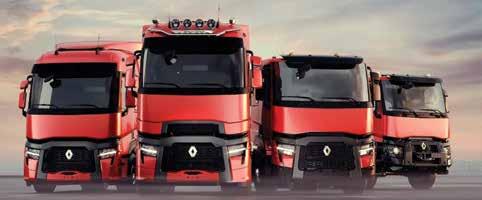
growing customer interest in lower emission solutions. New HGV registrations in Ireland fell in 2025 versus 2024, but investment in modern, efficient fleets continued, with particular momentum in sectors focused on cost control, compliance and decarbonisation.
Against this environment, demand for new trucks was more selective, with operators prioritising total cost of ownership, fuel efficiency and aftersales support rather than pure volume replacement.
Within this context, Renault Trucks Ireland outperformed the overall heavy truck trend, with stable or growing registrations and improved share in key vocational and fleet segments, reflecting a disciplined commercial strategy and strong dealer support.
The used HGV market remained active, with good quality Euro 6 trucks in particular demand as operators sought value and flexibility while deferring some new purchases.
Residual values for well specified, fuel efficient tractors and rigids held up relatively well, underpinning confidence in new vehicle investment for customers with clear longterm contracts.
With the wider Irish vehicle market growing modestly and economic activity expected to remain broadly positive, 2026 should see a flat to mildly improving HGV market versus 2025, assuming no major macroeconomic shocks. A gradual recovery in sectors such as construction, infrastructure and logistics, together with replacement of older Euro 5 and early Euro 6 vehicles, is likely to support replacement demand.
Overall, the expectation is for a more balanced market, with operators continuing to focus on efficiency and emissions, and volumes potentially edging back towards, but not significantly above, recent historic averages.
On the product side, there is a clear shift towards highe rspec tractor units and multiaxle rigids with advanced safety, connectivity and driver comfort features, reflecting both regulatory pressure and the ongoing driver shortage.
Interest in alternative drivetrains is growing from larger national and multinational fleets, particularly in urban distribution, regional logistics and municipal applications where duty cycles suit electrification.
Smaller and midsize hauliers remain predominantly diesel focused for now, but are increasingly asking for guidance on futureproof specifications and the practical steps towards lower carbon operations.
Sectorwise, growth is strongest among parcel, retail distribution, waste and recycling, and food logistics fleets, where uptime, urban access and corporate ESG commitments are key purchasing drivers.
These customers are placing more emphasis on telematics, preventive maintenance and full service contracts, areas where Renault Trucks and its Irish network are heavily invested.
There is also increasing demand for consultancy around route analysis, energy use and lifecycle cost modelling as fleets plan multiyear decarbonisation roadmaps.
The arrival of additional brands in the light and medium EV truck space is positive for overall awareness and helps normalise zero emission trucks in Irish fleets, but is unlikely to change the fundamentals of the heavy sector overnight.
In heavy distribution and regional haul, customers continue to look for proven products, strong local support and longterm parts and service backup, which favours established manufacturers with existing infrastructure.
Renault Trucks already has over 2,700 electric trucks in operation across Europe, covering more than 70 million kilometres, giving Irish operators access to realworld experience rather than pilotstage promises.
The key constraint for faster BEV adoption in Ireland remains charging and grid infrastructure, particularly for depot based overnight charging of heavy trucks and the need for a dedicated HDV public network on core freight corridors.
National plans under the Alternative Fuels Infrastructure Regulation (AFIR) envisage dedicated HDV charging and at least five hydrogen refuelling stations by 2030, but significant progress and clear support schemes are needed by 2027 to give haulage operators confidence.
Renault Trucks is working with energy partners, the wider Renault Trucks UK & Ireland organisation and its dealer network to support customers with depot charging design, energy planning and tailored transition strategies.
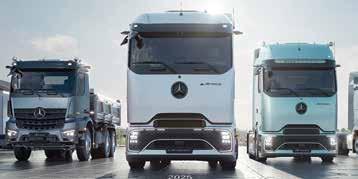
Fergus Conheady, Sales Manager for MercedesBenz Commercial Vehicles in Ireland outlined the state of play for the Daimler Truck & Bus brand: “From a MercedesBenz Commercial Vehicles perspective we have struggled with availability of some options which has impacted our 2025 results. Thankfully all appears to be back on track and a good order bank awaits for 2026. We forecast a modest growth/recovery in the market is expected at circa 5% growth.”
Mercedes-Benz Trucks has been one of the front-runners in the electrification transition, developing and improving its zero-emission drivetrain technology. “Electrification of the national fleet is occurring at a very slow rate due to lack of supporting infrastructure for users. The recent announcement that combustion engines will continue beyond 2035 is likely to have an impact across the entire motor industry and if anything, will in all likelihood slow down the introduction of EV’s to the truck sector.”
MAN Truck & Bus as a manufacturing group has been to the forefront on the electrification movement. Michael sees the emission free market centred towards the lighter commercial vehicle end. “The increase in light EV trucks is directly correlated to FMCG and industries focused in ‘final mile’ deliveries requesting and demanding this from their providers. The early adaptors to the EV CV world is driven be company policy and desire to create a more environmental conscious goal.”
Looking to the new year: “We are expecting an increase in construction sales due to new models coming on stream such as heavy duty 6x4 and tag-axle tractor-units and 8x2 & 10x4 rigid chassis becoming available for the first time. Since late 2025 we are offering 5-year warranty packages.”
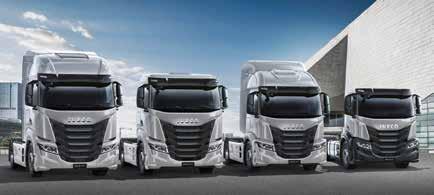
Iveco Commercial Vehicles, which marked its 50th anniversary last year, recorded good numbers last year across its truck and Daily medium commercial range of vans and bus chassis, which kept the main distributor Emerald Truck & Van and regional dealers busy.
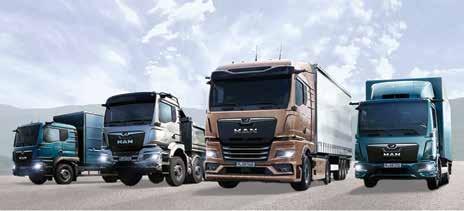
MAN Importers Ireland was singing from the same hymn sheet as its counterparts. Its truck market share was slightly back from 5.8% to 5.6% over the previous year, registering 11 less units. According to National Sales Manager Michael O’Dwyer these final figures are skewed by manufacturers being forced to register GSR1 stock they were carrying before the end of 2025. Some brands were worse affected by this than others, with MAN at the lower end of the scale. Also, he stated that 2024 performed better than predicted with a lot of trucks being bought ahead of schedule due to the more expensive GSR2 trucks coming online in 2025. 50% of the market continues to be tractor unit sales. Also 2025 sales were hit adversely by world economic factors, most notably US tariffs being announced in the peak buying time of the Spring which unsettled the market. Michael expects to see a further fall in sales during 2026 or for the market to break even at best.
According to Tyler Heatley, Brand Communications, Events & PR Manager at Iveco Limited: “All manufacturers are tackling the difficult market conditions brought on by a multitude of factors. IVECO isn’t immune to this, however, a new and strong product line-up certainly helped in an environment where Total Cost of Ownership (TCO) is critical for operators.
We are at a fascinating point in time where alternative fuels and new technologies are delivering capability without compromise. Ireland, along with the rest of Europe, is on a decarbonisation journey and so uptake of these vehicle will likely increase.
As mentioned, alternative fuel vehicles are proving their ability to dramatically reduce emissions versus their conventional counterparts. Infrastructure is key, but CNG is generating a lot of interest as a viable alternative – delivering a CO2 reduction of up to 95% versus an equivalent diesel truck – while electric for the right mission eliminates tailpipe emissions entirely. There is strong interest from customers throughout our range of alternative fuelled vehicles ranging from 2.8 tonnes to 44 tonnes.
Competition helps drive innovation, and innovation has always been a core part of IVECO DNA. We keenly observe new competition, but the two things many lack is experience and heritage. Heritage means a lot for some buyers in terms of what a brand means to them, while the experience of providing the support commercial vehicle demand is essential.
Text : Jarlath Sweeney – editor@fleet.ie
Continuing our review from the last issue of Solutrans 2025, featured here are some more of the notable exhibits from leading brands across the CV sector at the biennial show held in Lyon, France.
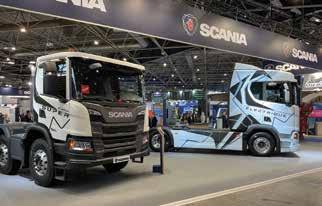
A number of examples from the famed Swedish manufacturer were to be seen all round the halls. On its main stand, Scania highlighted its latest innovations in sustainable transport, including alternative powertrains and advanced digital tools. Showcased as well were new heavy-duty models like the Scania 390 PB8X4HZ 2026 and the powerful V8s featured in walkaround, reinforcing their commitment to the energy transition. Overall it was a demonstration of Scania’s expertise in electric, hydrogen, and efficient diesel solutions, aligning with the show’s theme of decarbonization.
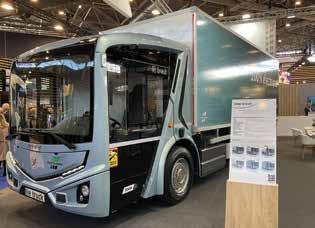
More familiar for its bus and coach building products, Irizar debuted a two axle version of its new generation Irizar ie electric truck, showcased with a refrigerated delivery body from the French client Groupe Pomona.
The design, initially presented at Solutrans 2023, has since undergone weight, consumption, and range improvements, and has been technically updated to meet all the latest legal requirements of the GSR2, like ADDW (Advanced Driver Drowsiness Warning).
The new 6x2 version is up to 2,000 kg lighter and around 1,400 kg lighter in 4x2 configuration. That can be seen in a significant reduction of up to 18% in energy consumption and emissions, as well as a notable improvement in the TCO for operators or end clients. This vehicle has third generation
batteries from the Group with higher energy density, providing for more onboard energy with less volume and weight. That makes possible a range of up to 400 km, depending on the use.
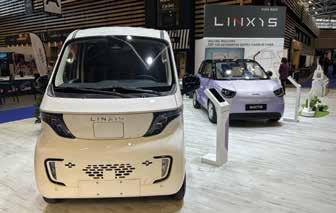
Although Wuling did not have a specific presence at Solutrans, the Chinese manufacturer owned by Guangxi Automobile Group announced LINXYS, its new brand dedicated to new energy commercial vehicles. Models include the LINXYS Gold Pickup, available in two trims and featuring a hybrid system. Representatives noted that the new division was formed in 2021 and offers sub-3.5t commercials compliant with European Type Approval, such as the G050-L pictured.
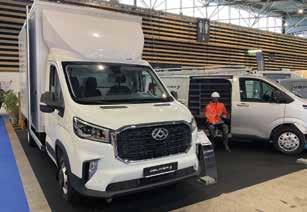
Among the line-up from the progressive Chinese brand was the eTERRON its all-electric all-wheel-drive pick-up truck that combines power, comfort, and versatility. With two electric motors, it delivers 325 kW (442 hp), all-wheel drive, and a 0-100 km/h acceleration time of 5.8 seconds. Its 102 kWh battery pack charges from 20% to 80% in 40 minutes and provides a WLTP range of up to 430 km. With a 620 kg payload, 3.5 t towing capacity, and a 236 litre frunk, it combines robustness and practicality. Premium features include massage and ventilated seats, adjustable air suspension, over 20 storage compartments, and a V2L function to power external devices.
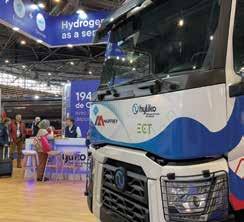
Hyliko was a key participant at the show, featuring its hydrogen solutions for heavy goods vehicles (HGVs), including unveiling the second generation of its fuel-cell retrofit trucks. The French company presented its turn-key hydrogen services, demonstrating its commitment to decarbonisation with a focus on retrofitting existing fleets and providing infrastructure support. Converting HGVs to hydrogen power is its forte, including providing the associated infrastructure to support such conversions.
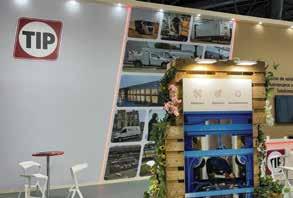
TIP (Trailer and Intermodal Products), the pan-European trailer leasing and contract hire specialist, unveiled its revolutionary electric reefer trailer. The integrates solar, battery, and kinetic energy for zero-emission transport, demonstrating TIP’s commitment to sustainable temperature-controlled logistics. This zero-emission cold chain solution also aligned nicely with SOLUTRANS’ themes of energy transition and industry innovation.
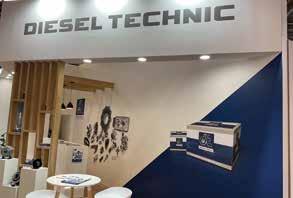
In 2025 Diesel Technic once again demonstrated its global reach and strong industry presence by participating in key trade fairs across Europe and South America. With DT Spare Parts
and the Parts Specialists team, the company connected with professionals, providing valuable opportunities for networking, featuring product innovations, and strengthening partnerships—especially with the spotlight on the Premium Shop and the newly established location at Janzé, near Rennes. The modern facility strengthened logistics operations and provided additional space for future growth, reinforcing Diesel Technic’s long-term commitment to the French market.
The German company is already preparing for the upcoming trade fair season—ready to build on this momentum and continue driving innovation in the automotive aftermarket.
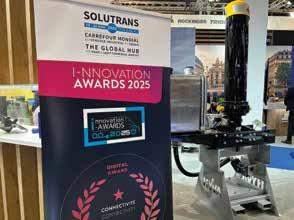
Hyva’s Digital Tipping Solution (DTS) was among the prize winners at the Solutrans Innovation Awards 2025.
This recognition highlights Hyva’s continued commitment to delivering safer, smarter, and more connected tipping operations for the global transport industry.
The award acknowledges the impact of DTS in bringing digital intelligence to tipping operations, empowering drivers and fleet managers with technology that enhances safety, productivity, and data-driven decision-making.
This innovative digital solution connects drivers and fleet managers through real-time guidance and cloud-based analytics.
For drivers, the DTS Guide System provides real-time operational support, improving tipping safety and reducing the risk of accidents or inefficiencies. For fleet managers, the cloud-based DTS platform delivers performance data and actionable insights that support informed decision-making and improved fleet productivity.

On show in its homeland was the new MICHELIN X Works 2 range of heavy-duty tyres set to meet the needs of construction and waste management fleets by combining durability, robustness, traction, retreadability and energy efficiency. The
tyre is the first to obtain a B rating for rolling resistance on the steering axle, thereby reduceing fuel consumption.
Featuring OPTICOIL and DURACOIL technologies, up to 25% more mileage on the drive axle is offered compared to the previous generation, while guaranteeing traction and resistance to damage, as certified by the DEKRA test. With a load index increased to 8.5T in single mounting, it also meets the requirements of heavier electric vehicles.
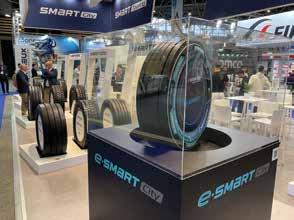
Hankook tyres had a major presence in Lyon, with its latest truck and bus developments focusing on innovation, sustainability (SmartLife concept, featuring regroovable, retreadable tyres), and fleet solutions. Alongside the SmartFlex range (AL51 steering/all-position, DL51 drive axle), designed for hybrid regional/long-distance use, was its other brand Laufenn, with products like the LF95 trailer and LZ22 drive tires, offering value for cost-conscious fleets. Hankook is a premium original equipment (OEM) supplier for major manufacturers, such as MAN, Scania and Mercedes-Benz.
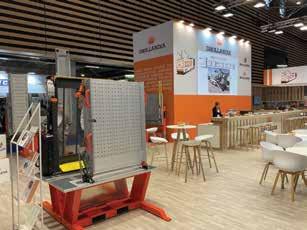
Dhollandia tail-lifts facilitate loading and unloading of light to medium to heavy duty commercial vehicles, with lift capacities ranging from 150 to 32,000 kg.
Founded in 1968 in Belgium, and with more than 50 years of experience, Dhollandia is now Europe’s No.1 tail-lift manufacturer, with production in excess of 75,000 units per year and more than 1,000,000 units sold since its foundation. It has production sites in 5 countries, with a professional network of Dhollandia Area Sales & Service Centres (Europe) and independent distributors (outside Europe) in 6 continents, and more than 80 countries worldwide.
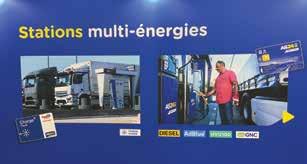
AS 24 was a key exhibitor outlining solutions for fuel, tolls, VAT recovery, and new energy options for fleets, while providing a platform for discussions on energy transition for transport professionals.
Its parent company, TotalEnergies, is focused heavily on the energy transition for commercial vehicles, playing a significant role as an essential link for electrification and alternative fuels for everyone from OEMs (Original Equipment Manufacturers) to body builders, as they work towards greener transport.
Vincent Passot, Charging Systems Manager, lead the presentations on new energy solutions for HGVs and LCVs alongside major manufacturers like Renault Trucks and Stellantis ProOne LCVs. The seminar highlighted electric, hydrogen, and retrofitting solutions, with TotalEnergies positioned as a key player supporting the sector’s move to zero-emission transport.

Geotab’s participation was part of a strategic approach aimed at strengthening its position as a world leader in telematics applied to industrial and commercial vehicle fleets. Recognized for its ability to transform fleet management through the intelligent use of data, Geotab supports road transport professionals in their daily challenges: cost reduction, improved safety, optimized fleet operations, and accelerating the energy transition.
Present in numerous countries and active in all sectors of road and urban transport, Geotab presented its vision of more sustainable and efficient professional mobility. The Canadian company is committed to demonstrating how on-board telematics and predictive analytics can address the current challenges faced by transport companies, whether it be reducing emissions, extending the lifespan of commercial vehicles, or maximizing operational profitability.
Geotab’s presence also provided an opportunity to meet directly with decision-makers, fleet managers, and key players in the sector. Through personalized discussions and live demonstrations of its wide range of products, the company showed how its solutions can be adapted to all types of fleets, from long-haul trucks to commercial vehicles for urban distribution, as well as urban and intercity passenger transport.
Text & Photos : Jarlath Sweeney – editor@fleet.ie
Road transport operators’ interest in Battery Electric trucks (BEV’s) is currently weak, with only thirteen emission-free heavy duty vehicles registered in Ireland last year. Why? A number of factors – overall purchase price, the lack of sufficient power infrastructure for charging and the cost of implementing such facilities are cited, with many expressing concern that the rapid development of said products could mean that their electric truck would be outdated within a few years.
On the plus side, the truck manufacturers have extended the range distance and weight capacity capabilities of their BEV products, and are working towards parity with diesel vehicles with regards to total cost of operation. Ireland, due to its motorway and road network is suitable for cross-country runs in electric commercial vehicle, but the charging facilities need to be in-situ, if operators are to realistically consider BEVs as an alternative to the diesel counterparts.
As stated in our Trailer market review in Handling Network, “the conversation is increasingly about whole combinations rather than tractor-units alone. Larger fleets in particular are exploring how trailer specification can support decarbonisation and energy efficiency, including the role of e-axles, electric refrigeration and weight optimised designs.”
“Without the substantial grants this segment would appear to be of limited interest for now, so the commerciality of BEVS in the heavy segment looks limited for now,” stated one brand representative that has developed and modified an electric HGV in recent years. A valid point, as the truck manufacturers have by and large based their electric products on existing models, although there are a few marques, mostly newcomers, entering the light commercial market with totally new platforms and body shells dedicated to electric propulsion.
Yes, there are Government grants
and tax incentives towards the purchase of electric commercial vehicles, but is it enough? In most cases, the transport operators customers are willing to pay the higher haulage rates (for now) to ensure and promote a seamless Green Supply Chain system. But the unit has to keep working as long as possible, in between battery reboots. A change of mindset for drivers in relation to how to drive an electric vehicle is also needed, although once they experience the silence and smoothness of travel, they will be won over pretty quickly.
DAF is one brand that in recent times has launched a broad range of configurations and specifications with its International Truck of the Year Award winning XF and XD Electrics, offering tractor-unit and rigid variations, with construction applications to be catered for in due course.
Leading brands Scania, Volvo, Mercedes-Benz, Renault Trucks, MAN and Iveco cover the majority of customer needs in this regard, not only with the product lines that are available, but with advice, assistance and finance packages for customers making the big transition. On the subject of finance, present potential customers are seeking a longer loan repayment package based on the initial cost of the vehicle to enable a more acceptable rate per month, with the only saving being less repair and maintenance bills.
Specific new additions to the Mercedes-Benz Actros electric line-up now include the eActros 400, directed towards the distribution sector, which fits below the eActros 600. Similarly, Iveco now has the S-eWay rigid becoming available.
On the electric side, Renault Trucks Ireland will expand availability of the ETech range in key distribution and municipal applications, and will prepare for the introduction of the latest long-haul ETech models revealed at recent European shows, providing signif-
To BEV (HGV) or not to BEV (HGV) – That is the Question!
icantly extended range and higher gross combination weights.
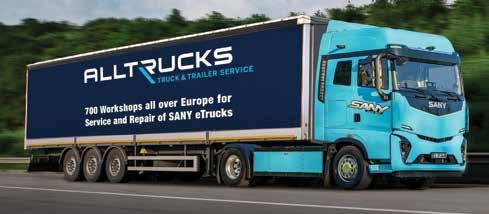
On the European front, Chinese manufacturer SANY, as reported in Fleet, is expanding its electric truck presence in Europe, launching the long-haul e263 4x2 tractor-unit in early 2026. It features a large 636kWh LFP battery for over 500km range, is fitted with 800V architecture and supports high-power charging. SANY is backed by Putzmeist er and Alltrucks for sales and extensive
service across Europe. It hope to build on its success in China (over 40,000 electric trucks in operation) and with its existing European construction vehicle presence (like iONTRON mixers) with this move, aiming to offer reliable, cost-effective electric solutions for logistics and construction with advanced tech like Megawatt Charging (MCS) on the pipeline.
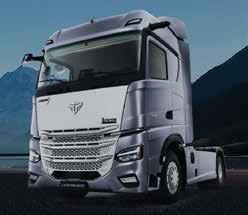
Country compatriot, electric truck maker SuperPanther is entering the European market by partnering with Steyr Automotive in Austria to locally produce models like the eTopas 600, aiming to meet EU emissions standards and compete with local brands. With advanced technology and availing of local manufacturing to avoid tariffs, SuperPanther aims to build a presence across Europe with support from partners like Alltrucks and ELMI Power for service and charging.
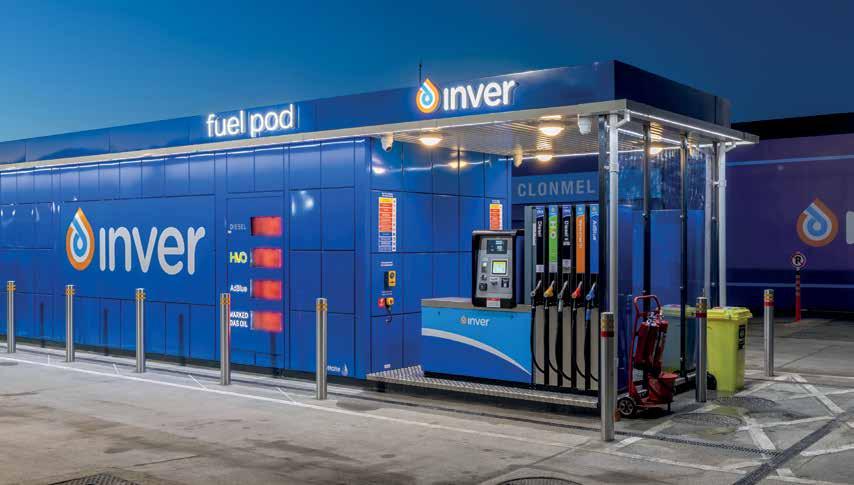




Compiled by Howard Knott – howard@fleet.ie
While ferry service schedules on the Dublin/Holyhead route returned to normal for the busy Christmas season, they moved back to the one vessel at a time operating method shortly afterwards. An emergency schedule was put in place to enable work on the mooring dolphin damaged in December 2024 to be completed. Bad weather during January has significantly slowed down work, while there was a complete stop to all sailings when Stena Line’s Stena Estrid struck the undamaged dolphin in early January. (As it happened that vessel was due to come off service after that sailing to go to drydock in Liverpool for annual maintenance refit).
On 14 January, Ken Skates MS, Cabinet Secretary for Transport & North Wales issued the report of Irish Sea Taskforce. This group had been established following the damage caused in Holyhead Port by Storm Darragh on 6 December 2024 and the need for all interested parties in the goods and passenger supply chains moving on the Irish Sea Central Corridor to keep traffic moving. The group consisted of Welsh and Irish Government Ministers and civil servants along with Stena Line Ports, Stena Line and Irish Ferries, together with the Irish Exporters Association and Welsh Local Authority representatives.
In his statement Ken Skates said: “The beginning of this month saw us drawing on our experiences and initiating some of the learnings of the taskforce sessions
following the brief closure of Holyhead Port but not having to stand the Task Force up formally.
Many of these recommendations will be included as part of a wider list of priorities contained within the ports and maritime, freight and logistics plan which we have committed to publish before the end of Government term in May 2026. The published plan will enable the next Government to clearly see what the priorities of the Irish Sea Task Force and the sector are, and be able to move them forward as they see fit. As part of that work, we have committed to establish a freight council. We see the Welsh Logistics Council as a natural follow on from this Task Force. The Council remit is likely to be wide ranging, therefore flexibility is key. For example, we hope to draw on the Council’s specific sectoral expertise once formed to monitor the progress of the recommendations agreed by the Irish Sea task force as part of their remit to consider ports, freight and logistics identified priorities in the published plan.
I have also approved contracted services to survey truck stop facilities as a priority action in support of the plan which will be published next year. This will support and inform the recommendations which includes resilience work on the A55, A494 and M4 corridors, progressing work on Menai Crossings resilience and an update on potential A55 improvements and work with regional transport partners to understand what further improvements
Back (l-r) Ian Davies, Stena Line; Gary Pritchard, Leader Anglesey County Council; Padraig Hughes, Advisor Irish Government; Andrew Sheen, Managing Director, Irish Ferries.
Front (l-r) William Priestley, Director Maritime Transport Division Irish Government; Minister Canney, Minister of State with responsibility for International and Road Transport, Logistics, Rail and Ports Irish Government; Rebecca Evans, Cabinet Secretary for Economy Energy and Planning Welsh Government; Ken Skates, Cabinet Secretary for Transport and North Wales Welsh Government and Denise McQuade, Consul General of Ireland in Cardiff.
could be made to A40/A477. We will look at refining and improving stacking arrangements in the event of issues at ports, and finally considering interim solutions to the welfare needs of drivers who are stranded or in stack arrangements because of port closures and the delivery of said welfare provision”.
The detailed Task Force recommendations include statements to the effect that the Welsh Government will:
n Continue to work with the UK Government Department for Transport’s Maritime Resilience Team to ensure the importance of Irish Sea routes are recognised.
n Seek concrete feedback from UK Government Agencies such as Border Force on any lessons learnt following the closure of the port of Holyhead and share as appropriate.
n Commit to meeting Government of Ireland transport officials on a six-monthly basis specifically to discuss ports.
n Through its Dublin presence it will maintain regular engagement with Ireland-based stakeholders including Irish Ferries and the Irish Exporters Association.
n Commit to working with partner agencies across UK and Ireland such as Liverpool City region, Transport Scotland, the N.I. Executive and the Irish Maritime Development Office to deliver a consistent and coherent response to the closure of any Irish Sea facing port with Ro-Ro facilities.

Stena Connecta, the second purpose-built freight vessel of two commissioned by Stena Line for the Irish Sea has gone into commercial service on the Belfast-Heysham route on 23 January.
The ro-ro newbuild joins its twin Stena ‘NewMax 2800’ class Stena Futura, which went into service on the BelfastHeysham service in September. Together they offer an additional 40% freight capacity on the increasingly popular trade route between Northern Ireland and Britain.
Stena Connecta, like its ‘New Max’ twin, was built for maximised freight capacity, with 2,848 lane metres across its 147-metre length. It uses a multi-hybrid propulsion system, enabling the use of battery power, biofuel, and methanol. Uniquely, Stena Connecta has two 28m x 4m Norsepower Rotor Sails, designed to enhance energy efficiency


and these could deliver up to 9% fuel savings on its Irish Sea route between Belfast and Heysham. These rotor sails are like those installed by CLdN on its ‘Brexit Buster’ ferry Delphine and have been under trials across the Line’s network for the last couple of years. Stena Futura is also ready for rotor sail installation.
Paul Grant, Stena Line Irish Sea North Trade Director, said: “Our significant investment in Stena Connecta and Stena Futura - more than £100m - demonstrates our strong confidence in the continued growth of the Irish Sea region and our commitment to strengthening trade and connectivity links.
In 2025 our Heysham–Belfast freight service recorded its highest volumes in the last 5 years, with 113,000 units being shipped. These vessels were commissioned in response to this increasing customer demand for increased freight capacity on this route.
Customer feedback on the recent introduction of Stena Futura has been extremely positive, and I have no doubt


Stena Connecta will be equally well received across our customer base. When fully operational, both vessels will offer a choice of up to 24 sailings per week on the increasingly popular Belfast-Heysham service. We are particularly pleased to introduce two of Stena Line’s most advanced vessels to the Irish Sea region, further enhancing Belfast’s significance as a key network business hub. These vessels represent the very latest in maritime technology and will not only play a crucial role in maintaining essential transport links in Ireland and the UK but also make a significant contribution to our sustainability goals of reducing CO₂ emissions by 30 percent by 2030,” added Paul.
The introduction of the two new vessels to the Belfast/Heysham route has enabled Stena to switch the sister ships Stena Hibernia and Stena Scotia to the Dublin/Liverpool route enabling the introduction there of a twice daily sailing schedule in each direction. Fifteen years ago, these vessels had maintained a similar Dublin/Liverpool schedule operating for DFDS.


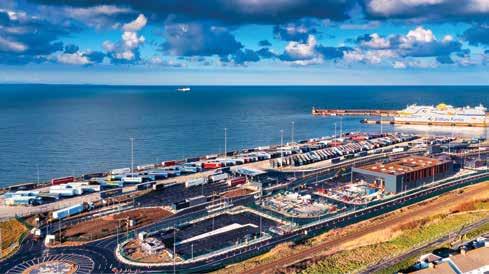
Iarnród Éireann, Port Authority for Rosslare Europort, has confirmed that it has lodged a planning application for the development of the Rosslare Offshore Renewable Energy Hub (Rosslare ORE Hub), a landmark new facility designed to support Ireland’s growing offshore wind industry.
The plans, submitted to An Coimisiún Pleanála, are a blueprint for the State’s largest ever purpose-built port facility dedicated to offshore renewable energy (ORE).
The €220 million development will be important both locally and nationally, creating 2,000 long-term jobs for the region, while also supporting the country’s renewable energy targets. Located at Rosslare Europort in County Wexford, the project will transform Rosslare Harbour into Ireland’s primary base for the construction, operation and maintenance of offshore wind farms in the Irish and Celtic Seas.
The development represents a key step in meeting Ireland’s renewable energy targets and in positioning the southeast region at the forefront of the new green economy. The government has committed to achieving at least 5GW of installed offshore wind capacity by 2030. Rosslare ORE Hub will have the potential to support the installation of approximately 0.5GW to 1GW of offshore wind capacity each year.
Subject to planning being granted and funding allocated, Iarnród Éireann aims to commence construction in early
2027, with delivery targeted for early 2029.
Recently appointed Chief Executive of Iarnród Éireann, Mary Considine, speaking at the launch announcement, said: “The Rosslare ORE Hub marks a once in a generation investment in Ireland’s clean energy future, integrating national transport and maritime infrastructure to unlock offshore wind potential and deliver sustainable growth for coastal communities. It will also be a significant boost for the Southeast, creating jobs in an emerging and vital industry, and becoming a crucial asset in Ireland’s energy transition journey.”
Spanning 80 hectares, the Rosslare ORE Hub will include two new heavy lift berths specifically designed for offshore renewable energy components, extensive areas for storage, marshalling and assembly and a new 64-berth, small boat harbour. The project also includes new access roads, utilities, environmental enhancements and facilities for local marine users, including the Rosslare Sea Scouts.
The planned works comprise 50 hectares of dredging, 32 hectares of land reclamation, and includes the creation of 19.7 hectares of new port lands capable of handling the largest wind turbine components. These facilities will enable Rosslare to serve multiple offshore wind projects underway in the Irish and Celtic Seas and deliver long-term economic and employment benefits to County Wexford and the southeast. The development design also seeks to meet the needs of Rosslare Europort’s growth as Ireland’s busiest continental ferry port and potential future developments as a lift-on/lift-off service port.
Glenn Carr, Director Commercial Business Units with Iarnród Éireann, Port Authority for Rosslare Europort, said: “Lodging planning for Rosslare’s
Iarnród
submits planning application for Ireland’s largest Offshore Renewable Energy Hub
ORE Hub is a significant milestone in the development of this critical piece of infrastructure that will support the development, growth and long-term operation of the offshore wind industry in Ireland’s Southeast region. Delivering this nationally significant infrastructure will support the continued expansion Rosslare Europort, strengthen the local economy, support local employment and deliver on national and EU policy priorities.”
The project, which is owned by Iarnród Éireann, has also been co-funded to planning stage by the EU Connecting Europe Facility (CEF).
Cessation of Houthi attacks prompts return to use of the Suez Canal
In October 2023, prior to the start of Houthi attacks on shipping transiting the Suez Canal, 583 vessels used the facility. In November 2025, following the cessation of attacks the number of vessels going through was down to 120. This number was expected to increase substantially following trials conducted by CMA CGM and others on vessels particularly focussed on shipping cargo from the Indian sub-continent to Mediterranean destinations, with CMA CGM announcing that one specific service would be committed to the routing from mid-January. However, the line changed its mind, due to overall geopolitical uncertainty and the traffic surge has been deferred. However most other lines are expressing interest in moving back to the using the Canal which is a seven to ten days shorter route than rounding the Cape.
These moves are fuelling freight rate reductions for cargo owners, reflecting the lower costs incurred by the lines and the reduction in vessels needed to operate each service.
Dublin based d’Amico Tankers has signed an order with Guangzhou Shipyard International in China for two medium-range product tanker vessels with an agreed price of $43.2 million each. The 40,000 deadweight tonne vessels are expected to be delivered to d’Amico Tankers in 2029. There is an option in the order for a purchase of two further similar vessels. The new vessels will join the existing fleet of twenty-nine tankers of varying sizes.
CLdN has announced the opening of a new Lo-Lo container shipping operation linking Rotterdam Distriport and Leixoes, Portugal. The company says that the introduction is in response to increasing demand for this route and will complement the two weekly return Ro-Ro sailing currently offered between Rotterdam/Zeebrugge and Leixoes. This introduction follows the pattern already deployed by CLdN on their Irish routes of backing up Ro-Ro vessels with Lo-Lo tonnage. The line says that operating this way minimises the CO2 emissions per unit carried.
CMA CGM Group is celebrating the arrival into its fleet of its 400th owned vessel, the CMA CGM Monte Cristo, which is the first of a series of six methanol powered vessels. The company also uses a further 250 vessels operated on
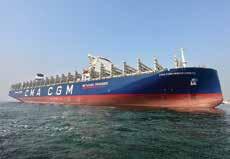
a charter basis from their owners. The new vessel has a capacity of 16,204 TEU, including up to 1,000 reefer containers and is 366 metres long. It will be deployed on a North Asia/Mediterranean service. CMA CGM is planning to operate
by 2031, around 200 dual fuel LNG and methanol container vessels that can be powered by low-carbon energy.
DP World has announced the 2024 financial results for its ferry subsidiaries operating in NW Europe. P & O European Ferries (Irish Sea) Ltd., which operates the Larne/Stranraer service reduced its loss to £1.6 million from £15.5 million in 2023. P & O North Sea Ferries Ltd. operating services linking the English east coast with Benelux posted a £ 8.9 million loss, compared with £1.9 million in 2023, amid growing margin pressure. That company faces severe competition from CLdN, DFDS and Stena on various routes. P & O Short Sea Ferries Ltd. recorded a £36.6 million loss, compared with a loss of £61.3 million in 2023, highlighting continued cost and regulatory pressure on the Dover/Calais route. The company competes with DFDs and Irish Ferries out of Dover and with Eurotunnel. Both P & O and Irish Ferries have reduced tonnage operating on the Dover/Calais route while operating a vessel sharing arrangement to give customers service frequency.
DP World has opened a ferry service linking Mina Rashid in UAE and Umm Qasr Port in Iraq. The vessel DP World Express which was previously named Norbank and had sailed the Dublin/ Liverpool route, is scheduled to complete

the voyage in 36 hours. She will transport up to 145 non-containerised, full trailer units with drivers travelling on board and will not only give a secure door-to-door solution between Dubai and Iraq, but will also facilitate onward transit to neighbouring countries, improve reliability and reduce cross-border complexities.
Larne Port has announced that the Isle of Man Steam Packet (IoMSP) will be operating a new service between Larne
and Douglas from 2026, using the Ro-Pax BEN-MY-CHREE. This route will provide a regular connection between the Isle of Man and Ireland, with three sailings a week in off-season and five a week in peak season.
“This development strengthens Larne Port’s position as a key gateway in the Irish Sea, offering enhanced travel and trade links that benefit businesses, communities, and tourism across the region. We look forward to working closely with the Steam Packet team to make this route a success and to deliver
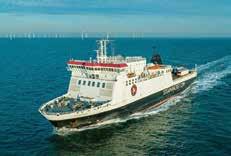
a seamless experience for passengers and freight customers alike”. Isle of Man Steam Packet M/D Brian Thomson said that the introduction of the Larne service reflects the company’s long-term commitment to growing travel and tourism across the Irish Sea. Use of the Ben-my-Chree will enable the company to offer enhanced freight links with the Isle of Man. The Mezeron Line weekly service linking Belfast and Douglas using a conventional vessel, will not be affected by the new IoMSP service and plans to continue its normal schedule.
IoMSP has also announced an upgrade of its Dublin/Douglas service using the Ben-my-Chree and other vessels and, again, enabling significantly more freight to be carried on a direct service to the Isle of Man instead of having to link with services through Liverpool or Heysham.
The Ben-my-Chree will sail these services from early summer 2026. She is presently on a four-month charter to Stena sailing mainly on the Rosslare/ Fishguard route and facilitating the switching around of vessels due to annual survey and maintenance requirements. Currently the vessel has a garage capacity of 1,235 metres and passenger capacity of 650.

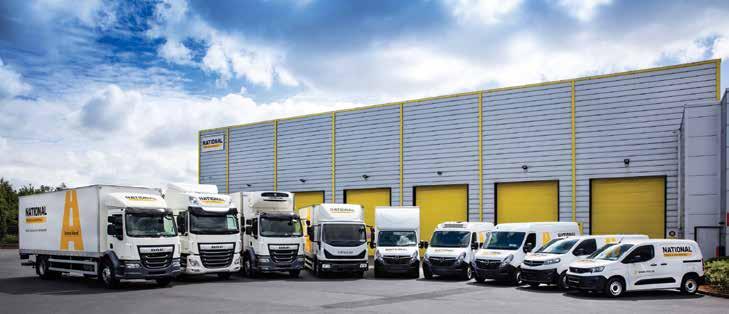
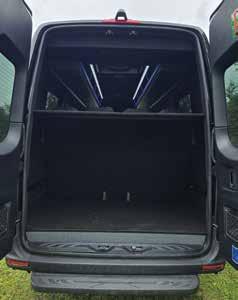
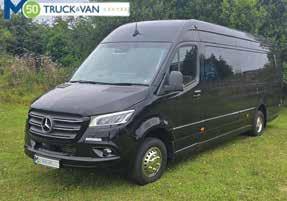
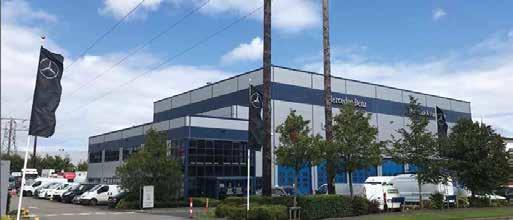
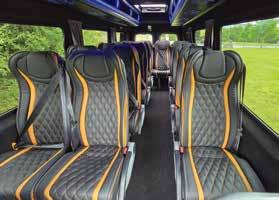
emerging technologies, and key industry challenges. Expert speakers will offer actionable insights to drive innovation and sustainability. Day three will focus on diversity, workforce development, talent retention, and inclusion – facilitating businesses to build a motivated, future-ready team.
Other topics discussed will be AI, cybersecurity, skills, vehicle maintenance, and tool theft, and the main stage will also see the launch of the SMMT’s latest Commercial Vehicle Report.
There will be contributions from companies, as well as representatives from the Department for Transport (DfT) and BVRLA.
The Technical Stage will host toolbox talks designed to engage drivers and fleet managers through interactive, hands-on sessions. With real-life case studies, live demonstrations, and insights from top innovators and manufacturers, it will deliver practical ideas and actionable solutions for implementation in organisations.
Located at the EV Café Village, the Decarbonisation Theatre will host a free-to-attend conference packed with expert insights on EV adoption, fleet transition, charging infrastructure, battery technology, and the Zero Emission Van Plan. This is designed to give businesses the knowledge and confidence to accelerate their electric journey.
The Future Fleet Arena will showcase the technologies shaping tomorrow’s transport. From autonomous systems and connected vehicles to AI-driven fleet management, next-generation fuels, and smart infrastructure, it will offer a first look at the innovations set to transform fleet operations.
Delivered in partnership with National Highways, the Driver Safety Theatre will have free sessions focused on road safety and driver wellbeing. Topics will include fatigue management, mental health, incident prevention, and compliance, providing both operators and drivers with practical strategies to stay safe and perform at their best.
New for 2026 is The Bus & Coach Expo – a dedicated event for the passenger transport industry. Co-located with the Commercial Vehicle Show, it will bring together operators, manufacturers, and suppliers from across the sector. With a strong line-up of exhibitors and thousands of industry professionals, it will also showcase the latest innovations in:
n Buses, coaches, minibuses, and accessible vehicles
n Telematics, route planning, and scheduling software
n EV charging, hydrogen refuelling, and depot infrastructure
n Workshop, garage, and fleet maintenance equipment
n Safety systems, accessibility technology, and regulatory compliance
Nick Davison, Event Director, said: “We’re thrilled to launch Bus & Coach Expo in 2026. This is not just another industry event, it’s a strategic new platform built for the challenges and opportunities ahead. With its co-location alongside the Commercial Vehicle Show, we’re delivering two powerhouse exhibitions in one, offering attendees more value, more connection, and more reasons to attend.”
Alongside the new Expo, The Bus & Coach Leaders Forum will bring together senior figures from across the passenger transport sector to discuss policy, innovation, fleet decarbonisation, and funding. This will offer valuable insights for those involved in the future of bus and coach services.
In this section of the show, located in Hall 4, visitors will be able to explore the newest advancements in electric, hydrogen, and alternative fuel-powered commercial vehicles. Operators
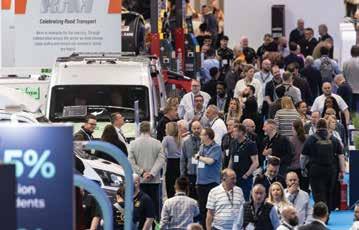
looking for battery-electric HGVs, hydrogen fuel cell trucks, or ultra-efficient hybrid powertrains will find the latest technology ready to hit the road.
Visitors will be able to test the latest vehicles in the safe and controlled environment of the Ride & Drive Area. This interactive feature is designed to showcase cutting-edge innovations in HGVs, LCVs, and alternative fuel vehicles, giving attendees the chance to experience the performance, comfort, and technology of these vehicles first-hand.
Whether comparing electric drivetrains, trialling advanced safety systems, or evaluating overall handling, attendees can gain valuable insights to support real-world purchasing and fleet decisions.
New for 2026, and positioned in the heart of Hall 4, the Collaboration Zone will bring together key government departments and leading industry associations as exhibitors, offering expert guidance and strategic support to attendees. There will be a central informal seating area for visitors and exhibitors to engage in meaningful conversations, spark new collaborations, and exchange knowledge on the challenges and opportunities shaping the road transport sector.
This year sees the return of a dedicated Workshop Zone at the show, for those looking to explore cutting-edge technologies or discover new suppliers.
This revitalised area will showcase the latest in garage and workshop equipment, tools, diagnostics, parts, and servicing solutions.
Home to leading suppliers and innovators, the zone will appeal to fleet engineers, maintenance professionals and decision-makers seeking to enhance workshop performance, safety, and efficiency. With garage workshop equipment and supplies among the top product interests for visitors, it is set to be a popular spot.
The Training Zone will appeal to people looking to upskill, enhance their qualifications, and stay compliant in the ever-evolving world of commercial driving.
Designed for HGV drivers, fleet managers, transport operators, as well as newcomers to the industry, this dedicated area will provide expert-led sessions and tailored resources to help professionals advance their careers and improve operational performance.
From the latest driver CPC updates and compliance insights to hands-on workshops in safety, sustainability, and efficiency, the Training Zone will bring practical knowledge straight to the show floor. It is a unique chance to learn directly from leading trainers and industry bodies, all under one roof.
Source: SMMT/Transport

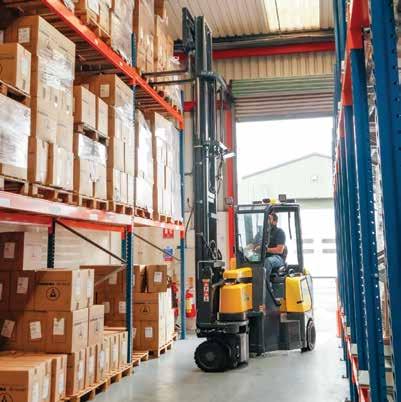
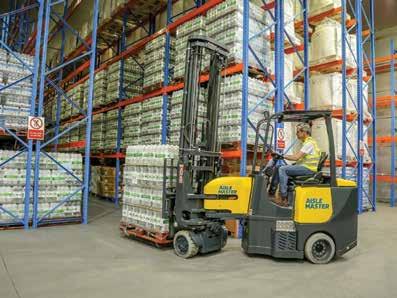
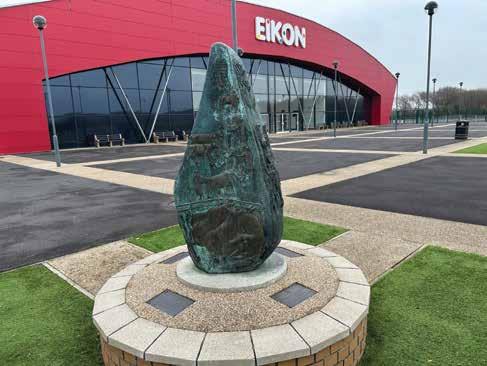
Lisburn is calling all road transport operators! The Eikon Exhibition Centre to be precise, as RTX Northern Ireland 2026 is set to make a strong debut this Spring, as it looks set to establish itself as a must-attend event for Commercial Vehicle owners and operators alike across the region.
Taking place on 15–16 April 2026 at the vast and most suitable facility at the Eikon Exhibition Centre, Lisburn, this brand-new business trade show will bring together the very best of the transport and logistics industries across extensive indoor and outdoor exhibition spaces.
Brought together by the organisers of award-winning and ultra-successful Road Transport Expo, in association with Export & Freight and Fleet Transport magazines, RTX Northern Ireland follows the proven “all about the truck” format – delivering everything needed to run, optimise and future-proof fleets, all from one venue.
A growing number of leading vehicle manufacturers and suppliers have already confirmed their attendance, highlighting the strong industry support behind the inaugural event.
Major OEMs confirmed include DAF, Mercedes-Benz, MAN, Renault Trucks, Volvo Trucks, Thompsons UK, Thermo King and Fruehauf trailers, all of whom will showcase a selection of their latest vehicles and innovations.
In addition, operators will have the opportunity to explore the latest in
RTX Northern Ireland 2026Set to make its debut this Spring
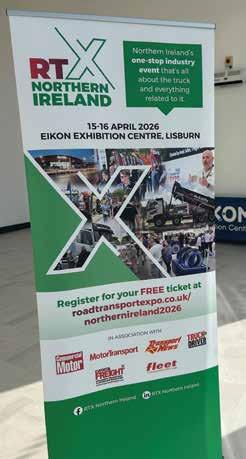
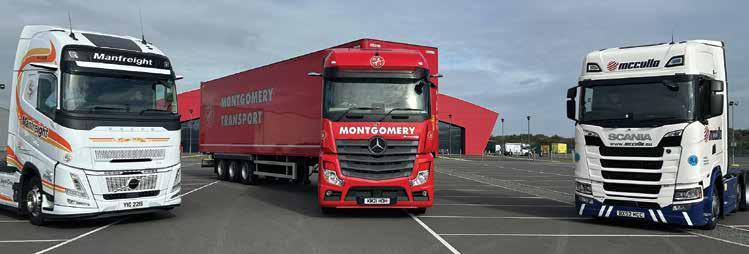
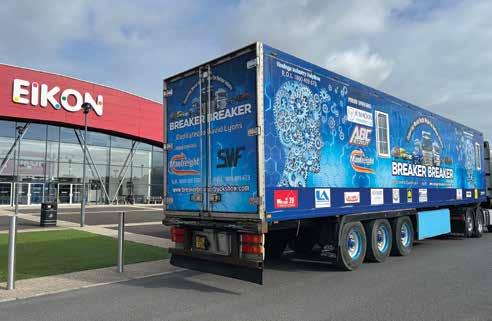
technology, tyres and equipment from a wide range of industry suppliers and dealerships. Exhibitors already signed up include Assured Performance Ireland, Brigade Electronics, Fastview360, Flowtech Ireland, Granco Trucks and Hankook Tyres, with many more expected to join in the coming weeks.
Alongside the exhibition, visitors can benefit from the Knowledge Zone, a two-day programme of expert-led sessions covering the issues that matter most to HGV operators. Topics will include compliance, skills and driver shortages, road safety and decarbonisation, providing valuable insight and practical guidance for fleet decision-makers.
For those keen to get hands-on, the Ride & Drive Experience will offer visitors the chance to test drive a selection of the newest vehicles on site (appropriate licence required).
Designed specifically with HGV & LCV fleet operators in mind, RTX Northern Ireland also provides a relaxed environment for informal networking, enabling attendees to connect with industry peers and build valuable new business relationships.
The event is organised by the team behind the established Road Transport Expo, held each summer in Warwickshire, England, and RTX Scotland, which launched successfully in Glasgow last year. The RTX portfolio will continue to
expand with the launch of RTX Ireland near Dublin in 2027.
“We are very much looking forward to bringing the popular RTX format to Northern Ireland this Spring and have been delighted with the industry support we’ve received,” said Vic Bunby, Show Director of RTX Northern Ireland.
RTX Northern Ireland takes place on 15–16 April at the Eikon Exhibition Centre, Lisburn. Entry is completely free for visitors. Register now at roadtransportexpo.co.uk/northernireland and join us.
About the Eikon Exhibition Centre Northern Ireland’s largest events campus Nestled in the heart of Lisburn, Northern Ireland, the Eikon Exhibition Centre stands as the premier destination for events of all sizes. Since opening in 2015, the Eikon Exhibition Centre has been at the forefront of providing exceptional facilities and services that cater to a diverse range of events, from large-scale trade shows and exhibitions to conferences and corporate gatherings. Spanning over 55 acres, the venue boasts over 10,600 square meters of flexible indoor space, complemented by extensive outdoor areas.
Conveniently located just minutes from the M1 motorway and under 30 minutes from two main regional airports and ferry ports, the Eikon Exhibition Centre is easily accessible from Belfast and Dublin, making it an ideal choice for
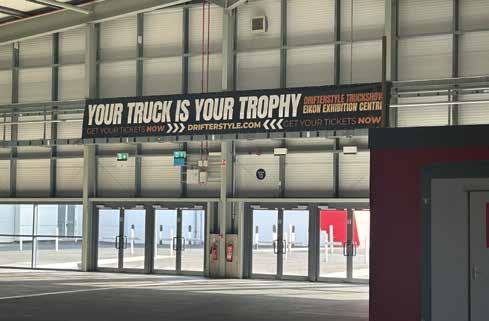
“As with all our RTX events, the show will provide an excellent mix of quality exhibitors, knowledgeable conference sessions and a relaxed networking environment.”
He added: “We can’t wait to welcome visitors in April, so please do register for your free ticket to join us.”
local, national, and international events. Ample on-site parking and excellent transport links provide hassle-free access for exhibitors and visitors alike.
Events previously held at the venue including Dubshed, Comic Con NI, National Balmoral Championships and Drifterstyle Truck Show.
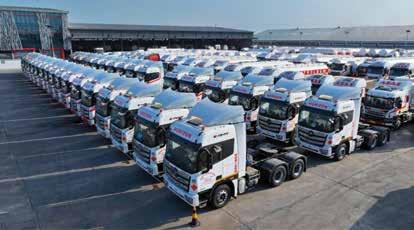
In the aftermath of the 9/11 terrorist attacks on the twin towers in New York, the world was horrified, nervous, even afraid of what might come next. This devastating incident was followed by economic nervousness. The big question was - would this escalate to world recession? One leading business stakeholder stood out in his view of where things were going - Michael O’Leary of Ryanair, who stated that if airlines made fares cheap enough, provided good value, reliability and service, people would return to the sky and fly again. As everyone now knows, he was right…and they did.
When the first Japanese cars came to Ireland, there was some people sceptical about them in terms of quality, value and general durability. However here we had an extra dimension compared to other European Countries; a Japanese truck had arrived sometime earlier. The HINO model range was imported and assembled by Pino Harris on the Long Mile Road, Dublin. There was inevitably some scepticism from the operator side initially, but as Pino Harris was well regarded in the industry, it was a big help.
At that time there were often long delays ordering and getting a new truck.
We
Pino’s philosophy was to have a selection of Hinos available ex-stock, all spec’d up and ready to work. Owners, drivers and mechanics fell in love with them. Hinos were robust and adaptable, in the construction sector especially and also in general haulage. Although some operators did venture into Europe with them, they were only sold in Ireland and the UK. so that was the exception rather than the rule. The lack of a dealer network was the main reason, but not a fault of the product. Its success as a new truck to the market was down to three things that Michael O Leary coined many years later, good value, reliability and service. Even with the passage of time those three features still hold.
So, look at the changes coming in commercial vehicle market now. Covid has had an impact on many parts of our economy and the activities within it. Supply chain interruption still has an effect. It’s been more pronounced in the Bus & Coach sector where supply of European products almost halted in the past few years. While there has been some improvement in the past two years, supply is still a challenge.
Manufacturers are also caught up in the battle to reduce emissions and bring zero emission vehicles to the market. A gap has emerged in the bus and coach market, and it is currently being filled by Chinese and Turkish manufacturers.
Turkish product has been around for a while, and many European manufacturers have been using Turkey as a base for assembly and manufacture. More recently their own national brands are being made available in Europe. Chinese buses are more recent arrivals but from humble beginnings in terms of numbers, they are growing. At the Busworld Brussels show last autumn
there were over twenty Chinese manufacturers displaying different types of large passenger transport vehicles. They were all ready to deliver into Europe and made no secret of the fact that they were looking for distributors and dealers in all countries, including Ireland, for a range of diesel and electric buses.
European manufacturers have not been saying much about the new competition from the East, although one industry insider, with many years’ experiences in the business did said publicly: “Many years ago when Spain came into the EU first, we were told that the threat from Spanish body builders could put many of the existing manufacturers out of business. Clearly that did not happen, they just became part of the market. Perhaps it will be the same with the Chinese”. Maybe that the way it will be.
So, what about the heavy truck market? Will we see significant changes, new entrants, different ways of doing business. We hear of Maxus, well known to us in the van side, possibly entering the HGV market, as will BYD, then there are others in the wings such as Foton and JAC, big names in the business.
Will the European Union move to protect its manufacturers? They don’t seem to be doing much other than dictating about new climate change targets and timelines. Change is always a feature of business, predicting it is not a science. For example, if someone told you five years ago that the Irish importer of Mercedes-Benz cars, vans and trucks now would be importing and distributing Chinese cars by 2025, it would have raised an eyebrow, I think. Care to make a prediction for 2030?
Text: Sean Murtagh – sean@fleet.ie
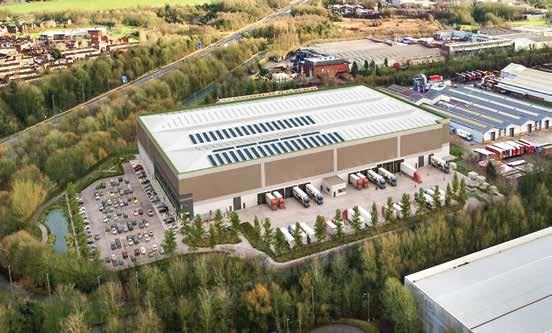
The heading for this article is the title of a financial training course devised and presented to more than 1,000 delegates from every sector of road transport over a two year period in 1999 and 2000. Twenty five plus years later, what financial changes have occurred in our industry since then?
Looking back through the quarter of a century there was a ready supply of labour. Employees actually wanted a job in transport, firms were smaller and the vast majority were family owned and run. Competition was fierce, but having survived the recession of the 1980s, all the firms were run by hardworking individuals and some had exceptional talent. The course was heavily subsidised by State funding to assist and develop the logistics sector so that there was a viable and sustainable industry to service what was to be a booming economy.
Move forward to 2026 and there are far fewer transport firms now, but those that exist are larger, more specialist and offer world class services to industries that range from food distribution (now controlled by a small number of players), to a totally altered agricultural industry
and a booming indigenous and multi-national manufacturing base. Irish transport firms have survived but it wasn’t the assistance or support from Government that pulled them through but rather the ingenuity of owners who embraced technology and realised that the more specialised and professional they became, the stronger a bottom line, especially when negotiating rate increases or seeking new contracts.
It’s rare these days for customers’ management teams to outperform the client in their knowledge of services required and the most cost efficient manner to carry this out.
Unfortunately in 2026 there are huge financial pressures again bearing down on transport firms as wage inflation in transport far outstrips the national average, meaning truck and trailer units are sitting in yards eating into the profit line. How can we be surprised when all our indigenous youth, regardless of ability, are going to third level? The high esteem and respect that was bestowed on logistic providers during Covid has long gone. Social acceptance of long hours and hard work has diminished, with most people nowadays having expectations of a balanced lifestyle which actually means work less. In theory, it could actually work but the fundamental flaw is the State’s inability or ignorance to allow much needed logistics workers into Ireland quickly to address a blatant need. If it’s not addressed, soon we will be back to
Text: Donal Dempsey – donal@fleet.ie
square one with a low margin industry and many firms closing their doors.
It’s in the country’s interest to support a progressive and developing transport industry, an industry that can quickly adapt to its current and future customer needs. To do this the transport industry needs support and assistance NOT hurdles in accessing staff. It needs the Road Safety Authority (RSA) whose job is more important than ever to work with the industry in a meaningful way so that both the actions of logistics providers can actually improve safety on our roads, reduce insurance costs and bring staff safely home.
The current trajectory of the road transport industry, with hauliers increasing in size thereby gaining economies of scale, means that many working in it have reached burnout. It’s worrying when less than 20 percent have family willing to be future owners and managers of the business. This means that there is a real risk of Ireland’s logistics industry being controlled by a few multi-nationals. Burnout was never a risk in transport previously as operators worked hard, doing something they loved. Now it’s a businesses tormented with labour shortage and wage inflation, and costly bureaucracy that does not work, in addition to reduced margins if rate increases and productivity is not met. It puts most hauliers on a treadmill that is speeding up, one that they cannot get off.

On RTE Radio’s Morning Ireland recently, Green Party ViceChairman, Ciaran Cuffe stated that he almost choked over his porridge on hearing that a District Court Judge had described cyclists in Dublin as “a nightmare”, and went on to ask, no doubt with a touch of irony, whether or not the Judge expected cyclists to be dressed up like Christmas trees. His opinion certainly got a discussion going.
In the Dublin Circuit Court Justice James O’Donohue, in ruling on a case in which a cyclist injured in a collision with a motor cyclist had sought an increased level of damages, had decided that the original award of €50,000 was excessive and that the appropriate figure should be €10,000. It seemed that apart from a general concern about the behaviour of many cyclists on the city streets, he accepted that in this case the evidence from the motorcyclist’s dash-cam was quite clear that the cyclist had not acted with due care and concern.
Ciaran Cuffe’s comments were the first of what seemed like a deluge of similar commentary on the plight of the cycling community in the face of hostility from motor vehicle drivers and others.
From Where I’m Sitting – Howard Knott
‘Cyclists dressed up like Christmas Trees’ comments
As I see it, they are all missing the point entirely. I see the negative commentary more as a criticism of a group of road users who fail to understand that they do have a responsibility to cycle in a safe manner, and that by doing so they substantially reduce the risk of accidents and injury to themselves and to other road users.
Surely it is in the interests of everyone that the cycling lobby groups would actively engage in efforts to improve road safety. I’m not saying that cyclists should be dressed up like Christmas Trees but that that they should do everything possible to ensure that they are always visible to all other road users. I don’t see why cyclists should not wear high visibility jackets and display lights along with having a bell or hooter purely in the interests of their own safety. Of course, traffic lights should be obeyed. Comments to the effect that it’s okay to break them because some motorists also do so should be actively discouraged by the lobby groups.
Thinking also about vehicles turning left at lights with cyclists coming up inside them, that must be a “no-no”. I haven’t checked this but I wonder if trucks and buses equipped with rear view cameras rather than mirrors can spot cyclists between them and pavements?
Away from the streets of Dublin and out on the highways and byways I suspect that most cycling is like a leisure activity and there is a strong temptation
to cycle two abreast and in groups. Doing this shows scant consideration for the car, van, truck or bus that travels the same road and generally at a higher speed.
Whatever excuse that there might be for taking up perhaps 4 metres of road width on open wide roads, there is no excuse for doing so where such practice forces a motorist attempting to pass over the continuous white line in the middle of the road.
I’m all for the development of dedicated cycle - and e-scooter –dedicated lanes, particularly ones that are built away from regular roadways. But I do wonder if, at a time when State agencies should be saving cash, as we lurch forward into a President Donald Trump world, one in which the massive Corporation Tax receipts that the Irish Government has been receiving from American owned companies might suddenly come to a halt, these cycle lane building projects might be reviewed and cheaper options like restricting all traffic on a specific piece of roadway to 30 km/h might not be at least a partial answer?
I would conclude by saying that this whole discussion is too important for any group of road users to be characterised as “goodies” or “baddies”. Lives are lost and more people are being injured. Preventing more of that is what it is all about.




Any Task, anytime. Discover vans by Mercedes-Benz. Available with our convenient Service plan and three-year Warranty. While you focus on your business, we take care of the rest.
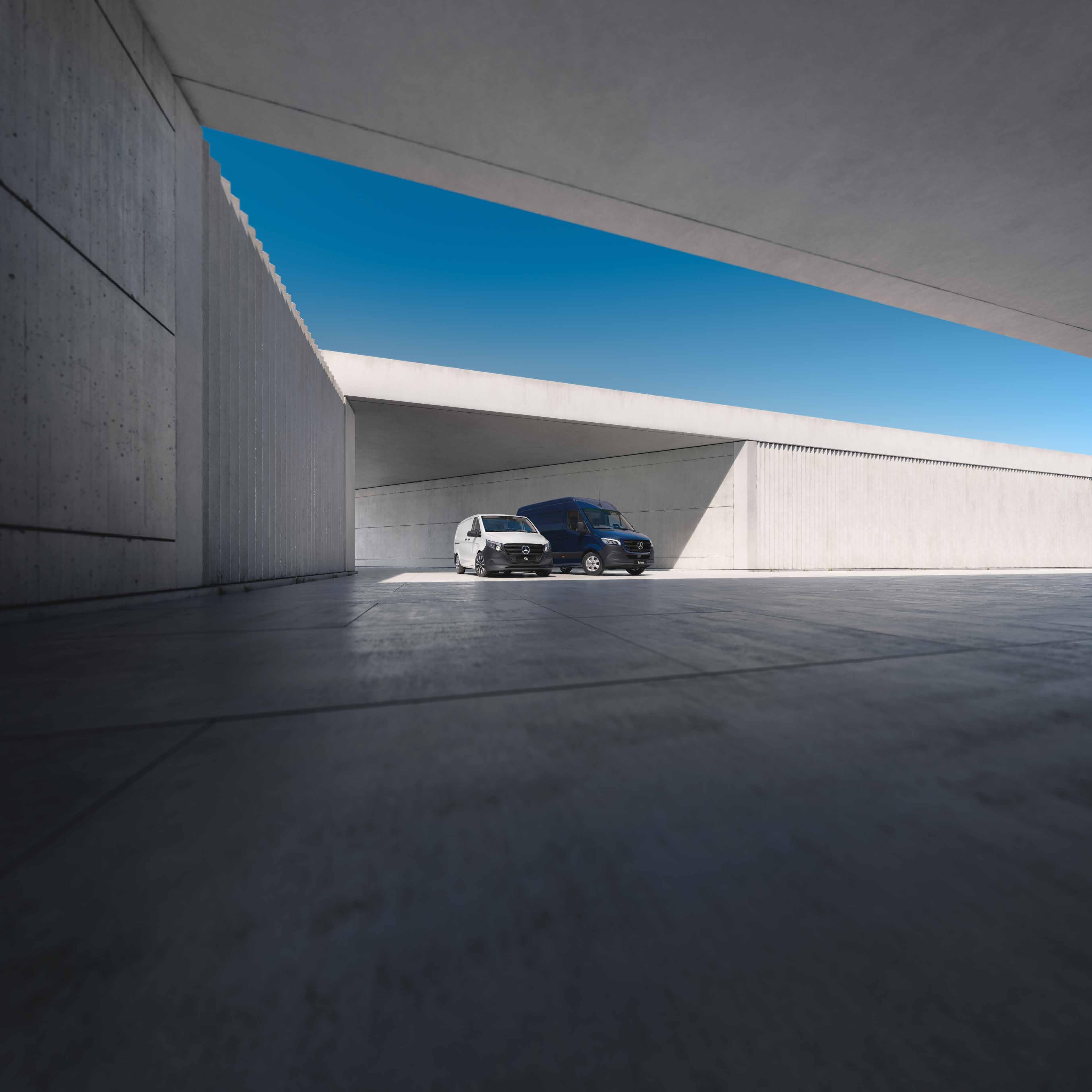
Learn more





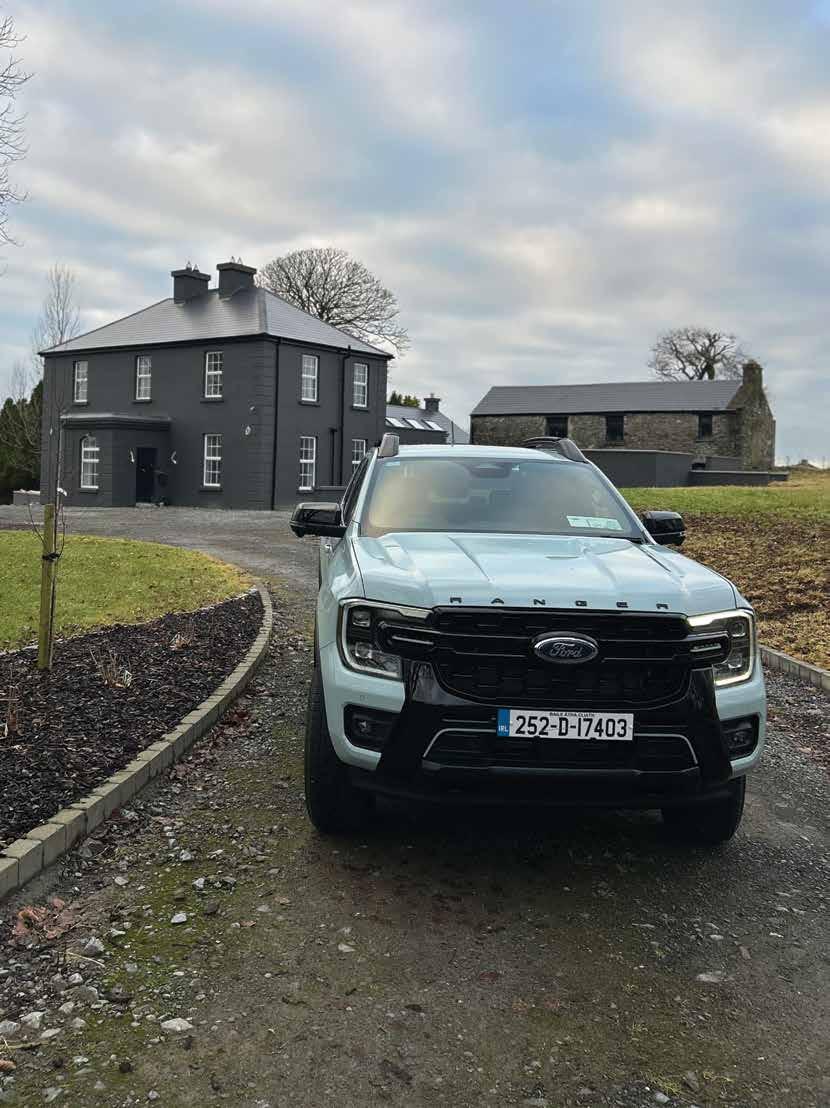
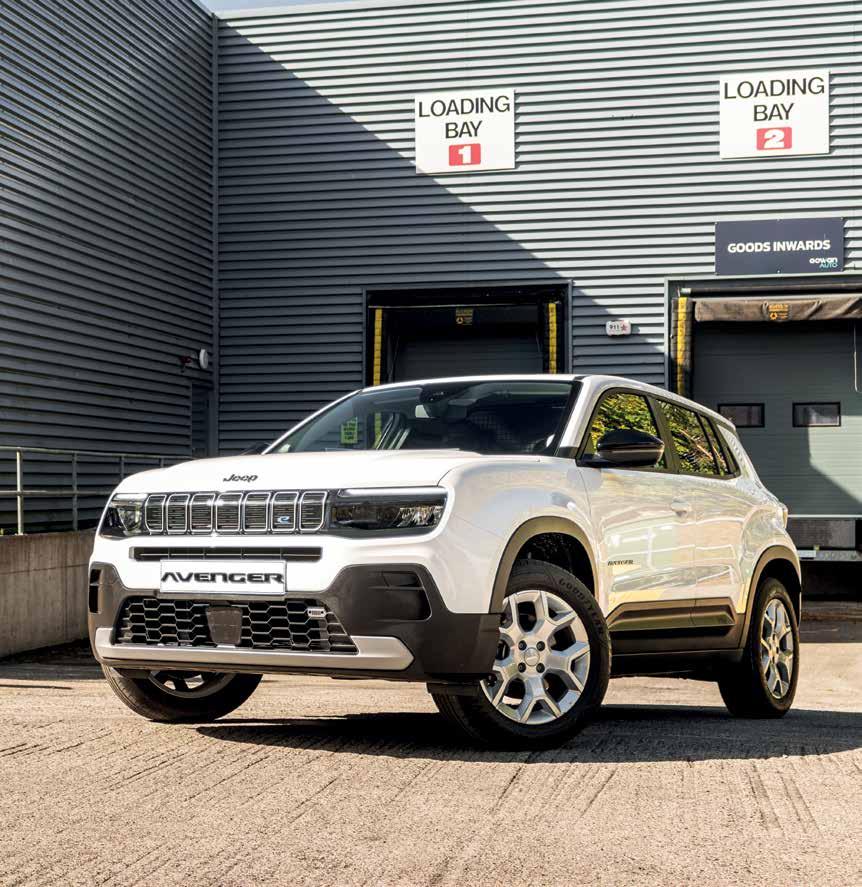
*Fuel consumption Jeep Avenger e-Hybrid range: 4.9-5.0 /100 km; CO2 emissions: 111-114g/km. Electric energy consumption Jeep Avenger Full-Electric range (kWh/100km): 15.4-15. 7 kWh/100km; CO2 emissions: 0 g/ km. Autonomy Jeep. Avenger Full-Electric range: 394-400km. Type approval values determined on the basis of the WLTP combined cycle. Values indicated for comparative purposes. Important: the actual electric energy consumption values may be strongly different and may vary depending upon the conditions of use and on various factors such as: options, frequency of electric recharge per kilometres travelled, ambient temperature, driving style, speed, total weight, use of certain equipment (air conditioning, heating, radio, navigation, lights etc.), tyre types and conditions, road conditions, external climatic conditions, etc. Jeep. is a registered trademark of FCA US LLC.


Fleet Van & Utility Magazine, D’Alton Street, Claremorris, County Mayo, Ireland.
Tel: +353 (0)94 9372819
Email: enquiries@fleet.ie
Printed in Ireland
Editor: Jarlath Sweeney

Contributors: Cathal Doyle, Stefan Bowman (IVOTY)
Photography: Jarlath Sweeney, Cathal Doyle
Administration: Orla Sweeney
Advertising: Mary Morrissey,
Design: Crackerjack Design House
Disclaimer: Fleet Van&Utility Magazine management can accept no responsibility for the accuracy of contributed articles or statements appearing in this magazine and any views or opinions expressed are not necessarily those of Fleet Transport management, save where otherwise indicated. No responsibility for loss or distress occasioned to any person acting or refraining from acting as a result of the material in this publication can be accepted by the authors, contributors, Editors or publishers. The Editor reserves the right to make publishing decisions on any advertisements or editorial article submitted to the magazine and to refuse publication or to edit any editorial material as seems appropriate to

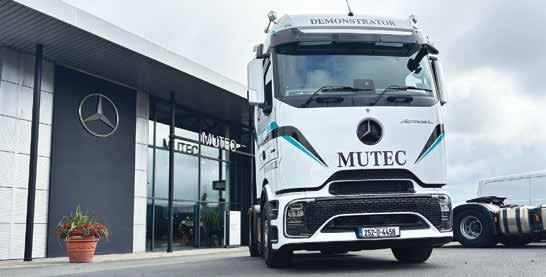
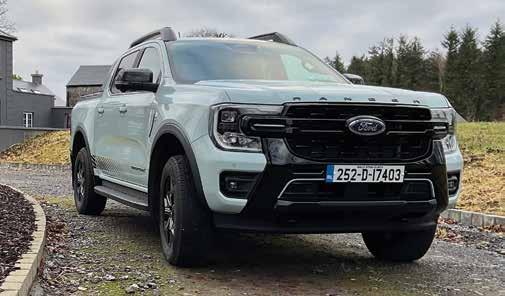
To coin a phrase from a famous horror-thriller movie involving a hungry, killer shark, Ford Pro needs to install a bigger trophy cabinet to house the growing list of accolades its best-selling Ranger Pick-up is continually winning.
Its most recent achievement was for the new Ranger PHEV which scored top marks in the International Pick-up Award (IPUA) 2026 competition, held in Bulgaria, with the trophy subsequently presented to the winning manufacturer at Solutrans 2025, in Lyon, France. The Ford Ranger pick-up has now scooped this prestigious prize on no fewer than four occasions since the IPUA Award was introduced in 2009.
Full details of this biennial group test session were featured in the November edition of Fleet Transport’s Fleet Van & Utility supplement.
The new Ranger PHEV - plug in hybrid, was up against strong opposition in the shape of the INEOS Grenadier Quartermaster and a number of Chinese newcomer models, with contenders put through their paces during the group test days, undertaken by members of the International Van of the Year (IVOTY) jury.
In their post-test submissions, IVOTY & IPUA jury members outlined their reasons for why the Ranger took the honours, A sample of that feedback is featured as follows:
“The Ranger invests the capital accumulated thanks to its successes not only to grow the variety of its range, but also keeping the segment alive with the best possible alternative to diesel for a pick-up.”
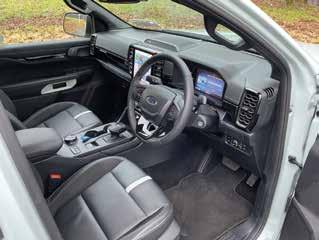
they deliver impressive combined power and torque, with the added advantage of electric-only driving for shorter trips or urban areas. Ford projects an electric-only range of around 45 kilometres, which
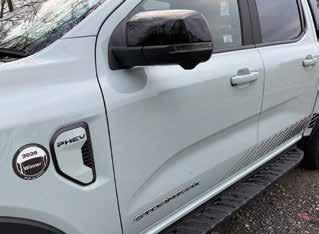
The Ford Ranger Plug-In Hybrid represents a major step forward in how working and leisure vehicles can combine power, practicality, and sustainability. It’s the first Ranger to feature plug-in hybrid technology, yet it remains unmistakably a Ranger – robust, capable, and engineered for real-world toughness. And it feels just like a “regular” Ranger.
“At its heart sits Ford’s proven 2.3-litre EcoBoost petrol engine paired with an electric motor and rechargeable battery pack. Together,
covers the daily commutes and job-site runs that make up much of a pick-up’s routine mileage. This ability to operate in zero-emission mode gives drivers genuine flexibility and reduces overall fuel costs – an increasingly important factor for both private owners and fleet operators.”
“The hybrid system doesn’t compromise the Ranger’s reputation for capability. The Plug-In Hybrid retains the full 3,500 kilogramme towing capacity, class-leading payload, and the selectable four-wheel-drive system that makes the Ranger so versatile off road. In fact, the electric torque can enhance control at low speeds, providing smoother traction when manoeuvring a trailer or negotiating technical terrain. Combined with the familiar 10-speed automatic transmission, the system feels both refined and rugged.”
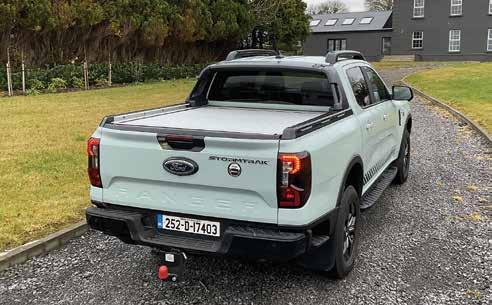
“Beyond its powertrain, the Ranger PHEV introduces useful new technology. Pro Power Onboard allows owners to run tools, lights, or camping gear directly from the vehicle – no need for a separate generator. Inside, the cabin carries over the premium, digital feel of the latest Ranger models, with a central touchscreen and connected services designed to make working life easier. These touches show Ford understands that today’s pick-up drivers expect more than brute strength – they want comfort, connectivity, and convenience too.”
“Crucially, the Ranger Plug-In Hybrid points towards a more sustainable future without asking owners to compromise. It keeps the ruggedness and practicality that made the Ranger Europe’s best-selling pick-up, while introducing lower-emission capability and new efficiency gains. For anyone who values versatility and responsibility in equal measure, the Ranger PHEV is a compelling – and genuinely exciting – evolution of a modern icon.”
“The new Ford Ranger PHEV is a more economic version of the popular Ranger - and though with a much better torque. And the quality is still on a very high level - that you still can miss in a lot of other pick-up vehicles.
In the off Road area you also have an intuitive way of operating the vehiclenot everything is hidden somewhere on the touchscreen.”
“So, the question isn’t just whether the PHEV is a Ranger in every way— there’s no compromise compared to diesel models, as we’ve seen - but whether it’s the best in Ford’s impressive pick-up range. With logic and our hand in our pocket, the answer to the question in the test title is clearly affirmative: The lower price (in several markets) than the equivalent diesel, the large fuel tank offering 700 km of range, the excellent performance of the electrical system, the exemplary and enjoyable road handling (more ‘controlled’ rear axle), the vastly improved gearbox operation, and the zero compromises in off-road capabilities are convincing enough arguments. Add to that the impressively low average fuel consumption, unmatched by diesel Rangers, and you have a pick-up truck that seems unbeatable for professionals -an almost default choice.”
tuned and responsive engine. When used properly, it can actually save a significant amount of fuel and CO2 without any limitations on payload or towing capacity.”
“The Ford Ranger has been a class leading pick-up for years, and with the new PHEV engine many customers can do much of their drive electric. This without compromising on drivability off-road. On road it is even better due to some extra weight that makes the suspension smoother than the other ICE variants. The engine is the most powerful in the Ranger line-up and will be appreciated by many customers towing or driving with full loads.”
“As always, the market leader in one-tonne pick-up trucks in Europe sets and defines the standards in this segment. To everything known so far in the model, the new Ford Ranger PHEV adds an efficient hybrid drive, with which the brand is once again a pioneer. In fact, for the first time in the tests we have a serial plug-in hybrid drive, which increases productivity and efficiency not only on the road, but also off-road. Last but not least, the Ford Ranger in the parallel tests showed that it is the most complex player, equally good in all conditions.”
Ranger Plug-In Hybrid combines full Ranger towing, payload and off-road prowess with zero-emission driving capability and Pro Power Onboard for off-grid work and play
“The Ford Ranger takes a huge step forward on the drivetrain side: In addition to the successful chassis, Ford Pro adds a very confidently
Its powertrain includes a 2.3-litre EcoBoost petrol engine, combined with a 75 kW electric motor (e-motor) and an 11.8 kWh (useable) lithium-ion traction battery, together with a 10-speed automatic gearbox, that delivers 697 Nm of torque – the most of any production Ranger model – as well as 281 PS, up to 43 km EV driving and reduced cost of ownership.
The battery can be charged by plugging into an external power source, as well as by the petrol engine or by capturing energy when coasting.
The battery takes less than four hours to charge using a single-phase 16 amp charger.



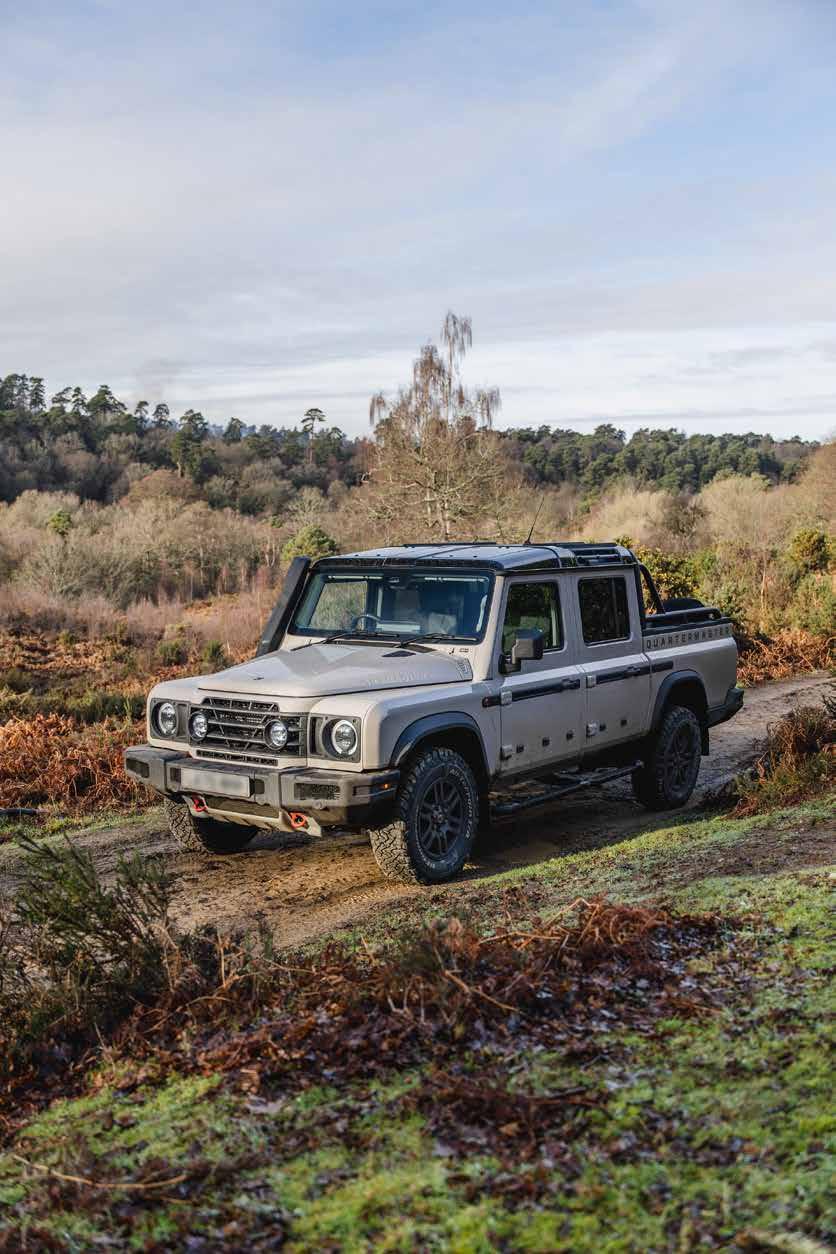
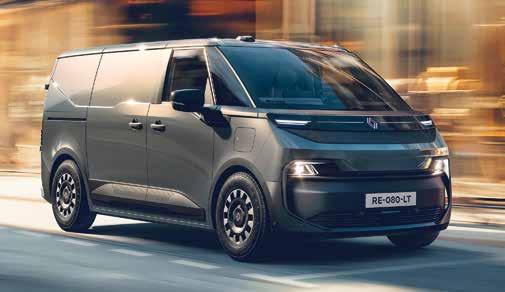
At the end of 2025 Ford and Renault could claim bragging rights in the Light Commerical Vehicle sector in Ireland; Ford for being the best selling brand overall with 22.7% market share, while the Renault Trafic was the most popular van sold in the country, claiming 7.24% of the overall LCV market (source: SIMI / https://stats.simi.ie/lcv). But other brands could equally claim that 2025 was a positive year and are looking forward to the year ahead with optimism.
But what will that year bring? To get a feel for both how the year
After several years where volatility rather than volume was the defining feature, the Irish light commercial vehicle market entered 2025 with cautious optimism and exited it with renewed confidence. While headline figures suggested a strong year with sales up nearly 7% overall, feedback indicates a more meaningful development was the return of balance — in supply, in demand and in customer decision-making.
For much of the previous three years, the market had been shaped as much by what could not be delivered as by what customers actually wanted. Supply constraints, extended lead times and delayed model introductions distorted replacement cycles and suppressed underlying demand. In 2025, those constraints eased, allowing the market to
function more normally.
Ford Ireland’s John Manning notes that the new LCV market ultimately finished 0.8% ahead of where it had initially been forecast, a modest overperformance that nonetheless reflected improving conditions as the year progressed. That improvement was not immediate. Most manufacturers reported a subdued first quarter, followed by a marked strengthening from mid-year onwards.
Renault Pro+ Ireland’s Jeremy Warnock describes the second half of the year as particularly strong, noting that it was this sustained momentum that pushed the market to its best result in over a decade. Growth of 7% year-on-year compared to 2024 placed 2025 among the strongest LCV years in recent memory, but without the signs of overheating that might otherwise raise concerns about sustainability.
Notably, this was not growth driven by incentives or short-term stimulus. Instead, it reflected the release of
pent-up demand, the resumption of fleet replacement programmes, and improved availability across key model lines. The recovery was broad-based, spanning fleet, SME and rental channels, rather than being concentrated in a single segment.
While the overall market picture was positive, brand-level performance varied considerably, shaped by differences in supply stability, product mix and channel exposure.
Ford maintained its long-established leadership position, in fact delivering its strongest commercial vehicle performance since 2007. Consistent availability across the Transit range, combined with strong fleet relationships, allowed the brand to capitalise fully on the market recovery.
Volkswagen Commercial Vehicles had a very strong year. The brand increased registrations by 34% in a market that grew by single digits, a performance that Paul Hunt attributes to improved supply and strong demand across the Transporter, Caddy and Crafter ranges. That growth saw Volkswagen move into second place overall in the Irish LCV market, underlining the competitive intensity at the top end of the segment.
Toyota also recorded one of its strongest LCV years to date. According to Cathal Ryan, market confidence recovered significantly in 2025, a trend
reflected in Toyota’s near-40% year-onyear growth. Strong residual values and continued trust in established models played a central role in that performance, particularly among fleet buyers.
Nissan’s experience highlighted the importance of timing. Delayed availability of the new Interstar constrained volumes early in the year, but once supply normalised, registrations accelerated sharply. Neil O’Sullivan notes that this allowed Nissan to finish the year up 55% year-on-year, despite the slow start.
Other manufacturers focused less on headline volume growth and more on consolidating their positioning. INEOS, for example, continued to build its presence in specialist and utility-focused applications. David Bassett observes that customers in these sectors are increasingly prioritising capability, durability and whole-life cost over traditional brand considerations, a trend that favours vehicles designed for specific operational roles.
Alongside the recovery in new vehicle registrations, the used LCV market remained resilient throughout 2025. Demand for quality used vans remained strong, particularly among SMEs and sole traders, while supply remained relatively constrained following several years of reduced new vehicle registrations.
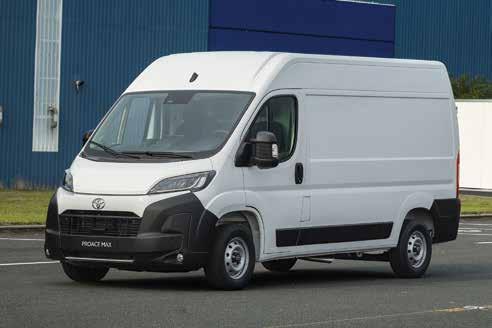
This combination supported residual values across most segments, particularly for medium and large vans with sensible specifications and clear service histories. For manufacturers and dealers, this strength in the used market played an important supporting role, improving trade-in values and making new vehicle purchases more viable for customers who had deferred replacement decisions during earlier periods of uncertainty.
The stability of the used market also reflects a more disciplined approach to fleet replacement in recent years, with fewer vehicles entering the market during the period of supply disruption and extended holding cycles.
Growth in 2025 was broadly distributed across the country, though urban centres continued to dominate demand for compact and medium vans, particularly in last-mile delivery and service applications. At the same time, regional and rural demand remained robust, driven by construction, agri-related services and utilities.
Rental and short-term hire activity increased during the year, reflecting a shift towards more flexible operating models. John Manning notes that Ford is seeing a clear trend in rental and hire drive sales, a pattern echoed by other manufacturers with strong presence in infrastructure-related projects.
This diversification of demand sources contributed to the overall stability of the market, reducing reliance on any single sector or channel.
As the industry looks towards 2026, few manufacturers are forecasting significant growth, but most are optimistic, expecting the market to remain broadly stable, with volumes similar to those achieved in 2025.
Paul Hunt expects a very similar market in 2026, citing positive economic indicators but also acknowledging ongoing global uncertainty. Ford projects total registrations of approximately 32,200 units, broadly in line with the previous year.

For Toyota’s Cathal Ryan, stability itself would represent a positive outcome. After years of volatility, a predictable market would allow fleets, dealers and manufacturers to plan with greater confidence.
Citroën adopts a slightly more optimistic outlook. Trevor Hunt points to a positive start to the year and believes that, despite worsening global tensions, further growth in the LCV market in 2026 is possible.
Across the board, there is a recognition that the ability to plan — rather than chase volume — may be the most valuable development of all.
One of the most significant structural shifts in the Irish LCV market is the continued growth of leasing and contract hire. What began as a response to uncertainty has evolved into a long-term change in how vehicles are funded and managed.
Opel Ireland’s Fergal Marron notes that as regulations become more complex, more businesses are choosing leasing and fleet management solutions to reduce administrative burden and risk exposure. Increasing vehicle complexity, evolving emissions standards and the growing importance of compliance have all contributed to this trend.
Fiat Professional’s Ciaran Cusack expects leasing and contract hire to continue growing as SMEs and corporates look for flexibility and cost control. While growth rates may moderate as major fleets complete renewal cycles, leasing is now firmly embedded in the structure of the Irish LCV market.
In parallel with leasing, the rental and short-term hire sectors continue to grow. Seasonal demand, project-based work and uncertainty around long-term technology choices are all driving interest in flexible vehicle access.
For manufacturers, rental and hire channels also play an important role in maintaining market presence and supporting residual values, particularly as electrification gathers pace.
While compact and medium vans remain the backbone of the Irish LCV market, manufacturers report a gradual shift towards larger, better-specified vehicles. Toyota’s Cathal Ryan notes growing demand for large vans as customers look for vehicles that can do more, both in terms of payload and operational flexibility.
Health and safety considerations are increasingly influential in vehicle selection. Features such as the ability to stand upright in the load area, improved access and enhanced driver assistance systems are becoming more important, particularly for fleets focused on dutyof-care obligations. Automatic transmissions, connectivity and comfort features are now widely expected, especially for
vehicles covering high annual mileages. The distinction between “working vehicle” and “mobile workspace” continues to blur.
Despite the shift towards larger vehicles, car-derived vans continue to perform strongly. For owner-drivers and small businesses, they offer a compelling combination of comfort, image and tax efficiency.
Trevor Hunt observes that the continued strength of the CDV segment suggests customers are increasingly looking to combine utility with comfort, particularly in urban environments. With electrified CDVs set to expand in the coming years, this segment is likely to retain its relevance.
Beyond mainstream segments, specialist vehicles continue to play a vital role in the Irish market. Utilities, emergency services and infrastructure providers place a premium on towing capacity, durability and off-road capability.
David Bassett highlights increasing demand for mission-specific vehicles, reinforcing the importance of matching specification to operational requirements rather than relying on generic solutions.
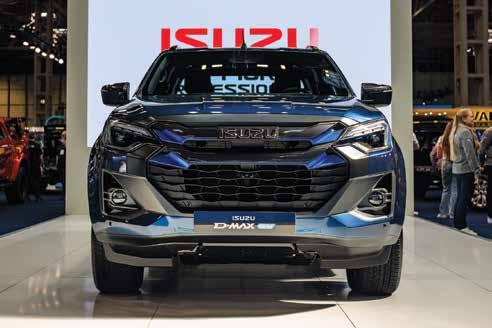
Electric LCV registrations more than doubled in 2025, lifting market share to just over 6%. While this represents significant progress, adoption remains uneven and concentrated among government bodies and large corporate fleets with defined sustainability targets.
John Manning points to growth of over 100% year-on-year in the electric commercial vehicle segment, but Mercedes-Benz Vans Ireland’s Fergus Conheady cautions that if pre-registrations and government purchases are excluded, the natural EV van market remains relatively small.
Charging infrastructure, upfront cost and operational suitability remain key barriers, particularly for SMEs and rural operators. Trevor Hunt argues that everyday practicality, rather than environmental signalling, will ultimately determine EV adoption among SME customers.
Several manufacturers highlighted structural disadvantages for electric LCVs compared to passenger cars, particularly in relation to taxation and incentives. Paul Hunt believes greater incentives would be required to achieve similar levels of BEV penetration.
At the same time, EU CO₂ compliance requirements are shaping manufacturer strategies, driving supply even where demand remains underdeveloped.
ECHNOLOGIES: PHEVS AND A LTERNATIVE F UELS
Green alternatives to full electrics are starting to make waves, albeit at a low level. Plug-in hybrid vans are increasingly viewed as a transitional solution, particularly for fleets with mixed duty cycles. John Manning expects further growth in the LCV PHEV segment, reflecting its role as a bridge between internal combustion and full electrification.
Alongside electrification, interest is
growing in alternative fuels such as HVO. David Bassett notes that HVO provides an immediate and practical pathway to CO₂ reduction where electrification is not yet viable, particularly for heavy-duty and rural applications.
This points towards a more diversified approach to decarbonisation, rather than reliance on a single technology pathway.
While many of the major brands are set to have a relatively quiet year for new products in 2026, there will still be a number of exciting new models to look forward to. Volkswagen Commercial Vehicles, Renault and others will expand their electric offerings, while new entrants such as Kia and Farizon increase competitive pressure.
Kia has just launched the PV5 Cargo, its first van offering. Kia Ireland’s Ronan Flood describes the PV5 as the beginning of the brand’s long-term commitment to the LCV market, signalling increased competition in both electric and conventional segments.
Another new brand, Farizon will have 2 new models: Farizon SV and Farizon V7E with additional variants and battery sizes, all built on a dedicated electric platform. “Our focus is on bringing to market electric commercial vehicles designed specifically to meet the practical needs of Irish fleets, as EV adoption continues to accelerate,” says Andrew Johnson.
Renault will see the arrival of the all-new Trafic E-Tech electric towards the end of the year. Offering up to 450km of range and ultra-rapid charging via 800-volt architecture, Jeremy Warnock is confident that when range, payload and charging capability align with real-world needs, customer adoption will follow — is the Trafic the vehicle to breach that threshold?
Partner brand NIssan will introduce Factory built Tipper and Dropside versions of the Interstar after first quarter 2026.
A Toyota New Toyota Hilux arrives in Ireland in October. Cathal Ryan tells us: “I’ve driven it. Its very impressive!”
Mercedes-Benz Vans will see the launch of VLE and VLS models in Quarter 3, though Fergus Conheady admits these will be niche models for the brand.
Over at Volkswagen Commercial Vehicles Ireland the focus will be on passenger versions of LCVs with a fully electric New e-Caravelle with 8 and 9 seat versions launching in January 2026 together with a Caddy Life PHEV model. Also new is an ID. Buzz People 7 seat Special Edition model now available with a Caravelle PHEV model launching in February.
New Car-Derived Vans are on the way from Citroën. “2026 will see availability of an all-new factory produced Citroen C3 N1 class, as well as a wider CDV model range in general with the introduction of the all-new C5 Aircross CDV and all-new C3 Aircross CDV,” says Trevore Hunt, adding: “These will further improve customer choice and further reduce customer compromises on comfort and image vs traditional LCV offerings. These new model additions will be available in both hybrid and full electric variants.”
“For 2026, Orangeworks Automotive has confirmed a revised Irish commercial line-up for the INEOS Grenadier and INEOS Quartermaster,” says David Bassett. “This includes new Irish pricing for the 2-seat Grenadier and 2-seat Quartermaster models, starting from €59,995 plus VAT, built to N1 classification, offering 8% BIK, alongside class-leading towing and payload capabilities.”
The Irish LCV market enters 2026 in a healthier position. Growth has returned, supply has normalised and longer-term trends are clearer.
The prevailing mood is one of a market that is continuing to grow but remaining extremely competitive. Electrification will progress, but gradually. Leasing and fleet management will play an increasingly central role. Established brands retain advantages, but competition is intensifying as new entrants sharpen their focus.
Rather than a year of transformation, 2026 is shaping up as a year of consolidation — one that may ultimately prove just as important in preparing the Irish light commercial vehicle market for the next phase of change.
Text: Cathal Doyle – cathal@fleet.ie
Finance from 0% APR*
Purchase contributions of up to €3,000*
Service plans from €12.99 pm*

Typical Finance Example: TRANSPORTER SL LWB28 110HP M6F. OTRP €38,995.00. APR 0%. Deposit / Part Exchange €12,055.00. 60 monthly payments of €449 incl. 5 year warranty, 5 services and 5 year roadside assistance. 5 Services Plan for new Transporter model only. This campaign is transferable to subsequent owners of the vehicle across the contract duration. No refunds or early terminations are permitted. Contract runs for 5 years or until all 5 services have been claimed. Total Cost of Credit €0. Acceptance fee (€75) and completion fee (€75). No minimum deposit requirement. Finance is provided by way of Hire Purchase Agreement from Volkswagen Financial Services Ireland and subject to lending criteria. Volkswagen Financial Services Ireland Limited is regulated by the Central Bank of Ireland. Offers available on new retail orders taken before 31st March 2026. Models shown for illustrative purposes. Terms and Conditions apply. These offers are subject to availability and may be withdrawn at any time. These offers do not apply to fleet sales. Information correct at time of publication. Warning: You may have to pay charges if you pay off a hire-purchase agreement early. If you do not meet the repayments on your hire purchase agreement, your account will go into arrears. This may affect your credit rating, which may limit your ability to access credit, a hire-purchase agreement, a consumer-hire agreement or a BNPL agreement in the future.
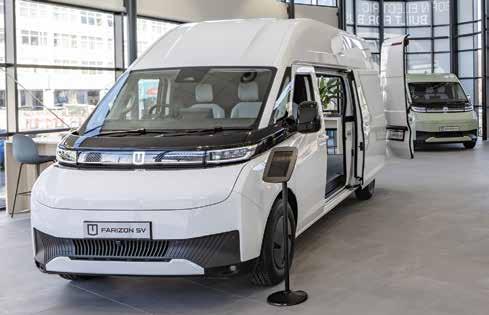
While many of the major light commercial brands are set to have a relatively quiet year for new products in 2026, there will still be a number of exciting and interesting new models for potential buyers to look forward to. Volkswagen Commercial Vehicles, Renault Pro+ and others will expand their electric offerings, while new entrants such as Kia and Farizon increase competitive pressure. Pick-up truck providers have also been busy on the development front.
Kia has just launched the PV5 Cargo, its first van offering and newly crowned International Van of the Year 2026. Kia Ireland’s Ronan Flood describes the PV5 as the beginning of the brand’s long-term commitment to the LCV market, signalling increased competition in both electric and conventional segments.
Another new brand, Farizon will have a brace of new medium and large size models: Farizon SV and Farizon V7E with additional variants and battery sizes, all built on a dedicated electric platform. “Our focus is on bringing to market electric commercial vehicles designed specifically to meet the practical needs of Irish fleets, as EV adoption continues to accelerate,” says Andrew Johnson.
Renault Pro+ will see the arrival of the all-new Trafic E-Tech electric towards the end of the year. This is one part of a trio of new light commercial developments in collaboration with Flexis, the newly formed partnership between Volvo AB, Renault Group and shipping company CMA CMG Group.
Offering up to 450km of range and ultra-rapid charging via 800-volt architecture, Jeremy Warnock, from Renault Ireland is confident that when range, payload and charging capability
align with real-world needs, customer adoption will follow - is the Trafic the vehicle to breach that threshold?
New Trafic will also be sold under the Renault Trucks Red Edition badging.
Alliance Partner brand Nissan will introduce Factory built Tipper and Dropside versions of the Interstar after first quarter 2026.
A new Toyota Hilux pick-up arrives in Ireland in October. Cathal Ryan, from Toyota Ireland tells us: “I’ve driven it. It’s very impressive!” So has Fleet! Very impressed too! As a well as the conventional diesel, the most popular pick-up truck will be electric and hybrid powered.
Mentioning pick-ups, KGM, formerly known as SsangYong is launching a new Musso model, to sell alongside the new Musso Electric entering the market this year.
version of the Transporter is to come to market, featuring a 150 hp diesel and automatic transmission.
New Car-Derived Vans are on the way from Citroën. “2026 will see availability of an all-new factory produced Citroen C3 N1 class, as well as a wider CDV model range in general with the introduction of the all-new C5 Aircross CDV and all-new C3 Aircross CDV,” says Trevor Hunt, adding: “These will further improve customer choice and further reduce customer compromises on comfort and image vs traditional LCV offerings. These new model additions will be available in both hybrid and full electric variants.”
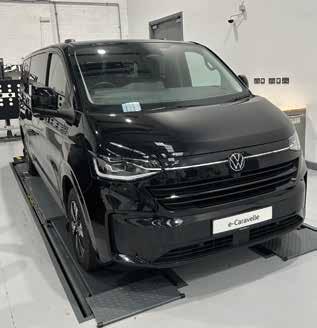
Isuzu premiered the latest version of the D-Max with its fresher look and new powertrain. This pick-up will also have an electric drive option.
Mercedes-Benz Vans will see the launch of VLE and VLS models in Quarter 3, though Fergus Conheady admits these will be niche models for the brand.
Over at Volkswagen Commercial Vehicles Ireland the focus will be on passenger versions of LCVs with a fully electric new e-Caravelle with 8 and 9 seat versions launched, together with a Caddy Life PHEV model. Also new is an ID. Buzz People 7 seat Special Edition model now available with a Caravelle PHEV model launching in February. A new Highline
“For 2026, Orangeworks Automotive has confirmed a revised Irish commercial line-up for the INEOS Grenadier and INEOS Quartermaster,” says David Bassett. “This includes new Irish pricing for the 2-seat Grenadier and 2-seat Quartermaster models, starting from €59,995 plus VAT, built to N1 classification, offering 8% BIK, alongside class-leading towing and payload capabilities.”
On the international front, Iveco will market versions of the Stellantis large and medium vans, rebranded as eJolly and eSuperJolly, from sometime later in the Summer.
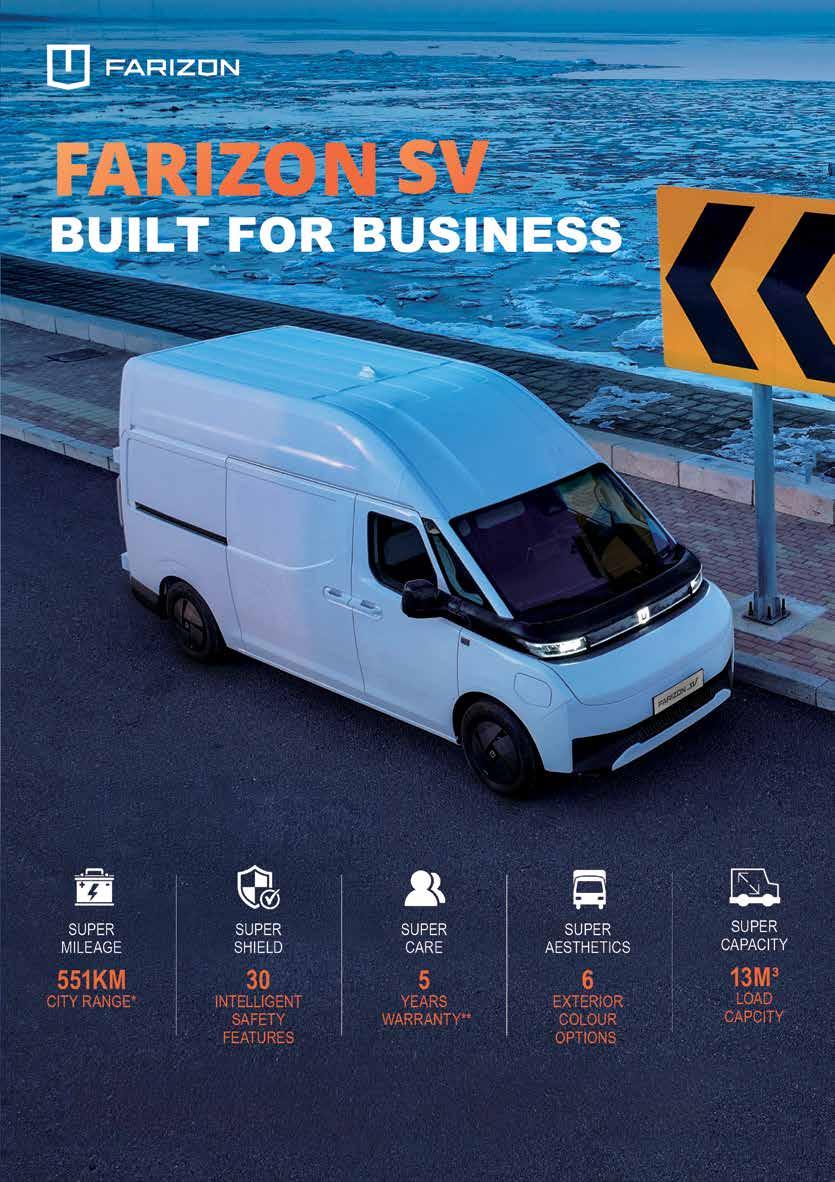

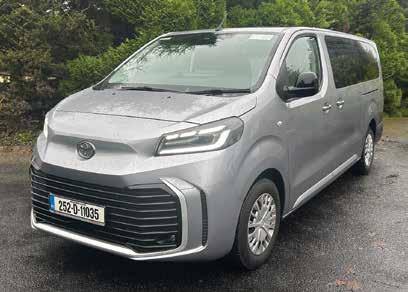
Practicality, roominess, huge luggage space, all round visibility and a sublime driving experience describes the Toyota Proace Verso in a nutshell. This nine seater people carrier is based on the Proace medium-duty van, which in turn is supplied by Stellantis ProOne, following a strategic partnership established in 2016. Since the start of that relationship, Toyota Professional has enjoyed year-on-year growth in Europe - both in terms of sales and market share.
Proace Verso is tailored towards business focused use, family lifestyles or executive transport. From the two person bench seat up front to the two rows behind, there’s room aplenty for all and sundry. The driver can access the 10” multimedia touch screen with ease and for those needing to charge gadgets, there are a
number of USB connections accessible from the first two seat rows.
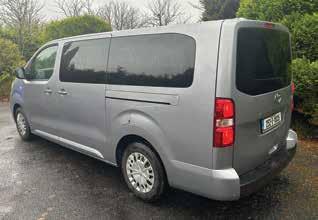
A well-proven 2.0-litre four-cylinder diesel engine has plenty of power on tap with 145 DIN hp (106 kW) @3,750 rpm and 540 Nm @2,000 rpm, mated to a six-speed manual gearbox. This D-4D diesel engine combine fuel efficiency with great driveability. From our time on board, we achieved close to the official average fuel consumption of 7.5 litres per 100km. With a tow bar fitted, it can pull 1,900 kg.
Regarding the cost price, it retails at €73,600 (Incl. VAT) and its annual motor tax is €790.
Its 1.9 m height allows the Verso to access standard car parks while manoeuvring in busy urban locations is made easier thanks to a 6.4 m turning radius for this long wheelbase version.
Other measurements include:
n Exterior length (mm) - 5331 mm
n Exterior height (mm) - 1910 mm
n Exterior width (mm) - 1924 mm
n Wheelbase (mm) - 3275 mm
Verso is designed to deliver spacious transport for the most active lifestyles. With keen attention to detail, the Proace Verso offers all on board a pleasurable experience through thoughtful ergonomics and a high level of standard specification. Passengers can relax all the way.
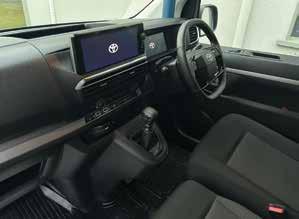
On the safety side, the Proace Verso includes Toyota Safety Sense, a suite of safety and driver assistance systems designed to give complete
peace of mind. Using an array of cameras and sensors located around the vehicle, these technologies can help with parking, staying in lane and collision-free driving
The only concern from a driving point of view is that the exterior mirrors are too small for the size of the vehicle, not a Toyota derived issue, but harking back to the original design from the manufacturer, something we have flagged on occasion previously.
As we know, every Toyota is built to exceptional levels of quality, durability and reliability. To ensure peace of mind, Toyota Ireland offers a standard 3 year/100,000km warranty.
Stylish and versatile, the Proace Verso is a quality multi-purpose vehicle. Offering top level transport for commercial passengers and adventurous families alike, its first-class comfort and seamless connectivity make every trip a pleasure.
Text & Photos: Jarlath Sweeney – editor@fleet.ie
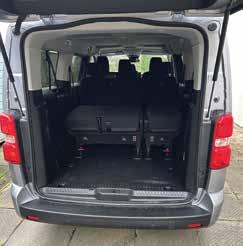
Electrifying your business. Available now.
From €33,230 (excl. VAT)
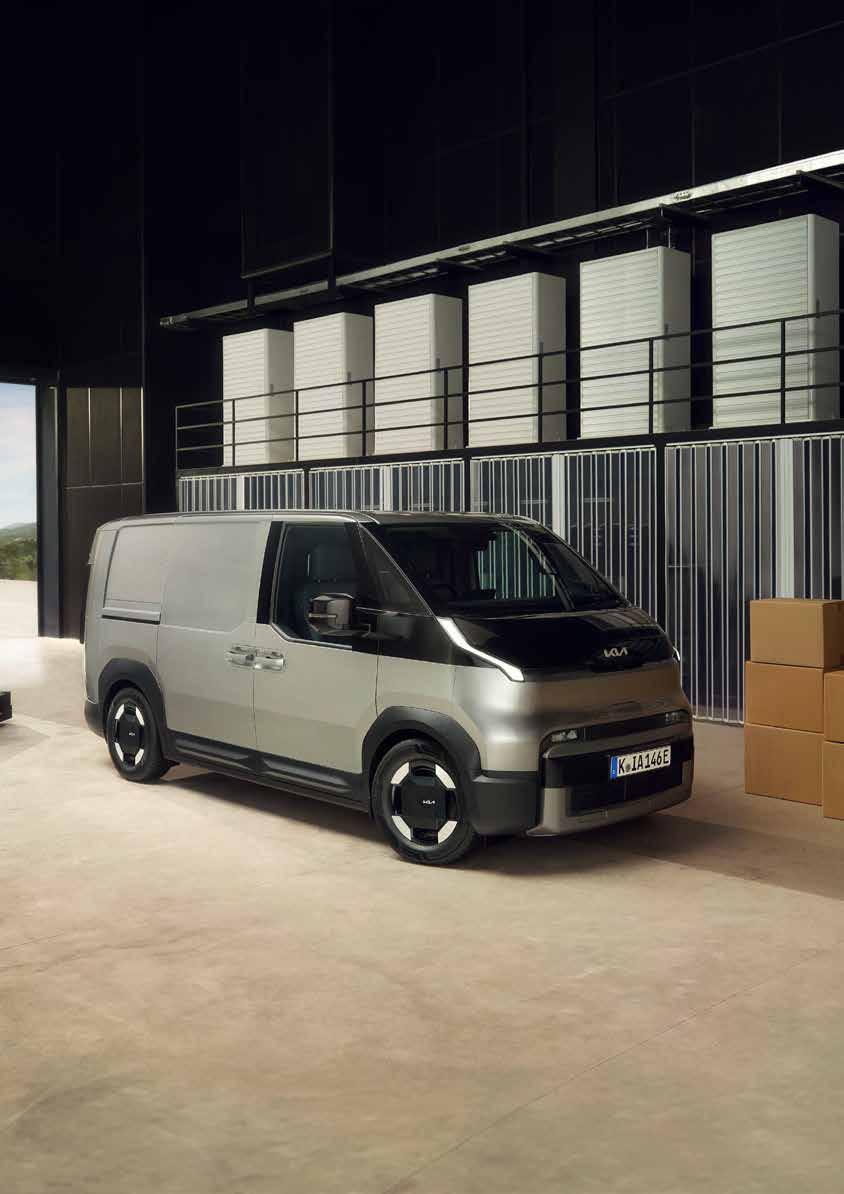

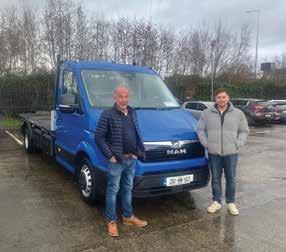
Recent sales of new MAN TGE light commercials by MAN Importers Ireland (Dublin) and Dennehy Commercials (Limerick).
George and Marc Smullen from Abwood, Timore, County Wicklow has purchased another new MAN TGE 5.150 chassis cab, with factory built and specified Scatolini Flatbed Body.
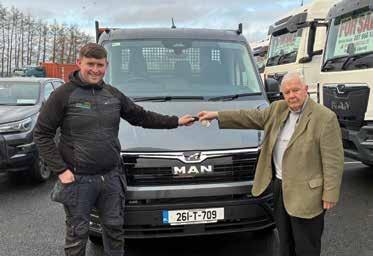
This new TGE MAN 5.160 with tipper body was sold to JMJ Eco-Hire, based at Holycross, County Tipperary. Pictured is Jack Ryan, Managing Director, JMJ Eco-Hire receiving the key from Martin Hough, Sales Executive at Dennehy Commercials. The company specialises in producing solar powered mobile welfare units for construction crews.
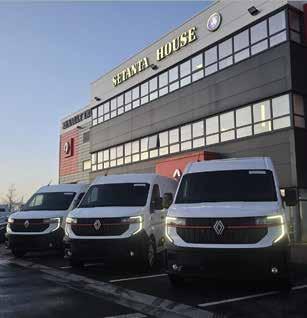
Three new Renault Trucks Red Edition Master vans, sold by Setanta Vehicle Sales North (Dublin) have gone into service at JFN Logistics (Jim Nolan), Naas, County Kildare. The award-winning panel light commercial vehicle were ply-lined by Pro Equip Ireland.
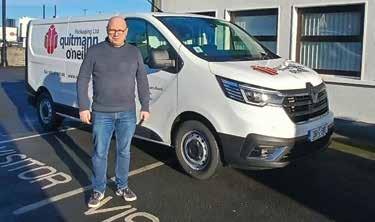
Another example of Ireland’s best-selling van the Renault Trafic was bought from Dennehy Commercials, Limerick, by David O’Neill, proprietor of Quitmann O’Neill Packaging, Portumna. The long established Vounty Galway firm supplies customers in the pharmaceutical, food and beverage, chemical, lubricant, coatings and waste industries.
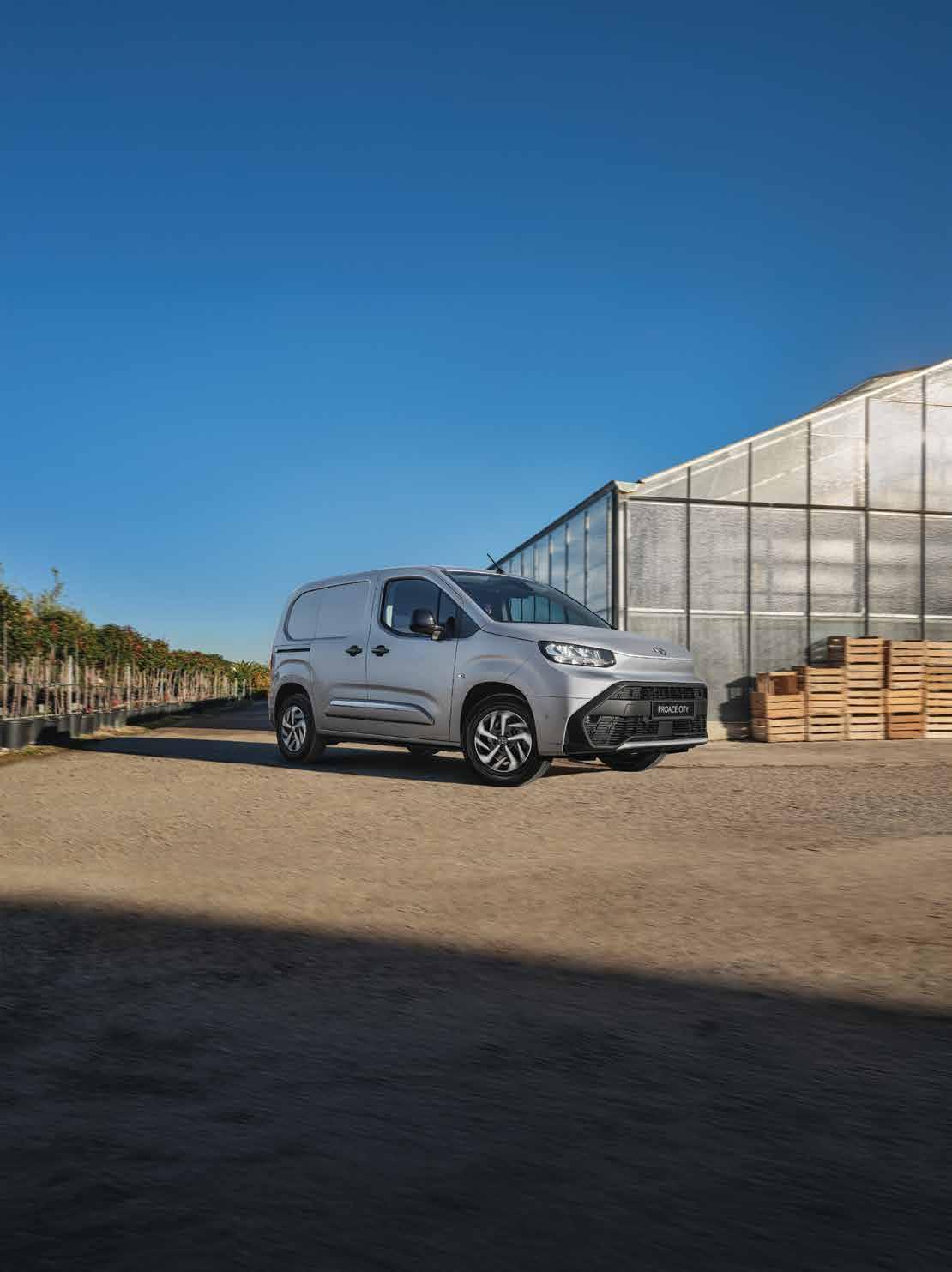
Fuel E cient Diesel Engine, Only 5.4L / 100kms
Cruise Control
Collision Avoidance
Parking Sensors
Up to 1 Tonne Load Capacity
Apple Car Play & Android Auto™
Up to 10 Years / 185,000km Warranty* 409 FROM PER MONTH ** € EXCLUDING VAT





Following the return of the “Real Motor Show” in January 2025, the 102nd Brussels Motor Show celebrated another major comeback in January 2026, 80 exhibitors covering car and commercial vehicle brands as well as the biggest motorcycle and moped brands came together across six halls at the Heysel Exhibition Centre and in the Astrid Hall.
Among the commercial exhibitors that premiered new models were Stellantis ProOne, Toyota Professional, Ford Pro, Isuzu, KGM and Renault Pro+.
Stellantis ProOne – the Stellantis global business unit dedicated to commercial vehicles highlighted the full potential of its market-leading range and unveiled a new solution for micromobility.
Alongside traditional vans, the spotlight fell on the surprising lightweight newcomer: the Fiat Professional TRIS, a fully electric three-wheeler making its European debut (See News item).
Attendees also discovered two special editions: the Citroën Berlingo XTR, offering professionals comfort with a dynamic look, and the Opel Vivaro Electric Sportive, featuring sporty decals, 17-inch alloy wheels and distinctive design elements.
Examples of Stellantis ProOne CustomFit programme were also showcased. This offers extensive possibilities for conversion and personalisation, ensuring OEM-level quality, optimised lead
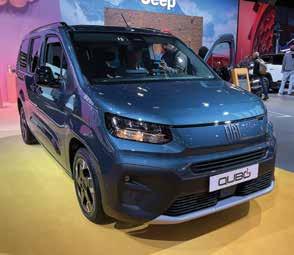
times, and full warranty coverage.
Another new model wearing the Fiat badge was the Qubo L, designed for everyone from families seeking the perfect blend of comfort, space and practicality, to outdoor enthusiasts and city dwellers. The Qubo L is the only diesel model in Fiat’s range, with 100hp and 130hp power options, in addition to petrol and electric variants. It is available as a 7-seater (long wheelbase) or 5-seater (short wheelbase).
Featuring in our Launch Pad preview, the all-new Toyota Hilux, the ninth generation of the Japanese brand’s legendary pick-up truck, was at the show,. It breaks new ground with a range that includes its first battery electric powertrain.
The all-new Hilux’s introduction builds on a heritage established over more than half a century and more than 27 million global sales. Throughout its history, Hilux’s success has been founded on its core values of Quality, Durability and Reliability, qualities that remain central to its latest evolution.
True to its customer-centred approach, Toyota is not offering a one-size-fits-all solution. Instead, the all-new Hilux aligns with the company’s multipath philosophy to provide a choice of powertrains suited to different customer requirements and preferences, and operation in different driving conditions. Therefore, the new model will be offered with two powertrains: a 2.8-litre diesel engine supported by a 48V battery – the option that will be the volume seller in Europe – and a battery electric version, both of which were on display in Brussels.
Ford Pro had a significant presence at the show, making a big statement on Ford Motor Company’s partnership with Red Bull for a major Formula 1 engine deal starting for the new 2026 season.
The project includes developing new hybrid power units for both the Oracle Red Bull Racing and Visa Cash App Racing Bulls (formerly AlphaTauri) teams, marking Ford’s significant return to F1 by contributing expertise in battery, electric motor, and software tech for sustainable fuels and increased electric power under new regulations.
Proudly wearing the International Pick-up Award logo for 2026/27, was the all-new Ford Ranger PHEV, while sporting the distinctive Red Bull Racing colours was the Ranger MS-RT which
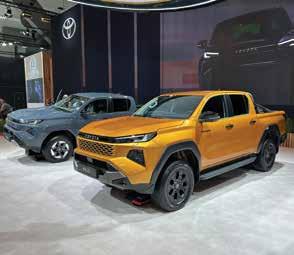
is also available in a plug-in hybrid version, featured alongside the Ford F-150 flagship pick-up and the revised Ranger Raptor.
The European debut of the all-new Isuzu D-Max, was also held here. Featuring the much anticipated 2.2-litre turbo-diesel engine which replaces the previous 1.9-litre unit, the higher capacity 2.2-litre ‘MaxForce’ (RZ4F) engine delivers a significant step up in performance. Now producing 120 kW (163 hp) and 400 Nm of torque, the engine offers a 10% increase in pulling power over its predecessor. Most importantly for professionals, it generates 60% more torque (255 Nm) from just
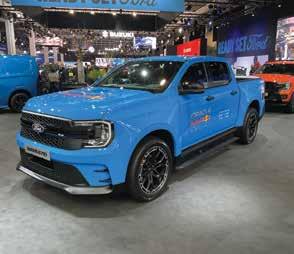
F ORD R ANGER PHEV MS-RT
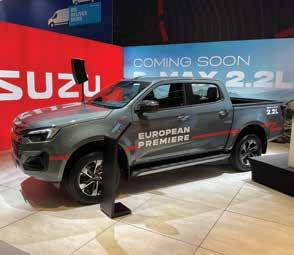

1,000 rpm, ensuring effortless take-offs even with heavy loads.
The new engine is paired with a new eight-speed automatic transmission, replacing the previous six-speed unit for smoother shifts and improved fuel efficiency, or with a 6-speed manual gearbox in some versions. All 2.2L variants (Single cab, Extended Cab & Double Cab) now feature a standard 3.5-tonne (3,500 kg) braked towing capacity, and a class leading payload capacity of up to 1,200 kg.
As Korea’s first and only electric pick-up, the Musso EV marks KGM’s (formerly SsangYong) fifth entry into the pick-up segment since entering the market in 2002 with the original and acclaimed Musso Sports.
Combining more than 20 years of pick-up truck manufacturing expertise with advanced electrification, the Musso EV delivers mid-size SUV–level comfort, EV-specific quietness, and payload capability (up to 500 kg).
KGM’s pick-up clientele continue to expand beyond commercial use into camping, leisure, and outdoor activities.
KGM has been at the forefront of this trend with its traditional pick-up models, the Musso Sports and Musso Khan. Now, the Musso EV further strengthens KGM’s leadership by opening a new chapter in the electric pick-up segment. Building on its initial success, KGM is also accelerating its overseas rollout. Pre-marketing activities began late last year in key European markets.
“The early success of the Musso EV is especially meaningful given the current slowdown in EV demand and the overall stagnation of the pick-up market,” said a KGM spokesperson. “We will continue to meet the diverse needs of our customers.”
Renault Pro+ premiered the new Trafic van alongside the current model, providing a direct compare and contrast opportunity for interested visitors. The new version, a collaborating project under the Flexis banner, is said to be on sale across Europe before year end.
Mentioning people carriers earlier, Hyundai presented a major product premiere: the Staria Electric, Hyundai’s first fully electric MPV, based on the exiting internal combustion light commercial, which expands the South Korean brand’s EV portfolio into the multi-purpose segment. The 7-9 seater is designed for families, leisure and commercial applications alike by offering new levels of space, flexibility and zero-emission driving. Its all-electric driving range travels up to 400 km from the high-capacity battery 84 kWh, allowing for ultra-fast charging from 10-80% in approximately 20 minutes.
Text & Photos: Jarlath Sweeney – editor@fleet.ie
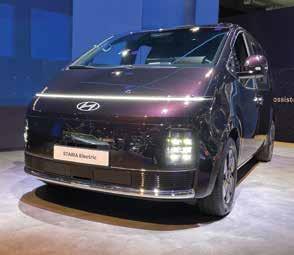
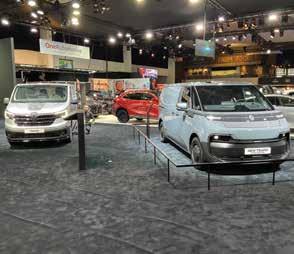
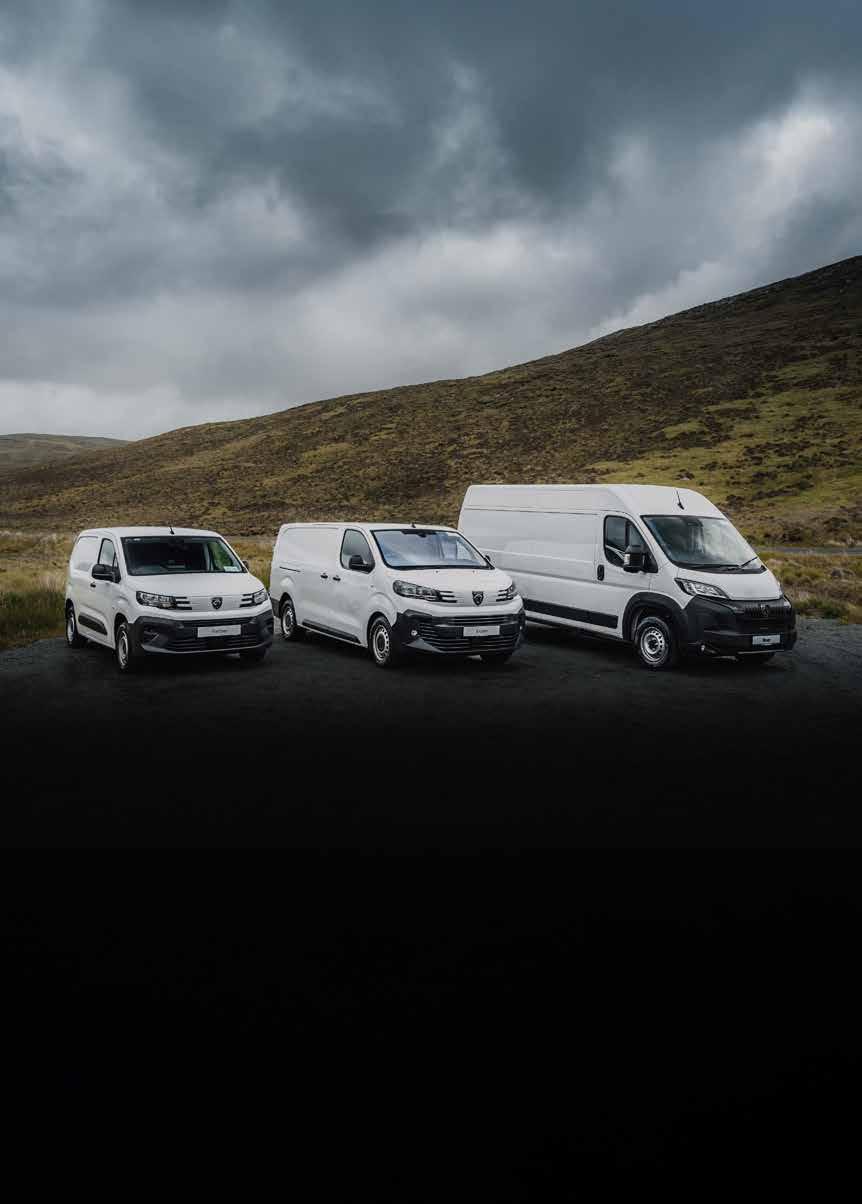

Edited by Cathal Doyle - cathal@fleet.ie

The latest data from the Central Statistics Office reveal that hybrid sales in Ireland were up 65% in 2025.
With an eye on greening the Irish economy and tackling the threat of climate change, the Irish government has introduced a range of incentives to encourage take up of cleaner cars, ranging from VRT relief to purchase grants.
The CSO data indicates that the public are responding and embracing the green revolution. Further data from DoneDeal Cars reveals that the BMW 5 series, Toyota Corolla and Toyota Yaris are proving to be especially popular models.
The key question for many Irish drivers then is not whether to go green, but how to go green?
For consumers, the transition from petrol and diesel vehicles to more sustainable options can be more complex than it at first seems.
First off, there are economic questions when it comes to making the switch.
Hybrid vehicles are generally newer than petrol and diesel vehicles, and more expensive. It’s well known that new cars begin to depreciate as soon as they
By Katie Byrne, Digital Partnerships Manager, Close Brothers Motor Finance Ireland
roll-off the forecourt. And with a higher up-front price than older petrol and diesel vehicles, this depreciation can be even more steep than usual.
That said, growing demand for hybrids means that many hybrid models - while subject to the usual new car depreciation - hold value better overall than petrol vehicles. As efforts to green the nation’s roads intensify and the case for running a pure petrol vehicle diminishes, there’s no reason to suspect this dynamic will change anytime soon.
Irish drivers also need to consider how to balance the up-front expense of a hybrid vehicle against the longer-term savings that can be made on running costs. After all, plugging in is far cheaper than filling up. Then there are the various government incentives to think about.
Whether it’s lower motor-tax or home-charger grants, the Government is doing a lot to encourage hybrid take-up. These factors too impact the finances of going green and need to be carefully considered.
Alongside the finances, another question for Irish motorists who are making the transition is what kind of hybrid will work for them.
Most of the motorists I speak to think hybrids are hybrids. But there’s a key distinction to be made between mild-hybrids and full plug-ins. Mild hybrids can’t run on electricity alone. Instead they harness the energy generated when driving to reduce emissions. Ultimately however, while mild-hybrids reduce fuel
consumption and emissions, they still rely on fossil fuels.
Full plug-in hybrids on the other hand can run on electricity alone and do so until the power runs low, when they switch to fuel. This is a subtle but important difference and means full plug-ins are far more efficient.
The choice between mild and full plug-in will be about price first and foremost but there are other considerations too. For Ireland’s rural communities for example, where charging infrastructure is yet to be rolled out, a full plug-in might still, at this stage, represent too much of a risk for somebody who relies upon their car.
There’s a significant urban-rural divide amongst Irish motorists when it comes to going green. The willingness is there amongst rural drivers but, until the infrastructure is in place to support greener roads, this urban-rural divide will likely persist.
Ireland is famous for its ‘one thousand shades of green’ and the latest DoneDeal Cars data shows that Irish motorists are behind the switch to cleaner, greener vehicles.
As Ireland, and the world, transitions from internal combustion engine vehicles however, there are a range of complexities to navigate ranging from the technical to the financial. Thankfully however, expert advice is out there, and financial options too that can make it easier to go green.
The 104th Brussels Motor Show 2026 edition was held at the Autosalon, Brussels Expo from January 9-18. In recent years the event has become a major international automotive exhibition and the host of the European Car of the Year (COTY) award ceremony, with the Mercedes-Benz CLA taking the coveted “Car of the Year 2026”.
The show was fully sold out and featured over 60 car and 20 motorcycle brands, with light commercials also featuring prominently.
Jarlath Sweeney captured the action from the stands.
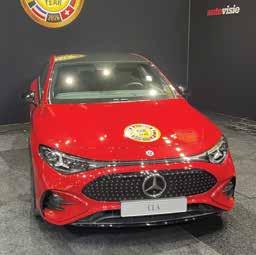
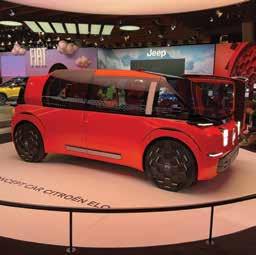
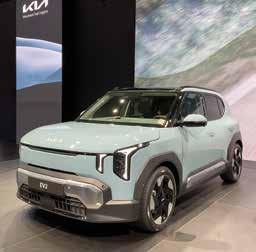


MERCEDES - BENZ H ISTORY
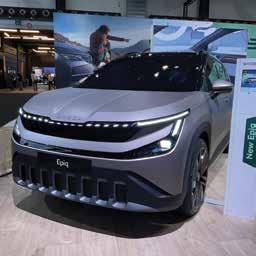
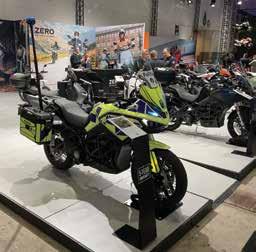
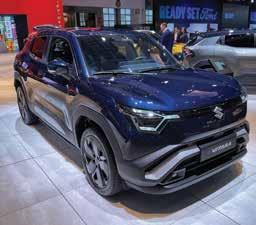
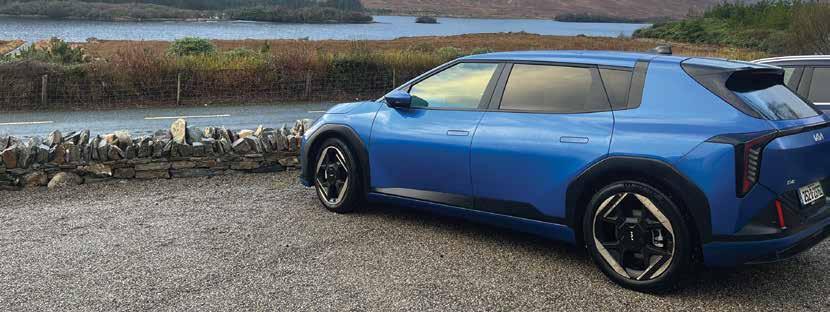
Kia continues to evolve and expand its car range, and recently introduced the EV4 in Ireland, to be followed by the EV5 and not to mention the PV5 Cargo Van (IVOTY 2026 winner) alongside its MPV sibling.
With this momentum, the focus remains on emission-free propulsion, and the EV4 is Kia’s first all-electric Hatchback, engineered on the dedicated Electric Global Modular Platform (E-GMP) to deliver class-leading performance and efficiency. With European customers in mind, the EV4 Hatchback is manufactured in Žilina (Slovakia), with the long-range version powered by an 81.4-kW battery that charges from 10-80 per cent in 31 minutes and delivers up to 625 kilometres of range (WLTP).
Korea. Featuring the 81.4-kW battery and 150-kW motor, it provides a maximum range of up to 633 kilometres (WLTP). The Fastback also has a luggage capacity of 490 litres.
Under review over the Festive season was the EV4 Hatchback with Earth 3 trim, presented in radiant Blue Flame exterior with two-tone interior colour scheme. What is initially appealing is its sleek aerodynamic design, (with an ultra-low drag coefficient of 0.27 Cd), sporty even, along with the generous space inside, endorsed by accompanying passengers. The simplification of its operation impressed too, from take-off, from a perfect driving position, to the touch screen workings, and most importantly actual buttons for the air-con system. While we liked the interior furniture and finishings, the cloth type door handles tend to get dirty fairly quickly, especially if the hand is wet upon entry.
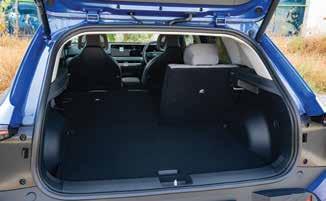
throttle sensitivity, steering weight, and power delivery, each mode gives a different personality and feel. Think of it as tailoring your car to the road ahead, or to your mood. Kia’s available driving modes include:
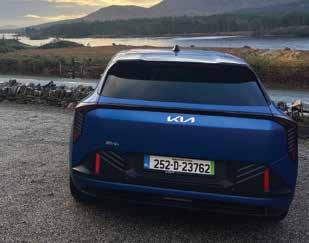
New EV4 is also available with a 58.3-kWh standard battery, which charges from 10-80 per cent in just 29 minutes. Both battery options power a front-mounted 150-kW motor. With up to 435 litres of luggage space, a stable ride, and segment-leading range, the EV4 is versatile for both city and long-distance journeys.
Uniquely, the EV4 Hatchback is joined by the EV4 Fastback, produced at Kia’s Gwangmyeong EVO Plant in
European engineers at the Hyundai Motor Europe Technical Centre (HMETC) in Rüsselsheim, Germany, optimised the EV4’s handling specifically for European roads. The result, together with its low centre of gravity due to the battery packaging, here is a car that offers stable, confident handling, precise cornering, and balanced weight distribution, assuring a safe driving experience. A most comfortable drive.
On electric cars, the drive mode selection changes how it responds to driving inputs, by adjusting things like
n Eco - This mode prioritises efficiency and maximises range
n Normal - This mode provides a perfect balance for everyday driving
n Sport - This mode allows for sharper responses for a more dynamic drive
n MyDrive - This mode has customisable settings to suit your driving preferences, and this one was engaged mostly. Energy returns averaged: 17.9 kWh/100km
From a safety perspective, EV4 comes equipped with a comprehensive suite of advanced driver assistance systems (ADAS). Using a network of cameras and radars, it constantly monitors its surroundings to help detect potential hazards. Features including Forward Collision Avoidance Assist, Blind-Spot Collision Avoidance Assist, and Lane Keeping Assist.
The Kia App provides the EV4 with remote vehicle access, driving insights,
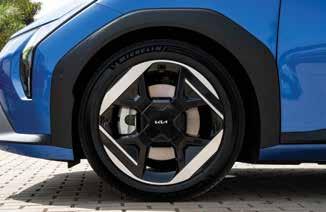
and maintenance tools. In addition, Over-the-air (OTA) updates continually enhance functionality after purchase. Drivers can efficiently locate charging stations, monitor their charging sessions, and plan routes with designated charging stops using the Kia App. The Kia Charge network, also available via the Kia App, currently provides customers with access to more than 5,000 public charging stations in Ireland and over 1,000,000 public charging points across Europe.
In Ireland, both EV4 and EV4 Fastback are available in three different trim levels: Earth 2, Earth 3 and GT-Line.
Specification is consistent for both body types with Earth 2 featuring 17” alloys, LED headlights, dual panoramic display screens, cloth and leather seats and heated front seats. Earth 3 adds 19” alloys, power adjustable front seats with driver memory function, smart power tailgate, wireless charging and wireless android auto/car play. The range topping GT-Line gains GT-Line exterior styling, full leather seats, driver head-up display, power adjustable sunroof and Vehicle-2Load functionality. Pricing starts form €39,940 for the EV4 Earth 2, Earth 3 retails at €46,175 and the GT-Line at €51,250.
Kia Ireland reached a significant milestone by achieving 10,000 annual sales for the first time. This accomplishment highlights Kia’s growing popularity and strong performance
within the Irish automotive sector. Since its introduction to the Irish market, Kia has steadily built a reputation for delivering pioneering innovation and award winning design.
“Reaching 10,000 annual vehicle sales is a testament to Kia’s strategic efforts and customer-focused approach.” Said Ronan Flood, Managing Director of Kia Ireland. “This achievement is thanks to our fantastic dealer network who work tirelessly at a local level to enable the best possible customer satisfaction which ensures repeat custom to allow for such an achievement.”
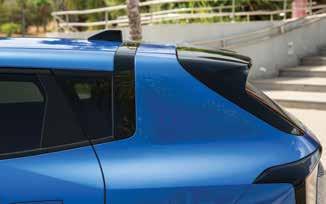

•
•
•


As the BEV numbers continue to increase in Ireland, has the significant investment you have made in the development of charge points around the country been appreciated?
Absolutely. The EZO EV Charging network saw significant growth in 2025, installing more chargers than any other charge point operator in Ireland. Demand for public charging continues to rise across both public and fleet sectors, with fleet charging in particular delivering clear commercial value for businesses transitioning to electric.
Fleet drivers depend on a reliable network and well placed infrastructure to keep vehicles moving. By investing in chargers at data led locations, we reduce friction for drivers, making it easier to charge efficiently and get back on the road with confidence. As BEV adoption accelerates and driver expectations rise, dependable infrastructure becomes non negotiable. Our focus has been on building a network that simply works in the background. When drivers can locate a charger easily, start a session without hassle and continue their journey smoothly, that is when the charging infrastructure is doing exactly what it should.
Are there areas that still need these facilities?
EV ownership is increasing across Ireland, driving demand for charging in a wider range of locations. Rural towns are seeing growing need, where the focus is less on volume and more on selecting the right charger types and locations to serve both local drivers and through traffic.
Destination charging is also expanding, particularly at hotels, holiday accommodation and leisure venues.
Businesses that have invested in charging are already seeing increased footfall and improved customer experience, with EZO supporting the delivery of cost-effective, site-appropriate solutions.
Workplace charging remains underdeveloped despite clear benefits. Enabling staff and fleet vehicles to charge during the day reduces pressure on public networks and improves operational efficiency. Overall, effective rollout depends on placing chargers where drivers already park, using data to guide decisions, and making everyday charging simple and reliable.
What kind of response have you seen since introducing the new name?
We have had an extremely strong response from both the industry and our customers. EasyGo has been part of the EV journey in Ireland for many years, growing alongside the wider adoption of electric vehicles and bringing a loyal customer base with it. As the market matured, it was the right time to evolve and introduce the next chapter of the business.
EZO builds on everything we learned through EasyGo, taking those foundations and expanding them with a clearer focus on people, journeys, and sustainable transport. That purpose resonates strongly with our customers and plays a big role in the loyalty we continue to see across the network.
For the fleet sector, what provisions are available - at company headquarters, branches and at driver’s homes?
For fleet operations, it is important to provide a mix of charging options that align with operational needs. At company headquarters, a combination of AC and DC chargers can be installed depending on vehicle types and usage. AC chargers are well suited to staff parking areas, allowing vehicles to charge while parked, while DC chargers support vans and trucks that require faster turnaround times.
At branch locations, smaller-scale installations are typically used to support
daily operations. Sites such as delivery depots and taxi ranks benefit from DC charging, which enables rapid recharging and helps minimise vehicle downtime.
For drivers who take vehicles home, home charging can be supported where suitable off-street parking is available, alongside clear reimbursement or billing arrangements. Where home charging is not possible, access to public charging networks provides a practical alternative. Together, these options create a flexible charging solution across headquarters, branches and driver homes.
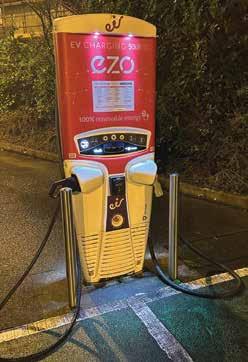
Is there a special charge rate for the fleet sector?
Businesses that choose to own their charging hardware outright retain full control over the tariffs applied to fleet charging. Through the fleet manager portal, tariffs can be easily set and adjusted, giving fleet managers greater visibility and control over driver charging costs. This level of control helps businesses manage operational spend more effectively, keep costs predictable, and ensure charging remains both efficient and cost conscious across the fleet.

After a year defined by delayed investment decisions, rising costs and fragile confidence, the UK forklift truck market is moving through a period of adjustment rather than retreat, a new financial report reveals. The latest UK Forklift Truck Market Outlook, compiled for the UK Material Handling Association (UKMHA) by Oxford Economics shows that cost pressures and economic uncertainty have influenced investment decisions throughout 2025, with many companies delaying fleet renewals or opting for shorter-term leasing.
However, the report suggests that 2026 will mark the beginning of a gradual return to improved conditions, supported by easing inflation and more favourable financing. Forklift truck orders are forecast to grow again as confidence strengthens, with further steady expansion expected through 2027. Analysts point to this as a transition into a more stable, sustainable replacement cycle rather than a return to pandemic-era peaks.
UKMHA CEO Rob Fisher commented on the findings: “The year has required resilience, but we are encouraged by the

projected upturn from 2026 onwards. The fundamentals of our industry remain strong, and when businesses feel more confident, we expect investment to return.”
The UKMHA’s industry survey showed that while some firms reported improved order books, confidence remained fragile. However, Association members show increasing levels of optimism for the return of modest sales growth, aligning with the predictions of economic forecasters.
The report suggests that 2026 will mark the beginning of a gradual return to growth, driven by easing inflationary pressures and a loosening of monetary policy conditions. With financing expected to become more affordable and supply chain uncertainty starting to settle, total forklift truck orders are forecast to recover by 9.4% in 2026. This uplift is set to be broad-based, with counterbalance truck orders projected to rise by 8.2%, supported by steady improvement in industrial production.
In the warehouse segment, truck orders are forecast to rebound sharply by 10.1% in 2026, following an unexpect-
edly weak performance in 2025 linked to softened online retail and consumer spending trends. Sales of pedestrian controlled warehouse trucks (Class 3), which were near to record highs in 2024, are projected to fall sharply during 2025 and then recover modestly in 2026.
Looking to 2027, the data points towards continued growth, albeit at a slower and more steady rate, with counterbalance orders forecast to rise by a further 6.5% and warehouse orders by a modest 1.9% as the market settles into a more normalised pattern of investment and operational planning.
Rob Fisher added that new entrants to the UK market demonstrate the continued belief in the long-term strength of materials handling, making the next edition of the IMHX logistics solutions show in September 2027 all the more attractive.
“Transition should not be misread as decline,” Rob said. “It is preparation. Our industry has shown time and again that it emerges stronger, and we believe it will do so again.”
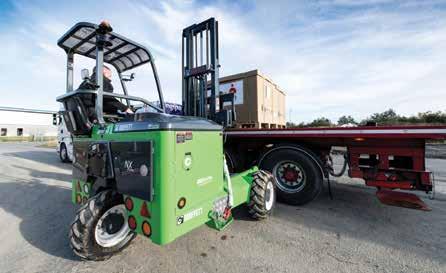
As a leader in smart and sustainable load handling, Hiab is dedicated to building a better tomorrow. Among other things, this means fundamentally changing the way the company designs and develop new products.
Hiab’s newly confirmed, science-based climate targets are targeting the company to reach net-zero greenhouse gas emissions throughout its value chain by 2050. Before that the goal is to reach a 25 percent emission reduction by 2030, compared to a base year of 2022. In its own operations Hiab is aiming for a 50 percent reduction by 2030 and 90 percent by 2040. At the same time, it will further develop its circular business models.
“These targets provide a science-based path to reducing the emissions linked to our business,” explained Johanna Pirinen, Vice President Sustainability at Hiab: “We turn our ambition into action in many ways, and product design may be one of the most impactful measures to do this. Smart design means we can make informed decisions on how to mitigate emissions throughout the life cycle of our equipment: in material sourcing, equipment use phase and end-of-life. And it also helps us see opportunities for improving circularity.”
To learn more about smart and sustainable product design, Handling Network spoke with Johanna Högosta, Hiab’s Sustainable Offering Manager.
“Hiab has been developing more sustainable solutions in its eco portfolio since 2017. These solutions have included low-emission equipment, innovative energy-efficiency features and numerous services that keep the equipment in use for longer. Nevertheless, our design process has often focused on performance and
affordability, with sustainability addressed as an afterthought. Now, we’re embedding these considerations from the start. “The focus is on embedding sustainability into the process from the very beginning to drive meaningful change.”
Johanna compares this new approach to planning a healthy recipe before you start cooking, starting with fresh ingredients. “By making sustainability a core part of the design process, we prevent wasted effort and optimise the entire product lifecycle from the outset. This means that our design teams need to ask critical questions: “How can we make it last longer, produce less waste and contribute to a circular economy?” This new mindset leads to conscious decisions about:
n Material selection: Choosing recycled or low-impact materials.
n Energy efficiency: Designing products that use less energy.
n Longevity and durability: Making products robust and easy to repair.
n Modularity: Allowing parts to be replaced without discarding the entire product.
n End-of-life planning: Ensuring products can be disassembled and recycled.
“Our new design approach is key to accelerating the growth of our eco portfolio. The eco portfolio is split into two main categories:
n Climate solutions: These solutions consist of equipment that cuts emissions by at least 25% compared to conventional alternatives. The reduction is verified by a third-party life cycle assessment (LCA), a systematic method for evaluating a product’s environmental impact from raw material extraction to disposal.
n Circular solutions: These services, like repair, reuse, and remanufacturing, extend the lifetime of our equipment, keeping resources in use for as long as possible.
We also offer more sustainable equipment that shows measurable improvements but don’t yet meet the 25% emission reduction threshold for the eco portfolio. This tiered approach acknowledges that every step towards sustainability is a valuable part of our journey.”
Prioritising sustainability offers significant business value. It leads to cost savings through lower energy use and material efficiency, and it sparks new ideas and business models.
Customers are increasingly willing to pay for products with verifiably low life-cycle emissions to meet their own targets and regulatory requirements. As Johanna puts it: “It’s not just greener, it’s also smarter business.” Companies that consider emissions across the full life cycle often end up being leaner, more innovative, and more competitive.
A great example of this is a project where we considered replacing steel with lighter aluminium to reduce emissions in the customer use phase. Since aluminium has an emission factor four times higher than steel, the change would have increased manufacturing emissions. We solved the challenge by sourcing recycled aluminium, which did not negatively impact manufacturing emissions.
At Hiab, we believe this change in our new product development process will be a key driver as we continue to be the industry leader in providing sustainable solutions,” Johanna concluded.

Palfinger AG, founded in 1932 and headquartered in Bergheim, Austria, is the world’s leading manufacturer of hydraulic lifting, loading, and handling solutions, with a dominant 30%+ market share in loader cranes. Monaghan native Joe O’Brien recently rejoined company on the materials handling side.
What’s your role since returning to the brand?
There has been some regional management restructuring at Palfinger in the past couple of years so my new role is Area Sales Manager for the Nordic and Baltic regions, together with responsibility for Truck Mounted Forklifts (TM FL) in the UK & Ireland. I’m really excited about the opportunities for Palfinger to increase Truck Mounted Forklift market share with the introduction of the latest completely redesigned FL model range.
How is the TM FL marketplace out there?
The market for Truck Mounted Forklifts is challenging in similar ways to many other sectors within the transport, logistics and materials handing industries. There was a positive rebound in terms of demand after Covid, but current geopolitical issues, inflation and higher interest rates have all created a level of uncertainty resulting in some customers taking longer to place orders. Having said that, 2025 was overall the second-best year to date for Palfinger in terms of order income and profitability. Turnover increased to almost 2.5 billion due to strong growth in Latin America as well as securing significant orders for Truck Mounted Forklifts from the US and increases in the Marine sector.
Truck Mounted Forklifts sales in general are back to pre-Covid levels and we are
starting to see an increase in order income from some European countries as a result of the introduction of the new models.
Tell us about the new FLM range launched at bauma 2025
The FLM (middle seat) which was launched at bauma in Munich and has a lifting capacity of 2,500kg, is the latest addition to the new FL range. It follows on from the FLS which was previously launched at the IAA Transportation exhibition and is the first ‘side-seat’ range produced by Palfinger. It’s already having an impact in markets where drivers have traditionally preferred that position, whereas the FLM ‘middle-seat’ machine which is based on the same modular design is aimed at long term customers who prefer to have the operator seated in the centre of the machine. Palfinger is the only Truck Mounted Forklift manufacturer to offer both seat options in the EMEA region and the FLS and FLM are available with a 4-way option for handling long loads in confined spaces.
Explain the 4 -way system
The latest all-wheel drive 4-way models feature dash mounted switches for rapid change from conventional forward and reverse driving modes to the lateral travelling position, facilitating the safe transport of long loads such as wood, pipes and plastic profiles in confined spaces and through doorways if necessary. Additional load supports and fork positioners are also available to further increase the stability of these long loads even over rough terrain such as building sites or farmyards.
What are some of the key features of the new models?
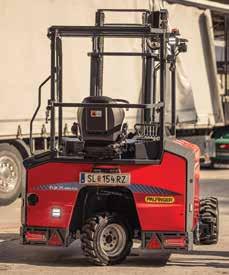
and the 5-degree inward seat position increases visibility and reduces driver neck strain when reversing. The footwell size is the largest in the industry and the controls have been located for optimum comfort. Optional telescopic wheel arms facilitate one-side off-loading without the need for a double reach system in some applications.
The mast has been designed for maximum durability and optimised load visibility in all directions. The engine compartment is developed for easy access to all components for daily and routine maintenance. The overall weight of the new models is the lowest in its class which enables customers to maximise payload.
Has Palfinger developed a BEV version yet?
Yes, the latest models are also available in electrically powered versions with maintenance free Lithium batteries to meet specific customer and application requirements where emission free operation and sustainability are of key importance. They are also beneficial when quiet night-time deliveries are necessary in urban areas. Palfinger has delivered a fleet of battery powered units to a large timber distributor in Germany, and the feedback is extremely positive. Battery performance is really good and having the ability to rechange the units in transit is an additional benefit. The first electric units have also been delivered to the Nordic region where electrification of the logistics and supply chain network is already well advanced and there is a well-established charging infrastructure, which gives operators greater confidence when making the transition to EV’s.
Because the new range has been completely redesigned from the ground up, this has facilitated the introduction of multiple upgrades and USPs. The swivel seat with integrated operation protection makes entry and exit really easy,
What events and exhibitions will Palfinger display at during 2026?
Palfinger will be participating in multiple regional and industry specific exhibitions throughout Europe in 2026 including the IAA Transportation in Hannover next September. In the meantime, we are continuing to demonstrate the new FL range to customers all over Europe and through our dealers, including Palfinger Ireland based in Tullamore, which have machines in stock to give operators the opportunity to see the machines in operation.
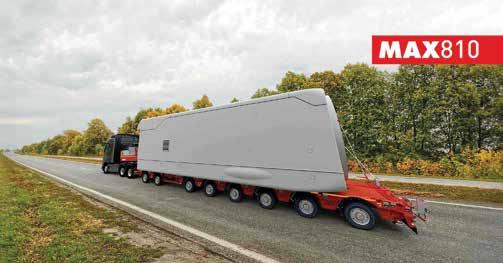
With the new MAX810 semi low loader, MAX Trailer is extending its product range and entering new service areas. The concept impresses with an optimised tare weight, a high payload and the modular combination of front bogie and loading platform.
The MAX810 is a power pack. The loading platform features 6 or 7 axles and is available with single or double extensions. Depending on requirements, it can be coupled to the gooseneck or extended with a 2- or 3-axle front bogie. The gooseneck is hydraulically liftable and lowerable. The technical fifth wheel load is 38 tonnes, designed for 6x4 or 8x4 tractor units.
The combination provides optimal cornering characteristics in any extension length, without having to manually adjust the steering bars at all. Even when manoeuvring backwards, the forced steering ensures ultimate precision.
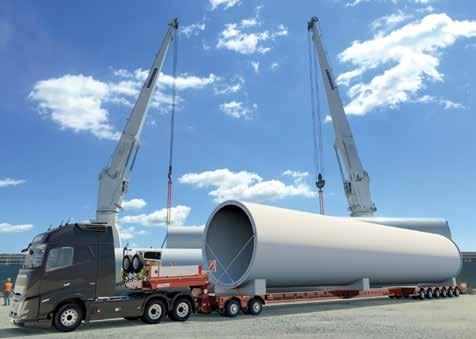
The axle system with 17.5” pendle-axles guarantees manoeuvrability and stability, even on difficult terrain. The technology used on the MAX810 offers three crucial advantages: 600-millimetre stroke, 60-degree steering angle and a low loading height of only 800 millimetres – ideal when transporting high loads. The hydraulic functions such
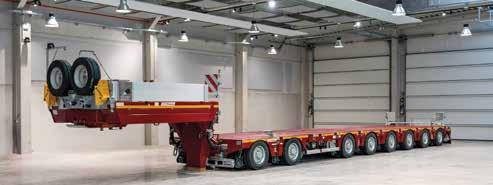
as driving height and alignment can be conveniently controlled using the radio remote control feature.
Hydraulic ramps, which can be easily attached according to the needs, support the heaviest machines, whilst numerous stakes and lashing points offer flexible load securing options. The result is an optimised vehicle solution for transporting machines, bridge elements, wind turbine components or industrial parts. The complete metallisation ensures optimum corrosion protection and durability in use.

n Thirteen products and solutions from eight countries have reached the final round of the International Intralogistics & Forklift Truck of the Year (IFOY) AWARD 2026 (IFOY) AWARDs 2026. Four companies are shortlisted for the IFOY Start-up of the Year Award.
n All of the finalists will face the IFOY Audit at TEST CAMP INTRALOGISTICS in the Westfalenhalle Dortmund.
n TEST CAMP INTRALOGISTICS will be open to B2B visitors on April 15–16, 2026.
n Winners’ trophies to be presented on June 25 in association with IFOY event partner AEB in Stuttgart.
The eagerly awaited list of finalists for the International Intralogistics and Forklift Truck of the Year (IFOY) AWARD 2026 have been announced. A total of 49 entries were submitted for this global innovation competition, and 17 products and solutions from eight countries have made it to the finals in Dortmund. Nominated innovations come from Crown, idealworks, Jungheinrich, KNAPP, Libiao Robotics, Locus Robotics, Mobotic, Nomagic, PureLoX SOLUTIONS, SSI Schäfer, STILL, The Mobile Robot Company, and Wiltsche Fördersysteme.
In the spin-off category: “IFOY Start-up of the Year”, AI2Connect, Koiotech, Pyck, and Romb Technologies are competing for the title.
The entries were evaluated over a six-week period to determine the panel of finalists.
“Artificial intelligence has arrived in intralogistics – as a practical tool with clear benefits, not as an end in itself. It is no longer just start-ups delivering disruptive solutions: established manufacturers, hidden champions, and mid-sized companies are demonstrating how innovation works today. The IFOY Audit is going to be a thriller,” says Anita Wuermser, Chairperson of the IFOY Jury.
Two integrated customer solutions are in the final
The pinnacle of integrated customer solutions demonstrates in practice what AI and automation can achieve today: Jungheinrich at Liebherr and Locus Robotics at The Quality Group.
At its headquarters in Ehingen, Germany, Liebherr has built a new central spare parts warehouse, which has been consolidating the global spare parts supply for cranes since April 2025. 90,000 items are processed there via the AI-based warehouse management system (WMS) from the Hamburg intralogistics specialist Jungheinrich. The WMS controls both the pallet high-bay warehouse with 18,000 storage locations and the small-parts shuttle warehouse with 40,000 bin locations, as well as nine manual storage areas. The Jungheinrich “Data Center” module plays a central role in managing the time-critical cut-off times for shipping providers: the integrated AI calculates the optimal picking start and automatically controls the retrieval process. Within the first months, the system made over 97,000
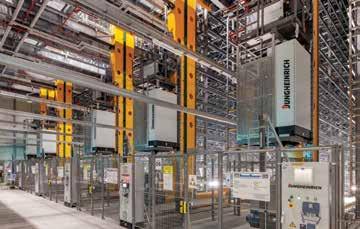
decisions based on more than 830,000 forecasts. The result: more than 96% of picking processes were completed on time, and manual interventions were reduced by over 80%.
The European headquarters of the US robotics company Locus Robotics in Amsterdam implemented the LocusONE platform with 350 autonomous Origin AMRs for The Quality Group (TQG) at their Elsdorf site, integrating it with the TQG WMS. On 40,000 square meters, the system orchestrates mobile robots and employees in real time. It scales capacity flexibly in a Roboticsas-a-Service model to 60,000 orders per day, and even higher during peak periods such as Black Week. The rollout was carried out in phases alongside the infrastructure build and completed in under eight months – from go-live with around 40 robots to full-scale operation with about 350 units, connecting three halls today. The feature crucial for e-commerce is LocusONE FastPick, where robots are dynamically grouped at so-called pick walls to handle sudden peaks in demand immediately without physical rearrangement. This allows the platform to respond flexibly to campaigns from influencers.
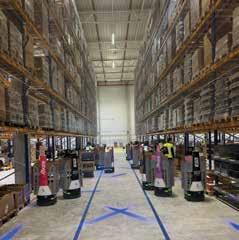
Three industrial trucks nominated for the final from the USA, Germany, and Denmark: Crown, STILL, and The Mobile Robot Company showcase the innovative potential of classic forklifts and warehouse vehicles.
The new WJ 50 electric low-lift pallet truck by Crown impressed during the nomination phase as a modern electric alternative to manual pallet trucks. Its practical overall package combines the familiar comfort of Crown ergonomics with easy handling, intelligent battery management, and a comprehensive warranty. Although it is lightweight itself, the truck can move loads of up to 1.5 tonnes. With a front-overhang of only 370 millimeters, it is also extremely manoeuvrable, making it ideal for tight spaces such as retail and wholesale stores, truck deliveries, or kerbside operations.
STILL demonstrates how true inclusion can work in intralogistics with a five-ton forklift adapted for people of short stature, without compromising performance or safety. The special version of the RX 60-50/600 electric forklift, developed together with Barrus Engineering for Voß Edelstahlhandel, features an electrically adjustable floor plate, a customized entry, additional handholds, and hydraulic fork adjustment. At the push of a button, the forklift can be converted to standard size, making it usable by all employees. Advantageously, the conversion concept is transferable to other RX-60 models and existing vehicles.
“Manual when you want it – autonomous when it makes sense”: the J1600 by The Mobile Robot Company is a pallet truck with intuitive and high-quality robotic functionality. The dual-mode machine, with a load capacity of 1.6 tonnes, can be used both as a conventional electric pallet truck and autonomously, based on 3D LiDAR localization and mapping. Especially for small and medium-sized manufacturing companies, warehouse operators, and logistics service providers with one to five operators, the J1600 provides an easy entry into automation – and can reduce manual labor by up to 80 percent.
Three finalists in the Robot Warehouse System category Robotics is a major trend in intralogistics, and here too,
everything revolves around AI. Libiao Robotics from China, SSI SCHÄFER from Germany, and Nomagic from Poland.
The AirRob PRO from Libiao Robotics is a climbing warehouse robot capable of handling both cartons and plastic bins directly from the shelf, without repacking. What makes it unique is that the gripper mounted on the AirRob climbing platform is rotatable, allowing bins to be picked up or set down on either side of the aisle. This reduces the number of required workstations – and in some cases, they can even be completely eliminated. Dual suction technology, an integrated conveyor,
and a vision system ensure precise, gentle handling and high storage density. The scalable system operates on standard shelving, is quick to implement, energy-efficient, and ideal for dynamic e-commerce and 3PL applications.
Automation meets shoeboxes: The Shoebox Gripper from Nomagic, introduced in January, handles them reliably. It is the first robotic arm with a novel mechanical gripping mechanism that can pick unsealed shoeboxes of all sizes, shapes, and orientations. Supported by an AI-based perception system, the gripper identifies each item and controls the grasp so that previously fully manual picking and sorting processes can now
be automated. The potential is enormous: according to industry data, shoeboxes account for roughly 20% of all items processed in a typical fashion e-commerce warehouse.
At SSI SCHÄFER, peak performance is the focus with the new FastBots Solution. This holistic solution replaces rigid conveyor technology with an autonomous shuttle fleet and seamlessly connects different warehouse types – shuttle, high-bay, or small-parts warehouses – with workstations of any kind or palletizing robots. On just a few hundred square meters, the system achieves five-digit hourly throughput, covering peak loads in e-commerce, fashion, grocery, pharma, and contract logistics. The solution scales from small warehouses to large distribution centers and can be expanded step by step with additional vehicles, workstations, and charging infrastructure –without interrupting operations.
Two Specials of the Year
With Mobotic and Wíltsche Fördersysteme, two German compete in the Special-of-the-Year category.
The MoboDrive ST from Mobotic is a steering-drive unit designed for highly maneuverable AMRs and AGVs. This all-in-one component combines steering, drive, motor control, encoders, and continuous 360-degree rotation in a sealed, compact, and contamination-free module, replacing multiple individual components. Its enclosed design allows configurations that were previously impossible and additionally provides a fast, hygienic solution, ideal for electronics manufacturing, hospitals, and the food and pharmaceutical industries.
With Destuff-it from Wiltsche Fördersysteme, the jury has nominated a mobile container unloading system that assists employees with loading and unloading packages of up to 74 kilograms. Its main innovations are the flexible conveyor belt and the system’s excellent manoeuvrability – both inside the container and in the warehouse. The unit is height-adjustable,
making lifting boxes largely unnecessary. Battery operation allows it to be easily moved from gate to gate, increasing throughput by up to 100 percent and almost completely eliminating injuries. It represents a practical precursor to the still largely unresolved full automation – ideal for e-commerce, contract logistics providers, and large shippers.
Three solutions nominated in the Intralogistics Software category
Software has always been important in logistics, and now “AI inside” is driving disruptive approaches. The finalists from idealworks, KNAPP, and PureLox SOLUTIONS clearly demonstrate this.
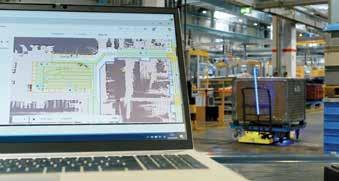

With AnyFleet from the German company idealworks, a cloud-based automation platform for intralogistics reaches the final. It surpasses traditional fleet management systems. A core innovation is the manufacturer-independent, open platform architecture, which – thanks to VDA-5050 compatibility – enables seamless integration of heterogeneous fleets from different manufacturers and levels of autonomy. AMRs, automated guided vehicles (AGVs), and manual vehicles are coordinated centrally, along with peripheral devices such as sensors, roll-up doors, or traffic lights, as well as WMS or ERP systems, ensuring material flow processes are future-proof. Real-time analytics, simulations, and digital twins additionally provide complete transparency of operations.
With its KiSoft Delivery Solution, the Austrian intralogistics provider KNAPP addresses one of the largest and still unresolved challenges in logistics: the last mile and end-to-end supply chain optimization. This AI-supported software connects warehouses, transportation, and delivery in a single system for the first time, enabling dynamic planning that adjusts in real-time to orders, traffic conditions, and available resources – ideal for next- and same-day delivery. Integrated analytics, a driver app, and seamless connectivity to WMS/ERP ensure precise delivery windows, efficient routes, and on-time dispatch from the warehouse.

PureLoX SOLUTIONS overcomes the limitations of traditional monolithic warehouse management systems with plx.wmx®. This cloud-native WMS from Germany, designed specifically for dynamic sectors such as 3PL, e-commerce, and retail, manages all logistics processes – from goods receipt and storage to picking, shipping, and returns – and supports flexible processes like value-added services or multi-pick strategies. Its patented GO-ONE Engine enables simple adaptation and scaling of processes, locations, or tenants, while API-first integration allows seamless connection to existing systems. The one-version strategy keeps all customer instances always up to date.
Four Start-ups nominated Software and AI also dominate the start-up category. The jury has nominated four candidates with disruptive approaches for the spin-off award “IFOY Start-up of the Year”: AI2Connect, Koiotech, Pyck, and Romb Technologies.
The Dortmund-based Start-up AI2Connect positions itself as a factory for specialized AI agents in logistics. AI2RampOptimizer is one of several AI agents. It addresses ramp optimization using a self-learning multi-agent system based on predictive learning, reinforcement learning, and rule-based logic. The results: 30 percent shorter waiting times, 60 percent fewer detention charges, and 15 percent lower carbon dioxide emissions. The plug-and-play system is operational in under three weeks without IT integration, with a return on investment of less than three months. The factory approach also allows scaling to yard management, route optimization, and other logistics domains.
Pyck aims to replace traditional warehouse management systems with an Open Source Toolkit for Warehousing Software. Instead of rigid standard solutions, the start-up from Schwaebisch Hall offers a modular system that models warehouse processes using AI and automatically generates software. Unlike conventional WMS, Pyck does not prescribe processes: logistics experts design workflows, data models, and user interfaces themselves – flexible, extendable, and independent of vendors. The promise: lower costs, faster

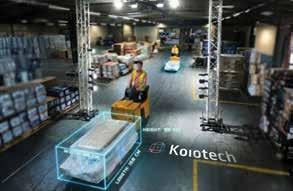

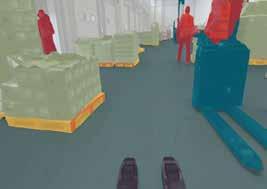
adjustments, and easier integration of new technologies such as AI and robotics.
Romb Technologies from Croatia focuses on Semantic Visual Intelligence for Intralogistics. The technology translates raw image data and gives machines a visual understanding of their environment – comparable to human perception. Unlike classical vision systems, it recognizes not only fixed objects but entire object classes such as people, pallets, loads, vehicles, or drivable surfaces. This enables new applications from adaptive load handling and obstacle avoidance to facility-wide analysis. Target users include AGV and AMR manufacturers, system integrators, and end users who leverage existing cameras for real-time transparency and AI-based analytics.
The jury also gave a go for the AI-based DeepCargo freight measurement system from the Göttingen start-up Koiotech. This AI-supported plug-and-play solution combines 3D sensors, barcode scanners, and proprietary software. It automatically measures freight of any size and shape at a stationary drivethrough gate at forklift speed of up to 17 kilometres per hour, detects missing or incorrect master data, and assigns barcodes precisely. The results: highest data quality without process interruptions, up to 50 percent fewer measurement errors, revenue increase of 3 to 5%, and 95% lower personnel effort.
The Irish trailer market in general was quite buoyant in 2025 as customers replaced older trailers which they had postponed the replacing in previous years due to Covid, price volatility etc . All sections of the market were busy including Curtainsiders, Skeletals and Platforms. That’s according to Aidan Kinsella, Managing Director, Dennison Trailers, Naas.
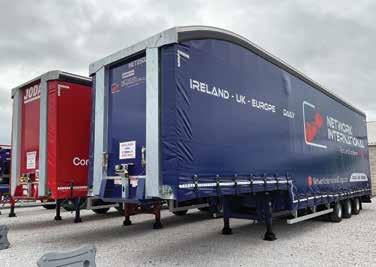
He continued: “Generally material prices stabilised in 2025, but steel prices could be affected in 2026 due to the introduction of the Carbon Border Adjustment Mechanism (CBAM) while new quotas under the tariff system which will see imports of steel from Korea, Turkey etc., which have reduced or having a significant increase in price due to exceeding targets. CBAM is where non-EU steel manufacturers whose goods are imported into the EU and will have a new charge added currently estimated at €85 per tonne and rising significantly up to and including 2032. Therefore, there two potential costs affecting steel. In 2025, we launched our new Double deck range of trailers, and this is gaining traction with some decent ordered delivered or in process.”
From the Irish perspective this sector of the market has reduced in significance over the last few years. The reason for this is that since Brexit, mutual recognition of trailers built in the UK has ceased. Therefore, any trailer operator importing trailers manufactured in the UK will need to be careful as trailers manufactured in the UK for the UK since Brexit do not have European Conformity and will need potential modifications and individual approval by the NSAI before it can be fully registered in the Irish Republic. Generally, trailers for the Northern Ireland operators are not affected.
Generally, the Irish and UK markets looks like it will be strong again in 2026 and will have recovered from the uncertainty as all the elections were taken place in 2024, that affected confidence so much.
David Dennison, Innovation Director at Dennisons added: We found the 2025 trailer market buoyant in all markets we serve, Ireland, England and some parts of Europe (in the counties we supply). We come into 2026 with a healthy order book and
see no reason why the new year will not continue in this vain. Extended lead times will pose a challenge, particularly for special trailers. Our brand performed well with notable recovery in the skeletal market where we had lost share in the previous three years due to lack of supply. We also saw a marked increase in the curtainside market, helped by double deck sales. We don’t have any requests for e-powered axles or components to compliment electric powered trucks.
There is a nice momentum building on link steer trailers for Germany to run a 25.25m long combination using existing standard tractor units and 13.6m semi-trailers. We will launch a new variant of this at the IAA Transportation 2026 in September. Closer to home there will be further iterations of double deck curtains building on the wrap around rear revealed at the end of last year.”
Schmitz Cargobull presented an overview of the new and used semi-trailer marketplace during 2025, and how the leading German brand performed.
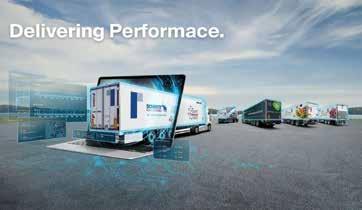
It was another challenging year in the European trailer market, with ongoing investment constraint, excess capacity in the sector and increasing cost and regulatory pressure. While our overall production volumes were down 6.5% to just over than 42,000 trailers in the year to 31 March 2025, Schmitz Cargobull increased its overall European market share to 25% and produced more units than forecast.
How do you see the market performing in 2026?
The tense economic situation is set to continue. Our focus is on strengthening trailer sales and expanding our services with the aim of stabilising our economic development over the long term.
Are pricing and cost of components continuing to be an issue?
Yes, costs for energy and personnel remain a concern and we continue to mitigate these with greater automation in our factories. However, we will not compromise on either investment or product quality as high-quality, reliable and durable products are the basis for low total cost of ownership for operators. Therefore, at the start of 2025, we increased our prices moderately by 3% to 5% based on the product.
Any new trailers or model variants [or technology] set for launch during 2026?
We recently announced the latest generation of our popular trailer refrigeration unit, the S.CU dc90, which requires 10% less fuel than the model it replaces while offering greater refrigeration capacity. We have also introduced the S.CU d80 ePTO ready as a factory option. This offers fleets maximum flexibility as the unit can be used with both conventionally powered trucks but also in ‘full electric’ mode with eHGVs.
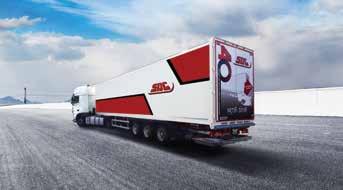
“We have seen a normalisation of the (new) trailer market with pricing and demand remaining steady, while used trailers are slow moving with prices at a consistent low,” said Paul Bratton, SDC Group President. “For 2026, SDC has over 3,000 trailers on order currently so we will see another fair year but competitive pricing is and will continue to supress margins, with the used trailer market again being low pricing with a glut of stock as the larger fleets consolidate. For SDC we achieved 8% more than forecast in terms of production numbers.”
Is pricing and cost of components continuing to be an issue?
“No these elements remains steady, availability was temporarily hit due to tariffs, it remains to be seen if there is any further disruption.”
“At Tiger Trailers we would describe the economic climate during 2025 as having been challenging for ourselves and the UK and Ireland trailer industry generally. We would attribute this to a range of factors, including increased costs, and reduced production output due to some operators delaying their decision making, due to the economic climate, choosing in some cases to extend the life of their trailers or pursue shorter term solutions like renting. We are, though, confident over our future growth plans for 2026. Our product range is wide, with particularly strong interest in and orders placed for our moving deck
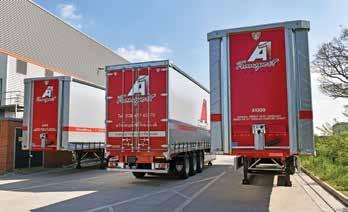
double deck fridge trailer. Also, we are continuously developing new products and enhancing our finance and rental solutions.
Curtainsider production reduced during 2025, which we believe was experienced by all trailer-builders alike - but Tiger’s box vans, moving double decks, rigid bodywork, and temperature-controlled products all performed strongly.
Supply chain costs remain high, which has inevitably led to price and margin pressure in the industry. We have however mitigated this where possible by passing on efficiency savings that we have realised in our products and processes.
There is definitely and interest in electrification and so in 2026 we will be launching our e-axle fridge trailer which is set to deliver significant CO2 savings over standard diesel fridge engines. Regenerative axles are a big area of focus for Tiger, representing a more environmentally friendly drive solution for customers by packing energy recovery capabilities into a more compact footprint, as sustainability becomes more important than ever for us and our customers.
With single-temperature variants now proven and in operation on several prominent operators’ fleets, 2026 will see the launch and take-up of the multi-temperature version of our moving deck double deck fridge trailer.”
Newcomers to the Irish market Kögel Trailers, hit the ground running with immediate conquest sales. The German brand’s product range are sold under the new established banner of Horizen Trailers, based in Dublin, with well-known industry expert Andy Freeney, at the sales helm.
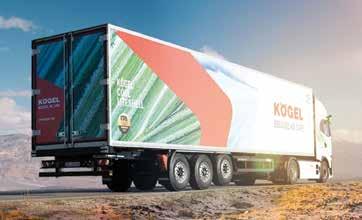
“For us with Kögel trailers, it was effectively our first year in business so coming with a new product to market our expectations were realistic but sensible,” explained Andy. “We performed better than we expected so that was a good start for us. What we saw in Ireland was a general softening of the market in late Q3 and into Q4 2025, which generally is the busiest time for trailers, so it will be interesting to see how Q1/26 goes. The general feeling among customers from our experience is that the HGV companies have overcooked the pricing and there should be a softening, Let’s see.
There is an interest in electric e-axles and we have the first trailer going into service this month, and have priced quite a few more and expect to win some of that business, For companies to invest they require help from their customers and Government support due to the price of this equipment.”
From the Setanta Vehicle Sales North perspective, as authorised importer for Meiller tippers, Kraker walking floor trailers and D Tec skeletal and vacuum tank trailers, overall, 2025 was a year of steady but more considered investment in
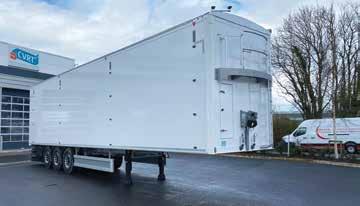
trailers, compared to the softer heavy truck registrations and a stronger focus by operators on extracting maximum utilisation and payload from existing fleets. While some high volume segments eased, demand for well engineered, specialist semi trailers remained resilient where equipment is central to safety, efficiency and compliance.
Within this environment, Setanta Vehicle Sales North performed well across all three brands. Meiller tipping semi trailers continued to appeal to customers in aggregates, construction and infrastructure, who value robust chassis and bodies, stable tipping characteristics and long term reliability in demanding site conditions.
Kraker walking floor trailers maintained strong demand from waste, recycling, biomass and agri bulk operators, where non tipping discharge, versatility and safe unloading on marginal ground are important advantages.
D Tec skeletal and tank trailers are well positioned in container, bulk liquid and waste streams, with lightweight, practical designs aimed at efficient handling of bulk liquid waste and by products within biogas and wider waste management chains.
Across all brands, repeat business from existing operators and new customers coming to the marques for the first time contributed to a healthy mix of orders in 2025, with a clear trend towards higher specification, long life equipment.
Looking ahead, Setanta expects the Irish semi trailer market in 2026 to be broadly stable in volume but with further emphasis on specification, uptime and total cost of ownership. Operators are using replacement cycles to move towards more versatile and better equipped trailers that can serve multiple contracts and seasons, rather than like for like swaps.
Opportunities are strongest in sectors such as construction and infrastructure, waste and recycling, agri bulk and energy
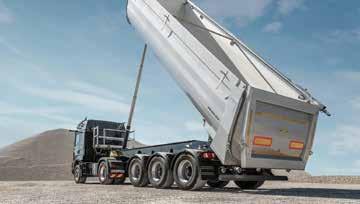
related flows (including residues for biogas), and port related traffic. In each of these sectors, there is a clear requirement for modern trailers that support customers’ ESG, environmental and safety objectives, an area where Meiller, Kraker and D Tec all have strong offerings.
Pricing and component costs remain a key consideration for customers, but conditions are more stable than during the most volatile post pandemic period. While material and component prices remain elevated versus historic norms, greater predictability is allowing more accurate budgeting and quoting for both single unit and fleet orders.
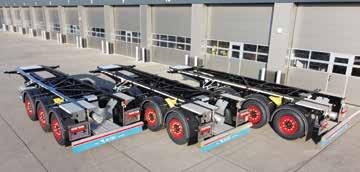
Lead times have improved overall, though bespoke builds and highly specialised specifications still require early engagement and planning. Setanta continues to work closely with Meiller, Kraker and D Tec to manage specification, production slots and logistics so that customers receive realistic delivery timelines and clear communication from order through to handover.
Interest from operators running, or planning to introduce, electric trucks is growing from a low base, and the conversation is increasingly about whole combinations rather than tractors alone. Larger fleets in particular are exploring how trailer specification can support decarbonisation and energy efficiency, including the role of e axles, electric refrigeration and weight optimised designs.
For now, the primary focus for most trailer buyers remains weight, robustness, safety and operational efficiency, but more customers are asking how their next generation of trailers can be specified in a way that does not limit future use with alternative drivetrains. Setanta is actively engaging with its manufacturing partners to ensure that Meiller, Kraker and D Tec products can be configured with this transition in mind where required.
In 2026, Meiller will continue to refine its tipping semi trailers with developments in weight optimisation, corrosion protection and safety systems tailored to Irish conditions. Kraker will further develop its walking floor range with configurations and options suited to Irish and UK waste, recycling and bulk markets. D Tec will continue to evolve its skeletal and tank trailer portfolio, including vacuum tank trailers used for bulk liquid waste and by products in biogas and waste management chains, with a focus on payload, ease of operation and compatibility with modern fleet requirements.
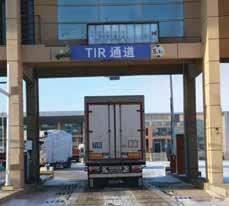
Supporting the rapid growth in more effective road transport routed across Asia, new TIR Green Lanes have opened at China’s Erenhot border crossing, significantly accelerating the transport of goods.
*TIR Green Lanes refer to specialised, fasttracked customs lanes for trucks operating under the TIR (Transports Internationaux Routiers).
TIR Green Lanes which enable vehicles travelling with TIR carnets to be processed in a dedicated lane at the border crossing, are now operational on both sides of the strategic Erenhot–Zamiin-Uud border crossing between China and Mongolia.
TIR Green Lanes on both sides of the border are an example of harmonisation best practices and the streamlining of secure transit.
International Road Transport (IRU) Union Chief Representative for East and Southeast Asia Ran Wang said: “Strengthening dialogue and collaboration with authorities and local partners is key to operational success. The new TIR Green Lanes at Erenhot are a direct result of these engagements, ensuring smoother processes and providing benefits for local companies relying on this crucial corridor.”
The establishment of TIR Green Lanes forms part of IRU’s ongoing efforts to advance trade facilitation at strategic border crossings along major international corridors.
Working closely with members, customs authorities and international institutions, IRU has helped implement similar measures in several more countries.
Already trailers can complete journeys between depots in Europe and China in seven to ten days and improvements in road standards, the development of hydrogen and other alternative vehicle fuels could further enhance the potential of road transport as quick, clean, and economical players in the supply chain.
Ferry lobby group demands pause in EU ETS implementation
Interferry, the global association for the ferry industry has called for an immediate halt to the further phasing-in of the EU’s Emissions Trading Scheme (ETS) for the maritime sector. This demand follows the recent EU decision to continue exempting road transport from a parallel ETS mechanism. Interferry claims that the present surrendering obligation for maritime emissions should remain frozen at the 70% level implemented in 2025 and not increase to the planned 100% in 2026, or at least until similar rules are put in place for the road transport industry. There are also issues concerning how the funds that are currently being collected for decarbonisation are being used. The ferry companies are concerned that the ETS charges, which they must add to their rates, can make ferries uncompetitive with road and rail in Europe.
increase at Dublin Port
Charges levied by Dublin Port relating to general cargo, containers, trailers etc. are increasing by 5% from March 1st. Vessel handling charges will also increase.
A new infrastructure levy of €15 per unit is being applied to laden containers and trailers. The port advises that the purpose of the levy is to help fund the Port Development projects which are
currently underway or in planning. The ports of Rosslare Europort and Waterford do not have any present plans to impose such charges.
The increases in Dublin charges, together with the significant rate increases being sought by the ferry companies, are worrying hauliers who carry low-cost items, typically materials for use in the construction industry to Britain. This represents a substantial amount of low margin traffic and without trailer flows to and from Britain would become lopsided forcing further rate increases.
Container tracking and monitoring continues to improve
The rapid implementation of container tracking systems by major shipping lines and other operators has significantly increased shipper trust in shipping using this mode. It is estimated that about 20% of the global fleet is monitored throughout its journey from cargo shipper’s premises to customer’s
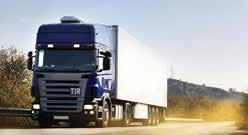
warehouse. Significant work is underway in East Africa for example to switch fruit and vegetable traffic from air freight to shipment to Europe in reefer containers. This is due to the ability of the cargo owners to control the condition of the cargo and avoids the need to stow and re-stow the goods at various stages throughout their journey.
As volumes being shipped in this way increase, certain shippers have been putting in place two monitoring devices, one hidden away, in each container which operate independently and reduce the risk of theft or damage en route.
Text: Howard Knott - contributor@fleet.ie


With extensive experience and knowledge across the transport industry, our team of specialists are committed to finding the right funding strategy for your business.
Learn more today, at closecommercialfinance.ie