1914 Constantin Brancusi New York Exhibition foto: Man Ray
1922 - 1932 Contimporanul (The contemporary)
Old house, Curtea de Arges 1914 Zaharia Leon villa Toma T. Socolescu
1939-1945 World War Two
1931 City Lights Charlie Chaplin
1926 Hermann Iancu building Marcel Iancu
1930 Ion Miclescu villa Horia Creanga
1929 Mar Kisa villa project Leonida Plamadeala
1935 House Constantiniu Henrietta Delavrancea Gibory
DREAMS
1957 Sputnik 1
1952-1953 Individual Housing 3rd year stud. Ninchevici 1945 House in Mangalia E. prof. Octav Doicescu 1956 Haralamb Georgescu Competition for single family urban houses 1st prize Radu Patrulius, Gh. Rosetti, M. Enescu
1957 Sputnik 1
1957 New House In Runcu
1958 4 apartment villas, Eforie N. Stopler
1977 Experimental solar house, INCERC 1970, Brasov Mircea Kassargian
1989 Revolution
1983 People’s House
1968 spring
1989 AD competition A dwelling for today entry: Ioan Andreescu Vlad Gaivoronschi Adrian Ionasiu
1998-2001 La Mesteceni 2000 Herczeg house Alexandru Beldiman Radu Mihailescu
2014
2009
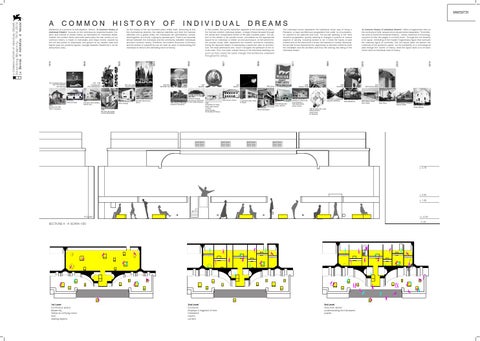
“A Common History of Individual Dreams” offers a fragmented view on the continuity of time, sequences to be perceived separately. The exhibition aims to avoid the temporal linearity – history read from a chronological point of view, like pages in a history book – through the non-linearity of its layout, reminding of the modern fragmentary figure that overrules the classical figure of continuity. Still, the layout does not abolish the continuity of the pavilion’s space, nor the possibility of a chronological walk through the ‘rooms’ of history: what the layout does is to let each visitor have an individual read of history.
2000
The individual house represents the traditional urban way of living in Romania, a major architectural programme that under no circumstances ceased to be planned and built. The private dwelling is the most sensitive programme, quickly reacting to changes in politics or various aspects of society, including fashion or art; it holds the traces of past models and at the same time it shows the features of novelty. Moreover, the private house represents the opportunity to become visible for both the inhabitant and the architect and thus the coming into being of the individual dream.
1977
1957
In this context, the current exhibition opposes to the thickness of history the frail but resilient individual dream, a single thread followed through the dense and complicated events of the past hundred years. The object of this dream is the private house, considered as the appropriate space for an individual, a shelter, an exclusive place. At the same time, the private house often represents the modern architect’s manifesto, being the favourite means of expressing a particular view on architecture, the most permissive one, since it escapes the pressure of the official code. Thus, the small, private history of the individual dwelling can point out more clearly the subtle changes that architecture underwent throughout the century.
1989
INDIVIDUAL
As the history of the last hundred years writes itself, dissolving at first the multinational empires into national identities and then the national identities into a global entity, the individuals are permanently considered together, as a block, a group to operate upon. There is an essential tension between the individual and the community, between individuals and their common history. Therefore, the modern discovery of intimacy and the praise of subjectivity can be seen as ways of empowering the individual to resist to the alienating force of history.
1930
1926
Modernity is a process of individuation. Hence, “A Common History of Individual Dreams” focuses on the individual as essential modern creation and intends to reveal history as framework for individual ideals. Indeed, the modern times and more particularly the last century of our common history is made of individuals and major events caused by the will and power of individuals; one glance at our modern past and figures pop out, powerful figures, strongly featured. Modernity is not an anonymous story.
OF
1968
H I ST O RY
1948
COMMON
1940
A
1914
Absorbing Modernity: 1914-2014 La Biennale di Architettura di Venezia
A COMMON HISTORY OF INDIVIDUAL DREAMS
MM59731
2001 WTC terrorist attack
2002 Pestera house Dorin Stefan
2002-2005 House Radu Teaca
2009 House in Carpinis Graphic Studio
2011 House in Voluntari Florian Stanciu
1983 Al Swani villa, Libya Gabriel Tureanu Viorel Trocan M. Alexandru
+ 4.70
+ 2.00 + 1.50
+/- 0.00
POLAND
- 0.45
SECTIUNE A - A’ SCARA 1/50
1st Level Continuous space Modernity Yellow as unifiyng colour floor seating objects
2nd Level Enclosure Displays a fragment of time framework beams content
3rd Level View from above understanding the framework pulpits
Absorbing Modernity: 1914-2014 La Biennale di Architettura di Venezia
1914 - 1926 Eclectic national expression
1926 - 1930 Avant-garde
1930 - 1940 The glorious 30’s
1940 - 1948 Uncertain ground
1948 - 1957 Social realism ?
1957 - 1968 Back to international style
1968 - 1977 Innuendo
1977 - 1989 Delirious regime
1989 - 2000 Transitory conscience
2000 - 2009 Misleading dream
2009 - 2014 Seeking ways out
The national dream being fulfilled by the 1918 Great Union, on the architectural level the urban dwellings tend to exercise a plethora of styles in the search for an individual expression. On the other hand, it is obvious that the rural, traditional architecture arrives to a point of classical beauty and integrity.
A pure modern esthetic arrives in Romania through German influence, Marcel Iancu being one of the forerunners of this movement. “Contimporanul” (“The Contemporary”) magazine promotes the new modern art and lifestyle soon after the end of the WWI, while the first modernist buildings are built in the private housing sphere.
The 1930’s state the modern style as a main current in architecture. While the public buildings still follow a neo-Romanian style, the private investments share the ideas of a necessary modern architecture. A series of individual villas - with plans oscillating between rationalist and traditional spaces and with clearly modern exteriors - creates a strong identity for the Romanian modernism. The modern mutations make their way into the traditional, rural areas with the opening of The National Village Museum in 1936.
The beginning of WWII casts a shadow on the private building. The Modern Movement evolves and remains the most important reference in architecture. This interval lets the modern architects reflect on their own themes. An example for this personal reflection it is a private house in Mangalia designed by Haralamb Georgescu, just after the war, in 1945. Many architects choose exile, exporting for the first time the Romanian modernism.
1948 begins with the urge of setting in the communist regime of Soviet influence; thus, the official style is diverted from modernism to social realism. The single family house is conceived as double house, classical in ornamentation while functionalist in layout. Meanwhile, in the villages, new available materials produce mutations in the typology of the traditional house.
Maybe the launch of Sputnik 1 would be enough to mark a new era, one of modern technologies conquering new territories, farther out in space; moreover, on a political level, the discourse of Nikita Hrusciov one year earlier had an impact on redirecting the architecture towards an international esthetics, following the urge for more economic building. The architecture in Romania turns also to a kind of international style.
In may 1968, the authorities adopt the laws which allow the development of private individual houses. A newly formed clientele will build in the following years a series of interesting individual houses, still unknown to the public. In the same time, there are being held some competitions on individual houses or weekend houses. In the meantime, in the rural areas the type project is replaced by the directive project.
The individual housing is almost banned and the beginning of the works for the House of the people in 1979 state that there can be only one house, the Ceausescu couple’s coming into being of an individual private dream of domination. In the same time, a series of design collectives work for individual housing in North African and Middle Eastern countries and a small part of the architects try to evade by desiging for international competitions, thus exporting again the modern Romanian experience.
1989 ends with the overthrow of the communist regime as in all Central and Eastern Europe. The architecture in those years is following an uncertain path between the contemporary Western architecture and the rediscovery of interbelic modernism. The albums “A home for everyone” transform the old directive project catalogues into ready made projects for fulfilling instantly one’s dream of private life.
In architecture it is the moment when foreign investments become substantial. An impressive melange of all styles of rationalfunctional plan individual houses are being built on the outskirts of towns, following the dream of escaping the polluted city for the idyllic countryside life, often a place not quite urban, not quite rural, lacking the qualities of each and caught in the dullness of the in-between.
The financial crisis in 2009 marks the begining of new solutions within the framework of the first modern – economy of means, simplicity, esthetics. New solutions for dense, urban individual houses appear and a higher sense of awareness for sustainability is being shown. The tendencies are on one hand global in the research of a contemporary lifestyle; on the other hand, local communities restate the need for traditional values.
+1.05
+0.40
+0.40
+0
.40
+0.40
+0.40 +0.40
+0.40 +0
.4
0
+0.40
+0.40
+1.05
+0.40
+0.40
+1.00 +0.40
+/-0.00
+0.40
+0.40
+0.40 +0.40
+0.40 +0.40
-1.15
PLAN AMENAJARE SCARA 1/50
week 13
week 14
workshop
major event week 16
week 18
week 19
week 20
week 21
week 22
week 23
23/11/14
week 11
workshop
major event repetitive manifestos week 10
week 15
week 17
week 24+1 day repetitive manifestos
week 8
week 9
week 12
repetitive manifestos
week 6
workshop
major event week 5
week 7
repetitive manifestos
week 3
week 4
repetitive manifestos
week 2
repetitive manifestos
week 1 workshop
07/06/14
-0.75
TIMELINE
A COMMON HISTORY OF INDIVIDUAL DREAMS
MM59731
Absorbing Modernity: 1914-2014 La Biennale di Architettura di Venezia
+ 4.70
+ 2.00 + 1.50
+/- 0.00 - 0.45
SECTIUNE A - A’ SCARA 1/50
SECTIUNE A - A’ SCARA 1/50
The first level is the ground level, painted in yellow, consisting of yellow seating objects spread throughout the pavilion; the seats are places where one discovers the continuity of space below the beam and where one can rest, read or watch the video projections.
Wooden beam 10x50cm
A COMMON HISTORY OF INDIVIDUAL DREAMS
MM59731
The second level is that of the standing person’s sight, the regular stance for reading the information displayed on the beam; it is the only level that offers a fragmented vision of the pavilion’s space, in analogy to the fragments of history.
The third level is the pulpits’ one, from the height of which a view from above is ensured, one that reveals for the first time the framework as such; the pulpits are also places of affluence, where one can give lectures to the audience or simply have oneself photographed.