ROSES’ RISE
The rapid advance of women’s sport
BY MAGGIE ALPHONSI
BROAD CHURCH
Stuart’s
unique twist on SPOTY
BY STUART BROAD


MODELS Data has changed betting for ever


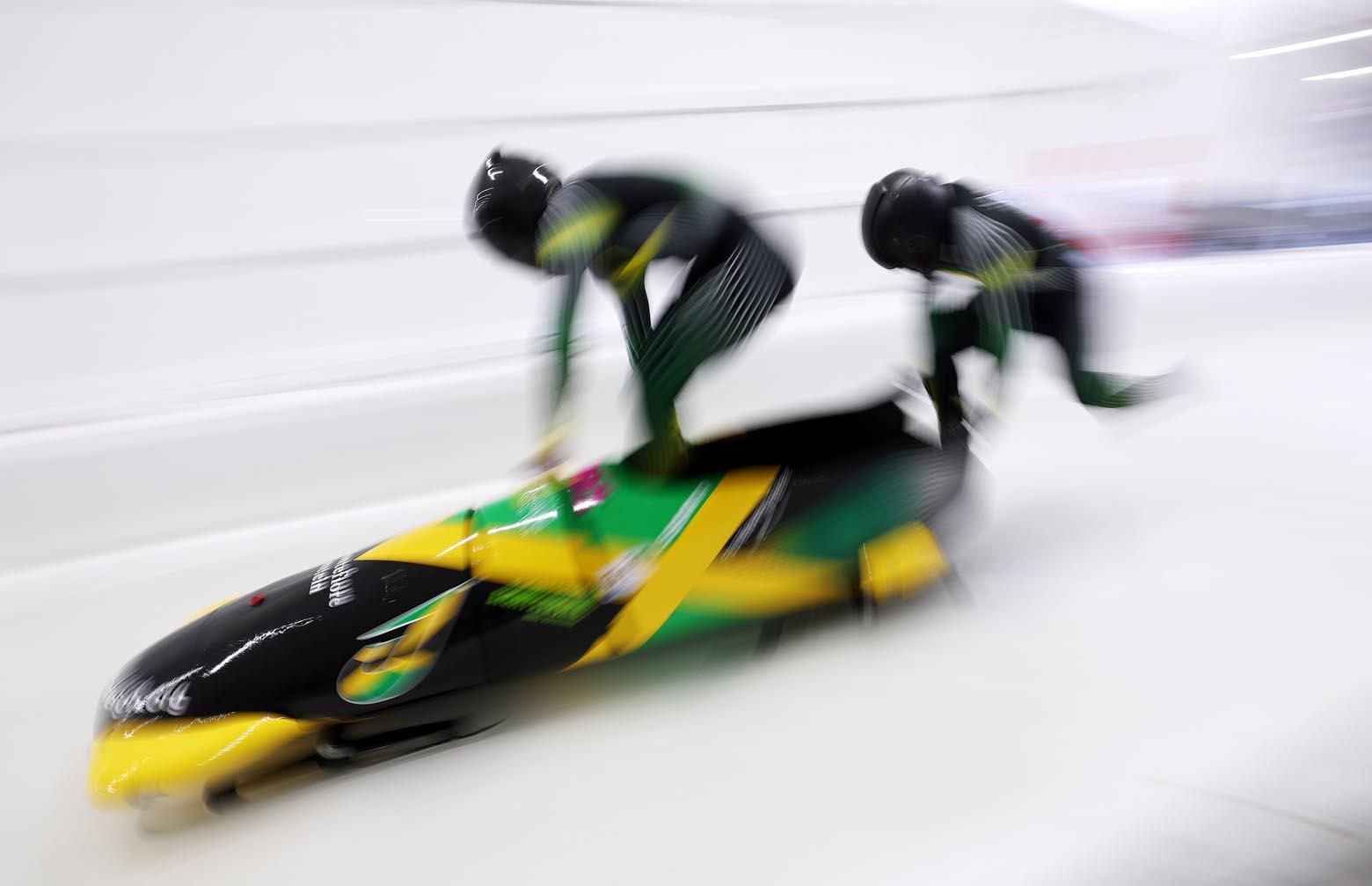
MICA MOORE IS ON AN ODYSSEAN journey to the Winter Olympics. A British sprinter turned Jamaican bobsleigh pilot, her wild career has had more twists and turns than the whizzing Whistler track she’s just bombed down.
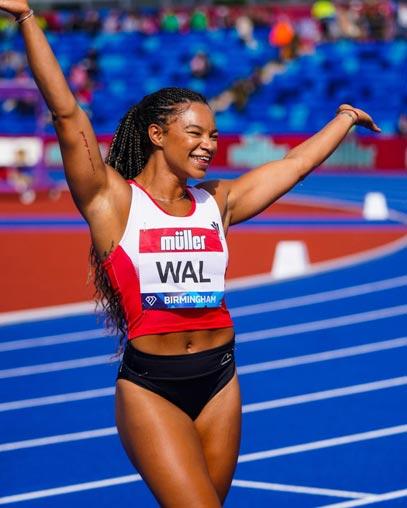
As we chat, she’s flying down the motorway on a 16-hour mission to Park City in Utah, before she prepares to hurtle herself once more towards Olympic qualification. There are journeys within journeys. And Mica has never sat still –except when fastened in her sleigh. Her love for sport, as well as the loving support from her parents, has enabled her to make some brave, career-defining decisions. She traded her summer spikes for the winter snow in 2016 after a glandularfever-type virus prevented her from competing as a top-level sprinter. It was a crushing moment for a young athlete who had competed at the 2014 Commonwealth
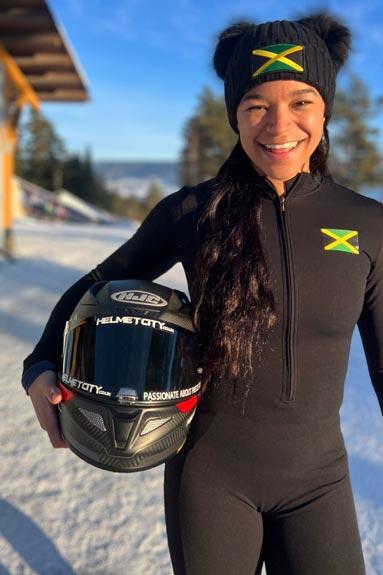
Mica Moore has swapped her Welsh running shoes for a Jamaican bobsleigh, but her Olympic dream lives on
Games as a 21-year-old. But it was the virus that led to Mica catching the bobsleigh bug.
“We looked for a new challenge –something to keep me ticking over – and I had a friend in the bobsleigh team who said, “Why don’t you come give it a try?” It was one of those things, just doing it to see what happens. And it went really well.”
Nobody was saying ‘don’t do this’, but my little devil on my shoulder was saying, ‘My God, you’re crazy.’
That is perhaps an understatement. Mica’s first attempt at bobsleigh was in Bath, where she underwent ‘Swiss Testing’: sprinting, jumping into the sand and pushing a bob on wheels. In her own genuinely modest words, “I got a score that was close to breaking records.”
No doubt records were broken. You can
picture the Bath bobsledders, eyes wide open, whispering to one another. Word spreading. Have you seen this new talent? I’ve never seen anything like it. While others were in awe of her natural segue into sledding, Mica was challenging herself in ways she’d never done before.
“Nobody was saying ‘don’t do this’, but my own little devil on my shoulder was saying, ‘Oh my God, you’re crazy.’ I’m not the most thrill-seeking person. I don’t like rollercoasters; I’m scared of heights.” But heights are what she has been scaling.
“I went out to Calgary six weeks later and it just became a whirlwind. If I’d had time to think about it, I probably wouldn’t have done it. But because it all happened so quickly, I was just along for the ride.”
She went on to compete for Great Britain in the 2018 Winter Olympics in Pyeongchang, achieving Team GB’s best ever result in the women’s bobsleigh with an eighth-placed finish. Not bad for a 100m
sprinter. So how does she compare the two?
“Bobsleigh is not for the faint-hearted. It’s long days in the cold for 60 seconds on the track. You’re at the track for five hours, moving the sled, lifting it, polishing runners. You’re not just pushing or driving; you’re your own mechanic. In athletics you can be a little more glamorous, turn up with your spikes and go. Both are tough, but bobsleigh probably tops it.”
HER SUCCESS IS EVEN MORE inspiring when you learn that this has been a self-funded process. The British Bobsleigh and Skeleton Association withdrew her funding less than a year before the 2018 Games, instead prioritising the men’s team. The glass ceiling has not yet been shattered.
“Our ambition was top ten. After day one we were sixth, and to finish eighth, the best British women’s finish ever, was amazing. It inspired so many women into the British →
BYJOE HODGSON
→ team, including quite a few Welsh ones ” Mica doesn’t dwell on the unjust nature of the funding double standards, even if it was a contributing factor in her short-lived decision to return to athletics in 2019. You can sense, however, that despite all her astonishing achievements, she takes the greatest pride in holding the torch for young British women hoping to make it in professional sports. After all, it was her parents who inspired her growing up. Her father has been her coach since she was 16, and her mother was her idol.
“She didn’t have much when she was younger, but growing up she looked like Superwoman to me, the biceps, the strength. As a young girl, that made me feel like I could be strong. They’ve both supported me my whole life and I couldn’t do it without them.” She returned to bobsleigh in 2021, but her second stint in the British team was wrought with challenges, sadly related to both her gender and skin
WONDER WOMEN
Women’s sport is reaching heights that would have felt unimaginable only a few years ago. Not because the quality wasn’t already there, but because the recognition and space simply weren’t. It’s no surprise, now, to see multiple female athletes among the favourites for SPOTY – there for performance, not performativity.
Speaking as the girl who once dreamed of playing in front of full stadiums, wanting only for her sport to matter, I know how significant this moment is. The crowds at the Euros, the Rugby World Cup – in stadia not long ago haunted by empty seats –speaks to a shift off the pitch that matters as much as anything on it.
We’re not talking about parity as an expectation. We’re talking about excellence deserving attention. And throughout these pages, you’ll find multiple stories of women doing exceptional things. Not as an afterthought, and not as a box to be ticked. Simply because it’s here, and it’s happening.
Lola Katz Roberts Audio & Editorial Manager
colour. Something needs to change, and something certainly needed to change for Mica. Rather than flip-flopping back to sprinting, she took a decision of the heart, a decision to connect with her roots, her identity. She decided to plough on as a bobsledder, but under a new flag.
Although she will now of course continue to inspire young British women, it will be Jamaican women who now have a chance to be captivated by her talent. In December 2024, Mica became a Jamaican citizen through her mother’s side of the family. A month later, she was now a Jamaican bobsledder. She had finally found a sporting environment where she felt comfortable and connected.
“After my last summer with the British team I was still ranked number one pilot and brake woman, but I felt there was an opportunity elsewhere. Unfortunately, Great Britain has some skeletons in their closet; it’s not always the nicest team to be part of. Jamaica welcomed me so kindly. Representing my heritage was a really proud moment.”
There is some serendipity in a young, mixed-race woman growing up on Disney movies (“I’m a massive Disney fan. I had a yellow TV in my room”) and dreaming of becoming a professional athlete, going on to represent Jamaica in the bobsleigh. Six-year-old Mica would never have known that her life would imitate art, but Cool Runnings II is surely coming to your screens this February.
MICA IS NOW WELL ON HER WAY to competing in the black, green and gold at the 2026 Milan Olympic Games. She embraces the cliché movie reference. Of course, she isn’t the first Jamaican to compete at the Winter Olympics, and there is a danger of tokenising her achievements through a Disney lens. But there is something special about such a beautiful film catalysing the Jamaican involvement in the Winter Olympics, whether it’s Mica or any other talented, young hopeful.
“It’s such a feel-good, inspiring movie. It’s nice to be part of that heritage, and I hope we can add a new chapter to that story, especially with everything going on in Jamaica with the storms. Some happy news
A lot of young athletes can’t see the wood for the trees. They get injured, have a bad race, and want to quit.
would be lovely. And the results this week have been record-breaking [at Whistler, in the North American Cup]. Three podiums out of four races for me, and the boys got a gold in the four-man. It’s an amazing start to the Olympic season. We’ll know (if we make it) around 17 January.”
WILL THIS BE THE LAST LEG of her epic career, switching both sports and national allegiances? “The reality is, it’s a financial thing. I’m (still) a self-funded team. No financial support from the federation. I’ve been incredibly grateful this year: people and businesses have helped with helmets, suits, kit, coats, even someone buying me a van to drive around Europe, and a sponsor getting me a new two-man sled. None of this would be possible without them. But every year the sport gets more expensive. I’d love to do it for ever, but it’s more of a pocket issue than a heart issue.”
For Mica, that may well be the case. But for her legions of fans, her success is very much a matter of the heart. An inspiring trailblazer, paving the way for young women to wrestle agency in their careers. There will be hundreds, if not thousands of young
women looking up to Mica as they begin their journeys into professional sports. Her advice is typically optimistic: “A lot of young athletes can’t see the wood for the trees. They get injured, have a bad race, and want to quit. I always say, ‘Don’t give up. Keep smiling. Keep enjoying it.’ The reason I’ve been in sport so long is because I love it. The community, the friends, the experiences. A bad day doesn’t make you a bad athlete. One of my favourite quotes is: ‘Even when times are good, they’ll pass, but even when times are bad, they’ll pass too.’” Her dream is to achieve a higher finish for Jamaica than she managed in 2018 for the Great Britain team. And when all is said and done, and she’s put the sleigh away, would she ever try her hand at a third sport?
“I think tennis would be fun. I play a little bit.” Wimbledon next? Doubtful. But you wouldn’t bet against Mica inspiring the next generation of women to either pick up a racket, drive a sleigh or sprint for glory. And you certainly wouldn’t bet against her making the headlines for Jamaica this February. Coming to a yellow TV near you. n
Mica Moore represents Jamaica in bobsleigh and is a former 60m sprint champion for Wales.
OUR TRIBUTE TO THE BEST BETS, JUNE TO NOVEMBER
SATURDAY 21 JUNE
INVESTED £25 EW DOUBLE SELECTION Noble Champion @ 25/1 Jersey Stakes Get It @ 28/1 Wokingham Stakes RETURNED £18,566
SUNDAY 22 JUNE
INVESTED £30,000 SELECTION Keegan Bradley @ 4/1 Travelers Championship RETURNED £150,000
SATURDAY 16 AUGUST
INVESTED £ 10 COMBI TRICAST SELECTION First Folio @ 15/2 3RD 15:20 Ripon Kodiac Thriller @ 10/1 2ND 15:20 Ripon Intervention @ 16/1 1ST 15:20 Ripon RETURNED £6,911
MONDAY 1ST SEPTEMBER
INVESTED £5 EW DOUBLE SELECTION Margorie @ 40/1 17:00 Windsor Yorkshire Lady @ 25/1 18:00 Windsor RETURNED £5,660
Congratulations on some fantastic picks in 2025, you all know who you are.
THURSDAY 6 SEPTEMBER
INVESTED £30,000 DOUBLE SELECTION Ireland Double Chance @ 11/8 vs Hungary Aryna Sabalenka @ 1/2 vs Amanda Anisimova RETURNED £ 107,100
SATURDAY 18 OCTOBER
INVESTED £10 EW SELECTION Powerful Glory @ 200/1 14:05 Ascot RETURNED £2,420
TUESDAY 21 OCTOBER
INVESTED £800 SEVEN-FOLD SELECTION Arsenal @ 8/15 vs Atlético Madrid Barcelona @ 1/4 vs Olympiacos Manchester City @ 4/6 vs Villareal PSG @ 8/13 vs Bayer Leverkusen Newcastle United @ 8/13 vs Benfica PSV Eindhoven @ 15/8 vs Napoli Borussia
Moore was crowned 60m sprint champion of Wales in 2014, before changing both sport and nationality


BSPEAKER’S CORNER Mark Bender
MENTAL GYMNASTICS
ACK IN THE DAY it was general massage therapists, good hands, good instincts. But those were the days of the sponge men. There were no GPS monitors strapped to chests, no MRI scans available within hours and no endless dashboards of data. And the athletes? They played hurt. That was the culture: get back out there and get on with it. But these days, one of the main things I do is try to slow people down. There’s always another grand slam, another game or another tournament to play in.
Starting out in the early Nineties, elite sport was a different universe. Support staff were minimal, sports science barely existed and medical departments were a world apart from what you see today. But clubs these days employ entire teams of physios, sports scientists, analysts and sports medicine doctors. The scale is enormous – and their input isn’t just medical, it’s also financial. Football clubs must ask themselves: “Are we about to invest £130 million in this athlete? Are they physically sound? Will they break down under the demands of the season?” Athletes aren’t just players any more, they are assets. Every heartbeat, recovery cycle and mood fluctuation is monitored. Every decision is scrutinised. The physical and psychological expectations have skyrocketed. More fixtures, more travel, more intensity, repeated through seasons that barely have an off-switch. But when you’re working at that Ferrari level, athletes must have an ebb and flow. You can’t compete every week, pushing yourself to the limit constantly.
IN MOST SPORTS, IF YOU PLAY WELL, you’ll play again. Take tennis, for example. If you want to be a top-ten contender on the ATP circuit, you have to prepare over the whole year to go deep in a five-hour match in the grand slams. While most points are short, a handful of seconds per rally adds up. Tennis is so complex in that sense. The body uses both sprint and marathon energy systems. But you could argue that it’s actually the mental load that has shifted more dramatically. These days, I see fewer characters. I see more tight, anxious athletes dealing with mental challenges alongside their physical ones. When I first started, there was so much more space and time to breathe without the world watching so intensely. Now? A microphone is shoved into an athlete’s face in the immediate aftermath of a match, constant analytics, the ever-increasing need for behind-the-scenes content, commercial obligations – athletes never get to
When you’re working at that Ferrari level, athletes must have an ebb and flow
step out of the spotlight. Often, the real fatigue isn’t muscular, it’s emotional. Despite the pressures, one of the great advances has been the sophistication of load management. We now monitor everything: sleep quality, muscle soreness, heart-rate variability, nutrition, strength outputs, GPS data – the list goes on. And all of it matters. At 18, athletes can’t be thrown into the deep end the same way they once were – and the big clubs and organisations are starting to wake up to this. A sudden spike in the volume or intensity of the workload is the biggest predictor for an injury. Look at the way Chelsea have managed their South American teenager (and starboy) Estêvão Willian, for example. Despite being one of their most dangerous talents on the pitch this season, they’ve managed his load meticulously, gradually integrating him into the first team, rather than starting him in every game from the outset.
WHEN I LOOK AT THE NEXT GENERATION of athletes these days, I see too much specialisation. Too many kids are locked into a single sport at nine or ten years old, which I think can be a risk. Not because they aren’t talented, but because their bodies and minds aren’t built for that kind of narrow pressure so early. Up to ages 14–16, I’ve always been an advocate for kids playing multiple sports. They should build movement literacy. Strength and conditioning should begin early, but with fundamentals, so things like bodyweight movements, box jumping, that kind of thing. Real gains in strength and robustness can take a decade, not weeks.
Fundamentally, sport is now part of a commercial machine that never stops whirring. Athletes are no longer just competitors; they’re personalities, content creators and global commodities. Fans want everything, from the cramping on court to the fly-on-the-wall documentaries. It’s entertainment. But the irony is that for many of these athletes, their lives are far less glamorous than we assume. Even Jannik Sinner’s Gucci photoshoots feel a little transactional! The spotlight amplifies everything, both good and bad, and not everyone can thrive under that constant exposure. These guys are only human, after all, so let’s let them live a little. I promise, that’s when the magic happens. n
Mark Bender has worked his magic on World Champions, Olympic Gold Medalists, Grand Slam Tennis winners and also young talented sports people.
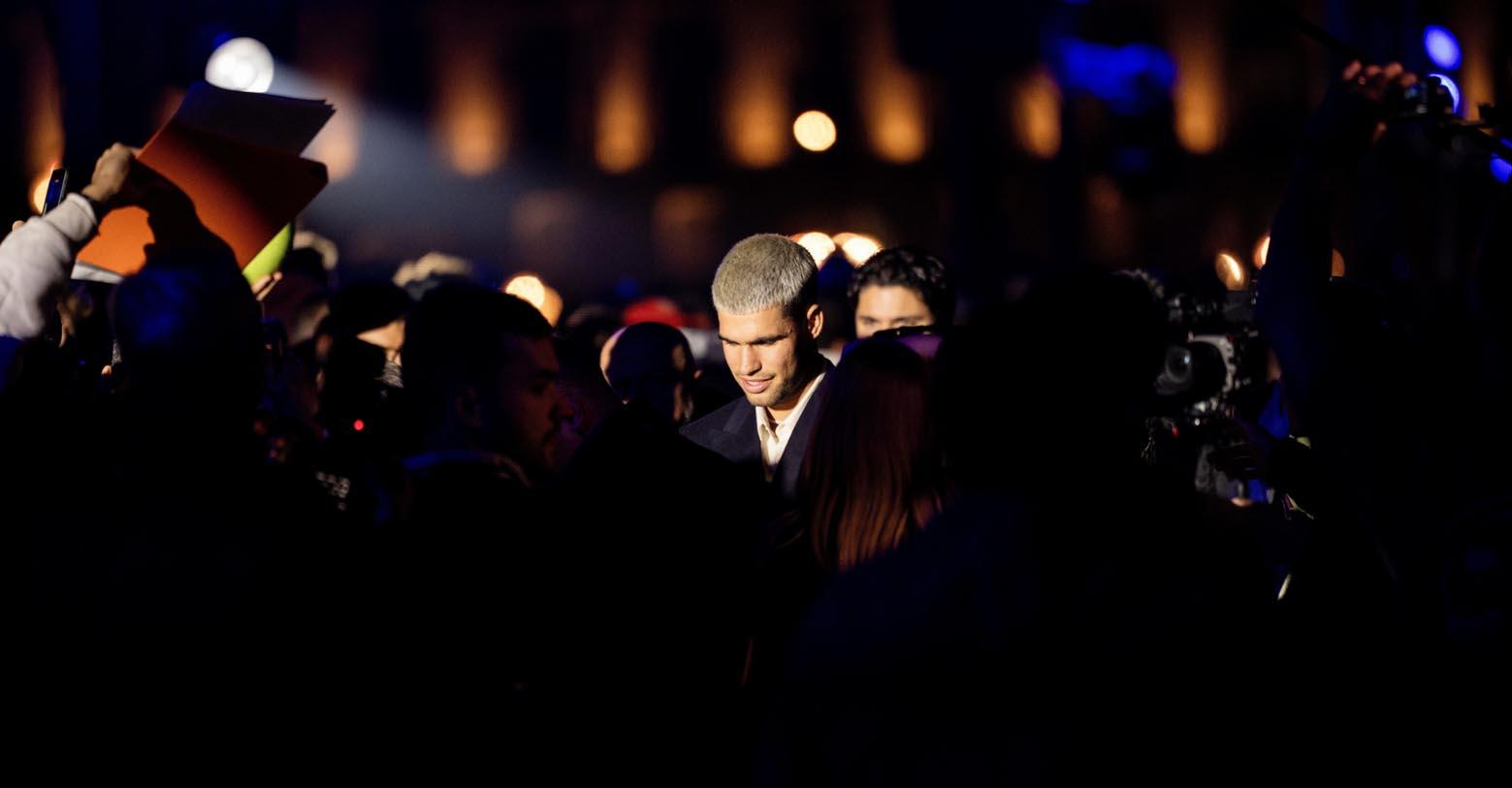
Tennis star Carlos Alcaraz is one of the most heavily scrutinised athletes on the planet




































































THERE’S
NO TIME LIKE THE
FUTURE
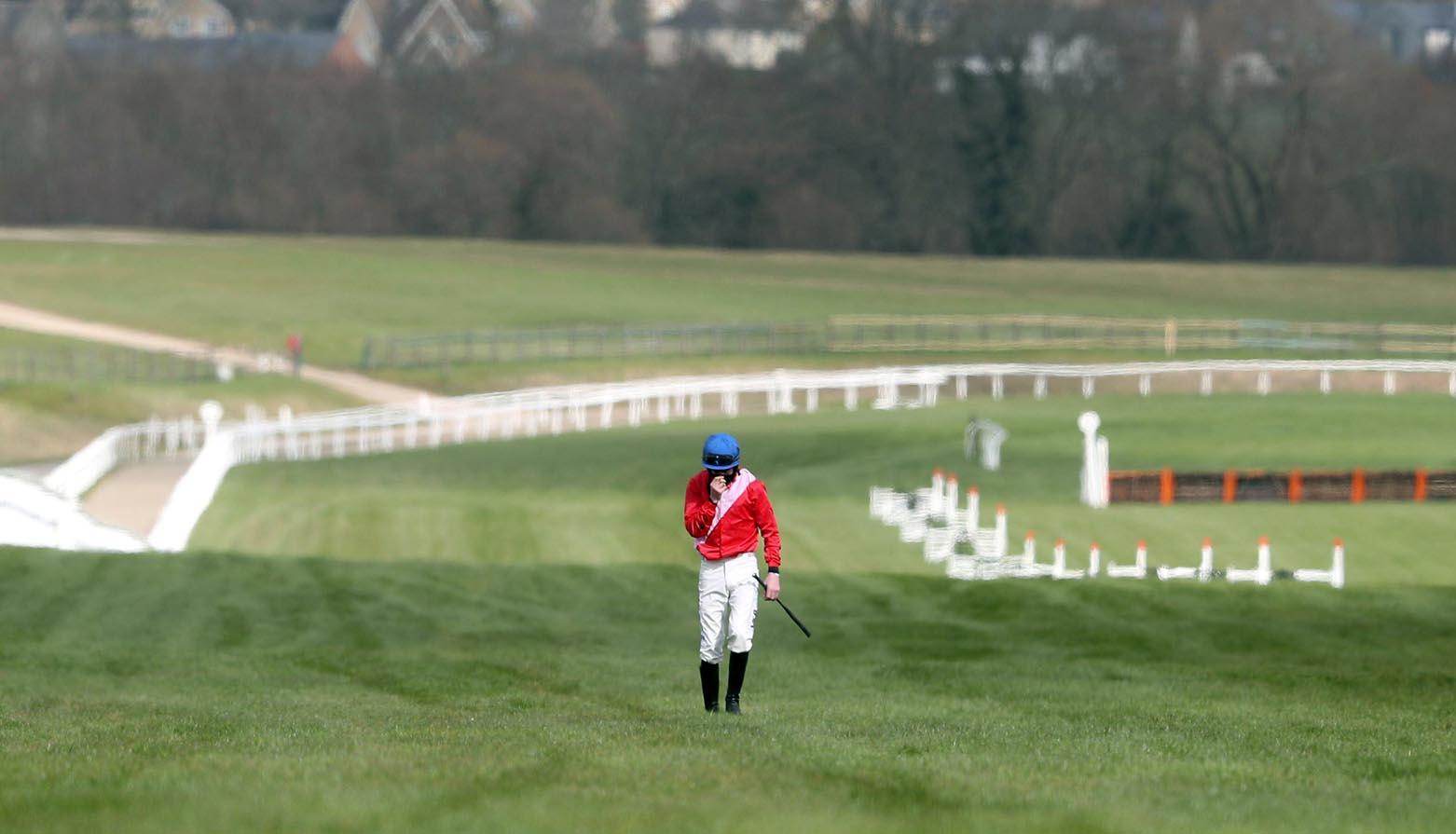
ANTE-POST SPECULATION CAN SOMETIMES BE A CRUEL MISTRESS, SAYS JULIAN SNOW
AS A WISE MAN ONCE SAID: no one who owned an unraced two-year-old ever committed suicide. One might say the same about the holder of an attractive ante-post voucher. The concept is linked; it is the hope that sustains one’s interest.
Nowadays when high street betting shops and online betting operators (not Fitzdares of course, but lesser operators) resemble strip clubs, in the sense that both operate a version of ‘you can look but you can’t touch’, it is an exercise in futility and frustration trying to conduct regular betting business. Punters can, however, still slip the occasional ante-post bet past the old enemy – with the inevitably long prices offering the allure of a big payout. In short, it is an aspect of the betting menu all of us should look at.
The corollary of the lure of and sustained interest in a potentially chunky return in the future is that ante-post disappointments tend to sting a little more than normal losses. Here follow some of mine which I recall least fondly…
TENBY
In the days when I used to go racing every day, the five-day Glorious Goodwood festival was a pleasant midsummer interlude: a near weeklong pleasure of no travelling. On one such day (the form book tells me it was 31 July 1992), I watched a Henry Cecil newcomer win a 7f two-year-old maiden by six lengths. Plainly, I would watch hundreds such races each
season, but something about this win alerted my ante-post antennae.
I backed it at 33/1 for the following year’s Derby. Thereafter, things could scarcely have gone better: Tenby won a Listed race and a Group 1 in his remaining races as a two-year-old, followed by another Listed race and the Dante as a three-year-old. He seemed sure to start a prohibitively short-priced favourite for the big race. I recall both the Racing Post and bookmakers moaning that Tenby’s dominance rendered the race uncompetitive and unappealing.
I did not mind!
Sadly, this was as good as it got. Tenby ran like a hairy goat (10th of 16 as 4/5 favourite) and never won another race.
INSPIRAL
The most frustrating ante-post bets are those when the horse does not make it to the target race, but which subsequent performances suggest it would have won if it had. One such for me was Inspiral.
Impressed by her debut in a 7f fillies’ maiden in June 2021, I backed Inspiral at 33/1 for the next year’s 1000 Guineas. All went well through her two-year-old career. There followed three wins out of three: at Listed, Group 2 and Group 1 level. The following spring was a different story, however. Little or nothing was heard of Inspiral and she drifted in the betting for the first Classic.
I recall Matt Chapman putting all this to joint trainer Thady Gosden at
He was the apple of Gordon Elliott’s eye, who considered him a future Gold
Cup winner.
Sandown in April after a Gosden horse had won the big race there that day. His plainly disingenuous insistence that all was well with Inspiral and that she was on target for the Guineas did little to placate her supporters. She was announced a non-runner in the middle of the following week. It was with a pained expression, a slight sense of bitterness and a strong feeling of ‘if only’ that I watched Inspiral subsequently easily win the Coronation Stakes at the Royal Meeting and establish herself as the leading three-year-old filly.
ENVOI ALLEN
I suppose I watch about 5,000 horse races a year live (in the sense of on television, not at the track) so have long since become inured to the ups and downs of a gambler’s luck. I try to accept the fortunate winners in the same manner as the final fence fallers. It is rare that I get too upset, let alone shout out at the screen. I admit that one exception to this gambler’s sang froid occurred on the second day of the Cheltenham festival in 2021.
I had learned the previous summer that Gordon Elliott planned to aim Galvin at the National Hunt Chase. Galvin had run very well in decent handicaps the previous season, including at the festival, but without winning, thereby retaining novice status. 33/1 was an appealing price for the NH Chase. Punters are nothing if not greedy, though, so I also added a couple of shorter fancies in a little trixie: Shishkin in the Arkle (4/1) and
Envoi Allen in what was then called the Marsh (3/1). My slip for a £50 trixie showed a potential maximum return of more than £50,000.
Readers will recall that Shishkin won the Arkle easily. (This was the post-Covid, behind-closed-doors festival, which produced small fields and less competitive racing.) Galvin led at the last in the National Hunt Chase to then go on to win well. It all rested on Envoi Allen, who started 4/9 favourite. At this stage Envoi Allen had the look of a once-in-a-generation champion: unbeaten in four bumpers culminating in the Champion Bumper, then unbeaten in four novice hurdles culminating in the Ballymore, now unbeaten and untested in three pre-Cheltenham novice chases.
He was the apple of Gordon Elliott’s eye, who considered him a future Gold Cup winner. It seemed not so much a question of whether he would get beaten in the Marsh as whether he would ever be beaten. So, when he fell as early as at the fourth fence, I gave out an unexpected and forlorn cry of horror.
DIAMOND NECKLACE
None of the above, of course, deters the needy and the greedy. I possess a nice little Paddy Power betting slip (Diamond Necklace to win both the 1,000 Guineas and the Oaks, at 100/1) which I hope will keep me warm through the winter…
Julian Snow is a keen punter and an eight-time real tennis Grand Slam winner.















Can you remember what you were doing 28 years ago? The chances are you may have a decent recollection, but are a bit light on detail. Not me. April 1997 is etched into my memory. It will remain there until my last breath. It was the only time I ever crossed the boundary between relentless sporting mediocrity and sporting achievement. The journey didn’t last long, and I retreated very quickly. But on cold, dark winter days or in packed, airless train carriages when I need to lighten my mood, the memory sustains me. It nourishes my soul. And it bores my friends.
14 April 1997 – Augusta National, Georgia. The most magical golfing terrain on the planet. The sky is a pure blue, the dogwood and azaleas vivid pink and red, the fairways an emerald green. As a humble BBC sports producer on my fourth and last trip to Magnolia Lane, imagine my excitement when I learn I’ve been successful in the media ballot – one of 40 accredited journalists invited to play the course the day after the Championship.
So, barely 12 hours after Tiger Woods romped to his first of his 15 major titles, there I am standing on the 10th tee at Augusta ready to start the round of a lifetime. Our group play the back nine first, teeing off at 07:45. I nearly miss my tee-time, because on my way from the car park I notice that the clubs I’ve borrowed from a kind photographer don’t include a putter. Cue a brisk walk to the pro shop (you’re not allowed to run at Augusta), an Oliver Twist-style request to the pro to borrow a putter, and a kind but stern lecture to look after the club and return it in the condition it came.
In those days, my handicap was nine, and I begin with three regulation bogeys. Solid enough for a player of modest ability. Then something strange happens. The par-five 13th is an iconic, sweeping dogleg right to left hole, with a raised green protected by Rae’s Creek. Having laid up in two, I hit my third shot from around 100 yards to within 20 feet, and to general disbelief, hole my snaking, downhill putt for a birdie four.
The 1989 European Open champion, Andrew Murray, is part of the BBC broadcast team and is there to support me. Most likely to laugh at my misfortune. But I’m laughing now.
DIARY
by Rob Nothman
Andrew Murray is there to support me. Most likely to laugh at my misfortune. But I’m laughing now.
The par-four 14th has an undulating green that looks as if an elephant has been buried in it. Blocked out a little by the trees after a slightly smothered drive, my low, drawing second shot with a four-iron chases up the fairway, trundles on to the green, rims the hole and comes to rest three feet from the cup. Another birdie.
In danger of drowning in my own incredulity, I make my way to the par-five 15th. A hundred yards short of the green in two, I hit my approach to 15 feet. And yes – you guessed it – I hole out again. Three birdies in a row on the back nine at Augusta. It sounds preposterous. Am I having an out-of-body experience? Andrew Murray says with Mancunian bluntness: “F—- me, you’ll never do something like this again as long as you live.” (He was right.) My Augusta National caddie Albert – whose ability to read the greens makes me wonder why he hadn’t been taking on Tiger for the previous four days – points out I ought to be drug-tested.
I par the short 16th, and bogeys at 17 and 18 take me to the turn in 38. Two over par. Ludicrous. Pars at 1 and 2 leave me +2 after 11. Perhaps this is my calling. A life on tour awaits… and then reality sets in. Three shots in the bunker at the 7th remind me that delusions of grandeur are not helpful. I’m back on planet earth. Still, a round of 81 – nine over par – is not shabby. I shake hands with my playing partners – one of whom, a journalist from the Arkansas Gazette, had rather smugly proclaimed when we began that he played off a handicap of six. He didn’t break 100, having four-putted seven times on Augusta’s treacherous greens. He’s quiet and sullen now.
I walk up the hill to the clubhouse to return the magic wand of a putter to its rightful home and to tell the world about the fleeting glance I’d had into the world of sporting achievement. Only the words of the great PG Wodehouse could sum up the feeling: “This was like going to heaven, without all the bother and expense of dying.” n
Rob Nothman is a BBC broadcaster, producer and broadcasting coach to presenters, commentators and pundits.
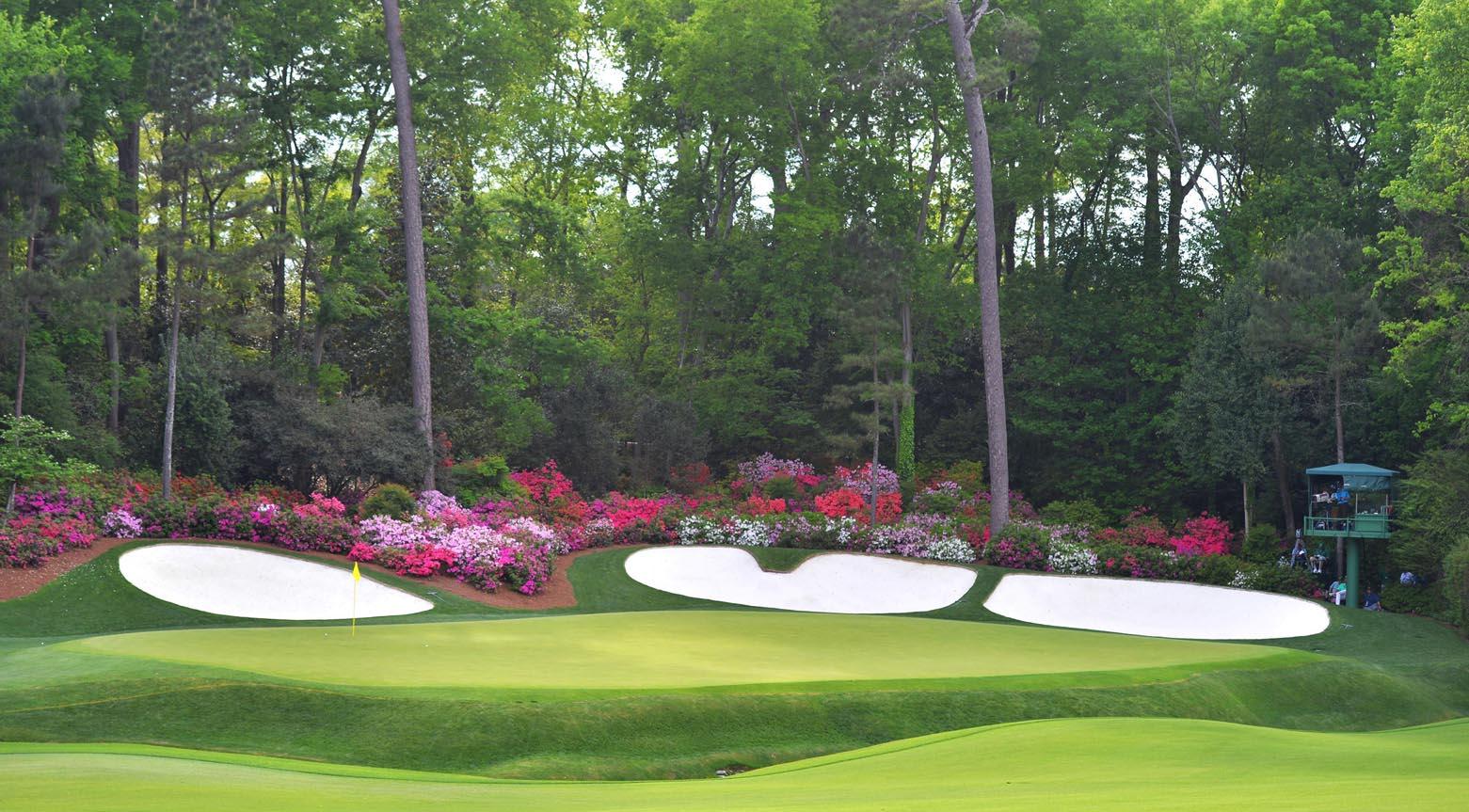
The 13th hole at Augusta: perilous for the likes of Curtis Strange, Ernie Els and Bryson DeChambeau, but a doddle for Rob Nothman



































P H A R M A’ S
HE VIDEO OF THE FASTEST
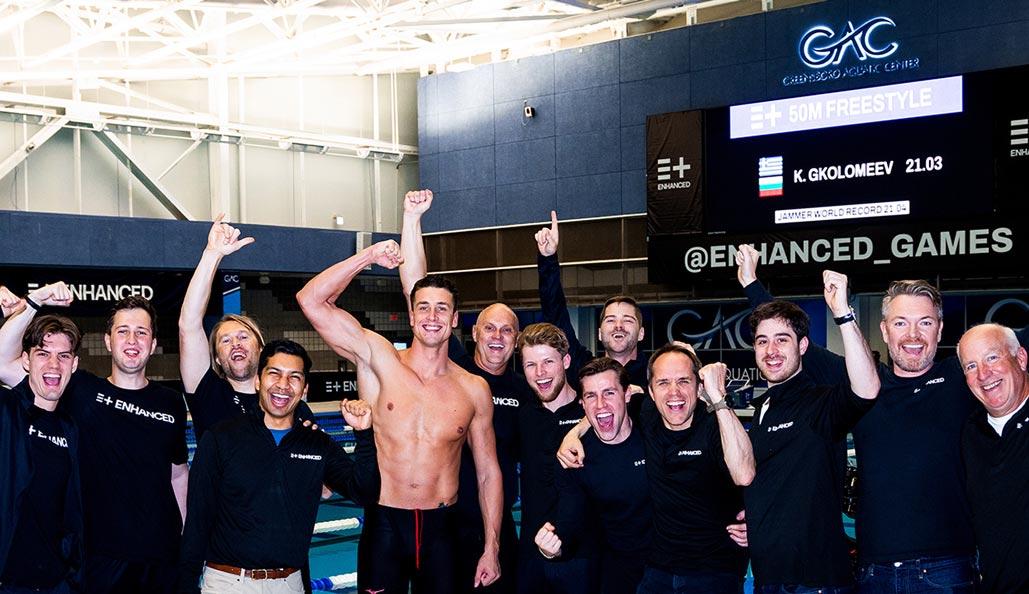
T50m swim in history has a little over 90,000 views on YouTube. The swim was not even planned as a world record attempt, which was planned for several weeks later. In the video, Kristian Gkolomeev bounces on the starting block of the Greensboro Aquatic Centre in North Carolina before settling. Then he launches himself, torpedo-like, into the water.
It is strange to watch an elite swimmer go all-out on their own, the only other person in shot being Brett Hawke, Gkolomeev’s coach, who jogs along poolside to take splits. It is also strange to hear, with no roaring crowd and no breathless commentary. The Greek is smooth as you like in the water, but with no other noise his huge hands can be heard slapping the water. When he reaches the end of the pool he turns casually to check the screen in the pool. It reads 20.89, two hundredths of a second faster than anyone else in history has ever swum the distance.
Gkolomeev stretches his enormous arms wide before holding his head in his hands. In just over one third of a minute he has just won $1 million, a sum that dwarfs his career earnings from a sport he has dedicated more than half his life to. He has also just single-handedly transformed the
fortunes of a sporting event that many had ridiculed, and few believed would actually happen. The Enhanced Games had its first world record, and it was a big one.
Aron D’Souza, CEO of the Games, is unequivocal about its importance, describing it as a “paradigm shift” on a par with the germ theory of disease and space travel. “Millions of people have swum competitively for billions of hours for that one world record,” is how he puts it to me in an interview. “And Kristian did it just like that, you know? That really shows us the power of human enhancement.” Gkolomeev had only been on “the protocol” for a matter of weeks when he broke the record.
In May I travelled to the launch of the Enhanced Games in Las Vegas, unaware that Gkolomeev had broken the world record three months previously – a secret that the organisation kept closely guarded. For D’Souza, Vegas is the perfect venue for the inaugural competition. “Where better to break records than the city that never watches the clock?” he will ask at the launch event.
In my taxi from the airport, I pass a billboard advertising a law firm with a photograph of a women’s basketball team and the slogan “WE WIN MORE”, and arrive at my hotel at
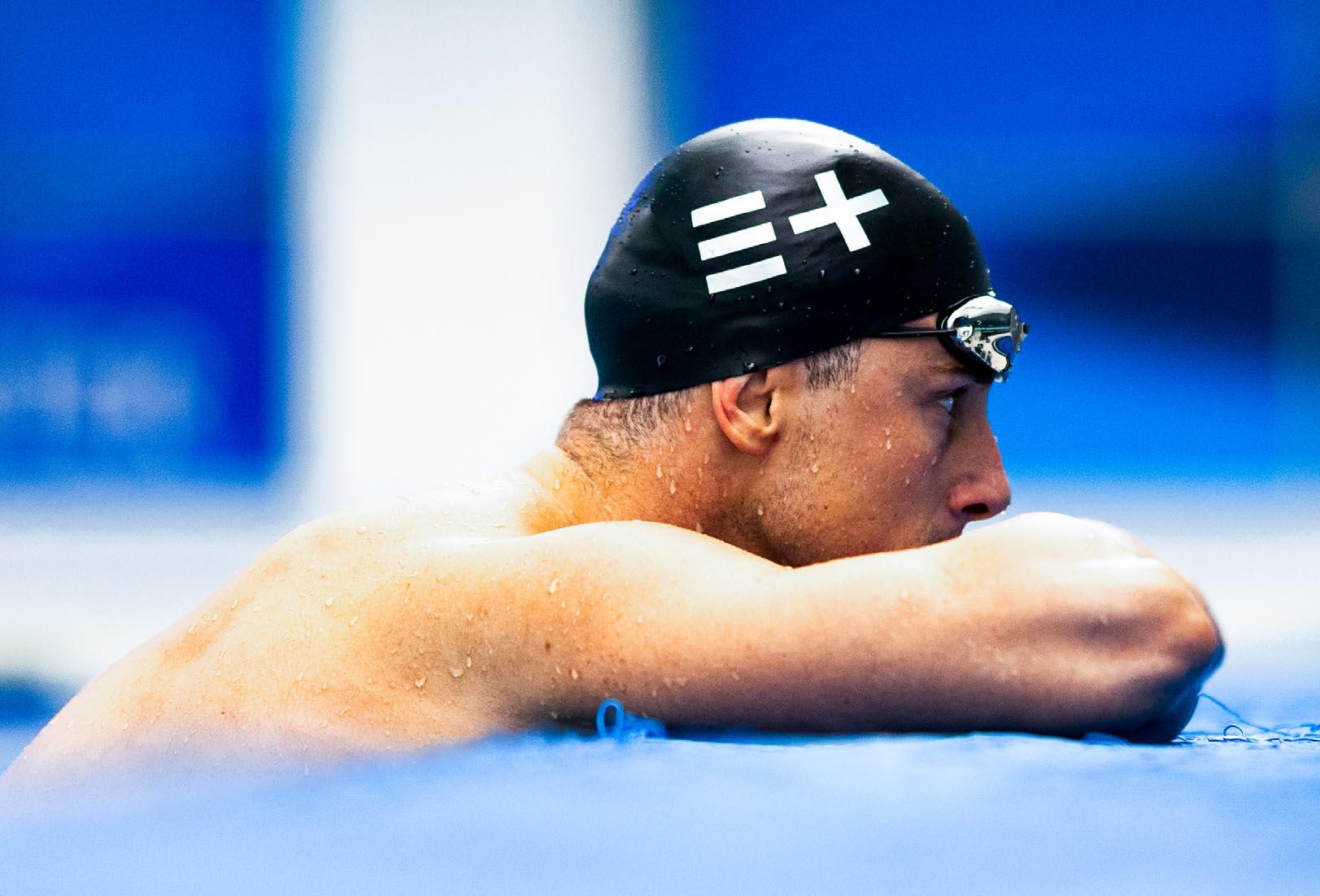
The Enhanced Games aim to push the limits of sporting achievement via banned methods. Visionary










the same time as a Cybertruck representing a company called Liv Wellness. The company provides on-demand IV drips for those seeking a quick recovery from a hangover. Their slogan is “BE LIMITLESS”. I can’t help but agree with D’Souza that Vegas’s unashamed embrace of sport as business and noholds-barred vibes make it the obvious location for a competition that has been described as “the Olympics on steroids”.
The first edition of the Enhanced Games will take place over Memorial Day weekend in May 2026, and will feature the most explosive sprint events in swimming and athletics alongside weightlifting, aiming to showcase what can be achieved through the embrace of performance-enhancing drugs and other technologies used under careful medical supervision. The organisers are keen to show that performanceenhancing substances can be safe, and that they can in fact improve the wellbeing of participants.
They are also keen to emphasise that normalising the use of performance-enhancing substances has a significance that goes far beyond sport. Those organising and investing in the Games envision them as a way of ushering in a new “age of enhancement” where everyone could feel younger, healthier



M A R K E T
and more vital. So what might the consequences of this shift be for sport and society?
I have always thought of the ability to go to sleep under any circumstances as a kind of sporting superpower, and amid the neon lights of the Red Tail bar and the ping and clatter of slot machines from the Resorts World casino floor, Gkolomeev is out for the count when I arrive for our interview. When he wakes up he seems slightly strained behind the piercing blue eyes and precise haircut. I ask him about his decision to come
thinking or mere delusion? It’s complicated, says Michael Crawley
over to the Enhanced Games from the world of conventional swimming. His answer is succinct.






“Three main reasons,” he says. “The most important for me was fair pay. It’s a lot of money. My whole career, I haven’t made much money from swimming, unfortunately. In one successful year at the Enhanced Games, I could make as much as I would have made in almost 10 careers. So that’s huge, that’s crazy, you know? I have a family now, I have a kid, I need to buy a house. I need for us to live more comfortably. I don’t want to stop swimming, then have to start from zero and work nine to five, have to stress about paying a mortgage.”
His second reason is – perhaps surprisingly – to do with fairness. “This will be a level playing field,” he says. “Everyone will have the same access to everything, to the best doctors to work with, and FDA-approved enhancements.” The lingering question of whether or not the people beating him were doing so fairly would be gone, which would be a weight off his shoulders. “And finally,” he goes on, “I always wanted to see my full potential. I was just curious. What if I did everything right, and added performance-enhancing drugs, and did it openly, and with medical supervision? I was curious. What could I do?”
This is a question most athletes ask, even at much lower levels of the sport. Australian James Magnussen (the first athlete to sign a contract with the Games) in particular is extremely open about the vulnerabilities of the elite athlete, and the difficulty of letting go of that identity.
It is clear that the swimmers I meet share some of the frustrations the founders of the Enhanced Games express. As Ukrainian swimmer Andriy Govorov puts it, “Traditional sport is by definition unhealthy. We all know the signs of this with injuries, mental health problems and ruined tendons. Ninety per cent of athletes struggle to maintain their health over time. Why? Because there is little scientific support for recovery.” This is something he feels the Enhanced Games can provide. What seems clear from my conversations with both Gkolomeev and Magnussen is that it takes some time to get used to inhabiting an enhanced body. “It changes a lot of things in your body,” is how Gkolomeev puts it, not least of these being that it makes you heavier, which can be a challenge for a swimmer.
Magnussen was constantly surprised by how good he felt every day in training after taking testosterone and a cocktail
of peptides and other substances. “Basically, I went four months without any soreness,” he told me. “And it was actually to the detriment of my performance, because I would wake up every day saying, ‘I feel great, let’s push harder, let’s go further, let’s lift heavier.’ I trained twice a day, every day, for 49 days straight, which for a 34-year-old athlete is unheard of.” What he didn’t realise was that while his cardiac and muscular systems seemed primed, his nervous system couldn’t keep up, and his speed was dropping. He couldn’t rely on the data or on how he was feeling to tell him when to back off. This raises all kinds of questions for me. Being able to ‘listen to your body’ and know when to take it easy has always been an important skill for an elite athlete. What will happen if this is no longer possible? As a society we celebrate characteristics like grit, determination and the ability to overcome pain and discomfort in relation to sport, so what would it mean if these qualities are no longer required? What would it mean for the athletes’ sense of self for their performances begin to be attributed primarily to the specific ‘protocol’ they were on, rather than their ability to work hard and overcome pain and suffering?
Both D’Souza and his co-founder, billionaire biotech investor Christian Angermayer, are prone to high-level philosophising about the future of humanity. For D’Souza, we face a choice between entering an age dominated by AI, where humans become a “subservient, secondary species”, and embracing enhancements, where “technology is a modality for improving the human condition”. He envisions trillions of dollars of investment in human enhancement bringing about profound changes to the structure of society.
“I think the greatest gift that I wish to give to humanity would be a 65-year-old who can run as fast as Usain Bolt,” he tells me, “because that would show that 65 shouldn’t be the age of retirement.” For Angermayer, the same drugs that allow an athlete in their prime to break a world record will allow 80year-olds to carry their bags home from the supermarket.
Clearly, there are potential benefits to the normalisation of some of the performance enhancements on display at the Games, and I can see the attraction of remaining fit and healthy into old age. The high-flown rhetoric does tend to give way to commercial reality, though, and in Las Vegas I found the transition from the celebration of “superhumanity” to the launch of the Enhanced Games’ product range a bit jarring. The Games will be a billboard for a certain kind of future, and, whatever happens, it will be a fascinating watch. n
The inaugural Enhanced Games will take place in Resorts World Las Vegas on 24 May 2026.
Michael Crawley is an award-winning author and social anthropologist based at Durham University. His latest book, TO THE LIMI T : THE MEANING OF ENDURANCE FROM MEXICO TO THE HIMALAYAS (Bloomsbury, 2024), was shortlisted for the Sunday Times Sports Book Awards.
Kristian Gkolomeev has already offered a glimpse of what might be achieved at the Enhanced Games
Maggie Alphonsi looks at how far women’s team sports have come since she made her first crunching
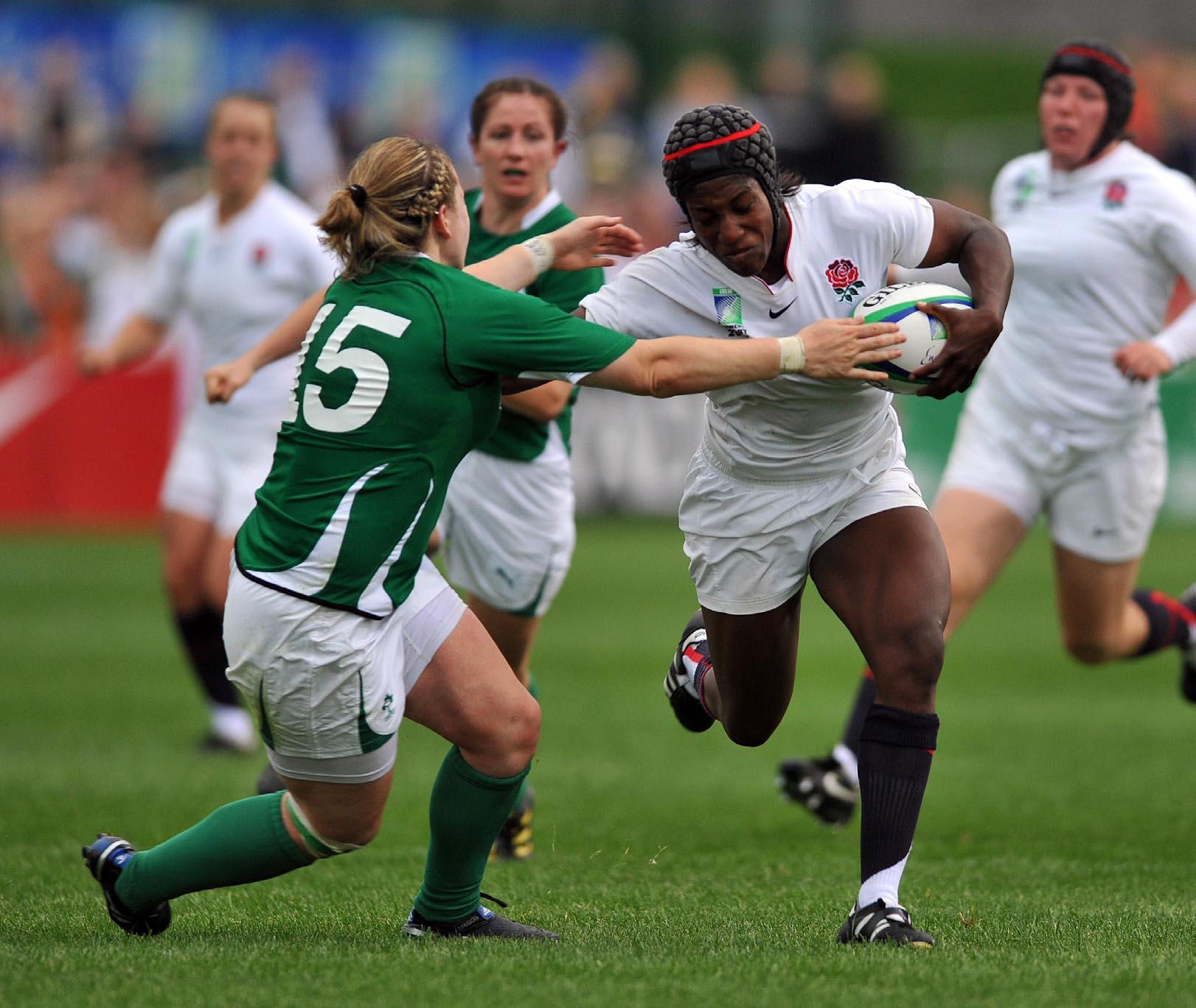
THERE ’ S A TENDENCY in women’s sport to take one moment and turn that into “the reason” things exploded. Winning the World Cup in the autumn was so special. The Red Roses running out at Twickenham in front of just under 82,000 people was a full circle moment. Everyone who was watching it who’s been part of women’s rugby knows the journey we’ve all been on, from having to effectively beg, borrow and steal for kit just to be able to play and, at times, feeling like a second-class citizen, to a packed stadium with more than 80,000 cheering them on. I think that final resonated with a lot of people because they were like, “Wow, look how far we’ve come.”
But as tempting as it is to see that final and think, “This is the moment,” it actually started long before us and built up a head of steam in 2012, when the Olympics were hosted in London. That was the moment there was a real change in attitude towards female athletes. Then to follow that up in 2014 with the World Cup win in France, it felt for the first time people were sitting up
and thinking, “Oh yeah, women do play rugby and they’re pretty decent at it.”
I don’t want to sit here and say it started with us – there were loads of events that began to lay the groundwork. England women won the Cricket World Cup in 2009, and that was followed up by GB hockey winning the Olympic gold in Rio in 2016. There were lots of women doing amazing things; it wasn’t just one group of players in one tournament.
The best compliment people gave me during my playing career was to say things like: “I was watching and I forgot that you’re women and I just watched a good game of rugby.” It shouldn’t make a difference what your gender is: once you cross that white line it’s all about the game – and people’s shared love of watching amazing sporting moments.
After the World Cup win in 2014, we were named team of the year at the BBC Sports Personality of the Year awards, and that’s when I first thought to myself, “Oh wow, something has happened here.” It was
the first time a women’s team had won that award outright on their own. After that, in 2017, England Women’s Cricket won it and, of course, the Lionesses in 2022. You can definitely look back at that list and see that shift in mindset happening year on year and women’s sport starting to become front and centre.
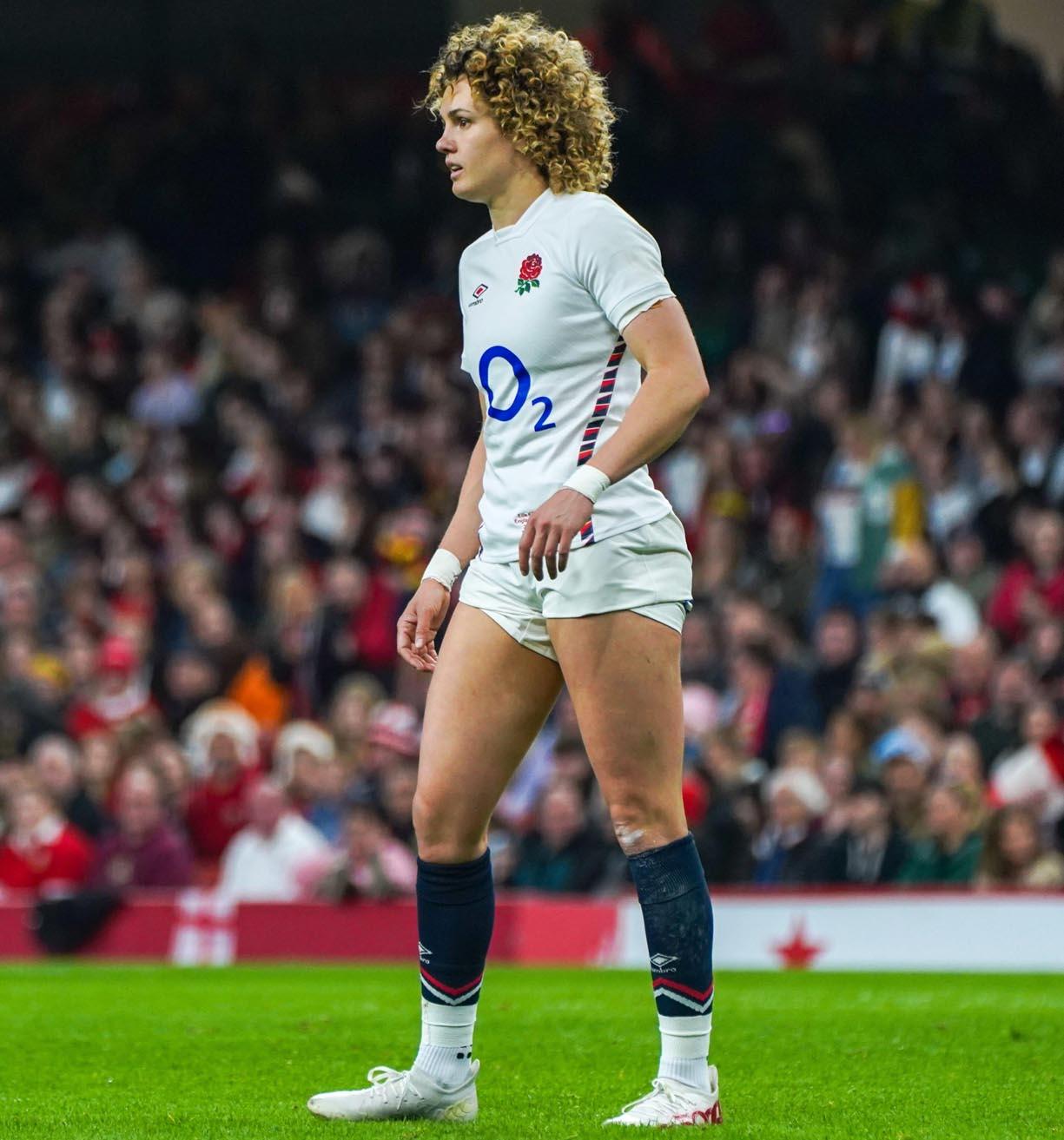
During the World Cup, things went to another level. I kept seeing Ellie Kildunne’s
Capitalising on the momentum of the World Cup has to be the utmost priority for women’s rugby now. It’s a different challenge with rugby union because the sport has taken a lot of financial hits –especially on the club side – and, unlike women’s football, on a club level men’s and women’s club rugby is still very much aligned. It remains a one-club ethos and we all have to work together to ensure that
I don’t want to sit here and say it started with us – there were loads of events that began to lay the groundwork.
face all over the place! A lot of the rugby players were appearing in places I never would have thought I’d see: at bus stops, in supermarkets. They were everywhere. But, we have to be honest with ourselves: the difficulty with rugby is that it doesn’t have the same popular impetus as football. No matter what anyone says, football is the national sport. From where I sit as a former rugby player, it’s easier to see the way that momentum can be maintained for those women’s footballers.
English success in international rugby is able to bolster the sport at club and grassroots levels.
Momentum is everything for women’s rugby now – and that might seem obvious, but the smallest things can be important. The next big moment is the women’s Six Nations in March and April, and we need to think about how we create a welcoming environment for new viewers. The World Cup opened the door to lots of people who
tackle for England in 2003
hadn’t followed rugby before and the commentary was very accommodating of that. When you’re bringing people into the sport, you have a duty of care. Rugby has a lot of laws and the laws do change, especially because it’s making the game safer, but that can make it confusing for new viewers and you have to be mindful of that.
We’re definitely on the coattails of the women’s footballers and they’ve done a great job raising the profile of women’s sport. We need to get more personalities out there – everyone knows Ilona Maher, Sarah Bern, Ellie Kildunne, but we need more. Rugby historically hasn’t been great at that – it’s such a team game I think people are afraid to put their heads above the parapet –but that’s part of taking the next step, being brave enough to be ourselves.
It can be a double-edged sword, and that’s something as a sport we can learn from women’s football. The recent fallout from Mary Earps’ book is something we’ve seen before in men’s sport. I remember Kevin Pietersen put out a book where he
was quite critical of his teammates and he got a lot of stick. People are always going to use books to air grievances and discuss their careers, but what’s happened here with Earps and Hannah Hampton should be taken as a lesson.
The flipside of all the negativity around it is that, in some ways, it feels like a step forward. The kid gloves are off with women’s football. It’s a kind of parity now –the reaction is the same as if they were male players. It is a shame that the Euros win is now somewhat tarnished, and the reputation of Mary Earps, who has done such important work off the field. But that’s life in the spotlight and you’ve got to find a balance between being honest and being overly critical.
I’ve devoted my career on and off the pitch to being a game changer, albeit in very different ways! In my playing days it was all about my tackling. That was my superpower and I loved the challenge of taking on prejudices about the women’s game literally head on. I learned to take it
Off the field I’m absolutely committed to keeping the momentum going, in all senses. I don’t ever stop and think about what I’ve done off the field. I’ve reached a point in my life where I want to be the one behind the scenes making a difference and not necessarily always be the one at the front. I do what I can supporting charities, and now I’m moving into executive coaching. I just get a real buzz out of helping people develop, not just in the world of sport, but in the world of business, helping women make the transition into leadership roles.
My space in rugby might change, it might not be as visible in the future, but I like to think that while I have that profile, I’ll continue to make a difference where I can. I really love it. n
Maggie Alphonsi is a Rugby World Cup winner, broadcaster and motivational speaker.
RECORD BREAKERS
OCTOBER 2025
Dr DY Patil Stadium, Mumbai Things weren’t going India’s way on the field, but history was being written off it. A crowd of 34,651 packed Dr DY Patil Stadium for the Women’s ODI World Cup semi-final against Australia, setting a new record for the largest attendance at a women’s cricket match in the country.
SEPTEMBER 2025
Twickenham, England
81,885 spectators crammed into all three Twickenham tiers. The record crowd for a women’s rugby World Cup match, shattering the previous record of 42,723 set at the Stadium of Light just weeks earlier in the same tournament.
AUGUST 2023
Memorial Stadium, Nebraska
92,003 fans watched Nebraska volleyball beat Omaha 3–0. The largest ever attendance for a women’s sports event in the USA. The stadium announced the record mid-match to wild cheers from the crowd.
as a compliment when people said: “You’re one of the women who could have played in the men’s game.” I think what they’re trying to say is: “You were so physical and tackled so hard – I didn’t know women could do that.” I like to think I played a small but significant role in changing how people viewed women’s rugby through that.
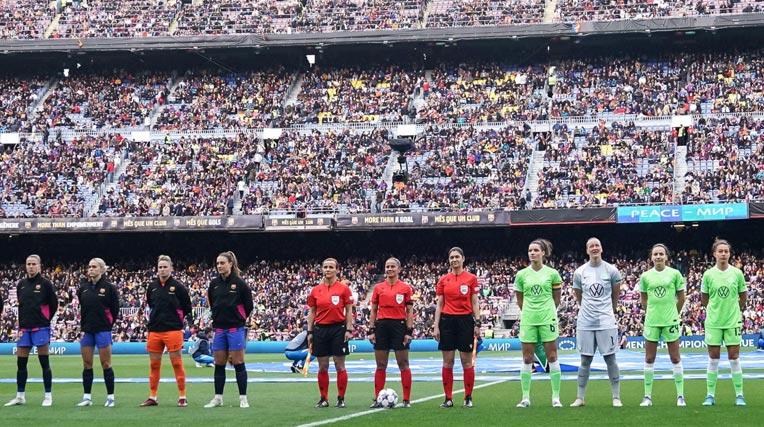
APRIL 2022 Camp Nou, Barcelona
91,648 spectators watched an all-conquering Barcelona side sweep aside Wolfsburg in a 5–1 semi-final win in the Women’s Champions League, breaking the Camp Nou’s own record set weeks earlier with the El Clásico femenino (below).




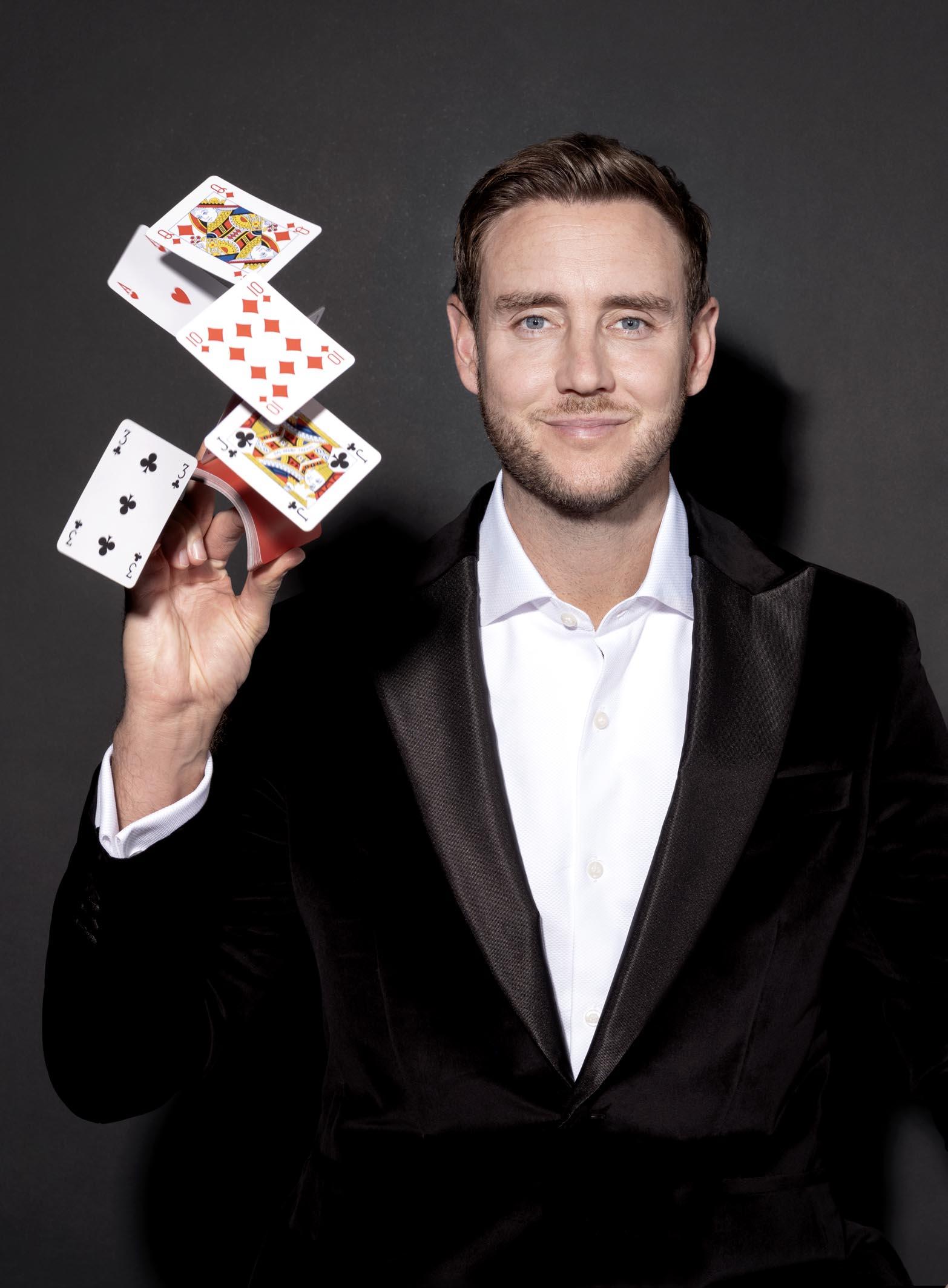
Fitzdares Ambassador Stuart Broad, runner-up for the BBC SPOTY award in 2023, has decided to create a new set of categories this year...
SPOTY

GROWING UP, Sports Personality of the Year was always something I looked forward to. It was a sign that Christmas was close, and a chance to look back on some of the year’s great footage. I was always allowed to make one phone call to vote for my favourite candidate, normally a footballer or a cricketer. 2023 was special for me, and it was a real honour to be runner-up.
Looking back on the highlights over the past 12 months makes you realise how spoilt we have been as sports fans. The flight over to Australia was the first chance I’ve had to do this properly. My notes have spilled over a few pages, considering some of the incredible moments, performances, and victories. Here, I’ve pulled together my ‘Alternative SPOTY Awards’, with categories that won’t be covered by the BBC. Some have been easier than others when picking a winner, but one thing is for sure, I wasn’t short on options. Enjoy reminiscing over the moments, and hopefully 2026 can deliver the same again!
Rory McIlroy 11/8 Chloe Kelly 7/4 Lando Norris 4/1
Littler 14/1

This is one that could be contentious among readers. I have to include a trip to Seville to watch Real Betis play Nottingham Forest . I’ve always dreamt of a European away trip with Forest, so to go with my best friend and our dads is something I won’t forget in a hurry. I think football fans will resonate with this – sometimes it’s the memories that come with it, more than the result. 2-2 was fair on the night, and the Forest fans did the club proud.
Another day that will live long in the memory was the final day at the Oval during the India Test match . The game was on a knife-edge for so much, impossible to call who would win. But the noise when Chris Woakes came down the steps from the changing rooms with one arm in a sling was incredible. Putting himself in the firing line for the team liked that epitomised Woakesy.
My final one would have to be Augusta National . While I wasn’t there, the idea of no phones being allowed on the course meant that fans were solely watching the golf and getting their updates from giant scoreboards. You could hear the roars through TV coverage and hear everyone willing Rory McIlroy on to victory there. It will definitely go down as an ‘I was there’ moment for those who were, and a unique atmosphere I hope to experience in the future!
WINNER Real Betis vs Nottingham Forest
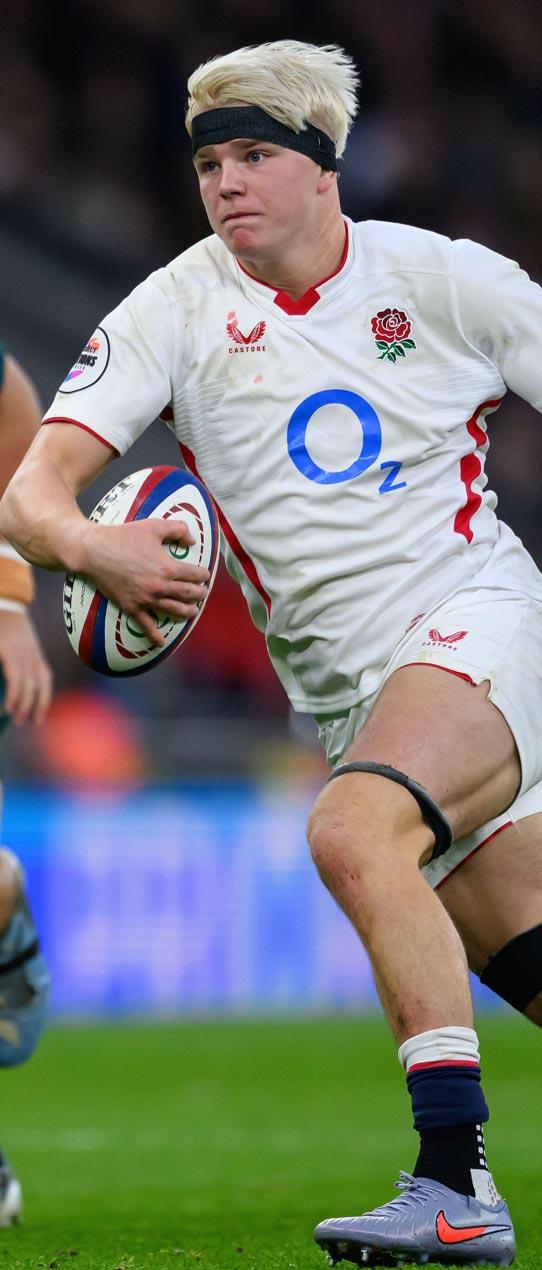

There is no shortage of candidates I could put forward here. My heart wants to nominate Elliot Anderson of my beloved Nottingham Forest. He’s had an incredible 12 months, culminating in getting his first England caps. I’m hoping we can hold on to him in January.
If you look at rugby, it’s hard to look past Henry Pollock Everything he has touched in a Northampton Saints or England shirt has turned to gold. He ran rings around Leinster in the Champions Cup semi-final, scored on his England debut in Cardiff, and was a bolter for the British & Irish Lions. He looks such a talent and has a knack already of being in the right place at the right time.
Looking at cricket, there are three young guns that come straight to my mind. Jacob Bethell has been explosive in the white-ball format, Vaibhav Suryavanshi scored an IPL hundred aged 14, and Davina Perrin scored a century in The Hundred aged 18. All three are going to be stars of the game.
WINNER Henry Pollock
WITH A TWIST
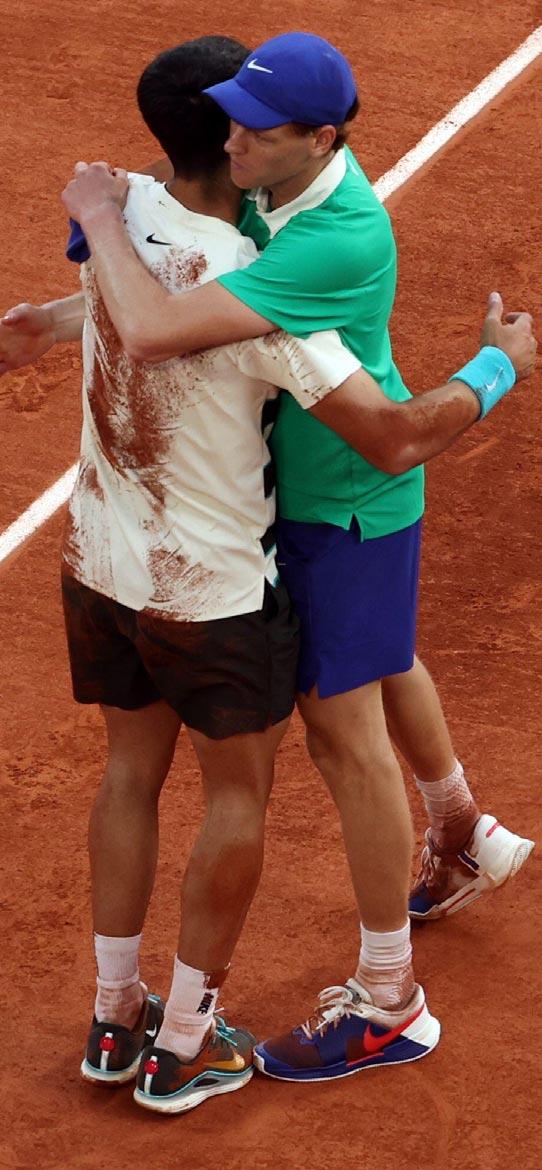

The year has seen plenty of incredible rivalries, some new, some renewed. The most iconic Formula One seasons are when two drivers are going toe to toe through to the final race. However, when those two drivers are also in the same team, it goes up to another level. While McLaren may have wrapped up the Constructors’ Championship early on, their drivers Oscar Piastri and Lando Norris contested the Drivers’ Championship (along with Red Bull’s Max Verstappen) right to the end of the season.
From a cricket perspective, England’s men and India enjoyed a series full of attrition. While it was played in the right spirit, there was undeniable tension and competition out there, which delivered one of the great Test series.
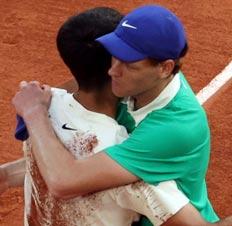
Carlos Alcaraz and Jannik Sinner (pictured) also look like they will meet each other in a record-breaking number of grand slam finals during their career, in a rivalry that could be a decade-long. But for me, it has to be the Ryder Cup. The rivalry on the course really extended to the stands in New York, but every credit to the European team for overcoming the hostile environment. An away win is always a huge feat, but in those circumstances it’s even more impressive.
WINNER Ryder Cup
The final round of the Masters this year was full of wizardry. Augusta National seems to be a course where someone who can shape the ball comes out on top.
I’ve never been so engrossed in an individual sporting event as I was that evening. Time after time, when Rory McIlroy needed to deliver something spectacular, he did it. The top tracer Sky Sports managed to put on some of his shots highlighted just how spectacular they were, shaping from left to right and right to left over water to almost gimmie distance. An incredible performance, and amazing to see him win his career grand slam.
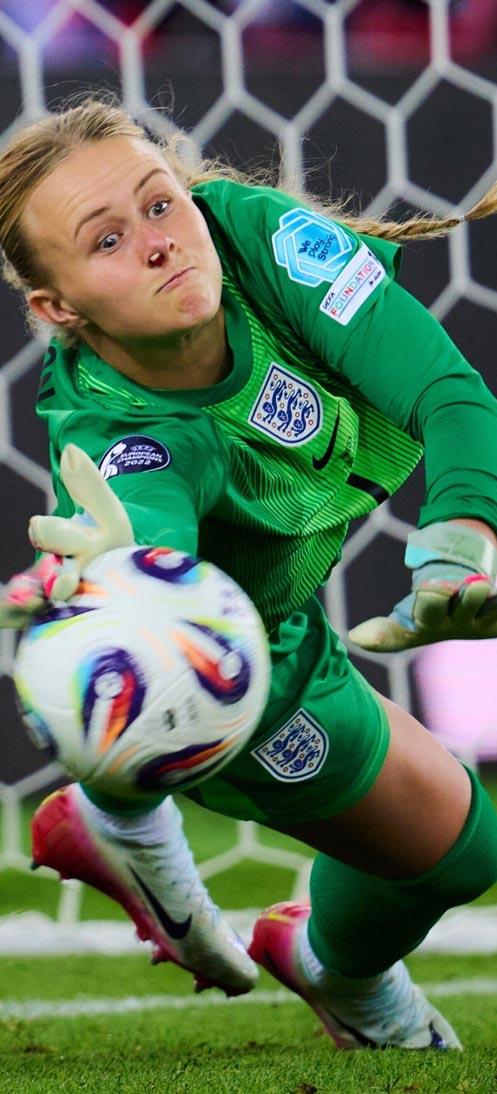
In among the Lionesses’ victory in the summer, it was impossible to not be in awe of Hannah Hampton (pictured) in goal. In the quarter-finals, she had a bleeding nose, with the old-school tissue visible during the penalty shootout. She saved two as England went on to win, before doing the same in the semi-final. I also enjoyed her throwing the opposition goalkeeper’s water bottle into the crowd, losing her notes on the Lionesses’ penalty takers at the same time!
My final player on this shortlist would be Ellie Kildunne She has the star quality that transcends sport of rugby. Her tries were a key part of the Red Roses winning, but it was also the skills she showed to find space from nowhere that saw them win at Twickenham.
WINNER Rory McIlroy
I could be accused of looking at this one through redtinted glasses by opening with Nottingham Forest , but I’d like to think the neutral would stand by me too on this! Considering the return to the Premier League feels fresh in the memory, a return to European football for the first time since 1996 is huge for the club. I’m not sure many would have called it at the start of last season, but Champions League football looked like a very realistic possibility for much of the season.
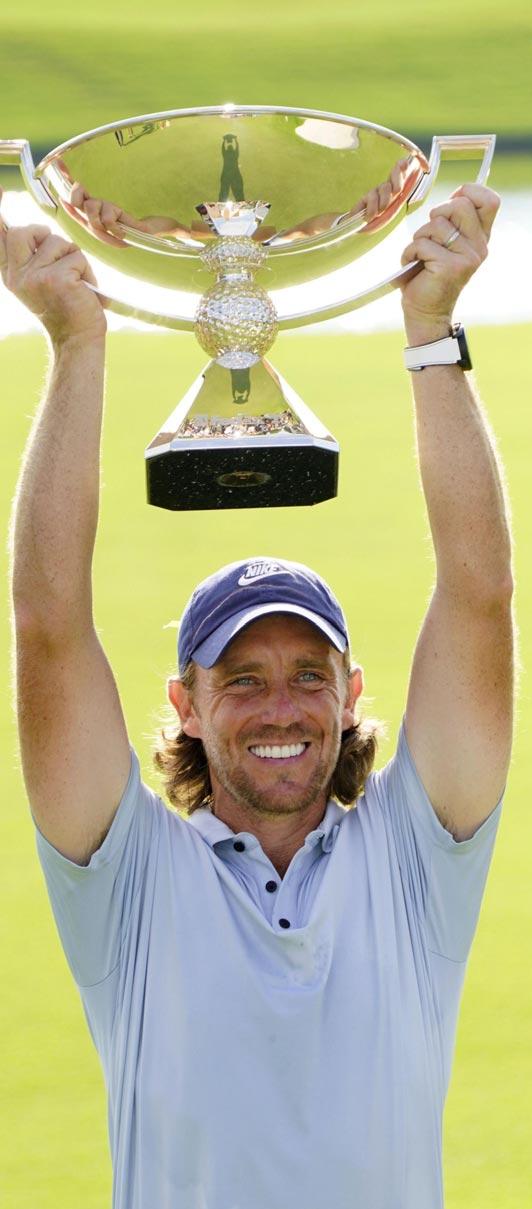
Another one of the great stories from this year has been Tommy Fleetwood , one of the nicest guys in golf. The narrative around him not winning on the PGA Tour seemed to be weighing him down with some near misses this season and prior to that. For him to go and win at the Tour Championship was clearly a very popular win among his peers. His form hasn’t dipped since either, playing a key role at the Ryder Cup and then winning in India.
I’ve also mentioned Europe’s win at Bethpage here, where the away team is often seen as underdog. Europe were so strong on paper, but winning in New York is one for the history books. n
WINNER Tommy Fleetwood
MODELLING THE GAME
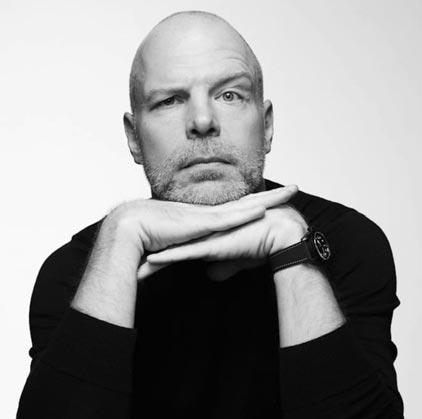
The explosion in sports data has changed the face of betting forever – but the human brain will always play a critical role, says Ted Knutson
ISTARTED BETTING PROFESSIONALLY in 2005.
I started because it was a more interesting side hustle than poker, but it quickly became allconsuming. Betting on sport was a bit of math, a lot of sports knowledge, and good reasons to spend endless hours watching teams and optimising your takes. I got to sit on the couch and watch every match of the 2006 World Cup for “work reasons” and my wife couldn’t complain – life was grand. The side hustle quickly turned into something real, which then turned into nearly a decade designing gambling products at one of the world’s largest offshore bookies. Then I spent a couple of seasons with Matthew Benham at Brentford, before eventually turning my sights on building the best gambling and football recruitment data in the world by founding StatsBomb.
Twenty years later, a lot has changed, but a surprising amount is still the same. Betting on sports – and football especially – is still a glorious problem-solving exercise that combines maths, sports knowledge and treasure-hunting into something highly profitable. And it’s still incredibly fun, especially when you are winning.
Gambling model outputs barely existed when I started but are now ubiquitous in the form of expected goals. Plenty of people assume that means the computers have taken over and all the advantage for human players has disappeared, but I can assure you that is not true. The fact of the matter is, the advantage has shifted from those who use models to those who understand what the models are capable of, and who make plays in the holes the robots leave behind.
Yes, lines are much sharper than they used to be. You’re no longer going to find lines that are wrong by 20 or 30 percentage points on which team is likely to win, across half the league, every single week. So in that sense, being a winning gambler is harder than before. But I have been heartened by the fact that there are still many wrong lines to play, even as expected goals as a concept has been adopted by pretty much every professional gambler, bookie and team I know.
To prove the concept, I spent last season documenting and analysing every play I made across three leagues in my newsletter, Variance Betting. People understandably hate touts, but this was me – a sometime professional gambler –trying to figure out if he could still win after a decade away from betting, for science. There may have been a bit of luck involved in that – there always is – but the successful patterns of old mostly repeated themselves, except this time with
greater emphasis on initial model development, and much greater emphasis on what the models might not know. I learned three things:
1. Football knowledge might be even more important now than before. Finding early trends that counter the model opinions – like fading Manchester City last season – is incredibly valuable and will be every season.
2. Models and data betting is never going away. Using data in both gambling and football recruitment is like going to the optician and getting glasses that help you see clearly. No one ever chooses to go back to seeing the world with a blur.
3. Modern bookies have got spectacularly greedy. I cut my teeth designing and trading products where the bookmaker had 1.5-4 per cent margins. Typical Vegas margins of 5 per cent felt expensive then but still tolerable, and smart bettors
could still win and even become professionals. As such, the modern era of kicking out winners and 20-plus per cent margins on single-game parlays just feels gross.
That last bit is why I continued writing and educating novice punters this season. It just didn’t sit right with me that a lot of the products I helped pioneer had been turned into these monstrous profit-extraction machines. So by educating people from the lens of a professional, maybe I could help even the playing field just a bit, and make new friends along the way.
The lesson: even in the age of better data, machine learning and AI, smart punters can still win by combining sports knowledge with models to stay ahead of the game, and as someone who has been working with all of these elements for decades, I doubt that’s going to change any time soon. n Ted Knutson is a punter and founder of StatsBomb.
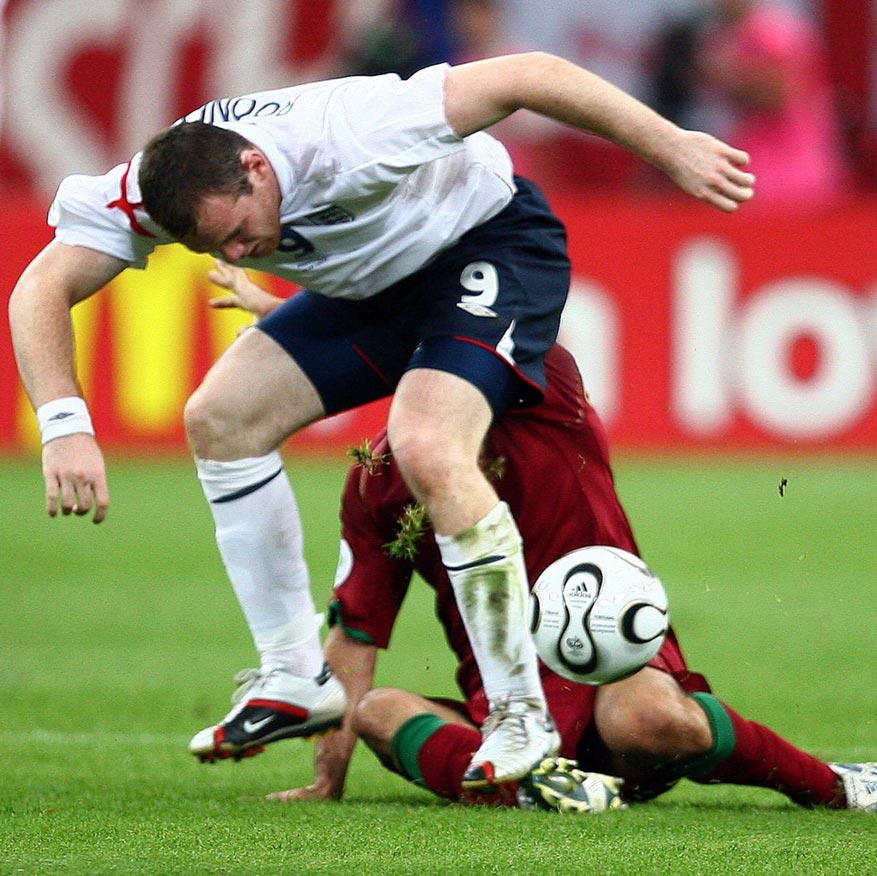
While Wayne Rooney was putting his foot down at the 2006 World Cup, Ted Knutson was busy doing sums



ALIVE AND KICKING
One man’s vision is transforming lives through the power of sport. Lucinda Sowerbutts explains
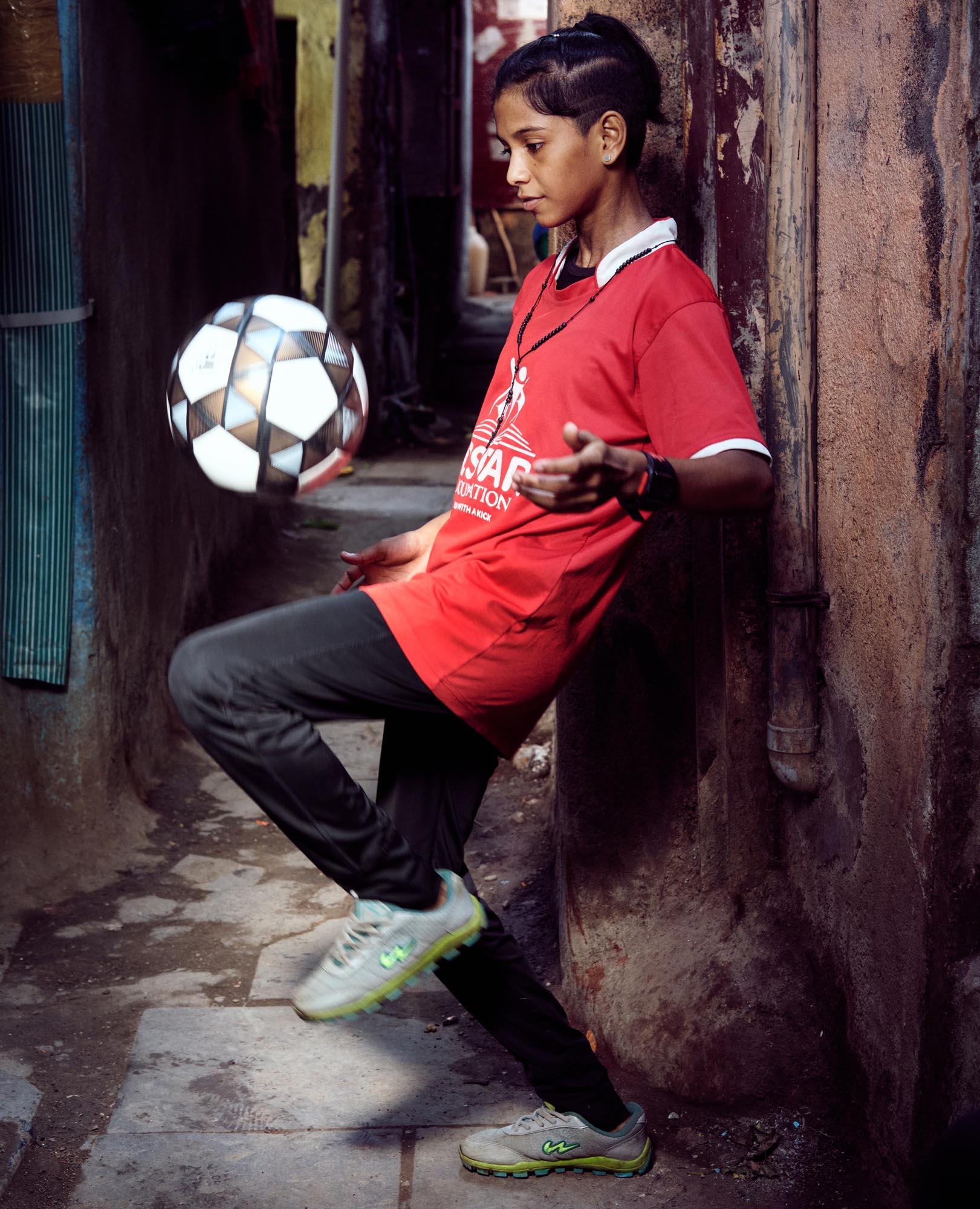
IN THE HEART OF MUMBAI , amid the labyrinth of narrow alleys and bustling energy of Ambedkar Nagar, a young boy lay awake on a corrugated iron roof, staring up at the night sky. Watching aeroplanes soar above the slum, he dreamt that one day he might travel in a plane.
That boy, Ashok Rathod, would grow up to become an inspiring social entrepreneur and the founder of the OSCAR Foundation, an organisation that uses the unifying power of football and sport to bring hope, opportunity and education to thousands of children across India and, through a unique partnership, to young people in the UK as well.
Home for Ashok and 60,000 neighbours was a three-metre-square room with no running water or toilet, but filled with love, hope and determination. His father worked as a fisherman at Mumbai’s Sassoon Dock, while his mother spent long hours peeling prawns before returning home to care for the family. His sister married at 15.
Yet, even amid hardship, Ashok’s parents insisted on one thing: education. Though they had never been to school themselves, they were determined their son would learn. Ashok would run three kilometres home in the midday heat to fetch water, then sprint back to class, dusty and exhausted. Against all odds, he persevered and became one of the few from his community to graduate from both college and university. That education and his growing love for football would soon change not only his life, but also thousands of others’.
A FOOTBALL, A DREAM
At 18, Ashok could no longer stand by and watch children from his community leave school, destined to repeat the same cycles of poverty. He decided to act with nothing but
a football (or rather, a plastic bottle filled with sand), a patch of ground and a handful of school dropouts.
He began by teaching them to kick, pass, and play. But football quickly became a tool for something much bigger: a way to teach teamwork, discipline, respect and hope. Between matches, Ashok would talk about school, hygiene, gender equality and the importance of education.
From those first 18 boys in 2006, the Organisation for Social Change, Awareness and Responsibility (OSCAR) was born. Officially registered in 2010, OSCAR has since become one of India’s most inspiring sportsfor-development programmes, engaging more than 35,000 children. Today, 17,500 children across five states participate in OSCAR’s football and life skills programmes, guided by more than 1,200 trained Community Young Leaders. At its heart lies a simple, transformative rule: “No school, no football.”
BREAKING BARRIERS
One of OSCAR’s most powerful initiatives uses football to drive gender equality. In communities where girls are often expected to marry illegally young or stay at home to do household work, OSCAR offers another option, one built on empowerment, leadership and self-belief through sport.
On the pitch, OSCAR girls learn more than just how to dribble or score goals; they learn teamwork, confidence and how to speak out. They learn to challenge stereotypes and societal norms. “They’re doing things differently,” says Ashok. “They’re becoming the change their communities have been waiting for. Through sport, these young women are breaking barriers that once seemed immovable.”
A CHANCE ENCOUNTER
In 2015, a chance meeting in Mumbai would propel Ashok’s mission onto the global stage. While visiting India, I had the privilege of watching OSCAR’s football sessions and community learning centres first-hand, witnessing how sport united children, parents and the community. I left determined to help support his vision in any way I could. From that encounter, OSCAR India (UK) was kicked into action, a registered UK charity working hand-in-hand with the OSCAR Foundation in India. Together, we realised that sport could do more than raise funds, it could build bridges between young people from vastly different worlds.
LIFE-CHANGING JOURNEYS
In 2017, we launched the first OSCAR UK School Tour, bringing 15 boys from Mumbai, none of whom had ever owned a birth certificate or passport, to visit schools and communities across Britain. The logistics were complex, but it bore extraordinary results. It offered young people who had never dreamed of travelling abroad the chance to experience it, and inspired British pupils to see life through a new lens.
Since then, OSCAR India (UK) has organised five UK tours, a Young Leaders Tour hosted by the University of Edinburgh and a US tour, and even celebrated victory at Denmark’s prestigious Dana Cup football tournament. Every match, every interaction and every shared story continues to remind us that football transcends barriers of language, class, religion and culture.
TRANSFORMING LIVES
The impact of OSCAR’s work runs in both directions. British schools that have hosted OSCAR teams now send students and vol-
unteers to Mumbai to teach, coach and learn. Every year, school leavers, graduates, teachers and participants of the UK Government’s Turing Scheme spend weeks with the OSCAR community, mentoring and sharing the universal language of sport.
“They arrive thinking they’re there to help,” says Ashok. “But they leave changed.” These experiences build empathy and mutual respect. Whether in Mumbai’s crowded streets or on school sports fields in rural England, football continues to unite, inspire and transform.
THE POWER OF TEAMWORK
Over the past five years, Ashok and I have invited supporters to take on epic physical challenges, climbing Mount Kilimanjaro and Mount Toubkal, trekking the Sahara Desert, completing the Mont Blanc Circuit and most recently, conquering a high-altitude Himalayan trek. Each journey mirrors the spirit of OSCAR itself: teamwork, fitness, resilience and shared purpose. “Every step up the mountain mirrors the journey of our children,” says Ashok.
Through these adventures, participants experience first-hand how sport and physical challenge bring people together and raise vital funds for OSCAR’s lifechanging programmes.
TWO CHARITIES, ONE MISSION
Though the OSCAR Foundation (India) and OSCAR India (UK) are separate charities, they share one goal: to create life-changing opportunities through education, sport and Football may be the foundation, but the lessons go far beyond the pitch: resilience, respect, gender equality and the belief that every child deserves the chance to dream.
THE RIPPLE EFFECT
Today, OSCAR’s model educating through sport and mentorship is now recognised globally as a blueprint for social transformation. Children who once played barefoot in Mumbai’s alleyways now study in universities. Girls who once feared early marriage now lead football teams. British students who once read about poverty in textbooks now experience solidarity, compassion and cultural exchange first-hand. In every sense, OSCAR’s impact is circular: India inspires the UK and the UK empowers India. As the world faces increasing division and inequality, OSCAR stands as living proof that empathy and action can bridge even the widest gaps, with sport as the catalyst. “Our dream,” says Ashok, “is to create a world where equal opportunities, respect and optimism are abundant. Where every child, no matter their background, has the chance to shine.” n
Lucinda Sowerbutts is driving the Oscar Foundation’s mission in the UK and India. oscar-foundation.org / oscar-international.org
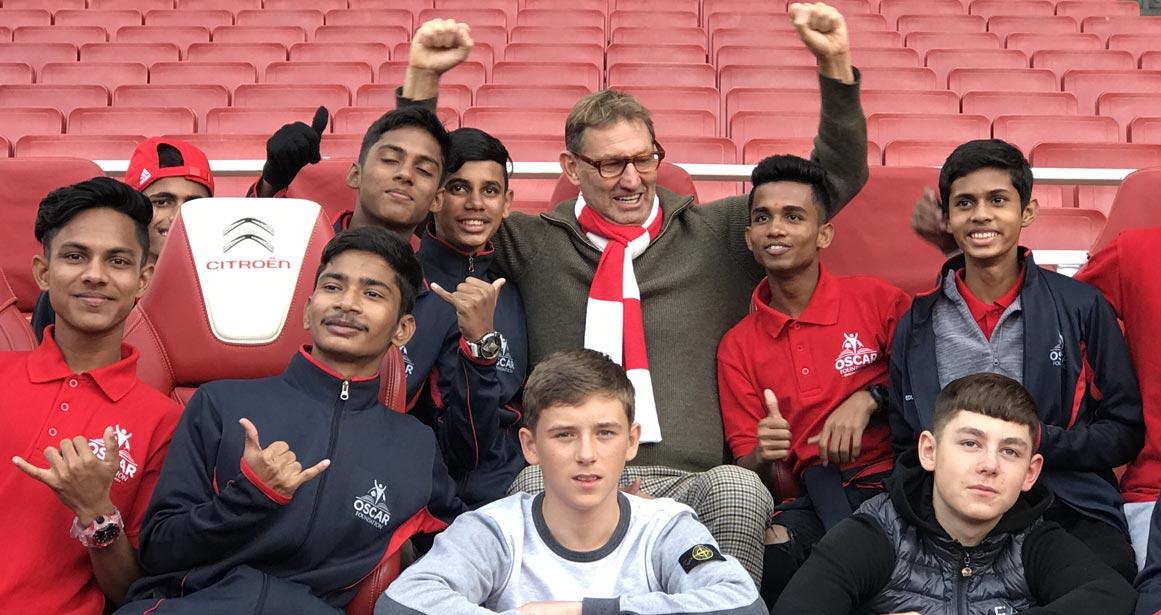
A touring OSCAR boys’ team enjoyed a day at the Emirates Stadium with Arsenal legend Tony Adams
Every match, every interaction and every shared story reminds us that football transcends barriers of language, class, religion and culture.
INDIA’ S FOOTBAL L

1. CHUNI GOSWAMI
Considered India’s greatest, he was Player of the Tournament at the Asian Games and Asia’s top striker in 1962. Famously turned down Tottenham to stay with Mohun Bagan.
2. BHAICHUNG BHUTIA
The Sikkimese Sniper changed the game for India. Second Indian to play professionally in Europe and three-time Nehru Cup winner.
3. SAILEN MANNA
Captain of India at the 1952 Olympics, famously barefoot. Named Asia’s best defender in the 1950s and India’s first Asian Games gold-winning captain.
4. PK BANERJEE
A natural leader on and off the field. Represented India at two Olympics and guided the nation to Asian Games gold in 1962. Padma Shri and FIFA Centennial Award recipient.
5. SUNIL CHHETRI
India’s all-time leading scorer with over 90 international goals. Four-time AIFF Player of the Year and multiple SAFF Championship winner.
BATTLE FATIGUE
Hollywood is in a dark place – but that won’t stop its stars putting on a happy face at the Academy Awards. Joe Hodgson looks at who might still be smiling afterwards
AROUND THIS TIME of year, just like us regular people, the glittery elites of Hollywood can be found doodling their Christmas wish list. However, unlike us regular people, they will not be hoping for a bottle of port as big as a house, and a brick of stilton so pungent it could set off fire alarms. Nor will they be contemplating a hot tub full of melted Mars bars.
Instead, the more health-conscious stars of La La Land will be praying for some anti-ageing hypnosis classes, a thimble full of Gwyneth Paltrow’s patented rejuvenating parsnip mist… and enough Botox to incapacitate a white rhino. All of which will help them look their very best ahead of the 98th Academy Awards ceremony on 15 March 2026. But as we cross the threshold into the Christmas period –and head towards the defining weeks of movie awards season – even for those in Hollywood who can still move their faces, there isn’t a great deal to smile about…
Things are a bit precarious, you see. Morale is low and the tinsel is beginning to fade. Production is plummeting on those famous old Hollywood lots – financial incentives are luring filmmakers to different states and different countries. Doommongers are even predicting that Los Angeles could become an industry ghost town, like Detroit when the wheels came off its once-booming car industry.
Plus, there is the continuing impact of streaming services to contend with; the twin lingering effects of Covid shutdowns and writer/actor strikes; as well as the recent damaging wildfires. Oh yes, and no one seems to have a clue what to do about AI either.
In fact, many in LA might even be questioning why they should bother spending millions making and marketing big-budget movies when a video of Nature’s Most Flatulent Animals, costing $12 to produce, can get 10 million views on YouTube, and someone twerking to a Simply Red song for about five seconds gets a billion hits on TikTok.
You could almost say it’s like one battle after another for Hollywood these days. Which, ironically, is the title of the current frontrunner in the race towards next year’s Oscars ceremony. Yes, like your parents failing to tell you that your beloved hamster is dying, awards season is going to carry on as if everything is

BEST PICTURE
One Battle After Another 4/7 Hamnet 5/2 Sinners 7/1
BEST DIRECTOR
Paul Thomas Anderson (One Battle After Another) 1/3
Chloe Zhao (Hamnet) 3/1
Ryan Coogler (Sinners) 7/1
BEST ACTOR
Timothee Chalamet (Marty Supreme) 4/5
Leonardo Di Caprio (One Battle After Another) 11/4
Dwayne Johnson (The Smashing Machine) 15/2
BEST ACTRESS
Jessie Buckley (Hamnet) 2/7
Renate Reinsve (Sentimental Value) 5/1
Teyana Taylor is far from laboured in One Battle After Another
You could almost say it’s like one battle after another for Hollywood these days.
fine and dandy, so let’s hope there are some very good movies in contention to help keep up the charade.
Thankfully, Paul Thomas Anderson’s One Battle after Another seems to fit the bill. It features one of Tinseltown’s biggest stars in Leonardo DiCaprio; PTA has personally been nominated for 11 Academy Awards and is, consequently, overdue a significant win; and the critics absolutely loved it.
Nominations for Best Picture and Best Director are pretty much guaranteed, and a thoroughly reptilian turn from Senn Penn is likely to land him a Best Supporting Actor nomination too. A more understated Benicio del Toro could join him in that berth, and Teyana Taylor is a good shout for a Best Supporting Actress nod. So that’s all settled then,
ODDS
how to respond to his presidency –continues to overwhelm and befuddle Hollywood. So, if One Battle after Another’s early momentum fully falters, who could come up on the rails and potentially overtake this current leader?
Perhaps a good, old-fashioned weepie, set in a mystical, faraway land (England circa 1600), could provide the kind of escapism viewers really want from their movies? Enter Hamnet – an adaptation of Maggie O’Farrell’s mega-selling novel which speculates the story of William Shakespeare’s wife, Anne Hathaway, and the fate of their children, specifically the young twin whose name provides the title. Hamnet’s stock swelled considerably when it received the Toronto Film Festival People’s Choice Award in September. While that prize doesn’t always lead to Oscar glory, it does effectively guarantee a few key lines in the conversation – previous winners include Green Book and The King’s Speech
Expect Hamnet nominations for Best Picture and Best Director for Chloé Zhao; Jessie Buckley, as the mysterious Mrs Shakespeare, is the current favourite to land the Best Actress gong; and Paul Mescal, as her scribbling spouse, is tipped to ink his name into contention in the sure-tobe-stacked Best Supporting Actor category.
Rose Byrne (If I Had Legs I’d Kick You) 5/1
Cynthia Erivo (Wicked: For Good) 9/1
Phone or Live Chat for latest prices
right? One Battle after Another to sweep the board? We can all place our bets and go back to bed?
Not so fast. While nominations look assured, wins do not. Because despite all the big stars and the press adulation, the film has not been a boxoffice smash. Though it works as a well-made and effective thriller, One Battle after Another’s depiction of a frazzled, factional America riven by deep and toxic political division may have put some people off going to see it – perhaps because they can watch a frazzled, factional America simply by turning on the news.
Just like last year, the spectre of Donald Trump – and the question of
Multiple nominations are anticipated of Ryan Coogler’s audacious horror/musical mash-up Sinners, which received acclaim and impressed at the box office; Michael B Jordan, for one, looks a safe bet for a Best Actor nomination. He is likely to be joined in this category by Timothée Chalamet, who has received drooling early notices for his performance in ping-pong thriller (yeah, you read that right) Marty Supreme
Wicked: For Good, part two of the verdant musical behemoth, could be rewarded with nomination love for showing that some big-budget films can still make money in cinemas; and don’t be too surprised if Swedish stalwart Stellan Skarsgård (Sentimental Value) nabs a Best Supporting Actor Oscar to crown his long and varied screen career.
Right, hopefully that’s everyone up to speed. Time to slather my body with parsnip mist in preparation for the latest in a long line of gruelling conflicts for Hollywood – a protracted and very bitchy awards season. Let battle commence, people! n
Joe Hodgson is a regular contributor to The Fitzdares Times in print and online


TRY THE FITZDARES LIVE CASINO

Iain Macintosh on the 20 years leading to the overnight success of podcasts
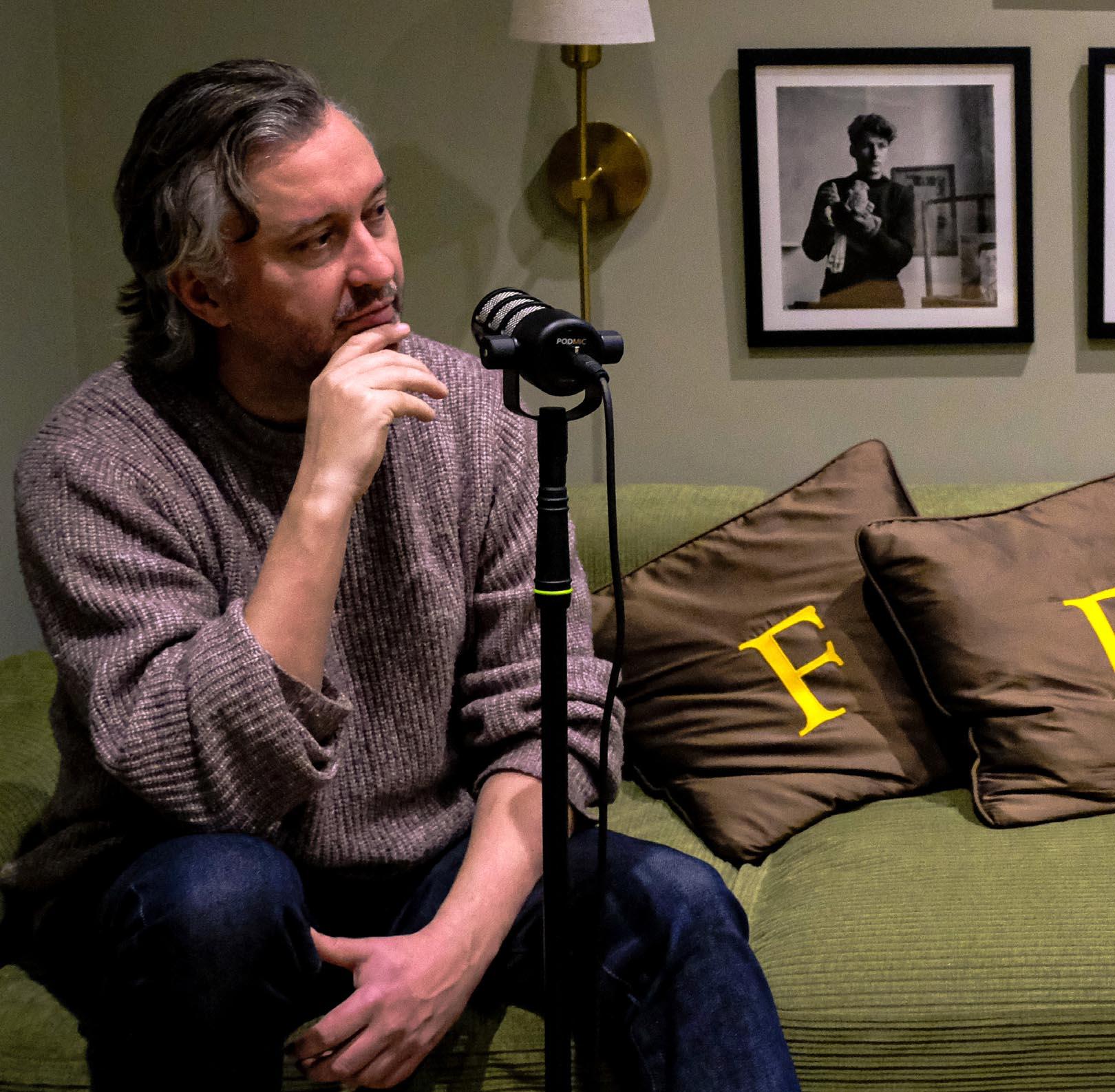
MY FIRST PODCAST was a spectacular failure, which was a shame because it was arguably the best thing I’ve ever made. It was called A Bit of Fry & Ollie, a hybrid talk/game show with Barry Fry and Ian Holloway, skilfully hosted by Di Stewart.
Oh, what fun we had, that hot summer’s day in 2005 in a studio in East London. How Barry and Ian roared with laughter at each other’s anecdotes. Watching on from the control room, I thought
I had a winner. But I was wrong. Hardly anyone knew what a podcast was. I remember one media executive telling me: “Yeah, it was good. But what is it? Do you just, like, listen to it?”
Alas, that was not an isolated reaction. That pilot episode was ignored. We were about ten years too early and A Bit of Fry & Ollie never saw the light of day. Twenty years on from that crushing blow, I’m still hoping that people will just, like, listen to my podcasts.
I’ve had a few wins along the way. The history show You’re Dead to Me was a huge success for the BBC (I made that one as a sort of penance for the abject failure of my A-level). I picked up an award for The Football Manager Show too, though I made that mostly just to legitimise my long standing addiction to Football Manager I’ve put a few in the L column, though. Buy me a drink and I’ll tell you about the time I thought investing in a musical theatre podcast was a good idea…
But sport has always been my passion, and podcasts serve it so well. The joy of podcasting, as opposed to broadcasting on terrestrial radio or television, is that you don’t have to pander to the mainstream. As long as you’re clear on your objectives, you can do anything.
There are three reasons to make a podcast. The first is to make money, the second is to raise profile, and the third is because it’s fun. That’s why it’s an ecosystem in which Gary Lineker
sits on the same platform as two British lads who only discuss Estonian football. (Seriously, they’ve done 56 episodes.) I used to appear regularly on the Guardian’s Football Weekly, a production that had risen to prominence in the sector because its guests were mostly drawn from outside the ranks of the recognised press pack. They served an audience tired of weary clichés and delighted to be entertained by former Golazzo presenter and cult hero James Richardson.
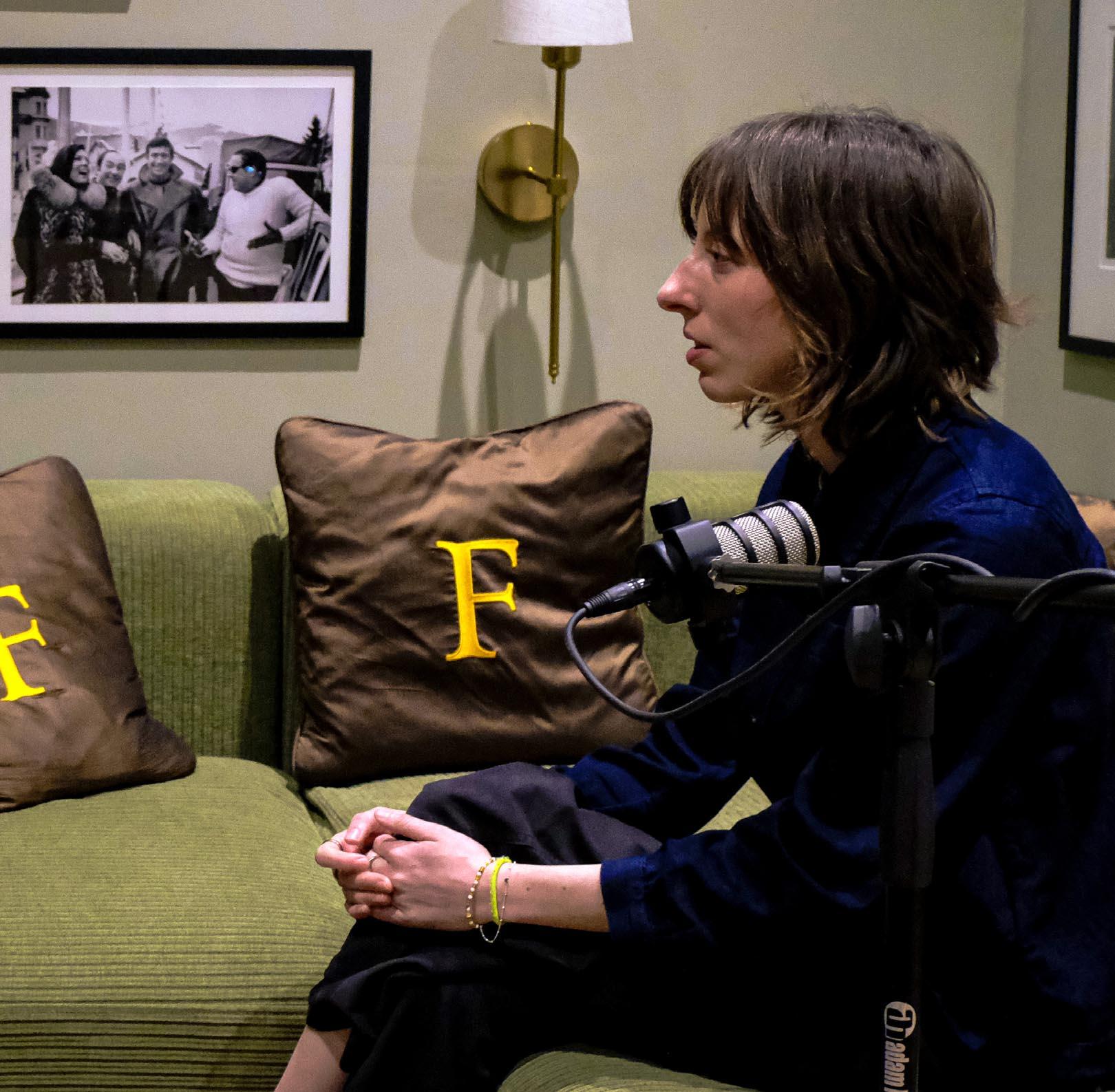
Later, in an act of chilly ruthlessness that surprised even me, I poached Richardson for my own podcast company, where he would host the award-winning Totally Football Show, the success of which would drive the growth of its EFL, Italian and Scottish sister shows right up until 2020, when we sold the whole lot to The Athletic.
I keep hearing people say that podcasting is over, that there’s too many of them now and the market is saturated. But no one
ever says that about books, do they? There may well be millions of podcasts out there, but there are billions of books and people are still printing them. Even now, as you read these words, someone somewhere just had a good idea for a novel and they’re not going to ignore it just because Richard Osman’s bringing a new one out.
Besides, as I mentioned earlier, the strength of a podcast isn’t always measured in the size of its audience. Far fewer people listened to our old Italian football
show than the flagship show, but, by thunder, they loved it with the heat of a thousand suns.
Podcasts have the power to bring people together, they have the freedom to pull whichever threads they want to pull and take the conversation wherever they want to go.
That’s why I’m so excited to work with Fitzdares on their new show, Odds Law, hosted by their own Lola Katz Roberts. Every week, they’ll cast their eye over
the major sporting events and they’ll use the odds to tell you the stories behind the story. It’s knowledge-led, because regardless of what anyone else thinks, we still haven’t had enough of experts, but above all… it’s fun.
Give it a listen today – you’ll find it wherever you get your podcasts. You won’t find A Bit of Fry & Ollie, though. It never even made it to the Apple page… n
Iain Macintosh is editor of Track Record Media
THE STUDIO
With
If you’re looking to give your podcast a home, film polished content or start something new, email marketing@fitzdares.com
room for four guests, 4K cameras, studio lighting and full production support, our space keeps the focus on the conversation. We already host Route One, the daily no-faff football show, and Odds Law, where sport meets the odds.
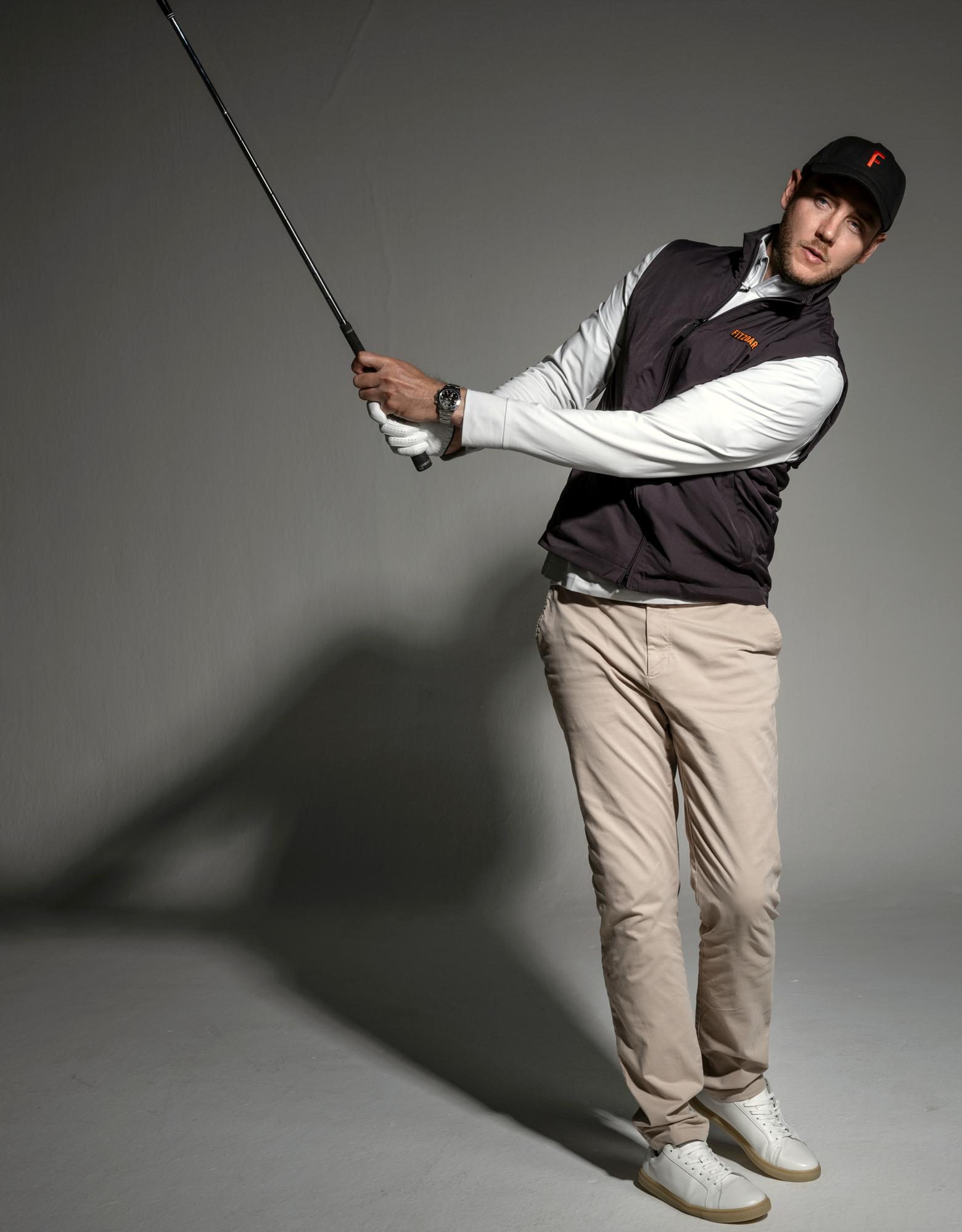
Broad, Fitzdares Ambassador
Broady’s competitive spirit, passion for sport and cheeky sense of humour are shared values that make him our perfect partner. Keep your eyes peeled as he continues to tell our story with insightful blogs, stunning video content and engaging personal appearances.
Stuart
WINTER READ
When Chelsea came from behind to beat Luton at Kenilworth Road on 2 March 2022 and progressed to the FA Cup quarter-finals, the real focus was on what was unfolding off the pitch.
From “the centre of the storm”, then-boss Thomas Tuchel fielded a barrage of questions about the club’s ownership as uncertainty swirled around Stamford Bridge.
Just an hour before kick-off, Roman Abramovich, Chelsea’s long-term owner, had released a statement putting the club up for sale. Against the backdrop of Russia’s invasion of Ukraine, Abramovich – arguably the most controversial and influential figure in English football over the past 25 years – was compelled to sell the club, with sanctions looming.
What ensued over the next three months was an unprecedented period in English football as the club looked to navigate a highly complex sale under the pressure of sanctions, political scrutiny and global attention. Nick Purewal’s Sanctioned: The Inside Story of the Sale of Chelsea FC captures this turbulent period with remarkable insight and storytelling.
With threats ranging from relegation to bankruptcy, every move had to be calculated carefully. The club was granted a special government licence to complete the sale before 30 May, giving it less than three months to complete a transaction that experts predicted would usually take roughly a year. The sense of urgency is palpable throughout the book.
Early in the narrative, Purewal details an extraordinary episode in which Abramovich was targeted by foul play amid reports he was attempting to backchannel peace talks between Russia and Ukraine. This dramatic context sets the tone for the high-stakes environment surrounding the sale.
Purewal’s account of the bidding process reads like a thriller. More than 200 expressions of interest were submitted, whittled down to just four serious contenders. The negotiations were chaotic: multiple buyers, rapid-fire bids and constant legal hurdles. Even a last-minute bid from Manchester United minority owner and INEOS chief Sir Jim Ratcliffe added to the ongoing tension, all under the watchful eye of the government.
Purewal humanises the chaos beautifully. Players and staff faced uncertainty over contracts, pay and futures, while fans grappled with the emotional upheaval of their club’s forced transition.
With sanctions imposed and his assets frozen, Abramovich could not profit from Chelsea. The club megastore was shut indefinitely, and
Even a last-minute bid from Man United minority owner Sir Jim Ratcliffe added to the ongoing tension, all under the watchful eye of the government.
fans were unable to purchase additional tickets for away games. The first-team squad was allocated capped budgets for matchday expenses. At one point, the players offered to pay for their flight to Lille for the second leg of their Champions League tie. The club advised against it, citing the need to comply with sanctions and avoid jeopardising the sale.
Eventually, a consortium led by LA Dodgers owner Todd Boehly purchased the club for £4.25 billion, and Abramovich hasn’t received a penny from the sale.
Purewal outlines how Boehly’s previous advance to purchase the club in 2019, which involved significant due diligence, gave him a crucial advantage over the other bidders in the increasingly timesensitive process. Remarkably, the author also secures Abramovich’s reflections, offering rare insight into a figure who had largely evaded the public eye during his 19-year tenure.
Sanctioned is more than a chronicle of a single transaction. It is a portrait of modern football, where sport, money and geopolitics collide to redefine a club almost overnight. The book is both a cautionary tale and a thrilling account of resilience, strategy and drama.
This is an essential read not just for Chelsea fans, but for anyone interested in football, governance or the business of sport. Sanctioned is a detailed, engaging and remarkably human account of 95 days that reshaped the future of one of Europe’s biggest football clubs.
SANCTIONED is published by Biteback (£20).
THE CROSSWORD
ACROSS DOWN
1. Home to The Optus Stadium (5)
4. 2025 US Open course (7)
7. Simona Halep’s land (7)
10. Kevin __, golfer (2)
11. Snow dome (5)
12. Michu’s Premier League team (7)
15. Multiple meaning wordplay (3)
17. Islam’s almighty (5)
18. Dominic _____, 2020 US Open winner (5)
19. Sky Sports Racing’s acronym (3)
21. Afternoon show (7)
23. Recommend a bet (3, 2)
25. ‘The’ for Thierry Henry (2)
26. The NBA ___-____ Game (3-4)
28. Fictional African nation from Marvel (7)
29. Host nation for the 2026 Winter Olympics (5)
For answers email rory@fitzdares.com
1. The P in SPOTY (11)
2. LA NFL Player (3)
3. 2025 BBC England Women’s POTY (6, 7)
4. ‘Hello’ for José Mourinho (3)
5. Mercedes F1 driver (4, 9)
6. South London Cricket Ground (4)
8. Beefy’s first name (3)
9. 2025 Race To Dubai Winner (4, 7)
12. ____ Sharks, Rugby Union team (4)
13. Subject of this puzzle (5)
14. Political body (2)
16. ____ Leg, cricket position (4)
20. ‘Thanks’ for Joe Root (2)
22. Unwell (3)
24. Ice Hockey ‘ball’ (4)
26. ___ Ivanovic, 2008 Roland Garros Winner (3)
27. Afternoon cricket break (3)
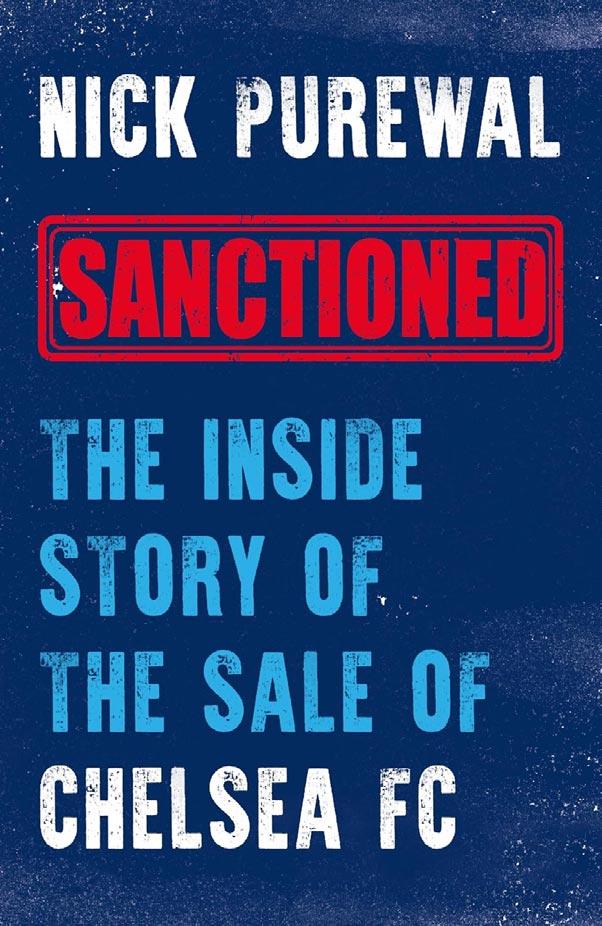
Nick Purewal’s account of the 2022 sale of Chelsea FC reveals the hidden drama as war unfolded