
fissionline 39

Page 1


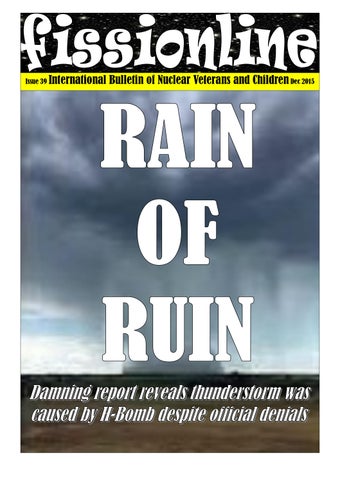
STORM-CLOUD CAUSED

THOUSANDS of troops may have been exposed to deadly radioactive rainfall, known as rainout, following H-bomb tests on Christmas Island, according to an official Meteorological Officereport.

Rain ‘possibly caused by the bombs’ fell after three huge H-bomb tests in1957-58, according to thereport. It makes a mockery of repeated denials by successive governments which insist there was no radioactive contamination on Christmas Island

The 10-page document, released to fissionline under freedom of information laws, also casts serious doubts on statements made by two former defence ministers who in separate statements flatly denied there was any contamination on Christmas Island following the bombtests.

The Met Office report was written in 1985 in response to an enquiry by an official from the Atomic Weapons Research Establishment.

Entitled Weather and Winds During Christmas Island Nuclear Tests, it states that rainfall occurred at the island’s Main camp after Grapple X on November 8, 1957, and after GrappleZ onAug22, 1958.

But the real shock comes with the admission that “precipitation” (rain) reached the surface in a shower possibly caused by the bomb..” The revelation is

MOD MINISTERS’

Misleading Answers Over Rainfall Reports

repeatedinan appendix whichstates:Precipitation in sight more than 5km from station, reaching surface. Cumulonimbus from bomb.

At least two former government ministers, in answers to questions, have stated there was no rainout contaminationafterthebombtests.

Former Labour Defence Minister Dr (now Lord) Lewis Moonie said in a parliamentary reply in 2003: “...there was no rainfall…AWE Aldermaston has no evidence to show that water contaminated with radiation was precipitated out over the island.”

Defence Minister Archie Hamilton went further. He told parliament after a shock Dispatches TV documentary claimed there was heavy rain after the GrapplyY explosion:-

“The unfounded allegations (about rainfall) are based on a series of factual in-

accuracies. All that I can say is that shortly after the test(s) extensive environmental monitoring did not measure any deposition of radioactive materials from the detonation(s).”

This statement directly contradicts another report, this time from the Atomic Weapons Research Establishment, which specifically states there WAS radioactive contamination after H-Bombtests.

This document, obtained by fissionline under freedom of information laws, is entitled: Environmental Monitoring at Christmas Island 1957-58. It states:A few very high values (of radioactive contamination) were recorded from the southern part of the island, none of which was nearer than 8km from the nearest inhabited area…

In fact scientists and weathermen wereso worriedabout contamination

CAUSED BY H-BOMB

The damning evidence proving that contamination hit Christmas island after H-Bomb tests

that they calculated how long it would take the fallout to reach the Main camp, where thousands of troops were based. There was mass

panic amongtheboffins aftermeasurements showed the wind shifted unexpectedly after the Grapple Y blast blowing particles toward the camp.

Deadly Menace of Rainout

Rainout is a particularly pernicious form of radioactive contamination. It was first observed after the Hiroshima bomb when ‘black rain’ loaded with particles ofash from burning wood structures fell about 30 minutesafter the blast. Medics noted that people hit by the rain suffered from burns to their skin and were later more prone to blood cancers. Rainout has the ability to hold its strength and not to be dissipated like dry fallout. Another notorious example occurred overthetownship ofTroyinupstate New York in 1953. Rainout whichhad travelledacross the continent from anA-bomb blast caused widespread contamination.It hasbeenblamedfora leukaemia clusterdiscovered inthe area.

The Met office report states:...assuming particles were released at 2,4 km to the south east of the camp, they could have reached the camp at 1200 local time. Heavier particles released from the thermonuclear cloud at greater altitudes could have arrived at the camp later..

The shock reports were written in the 1980s not long after the scandal of what happened at the nuclear bomb tests hit the headlines. But it was decided not to release them because the Atomic Weapons Establishment wanted to keep them ‘in house’.

LEUKAEMIA

MORE THAN 100 servicemen were hit by leukaemia and other blood cancers after witnessing ‘rainout’ HBombtests.

Huge toll of blood cancer incidences among troops Leukaemia

The shocking toll is revealed in medical and servicerecords supplied by nuclear veterans over a 40 year period between 1958 and1999.

The records detail the suffering of more than 3,500 servicemen who took part in British nuclear bomb testing in the 1950s.

They show men were hit by rates of cancers and other crippling illnesses farabove the norm. Theyalso reveal a terrible catalogue of injuries amongtheir offspring.

But the most startling finding was that those most affected were servicemen who witnessed three Hbomb tests on Christmas Island in 1957-58.

They suffered far more than men present at other tests, with a staggering 113 men reporting incidents of leukaemia and other blood cancers associated with radiation exposure.

causing a thunderstorm followedby rain.

Toll of Doom GrappleX...17

An astonishing 84 servicemen present at Grapple Y were hit by leukaemia and other blood cancers includingmultiple myeloma and aplastic anaemia. All have been linked to radiation exposure.

A total of 17 service-

The rogue bomb tests took place on 8 Nov 1957, April 28 1958, and 22 August 1958...the three tests identified in an official meteorological report as being associated with rainfall.

As revealed in fissionline, the Met Office report identifies the April 28 explosion, codenamed Grapple Y, as

men contracted similar diseases following the November 8, 1957 explosion, codenamed Grapple X, while 12 men were affected after the August 22, 1958 blast, codenamedGrapple Z.

Shockingly military chiefs decided to explode Grapple Y, the biggest of the bombs, and the onethat has causedmost health

TIMEBOMB

troops who witnessed ‘rainout’ H-Bomb Tests

Braving the storm: Plucky servicemen carry on their duties as torrential rain floods their camp after the bomb tests

problems in April, which is slap in the middle of the rainy season on Christmas Island. Weather stations monitored precipitation (rainfall) ‘reaching

the surface’ near where thousands of troops were mustered to witnessthe blast.

Many later spoke of being soaked in black rain, the size of 10p pieces, from a huge storm cloud that swept infrom thesea.

Scientists and senior officers in protective clothing frantically ordered troops in the open to get under cover from the torrential rain.

*Thousands of American servicemen won compensation when just nine cases of leukaemia occurred among 3,224 men who participated in military maneuvers duringthe 1957 nuclear test explosion “Smoky” in the Nevada desert. This represented a significant increase over the expected incidenceof 3.5 cases.

Graph shows April as peak of rainy season

SO SAD ABOUT SUE

Sue Lloyd Roberts, who sadly died on 13 October of leukaemia, was a brilliant journalist and one of the very first people from the media to recognise the importance of the story we nuclear veterans have to tell.

When we first hit the headlines in 1983 she hot-footed it up to Scotland to meet with myself and Phil Munn, another Christmas Island veteran,to get the scoop. Well, she certainly did that. Thanks to her, BBC Nationwide broadcast a stunning expose of what went on at the nuclear bomb tests which frightened the life out of a Thatcher government desperately trying to keep a lid on the scandal.

The programme inspired thousands of nuclear veterans to come forward and tell their stories resultingin the settingupof theBritish Nuclear Tests Veterans’ Associationinlate1983.

Sue, together with legendary nuclearexpert DrAlice Stewart, were instrumental in drawing up the

first constitution which called for justice and compensation for nuclearveterans.

Sue had a special affection for the nuclear veterans and in the early days often attended our meetings. She was not averse to ticking us off, however! I remember she attended one meeting in Blackpool when she was heavily pregnant. She stood at the back of the crowded hall and gave us a right royal telling off because we were all smoking.

Sue wrote a brilliant book Fields of Thunder about the Maralinga tests which was instrumental in the Australian Government setting up a Royal Commission toinquire into thebombtests.

Sue was one classy lady. She was educated at a private girls school and spoke with a cut-glass accent. She often said she needed an interpreter to translate my broad

Scottish brogue. But she had the common touch and she had us hoary old veterans eating out of her hand whenever she came to seeus.

When I was in London once she invited me to her house for a bite to eat. I was a bit reluctant because I imagined we’d be having muesli or tofu or other ‘healthy’ stuff. Not a bit of it! When I arrived she linked my arm and took medown to herlocal shopforfish and chips, and we ate them straight out of the paper all the wayback.

Sue went on to achieve many great things in her life. I often saw heramazing broadcasts from some of the most inhospitable parts of the world and marvelled at her ingenuityin getting thestories. I wasn’t surprised that she won so many media awards, and was delighted when she picked up a CBE forherwork.

We all have a lot to thank Sue for. If it wasn’t for her our story would still belargelyuntold.

I’M NOT TELLING YOU!

Manyofthetrusteesmyselfincludedgetfrequentqueries orrequestsforinformationfrommembers.Someofthe queriesarewellmeaningandgenuine.Someunfortunatelyarenot.ItisforthatreasonthatIhavechosento personallyadoptasimpleandperhapsbluntapproachto dealingwithqueries.IdonotdealwiththemifIdonot believethattheinvestigationwillbenefitthecharityin someway.InshortIdonotdealwithqueriesfrommembersofthecharitythatIconsidertobeeithermaliciousor whicharemadesimplyoutofcuriosity.Myroledoesnot extendtoprovidingindividual memberswithinformationoranswerstoquestions.

Ian Greenhalgh BNTVA Financial Controller

(In response to members who queried the accounts)

Ace Susie Joins fissionline

FLEET Street legend Susie Boniface has joined fissionline and she’s already made her mark by backing our campaign for pension rights for Britain’s nuclear veterans. In a hard-hitting article in the Sunday Mirror Susie reports how the forthcoming pension appeals tribunals could hand the veterans a much-needed cash windfall in

the form of war pensions. Last

year a fissionline campaign was successful in overturning a previous

ruling not to grant nuclear veterans war pensions. A High Court judge sent the case back to the Upper Tier Tribunal after heruled the law had been ’misapplied.’ Victory at the new hearing could pave the way for a sensational High Court trial which could hand the veterans a multi-million poundcompensation bonanza. Susie, dubbed the Fleet Street Fox, is known for her brilliantly acerbic articles which regularly have the Ministry of Defence diving for cover.Shehas been a longtimesupporterofBritain’s nuclear veterans.

Five years ago last month, the Redfern Inquiry Report into the shocking removal of tissue samples from the bodies of nuclear workers without informing their families, was published. No-one has ever been prosecuted and the families have been left feeling their loved ones had been viewed as just another piece of laboratory equipment.

Michael Redfern QC considered that families had been let down. and had seen no evidence that Sellafield had considered any of the legal or ethical issues involved. The Government chose a ‘good, bad-news day’ to publish the Redfern Report. Also on 16th November 2010 came the announcement of the engagement of Prince William to Kate Middleton which dominated all media headlines.

The scandal only came to light when BNFL’s Medical Officer expressed concerns when asked to re-examine data obtained from organ analysis from former nuclear workers by his predecessor, the late Dr. Geoffrey Schofield. He discovered that in many cases there was no evidence ofdeath beingrelatedto radiation, nor that consent had been ob-

tained. He also considered it odd that the coroner appeared frequently to have notified Sellafield of employees’deaths.

The issue was leaked to the press and attracted the attention of the government. The Inquiry found that an informal arrangement had existed between Dr. Schofield, the driving force behind the analytical work at Sellafield, and the pathologists at West Cumberland Hospital, which meant that he was told when a postmortem was to take place on the bodyof aformer Sellafieldworker. In cases of particular interest to him, Schofield appeared to have taken somewhat dubious steps to obtain

organs. The range of body parts removed for analysis, including liver, ribs, kidney as well as testes, brain, heart and tongue, had been extraordinary. The report concluded that although Dr Schofield and his colleagues had made no attempts to conceal their research, there was no suggestionthat they consideredtheir actions to be untoward and neither did they appear to have given any consideration to the ethical implications of their work. For the families, one of the hardest parts of the process had been that each person affected had felt as if they had reexperienced bereavements at different stages of the Inquiry as and when the true facts had come to light. According to the Inquiry legal team, CORE’s archived papers had given them ‘a valuable lead into everything at an early stage’. CORE had also raised funds enabling Sellafield workers or their families to access legal advice and secure compensation for work-related cancers. One of the shocking case studies of a included a claim by the son of a Sellafield worker that the plant was responsible for halting his father’s funeral so that they had more time to studyremovedorgans.

Cumbrians Opposed to a Radioactive Environment

MY FATHER, Wing Commander Kenneth Wallis, was a wartime bomber pilot who flew 28 missions over Germany. Among other things, he flew B-36s laden with nuclear bombs over the North Pole; hunted Lord Lucan over the Sussex Downs; scanned the deep waters of Loch Ness for the “monster” and advised the designers of Concorde on how to reduce engine noise. But he became better known after the war as a key figure in the development of the autogyro, which, most famously, he flew as Sean Connery’s stunt double in the 1967 James Bond film You Only LiveTwice.

and very, very interesting. We had just got married and we were only just out of university.

Thefilm had just come out and there was one or two places were it was being shown in Yugoslavia. People

what he was going to do before he did it. There is a picture of me somewhere riding pillion on the autogyro withhim.

Pa was still active and getting positively vetted for quite a long time

The James Bond thing made him a household name and he did very well out of it. He used to do some hairythings at times. When this came out about little Nellie my ex-husband and I were hitching around Yugoslavia and that was in the time of Tito and it upset the security people back here. We were in our 20s and we were just hitch-hiking around. It was amazing

found out who I was and suddenly we had security people following us around. It was very exciting and I wassoproudof Pa.

But there was so much else that he did that was so much more interesting. He was so clever and inventive, but hetookeverythingin hisstride.

I was very close to my dad. I did the odd air show with him on demonstrations and so on. I knew exactly

after he came out of the RAF. In his sparetimehemade some marvellous inventions. He went to the States and then he invented the auto-gyro. He spent all his time in his workshop. My first memory of him is in his workshop inHovewherewe lived.

*Ken Wallis was a member of the Anglia branch of the BNTVA before his sad death in 2013. Vicki has now proudly taken his place.

Wing Commander Ken Wallis at the controls of Little Nellie

I FLEW with 76 Squadron RAF, during the Grapple tests on Christmas Island. Being an aviator and flying, I had been ‘grounded’ and given a Medical classificationof A4G7.This was caused by a massive overdose of radiation received flying throughnuclear clouds. At the end of Grapple Zulu, all units started making preparation to return to their home bases. Our Squadron received an offer for berths that would take two of us from Christmas Island to Auckland, on Pukaki, one of two New Zealand ships that patrolled the waters round Christmas Island during thetests.

Having been ‘fried’ by the radiation in the two biggest Hydrogen bombs detonated at Christmas Island, I was offered the trip, and was granted a ‘Leave of Absence’ to make the adventure. Embarking onto Pukaki, I was given the Captains Sea Cabin, which was located just behind the bridge, and close totheRadio Shack. It was the first sea trip I had ever taken. Christmas Island to Fiji, then on to Auckland. Across the Tasman to Sydney. Then by Rail to Adelaide.

A lot of things happened at Christmas Island, and sailing on Pukaki, which at the time I did not under-

stand. Most people were told nothing. It was strictly on A NEED TO KNOW BASIS. We were discouraged in asking questions or to question what was going on. Many things were swept under the carpet, and just hidden by quoting THE OFFICIAL SECRETSACT.

So don’t ask! During Grapple Yankee I was flying as Navigator on Sniff Boss. It was the first aircraft to enter the cloud, and we made two cuts through it to assess the radiation levels, and dangers of flying through the cloud. Prior to detonation we were flying a ‘racecourse’ circuit about 25 miles from Ground Zero.

After detonation, we swung around to see the incredible sight of the explosion. Then we watched as the white hot plasma of the nuclear detonation ball turned red, then orange then eventually white from the condensed water particles in the warm humid tropical maritimeairmass.

flying in a circle around it, 15 miles out from the cloud.

Closer in to the cloud we were picking up Radiation, so we kept as close as we could. Basically the

Joe Pasquini discussing the impact of Grapple Y with

Flying at 46,000 feet (9 miles high), looking down we watched as the cloud started to rise, and we were

cloud was a Radiation Beacon, and it was irradiating everything within a 10mile diameter.

Pasquini

A maritime patrol Shackleton, flying at low level flew though more radioactive rain miles away from the island, and had to be put into the Decontamination Pans when it returned to the airfield.

the widow of another Canberra pilot Shirley Denson

Heavy rain fell at Port London. Was that radioactive as well? AWE knows, but wont tell. Back to Pu-

kaki, while the ship was steaming through and around the Ground Zero area, they were well within the 10 mile radiation rain circle. I would suggest that the crew were inhaling radioactive Cosmic Dust when they were on station. Even though they didn’t experience any rain, they could not see the Cosmic Dust. The Cosmic Dust contaminated by the Nuclear Cloud would have drizzled down, over a 100 square mile circle, around Ground Zero. Based on the calculations and estimates I made on April 24th, 1958. I have further estimated that there would have been a minimum of 1000 cubic miles of irradiated Cosmic Dust contaminated and generated by Grapple Yankee, just hanging in the air, and gently drizzling to Earth. After Grapple Yankee was detonated, Pukaki was ordered to sail underneath Ground Zero, possibly to take water samples and perform other tasks. I don’t know because I wasn’t there. At that time I was flying

9 miles above in a circle around the Cloud. Measuring, monitoring and recording However, my radia-

tion measuring instruments showed that everything from sea level up to the Tropopause (10 miles high), and beyond was being irradiatedbythe Cloud. This would mean that all the Cosmic Dust (microscopic nuclei) within a 10 mile range would become contaminated by radiation from the Cloud itself. This also explains why there was Radioactive Rain in the first place. It was all the way around Christmas Island after Grapple Yankee was fired. I flew a distance through a heavy shower of Radioactive Rain, while measuring the diameter of the Cloud Stem. All of my radiation detectorslit upandmaxed out.

FISSIONLINE DIRECTORS

For more than five decades the British Government has maintained the fiction that troops involved in nuclear bomb testing were not harmed by fallout. Now an official weather report has come to light that explodes the myth.It’s time the Government stopped lying and caught up with the rest of the world in compensating its nuclearveterans.

If you want to know what happens to your hardearned money when you pay your subs to the British Nuclear Tests Veterans’ Association, don’t bother to ask. They have issued a statement saying they won’t reply unless they deem it necessary. ‘Financial Controller’ Ian Greenhalgh says: “My role does not extend to providinginformation.”

Hundreds of friends, family and nuclear veterans attended a moving ceremony to celebrate the life of Nuke Vet hero Archie Ross who died on September 6 of leukaemia. There was hardly a dry eye in the Chapel at Bretby Crematorium as his son Stuart spoke about his dad’s life and achievements. Archie, a fissionlinedirector, will be sorelymissed.

Ken McGinley Roy Sefton Derek Chappell
Barbara Penney Dr Ian Gibson

Turn static files into dynamic content formats.
Create a flipbook