Writers’ Workshop Essays
Editor’s Note: Each Friday morning at 10 a.m., The Stewpot hosts a Writers’ Workshop. During the sessions, participants address selected topics through prose or poetry. In this edition of STREETZine, we feature the essays of writers that discuss their take on family.
The Meaning of Family
By Kenneth Henry
Families mean different things to different people. Some people are fortunate to have supportive families, and others are not.
I personally do not have fond memories of my family. It was just me, my brother, and my mother. My dad was never in the picture, since he left when I was two years old.
My mom was a high-strung person. She was rarely a happy person. She did the best she could. Working a steady fulltime job with rotating shifts was difficult. My brother and I were sent to various babysitting homes when my mom worked the evening and night shifts.
My brother was two years older than me. We were never close while growing up. He had his own friends and activities. Eventually, I rarely saw him because of his wild friends. I remember coming home from school and smelling pot in the house, which led to fighting between my
Behind Closed Doors
By Lisa López
Every family has one; some are proudly displayed while others are swept under the rug, but you may know them as the black sheep of the family or the generational curse breakers. These rare breeds are the natural world’s sacred way of weeding the garden of family life behind closed doors. The etymological root cursmeans of ‘uncertain origin.’ Cycle breakers have differing viewpoints, refuse to perpetuate patterns, and are on a healing journey to create a new legacy.
Putting an end to years of evil and misfortune is not something you willingly choose. It chooses you. From a tender age, these disruptors sense something is amiss.
They possess extremely heightened sensitivity and have differing, unique perspectives that conflict with family norms. They are able to quickly and easily recognize specific negative patterns or
mom and brother. Our family went down to two, my mom and myself.
I found myself finding family in my best friend’s home. There was a father figure I could look up to and hang out with. They had great family dynamics and were a happy family. My best friend had a brother about one year older, and they got along great. I was often jealous of him and his family, but I hid it from him. At some point I spent more time with them than of my own family, and I found solace in that.
The day I joined Scouts was the best decision to make at that time. I wasn’t a very outdoors person, but I loved the camaraderie associated with my Scout experience. I got to go on summer camp trips and a great deal of camping outings. This took a great deal of time away from home, which I enjoyed; maybe that’s wrong.
Later on in life, I finally met my father. I was about 22. It was awkward at first. I met some uncles and my grandmother on my father’s side of the family. My father
behaviors that run in the family. Most of the time, it is about morality and human welfare.
Unfortunately, the most heinous crimes are committed in the quiet privacy of the home, behind closed doors. Over time, these repeated actions create distorted versions of family beliefs and expectations. Evil or misfortune that comes as if in response to imprecation or retribution.
Embodying a new legacy is not for the faint of heart. Nevertheless, the emotionally intelligent pioneer is not only programmed to but also very determined to end cycles of pain, addiction, and dysfunction. They are not afraid to stand alone, but they are the first to set difficult boundaries. They willingly choose to change patterns and behaviors that no longer serve them.
As a result of their extra-sensory perception, generational curse breakers embark on a healing journey early on. As they mature, they begin to make different
was living with a woman with a big family. I felt out of place there. After that visit I’m sorry to say we didn’t remain in contact. The connection wasn’t there.
Eventually, my brother turned his life around. He had a good job cleaning up base sites that were contaminated. I’m not sure what he actually did, but he traveled a great deal and made a good living. He was the one who really helped me during my homeless situation. He helped me get into the mental hospital and eventually into a shelter. If it wasn’t for him, I’m not sure where I would be today. We still remain in contact, and he guides me through certain situations that I need help with.
Family can be a major support group — or a hindrance. It is my hope that people do not take family for granted and to remain in contact with each other through good and bad times. I am thankful I still have my brother. It is just the two of us.
Kenneth Henry is a writer in The Stewpot Writers’ Workshop.
choices, engage in self-reflection, seek professional help, and reparent their inner child. Slowly yet steadily turning their condemnations and maledicts into blessings and healthier versions of family living.
Forgiveness and faith are the known origins of the new family foundations for the chosen ones. Otherwise, blessings and evolution are not able to flow freely. Forgiveness is an act of release. There are no obligations or responsibilities with forgiveness. Just release. Creating a new legacy of peace, freedom, love, and acceptance, in and outside of the home. Do you know anyone like this in your family? More importantly, do you have differing viewpoints? Do you refuse to perpetuate patterns? Or are you on a healing journey to create a new legacy?
Lisa López is a writer in The Stewpot Writers’ Workshop.
Camping Created Many Family Memories
By Jason Turner
My family and I participated in many activities, like many of your families did. Some of my strongest memories from those activities involve camping.
When I was about seven years old until I was nearly 17, I would go camping almost every weekend. I went once a month with the Boy Scouts and then every other weekend with my dad. Sometimes I was able to invite a friend to come along to add to my excitement.
I got to leave school early some Fridays because of the long road trips. It was always a good idea to get to the campsite with enough daylight on Friday evening to gather firewood and set up tents.
There were always tasty snacks and sodas, late-night storytelling, and other activities. My little sister would come along every now and then while my mom would show up Saturday morning and leave before dark. She didn’t want to sleep in the tents on the ground because of her back.
Saturdays in the campgrounds were jam-packed and awesome. Fishing with chicken liver and giant worms, we would
catch anything from catfish and perch to bass and even the occasional turtles. My dad sometimes put multiple fishing lines in the water, and we would hang out on the dock at Huntsville State Park or Lake Livingston State Park.
Both of those parks had plenty of alligators and the raccoons would occasionally attack our food if it was not carefully secured. My mom would take the family and sometimes family friends down to the safe swimming area in the park.
I remember beaming with energy and anticipation about camping as soon as I woke up on Friday mornings. I was already packed on Thursday night and went over a huge checklist of utensils and gadgets that would ease the wilderness experience. We had to be precise in what we took: lanterns, propane, lighters, flashlights, extra clothes, fishing gear, and so much more.
Being close to my family was the best memory as I reminisce about the days of my innocence. My dad would teach me important life skills. My mom would talk with other mothers, and my little sister would follow me around.
Geez, these memories can really get me
going. I can still hear the sound of a potato chip bag ruffling in the car and the familiar hum of the highway nearing our destination. I would whittle a piece of wood into a walking stick and another one into a skewer for roasting weenies and marshmallows.
All the men often went on a long hike around the lake or down small Indian trails and come back and cook our predetermined dishes. Also, there was a tiny battery-operated black and white television set. I never was one to go to bed early yet after such loaded activities I could be out cold by the time my dad finished watching the sports game in his secret cabin.
Nothing terrible ever happened aside from some giant spider attacks and lowhanging tree branches hitting us on a hike. Instead, there were good days of bonding as a family.
Camping so many weekends supplied many family memories. I’d like to go camping again if only by myself just to breathe in the fresh air and recall those days.
Jason Turner is a writer in The Stewpot Writers’ Workshop.
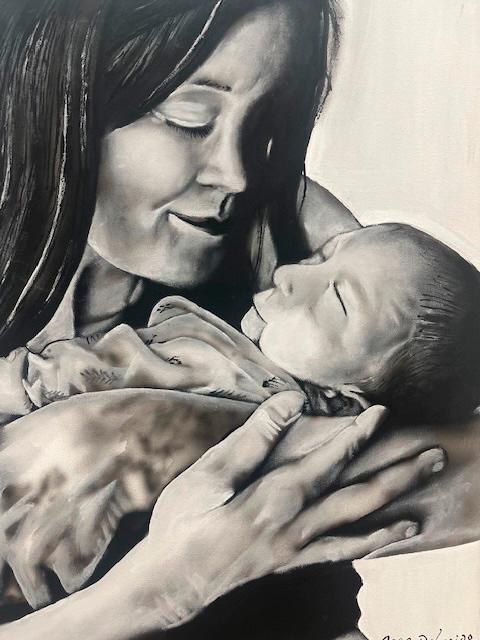
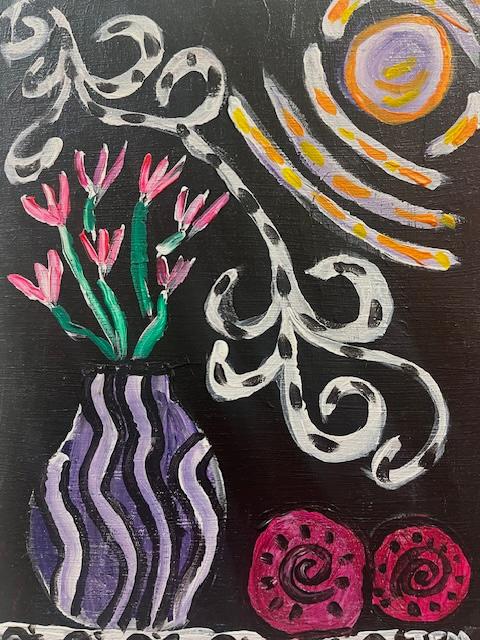
Artwork by Stewpot Artist Jennifer Moore.
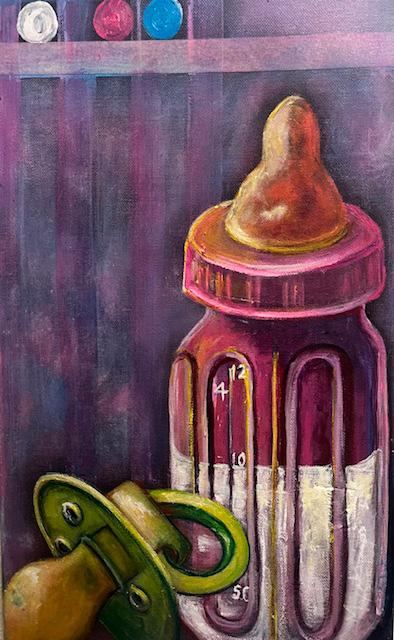
Artwork by Stewpot Artist Jose Palacios.
Honey, I Shrunk My Ego So You Won’t Leave
By Ezra Gatlin
In December 2020, my older brother’s roommate messaged me. “He’s in the hospital. He walked out into the middle of the street and started begging people to hit him. He’s been getting into strangers’ backseats in the middle of intersections and asking them to take him away.” He was diagnosed with paranoid schizophrenia four days before Christmas.
He was homeless and I decided I wouldn’t let him live with me. I condemned him to Denver’s negative-degree frostbite. Still, I tortured myself with the sound of his voice cracking with cars whizzing past, as the strongest man I knew desperately tried to escape from his own brain. He was incredibly abusive, but I wanted to save him, and I couldn’t. Only three months into noncontact, I was convinced his suffering was my fault. Despite his shortcomings, I was the only one who cared, but I couldn’t cold-plunge myself back into the hell I’d barely crawled out of. I often told people, “It feels like I can only choose to put myself first if someone else’s life is on the line.” The guilt haunted me.
This country has no empathy for the bro-
Beautiful Scenes
By James Varas
I have many childhood memories that I remember even now in my adult years. Some involve going to see my dad every other weekend in San Antonio after my parents divorced. I had moved to The Woodlands, Texas, with my mother and flew over every other weekend to see my dad.
Once, when I was about 11 years old, I had to take an early flight. I left the house at 5 a.m. with my mom and stepdad. We were at the airport by 5:45 a.m. When I was in the air, the sun began to awaken the sky. We were flying above the clouds, and I remember looking out the window and seeing the most beautiful sight I had ever seen. The sun was lighting up the heavens and clouds. I remember wondering if this is what heaven looks like.
I long have carried that memory of one of the most beautiful scenes I have ever witnessed. A similar memory is a journey that I took with my parents before they
ken men outside public libraries. He was missing for nearly three years. A doctor had to break HIPAA for us to find him. I had rearranged my entire personality by then. I wanted him to remember the person I thought he was. I listened to his favorite music, as though it were my own. I collected his favorite books, and I stayed updated on all of his friends’ accomplishments. I got to the hospital a week before my mom did. He asked me why I was there. I didn’t know.
I have realized that loving people only for who they could be is also cruel. By not looking at who they were in the moment, I was debasing myself and reducing people to their faults. As my own worst critic, I analyzed every movement, every expression, thought, and interaction — correcting every wrong, but refusing to acknowledge the good. I knew far too much about what I, and everyone else in my life, needed to fix. Toxic empathy. Toxic healing. Toxic honesty. Forcing them to “get better” without ever asking if they wanted to.
This went for myself, as well. I spent so long asking what needed to be changed for me to be loved, that I never took the time to ask about my best qualities. What do people love about me right now? I just
divorced. When I was five years old, we flew to Lima, Peru, where we spent time with my grandparents who lived there. We stayed at a country club for about one week and I remember feeding llamas and seeing beautiful peacocks running around the property. Their feathers were so beautiful. I loved to watch their wings spread and show their wonderful display.
After our stay at the country club, we caught a train and then a flight to Machu Picchu in Cusco, Peru. When we arrived in the Andes Mountains, I saw the Inca ruins. The hotel gave us cocoa leaves in a tea for mountain sickness. I even ran up the steps of the ruins and reached all the way to the top of the mountain. We were walking in the clouds in breathtaking places.
assumed they didn’t. I spent a long time thinking I could not be loved unless I was “fixed.”
In our relationship, I was always over giving. I became so used to balancing his abuse towards me with his mental illness. Being forced to decide what an acceptable level of cruelty looks like is exhausting. Before I arrived in Dallas, I went back to Denver to visit my best friend. Their family is not perfect. Far from it, actually, but they taught me that kindness does not have to come with sacrifice. Respect, gentleness, and accommodation for my physical and mental disabilities were choices they made over and over again. I want to create a family for myself where I feel included, respected, and cared for. I want to be invested in just as much as I invest in others.
When I became homeless, I could only think of my brother. I know I cannot change the person he was meant to become, but I used to take his word as gospel. I spent my entire life seeking his approval. I don’t know if I want it anymore.
Ezra Gatlin is a writer in The Stewpot Writers’ Workshop.
I am grateful for these beautiful memories.
James Varas is a writer in The Stewpot Writers’ Workshop.
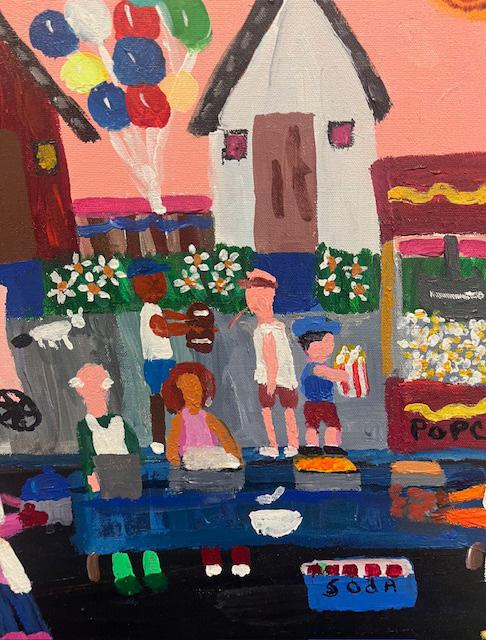
Artwork by Stewpot Artist Larry Ramirez.
Family Means the World to Me
By Darin Ramon Thomas
I always have been close to my siblings because of what we went through as children. We experienced trauma in seeing my father abuse us mentally and abuse my mother mentally and physically. Sometimes we enjoyed being around my father when we did things as a family, like going fishing at the park and barbecuing while flying kites. But those moments didn’t last long at all!
My mother would start drinking and my father would get upset and start beating on her. I would get so upset at him for hurting my mom I didn’t know what to do but be mad. I wanted a good and loving family, not a stressed-out one.
I always knew something bad was going to happen if my mother stayed with my father. One day my granddaddy, uncle, aunt, and cousins came to Springfield, Missouri, to get my mother, siblings, and me to take us from my father. We went to Dallas and stayed with my grandmother and my aunt and her two sons. We were away from all that abuse and trauma.
Family is Important
By Jeanie Robinson
Family to me is important because it is the nucleus. It has ways to connect us as the mother, the father, the children, and the children’s children. It represents togetherness, loving, and caring for each other. If it wasn’t for the mother and the father, there would be no family.
That’s why the Bible says, “Honor thy mother and thy father.” That phrase was written to honor our father and our mother. What makes it so humanistic is that we get to honor the father and the mother. And the father, he provides, and he helps the mother with the children.
I had good parents, who taught me to not judge people. My parents protected me, supported me, and made sure I had everything I needed to live on this earth. They fed us and clothed us. Every Christmas they would give me the most gifts. My parents would make sure that Christmas was every day and that we felt loved every day.
They praised our good behavior. When I became a mother, I awarded my kids with the same good behavior. I would try
One day my mother and sisters were gone with my granny. I was at home with my brother, aunt, two cousins, and baby sister when there was a knock on the door. My aunt opened the door and there was my dad. My aunt tried to shut the door, but my dad kicked it open. He grabbed my brother, baby sister, and me and took us away to Springfield.
My mother and older sisters came back to Springfield and were playing with us like they were going to stay. But my mom was trying to fool my dad so she could take us all back to Dallas with my grandmother. Unfortunately, my father ended up killing my mother then.
Long story short, he ended up getting 50 years for my mother’s death and we stayed in Dallas, where my grandmother raised us.
I’m finally grown up and have my own family. I was so in love with Tracie, the mother of my daughter and first son. I had another son by another woman. Tracie and I were in his life as well and I was so happy to be with my lovely family. We did
my hardest to provide whatever they needed in their lives. I do not have so many friends because I put family first. Some friends are not your family, but your family will always be family.
A good memory was when my father would take us to amusement parks, and we would always get on the rides. He took us to Disneyland when I was 12. Then I was able to take my kids to Disney World when I became a mother. I was so happy to be able to take my kids to Disney World as my father took us.
I love my parents, and I am forever grateful for all they did for me.
Jeanie Robinson is a writer in The Stewpot Writers’ Workshop.
things together. I was active with my children’s schools; we ate together, prayed together, and loved each other.
Unfortunately, our marriage broke up. I have written previously about some challenges I faced going back to that early trauma, including my drug abuse.
Still, my favorite memory of my family is when I first saw Tracie. I knew God brought her to me because I had prayed and asked him for a good wife. He did just that. Tracie and I are working on ourselves. She’s still the love of my life and I pray and ask God to bring her back to me once I am out of prison and can be a better provider.
The real meaning of family involves dedication to loving, caring, providing, praying, and walking with Jesus Christ and our Heavenly Father God Almighty. If you have those, you have the great thing called family.
Darin Thomas is a writer in The Stewpot Writers’ Workshop.
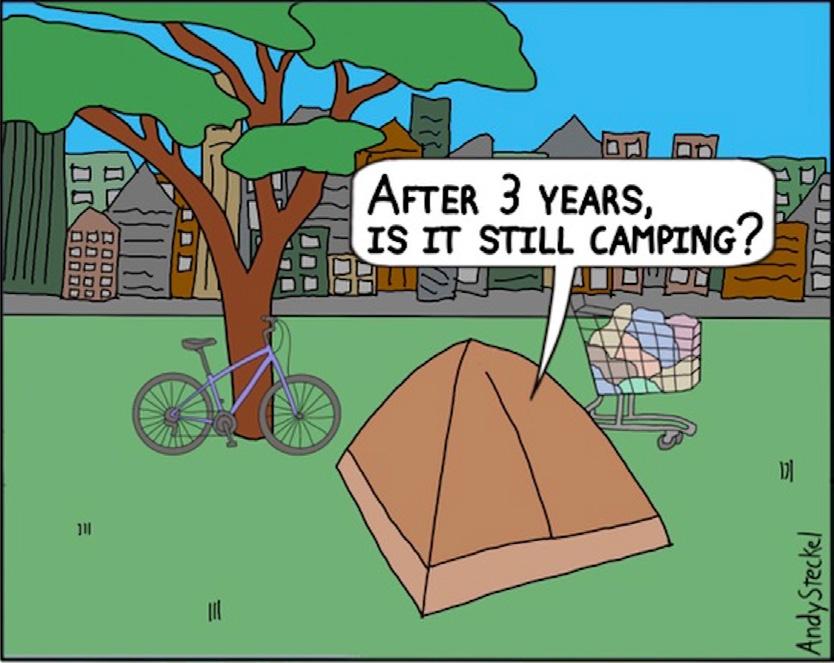
Artwork by Stewpot Artist Teresa Zacarias.
Holiday Meal
By Sandra Robinson
Around the age of nine is the only memory I have of cooking the holiday meal with my grandmother and mother. My grandmother assigned me to whip the egg whites. I used a small hand whisk. My mother stated, “She does not have the ability to whip the eggs.” My grandmother replied, “She’s young. She can do it.” When my arm started hurting, I did not say anything. I wanted my grandmother to see that I could do it.
Around the age of 19, I was in the kitchen by myself. I would bring a sample of dressing to my grandmother. She would be sitting on the side of the bed. She would taste the dressing and tell me what it needed. “Add a little more sage,” she would say. Or she’d tell me to add vanilla to the sweet potato pies.
My grandmother had breast cancer. The cancer had spread too far. They could not
My Recovery Family
By Mike McCall
On paper and in genealogy records, it may appear that I don’t have much of a family left. But I would respectfully disagree. The definition of family now has surpassed bloodlines and creeds. A family can be created in the most unusual fashions in a world that moves fast and pushes individuals to seek pleasure or avoid pain.
This family I’m referring to is often created out of despair and loss. Still, it is composed of the most beautiful individuals I have ever met. You find the family I am referring to when trying to overcome addiction.
A recovery family is what every suffering addict must find and share. One that is always glad to see your face and can help you find your way.
I came out learning one intrinsic fact from my 25 years spent in active addiction. While addiction prefers to keep you in isolation, recovery, if found, occurs in a room full of addicts and alcoholics. Just as a phoenix rises from the flames, someone trying to escape the grips of addiction can be reborn into a family of likeminded individuals.
This newfound family is not much differ-
do anything. My father’s cousin Joe Frank visited my grandmother each weekend until he found out she had cancer. He asked me which breast had the cancer. I told him it was her left breast. “Her heart,” he said. “No, her left breast,” I said — naive not to understand his meaning.
My grandmother’s heart consisted of not being able to read or write, working as a waitress, and picking cotton. She purchased herself a house. She was a single parent to my father. While living in Dallas, she gave her home to her brother who returned to the families small hometown with his wife and children. She only had one black dress, which was fading to green. At the same time, she would say her dead sister’s child was in financial need. “They did not have to treat him that way. I had money.” She was willing to take on his financial burden. “The heart.” Joe Frank was talking about her willingness to help any family member. She believed in extended family.
ent from a “typical” one you may have been born into. They will listen when you speak, support you when you need it, and, most of all, not judge you for doing the best you could regardless of how bad you may have fallen.
As an addict, I can assure you we have no problem hating who we have become. In most cases we are harder on ourselves than anyone else will ever be.
This is when my recovery family would help pick me up, dust me off, and ensure that I am loved. For someone who can’t even look at themselves in the mirror, being surrounded by those who can might be the difference between life and death.
So, I would like to give thanks to the family who taught me how to live again. Without them I would have been doomed to a life of despair. We may not be related by blood, but our hearts beat as one. We are fueled by the protective instincts of a father, the warm embrace of a mother, and the wisdom elders bestow upon the youth.
After my grandmother’s death, I prepared the holiday meal by myself. I had no one to taste the food, but I had someone to say the food wasn’t right — my mother. I had to leave something wrong so she could fix it to make her happy on the holiday.
At the holiday meal after my father’s death, my younger brother told me how stupid I was to prepare a homemade meal. “You should order the meal from the grocery store or a restaurant.” So I threw my cornbread and half-cooked turkey to the dogs in the back yard. Just years earlier he was saying that he could tell that I made more than one batch of pie crust. Now am I stupid! I am outdated.
After that, I never made a holiday meal. My last Christmas, I ate a hamburger at TGI Fridays.
Sandra Robinson is a writer in The Stewpot Writers’ Workshop.
help you find your way. The only requirement is a desire to live one day at a time and when the time is right, inspire others to join the family.
A recovery family is what every suffering addict must find and share. One that is always glad to see your face and can
Mike McCall is a writer in The Stewpot Writers’ Workshop.
Artwork by Stewpot Artist Cornelious Brackens, Jr.
Family Memories and Thanksgiving
By Paul Ranjan Watson
As Thanksiving draws near, there’s a quiet shift in the air, a gentle pull toward family and the stories that have shaped us. It’s a time to get nostalgic, right? Maybe not. Not all family memories are filled with merriment.
Bill Dotson, the author of “‘Abiding Fathers,” a course emphasizing the impact of fathers, affirms the significance of family. For four decades, Dotson has walked into prisons and shelters, places where the absence of family is a palpable wound. His mission is to help men heal from the father figures they missed and become a source of strength themselves.
Dotson points out prayer as a significant element of the “‘Abiding Fathers” course in restoring families. Growing up, he writes in his book “Victory Through Prayer,” “I did not understand the process of prayer.” Bill says he’s a layperson who believes in the power of prayer for victorious living this side of heaven.
The significance of healing families is preached by Charles Mitchell, a chaplain at Union Gospel Mission, Dallas. Charles
Family Matters
By Evan Williams
Family means love, care, sharing, collaborating, and understanding. I’m homeless and I don’t have anything more valuable than family. My Uncle Eric takes care of me as much as possible and is someone I look up to every day.
I have a church family at The Winners Assembly with Curtis and Yolanda assisting service every day. Yolanda is loud and distracting in the congregation, but Curtis always plays good music and relates to us with prayer leading into the service. I have a friend who goes to church with me every day as well.
I have another uncle who whoops me with a paddle every time I take my food stamp card from him because I have chores I haven’t finished.
Being around my family every day makes me feel better, because they’re nice and are trying to help me create a better life and maybe become a resident of an apartment complex and be involved in a community — voting for a local represen-
teaches the “‘Abiding Fathers” course at the men’s shelter, and his credibility comes not just from teaching, but from the valleys he himself has walked. While he shares his past struggles, it is his testimony of turning his life around that gets the men’s attention.
When asked why family is important, his answer is direct. “Because that’s how God designed it to be.” He sees the struggle as ancient. “Remember Adam and Eve, they were a dysfunctional family. See what happened to their children; Cain killed his brother Abel.”
But how does that dysfunction play out today? Charles takes a moment. “If a child does not see his father drinking alcohol, he’s not likely to drink either,” he says.
So how does one restore family? Without missing a beat: “Jesus Christ,” he says. He explains, “We have a sin nature. The Holy Spirit straightens a person; but you’ll have to study the Bible,” he adds.
For David, a Dallas engineer, married for 30 years, the family table was also a place of inquiry. Books on theology lined his shelves that became silent mentors to his growing son. That curiosity, nurtured
tative or taking part in a neighborhood watch.
Family means looking out for one another and praying together. I haven’t seen my family in a year or so and I want to keep working to make them proud.
At The Winners Assembly, I’m able to sit quietly to myself and enjoy Pastor Karen’s preaching. I was able to read a psalm to everyone and it’s fun for the entire time. They have a clothes closet and sometimes service is held in a banquet hall next door.
At First Episcopal Church, I’m able to get a glimpse of family structure and values with the members getting married. Occasionally I’ll sit in on wedding rehearsals and weddings with the members of the church starting their own families. I’ve been to graduations and celebrations seeing the students’ families proud of them and dressing really nicely. They take family seriously at that church, so that’s something to look up to.
Being homeless doesn’t leave a lot of room for family, especially at first when
at home, has now led his son to Ohio to pursue a doctoral degree in theology. David spends his Saturdays volunteering at shelters with his church.
An Epidemic of Loneliness
A survey by the Institute for Family Studies revealed that young adults today are more likely to report feelings of loneliness than any previous generation. Its study, “The State of Our Unions,” links this social fragmentation directly to a decline in stable family life.
This societal fragmentation is what theologians like Bishop Robert Barron point to when they speak of the family as being uniquely significant. From a faith perspective, he says, a family is the “domestic church.” It is the structure God established to reveal His love, he adds.
Meanwhile family in all its resilient forms remains the cornerstone--the place we are first taught how to build a world beyond our doors.
Paul Ranjan Watson is a writer in The Stewpot Writers’ Workshop.
you need to make your mat at The Bridge — but that doesn’t mean you can’t create one or find yourself in one at some point, so it would be better for you to keep family values in your life, be nice, and trust your whereabouts.
I’m 24, so I don’t think my family has to be at fault if I’m homeless. I got to this point because I failed school and didn’t qualify for a job that would help pay my bills. If I would have done better, then I’d be in a better lifestyle. In the meantime, I go to church and learn love, keeping my family in mind.
Family means everything to me, from fun trips like camping to living with character to staying out of jail.
Evan Williams is a writer in The Stewpot Writers’ Workshop.
Family
By Vicki Gies
I was born in 1952 to a loving mom and dad, who were very much Christians. Both sides of my whole family were Christians. We were a happy family.
My dad was in gospel music his whole life beginning at age five in Hayden, Alabama. My mom was a nurse’s aide in Little Rock, Arkansas. The rest of the family lived in and around Tupelo, Mississippi, and Hayden, Alabama.
When I was little, I couldn’t wait to get to go see my grandparents, aunts, uncles and cousins. We had so much fun riding bikes, playing board games, and going fishing. One of my uncles in Tupelo owned a small lake north of there. On some weekends, most of the family from Tupelo would go spend the entire weekend there. My oldest aunt taught me how to fish. She baited my hook because I just couldn’t deal with a squiggly, slimy worm!
We would also swim in the water, and I would watch my mother water ski across the lake. It looked like so much fun, but I was scared to try.
In the evening we would have a fish fry with catfish, real French fries, coleslaw, and hush puppies. When we came back home on a Sunday afternoon, the adults would make homemade peach ice cream
in the old wooden maker with the hand crank. Oh my gosh...to die for!
On Thanksgiving, the day would start out with eggs and homemade biscuits with butter and molasses. Traditionally, all us kids would watch the Macy’s Day Parade. Dinner would be more or less around noon with a big turkey, cornbread dressing, giblet gravy, and about six different vegetables from my maternal grandmother’s huge garden. We had iced tea to drink, and for dessert there would be either pecan pie or a fruit cake. I remember that I didn’t care for cake, but I would sneak into the kitchen and nibble on some of the little fruits on the cake. I absolutely loved smelling the bourbondrenched cloth covering it.
For the Christmas holiday we’d do Christmas Eve and Christmas Day morning in Tupelo. We’d spend the rest of the holiday plus a couple of extra days in Hayden where my dad’s side of the family was.
On Christmas Eve in Tupelo, we ate honey baked ham with potato salad, baked beans with bacon, and vegetable sides. After supper my oldest cousin would gather up the kids and take us out to the backyard to shoot off fireworks. During this time, “Santa Claus” would come and drop off all the presents on the front porch. The rest of the night was spent opening and playing with the gifts. Then most all the kids got to sleep on blanket
pallets on the floor. Everybody had such a loving time together.
My grandparents in Alabama were the same way. My dad’s sister lived down the road from my grandparents, but his brother lived in Ft. Worth and couldn’t make most of the trips. The holidays there were a lot of fun too, but a little different from holidays in Tupelo. Hayden was a oneintersection town with one traffic light. If you sneezed at the intersection, you missed the entire city! My grandmother was a homemaker, while my grandfather owned and operated a small gas station/ country store. He also had a hog farm on the backside of the store.
Both my parents were born and raised in the country, but I was born in the city, and I couldn’t wait to go see all of my relatives. To this day, I think about all of my family back then and remember all the fun times we had, not only on the holidays, but all the times we visited the Roper families.
As an added thought, I am a true Roper. My mother’s maiden name was Roper, and she married a Roper! No relationship as far as five generations back, maybe more.
Vicki Gies is a writer in The Stewpot Writers’ Workshop.
Street Newspapers - A Voice for the Homeless & Impoverished
?
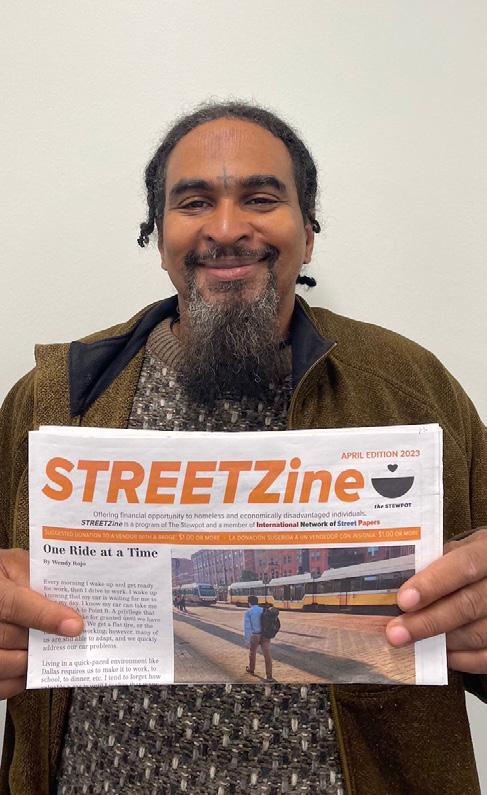
is a nonprofit newspaper published by The Stewpot of First Presbyterian Church for the benefit of people living in poverty. It includes news, particularly about issues important to those experiencing homelessness. STREETZine creates direct economic opportunity. Vendors receive papers to be distributed for a donation of one dollar or more.
Distributing STREETZine is protected by the First Amendment.
STREETZine vendors are self-employed and set their own hours. They are required to wear a vendor badge at all times when distributing the paper. In order to distribute STREETZine, vendors agree to comply with Dallas City Ordinances.
If at any time you feel a vendor is in violation of any Dallas City Ordinance please contact us immediately with the vendor name or number at streetzine@thestewpot.org
CHAPTER 31, SECTION 31-35 of the Dallas City Code
PANHANDLING OFFENSES
Solicitation by coercion; solicitation near designated locations and facilities; solicitation anywhere in the city after sunset and before sunrise any day of the week. Exception can be made on private property with advance written permission of the owner, manager, or other person in control of the property.
A person commits an offense if he conducts a solicitation to any person placing or preparing to place money in a parking meter.
The ordinance specifically applies to solicitations at anytime within 25 feet of:
Automatic teller machines, exterior public payphones, public transportation stops, self-service car washes, self-service gas pumps, an entrance or exit of a bank, credit union, or similar financial institution, outdoor dining areas of fixed food establishments.