Introduction to First Nations Mental Wellness
A Cultural Safety Resource for Supporting the Mental Wellness Workforce
A Cultural Safety Resource for Supporting the Mental Wellness Workforce
FPWC extends heartfelt thanks to the Working Group for their thoughtful guidance and generous contributions. The Working Group consisted of experts with deep lived experience in their fields, and their collective wisdom brought both depth and innovation to its development. We are grateful to all Working Group members from coast to coast to coast, including:
Linda Cairns
Étienne Dorval
Nadia House
Marsha Ledyit
Daniel Manitowabi
Barb Martin
Caroline Recollet
Pete Van Volkingburgh
This resource reflects the expertise, dedication, and collective strength of the FPWC team. We are deeply grateful for the insight, care, and commitment each team member brought to this work. The development of this resource was a collaborative effort, grounded in shared values and a strong commitment to supporting First Nations mental wellness. With appreciation, we acknowledge the contributions of:
Dr. Emily Kirk, Becky Carpenter, Melissa Dedemus, Anne Duquette, Jordyn Gattie, Haley Laronde, Keith Martin, Despina Papadopoulos, and Dr. Brenda Restoule.
The resource was guided and informed by the generous contributions, and views of participating individuals. We acknowledge their input, insight, and the many ways they support their communities every day. This includes individuals who are part of the First Nations Mental Wellness Workforce (FNMWW), such as, among others, health directors, managers, service providers, Knowledge Keepers, coordinators, and Wellness Workers. Thank you for your ongoing work and serving communities in the areas of mental wellness, trauma, and addictions.
First Peoples Wellness Circle. 2023. Introduction to First Nations Mental Wellness: A Cultural Safety Resource for Supporting the Mental Wellness Workforce. First Peoples Wellness Circle, North Bay, Ontario, Canada.
First Peoples Wellness Circle (FPWC) is an Indigenous-led national not-forprofit dedicated to enhancing the lives of Canada’s First Peoples by addressing healing, wellness, and mental wellness barriers. The organization’s purpose is to walk with and support First Peoples and communities to share collective intelligence for healing, peacemaking, and living a good life. FPWC advocates for collaborative and transformative change and promotes pathways to wholistic health and wellness for First Peoples by incorporating diverse Indigenous cultural lenses and knowledge.
FPWC primarily focuses on implementing the First Nations Mental Wellness Continuum Framework and supporting the frontline mental wellness and trauma-specialized workforce. FPWC aims to foster resilience, well-being, and mental wellness within First Nations communities by creating and disseminating resources tailored to the unique needs and perspectives of First Peoples.
Through partnerships, capacity-building, and continuous advocacy, FPWC is committed to making a positive impact on the lives of Canada’s First Peoples and promoting a brighter, healthier future for all. We recognize the importance of collaboration and knowledge sharing in addressing the complex challenges First Nations and other Indigenous communities face. By bringing together stakeholder expertise, FPWC can develop comprehensive strategies and resources that empower First Nations and others to achieve wellness and thrive in all aspects of life.
By advocating for strategies around peacemaking, healing, life promotion, and wellness, FPWC is helping to create a mental wellness landscape that is more responsive to the unique needs and experiences of First Nations communities. First Peoples Wellness Circle is a visionary organization that addresses the unique mental wellness barriers faced by Canada’s First Peoples. By implementing the First Nations Mental Wellness Continuum Framework and supporting mental wellness and trauma-specialized workforces, FPWC is making a tangible difference in the service delivery and supports available to frontline workers.
The content contained within this resource includes both the strengths of First Nations as well as the trauma they have faced as a result of colonialism. As those who have been most impacted by colonialism are at different stages of healing, some readers may feel activated by some of the information. The following resources and supports are included to help those who may have strong reactions to the content. We share our message of hope and recognize that wellness and self-care are important and should be prioritized.
1. National Indian Residential School Crisis Line for former Indian Residential School students: 1-866-925-4419
2. A Hope for Wellness Helpline: Call 1-855-242-3310 or chat online at https://www.hopeforwellness.ca/
3. Talk Suicide: Call 1-833-456-4566 or https://talksuicide.ca/
4. 9-8-8 Suicide Crisis Helpline: Call or text 9-8-8 toll free, any time, 24/7/365. https://988.ca/
As the introductory chapter to this resource, this section will communicate some foundational information in order to better position readers to learn about and reflect on mental wellness from a First Nations lens. This will include the resource’s main audience, a focus on the importance of culture, the significance of the First Nations Mental Wellness Continuum Framework, First Nations Mental Wellness Continuum Framework (FNMWCF), as well as a breakdown of proceeding chapters and their aims.
This resource is primarily intended to be a tool for learning. To support ongoing learning, readers are encouraged to:
• Consider the reflection questions throughout the chapters,
• Consider developing a ‘learning plan’ that identifies the areas for which the reader feels they need to learn more, and
• Explore the additional readings and resources provided at the end of each chapter, the reflection questions, and the reader’s learning plan.
The learning objectives for this chapter include:
• Better understanding the importance of culture as a foundation to First Nations mental wellness, including programs and services,
• Improving knowledge of the role and impact of history (particularly colonialism) on First Nations mental wellness,
• Gaining an understanding of what the First Nations Mental Wellness Continuum Framework is and how it can be applied to local First Nations community contexts,
• Improving learners’ understanding of what mental wellness is from a traditional lens, and
• Learning about the importance of relationships within a First Nations’ worldview.
This resource was developed to provide those involved in the provision of care (including leadership, government departments, and community health workers) with fundamental information regarding the mental wellness of First Nations. The central aim is not to communicate all the complexities of First Nations mental wellness, or to provide an exhaustive history of First Nations and their approaches to mental wellness. Instead, the purpose of this resource is to:
1. Provide important and foundational information on First Nations mental wellness in an accessible and concise format,
2. Present additional resources to support learning and community engagement, and
3. Encourage the reader to reflect on the information provided and how it can be used to improve the way they support First Nations mental wellness.
This resource’s main target audience includes Mental Wellness Teams (MWTs) staff members, partner organizations and stakeholders (Indigenous and non-Indigenous), and leadership (community, provincial, regional, and national representatives, departments, and organizations). However, it may be used by any reader to improve their understanding of First Nations’ mental wellness and wise practices in care.
Given the complexity of histories of Indigenous people living in Canada, a distinction must be made between ‘Indigenous’ and ‘First Nations’. Within this context, ‘Indigenous’ refers to First Nations, Inuit, and Métis groups either collectively or separately. These are 3 distinct groups with unique histories, languages, cultural practices, and spiritual beliefs. By contrast, ‘First Nations’ refers to a specific group within the broader Indigenous context. This resource also recognizes that there is no perfect term in English for the first peoples of North America, and many Nations prefer to be known by their individual Nation’s pre-colonial name. However, for the purposes of this work and the scope of its aim, the work will use the term ‘First Nations’ and focus specifically on First Nations’ people, communities, and needs.
As a result of the many individuals, departments, and institutions that are involved in providing care and support to First Nations, particularly in terms of mental wellness, this resource offers readers an introduction into the mental wellness of First Nations and their traditional practices.
First Nations in Canada view mental wellness from a wholistic lens, rooted in culture. Although complex and difficult to define, in this context ‘culture’ can be understood as a central way of life and being, characterized by shared attitudes, values, goals, and practices. For First Nations, culture is inclusive of language, practices, ceremony, knowledge, land, and values. It is conveyed by Elders, who are cultural practitioners, and is socially integrated through relationships. In essence, culture is a way of life that involves spiritual, psychological, social, and material practices. While the specific understanding of culture can vary between each Nation, the key foundational cultural beliefs and concepts across all Nations include: the Spirit; the Circle; harmony and balance; All My Relations; kindness, caring and respect; Earth connection; Path of Life Continuum; and language.1
Health and wellness are understood as being enhanced by and maintained through one’s connection to culture. This includes, among others, being connected to community, language, land, food, beings of creation, spiritual practices, and ancestry, as well as being supported by caring family and community members.2 In effect, mental wellness is understood as being a balance between spirit, heart, mind, and physical being.3 These elements are interconnected and interdependent.
Relationships are also foundational to culture and wellness, as First Nations understand themselves in relation to all of Creation. Relationships are about honouring culture and heritage, tradition, land, environment, and the impacts that these have on all aspects of
individual and community life. Mental wellness is fostered through the development of good relationships based on mutual respect.
In the context of better understanding and supporting First Nations mental wellness, the significance of culture cannot be understated. It is profoundly important in providing safe and meaningful care as well as maintaining and supporting the wellness of First Nations individuals, families, and communities. In other words, cultural values (such as Sacred Knowledge, languages, and practices) are essential determinants of health.4
While the importance of the connection between culture and health has previously been ignored or misunderstood by Western services, there has been increasing interest among care providers and care users to utilize culture as the main intervention for health care, including mental wellness. When approaching the topic of First Nations mental wellness, it is important to remember that culture is health.5
Think about your First Nations community or a First Nations community in which you work. Can you identify some practices, programs, or services that promote culture as foundational?
Before the colonization of Turtle Island (or North America), First Nations developed and maintained traditional medicines and healing practices to address mental, physical, emotional, and spiritual health. These practices were passed down through stories and oral teachings, which focused on Creation, culture, the importance of the land, and relationships. Their sophisticated societies lived in ways that were suited to their needs and surroundings and centred on the importance of living harmoniously with the natural environment. However, as a result of colonialism, many of these practices as well as cultural values as a whole were no longer implemented, communicated, or celebrated in the same way. Colonialism had a significant and far-reaching impact on how First Nations individuals, families, and communities viewed and treated mental wellness. Despite the negative impact of colonization and emphasis on Western medicine, there has been a clear resurgence of First Nations mental wellness practices as individuals, families, and communities increase their use of Traditional Healing practices and Traditional Knowledge, which have consistently proven to be effective. These traditional methods are widely considered to be beneficial to care users by both Western and traditional health care providers.6 7
As the graphic highlights, in regard to the use of cultural healing, there has been a significant change from pre-colonization to now. The emphasis on culture was fundamental to wellness before colonization, but throughout the process of colonialism it decreased significantly
as Western influences actively worked to stop this form of care. However, increasingly, strong cultural foundations have been re-established and championed. In many ways, this has been accomplished through engaging in “self-care, whole health, mutual aid, co-reliance, valuing of life experience and wisdom, and sustaining life forces on planet Earth.”8
In terms of how this relates to the mental wellness of First Nations, practitioners are increasingly basing services on cultural values and practices such as land-based treatment approaches as well as promoting and advocating for the further incorporation of Traditional Knowledge into these and other services. First Nations have been taking steps to preserve and strengthen their cultural practices and protect their populations from mental wellness challenges.9 10 For example, this includes the development of Mental Wellness Teams (MWTs), Crisis Support Teams, and Indian Residential Schools Resolution Health Support Program (vRHSP) workers. Despite the ongoing negative impacts of colonialism on First Nations, the value of culture has remained firmly rooted and continues to be used to support mental wellness.
There are significant differences between Western medical knowledge and First Nations views on wellness. While Western medicine largely understands ‘health’ as a lack of illness (taking a deficit-based approach) and focuses on the individual,11 a First Nations perspective uses a wholistic lens that is inclusive of body, mind, emotion, and spirit, and focuses on individuals’ relationships with family, community, and land. This can also be understood as a ‘bio-psychosocial’ lens, with the addition of spirituality. Viewing mental wellness from this wholistic lens considers aspects of life such as love, spirit, and emotion, which is difficult for Western practitioners to measure or treat.
Spirituality in particular is a pillar of mental wellness. It is an important aspect of Traditional Healing practices, which treats the individual as a spiritual being connected to the land. It is through understanding how the interior aspects of the being are connected to the external world that someone can achieve as sense of balance, harmony, and connection (also referred to as wellness).12
Western approaches to addressing mental health are limited as they generally do not attend to the whole person. Significant evidence indicates the efficacy of traditional methods in supporting the wellness of First Nations.13 14
The First Nations Mental Wellness Continuum Framework (FNMWCF) provides a tool for First Nations to identify what they need to design, deliver, and implement culturally relevant mental wellness programs and services while providing guidance on how First Nations can enhance service coordination and support the safe delivery of services. It identifies mental wellness as a “state of well-being in which the individual realizes [their] own potential, can cope with the normal stresses of life, and is able to make a contribution to her or his own community.”15 It explains that mental wellness is enriched when individuals have purpose in life, hope for the future, a sense of belonging, and a sense of meaning. The FNMWCF also provides a common language and understanding for First Nations and governments to allow for systemic change in First Nations mental wellness programs and services.
How can you incorporate your knowledge of Western and First Nations views on mental wellness into your work?
The FNMWCF evolved over several years. For example, important foundational work on which the FNMWCF was built was a 2007 review undertaken by leading organizations and departments in the field of First Nations mental wellness. The review resulted in the publication entitled Honouring Our Strengths: A Renewed Framework to Address Substance Use Issues among First Nations People in Canada. 16 This work concluded that:
• There is a need for a framework that addresses substance use challenges,
• Mental wellness and intergenerational trauma underlie and co-exist with substance use issues,
• First Nations must have access to services and supports to ensure culturally safe and comprehensive care,
• Deficit-based approaches to addressing substance use and mental wellness challenges of First Nations individuals, families, and communities are not effective, and
• A strengths-based understanding of mental wellness is rooted in identity and culture, making it a valuable and more effective approach to improving mental wellness.
Building on this and other collaborative works, the FNMWCF was launched in 2015 as a national framework. It was developed by First Nations organizations, communities, and partners to address mental wellness among First Nations in Canada. It identifies ways to enhance service coordination among various systems and supports the culturally safe delivery of services. In addition, it provides recommendations for how elements such as governance, research, workforce development, change and risk management, self-determination, and performance measurement can contribute to mental wellness. Its implementation is guided by a team with representatives from First Nations organizations (including the Assembly of First Nations, Thunderbird Partnership Foundation, and First Peoples Wellness Circle), regions, communities, Indigenous Services Canada (ISC), Crown-Indigenous Relations and Northern Affairs Canada (CIRNAC), as well as other federal departments.
The FNMWCF’s overarching goal is to improve mental wellness outcomes for First Nations. It presents “a vision for the future of First Nations mental wellness programs and services and practical steps towards achieving that vision.”17
The FNMWCF’s goal is accomplished by focusing on two main areas. The first centers on the need to strengthen federal mental wellness programming and to support improved integration between federal, provincial, and territorial programs. Secondly, it focuses on providing guidance to communities regarding how best to adapt, optimize, and realign their mental wellness programs and services based on their own distinct community priorities.
In essence, the FNMWCF can be understood as a comprehensive model that can be used to address a wide range of health and social challenges among First Nations.
While not a traditional medicine wheel, the FNMWCF wheel uses a four-directions model to promote balance among spirit, heart (emotion), mind (mental) and body (physical). Each ring is representative of a particular contributor to mental wellness.
These include: 1) Outcomes; 2) Community; 3) Populations; 4) Specific Populations Needs; 5) Continuum of Essential Services; 6) Supporting Elements; 7) Partners in Implementation; 8) First Nations Social Determinants of Health; 9) Key Themes for Mental Wellness; and 10) Culture as foundation.
Pages 14-16 include brief descriptions of these rings from the FNMWCF.18 More comprehensive descriptions can be found in the FNMWCF (see Section 6: Additional Reading and Resources to learn more).
“Mental
wellness
is a balance of the mental, physical, spiritual, and emotional.
This balance is enriched as individuals have: PURPOSE in their daily lives whether it is through education, employment, care-giving activities, or cultural ways of being and doing; HOPE for their future and those of their families that is grounded in a sense of identity, unique Indigenous values, and having a belief in spirit; a sense of BELONGING and connectedness within their families, to community, and to culture; and finally a sense of MEANING and an understanding of how their lives and those of their families and communities are part of creation and a rich history.”
First Nations Mental Wellness Continuum Framework – Summary Report. 2015.
Thunderbird Partnership Foundation. 2015. “First Nations Mental Wellness Continuum Framework.” Accessed November 7, 2022. https:// thunderbirdpf.org/wp-content/uploads/2022/03/fnmwc_framework_key_terms_and_concepts.pdf.
As the Framework explains, the rings represent:
1. Outcomes: Hope, Belonging, Meaning, and Purpose
A connection to Spirit (identity, values, and belief) promotes hope; a connection to family, community, land, and ancestry promotes a strong sense of belonging; knowing who one is and where one comes from allows one to think and feel and understand life from a First Nations perspective and promotes a sense of meaning; and an understanding of the unique First Nations way of being and doing in the world promotes purpose.
2. Community: Kinship, Clan, Elders, and Community
This section describes key relationships that organize social life and have an impact on health.
3. Populations
This section represents the many diverse and unique populations to which First Nations mental wellness programs and services must respond. This includes infants and children, youth, adults, men, fathers, grandfathers, women, mothers, grandmothers, health care providers, community workers, seniors, Twospirit people and 2SLGBTQ+, families and communities, remote and isolated communities, northern communities, as well as individuals in transition and away from reserve.
4. Specific Population Needs
This section indicates the range of needs experienced by the different populations. This includes intergenerational impacts of colonization and assimilation, people involved with care systems and institutional systems, individuals with process addictions, individuals with communicable and chronic diseases, individuals with co-occurring mental health and addictions issues, individuals with acute mental health concerns, crisis, and people with unique needs.
5. Continuum of Essential Services
This section indicates the key elements of a comprehensive continuum of essential services to address First Nations mental wellness needs. This includes health promotion, prevention, community development and education, early identification and intervention, crisis response, coordination of care and care planning, withdrawal management, trauma-informed treatment, as well as support and aftercare.
6. Supporting Elements
This section identifies the supporting components and infrastructure that ensure essential services are able to address population needs in a way that promotes hope, belonging, meaning, and purpose.
7. Partners in Implementation
This section indicates the many partners needed for effective implementation, including various levels of government, non-government organizations, and private sector and corporate partners.
8. First Nations Social Determinants of Health
This section identifies the Indigenous social determinants of health as outlined in the AFN Public Health Framework. For example, this includes environmental stewardship, social services, justice, education and lifelong learning, language heritage and culture, economic development, land and resources, employment, health care, and housing.
The section describes the mental wellness themes that were brought forward within regional and national dialogue sessions. These include community development, ownership and capacity building, quality care system and competent service delivery, collaboration with partners, and enhanced flexible funding.
While the wheel notes culture as the foundation on the outside, this section communicates culture as the underlying factor for all the Framework’s components. As such, it is represented by the single color that holds all other components together. Of particular importance is Elders, cultural practitioners and kinship relationships, language, practices, ceremonies, knowledge, as well as land and values.
Central themes that have emerged from the development and implementation of the FNMWCF include:
• Community development, ownership, and capacity building
• Quality care system and competent service delivery
• Collaboration with partners
• Enhanced flexible funding
• Culture as foundation
With these central themes supported and illustrated by the wheel, the Framework demonstrates the importance of, and need for, a systems approach to improving mental wellness. It engages each component within a broader system of mental wellness provision. This includes the full range of services, supports, and partners who have a role in addressing mental wellness challenges among First Nations, from the individual to the organizational levels. The FNMWCF is being implemented with the understanding of mental wellness as a continuum, or ongoing process, rather than a centralized and specific achievable goal. As a representation of wise practices developed through and by First Nations voices, health care service providers are encouraged to implement the Framework throughout their work.
Take some time to read about the First Nations Mental Wellness Continuum Framework here.
What key aspects of the Framework resonate with you?
How will you use this in your work to promote mental wellness?
This resource includes a glossary of terms to help orient the reader to terminology used by mental wellness service providers and support those unfamiliar with working in the field of First Nations mental wellness to better understand and communicate with service users.
Information is presented in six chapters, which each focus on specific topics related to First Nations mental wellness. Information in each chapter is provided through individual sections, including learning outcomes, key learnings, a well as additional reading and resources.
The introductory chapter (this chapter, Culture is Health) offers foundational knowledge to readers to support their ongoing learning. This chapter largely focuses on the significance of culture within First Nations wellness.
The second chapter, Historical Context and Impact on First Nations Mental Wellness, explores the impact of colonization and colonial policies, with a particular focus on intergenerational trauma. The aim of the chapter is to provide historical context and information so readers can better understand contemporary challenges.
Chapter 3, Concepts and Context that Support the Understanding of and Care for Mental Wellness, focuses on key concepts and context to provide readers with a clear and concise understanding of important and/or complex concepts. These are words, concepts, and background information that are likely to come up in mental wellness services, care, and related discussions.
Building on the earlier information communicated throughout the resource, Chapter 4, Understanding Traditional Methods to Mental Wellness, centres on Traditional Knowledge and how it can be used to improve mental wellness and related services.
The second-to-last chapter, Chapter 5, entitled Looking Ahead, focuses on some existing positive and effective strategies that support First Nations mental wellness. This includes information on impactful First Nations-led initiatives.
Chapter 6, Summary and Conclusion, wraps up the resource by providing a short synopsis of each chapter and offering suggestions for further reflections and learning.
Main takeaways from this chapter include:
• First Nations Mental Wellness Continuum Framework, Thunderbird Partnership Foundation: https://thunderbirdpf.org/ first-nations-mental-wellness-continuumframework/
• First Nations Perspectives on Mental Wellness, First Nations Health Authority: https://www.fnha.ca/wellness/wellness-forfirst-nations/first-nations-perspective-onhealth-and-wellness
• Strengthening our connections to promote life: A toolkit by Indigenous Youth, Thunderbird Partnership Foundation: https://thunderbirdpf. org/?resources=a-life-promotion-toolkit-byindigenous-youth
• The FNMWCF Progress Report 2015-2018: https://thunderbirdpf.org/fnmwc-progressreport-2015-2018/
• Carol Hopkins on the Use of the FNMWCF: https://www.youtube.com/ watch?v=Zg2taH3GusI
• Examples of Resources that Have Used the FNMWCF (after clicking the link, select “FNMWCF”): https://thunderbirdpf.org/ nnapf-document-library/
• First Nations Mental Wellness Continuum Framework Implementation Guide: https://www.dropbox.com/ s/25fcnornj53mxg9/FNMWC_ Implementation-Guide_EN-WEB.pdf?dl=0
• Recommended Podcasts:
• Mino Bimaadiziwin, Thunderbird Partnership Foundation: https://podcasts.apple.com/ca/podcast/ mino-bimaadiziwin-conversations-onaddictions-and/id1591662533
• Ahkameyimok Podcast with Perry Bellegarde, former National Chief, Assembly of First Nations: https://podcasts.apple.com/ca/podcast/ ahkameyimok-podcast-with-perrybellegarde/id1507212458
• Heal With It with Maytal Eyal, Ph.D.: https://podcasts.apple.com/no/podcast/ heal-with-it/id1583091107?l=nb
1 Thunderbird Partnership Foundation. 2018. “Indigenous Knowledge Key Terms.” Accessed November 7, 2022. https://thunderbirdpf.org/wpcontent/uploads/2022/03/fnmwc_framework_key_ terms_and_concepts.pdf.
2 Restoule, Brenda M., Carol Hopkins, Jennifer Robinson, and Patricia K. Wiebe. 2016. “First Nations Mental Wellness: Mobilizing Change Through Partnership and Collaboration.” Canadian Journal of Community Mental Health 34 (4).
3 First Nations Mental Wellness Continuum Framework. 2015. Accessed November 7, 2022. https://thunderbirdpf.org/wp-content/ uploads/2015/01/24-14-1273-FN-Mental-WellnessFramework-EN05_low.pdf.
4 Echo-Hawk, Walter. 2019. “March Towards Indigenous Justice.” Indigenous Peoples’ Journal of Law, Culture, & Resistance 5: 7-20.
5 O’Keefe, Victoria M., Mary F. Cwik, Emily E. Haroz, and Allison Barlow. 2021. “Increasingly culturally responsive care and mental health equity with Indigenous community mental health workers.” Psychological Services 18 (1): 84-92.
6 First Nations Health Authority. 2023. “Traditional Wellness and Healing.” Accessed February 24, 2023. https://www.fnha.ca/what-we-do/health-system/ traditional-wellness-and-healing;
7 Allen, Lindsay, Andrew Hatala, Sabina Ijaz, Elder David Courchene, and Elder Burma Bushie. 2020. “Indigenous-led health care partnerships in Canada.” Canadian Medical Association Journal 192 (9): E208–E216.
8 Mussell, William J. 2005. Warrior-Caregivers: Understanding the Challenges and Healing of First Nations Men. Ottawa: Aboriginal Healing Foundation. 104.
9 Chandler, Michael and Christopher Lalonde. 2008. “Cultural Continuity as a Protective Factor Against Suicide in First Nations Youth.” Horizons – A Special Issue on Aboriginal Youth, Hope or Heartbreak: Aboriginal Youth and Canada’s Future 10 (1): 6872;
10 Walsh, Russ, David Danto and Jocelyn Sommerfeld. 2020. “Land-Based Intervention: A Qualitative Study of the Knowledge and Practices Associated with one Approach to Mental Health in a Cree Community.” International Journal of Mental Health and Addictions 18: 207-221.
11 Hyett, Sarah Louise, Chelsea Gabel, Stacey Marjerrison, and Lisa Schwartz. 2019. “Deficit-Based Indigenous Health Research and the Stereotyping of Indigenous People.” Canadian Journal of Bioethics 2 (2).
12 Wilson, Shawn. 2008. Research is Ceremony: Indigenous Research Methods. Halifax, NS: Fernwood Publishing.
13 Task Group on Mental Wellness. 2021 [in press]. Substance Use Treatment and Land-Based Healing.
14 Dobson, Christina and Randall Brazzoni. 2016. Land Based Healing: Carrier First Nations’ Addiction Recovery Program. Journal of Indigenous Well-being: Te-Mauri – Pimatisiwin 1 (2): 9-17.
15 First Nations Mental Wellness Continuum Framework – Summary Report. 2015. Accessed November 7, 2022. https://thunderbirdpf. org/?resources=first-nations-mental-wellnesscontinuum-framework-summary-report-2
16 Honouring Our Strengths: A Renewed Framework to Address Substance Use Issues Among First Nations People in Canada. 2011. Accessed November 7, 2022. https://thunderbirdpf.org/?resources=honouringour-strengths-a-renewed-framework-to-addresssubstance-use-issues-among-first-nations-people-incanada
17 First Nations Mental Wellness Continuum Framework. 2015. 1.
18 First Nations Mental Wellness Continuum Framework. 2015. 12-14.
Since the colonization of Turtle Island by Europeans, government policies and practices have resulted in discriminatory and oppressive assimilation processes that have caused a significant and impactful loss of traditional ways of knowing, being, and living for First Nations. In particular, intergenerational trauma (also referred to as historical or generational trauma) has had a profound and long-lasting impact on First Nations. Establishing and developing a better understanding of the effects of colonialism on First Nations mental wellness will help support those in their healing journey, as well as assist service providers to deliver culturally safe and meaningful care. This chapter will focus on the origins, evolution, and impacts of Canadian colonial policies on First Nations, with a particular focus on how it relates to mental wellness. While providing a comprehensive and detailed history is beyond the scope of this resource, the content will communicate pertinent information designed to improve the reader’s understanding of how colonization has directly impacted, and continues to impact, the mental wellness of First Nations.
Learning objectives for this chapter include:
• Learning about how traditional First Nations lifestyles and governance structures contributed to mental wellness.
• Learning more about ways colonial policies led to cultural disruption and impacts on mental wellness.
• Gaining a better understanding of intergenerational trauma, how it has persisted, and how it affects First Nations mental wellness.

Prior to the arrival of European settlers, First Nations had their own robust governance, educational, social, and spiritual belief systems that made up distinct societies. Traditional and cultural activities were connected to the territory that each tribal group occupied. The land provided the necessary resources, sustenance, as well as medicines and each group had their own territorial boundaries, alliances, treaties, trade networks, and trading routes.1 Teachings centred on living in harmony with each other, the land, animals, all of Creation, and other human beings.
First Nations’ system of governance was particularly different than the European ones. In line with their views, First Nations largely viewed governance in a wholistic way with political life being closely connected with the family, the land, and a strong sense of spirituality.2 3 Some important aspects of traditional forms of governance include: the centrality of the land; individual autonomy and responsibility; the rule of law; the role of women; the role of Elders; the role of the family and clan; leadership; and consensus in decision making.4 Another significant distinction is that the governance model was hereditary, where chieftainships, titles, and responsibilities were passed down through generations. Hereditary chiefs had sovereignty over their traditional territories (the geographic areas that were historically occupied and used by specific First Nations).5 6
In terms of mental wellness, First Nations enjoyed good health prior to colonization. Communities possessed strong cultural foundations that included self-care, whole health, reciprocity, as well as co-reliance.
Children were valued as gifts from the Creator, and Elders were valued for their life experiences and wisdom. Spirituality permeated all aspects of life, including kinship patterns, social arrangements, communication networks, as well as personal, family, and social conduct. In addition, the family and extended family were essential to their social organization. It was through the family structure that relationships were made and sustained, and knowledge was transmitted generationally within and between family units. These factors contributed to a strong sense of mental wellness. The societal structure and belief systems would change dramatically with the beginning of colonization, which had a permanent and significant impact on First Nations wellness.
With the list of important aspects of traditional governance in mind, think about your community. What aspects are evident in your community and how can you support them?
Colonization happens when a group of people (European settlers) assume control over the territory of another group of people (First Nations). Colonizers imposed their own cultural values, religions, laws, and policies while actively dismantling previously established societal structures and beliefs. Colonizers generally believed their ways were superior to those they were colonizing. For example, colonizers viewed First Nations’ ways of knowing, being, and doing as incorrect, uncivilized, and backwards. This colonial understanding of First Nations is apparent throughout centuries of policies and practices designed and implemented by the colonial government.
In particular, legislation was used to maintain the unequal power relations between the colonizer (Europe) and the colonized (First Nations). Some significant legislation included:
• 1763: The Royal Proclamation. It provided guidelines for European settlement in First Nations territories.7 Under this proclamation, First Nations were guaranteed certain rights and protections (access to ancestral lands and cash annuity payments) and in return established the process by which the government could acquire their lands. Under the proclamation, only the Crown could buy land from First Nations. Settlers were not allowed to claim land; they could only purchase if it had been bought by the Crown.
• 1850: Act for the Better Protection of the Lands and Property of the Indians in Lower Canada. This stated that, in order to be considered a “legal Indian,” a person had to have Indian blood or belong to a body or tribe of Indians. This was a precursor to the concept of “status.”
• 1857: Gradual Civilization Act. This Act sought to increase assimilation by removing any special distinction or rights of First Nations so they could be further assimilated into Western society.
• 1867: British North America (BNA) Act (also known as the Constitution Act). This gave the federal government legislative jurisdiction over “Indians and lands reserved for Indians.” The authority was exercised through the Department of Indian Affairs.
• 1869: Gradual Enfranchisement Act. First Nations could voluntarily give up their status in exchange for land and the right to vote.
• 1876: Indian Act. This further attempted, through various means, to assimilate First Nations into Western society. As of 2024, The Indian Act is still in existence.8
The Indian Act was among the most impactful pieces of legislation and was created to forcefully assimilate First Nations into Western society. It contained policies intended to end the cultural, social, economic, and political distinctiveness of First Nations.9 10 For example, the Act granted control to the Canadian government over many aspects of First Nations including housing, health, environment, cultural practices, and other resources on reserves. The Act also imposed (and continues to impose) governance structures such as the Chief and Council system, funding models, and reporting structures, among others. In essence, it dictated in law how the Canadian government would and should interact with communities and their members.
In addition, the Indian Act created a common legal definition for “Indian”, grouping together different Nations and languages into the broad category of First Nations. It also determined who could be a Status Indian (usually determined by being any male person belonging to a particular community, as well as his child or a woman who was lawfully married to him). To be considered “Indian” under the Indian Act, individuals had to prove they were related to a male “Status Indian.” The Act was also exclusionary of Inuit and Métis, who were not considered “Indian” under the Act. Many First Nations individuals also lost their status under the limitations of the Act, which meant they were no longer legally allowed to live on any reserve land or participate in many aspects of community life. In addition, significant restrictions on mobility were included, such as needing permission from an Indian Agent to go on and off reserve. These restrictions fundamentally altered First Nations’ nomadic lifestyles and relationship to the land.11
What type of activities can you promote and implement that strengthen culture in community?
As a result of these laws and related policies, long-term effects of colonial policies include:
• The breakdown of families, communities, political, and economic structures
• Loss of culture
• Loss of language
• Loss of traditional values
• Exposure to abuse
• Intergenerational transmission of trauma
In terms of wellness, the act of taking away culture, language, and traditional values, as well as other colonial influences, has made it difficult for First Nations to address health and social issues in culturally safe and meaningful ways. As legislation has actively worked to dismantle First Nations ways of knowing and being, persisting negative impacts continue to be the lack of agency, self-determination, and culturally safe care. As supported throughout the First Nations Mental Wellness Continuum Framework (FNMWCF) (See Chapter 1, Section 3), systemswide change, including the active participation and engagement of government, is required to amend the impacts of centuries of damaging colonial legislation and policies.
In addition to broad legislation, it is also important to understand the specific ways in which colonial education policies and programs have impacted First Nations children and youth, as well as future generations.
Residential Schools were especially detrimental to generations of First Nations.12 Beginning in 1831, the Government of Canada worked alongside Christian churches to establish educational institutions designed to teach First Nation children how, in their view, they should be self-sufficient and live in Western society. These institutions became known as the Residential Schools.
In the over 100 Residential Schools that existed across Canada, children experienced many forms of loss. This included loss of culture, loss of identity, loss of language, loss of connection to their territorial land, and loss of connection to family and community. In addition, because of the way the schools were run and governed, most children suffered trauma from emotional, mental, physical, and sexual abuse. For example, if a child was caught speaking their first language, they were physically punished. In 1884, the Indian Act was amended to make it compulsory for First Nations children as young as seven years old to attend Residential and Day Schools.13
It is estimated that 150,000 children and youth attended Residential Schools. It is difficult to determine the number of children who died in residential schools, but estimates are in the thousands.14 15
The separation of children from their families and communities, as well as the abuses
“As a result of poor care, onequarter of all Indigenous children attending residential schools died from tuberculosis in the early 20th century.”
Hay, Blackstock & Kirlew 2020
experienced by children in the Residential Schools, have led to intergenerational trauma, including significant rates of mental wellness challenges such as depression, substance misuse, personality disorders, violence, and suicide.16 17 18
Indian Day Schools, like the Residential Schools, were run by both the Canadian government and Christian churches. They operated for over a century, from the 1860s to the 1990s. Similar to the Residential Schools, the Day Schools were intended to assimilate Indigenous children, and were places where students experienced emotional, physical, verbal, and sexual abuse. The primary difference between the Residential Schools and Day Schools is that, rather than being forced from their home communities to attend the institution, children attended school (throughout the day) in their communities, allowing them to continue living with their parents or caregivers.
The Day Schools were not part of the Truth and Reconciliation Commission and were not included in the Residential School Settlement Agreement. Indian Day School survivors were eligible to apply for compensation through the Federal Indian Day School Class Action Settlement. Please note that the claims period for this settlement has now closed.
In the 1960s, a large number of First Nations children were removed from their homes and adopted into primarily white middle-class families across the world. This became known as the Sixties Scoop. During this time, the percentage of First Nations children in the child welfare system in Canada went from 1% in the 1950s, to 30-40% in the 1960s, even though Indigenous people only accounted for 4% of the Canadian population at the time.19
First Nations women were primarily viewed as unfit mothers. First Nations parents were also considered ‘uncivilized’, and their cultural beliefs were viewed as ‘superstitious.’ As a result, it was deemed necessary for social workers to remove children from their homes and to place them in more ‘stable’, or ‘healthier’, environments. During this adoption era, children lost their family names as well as ties to their communities. In the vast majority of cases, children had no way of knowing to which tribe or band they belonged, and as a result lost their sense of identity and culture. Families were again torn apart, and communities were left nearly childless—almost losing an entire generation of their children to the welfare system. While this process primarily occurred in the 60’s and 70’s, the number of First Nations children in care has continued to rise since then.
The Millennium Scoop was similar to its precursor. In 1985, after the release of what is known as the Kimelman Report, the provincial governments in both Manitoba and Ontario amended their child welfare legislation to include a clause about “the best interest of the
child.”20 This amendment required child welfare agencies and the courts to seek the consent of families and communities when pursuing First Nations adoptions and ensure that cultural, linguistic, racial, and religious backgrounds of children were taken into consideration when providing services and placing them in foster or adoptive homes. However, rather than protecting children, this legislation was used by provincial governments to continue including First Nations children in child welfare systems, with ‘neglect’ regularly being cited as the issue. This trend has continued across Canada, with Indigenous children making up more than half of children in care. For example, as of 2016, 52.2% of children in foster care under the age of 14 were Indigenous, even though they accounted for only 7.7% of the child population.21
The trauma experienced from being removed from one’s family as well as from kinship ties and communities is tremendous. It causes loss of identify, feelings of abandonment, and often results in long-term mental wellness challenges. In particular, it negatively impacts relationships, cultural practices, language, and Traditional Knowledge. As shown in the FNMWCF (see Chapter 1), these factors are central to mental wellness and require system-wide change.
What contributions can you make to support the revitalization of culture, language, and traditions in your community?
As a result of the legislated discrimination imposed by the colonial government on First Nations as well as the impact of Residential and Day Schools, the 1960s and Millennium Scoops, and the consistent over representation within the child welfare system, First Nations face the major problem of intergenerational trauma.
When an individual experiences trauma, it affects the genetic make-up of subsequent generations. Untreated trauma can be transmitted from the parent to the child through the attachment bond and can influence the messaging that the child receives about themselves and the world.22 23 Personal trauma can be passed down to subsequent generations and become entrenched within a family. Intergenerational trauma can affect whole communities in situations where multiple families experience similar life events such as trauma suffered at the Residential Schools.24 25 In addition, it can manifest in unexpected times and places, and can be activated by unanticipated factors.
This leads to future generations suffering the same, or similar, problems. Left untreated, intergenerational trauma can result in selfdestructive behaviours that then become normalized over time, within the family and the community.
Some of these self-destructive behaviours include family violence, suicidal and homicidal thoughts, as well as mental health disorders such as anxiety and depression. Addictions and substance misuse are also developed as a harmful coping strategy. In many cases, the self-destructive behaviours exist because the individual living with intergenerational trauma is having difficulty dealing with the pain of remembering the trauma or trying to exist in abusive situations. Without addressing the individual trauma and focusing on their healing, or assisting in restructuring systemic oppression, the trauma will continue.
• Between 2011–2016, an estimated 1,180 First Nations people died by suicide out of 851,280 people. This amounts to a ratio of 24.3 deaths per 100,000 people, a rate three times higher than for non-Indigenous people (Statistics Canada, 2019).
• The suicide rate was higher among males than females (29.6 versus 19.5, respectively).
• Suicide rates were highest among First Nations youth aged 15 to 24 (Kumar and Tjepkema, 2019)
A recipient of the Indian Residential School Resolution Health Support Program (IRS RHSP) explained:
“I had a therapist who supported me. I know that many of our young people are struggling with addictions, some are 4th and 5th generation, many give up, many commit suicide. When my son died, there were three young men who had committed suicide in his community in Saskatchewan that year. They were all young men. His community is small but they have a lot of addictions problems.
I’ve been getting support from the IRS RHSP during this hard time in my life, by having other workers listen to me, I’ve gone to ceremony with staff members and that has been a big part of my healing process. I have an understanding that we can provide the services, care, and respect but in the end, it is the survivor who makes their own choice. I have resolved to be there if a person needs support and I will do my very best.”
(First Peoples Wellness Circle, 2021:50)
Main takeaways from this chapter include:
• It is important for First Nations and nonFirst Nations to understand the impact of colonialism in order to better serve and support the mental wellness needs of First Nations communities.
• Colonization and colonial policies have been identified as a cause of negative impacts on mental wellness.
• Legislation targeted towards First Nations was developed over centuries, causing long-lasting and ongoing oppression and discrimination.
• Education of First Nations children through the colonial model of Residential and Day Schools has caused significant mental wellness challenges as well as intergenerational trauma. In addition, the Canadian welfare system has caused substantial damage to First Nations as well as contributed to intergenerational trauma.
• Intergenerational trauma presents in several behavioural and emotional responses, including violence, anger, depression, anxiety, grief, substance use, suicide, and other mental health disorders.
• The impacts of colonialism continue to influence governance and policy decisions in Canada.

• Royal Commission on Aboriginal Peoples. 1996. Volume 2. Restructuring the Relationship: https://archive.org/details/ RoyalCommissionOnAboriginalPeoplesFinalReport-Vol.2-Restructuring
• The Pass System: https://www.ictinc.ca/ blog/indian-act-and-the-pass-system
• Challenging Hidden Assumptions: Colonial Norms as Determinants of Aboriginal Mental Health: https://www.researchgate. net/publication/341244879_Challenging_ hidden_assumptions_Colonial_norms_as_ determinants_of_Aboriginal_mental_health
• History of Residential Schools Timeline, Indian Residential School History and Dialogue Centre: https://collections.irshdc. ubc.ca/
• “Chapter 1: Indian Residential School System”. Our Stories: First Peoples in Canada, Centennial College: Indian Residential School System: https:// ecampusontario.pressbooks.pub/ indigstudies/chapter/chapter-1/
• Legacy of Hope Foundation, IRS Survivor Stories: https://legacyofhope.ca/ wherearethechildren/
• Legacy of Hope, Education and Resources: https://legacyofhope.ca/home/about-us/
• Indian Day School Settlement Agreement, Background Information and Resources for Survivors: https://indiandayschools.com/ en/faq/
• Sixties Scoop: https://indigenousfoundations. arts.ubc.ca/sixties_scoop/
• Residential Schools in Canada Interactive Map, The Canadian Encyclopedia: https:// www.thecanadianencyclopedia.ca/en/article/ residential-schools-in-canada-interactive-map
• Indigenous Law and Canadian Courts, First Peoples Law: https://www. firstpeopleslaw.com/public-education/blog/ indigenous-law-canadian-courts
• Royal Proclamation, 1763, University of British Columbia: https:// indigenousfoundations.arts.ubc.ca/royal_ proclamation_1763/
• Recommended Podcast:
• Secret Life of Canada: https://www.cbc. ca/listen/cbc-podcasts/203-the-secretlife-of-canada
• Suggested Books Related to Intergenerational Trauma:
• Legacy: Trauma, Story and Indigenous Healing by Suzanne Methot: https:// www.suzannemethot.ca/books/
• The Body Keeps the Score: Brain, Mind, and Body in the Healing of Trauma by Bessel van der Kolk: https://www.besselvanderkolk.com/ resources/the-body-keeps-the-score
• Decolonizing Trauma Work: Indigenous Stories and Strategies by Renne Linklater: https:// fernwoodpublishing.ca/book/ decolonizing-trauma-work
1 Timpson, Annis May (Editor). 2009. First Nations, First Thoughts: The Impact of Indigenous Thought in Canada. Vancouver, BC: University of British Columbia Press.
2 Royal Commission on Aboriginal Peoples: Final Report Vol. 2. 1996. “Restructuring the Relationship.” Accessed November 7, 2022. https://archive.org/ details/RoyalCommissionOnAboriginalPeoplesFinalReport-Vol.2-Restructuring
3 Smith, Linda Tuhiwai. 2021. Decolonizing Methodologies: Research and Indigenous Peoples. 3rd Edition. London: Zed Books.
4 Royal Commission on Aboriginal Peoples: Final Report Vol. 2. 1996. 112-133.
5 Gunn, Kate and Bruce McIvor. 2020. “The Wet’suwet’en, Aboriginal Title, and the Rule of Law: An Explainer.” First Peoples Law. February 13. Accessed November 7, 2022. https://www. firstpeopleslaw.com/public-education/blog/thewetsuweten-aboriginal-title-and-the-rule-of-law-anexplainer
6 Wilson, Shawn. 2008. Research is Ceremony: Indigenous Research Methods. Halifax, NS: Fernwood Publishing.
7 Aldridge, Jim and Terry Fenge (Editors). 2015. Keeping Promises: The Royal Proclamation of 1763, aboriginal rights, and treaties in Canada. Montreal: McGill-Queen’s University Press.
8 Bird, Brain. 2010. “Federal power and federal duty: Reconciling sections 91(24) and 35(1) of the Canadian Constitution.” Policy Options. November 1. Accessed November 7, 2022. https://policyoptions.irpp.org/ magazines/afghanistan/federal-power-and-federalduty-reconciling-sections-9124-and-351-of-thecanadian-constitution/
9 Coulthard, Glen Sean. 2014. Red Skin White Masks: Rejecting the Colonial Politics of Recognition. Minneapolis: University of Minnesota Press; Manitowabi, Susan. 2018. Historical and Contemporary Realities: Movement Towards
Reconciliation. Pressbooks. Accessed November 7, 2022. https://ecampusontario.pressbooks.pub/ movementtowardsreconciliation/
10 Regan, Paulette. 2014. Unsettling the Settler Within: Indian Residential Schools, Truth Telling, and Reconciliation in Canada. Vancouver: University of British Columbia Press.
11 Facing History and Ourselves. 2019. Historical Background: The Indian Act and the Indian Residential Schools. September 5. Accessed November 7, 2022. https://www.facinghistory.org/en-ca/resource-library/ historical-background-indian-act-indian-residentialschools
12 MacDonald, John A. 1883. Official report of the debates of the House of Commons of the Dominion of Canada. May 9. 1st Session (2): 1107-1108.
13 Hay, Travis Cindy Blackstock and Michael Kirlew. 2020. “Dr. Peter Bryce (1853-1932): whistleblower on residential schools.” Canadian Medical Association Journal 192 (9): E223-E224.
14 Historica Canada. 2016. Residential Schools in Canada: History and Legacy. Accessed November 7, 2022. https://fb.historicacanada.ca/education/ english/residential-schools-legacy/13/#zoom=z
15 Xue Luo, Carina. 2022. Missing Children of Indian Residential Schools. Academic Data Centre, Leddy Library, University of Windsor. Accessed November 7, 2022. https://storymaps.arcgis.com/stories/ cfe29bee35c54a70b9621349f19a3db2
16 Gagné, Marie-Anik. 1998. “The Role of Dependency and Colonialism in Generating Trauma in First Nations Citizens.” In International Handbook of Multigenerational Legacies of Trauma edited by Yael Danieli. New York: Plenum Press.
17 Giroux, Ryan, Kai Homer, Shez Kassam, Tamara Pokrupa, Jennifer Robinson, Amanda Sauvé and Alison Summer. 2017. Mental health and suicide in Indigenous communities in Canada. Ottawa: Canadian Federation of Medical Students. Accessed November 7, 2022. https://www.cfms.org/files/
position-papers/sgm_2017_indigenous_mental_ health.pdf
18 Knockwood, Isabelle. 2015. Out of the Depths: The Experiences of Mi’kmaw Children at the Indian Residential School at Shubenacadie, Nova Scotia. 4th Edition. Halifax: Fernwood Publishing.
19 Alston-O’Connor, Emily. 2010. “The Sixties Scoop: Implications for Social Workers and Social Work Education.” Critical Social Work 11 (1): 53-61.
20 Sinclair, Raven. 2016. “The Indigenous Child Removal System in Canada: An Examination of Legal Decision-making and Racial Bias.” First Peoples Child & Family Review 11 (2): 8-18.
21 Indigenous Services Canada. Reducing the number of Indigenous children in care. 2022. Accessed November 7, 2022. https://www.sac-isc.gc.ca/ eng/1541187352297/1541187392851
22 Coyle, Sue. 2014. “Intergenerational Trauma— Legacies of Loss.” Social Work Today 14 (3): 18.
23 McCallum, David. 2021. “Law, Justice, and Indigenous Intergenerational Trauma—A Genealogy.” International Journal for Crime, Justice and Social Democracy 10 (4): 165.
24 Kumar, Mohan B. and Michael Tjepkema. 2019. Suicide among First Nations people, Métis and Inuit (2011-2016): Findings from the 2011 Canadian Census Health and Environment Cohort (CanCHEC). Statistics Canada. Accessed November 9, 2022.
https://www150.statcan.gc.ca/n1/pub/99-011-x/99011-x2019001-eng.pdf
25 Nelson, Sarah E. and Kathi Wilson. 2017. “The mental health of Indigenous peoples in Canada: A critical review of research.” Social Science and Medicine 176: 93-112.
This chapter will communicate key concepts specifically associated to the mental wellness of First Nations, as well as provide some further context. Topics that will be highlighted include, among others, kinship, lifelong learning, blood memory, Trauma-Informed Care, racism, and stigma. The purpose is to share pertinent information in order to encourage readers to reflect on these concepts and consider them when engaging with First Nations.
Learning objectives include:
• Learning about mental wellness from a Western lens as well as a Traditional Knowledge lens,
• Understanding the key concepts and considering how they can be used to improve mental wellness,
• Gaining a better understanding of TraumaInformed Care and why it is important,
• Learning about the impact of racism, prejudice, and discrimination on mental wellness.
There is a longstanding debate among mental wellness professionals practicing in a Western model about the differences and nuances between ‘mental wellness’, ‘mental health’, and ‘mental illness.’ Researchers’ and practitioners’ understandings of these terms have developed over decades and are consistently changing. For the purposes of this resource, the focus will remain on the different understandings of mental wellness from a Western lens as well as from a Traditional Knowledge lens.
As touched on in earlier chapters (for example see Chapter 1, Section 3, and Section 5), a distinction must be made between Western Knowledge and Traditional Knowledge. In this context, the main difference is that a Western approach (Western Knowledge) focuses on the individual as a biological being. By contrast, a First Nations lens (Traditional Knowledge) approaches mental wellness from a wholistic view, which includes spirituality (biological, psychological, social, and spiritual). In other words, within a First Nations context, mental wellness is not separate from physical, spiritual, or emotional health. The Medicine Wheel, often a symbol of health, healing, and balance, illustrates this well.
One example (of several interpretations) of the Medicine Wheel teaching describes the need for balance between all aspects of the being (physical, mental, emotional, and spiritual) with the goal of achieving Mino-Bimaadiziwin (the good life). People who consider themselves healthy have been able to achieve a good balance in each area. This concept includes the understanding that this is a process rather than an achieved state.
The word “kin” refers to someone with common ancestry or one’s relative. Western society tends to think of kinship in terms of those who have biological (blood) relationships with one another. However, kin can also include individuals without a biological connection but with a significant social connection, such as a stepparent, godparent, friend, teacher, coach, and neighbour.1
For First Nations, the concept of Kinship includes family and community, and all extended relations (referring to the understanding of All My Relations [for example, see Chapter 1, Section 3]). Family units expand beyond the traditional nuclear family living together in one house to extensive networks of strong, connective kinship often consisting of entire communities. Family kinship is important in identity formation for First Nations. From birth, children learn about family connections (who we are and where we come from), which provides a sense of belonging. Knowing about kinship relations preserves and promotes cultural identity, traditions, and allows children to continue to feel connected as well as maintain a sense of belonging to not only their families, but also to their community and culture.2 3
This understanding in incorporated throughout the First Nations Mental Wellness Continuum Framework (FNMWCF), which identifies kin, and especially related relationships, as key to mental wellness. Kinship should be addressed by care providers through the First Nations lens, with a focus on relationships with family and community and the impact of these bonds on mental wellness.
Trauma can be transmitted through biological, psychological, and social pathways, including changes in the expression of DNA. Experiences and environments can turn specific genes ‘off’ and ‘on’, causing changes to a person’s genetic foundation. This function is known from a Western perspective as ‘epigenetics.’ If the changes happen to be in the germ line (in the egg or the sperm), the changes can be transmitted across generations. This is a common biological phenomenon, occurring across a wide diversity of species (plants, animals, and insects). While in animals this process is referred to as ‘instinct’, in humans it is what many understand as ‘blood memory’ (also know as ‘genetic memory’).
It is culturally believed and scientifically supported that First Nations’ thoughts, beliefs, and actions are transmitted from one generation to the next. For example, individuals whose parents or grandparents went to Residential School are at increased risk for mental wellness issues including psychological challenges (such as addiction and substance misuse) and suicide.4 5 6
From a First Nations worldview, lifelong learning is a way of life. It is the foundational understanding that knowledge is a sacred gift that is passed down from ancestors and must be honoured and transmitted to future generations. In this worldview, learning is not limited to formal education, but is a wholistic process that encompasses all aspects of life, including spirituality, culture, kinship, and community. Indigenous peoples in Canada see themselves as part of Creation, and learning about the natural world is seen as essential to understanding one’s place in it. Lifelong learning also involves learning about one’s own culture and history, which is one way that cultural identity is maintained. Additionally, First Nations peoples value the importance of intergenerational learning, where Elders pass down their knowledge to the younger generations through storytelling and other traditional practices. These practices and methods create continuity and connection between past, present, and future generations.
Groups that have consistently suffered from discrimination and prejudice (such as racial and ethnic minorities, substance users, and the homeless) have less access to, and less utilization of, health care services. First Nations are particularly vulnerable to health care inequities with systemic racism and discrimination being at the forefront of community members’ experiences within the Canadian health care system.7 As such, racism impacts access to treatment and overall wellness.
Systemic racism, also referred to as institutional racism, is a part of our history and reality. It refers to the complex systems in place that are designed to privilege one group (usually white/ European) over another. It can be characterized by public policies, institutional practices, and cultural norms that reinforce differences and devalue some while championing others. In effect, this means that policies and processes are designed to advantage some while intentionally or unintentionally disadvantaging others (in this context, First Nations). Systemic racism results in feelings of discouragement and powerlessness, and has a significant effect on the care provided, as well as the way it is provided, to First Nations.8 9
Since 2020, there has been more recognition and focus on anti-Indigenous racism across Canada and in health care systems. Evidence has highlighted that systemic racism exists across Canada’s health care systems, resulting in inequitable care and access for
First Nations.10 11 12 For example, a review of Indigenous-specific racism in the British Columbia health care system was released in 2020 and provided 24 recommendations for change.13 The Government of Canada has also committed to addressing anti-Indigenous racism in health systems through Joyce’s Principle. Joyce’s Principle honours the spirit and legacy of Joyce Echaquan, who died in hospital after enduring racist treatment and failing to receive proper medical care. Joyce’s Principle “aims to guarantee all Indigenous Peoples the right of equitable access, without any discrimination, to all social and health services, as well as the right to enjoy the best possible physical, mental, emotional and spiritual health.”14
Three actions you can take to address systemic racism:
1. Reflect - Think about the ways systemic racism and your position have impacted you and your perspectives.
2. Educate - Learn about Canada’s history with racism and how this currently impacts health systems and societal structures.
3. Speak up - Challenge yourself and your communities by bringing conversations into your spaces and finding ways to take action.
How can you promote ways to counteract systemic racism in your community?
Being prejudiced means that one has preconceived, biased opinions that are not based on reason or fact. Discrimination is the unfair treatment based on prejudiced beliefs. People with mental wellness challenges endure stigma and are often treated with prejudice and discrimination because of fear and misunderstanding. The negative stereotypes associated to people for a given reason are referred to as ‘stigma.15 16 People who experience mental wellness stigma are viewed in a negative way and treated differently than those without the socially reinforced stigma.
People may also face additional prejudice and discrimination because of their race, culture, religion, sexual orientation, economic status, or age. This can create serious barriers for First Nations who want to seek diagnosis, treatment, or support for their mental wellness challenge, and it may also affect their acceptance in the community.
People living with mental wellness conditions face many challenges related to negative stereotypes. The stigma attached to having mental wellness issues can be an ongoing challenge and burden, as well as further effect a person’s mental wellness. These stereotypes and stigma can come from a variety of sources including individuals, community members, and family members.
The stigma associated with mental wellness conditions impact people in many ways including:
• Losing self-esteem
• Having difficulty making friends
• Affecting well-being
• Stopping people from seeking treatment
• Changing relationships with others
• Changing perceptions of how others view them
• Affecting self-esteem
• Being unwilling to seek help or continue treatment for fear of what others think
• Affecting a person’s ability to find adequate housing
• Affecting a person’s ability to secure employment (on and off reserve)
For many, stigma and discrimination can prevent people from leading a full and rewarding life. As expanded upon in the FNMWCF, policymakers, educators, and leaders in the health care sector are encouraged to work in collaboration with First Nations to address this issue. A servicewide approach rooted in culture is needed to close the health gap and ensure equitable care, as well as to address and take action against racism, discrimination, and prejudice.
Language is a good place to start to reduce stigma and break down negative stereotypes. Using non-stigmatizing language can reduce barriers to accessing supports. For example, the Canadian Mental Health Association (CMHA) recommends the use of person-first language, which focuses on the individual rather than on the issue.17
The STOP criteria can also help someone reflect on and recognize stigmatizing attitudes and actions.18 This method encourages people to be thoughtful about word choices and encourages the use of accurate and sensitive words when talking about people with mental wellness challenges.
Doeas the attitude or aciton:
• S - Stereotype people with mental wellness conditions?
• T - Trivialize or belittle people with mental wellness conditions and/or the condition itself?
• O - Offend people with mental wellness conditions by insulting them?
• P - Patronize people with mental wellness conditions by treating them as if they were not as good as other people?
How can you include the FNMWCF in your work to reduce stigma and stereotypes associated with mental wellness challenge and care?
Common, Outdated Terms
Mental wellness disorders
Individuals “struggling”, “suffering from” or “having” a mental illness, mental wellness condition or issue
Person-First Language
Mental wellness challenges, issues, or conditions
Individuals “living with” mental wellness challenges or mental wellness condition
Committed Suicide, “suicided” or successful / unsuccessful suicide
Died by suicide
Attempted suicide
Mental illnesses
Mentally ill person
Someone who is bipolar
Patient / client / service user
Addict / substance abuser
A mental illness (or specify specific disorder, rather than generalize by using the term “mental illness” to capture all mental illnesses)
Someone who has a mental wellness challenge or issue
Someone who is living with bipolar disorder
People with lived experience or individuals we serve
He/she/they has/have a substance use condition
He/she/they has/have lived experience of substance use
He/she/they has/have misused substances
Trauma is a reality in the lives of many Canadians. However, First Nations have the added burden of experiencing individual and intergenerational trauma as a result of colonial processes and practices related to damaging safe family and community connections as well as loss of land, culture, and language. Because of First Nations’ unique history, TraumaInformed Care is an important concept to understand, as well as to practice.
Trauma refers to the mental stress that individuals feel following any terrible or lifethreatening event. Traumas can be classified into big “T” traumas (major horrific life events such as combat, rape, murders, suicides, loss of a child, etc.) and little “t” traumas (smaller, everyday challenges such as receiving daily negative childhood messages that impact a person’s self esteem).19 Traumatic experiences can often result in strong, disturbing feelings that may or may not subside on their own. Immediate reactions after a traumatic event include shock or denial, fear, anger, guilt, and shame, as well as feelings of helplessness and vulnerability. In some instances, individuals may experience flashbacks and other signs of PostTraumatic Stress Disorder (PTSD) or Complex Post-Traumatic Stress Disorder (CPTSD).20
How do these key concepts apply to your own lived experience?
Traumatic experiences can interfere with a person’s sense of safety, decision making, sense of self, ability to regulate emotions, and navigate relationships. This can also impact whole families and communities. Given the number of adverse experiences and the history of trauma in First Nations communities, a trauma-informed approach to care is highly recommended.21
Trauma-Informed Care is an organizational structure and treatment framework that involves understanding, recognizing, and responding to the effects of all types of trauma experienced as individuals early in life (such as child abuse, neglect, and witnessing violence) or later in life (including violence, accidents, as well as sudden and unexpected loss). TraumaInformed Care understands trauma beyond a single event, and instead approaches it as being long-lasting, transcending generations of whole families and communities.
A Trauma-Informed Care approach to addressing trauma emphasizes physical, psychological, and emotional safety for service users and providers, and helps survivors (individuals, families, and communities) rebuild a sense of control and empowerment.22 With Trauma-Informed Care, communities, service providers or frontline workers are equipped with a better understanding of the needs and vulnerabilities of First Nations affected by trauma. For example, understanding how trauma is an ‘injury’ rather than a ‘sickness’ is essential to the healing process and shifts the conversation from asking, “What is wrong with you?” to “What has happened to you?”23
Trauma-informed systems provide care by having a basic understanding of the psychological, neurological, biological, social, and spiritual impact that trauma and violence can have on individuals, families, and communities. Trauma-informed services recognize that the core of any service is genuine, authentic, and compassionate relationships.24 Also essential is cultural safety and cultural competency, which puts the burden for learning about individual, family, and community trauma and intergenerational trauma on the care/service provider rather than on the service user.25 Trauma-Informed Care then extends to traumas involving racism, discrimination, and other effects of colonization.
A relationship exists between Adverse Community Environments and Adverse Childhood Experiences, referred to as the Pair of ACEs.26 Children and adults who live in Adverse Community Environments can foster or perpetuate Adverse Childhood Experiences.
Characteristics of Adverse Community Experiences include poverty, racism, discrimination, community disruption, lack of opportunity or economic mobility, poor housing quality or affordability, and violence. This describes the social and economic conditions of many people living in First Nations communities.27 For example, children who experience poverty, parental illness, spousal violence, and social isolation are at greater risk of maltreatment and neglect, which can result in child welfare involvement. The resulting Adverse Childhood Experiences include emotional, physical, and sexual abuse as well as neglect, violence, household substance abuse, household mental illness, and incarcerated household members.28
When efforts are made to address Adverse Community Environments, families are less affected by poverty and chronic stress and more likely to meet their child’s basic needs, resulting in lower Adverse Childhood Experiences and greater community wellness.
Main takeaways from this chapter include:
• The Western and First Nations views of mental wellness have significant differences.
• While trauma is a reality in the lives of many Canadians, First Nations have the added burden of suffering individual and generational trauma as a result of colonial processes and practices.
• Trauma-Informed Care is important to understand mental wellness from a First Nations lens.
• Racism, prejudice, and discrimination significantly and disproportionately impact the mental wellness of First Nations. This includes seeking treatment and undergoing care.
• In order to improve mental wellness and the provision of care, stigma must be counteracted by First Nations and non-First Nations people.
• Defining Mental Wellness: https:// globalwellnessinstitute.org/global-wellnessinstitute-blog/2021/02/23/industry-researchdefining-mental-wellness-vs-mental-health/
• What Systemic Racism in Canada Looks Like: https://youtu.be/7GmX5stT9rU
• Trauma-Informed Care: https://www.youtube.com/ watch?reload=9&v=fWken5DsJcw
• Stigma and Discrimination: https:// ontario.cmha.ca/documents/stigma-anddiscrimination/
• Anti-Indigenous Racism in Canada. National Collaborating Centre for Indigenous Health: https://www.nccih. ca/28/Social_Determinants_of_Health. nccih?id=337
• In Plain Sight: Addressing IndigenousSpecific Racism and Discrimination in B.C. Health Care: https://engage.gov.bc.ca/app/ uploads/sites/613/2020/11/In-Plain-SightSummary-Report.pdf
• Recommended Podcast:
• All My Relations with Matika Wilbur: https://www.allmyrelationspodcast.com/
1 Campbell, Erika, Alyssa Austin, Maddison BaxCampbell, Esmé Ariss, Sophia Auton, Emily Carkner, Gabriela Cruz, Abby Hawes, Kayla O’Brien, Nardin Rizk, Emily Toop, Landon Brickenden and Karen Lawford. 2020. Indigenous Relationality and Kinship and the Professionalization of a Health Workforce.” Turtle Island Journal of Indigenous Health 1 (1): 8-13.
2 Hopkins, Marcía. 2020. “Family Preservation Matter: Why Kinship Care for Black Families, Native American Families, and Other Families of Colour is Critical to Preserve Culture and Restore Family Bonds.” Juvenile Law Centre. September 24. Accessed November 8, 2022. https://jlc.org/news/family-preservationmatters-why-kinship-care-black-families-nativeamerican-families-and-other
3 Sylliboy, John R, Margot Latimer, Elder Marshall a nd Emily MacLeod. 2021. “Communities take the lead: exploring Indigenous health research practices through Two-Eyed Seeing & kinship.” Internation al Journal of Circumpolar Health 80 (1): 19297551929755.
4 Baskin, Cyndy. 2016. Strong Helpers’ Teachings: The Value of Indigenous Knowledges in the Helping Professions. 2nd Edition. Toronto: Canadian Scholars.
5 Chandler, Michael and Christopher Lalonde. 2008. “Cultural Continuity as a Protective Factor Against Suicide in First Nations Youth.” Horizons – A Special Issue on Aboriginal Youth, Hope or Heartbreak: Aboriginal Youth and Canada’s Future 10 (1): 68-72.
6 First Nations Mental Wellness Continuum Framework. 2015. Accessed November 7, 2022. https://thunderbirdpf.org/wp-content/ uploads/2015/01/24-14-1273-FN-Mental-WellnessFramework-EN05_low.pdf.
7 Goodman, Ashley, Kim Fleming, Nicole Marwick, Tracey Morrison, Louise Lagimodiere, Thomas Kerr and the Western Abriginal Harm Reduction Society. 2017. “‘They reated me like crap and I know it was because I was Native’: The healthcare experiences of Aboriginal Peoples living in Vancouver’s inner city.” Social Science and Medicine 178: 87-94.
8 Eni, Rachel, Wanda Phillips-Beck, Grace Kyoon, Achan, Josée G. Lavoie, Kathi Avery Kinew and Alan Katz. 2021. “Decolonizing Health in Canada: A Manitoba First Nation Perspective.” International Journal for Equity in Health 20 (1): 1-206.
9 Philips-Beck, Wanda, Rachel Eni, José G. Lavoie, Kathi Avery Kinew, Grace Kyoon Achan and Lan Katz. 2020. “Confronting Racism within the Canadian Healthcare System: Systemic Exclusion of First Nations from Quality and Consistent Care.” International Journal of Environmental and Public Health 17 (22): 8343.
10 Blake, Emily. “People ‘dying unnecessarily’ because of racial bias in Canada’s health-care system, researcher says.” CBC News, 3 July, 2018. Accessed Feb 24, 2023. https://www.cbc.ca/news/canada/ north/health-care-racial-bias-north-1.4731483
11 Government of Canada. 2021. Government of Canada actions to address anti-Indigenous racism in health systems. Accessed February 24, 2023. https://www.sac-isc.gc.ca/ eng/1611863352025/1611863375715#chp3
12 Tjensvoll Kitching, G., Firestone, M., Schei, B., Wolfe, S., Bourgeois, C., O’Campo, P., Rotondi, M., Nisenbaum, R., Maddox, R., & Smylie, J. 2019. “Unmet health needs and discrimination by healthcare providers among an Indigenous population in Toronto, Canada.” Canadian Journal of Public Health; doi: https://doi.org/10.17269/s41997-019-00242-z
13 In Plain Sight: Addressing Indigenous-specific Racism and Discrimination in B.C. Health Care. 2020. Accessed February 24, 2023. https://engage.gov. bc.ca/app/uploads/sites/613/2020/11/In-Plain-SightSummary-Report.pdf
14 Government of Canada. 2021. Government of Canada honours Joyce Echaquan’s spirit and legacy. Accessed April 3, 2023. https://www.canada.ca/ en/indigenous-services-canada/news/2021/09/ government-of-canada-honours-joyce-echaquansspirit-and-legacy.html
15 Canadian Mental Health Association. 2022. “Stigma and Discrimination.” Accessed November 8, 2022. https://ontario.cmha.ca/documents/stigma-anddiscrimination/
16 Vives, Luna and Vandna Sinha. 2019. “Discrimination Against First Nations Children with Special Healthcare Needs in Manitoba: The Case of Pinaymootang First Nation.” International Indigenous Policy Journal 10 (1).
17 Canadian Mental Health Association. 2022.
18 Canadian Mental Health Association. 2022.
19 Shapiro, Francine and Margot Silk Forrest. 2016. EMDR: The Breakthrough Therapy for Overcoming Anxiety, Stress and Trauma. New York: Basic Books.
20 Friedman, Matthew J., Paula P. Schnurr and Terence M. Kean (Editors). 2021. Handbook of PTDS: Science and Practice. 3rd Edition. New York: The Guilford Press; Psychology Today. 2022. “Trauma.” Accessed November 8, 2022. https://www. psychologytoday.com/ca/basics/trauma.
21 First Nations Mental Wellness Continuum Framework. 2015.
22 Thunderbird Partnership Foundation. 2018. “Indigenous Knowledge Key Terms.” Accessed November 7, 2022. https://thunderbirdpf.org/wpcontent/uploads/2022/03/fnmwc_framework_key_ terms_and_concepts.pdf
23 Klinic Community Health Centre. 2013. The Trauma-Informed Toolkit. 2nd Edition. Accessed November 8, 2022. https://trauma-informed.ca/wpcontent/uploads/2013/10/Trauma-informed_Toolkit. pdf.
24 Klinic Community Health Centre. 2013.
25 Thunderbird Partnership Foundation. 2018.
26 Ellis, Wendy R. and William H. Dietz. 2017. “A New Framework for Addressing Adverse Childhood and Community Experiences: The Building Community Resilience Model.” Academic Pediatrics 17 (7): S86-S893.
27 Goodman, A. et al. 2017.
28 Bennett, Marlyn. 2013. “Understanding Neglect in First Nations Families.” National Collaborating Centre for Aboriginal Health. Accessed November 8, 2022. https://www.ccnsa-nccah.ca/docs/health/FSUnderstandingNeglect-Bennett-EN.pdf
The Western health care system and its practitioners often overlook and may not understand the importance of traditional methods that promote healing and mental wellness. However, incorporating wholistic healing methods leads to better long-term results, especially if First Nations individuals, families, communities, and Nations are involved in those practices. In order to provide meaningful and needs-centred care, culture must play a key role in service provision. This chapter will focus on cultural safety, the importance of strengths-based approaches, contributors to traditional healing and wellness, use of ceremonies, and land-based programs.
Learning objectives include:
• Developing a better understanding of cultural safety and how to promote and model it in care,
• Understanding the difference between a strengths-based approach and a deficitbased approach,
• Understanding the role of Elders,*
• Learning about ceremony and how it can be used to support healing and address trauma, and
• Gaining knowledge on land-based programs and their value in healing and wellness.
* Although this resource acknowledges the important and distinctive roles of Elders, Spiritual Advisors, and Knowledge Keepers, for the purposes of this work, this chapter will largely focus on the role of Elders.
Cultural safety approaches are needed to ensure that service environments are safe for everyone, and to ensure those receiving care feel supported without fear of judgement. Changes that promote cultural safety in health services, how organizations function, and how systems are designed lead to better health outcomes. It is especially important for practitioners and service providers to improve their cultural competency and cultural humility and recognize that cultural safety can only be assessed by the individual receiving the care.
Although extremely important to meaningful care, cultural safety and culturally safe practices are complex and difficult to define. As the First Nations Health Authority explains, cultural safety is “an outcome based on respectful
“I needed someone that understood [me], at an experience level…my first counsellor, she was good, but I found myself educating her a lot. Explaining things…this counsellor [that the participant had success with], he was Indigenous.”
Indian Residential Schools
Resolution Health Support Program (IRS RHSP) recipient (First Peoples Wellness Circle, 2021:88)
engagement that recognizes and strives to address power imbalances inherent in the health care system.”1 2 It can then contribute to an environment that acknowledges diversity as well as privilege, addresses racism and discrimination, and encourages equity so that people can feel safer when receiving health care.
The two main components of cultural safety are cultural competency and cultural humility. Both are needed to achieve a meaningful understanding of cultural safety. Cultural competency is the ability of a person to effectively interact, work, and develop meaningful relationships with people of various cultural backgrounds, honouring their culture and ways of knowing and being. In regard to mental wellness care, it refers to service providers, both on and off reserve, including knowledge of, and openness to, the cultural realities of those they serve. To achieve this, it is also necessary for First Nations Knowledge to be included in program and service planning in order to meaningfully inform and guide the delivery of health services and supports.3
To be culturally competent, a person must actively practice cultural humility. Cultural humility refers to a lifelong process of selfreflection and self-critique whereby the individual learns about another’s culture as well as examines their own beliefs, biases, and cultural identities. Practicing and modeling cultural humility can help workers
Reflection Question: How can you promote and practice cultural safety?
confront stereotypes and assumptions about a person’s culture by regularly questioning and evaluating themselves, unpacking biases and understanding stories from the point of view of the person telling it, actively listening, and being flexible when providing services.4 When practitioners and service providers lack awareness of their cultural biases, it enables them (intentionally or unintentionally) to impose their own beliefs while working with service users.
Traditional Knowledge* and Sacred Knowledge are different than Western Knowledge (see Chapter 1, Sections 3 and 5 for more information). While culturally safe mental wellness services are important to improve health outcomes for First Nations, many individuals and communities also believe in the value of Western health and wellness services and care. Although the reasons for this are complex, for the purposes of this resource, this can largely be attributed to assimilation (colonialism). Traditional and Western services must consider that there are many different First Nations communities, and that they have diverse life experiences and access to Traditional and Western practices. Successful mental wellness programs must navigate this and may also see the benefits of a Two-Eyed Seeing approach (see Chapter 4, Section 2.2 for more information).
In particular, it can be a challenge for those educated in the Western biomedical model of health to understand the importance of incorporating traditional ways of healing and Traditional Knowledge into treatment plans.5 6 The central difference between the two approaches is the treatment plan and how it is undertaken. The traditional approach looks at the person as unique with their own set of imbalances. A treatment plan would then be specific to that person. By contrast, the biomedical model typically generalizes a treatment approach for a particular diagnosis and does not necessarily consider traditional approaches to healing. In other words, the traditional approach addresses the imbalances in a particular person while the biomedical model addresses the symptoms in a standardized and regulated approach. As a result of the complexity of how these two approaches have been developed and implemented, it is important for care providers to be aware of that blend of both Western and Traditional Knowledge approaches to healing.
How can you incorporate ceremony and Traditional Knowledge into your work?
The concept of Two-Eyed Seeing, developed by Mi’kmaq Elder Albert Marshall, has been increasingly important in health care for First Nations. While it can be interpreted in different ways, in this context it refers to learning to seeing from one eye with the strengths of First Nations Traditional Knowledge and ways of knowing, and, from the other eye, seeing the strengths of Western Knowledge and ways of knowing “and learning to use both these eyes together, for the benefit of all.”7 In essence, the aim is to learn how to use both these eyes (or knowledges) together to improve overall care and wellness.8 9 This means seeing the world through the two different First Nations and Western perspectives, acknowledging the strengths of each approach.
In practice, Two-Eyed Seeing involves being attentive to bicultural ways of knowing, weaving back and forth between the two perspectives without either perspective dominating the other to create a hybridized way of addressing an issue.10
* While there is a clear distinction between ‘Traditional Knowledge’ and ‘Sacred Knowledge’, there is some debate around the use of ‘Traditional Knowledge’ and ‘Indigenous Knowledge.’ Although this resource acknowledges they may at times be interpreted differently, because they are most commonly used synonymously, this resource will continue to use the term ‘Traditional Knowledge.’
How can you use the concept of Two-Eyed Seeing to help in your work?
A core cultural value, highlighted in many Creation stories, is the belief in strengths over weaknesses and assets over deficits. Strengthsbased approaches recognize and build on existing strengths in an individual, group, or community.11 While Western approaches are typically deficit-based, a strengths-based approach focuses on potential, rather than need, and encourages a positive relationship based on hope for the future. For example, this is demonstrated in the different understandings of ‘suicide prevention’ (Western, deficit-based) as opposed to ‘Life Promotion’ (First Nations, strengths-based).
A strengths-based approach is rooted in the belief that when engaged to do so, people are resourceful and can solve their own problems, especially when working collaboratively. strengths-based approaches typically stem from a belief that:
• People (those receiving care, communities, and partners) have existing skills and competencies.
• First Nations have important cultural resources and, with the right support, can incorporate Traditional Knowledge within community services.
• People are capable of learning new skills and knowledge to address their concerns.
• People can and should be involved in the process of discovery and learning.
• Even in their most challenging moments, service users can build from their strengths.
As explained in the First Nations Mental Wellness Continuum Framework (FNMWCF) (see Chapter 1, Section 3), Elders, kinship relationships, clan families/cultural societies, and community are the primary facilitators of strengths and strengths-based approaches to facilitate outcomes of hope, belonging, meaning, and purpose.12
Can you think of other ways strengths-based approaches are used in communities?
A clear example of a strengths-based approach is Life Promotion, a strengths-based version of suicide prevention directed specifically towards First Nations. Using a strengthsbased approach, Life Promotion empowers communities to reinforce connection to land, community, self, and spirit, providing people, and particularly youth, with the skills to live a long and healthy life. As explained in the FNMWCF, having a strong cultural foundation that includes ceremony, land-based teachings, spiritual practices, and connection to Elders, Spiritual Advisors, and Knowledge Keepers helps people to develop a strong sense of hope, belonging, meaning, and purpose, which is needed to live well.
As Indigenous people living in Canada die by suicide at a rate three times that of nonIndigenous, Life Promotion has become increasingly important and commonly used throughout First Nations communities.13 It has proven to be an especially valuable approach for youth, who have some of the highest rates of suicide. The FNMWCF can be implemented by service and care providers, community members, leadership, and governments to support Life Promotion as well as plan culturally safe and meaningful healing. There are many initiatives taking place in communities, regionally, and nationally that centre around Life Promotion. For example, Wise Practices for Life Promotion, Indigenous Leadership for Living Life Well provides resources for youth (a Life Promotion toolkit) and guidance documents to those in decision-making positions on how to support system-level changes to advance Life Promotion.14 Healthcare Excellence Canada’s Promoting Life Together Collaborative has completed a number of initiatives that address Life Promotion and community wellness for people living in northern and remote regions from coast to coast to coast.15
See Section 8: Additional Reading and Resources to learn more.
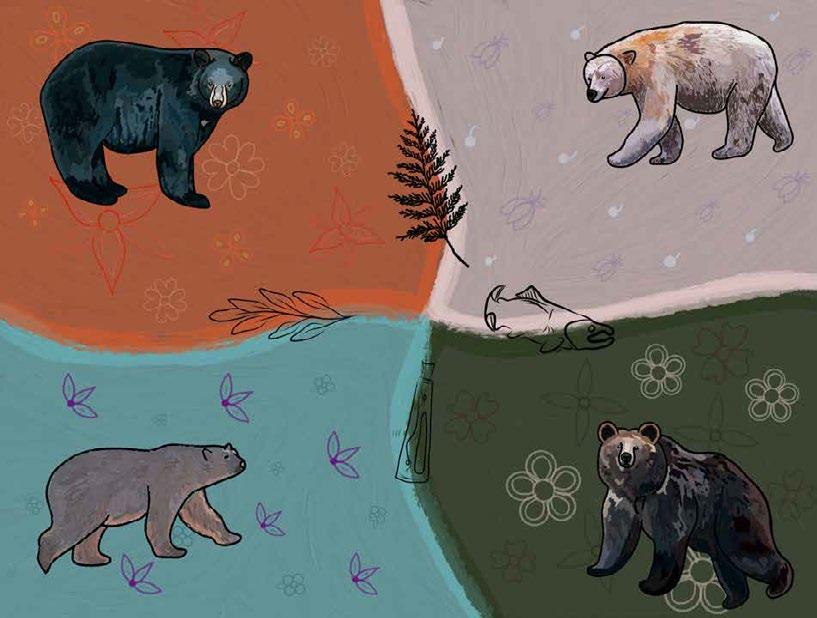
Language is an important aspect of culture and wellness. In particular, spiritual and cultural knowledge is embedded within language. Elders, Spiritual Advisors, and Knowledge Keepers teach that when you can learn the language of the land, you are able to see the world from a different perspective and communicate more fully with all of Creation. Language also builds resilience and has strong connections to identity. Infact, some evidence suggests that learning language increases attention, empathy, problem-solving skills, and executive functioning.16 Like many other non-anglophone (non-English) languages, First Nations’ languages are significantly more descriptive and complex than English. For example, traditional First Nations languages teach:
• Kinship relationships with all living beings.
• That First Nations are not from the land; they are the land.
• How to conduct one’s self in this world.
• How to balance relationships with people, the land, and the animals.
• That people are responsible for their actions, and that actions deeply affect surroundings.17
Reflection Question: How would the revitalization of culture and language promote wellness in community?
“Once you teach the language, tradition and culture will follow.”
IRS RHSP recipient (First Peoples Wellness Circle, 2021:64)
In terms of mental wellness care, First Nations’ languages contains more ways to speak about health, especially in a wholistic way. This translates to community members, Elders, healers and other health care providers having a much broader understanding of a person’s health, what they are going through, and how best to support them. In addition, language use and revitalization are connected to improving wellness and are a protective factor for individuals, even in cases where risk factors such as poverty are present.
Elders have a special and highly respected place in First Nations society because of their personal experience, knowledge of cultural teachings and language as well as the wisdom that they share with their families and communities. They are Knowledge Keepers of traditional stories and ceremonies, having engaged in lifelong active learning, selfreflection, and listening to older generations. They are sought for their guidance and advice, as well as their cultural knowledge.
Not every senior is an Elder. Elders are acknowledged by their community (identified and affirmed by the community) for the special gifts that they carry based on life experience, contribution to family and community, as well as knowledge of cultural practices, medicines, and language.
Becoming an Elder can happen naturally by being involved with the community’s teachings and living a traditional way of life, apprenticing with another Elder, or it can occur suddenly as a result of navigating an extreme life challenge.18
Elders hold special knowledge, skills, and gifts which give them the capacity to do one or more roles in the community. These roles may include supporting healing and growth by being role models, teachers, advisors, healers, cultural and spiritual counsellors, or conductors of ceremony. They may be adept at conflict resolution or communicating the wisdom and guidance needed for a specific situation, including issues related to community work more broadly. They model traditions for younger (future) generations so that teachings can continually be used to help improve wellness. They use traditional stories and their own personal stories of self-development to provide support and care.19 20
“[Ceremony] gives me back a sense of identity, of belonging. It gives me back a sense of strength. And a lot of it is connected with the ancestors.”
IRS RHSP recipient (First Peoples Wellness Circle, 2021:62)
There is no specific correct way to approach Elders, but they should be approached in a culturally safe and respectful way that honours their wisdom. This includes:
• Being respectful by listening and acknowledging them for their knowledge and time.
• Practicing self-reflection and preparing questions in advance.
• Providing an offering or gift (such as tobacco, fabric, clothing, fur, firewood, or food).
• Taking the time to build a relationship with an Elder that is grounded in reciprocity.
• Asking if there are any traditional protocols that you should be aware of before engaging with an Elder.
In whatever role they hold, Elders have a significant role in contributing to the mental wellness of individuals, families, and communities. They may help guide individuals in identifying their own hope, belonging, meaning, and purpose. Elders may also conduct ceremonies, offer cultural teachings, and hold cultural and community knowledge. All of these have important effects on individual, family, and community mental wellness.
Teachings are commonly referred to as the natural laws, customary laws, or sacred laws. Each community has its own stories that are shared and passed down from one generation to the next. Teachings provide the basis for understanding values, traditions, and ways of living. They can vary from Nation to Nation and can include:21
• Wellness teachings
• Knowledge of traditional plants and medicines
• Value systems
• Languages
• Indigenous arts, crafts, and songs
• Ceremonial knowledge and protocols
• Clan teachings
• Creation/Origin stories
• Governance structures
Knowledge, experience, and guidance are passed down from previous (older) generations in the form of teachings for younger generations. Following these teachings and traditions helps to honour culture and connect past generations with future generations. Applying teachings as well as Traditional Knowledge and skills are vital to the development and on-going delivery of culturally safe and meaningful community services and care. However, care providers should be cognisant of who should share a teaching and of how it should be shared. Traditional Knowledge Keepers, Spiritual Advisors, or Elders are ideally the ones sharing these teachings.
What are some of the ceremonies and cultural practices in your area?
Ceremonies are an integral means of addressing trauma and supporting healing. A ceremonial practice can be undertaken by an individual (one person) or in a group setting (including large groups). They can include a prayer, smudge, song with drum or rattle, a sweat lodge ceremony or traditional landbased event. Ceremonies are a means of carrying and communicating teachings, songs, and knowledge with the aim of supporting the wellness of individuals, families, and communities. Ceremonies often involve specific teachings taught by and/or led by an Elder, Spiritual Advisor, Healer, or Knowledge Keeper. There are many unique ceremonies across Nations and readers are encouraged to learn more about the specific ceremonies that are common, or were common, in their area. The following are some examples.
Smudging is a common form of ceremony. It is a traditional practice that uses prayer to evoke mindfulness, to ground and to calm, or cleanse negative thoughts and feelings. A sacred smoke is created by burning medicines (usually sage, sweetgrass, tobacco, and cedar). The smoke is wafted over the body ceremonially to encourage mindfulness and positive feelings. This ceremonial practice can also be used to help someone through anxiety, grief, or other strong emotions.
Cedar is often used in cleansing and purification ceremonies, such as within a cedar bath. Among its many applications, a cedar bath can be used to welcome a baby into this world, to purify and protect the body, to help in inner-child work
as well as in death to prepare the body for its journey back to the spirit world. Cedar baths are also used in the healing of all types of traumas, including family violence as well as sexual, verbal, mental, emotional, physical, and spiritual abuse.
The cedar bath is a symbolic cleansing of the body that involves the washing away of the hurts and pains that an individual carries as well as letting go of past traumas, replacing traumatic experiences with forgiveness. Cedar baths allow an individual to begin a process of change, which creates a sense of empowerment that supports their recovery and growth. During this process participants may relive trauma, so it is essential to establish a safe, nurturing environment.22
“…when you’re picking medicine it brings back all the four domains in life. The mental, the spirituality,
everything, the cultural aspects, it all comes
back.”
IRS RHSP recipient (First Peoples Wellness Circle, 2021:61)
Cedar has many medicinal qualities, such as playing a role in detoxification through the stimulation of the lymphatic system and acting as an anti-inflammatory medicine for respiratory illnesses. Cedar promotes calmness and grounding which are essential when supporting someone with trauma.23
Everyone’s experience with cedar baths is unique. The healer leading the ceremony asks the individual to put prayers into some tobacco, asking for the healing that is needed. The healer works through the spirit and the messages received from the tobacco to know what is being asked.
While ceremonies differ across the country, generally, the healer will wash the head (beginning with the third eye), ears, eyes, mouth, and throat, before proceeding to other parts of the body. Throughout this process, negative experiences are removed and replaced with positive, reaffirming thoughts and words. Depending on the reason for the cedar bath, the healer will focus on specific parts of the body. Once cleaned, the ceremony comes to an end.
Given the specialized knowledge and experience needed, not all healers or Elders are equipped to do cedar baths. It is important for health care users, providers, and counselors to know the healer who will be undertaking a cedar bath ceremony, and ensure they have the necessary knowledge and experience.
Soul loss occurs when there is trauma and violence in a person’s life. Each time a person experiences trauma, it is as if a piece of the person’s soul is lost to the universe/spirit world. Soul loss can have a lifelong negative impact on someone’s emotional, mental, physical, and spiritual wellness.
There are some traditional healers who, with the help of Spirit, have the expertise to journey to the spirit world and help retrieve missing parts of the soul, thus restoring the soul to its pre-trauma state. The soul retrieval ceremony welcomes home the missing soul parts of an individual and prepares them to protect and care for the lost soul pieces. To do this, an individual must be brought back to the time at which the trauma occurred. Similar to the cedar bath, the soul retrieval ceremony is unique to the individual and everyone has different reasons for participating in this ceremony.
“It is often the land that awakens blood memories within us, such as being in a certain place and knowing down to our core that we have been here before. The land has the ability to calm and restore us and to inspire creativity. The land is home. The land is in us. The land is us.”
(Baskin 2016, 175)
Land-based programs are important and effective means of healing. They offer opportunities for First Nations to heal by reconnecting to their culture. They include activities that promote healing, therapy, and Traditional Knowledge, while focusing on physical, mental, emotional, and spiritual health. With a focus on their deep-rooted relationship to the land, participants learn where they come from, and by extension they learn more about their own identity and that they have a purpose within Creation.24
These programs differ depending on community needs, territory, resources, and the specific program goals. For example, while some use a Two-Eyed Seeing lens, incorporating Western healing methods such as psychiatry and Western-based therapies, others focus primarily on survival skills and land-based activities such as hunting and gathering. No matter what approaches are used, the central aim is for participants to spiritually connect to traditional ways of knowing and being.
How would the revitalization of culture and language promote wellness in community?
Studies have consistently noted the significance and positive impact of culturebased interventions, specifically through land-based programs. For example, one study from Thunderbird Partnership Foundation analyzed 2,910 participants’ self-assessments from different land-based healing programs. This study found that participants experienced a 6% to19% increase in hope, belonging, meaning, and purpose.25 However, many mental wellness practitioners and participants believe that Western social work services lack an understanding of the profound cultural importance of the relationship to the land.26 The FNMWCF offers support and recommendations to improve programming and service planning and is especially effective in this regard as it focuses on communities’ unique needs, competencies, and resources.
Successful land-based programs include six primary components:27
• Flexible programming and structure
• Based on community needs and according to community protocols
• Connecting individuals with those that came before them
• Led by skilled practitioners, Elders, Spiritual Advisors, or Knowledge Keepers
• Quality of land location and the relationship with the land
• Addresses all levels of safety
Programming differs depending on the season, but some activities that are often found in land-based programs include:
• Making dream catchers
• Wood gathering, splitting, and piling
• Fire building
• Snowshoeing
• Canoeing
• Hiking
• Fishing
• Trapping, tanning, and smoking hides
• Hunting and learning to care for and respect the animals
• Drum and shaker making
• Berry picking
• Storytelling
“I think there needs to be more on the land healing program. It heals you and makes you proud…. When you get to participate in ceremony like that you feel so refreshed and you feel so good inside.”
IRS RHSP recipient (First Peoples Wellness Circle, 2021:61)
A particular component that differentiates land-based programs is the power dynamic, or relationship, between the counsellors and the participants, as land-based programs work with limited power difference between the two. Rather than assuming specific leadership and participant roles, programs work with the understanding that every person brings their own gifts, and that everyone is needed. While counsellors are there for guidance, and bring their specialized knowledge, the overarching understanding is that, within Creation, all are equal. No one is better than the other and each one is needed to undertake and support healing.
There are many land-based learning and healing programs that have been developed and are running in First Nations communities. For example, the Outdoor Adventure Leadership program in Wikwemikong First Nation offers land-based experiences for First Nations youth that improve resilience, well-being, leadership capacity, and cultural identity.28
Main takeaways from this chapter include:
• Cultural safety is essential to providing effective mental wellness care of First Nations.
• First Nations mental wellness approaches focus on the use of a strengths-based approach rather than a deficit-based approach, which is typically used in Western care strategies.
• There are many ways First Nations can incorporate traditional approaches into mental wellness care.
• Language use and revitalization are important aspects of culture and are directly linked to identity and wellness.
• Since wants, needs, and resources differ across communities, it is important that the traditional practices used are relevant to the communities that receive those services.
• First Nations’ relationship to land is crucial to identity, care, and wellness. Land-based programs that reconnect people to their culture are very effective.29 30 31
• Indigenous Land-Based Learning, Elementary Teachers’ Federation of Ontario: https://etfofnmi.ca/wp-content/ uploads/2024/03/EWS_Book_LandBasedLearning-FINAL_Oct20_CC.pdf
• Lesson Plans - Land-Based Learning, The National Centre for Collaboration of Indigenous Education: https://www.nccie. ca/nccie-lesson-plans/lesson-plans-landbased-learning/
• Smudging Protocol and Guidelines, Indigenous Inclusion Directorate of Manitoba Education and Training: https:// www.edu.gov.mb.ca/iid/publications/pdf/ smudging_guidelines.pdf
• Elder Protocol, Alberta Teachers’ Association: https://legacy.teachers.ab.ca/ SiteCollectionDocuments/ATA/For%20 Members/ProfessionalDevelopment/ Walking%20Together/PD-WT-16g%20-%20 Elder%20Protocol.pdf
• Elder Protocols and Guidelines, Justice Institute of British Columbia: www.jibc.ca/ sites/default/files/2020-09/OI%20Elder’s%20 Guidelines%20and%20Protocols.pdf
• Strength-Based Approaches to Indigenous Research and the Development of Well-Being Indicators, First Nations Information Governance Centre: https:// fnigc.ca/wp-content/uploads/2021/05/FNIGCResearch-Series-SBA_v04.pdf
• Wise Practices for Life Promotion, Indigenous Leadership for Living Life Well: https://wisepractices.ca/
• Wise Practices Life Promotion Toolkit: https://wisepractices.ca/life-promotiontoolkit/
• Wise Practices System Level Change: https://wisepractices.ca/system-level-change/
• The Promoting Life Together Collaborative - Healthcare Excellence Canada: https:// www.healthcareexcellence.ca/en/what-wedo/all-programs/the-promoting-life-togethercollaborative/
• Land-Based Healing and Resources: https://www.fnha.ca/Documents/FNHAWhat-is-Land-Based-Treatment-and-Healing. pdf
• Indigenous Strengths-Based Approaches to Healthcare and Health Professions Education - Recognizing the Value of Elders’ Teaching, Health Education Journal: https://www.researchgate.net/ publication/359118082_Indigenous_ Strengths-Based_Approaches_to_Healthcare_ and_Health_Professions_Education_-_ recognising_the_value_of_Elders’_teaching
• A Strengths-Based Approach to Indigenous Wellness (Video), Thunderbird Partnership Foundation: https://www. youtube.com/watch?v=ZMUUsxDXv2w
• Two-Eyed Seeing, Current Approaches, and Discussion of Medical Applications: https://bcmj.org/articles/two-eyed-seeingcurrent-approaches-and-discussion-medicalapplications
• Cultural Safety Resources: https://www. fnha.ca/wellness/wellness-and-the-firstnations-health-authority/cultural-safety-andhumility
• Trauma and Soul Retrieval: https://www. youtube.com/watch?v=ethA3mfY9Oo
• Sweat Lodges: https://mushkiki.com/ourprograms/sweat-lodge/
• Health Effects of Indigenous Language Use and Revitalization: A Realist Review, International Journal for Equity in Health: https://equityhealthj.biomedcentral.com/ articles/10.1186/s12939-022-01782-6
• Indigenous Health Care Workers Use Language to Build Trust and Break Down Barriers, CBC: https://www.cbc.ca/news/ indigenous/indigenous-language-health-careworkers-1.4660009
• The Language of Wellness Part One - First Peoples’ Cultural Council, First Nations Health Authority: https://www.youtube. com/watch?v=69w9f3aqzU8
• Significance of Cedar Tea, Creators Garden with Joseph Pitawanakwat: https://www. youtube.com/watch?v=XLUI6CEZQTc
• The Promoting Life Together Collaborative – Healthcare Excellence Canada: https:// www.healthcareexcellence.ca/en/what-wedo/all-programs/the-promoting-life-togethercollaborative/
1 First Nations Health Authority. 2022. “Cultural Safety and Humility.” Accessed November 8, 2022. https://www.fnha.ca/wellness/wellness-and-the-firstnations-health-authority/cultural-safety-and-humility
2 Thunderbird Partnership Foundation. 2018. “Indigenous Knowledge Key Terms.” Accessed November 7, 2022. https://thunderbirdpf.org/wpcontent/uploads/2022/03/fnmwc_framework_key_ terms_and_concepts.pdf
3 First Nations Health Authority. 2022; BC Patient Safety & Quality Council. 2021. Culturally Safe Engagement: What Matters to Indigenous (First Nations, Metis, and Inuit) Patient Partners? Accessed December 9, 2022. https://bcpsqc.ca/wp-content/ uploads/2022/03/Culturally-Safe-EngagementCompanion-Guide_Final.pdf.
4 First Nations Health Authority. 2022; Baba, Lauren. 2013. Cultural safety in First Nations, Inuit and Métis Public Health: Environmental Scan of Cultural Competency and Safety in Education, Training and Health Services. Prince George, BC: National Collaborating Centre for Aboriginal Health.
5 Mehl-Madrona, Lewis. 2019. “What Can Western Medicine Learn from Indigenous Healing Traditions?” The Positive Side. Spring. Accessed November 8, 2022. https://www.catie.ca/en/positiveside/ spring-2019/indigenous-healing
6 Latimer, Margot, John R. Sylliboy, Julie Frances, Sharon Amey, Sharon Rudderham, Allen G. Finley, Emily MacLeod and Kara Paul. 2020. “Co-creating better healthcare experiences for First Nations children and youth: The FIRST approach emerges from Two-Eyed seeing.” Paediatric and Neonatal Pain 2 (4): 104-112.
7 Institute for Integrative Science & Health. n.d. “Two-Eyed Seeing.” Accessed December 8, 2022. http://www.integrativescience.ca/Principles/ TwoEyedSeeing/.
8 Hall, Laura, Colleen A. Dell, Bard Fornssler, Carol Hopkins, Christopher Mushquash and Margo Rowan. 2015. “Research as Cultural Renewal: Applying Two-
Eyed Seeing in a Research Project about Cultural Interventions in First Nations Addictions Treatment.” International Indigenous Policy Journal 6 (2): 1-15.
9 Latimer, Margot, John R. Sylliboy, Julie Frances, Sharon Amey, Sharon Rudderham, Allen G. Finley, Emily MacLeod and Kara Paul. 2020. “Co-creating better healthcare experiences for First Nations children and youth: The FIRST approach emerges from Two-Eyed seeing.” Paediatric and Neonatal Pain 2 (4): 104-112.
10 Lavallee, Lisa and L. Levesque. 2012. “Two-Eyed Seeing: Physical activity, sport, and recreation promotion in Indigenous Communities.” In Aboriginal Peoples and Sport in Canada. Historical Foundations and Contemporary Issues, edited by Janice Forsyth and Audrey R. Giles. Vancouver: University of British Columbia Press.
11 First Nations Mental Wellness Continuum Framework. 2015. Accessed November 7, 2022. https://thunderbirdpf.org/wp-content/ uploads/2015/01/24-14-1273-FN-Mental-WellnessFramework-EN05_low.pdf.
12 Thunderbird Partnership Foundation. 2018.
13 Kumar, Mohan B. and Michael Tjepkema. 2019. Suicide among First Nations people, Métis and Inuit (2011-2016): Findings from the 2011 Canadian Census Health and Environment Cohort (CanCHEC). Statistics Canada. Accessed November 9, 2022. https://www150.statcan.gc.ca/n1/pub/99-011-x/99011-x2019001-eng.pdf
14 Thunderbird Partnership Foundation & First Peoples Wellness Circle. 2023. “Wise Practices.” Accessed April 12, 2023. https://wisepractices.ca/
15 Healthcare Excellence Canada. 2023. “The Promoting Life Together Collaborative.” Accessed March 29, 2023. https://www.healthcareexcellence. ca/en/what-we-do/all-programs/the-promoting-lifetogether-collaborative/
16 First Nations Health Authority, Vancouver Island Region. “The Language of Wellness Part One – First
Peoples’ Cultural Council.” YouTube, uploaded by First Nations Health Authority, 18 March 2021, https://www.youtube.com/watch?v=69w9f3aqzU8
17 University nuhelot’įnethaiyots’į nistameyimâkanak Blue Quills. 2019. Honouring Sacred Relationships: Wise Practices in Indigenous Social Work. Edmonton: Alberta College of Social Workers.
18 Nabigon, Herb. 2006. The Hollow Tree: Fighting Addiction with Traditional Native Healing. Montreal: McGill-Queen’s University Press; Tait, Patricia. 2007. Systems of Conflict Resolution Within First Nations Communities: Honouring The Elders, Honouring The Knowledge. National Centre for First Nations Governance. Accessed November 8, 2022. https:// fngovernance.org/wp-content/uploads/2020/09/ patricia_tait.pdf.
19 Ballard, Myrle, Juliana Coughlin and Donna Martin. 2020. “Reconciling with Minoaywin: First Nations Elders’ Advice to Promote Healing from Forced Displacement.” Canadian Journal on Aging 39 (2): 169-177.
20 Manitowabi, Susan. 2014. “The Role of Elders in the Community.” In Journey to Healing: Aboriginal Peoples with Addictions and Metal Health Issues edited by Peter Menzies and Lynn F. Lavallée. Toronto: Centre for Addictions and Mental Health.
21 Thunderbird Partnership Foundation. 2018.
22 Manitowabi, Susan and Denise Gauthier-Frohlick. 2012. “Relationship Building: A Best Practice Model for Aboriginal Women’s Health Research.” Native Social Work Journal 8: 57-74.
23 Joseph Pitawanakwat. “Significance of Cedar Tea.” YouTube, uploaded by Creators Garden - Joseph Pitawanakwat, 14 November 2020, https://www. youtube.com/watch?v=XLUI6CEZQTc
24 Baskin, Cyndy. 2016. Strong Helpers’ Teachings: The Value of Indigenous Knowledges in the Helping Professions. 2nd Edition. Toronto: Canadian Scholars.
25 Task Group on Mental Wellness. 2021 [in press]. Recommendations on Supporting Mental Wellness for Remote and Isolated Indigenous Communities: Substance Use Treatment and Land-Based Healing: 14-15.
26 Redvers, Jennifer. 2020. “‘The land is a healer’: Perspectives on land-based healing from Indigenous practitioners in northern Canada.” International Journal of Indigenous Health 15 (1): 90-107; Walsh, Russ, Jocelyn Sommerfeld and David Danto. 2022. “Land-Based Healing: Towards Understanding the Role of Elders.” International Journal of Mental Health and Addiction 20 (2) 862-873.
27 Redvers. 2020.
28 Ritchie, Stephen, Mary Joe Wabano and Nancy Young. 2010. Promoting Resilience and WellBeing through an Outdoor Adventure Leadership Experience (OALE) Designed for First Nations Youth: A Collaborative Research Report on a CommunityBased Positive Mental Health Promotion Program (Intervention).
29 Stelkia, Krista, Lindsay Beck, Anita Manshadi, Ashlyn Jensen Fisk, Evan Adams, Annette J. Browne, Corinne Dixon, Diane McEachern, Wendy Ritchie, Shannon McDonald, Bonnie Henry, Namaste Marsden, Daniele Behn-Smith and Jeff Reading. 2020. “Letsemot, “Togetherness”: Exploring How Connection to Land, Water, and Territory Influences Health and Wellness with First Nations Knowledge Keepers and Youth in the Fraser Salish Region of British Columbia.” International Journal of Indigenous Health 16 (2): 356-369.
30 Lines, Laurie-Ann, Yellowknives Dene First Nation Wellness Division and Cynthia G. Jardine. 2019. “Connection to the Land as a Youth-Identified Social Determinant of Indigenous Peoples’ Health.” BMC Public Health 19 (176);
31 Dobson, Christina and Randall Brazzoni. 2016. Land Based Healing: Carrier First Nations’ Addiction Recovery Program. Journal of Indigenous Well-being: Te-Mauri – Pimatisiwin 1 (2): 9-17.
The purpose of this chapter is to focus on some existing positive and effective strategies as well as consider how to continue to support mental wellness in the future.
Learning objectives for this chapter include:
• Understanding what is meant by ‘a legacy of hope,’
• Increasing knowledge on why there is an Orange Shirt Day and a National Day of Truth and Reconciliation,
• Identifying advancements that have been made for First Nations mental wellness as well as existing barriers, and
• Learning more about the importance of preventive strategies in mental wellness.
If trauma, pain, hurt, and oppression are passed down from one generation to the next, then so is resilience, hope, healing, and strength.1 2
“Today, triggers continue to work on my body, mind, and spirit but, ironically, they have given me a shot at life. My mother and father hoped they would … Their resilience became mine. It had come from their mothers and fathers and now must spill over to my grandchildren and their grandchildren. If we truly believe
the pain of the residential school legacy has had an intergenerational impact, then it necessarily follows that there will be intergenerational Survivors too.”
(Madeleine Dion Stout 2012, 50)
Orange Shirt Day is an Indigenous-led grassroots commemorative day intended to raise awareness of the individual, family, and community intergenerational impacts of Residential Schools, and to promote the understanding that ‘Every Child Matters.’ The orange shirt represents the stripping away of culture, freedom, and self-esteem experienced by Indigenous children over generations and the ongoing importance of children, youth, and future generations.
Orange Shirt Day has its roots in the St. Joseph Mission (SJM) Residential School (18911981) Commemoration Project and Reunion events, which occured in 2013. Having gained in popularity, participation, and attention, Orange Shirt Day is now celebrated annually on September 30th. This date was chosen because it signifies the time of year when Indigenous children were taken from their homes and sent to Residential Schools. This event demonstrates the strengths of First Nations, Inuit, and Métis individuals, families, and communities. In addition, it addresses trauma, raises awareness, and highlights the importance of Indigenous peoples’ history and culture.
Reflection Questions:
What does ‘truth and reconciliation’ mean to you?
What actions can you take to support reconciliation?
Building on the momentum of Orange Shirt Day, the National Day for Truth and Reconciliation was established as a national statutory holiday in 2021. It was specifically established to honour and acknowledge the strengths of First Nations, Inuit, and Métis as well as to recognize the thousands of unmarked graves
near former Residential Schools and the legacy of the Residential School system more broadly. National Truth and Reconciliation Day honours the children who never returned home as well as Residential School survivors, their families, and communities. The day is also representative of First Nations’ history of trauma, as well as the importance of ongoing and evolving efforts of truth and reconciliation.
The Truth and Reconciliation Commission of Canada (TRC) was established as part of the settlement agreement between survivors and the federal government to provide those impacted by the legacy of Residential Schools with an opportunity to share their stories and experiences. The settlement began in June 2008 with a Statement of Apology by the government of Canada toward former students of Indian Residential Schools that signified Canada’s acknowledgment of the harms that were caused.
What did you learn in school about First Nations history?
How does it compare to what you know now?
The central aim of the TRC was to communicate the reality and long-lasting effects of the schools as a step towards advancing the process of reconciling the past and moving forward in ways that honours former students and their families.
Active between 2008 to 2015, the TRC heard from more than 6,500 witnesses and resulted in a list of 94 ‘Calls to Action’ to continue advancing reconciliation.3 These actions largely focused on themes of health, education, culture, equity, and justice.
Education, and especially the increase in information related to First Nations and culture, has been important, especially with regard to supporting the mental wellness of First Nations children and youth. While previously rarely taught, information related to First Nations and their culture has increasingly been included in the curriculums of schools both on and off reserve as a result of the Truth and Reconciliation Commission’s Calls to Action pertaining to education. This includes providing information on First Nations history, the impact of colonialism, intergenerational trauma of Residential Schools, contributions that Indigenous people have made, as well as information about First Nations cultures, languages, and traditions. Doing so helps to introduce more perspectives and knowledge on these issues and to create healthy and informed dialogue and action. In addition, education builds respect, understanding, and empathy, facilitating the development of meaningful connections that work toward addressing as well as taking action against racism and discrimination while contributing to equality, dignity, hope, and healing.
In 2007, the United Nations (UN) adopted the United Nations Declaration on the Rights of Indigenous Peoples (UNDRIP) to support the rights that “constitute the minimum standards for the survival, dignity and well-being of the Indigenous peoples of the world.”4
In summary, UNDRIP:
• Protects collective rights of Indigenous people while safeguarding their individual rights.
• Declares that Indigenous peoples have the right to the full enjoyment of all human rights and fundamental freedoms as recognized in the Charter of the United Nations, the Universal Declaration of Human Rights and international human rights law.
• Guarantees the rights of Indigenous peoples to enjoy and practice their cultures and customs, their religions, and their languages.
• Guarantees the right to develop and strengthen their economies and their social and political institutions.
• Guarantees the right to be free from discrimination.
• Guarantees the right to a nationality.
The in-depth process of researching and presenting UNDRIP began in 1982 following the release of a UN’s study about the systemic discrimination faced by Indigenous peoples worldwide. In response to this study, the UN Economic and Social Council (ECOSOC) created the Working Group on Indigenous Populations (WGIP) that began to draft a Declaration of Indigenous Rights in 1985. By 1993, the Declaration was submitted to the Sub-Commission on the Prevention of Discrimination and Protection of Minorities (now known as the Sub-Commission on the Promotion and Protection of Human Rights) and was approved in 1994. Following this, the draft declaration was sent to the Commission of Human Rights for further review. Canada officially endorsed UNDRIP in 2016. British Columbia was the first province to develop an action plan dedicated to implementing UNDRIP, as called for by the Truth and Reconciliation Commission’s Calls to Action.5
“Indigenous women and girls are five times more likely to experience violence than any other population in Canada and this violence tends to result in more serious harm.”
(AFN, n.d.)
The National Inquiry into Missing and Murdered Indigenous Women and Girls (MMIWG) raises awareness of the systemic violence against Indigenous women and girls. While previously largely ignored by governments, significant work has been done since 2015 to address the high rates of violence faced by First Nations women and Indigenous women more broadly.6 As highlighted in the First Nations Mental Wellness Continuum Framework (FNMWCF), the importance of culturally rooted, collaborative work and systems-wide change have been and will continue to be central to this process of gathering information and healing. Some key milestone is this complex and ongoing work include:7
• August 2016: Government of Canada announces Terms of Reference and appoints Commissioners
• September 2016: National Inquiry officially starts
• November 2016 – March 2017: Meetings with regional groups, national organizations, and community visits.
• February 2017: The National Family Advisory Circle is formed, and includes family members of missing and murdered Indigenous women and girls from different regions of Canada.
• March 2017: Support Services Framework established to assist families and survivors through the truth gathering process.
• May 2017 – December 2018: Extensive engagement process from coast to coast to coast to gather statements, reports, and research with the aim of obtaining as much information as possible directly from community members and leaders, as well as to analyze existing government services, policies, and practices.
• October – December 2018: Guided dialogues with special populations, including 2SLGBTQ+, Métis, Inuit, and the Québécois.
• January – March 2019: Analysis and validation process.
• February 2019: Their Voices Will Guide Us: Education Guide is released.
• June 2019: Publication of Reclaiming Power and Place: The Final Report of the National Inquiry into Missing and Murdered Indigenous Women and Girls and the conclusion of the National Inquiry.
“[There is] stigmatized loss associated with MMIWG.”
IRS RHSP recipient (First Peoples Wellness Circle, 2021:78)
Although significant work remains in order to protect First Nations women and girls from higher rates of violence, it is telling and important that this issue has received some attention and funding from the federal government. The final report from the National Inquiry, Reclaiming Power and Place: The Final Report of the National Inquiry into Missing and Murdered Indigenous Women and Girls, describes an intergenerational Canadian genocide, revealing, among other findings, “[a] persistent and deliberate pattern of systemic racial and gendered human rights and Indigenous rights violations and abuses…This colonialism, discrimination, and genocide explains the high rates of violence against Indigenous women, girls and 2SLGBTQQIA people.”8 The findings also include 231 Calls for Justice which call upon all governments (federal, provincial, territorial, municipal, and Indigenous governments) to take actions regarding human rights, social equity, education, and justice system reform, to name a few.9
First Nations can access a range of health benefits through the Non-Insured Health Benefits (NIHB) program through Indigenous Services Canada (ISC). The NIHB covers some medical goods and services including vision care, dental care, mental wellness counselling, access to Elder services, medical supplies and equipment, prescriptions, and over-thecounter medications.
While beneficial in many regards, it is important to consider that, like many social services, there are significant gaps in the NIHB system. This includes many preventative medications and
What areas of the ‘Legacy of Hope’ are you actively supporting or could you support?
therapies not being adequately covered, while including some curative medicines. As such, although providing medical support to First Nations, improvements are needed.10 11
In 2020, the Assembly of First Nations (AFN) and the First Nations and Inuit Health Branch (FNIHB) of Indigenous Services Canada (ISC) engaged in a joint review of NIHB. The work has been driven by a Joint Review Steering Committee (JRSC) which is composed of equal representation from First Nations and FNIHB, and guided by an Elder. The objectives of the Joint Review are to:
• Enhance service users’ access to benefits,
• Identify and address gaps across all benefit areas,
• Adapt service delivery in response to service user needs, and
• Increase efficiency.
The JRSC has reviewed different components of the NIHB, including mental health counselling, vision, dental, pharmacy, and medical supplies and equipment benefits, and continues to review medical transportation. Through various mechanisms (monitoring, evaluation, and implementation of the JRSC recommendations), the AFN will continue advocating for the improvement of the NIHB program to address needs and improve access to health benefits.12
Health care service provision can be evaluated using three criteria: availability of services, accessibility to services, and acceptability of services.13 14 15 Canada has prided itself on universal health care since its inception in 1966. Free access to equitable, accessible, and acceptable health services has since been understood as a fundamental right. However, equitable and accessible health care services have not extended to, or met the basic needs of, First Nations. As a result of the jurisdictional divide between the federal and provincial governments, many First Nations are forced to go with minimal or no health care services in their home communities.16
Access to care has been an ongoing issue for First Nations. In particular, access to mental wellness services is complicated by the multiple levels of government involved in funding and programming. The current funding framework makes it difficult for health authorities to coordinate efforts to ensure that First Nations communities receive a continuum of care. This lack of coordination has contributed to the creation of service gaps across the continuum of care, including areas such as treatment and prevention services, aftercare, withdrawal management services, and psychiatric care.17 18 19 These complex funding arrangements have contributed to the unequal and unsustainable provision of mental wellness services within the provinces and territories, and among First Nations communities.
In addition, there are significant challenges and barriers for First Nations living off reserve or outside their traditional territories to find and receive comprehensive and culturally safe health services. First Nations in northern and remote communities also face major
barriers because of the shortages of health care providers, limited health services (basic health services only), and lack of infrastructure. These challenges, among others, are directly addressed within the FNMWCF, which encourages the different jurisdictional governments to coordinate and collaborate with First Nations and decision-making partners.
When looking at services on reserves, the lack of availability and accessibility is evident. For example, the Nishnawbe Aski Nation (NAN) in Ontario represents 49 distinct First Nations communities. Of the 45,000 people living within these communities, approximately 24,000 have access to nursing stations or clinics for all of their health-related needs.20 Large health care centres such as hospitals and trauma units are significant distances away and are only accessible by plane (weather permitting). Over half of the people living within these communities have no access to health care services.
Question: What actions can you take to improve accessibility to mental wellness services in your area?
Another significant challenge is the lack of wage parity and equitable funding of health services on reserve. For example, some mental wellness services, such as Mental Wellness Teams, Crisis Response Teams, and Indian Residential School Resolution Health Support Program
workers do not have sustainable and equitable funding. Without stable resourcing, recruitment and retention challenges have persisted, impacting service delivery and the sustainable implementation of services. While availability and accessibility to wellness and health services are apparent in many First Nations as a result, it is particularly evident in northern, remote, and isolated communities.21
These are commonplace examples of the inequity of health care offered by the federal and provincial governments to First Nations. It is important to highlight that these inequities also exist in funding. Funding is based on an outdated funding model, known as the Berger model, that does not account for important context such as population needs and community remoteness. This outdated formula directly impacts the types of services available, accessibility to services, and wage parity for the workforce. This model is largely based on population numbers. This means that small communities do not receive adequate funding to meet the needs of their members. Further, more urban communities with members living nearby but not within the territory (who may wish to access community-based services) also receive inadequate funding to support their members living on and off reserve.22 The First Nations Mental Wellness Continuum Framework (FNMWCF) calls for enhanced and flexible funding that would support equitable access to services across the continuum of care (see Chapter 1, Section 3 for more information).
What type of prevention strategies and life promotion approaches rooted in culture can you use to support your work?
Though service availability and accessibility is greater in urban settings, a lack of equitable care within services exists. Racism and discrimination are prevalent, and the care provided is often not offered in a culturally safe or meaningful way (see Chapter 3, Section 4 for more information). Health care practitioners are not adequately educated on First Nations history and the impacts of intergenerational trauma, and culturally safe practices are not typically offered. In addition, culturally safe services are not regulated or required by health care organizations or practitioners. This creates further barriers to First Nations families seeking or undertaking treatment and care services.
Some provinces and territories have urbanbased Indigenous primary health care services that provide culturally safe services to the urban Indigenous population. For example, in Ontario, these health care centres are known as Aboriginal Health Access Centres and include organizations like Anishnawbe Health in Toronto23 or Wabano Centre in Ottawa.24 The National Association of Friendship Centres also provides culturally safe and relevant programs
and services including some health care services such as children’s services, women’s services, and addictions support.25 These kinds of organizations often offer access to cultural services and cultural practitioners and are guided by Indigenous members or First Nations communities.
The challenges faced by First Nations when accessing health care was brought to light following the death of Jordan River Anderson, a First Nations child from Norway House Cree Nation in Manitoba. Born with complex medical needs, Jordan unnecessarily spent more than two years in hospital while the Province of Manitoba and the federal government argued and negotiated over who should pay for his at-home care. Jordan died in the hospital at the age of five, never having spent a day in his family home.26 Recognizing the challenges stemming from a lack of intergovernmental coordination of health services, including those related to mental wellness, the House of Commons unanimously supported a private member’s Motion (M-296), which stated that “the government should immediately adopt a child-first principle, based on Jordan’s Principle,
to resolve jurisdictional disputes involving the care of First Nations children.” Jordan’s Principle is named after this Motion and has since been incorporated into funding and programming services.27 Although jurisdictional challenges and barriers continue, this example demonstrates that meaningful change is possible, and the health care system can evolve to incorporate First Nations realities and priorities.
Creating, implementing, and maintaining strengths-based and culturally rooted strategies is key to building healthy communities and supporting mental wellness. Despite ongoing challenges, there are several impactful and large-scale initiatives being undertaken in First Nations communities. The goal of this work is to continue to support, develop, and promote culturally safe and meaningful mental wellness for First Nations.
Mental Wellness Teams (MWTs) and Crisis Support Teams are community-based, multidisciplinary teams that provide culturally safe and meaningful services. These include, among others, capacity-building, TraumaInformed Care, land-based care, early intervention and screening, crisis response, aftercare, and care coordination. In addition, they build partnerships across federal, provincial, and territorial jurisdictions. MWTs blend Traditional, cultural, and Western approaches to provide mental wellness services to First Nations, with the view to support, expand, and develop existing efforts. As of 2022, there were approximately 58 MWTs providing services to over 300 First Nations communities.
RHSP)
In an effort to meet the federal government’s aim of reconciliation, Residential School survivors can access the Indian Residential Schools Resolution Health Support Program (IRS RHSP) for support throughout the Indian Residential School System Settlement
Agreement.28 This program provides mental wellness, emotional, and cultural support services to eligible former students and their families throughout all phases of the Settlement Agreement, including Common Experience Payments (CEP), Independent Assessment Process (IAP), Truth and Reconciliation Commission (TRC) events and commemorative activities.
“It’s good to have someone to counsel with that’s First Nation… because they know where we came from and what we’ve been through.”
IRS RHSP recipient (First Peoples Wellness Circle, 2021:89)
The strength and success of the IRS RHSP is grounded in the culturally based and TraumaInformed Care that workers provide, including supporting service users to embrace and reclaim their culture, traditions, and traditional way of life.29 IRS RHSP also provides support services to Indian Day School survivors, 60s Scoop and MMIWG survivors and their families (see Chapter 2, Section 4, and Chapter 5, Section 2.6 for more information). They are also responsible for supporting the National Day for Truth and Reconciliation (NDTR) and communities searching for unmarked burial sites at former Indian Residential Schools. IRS RHSP workers are increasingly in demand and an expansion of services, such as additional resources to perform traditional healing methods and cultural practices are needed.30
While important to recognize that these efforts do not make up for the profound and negative impacts of Residential Schools, it is a positive example of attempts at reconciliation.
“So, because I received that help, today I am able to sit here and tell my story and with all that healing that I received, it helped me to a point, that now I can help others to overcome their experiences in whatever it is they have gone through.”
IRS RHSP recipient (First Peoples Wellness Circle, 2021:42)
The National Aboriginal Youth Suicide Prevention Strategy Program (NAYSPS) was developed from national and international evidenced-based recommendations from existing life promotion (suicide prevention) strategies, specifically related to Indigenous people living in Canada (particularly First Nations and Inuit). Its central aim is to find culturally safe and meaningful pathways to reduce risk factors and promote life. First Nations-specific NAYSPS initiatives are informed by an Implementation Guide, which was developed through collaborative efforts between Health Canada Regions, the Assembly
of First Nations (AFN) and the AFN Youth Council. In addition to prevention, NAYSPS also works to collect accurate data of suicide rates as well as information to improve understanding of suicide in an effort to develop more effective prevention strategies.31
The National Native Alcohol and Drug Abuse Program (NNADAP) is an example of a program that was initiated by representatives of the federal government but evolved to be largely led by First Nations communities and organizations. Originally established in the 1970s, the program’s aim has consistently been to support First Nations (and Inuit) communities to develop strategies to reduce alcohol and drug misuse. Programs focus on prevention, intervention, and aftercare initiatives in First Nations communities. As of 2019, through NNADAP, 52 residential treatment centres with some 700 treatment beds were supporting and promoting culturally safe and meaningful treatment.32 Although challenges are ongoing, the evolution of this program from a federal government-led to a more impactful First Nations-led initiative is telling of the ongoing importance of First Nations self-governance and culturally rooted care.
Key learnings from this chapter include:
• Culture is not a host of practices or way of doing things; it is a way of life.
• There is a strong legacy of hope. If trauma can be passed through generations, so can strength and resilience.
• There is a long way to go before any form of meaningful truth or reconciliation can occur. However, some positive changes have occurred, including a national recognition of the trauma related to Residential and Day Schools.
• Education is an important means of combating discrimination and misinformation, while increasing exposure to diverse perspectives and cultures. Although all levels of education have been increasing Indigenous content within the curricula, more education is needed regarding First Nations history and the impact of colonialism.
• Moving forward, prevention strategies and life promotion approaches rooted in culture will be valuable for mental wellness care and support. There are many initiatives that are currently underway in First Nations communities.
• First Nations led programs and services require sustainable and equitable funding to ensure the availability and accessibility of culturally safe services.
• Summary of UNDRIP’s Key Actions as it Relates to Engaging with Indigenous Peoples, UNESCO: https://en.unesco.org/ indigenous-peoples/undrip
• Missing and Murdered Women/Girls Information and Resources: https://www. mmiwg-ffada.ca/mandate/
• Cindy Blackstock on Jordan’s Principle and Systemic Racism in Canada and Residential Schools: https://youtu.be/jxAloD75dQ
• Orange Shirt Day Information: https:// www.orangeshirtday.org
• Orange Shirt Day video: https://youtu.be/ ll1pUrK29MM
• National Day for Truth and Reconciliation: https://www.canada.ca/en/canadianheritage/campaigns/national-day-truthreconciliation.html
• Truth and Reconciliation Commission of Canada: https://www.rcaanc-cirnac.gc.ca/ eng/1450124405592/1529106060525
• Indian Residential Schools Resolution Health Support Program: https://www.sac-isc.gc.ca/ eng/1581971225188/1581971250953
• Non-Insured Health Benefits Program: https://sac-isc.gc.ca/ eng/1576790320164/1576790364553
• Non-Insured Health Benefits for First Nations and Inuit, Government of Canada: https://www.sac-isc.gc.ca/ eng/1572537161086/1572537234517
• Jordan’s Principle: https://fncaringsociety. com/jordans-principle
• Ontario Federation of Indigenous Friendship Centres: https://ofifc.org/
1 Rogers, Shelaga, Mike DeGagné and Jonathan Dewar (Editors). 2012. Speaking My Truth: Reflections on Reconciliation and Residential School. Ottawa: Aboriginal Healing Foundation.
2 Stout, Madeline Dion. 2012. “A Survivor Reflects on Resilience.” In Speaking My Truth: Reflections on Reconciliation and Residential School edited by Shelaga Rogers, Mike DeGagné and Jonathan Dewar. Ottawa: Aboriginal Healing Foundation.
3 Government of Canada. 2022. Truth and Reconciliation Commission of Canada. Accessed December 8, 2022. https://www.rcaanc-cirnac.gc.ca/ eng/1450124405592/1529106060525
4 United Nations. 2007. United Nations Declaration on the Rights of Indigenous Peoples. Accessed November 8, 2022. https://www.un.org/development/ desa/indigenouspeoples/declaration-on-the-rights-ofindigenous-peoples.html
5 Government of British Columbia. 2019. Declaration on the Rights of Indigenous Peoples Act. Accessed February 23, 2023. https://www2.gov.bc.ca/gov/ content/governments/indigenous-people/newrelationship/united-nations-declaration-on-the-rightsof-indigenous-peoples
6 National Inquiry into Missing and Murdered Indigenous Women and Girls. 2022. “Truth Gathering Process.” Accessed November 8, 2022. https://www. mmiwg-ffada.ca/how-to-participate/.
7 National Inquiry into Missing and Murdered Indigenous Women and Girls. 2022. “Timeline of Key Milestones.” Accessed November 8, 2022. https:// www.mmiwg-ffada.ca/how-to-participate/.
8 National Inquiry into Missing and Murdered Indigenous Women and Girls. 2019. Reclaiming Power and Place: The Final Report of the National Inquiry into Missing and Murdered Indigenous Women and Girls, Volume 1b:174
9 National Inquiry into Missing and Murdered Indigenous Women and Girls. 2019. Reclaiming Power and Place: The Final Report of the National Inquiry into Missing and Murdered Indigenous
Women and Girls, Volume 1b:176
10 Morrison, Jeff. 2015. “The time has come to fix the Non-Insured Health Benefits (NIHB) program.” Canadian Pharmacists Journal 148 (4): 217.
11 Standing Committee on Indigenous and Northern Affairs. 2016. “INAN Committee Report: Declaration of Health Emergency by First Nations Communities in Northern Ontario.” House of Commons, Government of Canada. Accessed November 8, 2022. https://www. ourcommons.ca/DocumentViewer/en/42-1/INAN/ report-3/page-30#_ftn13.
12 Assembly of First Nations. n.d. “NIHB Joint Review.” Accessed April 4, 2023. https://www.afn.ca/nihb-jointreview/
13 Levesque, Jean-Frederic, Mark F. Harris and Grant Russell. 2013. “Patient-centred access to health care: conceptualizing access at the interface of health systems and populations.” International Journal for Equity in Health 12 (1): 18.
14 Levin, Ron and Morgot Herbert. 2005. “The Experience of Urban Aboriginals with Health Care Services in Canada: Implications for Social Work Practice.” Social Work in Health Care 39 (1-2): 165179.
15 Gulliford, Martin, Jose Fugueroa-Munoz, Myfanwy Morgan, David Hughes, Barry Gibson, Roger Beech and Maryl Hudson. 2002. “What does ‘access to health care’ mean?” Journal of Health Services Research and Policy 7 (3): 186-188.
16 Mew, E.J., S. D. Ritchie, D. VanderBurgh, J. L. Beardy, J. Gordon, M. Fortune, S. Mamakwa and A. M. Orkin. 2017. “An environmental scan of emergency response systems and services in remote First Nations communities in Northern Ontario.” International Journal of Circumpolar Health 76 (1):110.
17 First Nations Mental Wellness Continuum Framework. 2015. Accessed November 7, 2022. https://thunderbirdpf.org/wp-content/ uploads/2015/01/24-14-1273-FN-Mental-WellnessFramework-EN05_low.pdf
18 Katz, Alan, Jennifer Enns and Kathi Avery Kinew. 2017. “Canada needs a wholistic First Nations health strategy.” Canadian Medical Association Journal 189 (31): E1006-E1007.
19 Kielland, Norah and Tonina Simeone. 2014. Current Issues in Mental Health in Canada: The Mental Health of First Nations and Inuit Communities. Legal and Social Affairs Division, Parliamentary Information and Research Service, Library of Parliament.
20 Mew et al. 2017.
21 Task Force on Mental Wellness. 2022. Workforce Wellness; Thunderbird Partnership Foundation. 2022. “Overqualified and Undervalued, The Paradox of Indigenous Addiction Services.” Accessed April 13, 2023. https://www.healthinsight.ca/advocacy/ overqualified-and-underfunded-the-paradox-ofindigenous-addiction-services/
22 Thunderbird Partnership Foundation. 2022. Building Sustainable Equity in First Nations Addictions Treatment Programs.
23 Anishnawbe Health Toronto. n.d. “Homepage.” Accessed April 13, 2023. https://aht.ca/
24 Wabano Centre. 2023. “Homepage.” Accessed April 13, 2023. https://wabano.com/
25 National Association of Friendship Centres. 2023. “Homepage.” Accessed April 13, 2023. https://nafc. ca/?lang=en
26 Assembly of First Nations. 2018. Accessing Jordan’s Principle: A Resource for First Nations Parents, Caregivers, Families and Communities. Ottawa: Assembly of First Nations; Assembly of First Nations. 2018. “Support for the long-term implementation of Jordan’s Principle.” AFN Resolution 27/2018. Accessed November 8, 2022. https://www.afn.ca/uploads/ Social_Development/27-2018_en.pdf.
27 First Nations Child and Family Society. 2022. “Jordan’s Principle.” Accessed November 8, 2022. https://fncaringsociety.com/what-you-can-do/ways-
make-difference/jordans-principle
28 Government of Canada. 2022. Indian Residential Schools Resolution Health Support Program. Accessed November 8, 2022. https://www.sac-isc. gc.ca/eng/1581971225188/1581971250953.
29 First Peoples Wellness Circle. 2021. Indian Residential School (IRS) Resolution Health Support and Cultural Support Program Stories. Qualitative Program Assessment Based on Healing Journey Stories Shared by Indigenous Survivors.
30 First Peoples Wellness Circle. 2021.
31 Government of Canada. 2022. National Aboriginal Youth Suicide Prevention Strategy (NAYSPS) Program Framework. Accessed November 8, 2022. https://www.sac-isc.gc.ca/ eng/1576092066815/1576092115467
32 Government of Canada. 2022. National Native Alcohol and Drug Abuse Program. Accessed November 8, 2022. https://www.sac-isc.gc.ca/ eng/1576089851792/1576089910366.
This resource communicated some foundational information to better position readers to learn about and reflect on First Nations mental wellness. An important part of the learning process is to consider how the information presented can be applied moving forward. This chapter provides brief chapter summaries to support readers’ understanding of the material as well as offer some recommendations on how to support lifelong learning.
The primary learning of this chapter was the important role of culture in First Nations mental wellness. Culture is not a series of practices; ot should instead be understood as a way of life. This includes valuing relationships, particularly with the land, family, and community. As such, culture must be central to any programming or services offered. The emphasis on culture and its impact on mental wellness is supported throughout the First Nations Mental Wellness Continuum Framework (FNMWCF), which outlines the need for systems-wide change.
The main topic of this chapter was the importance of understanding the impact of colonialism in order to better serve the mental wellness needs of First Nations. Research conclusively and consistently demonstrates that colonization and colonial policies, developed over centuries, have negatively impacted First Nations mental wellness, as well as caused long-lasting and ongoing oppression, racism, discrimination, and inequity.1 Of particular significance was the harm caused by the colonial model of Residential and Day Schools, including the resulting intergenerational trauma. These and other impacts of colonialism cannot be considered as simply ‘history’, as they are ongoing and continue to influence the federal government’s policies, practices, and legislation.
How can applying the FNMWCF help you implement wellness initiatives and practices grounded in culture?
This chapter focused on learning about Western Knowledge and Traditional Knowledge, including how the distinction between the two can be used to better understand and support First Nations mental wellness. Of particular importance was the concept of Two-Eyed Seeing, as well as exploring the value and impact of Trauma-Informed Care. Building on Chapter 1 and the importance of culture, further information on specific concepts and context was included to highlight the effectiveness of care rooted in culture. In addition, the resource explored the negative impacts of stigma, stereotypes, and racism on First Nations mental wellness.
Continuing with the theme of culture, this chapter highlighted the importance of cultural safety. Although it is important to consider that, in each community, wants, needs, and recourses differ. As such there are many ways traditional approaches can be incorporated to support First Nations mental wellness. In particular, the use of a strengths-based approach, rather than a deficit-based approach (which is typically used in Western care strategies), represents traditional approaches.
Despite the challenges and negative impacts of colonialism on First Nations mental wellness, a legacy of hope and action is evident. This chapter highlighted the ongoing and evolving ways healing and strength are present across First Nations and, in particular, throughout culturally rooted mental wellness approaches. In this respect, prevention, education, and acknowledgement of colonial history are key to any meaningful reconciliation as well as any effective First Nations mental wellness strategy.
Which
of the concepts shared in this resource resonated with you the most?
Lifelong learning is an important concept that exists among many First Nations. It is understood that learning is an ongoing, neverending process regardless of age, knowledge, or circumstance. Building on this view, readers are encouraged to continue their learning about First Nations mental wellness by considering the reflection questions that are highlighted throughout the chapters as well as explore the supporting resources provided. In addition, some recommendations of how to support the information provided include:
• Continue learning about and reflecting on the history of colonialism and how it has, and continues, to impact First Nations mental wellness. In addition, participate in reconciliation activities.
• Foster relationships grounded in reciprocity with the First Nations communities in your area and participate in open community gatherings.
• Listen to First Nations health practitioners speak about wellness and wholistic models of health.
1 Nelson, Sarah E. and Kathi Wilson. 2017. “The mental health of Indigenous peoples in Canada: A critical review of research.” Social Science and Medicine 176: 93-112.
• Seek out resources such as books, podcasts, and other content offered by Indigenous authors, teachers, and creators.
• Learn about and support First Nations-led mental wellness initiatives.
How can you continue to support lifelong learning about First Nations mental wellness?
This glossary provides some information and context around several terms used within this Introduction to First Nations Mental Wellness. As readers may not be familiar with the terminology used in this resource, the purpose of this section is to provide some fundamental information and background. In addition to acknowledging the linguistic limitations of translation into English, we understand that the terms listed in this glossary are complex ones. As such, the definitions listed below should not be considered exhaustive or complete. Instead, readers are encouraged to use this information to support their ongoing learning.
Addiction / Substance Dependence: Substance dependence is the repeated misuse of a psychoactive substance or substances to cause periodic or chronic intoxication, with compulsion to use the preferred substance (substances). Substance dependence is characterized by a person having significant difficulty in voluntarily stopping or modifying substance misuse and typically seeking to obtain psychoactive substances by almost any means. Substance dependence can be progressive and debilitating.
All My Relations: All things and beings are regarded as persons and relatives. As these beings, or relatives, are all related to one another, it is important to support and maintain good, harmonious relationships within these relations or extended family. The term All My Relations is often used as a goodbye and highlights the cultural importance of relationship.
Allyship: Allyship, or being an ally, refers to another person or group that supports an ongoing effort, activity, or struggle of a typically oppressed group. This term has been problematic, as it has often been used by colonial institutions (such as universities or hospitals) to demonstrate and maintain an appearance of supporting First Nations without engaging in meaningful or significant ways. While being an ally and communicating allyship is important for settlers engaging in First Nations mental wellness, it should be used conscientiously and with the understanding that actions demonstrate intentions far more than words.
Caring: In the context of this resource, caring is one of the foundational beliefs that contributes to First Nations culture. Caring is key to creating harmonious relationships between the earth, people, all living beings, and All My Relations.
Ceremony: First Nations peoples use ceremony, or ceremonies, to help strengthen a person’s connection to the physical and spiritual world and improve wellness. This could include promoting healing and self-development, providing clarity, marking significant life moments, as well as offering remembrance and gratitude. Forms of ceremony widely vary, but could include lodge ceremonies, ceremonial dances, pipe ceremonies, fasting, feasting, smudging, and sunrise ceremonies. Ceremonies are essential to First Nations culture, and by extension, First Nations wellness.
Circle: All life operates cyclically—in a predictable series that makes up a circle. The circle, also synonymous with wholeness, is the primary representation of how the world is viewed and interpreted by First Nations.
Colonialism: ‘Colonialism’ and ‘colonization’ are often misunderstood or used synonymously. However, both terms refer to separate, albeit related, processes. Colonialism specifically refers to the policies and practices associated with acquiring full or partial (political, geographical, and economical) control of another region, territory, or country. The process of colonialism occurs when the colonizing group occupies the land with settlers who continue to exploit and dominate resources, including people. For example, the process of colonialism of what is now known as Canada is evident through the Canadian government’s control of land, imposed legislation on its Indigenous People, and sweeping education policies that saw the creation of residential schools, Indian Day Schools, and other systems.
Colonization: ‘Colonization’ and ‘colonialism’ are often misunderstood or used synonymously. However, both terms refer to separate, albeit related, processes. Colonization specifically refers to the initial action or process of arriving, settling, and establishing control over another region, territory, or country. For example, the colonization of North America was a violent process, which established colonial laws and policies that have continued to negatively impact First Nations.
Creation: Creation is a term that conveys an understanding of a First Nations, which embraces land, animals, birds, physical elements, air, water, and the universe. All of these ‘beings’ are created by the Creator, or Great Spirit. All of Creation has a distinct purpose, identity, and relationship with each other and humans.
Culture: There is no central understanding of culture because culture is defined by the land, language, and nation of people. Culture is a way of life that includes spiritual, psychological, social, and material practices that varies from one cultural group to another. However, there are some key foundational beliefs and concepts that contribute to First Nations culture. These include the Spirit, the circle, harmony and balance, All My Relations, kindness, caring and respect, connection to the earth, Path of Life Continuum, as well as language. Culture is also understood as the fundamental basis for wellness.
Cultural Activity: Activities that are of a cultural nature (such as sweat lodges, smudge ceremonies, and beading).
Cultural Awareness: Cultural awareness refers to being aware (i.e. conscious or mindful) of your own cultural construct (particularly of how it influences your actions and beliefs), as well as understanding the cultural constructs of others. In other words, it can be understood as reacting or responding to the other person without cultural stereotyping.
Cultural Competency: Cultural competency is the ability of a person to effectively interact, work, and develop meaningful relationships with people of various cultural backgrounds, honouring their culture and ways of knowing and being. With regard to mental wellness care, it refers to service providers, on and off reserve, including knowledge of, and openness to, the cultural realities and environments of those they serve.
Cultural Sensitivity: Cultural sensitivity refers to being aware of and recognizing that differences and similarities exist between cultures, without assigning them a specific value (such as positive, negative, right, wrong, better, and worse). Cultural sensitivity could be exemplified by someone who is comfortable interacting with different cultures, respecting their own individual/personal values while adapting to the cultural needs/ wants of another culture. This is especially important when providing care.
Cultural Humility: A lifelong process of self-reflection and selfcritique whereby an individual learns about another’s culture as well as examines their own beliefs and cultural identities.
Cultural lens: Culture informs how we think, how we live, who we are, how we interact with others, and how we see the world. Our cultural lens is how we view the world based on our culture.
Cultural Practitioners: The term was created to identify those who have community-sanctioned rights to lead, conduct, facilitate, or teach certain cultural practices, but are not yet identified as Elders by the community. A cultural practitioner is not simply someone who lives a traditional lifestyle or someone who participates in cultural activities, customs, or ceremonies. What gives credibility to a cultural practitioner is their knowledge and skills as identified, defined, and sanctioned by the community. They are often apprentices to Elders, work closely alongside Elders, Knowledge Keepers, and Spiritual Advisors, or may come into their roles through inheritance of sacred bundles held within their families.
Cultural Safety: Culturally safe practices include actions that recognize and respect the cultural identities of others and safely meet their needs, expectations, and rights.
Decolonization: Decolonization is very complex. In this context, it can be understood along the lines of taking away and/or taking out colonial influences. In addition, it centres on achieving cultural, psychological, and economic freedom from colonial policies and practices while championing the right and ability of First Nations to practice self-determination.
Discrimination: The unjust or prejudicial treatment of different categories of people or things, son the basis of such concepts as race, age, or sex.
Diversity: The meaning of the term diversity has evolved significantly over decades. In terms of people or populations, it previously referred to racial and ethnic minorities. Contemporary thinking has expanded the understanding to include race, ethnicity, nationality, religion, socioeconomic status, veteran status, education, marital status, language, age, gender, sexual orientation, mental or physical ability, and learning styles.
Earth Connection: First Nations view the earth as their ‘Mother.’ Therefore, all people are relatives. The earth is also viewed as a living, breathing, conscious being with a heart, soul, spirit, and the ability to create life. First Nations recognize this special connection with the earth and understand themselves in relation to the earth.
Elder: Elders are a cornerstone of First Nations knowledge, culture, and heritage and are recognized by the community for the gifts and knowledge they possess. Without the Elders’ wisdom, knowledge and experience, oral tradition, language, and history would be lost. Not all seniors are considered Elders. Elder protocols vary depending on the Nation and territory. For example, some people will offer tobacco, cloth, or a small gift as a gesture of reciprocity and gratitude. When asking Elders to provide a service, it is also respectful to compensate them with an honorarium that acknowledges their time commitment, preparation, knowledge, and connection to Spirit.
Equality: Equality achieves fairness by ensuring everyone enjoys the same treatment and benefits regardless of their individual privileges or needs. In other words, access to and distribution of resources is shared evenly across all individuals of a population.
Equity: Equity is about fair treatment, access, opportunity, and advancement for all while striving to identify and eliminate barriers to full participation in society. Equity acknowledges that starts their journey from a different place and attempts to ensure that everyone has the same opportunities by giving more to those who need it, proportional to their circumstances.
Ethical Space: When two different groups with diverse worldviews engage with each other, it can be problematic for either groups’ ethical standards or understandings. An ethical space, or the creation of an ethical space, aims to establish a space (ideological, not necessarily physical) where knowledge systems can interact with mutual respect, kindness, and generosity through dialogue and the development of new and/or mutual understandings.
First Nations: First Nations refers to a specific group within the broader context of Indigenous people living in Canada (which includes Inuit, Métis, and First Nations). Although included in the blanket term ‘Indigenous’, First Nations differ across Canada, depending on the specific Nation and territory.
First Nations Mental Wellness Continuum Framework (FNMWCF): The FNMWCF is a national framework that seeks to create systems-wide change and addresses mental wellness among First Nations in Canada. It identifies ways to enhance service coordination among various systems and supports the culturally safe delivery of services.
Harmony and Balance: Balancing all aspects of a being (physical, mental, emotional, and spiritual) and their environment to create harmony between one another. Harmony and balance are foundational to First Nations culture and worldview.
Wholistic Health / Wellness: An approach to health and wellness that encompasses the physical, psychological, and spiritual aspects of an individual and/or community.
Inclusion: Inclusion refers to creating a welcoming atmosphere where all people regardless of race, gender, or sexuality (and members of other diverse groups) are able to participate in processes, activities, and decision/policymaking actively and meaningfully in a way that shares power and improves equal access to opportunities and resources.
Indian Day Schools: Federal Indian Day Schools refer to on-reserve schools that were federally established, operated, maintained, and controlled. They were designed to assimilate First Nations children into Western culture. Unlike Residential Schools, that required students to leave their community, Day Schools were located in communities, allowing children to stay with families outside of school hours.
Indigenous: Indigenous and First Nations are different terms. Within the Canadian context, Indigenous refers to members of First Nations, Inuit, and Métis groups either collectively or separately. These three distinct groups each have their unique histories, languages, cultural practices, and spiritual beliefs.
Intergenerational Trauma / Transgenerational Trauma: Trauma that is transferred from trauma survivors to their children and future generations of their descendants through complex post-traumatic stress disorder mechanisms. The ongoing intergenerational trauma of colonialism has damaged the cultural integrity and wholistic health of First Nations. While some events and policies have affected many First Nations (separation from the land, dissolution of communities, oppression, Residential Schools, Sixties Scoop, etc.), some communities have also experienced their own unique traumas. This means that each community will have different needs throughout their healing journeys.
Kindness: A foundational belief of First Nations is that everyone and everything within Creation is interconnected and interdependent and that the act of kindness is needed to ensure that Creation can sustain itself and thrive. Kindness is a way of relating to one another that demonstrates caring.
Kinship: Kinship, or kin, often refers to connections between individuals, families, and communities and can include individuals with significant social connections (stepparent, godparent, friend, teacher, coach, or neighbour). In First Nations communities, family units extend beyond the nuclear family to include extensive networks of strong connective relationships that provide a sense of identity and belonging as well as provide strength and resources that contribute to healing, recovery, and wellness.
Land-based Healing: The land has always been fundamental for the health and cultural identity of First Nations. A commonly held belief is the interconnectedness of all life, which includes humans and all Creation (such as animals, plants, rocks, the universe) that coexist in balance, harmony, respect, and care. Living on the land for generations has enabled First Nations to develop an understanding of wellness that is more expansive than the Western view of health (as the absence of disease, deficitbased), including physical, emotional, intellectual, and spiritual dimensions. The land is thus viewed as a living, breathing, conscious being that heals and teaches, and is the source of a positive cultural identity and balanced well-being.
Language: Language is used to transmit culture, communicate with Spirit, and express emotions, thinking, behaviour, and actions of First Nations. Language is the most expressive means for the transmission of the original way of life and way of being in the world.
Lateral Violence: Lateral violence is a learned behaviour as a result of colonial structures of governing and societal development. As a result of the discriminatory and oppressive policies and practices (such as Residential Schools and legislation supporting assimilation), people were forced to stop practicing their traditional ways of knowing and being, while navigating significant trauma. This trauma caused many people to have developed social skills and practices that do not follow traditional teaching (such as the importance of relationships and kindness), and instead may have unhealthy interactions within workplaces or communities. This translates to First Nations causing pain and suffering to their own people or communities.
Life Promotion: Life promotion provides an Indigenous / First Nations perspective on how individuals can live a long and healthy life. It is a wholistic approach that addresses spiritual, emotional, mental, and physical wellness by attending to the First Nations determinants of health. For example, this can be characterized by self-determining communities where the gifts of children, youth, adults, extended families, and Elders are recognized and honoured, and First Nations knowledge systems and cultural ways are drawn upon.
Medicines: Medicines typically refer to the four sacred medicines that are used in traditional ceremonies, including cedar, sage, sweetgrass, and tobacco. Cedar and sage are often considered women’s medicines while sweetgrass and tobacco are understood as men’s medicines. However, medicines can also refer to other objects or plants determined or communicated by Elders and Knowledge Keepers and used in ceremony.
Oppression: Depriving certain groups of people who share a social category (such as race, class, cultural background, religion, gender, sexuality, age, language, or ability) of needed material resources. For oppression to exist, there needs to be a group that is being oppressed and an oppressor who benefits from such oppression.
Path of Life Continuum: The path of life is understood as a journey of the Spirit moving progressively through stages that are interconnected and continuous. Each life is connected intergenerationally, linking First Nations to their ancestors and to future generations.
Privilege: Privilege most commonly refers to material or structural advantages. It can mean a right, advantage, or immunity granted or available only to a particular person or group.
Racism: Racism often refers to interpersonal or relational racism aimed at some form of discrimination against an individual on a personal level. It includes ideas or practices that establish, maintain, or perpetuate the racial superiority or dominance of one group over another. Racism can range from being treated poorly or differentially from others to overt forms of violence and may be intentional or unintentional.
Reciprocity: In this context reciprocity usually means to give and take. For First Nations, there is deep meaning attached to reciprocity as it is connected to concepts of respect and relationship as well as the interconnection of all beings (All My Relations). Reciprocity implies that, when we ask for something, we need to ensure that balance is maintained by giving something back.
Regalia: Regalia refers to the formal dress and dress accessories of a distinguished member of society and/or an individual practicing in a ceremony. In First Nations culture, regalia refers to the traditional (sacred) clothing, accessories, and artifacts worn or carried during various ceremonies, powwows, celebrations, and gatherings. Regalia has significance for the individual who wears it, including colours, ribbons, feathers, furs, its origins, and reasons for being worn.
Respect: Respect means to consider and appreciate others. For First Nations, respect means more than that. It is about honouring all Creation, the harmonious interconnectedness of all life, culture, origins, and traditions. In this context, respect is understood to be intergenerational (passed on through our communities and families) and is a driving force of the community because it impacts all life experiences, including relationships, work, and health.
Sacred Knowledge: Some knowledge is held by specific people, families, clans, or Nations. For example, ‘community knowledge bundles’ are collections of sacred items or knowledge held with care by a person. Permission must be granted before this knowledge can be shared. Some of the people who have and can share Sacred Knowledge include Elders, Knowledge Keepers, and Spiritual Advisors.
Settler: In this context, a settler is someone who either had ancestors that came from outside Turtle Island (historically, usually from Europe) to live on (to settle or occupy) Turtle Island land or who themselves came to live on the land. The term can also be understood as someone who is a colonial descendant. Settlers are encouraged to reflect on the original stewards of the land and how their own histories engaged, and continue to engage, with them.
Smudging: Smudging is a common form of ceremony. It is a traditional practice that uses prayer to evoke mindfulness, to ground or calm someone, or to cleanse negative thoughts and feelings. A sacred smoke is created by burning medicines (usually sage, sweetgrass, tobacco, and cedar). The smoke is wafted over the body, ceremonially washing away negative thoughts and feelings. This ceremony can be used to help someone through anxiety, grief, or other strong emotions.
Spirit: The most fundamental feature of the First Nations’ worldview is the Spirit. In this context, the Spirit is housed within an inclusive concept of body-mind-heart-spirit. Spirit is in all things and throughout all things. In the First Nations worldview, we live in a spiritual universe and within a spiritual relationship.
Strengths-Based Approach: Strengths-based approaches recognize and build on existing strengths and assets in an individual, group, or community. While Western approaches are typically deficit-based, a strengths-based approach sees potential rather than need, and encourages a positive relationship based on hope for the future. For example, this is characterized in the different understandings of ‘suicide prevention’ (Western, deficitbased) as opposed to ‘life promotion’ (First Nations, strengthsbased).
Systemic Racism: Refers to the complex systems in place that are designed to privilege one group (usually white/European) over another. It can be characterized by public policies, institutional practices, and cultural norms that reinforce differences and devalue some while championing others.
Teachings: Teachings are commonly referred to as the natural laws, customary laws, or sacred laws. Each community has its own stories that are shared and passed on from one generation to the next. Teachings provide the basis for understanding values, traditions, and ways of living. They can vary from Nation to Nation and can include wellness teachings; knowledge of traditional plants and medicines; value systems; languages; arts, crafts, and songs; ceremonial knowledge and protocols; clan teachings; creation/origin stories; and governance structures.
Traditional Healing: Traditional healing or cultural practices used as interventions are common ways of talking about the use of First Nations Knowledge (Traditional Knowledge) and practices for supporting wellness. Traditional healing practices are facilitated by individuals whose skills and cultural knowledge have been sanctioned and who have been recognized by cultural teachers, community, and the Spirit to lead or facilitate a certain cultural activity. However, some Traditional healing practices (those that are not ceremonial) do not require this level of expertise.
Traditional Knowledge / Indigenous Knowledge: Traditional Knowledge, or Indigenous Knowledge, is different than Western Knowledge. It is knowledge that comes from the relationships between people, their ecosystems, and other living beings that share their lands. It is grounded in the original languages of First Nations, informed by Spirit, and translated through cultural practices performed over generations. Traditional Knowledge can therefore be traced to its original source and meaning, while still being used within contemporary contexts.
Turtle Island: Turtle Island refers to the continent of North America. Widely used by First Nations, the name comes from oral histories of a turtle that holds the world on its back. The term ‘Turtle Island’ is considered more culturally safe and meaningful than that of ‘Canada.’
Two-Eyed Seeing: Two-Eyed Seeing refers to learning to see from one eye using the strengths of First Nations Traditional Knowledge and ways of knowing, and from the other eye seeing the strengths of Western Knowledge and ways of knowing and learning to use both these eyes together, for the benefit of all. In essence, the aim is to learn how to use both these eyes (or knowledges) together to improve overall care and wellness.
UNDRIP: UNDRIP is the acronym for the United Nations Declaration on the Rights of Indigenous Peoples. It established a universal framework of minimum standards for the survival, dignity, and well-being of the Indigenous peoples of the world.
Western Knowledge: Western Knowledge, or Western science, is typically broken into disciplines with an emphasis on mathematics and linguistics as well as logic, rationality, objectivity, and the measurement of observable phenomena. Western Knowledge is often criticized for focusing on humanity/ human race as the central or most important element of existence. In addition, it often understands knowledge as a thing and views the land as an object of study rather than as a relation.
Wise Practices: Wise practice, or wise practices, is a term used to highlight specific examples of effective practices, approaches, and initiatives. This concept replaces the term ‘best practices’ as it recognizes that there is no hierarchy in the methods that can be used. Instead, each initiative should reflect the specific needs, culture, and conditions of the community.
Aldridge, Jim and Terry Fenge (Editors). 2015. Keeping Promises: The Royal Proclamation of 1763, aboriginal rights, and treaties in Canada. Montreal: McGill-Queen’s University Press.
Allen, Lindsay, Andrew Hatala, Sabina Ijaz, Elder David Courchene, and Elder Burma Bushie. 2020. “Indigenous-led health care partnerships in Canada.” Canadian Medical Association Journal 192 (9): E208–E216.
Alston-O’Connor, Emily. 2010. “The Sixties Scoop: Implications for Social Workers and Social Work Education.” Critical Social Work 11 (1): 53-61.
Anishnawbe Health Toronto. n.d. “Homepage.” Accessed April 13, 2023. https://aht.ca/
Assembly of First Nations. n.d. “NIHB Joint Review.” Accessed April 4, 2023. https://www.afn.ca/ nihb-joint-review/
Assembly of First Nations. 2018. Accessing Jordan’s Principle: A Resource for First Nations Parents, Caregivers, Families and Communities. Ottawa: Assembly of First Nations.
Assembly of First Nations. 2018. “Support for the long-term implementation of Jordan’s Principle.” AFN Resolution 27/2018. Accessed November 8, 2022. https://www.afn.ca/uploads/Social_ Development/27-2018_en.pdf
Baba, Lauren. 2013. Cultural safety in First Nations, Inuit and Métis Public Health: Environmental Scan of Cultural Competency and Safety in Education, Training and Health Services. Prince George, BC: National Collaborating Centre for Aboriginal Health.
Ballard, Myrle, Juliana Coughlin and Donna Martin. 2020. “Reconciling with Minoaywin: First Nations Elders’ Advice to Promote Healing from Forced Displacement.” Canadian Journal on Aging 39 (2): 169-177.
Baskin, Cyndy. 2016. Strong Helpers’ Teachings: The Value of Indigenous Knowledges in the Helping Professions. 2nd Edition. Toronto: Canadian Scholars.BC Patient Safety & Quality Council. 2021. Culturally Safe Engagement: What Matters to
Indigenous (First Nations, Metis, and Inuit) Patient Partners? Accessed December 9, 2022. https:// bcpsqc.ca/wp-content/uploads/2022/03/ Culturally-Safe-Engagement-Companion-Guide_ Final.pdf.
Bennett, Marlyn. 2013. “Understanding Neglect in First Nations Families.” National Collaborating Centre for Aboriginal Health. Accessed November 8, 2022. https://www.ccnsa-nccah.ca/docs/health/ FS-UnderstandingNeglect-Bennett-EN.pdf
Bird, Brain. 2010. “Federal power and federal duty: Reconciling sections 91(24) and 35(1) of the Canadian Constitution.” Policy Options. November 1. Accessed November 7, 2022. https:// policyoptions.irpp.org/magazines/afghanistan/ federal-power-and-federal-duty-reconcilingsections-9124-and-351-of-the-canadianconstitution/
Blake, Emily. “People ‘dying unnecessarily’ because of racial bias in Canada’s health-care system, researcher says.” CBC News, 3 July, 2018. Accessed Feb 24, 2023. https://www.cbc.ca/news/canada/ north/health-care-racial-bias-north-1.4731483
Campbell, Erika, Alyssa Austin, Maddison Bax-Campbell, Esmé Ariss, Sophia Auton, Emily Carkner, Gabriela Cruz, Abby Hawes, Kayla O’Brien, Nardin Rizk, Emily Toop, Landon Brickenden and Karen Lawford. 2020. “Indigenous Relationality and Kinship and the Professionalization of a Health Workforce.” Turtle Island Journal of Indigenous Health 1 (1): 8-13.
Canadian Mental Health Association. 2022. “Stigma and Discrimination.” Accessed November 8, 2022. https://ontario.cmha.ca/documents/stigma-anddiscrimination/
Chandler, Michael and Christopher Lalonde. 2008. “Cultural Continuity as a Protective Factor Against Suicide in First Nations Youth.” Horizons – A Special Issue on Aboriginal Youth, Hope or Heartbreak: Aboriginal Youth and Canada’s Future 10 (1): 68-72.
Coulthard, Glen Sean. 2014. Red Skin White Masks: Rejecting the Colonial Politics of Recognition. Minneapolis: University of Minnesota Press.
Coyle, Sue. 2014. “Intergenerational Trauma— Legacies of Loss.” Social Work Today 14 (3): 18.
Dobson, Christina and Randall Brazzoni. 2016. Land Based Healing: Carrier First Nations’ Addiction Recovery Program. Journal of Indigenous Well-being: Te-Mauri – Pimatisiwin 1 (2): 9-17.
Echo-Hawk, Walter. 2019. “March Towards Indigenous Justice.” Indigenous Peoples’ Journal of Law, Culture, & Resistance 5: 7-20.
Ellis, Wendy R. and William H. Dietz. 2017. “A New Framework for Addressing Adverse Childhood and Community Experiences: The Building Community Resilience Model.” Academic Pediatrics 17 (7): S86-S893.
Eni, Rachel, Wanda Phillips-Beck, Grace Kyoon, Achan, Josée G. Lavoie, Kathi Avery Kinew and Alan Katz. 2021. “Decolonizing Health in Canada: A Manitoba First Nation Perspective.” International Journal for Equity in Health 20 (1): 1-206.
Facing History and Ourselves. 2019. Historical Background: The Indian Act and the Indian Residential Schools. September 5. Accessed November 7, 2022. https://www.facinghistory.org/ en-ca/resource-library/historical-backgroundindian-act-indian-residential-schools
First Nations Child and Family Society. 2022. “Jordan’s Principle.” Accessed November 8, 2022. https://fncaringsociety.com/what-you-can-do/ ways-make-difference/jordans-principle
First Nations Health Authority, Vancouver Island Region. “The Language of Wellness Part One – First Peoples’ Cultural Council.” YouTube, uploaded by First Nations Health Authority, 18 March 2021, https://www.youtube.com/watch?v=69w9f3aqzU8
First Nations Health Authority. 2022. “Cultural Safety and Humility.” Accessed November 8, 2022. https://www.fnha.ca/wellness/wellness-and-thefirst-nations-health-authority/cultural-safety-andhumility
First Nations Health Authority. 2023. “Traditional Wellness and Healing.” Accessed Feb 24, 2023. https://www.fnha.ca/what-we-do/health-system/ traditional-wellness-and-healing
First Nations Mental Wellness Continuum Framework. 2015. Accessed November 7, 2022. https://thunderbirdpf.org/wp-content/ uploads/2015/01/24-14-1273-FN-MentalWellness-Framework-EN05_low.pdf
First Nations Mental Wellness Continuum Framework – Summary Report. 2015. Accessed November 7, 2022. https://thunderbirdpf. org/?resources=first-nations-mental-wellnesscontinuum-framework-summary-report-2
First Peoples Wellness Circle. 2021. Indian Residential School (IRS) Resolution Health Support and Cultural Support Program Stories. Qualitative Program Assessment Based on Healing Journey Stories Shared by Indigenous Survivors.
Friedman, Matthew J., Paula P. Schnurr and Terence M. Kean (Editors). 2021. Handbook of PTDS: Science and Practice. 3rd Edition. New York: The Guilford Press.
Gagné, Marie-Anik. 1998. “The Role of Dependency and Colonialism in Generating Trauma in First Nations Citizens.” In International Handbook of Multigenerational Legacies of Trauma edited by Yael Danieli. New York: Plenum Press.
Giroux, Ryan, Kai Homer, Shez Kassam, Tamara Pokrupa, Jennifer Robinson, Amanda Sauvé and Alison Summer. 2017. Mental health and suicide in Indigenous communities in Canada. Ottawa: Canadian Federation of Medical Students. Accessed November 7, 2022. https://www.cfms. org/files/position-papers/sgm_2017_indigenous_ mental_health.pdf
Goodman, Ashley, Kim Fleming, Nicole Marwick, Tracey Morrison, Louise Lagimodiere, Thomas Kerr and the Western Aboriginal Harm Reduction Society. 2017. “‘They treated me like crap and I know it was because I was Native’: The healthcare experiences of Aboriginal Peoples living in Vancouver’s inner city.” Social Science and Medicine 178: 87-94.
Government of British Columbia. 2019. Declaration on the Rights of Indigenous Peoples Act. Accessed February 23, 2023. https://www2.gov.bc.ca/gov/ content/governments/indigenous-people/ new-relationship/united-nations-declaration-onthe-rights-of-indigenous-peoples
Government of Canada. 2021. Government of Canada actions to address anti-Indigenous racism in health systems. Accessed February 24, 2023. https://www.sac-isc.gc.caeng/1611863352025/16 11863375715#chp3
Government of Canada. 2021. Government of Canada honours Joyce Echaquan’s spirit and legacy. Accessed April 3, 2023. https://www. canada.ca/en/indigenous-services-canada/ news/2021/09/government-of-canada-honoursjoyce-echaquans-spirit-and-legacy.html
Government of Canada. 2022. Indian Residential Schools Resolution Health Support Program. Accessed November 8, 2022. https://www.sac-isc. gc.ca/eng/1581971225188/1581971250953
Government of Canada. 2022. National Aboriginal Youth Suicide Prevention Strategy (NAYSPS) Program Framework. Accessed November 8, 2022. https://www.sac-isc.gc.ca/ eng/1576092066815/1576092115467
Government of Canada. 2022. National Native Alcohol and Drug Abuse Program. Accessed November 8, 2022. https://www.sac-isc.gc.ca/ eng/1576089851792/1576089910366
Government of Canada. 2022. Truth and Reconciliation Commission of Canada. Accessed December 8, 2022. https://www.rcaanc-cirnac.gc. ca/eng/1450124405592/1529106060525
Gulliford, Martin, Jose Fugueroa-Munoz, Myfanwy Morgan, David Hughes, Barry Gibson, Roger Beech and Maryl Hudson. 2002. “What does ‘access to health care’ mean?” Journal of Health Services Research and Policy 7 (3): 186-188.
Gunn, Kate and Bruce McIvor. 2020. “The Wet’suwet’en, Aboriginal Title, and the Rule of Law: An Explainer.” First Peoples Law. February 13. Accessed November 7, 2022. https://www. firstpeopleslaw.com/public-education/blog/ the-wetsuweten-aboriginal-title-and-the-rule-oflaw-an-explainer
Hall, Laura, Colleen A. Dell, Bard Fornssler, Carol Hopkins, Christopher Mushquash and Margo Rowan. 2015. “Research as Cultural Renewal: Applying Two-Eyed Seeing in a Research Project about Cultural Interventions in First Nations Addictions Treatment.” International Indigenous Policy Journal 6 (2): 1-15.
Hay, Travis, Cindy Blackstock and Michael Kirlew. 2020. “Dr. Peter Bryce (1853-1932): whistleblower on residential schools.” Canadian Medical Association Journal 192 (9): E223-E224.
Healthcare Excellence Canada. 2023. “The Promoting Life Together Collaborative.” Accessed March 29, 2023. https://www. healthcareexcellence.ca/en/what-we-do/ all-programs/the-promoting-life-togethercollaborative/
Historica Canada. 2016. Residential Schools in Canada: History and Legacy. Accessed November 7, 2022. https://fb.historicacanada.ca/education/ english/residential-schools-legacy/13/#zoom=z
Honouring Out Strengths: A Renewed Framework to Address Substance Use Issues Among First Nations People in Canada. 2011. Accessed November 7, 2022. https://thunderbirdpf. org/?resources=honouring-our-strengths-arenewed-framework-to-address-substance-useissues-among-first-nations-people-in-canada
Hopkins, Marcía. 2020. “Family Preservation Matter: Why Kinship Care for Black Families, Native American Families, and Other Families of Colour is Critical to Preserve Culture and Restore Family Bonds.” Juvenile Law Centre. September 24. Accessed November 8, 2022. https://jlc.org/news/ family-preservation-matters-why-kinship-careblack-families-native-american-families-and-other
Hyett, Sarah Louise, Chelsea Gabel, Stacey Marjerrison, and Lisa Schwartz. 2019. “DeficitBased Indigenous Health Research and the Stereotyping of Indigenous People.” Canadian Journal of Bioethics 2 (2).
Indigenous Services Canada. Reducing the number of Indigenous children in care. 2022. Accessed November 7, 2022. https://www.sac-isc.gc.ca/ eng/1541187352297/1541187392851
Institute for Integrative Science & Health. n.d. “Two-Eyed Seeing.” Accessed December 8, 2022. http://www.integrativescience.ca/Principles/ TwoEyedSeeing/
Joseph Pitawanakwat. “Significance of Cedar Tea.” YouTube, uploaded by Creators Garden - Joseph Pitawanakwat, 14 November 2020, https://www. youtube.com/watch?v=XLUI6CEZQTc
Katz, Alan, Jennifer Enns and Kathi Avery Kinew. 2017. “Canada needs a wholistic First Nations health strategy.” Canadian Medical Association Journal 189 (31): E1006-E1007.
Kielland, Norah and Tonina Simeone. 2014. Current Issues in Mental Health in Canada: The Mental Health of First Nations and Inuit Communities. Legal and Social Affairs Division, Parliamentary Information and Research Service, Library of Parliament.
Klinic Community Health Centre. 2013. The Trauma-Informed Toolkit. 2nd Edition. Accessed November 8, 2022. https://trauma-informed.ca/ wp-content/uploads/2013/10/Trauma-informed_ Toolkit.pdf
Knockwood, Isabelle. 2015. Out of the Depths: The Experiences of Mi’kmaw Children at the Indian Residential School at Shubenacadie, Nova Scotia. 4th Edition. Halifax: Fernwood Publishing.
Kumar, Mohan B. and Michael Tjepkema. 2019. Suicide among First Nations people, Métis and Inuit (2011-2016): Findings from the 2011 Canadian Census Health and Environment Cohort (CanCHEC). Statistics Canada. Accessed November 9, 2022. https://www150.statcan.gc.ca/n1/ pub/99-011-x/99-011-x2019001-eng.pdf
Latimer, Margot, John R. Sylliboy, Julie Frances, Sharon Amey, Sharon Rudderham, Allen G. Finley, Emily MacLeod and Kara Paul. 2020. “Co-creating better healthcare experiences for First Nations children and youth: The FIRST approach emerges from Two-Eyed seeing.” Paediatric and Neonatal Pain 2 (4): 104-112.
Lavallee, Lisa and L. Levesque. 2012. “Two-Eyed Seeing: Physical activity, sport, and recreation promotion in Indigenous Communities.” In Aboriginal Peoples and Sport in Canada. Historical Foundations and Contemporary Issues, edited by Janice Forsyth and Audrey R. Giles. Vancouver: University of British Columbia Press.
Levesque, Jean-Frederic, Mark F. Harris and Grant Russell. 2013. “Patient-centred access to health care: conceptualizing access at the interface of health systems and populations.” International Journal for Equity in Health 12 (1): 18.
Levin, Ron and Morgot Herbert. 2005. “The Experience of Urban Aboriginals with Health Care Services in Canada: Implications for Social Work Practice.” Social Work in Health Care 39 (1-2): 165-179.
Lines, Laurie-Ann, Yellowknives Dene First Nation Wellness Division and Cynthia G. Jardine. 2019. “Connection to the Land as a Youth-Identified Social Determinant of Indigenous Peoples’ Health.” BMC Public Health 19 (176).
MacDonald, John A. 1883. Official report of the debates of the House of Commons of the Dominion of Canada. May 9. 1st Session (2): 1107-1108.
Manitowabi, Susan and Denise Gauthier-Frohlick. 2012. “Relationship Building: A Best Practice Model for Aboriginal Women’s Health Research.” Native Social Work Journal 8: 57-74.
Manitowabi, Susan. 2014. “The Role of Elders in the Community.” In Journey to Healing: Aboriginal Peoples with Addictions and Metal Health Issues edited by Peter Menzies and Lynn F. Lavallée. Toronto: Centre for Addictions and Mental Health.
Manitowabi, Susan. 2018. Historical and Contemporary Realities: Movement Towards Reconciliation. Pressbooks. Accessed November 7, 2022. https://ecampusontario.pressbooks.pub/ movementtowardsreconciliation/
McCallum, David. 2021. “Law, Justice, and Indigenous Intergenerational Trauma—A Genealogy.” International Journal for Crime, Justice and Social Democracy 10 (4): 165.
Mehl-Madrona, Lewis. 2019. “What Can Western Medicine Learn from Indigenous Healing Traditions?” The Positive Side. Spring. Accessed November 8, 2022. https://www.catie.ca/en/ positiveside/spring-2019/indigenous-healing
Mew, E.J., S. D. Ritchie, D. VanderBurgh, J. L. Beardy, J. Gordon, M. Fortune, S. Mamakwa and A. M. Orkin. 2017. “An environmental scan of emergency response systems and services in remote First Nations communities in Northern Ontario.” International Journal of Circumpolar Health 76 (1): 1-10.
Morrison, Jeff. 2015. “The time has come to fix the Non-Insured Health Benefits (NIHB) program.” Canadian Pharmacists Journal 148 (4): 217.
Mussell, William J. 2005. Warrior-Caregivers: Understanding the Challenges and Healing of First Nations Men. Ottawa: Aboriginal Healing Foundation.
Nabigon, Herb. 2006. The Hollow Tree: Fighting Addiction with Traditional Native Healing. Montreal: McGill-Queen’s University Press.
National Association of Friendship Centres. 2023. “Homepage.” Accessed April 13, 2023. https://nafc. ca/?lang=en
National Inquiry into Missing and Murdered Indigenous Women and Girls. 2019. Reclaiming Power and Place: The Final Report of the National Inquiry into Missing and Murdered Indigenous Women and Girls, Volume 1b.
National Inquiry into Missing and Murdered Indigenous Women and Girls. 2022. “Timeline of Key Milestones.” Accessed November 8, 2022. https://www.mmiwg-ffada.ca/how-to-participate/
National Inquiry into Missing and Murdered Indigenous Women and Girls. 2022. “Truth Gathering Process”. Accessed November 8, 2022. https://www.mmiwg-ffada.ca/how-to-participate/
Nelson, Sarah E. and Kathi Wilson. 2017. “The mental health of Indigenous peoples in Canada: A critical review of research.” Social Science and Medicine 176: 93-112.
O’Keefe, Victoria M., Mary F. Cwik, Emily E. Haroz, and Allison Barlow. 2021. “Increasingly culturally responsive care and mental health equity with Indigenous community mental health workers.” Psychological Services 18 (1): 84-92.
Philips-Beck, Wanda, Rachel Eni, José G. Lavoie, Kathi Avery Kinew, Grace Kyoon Achan and Lan Katz. 2020. “Confronting Racism within the Canadian Healthcare System: Systemic Exclusion of First Nations from Quality and Consistent Care.” International Journal of Environmental and Public Health 17 (22): 8343.
Psychology Today. 2022. “Trauma.” Accessed November 8, 2022. https://www.psychologytoday. com/ca/basics/trauma
Redvers, Jennifer. 2020. “‘The land is a healer”: Perspectives on land-based healing from Indigenous practitioners in northern Canada.” International Journal of Indigenous Health 15 (1): 90-107.
Regan, Paulette. 2014. Unsettling the Settler Within: Indian Residential Schools, Truth Telling, and Reconciliation in Canada. Vancouver: University of British Columbia Press.
Restoule, Brenda M., Carol Hopkins, Jennifer Robinson, and Patricia K. Wiebe. 2016. “First Nations Mental Wellness: Mobilizing Change Through Partnership and Collaboration.” Canadian Journal of Community Mental Health 34 (4).
Ritchie, Stephen, Mary Joe Wabano and Nancy Young. 2010. Promoting Resilience and Well-Being through an Outdoor Adventure Leadership Experience (OALE) Designed for First Nations Youth: A Collaborative Research Report on a Community-Based Positive Mental Health Promotion Program (Intervention).
Rogers, Shelaga, Mike DeGagné and Jonathan Dewar (Editors). 2012. Speaking My Truth: Reflections on Reconciliation and Residential School. Ottawa: Aboriginal Healing Foundation.
Royal Commission on Aboriginal Peoples: Final Report Vol. 2. 1996. “Restructuring the Relationship.” Accessed November 7, 2022. https://archive.org/details/RoyalCommissionOnAb originalPeoples-FinalReport-Vol.2-Restructuring
Shapiro, Francine and Margot Silk Forrest. 2016. EMDR: The Breakthrough Therapy for Overcoming Anxiety, Stress and Trauma. New York: Basic Books.
Sinclair, Raven. 2016. “The Indigenous Child Removal System in Canada: An Examination of Legal Decision-making and Racial Bias.” First Peoples Child & Family Review 11 (2): 8-18.
Smith, Linda Tuhiwai. 2021. Decolonizing Methodologies: Research and Indigenous Peoples. 3rd Edition. London: Zed Books.
Standing Committee on Indigenous and Northern Affairs. 2016. “INAN Committee Report: Declaration of Health Emergency by First Nations Communities in Northern Ontario.” House of Commons, Government of Canada. Accessed November 8, 2022. https://www.ourcommons.ca/ DocumentViewer/en/42-1/INAN/report-3/ page-30#_ftn13
Stelkia, Krista, Lindsay Beck, Anita Manshadi, Ashlyn Jensen Fisk, Evan Adams, Annette J. Browne, Corinne Dixon, Diane McEachern, Wendy Ritchie, Shannon McDonald, Bonnie Henry, Namaste Marsden, Daniele Behn-Smith and Jeff Reading. 2020. “Letsemot, “Togetherness”: Exploring How Connection to Land, Water, and Territory Influences Health and Wellness with First Nations Knowledge Keepers and Youth in the Fraser Salish Region of British Columbia.” International Journal of Indigenous Health 16 (2): 356-369.
Stout, Madeline Dion. 2012. “A Survivor Reflects on Resilience.” In Speaking My Truth: Reflections on Reconciliation and Residential School edited by Shelaga Rogers, Mike DeGagné and Jonathan Dewar. Ottawa: Aboriginal Healing Foundation.
Sylliboy, John R, Margot Latimer, Elder Marshall and Emily MacLeod. 2021. “Communities take the lead: exploring Indigenous health research practices through Two-Eyed Seeing & kinship.” International Journal of Circumpolar Health 80 (1): 1929755-1929755.
Tait, Patricia. 2007. Systems of Conflict Resolution Within First Nations Communities: Honouring The Elders, Honouring The Knowledge. National Centre for First Nations Governance. Accessed November 8, 2022. https://fngovernance.org/wp-content/ uploads/2020/09/patricia_tait.pdf
Task Group on Mental Wellness. 2021 [in press]. Recommendations on Supporting Mental Wellness for Remote and Isolated Indigenous Communities: Substance Use Treatment and Land-Based Healing.
Task Group on Mental Wellness. 2022. Recommendations on Supporting Mental Wellness for Indigenous Communities During the COVID-19 Pandemic, Life Promotion.
Task Force on Mental Wellness. 2022. Workforce Wellness.
Thunderbird Partnership Foundation. 2018. “Indigenous Knowledge Key Terms.” Accessed November 7, 2022. https://thunderbirdpf.org/ wp-content/uploads/2022/03/fnmwc_ framework_key_terms_and_concepts.pdf
Thunderbird Partnership Foundation. 2022. “Overqualified and Undervalued, The Paradox of Indigenous Addiction Services.” Accessed April 13, 2023. https://www.healthinsight.ca/advocacy/ overqualified-and-underfunded-the-paradox-ofindigenous-addiction-services/
Thunderbird Partnership Foundation & First Peoples Wellness Circle. 2023. “Wise Practices.” Accessed April 12, 2023. https://wisepractices.ca/
Timpson, Annis May (Editor). 2009. First Nations, First Thoughts: The Impact of Indigenous Thought in Canada. Vancouver, BC: University of British Columbia Press.
Tjensvoll Kitching, G., Firestone, M., Schei, B., Wolfe, S., Bourgeois, C., O’Campo, P., Rotondi, M., Nisenbaum, R., Maddox, R., & Smylie, J. 2019.
“Unmet health needs and discrimination by healthcare providers among an Indigenous population in Toronto, Canada.” Canadian Journal of Public Health; doi: https://doi.org/10.17269/ s41997-019-00242-z
United Nations. 2007. United Nations Declaration on the Rights of Indigenous Peoples. Accessed November 8, 2022. https://www.un.org/ development/desa/indigenouspeoples/ declaration-on-the-rights-of-indigenous-peoples. html
University nuhelot’įnethaiyots’į nistameyimâkanak Blue Quills. 2019. Honouring Sacred Relationships: Wise Practices in Indigenous Social Work. Edmonton: Alberta College of Social Workers.
Vives, Luna and Vandna Sinha. 2019. “Discrimination Against First Nations Children with Special Healthcare Needs in Manitoba: The Case of Pinaymootang First Nation.” International Indigenous Policy Journal 10 (1).
Wabano Centre. 2023. “Homepage.” Accessed April 13, 2023. https://wabano.com/
Walsh, Russ, David Danto and Jocelyn Sommerfeld. 2020. “Land-Based Intervention: A Qualitative Study of the Knowledge and Practices Associated with one Approach to Mental Health in a Cree Community.” International Journal of Mental Health and Addictions 18: 207-221.
Walsh, Russ, Jocelyn Sommerfeld and David Danto. 2022. “Land-Based Healing: Towards Understanding the Role of Elders.” International Journal of Mental Health and Addiction 20 (2) 862-873.
Wilson, Smith. 2008. Research is Ceremony: Indigenous Research Methods. Halifax: Fernwood Publishing.
Xue Luo, Carina. 2022. Missing Children of Indian Residential Schools. Academic Data Centre, Leddy Library, University of Windsor. Accessed November 7, 2022. https://storymaps.arcgis.com/stories/ cfe29bee35c54a70b9621349f19a3db2
Introduction to First Nations Mental Wellness
A Cultural Safety Resource for Supporting the Mental Wellness Workforce
July 2025