"We are realists... we dream the impossible" - Che
Fire This Time! WHY IS THE U.S. STOP WAR ON YEMEN! BULLYING CHINA?
VENEZUELAN FEMINISTS Page 4
Page 22
Page 7
CUBAN MUSICIAN PABLO MENÉNDEZ WANTS FULL VISA SERVICES FROM CANADA
SYSTEM CHANGE NOT CLIMATE CHANGE!
Page 25
VENEZUELA: AN EYEWITNESS REPORT FROM AN EPICENTRE FOR CHANGE Page 13
Special section pages 9-13
Volume 13 Issue 9 • September 2019 • In English / En Español • Free • $3 at Bookstores
www.firethistime.net
Page 2
Student-led “Fridays for Future” protest in Cork, Ireland. May 24, 2019.
In Defense of Mother Nature
From the Amazon in Brazil to British Columbia in Canada
System Change Not Climate Change! Why is the Amazon Burning? By Alison Bodine
So far in 2019, an area about the size of the U.S. state of New Jersey, 18,600 square kilometres, has burned in the Amazon basin in Brazil. As the National Institute for Space Research (INPE) in Brazil recorded in August, the over 76,000 fires burning this year are 80% more than what burned from January to August of 2018.
reduce or stop eating meat.
However, as usual the mainstream corporate media did little in the way of addressing, or even sparking debate to question the systemic
This news was alarming and devastating for people around the world, who know the importance of the biodiversity of the Amazon rainforest and understand it to be the lungs of the earth, because of its incredible carbon capturing and oxygenproducing capacity. The Amazon basin is indeed one of earth’s most important ecosystems – and the escalating of its burning is another example of the climate in crisis.
FIRE THIS TIME
Vo l u m e 1 3 I s s u e 9
Offering a slight break to the mould, the article “We’re thinking about the Amazon fires all wrong. These maps show why,” published in the Washington Post, states “The consequences of the fires in the Amazon know no borders, and neither do the forces that ignited them. If the developed nations want a greater say in the stewardship of the rainforest, they might need to provide more than the modest $20 million offered by the G-7 last month. They might need to pay for it at higher prices for agricultural imports. Most importantly, they might have to readjust their own consumption habits.” Although the last sentence once again seems to point towards a personal-choice approach to the climate crisis with “adjust their own consumption habits,” looking at it a bit more closely this paragraph introduces, among others, two important questions into the discussion. These are important questions, not only about the fires in the Amazon but also about other devastating effects of the climate crisis that humanity faces today.
Once they eventually began reporting on the fires, weeks after they started, mainstream media was prepared to control the message when it came to the Amazon burning. They reported some of the reactionary policies of the government of the ultra-right-wing President of Brazil, Jair Bolsonaro, which has eroded environmental protections and attacked Indigenous rights, in-turn promoting illegal deforestation. While at the same time, the capitalist media also opened space for articles advocating a more personal approach to helping the Amazon – for example, the idea to
2
causes of the fires – and the drive for more crop and grazing land – that is behind them.
1. What is the contribution of the developed nations to the climate catastrophe, including the burning of the Amazon? Do these countries have moral authority when it comes to this crisis facing humanity? Continued on page 18
S e p te m b e r 2 0 1 9
By Alison Bodine Climate friendly leaders don’t build dirty tar sands pipelines. But this summer the Trudeau government showed once again that building the Trans Mountain Pipelines Expansion (TMX) is exactly what it intends on doing – and they are champing at the bit to get shovels in the ground. However, it has been a year since the government of Canada purchased the existing Kinder Morgan Pipeline and TMX project for 4.5 billion taxpayer dollars. Yet, flawed approvals, legal cases and public opposition and protest continue to stand in their way - and for good reason:
(B.C.) coast and beyond – posing a serious threat to the Salish Sea and the fishing and tourism economy that it supports, as well as to the dwindling population of the Southern Resident Orca whales. » Over its lifetime, the TMX pipeline will have a greenhouse gas footprint equivalent to over 120 million tonnes of carbon dioxide when considering extraction, transportation, processing and burning in other nations after
In Defense of Mother Nature
fine for “impairing or interrupting” pipeline construction. These new laws, which are in violation of civil and democratic rights, are intended to send a chill through the climate justice movement and discourage people from protesting. “Drums Not Drills!” Activists Return to Burnaby Mountain On August 5, over 150 people gathered at the Westridge Marine Terminal for “Drums Not Drills!” an action to protest Trans Mountain’s
We Must Build A Movement to Stop the TMX Pipeline!
PM Justin Trudeau and The Broken Promises
» In August 2018 the Federal Court of Appeals “quashed” the TMX project; citing a faulty National Energy Board (NEB) review process which had not considered the marine impact of increased tanker traffic, and the government’s failure to fulfil its constitutional requirement to “meaningfully consult” with Indigenous nations. This ruling led to another 22-week long sham review process by the NEB – and to the surprise of no one, the TMX pipeline was re-approved in June 2019. » Despite claiming that building the TMX pipeline will create jobs and a prosperous future for people along the route, the original application that Kinder Morgan made to the NEB for the project claimed that only 90 permanent jobs would be created. » The government of Canada has already spent $4.5 billion on this disastrous project – and the expansion is expected to cost another $15 billion more. Just think how much better these funds could be spent – on housing, healthcare, education, and more. » The TMX would triple crude volumes moving from Alberta to the British Columbia
export. The United Nation International Panel on Climate Change (IPCC) released a report in 2018 giving humanity 12 years to drastically cut emissions or face catastrophic and likely irreversible consequences. Another 120 million tonnes of CO2 in the atmosphere is not what the planet needs. The list of reasons to oppose the TMX pipeline could go on and on, but what is most important is that whatever the reason, people across BC, Alberta and Canada came together to build a broad and consistent movement. This pipeline is already years behind schedule – and continuing this movement bulduing is the only chance we have at stopping this catastrophic project. Want more proof that building an antipipeline movement has those upholding the climate-destroying status-quo shaking in their boots? Look to the United States where laws making it a crime to protest pipelines have been passed in seven states – and have been put forward in many more. As of September 1, someone in Texas can face up to two years in jail and a $10,000
intention to begin drilling a 2.6km tunnel through Burnaby Mountain. The NEB had given the green light to the Trans Mountain Pipeline ULC (which is owned by the government of Canada) to begin construction work at the terminal that day – so the presence of anti-pipeline activists was critical. “Drums Not Drills!” was organized by the Vancouver area grassroots climate organizations Mountain Protectors, BROKE and Climate Convergence. Soon after the action began on the hill overlooking the terminal, the air was electric with speeches, drumming and people discussing the next steps in the ongoing campaign to end the TMX once and for all. Speakers during the program, which was emceed by Cedar George-Parker from the Tsleil-Waututh First Nation, included Rueben George of the Tsleil-Waututh Nation; Lesley Durrant, a Burnaby mountain resident with BROKE; Alison Bodine, from Climate Convergence and Svend Robinson, a former NDP-MP Continued on page 20
Drumming and rally at the “Drums Not Drills Action” - Burnaby, BC. August 5, 2019
FIRE THIS TIME
Vo l u m e 1 3 I s s u e 9
S e p te m b e r 2 0 1 9
3
Women's Liberation & Venezueula Gains for Women in the Bolivarian Revolution
By Alison Bodine
“The most significant achievement of women in the revolution is that we now have central and important position in the revolution, as a collective we are now active participants in society, which has allowed us to win many of the battles we have fought, together with our conscience, organization, productivity, and legacy as women.” These are the words of María León, a leading revolutionary politician and feminist in Venezuela, who was speaking to a meeting of women in Lara State in 2017.
Just over 20 years ago Bolivarian revolutionary process in Venezuela began with the election of President Hugo Chávez. Since then, the lives of poor, working and oppressed people in Venezuela have been transformed through tremendous gains in nutrition, housing, healthcare, and education. As protagonists within the revolution, women in Venezuela have made great advances.
In their traditional role as mothers and caretakers, women were at the center of the social fabric of Venezuela when the revolution began, but they were also the most disadvantaged. Therefore, women had the most to gain from advances such as social housing (2.8 million homes built), and free healthcare, education (including 6 million free laptops), school lunches, and childcare. Incorporating women fully into society was one of the first steps taken by President Chávez and the people of Venezuela when they rewrote and then overwhelmingly voted for a new constitution in 1999. This constitution guarantees many rights for women which were previously denied to them – including equal rights and protections under law, while also outlawing discrimination based on “race, sex, creed or social standing.” There is also an article in the constitution unique to Venezuela and the Bolivarian revolutionary process which recognizes the work of women in the house as work. Article 88 reads, in part, “The State guarantees the equality and equitable treatment of men and women in the exercise of the right
4
FIRE THIS TIME
to work. The state recognizes work at home as an economic activity that creates added value and produces social welfare and wealth.” – and with this, women who work as homemakers now receive a pension.
The National Institute of Women, Inamujer, was also founded in 1999. This institution continues to be responsible for many aspects of promoting women’s rights in Venezuela. This includes education campaigns about violence and abuse against women, human trafficking, and sexual and reproductive health and rights, among others. Inamujer also runs programs such as: domestic violence shelters; a free domestic violence hotline; “Mother is the Homeland,” a program for women with cancer (which provides psychological support as well as supplies that facilitate a dignified life during treatment and recovery); and also carries out work to strengthen the relationship between the feminist organizations and women in community movements in Venezuela with the revolutionary government.
Since then, women in Venezuela have continued to make gains. Both through leadership and participation in political and social life, as well as the ongoing development of laws and institutions promoting women’s rights. In 2001, a women’s development bank, Banmujer, was founded to further integrate women into the economic life. In 2007 a groundbreaking law was passed called the Law on the Women’s Right to a Life Free from Violence. This law recognizes 19 forms of violence against women and provides for the legal framework for the prosecution of crimes against women. In 2012, the Labor Law was updated to guarantee 6 months maternity leave and breastfeeding rights.
Women in Venezuela are leaders in the Bolivarian revolutionary process, as the heads of communal councils, social organizations, as well as in the government.
Vo l u m e 1 3 I s s u e 9
S e p te m b e r 2 0 1 9
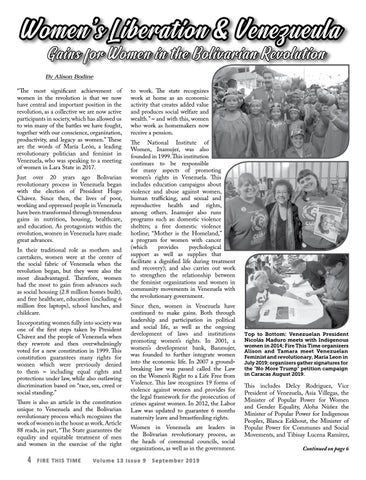
Top to Bottom: Venezuelan President Nicolás Maduro meets with Indigenous women in 2014; Fire This Time organizers Alison and Tamara meet Venezuelan Feminist and revolutionary, Maria Leon in July 2019; organizers gather signatures for the "No More Trump" petition campaign in Caracas August 2019.
This includes Delcy Rodriguez, Vice President of Venezuela, Asia Villegas, the Minister of Popular Power for Women and Gender Equality, Aloha Núñez the Minister of Popular Power for Indigenous Peoples, Blanca Eekhout, the Minister of Popular Power for Communes and Social Movements, and Tibisay Lucena Ramírez, Continued on page 6
* EN ESPAÑOL * Por Alison Bodine Traducido por Ana Laura Torres
“El logro más significativo que hemos alcanzado las mujeres en revolución es el protagonismo, la participación protagónica colectiva, lo que ha permitido ganar muchas de las batallas que hemos librado con conciencia, organización, producción, distribución y legado.” Estas son las palabras de María León, una lider política revolucionaria y feminista de Venezuela, dirigiéndose a una reunión de mujeres en el Estado de Lara en 2017. Hace poco más de 20 años comenzó el proceso revolucionario bolivariano en Venezuela con la elección del Presidente Hugo Chávez. Desde entonces, las vidas del pueblo pobre, trabajador y oprimido en Venezuela han sido transformadas a través de inmensas conquistas en alimentación, vivienda, salud y educación. Como protagonistas de la revolución, las mujeres
estaban negados, incluyendo igualdad de derechos y protección bajo la ley, a la vez que proscribe la discriminación basada en “raza, sexo, credo o condición social”.
La constitución también incluye un artículo, exclusivo de Venezuela y el proceso revolucionario bolivariano, que reconoce como trabajo las tareas de las mujeres en el hogar. El artículo 88 dice, entre otras cosas, “El Estado garantizará la igualdad y equidad de hombres y mujeres en el ejercicio del derecho al trabajo. El Estado reconocerá el trabajo del hogar como actividad económica que crea valor agregado y produce riqueza y bienestar social”. De esta manera, las mujeres que se dedican a labores domésticos ahora reciben una pensión. El Instituto Nacional de la Mujer, Inamujer, también fue fundado en 1999. La institución continúa siendo responsable de muchos aspectos relacionados con la promoción de los derechos de las mujeres
Banmujer, un banco de desarrollo de la mujer, fue fundado para favorecer más la integración de la mujer en la vida económica. En 2007 se aprobó una ley innovadora llamada la Ley sobre el derecho de las mujeres a una vida libre de violencia. Esta ley reconoce 19 formas de violencia en contra de las mujeres y establece el marco legal para el procesamiento de crímenes en contra de las mujeres. En 2012 se actualizó la legislación laboral para garantizar 6 meses de licencia por maternidad y derechos de lactancia.
Las mujeres en Venezuela son líderes en el proceso de la Revolución Bolivariana, ya sea como jefas de consejos comunales, líderes organizaciones sociales o en el gobierno. Esto incluye a Delcy Rodríguez, Vicepresidenta de Venezuela, Asia Villegas, la Ministra de Poder Popular para la Mujer y la Igualdad de Género, Aloha Núñez, Ministra de Poder Popular para los Pueblos
De izquierda a derecha: mujeres que participan en el programa "Soy Mujer" que beneficia a mujeres con pequeñas empresas; Ministra Asia Villegas Poljak, Ministra del Poder Popular para la Mujer y la Igualdad de Género y una madre; mujeres trabajadoras organizadas participan en una manifestación pública en Caracas.
Liberación de la Mujer y Venezuela Las conquistas de las mujeres en la Revolución Bolivariana venezolanas avances.
han
logrado
importantes
En su rol tradicional como madres y cuidadoras, las mujeres estuvieron en el centro del tejido social de Venezuela cuando comenzó la revolución, pero también eran las más desfavorecidas. Por eso las mujeres tenían mucho que ganar de los avances en vivienda social (construcción de 2,8 millones de viviendas), salud pública gratuita, educación (incluyendo la distribución de 6 millones de computadoras portátiles gratuitas), almuerzos escolares y cuidado infantil.
Incorporar a las mujeres plenamente a la sociedad fue uno de los primeros pasos que tomaron el Presidente Chávez y el pueblo de Venezuela cuando reformaron y aprobaron la nueva constitución de 1999 en una votación abrumadoramente a favor. Esta constitución garantiza muchos derechos para las mujeres que anteriormente les
en Venezuela. Esto incluye campañas educativas sobre violencia y abuso hacia las mujeres, trata de personas, salud y derechos sexuales y reproductivos, entre otros. Inamujer también gestiona programas tales como: refugios para víctimas de violencia doméstica, una línea telefónica gratuita de violencia doméstica; “La patria es una mujer”, un programa para mujeres con cáncer que ofrece apoyo psicológico e insumos para garantizar una vida digna durante el tratamiento y la recuperación; y también lleva adelante tareas para fortalecer la relación entre las organizaciones feministas y de mujeres en los movimientos comunales de Venezuela con el gobierno revolucionario.
Desde entonces, las mujeres en Venezuela continúan logrando conquistas, tanto a través del liderazgo y la participación en la vida social y política, como en el desarrollo contínuo de leyes e instituciones que promueven sus derechos. En 2001, FIRE THIS TIME
Indígenas, Blanca Eekhout, Ministra de Poder Popular para las Comunas y Movimientos Sociales, y Tibisay Lucena Ramírez, Presidenta del Consejo Nacional Electoral (uno de los cinco poderes del gobierno venezolano).
Otra contribución a las conquistas que han logrado las mujeres en este país fue el reconocimiento del rol de las mujeres, en particular mujeres afro-venezolanas e indígenas, en la historia y la lucha por la independencia de Venezuela. Tres de las mujeres que lucharon contra la colonización europea son hoy parte del Panteón Nacional de los Héroes en Caracas: Apacuana, Matea Bolivar e Hipolita Bolivar.
Las mujeres en Venezuela han recorrido un largo camino en los últimos 20 años, pero aún hay más batallas por ganar en la lucha por derechos e igualdad plena, incluyendo el derecho a decidir sobre
Vo l u m e 1 3 I s s u e 9
continúa en la página 6
S e p te m b e r 2 0 1 9
5
Continued from page 4
Viene de la página 5
the President of the National Electoral Council (one of the five branches of Venezuela’s government).
el propio cuerpo. En los últimos cinco años, la agudización de las sanciones, amenazas e intervención encabezadas por los Estados Unidos han hecho su lucha mucho más difícil. Las sanciones impactan desproporcionadamente a las mujeres, como figuras centrales en las familias y la sociedad. Han generado escasez de comida, medicina y productos básicos, causando la muerte a unas 40.000 personas en Venezuela solamente entre 2017 y 2018, según informa el Centro de Investigación en Política Económica (CEPR, por sus siglas en inglés).
Another contribution to the gains that women have made in Venezuela has also been through the recognition of the role of women, especially Afro-Venezuelan and Indigenous women in Venezuela’s history and struggle for independence. Three of these women, who were part of the struggle against European colonization, are now part of the National Pantheon of Heroes in Caracas: Apacuana, Matea Bolivar and Hipolita Bolivar.
Con el bloqueo a Venezuela, los Estados Unidos y sus aliados imperialistas, incluyendo a Canadá, aumentan las presiones sobre las mujeres y todo el pueblo Venezolano. Estos ataques brutales reducen el espacio disponible en la sociedad necesario para el debate y la discusión, ya que en Venezuela las personas no sólo deben enfrentarse cada vez más a dificultades cotidianas, sino también enfocar sus esfuerzos en unirse en contra de la guerra. Del mismo modo, la financiación y colaboración de los Estados Unidos y aliados imperialistas con la oposición contra-revolucionaria de Venezuela incitó revueltas violentas, asesinatos y ataques a personas sospechadas de apoyar al gobierno y el proceso de la revolución bolivariana.
Women in Venezuela have come a long way in the last 20 years, but there are still more battles to be won in their struggle for full rights and equality, including the right to choice. In the last five years, increasing U.S.led sanctions, threats and intervention in Venezuela has made their fight much more difficult. Sanctions disproportionally impact women, as the center of families and society, and they have created shortages in food, medicines and basic goods, killing an estimated 40,000 people in Venezuela from 2017-2018 alone as reported by the Center for Economic Policy Research (CEPR).
to overthrow their democratically elected President, Nicolas Maduro. However, people in Venezuela, led by women, continue to demonstrate that they are not afraid of the U.S. government or Venezuela’s violent opposition. Through organization, mobilization and participation in all sectors of life, the people of Venezuela continue to defend their revolutionary government, their sovereignty and their Through blockading Venezuela, the United self-determination. States and their imperialist allies, including Canada are increasing pressure on women As was said by Gladys Requena, an elected and on all people in Venezuela. These brutal member of the National Constituent attacks tighten the space that exists for Assembly, “Trump knows that women in debate and discussion in society, as people in Venezuela are not going to back down, Venezuela must not only increasingly focus because we know that it is a battle for on their daily hardships but must also center history, that we will not allow the Yankee their efforts on uniting against war. As well, boot to own our land because that would U.S. and imperialist funding and support strike a blow against women.” (Correro for Venezuela’s counter-revolutionary Orinoco) opposition has fueled violent street riots, As people living in the U.S. and Canada, assassinations and attacks on people that the most important thing that we can do are suspected supporters of the government is to stand with Gladys and the women and the Bolivarian revolutionary process. of Venezuela. We must educate, organize By creating frustration and tremendous and mobilize and demand that the United hardship, these callous and murderous States and their allies like Canada end the governments like that of the United States blockade and war against Venezuela. are hoping to incite the people of Venezuela Follow Alison on Twitter: @Alisoncolette
6
FIRE THIS TIME
Vo l u m e 1 3 I s s u e 9
S e p te m b e r 2 0 1 9
Al crear frustraciones y terribles sufrimientos, los gobiernos crueles y asesinos como el de Estados Unidos buscan empujar al pueblo venezolano a deponer al persidente electo Nicolas Maduro. Sin embargo, el pueblo de Venezuela, con las mujeres a la cabeza, continúa demostrando que no le tienen miedo al gobierno de Estados Unidos ni a la violenta oposición venezolana. Con organización, mobilización y participación en todas las esferas de la vida, el pueblo venezolano continúa defendiendo a su gobierno revolucionario, su soberanía y su auto-determinación. En las palabras de Gladys Requena, miembro electa de la Asamblea Nacional Constituyente, “Sepa Trump que las mujeres nos plantaremos, porque sabemos que es una batalla por la historia, que no vamos a permitir que la bota yanqui se pose en nuestra tierra porque eso lesionaría a las mujeres”. (Correro Orinoco) Como habitantes de los Estados Unidos y Canadá, el mayor aporte que podemos hacer es apoyar a Gladys y las mujeres de Venezuela. Debemos educar, organizar y mobiliarnos para exigir que los Estados Unidos y los países aliados como Canadá pongan fin al bloqueo y guerra en contra de Venezuela.
Sigue Alison en Twitter: @Alisoncolette
Voice from Yemen
Yemeni Artist Ahmed Jahaf Translated from Arabic by Azza Rojbi
photo by @mohiy.hamid
Ahmed Jahaf is an artist and graphic designer living in the Yemeni capital, Sana’a. He uses his art to raise awareness about the humanitarian crisis in Yemen and to speak up against the over 4 years long war on his country led by Saudi Arabia and backed by the United States and other western countries. The graphic showcased in this article represents some of Ahmed's work, to see more from his art visit: www.ajahaf.com and follow him on twitter @A7medJa7af This article belwo was written by Ahmed as an introduction to the upcoming book " U.S. and Saudi Arabia War on the People of Yemen" by Azza Rojbi, published by Battle of Ideas Press, Vancouver, Canada.
My child fell asleep while watching cartoons, so I carried him, tucked him into bed and went to my bedroom. My wife was asleep, the electricity went out and I couldn’t fall asleep, I opened my laptop to watch an episode of a documentary and suddenly huge explosions rocked the capital Sana’a from all sides. I couldn’t stop myself and yelled loudly while running towards my child’s room, I picked him up, I did not know where to go or what was happening so we Yemeni Artist Ahmed Jahaf went to the first floor of the house. We saw the signs of horror and confusion in the faces While the world is continuing its silence of all members of our family, the children were screaming frightened, shocked by what had paid for by the massacres in Yemen, there happened and we couldn’t even try to calm or comfort them. My brother, who was traveling were voices calling to stop these atrocities, in China, called to tell me that I like to call them the “voice of angels”, Saudi Arabia announced the those who stood with us and our suffering start of a military operation and is now bombing Sana’a. without any motives or interests, who stood with us only because they are human I could not talk to him for beings and their hearts are beating. We have much longer because of the seen many protests and demonstrations in sounds of explosions, shelling and heavy aerial flights... several countries such as Britain, France, Canada and Germany, and although their These were the first hours of number is small the echo of their actions is the night of March 26, 2015. disturbing to their governments and sends On March 26, 2015 Saudi us hope. We will never forget such stands, Arabia announced from we will not forget each organization or Washington the beginning group or even an individual that defended of military operations against humanity through solidarity and against the Yemen, and the formation oppression of the Yemeni people - either by of a coalition of more than demonstrations or by sending letters and ten countries with logistical petitions to their governments demanding and military support from to stop supporting the Saudi-led coalition, the United States, Britain or by breaking the silence and speaking up and other global powers. about this injustice in the media and social And so began the suffering media platforms. of the Yemeni people under Finally, all I wish after the end of the war bombardment from land, sea in Yemen is to invite all who stood with us and air and under the naval, aerial and land blockade on Yemen, while by contrast the arms to visit Yemen, and it will be an honor for and weapons factories all over the world began signing deals to supply arms, weapons and me to have them as our guests. This is the accessories to Saudi Arabia and the United Arab Emirates. They are making millions of least that can be done to express our love for dollars from this war while the Yemeni people are suffering from the largest humanitarian them. Yemenis and history will not forget crisis in the world, and certainly the world will not move to stop this suffering because it is their honorable stands. winning and benefiting and continuing to sign deals at the expense of Yemeni blood. We are now in the fifth year of this war, which has been paid for with the blood of thousands of Yemenis. In return, the Saudi treasury paid billions of dollars in several areas, including the purchase of weapons, the purchase of allegiances and the change of policies, and the purchase of the conscience of some human rights organizations in exchange for their silence about what is happening in Yemen. The world discovered that this Saudi-led coalition could not win any victory, so it began to use blackmail to opportunistically earn billions of dollars from it.
Battle of Ideas Press
•• Upcoming Book Release
U.S. & SAUDI WAR ON THE PEOPLE OF YEMEN
By Azza Rojbi
Azza Rojbi is a Tunisian anti-war and social justice organizer based in Vancouver, British Columbia, Canada. She is an executive member of Vancouver's anti-war coaliton Mobilization Against War & Occupation (MAWO) and a member of the Editorial Board of the Fire This Time Newspaper.
W W W. B AT T L E O F I D E A S P R E S S . C O M I N F O @ B AT T L E O F I D E A S P R E S S . C O M
FIRE THIS TIME
Vo l u m e 1 3 I s s u e 9
S e p te m b e r 2 0 1 9
7
U.S. & all Imperialists Hands Off Yemen! Why Do Imperialists Want to Split Yemen? By Azza Rojbi While children all over North America are starting the new school year, reuniting with their friends and meeting new ones, children in Yemen are being robbed of their future. According to the United Nations Children’s Fund (UNICEF) “2 million children in Yemen are out of school with few options to return to learning. One in five schools is either damaged, destroyed or being used for shelter or military purposes”. Children in Yemen and their families are suffering daily under the war that is ravaging their country. In addition to the staggering death toll of the war, now approaching 100,000 people killed, Yemen’s vital infrastructure has been targeted and schools, homes and hospitals have been completely destroyed by the Saudiled coalition’s bombing campaign. “Around 360,000 children under 5 years old are suffering from severe acute malnutrition and require treatment, with cases of acute watery diarrhoea and suspected cholera soaring in early 2019”, UNICEF reported. In the midst of this humanitarian crisis, the United Nations announced that some of their aid programs in Yemen are shutting down because of lack of funds. “The UN was forced to suspend most of the country’s vaccination campaigns in May. Procurement of medicines has been stopped and thousands of health workers are no longer receiving financial support. Plans to construct 30 new nutrition centres have been shelved and 14 safe houses and four specialized mental health facilities for women have closed. A treatment plant that purifies the water used to irrigate agricultural fields shut in June.” The main reason for this huge shortfall in funding is that Saudi Arabia and the United Arab Emirates (UAE) have failed to pay their promised pledges. According to the UN statement, if “the Kingdom of Saudi Arabia, the United Arab Emirates and Kuwait, paid in full, the
8
FIRE THIS TIME
fulfillment figure for pledges made at the Geneva conference would rise to 95 per cent.” The Saudi-led coalition, which includes the UAE and Kuwait, is not only responsible for creating the humanitarian crisis in Yemen, but they are now putting access to food, aid, water and medications at risk for millions of Yemenis. Saudi Arabia has never cared for the life or the well-being of the Yemeni people as they have been claiming. What has been achieved? The Saudi-led coalition, with the full backing of the United States, started the war on Yemen in March 2015 with the pretense of restoring legitimacy and stability to Yemen and to the
In addition to the daily bombings and killings, Saudi Arabia is imposing a sea, land and air blockade on Yemen. This blockade is causing an extreme shortage of fuel, food and medicine which has worsened the humanitarian crisis. The Saudi-led coalition has been stopping and delaying fuel tankers and ships loaded with life-saving goods from entering Yemen. Imperialist plan: dividing Yemen Yemen has been a very expensive war for Saudi Arabia and its coalition and very profitable for imperialist countries, especially the United States. They have sold billions of dollars’ worth of weapons and ammunition to the countries participating in the war. Unfortunately, this criminal war and destruction has devastated what was already the poorest country in the Middle East and North Africa (MENA) region. The people of Yemen are the latest victim of imperialist aggression and expansion in the MENA region, which started with the new era of war and occupation b e g i n n i n g with attacking and occupying Afghanistan in October 2001.
region. Saudi generals arrogantly predicted that within a few weeks they would take back control of Sana’a and reinstate to power their puppet Abd-Rabbu Mansour Hadi. As the war on Yemen is in its 5th year today, it is clear that the U.S.-backed Saudi-led coalition hasn’t achieved its goal to eliminate Houthi forces and bring back to power the illegitimate president Hadi. All that the Saudi military intervention has achieved in Yemen is death and destruction. Yemen today is “the world’s worst humanitarian crisis”, as the United Nations describes it.
Vo l u m e 1 3 I s s u e 9
S e p te m b e r 2 0 1 9
The fact remains that the imperialist plan to completely take over and control Yemen has been a huge defeat and failure. With hundreds of billions spent bombing and killing the Yemeni people, Saudi Arabia and the UAE have created a vicious cycle of bombing and more bombing with no win. The people of Yemen with their heroic resistance defended themselves and fought back for the sovereignty, selfdetermination and independence of their country. Failure to win the war in Yemen has led imperialists to a new plan, more vicious and dangerous than the first one. Now the U.S., France and the UK, the three leading imperialist powers intervening in the Yemen
Continued on page 15
Venezuela, A Revolution in Motion An Eyewitness Report from an Epicentre for Change
By Alison Bodine & Tamara Hansen
In Fire This Time Volume 13 Issue 8 we published, “Fire This Time in Caracas, Venezuela at the Sao Paulo Forum: The Only Thing that Guarantees Triumph is Unity!” with a report from the Fire This Time delegation to Venezuela in July 2019 for the dynamic international Sao Paulo Forum. Alison and Tamara, members of the Fire This Time Editorial Board, also took the opportunity while in Venezuela to spend some time outside of the forum meeting with Venezuelans and conducting interviews. This article in three parts will share some anecdotes and first-hand observations of what they witnessed during the trip. PART ONE
Why Are We Involved in Venezuela Solidarity? What is the Bolivarian Revolution?
In 1998 people in Venezuela elected President Hugo Chávez. This began the Bolivarian revolutionary process where poor, working, and oppressed people in Venezuela have made tremendous gains for their basic rights and dignity. Among many other gains: healthcare, education and housing are no longer privileges in Venezuela, but human rights. For example, healthcare, including medications, is free in Venezuela, and so is public education all the way through university. In the last five years alone, the government of Venezuela has built nearly 3 million homes that are available for free or low-cost to the most marginalized people in Venezuela through the social housing mission “Gran Misión Vivienda.”
President Hugo Chávez passed away in 2013, and since then democratically elected President Nicolás Maduro, together with the United Socialist Party of Venezuela (PSUV) has led the Bolivarian revolutionary process. During the last Presidential election in May of 2018 President Maduro was re-elected for a term of six years, receiving nearly 68% of the votes (6.3 million votes), of course some of the most right-wing parties boycotted the election and many imperialist countries, including Canada and the U.S. said they would not recognize the results. Despite this, millions of Venezuelans went to the polls in favour of their candidate, President Maduro. Throughout the past 20 years the government of the United States and
their allies (including the government of Canada) have been attempting to overthrow the democratically elected government of Venezuela and reverse the tremendous gains achieved by poor, working, and oppressed people in Venezuela. To achieve this, imperialist governments have carried out attempted coup d’états, threats of war, cruel sanctions, economic sabotage, and provided their ongoing support for Venezuela’s violent corrupt counter-revolutionary opposition. So, their support of the right-wing boycott of the May 2018 presidential elections came as no surprise.
Today, the people of Venezuela are facing an economic and financial blockade imposed by the U.S., Canada, and the European Union (EU). While these governments have tried to say that their sanctions are targeted at specific personalities or government officials, Venezuelans see it very differently. They are no longer using the term “sanctions” and now refer to this international rightwing campaign as a “blockade” and charge that an estimated 40,000 people died as a result of the blockade from 2017-2018. These statistics are backed up by a recent report by the Washington, DC-based, Center for Economic and Policy Research (CEPR), “Economic Sanctions as Collective Punishment: The Case of Venezuela”. However, this criminal blockade, combined with continuous threats of war by the U.S., and the attempted installation of their puppet Juan Guaido as “interim President” of Venezuela in January 2019 has not stopped the people of Venezuela from defending their hard-fought-for sovereignty, independence, and self-determination. Having the opportunity to see Venezuela first-hand left us clearer than ever before that the people of Venezuela are mobilizing to defend the Bolivarian revolutionary
Top to Bottom: Alison and Tamara of Fire This Time at the rally in Venezuela with compañeros Tulio, Marcos & Semprún; visting the Otra Beta centre in Petare; Visting with construction workers building their own housing complex as part of the Venezuelan housing mission, or "la Gran Misión Vivienda" with City Counsellor Jimmy Guidiño; Clothing studio at the el Panal commune.
FIRE THIS TIME
Vo l u m e 1 3 I s s u e 9
S e p te m b e r 2 0 1 9
9
process and the democratically elected government of President Maduro. Although their voices are deliberately eliminated by mainstream media in the U.S. and Canada in order to justify the regime-change agenda of imperialist governments, talking to people on the streets of Caracas we experienced their determination and their courage firsthand.
Throughout our trip, many Venezuelans approached us wanting to explain why they support the Bolivarian Revolution in Venezuela and President Nicolás Maduro. It became clear that Venezuelans who support the revolution understand that the media outside of their country – especially in the U.S., Canada, and Europe – is portraying the government of Nicolás Maduro as a dictatorship and accusing his government of a multitude of democratic and human rights violations. Around the Sao Paulo Forum, and also in visits to different areas outside of the Forum, many Venezuelans approached us for the explicit reason of explaining why they are personally invested in supporting the Bolivarian revolutionary process and asking us to share everything we saw and heard with people when we returned to Canada. Each of these encounters reminded us of the importance of building an international movement in solidarity with the people of Venezuela for their self-determination and their right to continue building their revolutionary Bolivarian project. Grassroots and Mass Support for the Revolution
On July 27 a march and a rally were held against U.S. imperialism in Latin America as part of the Sao Paulo Forum. As thousands of people marched down the streets of Caracas towards the front stage, the mood was defiant, but also festive and joyful. There were giant Venezuelan flags, printed and hand-made signs of all sorts, and people in costumes performing street theatre. This may come as a surprise to people in North America, but we did not see violence or fear, instead, we saw a people full of strength and determination. Despite hardships and shortages – brought on by brutal U.S. sanctions and right-wing sabotage of Venezuela’s economy – people from all walks of life used their Saturday to take to the streets with friends, family, and co-workers; to listen to revolutionary music and political speeches; and to show the world that they will fight to defend their independence and sovereignty. As the march approached, we stood on the side of the road with the Fire This Time banner, which features an image of Cuban revolutionary Che Guevara. Dozens of
10
FIRE THIS TIME
Venezuelans stopped and came over to ask to take photos with us and to know where we were from. We made many friends who accompanied us during the rally: Marcos, Semprún, Hernan, and Elba who reminded us to wear our backpacks on our fronts to discourage petty theft and invited people over to take photos with us. Elba is a hotel worker and Chavista (a supporter of the Bolivarian
also goes well beyond that, by providing services for free and teaching members to create things they are able to sell through a bakery and clothing factory, in order integrate production and make the centre more sustainable in the long-run. El Panal 2021, which today includes about 10,000 families, was started with resources from the revolutionary government, and Photo of the construction workers building their own housing complex as part of the Venezuelan housing mission, or "la Gran Misión Vivienda" that Tamara met in Antimano.
revolutionar y process). She was a petit woman who jokingly volunteered to be our “Guardaespalda” (bodyguard) staying with us for about two hours. Like so many others, she wanted to know what the media says about Venezuela in Canada and to tell us about the challenges and gains she has seen through the revolution. We shared snacks, political materials, and she gave us some of her handmade soap, all that she asked of us was that we let people in Canada and the U.S. know about the reality in Venezuela.
We also had the chance to visit many community projects throughout various municipalities in Caracas (a city with a population of about 3 million people), specifically: El Panal 2021 commune and “La Estafeta” cultural centre both in the Libertador Municipality, and the Comuna Apacúana and the “Otra Beta” Movement Centre both in the Municipality of Sucre.
The “El Panal 2021” commune is in the hills below the Cuartel de la Montaña, where President Hugo Chávez is buried. The commune and the 23 de Enero neighbourhood where it is located, are known for their revolutionary spirit and high level of organization, which was apparent throughout the commune, not only within the presentations we received, but also painted on to the walls for all to see. In some ways, an urban commune such as El Panal 2021 can be compared to a community center or a neighbourhood house, with programs ranging from classes for seniors, to recreational activities, to skillsharing workshops. However, the commune
Vo l u m e 1 3 I s s u e 9
S e p te m b e r 2 0 1 9
today is working towards becoming a self-sufficient community. In fact, the clothing factory which now produces a range of products, including the backpacks that are distributed to children in Venezuela free of charge, was the initiative of President Hugo Chávez. The commune has also recently purchased a generator for the community, which will ensure that the community radio and other services, including the Misión Barrio Al Dentro health clinic (which provides free, primary care services to the community, in cooperation with the Cuban medical mission in Venezuela), will continue to have power during blackout periods.
The Comuna Apacúana is a much newer and smaller commune then El Panal. At the Comuna Apacúana, Alison attended a Sunday morning weekly planning meeting and educational session for their urban agriculture project. This commune formed two years ago when a large house in the neighbourhood was left abandoned. People from the neighbourhood took it over, turning the house into a community centre and the grounds into a garden that enables the community to better confront U.S. sanctions and economic sabotage. All kinds of people were at the meeting: students, teachers, retired people and families, ready and willing to learn about urban agriculture and work together to build their community. It was a beautiful experience to see people taking an active role in their lives and in the Bolivarian revolutionary process, where one of the most present impacts of the past twenty years is that poor, working, and oppressed people in Venezuela who never had a voice, or a mechanism to work together to achieve gains in their communities are now armed with the resources, knowledge, and confidence that they need. END OF PART ONE
Follow Alison on Twitter: @Alisoncolette Follow Tamara on Twitter: @THans01
FIRE THIS TIME INTERVIEWS
Revolutionary Venezuelans
How U.S. Aggression and Sanctions Violate and Undermine the Human Rights of Venezuelan People While in Caracas, Fire This Time had the chance to interview two revolutionary Venezuelans about the conclusion of the international Sao Paulo Forum; the impact of the unjust economic blockade on Venezuela; and about their message for people living in Canada, the United States, and around the world. First, we spoke with Lucrecia Hernández who coordinates a nongovernmental human rights organization, SURES. Secondly, we interviewed Victor Salcedo, an organizer with the JPSUV (Youth of the United Socialist Party of Venezuela) who is in charge of international relations of the JPSUV in the state of La Guaira, this was his second interview with Fire This Time, to read his first interview please see Fire This Time Volume 13 Issue 5 (May 2019).
Fire This Time: Lucrecia, thank you for being here with Fire This Time. Do you want to introduce yourself?
Lucrecia Hernández: My name is Lucrecia Hernández. I run a social human rights organization called SURES. We work and study the issue of human rights in general and principally the issue of political violence by the opposition in the country.
FTT: After the Sao Paulo Forum - where Venezuela invited thousands of people from all over the progressive world to join in working and planning the tasks of the antiimperialist movement - What do you see as the achievements of the Forum and what do we need to do next?
LH: I believe that one of the fundamental achievements is that we get together, that we meet and are able to see each other face to face. To be able to discuss and strengthen ties, not only through social networks or in a virtual way, but also to communicate, to feel each other, to hug, and to express our solidarity directly. I think that the forum was very important. I congratulate the forum due to the participation of social movements and as with the previous the forum where we built an agenda of dialogue with political parties to put forward a plan for our struggle, a plan for common struggle related to different issues. From actions to how to strengthen joint mobilizations and how solidarity goes in both directions, not only towards Venezuela, but also how social movements and organizations in Venezuela want to express our support for struggles in other countries. I think there was an important advance in this aspect. I also believe that we made important
advances in our communication and political development. Social movements discussed and set a common action plan and strengthened the formative aspect of our organizations. In exchanges we learn about experiences from different places. We often have little Lucrecia Hernández, Venezuelan lawyer and director of the information about Venezuelan Human Rights group SURES speaks at a forum on what is happening in Human Rights in Caracas on July 29, 2019 the United States or had, but today the impact is very real. We what is happening also feel it because most of the food was in Canada, and when the agenda allows for imported, also medicines were imported, these exchanges our social movements, and these necessities came from countries that the youth of our countries, can learn about have imposed the sanctions, from the U.S., experiences in Canada and the United States. from Canada, from Switzerland. Now we So that they see that the American dream must rebuild Venezuelan imports, look for does not exist. That in the U.S. there are also new markets, look for new routes, search difficulties, there is an economic situation for ships that can bring medicines and food. that is very difficult and complex for the most Because those ships and those entrepreneurs disadvantaged classes. have also had sanctions imposed against them. FTT: Well, you have already answered part So, we must rebuild the entire structure to be of my second question, but I want to ask you able to give satisfaction to the Venezuelan more specifically about the sanctions, not people. There is a real impact, but there is also only by the United States, but also Canada a very strong path being developed by social and Europe. How do they have an impact on movements to confront that impact and to the daily lives of Venezuelan people? advance the struggle of the Venezuelan people of solidarity, of all the alternative methods LH: Yes, since 2014 our organization, along that we have been developing in this battle with other human rights organizations, against the bullying economic measures that have been denouncing this situation. Today the governments’ of North America have been we are becoming a platform against the forcing on our country. economic blockade on Venezuela. We have been denouncing – both in national and FTT: Thank you, your answer gives us a international arenas and in multilateral good idea of our great task, which is to organizations – the impact that these sanctions confront that economic blockade against have had on the lives of revolutionary people, Venezuela. My final question is how people on the daily lives of all people, in terms of in Canada, the United States, Europe and their right to food, health, and all socioaround the world can stand in solidarity economic developments in the country. They with the Bolivarian process and with the have tried to create the idea that the sanctions Venezuelan people? are only aimed at public officials, but most of LH: Of course, it is important that they come the sanctions are impacting both public and to see Venezuela for themselves. Let them private companies in our country and are see that Venezuela is a place of peace, it is impacting the main industry of the state, that a people of peace. Let them come to know is the oil industry de Venezuela, which is the the experience of how our communities are one that produces all the profits that the state resisting. Then that they take that message requires for social investment to develop social back to their countries and help us with the programs. dissemination of this campaign against the The issue of the exact impacts is complex. blockade so that more and more voices are As social movements, we have been trying added to this campaign against the economic to systematize the impact the blockade has blockade from the communities, from FIRE THIS TIME
Vo l u m e 1 3 I s s u e 9
S e p te m b e r 2 0 1 9
11
grassroots organizations, and from social movements all over the world. We would also like your support in the United Nations and the OAS (Organization of American States) to raise your voices against the criminal, unfair, and illegal blockade that continues to weigh on our country. FTT: Thank you very much, on behalf of Fire This Time we are super grateful that you were able to be here with us for a few minutes. LH: For us it is an honor, a pleasure and all the love of the Venezuelan people to you. FTT: Thank you!
VS: Look, as you just said, I think the twentyfifth edition of the Sao Paulo Forum was successful. It has given us positive results and we are now able to link the Latin American left movements together with the rest of the world, in the fight against imperialism, against foreign aggression and in favor of the self-determination and the independence of the peoples. This event, precisely, leaves us with a task that is to consolidate that network, that foundation, which must be permanent, must not be temporary, these must be permanent to fight together against imperialist aggression. We must be able to fight until we win.
Venezuela and tells them firsthand what is happening here in Venezuela, and what our people fight for – because obviously we are in struggle – it will be a daily fight we will finally win. FTT: Thank you Victor.
Follow Alison on Twitter: @Alisoncolette Follow Tamara on Twitter: @THans01
FTT: We now know that sanctions and the blockade against Venezuela - not only from the United States, but also Canada and Europe - have an impact on Venezuela. Can you tell us a little about the impact on the daily life of Venezuelans?
VS: Of course, there is an impact. Indeed, unilateral coercive measures affect ordinary citizens, Venezuelan people, who are the ones who are hit by the consequences of this imperialist aggression. Obviously it impacts our An Instagram post by Victor Salcedo with Alison everyday life, because the food that is Bodine of Fire This Time, at the International Sao distributed through the CLAP [Local Paulo Forum in Caracas, Venezuela, July 2019 Supply and Production Committee], an institution founded by our president Nicolás Maduro, is affected because, Victor Salcedo with Tamara Hansen of Fire for example, I’ll make the figure clear: of the This Time, at the International Sao Paulo 8 or 10 shipping companies that bring food Revolution & Counter Revolution Forum in Caracas, Venezuela, July 2019 here by boat, are only one or two are coming in Venezuela a month because they receive pressure. Those Fire This Time: Thank you for being companies that dare to disobey the orders here with Fire This Time once again! of the empire are hit by sanctions. Indeed, First, can you please introduce it impacts the lives of Venezuelans, because yourself and your work here in through that food subsidy Venezuelans can Venezuela and in Vargas. buy products at very low prices, very low. That food may not longer arrive, or it does not arrive Victor Salcedo: How are you Tamara? A as often as it arrived one or two years ago after greeting to all our friends of Canada, please the CLAP project was created. This is a result send my thanks to them for their ongoing of imperialist aggression. I believe that the solidarity there in Canada and in Vancouver. empire is increasingly digging its claws into A fraternal and supportive hug for you all. Venezuela and the Venezuelan people. We are My name is Víctor Salcedo, I am a young telling them to leave us alone. Do you want us person who belongs to the JPSUV (Youth of to be free? Well, lift all the sanctions, repeal the United Socialist Party of Venezuela) and I the sanctions so that they can see how the am in charge of international relations of the Venezuelan people can truly solve their own JPSUV in the state of La Guaira. In addition, problems internally and without any tutelage I currently work in the Mayor’s Office with of any empire or any country. an international relations project that will By Alison Bodine help us connect ourselves internationally with FTT: How do you think the people of North Writer and researcher on Venezuela. She is movements, delegations, and political parties America, Europe and also of the whole a member of the Fire This Time Newspaper allied to the Bolivarian Revolution and to world can support the people of Venezuela Editorial Board and is the coordinator of receive them here in La Guaira. and work towards ending the sanctions? the Fire This Time Venezuela Solidarity Campaign. Alison Bodine is an electrical FTT: Perfect! You participated with us in the VS: What I think is necessary are permanent designer based in Vancouver, Canada. Sao Paulo Forum which was very successful meetings and events. That you come here for Venezuela, to unite progressive people October 2017, paperback, $10.00 to Venezuela, see the reality of people in 190 pages, illustrated, ISBN 978-0-9864716-5-0 from many parts of the world. How do you Venezuela, so that you can return to your Copyright © 2016 by Battle of Ideas Press foresee the work continuing or what do you countries to share that truth. To have the think are the next steps after this successful people, in this case Canadian people, hear W W W. B AT T L E O F I D E A S P R E S S . C O M forum? from you, their fellow citizen who has visited I N F O @ B AT T L E O F I D E A S P R E S S . C O M
Battle of Ideas Press
••
12
FIRE THIS TIME
Vo l u m e 1 3 I s s u e 9
S e p te m b e r 2 0 1 9
WHY VENEZUELA SOLIDARITY ACTIVITIES ARE OUR CENTRAL CAMPAIGN AGAINST IMPERIALISM WORLD PROTEST DAY DEMANDS HANDS OFF VENEZUELA IN VANCOUVER AND AROUND THE WORLD! By Janine Solanki The U.S. government has been using escalating methods to force “regime-change” in Venezuela, and to bring the independent, sovereign nation under U.S. imperialist control. The U.S. has engaged in economic warfare, with sanctions that amount to a blockade of Venezuela. This blockade limits Venezuela’s access to imported food and medicine, impacts their ability to trade on the world market, and prevents exports of their resources, particularly oil. A recent report by the Center for Economic Policy Research (cepr.org) also put the malicious intent of the U.S. blockade into figures, finding that U.S. sanctions amount to “collective punishment” and have been responsible for over 40,000 deaths between 2017 and 2018. This brutality is increasing, and on August 5, 2019, U.S. President Trump signed yet another executive order imposing further sanctions against Venezuela. Since January 2019 the U.S. has also tried, and failed, to conduct a coup against the democratically elected Venezuelan President Nicolás Maduro. While the attempted coup was directed by the U.S. government and backed by their right-wing allies, it was defeated by the Venezuelan people who defended the Bolivarian revolution and their democratic process.
Lilly, a youth activist who was part of the New York City protest in Grand Central Station, organized by the Alberto Lovera Bolivarian Circle. Dakotah reminded activists of the many other countries that have been victim to U.S.-backed coups and right-wing governments, and that we will not allow this to happen to Venezuela “like it has happened in Honduras, like it has happened in Argentina, and like it has happened in Chile.” Alongside the demands of “U.S. Hands Off Venezuela!” protesters also demanded that all charges be dropped against members of the Embassy Protection Collective. The activists were arrested by the U.S. government in their heroic defense of Venezuela’s
Continued on page 30
SUPPORT THE EMBASSY PROTECTORS DEFENSE COMMITTEE! Collecting funds for the Embassy Protectors who defended the Venezuelan Embassy in Washington, DC from U.S. government sponsored pro-coup Venezuelans for 37 days in the Spring of 2019.
Funds will go toward legal defense for the four members of the Embassy Protection Collective that have been charged with “interfering with protective services” and now face up to a year in jail and up to a $100,000 fine, as well as other supporters.
https://defendembassyprotectors.org
As a blockade and attempted coup have not succeeded to bring Venezuela under U.S. domination, the U.S. threats of military intervention are becoming more and more dangerous. The White House press statement on August 6, 2019 didn’t mince words and said, “as the Trump Administration has made clear: All options are on the table.”
Now more than ever is a critical time to defend Venezuela against sanctions and further imperialist attacks. August 10 was called as a “World Protest Day”, with massive demonstrations that took place in Venezuela and actions by supporters of the Bolivarian revolution around the world. Demonstrations took place across the U.S., in Canada, as well as in Australia, France, Aruba, South Korea, Haiti, Turkey, Italy, Germany, Dominican Republic, Argentina, and Mozambique, along with other countries.
Here in Vancouver, activists and peace-loving people joined the global efforts with an action on August 9th. While part of the World Protest Day, the action is also organized every month by the Fire This Time Movement for Social Justice Venezuela Solidarity Campaign. The protest kicked off in downtown Vancouver, with picketing and chanting in front of the U.S. Consulate. Between rounds of picketing, activists gathered to hear from speakers including a solidarity message from Dakotah
FIRE THIS TIME
Vo l u m e 1 3 I s s u e 9
S e p te m b e r 2 0 1 9
13
Puerto Rican unity drove out Rosselló next up La Junta and colonialism By Graciela Pichardo On the night of July 24, Puerto Ricans who had been protesting for hours in San Juan began to chant a victorious “Olé Olé Olé” as they celebrated Ricardo Rosselló’s resignation — a victory for the people, and won by the people. Ricardo Rosselló announced via Facebook Live that he would resign from his position as governor of Puerto Rico as of August 2. It is a remarkable change for a governor who just days prior had insisted he would never resign. The tenacity and unity of the Puerto Rican people — in the face of considerable repression — made him eat his words.
The Puerto Rican people’s massive struggle exposed not only Rosselló but increasingly called into question the Puerto Rican political establishment as a whole, and the colonial dynamic on which its authority rests. It is no wonder why so many in that establishment, including his own party, abandoned him. But the genie cannot be put back in the bottle. Having tossed out Rosselló, the people will not simply go home, but now turn towards the undemocratic junta — banks that control the the island’s finances and budget — and ultimately the question of Puerto Rican independence comes the forefront as well. This victory comes just before the 67th anniversary of the day Puerto Rico became a “free associated state” of the United States. One protestor told the Washington Post, “We are the generation that does not give up, and we will keep on moving forward, and we will remove all the corrupt that think they cannot be removed. This is simply the beginning of a new era.” Just days ago over half a million people flooded the streets of Las Americas Expressway in San Juan in a national strike demanding Ricardo Rossello’s resignation. The national strike which was called on July 19 came after Rosselló had issued a statement via Facebook live on Sunday where he resigned from his position as President of his political party, and announced that he would not seek reelection (while refusing to resign as governor). He declared he would confront the impeachment process started by the Legislative Assembly. Clearly, Rosselló was hoping these promises would end the protests, but he just enraged them further. The hypocrisy of Rosselló’s words promising “truth” and “responsibility” mirror the farce that has been his governorship. The Puerto Rican people have had enough. Laura Rodriguez a teacher from Caguas attending the national strike told the LA Times, “He has disrespected us,” she said. “But the pueblo — the people he has abandoned — we will keep packing the streets until he’s
14
FIRE THIS TIME
gone.”
In their recently released song “Afilando los Cuchillos” (Sharpening the Knives)- rappers Bad Bunny and Residente capture the outrage and anger of the Puerto Rican people and their willingness to fight back against injustice. The song’s chorus describes the Puerto Rican people as sharp knives ready to cut the weed from the soil, vowing to never let anyone take advantage of what is theirs. And indeed, since July 14, united under the hashtag #RickyRenuncia, people old and young have poured into the streets of San Juan with their placards, drums and flags, chanting while being tear gassed and shot at with rubber bullets by the police, to demand that Rosselló resign from office. Celebrities, like Ricky Martin, Bad Bunny and Residente have all joined the protests using their international fame to ask for Rosselló’s resignation and to call people to the streets. The mass protests were ignited by Rossello’s refusal to resign after the Center for Investigative Journalism of Puerto Rico released 900 pages of a Telegram chat Rosselló had with other government functionaries where they made misogynistic, homophobic and transphobic remarks and conspired against other politicians.
Rosselló and his cronies went so far as to wish death upon San Juan Mayor Carmen Yulin Cruz and threaten to give House Representative Manuel Natal a public lesson for his criticisms against the government. They made fun of the thousands of people that died due to Hurricane Maria. When asked about the forensics budget the governor replied, “And now that we are on that subject do we have any extra bodies to feed our crows?” But the leaked information was just the tipping point for the Puerto Rican people who had long been disillusioned and outraged by the mismanagement of the local government. Immediately following Maria the local and federal government failed to provide aid to
Vo l u m e 1 3 I s s u e 9
S e p te m b e r 2 0 1 9
the people. To this day Donald Trump will say that the death toll of Maria was 64 and it took Rosselló a year to admit that the death toll wasb higher 64 and elevate it from 64 to 2,975.
Their improper assessment of the death toll led to more deaths, lack of aid and adequate resources for the Puerto Rican people. Almost two years after Maria, Puerto Rico is still struggling to get back on its feet, the economic crisis has worsened, crime rates have increased and thousands have left the island.
The incompetence of Rosselló and La Juntathe U.S. appointed fiscal board- have only escalated since Maria. Corruption scandals have plagued the local government. In June Julia Keleher, the former education secretary who closed down 400 schools because Puerto Rico did not have enough money, and Ángela Ávila Marrero, the former executive director of the Puerto Rico Health Insurance Administration, and four other government officials were indicted for redirecting about $15.5 million in federal contracts to politically connected consultants.
A federal investigation has been launched into Unidos por Puerto Rico, the non-profit created by Beatriz Rosselló to manage donations from Hurricane Maria after Rossello was accused of asking accounting firm BDO to change reports regarding missing freights with donations because it made his wife look bad.
Rosselló denied all fraud accusations and in a statement following all the arrests said, “The agenda of this Government does not stop, despite those who have incorrectly decided to treason the trust of the People.” But ultimately it was Rosselló who was found to have committed treason against the trust of the people — they proved that in the streets. For that reason the people of Puerto Rico, in the mainland and in the diaspora, drove him out. Published July 25, 2019 From Liberation News: www.liberationnews.org
Continued from page 8
war, have started a new course which is basically to divide Yemen into north and south. This plan will only bring more war and devastation to the people of Yemen. The U.S. and their allies, including their puppets Saudi Arabia, UAE and their coalition have had some initial success in the south of Yemen by taking over the major city and port of Aden and consolidating their presence in that area. Since they are unable to win against Houthis in the north, imperialists are now shifting to a new plan to consolidate a new lackey government in the south of Yemen and immediately reinforce and accelerate all kinds of sanctions and the blockade of the north. This plan helps the United States and other colonial powers to completely dominate and control access to the Arabian Sea and a big part of the Red Sea. Furthermore, with imposing severe sanctions and blockade they will try Red Crescent workers collected bags containing the bodies of victims of the to bring the Houthi government to its knees to accept the Saudi-led bombing on a detention centre in Dhamar, Yemen on September 1, 2019. More than 100 detainees were killed and about 40 others wounded imperialist hegemony of the U.S., France and UK over the in the attack. Arabian Sea, the Red Sea and the Horn of Africa. This is all part of a very important strategic area for imperialists to All Foreign Troops Out of Yemen have a permanent presence in, as one of the world’s most important Dividing Yemen and arming and training different factions and trade and shipping routes. mercenaries will bring more chaos, death and destruction to the country. In early August, clashes and infighting erupted in Aden between the It will weaken Yemen in favor of serving the agenda of the United States Saudi-backed forces and the UAE-backed ones over who has control and imperialists in the region. of the city. Both Saudi Arabia and the UAE have spent millions of The Yemeni people have been heroically standing up against the foreign dollars training and arming different factions and mercenaries in war and intervention in their country. A future of peace and prosperity Yemen. This is only creating more chaos in the country and further can’t be achieved in Yemen by imperialist foreign intervention and pushing the agenda of dividing and destabilizing Yemen. occupation. The United States and its allies have only a history of The division between Saudi Arabia and the UAE is a fight between destruction, war and occupation to show for, and their plan for Yemen is two lap dogs fighting over leftover bones, in this case after dividing no different. A solution to the crisis in Yemen needs to be local, involving Yemen in two, who gets to rule the south. It is a fight between puppets Yemeni voices without any foreign interference or meddling. This is why about who will better represent and serve the interests of the U.S. and our role is important as people living in imperialist countries such as its imperialist allies in region. the United States and Canada, to voice our opposition to the Saudi-led war on Yemen and to hold our respective governments accountable for having Yemeni blood on their hands. U.S., Saudi and UAE Stop the War on Yemen! End the Blockade of Yemen! No to a divided Yemen!
Follow Azza Rojbi on Twitter: @Azza_R14
Silence Is A disgrace Excerpt from a poem by Khalida Al-Nasiry*
The chains of evil cannot be broken by poetry, I will certainly knock down the corners of my enemies, And the injustice in my homeland will not last long. The pulse of my heart will tweet with dreams, And the blood of those who have been killed will make a revolution, A white revolution that will rise up against those who infringed the dignity,
Khalida al-Nasiri: (B. 1986) is a poet from Sana’a, Yemen. She holds a degree in Arabic literature from Sana’a University. Khalida’s poem represented the voices of Yemenis against the intervention of Saudi in Yemen. To read the full poem and other poems by Young Yemenis visit: www.shatteredwindows.com
FIRE THIS TIME
Vo l u m e 1 3 I s s u e 9
S e p te m b e r 2 0 1 9
15
“ SHUT YOUR MOUTH.
I’M NOT JUST OLDER THAN YOU, I’M OLDER THAN YOUR STATE.” END THE OCCUPATION OF PALESTINE! SELF-DETERMINATION FOR PALESTINE! WWW.FIRETHISTIME.NET
“ SHUT YOUR MOUTH.
I’M NOT JUST OLDER THAN YOU, I’M OLDER THAN YOUR STATE.” END THE OCCUPATION OF PALESTINE! SELF-DETERMINATION FOR PALESTINE! WWW.FIRETHISTIME.NET
It must be noted that there are two glaring absences from the calculations related to greenhouse gas emissions used to claim that Canada doesn’t have a stake in the climate crisis. The first is emissions from the Canadian Armed Forces and the Department of National Defense, which are not included in calculations (nor, for that matter, in any GHG calculations that are used in international agreements like the Paris Agreement). The second is that just because tar sands oil isn’t burned in Canada doesn’t mean that its emissions shouldn’t be counted towards Canada’s impact.
Continued from page 2
The short answer is no. The Journal of the National Academy of Sciences of the United States of America has put the answer to this question simply as, “the wealthiest one billion people produce 60% of GHGs [Greenhouse Gases] whereas the poorest three billion produce only 5%.” As a study from the charity Christian Aid reports – “a person in the UK has a carbon footprint that is 200 times larger than a person in Burundi, the world’s most food-insecure country.” The U.S. military is the world’s biggest consumer of fossil fuels and the world’s biggest polluter, while at the same time being responsible for the complete destruction and poisoning of entire countries, and the murder of millions of people throughout the Middle East and North Africa. These are just three examples of many. Despite this, the Financial Post here in Canada and other media outlets continue to promote the dangerous idea that not only does Canada not significantly contribute to global warming, but also that Canada would benefit from climate change. In a special article penned by none other than the former Minister of Natural Resources under the Conservative Harper government Joe Oliver, the idea that due to warmer temperatures “Canada would have a wonderful opportunity to help feed a hungry world,” is presented as a real argument. In fact, worldwide scientific opinion is clear – massive hunger will only be one of the major crises facing humanity if the global temperature rise exceeds 1.5˚C. Not to mention that with warmer temperatures will also come flooding and droughts, which will have an impact on the ability to grow food. When trying to understand the impact that Canada has on global warming, it is important to realize that rich and developed countries like Canada outsource their environmental impact. This means that people in the U.S. and Canada enjoy relatively pollution-free environments, clean water (not counting Indigenous reserves in Canada; or Flint, Michigan and Pittsburgh in the U.S., among others) and breathable air. Meanwhile, millions of people around the world that live where goods are produced,
18
FIRE THIS TIME
Even without these, Canada is, perperson, the highest GHG emitter in the world (World Resources Institute). Canada’s transportation sector and buildings produce emissions that are four times the G20 average; each person in Canada produces 22 tonnes of greenhouse gases per year, three times the G20 average. Canada may have a relatively small population and a large landmass, but its climate-impact is great. 2. Are the “solutions” that the capitalist system is offering enough to really address the crisis for humanity at hand?
Photos bottom to top: Amazon burning in Brazil; Oil Tar Sands in Alberta, Canada
from clothing to electronics and more which people in the U.S. and Canada buy, live surrounded by contaminants and poisons. Additionally, any time that an argument is made that global warming will be good for the economy in Canada, it is also important to ask the simple question, who will benefit? For this, the only answer from Joe Oliver and his cohorts would be the ultra-rich oil and natural resource extraction executives they count among their closest friends and allies. It is certainly not poor, working and oppressed people in Canada that he is thinking about.
Vo l u m e 1 3 I s s u e 9
S e p te m b e r 2 0 1 9
This is the question that must be asked when more funding for forest conservation is presented as a solution to the burning of the Amazon. This question is also an important one to be asked about the “Climate Change and Land: Report on climate change, desertification, land degradation, sustainable land management, food security, and greenhouse gas fluxes in terrestrial ecosystems” report published by the Intergovernmental Panel on Climate Change (IPCC) on August 8, 2019. Taken as a whole, this report is another alarming reminder of the climate crisis, focusing on how the way that humans use and exploit land impacts climate change. This new report was compiled by a team of 107 experts from 52 countries. They present scientific evidence and analysis of the various ways that human’s land-use effects the climate. In the end, the report offers 40 generalized recommendations for how the impact of human land-use on climate changed can be minimized. For example, one part of the report
describes the impact of food waste. “Currently, 25-30% of the total food produced is lost or wasted.” Clearly, the over-production of food in some parts of the world and severe malnutrition in other parts of the world would contribute to GHG emissions and climate change in many ways.
resulting from the belief that to have more is to live better; to pollutant production of disposable goods to enrich capital, increasing the ecological footprint; as well as the excessive and unsustainable extractive use for production of renewable and non-renewable natural resources at high environmental costs.”
Here too, Canada is no shining star. Each year it is estimated that $49 billion in food is lost or wasted in Canada each year, as reported by Second Harvest, a food rescue charity.
Building a Mass Movement to Confront the Climate Crisis
So, the question is, if food waste is such a problem, can the capitalist system fix it? Although it might be someone’s first assumption that wasted food is equal to wasted money, that not the case. Under capitalism food is produced for profit, not based on human need, and food is left to rot in fields in order to raise prices and increase profits. Or, food that is not aesthetically pleasing enough to fetch a price is thrown away, rather than sold. These are just two ways that the capitalist system ensures that food is wasted. These are fundamental problems that better technology cannot fix. This also applies to other solutions examined by the IPCC such as sustainable land management and the diversification of the food system. How are any of these measures possible under a system where profit will always come before people’s needs? Largescale farms, mono-cropping, the use of pesticides, deforestation - these are all the opposite of what the world needs today, but they are exactly what the capitalist system needs in order to satisfy its insatiable demand for profits and new markets. As Evo Morales, the revolutionary President of Bolivia stated in 2012, “The causes of this climate crisis are directly related to the accumulation and concentration of wealth in a few countries and in small social groups; to massive, excessive and expensive consumption
From the IPCC report to the increased burning of the Amazon, every day there is more and more evidence that what the world needs today is system change, not climate change. To get there, we need to build a mass movement in opposition to the devastating anti-environment and anti-human policies that are being imposed on poor, working and oppressed people by capitalist and imperialist governments around the world. In Canada, this means doing everything that we can and encouraging everyone to get involved in building a movement against the government of Canada’s disastrous environmental policies. Urgently, people from all walks of life must stand against the government of Canada’s purchase and approval of the Trans Mountain Pipeline Expansion in British Columbia. It is not acceptable for the government of Canada to turn a blind eye on the fact that they are nowhere close to being a “climate leader,” and equally far from meeting the climate emissions targets that they agreed to in the already modest Paris Agreements. Through united protests, petitioning and other forms of direct action we must make this known. Climate Educate
Strike:
Organize,
Mobilize,
From September 20 – 27, 2019 people around the world will be participating in a Global Climate Strike, led by the students of the Fridays for Future movement. These actions must be fully supported by all who believe that a better world is not only possible – but necessary for the future of humanity on Mother Earth. For more information on actions in Canada visit: www.climatestrikecanada.org
Protest in Rio de Janeiro, Brazil. August, 2019.
Follow Alison on Twitter: @Alisoncolette FIRE THIS TIME
MOTHER OF ALL STRUGGLES! Indigenous struggle against colonialism
Howard Adams (Métis) 1921 - 2001
Revolutionary Métis Marxist scholar and professor Howard Adams grew up in a Métis community in Saskatchewan. He was a leader in the struggle for Indigenous rights, selfdetermination, and socialism.
“Divide and Rule” is a basic method of oppressive action that is as old as imperialism itself. Since the colonizer subordinates and dominates the rankand-file natives, it is necessary to keep them divided in order to remain in power. The oppressor cannot permit himself the luxury of tolerating the unification of indigenous people, which would undoubtedly cause a serious threat to the status-quo rule. Accordingly oppressors prevent any method and any action by which the oppressed could be awakened to the need for unity. Concepts such as unity, organization and struggle are immediately labeled as dangerous. These concepts are dangerous to the oppressor because he knows they are necessary for actions of liberation. It is in the interest of the colonizer to continuously weaken the oppressed, to isolate them, to create and deepen rifts amount them. This is done be various means, from repressive methods of police action to forms of cultural imperialism and community action programs. The colonizer manipulates the people by giving them the impression that they are being helped, e.g., community development programs, free education, etc. Excerpt from Prison of Grass – Chapter 14 “The Failure of Native Leadership”
Vo l u m e 1 3 I s s u e 9
S e p te m b e r 2 0 1 9
19
Continued from page 3
who is running in the Burnaby North riding for the NDP in the upcoming Federal election, among others. These speakers delivered a powerful and united message to Trans Mountain and the Federal government – this dirty tar sands pipeline will not be built! Returning to Westridge Terminal at the foot of Burnaby Mountain was the next step in building an ongoing campaign against TMX that can stop the pipeline construction right in its tracks. From September 20-27, 2019, here in BC, across Canada and around the world, there is another important opportunity to be out on the streets fighting for our future and showing the power of united action. Build Our Future – Not a Pipeline! Youth in Action! This week of Global Climate Strike actions
has been called by the Fridays for Future movement that was begun by 15-year-old Swedish climate justice activist Greta Thunberg. One year ago, she started a one-person climate strike in front of the Swedish Parliament, and today she leads Top: Climate Convergence Rally, Vancouver, p r o t e s t s Canada. September 2018. Above: Vancouver poet of tens of Rita Wong is arrested on Burnaby Mountain t h o u s a n d s Peacefully protesting against the TMX pipeline a r o u n d in August 2018. Over 200 people were arrested the world. that summer during protests. In August 2019 Rita was unjustly sentenced to 28 days in jail for her During the actions. last Global Vancouver, it is urgent that we come together Climate Strike on to support the students and participate in May 24 there were the September 27 action. Whether it is the protests in more than Federal government spending $15 billion 1600 towns and cities on the TMX expansion, or the Provincial in over 125 countries. government giving $5.35 billion in financial incentives to LNG Canada for its massive In Vancouver, the natural gas pipeline, these climate-destroying high school studentprojects are not only bringing humanity closer organized group to climate catastrophe, they are stealing money “Sustainabiliteens” from the housing, healthcare and education has called for the that youth and students especially need. Global Climate Strike action to Climate Convergence has joined with begin at 1 pm at the other Metro Vancouver groups and the Vancouver City Hall Sustainabiliteens to build the September near Cambie and 27 Climate Strike action as big as possible. th 12 Street on Friday, For more information on how to get March 27. For involved in this vital effort and on upcoming more information meetings, events and outreach actions visit on this action, www.climateconvergence.ca ! and other actions across Canada visit: climatestrikecanada.org
20
Here in BC and FIRE THIS TIME
Vo l u m e 1 3 I s s u e 9
S e p te m b e r 2 0 1 9
Follow Alison on Twitter: @Alisoncolette
U.S. Hands Off Iran, Yemen & Venezuela! By Janine Solanki Unacceptable:
Every day there are more and more reasons to oppose the deadly U.S. war drive that is attacking innocent people around the world. In Iran:
Since U.S. President Trump broke the Iran nuclear deal last year, the U.S. has been intensifying their brutal sanctions and threats on Iran as part of a “massive pressure campaign”. This has caused huge strain to the Iranian economy. On August 19, 2019 an NBC news report quoted Arash Ahmadian, the head of Iran’s Mahak Pediatric Cancer Center, saying that “strict U.S. financial sanctions have spooked foreign banks from touching any transaction with Iran, even for those permitted under the sanctions laws.” In October of 2018, the International Court of Justice ruled that so-called humanitarian exemptions in the U.S. sanctions are insufficient, leaving “little prospect of improvement” in the “serious detrimental impact on the health and lives” of Iranian individuals. The result today is children in Iran are dying from a lack of vital cancer drug imports. In Yemen:
The effects of imperialist countries are also bringing suffering to the Yemeni people. Last year the United Nations called the situation in Yemen the worst humanitarian crisis in the world. In February 2019, the UN Office for the Coordination of Humanitarian Affairs found the “severity of needs is deepening”, with the
number of people in acute need, a staggering 27 per cent higher than last year. This amounts to more than 20 million people across the country that are food insecure, half of whom are suffering extreme levels of hunger. This is the crisis of over four years of a Saudi-led, U.S.backed bombing and war, as well as a land, sea and air blockade preventing medicines, food, fuel and other essential aid from reaching the Yemeni people. In Venezuela:
The tactic of indiscriminate targeting of a population through sanctions is also being used against the Venezuelan people. On August 5, 2019 U.S. President Trump signed an Executive Order that further increases the cruel and illegal blockade against Venezuela. This murderous blockade has already killed an estimated 40,000 people in Venezuela. The U.S. government has used a failed coup and sanctions to attempt to force “regime-change” and overthrow the democratically elected government of President Nicolas Maduro. While these methods haven’t worked, the Trump administration has repeatedly stated that a military intervention in Venezuela is “on the table”. On August 23, Vancouver’s antiwar coalition Mobilization Against War and Occupation
(MAWO) took to the street to oppose all of these criminal imperialist wars and occupations. MAWO’s monthly antiwar rally and petition campaign set up in downtown Vancouver’s busy Robson street plaza, with picket signs and banners reading “Don’t attack Iran!” and “U.S./Saudi Arabia Hands Off Yemen!” An information table was busy with people stopping to find out more information, talk to organizers and pick up antiwar literature, while teams of activists collected petition signatures. Passersby were particularly interested to sign the petition demanding that Canada stop its $15 billion arms deal supplying Saudi Arabia with so-called “light” armored vehicles – essentially heavily weaponized military vehicles. MAWO’s monthly action, and other antiwar events and actions will continue as long as these imperialist wars, occupations and sanctions continue to attack oppressed nations around the world. To find out about the next action visit www.mawovancouver.org, follow MAWO on Facebook or on Twitter @MAWOVan
Follow Janine on Twitter: @janinesolanki
Vancouver & International Upcoming Antiwar Actions
We will gather on October 11 at 11:00 am near the White House and will march together on a predetermined route through Washington DC.
FIRE THIS TIME
Vo l u m e 1 3 I s s u e 9
S e p te m b e r 2 0 1 9
21
By Manuel Yepe Philippe Waechter, Chief Economist with French Company Ostrum Asset Management, published on May 17 last year an interesting analysis of the current tensions between China and the United States. The French expert explains that Donald Trump’s tweets of May 5 increased tension between Washington and Beijing and relaunched new discussions on the terms of a trade agreement between the two powers. Chinese retaliation imports in response to the new U.S. tariffs calls into question the lengthy period of calm begun after the G20 meeting on December 1st last year. Trump’s desire to impose new restrictions on China reflects his desire to repatriate jobs, especially in the manufacturing sector, and also to reduce US dependence on China.
against US
unwillingness to respond to its requests. By taxing Chinese imports, Washington wants to influence Beijing’s economy by creating strong social tension there that would force the hand of the Chinese authorities who do not wish to take this social risk. The slow pace of Chinese activity indicators since the beginning of the year could validate Washington’s analysis and encourage it to further harden its commercial tone. At the beginning of 2019, the weight of the United States in Chinese exports slowed significantly. China’s dependence on the United States is being reversed and, at the same time, the Chinese are relaunching the New Silk Road initiative, whose objective is,
have the means to develop these technologies without American support. This situation could have arisen with Japan a few years ago, but the Japanese always opted for remaining in the US fold, which is not the case in Beijing –says Waechter– because China has a very large internal market and this them to create conditions for autonomous technological dynamics. The stakes are simple: Whoever sets the standards for these new technologies will have a considerable comparative advantage. It will be easier to develop innovations using these technologies. That’s why this is where the negotiations get stuck.
U. S . H Why I a n d s S THE Off U.S. B C ullYI h i na ! NG Ch i na ?
The Chinese have devoted significant resources to achieving this technological advantage and will not fall naively under U.S. control. This technological stagnation will not be resolved spontaneously, and the possibility of an agreement between the two countries seems unlikely.
“The dynamics of the world economy are changing. This is the first time in modern history that a situation occurs that makes it likely that the world economy moves to a new region due to criteria related to technological innovation.”
In 2018, the U.S. external trade balance with China showed a more than $400 billion deficit.
The counterpart of this Chinese When the core of the world economy surplus with the moved from the United Kingdom Reactionary Pro-U.S. Protest in Hong Kong, August 22, 201 United States 9 to the United States, there was a reflected Chinese continuity that does not exist in the financing of the U.S. economy through the a m o n g current situation. This will alter the purchase of U.S. federal bonds. The logic was others, to further diversify Chinese markets. dynamics of the world economy and will that the Chinese products in the U.S. market inevitably redistribute the cards among the China is now expanding market opportunities financed the U.S. economy to compensate for regions of the world,” concludes Philippe and effectively limiting the influence of the the lack of savings there. Waechter. U.S. on its internal economic situation. Manuel E. Yepe, is a lawyer, economist and jourThe functioning of the Chinese-American nalist. He was a professor at the Higher Institute The other major point of disagreement trade was on the basis of complement, but this of International Relations in Havana. He was between Washington and Beijing concerns balance is now changing in nature because Cuba’s ambassador to Romania, general director technology. “It seems to me that this is the China’s weight in financing the US economy of the Prensa Latina agency; vice president of the main point of the differences between the two has been declining. Cuban Institute of Radio and Television; founder countries,” says Waechter. and national director of the Technological InforIn March 2019, the weight of U.S. financial The Chinese have updated technologically mation System (TIPS) of the United Nations assets in the hands of China as part of the very quickly in the last twenty years. This has Program for Development in Cuba, and secretary total U.S. foreign funding had fallen to the been the case both in technology transfers of the Cuban Movement for the Peace and Soverlow level observed in June 2006. as in resources to facilitate it. And this has eignty of the Peoples. The balance of the relationship between the worked so well that the Chinese are now two countries is changing and the United considerably ahead of the U.S. in 5G and A CubaNews translation. Edited by States no longer has the capacity to influence Artificial Intelligence, among other significant Walter Lippmann. China as it did in the past. China now has developments. www.walterlippmann.com more autonomy, says Waechter. In this question of technological supremacy, www.englishmanuelyepe.wordpress.com The White House is impatient over Chinese there is a radical change because the Chinese
22
FIRE THIS TIME
Vo l u m e 1 3 I s s u e 9
S e p te m b e r 2 0 1 9
* EN ESPAÑOL * Por Manuel Yepe Philippe Waechter, economista jefe de la administradora de activos francesa Ostrum Asset Management, formuló el 17 de mayo último un interesante análisis acerca de las actuales tensiones entre China y Estados Unidos. Explica el experto francés que los twits de Donald Trump del cinco de mayo aumentaron las tensiones entre Washington y Beijing, relanzando las discusiones sobre los términos de un acuerdo entre ambas potencias en el ámbito comercial. Las represalias chinas contra las importaciones de EEUU en respuesta a los nuevos aranceles estadounidenses ponen en tela de juicio el largo período de calma comenzado después de la reunión del G20 el primero de diciembre del año pasado. El deseo de Trump de imponer nuevas restricciones a China refleja su voluntad de repatriar puestos de trabajo, especialmente en el sector manufacturero, y también de reducir la dependencia en China de Estados Unidos. En 2018, la balanza exterior de EEUU con China era deficitaria en más de 400 mil millones de dólares. La contrapartida de este superávit chino con EEUU reflejaba una financiación china de la economía de EEUU a través de la compra de bonos federales estadounidenses. La lógica era que los productos chinos en el mercado estadounidense financiaban la economía de EEUU para compensar la falta de ahorro allí. El funcionamiento del comercio chino-estadounidense era a base de complementariedad, pero este equilibrio está cambiando ahora de naturaleza porque el peso de China en la financiación de la economía estadounidense ha ido disminuyendo. En marzo de 2019, el peso de los activos financieros de EEUU en poder de China en el total de la financiación exterior de Estados Unidos había descendido al bajo nivel observado en junio de 2006. El equilibrio de la relación entre los dos países está cambiando y Estados Unidos ya no tiene capacidad de influir en China como en el pasado. China tiene ahora más autonomía, afirma Waechter. La Casa Blanca está impaciente por la falta de voluntad de los chinos para responder a sus peticiones. Al gravar las importaciones chinas, Washington quiere influir en la economía de Beijing, a riesgo de crear allí fuertes tensiones sociales y forzar así la mano de las autoridades chinas que no desean asumir este riesgo social. El bajo ritmo de los indicadores chinos de actividad desde principios de año podría
¡EEUU MANOS FUERA DE CHINA!
¿POR QUÉ LOS ESTADOS UNIDOS ACOSAN A CHINA? validar el análisis de Washington y animarle a endurecer aún más su tono comercial. A principios de 2019, el peso de Estados Unidos en las exportaciones chinas se ralantizó significativamente. La dependencia de China respecto a Estados Unidos se está invirtiendo y, al mismo tiempo, los chinos están relanzando la iniciativa de las Nuevas Rutas de la Seda, cuyo objetivo es, entre otros, diversificar aún más los mercados chinos. China está ahora ampliando oportunidades de mercado y limitando efectivamente la influencia de EEUU en su situación económica interna. El otro gran punto de desacuerdo entre Washington y Pekín se refiere a la tecnología. “Me parece que éste es el principal punto de las diferencias entre los dos países”, dice Waechter. Los chinos se han puesto al día tecnológicamente muy rápidamente en los últimos veinte años. Esto ha sido así tanto en transferencias de tecnología como en recursos para facilitarla. Y esto ha funcionado tan bien que los chinos ahora aventajan considerablemente a EEUU en 5G e Inteligencia Artificial, entre otros desarrollos significativos. En esta cuestión de la supremacía tecnológica hay un cambio radical porque los chinos tienen los medios para desarrollar estas tecnologías sin el apoyo estadounidense. Esta situación pudo haber surgido con Japón hace unos años, pero los japoneses siempre optaron por permanecer en el redil de EEUU, lo que no es el caso de Beijing- dice Waechterporque China tiene un mercado interno muy FIRE THIS TIME
grande y esto les permite crear condiciones para una dinámica tecnológica autónoma. Lo que está en juego es simple. Quienquiera que fije los estándares para estas nuevas tecnologías tendrá una ventaja comparativa considerable. Será más fácil desarrollar innovaciones utilizando estas tecnologías. Por eso es aquí donde se estancan las negociaciones. Los chinos han dedicado recursos significativos para lograr esta ventaja tecnológica y no caerán inocentemente bajo el control estadounidense. Este estancamiento tecnológico no se resolverá de manera espontánea y la posibilidad de un acuerdo entre los dos países parece improbable. “La dinámica de la economía mundial está cambiando. Es la primera vez en la historia moderna que se produce una situación que hace probable que la economía mundial se desplace hacia una nueva región en virtud de criterios relacionados con la innovación tecnológica. Cuando el corazón de la economía mundial se trasladó del Reino Unido a Estados Unidos, hubo una continuidad que no existe en la situación actual y ello alterará la dinámica de la economía mundial e inevitablemente redistribuirá las cartas entre las regiones del mundo”, concluye Philippe Waechter.
Manuel E. Yepe Menendez es periodista y se desempeña como Profesor adjunto en el Instituto Superior de las Relaciones Internacionales de La Habana. www.manuelyepe.wordpress.com
Vo l u m e 1 3 I s s u e 9
S e p te m b e r 2 0 1 9
23
LGBTQ+ RIGHTS ARE HUMAN RIGHTS! VANCOUVERITES CELEBRATE CUBA’S ADVANCEMENT FOR LGBTQ+ RIGHTS in leading the struggle against homophobia and transphobia in Cuba. Here in Vancouver, Cuba has been part of Pride events for over 13 years, with Vancouver Communities in Solidarity with Cuba (VCSC)! At these events VCSC dispels the myths promoted by mainstream media which falsely demonize Cuba, and lets the truth be known – Cuba is a Top and bottom: country of diversity, Slideshow from Cuba's inclusion, respect and International Day love between people Against Homophobia of all genders and and Transphobia, and sexual orientations. trivia game at VCSC Cuba Pride event, Aug. 22, 2019 Middle: VCSC at the Dyke March, Aug. 3, 2019.
By Janine Solanki “People understand that homosexuality is not dangerous, but homophobia and transphobia are.” Mariela Castro, director of Cuba’s National Center for Sexual Education (CENESEX), speaking at the May 13, 2017 march through Havana for the International Day Against Homophobia and Transphobia.
VCSC is a Community Partner with the Vancouver Pride Society, and earlier in the summer took part in East Side Pride on June 22 and the Pride Premiere on July 26 with Cuba LGBTQ+ information tables. VCSC also contributed a salsa lesson at East Side Pride and at the Pride Picnic in the Park on July 21, bringing a bit of Cuba to Vancouver through dance and music! August is Vancouver’s busiest month in the Pride season, and VCSC was out alongside the queer community marching, chanting, dancing and celebrating! On August 2 the Trans, Two-Spirit, Genderqueer, Intersex March started out at East Vancouver’s Clark Park before marching down Commercial Drive. The VCSC banner reading “Cuba Says: LGBTQ+ Rights are Human Rights!” complete with a rainbow Cuba map was held by Cuba solidarity activists in the march, alongside signs such as “trans rights are
Cuba today is making huge strides for LGBTQ+ rights and is inspiring the queer community throughout Latin America and beyond in the fight for LGBTQ+ rights. Some of Cuba’s achievements include the right to free gender confirmation surgery, the right for same-sex couples to adopt, and an active Left: VCSC at the Vancouver Pride Parade, Aug. 4, 2019. and effective campaign Right: VCSC table at New Westminster Pride, Aug. 17, 2019 against homophobia and transphobia across Cuba. Much of this is the work of Cuba’s National Center for Sexual Education (CENESEX), which is not only responsible for implementing the national sexual education and health programs but is also working alongside the LGBTQ+ community
24
FIRE THIS TIME
Vo l u m e 1 3 I s s u e 9
S e p te m b e r 2 0 1 9
human rights!” The march wrapped up at Victoria Park, with beautiful performances by local trans artists. The next day, the 16th Vancouver Dyke March and Festival took to the streets! Cuba supporters with the VCSC banner and Cuba, Pride and Trans flags joined the march down Commercial Drive, alongside other banners and signs. Highlighting the Dyke march’s inclusion of the trans community, marchers chanted “trans women are women!” The march ended with a festival at Grandview Park where VCSC also had an information table. The biggest event of Vancouver Pride was the Vancouver Pride Parade on August 4, which takes over downtown Vancouver for a day of festivities! The VCSC delegation in the parade decorated a truck with banners, flags and many, many festive rainbow decorations, and decorated themselves too! The group of about 20 people danced down the street lined with people watching the parade go by, wearing this year’s beautiful VCSC Cuba Pride t-shirt printed with “Humanidad es Diversidad” (humanity is diversity) between a Cuban and rainbow Pride flag. Throughout the parade, Coast Salish Elder, activist and Cuba supporter Kelly White drummed and lead chants of “Viva Cuba! Viva Pride!” Hundreds of thousands of people come out to watch or participate in the Vancouver Pride Parade, and many saw the banner held up reading “Cuba Says: Sexual Diversity is not Dangerous! Homophobia and Transphobia Are!” The parade ended with a festival at Sunset Beach where VCSC had an information table and were able to talk to hundreds of people who stopped by to find out about LGBTQ+ rights in Cuba. Continued on page 29
FTT: Could you please introduce yourself and what brings you to Vancouver? Pablo Menendez: Well, my name is Pablo Menendez and I was born in Oakland, California. My mother is a blues singer, a jazz singer, a people’s struggles singer from the United States, called Barbara Dane. She was here at the Vancouver Folk Festival in 1983 and I came with her to sing. But she also was the first person from the United States, the first public person to defy the State Department ban on travel to Cuba, which still exists. She went there in 1966 preparing for me to go to study music there.
Top: Pablo Menéndez and his band Mezcla Bottom photos: Pablo Menéndez being interviewed by Fire This Time and signing petition demanding Canada reopen visa services in Cuba
,C Cuba
So, I went to Cuba thinking I would be there for a year. And now I’ve been there for 53 years, traveling around the world as a Cuban musician. I came back to the Vancouver Folk Festival with my band Mezcla out from Havana, Cuba.
IAN S IC Z
WITH CUBA W E I V N R B L A O P E M MU T E N N É I ND E
By Thomas Davies
FTT: You took the original step of contacting and trying to contact the media yourself about the challenges you and your band faced coming into Canada. Could you please explain why you did that and what happened?
PM: Well, the thing is that in Cuba, everyone knows that Canada is a good friend of Cuba and it’s normal for Canadians to visit Cuba. As I’ve found here in the festival, every time I ask people how many of you have been to Cuba? Everybody in the audience has been to Cuba at one point or another. Unlike the U.S., where the government still has made it illegal for them to travel there. They have to use some, you know, some categories that are allowed. But basically, they scare people from trying to go to Cuba. Just very recently we started to apply for a visa to come here, after we’ve been here many
an ad times a, Mu i n sic a the past for festivals like nd Re Luminato in Toronto volution or Toronto Jazz Festival, Montreal Jazz Fest or Ottawa Blues Festival, Sunfest, or the World Music Festival in London, Ontario.
So, you know, we started to apply for a visa to come to Canada. And it turns out that the Canadian government has closed, for all practical purposes, there. It’s impossible to get a visa to come to Canada now for Cubans in Cuba.
"People of Canada, people of Cuba are friends no matter what and no government is ever going to stop me"
matter w h a t and no government is ever going to stop me. So, I decided to come anyway and play and I wanted people to know because I think it’s really sad in a country that supposedly is a democratic country with information and freedom of information, how nobody here knew anything.
Maybe in the best cases, they knew a little bit of fake news about some supposed “harm for Canadian diplomats,” which So, this really created difficulties for us. I even if you were to take seriously, I could had to figure out some very creative ways to tell you a solution right away. The security get the band here and perform, because for forces of the Canadian Embassy in Cuba us, it’s like it’s a matter of principle. People are Cubans, Cuban nationals. You just hire of Canada, people of Cuba are friends no two more, one to take photographs, one to take fingerprints, do everything else on Cubans in Toronto, Canada protest the Internet and you didn’t don’t need the government to risk any Canadians. It’s ridiculous to of Canada closing think that anybody in Cuba would have visa services in any reason to harm any Canadian ever, Havana, Cuba, because Canada is the only friend we June 2019. Signs have in North America, because United include "1.3 million States government still has a blockade, Canadian visit which the United States calls embargo. Cuba annually, I Every country in the world votes against want my family it, every year in the U.N., the U.S. here!" and "Canada closes a door on blockade of Cuba, and the United States says it’s not a blockade, it’s an embargo. Cuban Culture" FIRE THIS TIME
Vo l u m e 1 3 I s s u e 9
S e p te m b e r 2 0 1 9
25
It’s pretty sad. Because as I say, even if you were to take, you know, seriously some ridiculous accusations, unfounded and unsubstantiated, and believe fake news that you’ve heard that some diplomats were hurt. Well, okay. You know, take, for example, if you want to apply for a visa for Canada in the United States, the people that take your fingerprints and your photographs, which has only been necessary, I must say, since last December, are U.S. people, not Canadians, and they send it to the Canadian government and there’s no problem. So you get your visa. Now, why couldn’t they do that in the case of Cuba, instead of asking the impossible, totally impossible process of - Okay, you have to apply in Mexico. Meaning that you have to get an airplane ticket, get a visa, get a hotel, go, and spend two or three weeks waiting to see if you’re going to get a visa or not from the Canadian government in Mexico? No, I mean, you know, this is totally absurd and totally inappropriate and totally unCanadian as far as I’m concerned, because I know that the Canadian people do not feel that way. And even if you wanted to be really special, extra special, careful, okay, then hire a couple more Cubans to do the work and do the rest of it on the Internet. And there you go.
that he’s done. Because, you know, I mean, it’s pretty ironic.
SCAN TO SIGN THE PETITION!
I flew out of Cuba. I got on the plane in an airport that was built by Canadians and inaugurated by President Fidel Castro and Prime Minister Pierre Trudeau. So, you know, this is very ironic to get to Canada through this kind of like backdoor way because Canada is refusing to give the possibility to come and visit this beautiful country in the summer and have the usual academic, cultural and athletic exchanges that you’ve enjoyed in www.change.org/p/justin-trudeauCanada for many, many years. You should canada-must-reopen-ircc-office-allhave the freedom to be able to enjoy visa-services-to-cubans having your Cuban friends come and visit impossible to wrap your mind around why you. Canadian families are suffering from this, Cuban families are suffering from this, and how this happened. What is impossible for me to understand is how is it possible it’s just totally unacceptable. Totally. And in a country that is supposedly democratic something has to be done about it. and has freedom of information that people FTT: You’ve been speaking about this don’t know about it. Something that was from the stage. What is the response then done in their names. from people who are hearing about it? One million four hundred thousand PM: I think they’re bewildered because it is Canadians each year visit Cuba, right? And everybody knows that that’s where you go for a beach, for good music, for, you know, a culture, for a peaceful place where there is no drug trafficking, there is no danger on the streets. And I mean, people from Canada come all the time, everybody knows about Cuba. So how is it possible they don’t know about the fact that now Canada is refusing to give visas to come and visit Canada? Because, you know, I know a lot of Cubans that are permanent residents of Canada that have done a lot in a country of, basically of immigrants and, you know, people that have come from all over the world to build a prosperous, friendly, and neighborly nation like Canada. So, you know, how can this be? How can this happen?
FTT: The great thing is I had a couple other questions prepared, but you answered them with you with your first answer. So, if Justin Trudeau is at the folk festival today, the Prime minister of Canada. What would you say to him? PM: I’d say his father would be rolling in his grave thinking about some other stuff Top: Collecting signatures on petition demanding Canada reopen visa services in Cuba at Vancouver Communities in Solidarity with Cuba table at Car Free Day Festival, July 7, 2019.
Bottom: Students from Queen's University's global development studies course delivered a letter of protest against closure of visa services to the Canadian embassy in Havana, Cuba. May 17, 2019.
26
FIRE THIS TIME
Vo l u m e 1 3 I s s u e 9
S e p te m b e r 2 0 1 9
And if I had the possibility to see the Prime Minister? I don’t know. I mean, you know, because I come from a country where the President does walk around the streets and you can talk to him. But I have not seen Justin Trudeau at the festival at all. I don’t know. FTT: Thank you very much for taking the time. This is a really important issue that we’ve been working on and have you taken the initiative and to be speaking about it, I think it really helped get the word out, especially, so far so good. Follow Thomas on Twitter: @thomasdavies59
JOIN THE CALIXTO GARCIA BRIGADE IN CUBA! DECEMBER 1-14, 2019
Want to visit Cuba?
Come and join us on this exciting opportunity to see Cuba’s beautiful “Oriente”! This year the brigade will be visiting 4 of its Provinces: Holguin, Santiago, Granma & Guantanamo. Learn about Cuba’s culture, history, music, and meet some of the most beautiful & friendly people. For more infromation or to register: Email calixtogarciabrigade@gmail.com Call +1-403-461-4798
Remembering Social Justice & Cuba Solidarity Activist
Paul Lynch 1952-2019
On behalf of the Canadian Network on Cuba we are deeply saddened to announce the passing of a dear friend and solidarity activist, Paul Lynch on August 5th in Toronto after a short illness.
Paul was an easy-going, generous, warm person, who worked tirelessly in solidarity with Cuba and for peace and social justice. In Cuba, his vibrant presence at the brigades over the years livened up the spirits of everyone around him. His deep commitment and love for Cuba was reflected in his constant return and solidarity with the Cuban Revolution. He found hope, solace and renewed energy from the Cuban people and their innumerable accomplishments; and in turn brought that optimism back to Canada and shared it with all those he encountered. Back in Toronto, Paul was an executive member of the Canadian-Cuban Friendship Association and attended FIRE THIS TIME
the 9th Biennial Convention in June 2019 as a delegate. He was always keen to welcome our Cuban visitors. Most recently, during the convention held in Toronto, he had the opportunity to drive ICAP representatives Sandra Yisel Ramírez and Yamil Edwardo Martínez Marrero around the city; and around Ontario during their post-convention tour.
Paul’s presence was omnipresent with CCFA. He helped organize the Bravo Film Festival in 2018. With a keen proofreaders’ eye, Paul helped put out the CCFA Toronto newsletter Amistad. He delivered cots for the large Pastors for Peace caravan on its stopover in Toronto last fall. Paul always had his cell phone camera ready to take photos, documenting demonstrations, events, travel and friends everywhere. We express our heartfelt condolences to Paul’s family and friends.
Our dear, wonderful Paul will be greatly missed by his numerous friends in Canada and Cuba and around the world.
Elizabeth Hill and Isaac Saney, Co-chairs Canadian Network on Cuba (CNC)
Vo l u m e 1 3 I s s u e 9
S e p te m b e r 2 0 1 9
27
athletes and others. Across Canada this action has been protested, including with an online petition at https://www.change.org/p/justintrudeau-canada-must-reopen-ircc-office-allvisa-services-to-cubans
By Janine Solanki For nearly 60 years, Cuba has been inventing ways to survive under a cruel and inhumane U.S. blockade. T h i s blockade is intended to break the Cuban people and bring Cuba under U.S. domination, and for close to 60 years it has failed. When Cubans were unable to get replacement parts for their old American cars and machinery, they invented ways to mix, match and create parts to keep them running. Unable to import many medicines and medical supplies due to the blockade, Cuba has developed a world class health care system based on prevention and a holistic approach to patients, pioneered “green” medicine using their natural resources, and produced their own medicines including breakthroughs that the world can benefit from, such as a vaccine for lung cancer. When the U.S. blockade stopped Cuba’s access to fertilizers and pesticides, Cubans started a movement of urban and organic agriculture, with techniques that the world is learning from today.
Frien
ds o
f Cub a in
Life
Vanc o
the
If Trump thinks he will be the U.S. President
In Vancouver, along with Ottawa and Montreal, Canada and Kiev, Ukraine, every month coordinated actions protest the U.S. blockade against Cuba. On August 17 in Vancouver, Friends of Cuba Against the U.S. Blockade came together in front of the U.S. Consulate in downtown Vancouver. Activists picketed and let their
uver
Blo
, Otta wa, Mo
cka
de o
ntre
al an
n Cu
d Kie
ba N v Say: OW!
chants carry up to the offices of the U.S. Consulate, demanding “Lift the Blockade on Cuba Now!” and “Return Guantanamo to Cuba Now!” Bright yellow picket signs and a big banner caught the attention of cars and people going by, some of whom stopped to get more information. Between rounds of picketing, the protesters gathered to hear from speakers condemning the U.S. blockade, as well as a solidarity m e s s a g e via phone from fellow activists in Ottawa Cuba Connections who also had their monthly
to break the Cuban people by tightening the blockade, he has another thing coming. Yes, the blockade is severely detrimental to the Cuban people. The blockade has caused economic losses of $134.5 billion over six decades, and now Trump has sanctioned more than 100 Cuban companies and imposed stricter travel restrictions on U.S. citizens. But until the U.S. blockade is lifted, Cuba will keep inventing its way to survive the blockade and progress despite the challenges, with the support of those in solidarity with Cuba around the world. The government of Canada has also shamefully taken hostile actions against Cuba. On May 8, 2019, Canada shut down the visa services section of their Immigration, Refugees and Citizenship (IRCC) offices in Havana. While Cuba opens its doors to more than a million Canadians every year, Canada is effectively shutting out visiting Cuban family members, artists, academics, students,
28
FIRE THIS TIME
More info at: siempreconcuba.wordpress.com
Vo l u m e 1 3 I s s u e 9
S e p te m b e r 2 0 1 9
picket action at the U.S. Embassy. The action wrapped up with a customary photo of the activists holding picket signs, banners and the Cuban flag defiantly under the U.S. Consulate sign, to be shared on social media around the world! As long at the U.S. imposes this criminal blockade, the Cuban people and supporters around the world will hold events and protest actions demanding the blockade be lifted. To join the next action in Vancouver visit www. vancubavsblockade.org or follow on Facebook and Twitter @NoBloqueoVan
Continued from page 24
On August 17 New Westminster Pride’s street festival took over Columbia street with info and vendor tables, food trucks, and music and drag performances. VCSC’s colourful display of banners and flags attracted people who talked to organizers and signed the petition to lift the U.S. blockade against Cuba, and the recent petition demanding Canada re-open its visa services in Havana, Cuba. To wrap up Pride season, VCSC held its own event on August 22nd titled “Humanity is Diversity! Celebrate the Gains of Cuba’s Queer Community”. The event, held at New Westminster’s popular Old Crow Coffee Co brought together a mix of people, some who heard about the event at other Pride festivities earlier in the month. The evening started with VCSC coordinator Tamara Hansen, who outlined the history and current achievements of the LGBTQ+ community in Cuba, before introducing some short documentaries from Cuba. The films showed some of the campaigns by CENESEX in Cuba and included heartfelt interviews with people in Cuba’s queer c o m m u n i t y. Azza Rojbi and Janine Solanki, organizers with VCSC, then spoke and showed photos from their experience at Cuba’s 2016 International Days Against Homophobia and Transphobia. Their stories and pictures helped convey to the room just how vibrant, active and dynamic Cuba’s queer community is! The event continued with an exciting trivia game, a crowd favourite, and teams competed by answering questions on Cuban and LGBTQ+ history and current events. The event wrapped up by turning up the music and turning the coffee shop into a dance party! Aside from the multitude of Pride activities, VCSC also participated in two other community events this last month. As a community partner of the Vancouver Latin American Film Festival, VCSC’s coordinator Tamara Hansen spoke to introduce the Cuban/Brazilian/French film “On the Starting Line” (La Arrancada). VCSC also had an info table at the August 29 and September 1 screening at Vancouver’s Pacific Cinematheque, giving filmgoers a chance to learn more about Cuba! Also on September 1, VCSC participated with an info table at the Annual Corn Festival (Festival del Maís), organized by the Canada El Salvador Action Network. The festival featured musical and dance performances and delicious Latin American corn-based food! Peoples Dispatch, is an international media organization with the mission of bringing to you voices from people’s movements and organizations across the globe.
This one-month snapshot shows that Cuba solidarity is alive and well in Vancouver! To find out about more Cuba solidarity events visit www.vancubasolidarity.com or follow on Facebook and Twitter @VanCuba_VCSC FIRE THIS TIME
Vo l u m e 1 3 I s s u e 9
S e p te m b e r 2 0 1 9
29
“By Any Means Necessary...”
Continued from page 13
sovereignty. For 37 days the Embassy Protection Collective protected the Venezuelan Embassy in Washington, DC from take-over by supporters of the U.S.-backed puppet so-called, “interim President” of Venezuela Juan Guaido.
OUR HERITAGE
The picket action wrapped up with the protesters gathered under the U.S. Consulate sign, holding up picket signs and banners, and chanting energetically for photos and a video that was shared hundreds of times around the world on Twitter and other social media!
MALCOLM X SPEAKS We are living in a society that is by and large controlled by people who believe in segregation. We are living in a society that is by and large controlled by a people who believe in racism, and practice segregation and discrimination and racism. We believe in and I say that it is controlled, not by the wellmeaning whites, but controlled by the segregationists, the racists. And you can see by the pattern that this society follows all over the world. Right now in Asia you have the American army dropping bombs on darkskinned people. You can’t say that—it’s as though you can justify being that far from home, dropping bombs on somebody else. If you were next door, I could see it, but you can’t go that far away from this country and drop bombs on somebody else and justify your presence over there, not with me.
It’s racism. Racism practiced by America. Racism which involves a war against the dark-skinned people in Asia, another form of racism involving a war against the dark-skinned people in the Congo, as it involves a war against the darkskinned people in Mississippi, Alabama, Georgia, and Rochester, New York. So we’re not against people because they’re white. But we’re against those who practice racism. We’re against those who drop bombs on people because their color happens to be of a different shade than yours. Excerpt from Speech: "Not Just an American Problem, But a World Problem" (Feb. 16, 1965)
30
FIRE THIS TIME
The action then continued at the busy Robson street plaza, with banners and a giant Venezuelan flag attracting the attention of people passing by. An information table was set up too, and many stopped to talk to organizers, sign a petition against the sanctions on Venezuela, and to get a better sense of the true situation in Venezuela which is not reflected in mainstream news. Activists also took the chance to take video clips asserting their support for the Bolivarian Revolution, which were shared on Twitter and other social media with the World Protest Day’s hashtags #NoMoreTrump, #NoMasTrump and #HandsOffVenezuela. In Venezuela, around the world, and here in Vancouver, activists are defending the Bolivarian revolution and the Venezuela people! Join the next action in solidarity with Venezuela, and find out more at www.firethistime.net as well as on Facebook, on Twitter @ftt_np and on Instagram @ftt.venezuela
Battle of Ideas Press
•• 5 Decades of the Cuban Revolution
The Challenges of an Unwavering Leadership
By Tamara Hansen Coordinator of Vancouver Communities in Solidarity with Cuba (VCSC). She is also an editorial board member of The Fire This Time newspaper. She has travelled to Cuba over a dozen times and has written extensively on Cuban politics since 2003. April 2010, paperback, $10.00 314 pages, illustrated, Copyright © 2010 by Battle of Ideas Press W W W. B AT T L E O F I D E A S P R E S S . C O M I N F O @ B AT T L E O F I D E A S P R E S S . C O M
Vo l u m e 1 3 I s s u e 9
S e p te m b e r 2 0 1 9
Rosa Luxemburg
Revolutionary Marxist Leader 1871-1919 It is contrary to history to represent work for reforms as a long-drawn out revolution and revolution as a condensed series of reforms. A social transformation and a legislative reform do not differ according to their duration but according to their content. The secret of historic change through the utilisation of political power resides precisely in the transformation of simple quantitative modification into a new quality, or to speak more concretely, in the passage of an historic period from one given form of society to another. That is why people who pronounce themselves in favour of the method of legislative reform in place and in contradistinction to the conquest of political power and social revolution, do not really choose a more tranquil, calmer and slower road to the same goal, but a different goal. Instead of taking a stand for the establishment of a new society they take a stand for surface modifications of the old society. If we follow the political conceptions of revisionism, we arrive at the same conclusion that is reached when we follow the economic theories of revisionism. Our program becomes not the realisation of socialism, but the reform of capitalism; not the suppression of the wage labour system but the diminution of exploitation, that is, the suppression of the abuses of capitalism instead of suppression of capitalism itself. Excerpt from Reform or Revolution (1900)
The Newspaper Of
By Janine Solanki
FIRE THIS TIME
Today in Canada, the Canadian S e c u r i t y Intelligence Service (CSIS) has undefined powers of “d i s r u p t i o n” which include actions that violate the Charter of Rights and Freedoms. You are also are subject to mass surveillance, government agencies can share your personal information without your consent and violate your freedoms with secret “no fly lists”. And with vague and broad definitions of “terrorism” activists come under threat of having this term used against them.
MOVEMENT FOR SOCIAL JUSTICE
www.firethistime.net Volume 13 Issue 9 September 2019
Repeal Undemocratic Bills C-51 and C-59!
This and more are the result of the muchhated Bill C-51 “Anti-Terrorism” law passed in 2015. After four years of empty promises to “fix” the human rights violations, the Trudeau government passed “National Security” Bill C-59, which doesn’t address many of the fundamental human rights concerns regarding Bill C-51, creates an even worse cyber surveillance regime and gives the Communications Security Establishment powers to launch cyber-attacks! Soon after Bill C-59 was passed recently we received another chilling reminder of how these bills threaten our privacy and rights to protest and organize. The British Columbia Civil Liberties Association (BCCLA) published thousands of pages of heavilyredacted documents disclosed by CSIS that suggest the spy agency spied on the peaceful protest and organizing activities of Indigenous groups and environmentalists who were
opposed to pipeline expansion – and actively shared and received classified information with oil and gas corporation representatives. Since Bill C-51 was introduced, the Working Group to Stop Bill C-51 has been consistently organizing to stop and then repeal Bill C-51, and now Bill C-59. Alongside regular protests and banner drops, the Working Group to Stop Bill C-51 also periodically holds educational forums and publishes a brochure to keep the issue of this anti-democratic law in the public eye!
Published Monthly Political Editor: Ali Yerevani - editorftt@mail.com @aliyerevani Editor: Tamara Hansen @thans01 Editorial Board: Tamara Hansen, Alison Bodine, Janine Solanki, Azza Rojbi, Thomas Davies, Ali Yerevani Layout & Design: Azza Rojbi, Alison Bodine, Mike Larson, Max Tennant, Janine Solanki, Tamara Hansen Copy Editors: Tamara Hansen & Alison Bodine Publicity & Distribution Coordinator: Thomas Davies Production Manager: Azza Rojbi Contributors to this Issue: Sanam Soltanzadeh, Manuel Yape, Ana Laura Torres, Ahmed Jahaf
Contact: Phone (778) 938-1557 Email firethistimecanada@yandex.com Mail PO Box 21607 Vancouver BC, V5L 5G3
Subscriptions For a one year subscription outside the lower mainland, make cheques payable to “Thomas Davies” (Canada $15, USA $20, International $30) Send to: PO Box 21607 Vancouver BC, V5L 5G3
On August 6, the 219th bi-weekly action took place at Metrotown station. The info table at this busy transit hub attracted many people to sign onto the petitions against Bill C-51 and C-59. On August 19 the 220th action setup at Vancouver City Centre Station. The big pink and yellow “Repeal Bill C-51!” banner and picket signs drew the curiosity of people walking by, and organizers had many great conversations with those opposed to the bill or wanting to learn more.
Distribution
Find out about the next action to oppose Bill C-51 and C-59 at http://www. RepealBillC51.org/ and on Facebook or Twitter @stopbillc51
Donations
Distribute Revolutionary Change in Your Area!
Thomas Davies
For distribution of Fire This Time in your area, across BC, and internationally, please contact:
For Fire This Time in your area across BC, Canada, and Internationally contact Publicity and Distribution Coordinator Thomas Davies Phone : (778) 889-7664
Submissions & Suggestions We welcome articles, letters, unsolicited submissions, and suggestions. However, we cannot promise publication. Submissions and suggestions can be made by email by contacting firethistimecanada@yandex.com fax, or regular mail. Submissions will not be returned. The opinions expressed in the newspaper are those of the authors, and do not necessarily represent those of Fire This Time. If you find Fire This Time to be an effective tool in the struggle of oppressed people for justice, more than ever, we need your support. On top of our regular costs of production, we regularly send members of our editorial board on assignment throughout North America, the Caribbean and beyond in order to make Fire This Time a better resource. These efforts have strained our finances. If you would like to help with a donation, please make cheques payable to “Thomas Davies”. Fire This Time is an independent newspaper and publishing Fire This Time could not be possible without the generous contributions from our supporters.
Reprint Policy Reprinting of articles from Fire This Time by progressive media is welcomed, with source credit to the author and Fire This Time Newspaper. All other media, including .main stream media or institutions must request permission.
Thomas Davies
Advertisement Policy
Publicity & Distribution Coordinator
Fire This Time does not accept commercial ads. Ads in this newspaper are political ads and Fire This Time makes no profit off of these ads. The presence of ads are solely for political purposes.
Phone: (778) 889-7664
Fire This Time Newspaper is written, produced and distributed entirely by volunteer labour and printed in Burnaby, Greater Vancouver, Canada
Email:
firethistimecanada@yandex.com FIRE THIS TIME
ISSN-1712-1817
Vo l u m e 1 3 I s s u e 9
S e p te m b e r 2 0 1 9
31
SOCIALISM YESTERDAY,
SOCIALISM TODAY,
SOCIALISM TOMORROW
CONTINUITY OF THE CUBAN SOCIALIST PROJECT
8TH VANCOUVER INTERNATIONAL
CHE GUEVARA CONFERENCE OCTOBER 25TH-27TH 2019
RUSSIAN HALL - 600 CAMPBELL AVENUE, VANCOUVER, CANADA
Vancouver Communities in Solidarity with Cuba cheguevaraconference.ca Member of Canadian Network on Cuba-CNC www.canadiannetworkoncuba.ca