fintechview issue #6

Page 1


Panicos

Hiring

Donna Stephenson - Emerald Zebra

Evi Odiatou, Director &

Alexander

Flourishing

Nicholas

Petros

Maria Taki,

Maria Pittashi, PLUGIT

Welcome to fintechview 6th edition, where we delve into the dynamic world of fintech and its interconnected sectors. As the industry continues to accelerate, driven by technological innovation and evolving market demands, it’s crucial to stay informed about the latest trends, challenges, and opportunities shaping the landscape.

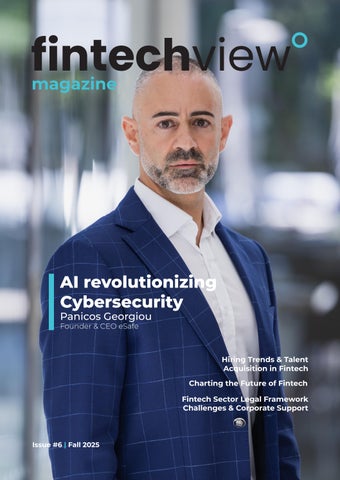
Our cover story features Panicos Georgiou, Founder & CEO of eSafe, who explores the rapidly evolving AI landscape in cybersecurity—a vital aspect of safeguarding digital assets and maintaining trust in the digital economy.

In human resources, Donna Stephenson, CEO and Founder of Emerald Zebra, discusses current hiring trends and challenges within the fintech sector, while Evi Odiatou, Director & Partner at HRUS, highlights the importance of talent acquisition and specialization in this competitive field.

The forex segment examines the future of fintech and the industry’s growth amidst a fierce global market. Insights from Alexander Oelfke of Tauro Markets and Nicholas Xydas of EC Markets offer valuable perspectives on navigating this competitive environment.

On the corporate services front, Petros Archontides provides insights into Cyprus’s fintech ecosystem, focusing on NovoFin Audit and the favorable tax incentives available for fintech companies operating in Cyprus. Maria Taki addresses the legal framework challenges faced by fintech firms and highlights the role of AI advancements in overcoming these hurdles.

Lastly, we explore innovative fintech solutions with Maria Pittashi of PLUGIT, who discusses the modern applications of copy trading and IB/affiliate management platforms in the brokerage industry. We invite you to explore these thought-provoking articles that showcase the resilience, innovation, and strategic evolution of the fintech sector. Stay informed, stay ahead.
Read us online www.fintechview360.com

Follow us marketing@fintechview360.com

Editor-in-Chief: Drosoula Hadjisavva

Graphic Designer: Demetra Ioannou

Photography: Petros Demetriou

COVER STORY

eSAFE: The evolving AI landscape in Cybersecurity Panicos Georgiou

While the cybersecurity aspects of AI are receiving a lot of attention, evidence shows that the use of AI for and against cybersecurity is rapidly developing. Cybercriminals are using AI to carry out, as well as increase the scale of, a variety of attacks such as phishing, vishing and password hacking, while cybersecurity organizations also increasingly rely on AI to help flag suspicious data to detect or thwart attacks.

Fintechview presents in its cover story: Panicos Georgiou is the Founder and CEO of eSafe Cyber Security, a leading provider of cyber security solutions and services, headquartered in Cyprus, with operations expanding into Greece, Italy, and Malta.

How did your journey in cybersecurity start?

Back in 2005, I made a life-changing decision. I left England and moved to Cyprus in search of a new chapter. At first, I took on a role as an IT Manager while trying to figure out where I truly wanted to go. My background was always rooted in IT, but around that time, cybersecurity was emerging as one of the most exciting and specialized fields. Something about it captured my imagination, the idea of protecting people, businesses, and their digital worlds.

In 2007, driven by that passion, I founded eSafe with one clear mission: to dedicate myself entirely to cybersecurity. The early years were far from easy. I faced countless challenges, financial struggles, and moments where giving up would have been the simpler choice. But persistence is powerful. It took more than 12 years of hard work, setbacks, and lessons learned before eSafe began to truly thrive.

Today, that vision has grown beyond what I imagined in those early days. Our headquarters are in Limassol, and we now have offices in Greece, Italy, and Malta. Spain is already on the horizon for 2026, and we plan to continue expanding steadily across Europe. Looking further ahead, the UAE is also part of our future journey.

But eSafe is only part of the story. Under its umbrella, we launched RedLine, a company born out of the need to respond to the most pressing threats businesses face today. RedLine focuses on Digital Forensics & Incident Response, helping organizations mitigate risks, strengthen

their defenses, and react swiftly when attacks occur. It represents the evolution of our mission — not just protecting, but also empowering our clients in the face of adversity.

Can you share an experience during your career, that you learned from and can share as a case study?

In the early years of eSafe, the market was extremely cutthroat. Larger companies dominated the scene, winning almost every big project. No matter how hard we tried, the “safe” choice for clients was always the big global names.

Instead of trying to compete head-to-head in the same crowded space, I decided to shift eSafe’s focus entirely. While our competitors were chasing what I call commodity projects — firewalls, proxies, web filtering — we deliberately went in a different direction. We chose to work only with best-of-breed vendors and to specialize in niche technologies that others overlooked.

We invested early in areas like DNS security, sandboxing, i ntrusion prevention, forensic tools, and other advanced solutions that were years ahead of the mainstream market. These were technologies most people had barely heard of at the time, but they represented the future. That strategic choice gave us a unique identity. We weren’t just another IT security reseller; we were the company clients turned to when they needed cutting-edge solutions.

But technology alone is never enough. From the beginning, we invested heavily in our people. I’ve always believed that having a strong, highly skilled, and motivated team is even more important than the technologies themselves. Our people became the cornerstone of our success — experts who could deliver on complex projects and inspire confidence in our clients.

That decision to specialize and to back our people changed everything. Instead of fighting for the same commodity projects, we carved out our own space in the market. Over time, those early bets on niche technologies — combined with a world-class team — paid off, and clients began to recognize eSafe not only for expertise, but for vision and innovation.

AI-driven security solutions will become vital for real-time threat detection and automated response capabilities.”

The lesson I took from that experience is clear: when the odds are stacked against you, don’t play the same game as everyone else. Differentiate, specialize, and invest in people. That strategy transformed eSafe from a small outsider into a trusted leader in the region.

AI is rapidly becoming central to the future of cybersecurity, acting as both a powerful tool for attackers and an indispensable defense mechanism for organizations. How do you see the near future with regards to AI and cybersecurity?

Artificial intelligence will play an increasingly significant role in cybersecurity, enhancing both offensive and defensive strategies. In the near future, we can expect a continual progression in this technological arms race, with AI-enabled threats becoming more sophisticated, tailored, and scalable. Simultaneously, AI-driven security solutions will become vital for real-time threat detection and automated response capabilities.

Which regions are the most sophisticated and ahead, in comparison with others?

The most advanced regions in cybersecurity typically feature comprehensive national strategies, strong public-private partnerships, and considerable investment in research and development. According to the National Cyber Security Index (NCSI)

“Differentiate, specialize, and invest in people. That strategy transformed eSafe from a small outsider into a trusted leader in the region.”

and other international assessments, countries in Europe—particularly the United Kingdom, the Nordic nations such as Finland and Norway—as well as North America (Canada and the United States), and parts of the Asia-Pacific region (China, Singapore and South Korea) are recognized as leaders. These regions often demonstrate excellence in legal frameworks, educational initiatives, and the development of innovative technologies.

How can humans stay ahead in cybersecurity and keep pace with rapid advancements?

To remain at the forefront of rapid cybersecurity advancements, organizations should transition from reactive security approaches to proactive cyber resilience strategies. This comprehensive approach entails the integration of technological, educational, and procedural initiatives:

Continuous Education: Keep abreast of emerging attack methods, new technologies, and industry best practices through participation in conferences, review of relevant publications, and engagement in professional development opportunities.

Leveraging AI and Automation: Approach artificial intelligence as a strategic partner rather than a competitor. Develop expertise in data science and behavioural analytics to interpret AI-generated insights, enabling effective response to complex and strategic threats beyond AI’s current capabilities.

Implementing a Zero Trust Framework: Adopt a security model based on the principle of “never trust, always verify.” This involves continuous authentication and authorization of all users and devices, regardless of their location within the network.

Is it true AI enhances threat detection?

AI significantly enhances threat detection capabilities. Traditional security systems primarily depend on signature-based methods, which are limited to identifying known threats. In contrast, AI employs machine learning algorithms to analyse extensive datasets, enabling the identification of patterns and anomalies that may indicate potential threats, including zero-day exploits and novel malware variants. This advancement is valuable in several areas:

Anomaly Detection: Establishing a baseline of normal network and user behaviour to identify deviations that could represent security incidents.

- Predictive Analytics: Leveraging historical data to

“ The growth of AI-powered threats: Organizations can expect to encounter more advanced AI-driven attacks, such as highly targeted phishing campaigns and autonomous malware. This development will necessitate a faster adoption of AI-based security measures.

anticipate potential attack vectors and vulnerabilities, allowing for proactive security measures.

- False Positive Reduction: Improving accuracy to filter out benign activities that might otherwise be misclassified as threats, thereby allowing security teams to focus on genuine, high-risk alerts.

What’s AI’s role in defence and what’s its role in attack?

- Defence: AI functions as a protective barrier by automating threat detection and response, analysing large volumes of data rapidly, and adapting to emerging threats. It underpins technologies such as Security Orchestration, Automation, and Response (SOAR) platforms, which can automatically isolate compromised systems or block malicious traffic without manual intervention.

- Attack: Conversely, malicious actors utilize AI to automate and scale their operations. This includes crafting highly personalized phishing emails, generating sophisticated deepfakes for social engineering and fraud, and developing adaptive malware capable of learning and modifying itself to evade detection.

Few trends we shouldn’t miss in 2026?

The growth of AI-powered threats: Organizations can expect to encounter more advanced AI-driven attacks, such as highly targeted phishing campaigns and autonomous malware. This development will necessitate a faster adoption of AI-based security measures.

Operational Technology (OT) and IoT Security: As critical infrastructure and industrial control systems become increasingly interconnected, they will become more attractive targets for cyber threats. Securing these environments, often reliant on legacy systems, will become a key strategic priority.

Zero Trust Architecture: The zero-trust security model is expected to transition from an emerging concept to a standard practice for safeguarding remote workforces and complex multi-cloud environments.

Increased Regulatory Oversight: Governments are likely to implement stricter regulations concerning data protection and AI governance, encouraging organizations to enhance transparency in their AI usage and data security practices.

Cyber Resilience versus Prevention: The security focus will evolve from solely preventing attacks to building organizational resilience, emphasizing the ability to withstand and rapidly recover from cybersecurity incidents. This includes developing comprehensive business continuity and disaster recovery strategies.

Quantum Computing: While the comprehensive and disruptive potential of quantum computers on cybersecurity is not expected to materialize by 2026, the preparatory and transitional phases represent a significant trend to monitor. The transition toward a post-quantum era is already in progress, and its influence will be reflected in emerging regulations, complex migration initiatives, and a fundamental change in organizations’ approaches to long-term data security.

Who is Who

Panicos Georgiou is the Founder and CEO of eSafe Cyber Security, a leading provider of cyber security solutions and services, headquartered in Cyprus, with operations expanding into Greece, Italy, and Malta. Under his leadership, eSafe has become a strategic partner to major organizations across Europe, helping them strengthen resilience in the face of growing cyber threats.With more than two decades of experience in the cyber security industry, Panicos has built his reputation on combining deep technical knowledge with a sharp business vision. He has successfully led the launch of RedLine Incident Response, a specialized entity dedicated to digital forensics, penetration testing, and incident response.

Passionate about innovation, Panicos is committed to bridging the gap between cyber security and fintech, ensuring that digital transformation is built on a foundation of trust, compliance, and security. His vision is to position eSafe Group and its entities at the forefront of Europe’s digital economy, enabling organizations to adopt cutting-edge technologies with confidence.

Donna Stephenson Founder & CEO of Emerald Zebra

Hiring Trends and Challenges in the Finteach sector

Meet Your Specialist Recruitment Partners in Cyprus

Talent acquisition in fintech involves a strategic process of finding, attracting, and hiring skilled professionals for the rapidly evolving financial technology sector. Fintechview meets Donna Stephenson, the Founder & CEO of Emerald Zebra, a specialist recruitment consultancy, with over 25 years in the FinTech, Tech, Financial Services and iGaming sectors in Cyprus.

With Global Reach Services

What inspired you to launch Emerald Zebra, and how did the idea evolve into what it is today?

Emerald Zebra is a highly recognised specialist recruiter for FinTech, Tech, Financial Services and iGaming industries. Since 2021, we’ve built a reputation for excellence and delivery. From our base in Cyprus, we help companies hire exceptional talent locally and internationally. Behind that reputation is a boutique team that understands the industries, the market, and how to deliver results with integrity.

I’ve been recruiting in Cyprus since 2004, when I moved here and co-founded GRS Recruitment. At that time, the recruitment industry on the island was still developing, and we grew GRS into one of the largest agencies in Cyprus. It was an invaluable journey. I built teams, shaped a brand and worked closely with financial services and fintech companies in Malta and Cyprus just as they were becoming a hub for these industries.

Why the name Emerald Zebra? What’s the story behind it?

Donna Stephenson Founder & CEO

After many years, I decided to sell my shareholding and step out to create something new. It wasn’t about leaving recruitment, it was about doing it differently. With Emerald Zebra, I wanted to build a consultancy that is specialised, agile and insight-driven. The team and I focus deeply on fintech, tech, iGaming and financial servicessectors where Cyprus has a real footprint and global relevance. That move was about stepping into my own show: taking everything I’d learned from scaling a large agency and applying it to a more focused, modern business model that combines recruitment with data, employer branding and true partnerships.

The name Emerald Zebra is layered with meaning, drawing both from symbolism and from my own personal journey.

Emeralds often associated with renewal, wealth, wisdom and rebirth. For me, emeralds have always held a deep personal resonance: they are a reminder of vitality, growth and the energy of the heart. They also connect to the Emerald City in The Wizard of Oz, a place of discovery, vision, and the pursuit of wisdom. An apt metaphor for building a company that helps people and organisations pursue their own journeys of growth.

Zebras, their black and white stripes represent balance and the harmony of opposites - light and dark, individual and collective. Every zebra’s stripe pattern is unique, reminding us of individuality, while their instinct to thrive in herds speaks to the power of community and unity. I drew inspiration from a safari I took in the Maasai Mara, watching zebras in their natural environment, and later from a zoological study often cited by Jordan Peterson: predators struggle to single out zebras in a herd because their stripes create collective protection, but once one zebra is marked, it becomes vulnerable. For me, the zebra became a powerful metaphor for resilience, unity and the importance of teams thriving through harmony and collective strength.

THE TEAM

Terri Neofitou Country Manager Georgia Michaelides Senior Recruitment Consultant

Katy Savvides Recruitment Coordinator

Together, these two symbols merge into something greater: Emerald Zebra reflecting the importance of valuing individuality while building collective strength and of balancing purpose with growth. Of course the spin on that at a practical level is exactly what we set out to do for our clients and candidates. At Emerald Zebra, we don’t just fill vacancies, we align people with purpose, values and potential. We help our clients to build resilient teams that can grow and prosper and bring clarity and insight to every recruitment process. For me personally, the name also marks a shift in my own journey, from co-founding and scaling one of Cyprus’s largest agencies to creating my own specialised consultancy.

What gaps did you see in the recruitment industry, especially within the fintech industry? When I founded Emerald Zebra, I had already spent over a decade working closely with fintech and regulated companies in Cyprus. The gaps were clear:

The name Emerald Zebra is layered with meaning, drawing both from symbolism and from my own personal journey.”

The people emeraldzebra.cy jobs@emeraldzebra.cy

Reach: Employers struggled to access passive or niche talent, while candidates often felt invisible and unsure how to get in front of the right companies. A partnership model: we work with in-house recruiters to extend their reach, not compete with them.

Insight: Both employers and candidates lacked reliable, Cyprus-specific data on salaries, progression opportunities and workforce expectations making it difficult to plan careers or hiring strategies with confidence. We’ve been championing salary transparency for years to benefit both sides of the market.

Branding: Many companies, particularly smaller ones, under-communicated their culture and growth story. As a result, candidates often overlooked great opportunities simply because the employer brand wasn’t visible enough and that’s been a mission of ours too, to position Emerald Zebra differently. We built a talent pool and digital presence that extends employers’ reach. We invest in Workforce Insights surveys that give the market real data.

That combination of specialist reach + local insight is what allows us to fill the gaps and support hiring managers, whether it’s for a three-person startup or a multinational scaling its Cyprus hub.

What’s your view on outsourcing or building inhouse acquisition teams?

The best model is hybrid. In-house TA teams are essential for embedding culture and managing dayto-day hiring. But they don’t always have the time or resources to tap into wider networks or engage passive talent. Emerald Zebra partners with TA teams to extend their reach through our networks, digital channels and market presence. We also bring speed and intelligence: because we’re immersed daily across fintech, tech, financial services and iGaming, we can advise on so many levels.

The result is that clients get the best of both worlds: the cultural alignment of their in-house recruiter and the market access and insight of a specialist partner.

What hiring trends are you currently seeing across fintech and SaaS companies?

Technical demand remains strong i.e. engineering, DevOps, product delivery and compliance/risk. But what’s interesting is candidate behaviour. We’re seeing more “job hugging” people staying put, even when not completely satisfied, because they feel the market is uncertain and that means less shortterm “job hopping” and more caution around career moves. To attract candidates, employers understand that they need to offer more than just a role, they need to present a compelling story: progression, flexibility and a culture that feels and is authentic. Our survey confirms this: the top reasons people change jobs in Cyprus are better pay, growth opportunities and improved culture.

We’re also seeing more companies bringing in talent from abroad, with ratios of around 70% external recruits to 30% local in some cases. Cyprus’s tax incentives for expats make this attractive, but it can’t be the whole solution. Employers also need to think long-term and many are, for example, partnering with universities, mentoring young professionals and investing in training pipelines to grow home-grown talent. The best companies are taking a holistic approach to the employee experience and going beyond salary to invest in workplace design, ergonomics, wellbeing programmes, sports memberships, food and beverage options, team building, work flexibility, personal development budgets and counselling support. Just as importantly, they’re encouraging their own employees to build personal brands on LinkedIn, share vacancies and tell authentic stories about what it’s like to work in their organisation. But it isn’t always the companies with the biggest budgets that attract the best candidates. Many smaller organisations are finding creative, affordable ways to make the workplace more inviting. Hiring trends in Cyprus are no longer just about demand. They’re about differentiation.

Why is there a high turn-over in the forex industry? Is the Cyprus regulator a blocker?

Turnover in forex is often seen as unique, but the drivers are the same across industries: people leave for higher pay, career progression and better work culture. The forex sector is fast-paced and commercially intense, which makes those drivers more pronounced. The regulator, in my view, isn’t a blocker, it’s a catalyst. Stronger oversight means companies need better compliance, risk and control teams. That creates demand, but it also creates movement, as professionals with those skills become more mo-

Meet Your Specialist Recruitment Partners in Cyprus

With Global Reach Services

Emerald Zebra is a highly recognised specialist recruiter for FinTech, Tech, Financial Services and iGaming industries. Since 2021, we’ve built a reputation for excellence and delivery. From our base in Cyprus, we help companies hire exceptional talent locally and internationally. Behind that reputation is a boutique team that understands the industries, the market, and how to deliver results with integrity.

THE TEAM

Donna

Executive Search

Specialist Recruitment

Recruitment Partnerships

Salary Benchmarking & Insights

Margarita Savva Recruitment Consultant

George Tsolakis Senior Recruiter

Stavri Christodoulou Talent Acquisition Specialist Terri Neofitou Country Manager

Georgia Michaelides Senior Recruitment Consultant

Savvides Recruitment Coordinator

bile. The real challenge for employers isn’t regulation itself, but building work environments that retain people once they’re hired.

We see the PSP industry is becoming truly competitive. Your thoughts on this and how it supports recruitment?

Competition in payments and EMIs is increasing, and that’s a good thing. It forces companies to think about how they differentiate themselves, not just through salary, but through culture, flexibility and progression opportunities. For recruitment, it means employer branding is critical. Smaller PSPs often feel they can’t compete with bigger names, but if they can clearly articulate their story and growth vision, they can. That’s where Emerald Zebra steps in, helping to amplify those messages through our networks, digital presence and talent pool so they can reach the right candidates.

Is fintech a male-dominant sector? Is it true that the % in having women in leadership roles is pretty low?

Globally, fintech does lean male, and our survey in Cyprus reflects that: women make up a significant share of the workforce, but fewer hold leadership roles. However, the point isn’t about filling quotas, it’s about merit and fairness in my opinion. Everyone with the right skills and experience should have the chance to progress.

That starts with removing bias in hiring so women have the same access as men to leadership opportunities. It also requires flexibility. Women are often primary caregivers, but increasingly we see parents share responsibilities, one requests flexible working days, while the other covers the rest. Legislation in Cyprus already enforces the right to disconnect after hours, and when embraced by employers, it supports balance for both men and women alike. Ultimately, men and women bring different strengths to leadership. What matters most is ensuring that the best person for the role can succeed on merit, with the right support to balance work and life. For that to happen, there must be clear and accessible paths for both genders to progress into leadership when they are ready.

In-house TA teams are essential for embedding culture and managing day-to-day hiring. But they don’t always have the time or resources to tap into wider networks or engage passive talent.”

Which industry is emerging and what roles are promising?

In Cyprus, fintech, payments and SaaS continue to expand, with growing demand for software engineers, DevOps, compliance/risk professionals and data and finance specialists, supported by sales, marketing, customer success roles. Cybersecurity and privacy roles are increasing, driven by new regulations like DORA and NIS2. Globally, the trends are aligned: the fastest growth is in AI, cybersecurity and data.

How is AI impacting the recruitment sector?

AI is reshaping processes, but I see it as an augmentation tool, not a replacement. At Emerald Zebra our ATS helps reduce the admin load and for example, we’ve developed a GPT tool for producing job adverts, trained on our data to distinguish between job descriptions and job adverts. It speeds up content creation and ensures sharper messaging, but it doesn’t replace the human consultation we always have with clients to understand must-have skills, business objectives and the role’s place in the bigger picture.

I’ve reviewed countless ATS and AI products targeting the recruitment sector, often launched with bold claims that recruiters are no longer needed. Frankly, many feel like snake oil! Every week there’s another tool promising to replace us, yet none can replicate what recruiters actually do. Recruitment is built on trust and networks, and those can’t be replicated by software. I’ve spent 25 years building relationships in Cyprus and internationally; no AI can replicate the credibility that comes from that.

Candidates know the difference between an automated outreach and a genuine conversation with someone who understands their market and career journey. I’ve reviewed early AI video-interview platforms, which produced terrible candidate experiences. It confirmed for me that while AI can make processes smarter, it cannot replace human communication, connection, empathy and judgment. AI may help to tackle human bias, but it is only as strong as the data and human input behind it. Machine learning allows it to evolve, yet that doesn’t make it a reliable replacement for human recruiters. I’m always curious and open to innovation, but never at the expense of the human element. The future is about blending efficiency with empathy: AI for speed and insight, recruiters for trust, their deep networks and expertise and connection.

What’s next for Emerald Zebra? Any exciting expansions or new verticals? We’re building Emerald Zebra into a talent intelligence and workforce partner. That includes: Expanding our Workforce Insights surveys into sector-specific reports. Growing our employer branding offering with career microsites, content and campaigns. Helping our Cyprus-based clients expand through cross-border hiring in the UK, EMEA and Asia. Developing training and toolkits for in-house recruiters to strengthen their own capability.

And just as importantly, we’re investing in and expanding our own team. Emerald Zebra may be boutique, but our strength lies in our people, their collaboration, creativity and resilience. That’s what allows us to partner with both small startups and large multinationals and deliver consistently. Looking ahead, we’re also developing complementary services to strengthen our positioning. Details for another time!

Who is Who

Donna Stephenson, originally from the UK, has lived in Cyprus since 2003. She is the Founder & CEO of Emerald Zebra, a specialist recruitment consultancy for the FinTech, Tech, Financial Services and iGaming sectors in Cyprus.

With over 25 years in recruitment, including co-founding and scaling GRS Recruitment until selling her shareholding in 2018, Donna has been at the forefront of hiring for the fintech sector in Cyprus since its early days. Since 2021, she has led Emerald Zebra with a focus on talent intelligence, employer branding, and consultative recruitment, helping companies build resilient teams and individuals grow purposeful careers.

Evi Odiatou, Director and Partner

HRUS: Talent Acquisition in Fintech & Specialization

Fintechview presents Evi Odiatou is the Director and Partner at HRUS Partners, a leading recruitment agency specializing in talent acquisition for the fintech industry.

HRUS Partners specializes in fintech talent acquisition. What inspired you to focus on this niche, and how does it set you apart from other recruitment agencies?

We’re witnessing a revolution in financial technology that’s reshaping the way we do business and interact with money. Fintech is one of the most dynamic and transformative industries of our time. When we launched HRUS Partners, we recognized a critical gap: while fintech companies were innovating at speed, many struggled to secure talent that combined deep technical expertise with an understanding of complex regulatory frameworks. By focusing exclusively on fintech, we bring a nuanced understanding of the industry’s unique challenges and opportunities. This specialization sets us apart from traditional recruitment firms. We don’t just fill roles—we strategically build high-performing fintech teams that drive innovation and are equipped for long-term success.

Your company has a strong presence in Cyprus and Seychelles. Why are these markets so important for fintech, and how do you support clients operating there?

Cyprus and Seychelles have emerged as vibrant fintech hubs, offering unique opportunities for growth, innovation, and international connectivity. Our deep local expertise and understanding of the regulatory and cultural landscapes in both regions allows us to guide clients and provide tailored solutions for companies expanding or operating here. We complement this with our global network, connecting organizations to top-tier fintech talent across borders. This combination of local insight and international reach gives our clients a distinct competitive edge in scaling and succeeding in these markets.

At HRUS Partners, you emphasize a people-centric approach. How do you balance the needs of clients with the career growth aspirations of candidates?

For us, people are at the heart of every success story. We see recruitment not just as filling roles, but as building meaningful partnerships. With clients, we take time to understand their culture, goals, and long-term vision. With candidates, we focus on their aspirations, skills, and potential. By aligning these two sides, we create sustainable matches where both organizations and individuals can thrive. That’s what makes our approach unique—and impactful.

Fintech is one of the fastest-evolving industries. How does HRUS Partners stay ahead of trends to ensure clients access the right talent at the right time? Adaptability and foresight are key in fintech. At HRUS Partners, we constantly monitor industry trends—from blockchain and digital banking to regtech and payments

innovation. We engage with fintech leaders, attend key global events, and keep close to the regulatory and technological shifts shaping the industry. This proactive approach ensures our clients aren’t just reacting to talent needs—they’re prepared for them. We deliver forward-thinking solutions that keep businesses competitive in a rapidly changing landscape.

What role do your mission and values — such as integrity, innovation, and collaboration — play in shaping your recruitment strategies?

Our mission is to empower organizations by connecting them with the right talent, and our values are the foundation of how we achieve that. Integrity means being transparent and ethical in every interaction. Collaboration means working closely

By focusing exclusively on fintech, we bring a nuanced understanding of the industry’s unique challenges and opportunities. This specialization sets us apart from traditional recruitment firms.”

with our partners to understand their unique needs, their culture, and the way they do things. Innovation means staying ahead in how we source, assess, and engage talent, particularly in fintech. These values guide every decision we make, ensuring we deliver excellence not just in results but in the way we build long-term, trusted partnerships. Our core values are based on the professional development of each organization’s manpower, as well as ensuring the best service for the individuals.

Looking ahead, what is your vision for HRUS Partners and its contribution to the global fintech ecosystem? Our vision is to become the leading talent acquisition partner for fintech companies in Cyprus, Seychelles, and beyond. We want to be known not just as recruiters, but as trusted advisors who contribute to innovation, growth, and organizational excellence across the fintech ecosystem. By connecting the right people with the right opportunities, we play a direct role in shaping the future of fintech. Ultimately, our goal is to help organizations achieve their maximum potential and growth —with people at the center of every success.

Gen Z is entering the workforce with unique expectations around technology, flexibility, and purpose. How is HRUS Partners adapting talent strategies in the fintech sector to attract, engage, and retain this generation, and what lessons can other companies learn from your approach? Gen Z is reshaping the workforce—they’re tech-savvy, purpose-driven, and thrive in fast-moving, innovative spaces like fintech. Flexibility, meaningful work, and having their voices heard matter to them, but so does stability and growth.

At HRUS Partners, we focus on listening to what drives them and creating cultures where they can grow, contribute, and feel ownership in their work. Attracting talent is only half the battle—it’s about keeping them engaged and supported.

A big part of that is employee wellbeing. When people feel supported physically, mentally, and emotionally, they’re more productive, more engaged, and more likely to stay. For fintech organizations, embracing these values isn’t just a trend—it’s how you build the teams that will drive the future of work.

What advice would you give to young people who want to build a career in the fintech industry?

My advice is to stay curious, adaptable, and proactive. Fintech is constantly evolving, and the most successful professionals are those who embrace change and commit to lifelong learning. Build strong foundations in both finance and technology, but also focus on soft skills—communication, problem-solving, and adaptability which are just as valuable.

Most importantly, don’t be afraid to take opportunities outside your comfort zone. At HRUS Partners, we believe in the potential of young talent, and we are committed to connecting ambitious individuals with organizations that will challenge them, help them grow, and give them a platform to succeed globally.

Why is outsourcing HR often a better option than managing it fully in-house?

Outsourcing HR allows companies to concentrate on their core business while leaving HR processes in the hands of specialists. For fast-growing fintech firms, in particular, the regulatory landscape and talent market are complex and constantly evolving. Outsourcing provides access to expertise, scalable solutions, and cost efficiencies that are often hard to achieve in-house.

Finding the right talent is not easy — I can assure you it requires time, effort, and resources. By outsourcing recruitment, companies can tap into a global talent pool and reach professionals with diverse backgrounds and experience.

We want to be known not just as recruiters, but as trusted advisors who contribute to innovation, growth, and organizational excellence acrossthe fintech eco system.” “

Who is Who

Evi Odiatou is the Director and Partner at HRUS Partners, a leading recruitment agency specializing in talent acquisition for the fintech industry. Evi holds a Master’s Degree in Human Resources Management from the University of Birmingham and Bachelor’s Degree in Social and Political Science from the University of Cyprus. In today’s fast-paced and highly competitive fintech landscape, Evi thrives on the challenge of identifying, attracting, and securing top-tier talent.

Her people-first approach and commitment to excellence have enabled her to build lasting partnerships between cutting-edge fintech companies and exceptional professionals worldwide. For the last 15 years Evi is actively involved in NGOs supporting different initiatives especially dedicated to young people.

Charting the Future of Fintech Alexander Oelfke,

at Synervest Group

Looking back, what was the most defining moment in your career journey so far?

The defining moment was stepping away from the security of established finance and committing to build something entirely from scratch. The early days meant no big office or safety net—just conviction and long nights turning ideas into structure. It wasn’t about launching another brokerage; it was about proving we could design a modern trading platform from the ground up—transparent, technology-driven, and anchored in risk management. Very quickly, I realized that success doesn’t just come from vision, but from finding the right people who share that vision. Building the right team—people who challenge you, complement your weaknesses, and live the same values—defines the culture of the company. That leap of faith taught me that fintech isn’t only about innovation and credibility; it’s also about assembling the team that makes the vision real and sustainable.

You’ve successfully co-founded Tauro Markets and serve as a Partner at Synervest Group. What core vision connects your work across these two ventures?

Tauro Markets is one of the flagship ventures within Synervest Group, and that relationship is very deliberate. Synervest was built to be more than a capital provider—it’s designed as a platform that gives fintech companies the regulatory, operational, and strategic foundation they need to scale. Tauro benefits directly from that, whether it’s access to infrastructure, licensing expertise, or long-term investor support.

The connecting vision is simple: build ecosystems, not stand-alone companies. With Tauro, the ecosystem serves traders—delivering access to transparent, technology-driven markets. With Synervest, the ecosystem serves entrepreneurs and investors—aligning capital with deep operational know-how. Both are rooted in the same philosophy: create enduring value by pairing innovation with trust, and by thinking in decades, not hype cycles.

Synervest Group recently raised $4 million in Series A funding. What are the key focus areas for deploying that capital, and how will it shape the group’s investment strategy going forward?

Our strategy for deploying the Series A capital is focused on two primary areas. First, we are scaling Tauro Markets to fully realize its growth potential—expanding into key new jurisdictions, diversifying asset classes, and strengthening our product suite while continuing to invest in technology and compliance. Second, we are further developing Synervest’s wider investment platform, with a strong focus on payments and regulated fund structures in Luxembourg.

This capital raise is not only about fueling growth—it is about building a resilient foundation that allows Synervest to support fintech ventures with both financial resources and operational expertise. By combining capital with infrastructure and regulatory strength, we position the Group to capture long-term opportunities in a sector undergoing rapid transformation.

You’ve navigated startups, strategic funding, and partnerships. What advice would you give to first-time fintech founders?

My advice is to focus on fundamentals from the very beginning. It is easy to get caught up in emerging trends—whether AI, blockchain, or the latest trend— but lasting success is built on disciplined execution: achieving product–market fit, ensuring sustainable unit economics, and embedding regulatory credibility at the core of the business.

Equally critical is assembling the right team. The early hires shape the culture of the company—they define values, drive execution, and often become the strongest ambassadors for the vision. Surround yourself not only with talented individuals, but with people who challenge you, complement your weaknesses, and share the same long-term mindset.

Lastly, choose your partners and investors carefully. Align with partners who value sustainable growth over shortterm hype. And never underestimate compliance: building a strong regulatory foundation from day one creates trust with clients, regulators, and counterparties—trust that compounds into a durable competitive advantage.

How do you approach leadership in the fintech sector, especially when balancing innovation with regulatory demands?

I view regulation as an enabler rather than a constraint. Embedding compliance into our core from day one allows us to innovate at scale with confidence. At Tauro and Synervest, compliance is not treated as an afterthought—it is part of the very DNA of the business. This foundation gives us the confidence to grow knowing that innovation is supported by resilience and trust.

Leadership also means setting clear standards, communicating transparently, and building teams that share long-term values. When you build the right culture and surround yourself with people who live those values, they not only meet expectations—they often exceed them. That balance of trust, innovation, and discipline is what defines effective leadership in fintech today.

That balance of trust, innovation, and discipline is what defines effective leadership in fintech today.” “

Tauro Markets has been expanding rapidly. Can you share what differentiates your platform in the crowded CFD and multi-asset trading space? What differentiates Tauro is the ability to combine institutional-grade infrastructure with a client experience tailored for retail traders.

While many brokers focus primarily on aggressive acquisition, our strategy is centered on long-term sustainability and client retention. We provide competitive pricing, robust execution quality, and a compliance framework that is designed to scale across jurisdictions.

In addition, we place strong emphasis on partnership alignment. Tauro is built as the broker for partners—aligning our growth directly with affiliates and introducing brokers. This alignment of interests, underpinned by resilient technology and a disciplined approach to risk management, positions Tauro as a platform built not just to compete, but to endure in a highly crowded marketplace.

The fintech landscape is evolving fast—with AI, tokenization, and decentralization on the rise. Where do you see the biggest disruption coming next? The next phase of disruption will be driven less by individual technologies and more by their integration. Artificial intelligence will transform areas such as risk management, client onboarding, and operational efficiency. Tokenization will enable around-the-clock access to a broader universe of tradable assets, while

decentralized infrastructure will significantly reduce transaction costs and increase market accessibility. However, the real disruption will come from how these technologies converge under strong regulatory frameworks. The firms that succeed in bridging innovation with compliance at scale will define the future of financial services.

At Synervest and Tauro, our strategy is precisely to operate at this intersection—leveraging new technologies while ensuring they are deployed responsibly, sustainably, and in line with global regulatory standards.

What’s next for you personally—any new ventures, initiatives, or bold bets we should keep an eye on?

At present, my focus remains on scaling Tauro Markets and further developing Synervest into a truly global fintech platform. Looking ahead, I see significant potential in bridging fintech with real-world assets, particularly in areas such as tokenization and cross-border payments. We are already laying the foundations in these domains, and I anticipate sharing meaningful developments in the near future.

My bold bet is simple: stay disciplined in building businesses that endure. In a sector often driven by short-term momentum and quick wins, I believe the firms that combine trust, compliance, and innovation with long-term value creation will ultimately define the future of financial services.

Who is Who

Alexander Oelfke is a Partner at Synervest Group, a diversified financial technology holding with core activities in trading, payments, and fund structuring.

Within the group, he oversees global business development, strategic partnerships, and fintech investment initiatives, driving Synervest’s expansion across key international markets.

As Chief Executive Officer of Tauro Markets, Synervest’s flagship multi-asset brokerage, Alexander leads the firm’s strategic growth and operational execution, advancing the group’s vision of a seamlessly integrated fintech ecosystem that unites traditional finance with digital innovation.

With extensive experience in capital markets and cross-border finance, he has successfully guided multiple ventures through complex licensing, international expansion, and institutional fundraising, establishing Tauro Markets as a central platform in redefining global access to multi-asset trading.

EC Markets: Flourishing Growth Amidst Global Competitive Landscape

Nicholas Xydas, Group Marketing Director at EC Markets

Fintechview presents Nicholas Xydas, Group Marketing Director at EC Markets, in a must-read exclusive interview. Liverpool FC and EC Markets have entered a multi-year global partnership, announced earlier this week. As EC Markets enters a new period of global growth, this partnership will offer the broker a powerful platform to amplify its brand and showcase its innovative multi-asset trading products.

With more than ten years of global presence, EC Markets has built a reputation for strong regulatory compliance and innovative tools that empower traders worldwide.

How forex traders’ needs evolved?

Over the last decade, traders have become more sophisticated and demanding. Today’s traders are looking for more than just tight spreads and fast execution — they want a complete trading experience. This includes educational support, transparency, access to multiple asset classes, and innovative tools that allow them to trade with confidence. In particular, we see strong demand for mobile-first trading, social and copy trading features, and advanced analytics.

At EC Markets, we’ve responded to this by expanding our product offering, enhancing our technology infrastructure to ensure speed, security, and reliability, and preparing to launch EC Academy this October, a dedicated educational hub designed to empower clients through structured learning and insights.

Which challenges are online trading brokers facing and expected to face in 2026?

The industry is becoming more competitive and more regulated, which presents both challenges and opportunities. One of the biggest challenges is differentiation, many brokers offer similar products, so the ability to stand out through brand, technology, and customer service is key.

Another challenge is adapting to rapidly changing client expectations, especially with the integration of AI, automation, and personalised trading experiences. By 2026, we expect client acquisition costs to rise, while global regulatory requirements will continue to tighten.

This means brokers must build long-term trust with traders, invest in compliance, and balance growth with sustainability. At EC Markets, we see these challenges as catalysts to strengthen our brand, build partnerships, and leverage innovation.

How is regulation changing and in which jurisdictions do you focus?

Regulation in online trading is continuously evolving, with most jurisdictions moving toward stricter standards and greater oversight. The focus is increasingly on transparency, client protection, and ensuring brokers operate responsibly. As a global broker, we pay close attention to

these developments and adapt accordingly. While we monitor changes across multiple regions, our priority is always to remain fully compliant wherever we operate and to be flexible enough to grow within the frameworks that regulators establish.

How the EC Markets and Liverpool FC partnership come together?

Thanks for having me. This partnership has been in the works for some time, and it wasn’t a decision we took lightly. We wanted a name that truly reflects who we are as a company. When we look at Liverpool FC, it’s more than just a big name in sport, they embody values which deeply align with EC Markets’ own principles. This shared commitment is what makes the partnership meaningful, it’s about joining forces with an organisation that lives and breathes the same core beliefs we do.

Can you give some examples of those values?

We’ve built a strong foundation based on trust, evolution, and a client-first approach in everything we do. Liverpool FC has reached global success not only through their achievements but by creating a deep connection with their supporters. That same principle drives us. We put our clients at the centre of every decision we make.

From our trading platforms to the support we offer, the regulations we commit to, it’s all designed around what delivers the most value to them. This partnership is a perfect reflection of those shared commitments and ambitions.

So it’s more than just branding, it’s about cultural fit? Exactly. The trading world and the world of football have a surprising amount in common. Both are driven by passion, but also by discipline and patience. When you look at the kind of dedication it takes to compete at that level, whether it’s trading or playing for a top club, that’s the connection we want to highlight.

Liverpool FC has a massive and global fan base. How do you see this partnership supporting EC Markets to reach its target audiences?

The fan base is huge, yes, but what matters more is how engaged it is. We want to build bridges between our traders and the Liverpool FC global community. Many of our clients are sports fans themselves, so this partnership is about creating authentic moments where those interests overlap. It’s not about trying to change who we are, but about reinforcing our presence in markets that matter.

We’ve been a strong player in the trading space for years, and now we’re stepping up to a bigger stage. This partnership signals where we are today, bold, recognised and always looking ahead. It’s about showing our scale and ambition without losing the qualities that made us successful in the first place.

How does EC Markets maintain its goals and culture internally, especially with this kind of rapid expansion? That’s something we focus on everyday. Growth is important, but it can’t come at the expense of what makes us reliable. For us, that means regulation and transparency. We’re regulated across multiple jurisdictions like FCA, ASIC, FSC, SCA, FSCA, FMA, and FSA, and that framework is central to how we operate. It’s about building trust, not just chasing scale.

Who is Who

Nicholas Xydas is a seasoned marketing executive with over 15 years ofexperience in the financial services and fintech industries.

As the Group Marketing Director at EC Markets, Nicholas leads global brand strategy, digital marketing innovation, and client engagement initiatives across key markets in Europe, Asia, Latam and the Middle East.

We focus on giving our traders clarity and confidence. Clear pricing, strong protections for client funds, exceptional trading conditions and solid platforms, these are basics that some overlook, we make them our priority. That builds the kind of long-term relationships that help us grow sustainably.

We have a strong, clear vision that everyone believes in. That sense of shared purpose keeps the team aligned. People here understand the value of what we do, it’s about quality, trust, and growth. That drives every decision we make.

You mentioned earlier this year you partnered with Judd Trump. That feels quite different from the Liverpool FC deal. What was the idea behind that?

Judd Trump’s approach to snooker is about precision, patience, and a strategic approach. That’s what makes him one of the best snooker players today. This partnership reflects a mindset that’s important to us.

Trading is about more than momentum; it’s about discipline. While these partnerships highlight different aspects of EC Markets, they both come down to our shared core values: focus, evolution, and consistency.

So both sponsorships complement each other, reflecting different parts of the company?

Exactly. With Liverpool FC, it’s about ambition and community at scale. With Judd Trump, it’s about discipline and precision. Both are important.

Together, they tell a full story about who we are. We choose to partner with number one’s in their given field, as we too are committed to positioning ourselves as a number one leader in the financial markets.

Looking ahead, with new partnerships and continued growth, what can your clients and partners expect from EC Markets over the next year? We’re focused on evolving in ways that genuinely matter to our clients. That means better tools, faster platforms, stronger support, and smarter education, everything designed to make the trading experience more intuitive and impactful. The Liverpool FC partnership gives us a bigger stage to connect with a wider global community, but at the heart of it all, nothing changes: the trader comes first.

Everything we do is about long-term value, not chasing quick wins or making noise just for the sake of it. And that’s why at EC Markets, we don’t just team up with anyone. We look for partners who match our mindset, who are in it for the long haul. We’ve partnered with Judd Trump, the world’s top-ranked snooker player, and now with Liverpool FC, champions of the world’s number one football league.

For us, it’s more than a sponsorship. It’s about surrounding ourselves with people who understand what it takes to reach the top, and stay there. We’re proud to stand beside number 1s, and we’re just as committed to becoming one ourselves.

Petros Archontides, Founder & Director

NovoFin Audit: Fintech Companies & Cyprus Tax Incentives

Fintechview met with Petros Archontides, the founder and director of NovoFin Audit & Consulting Ltd, a premium firm regulated by the Institution of Certified Accountants of Cyprus. During this insightful interview, Petros explained the key factors named Cyprus as one of the most attractive destinations corporate wise.

Is Cyprus indeed one of the most attractive destinations to develop a fintech organisation?

Is truth that Cyprus has become a strong magnet for fintech companies in the recent years, and there are many reasons connected with this, if we want to see it from a wider point of view as well as extension, evolution of the past I would say Cyprus, became an attractive destination for financial, tax and corporate purposes which combines high standards of quality of living and at the same time maintain its values respecting both its local and foreign people which consider Cyprus as home and as centre for their international business.

Which are the key factors to support this?

Strategic Location

Positioned at the crossroads of Europe, the Middle East, and Africa, Cyprus gives fintech firms access to multiple markets. It’s inside the EU, which ensures access to the European Single Market, while also maintaining strong ties with non-EU countries in the region.

Business-Friendly Regulatory Environment

Cyprus has developed a modern, EU-aligned legal and regulatory framework, particularly in financial services, investment firms, and electronic money institutions. The Cyprus Securities and Exchange Commission (CySEC) is widely recognized for supporting innovation in fintech and crypto-assets while ensuring compliance with EU directives. The regulator has been relatively proactive compared to some other jurisdictions, making it easier for fintech startups to obtain licenses.

Tax Benefits

Cyprus offers one of the lowest corporate tax rates in the EU at 12.5%. Double taxation treaties with more than 65 countries make international operations more tax-efficient. Attractive incentives for intellectual property (IP) and R&D, which fintechs often rely on. Tax incentives for high network individuals and employees

Growing Talent Pool

Cyprus has a highly educated, multilingual workforce (English is widely spoken in business and law). The island attracts international professionals thanks to its quality of life and relatively low cost of living compared to other European fintech hubs. Fintech & Crypto Ecosystem Cyprus has become a regional hub for forex, blockchain, and crypto companies, with many established firms already operating there. Networking opportunities and clusters of service providers (law firms, tech developers, consultants) make it easier for new fintech entrants to scale.

Lifestyle & Infrastructure

Good quality of life, safety, and climate make Cyprus attractive for entrepreneurs and employees. Strong IT infrastructure and growing co-working/startup hubs encourage innovation.

Government Support

Initiatives such as the Cyprus National Strategy on Blockchain & Distributed Ledger Technologies and innovation-friendly policies reinforce fintech adoption. Incentives for startups, including simplified visa schemes for foreign talent and investment incentives, further enhance the ecosystem.

Can you please share your thoughts on how fintech companies can utilize Cyprus tax incentives? By default, the corporation tax of Cyprus is one of the lowest in EU at 12.5% on net profit however especially for Fintech Companies including softwares, platforms , gaming and other related companies Cyprus is offering the “IP regime”

Key characteristics is that:

Cyprus’ IP regime allows an 80% tax exemption on qualifying IP profits, producing an effective tax rate of ~2.5% on those profits. The IP regime follows the OECD “nexus” approach which this means the tax benefit is connected to the amount of R&D costs economically attributable to the IP. Of course, each case should be carefully examined by professionals in order for the companies to have a clear understanding of the expectations around the IP regime and whether it is applicable or not. The main reason I mention this is because we have seen cases where the incorrect approach or use of the IP puts at risk the entities. Novofin as Audit, tax and Consulting firm IP is one of the areas we feel very confident to assist.

“ Cyprus has a highly educated, multilingual workforce while the island attracts international professionals thanks to its quality of life and relatively low cost of living compared to other European fintech hubs.”

Who is Who

Petros Archontides is the founder and director of NovoFin Audit & Consulting Ltd, a premium firm regulated by the Institution of Certified Accountants of Cyprus.

He has over 18 years of experience in the financial sector and leads a team of high-level educated professionals with extensive experience in audits, tax, payroll, and consulting services. Petros emphasizes understanding and mutual respect in client relationships, ensuring personalized and professional services, serving in Cyprus as well in international and European markets.

NovoFin in this dynamic environment, supporting clients in creating value, stability, and sustainability in their businesses .

Maria Taki

Lawyer and Partner at Maria S. Taki & Co LLC

Fintech Sector Legal Framework Challenges & AI advances

Cyprus’s fintech sector is rapidly progressing with support from international investors, and its legal framework is evolving accordingly. fintechview features Maria Taki, a lawyer and Partner at Maria S. Taki & Co LLC, a boutique law firm she co-founded. She brings over a decade of expertise in corporate and commercial law.

Share with us how your entrepreneurship journey started, the need and challenges you have identified: My entrepreneurship journey began during a very challenging period, when two wars were unfolding and directly affecting Cyprus. This created significant uncertainty on the island, but at the same time, it opened up new opportunities. At that time, my partner approached me with the idea of opening our own law firm. Without overthinking, we simply said “yes” and started from zero.

Our vision was to build a law firm that combined strong legal expertise with adaptability to the evolving demands of today’s business environment. Of course, this path came with difficulties and disappointments, but I strongly believe that the key to success is having the right partners by your side and the determination to fight every day. Living on this island has taught us that there are always opportunities to be created. We quickly identified a growing need for legal services that move beyond the traditional approach, especially in sectors such as fintech, energy, infrastructure, and cross-border transactions. The greatest challenge was establishing credibility and trust as a young lawyer and business owner. Yet, this challenge became my motivation, pushing me to innovate, work tirelessly, and create a client-centered practice built on integrity, reliability, and long-term value.

What are the services you offer:

As a boutique law firm, we provide comprehensive legal services tailored to the evolving needs of today’s businesses and private clients. Our core expertise lies in corporate, commercial, property, intellectual property, immigration and fintech law. We advise clients on regulatory compliance, licensing, data protection and privacy, reputational management, as well as the legal frameworks surrounding digital assets and emerging technologies. Beyond this, we work closely with entrepreneurs, startups, and investors on corporate structuring and cross-border transactions.

Our mission is simple yet powerful: to deliver legal solutions that are both practical and innovative, always aligned with the fast-paced and dynamic goals of our clients. What truly sets us apart is our ability to go beyond traditional legal advice. We actively leverage our international network to help clients establish meaningful partnerships, connect them with trusted professionals and investors abroad, and identify new opportunities for growth.

This combination of legal expertise and business connectivity gives us a unique competitive advantage in guiding clients through mergers & acquisitions and complex cross-border transactions, ensuring not only compliance but also long-term value creation.

Key areas of fintech law include data privacy, fraud prevention, AML, and regulations for digital assets like cryptocurrencies. Is there any law changes or developments in this?

Fintech in Cyprus is advancing at remarkable speed, and the legal framework is adapting in equally important ways. Recent developments such as the strengthened anti-money laundering rules, the full implementation of the EU’s MiCA regulation for crypto assets, and new obligations around instant payments and real-time beneficiary verification show that Cyprus is committed to fostering innovation within a secure and transparent environment.

The forthcoming EU AI Act will also play a significant role, setting out harmonised rules for the use of artificial intelligence, including in financial services, where AI is increasingly applied for fraud detection, risk management, and compliance monitoring. What excites me most is that these changes are not just compliance requirements; they are building trust, which is the foundation for sustainable growth.

For fintech professionals, this evolving framework is not a barrier but an opportunity to innovate responsibly, leverage technologies like AI for fraud detection and risk management, and deliver financial services that are faster, fairer, and more reliable.

Cyprus is positioning itself as a hub where innovation and strong governance go hand in hand, and it’s a journey I am proud to be part of.

How do you see AI in the legal industry?

Artificial intelligence is already reshaping the legal profession, and its role will only expand in the years ahead. I do not see AI as a replacement for lawyers but as a valuable enabler. It can help us work more efficiently and precisely, whether in contract analysis, due diligence, or document review, freeing up time for what matters most: strategy, judgment, and client care. At the same time, law is not just about efficiency. It is about people. It is about fairness, empathy, and the responsibility to make decisions that can deeply affect lives. No algorithm, no matter how sophisticated, can replicate those qualities. That is why the real question is not whether AI can do what lawyers do, but how wisely we choose to use it. Handled responsibly, with clear rules on accountability and data protection, AI can be an excellent partner, one that allows lawyers to move beyond repetitive tasks and focus on the human side of justice.

The recently adopted EU AI Act is an important step in this direction, as it introduces harmonised rules on transparency, accountability, and safeguards for high-risk AI systems, ensuring that technology supports, rather than

undermines, fundamental rights and the rule of law. If we embrace it thoughtfully, AI will not threaten the profession but will strengthen it, helping us move beyond the standard and traditional pathways while keeping the core values of law intact. The future of law, therefore, is not about machines replacing us. It is about lawyers being clever, prepared, and principled enough to guide AI within the right limits, so that technology enhances, rather than diminishes, the integrity of our profession.

Why is Cyprus becoming a hub for innovation and tech beyond fintech? Cyprus is rapidly emerging as a hub for fintech and innovation. Its business-friendly environment, EU membership, and strategic location make it an attractive destination for both startups and established companies. In recent years, several major fintech players have relocated to Cyprus, bringing with them talent, expertise, and international networks. This creates a ripple effect, attracting new startups, investors, and professionals, while fostering trust, knowledge transfer, and a stronger local talent pool. The presence of these leading companies generates significant ancillary benefits. Best practices, professional experience, and industry knowledge circulate within the ecosystem, creating network effects that encourage additional firms to establish a presence on the island.

Combined with enhanced access to funding, advanced technological infrastructure, and a skilled workforce, Cyprus has become increasingly competitive in fintech and innovation. While fintech is thriving, Cyprus also has enormous potential in other tech sectors such as gaming, AI, and digital services. The ecosystem in these areas is still developing, but ongoing strategic initiatives, investments, and talent development are creating fertile ground for growth. There’s clearly room for improvement, yet the trajectory is evident: Cyprus is positioning itself as a multi-sector innovation hub, offering opportunities for established players and new entrants alike to grow, collaborate, and innovate.

What advice would you give to foreign companies considering relocation or expansion to Cyprus? My advice would be to think of Cyprus not just as a destination, but as a partner in your business journey. The island offers a lot: EU membership, a business-friendly environment, friendly taxation, access to funding, skilled talent, and an emerging tech ecosystem. But success here doesn’t happen automatically, you need local insight. Understanding the regulatory landscape, building trusted relationships, and leveraging local networks are essential. Strategic planning is key, especially as the ecosystem continues to evolve. Companies that approach Cyprus thoughtfully, build connections, and utilise expert guidance will find fertile ground to innovate, grow, and scale internationally.

How do you ensure your firm stays ahead in terms of tech, legal knowledge, and industry trends?

Remaining at the forefront of technology, legal expertise, and industry developments is a priority for our firm. The legal landscape, particularly in areas such as fintech, digital assets, and AI, is changing rapidly, and keeping up isn’t optional, it’s essential. We actively monitor EU and global regulations, participate in industry forums, and invest in ongoing professional development for our team. But staying informed is only part of the equation, applying that knowledge strategically is equally important. That’s why we combine our legal expertise with a deep understanding of business, technology, and cross-border markets. Our international network of partners and advisors also plays a key role.

These connections allow us to anticipate trends, identify opportunities early, and provide insights that help our clients make informed decisions. As a result, our clients are not only compliant, they are empowered to innovate, seize opportunities, and grow with confidence in a complex, fast-evolving environment. In essence, staying ahead is about continuous learning, strategic application, and leveraging relationships to help our clients succeed.

Who is Who

Maria Taki is a Cyprus qualified lawyer and Partner at Maria S. Taki & Co LLC, a boutique law firm she co-founded. With over 10 years of experience in corporate, commercial, and other areas of law, Maria advises clients on company formation and management, cross-border transactions, trusts, compliance, intellectual property, and regulatory matters, as well as emerging fields such as fintech and digital assets.

Recognised by The Legal 500 for her work in Commercial, Corporate, and M&A, she combines legal expertise with an entrepreneurial mindset to deliver client-focused solutions built on trust, adaptability, and innovation in today’s fast-evolving business environment.

INVESTMENT OPPORTUNITIES

OF CYPRUS

DOM Invest: Your Trusted Partner

Identifying investment opportunities

Diversifying investment portfolio

Investment Focus Areas:

Maritime Industry & Blue Economy

Energy & Renewable Energy

Waste Management & Infrastructure Projects

Real Estate & Hospitality (Hotels and Restaurants)

Strategic Acquisitions & Startups

Aviation

Maria Pittashi, General Director

PLUGIT Copy Trading and IB / Affiliate Management Applications in the Modern Brokerage.

Fintechview sat down with PLUGIT, a fintech provider of Yoonit, a six-module application solution which brings structure, speed, and flexibility to the brokerage operations, to unpack what brokers really need to know when selecting Copy Trading and IB / Affiliate Management solutions. Copy trading has moved from a “nice-to-have” to a mainstream expectation. For traders, it lowers the entry barrier; for brokers, it drives loyalty, revenue, and differentiation. The key now isn’t whether to offer it, but how to deliver it in a way that builds trust and long-term value.

And while copy trading has become central to client acquisition and retention strategies, it’s not the only area where brokers are turning to technology for an edge. Almost every broker today works with IBs and Affiliates, but managing those relationships with flexibility and transparency can be just as complex as running a copy trading program.

We continued our conversation with PLUGIT General Manager, Maria Pittashi to explore how their Copy Trading and IB & Affiliate Management technology is reshaping the brokerage business.

“Integrity isn’t a checkbox, it must be an industry standard, to build trust, and grow the market sustainably led by brokers, not regulators alone, and PLUGIT can offer that edge”,

Maria said.

How does copy trading technology impact broker revenue models beyond simple trade volume increases? A lot of brokers assume copy trading is just about driving more trades through the system. And yes, volume is a factor, but the real story is more than that. Copy trading introduces new ways to structure revenue; from performance fees, subscriptions for access to certain providers, or even tiered memberships for premium strategies.

With PLUGIT’s Copy Trading module, for example, brokers aren’t locked into one strategy. They can tailor fee structures to fit their signal provider’s needs, whether that’s high-frequency traders or long-term investors. At the same time, it keeps clients engaged. If a new trader is copying a strategy and seeing results, they’re far more likely to stick around and keep trading, which translates into better long-term value for the broker. At PLUGIT, all our modules are developed in-house, ensuring full control over quality and innovation. As with every product we build, the Copy Trading module was shaped by market demand, but we also pushed beyond those requirements to deliver features that give brokers and traders an extra edge.

What operational and compliance challenges should brokers prepare for when launching a copy trading service? The biggest challenge is that copy trading looks simple on the surface but is complex behind the scenes. You’ve got to make sure trade allocations are fair, execution is fast, and regulators are satisfied with how client risks are disclosed and managed. A broker also needs to think how to scale. For example, what happens when hundreds of people are copying the same strategy at once? At PLUGIT, we’ve tackled this topic by building a plugin system that replicates trades in real time and logs everything for audit and reporting. That way, brokers don’t end up firefighting with compliance teams later.

In a competitive market, what features differentiate a robust copy trading platform from a basic trade mirroring tool? Copy trading done right is a lot more than just copying trades. The difference comes down to data and control. A basic tool will just mirror trades without much context. A proper platform will give providers as well as copiers performance stats, risk analytics, and history so they know what they’re signing up for. From the broker’s perspective, integration matters. PLUGIT’s solution, for instance, connects seamlessly with our APIs allowing the broker to connect their data so the broker has one dashboard of their client, not a bunch of disconnected tools. That’s also what helps a broker stand out by offering something that feels professional, transparent, and reliable.

How can brokers use copy trading to improve client retention and lifetime value, not just acquisition? It’s easy to see copy trading as a marketing hook to bring new traders in, but the real payoff is in retention. New traders often lose interest after a few bad trades on their own. Copy trading keeps them engaged because they’re still participating, still learning, and in many cases still making trades that keep them active. Our Copy Trading technology allows brokers to highlight top providers, showcase results, and give clients a sense of community.

When traders feel connected and supported, they’re far less likely to churn. The user experience brokers’ offer to the clients makes a big difference, that’s where the real value lies.

What role does transparency play in building trust between signal providers, copiers, and brokers within a copy trading ecosystem?

Without transparency, copy trading can become quite complex. Copiers need to know the results they’re seeing are real. Providers want confidence and that they’re being rewarded fairly. And brokers can’t risk their reputation by leaving room for doubt. That’s why features like clear fee structures, risk metrics, and verifiable performance history are essential. In our own platform, we’ve put a lot of emphasis on showing the numbers in a way that’s easy to understand and have full transparency by offering a dedicated for the signal providers as well as for the Copiers. From there, they have access to manage and stay on top of it all, without causing extra headaches for the broker.

IB & Affiliate Management:

And while copy trading has become central to client acquisition and retention strategies, it’s not the only area where brokers are turning to technology for an edge.

We continued our conversation with PLUGIT to explore how their IB & Affiliate Management technology is reshaping this side of the brokerage business.

How can brokers design IB and affiliate structures that reward growth without exposing the business to runaway costs?

It’s a balancing act. If you make the program too generous, costs spiral. If you make it too tight, IBs lose interest. The key is flexibility in how commissions are set up; flat fees, revenue share, or tiered rewards that encourage real growth.

With PLUGIT’s IB & Affiliate module, brokers can build multi-tier structures and test different payout models, on both Rebates or CPA tiers. That way, they can fine-tune rewards based on actual performance and profitability, not guesswork.

What role does real-time data and transparency play in strengthening broker–IB relationships?

Honestly, it’s huge. Nothing creates tension faster than an IB questioning their commission statement. If they cansee everything in real time, how many clients they’ve referred to, what those clients are trading on, what commissions are building up, then the trust level increases. Brokers benefit too, because they don’t waste time dealing with disputes.

With the IB & Affiliate module, brokers get clear dashboards, instant reports, performance fee reports, revenue made and no grey areas.

With increased regulatory scrutiny, what compliance considerations should brokers keep in mind when running affiliate programs?

Regulators have been cracking down for quite some time now. They are looking closely at how affiliates promote trading, especially in cross-border situations. Brokers need tools that give them oversight, not just over payouts, but also over who’s doing the promoting and how.

For example, keeping proper records of referrals, disclosures, and campaign activity is becoming critical. Having this data readily available in your system is a must have.

How can IB and affiliate programs be used strategically for client acquisition in emerging markets versus mature ones?

They play very different roles depending on the market. In emerging markets, the Affiliates and IBs are the first point of trust for new traders. They’re usually local, they speak the language, and they give the broker reach they’d struggle to get otherwise. In mature markets, the strategy shifts more towards segmentation and loyalty.

Programs are often about keeping high-value clients engaged or expanding into niche communities. That’s why flexibility matters so much in your technology. With PLUGIT’s IB & Affiliate module, brokers can run both styles side by side: high-growth recruitment in one region, and retention-focused setups in another, by mixing and matching payout rules and profiles.

What future trends do you see shaping IB and affiliate technology / AI-driven recruitment, dynamic commission models, or deeper CRM integration?

All of the above, honestly. We’re already seeing demand for smarter analytics. Brokers want to know not just how many clients an IB brought in, but which ones are profitable long term. That’s where AI could make a real difference, spotting patterns and helping brokers focus on quality, not just quantity.

Dynamic commission models are also a thought, programs that adjust rewards automatically based on performance. And deeper CRM integration is a must. Brokers don’t want five different systems; they want one dashboard to manage their client database and partner network.

That’s the path we’re taking at PLUGIT: building technology that covers all your needs, and more like a natural part of the broker’s day-to-day operations. Any technical engineer will tell you that every day they wake up and there is already something new to learn. Our team is inspired and hopefully this reflects in our innovative tools, as well as the new func- tionality in future products releases to come.

Closing:

Copy Trading and IB / Affiliate management applications may seem like separate parts of a broker’s operation, but in practice they’re closely connected. Both are building stronger relationships, whether it’s between traders and signal providers, or between brokers and their partners.

The real differentiator for brokers isn’t just offering these tools, but offering them in a way that is transparent, scalable, and fully aligned with long-term growth.

At PLUGIT, we see our solutions as part of a bigger shift in retail brokerage: technology moving from a back-office necessity to the backbone of client engagement and partner ecosystems. Through our experience, we understand that Brokers, IBs and Affiliates, don’t trust slogans, they trust trading applications and systems which can perform, and at PLUGIT we have the right tools.

Who is Who

Maria is the General Manager at Plugit, a leading fintech company celebrated for its award-winning solutions in the forex industry, including the Best All-In-One Broker Solution for their flagship product, the YOONINT suite of intelligent modules. With over a decade of experience in the financial sector, Maria has excelled in management positions at some of the industry’s top fintech companies.

At PLUGIT, Maria is driving the company’s expansion into new global markets, streamlining the client onboarding journey, and reinforcing PLUGIT’s reputation for delivering outstanding partner support and scalable, broker-focused technology.

Turn static files into dynamic content formats.

Create a flipbook
Issuu converts static files into: digital portfolios, online yearbooks, online catalogs, digital photo albums and more. Sign up and create your flipbook.