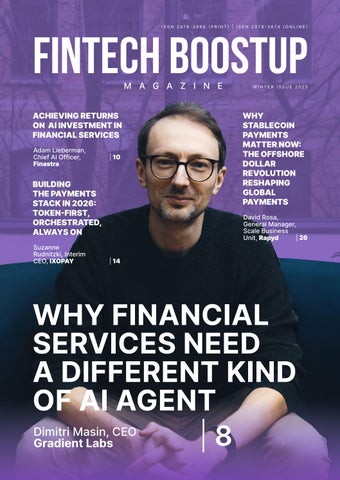
ACHIEVING RETURNS ON AI INVESTMENT IN FINANCIAL SERVICES
Adam Lieberman, Chief AI Officer, Finastra | 10
BUILDING THE PAYMENTS STACK IN 2026: TOKEN-FIRST, ORCHESTRATED, ALWAYS ON
Suzanne Rudnitzki, Interim CEO, IXOPAY | 14
Dimitri Masin, CEO Gradient Labs
David Rosa, General Manager, Scale Business Unit, Rapyd | 26
A DECADE OF TRANSFORMATION
Dear Readers,
This December, London welcomes the global fintech community to mark ten years of FinTech Connect. A decade on, the event continues to reflect the evolution of financial technology itself: what once felt experimental is now being deployed at scale, and what once lived in proof-of-concepts is today shaping core infrastructure. The shift from exploration to execution is unmistakable – and this issue captures that same moment of acceleration.
The 2025 agenda reflects the sector’s pivot toward real transformation. Across the Digital Transformation Stage, conversations will focus on how neobanks, challenger banks, and established institutions are adapting to new expectations while AI, APIs, and cloud-native design drive a new standard for intelligent financial services. That theme mirrors several of our features this issue: from Dimitri Masin of Gradient Labs’ perspective on why financial services need a domain-specific class of AI agent, built for high-stakes environments, to Adam Lieberman of Finastra’s framework for achieving measurable returns on AI investment within organisations. Together, they illustrate how AI in finance is no longer about experimentation but about responsible, resilient deployment.
On the RegTech & Compliance Stage, resilience takes centre stage. Ethical AI, big-data-driven compliance, and the rise of RegTech-as-a-Service underscore the industry’s urgent response to threats such as deepfakes, synthetic identities, and escalating fraud risks – trends also reflected in this edition’s coverage of AI-powered compliance platforms, fund flows, and operational risk intelligence.
Payments innovation is highlighted on the PayTech & eCommerce Stage – from embedded finance and alternative payment methods to cross-border flows and liquidity management. This magazine explores those shifts through IXOPAY’s Suzanne Rudnitzki and her deep dive into building the payments stack for 2026, where token-first rails, networktoken ecosystems, and orchestrated infrastructure redefine how merchants compete globally.
David Rosa of Rapyd also unpacks the offshore-dollar revolution and why stablecoin payments now represent real operational advantages for global merchants – one of the most timely conversations shaping the future of cross-border commerce.
Meanwhile, the Innovation & Start-Up Stage brings forward the next wave of disruptors. Whether through AI-powered compliance, financial automation, accounting intelligence, SME financing, or next-generation payments infrastructure, entrepreneurial energy continues to accelerate transformation at a pace no single institution can match. You’ll see these themes echoed in this issue’s fundraising stories: from AI megarounds and workflow-automation platforms to payment-linked financing and cross-border expansion plays – each illustrating how innovation continues to reshape the ecosystem’s next chapter.
What makes this year particularly special is the co-location with Tokenize: LDN and Dev Expo: LDN – an integration that mirrors many of the perspectives shared in this edition. From Laurent Marochini’s insights on institutionalising DeFi within evolving regulatory frameworks to IBM Project Manager Grace Robinson’s exploration of how cloud-native structures, DevOps, and modern observability are reshaping financial services infrastructure at scale, the convergence of digital assets, blockchain, and developer communities feels not only natural but necessary.
As FinTech Connect celebrates its ten-year milestone, the industry’s focus is clear: scaling AI responsibly, embedding finance across industries, strengthening compliance through technology, and ensuring inclusion in every market. The event remains a place where dialogue becomes action and where innovation translates into impact.
We wish all attendees an inspiring and productive two days in London.
As the year draws to a close, we also send our warmest wishes for a restful festive season and a successful year ahead.
Here’s to the next decade of resilience, intelligence and collaboration across global fintech.
Warm regards, Ekaterina Emirosan
Ekaterina (aka Katherine)
Emirosan, Founder
A
Dimitri Masin, CEO, Gradient Labs
Adam Lieberman, Chief AI Officer, Finastra
DIGITAL ID NEEDS ITS STRIPE MOMENT
Chloe Coleman, CEO & Co-Founder, Vouchsafe
2026 MARKS THE BEGINNING OF AI-DRIVEN FINANCE
Rinesh Patel, Global Head of Financial Services, Snowflake
STACK IN 2026: TOKEN-FIRST, ORCHESTRATED, ALWAYS ON Suzanne Rudnitzki, Interim CEO, IXOPAY
David Rosa, General Manager, Scale Business Unit, Rapyd
AND USBC
Simon McLoughlin, CEO of Uphold, Greg Kidd, Chairman and CEO of USBC
REGULATING THE DEFI
Laurent Marochini, CEO,
WASHINGTON: HOW THE US IS
ASSET LEADERSHIP (AND WHY THE UK MUST KEEP PACE)
Michael Treacy, Director of Marketing & Business
FROM LEGACY TO LEADERSHIP: HOW CLOUDNATIVE STRUCTURES
Grace Robinson, Product manager, IBM
INNOVATION STARTS AT THE CORE: BUILDING THE FOUNDATIONAL PLATFORMS FOR THE FUTURE OF FINANCE
Subramaniam Sundaram –Global Head of Solutions Management, Pismo
DISCLAIMER
By Joël Winteregg,
CEO, Vyntra
LEADERS REPORT PAYMENTS-RELATED CYBER INCIDENTS –
Piero Macari, VP of Product, Corpay
ISO 20022 – THE CONVERGENCE OF COMPRESSION AND FRAGMENTATION
Adam Cottingham, Asset Servicing Product Manager, SmartStream
MODERNISE OR FALL BEHIND: THE PRESSURES RESHAPING BANKING IN 2026
Nick Fernando, Co-founder and Director, Aqua Global
GEN Z HAVE BECOME FRAUDSTERS’ FAVOURITE E-COMMERCE TARGET –AND WHAT MERCHANTS CAN DO ABOUT IT
Ugne Buraciene, Group CEO, payabl.
AI EMPOWERS
MAKE CONFIDENT FINANCIAL DECISIONS
Dan Mines, Co-founder, Menna.ai
While every effort has been made to ensure the accuracy of the information contained in this publication, neither FinTech BoostUP nor its contributors accept any responsibility for errors, omissions, or the views expressed. The content is provided for information purposes only and does not constitute professional, financial, or investment advice. FinTech BoostUP is registered in England and Wales under company number 15797833.
Registered address: 69 Lea Hall Green, Birmingham, England, B20 2AY
ACKNOWLEDGEMENTS
We would like to thank the following brands that have helped make this edition of FinTech BoostUP Magazine possible: Gradient Labs, IXOPAY, Finastra, IBM, Vouchsafe, OpenPayd, payabl., Rapyd, SmarStream, Standard Chartered Luxembourg, and others. Your thought leadership and contributions are helping drive the future of fintech, and we’re proud to showcase your innovations within this publication.
Mastercard & Thunes Bring Stablecoin Payouts to the Mainstream
Mastercard has partnered with Thunes to enable secure, compliant stablecoin payouts across global markets, expanding Mastercard’s blockchain-based settlement capabilities.
<< Full story
THG Ingenuity Selects BR-DGE for Interoperable Tokenisation
THG Ingenuity has chosen BR-DGE to enhance payment orchestration through interoperable tokenisation, strengthening security and streamlining multi-provider payment flows.
<< Full story
dLocal & Felix Launch WhatsApp Stablecoin Remittances Across Latin America
dLocal and Felix have launched instant, stablecoinfunded WhatsApp remittances, enabling faster and more cost-efficient crossborder transfers across Latin America.
<< Full story
MoonPay Launches Enterprise Stablecoin Service
MoonPay has introduced an enterprise-grade stablecoin
service supporting issuance, management, and settlement for organisations adopting blockchain-enabled finance.
<< Full story
Banking
Ebury Launches Mobile App for Global Cash-Flow Management
Ebury’s new mobile app provides clients with realtime oversight of global payments, balances, and FX exposures directly from their devices.
<< Full story
Mercado Bitcoin to Invest €50M in European Expansion
Mercado Bitcoin will invest €50 million to grow its European footprint, focusing on digital assets, regulatory licensing, and cross-border financial solutions.
<< Full story
VPBank Modernises Core Banking with Temenos & Systems Limited
VPBank is upgrading its core platform using Temenos and Systems Limited on Red Hat OpenShift, improving scalability and accelerating its digital-transformation strategy.
<< Full story
Starling Expands Business Banking Ahead of HMRC’s Making Tax Digital Rollout
Starling Bank is enhancing its business-banking tools to support SMEs preparing for HMRC’s upcoming Making Tax Digital requirements.
<< Full story
SunTec Launches AIAugmented Account Analysis for US Banks
SunTec has launched an AIpowered account-analysis system to help US banks strengthen pricing strategies and drive more intelligent deal-making.
<< Full story
RegTech
Portugal FinTech Report 2025 Highlights Rising Shift to AI-Powered Compliance
The 2025 Portugal FinTech Report highlights strong momentum for AI-driven compliance, with Londonbased RegTech start-up Zango prominently featured.
<< Full story
MassPay Processes Tens of Thousands of Monthly ID Checks via Veriff
MassPay now processes tens of thousands of identity verifications each month
following its integration with Veriff, boosting onboarding efficiency and fraud prevention.
<< Full story
ComplyAdvantage Unveils New Platform to Tackle Rising Financial Crime
ComplyAdvantage has launched a new riskintelligence platform designed to help financial institutions combat increasing levels of financial crime.
<< Full story
M&A Activity
Lloyds Banking Group set to acquire Curve
Lloyds Banking Group, the UK’s largest digital bank, has announced the acquisition of Curve, a leading digital wallet platform, in a strategic move to accelerate its digital transformation for customers and reshape the future of payments.
<< Full story
Nexi Becomes Full Owner of Computop
Nexi has acquired full ownership of Computop, consolidating its European payments portfolio and deepening merchant-service integration.
<< Full story
FUNDRAISING STORIES
Thinking Machines Targets $50B Valuation in New Funding Round
Thinking Machines, founded by former OpenAI executive Mira Murati, is reportedly seeking a valuation of around $50 billion in its upcoming funding round.
<< Full story
Investors Back AdClear with $2.75M for AI Compliance
AdClear has raised $2.75 million to expand its AI-powered financialpromotions compliance platform.
<< Full story
Zilch Secures $175M to Drive Expansion
Zilch has raised more than $175 million to accelerate product development and international growth across its payments and credit platform.
<< Full story
Tide Receives Strategic Investment from Global Investor TPG
Tide has secured a strategic investment from TPG, supporting further product development and international expansion.
<< Full story
LexDo.it Raises €1.7M to Scale Its BusinessFormation Platform
LexDo.it has raised €1.7 million to expand its digital platform for launching and managing new businesses.
<< Full story
Sunhat Raises €9.2M Series A to Bridge the Enterprise “Proof Gap”
Sunhat has completed a €9.2 million Series A round to scale its platform automating evidence collection and compliance workflows for enterprises.
<< Full story
SAPI raises $80M to scale SME financing
SAPI, the payment-linked financing platform has raised $80 million in a package comprising approximately $75 million in debt and $5 million of equity. The funding will be used to scale SAPI’s repayment-at-source technology and expand its global footprint.
<< Full story
Numeric Secures $51M Series B Led by IVP
Numeric, the AI accounting automation platform, has raised a $51 million Series B round led by IVP, with participation from Menlo Ventures, Founders Fund, Alkeon, 8VC, Socii Capital, Access Industries, Friends &
Family Capital, Long Journey Ventures and Fifth Down, as well as Marc Huffman, Former CEO of BlackLine, and Ron Gill, Former CFO of NetSuite.
<< Full story
AI Fintech Dost Officially Launches in UK With £6M Series A Led by Octopus Ventures
Dost, an AI-powered financial automation platform, today announces its official UK market launch following a £6 million Series A funding round led by Octopus Ventures, one of Europe’s most active venture capital firms.
<< Full story
WHY FINANCIAL SERVICES NEED A DIFFERENT KIND OF AI AGENT
By Dimitri Masin, CEO, Gradient Labs
The pressure is on for banks and fintechs to ‘do something with AI’. Boards want action. Customers expect intelligence. Competitors announce new pilots every quarter. The result is an industry trying to move fast in one of the most complex and tightly regulated environments in the world.
Behind the noise, a quieter conversation is taking place among leaders who have carried AI systems through audits, regulatory reviews, and real cases of customer harm. Few understand that reality better than Dimitri Masin, CEO of Gradient Labs and former Head of Machine Learning and Data at Monzo. His experience building regulated AI systems at scale offers a sober view of what the industry needs and why generic chatbots and thin layers on top of large language models will not be enough.
He believes the agents capable of meaningfully improving customer operations must be built with financial services at their core.
THE LIMITS OF GENERIC AI IN A HIGH-STAKES INDUSTRY
It is tempting to believe that breakthroughs in large language models have created a one-size-fits-all solution for customer service. In many industries, that is starting to look true. Retailers can safely automate questions about orders, returns, or delivery updates. Telecoms can offer fast help on account changes. Travel companies can answer booking questions without risking financial loss. Financial services is different. The issues customers raise are often sensitive, highstakes, and deeply regulated. A misstep here isn’t an unsatisfied customer, it could be an illegal tip-off about an active investigation, the disclosure of account information to an unauthorised person, incorrect guidance during a fraud case, or a mishandled complaint that becomes a regulatory issue.
• “I’m seeing transactions I don’t recognise.”
• “I think I’ve been a victim of fraud.”
• “I need to file a complaint.”
• “There’s an issue with my loan repayment.”
These are not simple queries. They require agents – human or AI – to understand
policies, interpret regulatory rules, apply judgement on risk, and escalate correctly. Masin saw this complexity daily at Monzo. Launching any machine learning product required what he describes as years of “zigzag” with regulators. The goal wasn’t just technical accuracy. It was proving that the system understood edge cases, handled exceptions safely, and could be audited months or years later. “You never build these things straight,” he recalls. “You build them, learn from real interactions, and shape them until both regulators and customers are confident.”
This experience formed Gradient Labs’ product philosophy: deep domain expertise built into the agent itself. Not after the fact. Not as a wrapper. But at the core of the system.
WHY THE FUTURE BELONGS TO VERTICAL AI
Many companies entering the AI market today follow the same pattern: wrap a general-purpose foundation model with a thin layer of tools and prompt engineering, then position it as an agent for any industry. The problem, Masin argues, is durability. As underlying AI models get more
powerful, these thin wrappers become obsolete. They cannot keep up with the pace of change, nor can they absorb the depth of industry-specific knowledge needed to operate safely in finance.
The real movement, he says, is toward Vertical AI – systems built from the ground up with industry rules, context, and guidelines embedded natively.
“In the history of technology, experience has never mattered more,” he says. “Previously you built software to support experts. Now, the application is the expert.”
Vertical AI is not a buzzword in Masin’s view, but a change in how technology creates value. Instead of adding intelligence around the edges, the intelligence sits in the middle of the workflow, shaping decisions, guiding customers, and enforcing controls.
For financial services, this shift mirrors earlier waves of industry-specific technology. Payments, core banking, fraud detection, AML screening – each evolved into specialised ecosystems because the stakes were too high for general tools. AI agents will follow the same path.
BUILD VS. BUY: A MORE RATIONAL WAY TO DECIDE
Every financial institution is wrestling with the question of whether to build its own AI capability or buy a solution. Masin believes this debate has become unnecessarily polarised. Most firms will need both.
The real question, he says, is not whether to build, but what to build.
Generative AI is a foundational capability. It makes sense for banks to develop internal expertise. But that doesn’t mean every AI-enabled automation should be built in-house. Customer operations –where AI agents need to understand hundreds of procedures, escalate correctly, and adhere to strict controls – is one of the hardest places to start.
According to Masin, an internal team would need roughly two years to approach the quality of a specialised AI agent trained on financial processes. Even then, the vendor will have moved further ahead.
The reason is simple: scale and learning curves.
Gradient Labs estimates that achieving 80–90% automation requires building support for 100–200 Standard Operating Procedures (SOPs). Each SOP takes time to discover, document, structure, and integrate with the right APIs. This becomes a bottleneck for internal engineering teams already balancing competing priorities.
A specialist, by contrast, builds its entire product around these workflows.
It doesn’t need to discover them – its whole purpose is to encode them, refine them, and make them safer.
If a financial institution wants rapid time to value, buying a vertical solution is often the faster, safer choice. Internal teams can then focus on what truly differentiates their organisation.
EVALUATING PERFORMANCE: IT MUST BE DONE LIVE
The most difficult part of evaluating AI agents in finance is that performance cannot be measured on paper. Feature lists look similar. Demos are polished and only follow the happy path. Differences in quality between vendors only emerge with the volume of live conversations.
“You can’t evaluate these systems on a spec sheet,” Masin says. “The meaningful difference between a mediocre agent and a great one only becomes clear when it’s handling real conversations.”
Gradient Labs’ own benchmarks illustrate the point. In financial customer operations, their AI agent consistently delivers:
• Customer satisfaction (CSAT): 80–95%
• Quality assurance pass rate: 98%
• Cost: 25–35% of a human agent
For comparison, human teams typically achieve:
• CSAT: 65–85%
• Quality assurance pass rate: ~90%
When a financial agent performs at this level, customers trust it, operations become more resilient, and leaders can scale a phenomenal customer experience without scaling headcount.
WHAT COMES NEXT
The most important question is not what the next generation of AI will look like. The important question is what the customer experience can become. Banks and fintechs now have a chance to remove friction across the entire journey in a way that has never been possible before. They can move from solving problems after they appear to guiding customers before an issue ever reaches the support team.
Proactive support is a clear example. When a repayment concern, an expiring document, or a payment failure cannot wait for a customer to get in touch, the institution can reach out first. These two-way conversations resolve a wide set of scenarios, from collecting information to clarifying a fee to confirming a fraud alert. Because they can run across any channel, the customer receives support in the place that suits them best.
The outreach feels timely and relevant rather than intrusive.
The same opportunity exists behind the scenes. Most customer support happens in the back office. It involves investigations, evidence gathering, and the application of detailed operational rules. It is the part of the journey many AI systems never reach. By automating these steps, institutions can remove a major bottleneck. When an issue is flagged, the system can investigate, collect the right context, and prepare a clean case file. Simple issues can be resolved outright. Complex ones can move to a human with the groundwork already done.
This is how institutions unlock the deeper value of automation. Their teams spend more time on work that requires judgement and trust. Customers feel supported throughout their journey, not only when they ask for help. The experience becomes calmer and more consistent.
The path forward is about quality. It is about the kind of support customers will want to receive and rely on. It is also about recognising that the biggest gains come from improving the entire experience, not only the moments when a customer reaches out. Institutions that focus on this direction will be the ones that set the new standard for financial services.
ABOUT THE AUTHOR
Dimitri Masin is the CEO and Co-Founder of Gradient Labs, the conversational AI platform transforming customer operations in financial services. An early employee at Monzo, Dimitri built the bank’s AI and Data Science teams, helping it become one of the UK’s most successful fintechs. During this time, he worked on some of the most challenging problems in customer operations and saw first-hand how AI could be used to solve them.
Prior to Monzo, Dimitri worked at Google and Osper. He is known for building high-performance technical teams and for developing responsible AI systems for regulated environments. His work has spanned large-scale automation, operational efficiency, and applied machine learning across product, engineering, and operations functions. He frequently speaks about the future of AI in banking and advises earlystage fintech and AI founders.
ACHIEVING RETURNS ON AI INVESTMENT IN FINANCIAL SERVICES
By Adam Lieberman, Chief AI Officer, Finastra
With financial services firms having invested heavily in AI in recent years, many material use cases, from generative AI assistants, embedded services, and advanced automation in operations and analytics, are beginning to mature. For some organisations, however, ROI is still proving to be elusive. The reasons for this are well known and range from the challenge of legacy systems and processes to the lack of in-house expertise. With advancements in the fields of data science and AI happening all the time, it can be challenging for organisations to ensure their digital transformation roadmaps are agile enough to fully harness the potential of new technologies in good time.
While blockers exist, I’d like to discuss some relatively simple steps that organisations can take to achieve the required agility and deliver value with AI.
MEASURING MATURITY AND UPSKILLING
The first step every organisation must take is to measure its level of AI maturity. To do this, it’s important to start by assessing the extent to which AI can deliver efficiency across different workflows and then consider how far along individuals and teams are in relation to this benchmark. If tools that can automate tasks are readily available but
are not being used effectively, or at all, education and upskilling are clearly required.
Of course, some employees will be more adept at using AI tools than others. Developers, for example, will likely be using AI coding applications on a regular basis, but those working in areas that can most readily benefit from rudimentary task automation, such as HR and finance teams, are less likely to have incorporated AI into their workflows.
Identifying these gaps and developing bespoke education and upskilling road maps is an effective strategy for ensuring every employee is engaging with the tools available in a way that truly benefits them. Ultimately, we want every employee to feel empowered by the technology, as improved employee experience translates into better outcomes for customers.
Training should, however, not be looked at as a one-time event. As the technology advances and new features and capabilities come online, and as employees become more adept at incorporating AI into their workflows, new training pathways should be established. This is how organisations can maintain a consistent level of maturity.
DELIVERING MATURITY THROUGH MODERNISATION
For financial services firms, enhancing products and services with AI requires a deeper focus on upgrading technology infrastructure. In this regard, maturity should also be measured against what is possible with the existing technology stack, with the wider AI strategy focused on modernising systems so that AI can deliver real value.
Data infrastructure is crucial for unlocking the power of AI and automation. Disparate systems and data silos are challenges that most financial institutions face, having initially built their core infrastructures and offerings with technology that predates cloud computing and other technological advancements. This has led to a gradual migration of services to the cloud, as monolithic legacy applications are broken down into modular applications.
These applications can also benefit from AI-powered cloud services, such as Copilot and ChatGPT, enabling fi-
As the technology advances and new features and capabilities come online, and as employees become more adept at incorporating AI into their workflows, new training pathways should be established
nancial institutions to overcome their legacy challenges. The most widespread example is chatbots, which can now connect to company databases as well as approved external sources to deliver more advanced search and discovery capabilities. This can help internal users collate information and reports, as well as summarise large amounts of information, and also deliver better customer service experience through the quick resolution and prioritisation of more complex queries.
WHERE TO PRIORITISE AI INVESTMENT
When it comes to succeeding with individual AI initiatives, the path to achieving ROI starts with clarity. Communicating how AI initiatives will help to achieve business objectives, and setting clear measures of success, such as KPIs, is essential. This starts from the top, with leaders ensuring all teams involved in the initiative are involved in determining what success looks like.
Disparate systems and data silos are challenges that most financial institutions face, having initially built their core infrastructures with technology that predates cloud computing
Securing cross-functional buy-in at inception, from data science and engineering teams to product, operations and risk and compliance teams establishes a culture of co-ownership, with all teams responsible for delivering against success metrics, and fulfilling Service Level Agreements (SLAs) if the use cases are external.
Early wins typically come from projects focused on internal productivity, such as those relating to document intelligence and discovery, case summarisation in operations, and coding assistants. These use cases are low risk, particularly from a regulatory point of view, so are typically quick to deliver as there are fewer restrictions when working with organisational data and IP. For this reason, internal use cases are the best place to start when it comes to delivering value with AI.
STAY FAIR AND FOCUSED
Of course, the core principles of responsible AI must be the foundation of every initiative, with fairness, explainability and privacy observed. Internal use cases are much less likely to expose the business to the risks associated with customer-facing applications, but they may require that consent is sought from employees if their data is used in new ways.
The rise of the CAIO reflects the importance of senior advocacy and oversight for AI initiatives, as well as the commitment to ensuring all AI initiatives are undertaken with the purpose of achieving business objectives. AI has the power to deliver incredible results, but when the aims of initiatives are not clear, projects will quickly unravel and fail to deliver ROI. The recommendations in this article can help firms boost success when it comes to the adoption and integration of AI.
DIGITAL ID NEEDS ITS STRIPE MOMENT BEFORE IT TRULY TRANSFORMS FINANCE
By Chloe Coleman, CEO & CoFounder, Vouchsafe
When your customers have to go through KYC/AML checks, they currently hate you. Proving who you are, where you live and that you’re trustworthy is still an absolutely awful user journey. Drop off rates of over 60% are common.
The absolute best case scenario is having to get off the sofa and remember where you left your passport. Worst case scenario: you don’t have one at all.
Paired with the growing threat of AI-powered fraud, the UK Government’s new push for digital ID, whatever that ends up being, has come at the best possible time.
Proper digital ID is incredibly hard to fake, providing an excellent defence against both synthetic identities and impersonation.
With the right KYC systems in place, it can be as simple as agreeing to a prompt on your smartphone, the same way you might give permission to use the camera.
Digital ID is now months, not years, from mainstream rollout in the UK. Veteran Cards are already live, and mobile driving licences are coming. Vouchsafe already supports automatic eVisa acceptance and dozens of other digital ID provers.
The anti-fraud benefits are immense. There is very little true security added by collecting pictures of identity documents, because for the most popular government-issued documents, there is
simply no way to confirm with the issuer that they’re genuine. Digital ID closes this gap.
If you’re a fintech, or any kind of financial service with a digital element, your user journey is about to suck a whole lot less. Customers will be able to prove their identity with one click of a button. And you’ll know with much more certainty that it’s them.
This all sounds very much like a KYC utopia, but there are a few barriers to hurdle before we get there:
YOU DON’T ALWAYS GET WHAT YOU WANT
People like to be in control of what data they are sharing, and government services are built around this principle. Emerging digital ID schemes all use the concept of selective disclosure; only sharing the requested information, no more.
If I use my digital ID to buy something age-restricted in a shop, there’s no need for the vendor to know my full
name or address. With selective disclosure, they don’t see it.
This poses an issue for KYC, which demands much more than just a name and date of birth, even if they come with the strong assurances and fraud controls of a recognised digital ID scheme.
How do we fill the gap?
The way forward is to use these new digital IDs as the root of trust, and the verified data that comes from them as the basis for a cascade of background checks against telcos, credit bureaus and international watchlists, enriching the data and turning it into a complete risk assessment
A STRIPE FOR DIGITAL ID
Despite emerging technical standards, implementations of digital ID schemes are often very different. India’s Aadhaar bears little resemblance to Nordic BankID schemes, and our own mobile driving licences will only superficially resemble either.
Just as in the world of payments, a merchant doesn’t make a fresh integration with every single bank; they use payment networks Visa and Mastercard and processors like Stripe.
As KYC goes digital, expect social engineering attacks geared at stealing legitimate credentials from a user’s device to become more common.
Just like today, stolen details can be spotted by an unusually high number of applications in a short space of time, as the scammers grab what they can before the theft is noticed.
This all means there’s a gap for a Visa or Stripe-like acceptance network for digital IDs; with a vantage point from which high-velocity signals and other risky behaviour can be spotted and controlled.
ID POVERTY WILL BE AROUND FOR A LONG TIME TO COME
Digital ID is already here for billions around the world, and millions in the UK, and rapid expansion is imminent, but it will be a long time until we can make it the only choice for onboarding, if ever.
There are eleven million people in the UK without a passport or driving licence, and a billion people globally in a similar situation. If someone doesn’t have the
There are eleven million people in the UK without a passport or driving licence, and a billion people globally in a similar situation
right foundational identity documentation, it’s going to be nearly impossible to enroll them on a digital ID scheme.
As AI-powered fraud pushes more services to adopt explicit identity verification, the verification systems must use inclusive, flexible fallbacks, not just digital ID but also to old-fashioned passports and driving licences.
Vouchsafe has had great success providing a trusted referee vouching mechanism for those users who lack
Digital ID will be a watershed moment for our industry
foundational documents. It is safe, automatic and an excellent tool of financial inclusion.
Digital ID will be a watershed moment for our industry.
But it won’t deliver the promised benefits alone. We need to pair it with Visa or Stripe-like trust infrastructure that provides interoperability, fraud protection and inclusive fallbacks for those without.
The winners in this next decade of fintech won’t be the ones who bet on a single credential or wallet. They’ll be the ones who build systems that work for everyone.
WHY 2026 MARKS THE BEGINNING OF AI-DRIVEN FINANCE
By Rinesh Patel, Global Head of Financial Services at Snowflake
Financial organisations are entering a new era, which will be defined by their ability to power their data with AI. In 2026, banks, asset managers and fintechs will no longer treat AI as an experiment, but as a core driver of datapowered performance. Delivering real value will depend on unified data foundations, governed architectures and a clear focus on measurable business outcomes.
As regulatory pressure intensifies and competition accelerates, the firms that succeed in 2026 will be those that embed AI deeply into their data foundations, treat it with the same rigour as any mission-critical technology investment, and deploy it to solve real, revenueimpacting problems. The expectations are rising and the industry is finally preparing to meet them. Here are the three predictions I believe will shape the finance industry most in the year ahead.
SEEKING TANGIBLE OUTCOMES
The days of “AI for AI’s sake” spending are over. In 2026, financial institutions will pivot from proof-of-concept projects to demanding measurable business impact from every AI dollar spent. Banks and asset managers will no longer accept experimental chatbots or isolated AI tools – they’ll require clear evidence that AI is driving specific outcomes: customer retention rates, revenue growth percentages, operational scale improvements, and enhanced digital adoption metrics.
This shift will force organisations to abandon siloed AI experiments in favour of integrated solutions built into core data architectures, with boards demanding comprehensive measurement frameworks that treat AI investments with the same rigour as any other strategic technology deployment.
THE EVOLUTION OF AI RISK MANAGEMENT
As AI agents and large language models become embedded in critical financial operations, the risk conversation will expand dramatically beyond bias and hallucinations. In 2026, financial institutions will grapple with AI risks that directly threaten operational resilience, from data residency challenges to systemic failures that could trigger regulatory sanctions.
European regulators are already signalling stricter oversight, and boards will demand comprehensive risk frameworks that treat AI deployment as seriously as any other mission-critical system. Firms without robust data foundations will find themselves unable to deploy AI at scale.
PROFITABILITY WILL DRIVE HYPER-SPECIALISED AI
Unlike other industries pursuing AI for efficiency gains, financial services will double down on AI’s revenue-generating potential. In 2026, this profit-first mentality will spawn highly specialised AI applications tailored to specific financial sectors. For instance, banks will deploy AI to optimise lending margins and reduce credit losses, and asset managers will use it to uncover alpha in alternative data.
EMBRACING A NEW AI ERA
AI in financial services will no longer be defined by prototypes, hype cycles, or isolated innovation labs – it
European regulators are already signalling stricter oversight, and boards will demand comprehensive risk frameworks
will be defined by performance. Institutions will demand integrated AI systems that operate at scale, deliver provable commercial outcomes, and meet the stringent regulatory and operational standards expected of modern financial infrastructure.
The winners in this next phase will be those that pair cutting-edge AI with strong data governance, cross-enter-
prise integration, and a clear understanding of where AI can truly move the needle – whether in revenue generation, customer engagement, or risk mitigation. In the finance industry we can expect to see a more disciplined, impactdriven ethos coming to the fore. The organisations that embrace this shift today will be the ones shaping the financial landscape of tomorrow.
In 2026, this profit-first mentality will spawn highly specialised AI applications tailored to specific financial sectors
BUILDING THE PAYMENTS STACK IN 2026: TOKEN-FIRST, ORCHESTRATED, ALWAYS ON
By Suzanne Rudnitzki, Interim CEO, IXOPAY
Global digital commerce is outpacing legacy payment stacks, and that’s an opportunity, not a crisis. Regulatory scrutiny and rising customer expectations are pushing payments from the back office into the spotlight as a strategic engine to manage revenue, risk, and trust. In 2026, this shift from “plumbing” to “growth platform” becomes real. In this article, I outline seven trends that I believe will define that transition; teams that lean into them now won’t just keep up, they’ll be setting the standard for the next decade of payments.
1. THE INTELLIGENT PAYMENTS STACK: WHERE TRANSACTIONS FUEL EVERY DECISION
In 2026, AI-driven analytics and embedded observability will be table stakes for any serious payments business. That means a single, end-to-end view of payment flows, with AI turning that data into early warnings, trends and predictions; exactly the kind of shift IDC expects as AI/ML “redefine observability.” To get there, merchants must unify siloed PSP and acquirer data, often via orchestration. Regulation is accelerating this shift. PSD3 and tougher fraud/cross-bor-
der scrutiny makes real-time visibility, anomaly detection, and automated alerts part of the minimum compliance toolkit.
2. TRUST ORCHESTRATORS: WHO WINS WHEN AI AGENTS START TO PAY
By 2026, the strongest orchestration platforms won’t just route payments; they’ll orchestrate trust. As AI agents start acting on behalf of users and businesses, the key question shifts from “Which PSP?” to “Who or what is ‘acting’, what are they authorised to do, and who holds the risk?” Routing logic will be commoditised. The harder, more valuable work is verifying identity and intent, applying the right agent protocol, and generating evidence that stands up in a
dispute. The winners will be protocolagnostic, token-first orchestrators that deliver immutable, end-to-end proof; because in autonomous commerce, machine-verifiable trust becomes the core currency.
3. RIGHT RAIL, RIGHT TIME: WHY LOCAL APMS DECIDE WHO WINS AT CHECKOUT
For global merchants, payment mix now rivals price. Customers expect familiar methods, cards, bank transfers, wallets, instant-pay rails; and local APMs like India’s UPI and Brazil’s Pix Automatica dominate in their markets. Missing them at checkout can cost up to 10% of international revenue. From 2026, supporting cards, non-card APMs, and
emerging rails like stablecoins will be essential, with orchestration platforms helping quickly add and optimise options.
4. WHEN BOTS BUY FOR YOU: PREPARING THE PAYMENTS STACK FOR AGENTIC COMMERCE
Agentic commerce, where AI agents handle renewals, reorders, and even procurement, is moving from concept to reality, but rollout will be gradual. Infrastructure comes first: providers and orchestrators are deploying tokenisation, delegated authentication, and credentials-on-file so agents can transact securely. With consumer trust slowing B2C, early growth will be in B2B and subscriptions, so merchants should prioritise tokenised credentials, reusable (tokenised) IDs, and agent-friendly workflows.
5.
THE RISE OF NETWORK TOKENS: FROM SECURITY FEATURE TO AGENTIC FOUNDATION
Over 2026 network tokens will cement themselves as the foundation for future “agentic tokens”, the secure, reusable credentials autonomous agents use to transact safely. Card schemes already treat them as the new card-onfile and CNP standard, with tokenised transactions set to double, and deliver higher approvals, lower fraud, reduced PCI scope, and fewer involuntary churn events. Yet many merchants still lack clarity on how network tokens work, especially in multi-PSP setups, making education from schemes and providers a key priority.
6. THE HIGH COST OF BLIND SPOTS: USING CHARGEBACK OBSERVABILITY TO AVOID PENALTIES AND LOST PROCESSING
As card networks tighten dispute and fraud rules, chargeback data is shifting from a back office report to a core compliance and performance requirement. Visa’s VAMP program lowers dispute ratios deemed ‘excessive’ from around 2.2% to roughly 1.5% in many regions, with global rollout (excluding MENA) from April 1, 2026. Even if a merchant’s own ratios look acceptable, contributing to an acquirer’s breach can mean higher fees, tougher terms,
AI-driven analytics
and
embedded
observability will be table stakes for any serious payments business
in 2026
fines, or termination. To stay out of the danger zone in 2026, merchants will need granular, near real-time visibility into disputes by provider, BIN, region, product, and APM, plus proactive alerts and clear controls. Merchants also need to have preestablished redundancy and use APMs to drive down risk.
7. MULTI-TOKEN INFRASTRUCTURE: NETWORK, PAR, AND VIRTUAL CARDS AS THE NEW CORE
Payments are undergoing a structural shift from raw PANs to token-native rails, with card scheme-issued network tokens and wallet tokenisation becoming the core of the stack. Tokenisation cuts exposure and PCI DSS scope, limits breach impact, and keeps credentials current to lift approvals and reduce churn. With PAN-only
e-commerce set to sunset by 2030, tokenfirst infrastructure is fast becoming the default, and the most pragmatic on-ramp to agentic commerce.
2026: FROM AD HOC TO AHEAD OF THE CURVE
Payments are no longer back office plumbing; they are strategic infrastructure for growth, loyalty, and reach. The changes coming in 2026 and beyond are structural. The good news, payments teams that invest now will build an edge. A token-first, orchestrated stack with real-time observability and compliance lets you move faster with less risk. Add the ability to think globally and adapt locally, and payments become a programmable decision engine. At IXOPAY, we are building for a future where merchants can simplify complexity and scale for advantage.
Chargeback data is shifting from a back office report to a core compliance and performance requirement
WHY STABLECOIN PAYMENTS MATTER NOW: THE OFFSHORE
DOLLAR REVOLUTION RESHAPING GLOBAL PAYMENTS
By David Rosa, General Manager, Scale Business Unit at Rapyd
The programmable dollar is here, and it’s fundamentally changing how businesses move money across borders.
If you’re running a business that moves money internationally, you’ve likely heard the buzz about stablecoins. Beyond the hype lies a fundamental shift in how US dollars work outside the USA, and it will transform your global payment operations and treasury management. Stablecoins aren’t just another cryptocurrency trend. They are the modern evolution of an ageing financial system that’s finally getting the upgrade it needs. For businesses dealing with cross-border payments, emerging markets, or highopportunity industries1 , this shift opens doors that traditional banking has long kept shut.
To understand stablecoins on a global scale, consider the Eurodollar market: US dollars held outside of the United States. This market became a foundation for global finance, with its price historically set by LIBOR (the London Interbank Offered Rate).
The 2008 financial crisis exposed massive collusion in LIBOR, leading to its complete phase-out by 2023 and replacement with SOFR (Secured Overnight Financing Rate). This regulatory pivot effectively brought dollar pricing and liquidity management back onshore to the US, causing offshore dollar liquidity to evaporate just when global demand was surging.
That is the macro backdrop against which stablecoins found their productmarket fit. With the stability of the US dollar and the versatility of blockchain transactions, stablecoins function as programmable versions of Eurodollars that do not require banks as intermediaries. This allows them to instantly meet the voracious global demand for dollars.
WHY BUSINESSES ARE TURNING TO STABLECOIN PAYMENTS
With landmark clarity from the U.S. GENIUS Act and European MiCA regulation paving the way for adoption, the race is on to optimise global payment flows. The numbers tell the story: the supply of stablecoins has grown from $2 billion to over $200 billion in circulation2 in just the last six years.
Even excluding trading volumes generated by crypto traders, stablecoin payment volumes are quickly ap -
proaching those of major card networks like Visa and Mastercard. Projections indicate that the market will continue to grow rapidly, with stablecoin supply potentially exceeding US$3 trillion by 20303. Major global payment processors, including Rapyd, have launched solutions, and both the US and Europe have passed legislation facilitating adoption. This is not experimentation; it is a rapid, private-sector-led transformation.
Three forces are driving this use: supply-side strategic interests, growing demand from emerging markets, and an opportunity gap in traditional banking.
• Emerging Markets Need Stable Currency: Picture a Colombian business invoicing international clients. They prefer payment in US dollars to hedge against currency volatility. While opening a US dollar bank account is complex, creating a stablecoin wallet is fast and straightforward. Businesses across
Stablecoins aren’t just another cryptocurrency trend. They are the modern evolution of an ageing financial system that’s finally getting the upgrade it needs
emerging markets use stablecoins to invoice in stable currency, store value protected from local devaluation, and receive payments instantly, 24/7, 365 days a year.
• The Opportunity Gap: Non-banks are filling gaps in high opportunity, regulated industries, such as forex, regulated gambling, and crypto exchanges, that are often underserved by traditional banks due to perceived reputational risk. Stablecoin solutions provide a compliant, operational lifeline to these legitimate sectors.
WHAT DO STABLECOINS MEAN FOR YOUR BUSINESS?
The infrastructure is maturing quickly, with modern blockchains and compliance tools meeting stringent regulatory requirements. Stablecoins deserve your attention now if you fall into any of these categories:
• Global Merchants: Dealing with emerging markets where traditional banking is slow and restrictive.
• High-Opportunity Industries: Regulated sectors like forex, crypto exchanges, and digital goods.
• Businesses with Remote Workers: Paying international contractors and employees instantly without wire transfer delays.
• Companies with Volatile Supply Chains: Needing to move money quickly between regions to optimise cash flow and seize opportunities.
Stablecoins are reshaping global payments, but you don’t need to navigate this transformation alone. Rapyd has the infrastructure and expertise to support your growth in any market.
BRINGING BANK-ISSUED DOLLARS TO THE BLOCKCHAIN: A CONVERSATION WITH UPHOLD AND USBC
By Simon McLoughlin, CEO of Uphold, and Greg Kidd, Chairman & CEO of USBC
FB: Simon, Greg, can you explain your roles?
Simon McLoughlin (SM): I’m Simon McLoughlin, CEO of Uphold, a digital asset trading platform. We were at Money 20/20 USA this year primarily because a very important part of our business is opening our platform to traditional financial institutions who want to incorporate digital assets and blockchain in what they do. We believe we’ve got the best API platform in crypto, and we’re also a market maker; we’re not a crypto exchange, which means we poll the entire market for the best pricing, the best liquidity.
Greg Kidd (GK): I’m Greg Kidd, Chairman and CEO of USBC (US Bank Coin) and also the lead investor in Vast Bank.
FB: Why is USBC so important?
SM: There are two sides to Uphold’s business. We serve retail customers in 150 countries and we also serve enterprise customers building on blockchain. And for both of those customer segments, USBC is a really important innovation. The US dollar is the global reserve currency, and USBC will enable us to offer a bank-issued dollar that moves on the blockchain but comes with all the protections of the US banking system. That’s a completely novel development. Nobody has anything like that, and we think it’s really going to spur account opening at Uphold in many countries around the world,
especially Latin America. And on the enterprise side, I would argue it’s even more important because enterprise customers are not natural users of stablecoins.
FB: What does the partnership between Uphold and USBC bring to the financial sector?
GK: USBC is a product, but Uphold is really a platform, and it’s a platform
that’s currently business-to-consumer, but it’s also business-to-business. Uphold is the front end where people actually get access, historically to crypto and other fiat currencies, but now we’re adding actual bank account money. And so this offering, which is bank money, will sit right alongside the traditional offerings Uphold has had, both in retail, but also every developer will be able to build
Simon McLoughlin, CEO of Uphold
those features in. That includes sending, spending, conversion, loading and unloading. And all those things will happen at the front end through Uphold. USBC will be the back end.
FB: What benefits do tokenised deposits bring to everyday users?
SM: At the most simple level, it pays interest because it’s a real dollar issued by a US bank. It comes with FDIC insurance, and it comes with Reg-E chargeback protections.
The natural issuer of a dollar is a US bank. The natural issuer of a dollar is not a fintech. So I think for retail users, the confidence and trust they can put in USBC is of a completely different order to a stablecoin from some random fintech.
FB: How do you handle compliance so USBC can scale across different markets?
GK: USBC is like Tether and USDC, which are stablecoins running on a blockchain, but ours is a permissioned blockchain, so all the transactions are private. The way we make them compliant is we make sure that every single holder has an identity – that’s an identity-first blockchain, which means you can’t hold positive value on the chain without having credentials. Things like stated address, government ID, proof that you’ve logged into, say, another financial account. With those credentials, you’re able to get things like FDIC insurance, chargeback protections and also consumer protections. So, you have all the protections of the banking system because you’re using bank money on blockchain.
That’s the marriage – it’s between all the advantages of the blockchain crypto world in terms of 24/7, being global, but with all the protections we take for granted in the US banking system, with FDIC insurance, chargeback protection and other consumer protections.
FB: What role do you see USBC playing in defining the standard of compliant digital money?
GK: For USBC to make this a universal protocol across all countries, across all products, all wallets, all applications, we’ve made a very simple designation of bronze, silver and gold levels of credentials. In bronze, you’re round-tripping at a very low level. Things like your mobile phone number, things like your email
address, a biometric, and that gives you a certain level of trust. Silver is government ID, gold means you’re hooking up another bank account.
Once you have those things and you pick a unique name, then you can send and receive between yourself and any other person in the system. That structure, put forth by regulated entities, a bank on our side and in the case of Uphold, a money transmitter, means that developers can put USBC into their products and services without having to be licensed themselves.
FB: How do you see digital deposits shaping the future of global retail banking and payments?
GK: Tokenised deposits mean everybody can send to everybody; people, entities, even AI bots. From a send point of view, we believe everyone who has the token will also have a card to use this form of money anywhere major cards are accepted. We’ll have a USBC card, it might be issued by Uphold or other fintechs, but it means universal acceptance… And so it
becomes kind of like the Star Trek currency – it’s the unifying currency.
Finally, we’ll have all these loadand-offload ramps, and once again, this is the universal currency. In a world of real-world tokenised assets, you’re not going to go from a Pokémon card to a Ferrari without going through money. And the form of money you’re most likely to go through is a dollar. So if you’re going from one tokenised asset to another, you’re probably going to want to pass through a tokenised dollar.
FB: How does this tie into the broader vision of tokenised assets?
SM: This delivers on a lot of the promises of blockchain because it’s inherently inclusive and inherently global. If you’re living in Argentina can open a bank account in Tulsa, Oklahoma and you get access to a dollar that’s really unique because the dollar can travel in two dimensions. It can travel to a blockchain wallet address, but it also has traditional bank credentials, so you can send it through the traditional bank rails.
Greg Kidd, Chairman & CEO of USBC
REGULATING THE DEFI REVOLUTION
By Laurent Marochini, CEO of Standard Chartered Luxembourg
FB: Why is DeFi important for the future of finance, and how is Standard Chartered positioning itself in this evolving ecosystem?
LM: Innovation has always been a driver of transformation in the financial industry. Infrastructures have evolved from paper-based in the late 1990s to electronic and now to digital, with the promise of blockchain technology. These transformations have required the industry to adapt its infrastructure. Technology has the capacity to transform market infrastructures across the entire value chain, promising efficiency, speed, and transparency. At Standard Chartered, we recognise these changes and that the pace of change is accelerating. Digital assets and blockchain technology are here to stay. Standard Chartered considers digital assets an important and permanent part of the future of financial services, reinforced by continuing affluent clients and cross-border demand, and the increased focus of policymakers and regulators on digital assets, which we welcome.
In this context, we are investing in our 5 Strategic Capability Pillars that are access, execution, custody, tokenisation and interoperability.
FB: How are regulatory authorities approaching decentralised finance across global regimes?
LM: Regulation is essential to protect investors and consumers, as well as to ensure the stability of the financial sector. Digital assets and blockchain represent a major innovation that requires regulation without hindering its widespread adoption. Regulators
across the globe have different approaches, with Europe taking the lead by regulating stablecoins and Crypto Asset Service Providers (CASPs) in 2024 and launching a pilot regime for security tokens in 2023. Other regions, such as the US, the UK, and Asia (including Hong Kong and Singapore), have followed suit, often with greater flexibility. Regulation has also become a tool for building investor confidence and preserving sovereignty while fostering competitiveness. The US has become very attractive with the Genius Act, while Europe remains more restrictive. With it, the US also secured its dominance in stablecoins, while Europe keeps central bank digital currency (CBDC) as a future objective.
FB: How are concerns around legal uncertainty and security risks being tackled by regulators and financial institutions?
LM: Regulators and financial institutions reduce legal and security uncertainty through standards and regulations. It is important to remember in the financial environment that clear and precise rules are essential for developing business activities. Regarding legal uncertainty, regulators have developed licences that in some cases resemble banking licences, with sets of obligations such as capital requirements, internal audits, management, and appropriate governance.
On the security front, regulators have emphasised the need to segregate assets, insure them, and adopt a cybersecurity-by-design approach (cold storage, Multi-Party Computation (MPC)). The Anti-Money Laundering (AML) and Know Your Customer (KYC) framework, inspired by traditional rules, is also part of the rule set. Compliance and security are the major pillars of the regulations. In Europe, we also have the Digital Operational Resilience Act (DORA). The specific measures vary depending on the country and its regulations, but the general principles remain the same to guarantee security, trust, and predictability.
Regulation has also become a tool for building investor confidence and preserving sovereignty while fostering competitiveness
FB: What is the role of smart-contract standardisation in enabling wider institutional adoption of DeFi?
LM: Smart contracts play a crucial role in the development of initiatives, particularly in their adoption and institutionalisation. They can be considered a cornerstone for several reasons:
• Interoperability: Institutionalisation will require the ability to interact between initiatives, and therefore between blockchains. The smart contract must be designed from the outset to take these considerations into account, and standardisation must contribute to this.
• Security: Cybersecurity is becoming increasingly more significant. Any vulnerability in a smart contract could be exploited and strong risk management is necessary to enable adoption.
Standards such as ERC-426 will help reduce errors and increase interoperability. Auditability and talent development in this context will play a vital role in building trust in this new world.
FB: What key insights will you be highlighting at Fintech Connect 2025?
LM: The title of my panel is “Rethinking the Regulation in the Age of DeFi.” My main key messages are as follows:
• Regulation is necessary in the DeFi world. However, this should not stifle innovation. The purpose of regulation should still be investor protection and financial stability
• DeFi will also require rethinking and not always trying to use traditional methods. It is necessary to evolve, and education for financial professionals and regulators is essential to under-
The time is now for building the infrastructure of tomorrow with, and for, our clients
stand these new risks while maintaining flexibility.
• Standardisation and harmonisation must become the rule to avoid grey areas.
FB: What are Standard Chartered’s plans for DeFi over the next few years, and what trends do you see shaping the space?
LM: From our perspective, we are convinced that the institutionalisation process is more underway than ever, both in terms of digital assets and tokenisation. Recent U.S. Securities and Exchange Commission (SEC)-approved exchange-traded funds (ETFs), the growth in stablecoin market capitalisation, and tokenisation operations like the one we completed with China Asset Management in Hong Kong have become a reality.
The trend is clear, and it is important to seize the opportunities within our regulated environment.
At Standard Chartered, we have built our foundations on the five pillars of access, execution, custody, tokenisation, and interoperability. The time is now for building the infrastructure of tomorrow with, and for, our clients.
For Luxembourg, our plan is clear: to become a leading and major player in the world of Digital Asset Custody.
ABOUT THE AUTHOR
Laurent was appointed CEO of Standard Chartered Luxembourg in January 2025. He is very involved in the Fintech ecosystem, currently acting as Chairman of the ABBL (Association Banques et Banquiers Luxembourgeois) for the working group for Tokenisation and DLT and was Co-Chairman of the Working Group Blockchain & Crypto Currencies of ALFI (Association Luxembourgeoise des Fonds d’Investissements) from 1996.
INSIDE WASHINGTON: HOW THE US IS FAST-TRACKING DIGITAL ASSET LEADERSHIP (AND WHY THE UK MUST KEEP PACE)
By Michael Treacy, Director of Marketing & Business Development, OpenPayd
When it comes to digital asset regulation, there’s one clear message coming from the United States that stands out above all others: “We are moving quickly and the UK can be a key partner.”
Last month, I had the honour of representing OpenPayd as part of a UK delegation of blockchain experts from industry and government on a visit to Washington, DC. The trip was led by Dr Lisa Cameron of the UK/US Crypto Alliance, whose leadership and advocacy have been instrumental in strengthening transatlantic collaboration in digital finance. We were also joined by Lord Ranger and Baroness Uddin, representing the House of Lords and adding vital parliamentary weight to the discussions. What became immediately clear throughout the visit is that the US is gaining momentum at a pace that demands attention, and that the UK must act decisively to avoid falling behind.
A UNITED STATES POSITIONED TO BECOME A GLOBAL DIGITAL ASSET HUB
The ambition shown by US policymakers and regulators was unmistakable. The US is actively positioning itself
as a global leader in digital assets and sees regulatory clarity as a strategic economic advantage.
The country is: • Building frameworks that support responsible, scalable innovation
• Champions of regulatory harmonisation internationally
• Expanding sandbox environments to promote safe experimentation
• Engaging industry and policymakers in a collaborative, forward-looking dialogue
This is not a tentative movement, but a decisive, structured push toward becoming the world’s leading digital asset hub.
HIGH-LEVEL ENGAGEMENT WITH POLICYMAKERS AND REGULATORS
A key highlight of the visit was a series of constructive discussions with US regulators, senators, and senior officials, including at the U.S. Securities and Exchange Commission.
Our delegation met with:
• Paul Atkins, Chairman of the SEC
• Commissioner Hester Peirce
• Ammon Simon, Chief Counsel to the SBC
• Senator Cynthia Lummis
Each conversation underscored a commitment to openness, clarity and collaboration. The US recognises the value of working closely with the UK to create regulatory coherence and to support cross-border innovation.
CLOSING THE EDUCATION GAP: A CRITICAL INDUSTRY RESPONSIBILITY
Yet despite the progress, one significant challenge remains: education. Misunderstandings about digital assets persist across global governments and the wider financial services industry.
To drive meaningful progress, the digital asset sector must take an active role in:
• Supporting policymakers and regulators with accessible, accurate information
• Demonstrating real-world use cases and consumer benefits
• Ensuring that digital assets are understood beyond the headlines
As an industry, we cannot expect regulation to evolve in isolation. We must be proactive partners, helping to build the frameworks and shared understanding that will enable responsible growth.
A CRITICAL MOMENT FOR THE UK
The momentum in the US is undeniable. It is moving fast, speaking with clarity, and showing unified political will. If the UK wants to remain a leader in digital finance, it must match this urgency.
What became immediately clear throughout the visit is that the US is gaining momentum at a pace that demands attention, and that the UK must act decisively to avoid falling behind
ABOUT THE COMPANY
OpenPayd is building the universal financial infrastructure for the digital economy. Their railsagnostic platform enables any business to move and manage money globally – across fiat and digital assets – through a single, powerful API.
OpenPayd provides embedded finance solutions, FX, domestic and international payments, Open Banking, and stablecoin on/off ramps – delivering full interoperability between traditional finance and digital assets. With one of the most comprehensive banking networks in the market, OpenPayd enables real-time money movement, everywhere.
Trusted by global brands including eToro, Kraken, OKX, and B2C2, they process more than €130 billion in annual volumes for over 800 businesses. OpenPayd is the infrastructure layer powering the next generation of financial services.
Further information can be found at www.openpayd.com.
FROM LEGACY TO LEADERSHIP: HOW CLOUD-NATIVE STRUCTURES TRANSFORM FINANCIAL SERVICES
By Grace Robinson, Product manager, IBM
FB: Cloud native adoption and DevOps are transforming many industries. Which sectors benefit most, and in particular, how are they reshaping finance and banking?
GR: Cloud-native adoption and DevOps are accelerating innovation across multiple industries. Naturally, some sectors (finance, healthcare, retail, and telecom) benefit more than others from this adoption due to their need for agility, scalability and rapid innovation. Of these industries, studies1 show that finance is leading the way – driven by the need for adaptability, resilience and compliance in a heavily regulated market.
Some of the ways in which adopting these technologies has helped to reshape the finance industry include:
1. Improved scalability and resilience
Microservices and container orchestration (e.g., Kubernetes2) allow banks to scale applications dynamically during peak loads.
2. Speed to market
DevOps practices – CI/CD pipelines, automated testing, and infrastructure as code (IaC) all enable banks to launch products in weeks instead of months –closing the development gap with fintechs.
3. Cost optimisation
Cloud-native architectures reduce upfront capital costs for data centres and enable pay-as-you-go models, whilst FinOps provides banks with an increased visibility on resource management – enabling a stronger data-led approach for budget allocation.
4. Enhanced security and compliance
Automated compliance checks within CI/CD pipelines ensure continuous adherence to strict finance regulations.
5. Improved customer experience
By modernising legacy systems and adopting cloud-native innovations, banks can expect to deliver real-time transactions, experience faster onboarding, minimise downtime, and offer increased personalised services.
FB: Has IBM worked with financial clients applying Infrastructure as Code, CI/CD pipelines, or containerisation? Could you share any examples or lessons learned from those case studies?
GR: IBM has worked extensively with financial institutions to implement IaC, CI/CD pipelines, and containerisation as part of cloud-native and DevOps transformations. IBM has a broad portfolio of products, tools and offerings that financial organisations can leverage, from application modernisation, through to containerisation, cloud delivery, management, and cost optimisation.
Application modernisation for cloudreadiness and containerisation:
• A comprehensive set of application modernisation tools3 available within our Java portfolio (with Java being the language of choice for more than 40%4 of fintech applications)
Grace is a Java Champion, international speaker and Product Manager at IBM. Grace enjoys bringing a varied perspective to her projects, often combining her technical experience with her knowledge of biological systems (from her degree) in novel ways to simplify complex software patterns. Previously, as a developer advocate for 7 years, Grace built POC’s, demos, sample applications and tutorials. Now, as a Product Manager within IBM’s Java portfolio, she’s combining her experience and passion for development with her MBA and leadership skills to help drive the strategy and future direction of IBM’s Java tools. She is a regular presenter at international technology conferences and has been recognised with several national awards. Grace also has a keen passion for encouraging more women into STEM and especially Technology careers.
–
Application Modernisation Accelerator (AMA)5 and the Application Modernisation Accelerator Developer Tools (AMA Dev Tools)6
» Tools that scan application portfolios, recommend modernisation strategies, automating code and configuration fixes for migration and cloud migration.
– Mono2Micro7
» Enables refactoring of monolithic applications into microservices
– Our Java case study8 highlights how IBM Financing were able to cut their modernisation time by 70%
Cloud delivery and management:
• IBM Enterprise Application Service for Java9 (EASeJ)
– A fully managed cloud-based platform for building and running Java apps with automated CI/CD pipelines, simplifying migration and modernisation to the cloud while reducing operational overhead.
• IBM Cloud for Financial service10
– An industry-specific cloud, built to support a financial organisation’s unique modernisation and AI transformation needs.
• Hashicorp11
–
An IaC solution, offering a unified infrastructure lifecycle management (ILM) and security lifecycle management (SLM)
– Deutsche Bank12 utilised Hashicorp’s Terraform to reduce risk and quickly deliver new services during their shift to the cloud.
Cloud cost optimisation:
• IBM Apptio13
– A FinOps solution empowering organisations to take control of their IT spend, uncover actionable insights, and align IT investments with business outcomes.
– The Bank of Ireland14 were able to realise a saving of €2.5 million in year one after adopting Apptio, with similar savings expected annually.
AI:
• Asteria15 used IBM’s watsonx16 assistant technology to cut loan advisory time by 33%
5 https://ibm.biz/AMAIntro
6 https://ibm.biz/IntroAMADevTools
7 https://ibm.biz/Mono2MicroIntro
8 https://ibm.biz/JavaModernizationCaseStudy
9 https://ibm.biz/EASeJIntro
• rKube17 leveraged watsonx Code Assistant to accelerate Java app modernisation with generative AI
• IBM’s upcoming Project Bob18 will bring Gen-AI based app modernisation and in-editor support.
FB: Looking ahead, how do you see DevOps and cloud native structures evolving in the financial services sector over the next five years?
GR: By 2030, I believe that financial services will operate on intelligent, cloud-native ecosystems where DevOps, AI and compliance converge to deliver secure, efficient platforms. Expect to see more hybrid and multi-cloud strategies, standardised DevSecOps practices embedding security at every stage of the software development cycle – and ensuring every contributor enables it in their workflows – plus widespread use of GitOps, IaC , and observability tools for traceability, consistency and reliability.
AI-driven automation will optimise CI/CD pipelines, enable predictive analytics, strengthen fraud detection, and improve risk modelling – all contributing to improved reliability and consumer trust.
FB: In banking, downtime or errors can be costly. How do modern monitoring and observability tools help financial institutions maintain trust and reliability in cloud native applications?
GR: Modern observability isn’t just about monitoring – it’s about predictive resilience. And in an industry where downtime can cost banks up to $9.3m per hour19, resilience is key!
By combining telemetry, AI, and automation, financial institutions can shift from reactive fixes to proactive reliability. Tools like distributed tracing (e.g. OpenTelemetry20), metrics aggregation, and AI-driven analytics provide realtime visibility, forecast bottlenecks, and enable pre-emptive scaling. Observability also supports compliance through immutable logs and continuous monitoring for SLA and regulatory uptime requirements.
In addition to ensuring increased reliability, enabling effective observability can also result in enhanced customer trust –real-time dashboards enhance transparency in service status communications, whilst fewer outages strengthen customer confidence in the available digital channels.
FB: Beyond the technology, what cultural or organisational changes must financial institutions embrace to successfully adopt cloud native structures?
GR: Successfully adopting cloud-native structures in financial services isn’t just a technical shift – it requires deep cultural and organisational transformation. Cloud-native adoption in banking is as much about mindset and governance as it is about containers and pipelines. Organisations that combine technical modernisation with cultural agility will lead the next wave of financial innovation.
If organisations are to be successful with implementing effective, automated CI/CD pipelines, embracing a DevOps mindset is crucial. This mindset involves transitioning from siloed teams to cross-functional squads that foster a shared responsibility for uptime, security and compliance . Organisations also need to shift towards agile and continuous delivery if they wish to effectively move to cloud-native applications and infrastructure. This requires replacing long release cycles with iterative development and frequent deployments allowing teams to fail-fast and react effectively to potential issues, bottlenecks or security risks – something that can be a big cultural leap for riskadverse organisations, as was historically typical for financial institutions.
Other important cultural considerations include prioritising automation and self-service; strengthening governance without slowing down delivery; investing in skills and talent; fostering a culture of collaboration and transparency; and ensuring leadership commitment – executives must champion cultural change, not just approve technology budgets.
FB: You’re speaking at FinTech Connect this year. What makes this event particularly interesting to you, and what are your expectations from engaging with the fintech community there?
GR: I’m thrilled to be speaking at Fintech Connect this year! It’s a unique opportunity to connect with innovators, banks and regulators shaping the future of financial services. I’m eager to share ideas, learn from real-world case studies, and explore how emerging technologies can drive secure, scalable innovation across the industry.
INNOVATION STARTS AT THE CORE: BUILDING THE FOUNDATIONAL PLATFORMS FOR THE FUTURE OF FINANCE
By Subramaniam Sundaram –Global Head of Solutions Management, Pismo
For years, a popular narrative has echoed through the halls of financial institutions: innovate at the edge, but don’t touch the legacy core. The advice to “hollow out the core” by layering new engagement capabilities on top seems appealing–promising lower costs and faster launches. However, this approach is like building a skyscraper on sand. While it may stand for a moment, it is not engineered to endure the dynamic pressures of modern finance.
This strategy of layering new apps and digital wallets over an inflexible foundation can deliver short-term wins. Yet, it creates a dangerous illusion of progress. Legacy systems, often monolithic and complex, stifle true innovation and agility. When the underlying core cannot flex, cross-product innovation stalls, embedded finance initiatives struggle, and the real-time, data-driven decisionmaking that customers now expect becomes extremely difficult. The result is a collection of disconnected silos, not
the integrated, seamless experience that helps drive strategic advantage.
THE CORE REIMAGINED: FROM LIABILITY TO STRATEGIC LEVER
A modern banking core is no longer just a ledger; it can be the strategic engine for growth and resilience. To help unlock genuine innovation, the core must be reimagined from the ground up by embracing a new architectural phi-
losophy. This begins with a composable approach, where financial services are broken down into smaller, independent components that can be easily combined to create custom solutions and reduce chances of vendor lock-in. This modular design is powered by an API-first mindset, which helps ensure all core functions are accessible through secure, developer-friendly APIs that facilitate seamless partner integration and dramatically reduce product launch times. The entire structure is built to be cloud-native,
leveraging the cloud to offer outstanding scalability, resilience, and cost-efficiency. This allows banks to handle massive transaction volumes while maintaining high uptime and significantly reducing infrastructure costs. This architectural shift empowers financial institutions to adapt continuously, which is essential as new regulations come into force and demand greater flexibility for compliance.
BEYOND COST SAVINGS: THE BUSINESS CASE FOR MODERNISATION
Modernising the core is a strategic business decision, not merely a technical one. The benefits extend far beyond IT cost savings and are reshaping what is possible in financial services. Institutions that upgrade their core systems may see a significant boost in operational efficiency and in some cases can shrink the time-tomarket for new products from months to just a few weeks. This agility is a powerful competitive advantage in a market where nimble competitors are acquiring customers at a fraction of the cost of traditional players. Furthermore, a modern core is the foundation for leveraging next-generation technologies like artificial intelligence and machine learning, which are becoming deeply embedded in core banking systems to enable everything from hyper-personalized experiences to real-time fraud detection.
A compelling example of this principle in action is T2P, a leading fintech driving digital transformation for financial institutions across Asia, successfully completed the migration of 320,000 customer accounts to a new cloud-native platform in under three months, an impressive feat for an upgrade of that scale. The shift has markedly strengthened T2P’s system uptime, scalability, and overall resilience.
LEADING THE NEXT WAVE OF FINANCIAL INNOVATION
The financial institutions that will define the next decade will be those that
Front-end innovation alone is insufficient; its potential is only unlocked when supported by a capable, composable platform
recognize the core as a catalyst, not a constraint. Front-end innovation alone is insufficient; its potential is only unlocked when supported by a capable, composable, and resilient platform. Industry trends indicate that the great core banking awakening is already underway, with institutions finally moving from conversation to transformation.
By treating the core as a strategic asset, organisations can unify banking domains, embrace cloud-native infrastructure, and leverage an API-first design. This approach can transform the core from a technical necessity into a competitive advantage, enabling banks and
A modern banking core is no longer just a ledger; it can be the strategic engine for growth and resilience
fintechs to not just weather change, but to drive it. By modernizing with purpose, they are not just keeping pace with the market, they are helping shape it.
ABOUT THE AUTHOR
Subramaniam Sundaram is the Global Head of Solutions Management at Pismo. He leads a globally distributed team dedicated to partnering with banks, fintechs, and payment providers to design and deliver advanced architectures that drive innovation, scalability, and resilience. With over 25 years of experience in building and scaling solutions architecture functions across multiple regions, Sundaram has enabled enterprise transformations through modern cloud, payments, and data platforms.
THE REAL COST OF POOR VISIBILITY IN PAYMENT INFRASTRUCTURE
By Joël Winteregg, CEO of Vyntra
In a world of instant expectations, banks still struggle to track and trace payments across complex systems. Delayed or difficult to trace payments are an inconvenience and carry real financial and reputational costs and when funds seem to vanish into legacy silos, customers lose trust and businesses lose cash. In this article, Joël explains how opaque payment infrastructure drives up costs and risks for banks, and outlines strategies to gain full visibility and prevent these losses.
PAYMENT VISIBILITY AS A HIDDEN EXPENSE
When a payment doesn’t arrive on time, trust can evaporate overnight and many will switch banks after even one unexplained delay. A lost payment damages confidence and relationship value instantly. For the bank, the cost is more than the missing amount, it includes investigation time, manpower and potential penalties needed to make things right. Even a “small operational leak” can quickly balloon into a million-dollar problem across thousands of transactions.
Traditional systems make these issues all too common as each legacy platform adds another step and another opportunity for error or delay. When payments vanish into siloed processes,
banks often rely on manual reconciliation with teams chasing logs, emails and calls to trace a single payment. These investigations drive up costs and headcount. In short, poor visibility is a hidden expense that erodes revenue and trust.
REAL-WORLD IMPACT FROM FINANCIAL LOSSES TO REPUTATION DAMAGE
High value clients notice these delays quickly and hold their bank accountable. When a corporate customer loses days of liquidity due to a stuck payment, the bank risks not only that transaction, but potentially the entire relationship. Reports of stranded transfers undermine confidence in the bank’s competence and in extreme cases, major service outages or repeated payment snags have led large clients to demand refunds, renegotiate contracts or even move their business elsewhere.
When funds are held in limbo, businesses cannot manage cash effectively and may miss critical payments. This
inefficiency doesn’t just hurt clients, it hurts the banks too, by disrupting clients’ operations and pushing them to more agile competitors.
At the same time, customers, especially corporate treasurers, have little patience for opaque processes, and having a reputation for mysterious payment hold-ups can drive even the most valuable clients to more transparent providers.
ROOT CAUSES OF OPACITY IN PAYMENT SYSTEMS
The reason why payments still go missing is often due to layers of legacy systems. Banks have built payment processes on patchworks of different systems and different networks where each speaks its own format, creating a tangled web of data. Without a central transaction overlay, banks must manually correlate logs across multiple systems, and a single missing record can halt the entire chain. This problem is structural as most banks simply lack integrated monitoring that makes every handoff visible.
The result in some cases is a heavy reliance on manual investigations and fixes. Operations teams become detectives, chasing down transactions in batch records and correspondence one by one. This process is slow and error-prone and prolonged investigations can delay settlement by days, incurring extra fees or penalties. In effect, every stuck payment quietly adds millions to the bank’s operational costs.
THE TRUE COSTS ON EFFICIENCY AND TRUST
When transactions go untracked, finance and IT teams waste hours on reconciliations and chasing missing payments instead of adding value. Hidden inefficiencies build up until they erupt as a crisis and banks often hire extra IT or operations staff just to manage these legacy frictions, pushing up their costto-income ratio.
Trust and revenue suffer alongside as frustrated customers turn into lost customers. Even one opaque transaction can disrupt critical operations, and the lifetime value of a client can plummet after repeated issues. Delayed payments may also trigger hidden fees for clients, overdraft penalties or currency losses, and banks may owe contractual rebates for missed SLAs and regulators can even fine institutions for resilience failures. In total, these direct and indirect costs can tally in the tens of millions of pounds a year. For banks which choose to be proactive, every avoided delay protects revenue and reputation, which is a clear representation of ROI.
ACTIONS FOR ACHIEVING FULL PAYMENT VISIBILITY
The first step is a centralised transaction warehouse, which offers an enterprise search engine for payments. Every message goes into one unified repository, so any payment (even from years ago) can be located in seconds. On top of that, banks should implement real-time tracking tools that monitor a payment’s journey across all systems. Like parcel tracking for money, operations teams (and even customers) can
Banks have built payment processes on patchworks of different systems and different networks where each speaks its own format, creating a tangled web of data
see where a payment is at each step. Automated alerts flag anomalies, such as a delayed transfer, enabling teams to fix issues before they escalate. By catching problems early, banks can avoid costly downstream investigations and resolve issues quickly.
Data normalisation and transparency are equally important. As banks migrate to ISO 20022, they should map all payments into a common schema. Transfers from any network can then be correlated in one interface, making retrieval and investigation of any payment easier. Equally important is a culture of transparency – banks should set KPIs for payment execution times and expose status updates via portals or APIs. When customers can check payments themselves, trust grows. Transaction observability platforms provide operations teams (and customers) with live visibility into every payment, turning transparency into a true competitive advantage over time.
In conclusion, the costs of poor visibility are real, measurable and growing. As payments accelerate around the clock, banks can no longer hide problems in the back office. Embracing real-time transaction observability turns hidden costs into visible insights. Financial institutions that invest in this transformation will not only avoid fines and losses, but also differentiate themselves through reliability and trust. In an era where seamless service is expected, full payment transparency will be a marker of success.
Delayed payments may trigger hidden fees, overdraft penalties or currency losses
ABOUT THE AUTHOR
Joël Winteregg is the CEO of Vyntra, a global leader in transaction intelligence formed from the union of NetGuardians and Intix. With a career spanning more than 20 years, Joël has been at the forefront of technology innovation and business development in the financial sector. Under his leadership, Vyntra equips over 130 financial institutions in 60+ countries with intelligent solutions to detect fraud, ensure AML compliance and gain real-time visibility into every transaction.
Previously the driving force behind NetGuardians’ pioneering AI-driven fraud prevention technology, Joël played a key role in developing the industry’s first augmented intelligence solution for banks, enabling proactive fraud prevention and significantly enhancing security operations. Today at Vyntra, he continues to shape the future of financial crime prevention and transaction observability by combining next generation behavioural analytics with deep industry expertise.
Joël is passionate about sharing his insights on cybersecurity, financial crime prevention and tech driven innovation. His unique perspective at the intersection of machine learning, fintech and fraud prevention makes him a sought after voice in global conversations shaping the resilience and transparency of the financial industry.
FINANCE LEADERS REPORT PAYMENTS-RELATED CYBER INCIDENTS – WHAT CAN BE DONE?
By Piero Macari1, VP of Product, Corpay2
Based on a recent Corpay survey of 150 UK CFOs across the manufacturing, retail and wholesale sectors, nearly all reported experiencing a paymentsrelated cyber incident in the past two years3 – a wake up call we can’t afford to ignore. According to the research, 99% of finance leaders surveyed have faced such incidents, with 42% identifying cybersecurity as their number one operational risk for the next 12–24 months. For CFOs, the findings are a wake-up call: finance operations are now firmly on the frontline of cyber defence.
This growing problem reflects the complex realities of modern finance. Payment systems have become increasingly interconnected, supply chains more digitised, and fraud detection systems increasingly sophisticated. And yet, it was possible for one man to steal $120 million from major companies using nothing more than realistic-looking invoices4.These outdated environments not only slow down opera-
1 https://www.linkedin.com/in/pieromacari/
2 https://www.corpay.com/en-GB
tions but also expand the threat surface – giving attackers more opportunities to exploit gaps in oversight and control.
The result is a tension familiar to many CFOs. On one hand, they must safeguard against escalating cyber risks; on the other, they are tasked with cutting costs and improving efficiency amid tight budgets. The Corpay data highlights how finance leaders are responding: 94% plan to increase investment in cybersecurity over the next year, with more than half preparing a significant uplift. But spending alone won’t solve the issue. The findings from the survey reflect the pressures facing finance leaders today as they work to manage risk, control costs, and modernise operations in an increasingly complex and interconnected payments landscape.
AUTOMATION, INTEGRATION, AND THE LEGACY PROBLEM
Automation has become the clear strategic response to these pressures. Every CFO surveyed by Corpay expressed an appetite for automation, with Accounts Payable cited as the top priority for improvement. This isn’t surprising – AP sits at the heart of most payment processes and is often riddled with inefficiencies that increase both cost and risk. Manual data entry, fragmented approval chains, and limited oversight make it a natural target for cybercriminals seeking to exploit weak points in an organisation’s financial workflows.
More than half of CFOs (54%) identified Accounts Payable as their most urgent focus for automation, followed closely by expense management and cross-border payments. These are areas
ABOUT THE AUTHOR
Piero Macari is Vice President of Product at Corpay, a global S&P 500 corporate payments company. With over 20 years’ experience across blue-chip organisations including Mastercard, GE Capital and leading fintechs, Piero specialises in building technology solutions that enable finance leaders to drive transformation, resilience and growth.
where inefficiencies compound quickly – and where the benefits of automation are most tangible. Digitalising these processes can reduce errors, accelerate workflows, and, crucially, close the gaps that attackers rely on.
However, the path forward isn’t going to be easy. Almost half of CFOs (47%) say integration with existing systems remains the biggest barrier to automation. Many finance teams operate across multiple legacy platforms that were never built to work together, making data visibility patchy and real-time insight elusive. These legacy platforms continue to function thanks to patches and work-arounds, often sourced from open-source repositories, creating sup-
ply-chain risk. Resistance to change, cybersecurity concerns about new technologies, and limited in-house expertise compound the challenge.
The challenge for CFOs is to strike a balance between innovation and security. Moving too fast without robust integration and oversight can create new vulnerabilities; moving too slow risks leaving teams exposed to the same weaknesses that have already been exploited. The answer lies not in piecemeal fixes but in strategic transformation – replacing fragmented tools with unified, cloud-native platforms that bring together visibility, control, and automation in one place.
VISIBILITY, CONTROL, AND THE NEXT PHASE OF FINANCE MODERNISATION
Real-time visibility has become the cornerstone of resilience. Corpay’s research shows that 94% of CFOs see realtime oversight of finance and payments as important, with half calling it very important, yet only 64% are confident their current systems deliver it. In a world where funds move globally in seconds and fraudsters exploit milliseconds of inattention, that lack of visibility is a strategic risk.
Modern finance teams can no longer rely on end-of-month reconciliations or fragmented dashboards. They need live insight into cash positions, payment statuses, and anomalies across every channel. Without this, CFOs are flying blind – unable to spot fraud attempts early, manage liquidity effectively, or demonstrate compliance with evolving data standards and regualtion. If stablecoins5 become a common feature of business finance then finance teams will have to learn entirely new systems, some of which can transact instantly.
That is precisely the gap platforms like Corpay Complete aim to close. Launched earlier this year in the UK, Corpay Complete unifies Accounts Payable, domestic and international payments, and expense management in a single cloud-native solution. Designed
It was possible for one man to steal $120 million from major companies using nothing more than realisticlooking invoices
for mobile-first operation, it gives finance teams the ability to view, approve, and analyse transactions in real time –wherever they are. The platform enables automation across critical workflows, helping to eliminate manual bottlenecks and reduce the potential for human error, while also strengthening protection against fraud and cyber threats.
This combination of automation and oversight marks a turning point for the finance function. Where legacy systems once constrained agility, modern cloudbased platforms enable CFOs to shift from reactive to proactive risk management. With unified visibility, anomalies can be identified instantly. With automation, payments can be executed securely without manual intervention. And with integrated analytics, decision-making becomes faster, more informed, and more strategic.
The research also suggests that cultural and organisational factors will play a key role in this transformation. Resistance to change and skills shortages remain significant obstacles, highlighting the need for CFOs to foster digital literacy across their teams and build closer collaboration between finance, IT, and security departments. As automation becomes more pervasive, the skills demanded of finance professionals will evolve – moving from transactional processing toward analytical and strategic roles that add greater value.
Ultimately, the future of finance operations will depend on how effectively organisations can combine technology and talent. As payments become increasingly digital and cross-border activity in-
Only 64% are confident their current systems deliver real-time visibility
tensifies, the attack surface will continue to grow, and that requires a response.
The message from Corpay’s research is clear: the old finance model is no longer sustainable. Fragmented processes and outdated systems are exposing businesses to unacceptable levels of risk. The next generation of finance operations will be defined by integration, transparency, and speed and the CFOs who lead that transformation will define the future of financial resilience.
ABOUT THE COMPANY
Corpay (NYSE: CPAY) is a global S&P500 corporate payments company that helps businesses and consumers pay expenses in a simple, controlled manner. Corpay’s suite of modern payment solutions help its customers better manage vehicle-related expenses (like fuelling and parking), travel expenses (like hotel bookings) and payables (like paying vendors). This results in our customers saving time and ultimately spending less.
Corpay – Payments made easy.
‘Corpay’ and ‘Corpay Complete’ are trading names of Allstar Business Solutions Limited. Payment services provided by Allstar Business Solutions, Canberra House, Lydiard Fields, Swindon, Wiltshire, SN5 8UB, Registration Number 2631112 GB. Allstar Business Solutions is authorised by the Financial Conduct Authority under the Electronic Money. Regulations 2011 (register reference 900470) for the issuing of electronic money and the provision of payment services. To learn more visit www.corpay.com
ISO 20022 – THE CONVERGENCE OF COMPRESSION AND FRAGMENTATION
By Adam Cottingham, Asset Servicing Product Manager, SmartStream
CORPORATE ACTIONS RISK AND THE COST OF FRAGMENTATION
The asset servicing industry is under mounting pressure. Volumes are climbing, timelines are tightening, and client expectations continue to rise. Nowhere is this more evident than in corporate actions, where the complexity of global markets collides with fragile operating models. Corporate actions risk today is shaped by two reinforcing dynamics: market compression and infrastructural fragmentation. Compression reduces the time available to decide and instruct. Whereas fragmentation multiplies the places where information can drift or be misinterpreted. Together, they create a cost and risk profile that is hard to control with manual workflows and narrative-heavy data.
THE CONVERGENCE OF COMPRESSION AND FRAGMENTATION
Corporate actions risk today is the product of two forces that have been moving in opposite directions for decades.
Compression is structural. Event volumes and participating accounts are rising, decision windows are narrowing, and the number of concurrent touchpoints per event continues to expand. Shorter settlement cycles, 24/7 trading and the growth of securities lending and retail participation compress the time available for accurate instruction processing.
Fragmentation is architectural. Most organisations run corporate actions across several different systems and even spreadsheets. Data is copied rather than reconciled; narratives are interpreted rather than normalised; workflows are milestone driven rather than status driven. The consequence is more manual effort precisely when time is scarcest.
THE FINANCIAL IMPACT OF FRAGMENTATION
The cost profile of corporate actions is now dominated by people and process
remediation. Direct spend rises with headcount in local markets, and error costs increasingly sit with investors and custodians. Hidden costs proliferate in additional data sourcing, reconciliation and exception handling. Small value errors are escalating because people based controls do not scale.
RECENT MARKET SIGNALS
Asset servicing volumes are growing north of 25% year on year for many institutions, with Asia outpacing other regions. Cost growth is being driven mainly by core processing rather than by one
off changes, and small value errors are rising because controls remain people based rather than platform based. In Europe, automation levels are reported to be declining faster than in other regions, as budgets continue to prioritise proxy and tax over corporate actions. These signals reinforce the compression–fragmentation dynamic: more events, less time, same tools. The business outcome is a structural budget holdback for remediation that crowds out strategic change. STP rates for voluntary events remain the weakest link, and manual re validation is endemic. In parallel, issuers carry their own burden in missed engagement, late responses and difficulty identifying beneficial owners. The net result is an ecosystem where the downside of inaction is still under appreciated even as run rates climb. Treat corporate actions as a time critical, status driven process, not a periodic batch. The operating system must be status driven, not milestone driven, routing exceptions with decision ready data. Concentrate sources.
Additional sourcing should be a measured control, not a default behaviour. “More feeds” without attestation deepens entropy. Replace data translation with data normalisation. Translation reconciliation loops are the primary hidden cost. Build true interoperability between ISO 15022 and ISO 20022 to protect change windows and avoid excessive coexistence risk.
LIABILITY AMBIGUITY AND REGULATORY MATURITY
Liability for corporate actions errors is often described as if it were binary, but in practice it looks more like an insurance framework that diffuses responsi-
Shorter settlement cycles, 24/7 trading and the growth of securities lending and retail participation compress the time available for accurate instruction processing
bility along the chain. Working groups have driven meaningful progress on message content and market practice; however, top down insistence for timeliness and interoperability are still catching up with market realities. Meanwhile, regulation tends to focus on outcomes (for example “without delay”, machine readable formats, confirmations) more than on the operational design needed to achieve them.
Most firms have done the hard yards of integrating ISO 15022 into their stacks. That investment is now the constraint. The default answer to any change request is another translation layer, another spreadsheet, another local script. Translations create tight coupling and long testing cycles. They also make exceptions opaque: when a status is the by-product of a translation pipeline, nobody “owns” the truth.
Asset servicing volumes are growing north of 25% year on year for many institutions, with Asia outpacing other regions. Cost growth is being driven mainly by core processing rather than by one off changes
MARKET PRESSURES: ALIGNMENT TO THE BENEFICIAL OWNER
The direction of travel is clear. Retail participation is rising; securities are more mobile; and client expectations for real time status and decision support are now shaped by other parts of finance. The operating model must move closer to the beneficial owner: earlier notifications, clearer narratives, traceable lineage, and self-service instruction options. Firms that treat ISO 20022 as an agent to agent plumbing upgrade will miss the strategic upside in client experience and retention.
WHAT TO DO NOW
• Stabilise announcements at source. Introduce explicit source attestation and weighting; normalise narratives into decision ready objects; and deploy early warning controls for changes and cancellations.
• Ensure status reporting is first class. Persist statuses across notifications, entitlements, elections, distributions, and claims. Report it to clients and counterparties. Route by status and exposure, not milestone
• Compress the translation surface. Replace point to point mappings with an object-oriented model and API layer across ISO 15022 and ISO 20022. Treat translation as a boundary concern, not a core workflow.
• Structure and secure the lifecycle. Build end to end observability: time to instruct, exception ageing, client response patterns, and claims velocity. Use these controls to govern BAU and to de risk change.
• Prove it continuously. Stand up reusable test harnesses and synthetic datasets that reflect both message standards. Align custodian testing calendars with internal releases.
MODERNISE OR FALL BEHIND: THE PRESSURES RESHAPING BANKING IN 2026
By Nick Fernando, Co-founder and Director of Aqua Global
2026 will challenge banks to adapt or fall behind their competitors. Industry changes, like Swift’s ISO 20022, are forcing banks to rethink their systems and payment structures. However, it’s not just standards driving change, banks face increased competition from neobanks and stablecoinbased payments, forcing them to step up their game in cross-border transactions. Even automation, designed to improve efficiency, has introduced a plethora of new risks.
As the financial landscape evolves in 2026, banks will need to be prepared to take the necessary steps to modernise their infrastructure, embrace interoperability, and adopt next-generation payment rails. Those that don’t risk falling behind more agile competitors.
NEOBANKS AND STABLECOINS PUSH BANKS TO THE EDGE
Next year, neobanks, digital wallets, and stablecoins will force traditional banks to raise the bar in cross-border
payments. This year alone, ten major banks began jointly exploring issuing stablecoins and it’s likely more will follow suit next year. These digital assets promise faster and cheaper transactions than most banks can currently deliver. Even the FSA has admitted that the G20’s ambitious 2027 targets to slash the cost and time of cross-border payments are unlikely to be met.
As a result, in 2026, competitive pressure will be banks biggest driver for modernising payment processes. Customers expect instant, seamless payments around the clock, both domestic and global, and are willing to jump ship for nimble competitors who can accommodate. To keep up, banks will have to truly prioritise making payments faster and cheaper. This will involve moving
away from traditional fragmented systems that were never designed for today’s volume of transactions and instead investing in modern, scalable messaging infrastructure.
BANKS INVEST IN REAL-TIME DATA TO OUTSMART FRAUD
In 2026, fraud, not speed, will define the real-time payments race. Fraud in the banking industry is nothing new. In fact, the UK banking industry lost £1.17 billion last year across more than 3.3 million scams. Next year, as banks increasingly use automation to process transactions in seconds, they’ll inadvertently open the door to fresh risks. The faster payments move, the more duplicates can slip through unnoticed and the smaller
the window to verify that funds have gone to the right place.
The very safeguards like Confirmation of Payee (CoP) and Verification of Payee (VoP) designed to stop fraud, are being exploited. Fraudsters can create accounts that match the victim’s intended recipient’s name or convince the victim to ignore “no match” alerts from the verification system. In 2026, these tactics will only become more advanced and challenging to spot.
To defend against this new wave of fraud, banks must evolve from basic automation to intelligent automation. This involves collecting real-time data on each payer and payee to track who sent what, when, and why. Swift’s new ISO 20022 messaging standard will help, offering clear and consistent information on payments, and making it easier to distinguish genuine threats from false alarms. When combined with configurable payment orchestration and CoP/VoP systems, banks can move beyond reactive measures. They can automatically flag anomalies, block duplicate payments, and intercept fraudulent transactions before they settle.
TRANSLATION TOOLS WON’T ENSURE ISO 20022 COMPLIANCE
Next year, the limitations of translation tools for ISO 20022 compliance will be pushed into the spotlight. From November 2026, Swift will mandate a minimum amount of structured data in CBPR+ messages. Translation tools cannot provide this level of data quality or structure, and the consequences for banks could be severe. Those who relied on these tools risk failed payments and rejected transactions once the new rules take effect. In the worst case, we could even see knock-on disruption to the global economy.
Banks that pursue a native ISO 20022 migration will unlock the true potential of the messaging standard. Once fully integrated into systems, ISO 20022 allows for automation, smarter compliance, and enhanced analytics. The business benefits are untold. Automating tasks that once required manual intervention frees up employees to focus on higher value activities. Meanwhile, standardised payments data enables customer segmentation. This means banks can better anticipate customer demands and offer tailored bespoke products and services accordingly.
The UK banking industry lost
£1.17 billion last year across more than 3.3 million
MODERNISATION FOR A COMPETITIVE EDGE
The financial services industry is facing a significant amount of change. Banks already grapple with existing challenges, from payment delays and cross-border reconciliation. When
coupled with added pressure from digital banking competitors, more sophisticated fraud attacks and industry switch-ups, being proactive is more critical than ever. In 2026, those who take decisive steps to modernise, automate, and leverage real-time data will gain a competitive edge, while those who hesitate risk being left behind.
Those who take decisive steps to modernise, automate, and leverage real-time data will gain a competitive edge
WHY GEN Z HAVE BECOME FRAUDSTERS’ FAVOURITE E-COMMERCE TARGET –AND WHAT MERCHANTS CAN DO ABOUT IT
By Ugne Buraciene, Group CEO at payabl.
With the Christmas season approaching, fraudsters will be making a list of targets –and checking it twice. The holidays bring a surge in online shopping, and with it a heightened risk of phishing attacks, fake loan offers and other scams designed to tap into the high volume of e-commerce traffic and the hunt for festive deals.
But it’s younger shoppers who are proving the most vulnerable. Findings from our ‘Fraud in Europe’ report show that 38% of Gen Z consumers have been victims of fraud, significantly higher than the 26% average across all demographics.
Despite being the most digitally native generation, Gen Z are now the most frequent targets, with 30% reporting they’ve been defrauded online. On average, they lose £394 per incident, more than double the amount lost by Baby Boomers (£155).
Nearly half (44%) of Gen Z shoppers now say they’ve seen an increase in scam attempts over the past year, and one in five (22%) who were scammed fell victim to fraudulent sellers via social media.
ROLLING THE DICE FOR A BETTER DEAL
So why is this? While tech-savvy, this generation is also susceptible to scams due to tightening economic pressures, with recent figures by Barclays1 showing a third of Gen Z consumers now risk unknowingly becoming money mules.
Growing up online has fostered a trust in digital content that can be misplaced, with scammers often hiding behind fake social media profiles or impersonating influencers, leading to impulsive purchases based on misleading offers.
Many young adults are also navigating their finances independently for the first time, and limited awareness of potential threats means warning signs can be missed or ignored.
And this is a generation more willing to roll the dice for a good deal. While 60% of UK consumers abandon their baskets if something looks suspicious –such as poor spelling or bad reviews –abandonment drops to just 34% among Gen Z. Worryingly, one in eight (13%) say they would still go ahead with a purchase even as red flags mount, showing how misplaced trust and the lure of a bargain can be a dangerous mix.
In the same way economic pressures and misleading social media ‘hacks’ make Gen Z a clear target, they’re also encouraging young adults to willingly become a source of fraud.
Gen Z consumers are driving a significant increase in so-called firstparty fraud, which involves disputing legitimate transactions or knowingly exploiting return policies for financial gain. Our partners at Sift found 42% of Gen Zers readily admit to engaging in some form of first-party fraud2, which is also considered ‘digital shoplifting’.
Nearly half (44%) of retailers told us they’ve experienced refund fraud, such as customers returning used items as new or buying two identical products at the exact same time and then claiming there’s a duplicate charge on their card.
Given the emphasis they place on speed and convenience, Gen Z shoppers are also often guilty of initiating fraudulent chargebacks, which can occur when a customer forgets a purchase, doesn’t recognise the billing name, or simply fancies seeing if they can get some money back. As a result, around a third (31%) of retailers are struggling with chargeback fraud.
Gen Z are now the most frequent targets, with 30% reporting they’ve been defrauded online. On average, they lose £394 per incident, more than double the amount lost by Baby Boomers (£155)
HOW CAN MERCHANTS MITIGATE THIS BEHAVIOUR?
Peak sales periods coincide with peak risk. While these trends pose challenges for shoppers, particularly younger ones, it also creates headaches for merchants who need to keep genuine customers safe while protecting themselves from fraud. Staying vigilant means balancing growth opportunities with prevention.
Brands can build trust by educating customers about common scams, such as fake giveaways, and how to spot them. Clear return policies help prevent misunderstandings that may lead to chargebacks, while fast, responsive customer service reduces the chance that frustrated shoppers turn to dubious alternatives to resolve an issue.
Merchants should also harness modern fraud prevention tools, including AI-driven systems that monitor transactions in realtime, complemented by manual review for suspicious orders. This reduces false declines and helps distinguish legitimate purchases from fraudulent ones.
Offering secure, recognised payment methods at checkout reassures customers that their data is protected.
A quarter (25%) of Gen Z consumers say secure third-party options like PayPal or Klarna make them more likely to complete a purchase, with another 22% citing clear, accessible refund policies.
Biometric or one-tap approvals (17%) and secure payment-detail storage (12%) also rank highly. By working with trusted providers and adopting features like Click to Pay, merchants can deliver faster, safer checkouts without requiring shoppers to re-enter card details – a key defence as e-commerce continues to grow.
Fraud prevention is a shared responsibility, but merchants have several tools at their disposal. By pairing smart technology with clear communication and customer-first experiences, they can turn moments of risk into lasting trust and sustained growth.
ABOUT THE COMPANY
Ugne Buraciene is Group CEO of payabl., a European financial technology provider helping businesses take control of their money flow. Since joining in 2020, Ugnė has led the company through a period of rapid growth, expanding its reach across Europe and broadening its product suite with payabl.one, the unified financial platform that brings acquiring, business accounts, and card issuing together in one connected view.
With almost 20 years of leadership experience in fintech and banking, Ugnė has built her career on navigating complex regulatory environments and scaling cross-border operations.
Beyond payabl., Ugne actively champions the growth and innovation of the payments industry. She serves as a board member of TechIsland and CYENS Centre of Excellence, an advisor to Bivial AG, the Cyprus Country Ambassador for the European Women Payments Network, and a Money20/20 Europe RiseUp mentor.
MENNA AI EMPOWERS SMEs TO MAKE CONFIDENT FINANCIAL DECISIONS
By Dan Mines, Co-founder of Menna.ai
FB: What motivated you to launch Menna, and which early challenges tested Menna’s resilience most?
DM: Menna was created after years of seeing how underserved small business owners are. Across our time at Admiral Group and later in fintechs, we helped develop products that improved financial outcomes for consumers, but small businesses never received the same level of support. Most owners are experts in their field, not in financial management, and they often juggle cash flow, credit and admin with limited guidance. The consequences are clear – 60% of small businesses fail within five years, and many struggle to access funding because of thin credit files and limited financial insight.
Meanwhile, banks have reduced personalised SME support, leaving business owners to handle complex financial decisions alone. We built Menna to close that gap. By combining business and personal credit data with real-time affordability insights, we help owners understand their financial position and take practical steps to become funding ready.
Our biggest early challenge was maintaining focus. With a broad market and many possible features, staying centred on the core problem customers repeatedly raised – finding funding – was essential. Technically, integrating an LLM-powered assistant with structured financial and credit data in a regulated environment required careful design, strong controls and experienced partners. We also learned that commercial progress, especially with larger institutions, often takes longer
than planned, making communication, contingency and persistence critical.
FB: Can you walk us through how Menna’s solution works on a practical level for end users?
DM: Menna helps lenders lend with confidence and helps business owners become funding ready. At the core of the product is the Funding Fit Score,
which brings together business credit, personal credit and real-time financial data to show how a business appears through the eyes of a lender. Instead of relying on guesswork, we demystify lending for business owners to get a clear, data-driven view of their financial standing and the specific actions needed to strengthen it. Equally, for businesses who have been rejected for loans, often
Strategy & context: regulation, geopolitics in payments, investor marketing
with no reason, we help them under stand why, and what to change.
Menna drives the improvements required to build creditworthiness or prepare for a funding application. When they are ready, Menna matches them to suitable funding options based on their profile, helping them make decisions with clarity and confidence.
To improve their lending readiness, Menna provides tools designed to proac tively help, while also saving them time and money. Our AI assistant provides in stant, personalised support–answering questions, interpreting financial infor mation and putting them in control.
At the heart of every well-run busi ness is knowing their cash position, our AI gives you instant access to all your bank accounts in one place. There is no clicking around, a user can simply ask questions like; ‘how much money do I have?’, ‘what was my net cash flow last month?’
Business growth is critical, but missed payments, or non-delivery of goods and services can be crippling for a business, so our ‘Credit Shield’ product continuously monitors their customers’ and suppliers’ creditworthiness.
FB: How does Menna’s technology differentiate itself from existing solu tions in the market?
DM: Menna is the first AI-powered fi nance assistant designed specifically for small business owners. Unlike brokers or comparison sites that only present options, Menna helps users understand their eligibility, risks and opportunities in real time.
We bring tools that transform personal finance–credit insight, affordability fore casting and personalised recommenda tions–into the SME space, tailored to the nuances of business finance. Our use of generative AI is key: the assistant delivers relevant, contextualised guidance instant ly, helping fill the gap left as banks have reduced access to relationship managers.
Where traditional services offer fragmented information, Menna unifies business and personal data. Where oth ers react to issues, Menna helps prevent them through forward-looking insights. And where existing platforms offer ge neric choices, Menna provides personal ised, actionable advice that reflects the reality of each business.
FB: Are you currently looking for fundraising as a startup, and if so, what stage are you targeting?
DM: Yes, we raised our pre-seed round last year, and will begin our seed
INVESTING WITH PURPOSE: A VENTURE CAPITALIST’S ROADMAP TO SUSTAINABLE GROWTH
By Nicolai Chamizo, CEO of Incore Invest
Within the dynamic landscape of venture capital, attention often gravitates toward the latest market sensations and booming sectors. While chasing trends can appear enticing, this pursuit carries substantial risks that can undermine long-term success.
Nicolai Chamizo, CEO of Incore Invest, advises venture capitalists to resist the lure of fleeting trends. Instead, he emphasises the value of careful due diligence, a commitment to long-term strategy, and a focus on innovations that are sustainable and genuinely market-ready.
THE DOUBLE-EDGED SWORD OF TREND-CHASING
The venture capital industry thrives on discovering the next “trendsetter.”
This relentless quest fuels innovation and propels the sector forward. Yet, it can also become a weakness when investors prioritise hype over substance,
often overlooking businesses that possess enduring strategies and real growth potential.
For investors, it’s essential to recognise that companies with solid business foundations, a clear path to profit -
ability and experienced leadership are often more valuable than those riding short-lived fads. While embracing innovation is necessary, following trends blindly can jeopardise sustainable returns.
STEERING CLEAR OF FADS AND THE IMPORTANCE OF THOROUGH DUE DILIGENCE
Investing in companies without a strong foundation is among the greatest dangers of trend-chasing. Ventures built primarily on hype rather than viable business models often fail to provide lasting returns. History offers ample lessons, such as the dot-com bubble of the late 1990s and early 2000s. Fueled by excitement over the internet’s potential, investments poured into internet startups without proven business models. When the bubble burst, it left investors with significant losses, highlighting the dangers of prioritising buzz over fundamentals.
This is why successful venture capital investment requires meticulous due diligence. This involves examining not just the product or service, but the company’s overall sustainability, scalability and long-term viability. Key areas of focus include financial health, market positioning, competitive advantage and the capabilities of the management team. Decisions grounded in rigorous analysis are far more likely to yield positive outcomes than those influenced by temporary excitement.
Due diligence should also evaluate broader implications, such as the company’s alignment with societal and environmental goals. Investments that are financially sound, socially responsible and sustainable tend to offer both reliable returns and a positive impact on the industry and community.
KEEPING A LONG-TERM PERSPECTIVE AND INVESTING IN MEANINGFUL INNOVATION
A long-term vision is critical in venture capital. While trendy investments may appear attractive and offer shortterm gains, true sustainability comes from businesses capable of evolving and growing over time. Investors should prioritise companies that address ongoing market needs and demonstrate potential for meaningful innovation.
Understanding market trends and consumer behaviour is essential to distinguish between passing fads and enduring shifts. By analysing market data, technological developments and emerging patterns, venture capitalists can identify investments with genuine disruptive potential rather than temporary hype.
Sustainable investing involves targeting companies that tackle real prob-
Investing in
companies without a strong foundation is among the greatest dangers of trend-chasing
lems or fill identifiable gaps in the market. Successful ventures typically have a clear value proposition, a well-defined audience, and a roadmap for future growth. Their innovations are not only technologically advanced but also commercially viable, with strategies to adapt to changing market demands. Diversification is another key tool for mitigating the risks of trend-chasing. Building a portfolio across different sectors, stages, and technologies spreads risk, allowing VCs to engage with some trending areas while maintaining stability in more established sectors.
Additionally, cultivating strong networks within the startup ecosystem is invaluable. Relationships with entrepreneurs, fellow investors and industry experts provide insights beyond superficial market reports. These connections help VCs assess the authenticity and potential of emerging trends.
THE POWER OF CRITICAL THINKING
Maintaining skepticism is crucial in a market often driven by herd mentality and FOMO (fear of missing out). Venture capitalists should evaluate each opportunity independently, resisting the pressure to invest purely because others are doing so.
Responsible and sustainable investing is increasingly vital. VCs must consider how their investments affect broader economic, social and environmental landscapes. Aligning investments with sustainability principles not only reduces risks but also positions firms to contribute positively to society while maintaining profitability.
BALANCING TREND AWARENESS WITH DISCIPLINE
Keeping pace with market trends is important, but disciplined investment practices remain essential. This discipline involves combining thorough due diligence with long-term thinking and a focus on innovation that has tangible
market relevance. By looking past shortlived trends and prioritising sustainable, meaningful opportunities, venture capitalists can make informed decisions that deliver lasting benefits for investors, companies, and the wider community.
ABOUT THE AUTHOR
Nicolai Chamizo, founder and CEO of Incore Invest, is a highly regarded investor and entrepreneur, known for his strategic leadership in the fintech and tech sectors. Under his guidance, Incore Invest has become a key player in Series A and growthstage investments, focusing on scaling innovative, operational startups.
Nicolai’s journey in the tech industry has been marked by the creation and growth of several companies, each achieving valuations exceeding €100 million. This impressive feat, achieved in a relatively short time, highlights his role as an influential underdog who has demonstrated that significant achievements are possible with dedication and diligence. His leadership has been instrumental in the success of companies like Brite Payments, SAVR and Kameo, all of which have seen significant growth under his guidance.
Nicolai’s deep understanding of global business dynamics and his ability to scale companies internationally sets him apart as a leader in the industry. His expertise spans venture capital, fintech innovation, leadership, and startup growth, making him a sought-after voice and a standout figure in the global investment community.