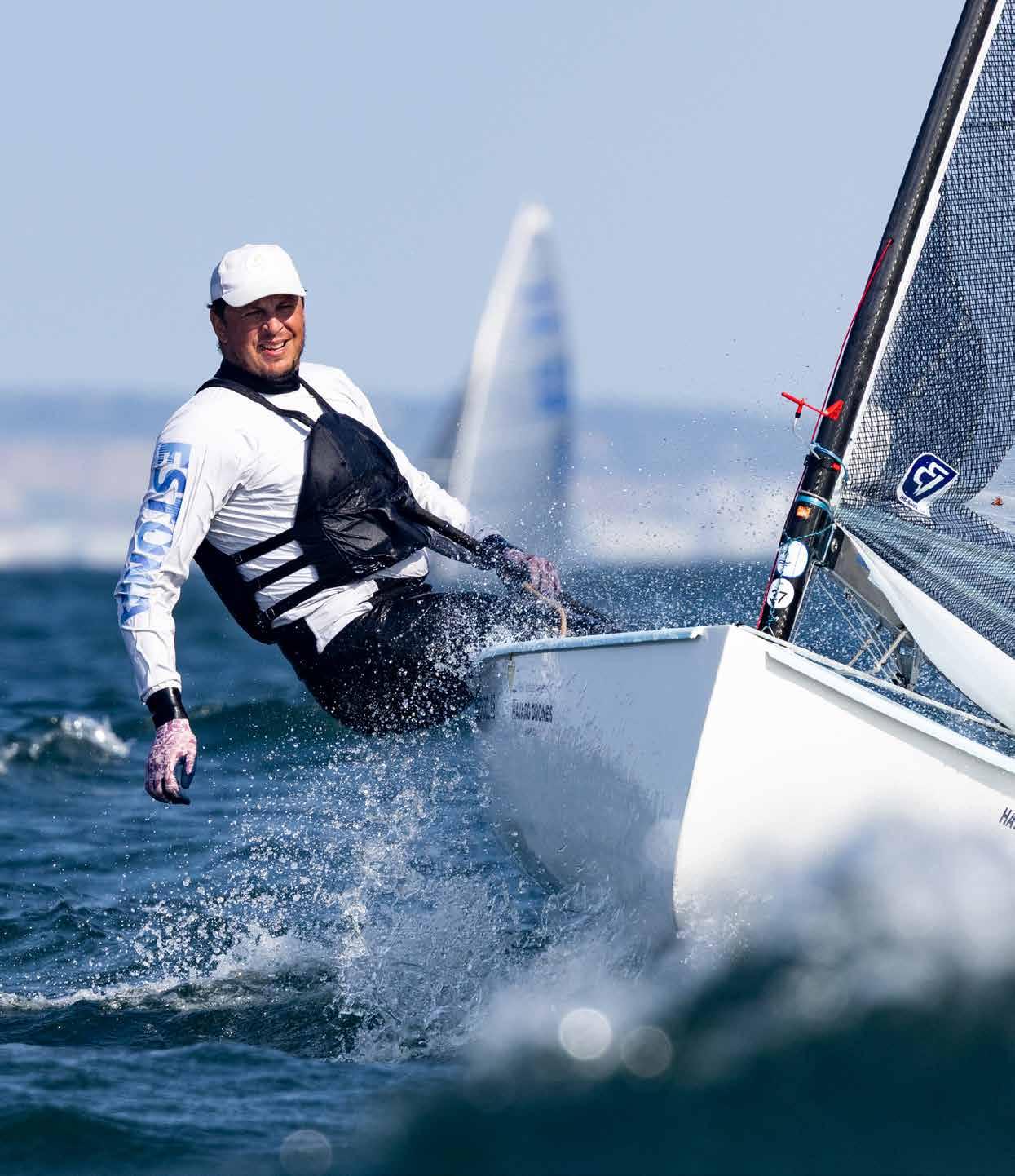
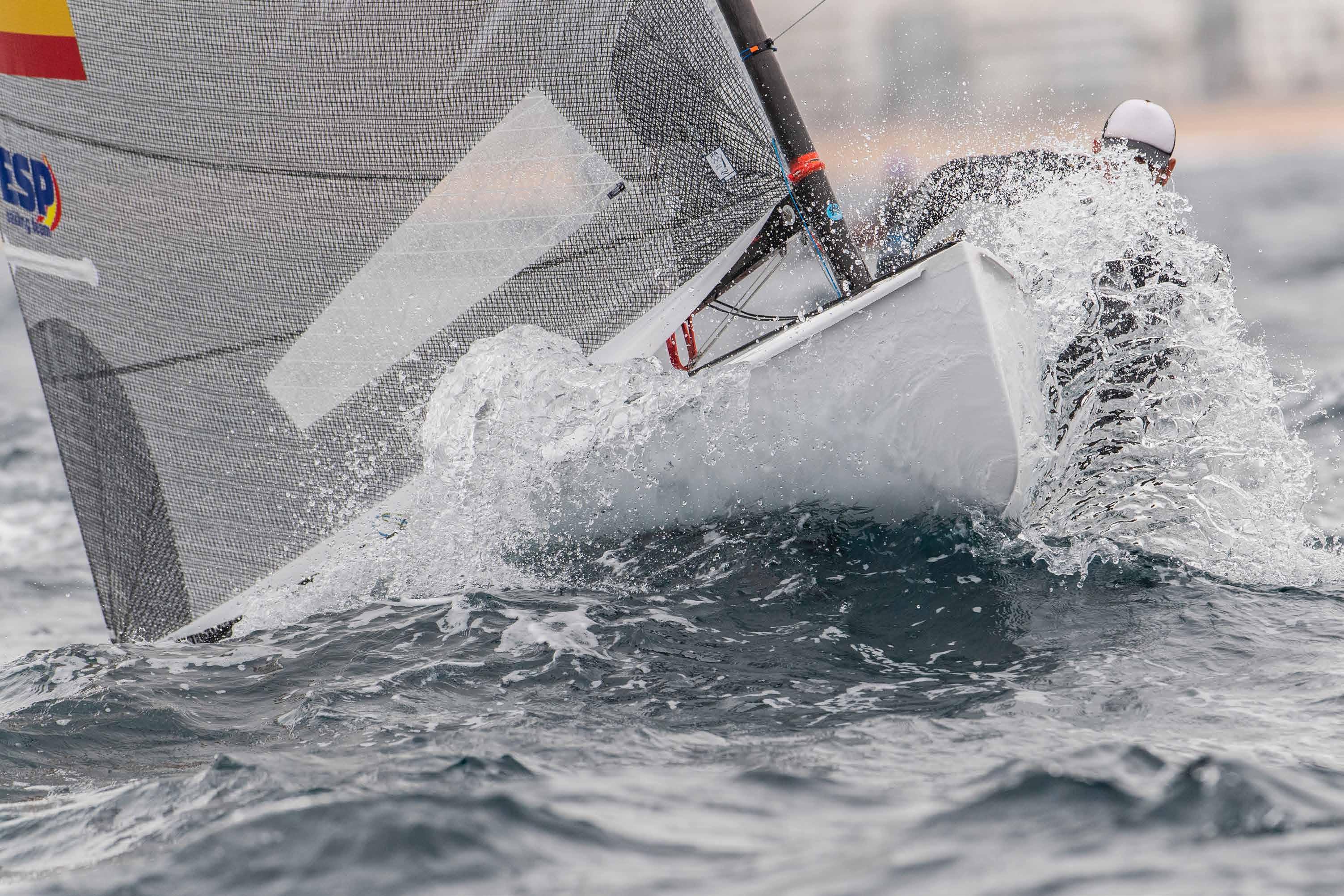
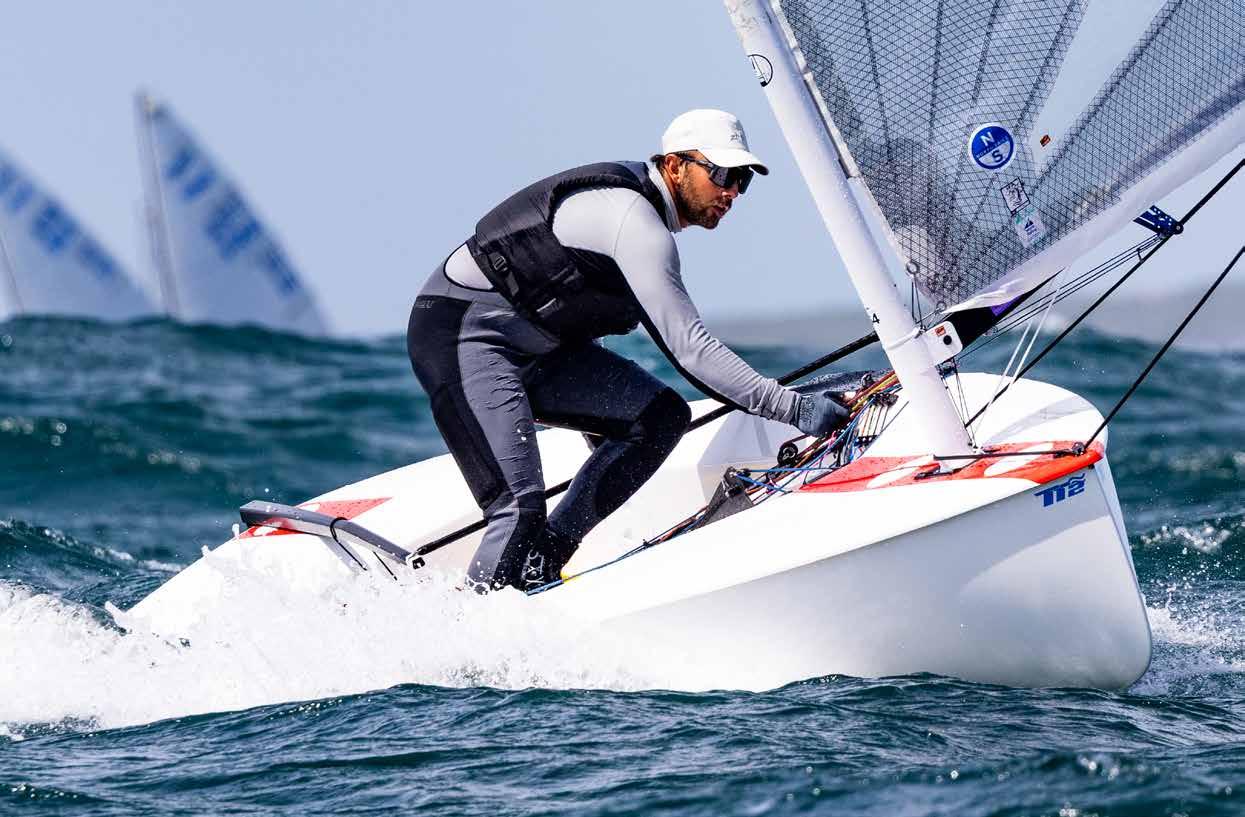
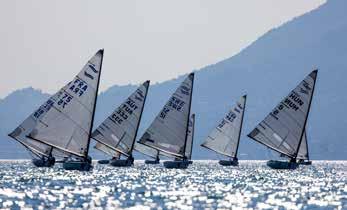
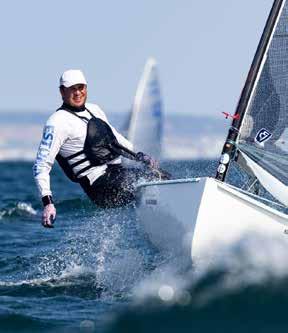
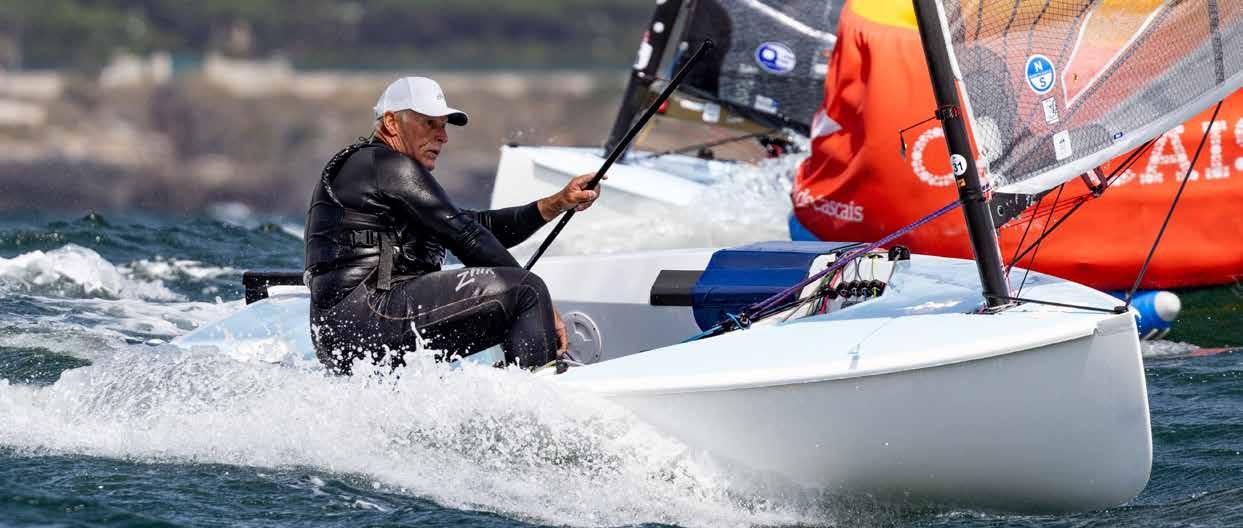
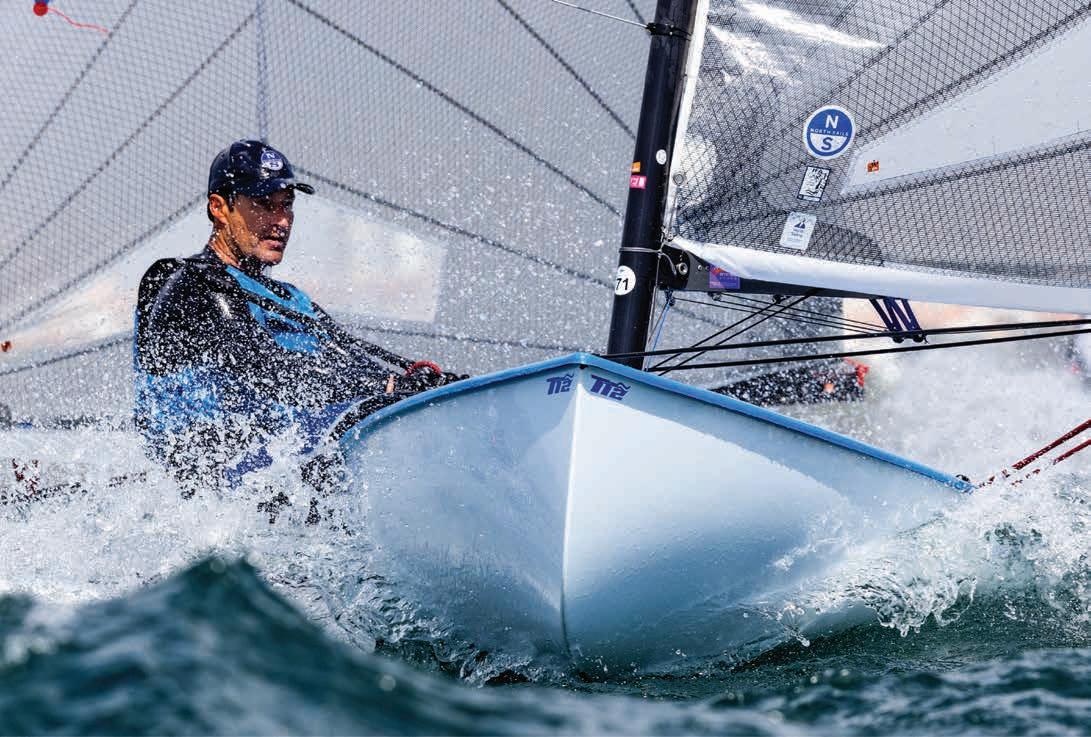
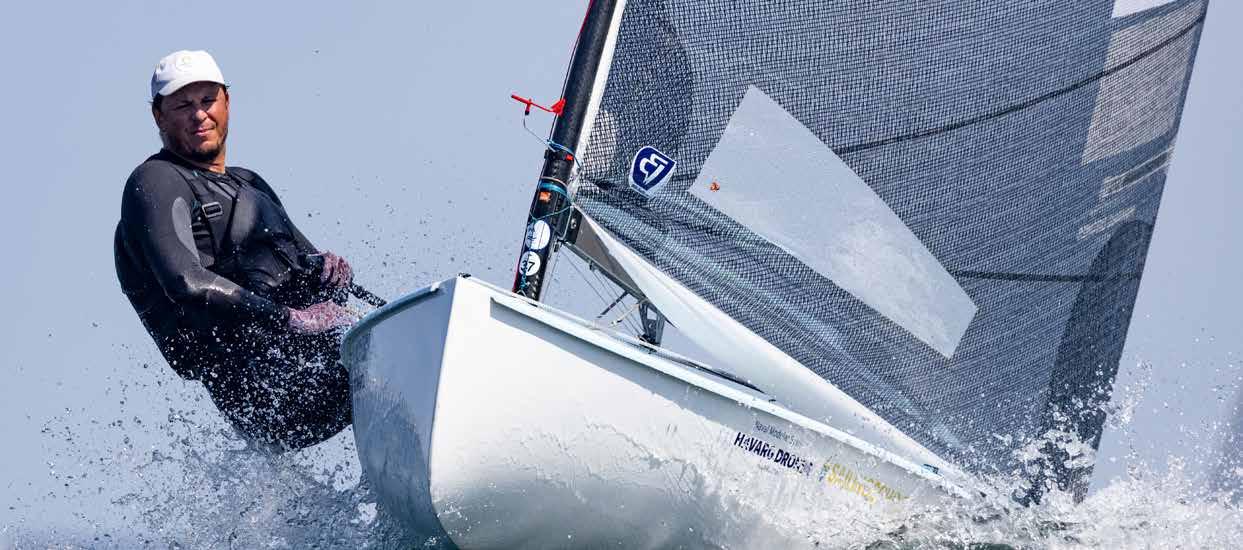
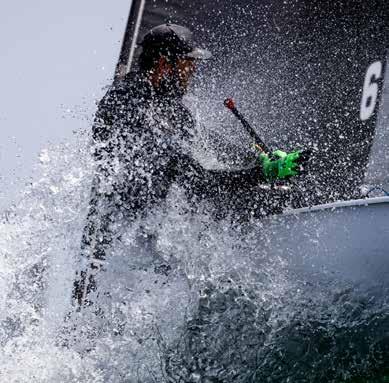
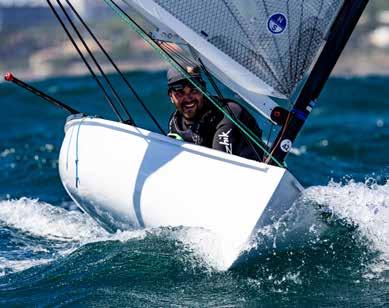
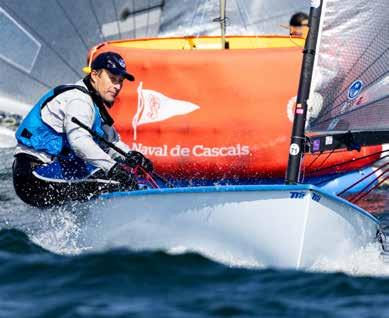
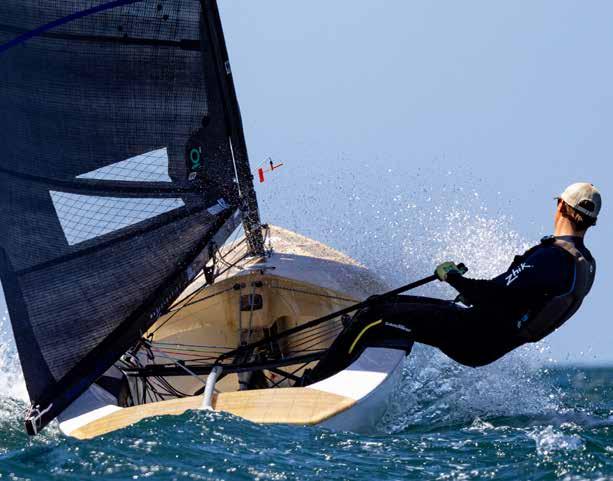
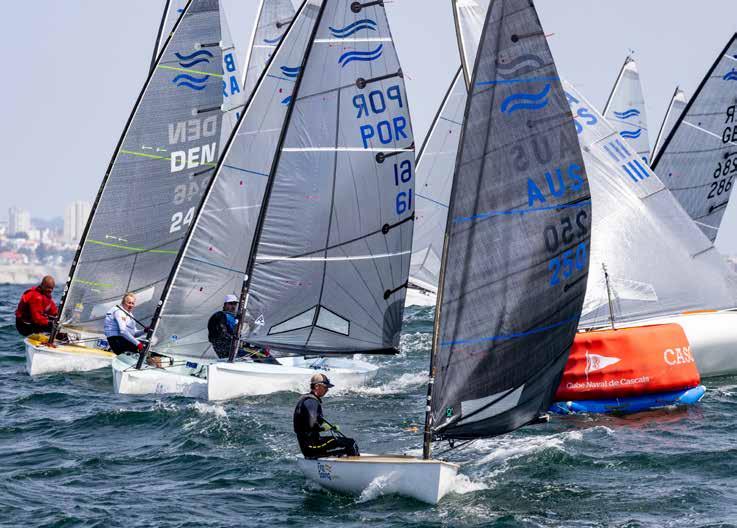
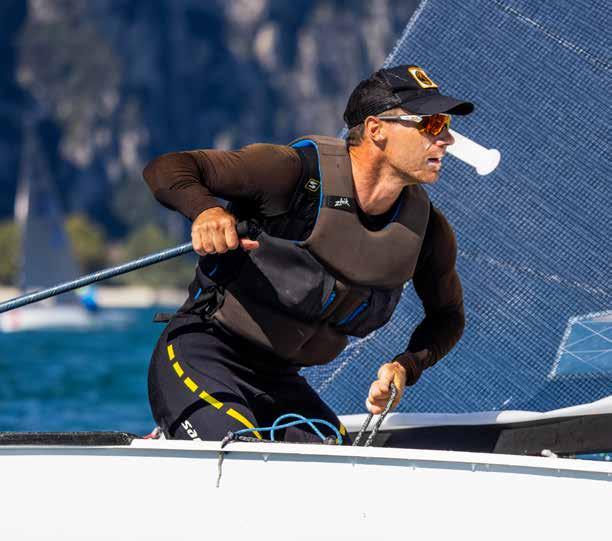
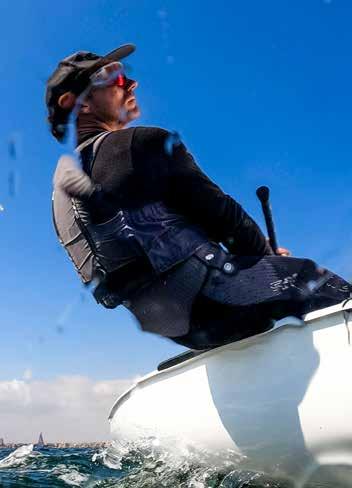
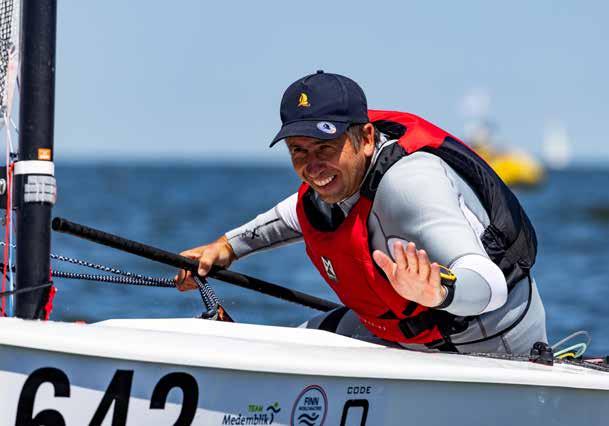
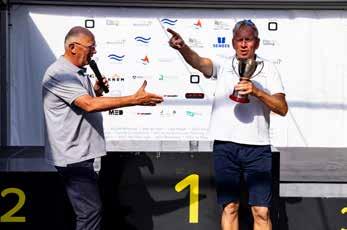
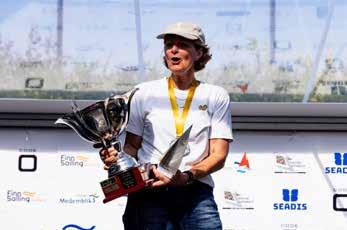
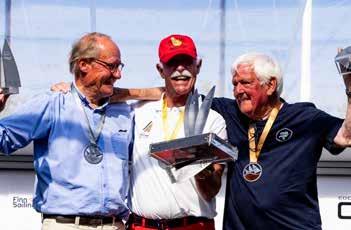
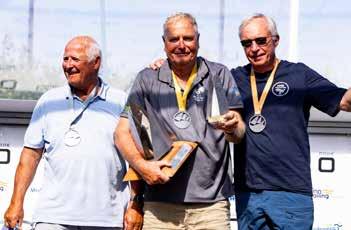
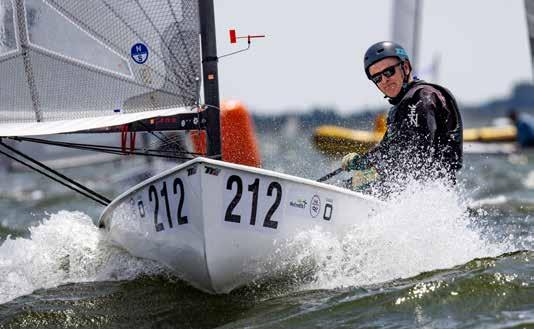
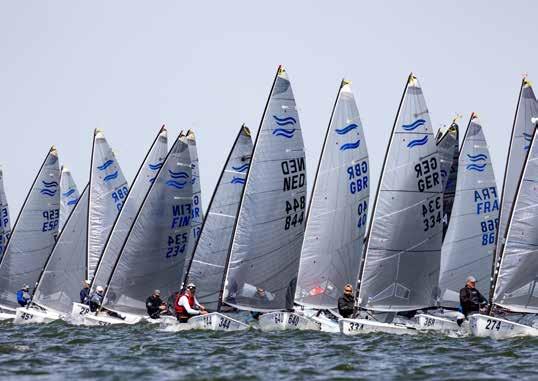
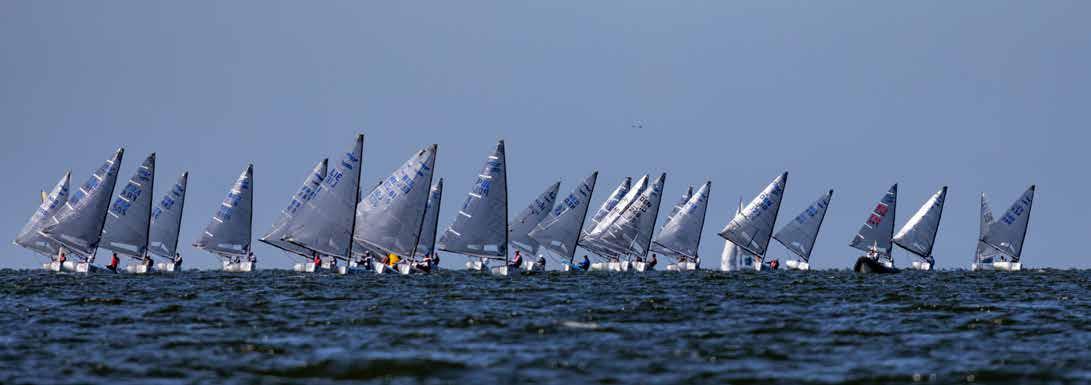
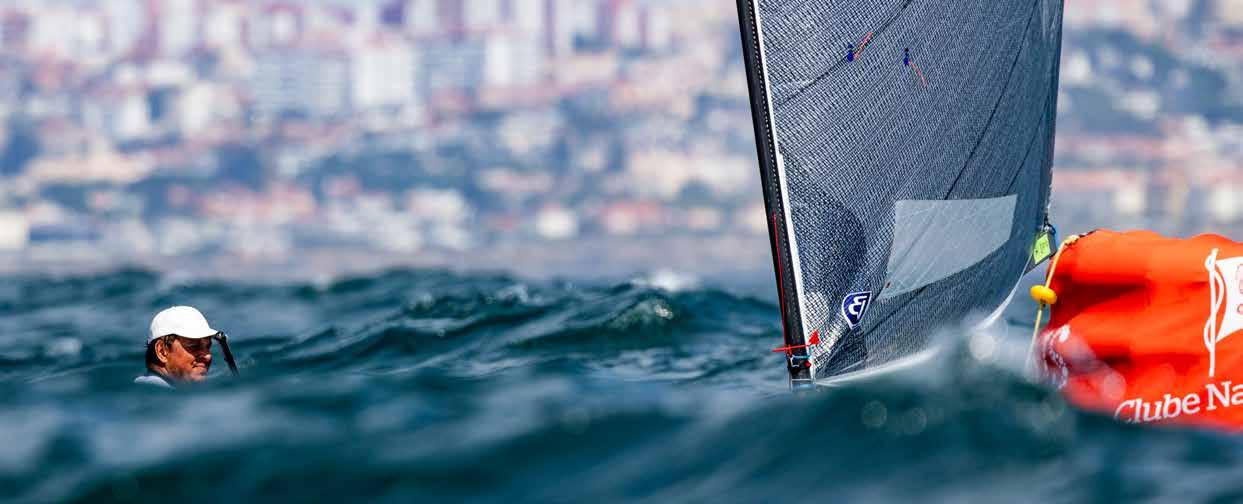
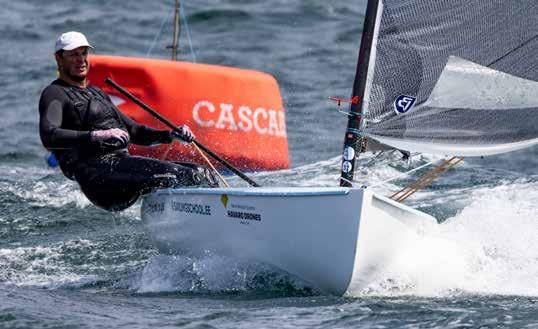
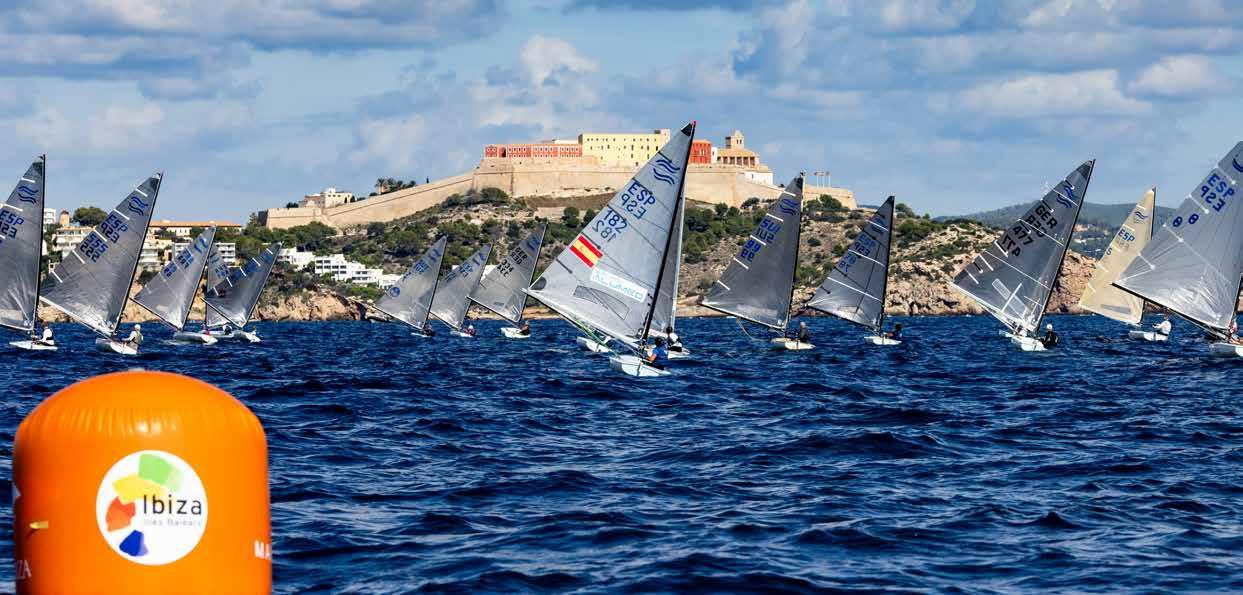
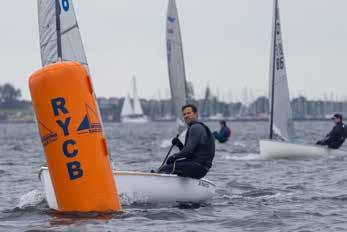
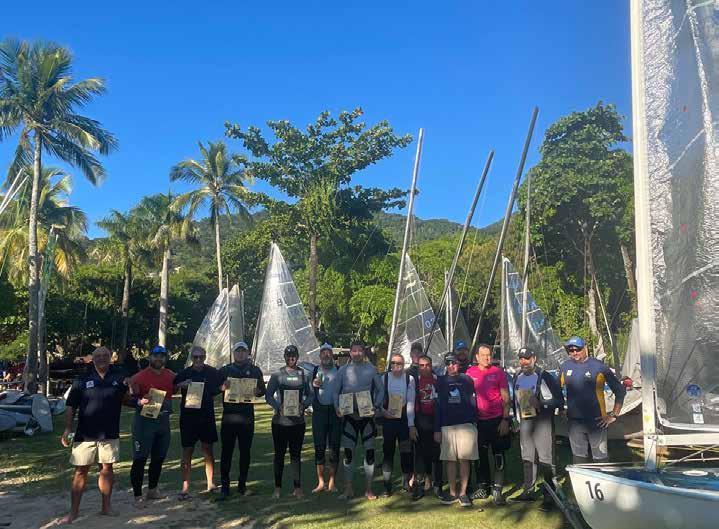
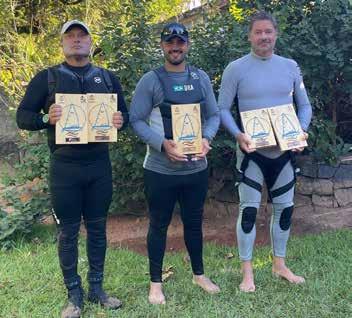
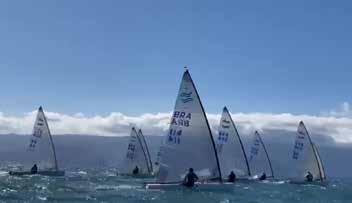
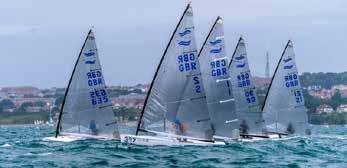
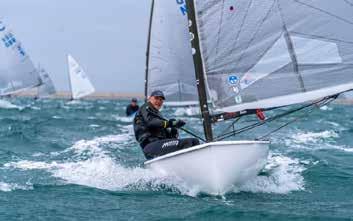
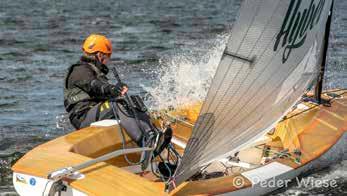
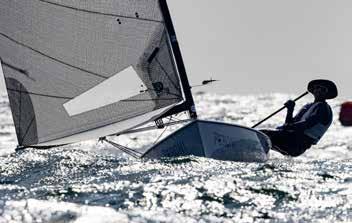
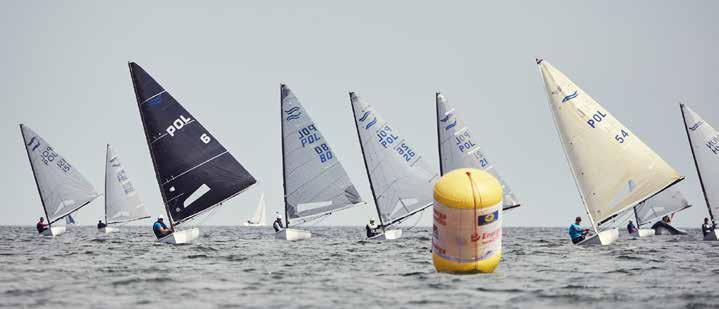
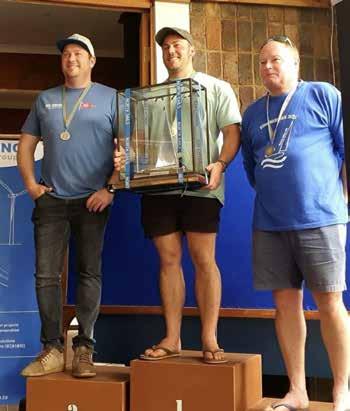
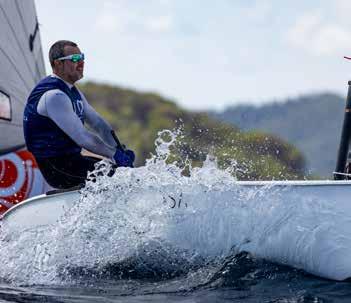
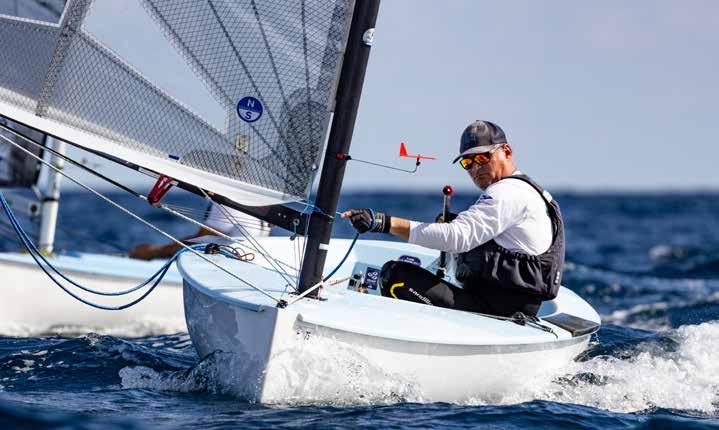
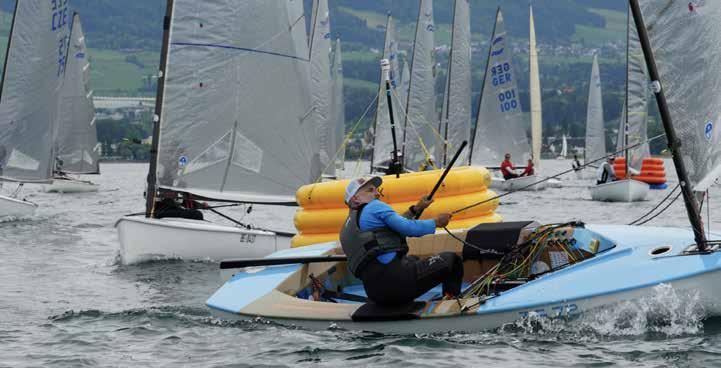
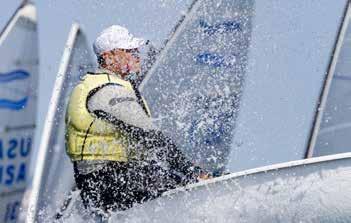
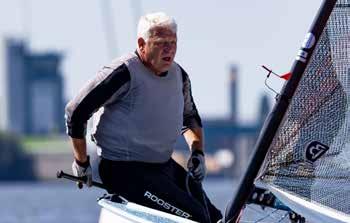
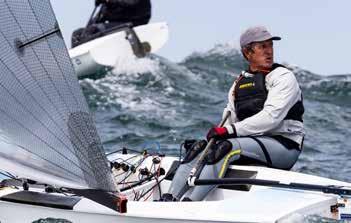
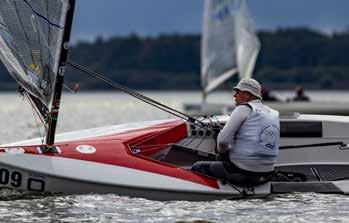
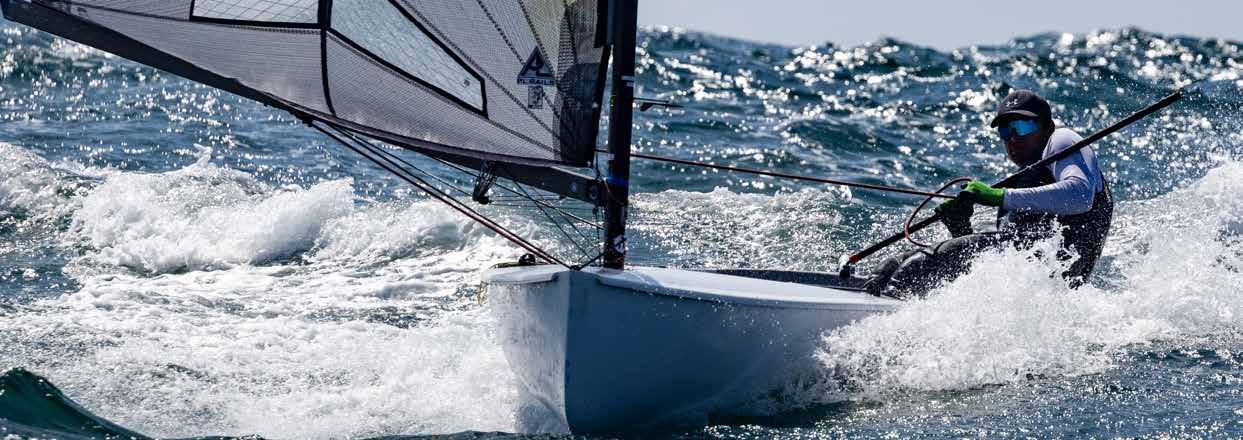
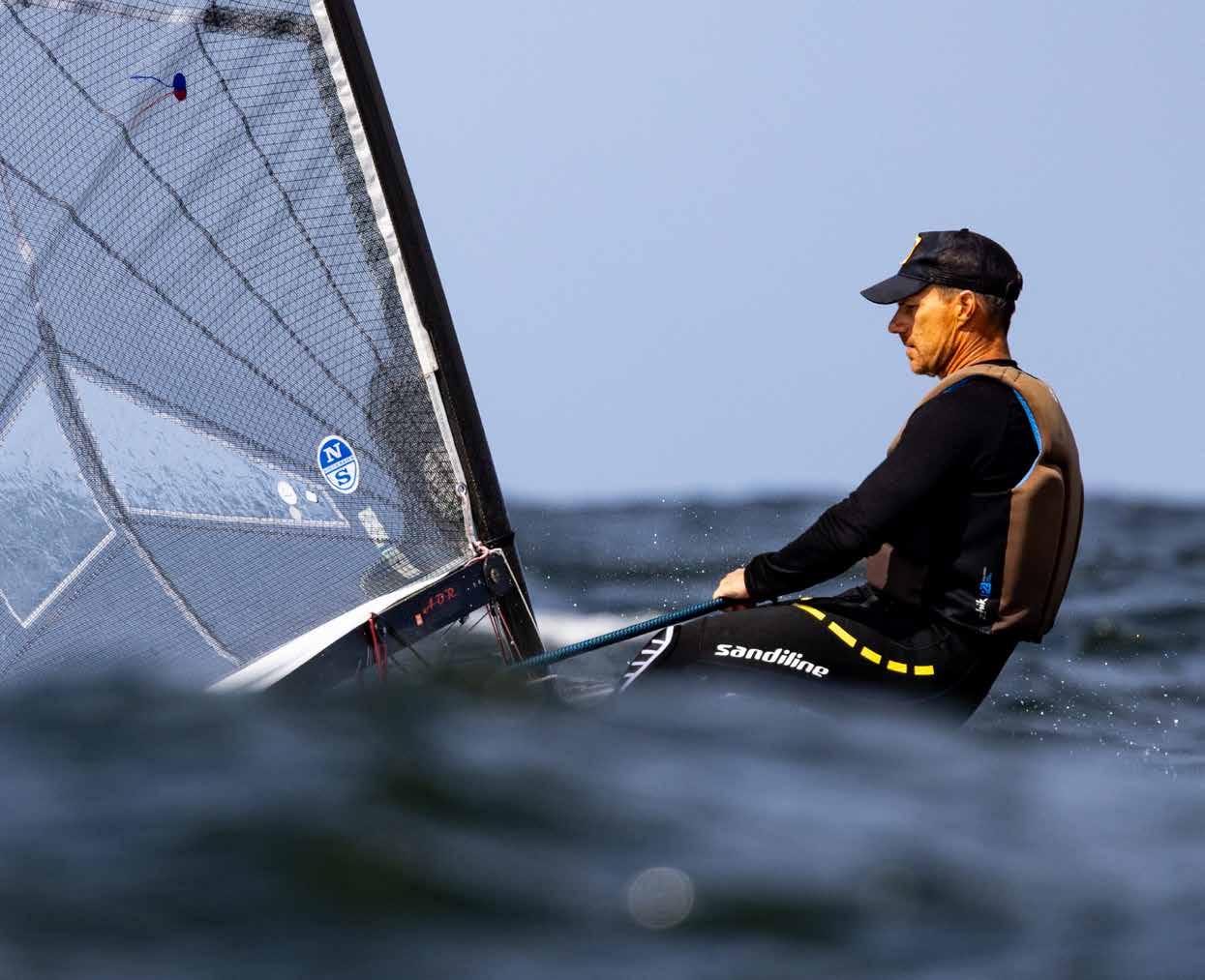
Opening shot: Arkadii Kistanov concentrates on the Cascais waves
PRESIDENT’S LETTER
Dear Finn sailors and friends,
We have had an amazing 2025 — and I want to express my thanks, on behalf of all of us, to everyone involved. It has been an incredible year for the Finn Class, filled with exceptional sailing, strong fleets, and the unmistakable camaraderie that makes this community so special. From the amazing Naples to the northern (and warm) waters of Medemblik to the rolling Atlantic swells of Cascais, and from the first U29 training initiatives to the exciting build-up toward Brisbane 2026, the Finn spirit has never felt stronger.
A SEASON OF CHAMPIONS
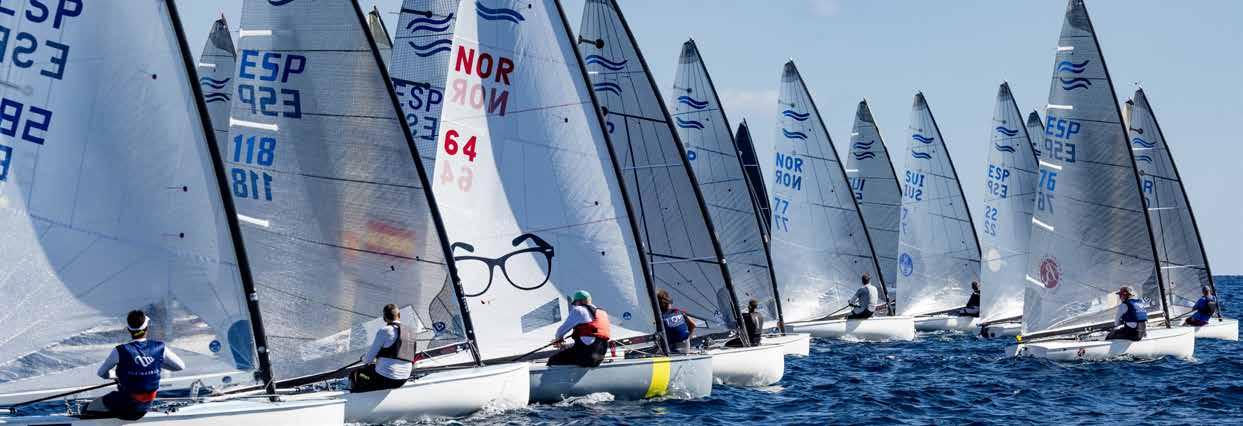
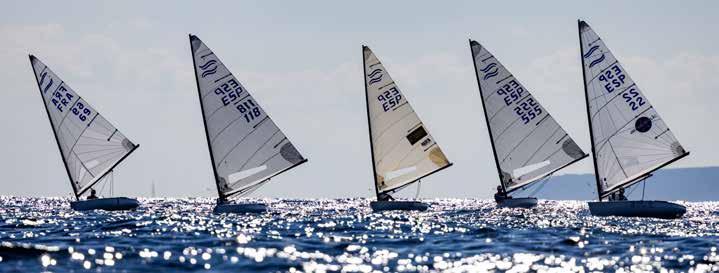
The Finn Gold Cup in Cascais delivered a true masterclass in Finn sailing. From light tactical racing to full-power big-wave days, the event had it all. Huge congratulations to Deniss Karpak, who claimed a historic first — becoming our first Finn World Champion from Estonia. His victory was not only outstanding but also symbolic of the class’s enduring appeal, as Deniss made his return to the Finn following multiple Olympic campaigns. A big thank you to the team at CN de Cascais and to our Portuguese Finn sailors for their hospitality. My only question is, when are we coming back?
Meanwhile, the Finn World Masters in Medemblik
was a celebration of experience, endurance, and friendship. With over 300 sailors from 27 nations, the atmosphere was electric. Congratulations to Pieter-Jan Postma on an exceptional win, and to all competitors who made this one of the most memorable Masters events in recent years. To our incredible Masters team — thank you for your energy, passion, and sportsmanship. To our Dutch hosts, our sincere gratitude for your superb organisation. Medemblik again reminded us why it remains one of the true homes of Finn sailing.
BUILDING THE PATHWAY – U29
Another highlight of the year has been the renewed emphasis on U29 development. Across several nations, the first dedicated U29 training camps have been launched, giving young sailors a clear pathway into the senior fleet. The enthusiasm has been infectious — these sailors are embracing the Finn’s unique blend of power, precision, and independence. This initiative has only just begun, and we will be doing more to encourage and support our younger sailors as they find their way into the class, more announcements will follow.
CELEBRATING OUR HEROES
The Finn Class has always been defined not just by great sailors, but by great people — competitors, organisers, builders, and innovators who have shaped our story over more than seven decades. In recognition of this, we have asked Gerardo Seeliger, our Honorary President, to take the lead in the re-invigoration of our Hall of Fame. It is important that we recognise those who have left an indelible mark on the class — through performance, leadership, or lifelong contribution — and those without whom Finn sailing would not be what it is today. I look forward to sharing more news
Back Issues
Sets of back issues of FINNFARE dating back to the late 1990s are available in the Finn Shop. In total there are about 60 editions available, totalling more than 1500 pages. SET 1 covers all available issues from 1997 to 2009. SET 2 covers all issues from 2010 to 2019. There are at least 20 complete sets of all 30 issues. In addition, some sets of the Masters Magazine are available. It includes all copies from 2015 to 2020 (6 editions). See finnclass.org/shop
Future champIonshIps
The following venues and dates are confirmed. 2026 Finn Gold Cup, Brisbane, AUS, 12-19 February 2026 Finn World Masters, Brisbane, AUS, 20-27 February 2026 Open Europeans, Gydnia, POL, 20-27 June 2026 Finn European Masters, Mar Menor, Murcia, ESP, 16-23 October 2027 Open Europeans, Estartit, ESP, 9-16 April 2027 Finn World Masters, Forio d’Ischia, ITA, June Dates TBC 2027 Finn Gold Cup, La Rochelle, FRA, 28 Aug-3 Sept
To bid for events please contact the IFA Office. See: https://finnclass.org/event-page/calendar
photos
Most of the photos in this issue and from the major events can be obtained as prints or downloads from: http://robertdeaves.smugmug.com
IFA Executive Committee 2025-26
President of Honour
Gerardo Seeliger ESP
Mob: +34 609 20 10 20
Email: gerardo.seeliger@gmail.com
President
Rob McMillan AUS
Mob: +61 405 177 207
Email: finnports@live.com.au
Vice-President – Development
Arkadii Kistanov ITA
Tel: +39 388 950 4915
Email: arkadiikistanov@gmail.com
Vice-President – Sailing
Remko Boot NED
Tel: +31 6 29720170
Email remkoboot@me.com
Vice-President – Masters’ Fleet
Andy Denison GBR
Tel: +44 (0)1202 484748; +44 (0)7802 355 522
Email: andy@denisons.com
Hon Treasurer
David Bull AUS
Tel: +61 411 071 833
Email: davidannb@icloud.com
Chairman Technical Committee
Tim Tavinor GBR
Tel: +44 7590 043459
Email: timtavinor@gmail.com
Special Projects
Andrzej Romanowski POL
Mob: +48 501 371 281
Email: andrzej.romanowski@buildingenergy.info
Chief Measurer
Andre Blasse AUS
Tel: +61 438 347 398
Email: finnmeasurer@gmail.com
IFA Office (Executive Director, FINNFARE Editor, webmaster)
Robert Deaves
2 Exeter Road, Ipswich
IP3 8JL, England
WhatsApp/Mob: +44 7936 356663
Email: robert@finnclass.org
#FInntaLks
Every month there is a new #Finntalks on the Finn Class YouTube channel. If you want to talk Finns, please get in touch. https://finnclass.org/finn-tv/finntalks
is the official publication of the International Finn Association
No. 177 • NOVEMBER 2025
FINNFARE is a non-profit publication that is distributed free of charge to all IFA members and interested parties connected to the International Finn Class around the world. Articles, race results, photographs and reports from countries are always welcome. Please include FINNFARE in your news mailing. All advertisement enquiries should be addressed to the Editor. A media pack is available on www.finnclass.org
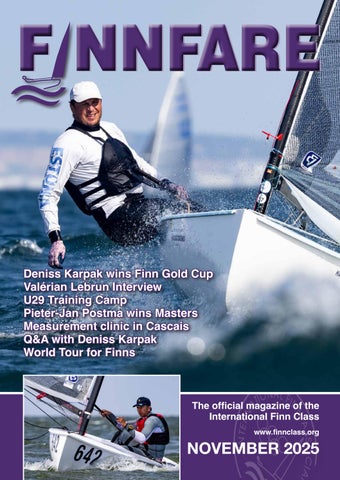
Cover photo: Deniss Karpak in Cascais
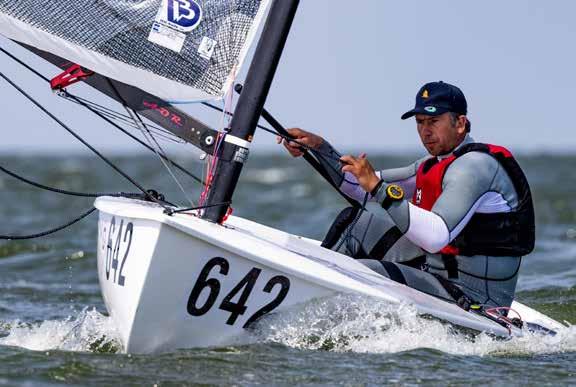
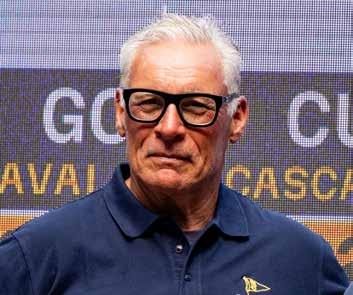
Inset: Pieter-Jan Postma in Medemblik (Photos: Robert Deaves)
Deniss Karpak wins Finn Gold Cup
Lebrun Interview
in this area in the weeks ahead as we celebrate the legends and contributors who continue to inspire all of us.
LOOKING AHEAD – BRISBANE 2026 AND BEYOND
Excitement now turns to Brisbane 2026, where strong fleets are already forecast for what promises to be a world-class Finn Gold Cup and Finn World Masters. The Australian Finn community is working hard to create an event that reflects the very best of our class — competitive racing, friendship, and an unforgettable atmosphere.
We will soon come together at the fabulous Royal Queensland Yacht Squadron, a venue with a proud history of hosting international championships and a deep connection to the Finn Class. I would like to thank the Finn community worldwide for supporting this event, and especially those who have taken on the significant task of organising containers and logistics — a huge effort that ensures sailors from every corner of the world can unite for what promises to be an outstanding championship.
And the horizon beyond looks equally exciting:
• 2026 European Championship – Gdynia, Poland (June): a very professionally run sailing venue with an excellent track record in race management and one of Europe’s most experienced championship hosts.
• 2026 Finn Masters European Championship – Mar Menor, Spain (October): autumn breezes and a very popular venue for both sailing and après-sailing activities.
• 2027 European Championship – L’Estartit, Spain (April): a welcome return after some 34 years and one that recently hosted the 505 European Championships with stunning vistas and amazing conditions.
• 2027 Masters Worlds – Island of Ischia, Italy (June): a stunning volcanic island setting in the Bay of Naples. The island has excellent facilities, and the Finn fleet will be exceptionally well looked after — as well as being able to enjoy the America’s Cup close by.
• 2027 Finn Gold Cup – La Rochelle, France (September): a world-class venue steeped in Finn history and a great test for our top Finn sailors, combining Atlantic conditions with true championship prestige.
It’s pleasing to see the mix above — we really do have something for everyone in our community in the years ahead.
TECHNICAL DEVELOPMENT
Over the year we have consulted widely at events on matters of technical development, and I am now drawing to a close, for the moment, discussions in two key areas.
The first relates to the use of GPS-enabled devices, compasses, and other electronic sailing aids to assist with race
management. After careful review and feedback from sailors and race officials, we believe that adoption of this technology would not, at this time, be in the best interests of advancing the class. As many will have observed, the number of suppliers in this space has contracted, and costs — including device subscriptions and race management levies — remain high. We do, however, expect this market to evolve in the years ahead, ideally toward device-agnostic platforms that could make use of more economical technologies such as smartphones and smartwatches. This is also a hot topic for World Sailing, which has formed a new committee to examine developments in this area, working on a two-year roadmap for integration and governance. For now, we are content that the success of our racing continues to depend on excellent race management, not electronic aids. One small rule adjustment has been made, however: sailors may now carry a smartphone within the buoyancy tank for safety purposes.
The second area concerns carbon booms. After extensive consideration, the Technical Committee has decided not to progress this matter further. Although some argue that carbon booms may offer a cost advantage in today’s market, the Committee’s view is that structured “technical” development within our framework would quickly see prices escalate. Equally important is the issue of perceived obsolescence — the introduction of carbon booms would instantly devalue every aluminium boom currently in use worldwide. For these reasons, the proposal has been closed, and we will continue to focus on maintaining fair, stable, and affordable equipment standards across the fleet.
These decisions reflect our continued commitment to a measured, practical approach to technical evolution, ensuring that the Finn remains competitive and accessible, while we continue to investigate solutions.
A UNITED AND THRIVING CLASS
To every sailor, organiser, volunteer, supporter, as well as our suppliers and our NFAs— thank you. Your passion, professionalism, and generosity keep the Finn alive and thriving. Whether you’re chasing world titles, defending Masters honour, or simply enjoying a perfect reach at home, you are part of something extraordinary.
Here’s to more great racing, great friendships, and another unforgettable year ahead.
Fair winds and see you on the water.
Rob McMillan
President
Martijn van muyden Cascais, Portugal
photo: Robert deaves
1
approved by the class following the
in
It is reduced in
and should now conform with all the RRS and ERS updates in recent years. It can be downloaded from the World Sailing website at: https://www. sailing.org/classes/finn/
DENISS KARPAK WINS FINN GOLD CUP
Fifty-five years ago, in 1970, the Finn Gold Cup was held in Cascais, Portugal. It remains to this day the largest ever Finn Gold Cup with 160 competitors from 34 nations.
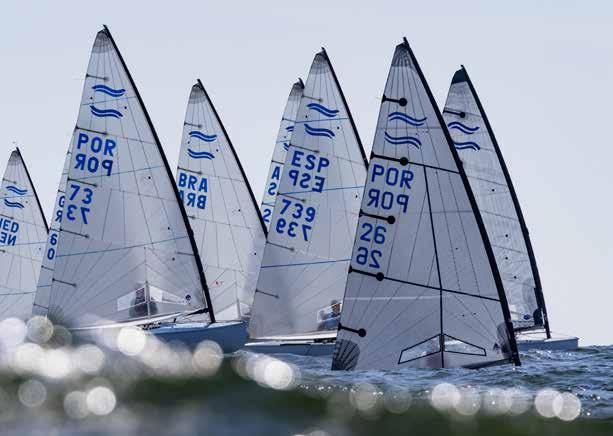
In 2025, the Finn Gold Cup returned to Clube Naval de Cascais for the third time. With 80 entries from 20 nations, it was the most competitive event in the class for many years.
Deniss Karpak became the first ever Estonian to win a major Finn title. Apart from one slip up in Race 2 he sailed fast and never outside the top four, winning three races, including the lightest and the windiest. What more can you expect from a true champion?
DAY 1
Karpak won the only race on the opening day. All the forecasts indicated it would be a quiet start to the event, but no one really expected it to be as quiet as it was. With big swells, big shifts and light winds, it was a challenging day for everyone. The first race was already postponed until 14.00 due to the slowly developing wind.
Laurent Chapuis benefitted from a large shift on the first upwind to lead round the top mark, but Karpak was leading at the gate and maintained his lead to the end, with much place changing going on behind him. A further race was attempted, but the increasing current, and decreasing wind made a start impossible.
Karpak said, “The first day was a bit of a mess, with too big swell, light winds, strong current, and we had only one race which I managed to win. I am quite happy with that as I am quite good in light winds despite being one of the heaviest guys in the fleet, so I still manage to feel the boat and gain some speed.”
DAY 2
Laurent Hay took the lead on the second day after two races were completed. Alessandro Marega was second with Valerian Lebrun in third. The forecast was similar with a little more breeze on the cards. Though three races were scheduled to catch up the programme, a 14.00 start and several recalls in Race 3 meant time ran out so only two were completed.
Chapuis was again leading at the top mark in Race 2, though he touched the mark and let Peter Peet through to lead downwind. Hay took the lead on the second upwind to lead down to take the win from Peet and Andre Budzien.
The wind increased slightly to 8-10 knots for Race 3. Several recalls and the black flag reduced the fleet by 12 boats. The leaders emerged from the right corner with Karpak overstanding the layline, letting Kistanov through to lead all the way. Marega was also up there to finish in second, with Rob McMillan passing Karpak on the last downwind to cross third.
Kistanov said, “It was a super tricky day, almost as tricky as yesterday, but the second race we had a bit more wind, so it was a bit more constant. Still very unusual races with more current than wind.”
1
3
5
30
31
33
34
35
36
37
38
39
40
41
42
43
44
45
46
47
48
49
50
51
52
53
54
55
56
57 BRA 108 Cristiano RUSCHMANN
58 POL 6 Bartosz SZYDLOWSKI
55 (bfd) dnc dnc dnc 26 18 365
59 USA 31 James DEWOLFE (69) 52 54 57 62 34 57 58 374
60 AUS 169 Jason WILSON (66) 64 52 50
61 USA 47 Robert KINNEY 63 29 48 (68) 65 56 58 59 378
69 POR 6 Miguel MAYA 25 53 57 (dnc) dnc dnc dnc dnc 459
70 BRA 97 Ricardo SANTOS
71 GBR 18 Jonathan PYKE
72 POR 3 Carlos AZEVEDO
73 ESP 99 Gerardo SEELIGER
74 POR 66 Didier GOUDANT
75 GER 93 Bernd STOLL
76 POR 58 Henrique COSTA E SILVA
77 POR 2 Diogo LACERDA
78 USA 58 Anna BROUGHTON
79 ESP 313 Antonio PARRA
80 BRA 44 Fabiano VIVACQUA
66 62 60 64 57 (dnc) dnc 462
32 (bfd) dnc dnc dnc dnc dnc 472
63 (dne) 66 dnc dnc 65 dnc 478
77 59 67 (dnc) 59 66 dnf 484
(bfd)
74 61 (dnc) dnc dnc dnc dnc 538
(dnc) 63 dnf dnc dnc dnc dnc 546
(dnc)
(dnc)
DAY 3
Karpak was back in the lead after three windy races were completed to catch up to schedule, with Kistanov up to second and Lebrun in third. The fleet launched into 15–17 knots at the start of Race 4, with bigger waves than before and a shifty, tricky breeze that kept the sailors working hard.
In the opening race, defending champion Oskari Muhonen claimed the win, followed by Kistanov and Karpak. By the second race, the breeze had built to 18-20 knots, but Muhonen continued his strong form, taking his second victory of the day with exceptional downwind speed. This time, Karpak crossed in second with Kistanov again third.
The third race became a real test of endurance, with winds averaging 20-22 knots and a steadily building sea state. The big, ocean-like waves and 60-70 minute race duration demanded resilience from the fleet. Karpak quickly seized the lead and held it all
the way to the finish, while Muhonen fought back from a poor start to climb up to second. Jesse Kylänpää completed the top three.
It was the day they were all waiting for and though many came ashore broken men (and woman), they were all satisfied with an exceptionally tough day of Finn Gold Cup racing. It’s why they came to Cascais.
Muhonen explained that he had, “a pretty difficult start to the regatta. The first two days were pretty difficult for me, but I managed to pull it together today, with two bullets in the first two races, which was really nice. I think I found a really good speed both on upwind and downwind. In the third one I had a pretty tricky start and Deniss managed to find a really good shift on the right side and he was controlling the race pretty well. I just climbed up back up to second which was really good as well, but man, the legs are dead now. Some more wind probably tomorrow and should be pretty windy again”
DAY 4
Karpak extended his lead to 17 points on the penultimate day. He was only bettered by defending champion Muohnen who scored a 1,2. Italy’s Arkadii Kistanov was in second after a 2,5.
With strong winds again forecast, the fleet was sent out to the offshore course for another day of big waves, big surfs and big smiles. Kylänpää led round the top in race 7 from Martijn van Muyden, and Karpak. Muhonen rounded about sixth, but was in the lead by the gate and extended away to win by a huge margin from Kistanov and Karpak.
In Race 8, now with 20-24 knots of breeze, Karpak was the clear leader at the top from McMillan. Again, Muhonen came through downwind but could not catch Karpak. And though he lost to McMillan on the second upwind, passed him downwind to take second, while Domonkos Nemeth finally had a good start for his best race in third.
Marega said, “It was a very tough day, another day with more waves and very strong wind, I did two sevenths and I’m fourth in the ranking. I’m quite happy about today and let’s see for tomorrow what happens.”
IT’S FINALLY AVAILABLE FOR ALL.
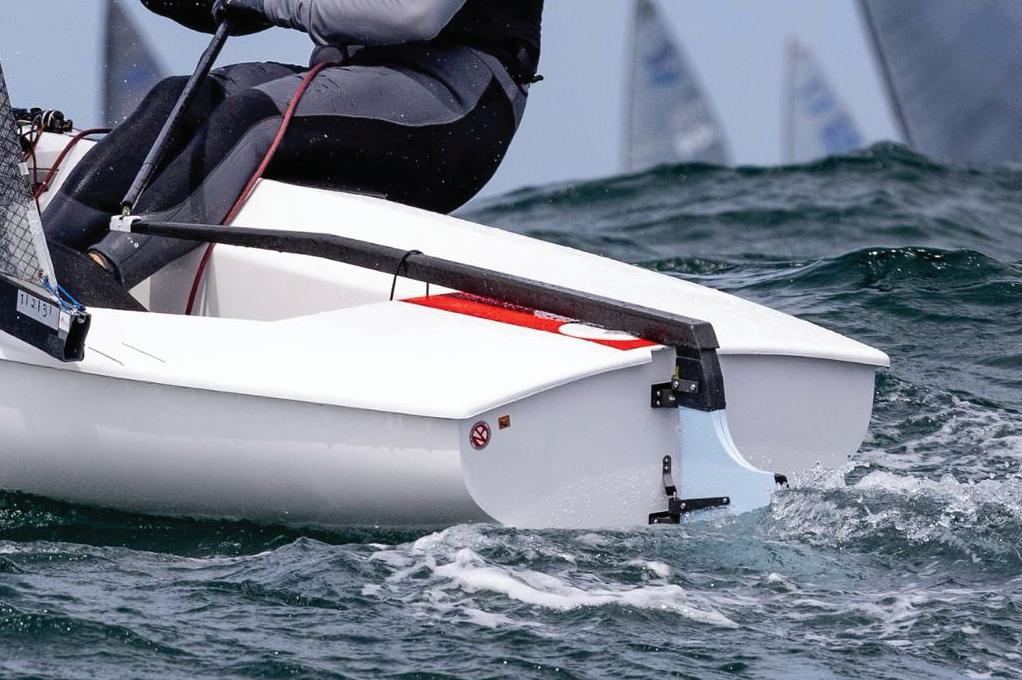
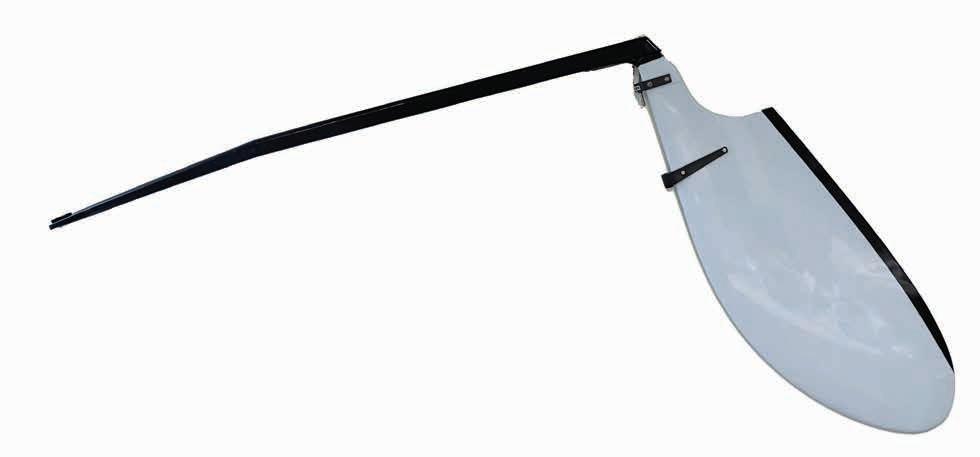
THE TOKIO OLYMPIC GAMES WINNING RUDDER DESIGN, BUILD FROM ONE OF THE MOST SUCCESFUL AND OFTEN COPIED MODELS IN THE CLASS; THE ICHIBAN BLADE.
THE NEW FINN RUDDER DELIVERS OUTSTANDING BALANCE, SMOOTH STEERING, AND EXCEPTIONAL CONTROLA TRUE BENCHMARK DESIGN.
- HIGH MODULUS RUDDER STOCK - SUITABLE FOR BOTH THE TT2 FINN AND THE FANTASTICA - CUSTOM ANGLED FITTINGS - MEASURES TO IFA CLASS MEASUREMENT RULES
Kylänpää, “Today was quite ok conditions, a bit more wind would be even better. Today there was too much work in the downwind, with more wind there could be just sitting and enjoying. The upwinds were quite challenging to find a good spot and speed but then it was mainly ok.”
DAY 5
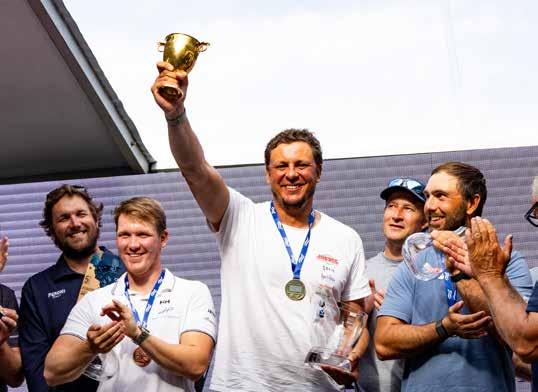
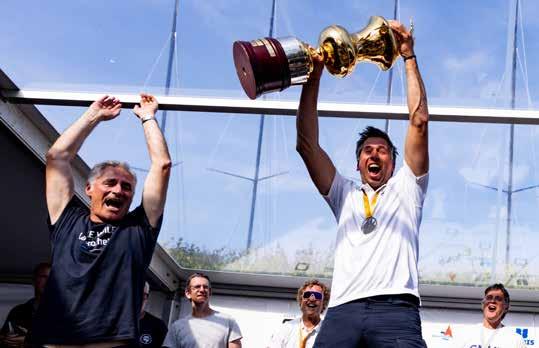
Deniss Karpak became the first ever Estonian winner of the Finn Gold Cup, after no more races were possible on the final day. Arkadii Kistanov took silver, while last year’s champion, Oskari Muhonen took bronze, as well as winning the Jorg Bruder U29 Finn Silver Cup.
The final day dawned windless with little hope of racing before mid-afternoon. An early postponement was raised at 11.30, but with no wind on the race course the fleet was held ashore. The postponement stretched through the morning and into the early afternoon. The sailors were teased with a very light breeze, but nothing substantial materialised and at 14.00 AP over A was raised, ending the regatta with no more races.
FINN SAILING IS an individual sport, but as a community the sailors honour their champions as a group. Deniss Karpak is a welldeserved champion and was honoured by every individual present. His victory is an incredible continuation of a sailing story that has come full circle from his bronze medal in the Laser class in Cascais at the 2007 ISAF World Championship.
He said, “No words to describe my feelings. You know it was a beautiful week of mixed conditions but I’m really happy to win this title, this is a historic moment for the Estonian sailing, this is a big payout for my technical director, my coach and my dad Igor so basically I dedicate this win to my family, and to my little daughter Adeline.
“Also, I’m happy to be here because it’s where everything started for me. 18 years ago I won a bronze medal in the Laser class here exactly in the same sailing club and now 18 years later I won the Finn Gold Cup
“I did really well. I did not train so much for the last six months after the Europeans in Naples, but still the head remembers but the most important thing is here [touches his chest]. I am always connected to sailing with the Finn class so every time I leave sailing I always come back. That’s in my DNA.”
On the class, “I think the Finn class is moving the right way. The Finn is a way of life and I am really happy to see that, especially the Masters fleet, with 300 boats starting. That’s impressive. Next year I am coming, as I will be 40. I wont be in Brisbane but after that will join the fleet.”
ARKADII KISTANOV STARTED the week on the back foot with an OCS, but from then on remained consistent and won one race. “Very happy with this result. I mean I could only dream about it. I
am not so happy about my performance to be honest, but I mean it was good enough for all the effort I put. Congratulations to Deniss and Oskari, for being first and third. Crazy week, super cool, super tricky, very tidal races. I am full of happiness and happy to be in the Finn Class.”
LAST YEAR’S CHAMPION Oskari Muhonen, who was the first ever Finnish Finn Gold Cup winner, had a slow start to the event but when the breeze arrived, he was almost unbeatable, winning three out of five races. He said, “A tricky start for me with the black flag and the bad races early in the week so I was already done with the winning at least at that point but still quite happy to manage to pull out third after two solid days with more wind. So obviously not what I was aiming for but still pleased to finish third.”
Muhonen also wins the Finn Silver Cup, a title he last won in 2020, then for U23 and now as U29. Brazil’s Antonio Carvalho Moreira took silver while last year’s winner, Domonkos Nemeth, from Hungary, took the bronze. In total, 11 U29 sailors were taking part this year.
FIFTY-FIVE YEARS AGO, the Finn Gold Cup was won in Cascais by the legendary Jörg Bruder, his first of three wins. Fate determined he would remain unbeaten when he was tragically killed in an air crash in 1973 on the way to defend the title for the third time. His daughter Georgia had made a kind of pilgrimage to the Finn Gold Cup in Cascais this year to complete the circle after writing her father’s story in the book ‘Regatta 977 – Biography of the champion sailor’. Georgia was present at the Clube Naval de Cascais to present the Jorg Bruder Silver Cup, donated to the Finn class by the Brazilian Olympic Association, to remember her father. She was on stage with Patrick de Barros, who competed at the 1970 Finn Gold Cup here in Cascais. She also presented a copy of her book to the Clube Naval de Cascais. The circle was completed.
All told, it was a great championship wonderfully hosted by the Clube Naval de Cascais, even if not always in typical Cascais conditions. But the fleet had three light wind, and five moderate to strong wind races, so it was a true test of sailing ability. The top three proved a step above the rest. The level in the class keeps improving with more sailors coming back and motivated to test their Finn skills again.
DRIVEN BY IMPROVEMENT
HOW DID YOU FIRST GET INTO SAILING; WHERE DID IT ALL BEGIN FOR YOU?
My parents live next to La Trinité sur Mer, which is a very famous place for offshore sailing. At the start I entered summer camp in different boats but didn’t like it that much. Then when I was 11, some school friends started to sail Optimist the whole year, and I entered as well to join them. I perfectly remember my first regatta, and I quickly realised there would be a lot more afterwards…
BEFORE THE FINN, WHAT OTHER CLASSES DID YOU RACE IN, AND WHAT DID YOU TAKE AWAY FROM THOSE YEARS?
I was soon too big for the Optimist, and never performed ahead of kids 20 kg lighter who started way before me. When I was 14, I moved to the Europe Dinghy. I loved the boat and the class was very active in the 1990s. In the Europe I found the perfect combination between techniques, tactics and physical abilities. The first day I told my parents I wanted to become world champion… I had neither the talent nor a strong body, but I knew the only way was to train more.
In a wide ranging interview, the 2025 European Champion (and 2021 Finn World Masters Champion) Valérian Lebrun talks about his journey back to sailing after giving up for nearly a decade, and how he is driven by continual improvement. He was interviewed by Francesca Frazza shortly after the Finn Gold Cup in Cascais.
Along the path I was lucky to meet great coaches and people. Then a few years later I moved to the sport section at college, then started to sail Laser. For the federation, I was too small to sail the Finn. I never liked the Laser as a boat but the competition was tough, and I had the opportunity to sail against sailing legends and learn a lot. Then my passion for sport drove me to the triathlon for a few years. At that time I was disillusioned with sailing Laser and I had the feeling I was going nowhere. I thought I would never sail again and then I started to work, met my wife, had kids… then one day, eight years later, I learned the Europe worlds would be organised in La Rochelle in 2014. I realised I never finished the story, and my parents still had my old boat in the garage. I was living in Martinique, working 60 hours a week, but I bought a Laser to get back on the water, lost 20 kg, and in a few months I was back.
Then I sailed Finn and OK Dinghy. Of course I have sailed big boats, but I don’t like it that much; to me single handed is the purest form of sailing, combining all abilities and nothing but yourself to blame when things are turning bad. Also, I don’t think I could have found someone as involved as I was…
WHAT MADE YOU DECIDE TO SWITCH TO THE FINN, AND WHAT WAS THE ATTRACTION OF THE BOAT?
Well, I was too small, too light and too old, so sailing a Finn was impossible, so that was just the perfect challenge for me!
I have always admired the Finn and the athletes sailing it. I saw most of the French I had sailed against in the Laser doing well in the Finn (Thomas Le Breton, Jonathan Lobert…). Since there was a fleet in La Rochelle, I decided to buy an old boat to try, just for fun. After 5 minutes of the first session, I knew I would sail Finn forever I loved the boat, which was summing up all I liked in sailing.
WAS IT A TOUGH ADJUSTMENT AT THE START? WHAT WERE THE HARDEST THINGS TO LEARN WHEN YOU JOINED THE FINN FLEET?
Not that much because I had no intention to sail Finn at high level. The first year I could sail Finn on Saturday and run a marathon on Sunday. Then I realised I was improving, and, because it’s my personality, I wanted to do better and better, and started to do everything to become as competitive as possible, which meant putting on some weight obviously.
Coming from the Europe, I already knew how rig was working, but I had to adjust my steering ability: the Finn is very heavy and I was sailing too close to the wind, which is what you look for when sailing Europe or Laser.
THE FINN IS FAMOUSLY DEMANDING PHYSICALLY. HOW HAS YOUR TRAINING CHANGED OVER TIME TO COPE WITH THAT?
One of my other passions was the Triathlon which I did at the highest amateur level. Aerobic level is an asset, but sailing the Finn requires pure strength as well, every manoeuvre is demanding. I had to lift weights for a bit, though it had always been forbidden for me, because I use to put on weight very easily, which doesn’t help either for Europe dinghy nor Triathlon.
Free pumping requires a combination of balance, strength and stamina. I had to prepare for that to be competitive against the best Finn sailors.
YOU’VE DONE A LOT OF WORK WITH LAURENT HAY. WHAT HAS HE BROUGHT TO YOUR SAILING?
In La Rochelle, I was lucky to find a strong Finn fleet. All of the guys were very welcoming and I have been able to learn from all of them. I spent a lot of time sailing with Fabian Pic and he helped me to improve technically.
As for Laurent, he has got a lot of experience of the boat and from the beginning, despite I wasn’t a great help for him, he helped me to fine tunings, to test sails… Most of all, Laurent is a
born competitor; every single leg is a competition, so every week If you want to be in front of him, you need to sail at your best, you cannot just cruise and see. And since Laurent and I both like to win, it helps us to sail at 100 per cent all the time. Today I think it’s good for both of us to have such an internal challenge.
HOW HAS YOUR APPROACH TO TRAINING AND RECOVERY CHANGED OVERTIME?
Lots of people will laugh because I’m still way younger than them, but I also get older, and my body often reminds me I’m not 25 anymore. I have always been kind of an active person, then it’s sometimes difficult to say ‘OK, I should just take it easy for a few days’, but I have to do so. Usually after each Finn championship I feel really exhausted, both physically and mentally. I guess it’s a normal process and I learnt to listen to myself much more.
AND HOW DO YOU MANAGE ALL THIS ALONGSIDE BEING A FATHER; IS IT DIFFICULT TO BALANCE SAILING AT THIS LEVEL WITH FAMILY LIFE?
This is actually also the reason why I’m not sailing so many events, usually 3-4 maximum. It can be frustrating sometimes, but since I’m already travelling a lot for my job, I cannot afford to sail 10 events and be away from home for months. My son has now started sailing windsurf, and I noticed it can be stressful as well to wait for him on the beach. I know sailing is a very demanding passion, my family understand it’s very important for me to keep doing something I can improve in. I’m pretty sure my wife couldn’t bear me staying at home making cakes and home improvement all year long. Love of sport and competition is an important value I’d like to give my kids.
HOW DO YOU SEE THE STANDARD LEVEL OF THE FINN CLASS AT THE MOMENT?
I think we must be honest about that, in terms of level, there are two in sailing.
Olympic sailing with fantastic athletes sailing at the top and working like professionals, and the others. You cannot compare the current level in the Finn with ILCA or Olympic Finn. It’s a different kind of sailing now, though with good, experienced sailors, who all have their own constrains in everyday life whether it’s family or work. That gives fantastic competition, huge fun, but no need to say not one of us could be compared to Giles Scott or Ben Ainslie at their best.
SINCE THE CLASS LEFT THE OLYMPICS, HAS THE ATMOSPHERE OR STYLE OF RACING CHANGED IN ANY WAY?
I think even when the class was Olympics there was a very appreciated atmosphere (those who have sailed ILCA will know what I’m talking about), because it has always combined full time competitors with passionate and experienced sailors. The starting line as well as the downwind are less competitive now, but the atmosphere during event is at its best, with a lot of sharing; it’s like a family.
DO YOU PREFER THE BIG FLEETS AND LONG COURSES, OR DO YOU ENJOY THE SHORTER FORMATS WITH SMALLER GROUPS?
Some of the reasons which made me turn toward Finn sailing are single big fleet, long races with only one discard. This sailing awards consistency, conservative sailing and your brain is as useful as your legs. Sailing 10-minute races with 10 boats isn’t what I’m looking for. The Finn has got one of the worst conversions between effort and speed… But to me, sailing isn’t about speed; if you look for speed you should better choose motorsport. Using the wind shifts, managing the fleet, this is, to me, the quintessence of sailing.
WHAT DO YOU THINK THE CLASS NEEDS TO KEEP DOING TO STAY ATTRACTIVE FOR NEW SAILORS COMING IN?
That’s a good question. I think the media / social network strategy is good; having fun is something, show people they can have fun in this class is important to attract them.
We should keep what made the strength of the Finn, a real sailing lover will always tend to look for this kind of racing.
The financial part is important too. The boat and mast remain competitive for a very long time, people should know it, that means the investment. If considered on a yearly basis it is actually lower than for classes such as ILCA. Any new rules should have, as a consequence, that old boats should not become less competitive, or costs would increase.
I guess the calendar must remain attractive too, with great events located at different attractive places, so that Finn sailor from everywhere can enter a few of them for attractive costs.
BEYOND THE RACING, WHAT DOES BEING PART OF THE FINN COMMUNITY MEAN TO YOU?
I wouldn’t say that means something for me. I just know it’s very interesting to meet and talk to Finn sailors. Most of them are smart people, with very interesting backgrounds. I like to learn from people, I hope they can learn for me as well. I like passionate people, so I guess a Finn boat park is among the best place to find them.
WINNING THE MASTERS IN 2021 WAS A BIG MOMENT, WHAT DID THAT MEAN TO YOU PERSONALLY?
Without disrespect, winning the Masters has never been a supreme goal to me, sportively speaking. It’s a great event, often sailed at great places and the atmosphere has no comparison. I was able to convince my best friend to come to Murcia and sail the event with me, sharing this with him, as his last sailing event, is the most memorable to me.
AND THEN THIS YEAR, THE EUROPEANS IN 2025; HOW DID THAT VICTORY FEEL COMPARED TO THE MASTERS WIN?
I don’t compare victories and events. As soon as an event is finished it belongs to the past, watching the past doesn’t help to get better. The win at the Europeans was a special feeling because I had a difficult winter with a lot of work and only a very few sailing sessions. I was just enjoying being on the water, and I was happy about the way I sailed. I make less mistakes than usual. The venue itself was great as well, what a yacht club. But saying, this victory worth 9/10, and the other 8/10, no… it’s just about enjoying the moment, and see how I can keep improving.
BETWEEN THOSE TWO RESULTS, WERE THERE ANY OTHER REGATTAS OR MOMENTS THAT REALLY SHAPED YOUR JOURNEY?
I will contradict myself a bit then. Remember, I started sailing Europe at the end of 1995. The first week I told my parents I wanted to be world champion. Most of coaches and sailors were laughing. They were right. I knew nothing, was too heavy for Europe, not talented, and didn’t sail Optimist at high level. At my first French nationals, I was 76th… But I kept that dream in my mind, worked hard, measured masts, biked for thousands of km. In summer I was sailing alone every day, and sometimes I was running in and back to the club (12 km x 2). I read absolutely everything about sailing, filled tons of scrapbook. In 1999 I got second place at the youth Europeans, in 2001 Silver at the Worlds, in 2002 everyone knew I was the
best, won easily the open week but I got two yellow flags. Then, life came, studies, work… everything but sailing. Finally in 2016 in Torbole I won the world championship at the end of a dramatic race, sailing against Lars Johan Brodtkorb (another Finn sailor who deserves an interview). Luckily my parents, wife and kids were there. A few seconds of intense joy justified 20 years of my life. I knew If I wasn’t to win anything else for my whole life it wouldn’t be a problem. Most people have dreams but never fulfilled them. I was lucky enough to realise mine. I’m not talented enough to become Olympic champion, but I read once: If you cannot be a tree, try to become the most beautiful shrub.
WHEN YOU LOOK BACK AT WHERE YOU STARTED AND WHERE YOU ARE NOW, HOW PROUD ARE YOU OF THE PATH YOU’VE TAKEN?
Sailing is an attractive sport because you can keep improving year after year, learn some new skills, experience a new sail design or the effect of a coast you never saw. Then I don’t consider I have arrived anywhere, it’s much more selfish. I hope I’ll keep enjoying the path as long as possible. So proud? Now, I just finished the Gold Cup and the guys have been way better than me. That gives a good lesson of humility.
WHAT KEEPS YOU MOTIVATED NOW, AFTER ALL THESE YEARS, TO KEEP PUSHING HARD IN THE FINN?
Very easy. I wouldn’t say I’m driven by performance. I’m driven by improvement. I know I may not keep pushing that hard physically, but I will improve other skills, work on different tunings, and I hope I can be better in the future. I quit Triathlon mostly because I reached my best level and I couldn’t improve anymore. I had put every aspect of my own performance at its best and was only limited by my capacity. In sailing, there is so many different aspects of performance that you can keep improving during your whole life. I may sail also different boats such as OK Dinghy or Star, but I know I will never be far from the Finn.
PJ POSTMA JUST SMILED AND SAILED AWAY 1
The 2025 Finn World Masters was held in Medemblik, The Netherlands, from 13-20 June, over a week of exceptionally warm and sunny weather and great hospitality on shore. After two previous attempts were cancelled by the pandemic it was finally time for a Dutch Finn World Masters.
Jan Zetzema, the Chair of the Organising Committee, opened proceedings with a heartfelt and emotional welcome, thanked all the many sponsors and volunteers and invited the more than 350 people present to reflect on being at the event. He said, “I want us all to think how special it is to come in peace from more than 30 countries. It’s something extremely meaningful. We should all reflect privately on the state of our world.” It was a very poignant moment amongst those gathered in the vast event tent.
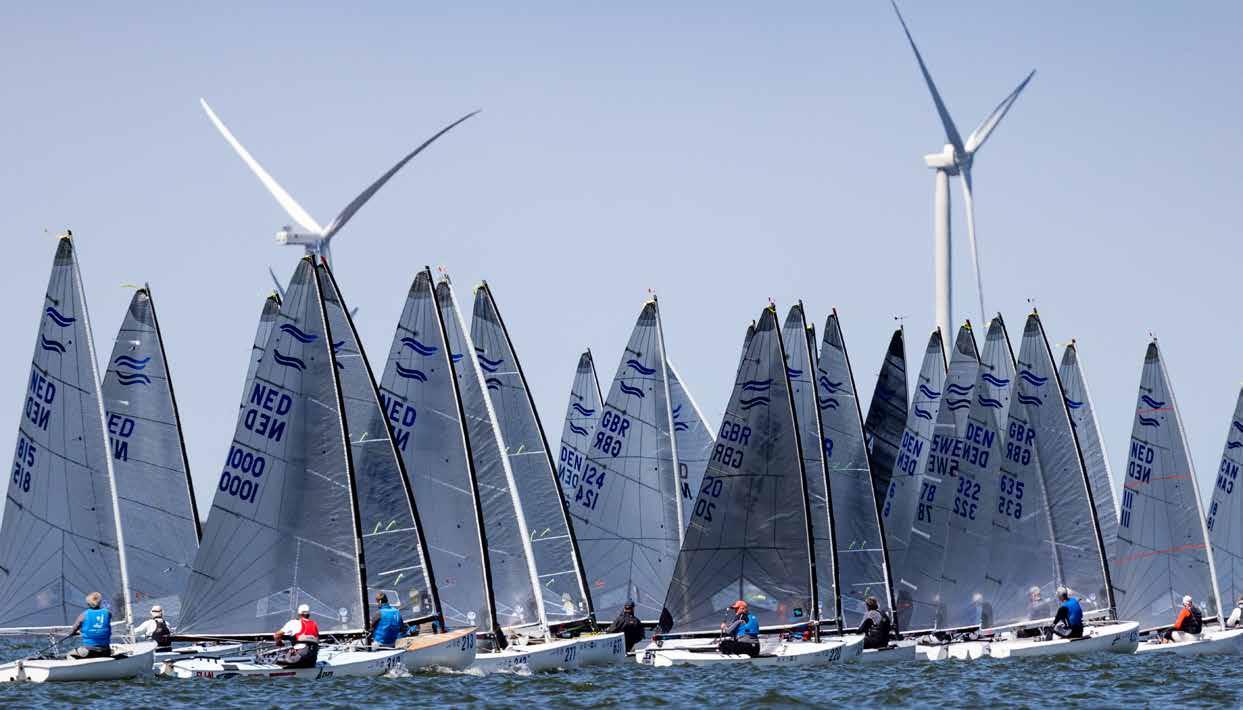
The huge fleet of more than 301 sailors from 27 countries were split into four groups each day, on two course areas. The IJsselmeer was full of Finns again.
EIGHT RACES, FOUR WINNERS ON FIRST DAY
The first day was a big day with each group sailing two races in a shifty 8-12 knots offshore breeze and a lot of racing. Laurent Hay, Fabian Lemmel, Eric Bakker and Pieter-Jan Postma all won both their races so there was a four-way tie at the top after the first day In fifth place was the 1996 Olympic bronze medalist, Roy Heiner with two solid second places. Other standout performances came
from Zdenek Gebhart with a 3,2 and Marco Buglielli with a 2, 4. Buglielli: “Being here is wonderful. This year I managed to attend two championships, the Europeans in Naples and the Finn World Masters in Medemblik and it’s very good, you know it’s a wonderful atmosphere. We’re also having some nice weather and some light wind conditions which is very good for me.”
POSTMA TAKES LEAD ON SECOND DAY
Two more races, with eight starts, were again sailed on the second day in an offshore shifty breeze, though more stable than Monday. The conditions were again sublime, with a warm 8-10 knots in the first race, with wall-to-wall sunshine, increasing to 12-15 in the second with more cloud cover.
Of the first day’s race winners, Postma was the only one to maintain a perfect score, winning both races in blue group. Both Hay and Lemmel were also in blue. With four groups, points can build up very quickly, so every place won or lost is critical. After a less-than-ideal start to the week on Monday, Martijn van Muyden won both races in green group, while the yellow group races were won by Karel van Hellemond and David Terol, and the red group races were won by Sami Salmona and Taras Havrysh Postma took the overall lead from Hay and Lemmel.
Brendon Hogg: “I have to say today was a fantastic day, just a fantastic day of racing and a couple of good battles with some good guys. I know everybody is just enjoying themselves.”
Fredrik Tegnhed: “I didn’t have a very good day yesterday, I got
1 From an ‘original’ song by Brendon Hogg. See finnclass.org/finn-tv
1
48
49
Super LegendS: 1 ned 8 rodrick cASAnder; 2 FrA 23 dAnieL cHedeViLLe; 3 gBr 777 HowArd SeLLArS
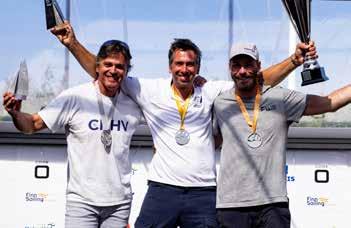
LegendS: 1 nZL 9 roB couTTS; 2 ned 2 wouTer MoLenAAr; 3 FrA 86 cHriSTopHe JeAn
grAnd
ned 703 eric
1 FrA 75
3 AuS 2
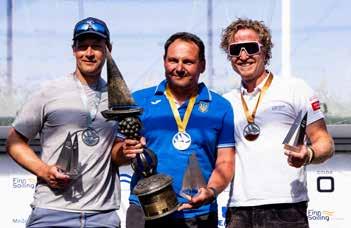
grAnd MASTer: 1 ukr 8 TArAS HAVrYSH; 2 ned 68 MArTiJn VAn MuYden; 3 ger 501 FABiAn LeMMeL
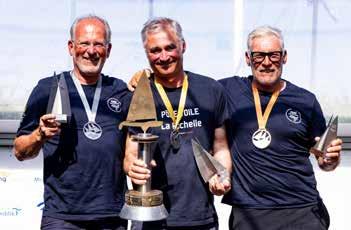
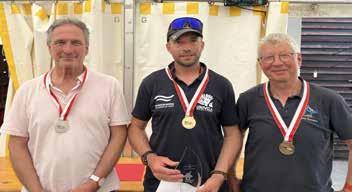
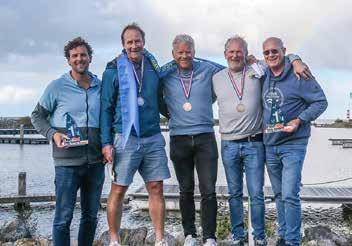
MASTer: 1 ned 842 pieTer-JAn poSTMA; 2 eSp 7 dAVid TeroL; 3 Hun 5 TiBor pALLAY
greAT
MASTer:
LAurenT HAŸ; 2
BAkker;
roB McMiLLAn
Top LeFT (cLockwiSe): cLuB TropHY: HeT wiTTe HuiS, ned; cLASSic BoAT: ned 468 ArTHur VAn den HoVen; LAdY: ned
two yellow flags but it is what it is. But today I got a seventh and a ninth in some pretty breezy conditions and I am happy. Medemblik is an amazing place, I really enjoy the sailing area and the social events after racing. Everything is very well organised.”
The day ended with Code Zero sponsored snacks and drinks at the famous Café Brakeboer in the old harbour. The Finn class has a long history in Medemblik. The 1963 and 1982 Finn Gold Cups were sailed there, as well as the 2008 Finn World Masters, at the time the largest Finn event ever sailed with 229 entries. And of course, the Finn was sailing the original SPA regatta from the beginning, from outside the Brakeboer.
POSTMA CONTINUES TO DOMINATE ON DAY 3
One race was sailed in the afternoon, in a pleasant breeze that brought cloud clover later on but cleared through for the evening dinner. Yellow group was the one to watch with Heiner leading Postma around the top mark. However, Postma was soon past and went on to a huge win, acknowledged by Heiner at the finish. In the blue group, Havrysh led all the way to win from Nick Craig. On the other course area the wins went to Hay and Allen Burrell.
Heiner: “I have no other words to describe today than champagne sailing. There’s exceptional warm weather in Holland, beautiful northern wind building great waves. The Finn World Masters are always a lot of fun, lots of different countries lots of friends to catch up with and some really close racing at the top.
Tomorrow is going to be a different day and I am sure different people will be at the top of the fleet.”
Craig: “A lovely day sailing today. Rob McMillan very kindly lent me a boat after I had an issue with mine. It’s been leaking after a self-inflicted wound on a port-starboard, so I spent two days dragging the boat around the IJsselmeer and I have to say it’s nice to sail on a much faster and dry boat.”
On Wednesday evening the traditional Masters dinner took a new twist with the Finn Foodtruck Festival – sailors were given tokens to try different cuisines from trucks outside the Regatta Centre Medemblik.
POSTMA WINS WITH DAY TO SPARE
The penultimate day of the Finn World Masters in Medemblik threw a curveball at the fleet with very light and tricky winds, some high scores, complex racing, protests and unfinished races. It was a long, busy and hot day in Medemblik, but also a lot of fun for the 300 sailors.
The weather continued to amaze everyone with sunny skies and high temperatures, though Thursday brought light wind and big shifts. Yellow group sailed almost three races after bizarrely missing the change of course signal at the first gate and all headed to a finish line that was not there. The race was abandoned and resailed later in the day. The race wins went to Lawrence Crispin and Jelte Baerends. In the blue group, which did not make the same mistake
51 BEL 99 Gwyn HAGENAERS 115
52 NED 148 Peter PEET 120
53 BRA 305 Fabio PRADA 120
54 BEL 18 Sigurd VERGAUWE 120
55 HUN 1 Geza HUSZAR 121
56 NZL 9 Rob COUTTS 121
57 NED 98 Nanno SCHUTTRUPS 124
58 GBR 90 Richard SHARP 125
59 NED 81 Gerko VISSER 126
60 GBR 5 John GREENWOOD 127
61 BRA 97 Ricardo SANTOS 131
62 SUI 83 Jürg WITTICH 133
63 GBR 567 Martin HUGHES 133
64 ESP 76 Alejandro CARDONA 136
65 FRA 202 Yann VILEIN 138
66 SUI 95 Michael GOOD 141
67 NOR 55 Arild HELDAL 141
68 NED 117 Thierry VAN VIERSSEN 142
69 SWE 5 Fredrik TEGNHED 143
70 SWE 32 Olof LUNDQVIST 144
71 NED 977 Peter AUKEMA 145
72 NOR 5 Per Olav BERNHARDSEN 146
73 FRA 373 Harri VEIVO 147
74 FIN 50 Freddy MARKELIN 148
75 NED 147 Ted DUYVESTIJN 152
76 NED 116 Marco EEMAN 152
77 NZL 5 Brendon HOGG 154
78 CHI 21 Felipe GIL 154
79 NED 995 Arjan VOS 157
80 SUI 41 Dominique WÄLCHLI 158
81 SWE 78 Lars BERGFELDT 159
82 NED 1000 Tim VAN ROOTSELAAR 159
83 NED 2 Wouter MOLENAAR 159
84 BEL 2603 Stijn HELSEN 160
85 POL 100 Marek JAROCKI 161
86 USA 19 R. Phillip RAMMING 162
87 NED 966 Sander JORISSEN 164
88 DEN 6 Lars HALL 166
89 BRA 11 Robert RITTSCHER 167
90 GER 909 Udo MUREK 168
91 USA 47 Robert KINNEY 169
92 NOR 88 Morten HELGESEN 172
93 NED 27 Paul KAMPHORST 172
94 POL 1 Jarosław RADZKI 174
95 NED 53 Jeroen vd VELDEN 176
96 GBR 74 Lawrence CRISPIN 177
97 NED 999 Hein BLOEMERS 178
98 UKR 13 Andriy PODVEZKO 182
99 DEN 321 Joe SCHUBERT 182
100 NED 179 Kik VAN SWOL 185
101 NOR 73 Karsten ESKELUND 187
102 POL 80 Ryszard MRÓZEK 190
103 ESP 86 Paco CASTANER 190
104 BEL 4 Yves BASSETTE 190
105 SUI 57 Rudolf BAUMANN 193
106 NED 73 Ronald RUITER 194
107 GER 595 Fabian ROSSBACHER 195
108 CZE 75 Vladimir SKALICKY 195
109 NED 33 Melle HEERLIEN 196
110 HUN 51 Istvan RUTAI 197
111 DEN 322 Kasper SANDSTRØM 198
112 GER 334 Andreas GILLWALD 199
113 NED 126 Maarten GODSCHALX 199
114 DEN 325 Michael SANDSTRØM 200
115 DEN 246 Jens Kristian ANDERSEN 200
116 NED 962 Marc ERIKS 204
117 GBR 78 Robert TEMPLE 204
118 GER 37 David SAHA 205
119 DEN 323 Ole VORM 205
120 GBR 19 Simon HOULT 206
121 GBR 61 John HEYES 206
122 NED 49 Jan-Mark MEEUWISSE 207
123 FRA 86 Christophe JEAN 208
124 AUS 10 John CONDIE 209
125 BEL 41 Tony DELAVA 210
126 NED 875 Marcel NEUTEBOOM 210
127 FIN 145 Mathias TALLBERG 210
128 GER 103 Ralf-Udo LEMKE 211
129 NED 111 Chris FRIJDAL 212
130 FRA 66 Philippe LOBERT 212
131 BRA 108 Cristiano RUSCHMANN 213
132 POL 26 Boguslaw NOWAKOWSKI 214
133 GER 62 Uwe BARTHEL 214
134 NED 55 Eddy HUISMAN 216
135 NED 188 Rolf HEEMSKERK 216
136 AUS 75 Phil CHADWICK 219
137 SUI 12 Franz BÜRGI 219
138 NED 115 Gerrit Jan VAN OMMEN 220
139 CZE 211 Martin KALOŠ 223
140 NED 136 Henk Jan DE HEER 224
141 SUI 13 Peter KILCHENMANN 225
142 GBR 8 Tim CARVER 226
143 GER 84 Michael HUELLENKREMER 226
144 SUI 99 Laurent CHAPUIS 227
145 CAN 18 Simon VAN WONDEREN 228
146 LIE 1 Attila SZABO 230
147 NED 1009 Pieter RISSEEUW 230
148 GER 479 Gerd-Uwe HILLERS 230.6
149 NED 90 Frank BAIKO 232
150 FRA 87 STEPHANE MARCELLI 233
151 SUI 33 Bernhard SEGER 235
152 NED 17 Marck SMIT 237
153 NED 85 Peter BISSCHOP 237
154 GER 19 Andreas BOLLONGINO 238
155 SUI 1 Hans FATZER 238
156 CAN 8688 Robyn CULP 239
157 BEL 81 Jan GODERIS 240
158 BEL 8 Filip VERHAEGHE 241
159 GBR 21 Michael DE COURCY 241
160 AUS 31 David CLAYTON 242
161 NED 56 Rick BOMER 247
162 NED 226 Ebe VAN DER SPEK 254
163 NED 199 Matthijs KNEGTEL 255
164 GUA 1 Juan E. MAEGLI 256
165 BEL 86 Maurits HOMAN 257
166 FIN 233 Sami SALOMAA 261
167 SUI 39 Hans STOCKLI 261
168 NOR 99 Carl Gunnar LUNDE 261
169 DEN 117 Peter Sigetty BØJE 263
170 HUN 972 Gyula MÓNUS 263
171 NED 51 Eric (AHJM) NOOIJEN 263
172 ITA 788 Roberto BENAMATI 266
173 GER 226 Uwe FERNHOLZ 266 174 GER 477 Harald LEISSNER 267
GER 12 David GUMINSKI 324 217 NED 101 Jaap SLUIJTER 327 218
156 Pim BROUWER
NED 4 Ruurd BAERENDS
NED 113 Peter VAN DER VLIET
NED 88 Chiel BARENDS
BEL 22 Bart VICTOR
FRA 26 Gilles MALSERVET
NED 137 Stephan BRUMM
FRA 307 Xavier LACOMBE
CZE 149 Vladimír VOGLTANZ
276 GER 383 Björn ARNOLD
NED 128 Klaas RUIGEWAARD
GER 365 Martin WEBER
279 BEL 88 Jos STRIJCKERS 441
GER 300 Markus KASCHUBA 441
NED 444 peter RUMPING
NED 22 Lolke KET
NED 197 Walter KAMSTEEG 447 284 NED 468 Arthur VAN DEN HOVEN 447 285 GER 285 Lars MOECKE 451
NED 9 Jobs ISSELMANN 453 287 SGP 1 Adriaan SMIT 454
288 NED 450 Willem SCHOPMAN 465 289 NED 333 Tol TRIMBORN 470
290 NED 93 Gelmus PEETERS 473 291 NED 996 Joost VERSLUIJS
292 NED 201 Maria KUIPER 478
293 NED 815 Aart BOOTSMA 484
294 NED 225 Frits LAFEBER 487
295 GER 997 Jochen DAUBER 493
296 NED 211 Philip DE KONING GANS 502
297 NED 164 Joop WUIJTS 524
298 BEL 968 Wim CRAENEN 529
299 FRA 15 Philippe RINALDI 532
300 SWE 12 Stefan SANDAHL 535
301 SWE 82 Marcus LÖFGREN 539
Anthony Nossiter took a very popular win in the first race with Peter Mosny winning the second.
Over on the other course Postma carried on his winning ways by taking the first race only to struggle in the second after a risky start and ended up fifth over the line. Meanwhile, Hay, in the same group was sixth in the first race and then escaped in the second for a big win to keep his title retention within reach. However, a protest from Postma disqualified the third-place finisher and he moved up to fourth, which was enough to win the title with a race to spare. In the green group, the wins went to Tibor Pallay and Harri Veivo. In fact, Pallay and Baerends matched the best score of the day with a 1, 2 each.
Ville Aalto-Setala: “It was a very tricky day with light wind, and a lot of differences in pressure across the racing area. The hardest thing for me was keeping the speed up because it was very difficult to pass given the light breeze. I have no expectations on tomorrow. It’s better not to have them in a tricky place like this.”
Nanno Schuttrups: “So today was quite challenging. It was patchy with lots of shifts and things you don’t want to see on a racing day like this. It was really fun because at the end the front of the green fleet got caught in the tail end of the red fleet so all the boats came on the finishing line together so the final reach was quite hectic for both sailors and people at the finishing line. I’ve been sailing here for most of my life but a week like we have had this week is unheard of. It’s almost like Punta Ala but on fresh waters.”
MASTERS ENDS AFTER EPIC WEEK
The final race on the final day was probably the trickiest of the week with light and patchy easterlies mixing up the racing. While Hay won the yellow group, to end on equal points with Postma, who struggled in blue group and finally crossed in fourth. Eric Bakker led blue group from start to finish. On the other course area Michael Good won green group, while Havrysh won the red group.
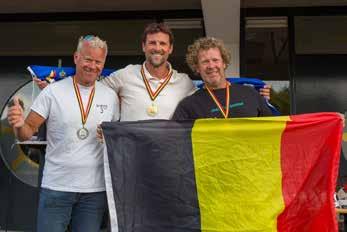
Pieter-Jan Postma took his second Finn World Masters title, while Laurent Hay was also second, and Taras Havrysh moved up to third on the final day.
THE 2025 FINN World Masters was an exceptional event in all aspects, from the competition, race management, onshore socials, partners programme but most of all for the weather. The 2008 Finn World Masters was also held in Medemblik and also had exceptional weather, so perhaps Finn Masters are just exceptionally lucky. For sure everyone in Medemblik felt lucky and privileged to be there. The atmosphere was just incredible.
Pieter-Jan Postma: “I am super happy. It was an incredible event, but besides racing, I think the most important thing is the character of the people. You know we have such a good atmosphere, we always have such a good character and everybody’s here to cheer on one another and we all enjoy sailing. I’m very grateful to be sailing and to be part of the Finn class and this week was just amazing.”
Postma also won the Masters age group, Havrysh won the Grand Masters age group and Hay won the Great Grand Masters category. As is traditional, all 32 Legends (those over 70) and nine Super Legends (those over 80) were celebrated on stage, representing as a group the aspiration of everyone present. Rob Coutts retained the Legends title, while Rodrick Casander again won the Super Legends title.
Laurent Hay: “It was a very beautiful championship, and we had a fantastic weather, we had good breeze with a lot of different conditions, so it was really nice. We had some great battles, a lot of sportsmanship. I’m very happy about my championship, I had some good battles with PJ Postma, I tried to do my best, but he was just better. I am super happy and I want to thank all the volunteers, the race committee, and the jury. It was a perfect race.”
A huge thanks to the enthusiastic Organising Committee, led by the unflappable Jan Zetzema, the Royal Hollandia YC and the Regatta Centre Medemblik for the superb welcome, hospitality and convivial atmosphere that made the 2025 Finn World Masters such an unforgettable event.
Q&A WITH DENISS KARPAK
WHAT’S IT BEEN LIKE TO COME BACK TO THE FINN?
Coming back to the Finn felt like coming home. It’s a boat that shaped me as an athlete and as a person, so stepping back into it was emotional but also very natural. The Finn doesn’t forgive laziness – it immediately reminds you what true sailing means.
WHAT WAS EASY AND WHAT WAS HARD?
The easy part was the feeling – the instinct, balance, and love for the boat came back fast. The hard part was physical. The Finn demands power and endurance, and it took time to rebuild the ‘Finn body’ again. But I enjoyed that process; pain just means progress.
DOES YOUR BRAIN REMEMBER MORE THAN YOUR BODY?
Haha, yes - at first, definitely! My brain knew exactly what to do, but my body needed a few months to catch up. Eventually they synced again, and that’s when the magic started to happen.
WITH SOME MONTHS GAP, WHAT DID YOU THINK OF THE COMPETITION IN CASCAIS AND HOW YOU PERFORMED?
Cascais was world-class. The fleet was strong, the conditions were pure Finn conditions – wind, waves, and physical racing. I felt in tune with the boat, and mentally I was very sharp. It wasn’t perfect, but it was a performance built on experience and hunger. Winning there meant a lot.
DID YOU BELIEVE YOU HAD A GOOD CHANCE TO WIN GOING INTO THE EVENT AND HOW IMPORTANT TO YOU WAS WINNING?
I believed I could win, yes. I always race to win, but this one had deeper meaning. I wanted to prove to myself that discipline and mindset still matter more than age or circumstances. Winning the Finn Gold Cup wasn’t just a title - it was a statement that passion never fades.
EXPLAIN ABOUT THE RESPONSE BACK HOME TO BEING THE FIRST ESTONIAN TO WIN THE FINN GOLD CUP.
It was incredible. People back home were proud, emotional even. For a small country like Estonia, achievements like this are symbolic – they show what’s possible with persistence. The support and messages I received reminded me that I wasn’t just racing for myself.
WHAT ABOUT THE TRAINING CAMPS YOU ARE PLANNING NEXT YEAR?
Next year I’m planning several Performance Sailing Clinics –focused, high-quality Finn and ILCA camps in top sailing venues. What I bring is experience from three Olympic campaigns and
the mental side of elite sport. I help sailors connect performance, mindset, and purpose – not just technique.
WHAT IS THE ‘ETHOS’ OF YOUR CAMPS AND WHAT MAKES THEM DIFFERENT FROM OTHERS?
The ethos is simple: real sailing, real improvement, real connection. My camps are not about being perfect, they’re about becoming self-aware, understanding your limits, and pushing beyond them. I combine technical precision with psychology and physical preparation – it’s a full-performance experience.
WHEN WILL WE SEE YOU BACK ON THE RACE COURSE? Soon! I plan to do selected Finn events next season – not a full campaign, but enough to stay sharp and connected to the fleet. I still love the challenge. Europeans for sure.
WHEN YOU LOOK AT THE FINN CLASS NOW, DO YOU THINK WE ARE ON THE RIGHT PATH AND WHAT, IF ANYTHING, WOULD YOU LIKE TO SEE DONE DIFFERENTLY?
I think the Finn Class has kept its spirit alive, which is the most important thing. The sailors are passionate and authentic. Maybe we could invest more in visibility – media, storytelling, and connecting the new generation to the heritage of this amazing class.
HOW DO YOU THINK WE COULD ADD TO THE ENTHUSIASM WITHIN THE CLASS AND FURTHER DEVELOP WHAT WE HAVE?
We should highlight the human side of Finn sailing – the mindset, the effort, the brotherhood. The Finn community is unique, it’s like a family of warriors. More content, shared training, and collaboration across generations would help keep that fire burning.
MEASUREMENT CLINIC IN CASCAIS
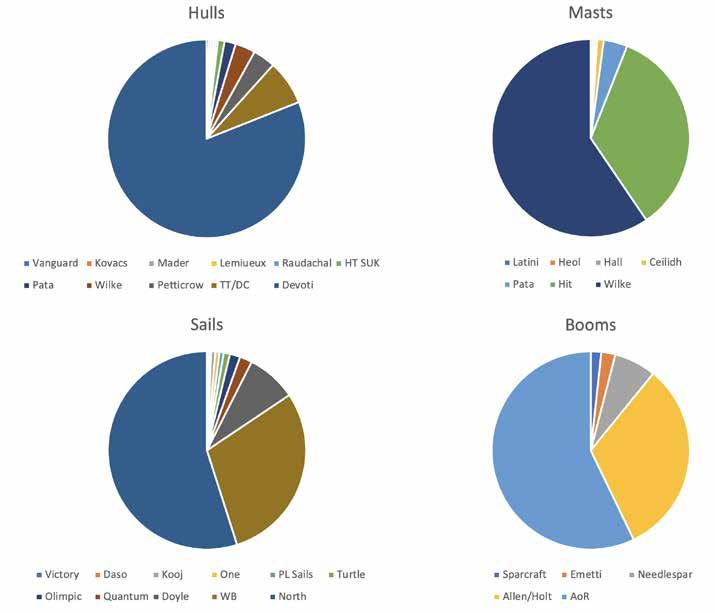
Iam sure that if you are reading this then like me you have a passion for Finns and what makes them tick. A subset of that interest is the variety of hulls, sails, masts and foils. When compared with other single manufacturer classes this adds a tremendous depth to the Finn experience. However, with these variations comes the requirement to make sure that all of these combinations comply with the class rules. We don’t want the bland ‘uniformity’ of an ILCA but we do want to know that these variations have limits which are consistently applied.
Britain has a long and storied history when it comes to the Finn class. An important part of that was the technical side and the capability in the country to measure boats and ensure they complied with the class rules. A consequence of the Finn leaving the Olympics and the passage of time meant that we ended up with no in-country ability to measure boats. So, when the British Finn Association put out a call for those who might be interested in becoming qualified to become Certification Measurers both myself and Martin Hughes put our hands up. The IFA offered the
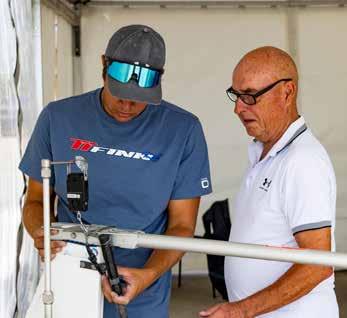
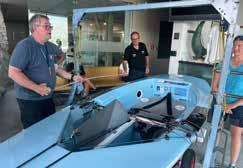
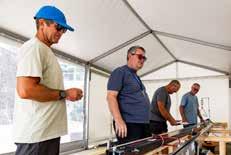
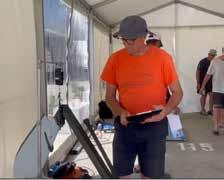
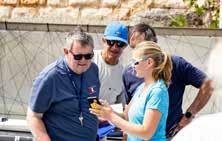
Just before the Finn Gold Cup in Cascais, IFA ran a measurement clinic for aspiring Certification and International Measurers. Led by IFA Chief Measurer, Andre Blasse, the clinic rolled into the Equipment Inspection days for the Finn Gold Cup. One of the attendees Fergus Allan describes what was carried out and learned over the four days.
chance to train and become certified at the FGC in Cascais with Andre Blasse, Alistair Deaves and Tim Tavinor. Flights and accommodation were booked and so it came to pass that Martin and I headed out to Lisbon to learn from the best.
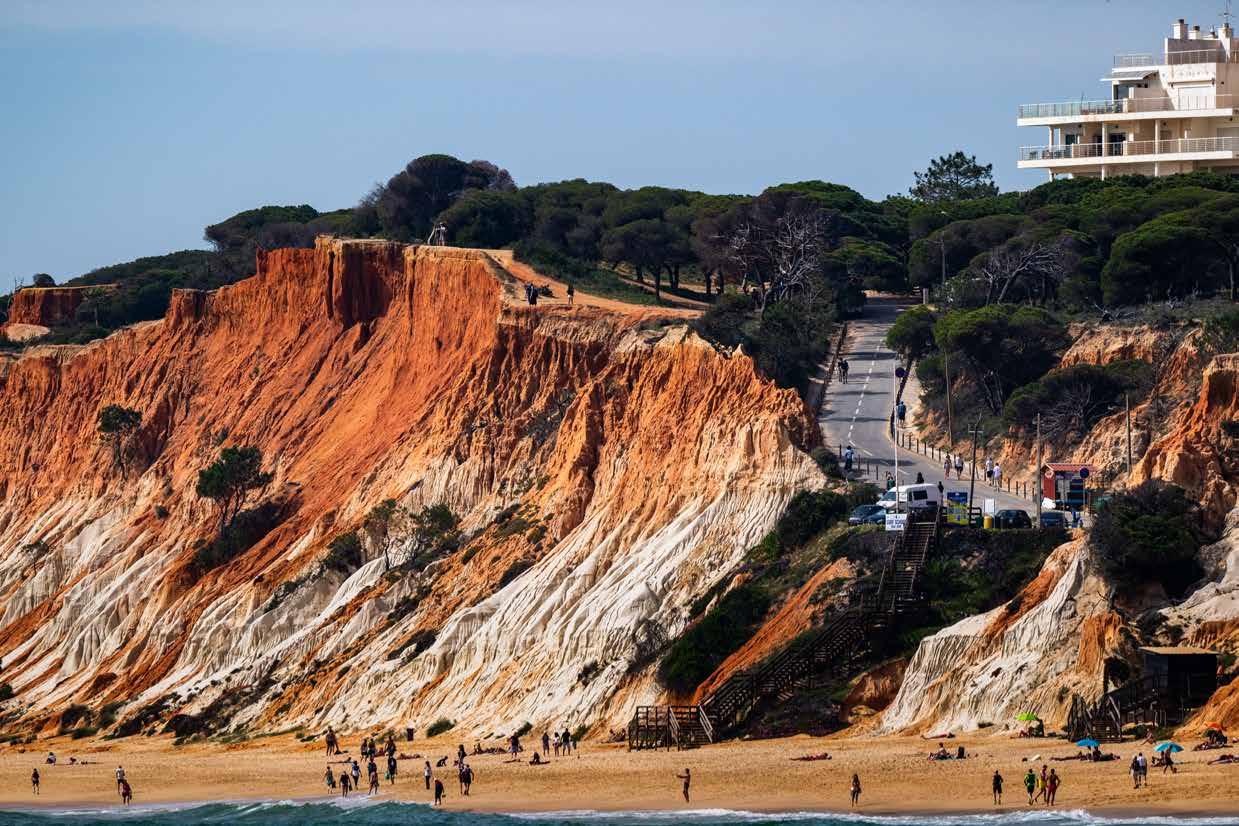
Never having been to Portugal I did not know what to expect. I was blown away by the awesome sense of maritime history as you get the train and travel along banks of the Rio Tejo to arrive at the beautiful seaside town of Cascais. A delightful town centre and a truly impressive fort with the yacht club nestled in underneath the walls. It all had a bit of a holiday feel to it, and I was starting to feel a bit guilty until the first Whatsapp arrived from Andre. “0900 tomorrow let’s get started!”
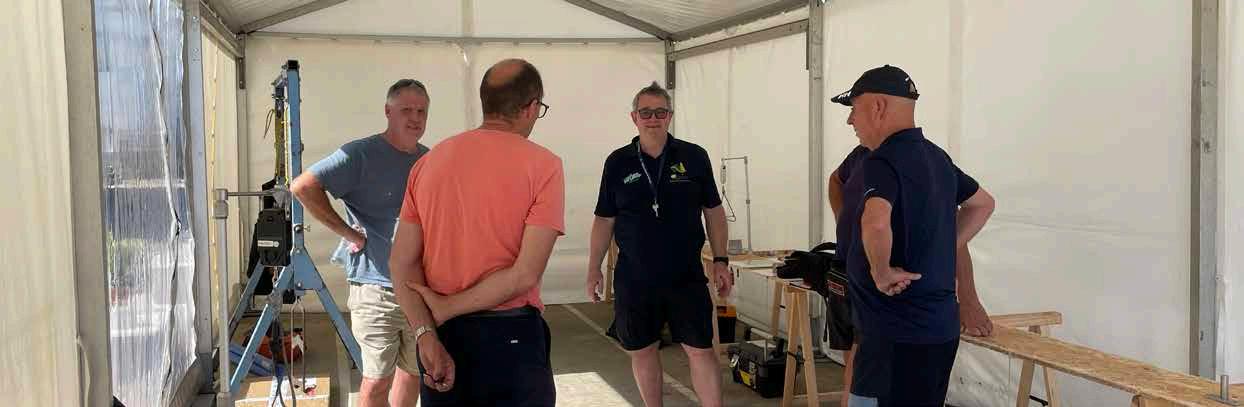
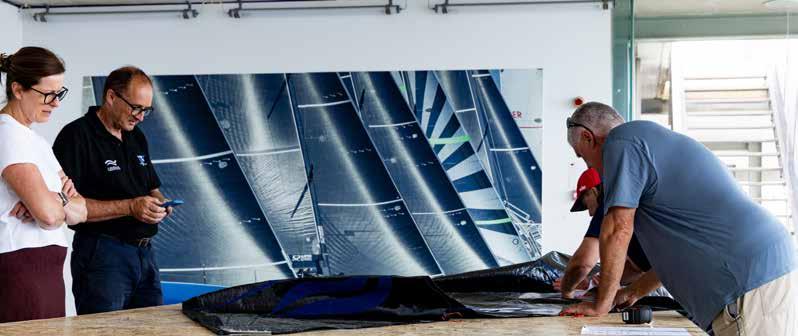
The sailing club had done a great job setting up the boat and mast measurement tent and also a giant table in a conference room for sails. The day was spent marking out the tables, setting up boat, mast and rudder scales and building the frames for the Lamboley swing test. Martin and I took copious notes and pictures and started to think about how we could achieve the same setup in the UK. As evening drew in, we retired. It had been a long day.
The next day we started to get some customers. I was not really sure of what to
expect of equipment inspection. Personally, I have always found it to be quite nervewracking on the couple of occasions I have been through it. I imagined a strict set of barriers and hurdles designed to prevent anybody from sailing if their boat was even a gram or millimetre out of whack. What I found was the opposite. Andre, Alistair and Tim were doing everything they could to educate and help those who encountered problems. Here is a summary of our four days of training and measuring and some of the issues observed and problems solved.
DAY 1
• Arrive and meet the team: Andre Blasse
– IFA Chief Measurer; Alistair Deaves –International Measurer; Tim Tavinor – Chair of the IFA Technical Committee; Martin Hughes / Fergus Allan – GBR; Pauline Kaminsky – GER; Detlev Guminski – GER
• Andre explained the ethos of the process which is to verify that all competitors are sailing a Finn and where discrepancies arise to do all possible to bring them within the rules. It is not a case of catching sailors out or issuing penalties but about having a level playing field for all.
• Setup measurement tent and sail measurement table
DAY 2
• Competitor measurement started
• We split into two teams, one in the measurement tent and the other on sails
DAY 3
• Competitor measurement continued
• We rotated the two teams so that all had exposure to the two measurement areas
• In the evening the swing setup was assembled in the lobby of the club and two boats were swung
DAY 4
• Last day of competitor measurement
• Briefing and practice race
BOATS
• The following was checked on each boat
• Correctors – location and quantity as per measurement form
• Centreboards – numbering vs certificate
• Occasional boats were weighed – the scales used were 150 kg “vets” scales
• Lamboley Swing test (see 5)
• Very generously the sailing club allowed us to setup in the reception area – how many sailing clubs would let you do that?
• The boats were first weighed to find out how much weight was required to be added
• The swing setup was very highly developed making the swing test efficient and quick
• The oscillation periods are measured using an optical detector to an accuracy of 0.001 sec
• Moving between the two hang-off points was made easy using the swing setup
• It was observed to be very important to have an area with no air movement i.e. no draughts
• A spreadsheet uses the two oscillation periods to solve the equations and plot the output
• The setup allows almost instant feedback on the placement of correctors
ISSUES OBSERVED WITH HULLS
• Wrong information on the form about corrector weight and location – generally speaking the boat and certificate were correct but many sailors were unsure about how the certificate information translates to their boat
• Missing correctors – usually to be found somewhere else in the boat (see 3)
• A useful trick was to use an iPhone camera as an inspection device to see inside the tank. In several cases missing lead was found. The boat was upended and the lead placed in the correct location. This was a good example of the process helping a sailor to bring his boat within the class
• Centreboard numbering – as per the rules if a new centreboard is installed in the boat, then reweighing and a swing test should be required. On one occasion a boat was presented with a mismatched centreboard/certificate. The chief measurer was able to query the database and find a newer certificate with the actual centreboard. Another good example of the
process and database helping a sailor to bring his boat within the class rules.
BOOMS
• Checks against a template to verify boom pin hole was correctly located
• Dimensional checks to make sure that a band of distinctive colour was in the correct place at the clew end
• Check for some means to stop the sail being pulled beyond the band
• Occasional booms were weighed if found to be from a new manufacturer
• Several booms were found with no distinctive band. This was solved with tape and a spray can of paint.
• New booms from one manufacturer/ supplier had no end stop, rectified quickly and efficiently.
MASTS
• Masts were weighed to confirm within spec.
• Centre of gravity was checked
• Some masts were under weight and had to have weight added.
• Some masts had the COG too low and had to have weight added to the masthead
• Weights used were as per the adhesive lead weights used by garages to balance tyres (Donated by Pauline).
RUDDER
/ TILLERS (4 AND 7)
• Rudder/Tiller/extension weighed together
• Rudder checked using letterbox gauge Problems observed:
• Underweight – lead had to be added
• Rudder blades too thick – in one case the rudder was approx 3 mm oversize – this was a brand new certified/measured rudder. The yacht club workshop applied a sander and the blade was brought in tolerance.
SAILS
• The sails were measured on a large table which was pre-marked with the necessary measurement points
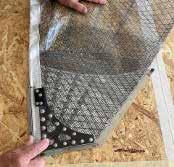
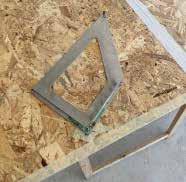
• The dimensions of the head were checked against a metal template (see photo 1 / 2)
• Verification of sails included the following
• Check head against template
• Check sail width at two check points
• Check leech length < 6020 mm
• Check sail has signed IFA label which is signed and stitched to the sail
• The sail may also have a World Sailing IHC label but this is not mandatory
• If the IFA label is not signed the sail must go through a full measurement which includes measuring the length of the foot bolt rope and the battens
• The IFA label is then signed by the measurer
• These are a list of the issues which were seen
• One sail had a leech which was too long
– the sail was recut and measured in
• Various issues with positioning of sail numbers – these dimensions are not in the Finn class rules but are standardised in the Racing Rules of Sailing
• No IFA label – new label to be purchased from IFA
• Some sails had an additional small logo stitched into the luff. This contravenes the rules on number and positioning of logos so needed to be removed or obscured
WRAP-UP / CONCLUSIONS
The objective of the trip was achieved in that both Martin and I are now approved by the chief measurer Andre Blasse as IFA Certification Measurers. I have a remaining task to complete which is to attend an RYA sail measurement course however we do now have a means in the UK to measure boats and equipment and issue and sign certificates.
The forward plan is to setup measuring equipment during the winter and then offer the opportunity to members to address any measurement issues they may have.
Some final words. The club were amazing. Just in the few days I was there I saw Olympic hopefuls training, kids in oppies learning to sail, a massive Saturday night party, J70 championships, measurement for the FGC and coffee with pastel de nata for elevenses. Andre, Alistair, Robert and Tim were incredibly generous with their time and encyclopaedic knowledge of Finns and measurement. Regrettably I had to leave when the sailing started so I only experienced the event through the photos, videos and words on FB/Youtube however I took some pride in knowing that I had played a part in making sure that all sailors knew they were competing in Finns against other Finns and that the winners had won fair and square. Next step is to get the UK Finn measurement capability up and running and I look forward to doing that with Martin and the BFA.
World Tour for Finns - Reports and Results
AUSTRALIA
Winter nationals, aUs
Brisbane •18-20 Jul • 44 entries
1 ESP 100 Rafael Trujillo 12
2 AUS 2 Rob McMillan 18
3 AUS 11 Brendan Casey 18
4 NZL 111 Karl Purdie 23
5 AUS 110 Marcus Whitley 29
6 AUS 250 Pat Cummin 35
7 NZL 4 Mark Perrow 38
8 AUS 5 Matt Visser 39
9 AUS 98 Lucas Prescott 41
10 AUS 72 Chris Links 46
AUSTRIA
national Championship, aUt
Mörbisch • 23-25 Jun • 43 entries
1 HUN 30 Zsigmond Kantor 11
2 AUT 7 Michael Gubi 17
3 GER 286 Max Trommer 19
4 AUT 4 Michael Luschan 22
5 ITA 4 Francesco Faggiani 29
6 GER 60 Thilo Durach 36
7 CZE 2 Zdenek Gebhart 37
8 AUT 73 Markus Schneeberger 38
9 AUT 400 Bernhard Klingler 44
10 AUT 8 Hartwig Gfreiner 46
rofi pokal attersee, aUt
Attersee • 30-31 Aug • 17 entries
1 AUT 11 Bernd Moser 1
2 AUT 73 Markus Schneeberger 2 3 AUT 330 Tina Weinreich 3
4 AUT 342 Valentin Boesch 4
5 AUT 6 Bernd Rohlfs 5 6
BELGIUM
Paul Goossens writes: The 2025 OBK Finn Championship in Scharendijke broke records with more than 50 competitors at the start line, representing seven nations: 15 from Belgium, 25 from the Netherlands, eight from Germany, plus sailors from Portugal, France, Norway, and even South Africa. The growing popularity of the event reflects not only its high sporting level but also its reputation for warm hospitality, smooth organisation, and a fantastic atmosphere supported by a dedicated team of volunteers.
The regatta was sailed under nearperfect conditions: sunshine, summer
temperatures, and winds ranging from 8 to 16 knots. From the outset, the competition was fierce, and by day two it was clear that the title fight would come down to Nanno Schuttrups and Peter Peet. Their duel remained undecided until the very last race, with Nanno ultimately winning the 2025 OBK title by just one point.
“Consistency was key,” Nanno reflected afterwards. “But above all, reading the wind shifts was crucial this week.” Peet also delivered an exceptional series and proved once again why he is among the very best.
The podium was completed by Finn legend Sebastien Godefroid, who showed his enduring skill despite limited training.
• Memorable Moments: Beyond the results, OBK 2025 delivered plenty of drama and entertainment:
• Spectacular moves: Huub de Haer (NED 13) pulled off a daring port-tack start right in front of the entire fleet, a manoeuvre that required as much courage as perfect timing.
• Photo finishes: Several races ended in nailbitingly close calls, resolved swiftly thanks to the race committee’s live video footage.
• Protests & penalties: Remarkably, the entire top four received yellow flags for “free pumping,” a reminder of how fine the margins are at this level. The on-water jury was sharp but fair.
• Physical test: With the pumping rule consistently enforced above 10 knots, fitness proved decisive. Downwind battles highlighted the stamina and technique of Peet, Cees Scheurwater, and Tobias de Haer. Shore-side Atmosphere: On land, the event was just as memorable. From breakfast and coffee to lively après-sailing gatherings, the highlight was the musselsand-fries evening, which turned into a true celebration. The mix of sharp competition and warm camaraderie is exactly what makes the OBK such a special event.
national Championship, Bel Scharendijke (NED) • 14-17 Aug • 51 entries
1 NED 98 Nanno Schuttrups 15
2 NED 148 Peter Peet 16
3 BEL 7 Sebastien Godefroid 36
4 NED 43 Ronald Van Klooster 37
5 POR 21 Filipi Silva 43
6 NED 86 Stefan Marechal 50
7 NED 7 Cees Scheurwater 55
8 NED 133 Tobias De Haer 59
9 BEL 18 Sigurd Vergauwe 76
10 GER 595 Fabian Rossbacher 77
Copper CUp, Bel
Oostende • 10-11 May • 10 entries
1 BEL 41 Tony Delava 13
2 BEL 99 Gwyn Hagenaers 16
3 BEL 18 Sigurd Vergauwe 17
4 BEL 2603 Stijn Helsen 20
5 BEL 81 Jan Goderis 27
6 BEL 86 Maurits Homan 28
7 BEL 15 Filip Willems 30
8 BEL 16 Elias Kerre 30
9 NED 51 Eric Ahjm Nooijen 31
10 NED 882 Jan Van Der Werff 32
BRAZIL
Cristiano Ruschmann writes: The 2025 Brazilian Finn Championship took place in the picturesque sailing haven of Ilhabela from 1-4 May, attracting 14 sailors from various regional fleets across the country and 1 German friend.
Ilhabela, a stunning tropical island located off the southeastern coast of Brazil—about 200 km from São Paulo and 450 km from Rio de Janeiro—has long been a treasured destination for competitive sailing. Known for its consistent trade winds, scenic mountain backdrop, and rich maritime heritage, Ilhabela notably hosted the 1988 Finn Gold Cup and continues to serve as a premier venue for top-level regattas.
This year’s championship featured eight exhilarating races held in a range of wind conditions, all under bright, sunlit skies and comfortably warm weather. The first two days delivered excellent sailing conditions, with steady easterly winds ranging from 12 to 18 knots—ideal for fast, tactical racing and powerful downwind legs. Day 3 brought a dramatic change, as the wind shifted to the south and lightened to 6–9 knots, demanding heightened focus and finesse from all competitors. On the final day, the classic easterly returned at a robust 15 knots, producing rolling waves and thrilling downwind surfing, which led to fierce battles and tight finishes.
Antonio Moreira, from the Rio de Janeiro fleet, delivered a commanding performance, winning all eight races which
earned him his fourth national title. The fight for the remaining podium spots was notably less tight than expected. Pedro Lodovici, representing the Ilhabela fleet, secured a decisive and undisputed second place, finishing well ahead of the rest of the fleet with a series of strong and consistent performances. Robert Rittscher’s calm and consistent approach earned him a solid third-place finish on the podium.
The next edition of the Brazilian Championship is already generating anticipation. Scheduled for mid-April 2026 in Rio de Janeiro, the regatta will be held in the iconic waters of Guanabara Bay, the same Olympic race course used during the 2016 Rio Games. Known for its challenging wind patterns and tidal currents, as well as its spectacular views of Sugarloaf Mountain and the city skyline, Rio promises to offer another unforgettable chapter in the history of Brazilian Finn sailing. national Championship, Bra Ilhabela • 1-4 May •
BRITAIN
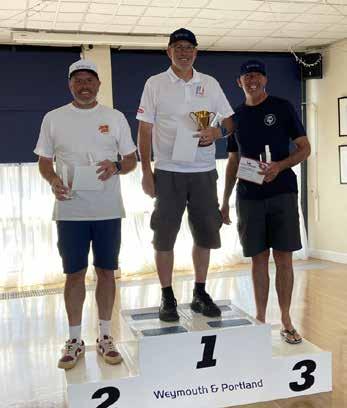
Former Laser World Champion Lawrence Crispin won his first Finn National Championship after returning to the Class nine years ago, having previously won Weymouth Olympic week in the Finn in 1986. The event was held at the Weymouth & Portland National Sailing Academy with 33 entrants from across the UK, two visitors making the trip from Holland, and one Australian from France. Photos by Noah Fitzgerald, Optical Marine.
Crispin held a narrow lead after the opening day from Andy Couch in a 12 to 14 knot south-westerly. Saturday’s increased forecast was evident with wind speeds of 18 to 28 knots recorded on the harbour wall so two races were held inside Portland Harbour.
Crispin again dominated the fleet with a superbly controlled performance. There was then a significant gap in both races, to some super tight individual battles in both races. Most exciting was for second and third place between Andy Couch, with his great all-round ability and additional downwind speed, and the visiting Joost Houweling, who nailed the conditions upwind
On Sunday morning, keen to deliver a full series of eight races before an incoming front later in the day, three more races were held in the harbour. Crispin put the title beyond doubt with two more race wins. Whilst the top two were never disputed, there was some terrifically close racing from start to finish throughout the fleet, all conducted in a super friendly and respectful environment. Third place went to Simon Percival with a race win to finish the regatta
Crispin’s performance was inspirational,
and the nature of his victory deserves cred-it and is testament to what can be achieved in our sport (across any age group) through raw determination, dedication and effort whilst using exceptional ‘out of the box’ equipment that the International Finn Class offers.
national Championship, GBr Weymouth • 4-6 Jul • 33 entries
1 GBR 74 Lawrence Crispin 6 2 GBR 79 Andy
DENMARK
Kasper Sandstrøm writes: This year’s Danish Championship was an intense and memorable event, where both nature’s forces and sailors’ skills were on full display. With Veddelev hosting the DM for the first time, a new standard was set for race organisation in Roskilde Fjord. The regatta brought together both experienced and new sailors in a class that has seen positive growth in recent years.
masters, GBr
Thorpe
GBR 8 Tim Carver
•
CZECH REPUBLIC
national Championship, CZe Lipno – Kovarov • 29-31 Aug • 45 entries 1 HUN 50 Akos Lukats 12
CZE 3 Rudolf Lidařík 17
CZE 19 Dan Audy 20
CZE 9 Jiří Hýža 21
CZE 43 Ladislav Hyrš 28
palavska reGatta, CZe
The Danish Finn class has experienced a revival in recent seasons, with increasing participation from younger sailors and strong engagement from clubs and the class association. Training camps, international participation, and a growing fleet have strengthened both competition and camaraderie. Veddelev has emerged as an active center for dinghy sailing, and with DM 2025, the club has cemented its role as a key player in Danish Finn sailing.
Friday was marked by strong winds with average speeds around 12–13 m/s and gusts up to 18 m/s, leading to the cancellation of all scheduled races. However, four sailors ventured out onto the fjord to train in the extreme conditions. They quickly realized that the short wave intervals in Roskilde Fjord made it nearly impossible to sail downwind – boats were constantly caught between waves, making balance extremely difficult.
Saturday brought average winds of 10–12 m/s with gusts up to 16 m/s. The wind came primarily from the northwest, creating steep, choppy waves. Sailors had to fight for both balance and speed, and especially downwind sailing proved challenging. After three completed races,
sailors were sent ashore for safety reasons as the wind began to increase further. The decision was well received, as conditions were approaching the limits for safe racing.
Sunday continued with average winds around 8–10 m/s and gusts up to 12–13 m/s, but with a more stable and predictable wind direction. Temperatures hovered around 21°C, and the sun appeared periodically, creating a more pleasant setting for racing. Again, three races were completed, and many sailors found the conditions slightly easier than Saturday –though still demanding and physically taxing.
Otto Strandvig delivered an impressive and consistent performance throughout the regatta. Despite a challenging start with a UFD in the first race, he came back strong and dominated the rest of the weekend.
Friday evening, despite cancelled races, the mood was lifted by a grill buffet in the clubhouse, where sailors and volunteers gathered for informal fun with good food and cold drinks. It was a relaxed and warm evening filled with sailing stories and reunions.
Saturday evening turned festive with a gala dinner in the clubhouse, where
participants enjoyed a delicious menu, speeches, prize ceremonies, and a great atmosphere. Music and laughter filled the room, and the social aspect was just as important as the competition on the water.
The DM 2025 showed that the Finn remains a class of high quality and dedicated sailors. The Danish Finn Association continues to work on strengthening the class and attracting new sailors, and Veddelev has, through this year’s regatta, established itself as a prime venue for future championships.
Several Danish sailors have already committed to participating in international regattas this season and in the coming years, including the European Championship, World Masters, Gold Cup, and other European events. This reflects both ambition and commitment within the class and offers opportunities to strengthen Danish representation and experience across borders. The positive development bodes well for the future and for the Finn’s role in Danish and international sailing.
national Championship, Den Veddelev (Roskilde) • 22-24 Aug • 40 entries
1 DEN 21 Otto Strandvig 11
2 SWE 72 Peter Overup 15
3 GER 193 Thomas Schmid 21
4 GER 1 Peter Sigetty Bøje 23
5 DEN 246 Jens Kristian Andersen 24
6 GER 52 Harald Weichert 33
7 SWE 32 Olof Lundqvist 36
8 SWE 5 Fredrik Tegnhed 37
9 DEN 323 Ole Vorm 43 10 NOR 64 Petter Fjeld 46
norDiCs anD kDY sprinG CUp, Den Rungsted • 17-18 May • 31
FINLAND
Derek Breitenstein writes: Like many other countries, Masters sailors represent a big part of the fleet, however we are happy at having young sailors pouring into the class from the Europe.
The winner of the Finnish Championship in 2024 was Ville Aalto-Setälä (GM) who has also become the Finnish Champion in the Snipe class numerous times. Back in the day he was successful both in the Laser and the Finn class. Aleksi Saarni (U 23) was runner up from Joonatan Partinen in third a fleet consisting of 23 boats. There has been a considerable number of young Europe sailors that have attended our Open National Championships during the last years.
The Open National Championships in 2025, with 22 entries, was organised from 22-23 August by the fourth oldest sailing club in Europe (Segelföreningen I Björneborg, est. 1856). The racing area is considered to be the best in Finland. This year the winner was (no surprise) Oskari Muhonen who has won the title five times before.
We are also very proud of the fact that we had two sailors in top five in the Gold Cup 2025. Aleksi Saarni (below) also finished 20th in the 2025 Gold Cup. The Finn sailors from the Helsinki area keep the boats at the same yacht club NJK that enables improvised practising scheduled on our Finn notice board WA-group. The class is also spread geographically to other cities.
The National Championships for 2026 will be arranged in Tampere from 4-6 of September at a lake. Since the event is also an Open Nordic Championship it will attract Finn sailors from other countries in northern Europe. You can find information regarding the event on the web: finnjolla.worldpress.com
A couple of younger sailors are planning to enjoy the pumping conditions of Brisbane in February 2026. Our road trailer will also be heading to the Open Europeans in Gdynia in 2026.
national Championship, fin Pori
FRANCE
national Championship, fra Douarnenez • 7-12 Jul • 31 entries
1 FRA 111 Valerian Lebrun 7
2 FRA 75 Laurent Hay 13
3 FRA 96 Florian Faucheux 29
4 AUS 22 Paul McKenzie 31
5 FRA 61 David Huet 32
6 FRA 38 Michel Audoin 43
7 FRA 85 Aubert Lerouge 48
8 FRA 373 Harri Veivo 53
9 FRA 66 Philippe Lobert 60
10 SUI 99 Laurent Chapuis 65
la roChelle Week, fra La Rochelle • 29-31 May • 19 entries
1 FRA 61 David Huet 5
2 FRA 373 Harri Veivo 6
3 FRA 66 Philippe Lobert 14
4 FRA 77 Jean Duru 22
5 FRA 85 Aubert Lerouge 22
6 FRA 100 Laurent Camusson 26
7 FRA 26 Gilles Malservet 29
8 FRA 35 Jerome Vennin 32
9 FRA 23 Daniel Chedeville 33
10 FRA 666 Romain Aubry de la Noe 34
GERMANY
The 2025 2025 Internationale Deutsche Meisterschaft attracted a massive 89 entries from 10 countries to one of the shallowest sailable lakes in Europe, very ably hosted by the Segler Club Dümmer. While the weather was sometimes inclement, with very grey skies, cold wind and sometimes wet air – with brief moments of sunshine – there was some very close racing. Two days were lost with no wind, but six races were sailed on the other two days. On the opening day, defending champion Andre Budzien took the opening race after several recalls, leading from start to finish. Then Denmark’s Peter Bøye led most of the second race only to be overhauled by Teply. In the third race, Rainer Haacks was the early leader, only
to again find Teply passing him to take his second win of the day.
No racing was possible on Day 2. Racing was abandoned at 15.00 followed by abundant free beer and snacks and another generous tombola with prizes from many sponsors.
Teply extended his lead on Tuesday, winning two out of the three races sailed. Budzien remained second while Fabian Lemmel moved up to third. Teply dominated the first race of the day after three recalls and postponements, leading all the way for a comfortable win in 7-9 knots. Stefan de Vries crossed a distant second with Zdeněk Gebhart third. Jurgen Eiermann led round the top in the next race. But Teply was not far back and took the lead on the second upwind to win again from Lemmel and Klaus Reffelman. Then the final race was won by Gebhart, leading all the way for a massive win from Arkadii Kistanov and Karel van Hellemond. Teply got buried on the first upwind and finally crossed in seventh, while Gebhart actually had the best score of anyone all day.
Again no more races were possible on the final day, when the forecast of very light wind proved correct, and an early decision was made to abandon for the day.
national Championship, Ger
Lake Dümmer • 11-15 Oct • 86 entries
1 CZE 5 Ondrej Teply 6
2 GER 711 Andrè Budzien 21
3 GER 501 Fabian Lemmel 41
4 CZE 2 Zdeněk Gebhart 43
5 ITA 51 Arkadii Kistanov 43
6 GER 111 Rainer Haacks 46
7 POR 21 Filipe Silva 48
8 NED 511 Stefan De Vries 50
9 NED 41 Karel Van Hellemond 51 10 BEL 18 Sigurd Vergauwe 55
nesselBlatt, Ger
Steinhude • 1-4 May • 35 entries
1 GER 501 Fabian Lemmel 7 2 GER 111 Rainer Haacks 15
3 GER 6 Ralf Behrens 16 4 GER 52 Harald Weichert 19
5 GER 62 Uwe Barthel
WarnemünDe WoChe, Ger
Warnemünde • 11-13 Jul • 28 entries
1 GER 501 Fabian Lemmel 4
2 GER 711 Andrè Budzien 4
3 GER 52 Harald Weichert 9 4 POL 73 Andrzej Romanowski 14 5 POL 100 Marek Jarocki 19
HUNGARY
ITALY
national Championship, ita
Castiglione della Pescaia • 6-8 Jun • 42 entries
1 ITA 6 Enrico Passoni 18
2 ITA 5 Francesco Cinque 20
3 ITA 202 Giacomo Giovanelli 27
4 ITA 115 Roberto Strappati 30
5 ITA 2 Marco Buglielli 31
6 AUS 2 Rob Mcmillan 38
7 ITA 788 Roberto Benamati 51
8 ITA 920 Alberto Romano 51
9 ITA 45 Nicola Capriglione 56
10 ITA 29 Pasquale Orofino 75
Coppa italia, ita
Caldero • 3-4 May • 39 entries
1 ITA 110 Alessandro Marega 4
2 ITA 115 Roberto Strappati 9
3 GER 193 Thomas Schmid 4
4 ITA 30 Andrea Linos 18
5 ITA 24 Peter Stuffer 18
6 ITA 788 Roberto Benamati 20
7 AUT 73 Markus Schneeberger 23
8 ITA 6 Enrico Passoni 24
9 ITA 2 Marco Bugliell 36
10 ITA 8 Florian Demetz 44
NORWAY
national Championship, nor Hankö • 1-03 Aug • 25 entries
1 NOR 1 Anders Østre Pedersen 8
2 NOR 7 Christoffer Sørlie 12
3 AUS 221 Anthony Nossiter 25
4 NOR 26 Steffen Emhjellen 52
5 SWE 40 Anton Usachev 54
6 SWE 6 Kristian Faste 57
7 NOR 64 Petter Fjeld 58
8 NOR 41 Christian Dahl 59
9 NOR 77 Peder Nergaard 64
10 NOR- 4 Kit Kattenberg 68
POLAND
Andrzej Romanowski writes: As in previous years, we continued the annual Polish Cup regatta series, consisting of 10 events including Polish Championship. It is assumed that five of them take place on lakes and five on the sea or in bays. The Nord Cup regatta in Gdańsk and the Polish Championships were counted in the World Tour for Finns ranking. In the eight events held so far, three were won by Bartosz Szydłowski (POL 6), two by Andrzej Romanowski (POL 73) and one each by Tadeusz Bartlewski (POL 13), Przemysław Marczak (POL 77) and Jarosław Radzki (POL 1). The Polish Championships in Puck had the largest turnout, with 48 sailors,
including four from abroad. They were won by Bartosz Szysłowski, ahead of Fabian Lemmel (GER 501) and Taras Havrysh (UKR 8). The medalists of the Polish Championships were Bartosz Szydłowski, ahead of Jarosław Radzki and Przemysław Marczak.
national Championship, pol Puck • 12-14 Sep • 48 entries
1 POL 6 Bartosz Szydłowski 28
2 GER 501 Fabian Lemmel 30
3 UKR 8 Taras Havrysh 37
4 POL 1 Jarosław Radzki 38
5 POL 77 Przemysław Marczak 49
6 POL 73 Andrzej Romanowski 53
7 SVK 1 Peter Mosny 54
8 POL 2 Miłosz Michalak 58
9 POL 100 Marek Jarocki 75
10 POL13 Tadeusz Bartlewski 77
norD CUp, pol
Gdansk • 5-6 Jul • 22 entries
1 POL 6 Bartosz Szydłowski 3
2 POL 73 Andrzej Romanowski 5
3 POL 13 Tadeusz Bartlewski 11
4 POL 46 Sebastian Knasiecki 11
5 POL 115 Lucjan Bladowski 15
6 POL 38 Juliusz Reichelt 15
7 POL 1 Jarosław Radzki 18
8 POL 151 Jakub Micewski 20
9 POL 18 Evgeny Dzhura 22
10 POL 83 Błażej Wyszkowski 25
PORTUGAL
national Championship, por Cascais • 27-29 August • 22 entries
1 AUS 2 Rob McMillan 9
2 AUS 37 James Bevis 16
3 POR 73 Nuno Es Silva 17
4 ITA 51 Arkadii Kistanov 27
5 POR 55 Jorge Pinheiro De Melo 29
6 POR 61 Fernando Bello 29
7 POR 1 Gonçalo Castro Nunes 35
8 AUS 255 Lewis Davies 36 9 GER 60 Thilo Durach 41
SLOVAKIA
national Championship, svk
Gabčíkovo • 27-29 June • 23 entries
1 CZE 43 Ladislav Hyrš 4
2 HUN 50 Akos Lukats 9
3 CZE 098 Patrik Ščerba 13
4 HUN 972 Monus Gyula 17
5 CZE 63 Kamil Ščerba 22
6 SVK 470 Andrej Holák 26
7 SVK 6 Milan Loukota 30
8 HUN 150 Zoltan Csanyi 35
9 CZE 061 Vojtěch Nalezenec 39
10 SVK 14 Roman Hladný 43
SOUTH AFRICA
The South African National Finn Championship was held at Pretoria Sailing Club and was awarded to PSC for the first time in the 67-year history of the club.
The PSC Finn class has been the largest and most active in the country for several years, and Finns have been sailed at the club almost since its inauguration in 1958.
Georgiou Divaris, sailing for Knysna Yacht Club made his first visit to PSC, and he not only mastered the tricky conditions but managed to win all ten races. In doing so, he defeated several former National and Provincial champions, often carving his way through the competitive fleet with apparent ease. He and his fellow Cape sailors, David Shilton and Paul Allardice, put to bed any suggestion that local knowledge is a necessity when sailing at Highveld venues. His calm demeanour and delicate touch were an example to everyone.
national Championship, rsa Pretoria • 22-28 September • 29 entries
1 RSA 584 Georgiou Divaris 8
2 RSA 594 David Shilton 23
3 RSA 82 Paul Allardice 26
4 RSA 583 Randolph Verheij 33
5 RSA 600 Arend van Wamelen 35
6 RSA 77 Morgan Evans 40
7 RSA 581 Dudley Isaac 49
8 RSA 51 Philip Baum 57
9 RSA 5 Jacques Louw 67
10 RSA 590 David Hunphrey 78
SPAIN
Laurent Hay won the Spanish Open Finn Championship in Ibiza, Spain. Christoph Burger took second with Xavier Penas in third. Penas won the Spanish Championship from David Terol and Alejandro Cardona.
Seven races were held over three days, with the championship very ably hosted by the Club Nautico Ibiza. The conditions were mainly light, with more wind coming in for the final races. The backdrop of Ibiza’s beaches and hospitality was very welcomed by the fleet of 36 boats from nine countries.
Laurent Hay won both races on the opening day. After a postponement onshore, the wind finally arrived, and two races were sailed in 5-8 knots of breeze. Lawrence Crispin, from Britain, ended the day in second with Christoph Burger, from Switzerland in third.
Burger was early leader in Race 1, but Hay took the lead on the second upwind to win from Crispin and Burger. The wind increased at the start of Race 2 with local hero Jordi Tur leading round the first lap, only to be overhauled by Hay on the second upwind. Hay took his second win from Tur and Spain’s David Terol.
A third race was planned, but with decreasing wind and inland rain clouds moving over the course, the fleet was sent back to the harbour.
Only one race was managed on the second day with Hay leading from start to finish in 5-6 knots and hot sunshine. Christoph Burger remained in second overall, while Xavier Penas moved up to third and the leading Spanish sailor. After a long wait for the wind to return – with an Ibiza party boat in close proximity – the fleet was sent ashore. In the evening many sailors attended the Club Nautico Ibiza’s centenary celebrations at the iconic Teatro Pereyra in Ibiza.
The fleet was launched on time for the final day with four races sailed in an increasing breeze. Burger crossed first in the opening race but was given a starting penalty, handing the win to former Spanish champion, David Terol. Hay then took the next two races to secure the championship with a race to spare, while Burger again found the front in the final race in the strongest winds of the week – 8-10 knots
– to end with a win and secure second overall. A very happy Xavier Penas did just enough to take the Spanish title by 1 point from David Terol.
Overall, the event was one of light winds, hot weather and great hospitality and surely a venue to return to in the future.
national Championship, esp Ibiza • 17-19 Oct • 36 entries
1 FRA 75 Laurent Hay 12
2 SUI 7 Christoph Burger 19
3 ESP 71 Xavier Penas 34
4 ESP 7 David Terol Albaladejo 35
5 POR 21 Filipe Silva 37
6 GBR 74 Lawrence Crispin 40
7 ESP 76 Alejandro Cardona Riera
8
9
SWIZERLAND
Michael Good writes: The Swiss Championship took place over the Ascension Day weekend in Arbon on Lake Constance. Fifty-eight entries were received from seven countries — a great turnout. However, the wind forecasts already looked unpromising ahead of the event. A pronounced high-pressure system brought beautiful, warm earlysummer weather to Central Europe, but
it became clear early on that there would be little wind over the four days of the regatta.
Nevertheless, three races were sailed on the first day, with winds of only six knots — right at the limit of what can still be considered fair. After several false starts with many early starters, the race was subsequently started under a black flag, which also led to numerous prominent dropouts. After the first day, Simon Bovay took the lead as expected, ahead of Ruedi Baumann and Zdenek Gebhard, CZE.
On the following two days, Lake Constance presented itself from its very calm side. Only starting attempts were made. Instead, the festival tent of the hosting Yacht Club Arbon became all the more popular. On the last day of racing, only a single and shortened race could be completed, which was won by Zdenek Gebhard. This meant that there were only four races in total, with no discard (only applied from five races onward) included in the scoring.
The Swiss Championship was ultimately won by Simon Bovay, ahead of Zdenek Gebhart and Peter Ganzert. However, as only Swiss sailors can become Swiss Champions, the medal winners were as follows: Gold: Simon Bovay, Silver: Laurent Chapuis and Bronze: Ruedi Baumann.
national Championship, sUi
Arbon • 29 May - 1-Jun • 58 entries
1 SUI 59 Simon Bovay 24
2 CZE 2 Zdenek Gebhart 25
3 GER 15 Peter Ganzert 28
4 GER 488 Andreas Franke 33
5 SUI 99 Laurent Chapuis 38
6 SUI 57 Rudolf Baumann 42
7 CZE 75 Vladimir Skalicky 42
8 SUI 51 Ulrich Appenzeller 44
9 LIE 1 Attila Szabo 47
10 SUI 55 Philippe Mauron 48
JollenreGatta, sUi
Mammern • 26-27 Apr • 41 entries
1 SUI 83 Jürg Wittich 16
2 SUI 5 Christoph Christen 20
3 SUI 21 Attila Szabo 27
4 GER 323 Jonas Jung 28
5 SUI 41 Wälchli Dominique 32
6 SUI 58 Dominik Schenk 36
7 SUI 28 Stefan Stäheli 38
8 SUI 16 Ignaz Stäheli 44
9 SUI 67 Peter Theurer 44
10 SUI 12 Franz Bürgi 51
SWEDEN
national Championship, sWe
Karlstad • 12-14 Sept • 27 entries
1 FIN 12 Joonas Harju 7
2 NOR 41 Christian Dahl 26
3 SWE 12 Stefan Sandahl 28
4 SWE 5 Fredrik Tenghed 32
5 FIN 234 Ville AltoSetälä 35
6 FIN 50 Freddy Markelin 43
7 NOR 26 Steffen Emhjellen 47
8 NOR 5 Per Olav Bernhardsen 47
9 DEN 117 Peter Böje 58
10 SWE 69 Erik Åberg 70
Xss sprinG reGatta ( aUtUmn), sWe
Hönö • 24-25 May • 14 entries
1 SWE 2 Svante Collvin 12
2 SWE 40 Anton Usachev 15
3 SWE 91 Pär Friberg 17
4 SWE 21 Mats R Karlsson 23
5 SWE 42 Geir Odmar Heldal 26
6 SWE 59 Lars Edwall 31
7 SWE 71 Jonas Andersson 34
8 SWE 20 Gösta Eriksson 52
9 SWE 734 Peter Bernstein 52
10 SWE 28 Åke Brolin 52
THE NETHERLANDS
Tobias de Haer writes: The end of summer is marked by the Dutch National Championship. Sometimes you get the last beautiful summer days, and sometimes the first autumn storms arrive. This weekend, we got both. It all started on Friday with a fairly light but warm day. After last year, when we
sailed very short courses, Hollandia—the race management—made sure to learn from their mistake. The current Dutch national champion, David Terol, returned to Medemblik to defend his title.
Fifty-five sailors from five different countries attended the national championship, which turned into a weekend full of wind shifts, general recalls, and, in the end, a well-deserved Dutch national champion.
On Friday, light winds of around 8 to 12 knots were expected. Everyone was eager to get the best start, which immediately led the race management to pull out the black flag. At the front, it was a close race between the championship contenders. One particular situation raised eyebrows when NED 147, 148, and 149 were written on the board. Some wondered if it was just a coincidence that all the 14.. numbers were listed.
Unfortunately for Cees, even more bad luck was in the air. After fully waxing his boat in the morning, he was involved in not one, not two, but three incidents, forcing him to retire from the race with a large hole in his boat. In true Finn spirit, he was offered the boat of Wietze Zetzema for the remainder of the weekend.
Saturday never delivered the much anticipated 12 to 18 knots of wind that had been forecast. Instead, we saw everything— from 4 knots to 20 knots within a few hours— combined with 40-degree wind shifts. This made the races exciting, with everything to be won or lost in a matter of minutes.
Sunday was, in the words of Ronald van Klooster, “one of the most beautiful sailing days of the year besides Cascais.” After a small storm passed over the Netherlands overnight, the wind calmed down enough— after a short delay—to get the races underway. Big gains and losses were made depending on the wind lanes on the racecourse, making it another challenging day for the competitors.
From being unlucky to being lucky—or perhaps just a combination of luck and very good sailing—Eric Bakker is on a roll this season. World Masters, Cascais, and now the Nationals. He has found a new gear.
But in the end, a real close battle was fought between Martijn van Muyden and Peter Peet, both consistently finishing in
the top three. Ultimately, Peter walked away with the title—a well-deserved win. Congratulations, Peter!
national Championship, neD
Medemblik • 19-21 Sep • 50 entries
1
WORLD RANKING LIST - NOVEMBER 2025
57 Oskari Muhonen FIN 8 636.46 3
58 Florian Faucheux FRA 96 636.17 9
59 Nanno Schuttrups NED 98 634.82 8
60 Zsigmond Kantor HUN 30 632.64 10
61 Adrián Bedoya Mey ESP 22 632.47 7
62 Zdenek Gebhart CZE 2 630.13 12
63 Matthieu Moerman NED 149 623.04 4
64 Jürg Wittich SUI 83 616.63 8
65 Steffen Emhjellen NOR 26 616.63 11
66 Sigurd Vergauwe BEL 18 615.76 15
67 Bartosz Szydłowski POL 6 612.80 7
68 Roberto Benamati ITA 788 610.61 10
69 Philippe Lobert FRA 66 604.81 11
70 Harald Weichert GER 52 603.08 7
71 Michel Audoin FRA 38 599.13 7
72 Nicola Capriglione ITA 45 596.83 5
73 Zsombor Majthényi HUN 88 595.57 7
74 Florian Raudaschl AUT 3 590.62 7
75 Fernando Bello POR 61 587.61 7
76 Michael Good SUI 95 584.07
Laurent Hay returns to the top of the World Ranking List for the final release of 2025. He was last World. No 1 in July 2024. After occupying the top place for three releases, Alessandro Marega drops to second while European Champion, Valerian Lebrun moves up to third. The list contains 1,399 sailors from 40 nations and is based on results from the World Tour for Finns which takes in around 60 events each year in 30 countries.
7
36 Roberto Strappati ITA 115 721.79 8
37 Laurent Chapuis SUI 99 721.40 18
38 Paul Mckenzie AUS 22 716.00 6
39 Xavier Penas ESP 71 710.24 10
40 Jürgen Eiermann GER 8 709.24 10 41 Robert Rittscher BRA 11 709.06 10 42 Ewout Meijer NED 66 698.07 8
46
55
156 Juan Grau Cases ESP 555 420.02 7
157 Sam Ede AUS 21 419.63 6
158 Jan Heinrich Meyer GER 137 418.12 7
159 Francisco Pinheiro De Melo POR 56 416.97 6
160 Christian Dahl NOR 41 415.83 12
161 Therry van Vierssen NED 117 415.75 7
162 Robert Kinney USA 47 414.95 5
163 Brendon Hogg NZL 5 411.43 6
164 Lewis Davis AUS 255 407.29 5
165 Simon Percival GBR 635 407.14 4
166 Paul Kamphorst NED 27 401.66 5 167 Augustin Juarez Marrero ESP 107 401.49 2 168 Kasper Sandstrøm DEN 322 399.35 9 169 Michael Huellenkremer GER 84 398.29 8
170 Harald Leissner GER 477 397.93 12
171 Miguel Fernandez Vasco ESP 161 394.57 4
172 Per Olav Bernhardsen NOR 5 393.49 6
173 Peter Kilchenmann SUI 13 392.94 10
174 Václav Cinti Sn CZE 70 391.05 6
175 Phil Chadwick AUS 75 389.89 6
176 Jan Zetzema NED 50 389.58 7
177 Ole Vorm DEN 323 388.10 4
178 Uwe Barthel GER 62 386.70 13
179 Martin Kaloš CZE 211 385.03 10
180 Roman Hladny SVK 14 384.52 8
181 Istvän Rutai HUN 51 381.91 7
182 Pasquale Orofino ITA 29 381.47 3
183 Claus Wimmer GER 164 379.05 5
184 Remko Boot NED 67 376.39 6
185 Søren Holm DEN 7 374.85 4
186 Räcz Bence Zsolt HUN 18 374.33 4
187 Tadeusz Bartlewski POL 13 373.84 5
188 Rob Coutts USA 9 373.82 5
189 Michael Perband GER 275 371.98 8
190 Alberto Romano ITA 920 370.81 3
191 James Golden USA 186 370.61 3
192 Frederico Melo POR 68 370.61 2
193 Nicola Menoni ITA 872 370.34 5
194 Anders Pedersen NOR 1 369.00 4
195 Hans Stöckli SUI 39 368.47 13
196 Uwe Fernholz GER 226 368.09 7
197 Marc van Eriks NED 962 367.59 7
198 Germano Lucchetta ITA 168 366.73 8
199 Xavier Mayoral Jove ESP 118 364.08 6
200 Boguslaw Nowakowski POL 26 363.63 6
201 Pierre-Loius Bossart FRA 69 362.19 6
202 Rick Bomer NED 56 358.55 11
203 Tim Tavinor GBR 9 356.81 8
204 Jan-Mark MeeuwisseNED 49 356.42 5
205 Tim Carver GBR 8 353.34 6
206 Gerko Visser NED 81 351.09 4
207 Huub De Haer NED 13 350.74 6
208 Kamil Ščerba CZE 63 350.50 8
209 Scott Griffiths USA 1138 349.91 7
210 Jan-Dietmar Dellas GER 81 348.16 7
211 Jan Goderis BEL 81 347.99 8
212 Jordi Tur Casadoi ESP 182 345.94 3
213 Michael Staal DEN 80 345.18 7 214 Gerhard Schwendt AUT 511 343.83 8 215 R Mrózek-Gliszczynski POL 80 342.37 5 216 Bruno Schwab SUI 34 340.21 6
Mark Perrow NZL 4 339.76 4 218 John Condie AUS 10 337.65 6
226
U29 CLINIC IN CASCAIS
Having the expertise of a former Olympic cycle sailor certainly helped everyone taking part in pushing the mindset to the limit. Through the briefings we could see our day on the water in data analysis (using the Vakaros and Ktool, Arkadii’s programme) and I could improve a lot of different details which certainly made a big difference.
Arkadii ended up taking part in the nationals (finishing fourth after winning every race in which he competed after missing the first day) and finished second in the Gold Cup with a TT2 he borrowed and had not sailed before the championship, proving once again the experience he has on the boat and in tuning it by feel and not by the usual numbers that most sailors talk about.
As a proof of his professionalism Arkadii made sure to go to the gym every day after sailing, proving why he is one of the worlds’ best.
THE TRAINING CAMP
Every morning, we would have a briefing in the classroom, where Arkadii started by showing us some data and some drawings about how tuning the boat would change how it felt and sailed. He noticed that most of us were sailing with too little tension and as soon as I started to create more tension, I certainly felt a great difference in boat speed, using the controls more to flatten the sail and not as much rake and tension. Even with deeper sails it made the boat feel freer to accelerate in the gusts.
In the first two days we had winds from 9 to 13 knots, and we sailed sessions of 2-3 hours, finishing always with some short races as more sailors joined us on the water. In the first part we would do some speed tests upwind and some downwind, with Oscar flag up, free pumping and taking ourselves to the limit.
Over the last two days the wind increased and some of the masters took the opportunity to rest, with the last day gusting up to 30 knots with big waves. It was certainly good to train in those conditions since in the Gold Cup we ended up having two days of really strong winds, in which the experience of the last day certainly paid off and gave people who participated an advantage through being familiar with the conditions. My home club certainly treated us with some memorable conditions.
THE TWO CHAMPIONSHIPS
After the training camp we first had the Portuguese Nationals for three days, which was a great warm up for the Gold Cup and afterwards measurements for the Gold Cup and finally the Gold Cup itself. In the nationals I had two great first days but unfortunately some tactical mistakes in the last day cost me a better result. Even while sailing Arkadii always made sure to help us out by asking us how we were feeling the boat and giving us small tips about how he was sailing itself.
Before the Finn Gold Cup in Cascais, IFA organised a very interesting training camp with Arkadii Kistanov as coach. It was initially intended for the U29 sailors but afterwards was open to all Finn sailors that wanted to take part. It ended up having a very nice fleet for the camp with sailors from all levels: three U29 sailors who pushed the others physically and some very competitive Masters. Gonçalo Castro Nunes, POR 26, describes what happened.
Then during the Gold Cup, very light winds during the first two days proved challenging and unexpected, since no one had trained with those conditions, and experience proved key to sailing well in those conditions. Arkadii made sure to always be open to help us out in whatever he could, even being occupied with his own races. The next two days brought a really strong breeze, with three races in more than 20 knots on the same day proving a physical challenge that only the Finn class can give to a sailor.
In the ended I manage to finish 25th overall, second U23 and fifth U29, being a big improvement from the Napoli Europeans where I didn’t even finish in the top half. I certainly felt that all the feedback and experience I gained during the training camp proved key in my results, and I can only thank Arkadii and the Finn Class for providing us with this opportunity.
The only downside was the lack of U29 sailors, but hopefully for next season more and more youth sailors will be taking part in these events.
2025 IFA AGM MINUTES & ACCOUNTS
INTERNATIONAL FINN ASSOCIATION 2025 ANNUAL GENERAL MEETING
Held online on Zoom on 22 May at 21.30 CEST.
Present: Executive Committee: Rob McMillan (Chair), Tim Tavinor, Robert Deaves, Andrzej Romanowski, Andy Denison, Andre Blasse, David Bull, plus representatives from AUS, BEL, BRA, DEN, FRA, GER, HUN, NED, NOR, POL, POR, SUI, GBR AND USA and around 20 sailors. Proxy votes sent online by: SWE [Combined vote of 15 nations and 7 Executive equalling 30 votes]
MINUTES
1. National Class Associations
The list of National Class Associations (NCA) and the Treasurer’s statement of the NCA Representatives’ voting powers based on the IFA dues received was noted. Details were published online with the agenda.
2. Minutes from the last meeting
The minutes from the 2024 IFA AGM (previously circulated on IFA website, to secretaries) were approved.
3. Accounts
3.1 The 2024-5 accounts and the 2025-6 budget were approved
3.2 The treasurer was thanked for his diligent work in maintaining the accounts
3.3 Questions were raised about the level of the current funds (over €190,000), what was the level need to keep a reserve (€100,000) and what the saved funds could best be used for.
3.4 The treasurer stated this was a matter for the Executive and not the treasurer.
3.5 The president talked about the investment over the past year and the new development plans, including a new VP Development who will be given a budget for training and other activities.
4. Executive Committee Reports
4.1 Presidents Report - Rob McMillan
Before we reflect on our class, I would like to extend our sincere thanks to Kristian Sjoberg (VP Sailing) and Marc Allain des Beauvais (VP Development) for their longstanding service to the IFA and the wider Finn community. Our class cannot operate without volunteers, and I personally thank them on behalf of all Finn sailors for the time, energy, and passion they brought to their roles within the IFA — whether on committees, behind the scenes, or at events. As we come together for the 2025 Annual General
Meeting, I feel we do so with a renewed sense of pride, reflection, and responsibility. In 2024, we celebrated the 75th anniversary of the Finn, a milestone not just in years but in the collective stories, champions, and global community that the Finn has inspired - it is a rich past but also sets the standard on and off the water that we must continue to uphold.
The 2024 European Championship in Cannes and the Finn Gold Cup in Aarhus and Finn World Masters showcased the strength of our fleet across generations. These events remind us of the true depth and reach of the Finn community, and our enduring strength. Encouragingly, we are seeing increased youth participation, renewed engagement from past sailors, and a growing supplier community who are busy and proactive. But not everything goes to plan and despite setbacks my sense is we are rebounding stronger. We worked through the feedback from the Cannes Europeans, which highlighted areas for improvement and reaffirmed a key principle: for our major events, quality must take precedence over scale. This informs our thinking across all aspects of planning — from venue suitability and race management to sailor experience and event legacy. We also made meaningful progress in Naples for the Open Europeans in April — it wasn’t perfect, but it was a solid 8/10 and showed strong steps forward in both planning and execution. We could certainly have done better onshore, but the on-the-water delivery was superb.
I am about to depart for Europe for the Italian Nationals and Finn World Masters. I am excited about both events. You cannot escape the enthusiasm (or media) of Jan Zetzema and his team, nor the allure of Medemblik and our Dutch Finn Sailors - very well done. This venue is very special to many of us with a long history of Finn exploits. When we reflect on iconic venuesCascais is right up there. I am very excited about the programme for late August and love the way it has all come together. Thank you everyone. In 2026, we can expect a strong and wellsupported fleet in Australia for the Australian Nationals, Finn Gold Cup, and Masters trifecta, followed by the Gdynia for the Open Europeans. For 2027, there are excellent bids for the Finn Gold Cup and Europeans - which we will vote on later. The quality and number of bids received for our major events confirm that the Finn remains an attractive and prestigious class for event hosts worldwide. In parallel, there is increasing interest in new regatta series and formats, with several ideas currently being developed or tested. While not all may align immediately with our established structure, we welcome this enthusiasm and will carefully consider how best to embrace it while maintaining a cohesive
and strategically balanced calendar.
From a financial perspective, the class enters this AGM with a solid footing. As reported separately, we posted a year-to-date surplus of over €28,000, supported by stable membership contributions and diversified event income. These funds must be used to build a sustainable future for our class and improve the infrastructure we have for event delivery and the enjoyment of the Finn within our community.
On the technical front, the class remains committed to maintaining the strict one-design integrity of the Finn while continuing to monitor evolutions in materials and sustainability standards. While this may sometimes mean we appear slow to implement changes, it is a deliberate choice. It is better to be cautious than to jeopardise the integrity of what we have. You don’t have to look far across international classes to see how small departures from long-established practices have, in some cases, led to the decline of entire fleets, loss of sailor confidence, and in many cases, the loss of thousands of dollars in now obsolete or noncompliant equipment.
Careful consideration is also being given to developments with Vakaros and other emerging sailing/race management technologies, especially in light of recent changes in the supply landscape — with effectively only a single supplier now active. Sensible safety measures are already in place with the current rule enhancements, but any further adoption of electronic devices or data systems will require careful evaluation. These technologies represent a significant shift, and the class will have the opportunity to vote on their wider use later in the year.
We are also excited by the growing momentum in the U29 development space. Initiatives are underway to better support this key demographic, including training camps and a revamp of the role of VP Development. Several NFAs are already embracing U29 programming as a pathway to re-engage younger sailors and extend their competitive careers into the senior fleet. Listening to members, we recognise that investment in development — particularly for U29 sailors — is not just wanted but essential.
The proposed focus of a new VP Sailing will see us address other key issues:
• A restructured qualification and entry framework for major events, ensuring fair access and highlevel racing through capped entries and NFA-led qualification processes;
• Updated bidding and hosting procedures, with clear timelines and support materials to help more clubs and countries become part of our global regatta network;
• Strengthened efforts in media, branding, and
IFA ACCOUNTS 2024
communications, aiming to raise the visibility of our major events more broadly;
• And most importantly, the reinforcement of a culture of transparency, collaboration, and longterm planning when working with event organisers. Proposals related to qualification and entry will be brought forward later in the year for all members to consider, ensuring that final decisions reflect broad input from across the class.
I would also like to thank Dimitris Dimou, Tim Tavinor, and our IFA Technical Committee for their ongoing dedication and expertise — particularly their work aligning our class with the evolving Equipment Rules of Sailing (ERS). Their efforts ensure the Finn Class continues to uphold the highest technical standards while adapting
thoughtfully to new challenges and developments. In closing, I see our priorities as delivering great events, achieving clarity on the event calendar for the next few years, mobilising our new VP appointees in Sailing and Development, improving our digital presence, and supporting cautious innovation. We remain here to work for you and the good of the class. Our contact details are in the public domain — personally, I love hearing from Finn sailors and NFAs alike and look forward to seeing you on the race course.
4.2 Executive Director Report – Robert Deaves It has been an interesting and challenging year for the Finn class, with generally increasing numbers, but also a lot of change and introspection. In
terms of pure numbers, membership has slightly increased again. We have just over 1,800 members worldwide in 40+ countries. Attendance at IFA events continues to be very healthy and as a direct result, we are receiving increasing interest to host events.
However, there are a lot of ideas and initiatives being discussed and implemented to grow and expand and provide services to our members.
• FINNFARE has a new look and focus and has been reduced to two issues per year
• Work is underway to enhance the status of the Finn Gold Cup and Open Europeans, with initial plans presented at this AGM.
• The U29 Development Programme has been launched with the first camp on Garda in March.
• We ran two incredibly successful webinars with Nicholas Heiner.
• Our social media presence continues to grow thanks to Francesca’s tireless efforts
• The Executive has been short on two important members for most of the last year with VOP Sailing and VP Development positions vacant
• Calls to reinstate the Marketing Committee to look at the wider appeal of the Finn and new ways to promote the class locally as well as globally
• Extensive work to update the Class Rules with the latest ERS and RRS terms.
• New class-wide event documentation which has made much of the processes easier. We are about halfway through this evolution.
• Looking at race management issues and event organisation has been a priority
• Work on evolving the website continues, albeit more slowly than hoped.
• The finances remain very healthy, but we are investing more than the last few years, so further expenses should be prudent while we adjust.
• Providing ongoing assistance and support to create for Certification Measurers and International Measurers for the class.
• The World Tour for Finns and the World Ranking List remain pivotal to the annual calendar and obtain a lot of exposure for the class.
• Work is ongoing on our major championship calendar, and we hope to present a solid structure for the coming years
• Event media continues to be the vital cornerstone of all our publicity and provides unquantifiable exposure worldwide.
In closing I’d like to again thank the Executive members, as well as many national representatives, for their collaboration and support over the past year. Maintaining contact with all member association is never simple, and many rarely respond, but all feedback is important and valued, so please do get involved. There has been a lot to deal with and some tough decisions, but I feel we are generally heading in the right direction and I look forward to continuing to serve the class in the coming years.
4.3 VP Masters Report – Andy Denison
As I write this, we are at 30 Nations and 322 entries for the 2025 Finn World Master. Medemblik 2025 is already promising to be one of the largest Finn events ever to take place. The event will be sailed in four groups and these groups will be randomly selected for every day of racing. Random is random and can sometimes mean good for some but not so good for others. That’s the luck of the draw and is what was voted in. In all honestly, if you are in the top 50 of this event, you have done exceptionally well, navigating many of the issues that come with big fleet sailing. It remains a unique event with a unique structure format and atmosphere. We have one bid in for 2027 Finn World Masters, Tangier, in Morocco. The inspection visit to Tangier was easy, ferries run from mainland Spain and France. The proposals for the event set up look amazing, handled and run by the Vilamoura Team. There is a full report on the website under EVENTS/bids
4.4 Treasurers Report - David Bull
Our financial year runs from 1st January to 31st December and the following report reflects this period. The Budget for 2025 has been prepared and has been forwarded to the Executive and incorporated in the current financial year summary. At the AGM held in Aarhus, Denmark on 2nd September the members from FRA & GER did not approve the 2024 Budget because of the large profit. The budget had been in operation for the best part of the 2024 year and therefore changing the budget would make no difference as the Actuals were committed.
Mindful of the comments, the 2025 budget has provided for additional expenditure to cover travel costs, U29 training, webinar costs, website update and repairs to the FGC trophy case.
2024 Balance Sheet
Total Bank 193,616 Euros
Total Assets 191,115 Euros
Total Liabilities (17) Euros
Net Assets 191,132 Euros
Retained Earnings 163,802 Euros
Current Year Earnings 27,330 Euros
Total Equity 191,132 Euros
The Xero accounting system has the 2025 budget loaded, with the noted expenditure included and the projected profit is Euro 3,950. We are currently well ahead of budget, however with only 4 months of the financial year completed and major operating expenses not yet expended the actuals will be close to budget.
2025 Budget Summary
Gross Profit 110,000 Euros
Other Income 9,000 Euros
Operating Expenses 115,650 Euros
Net Profit 3,950 Euros
2025 Balance Sheet (as at 30th April 2025) Total Bank
Euros
Euros
Euros
Euros
Euros
Euros
Equity 230,849 Euros
We have now been operating with the Wise bank accounts for the past 12 months or more and this is working most efficiently. Surplus funds are transferred to the Liquidity Manager Investment account and we are receiving a competitive interest rate.
I can report we have no major outstanding debtors although there are a few countries yet to pay their membership fees. Most are smaller memberships with only a few members, however CHN may prove problematic. Time will tell. The Masters income and expenditure is incorporated with the IFA accounts although there is a separate bank account with Lloyds Bank which indicates a balance of 8,800 GBP. The Association continues to be in a sound financial position with a healthy balance sheet. An annual report is submitted to the Victorian Government in Australia where the association is incorporated and as a Tier 1 category, therefore no audit is required.
My thanks to Robert Deaves for his continued support and valuable assistance which makes my job a lot easier.
4.5 Technical Committee - Tim Tavinor
As you have heard for some time the process to update the Class Rules to conform to the new RRS (Racing Rules of Sailing) and ERS (Equipment Rules of Sailing) has been underway. It has now finally been achieved. This has largely been done with the invaluable input of Dimitris Dimou who is a long-time friend
for the Finn Class and currently chairman of the WS Equipment Rules Committee.
You may ask why this is important? It is a World Sailing regulation for International Classes to keep their rules current with the RRS and ERS and this largely controls the format of the rules and terminology. It also helps measurers and sailors who swap between classes as all format and terminology are standard in compliant International Class Rules.
When you look at the new rules, on top of the changes in format and terminology needed for RRS and ERS compliance we have taken the opportunity to make some other reformatting to reduce the size of the document and include diagrams next to the relevant rules.
This is referred to by WS as Housekeeping and the intention is not to make any actual meaningful changes to any pre-existing Class Rules. Housekeeping Class Rule changes do not normally require a vote but as this is such a comprehensive review of our rules we will be asking for a vote on this update. A link and details will be shared after the AGM.
However, one proposed change that will need a vote is a rule change in permitted Technology on board to permit the carrying of a mobile phone. As we all know mobile phones are part of modern life and are regularly carried on board at Regattas for convenience, but this is a breach of current rules. It would be my recommendation to accept this change.
On the wider topic of technology on board. This is an ongoing discussion and there is a wide spectrum of opinions if this is a good or bad thing. We are mainly talking about GPS enabled devices. There is no doubt some of the features these can bring to race management in the way of identifying OCS and finishing positions, and also to the sailors in terms of added information can be very persuasive.
There is also no doubt the current equipment available is of a high standard and has become user friendly with mainly the Vakaros unit and many other software packagers available to post race or post training analyse performance. I have been monitoring classes that have adopted the use of these devices in test regattas and making changes to their class rules to permit their use while racing. It is very much a split in opinions within the sailors if it has been a good or bad decision.
In my opinion despite the added benefits these devices potentially bring, it is uncertain. I feel it is still not time to take the plunge and allow these as permitted equipment while racing in the Finn Class. Added cost is one issue but we should also remember the Finn Class has a broad church of participants and also even most race committees are not geared up to utilise the benefits. That also requires all participants to use one brand of equipment which brings other problems. We should continue to keep an eye on developments in this area but for now my recommendation is to wait before making any move to permit within our class rules. The other area that has been a topic for discussion is the potential change to allow Carbon Booms. Several manufactures have been invited to produce samples that we can physically test and
commit to a price.
Until we get that commitment it is difficult to make any progress on this issue. However, my understanding is that a Dutch Manufacture will have a sample to present at the upcoming FWM and if that does happen then we will need to make a programme for testing and make available other regattas to start help making informed decisions.
5.
Major Championships
5.1. La Rochelle, FRA was awarded the 2027 Finn Gold Cup in the first round on voting (Vilamoura, 3 votes; La Rochelle, 17 votes; Hyeres, 2 votes)
5.2 Estartit, ESP was awarded 2027 Open European Championship
5.3 Interest from other venues was noted for 2028 onwards: Vilamoura, POR; Douarnanez, FRA; San Francisco, USA; Sardinia, Italy; Pula, Croatia.
6. Rule Changes
6.1 Approval and discussion of new Class Rules
Tim Tavinor and Dimitris Dimou made a short presentation about the updated Class Rules which will go to a class vote in May. The Class Rules have been updated with new RRS and ERS requirements (housekeeping), and one minor change to allow electronics to be carried in buoyancy tanks. After reformatting the size has also been reduced by 10 pages.
6.2 Changes to IFA Constitution
The following change was approved 18 votes to 1 against, with three abstentions.
(a) Add to Part C 1
8) The IFA Executive may decide on a different method of allocation, including open entry, to be invoked in the Notice of Race.
Reason: Intention is to allow the possibility to limit FGC and EC to 120 boats and the IFA Executive would like flexibility to enforce different requirements. This will be based on the existing national quota system but allows the NoR to cap the entry at what the venue can hold, in most cases 120, rather than being open ended. This will not apply to combined EC/Masters events.
7. Submissions
None received.
8. Elections of Members to IFA Committees
8.1 Arkadii Kistanov, ITA, was elected as VP Development
Remko Boot, NED, was elected as VP Sailing The rest of the Executive were re-elected.
8.2 There were no changes recorded to the Technical Committee
8.3 It was noted that Andreas Bollongino and Ronald van Klooster wished to be included in the Marketing Committee. This role of this committee would be discussed after the AGM.