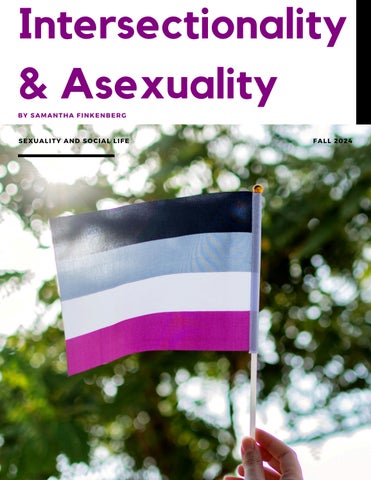
Intersectionality & Asexuality
BY SAMANTHA FINKENBERG

BY SAMANTHA FINKENBERG
Hello readers!
I hope you enjoy my analysis of some of the different intersectionalities of asexuality. I think this is a very important topic to discuss, because much of the talk about and representation of asexuality only includes white aromantic women, and so it’s important to address that other people can be asexual as well. I was reminded again of the exclusion of, in this case, Black people and men from the discussions of asexuality when I struggled to find fun pictures/graphics to put on those pages, which only served to reinforce my opinion that these topics are so important to discuss!
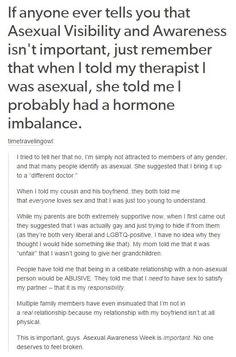
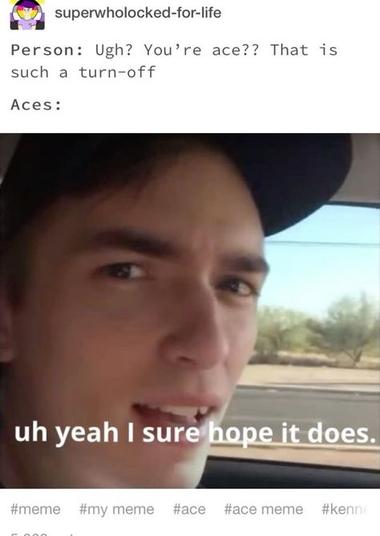
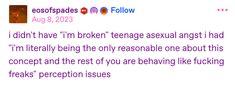
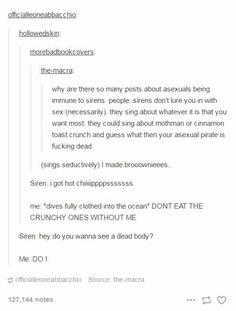
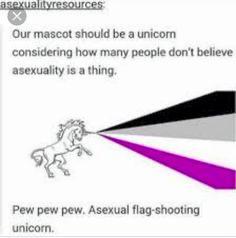
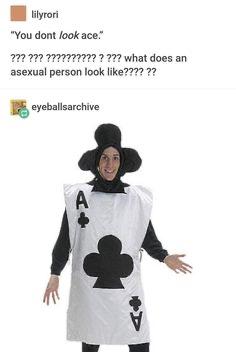
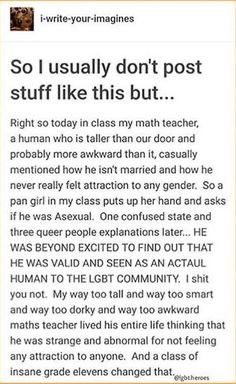
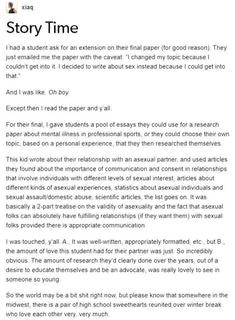
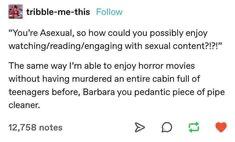
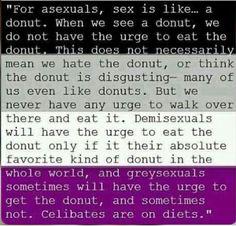
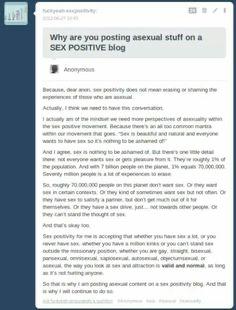
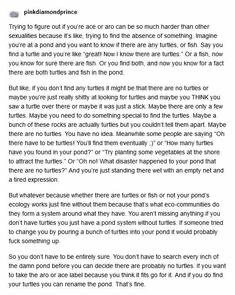
I have also included a section of (mostly) Tumblr posts that showcase the wide variety of experiences asexual people face. I thought Tumblr was a fitting medium as many people have gone to Tumblr over the years for help determining their identity. I also think that it’s important to show the many sides of asexuality, as it’s not just “not having sex”. Asexual people have created a wonderful community, and also face oppression that is often glossed over as well as discussions of asexuality in general. Asexual people are also known for their humor, so I thought it would be fun to include some of that as well.
As someone on the asexual spectrum, I think asexual awareness is so so important, and this zine only covers some aspects, so I encourage you to do you own research into asexuality if you’re not familiar!
Enjoy!
Samantha Finkenberg
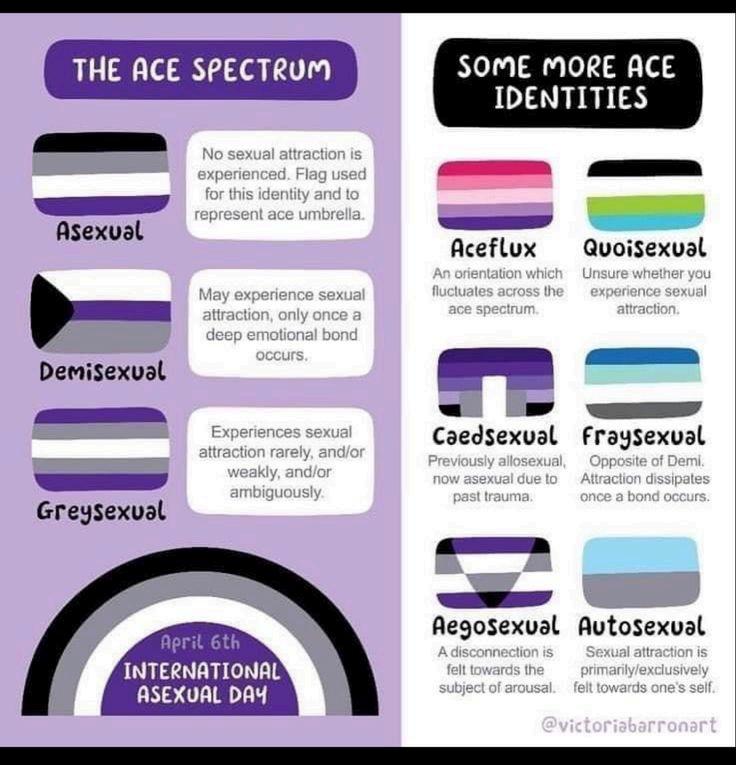
(ACCORDING
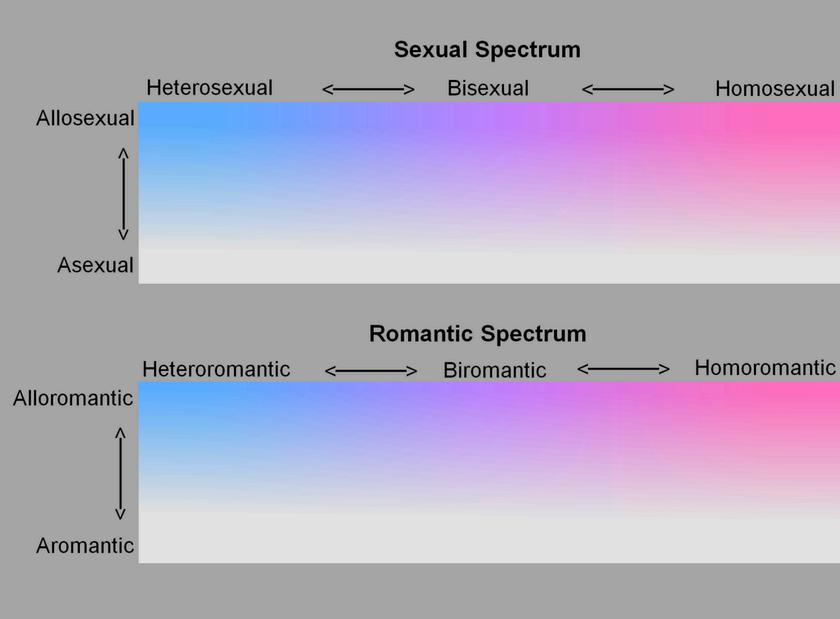
THE SPLIT ATTRACTION MODEL (SAM)
ACKNOWLEDGES THAT ROMANTIC AND SEXUAL ATTRACTION ARE SEPARATE, AND ALLOWS FOR LABELS LIKE BIROMANTIC ASEXUAL TO SPECIFY
BOTH TYPES OF ATTRACTION
Richard von Kraft-Ebbing, a German sexologist, published Psychopathia Sexualis, in which he cited 10 cases of Anaesthesia Sexualis (absence of sexual feeling), which he classified as a medical condition 19th century
Rise of sexology in Western society led to a belief that non-sexualities were a medical problem that needed to be corrected
1886
1948
Alfred Kinsey published the Kinsey reports, which included the Kinsey Scale, a 7-point scale ranging from heterosexuality to homosexuality that can be used to gauge a person’s sexuality.
In his data, Kinsey included an ‘X’ category, which included people with no sexual attraction
1972
1980
DSM-III introduced a new sexual disorder called Inhibited Sexual Desire 1.
2. Michael Storms reimagined Kinsey’s 7+X point scale as a quadrant system, with a vertical axis of homosexuality and a horizantal axis of heterosexuality. His four quadrants were heterosexuality, bisexuality, homosexuality, and asexuality.
1987
DSM-III-R renamed and split Inhibited Sexual Desire into two disorders: Hypoactive Sexual Desire Disorder (HSDD), defined as an absence of sexual desire, and Sexual Aversion Disorder (SAD), defined as an “extreme aversion to, and avoidance of ... genital sexual contact with a sexual partner”
2001
David Jay founded the Asexual Visibility and Education Network (AVEN) website
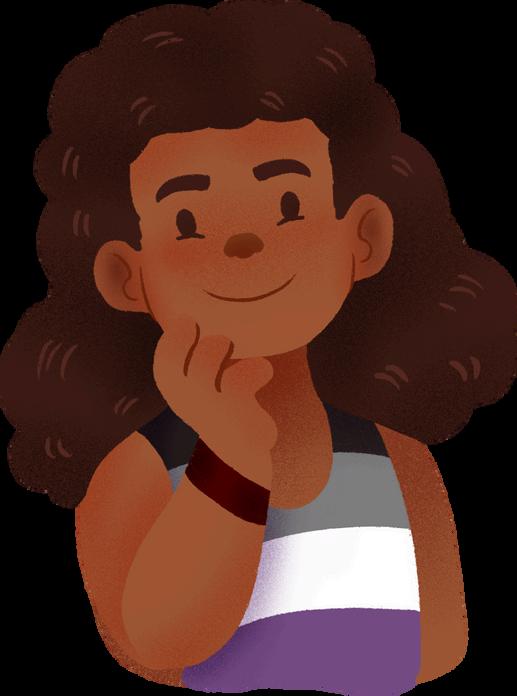
2.5% of asexuals (according to 2014 AVEN survey)
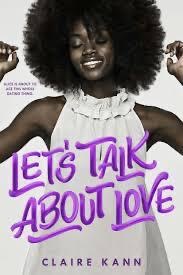
Society tends to hyper sexualize Black people, which makes it harder for them to realize/accept/be accepted as asexual
For Black women, the stereotype of the asexual mammy is also pushed on them, and so it is then hard to be asexual outside of the lens of how society expects them to be. However, there can be power in being asexual outside of the mammy stereotype, as it allows Black women to take agency over their own sexuality in a way that they are normally denied
Because white supremacy has framed white people as supposed sexually pure and restrained and Black people as supposedly impure and hypersexual, asexuality (as a concept) is entangled with racism and white supremacy
-Owen (2018)
It’s important to acknowledge that Black people can be asexual because it gives them back the power to determine their sexuality for themselves instead of being told how they should act by White society.
Also, from a sociologoical standpoint, this intersection can tell us a lot about the ways that racism and sexuality interact in our society.
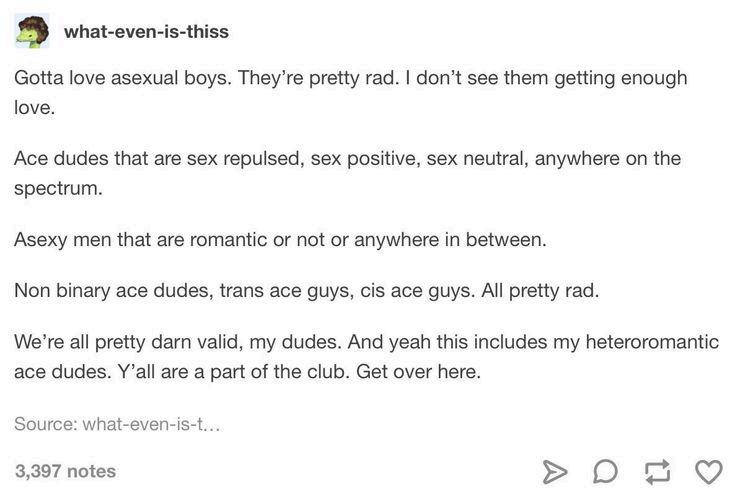
11.9% of asexuals (according 2014 AVEN survey)
WHY DO FEWER MEN IDENTIFY AS ASEXUAL?
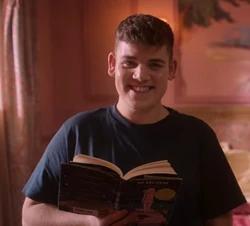
men are seen as more inherently sexual than women
2015 study by MacNeela and Murphy found that asexual men face more social stigma than women sexual activity helps men solidfy their masculinity, connect with other men, and gain social status
Engaging in (hetero)sexual activity can be central to bolstering men's
By acknowledging that men can be asexual too, we can help dismantle the parts of the patriarchy and toxic masculinity that require men to be hyper sexual. This is helpful, not only for asexual men, but also for straight women, because if there was less pressure on men to be hyper sexual, then they would likely objectify women less. From a sociological standpoint, this intersection can also be helpful in the examination of the ways that the patriarchy and toxic masculinity put unhealthy sexual expectations onto men claims to masculinity... and validating their manhood..., suggesting its absence may present a masculinity threat...
-Tessler & Winer (2023)
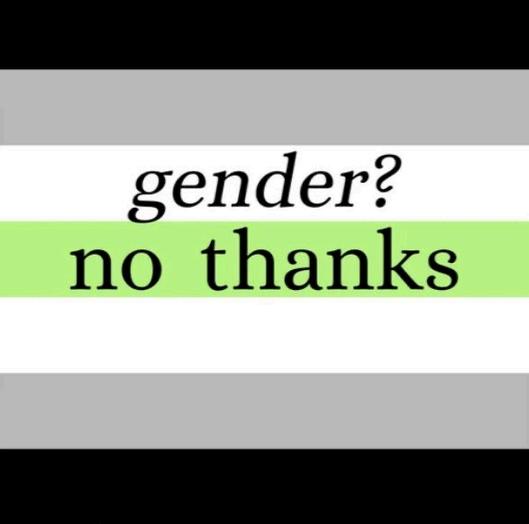
8.5% of asexuals (according to 2014 AVEN survey)
Agender is often defined as having no gender, being gender neutral, or being genderless
Included semi-structured interviews and a notebook element in which the participants were asked to reflect on gender and sexuality over the course of 4-6 weeks
Around 2/3 of the participants discussed how gender felt irrelevant to them
Many explained that they believed that gender existed to organize and regulate sexual relations, and thus had no purpose to people with no desire for sexual relations
Others believed that sexualities had gender aesthetics attached to them, and so their lack of sexual orientation translated into a lack of gender
The biologically female participants discussed their separation from femininity as a result of their wish to not be sexualized and society’s inherent sexualization of femininity

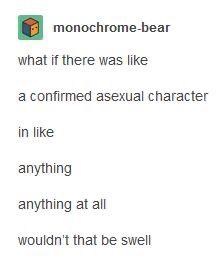
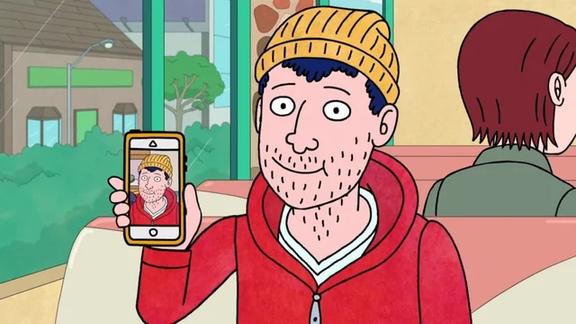

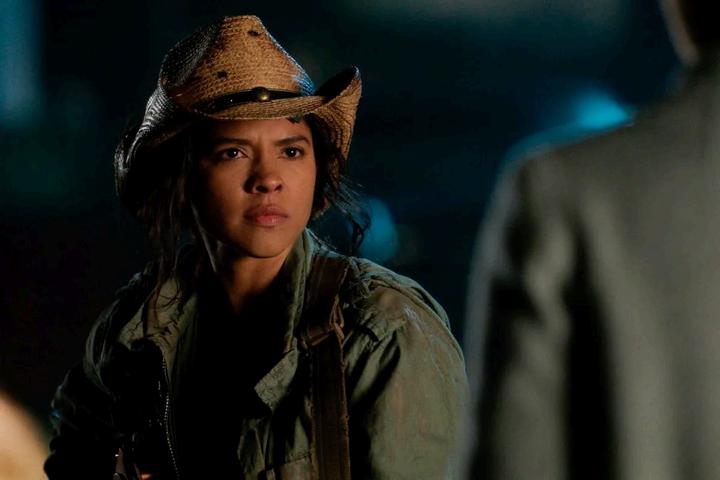
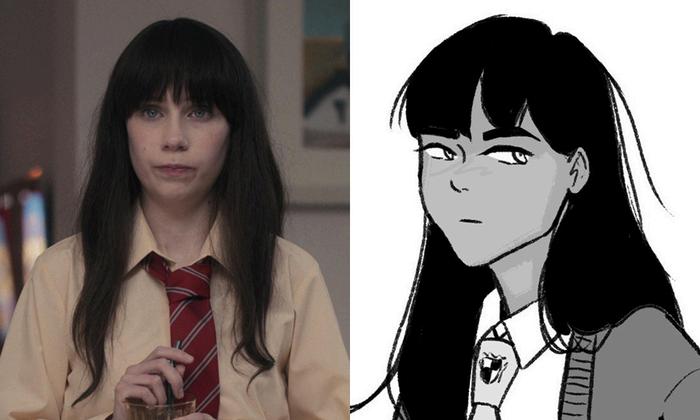
Esperanza “Spooner” Cruz- Legends of Tomorrow
Cuthbert, Karen. 2019. “‘When We Talk About Gender We Talk About Sex’: (A)Sexuality and (A)Gendered Subjectivities.” Gender & Society 33(6):841–64.
https://doi.org/10.1177/0891243219867916
Hart-Brinson, Peter, M. L. Tlachac, and Emily Lepien. 2023. “Contradictions in Experiences of Compulsory Sexuality and Pathways to Asexual Citizenship.” Sexuality & Culture 28(1):187–213.
https://doi-org.ezproxy.bu.edu/10.1007/s12119-023-10110-1
Miles, Brittney. 2019. “Theorizing Conscious Black Asexuality through Claire Kann’s Let’s Talk about Love. ” Humanities 8(4):165.
https://doi.org/10.3390/h8040165
Owen, Ianna Hawkins. 2018. “Still, Nothing: Mammy and Black Asexual Possibility.” Feminist Review 120(1):70–84.
https://doi.org/10.1057/s41305-018-0140-9
Stremel, Emily. 2022. “A History of Asexuality: From Medical Problem to a Recognized Sexual Orientation”. the Ascendant Historian 2 (June), 68-77.
https://journals.uvic.ca/index.php/corvette/article/view/20810.
Tessler, Hannah and Canton Winer. 2023. “Sexuality, Romantic Orientation, and Masculinity: Men as Underrepresented in Asexual and Aromantic Communities.” Sociology Compass 17(11).
https://doi.org/10.1111/soc4.13141
Winer, Canton. 2024. “Understanding Asexuality: A Sociological Review.” Sociology Compass 18(6).
https://doi.org/10.1111/soc4.13240