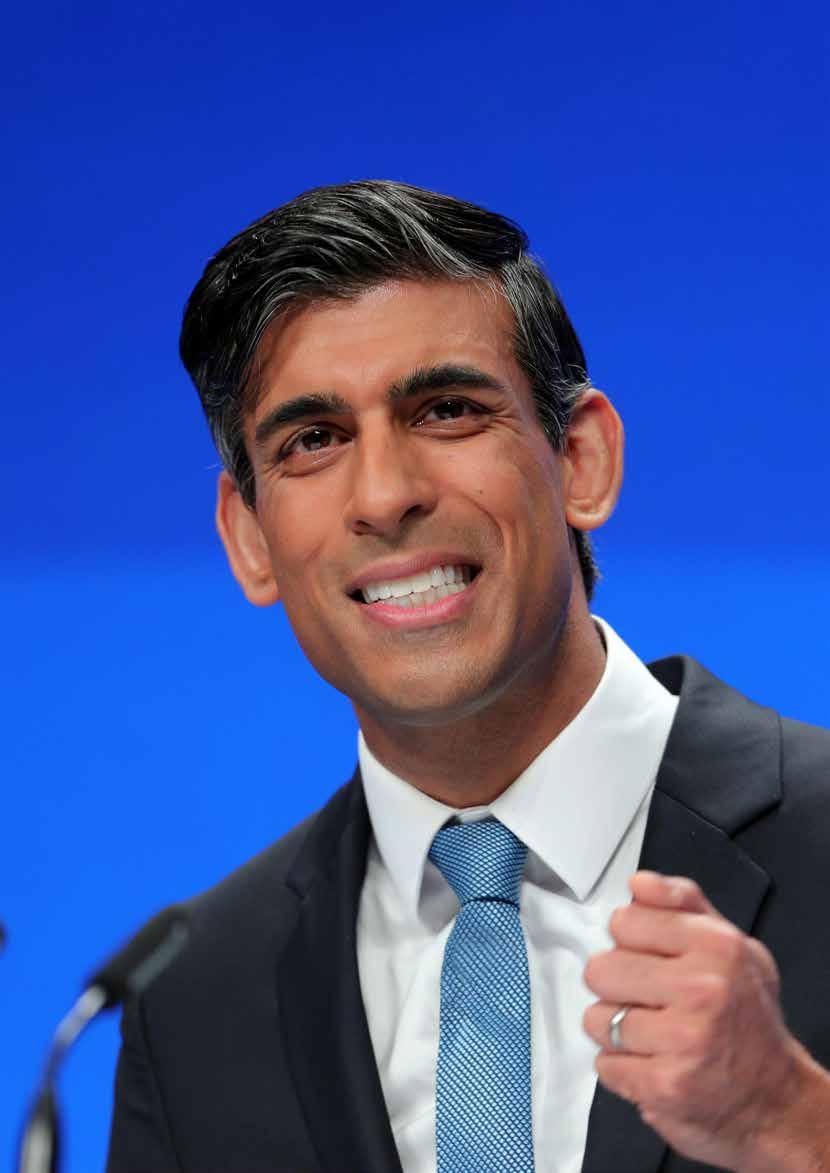
RISHI SUNAK

LINE OF DUTY
Issue 9 2023 £5.99 ISSN 2732-5180




T H E N E W F R A G R A N C E Floris London Lily EDT A4 Poster.indd 1 14/08/2023 08:54:28
Editor: Christopher Jackson
Editor-at-large: Claire Coe
Contributing Editors:
Patrick Crowder, Emily Prescott, Meredith Taylor Lord Ranger CBE, Fred Finn, Liz Brewer
Advisory Board:
John Griffin (Chairman), Dame Mary Richardson, Sir Anthony Seldon, Elizabeth Diaferia, Ty Goddard, Neil Carmichael
Management:
Ronel Lehmann (Founder & CEO), Colin Hudson, Professor Robert Campbell, Christopher Jackson, Gaynor Goodliffe, Julia Carrick OBE
Mentors:
Derek Walker, Andrew Inman, Chloë Garland, Alejandra Arteta, Angelina Giovani, Christopher Clark, Robin Rose, Sophia Petrides, Dana JamesEdwards, Iain Smith, Jeremy Cordrey, Martin Israel, Iandra Tchoudnowsky, Tim Levy, Peter Ibbetson, Claire Orlic, Judith Cocking, Sandra Hermitage, Claire Ashley, Dr Richard Davis, Sir David Lidington, Coco Stevenson, Talan Skeels-Piggins, Edward Short, David Hogan, Susan Hunt, Divyesh Kamdar, Julia Glenn, Neil Lancaster, Dr David Moffat, Jonathan Lander, Kirsty Bell, Simon Bell, Paul Brannigan, Kate King, Paul Aplin, Professor Andrew Eder, Derek Bell, Graham Turner, Matthew Thompson, Douglas Pryde, Pervin Shaikh, Adam Mitcheson, Ross Power, Caroline Roberts, Sue Harkness, Andy Tait, Mike Donoghue, Tony Mallin, Patrick Chapman, Amanda Brown, Tom Pauk, Daniel Barres, Patrick Chapman, Merrill Powell, Kate Glick, Lord Mott, Dr Susan Doering, Raghav Parkash, Marcus Day, Sheridan Mangal
Business Development:
Rara Plumptre
Digital:
Stephen James
Creative Director:
Nick Pelekanos
Photography:
Sam Pearce, Will Purcell, Gemma Levine
Public Relations:
Pedroza Communications
Website Development:
Eprefix

Media Buying:
Virtual Campaign Management
Print Production:
Marcus Dobbs
Printed in the UK by:
Micropress Printers Ltd, Reydon Business Park, Fountain Way, Reydon, Southwold IP18 6SZ
Registered Address:
Finito Education Limited, 14th floor, 33 Cavendish Square, London W1G 0PW, +44 (0)20 3780 7700
Finito and FinitoWorld are trade marks of the owner. We cannot accept responsibility for unsolicited submissions, manuscripts and photographs. All prices and details are correct at time of going to press, but subject to change. We take no responsibility for omissions or errors. Reproduction in whole or in part without the publisher’s written permission is strictly prohibited. All rights reserved. Registered in England
The starting gun has already been fired for the next General Election. Whatever your political persuasion, the need for compassion is going to play a big part in the battle ahead. Rishi Sunak, our Prime Minister, has oodles of compassion. It was best demonstrated during the pandemic when as Chancellor of the Exchequer he answered my question about what keeps him up at night. His answer - that he was worried most about people losing their jobs - was quick, unscripted, and spoken from the heart.
I have always favoured simple explanations of policy, which determine the problem, what government is going to do about it and how intervention will help. Sadly, we are used to hearing figures bandied on how many billions are going to be spent. It is meaningless to the man in the street. What matters is knowing that the people we trust to govern actually care. You can more easily forgive their policy decisions, mistakes and the inequalities of life, when you know that there is demonstrable compassion.
It was the same during Lord Young of Graffham’s recent memorial service when Lord Chadlington of Dean gave one of many moving eulogies and mentioned how David Young, upon hearing that you were having a difficult time, didn’t follow the sheep of public opinion and was the first to pick up the phone, insist you drop everything and invite you over for lunch.
This is in very stark contrast to the bank dossier which Coutts prepared about its long-standing customer, Nigel Farage. It reminds me of our own Chairman who held his Addison Lee account with my
late father at Bank Leumi in London. Ralph Lehmann was a caring champion of a bank manager, entirely trustworthy and prepared to risk his position to help a customer itching to grow. When my father retired after nearly 40 years of loyal service, John Griffin recalled someone else in head office wrote to him to request management accounts and personal guarantees, despite the company having a substantial credit balance. John famously wrote to the bank and asked for their directors’ personal guarantees for his funds which they held and to his surprise, the bank replied that he had eight weeks to move the account, which after a 21-year relationship was disappointing to say the least.
The inspirational book Passport to Success, by Lord Cruddas of Shoreditch, charts the humble beginnings of a self-made man. He too had his legal battles fought out in the public eye and was critical of a lack of compassion by the Conservative Party when he needed their support most.

Despite efforts by Sir Kier Starmer, the Labour Party still has not rid itself of the stain of antisemitism. The electorate has long memories and communities always stand together against all forms of racism.
One policy idea which has been muted is dropping the voting age to 16 years. I am against this. We see many school, college leavers and graduates. After leaving education, they have absolutely no idea about what they want or career choices. Given that education is not a passport to employment, they are simply unready for a meaningful vote.
The news of an impending UK India trade deal is a government’s dream. It is for that reason that Dinesh Dhamija, a former Liberal Democrat MEP, is championing the 300,000 new jobs which will result in the UK. It is our first foray into book publishing, and I invite you to read his book entitled The Indian Century.
Let us hope that during the weeks and months ahead, voters are respected for their views and not taken for granted. Compassion really does win over.
Weknow that Rishi Sunak thinks about mathematics a lot because he has told us this is the case. This is a prime minister who, as the almost clicheic saying goes, ‘inherited a mess’, and is now beginning to think about what his priorities going forward might be.
He has sorted out that mess to some extent. Certainly, he has shown he can handle the work – a low bar perhaps, but one which his predecessor Liz Truss never managed to clear. He also has some victories to his name: the Windsor Framework should in time spark a return to power-sharing in Northern Ireland; the AUKUS submarine deal shows he is capable of operating on the world stage; and most importantly, he has begun to get control of the public finances, though inflation remains stubbornly high and his decision to promise to cut it in half was an own goal: in politics, never promise something which isn’t in your control to deliver.
None of his achievements are showy, and all of his progress is incremental. All is not lost: due to a low energy opponent in the shape of Sir Keir Starmer it may be enough to put the Conservatives in touching distance of a 1992-style election victory in next year’s General Election, though that remains a long shot. What’s needed to pull off victory is leadership, and direction. So far, we have the ‘maths to 18’ policy, stipulating that all students should have some maths education right up until the end of secondary school.
It is well-intentioned, and the prime minister has a point. Many young people do indeed, as the prime minister said in his speech at the start of the year, leave university without a basic understanding of finances, and experience difficulty when it comes to negotiating their mortgage deals.
But in framing the question of
mathematics in such limited terms he has made the matter seem dull, thereby making it hard to bring people along, and earning derision in some quarters for a ‘cookie cutter’ approach. A tax return is a good thing to have sent in on time, but it doesn’t speak to the human heart. It was Albert Einstein who said: “Imagination is more important than knowledge. Knowledge is limited. Imagination encircles the world.”
In politics it is best never to express an intention aloud without having fleshed out the consequences of choosing to pursue it. In rushing into the debate without a full appreciation of how more maths teachers will be delivered – and doing so during such a febrile atmosphere of teachers’ strikes – Sunak has raised more questions than he has answered, leading to a series of jokes about not having done his sums.
This isn’t to say the policy is dead. It simply needs to be recalibrated and, of great importance to this magazine, tethered properly to the realities of the jobs market. Sunak would do well to read the Institution of Engineering and Technology’s report Engineering Kids Futures. This highlights a shortfall of 173,000 workers in the so-called STEM (science, technology, engineering and mathematics) sectors. The cost to the UK economy of this shortfall is estimated at £1.5 billion.
It might be that the economic cost is the least of it. Children need wonderment and inspiration; they need to feel early in life the joy of creating things – and also to learn from the experience of wrestling with the difficulty of making things work.
Of course, mathematics isn’t separate from the importance of engineering; an engineer who can’t count won’t get very far. But maths isn’t a siloed subject
– quite the opposite. Sunak now has an opportunity to reimagine ‘Maths to 18’, by tethering it to employability. How might it transform our children’s careers outlook?
While he’s about that he might go further. A glance at the sector output of the UK economy, ought to persuade the prime minister to think not just in terms of STEM but also STEAM.
The ‘A’ stands for art, of course, a word which can still seem wishy-washy to the conservative mentality – so perhaps we might be thinking in terms of STEMCI – where the CI stands for Creative Industries.
That ought to get recalcitrant Conservative minds to pay attention: the creative sector is big business. Year on year, the sector continues to boom – and that’s in spite of the restrictions placed on many businesses during the Covid-19 pandemic. For instance, according to the Department for Culture, Media and Sport, the creative industries grew by 6.9 per cent in September 2022 compared with the same month in 2021. Growth across the UK economy as a whole was 1.2% over the same period.
Perhaps we need to think not just of Einstein’s contributions to maths and science, but to remember his violinplaying. A new generation of renaissance men and women is possible if Sunak gets this right.
It also happens to tally with what he needs to do politically. He has made a good start and is probably the best-suited to the role of any of the occupants of 10 Downing Street since David Cameron. But he is yet to make anything approaching a powerful speech. And if he can’t make one about maths, he needs to think again.




What is the best thing Rishi Sunak could do to improve the jobs outlook in this country? That’s an easy one – a trade deal with India would create 300,000 UK jobs over several years. It ought to be right up the Foreign Office’s list of priorities. Of course, India’s charismatic populist Prime Minister – Narendra Modi –has his detractors. There are also those who will point out that India has so far refused to condemn Russia’s invasion of Ukraine. This is true, but leaves out important context. India has abstained in the UN votes on Ukraine because Russia vetoed all votes against India in the Security Council throughout the 1970s, 80s and 90s. India is also Russia’s biggest buyer of oil, buying around 70 per cent of its output. Accordingly, Russia sells oil to India at approximately $40 a barrel – a large reduction on global prices. We might call this loyalty, or we might call it expediency, but it is important for readers to know why no condemnation has been forthcoming.
There are also those who think that we shouldn’t have a wide-ranging
deal with India because of Modi’s alleged politicisation of the judiciary. But really Modi is embarking on an important project of reform. We might be queasy about his methods, but doing nothing is not an option. With 25 per cent of the judiciary currently unfilled, the average land dispute takes between 20 and 30 years to settle. It is a Victorian form of justice, of a kind which Dickens satirised in the UK over 150 years ago in his novel Bleak House. All the current situation does is deter the foreign investment which would mutually benefit us all, and Modi is right to proceed with his reforms.
Really it’s a no-brainer for the government – and for the country. In 2022, India overtook the UK to become the world’s fifth-largest economy; in 2023, it surpassed China to become the largest population on earth. Meanwhile, as Dinesh Dhamija – the leading commentator in this space, who we interview in this issue – has pointed out, Apple has now opened its first Indian retail store. At the same time, Pret a Manger is set to arrive in Mumbai. In each instance,
an increasingly affluent middle class is being catered to – a sign of things to come. This is a country primed on Western goods and American TV shows; their phones are connected to fintech apps. According to Google, Indian consumption of digital mobile data is now higher than that of the US and China combined.
Of course, India still has a way to go. In terms of many important indicators, from life expectancy, infant mortality, and access to sanitation, India lags behind China. When you consider that wealth per capita still lags far behind China, then it’s also worth remembering that a prospective deal between India and the UK would create one million jobs in India. It’s in our mutual interest.
Sunak has shown that he can deliver. The Asia Pacific trade deal was good news, but the prospective 0.08 per cent uplift to GDP resulting from it pales in comparison to what the Treasury expects from a trade deal with India: around 0.22 per cent.
Before you learn from someone else that Finito World has Napoleonic ambitions, it is better that you hear it direct from us. We are pleased to announce that Finito World Publishing has now been founded, an offshoot of the success of the publication you are reading.
Our goal is to provide a platform for those voices which the mainstream publishers fail to reach. Our first book is the autobiography of the Guinness
Book of World Record holder for the world’s most travelled man, Fred Finn. Finn says: “I am delighted to share my story with readers – a tale of 15 million miles and 150 countries. I want to help inspire the younger generation and let them know anything is possible.” Our second book is The Indian Century, by the revered entrepreneur Dinesh Dhamija, founder of online travel agency Ebookers. If the 20th century belonged to America and China, the
21st will belong to India. Dhamija says: “I am proud to be with a publisher like Finito World Publishing which is looking to the future in the work it conducts on behalf of young people. My timeline and Finito World Publishing’s is the same: I care about what the world will look like when I’m gone and I’m passionate and excited about the chance to shape it now in my own lifetime.” To order your copies go to www.finitoworld.com.
40 RISHI’S WAY
What does the Prime Minister mean for jobs?
53 THE LAW AND ME
Christopher Jackson on changing careers
62 300,000 JOBS
Dinesh Dhamija on that UK - India trade deal
66 PHOTO ESSAY
The strikes of 2023
70 THE HIDDEN EPIDEMIC All you need to know about Lymphoedema
76 THE SEARCH FOR THE APEX
What does it mean to succeed?
84 THE GREAT CORONATION
Sam Pearce was at the Abbey
90 TICK TICK ZOOM
The reality of working online
94 BURSARY UPDATE
The tale of Max Liebmann
98 SERIOUS BUSINESS
Joanna Thomas on British business

102 LETTER FROM VENICE
Bulletin from La Serenissima
104 AMAZING AMSTERDAM
Lana Woolf reports





600+ INTERNATIONAL BRANDS
120+ SHOWROOMS
ABI INTERIORS ALEXANDER LAMONT + MILES ALTFIELD ALTON-BROOKE AND OBJECTS ANDREW MARTIN ARTE ARTERIORS ARTISANS OF DEVIZES AUGUST & CO BAKER LIFESTYLE BEAUFORT COLLECTION BELLA FIGURA BRUNSCHWIG & FILS C & C MILANO CECCOTTI COLLEZIONI CHASE ERWIN CHRISTIAN LEE (FABRICUT) CHRISTOPHER HYDE LIGHTING COLE & SON COLEFAX AND FOWLER COLLIER WEBB COLONY BY CASA LUIZA DAVID HUNT LIGHTING DAVID SEYFRIED LTD DE LE CUONA DEDAR DONGHIA AT GP & J BAKER ECCOTRADING DESIGN LONDON EDELMAN LEATHER EGGERSMANN DESIGN ELITIS ESPRESSO DESIGN FLEXFORM FORBES & LOMAX FRATO GALLOTTI&RADICE
GEORGE SPENCER DESIGNS GLADEE LIGHTING GP & J BAKER HADELAND GLASSVERK HARLEQUIN HOLLAND & SHERRY
HOULES HOUSE OF ROHL HUMA KITCHENS IKSEL DECORATIVE ARTS INTERDESIGN UK JACARANDA CARPETS & RUGS JASON
D’SOUZA JEAN MONRO JENNIFER MANNERS DESIGN JENSEN
BEDS JULIAN CHICHESTER KINGCOME KRAVET KVADRAT
LASKASAS LEE JOFA LELIEVRE PARIS LEWIS & WOOD LINCRUSTA
LIZZO LONDONART WALLPAPER LONDON BASIN COMPANY
LOOM FURNITURE MARVIC TEXTILES MCKINNON AND HARRIS
MINDTHEGAP MODERN BRITISH KITCHENS MORRIS & CO
MULBERRY HOME THE NANZ COMPANY NOBILIS OFICINA
INGLESA FURNITURE ORIGINAL BTC OSBORNE & LITTLE PAOLO
MOSCHINO LTD PAVONI PERENNIALS SUTHERLAND STUDIO
PHILLIP JEFFRIES PHILIPPE HUREL PIERRE FREY PORADA PORTA
ROMANA RALPH LAUREN HOME RESTED ROBERT LANGFORD
ROMO RUBELLI SA BAXTER ARCHITECTURAL HARDWARE
SACCO CARPET SAMUEL & SONS SAMUEL HEATH SANDERSON
SAVOIR BEDS SCHUMACHER SHEPEL SIMINETTI SIMPSONS
THE SPECIFIED STARK CARPET STUDIO FRANCHI STUDIOTEX SUMMIT FURNITURE THREADS AT GP & J BAKER TIGERMOTH LIGHTING TIM PAGE CARPETS TISSUS D’HELENE TOLLGARD
TOPFLOOR BY ESTI TUFENKIAN ARTISAN CARPETS TURNELL & GIGON TURNSTYLE DESIGNS TURRI VAUGHAN VIA ARKADIA (TILES) VISIONNAIRE VISUAL COMFORT & CO WATTS 1874
WENDY MORRISON WEST ONE BATHROOMS WIRED CUSTOM LIGHTING WOOL CLASSICS ZIMMER + ROHDE ZOFFANY
OSBORNE & LITTLE • CRUCIAL TRADING • FORBES & LOMAX • SIMINETTI • LOOM FURNITURE • TIGERMOTH LIGHTING • HECTOR FINCH • CASAMANCE • AUGUST & CO
Design Centre, Chelsea Harbour SW10 0XE




Illegal immigration is an important issue for me. I think there’s a lot of misreporting about Rwanda, and it’s outrageous. How would I describe Kigali, the capital? It’s very tidy – an extraordinarily clean city. It has high rates of economic growth, and gives the impression of being a well-run country. In my life, as the longestserving foreign secretary of Australia, I must have been to over a 100 countries.
Ialsolike to point out that these asylum seekers are also coming from a country called France, so there’s a choice of France or Rwanda. That’s not inhumane. Gary Lineker is a football ex-player and pundit. I don’t regard him as an expert on immigration issues; he’s reading about people scoring goals and being offside. Of course, it would be inhumane if the policy were to send genuine refugees back to their country, but that’s not the policy. The reality is that people smugglers have found a way to make huge amounts of money, and it’s a racket. It’s also hugely expensive for the government to pick these people up, process and house them.
Difficult interviews never bothered me. The media’s job is to hold you to account. If you’re powerful and decided on a particular path, you’ve got to be prepared to defend it. The Andrew Neil Show wasn’t a problem for me. I did an interview with Kay Burley on Sky, and she was incredibly against the government’s policy, but that was okay. If you’re so worried about being attacked by journalists, why not put them in charge of the country and see how it goes? Usually, whatever you do is suboptimal.
Irememberthe day I was sworn in in Australia by the GovernorGeneral as a Cabinet Minister. One of my colleagues who’d previously been premier of New South Wales, he was being sworn in as finance minister, and I remember him turning him to me: “This is the best day you’ll have as a minister. I asked him why and he said: "Because I left politics in 2008, and still on social media I get attacked for things we did in government and that’s fine."
Overthe years, I’ve met many leaders. The more conviction they have the better. When John Howard was Prime Minister, we were subject to endless attacks. We used to describe ourselves as the Howard Fascist Dictatorship because they hated us so much. But we knew what we were doing, and felt that what we were doing was for the best. It hurts more when you’re attacked for a slip of the tongue or a gaffe. If you want to be popular, it’s not the job for you. You become famous in your country but at the same time for many people become infamous.
Twentyyears on from Iraq, I wonder whether we were right, and I think we were. We didn’t make a huge contribution to the invasion of Iraq, but getting rid of Saddam Hussein was a good thing. However, the Americans handled the post-invasion incredibly badly. We argued with the Americans about that, but it wouldn’t have made any difference if we’d refused to participate. You can’t ask the Americans to underwrite the security of the IndoPacific region at huge expense to the American taxpayer, and be a fairweather ally.
BothBlair and Bush were leaders of conviction. You’d have to say you were impressed by the forcefulness of each. They’re different sorts of people – both very personable. Bush was very funny, full of jokes. The funniest moment relates to my wife, Nicky. It was September 2007, we were at the Australian PM’s Sydney residence and at this time he was incredibly unpopular worldwide. Condi Rice was there, and she said to my wife: “Would you like to meet the President?” My wife said: “He’s a bit out of my league. Condi insisted and I don’t know what came over my wife but she said: “Mr. President, what’s it like being the most unpopular person in the world.” I’m Australia’s leading diplomat and he just laughed and said: “That’s politics. You have to do what you think is right. "She spoke to him for 15 minutes and came away thinking he was delightful, much underrated by people. He made politically incorrect jokes and after one which I won’t repeat I said: “You mustn’t say that publicly. “No,” he said. “I never would.”

I read with interest your article Our Collective WhatsApp Habit, and enjoyed your own contributions to it. I am a trainee in a law firm and am naturally rather retiring and find that this makes me fail to speak up. I’m often told that I don’t project my voice well and feel this may be damaging my career. What can I do to improve my self-confidence? Should I consider some sort of voice coaching or body language training to improve how I come across at work?
Lucy, 23, London
Congratulations, Lucy, on your role as a trainee in a law firm, a great start to your future career. It’s normal to feel shy when you start a new role, particularly if you naturally find it difficult to speak up. There are some practical ways that you can try to reduce your anxiety. Practise speaking out loud and projecting your voice in the privacy of your own home, in the car or even in the shower. Find a place where you can shout out loud. It’s quite a liberating experience! You could record yourself speaking and play it back, then move on to practising speaking more loudly in informal situations, say with close friends and family, asking them for their constructive feedback. You could also consider joining non-work groups, such as legal societies with other junior solicitors or starting a book club, where you could contribute in a more relaxed environment.
In work meetings try to prepare in advance what you would like to say, practise speaking up first in
more informal meetings with fewer participants and your peers, until you gain in confidence in more formal meetings and with senior colleagues. You mention potential courses in voice projection and body language. There are various techniques that you can learn to improve these, with tips available online or you could research in-person courses and individual voice coaching. Alternatively you might consider joining a debating club or amateur dramatics society to improve your confidence. Good luck with finding your voice.
I used to post a lot on social media when I was in my teens. I have never been rude or intentionally offensive but I certainly didn’t post in a way I would try to come across in a job interview. I hear now that employers are able to access internet history and though I don’t think I’ve done anything wrong, I feel I should try and wipe the slate clean so I don’t lose a position based on who I used to be. I don’t know whether I should do this – or if I do, how I would go about doing it. Another part of me doesn’t see why I should, when we were all young once! Anonymous, Los Angeles
I appreciate your honesty, you are not alone in regretting posts that you have made on social media, particularly when you are considering looking for a new role. You are correct that many employers and recruitment consultants look at an individual’s online presence and you should consider reviewing your public profile before you start the application process - as you point
out, what seemed amusing when you were a teenager, might appear inappropriate or unprofessional now. Many employers appreciate that 'we were all young once', but they also expect employees to reflect the values and the goals of the organisation, so inappropriate social media posting, albeit in the past, might adversely affect your future job opportunities.
There are many ways to reduce and delete your social media posts, which are explained in detail online. However some negative online presence may remain, so it is worth having an explanation to respond to interviewers, that you are aware of your online history and you have changed your current views and lifestyle.
On a separate note, if you don’t already have a LinkedIn profile, setting one up provides a useful way for you to project yourself in a professional manner, by including a formal style photograph and detailing your education and employment history. This can help you prepare yourself for the initial stages of your career journey. Best of luck in your search!
I was intrigued by your article about King Charles III. I would like to work in the Royal Household as I believe in Charles’ environmental mission, and I am not sure what career routes are available. Would you be able to provide any guidance?
Richard, 24, Cardiff
We are delighted that you enjoyed our article about King Charles. The King has indeed been passionate about environmental issues for over 50 years and he was instrumental in setting up an organic farm on the Highgrove Estate which now sells organic produce in supermarkets. You express an interest in working for the Royal Household on environmental issues - the Royal Household has a website that explains the criteria for applying for a post, such as having a British passport, and lists the current vacancies available, including the opportunity to sign up for details of apprenticeships. You might also consider opportunities to work for the King’s other projects, such as the Duchy of Cornwall Estate, the Prince’s Countryside Fund or The Campaign for Wool. You have not outlined your education and career history, I would suggest that you spend some time writing your CV and thinking about your skills and what specifically you are passionate about within the environmental area. There are also many other opportunities to start a worthwhile career in environmental issues, ranging from consultancy to charitable work, ESG roles within organisations, national and local government or pursuing a career in environmental law. We wish you all the best in your search to find a meaningful career that aligns with your values.
me, and lately I have been thinking of confronting him. The difficulty is that in all other respects this is my dream job with genuine career progression and I don’t want one person’s behaviour to impact on my own chances of a successful and meaningful career.
Stephanie, 28, Manchester
Dear Stephanie,
I am sorry to hear about the toxic behaviour of your boss. I would suggest that coaching might be useful to help you explore the issues in more detail and how best to address this difficult situation. There are various types of coaching, I am trained in the systems psychodynamic approach which explores business relationships using the framework of the person, their role and the organisation. Coaching gives individuals the time and space to reflect on work issues, a sanctuary where they can explore and think in a non-judgemental, secure environment and engage in open dialogue to help them understand patterns of thinking and behaviours which they might not be aware of . It can be a useful way for people to explore what is going on 'under the surface', helping them to deal with work issues more strategically and effectively in the future.
Some examples of questions you might think about:
How do I feel when he behaves this way? When have I felt this way before? How have I dealt with these types of situations in the past? These are the types of openended questions you could explore through coaching.
Alongside coaching, I often suggest to clients to find a mentor or ally, who can support you in the organisation, someone you can trust who might not be your direct line manager. You could also explore widening your reach to work for other managers in the organisation. I wish you all the best in continuing to pursue your successful and meaningful career.
I am very unhappy as I was caught driving very slightly over the limit when coming from a party a few weeks ago. Before that happened, my goal was to be an airline pilot – and it’s still my dream. I fear I may have ruined my chances and I don’t know what to do. I don’t think the career I wanted can now be mine, and I don’t know how to move forwards. Help! Anonymous, 20, London.
I work in accountancy. My boss has become increasingly toxic, and is continually throwing his weight around. He regularly uses meetings as a forum to display his knowledge, and ends up seeming insecure and causing awkwardness. He seems to have a particular problem with
It sounds as though perhaps your boss is finding his role difficult and whilst this does not in any way condone his behaviour, understanding the pressures he might be under could help you to improve your relationship with him. From your explanation of how he behaves in meetings, this suggests you might not be the only one who finds his behaviour challenging.
I am sorry to hear that you were caught speeding, but this does not necessarily mean the end of your aspirations to become a pilot, although repeated speeding fines or more serious driving offences might be detrimental to your chances and you will have to disclose them. There are many factors that are taken into account when applying for training as a pilot, including a medical certificate, checking your hearing, fitness and vision, and obtaining an enhanced DBS check. There are several routes available to becoming a pilot - however the training is expensive so I would suggest booking yourself a free aptitude test (it looks as though you need to book well in advance as they are currently full online) run by airpilots.org or a two day aptitude course before you commit financially to the training, there might also be scholarships available or sponsorship by one of the airlines. If you decide not to pursue the pilot route, there are many other careers in the airline industry so it might be worth thinking about your strengths and researching the wider opportunities available - ranging from RAF pilot, supply analytics for airlines, air steward, to hang gliding instructor! I wish you all the best in fulfilling your dream!

FROM MILKMAN TO MAYFAIR: Lord Cruddas’ incredible journey

Wikipedia
MADAME SECRETARY: Gillian Keegan on the next election Wikipedia .org

WIELDING WINSTON: Tariq Ali on Churchill’s influence today

Ispentmost of my career in business and am a bit of a Johnny-comeLately to politics; I got elected at the age of 49. I am the first former apprentice to be Education Secretary – and I’m also the only degree level apprentice in the House of Commons.

Twenty-five years ago, growing up on the outskirts of Liverpool in Knowsley, there weren’t that many opportunities. For me, an apprenticeship was a golden ticket; I was so delighted but it’s been quite a shock at the Department of Education when everyone looks down on you as if you’ve come up with soot on your face.
I’m sometimes asked who was the person who most destroyed the education system and I’d say Shirley Williams. I was on a trip with a Lib Dem MP, going to St Mungos to visit a homeless shelter; we were on a Public Accounts Committee together. She spent the entire train ride telling me how fantastic Shirley Williams was, and all about the comprehensive system. Having been a beneficiary of this system, where 92 per cent of students were without any qualifications, I was confused by her enthusiasm. Then I found out on the return journey that her upbringing consisted of the International School of Brussels and Roedean; she’d never been anywhere near a comprehensive school.
That’s the whole point: theory and practice are very different. Rishi Sunak understands that and it’s one of things which makes him a fantastic prime minister. He has the most extraordinary talent; he’s very detailed and strategic and kind. I look at him and think that he’s got that stardust, and a lot of space to grow: I
think he will be a world statesman. Rishi is very encouraging but also gets things done. Look at the Windsor Framework: when you consider the column inches which were devoted to this, whether it was any good or not, or whether it was practicable. But he got it through. Look at the way he’s handled the health and the teaching unions.
Education will be a big part of the story we tell to the electorate next year, when it comes to our achievements over 13 years. In 2010, we inherited a lot of problems in our education system. The attainment of children wasn’t up compared with other countries; for instance, in the PISA rankings we had fallen back nine points over the 13 years of the Labour government. That’s quite a lot. We had fewer schools deemed outstanding.
We also did a lot in childcare in our budget earlier this year. In 13 years of Labour government, all Labour introduced was 12 and a half hours for three and four year olds. That was it. Since then we’ve introduced 30 free hours, and now we’re doing nine months to five years, which leaves Labour nowhere to go.
You’ve also got to look at what Michael Gove and Nick Gibb did in setting up academies; they’ve transformed academic outcomes and opportunities for kids. Having grown up in Knowsley, I know there are large numbers of very bright children who don’t get the chance to go to an outstanding school or to university. It’s not a slogan with me.
We’ve also done a lot to be proud of when it comes to universities, and in relation to skills. That’s a nice thing about my current role: it’s where I
started as a skills and apprenticeships minister. I can now get stuff through which I wanted to do then and which everyone overruled me on at the time. One such thing is medical apprenticeships. I started to think: “How do we get parents to want their children to do apprenticeships?” I thought about what parents want for their children: they want their kids to have a good profession and career. The last thing we did was medical apprenticeships for 18 year olds. The courses are five years long. That means you can come out at 18 and be a doctor in five years. It’s the sort of thing which shows you that this is a government focused on delivery.
From my seat on the front bench I have a good view of the Leader of the Opposition. The only time Sir Keir Starmer has ever energised a room is by leaving it. It’s quite a good vantage point on the front bench. I think: “You’re making a massive miscalculation. What are you going to say when we deliver all this!” Margaret Thatcher always used to say, if you’re not ten points behind then you’re not doing enough. This is going to be a historic fifth term.





















Allin all, it’s been this cataract of legislation. There have been three bills. The Online Safety Legislation Bill has been in the making for about six years, and deals with the uncontroversial idea that there should be some online protection regarding content harmful for children. Molly Russell’s father has been campaigning on this; and Beeban Kidron, a fantastic cross-bencher, has been leading on that, and done a fantastic job.
I’m always in principle opposed to any legislation which interferes with free speech, because once it’s on the statute books it’s a hostage for fortune. You never know, we might have a fascist government one day; it’s not impossible. It’s a very technical bill, which only a very few people understand. Ultimately, the large companies are going to have to abide by advertising standards, but to get them to do that may require legislation.
The second bill is the Retained EU Law (Revocation and Reform) Bill whereby the government is seeking to wipe off the statute books around 6000 executive orders which have come from the EU. The minister dealing with that happens to be Martin Callanan, who is quite abrupt and there have been some testy exchanges. That makes life quite interesting – people at least wake up!
But I’m particularly concerned about the third bill, the Illegal Immigration Bill. This goes against our treaty obligations – as was pointed out in the second reading in the House of Lords.
As the Bill stands, we have the government-sanctioned entry points, which have special status – essentially if
you’re an Afghan or Ukrainian refugee, or if you’re from Hong Kong. But let’s say, for example, that you come from Eritrea: if an asylum application is refused, then you can never return in your lifetime. Furthermore, if you’re an unaccompanied child, you can stay until you’re 18, then you’re sent to Rwanda. It rides roughshod over 1951 Refugee Convention.
The point the government makes – and it’s clever of them to make it – is that nobody is coming up with an alternate system. What we argue is that if the UK is serious about immigrants and asylum seekers in genuine fear of persecution, then they’ve got to create more safe routes into this country.
In actual fact, the numbers that come here are quite low pro rata as compared with Germany, France, Italy, Greece and other European countries. Of course, there is undoubtedly a problem with economic migrants who come here, but there is a mechanism in place to determine people’s claims.
The question is why does the government not go after the criminal gangs? They’ll never succeed in starving them of revenue with the current proposed legislation. Really they need to infiltrate the criminal gangs. Intelligence ought to know who they are –and if they don’t, they should. It’s certainly worthy of a question in the House. Are the intelligence services on this?
Incidentally, the current processing of the special programmes is a shambles. The Ukrainian situation has more or less obliterated the work on Afghanistan, due to the melancholy fact that the Foreign Office can’t do two things at the same time. To be registered as a genuine asylum seeker, the offices which issue refugee passes are few and far between, and hugely overburdened with around 350,000 people currently awaiting recognition that their application is bona fide.
All of which, as Sunak knows, is a lot for the Houe to process. The trouble is we only have about 50 or 60 hard-working peers; they do a fantastic job, but that number is very small – but the question of House of Lords reform is a topic for another article altogether.
I’m70 this year and I’ve been working 55 years. My brain is sharp and I still carry on as if it’s not retirement age. My great friend Lord Young once said to me: “Keep working. Don’t retire. Life is like riding a bicycle: once you stop pedalling, you fall off.” I believe that. He was my inspiration to keep going.

I love owning my own company. I rang the office one day and had to go through the switchboard, as I didn’t have the direct number of the person I wanted to speak to. I rang up and a new receptionist answered the phone and said: “Who shall I say is calling?” I said: “Just say it’s Peter.” She said: “Peter who?” I said: “I’m the Chief Executive. And she said: “You work for the company as well?” I said: “No, the company works for me.”
That’s the thing about having my own business. I feel in control. I love strategies and love thinking about the future; I like mentoring people, and making money and paying taxes. The whole thing for me ticks so many boxes. I’m usually in the office around 7.30am. I usually get up at 5.30am, and drive into the office from Mayfair. Sadiq Khan hasn’t ruined my commute yet although he’s certainly doing his best. I would encourage young people to start their own companies. This is a pretty good country in which to do that; there’s all sorts of breaks, the internet structure is good, and corporate law is good. It’s not a perfect environment, of course.
I didn’t start my own company until I was 35. I went out of school at 15 – not because I wanted to, but because I had to. My Dad was useless – an alcoholic.
I write about him in more detail in my book Passport to Success: from Milkman to Mayfair: he drank 25 pints of Guinness and a bottle of rum on a normal day. I had to go out to work. Looking back, the first thing I had to do was bring stability to the household as a base for moving forward. What I learned is that if you come from a dysfunctional background where there are constant arguments and lack of support, if you earn a bit of money it puts you in a much better position. You can control your own destiny a bit. If you do that, you can buy your own car, and get a mortgage in your own name. I spent about 18 years building my life and giving myself a foundation which I never had as a child.
I got a job in the City, and there were many highly educated people and I realised then that I didn’t leave school at 15 because I was stupid. At 35, I started my own company. By then I had a nice house, no mortgage, a Mercedes and a beautiful young wife – and some savings in the bank. I was in a good position to go out on my own.
Some people start their own company because they see it as an alternative to getting up at a regular time. To be successful in any walk of life you’ve got to be disciplined and you’ve got to want it. It’s not just about having a good idea. Due to the example of my Dad, I never did drugs or alcohol. I was always shaven, washed, and showered first thing on a Monday morning. People around me knew they could depend on me. Even now, when I have 1,000 people working for me, I still wear a suit and tie even though the people working
for me don’t. I set my own standards. I want to set an example. I’m not going to take afternoons off and go to the golf club. It’s about hard work, desire, and ambition. In fact, I’m more ambitious today than I was 20 years ago and that’s why the company is booming. I could have sat back during lockdown, and put my feet up. It’s not my way.
That’s the starting point if you want to start your own company. Do not cut corners. When you get outside investors, effectively you’ve lost control of the business because the people that give you money believe in you which is great. At some stage they’re going to want a return on their money. When I started at 35, I didn’t need outside investment. In 2007, I sold ten per cent of the company to Goldman Sachs, and that was a good partnership. But if you don’t have money, you have no choice, but you do become accountable to others. It takes the shine off running the business. But at least if you own the stock, you work on your own terms. If you can avoid outside investment, that’s best.


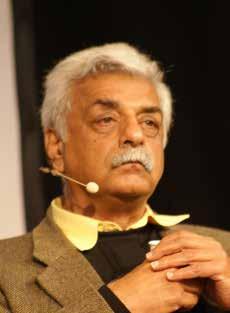
I’ve recently published a book about Churchill, and it’s interesting as the dust settles on the Johnson administration, and as we enter a period of strikes under Rishi Sunak with Boris even out of Parliament now, to consider the way in which Churchill is all bound up in this.
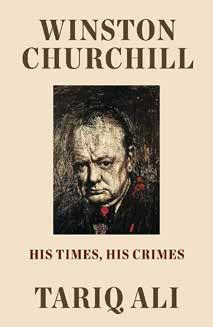
Sometimes Boris created the idea that he was dumb but he certainly wasn’t. He always knew what he was doing and why. Boris’ novel is even a copy of Churchill’s novel; he complains about being a victim, just as Churchill did. He copies Churchill to that extent; Boris really does think Churchill was the greatest person ever.
Churchill could say what he did and get away with it, because behind him was the British Empire, which was supported by a large part of the British population. Some of the Scots, whether you like it or not, were the most ardent imperialists. That’s why, with the decline of the Empire, the more nationalist tendencies have come out in Wales, Scotland and England. What Boris tried to do was to nurse a special form of English nationalism, linked very much to Churchill and his so-called heroism – and to make this part of the new mythology. If you withdraw from Europe, or Scotland might go from the Union – as seemed more likely when he was Prime Minister than it does now – then you need something, and for Boris that was Churchill.
America also plays into this. He used Churchill to say to the Americans that we have a long-standing relationship, and that we will be better partners than Germany, for instance, because we’ve been attached by an umbilical wire. Blair played that line in the most vulgar way, as did Thatcher. Boris attempted the same. What that results in is a Britain completely tied to the United States without any room for manoeuvre.
This all played out of course in respect of the reaction to Putin’s crazed assault on Ukraine – and still does under Rishi Sunak. The British media class went semi-hysterical, though they’re beginning to calm down now. If you look at France, Germany and Italy, they all supported NATO but the tone was more measured.
Even in America itself, there’s a different tone: look at Thomas Friedman’s columns in the New York Times. I’m not a huge fan of his, but he has sought a balanced tone, and even pointed out the mistakes the Americans have made.
We also need to look at the situation in Yemen which is infinitely worse than what is going on in Ukraine. The reason for the lack of coverage is that the media largely supports the government, and so they’ve been told by the Foreign Office that this isn’t a priority. I notice that all four parties drool over Zelensky’s addresses, and especially when he mentions Churchill; and I do sometimes wonder whether the Foreign Office has a hand in writing those.
The big debate now is really this: How long do you want to tie the Russians down? American intelligence boasts that the Russian generals who were killed, were killed because of us. Older
“BORIS REALLY DOES THINK CHURCHILL WAS THE GREATEST PERSON EVER.”
intelligence people in the US are saying: “Keep your mouth shut. Do you want a retaliation?” How long will Biden want to carry this out? It will either be non-stop escalation or a negotiated settlement.
Putin’s invasion has been a mistake, and he has lost the support of the usually pro-Russian segment of Ukraine. That means that Putin is in a position where he might need to negotiate a settlement in any case. So far, the Americans have irresponsibly chosen to continue the war.
The roots of our present problems domestically are also deep. The postwar consensus required the rebuilding of the country and that meant a form of social democracy. This wasn’t just
in Britain – it was also in Europe. It was never meaningfully altered by Conservative governments, until Thatcher destroyed the mining industry.
other countries – for instance in South Korea. There was a huge strike wave in South Korea in the 1980s against multinationals. The banners in front of the Japanese multinationals said: “You can’t crush us, we’re not English.”
That was a huge triumph for Thatcher, and Blair carried on and to some extent went further. They were looking for a strike to crush – but unfortunately for them the only strike going on was the nurses, and even they felt that nobody in their right minds would regard them as the enemy within.
That development was dual in nature. First, it showed she didn’t care about the British working people anymore. Secondly, it meant that Arthur Scargill would have to be dealt with. The British trade union movement never recovered from that defeat. Privatisation was never contested in Britain in the same way it was in many
When it came to both the Blair and Brown premierships, the first person they invited in was Thatcher. Then Cameron made no secret of the fact that he was an admirer of Blair. I call this the ‘extreme centre’. It doesn’t seem to matter who comes in. They do the same thing; they fight the unions, and fight America’s wars. What is the point of an election under such circumstances? It just becomes a ritual.
And a ritual all bound up with Churchill, who himself fought the unions in Wales and Scotland. That’s why the hatred of Churchill went so deep, and why I get so many messages from working class people saying how much their grandparents hated Churchill. Rishi Sunak should know that rubbing British noses in British mud doesn’t go down well.
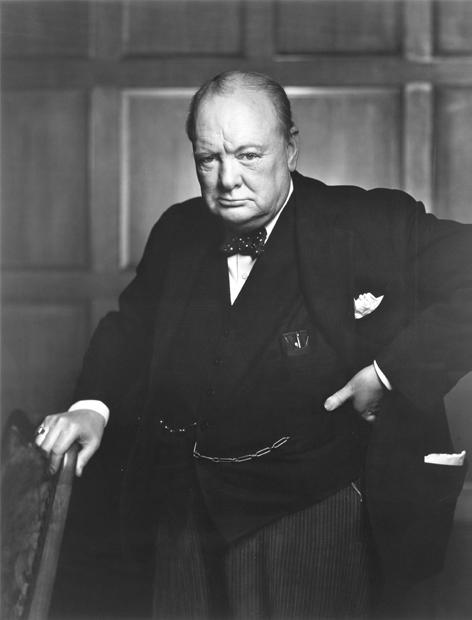
“YOU CAN’T CRUSH US, WE’RE NOT ENGLISH.”
“IT DOESN’T SEEM TO MATTER WHO COMES IN. THEY DO THE SAME THING; THEY FIGHT THE UNIONS, AND FIGHT AMERICA’S WARS.”
17 PALL MALL, LONDON SW1Y 5LU www.favourbrook.com
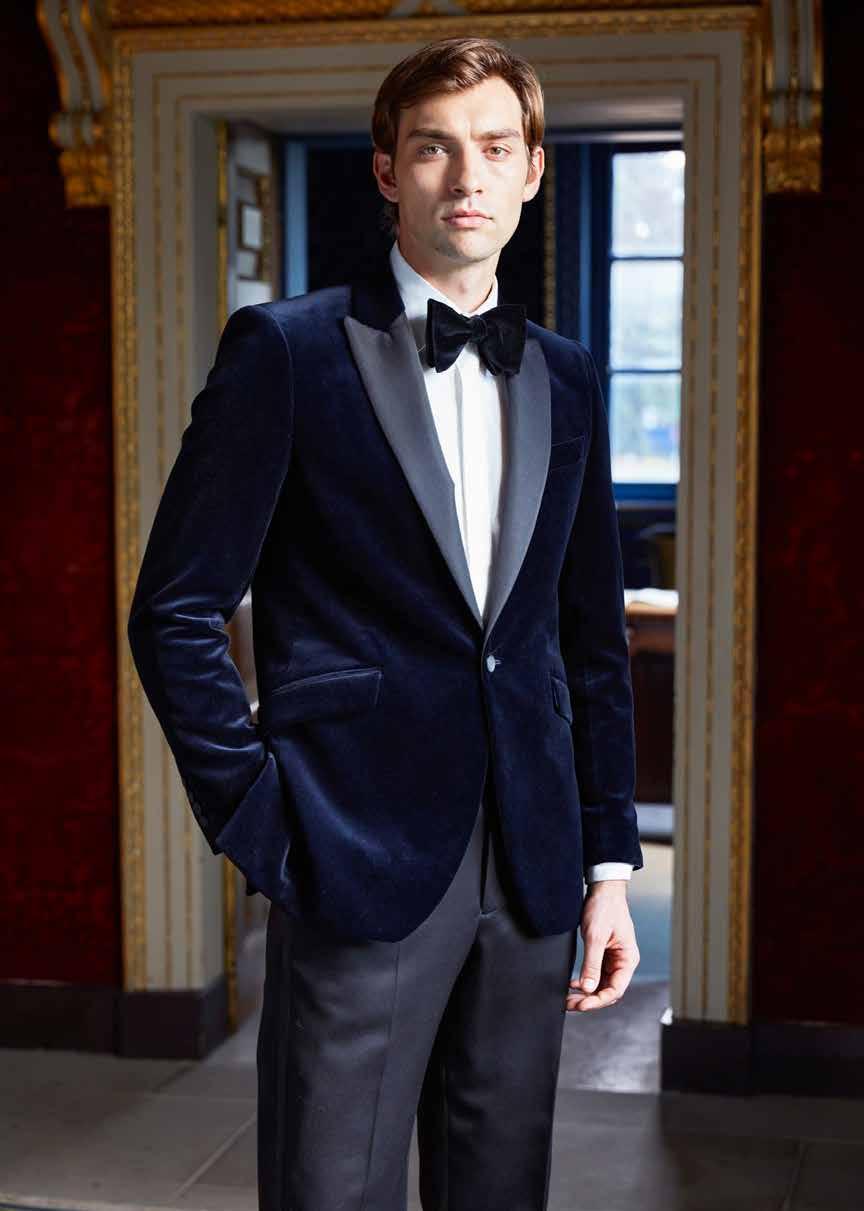

Peopleoften ask me about a career in politics. The way I describe it to people is: “Do you remember that scene in Notting Hill (1999) when Rhys Ifans opens the door in his underpants and there they all are taking his picture?” The reality is just like that, when you’re in trouble in British politics – it’s not nice.
That’s why British journalists are different to everybody else in the world, because they create this very difficult atmosphere for those who want to serve the British people.
It doesn’t happen in other countries. For example, Macron refused to allow pictures of him on a jet-ski in a shop opposite his residence. That level of interference is something that we don't have here. We don't have a proper regulator either, and it’s really important that people know that if they're going to get into politics.
Of course, freedom of the press is a good thing, but you've got to remember that bad news is what sells. Therefore, you will not get good coverage if you're a politician. Anyone who thinks going into politics is going to make them look like a hero is just wrong – and the higher you go up the greasy pole, the worse that becomes.
When I was first elected, Tony Blair was Prime Minister. Blair was an extremely competent performer in the House of Commons: he didn't always tell the truth exactly as I saw it, putting it gently. When I challenged people about it, they said, “Yeah, but everyone knew he’d just made it up, and they still voted for it.” Since then he has been vilified, and when he was knighted, it all came out again.
But his crime seems to have been to make the Labour Party electable, which they don't really like. After Blair, Gordon Brown came in and threw his telephones around and was also vilified. And then David Cameron won the election, and thanks to Greensill Capital he has been vilified. Theresa May is next - so far, so good for her - although her Brexit experience was pretty ghastly. Then Boris was put through the mangle for his ‘partygate’ stuff. This was a prime minister who was dealing with a global pandemic, the departure of Britain from the European Union, and Ukraine. These were some really enormous political challenges, and he was attacked for whether or not he attended a party that Dominic Cummings put in his diary as a staff meeting. If people want a career in politics after seeing that, I think they believe it won't happen to them. And my experience is, they're wrong. It will.
not only fair game, but you're not even protected by the truth. Your weapon is your ability to speak in the House of Commons, without fear or favour, and you cannot be sued. You can genuinely tell the truth as you see it, and there's nothing rich people can do to stop you. That is a really powerful weapon in the fight for freedom and truth, which in the 21st century, with the extraordinary ability we have to communicate with one another, should be the highest principle.
What you read on the internet should be telling you the truth, or it should be couched in a way that you can discount it. That’s what I think young people today should be pushing for. At the moment, we're all trapped in the idea that if it's on the internet, then it must be true. I tested this at a school I spoke to recently where they said I was antigay marriage. And I’m not! And when I told them that, their faces all seemed to say, “What? But I read it!” That is what you are up against when you put yourself forward for a career in politics.
Every time there’s a general election, there’s a new entry of young or certainly new MPs. One by one they are picked off, and it can be something they didn't do. It doesn't have to be true and it doesn't have to be fair: none of that matters. Once you're in politics, you are
“YOUR WEAPON IS YOUR ABILITY TO SPEAK IN THE HOUSE OF COMMONS, WITHOUT FEAR OR FAVOUR, AND YOU CANNOT BE SUED.”Sir Bill Wiggin is the MP for North Herefordshire
Wethink of mathematics as being like chess or classical music, as something which takes place in the ether somewhere, with little practical results. One person who’s determined to say this isn’t the case is Rishi Sunak, who has made his ‘Maths to 18’ policy the centre of his domestic agenda.
Another is Professor Sebastien van Strien, the likeable Chair in Dynamical Systems in the Faculty of Mathematics at Imperial College, London. When I tell him that I feel I reached my own mathematics ceiling at around the age of 15, he argues that such a view is part of a general misunderstanding about the subject. “Many people at school get a dislike of mathematics. Some of this is social stigma and also poor teaching. I don’t mean teachers don’t try hard but they don’t relate it to what kids find interesting.”
So how does maths come across today? “A lot of kids think of it as being shown something and having to repeat it, almost like a military exercise. It’s a sign of obedience if you do it well – then you’re a good boy or girl. That’s very misleading.”
the subject at degree level. “It’s much more like a game. Even the idea that it’s a problem-solving exercise is also misleading. Some kids are very good at the Maths Olympiad for example but they don’t really enjoy university education.”
For me, years after finding maths a bore at school, I read Bill Bryson’s A Short History of Nearly Everything which made me pine for the maths education I never had, full of the human stories which populate the history of maths. Van Strien says: “When I was teaching once, there was a girl who struggled a lot. I made a deal with her dad that if I got her through the year, he would give me a thousand pounds. It turned out she had some very basic – and reasonable –questions and often the teacher would say, “Just accept that.” For her it was impossible to go beyond that. I realised I was more on her level than the teacher was. Very quickly, once we went back to some more basic things, she was flying and did the exams well, and I got a lot of money!”
This, then, would seem to be something in favour of Sunak’s plan – the possibility that there is an untapped mathematical potential in the population at large.
Strien: “Kids come to it thinking they just need to follow a recipe and if they follow it, they’ll do well. But that’s actually not what maths is about. In fact, a computer will probably do those kinds of things better than you will. Such kids tend to find this disappointing.”
For von Strien, maths is something different – so much so that if you think you’re good at it, you still might want to think twice before embarking on

But of course the cognitive aspects aren’t the only obstacle to the goal of creating a nation of mathematicians. “Of course, there is also an emotional hurdle to surmount,” explains Van Strien. “This is the idea that only nerds like Elon Musk are good at it, which doesn’t go down well with young kids. In private schools, you can find an ethos that it’s okay to be a nerd. But at state schools, that’s not so common.”
So what is the university experience like? It can be surprising, says Van
However, the British university system tends to be reasonably flexible on that score. “Fortunately, here in the UK most universities accept that many pupils have skills and are smart but not at pure maths. In those circumstances, there’s a lot such pupils can do in the second and third years to go into statistics or business degrees which are more amenable to their skillsets and interests – and that’s to the good, as when I was a student that wasn’t possible.”
University degrees tend to reward imagination. “You have to accept that quite often it takes real effort to get to a solution. Kids sometimes think about it and don’t know immediately what to do: if it’s not easily done, it’s not for them. Most mathematicians spend a lot of time thinking about things. Sometimes, you suddenly develop enough mental tools to see how to go further with a problem. That can give people a huge
“IN PRIVATE SCHOOLS, YOU CAN FIND AN ETHOS THAT IT’S OKAY TO BE A NERD. BUT AT STATE SCHOOLS, THAT’S NOT SO COMMON.”
amount of satisfaction.”
So what does Van Strien think of the government’s emphasis on maths as a way of understanding financial information? “Well, as Einstein put it: ‘Compound interest is the most powerful force in the Universe.’ If you have a basic skill at maths it carries you a long way as a builder, a homeowner, and in DIY. That’s certainly valuable.”
But for Van Strien there’s another valuable thing we might gain.
“Sometimes it’s good to think about something before you give an answer. That’s why a lot of mathematicians also find it easy to get a job; they analyse questions more systematically. For example, many years ago there was this persistent student who got a job in the shipping logistics sector in the Rhine. He thought about it for a long time, and got some help from academics. Sometimes a problem might not seem mathematical, but will turn out to have some mathematical aspects.”
“That’s why students end up with jobs in all sorts of areas. For example, I’ve had students go into lots of sectors. I had one who ended up in the film industry, and of course he had an interest in film but he also looked at the world differently. He’d built up that repertoire of skills which maths can give.”
So maths, contrary to what one might think, doesn’t just lead to the university. “A very small number of people – perhaps ten per cent – end up
in academia. In Britain there is the idea of the university pyramid, and so you’re probably more likely to do a PhD from a place like Imperial College – it is higher up the pyramid than other universities.”
“A lot of students work in this area. A lot think this is the career now. There are a lot of scary aspects to it, but they also find it intellectually interesting. Fifteen years ago, if you didn’t go into academia you’d go into finance. Now, it’s probably much more AI. It definitely attracts a lot of start-up money and people end up there. Insurance products is another area.”
And would he advise the academic career route? “Academia is a long story. You have to do a PhD, then a postdoctorate and then a second postdoctorate. It’s a career which you should only pursue if you’re really addicted to mathematics, as the financial rewards are small and there’s a lot of risk attached. At the moment, the salary issues have been worse with strikes. At least the doctors, who are also striking, have a secure career – that’s not the case in academia. You can do a post-doctorate and not end up with a job which matches what you originally intended. Some people love it, but it’s potentially a stressful route.”
How will the advent of Artificial Intelligence affect maths graduates?
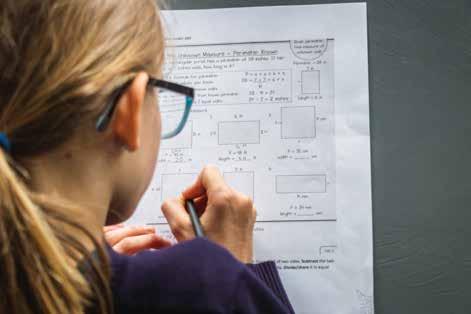
So does he think Sunak’s policy will work? “The government can wish for more teaching, but that’s a problem. Historically, there’s been the idea that the PE teacher teaches maths because he has an O-Level in maths, despite having no affinity for it.”
For Van Strien, this opens up onto the broader question of the value we ascribe to the teaching profession. “We also need to think differently about teachers. Teachers get very little respect for society,” he explains. “Traditionally, if you were a teacher, you were a respected figure in your local community but I don’t think that’s the case anymore.
“You still hear of confrontational parents’ evenings, and a lack of respect because it’s poorly paid.” Whatever else one might think of the Sunak administration’s policy, that needs to change.
“IT’S A CAREER WHICH YOU SHOULD ONLY PURSUE IF YOU’RE REALLY ADDICTED TO MATHEMATICS.”
Yachting offers the ultimate luxury, unrivalled freedom. From first time charterers cruising the iconic coastline of the French Riviera, to experienced yacht owners looking for a proven world cruiser, Edmiston’s global team have the knowledge to support you at every step in your yachting journey.
RESILIENCE, 65m, ISA Yachts, 12 guests

My parents had a cabaret club in America in the mid-West. They did plays and had performers – people like Woody Allen, and Lenny Bruce – and a then unknown singer called Barbra Streisand. They put on plays by Pinter and Beckett and had a show on Broadway and moved to London in 1964. I was too young to remember Woody et al. but I remember going to the club and Albert King – B.B. King’s brother – was there and I went up on stage and did the twist. My Dad went on to do all sorts of things; he was a theatre producer, who put on a play at the Edinburgh Theatre Festival. My mother was a lyricist and wrote jazz songs and became a performing poet.
I think my Bohemian upbringing gave me a taste and a leaning towards the unconventional. I’ve never followed the traditional path of most of my peers. I didn’t go to university and didn’t go to Oxbridge. I dropped out – and hung out. There are disadvantages to that, and I don’t think it makes me superior at all. It gives me a certain unique perspective and that’s good. That Bohemian tradition which my parents were part of in the 1960s is something I miss. The classic moan is that Soho isn’t what is used to be. But cities have to change. Soho, which was once the Mecca of the Bohemian, has gone.
But sometimes I look back at people who I thought of as square and conventional, and think of how they have the pensions. When you’re in your twenties, you think: “Pensions be damned!”
I know quite a lot of people who did law, for example, not out of passion or interest, and regret it. I could never do something like that; I’m too dumb. I went into journalism because I was too stupid for everything else. I always wanted
to write and I’m happy with my choices. I know plenty of deluded journalists who think they’ll write the great novel. Robert Harris is the exception everybody names. I realised I had no talent in that area; I abandoned all hope! Fleet Street used to be fun. Last time I went to The Sunday Times office it was like going into a library; it was so quiet and calm. Nobody hangs out and has lunch anymore. I meet young journalists who remember The Modern
Review and it seems exciting to them. I was invited by Robert Peston to come to his Academy to talk about jobs in journalism. I would say: “Don’t do it – or only do it if you’re driven by a crazed passion that you must.” It’s a bit like becoming an actor – have a reserve job.
I don’t do the kind of journalism that aims to change the world; I want to make people think, but mainly I want to make them laugh. You just do the best you can do, and pray to God that
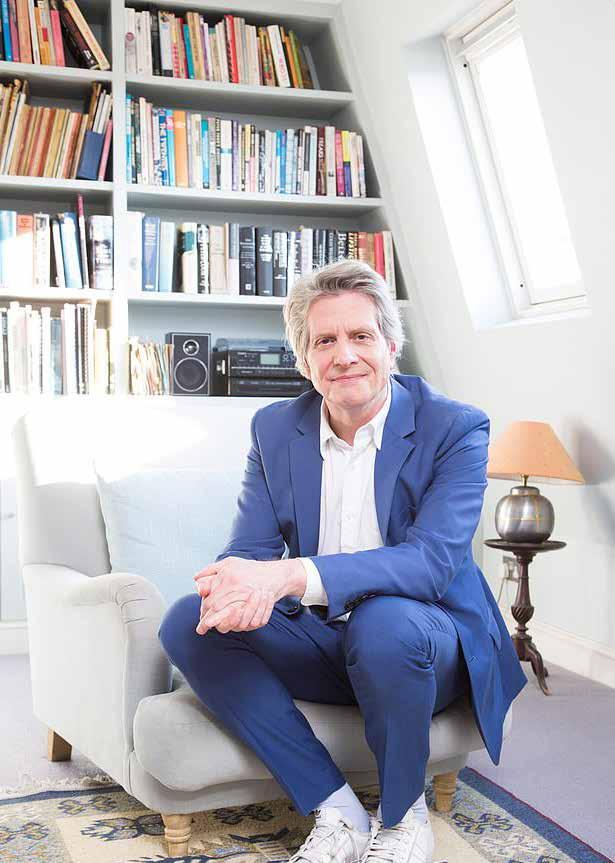
somebody will be moved. You try to be good and say something original and fresh. Ninety-five per cent of what I read is this sludge of opinion and punditry.
Book-writing is very unlucrative too. If you look at the statistics of the number of writers who make a living from their writing alone, it’s tiny, especially for a country as cultured and book-oriented as the UK. That’s not to say that you shouldn’t write books. It’s very rewarding. My real advice to young people is to try and be different. In this day and age, there’s such conformity – especially in the mainstream. Twenty-five people writing the Harry and Megan article: do something different even if it will be a bit harder. Don’t follow the herd.
If you devote yourself to journalism and writing, you’ll have what we call cultural capital. Don’t not do it because of fear about your pension.
The death of my son Jack, who committed suicide after developing a drug problem, isn’t an easy topic –especially if you’re a parent. Who wants to read a book about this? It came out over the Christmas period last year. I hope people will find in the book more than just a sad memoir. I wanted it to be thoughtful and to have something to say about loss; I wanted it to be entertaining. I wanted to think about what it means to be a Dad.
Parenting is trial and error; you bumble along and try your best. One of the things I write about in the book is that I had this idea of being a great Dad. I realise that I wasn’t being the Dad that my son needed, but I was trying to be the Dad I might have wanted. You don’t have to be a great Dad, you have to be a good enough Dad. You have to show up; you don’t have to be spectacular. It’s not just showing up at the parents’ evening. They’ll remember you sitting you in a chair, and leaning over and smiling at them, and pulling a funny face. It’s those small things: as long as there’s an atmosphere of support, love and care.
You’re going to make terrible mistakes; being a Dad is about being a flawed human being. You’ll shout and lose your temper and regret it. That’s part of the business; it’s what you have to learn.
actually go through it. We need to give young people more tools when they face adversity and unhappiness. Suicide shouldn’t be an easy option; I sometimes wonder it’s become a sort of lifestyle choice – a human right. It should be understood that it’s a terrible thing to do, not just in relation to oneself, but in relation to others. But sometimes the mind orders its own destruction and that’s a scary thing.
There are days when I think Jack could have had more support for his condition, but I didn’t give him enough support either. But I can’t point the finger of blame; these things are complex. You often read that so and so committed suicide because of bullying. I don’t believe that; what drives people to that state of despair is a whole set of complex reasons. It’s not just one thing which does that. We always have these initiatives and drives, but I don’t think there’s a magic wand we can wave. We don’t really know why certain individuals commit suicide. Some will have suicidal thoughts; it’s only a minority will
The trouble is my son had a terrible drug problem. We’re beginning to wake up to the impact of drugs on young people. I grew up in a generation where drugs were considered recreational and even mind-expanding, and people thought that anyone who disagreed with this view was a right-wing lunatic. Well, that’s just not true.
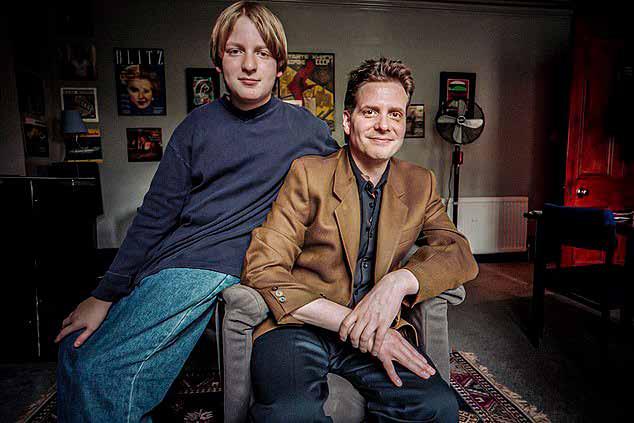
I don’t think prosecuting people is going to solve the problem. You have to get people to understand what they’re doing. Our drugs problem also enriches the drug dealers, who are the worst in our society. People feel embarrassed to say they find my book funny, because it deals with tragic things. But humour is important – it’s perhaps especially important here. You don’t have to have a damaged son to enjoy this book.
Jack and Me: How NOT to live after loss is published by the Black Spring Press Group
“ THERE ARE DAYS WHEN I THINK JACK COULD HAVE HAD MORE SUPPORT FOR HIS CONDITION, BUT I DIDN’T GIVE HIM ENOUGH SUPPORT EITHER.”

I’ma psychologist by background. I did some clinical stuff very early on when I first graduated, and there I saw a lot of trauma and PTSD. Then, when I worked in public service, I saw a lot of people dealing with substance abuse and victims of domestic violence, so it was my job to then rehabilitate them back into the workforce. I’m always very drawn to the intimacy of an individual, which is probably why I ended up in this one-to-one role rather than a large public health policy role or something like that. I think that the unique complexity of what makes each individual them is quite a driver and an attraction for me.
SOFOS Associates is a brain optimization practice, and I believe we were the first one in the UK. We work with individuals to improve brain health and enhance cognitive function, so we’re purists in that way - we just focus on the cognitive piece. There were a couple of things that came together at the moment SOFOS was born. Firstly, I had a career in consulting, working with senior executives, CEOs, and boards. We would look at intelligence, measure it, and factor it into our judgments around executive capability or their likelihood of success, but we didn’t do anything in terms of cognitive development. Alongside that, you had some really remarkable developments in the world as a whole. The tech world made some major leaps and bounds, and in the scientific community we started to really understand things around Alzheimer’s, dementia, and what prevention might look like, and we started to understand a little bit more about neuroplasticity and how the brain changes. With all of these things coming together, I wondered if we were to take a healthy, high-performing population and apply some of these
learnings,
This marked a crossroads from development being quite traditional and really needing a shake up, to applying the innovations coming out in the scientific community to the executive world, leading to a great deal of benefit for individuals and the companies they work for. We’ve got a pretty stressed out workforce. I think that’s clear across any level of an organisation in any industry that you’re in, and I think that there is a huge cognitive demand on us. We live dynamic, complex, multifaceted lives where we work and have families and have interests, so I think the increased cognitive load is something that is very real. Before Covid, I think our clients were looking for a way to boost their brains, to get an edge, and to be better. While that’s still true post-Covid, I think some of the drivers have changed. People are more interested in sustaining their performance in the long-term, and they’re thinking about their wellbeing, happiness, and performance all together as one rather than separating things like work, nutrition, and fitness.
In terms of interventions to improve cognitive health, it’s very broad. You have everything from simple, straightforward stuff such as what you eat, your sleep quality, how much you exercise, and managing stress levels, all the way through to some of the most cutting-edge innovations including neurofeedback, brainwave training applications, hyperbaric oxygen therapy, nootropics, and different supplements that have been found to have an effect on cognitive performance. There’s so much coming out, and it’s coming at pace. It’s been remarkable to see that research really speed up.
I did an MBA not that long ago, and
I don’t recall there being any content addressing the cognitive side of things, and I’d like to see higher education give students the resources to improve the way their hardware functions. We send people off to MBA programmes and we teach them how to put together balance sheets, write up their profit and loss statements, and put together marketing strategies, but actually all of that is resting on their cognitive functions. So why aren’t we talking to these individuals about what they can do to enhance their cognitive function? Why aren't we talking to them about managing stress levels and what high cortisol as a result of stress does to their brains? It impacts memory, it impacts the ability to make decisions, and it impacts the ability to think strategically, and these are abilities that we all need. Teaching people how to do, say, an accounting course doesn’t have the same value if they’re not cognitively able. I’d like to see everyone, and certainly people in the education system, have that information provided to them. You aren’t stuck with what you’ve got - everyone should know that there are lots of things they can do to enhance their ability and intelligence.
Overthe last 15 years, we have built a great machine for fundraising. It is called Big Give, and you might have never heard of it. If so, I want to introduce you to our work and ask for your help. What we have pioneered is the concept of match funding – asking funders to match donations to charities made by members of the public. So £50 from an individual becomes £100 for a good cause, after being doubled by a Big Give match funding ‘champion’ – typically philanthropists, foundations or companies.
What the champions who support Big Give say is that they are so pleased to see their donations multiplied, often by many times. The average donation to Big Give last year was multiplied by 5.6, making their money go far further than it would otherwise have done.
We are now the UK’s biggest match funding platform, working every day to multiply people’s generosity.
Public donations are crucial. But we need the fuel provided by more champions to take our work to the next level.
My feeling is that a lot of wealthy individuals want to help and to do something charitable, but they are not quite sure where to put their wherewithal and their energy.
It’s actually not that easy to give away a lot of money and do it effectively. It may be that there is a cause you want to champion – the environment, homelessness, the arts, women and girls, developing communities – but you aren’t sure who to work with to have the best impact.
Working with us means you make much, much more impact. We say to the public who donate to charities through our platform that one donation has twice the impact. But for the champions, it’s a lot more than that.
In the UK the top one per cent are not as generous as they are in the US. What I would say to those people is that you get an enormous satisfaction from making a contribution like this. Once you have got the material things you need, the return on acquiring more and more material things diminishes. When you contribute philanthropically, the satisfaction grows stronger each time you do it.
The people who take part tell us that it is really enriching. They get huge satisfaction from supporting what is often a number of different organisations. If you want to support the homeless, say, you can target your help at more than one charity working in the sector. You also know that we have done the work for you in terms of selecting well-run, effective organisations to support.
Our annual Christmas Challenge raises money for over 1,000 different charities, and even our themed campaigns like the Green Match Fund, which targets environmental causes, are very varied. Wealthy people should think about how much they want to give away every year, and then they can plan effectively for doing so. In some religions, it’s expected that you will give away a certain percentage of your income. I’m not saying everyone should set it in stone, but there is something to be said for planning ahead.
I try to do that, and it helps that I have been working with charities since I was a young man. I have seen how well targeted work can make a huge difference to people’s lives.
What we have created in Big Give is a way of multiplying and magnifying that. We give the organisations that take part in our campaigns a lot more financial firepower.
I find it very satisfying when I hear back from our charity partners that they have
hit a target and demonstrate amazing programmes of work as a result, across all different aspects of society that are really inspiring. That motivates me. There are a lot of cracks in our society and life that government does not fill. Voluntary and individual action is a necessary part of the social landscape. The small battalions, as they have been called, make a huge positive difference. A lot of them are led by very impressive individuals who are really remarkable leaders.
We want to work with them to reach a new target of raising £1 billion by 2030. It’s a big number and it’s a long way off where we have got to. But I’ve always found in business that it’s good to know what you are trying to do and have a target. It keeps you focused on the goal, which is raising money to help charities finance the work they do.
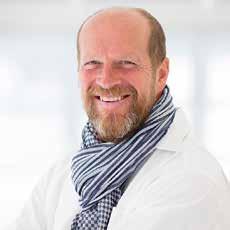
Currently, we are not far off having raised a quarter of a billion pounds – so £1 billion is a big stretch. But it’s doable. It’s good that people know we are ambitious. After all, the need out there is limitless.
For more information visit: www.donate.biggive.org
Whenyou pick up the newspaper what do you turn to first? For me, it depends on the occasion. After a sound sleep, I can face the enormity of the day’s issues, and brave the front pages. Usually, selfish for the next thing, I prefer the culture pages. But sometimes, especially when tired after a day’s work, I’ll go to the diary section to be pepped up by the human delights of gossip.
When I do so, it’s with appreciation that writing it is the hardest job in journalism; the gossip columnist specialises in the bite-sized indiscretion, the minor cockup, the eye-popping peculiarity. What’s noteworthy is how little of this there is in today’s PR-burnished world: these stories are hard to find, and needing to be taut and punchy, hard to write.
At 26, Emily Prescott is already one of the best in the business, with a small team already working under her at The Mail on Sunday. Is this a declining sector? Every time I open The Evening Standard, the diary section – where Prescott used to work – seems smaller. Prescott bats this away: “If anything, gossip is booming. The Telegraph recently introduced the Peterborough column and The Times Diary was culled during the financial crisis but returned in 2013. Any shrinking pages are a sign of newspaper decline rather than a waning lack of love for gossip and whimsy I think.”

Prescott’s is a fabulous story. By nature softly-spoken and kind (‘Always be polite, no matter what’), she has shown tenacity to get so far so young. So how did she do it? After a range of almost hilariously non-descript jobs in recruitment and communications (“the pointlessness of those roles weighed very heavily on me”) Prescott decided that only one career would do. “I just really wanted to be a journalist,” she tells me. “So a few years
out of university, I messaged Katie Glass on Instagram, saying I liked her features. To my amazement, I emailed her, we met up for a coffee and then she suggested I go to Diary events. I didn’t go to private school; didn’t grow up in London; had zero connections.”
Astonished, half-thinking the gig a joke, Prescott attended her first party. “Weirdly, I did really well; it was beginner’s luck,” she recalls. “It was a weird law event at one of the posh law firms, and Victoria Coren Mitchell had gone to speak. She said she’d been groped when she was a poker player and men would grope her under the table. It was a good news story – but a complete fluke!” From then on Prescott hit the party circuit (“I found it such a thrill, just collecting lines”), and soon did stints at The Sun (“really useful”), The Express (“really awful, so depressing and bleak and SEO-driven”) and The Sunday Times, as the Saturday reporter (“wonderful”).
After that came a prolonged stint at The Evening Standard, a paper she obviously loves, and which connected her into the worlds of entertainment and politics. “It’s quite easy to get well-connected into Westminster. Now [at The Mail on Sunday], I do showbiz and it’s difficult to get access. But I could get any MP on the phone now, bar Rishi – and even there I could probably get his number.” Prescott isn’t bragging – or the type to brag – she just knows her craft and what it takes.
She recalls getting to know Sir David Amess MP, who was tragically murdered at his constituency surgery in 2021. “He was doing a campaign to get a statue of Vera Lynn. We spoke during lockdown, so maybe it was the thrill of talking to a stranger which caused a bit of a bond to develop. During the pandemic, interviews would be hours long; people
were desperate for new voices in their lives. David was kind and thought of me a few weeks later, and called and said: “I have a potential story for you”. I was struck by the fact that the story wasn’t self-motivated. He had just remembered.”
Prescott explains the range of interviewees she’s experienced.
“Sometimes – and this especially happens with very experienced interviewees – you feel like you’ve had a good interview and that they’ve told you something, but then you’ll listen back and there’s nothing there, except perhaps an anecdote which they wheel out every time.”
And what about young interviewees?
“That can be frustrating – sometimes they’re just nervous. People often don’t understand that I don’t need a massive
OFTEN DON’T UNDERSTAND THAT I DON’T NEED A MASSIVE SCANDAL, I JUST NEED SOMETHING MILDLY INTERESTING.”
scandal, I just need something mildly interesting. When they’re so earnest, that’s difficult for a diarist.”
And what about the effect on Prescott as a person from having met so many wellknown people? “I have to watch myself not to do too many celebrity mentions. A friend might say: ‘I saw so and so on the tube the other day’. I might reply: ‘Well, I went to their house the other day’.”
Some people are less than delightful to interview, Prescott says. “Sir David Attenborough wasn’t incredibly charming,” she recalls. “When I say I’ve spoken to him, he’s so many people’s hero, but I’m not part of the fan club. He’s had an immensely privileged life, but he’s quite curt, and I have spoken to other people who have said the same. He is in his 90s though, so I forgive him a bit.”
alongside her early jobs), but then tells me what it’s really like to wage war each day on the battlefields of UK defamation law. “I’m very protected now,” she explains. “I can message the lawyers and ask the question – and you do get a feel for whether something might be defamatory. But actually, more important than that is having the confidence to say: ‘This is not illegal; this is not a problem’. I’m always getting legal letters telling me to back off – even Prince Harry’s psychic has sent legal letters!”
The sainted Lineker meanwhile piled in on her after coverage Prescott had given his two sons – one story about George Lineker’s business, and a second about Tobias Lineker, who had secured a job DJ-ing at Raffles. Having read these pieces, I’d certainly say that worst things happen at sea, and that Lineker, handsomely paid by the BBC – that is, by the taxpayer – would do well to marry his gift for volubility with a balancing tendency towards reticence from time to time.
And has she ever had any pleasant surprises? Prescott pauses. “Often the extreme right-wing people can surprise you. Like Nigel Farage – I won’t say he’s lovely but he’s funny and has good manners. I think there is a tendency for Right wing people to have better manners. I’m not quite sure why?
Edmund Burke (sometimes hailed as the founder of conservatism) spoke about manners being more important than laws!”
The move to The Mail on Sunday has led to an increase in her visibility. She recalls doing the media law module on the NCTJ course (which she completed
It’s in the nature of gossip to rile people: “That’s because it’s not PR,” says Prescott, smiling. But now, after Twitter run-ins with Jeremy Clarkson and Gary Lineker, she’s more likely to brush off any furore. Nevertheless, those fandangos – silly and needless as they are – tell you a lot about the job of being a high-profile journalist. Prescott managed to elicit in Clarkson that most 21st century of psychological states – the Twitter ‘meltdown’. This occurred when Prescott wrote a funny –and not especially mean – story about Clarkson’s daughter, who had complained on Instagram about the effect of the Russia-Ukraine war on influencers (‘the great casualty of the Russia-Ukraine war!’ Prescott laughs). But upon publication of her story, Prescott woke – on a hangover as it happened – to a thousand messages, from the dreaded Twitter ‘mob’; specifically, Clarkson’s Twitter mob. The former Top Gear presenter had twice tweeted her (‘he failed to ‘at’ me properly the first time, so did it twice’), lampooning her journalism.
Prescott recalls: “Lineker tweeted me calling me ‘unnecessarily nasty’, then George Lineker piled in, and wrote that I was ‘useless’. They lack an understanding of the Diary. Does Tobias Lineker want me to say he’s innately gifted and selfmade? I appreciate people have to defend their sons, but Gary Lineker can use Twitter in that way knowing it’s not bad for his sons’ businesses, and also knowing that no-one criticises anybody for calling out The Mail. A friend of mine asked me how I felt after that, and initially I couldn’t remember what it had been about so I’ve definitely hardened.”
Nowadays Prescott’s week is constructed around the demands of delivering her copy on time for the Sunday editions. The best time to catch her is undoubtedly a Monday, and her tough days are Thursday and Friday, on which days all right-thinking people shouldn’t contact anyone toiling to produce our Sunday papers.
Prescott’s success is considerable but there is far more to come. A recent feature for The Spectator about Americans buying up stately homes shows how easily she can do long form journalism too. I should add that she can also draw and write superb poetry.
Recently, Prescott was interviewing Michael Gove. When she began introducing herself, Gove interrupted her: “I know who you are, Emily.” Gove – for once, some might say – is ahead of the curve. Soon, everybody else will know her too.
“OFTEN THE EXTREME RIGHTWING PEOPLE CAN SURPRISE YOU. LIKE NIGEL FARAGE – I WON’T SAY HE’S LOVELY BUT HE’S FUNNY AND HAS GOOD MANNERS.”
“I’M ALWAYS GETTING LEGAL LETTERS TELLING ME TO BACK OFF – EVEN PRINCE HARRY’S PSYCHIC HAS SENT LEGAL LETTERS!”
78 | DEFEATING LYMPHOEDEMA
How a disease you’ve never heard of became the new cause celebre


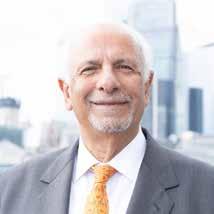
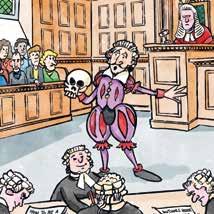
Iamnot especially tall but as Rishi Sunak shakes my hand he has to peer up at me. Saul Bellow once wrote of a particular quality of modern celebrity: ‘TV brightness’. Sunak has it, though it is perhaps a rather dubious thing to possess. He is one of those politicians, immaculately turned out, whose slick appearance calls into question his sincerity. In this he is distinct from those politicians whom the public really takes to their heart: one thinks of the former Chancellor of the Exchequer Kenneth Clarke with his jazz and Hush Puppies, and of course, Sunak’s predecessor bar one, Boris Johnson.
Every Prime Minister has a context in which their premiership plays out –and this inevitably has to do with their immediate predecessor.
In Sunak’s case, because of the short duration of the Truss administration, it is truer to say that Sunak’s administration faces a sort of double context: he is always being considered in relation to Liz Truss, and in relation to Boris Johnson. With regard to Truss, he comes out well – the image is of the sure hand at the tiller. Secretary of State for Education Gillian Keegan tells us: “Theory and practice are very different. Rishi Sunak understands that and it’s one of the things which makes him a fantastic prime minister. He has the most extraordinary talent; he’s very detailed and strategic and kind. I look at him and think that he’s got that stardust, and a lot of space to grow: I think he will be a world statesman.” The first sentence feels partly aimed at Truss, whose short-lived premiership unravelled when it transpired that unfettered ideology
doesn’t necessarily meld with the pragmatic decision-makers who govern markets.
As one might expect from a serving Cabinet minister, Keegan’s is a reasonably sunny assessment of Sunak and his predicament – especially given that he must call a General Election next year and is behind in the polls. Even so, these positive sentiments are echoed here and there in the Conservative Party. One seasoned political observer who recently had breakfast with Sunak’s wife Akshata Murthy says that the single most revealing fact about Sunak is that once he had achieved financial success at Goldman Sachs he paid his parents back for his education (Sunak famously attended the expensive Winchester College). The impression is usually of someone kind and admirable – a hard man to dislike. But in the current febrile environment, there are naysayers – as there always are. In respect of the contrast drawn between Sunak and his former boss Boris Johnson, things become a little more complicated.
Considered alongside Johnson, Sunak seems organised, on top of his brief – the man with the tidy desk. But for others, he will seem bland and technocratic – the former Goldman Sachs alumnus and hedge fund relationship manager raised too high, to a position where he cannot inspire.
Some insiders note that he can seem detached in meetings, like he wishes to get away. Johnson, it is said, always enjoyed human interaction, and was always genuinely interested in the family situations of staff. Others note that
Sunak is simply busy, keen to get on with the job.
He gives me a brief, transactional nod then marches on to the bestowal of other transactional nods. One of his predecessors as Prime Minister David Lloyd George is sometimes considered the archetypal “young man in a hurry”. Sunak’s busy shuffle off into the next encounter suggests the rush you have to be in to stand a chance of making it to Downing Street, but it also seems like someone who must brush off entanglements. The obverse of being in a hurry is not wishing others to hold you up.
I first met Sunak at the Two Cities lunch when he was Chancellor of the Exchequer. This occasion is held annually at a central London hotel – usually the Intercontinental. These affairs are hush-hush beforehand both for security reasons and to ward off journalistic interest. They are usually attended by the Prime Minister and the Cabinet of the day, and can therefore be vivid exhibitions of that particular politician’s predicament.
In 2019, I recall the then Prime Minister Theresa May, standing at the lectern a few metres away from me, her hands visibly shaking: the office which she would depart that week had begun to overwhelm her. I remember wondering if David Cameron had ever felt nervous speaking before the party faithful. She sat down to a respectful silence, her fate all but sealed.
After the pandemic, it was Boris
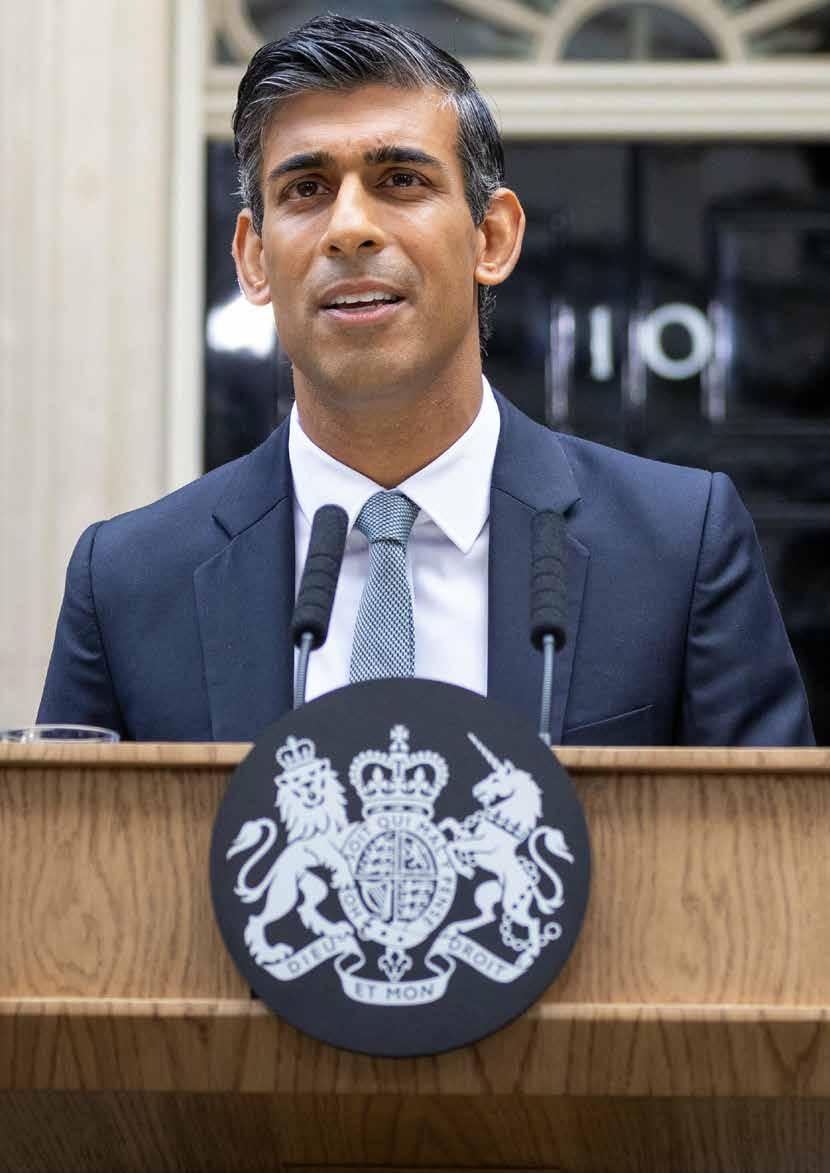
Johnson’s turn to swagger in an hour late, and then find himself the object of cult-like attention, trying to eat his lunch while being encircled by a phalanx of business people photographing and videoing him. Eventually, a Two Cities official panicked over the speaker system: “Let the Prime Minister eat his lunch!”.
At the time one realised that Boris had so charmed a segment of the Conservative Party that it had been futile to keep the paparazzi out: we’re all paparazzi now.
Sunak’s demeanour when I first met him, and again in 2023, is more methodical –lacking the nervousness of May, but also the bombastic charisma of Johnson. He moves around the room shaking hands, meticulous in the discharging of prime ministerial duties. Here, you think, is the tidy desk prime minister in action, slick and at ease in his own competence – and since none of this is particularly exciting, he also gets to eat his lunch more or less undisturbed. This year, too, the lunch takes place just before the parliamentary summer recess and so the hall is bereft of Cabinet ministers, giving Sunak a somewhat lonely look, although of course one wouldn’t want to overdo the symbolism of an impression arising out

of a scheduling issue.
Former MP and minister Brooks Newmark once recalled to me what it was like to campaign in the North alongside Johnson: “They come out of their houses to greet him; he doesn’t need to knock on doors”. While it is remarkable to consider how swiftly the intense energy which surrounded Johnson has now disappeared into the rearview mirror after Partygate, there remains the suspicion – buttressed by iffy opinion polls – that Sunak could do with a bit of that stardust.
We must add to this the question of legitimacy which usually attaches itself to any prime minister who hasn’t fought a general election: think Gordon Brown and Theresa May. In Sunak’s case, there is the spectre of a well-financed proBoris wing which sometimes seems to be willing Sunak to fail. In particular, the legendary businessman Lord Cruddas has come out as saying the leadership vote for Truss’s replacement should all along have been put to the membership – a decision which would have led, as night follows day, to a second Johnson administration, albeit one Boris would have found prohibitively difficult to staff. Cruddas tells me: “We have to look at
the situation as a whole. The fact of the matter is that Boris was elected by 43 per cent of the popular vote in the country – an 80-seat majority – on a mandate of Getting Brexit Done. Effectively what happened is that Boris was removed from office by a small group of MPs who decided that he had to go. But Boris got the same fine as Rishi and the membership didn’t vote for Rishi. But this isn’t anti-Rishi.”
And yet it can’t really avoid being a bit anti-Rishi, since no two people can be prime minister at the same time and Cruddas would obviously prefer Boris. He continues: “At the end of the day, it’s bad for democracy – we need to let the country decide who the Prime Minister is. It’s all about democracy and it’s appalling what’s happened to Boris.”
Wondering what Sunak might have to fear if Boris were to attempt a comeback at some point once the dust has settled, I ask Cruddas if he’s seen Boris recently? “I think he’s in good spirits. He’s a successful guy. He can work, he’s making
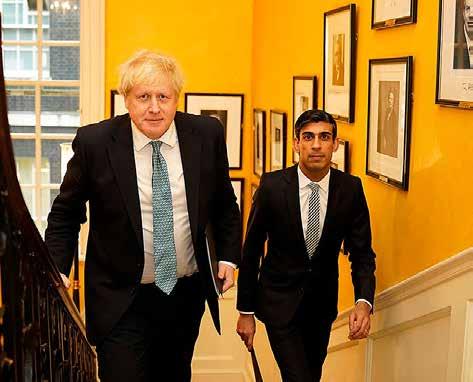
money and he doesn’t need politics. He feels an obligation to the electorate. He was elected by 14 million people and he doesn’t want to let them down and he feels that opportunity has been taken away from him. Ultimately, Boris has been removed over really mundane stuff.” But in truth, as 2023 has limped along, these emotions now hang over Sunak less and less – especially after a series of policy achievements, including the Windsor Framework, the Illegal Boats Bill, the Comprehensive and Progressive Agreement for Trans-Pacific Partnership (CPTPP), the incremental slowing down of inflation, and the eventual settling of some of the strikes.
Watching Sunak mingle with the business community, one senses his ease in that environment. This is the Sunak who has married wealth (his fatherin-law is N. R. Narayana Murthy, the billionaire founder of Infosys) and who has an instinctive understanding of the economy due to his career in financial services, and of course in government
both as Chief Secretary to the Treasury when Sajid Javid was Chancellor of the Exchequer, and then as Javid’s successor in that role.
This is also the same man who can appear too technocratic for popular taste, and who could, for instance, ask somebody he was serving at a homeless kitchen whether he was in business (‘No, I’m homeless,’ came the viral reply). Likewise, it isn’t too much of a leap to see why such a man might frame his education policy around the importance of mathematics. It was the former Chancellor Philip Hammond who became known as Spreadsheet Phil, and perhaps if that moniker hadn’t been used so recently we might be discussing Spreadsheet Rishi.
Interviewed on stage at Two Cities, Sunak began in light touch mode, recalling his early weeks as Chancellor of the Exchequer. “When I first got the job, I had to deliver a budget in about three and a half weeks – and I really thought at that moment that it would be the hardest
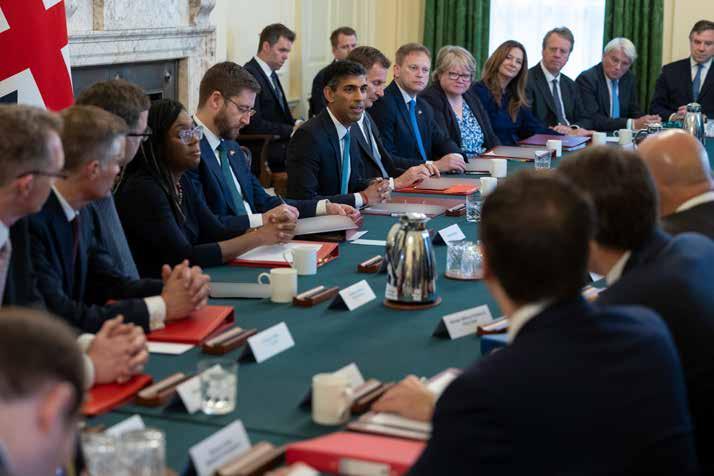
professional thing I had ever had to do in my life. It turned out to be the easiest.” This gains laughs in the hall – and probably down the line, this sort of anecdote will win a few votes. Politicians like to remind us how difficult the job is, since it acquires our empathy – the quality we usually most withhold from them.
Sunak continues, explaining the intractable nature of crises which seemed considerable in 2022, and now seem gigantic in 2023: “I recently got back from Washington from meetings with all the finance ministers from around the world and I discovered that we’re all facing similar challenges. Inflation is very much a global phenomenon and my colleagues are all talking about the same things.”
This sort of talk, as true as it might be, can only get a politician so far: the contemporary experience is still sufficiently national that voters tend not to think, ‘Well, at least things are just as bad in Germany”. They vote on their
own lives and not on the lives of others. Besides, inflation has fallen somewhat swifter in other economies – especially in the US – than it has done here, which means this argument will run out of road if the figures don’t improve by the end of the winter.
Sunak continues, recalling the strange early days of 2020, in whose wake we still live: “We were staring into the abyss at the start of the pandemic – but we have got through that and we have done so pretty successfully. I am confident that we can embrace the challenges ahead but also deliver all the other things people expect us to do which is to invest in public services and deliver a growth agenda UK. We have got to crack on with these challenges but also not be diverted from the task at hand that people actually need us to get on with as well.”
There is, of course, a step change in expectation and difficulty when an individual moves from Chancellor to Prime Minister, but he goes on to make remarks which afford an insight as to how Rishi Sunak thinks about the issues likely to be at the front of voters’ minds when we go to the polls next year. It feels like a flier for Sunak v. Starmer in 2024. Sunak will say: “Stick with me, it could have been so much worse.” Starmer will say: “Surely, it’s time for a change and you’re a bit sick of this lot.”
In the usual scheme of things, Starmer will win. But these aren’t ordinary times – and the government is looking for a compelling story to tell. For this article, I spoke to a range of opinion formers and colleagues from those who have followed the PM’s career, Cabinet ministers past and present, party donors and those who have insight into the legislative process under the Sunak administration to ask what story Sunak will tell at the next election.
On 30th July 2023, Sunak’s X (formerly known as Twitter) account, tweeted a picture of himself sitting in – but not driving – Margaret Thatcher’s old Rover. The tweet read: “Earlier I spoke to @ Telegraph about how important cars are for families to live their lives. It’s something anti-motorist Labour just don’t seem to get. And it’s why I’m reviewing anti-car schemes across the country”.
The photo op generated a bit of ridicule, but was designed to draw a deeper lesson
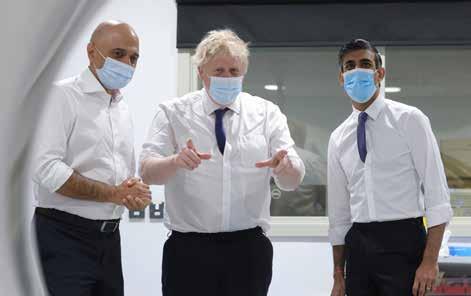
about the similarities between Britain’s greatest post-war prime minister and the current incumbent. This isn’t an old ruse: even Gordon Brown invited Thatcher to Downing Street once he assumed office. But it feels relevant for another reason. Having steadied the ship post-Truss, Sunak is beginning to show that he understands the need to be bolder to appeal to a middle England exhausted by Brexit, Covid and experiencing their own version of the cost of living crisis.
These people who read The Telegraph, to whom Sunak gave that interview, will probably always be able to make their mortgage payments, but are nevertheless capable of being quite annoyed when every Sainsbury’s (or perhaps Waitrose) shop costs more than they feel it should; when value is wiped off their houses; and when everywhere you turn there’s a tax to put you off investing in a better life. We can’t feel the same sympathy towards such people as we do towards those who are genuinely struggling, but the fact remains that Rishi needs their support to win.
The car tweet shows Sunak also distancing himself from Johnson’s embrace of the green lobby (Truss didn’t hang around long enough for us to find out what she thought on that issue).
Sunak is intuiting that while most people accept the science on climate change, there is also a growing consensus that green policies are beginning to hurt their personal finances. As Caxton CEO Andrew Law tells me: “We’re in the early stages of an energy transition where we’re going to have to invest enormous amounts of money on green energies, as we decrease our dependence on gas and oil. This will undoubtedly put upward pressure on interest rates.” Voters are beginning to sense the pain attached to that.
But for Sunak there’s also a pragmatic business streak in play: “What we can’t have is a situation where private capital can’t invest in the transition of fuels, particularly natural gas,” he says. “Where
“SURELY, IT’S TIME FOR A CHANGE AND YOU’RE A BIT SICK OF THIS LOT.”
that happens it’s not good for people, as it hits their gas prices and people’s bills. We need to recognise that but also in the long term be really committed to transitioning to renewable energy. We also have to do things like nuclear which we haven’t done for a long time in this country – all this is a change people will really welcome.”
It is unthinkable for the Conservatives to enter the General Election without some compelling sops of this nature to the middle classes. A review of anti-car legislation might win some votes, as it did in Uxbridge, thanks to the unpopular ULEZ policies of London mayor Sadiq Khan.
But really, Sunak needs to do something on tax – and unlike Liz Truss, to do something in a way which markets will stomach. This is especially the case if the Bank of England keeps interest rates roughly where they are deep into 2024. Despite all this, Sunak faces an additional problem – that the damage was likely already done during the Johnson and Truss administrations. Haven’t most people made up their minds, however unobjectionable they might find Sunak personally to be? When I speak to Sir Terry Waite, he issues a stark condemnation of the current climate in Westminster: “In recent years we’ve had a very poor deal in our political
life and if you read the latest book on former prime minister Johnson, which I’m reading not because I’m an admirer, but because I wanted the inside story… [Waite is referring to Finito advisory board member Sir Anthony Seldon’s Johnson at No. 10].” Waite trails off, plainly disgusted by the status quo. Then he continues: “The inside story is frankly dreadful. The fact of people vying for power and position, rather than saying: ‘My first obligation is wanting to serve the people of this country’. On a much broader scale, a sense of vocation has gone out of life for many people. At one time teaching and nursing were considered definite vocations.”
Why has it gone out? “It’s because we live in a society where money is the God. We can’t seek for bigger or better all the time. We need people to be content with what they have.” This feels true, and I wonder how it might apply to Sunak. On the one hand, he certainly does have money, and is more guilty than many of seeking it. On the other hand, he plainly has an admirable sense of duty. He didn’t need to go into political life, but he did. He didn’t have to submit himself to that miserable summer electioneering against Truss, but felt obliged to do so. On a day to day basis, he works hard.
Of course, there’s a policy element to the misery Waite describes too, and this now intertwines with the overall sense of fatigue. An atmosphere of rising interest rates has hurt homeowners – and this has obvious ramifications for Sunak’s electability next year. It was Churchill who in his tired second administration articulated his vision of Britain as a ‘property-owning democracy’ and to a remarkable extent – partly thanks to Sunak’s hero Margaret Thatcher – that is what we became. But there’s a corollary to this which Liz Truss would have done well to remember: don’t mess with people’s houses.
A house is an unusually emotional asset. ‘How we live measures our own nature,’ as Philip Larkin put it. Sunak faces
the problem that voters’ memories are likely to be long even if the situation dramatically improves, and inflation, as he has promised, is indeed halved by the end of the year. When even pledges you can’t keep feel insufficient, you have a problem.
Added to this is the sense of what 2023 has been: some strikes have been settled – but likely settled too late if settlement was always to be the policy. In addition to all this, while Sir Keir Starmer isn’t by any stretch of the imagination Tony Blair circa 1997, the Labour Party has done a reasonable job rowing back its more extreme policies, especially on climate change, and making a sort of uninspired saunter for the centre ground where elections tend to be won.
Even so, despite these negative indicators for Rishi, there is still a sense in the Party that there is much to play for. The memory of Sir John Major’s victory in 1992 can still occasionally swerve in to calm Party nerves. When I bump into Sir John at the Oval in July, I am reminded that it was here that Major came after the 1997 defeat. But there was a 1992 victory too. His acolytes confirm that he’s supportive of Sunak and will be voting for him. But the economy in 1992 was on the up – and it’s not now.
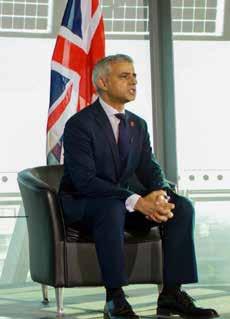
So what does Sunak think on the economy? Having watched him steward the public finances for three years, we feel we should know more about what he thinks than perhaps most of us do. At the Two Cities lunch, Sunak gives his ‘four pillars’ of the economy, and they continue to be relevant today – both in terms of policy, and in terms of how Sunak’s mind works. Like many politicians, the tidy drawers of his mind contain easy-to-reeloff lists.
“The first pillar is openness,” he says. “We are trying to make progress on that, and I think we’ve been very successful so far.

Born in Southampton to parents of Asian descent.
Attends Lincoln, College Oxford, reading PPE, graduating with First Class Honours.


2006
Makes partner at The Children’s Investment Fund Management.

Misses scholarship to Winchester, but his parents scrape together the fees.
2001-2004
Works as an analyst at Goldman Sachs.
2009
Joins Theleme Partners, a new firm with $700 million under management.

The UK’s particular strength in financial services is something I know well.” In this, he presumably means that he believes in free trade – except, of course, when it comes to the crucial question of Brexit where he doesn’t. But it’s a reminder of how, when Sunak is in the room with financial types, it is natural for him to remind them that he’s one of them.
He continues: “Secondly, we have to make sure that London is home to innovation, and concept trading and so forth. Thirdly is technology. Again, in a fast-changing environment we need to
be sure that this is a competitive place to do business and we need to lead the way in fintech and payments technology and other aspects. The fourth pillar is competitiveness, whether that be capital markets reform, or on tax too.”
Of course, there is a sense in which innovation and technology arguably amount to the same thing – but few would deny that Sunak has given all this serious thought.
Sunak speaks as the former Goldman Sachs employee, the firm which he went to work for straight out of Oxford. He also speaks as a former hedge funder. I
am curious to know how these two kinds of experience – government and business – stack up when you move from one to another. When I speak to Lord O’Neill of Gateley, who was Chief Economist at Goldman Sachs before himself moving to the Treasury in the George Osborne days, he draws comparisons which may apply to Sunak: “When I worked in government, to my pleasant surprise I found the quality of the staff in the Treasury to be just as good as at Goldman Sachs – but with greater public spirit. The hard thing for me was that I wasn’t a member of the Conservative

Enters Parliament as MP for Richmond, William Hague’s former seat.

Succeeds Sajid Javid as Chancellor of the Exchequer, following Javid’s.
Appointed
Following defeat to Liz Truss in the leadership election, Sunak succeeds her as Prime Minister, becoming the first UK PM of Asian descent. .


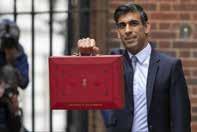

Party; I was there to execute a technical role. But I was surrounded by ministers who were obsessed with where they were in terms of political horse-trading.”
This, says O’Neill, is a problem which he found difficult to overcome. “I found their motives troubling. They would decide what to support based on how it would help them in their next job which is extremely different to Goldman Sachs. Even within the same party, competing ideologies were different –often irreconcilably so. In that sense, I witnessed first-hand the ridiculous developments within the Conservative
Party: I was shocked as to how crazy it was.”
In understanding how Sunak might have reacted to this identical predicament, it’s important to realise what Sunak’s role really was within the financial services industries. As a general rule, there are two kinds of people at banks and hedge funds: there are the so-called relationship managers, who don’t need to be handsome and immaculate like Sunak, though it certainly helps. Usually, unlike Sunak, they enjoy a drink or two with their prospective clients. But they have to be trusted – good at what Westminster
calls retail politics.
Then there’s the second group: the investment officers, or in more derisory language, the quants. In the popular imagination these are basementy folk, hidden away from human interaction for the compelling reason that they can’t manage human interaction. They choose the allocation of funds, and have great power but had the cards fallen slightly differently they might have been gamers. Sources from his time at Goldman, and his subsequent hedge fund roles say that Sunak was far more the former than the latter. But by Westminster standards
where hardly anyone understands economics, especially the people writing about it, Sunak probably qualifies as a policy geek. His success in Westminster, you feel, is partly down to this ability to touch both bases.
But Sunak is still someone you can send into the room. This skillset is the link between Sunak’s two lives in business and in politics. Back at the Two Cities lunch, Sunak zooms out, detailing the broader picture: “I am seeing job confidence not just in London but in the South East. Two thirds of employment for this fantastic industry is actually outside London and the South East and that fills me with confidence.”
Of course, the great question is whether Sunak’s innate support of the financial services sector is good for social mobility or not. For one thing, it certainly generates its rags to riches success stories, a little like Sunak himself, whose upbringing was relatively humble and not exactly typical of someone about to go into the stratosphere both financially and politically. Lord Cruddas would be another – a milkman who ended up in Mayfair.
On the other hand, the statistics seem to suggest that these extraordinary stories of achievement are exceptions. For instance, a 2019 study by KPMG found that 41 per cent of people working in finance in the UK had relatives in the same sector, far above the national average of 12 per cent. The study also showed that students from some backgrounds were less likely than others to get City roles following graduation.
Few who read the FCA’s discussion paper on diversity will feel that the financial services sector is a vital force for equality at this precise moment. By its own admission: “A deep dive study of eight financial firms (including regulators) found that 89 per cent of senior roles are held by people from higher socio‐economic backgrounds.”
Even so, this isn’t to say there isn’t potential for improvement. And Sunak has much to say about what
the Treasury can do to improve the levelling up situation in the country. “The best example I have of [levelling up potential] is Teesside next to my North Yorkshire constituency. Teesside is a place which I have championed as an example of what this Government is about: it’s not a big city. It’s in the North but it’s not Leeds, it’s not Manchester and it’s not Newcastle,” he explains.
And what about particular examples?
“I just celebrated the fact that in the new Treasury campus there we hired our hundredth person: it’s already transformed the region.” [In 2023, that number is now around 130]. “The combination of the new Freeport, the Treasury Office, the investment in high streets and town centres, all of that is bringing jobs and investment into that area. There is new vaccine manufacturing; there’s offshore wind turbines. You name it, it’s happening there now. There is a sense of optimism and positivity in an area which just five years ago lost 5,000 jobs. That turnaround is quite frankly extraordinary and that is as a result of the policies of this Government.”
These are stories that Sunak will need to tell to stand a chance of a hung Parliament, or a victory at the next election. He also points to a few things begun when he was Chancellor which now continue with him as Prime Minister: “There’s lots of other things we are doing in Government to take advantage of Brexit. Turbo-charged free enterprise zones with trade in customs benefits in places like Humber and Teesside, for example. We’re doing trade deals, taking advantage of these new-found freedoms and signing trade deals in fastgrowing economies around the world. Then of course on things like tax and regulation, we can start to do things differently – for instance, we were able to cut VAT on energy saving materials earlier in the Spring Budget.”
Since then, there have been small wins on calming the economy post-Truss, and
gradually bringing inflation down. But if you want optimism, you still need to talk to a Cabinet minister – which is why I go to meet Trade Secretary Kemi Badenoch.
I sometimes try to imagine Westminster village as an organism made up of exits and entrances. Ministers troop up to Downing Street and swagger out again; flights depart for Washington, the return flight lands; meetings disband, are cancelled, rescheduled, or they’re suddenly back on again. All this feels like it has its inevitability but also a degree of flexibility. But this is also a place with its iron laws. No matter what, every day at around 6pm, a handful of rotating ministers trudge towards the clubs of Mayfair to raise money for the Party.
On a day in June, the minister in question was Kemi Badenoch, currently Secretary of State for Trade and Equalities, who headed down to the Travellers Club to sing for the Party’s supper and to say a few words about the state of play under Rishi Sunak.
“One of the toughest things about being in government is the relentless bad news,” she concedes. “If you were reading what’s going on on Twitter, you’d think the UK was in a state of permanent decline, performing worse than all our peer countries, and that everybody hated
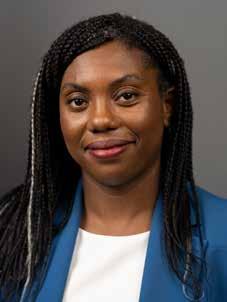
each other. But it’s really not the case. Through these once-in-a-generation events – Russia-Ukraine, Covid and the financial crisis – or even leaving the European Union – we have held people together. Business, in particular, has had a tough time – but we’re doing better than Germany, which hasn’t left the EU.” Badenoch doesn’t mention that this is because Angela Merkel made a nearly incredible series of foolish decisions during her long tenure as Chancellor, cosying up to Putin (and Russian energy) at every turn.
Even so, how can the government push back against this prevailing narrative of a Dilapidated Britain? “We need to not just prove them wrong but to communicate what we’re doing. It’s not enough to do well – you have to show and tell what you’re doing well,” Badenoch says. And how seriously have the Johnson and Truss administrations harmed the Party’s chances in 2024? “The biggest challenge we have is showing people that we’re still a united Party and have common goals. This is a challenge. After 14 years in power there will be things people wanted to do but didn’t quite get done. It’s natural. Of the 14 years, the first five were spent in Coalition, then we had a small majority, then we had Brexit. After Johnson’s victory, we had only three months before we were all locked up in our homes. People have had a really tough time.” And Sunak? “He’s doing a very good job. He is doing one of the most difficult things a prime minister has had to do in a very long time. The only way we’ll see another Conservative government is to back him.”
But is it going to be enough? “What we don’t see is all the things we stop happening. We’re the only party which is still able to stay grounded and rooted in reality and tell people how tough things are. It’s important to base an economy on sound money – you can’t spend your way to prosperity. We’re only able to take the decisions we did during Covid because of those years of austerity under David
Cameron which everybody hated at the time.”
In Badenoch’s view, there can be no true society – and therefore no viable social mobility – without truth-telling. For her, wokeness has created a distorted reality – but it’s also a sideshow from the things which matter. If we want a better and more socially fluid country, we must better focus on our priorities.
Badenoch also explains that this country is more broadly admired under the Sunak administration that we might realise, immersed as most of us are in the 24-hour news cycle. “Things are different as soon as you step outside the UK. People love our country. We’ve just joined the biggest trading bloc which we have done since leaving the EU. The Comprehensive and Progressive Agreement for TransPacific Partnership (CPTPP) is not just Commonwealth countries – it’s also Japan, Malaysia and Singapore. They really wanted us in not just because of the trade but because of our values. Some of them are worried about China being on their doorstep and we’re the antidote to that.” Of course, there are those who would point out that if you really want social mobility in this country to come through trade then you’d be far better off doing a deal with India, which carries the mouthwatering possibility of 300,000 jobs over three years. This statistic comes from the founder of eBookers, and author of The Indian Century Dinesh Dhamija. In our exclusive interview in this issue, he makes the argument that Johnson could have done a deal which has so far eluded Sunak.
In Dhamija’s opinion, sometimes Sunak’s essential slickness means that he can’t create those close relationships with his opposite numbers which are vital for getting things done. Likewise, Sunak’s deal with Biden – the so-called Atlantic Declaration – was dismissed by some commentators as small beer, even though it does contain some important provisions, including a data bridge to help small companies in both countries export their
services and products.
When you listen back to Sunak as Chancellor, the approach feels like it has something of the Johnsonian energy, where the boosterish PM drove things through Parliament at a tremendous rate. If you go to the House of Lords, and ask about a bit, you soon find that under Sunak the tempo is different – more considered, though not necessarily less ambitious. “It’s not going to be a slamdunk,” says Baroness Frances D’Souza, the former Leader of the House of Lords, referring to the next election. “I’m not sure if Keir Starmer is a leader, but then neither am I sure about Rishi. But they’re not going to do anything about Rishi – the ruthless Tories – until after the election, if it’s a bad result which I suspect it will be.”
What does D’Souza think of Sunak? “I met him recently. He came across as a nice bloke, a bloke who listens. He’s smart – no doubt about that. He said one thing which I think is tremendously revealing in terms of how he plans to run the government: ‘I believe in doing less and doing it well’. That led to a conversation about the load of legislation which is tumbling down on us. He said: ‘It was on the books when I came in.’ He was basically saying: ‘Not my fault, mate’. So I think if he does continue, that there will be less coming our way.” From D’Souza’s point of view, given the tremendous moral complexity of the Illegal Boats Bill, and the technical maze of The Online Safety Bill (“That’s before you’ve even broached the massive implications of the Retained EU Law Bill!”) this can only be a good thing.
Of course, once the pandemic struck, the Johnson years were always going to be about government intervention – on a scale one would normally associate with a Labour and not a Conservative administration. But for Sunak the paradigm has shifted now the pandemic has ended. He says: “All that expenditure was fair enough while we were in a crisis
and had to shut down the economy. We all know that’s not how you create long term wealth and prosperity in a country by relying on the government to do it.”
So what’s the alternative? “It is better that the private sector and business try and come forward and there are three areas that we need to focus on: capital, people and ideas. It is probably worth spending a second on each of those and what we mean by them.”
Sunak is embarking on another list. “If you look at our productivity gap, half of that gap is explained by the lack of capital investment. It has been a longstanding UK problem. Are businesses investing 10 per cent of GDP? If you look at France and Germany or the EEC in general, it’s more like 14 per cent, which is a significant difference. So we will be cutting taxes on capital investment where our regime is not as generous as it could or should be and hopefully that will stimulate investment going forward.”
This measure turned out to be the so-called superdeduction on capital allowances, but for mysterious reasons, the Sunak administration let it expire on March 31st 2023. We approached Downing Street for comment , but received no reply.
Sunak continues: “On people, the issue is technical education. Innovation has historically driven half of our productivity growth. It is considerably slower in the last few years so we need to reinvigorate that. In my opinion, the single biggest explanation for that weakness is lack of investment. Again our private companies just do not invest in research and development at the same rate that most of our competitor countries do by quite a significant difference.”
Gillian Keegan explains that, as PM, Sunak is particularly motivated by education and skills which, she says, he often talks about getting on to do “once he’s sorted out all the things he’s been left to sort”.
She continues: “His big passion is maths to 18, and we spend a lot of time talking
about what that would look like. There should be an entrepreneurial element, and a jobs element, and knowing how to buy a house – a lot of this is very attractive to young people. Many of our universities and colleges have set up entrepreneurial centres, and one thing we need to figure out is how to support them in that. We’re not talking about maths being compulsory at A-Level – everyone needs it to be something they want to do.”
Of course, it was Macmillan who spoke of ‘Events, dear boy, events’ as being the reality of the prime minister. It may be that Sunak simply doesn’t have enough time to really place his personal mark on the office he holds.
But I wonder how often a prime minister really does hold the reins of government in any meaningful sense. As I head up to 10 Downing Street for a meeting with the MS Society, and say hello to Ian and Ben the security guards, who very kindly mug me of my phone, I never feel I am entering Rishi Sunak’s house. I am entering government – or perhaps, one should say Government.
The process of getting approved to come in has become harder than it was in the Johnson era: a legacy of Cakegate. But inside, nothing really changes. You are lambasted straightaway with tradition –and the sort of traditions you immediately want to assent to if you believe in democracy. It is told in a sort of venerable solemnity. Often here, it’s eerily quiet. It doesn’t feel like it has anything much to do with individuals; outside on Whitehall, the traffic passes as a reminder that there’s a country out there which demands a better life. Sometimes, one feels there is an obligation to enact a role, and to submit to a series of protocols. These might be reassuring, but they may also be hampering and dissuade people from taking initiative.
To be prime minister is to be temporarily
atop all that. I doubt it ever feels like a particularly comfortable existence. As Liz Truss knows, one is never far from hearing the footsteps of obsequious aides very swiftly become the funereal tread of removal men.
And how near the removal men are for Sunak will likely depend on inflation and where it goes in the spring of 2024. So what does Sunak have to say about inflation? “We have to understand that this is a global problem. We have the shutdowns in China, global supply chains, post-Covid prices, Ukraine and the labour market more generally. But we have been very much committed to helping people over the last years in very different types of situations – whether that be helping with the cost of energy bills, cutting fuel duty, raising the minimum wage – or by making Universal Credit more generous for those who move into work, so that we’re rewarding hard work. We stand ready to do more as the situation evolves.”
Then he pauses and adds a crucial caveat: “But we are always going to do it in a way which accords with our values and that means supporting those in work, and making sure that work pays. That’s the most sustainable way of helping people.” Sustainable – it’s one of the buzzwords of the era, and it’s interesting that Rishi uses it in a different context altogether. In some ways, he’s always been an independent thinker – he saw a way out of Southampton to Oxford and beyond. He was teetotal at school and university. He went into politics when he had enough money not to put himself through the stress of it. His antennae twitched at the opportune moment to move against Boris Johnson, and then he campaigned powerfully against Truss for the leadership though he must have known defeat was inevitable. But his commitment stuck in the mind and was rewarded when Truss unravelled.
But he’s also collegiate. Keegan says: “Rishi is very encouraging but also gets things done. Look at the Windsor Framework: when you consider the
column inches which were devoted to this, and the question of whether it was any good or not, and whether it was practicable: he got it through. Look at the way he’s handled the health unions and the teaching unions.”
One might not agree with all this, but it seems pointless to deny that Sunak will have some strong arguments to make to the electorate to continue as prime minister. The question is whether these arguments will prove to be as strong as the forces ranged against him. The costs; the regulation; the strikes; a semi-resurgent Labour. Above all, there is the malaise which whispers to you sometimes that the country has become a sort of unfair parking ticket.
We are shown upstairs. Downing Street is a warren – an unconvincing townhouse which admirably fulfils its purpose of keeping the politicians out of the palaces. I walk through it and we put our pitches to the brilliant special advisor for a neuro taskforce to help combat a whole range of illnesses, including multiple sclerosis. We hope our ideas will drift magically upwards into the brain of the PM. It feels a long shot: we hope for that rare game of Chinese whispers where the last person to speak gets the answer right. But we know that a few words in one of Sunak’s speeches could mean less suffering for some people somewhere down the line. Most of us have personal connections to people with neurological conditions that mean we know the magnitude of that. There’s always a touch of hope attached to any meeting in Downing Street. People bring their best thoughts.
We don’t expect to be heard, but it occurs to me as we make our arguments anyway that I’d rather be making my representations to Rishi Sunak than to many of his predecessors. You know that if our ideas get into his red box, he’ll get to them in a fair-minded and essentially kind and thorough way. That may not be enough to get him re-elected, but I think it’s worth more than we sometimes give him credit for.
THE Conservative Party likes to claim to be the party of business – and in the past, when they have demonstrated this, I have supported them as a donor. But under Rishi Sunak, the party seems to have completely lost touch with what business leaders and entrepreneurs want to see.
For a start, the tax burden is far too high – and there is no better demonstration of this than the decision in 2021 to scrap the traditional tax rebate scheme for foreign tourists, which had been in place for 60 years.
Some of us warned at the time that taking this step when every single country remaining in the EU continues to offer tax-free shopping was bound to end in tears, but we were ignored.
It is now sadly apparent that the decision taken by Mr Sunak when he was Chancellor has turned into the most appalling economic own goal. My hotel group has properties across Europe and tourists are simply not returning in the same numbers to the UK as they are elsewhere. Milan, Paris and Berlin can’t believe their luck.
When challenged on the issue, Mr Sunak likes to claim that the £2bn a year tax break became unaffordable and only benefited a few luxury outlets in London’s West End.
This is completely wrong – and hard to understand from a man who grew up seeing his parents build a small pharmaceutical business so should understand how business works. It is completely short-sighted to look narrowly at the cost of the VAT rebate. Instead, you should consider the broader
economic benefits that tourists bring to our whole economy – their spending in hotels like mine, restaurants, bars, tourist attractions, museums, galleries, theatres, on public transport and so on.
Analysis we commissioned from the Centre for Economics and Business Research concluded that the tourist tax is costing the UK £10.7 billion in lost GDP and deterring two million extra foreign visitors a year who would otherwise be here spending money throughout the economy. . For every £1 refunded in sales tax to foreign tourists, the exchequer would gain £1.56 in other taxes thanks to the dynamic economic effects of tourist expenditure.
I have organised an open letter to the Chancellor calling for what we have branded ‘the tourist tax’ to be scrapped. So far, 350 business leaders have signed – ranging from Harvey Nichols to Marks & Spencer to Primark. Other signatories include British Airways, Burberry, Heathrow, Gatwick, Glasgow, Edinburgh and Aberdeen Airports, Jigsaw, Victoria Beckham, the Royal Opera House, British Fashion Council, Fenwick, Charlotte Tilbury, UKinbound, Tate, The Really Useful Group, Shakespeare’s Globe, Southbank Centre and Bicester Village. This goes way beyond London and is affecting every high street.
The chorus of criticism has become deafening – and Mr Sunak cannot responsibly go on ignoring it. If he does, I and other business leaders will conclude that while he occasionally appears interested in the concerns of his hedge fund friends, his understanding of entrepreneurship and how the economy works is sadly lacking.
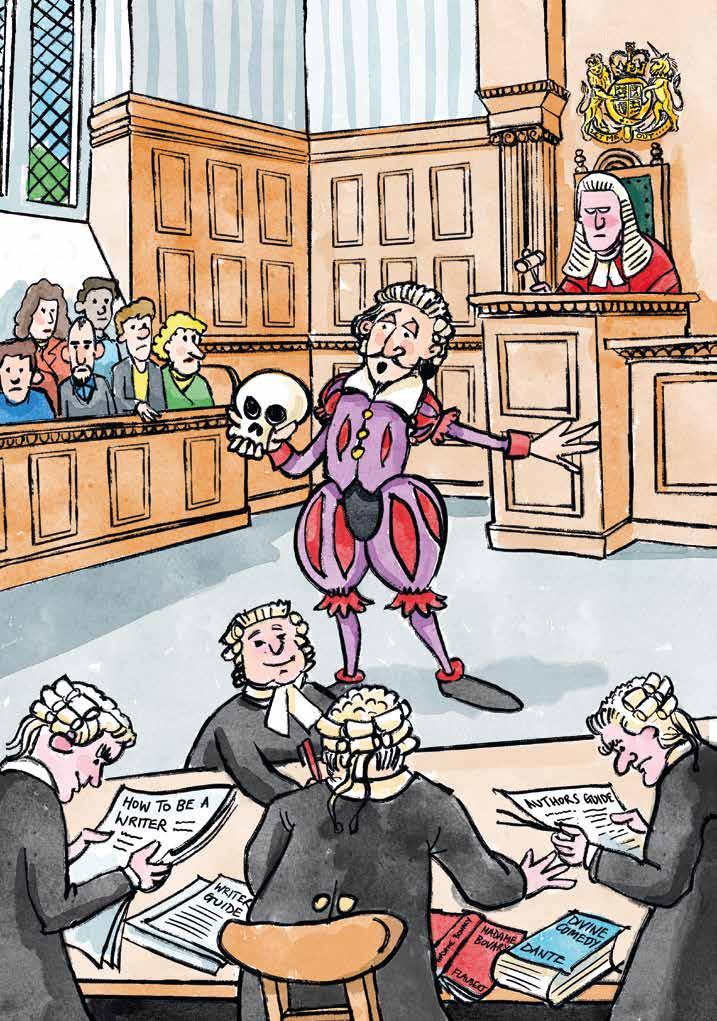
Iremembereverything about the occasion. The little meeting room at Stevens and Bolton LLP, the excellent provincial law firm in Guildford where I had trained for two years. I remember the kindly faces of the HR manager, Julie Bowden, and the partner in charge of trainees Beverley Whittaker. I remember being asked if I would like to take on a seat in the family department at the firm.
This was, to put it mildly, generous of them, since I hadn’t been a particularly good trainee. One reason was that I was just out of university and found it hard then, in ways I wouldn’t now, to relate to the problems clients faced: the need to structure a business, or transact a probate, or litigate a minute point of commercial law. It was hard then, with life just getting going, and owning no businesses and having little money myself, to detect the relevance of it all to my own life.
But really there was a deeper reason for my misgivings about the law. It was the wish to be a writer. To be young is sometimes not to accept the absurdity of our dreams, and I had decided I wouldn’t let go of mine, just yet. But still as I went into that meeting I hadn’t decided for sure what I would say. Mightn’t it be better, if offered a role, to continue to write in the evenings alongside a well-paid job?
At Finito, we often encounter these sorts of crossroads where one’s wishes and commercial reality vie with one another for the upper hand.
I think one often forgets when one looks back that one’s path wasn’t certain – it only seems so retrospectively. In my case, I remember being put the question about whether I’d like to join the firm, and I looked out of the window, vaguely hoping
the answer might lie there. I wanted a prompt.
This almost never works: the answer is more reliably found within than without, a fact which tends to be a bane for the indecisive.
But that doesn’t mean we shouldn’t pay attention to the external world: though it won’t absolve us of responsibility, it’s always giving us hints, if only because its very existence is a constant challenge to our need to live in it.
directly on from this that I had no plan whatsoever about what to do next.
At such points, the world, which had hitherto seemed to hold two options like a sort of everlastingly balanced paradox, alters forever: one way closes, and the reality of the way chosen crystallises. The road I had decided against had contained: 9-5 hours (or longer); likely financial security, though as shareholders in Credit Suisse know that’s never a certainty; the possibility of being a partner in a good firm, like my father and grandfather before me; and the camaraderie of the law, which I have since seen and sometimes envied.
But the legal profession had also seemed to me too staid, too predictable – a toosafe choice for someone who longed to do other things and who only had one life in which to do them.
On this occasion, there were some schoolchildren crossing the River Wey towards the Odeon, on their way to the Friary shopping centre. Had I not looked out the window at that point, I might well have not had a sudden sense of what it had meant to be a child, and what it had meant to dream of the life you want for yourself. Children, I have come to learn from having my own, are visionaries compared to adults: they see time stretching ahead and expect to succeed.
But time has an annoying way of narrowing. John Updike, a writer I would come to admire in my late twenties, called reality ‘a running impoverishment of possibility’. One always vaguely knows this, of course; what is surprising is how quickly crucial choices have to be made when life really gets going after school or university.
So it was that I found myself saying I would leave the law firm. It followed
And the way chosen? It was then unknown, but over time it would mean the writing and publishing of books (a great reward in itself but not exactly the most lucrative of professions); reams of journalism; financial uncertainty; the unexpected need to become entrepreneurial; the chance to meet people from every walk of life; and the feeling, as I write this at the age of 43, that I made the right decision for me.
Nevertheless, I’ve never stopped being interested in the law. And my professional career has involved encounters with the profession to an extent I wouldn’t have predicted back in Guildford all those years ago.
Due to the nature of my own story, I’ve often thought about the relationship between law and literature, a topic which I feel is fascinating in itself, and would merit a book one day, if someone – perhaps me
“ TO BE YOUNG IS SOMETIMES NOT TO ACCEPT THE ABSURDITY OF OUR DREAMS.”
– could find the time and inclination to write it.
It is an untold story about the relationship between two professions, both antagonistic and fruitful, which stretches back millennia.
In order to tell it, you’d have at your fingertips an impressive cast list. Your opening chapter might discuss Cicero, but would also have to delve into the fact that Virgil’s father had wanted him to be a lawyer, but that Virgil turned to philosophy finding the law uncongenial to his temperament. For every lawyerwriter who has found themselves able to incorporate into their writing, there is someone who found that impossible and sought escape.
Fast-forwarding into the Middle Ages, Geoffrey Chaucer studied law at the Inner Temple; for him, coming from an upwardly mobile family, it was an aspect of being a courtier, as it can sometimes be today if you happen to end up somewhere in the unsung Government Legal Department. Dante Alighieri, the author of the greatest poem of all The Divine Comedy, was both a lawyer, and had much to say about law – consigning members of the profession variously to Hell, Purgatory, and Paradise.
This hypothetical work would then have a chapter devoted to William Shakespeare, and try to decide to what extent one might co-opt him to the profession. For many, there is a lot of linguistic evidence within the plays that Shakespeare may have studied law at one time: it was Mark Twain who observed that nothing comes to Shakespeare’s mind so readily as the law, so much so that he decided he was actually the Lord Chancellor Francis Bacon. Conversely, the cry issued by a minor character in Henry VI Part III – ‘Kill all the lawyers!’ – has sometimes been taken as a possible indication of Shakespeare’s low view of the profession, perhaps arrived at after acquaintance with its drudgery. As always with Shakespeare, we know so little about
him that the desire to speculate is irresistible.
And as you go through the centuries, the law keeps cropping up as a profession of writers: in the 19th century and early 20th century, Gustave Flaubert and Henry James. By the 20th century, you have John Mortimer. Today lesser known but fascinating writers like The Secret Barrister, Christopher Wakling, Douglas Stewart and Martin Edwards have all done time – sometimes a lot of it – in the legal profession.
he’d seen such things first hand. Dickens, of course, established a readership in a world when people read books voraciously. That’s not the case today, to put it mildly, making the dream of ‘being a writer’ somewhat heartbreaking, and commercially mad. So what do lawyers-turned-writers think today about the overlap between the two?
For Christopher Wakling, author of six acclaimed novels including On Cape Three Points, Undertow and Towards the Sun, and who worked as a litigator before turning his hand to writing, the relationship between the professions should come as no surprise. “Law is about morality, conflict, evidence, persuasion, point-of-view and precise use of words, all of which applies to story-telling, too … it’s always seemed unsurprising to me that many lawyers also write fiction,” he says.
There is also a sort of watershed moment for the species of lawyerturned-writer around the middle of the 21st century. Before the invention of television when literature was the primary form of entertainment, a writer was more likely to leave the law and establish an income as an author – as Charles Dickens, who would also get a chapter in my book, did.
Dickens had worked as an articled clerk, and if anyone wants to know how interesting he found that, they should read David Copperfield, paying particular attention to the character of Uriah Heep. What he seems to have loathed about the law was its pace, so at odds with the frenetic pace of Dickens himself. But it also put him in an ideal position to write that great satire Bleak House: he could laugh at the slow progress of Jarndyce v Jarndyce because
Meanwhile, Douglas Stewart, author of superb novels such as Dead Fix and Hard Place, specialised in employment law, and founded the immensely successful Stewarts Law, which still bears his name. In his view, it’s important to make a distinction about the sort of linguistic skills required for the law. “To become a lawyer, one of the first prerequisites is having made the most of a good education with particular emphasis on English Language but, in my view, less on English Literature,” he says.
But for Stewart, it’s not so much this immersion in language as the immersion in human nature which the law requires, which can be of such benefit to writers. He continues: “In their daily lives, lawyers (and particularly litigators like myself) have seen the best and worst of humanity. We have the advantage of being able to ask questions and assess the honesty and integrity of answers. Even those who do other legal work such as probate may (rarely) encounter fraud and forged Wills. Dealing with
“TO BECOME A LAWYER, ONE OF THE FIRST PREREQUISITES IS HAVING MADE THE MOST OF A GOOD EDUCATION WITH PARTICULAR EMPHASIS ON ENGLISH LANGUAGE BUT, IN MY VIEW, LESS ON ENGLISH LITERATURE.”
A new generation of tailors serving a new generation of gentleman Bespoke & Ready to Wear clothing, made by hand
 LONDON NEW YORK STOCKHOLM
a cross-section of the community also gives an insight into the lives of the rich and famous through to those who are in need of Legal Aid.”
Stewart also cites other benefits to remaining in the law when it comes to wanting to write. “For me, having the financial security of a job as a solicitor also enabled me to devote time to writing. Very few writers starting out are able to survive on their income from book sales.”
Stewart adds a third reason to juggle law and writing: “Another advantage of being a lawyer is the benefit of travel to broaden horizons,” he explains. “That was certainly true in my case because I have now visited and/or worked in some 80 countries. The benefit of seeing other countries and meeting different nationalities, whether lawyers or not, has been of great advantage to me.”
All this amounts to a reasonably good refutation of my decision to leave the law, and almost makes me begin to wonder whether I made a mistake. I remember when I sheepishly told a friend of the family that I wanted to write when I was in my early twenties, and he replied somewhat brusquely: “Yes, but to do that you need to have some life experiences.”
My answer then is the same as my answer at the time: what about Jane Austen? Austen, of course, isn’t someone anyone but a fool would compare
themselves to. But even so she’s something of a trailblazer in the idea that life experience is one thing you don’t need when it comes to writing book. What you need is an ability with language and plot and an insight into human nature.
However, it’s also clear that Stewart has received great benefit from the law. And he isn’t finished yet, telling me: “Finally, and this is particularly so in the case of John Mortimer QC, involvement daily in the High Court and in particular the criminal courts, is a constant source of amusing anecdotes and high drama. Mortimer used it so effectively – bringing out absurdity,
pomposity, wit and cunning. I could talk for hours about my own experiences in court up to and including now where I sit as what in England would be called an Employment Judge. Most of my books have not actually involved the daily grind of the law, although my early novels did although all involved litigation.”
It is all enough to make one question whether there really are that many frustrated writer-lawyers out there. Christopher Wakling is unsure, saying: “I did work with other lawyers who had literary ambitions, yes. So do lots of other types, though: at Curtis Brown Creative I’ve taught many teachers,
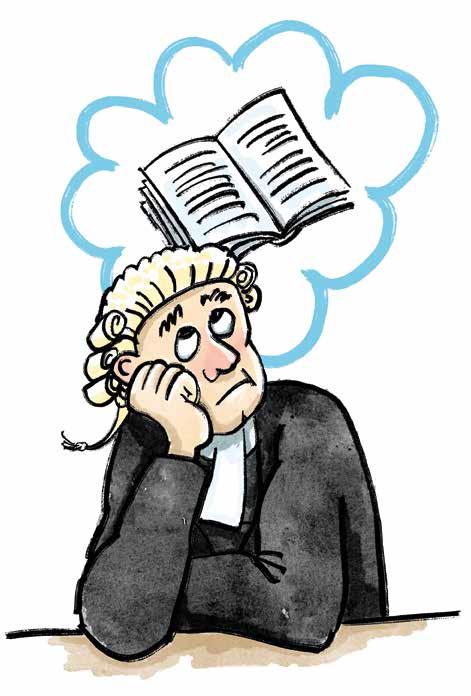
“I WOULD THINK THAT AT LEAST 70 PER CENT OF SOLICITORS NEVER GO TO COURT AND SPEND MUCH OF THEIR DAY PORING OVER LAW BOOKS AND DRAFTING COMPLEX DOCUMENTS.”
journalists, doctors, advertisers, analysts, as well as a fair few lawyers.”
Stewart agrees, adding: “I quite doubt that there are lots of frustrated writers practising law. I cannot give a precise percentage but at a guess, I would think that at least 70 per cent of solicitors never go to court and spend much of their day poring over law books and drafting complex documents. It would drive me mad but they seem to get job satisfaction. That large percentage of solicitors probably does not get much opportunity to consider writing as inspired by their work in the law –because so much of it would be boring to a layman. It takes a different type of legal brain to sit everyday dealing with arid conveyancing deeds or drafting Articles of Association – as opposed to living on your wits and using imagination, essential in litigation –these latter being qualities which will assist fiction writers.”
Even so the brilliant crime writer Martin Edwards, whose books have won multiple awards, has this to say: “I have met many lawyers who told me they intend to write a book once they retire. I doubt many of them have done so. The key ingredient that may sometimes be missing is a strong creative imagination. Personally I think creative imagination is a great asset for a lawyer but I don’t think it’s essential and in fact I think it is lacking in some perfectly good lawyers.”
someone who has been in the law their whole life: on the day the person is about to leave the firm and retire, he overhears someone saying something disobliging about him in the corridor. This chance overhearing leads to a complete panic attack about the choices he has made, and a terrible sense of having wasted the whole of life. My suspicion when I left the law – and it still holds today – is that that potential feeling of waste is worse than any financial or status uncertainty which might be triggered by ‘following your dream’.
Even so, according to Stewart and Wakling, I may have acquired a slightly exaggerated sense of the idea of there being numerous frustrated lawyers out there.
If I ask myself why I might have arrived at this possible fallacy, then I arrive at the figure of my grandfather Neville Jackson (1923-2013) who practised law after the war. A family member might be deemed the opposite of a workable data set: the important figures in our lives loom in outsized fashion, and their example can make us draw a range of generalisations about the world which may be true as to that specific person but insufficiently true about everybody else. In that sense they give a vivid example and a limited clarity, while at the same time distorting our sense of the world.
In this magazine we have a regular feature called ‘Relatively Speaking’ which touches on the perennial question of how the jobs our relatives do impact on the careers we ourselves attempt. If I were writing my own column of this, I would write about my grandfather and my father Gordon Jackson (1952-), who was also a lawyer for many years, ending up as managing partner of Taylor Wessing.
as President of the Westminster Law Society, as well as acting as one of the first film lawyers representing Universal Studios. Through this client, he was able to meet some names of astonishing fame, including Charlie Chaplin, Peter Ustinov, and David Niven. These people didn’t especially impress him, anymore I suspect than some of my generation would be impressed by representing a boy band. His favourite by far was Marlon Brando, who in my grandfather’s telling couldn’t have been nicer; Niven and Alec Guinness he once had to tell to shut up after he caught them arguing outside his office. Ustinov, meanwhile, ‘thought a bit highly of himself’ – something which, for my grandfather’s generation, was very bad form.
At the same time, my grandfather also became a leading expert in planning law. In those days you didn’t have to specialise so much as you do today, which made the profession more attractive for a certain kind of mind than it would be today. His attitude to it all engendered in me mixed views about the law. In one sense, my grandfather could be Eeyorish about it, as he was prone to being pessimistic about many things: humorous disavowal of his own achievements was an undeniable streak of his character. Well into eighties he would opine about alternate lives he might have lived given better luck. He would imagine his would-be life as a farmer, or racing car driver, historian or Latin professor – just about anything besides the successful career he had.
It’s this which I think comes near the matter: the idea that somehow, if you go down the route which isn’t your dream, there won’t be time at the end of it all to make it right.
I remember writing a story once about
Neville died in 2013, and as I approach the tenth anniversary of his death, I find myself thinking of him more and more: he remains a daily reference point against the world. He was, in fact, a very successful lawyer serving
In actual fact, I suspect he had loved his career. “He was certainly much more a lawyer than a farmer,” laughs my father today. “The thing you have to remember about that generation is that, he would have almost certainly done Classics at university, had it not been for the Second World War, so there was that sense of a road not travelled for all those people who had fought and won the
“ THE KEY INGREDIENT THAT MAY SOMETIMES BE MISSING IS A STRONG CREATIVE IMAGINATION.”
This in turn makes me recall a copy of Horace’s Odes which was handed down to me after my grandfather’s death: it sits on my shelf now like a set of intentions he never quite got around to. It’s an interesting point to note when we see the widespread discussions in Westminster today surrounding apprenticeships and skills that it has already been tried on my grandfather’s generation.
And tried, it must be said, with some success. They rebuilt the country, and expertly ‘got on with it’. For the postWar generation, the theatre of battle had been their university and I remember my grandfather being pretty unsentimental about it. Naturally bookish in any case, he never had any trouble educating himself.
In those days, the interview process was extremely literary, reminding me that law and literature were bound up then in ways which would be gradually ousted in the second half of the 20th century. My grandfather once told me there were only two questions: “Do you like English poetry?” When my grandfather replied: “Yes”, the second question was: “And do you like this modern stuff?”, presumably referencing things ike TS Eliot’s Wasteland. When he shook his head adamantly, replying “Oh no!” he was offered the job.
It is an image of how rapidly the world has changed and how in those days, it would have been far easier than today to juggle the career of a writer with a daytime job as a lawyer. My grandfather was articled, my father now tells me, to one Sir Samuel Gluckstein, who had a successful career as a lawyer, and an unsuccessful career as a politician, failing three times to win a parliamentary seat in the interwar years. Perhaps it was Sir Samuel who came up with those questions all those years ago.
Of course, the case was different for that generation. In those days, there was real money to be made in writing, and so there wasn’t quite the same necessity today’s writers experience of needing a ‘day job’ or a ‘paying gig’ alongside what they really want to do. Today’s generation of writers has it harder both ways: there is limited market for books, and the jobs you need to do to earn a living while you write them have also become more specialised and therefore more consuming.

In post-war London, the life of a lawyer has an undeniably leisurely feel. The day would begin, or so he told me, in postwar Piccadilly, with the opening of one’s physical post – without the constant demands of emails whizzing back and forth. One imagines offices of relatively uncluttered desks – and uncluttered minds.
Lunchtimes would be spent patrolling the streets of Piccadilly, pursuing his other great love: Persian carpets. The afternoon might involve a client meeting, then a sedate train journey home. No doubt there was work to be done, but how quiet and untroubled it seems compared to what it is today.
For my father Gordon Jackson’s generation, the Reaganisation of the law had come along, and the profession was no longer the sedate gentleman’s sport it had once seemed to be. It was the era of Wall Street, of Gordon Gecko and big deals – all of which seemed to suit my father, whose energy continues today in his seventies, now diverted away from the law towards his great passion for the Surrey Hills. While being a talented photographer, he was able to practice the law without constantly imagining himself in other careers. He rose to be managing partner at Taylor Wessing, moving offices as his last hurrah before disappearing into a life animated by passion for a locality he had seen too little of while commuting into London and back for the previous decades.
There was an element of Walter Mitty in my grandfather’s makeup – a tendency to wonder aloud about other lives, and insodoing to create little moments of escapism for himself. But it was all along an inconstant vein of fantasy which
“MY GRANDFATHER ONCE TOLD ME THERE WERE ONLY TWO QUESTIONS: “DO YOU LIKE ENGLISH POETRY?” WHEN MY GRANDFATHER REPLIED: “YES”, THE SECOND QUESTION WAS: “AND DO YOU LIKE THIS MODERN STUFF?”Unsplash.com
could make him imagine other lives but this streak was never stubborn enough to nudge him into a creative career. I remember his second son Andrew, also a lawyer, when he was dying of cancer in 2008, saying of my grandfather: “Well, he was a born lawyer, actually.”
The same could not be said of me, in whom its practice caused resentment. I sometimes imagine that the law gets an unusually bad press in English literature partly because it is written by people trying to escape it.
Yet leaving the law didn’t mean that I got to escape it: in fact it only altered the way in which I enacted with it. Having completed my journalism studies it looks inevitable in hindsight that I turned out to be especially suited to legal journalism, starting out at one of the directory companies which publishes among other industry publications, the Legal 500, which I joined in 2011. The job was often very dull – but I found I could do it quickly and ably, and still have time leftover for the writing of books. Open at my desk would always be the Legal 500 document I was working on – a summary of the solicitors working in family law or tax law or for the US Supreme Court – and a book of poems, which I would tinker at all day long, headphones in, surreptitiously
determined on things other than the job I was ostensibly there to do.
That book of poems, which would eventually be called The Gallery, would be published by the University of Salzburg in 2013, about three months before my grandfather’s death. I remember, though he was emaciated and very sick, that when I showed it to him in the hospital, he did a very good look of wild surmise, eyebrows raised with delight. I always think how that book arrived just in time.

But what I didn’t know is that many of the people I was writing about in the directory chapters would turn out to be people I’d get to know, become friendly with, and learn from as my career proceeded to the deputy editorship of Spear’s magazine, and beyond.
The private client beat in London turned out to contain a marvellous cast of characters, quite distinct in glamour from the sort of people, much as I liked them all, who I had seen at work in Stevens and Bolton.
Private client always seems to me, because of its personal nature to attract delightfully wacky individuals. Having got to know the people who work in tax and trusts law, art, divorce and reputation, I can see what a desirable life it is, if you happen to be constructed that way.
Here we find the always sumptuously dressed Baroness Fiona Shackleton,
sweeping into the boardroom, in a blaze of colour, but always giving kindly attention to me as a young person and almost certainly the least important person in her day, though you could tell from her energy that every day was equally busy. Then there was Mark Stephens CBE, who’d always greet you with a ‘Hello, mate’ and always hint at a zone of confidential knowledge which was his and his alone which he was quite unable to share while seeming also to share something of the thrill of it all: a sort of legal Willy Wonka. With Mark, possible disclosures seemed to whizz by: the identity of Banksy, what Rolf Harris had really been like, what it meant to consider litigating against the Pope. He’d fascinate you, then leave you standing outside the gates of confidentiality, wondering what he really knew. All this seemed desirable to me in a way that provincial law had never done. In short, I began to be interested in the law at a point when I had moved too far away from it realistically to return.
True, it wasn’t always enviable. Family law, in particular, perhaps because of the deeply contentious nature of cases, seems to give rise to rivalry which often spills over to animosity. It was a world dominated by the Queen Bees – Fiona, Helen Ward, Sandra Davis, Diana Parker, Frances Hughes – all of whom I grew to like personally, but then became aware that they were often at loggerheads, and in some cases, mortal enemies.
The men involved – the charming Stephen Foster, the wise and kindly Michael Gouriet – seemed to be sitting to one side, watching all this gladiatorial combat rather wryly, ultra-smart men bemused to have landed somehow in a woman’s world.
And the money was undeniably attractive. There were the lunches (‘Would it not be criminal if we didn’t begin with a glass of something rather good?’ as one partner put it to me once);
“I SHOWED IT TO HIM IN THE HOSPITAL, HE DID A VERY GOOD LOOK OF WILD SURMISE, EYEBROWS RAISED WITH DELIGHT. I ALWAYS THINK HOW THAT BOOK ARRIVED JUST IN TIME.”
there was the tennis with Stephen Foster at the O2 when, having written an entire book about Roger Federer, I finally got to see him play (and win) thanks to Stephen’s exceptional kindness and thoughtfulness; and the general sense that this, and not literature, was the good life. I could never after all the experiences I had quite concur with ‘Kill all the lawyers’ and never any longer imagine Shakespeare had ever agreed with it himself.
The Legal 500 was also international, meaning I would travel to Japan and Israel, meeting lawyers who had built astonishing lives overseas: young people mulling a legal career should know that it’s hard to think of a career which has such readily available international opportunities as the law.
My favourite beat was the US trial lawyers and US Supreme Court. It was the French philosopher Jean-Jacques Rousseau who stated in his Confessions that if someone were to peer into the heart of man, he would want to travel down in life and not up: Rousseau was peddling the idea that the successful are necessarily hard-hearted. He was wrong about that just as, so far as I can tell, he was wrong about more or less everything.
Certainly, that US beat taught me that the opposite is frequently the case. People do well in life because they’re kind and polite, and therefore people want to work with them – and promote them. I noticed when interviewing the very top lawyers, those who’d argued 40 cases before the Supreme Court, or risen to become name partners of New York or San Francisco firms, and find them delightful. In my experience, it was the person who was toiling as a debt recovery solicitor in Derby who was rude – and there was a strong sense that being rude was why they’d ended up in that position.
Sometimes, there would be comic moments. I remember one lawyer boasting about his representation of Lance Armstrong one year; by
the following year, by which point Armstrong had been disgraced by his cheating scandal, he affected not to remember ever having done so. Young lawyers may not know that one day they’ll be required to ‘go after’ clients. I remember having coffee with Jenny Afia of Schillings several years ago, telling me with steely determination her desire to represent Meghan Markle. She now does, and when I found this out by watching her appear on Netflix documentary about the Sussexes, I remember thinking it was never in serious doubt that she would.
‘No genius is required for the law except common sense and relatively clean fingernails,’ as John Mortimer put it. As usual, he was joking. Actually, much more is required and I would sometimes glimpse it in these individuals I was privileged to meet. All were immaculately dressed, with the possible exception of Stephens, whose dishevelled look was part of a sort of Columbo-ish charm, making him the exception that proved the rule. I remember Fiona's brisk manner, the way she filled a room, and how any client would feel that they were buying, alongside legal nous, an tigerish indefatigability allied to kindness. I recall how Frances Hughes, meanwhile, had a sort of detached cool which I sensed could easily turn terrifying. And I don’t think I’ve met anyone quite so precise as Helen Ward, someone who seemed to take such care over everything – language, manner. It was as if she took note of what was required in each successive moment and expertly provided it.
No doubt this form of precision was
all along what I was lacking. Creativity, when we are in flow, still has a slight flavour of throwing things at the wall and seeing what sticks. You might subsequently revisit and refine, but creation just isn’t like the law; I think in its essence it’s too impatient. My grandfather had a sort of deliberation about him which meant that when he did finally get around to painting he did it slowly: I could never understand why he wouldn’t work on a canvas every day. But just as it wasn’t in my nature to be a lawyer, it wasn’t in his nature really to be an artist or a writer.
Similarly, my father whose energy reserves are considerable, has an ability I can hardly fathom to be confronted with a document and laser in on the detail which will prove problematic later, and to engineer the words to tweak that contingency and solve the problem. There’s a bit of clairvoyance about the law; a need to pause in the present, peer round all the things which are likely or even unlikely to happen, and to pin those down to the advantage of the client.
For writers, getting into a flow in the present is more important than getting too hung up on where the book is going. When Gore Vidal wrote Myra Breckinridge, he had no plan. He simply wrote: “I am Myra Breckenridge whom no man shall ever possess” and went from there. It had the flavour of something to be getting on with. Today, I realise that my life then is impossible to imagine without law – it has enriched me and frustrated me in more or less equal measure. But if I could go back to that twentysomething years ago, and be at his shoulder in the room in Stevens and Bolton LLP at the moment I was offered a job in the divorce department, with the opportunity to reverse his decision, I wouldn’t interrupt him.
Growing up in Surrey in the 1990s, you could be forgiven for thinking the future was American: there was the easy triangulation rule of Bill Clinton; the popularity of Seinfeld and Friends made even people who had grown up in Woking talk with a slight New York accent; grunge music reigned supreme as, in literature, did the books of Updike, Roth and Bellow. It was such a certainty that I remember vividly when the assumption was called definitively into question.
In 1998, touching down in Mumbai for my gap year, I had never seen so many people vying for space: a veritable carnival of joyous activity. Standing outside a McDonald's, I dropped an enormous wad of rupees on the floor, and found nearly 30 natives of that marvellous city jostling to help me pick them up and return them to me. Their
unanimous kindness and bemusement at my panic stays with me to this day.
I knew then, without being able to formulate it clearly, that the future might just as well belong to India. Whatever one thought of the vote to leave the European Union in 2016, nobody who witnessed the debates at that time will have forgotten the promise of a new era of international trade and fabulous global opportunity. Not even the most ardent Brexit supporter would think that this promise has been made good on. In the last years, and especially since the end of the Johnson administration, things have gone eerily silent on this front. To find out why, and to gauge the possibilities of the future I speak to Dinesh Dhamija, the former MEP, and the founder of the online travel agency Ebookers. Dhamija
is gearing up to the publication of his important book The Indian Century.
Dhamija grew up as the son of an Indian diplomat and had the peripatetic upbringing such children do, spending time in India, Mauritius, Afghanistan, Czechoslovakia and the Netherlands. This background, together with his business success and experience of the European Parliament, is what makes him such a compelling commentator on UK-India affairs.
Dhamija explains to me the mood in India today. “People who live there are all very entrepreneurial and innovative – you have to be when the pot of gold is so small and there are so many people competing for it.” India recently overtook China as the most populous country in the world. The demographics create, says Dhamija, a particularly
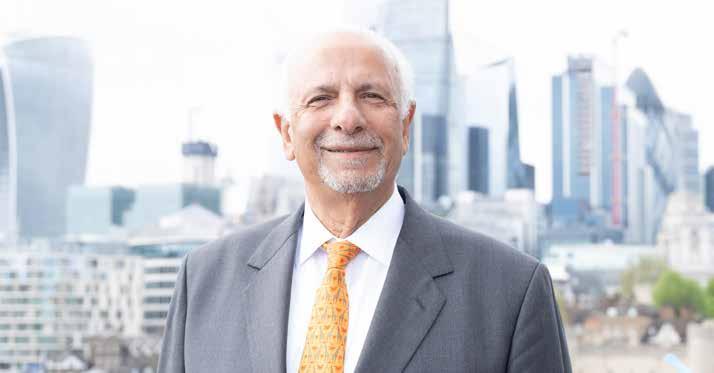
“THIS CAN BE DONE IN A DAY”
exciting landscape of innovation. “They see millionaires on the internet – Modi hasn’t blocked that like the Chinese have. And they watch programmes like The Shark Tank and Dragon’s Den and then they say: ‘What about me?’”
This ambition has created some astonishing success stories: “There are now 100 unicorns in Indian – those who started a business and within one year are valued at $1 billion dollars. This means if they sell ten per cent, they’re worth $100 million. Of course, that’s not Indian money,” Dhamija continues, “but usually money from the United States, or perhaps Singapore.”
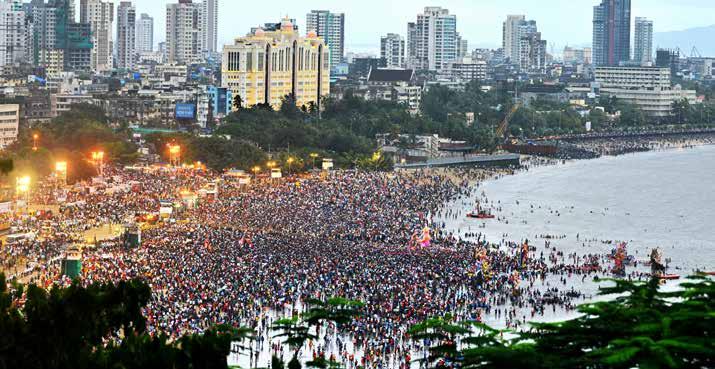
It’s also important to consider the youthfulness of the Indian population: “In India, 65 per cent of the population is under the age of 35,” Dhamija explains. “They’ve got energy – compared to China and also compared to the West. It’s all: ‘Let’s get this – do that’.”
Of course, before discussing the possibilities of a trade deal between the two nations, it is important to consider the precise nature of the colonial inheritance from the perspective of India: “India in 1700 had 23 per cent of the world’s GDP, and was the richest country in the world,” Dhamija tells me. “When the British left, India had three per cent of the world’s GDP. In 250 years, it went from riches to rags.”
Is there a psychological difficulty then, I ask, for Indians when it comes to doing a trade deal with their former colonial rulers? Dhamija is philosophical. “One thing about history is that as time passes, you forget things. History is written by the victors. When I was doing A-Level history in the UK, we never learned about what was happening in the colonies good or bad.”
So are the elites who forge trade deals liable to take a relaxed view of the past? Dhamija takes a nuanced view:
“It depends on the politics. From the Indian point of view, they’re going to say: ‘We’re not going to sell ourselves down the river.’ Or they’ll say, ‘We need something back’. You might also hear history professors say that the UK took $45 trillion dollars of money out of India in today’s money – but if you only pay heed to such voices, then you’re never going to have a trade deal.”
That’s why, for Dhamija, it needs to be clearly spelled out what a trade deal would mean: put simply, it’s the single biggest economic win which the Sunak administration could post on the board before the General Election next year. “The pros are that the UK will have an extra 300,000 jobs within three years –and these are new jobs.”
And the situation, Dhamija explains, will be even better for India: “Because of
“IN INDIA, 65 PER CENT OF THE POPULATION IS UNDER THE AGE OF 35... THEY’VE GOT ENERGY –COMPARED TO CHINA AND ALSO COMPARED TO THE WEST.”
PROS ARE THAT THE UK WILL HAVE AN EXTRA 300,000 JOBS WITHIN THREE YEARS – AND THESE ARE NEW JOBS.”
its purchasing power it will have many more – perhaps a million.”
These figures are eye-catching and Dhamija is able to take you through his calculations from a perspective of deep experience: “I was head of the India desk for the European Parliament, and we made our workings then. For each trade deal which the EU signed, within three years, its trade doubled. We also worked out that for every EUR60,000 of new exports, you create one new job.”
will a deal happen? Dhamija charts the progress so far: “Even though I don’t like Boris, he could have done it,” he says. Whatever faults Boris suffered from, he never lacked ambition, just as he was rarely bereft of modesty.
But what then ensues is a recital of three own goals by the UK government which add up to a compelling portrait of incompetence. “When the trade delegation was here, Home Secretary Suella Braverman came out with her line that the worst culprits in overstaying their Visas are the Indians. The delegation packed up and left. That was last September.”
Own goal number one. And number two?
“In January, the BBC put out a two part documentary series on the 2002 Gujarat riots and its conclusion was that Modi was culpable of homicide. That really screwed up the talks,” recalls Dhamija.

And here’s own goal number three:
us feel good.’ And I agree with that.”
What’s frustrating about the above is how easily it could all have been prevented: inexperience on the part of the Sunak administration perhaps. In relation to the Braverman gaffe, Dhamija argues that the Cabinet Secretary needs to give a simple instruction that no politician should comment on the matter until the deal is done. “Trade has got nothing to do with immigration,” he adds.
The second own goal might seem a bit more complicated on the face of it, but Dhamija is clear: “The Chairman of the BBC was appointed because he got a loan for Boris. All the trustees of the BBC are government appointees. How can you say it’s a separate arms-length organisation?” In relation to the third own goal, it’s a no-brainer to have better security at the Indian Embassy.
With the current UK export to India being £12 billion a year, you can expect that to double on the back of a trade deal. “That leaves £24 billion,” continues Dhamija. “Divide that extra £12 billion by 50,000 and you come up with approximately 300,000 jobs.”
This sounds extremely exciting. But
“About two months ago, a group of Khalistanis were protesting outside the Indian Embassy in Aldywch, and one of them climbed up and took down the Indian flag – an insult, according to the Indians. They said: ‘Try doing that to the Chinese or the US embassy and see what happens. You want a trade deal with us, you do something which makes
With this sort of thing going on, a shooin has now become unnecessarily stodgy. “There are people who want the trade deal to be done; there are people who don’t,” Dhamija says. “People in the UK need to know what the advantages of a trade deal are – and that includes the civil servants who either haven’t done the calculations or don’t know how to do so.”
So is anyone actively opposing it? “Anyone
“WITH THE CURRENT UK EXPORT TO INDIA BEING £12 BILLION A YEAR, YOU CAN EXPECT THAT TO DOUBLE ON THE BACK OF A TRADE DEAL.”
who’s ignorant about it,” replies Dhamija, pithily.
It seems especially odd post-Brexit to be having this conversation. We hear about Sunak’s minor wins in the Pacific and in Japan, and see much keening over the question of our failure to make progress over a US deal, but little coverage related to India. “The US wants access to the NHS,” explains Dhamija. “We’re at ‘the back of the queue’ as Obama put it –there’s no special relationship when it comes to a trade deal. We’ve done a trade deal with Australia which was horrendous for us simply because we wanted to show there was a trade deal in some form or other.”
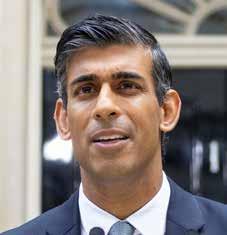
All of which ups the stakes still further on the question of India. Why has there been loss of will? “No one explains it,” says Dhamija. “Nigel Farage is blaming the politicians. Meanwhile, India knows the UK needs it more. The Tories sometimes respond by saying that we have record low unemployment but look at how many people have gone out of the workforce –the over-50s, about 20 per cent have gone out of the workforce. We need not only strawberry pickers but people in the NHS, architects, engineers. They’re not giving the right figures to everyone.”
And what is Modi’s position on the deal? “Modi wants Make in India –meaning that everything should be manufactured there. If he wants to buy something from the UK, he’d like some aspect of it to be made in India – a technology transfer sort of thing. Secondly he knows that Chinese
income has gone up by seven times per capita in the last 50 years. India will go up by at least four times in the next 10 to 15 years. Starbucks and Prêt à Manger recently opened. Amazon’s second largest operation after Seattle is in Hyderabad.”
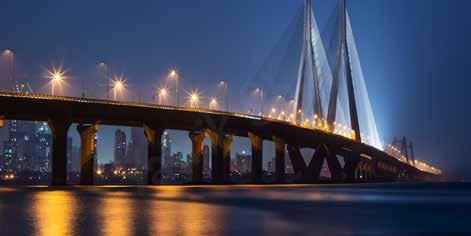
Encouragingly, Dhamija explains that the sector-specific sticking points have largely disappeared on both sides. Concerns about whiskey and wine have largely been taken care of. “It’s political will now. It could be done in a day. If Modi says: “Do it”, then Sunak says: “Do it”, it will be done in a day. We need that sledgehammer. At the moment, they’re not focusing on it and finishing it. It was meant to be done by Diwali last year. Civil servants will always find a comma or a dot on an ‘i’ or a cross on a ‘t’, but a deadline is good.”
Why did Boris seem more suited than Sunak to the task? Dhamija sighs: “He has more bluster. He would hug Modi; it was a personal relationship perhaps. Rishi can’t seem to do that: he’s far younger and he’s diminutive compared to Modi – by which I mean, physically slight, not in terms of intelligence of course. I think you have to do it at the spur of the moment. You sit together and say, ‘Can’t we do this dammed thing? You want the Koh-i-Noor diamond – here it is!’”
How big an issue is the return of the diamond, currently set into the crown of Queen Elizabeth, the Queen Mother as part of the Crown Jewels on display at the Tower of London? “It’s bigger than the whiskies or the cars, as that’s all been dealt with” Dhamija concedes. “But the
whole of the British Museum is full of looted stuff, so everyone will say: “Give us the Elgin Marbles” and so on. But the moment the UK says it will give money, they’ll ask for more. Really, it’s a question of saying sorry and the UK still hasn’t done that successfully.”
When I think of India, I consider how much I love it: the nation’s fascinating obsession with cricket; the batting of Tendulkar, Dravid and Sehwag; the novels of RK Narayan; the Amaravati Marbles (also in the British Museum as it happens); the Falaknuma Palace at Hyderabad; the four days I spent doing not much next to the Taj Mahal in 1998; the Ganges at five in the morning, the sun rising to draw back the curtain on another unfathomable day full of the teemingness of India.
Could a politician ever evoke India to try and bring our relations closer together? Dhamija is pessimistic. “That ability’s not there. They’re politicians and they fear being criticised for selling the UK down the rivers. But if it’s done as two guys –Modi and Sunak – getting on well, and if we talk always about the possibility of those 300,000 jobs – then we can do it”
Spending time in Dhamija’s company makes you feel that it just might be possible – and definitely that it should be. The ball is in Rishi Sunak’s court now. If he wants to win the next election, it’s pretty clear what he needs to do.
 BY CHRISTOPHER JACKSON
I’ve often thought that spring has its secret pitfalls. Every time the moment of the clocks going forward comes round, I always think, remembering Shakespeare’s Julius Caesar: “Beware the Ides of March.” And it was, of course, TS Eliot who wrote of April as ‘the cruellest month’ when the promise of spring cedes instead to rather a different reality.
So it went in 2023. I woke to Budget Day on the 15th March to news that the government would extend the free 30 hours of childcare to those with children aged one and two. Given that I have
a daughter who has just turned three, this development put me in mind of the Philip Larkin line:: “Sexual intercourse began in 1963/ (which was rather late for me)”. Many parents woke to news that the money which had essentially constituted a second mortgage was not money they’d have had to spend had they elected to have children a few years later. As Kurt Vonnegut put it: So it goes.
Nevertheless, although the policy won’t come in until 2025, it represents a possible alleviation for many households where the incentive to work is dramatically reduced by the cost of
nursery fees. I filled out my forms with Southwark Council with the sort of passion and alacrity which, to put it mildly, I never attack my annual tax return.
I should add that the policy, announced by Jeremy Hunt, also represents a personal triumph for the brilliant MP for Stroud Siobhan Baillie; Baillie was rightly thanked in the Chancellor’s speech.
But progress is always incremental; and nothing ever straightforward. While the policy was delayed until 2025, there was another irony. The commitment by
Chancellor of the Exchequer was aimed at encouraging work since the 30 free hour entitlement is available only to households where both parents work.
But on the day of the announcement, the teachers’ strikes meant that for those with children in reception or higher, it was another day – after so many during the pandemic – where work needed to be set aside by at least one parent in order to create a day for a child – or children – not in school.
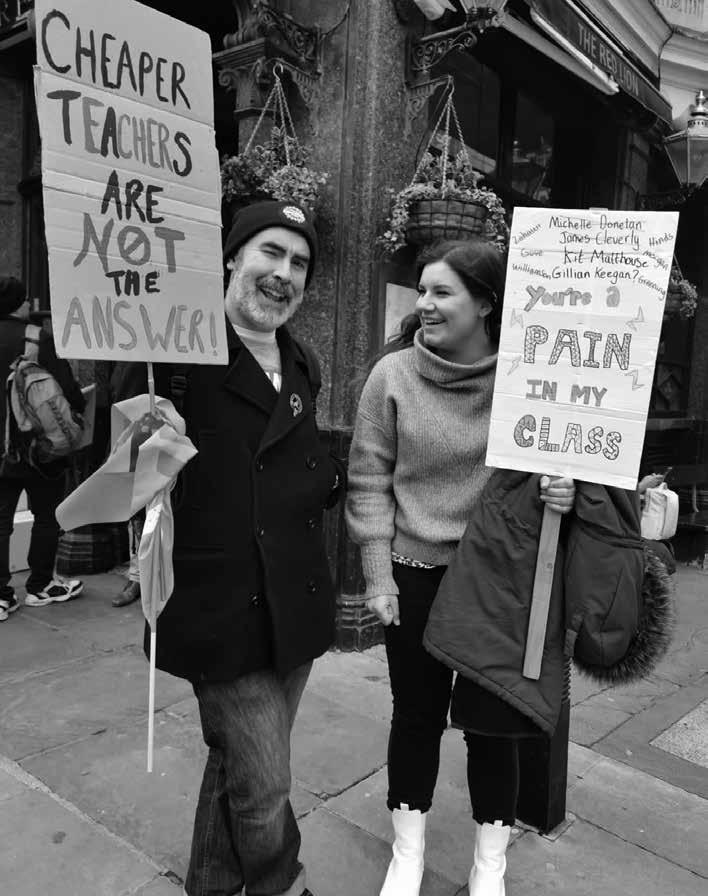
And so what do working parents feel about the strikes? You might think that there is widespread moaning about the fact that teachers have secure jobs, and that if they have elected to enter the profession then they ought to be there for the children. Sometimes this does happen, but I think more generally when parents give vent to this sort of resentment it is as pandemic parents who have just had too many bad breaks these past few years.
But more generally, the opposite is the case: the parents I speak to worry about the effect on their children’s education of their teachers being in a state of anxiety
over wages. At our children’s school in South East London we adore our teachers, and though we sometimes do experience stress because of the strikes, we are also aware of what it’s like when bills go up but wages remain stagnant: there is a helplessness to that situation when you work in the public sector which, in theory at least, you don’t have if you work in the private sector where there is meant to be more elasticity on salary.
But of course, this isn’t just about teachers. It is also about parents who are on zero hours contracts and so really can’t manage a strike day in the same way which many workers with understanding bosses can. It’s also about the whole ecosystem of the school which, underfunded as it sometimes is, is still the heart of the life of the community.
As always when hardship comes along, there are heartening stories. Some parents manage friendship-deepening play dates in central London – but again they’re the lucky ones who have flexible jobs, understanding employers, and the funds to do so.
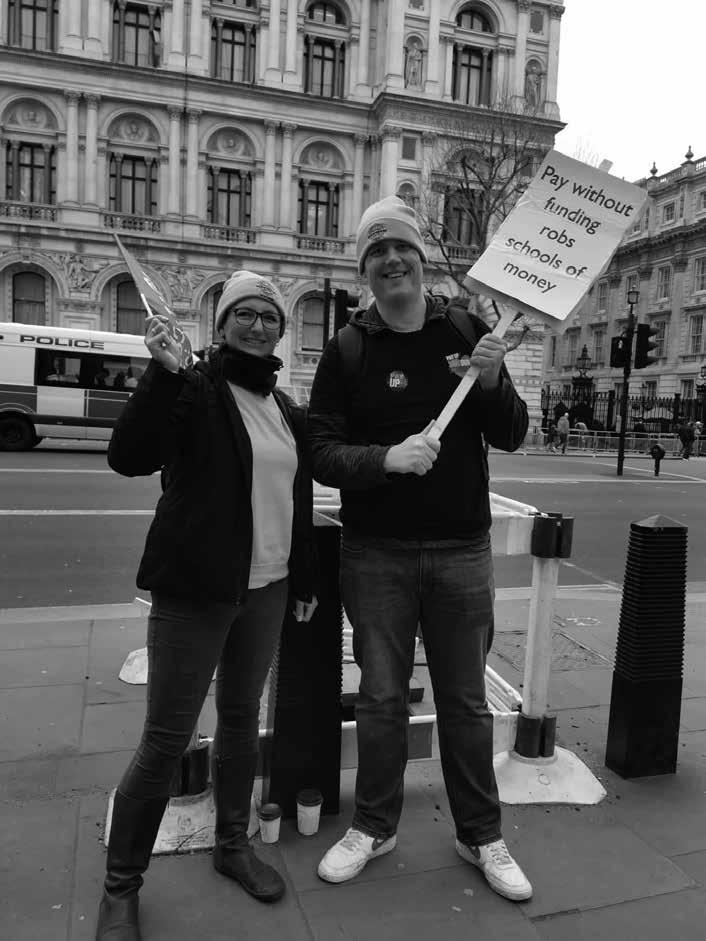
Near where we live, East Dulwich Picturehouse screened cartoons throughout the strike days on 15th and 16th March at affordable prices. Many parents have become engaged in thinking of creative ways to help their community; whether it be through playdates, fund-raising activities, or just simple words of support to teachers. Many join them on the picket lines. Of course, the private schools remain open, and this leads to an acute sense of a two-tier system where children from backgrounds who can’t afford it are being left behind unable to learn. Meanwhile, fee-paying schools can be seen continuing as usual: the lines are drawn vividly on strike day between the haves and the have nots. One sometimes wonders if the future is already being won and lost on such days, even if you have very young children, as I do.
Of course, while there’s life there’s hope, and a strike day can be as good as a school day if you can take your child to a museum, or some other activity. Even so, all these problems seem so intractable that they are crying out for the clarity of photography. In the photographs which accompany this essay we hope to cut through the complexity to arrive at images which show the simple truth of our times. We see the empty classrooms where light from a beautiful spring day falls not on the faces of children but on empty furniture; we see the thoroughfares of a local school, usually frantic with parents in the rush for drop-off now vacant, the trees almost seeming to ruminate on an unexpected quiet; we see a lone parent
doing nursery drop-off, as testament to the way in which schools and nurseries sometimes feel like separate ecosystems in our society.
It is an image of a struggling society. And with that it isn’t Shakespeare who springs to mind, but Yeats with his line that; “Things fall apart/the centre cannot hold.” This is a country which hasn’t fallen apart, but there is the sense that without smart moves from the Sunak government, it soon could.
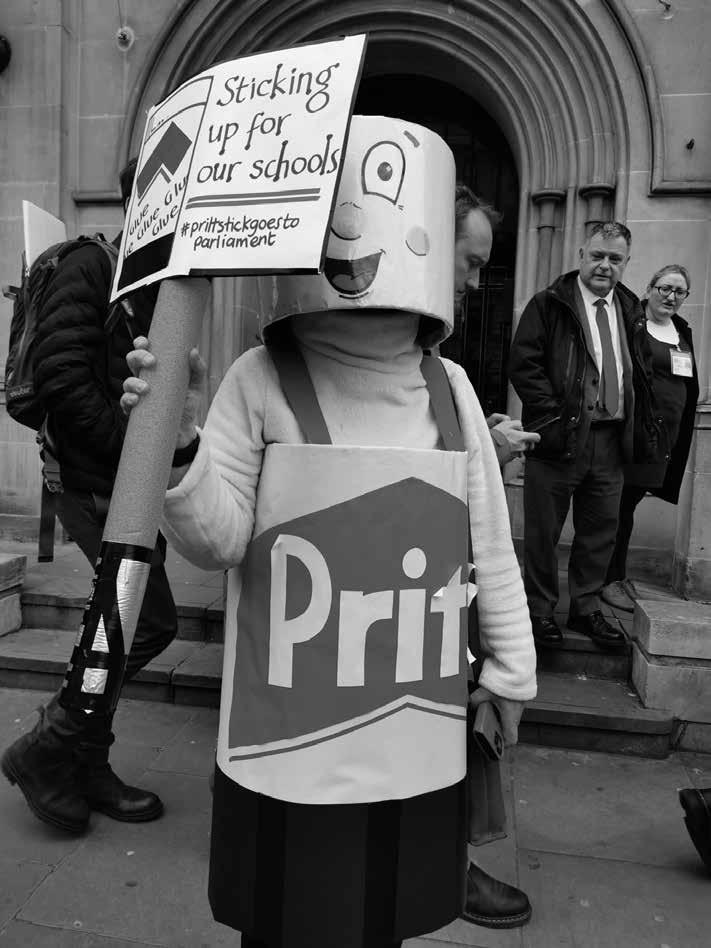
“THIS IS A COUNTRY WHICH HASN’T FALLEN APART, BUT THERE IS THE SENSE THAT WITHOUT SMART MOVES FROM THE SUNAK GOVERNMENT, IT SOON COULD.”
THE CELEBRATED PHOTOGRAPHER GEMMA LEVINE IS TAKING THE FIGHT TO LYMPHOEDEMA. HERE SHE, AND THOSE WHO HAVE JOINED HER IN HER CAMPAIGN, EXPLAIN WHAT YOU CAN DO TO HELP.
Lymphoedema is a hidden epidemic. It is one of the least recognised illnesses among both doctors and patients. There is no cure, but there is effective treatment and it can be self-managed. The signs are unmistakable - with severe unsightly swelling , perhaps in the arms, hands, face, legs and/or feet. I contracted this disease straight after my breast cancer operation, as do 40 per cent of women who have Lymphoedema, suffer from the same cause. But, most importantly, one can lead a full and active life, as I have done.
Being a portrait photographer for half a century, I used rather weighty equipment: Hasselblads and Leica. But having been through the trauma of chemotherapy and radiotherapy and subsequently finding my right arm immensely swollen and feeling heavy, I found that I could no longer lift or hold heavy items. Therefore, I thought my career as a photographer had come to an abrupt end.
What was I going to do with the rest of my life? Apple were most obliging. I went to head office and explained my circumstances. They showed me all their iPads and gave me one on trial. Since then, I take images with both iPads and my iPhone. Admittedly the results are not as professional as my Hasselblad images, but the equipment is light enough for me to manage. Having said that, I have not looked back. I’m not doing too badly, having published five books since becoming ‘semi-disabled’ . There are other problems related to not
having the use of my right arm and hand: ordinary things that one doesn’t normally think about. For example, using a kitchen knife and trying to slice; cutting with scissors; removing hot dishes from the oven; reaching high shelves is an impossibility; showering, holding a bar of soap which slips out of my grasp; washing my hair with one hand! With the swelling of the arm, I have given up on tight T-shirts and have to try on garments that have fitted sleeves. And so on . ….Men that have Lymphoedema in their leg(s) have problems buying trousers that are wide enough. They do not like to wear shorts. With swelling feet, in some cases people have to have custom-made shoes. Or just wear sandals, even in the winter months. And so on ……
Flying is questionable. I will not fly more than two or three hours as my arm swells, becomes heavy and I have to keep it elevated. So, my friends, my life has changed somewhat dramatically, but being a positive person I most certainly make the most of my time.
I work in conjunction with St George’s Hospital and raise funds for research which in my opinion is vital. Since I first contracted Lymphoedema, and discovered that no one I knew was aware of it, I went to meet Professor Mortimer, professor of dermatology and world-renowned expert in this field. We discussed collaborating in writing a book and in 2017 it was published and became a best seller – even to this day. It’s called: “Let’s Talk Lymphoedema - An essential guide to everything you need to know”.
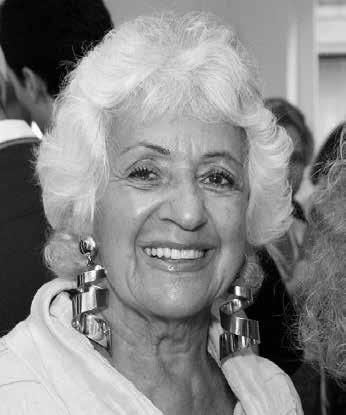
I have since published five more books, raising awareness for Lymphoedema and a seasonal calendar and greeting cards. I created entertaining events, with famous personalities, all for raising awareness. This has proved immensely successful. However, it seems I am the only person in this country with this passion, therefore anyone who would wish to join me, and continue my work and gather funds for research, please be in touch: I would be delighted.
We are struggling to raise the research funds to find a cure for Lymphoedema, but there is a ray of hope. While making a speech at the National Institutes of Health, I learned that researchers may one day have the opportunity to discover the pivotal role of the lymphatic system in the treatment of cancer metastasis, AIDS, auto-immune diseases, obesity, cardiovascular disease, organ transplants as well as those of us suffering from cancer-related Lymphoedema or
congenital Lymphoedema. Researchers’ discoveries may unlock a Pandora’s box of cures for a host of diseases. These pathological heavy hitters might finally draw attention to our plight, the plight of millions. I look forward to that day.
Lymphoedema is one of those conditions whose name makes it sound obscure, marginal. But it isn’t: it strikes everywhere and anywhere and is shatteringly debilitating. We need to take it very seriously indeed. It savagely attacks one of the body’s most astonishing and indispensable mechanisms, the lymphatic system, the superbly engineered network of locks and pumps that transports necessary nutrients to the cells, all the while collecting and disposing of waste products, bacteria, and damaged cells. This is not too fanciful an image: it’s very name comes from the Roman goddess of rivers, Lympha. It is a crucial key to health: when the system breaks down, Lymphoedema ensues, painfully swelling the limbs; sometimes the face, the neck and the abdomen may also be affected. It can cause skin infections and growths, difficulty with movement, even leakage of water through the skin; in extremis, it turns into elephantiasis.
We know what it is; we know how to contain it. What we don’t know is what causes it. Investment in research is urgently needed: nearly a quarter of a million people are affected. Acquainted as I now am with the profile of Lymphoedema, I realize that my grandmother, who was plagued with cellulitis, her limbs, ankles and joints severely inflamed – one of its other frequent symptoms – must have been a sufferer. Her life was hell as a result of it. We could relieve many of her symptoms now. But we’re still no closer to prevention.
Over many years I have known a few friends and acquaintances who were unlucky enough to have had mastectomies or in some cases, ovarian cancer. After operations, most were left with either badly swollen arms or, in the case of the latter, swollen legs. I felt extremely sorry for them that having been treated successfully for their cancers, they should have to endure such discomfort and unsightliness with the affected limbs. Never in those days did I hear the word Lymphoedema mentioned, and it was only due to a great friend mentioning that her mother-in-law had been suffering from Lymphoedema for over twenty-five years that I became aware of it, and how debilitating it is. This is a horrible and life-changing disease and I find it strange and rather shameful that so few people are supportive. As Maureen Lipman says, “We must raise money for research”, and Gemma is tireless in her pursuit of this. Let us join her and do our very best to help.

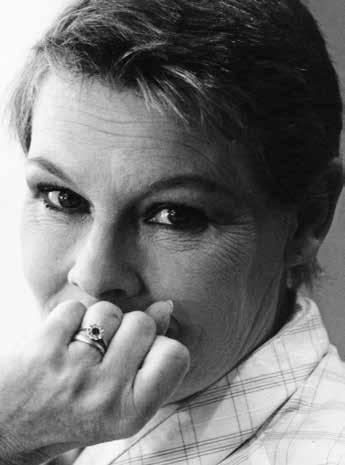
Lymphoedema is a little-known illness.
My assistant, Jen, has primary Lymphoedema in her leg, so I am
aware how uncomfortable and cruel this condition can be. A heavy swollen leg is not only a disfigurement but physically debilitating. It can lead to unexpected infections which can cause sepsis.
Lymphoedema is arguably one of the most neglected diseases in healthcare today. Few doctors know about it or understand it. That is why it can take a long time before a correct diagnosis can be obtained. There are so few specialists in Lymphoedema that accessing treatment is not easy. We must fight to make this world more aware of Lymphoedema and have more help available to those suffering with the condition.
So many of our colleagues in the world of music rely on hand and arm movements to play instruments. With
“LYMPHOEDEMA IS ARGUABLY ONE OF THE MOST NEGLECTED DISEASES IN HEALTHCARE TODAY.”Kathy Bates (Copyright Gemma Levine ,UK) Dame Judi Dench CH DBE FRSA
Lymphoedema, it is impossible. It is incredibly depressing to know that there are those who have had to drop out of the profession for this reason. We hope one day, there will be a cure.
Gemma has been indefatigable in her campaign in raising awareness of this condition.
We think it is fair to say that very few, if any, of the contributors to this booklet would have heard of Lymphoedema if it were not for Gemma.
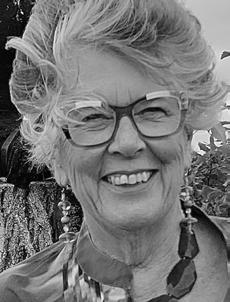
If you are happy and healthy it barely crosses your mind that a tiny accident of fate could ruin your life. If I had had Lymphoedema in my hands I would not have been able to butter bread, never mind cook for the glitterati, eat cake on telly, lunch with the Queen or make pizza with my grandchildren.
Indeed, before my friend Gemma Levine got Lymphoedema, and decided, in typically forthright Gemma style, to do something about it, I’d no idea even what it was. I didn’t realise that it is a debilitating, extremely painful, ugly, incapacitating, and incurable disease. It’s horrible.
Gemma’s life, once that of a famous, fashionable photographer, changed dramatically. Unable to hold and operate
a professional’s camera anymore, she must make do with an iPhone. But she works as hard as ever, producing books and images to promote awareness of Lymphoedema.
So, the least her friends can do is give her a bit of support. She deserves it. Treating and curing Lymphoedema may be a way away, but nothing will happen without research.
And money. And people who care.

One of my first patients with Lymphoedema was Madelyn P. She was a 36-year-old woman who had been diagnosed with breast cancer at an early age. She had undergone mastectomy and completed radio therapy and chemotherapy. After treatment she developed severe left arm Lymphoedema that was significant and extended into the wrist. She was already battling with the psychological challenges of breast cancer and her overtly swollen arm knocked her back even further. She did not feel attractive or desirable to her husband. She felt that people in shops, restaurants and the cinema were looking at her and avoiding her because she was unsightly.
Madelyn's depression was caused by
multiple factors and required support from a psychiatrist, psychologist and physical therapist as well as the medical and Lymphoedema teams. It took more than a year for Madeline to feel good and five years later she was without evidence of recurrence. She has returned to her beautiful, energetic and happy self.
Lymphoedema is an ongoing disease of the lymph system which results in unsightly swelling in one or more parts of the body. Many people who have Lymphoedema often feel blue or even depressed. If you have Lymphoedema and feel down, ask for help from a health professional. If someone you care for has Lymphoedema be compassionate, look out for them and give them a helping hand.

I knew very little about this dreadful disease until Gemma asked me to write this piece. In a world when we obsess about our lines and our lips don’t seem full enough, and our bottoms need padding out; where people become addicted to distorting plastic surgery and young people suffer body dysmorphia, it is sobering to look at the symptoms and results of this terrible illness.
I suspect the public profile of Lymphoedema is because it is a disease
we connect with, perhaps, people in distant lands, but it is here among us, and the fact that it can be a side effect of a supposedly curative cancer treatment makes it of more immediate concern than ever.
was second nature to her existence.
Fingers crossed, one day sometime soon, people will put on their thinking caps and realise Lymphoedema is a ‘giant’ and must be taken as seriously as other afflictions, that is why research is so vital. We have recently made astonishing advances in other branches of medicine; now is the time to put Lymphoedema centre stage.
Whether we focus on creating awareness or finding a cure, it is our collective efforts that bring us ever closer to our ultimate goal of a world without Lymphoedema.
How does one begin to change the world? Lofty gestures and grand pronouncements may grab attention, but real change is something that grows once a seed is planted in our hearts. It blossoms from a brew of logical thinking and compassion. It is fuelled by a spark that sets fire to our passion to see a world in balance with our notions of social justice.
carrying a message that those living with Lymphoedema are not alone. We are one with them. A new era begins.
Every medical student is fascinated by dramatic manifestations, and the one fact that they all know about Lymphoedema, a neglected subject in undergraduate teaching, is that this is the cause of elephantiasis. This is the complication of condition of filariasis which affects 1.5 percent of the world’s population and can cause massive permanent swelling and disfigurement when the parasite, Wucheria bancrofti, passed by mosquitoes, invades lymphatic vessels causing gross secondary Lymphoedema.
Of course, we must raise money for research, which means raising the profile of Lymphoedema. When Gemma puts her mind and her intelligence into a cause the drums start pounding. We need to join in the sound until it reverberates into universal consciousness.

Lymphoedema is a ghastly condition too widely ignored. Lymphoedema appears mainly in the arms or legs, as well as other parts of the body. I hate to think of how it affects Gemma, a lifelong photographer who is now unable to lift the camera, due to the disease affecting her right arm and hand. Her profession
Against this backdrop, a mystery looms. As much value we give our health and well-being, a disease has been allowed to sweep the globe almost unnoticed by most. How curious that up to 250 million people worldwide should live with Lymphoedema, and yet most people have never heard of it. Instead, they remain unaware of the physical pain and emotional trauma of even loved ones living with this debilitating and incurable disease.
It is here that the story takes a magisterial turn. Unwilling to accept the status quo, from advocates to scientists, voices of enlightenment began to be heard throughout the world. As the strains of music fill this hall with glorious music, every note is an affirmation that Lymphoedema is invisible no longer. The fruit of one person’s imagination brings us together and now sends us out into the world
But, aside from the shocking clinical signs of an under promoted tropical disease what else do students know about this Cinderella of subjects? Too little. ‘Awareness’ will help to amplify undergraduate teaching and the library of every medical school should contain a copy, would that I had had this in my practice library through my career: I had too little to contribute to patients who suffered Lymphoedema following cancer surgery, secondary Lymphoedema, or in my shameful ignorance, primary Lymphoedema, seen in several young women who presented with chronically swollen legs and who then had to bear the psychologically traumatic news that their problem would be lifelong.
Approximately one in five women who’ve been treated for breast cancer will develop Lymphoedema.
One of the commonest sites is the arm after surgery for breast cancer. Life can change dramatically and for one woman, Gemma Levine, a photographer,
“ WE MUST RAISE MONEY FOR RESEARCH, WHICH MEANS RAISING THE PROFILE OF LYMPHOEDEMA.”
Lymphoedema treatment for breast cancer meant she was unable to use her camera. Undeterred Gemma pursued her career on a much lighter iPad and iPhone.
In this Gemma is an inspiration to all. Despite having scares and setbacks she’s stoically ploughed on with cheerfulness, affection and stoicism. Yes, Gemma has seen Lymphoedema for what it is; it’s literally a lifestyle. With Gemma the emphasis is on LIFE which she espouses with grit and determination, down to her morning swims, daily exercise and never going without a compression bandage.
Gemma is dedicated to helping others deal with Lymphoedema and she was astute enough to seek the expertise of Professor Peter Mortimer, her loyal collaborator and they proved an irresistible team.
Lymphoedema is for life, and I see Gemma supporting Lymphoedema Research Fund at St George's Hospital Charity with more books, glittering events, and ceaselessly raising funds.
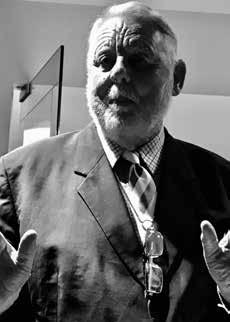
It is now many years ago since I was held for almost five years in solitary
confinement as a hostage. Even though it is a long time ago I still have vivid memories of what it is to be like to suffer illness and to be without any form of medical treatment whatsoever. For most of my time in captivity I kept reasonably well but in the latter months succumbed to a severe chest infection which caused me to lose consciousness on several occasions. For the final few weeks in captivity, I was moved from my solitary state to be with three other hostages. At night, when I was feeling very poorly indeed one of my fellow captives stretched out as far as his chains would allow and placed his hand on mine. He did not say a word but the comforting fact that there was another human being who cared and who was with me at this time of difficulty gave me strength to continue.
Lymphoedema is not a well-known medical condition and those who suffer from this disease know that more research needs to be conducted to combat this life-threatening illness. My fellow hostage showed he cared by stretching out his hand. More and more people need to be informed about Lymphoedema so that they also can stretch out their hands and give their support.
Gemma has worked tirelessly to give her time and talents to help combat this life-threatening illness. I hope that many will join her and stretch out their hands to help bring comfort and hope to the many who suffer in silence.
Towards the end of his life, Dad found that a special massage was a help at that point of his illness. There was only one person in London we could find who did this kind of massage for Lymphoedema sufferers. He found it very beneficial, and I hope now - thirty five years on - this is more commonly available.
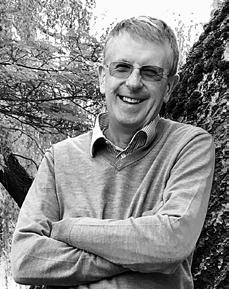
Lymphoedema and other lymphatic diseases are not on the radar of doctors. Doctors rarely make a positive diagnosis of Lymphoedema. Why is this?
The reason is no awareness. The lymphatic system and the diseases that result from its malfunction, are not taught properly at medical school. Without education there is no awareness amongst doctors. Furthermore, as there is no tablet treatment or proven operation to treat Lymphoedema, doctors are not interested. Management using compression stockings is just not appealing.
As a result, Lymphoedema sufferers do not get the help they deserve. A diagnosis is often delayed or never made. Consequently, access to the correct treatment may never happen.
I was born with primary Lymphoedema from head to toe. As a child and teenager trying to fit in, I hated the fact that I was different. I disliked the sight of my large legs and pregnant like stomach. And the fact that every other week I was in hospital for a
medical appointment or that I had caught another infection. I’m now 20 and I am finally learning to love my Lymphoedema. I’ve accepted the things I cannot change and I’m headstrong in pursuing a career as a film editor.
funding being taken away but this year, I am planning on putting my health first by seeking out treatment for my legs again. My parents were told I wasn’t going to make it past my first birthday and I’m going to be 21 this year. Just goes to show you, anyone can do anything, if they believe they can. As clichéd as it sounds, don’t try to fit in when you were born to stand out.
In October 2022 I started an account on TikTok teaching fellow filmmakers about editing and how to get into the film industry. I didn’t think it would go anywhere but I’ve just surpassed 60 thousand followers and it’s still growing! Lymphoedema hasn’t stopped me doing what I love, if anything it’s giving me more determination as it’s meant I’ve had to work twice as hard as my fellow colleagues. Whilst I’ve had my bad days where walking is a struggle, breathing is tough, and sometimes when I wake up my face is so swollen, I can barely see. The good days always outweigh the bad ones. I haven't had Manual Lymph Drainage or tights since I was a child due to my
Living with Lymphoedema has its challenges, like holding a pen without being in pain. However, it has taught me to appreciate what I have and to enjoy the good things in life. As I have aged, my perspective of the condition has changed and I have learnt to find alternate methods of doing things, like using my laptop for all of my schoolwork. A big part of living with Lymphoedema is the visibility of the condition. Most people are uneducated on the topic and so naturally are quite curious about why my hands look (swollen as they are) causing them to stare, making me often feel self-conscious. I have been in Professor Mortimer’s care my whole life, with regular checkups overseeing my programme of treatments. Recently I have been seeing a massage therapist, who massages my hands and bandages them for me, to keep them on overnight and even through the following day. I am not a fan of wearing bandages, as they make my arm sore but, I know that it is in my best interest as they reduce the swelling and soften the tissue in my arms. Overall, the treatments help me immensely and I can take part in all the things my friends do.
Living with Lymphoedema has its challenges but by applying a positive mindset and finding solutions, I have been able to live life accepting Lymphoedema as the new normal.
After a few years of coming to terms with facing this lifelong condition, I made the concerted decision to control my Lymphoedema and not let it control me. I continued to play golf – my passion, using this as an opportunity to get the lymph pumping. I’ve had to overcome the challenges that Lymphoedema has had on my golf swing and game, due to essentially being lop sided and off balance, with one leg heavier than the other. Nevertheless, it was time to show my Lymphoedema who’s boss!
After 11 years of hiding my large stockinged leg away in forgiving jeans and trousers, in 2022 I decided to push through my embarrassment and wear shorts in public for the first time. It was liberating and empowering! I now welcome questions from curious people as it allows me to explain what Lymphoedema is and raise awareness of the condition.

My passion and purpose are to help others with Lymphoedema by sharing my solutions and uniting people with this lifelong disease, so they do not feel alone.
By also incorporating my other passion, golfers with Lymphoedema unite at my annual charity golf day to raise money for incredible charities like the Lymphoedema Research Fund. Let’s take control and help everyone to live better with Lymphoedema.
“MY PARENTS WERE TOLD I WASN’T GOING TO MAKE IT PAST MY FIRST BIRTHDAY AND I’M GOING TO BE 21 THIS YEAR.”Bella Roberts (Copyright Gemma Levine ,UK)
WHAT DOES IT MEAN TO SUCCEED IN LIFE?
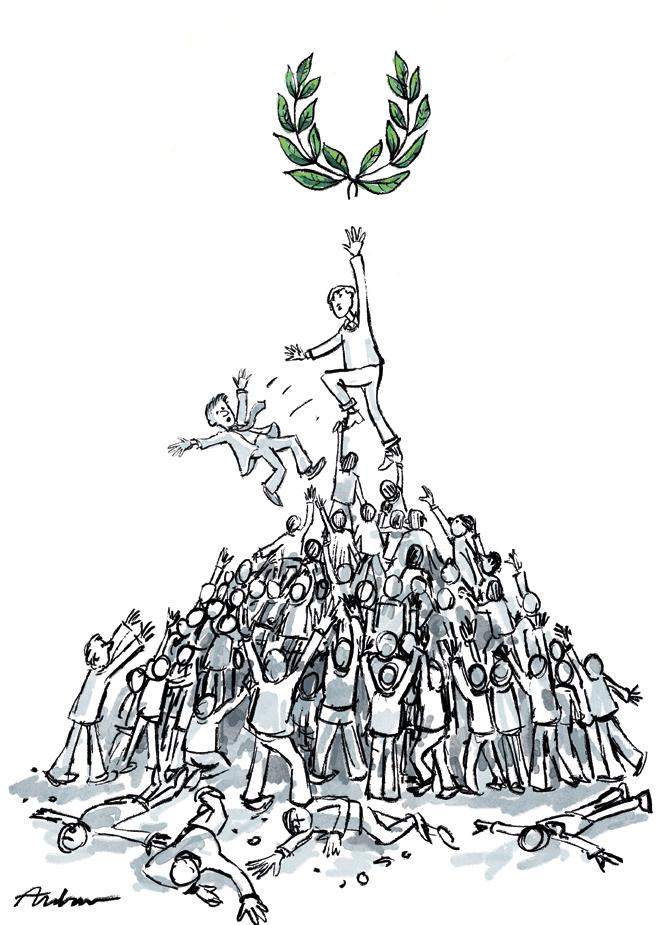 BY CHRISTOPHER JACKSON
As the world in 2023 bumps, stalls and falters, I find myself considering the question of Gore Vidal the internationally famous writer and Darius Campbell Danesh, the not all that famous pop star. When life gets difficult – as it has done for so many this year – the question of ultimate purpose has a curious way of resurfacing and clarifying itself.
Darius Campbell Danesh died in August 2022 – another of those celebrity deaths which come out of leftfield, as wrong – as strange. We’ve become used to thinking: drugs. Or we think: alcohol. And we sigh: fame. A little fame seems to be as bad for the soul as a lot of it: you get that taste for the hedonistic life, learn how to boomerang into rehab and back out again – and by that point you’re more than up-and-running as a candidate for an early death. The paparazzi increases its attention on your dramatic arc, sharpening its intensity, until the curve is hastened.
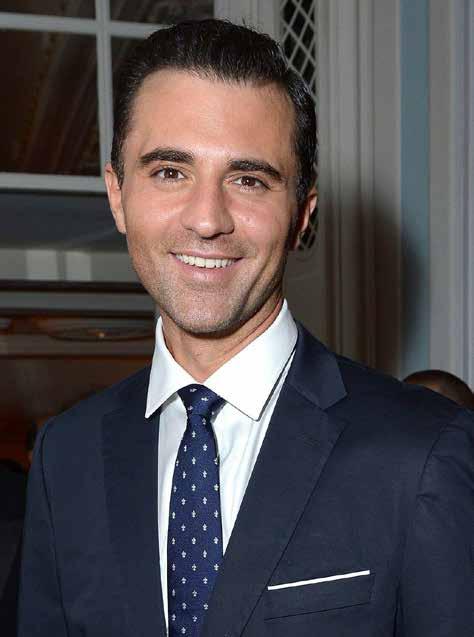
The young body turns out not to be strong at all when faced with the rote rigors of stardom.
But in the case of Darius, who died in a Minnesota clinic from inhalation of chloroethane and an undiagnosed heart condition, a different force was at work: pure bad luck. His death, though it looked like misadventure at first, turned out to be a tragedy without the moral dimension of crack-up we’re used to. He was simply very unlucky. A car accident led to pain, leading to painkiller addiction, leading to his sad end.
It is the fate of some pop stars to cross over into the arid but peaceful world of never-being-interviewed. Darius made it there: after Pop Idol, where he secured a degree of fame in that banner year when Will Young and Gareth Gates led the competition, he prospered for a while. Refusing with a
certain cool clear-headedness the offer of a music contract by Simon Cowell, Darius went on to write his own songs before gaining five Top 10 singles. He then had a successful career on the stage playing leading roles in Broadway and in the West End. It was a quietly successful life.
By the time of his death, Darius was still well-known enough for his untimely end to register in the mainstream media. He had, in fact, got to the point where an interview might be given by the trainee trends writer of The Daily Record, fail to be published, and then resurface after his death.
It’s this interview which caught my eye for its quiet wisdom, and humility.
Not knowing that he is destined to be speaking posthumously, Campbell nevertheless sounds valedictory at the start of the article: “I’ve been really blessed. I’ve been really lucky to have had an amazing life,” he says.
Probed further, he explains his desire to move back to Scotland: “I’m looking to form a new relationship with a country that I love coming back to, an extraordinary gem of a country that has contributed more to science and the arts and inventions than many countries could ever dream of. I’m coming back to give back and to establish a base in Scotland.”
This is the note of patriotism and authentic pride. Campbell goes on to
add: “When you get to the peak of achievement, of doing all the things that you love, it’s all about giving back.”
I like this very much. It’s simplicity shouldn’t blind us to its wisdom. Campbell is talking about what really matters. He is talking about life at the apex.
The apex. The word is an interesting one, and dates from about 1600. It means, the summit, the peak, the tip, the top, the extreme end. It originally denoted part of a headdress worn by priests in ancient Rome. Etymologists say that it’s possible that it is related to the Latin verb ‘apere’ – to fasten or to fix. It has to do then with being attached to the top of things – on top of the world, as the song goes, looking down on creation. But with the possible connotation that you might be unfastened – one day, you’ll possibly need to come back down again.
It therefore needs to be distinguished from the notion of the ‘establishment’, which has to do with the old French root establiss, and the even older Latin root stabilire: to ‘make stable’. There is something cosier one feels about the establishment than there is about the apex. One senses that once you’re in the establishment, you’re in unless you do something really stupid. Sometimes, you can even murder and remain in it: ask Lord Lucan.
The apex feels less certain – a place you have to struggle to arrive at, and then struggle to stay in. Nothing’s certain at the apex except your own fragile eminence.
So who’s at the apex? A downat-heel aristocrat is usually in the establishment but can hardly be a serious candidate for the apex. A prime minister or Cabinet minister may moonlight at the apex, but depending on their beliefs and performance,
may never really be admitted into the establishment: think Liz Truss, or even in certain ways Tony Blair. A rags-toriches businessman will get to the apex by making enough money; if they want to join the establishment they might consider donating to the Prince’s Trust.
A writer will be at the apex if they sell a lot of books but only in the establishment if they chair, or are elected to, the Royal Society of Arts. It is the goal for many of us in our careers to taste the heady crosswinds of the apex, and while we’d like to feel stable there, by 2023 it feels as though experience has bitten off another chunk of innocence: nowadays there’s very little stability in our society.
And if you want an image of the apex, what would that be? To know that you need to visit the Amalfi Coast.
Two questions. What’s the most beautiful house in the world? What’s the best house a writer has ever lived in?
The answer to these two questions happens to be the same: La Rondinaia. The name means Swallows’ Nest, but such associations hardly do justice to the beauty of the building, a sprawl of delicate marble somehow sprinkled down the cliffside near Ravello in Italy, presiding celestially over the Mediterranean.
Now a luxury hotel, it is most famous for having been the home of the American writer Gore Vidal from 1971 to 2006. Vidal was both an outsider and an insider – but very definitely knew what life was like at the apex. It’s not entirely clear that he didn’t invent the apex; he certainly clarified the language of the apex. There remains the suspicion that you’ve not hit the heights unless you’ve stood on the balcony here, having just signed the transfer of deeds documentation, and raised a glass with the toast: “To my new house”.
Vidal was born into the purple of American life. His biography comes up against an irremediable fact in the birth ward: he loathed his mother steadfastly, without any chink of light. It’s possible to happen upon interviews where she is described variously as: “atrocious” “a terror” “everybody hated her” – all within the space of a few suavely embittered lines.
In this case, hatred of his mother meant closeness to the grandfather – the blind senator for Oklahoma Thomas P. Gore. Furthermore, when Vidal’s mother divorced his father – not untypically in the Vidal narrative, Eugene was an aviation star, and great friends with Amelia Eckhart – she remarried into the Auchincloss family, meaning that Vidal became distantly related to Jackie Kennedy, the wife of JFK. ‘It is always a matter of delicacy when a friend or acquaintance becomes president,’ he would later say, sounding as he always did, like a creature of the apex.
We can now say that post-war America churned up about seven ‘great’ writers, usually considered by their surnames: Mailer, Bellow, Updike, Heller, Vonnegut, Roth – Vidal. The Vidal opus is vast, containing a host of novels, plays, essays, short stories - and interviews usually conducted at La
“WE CAN NOW SAY THAT POSTWAR AMERICA CHURNED UP ABOUT SEVEN ‘GREAT’ WRITERS, USUALLY CONSIDERED BY THEIR SURNAMES: MAILER, BELLOW, UPDIKE, HELLER, VONNEGUT, ROTH –VIDAL.”
Rondinaia. The act was well-known. Vidal would recall famous friends, and waspishly dispatch his enemies: Truman Capote, William Buckley Jr., Norman Mailer. (When the novelist Mailer once went up to Vidal at a party and smacked Vidal in the mouth, the wit replied: “Once again, words fail Norman Mailer.’) In interview, Vidal would roll his eyes at the folly of America; he would remind everyone that he didn’t care what they thought of him; he would give an account of what life is like once you are free of concern and duly elevated. Some thought he’d gone to a lot of effort to convey his own calm detachment. Martin Amis, having observed Vidal in situ at La Rondinaia, wrote: “He has removed pain from his own life, or narrowed it down to manageable areas; and it is one thing he cannot convincingly recreate in his own fiction. But his deeply competitive nature is still reassured to know that there is plenty of pain about.”
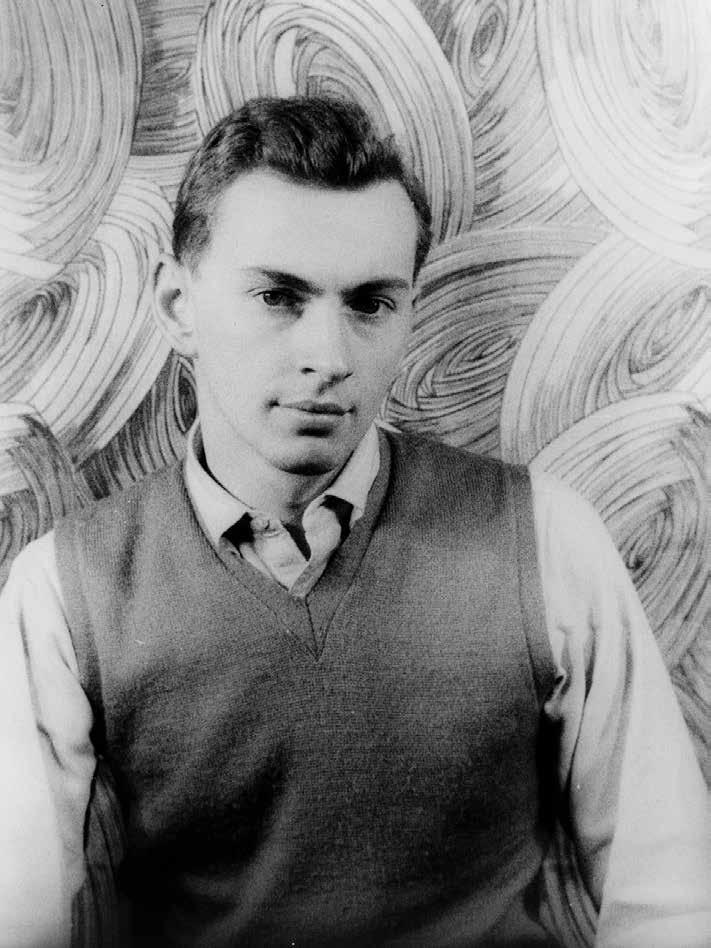
How had his fame become so great?
As the recent play Best of Enemies by James Graham shows, Vidal’s celebrity grew particularly as a result of his head-to-head debates on ABC with the Conservative thinker William Buckley Jr in 1968. These debates occurred while protests about the American war in Vietnam raged outside the television studios. They represented – as Graham’s excellent play depicts – the moment when head-to-head TV debate created a sort of bifurcation in American society. From now on the question would be: Are you left or right? Are you Republican or Democrat? Are you Buckley or Vidal?
The debates to some extent marked the end of the era of the floating floater: by a quirk of television, two extremely nuanced thinkers ended up, by accident, retiring the public space for nuance. Millions of people watched the culminating exchange. During a discussion about Vietnam, Buckley labelled opponents of the war Nazi appeasers. Vidal, who knew that
the important thing in television is to retain one’s self-possession no matter what, retorted:
Vidal: The only pro- or crypto-Nazi I can think of is yourself...
Buckley: Now listen you queer, quit calling me a crypto-Nazi or I’ll sock you in the goddamn face and you’ll stay plastered.
In short, Buckley lost his cool and Vidal didn’t, meaning that Vidal won. At various times since, it has looked like each man won the far more crucial aftermath: the battle for the eventual direction of America. During the Reagan years, Buckley seemed to be winning; but, in the 1990s, Vidal befriended the Clintons, Hilary being a famous visitor to La Rondinaia.
Despite the election of Barack Obama in 2008, Vidal went to his grave thoroughly disillusioned by the state of America – as an isolationist well might do when his country has a military presence across the earth.
One of the perennial themes of the debates themselves was always that – in the same way that Darius Campbell Danesh cared about Scotland – Buckley cared about America more deeply because he was rooted to the country. Meanwhile, Vidal, in exile in the Amalfi Coast and Rome, is to Buckley a sort of gilded visitor to the US. Further, as a gay man, you always feel that Buckley thinks – though can’t quite say – that Vidal has an insufficient sense of the building block
of the family and so isn’t invested in America’s future. Here is an excerpt from Best of Enemies, during debate prep, when the Buckleys are wondering aloud about the slipperiness of their antagonist:
Patricia Buckley: Not only that. He doesn’t even go by his real name. His Christian name is Eugene. Gore isn’t even a Christian name, it’s a surname he just took it and gave it to himself.
William Buckley: …My God. He doesn’t even exist does he. Nothing about him is real, permanent. He has no roots. He doesn’t come from anywhere. He has no regular family. He is incapable of committing to a relationship as much as he is a country to reside in.
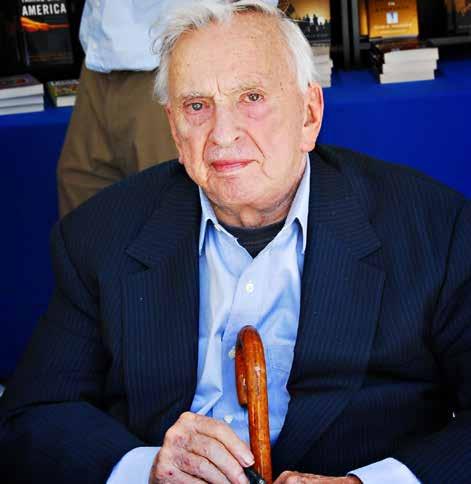
By 1968, Vidal’s novel Julian was a best-seller: he had found his metier in the shape of the erudite historical novel – history handed down from on high. Vidal didn’t go to university but was prepared to mock those ‘priests of academe’ or ‘scholar-squirrels’ who might query his version of events.
Being a creature of the apex, he could also claim personal knowledge, via his famous grandfather, of the gossip of history which is denied the staffers at universities.
Vidal didn’t have it all his own way: he had to fight. His early novel The City and the Pillar, with its frank exploration of homosexuality, was banned by The New York Times – a sign that Vidal, while patrician, was never quite of the establishment.
It’s not clear yet to what extent he shall speak to the next generation. After a death, fame can recede with a rapidity which would probably scandalise the famous were they to be made aware of it: it’s as if the world pauses, mulling the contribution, deciding whether to issue a posthumous acceptance or rejection letter.
In terms of his novels, his lasting influence is likely to be with Julian and Burr (1973). These books feel lastingly readable in a way in which his success de scandal Myra Breckinridge (1968)
doesn’t. That book, with its transgender themes, could easily be taken up today and become a hit for some trilliondollar streaming company.
The fact that Vidal was homosexual (an adjective he despised) in a time when that wasn’t yet acceptable, meaning that he had to shoot for the apex and not the establishment. The cosy structures of the American aristocracy could never quite be for him: The New York Times refused to review his books in the 1960s (at a time when that newspaper could make or break a book), meaning he had to turn to screenwriting to make a living.
He was successful at that too. As he was known to boast, he always had more money than his competitors. Soon bestsellerdom and – like Shakespeare – a canny eye for property, removed financial concern. He lived with the advertising professional Howard Austen for many years – a platonic friendship whose secret, as Vidal would explain, was its refusal of sex.
I don’t yet know which letter Vidal has received in the great atrium of the skies. The early signs are good: his quotability outstrips his competitors, and the life is reliably gilded and interesting. Saul Bellow looks too verbose and baggy now; John Updike somehow weightlessly gifted; Norman Mailer, too macho and maybe a little mad; Kurt Vonnegut too arch. Vidal’s only serious rival among his contemporaries in terms of the creation of pure laughter – that quality which turns out to have far more posthumous value than people realise in the present – is Joseph Heller. Catch-22 isn’t going anywhere; it was always here to stay.
So are Vidal’s great lines. ‘Every time someone else succeeds, a little part of me dies’. ‘A narcissist is someone better looking that you are.” “I never pass up the opportunity to have sex or appear on television.” This is the sort of stuff that turns out to last as people can’t –shouldn’t – wean themselves off wit.
Cynicism can be addictive; Vidal’s certainly was. Sincerity, like Darius Danesh Campbell’s, turns out to be harder to sustain. The real reason for this juxtaposition is that cynicism can be funny and sincerity can’t. And we all need a laugh.
And yet, if we dig a little deeper, we start to wonder if Vidal’s life was all it was cracked up to be. Vidal took a predictably lordly stance against the counterculture of the 1960s, loathing the Beatles and Bob Dylan and all the rest. I wonder how he would feel if told that he had something to learn from Darius Campbell Dinesh, someone far further down the pop food chain. It’s difficult to imagine him being pleased.
Over the years, life went sour for Vidal: Buckley’s admonition that he would ‘stay plastered’ had a sort of punning afterlife. Late period Vidal was indeed all about staying plastered – in the sense of consuming epic amounts of booze. At a certain point, it seems always to have been cocktail hour at La Rondinaia.
The novelist Tim Robinson – author of Hatham Hall – recalls hearing direct from the writer Kevin Jackson about his interview experience with Vidal: “Kevin was an enormous fan, and went to interview Gore Vidal for a TV programme,” Robinson recalls. “By that time, Vidal was no longer the beautiful man of his youth but somewhat bloated – on account of a very high daily consumption of, I think, Jack Daniels.” So what happened? “While Kevin interviewed him, both got steadily drunker and it was clear that Vidal’s memory was no longer what it once was. Fortunately, Jackson – who was younger – also had a younger, less addled mind and having memorised all Vidal’s best anecdotes, whenever Vidal had to stop mid-story, Vidal would wave his glass at Kevin who would repeat the first few words of the story which then triggered
Vidal’s memory for the next five minutes until it was time for the next glass of Jack Daniels and another prompt. He was by then a wind-up drunken anecdote machine.”
Vidal’s death came in July 2012, as if he were unable to contemplate living through that November’s presidential elections. Insodoing, he deprived himself of the opportunity to be indignant about the many things which have since had the ill grace to happen: the rise to the presidency of a certain Donald Trump Jr.; the global pandemic; the war in Ukraine, to name a few.
Life at the apex, then, doesn’t inoculate you from the currents of life. In fact, it can merely mean you have an audience for your own tribulations.
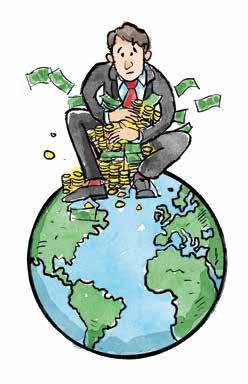
What do they talk about at the apex?
One’s hunch is that it’s mainly art and politics, with a particular emphasis on the latter. (Scientists are too distracted to mind about the apex or the establishment). Being in the apex means that you’ve taken care of your own needs. You’ve got to parade your interest in the planet. And on this topic, Gore Vidal is at his best.
Fifty years ago Burr was published, and it can’t be said the newspapers brim with reminiscences about this fact. Even so, in Burr, and in the other books which form his Narratives of Empire series, Vidal hands down from on high a beautifully wrought (and selective) fiction about what America really is, and perhaps more importantly, what it has failed to become. We may not wish to emulate Gore Vidal’s life, but as America spins alarmingly on, into a Trumpian election year, we need more than ever to know what he thought.
If you’ve ever been to see Hamilton, then you’ll know of Aaron Burr, and be well-aware of the many words it can rhyme with. Forty years before Lin-Manuel Miranda was reimagining the Founding Fathers, Vidal had already posed in fiction every kind of blasphemous question, probing the pieties and complacencies which still continue to dog America.
Aaron Burr has been called by Miranda ‘the Richard III of American history’. This is partly because he killed Alexander Hamilton, the founder of the American financial system, in a duel, and also because Thomas Jefferson charged him with treason in circumstances very different to unravel. Vidal takes the opposite view: that Burr was, in many respects, a maligned hero. It follows from this that the people we see staring out at us from the dollar bills were imperfect.
So we witness first-hand George Washington’s ‘large derriere’ (a typically derogatory Vidalian detail), Jefferson’s slave-owning guile, Hamilton’s alarming fervency. This becomes a leitmotif throughout Vidal’s books: to question received wisdom. In Julian, Christ is referred to throughout as the Galilean (‘compared to Plato he is a child’). This novel works well as it’s possible to imagine the historical Julian thinking precisely this; but sometimes polemic crosses over into impertinence as in Live from Golgotha (1992) where Vidal
– among many other things – invents a weight problem for Jesus of Nazareth, specifically in order to mock it. The problem with such jokes is that it opens up onto the idea that nothing is sacred – apart from perhaps the amour-propre of a certain G. Vidal of La Rondinaia on the Amalfi Coast.
But more broadly, there is much to learn. Vidal shows us what you see when you enter (Lin-Manuel Miranda again) ‘the room where it happens’. What you see turns out to be, in one
sense, people less intelligent and less qualified to be president than Gore Vidal. “I am at heart, a tiresome nag complacently positive that there is no human problem which could not be solved if people would simply do as I advise.” But by asking whether American history is really what it says on the tin, Vidal shows us how to think for ourselves – his books are ultimately freeing and allow us to breathe his rarefied air alongside him. Our tendency to create saints ends up limiting us in the present
time; the worship of false idols, or the aggrandisement of the imperfect, maroons us in a contemporary inertia. Sometimes this can be a little overdone. Perhaps the novel Lincoln has too many references to Lincoln’s constipation – a bodily embarrassment designed to remind us again and again that Lincoln was mortal. But the book is very powerful when it lasers in on the core psychological question: “Why, in fact, was Lincoln so pro the Union, and what was it about that concept – an essentially abstract one – which enabled him to countenance so many thousands of deaths?”
For Vidal the answer is ambition, which Lincoln gave voice to once when very young, and it’s probably as a good an explanation as any. But in asking the question, we start to wonder about what is really wise and what is not. These are insights only the apex can give; only someone like Vidal has the intellect, the money, the time – and, often forgotten, the sheer luck – to be able to give voice to all this, to pick apart everything we’ve received and say: “Is this true?” And even more than that, to say: “You’ve got it all wrong. All of you, without exception, are cataclysmically mistaken – and let me show you why.”
By comparison, of course, we can be relatively sure of the artistic afterlife of Darius Campbell Dinesh.
I am watching the video to the 2012 hit ‘Colour Blind’, released in the year Gore Vidal died. If Vidal couldn’t accept the 1960s, then I doubt he’d get far with this. As per pop convention, Darius is inexplicably singing and playing his acoustic guitar in a desert; an attractive woman is standing with similar strangeness on top of a random car. The message is: ‘Beautiful people appear in the video to this song and so you should listen to this song. Perhaps then you might almost be beautiful.”
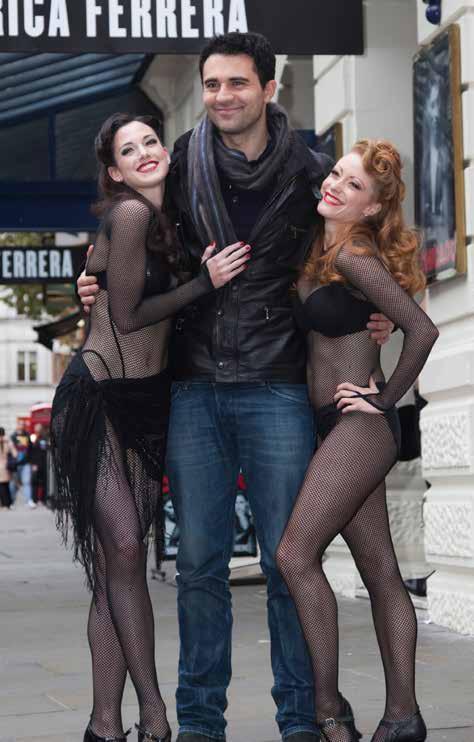
Darius is soon ticking off the colours he’s experiencing – he’s blue, because he’s sad; he’s green because he’s jealous. Less self-evidently, he’s yellow because he’s feeling confused, but because we need a rhyme, he’s also mellow. But the loved one casts a light on him – and the colours scatter, and he’s colour blind.
It’s a goodish pop song, but partakes of every pop convention. And convention, once the reasons for its existence lapse from memory, won’t prop up any song for the long term.
by the press, and however much he looks small next to Vidal – and Vidal was the sort of man who lived for making others feel small – he knew things Vidal did not.
Yet, there’s no real reason to doubt that the song isn’t heartfelt, and there’s no point begrudging it the fact that it has come to mean something to plenty of people. Gore Vidal says: “I can understand marriage. I can understand bought sex in the afternoon. I cannot understand the love affair.” Darius says: “Nobody told me you’d feel so good/ Nobody said you’d be so beautiful/ Nobody warned me about your smile.” The first line is hilarious, intelligent – but as a position to take it is surely insane. The second is banal, but it relates to universal experience, and it opens up onto a world where other people genuinely matter.
Vidal’s mind, when it was at its best, was one of the most beautiful things of the 21st century: erudite but memorable, poised but ranging, both amusingly flippant and genuinely wise. Dinesh, coming from the world of performance and pop song-writing, was a man who began as a figure of fun, and who to some extent remained one. But however he might have been belittled
He knew for instance that the apex of life is doing what you love, and using that as a way of helping others. Not for Darius the destruction of all competitors. He had no Capote or Mailer equivalents. Instead, he looked forward at the time of his death to a Pop Idol reunion. In short, about the essential fact of what life is really about, what its purpose is, Darius is right and Gore is vastly, even horribly, wrong. Had Darius lived it seems likely that he would have dedicated himself to Scotland and to philanthropy. Vidal never did that. To my knowledge, there is no Gore Vidal hospital wing, or Gore Vidal Prize for young upcoming essayists, no Gore Vidal Foundation for historical novelists. Darius’ death marooned him in a series of unrealised intentions, but I see no reason to doubt he would have seen them through. Such things never occurred to Gore: he was always lonely – or rather, apart. But we mustn’t grumble – not least because we can have the best of both worlds. We have Gore Vidal’s marvellous books, and these give enormous clarity about the people who always will rule over us, and make the decisions which, for better or worse, define our lives. We must also empathise with him, even if empathy is something almost wholly absent in his life. Writing is difficult: it takes an enormous amount of time and energy, and sacrifice. And a large part of
philanthropy is to become embroiled in administration, and writers will always shy away from that: it might deprive their latest book of its best paragraph. Writing is selfishness on a scale grander than any non-writer can begin to contemplate. And none I think was more selfish than Vidal. The theme of the hedgehog and the fox dates back to Archilochus. It was given recent expression by the philosopher Isaiah Berlin (1909-1997). Berlin divided writers into those who knew one thing and whose careers can be boiled down to that thing, and those with a broader view. He gave as examples of the first Plato, Dostoyevsky, and Pascal. Darius, in his unheralded way, is classic hedgehog. He knows quite simply the following: other people matter, and therefore what I’ll do is show them that I know that. Vidal is classic fox. He knows a lot; in fact, he can sometimes appear to know everything. But omniscience turns out to be valueless if it cannot cohere into insight. It’s a pose, and its effect is to scatter the good things of the world in favour of a self-satisfied egoism.
In 2023, we need Vidal. We need him to understand literature, Trump, Biden, inflation, empire, war. We can read Lincoln to understand the Civil War. We can read the essays to know how to think for yourself. We can consult Creation to understand the origins of religion.
But you can do all that, and still remember the man who died far too young – almost forgotten far from home, but dreaming of home.
“I CAN UNDERSTAND MARRIAGE. I CAN UNDERSTAND BOUGHT SEX IN THE AFTERNOON. I CANNOT UNDERSTAND THE LOVE AFFAIR.”
“WRITING IS DIFFICULT: IT TAKES AN ENORMOUS AMOUNT OF TIME AND ENERGY, AND SACRIFICE.”
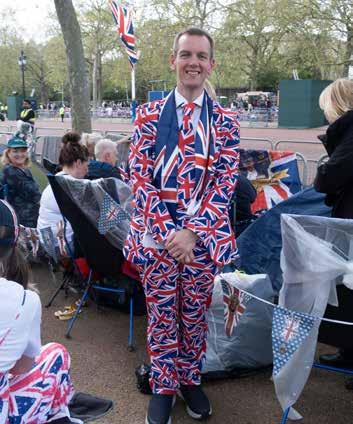

FINITO WORLD'S PHOTOGRAPHER SAM PEARCE WAS INVITED TO CAPTURE THE ICONIC CORONATION OF KING CHARLES III. HERE SHE CHOOSES HER FAVOURITES FROM A MEMORABLE DAY

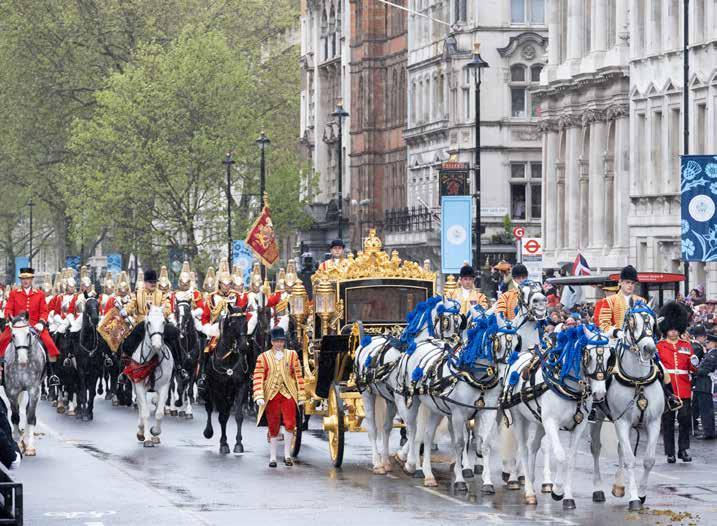
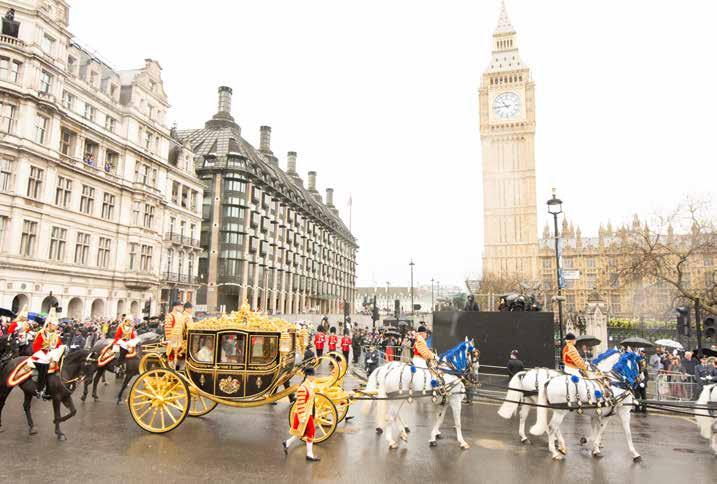
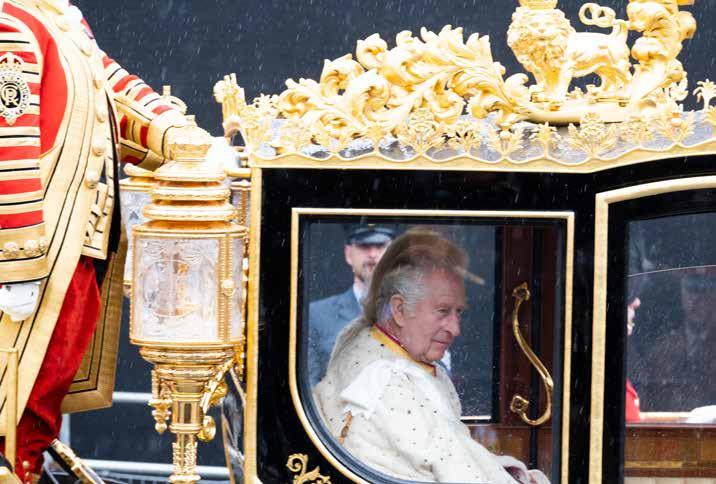
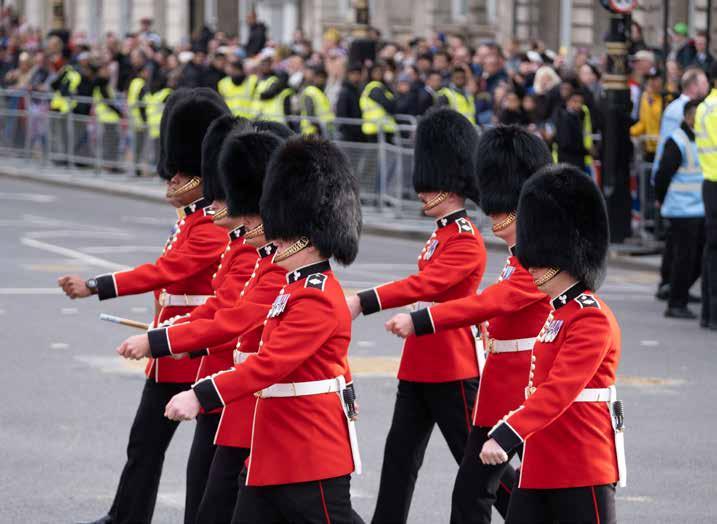
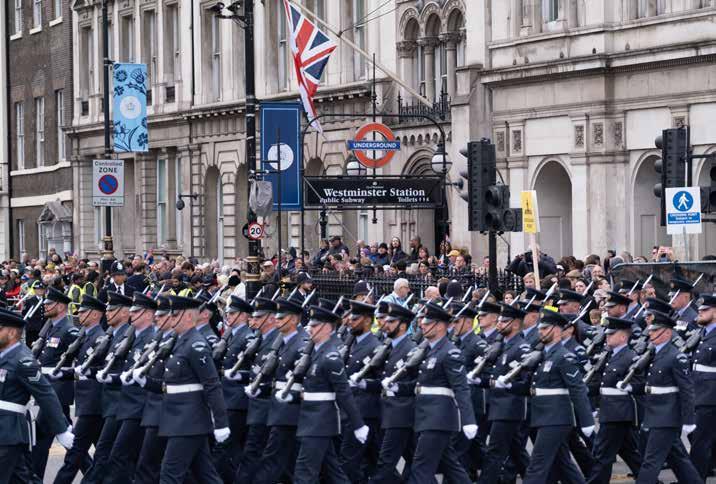
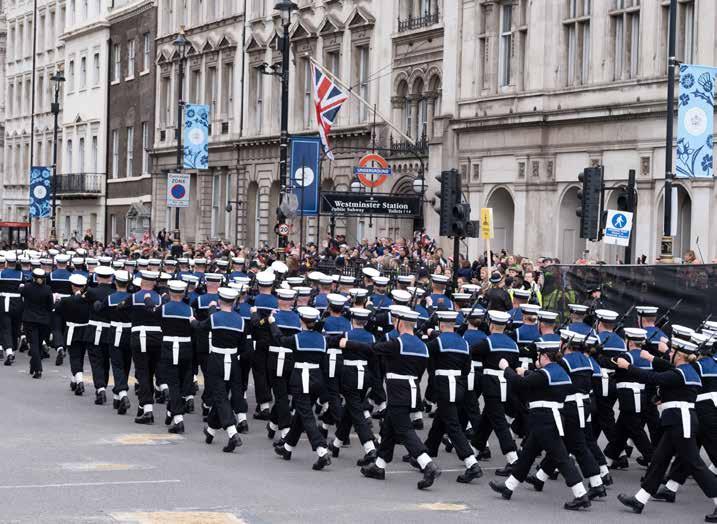
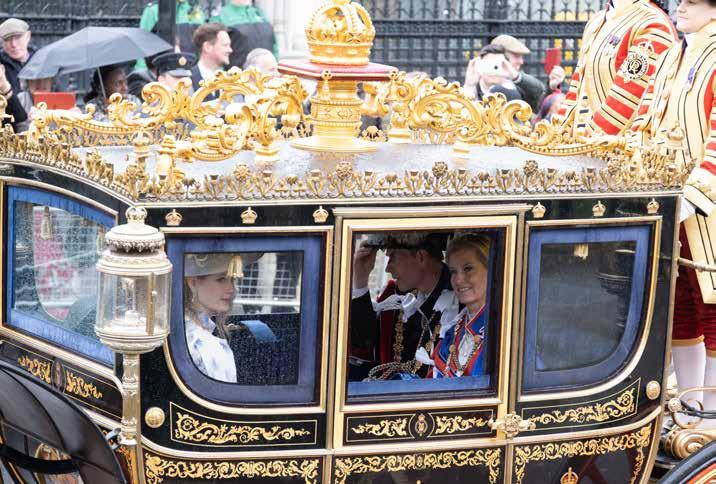
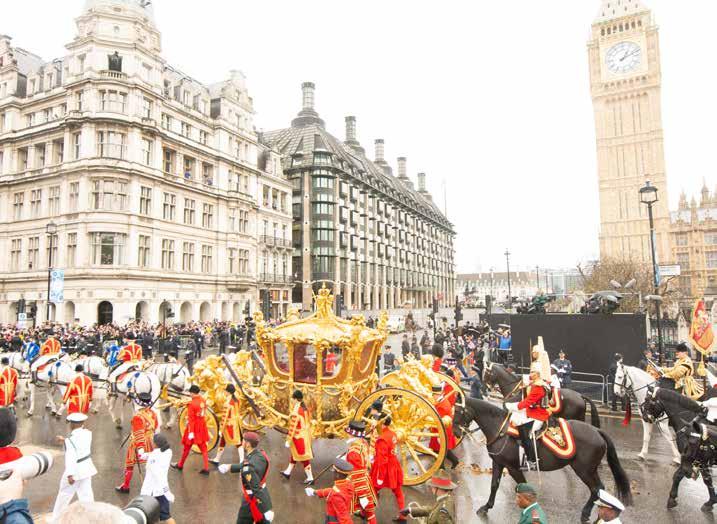
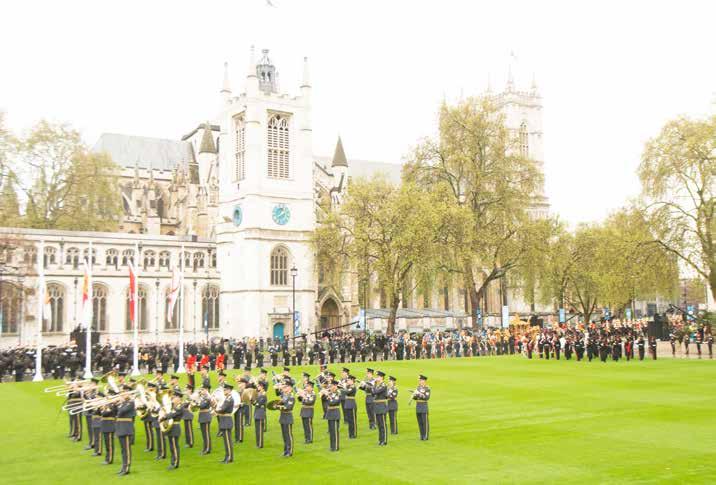
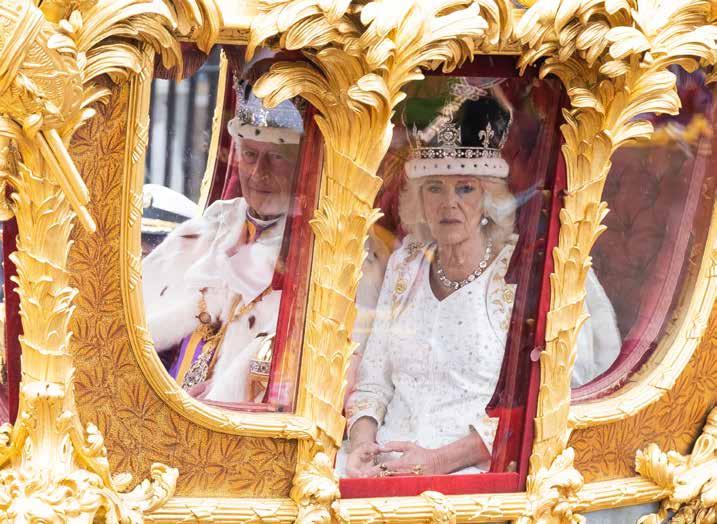
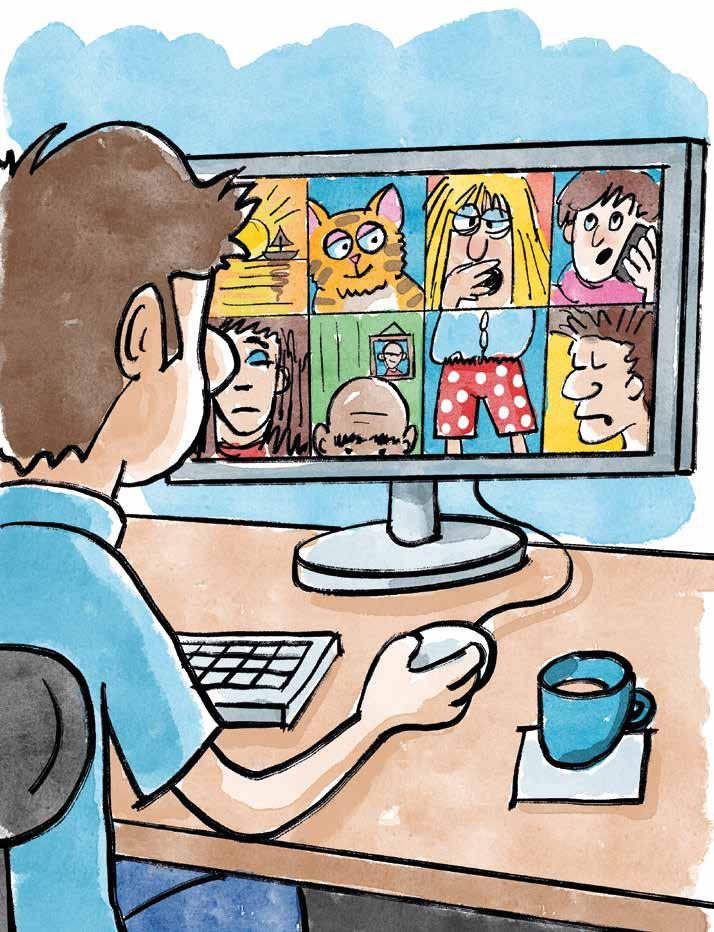 BY ROBERT GOLDING
Zoom is one of those words like ‘tweet’ which has abruptly acquired a second life. Tweet used to be birdsong; zooming used to be for cars. But post-pandemic, we find that we all from time to time – and possibly more than we’d like – Zoom. Of course, as other competitors have rushed into the video call market we might also Teams or Google Meet – but Zoom is the word which has become synonymous with a sea change in how we work.
I remember at the outset of the pandemic having a call with the architect and designer Thomas Heatherwick. ‘I am so sick of flat halfpeople,’ he sighed. From the perspective of the journalist the old form of interview – a personal encounter in 3D – is beginning to feel almost antiquated. Why let a journalist into your house if you can keep them at a computerised distance?
For the rest of us, it has created a range of effects in the workplace which are still remarkably new. People have now gone back to the office – but only to some extent, and hybrid-working appears to be the post-Covid consensus for most industries.

So where exactly are we when it comes to Zoom – and what should young job-seekers and employees know about Zoom before they dip their toe into the world of work? Finito mentor Sophia Petrides tells me that for many people there is a sense of equality about Zoom which makes for a more comfortable working environment for employees: “Nowadays, conducting Zoom meetings is second nature. However, it has certainly helped a lot of people to feel psychologically safer sitting behind a screen rather than being physically in a meeting room,” she says. “As one CEO commented, during COVID
his employees were able to be more open about their fears and anxieties during their weekly Zoom meetings, and this made it easier for him and his management team to provide the right level of support. We are more relaxed when we are behind a screen, and often more human because you see us alone in our office, not performing in front of the rest of the team.”
That sounds broadly positive. I recall an early pandemic interview for this very magazine with Sir Martin Sorrell. Sorrell, sat in some vast mansion in north London, and me in my garden flat in Camberwell seemed to experience a sense of camaraderie, which was down to the strangeness of the times, but also to the technology.
too. “On the negative side, body language, tone of voice, eye-contact tells a story about a person and on Zoom that can be lost. We’re all paler, more generic versions of our personalities when we’re shrunken into a 200-pixel wide teams window. We don’t get the buzz or the interpersonal sparks of human contact. We don’t laugh so easily or connect as well.”
This is plainly true – body language tells us much about a person and this is to some extent truncated on the screen, where we gawp uniformly at the image before us, perhaps occasionally looking in alarm at our own self-image in that tiny box in the corner.
But Petrides also points out that there are drawbacks to the Zoom experience
Kate Glick, another Finito mentor, to some extent shares Petrides’ ambivalence. I ask her whether Zoom alters or reinforces typical power structures in the workplace. “I’ve got conflicting views about the question,” she explains. “It can be intimidating to be the youngest person contributing to a large online Zoom where you don’t necessarily get immediate feedback about how well your comment has been received. I find online meetings tend to follow the format of a series of statements rather than the flow of a conversation.”
“ON THE NEGATIVE SIDE, BODY LANGUAGE, TONE OF VOICE, EYE-CONTACT TELLS A STORY ABOUT A PERSON AND ON ZOOM THAT CAN BE LOST.”freepik.com
Glick is also concerned about the way in which online video calls detract from body language. “Research shows that around 80-90 per cent of our communication relies on non-verbal and body language and some of this communication can be missed in online meetings. It’s more difficult to engage everyone on zoom, whereas in person, you are more likely to get a feeling from someone that they would like to contribute but they are unsure whether their voice is valid.”
But Glick also sees possibilities for young employees in the brave new Zoom world. “However, for some young people, being on Zoom can improve their confidence when contributing to meetings - and seeing your boss on the same sized screen as everyone else, perhaps is less intimidating than sitting at the end of a large board room table! It also depends on the nature of the meeting and the values of the business itself.”
freepik.com
So perhaps a company’s policy in relation to Zoom is a good question for the job-hunter to ask at interview. Any information on that score is a revealing indicator about the nature of the business you might be applying for. “Some businesses value an ‘ideas meritocracy’ where everyone is encouraged to participate, whereas

others follow a strict hierarchical structure,” Glick continues. ‘For example, I have coached individuals working in the NHS, where internal meetings follow a strict hierarchy based on grade, you don’t contribute to meetings if you are a lower grade than your colleagues. Interesting research at Stanford University during lockdown showed that more ideas are generated when meeting in person, whereas online meetings hinder ‘creative collaboration’. But when choosing ideas, they found no difference between online or in person meetings. As hybrid working is here to stay, it’s worth watching and listening carefully to gauge your firm’s etiquette, and if you’re not sure whether you should contribute to a meeting, just ask!”
I ask the revered psychologist Dr Paul Hokemeyer about the psychological aspects of this, and he gives a characteristically interesting reply. “Being effective in a Zoom meeting is a nascent art that we are only just developing. For starters, we need to learn how to keep our attention to the meeting at hand, manage our concerns about how we look and sound on screen, the information being conveyed by our background, our wardrobe and grooming as well as the wardrobe and grooming of others, who speaks and when, who is in charge, and who is off screen checking their email or getting their children to stop eating the Nutella with crisps. In this regard, power dynamics, specifically those relating to who is in charge have become obscured. It’s much harder to hold the attention of a group in a Zoom meeting than it is in an in-person meeting.”
“RESEARCH SHOWS THAT AROUND 80-90 PER CENT OF OUR COMMUNICATION RELIES ON NONVERBAL AND BODY LANGUAGE AND SOME OF THIS COMMUNICATION CAN BE MISSED IN ONLINE MEETINGS.”
“BEING EFFECTIVE IN A ZOOM MEETING IS A NASCENT ART THAT WE ARE ONLY JUST DEVELOPING.”
lives, we gain glimpses of one another’s lives which we never had pre-pandemic: a sense of people’s taste in interior design or the art on the wall behind them; and even, especially if you have raucous children, a sense of the rhythm of their domestic lives. In a sense the private self is admitted to the public sphere.
one can surf the web or write emails whilst the meeting is going on. This is much more difficult in in-person meetings. It’s easier to hide unnoticed in a zoom meeting; making it easier for shy or introverted attendees to stay low, but it also robs them of the opportunity to shine as they’re less likely called for comment than in a room where the meeting leader can make eye contact with everyone in the room.”
should managers and CEOs take when it comes to the question of Zoom calls?
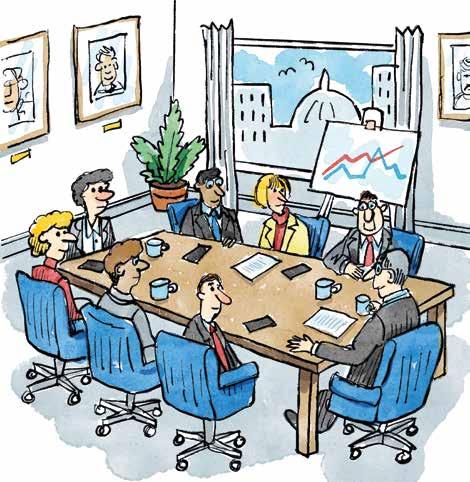
Gerber tells me: “If possible, hold in-person meetings. If some people are off-site, have the present attendees gather in a conference room and others join by Zoom, but not everybody joining via Zoom from their desks. Again, a meeting has much more value than the information exchanged or content created during a meeting. Staff members are much more likely to stand behind a common purpose when physically present.”
Jan Gerber, the CEO of Paracelsus Recovery argues that this has little impact on existing power structures, and instead notes the little tics of meeting behaviour which online calls brings out. “It depends on the size of the crowd and the purpose of a meeting how in-person and Zoom meetings differ. Large Zoom meetings tend to make people check out, i.e. not pay attention. On mute,
So given the more or less universal ambivalence of our experts on the question of Zoom, what approach
Petrides agrees: “I always recommend a mix of face to face and virtual meetings. In fact, combining them can be very effective – a weekly remote team meeting to set the plan for the week works well, a weekly face to face review has a social quality that builds teams and a sense of progress. And dialling-in remote people to spontaneous faceto-face office meetings adds a sense of inclusion for people working remotely. I like to remind everyone that these are the tools now, remote, digital, messaging, it’s all part of the mix – but so are pencils, pens, whiteboards, and watercoolers for a chat. Use them all and you’ll do great. Variety is the spice of life – and workplace productivity.”
Hear, hear. And it’s worth remembering that in 2023, as weary as we might be of Heatherwick’s ‘flat half-people’ that these developments are still extremely recent – which makes them all the more worth considering.
“STAFF MEMBERS ARE MUCH MORE LIKELY TO STAND BEHIND A COMMON PURPOSE WHEN PHYSICALLY PRESENT.”
“ON MUTE, ONE CAN SURF THE WEB OR WRITE EMAILS WHILST THE MEETING IS GOING ON. THIS IS MUCH MORE DIFFICULT IN IN-PERSON MEETINGS.”
“A WEEKLY FACE TO FACE REVIEW HAS A SOCIAL QUALITY THAT BUILDS TEAMS AND A SENSE OF PROGRESS.”
In an age where almost everywhere we look we hear lament about declining standards, let’s consider some good news from the front lines of mentoring: it’s remarkable how intelligent the young are. It’s hard to say this without sounding patronising, so it needs to be bound up with a couple of relativistic statements. They are, seemingly without exception, more intelligent than I was at that age – and always know things I do not know. In short, there’s always twoway learning to be done, and I’d distrust any mentoring process that didn’t have this understanding as a sort of guiding principle.
We have the word ‘precocity’ for this and I think generally we can say today: the young are precocious. Whether this is because the Internet, with its moreish flow of information, has democratised intelligence, I don’t know. But one thing it definitely hasn’t democratised is the work ethic. That is now the rare thing; to know what to do with intelligence.
This last point is what sets Max Liebmann apart. When I heard that a mature young man was joining our Bursary scheme, I initially underestimated the extent to which that would be true. This mandate would see Finito help take Liebmann all the way to Cambridge University and in time, we hope to be part of his journey beyond that point. It’s definitely an example of a story where the candidate’s initial excellence was central to the mandate’s success.
Liebmann came to the Finito bursary scheme fully formed in certain crucial respects. He knew for instance that he wanted to work hard and succeed. More than that, he had known from
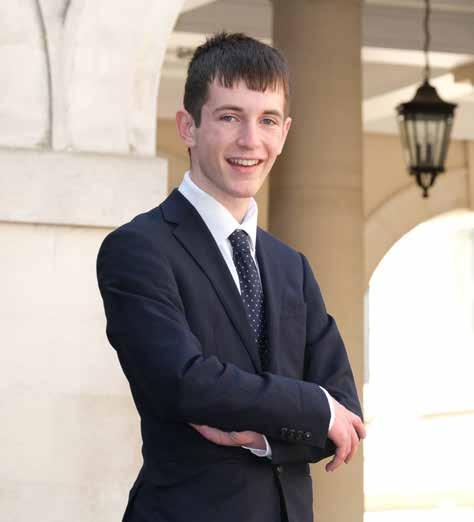
a very young age that he wanted to be a lawyer. “I have known that I wanted to become a lawyer since primary school,” he recalls. “I have always enjoyed logical problems, participating in Maths Olympiads during secondary school. I initially developed a passion for languages, taking both French and German at A level. This logical thinking I used to apply in maths evolved into a love of applying the law to problems. I like the ever-changing nature of the law which keeps it exciting and intellectually challenging.”
Sometimes an appetite for the law is a hereditary bequest, but not in this instance. “My mum currently works as a teacher in primary school, helping
less-able students. I am also very close to my grandparents, and they have had a significant influence in my life,” Liebmann explains.
Liebmann attended Parmiter School in Watford and, as he came to maturity, began to stand out. He was successfully elected Head Boy for the year 20212022: “I was incredibly fortunate to have been elected to that position. During my time as Head Boy, I represented the school at events, sought to improve the school, and I organised prom.”
This appointment gave Liebmann huge confidence, and it reminds us how maturity can often lead to a higher grade of experience which deepens a maturity which was already far advanced. Liebmann
recalls: “Being Head Boy strengthened my leadership, time-management, and publicspeaking abilities, and it showed me the importance of giving a voice to students from underrepresented backgrounds. Working in a large and diverse community to bring about change, I learned how to synthesise multiple standpoints to determine a common objective.”
It was at this stage that the world beyond Parmiter began to loom, and Liebmann decided he would apply for Cambridge. At this hinge point, he was introduced to Finito, and assigned to our bursary scheme: “I try to make the most of every opportunity that I am offered,” Liebmann recalls. “I want a career where I can constantly learn new skills and face new challenges. I think it’s important that you do things that you enjoy in life. A career needs to be fulfilling, and I find law really exciting.”
So what were his impressions of the bursary scheme? “I first came across Finito during lockdown. Finito was excellent, helping me out in every way it possibly could. I was given mentors, each of whom helped me out with different things. I was advised how best to present myself to the business world, and Finito helped me set up a LinkedIn account. Finito helped me practise my interview skills and develop my legal thinking.”
LinkedIn training is all to do with the way we present ourselves to the world and is absolutely vital at the outset of our careers; it might be the unglamorous side of mentoring but that doesn’t make it any less important. Clair Marr, one of Finito’s experts, recalls Liebmann’s mandate: “I suggested that Liebmann think about who he wants to be on
LinkedIn as well as on other social platforms. We looked at three other lawyer profiles and considered what we could learn from them, and also discussed keyword strategies.”
Liebmann was already beginning to develop a strategy for posting content based around keywords: ‘team player’, positive’ and proactive’ – words which, this writer can attest, do indeed encapsulate Liebmann’s strengths. More broadly, what this approach shows, is that Finito was already thinking beyond the entrance examination to Liebmann’s eventual career.
Meanwhile, it was necessary to prepare an all-star prep team consisting of Lumos Education and Bonas Macfarlane. This is an opportunity to thank Lumos Eduacation and Johanna Mitchell for their own sponsorship of the Finito bursary scheme.
Mitchell recalls: “We were delighted to be asked to support Max Liebmann to prepare for his Cambridge law interview. Monica, Lumos Education’s tutor, worked with Liebmann for three sessions. Prior to the tutoring, she read through Liebmann’s UCAS personal statement. This helped her to understand the type of questions he might be asked, based on the specific fields of law in which Liebmann was particularly interested. Interviewers are almost certain to make reference to the applicant’s academic interests set out in their personal statement.”
And what else did Monica cover?
“Monica also discussed with Liebmann the law specialisms of the dons who were interviewing him, so Liebmann would be aware of their particular stance and bias.” A successful interviewing strategy was born.
Meanwhile, Bonas Macfarlane tutor Sam Williams went deep into the detail of how to impress – even taking Liebmann deep into first principles. Williams explained to Liebmann: “The law often works like grammar:
the parties are like the subjects and the objects in a sentence. The verb is the action that occurs between them. Other grammatical elements of the scenario will give you more information about the syntax and significance of that relationship.”
Liebmann was also advised by Williams to ‘focus squarely on the question asked; try not to introduce extraneous or abstruse counterfactuals. Ask your interviewer if you need clarification on the facts of the scenario to develop your answer.”
The advice throughout the report is admirably specific and shows how thorough Liebmann’s interview prep had become. At one point, Williams wisely urges: “Don't hedge: you do not generally need to give a yes no/answer, but your discussion of the principles needs to be confident. Try to avoid "possibly"/"might be argued that"/, depending on the circumstances" type-answers. If you are using the word "depends", do so sparingly and to refer to precise circumstances.” Another piece of advice should resonate for all students preparing for the highly demanding entrance interview: “Be open to the tutor guiding you to reconsider and reframe your position. They are looking for intellectual exibility and teachability.”
Not wanting to leave anything to chance, Liebmann was also hooked up with a former Cambridge alumnus who has had a gilded career in politics. This mentor has asked to remain nameless, but his initial sense of Liebmann is worth quoting in full: “Max is up for the intellectual journey which is needed to get into Oxbridge. He has set his ambitions at the highest level when it comes to any arts degree in this country.
Without help he is looking at a one in eight chance of getting in - but with help can get to a one in two or three chance. He has no doubt got command of his school subjects and leadership - but lacks the extra yard needed in that his application has no evidence of entrepreneurial or world-leading academic courage. It’s not expected to be world-leading in standards, but his paperwork should be screaming that he’s fearless while being modest and that this man is not just going go nail his degree but will take St John’s around the world in reputation.”
Our former Cambridge mentor began identifying weaknesses: he was intent on stress-testing Liebmann’s candidacy. He recalls: “When asked why he wanted to go to St. John’s he replied that the squash court is a major attraction for him. He won’t get close with this.” The mentor advised Liebmann to lead with academia, and also ‘to be alive to conferences where his supervisors have spoken out big.” He was also advised to be ‘current’ and, when it came to the question of immigration law, for instance, to be in contact with vulnerable communities.
This first session with this mentor would clearly bring out the best in Liebmann. As the sessions went by, our mentor became more and more impressed by his pupil, culminating in this assessment: “Max aspires to serve society as a barrister, to ask questions of the law and appreciate human circumstances. Being from a single parent household on free school meals, Max is acutely aware of sensitivities and
vulnerabilities. He knows what makes people human. As such he has become a leader through understanding people, commanding the respect of his entire school to become Head Boy. He doesn’t lead to gain followers, he leads to create leaders - of their own choices and of society. With his breadth he has the potential to be at the vanguard of the legal profession. He was exceptional today - had a huge range of societal awareness and his subject in great shape. He has all the information to write his statement.”
It was time for the interview itself: the big day. So how did that go? The day after the interview, Liebmann spoke with Lumos Education’s founder, Johanna Mitchell. “He said that he felt that the interview hadn’t gone well at all and that, the more he reflected on it, the more he felt his answers should have been better,” Mitchell recalls. “Knowing Max’s considerable capabilities, and how daunting Cambridge interviews can be, I wasn’t convinced that the interview had gone badly. I reassured Max that he had probably done better than his own assessment of the situation led him to believe.
And Libemann’s own recollections? “The entrance exam went quite well, and I was not particularly nervous about it. I took the Cambridge Law Test, which meant that I had to write a legal essay in an hour. I was more worried about the admissions interviews, and Finito really helped me with that. I had many mock interviews, but even that did not change my sense of doubt afterwards.”
In the end, Liebmann’s fears were misplaced: he was offered a place to read law at Sidney Sussex College. “I couldn’t believe it,” recalls Liebmann. “The first thing I did was get someone else to verify that I had actually read the email correctly! I then called my family and celebrated with my friends. The offer day was full of mixed emotions; it was difficult in school, since many people were sad about the outcome of their application.”
So to fast forward to the present time, what has the course been like? “I cannot
lie – the course is really intense. The short terms in Cambridge mean that term time is hectic and the workload is heavy,” Liebmann says. “I haven’t had the option to properly explore the law yet, since I could not choose which modules I studied in my first year. Nevertheless, it is manageable and can be a lot of fun. I am lucky to have made so many friends at Sidney.”
Meanwhile, Liebmann has continued to benefit from the Finito bursary scheme. Liebmann has been connected with people at the highest levels of law –most notably with Sir Rupert Jackson. Liebmann now also has work experience over the summer with Carter-Ruck – again through the bursary scheme. We are delighted to report that in this environment he has shone and impressed senior partners.
All this would have been impossible without the support of The Stewarts Foundation. This began as a result of the support of the outgoing managing partner John Cahill who has said: “In a perfect world comprehensive career guidance would be available to all regardless of their background. The Stewarts Foundation is delighted to support the important work of Finito via its bursary scheme.”
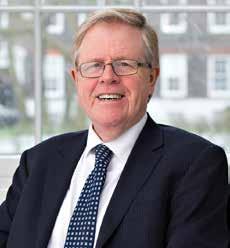
We are thrilled that this support is now continuing under the leadership of Stuart Dench. We will continue to support Liebmann as he continues his journey, and report back on developments.
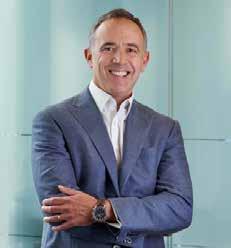

British business and trade will drive the future growth and prosperity of the UK, yet in recent years the relationship between the UK Government and business has been left wanting at best. Business engagement has almost become synonymous with securing donations. Rishi Sunak and Jeremy Hunt are attempting to change this perception and be taken seriously again as the party of business. They are genuinely diligent, intelligent leaders who have impressive business and entrepreneurial experience: a PM with an MBA, ex-Goldman Sachs and a Chancellor who founded a successful business.
Meanwhile, the political and economic fallout after the referendum is still playing out. Brexiter or Remainer, the observable, negative effects of Brexit on business are amplified by the aftershocks of the pandemic and we are still refusing to have honest conversations about where we are. Russia's invasion of Ukraine and the improvised explosive device that was Trussononics compound the problems.
Global supply chains are still recovering. Working patterns have changed. Inflation is hard to suppress. People feel squeezed. AI will destroy humanity, or save it, depending on your choice of pundit. The UK car industry still risks being unplugged from the electric future, notwithstanding the deal to subsidise a battery factory for Jaguar Land Rover. Steel is in trouble again. Joe Biden’s gigantic Inflation Reduction Act underpins America’s green industrial growth. The EU is responding, but
where does that leave the UK? Then there is the rise of China and India. The promised benefits of Brexit remain unicornian for now. We need a credible plan grounded in reality and we need to communicate it.
The scale and complexity of issues facing CEOs is daunting. It is in this environment that business leaders must chart a course to ensure that their companies thrive. They need stability to make long term investment decisions. The very agility and resourcefulness of business sits totally at odds with the rigidity and torpor of Westminster. All too often we hear that the Government does not listen, and that the Government is not available. Things need to change.
The UK’s Business department should have a full-time Secretary of State, but it does not. The incumbent is also the Minister for Women and Equalities, an extremely important, complex, sensitive and unbelievably time-consuming brief in its own right, that arguably deserves to have its own Ministry. The message to business is all wrong. Is business a priority or not?
We need a paradigm shift in how the Government engages business and without doubt the PM recognises this, but we need to go further within Westminster to support him. We have some exceptional Ministers, but we should in the future place a premium on ensuring that all in positions of power have the passion and experience needed for such an important task. We need to be able to “speak business”, to know the culture of international business and SMEs alike; to understand the diplomacy required to navigate sensitivities and build relationships and to have a sense of the technologies of the future. We need a huge injection of emotional intelligence and a commitment to face the facts about where we are, with courage and humility. We must, as a matter of urgency, acknowledge and tackle the structural problems that Brexit has created for British businesses.
On a more superficial level but equally important, basic etiquette would be standard. There would be respect for CEO diaries, events would not be cancelled last minute after months of planning, and, if unavoidable, then followed up. Invitations would be sent out with plenty of notice and would be professional in delivery. We should not have to say that basic courtesy needs to be observed; the Government needs to reply to correspondence in good time and receive and return phone calls.
Steering groups offer valuable insights from the ground into the issues being faced and provide viable solutions, but unless these insights are taken to the top and heard, time is lost and decisions made without sector input. Alongside these we should have frequent in-depth conversations with business leaders and not just representative bodies. We must recognise that business does not sleep during the day, that some of the best networking, intelligence gathering, deals and decisions are made over breakfast. The Department for Business needs to be open for business from early until late.
The Government must be curious, willing to ask big, open questions and to hear answers that we might not always like: to show humility and patience enough to listen and to learn, to inform policymaking. We must then act with speed to find solutions, not dither in picking up on issues raised months earlier, such as the VAT Retail Export Scheme. We need to act in real time. Even the simplest of solutions can be complicated, though, if the political will is not there to fix it – or more importantly the will to listen to critical voices. It is not enough to keep admitting “we do not know what business is about" and “we want to hear from you”. It is novel, even
charming at first, but the act wears thin if the fact is we really do not know, nor really care. Business leaders will become impatient when it is apparent that we are not learning, that incomprehensible political maneuvering trumps urgent business needs and that we are merely paying lip service. Business leaders are not stupid. Businesses want to know how we will now sort the customs and border irritations for goods, how we will tackle business rates, the skills shortages that arise from the lack of labour mobility and myriad other problems created by questionable policy decisions. We need genuine dialogue with give and take from both sides, not tone-deaf political monologue, game-playing and supercilious posturing. Being given only high level policy answers and not practical solutions merely frustrates and further undermines the Government’s credibility.
If Westminster could run more professionally in certain areas and less emotionally, we may get somewhere. For the sake of the country, the approach must be more cohesive and businesslike, and the structures should survive changes of Government. We need to look at
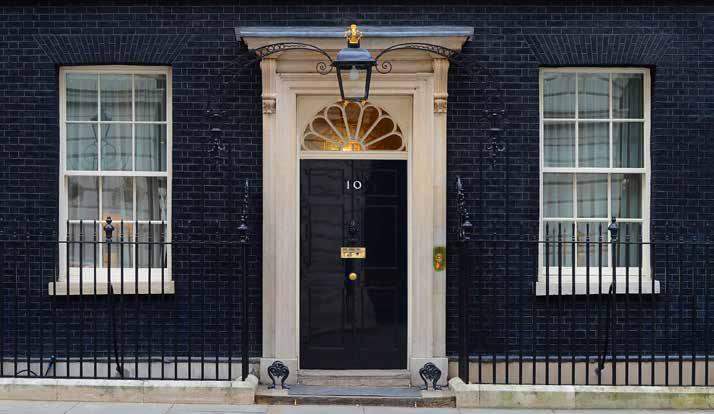
“ THE GOVERNMENT MUST BE CURIOUS, WILLING TO ASK BIG, OPEN QUESTIONS AND TO HEAR ANSWERS THAT WE MIGHT NOT ALWAYS LIKE.”
where we want to be in five or ten years’ time. What does that look like? What is the vision?
I have seen evidence of ground-breaking approaches to helping some of the biggest global companies to define the future of their businesses. Effective questions are asked using systems design and creative thinking approaches to tackle the most complex issues, from how boards can best imagine the future to define strategy, to how to redesign production processes and supply chains. Stakeholder mapping is utilised to understand what’s really going on in a system, to map the “value exchange” between parts to see what’s working and what needs to change. The purpose is to find a competitive edge, to do better thinking and to produce better strategic options.
These approaches are also used to help leaders from emerging economy governments and multilateral organisations to design and test policy. And yet Whitehall rarely taps into such British expertise and instead continues to work in antediluvian ways that Victorian civil servants would recognise.
We should use the best available, cuttingedge techniques in systems design to explore the issues we face, to imagine the successful and prosperous future we wish to create and then objectively work out what needs to change. We need to take a truly collaborative approach that works throughout Whitehall and across departments and sectors. We owe it to the country to think beyond any particular ideology and the electoral cycle, as we require long-term solutions that actually work. How else are we going to tackle climate change, to get beyond net zero and towards a sustainable, regenerative future? How else are we going to stay globally competitive?
We also need a shift in our political culture. It is no secret that successive Secretaries of State have been constantly planning the downfall of whomever is the current Prime Minister and
focusing on their own positioning, using whatever brief they have at hand and to the detriment of that brief. Such an environment is unsettling and unsustainable. A great figure from the world of politics who served in a past Cabinet once told me that it used to be, when serving in high offices of State, Ministers focused on the job at hand and stopped playing politics. You served the Government and the country – not yourself. Tellingly they added, “There wasn’t time”. What has changed so much in our political culture that rarely does this seem to be the case today? The instability of the last seven years has fuelled the dreams of those who wish to reach No 10 and so the focus has shifted to personal ambition and away from the day job. The political reflex is to rubbish criticism while scrambling to deny any personal culpability and find fall guys to take the hit, usually officials who cannot defend themselves, or even colleagues in Parliament. All this should stop.
In contrast, when it comes to business, the Government should respect the importance and personal expertise of backbench MPs and include them more in the process of engagement and consultation. They have deep local empathy for and knowledge of the culture of their constituencies, and can offer valuable insight into the needs of their businesses. Visits, issues and ideas can filter through this channel and data can be gathered to inform policy making. There are very impressive and good people working at the Department of Business and Trade, Ministers and civil servants alike. Talk about “The Blob'' is disrespectful, combative and counterproductive. The process of government is clunky and slow but that is from all sides. In contrast, I found hard working, impartial, bright and diligent people who care deeply about our country; people who need leadership and to be encouraged and allowed to think big, but also who need to be heard and valued for the expertise they bring. I am an advocate of a more compassionate,
open and collaborative approach to the conduct of government.
A senior political figure once said to me, “The trouble with you, Joanna, is that you see everyone as a friend, someone to work with, whereas I think, ‘How can I kill them?’” I was astounded. How can anything be achieved if the people in our politics behave in this self-interested way, playing a zero-sum game? This country, our people, this nation can only be protected and developed with teamwork. If we are constantly undoing the good of others for self-gain, how does that serve? Look around, this is how we have ended up in such trouble.
There is much that is wrong with Westminster and how it works for business. Engagement with businesses now runs the risk of being about populating a personal address book as a hedge against election defeat, rather than driving business growth. In addition, departmental strategic planning should not be sacrificed due to political pre-election inertia, or the business department risks entering a state of suspended animation, tying the hands of exasperated officials.
We are going through a very difficult time, but I believe that good, competent, committed, creative and courageous people can change things, to stimulate new ideas, to help our businesses to thrive and to drive wealth creation. I have worked with many such great people from all sides of politics, and from the civil service and from business. We need people such as these at the top, making the decisions and supporting the Prime Minister if Government is to get serious about business and drive the future growth and prosperity of the UK.
Joanna Thomas was a Special Adviser to the Secretary of State, Department for Business and Trade until recently. Before, she spent over a decade working in Parliament and in politics. Joanna has a background in business and experience of broadcast television in the United States.
Many a city which we call beautiful is by any objective measure not beautiful at all. Very often, as with London or New York, they’re simply gigantic and dynamic enough to admit opposites. Others are dystopias which we’ve trained ourselves to manage in by assigning them labels – enchanting, lovely, beautiful – which don’t apply.
You realise this when you come to Venice: the City of Water is a separate case altogether. Any survey or poll taken regarding the question of The World’s Most Beautiful City, which didn’t show Venice the winner by a comfortable margin would be immediately suspect and void. No other city does terracotta reflected in the water and Gothic windows like this. But it’s also the place of the chance discovery: the Madonna above the doorway; the disappearing spire; the gondola yard; the washing on the balcony.
It hits you rightaway. As you cross from Marco Polo airport towards the lagoon, a new standard presents itself. We can call it beauty, but it’s also to do with an unusual degree of respect for the past. The past, you continually reflect, as you tour Venice’s bridged intricacies and tucked-away glories, may simply have been better aesthetically. The difference between Venice and elsewhere is that Venice has kept its commitment to the past as close to absolute as a city can, while everywhere else has made significant accommodations.
I recall coming here in the aftermath of the financial crisis in 2008. It occurred to me then that the very last city on
earth to know that there was a recession on would be Venice – and the last person on earth, a Venetian hotelier. It comes as no surprise to learn that tourism is by far the biggest sector in Venice, though the region still has a lively shipbuilding sector, in addition to being the largest exporter of Italian luxury goods.
Unemployment here remains high, meaning securing jobs is competitive. I recall another visit here in 2006, and on nights in the piazzas found the common thread among the young was their tendency to be living with their parents with no serious prospect of employment any time soon. Occasionally one wonders what happened to that
generation: perhaps they had to go abroad; maybe they become part of the radicalisation of Italian politics either nationally or as part of the Venetian nationalist movement; or perhaps they inherited their parents homes, and still hear their footsteps echoing as they leave the bars of the Piazzale Michelangelo, now thirtysomethings their static lives having been spent taking all this for granted.
For non-Italians who happen to be mobile, and perhaps looking to run their businesses from abroad, the property market is rather inflated in Venice itself compared to properties nearby in Padova and Vicenza. Everything’s Giotto in the first city, and Palladio in the second –
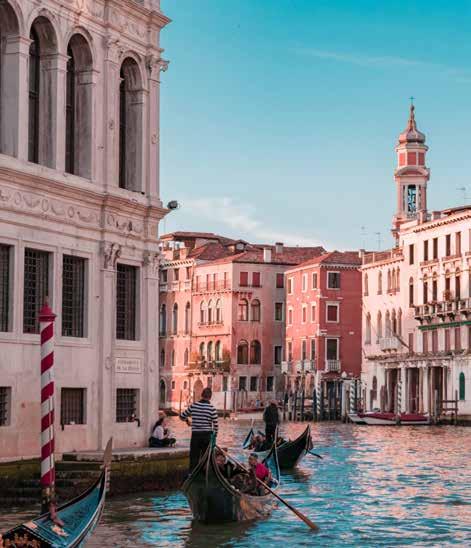
and both are in easy reach of Venice. But relocating to Venice is not impossible, and there's more life than you might imagine. Readers of Donna Leon’s excellent Commodore Brunetti series will know that the idea of Venice as mere museum and cultural fossil has tended to be exaggerated. In those books, we find a vivid, almost Dickensian cast of characters: the detached aristocrat, somehow managing to afford the upkeep of the palazzo; the shadowy criminals moving their money around; the owners of the gondola companies; the close-knit community which keeps La Fenice running. But Brunetti’s mysteries often take him beyond Venice itself onto the mainland, as if only there might the real network of relationships which lead to an intriguing crime be found. You sense that if Leon didn’t do this, too many of her stories would be centred on hotels, restaurants, or gelaterias.
For those looking to relocate, I can recommend the Lido. Every night, the vaporetto from the mainland disgorges true Venetians from their day jobs in hospitality onto a sleepy promenade whose veneer is touristy, but which the longer your stay feels lived-in and viable as a home. Accordingly, the place has a sense of community which you only occasionally glimpse on the lagoon. Housing here is affordable – for the
Londoner, almost laughably so – and so the international entrepreneur is in theory only a Visa application away from an affordable lifestyle with Venice on their doorstep.
And what does it mean to have Venice on your doorstep? It’s to be among the very wonders of the world. Almost every church has at least something by Titian, Carpaccio, or Veronese and most have at least two of them. Then there are the big-hitters such as the Scuola Grande which is known as the Sistine of Venice, with its grand dramatic ceilings painted by that scrappy hustler Tintoretto. We don’t always like to hear it, but it was the product of a worldly ruse. When the possibility of the commission came up, there were four other artists in contention, including Tintoretto. When Tintoretto displayed his submission, he took the opportunity to announce that it was a donation, knowing full well that the regulations stipulated that all gifts had to be accepted: he went on to do 60 paintings, a large proportion of them deathless masterpieces.
You could spend your life only looking at those – and scores of lifetimes inspecting all the glories elsewhere in the city. If you stand very still on the Ca d’Oro and pay proper attention, you can feel it moving slightly. Look down at the floor at the Basilica di San Marco, and you’ll notice that the stones are uneven and therefore hand-cut – nothing is
ever completely even in the Venetian aesthetic, it always admits room for growth. In this beautiful untidiness, it mimics the laws of the universe itself.
Of course, there is another side to Venice, which you can glimpse in the Doge Palace itself. Here you meet the truth that there’s such a thing as a painting which is too large – Tintoretto’s gigantic Last Judgement seems as though it must forever draw attention to its size, and therefore to the ambition of the painter. To paint on that scale you need a better reason than that you’d like to be considered great (and be paid in the process).
Here too are some of the more forbidding prisons imaginable, reminding you that to fall foul of the Doge was never a particularly good idea. The famous Bridge of Sighs is named not, as many think, after the delighted exhalations of lovers seeing the possibilities of La Serenissima. Instead it refers to the regret of prisoners who saw this view on their way to their executions, to when all those possibilities had been closed.
But perhaps there’s a lesson there. If Venice is infinite and we are not, then it’s always to some extent a mystery to anyone mortal. A relocation might be for you if you’ve come to the conclusion that the occasional scratching of the surface isn’t enough.
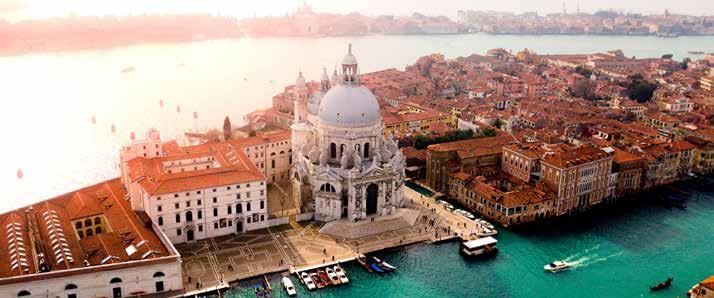
After Brexit there was a certain amount of talk of a number of cities taking London’s crown as Europe’s financial centre. Several runners and riders stepped forwards, but the results sometimes seemed underwhelming. JP Morgan sent its backroom staff to Dublin; a Goldman Sachs banking chief waxed lyrical about Luxembourg; and even Paris, that city so addicted to every kind of tax, but perhaps still nursing disappointment over the location of the 2012 Olympics, saw an opportunity.
But I remember thinking Amsterdam was quite a plausible competitor. Its mercantile past stares back at us in a hundred Rembrandts. Here, after all, is where banking found its rhythm after its initial invention in Florence in the Renaissance. This is a city with form when it comes to doing its sums –except when it comes to the question of the value of tulips where they may have erred from time to time.
200,000 people who work in finance now, around a tenth work for a fintech company. AI, tech, and life sciences are also all growing sectors in this city. Of course it helps that Amsterdam has one of the biggest airports in the world; proximity to one of the world’s largest ports in the shape of Rotterdam; and that Dutch people are excellent English speakers.
It turns out that Amsterdam is eager to have our wealth management clients here, but increasingly less delighted to host our stag-dos. A recent campaign by the city, warning off the Brits, was a reminder that Amsterdam doesn’t necessarily want to be a place of infinite licence after all.
In confirmation of this, the Wallen Watch now patrols the streets at night, and though it’s possible for other nationalities to misbehave here, it has long been suspected that nobody does hooliganism quite like the Brits. It is indeed a miserable sight to see the windows of available – and often trafficked – women; the hash bars, wreathed in idiotic smoke; and the lunatic shouting of a tourist who might have had something to say had he not just vomited on his shoes.
It is especially depressing to observe, rising out of all the depressing evidence of human beings in decline, the gorgeous Oude Kerk, that medieval glory dreaming on another morality than the one which has long since overtaken Amsterdam.
Amsterdam was always a marshy place, and therefore an incredibly unpromising place to build a major city. The Romans understood this and weren’t thinking in terms of canal systems.
I sometimes think that the relative absence of the ghosts of Rome has meant for a city less tethered to the deep past, which may possibly account for its undeniable mercantile and hedonistic streak. Of course, it’s possible to take these sorts of ruminations too far: the presence of a Mithraeum doesn’t quash one’s delight in the present, just as the absence of one doesn’t excuse you from Gibbon.
While the Romans didn’t take much notice of here, the Nazis did. The Anne Frank Museum has to be visited if only to see what it means to fight for a freedom we might subsequently lament for the excesses it can bring. Here you wind up narrow staircases into the very rooms where the famous diary was written. What cannot be understood is how somebody could kill a girl with a smile like hers. To consider her fate, and to know that if one had the power to do so one would reverse it in an instant, is to doubt the wisdom of a non-interventionist God. But perhaps all the intervening is done elsewhere than earth. It certainly wasn’t done in Amsterdam.
In fact, some of the prophecy came true. Amsterdam has seen a marked post-Brexit uptick in fintech companies: TradeWeb, MarketAxess, Klana, Azimo and CurrencyCloud all entered the market here over the past five years, or else increased their presence. Of the
It’s the morality of the 1960s, of course. There are signs that Amsterdam has always craved freedom. In this city, unlike in many others in Europe, there are no Roman ruins for the tourists to tick off on their itineraries, though a few artefacts have been found here and there. Like the area around Westminster,
Moving here has one considerable boon secreted amid all the admin: the Netherlands boasts one of the world’s finest healthcare systems. In 2016, the country topped the Euro Health Consumer Index. The system is based on a mandatory health insurance scheme (called the basisverekering), covering everything from GP consultations, hospital care, medicine prescriptions, maternity care and ambulance services: starting at around $95 a month, it’s affordable too.
“AMSTERDAM HAS SEEN A MARKED POSTBREXIT UPTICK IN FINTECH COMPANIES”
And the city itself, especially if one has experienced the eye-watering prices of Oslo and such places, has an affordable feel too: beers come in at EUR4.50; a monthly transport pass at around EUR 90; monthly gym subscription at around EUR 36. The city doesn’t seem to want to take your money quite like other less exciting places.
And if you take the plunge and come here, you’ll be connected to some of the finest museums in the world. The Rijksmuseum boasts the famous Night Watch, a picture I sometime find it hard to get too excited about – partly because it’s surrounded by so much I think better: not just the other Rembrandts, but the Vermeers and the Franz Hals. Sometimes when we try to paint our masterpiece we merely produce something gigantic; when we’re off our guard and looking at a goldfinch with
unusual attention, that’s when greatness can come our way.
Of course, for a while, a little known and superficially uncharming fellow called Vincent Van Gogh lived in the general vicinity. He painted supreme pictures to everybody’s equally supreme indifference. Now, he’s booked out months in advance and if you listen hard in the Van Gogh Museum, I sometimes think you can hear his kindly laughter at what posterity has given him. It’s the sort of turnaround only human ignorance, and its eventual corrective, herd praise could have produced. But there’s no begrudging Vincent, who deserves every paragraph of praise he’s ever received, including this one.
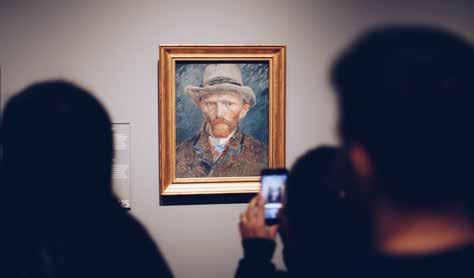
I sometimes worry we think too much in terms of capital cities: Amsterdam is a portal just like every other major urban centre. Over the years, I’ve enjoyed
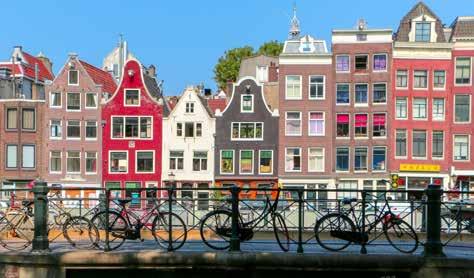
a peaceful walk around Delft, whose essential peace feels unchanged since the time of Vermeer. It was once said that a great artist is news who stays news. But another possible explanation is that there is really no news: human beings continue on their endeavours just as the earth is on its ellipse.
Elsewhere there’s also the Hague, which is a good option for relocation too, with a strong political scene both domestically and internationally.
Amsterdam is beautiful and thriving. Its excesses are really a wager it has made with the desire to be exciting. The good news is that it reliably is: the occasional whiff of hash is more than offset by the wholesome scent of a thousand bakeries and the ministrations of the stroopwafel you really must try, whether you decide to live and work here or not.
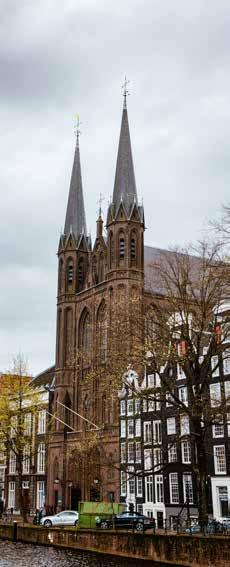
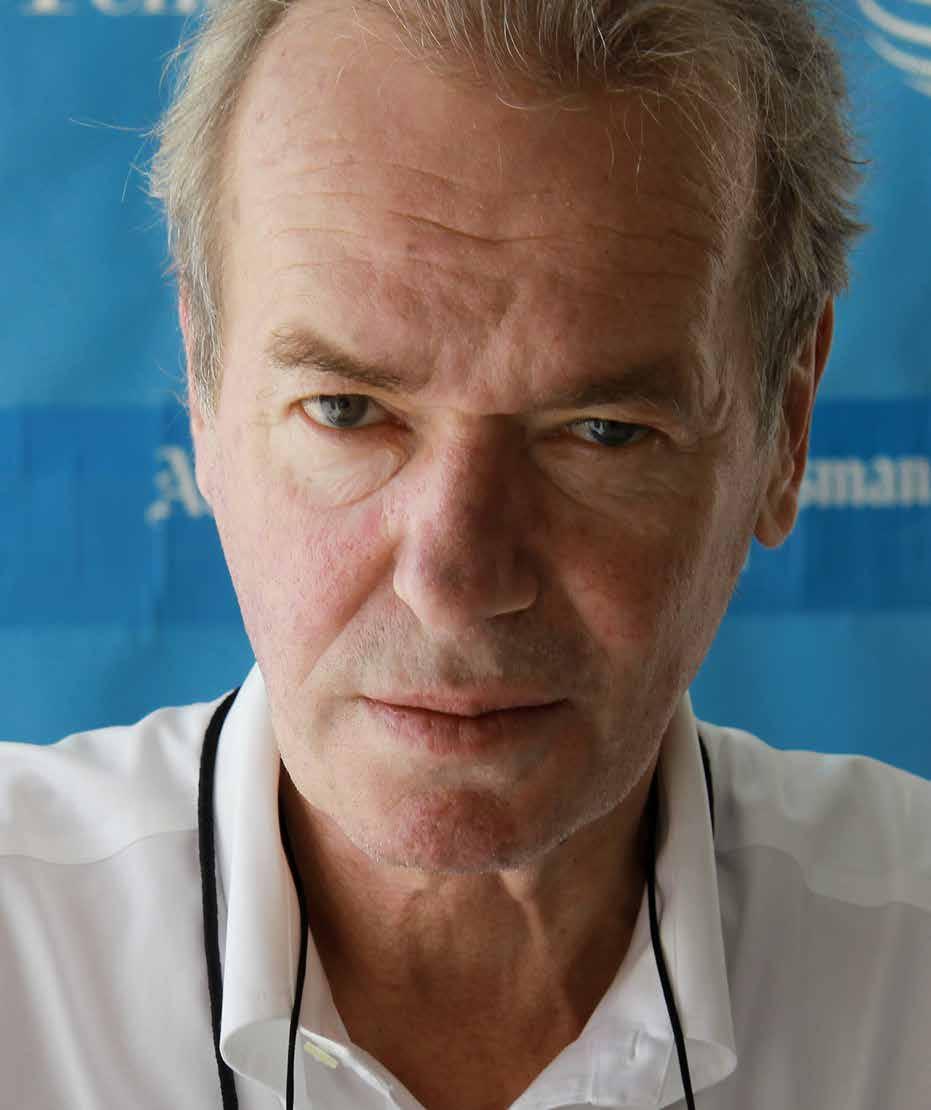

Ihavealways been very fond of Philip Larkin’s poem ‘Church-Going’, where Larkin stops at a countryside church and takes off his cycle-clips ‘with awkward reverence’, walking around, until he decides ‘the place was not worth stopping for’. He ends up wondering ‘when churches shall fall completely out of use, what we shall turn them into.’ It’s a lovely poem for an England Larkin felt to be vanishing. The only line in the poem I think is definitely false is the line about it not being worth stopping for –not least because it gave him the poem itself.
I thought of the poem a lot after talking with Sir Philip Rutnam, until recently the permanent secretary at the Home Office, and now the Chairman of the National Churches Trust, a laudable organisation which seeks to help preserve the 39,000 or so places of worship in the United Kingdom.
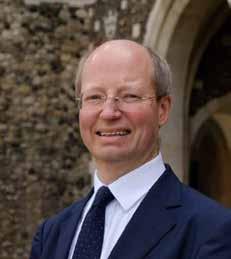
So how did Rutnam acquire an interest in our churches and chapels?
“My parents weren’t from a churchgoing family, though there was a lot of emphasis on education. It was a modest household in terms of income but it was a rewarding environment for me,” he tells me. “I was interested in history going as far back as I can remember. And buildings are one of the most tangible and engaging ways of seeing
how the past continues to have an effect on us.”
Rutnam went on to study History at Trinity Hall, Cambridge: “I really loved it because it’s so varied,” he recalls. “You’re looking at everything from the origins of Europe after the fall of the Roman Empire through to neocontemporary history of the United States with all sorts in between. It was a vast field – not just in terms of subjects but also in terms of ways of thinking about the past.”
So why are they not better known?
“The first thing is that these buildings get taken for granted; they become familiar. And familiarity can lead to lack of inquisitiveness or curiosity,” explains Rutnam. “Secondly, they’re often not well understood. If any one of
the 15,000 Listed places of worship in England – and there are thousands more in Scotland, Wales and Northern Ireland – were in America it would be regarded as utterly extraordinary. The abundance of these buildings makes them their own worst enemy.”
So what can we do to redress that?
Rutnam is clear. “We need to help people to recognise how exceptional it is that in this country there’s such an amazing collection of historic churches.”
“THE STATE OF OUR CHURCHES IS THE BIGGEST PROBLEM FACING OUR NATIONAL HERITAGE –BY FAR.”
CHRISTOPHER JACKSONSt Leonard, Kirkstead, Lincolnshire
Obviously, the challenge is doing this in an era of distraction – of memes and AI and and Taylor Swift and a million other things. But Rutnam is optimistic: “The decline in church-going has had an effect, yes, but actually very often you find that these buildings, even if the number in the congregation is less than it was 50 years ago, the building is still the centre of the community and regarded as such. It typically provides a wide range of activities beyond worship.
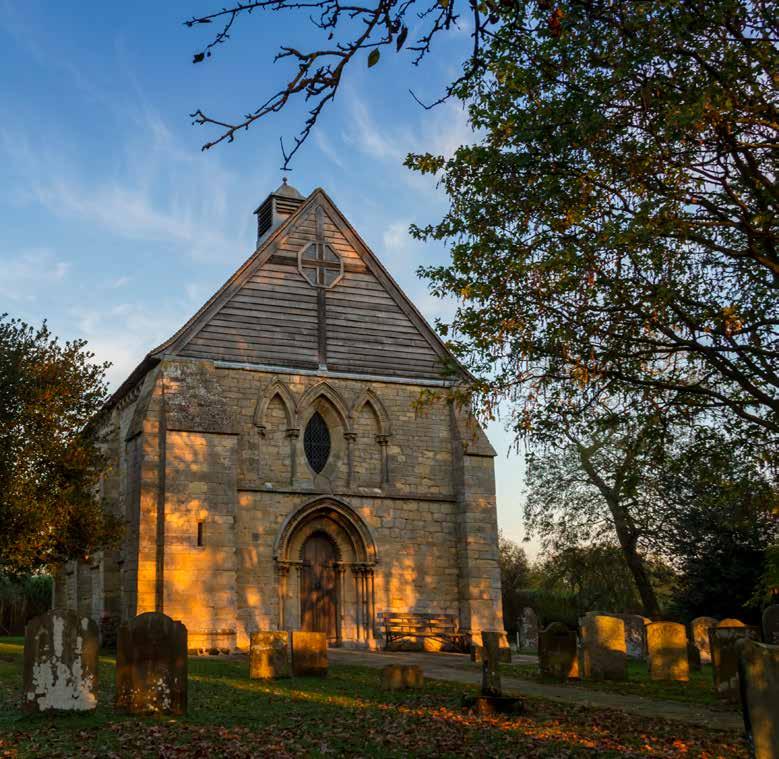
Our challenge is to jolt people out of this sense of taking these places for granted.”
And how do you do that? “One thing is to make the buildings more accessible. That might not jolt but it will encourage. If we don’t, some people might hesitate metaphorically at the threshold and not go into the building because it’s unfamiliar and they haven’t been inside before. You need to make sure it’s got wheelchair access, as well
“THE BUILDING IS STILL THE CENTRE OF THE COMMUNITY AND REGARDED AS SUCH.”
as toilets and a kitchen. My church in North London has a nursery in it and holds Alcoholics Anonymous meetings.”
I think back on the role the church used to play, remembering how in Cartmel Priory in the Lake District, there is a loaf of bread behind one of the pillars, a memorial to the church’s traditional role in feeding the poor. Rutnam explains that this work continues today in ways we might not realise: “Many of our churches are hosts to food banks. There are more food banks hosted than there are branches of Macdonald’s in the country. There’s a modern version of the loaf of bread at Cartmel Priory at the food bank at Blessed Sacrament Church at Copenhagen street in North London, or Maryhill in Glasgow – and thousands of other examples.”
But we shouldn’t stop at simply making
these magnificent buildings more accessible, Rutnam explains. “We also need to bring out the stories, and discover ways in which people can easily engage with the history behind the buildings. For instance, I went to the Parish Church in Ross-on-Wye a few weeks ago and they had a very cool bit of technology, which meant if you downloaded a QR code, and then raised your phone, you could see the medieval rood screen restored. The same thing could be applied in lots of different buildings. It’s to do with bringing up the variety of history there.”
Has the pandemic improved churches’ technology offering? Rutnam replies: “Covid-19 had a whole range of impacts. It’s now common for services to be online at the same time as they’re happening physically. But more generally technology’s quite a challenge for parishes, as these are by their very
nature small organisations. We have 39,000 places of worship open for use, half of them listed buildings, and each one of those is effectively a small organisation – and, as with any small organisation – helping it to have the skills is a big challenge. One of the things organisations like ours could do is provide more of the common resources needed for technology to be adopted.”
When I think of my own experiences of visiting churches, I find that one reason that I might not stop is because it’s not always clear if the church itself will be open. One fears the rigmarole of parking up, trudging up to the steps and then finding the door locked. Sometimes it’s worth it – the door delightfully gives yielding the inside of the church, and the secrets within – but more often than not it doesn’t and you have to trudge back to the car. Larkin
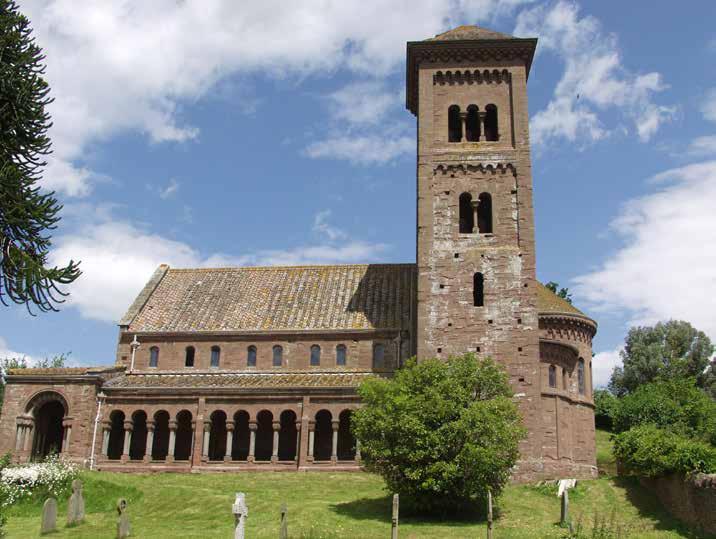
might have thought his church not worth stopping for, but he lived in an era when doors weren’t closed due the perception that otherwise they’d be ransacked by vandals.
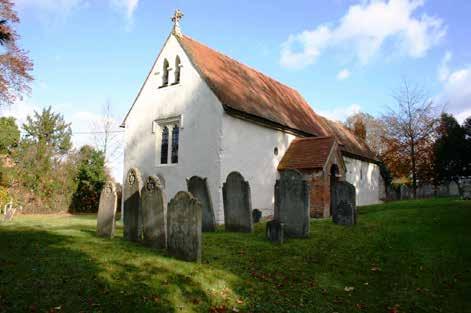
Rutnam strongly agrees: “We would encourage churches to be open to the public regularly and indeed the standard advice from the main insurers for church buildings is to be open to the public regularly – it’s not to be closed, there are other risks to be associated with that. I understand it’s a challenge. Definitely at the minimum churches should advertise the hours they’re open and to be open not just on Sundays but for some point during the week. We run a website which is the largest source on this called Explore Churches.”
Of course, every church is unique, and each incumbent must choose a strategy. Not all churches can be like, say, St Bride’s off Fleet Street in London which has its famous relationship with the journalism profession. But Rutnam points out that every church has something to offer. “The main identity which churches have is a geographical one,” he says. “Everyone of us lives in a locality, whether we’re there for a month or for 30 years. Churches have an extraordinary role and potential.”
When it comes to the crucial business
of maximising that potential, a lot currently seems to depend on the get-up-and-go of the individual incumbents. I can think of a range from the vigorous Dr. Alison Joyce at St Bride’s to the rather indifferent vicar at my local church in South-East London. Rutnam is sympathetic to the plight of clergy and eager to help: “Clergy are not generally trained as the operators and manager of buildings –understandably. It’s not a standard part of the theological training, but it has ended up being an important part of their job. One of our roles is to support not just clergy but also the small groups of volunteers, the church wardens, the church councils, and the people who end up involved in the running of the buildings, and to support them with easy to use advice and training about how to manage the difficult problems which come up.”
So how many volunteers are there exactly? “We’ve estimated there are about 400-500,000 volunteers. One of the things we try to do is make sure their role gets recognised. We have awards each year for volunteering. We provide some support and training on how to work with volunteers. You’ve got this incredible network of churches and chapels, and local organisations and what we seek to do is provide the best support we can for them.”
So there’s a lot of work to do, and I realise afterwards that I’d been talking to Rutnam for nearly an hour, and because of his soft-spoken, knowledgeable and gentle demeanour not really intuited the scale of the crisis. But now it begins to hit home: “We’re a relatively small organisation. We’re a national charity for this extraordinary group of buildings. We have about 5,000 members who support us each year. We also have regular donors, some of whom are individuals who have a strong alignment affinity for the cause, recognise the role churches play and some are from foundations and trusts such as The Pilgrim Trust which has been supporting this cause since we were set up in 1953.”
But here’s the rub: there’s far more support required than the NCT can currently provide. Rutnam sets it in context: “We’re able to distribute around £2-5 million a year on projects. That’s an appreciable sum but only part of the overall funding of projects which need to take place.”
So what sort of grants do they give?
“We don’t give more than £50,000 to any one project, and in a typical project we fund about 200-300 a year. But each year we’re oversubscribed by a factor of three or four. There’s far more demand for funding to restore these buildings
than there is funding available. As a result, the backlog of works is growing, and the threat to keeping these buildings open is also growing.”
To anyone who loves history – let alone anyone who loves churches – this is a dystopian vision of a country losing its connection to its past – exactly as Larkin feared.
“It’s very serious,” agrees Rutnam. “We need more donations. This is the single biggest issue by far facing our national heritage. Stately homes were an issue after the Second World War when the families who owned them didn’t have
the money to keep them running; now the biggest problem is our churches and chapels. There are buildings which have closed recently because of major repairs which the congregation can’t fund but there are others which are in danger of foreclosure. The National Churches Trust has a role but so does Heritage Lottery Fund – and so, of course, does the government. These are fundamental public buildings which have been here for hundreds of years.”
So what is the UK government doing? The answer is shocking. ““Apart from being able to reclaim VAT on repair work, there is no regular funding from government. There was some funding during the pandemic as part of the Culture Recovery Fund and that was very quickly used to fund a whole range of major repairs of churches which urgently needed. That too, of course, was massively oversubscribed.
It’s a hard one to get up the agenda, he explains. “Scotland may provide us with a warning of what could happen in England, Wales and Northern Ireland. The Church of Scotland is going through a process of trying to reduce its church building estate by 40 per cent and a whole range of buildings, some medieval, have been identified for closure. Some are for sale at the moment on the Church of Scotland website.”
Of course, what happens to those sites will depend on the acquirer. Some will no doubt become housing, others will house retail store.
So how can the NCT connect with young people? “Sustainability is important and strikes a chord with many young people. As we deal with the huge existential challenge of climate change we have to make better use of our existing stock of buildings. We have to move away from a culture of demolishing buildings when we think they’ve finished one use and building something new – usually out of glass and steel. That’s not going to
“IT’S OUR DUTY TO MAKE THE BEST OF THOSE STRUCTURES, AND ADAPT THEM FOR WORSHIP AND FOR SERVING THEIR COMMUNITIES.”
St Peter, Peterchurch, Herefordshire
be sustainable in terms of their impact on the environment. Churches have overwhelmingly been here for hundreds and hundreds of years, and they have a huge amount of life left in them. It’s our duty to make the best of those structures, and adapt them for worship and for serving their communities. It’s eminently possible to do this in a way far more sustainable than the alternatives.”
Rutnam also makes another point: “The other thing for young people to be aware of is that there are opportunities – really rewarding opportunities – to work in the field of conservation. There’s a huge shortage of people with the skills needed to look after ancient buildings, working with your hands to carve stone, to repair wood, to the craft skills and there are some really good programmes available for apprenticeships at universities and degree programmes.”
It’s a remarkably clear case for action, made passionately by someone with
a great deal of intelligence and quiet knowledge. Larkin ends that poem with a stanza that must be quoted in full:
A serious house on serious earth it is,
In whose blent air all our compulsions meet,
Are recognised, and robed as destinies.
And that much never can be obsolete, Since someone will forever be surprising
A hunger in himself to be more serious, And gravitating with it to this ground, Which, he once heard, was proper to grow wise in,
If only that so many dead lie round.
It is that surprise of churches which we must preserve – and preserve it for as many generations as possible.

To find out more about and support the work of the National Churches Trust, visit: nationalchurchestrust.org.
There was a time when Vincent Van Gogh couldn’t get anyone to look at his paintings. Today, it’s hard to get people not to. Vincent, who lived a lonely and unhappy life –unhappy when he wasn’t painting – is now cemented in his greatness. This turnaround would have astonished his contemporaries in Arles in southern France, where Vincent lived out his last years.
But as ever we simplify, and to simplify is to misunderstand. We attribute his current reputation to ‘madness’ – as if all these marvellous pictures somehow came to him as an expression of insanity.
This is to remove much – not least the fact that Vincent was always sane when he was painting, and that painting was in fact his best method of remaining together. He was likely bipolar in an era preceding treatment.
It also implicitly forgets the hard work which underpins his achievement. One might sometimes imagine that Vincent is a completely separate case, someone we can’t expect to learn from at all, because we are not mad and he was.
This comes up against a crucial objection. In the first place, I remember my grandfather’s dictum: “I’ve never met
a sane person.” We might be deluding ourselves if we consider ourselves well, and Vincent not. What is our almost unanimous love of Vincent’s pictures but a sort of sudden recognition that the world actually is the way he sees it for us too?
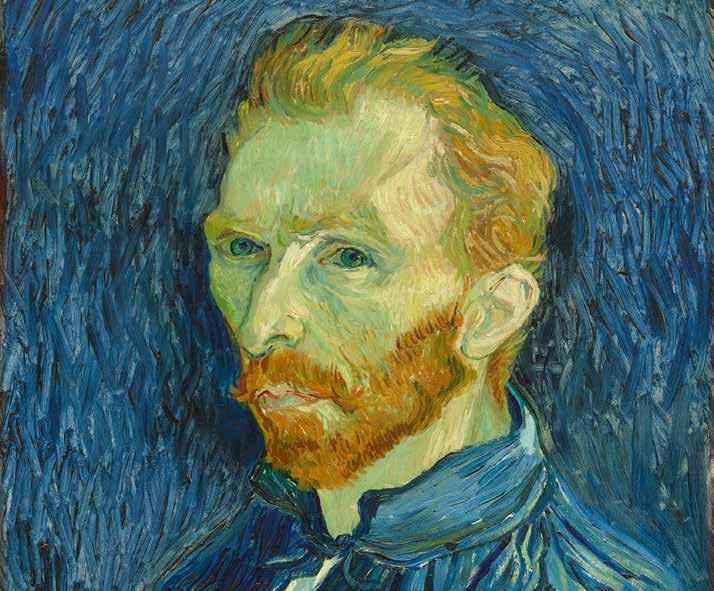
Vincent’s life still seems to invite us to imagine the world binary, divided between the sane and the insane. In actual fact, his story increasingly makes me think that we are instead divided between those who are committed to something and those who are not.
Meanwhile, one museum partly
dedicated to Vincent’s memory is in flux. The Courtauld Institute last year reopened, having spent £57 million on renovation works only to emerge on the other side of the expenditure looking almost identical to what it had looked like before. The Van Gogh Museum in Amsterdam renovated itself a decade ago for around half the expenditure and looks fabulous.
Even so, the Courtauld Institute is one of the great collections of the world. Probably its most famous picture is the self-portrait of Van Gogh which he made after the terrible – and even to him, incomprehensible – incident in Arles where, his friendship with his visitor Paul Gauguin having blown up, he cut off his own ear and delivered it to a prostitute with a cryptic note attached. This episode is so famous that it is probably this alone which distances us from Vincent and makes us think that the lessons of his life can’t possibly apply to us. Most Van Gogh lovers still exist in the aftermath of last year’s Courtauld exhibition which brought together 27 self-portraits across two rooms. They showed the extent of his development –his astounding commitment to the art of painting. It has to be considered in tandem with the Van Gogh Museum in Amsterdam, which still houses many of his greatest works.
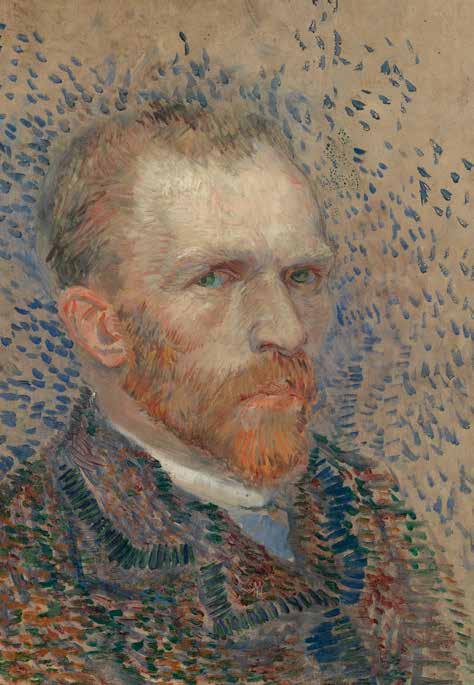
Born in 1858, Vincent’s mother was from a well-to-do family, and by all accounts an austere character; his father was a minister with little means. Before Vincent was adopted by the French, he was a Dutch painter, and really he remained so. The early selfportraits, drawn in his native Holland, are sombre affairs compared to what he would later produce and as such are a precise measure of how far he would subsequently develop. These pictures show a desire to make his craft secure before he did branch out – but we also suspect, because we know how radically he would depart from them, that he may
have had misgivings about them.
Why do so many self-portraits exist?
Vincent, we forget, was unnerving to meet – full of tics and idiosyncrasies. Few were willing to pose for him, not being able to glimpse our subsequent admiration for him amid the demands of their own lives. His physical appearance was by no means prepossessing, and the only reputation he’d ever acquire would be posthumous. Throughout his short life, the only model always willing to sit for him was himself.
This points to his resourcefulness and his determination. In his letters to his brother Theo – some of the loveliest
documents in the history of art – we get a lot of detail about materials Vincent is buying. Sometimes, you bump up against the sort of poverty he was dealing with: “I spent the afternoon doing a drawing in mountain crayon, the one little piece I had left from this summer,” he writes to Theo on 4th March 1883.
The situation never noticeably approved. Had he known that his portrait of Dr. Paul Gachet would sell for $83 million about a century after it was painted, he might well have thought of all the canvas and crayons he could have bought with that. In life, he was
always sensible with money, frugal out of necessity. Unfortunately, because Theo’s letters weren’t kept, and Vincent’s were – though nobody in their right mind would wish that things had turned the other way round – we rarely get a sense of Theo’s view of Vincent. What evidence we have suggests his deep admiration, but the gap in the record further augments the sense of Vincent as a man alone.
Vincent’s was a dedicated, even obsessive gaze. In last year’s Courtauld exhibition, we saw Van Gogh studying his own face from every angle. In Amsterdam you begin to grapple with his obsessions, which are still ours: water, trees, faces, skies. Again, Van Gogh is both genius and everyman which accounts for his singular power. We feel we know him. It’s this intimacy – together with the perennial simplicity
of his signature – which makes us comfortable (think Don Maclean’s song of the same name) calling him ‘Vincent’. We do not call Cezanne ‘Paul’ or still less Picasso ‘Pablo’. Vincent is touching in a way no other great artist is. Paradox weaves through his life. He’s both awesome and pitiable. His fate is tragic – but it’s also heroic.
He never put himself on a plinth; he is always in the trenches of life with us. It is difficult to think of another artist who cared so much for the downtrodden and the outcast. A great artist, even if they are poor, will often be haughty as they can do what so few can: produce great art. They will also be private as they will only really experience peace when undertaking their art. Vincent wasn’t self-aggrandising. Of course his failure seemed so absolute that to have been so would have invited ridicule. But there
are signs that he knew his worth, and artists far less great – and just as ignored – have permitted themselves arrogance.
In the self-portraits we see the same determined mouth, the slightly watery eyes as if he were already weeping for his short life, the hooked and even austere nose, the receding hairline. But this is where the similarities between each picture end. Given that the same subject recurs throughout, the variety of moods and techniques cause astonishment.
The main reason for this astounding versatility is that Van Gogh had made himself open to the gigantic discovery of the age – Impressionism – and then moved swiftly beyond it, marrying it to his heritage, and then making a unique and wholly personal achievement out of the new artistic mood.
It is his ‘discovery’ of Impressionism which again gives the lie to this idea of Van Gogh as cordoned off by insanity from other people. In truth, he never could have discovered Impressionism without having been immersed in the art world through his brother Theo. There was no internet with which to google Seurat; he had to meet Seurat. We can see in retrospect that Vincent made many shrewd moves which might be the envy of more worldly painters; his fame is no accident at all. In fact, he often foresaw in his magnificent letters that there would come a time when he would find recompense for his hard work. He even foresaw from time to time that his victory would have to be posthumous. Take, for instance, his decision to move away from the priesthood – one of the great career changes in history. He knew he was unsuited to it, but took what he had learned there – the importance of the numinous in life – and applied it to his art. He then applied himself with rigorous dedication to painting, and – crucially –connected himself in that world, making sure that he was working not according to some outdated understanding of his craft but to its latest developments.
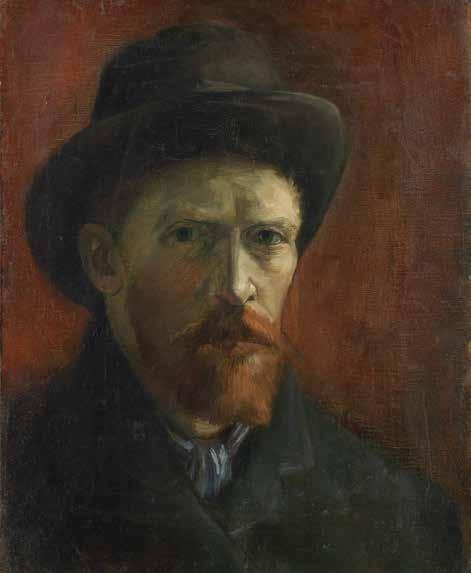
As he carried out all this he was frugal, careful, and utterly committed. He also had an unfailing instinct for the next subject, and was prepared to subject himself to upheaval in order to pursue those instincts to their logical conclusion. The most famous example of this is his decision to leave Paris and move to Arles in southern France.
He craved more light – perhaps another kind of light. What Vincent calls that ‘high yellow note’ entered his pictures: we see it in his Yellow House in the Van Gogh Museum, and of course in Sunflowers, his most famous picture. But we sometimes talk of these things happening to him, as if he were too mad to do anything other than stumble upon greatness: in reality, he made it all happen. Again, because his life ended tragically, we forget that he was possessed of exceptional self-reliance to have got as far as he did.
Of course, a more organised person would have found somewhere less depressing than Arles to settle. It’s true that it had a few things going for it –the old Roman amphitheatre and some decent museums in towns nearby. But one senses that almost anyone else would have pressed on to Italy – or to Tahiti, as Gauguin did and follow their decision to relocate to its logical conclusion and find their way to a more appealing town. Again, it was his hyperactive fascination with what he saw which made him stay. The fields, the café, his chair, his room: these were enough for him, because he realised that just by going to Arles he had learned to see things in a way which nobody before him had been able to do.
No-one has seen like that since – and it must be that no artist has communicated to so many people with such immediacy. In fact, his work has the immediate comprehensibility of photographs: it is mass art in the way in which magazines are. And yet it stands up.
This is abundantly clear at the exhibitions now touring the world where huge
crowds, including children, experience Vincent ‘interactively’. At times the exhibition – as in its roomful of sunflowers – feels somewhat gimmicky, but sometimes it astonishes.
The centrepiece of the exhibition is a vast, cubist cinematic experience, where we see the familiar story of Vincent’s life written in subtitles while relevant music plays and his paintings are shown blown up on a series of partitions. The fascination of the show is that it’s impossible to see all of it in one go, and we’re reminded of what a complicated thing a life is, and especially a creative life like Vincent’s.
But the principal reflection is this: it’s very hard to imagine a show on this scale for any other artist dead or alive. Picasso, perhaps. Hockney has recently sought to emulate it. But in each case, I doubt that their work and life has that deep appeal of Vincent. Picasso is at his heart too grotesque and misogynistic; Hockney’s work is probably not quite good enough, especially in the last 20 years or so.
What accounts for this? It is that Vincent truly loved the world and truly loved all people. In his life, he imagined creating an artists’ colony alongside Gauguin and others where the world would be righted. Sometimes, Vincent had little self-awareness: he had neither the organisational skills nor the money, nor really the personal magnetism, to make such a thing happen.
But it happens today at any Vincent exhibition where people gather in a kind of loose arrangement of fascination, seeing the world again through his eyes. Of course that arrangement dissolves swifter than Vincent had in mind when he imagined a colony of artists. But it is something – more than something. And with every passing year we need to understand that Vincent’s popularity isn’t a quirk of madness. It was because his life in its way was exemplary, and there is much we can learn from him.
Think of a man gone past like this: unschooled by any length of scholarship,
but still seeing a path through and by the brimming cup and rip of his seeping madness, a way of doing things with paint and an eye, a wholly newly naked way of haggling with the daylight and the night, and then to let all the others see the whiplike pictures built from a mind’s priest-less cathedral.
He made his mark on history, fusing to a trouble time’s wide white canvas, mimicking the rain, the fearsome hail-stroke of living. What was natural to him, his early death, was the very letter of that early death spelt in the desperate, breathless color and might that crowned him with their feats and with the more halcyon golden bells of hindsight.
He died penniless, disregarded, going under the earth alone; but he’d made, the while, color wonder, and light made to sunder the gift of light.
By Omar Sabbagh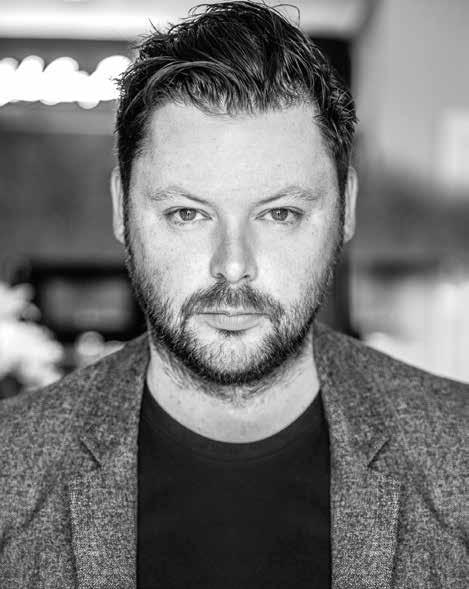
is a wonderful thing. As soon as you meet Liam West you find yourself mentally revising your idea of the art world. West, the hugely successful founder of West Contemporary, meets me at Kerridge’s Bar and Grill in the Corinthia Hotel. West is sitting quietly in a corner – with an air of humble diligence – hunched over some paperwork with a team member. You wouldn’t know that all the art on the walls is here because of his acumen and reputation – or that this is one of the leading figures in the UK art world. So how did he become involved in the sector? “I was brought up in New Cross in South London – which is part of the Old Kent Road, the cheapest block on the monopoly board,” he recalls, with a smile. “But crucially, I was also born a couple of roads away from Goldsmiths University, where the YBAs (Young British Artists) came from. I just fell in love with that movement.”
Such is London: you might grow up feeling you have poor life chances but opportunity is always adjacent. And West is referring, of course, to that group of artists Damien Hirst, Sarah Lucas and Tracey Emin, who had nothing much to do with one another, other than being lumped together by the British press. When they came to prominence, they collided with Britpop and the outset of the Blair administration. Briefly, pre-Iraq, anything seemed possible – and it turned out that quite a lot was.
And especially for West. What was his career journey? “I ended up finishing college, not knowing what I wanted to do,” he recalls. “My Dad used to be a bus driver at New Cross garage, but went on to work for the Law Society.
He had someone doing CVs, so I went in. My parents never had the funding to do the university route anyhow. But my CV was done.”
This led to a bit of luck: “The lady that my dad gave my CV to for typing took it home to her husband. As it happened, he ran a fine art print company in Nunhead called Napier Jones. I got a phone call out of the blue saying they were looking for someone to come and do an apprenticeship.”
Initially, West was unsure about this development: “I wanted to continue my education, but I decided to do three
months over the summer. On day one, Damien Hirst walked through the door; they were doing a limited edition litho print for him.”
That sounds like a good first day – but, as time went on, West was continually impressed by the variety of work. “It just continued. We were working with Agnew’s at Bond Street, White Cube, and all the galleries around St James’s. I fell in love with it.”
West stayed for five years moving over time to a customer-facing role. He then started his journey in to reprographics and joined a
company called Icon near Borough Market in Southwark: “I kind of hit the ground running,” West recalls, “and I ended up being the MD of that company, managing over 50 staff, very quickly by the age of 23.”
It was an impressive rise. West recalls for me an important incident in the year 2000: “We had a salesman called Nick Duchamps. His great-grandfather had been Monet’s art dealer. He came flying through the door one morning and he said: ‘He’s only done it again’. I said: ‘Who?’ He said: ‘Banksy’. And I said: ‘Who’s Banksy?’”
We can catch here something of the energy an artist harnesses when they’re about to go global: sudden unanimous fascination among those who mind about the latest thing. From that time onwards, West was hooked by Banksy’s work: “I started blogging about Banksy; it became a hobby.”
West had discovered street art and its global superstar. He then went on to start a company Beautiful Crime, which in time would become dedicated to the
sale of street art. How did he come up with the name? “Those words come from a French artist called Monsieur A who’d been interviewed by a high end magazine and they’d said: “Don’t you know that what you’re doing is vandalism?” He said: “No, it’s not; it’s beautiful crime.”
worked for him at Pictures on walls . He was often referred to as Dave, which is not his real name. It’s quite remarkable how well he’s been protected over the years. And rightly so. I mean, he’s obviously a global phenomenon now. And pound for pound probably is the most expensive artist in the world.”
Eventually, having saved up a year’s salary from his day job, West became full time at Beautiful Crime. “Our big break came when we were asked to design the Coca-Cola bottles for the Olympics 2012 using local urban artists. They were so impressed that they asked us to design their HQ for the Olympics on the Southbank ”
West would go on to co-create the world’s first online gallery for street art originals. I can’t help but ask, hoving near a possible scoop, if he knows Banksy and will consider revealing his identity? But West smiles: “I've been in the same room as him, but I've never spoken to him. I know it’s him, because I’ve been with people who actually
Word spread and soon West could count The Royal Albert Hall, Adidas, Microsoft, All Saints, Levi's, Peroni, and numerous others as his clients.
Was it difficult to overcome the perceived gulf between the world of street art and the commercial art sector? “It was tricky at first because street art is seen as a bit of an anarchic movement
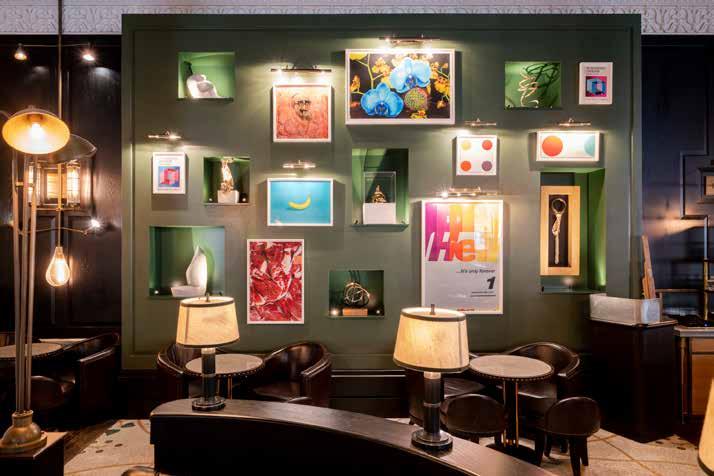
“NO, IT’S NOT; IT’S BEAUTIFUL CRIME.”
and a lot of street artists didn’t want to be involved in that world. But when the opportunity actually arose, I don’t think any of them turned it down.”

By 2018, he was ready for his next move – to Kerridge’s Bar and Grill at the Corinthia. “Tom opened this restaurant in 2018,” West recalls. “He said, ‘I want to build you a gallery.’ I’ve never been one for putting art in restaurants. I've always said if you want to buy meat, you’ll go to a butcher. So why would you buy art from a restaurant?”
What changed his mind? “Amazon shows us we’re all bereft of time. I never
thought we’d come to a point where people would be buying art online for thousands but here we are. We did a show in October 2021 where we sold 24 artworks for between £18,000 and £35,000. Not one of them was to the UK. So not one of them had been seen by the purchaser in the flesh. That still astounds me.”
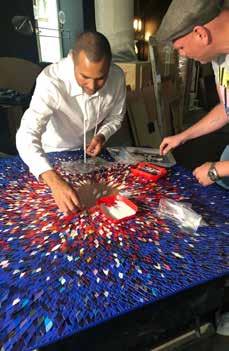
Meanwhile, the gallery itself has been an astonishing success. “I call it a showroom. Tom completely changed the food world by convincing Michelin that you could have a two Michelin star pub. I put a lot of trust in Tom who said:
“Look, we’re going to create something new here. We’re going to call it gastro art’.”
Just as important as these successes is what West does for the artists themselves. West notes that many artists leave college uncertain about vital aspects of the art world. “They don’t teach you about art management, how to go about marketing, framing, printing, and all that goes with it . My favourite thing is to take an artist from the very beginning of their journey and help them.”
Who does he represent? West now argues that street art doesn’t really exist anymore (“Banksy is selling in the same auctions as Picasso or Warhol”), and so he’s broadened his roster. “Graffiti artists make up 10 to 15 per cent of our roster of artists. But now we work with every sector: neon artists, mixed media, artists that are particularly inspired by sustainability, pencil drawing artists, sketch artists, spray can artists, painters, photographers, the whole lot. It’s a really exciting time.”
I’m keen to ask West about hot topics in the art world. What does he think of NFTs? “A complete Wild West at the moment, but I do think NFTs and blockchain are going to be game-changing for art authentication.”
He adds: “The one who’s really nailed the NFT market is Damien Hirst. And it’s quite clever what he does: with his latest collection, you can buy the physical artwork, or you can buy the NFT. But at any point, you can swap the NFT back for the original artwork. The last release he did, the NFTs outsold the actual physical artwork.”
And does he have any advice for young artists? “To be honest with you, it changes all the time. The problem is getting your name out there. There’s a
lot more opportunity today. It used to be a really closed shop. Social media has completely opened that up. Bond Street galleries are signing people up who’ve made it through social media because they’ve built their own market.”
And how should young artists price their works? West explains: “Tom also had a restaurant in Manchester called the Bull and Bear. We did all the art there, and we created a Fine Art prize. We ended up choosing a young artist called Tom Yates, who’s 26 from the Manchester area. We’re going to nurture him, but we’ll start off at £150. Each costs £50 to create, so there’s a £100 profit in it – and then you build it up.”
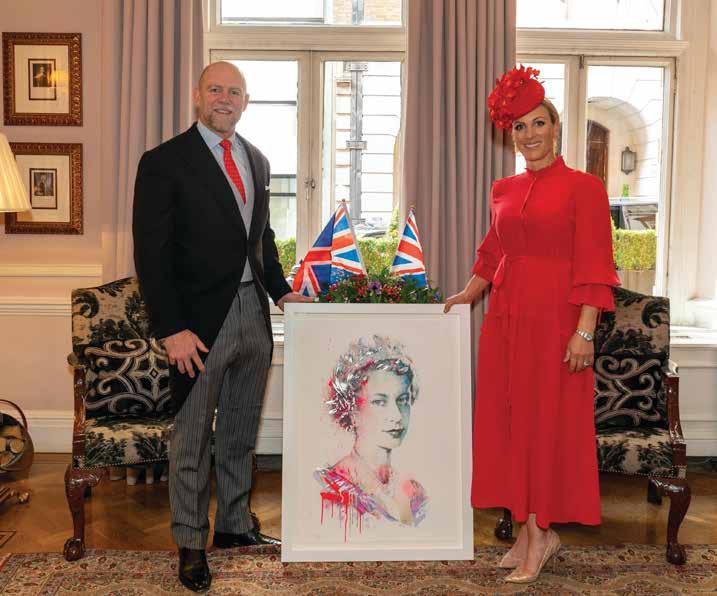
What does the cost of living crisis
mean for artists? “The problem I think young artists will have is getting materials when everything has gone through the roof. I think paper’s up 100%, as are inks. Certainly framing, wood, glass – everything across the board is up 50-60%. When you want to put on a show, the overheads for printing and framing just build up, incredibly so.”
Which means that many artists, floundering in these currents, need his help. Yet you never feel that for all his success, West is the least bit impressed with himself or arrogant. That’s the thing about success. It’s about hard work, and talent – and West has these things. But to travel so far so quickly and remain kind is the hardest thing of all. And he’s done that too.
“ THE LAST RELEASE HE DID, THE NFTS OUTSOLD THE ACTUAL PHYSICAL ARTWORK.”
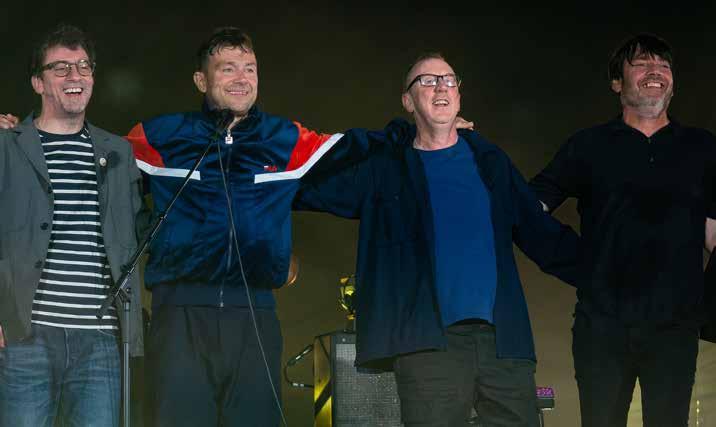 BY IRIS SPARK
There is a moment in the Beatles’ catalogue of which I’m particularly fond. It comes on the album Sergeant Pepper’s Lonely Hearts Club Band when Paul McCartney, ever the panting optimist, sings: “It’s getting better all the time.” Lennon improvises back: “It couldn’t get much worse.”
The essentially dual spirit of the Beatles is encapsulated in that – and, of course, it’s the want of instances like it which, one feels, diminishes their respective solo careers. It’s one of those moments which charts the ideal of ‘being in a band’ whereby two contrasting personalities lay aside competitiveness, and work together for the creation of something grander, more expansive, and stranger than their individual selves could muster.
A writer of manuals for office etiquette might call this ‘teamwork’. Musicians and listeners alike know it’s something far more magical: human difference overcome in the name of art.
I remembered this moment when, on a sunny morning in May, I placed Blur’s new single ‘The Narcissist’ onto iTunes, and in the joy of the moment, on a wide and deserted road, almost went above the stipulated 20mph speed limit, risking a £100 fine.
For one thing, your summer suddenly has its soundtrack. What is it that makes a summer tune? When the intricate growth of spring gives way to the lazy months of July and August, we want our summer songs to mimic that: they should eschew detail and fiddly chord changes in favour of a languorous
unfolding, leading with no particular hurry to anthemic choruses, simplicities learnable even in the heat. A summer anthem must speak to the most passive version of ourselves.
‘The Narcissist’ easily ticks all these boxes: the chord sequence turns out to be a straightforward exploration of the possibilities of E, C sharp and A, with various bouncings off the Asus11 and a cunning shift to the augmented chord of E in the chorus. An augmented chord, by the way, is a very good way of separating the amateur musician from the pro: an amateur will peer at its notation with a narrowing sceptical frown, myopically mortified at a difficulty. A true musician will instinctively see the progression, and intuit its justice, fingers manoeuvring knowledgeably.
The song possesses a pattern of ingenious simplicity. This is frontman Damon Albarn taking it easy, and telling us it’s okay to relax. Next up, the singer’s regal and essentially inexplicable cockney imitations enter, immediately recognisable to any Brit between the age of 40 and 50:
So many people standing there
I walked towards them
Into the floodlights
The lyrical and the musical theme are perfectly intertwined. Not only this, but it's the right thing for Blur to be singing about in this age of TikTok, Instagram live feeds, disposable memes, and Holly and Phil.
Let’s consider the narcissism of the music industry. It is sui generis. Theatre, which might otherwise have given the sector a run for its money, lacks the turbocharger of a huge audience; if narcissism is ever attained it happens in a comparative vacuum, with insufficient adoration to feed off. Meanwhile film, though also a contender with its ludicrous red carpet set pieces and softball promotional interviews, seems to have its saving grace in the dull slog of a working environment which ostentatiously lacks glamour.
Door' from scratch in an hour (though it goes without saying only Dylan could write it). Of course some – the members of Blur among them – become gifted musicians, but I don’t think any of them would say they were to begin with.
that the young are reasonably narcissistic even if they don’t have a hit with 'There’s No Other Way'.
The music industry by comparison is a cauldron of narcissism. Firstly, the musical skills required to make a 'hit' are relatively limited. You can get a long way in pop with an affinity for G, D, C and A minor. Most sentient adults can be taught to play 'Knockin’ on Heaven’s
Pop music is a question of conveying an appealing mood. The offshoot of this is that, if successful, just as one is being lavished with money and sexual attention, one’s intellect is likely being overpraised. These things taken together make narcissism all but inevitable. And once arrived at as a condition, it appears irreversible: witness Pete Docherty’s adolescent ramblings, still ongoing now at the age of 44; Liam Gallagher’s tweets, the work of a 50 year old; and even Dylan's plain weirdness, undertaken at the age of 82.
You can add to that the demographic certainty that pop stars are not made in middle age: my own experience tells me
Incidentally, what would the music industry do if someone in, say, their mid-50s suddenly wrote a string of brilliant pop songs? This intellectual feat would not necessarily be difficult for anyone with musical training: its equivalent happens all the time in literature and art. But there is simply no precedent for sudden middle-aged achievement in this art form, meaning that there can be no economic migration from other sectors. When you turn on the radio you are almost certainly hearing the thoughts of the under40’s, and usually the under-30’s – and if you’re not you’re probably hearing someone whose identity was frozen in place around then: we are hearing Narnias bereft of Aslans.
Is Damon Albarn a narcissist? Some of
“ THE MUSIC INDUSTRY BY COMPARISON IS A CAULDRON OF NARCISSISM.”David Albarn(wikipedia.org)
the signs have always been bad. Even his defenders must concede the knowing inauthenticity of his East End vocals. There was the Damien Hirst-directed video to ‘Country House’ in 1995, Albarn in a bubble bath surrounded by Page Three models. One never recalls without baffled solemnity his initial willingness to submit to the extraordinary dullness of the Blur v Oasis spat, an esoteric competition he only soured on when it seemed to be going against him. And always in these narratives there is the bland submission to drugs and alcohol, the back and forth of addiction and rehab, leading to other yawns: fallouts with bandmates and rivals; dewy-eyed ‘hurt’ at the tenor of press coverage; all leading to a generalised and moneyed whingeing, and its inevitable offshoot, rubbish music.
Blur went through this phase with 13 – though note that even their low point contained ‘Tender’, perhaps their masterpiece. Despite all this, Blur has given the impression it knows what it’s doing, that it’s able to conduct the
rituals of hedonism with a degree of ironic distance. Alex James, the band’s likeably louche bassist, is on record as saying: “Food is one of life's really great pleasures. My 20th birthday party was all about booze, my 30th birthday was about drugs, and now I realise that my 40s are about food. It's something you appreciate more and more as you get older.” This is a pleasing progression. By the way, where James says ‘food’ he predominantly means ‘cheese’.
his own right, just as George Harrison was. For some reason it is pleasing to me to know when listening to Blur that a major cheese-farmer is playing bass, and that the band's drums player Dave Rowntree is also a minor Labour politician and former Kingsley Napley solicitor. Blur have jobs – they have experience.
Happily, that initial – and let’s face it, narcissistic – immersion in fame had its second act, consisting of a surprisingly mature resolution of the routine jeopardy of the pop star 'predicament'. Albarn found salvation in the Hell of fame by discovering within himself an astonishing work ethic; he always seems to have five projects on the go, and all are ambitious. This might be why, in 2023, he feels able to tackle the question of narcissism and the entertainment industry: he’s traversed it.
Blur are reminiscent again of the Beatles in that their ‘third’ member also turns out to be a highly interesting person in
For the record, I don’t know how sane Albarn is. For all I know, he may possess all the usual madnesses of pop stars: the unwillingness to begin any sentence without the word ‘I’; the childish need
“ BLUR ARE REMINISCENT AGAIN OF THE BEATLES IN THAT THEIR ‘THIRD’ MEMBER ALSO TURNS OUT TO BE A HIGHLY INTERESTING PERSON IN HIS OWN RIGHT.”Dave Rowntree (wikipedia.org)
to have a pool of secretaries, bouncers and admin staff to conduct the basics of daily administration; a powerful lack of interest in philanthropy of any kind, especially if any outlay doesn’t get in the press with their own name attached to it.
world, and make sense of it. In doing that for himself, he does it also for us. His artistry, and the endeavour required to produce it, breaks the typical cycle of narcissism.
As ‘The Narcissist’ enters its second verse, we are reminded how happy he is when he’s in Blur. It’s an ‘It’s Getting Better’ moment:
I heard no echo (no echo)
There was distortion everywhere (everywhere)
perfectly fit the theme of the song. At time of writing, it’s not clear whether Albarn sings ‘rubato’ or ‘rebuttal’ in that last line of this second quatrain. I think I prefer ‘rebuttal’, but with all due respect to Albarn, I don’t think he is quite sufficient a poet for it to matter, the way it might matter with Leonard Cohen or Bob Dylan.
That’s because Albarn is very good at displaying generalised intelligence: the listener will likely feel at this point that he is simply using a word which we don’t normally hear in pop songs, bestowing a sense of non-specific sophistication. We don't actually mind which word he's using so long as it's an interesting one. It has been said that some writers (Stoppard, Wilde) have the kind of intelligence which flatters the audience, and makes you feel more intelligent than you actually are. Others (Nabokov, Joyce) possess the intelligence which bludgeons you a bit, lets you know that you’re their inferior. There is another category, the highest of all – in Tolstoy, for instance – where you stop minding about the question of intelligence altogether and just take in a work of art as a chunk of life.
Anyway, Albarn is in the first category: we can partake of his intelligence without feeling overwhelmed. As tertiary gifts go, it's a fine one to have. But the most important aspect of the stanza is in the call and response. Really when we talk of Blur as distinct from any other Damon Albarn project, we’re discussing the relationship between him and Coxon, singer and guitarist –songwriter and interpreter.
But I think his work is sane: in his solo career, his Gorillaz albums, his musicals, and now in ‘The Narcissist’, he seems always to be using music to arrange the
I found my ego (my ego)
I felt rebuttal standing there
The parentheses are sung by his old friend, Graham Coxon – and of course
In the annals of Britpop, there were probably two ‘great’ guitar players: Jonny Greenwood in Radiohead, and Coxon. In neither instance are we discussing guitarists in the ilk of Slash from Guns N’ Roses – the purveyor of the noteriddled mountaintop solo. We are instead discussing something far more embedded.
“ HE SEEMS ALWAYS TO BE USING MUSIC TO ARRANGE THE WORLD, AND MAKE SENSE OF IT.”Alex James (wikipedia.org)
Coxon is seemingly able to do almost anything with a guitar: he can make it scythe unobtrusively through a landscape of disco (‘Girls and Boys’);
imitate the sound of a fly bumping again and again into the frustrating transparency of a windowpane (‘Beetlebum’); or give it a loose twangy mid-American verandah ranginess, which seems to let a song walk on a sort of leash (‘Tender’). He can make a guitar riot ('Parklife'); mourn ('Badhead'); headbang ('Song 2'); and yearn ('Under the Westway'). His limitlessness is entire - in Blur. But that's his limitation; he needs Albarn to realise his own greatness.
But more notable than all this is what Coxon chooses not to do. Every Coxon contribution to Blur is generous not just to the listener, but to his bandmates:
humility is implied in all he does. This is especially in evidence in ‘The Narcissist’. The chorus passes off agreeably (‘I’ll shine a light in your eyes/you’ll probably shine it back on me’), and then the interlude reverts to four straightforward notes by Coxon which I am sure I could teach my six-year-old to play. But a lesser guitarist would have sought to play forty. Such a solo would have been more complicated to play. There’s no doubt that Coxon can play it, or anything you put in front of him: but such a performance would have been obtrusive and spoiled all our summers.
Ever since Paul McCartney’s Liverpool Symphony was booed and mocked by the classical music fraternity at its premiere, there has been the question of how good at music you have to be to be a pop musician. It is a complicated question: on the one hand, there is no evidence yet of McCartney being able to play Scriabin on the piano. Equally, none of his tormentors has yet had the wherewithal to write ‘Penny Lane’. My allegiance is probably – just – with McCartney, as I’d always rather have the thing itself than the interpretation of the thing. But I also know I don’t need to take a side if I don’t want to. And I don’t. Yet the question seems to matter if we're considering whether the 21st century finds us in some kind of musical decline – and perhaps therefore in some broader societal decay. One thought experiment is to imagine your way into Beethoven listening to Coxon’s guitar-playing. It’s possible to go round the houses on this. Sometimes I imagine Beethoven sternly wanting to educate Coxon on classical progressions; at others I imagine him going quiet, knowing the game is up, then meekly asking Coxon if he might borrow his guitar.
A good summer song should be like a good summer’s day: it shouldn’t go anywhere. ‘The Narcissist’ makes good on this. I’m not sure if lyrically it says much more than: “I’ve been a narcissist in the past but now I’ll not be.” If we
“ COXON IS SEEMINGLY ABLE TO DO ALMOST ANYTHING WITH A GUITAR: HE CAN MAKE IT SCYTHE UNOBTRUSIVELY THROUGH A LANDSCAPE OF DISCO.”
were strict about it, it’s probably a minor song, but something in its beguiling expansiveness makes me want not to be strict about it. Besides, it’s minor status only really makes sense if you take it out of context as a record and as a release.
So what does Blur mean now in 2023?
Initially, Blur could be pegged as an act nostalgic for the music of the 1960s – this was because Albarn looked to Ray Davies as a way of navigating the shallowness of the 1990s. In relistening to songs like ‘Lola’, ‘Days’ and ‘Autumn Almanac’, Albarn found a useful crutch because the country hadn’t really changed all that much since the Jenkins reforms of the 1960s. But the band was always more than that. For instance, Albarn also leaned on Martin Amis’ comic novels. Just as Amis gave us John Self, Keith Talent – and later, his most hilarious name of all, Clint Smoker – Albarn created Tracy Jacks, Dan Abnormal, the Charmless Man, the rural escapee who lives in the country house ‘reading Balzac, and knocking back Prozac’ and a myriad others. Even when he was caught up in the satire

moment, Albarn took care to have a range of satirical influences.
But he was always omnivorous: amid all the satires in Parklife, there was nothing satirical about ‘To The End’, or ‘This is a Low’. It’s immensely to Albarn’s credit that he knew satire wasn’t enough. He had to go on seeking, until he became a kind of search. Through the digressions of Gorillaz, The Good, the Bad and the Queen, Mali Music, and his musicals (themselves astonishingly diverse in influence and intent), he has amassed a body of work which you would only underestimate if your main image is of the blonde boy singing ‘Parklife’ in front of an ice cream van. Unfortunately, that accounts for almost all of us.
But I don’t think Albarn minds this. In fact, we can now see that his fame gave him useful cover for his essential seriousness – not to mention an ongoing audience. As a result, he has smuggled into the mainstream so much that’s interesting that he has come to
merit extended study while belonging to an industry that all balanced people try to ignore.
It amounts to a remarkably generous corpus, of which Blur will always be the cornerstone, as ‘The Narcissist’ reminds us. It’s a marvellous thing that Albarn has again made time to return to his old friends, in one fell swoop continuing a conversation which we all love to hear, and eschewing the cliché of the spat that turns into an everlasting split. Each Blur record now has the wisdom of the renewal of old friendship attached to it.
From Amy Winehouse to Jim Morrison and Jimi Hendrix and all the others, musical careers often seem to end in tragedy – and the tragedy is always the tragedy of narcissism. Blur have gone a different route: this isn’t tragedy but a sort of romance, as in Shakespeare’s The Winter’s Tale when the statue of Hermione starts moving, and suddenly all the altered world is singing again.

Ihave started to dread a random Apple news flash on my iPhone: this sudden beeping sidebar seems to exist partly to alert me to the unexpected death of someone I mind about. If I knew how to turn off these updates I probably would, and take my chances on the websites.
As it is, the need to own a phone has so far trumped the annoyance of being plugged into a cycle of morbidity and crisis. Last year it was Shane Warne, dead of a heart attack at some absurdly
young age, as if the Grim Reaper had no understanding whatsoever of the virtue of a good leg break.
This weekend it was Martin Amis, who died in Lake Worth, Florida at the age of 73 – the same age as his father Sir Kingsley Amis – of a disease I hadn’t known he had, in a house I wasn’t aware he had owned.
Why should the death of our heroes be so shocking, being as it is the surest fact about the world? Partly, it is because we’re deprived of the context of decline.
Death has its logic lived one moment at a time: Warne’s yo-yo diets and jager bombs, and Amis’ smoking and drinking are explanations we look for amid the fact of coming to terms with it all. We have to play catch up mid-grief - we scrabble for information as we mourn.
I can still remember Amis sitting to one side of Christopher Hitchens during one of the latter’s last TV interviews, swigging a bottled beer while his friend, bald from chemotherapy, talked so brilliantly in the face of death. Hitchens
looked vulnerable, but Amis appeared separate from his friend’s situation. Now we must assimilate that these past years Amis had been silently dealing with the same illness which killed his friend.
Separated from cause like this, Amis’ departure leaves us with the shock of an unsubstantiated absence. In the face of overwhelming evidence to the contrary, we have come to expect immortality from our literary greats. It was John Updike who expressed his surprise at Nabokov’s death by saying he had ‘imagined him exempt’.
I don’t think our regard for Amis ever quite partook of the awe which he – and others – felt for the author of Lolita. It was Amis’ fate to be obviously brilliant, but also to be widely disparaged and belittled.
There were many reasons for this. One was his physical stature: always, in his
own words, ‘a short arse’ he was also characterised by Christopher Hitchens as ‘little Keith’. Given who his father was, it was possible to miss the scale of his achievement by thinking him a smart child. “Daddy does it better,” was a bright friend of mine’s verdict, and one I doubt he would consider revisiting.
Yet now, in his obituaries, Martin is a ‘literary giant’, amid all the other newspaper banalities: the ‘Mick Jagger of literature’, the ‘enfant terrible’ and so forth. “Why don’t people ever refer to Mick Jagger as the Martin Amis of rock and roll?” he once opined. But we now experience the sudden sweeping away of all the nonsense that was written about him. The somewhat overblown controversies recede – things Amis said here and there in interview about Islam, about how he’d have to be brain dead to write children’s books, or silliness surrounding his teeth. All this exaggeration and ad hoc explaining rushes aside to be replaced by the work he did at the desk: Money, London Fields, Experience, The Zone of Interest (a film of which was showing at Cannes in the week of his death), The House of Meetings, Success, to name only a few. These are what matter but one wonders if they will matter enough. On the BBC News, Amis’ death came second
throughout Saturday to the departure of Phillip Schofield from ITV’s This Morning – a pretty vivid example of the insanity which Amis had spent his life railing against. But as Auden put it: “Poetry makes nothing happen.”
Writers will look at the death of a fellow writer – especially one so eminent as Amis – and pause in their next day’s work, wondering if it’s necessarily worth it. Amis himself knew this feeling, and articulated it definitively in his 2009 tribute to John Updike: “Several times a day you turn to him, as you will now to his ghost, and say to yourself ‘How would Updike have done it?’ This is a very cold day for literature”. So it goes today.
But already at his death, Martin Amis was read less than at any time in the last 50 years. There wasn’t a great fanfare around 2020’s Inside Story – presumably his last novel unless something comes to us posthumously. This may have been because in retrospect he was too ill to conduct too many interviews. But undeniably, he had begun to run out of steam. That last book – in many respects a rewrite of 2000’s memoir Experience – felt bloated, the sign of a writer returning to material – his father, his friendships with the American novelist Saul Bellow and Christopher Hitchens – which he’d already satisfactorily dispatched.
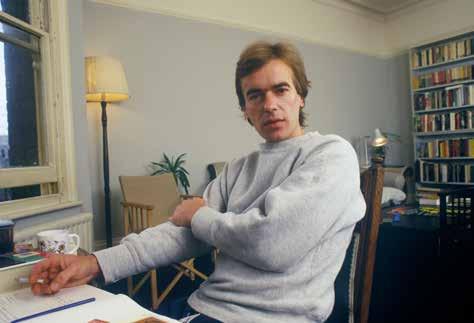
In a sense then, his death comes with this compensation: Martin Amis got himself expressed. Well then, what did he say?
As numerous obituarists have pointed out, he said first of all that what he was saying was of less importance than how he said it – or more, what he was saying was how he said it. Sometimes, as in his great collection of journalism The War Against Cliché, he pointed this out very precisely – but all along it was the subtext of every sentence he wrote.
“WHYMartin Amis (Alamy.com)
Can this commitment to style be taken too far? Christopher Hitchens recounts how Amis refused to go on past the first page of Orwell’s 1984 because of the early line describing the Stalin figure as ‘ruggedly handsome’. It could be argued that to miss out on 1984 because of this was a step too far: he sometimes acted as though writing was only style. “Style isn’t neutral; it gives moral directions,” he once said.
So in what direction did Amis – or rather Amis’ style – point morally? One sentence which is rightly celebrated from Experience is this lordly dismissal of a minor critic: “By calling him humourless I mean to impugn his seriousness, categorically: such a man must rig up his probity ex nihilo.” It is worth pointing out firstly that this superb line occurs in a footnote, a reminder in itself that a true work ethic will make sure it prospers even at the margins. To commit to a path in life is tantamount to a blanket refusal to relax. But the sentence has far more in it to impart than the mere importance of Amis having written it when he might
have got way with something lesser. For instance, note the comma before the word ‘categorically’: if a comma is a pause then Amis here takes a moment to tauten his bow before slinging his arrow. But there is also a patience here – a marshalling of care, which might be taken as containing pity for the target of the ensuing barb. It isn’t a sneer, but a tender corrective. It is also worth noting the marvellous switch to Latin with ‘ex nihilo’, which holds – and is held – in marvellous balance by the run of one-syllable words, and especially the Anglo-Saxon sounds of ‘rig up’. The overwhelming impression is of serenity – a calm contentment at his own gifts. Was this enough? This equilibrium in the Amis style loops back to his fundamental delight at his choices in life. He loved his job and his work, and never seriously deviated from it, unless one counts his foray into screen-writing with Saturn III, an abortive experience that was immediately scooped up in the terrific gift of his masterpiece Money. What did writing mean to him as a career? Amis once described writing as “a sort of sedentary, carpet slippers, selfinspecting, nose-picking, arse-scratching kind of job, just you in your study and there is absolutely no way round that. So, anyone who is in it for worldly gains and razzmatazz, I don't think will get very far at all.”
In fact, Amis was so famous so young that he could have spent his life at parties. Zachary Leader has recalled that Amis, always kind to his friends, never mastered the art of saying no politely to invitations.

But if there were hurt feelings, I think we can let those lapse now: the most important word in a writer’s vocabulary is ‘no’ – and had Amis not used it to so much we might not have London Fields. As Amis once said in relation to the emotional response of one of Bellow’s friends who didn’t like the way he’d been depicted in one of the master’s novels:
“Well, that’s just tough.”
What else does the Amis style point towards? There were the piled-up lists of horrified noticing, which are often allied to disgust at modernity: Amis was really a romantic at heart, appalled at this post-lapsarian world. This rhythmic rage was identified by John Updike in his review of Night Train (1997) – the critical mauling which hurt Amis most – as a ‘typical burst of Amis lyricism’. This trope was there from the beginning in this depiction of a street in 1973’s The Rachel Papers, which is seen as containing: “demonically mechanical cars; potent solid living trees; unreal distant-seeming buildings; blotchy extra-terrestrial wayfarers”. This brash listiness repeats throughout the oeuvre and is Amis’ way of showing how the ugliness of the world appears to be piling up exponentially, and can only be mitigated by being named – only when you do that do you begin to bring things back under control.
This, then, is the Amis disgust, and in his worst novels this emotion could seem synonymous with a dislike of the working classes. There will always be those who think that he was dismissive about people with whom he could claim at best a slender acquaintance. On the other hand, he was creating a fictional universe not writing government policy,
“STYLE ISN’T NEUTRAL;
GIVES MORAL DIRECTIONS.”
“BY CALLING HIM HUMOURLESS I MEAN TO IMPUGN HIS SERIOUSNESS, CATEGORICALLY: SUCH A MAN MUST RIG UP HIS PROBITY EX NIHILO.”
and those who read him as if they don’t know the difference will probably never enjoy a comic novel.
Amis wrote much about the importance of a writer being generous to readers – by which, he appears to have meant being intelligible. For him Ulysses was too difficult, and Finnegan’s Wake an absurdity; even his own beloved Nabokov strayed into error with his late book Ada. My least favourite of Amis’ books for similar reasons is Time’s Arrow, a Holocaust story told backwards, and which gave me a migraine. But it was a brilliant idea even if it could never have been a readable book.
I’d say that by the midpoint of his career, Time’s Arrow tells you all you need to know about Amis and the future – he didn’t welcome it, and wanted time itself to flow not forwards, but backwards. Again, he had his reasons. Most people who truly love writing know that the future can’t be everything it’s cracked up to be: Shakespeare died 407 years ago.
Amis gives us a Britain – and then an America – in decline. Some have said that especially in Money, Amis depicts the excesses of late capitalism, which is true in so far as it goes, except that we don’t know how near its death capitalism really is. For all we know, it might be that he is the chronicler of its stodgy middle period.
At any rate, Amis seems to be sitting too comfortably to one side of societal decay, regarding it. It’s always possible that someone may have some vast private George Michael-esque habit of philanthropy, but I find it hard to imagine Amis rolling his sleeves up to fix a problem; the idea of him ever running for office like Gore Vidal or Norman Mailer is palpably absurd. But perhaps there’s never been anyone better at describing the problems themselves. Even so, this sane opting out made politics a difficult subject for Amis. Something about history – though it fascinated him – didn’t sit easily with
him creatively. This might be because he was a very sensory writer, and the past is out of reach. Gore Vidal – who Amis wrote brilliantly about – understood the past instinctively, but Amis can’t write about the past without straining after significance. The repetitions which Craig Brown satirised brilliantly in The Mail increase considerably in any book when Amis is grappling with the past. This is Brown pretending to be Amis:
“I am a serious. It is novels that I usually write: what I usually write is novels. And you know why I write? I write to fill the chiliastic lacuna of the aberrant psychotheatre in my headipops. And it all adds up to one thing. I am a serious.”
Hilarious as this is, you can only parody a style which is absolutely recognisable in the first place.
Nevertheless, something like selfparody increases in frequency in Koba the Dread, The House of Meetings, The Zone of Interest, and The Second Plane – basically any book when Amis is taking on serious subject matter. It is the self-consciousness of taking on big topics which appears to get in the way of what he elsewhere regards as the crucial business of perception, which then leads necessarily, because the world is funny, to comedy. He once said that he continued to write about the Holocaust because he hadn’t come to understand it yet. This need to assimilate the unthinkable is really a sort of refusal of mysticism, and therefore a dead end. There has to be mystery in writing; it is the unseen energy which harnesses the instinct to do it at all. Amis couldn’t leave evil alone as a thing which just is and requires no special or new explanation. There has always been a strand of Judaeo-Christian thinking which regards the devil as essentially boring. Amis wasn’t at all of that tradition. In his best books he floated free of it in the comic mode. But when he sought to take on the Nazis or Stalin, he was rudderless.
Similarly, he had no particular interest in goodness either. In this, as in much else, he is similar to Dickens, whose villains are vivid, but whose heroines – think Esther Summerson in Bleak House – simper, as if goodness can’t ever have convincing embodiment. Updike wrote in that same review of Night Train that Amis’ fiction ‘lacks positives’. Though Amis always stopped short of Hitchensstyle atheism arguing that it sounded like a ‘proof of something’ there may have been something ultimately a bit watery about his worldview which led to a somewhat unmoored intellectual life. This is what ultimately weakens the work undertaken outside the genre of comedy.
But how wonderful he was when he was doing what he was best at. I think of the uproarious descriptions of Marmaduke in London Fields; of his description of Updike as a ‘psychotic Santa of volubility’; of the ‘nylon rain’ in Success; of the filmed sex scene in Money (‘You’re a tremendously ugly man, John’); his description of accompanying Blair during the end of his premiership, and finding himself becoming 'mildly flirtatious' with the PM; the idea in Experience, of Kingsley Amis’ last fall being a thing of ‘colossal administration’; and his great eulogy to Christopher Hitchens, to my mind the greatest speech by far of the post-War period in an admittedly poor period for orations generally.
We go to Amis not to meditate on the complexity of the world, but for joyous laughter. And in this serious world there is sufficient dearth of that to make his passing an event very far from neutral: it’s time to go with delight and love back to the books. But as we do so, let's ask ourself what the style pointed towards.
with no qualifications and a part time job as a milkman. Today he’s Lord Cruddas of Shoreditch, the founder of a £1.5 billion financial trading company and a distinguished philanthropist, giving to over 200 charities through his foundation which helps young people from disadvantaged backgrounds.
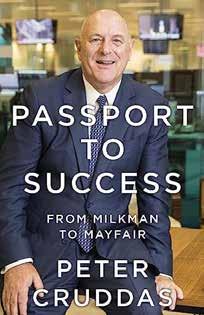 BY PETER CRUDDAS
PUBLISHED BY BITEBACK: £20
BY PETER CRUDDAS
PUBLISHED BY BITEBACK: £20
Icould not put this book down from the moment that I began reading, despite its author for a time crossing the road when he saw me approach. As an Honorary Trustee, I was fundraising for Noah’s Ark Children’s Hospice capital appeal and Peter was inundated with similar requests. He did contribute for which we will always be incredibly grateful. It set the scene for what was a remarkable journey From Milkman to Mayfair.
Unlike many business leader autobiographies, this was not ghost written but penned by the great man himself. Whilst reading you can hear his tone of voice during an extraordinary voyage right to the top.
The son of a meat market porter and an office cleaner, Peter left Shoreditch Comprehensive School at the age of 15
Fed up with Labour's economic management, Peter began his foray into politics, becoming a key Conservative Party donor. But after being elevated to Treasurer in 2011, he fell victim to a Sunday Times sting in which he was falsely accused of breaking the law on party donations. With unflinching honesty, he reveals the full story of his successful libel battle and opens a Pandora’s box of profound wider questions about newspaper dark arts and the power of the British press over the judicial system.
Refusing to be scared off from the political world, Peter co-founded the winning Vote Leave campaign. Here, he gives a detailed insider view of the real reasons behind the victory and contemplates how Britain can now thrive outside the EU.
Filled with heartbreak and elations, this is the extraordinary story of Peter’s epic rise from an east London council estate to a Mayfair mansion – and includes plenty of tips for budding billionaires, not to mention the importance of giving back.
Honestly, I cannot wait for his sequel, and so will you.
RL
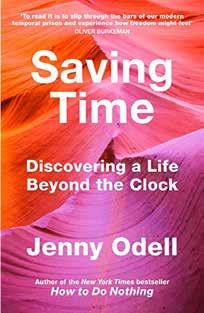 BY JENNY ODELL · 2023
It’s an interesting notion that whenever you meet a successful person in the world of work and try to account for their success, you almost
always find that that person has an unusually fruitful relationship with time. That is, they’re always skilled at putting what time they have to good use, and making sure that it’s translated into action.
This book by Jenny Odell, like her previous book How to Do Nothing, attempts to turn the matter on its head, and calls itself a ‘radical argument that we are living on the wrong clock, one that tells us time is money.” She writes also of her work as ‘a panoramic assault on nihilism.’ Odell describes a refreshing notion of time which many of us experienced to some extent during the pandemic, whereby the regulated office clock cedes to other forms; preindustrial, time as it is felt in other cultures, ecological time, and geological time. The goal, she says, is a ‘more human, more hopeful way of living’.
What emerges is a sort of non-fiction counterpart of Proust’s Remembrance of Things Past, which feels like a therapy gone through for people who feel their lives are being whittled away by office drudgework. We begin to think in terms of memory, and of the many different ways in which experience can be, to use Odell’s word, ‘stretchy’.
Of course, one can’t imagine this book changing much: Goldman Sachs seems unlikely to alter its office hours on the basis of this. But it may do much to salve the exhausted worker – an emotion which comes to most of us some of the time.
turned out to be worth hearing. This energising book charts her time travels through her most significant memories, from meeting Princess Diana to creating a national outrage with a mischievous short film about a driving dog and reflects with candour and humour on the life lessons she has learned, revealing the hints, hacks and personal philosophies that have been her secrets to surviving almost everything.
We may not all achieve what Dame Esther has, but here we can soak up her wisdom, laughter and learn from her, embracing the passing years and marching boldly on.
Over a career spanning five decades
A sort of dislodged washed-out bay we fell into after hours of hill torture. No terns or boats, no breeze to speak of, but laces of white water moving fast and, farther off, the shattered hem of a ness.

Ioften remind our student candidates that it is normal to be nervous before an interview. At their age, I was so very fortunate to shadow Esther Rantzen from her green room to live broadcast on BBC That’s Life and Hearts of Gold. The minute before she waited to walk on to receive rapturous live audience applause, you could see stage fright kick in and the shear look of terror on her face. Of course, it was all gone as quick as it arrived once the programme titles started rolling. It is good that in her golden years, she is still inspiring the next generation with her wisdom.
Her sixth book entitled Older & Bolder is crammed with advice, gleaned from her own experience, what she has learned as a journalist, author and broadcaster, and from what she has been told on the rare occasions when she has actually listened to somebody else who
Dame Esther Rantzen has appeared in more than 2,000 television broadcasts, in her regular contributions to political and news programmes, including The One Show, she especially advocates protecting vulnerable people and growing old ungracefully. She is also a reality TV favourite with appearances on Strictly Come Dancing, First Dates, and I’m a Celebrity. As a journalist, she writes for the Daily mail, the Guardian, the Telegraph and The Times.
She was awarded a DBE in 2015 for her services to children and older people, through her pioneering work as founder of Childline and The Silver Line.
I am still in touch with Dame Esther today. Sadly, she was recently diagnosed with stage 4 lung cancer. Her quote “Remember that history is written by the survivors, be bolder as you grow older and make sure you float above any challenges that threaten to overwhelm you,” will resonate with all those who have had the privilege of meeting or working with her and the audiences of tens of millions who avidly placed their trust in her during a career spanning five decades.
Her generosity of spirit to others less fortunate will always live on.
Spilled before it, a wide green stony spread and the afterthought of winter crofting:
salt white walls, salt white doors, copper roofs, turf-piled yards and sweet tails of smoke.
Most things will end, the mind in time, work and teeth and knees and hips, but there among the still weather and homesteads
all the short-lived shadows you could know hold their ounce of love before the land runs out.
Christopher Hamilton-Emery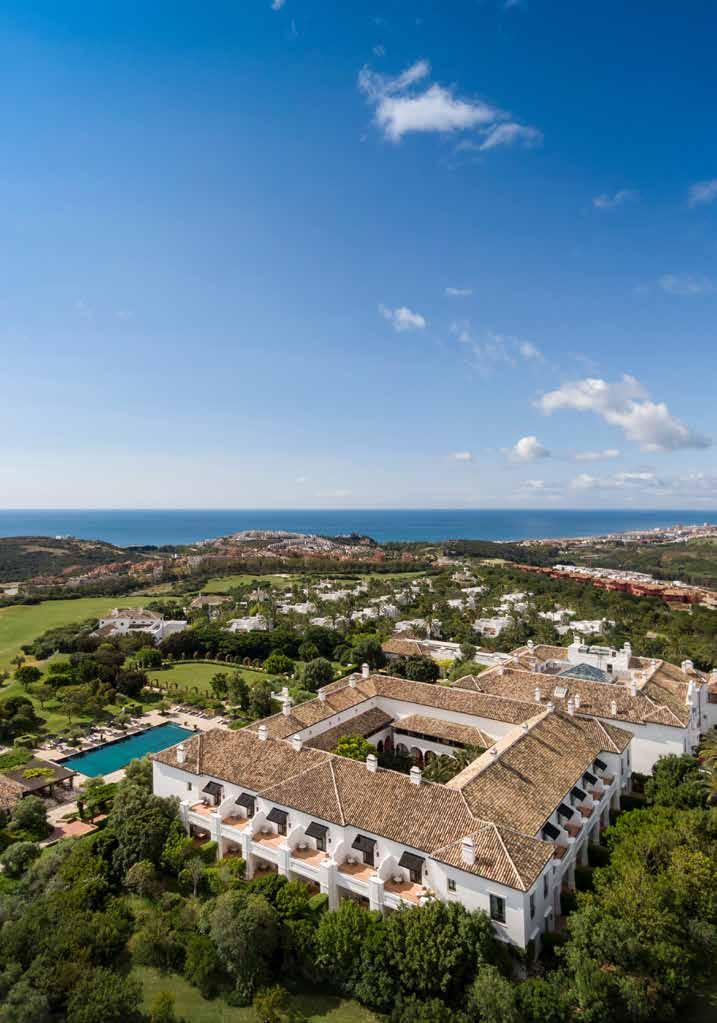 BY PATRICK CROWDER
On an estate spanning 215 hectares, Finca Cortesin sits nestled in the hills of the Andalusian coast, a bastion of luxury. The estate boasts six top-tier restaurants, four swimming pools, full spa facilities, a fitness and racquet club, and a world class 18-hole golf course. It doesn’t end there. As you might expect from an Andalusian resort, the weather is impeccable, and guests are invited to enjoy the crystalclear Mediterranean Sea at the Finca Cortesin Beach Club, which is situated just under a mile from the hotel.
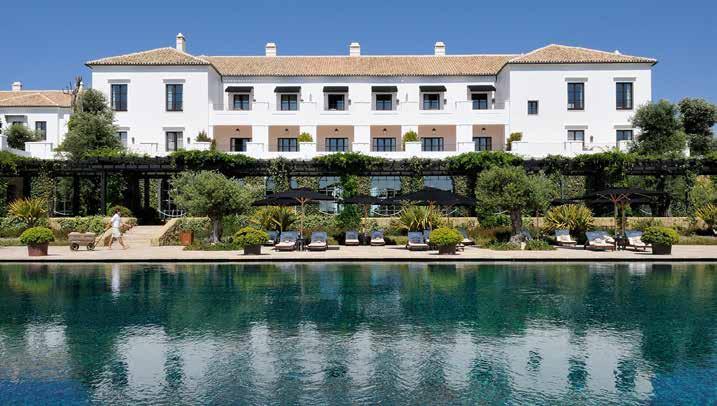 Rocco Forte Hotel Savoy Duomo, Presidential Suite
cent increase in exports – particularly to America and to Asia – partly driven by its powerhouse olive oil industry, but also by its surprise strength in other sectors such as aeronautics. Having said that, these numbers would look better if a great number of people were benefitting from them. Instead, unemployment remains stubbornly high at 19 per cent, though it is falling.
In other words it’s paradise – but unlike so many other versions of the ideal, it’s paradise within easy reach. Travel to the resort is simple. The two best options for those coming from abroad are to fly into either the Malaga or Gibraltar airports, which are a 50 or 15 minute car journey away, respectively. We chose Malaga, and a chauffeur from the resort was there to pick us up, peppering us with facts about the area.
The economic news from Andalusia and from Spain generally is reliably mixed. On the one hand, exports shot up at the end of 2022 with a near 25 per
As a Californian, the landscape looked remarkably familiar, as if I had stepped through a portal to a new version of my home across the ocean.
We were taken to the Executive Suite,
and shown a view which I’ll never forget: it looked out directly over the ocean, with a private terrace from which to enjoy the play of light at every time of day. Each evening, the sky would produce a gratis masterpiece of oxbloods and oranges for anybody who happened to be looking. Our rooms were beautifully laid out and succeeded entirely in soothing us from our flight: fresh fruit, confections, and hand-cut flowers awaited us in the tastefully decorated living room, and the kingsized bed provided a stellar night’s sleep. The high ceilings found in the living room and bedroom also extended to the marble finished bathroom, which had two sinks, a spacious shower, and an even more spacious bathtub.
We began with a quiet drink at the Blue Bar. The décor inside the bar is classic and welcoming, though during our stay the unblemished weather would send us more often out onto the stillness of the patio with its view of the vast well-manicured lawn of the estate. Tapas is always available: beef carpaccio, complementary dried yucca and plantains, and of course the worldfamous Iberian ham.
“IN OTHER WORDS IT’S PARADISE – BUT UNLIKE SO MANY OTHER VERSIONS OF THE IDEAL, IT’S PARADISE WITHIN EASY REACH.”
The next morning, we wandered the estate, deepening our acquaintance with perfection. Though Finca Cortesin is of recent construction, the attention paid to traditional Andalusian architecture and décor gives it the prestige and luxury which often come with age. The estate forms two massive open-air courtyards which are filled with tropical plants. A fountain provides a centre to the impressive display of foliage, which towers above you, cushioning you from the imperfections. By being here, you come to realise the outside world is a sort of scandal, inferior to the beauty and glory of Finca Cortesin. I became particularly acquainted with a Moroccan-themed lounge, which features traditional tile patterns, cushions, lamps, and cast brass tables.
Of course, paradise does have a few demands. Having surveyed the lawn, we moved with a sort of regality bestowed by the place itself to the pool, noting approvingly that it has a good variety of depths to suit your swimming style. Once these details are in your life you
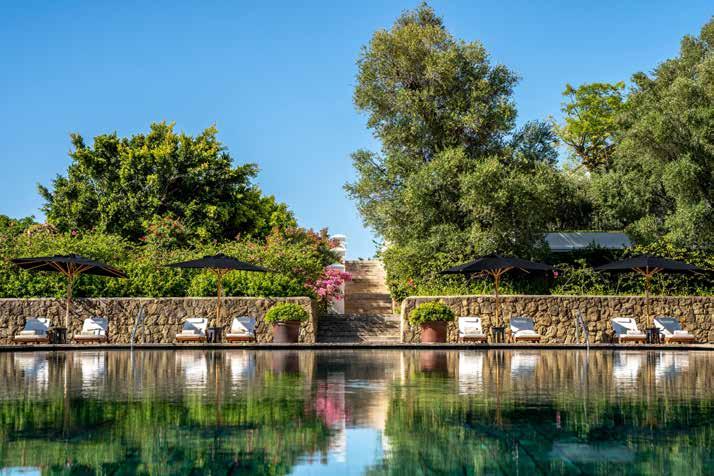
start to get used to them. Similarly, the poolside bar offers cocktails as well as food, with a variety of fresh fish kept on ice for you to choose from.
Due to the desirability of coming here, tourism is big business in Spain, and especially here in the south, meaning there are a lot of careers to choose from. Had you thought of perhaps manning the spa facilities in paradise? Or might you wish to deliver the Thai massage I had on my second day, the knots of life beyond the kindly walls of Finca Cortesin, bashed and kneaded, embedding you further in this place, making you more suitable than ever as a citizen of Eden.
There are also a huge number of roles in food. Throughout our stay, the food was impeccable. The a la carte breakfast at El Jardin de Lutz consisted of traditional Spanish fare with a modern twist. Alongside the tapas were croaker filets, carpaccio, foie gras, and numerous pastries. In the evening, we dined at Finca Cortesin’s signature restaurant
“THE ESTATE FORMS TWO MASSIVE OPENAIR COURTYARDS WHICH ARE FILLED WITH TROPICAL PLANTS. A FOUNTAIN PROVIDES A CENTRE.”


Rei, which offers an ingenious blend of Japanese and Mediterranean culinary traditions.
But this is also a mecca of golf. The course, blessed with Cabell B. Robinson’s course design and Gerald Huggan’s attractive landscaping, is one of the finest in the world and has played host to both the Volvo World Matchplay and the Solheim Cup, which it was busy preparing for during our stay. The clubhouse has a pro shop and a restaurant which provides a more laidback dining and drinking experience, consistent with what one would expect from a world-class “19th hole”.

It is impossible to leave the estate feeling anything but relaxed, rejuvenated, and satisfied. At Finito World, we’re all about working hard and achieving seemingly impossible goals. Places like Finca Cortesin remind us what we’re working for.

“THIS IS ALSO A MECCA OF GOLF. THE COURSE, BLESSED WITH CABELL B. ROBINSON’S COURSE DESIGN AND GERALD HUGGAN’S ATTRACTIVE LANDSCAPING.”

We provide the tools and resources to help you inspire the next generation to engineer a better world.
IET education resources are free and written by teachers, for teachers. Save time with our ready-made, accessible lesson plans for science, technology, engineering and maths (STEM), suitable for teaching children aged 4 to 16 years. We also offer free careers materials and global, competitive STEM activities focused around real life challenges, to inspire children, help them develop skills for life and enable them to discover their inner engineer.
Visit our website to discover your free STEM teaching resources for primary and secondary education.

Now is the time for eating. Later is the time for regret.” So said my companion as we sat down to lunch at Galvin at Windows. In the end we had the eating, but not the regret.
But first the view: London, unlike New York and Paris both of which are built to comprehensible plans, looks delightfully mad from the skies. The Thames is never quite where you think it should be, swerving in and out of everything, seeming to force the architecture into unexpected arrangements. From on high, you realise too that the tube map is a perfect liar, giving you a false sense of distance and relationship when you travel through it.
From the 28th floor of the Hilton Park Lane you discover that London is a mystifying place to live. What is Westminster Cathedral doing being so near, for instance, to the back garden of Buckingham Palace? Throughout our meal, we were able to see a peaceful soul mowing the gardens at the palace, looking in his way more kingly than the king. There was also an emperor of a seagull presiding over the area near Vauxhall, who certainly views it as his terrain not ours. I noted the occasional stray drone skating along clouds –inquisitive, knowing things we didn’t.
But we knew also what it did not: the supreme glory of the food at Galvin at Windows. The butter came, slightly fanned and petalled, like an apricot
rose on a basalt slab. The butter-knife resembled a sort of bladed paperweight, whose balance would self-correct if you nudged it so that its sharp end always pointed upwards. Like this, admiring a minor novelty, we embarked on one of the meals of our lives.
In retrospect greatness was coming at us from every possible angle; but I think it was the service which began to alert us to the sheer quality of the afternoon. One by one, good-humoured and knowledgeable staff arrived at our table, conducting the rituals of public dining with an intelligence and thoughtfulness. A great meal must of necessity be to some extent incidental to the food: a Burger King would have tasted good up here.
But happily, this was no fast food experience. The food at Galvin is reliably first rate. At around this point, the attentions of Rudina Arapi began to weave in and out of the experience. Arapi cheerfully told us about her upcoming sommelier exams – and the thoughtful pairings throughout the meal make me think she’s likely a shooin for these.
Hearing that I wasn’t drinking, she caused a revelation in the shape of a few glasses of Wild Idol, the closest approximation to champagne I’ve experienced – only the very slightest non-alcoholic tang giving the game away.
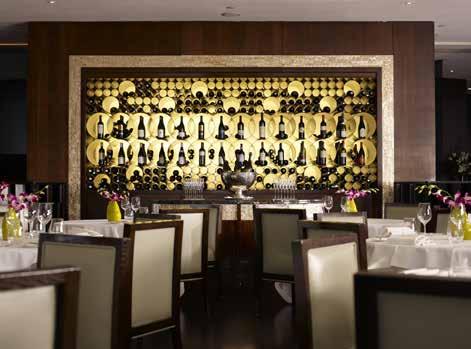
We started with caviar, which came amassed on an oyster shell at the centre of a plate of ice. Adjacent to it, was an oblong plate of bite-sized pancakes with a tiny china saucepan of whipped cream cheese, sprinkled with chives. I recommended trying the caviar without any additional flavour in the first place so as to concentrate entirely on the pop and rush of flavour of the little fish beads.
This was mere prelude to our main courses. I consulted the menu. After a period of anxiety, where every decision seemed to cordon off too many delightful possibilities, I opted –grieving for what I wouldn’t eat – for the artichoke soup. But I hadn’t erred: what emerged was a gorgeous broth, topped with truffles. I found myself reflecting that I never regret ordering soup. My companion went with the crab, which came with a veritable garden of edible flowers, as well as dill. A generous splash of caviar was to one side – like a kindness when someone doesn’t demand a thank you.
By the time of the main, I was by any reasonable standards already full – almost to the extent where food was beginning to present itself as a dangerous notion. But I had previously committed to a bulky steak. At this point – though my steak was delicious,

I might have preferred the cod which my companion had ordered: a thing of delicate crutons, scattered capers, grapefruit, and mash. No onlooker, seeing what we had already eaten, would have expected us to order dessert. But our ambition had increased, and so had our curiosity regarding what was possible. Not to eat dessert would have been like hearing the first four movements of Beethoven’s Ninth, and not listening to the Fifth. That would be to miss out on the Ode to Joy.
I opted for the araguani chocolate
and dulce de leche, which came with banana and lime ice cream, topped with a sort of hyperloop of caramelised banana. To my own amazement, its deliciousness caused me to eat all this. My companion meanwhile showed no compunction about finishing her apple tarte tatin, with Calvados caramel and Tahitian vanilla ice cream.
When she laid down her spoon, it was with the confidence of the soothsayer who has been proven right. It had indeed been the time for eating. We had done our duty – and perhaps if you’re reading this, you should too.
30 X MARKS THE SPOT
Will Elon Musk succeed in reinventing Twitter?
40 AI AND ME
Will Christopher Jackson be put out of business?
51 MAGIC BEANS
Tales from the Coffee Industry
57 PHOTO ESSAY A school in Namibia

85 ENGINEERING FUTURES
David Lakin on the state of the curriculum

88 CHELSEA SECRETS
Tales from the Design Centre
94 BURSARY UPDATE
Our new Manchester cohort
98 LETTER FROM BRAZIL
An update from a troubled land
102 LETTER FROM KILIMANJARO
Petrides reports
21 10,000 HOURS
75 SUSTAINABILITY INDEX Which companies are really green?
25 TOMORROW’S LEADERS ARE BUSY TONIGHT Carter-Ruck’s young associates
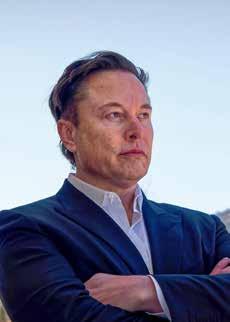
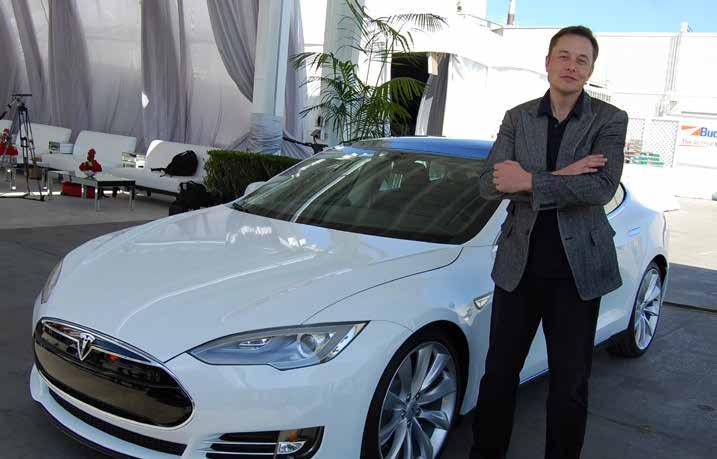
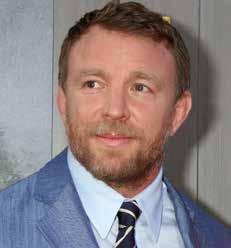
THE LEGENDARY IMPRESARIO ON HIS START IN THE INDUSTRY, THE MISGUIDEDNESS OF NADINE DORRIES – AND HIS FRIEND LUCIANO PAVAROTTI
I left school three days before my 16th birthday: my father was a chartered accountant, and he was determined that I would be articled to him. Once I got the basic five O-Levels, that was all I needed – but I absolutely hated it. After that, I got a job in newsreels – that was the week after Kennedy had been assassinated. By good luck my father was doing the accounts for theatrical people, and I managed to get a meeting in Notting Hill Gate with Victor Hochhauser.
He had three questions. ‘Are you Jewish, boy?’ ‘Where did you go to school?’ ‘Can you start on Monday?’ It suited me to a tee. I worked there for 10 months, 28 days and 12 hours and then bold as brass, started out on my own. In retrospect Viktor was running a sort of finishing school for budding promoters.
It was important when I was introduced to Donald Swann – who was half of Flanders and Swann. The Queen Elizabeth II Theatre gave me dates for an evening of his songs with very little grace, but they gave me the date because Don was involved. We ended up doing over 130 performances a year, and my business just grew and grew.
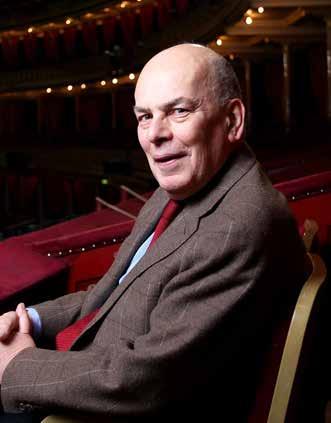
HAS THEATRE CHANGED OUT OF ALL RECOGNITION SINCE
I think I had the glory years – because things have changed now as inevitably they do. I suppose every generation is apt to say the same, but I think it's become much more difficult. It's tough. Nowadays the kind of parameters that you work within are in many cases rightfully much trickier than they were when I was a young man.
The basic premise hasn’t changed. If you've got ideas and you're creative, and you want to do something – then you have to find a way through. Can you get through to Cameron Mackintosh first up? I doubt it very much, but you can find someone to workshop it for you. It's a question of persistence and determination and, of course, talent. And everyone needs a bit of luck somewhere along the line.
WHAT’S YOUR VIEW OF THE DEBATE SURROUNDING THEATRE SUBSIDY?
The whole point of subsidy is that you enable companies like the Royal Opera House or the Royal Ballet to exist. You certainly couldn’t run these things on a commercial basis. That said, I don’t think they do a very good job of it. I also don’t think Nadine Dorries, when she was Secretary of State, should have interfered with funding allocation. It should be arm’s length from government.
WHAT’S THE BEST NIGHT YOU’VE HAD
Last year the Albert Hall put on a gala concert to celebrate my long association with them and my family came from all over Europe. I loved that – I think it’s the only time they’ve ever done that for a promoter.
I remember he came in to a masterclass once and afterwards we had a reception. We had an apple crumble and cream dessert. There was this man who saw that Pavarotti and came running up to him with his dessert in his left hand because he wanted to shake Pavarotti’s hand with the other. Pavarotti couldn’t resist taking the dessert off him with his free hand! More generally, he was very generous with his time.
They’re all different. As a promoter I’ve learned that you have to step back and try not to impinge on celebrities. Don’t get overwhelmed and don’t be too gushy. Just try to be as nice as possible.
P r o t e c t W h a t ' s Y o u r s
Y o u r R e p u t a t i o n , Y o u r A s s e t s , Y o u r R i g h t s

C a r t e r - R u c k i s o n e o f t h e U K ' s b e s t k n o w n l a w f i r m s - l e a d e r s i n t h e f i e l d s o f r e p u t a t i o n , m e d i a & p r i v a c y , l i t i g a t i o n , i n t e r n a t i o n a l a r b i t r a t i o n a n d d i s p u t e r e s o l u t i o n

P a r t n e r - l e d s e r v i c e a v a i l a b l e 2 4 h o u r s a d a y , 7 d a y s a w e e k
T h e B u r e a u , 9 0 F e t t e r L a n e
L o n d o n E C 4 A 1 E N
+ 4 4 2 0 7 3 5 3 5 0 0 5 w w w . c a r t e r - r u c k . c o m