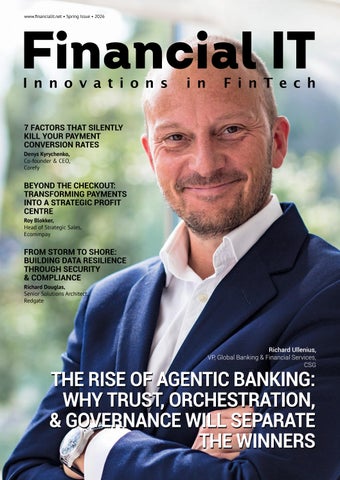
Financial IT Spring Edition 2026

Page 1


7 FACTORS THAT SILENTLY KILL YOUR PAYMENT CONVERSION RATES

Denys Kyrychenko, Co-founder & CEO, Corefy

BEYOND THE CHECKOUT: TRANSFORMING PAYMENTS INTO A STRATEGIC PROFIT CENTRE

Roy Blokker, Head of Strategic Sales, Ecommpay

FROM STORM TO SHORE: BUILDING DATA RESILIENCE THROUGH SECURITY & COMPLIANCE

Richard Douglas, Senior Solutions Architect, Redgate

Richard Ullenius, VP, Global Banking & Financial Services, CSG

DEFINING AGENTIC AI WHAT IS GOING TO HAPPEN IN 2026?

Half of the articles that appear in this magazine, the Spring 2026 edition of Financial IT, are devoted in some way to agentic Artificial Intelligence (AI).

These articles otherwise cover a huge variety of topics. Among others, these topics include payments, fraud detection, boosting the lifetime value of banking customers, modernisation of legacy systems and the strategic challenges posed by financial institutions’ adoption of AI.

This implies that, for now, there is no single and universally accepted definition of agentic AI. For now, though, we concur with the view of one of our contributors that agentic banking is ‘where AI doesn’t just respond, it executes. Autonomous agents can authenticate users, retrieve context, initiate workflows, orchestrate decisions across systems and complete tasks within defined compliance guardrails.’

Making all this work in practice will undoubtedly be difficult. As another of our contributors notes: ‘There is a major trust gap holding organisations back from scaling agentic AI projects beyond pilots. It happens time and time again – pressured by

market forces and customer expectations, organisations are rushing into AI adoption only to find that for every new opportunity created, they must also plug new weaknesses that black-box algorithms have exposed.’

The frequent absence of trust is an important challenge. Our cover story explains how, in agentic banking, ‘the winners will not be those who deploy the most sophisticated models. They will be those who combine human expertise with an agentic workforce grounded in clean data, governed workflows, and transparent decisioning. In that three-layer model –human workforce, agentic workforce, and underlying systems – the banker remains the steward of the client relationship. The agent becomes the operator of complexity. And trust – earned through governance and orchestration – becomes the ultimate differentiator.’

In other words, successful deployment of agentic AI depends on a combination of factors, not least of which is the strategic vision of management. As a contributor to this edition of Financial IT points out, ‘the rise of agentic banking isn't simply

about what AI can do for consumers, it's about whether financial institutions can transform themselves quickly enough to support that future. The infrastructure gap between current banking systems and the requirements of agentic finance is substantial, and it won't close overnight.’

Bearing this in mind, it is perhaps unsurprising that, so far, there are few concrete examples of positive outcomes from agentic AI. Nevertheless, one of our contributors does explain how ‘a major European bank needed to modernize its mortgage processing system, a missioncritical application running on a 30-yearold mainframe. Traditional approaches projected an 18–24-month timeline and costs exceeding $50 million. By using AI powered assessment tools, the bank created a comprehensive application map in just six weeks, uncovering more than 2,300 hidden dependencies missed by manual analysis. AI generated documentation also surfaced critical business logic embedded in legacy code and undocumented for years.’

‘The bank then applied intelligent refactoring tools to break the monolithic

system into microservices, with AI recommending service boundaries based on data flows and transaction volumes. Automated testing tools generated robust test suites for the new architecture, accelerating validation and reducing risk. The project was completed in 11 months at roughly 40% of the original cost, while the modernized platform now processes mortgage applications three times faster and cuts infrastructure costs by 60%.’

Over the remainder of 2026, it will become clearer exactly what agentic AI involves. By the end of the year, it should be a lot nearer than it is today to the mainstream of bank operations. Over the next 10 months, there will some high profile wins – where the revenue boost and/or cost reduction through adoption of agentic AI can be quantified. There will also likely be some (low profile) loss situations, where agentic AI has thrown up new problems. One absolute certainty is that interest in agentic AI will continue to expand.

The quest for knowledge about agentic AI – and much else at the intersection of

technology and financial services – means that industry conferences should continue to flourish. Financial IT is pleased to be an industry partner of Money20/20 Asia in Bangkok (on 21-23 April), MPE in Berlin (on 17-19 March) and Pay360 in London (on 25-26 March). In relation to the last of these, we salute The Payments Association for the surge in the number of participants from 2,500 in 2024 to 6,000 this year.

We wish well to all the participants in each of these three important conferences – where there will be valuable insights to be gained about agentic AI. Meanwhile, we trust that this edition of Financial IT serves as a helpful guide to a rapidly emerging topic.

Although Financial IT has made every effort to ensure the accuracy of this publication, neither it nor any contributor can accept any legal responsibility whatsoever for consequences that may arise from errors or omissions or any opinions or advice given. This publication is not a substitute for professional advice on a specific transaction.

No part of this publication may be reproduced, in whole or in part, without written permission from the publisher. Entire contents copyrighted. Financial IT is a Finnet Limited publication. ISSN 2050-9855

Finnet Limited

137 Blackstock Road, London, N4 2JW, United Kingdom +44 (0) 208 819 32 53

Publisher Chris Principe chris.principe@financialit.net

Editor-In-Chief

Andrew Hutchings andrew.hutchings@financialit.net

Research

Abdu Turdialiyev Jamshid Samatov

Production/Design

Timur Urmanov

PM & Marketing

Nilyufar Sodikova nilyufar.sodikova@financialit.net

Founder Muzaffar Karabaev

Imagine if you can, life without Internet!

Now live a life without Internet. Hard to imagine, or to do. Tech and specifically the Internet is ingrained in our lives, jobs and education.

In the words of John Lennon Imagine all the people, sharing all the world....

Yes, it is hard to imagine, accept there are people today, 2.5 billion, that have no Internet. Never have had it, they are the unTECHed. The unTECHed are people with no access to modern technology. No Internet, no computer and if a phone, its basic, not smart. The benefits and advantages that we cannot live without, unTECHed live a life that doesn’t know what without is.

Unbanked, we hear this a lot. How sad, no access to the financial system. Bank fees, credit card interest, insurance, loans, etc. All the products of our financial system designed to reap profit. Profits from making debtors out of society. Keeping us in debt, keeps us working and in flows the profits. The system is saturated and new customers

unTECHed

are found on their 18th birthdays. Making the unbanked the great frontier for new profits. The unbanked only needs a safe way to pay and get paid by a basic phone. These are families making something like $200 per month. To charge them banking fees and credit card interest is morally wrong and should be criminal.

The unbanked can and do live without banks. We should all be considering unbanking ourselves and join them.

The unTECHed people are something different. The Internet does not reach them. All the benefits of education and learning do not reach them. The economic rewards do not reach them. The problem is not just the Internet. It is a three-fold problem. Yes, you need Internet access. That access is only usable with a device. That device is only usable with teaching. Three-fold; Internet, device, teaching. It is only be delivering this package can the unTECHed start to benefit. That gap is 2.5 billion people of which over 70% are

women and young people. Roughly 30% of the global population.

This problem is not being ignored. There are a number of initiatives addressing this gap. One powerful initiative is Tech Cares. Sponsored by Huawei, www.huawei.com, with the International Telecommunications Union (ITU) www.itu.int, along with the Vodafone Foundation, www.foundation.vodafone.com and the NGO Close The Gap, www.close-thegap.org, lead the efforts to bring Internet, devices and teaching to the unTECHed. There are other equally as valuable initiatives working, usually sight unseen, to bring Digital Inclusion to the masses.

The unTECHed need all of our assistance. Imagine 2.5 billion more people whose ideas and inventions can benefit the world if they are helped to. Up until roughly one hundred years ago women were not able to gain the education and skills to impact lives. Today we see the many benefits that women can and have provided. Let’s not let the human capital of the unTECHed be wasted.

Andrew Hutchings, Editor-in-Chief,

Chris Principe, Publisher,

Richard Ullenius, VP, Global Banking & Financial Services, CSG

Andrew Bateman, EVP, Lending, Finastra

Denys

Ruben Salazar Genovez, CEO, Gennius XYZ

Ani Sane, Co-founder & Chief Business Officer, TerraPay

28 THE INFRASTRUCTURE GAP IN EMBEDDED FINANCE: WHY PLATFORMS BREAK AT SCALE

Jelle van Schaick, Head of Marketing, Lorum,

30 FROM CHATBOTS TO CO-WORKERS: THE RISE OF AGENTIC BANKING

Dan O’Malley, CEO, Engageware

32 THE INFRASTRUCTURE GAP WHY BANKS MUST BECOME AGENTIC BEFORE FINANCE DOES

Macs Dickinson, Director of Engineering, LHV Bank

34 AGENTIC BANKING WILL BE THE NEXT PILLAR IN AUTONOMOUS FINANCIAL STEWARDSHIP

Nitin Agarwal, co-founder and Chief Revenue Officer, FV Bank

36 HOW GAPS IN DIGITAL ID SLOW DOWN ACCESS TO FINANCE

Michele Tucci, Chief Strategy Officer and Co-founder, Credolab

38 THE CHANGING FACE OF FRAUD STRATEGY: FROM RULES TO INTELLIGENCE

Chris Oakley, Head of Financial Crime Solutions, Sopra Steria

40 STABLECOIN SANDBOXES ARE A LIVE-FIRE TEST FOR BANK PAYMENTS

Mouloukou Sanoh, Co-Founder & CEO, MANSA

42 THE RISE OF B2B MARKETPLACES: A NEW ERA FOR BANKS

Radi El Haj, CEO, RS2

44 AGENTIC BANKING: HOW GLASS-BOX AI RESTORES TRUST IN CONVERSATIONAL AGENTS

Roy Moussa CEO and Co-founder, GetVocal AI

46 AI AS THE MODERNIZATION ENGINE: HOW FINANCIAL INSTITUTIONS ARE FINALLY BREAKING FREE FROM LEGACY SYSTEMS

Rajul Rana, CTO, Orion Innovation

Sonali Dixit, SVP, Global Head of Delivery & Transformation, BFSI

50 WHY PAYMENT FLEXIBILITY IS CRITICAL TO THE UK HIGH STREET’S RECOVERY

Rich Bayer, Clearpay CEO, Block, Inc.

THE RISE OF AGENTIC BANKING: WHY TRUST, ORCHESTRATION, & GOVERNANCE WILL SEPARATE THE WINNERS

Much of the current conversation around agentic banking focuses on autonomy: AI running the bank, replacing workflows, accelerating decisions.

That framing misreads the real transformation underway.

The future of corporate and commercial banking is not about removing humans from the equation. It is about redesigning the bank around three tightly integrated layers: the human workforce, the agentic workforce, and the underlying technology systems. The winners will deliberately combine them, building trust first and autonomy second.

This is not a race to replace bankers. It is a leadership test about how banks reimagine how they serve their customers and how work gets done.

Corporate and commercial banking can no longer hide from transformation

For years, corporate and commercial banks could defer deep operational transformation. Margins were healthy. Relationships were sticky. Competition was largely between incumbent banks, and churn remained relatively low.

That is changing.

Neo-banks, fintech, and other entrants are attacking specific product lines with faster

decisioning, simpler onboarding, and sharper pricing. Merchant services, payments, and embedded finance are being reshaped by competitors with radically different cost structures and digital architectures. Decision speed is compressing from weeks to minutes – and tolerance for friction is disappearing.

Corporate customers now expect a seamless, coordinated experience. They no longer see cash management, lending, treasury, and payments as separate conversations. They expect one bank, one relationship, one integrated engagement.

To respond, banks must rewire not only their customer journeys, but their internal decision models and operating structures.

From product silos to an agentic workforce

Today, much of the friction in corporate banking sits between systems, processes, and different teams. A relationship manager preparing for a client meeting often navigates multiple platforms to assemble intelligence, construct pricing scenarios, initiate approvals, and align internal stakeholders.

The process works – but it is slow, fragmented, and heavily manual.

The next phase of agentic banking changes this dynamic. Instead of logging

into multiple systems, the banker communicates with a single trusted agent:

“I’m meeting this client tomorrow. Prepare a briefing, propose three financing structures, run pricing scenarios, pre-clear approval thresholds, and alert credit and treasury.”

The agent coordinates across deal management, pricing, risk, and billing systems in real time. Adjustments can be simulated instantly. Trade-offs between margin and risk are surfaced transparently. Negotiations are supported by the agent throughout. After the meeting, the next steps are initiated automatically across the deal management workflow.

The banker remains in control, the human relationship remains central, but the cognitive and operational burden shifts to an agentic workforce operating the underlying systems and processes – and it does this lightning quick.

This is not science fiction. The building blocks already exist.

Advisory first, autonomy later

In 2026, the most credible and responsible use of agentic AI in banking is advisory – not fully autonomous execution.

The systems delivering real value today simulate, prioritize, orchestrate, and explain. They highlight pricing trade-offs, consolidate fragmented data, pre-structure approvals, and guide teams through complex workflows. They do not remove human accountability.

That distinction matters.

Any capability that affects a balance sheet or a client relationship must be explainable, auditable, and reversible. Regulations such as DORA and the EU AI Act make governance non-negotiable. Trust is the currency.

Autonomy should be the byproduct of trust earned over time — not the starting point.

The hidden prerequisite: clean, unified, real-time data

An agentic workforce cannot operate effectively on fragmented or stale data.

For agents to coordinate pricing, risk, billing, and engagement in real time, the data layer must be unified, clean, and actionable. Business logic must be consistent. Workflows must be orchestrated end-to-end.

Without this foundation, agentic AI becomes a conversational interface layered on top of legacy complexity.

Leading banks will invest in data and orchestration before chasing autonomy headlines. They will absorb internal complexity so that customers and frontline teams experience simplicity.

A structural shift in how banks evaluate technology

There is another implication often overlooked.

As large AI platforms introduce standardized agent interfaces and integration protocols, the traditional SaaS model built around user interfaces begins to shift. Banks will evaluate technology not by how many screens it offers, but by how effectively it enables trusted agents to deliver outcomes across their existing estates.

Underlying platforms still matter – they provide business logic, customer data, workflow engines, and regulatory controls – but focus migrates toward orchestration and outcome delivery through agents that behave safely, consistently, and in line with risk appetite.

Banks should be asking themselves: are we building platforms our people operate, or systems our agents can operate safely and intelligently on our behalf? An agentic workforce can deliver outcomes to the human workforce when, where, and how they need it.

Decision leaders versus laggards

The gap between leaders and laggards will widen quickly.

Decision leaders will reimagine corporate banking as one coordinated engagement rather than product silos. They will embed agentic capabilities into high-value workflows such as onboarding, deal structuring, pricing, and collections. They will treat governance and explainability as design principles, not retrofits. And they will redesign roles, so bankers spend most of their time on what matters most, building relationships and providing strategic advice — not internal navigation.

Over time, these banks will move from reactive service to preemptive intelligence, as an agentic workforce continuously monitors deal pipelines, exposure limits, liquidity positions, and customer signals to surface risk and opportunities early.

Laggards will digitize existing steps without changing the decision architecture beneath them. They will add copilots without fixing fragmentation. Complexity will surface at the frontline. Productivity gains will stall.

A leadership test, not a technology race

Agentic banking is not a technology race. It is a leadership maturity test.

The winners will not be those who deploy the most sophisticated models. They will be those who combine human expertise with an agentic workforce grounded in clean data, governed workflows, and transparent decisioning.

In that three-layer model – human workforce, agentic workforce, and underlying systems – the banker remains the steward of the client relationship.

The agent becomes the operator of complexity.

And trust – earned through governance and orchestration – becomes the ultimate differentiator.

Denys Kyrychenko, Co-founder & CEO, Corefy

Denys Kyrychenko is the founder of Corefy, a global payment orchestration platform, and PayAtlas, a payment community platform connecting providers and merchants. With nearly two decades of experience in software development, system architecture, and management, he brings deep expertise in online payments and fintech innovation. Over the course of his career, Denys has helped launch numerous PSPs and e-wallets and co-founded Interkassa, a payment aggregator. A graduate of Kyiv Polytechnic Institute and KyivMohyla Business School, he is dedicated to building scalable, efficient payment infrastructure that enables businesses worldwide to optimise conversions, reduce costs, and expand seamlessly into new markets.

7 FACTORS THAT SILENTLY KILL YOUR PAYMENT CONVERSION RATES

When payment conversion starts slipping, the first instinct is usually to check the routing rules, issuer declines, fraud settings, the checkout flow, or to add another provider to stabilise performance. And often, those moves are valid.

The tricky part is that conversion can fade because of small configuration details, default behaviours, or gaps in end-to-end visibility that are easy to miss when multiple teams and systems share the flow.

Based on my experience working with merchants across different markets and payment setups, here are seven factors that quietly undermine payment conversion rates, often without triggering any alerts.

1. Incorrect PSP-Side Configuration

In a recent case we analysed, the routing logic was sound, retries worked correctly, the gateway behaved as expected, yet conversion kept falling. Digging deeper, we noticed a

misconfigured PSP setup: incorrect terminal parameters, outdated rules, and inconsistent limits on the provider's side. No one validated the end-to-end payment flow, and traffic was routed through a fundamentally flawed configuration for weeks.

That case shows that you can have excellent routing logic and still lose conversion if your provider setup is broken. Without regular validation of PSP-side settings, even the best architecture can't compensate.

2. Apple Pay UX Broken by iFrame and Cross-Domain Limitations

Apple Pay is often assumed to lift conversion by default because it reduces checkout friction to a familiar, one-tap flow with prefilled card and billing details, but the outcome still depends heavily on implementation details that many teams overlook.

We've seen setups where:

• Apple Pay button lives inside an iframe and doesn't trigger reliably

• Users need to double-click to initiate the flow

• Session start is delayed due to crossdomain restrictions

Technically, nothing is broken, and payments still go through. But UX friction increases just enough to reduce completion rates.

Compare that to a host-to-host Apple Pay button: one click, faster session start, cleaner user journey. The difference shows up directly in conversion, even though dashboards rarely flag it.

This is the definition of a silent conversion killer: no errors, no failed requests, just fewer successful payments.

3. Not Understanding How 3DS Really Behaves

Sometimes, 3D Secure is treated as a binary switch: on or off. But its behaviour is nuanced: exemptions for small amounts, issuer-specific logic, and providerspecific interpretation all shape whether a transaction is frictionless, challenged, or declined.

We've seen that 3DS behaviour is often under-instrumented and rarely compared across providers in a structured way, which is why teams are often surprised to learn that:

• The same transaction can trigger different 3DS flows across providers due to different exemption strategies, requested indicators, or issuer responses handling.

• Exemptions don't guarantee a frictionless experience , because issuers can still require a challenge or return a soft decline that forces 3DS, which changes approval dynamics.

• 3DS logic can change approval rates even when fraud remains flat because users fail or abandon the checkout due to not receiving the SMS code,

not wanting to open their bank app, verification screens timing out or glitching, or simply getting confused.

Without analysing how 3DS behaves in practice, businesses optimise blindly, often harming conversion while believing they've improved security.

4. Limits and Terminal Logic that Silently Block Normal Traffic

Some of the most expensive conversion losses come from limits no one remembers setting: terminal-level caps, MID limits, velocity rules, maximum attempts before blocking, and daily or hourly thresholds. When these rules are hit, perfectly legitimate users can be blocked or declined, and it rarely appears clearly in dashboards. From the merchant's perspective, traffic simply drops. If teams don't know which questions to ask about limits and terminal logic, good traffic disappears without explanation. And because nothing crashes, the issue can persist indefinitely.

5. No Baseline and Lack of Understanding of What Actually Changed

This may sound obvious, but it's surprisingly common. Teams make changes to routing, providers, or risk rules without fixing a baseline first. Weeks later, when results shift, no one can say whether conversion improved, worsened, or stayed the same.

Without a baseline, optimisation becomes guesswork, decisions are driven intuitively rather than by data, and teams argue about outcomes rather than measuring them.

The absence of measurement may itself be a conversion killer. If you don't know where you started, you can't tell whether you're moving forward.

6. Fragmented Ownership Across the Payment Stack

Merchants know their product, PSPs know their APIs, and product teams focus on UX. But often, no one owns the end-to-end payment experience.

When ownership is fragmented, issues fall through the cracks. Conversion degrades gradually as each party optimises its slice, and the overall flow may suffer.

Payment performance requires a single point of accountability — someone responsible for outcomes.

7. Teams Don't Know Which Questions to Ask

This is perhaps the most subtle factor of all. Many payment setups are defined by defaults: routing, retry logic, decline handling, and network behaviour. Not because those defaults are optimal, but because no one challenged them.

Teams don't ask about:

• Network-level routing behaviour

• Decline logic and retry sequencing

• Provider-specific approval dynamics

• How retries interact with issuer rules

As a result, conversion is shaped by assumptions no one reviewed.

Final thought

The most expensive conversion losses may arise from nuances in configuration, flow behaviour, and provider logic that quietly add friction or reduce approvals, even when everything appears to be working.

To achieve the best conversion your setup can realistically deliver, you need visibility into those details and the experience to interpret them. That's exactly where we help payment teams: spotting the hidden blockers, validating the end-to-end flow, and turning subtle issues into measurable gains. If you're dealing with a conversion dip you can't fully explain, we'll be glad to help.

Payment Orchestration Platform

Payment bridge helps you expand payment coverage without rebuilding your stack. Add new acquirers, wallets, or local methods from Corefy’s 600+ ready-made integrations pool in hours, not months. No migration. No disruption. Just the integrations you or your merchants need.

BEYOND THE CHECKOUT: TRANSFORMING PAYMENTS INTO A STRATEGIC PROFIT CENTRE

In today’s competitive e-commerce landscape, the payments function is undergoing a once-in-a-century transformation, shifting from a back-office cost of doing business to a primary driver of strategic growth. While some industry giants have already integrated payments into their core strategy, many businesses still struggle to navigate the technical jargon and internal silos that keep payments in the dark.

The latest Ecommpay white paper, ‘Making payments a profit centre’, brings together insights gained from conversations with a range of e-commerce retailers and consultants, learning how they are shifting focus and seeing payments as central to the customer experience.

From cost centre to strategic enabler

At board level, the narrative around payments has been purely commercial for many years, with the question: "How can we save costs?" However, the focus on payments is now expanding to include risk management, fraud prevention and, crucially, revenue uplift. Indeed, experts contributing to the white paper confirmed their key payment priorities are split between increasing authorisation rates and reducing false positives (43%), reducing scheme fees and processing costs (28.5%) and reducing fraud losses and cutting transaction risk (28.5%).

While merchants are often ‘anti-cost,’ they lean in when shown how payments can drive revenue. For example, introducing alternative methods like Buy Now, Pay Later (BNPL) for high-ticket items – such as luxury goods or travel – can significantly increase average order values and customer loyalty.

Raising the payments profile

One of the greatest challenges is raising the visibility of the payments department within an organisation. Many non-payment teams and even C-suite executives operate under the illusion that ‘people magically send payments’. There is often a limited understanding of the complex ecosystem behind payments.

Many businesses place payments within other business functions, but some of the most successful companies are now positioning payments as a stand-alone function, elevating its profile and helping employees understand its importance. Experts interviewed for the white paper confirmed that gaining internal support is the biggest factor in making payments profitable.

To bridge the internal knowledge gap, payment leaders are increasingly adopting key tactics such as:

• Strategic reporting: Creating regular reports that translate technical KPIs into business outcomes to demonstrate value to the CFO.

• C-Suite integration: Establishing dedicated committees that include the CEO and CFO to ensure payments aren't just an afterthought.

• Cross-functional education: Incorporating payment strategy into new hire training and working closely with marketing to align promotional activities with payment capabilities.

Leveraging data and tech for optimisation

Granular data – the ‘oil of the modern economy’ – for payments, provides invaluable insights when a business is looking to transform payments into a profit centre. The reality is now that simply looking at authorisation rates is not enough. Analysis of transaction data, drop-off rates and customer spending patterns can also help payments teams identify new opportunities for optimal performance, cost reduction and revenue enhancement. Teams can further optimise payments-related functions including

Roy Blokker, Head of Strategic Sales, Ecommpay

Roy Blokker, Head of Strategic Sales, Ecommpay, brings 15 years of commercial experience, including over a decade in payments. He spent more than eight years at Worldline, where he held strategic global sales and leadership roles. With expertise in localising payment strategies and leveraging payment orchestration, Roy has helped large merchants optimize payment acceptance costs and expand into new markets.

chargeback and fraud management as well as transaction routing and fees, by working with external partners.

Collaboration can also help reduce the overall cost of these functions. A 2024 study from Blackhawk Networks in the United States found that outsourcing payments functions can drive greater efficiency and reduce costs, with companies saving 12.5% on account-to-account transactions through outsourcing. The study also found that working with a third-party to automate certain functions saved over 520 hours of manual work per year and delivered huge efficiency gains.1

Ecommpay research underlines the value of collaboration, finding that external providers are helping big merchants to provide a wider range of payment options and currencies at checkout, while reducing both fraud and costs.

Transforming The Payments Function

Gleaned from insights gained during interviews with experts from across the sector, the Ecommpay white paper shares six key steps payments leaders should consider following to successfully turn the payments function into a profit centre to benefit the entire business:

1. Go beyond buy-in and reporting to active participation of ‘C’ suite executives,

2. Set up a cross-functional payments group for key players,

3. Identify and execute on quick wins,

4. Identify key metrics and track and report value delivery continuously,

5. Partner with external providers for optimal solutions at lower cost,

6. Recognise new opportunities based on customer preferences.

As digitalisation of the world’s economy continues at pace, online merchants of all sizes need to find new ways to drive higher revenues and greater profitability, better customer service and improved efficiency. Only those businesses responding effectively to this imperative will remain competitive and relevant.

Mordor Intelligence predicts that European e-commerce will hit more than US$ 1 Trillion by 2030. A FedEx study states cross-border e-commerce is likely to grow almost three times as fast, rising around 26% per year. Increasing cross border online activity is already diversifying payments, with digital wallets, account-to-account payments, Buy Now, Pay Later (BNPL) and other ‘alternative’ methods set to dominate by 2035. Agentic commerce, in which AI agents shop around and even execute transactions on behalf of customers is another rapidly growing area, with Celent expecting to see 17% of all e-commerce transactions carried out in this way within the next decade. We know customers will abandon checkout if they cannot use their preferred payment method, so it is clear that payments must be prioritised. By treating payments as an independent, strategic function rather than a hidden cost, online merchants can secure their future in an increasingly consolidated market.

Denys Kyrychenko, Co-founder & CEO, Corefy

To download the new Ecommpay whitepaper visit https://ecommpay.com/ whitepapers/making-payments-a-profitcentre/

1 Blackhawk Networks, 24 December 2024: “Utilising Digital Payments To Save Your Company Money” https://blackhawknetwork.com/resources/blog/payments-ungated/all/dec2024/utilizing-digital-payments-save-your-company-money

Richard is an award-winning Senior Solutions Architect with over 25 years improving the performance, scalability, and security of data platforms. With 13+ years of hands-on pre-sales experience and multiple global awards, he drives revenue and builds strong customer champions across organizations of all sizes. A confident communicator and accomplished public speaker, Richard presents on data worldwide and excels at translating complex technical solutions into clear, impactful guidance for customers.

FROM STORM TO SHORE: BUILDING DATA RESILIENCE THROUGH

SECURITY & COMPLIANCE

When disruption hits, there’s rarely a warning klaxon. One moment your data platform hums along: the next, you’re triaging incidents, fielding leadership questions, and racing to restore normality. Resilient teams bridge that gap. Not by luck, but by preparation, shared visibility, and disciplined execution. Redgate Monitor, Test Data Manager, and SQL Toolbelt Essentials help you build those capabilities into everyday practice, so you can move from drowning to foresight.

The leadership mindset: From metaphor to method

Metaphors are useful; storms, islands, safe harbours, etc. However, resilience is ultimately operational. A practical way to organise priorities is to adapt Maslow’s hierarchy to data resilience. Establish uptime and access first, harden for safety, align people and processes, and then automate and optimise. This framing keeps teams focused on what matters most when the pressure is on.

Foundational need: Availability. If customers can’t connect, nothing else matters. Build for high availability and tested disaster recovery, and ensure observability is in place to spot trouble early. Redgate Monitor serves as the lookout, baselining “normal,” highlighting anomalies, and surfacing the signals that deserve attention. Safety need: Security & Compliance. Monitoring, least-privilege access, change control, and evidence for auditors form the “shelter” of your platform. Secure data through your development

cycle with Test Data Manager. Toolbelt Essentials is pivotal in bringing version control, schema comparison, and documentation together, so change becomes controlled, reviewable, and repeatable.

Belonging & collaboration: Resilience is a team sport. Shared operational awareness, developers, DBAs, and compliance officers seeing the same facts, which reduces friction and accelerates correct decisions. Esteem & mastery: As noise drops and repeatable workflows take hold, teams regain time for improvement. Automation maintains consistency across environments and reduces the toil that invites mistakes.

Self-actualisation: With the basics secured, monitoring becomes intelligence. Trends inform capacity planning; signals drive proactive fixes; leaders gain confidence in risk posture and service health.

Why security and compliance must lead

Security and compliance are not appendices to resilience, they are resilience made durable. Regulations such as DORA, GDPR, HIPAA, and SOX formalise the safeguards that protect data subjects, uphold accountability, and demand auditable change. Treat them as design constraints, not post event checklists. Redgate’s approach bakes this into daily work: monitoring for abnormal access patterns, masking sensitive data in non production, versioning every change, and providing traceability that stands up to review.

A culture of routine and predictability is the unsung hero here. When teams know what “normal” looks like and have reliable processes for change and review, anxiety falls and focus returns to valuable work. That predictable rhythm is both a security control and a productivity accelerant.

Redgate Test Data Manager (TDM): Creating safe dev environments

DORA mandates regular resilience testing of critical IT systems and embeds high standards for data availability, integrity, and confidentiality across all environments, not just production. TDM allows companies to classify, map, and mask sensitive data making production like data safe to use in development environments.

Redgate Monitor: From visibility to foresight

See issues early. Monitor baselines your estate and flags departures from normal behaviour, turning complex telemetry into clear, actionable signals before they escalate.

Connect cause and effect. When unusual behaviour correlates with a deployment, the whole team can see the same evidence thereby reducing time to diagnosis and finger pointing.

Turn data into patterns, and patterns into action. Over time, monitoring evolves from performance triage to operational intelligence informing capacity planning,

patch windows, and risk reporting to leadership and auditors. Compliance support, every day. Continuous visibility produces living evidence, alerts, changes, and reports that are ready when auditors are, not scrambled together under duress.

Redgate SQL Toolbelt Essentials: Change you can trust

If monitoring tells you what is happening, controlled change determines what you do about it. Toolbelt Essentials provides the guardrails:

• Version control for databases so every change is tracked, reviewable, and attributable.

• Schema comparison to maintain consistency across environments and prevent drift.

• Documentation that turns tribal knowledge into organisation wide understanding.

Consistency is a security control. By automating repetitive, error prone work comparisons, validations, and deployments you reduce overworked human’s mistakes that so often trigger incidents.

Making

compliance

practical (DORA, GDPR, HIPAA, SOX)

DORA & GDPR (privacy by design). Test Data Manager reduces exposure in nonproduction by using safe, representative data and masking sensitive fields. Doing this as part of your standard workflow supports Article 25’s “data protection by design and by default.” HIPAA (access and audit). Monitor access patterns continuously and treat anomalies as first class incidents. Alerts and historical activity help detect and investigate irregular access before it becomes a newsworthy breach.

SOX (accountability and change control). Version every change, require review, and preserve deployment history. Auditable pipelines turn regulatory obligations into normal operating practice rather than an annual mad dash.

The key is habit. Compliance isn’t an annual event; it’s the record of consistent, careful practice over time. Use solutions that make the compliant path the safest, easiest path.

Implementation

roadmap: Six

steps to resilient, compliant data operations

1. Baseline and instrument. Deploy Redgate Monitor across your SQL estate. Establish what “healthy” looks like in workload patterns, resource usage, and alert thresholds. This ensures deviations are unmistakable.

2. Classify data and define policies. Identify sensitive data, map regulatory scope, and set controls for access, masking, and retention. Treat these as non-negotiable design constraints.

3. Put database changes under version control. Adopt Toolbelt Essentials to enforce pull-request reviews, schema comparison, and deployment validation covering both new features and hotfixes.

4. Automate the boring (and risky) bits. Standardise build, test, and release scripts. The more repeatable the process, the fewer expensive rollback calls you’ll have to make.

5. Prove it continuously. Generate routine evidence via alert summaries, change histories, and environment diffs. Always be audit ready.

6. Evolve from reaction to prediction. Use trends and correlations from Monitor to anticipate capacity bottlenecks, plan maintenance, and inform risk reports for leadership.

The human factor: Mistakes you know will happen

Don’t evangelise a hero culture, heroes are for Hollywood movies. Mavericks with misplaced confidence will skip guidelines or make undocumented fixes when the pressure is on leaving future landmines. Rely on systems that prevent, detect, and recover from human error. Automation in Toolbelt Essentials and the continuous feedback of Monitor reduce the likelihood and impact of these everyday missteps, shortening incidents and preserving end user trust. When dealing with data boring is good.

What good looks like: Signals of sustainable practice

• Fewer surprise incidents, faster MTTR. Clear baselines and intelligent alerts cut noise and speed diagnosis.

• Predictable, auditable change. Every database change is versioned, reviewed, and linked to a deployment record.

• Audit without panic. Evidence exists as a by-product of daily work—no last-minute artifact hunts.

• Confidence at the top. Leaders get visibility into risk, readiness, and trendlines, not just point-in-time fire drills.

Quick start checklist

• Onboard all SQL instances to Redgate Monitor; define healthy baselines and critical alerts.

• Put database code and schema under version control with Toolbelt Essentials; enforce reviews.

• Classify sensitive data and implement masking in non-production to support GDPR.

• Document standard operating procedures like backups, restores, failover tests and keep them in a battle tested playbook.

• Correlate Monitor alerts with deployments to accelerate root cause analysis.

• Produce a weekly/monthly compliance pack: alert trends, change logs, and environment diffs.

From survival to self-reliance

In a world of shifting threats and growing complexity, resilience isn’t stubbornness it’s clarity, discipline, and the confidence to act when conditions change. With shared visibility, controlled change, and compliance woven into the daily rhythm, your team won’t just weather storms; you’ll chart the course through them. Redgate Monitor and SQL Toolbelt Essentials help you get there, turning uncertainty into stability, and effort into trust. Call to action: If you’re ready to move from reactive recovery to proactive control, start by baselining your estate with Redgate Monitor, obfuscate sensitive data in dev environments with Test Data Manager, and version your database changes using Toolbelt Essentials. The best time to build your safe harbour is *before* the next storm appears on the horizon.

THE FUTURE OF LENDING –POWERED BY AI AND TECH MODERNIZATION

Two forces are redefining the future of finance: artificial intelligence (AI) and technology modernization. Together, they form the backbone of the industry’s next wave of growth. It’s certainly clear that AI adoption has crossed a threshold over the last year, with Finastra’s recent Financial Services State of the Nation survey finding that just 2% of respondents in financial services report no use of AI at all, a statistic that underscores just how decisively the industry has embraced this technology.

Where AI is the spark in unlocking new opportunities, modernization is the structure, the set of foundational technologies – from cloud infrastructure to data platforms, and flexible core systems –that make AI scalable, secure and enterpriseready.

As AI becomes increasingly embedded across the banking value chain – reshaping trust, efficiency and customer experience –what does it mean for lending specifically? Today's borrowers don't simply expect loans – they demand seamless journeys, transparent terms, and personalized options delivered at digital speed. This shift places lending at the center of financial innovation, where technology capabilities directly impact customer trust, satisfaction and loyalty.

AI adoption in lending

Customer expectations are rising rapidly, forcing institutions to reimagine the entire

borrowing experience. Modern borrowers expect financing decisions to be faster, fairer, and easier to understand, without compromising on security and compliance. Forward-thinking lenders are responding by investing in technologies that enable real-time decisioning, transparent processes, and hyper-personalized offerings – transforming lending from a transactional process into a relationshipbuilding opportunity. As these technologies mature, lending is emerging as a key battleground for customer experience in financial services.

AI is at the heart of this shift. Enhanced risk modeling, automated underwriting, and accelerated credit decisioning are enabling lenders to process applications faster while maintaining, or even improving, risk assessment accuracy. Credit underwriting and decisioning are the top use cases for AI, with more than 80% of the organizations Finastra surveyed deploying, piloting or planning to leverage AI. Nearly one-third are already live. Customer-facing AI applications are gaining momentum, with 36% of financial institutions having adopted AI assistants and chatbots for training and customer support in the past year. These tools provide borrowers with immediate responses to queries, guide them through applications, and offer personalized product recommendations. The trend shows no signs of slowing, as 34% of

institutions plan further investment in the coming year.

Security-focused AI adoption is expanding as well. 35% of institutions have deployed advanced AI for fraud detection and identity verification, incorporating Know Your Business (KYB) and Know Your Customer (KYC) capabilities that strengthen security without adding friction.

Perhaps most surprisingly, AI has emerged as a driver of trust – a dramatic shift from earlier concerns about algorithmic ‘black boxes’. By enabling more transparent lending processes, consistent decisions, and stronger fraud protection, AI is helping institutions build stronger customer relationships. The technology that once raised questions about fairness now plays a central role in creating lending experiences that customers perceive as efficient, fair and trustworthy.

Infrastructure modernization

While AI captures the headlines, modernization provides the essential foundation on which all lending innovation depends. This isn't simply about upgrading technology – it’s about equipping institutions to scale innovation, strengthen resilience, and deliver truly customer-centric lending experiences. Modern lending capabilities rely on four interconnected pillars: digital

Andrew Bateman, EVP, Lending, Finastra

Andrew is responsible for the leadership and growth of Finastra’s Lending Business Unit. With almost 30 years in financial services, he guides global teams in modernizing technologies through technical agility, supporting customers’ growth agendas. In addition, he is committed to promoting inclusion, diversity and sustainability within the industry, and strongly advocates for workplace wellbeing and open communication.

transformation (prioritized by 30% of institutions), cloud adoption (29%), data platform modernization (29%), and core banking upgrades (25%). Together, these elements create the infrastructure that enables faster credit decisions, personalized offerings, and seamless end-to-end customer journeys. Financial institutions recognize this imperative, with an overwhelming 87% planning to increase modernization investments in the next 12 months.

However, significant barriers persist. Talent shortages represent the most critical challenge, with 43% of institutions citing skills gaps as their primary modernization obstacle. Budget constraints (41%) further complicate progress, creating a situation where leaders understand the urgency but struggle to execute.

To overcome these hurdles, institutions are increasingly turning to partnerships. In fact, over half (54%) are collaborating with fintech providers to accelerate modernization and close capability gaps. These strategic relationships will allow lenders to rapidly enhance their technology stack without bearing the full burden of talent acquisition or in-house system development.

The results of successful modernization are transformative for lending: faster product launches, enhanced compliance capabilities, reduced operational costs, and

– most importantly – lending experiences that meet rising customer expectations. As institutions progress on their modernization journeys, the most resilient approach combines strategic partnerships with targeted internal development –especially in areas where data sovereignty, regulatory compliance and competitive differentiation matter most.

Future-proofing lending

As lending transforms, success metrics are shifting. Financial institutions will be evaluated less on size or speed and more on dependability, trustworthiness, and customer-centricity. In this new era, progress isn’t about being the biggest or the fastest, but about being the most dependable. The institutions that thrive will be those that deliver lending experiences that are not just innovative, but consistently reliable and responsible. Security investments are accelerating to support this vision. Finastra’s survey shows a projected 40% increase in security spending in 2026. By strengthening their security posture, lenders can protect customer data, meet regulatory expectations, and build the resilience needed to maintain operations even during disruptions.

Simultaneously, personalization in lending is rapidly accelerating. 30% of institutions plan to increase customer

experience spending by 25-49%, while another 24% anticipate increases of 5074%. Hyper-personalized lending – offering tailored rates, terms, and experiences based on individual needs – is fast becoming the industry standard. However, only institutions that embed strong privacy protection and meaningful consent into their personalization strategies will convert these capabilities into lasting customer loyalty.

Looking ahead, industry leaders should prioritise four strategic imperatives: strengthening trust through enhanced security, embedding AI into core lending workflows, accelerating APIled modernization to unify data flows, and partnering strategically to drive customer-centric innovation. Ultimately, stewardship will define success in the next era of financial services. The lenders who build responsibility into every decision – from credit algorithms to customer communications – will not only earn trust but will define what competitiveness looks like in the age of AI-powered lending.

TOKENIZED VALUE CHAINS BEYOND CRYPTO: THE RISE OF STABLECOINS, DIGITAL CURRENCIES AND THE QUIET REINVENTION OF REWARDS

For more than a decade, digital finance has been framed as a hunt for novelty. Cryptocurrencies still dominate that conversation, now approaching three trillion dollars in global market capitalization, while stablecoins and digital currencies are increasingly discussed as infrastructure rather than speculation.

Yet one of the world’s largest pools of economic value has existed quietly alongside these debates. Loyalty points, airline miles, retail credits, and ecosystem rewards already exceed one trillion dollars in issued value worldwide, but they are rarely treated as assets and remain classified as marketing incentives rather than part of the value chain.

This is not because rewards lack economic relevance. It is because they were never designed to behave like assets.

Rewards as Value Without Circulation

Traditional loyalty programs were built for a specific purpose, retention. Their design reflects that narrow goal. Points are issued unilaterally, redeemed under strict conditions, and siloed within individual brands or alliances. Transferability is limited by design. Expiry is common. Interoperability is rare.

From a value perspective, this creates predictable outcomes. Consumers

accumulate balances they struggle to use efficiently, while enterprises carry large, slow-moving liabilities whose value depends more on breakage than engagement.

The result is a paradox. Rewards are abundant yet underutilized, valuable but economically dormant. This is not a behavioral problem. Engagement remains high. It is an infrastructure problem. Value exists, but it does not flow.

What Tokenization Actually Changes

Tokenization is often associated with speculative crypto markets, but its most practical applications are far more restrained. At its core, tokenization is about representation, converting value or rights into digital units that can be tracked, governed, and moved across systems with precision.

Payment networks have used tokenization for years, replacing sensitive credentials with secure digital substitutes. These tokens are not tradable assets, they are functional instruments that enable value to move safely at scale. I was personally involved in the expansion of token-based payment infrastructure across Asia and Latin America for one of the major networks.

Blockchain-based and distributed ledger technologies extend this logic by

introducing transparency and shared verification across participants, while smart contracts add programmability to enforce rules automatically.

These capabilities matter most in environments where value is fragmented and coordination costs are high. According to the World Economic Forum, these are precisely the conditions where tokenization delivers its strongest economic impact. Loyalty and rewards fit this profile well.

From Points to Tokenized Reward Assets

Academic research has begun to formalize this shift. Lee and Shen describe tokenized rewards as loyalty benefits converted into blockchain-based tokens, fungible or nonfungible, governed by predefined rules and redeemable across platforms.

The distinction matters. Traditional points are contractual promises confined to closed systems. Tokenized reward assets, by contrast, embed logic around issuance, use, and expiration directly into the asset. Industry research reinforces this view. Work by McKinsey, Accenture, and BCG shows that tokenization increases the functional value of rewards rather than their nominal value. Tokenization does not turn points into money, it turns them into usable assets.

Once rewards are tokenized, utility expands. Benefits can be bundled, split, time-bound, or conditional, allowing value to follow the user across platforms. The shift is from storage to circulation.

Utility as the Source of Value

One of the most persistent misconceptions about tokenization is that it exists to create liquidity through trading. In rewards, the opportunity lies in expanding utility, not convertibility.

Tokenized reward assets do not require open markets to become more valuable. They require relevance. A token that unlocks priority access, upgrades, or exclusive experiences can deliver more perceived value than a static discount. Smart ledgers allow this utility to be defined and enforced automatically.

This aligns rewards with broader developments in digital money. Stablecoins succeed because they settle reliably. Digital currencies matter because they clear efficiently. Rewards follow the same logic, their value increases when they move smoothly within designed ecosystems.

Tokenization enables this movement without removing issuer control. Rules

Ruben Salazar Genovez is a global fintech executive with extensive leadership experience across payments, financial infrastructure, and platform ecosystems. He has held senior roles at Visa, Citibank, Barclays, and Mastercard, and currently serves as CEO of Gennius and Chairman of TerraPay. Ruben is widely recognized for his insights on tokenization, cross-border payments, and the evolution of value in digital economies.

around where, when, and how rewards can be used remain intact, what changes is flexibility.

Breaking the Silos Without Breaking the Model

Historically, interoperability between loyalty programs has been expensive and fragile. Bilateral partnerships require custom integrations, negotiated exchange rates, and ongoing reconciliation. Scale is difficult.

Tokenized systems replace this with shared infrastructure. Instead of integrating program by program, partners connect to a common ledger governed by agreed rules. Issuance remains decentralized. Utility becomes shared.

This model mirrors how modern payment systems evolved. Networks scaled not by forcing uniformity, but by standardizing how value moved between diverse participants. Tokenized rewards apply the same principle to benefits rather than balances. As highlighted by the World Economic Forum1 and S&P Global2, tokenization delivers its strongest gains when embedded into existing value chains rather than positioned as standalone innovation.

Technology alone does not guarantee success. Tokenization applied without economic intent simply recreates fragmentation in digital form. The critical decisions are structural, issuers must define what rewards represent, how they circulate, and what experiences they unlock, while partners align on shared standards of use.

When designed well, tokenized rewards shift from liabilities managed through breakage to assets optimized through use.

The trillion-dollar reward economy does not need reinvention. It needs activation.

Tokenization, supported by blockchainbased ledgers and informed by lessons from stablecoins and digital currencies, offers a credible path forward. The strategic question is no longer whether rewards can become richer assets, but who is building the systems that allow them to behave like them.

1 World Economic Forum, https://www.weforum.org/publications/asset-tokenization-in-financial-markets-the-next-generation-of-value-exchange/

2 S&P Global, https://www.spglobal.com/en/research-insights/special-reports/look-forward/future-of-capital-markets/tokenization-financialmarkets-value-flow

Aniruddha Sane, a seasoned entrepreneur, is a founding member of TerraPay Payment Services, a licensed digital payment infrastructure and solutions provider. With over 20 years of experience in global business development for electronic payments and services, Ani, as he is more popularly known, holds the position of Chief Business Development Officer at TerraPay.

In 2015, Ani made his entrepreneurial debut by co-founding Rêv Worldwide, a leading payment products and service provider. During his tenure of over 6 years, he served as Country Manager and Board Director across various subsidiaries worldwide. His exceptional business development skills and dynamic approach played a pivotal role in establishing Rêv's successful business presence in India and the Middle East.

Before Rêv, Ani was Director of Sales at Fidelity Information Services (FIS), where he oversaw the financial payment products and services business in the Indian market. Throughout his career, he has also engaged with multiple startups as a financial and strategic investor and has collaborated with industry giants such as Diebold, Canon, and Motorola.

Ani is a graduate of Mumbai University, holding an MBA, as well as bachelor's degree in business management and engineering. His comprehensive educational background and extensive experience position him as a leading figure in driving business development in the digital payments sector.

CO-CREATING THE FUTURE OF MONEY: WHY BANKS, WALLETS, AND CONNECTIVITY MUST WIN TOGETHER

We're at the brink of a new era. The narrative that pits banks against wallets, traditional payment rails against new rails is no longer relevant. More than a decade of innovation and evolution, from the steady rise of digital payments, rapid technological advancements, or shifting consumer preferences, has led the world of payments to this threshold of change. What’s next demands continuous innovation, strategic agility, and a sharper focus on building trust, accessibility and inclusion; from old and new players alike. The future, it’s clear, must be co-created. For us, at TerraPay, this has always meant prioritising collaboration over competitiveness and allowing it to set the tone for our ambitions as a global money movement company. Let me explain.

The Opportunity in Waiting

Wallets have evolved from being an alternative payment method to a mainstream payment option, with over nearly 5.6 billion people –over two thirds of the world – forecasted to own a digital wallet by 2029. While they meet the growing consumer demand for speed and convenience in everyday life, wallets have also proved to be especially important for instant small-value cross-border transactions with at least 42% consumers choosing wallets over banks for such transfers

By championing digital wallets, banks can drive the next wave of innovation in crossborder payments. But it’s not just banks that benefit from a collaborative approach.

Over time, wallets have become digitally rich but globally isolated – fast domestically, but unreliable across borders. While many users prefer wallets for cross-border transactions, a significant share of them also report persistent challenges, like the inability to

send or receive across wallets, opaque FX, merchant acceptance gaps, and high fees that often ranges between 6–10% for cross-border transfers. With the demand for real-time cross-border payments growing, wallets must be equipped with cross-border payment capabilities, enabling frictionless money movement across systems, geographies, and regulatory frameworks.

TerraPay’s approach towards this future has always been clear. We never set out to replace banks or rails like SWIFT – we set out to extend them. The focus is on creating an ecosystem where banks continue to anchor trust, liquidity and regulation while wallets become the primary interface for everyday money movement; and TerraPay acts as the connective layer between them makes those movements interoperable across borders.

And we take this promise of interoperability very seriously. It is what has formed the foundation of our wallet proposition. It is why we designed flows that are aligned with bank-grade compliance from day one, money must move within regulated frameworks, with end-to-end visibility and governance intact. Or why we ensured that we build with banks, and not around them. It's about integrations that fit inside the system. It’s what led us to build Xend, the “roaming network” for wallets. Just as SWIFT connects banks, Xend connects wallets but without removing banks from the core. In short, we have empowered wallet with global connectivity, while banks retain oversight, liquidity and compliance.

In Davos, the International Telecommunication Union reiterated that for wallets to deliver on their promise, they must be “interoperable, secure, and useful anywhere we take them.” With increased bank-wallet collaboration, we can expect

increased interoperability. This interoperable future of payments brings predictability, easier settlement, faster dispute resolution, and compliance that scales with innovation. It gives regulators clearer visibility across the value chain, without stifling new models. Interoperability lowers friction for households, workers and businesses who want to extend their activity beyond the limits of a single provider.

For banks, fintechs and other payment providers, this presents both a responsibility and an opportunity. The UN’s Sustainable Development Goal targets remittance costs below 3% by 2030. Interoperable rails – where multiple providers can compete over shared, transparent infrastructure – are how we get there. I believe the important thing to remember is that we don’t need to rebuild what’s working. SWIFT’s speed, data, coupled with the ISO 20022 cutover, prove that modernised legacy can be extended to reach new digital endpoints safely and at scale.

Relevance will increasingly travel through ecosystems, not just owned customer bases. The strongest banks of the next decade will serve users they never directly onboarded – salaried workers receiving payouts into a wallet, freelancers reconciling cross-currency invoices on a phone, travellers paying with a tap in a market they’ve never visited. The institutions that lead won’t insist on owning the last mile of every experience; they will own the trust and let that trust travel through interoperable networks to wherever the user is. In a multitrillion dollar payments market, that is how you scale without silos.

Jelle van Schaick, Head of Marketing,Lorum

Jelle van Schaick is Head of Marketing at Lorum, the specialist clearing and treasury infrastructure provider. He writes about what actually moves money: the correspondent chains, custody layers, and clearing infrastructure that sit behind the messaging networks

THE INFRASTRUCTURE GAP IN EMBEDDED FINANCE: WHY PLATFORMS BREAK AT SCALE

The embedded finance market is exploding. According to Bain & Company's research, embedded financial services accounted for $2.6 trillion of US financial transactions in 2021 and will exceed $7 trillion by 2026. What was once a differentiator is now table stakes: PYMNTS reports that 99.8% of platforms now offer at least one embedded finance capability, with more than three-quarters planning to deepen that footprint within the next year.

The drivers are clear. Platforms that embed financial services see 2-5x higher customer lifetime value and 30% lower acquisition costs, according to McKinsey research. For payroll and EOR platforms, marketplaces, and trading platforms, the opportunity to capture financial margin on existing transaction flows is too compelling to ignore. The question is no longer whether to offer financial services. It is how to deliver them without building a bank from scratch.

The operational reality

Most industry commentary focuses on the opportunity. Few discuss the operational complexity that follows. When a payroll platform decides to pay contractors in 30 countries, or a marketplace wants to hold funds for sellers across multiple currencies, the real challenge begins. Operating across jurisdictions means managing fluctuating exchange rates, reconciling data across disconnected systems, and navigating currency risks that impact both the platform and its end users.

The infrastructure requirements multiply quickly. Platforms need multi-currency accounts to receive payments locally. They need clearing relationships to settle

transactions across different payment rails. They need treasury capabilities to manage liquidity and FX exposure. And they need all of this to work together without requiring their customers to think about the plumbing underneath. J.P. Morgan's analysis of virtual account structures notes that streamlined structures and seamless reconciliation are "mission-critical to executing treasury initiatives," yet most platforms lack the internal expertise to build this from the ground up.

Why vertical platforms need horizontal infrastructure

The "platform finance goes horizontal" narrative often emphasises the front-end experience: embedded checkout, BNPL options, instant payouts. But the back-end infrastructure that makes these experiences possible is equally horizontal. A payroll platform, an e-commerce marketplace, and a trading platform all need fundamentally similar capabilities: the ability to receive funds in multiple currencies, hold balances in customer-named accounts, and pay out to local rails in dozens of markets.

This is where specialised clearing and account infrastructure providers play a critical role. Rather than building and maintaining direct relationships with correspondent banks in every market, platforms can access multi-currency clearing and virtual account infrastructure through a single integration. The result is faster time-to-market, lower operational overhead, and the ability to focus engineering resources on the core product rather than financial plumbing. Companies like Lorum exist precisely to solve this problem:

providing the clearing layer, customer-named accounts, and treasury operations that let regulated platforms scale their financial services without building correspondent banking relationships in every market.

What comes next

The next phase of platform finance will separate winners from also-rans based on operational execution, not feature announcements. McKinsey's 2025 Global Payments Report predicts that merchant payments providers will need to transition from "enabling acceptance to offering autonomous payment infrastructure," including smart routing, real-time settlement, and dynamic currency optimisation. Platforms that treat infrastructure as an afterthought will find themselves constrained by slow settlement times, high FX costs, and reconciliation headaches that erode the margin they hoped to capture.

The opportunity is real: platforms that master financial infrastructure will own the customer relationship across both the core service and the financial layer. But the path from "we offer payments" to "we operate bank-like" requires more than APIs and partner logos. It requires clearing relationships, treasury operations, and account infrastructure that scales across markets. The platforms that recognise this early will build sustainable competitive advantage. The rest will learn that embedding finance is easy, but operating it at scale is where the real work begins.

FROM CHATBOTS TO CO-WORKERS: THE RISE OF AGENTIC BANKING

For more than a decade, AI in banking has mostly lived at the edges: smarter chatbots, sharper fraud detection, better analytics. Valuable improvements, but largely incremental. In many institutions, AI helped answer questions faster without fundamentally changing how work moves through the organization.

That’s now shifting. We’re entering the era of agentic banking, where AI doesn’t just respond, it executes. Autonomous agents can authenticate users, retrieve context, initiate workflows, orchestrate decisions across systems, and complete tasks within defined compliance guardrails. In parallel, Bankingas-a-Service (BaaS) has modularized financial infrastructure, exposing capabilities like payments, identity verification, KYC, lending, and account management through APIs that can be embedded into virtually any digital experience.

When autonomous agents meet programmable banking, the operating model changes.

Automation vs. Autonomy: The Distinction That Matters

Traditional automation in banking was built for containment, deflecting routine demand from contact centers: balance checks, password resets, transaction status, and basic servicing. The primary KPI was efficiency.

Autonomy is different: it’s built for completion. An AI agent can guide onboarding, validate data, initiate

documentation, trigger risk and compliance workflows, schedule follow-ups, escalate exceptions to specialists, and document each step for audit. The system becomes an operational participant, not just a conversational interface.

This isn’t semantics. It determines whether AI stays an enhancement layer or becomes a lever that improves throughput, cost-to-serve, and customer experience at scale in complex enterprises.

Why This is Happening Now

Several forces are converging at once. Customer expectations are firmly digital: immediate support, consistent experiences across channels, and minimal friction. Margins remain under pressure, and scaling headcount is rarely sustainable. Regulators demand transparency, control, and evidence. Meanwhile, the technology foundation is more mature than in prior AI waves: API ecosystems are richer, cloud infrastructure is scalable, and governance patterns for AI in production environments are clearer. Individually, these pressures are familiar. Together, they favor a model where banks move from answering queries to completing outcomes, safely.

BaaS Turns Banking into Components

BaaS has quietly transformed architecture by turning core capabilities into modular

services. Payments, account management, compliance checks, identity verification, lending functions, all exposed through APIs. This composability is why fintechs, retailers, marketplaces, and telecom providers can embed regulated financial products without building a bank from scratch.

But composability also creates an environment where autonomous agents can orchestrate end-to-end workflows across services. Instead of forcing customers and employees to navigate siloed systems, agents can coordinate across API-driven infrastructure in real time, with each action governed by policy and logged as evidence.

In practice, this is what makes agentic banking viable at scale: not only better models, but a banking stack that can be called, controlled, and measured programmatically.

What Agentic Workflows Look Like in Enterprise Consumer Banking

Agentic banking becomes real when institutions design around journeys, not isolated touchpoints. For large banks, the biggest gains often come from consumer journeys that generate high volumes, high operational load, and high compliance sensitivity.

1. Consumer onboarding and identity/ KYC exception handling

At enterprise scale, “simple” onboarding breaks on edge cases: ID mismatches,

address conflicts, poor document images, watchlist hits, and step-up authorization. An agentic system can guide the applicant, capture and validate documents, reconcile discrepancies, run required checks, and route exceptions with a complete case file. Customers get a smoother flow; banks get fewer manual touches and an auditable record of what happened and why.

2. Fraud and card servicing: from detection to resolution

Fraud is high-volume and time-sensitive, spanning multiple channels and systems. Instead of customers bouncing between alerts and call centers, an AI agent can verify identity, review activity, apply policy, freeze or replace cards, update digital wallets where supported, trigger provisional credit workflows when appropriate, and schedule next steps. Ambiguous or high-risk cases escalate to a specialist with full context. The outcome shifts from “detected” to “resolved,” without weakening controls.

3. Disputes and chargebacks as end-toend case management

Disputes are expensive because they require evidence gathering, coordination across teams (and sometimes networks/ merchants), deadline tracking, and frequent status updates. An agent can intake the claim, assemble transaction context, request documents, initiate the right process, send proactive updates, and enforce policy/timeline guardrails.

A seasoned leader and proven enterprise software and AI technology executive, Dan brings more than 20 years of experience driving digital transformation, practical innovation, and growth across the financial services and technology sectors. Dan is responsible for continued AI innovation, enhancing customer support and services, and expanding opportunities to create added value for customers and the markets they represent. Previously, Dan served as CoFounder and CEO of Numerated (acquired by Moody’s) and Chief Digital Officer of Eastern Bank.

Internally, performance becomes measurable (cycle time, resolution rate, exception drivers); externally, customers see progress, thereby reducing churn.

Across all three examples, the pattern is consistent: agents handle structured work at scale, while humans focus on judgment, exceptions, and high-empathy situations.

The Agentic Banking Stack

For institutions moving from pilots to production, it helps to think in layers:

1. Identity, consent, and authentication: ensure the agent acts only for verified users with explicit permissions.

2. Context and data retrieval: pull the right customer, product, and risk context from approved sources and systems of record.

3. Orchestration layer: coordinate steps, apply policy, and manage exceptions (often alongside a workflow engine).

4. Action layer (APIs and services): BaaS and internal APIs execute payments, case updates, KYC checks, card actions, scheduling, document generation, and notifications.

5. Governance and auditability: guardrails, approvals, logging, explainability, monitoring, and change control.

This framing matters because “agentic” isn’t one feature. It’s an operational capability that depends on integration, policy enforcement, and evidence.

How Banks Should Start

Institutions that succeed usually begin with workflows that are high-volume and operationally expensive, measurable endto-end, bound by clear policies, and rich in repeatable steps with predictable exceptions. Consumer onboarding exceptions, fraud/card servicing, disputes, servicing requests, and appointment scheduling are often strong starting points.

The objective isn’t to automate a single step, it’s to orchestrate the journey from intent to completion. Success should be measured in operational outcomes: resolution time, cost-to-serve, exception rates, escalation quality, customer satisfaction, and audit readiness.

Who Wins Next

The institutions that will define the next era of banking won’t be those that deploy AI the fastest. They’ll be the ones that integrate it deeply, govern it rigorously, and measure it relentlessly. Automation helps banks respond, and agentic banking helps banks deliver. In a low-margin, high-expectation, heavily regulated industry, that difference is the future.

Macs Dickinson, Director of Engineering,

Macs Dickinson is Director of Engineering at LHV Bank, where he focuses on building scalable platforms across payments, digital banking and banking services. He works at the intersection of technology, regulation and product delivery, with a particular interest in how emerging technologies, from AI to regulated digital money, can be adopted pragmatically to reduce complexity and deliver real-world impact.

THE INFRASTRUCTURE GAP WHY BANKS MUST BECOME AGENTIC BEFORE FINANCE DOES

The conversation around agentic banking typically focuses on autonomous AI making financial decisions for consumers, executing trades, optimising portfolios, negotiating rates. But this narrative overlooks a fundamental prerequisite: banks themselves must adopt agentic workflows before they can reliably support agentic finance.

At LHV Bank, we're approaching this transition from both directions simultaneously. We’re transforming our internal operations whilst building the infrastructure that will enable the agentic finance ecosystem when consumer behaviour inevitably shifts.

The Coming Behavioural Shift

We're witnessing a profound change in how people interact with technology. As AI assistants become the default interface for search, planning, and decision-making, the leap to AI-initiated purchasing becomes trivial. The same consumer who asks an AI to "find the best Italian restaurant nearby" will soon ask it to "book and pay for dinner on Thursday."

This isn't speculation. ChatGPT users can buy directly from merchants without leaving their chat. Visa and Mastercard have both launched their own bids to support Agentic finance with the Trusted Agent Protocol and Agent Pay respectively. Google have also launched their take on this with the Agent Payment Protocol (AP2).

Every major interface shift in financial services has followed broader consumer technology adoption. Mobile banking lagged behind the smartphone revolution by several years. Open Banking infrastructure arrived after consumers were already sharing credentials with aggregators. We're determined not to repeat that pattern with agentic finance.

The question isn't whether AI agents will initiate financial transactions on behalf of consumers. The question is whether banks will have the infrastructure in place when that behaviour becomes mainstream.

Building the Rails

Supporting agentic finance requires more than enabling API access and adoption open standards. It requires a comprehensive rethinking of authentication, authorisation, and transaction verification for non-human actors.

Traditional banking APIs were designed for human-initiated workflows with deterministic inputs. Agentic systems will present probabilistic requests with varying degrees of certainty. A payment instruction might include confidence intervals, alternative scenarios, or conditional logic that current banking infrastructure simply cannot process.

Internal Transformation as Testing Ground

We're not building this infrastructure in a vacuum. LHV Bank is developing AI across our operations, from anti-money laundering workflows to customer support interactions and internal productivity tools. These implementations serve dual purposes: delivering customer value whilst pressuretesting our internal governance framework and ability to productionise AI.

Our anti-financial crime systems already incorporate AI decision-making with appropriate human oversight. This provides invaluable learning about where autonomous systems excel, where they require validation, and how to structure escalation protocols. Similarly, our development of AI-supported customer service capabilities is teaching us how to build systems that can distinguish between routine requests suitable for autonomous handling and complex situations requiring human judgment.

These aren't just operational improvements, they're infrastructure investments. Each internal AI deployment refines our understanding of how to build secure, reliable, and compliant systems for autonomous decision-making.

The Pragmatic Path Forward

There's a tendency in financial services to either dismiss emerging technology as hype or embrace it with insufficient consideration for risk and compliance. We're taking a third path: aggressive yet disciplined experimentation.

We're running AI in production where it adds clear value, learning from those deployments, and using those insights to build infrastructure that can scale when demand arrives. This approach lets us move quickly without moving recklessly.

The banks that will thrive in an agentic finance ecosystem aren't necessarily those with the most sophisticated AI models. They're the ones with the infrastructure to support billions of autonomous microdecisions with appropriate speed, security, and oversight.

Conclusion

The rise of agentic banking isn't simply about what AI can do for consumers, it's about whether financial institutions can transform themselves quickly enough to support that future. The infrastructure gap between current banking systems and the requirements of agentic finance is substantial, and it won't close overnight.

At LHV Bank, we're building that infrastructure now, learning through internal deployments, and positioning ourselves to support agentic finance workflows when consumer behaviour catches up to technological capability. Because in financial services, the institutions that are ready when the shift happens don't just survive, they define the next era.

AGENTIC BANKING WILL BE THE NEXT PILLAR IN AUTONOMOUS FINANCIAL STEWARDSHIP

Today's banking leaders face persistent pressures: According to the St Louis Fed 2026 Banking Report, core deposit growth accelerated to 4% in the first three quarters of 2025, yet many institutions struggle to retain and optimize those funds amid fragmented customer experiences and rising costs to serve. Customers juggle multiple apps, manually track cash flows, and make suboptimal decisions – leading to 43% of retail bank customers classified as financially vulnerable, up from 27% five years ago.

The JD Power 2025 U.S. Retail Banking Satisfaction StudySM found that slick digital interfaces and chatbots have improved satisfaction scores to 655/1000 1 (11 points higher than 2024) but they haven't addressed the core issue: customers and banks alike remain trapped in reactive, human-driven optimization. Agentic banking fixes this by putting smart AI agents to work for customers. These autonomous helpers monitor finances, make real-time optimizations, and adapt on the fly – all within guardrails set by the customer and enforced by the

1 2025 U.S. Retail Banking Satisfaction Study

bank. Unlike self-service apps that demand constant user input or basic tools like standing orders and simple robo-advisors, these agents go further. They tackle goals like "maximize yield while keeping liquidity intact" across all accounts and providers.

Bottom line: Over the next 3-5 years, agentic banking will be the real competitive edge. It lets banks cut costs dramatically, grow the lifetime value of deposits, and deliver personalization that today’s digital tools cannot match.

Persistent Friction in Modern Banking

Retail and small-business customers bear excessive cognitive load, constantly monitoring dashboards, deciding on transfers, and optimizing across siloed providers. For a small business owner, this means manually reconciling cash flow forecasts from accounting software, banking apps, and payment rails, often missing opportunities like high-yield sweeps or early vendor payment discounts.

Banks compound this: superficial segmentation limits true personalization, with robo-advisors plateauing because they lack cross-provider actionability.

Digital transformation has brought gains – a reported 72% of customers now use mobile apps as their primary channel, but hasn't changed underlying dynamics. Satisfaction is up, yet problem resolution drives much of it, not proactive value creation. The takeaway: Incremental UX won't defend deposit share against fintechs wielding agentic capabilities; banks must enable autonomous stewardship to unlock commercial upside.

What Agentic Banking Delivers: A Four-Pillar Framework

Agentic banking rests on four pillars: proactive autonomy, data-driven continuity, behavioral optimization, and real-time adaptability. Each moves beyond today's reactive tools.

• Proactive Autonomy: Agents handle onboarding via consented data

aggregation from multiple sources, eliminating manual form-filling and bias-prone reviews—creating trends, graphs, and statistics for databased decisions, as seen in treasury management dashboards. Unlike static alerts, an agent might automatically ladder savings across products for optimal yield.

• Data-Driven Continuity: Periodic reviews and post-transaction analytics integrate external real-time data (e.g., market rates), enabling continuous cash-flow forecasting and multi-product optimization.

• Behavioral Optimization: Agents remove personal bias, acting as neutral reviewers for scenarios like BNPL vs. credit card orchestration or APR renegotiation— scanning terms, simulating outcomes, and executing within guardrails.

• Real-Time Adaptability: "Vibe coding" accelerates prototypes, but agents update dynamically with world events, like shifting investments post-rate hikes.

Consider a SMB treasurer: Today's dashboard shows low cash yield; an agent detects it, pulls external rates via open

Nitin is the co-founder and Chief Revenue Officer of FV Bank, a globally recognized digital bank and digital asset custodian that offers integrated banking, payment, and digital asset custody solutions to fintech and blockchain enterprises. With a rich background as a serial entrepreneur and payment product specialist, Nitin brings over 18 years of expertise in developing financial services products, orchestrating marketing strategies, and expanding sales on a global scale. He is the co-inventor of crypto-linked debit cards, which gained widespread adoption in over 70 countries. Nitin, along with FV Bank co-founder Miles Paschini, has secured a U.S. patent for their pioneering work in developing stablecoin instruments backed by sovereign debt and incorporating on-chain KYC protocols.

banking, ladders funds into high-yield options, and reports via natural language – achieving 17% better pricing accuracy, as Bradesco demonstrated. We consistently underestimate how agentic systems complement human judgment, handling routine decisions while escalating complex ones, challenging the myth that customers crave control over every action.

Feasibility: Architecture and Operating Model Shifts

Implementing agentic banking demands strategic readiness, not wholesale rip-andreplace. Core requirements include realtime data access via consented aggregation, feature stores for clean inputs, and robust identity layers. Architecturally, agents comprise a policy engine (guardrails), action space (APIs to core banking, RTP rails, embedded partners), and human-in-the-loop for overrides.

Product teams pivot from feature roadmaps to defining agent behaviors and policies – e.g., "risk appetite for auto-swaps." New metrics emerge: goals achieved, decisions delegated, agent NPS – leading indicators of LTV uplift. Banks like Lloyds use data fabrics

merging legacy cores with AI for this, proving feasibility without full modernization.

Trade-offs are clear: Invest in governance now, or lag as fintechs like Citi pilot wealth agents for real-time portfolio tweaks. The strategic shape favors composable platforms over monoliths.

Agentic AI of course, isn't flawless, and hallucinations demand rigorous validation, rapid evolution requires prompt agility, and autonomy mandates ironclad guardrails. Misalignment risks dark patterns or over-automation, but these stem from poor design, not the innovation itself. Address via explainable actions, audit logs, and regulatory-aligned policies and the downsides of agentic banking can be mitigated

Agentic banking is the path to lower costs, higher deposits, and superior LTV. Institutions acting now will lead; those iterating UX alone risk commoditization. At FV Bank, we're prototyping these agents to deliver on this promising tech.

HOW GAPS IN DIGITAL ID SLOW DOWN ACCESS

HOW GAPS IN DIGITAL ID SLOW

DOWN ACCESS TO FINANCE

TO FINANCE

Michele Tucci, Chief Strategy Officer and co-founder at Credolab

Michele Tucci is the Chief Strategy Officer and co-founder at Credolab, a global leader in device behavioural data and analytics. By delivering predictive insights and scores for credit risk, fraud prevention, and marketing, Credolab gives financial institutions and fintechs a holistic view into every stage of the customer journey so they can make smarter decisions about onboarding, underwriting and communication. To date, the platform has delivered more than 195 million actionable insights, enabling faster and more inclusive credit and risk strategies. With over 25 years of experience across fintech, consumer lending, payments, wallets, and digital products, Michele has been instrumental in shaping Credolab’s strategic direction, leading product innovation and driving international expansion. Having conducted business in 47 countries, Michele offers a truly global perspective on financial services innovation and the evolving role of alternative data in credit decisioning.

Digital banking solutions were supposed to be the key to global financial inclusion. But with 1.4 billion people still unbanked worldwide, these solutions have seemingly yet to bring us to the promised new era.

This isn’t entirely the fault of fintech and the digital banks themselves, nor of unbanked people. Digital banking relies on digital onboarding frameworks to work, and digital onboarding frameworks require verifiable and secure KYC methods.

This is where the problem arises. Underbanked people and the digital finance tools that could help them are being held back by an outdated system of regulations that were not designed for digital economies. Many regulatory systems were created during a completely different financial era and written with legacy financial institutions in mind, all prior to the rise of phone-based banking and any understanding of neobanks’ ability to open the economy to people. In economic terms, it’s ancient.

The double bind of regulatory exclusion

Broadly speaking, there are two different kinds of legislation and regulations that need to be updated to fix this problem. The first is legislation concerned with the widespread issuance of official IDs that can be used in KYC-related processes common to digital banking. The second is regulation around which kinds of digital identification neobanks and fintechs can accept in KYC processes. Without getting these legacy regulations into a better organizational structure, financial accessibility will remain largely impossible for people who don’t have the exact kind of identification necessary to open an account and subsequently live a modern financial life.

The problem begins with official government IDs or, as it happens, the lack thereof. Take Mexico, which is beginning to address this problem head on, particularly as it relates to the 63% of the population that’s unbanked. This past July, the Mexican government made biometric IDs mandatory for all citizens, with full adoption expected by early 2026. These IDs will include QR codes containing biometric fingerprint and iris data, and enable electronic identification for every Mexican.

By issuing official identification documents fully enabled to work on digital platforms and containing biometric

data, Mexico is poised to put a dent in its unbanked problem. If the Mexican government is successful, 63% of their population will finally have the ID they need to participate in a digital onboarding process. Enough steps down the line, and that could create the kind of economic integration that pulls people out of poverty. That the digital onboarding process is still completely reliant on either an official ID or a utility bill is a major issue. Comprehensive modern ID issuance is a pressing issue for many governments, but it will not happen quickly enough to create the kind of financial inclusion that’s desperately needed now. In Nigeria and Indonesia, as much as half the population doesn’t have the requisite ID or bill, and as such they’re locked out of using KYC-dependent services. Neobanks’ strict rules concerning this are the product of federal mandates, and those mandates and regulations are in urgent need of modernization.

Modernized KYC breeds widespread inclusion

Outdated KYC-related technology is not the issue here. New and emerging methods exist that go beyond the outdated criteria considered mandatory in a number of underbanked countries. This is a question of political will, not technological capability. The example of the Aadhar ID card in India is quite illustrative here (and points out the global nature of this problem). There was strong political will power behind the success, and India enrolled over 90% of the population within seven years of the first card's issuance in 2010.

We won’t see significant movement on this issue without regulatory adjustment around new digital onboarding frameworks. Governments must expand acceptable methods to the increasingly sophisticated combined verification methods of biometrics, device signals, and consented data to verify identity. Whether or not they have a utility bill, any person seeking to open a digital bank account already has a smartphone and a thumbprint. Identity verification could follow the same path by linking a device to another trusted source, such as a utility account or a mobile phone contract. We’re looking ahead to a future where one-time identity verification alone won’t be enough to confirm that someone is who they claim to be. What will matter

is the combination of identity + device + behavior – a continuous trust signal rather than a one-time check. There is reliable, secure data available absent these regulations. Device signals and consented data evaluation are incredibly revealing, sifting through millions of data points to create a portrait of credit predictability. How someone already uses their phone on a day-to-day basis is not just an excellent tool for weeding out fraudsters but also measuring consistency and reliability. All data is taken consensually, and it doesn’t include highly personal data such as the content of individual messages. Modernized regulation begins with KYC verification, but actually extends into credit predictability.

A modernized tide raises all GDP boats

Governments stand to benefit every bit as much as fintechs from modernized regulations. An underbanked citizenry is a citizenry that is kept out of participating in the modern and digital economy on which GDP growth now depends. Fixing it could potentially lift an entire national economy. Beyond ID issuance and modernized regulation, governments could benefit from greater inclusion around neobanks and digital wallets. Benefits and subsidies can be easily and more efficiently distributed through digital wallets, which has the added benefit of incentivizing widespread adoption itself. There is another crucial element here: formalizing the informal economic activity through digital payments helps transition citizens out of cash-based payments. This increase in traceable transactions provides governments with a bigger tax base, leading directly to higher and more accurate tax revenues. Nothing changes, however, before stodgy regulations do. Fintech is ready. Neobanks are prepared to bring on millions of users throughout the world and change the very economic landscape in the process. Serious campaigns to issue modern IDs, in tandem with modernized regulation for digital onboarding and finance are the way forward. Acting on it now will pay dividends later, and smart leaders will take note.

THE CHANGING FACE OF FRAUD STRATEGY: FROM RULES TO INTELLIGENCE

Chris Oakley, Head of Financial Crime Solutions, Sopra Steria

Fraud continues to pose a relentless challenge in the UK. In the first half of 2025 alone, Authorised Push Payment (APP) fraud in which criminals trick victims into sending money from their own accounts resulted in losses of £257.5 million, a 12% increase compared to the same time last year.

As these schemes grow more sophisticated and claim more victims, the tactics aimed at preventing such attacks have continued to evolve. In the mid-tolate 1990s, when online banking first went mainstream, defences relied on manual rules and analyst-built logic shaped by experience and gut instinct. By the 2000s and 2010s, fraud prevention entered the analytics era, introducing scorecards and thresholds to refine those instincts, for example, transaction scoring to flag suspicious debit or credit card activity.

Today, most financial service providers operate optimised rulesets, incrementally tuning existing logic to maintain performance, such as adjusting limits and data points to counter emerging scams. But the next evolution is already taking shape, combining machine learning speed with human judgement to stay ahead of threats.

Optimisation has hit its ceiling

The current era of optimisation brings clear benefits for fraud prevention teams. Analysts can fine-tune weightings, adjust thresholds, and introduce new conditions as patterns shift, such as tightening rules after a surge in card-not-present fraud. This flexibility helps maintain both performance and Customer Experience, but it comes with limitations as optimisation is reactive by nature, and today’s fraud landscape moves far faster than manual tuning can keep up.

For example, the volume of APP fraud cases increased by 27% during the pandemic. Meanwhile, recent “money mule” schemes, where individuals are recruited by criminals to transfer money on their behalf, demonstrate how instant payment systems can be exploited before rules can adapt. Ultimately, these types of trends show that gradual tweaks simply cannot deliver the speed or scale needed to stay ahead of fraudsters.

Human context meets AI scalability

To truly bridge the gap and move beyond a reactive model, the next evolution in fraud detection will centre on humaninformed, AI-driven rulesets. For the human layer, understanding context, control, and credibility are qualities no algorithm can replicate. This layer ensures every AI recommendation is interpreted through the lens of business objectives, brand promise, and ethical responsibility.

AI systems, meanwhile, can analyse billions of data points and test thousands of rule variants. For instance, machine learning can uncover anomalies in crossborder payment flows that would otherwise remain hidden. Yet, without human framing, these systems risk producing logic that is impractical or ethically tonedeaf, such as rules that block legitimate transactions for vulnerable customers. The future therefore lies in combining machinescale analysis with human judgement to create fraud strategies that are not only effective but operationally viable and ethically sound.

The advantages of smarter fraud strategies

Having explored why optimisation has reached its limits, the question becomes: what does a truly adaptive and superior fraud strategy look like? The answer revolves around four core principles:

• First, precision over volume, where the focus shifts from chasing every suspicious signal to prioritising what truly matters. Fewer but smarter alerts. For example, flagging high-risk patterns in instant payments rather than overwhelming teams with false positives.

• Second, agility over inertia, so rules can be refined in days, not months, because subject matter experts can review AIgenerated options instantly.

• Third, transparency over opacity, whereby every decision remains explainable. Analysts can trace logic back to the source data and rationale, strengthening auditability, a critical capability if regulators demand clear evidence of decision-making.

• Finally, sustainability over reactivity, so that continuous feedback loops prevent rule decay before it impacts customers. For example, when new scam techniques emerge, adaptive systems can learn from confirmed cases and update logic automatically, avoiding the lag that manual tuning creates.

These principles matter because regulatory and customer experience pressures are converging, forcing firms to balance proactive prevention with maintaining frictionless journeys. For example, UK rules on APP fraud reimbursement are pushing firms to show they acted early rather than simply reacting after losses. At the same time, customers expect instant payments with no extra checks or delays even when risk is rising.

Fraud teams are now expected to be able to justify every decline in real time, which is why this shift towards a more intelligent decision framework has become essential. The result is more than operational efficiency, its fewer manual investigations, stronger governance, and a shift from “tuning rules” to managing an intelligent decision framework that learns alongside the institution.

The future belongs to human-AI partnerships

A true differentiator for fraud detection belongs to institutions that can strike the right balance between human insight and AI capability. Financial service providers that embrace this partnership will not only keep pace with evolving threat but will stand out as a key differentiator, enabling firms to deliver precision, transparency and trust at scale.

It’s not about replacing fraud professionals, it’s about amplifying their expertise. AI surfaces the best rule logic, strips out bias, and gives decisioning teams the tools to act faster and with greater confidence. As fraud becomes more adaptive, so must we, and those who adapt first will set the benchmark for not only within the industry, but across all sectors.

Banks are turning stablecoin pilots into diagnostic labs for their payment stacks. These sandboxes show how legacy systems behave under continuous settlement, automated controls, and shared data. They expose batch-era failure points so banks can redesign approvals, reconciliation, and incident response for 24/7 operations — and give leaders a roadmap to upgrade controls before money moves at production scale.

Regulators and networks are running live programs that supply data points, such as Hong Kong’s issuer sandbox, the UK’s FCA pathway for stablecoin firms, and recent settlement pilots with banks.

Real-time settlement exposes hidden latency

Stablecoin settlement removes the buffers that hide latency and operational debt on traditional rails. Prefunding remains, shifting from multi-day nostro positions to transparent, intraday wallet balances and smart-contract escrow, and programmable transfers surface delays and exceptions immediately. That shift reveals reconciliation gaps, cutoff brittleness, and end-of-day dependencies.

Pilots show where approvals stall, which ledgers fall out of sync, and how incident workflows behave when value moves on Saturday night as readily as Monday morning. That visibility explains why large networks highlight intraday liquidity forecasts and cash-position accuracy as much as speed. The data surfaces flaws dashboards miss and shows liquidity management must operate in a permanent banking day.

STABLECOIN SANDBOXES ARE A LIVE-FIRE TEST FOR BANK PAYMENTS

Smart contract logic reshapes manual operations work

Trials point to an operating model where executable logic enforces controls at initiation, reducing after-the-fact approvals and spreadsheet reconciliation. In practice, delivery-versus-payment can auto-release funds on confirmed receipt, cutoff times can trigger on-chain, and dual authorization can execute at the moment of value movement. Payment metadata and state changes live on a shared, tamper-evident log that finance, compliance, and audit teams query from the same source of record. Executives should track touches per payment, exception rate, cycle times, and month-end closing to verify the lift and accountability.

Sandbox

failures are instructions for future development

Supervisors are using sandboxes to observe these stress points. Hong Kong’s issuer sandbox and licensing path focus on reserves, redemption, and risk controls, while the UK’s approach explores oversight when stablecoin liabilities touch money-market instruments. Large networks exploring stablecoin settlement with banks provide additional live data on 24/7 operations and treasury impact. When pilots wobble, governance is usually the cause — unclear RACI, fragmented ownership across treasury, payments, and tech, and playbooks built for fiveday windows. Supervisors expect these constraints to be fixed before deployment. Readiness means named control owners,

24/7 incident response with halt and unwind authority, and pre-agreed playbooks for reconciliation breaks and resolution steps. While the media focuses on launch announcements, the durable asset from the initiatives is institutional muscle memory. Banks learn who has the authority to halt a transaction, who manages the unwind, and how the organization regains coherence when value never sleeps.

Sandbox insights build the blueprint for modern banking

Stablecoin experiments reveal the state of bank infrastructure. They show where batch assumptions break, how upstream logic displaces manual review, and which governance changes enable always-on finance.

For institutions and regulators, the sandbox is valuable precisely because it is temporary. It is the built phase that turns payment systems into software, with realtime observability and accountable controls. For stablecoins, it means that pilots graduate to production when tokens deliver bank-grade redemption at par, transparent reserves, auditable trails, and integration hooks for approvals, cutoffs, halts, and unwinds.

Treasurers gain continuous settlement, supervisors gain line-of-sight, and banks run faster, cleaner money on core rails. That is how stablecoins move from experiments to components of mainstream payments.

Radi El Haj is RS2’s CEO and Executive Director. He has been in the payment industry for more than 25 years. Radi specializes in the areas of issuing, acquiring, clearing and settlement, e-commerce, and accounting. The Group and clients benefit from his international experience, global network, and experience with the technical and product development units. Radi was appointed Chief Executive Officer in January 2013.

Radi El Haj, CEO, RS2

THE RISE OF B2B MARKETPLACES: A NEW ERA FOR BANKS

Imagine walking through a bustling international bazaar. Merchants shout out prices, buyers negotiate deals, and money changes hands in an instant. Now imagine that bazaar exists digitally, connecting businesses across continents, 24/7, where every transaction is instantaneous, every payment seamless, and the stakes are measured in trillions.

This is the reality of the emerging B2B marketplace economy. Our latest research shows that by 2030, nearly half of all global B2B transactions, over $16 trillion annually, will move through these online marketplaces. And this isn’t some distant vision; it’s happening now, driven by technology, globalisation, and the modern business’s demand for speed, transparency, and convenience. This shift is already well underway, supported by a 450% increase in global investment in B2B marketplaces since 2016, alongside rapid adoption across Asia and Latin America and accelerating momentum in Europe and North America.

For banks, this transformation presents a paradox: a massive opportunity paired with the risk of irrelevance. Traditional banking models, built around relationship-driven transactions and batch processing, are ill-suited for a world where marketplaces have become the central hub for commerce, integrating procurement, finance, and payments into a single digital experience. As marketplaces embed payments, credit, and data-driven services directly into their platforms, banks risk being relegated to background processors, losing ownership of both the customer relationship and the data that drives value.

So how can banks thrive in this rapidly shifting landscape? The answer lies in intelligence, agility, and integration. At the center of this transformation is payments orchestration, the ability to dynamically route transactions, manage liquidity in real time, and optimize cost, risk, and performance across multiple payment rails. Modern APIs, cloud-native infrastructures,

and AI-driven payments orchestration are no longer optional – they are essential. They allow banks to optimise cross-border transactions, manage liquidity in real-time, and turn payment operations from a cost centre into a strategic growth engine. Using data intelligently, banks can offer predictive insights, risk mitigation, and embedded credit solutions directly within the marketplace experience, transforming the way businesses interact with financial services.

Consider marketplaces themselves: they are evolving beyond procurement platforms into full-fledged financial ecosystems. Businesses can access working capital, credit, and payment services as naturally as they purchase goods. Banks that embed themselves into this workflow capture a slice of activity that might otherwise bypass traditional channels entirely. AIdriven orchestration ensures money flows efficiently across multiple currencies and payment rails, while real-time analytics empowers businesses to make informed, strategic decisions at every stage.

The implications for banks extend far beyond operations. Cross-border payments must become faster and more reliable. Multi-currency transactions require dynamic routing. Compliance with standards such as ISO 20022, and regulations like PSD3 and FedNow, is non-negotiable. Banks that modernise their infrastructure and embrace embedded finance can not only survive this shift – they can redefine their role in commerce, offering value-added services that drive loyalty, increase revenue, and strengthen market positioning.

Strategic partnerships will also define success. Collaboration across card schemes, PSPs, acquirers, and regulators is no longer a back-office function – it’s central to creating marketplaces that deliver real value. Banks that embrace this ecosystem approach will be better equipped to respond to market dynamics, leverage actionable insights, and provide differentiated services that meet modern business expectations.

The next decade of B2B commerce will be platform-driven, data-led, and increasingly automated. The winners will be those who act decisively, embedding AI and orchestration into their payments strategy, and aligning their services with how businesses operate in real life. Drawing on decades of experience supporting banks and enterprises across issuing, acquiring, and payments orchestration, we see the transformation of payments not as a challenge, but as an invitation: an opportunity for banks to reinvent themselves, seize a central role in a new global marketplace, and shape the future of commerce itself.

B2B marketplaces are no longer a passing trend – they are the next frontier. Banks that recognise this, and act boldly, will define what success looks like in the platform economy.

About RS2

RS2 is a leading global provider of payment technology solutions and processing services, offering a unified approach to managing payments across all channels for banks, integrated software vendors, payment facilitators, independent sales organizations, payment service providers, and businesses worldwide. RS2’s platform stands out as a robust cloud-native solution designed for both issuing and acquiring operations. With its advanced orchestration layer seamlessly integrating all aspects of business operations, clients gain access to comprehensive analytics, reporting tools, and reconciliation features. This empowers businesses to effortlessly expand their global footprint through a single integration, while also gaining valuable insights into payment processes and customer behavior, enhancing operational efficiency, increasing conversion rates, and driving profitability. www.RS2.com.

AGENTIC BANKING: HOW GLASS-BOX AI RESTORES TRUST IN CONVERSATIONAL AGENTS

There is a major trust gap holding organisations back from scaling agentic AI projects beyond pilots. It happens time and time again – pressured by market forces and customer expectations, organisations are rushing into AI adoption only to find that for every new opportunity created, they must also plug new weaknesses that black-box algorithms have exposed.

Without rules to govern it, AI is no more than the 'smart class clown’ – its intelligence and creativity are unrivalled, but these qualities become most apparent when it misbehaves. Whether it’s a courier’s chatbot composing a disparaging haiku about the company’s service or a clothing retailer’s AI willingly conversing about Nazi history, the effect is the same: trust and customer loyalty suffers.

This is not a risk financial services institutions can take. Studies consistently show that close to 90 percent of agentic AI projects fail or get delayed due to distrust and fear over risk. When examined more closely, this distrust is the result of a lack of transparency and control — cited by 80 and 84 percent of IT and business decisionmakers respectively.

To make agentic banking a reality – in a way that benefits brands, employees and customers alike – organisations must ensure their AI is fully governed and auditable. This is where glass-box algorithms come in.

Why generative AI needs deterministic reasoning

Organisations are learning that AI is not the problem – for all its complexities, the real challenge is putting the right guardrails around it. While previously the practice was to tag on exceptions and rules to keep black-box algorithms in check, there is now a major shift to ‘glass-box’ AI.

Glass-box AI simply means that the reasoning path of agents is transparent, predictable and follows a fixed path. Unlike black-box algorithms, which make decisions on the go and solve problems at any cost – even hallucinating –, glass-box algorithms run on strict business protocols. This is the difference between probabilistic and deterministic logic.

Crucially, generative AI still has a vital role to play in this model. Large language models (LLMs) have an unparalleled ability to generate language, adapt and personalise – no agent would be complete without these qualities. However, decisions made during a customer conversation should never be subject to the interpretation of LLMs. Reasoning must remain deterministic; it is the only way to create an audit trail for AI.

This governability is essential for highstakes customer interactions. And for banks, which have a heightened duty of care and face strict regulatory scrutiny, every single customer interaction is high stakes.

Banks are banking on conversational AI agents

The most impactful use case of AI agents blending generative and deterministic principles is offered by voice-based customer service interactions. In the UK Customer Service Institute’s (UKCSI) latest Customer Satisfaction Index, respondents said they would be motivated to pay more for services that provide greater speed and convenience (selected by 28%), more personalised experiences (22%) and easy access to customer service advisors (19%.)

These customer preferences make it clear why banks are increasingly looking to invest in conversational AI – and why getting it right is of the utmost importance. When done well, voice-based agentic banking combines the efficiency of AI with the empathy of humans.

The first prerequisite for this is, of course, glass box AI. In practice, ‘context graphs’ – also known as ‘conversational graphs’ –provide the most fail-safe blueprint for AI agents. Context graphs allow automated decision-making based on three factors: the organisation’s protocols and procedures, what is being said, and how it is being said (performance indicators like sentiment, intent and drop-off.) This means that, at any point during or after an AI agent-led interaction, banks can validate which policy

applied, which exception was triggered and why an outcome was allowed.

The second part, empathy, is less about AI and more about well-timed human intervention.

Making hybrid human-AI agent collaboration effortless

There is one crucial aspect of AI-driven customer experiences that banks mustn’t overlook: the human experience. Consumers say the best way for organisations to demonstrate care is by picking up the phone and offering them help and empathy. In the UKCSI’s latest survey, 31% of respondents ranked ‘making it easy to speak to a person when needed’ the most important carefactor, followed by ‘investing in technology to make processes more efficient’ (28%) and 'listening and understanding them' (23%.) However, among consumers with poor financial well-being, listening and understanding jumps to first place.

The aim of technology adoption must be to empower employees to delegate to AI agents the tasks the AI can do well and be readily available to customers in the moments where the human touch is needed. For this, banks must prioritise making AI work well alongside humans – carving out their scope and deciding where AI’s jurisdiction ends and human judgement begins.

Roy Moussa is CEO and Co-founder of GetVocal AI, where he leads the development of enterprise-grade conversational AI platforms built for transparency, control, and measurable business outcomes. Under his leadership, GetVocal AI secured a $26 million Series A funding round in November 2025, accelerating the company’s mission to scale hybrid AI workforce solutions for complex enterprise environments.

This AI ‘sweet spot’ will be different for every organisation. Even within the financial sector, the boundary will vary – the important part is that each organisation should be able to determine what gets automated and what gets flagged for human intervention.

A peek into the new norm for customer experience

Let’s look at just one example of how glass-box conversational AI works. Imagine a customer phones a bank, the AI agent answers and handles the first part of the interaction smoothly – getting the customer’s name and listening to the issue at hand. However, in analysing the responses, it determines that the conversation does not map with its agreed protocols – for example, it concerns a topic it’s not allowed to handle, or the customer’s tone signals they might be vulnerable – and decides to escalate it to a human agent instead.

Since the human agent is monitoring all AI-led conversations in real time, they see the alert and seamlessly take over, placing the AI into a shadowing role. The AI will continue to learn from the way the human agent handles the interaction, but it cannot arbitrarily decide to answer similar questions in the future automatically – it is strictly up to the bank to update the context graph guiding the AI agent behaviour.

It’s make-or-break time for agentic banking

When cars first appeared, seatbelts weren’t a built-in feature. Then came accidents, and they were introduced as a safety measure. AI is not the same – banks can’t just put the seatbelt on their AI and hope for the best; the roads won’t become less treacherous as a result. Instead, what we are witnessing now is more akin to the dawn of railways –creating a faster, safer and more predictable mode of travel.

Deterministic protocols like context graphs create a fixed path for generative AI to run on – unleashing all its strengths to personalise the customer experience while eliminating any chance of the LLM misbehaving. This is how glass-box AI ensures governance and control, and how banks can foster trust and loyalty during the agentic revolution.

AI AS THE MODERNIZATION ENGINE: HOW FINANCIAL INSTITUTIONS ARE FINALLY BREAKING FREE FROM LEGACY SYSTEMS

The financial services industry faces a fundamental paradox. While institutions manage trillions in assets and serve millions of customers daily, many still operate on systems built decades ago, mainframes running COBOL, monolithic architectures resistant to change, and databases structured before the internet existed. These legacy systems, while stable and battle-tested, have become innovation bottlenecks. The cost of maintaining them consumes up to 75% of IT budgets, leaving little room for digital transformation.

Entering artificial intelligence era, what started as experimental technology is now reshaping how financial institutions approach their most intractable challenge: legacy modernization. Rather than the traditional "rip and replace" approach, which is expensive, risky, and often unsuccessful, AI-powered tools are enabling incremental, intelligent

transformation that reduces risk while accelerating outcomes.

The Legacy Modernization Challenge

McKinsey’s research shows that financial institutions spend approximately $300 billion annually on technology, yet 60% of that goes toward maintaining existing systems rather than building new capabilities. This "technical debt" compounds over time. Core banking systems at many institutions contain millions of lines of undocumented code, written by developers who have long since retired. Business logic is embedded in ways that make even minor changes a multimonth endeavor requiring extensive testing.

Gartner's analysis highlights another dimension: these legacy systems weren't designed for today's regulatory

environment, customer expectations, or competitive landscape. They can't support real-time payments, struggle with API integrations, and make data analytics nearly impossible. Yet replacing them carries enormous risk, i.e. one major bank's core system migration took seven years and cost over $1 billion before being abandoned.

How AI Changes the Modernization Equation

AI is fundamentally changing how organizations approach legacy modernization by introducing a faster, lower-risk alternative to traditional methods. Instead of relying on costly, manual analysis or high-risk system replacement, AI enables modernization through two complementary capabilities: reverse engineering and forward engineering.

Rajul Rana is the Chief Technology Officer at Orion Innovation, where he leads the company’s global technology vision, architecture strategy, and innovation agenda. He drives Orion’s Generative AI, data platforms, and cloud-native engineering initiatives, working closely with global enterprises to scale AI from experimentation to production. Rajul also spearheads innovation initiatives across Orion’s Centres of Innovation, focusing on applied research, IP development, and client co-creation.

Sonali Dixit leads end-to-end delivery excellence, client engagement, and strategic transformation initiatives across BFSI at Orion. She oversees large-scale technology implementations, multi-regional delivery teams, and drives operational excellence. Sonali is responsible for portfolio governance, executive relationship management, and fostering innovation across the function. With deep expertise in digital transformation and technology strategy, she helps position Orion as a trusted partner for enterprise modernization and strategic growth initiatives.

Reverse engineering focuses on understanding existing legacy systems. AI-powered tools can analyse millions of lines of legacy code to uncover business logic, dependencies, data flows, and integrations that are often undocumented or understood by only a few experts. This insight is captured in a structured, machine-readable knowledge graph that reflects how systems operate. Based on this data, AI Agents generate various artifacts that like the requirements document, process flows, API, etc. Importantly, this is a human-AI collaborative process: AI accelerates discovery, while SMEs validate and refine the output to ensure accuracy and governance.

This approach delivers significant enterprise value. By making hidden system logic visible and explicit, AI reduces reliance on scarce subject matter experts, exposes risks early, and creates

a trusted foundation for modernization. It also enables automated generation of functional and regression test cases, improving system reliability and reducing the risk of unintended changes.

Forward engineering builds on this foundation by using reconstructed system intent to support modern implementations. While still evolving, AI-driven forward engineering enables legacy functionality to be systematically regenerated into modern, cloud-native platform.

Together, these capabilities allow organizations to modernize incrementally, with greater confidence, speed, and control – transforming legacy systems from barriers into platforms for future growth.

Real-World Applications

A major European bank needed to modernize its mortgage processing system,

a mission-critical application running on a 30-year-old mainframe. Traditional approaches projected an 18–24-month timeline and costs exceeding $50 million. By using AI-powered assessment tools, the bank created a comprehensive application map in just six weeks, uncovering more than 2,300 hidden dependencies missed by manual analysis. AI-generated documentation also surfaced critical business logic embedded in legacy code and undocumented for years.

The bank then applied intelligent refactoring tools to break the monolithic system into microservices, with AI recommending service boundaries based on data flows and transaction volumes. Automated testing tools generated robust test suites for the new architecture, accelerating validation and reducing risk. The project was completed in 11 months at roughly 40% of the original cost, while the modernized platform now processes mortgage applications three times faster and cuts infrastructure costs by 60%.

In parallel, a U.S. regional bank used AI-assisted code translation to address a COBOL skills shortage. By combining AI automation with human oversight, the bank reduced reliance on legacy expertise by 70% and now deploys changes weekly instead of quarterly, dramatically improving its ability to respond to market demands.

The Business Impact: Quantifying the Benefits

Bain & Company's research on technology transformation reveals that AI-driven

modernization delivers benefits across three dimensions: financial, operational, and strategic. Financially, institutions typically see 30-50% reduction in modernization costs compared to traditional approaches. This stems from reduced consulting hours, faster timelines, and lower risk of cost overruns. One global bank reported saving $200 million on a core system migration by using AIpowered assessment and testing tools that eliminated six months from the project timeline.

Operationally, modernized systems running on cloud-native architectures reduce infrastructure costs by 40-60% while improving performance. Deployment cycles shrink from months to days. System downtime drops by up to 80% due to better architecture and automated monitoring. Perhaps most importantly, the talent challenge eases, the pool of developers proficient in modern languages like Python, Java, and JavaScript far exceeds the shrinking population of mainframe specialists, making staffing and knowledge transfer significantly more sustainable.

Strategically, modernization unlocks innovation capacity. Harvard Business Review's analysis of digital transformation in banking found that institutions with modern core systems launch new products 3-5x faster than competitors. They can integrate with fintech partners in weeks instead of quarters. Realtime data processing enables better fraud detection, personalized customer experiences, and regulatory compliance. One insurance company reported that post-modernization, they reduced the

time to launch new insurance products from 18 months to 6 weeks, a competitive advantage worth far more than the modernization investment.

A New Path Forward

Legacy modernization isn’t simply a choice between keeping old systems or replacing them. AI now enables a third path: intelligent, incremental transformation that manages risk while delivering continuous value. The focus should be on modernization as a strategic capability, not just a technical project.

Financial institutions should start by using AI-powered tools to gain a full understanding of their systems –dependencies, data flows, and business logic – guiding decisions on what to modernize first and how to sequence work for maximum impact with minimal risk. Successful organizations treat modernization as an ongoing discipline, building hybrid teams, internal AI capabilities, and systematic “modernization factories” to transform applications efficiently.

The financial services landscape is changing faster than ever. With fintech competitors moving fast and regulations constantly evolving, legacy systems aren't just a cost burden, they're a competitive liability. AI-powered modernization tools have finally made it feasible to address this liability at speed and scale. The question isn't whether to modernize, but how quickly institutions can adopt these new approaches before the competitive gap becomes insurmountable.

Last year, British high streets experienced welcome shoots of new life, a revival that according to the ONS , saw high-street footfall rise by 5% year-on-year in April 2025. From boutique coffee shops to retailers selling local produce, the high streets that are succeeding are those that offer authenticity, personalised service and community. The result of a bustling high street? Local economies boom and human connections thrive.

Local communities need local high streets

Community-owned high-street spaces contribute £220m to the UK economy, and 56p of every £1 they spend stays in the local economy vs 40p when spent with large, private firms. Supporting high streets and helping smaller businesses to prosper has become critical to improve local communities. To remain competitive and continue to drive footfall, local retailers must constantly evolve to meet the needs of British shoppers who –influenced by social media and microtrends – are constantly changing how they browse and buy.

But the high street struggle is real and business owners continue to grapple with multiple challenges. The latest Simply Business SME insights report lists the greatest concerns for high street business owners as soaring costs, such as tax, rent and energy; and sales declining and

WHY PAYMENT FLEXIBILITY IS CRITICAL TO THE UK HIGH STREET’S RECOVERY

reduced consumer spending. Independent shops are likely to be hit particularly hard, with less to fall back on than bigger chains.

For some businesses, these challenges have been insurmountable. The Centre for Retail Research reports that more than 13,000 high street shops closed in 2024, an increase of 30% from 2023. The outlook feels bleak for Brits – Block’s Entrepreneurship Revolution report found that 75% of those who feel pessimistic about their high street, said that this was driven by the number of shops and businesses either opening or closing down.

Online convenience vs. local experience

While the convenience of online shopping is powerful, the social benefit of a vibrant high street is equally engaging, and instore shoppers want the same flexibility and control that they get online. By adopting new technology, retailers have the potential to tap into a new era of high street spending, which, in turn, will help to boost growth and create employment opportunities. Success breeds success, if we see retailers on the high street booming, this will encourage budding entrepreneurs to take the next step and start a business of their own – something our research shows one in 10 British adults want to do in the next year.

By offering multiple payment options at point of sale, retailers can provide a

seamless shopping experience and the payment flexibility that shoppers need. In turn, retailers can expect to see a growth in sales. Notably, two in five (40%) UK shoppers would visit the high street more often if Buy Now, Pay Later (BNPL) payment options were available.

Our research found that almost a quarter (23%) of British adults have used BNPL in the last 12 months – a trend that is being driven by millennials and Gen Z. In fact, BNPL has become so popular that more than a quarter (28%) have said they would go to another retailer if their preferred payment method or BNPL product of choice wasn’t available. Demand is already there – last year, BNPL services enabled £6.6 billion worth of sales revenue for UK merchants that would not have happened otherwise.

For years now, many sectors have been discussing how to revive local high streets, and technology is part of the solution. Modern payment methods are not just a ‘nice to have’, they are a catalyst for a future-ready high-street. One thing is clear, if retailers don’t adapt to the expectations and needs of younger generations, they will miss out on capturing the spend of tomorrow’s biggest earners.

Turn static files into dynamic content formats.

Create a flipbook