PHILIPPINE BAMBOOS
By WILLIAM H . BR OWN AND ARTHUR F . FISCHER
INTRODUCTION
T he bamboos form a section of the grass family and contain the largest known gra sses, many of which are of tree size. Bamboos, according to form, can be divided into three classes : clump-forming erect s pecies; erect ones which send up shoots singly from an underground stem; and climbing bamboos. Erect clump-forming species are characteri stic of tropical countries, while those which send up shoots singly are more characteristic of subtropi cal or temperate regions. Bamboos are the most useful plants for domestic purposes in the Philippine Islands. Their most promising possibilities for export are a s paper pulp, hats, baskets, mats, and matting.
In the Philippine Islands are found about 30 species of bamboo, 17 erect and 13 climbing, as follows:
ERECT
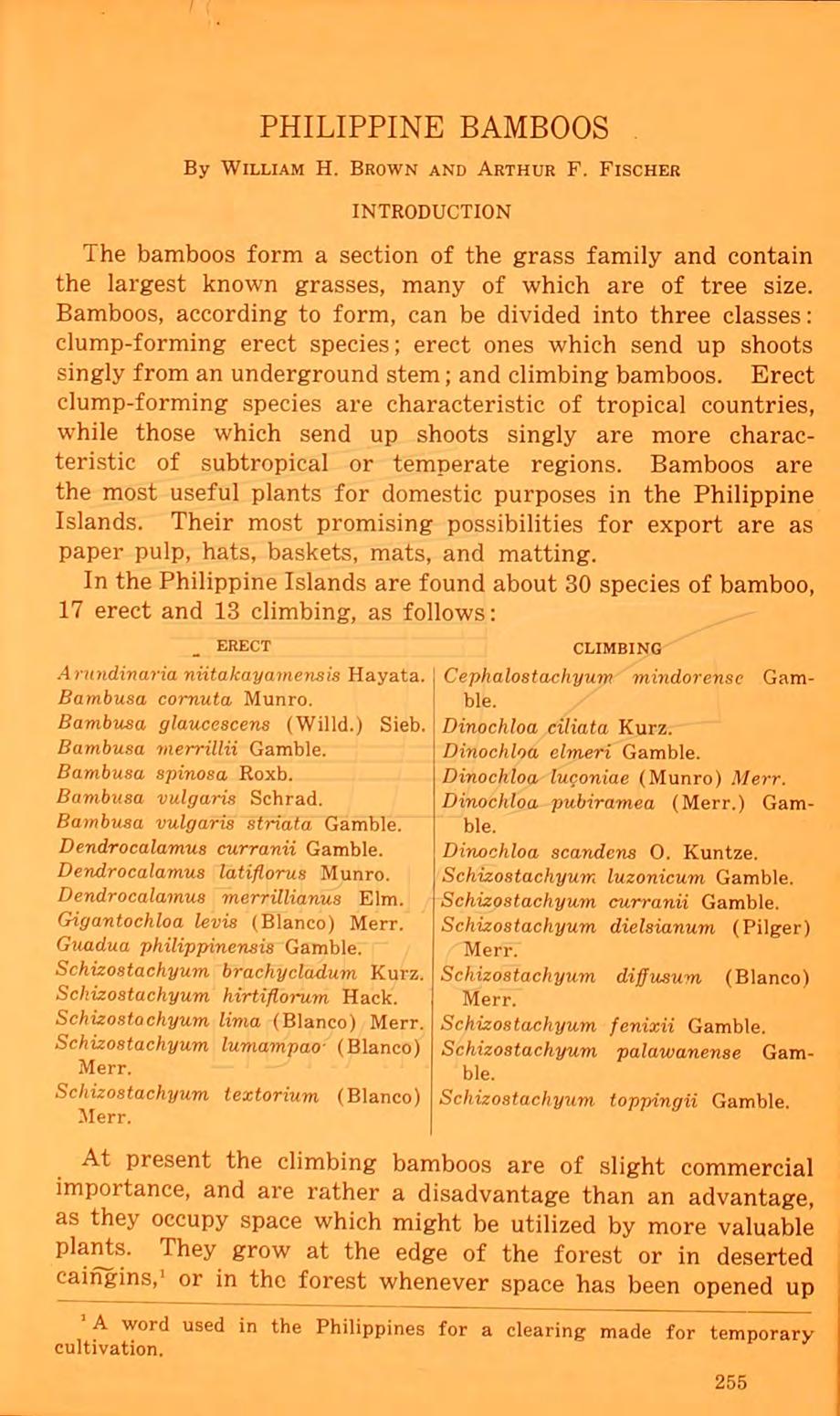
CLIMBING
A rnndinaria niitakayamensis Haya ta. I Cephalostachyum mindorense
Bambusa cornuta Munro. ble. Garn-
Bambusa glaucescens (Willd.) Sieb. Dinochloa ciliata Kurz
Bambusa nierrillii Gamble. Dinochfoa elmeri Gamble.
Bambusa spinosa Roxb.
Bambusa vulgari~ Schrad.
Bambusa vulgaris striata Gamble.
Dendro calamus curranii Gamble.
Dendrocalamus latiff,orus Munro.
Dendrocalamus merrillianus Elm.
Gig an toch loa le vis (Blanco) Merr.
Guadua philippinensis Gamble.
Schizostachyum brachycladum Kurz.
Schiz.ostachyum hirtifiorum Hack.
Schizostochyum linia (Blanco) Merr.
Schizostachyum lumampao · (Blanco) Merr.
Dinochloa lu~oniae (Munro) Me1·r. Dinochloa pu biramea (Merr.) Gamble.
Dinochloa scandens 0 . Kuntze
Schiz.ostachyum luzonicum Gamble.
Schiz.ostachyum curranii Gamble
Sch'izostachyum di e lsianum (Pilger) Merr.
Schizostachyum difjusum (Blanco) Merr.
Schiz.ostachyum f enixii Gamble . Schizostachyum palawanense Gamble.
Schizostachyum textorium (Blanco) Schizostachyum toppingii Gamble. :'llerr.
At present the climbing bamboos are of slight commercial importance, and are rather a disadvantage than an advantage, as they occupy space which might be utilized by more va luable plants. They grow at the edge of the for est or in deserted caifigins, 1 or in the for est whenever space has been opened up
1 A word used in the Philippines for a clearing made for temporary cultivation.
255
by the falling of large trees. They require considerable insolation for their best development and then grow very densely-so densely that it is very difficult to penetrate the thickets formed. In fact climbing bamboo forms the most impenetrable thickeb that are to be found in our fores ts. They seem to be decidedly inimical to tree growth, and are hard to eradicate when once they have fully occupied an area.
The erect species may, for convenience, be divided into thickand thin-walled bamboos. The framework of a great majoritv of the houses in the Philippine Islands is constructed from the thick-walled species. Unspht culms are used for posts, beam , and rafters. The same species, when split and flattened, are used for the sides of houses; or when split in two employed like tiles for roofing. Most frequently the sides and partitions, and occasionally the fl.001 s, are fo1med from thin-walled species split and woven into a coarse matting (sawale).
Sawale is a promising material for the construction of light- material bungalows even in temperate countries. It is al o very attractive as an interior finish in strong-material houses. Sawale is of particular advantage in the construction of large temporary buildings. In Manila there is held an annual arnival, in which very imposing structures are constructed rapidly and cheaply with the aid of this material. \\'hen the Philippine National Guard was organized, all the barracks were constructed very quickly on account of the use of sawale. In the entire Philippine exhibits at the Panama-Pacific International Expo ition at San Francisco, California, various weaves and classe of sawale were used extensively in the installation of the different booths. This proved so attractive and demon trated o clearly its use, that people visiting the Exposition ordered material of the heavier weave for summer cottages in California. These orders, aggregating 3,000 linear yards, were for the kind of material u ed in the exhibits. It was only due to a lack of an organized industry and the subsequent rise in freight rates that a considerable export trade did not re ult from thi beginning.
The domestic uses of bamboo are innumerable and include bridges, fences. rafts, fish traps, v s els for carrying and toring water, cooking, splints for baskets, hats and mats, vehicle haft , chairs, cupboards, table , beds, benche , flowerpot , etc. In fact, on account of the ease with which it is worked, bamboo is used for almost every purpose for which wood i employed in temperate countries. The young shoots of many '"'pecie are al 0 u ed for food. A an intere ting use of bamboo we may mention that complete bands, in ome case having 32 or more iece~ ~
256 PHILIPPINE BAMBOOS
are equipped with musical instruments constructed of bamboo. These pieces are of the same general character as brass instruments and include horn s, clarinets , flageolets, saxophones, flutes, piccolos, and drums. A church in Las Pifias, a few kilometers from Manila, ha s a famous organ with bamboo pipes.
For construction purposes bamboo should be cut a year after it has rea ched mature si ze and after the rainy season; that is, in most parts of the Philippines, after November. If cut during the rainy season the culms are full of sap, which soon attracts small beetles in great numbers and these rapidly destroy the bamboo. In pra ctice, newly cut bamboo is often kept in water for several weeks in order that the sap, or at least the sugar and starch contents of the sap, may be eliminated. Filipino bamboo carpenter s say that when flies gather around the newly worked bamboo, it is a sign that this bamboo is not durable. The flies, of cou r se, are attracted by the s ugar in the bamboo .
Owing to the wide distribution of bamboo and the ease with which it is worked without any special implements, it offers a promising field for the development of local household industries for the manufacture of va riou s useful and ornamental articles. If t hi s industry were developed, no doubt considerable export trade could be secured.
K e y to th e g e nera of Philippin e bamboo s . 1. Climbing.
2 Flowers in widely sc attered, dense , globose hea ds; rare, known onl y from Mindoro Cephalostachyum.
2. Fl ower s not in widely scattered , dense, globose heads.
3. Spikelets v ery small, ovate . . . ... .. . ... Dinochloa. :3 . Spikelets elongated, linear or linear-lanceolate.
Schi z os tachy 111n 1. Erect
2 Two and a half meter s in height or le ss, only on high m ountains, wild . . ....
...... A rnndina l'ia.
2. Clump s on e to three meter s in height, leaves sm al1 and whitish, culti vated only . . .. ................................... Ba mbusa glaucescens.
2. More than 3 meter s in height .
3. Bas e of clump protected with long, interlaced, spiny bran ches . Barnbusa spino s a
3. Ba se of clump not protected with long s pi ny branches . -1 ulm s thin walled; m ostly small or m ediu m sized bamboos
5. Keels of palea broadly winged; rare, known only from Mindanao G11acl 11 a
5. Palea not winged . ..... .. .. S chi z ostachy11 in 4 Cul m s thick walled; mo s tly large bamboos
5. Pericarp thin, adnate to the seed .
6. Filaments free ......... .. . . ... . .. .. ... Bambu s a.
6. Filaments connate in a t h in t ub e . Gigantocllloa .
5. Pericarp fl eshy or crustaceous, separable from t h e
KEY
GENERA 257
TO
.. . .. ..
..
.. .. . ......
...
....... ... .. ..
DESCRIPTION OF SPECIES
Genus ARUNDINARIA Michaux
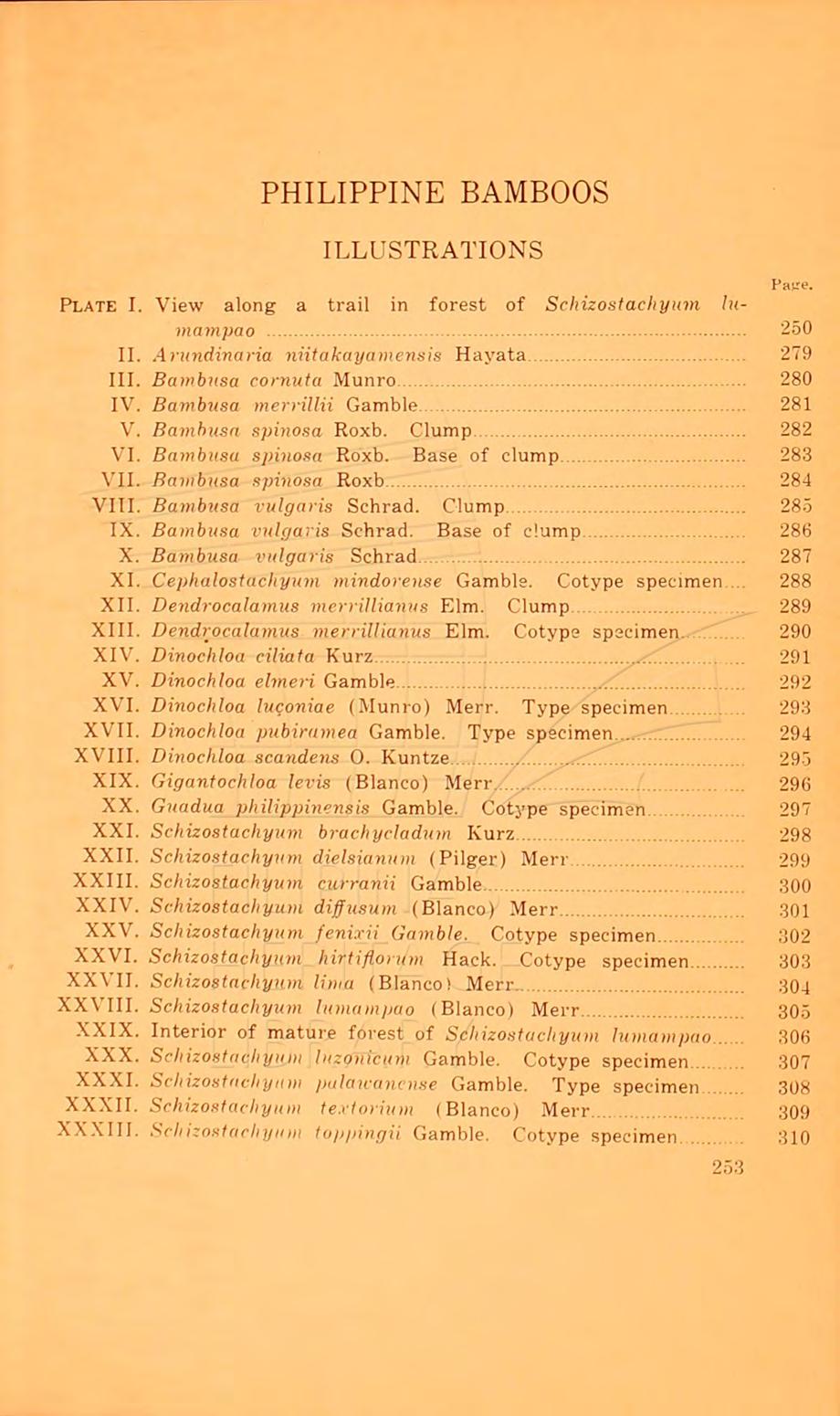
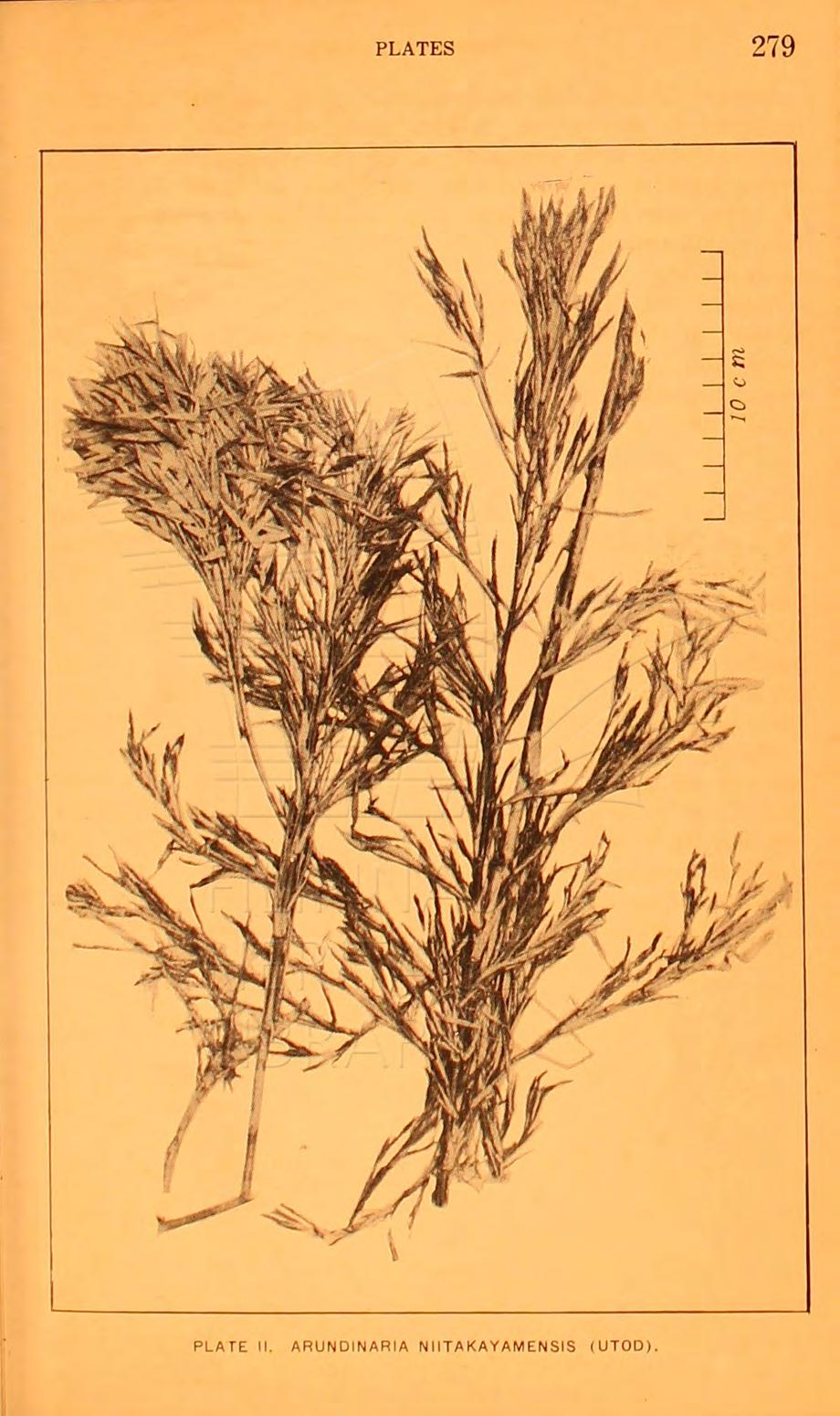
ARUNDINARIA NIITAKAYAMENSIS Hayata. UTOD. Among the Igorots, this bamboo is known as utod. It is the only representative of the g enus found in the Philippines. This species was originally de s cribed from the mountains of Formosa, and is known only from Formosa and the mountains of Luzon. It is locally very abundant, forming dense thickets, at altitudes from 2,100 to 2,600 meters in the Mountain Province, Luzon. This bamboo reaches a height of 2.5 meters, but in unfavorable habitats i s frequently only a few centimeters in height. Its maximum dian1eter is about 1 centimeter. Its only recorded use in the Philippines is for pipestems. A flowering specimen is shown in Plate II.
Genu s BAM BUSA Schreber
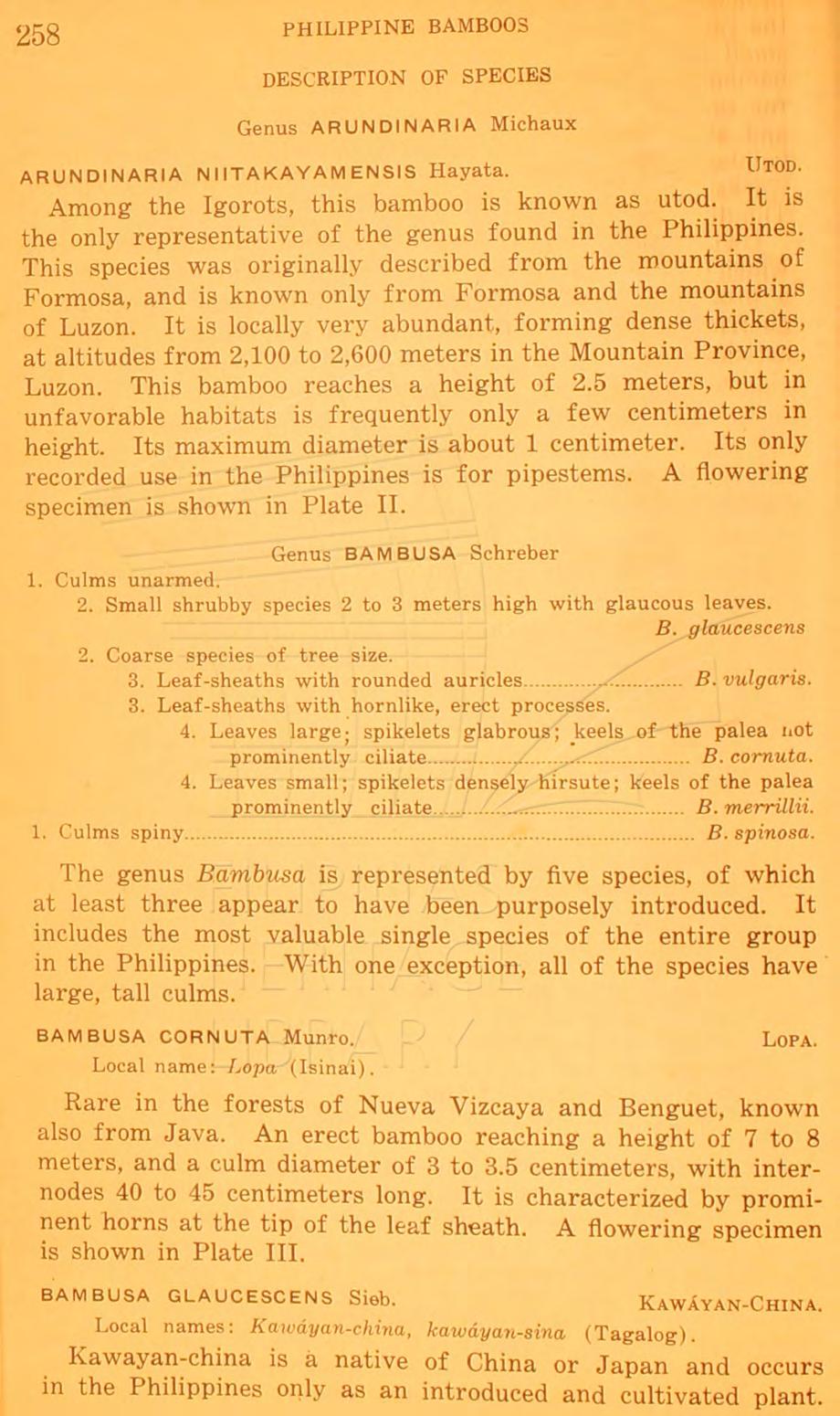
1. Culms unarmed.
2. Small shrubby s p e cies 2 to 3 meters high with glaucous leaves. B. glaucescens
2. Coarse specie s of tree size.
3. Leaf- s heaths with rounded auricles... ···-···· B. vulgaris.
3. Leaf- sh eaths with hornlike, erect processes
4. Leaves large; s pikelets glabrous; _keels of the palea 1iot prominently ciliate _ B. cornuta.
4. Leaves s mall; spike let s densely h1rsute; keels of the palea prominently ciliate ______ -· -··· ··-· B. merrillii.
1. Culms spiny _____ .·-
B. spinosa.
The genus Bambusa is represented by five species, of which at least three appear to have been purposely introduced. It includes the most valuable single species of the entire group in the Philippines. With one exception, all of the species have large, tall culms.
BAMBUSA CORNUTA Munro. LOPA.
Local name: Lopa (lsrnai)
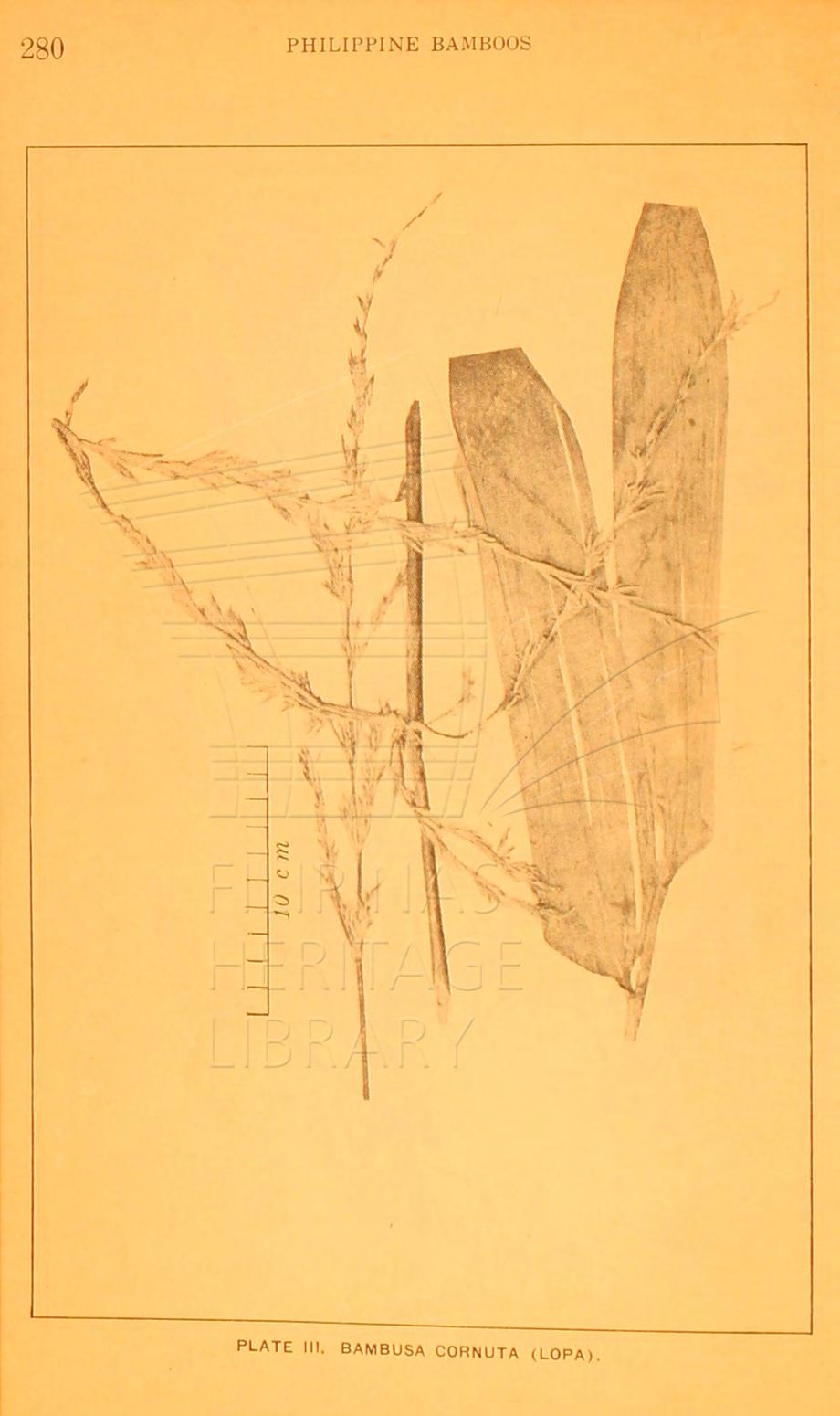
Rare in the forests of Nueva Vizcaya and Benguet, known also from Java. An erect bamboo reaching a height of 7 to 8 meters, and a culm diameter of 3 to 3.5 centimeters, with internodes 40 to 45 centimeters long. It is characterized by prominent horns at the tip of the leaf sheath. A flowering specimen is shown in Plate III.
BAM BUSA GLAUCESCENS Sieb. KAWA.YAN-CHINA.
Local names: Kawayan - china, kaw<iyau-sina (Tagalog).
Kawayan-china is a native of China or Japan and occurs in the Philippines o~ly as an introduced and cultivated plant.
258
PHILIPPINE BAMBOOS
________ -····_ . _____ __ _______ __ __
The clumps are usually from 1 to 3 meters in height, the culms up to 2 centimeters in diameter. The culms may be 5 meters in length but when long are usually much bent. The leaves are from 3 to 10 centimeters long and whitish in appearance. This species is planted for ornamental purposes and in some parts of Manila is used as a hedge plant. The I stems are used for fishing rods.
BAM BUSA M ERRILLII Gamble.
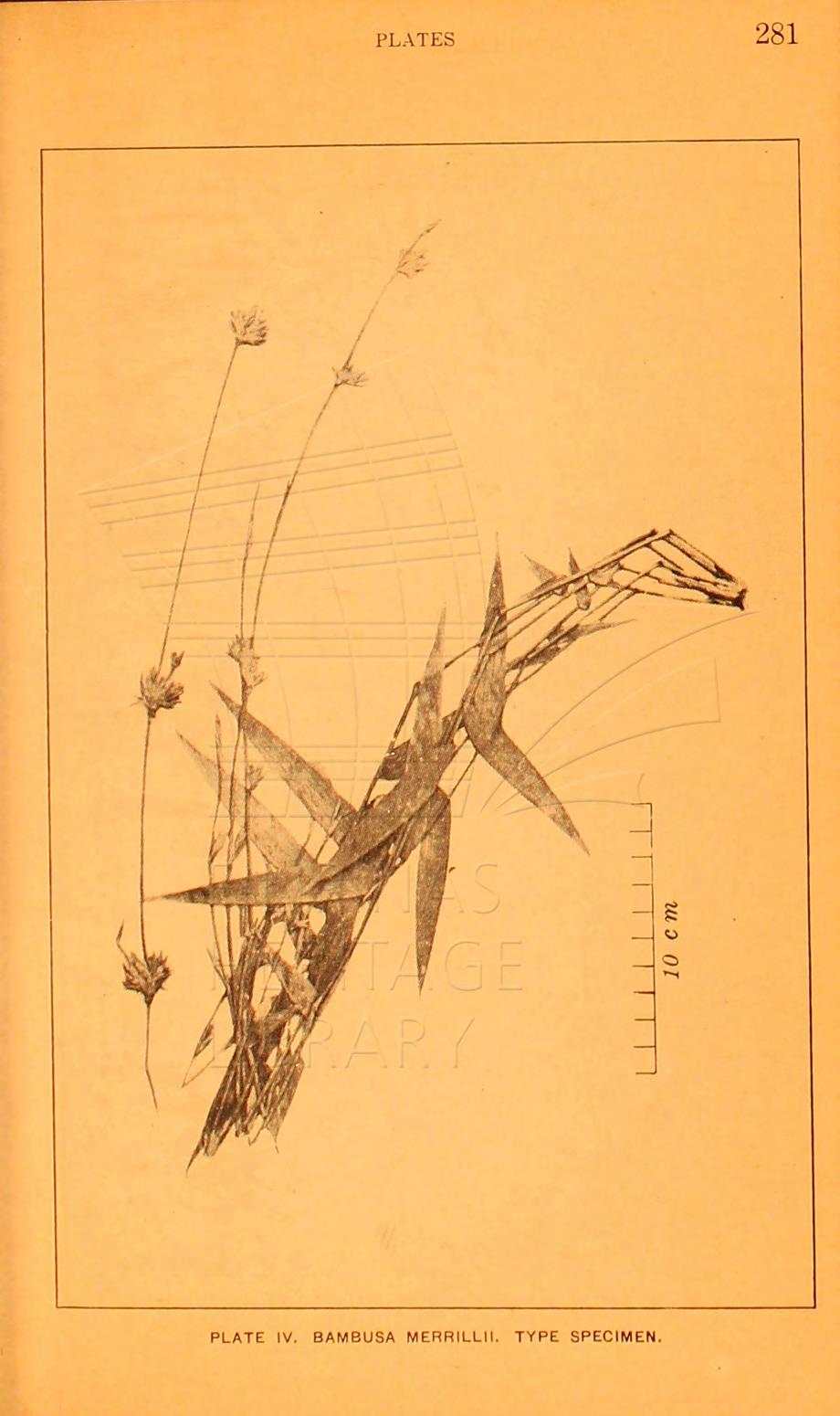
This species is known only from collections from the Caraballo Sur mountain ranges in Nueva Vizcaya, where it grows in forests at an altitude of about 600 meters.
It is an erect straggling species about 18 meters in height. See Plate IV.
BAM BUSA SPINOSA Roxb. (B. blumeana Schultes f.). SPINY BAMBOO.
Local names: Dugian, kabugci.wan, marur1lgi, rugian (Bikol) ; kawayan, kawayan tot6o (i. e. true bamboo), kawayan tinik (Tagalog); ao1v-or batakan, paua, kawayan-gid (Bisaya); kawayan si-itan (Iloko); bay6g (Zambales); larn-nuan (Isinai) ; baugin (Pampanga); pasingan (Cagayan); caiia espina (Spanish).
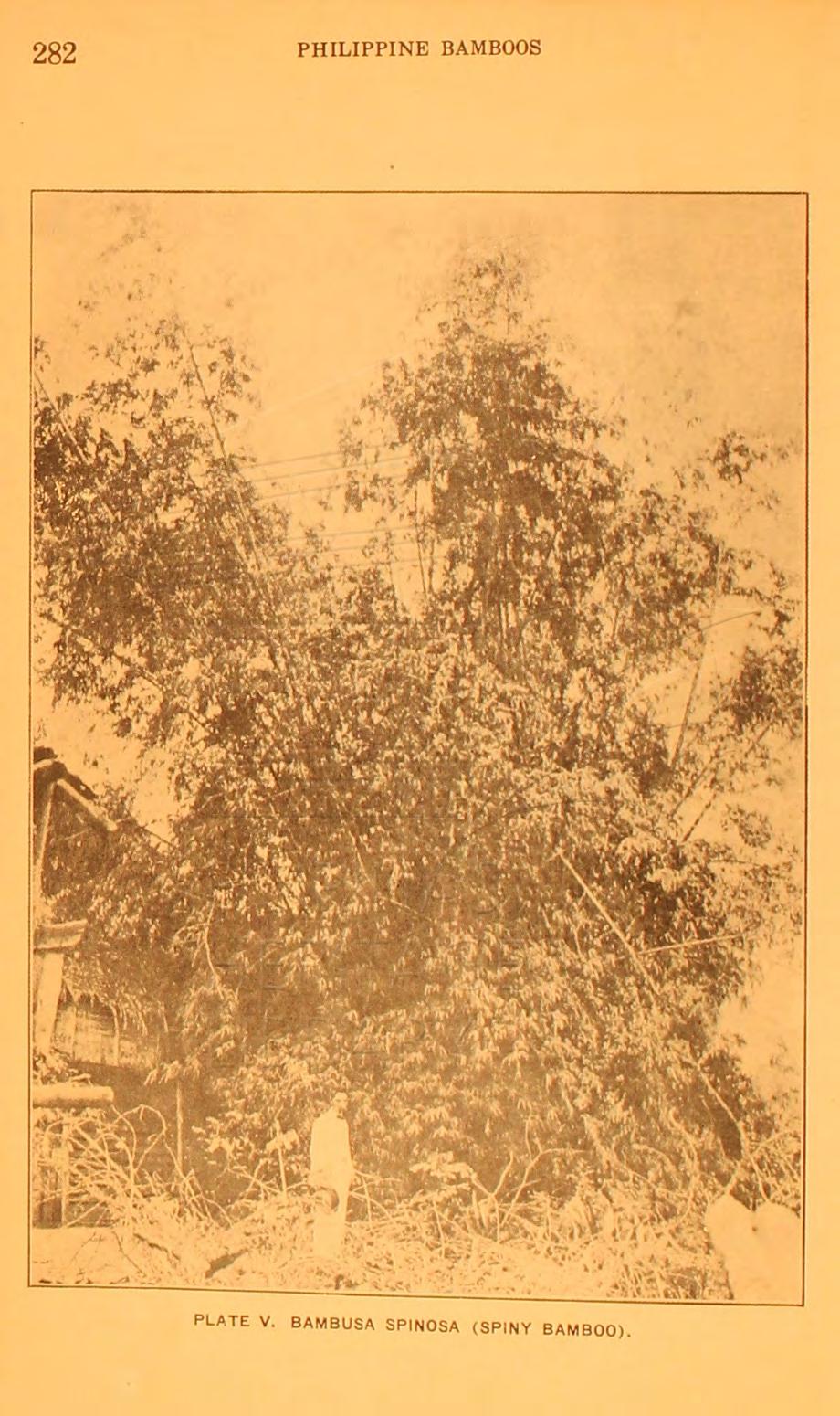
This bamboo is the one to which the name kawayan is most frequently applied. It is found throughout the settled areas of the Philippines at low and medium altitudes, and is apparently always planted, there being no valid reason for considering it a native of the Archipelago. This bamboo was apparently purposely introduced at an early date. Spiny bamboo, as well as the other large, probably introduced species, has been cultivated quite extensively in clearings which have since been abandoned, so that considerable areas are now covered by virtual forests of this species. Spiny bamboo offers considerable possibilities as a valuable reforestation crop.
Spiny bamboo reaches a height of about 25 meters and a culm dhmeter of 20 centimeters. The internodes are usually hollow, and from 40 to 60 centimeters in length. The culms have thick walls, becoming progressively thicker toward the lower part of the culm. It occasionally happens that the lower internodes are so thick walled that they become almost or quite solid. The stem contains a large amount of silica and sometimes an internode is complet ly filled with a hard, white, siliceous mass, which damages any instrument used in cutting it. This bamboo is rarely found in flower and the interval between flowering periods is not known. It is by far the most commonly used bamboo in the PhiUppines, being prized above all others by the Filipinos for building purposes on account of its great strength and durability. It is distinguished from all other spe-
DESCRIPTION OF SPECIES 259
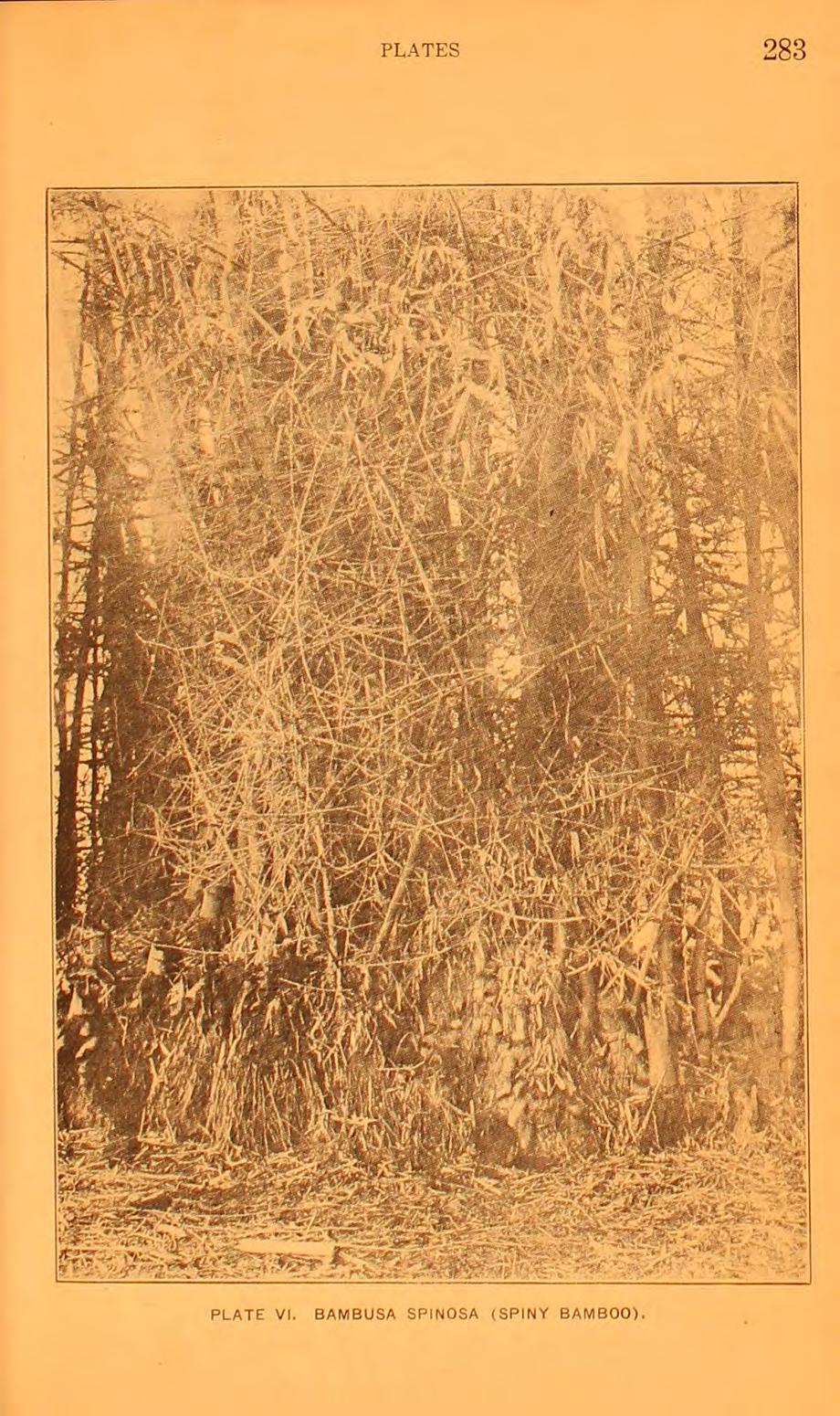
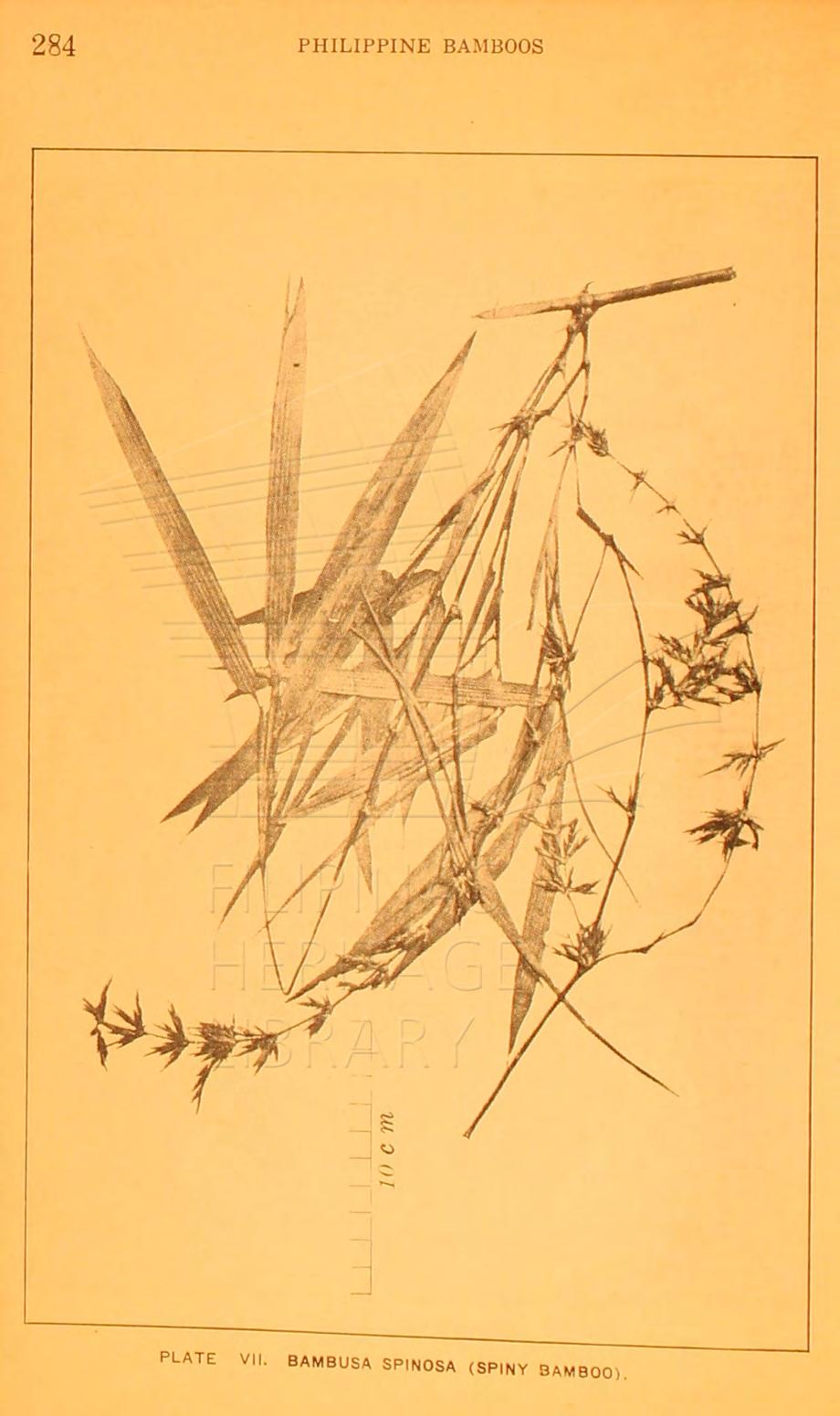
cies of Philippine bamboos by the fact that it grows in l~rge clumps, the basal portions of which are surrounde? to a height of from 2 to 3 meters by a densely interlaced thicket of very spiny branches, which make access to the culms exceeding~y difficult. The function of these spiny branches, apparently, 1 to protect the delicate young shoots from herbivorous animals. This species is illustrated in Plates V to VII.
The splints from green stems of this species are used extensively in the manufacture of ba kets and hats, it being the most valuable species for hat making. It also has ome commercial possibilities for paper pulp. The basal portions of the culms ha,·e been used as heads for polo mallets and for shuttles on hand looms.
Distributed in southern China, Indo-China, Malay Peninsula, and Malay Archipelago.
BAM BUSA VULGARIS Schrad.
 KAW,\YAN-KILIXG.
Local , ame::-;· hrncuuru1-kil111y, kawciyan bay11yin, kc11uayan hobe1·0, tauccrnak, tc 1l'Cl11((k (Tagalog); bllluwu, b11nrau, l1i1ws, 8inambang (Bisaya) ; k<Jholr,a it (Biko!).
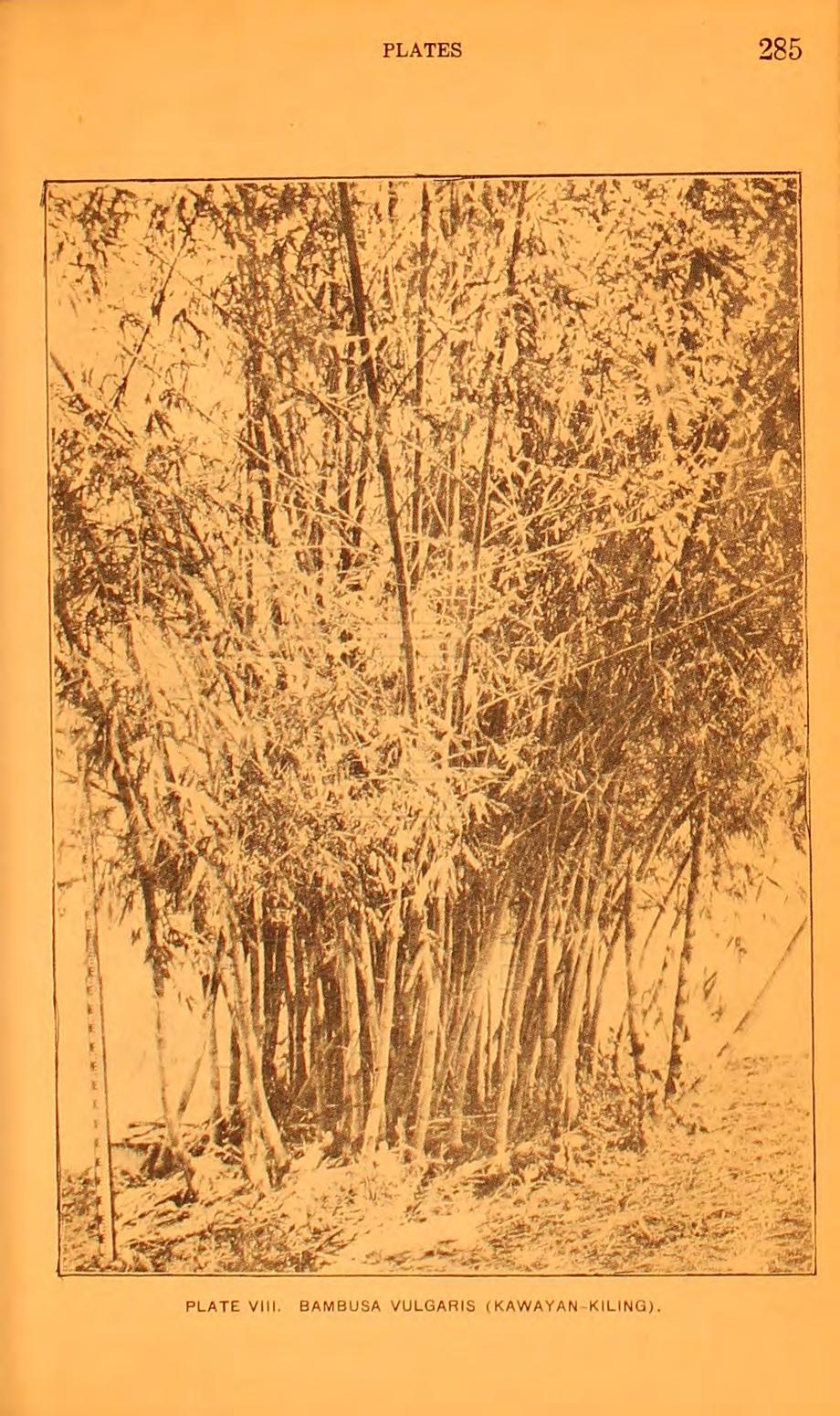
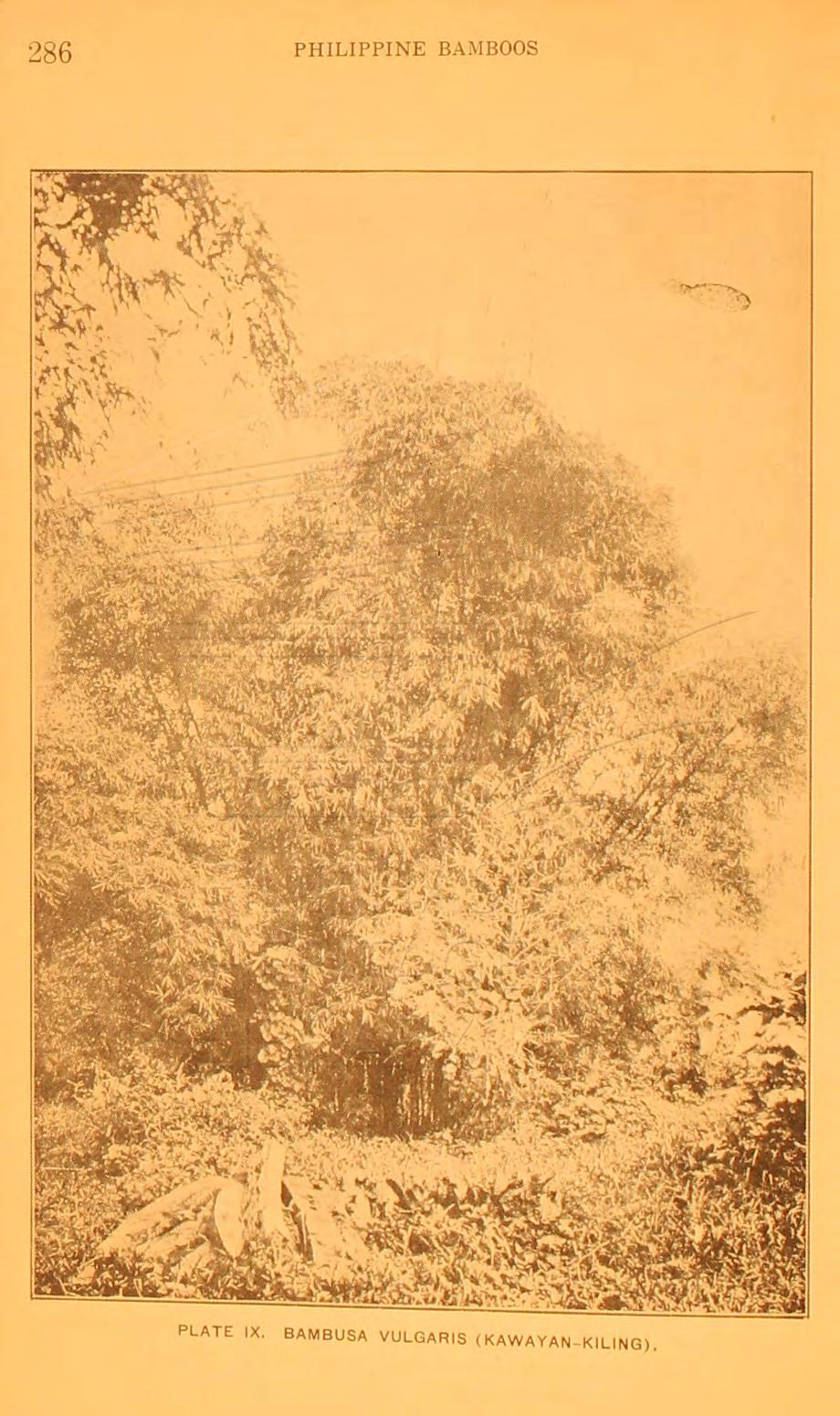
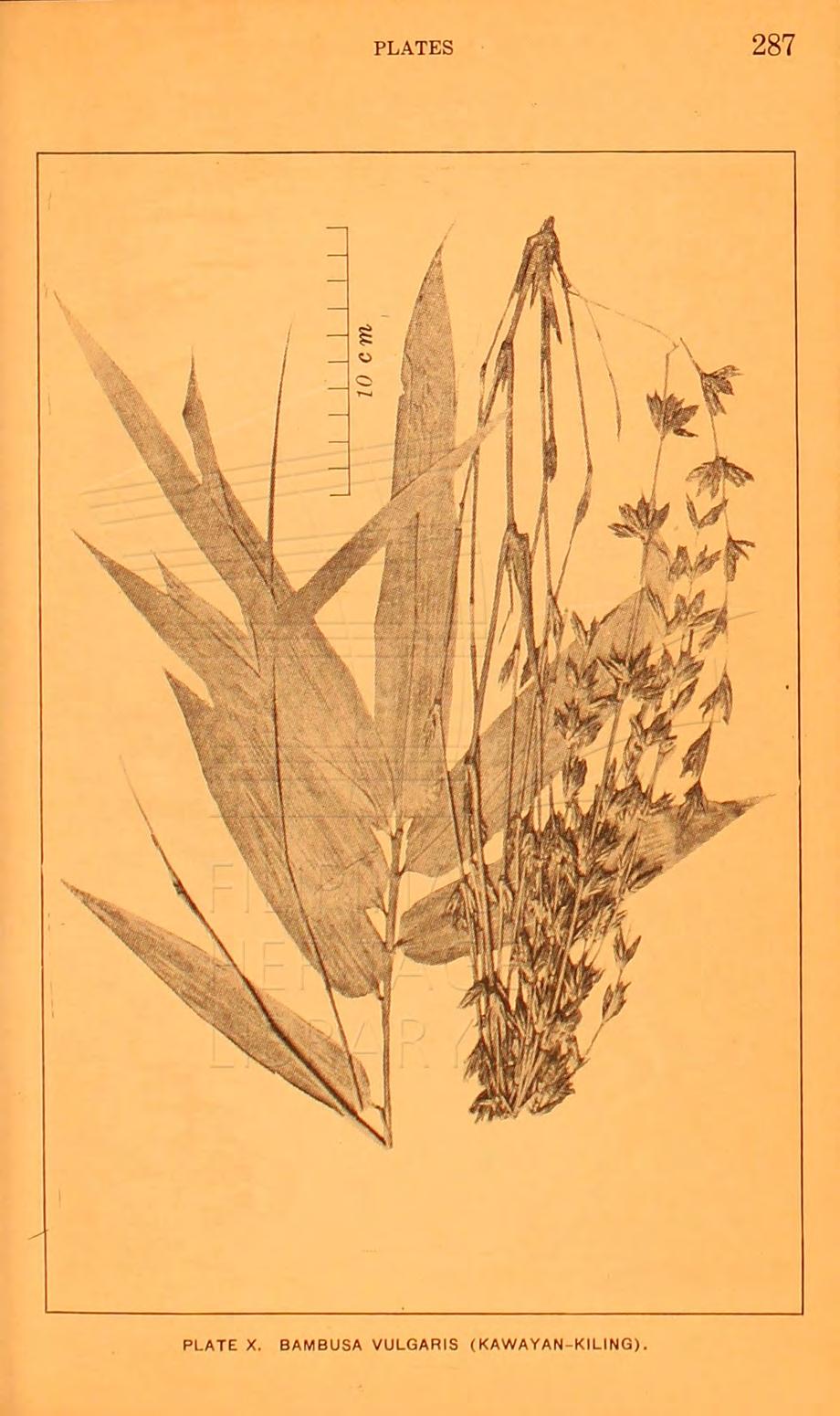
This is a clump-formmg spineless bamboo, which reaches a height of about 17 meters or more and a diameter of about 12 centimeters. The stems are smooth, usually yellowish or yellowish-green. It is u. ually smaller than Bambusa spinosa and has thinner ,,·alls. This species is illustrated in Plates VIII to X. 0
Kawayan-kiling is one of the building bamboos and i generally utilized in the regions wh re it grows for the variou~ purposes, such as house construction, bridges, furniture, for which the coarse erect bamboos are adapted. It is much inferior to Bcm1b11sa spino:-;a. Like the spiny bamboo, it is probably not a native of the Philippines, but was purposely introduced in prehistoric times on account of its general ut ilitv. The varietv :-;triata Gamble is occaswnally cultivated in :Manib and in othe~· large towns for ornamental purposes; it is readilv distinguished by its culms bl'ing bright yellow with a few gree1{ stripes. This form is a native of China or Japan, but is now widelv distributed in cultivation. •
The native country of !Jcunbw·m vulgaris is so far unkno\'::n · it is cultivated and half wild in Asia, Africa, and America. '
Genus CEPHALOSTACHYUM Munro
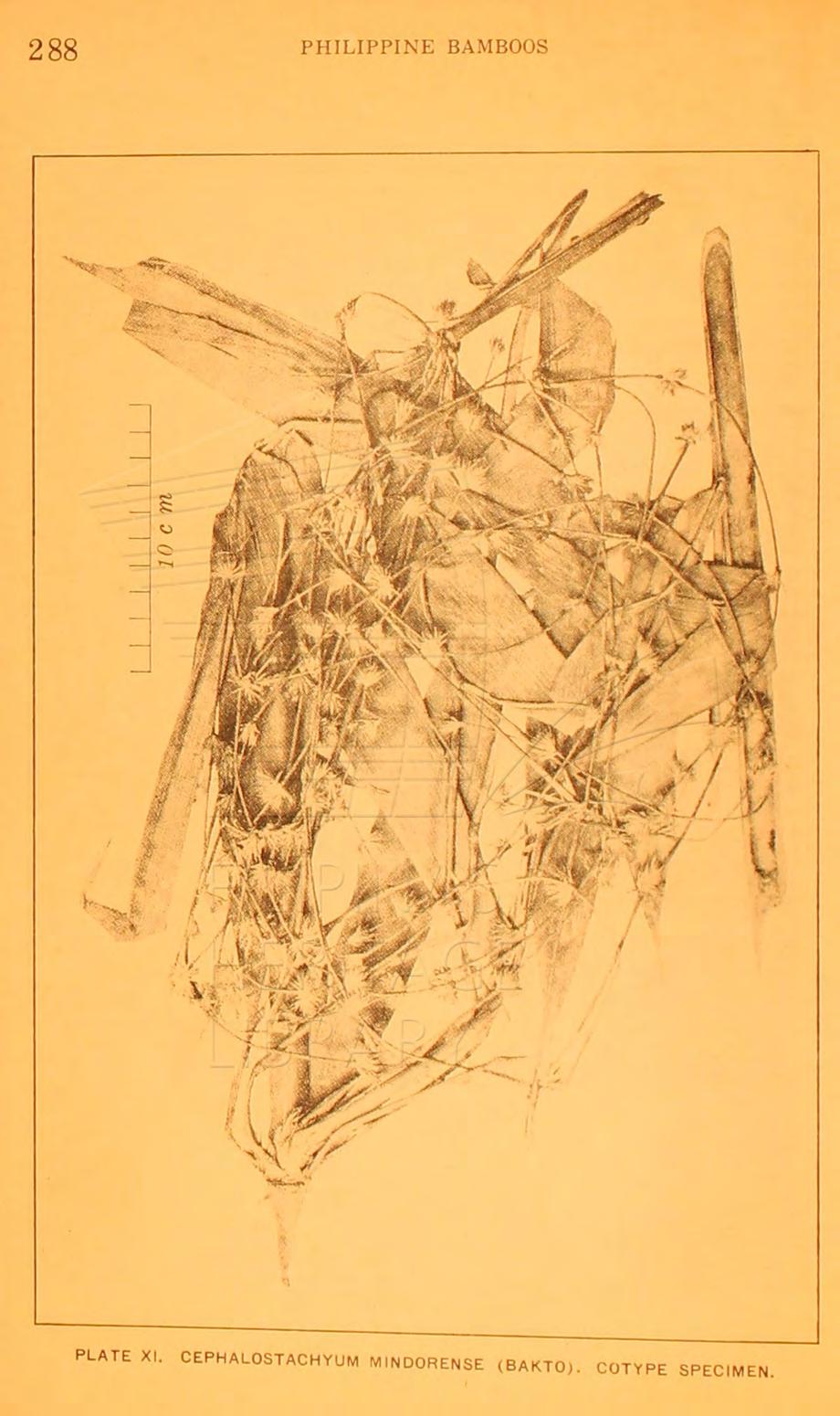
_Thi_s species_ is rare and known only from :\lindo1 o. It i~ a chmbmg species well characterized by havin its flow rs in
260 PHILIPPINE BAMBOOS
CF;PHALOSTACHYUM MINDORENSE Gamble B AKTO.
dense, globose, widely scattered heads the larger of which are about 2 centimeters in diameter. See Plate XI.
Genus DENDROCALAMUS Nees
Spikelets large; leaves large ............................. ................. D latifiorus. Spikelets medium-sized• leaves long............................................... D . cu,rranii. ' . Spikelets very small... ........................................................... D. merrillianus.
This genus of large erect bamboos is represented by three species. It is economically unimportant and none of the species are especially abundant.
DENDROCALAMUS CURRANII Gamble.
A rare species known only from Sampaloc, Tayabas, and the Island of Polillo off the coast of Luzon, and possibly not distinct from Gigantochloa le1 is.
DEN DROCALAM US LATI FLOR US Munro. BoT6NG .
Local names: Bot6ng, bolong-sina (Bikol, Bisaya) ; but 1tn (Bisaya); kabol6an, pat 6n g (Bicol); kawayan- sin a (Tagalog).
This is a tall, tufted, spineless bamboo apparently of general distributiort in the central Philippines. It is frequently utilized for building purposes, but is not considered to be good material for basketry.
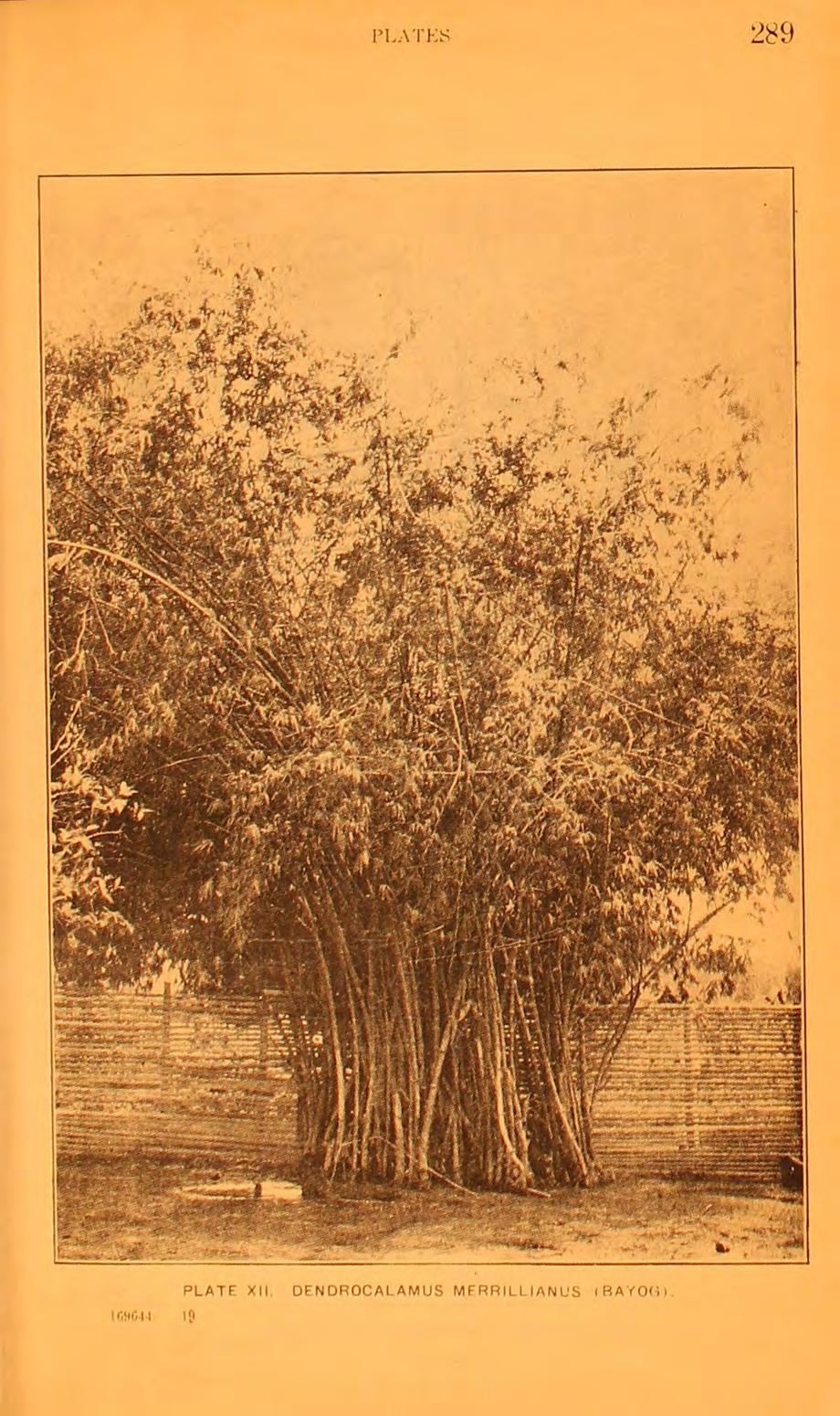
DENDROCALAMUS MERRILLIANUS Elm. BAY6G
Local names: Bay6g (!locos); kaw<iya~bay6g (Pangasinan).
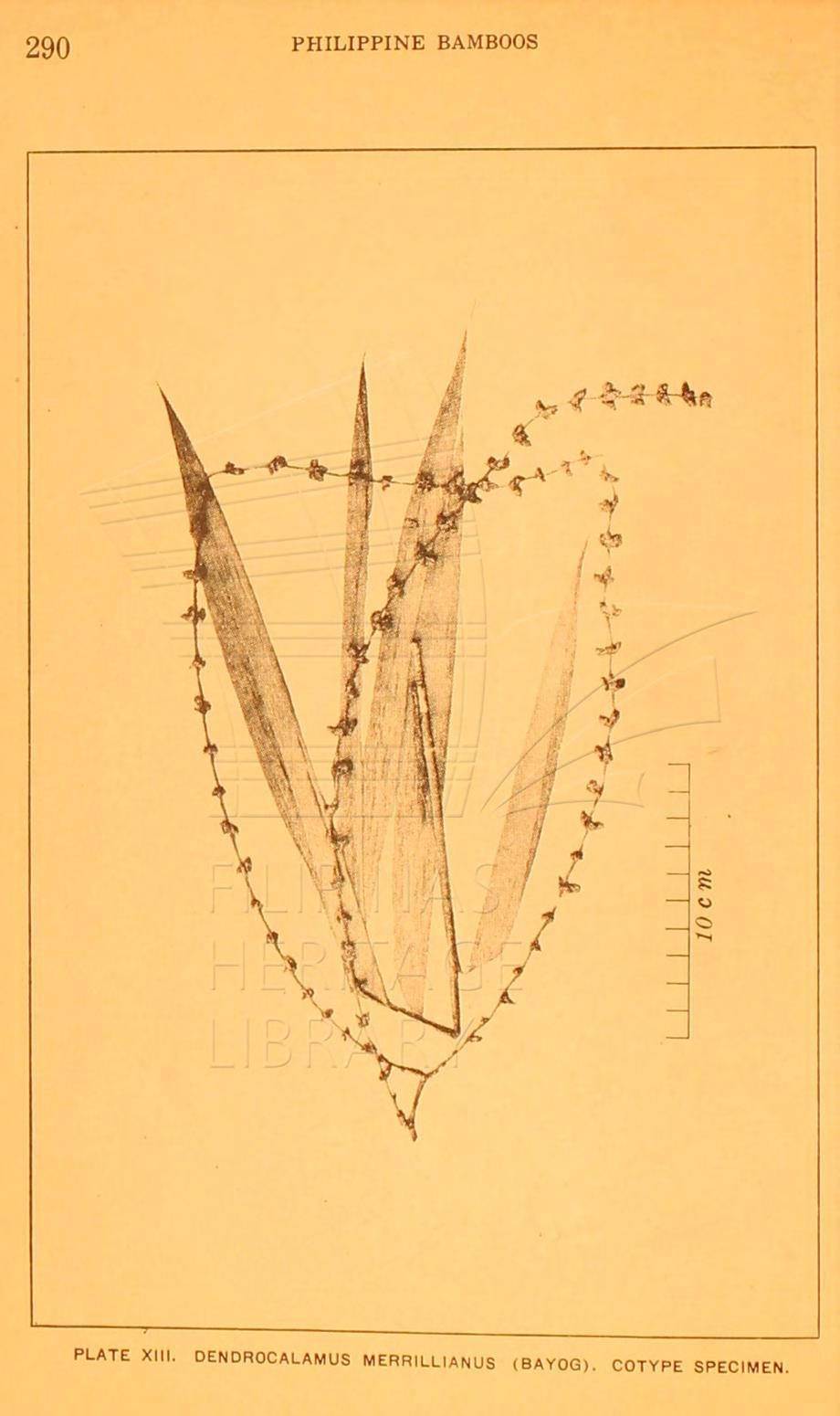
This bamboo is apparently widely distributed in the Philippines. It is a tall graceful bamboo with slender stalks forming large clumps. The culms have very thick walls and prominent nodes. They are used for vehicle shafts and for other purposes where great strength is desired. The green culms of this bamboo are split and made into ropes, used particularly for hauling logs . A flowering specimen is shown in Plate XII.
Genus DIN OCH LOA B iise 1. Woody.
2. Leaves broad .
3. Lodi cul es absent ; caryopsis globose; floral rachis glabrous . D . scandens.
3. Lodicules pre sent; caryopsis oblong; floral rachis pubescent. D pubiramea
2. Leaves narrow; no lodicules.
3. ulms smooth; caryo p si s globose .. ......................... D cilia ta
3. Culms rough; caryopsis oblong . .. . .. . ....... D. luroniae. 1. Herbaceou s , or woody only at the base; lodicules present.. ... D. elmeri.
The genus Dinochloa is represented in th Philippines by fiv species. With one exception our repres ntativ s ar all scandent, thick-walled, sylvan forms and are locally very abundant, forming almost impenetrable thickets under favorable conditions.
DESCRIPTION OF SPECIES • 261
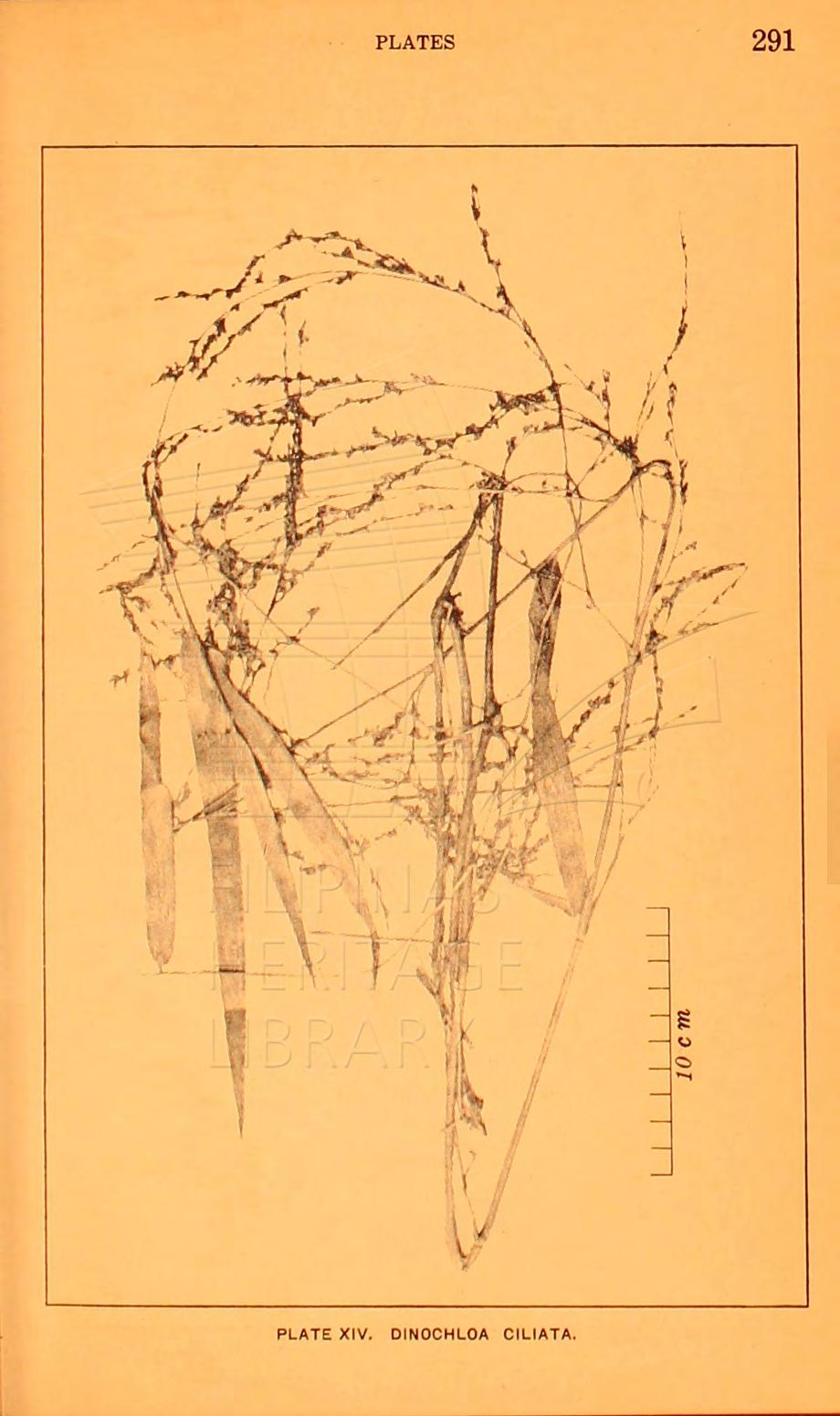
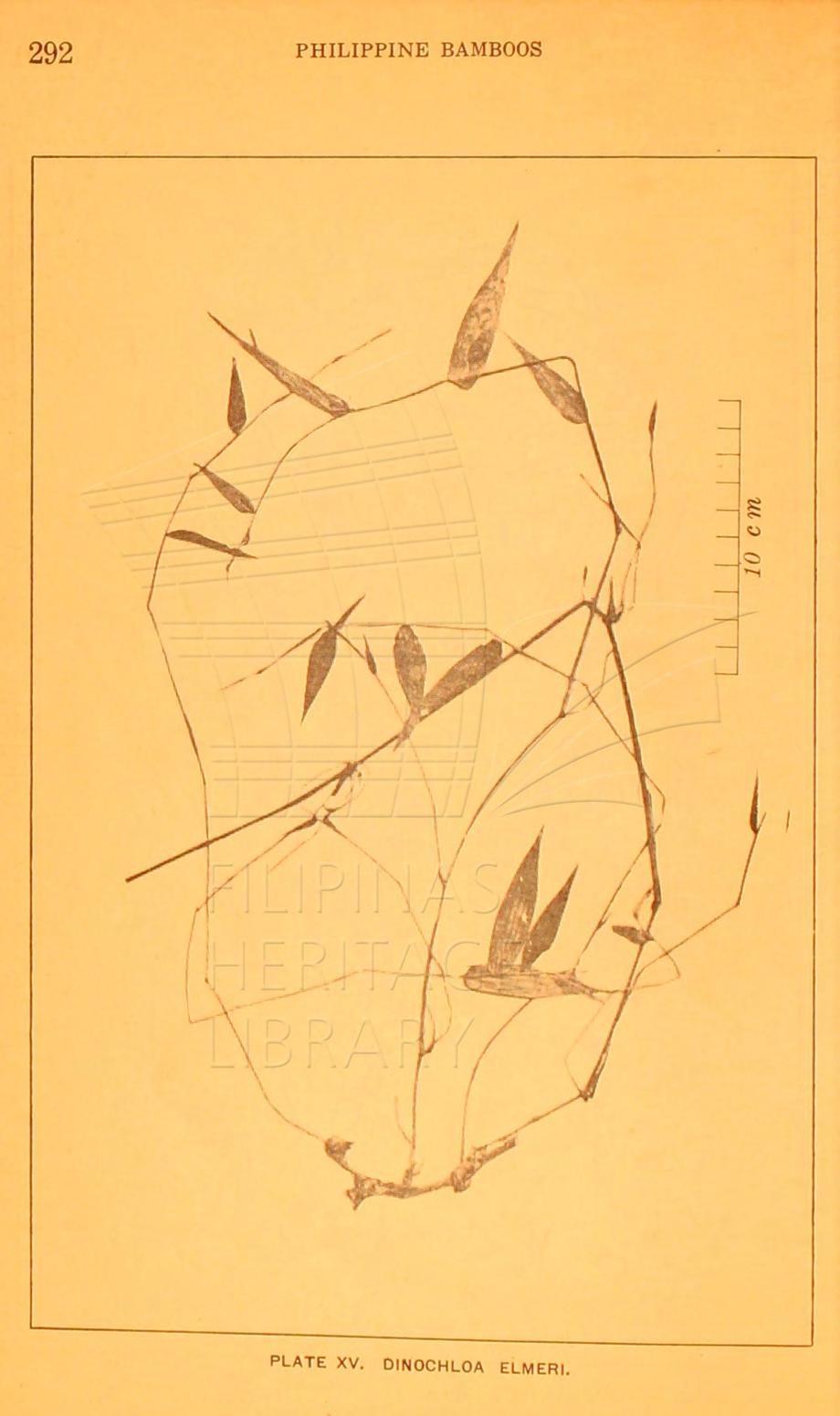
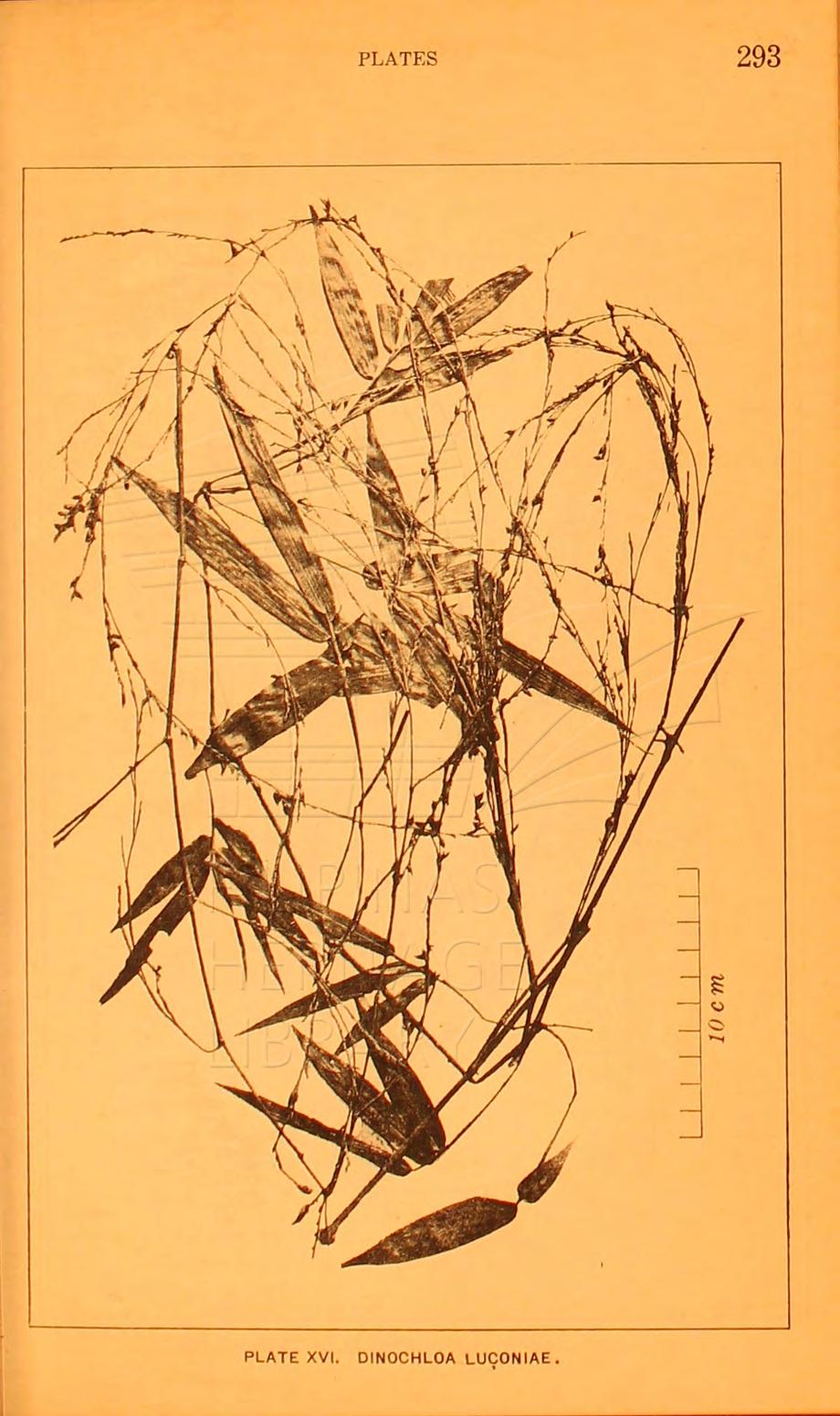
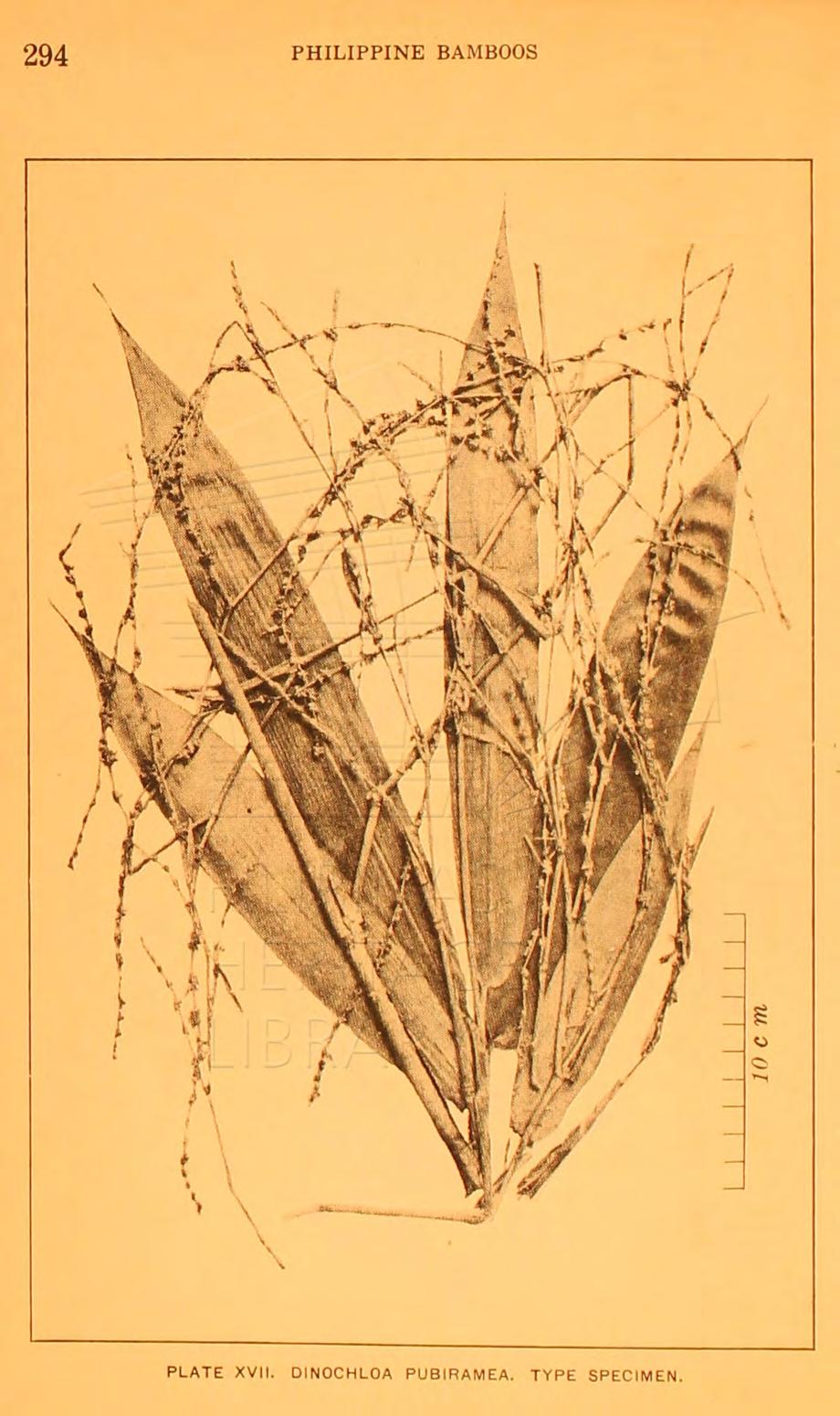
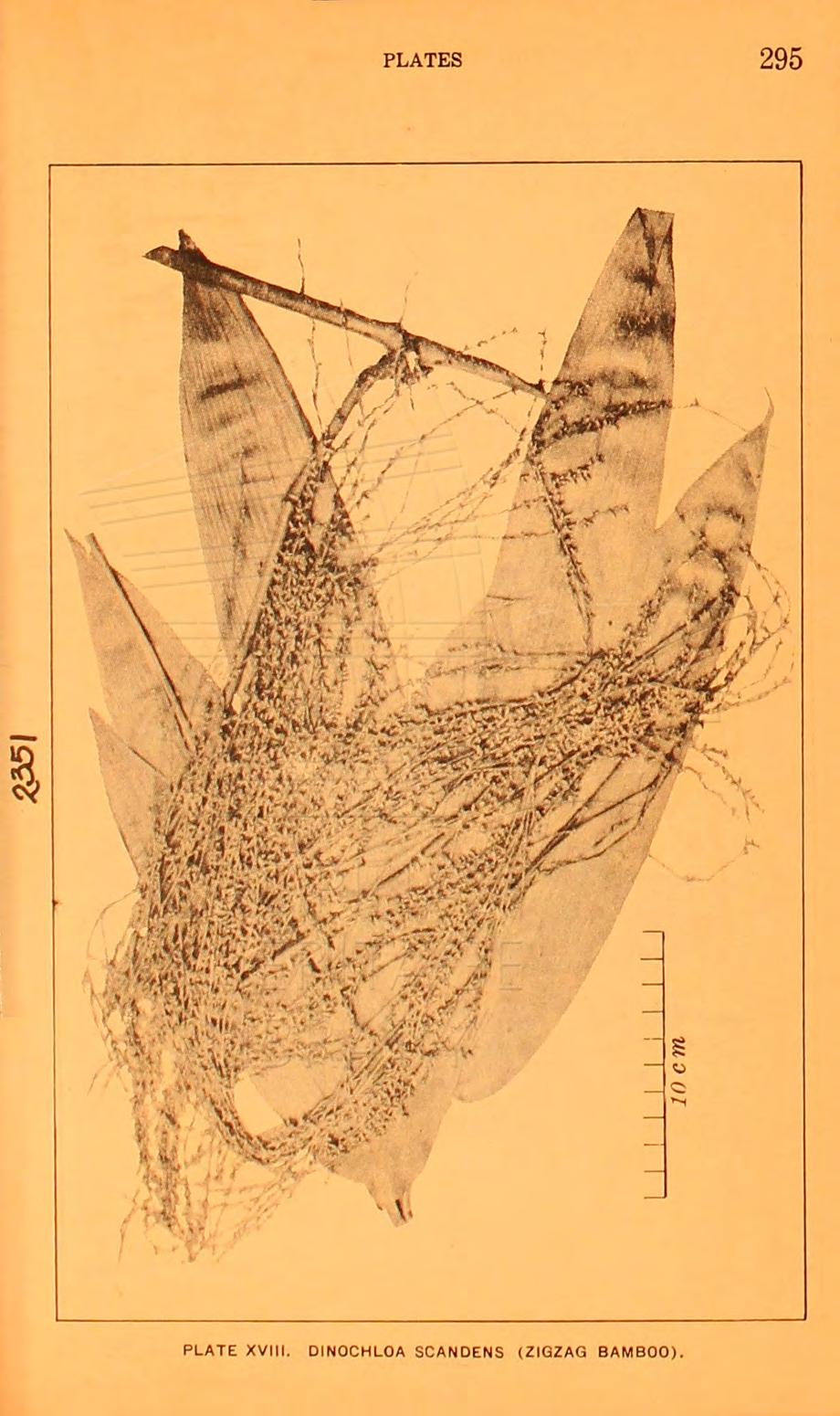
No special economic uses are indicated for any of the forms, yet like all bamboos they are more or less utilized by the Filipinos for general purposes. They should be adapt:d to the sa_me special uses as the thick-walled scandent species of Schizostachyum. The most common species is Dinochloa scanclens, zigzag bamboo, (Plate XVIII) which is abundant and widely distributed in the central and southern Philippines; it is characterized by its very broad leaves and is variously known as baia in Palawan, bokime in Balabac, bukau in Basilan, usiu, timak, and bolokaui in l\Iindoro. :\1ost of these names are also used for the scan dent species of Schizostachyum. Dinochloa luroniae (Plate XYI) is very similar in general character to Dinochloa sca,ulurn, but has much narrower leaves, which is also true of Dinf>chlua ciliata (Plate XIV). Dinochloa lu<;oniae is known as baito (Tagalog) and esu (Iloko). D. pubiramea (Plate XVII) is a broad-leaved species similar to D. scandens and distinguished chiefly by having the branches of the inflorescence pubescent. Its local names are kandi (Bis.) and bukau (Moro). Di,w,·liloa elmeri (Plate XV) is a dwarfed, half-woody form growing in the mossy forest at the summits of high mountains.
Genus GIGANTOCHLOA Kurz
GIGANTOCHLOA LEVIS (Blanco) :\lerr. BoL6.
Local names: Kawciycrn-buv, ka u:ayu n-1,iila, ka waya n-puti, boh6 (Tagalog); bok6, bolo, bot6ng (B1saya).
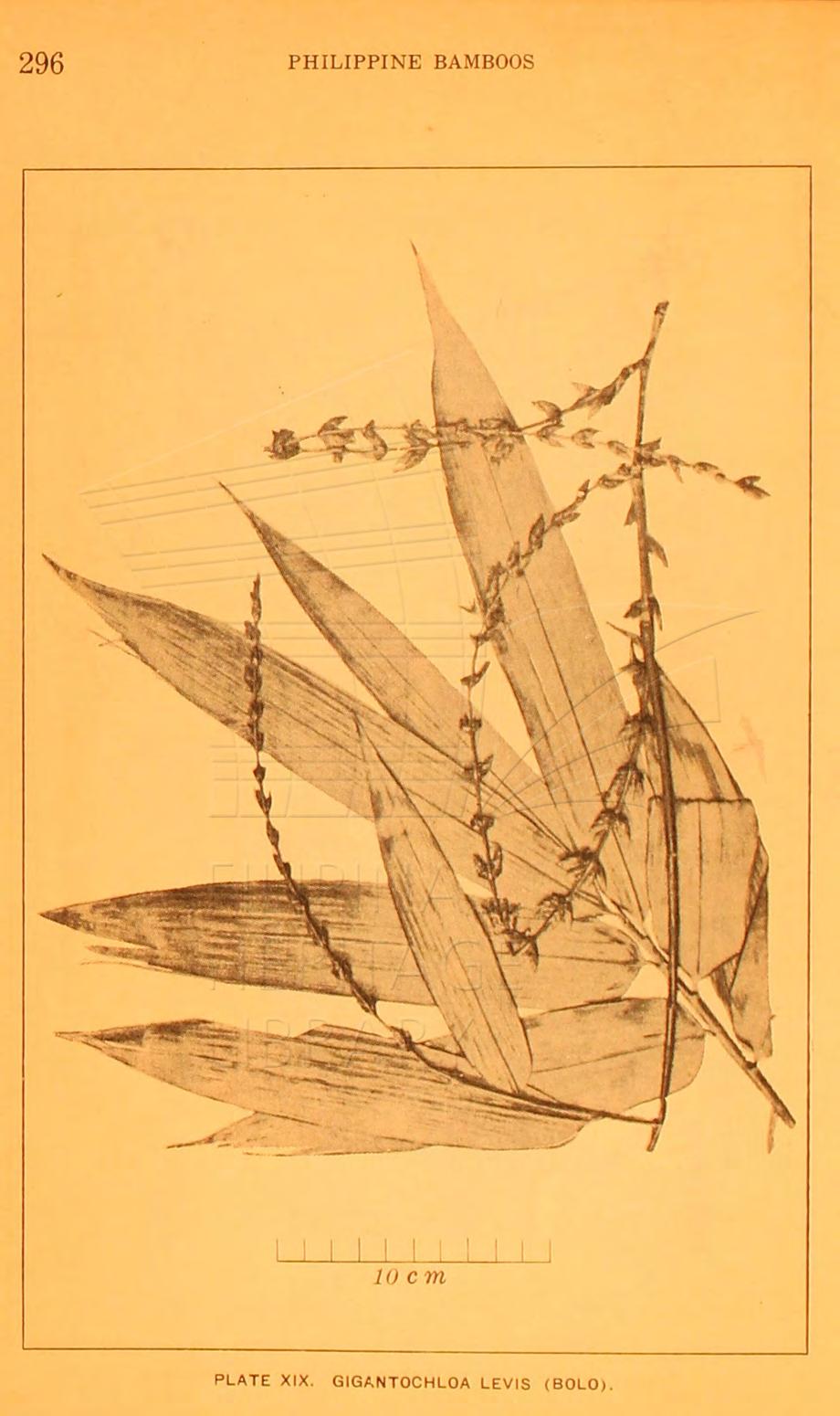
Gigantochloa, lel'is is a stout bamboo reaehing a height of 20 meters or more and a culm diameter of 20 centimeters. • Its culms are very straight and smooth, dull green, covered with siliceous pubescence, and entirely unarmed. It is found in and ~bout towns in the settled areas of the Philippines, and al o m the forests. The stems are used as pipes for temporary water supplies, as they are usually long and straight, and for bu~ld!ng fish traps. They are, apparently, rarely employed in bmldmg operations, except for walls of houses. perhaps because they are not especially durable. A flowering specimen is shown in Plate XIX.
The Philippine specimens ref Pr reel to (;iyu ,If ochloa robu~ta Kurz and (;1uu,llo1·/il()a ((ffr I' < ( t , •iclc•red bv Ir. E. D. Merrill to be specificall~ di , t ti•Jm r,. Zc,·i.·. •
This is a rare species known only from a sin
262 PHILIPPINE BAMBOOS
GUADUA
PH I LIPPI N ENSIS Gamb
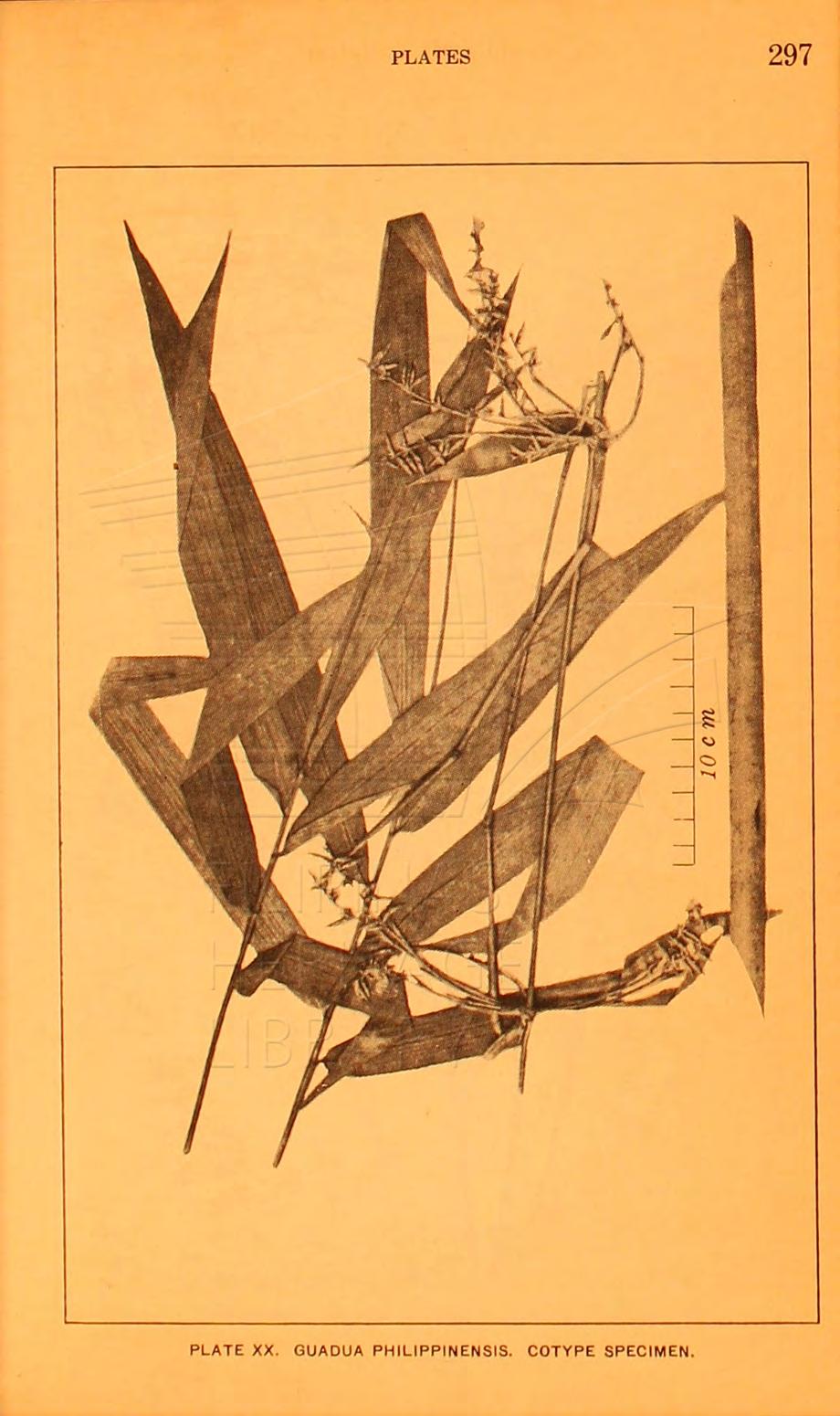
long and 2.5 to 5 centimeters in diameter. The cu lms are thin walled and 4 to 6 meters in height. A cotype specimen is shown in Plate XX.
1. Climbing
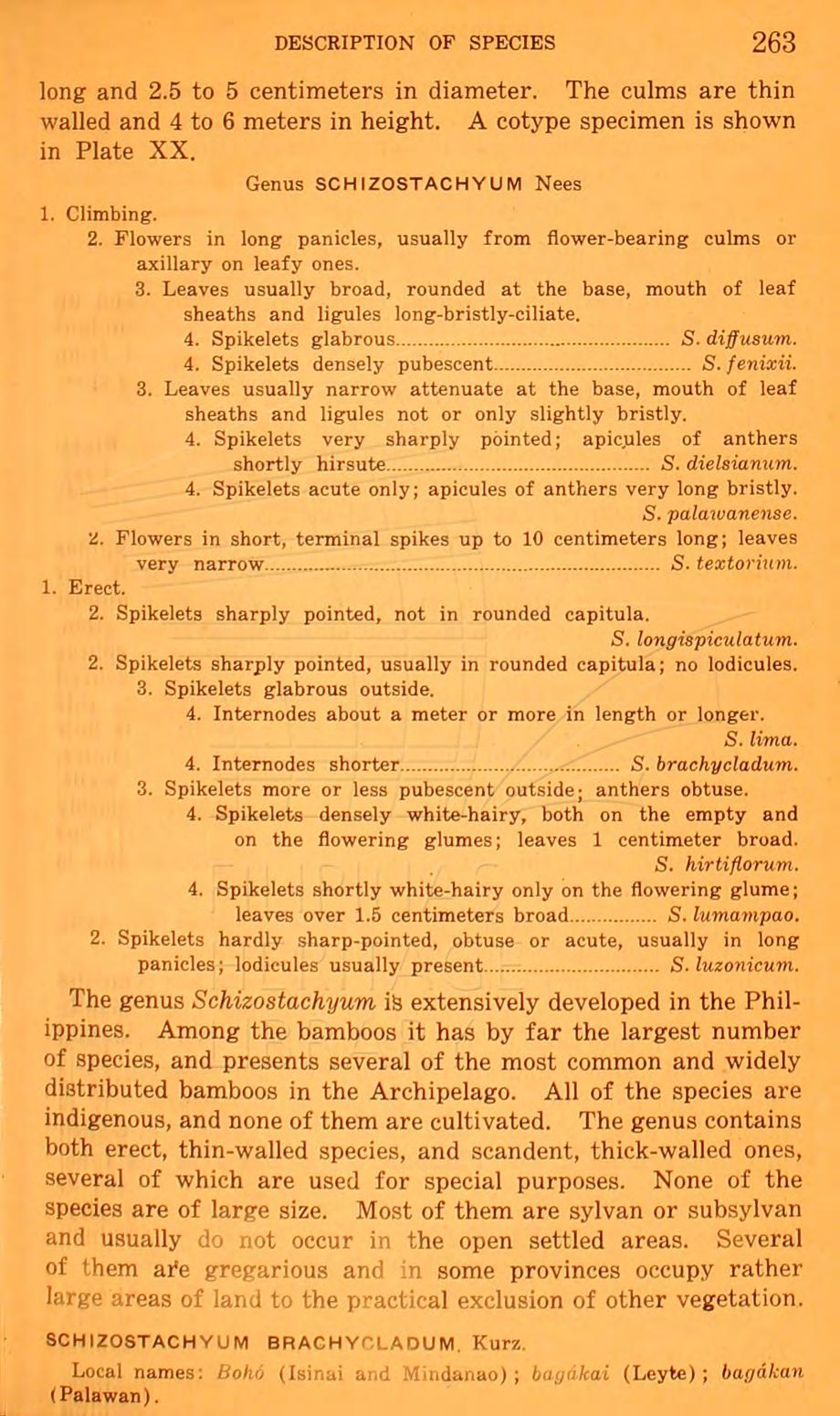
Genus SCHIZOSTACHYUM Nees
2. Flowers in long panicles, usually from flower-bearing culms or axillary on leafy ones.
3. Leaves usually broad , rounded at the base, mouth of leaf sheaths and ligules lo n g -bristly-ciliate.
4 Sp ikelets glabrou s S difjusum.
4. Spikelets den s ely pubescent .................................... S. fenixii.
3. Leaves u s ually narrow attenuate at the base, mouth of leaf sheaths and ligules not or only slightly bristly.
4. Spikelets very sharpl y pointed; apic ules of anthers shortly hirsute................................. ....... ........ S. dielsian'l.lm.
4. Spikelets acute only; apicules of anthers very long bristly. S. palawanense.
~. Flower s in short, terminal spikes up to 10 centimeters long; leaves very narrow................................................................. ....... S. textorium..
1. Erect.
2. Spikelets sharply pointed, not in rounded capitula. S. longispiculatum.
2 Spikelets sharply pointed, usually in rounded capitula; no lodicules.
3. Spikelets glabrous outside.
4. Internodes about a meter or more in length or longE:r. S. lima.
4. Internodes shorter......................... ............... S. brachycladum.
3. Spikelets more or less pubescent outs ide; anthers obtuse.
4. Spikelets densely white-hairy, both on the empty and on the flowering glumes; leaves 1 centimeter broad. . S. hirtifiorum.
4. Spikelets shortly white-hairy only on the flowering glume; leaves over 1.5 centimeters broad S lumarnpao.
2. Spikelets hardly sharp -pointed, obtuse or acute, usually in long panicles ; lodicules usually present S. luzonicum.
The genu s Schizostachyum is extensively developed in the Philippines. Among the bamboos it has by far the largest number of species, and presents several of the most common and widely distributed bamboos in the Archipelago. All of the species are indigenous, and none of them are cultivated. The genus contains both erect, thin-walled speci es , and scandent, thick-walled on s, several of which are used for special purposes. None of the species are of la r ge size . Mo st of them are sylvan or sub sy lvan and usually J n 0t occur i t he open settled areas. Several of hem ate gregarious and n some provinces occupy rather Ia ge reas of land to the p r actical exclusio n of oth er vegetation .
DESCRIPTION OF SPECIES 263
SCHIZOSTACH YU M BRA C H Yr.LADU M K urz Loca l name s. Hoho ( Is1n ..u a nd ndanao ) ; bagr1.kai (Leyte) ; bagcil ·an (Palawan).
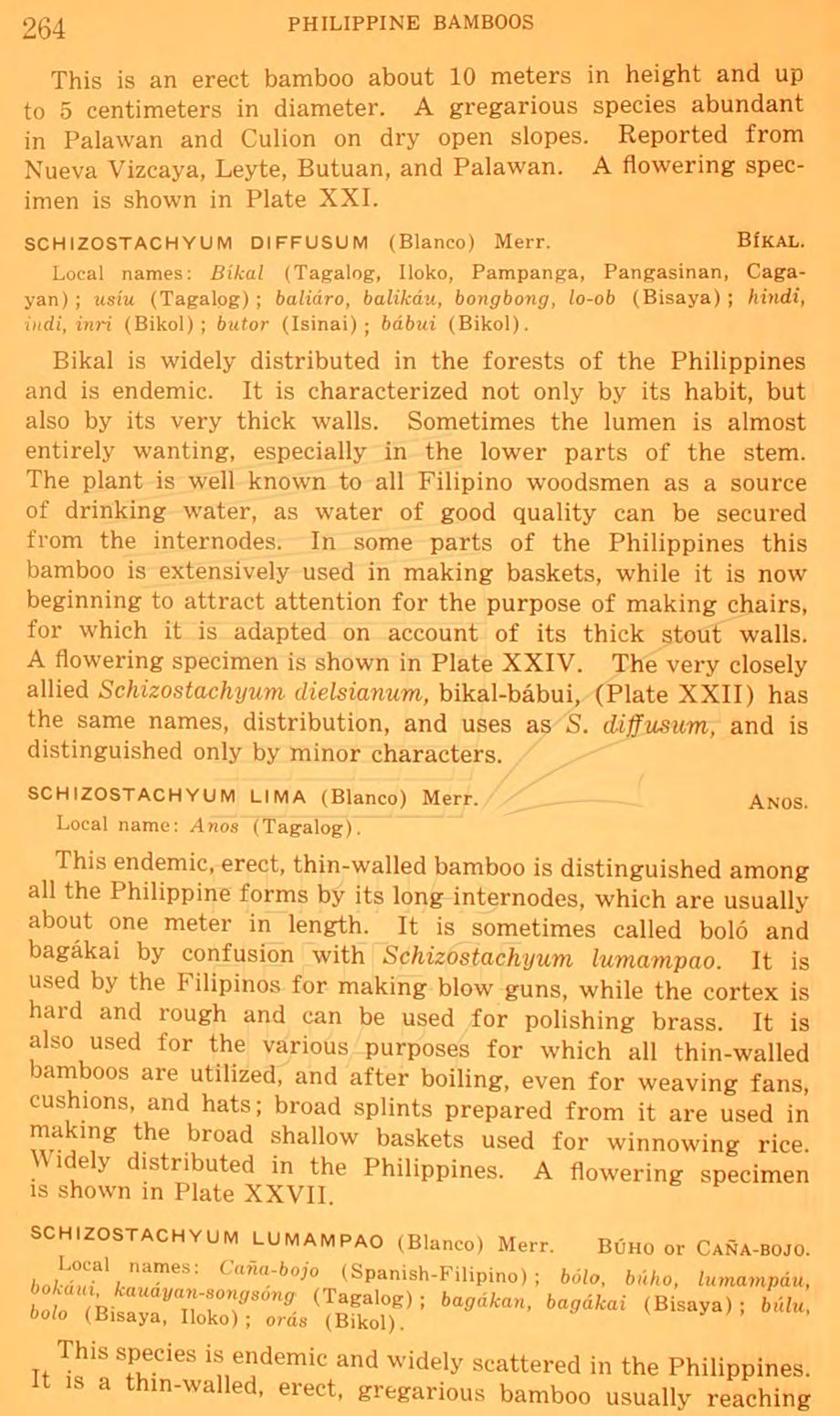
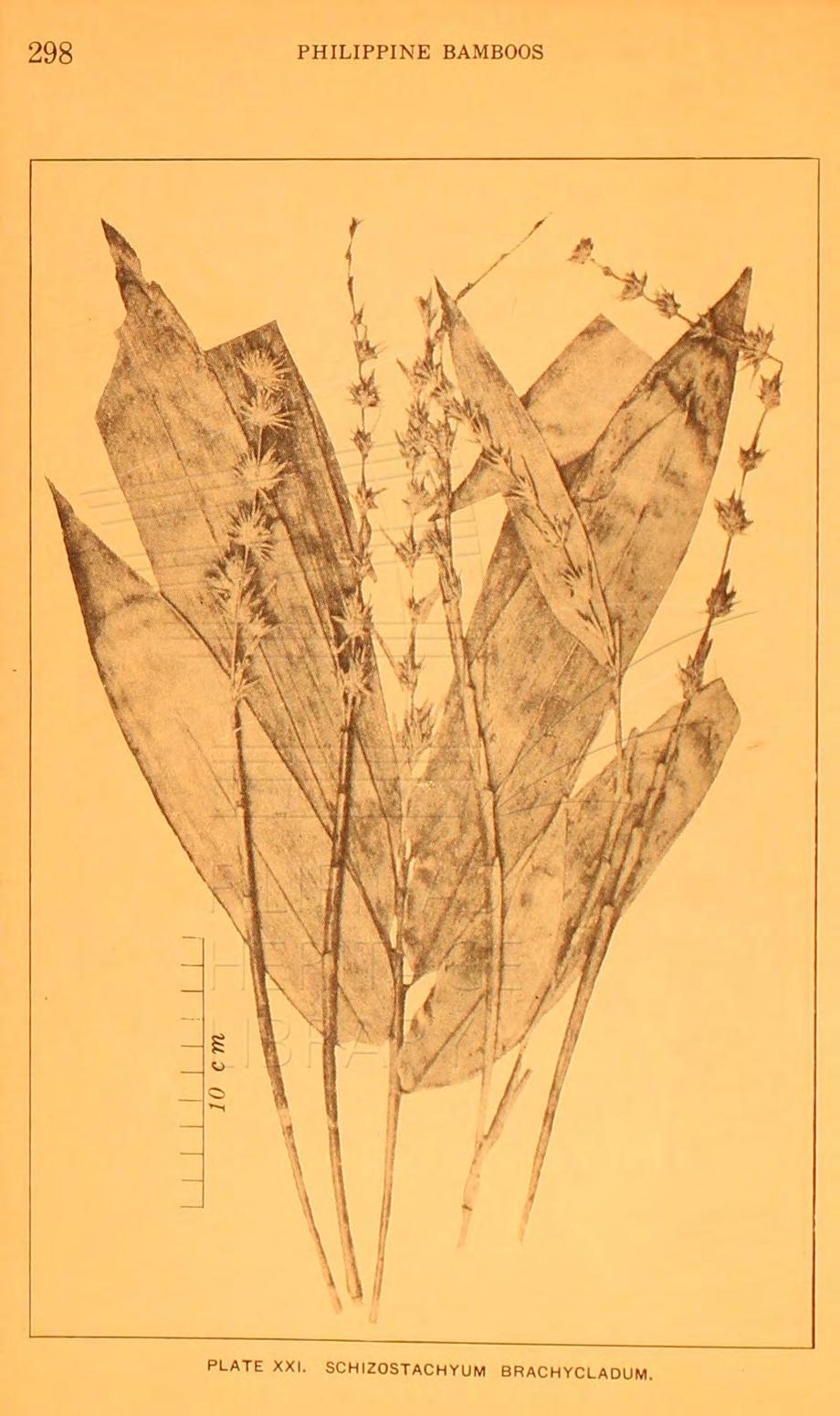
This 1s an erect bamboo about 10 meters in height and up to 5 centimeters in diameter. A gregarious species abundant in Palawan and Culion on dry open slopes. Reported from :Nueva Vizcaya, Leyte, Butuan, and Palawan. A flowering specimen is shown in Plate XXI.
SCHIZOSTACHYUM DIFFUSUM (Blanco) Merr. BiKAL.
Local names: Bikal (Tagalog, Iloko, Pampanga, Pangasinan, Cagayan); us[u (Tagalog); baliaro, balikau, bongbong, lo-ob (Bisaya); hindi, iudi, inri (Biko!); butor (Isinai); babui (Biko!).
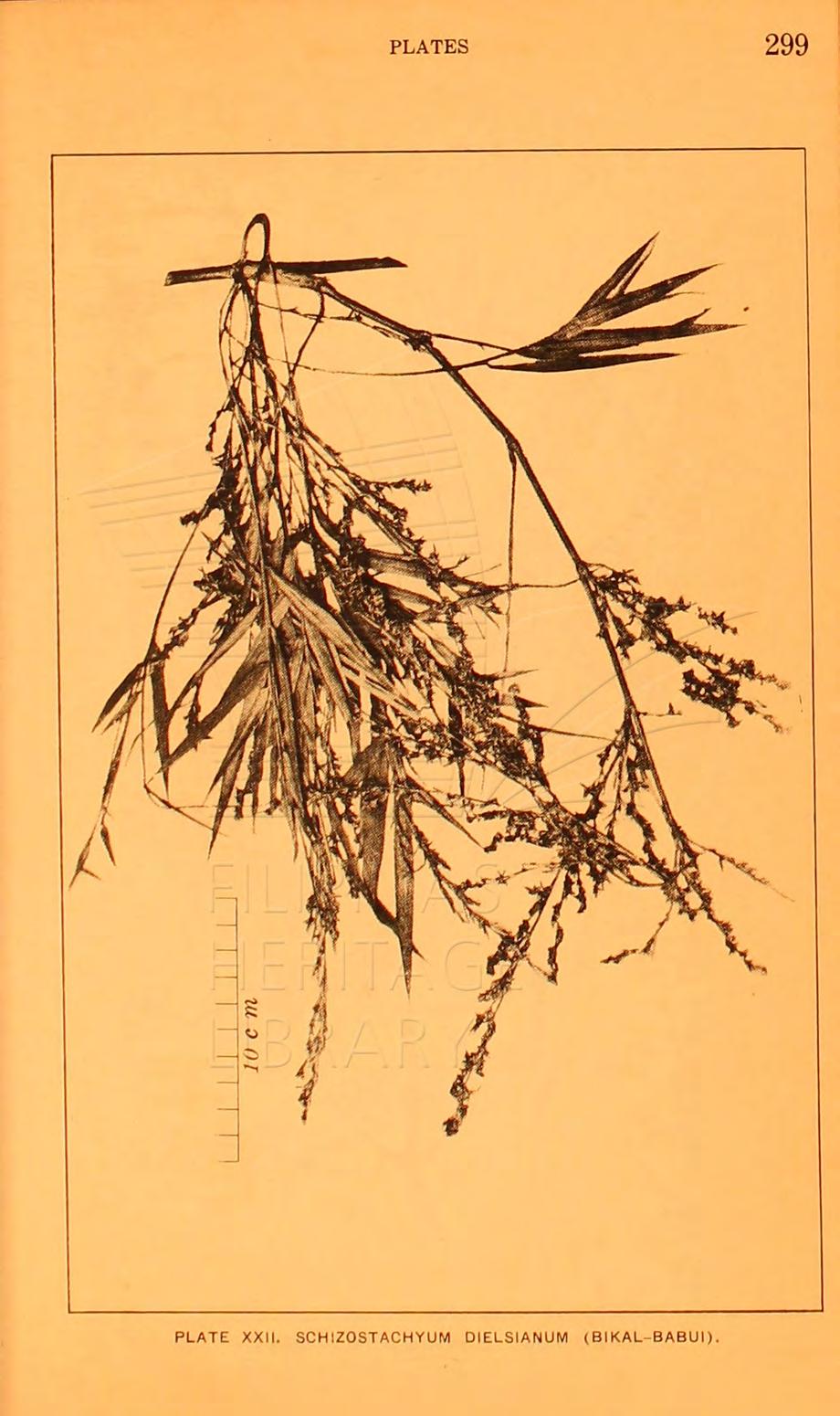
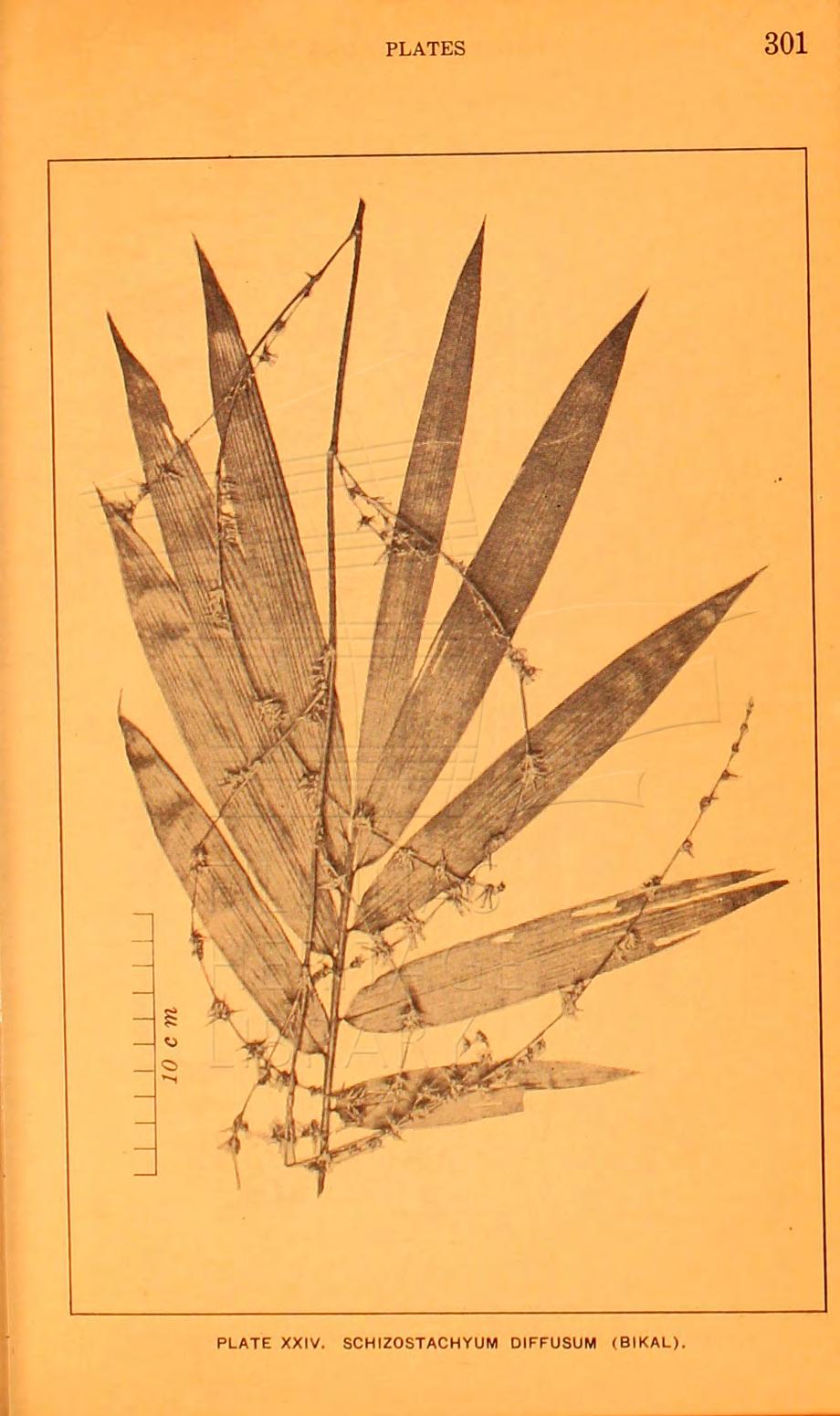
Bikal is widely distributed in the forests of the Philippines and is endemic. It is characterized not only by its habit, but also by its very thick walls. Sometimes the lumen is almost entirely wanting, especially in the lower parts of the stem. The plant is well known to all Filipino woodsmen as a source of drinking water, as water of good quality can be secured from the internodes. In some parts of the Philippines this bamboo is extensively used in making baskets, while it is now beginning to attract attention for the purpose of making chairs, for which it is adapted on account of its thick stout walls. A flowering specimen is shown in Plate XXIV. The very closely allied Schizostachyurn clielsianum, bikal-babui, (Plate XXII) has the same names, distribution, and uses as S. diffusum, and i distinguished only by minor characters.
SCHIZOSTACHYUM LIMA (Blanco) Merr. A os.
Local name: Anos (Tagalog).
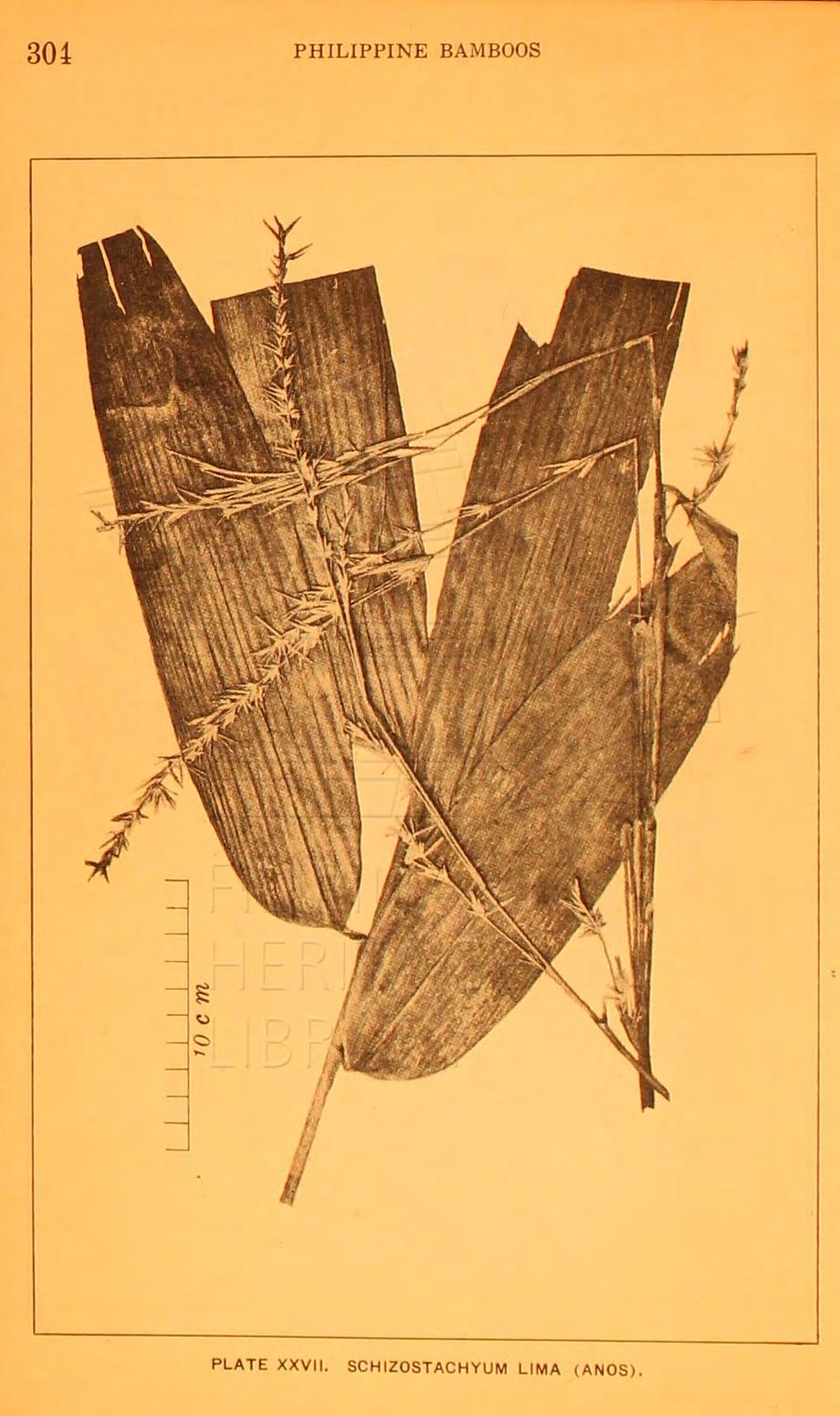
This endemic, erect, thin-walled bamboo is distinguished among all the Philippine forms by its long internodes, which are usually about one meter in length. It is sometimes called bol6 and bagakai by confusion with Schizostachyum lumampao. It i used by the Filipinos for making blow guns, while the cortex i hard and rough and can be used for polishing brass. It is also used for the various purposes for which all thin-walled bamboos are utilized, and after boiling, even for weaving fans, cushions, and hats; broad splints prepared from it are used in making the broad shallow baskets used for winnowing rice. \Videly distributed in the Philippines. A flowering specimen is shown in Plate XXVII.
SCHIZOSTACHYUM LUMAMPAO (Blanco) Merr. BuHo or CA-A-BOJO. Local nai_nes: Ccoia-boJo l Spanish-Filipino) ; bcilo, b11ho, liunampau, bokam, _kauayan-songsong (Tagalog); baga.kan, bagakai (Bisaya); biHu, bolo (B1saya, Iloko); oras (Bikol).
~his spe_ci s is endemic and widely scattered in the Philippine . It is a thm-walled, erect, gregarious bamboo usually reaching
264 PHILIPPINE BAMBOOS
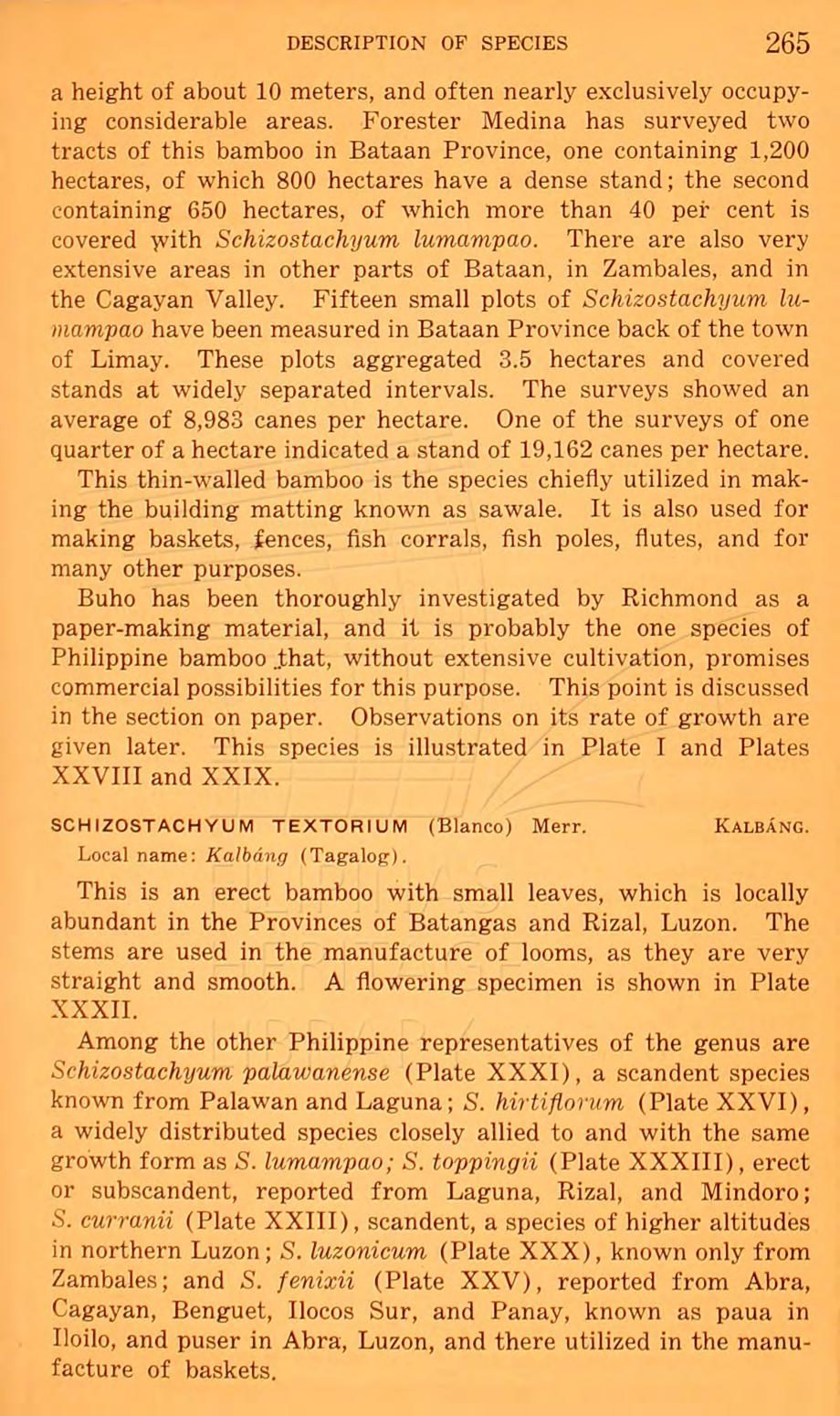
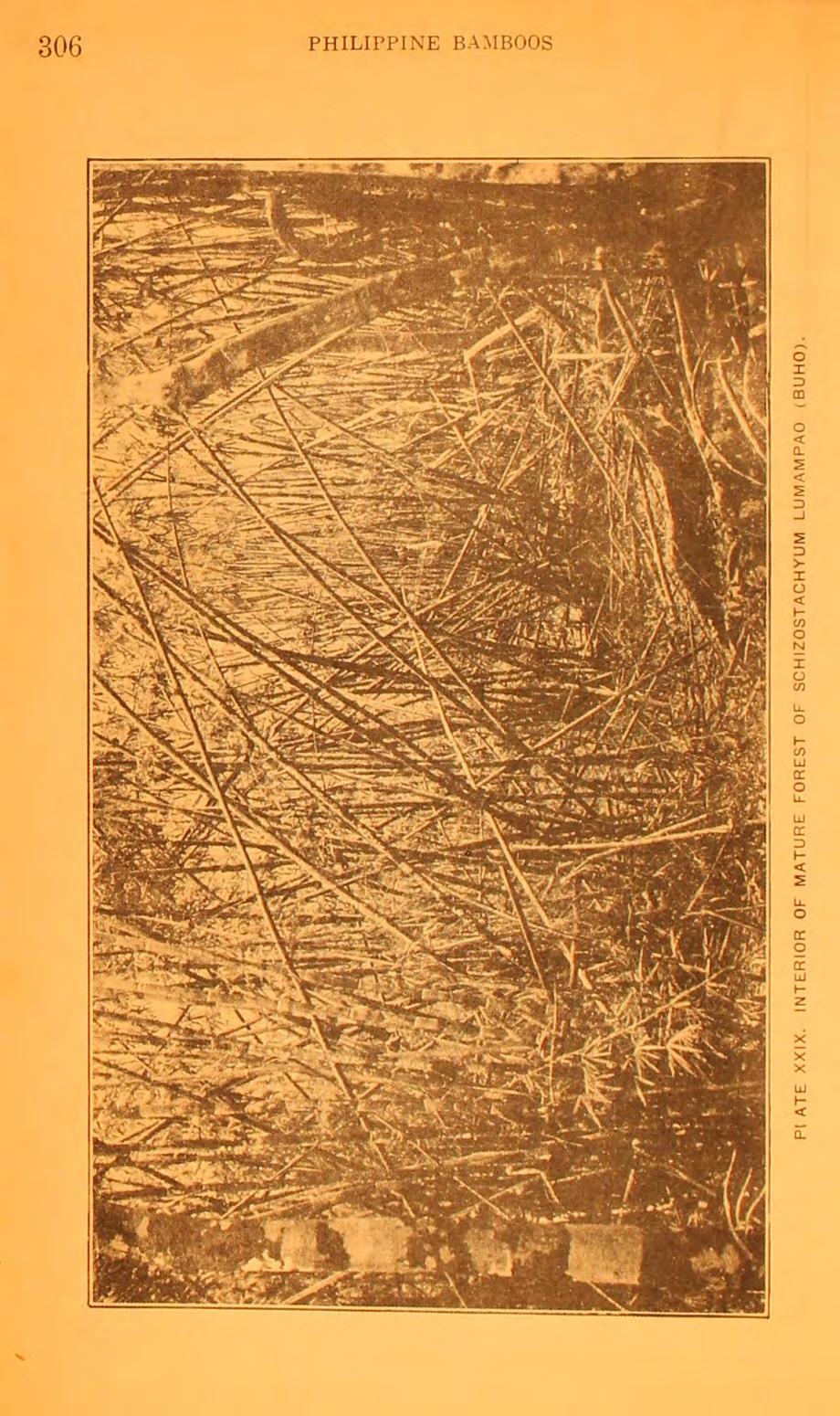
a height of about 10 meters, and often nearly exclusively occupying considerable areas. Forester Medina has surveyed two tracts of this bamboo in Bataan Province, one containing 1,200 hectares, of which 800 hectares have a dense stand; the second containing 650 hectares, of which more than 40 per cent is covered with Schizostachyum lumampao. There are also very extensive areas in other parts of Bataan, in Zambales, and in the Cagayan Valley. Fifteen small plots of Schizostachyum lumampao have been measured in Bataan Province back of the town of Limay. These plots aggregated 3.5 hectares and covered stands at widely separated intervals. The surveys showed an average of 8,983 canes per hectare. One of the surveys of one quarter of a hectare indicated a stand of 19,162 canes per hectare.
This thin-walled bamboo is the species chiefly utilized in making the building matting known as sawale. It is also used for making baskets, ~nces, fish corrals, fish poles, flutes, and for many other purposes.
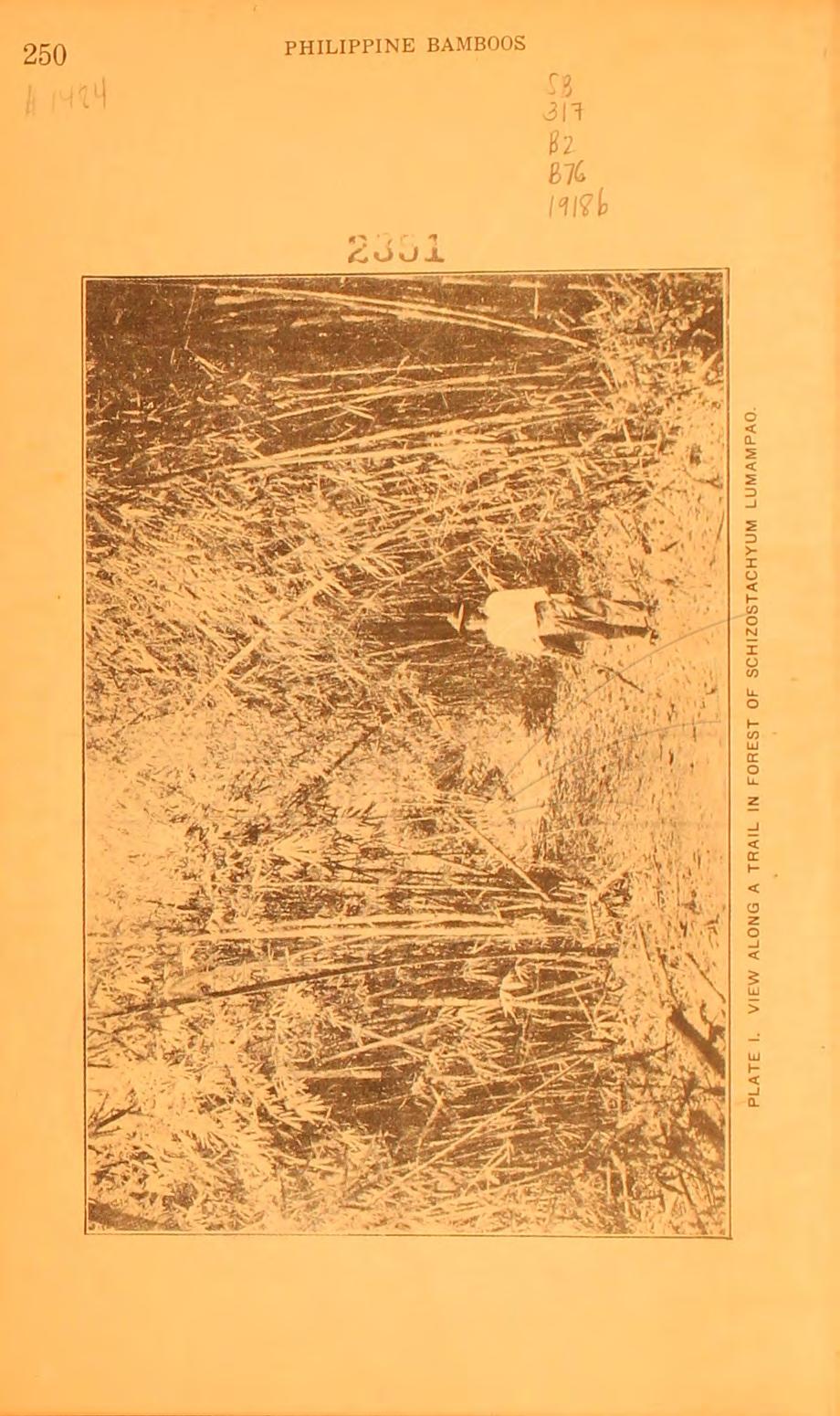
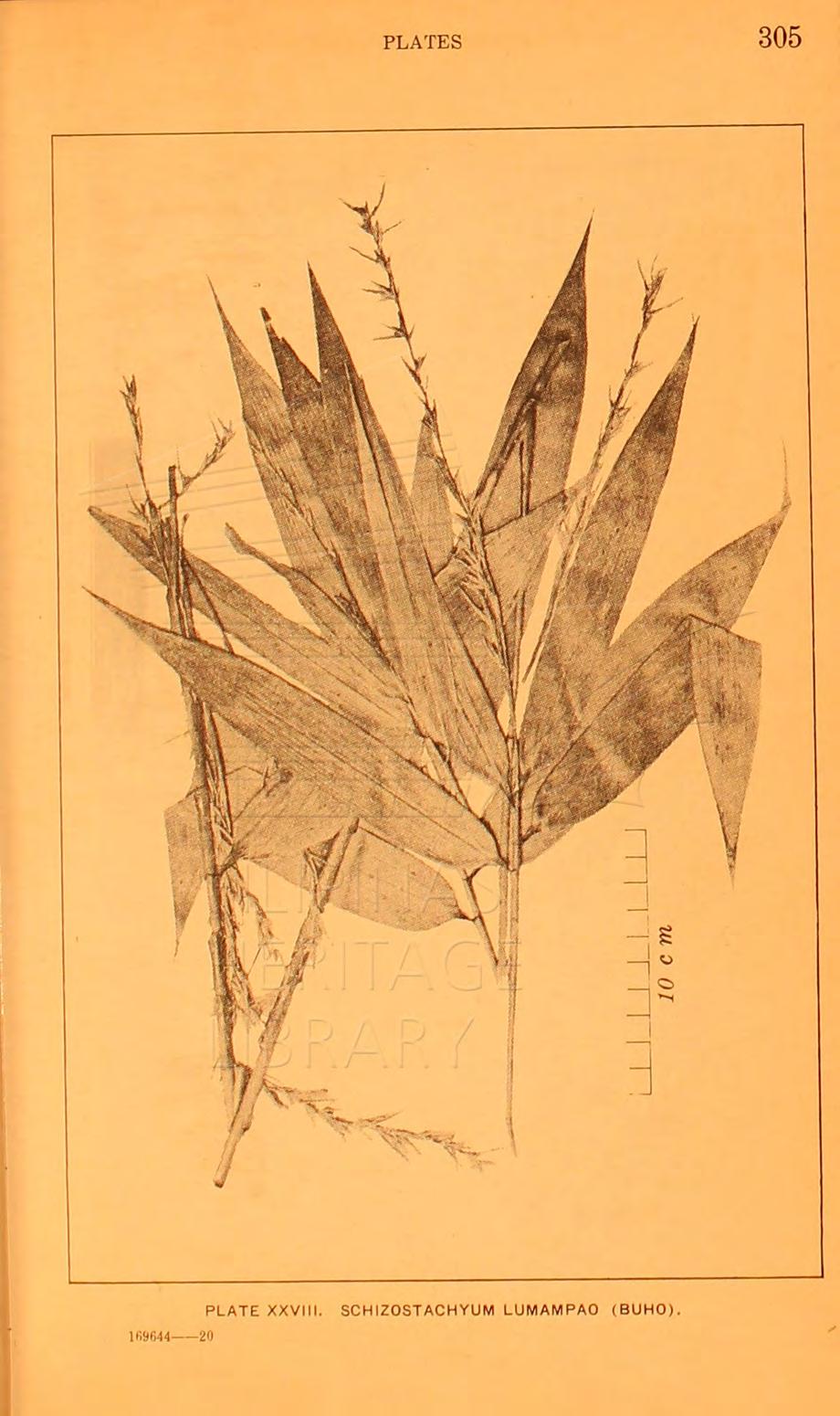
Buho has been thoroughly investigated by Richmond as a paper-making material, and it is probably the one species of Philippine bamboo _that, without extensive cultivation, promises commercial possibilities for this purpose. This point is discussed in the section on paper. Observations on its rate of growth are given later. This species is illustrated in Plate I and Plates XXVIII and XXIX.
SCHIZOSTACHYUM
TEXTORIUM (Blanco) Merr. KALBANG.
Local name: Kalbring (Tagalog).
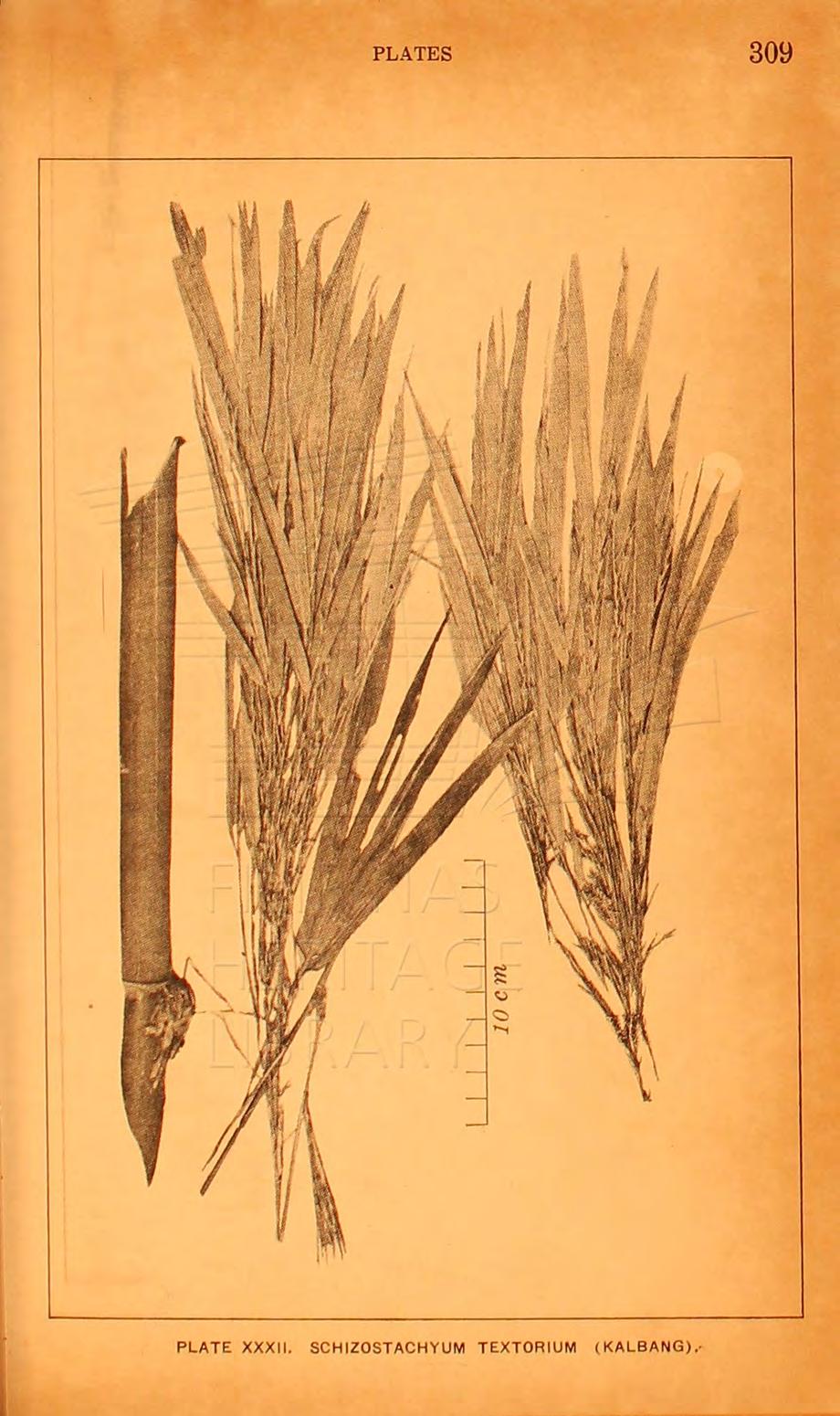
This is an erect bamboo with small leaves, which is locally abundant in the Provinces of Batangas and Rizal, Luzon. The stems are used in the manufacture of looms, as they are very straight and smooth. A flowering specimen is shown in Plate XXXII.
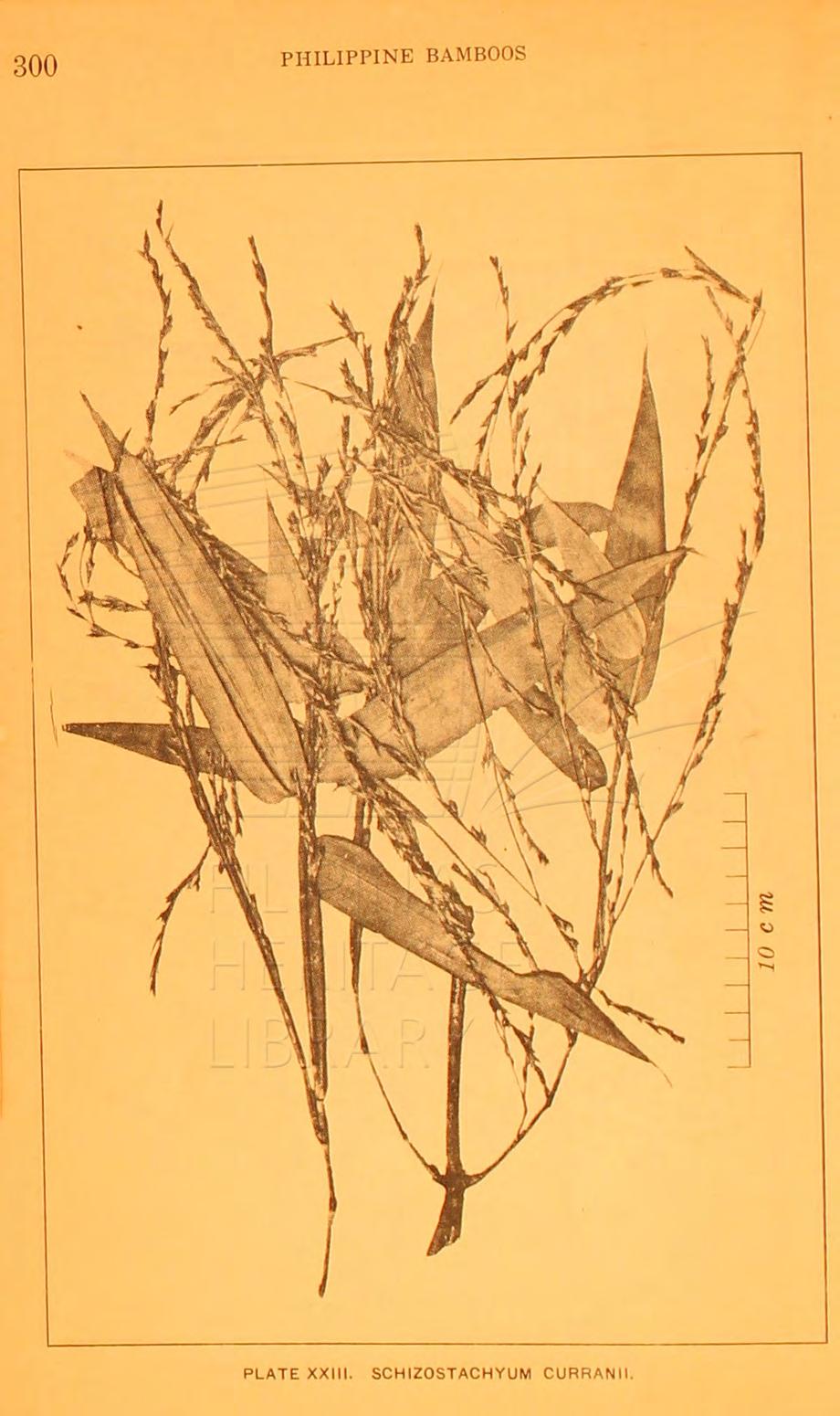
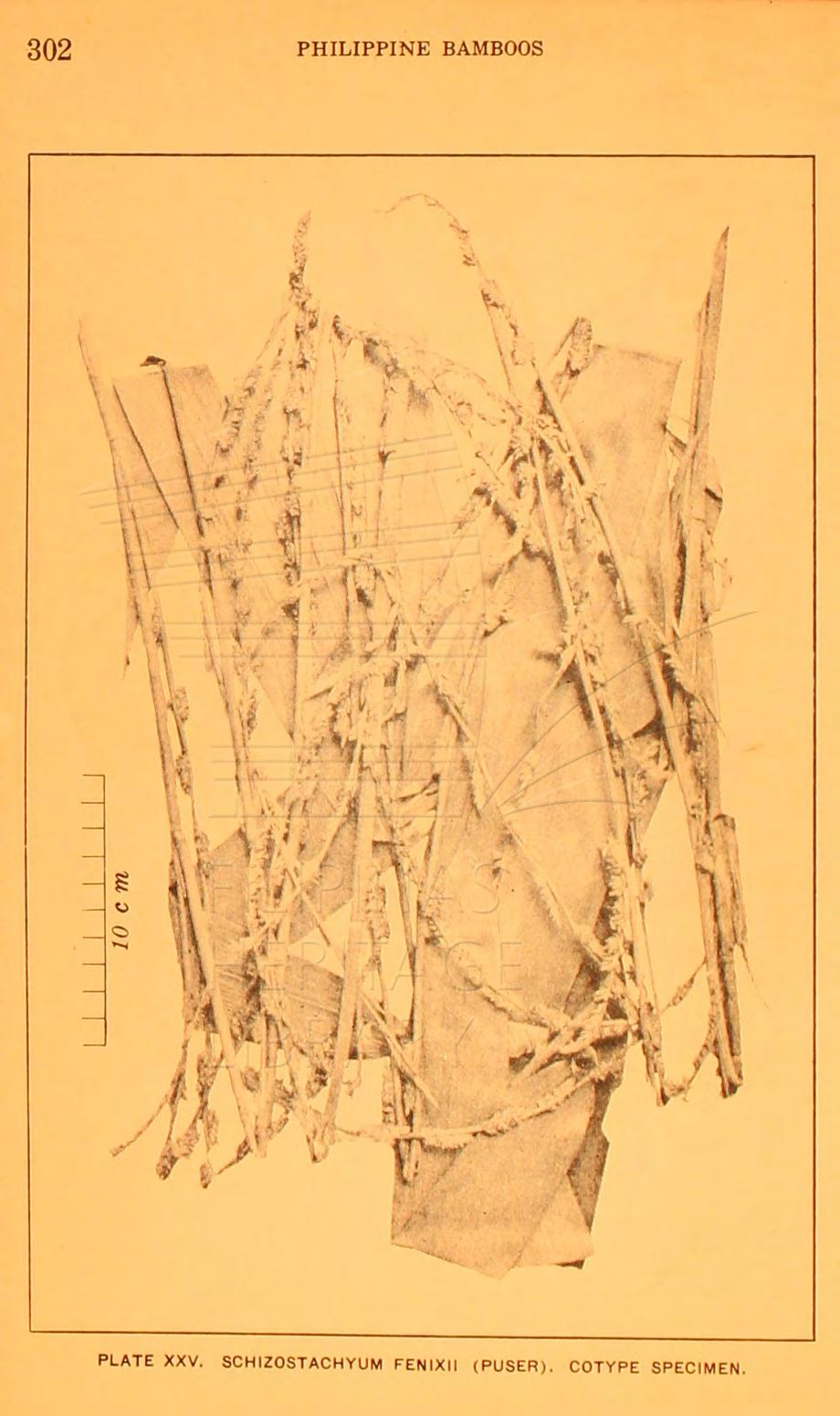
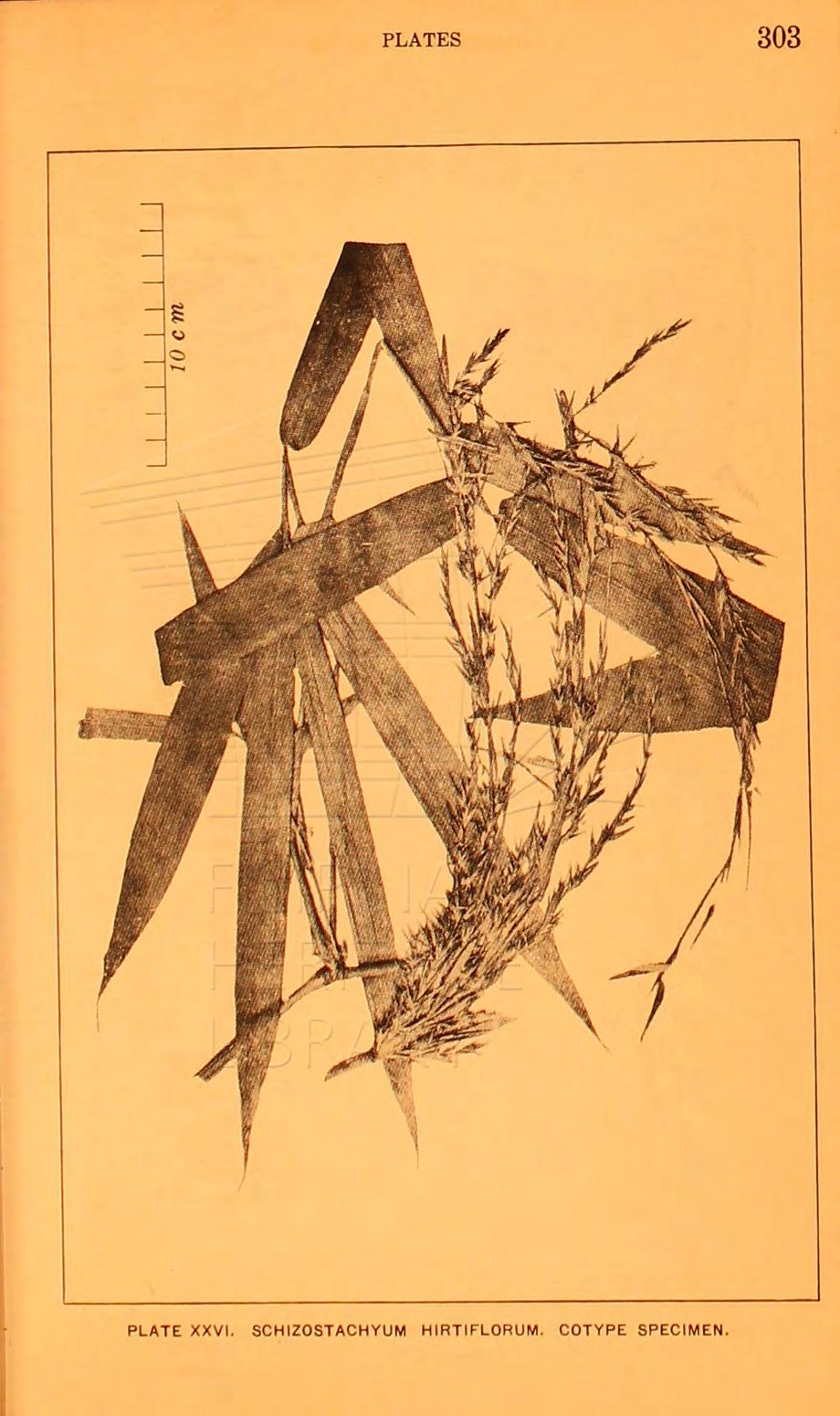
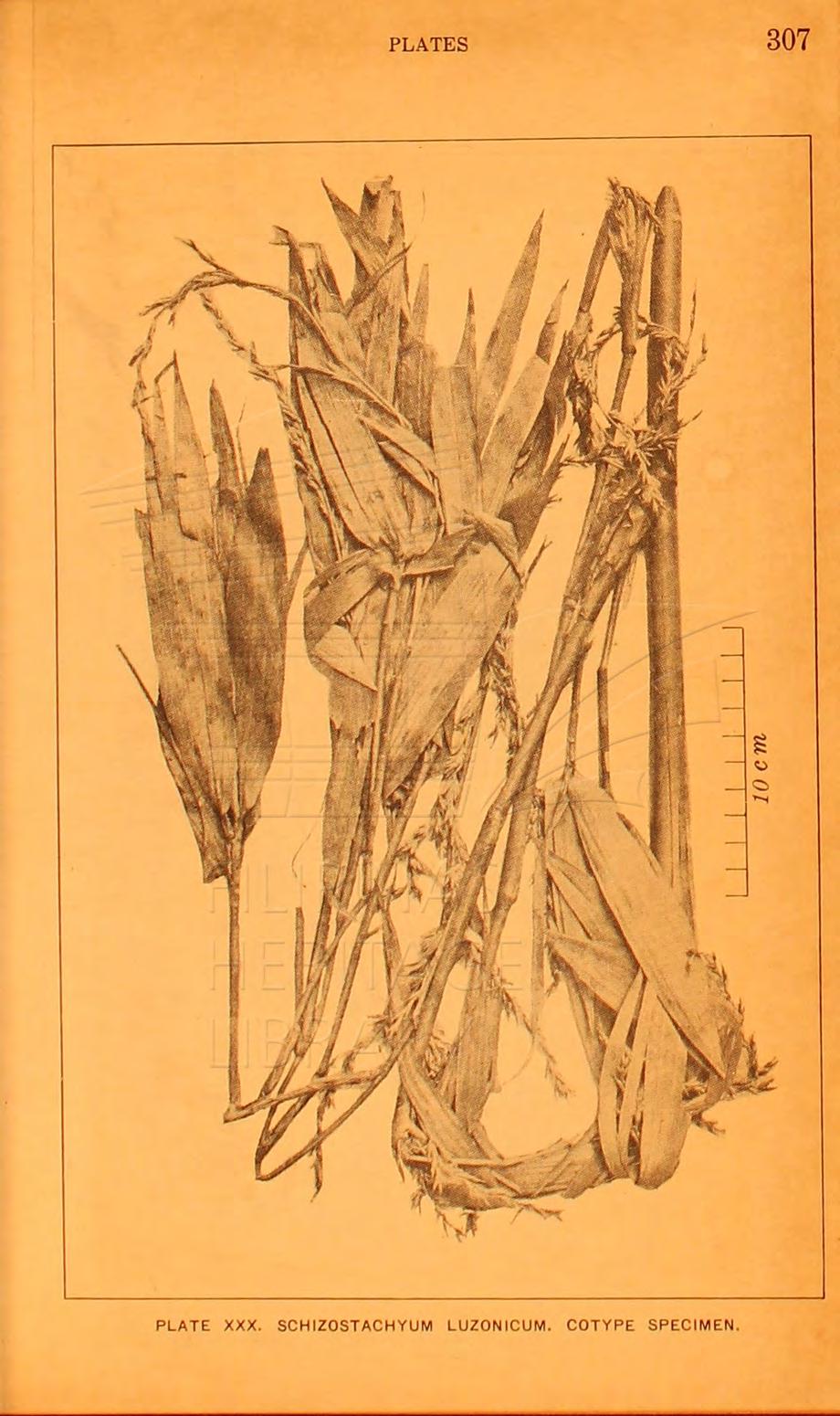
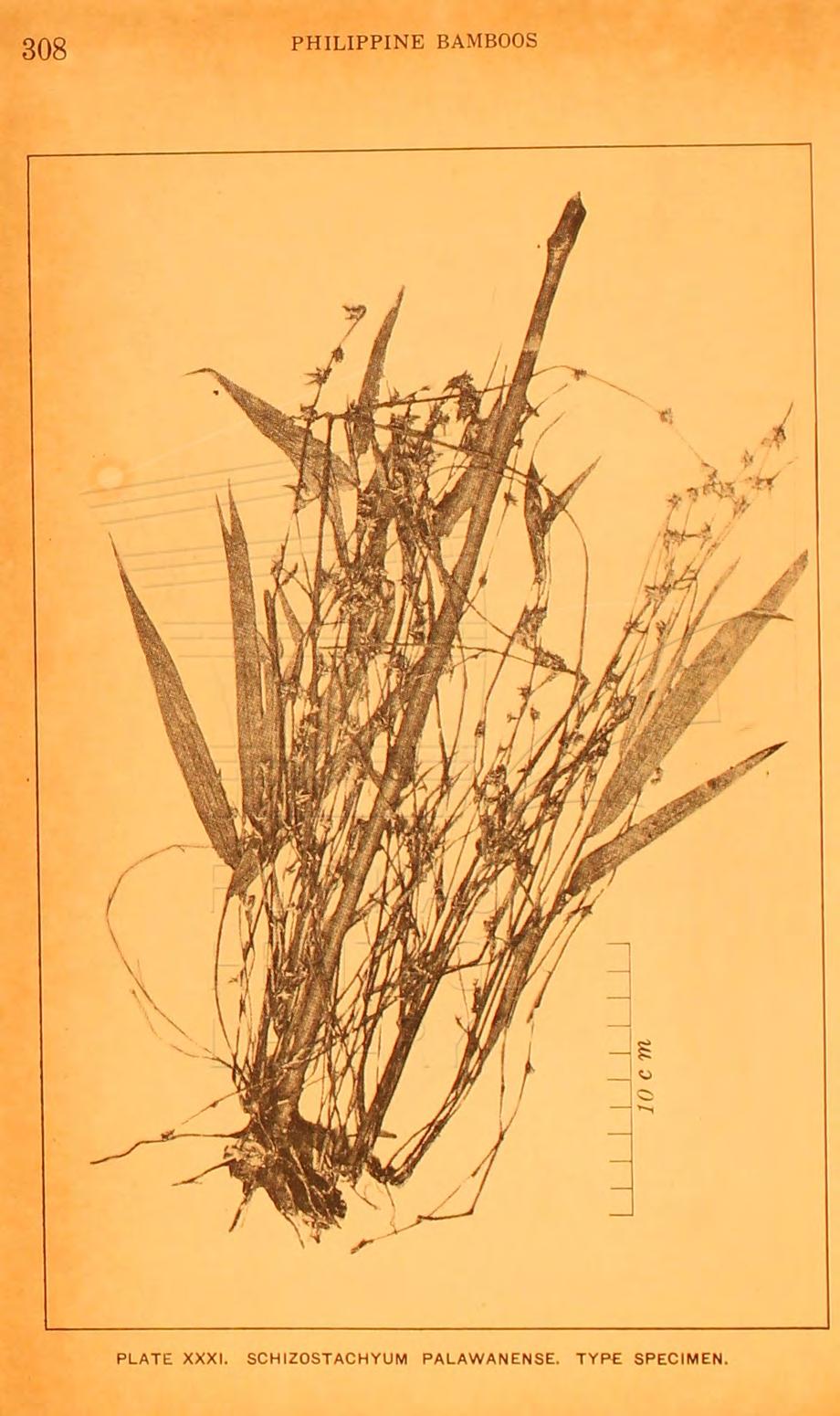
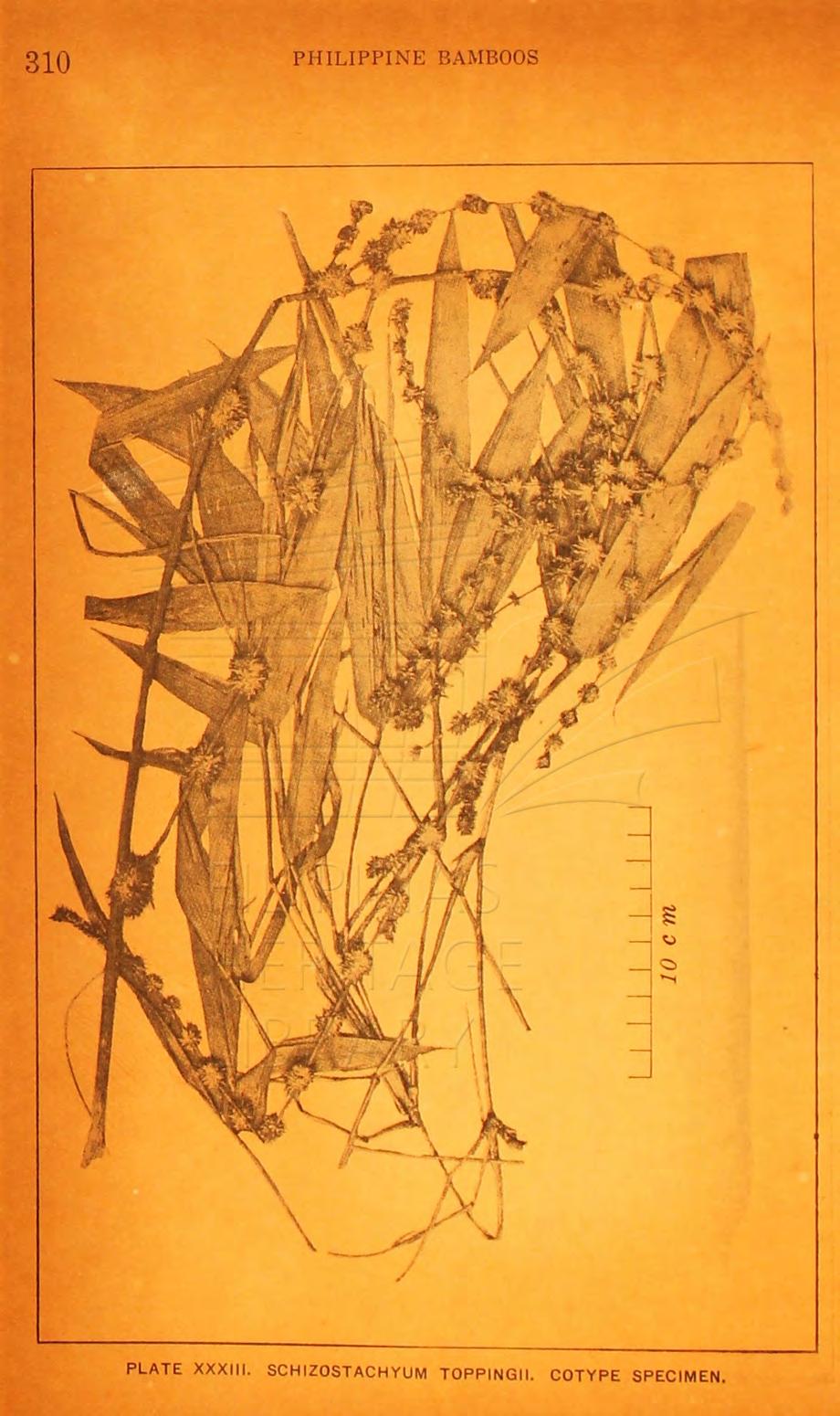
Among the other Philippine representatives of the genus are Sc hizostachyum palawanense (Plate XXXI), a scandent species known from Palawan and Laguna; S. hirtifionlm (Plate XXVI), a widely distributed species closely allied to and with the same growth form as S. lumampao; S. toppingii (Plate XXXIII), erect or subscandent, reported from Laguna, Rizal, and Mindoro; S . curranii (Plate XXIII), scandent, a species of higher altitudes in northern Luzon; S. luzonicum (Plate XXX), known only from Zambales; and S. fenixii (Plate XXV), reported from Abra, Cagayan, Benguet, !locos Sur, and Panay, known as paua in Iloilo, and puser in Abra, Luzon, and there utilized in the manufacture of baskets.
DESCRIPTION OF SPECIES 265
PLANTING OF BAMBOO
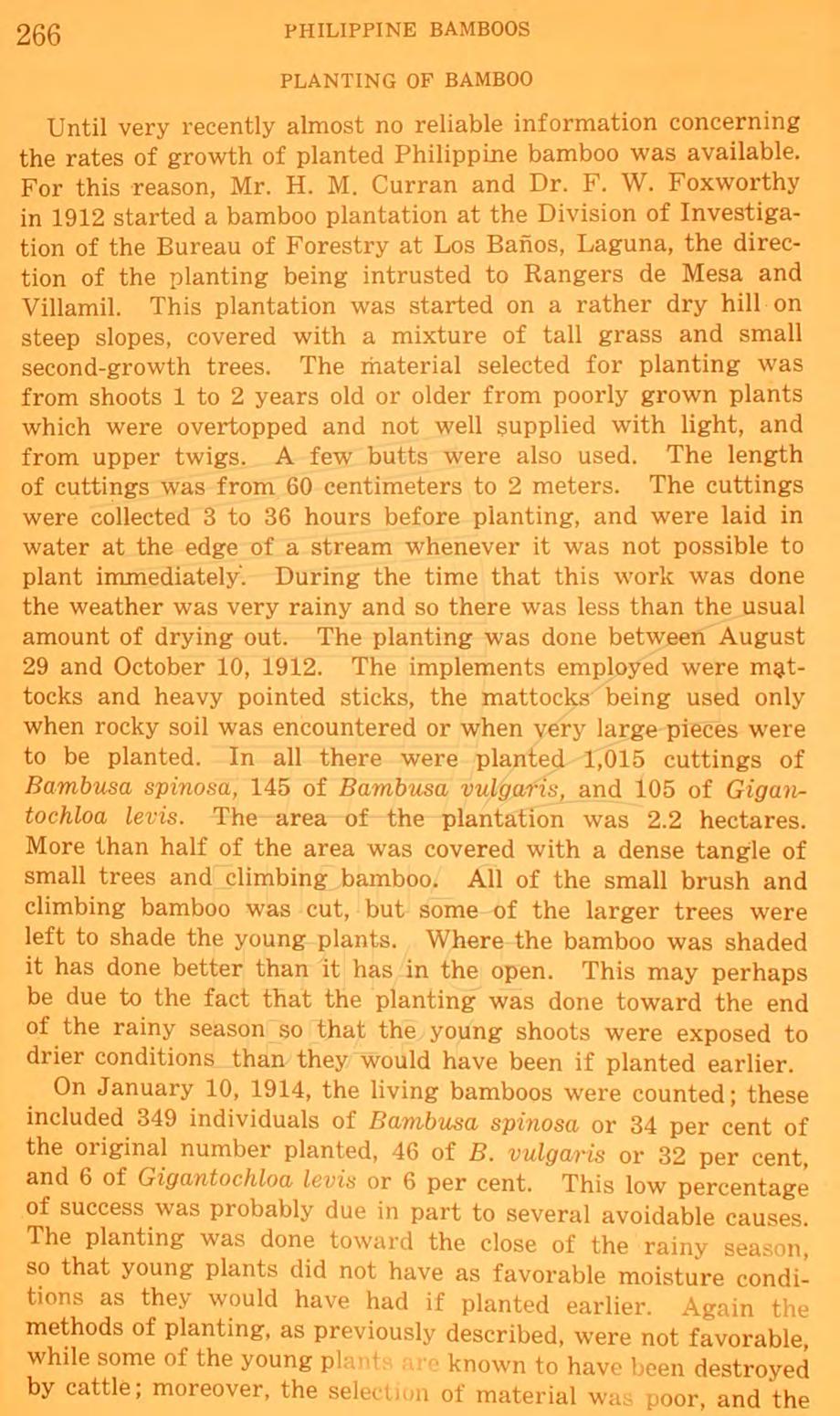
Until very recently almost no reliable information concerning the rates of growth of planted Philippine bamboo was available. For this reason, Mr. H. l\tl. Curran and Dr. F. W. Foxworthy in 1912 started a bamboo plantation at the Division of Investigation of the Bureau of Forestry at Los Banos, Laguna, the direction of the planting being intrusted to Rangers de Mesa and Villamil. This plantation was started on a rather dry hill on steep slopes, covered with a mixture of tall grass and small second-growth trees. The material selected for planting was from shoots 1 to 2 years old or older from poorly grown plants which were overtopped and not well supplied with light, and from upper twigs. A few butts were also used. The length of cuttings was from 60 centimeters to 2 meters. The cuttings were collected 3 to 36 hours before planting, and were laid in water at the edge of a stream whenever it was not possible to plant immediately·. During the time that this \York was done the weather was very rainy and so there was less than the usual amount of drying out. The planting was done between August 29 and October 10, 1912. The implements employed were mq.ttocks and heavy pointed sticks, the mattocks being used only when rocky soil was encountered or when very large pieces were to be planted. In all there were planted 1,015 cuttings of Bambusa spinosa, 145 of Bambusa vulgaris, and 105 of Gigantochloa leris. The area of the plantation was 2.2 hectares. More ihan half of the area was covered with a dense tangle of small trees and climbing bamboo. All of the small brush and climbing bamboo was cut, but some of the larger trees were left to shade the young plants. Where the bamboo was shaded it has done better than it has in the open. This may perhaps be due to the fact that the planting was done toward the end of the rainy season so that the young shoots were exposed to drier conditions than they would have been if planted earlier.
On January 10, 1914, the living bamboos were counted; these included 349 individuals of Banibusa spinosa or 34 per cent of the original number planted, 46 of B. vulgatis or 32 per cent and 6 of Gigantochloa le1·is or 6 per cent. This low percentag~ of success was probably du(_• in part to several avoidable cam:;es. The planting was done toward the close of the ramy e,t 1 , o that young plants <lid not have as favorable moisture conditiorn~ as they would have had if planted earlier. Agr in t , methods of planting, as previously described, were not favorable, while some of the young pl known to havE' ren destroyed by cattle; moreover, the selt.:'- t 1 of material wa I oor, and the
266 PHILIPPINE BAMBOOS
site unfavorable. The best material for plantin g is from stump s, which, thou g h har der to prepare, will probably be ch eap est in t h e long run. Small twi gs are much harder to handle t h an larger pieces. Th e cutting should be planted oblique to t h e ground . Planting material should be taken from full-sized sho ots w hi ch are not fully mature. Subsequent careful planting of small n umbers of these same bamboos in the early part of the rai n y season gave 100 per cent success.
During the year 1914, blanks in the plantation were filled . Bamboo cuttings, at first, send up thin whiplike shoots and it is only after a considerable period that regu lar cu lms are produced. The number and size of these culms increases yea rly until mature size is reached.
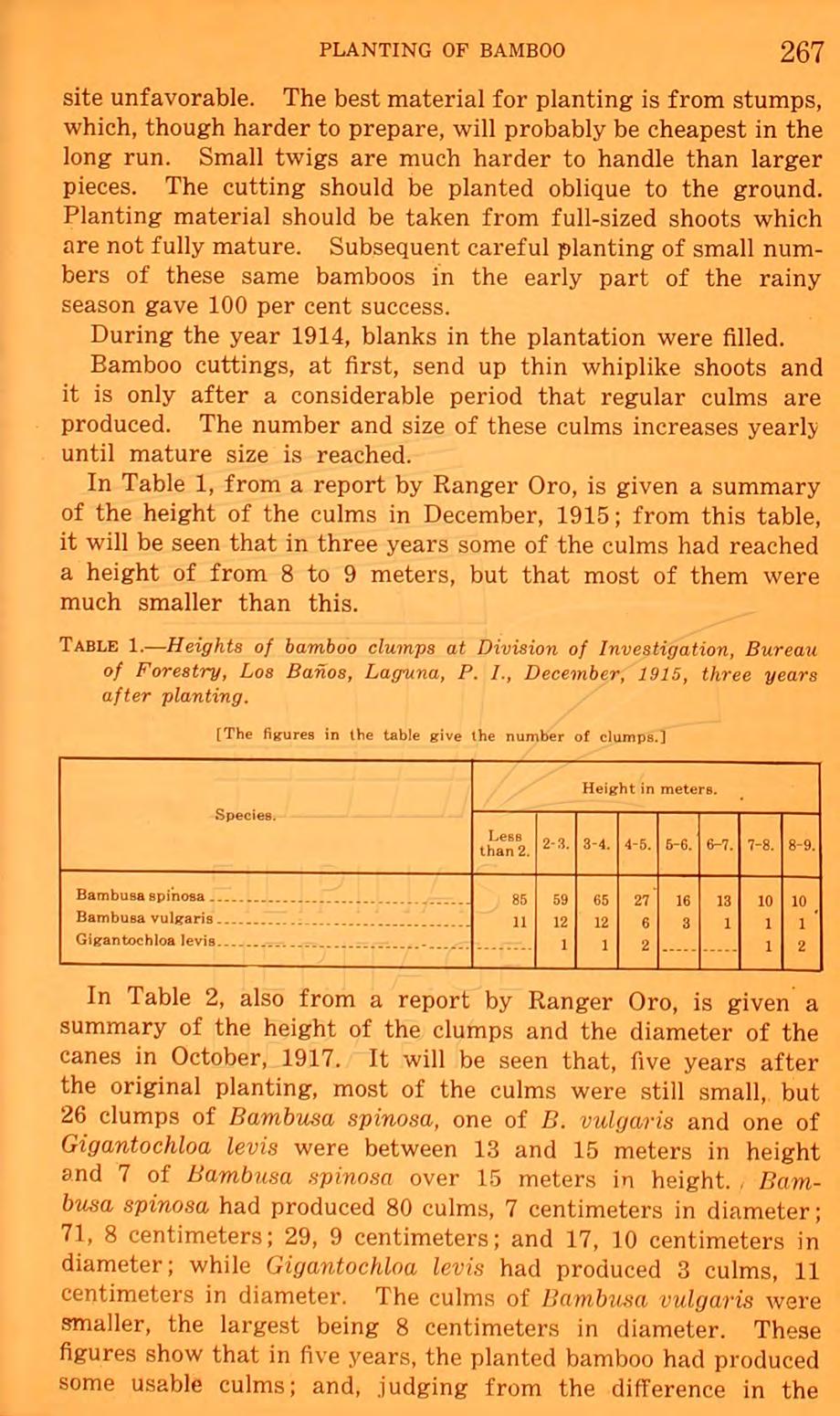
In Table 1, from a report by Ranger Oro, is given a summary of the height of the culms in December, 1915; from this tab le, it will be seen that in three years some of the culms had reached a height of from 8 to 9 meters, but that most of them were much smaller than this.
TABLE 1.-Heights of bamboo clumps at Division of Investigation, Bureau of Forestry, Los Banos, Laguna, P. I , December, 1915, three years after planting.
[The figures in the table give the number of clumps.]
Species.
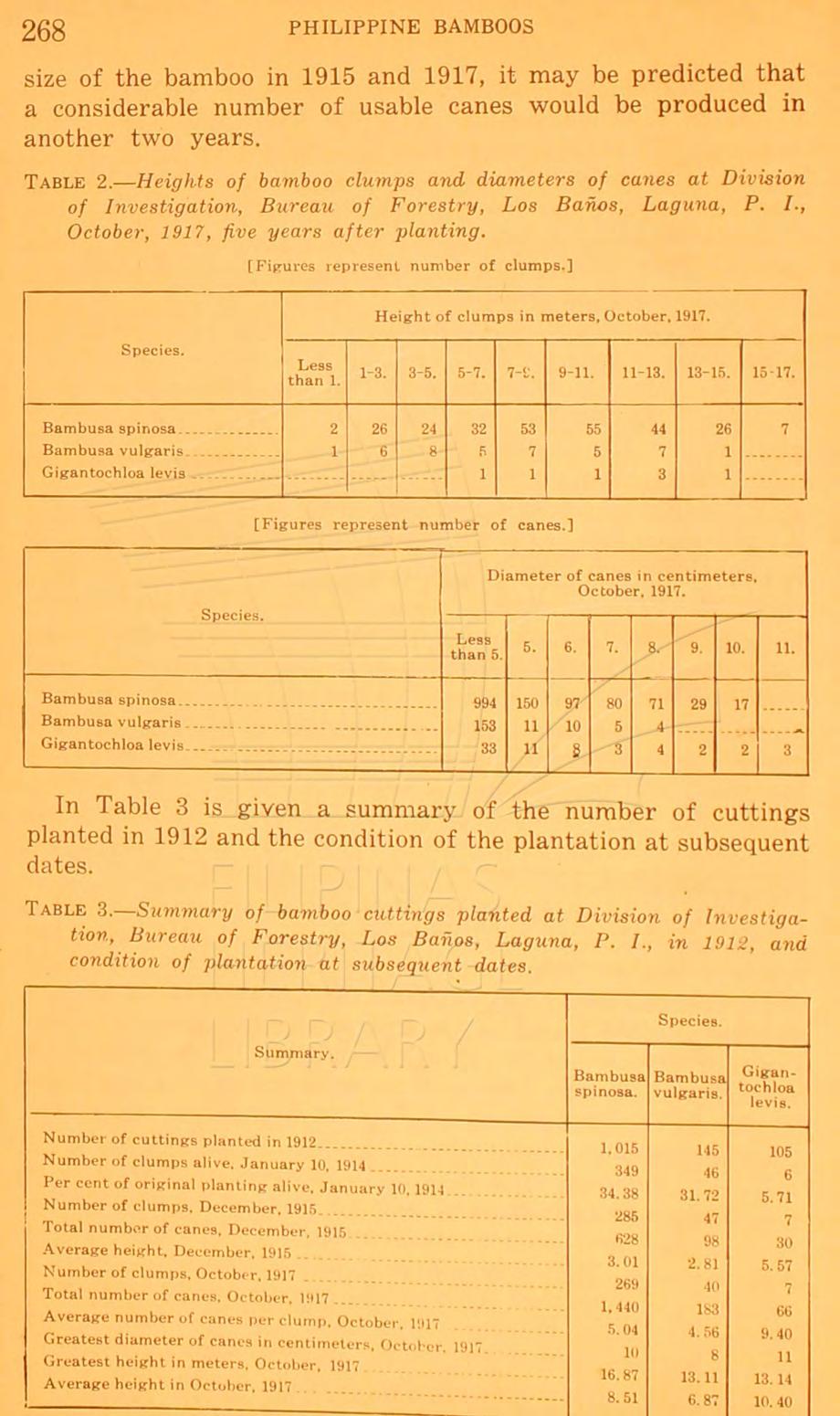
In Table 2, also from a report by Ranger Oro, is given a summary of the height of the clumps and the diameter of the canes in October, 1917. It will be seen that, five years after the original planting, most of the culms were still sma ll , but 26 clumps of Bambusa spinosa, one of B. vu,lga?"is and one of Gigantochloa levis were between 13 and 15 meters in height and 7 of Bambusa spinosa over 15 meters in height. Bambusa spinosa had produced 80 culms, 7 centimet rs in diameter; 71 , 8 centimeters ; 29, 9 centimeters; and 17, 10 c ntimeters in diameter; while Gigantochloa l vis had produced 3 culms, 11 centimeter s in diamet r . The culm s of IJambu,.sa, vulgaris were smaller, the largest being 8 centimeters in diam ier. Thes figures show that in five years, the plant d bamboo had produc d some usable culms; and, judging from the difference in t h
PLANTING OF BAMBOO 267
Height in meters.
Le s s 2-:t 3- 4 4- 5. 6-6. 6-7. 7- 8. 8- 9. than 2 Bambusa Spinosa - .,. ______ 86 69 65 27 16 13 10 10 ' Bambusa vu)garis _______ - .. --------------------11 12 12 6 3 1 1 1 Gigantochloa levis ___________ .. _______ ____ . _ - 1 1 2 ---- - - 1 2
size of the bamboo in 1915 and 1917, it may be predicted that a considerable number of usable canes would be produced in another two years.
TABLE 2.-Heights of bamboo clumps and diameters of canes at Division of In vestigation, Bureau of Forestry, Los Banos, Laguna, P. /., October, 1917, five years after planting.
[ Fivurcs repre,;enl number of clumps.] - - -
Height of clumps in meters, October, 1917.
Species.
than 1
[Figures represent number of canes]
Diameter of canes in centimeters, October, 1917.
Species.
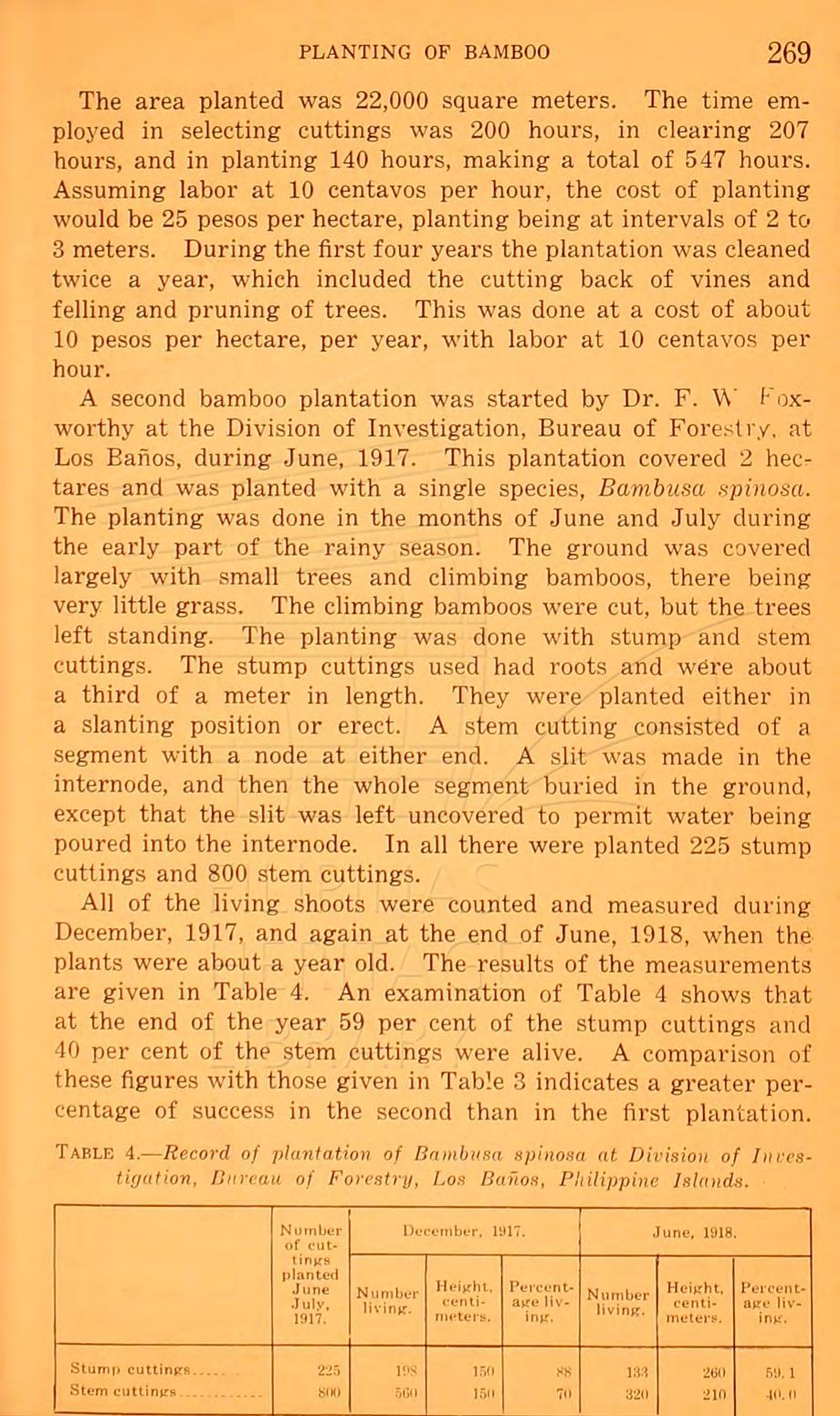
In Table 3 is given a summary of the number of cuttings planted m 1912 and the condition of the plantation at subsequent dates.
TABLE 3.-Summary of bamboo cuttings J)lanted at Di1·ision of lnvestigation, Bureau of Forestry, Los Bafios, Lagima, I'. I., zn 1!111, and condition of 71lantation at subsequent dates.
Species.
Summar~.
Hambusa Bambusa G1gan!ipinosa. vulgaris tochloa lev1s.
Numbe1 of cuttlnf!S planted in 1912 1,015 115 105
Numlwr of clumps alive, Ja11uar} HI. l!!J.I :wi 4li G
Per cent of original planl1t1).!" ali\ l', Januar~ Ill. Hll I :14
! Number of dumps. December, 1!:Jli,
Total numb,>r of eanes, lkel•mbt•1· l !IJ:, ti2~ \I 30
Average he1g-ht. IJeennlil'r. 1111~,
Number of clump:, Octob, r, J<tJ";
Total number uf can.-~. Oetolil'r. J\t]7
[,. 57
6(, Averag-e number uf <'an,·s p.-r dump, Oetob,·r. ]•11-;
Greate1:1t diameter of c-an,!. in ecnttr,wh•r-., llt t, 1,. 1 1•q-; lo b 11
Greatest he1f!ht in meters, Odol,,,r, 1917
Hlli
268
PHILIPPINE BAMBOOS
I
I
Less 1 3.
Bambusa
- -- - 2 26 24 32 53 55 44 26 7 Bambusa
- - - - 1 6 !'- ii 7 5 7 1Gigantochloa levis -- l 1 1 3 1 -·
3-5. 5-7. 7 \.. 9-lL 11-13. 13-lfi. 15 17.
spinosa
vulgaris
Less 5. 6. 7. 8. 9 10. 11.
~- ._Bambusa
- - - 994 150 97 80 71 29 17 -- -Bambusn
- - - -- 153 11 10 5 4-Gigantochloa levis .. . 33 11 5 3 4 2 2 3 ,,
than 5
spinosa
vulgar1s
3 31. 72 5. 71
47
7
3.01 2.~l
269
j(I 7
1, IW J,J
fi.04
·I. :i6 !;l.40
16 ii, 13.11 Ave1·age height in Octobl•r.
13 1-l - ~- 51 6.87 10.40 '
The area p lanted was 22,000 square meters. T h e time employed in selecting cuttings was 200 hours, in clea r in g 207 hours, and in planting 140 hours, making a total of 547 hours . Assuming labor at 10 centavos per hour, the cost of p lantin g wou ld be 25 pesos per hectare, planting being at interva ls of 2 tc, 3 meters. During the first four years the p lantation was cleaned twice a year, which included the cutting back of vines an d felling and pruning of trees. This was done at a cost of about 10 pesos per hectare, per year, with labor at 10 centavos pe r hour.
A second bamboo plantation was started by Dr. F. v,.. · Foxworthy at the Divi s ion of InYestigation, Bureau of Fore ~t r.v. at Lo s Banos, during June, 1917. This plantation covered 2 hectares and wa s planted with a s ingle specie s, Barnbu sa s pinolia. The planting wa s done in the months of June and July during the early part of the rainy s eason. The ground was covered largely with mall trees and climbing bamboo s, there being very little grass. The climbing bamboos were cut, but the trees left standing. The planting was done with stump and tern cutting s . The s tump cuttings u se d had root s and were about a third of a meter in length. They were planted either in a s lanting position or erect. A s tem cutting con isted of a segment with a node at either end. A s lit ·was made in the internode, and then the whole se gment buried in the ground, except that the s lit was left uncovered to permit water being poured into the internode. In all there were planted 225 stump cutt ings and 800 stem cutting s.
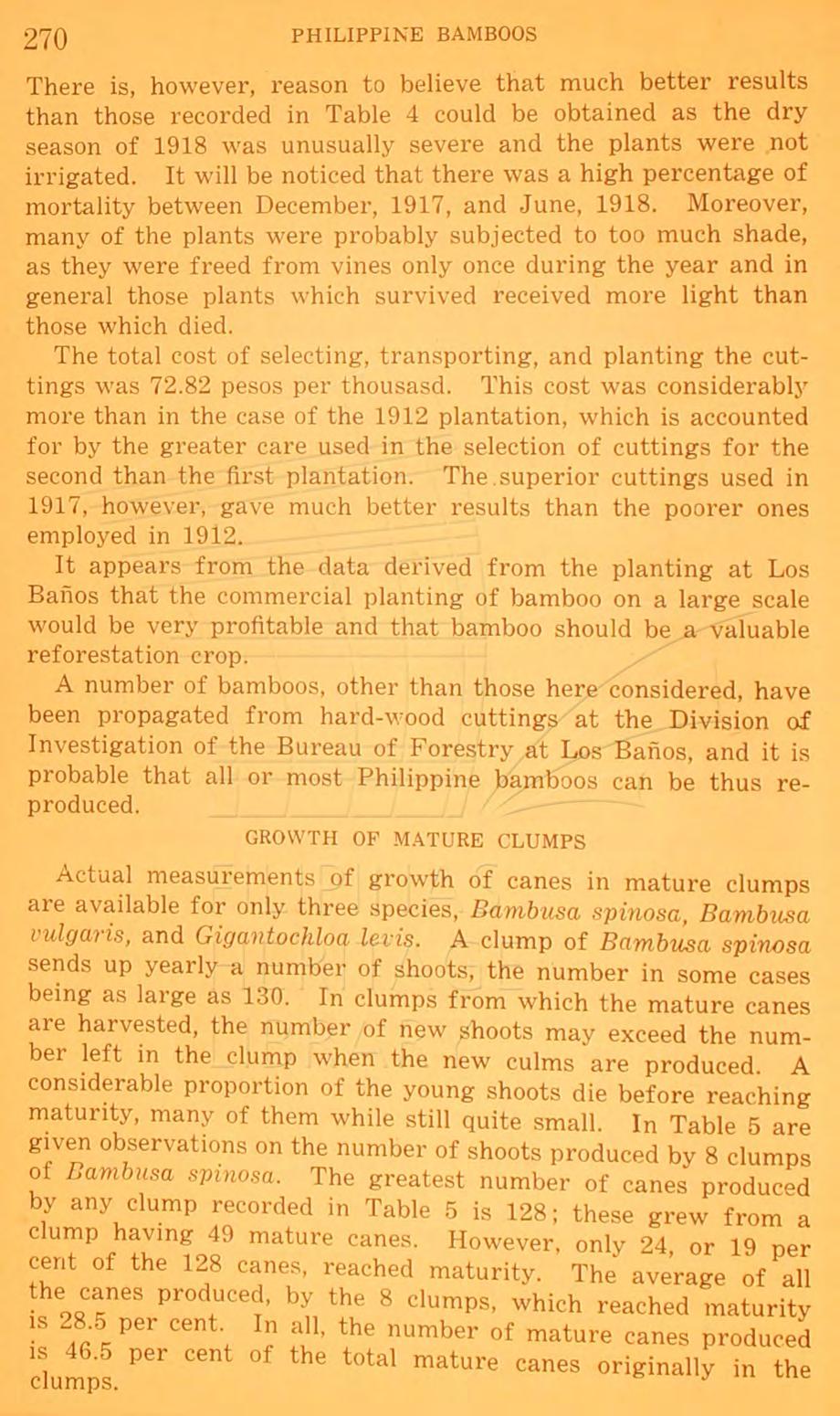
All of the li ving shoots were counted and mea s ured during Dece mber , 1917, and again at the end of June, 1918, when the plants were about a y ar old. The results of the mea s urements are given in Table 4. An examination of Tabl 4 shows that a t the end of the year 59 per cent of the stump cutting and 40 per ce nt of the stem cuttings w re alive. A compari on of these figure s with tho se given in Tab!e 3 indicates a great r percen tag of s u ccess in th e seco nd than in th fir st plantation.
TABLE 4.- R ecord of JJ!antation of Br1111b11 s <1 Hp inoHa at Di L'isioll of /1 11·<'sti9flt10n, fJ 11n·a11 of F orestry, Los Ba1101-1, Pl1ili ppi11 e Jslc111 d s. Number I l<'ct•111 lwr. Hl)';. June. HJ18. of cuttin)(!< planted H1•11!ht Pe1 ·,·1•n t- H il-{ht, Pen·ent- J une N11mber N11ml.Jer ,Jub•. Ii\ in)( •·enti- al!l' liv- living. c-enti- al!'<' liv1!117 nu•ters. inir. mcttff~ . in,-r
Stump cuttinvs .. :.!:!.'", I'' 1:;11 :..;:..; 1:n :wo fi\J 1
St•m cuttinl!'H !-IHI ;i,;,1 1,,11 'iO :3:W :no -lll.O
PLANTING OF BAM BOO 269
There is, however, reason to believe that much better results than those recorded in Table 4 could be obtained as the dry season of 1918 was unusually severe and the plants were not irrigated. It will be noticed that there was a high percentage of mortality between December, 1917, and June, 1918. Moreover, manv of the plants were probably subjected to too much shade, as they were freed from vines only once during the year and in general those plants \\'hich survived received more light than those which died.
The total cost of selecting, transporting, and planting the cuttings was 72.82 pesos per thousasd. This cost was considerably more than in the c:ase of the 1912 plantation, which is accounted for by the greater care used in the selection of cuttings for the second than the first plantation. The superior cuttings used in 1917, however, gave much better results than the poorer ones employed in 1912.
It appears from the data derived from the planting at Los Banos that the commercial planting of bamboo on a large scale would be very profitable and that bamboo should be a valuable reforestation crop.
A number of bamboos. other than those here considered, have been propagated from hard-wood cuttings at the Division o.f Investigation of the Bureau of Forestry at Los Banos, and it is probable that all or most Philippine bamboos can be thus reproduced.
GROWTH OF :\1ATURE CLUMPS
Actual measurements of growth of canes in mature clumps are available for only three species, Bambllsa spinosa, BambuBa 1.:ulgaris, and Gigantochloa lei-is. A clump of Bambusa spinosa sends up yearly a number of shoots, the number in some cases being as large as 130. In clumps from which the mature canes are harvested, the number of new shoots may exceed the number left in the clump when the new culms are produced. A considerable proportion of the young shoots die before reaching maturity, many of them \vhile still quite small. In Table 5 are given observations on the number of shoots producPd by clumps of flam bw:;a spi 11osa. The greatest number of canes produced by any clump recorded in Table 5 is 128; these grew from a clump having 49 mature canes. However. only 24, or 19 per cent of the 128 canes, reached maturity. The average of all ~he canes produced, by the 8 clumps, which reached 1naturity 1s 28.5 per cent. In all, the number of mature canes produced is 46.5 per cent of the total mature canes originally in the clumps.
270 PHILIPPINE BAMBOOS
TABLE 5:-Number of shoots pro-duced and yield of 1nature living canes from 8 clumps of Bambusa spinosa at Division of Investigation, Bureau of Forestry, Los Banos , Laguna, Philippine Islands. Data from report by Ranger Oro .
New shoots.
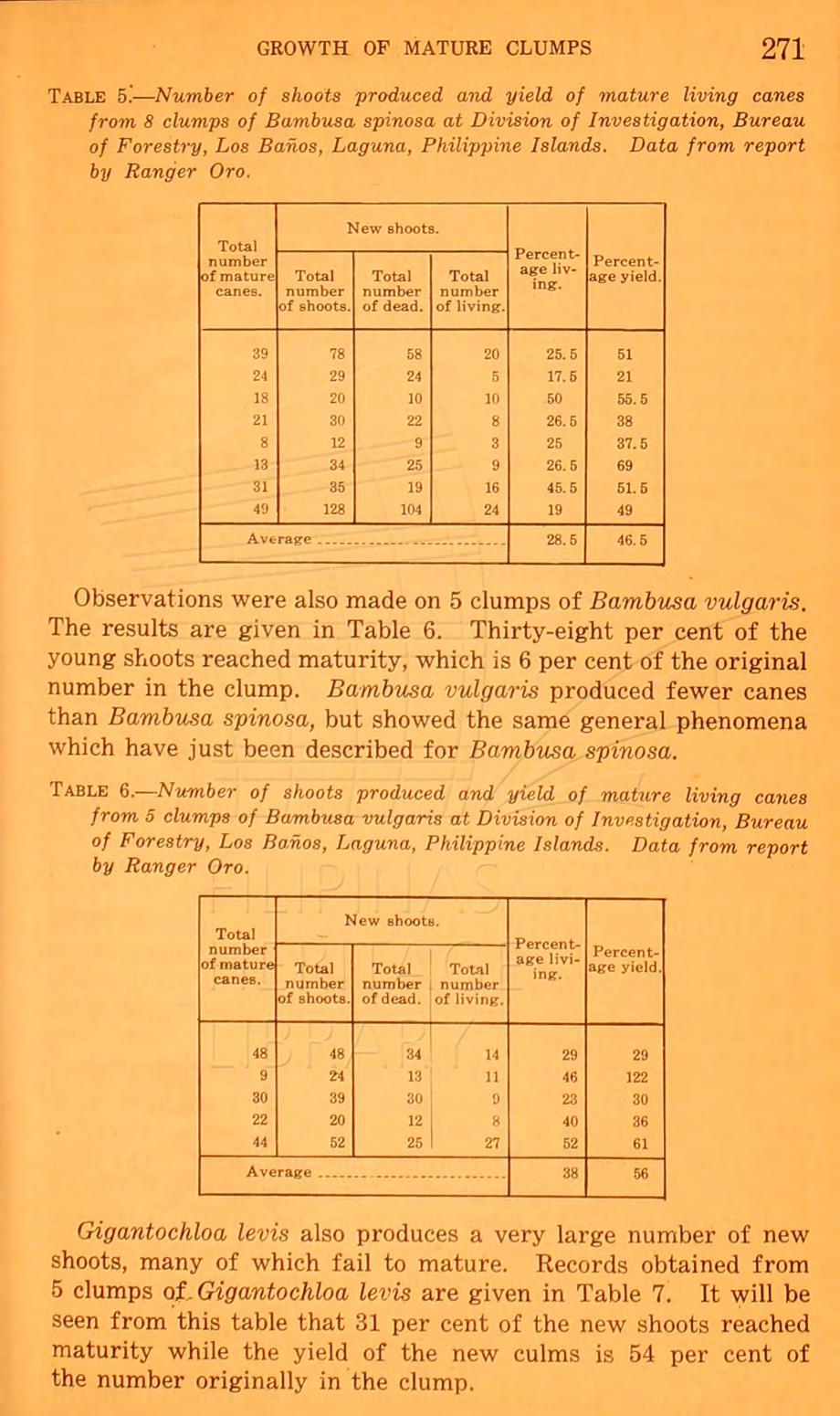
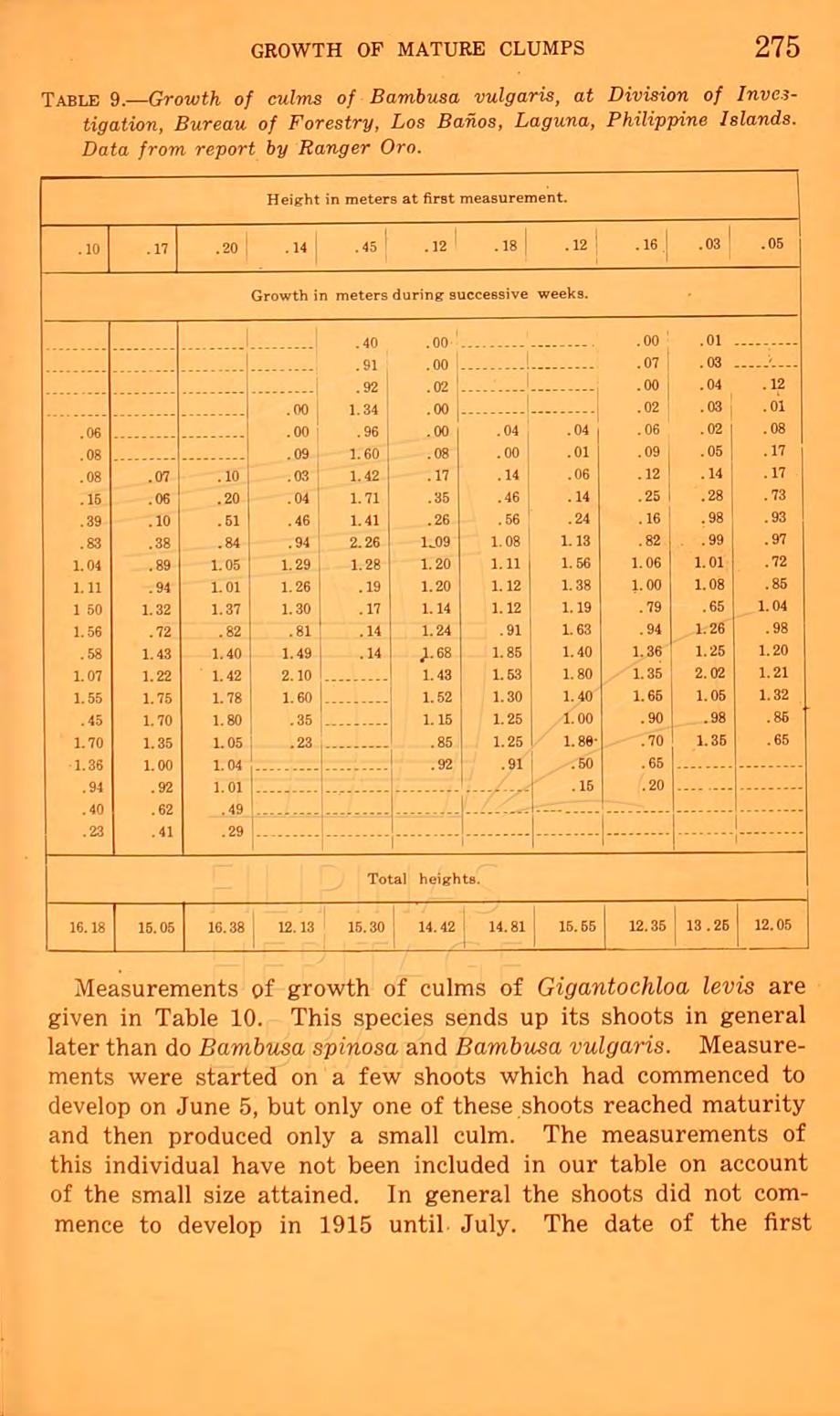
Observations were also made on 5 clumps of Bamb'USa vulgaris. The results are given in Table 6. Thirty-eight per cent of t h e young shoots reached maturity, which is 6 per cent of the original number in the clump. Ba·mb'USa vulgaris produced fewer canes than Bamb'USa spinosa, but showed the same general phenomena which have just been described for Bamb'USa spinosa.
TABLE 6.-Nwmber of shoots produced and yield of matU,re living canes from 5 clumps of Bambusa vulgaris at Division of InvPstigation, Bureau of Forestry , Los Bo nos, Laguna, Philippine Islands. Data from report by Ranger Oro. New shoots
Gigantochloa levis also produces a very large number of new shoots, many of which fail to mature. Records obtained from 5 clumps of. Gigantochloa levis are given in Table 7. It will be seen from ·this table that 31 per cent of the new shoots r ached maturity while the yield of the new culms is 54 per cent of the number originally in the clump.
GROWTH OF MATURE CLUMPS 271
Total Percent- number age liv- Percentof mature Total Total Total age yield. canes. number number number ing. of shoots. of dead. of living. 39 78 58 20 25.5 51 24 29 24 5 17 6 21 18 20 10 IO 50 55.6 21 30 22 8 26.6 38 8 12 9 3 25 37.5 13 34 25 9 26.6 69 31 35 19 16 45.5 61. 6 49 128 104 24 19 49 Av1:rage __ 28.5 46.6
Total Percent- number age livi- Percentof mature Total Total Tot,-il ing. age yield. canes. number number number of shoots. of dead of living. I 48 48 34 14 29 29 9 :M 13 11 46 122 30 39 30 !) 23 30 22 20 12 8 40 36 44 52 25 I 27 62 61 Average. -·-- 38 66
TABLE 7.-Nu 111 ber of shoots produced ancl yield of mature living_ ca~ze.~ from .5 clzwips of G1gantochloa lccis at Dir~s.ion_ of lnuestiyatzon, flureau of Forestry, Los Baii.os, Laguna, Pl11llppzne Island:~. Data from report by Ranger Oro.
New bhoots.
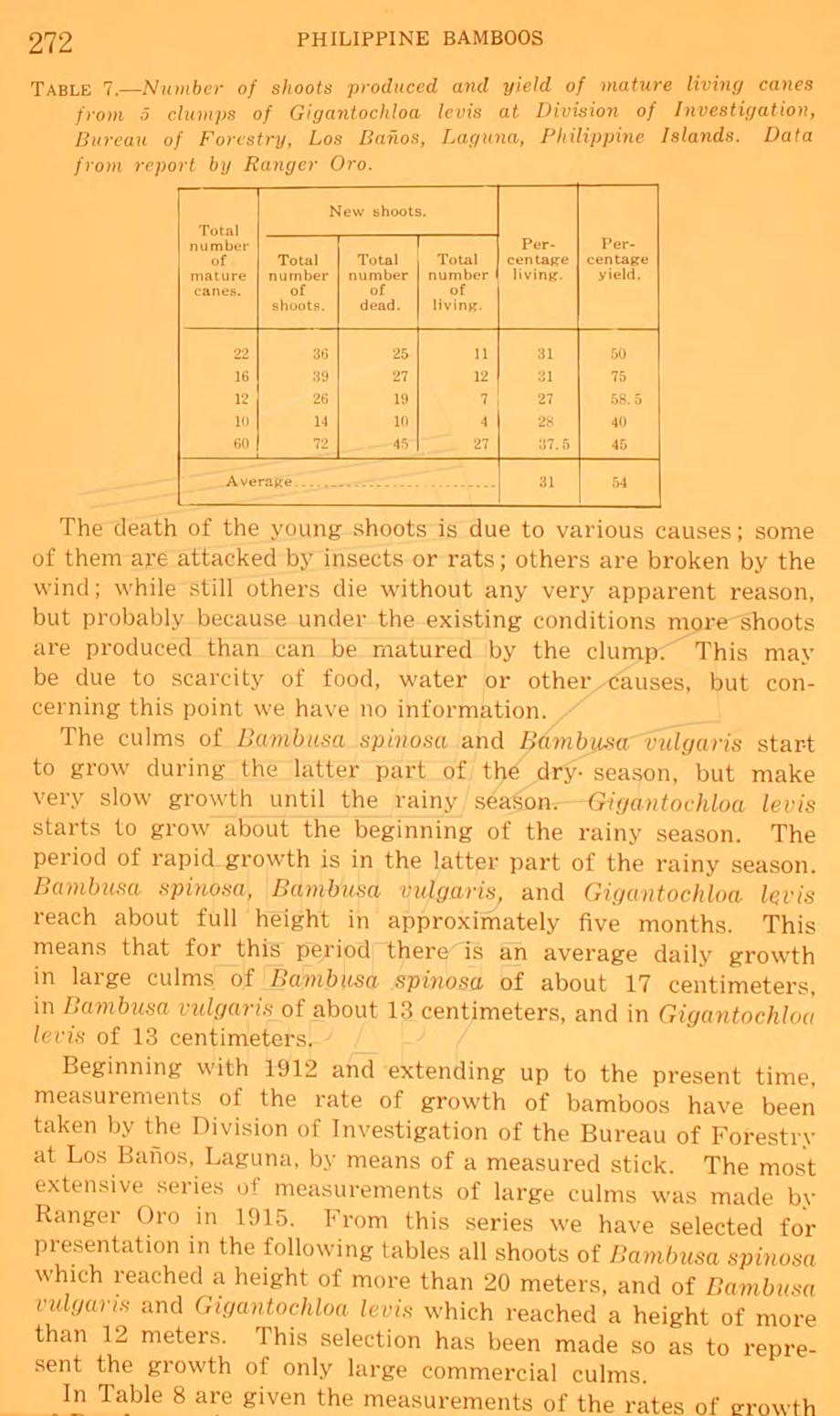
The death of the young shoots is due to various causes; some of them are attacked by in ·ects or rats; others are broken by the wind; while still others die without any very apparent reason, but probably because under th existing conditions mor shoot~ are produced than c.:an be matured by the clump. This may be due to scarcity of food, water or oth r causes, but concerning this point we have no information.
The culm-; of Dambu.wi spinosa and IJambn:•.;a l'lllgaris star-t to grow during the latter part of the dr}- • season, but make Yery slow growth until the rainy season. (;iya11tnchloa lens starts to grow about the begmning of the rainy season. Th period of rapid growth is in the latt r part of the rainy season. Baml>1uw spinosa, Bambusa rulgan.~. and (;i,<1u11tochlua le.els reach about full height in approximately five months. This means that for this period there is an average daily growth in larg culms of IJcunbirna ~pi110.~a of about 17 centim ters. in IJambww culgaris of about 1:~ c ntimet rs. and in (;igantochluu l< 1·is of 13 centimeters.
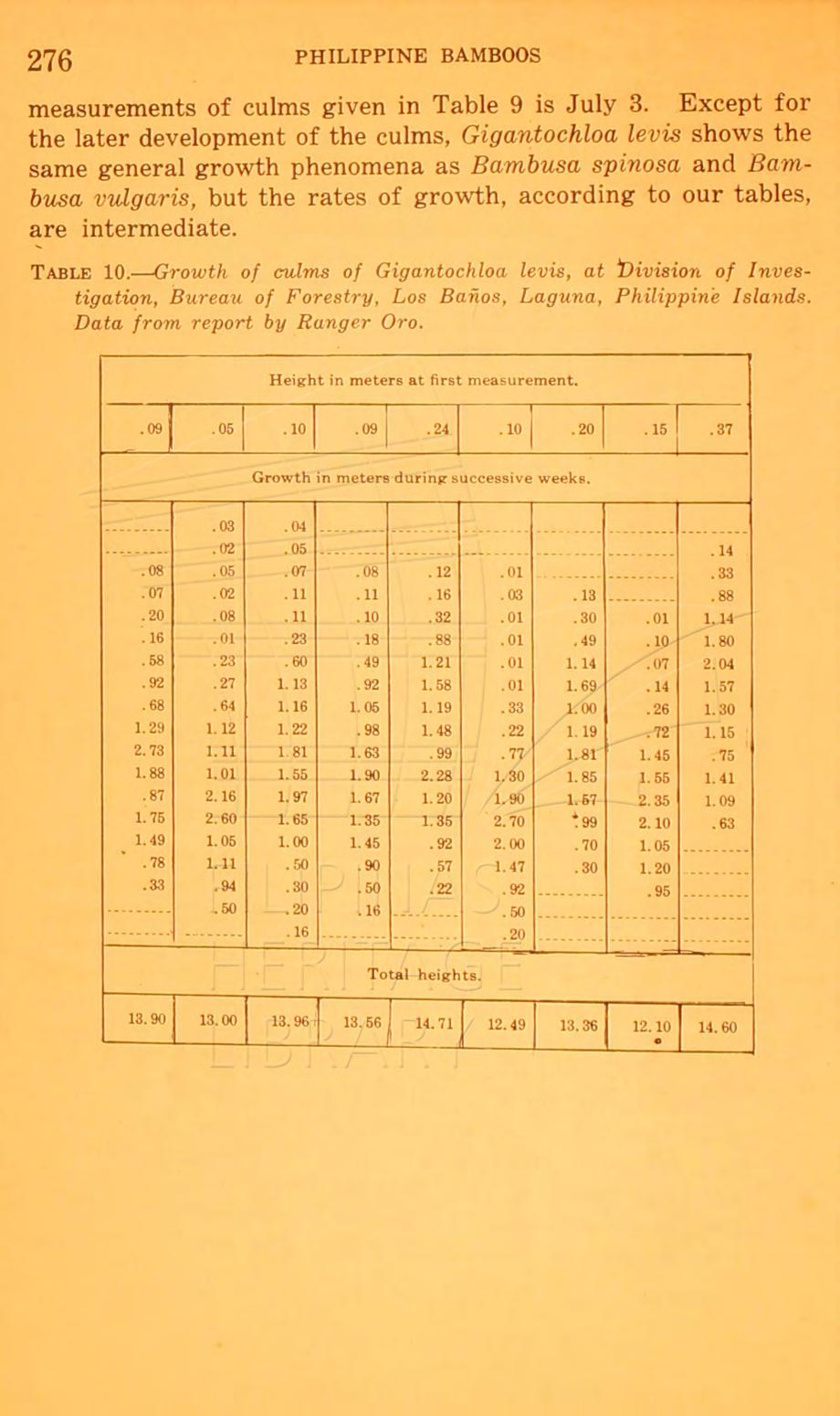
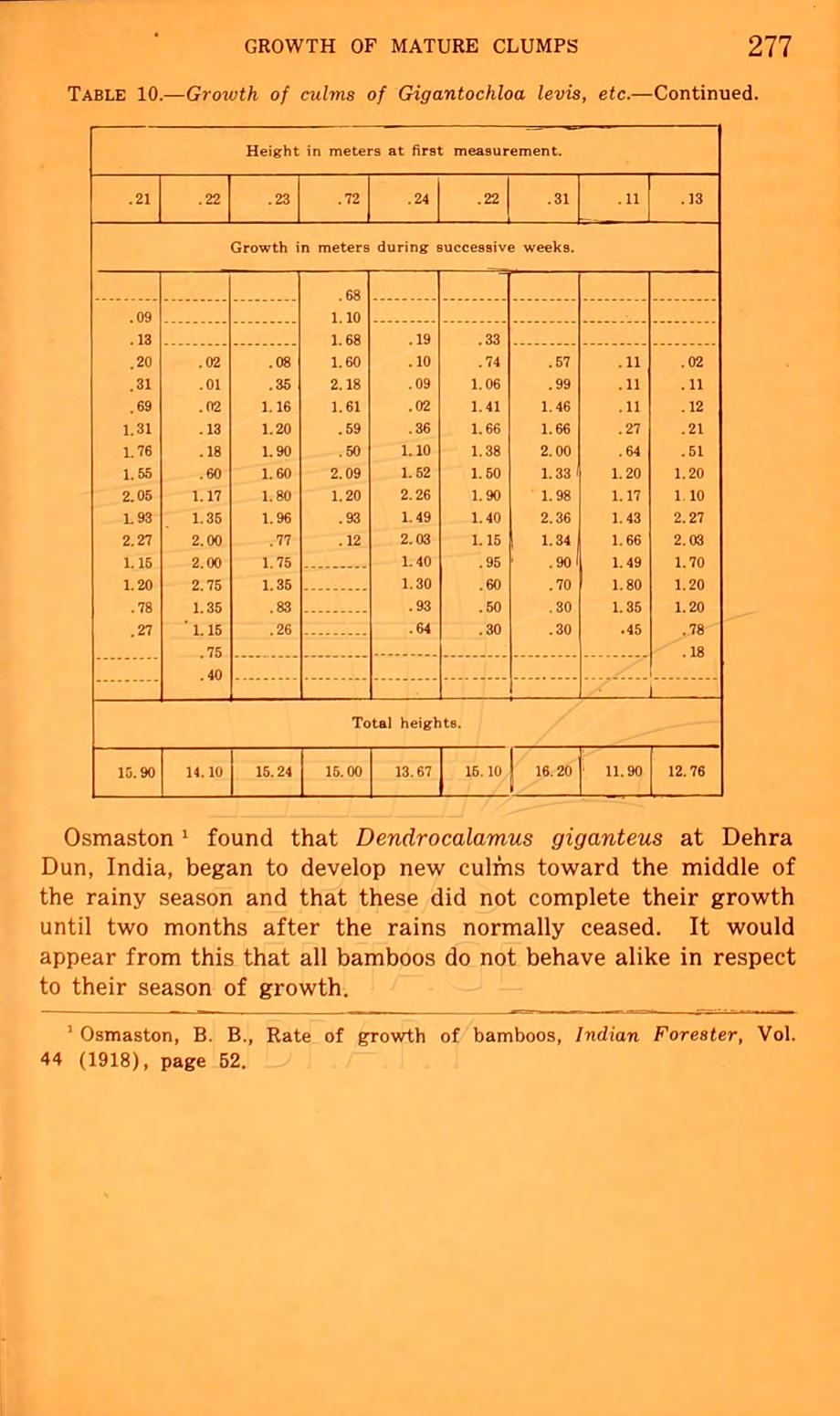
Beginning with 1~)12 and ext nding up to the pres nt tinw. measurements of the rate of growth of bamboos hav been taken by thP Division of In,· stigation of th€' Bureau of For str:, at Lo:-; Baii.os. Laguna, b~· means of a m asurecl stick. Th most xll•nsivP :-;l•ries 11!' measurt'ment.s of large culms was made b~· RangPr Oro in l ~ll 0. From this s ries \\'e ha, e s lected for pres ntation in the followrng tabl 'Sall shoots of J:amhusa spi11mw which r ached a height of mor than 20 m ters, and of flconbusa 1·ulyaris and Giycwtnchloa l, 1·1s which reached a h ight of more than 12 m ters. This seleetion has been made so as to r pres nt th growth of only larg<.> commercial culms.
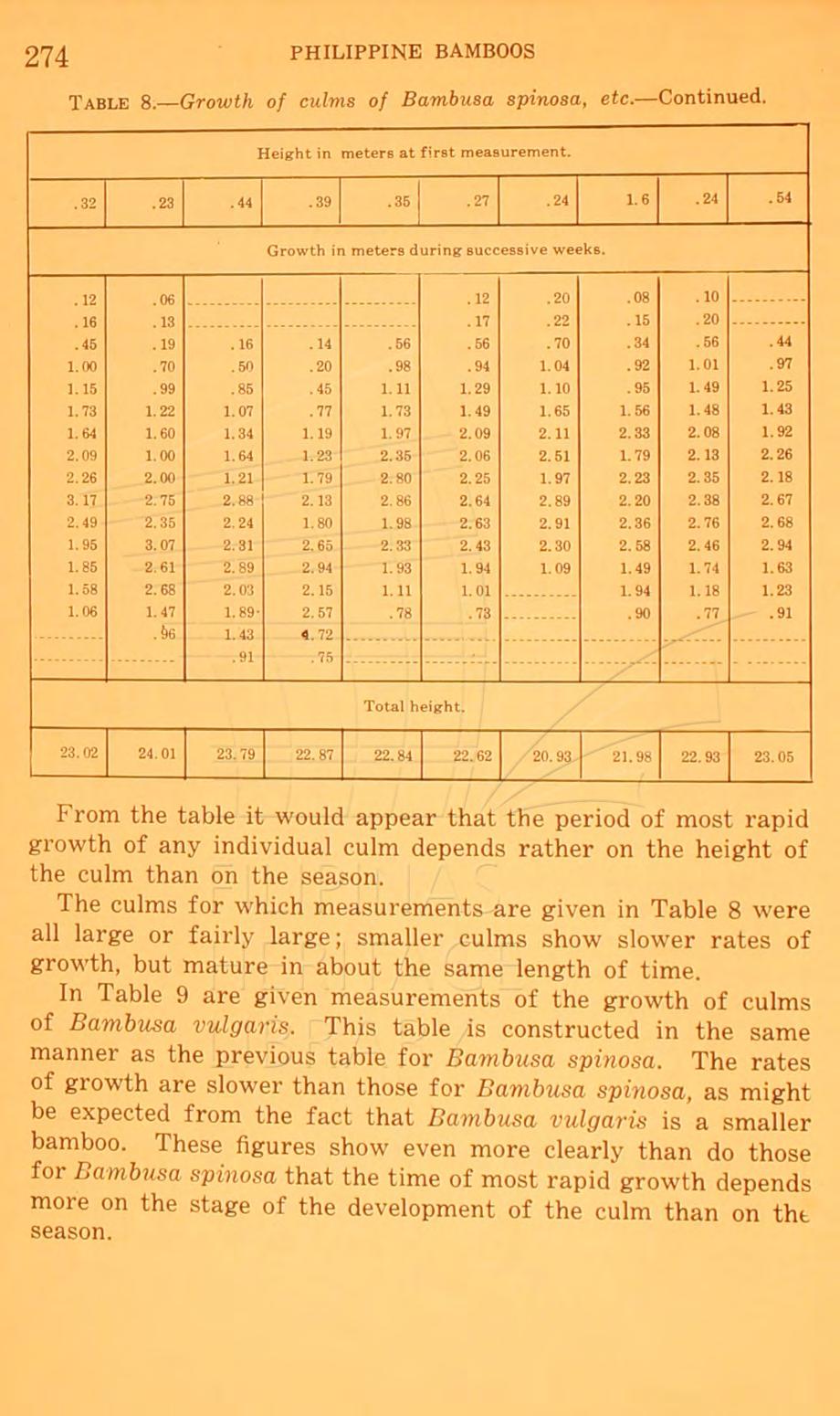
In Table 8 ar given the measurements of th ra
272 PHILIPPINE BAMBOOS
Total number I Per- Perof Total Total Total cent.age centage mature number number number hvmg ~1eld. canes. of of of shoob. dead. living22 l•i 25 II 'H JI) 16 :l'.I 27 12 -~ I 1s I ~: l 21; Ul 7 ·}- flit.; -, -· 11 Ill I 2 .j() tj(l '7:! 4i 27 17 ;, 4f, A\.erng-t- :ll i4
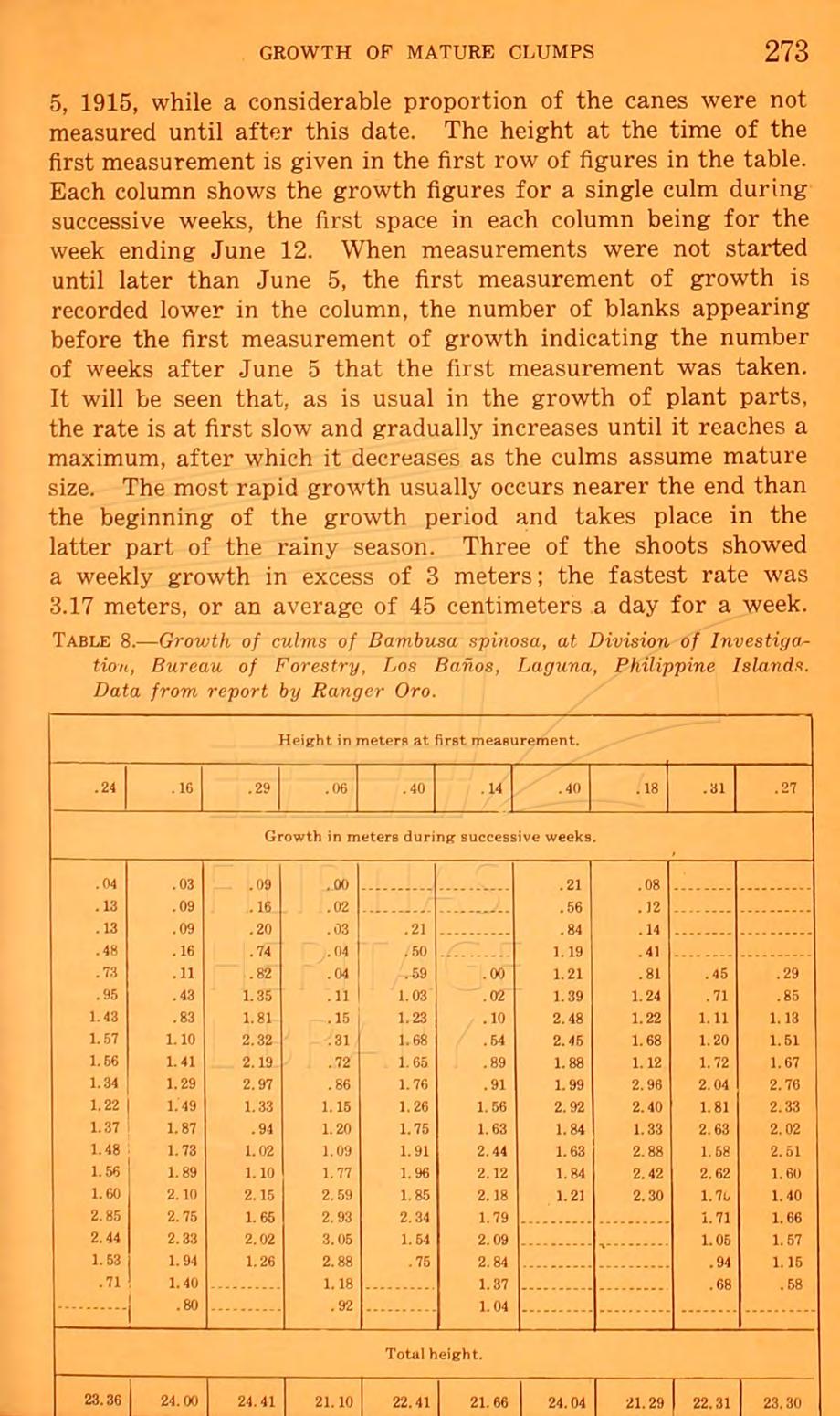
5, 1915, while a considerable proportion of the canes were not measured until after this date. The height at the time of the first measurement is given in the first row of figures in the table. Each column shows the growth figures for a single culm during successive weeks , the first space in each column being for the week ending June 12. When measurements were not started until later than Jun e 5, the first measurement of growth is recorded lower in t he co lumn , the number of blanks appearing before the first measurement of growth indicating the number of weeks after June 5 that the first mea s urement was taken. It will be seen t hat1 as is usual in t he growth of plant parts , the rate is at first slo w and gradually increases until it reaches a maximum, after which it decreases as t he culms assume mature size. The mo st rapid growth usually occurs nearer the end than the beginning of the growth period a.nd takes place in the latter part of the rainy season. Three of the shoots showed a weekly growth in excess of 3 meters ; the fa s test rate wa s 3.1 7 meters, or an average of 45 centimete r s a day for a week.
TABLE 8.-Growth of culms of Bambusa spinosa, at Division of In vestiga~ tion, Bureau of Forestry, Los Banos, Laguna, Philippine Isla nd '{. Data from report by Ranger Oro
GROWTH OF MATURE CL UMPS 273
Height in meters at first measurement. • 241 • 16 I .291 .06 .40 14 .40 18 .a l .27 Growth in meters durmg successive weeks. ' .04 .03 .09 00 -- -------- - 21 .08 .13 .09 16 .02- - . 56 .12.13 .09 .20 1)3 .21 .84 .14 ---- -----.48 .16 . 74 04 50 - 1.19 41 73 .11 .82 .04 59 .00 1.21 81 .45 .29 .95 .43 1. 35 .11 1.03 .02 1. 39 1. 24 71 .86 1. 43 83 1. 81 .15 1. 23 .10 2.48 1. 22 1.11 1. 13 1. 57 1. 10 2. 32 .31 1 68 .64 2. 46 1. 68 1. 20 1. 61 1.56 1. 41 2.19 72 l. 65 .89 1.88 1.12 1. 72 1. 67 1.34 l. 29 2.97 86 1. 76 91 1. 99 2.96 2.04 2.76 1. 22 I I. 49 1. 33 1. 16 1. 26 1. 56 2 92 2. 40 1 81 2.33 1.37 1. 87 94 1 20 1. 75 1. 63 1. 84 1. 33 2.63 2.02 1.48 1. 73 1. 02 1 09 1. 91 2.44 1. 63 I 2.88 1. 68 2.51 1.513 I 1. 89 1. 10 1. 77 1.96 2.12 1. 84 2. 42 2.62 1. 60 1. 60 2. 10 2 15 2 .59 1. 85 2. 18 1. 21 2.30 1. 71, 1. 40 2.85 2.76 1. 65 2.93 2.34 1. 79 - -- ----- ·- ------- l. 71 1. 66 2.44 2 33 2.02 3.05 1. 64 2.09 ---------· 1.06 1.67 ,---·----1. 531 1. 94 1. 26 2.88 75 2.84 ------· - 94 1.16 . 71 . 1. 40- - 1. 18 -----· 1. 37 ---- -----·------- . 68 .58 I .80 .92 1.04 ------1 -- -_,.., __ . ____ --------Total height. 23.361 24.00 I 24. 41 I 21.10 I 22.411 21. 66 I 24.041 21. 291 22.31 I 23.30