understanding the athletic brain to overcome mental challenges f e n c i n g f r o m y o u r
B R A I N ’ S P O I N T O F V I E W
understanding the athletic brain to overcome mental challenges f e n c i n g f r o m y o u r
B R A I N ’ S P O I N T O F V I E W
ZaraPehlivani
EditorsandContributors:
Dr.MartinV.Kolev,PhD-ClinicalPsychologist
Dr BrookeConway-Kleven,PT,DPD,PhD-UNLVSportsInnovation Institute
Mr ForrestGriffin-VPofAthleteDevelopment,UFCPerformance Institute
TeddyKim
Copyright © 2024 Zara Pehlivani
All rights reserved.
“Fencing From Your Brain's Point of View” is a compelling read that contains two voices. One is reporting the subjective psychological experience of what it is like to be an athlete in an individual sport - it requires physical training, discipline, dedication, inspiration, and self–regulation. The other, however, is the objective voice of neuroscience, which informs the reader about the mechanisms of the brain and psyche which regulate the processing of incoming information, the perception of oneself, of the opponent, and of the inner voice, and the difficulties which the young and developing athletes may encounter on their path.
The book is in a distilled form, and the information is communicated in a focused and concentrated manner - as a skilled swordsman would approach it. It is for this reason that the principles and sharings in the book can be applied and adapted to any individual sport of a highly competitive nature.
Additionally, at the end of the book, we find a diary with semistructured sections that each reader may use as a compass, to describe and track their own experience of motivation, distress, associative flow, and general development. Precisely because the book communicates objective mechanisms but leaves it to the individual reader to adapt the information to their development, the book can also help families and coaches who wish to support the development of their fencers.
-Dr. Martin V. Kolev, PhD
This resource discusses various common psychological challenges, ranging from burnout to chronic anxiety, which some readers may find triggering. The materials presented here are purely for informational purposes, do not constitute medical advice, and are not intended to diagnose, treat, cure, or prevent any condition or disorder. If you are facing issues with anxiety, depression, eating disorders, or other challenges, or are experiencing a crisis, please seek help from a medical professional. The psychological journey that is fencing is different for everybody. Symptoms, experiences, and coping strategies vary from athlete to athlete and individuals should pay constant attention to each of these.
The ideas and concepts presented here are an amalgamation of rigorous studies and research in various scientific areas, including neuroscience, biology, and psychology, and citations are annexed.
All quotes and names here are published with consent.
Competitive sports are activities that blur the lines between thought and action, strategy and reflex. As much as fencing is governed by physical maneuvers and muscle work, it is the brain that is managing every aspect of the athletic experience. You could be the strongest, fastest, most precise fencer on the planet - but if you are not in the correct mental state, your abilities will be rendered useless. In a highintensity sport like fencing, the brain requires just as much, if not more, time and attention as the body.
As a beginning competitor, the mind is a tool. Understanding the mechanics of reflexes and learning is crucial to optimize your training and preparing for tournaments.
As an advancing competitor, the mind can become a hindrance. Understanding the mechanics of motivation and fear is crucial to recognizing the difference between lack of skill (something you need to practice) and psyching yourself out (a mental hurdle that you need to overcome).
Assuming that a fencer is constantly and mindfully working on their physical activity, their growth trajectory would be constant or upwards. They’d keep getting better and better.
But in reality, the human brain is volatile. Internal chemical reactions respond to the environment, including factors like pressure and social interaction. The mind produces mental hurdles that prevent the fencer from achieving consistency in their improvement or success.
A mental barrier does not mean you are a failure. Far from it; it actually means you have improved your game to the point where you’ve reached a setback.
These hurdles can be better thought of as locked doors, barriers between you and your goals. They require a mental skill - a key - to open.
A lock can be anything from performance anxiety to sleep deprivation, too much thinking, not enough thinking, lack of motivation, and any number of other individualized mental blocks.
A key can be anything from improved nutrition to meditation, music, breaks, stretching...
There are any number of doors in an athletic career, and they are all different, from person to person and situation to situation. In order to get past each door you need the right key. To find the right key you need to understand the lock. To understand the lock you need to study your habits and be in tune with your brain.
This book aims to help you study your habits and be in tune with your brain. The rest comes together with effort and experience.
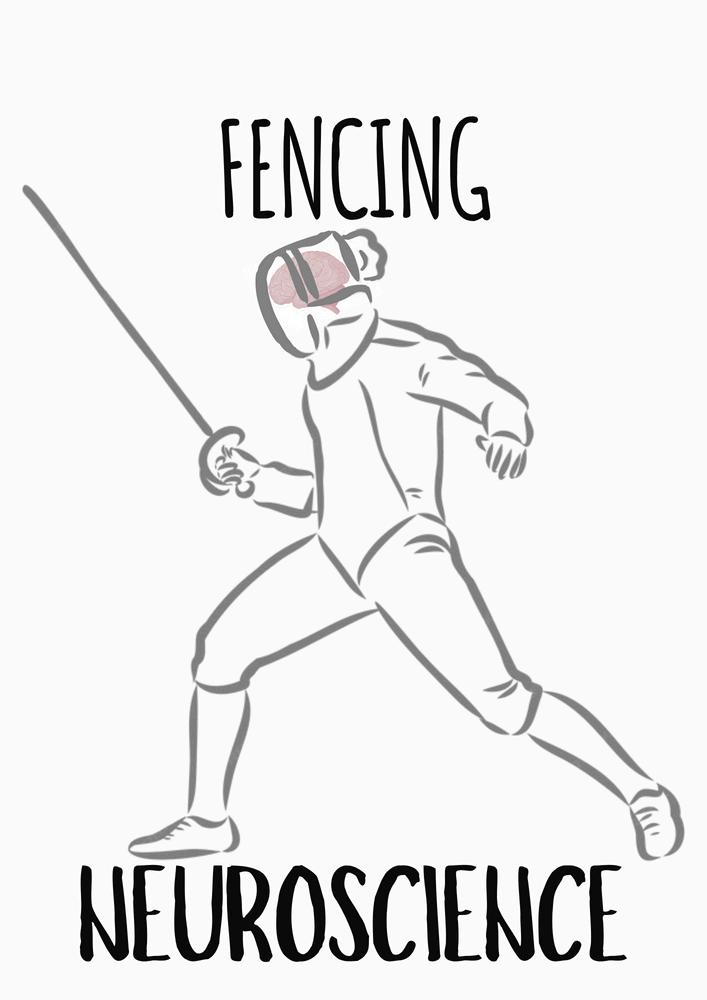
Each physical movement of fencing — like an advance, a parrysixte, or a flick — is encoded in your brain.
In essence, your brain has a 3D "map" of your body. The brain's motor cortex contains smaller networks of neurons that represent, your muscles, fingertips, arms, etc. The motor cortex reinforces this map through a combination of sensory information.
The physical structure of your motor cortex is capable of adapting to your habits the more you use a particular part of your body, the more neurons your brain has dedicated to it, and the more complex their interconnections become. For example, pianists have more gray matter in the region of their motor cortex that represents their hands, because they constantly use it to perform precise movements. Similarly, the more you use the muscles involved in doing a particular skill, like a lunge or fleche, the denser and more interconnected the neurons related to these motions become.
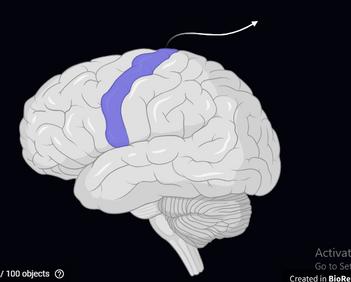
The number of neurons that a person has and the connections between them can change this is called neuroplasticity, and is fundamental to learning. When it comes to a sport like fencing, you can harness your brain's ability to map your body and neuroplasticity to enhance your performance.
When you are learning something for the first time, your motor cortex, prefrontal cortex (the part of the brain responsible for handling highlevel planning), and basal ganglia (responsible for procedural learning and coordinating voluntary motion) are all engaged. Recall the first time you learned to do a parry-four-riposte. It was a slow, indecisive action. You had to be actively thinking and observing yourself and others do the motion before you got the hang of it.
The more you practice an action, the more intuitive it becomes. This is a phenomenon called "muscle memory." From a neurological perspective, this means that, when you execute the action, there is now less activity in the prefrontal cortex and basal ganglia. The action is now being handled subconsciously, and automatically. Your parry-four-riposte, now that you have practiced it, has become a reflex.
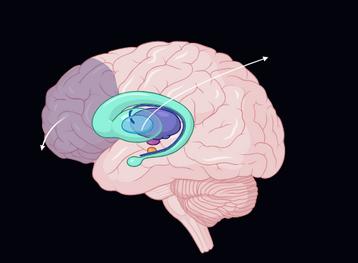
Normal brain activity is inattentive (not focused). When you are in a relaxed state of mind and your thoughts are wandering, your brain is processing lots of sensory information at once, and the different parts of the brain communicate at a low frequency. But when you are fencing, the neurons responsible for processing the visual input of your opponent and managing the physical actions of the sport begin to communicate in streamlined pathways at a much higher frequency and in synchronized waves. This is what focus looks like physically, in the brain.
When you are in an extremely competitive environment, there are two main types of peak focus mental states. You may have experienced them before.
The first is "flow mode." It is an experience exactly like meditating, characterized by activity that is almost completely subconscious. When you are in flow mode, you are not actively thinking, and neural activity is directed away from the prefrontal cortex. Your reflexes take the center stage without any interference. Your sense of time becomes distorted, usually slowed, in the total absence of analytical thoughts. Elite athletes usually report that it is in this state that they achieve optimal performance.
It is counterintuitive to think that your best performance is when you are thinking and analyzing the least.
The key is to distract your attention just enough to where the reflexes you've been building up in practice work for themselves without your conscious hesitation. In flow mode, the athlete has a loose goal in an uncertain situation, but feels relaxed and confident. When both challenged and confident, a fencer enters supreme concentration.
The second peak mental state is called "clutch mode." Unlike flow mode, clutch mode includes more conscious activity, and is usually triggered when an athlete decides to increase their intensity. Clutch mode is usually easier to get into when a fencer is in a high-stakes environment. This is the kind of moment where a fencer who is down five touches in the last period realizes that they need to put in their utmost effort and energy despite the anxiety or exhaustion they are consciously aware of feeling.
Flow Mode Clutch
subconscious experience absence of worry high challenge situation uncertain outcome confidence altered perception of time absorbed by task open/flexible goals creative experimentation deliberate focus conscious experience outcome on the line (fixed goal) active thinking/planning decision to increase intensity
Unlike concentrating and practicing movements, strategizing is a very conscious activity, taking place largely in the prefrontal cortex. Planning is a complicated and fundamentally mathematical process. In the brain, planning involves exploring an environment, making predictions about the outcomes of actions, and adjusting the actions based on whether the brain perceives a reward will result from those actions or not. In other words, your brain is constantly weighing probabilities to determine a course of action that maximizes reward.
Strategizing incorporates past experiences, encoded by the hippocampus (which handles episodic memory among other functions). Your past experiences play a huge role in helping your brain gauge the accuracy of its predictions. If you've succeeded in the past by doing sixte-ripostes against people who fleche, your brain will determine that the probability for your being rewarded is higher for a sixte-riposte against this particular opponent who fleches, even though this one is shorter and uses a pistol grip. If you take the sixte and lose the touch, your prediction calculations will adjust accordingly.
This process is called reinforcement learning. It means that from a purely mathematical standpoint, your strategic predictions will inevitably get better and more precise from more experience. The more you fence, the better your ability to strategize becomes even if you don't actively analyze.
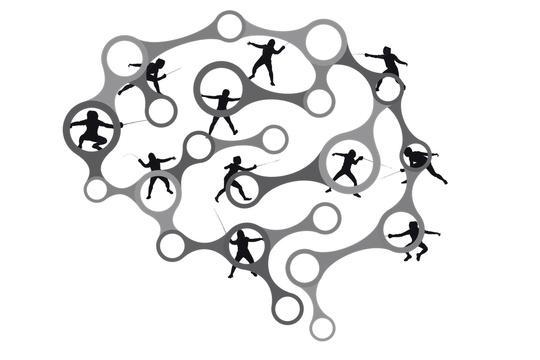
"Nobody goes into a fight at a hundred percent… But your body's designed to overcome and adapt to those stressors. It knows what to do. It's not gonna be perfect, which is why you practice every day. You practice on your good days, you practice on your bad days. You fight on your good days, you fight on your bad days. " - Forrest Griffin
Like all other organs, the brain needs nutrients so that neural cells have the resources with which to build themselves up, multiply, and carry out the functions that help you fence at your best. Nutrient deficiencies can cause you to experience brain fog or thought lag, making you feel not fully present, awake, or aware during a bout. This can also contribute to fencing anxiety or frustration with your performance.
Ensuring a diet containing sufficient amounts of vitamins D, B-5, B-9, and B-12, iron, magnesium, omega-3, etc., is one of the best things an athlete can do to keep their neurons working optimally. Most of the vitamin Bs are components of enzymes produced by the brain. Enzymes speed up the chemical reactions necessary for the organ to carry out its functions. Vitamin B-5, for example, is used in the production of co-enzyme A, which is in turn involved in building neurotransmitters
On the other hand, eating foods high in saturated fats and simple sugars can lower neurosynaptic functions by creating clefts, or gaps, between the neurons in the brain, which slow down the transmission of information from brain cell to brain cell. This can impede your ability to learn new techniques or effectively use your existing ones. Water makes up 80% of the brain and is used in many cellular functions. Staying hydrated is just as important as eating well.
As we discussed, the more your brain uses the neural pathways for a particular action, the easier and more subconscious the action becomes. Just as important as nutrition, sleep plays a vital role in how your brain functions.
Sleep occurs in different stages, which differ in terms of functions like heart rate and brainwave frequency. As your body enters the deep sleep stage, brainwave activity decreases dramatically. Deep sleep usually occurs in the first half of the night and is necessary for your brain and body to rest. About 90 minutes after falling asleep, the brain passes into the rapid eye movement (REM) stage.
Recent research demonstrated that the brain repeats actions it performed during the day while you sleep. Called sleep replay, this phenomenon is linked to both memory and learning.
In other words, when you sleep, your brain is rehearsing and practicing actions for you.
This is a superpower that can help you combat the frustration that comes with trying to master a difficult skill. Let's say you have been trying to learn a parry-riposte with a fleche, because you know this skill will better your game, but you just can’t get it, and it’s becoming frustrating. In these kinds of situations, where it feels like you're making no progress, taking a break and getting some more deep sleep may help tremendously. It will allow your brain to process what
you are trying to perfect without any interference from your worry and frustration.
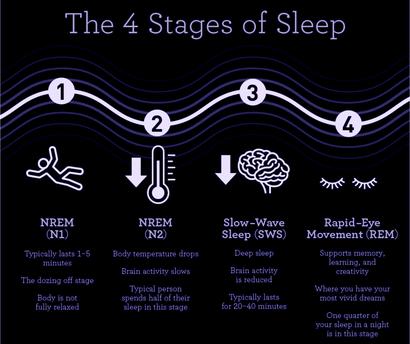
Source:AmyMyers,M.D.
It is important to say that routinely playing a sport, especially one which, like fencing, involves many areas of the brain at once, is extremely beneficial to your psychological well-being in and of itself. The endorphins released during physical exertion help moderate your mood, and learning and practicing helps your brain stay flexible (neuroplastic) for the rest of your life.
That said, playing a sport competitively draws up a host of its own cognitive challenges, which can bring about or worsen existing problems. It is important to maintain a good balance and to constantly check in with yourself to ensure you are taking adequate breaks and approaching your athleticism with a healthy mindset. Taking these measures will help you avoid burnout.
When you are in the heat of a bout at a tournament, it is very normal to feel stressed. Fencing is a high pressure, individual sport, intensified with a clock. And the awareness that if you lose a direct elimination bout, you’re out, does not help.
For many fencers, performance anxiety goes hand in hand with tournaments. You know what you have to do, but you just can't execute it correctly because you're too nervous. This nervousness causes you to start questioning your abilities and your actions, and miss your split-second opportunity to snag a touch.
When you are in such a high-pressure situation, your body goes into "fight-or-flight" mode, an evolutionary mechanism that helps you respond to danger. The amygdala processes a stressor, such as a big competition, high-ranked opponent, or even the presence of parents, friends, and coaches. The hypothalamus then releases a hormone called corticotropin, which, after a chain reaction, starts the release of cortisol.
Cortisol causes your blood vessels to constrict and your heart rate to increase, along with numerous other functions. All of this causes you to be tense and on high alert. Fight or flight is necessary for your survival, but it can be counterproductive for your athletic performance. When you are competing, you are under pressure, but you are not actually in danger.
A certain level of stress is important for optimal focus (remember that a perception of challenge is a component of both flow and clutch mode), but too much may cause you to seize up.
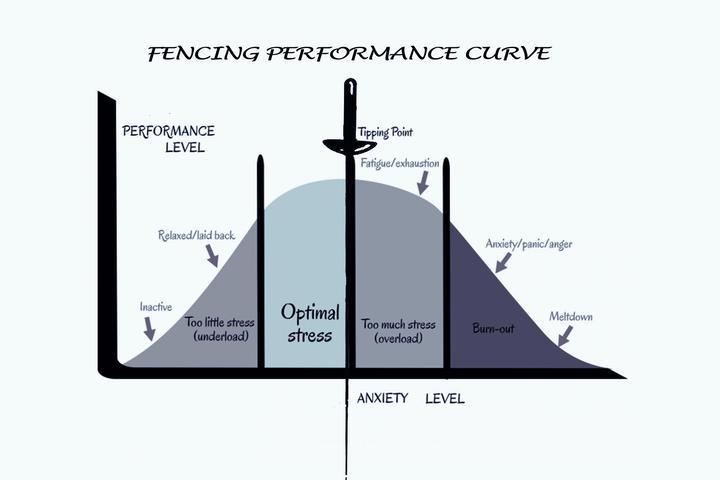
After having competed several times, many fencers begin to subconsciously classify the tournament environment as threatening. For example, you may start to feel preemptive anxiety before fencing at each North American Cup (NAC), because your brain has started to automatically associate it with stress. This phenomenon may cause you to believe you’re performing worse than your actual ability level, simply because the repeated performance anxiety makes it difficult to execute your skills.
In reality, it’s all a trick of the mind. There is nothing truly deadly about a NAC - it is a matter of catching your brain when you first feel tense. Noticing the anxiety pattern is the first step to dealing with it.
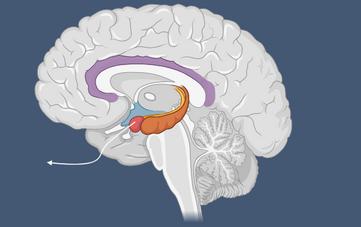
It is okay to feel anxious. Adrenaline and other stress hormones are not going to ruin your execution (in fact, they usually help). But it is also important to not be thinking about it, because it is the thought and not the feeling that will mess up the fencing. Recognize that you are feeling worried and hesitant, accept the reality of the feeling, and steer your thoughts back to the bout (this is a technique called cognitive defusion. It enables you to redirect your attention, acknowledging the anxiety without leaving it to fester in the back of your mind). Then, try to focus your conscious attention on managing the distance and timing, and trust your reflexes. Even if you don't feel confident about your fencing abilities, you can rest scientifically assured that your body knows what to do and you can afford to not think about it.
Chronic anxiety is a more difficult issue to tackle, but one that affects many fencers, particularly if they are balancing their school and social lives with athletics. It is a result of multiple compounding stressors and worries that plague your daily life and carry over into your sport.
If you are exposed to stress for extended periods of time, cortisol buildup remains in your bloodstream for days after the stressor is gone, continuing to instruct your body to be tense and jumpy. If you fence in a tournament after prolonged anxiety, your muscles will be stiffer than usual, and this may impair your physical execution of actions. Your disengages and parries might be wider, for instance. If this occurs, it is important to practice deep breathing and other relaxation exercises to mitigate the tension that cortisol buildup can produce.
Many meditation, breathing, and positive self-talk techniques can counteract both situational and chronic anxiety. Meditation engages the attention-regulation parts of the brain, which can help you bring your awareness back to the present situation instead of keeping it stuck in an anxious thought loop. Focused breathing mimics the body’s natural cool-down mechanisms and lowers your heartrate (stimulating the nerves on your face with cold water has a similar effect). Positive self-talk prompts your brain to associate certain words and phrases with comfort and focus, in the same way it can associate a NAC with anxiety. Essentially, these are tricks to re-train your body’s reflexes as they apply to feelings and states of mind.
If you are experiencing severe anxiety and/or regular panic attacks, it is critical that you adjust your schedule and workloads, including your fencing regimen, so that you are not overburdened on a daily basis. Be kind to yourself; it is okay — and in fact better for your brain to discuss your current situation with coaches, take breaks, and return slowly to avoid burnout.
For the purposes of this guide, we will combine transitory depression (temporary depressive episodes, like after losing a bout), chronic depression, and lack of motivation under one umbrella, because these all have some neurological bases in common. In all these cases, it is important to seek professional medical advice if you feel your daily life or relationships are being disrupted.
Depressive episodes are common among competitive athletes, especially in individual sports like fencing, where environments are high-pressure. Fencing is uniquely challenging, and it is necessary to develop adequate coping strategies and flexible goals to prevent the burnout, a precursor for depression.
Depression, at a fundamental level, simply means that the brain is producing insufficient dopamine for optimal communication between neurons. In a depressive episode, your cognitive processes are literally slowed. Being depressed does not mean feeling melancholy or sad. It means losing most or all of your intrinsic motivation, even for working through the episode itself. It’s a signal to take off all the pressure and take better care of your brain.
Episodes like these are normal if they pass after some time. They can happen if you feel you have underperformed, have experienced an injury, or even just as a result of stress. Recognize what is happening in your brain at these times everything is purely a
chemical process, and the thoughts you have as a result of your feelings are not necessarily reflections of reality. You may feel like you are not made for the sport. You may also start comparing yourself to others and experience self-doubt. But remember that these are just that - thoughts - and all the skills you have learned are still encoded in your brain.
It’s worth repeating: breaks can be a game-changer. Episodic depression can happen as a result of the sport because you’ve spent so much time and energy working hard, to the point where you’ve forgotten why you do it in the first place. Trying to “work through” the absence of motivation can only lengthen and deepen the burnout; overexertion should not be mistaken for discipline or perseverance. When your passion for fencing is being overshadowed by what feels like mindless or desperate work, step away and return clear-headed. Change some aspect of your outlook - switch up your goals or your routine. Taking small steps, removing pressure, and introducing novelty to your process are healthy ways to begin overcoming burnout depression and building up your confidence.
"Be thankful that you get to do this. It sounds very odd, but I can tell you as a retired athlete, give it a year or two and you start to miss the sport. You miss that pressure. Enjoy the moment, because it will pass, and you won't be able to do this forever. "
- Forrest Griffin
Amygdala: A small region near the center of the brain which identifies and processes danger. It is responsible for regulating responses like fear, anger, and stress, which are all defense mechanisms against a perceived threat.
Basal ganglia: Works with the prefrontal cortex and motor cortex to organize procedural learning and voluntary motion.
Brain fog: A state of unclear thought processes. Usually resulting from a lack of sleep or adequate nutrition, brain fog can cause a person to feel less awake, aware, or present.
Brainwave frequency: The frequency (level of intensity) of electrical pulses (waves) created by neurons communicating in sync. Different frequencies correspond to different levels of brain activity and mental states.
Chronic anxiety: A consistent feeling of stress or pressure that builds up on a day-to-day basis. A common challenge among student-athletes who are trying to juggle multiple challenges at once.
Cognitive defusion: The act of acknowledging and accepting feelings without allowing them to impede performance or cause doubt. An example technique is isolating a thought or feeling and visualizing it in a box that floats out of your mind.
Hormones: Chemical messengers which instruct organs to start or stop biological functions.
Motor cortex: The region of the brain responsible for planning and creating electrical impulses for voluntary muscle movements.
Neuron: A brain cell. Neurons communicate with one another through electrical impulses that are transferred through axon terminals.
Neuroplasticity: The process by which the brain produces more neurons and more connections between existing neurons (learning).
Neurotransmitters: Chemical compounds that transmit information from one neuron to the next.
Performance anxiety: When an athlete worries about their ability to perform a particular action or compete well.
Prefrontal cortex: The frontmost part of the brain responsible for high-level conscious actions, like active thinking, planning, and analyzing.
Reinforcement learning: The process by which your brain learns, through making predictions about the outcome of an action and readjusting these predictions based on whether or not they were correct.
Sleep replay: Your brain rehearses habitual actions during sleep. The sequence of neuron activity is exactly the same as when you are awake.
Thought lag: A perceived slowness in thought processes.
1. Bhatt, M., & Camerer, C. F. (2011). The cognitive neuroscience of strategic thinking. Oxford Academic University Press eBooks. https://doi.org/10.1093/oxfordhb/9780195342161.013.0062
2. Brain Activity During Strategic Planning. (n.d.). National Institute of Neurological Disorders and Stroke. https://www.ninds.nih.gov/health-information/clinical-trials/brain-activity-duringstrategic-planning
3. Using Neuroscience To Overcome Mental Blocks And Optimize Your Nervous System. (n.d.). SwimSwam. https://swimswam.com/using-neuroscience-to-overcome-mental-blocksand-optimize-your-nervous-system/
4. Fadó, R., Molins, A., Rojas, R., & Casals, N. (2022). Feeding the Brain: Effect of Nutrients on Cognition, Synaptic Function, and AMPA Receptors. Nutrients https://doi.org/10.3390/nu14194137
5. Foryś, W. J., & Tokuhama‐Espinosa, T. (2022). The Athlete’s Paradox: Adaptable Depression. Sports. https://doi.org/10.3390/sports10070105
6. What is flow, and how to achieve it. (n.d.). InnerDrive https://blog.innerdrive.co.uk/sports/what-is-flow
7. Kennedy, D. O. (2016). B Vitamins and the Brain: Mechanisms, Dose and Efficacy—A Review. Nutrients. https://doi.org/10.3390/nu8020068
8. Lall, S. (2023, May 24). How does the brain focus? - MIT McGovern Institute. MIT McGovern Institute. https://mcgovern.mit.edu/2019/03/14/ask-the-brain-how-does-the-brainfocus/
9. Lee, D., & Seo, H. (2016). Neural Basis of Strategic Decision Making. Trends in Neurosciences. https://doi.org/10.1016/j.tins.2015.11.002
10. New insights into the brain’s motor cortex. (2023, May 9). National Institutes of Health (NIH). https://www.nih.gov/news-events/nih-research-matters/new-insights-into-brain-s-motorcortex
11. The amazing phenomenon of muscle memory. (2018, June 18). Oxford UniversityMedium. https://medium.com/oxford-university/the-amazing-phenomenon-of-muscle-memoryfb1cc4c4726
12. Swann, C., Crust, L., Jackman, P. C., Vella, S. A., Allen, M. S., & Keegan, R. (2017). Psychological states underlying excellent performance in sport: toward an integrated model of flow and clutch states. Journal of Applied Sport Psychology https://doi.org/10.1080/10413200.2016.1272650
13. The University of Sydney. (n.d.). Cognitive Defusion. The University of Sydney Counselling and Psychological Services (CAPS) https://www.sydney.edu.au/content/dam/students/documents/counselling-and-mental-healthsupport/cognitive-defusion.pdf
14. Brain basics: Understanding sleep. (n.d.). National Institute of Neurological Disorders and Stroke. https://www.ninds.nih.gov/health-information/public-education/brain-basics/brainbasics-understanding-sleep
15. Brain practices new tasks while we sleep. (2023, November 9). Harvard Gazette https://news.harvard.edu/gazette/story/2022/06/scientists-find-link-between-sleep-andlearning-new-tasks/
16. Understanding the stress response. (2020, July 6). Harvard Health. https://www.health.harvard.edu/staying-healthy/understanding-the-stress-response
17. MacAulay, N. (2021). Molecular mechanisms of brain water transport. Nature Reviews Neuroscience. https://doi.org/10.1038/s41583-021-00454-8
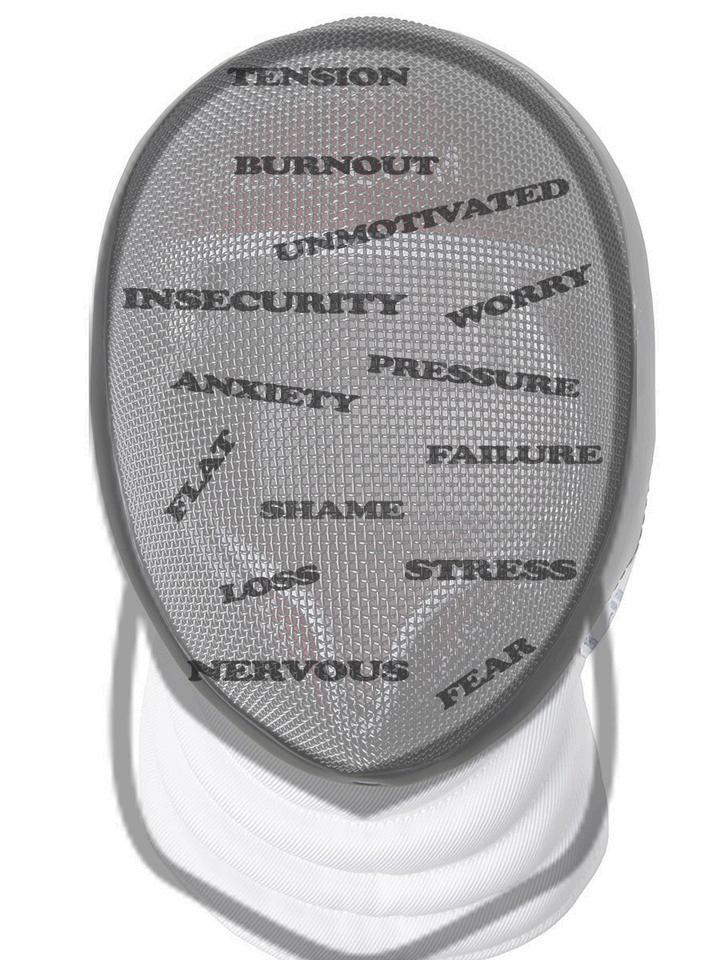
Describe your physical state during a stressful bout.
Where do you feel tension in your body?
ex. shoulders
Which actions do you overthink/doubt or freeze up on?
ex. counterattacks, fleches
What causes you to feel nervous in a bout?
ex running out of time, disappointing my coach
What are some ways you can calm and recenter yourself?
ex directing my attention at footwork instead of bladework, listening to music, focusing on an object or word
What are your biggest strengths as a fencer?
ex. i’m good at fleching
What is your greatest fencing moment and why?
What is your biggest fencing dream (something you REALLY want)?
Remember your strengths and goals when you fence in challenging situations. The more you revisit your motivators, the more automatic they will become. You will notice your brain reminding you about them on its own.
Redirecting your thoughts to what you want out of the sport will help you feel less overwhelmed during a tough bout. Remembering your strengths while you are facing a challenge will help you get into flow mode
Think of your best bout. What adjectives describe the experience?
ex. relaxed
Think of your worst bout. What adjectives describe the experience?
ex. sleepy
Think of your ideal bout. What describes your best performance?
ex. unafraid
Attaching words to your experiences and emotions helps to make them more real and easy to work with. When you have a name for something, you can call it out - you are in control of it. Get into the habit of reflecting on and labeling important moments in your fencing experience, so you can revisit and rehearse them.
Even if you are not in your ideal mindset, you can help yourself into it using these labels.