Announcements and Shout Outs
Congratulations to Loni Cooper (BC 1857, US Mammal SME) on being promoted to the US West Project Manager Leader (PML) role.
Congratulations to Spencer Lejins, Megan Fee, Caroline Hamilton, and Neil Kauffman (BC 1857) on completing the 2024 US Forest Service Yosemite Toad Training.
Michael Preston (BC 1232, CA Bird SME) and Jessica Costa (BC 1956, US Bird SME) worked with the National Audubon Society to design floating black tern nest platforms
on Lake St. Clair in Michigan. Read their article: Stantec selected to design floating nest structures for National Audubon Society
David Plumpton (BC1857, US Bird SME) and Katie Castor (1726) presented: Jove Solar: Permitting Renewable Energy Development and Complying with the US National Environmental Policy Act (NEPA) during the June ES TechEx Webinars Series.
People and Projects
US East
Last spring, Katie Trebilcock, Caroline Byrne, and Joel Perkins (BC 1956) deployed ten solar-powered thermal cameras beneath wind turbines at a wind energy facility in the mountains of Western Maine while Derek Scholes, Adam Rusk, and JT Layne (BC 1937) did the same at a wind farm in Missouri. Both efforts were part of a research project funded by the National Renewable Energy Laboratory (NREL) to better understand bat behavior near wind turbines. The primary focus was to pair thermal cameras with turbine-mounted detectors and compare how each of these methods helps to understand bat activity, as well as evaluate the pros and cons
WILD is the U.S Terrestrial Wildlife Technical team’s quarterly newsletter. If you have any terrestrial wildlife projects, species photos, announcements, or other contributions please reach out to our co-editors Sara Viernum and Loni Cooper.
of camera vs. detector in evaluating risk to bats. Stantec has partnered with Wildlife Imaging Systems (based in Vermont), who will be analyzing the video data. At each site, the NREL funding is also leveraging ongoing monitoring that Stantec was already performing for the companies operating the wind projects. This exciting project is a great example of adding research components to monitoring tasks and conducting rigorous science while still providing our clients with the data they need to manage risk to bats at their wind energy projects. Adam, Caroline, and Trevor Peterson (BC 1956) presented an overview of this project during the 2023 North American
Symposium on Bat Research in Winnipeg, Manitoba. Joel Perkins has also traveled to distant locations in 2023 to deploy radar units as part of pre-construction surveys at proposed wind projects in Nova Scotia and Alaska. The Nova Scotia project is using three marine radar systems designed to document migration activity for two proposed wind energy projects and provided ongoing support to our Canadian team out of St. John’s, New Brunswick and Dartmouth, Nova Scotia. In Alaska, Joel installed a single marine radar system designed to document migration activity for proposed wind energy projects and provided ongoing support to our team based in Fairbanks.
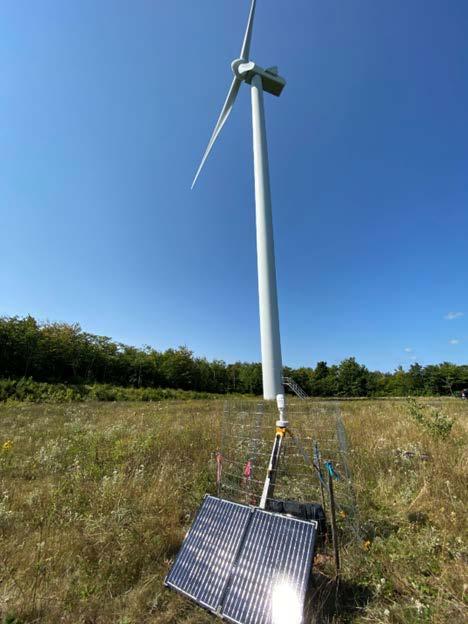
Solar-powered thermal camera installed beneath a wind turbine.
Photo credit: Trevor Peterson
People and Projects Continued
US West
Biologists Ryan Hrabe, Kimberly Grmusich, Derek Scholes, and Michael Mahr (BC 1937 and 2037) performed nocturnal spotlighting and trapping surveys for black-footed ferrets in association with USFWS reintroduction efforts in western Kansas last fall. Black-footed ferrets are one of the most endangered mammal species in North America. Once presumed extinct, captive breeding, reintroduction, and habitat protection efforts have helped restore the population to
approximately 300 animals in the wild. This ferret was historically found across the Great Plains, but current populations remain in isolated pockets of Colorado, Kansas, Utah, Wyoming, South Dakota, Montana, Arizona, and New Mexico. Many are designated as non-essential experimental populations due to the reintroduction efforts.
Individuals require large, continuous prairie dog colonies for both sustenance and cover.
The continued decline of prairie dogs (whether through disease, extermination, or habitat loss/
“Once presumed extinct, captive breeding, reintroduction, and habitat protection efforts have helped restore the population to approximately 300 animals in the wild.”
fragmentation) continues to threaten the ferrets. Stantec biologists spent nights driving through active prairie dog colonies to locate ferrets via spotlighting and placing traps in burrows with observed ferrets. Captured individuals were transported to an onsite veterinarian processing station. Processing typically included the removal of ticks and administering relevant vaccinations and flea treatments to slow or prevent the spread of
individuals were also marked and affixed with a PIT tag for tracking purposes. The trapping and tagging efforts help determine the survival rate of released individuals and the number of wild-born kits in a given year. This was the twelfth year some members of the team have been participating in these efforts. Biologists commonly observe other wildlife that occupy the prairie dog colonies at night such as swift fox, American badgers, bobcats, burrowing owls, prairie
Federal Endangered Species Updates
From June 1, 2024-August 23, 2024, the following rules and notices were added to the Federal Register :
Endangered or Threatened Species
y Final Rule Threatened: Suwannee alligator snapping turtle, Mount Rainier white-tailed ptarmigan, Pearl River map turtle, Alabama map turtle, Barbour’s map turtle, Escambia map turtle, Pascagoula map turtle
y Proposed Rule Endangered: eastern regal fritillary, Cedar Key mole skink
y Proposed Rule Threatened: western regal fritillary
Critical Habitat
y Final Rule: Jaguar critical habitat removal of approximately 64,797 acres in Arizona, Suwannee alligator snapping turtle critical habitat designation not prudent, Mount Rainier white-tailed ptarmigan critical habitat not prudent determination being reevaluated, Pearl River map turtle critical habitat prudent but not determinable now.
y Proposed Rule: Cedar Key mole skink, eastern regal fritillary and western regal fritillary not determinable
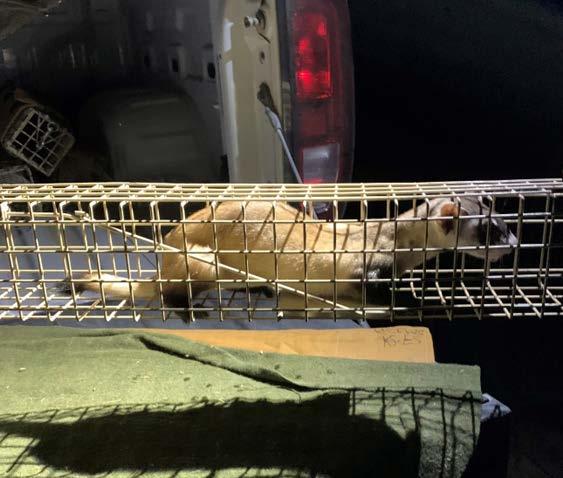
Black-footed ferret capture during nocturnal surveys in Kanas.
Photo credit: Kimberly Grmusich
Upcoming Conferences and Workshops
y American Ornithological Society
October 1-5, 2024, Estes Park, CO
y The Wildlife Society Annual Conference
October 19-23, 2024, Baltimore, MD
y North American Society for Bat Research Symposium October 23-24, 2024, Jalisco, Mexico
y Entomological Society of America Annual Meeting November 10-13, 2024, Phoenix, AZ
y Wind Wildlife Research Meeting
November 12-15, 2024, Corpus Christi, TX
y Tennessee Bat Working Group Annual Meeting
November 22, 2024, Murfreesboro, TN
y Partners in Amphibian and Reptile Conservation Annual Meetings Various locations and dates
y Midwest Fish & Wildlife Conference
January 19-22, 2025, St. Louis, MO
y The Western Section of The Wildlife Society Annual Meeting February 3-7, 2025, Visalia, CA
y International Conference On Ecology and Transportation May 11-15, 2025, Denver, CO
y International Urban Wildlife Conference
June 1-5, 2025, Atlanta, GA
y California-Nevada Amphibian Population Task Force Annual Meeting TBD 2025, Camarillo, CA
y Northeast Bat Working Group Annual Meeting
TBD 2025, Harrisburg, PA
y Southeastern Bat Diversity Network Annual Meeting TBD 2025, Lexington, KY
Technology Highlight
EchoPITCH is a Stantec proprietary tool created by Trevor Peterson (BC 1956) which combines bat activity with local seasonal and meteorological conditions to create defined curtailment parameters and to allow operators to customize the cut-in wind speed for their wind turbines. Using bat acoustic data recorded at turbine nacelles to determine the envelope of conditions when bats are active (e.g., temperature, wind speeds), EchoPITCH focuses curtailment on periods when it is most warranted to reduce bat mortality rates while maintaining power and renewable energy generation.
Species Highlight
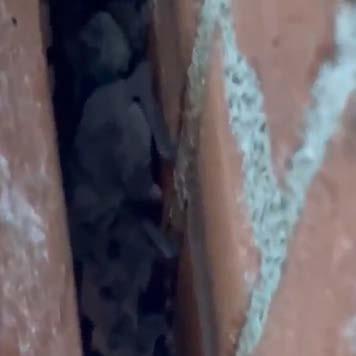
Brendan Cohen (BC 1857) shares this video of Mexican free-tailed bats roosting in a parking garage in Sacramento, California. Mexican free-tailed bat (also known as Brazilian free-tailed bat) is a sensitive species in some states (e.g., Species of Special Concern in California, Protected Mammal in Nevada) and currently consists of nine subspecies, two of which occur in the U.S. Mexican free-tailed bats occur in North, Central, and South America and roost in caves, mines, bridges, and buildings like garages with narrow, dry, dark spaces. Roosting colonies can include over a million individuals. One of the world’s largest known bat colonies is a nursery colony of adult female Mexican free-tailed bats and their young in Bracken Cave in Texas, which houses 20-40 million estimated bats each summer. Some populations are migratory and overwinter in the Central and South America while others are non-migratory and overwinter in warmer parts of the U.S. This species is the most wildly distributed mammal in the Western Hemisphere and is one of the most abundant mammals in North America.
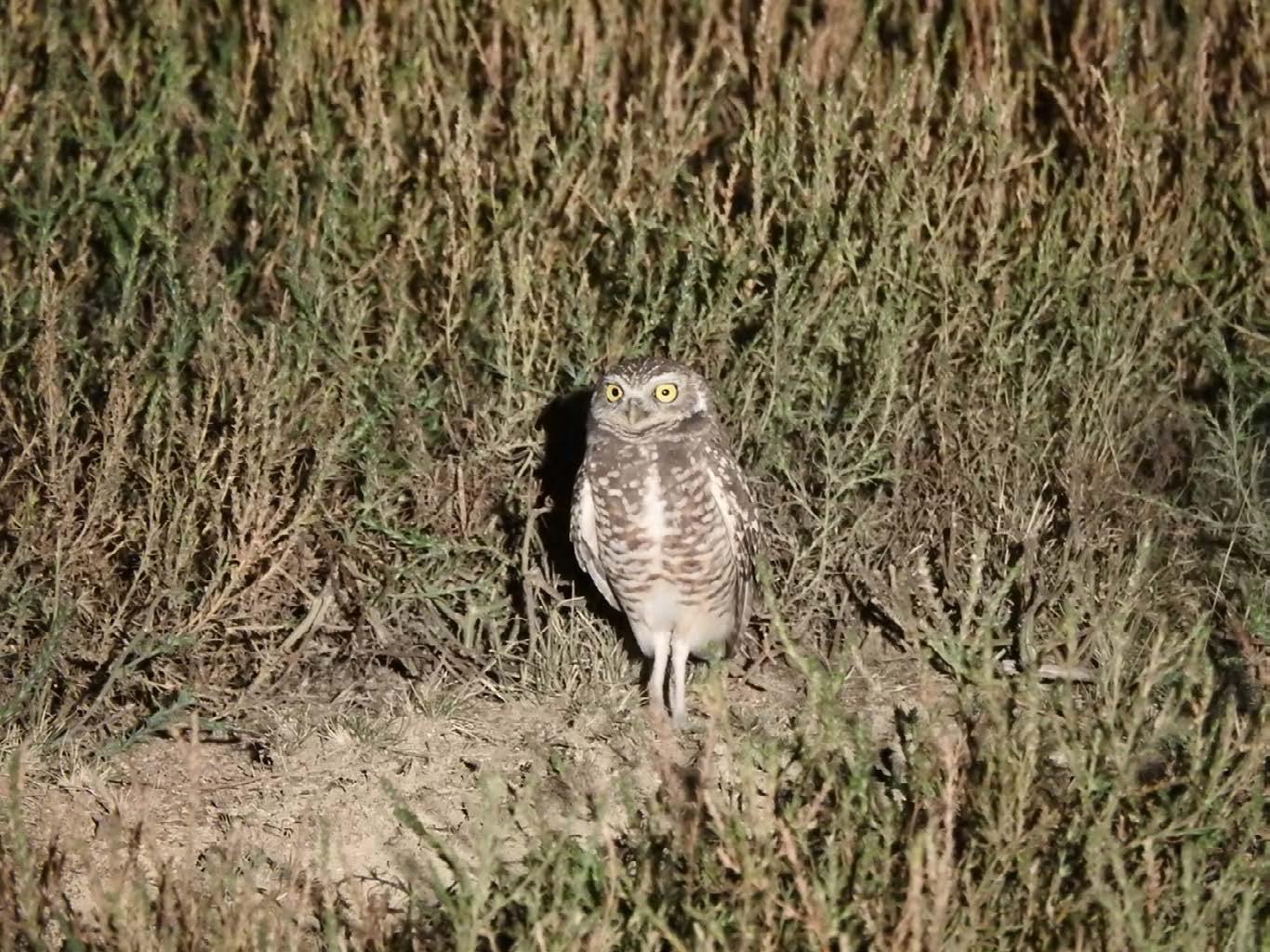
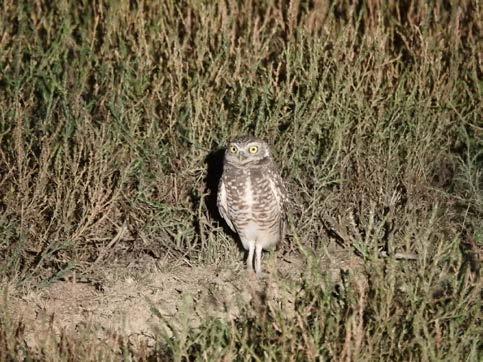
Photo “D” in WILD Masthead: Burrowing owl observed during the black-footed ferret nocturnal surveys in Kanas
Photo credit: Kimberly Grmusich
WILD Graphic Designer: Sam Fellner-Michiels
Environmental Services SharePoints
Check out the Terrestrial Wildlife SharePoint , Environmental Services SharePoint , Subject Matter Expert Search Tool, and RegUpPro SharePoint for more content, resources, regulatory information, and back issues of WILD.
US Terrestrial Wildlife Subject Matter Experts (SME), US Terrestrial Wildlife Technical Area Lead (TAL), and US Ecology Technical Discipline Lead (TDL)
Bernadette Bezy Technical Discipline Lead, Nevada City, CA
David Bart Invertebrates and Insects, Naperville, IL
David Bender East Amphibians and Reptiles, Overland Park, KS
David Plumpton West Birds, Redding, CA
Devin Couture Central Birds, Overland Park, KS
James Kiser Central Bats, Louisville, KY
Jared Elia West Wildlife and Renewable Energy, Walnut Creek, CA
Jessica Costa East Birds, East Wildlife and Renewable Energy, Topsham, ME
JT Layne Central Wildlife and Renewable Energy, Overland Park, KS
Katrina Bélanger-Smith Mammals, Wildlife Crossings, Walnut Creek, CA
Loni Cooper Mammals, Sacramento, CA
Rosalinda Vizina West Bats, Walnut Creek, CA
Sara Viernum Technical Area Lead, West Amphibians and Reptiles, Portland, OR
Scott Krych Butterflies and Moths, Woodbury, MN
Trevor Peterson East Bats, Topsham, ME
Please contact these staff for questions and assistance with these terrestrial wildlife-related subjects.