Thoughts, trends, and innovation from Stantec’s Buildings practice
Engage
Connecting with place
Our attention is valuable, important, and limited.
Screens
compete for our gaze at every moment.
We need spaces that inspire us at work. We need healthcare that welcomes us in. We need rooms that soothe and revive us. And we need shelter in extreme conditions. Design must work harder than ever to engage us.
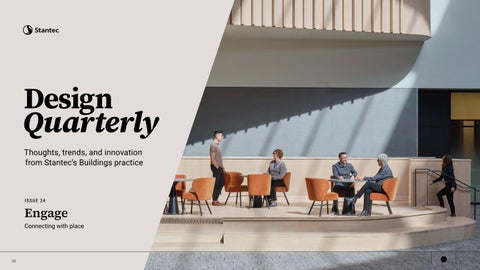
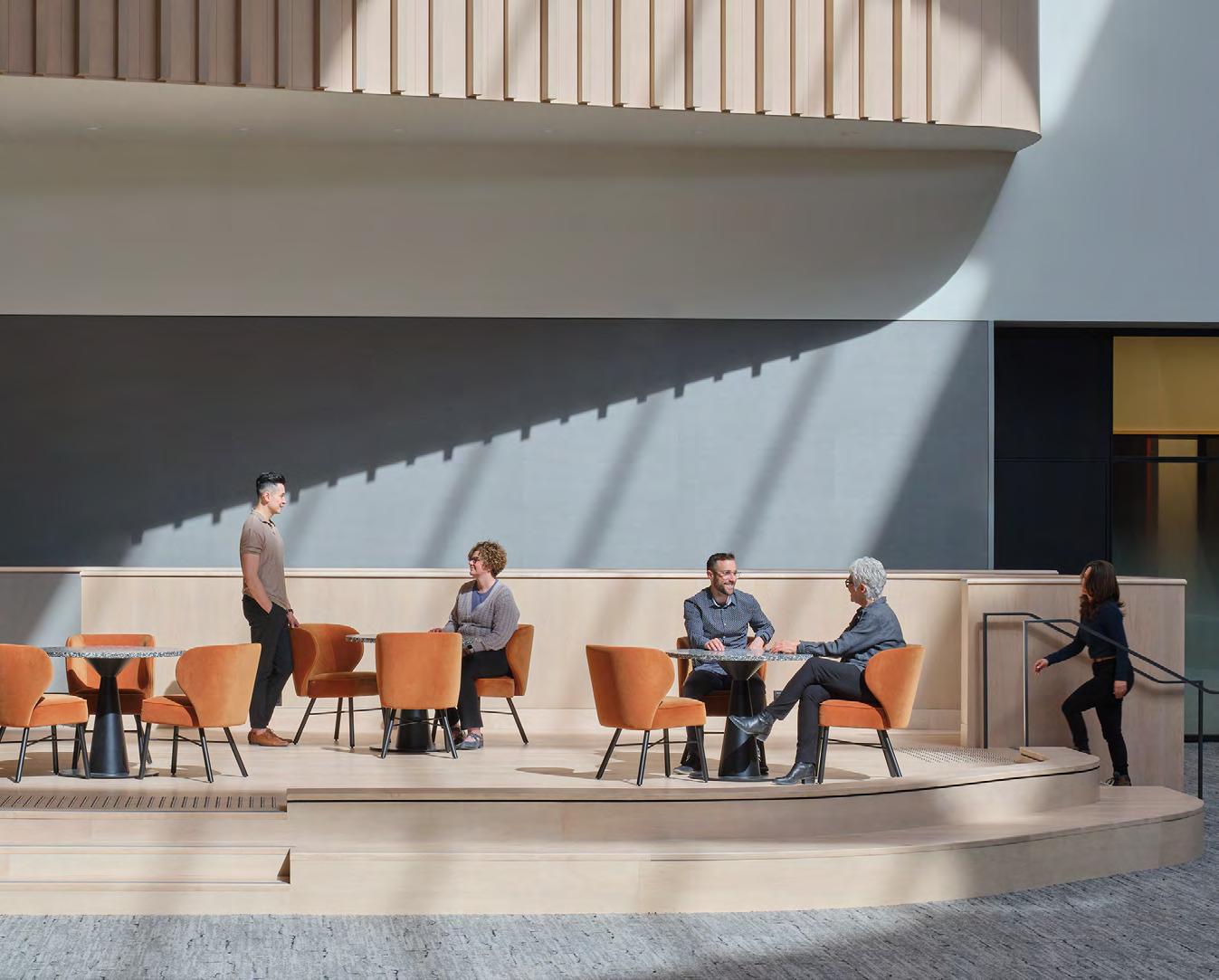
Front Cover and Right: BMO Convention Centre Expansion Calgary, AB Stantec Architecture Ltd. in association with Populous and S2 Architecture
Engage
Connecting with place
The Stantec Design Quarterly tells stories that showcase thoughtful, forward-looking approaches to design that build community.
With your reading experience in mind, we have built in easy ways for you to navigate this document. Use the bottom menu, arrows, and the table of contents to flip to different sections. Watch for information icons, arrows, buttons, and underlined hyperlinks throughout the document. They will lead you to more information.
Let’s Talk: Promoting Inclusive Dialogue on Affordable Residential Projects
By
Brian Crilly and Aeron Hodges
Housing affordability
is a major issue in North America. Some call it a crisis.
We’re seeing municipalities respond with a range of approaches to increase the supply of housing. Cities are changing their zoning. They are allowing more multi-family residential where they once promoted single family homes. We see more ADUs (alternate dwelling units) and TOD (transit-oriented development). Taller buildings and microunits are getting the greenlight. Approaches that increase density, supply, and affordability are catching on.
People are a critical part of the affordability conversation. We believe community engagement plays an important role in getting affordable housing right. Many local governments often have processes in place to gather community feedback, especially for
larger developments or those with an affordable component. But engagement can benefit any residential project.
Multi-family projects and affordable housing developers should take note; engaging with people in the neighborhood can elevate residential projects. We have seen firsthand how long-term community participation can speed approvals, enrich the design and provide better outcomes for the neighborhood.
To understand the importance of engagement, consider the consequences when community engagement is overlooked for residential projects, then look at the benefits.
Overlooking community engagement vs. its benefits
Unwelcoming vs. insight-driven
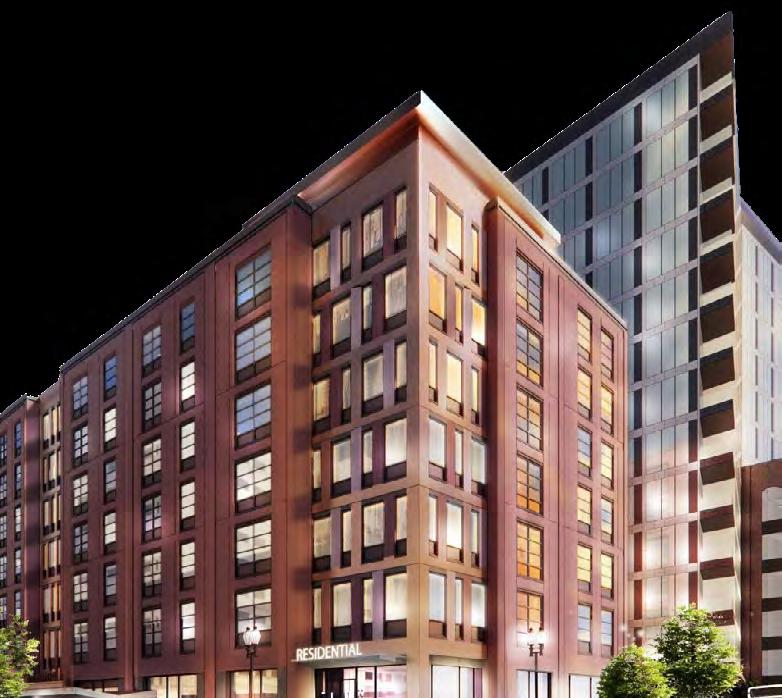
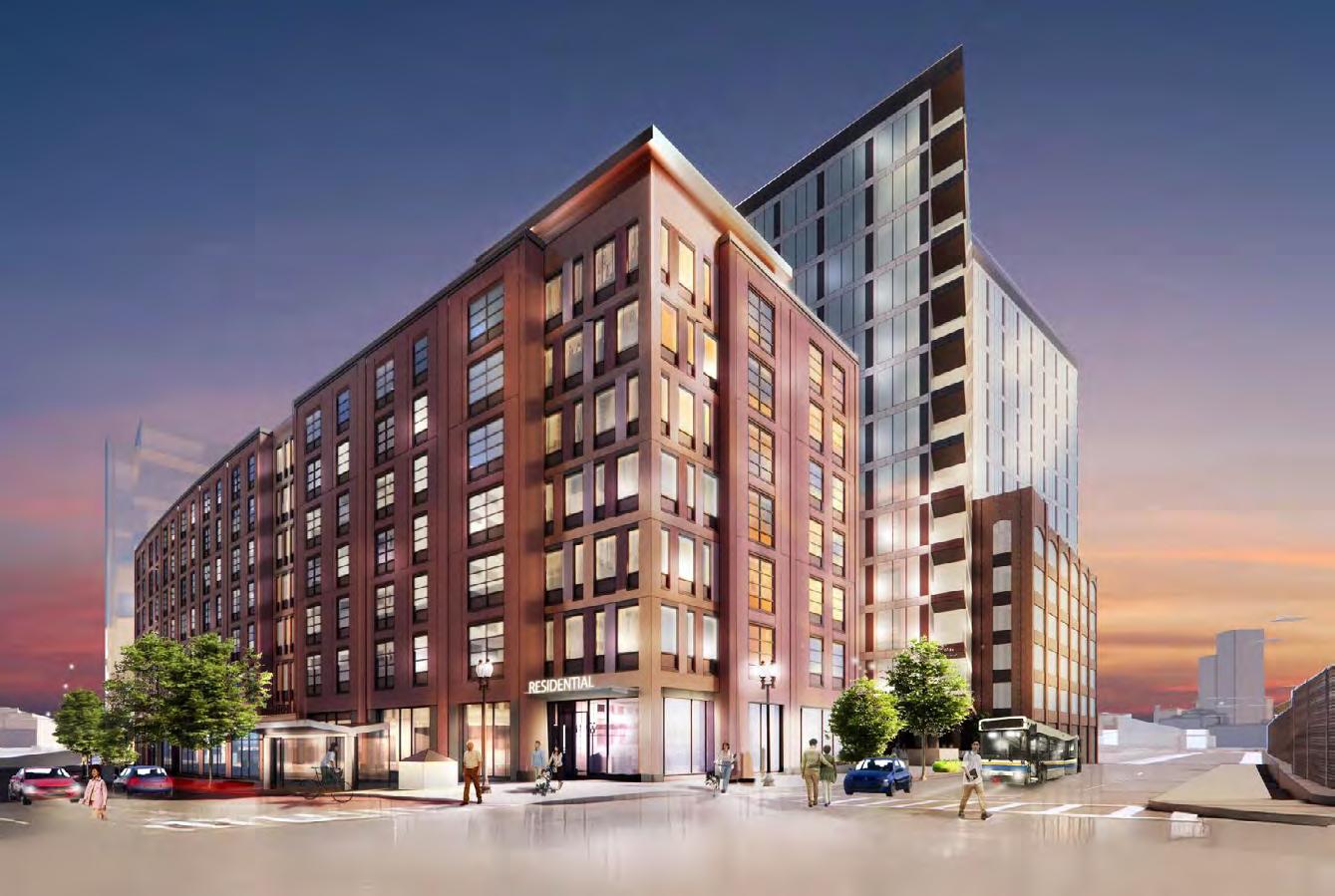
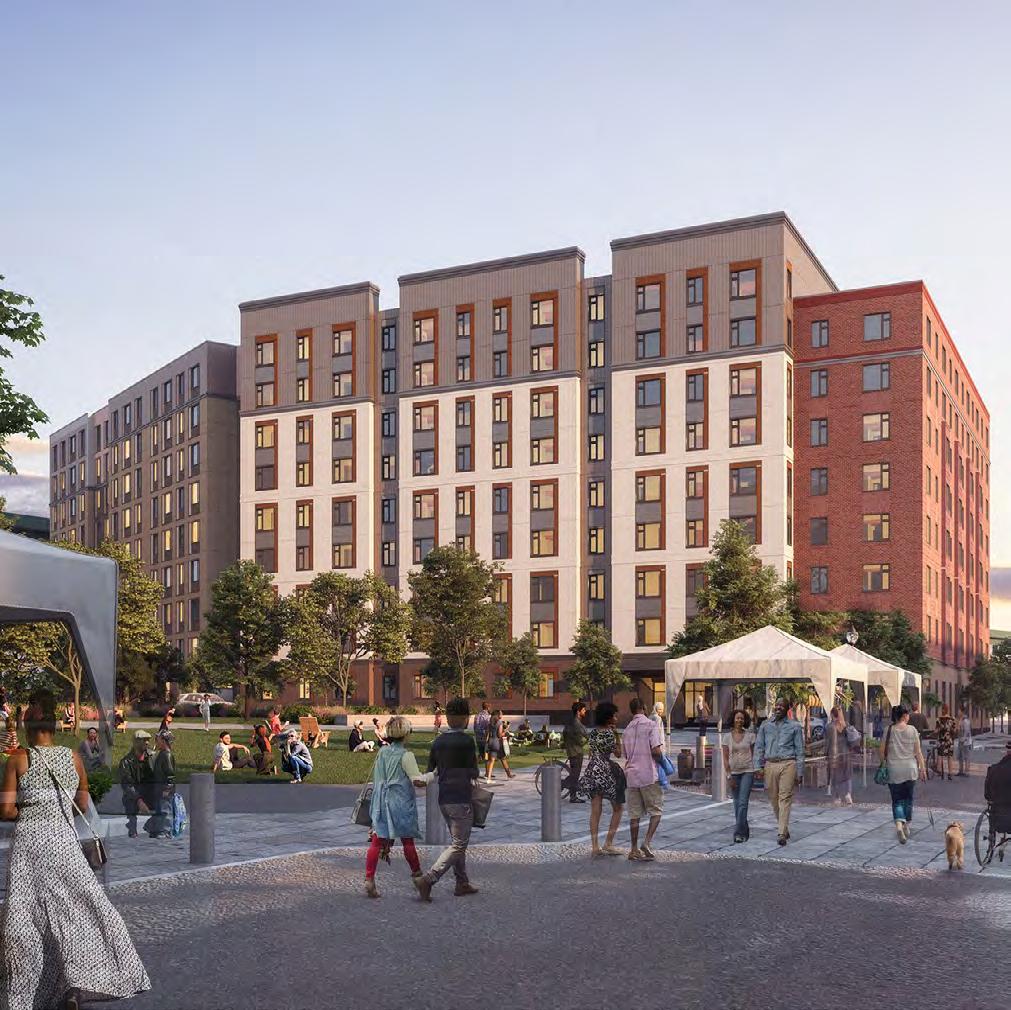
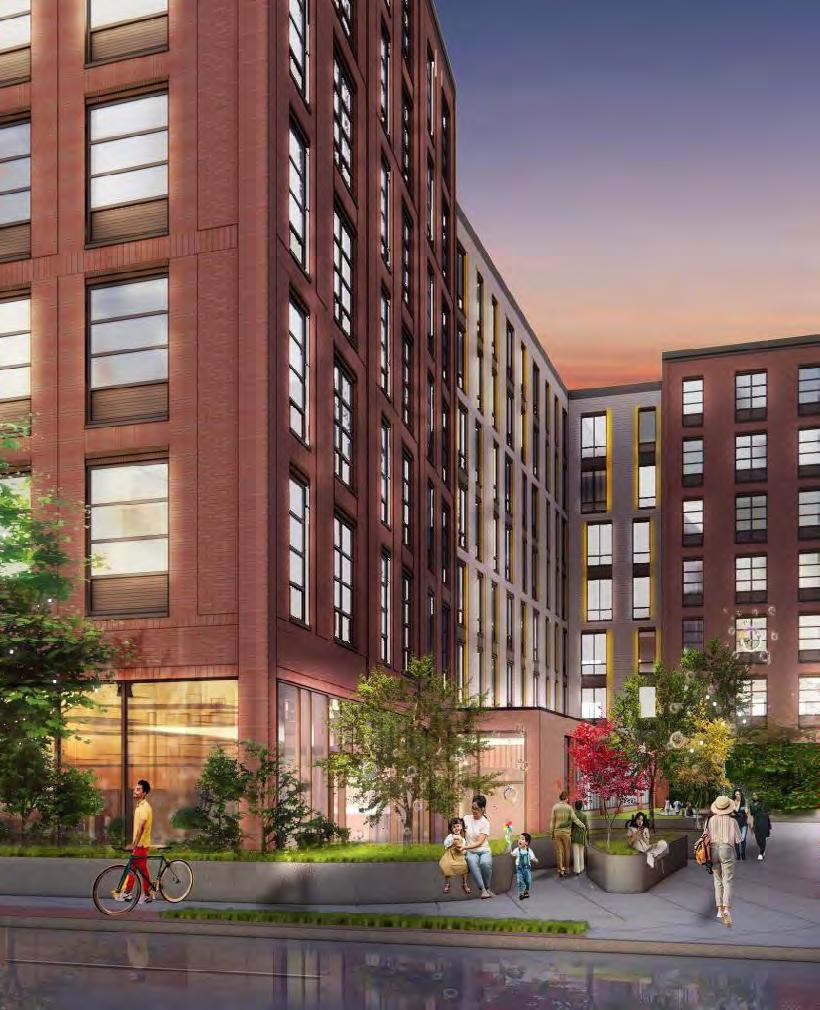
Without engagement, designers will miss insights from potential residents and community members. For example, a design may not address potential security concerns, leading to unwelcoming environments. Or it might not recognize meaningful aesthetic preferences. At Bunker Hill, the team’s engagement revealed surprising tastes in materials. Red brick had a negative connotation for some residents—they associated it with neglected housing projects of the past. With craft and care, however, we were able to design with brick. Residents were able to renew their relationship with the material.
Community engagement leads to designs that better meet the needs and preferences of the people who will use the spaces. The insights allow designers to tailor a development to the specific needs and character of the local community.
Reflexive opposition vs. informed partnership
Without engagement, the community can see a residential project as an imposition. This can harden a negative impression before design gets off the ground. Lack of communication can make it hard for projects to gain approvals and proceed smoothly. Engagement allows for a meaningful conversation. Community groups are often well-organized and have a deeply vested interest in successful development. They make good partners and allies.
At Bunker Hill, for example, the community was concerned with plans to increase density in an established neighborhood. It required careful listening, strong urban design concepts, and a thoughtful masterplan to address the issue. As a result of close collaboration with the community, we placed lower buildings near the neighborhood edge, and taller buildings further away to respect the scale of the existing neighborhood.
Mundane details vs. neighborhood vibrancy
Building amenities can make a real difference to residents. And publicfacing retail elements can add to the vibrancy of the neighborhood. Without much community input, design for the required affordable units, amenities, or retail frontage can be an exercise in cost-cutting. We’re looking for insights that will help us design features that enliven the street life of the neighborhood. And we want to design in the extras that residents want—pet washing stations, bicycle storage, or community gardens? Engagement helps designers tailor programming to the neighborhood and gauge support for retail offerings.
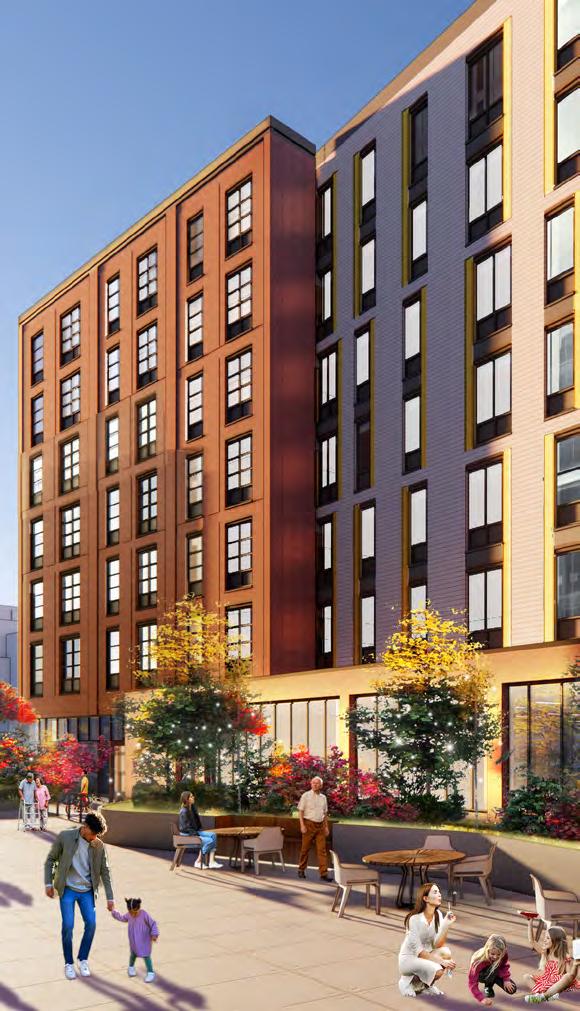
Neighborhood groups shared invaluable input during the approval process for 50 Herald Street at the edge of Boston’s Chinatown. They requested space for an Asian grocery store and more three-bedroom units to support larger families.
Disinterest vs. sense of ownership
Lack of engagement can reduce the sense of ownership that residential projects need for long-term success. Participating in the design process gives community members a sense of ownership. Whether they live in the building or not, we want locals to see the public-facing and retail components as part of the neighborhood.
Vacant spaces vs. market viability
Developers of multi-family housing should know that engagement can impact the bottom line. An illinformed design can require costly changes or retrofits later. Without the community perspective, developers have a higher risk of delivering a building misaligned with the marketplace. The result can be vacant commercial spaces and unleased residential units. Engagement impacts the financial viability of the project.
Effective community engagement should lead to development that meets the needs and desires of the target market. It can help sell housing and activate the neighborhood.
So, what are some practices we recommend for productive community engagement?
Develop a holistic engagement strategy
What are you hoping to learn from the process? Which groups are the appropriate community representatives and how do you communicate with them? And how much of the feedback that you’re asking for can you apply to the design?
Engage early
The better the information gathered at the project’s outset, the deeper the collaboration and the richer the design details. Time listening and engaging with the community, built into the project schedule, will pay off in the long run. From the start, the planning process for Bunker Hill included Charlestown Residents Alliance (CRA). The group represented existing residents in an engagement process lasting several years. They engaged in public meetings with the wider neighborhood, the Charlestown Preservation Society, and the City of Boston.
Create multiple contact points and opportunities for information sharing
Consider a multi-pronged approach to communication methods. Some constituents may be more digitally active than others. We suggest a combination of in-person and digital meetings, brainstorming sessions, and focus groups to gather community feedback. Variety delivers diverse input and comprehensive engagement.
Ask the right questions
Show, don’t tell
Look for feedback and real experiences, not a solution. Curate questions to be respectful of a diversified demographic. Understanding that the outcomes of our outreach may or may not be varied, we have a better chance of evaluating feedback received through a more inclusive or specific lens.
While terms like density and walkability are common for designers and planners, they may not connect with the public. Rather than present abstract concepts, demonstrate what density, affordability, and walkability mean in daily life. Show a walking map of the neighborhood, for example. We can show how density supports more businesses, increases the tax-base, improves infrastructure and safety. That type of messaging helps spur more meaningful engagement.
Make it visual, inclusive, and interactive
Consider visuals that will resonate with the community and allow for a reaction and consider ways to show multiple options that reflect community priorities. Can we create images in real-time based on live feedback? We are already using AI and virtual reality in this way for some of our projects.
“Time listening and engaging with the community, built into the project schedule, will pay off in the long run.”
Gamify the experience
Record, collect, and evaluate the data
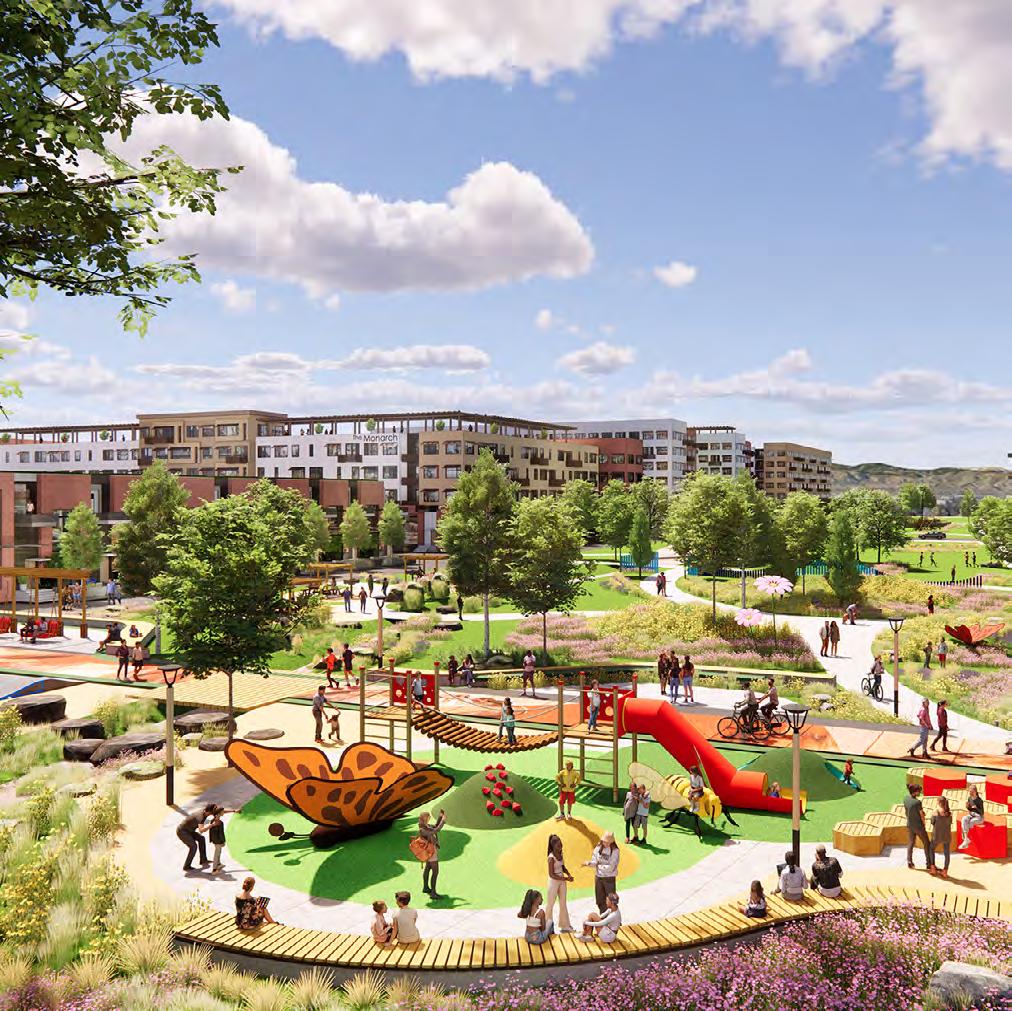
We can use customized games in engagement sessions to show the options and trade-offs available in development. In Denver, CO, for example, we created an interactive game to use in engagement sessions. Gameplay gave community members a chance to suggest programmatic elements for the redevelopment of the Park Hill Golf Course. The game allowed our collaborators to see the possibilities and trade-offs available in the redevelopment.
Engagement is valuable. It’s fuel for creativity. So, how are we capturing the data from our interactions with the community? Digital questionnaires? Design workbooks? Or an analog idea box? And who is sorting through the material and finding the key insights that will shape the design? It’s important for us to have a method for harvesting this collaborative data.
Partner with engagement experts
Incorporate the results in the design
There’s an art to collaboration. And designers who have deep experience collaborating with users and drawing out their wants and needs are well-suited to guiding these long-term engagement programs.
It should be understood, but we should design with what we’ve learned in engagement. Everything we discover through the outreach, engagement, and evaluation processes can inform our design concepts and the project itself. Community feedback had us revise the unit make-up for a residential project in California. Neighbors wanted a building that connected to its surroundings. We reduced the number of two-bedroom and efficiency units in favor of studios and one bedrooms. And in lieu of building amenities or ground floor retail, our revised design offered better access to outdoor spaces.
Gameplay gave community members a chance to suggest programmatic elements for the redevelopment of the Park Hill Golf Course.
Park Hill Golf Course Master Plan, North Greenway Denver, CO
As designers, we know the importance of engagement. It’s our mission to listen with empathy and synthesize community needs with programmatic reality. Engagement is critical to our information gathering. Our role is to transform that data into something that’s functional, beautiful, and financially realistic.
Designing affordable residential projects is a rare opportunity. It’s a chance for multi-family building dwellers to work with design professionals to create a home from the ground up. It requires a lot of thoughtful design to rein in a large-scale building, so it feels like a good neighbor. With the right touch and input, even mega block programs can fit seamlessly into a neighborhood.
In our residential design practice, we’ve seen the value and the result from productive community engagement: it makes better residential projects. Engagement is critical to designing multi-family projects to address the need for affordable housing.
“It requires a lot of thoughtful design to rein in a large-scale building, so it feels like a good neighbor. With the right touch and input, even mega block programs can fit seamlessly into a neighborhood.”
Based in Sacramento, architect Brian Crilly focuses on residential, workplace, and civic design and architecture.
Aeron Hodges strives to deliver design for high-quality, market-rate, affordable residential communities.
Who Needs a PurposeDriven Workplace?
Warning signs that the office isn't working and the benefits of getting it back on track
By Jennifer Nye and Stephanie Wood
Remember the office?
The pandemic accelerated the remote work experiment, giving way to more recent hybrid work arrangements and back-to-theoffice mandates.
Chaos or crickets?
From empty seats to the ‘Hunger Games’ of finding and reserving a workspace, the struggle to make the office environment effective is real. Employers are grappling with a myriad of issues, from workforce dynamics to workplace logistics. Organizations worry about underutilized spaces and are uncertain about the effectiveness of hybrid work models. They want their employees to be engaged and motivated when they come into the office and need spaces that can adapt to unpredictable changes.
Employers are wondering: What is the purpose of the office? What can it do for the company? Why invest in physical space if our workforce has gone remote? How much should we spend?
Workers are asking: Why should I go back? What’s the value in the office? Who is coming in and when? Why does this space mean anything to me?
Where has the pendulum stopped?
There is no new paradigm, the workplace pendulum is still swinging and will likely never stop. The indecision about the office is understandable. But there is a way forward. Where the pendulum settles for employers depends on the unique needs of the workplace. To get the best value from their space, it must be an intentional purpose-driven workplace that meets the needs of their people. It should be able to adapt to an inevitable ‘swing’ in the future.
After years of change in the workplace, both employers and workers are looking for answers. But first, we must learn to ask the right questions. Rather than asking “What should the office look like?” we should instead be asking “What should our office do for us?” If purpose is the driving force behind employee engagement, shouldn’t an organization’s physical space reflect that motivation? The answer is simple: every space must work to support the business, operations and people of an organization. That’s the definition of a purpose-driven workplace.
Marquee Development Chicago, IL
Why invest in the purpose-driven workplace? Because engagement matters.
Talent is everything. Attracting and retaining talent can make or break an organization. People have a need to belong. Professionals want to see their efforts as part of something bigger and more meaningful. Organizations that foster a sense of belonging in the workplace will attract and retain talent.
Engaged talent is willing to go the extra mile. Engagement and productivity reinforce and multiply the other: when you are passionate about your work, you can achieve more. When you achieve more, you are more satisfied.
Research shows that a high level of engagement is profitable. Gallup’s State of the American Workplace1 reports that “companies with higher engagement are 21 percent more profitable and have better financial outcomes overall, outperforming the S&P 500 after a year.” And a Microsoft 2 analysis from 2023 comes to a similar conclusion; engagement matters. Work environments that foster a sense of purpose and belonging will deliver benefits in talent recruitment and productivity.
The decisions employers make about the office and its use directly impact the success of the organization. The workplace impacts culture, workflow, productivity, attraction, and retention. And all of these influence the bottom line.
Research shows that a high level of engagement is profitable. Gallup’s state of the American workforce reports that companies with higher engagement are 21 percent more profitable and have better financial outcomes overall, outperforming the S&P 500 after a year.
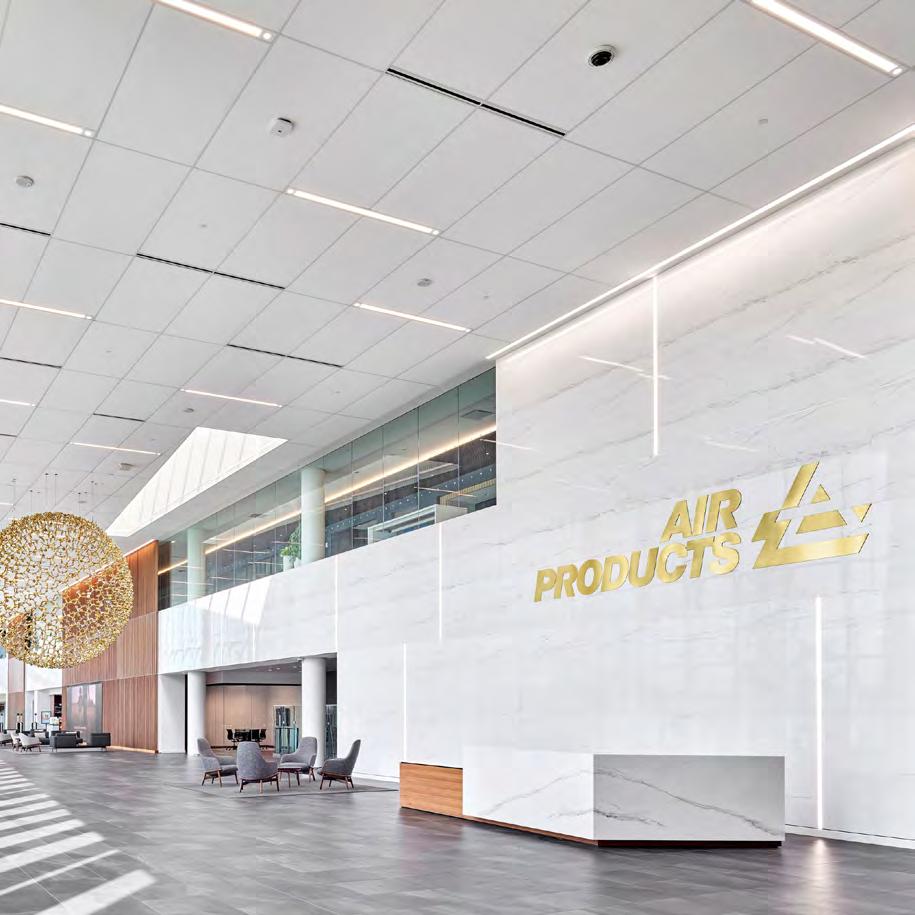
Air Products – New Headquarters Allentown, PA
What are some red flags for a workplace that isn’t driven by purpose?
Unresponsive space
The workplace consists of identical workstations. It doesn’t consider the diverse needs of different groups or tasks. It lacks a variety of spaces, such as call rooms, small meeting rooms, and collaborative areas, which support various work modes throughout the day.
We’ve seen companies consolidate into smaller footprints, sized to an average number of desks they require. They think, “we can fit in there because of our hybrid schedule.” They haven’t defined a vision around the work they expect to do each day. They haven’t recognized the different groups that work there and their needs. They miss the mark with this approach.
One client we worked with recently was having problems with its existing space. Over several decades, it had modified its office. The office had become a Frankenstein monster; it no longer served the client well. Staff couldn’t find conference rooms. They were arranging their own workstations and 60-inch-high panels into makeshift meeting “rooms.”
Low engagement
Frustrated users
Employees struggle to find suitable areas for their tasks, leading to frustration and lost productivity. Without clear guidelines or expectations on how to use the space, they are stuck with a chaotic and inefficient work environment.
Employees are not motivated to come into the office. They question the value of being there. And the organization hasn’t shared how the space and workplace supports its core mission. Imagine that you come into the office and it’s a-free-for-all, a sea of workstations. You’re not able to sit with the people you collaborate with. You’re in a space that is loud even when you need a focus space. Without a coherent plan or a variety of spaces designed for you to move through, you might wonder well, why am I here at all? If any of these indicators sound familiar, you may need a more intentional and purposedriven workplace.
Help! Employers are struggling with a myriad of issues around the workforce and the workplace. They want to use their space efficiently. Organizations are worried about the underutilization of their current spaces. Some are focused on how to consolidate their real estate to save money while still meeting the needs of their employees. Others, however, are finding they are outgrowing the shrunken spaces they took on when remote work was the norm.
They want to boost employee engagement. Employers want to ensure people are engaged and motivated to come into the office. They want the office to satisfy the needs of their people.
They’re navigating hybrid work. Many companies still offer some mix of flexible and on-site work. Naturally, they’re concerned with how to effectively implement hybrid work models. They need to know the right mix of spaces and how to support employees working both remotely and in the office.
They don’t want to get locked in. Many firms today are dynamic—they scale with their opportunities for growth. So, they are naturally drawn to spaces that are flexible enough to accommodate change. Change can come from future growth, consolidation, or unpredictable changes in work patterns or the marketplace.
What does a purposedriven workplace do?
It aligns with organizational vision.
The workplace should reflect and support the organization’s mission and goals. In designing the headquarters for Air Products, our client had a vision: support various work modes and foster personal connections among its staff. It wanted the ability to separate the workplace from community space. Air Products envisioned the community space as a vertical neighborhood for connection, collaboration and socializing.
It supports specific operations and workflows.
The design of the workplace should be intentional, with spaces created to support specific functions and workflows. We can put some intention behind the spaces in the workplace, their design, organization and expectations around using them. Staff feel supported in their roles.
It supports individual and collaborative work.
Workplace design should meet the diverse needs of employees, allowing for both focused individual work and collaborative activities.
We designed the Air Products headquarters with a highly collaborative public main street and private neighborhood spaces. Open staircases connect the vertical neighborhoods. The idea is that people constantly need to get up to move if they need to meet or focus on a task. This supports well-being. They can choose their environment. It’s close by.
It enhances employee engagement and well-being.
The environment should foster a sense of purpose, belonging, and well-being among staff members, encouraging them to feel part of a larger effort.
Design can enhance workplace culture. If you are sitting in a place that supports your needs, going in on similar days as your collaborators, you suddenly feel a part of a bigger picture. You can see what you’re contributing to. The workplace makes sense. People are attracted to feeling a part of something bigger than themselves and that they’re making a difference.
Air Products – New Headquarters Allentown, PA
It accommodates change.
The workplace should be flexible enough to accommodate changes in work patterns and future growth, providing a variety of spaces that can be used for different purposes. It comes with expectations.
There should be clear guidelines on how to use the spaces effectively, ensuring that employees understand the purpose of each area and how it supports their work. We saw the importance of expectations when Stantec consolidated multiple Colorado offices into a single workplace in Denver, Colorado.
Initially, the space was overcrowded. A lack of clear guidelines was causing frustration. Team members didn’t know which spaces were meant for which tasks. The new space was appealing but needed to accommodate more people and added an extra floor which prompted a new strategy. We developed a new workplace strategy which featured guidelines that identified expectations for space use. This led to better collaboration and a stronger sense of community.
Sometimes, we can realign expectations by simply helping staff understand how the space supports their workflow or by moving things around during an office reconfiguration. Other times, a redesign is required.
It offers opportunities for mentorship and collaboration.
The workplace should facilitate interactions, mentorship, and collaboration among employees, enhancing their overall experience and productivity. These elements work together to create a supportive and engaging environment that aligns with both organizational goals and employee needs.
The vertical neighborhoods at Air Products feature various settings where people can meet and collaborate. This includes open and closed spaces, different postures, and room sizes, The design clearly separates public and private areas. Studies show mentorship can be a big draw to the office. The space fosters a workplace culture that encourages face-toface contact and personal contact that remote work can’t offer.
It supports an ecosystem.
The purpose driven workplace thrives as a result of a well-balanced ecosystem. There’s no one-size-fits-all solution to today’s workplace needs. It depends on a well-designed space, clear expectations, and supportive workplace culture.
The purpose driven workplace does not happen by chance. We need to develop it through an intentional process that asks the right questions and considers the whole organization.
To learn more about creating a workplace strategy for your organization, read “ Discovering The Purpose Driven Workplace” at Work Design Magazine.
Workplace consulting market leader Jennifer Nye delivers client-centric strategic design from our Philadelphia office.
US workplace strategy lead Stephanie Wood helps create work environments for companies to support vision, culture, and productivity.
Better data and culturally-savvy design can enhance healthcare outcomes for all Hawaiian islanders.
By Marni Tam
Promoting Health Equity in Hawaii in
the Spirit of
In Native Hawaiian culture ‘Ohana means embracing the wider community as family and making sure no one gets left behind. In the spirit of ‘Ohana, we can further health equity in Hawaii.
By some measures, Hawaii is the healthiest state in the union. It takes the top spot on US News rankings for April 2024.1 And it’s number two on the Commonwealth Fund’s 2023 state rankings.2 Yet access to health and health outcomes is a significant issue in Hawaii. Publications use aggregated data to make the rankings, and this obscures a significant issue; Hawaii’s health inequity is among the most extreme in the United States.
When we break down health outcomes into categories such as cultural values, socioeconomic status, and race and ethnicity we see a dramatic disparity in health needs and outcomes. Research by KFF3 shows that Native Hawaiian or Pacific Islander (NHPI) people in the United States experience substantial disparities in health and health care. And research by the University of Hawaii4 shows that rural residents of Hawaii face significantly more health challenges than urban dwellers. A researcher at the
John A. Burn School of Medicine has shown that aggregation of NHPI and Asian data often misrepresents health issues and socioeconomic status. Bad data leads to inadequate responses.
Hawaii is not alone. There are numerous communities in North America where healthcare inequity is a significant issue. But Hawaii faces a unique set of challenges. By examining these roadblocks to health and looking at menu of solutions, both proven and experimental, we hope to illuminate opportunities for design to improve health equity and access. As architects and designers, we can be part of the solution in making Hawaii an equitable place for health.
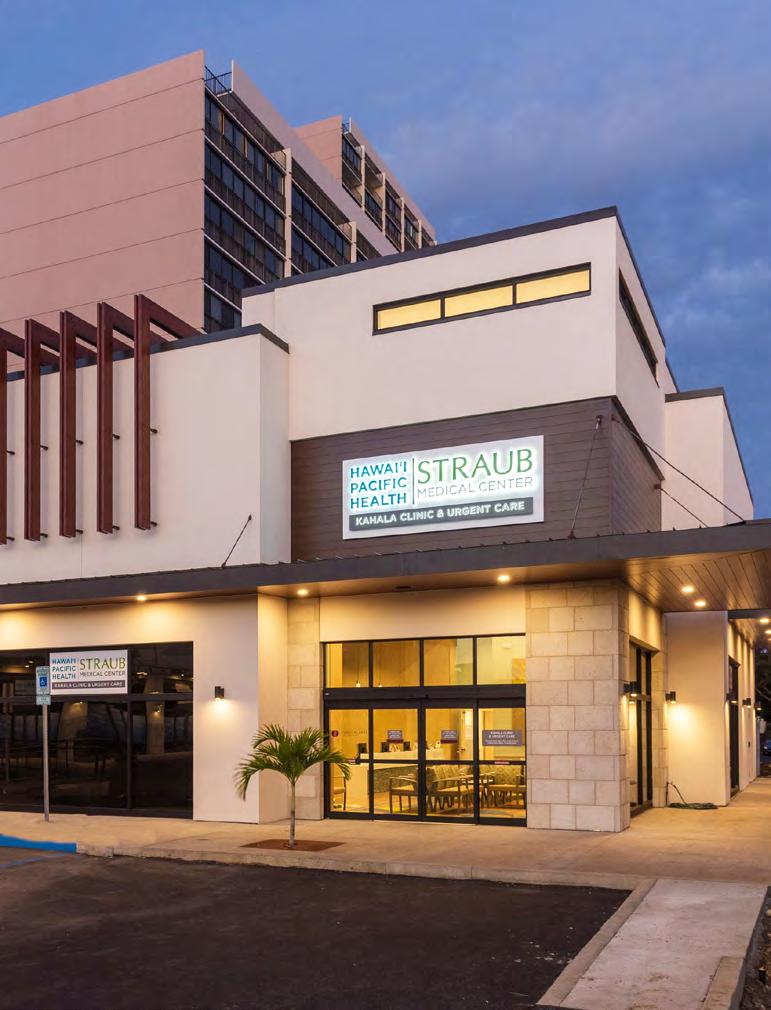
Straub Clinic and Urgent Care at Kuono Marketplace Honolulu, HI
1.4m People
Native Hawaiians and Pacific Islanders make up about 0.4% of the U.S. population
What’s causing health inequity in Hawaii?
Shortage of healthcare providers
High cost of living
2.5 x
Diabetes is a major cause of death in Hawaiian populations. Native Hawaiians are 2.5 times more likely to receive a diabetes diagnosis or die from the disease than white populations. The data shows that 39% of Hawaiians have uncontrolled diabetes.5
There simply aren’t enough doctors, nurses, and specialists on the islands to serve the population. There is a significant shortage of healthcare providers, especially in rural areas of the islands. The staffing shortage makes it difficult to provide adequate care to all residents.
Roadblocks to new facilities
47%
40% of Hawaiians considered moving out of the state in 2024 due to high living costs. The rate was higher (47%) among Native Hawaiian and Pacific Islander communities.6
The lack of staff and resources means that even when authorities identify the need for a new facility, there isn’t much appetite for building one. Staffing and equipping a facility are known challenges. Efforts to build new healthcare facilities can even face opposition. For example, an attempt to establish a second hospital on Maui failed due to concerns about staffing and resource allocation.
Goods, services, and housing in Hawaii can cost 1060% more than they do on the mainland. Rents are relatively high. Most things in Hawaii must be shipped in, making them more expensive than on the mainland. The inflated cost of living in Hawaii makes it challenging to attract and retain healthcare providers, further exacerbating the shortage.
19%
Native Hawaiian and Pacific Islander residents experience notably higher levels of stress and unhealthy days compared to White and Asian residents. These disparities are compounded by challenges in accessing affordable healthcare, with 19% of all surveyed residents reporting medical debt over $500.7
Geographic barriers
The Hawaiian Islands are remote. Travel between islands is usually by air. The smaller islands, such as Molokai and Lanai have limited flights. This makes it hard for many residents to get to the hospital, particularly in emergency situations. Patients on the neighboring islands often need to be medically transported via helicopter to a Level I trauma center on Oahu.
Cultural and socioeconomic disparities
Hawaii’s economic inequality shapes the healthcare outcomes for its people. Nearly one-third of its households experienced food insecurity in 2023. And hunger correlates with diabetes, heart disease, and health issues. Housing is expensive. Four in 10 lowincome Hawaiians are homeless or pay more than half their income in rent. Those dealing with housing insecurity tend to have more health issues.
All Access Ortho at Hale Pawa’a Honolulu, HI
Improving health equity
These challenges highlight the need for innovative solutions and targeted efforts from healthcare providers to improve health equity across the state. We’re interested in looking at existing approaches that show promise and innovative ideas that have yet to be proven and asking how design can contribute. Interestingly, we see a blend of low-tech and innovative tech making a difference here.
Healthcare
facilities that celebrate Hawaiian heritage and reflect the local culture are more welcoming. More people will use them.
Mālama I Ke Ola Clinic features a mosaic by local artist Monica Morakis.
Here are six approaches we believe can promote health equity in Hawaii
1. Community outreach and engagement
Healthcare providers can ally with influential community organizations. This outreach helps them build trust and make a greater impact. They can promote participation in health programs. They can increase preventive care. They can foster lifestyle changes. During the COVID-19 pandemic, this approach proved successful. Providers reached out to community leaders which increased vaccination rates in rural areas.
2. Culturally informed design
Healthcare facilities that celebrate Hawaiian heritage and reflect the local culture are more welcoming. More people will use them. Mālama I Ke Ola Health Center features a mosaic by local artist Monica Morakis. The center’s ‘olena logo refers to a medicinal plant brought to Hawaii by Polynesian voyagers. Throughout the clinic, visual elements such as canoes and native plants represent a holistic approach to care. In the spirit of ‘Ohana, Mālama health center promotes wellness and brings healthcare closer to the community.
3. Telehealth and virtual care
Expanding telehealth services to reach remote areas will reduce the need for physical visits. Telehealth increases the frequency of check-ups to head off chronic disease earlier. With inpatient staffing shortages, a model of innovative care is virtual nursing, which decreases physical demands on bedside nurses.
Mosaic in the Mālama I Ke
Ola Health Center Wailuku, HI
Artist: Monica Morakis
4. Technology integration and artificial intelligence (AI)
It’s happening everywhere; senior citizens are tracking their health with apps and smart watches. Young people do medical care through their phones and seldom set foot in a physician’s office. Those in remote areas can reduce the need for inconvenient in-person visits by wearing smart devices to monitor their health conditions.
AI driven medical technology promises to help treatments reach patients faster.
5. Smaller community clinics
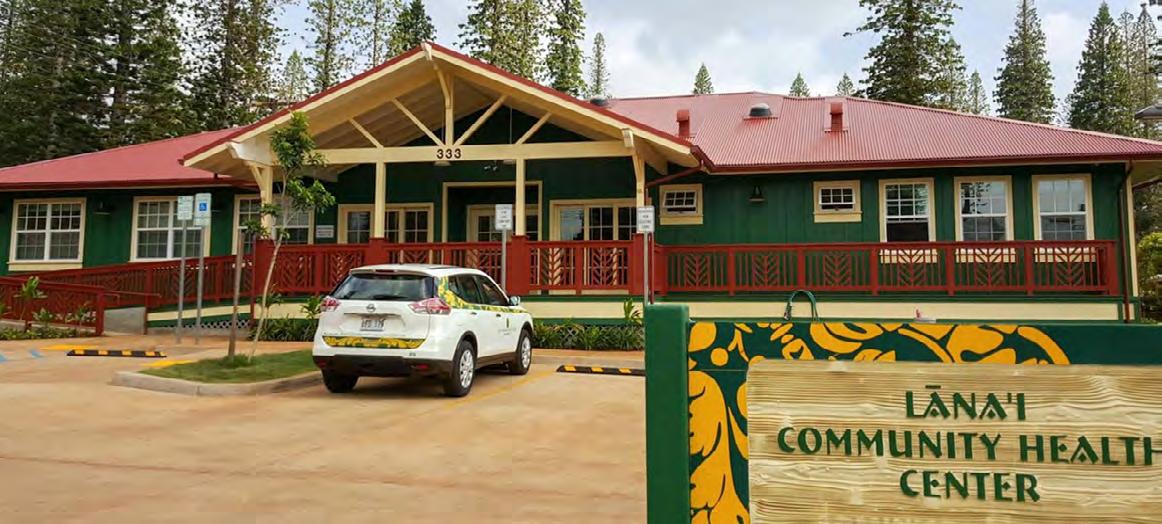
Convenience matters. The easier it is for islanders to access healthcare, the more they will use it. By placing smaller clinics in communities, we can reduce the barriers to access. We can make it less intimidating for islanders to get checkups. Neighborhood clinics can serve as multi-purpose community centers. They can offer wellness programs, preventive care, and activities. For example, the Lāna’i Community Health Center in Lāna’i City provides services from dentistry to behavioral health. It looks like a Hawaiian plantation home featuring a wide lanai. It has a medicinal herb garden and a large multipurpose room for community activities.
6. Disaggregating data
Better data can help counter structural racism and health disparities. If we don’t know a problem exists, we can’t act on it. We need data that shines a light on NHPI in Hawaii. By disaggregating the data about NHPI populations, we can see health disparities that have been historically obscured. For example, because research lumped Asian islanders in with NHPI populations, it was difficult for researchers to observe that NHPI people were experiencing worse outcomes for cancer.
The easier it is for islanders to access healthcare, the more they will use it. By placing smaller clinics in communities, we can reduce the barriers to access.
We believe these strategies can help Hawaii promote equitable access to healthcare. If we can place healthcare closer to home and make it more culturally relevant and approachable, we can increase access for all islanders.
Lāna’i Community Health Center Lāna’i City, HI
Photo courtesy of Lāna’i Health
Based in Honolulu, healthcare architect Marni Tam is passionate about creating quality patient care environments.
1. U.S. News
The Commonwealth Fund
KFF
University of Hawai’i New s
Ask an Expert: What is Building Automation Design?
Maria Campos, Automation Discipline Lead
Twenty years ago, the momentum in building automation was about advancing sustainability. Today, we expect building systems to be “smart.”
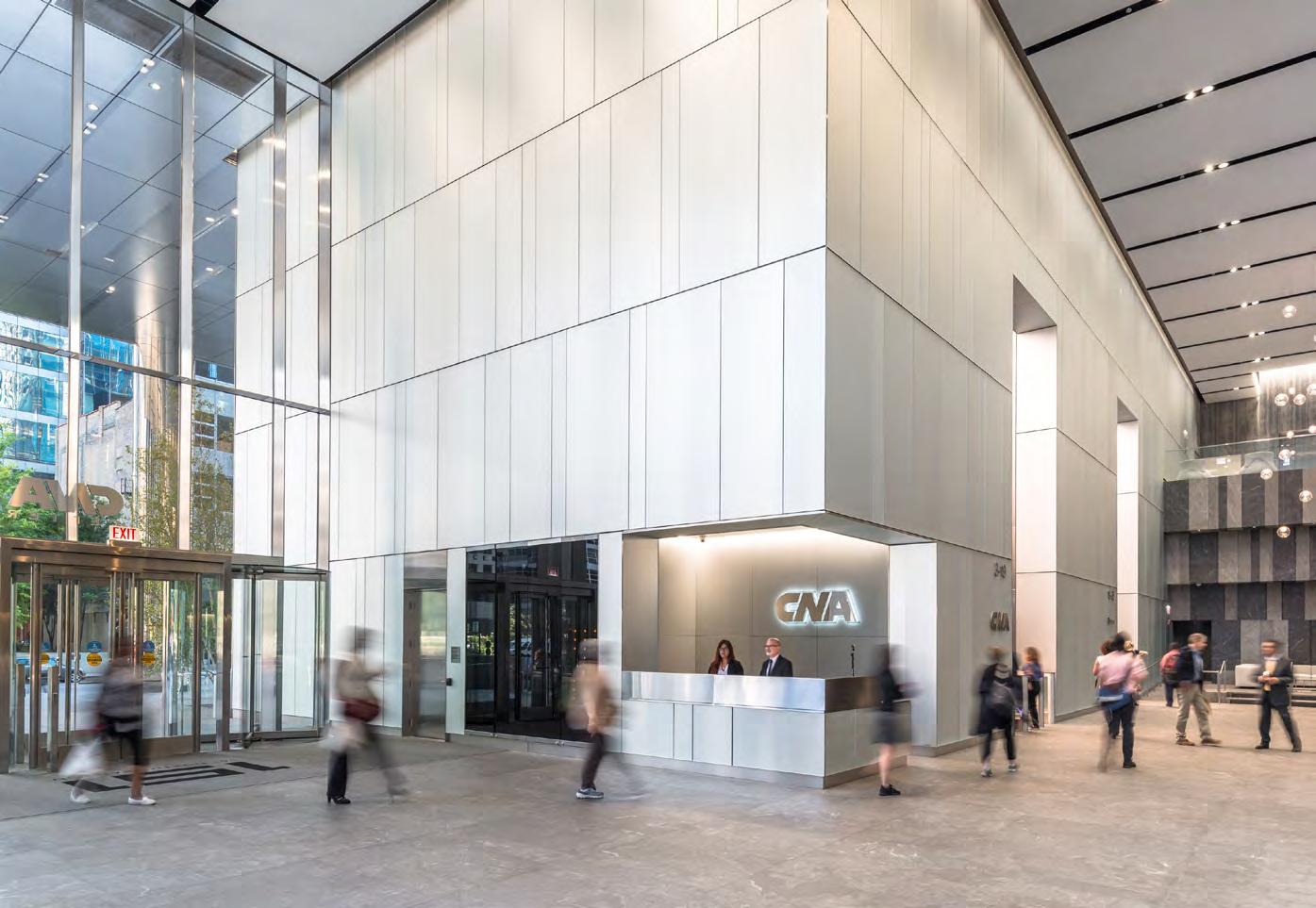
151 N Franklin Chicago, IL
Stantec delivered a Division 25 Integrated Automation specification detailing the interfacing of building infrastructure systems such as HVAC control, lighting control, metering/monitoring of MEP, fire alarm, and security. Stantec then led the design of the user interfaces for building management, tenants, and visitors to leverage that system integration and helped procure a utility incentive exceeding $330,000.
MARIA CAMPOS Principal, Automation Discipline Lead Chicago, IL
Operational technology (OT) can be fully automated in terms of security, lighting and climate control— that’s just for starters. Building systems can also harvest data. Builder operators can use this data for analysis and control. We chatted with Stantec’s automation discipline lead Maria Campos to find out more about the state of building automation and challenges to realizing its full potential.
Architect: John Ronan Architects, Adamson Associates Architects
What’s your role at Stantec?
maria campos: I’m currently the automation discipline lead. Our automation team is made up of roughly 20 individuals in Chicago and across the country that specialize in automated building systems, both DDC (direct digital control) and PLC (programmable logic control).
How do you define building automation systems? How is that different from building management systems?
mc: I’m a member of several technical committees within ASHRAE. And one of these committees defines these terms for the industry.
So, we asked the right expert?
mc: Ha, yes. The terms are used interchangeably within the industry. You’ll hear some people say building automation system or BAS and others say building management system or BMS, then there is EMS for energy management system. Technically, however, within the industry guidelines, building automation systems refer to all the physical components and software
that control components and systems within the building. Whereas the building management system is the overlaying graphical user interface that allows users to see what’s happening.
QHow did you get into building automation?
mc: I went to University of Illinois in Urbana Champaign for a degree called general engineering before it was renamed systems engineering and design. I took a series of controlsrelated courses and became a LEED AP, which got me interested in the buildings space. But it wasn’t until I interned with the building automation team at ESD, which is now Stantec, that I became familiar with the industry and the specialized area of automation services. One thing that helped me better understand automation was going out in the field and performing commissioning activities. I tested the equipment and systems to see how they integrated into an automation system. That informs how I design them.
Automation has changed a great deal over the last 10 years. Did you predict it would evolve so rapidly?
mc: Absolutely. It’s always been a dynamic and exciting space within the buildings industry. Now I’m inspired by how our services crossover. Automation is not just in buildings, it’s in water and energy and resources. It’s about seeing where the right opportunity lies for overlap in service offerings.
It’s always changing. Our services are impacted by technology. We need to keep pace with and think about emerging technologies outside of our industry and how we can incorporate those within our designs. Even technology that may not exist today. We can talk to vendors and manufacturers about our needs.
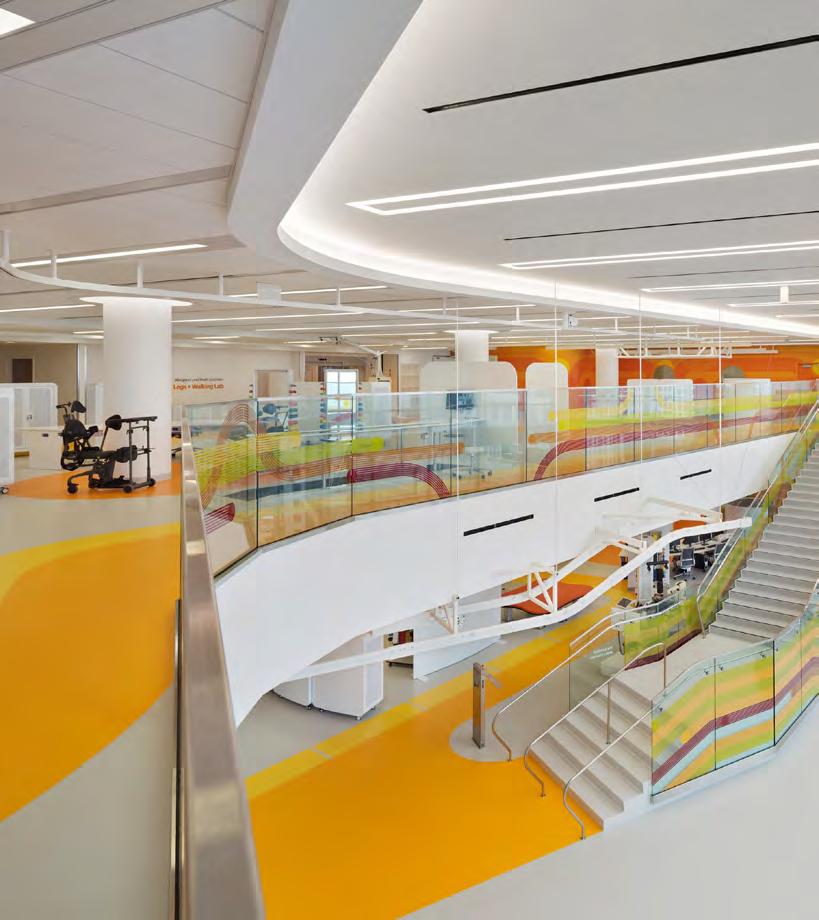
Shirley Ryan AbilityLab Chicago, IL
Stantec provided engineering consulting services for an innovation center at a leading research and rehabilitation hospital. We designed a system that offers power and data flexibility for unique items such as gait tracks. Wall sensors monitor patient walks and gauge steadiness. Architect of record: HDR Gensler
How has building automation changed?
mc: Traditionally, heating and cooling equipment has been the primary focus of building automation systems. But it’s a lot more than that today. Now, we expect a building automation system to bring together multiple operational technology systems—lighting, electrical, technology, security, and domestic water systems, even secondary fire alarm.
Because we’re bringing all those different systems together, we have this opportunity for two-way communication between those systems to make decisions and provide actionable insight. We can choose to control an HVAC system a certain way depending on the occupancy within the space. It might be the Wi-Fi system that’s giving us occupancy data. The value comes in providing use cases that drives bringing this data together.
QAre you finding that the clients are more aware of what’s possible in terms of automation? Or do you need to show them what’s possible?
mc: It’s definitely both. Clients are more aware of what’s possible within the space. They want to take advantage of new technology to improve energy efficiency, sustainability and user satisfaction within their spaces. But there is also a big need for us to educate clients. Because it can be overwhelming for them. There’s so much technology available and so many ways we can implement it. Our role includes guiding them to find the best fit.
QWhat is the biggest challenge to implementing building automation?
mc: The building automation space is well solidified in the marketplace. Building automation systems have been around for so long. People think, hey, I need an electrical power monitoring system. Well, I’ll just integrate that into the building management system with one user front end for everything.
However, many people are approaching automation projects today the same way that they did 20 years ago. But there’s a lot of new technology and approaches that we’d like to implement. And to do so, it means we need to change the approach we take on projects.
The buildings industry often follows traditional contracting methods. These methods don’t favor innovative system designs or even allow for conversations about implementing them. For us to combine innovative building systems, we need to discuss that with the client before the foundation is poured. Once a project starts, it’s almost too late because now you’re under schedule and budget constraints. The scope has been defined.
So you need to talk very early on to change up the paradigm?
mc: For sure. You may change the contracting structure for the project so you can implement certain systems. You may want to bring in a master system integrator partner early on. If we’re designing a project, we want to evaluate technologies and bring ideas to the table as early as possible. The solutions we surface will impact every discipline on the project and procurement. The industry has been hesitant to change project execution. We must push for change when it’s in the best interest of our clients.
attention. Automation systems can deliver significant sustainability benefits. For commercial or mixed-use spaces, the benefit is in user experience or satisfaction that will attract tenants to buildings. We’re also finding ways to help clients with their day two operational needs.
What does day two mean?
What makes the client say ‘yes’ to more robust building automation?
mc: That differs depending on the market we’re talking about. On the mission critical space, the value is in speed to market. The client wants the data centers built efficiently with reliable systems. They see value in engaging with all their partners as early as possible.
The conversation in the commercial building space or healthcare facilities is totally different. If we can show them they can save money or attract top talent and tenants by implementing a certain technology, that attracts their
mc: It’s not enough for us to integrate these systems together and expect that the client will naturally know what to do with the data from these OT systems. Someone must do something with the data. Who is using it? Basing decisions on it? Is the data customized for what they need? If not, there’s no value in them.
We’re integrating systems together to function on day one. What happens on day two? How are the systems being maintained? Are they going to be updated to work with each other?
When we’re implementing a new technology or functionality within a building, there’s two things I think about: One has the client committed to adopting certain processes internally to support it? If not, can we better adapt the technology to fit the processes they use today? We must think about day two when we’re designing for day one.
If we’re designing a project, we want to evaluate technologies and bring ideas to the table as early as possible. Because solutions that come out of that will impact almost every other discipline on the project.
QSo, building automation is much more than sensors?
mc: Yes, it’s more than just the physical sensors. The solution is a platform that maximizes the potential of a facility in terms of operations and experience. When you bring all these building systems and their data together to solve a problem, one challenge is solving interoperability to achieve that goal. The goal may be to improve user experience in the space, or to meet their energy and sustainability goals. Usually, we listen to them, understand their needs, then look at the available technologies and approaches. Then, we design solutions.
Based in Chicago, John Dugan edits the Design Quarterly.
Sensory-enabled architecture isn’t just for hospitals. It’s for everyone.
By Nate Hawley, Gwen Morgan, Stephen Parker, and Bridget Rice
When we design for multiple senses, we enhance well-being.
In sensory-enabled architecture (SEA), we design for human touch, scent, sound, and taste in immersive environments. We approach the user experience from emotional, psychological, and cultural perspectives. We can use SEA to promote mental health and well-being in a variety of settings. Based on our explorations of SEA environments, we developed a portable prototype of a multi-sensory space called the ZenDen. We’re using the ZenDen to demonstrate SEA to clients and collaborators.
In our mental and behavioral health practice, we regularly design sensory environments. But it isn’t just healthcare spaces that need to support wellbeing. Our team also collaborates on sensory spaces for workplace, community development, and education.
SENSORY-ENABLED ARCHITECTURE (SEA)
Immersive, experiential environments designed for the entire sensory spectrum
Why are we interested in SEA?
Our experience in neuroinclusive design for behavioral health inspires our approach to SEA. In our sensoryenabled design, we design rooms that offer different levels and kinds of stimulation. Restorative multisensory spaces can offer individuals the opportunity to self-regulate or take a mental health break. And we can apply SEA at various settings and price points.
Key aspects of sensory-enabled architecture
Research Informed
The design is informed by research.
Refuge and Safety
Multi-sensory design gives the user a sense of comfort and safety. The materials, furniture, and spatial arrangements in the space promote relaxation and reduce stress.
Neuroinclusive
Sensory design is for everyone. It should be inclusive and accessible.
Sensory design is for everyone. It should be inclusive and accessible. It should consider and provide for a wide spectrum of sensory needs and preferences. The multi-sensory spaces we design cater to a range of hypersensitive and hyposensitive needs.
Agency and Autonomy
It’s customizable. Users have the ability to control and customize their environment. This enhances the multi-sensory experience and personalizes it. They can tune the lighting (temperature and color) or adjust the soundscapes and olfactory stimuli (e.g., the smell of rain).
Iterative and Flexible Design
Nearly 60 million American adults (23.08%) experienced a mental illness in the past year 1
SEA is experimental. Therefore, it should be iterative and flexible, allowing for continuous improvement based on user feedback, changing needs, or evidence-based best practices. This allows us to adjust the design to fit the setting and application.
Starting with research
Recently, we explored using SEA for student mental health. We partnered with the Department of Interior Architecture at the University of North Carolina – Greensboro. Our study created a space informed by our experience designing with neurodiverse considerations. Our team turned an old office on campus into a psychologically safe and supportive environment. We designed it with various levels of stimuli and engagement.
On a minimal budget we combined interior design elements, from murals and wall-dividers to a water feature and swing chair, with individually tunable lighting and sound. The goal was to discover if attainable design interventions could positively affect student mental health, while reducing stress and anxiety.
We surveyed an array of students on their experience. The research results were promising. They showed us that individuals appreciated the ability to tune their environmental lighting and sound to improve their mood and reduce their stress.
This experiment at UNC Greensboro was exciting and productive. It left us asking more questions about the possibilities for multi-sensory environments. We assembled a collaborative team drawn from the education, health, and ViBE (Visioning, Brands, and Experience) teams at Stantec. We wanted to leverage our expertise in sensory spaces and investigate further.
Next stop, The ZenDen?
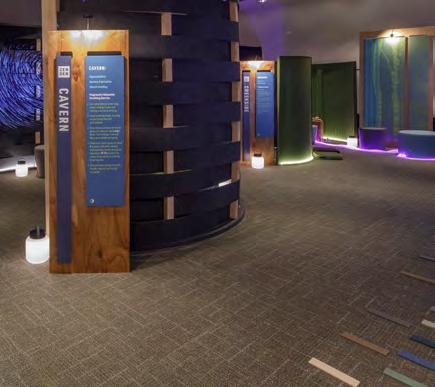
We applied the fundamentals of sensory-enabled architecture to develop a prototype of a multisensory room—The ZenDen. This portable, temporary environment is designed to support mental health and well-being through sensory engagement. It’s practical and easy to ship and deploy.
We designed The ZenDen to be a conversation starter and research tool to help us refine and implement multi-sensory spaces in projects. The ZenDen allows clients to experience a sensory environment and visualize how they might implement sensory spaces in their own buildings.
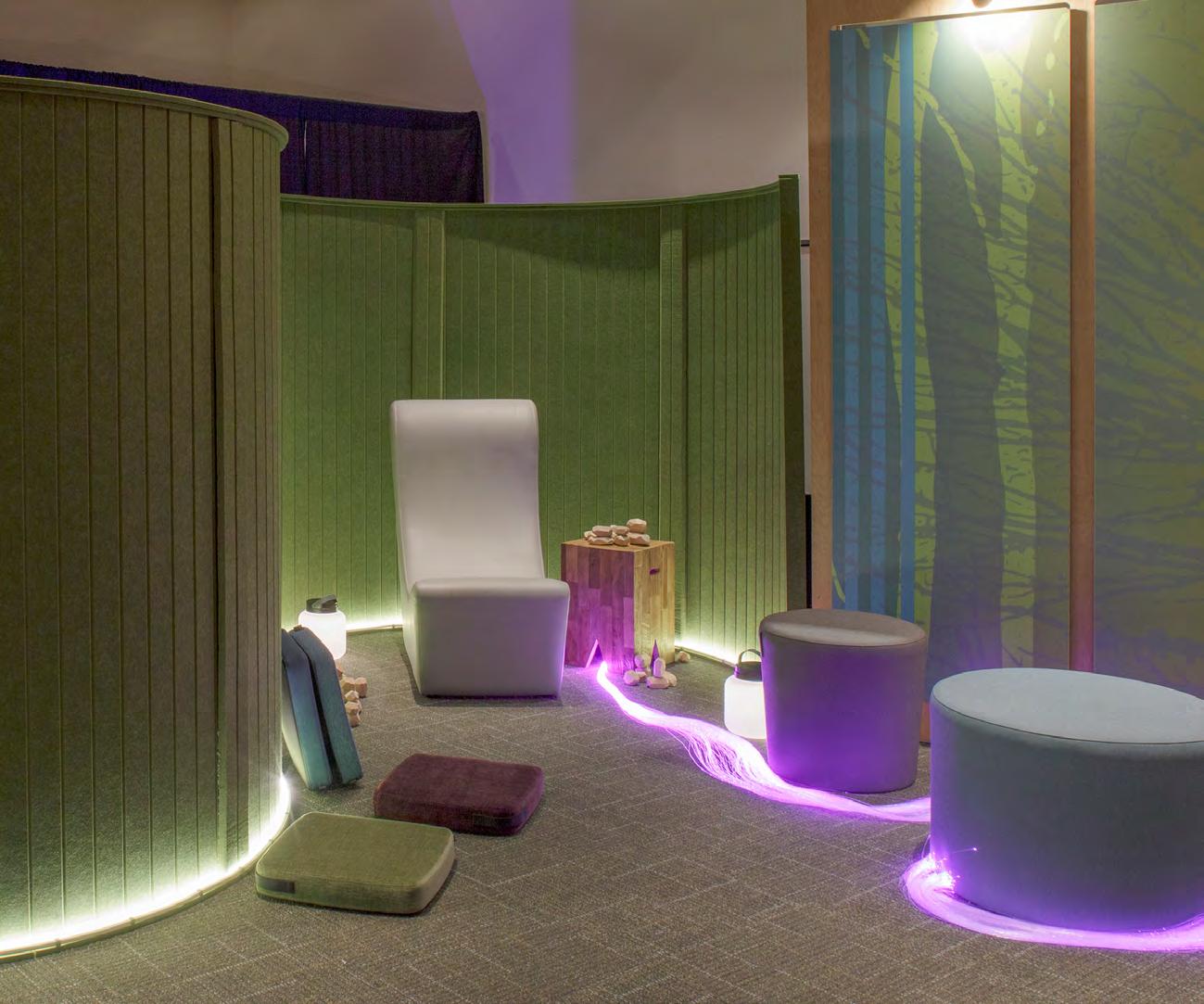
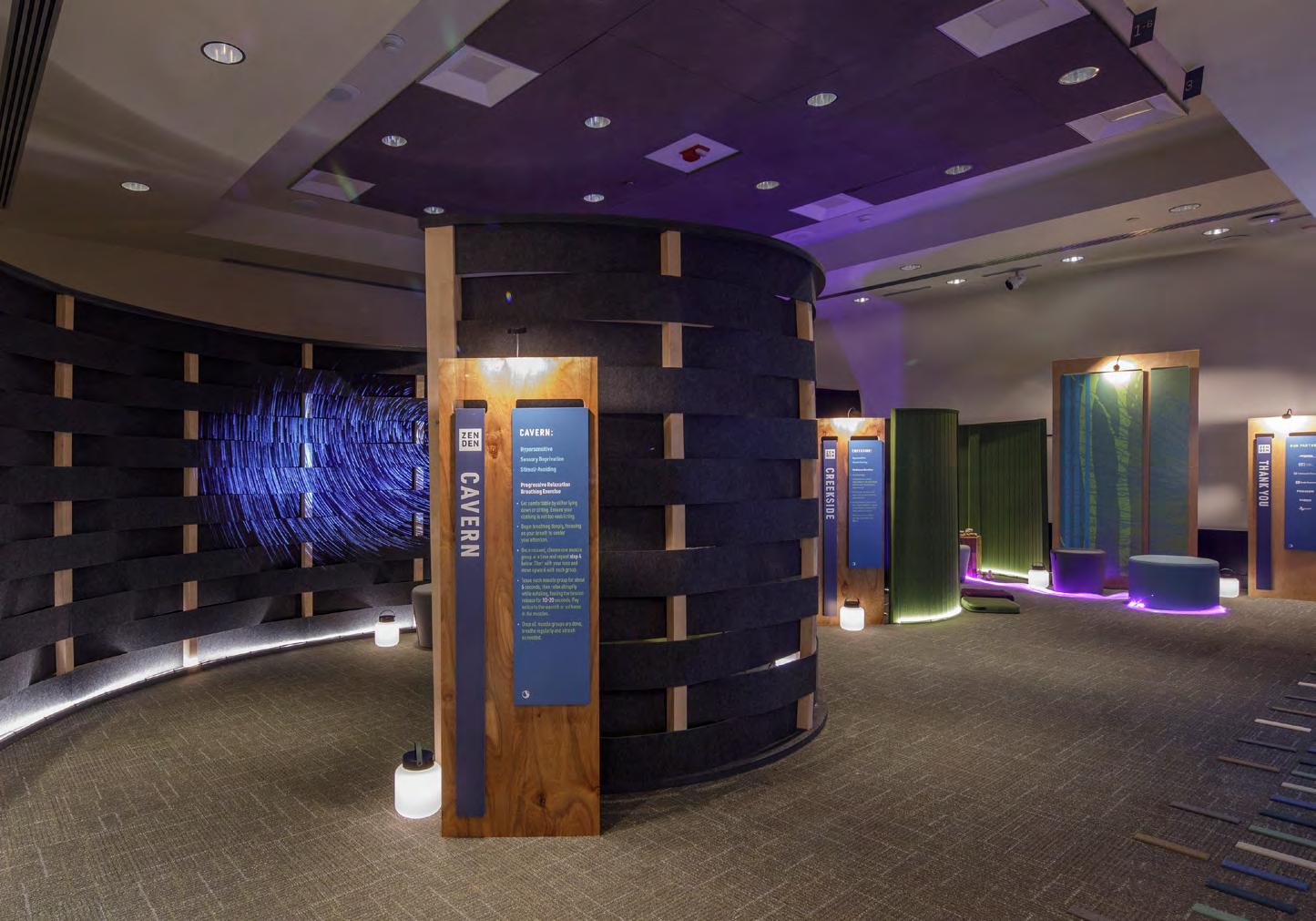
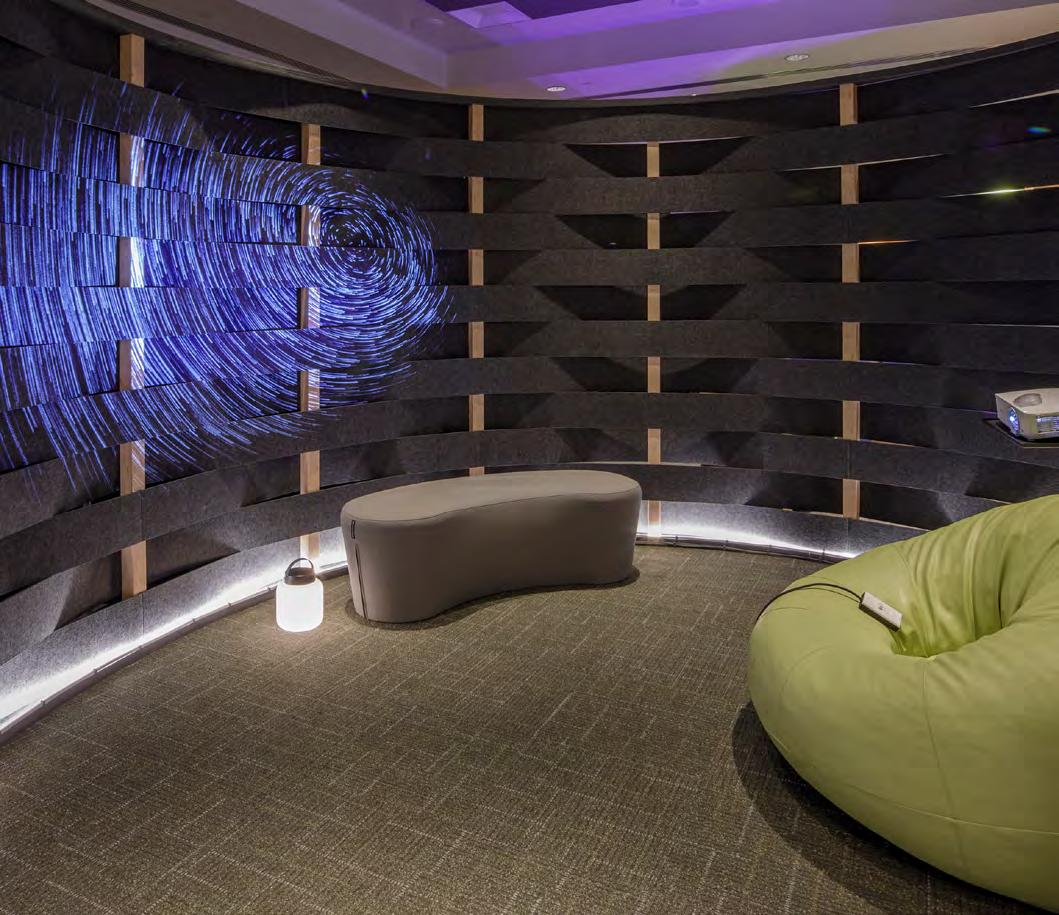
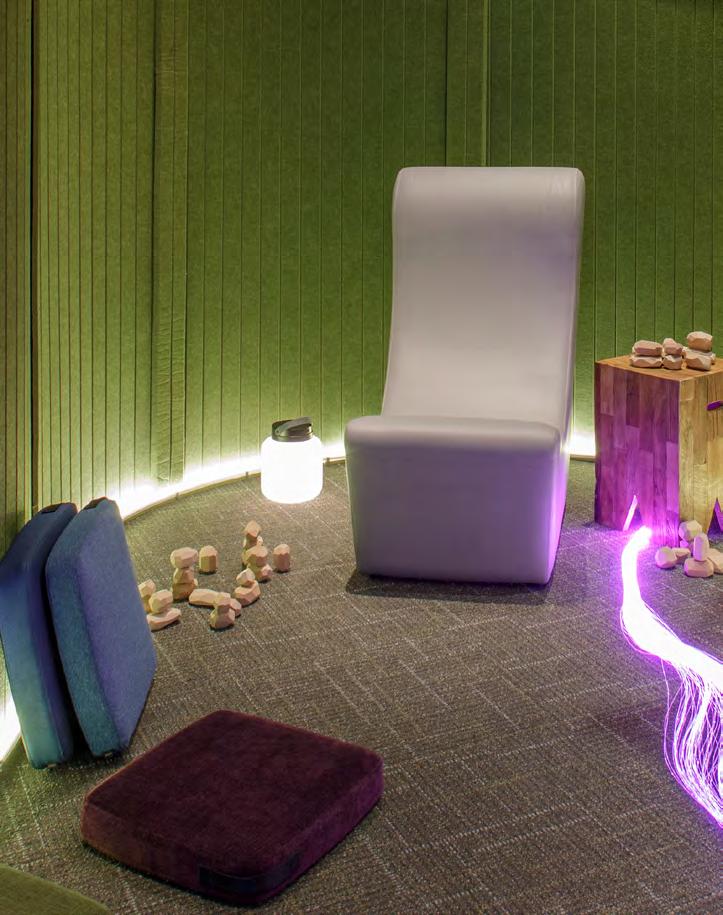
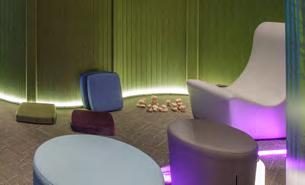
The ZenDen features three different sensory exhibits. Each provides a different multi-sensory environment. The hypersensitive space relaxes. It offers low light, calming sounds, and soothing scents. The hyposensitive space stimulates and engages visitors. It has brighter lighting, projected nature scenes, and tactile features. The social spatial area accommodates group interaction. It features various comfortable seating options.
The ZenDen debuted at txEDCON 2024 in San Antonio, Texas. We invited our clients in to experience it and chat about sensory environments. We used an online survey to gather voluntary feedback on this prototype design. We looked for valuable insights we could deploy for our next version.
Cavern
A hypersensitive pod for stimuli-avoiding individuals
Projected images transition from starry nights to more ethereal images in this environment. The Cavern lets users mediate and take their minds off their current stresses or engage in movement.
• Darker, subdued colors
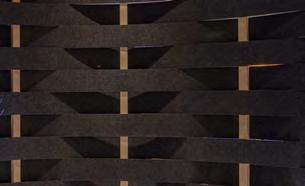
• Custom designed and fabricated, woven structural wool felt enclosure mitigates unwanted noise and provides a cloistering effect for users.
• Rocking furniture allows users to meet their kinetic movement needs in a comfortable and safe setting.
• The woven structure allows for user privacy while ensuring occupancy is understood for casual observation by staff or passers-by.
• User-controlled indirect lights complement the circadian lighting fixtures providing agency and autonomy.
• Based on Ulrich’s Stress Reduction Theory
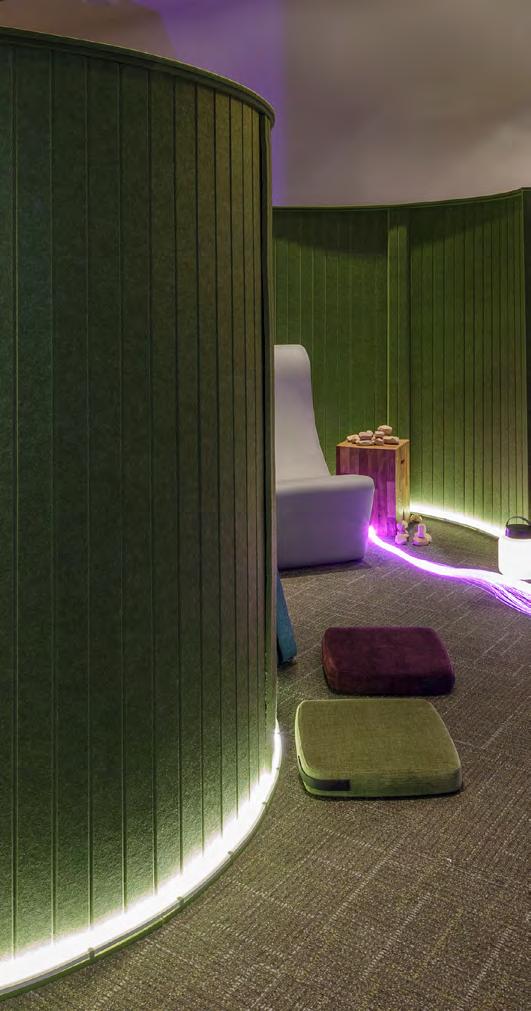
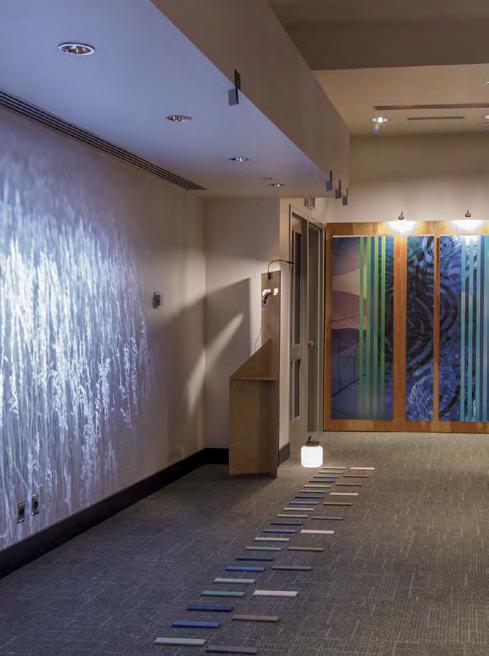
Creekside
A hyposensitive pod for stimuli-seeking individuals
This built environment transports users into a more natural environment to decompress.
Comfortable seating allows for muscle relaxation. Brighter pastels and indirect lighting provide a refreshing environment for users to engage sensory inputs that meet their neurodiverse needs.
• Playful tactile devices to touch-oriented needs
• Projected biophilic images
• Light rope with color control so users can change the mood of the space
• A scent diffuser hidden behind a screen wall provides the smell of petricore or fresh rain
• Informed by Kaplan’s Attention Restoration Theory
Flexible elements
We carefully selected elements that would support a flexible, multi-sensory environment. We can use a version of it in a variety of spaces without significant construction.
A. Custom enclosures
A woven, custom-fabricated set of cloisters or pods gives users a sense of privacy. We designed the enclosures to be acoustically and visually calming.
B. Dynamic furniture
We chose furniture with behavioral health benefits. Rocker chairs are comfortable to sit in but also encourage movement.
C. Interactive projection and lighting
Dynamic projections shape the sensory experiences in various areas. Users can adjust lighting to customize their environment.
D. Olfactory activation
A scent diffuser behind a screen wall fills the space with a specific biophilic scent. The smell of rain (also known as petrichor) promotes relaxation.
E. Tactile opportunities
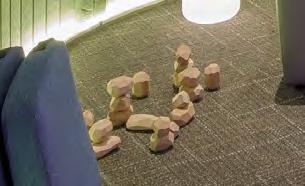
We equipped the spaces with various fidget devices. These provide relaxing tactile stimulation for users who relax by engaging their sense of touch.
Revelations, insights
We teamed up with vendors such as EzoBoard, Mohawk, Smith Systems, Lonestar and Pineapple to craft the ZenDen. We brought together a mix of offthe shelf furniture solutions and custom-built installations in the environments.
We rapidly built and furnished the exhibit in time for the conference with a limited budget. Local partners Joerios Construction and Indeco assisted. At this stage in our experimentation, we find that collaboration is key to executing complex sensory environments that support neuroinclusivity.
We’re just getting started with the ZenDen. We plan to continue research and gather more user feedback to refine and improve the designs. Not only will we refine and experiment with the design elements, but we will also develop more effective and detailed methods for gathering user feedback—perhaps with longerterm installations and mix-method surveys and feedback in real-time.
Our SEA research has already led to sensory projects with other clients, including school systems such as Austin Independent School District, community clinics, and even sports arenas.
We can apply the multi-sensory design principles exhibited in the traveling ZenDen in various settings to support mental health and well-being.
Where do we see the applications?
K-12 education
The ZenDen can create calming spaces for students and teachers in K-12 schools. We can implement it in classrooms, counseling rooms, and other areas within schools.
Higher education
The ZenDen concept can extend to college and university campuses, including dormitories and study areas, to provide students with space to de-stress and self-regulate.
Healthcare
The sensory room is already emerging as a musthave in mental and behavioral health environments. But we are envisioning wider applications. We could apply the ZenDen approach or elements of it in waiting rooms, exam rooms, and other healthcare spaces to help patients manage anxiety and stress.
Workplaces
Offices and corporate environments can benefit from sensory spaces to support employee well-being and productivity. These spaces can be used for relaxation, meditation, or focused work.
Hospitality and airports
Hotels, airports, stadiums, and other high-stress environments can incorporate SEA to enhance the experience of guests and travelers, providing them with calming and restorative spaces.
The ZenDen’s flexibility and scalability make it suitable for a wide range of settings. We can tailor it to the specific needs of different environments and user groups. For now, the ZenDen will serve as a prototype for future installations of multi-sensory spaces. We will use it as a research tool to discover what aspects of these spaces resonate with users.
Mental health and well-being are no longer taboo considerations for educational spaces. They’re emerging as a primary concern for educators. As designers we can play a significant role in helping those across the sensory spectrum thrive in educational settings. Informed by evolving SEA principles, we can craft sensational spaces that enhance well-being.
Additional ZenDen design contributions by Angus MacInnis, Maithili Awasarikar, and Keith Harley
Sources:
1. Mental Health America
Based in Boulder, experiential designer Nate Hawley uses a multidisciplinary approach to promote holistic, humancentered design on a variety of project types.
Interior design leader Gwen Morgan based in Plano, creates sustainable environments that promote occupant health and wellbeing in a variety of building types.
From a home base of Washington, D.C. behavioral health planner and mental health designer Stephen Parker advocates for human-centered design in Stantec’s global healthcare practice.
Based in Boulder, designer Bridget Rice leads a variety of projects focused on finding creative solutions and fostering vibrant places.
Designing for a Scientific Community Near the South Pole
Scientists need social spaces, too. Architecture is fundamentally about designing places where people can live, work, heal, play, and educate.
When we design for people living in extreme climates, we’re still designing for people and their needs. However, at times, environmental conditions and geography require us to find different design solutions.
The Antarctic Infrastructure Modernization for Science (AIMS) program is updating the capability of major portions of the U.S. National Science Foundation (NSF) McMurdo Station—the logistics hub for the U.S. Antarctic Program—so it can continue to support Antarctic science. Leidos is the program manager on behalf of NSF. Parsons Government Services leads the design-build team and is supported by Stantec as the lead designer for the AIMS project. Stantec was tasked with crafting new residential dormitories and support and logistics facilities for the scientists and staff at NSF McMurdo Station.
The population of McMurdo Station swells to more than 1,000 in the summer months, when conditions are more favorable for research and data gathering. The scientists and staff need comfortable living quarters to complete their work in this harsh environment. And their housing should meet a high standard for energy efficiency and climate and weather resilience.
Our work in Alaska, the Rocky Mountains, and parts of northern Canada has helped us design in such harsh environments. From simple mining camps to daycare, K-12 and secondary education facilities, our team regularly designs for temperatures well below zero.
The design of the new McMurdo Station lodging facility was a collaboration between our Denver and Fairbanks architecture, interior design, and lighting design teams. We prioritized design solutions that suit the environment and provided improved living conditions at McMurdo Station.
Our challenge in Antarctica?
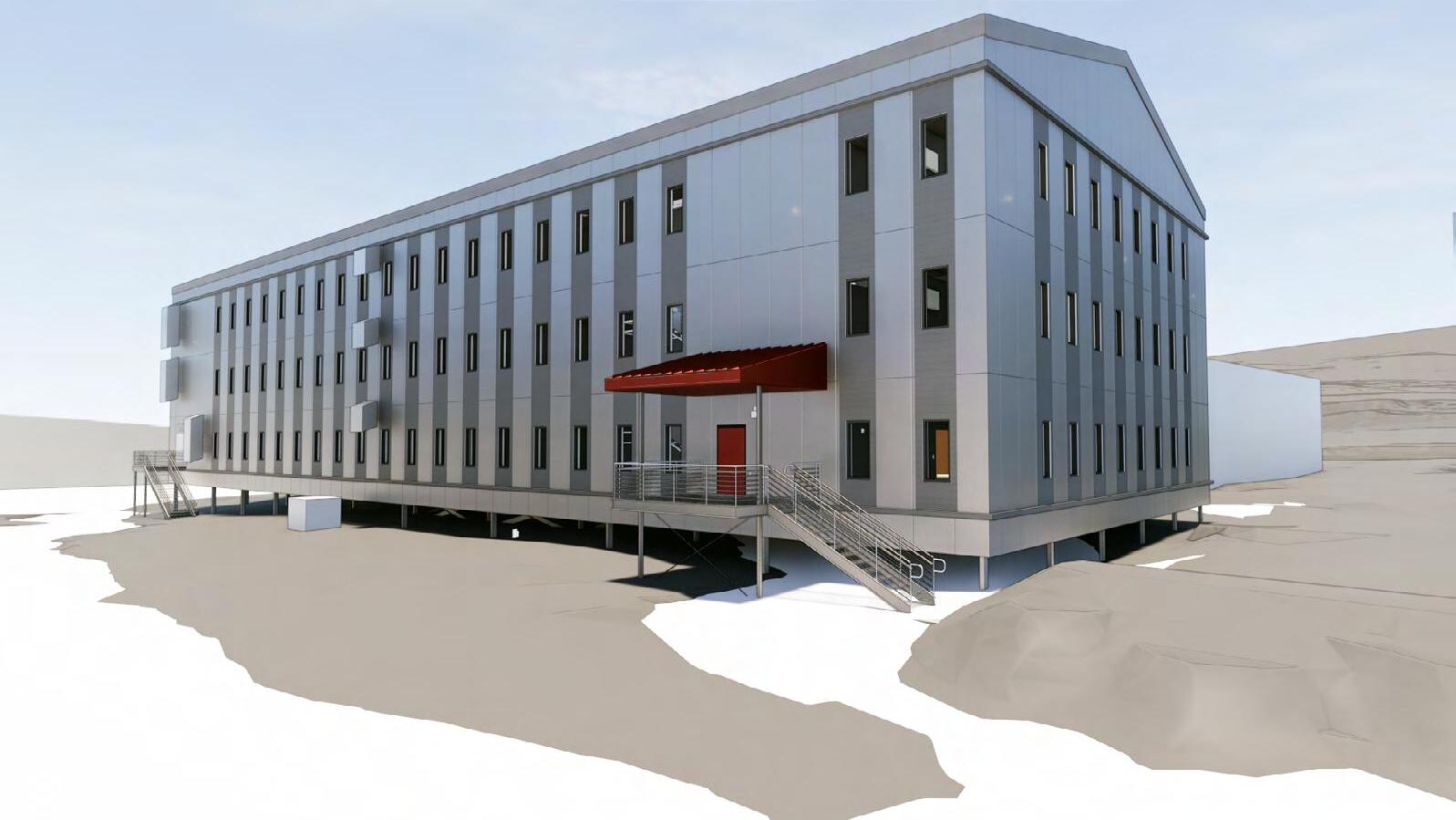
Design a new housing building—like a student residence—with 283 beds. Designing for a unique community of scientists working in extreme conditions gave us a chance to see how our approach can be applied in an atypical environment.
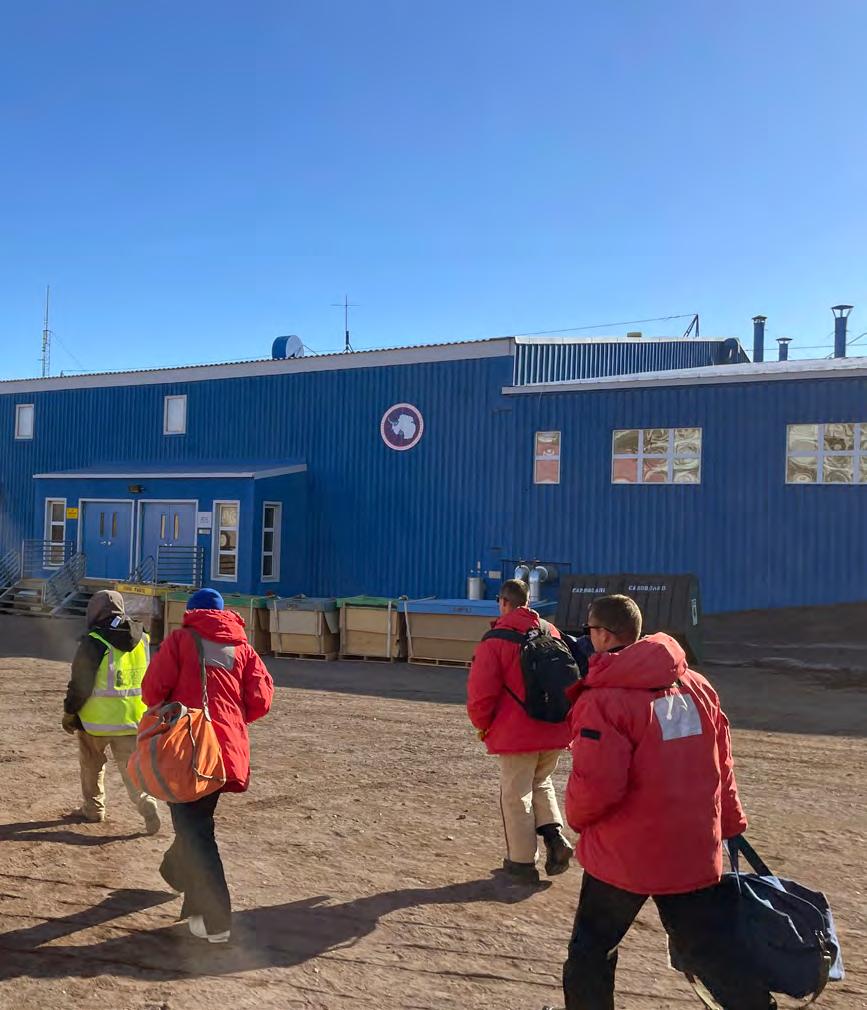
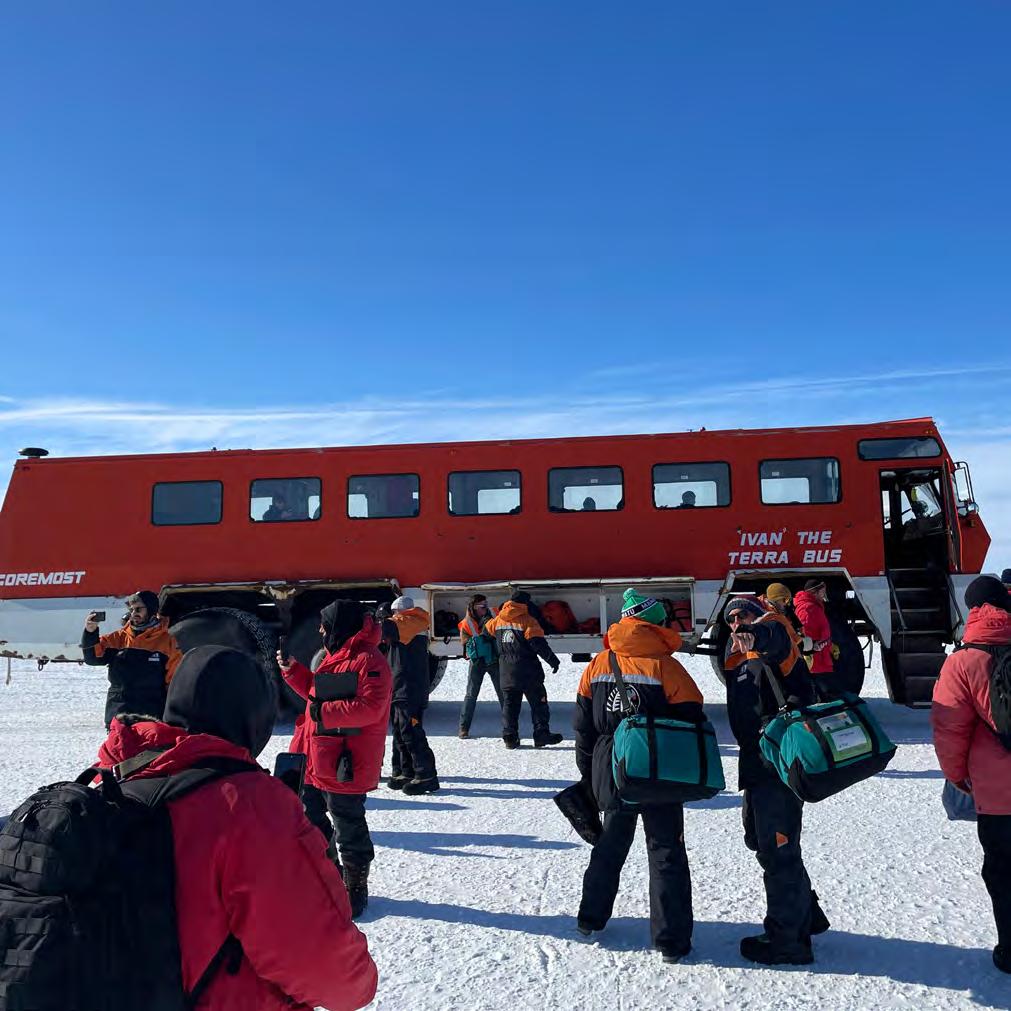
Scientists arriving at Building 155, “The Heart of McMurdo” McMurdo Station, AN
Our approach
Promote well-being and mental health
In the previous residence configuration, staff and scientists bunked together with very little privacy. While that might have been good for efficiency, it didn’t promote mental health and well-being. At McMurdo Station, some staff work the day shift, and some work the night shift. It’s hard to rest in living sleeping quarters.
The design features a mix of single and double occupancy rooms, depending on user preference. And the new lodging facility is much bigger than the previous residences. Each of the three floors is roughly 20,000 SF for a total of 60,000 SF of living space for 283 residents.
85% Antarctica contains 7.2 million cubic miles of ice, roughly 85% of the world’s ice. 1
283
The residential building will accommodate 283 residents with a mix of single and double occupancy rooms.
60k
Each of the buildings’ three floors is roughly 20,000 SF for a total of 60,000 SF of living space.
Support durability and resiliency
In Antarctica, our designs must account for powerful winds and extreme temperatures. In the winter, the temperature drops to minus 40 °F. In the summer, it can hit 45 °F. And wind speeds in this region can reach 170 miles per hour. The design solution for this project requires a thermal envelope that is resilient, withstanding strong winds and wide temperature variation.
Consider logistics and constructability
When designing for remote environments like Antarctica, we must plan far in advance. We must ship all our building materials during the summer months, a narrow window of opportunity. Because the location is so remote, there’s no guarantee that all the materials arrive in one piece. The extreme temperatures and high winds in Antarctica also mean there is a limited window for construction. We must schedule construction for the months when conditions are more favorable.
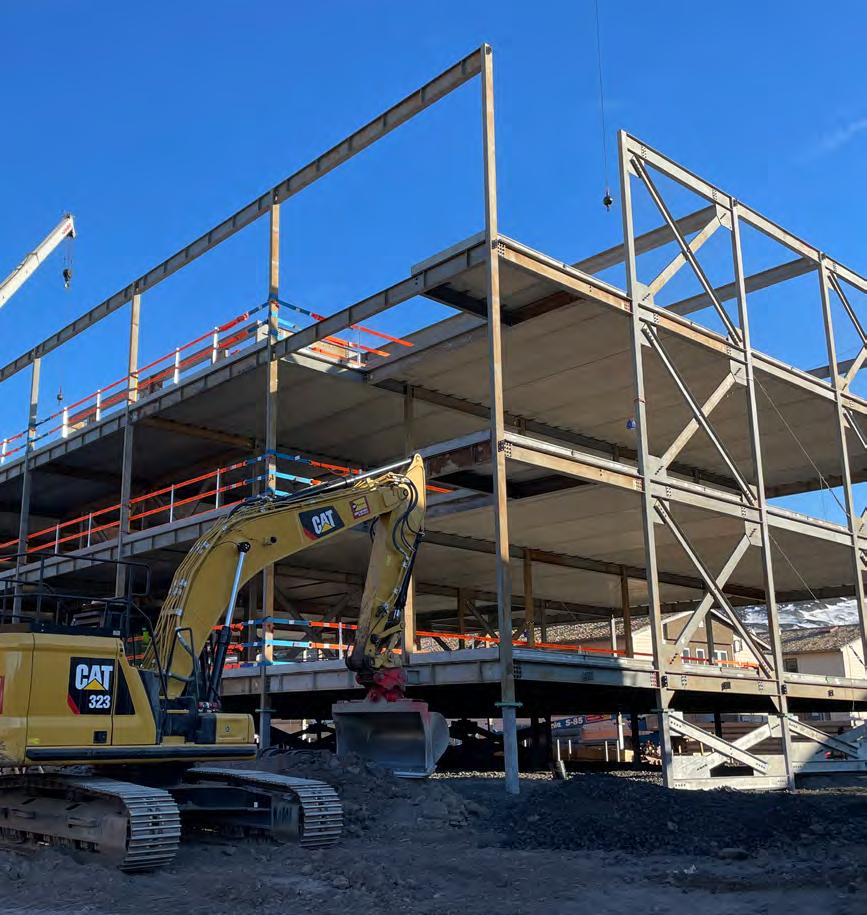
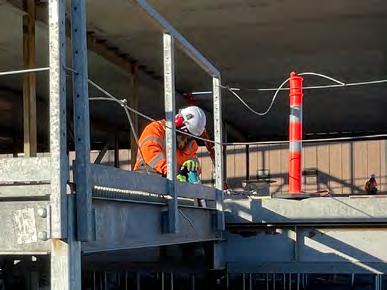
Construction of the new residential facility
Prioritize design solutions that suit the environment and improve living conditions
With the limitations above in mind, we needed a solution that met our needs for constructability and resiliency but could also support design that would enhance the living experience for scientists at McMurdo Station.
We chose a panel system that can go up fast. It made sense to work with a structural insulated panel (SIP). Using SIPs limits us somewhat. We can’t, for example, create a custom façade for the residences with SIPs. But they offer multiple benefits. Firstly, we can build with them quickly. With SIPs, we build the entire facility during a short window of favorable weather.
And second, it’s a very tight system. Using interlocking panels and sealants, we can get these SIP modules close to airtight. To get the rigidity necessary to protect these buildings at high wind
speed, however, we are using an insulated metal panel on top of the SIP panels. By combining these panels, we exceed the thermal performance we targeted for comfort, resiliency, and efficiency in Antarctica.
Designing with a panel system for bolt together construction doesn’t mean we are shipping complete rooms to the site. Rather, it’s a kit of parts, the panels in combination with hundreds of precast footings and steel, that builders can construct the building easily. We designed the entire facility so that everything could be bolted together. We can even package all the studs and material together to fit the kit onto a container vessel, with plenty of extra bolts, naturally. Even better, the builders can fasten a part of the building together from the inside. This reduces the number of workers working on lifts in the wind.
With prefabricated furniture and built-in storage solutions, our design optimizes the layout for the living units. This allows for ease of construction and maximizes space within the building footprint. Each 80 SF unit features a bed and desk.
Meet a variety of human needs
Scientists need social spaces, too. The second and third floors of the building each have a quiet and public lounge, used for a variety of activities: watching movies, building puzzles, playing board games, reading books, and socializing.
We can package all the material together to fit the kit onto a container vessel, with plenty of extra bolts, naturally. Even better, the builders can fasten a part of the building together from the inside. This reduces the number of workers working on lifts in the wind.
Each floor of the residential building features a central restroom core. Plumbing is routed through a central chase out through the bottom of the facility via a super insulated waste pipe. Adjacent to the restrooms in the central core are trash/recycling and laundry facilities to serve the 283 occupants. Other miscellaneous spaces within the facility include fan rooms on each floor for fresh air intake and communication rooms, electrical rooms, and mechanical rooms as required.
Lodging facility, Antarctic Infrastructure for Modernization for Science (AIMS) McMurdo Station, AN Leidos is the program manager on behalf of the National Science Foundation (NSF). Parsons Government Services leads the design-build team and is supported by Stantec as the lead designer for the AIMS project.
1K+
Population of McMurdo Station swells to more than 1,000 people in the summer months.
2,435
The launch point for Antarctic missions, Christchurch, New Zealand, is a 2,435 mile flight from McMurdo Station. 2
1956
The U.S. Navy Construction Battalion known as the Seabees completed the original McMurdo Station in 1956. 3
110 It’s not unusual for wind gusts to reach 110mph at McMurdo Station. We designed the residences for 170mph winds.
McMurdo Station
So, what does that leave us? Under these conditions, we achieve sustainability by resiliency: making sure that our structures are super insulated and will last 50+ years without significant maintenance.
Make it sustainable and resilient
Sustainability takes on a whole new meaning in the Arctic and Antarctic. To simplify operations down on the ice, fuel is the primary heating source for the campus. Concerning renewable energy, there are other projects currently in the works to provide supplemental wind power to the site. But solar is not feasible, especially because the sun is below the horizon continuously for most of the winter.
The island is largely formed of basalt, so there is no geothermal potential. So, what does that leave us? Under these conditions, we achieve sustainability by resiliency: making sure that our structures are super insulated and will last 50+ years without significant maintenance. We designed a wall system with R-70+ ratings (heat flow resistance) and chose fixed, quadruple pane windows. The exterior skin is made up of extra-thick insulated metal panels. We chose heat exchangers and heat recovery ventilators (HRVs) for the mechanical systems to recover as much heat as possible from exhaust units.
Resiliency in this setting means redundancy, so backup boilers are installed in case primary boilers fail. This allows for routine maintenance to be performed, keeping the main boilers in prime operating condition.
This winter (Antarctic summer), the project is moving forward with preparation for the installation of the SIP panels and roof. The construction crew will stay down on the ice over the winter to install sprinkler, mechanical, and electrical systems, and rough-in interior framing. The building will be complete in Spring 2026.
We are excited to see how the new living quarters are received by this important scientific community. And we’re looking forward to applying our experience in resilient design to more projects for those living and working in extreme climates.
From our Fairbanks, Alaska studio, architect Erik Dukes works on designs for school renovations, office buildings, military hangars, and more. He has worked on the design of McMurdo Station since 2018, visiting the site in 2024 and 2025.
From Denver, Colorado, Merlin Maley focuses on transportation and municipal/utility maintenance and operations facilities, multimodal stations, and facility master plans. He has been working on design for McMurdo Station since 2016 and visited the site and the South Pole in 2018.
Stantec is a global leader in sustainable engineering, architecture, and environmental consulting. The diverse perspectives of our partners and interested parties drive us to think beyond what’s previously been done on critical issues like climate change, digital transformation, and future-proofing our cities and infrastructure. We innovate at the intersection of community, creativity, and client relationships to advance communities everywhere, so that together we can redefine what’s possible.