SMEC simplifies the complex. We unlock the potential of our people to look at infrastructure differently, creating better outcomes for the future.
Document Type
Project
Project Number
File
Revision History
SMEC Company Details
Approved by Sophie Quinn
Address Level 9, 12 Moore Street, Canberra ACT 2600
Phone +61 2 6234 1976
Email sophie.quinn@smec.com
Website www.smec.com
Signature The information within this document is and shall remain the
Important Notice
This report is provided solely for the purposes of a service review of the Planning and Development Team at Federation Council This report is provided pursuant to a Consultancy Agreement between SMEC Australia Pty Limited (“SMEC”) and Federation Council, under which SMEC undertook to perform a specific and limited task for Federation Council. This report is strictly limited to the matters stated in it and subject to the various assumptions, qualifications and limitations in it and does not apply by implication to other matters. SMEC makes no representation that the scope, assumptions, qualifications, and exclusions set out in this report will be suitable or sufficient for other purposes nor that the content of the report covers all matters which you may regard as material for your purposes.
This report must be read as a whole. The executive summary is not a substitute for this. Any subsequent report must be read in conjunction with this report.
The report supersedes all previous draft or interim reports, whether written or presented orally, before the date of this report. This report has not and will not be updated for events or transactions occurring after the date of the report or any other matters which might have a material effect on its contents, or which come to light after the date of the report. SMEC is not obliged to inform you of any such event, transaction, or matter nor to update the report for anything that occurs, or of which SMEC becomes aware, after the date of this report.
Unless expressly agreed otherwise in writing, SMEC does not accept a duty of care or any other legal responsibility whatsoever in relation to this report, or any related enquiries, advice or other work, nor does SMEC make any representation in connection with this report, to any person other than Federation Council. Any other person who receives a draft or a copy of this report (or any part of it) or discusses it (or any part of it) or any related matter with SMEC, does so on the basis that he or she acknowledges and accepts that he or she may not rely on this report nor on any related information or advice given by SMEC for any purpose whatsoever.
Executive Summary
Federation Council is undertaking a Service Review of its internal Planning and Development Team including the roles, responsibilities, functions, and efficiencies of the division.
What is a Service Review?
Local governments periodically undertake reviews of specific divisions or across the organisation to identify whether the service is fit for purpose; is meeting Council’s expectations; and is delivering quality outcomes efficiency to the community.
Service reviews are broad-sweeping and can cover an extensive range of functions, inputs, and outputs. In NSW local government service reviews are underpinned by the foundations established in Service Delivery Review: A how to manual for local government – Second Edition (June 2015 by the Australian Centre of Excellence for Local Government). Service review reports come in a range of formats and sizes and conclude with recommendations varying from ‘change nothing’ to ‘complete overhaul.’
The reviews can be done in-house or by an independent consultant. Determination of who does the review is often contingent on resourcing, the level of need for the review, and the appetite of the Council to change.
Why is Federation Council doing a Service Review of the Planning and Development Team?
Federation Council is undertaking a periodical service review of the Planning and Development Team (PDT) because of the changing landscape of the development industry; in response to complaints and criticisms from internal and external customers; and to identify opportunities to revamp the services offered to improve efficiencies and the customer experience.
In this instance, Federation Council has elected to appoint an independent consultancy (SMEC Australia Pty Ltd) to undertake the service review on their behalf. Council does not have the resources available to undertake the review in-house and sought for a fresh set of eyes to review the entire service and provide independent and alternative service delivery model recommendations.
How was this Service Review done?
The foundation of this service review is underpinned by extensive engagement with internal and external customers. Over a period of 5-months the SMEC project team facilitated discussions with more than fifty staff, all elected Council, a broad range of local community members, and members of the wider development community.
The feedback and knowledge gained from the engagement sessions, in addition to analytical reviews, has informed the Recommendations of this report in identifying which areas of the service require the most urgent attention.
What was learnt during the Service Review engagement?
The engagement exercises revealed that everyone is on the same page. There is unanimous consensus that some format of change is needed because the timeframes of the PDT processing work are, sometimes, too slow and are leading to real-world implications. There is also a unanimous consensus that the PDT do not do an easy job, and that they have historically been under-resourced and have had recruitment difficulties. It is in no one’s interest for the team to fail and the engagement revealed that internal and external stakeholders want to help find solutions to the PDT delays.
Many stakeholders expressed a bitterness from their previous experiences with the PDT. Recurring themes raised included a lack of communication, delays in processing at each stage in the development lifecycle, and the perception that the team in PDT are exhausted, overworked, and that stresses were high.
Positively, the same stakeholders also acknowledged the quality of the staff and their knowledge. Persons engaged did not have resentment towards any individuals within the team but were just frustrated with the process as a whole.
Concerns were raised about the implications that an inefficient or uncertain planning process can have on a small rural town, particularly with regards to the appetite and willingness for investment into the region. Some
expressed a sentiment that it was too hard and not worth the risk to try and build in the Federation local government area.
Critically one key procedural point and one operational pain-point were raised repeatedly. They include PDT’s method and timing of undertake the initial triage of development applications (submission to lodgement); and the absence of consistent communication throughout the total development process.
These two key points are focused on in this service review, intertwined with many other themes, ideas and concerns that were expressed from the engagement.
What else was learnt?
Comprehensive analytical reviews of Council’s performance were also undertaken from two different data sets. The first is from data provided by Council itself. This data is useful to monitor the performance of the PDT year on year but is unhelpful to use as a comparative tool against other councils as the source, reliability, and transferability of the data from different organisations cannot be accurately correlated.
The second is data provided from the NSW Planning Portal that allows comparisons to be made between Federation Council and every other council in the State – however this data is limited to development applications only. For the purpose of this service review, this data, albeit limited to one stream of work only, is broadly considered to be reflective of trends throughout the total development lifecycle as a development application is, generally, catalytic of the other functions that are performed by the PDT.
The review learnt that:
• The PDT has had prolonged and on-going recruitment challenges with a number of vacancies existing. Delivery of the service could be jeopardised at any time with the departure of any of the existing team.
• The PDT delivers over 20 individual streams of work relating to planning, building and development. Some services delivered are likely better suited to other directorates within Council. Most of the services delivered are legislated and heavily regulated by State and Federal laws.
• There are challenges with technical staff being burdened with administrative tasks that could be more efficiently delegated to paraplanners or administrative staff, highlighting a need for improved processes to streamline and better support task allocation and enhance productivity.
• The total output of all Certificates and Applications in 2024 was 1,855, representing a 12% reduction on the output from 2022.
• The PDT received (not dialled or voicemails) 3,014 phone calls in FY23-2024 with an average call time of 2 minutes and 54 seconds, or 145 hours over the year.
• The average number of days to process all streams of work has decreased (improved) since 2023.
• The number of development applications, construction certificates and occupation certificates received and determined has declined since 2021. Other work streams are generally stabilised with minor fluctuations.
• Between 2021 and 2024 calendar year:
– Building Information Certificates are down 50%.
– Delegated CDCs (not Private Certifier) are down 50%.
– Construction Certificates have reduced by two-thirds.
– Occupation Certificates have reduced by nearly a half.
– Development Applications have reduced by more than half.
– There is a clear correlation between an increasing number of staff and improving performance.
• Federation Council’s performance (from end to end) is not vastly dissimilar to other comparable councils, however there are specific stages in the process that take longer than expected.
Is change necessary?
Yes. Beyond the very real and valid concerns of internal and external stakeholders, Council is obligated to deliver planning and development services in accordance with the Minister of Planning and Public Space’s Statement of Expectations Order with regards to average timeframes and performance.
The Order is relatively new and the full implications of it are not yet seen, however as of March 2025, the office of the Minister has begun writing to Council’s that are not achieving the Expectations contained within the Order requesting an immediate remedy and improvement.
Federation Council is not achieving all of the Expectations. Federation Council needs to decrease their development application ‘submission to lodgement’ time by 73.6% or 39 days in order to conform with the Expectation. The benchmark of this Expectation renews on 1 July 2025 from a 14 day target to a 7 day target, which will require an 86.8% improvement.
Are these circumstances unique to Federation Council?
No. The complexity of the workload managed by the PDT has increased significantly and impacts to timeframes and overall performance are demonstrable across nearly all local governments in NSW.
The pressures facing Federation Council are not unique and are, in the findings of this report, not the cause of the staff within the PDT. State-wide findings on (inter alia) the pressures of local governments have been published in the 2022 Local Government Workforce Skills and Capability Survey, which found that:
• Local governments continue to experience skills shortages in multiple occupations, exacerbated by the impacts of the COVID-19 pandemic, the impacts of climate change, and the accelerated take-up of technology and digitisation of services.
• Local governments are grappling with significant challenges in relation to recruitment and retention of skilled staff and accessing training opportunities to enhance workforce skills and capability. Employee attrition and an ageing workforce and ongoing and an escalating difficulty.
• Local governments are having difficulties in securing the right quantum and mix of skills to support local service provision which is affecting not only local government’s productivity, but also the productivity of host localities and regions.
• Barriers to effective workplace planning and management include a shortage of resources with local government, a lack of skilled workers and the loss of corporate knowledge as employees retire or resign.
Is Federation Council committed to make a change?
In the opinion of the independent project team – Yes.
Council has fully acknowledged that some form of change is needed and that there are a variety of unfavourable consequences if the status quo is maintained. Staff and Council have expressed a willingness and desire to assist in facilitating change to improve the PDT and the customer experience.
The Recommendations contained within this Service Review are contingent on the commitment of the broader organisation of supporting the PDT during a time of transition and change. The traditional adage short-term pain for long-term gain is applicable in scenarios like these.
What changes are in the Recommendations?
The changes provided within the General Recommendations and Service Delivery Models can broadly be consolidated into key categories:
• Secure existing permanent and fixed-term employees and fill vacancies.
• Revamp the processes and procedures that occur internally to be contemporary, easy to follow, transparent and replicable.
• Bring the community along for the ride and explain what the changes are and why they are occurring.
• Re-ignite and rebuild the bond between the PDT and the development community. They are peers. Technical disagreements are part of the job, but the discussions around them should be solutions orientated, friendly and professional.
• Invest in technological intervention to let the team do the job quicker and to provide more and easily navigate-able resources online for the community.
• Invest in the staff. Encourage training opportunities and if they are unfeasible, work to develop alternative in-house training. The staff want to grow and learn – the organisation should support them to flourish.
Is it realistic that Council can adopt all of these changes?
Maybe. Change takes time, money, and a shift in an organisation’s cultural attitudes. This Service Review is authored with full cognisance that some of the Recommendations will be beyond the current means of Council, and that recruiting additional staff only works if there are people to fill the positions in the first place.
The Recommendations of this Service Review are not rigid. The ideas and recommendations can be adapted, tested, and adopted incrementally as time and funding allows. The Recommendations have been specifically designed so that they can be applied, generally, across each of the work streams delivered by the PDT. To this extent, a level of generality is applied to facilitate transferability of the recommendation.
Will the changes fix the problem?
Yes, with caveats. This report is not a silver-bullet that can mend everything. A report and recommendations are only as good as the willingness of the organisation to be open-minded and to try a new way of working.
The success of the Recommendations within this report has many variables that change temporally contingent on factors that are both within and out of Council’s control. The Recommendations are designed to be tweaked and manipulated over time as the services provided by the PDT evolve.
The ideas and Recommendations are based on fact and are all tried and tested to varying degrees of success. This report does not seek to change the foundations and core of the PDT – it serves to provide a snapshot of performance, identify where change is needed, and to give Council the tools and ideas to reframe their service.
The project team wish to acknowledge the contributions of all who participated in the formation of this service review. The delivery of this report would not be possible without the valuable insights and first-hand experiences of participants.
Readers are advised that no guarantee as to the accuracy of all data contained within this report is provided. Whilst close care and scrutiny has been applied, SMEC has not independently verified the rigour or analytics of the data which has been provided or obtained either directly from Federation Council, or from publicly available official government sources. It is considered that any departures from the stated data would not materially alter the findings or conclusions of this report.
1. Structure Overview
1.1 What is a Service Review?
A Service Review aims to drive more efficient use of resources within an organisation whilst providing services to meet the needs of the community. Service reviews are undertaken by government organisations every few years to ensure that the services offered are:
• Appropriate – services meet the current community needs and wants and can be adapted to meet future needs
• Effective – councils delivery targeted, better quality services in new ways.
• Efficient – councils improve resource use (people, materials, plant and equipment, infrastructure, buildings) and redirect savings to finance new or improved services.
A service review does not look specifically to reinvent all processes and procedures. The review does not seek to single out, comment on, or degrade any member of the organisation. A service review does not attempt to resolve any systemic or cultural issues within an organisation.
Federation Council have provided that the scope of this service review is to consider the following (per RFQ 2024-212 - 31 May 2024):
• Review of current staff resourcing and the adequacy of such resources.
• Undertake internal stakeholder review.
• Undertake external stakeholder review.
• Review industry bodies and relevant state department guidelines, standards, or recommendations, which relate to delivery of planning and development services for local government.
• Compare Federation Council’s Planning and Development Team to other NSW Council’s in relation to delivery of planning and development services.
• Provide review of educational and training opportunities for entrance and progression in the planning and development fields.
• Identify opportunities for improvements to the delivery of planning and development services.
• Provide three services delivery models or options that will allow the planning and development team to provide efficient and effective services for the community for further consideration.
This report is a service review of the Planning and Development Team (PDT) within Federation Council and is not a service review of the whole organisation.
1.2 Why is a Service Review being undertaken?
Council has elected to undertake this service review of the PDT for the following reasons:
• Efficiency – Council is in receipt of complaints internally and externally that the services offered are not being undertaken in an efficient and effective manner.
• Communication – Council is in receipt of complaints that communications from the PDT is poor and requires attention and action.
• Industry – Council is having significant difficulties in attracting and retaining suitably qualified staff to fulfil jobs in the PDT
• Resilience – Staff are unhappy and have, at times, an unmanageable workload. If no improvements are made staff will leave and existing problems will exacerbate significantly.
• Delivery – Investment into the PDT will facilitate expedited investment into the whole of the local government area, including faster housing approvals and a more appealing opportunity for new business and industry investment.
1.3 How was the Service Review undertaken
This service review was undertaken by an independent external consultancy to ensure impartiality. The review was undertaken in accordance with the framework established in the Service Delivery Review: A how to manual for local government – Second Edition (June 2015 by the Australian Centre of Excellence for Local Government).
This service review was undertaken by:
• Reviewing existing structuring, resourcing, and sample outputs.
• Reviewing relevant Council policies, procedures, and operational plans as they pertain to resourcing, reviews and the PDT
• Engaging with internal stakeholders including elected Council (approx. 15 hours of interviews with 50-60 people).
• Engaging with the community and members of the development industry through online consultation.
• The formation of a dedicated Strategic Reference Group comprised of local community members to provide insight into Council.
• Benchmarking the performance of Council against equivalent councils.
1.4 Outcomes of the Service Review
The report is appended by a suite of general recommendations and four alternate service delivery models for Council’s consideration. These can generally be described as:
• Option 3 – $$ - maintain FTE resources, engage additional temporary resources to remove work backlog and establish new procedures, and maintain existing services.
• Option 4 – $$$ - expand FTE resources, remove work backlog, establish new practices and procedures, provide developmental opportunities in the team, and expand services delivered.
These options are not definitive. Different elements can be used interchangeably as and when required or when resourcing permits. The suite of general recommendations should be implemented regardless of which option is pursued.
The pursual or adoption of any option or change to resourcing, operations or finances are a matter for Council to determine and are beyond the scope of this engagement (and should not be decided by a private consultant in any regard).
1.5 Next steps
Upon receipt of this service review Council will consider the findings, options, and present the report with recommendations to Council for consideration and adoption.
2. Service Review Brief
2.1 Terms of
Review
SMEC has been engaged by Federation Council to undertake the following specific tasks (per RFQ2024-212 31 May 2024):
Terms of reference for review
i. The review is to be undertaken in accordance with Service Delivery Review: A how to manual for local government, Second Edition, June 2015 published by the Australian Centre for Excellence for Local Government.
ii. The review must ensure compliance with the following:
(a) Section 8C Integrated planning and reporting principles that apply to councils of the Local Government Act 1993
The following principles for strategic planning apply to the development of the integrated planning and reporting framework by councils
(i) Councils should make appropriate evidence-based adaptations to meet changing needs and circumstances.
(b) Section 223 Role of governing body of the Local Government Act 1993
(1) The role of the governing body is as follows
(g) to keep under review the performance of the council, including service delivery,
(c) The NSW Office of Local Government - Integrated Planning and Reporting Guidelines and Handbook September 2021. Notably clause 4.3 of the guidelines - To Encourage continuous improvement across the Council’s operations, the Delivery Program must identify areas of service that the council will review during its term and how the Council will engage with the community and other stake holders to determine service level expectations and appropriate measures.
(d) NSW Office of Local Government – 23-12 5 October 2023 A871143 Guidelines on the withdrawal of development applications.
iii. Review current staff resourcing and the adequacy of such resources.
iv. Undertake internal stake holder review.
v. Undertake external stake holder review.
vi. Review industry bodies and relevant state department guidelines, standards or recommendations that relate to delivery of planning and development services for local government.
vii. Compare Federation Council planning and development team to other NSW Council’s in relation to delivery of planning and development services.
viii. Provide review of educational and training opportunities for entrance and progression in the planning and development fields.
ix. Identify opportunities for improvements to the delivery of planning and development services.
x. Provide three service delivery models or options that will allow the planning and development team to provide efficient and effective services for the community for further consideration.
2.2 Objectives
The objectives of this service review include:
• Reviewing the structure and resourcing within Federation Council to determine if the quantity and efficiency of output is meeting Council and the community’s expectations.
• Benchmarking the performance of Federation Council against other comparable councils to identify if performance fluctuations are industry-wide or isolated to Federation.
• Embedding the notion of ‘continuous improvement’ including providing an environment where continuous and innovative improvements are encouraged, expected, and supported by the organisation and community.
• Empowering staff to speak up and make suggestions, and to provide staff with tools and processes to make better decisions. Continuing the journey to be a “customer-centric” organisation with a positive and solutions-oriented direction.
• Develop a clear set of performance improvement recommendations for Council to review and implement.
• Assist to inform Councillors, the community, and staff on how and why the PDT operates as it does.
• To provide the PDT with a framework to achieve the Minister’s Statement of Expectations Order.
2.3 Scope
This service review is limited to the PDT within Federation Council and the roles and responsibilities that they are responsible for. This review considers the efficiency, outputs, resourcing, and structure of the PDT.
This report is informed by extensive internal and external engagement. Considerable emphasis on the findings and recommendations by stakeholders has been given in authoring this report, however full reliance on this engagement to provide all of the answers has not been made.
This report serves to describe the performance of the PDT; measure performance against publicly available benchmarks; quantify the workload and output; explore opportunities for efficiencies and improvements; and to provide four alternate service delivery models.
This report is not authored to be used as a tool to reprimand any member of staff and such use would defeat the constructive nature and purpose of this exercise.
3. Existing Services
3.1
Services
The PDT provides and delivers a broad range of services across a range of disciplines and plays a fundamental role in shaping the future of the community (both intentionally and unintentionally). The services provided by the PDT differ to those provided by other divisions within Council insofar as the work is, generally, legislated, and Council has a mandate to offer the service to the community.
Within the PDT there are three primary types of employees: town planners, building surveyors, and administration support officers. Staff are overseen by one manager and one director.
The scope of services and functions delivered by the PDT are difficult to capture in one report. The primary schedule of services come under many different names but are generally captured within the below list:
• Development, Modification and Review Applications
– Any subsequent Land and Environment Court proceedings
• Vegetation Removal / Permit Applications
• Strategic Planning
– Community Strategic Plan (CSP)
– Local Strategic Planning Statement (LSPS)
• Plumbing, Drainage and Sewer applications
• Construction Certificates, including all critical stage inspections
• Complying Development Certificates, including all critical stage inspections
• Occupation Certificates
• Mandatory inspections
• Section 68 Approvals
– Sanitary plumbing and drainage applications
– Commercial and industrial plumbing and drainage applications
– Onsite waste management systems assessment (septic tanks, effluent disposal)
– Wood heater and solid fuel burning device applications
– Events – Manufactured homes
• Subdivision and Subdivision Works Certificate
• Swimming Pool – Compliance inspections and compliance certificates
• Planning Certificates – Section 10.7
• Government Information Public Access (GIPA) requests
• Contribution Certificates
• Outstanding Orders
• Building Information Certificates
• Dwelling Entitlements
• Flood Affect Certificates
• Compliance investigations
– Fire safety
– Unauthorised land uses and building works
– Other general compliance investigations if directed to the PDT
– Preparation of letters, notices, and orders
This list is not exhaustive. As is the nature within local government, the PDT are often sought out to assist other divisions within Council with various work when the need arises.
FEDERATION COUNCIL
3.2 Division Structure and Resourcing
Council has sought to increase the size of the PDT FTE staff year on year to a current provision of 7.7 FTE comprising of a manager, town planners, building surveyors, and administration support officers. The provision of funded FTE roles has not been filled and there are vacancies within the team.
The structure of permanent FTE staff over the past three years is provided below: Table 1: Division Structure and Resourcing 2022 - 2025
The PDT has not been operating at full quota given recruitment challenges and general fluctuations in employment (resignations, retirements, parental leave). Of significant note is the fact that (at the time of writing) Council has no permanent town planners and as such, assessment and reporting of applications has fallen to building surveyors, the manager and director
Whilst the number of FTE provided to the PDT has grown year on year, the ratio of position vacancies has correspondingly increased too. In 2022 there was the equivalent of 0.5 FTE vacancy; in 2023 there was no vacancy; and in 2024 there was the equivalent of 1.5 FTE vacancies.
In previous years Council had also relied on the services of consultants to undertake the assessment of applications on Council’s behalf, and either engaged those services directly or via various state government initiatives. At peak, consultants completed approximately 10% of the annual output of the PDT.
In addition to the broader challenges around attracting and retaining staff, there appears to be a lack in structure or clarity around roles and process, which often results in technical staff undertaking administrative tasks that could be more appropriately addressed by administrative staff or newly appointed paraplanners. It is noted this lack in structure or clarity around roles and processes may have come about due to limited resourcing in the past and therefore the need for technical staff to undertake these tasks. This misalignment not only diverts valuable expertise away from core technical functions, but could contribute to lower job satisfaction, further impacting staff retention. Streamlining workflows and implementing clearer role responsibilities and support structures would allow technical staff to focus on delivering technical work, ultimately improving service delivery and overall organisational efficiency.
3.3 Service Outputs
The service outputs of the PDT are difficult to quantify as phone calls, emails, site visits and inspections are not consistently recorded in a uniform manner, a situation contributed to by the vacant development engineer position. The actual number of applications and certificates assessed and determined only paint part of the picture that forms the full service provided by the team.
Council has provided SMEC with raw data to determine the extent of service output delivered by the team. The data is generally broken down in this table as either being a ‘certificate’ or an ‘application’. Table 6 (provided later in this report) provides a break-down of the specific task outputs.
Table 2: Service Outputs 2022 – 2024
Note: Data provided in this table has been provided by Federation Council directly and therefore cannot be accurately measured against the performance of other comparable councils as the data sourcing methods between organisations is unknown.
Note 2: Certificates included in this table include s10.7 Planning Certificates which make up the significant majority of output and correspondingly distorts the overall output. A breakdown of application and certificate types is provided in Table 6 later in this report.
3.3.1 Communication Outputs
Beyond certificates and applications, the PDT directly engages with internal and external stakeholders by way of site visits, phone calls and emails. No data is available to measure the amount of time spent on emails and site visits, however it can reasonably be assumed that a site visit or inspection would be required for each application and certificate and would take approximately 1 hour per site on average (including travel time and inspecting).
Phone calls received by the PDT are recorded. In FY23-24 the PDT received 3,014 phone calls from members of the community, with an average call time of 2 minutes and 54 seconds. This figure does not include calls to voicemail (an additional 704 calls), or calls made by the staff to customers (received only). In total this amounts to approximately 145 hours of phone calls received per annum within the PDT.
4. Stakeholder Engagement
4.1 Engagement Principles
Three key guidelines underpin the communication and engagement approach for this project including:
1 Service Delivery Review: A how to manual for local government
2 Federation Council Community Engagement Strategy
3 International Association of Public Participation (IAP2) core values of engagement
4.1.1 Service Delivery Review: A how to manual for local government
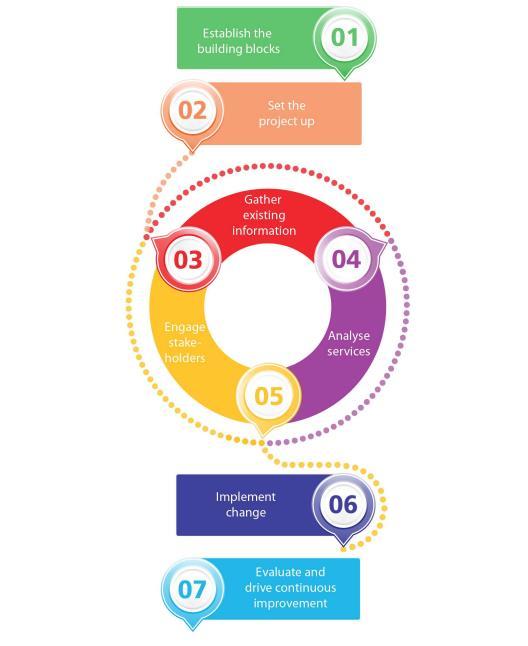
The methodology has been designed in accordance with the framework for a service review outlined in Service Delivery Review: A how to manual for local government (2015) by the Australian Centre of Excellence for Local Government (the SDR Manual), as well as the IAP2 Foundations of Public Participation. The framework encompasses the entirety of the review; however, given the scope of this engagement, it is anticipated that the deliverables required to fulfil this engagement would include the following stages shown in Figure 1: Service delivery review process.
4.1.2 Federation Council Community Engagement Strategy
As outlined in the Federation Council Community Engagement Strategy, Council is committed to informed and transparent consultation and decision-making using a range of engagement techniques. Council outlines engagement aims, including to:
• Be accessible and inclusive, listening to community needs and ensuring they are understood and considered.
• Actively seek input into our decision-making, encouraging and enabling genuine community participation using best practice consultation tools including innovative information sharing technologies.
• Be open and transparent, communicating using plain and engaging language, and ensuring that the community and other stakeholders are informed as to how their inputs have (and have not) been integrated in Council decision making. Routinely sharing information about Council services, activities and decisions and celebrating the achievements of Council and local community.
To achieve these aims, and to ensure that all members of the community are able to contribute to their community and prospective plans, Council outlines guiding social justice principles including:
• Equity, fairness in decision-making and allocation of resources, with consideration for relative vulnerability, ensuring fair and equitable opportunity to participate in the future of their community.
Figure 1: Service delivery review process.
• Access, fair access to services, resources, and opportunities to improve quality of life.
• Participation, ensuring maximum opportunity to genuinely participate in decisions which affect their lives.
• Rights, establishing and promoting equal rights, with opportunities for people from Culturally and Linguistically Diverse backgrounds to participate in community life.
• Quadruple Bottom Line, the Community Strategic Plan will also adequately address social, environmental, economic, and civic leadership considerations, and approach referred to as ‘the quadruple bottom line.’
4.1.3 IAP2 Core Values of Engagement
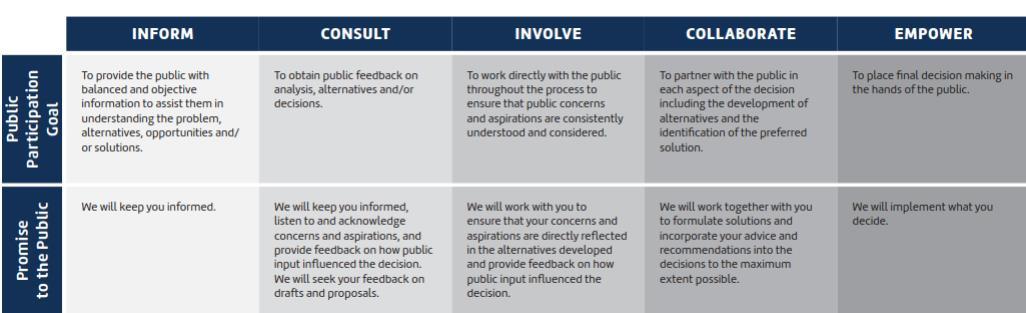
The IAP2 spectrum (shown in Figure 2 below) identifies the level of influence stakeholders have on a project, from inform through to empower. Section 4 of this plan describes the level to which SMEC and Council will engage with key stakeholders during the Project.
Figure 2: IAP2 Spectrum of Public Participation
4.2 Summary of Engagement
The key engagement objective was to carry out formal targeted engagement with identified stakeholders to inform them about the project and invite early feedback to gain an initial understanding of their key issues, concerns, and opportunities. The project team also canvassed builders, developers, and the wider community to seek feedback on their individual experiences with the Federation Council’s PDT Collectively, feedback was received by external stakeholders, internal staff, and councillors. This feedback has been reviewed, categorised into feedback themes, and reflected in sections 4.3 and 4.4 of this report below.
Key outcomes to be derived through stakeholder engagement included:
• Engage early and transparently with stakeholders to inform them about the Project
• Pre-emptively identify potential issues to reduce the risk of project delay, based on similar project experience
• Propose a mix of both traditional and digital consultation to best reach all relevant stakeholders
• Incorporate community and stakeholder feedback to the maximum extent possible during the development of the project
• A greater understanding of project risks and how they may be best managed
• Engendering community and stakeholder support for the project.
Feedback was collected through two primary channels: an in-depth session with the Stakeholder Reference Group (SRG) and an Online Survey.
Table 4: Engagement participation highlights
50+
Targeted 1:1 and focus-group meetings held with Council staff and Councillors
1
Dedicated SRG meeting with 1:1 follow-ups
65%
Respondents believe the DA decision making process is not transparent
44%
Respondents have lived in Federation Council LGA for 20 years or more.
4.3 Summary of Feedback
43
Online survey responses received
52%
Respondents had submitted a DA with FC in the past
22%
Respondents received four or more requests for additional information on their application.
43%
Respondents strongly disagreed that the application process was straightforward and easy to understand.
During the consultation period, feedback received covered a broad range of topics relating to the key challenges faced by Council's PDT, including high staff workloads, recruitment difficulties, and cultural and communication issues. Whilst it was acknowledged that staff are appropriately qualified and the quality of their work is upheld, process inefficiencies, including inconsistent determination times, excessive early-stage scrutiny, and rigid rules, cause delays and errors in application assessments.
To address these problems, stakeholders called for cultural and procedural change, improved delegation, clearer decision-making, and streamlined processes. A shift toward a more solution-focused, flexible approach is essential for improving efficiency and the Council's reputation.
Stakeholders also expressed a willingness and desire to help Council. There is clear recognition that many of the factors that have led to Council’s current predicament are external and beyond Council’s control. For any chance of change to succeed, the change needs to support and constructive feedback of the whole organisation and the local development community.
4.4 Feedback Themes
During consultation, key areas of concern and potential opportunities were identified, which are listed below. It is noted that these are the views of individuals. They have been included for the purpose of providing a 360degree review of the service.
Table 5: Engagement feedback themes
Staffing and workload
• Insufficient staff (e.g., vacant development engineer position) to handle workload due to ongoing recruitment challenges (e.g., suitably qualified applicants).
• Concerns that the Council’s reputation hampers the ability to attract strong candidates.
• Staff frequently express being overwhelmed, affecting their ability to deliver work on time.
• Admin staff are knowledgeable and capable but seem to have limited delegation.
• Training opportunities have reduced as a result of workload and staffing shortages, and stakeholders strongly support re-establishing training as a priority
Cultural and communication challenges
• Council to rethink communication strategies; updates to applicants could come from customer service rather than solely via planners.
• Seeming lack of collaboration between Council and developers
• Applicants struggle to build trust and relationships with staff due to inconsistent interactions.
• Pre-DA meetings are often not documented by Council with no follow up communication on summary.
• The SRG recognise the need for "baby steps" and adopting new ways of thinking.
Processes and procedures
• Determination times are inconsistent; staff commit to deadlines but often fail to meet them.
• Initial submission to lodgement period lacks adherence to the 14-day rule; excessive forensic investigation at preliminary stages leads to unjustified RFIs.
• The quality of an application directly affects acceptance timelines through the Planning Portal, delaying processes and procedures and creating applicant frustration.
• Requests for documentation that is excessive and not commensurate or proportionate to the proposal, project, or stage (i.e., CC level information for a DA).
• Applicants prefer one comprehensive RFI rather than multiple staggered requests.
• There is a disconnect between pre-DA advice and final applications, especially where applicants are unfamiliar with planning processes, resulting in inefficiencies, and leading to increased costs and frustration.
Inconsistency in assessment approach
• Significant inconsistency in approach across staff and departments; decisions vary between neighbouring Councils.
• Lack of streamline procedures/ varied staff approaches, along with challenges in timely and proactive communication are affecting clarity resulting in applicant frustration.
• Vacancies and workload pressures have led to technical staff undertaking administrative tasks, impacting efficiency and consistency with assessments
• Staff appear cautious in exercising decision-making responsibilities.
Impact on development/ local economy
• Procedural hurdles and delays discourage development and investment in the region.
• Every step of the process has its own delays and pain points.
• Developers are increasingly turning private for certification purposes instead of relying on Council’s services.
• Local consultants receive less work year after year due to perceived delays and uncertainty in investing in the Federation Council area.
Decision-making challenges
• Minor decisions or core functions (e.g., payment approvals or refunds) require Director sign-off. Consider streamlining by removing the sign-off requirement for minor tasks.
• Established procedures or rules are followed closely, leaving limited ability for flexibility or discretion, negatively impacting customer satisfaction.
• Opportunity for Local Government Approvals Officer (customer liaison officer) as a dedicated point of contact to improve consistency and communication.
4.5 How feedback was integrated into the final report
• Expressing stakeholder recognition that the PDT does not do an easy job and that they are understaffed. Stakeholders want the PDT to work smarter not harder; want to come along for the journey; and acknowledge that change will be gradual and will inevitably cause some short-term friction.
• Acceptance that it is unfeasible to reduce staffing levels below what currently exists. Meaningful and lasting change to performance cannot change without new processes and procedures, and the maintenance and growth of the team.
• Empower staff to be more confident and have wider delegation through improved training and career progression opportunities.
• Applicants want better communication from the PDT. They want clear and honest expectations on RFI and determination timeframes as changes to timeframes impact significantly on their workload, and the finances and liveliness of clients. Measuring and mandating communication is difficult; however, it is recommended that at a minimum, assessment staff should be proactive and provide an introductory email to applicants with high-level feedback and timeframes.
• Restructure Council’s ‘clearing house’ (or upfront) application triaging processes as these are the biggest pain-point for customers and result in the largest delay.
• Rebuild the professional relationship between PDT and regular applicants as peers. They work together every day. The two sides do not need to agree on everything, but the relationship should be professional, constructive, and neither side should have fear or resistance to picking up the phone to have a conversation.
5. Performance
Part 5 of this report measures the performance of the PDT year-on-year and against other comparable councils. Data collected for this part is provided directly from Federation Council and from the NSW Planning Portal. Council’s data can be used to measure year-on-year performance within council but is not suitable to be used for comparative purposes as there is no way to confirm that the origin and method of measuring performance is the same across different organisations.
For comparison purposes the NSW Planning Portal data is used instead of Council’s data. The NSW Planning Portal only captures Development Application performance data which accounts for only a portion of the work done by the PDT but is generally considered to be a representative sample and is, generally, catalytic for the future stages of applications and certificates
5.1 Planning Portal
The NSW Planning Portal was implemented in 2020 and is now mandated by the State Government as the single and universal point of application lodgement and management. In 2022, the NSW Planning Portal introduced electronic application management, bringing new processes and procedures as well as standardised assessment report templates that previously did not exist. Councils across NSW are legally required to use the Planning Portal.
Regional councils were afforded additional time to prepare for the Planning Portal implementation than metropolitan councils. Regional councils were required to commence using the Planning Portal by 1 January 2021 and were required to process 100% of applications via the Portal from 1 July 2021. The introduction of the Planning Portal is meaningful to note as it represents a clear turning point (for all councils) in the average processing times of development applications as evident in later Figures.
5.2 Internal Data
Federation Council has provided internal data measuring internal performance year on year from 2021 to 2024. Whilst this data cannot be relied on to compare Federation against other councils, it is useful to track internal efficiencies against the volume of work received. The data received is summarised and displayed below:
Average Determination Days
*Council’s Administration Support Officers have advised that the average Government Information Public Access (GIPA) request takes approximately 1-hour to prepare and then require Director review and authorisation to release the information. Other estimates provided suggest the average time is closer to 3-hours to complete per request.
*Additional staff joined in October 2024, which may have contributed to improved average processing times in 2024.
Findings
• The volume of work received by Federation Council has steadily declined over the past four years. Much of this decline is considered attributable to a general decline in construction globally, resource and staff shortages, cost of living pressures, and economic turbulence generally.
• The data shows a clear trend in the average number of determination days increasing from 2021 until mid2022 across all types of applications. This trend is likely considered attributable to the introduction of mandatory NSW Planning Portal usage (1 July 2021).
• The ‘Applications and Certificates Determined’ downward trajectory is anticipated to continue occurring in 2025, consistent with the decreasing receipt of development applications that is measured in financial not calendar years.
• From 2022 onwards the average determination days of most application types has been in decline (improving) in a consistent manner. These efficiencies are reasonably considered attributable to an increased number of assessment and administrative staff; decreased workload; and an increased familiarity and comfort with the NSW Planning Portal.
• The temporal trends are reflective of significant organisational or procedural change (i.e., the Portal) and reflect the typical knowledge bell-curve (baseline > decreased efficiency while learning > return to baseline).
• The number of customers nominating Council as their Certifying Authority for Construction and Occupation Certificates has reduced at a higher rate than the number of consents issued. This indicates that there is growing use of the private certification market to fulfil these services.
• The reduction in Planning Certificates is indicative of a slowing property and development market over the years (noting that these Certificates are required to be included in property marketing / sale contracts). This shows that the decrease in work is affected by internal and external factors.
5.3 External Data
External data considered for this part is extracted from the NSW Planning Portal in February 2025. The reader is advised that data on the Portal is updated monthly.
5.4 Statement of Expectation
The Environmental Planning and Assessment (Statement of Expectations) Order 2024 came into force on 01 July 2024 and outlines the Minister for Planning and Public’s Spaces expectations of the performance of a council in dealing with planning and development matters. The Minister has wide powers to intervene in the function of local government in accordance with the heads of consideration under Part 2 of the Order. The Order comprises of the following considerations:
(a) Whether or not the Council has failed to meet the Minister's expectations in relation to council performance.
(b) The duration, frequency, and degree to which the council has performed, or failed to perform, in accordance with the Minister's expectations.
(c) The range and type of planning and development matters in respect of which the council has performed, or failed to perform, in accordance with the Minister's expectations.
(d) Whether or not an appointment under s.9.6(1)(b) should be made in relation to one or more of a particular class of planning and development matter, or all planning and development matters dealt with by the council.
(e) The effect of any caretaker period preventing a council's performance in dealing with the planning and development matters (or any particular class of such matters) as set out in clause 5.
(f) The individual circumstances of each council, for example whether external events like natural disasters have impacted the council, or council has received an unexpectedly high volume of DAs compared to their current staffing levels.
(g) Whether or not other available interventions or support have failed to result in improvements to council performance in relation to the Minister's expectations.
(h) With respect to development applications for residential accommodation:
• Whether the Minister's expectations have been met for development assessment timeframes, and
• Whether the Council has been identified as having a key responsibility in the delivery of housing supply by the NSW government.
(i) (i) The public interest.
With regard to Federation Council’s performance, the quantifiable expectations set by the Minister in relation to development assessment timeframes are as follows with data extracted from the NSW Planning Portal:
Lodgement timeframes
• From 1 July 2024: 14 days
• From 1 July 2025: 7 days
Determination timeframes The lesser of the previous financial year average (80 DAYS), or an average of:
• From 1 July 2024: 115 days
• From 1 July 2025: 105 days
• From 1 July 2026: 95 days
• From 1 July 2027: 85 days
days / 17% of applications meeting Expectation
days / 83% of applications meeting expectation (as of February 2025)
Table 8: Minister for Planning and Public Space’s Statement of Expectations summary Criteria
Comply with procedural and reporting requirements per Guide to Varying Development Standards
Combined Lodgement and Determination Expectation
• 94 days
Combined Lodgement and Determination Performance 118 days
5.5 Current Performance
Federation Council’s DA lodgement and determination performance over the past four calendar years, per the data from the NSW Planning Portal, is displayed below. Note FY24-25 is incomplete at the time of writing (March 2025).
Federation Council DA Performance
DAs lodged DAs determined
Average Lodgement Days Average Determination Days
Findings:
• The number of development applications lodged and determined at Federation Council have reduced significantly over the reportable years. The number of applications determined in FY23-24 decreased by 30.02% compared to FY21-22.
• The average lodgement timeframes (shown as a green line above) have been decreasing (improving) from FY23-24 to FY24-25 but are still far in excess of the 14-day expectation set by the Minister (see commentary in Part x Performance Tracking of this report).
Figure 5: Federation Council DA performance FY21-22 – FY24-25
• The average determination timeframes (shown as an orange line above) have stabilised in FY23-24 and FY24-25 after two years of increases. Council is reminded that the FY25-26 determination timeframe expectation will be to improve on the current financial years average.
• The data does not account for the rising complexity of assessment and the growing list of considerations that must be given to each individual application.
• The data shows a clear correlation between increased staffing levels and performance speed.
5.6
Expectation Benchmarking
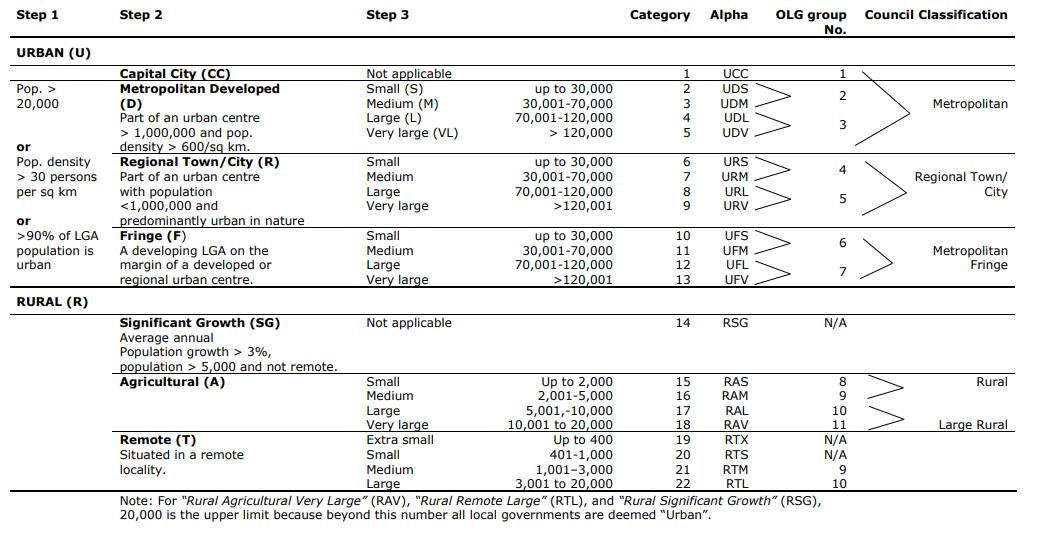
The Australian Classification of Local Government and OLG Group Numbers have developed a formula to classify each NSW council into one of eleven distinct categories. Federation Council is classified as OLG Group 11 – Large Rural. The formula developed is provided below:
Other NSW Councils that are classified as Large Rural councils, and are therefore suitable to be used as a benchmark to Federation Council include:
• Bellingen
• Cabonne
• Cootamundra-Gundagai
• Cowra
• Greater Hume
• Gunnedah
• Hilltops
• Inverell
• Leeton
• Moree Plains
• Murray River
• Muswellbrook
• Nambucca
• Narrabri
• Parkes
• Snowy Valleys
• Upper Hunter
• Yass Valley
For the purpose of comparing one entity against another, the data reviewed must be unbiased and uniform. Relying on each entity to provide their own data is unhelpful and the source can be unknown. The only consistent data set available across each of the comparable councils is the NSW Council Leagues Table, with its inputs derived directly from the NSW Planning Portal. No consistent source of data is publicly available to compare a Council’s performance against the other types of applications or certificates (including CDCs, OCs, mandatory inspections etc).
• 4/18 councils (excluding Federation Council) achieved both their lodgement and determination expectations.
• 6/18 councils (excluding Federation Council) achieved a combined lodgement + determination performance timeframe that was lesser (faster) than their expectation timeframe.
• Federation Council determined the equivalent of 97.6% of applications received at an average total time (inclusive of lodgement/assessment/determination) of 118 calendar days (approx. 84 business days).
• Of the comparable councils there is an average lodgement period of 17 days and average assessment period of 79 days.
• Federation Council’s submission to lodgement period is too long and requires improvement; however, Council’s determination timeframes and combined timeframes are not significantly different to other comparable councils. Whilst there is always scope to improve, Federation Council is not underperforming commensurate to comparable councils.
5.7 Performance Tracking
5.7.1 Lodgement Expectation Performance
Council is not achieving the Minister’s 14-day lodgement expectation for development applications and is 357% over the timeframe.
The 14-day expectation is decreasing for all councils to 7-days from 1 July 2025. This change is depicted in green on the below graph.
Council’s performance in decreasing the average number of days it takes to lodge an application is evident, and Council’s “ranking” on the Council Leagues Table is correspondingly improving.
The graphs in Figures 4, 5 and 7 demonstrate that the average timeframes for the lodgement of applications increased substantially in the months following the mandatory usage of the Planning Portal. This trend is consistent across the state. The lodgement graphs show a clear trajectory in the increasing efficiency of lodgements over the past 7-months, which generally coincides with the appointment of additional fixed-term Planning Officers, Building Surveyors and Administrative Support Officers.
The Figures demonstrate the average timeframes for the assessment and determination of applications. The graphs demonstrate a reduction and subsequent stabilisation of assessment timeframes in the past 7 months.
Current Performance and Minister's Expectations
5.8 Statement of Expectations Implications
The Minister has broad powers to intervene if a Council is not acting in accordance with, or meeting, the expectations of the Statement of Expectations Order (of which Federation Council is not).
No contact has been made with the office of the Minister as a part of this service review and there is no indication (acknowledged, perceived, or given) SMEC of any implications or ramifications that Federation Council may or may not face consequent of not achieving the Expectation timeframes.
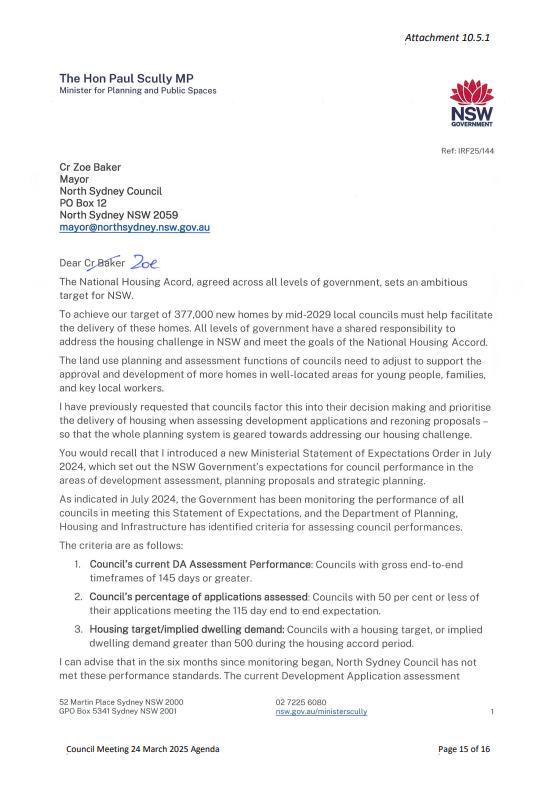
It is however noted and provided that the Minister has begun writing to council/s that have not met the relevant performance standards. A copy of a letter to North Sydney Council from the Minister for Planning and Public Spaces dated 6 March 2025 is provided overleaf (extracted from North Sydney Council’s 24 March 2025 meeting agenda).
Figure 7: Federation Council current performance and Minister’s Expectations
6. Industry Relationships
Engagement exercises undertaken throughout the course of this service review have revealed that there is a perception from all parties that there has been a relationship breakdown between internal and external customers and the PDT
The cause of this breakdown is not clear and is not within the remit of this service review to dissect these events.
The breakdown has resulted in deteriorating and increasingly stressful communications between the parties as opposed to pragmatic and solutions orientated discussions. External customers have expressed that they often feel like a hinderance instead of a peer when working with the PDT, and that a perception of “us versus them” exists.
Despite this, all parties have expressed an immense desire to mend and rebuild the relationship and to work together to achieve better development outcomes for the community. All parties want to be constructive, and solutions orientated, however without having a foundational positive and professional relationship with a counterpart, a person will be less likely to pick up the phone and have a conversation.
Improved relationships between the PDT and regular applicants should result in less stress, higher morale, and improved efficiencies and customer experience. Repairing or building relationships is beyond the scope of what a service review report can deliver, however a series of recommendations have been made in Appendix 1 of this report as to how this process could begin.
7. General Recommendations
A series of recommendations for the general operation and function of the PDT have been formed from observations of the project team and engagement feedback from internal and external customers including the SRG and elected Council.
These recommendations have been formed into a simple ‘Recommendation – Action’ structure and should be considered by Council irrespective of which Service Delivery Option is selected.
Each recommendation made is achievable and is already in place across a number of local and state government organisations. The General Recommendations can be found in Appendix 1 of this report.
8. Service Delivery Options
There are four chapters provided in Appendix 2 of this report which each provide an alternate service delivery model which Federation Council may choose to adopt in full or use as a basis to create an alternate fifth model.
The four service delivery models have been designed specifically for Federation Council, and each require various levels of investment and effort. In summary, the four options could be described as:
• Option 1 – do nothing.
• Option 2 – maintain the current team but reduce the extent of services provided.
• Option 3 – maintain the current team, make permanent fixed-term employees, and engage consultants for a four-month period to allow the clearing of backlog and development of new processes, procedures, and templates.
• Option 4 – builds on option three, by adding an appointment of a development engineer and a specialist IT employee within PDT to rebuild the technological platform that the team operates within and how customers can track their applications.
9. Conclusions
• Federation Council’s current level of performance is improving consequent of continued stagnations within the economy resulting in less work coming in; the fulfillment (or partial fulfillment, with fixed-term employees) of vacancies; and through efficiencies as new staff become familiar with Federation Council’s process.
• The provision of staff will likely become inadequate and new work will quickly backlog under the current processes in the event that the economy stimulates, or if staff were to resign. Without meaningful investment in both staff and processes, the PDT cannot succeed.
• The success of the PDT can be measured through many anecdotal lenses. Primarily through, it can be measured through compliance with the Minister for Planning and Public Spaces Statement of Expectations Order. Council’s ‘submission to lodgement’ period for development applications does not meet the minimum standards set (and thus pushes out the end-to-end timeframe). Without very quick change to the application triaging system, Council may be at risk of State government intervention.
• The staff in the PDT are good. They are qualified, knowledgeable, and generally deliver a high standard of work. The number of functions delivered by the PDT combined with the level of staffing means that individuals are spread too thinly in their BAU.
• There is a lack of resources available for the PDT to invest time in the development of new processes and procedures to assist in implementing long-term change. Staff are required to be focused on output rather than strategically planning for longer term solutions.
• There is recognition from all stakeholders that positions within the PDT are not easy jobs and that they are heavily regulated by legislation. The staff are knowledgeable and competent. There is broad recognition that the prolonged assessment timeframes are largely due to recruitment and retention challenges, outdated procedures, and staff being spread too thin.
• The community wants better communication from the PDT both by way of speed, accuracy, and general friendliness. There should be a constructive and professional relationship between the PDT and regular applicants – ultimately everyone is a peer seeking to achieve the same goal and just have different responsibilities at different stages of the development. Building a respectful relationship between peers will improve development outcomes, lead to quicker determinations, and facilitate a more positive working environment.
• Investment in technological innovation would significantly reduce the volume of telephone calls received by Council as a whole. Information relevant to developments (including plans, SEEs, technical reports, and Council’s Assessment Reports and Notice of Determinations) should be publicly available on Council’s website for the community to review. Without the information being online, the only other avenue is for a community member to call up, email, place a request, and wait for a response.
• Given the present resourcing and the economic decline in the construction sector, now is the perfect time for Federation Council to implement the Recommendations included within this report (in addition to any others that staff or the community may think of). The opportunity to act on a decreasing workload will not last forever, and Council should be proactive in preparing for the future; in increasing performance times; and in stimulating increased investment across the region.
Table 10: General Recommendations
Recommendation
1. Clear existing backlog of applications and certificates through a “backlog blitz”.
* Optional activity for staff as outside of work hours. Hours to be paid as overtime or TOIL.
• Nominate a weekend for staff to work through and clear the backlog of “assessment ready” applications that require no further site inspections, referrals, or information.
• Management to set minimum workload expected to be completed in blitz (i.e., four applications / certificates per day finished)
• Staff to nominate work to complete in blitz (from start to finish). Should be a focus on new work, and not just continuation of BAU.
• Development engineering staff may also participate in the blitz, focusing on completing applications or certificates requiring engineering input. Now
2. Restructure the Clearing-House process and procedure to achieve Minister’s 14-day Expectation.
3. Improve customer communications protocol to achieve consistent and accurate messaging.
• Refine review process. Current process is good for junior learning but inefficient (whole team meeting). Number of staff involved should vary depending on application size and type.
• Develop a simple checklist to ‘accept’ or ‘reject’. Instil ethos that clearing-house is not an assessment of the application – it is a check that the right information is available to allow an assessment to be made once application is accepted. If council preference is to avoid RFIs, this process will operate strictly on an accept/reject basis.
• Set firm 7-day applicant response deadline and allow only one opportunity to provide correct information.
• Set KPI to accept or reject 90% of applications within 14-days.
• Record changes in clearing-house timeframes to measures whether actions have been successful or not.
• If unsuccessful, revisit actions and liaise with DPHI to find alternative solutions.
• Develop Customer Engagement Plan and Customer Service Charter
2-3 months
3-4 months
• Enforce organisational KPIs for email and return-phone call response times. If none in place, establish (i.e., 5-days for email, 2 days for a call). Now
4. Keep a written record of all commitments
• Staff to provide introductory email to all applicants upon allocation of all work. Email is to set realistic time expectations for referrals, site inspections, RFIs and assessment completions. Even if the period will be prolonged, applicants will prefer open and upfront timeframes.
• Staff to record all introductory emails in Council document management system.
• IT in collaboration with PDT staff to develop template to record correspondence and application status.
• Staff to record in spreadsheet the day application was allocated to them and the day introductory email was issued, including any relevant supplementary communications.
• Management to review spreadsheet monthly to monitor performance. Management to express the importance of clear and up-front communication.
• After each phone call or site visit, if staff have made any form of commitment to any stakeholder (i.e., timeframes, agreement in principle to something, “I’ll get back to you on that”) they are to keep a written record (i.e., dot-point email to self).
• If a verbal commitment is made to an applicant, follow-up that commitment via email setting out any terms or conditions that may change completion of the commitment.
• IT in collaboration with PDT staff to develop template to record commitments made or agreed upon and application status. Now
5. Develop a new Request for Information or Withdrawal process for applications during assessment process.
• Council to refrain from issuing any RFI until a full preliminary assessment is complete, including referrals and notification.
• Council to strive to issue only one comprehensive RFI per application (Note: there will be circumstances where this is not appropriate).
• Strict timeframes are to be enforced for applicant’s responses to an RFI, contingent on the complexity of information or change needed.
• If applicants are unable to respond in time, an offer for a partial refund of the application fees commensurate to the level of work done is to be offered (i.e., 40%) to encourage withdrawal and submission of a new application once all information is received.
3 months
6. Develop a DA lodgement checklist and matrix so that applicants know what documents Council expects for different types of applications.
• ‘One strike’ policy to be enforced – applicants are only offered one opportunity to respond to the RFI. If their response is inadequate, refuse application.
• Council to publish notice and inform applicants of this upcoming change to minimise surprise and push-back. 1 month
• Council to develop checklist with definitions of what each type of plan and report is.
• Develop a matrix of different application typologies and a key of what documents are required for what application.
• Council to publicise and publish new application checklist and matrix.
• Council to use the checklist and matrix during the Clearing House function, to ensure that both applicants and council have the same expectation of what information is required. 3-6 months
7. Peer review
• Assessment reports, Certificates or determinations should not leave Council without being peer-reviewed by a superior.
• Add a secondary signature box to each document for the author and reviewer to sign. If impractical, a separate “Review Form” can be created, in which both the author and reviewer sign and date.
8. Redistribute existing workstreams or functions that are within the PDT but are more suited to alternate divisions with Council.
• Develop a list of all functions and tasks currently complete by and under the remit of the PDT
• Identify existing functions that are more applicable to alternate functions within Council (i.e., Flood Affect Certificates) and seek to transition the responsibility of the stream from the PDT to alternate divisions / directorates.
9. Rebuild connections and relationships with local development community.
• The relationship between Council and the local development community has become frayed over the years, however both sides have desire to rebuild and mend.
• Council Comms team (or other division separate to PDT) is to look at low-stress networking opportunities between the parties and encourage individual dialogue.
• Council to consider asking local developers for a tour through recently completed or under construction developments to stimulate conversations and connections outside of Council’s office.
2 months > ongoing
10. Specialised Planning and Development Lawyer session.
11. Explore alternative training opportunities for the PDT.
• Find and establish a collective goal that the parties can work together on.
• Engage a specialised Planning/Development lawyer/s to run a one-day or half-day session with the PDT outside of the office to:
– Give their perspective on the state of planning.
– Discuss procedural risks.
– Discuss conditions of consent / Newbury test.
– Discuss importance of staged inspections and documenting them correctly.
– Provide their experience on the mistakes or shortfalls that they often see during the development process.
– Provide an interactive Q&A function.
• Continue providing dedicated training sessions or days to the staff equally provides for new knowledge and a morale boost from seeing proactively Council investing in their staff.
• i.e., CPTED courses, Aboriginal Cultural Heritage training.
3-6 months
12. Partner with local educational and employment-finding services to promote the certification field.
• Undertake a review of how many building certifiers are in the public register within the LGA.
• Engage with local educational and employment-finding services to develop a strategy and further promote the opportunities in the industry within Federation and surrounding LGAs.
• Incrementally monitor the register to see if there is any increased uptake in certifiers.
3 months > ongoing
13. Develop a pre-approved consultant’s pool.
• From time to time Councils need to rely on consultants to undertake various components of work. Engagement of an adequate consultant can take many weeks.
• Council should release a tender seeking the interest of suitable planning, engineering, plumbing etc consultants, and appoint up to five within each field to go on a pre-approved consultant list with rates set.
• If Council needs to engage the services of a consultant, they will be able to do so immediately within the pre-approved list without having the delays of EOI and procurement.
12-24 months
14. Nominate a dedicated staff member to regularly check DPHI websites and releases for grant funding opportunities.
• DPHI releases grant funding for assorted opportunities from time to time, however sometimes the opportunity it not seen by a council until the EOI has finished.
• Council shall nominate one specific staff member to regularly (i.e., once per 2-weeks) check DPHI websites and media releases to identify if any grant funding opportunities are available that are suitable to Council.
Status Quo / Do Nothing
Option one seeks to provide a likely scenario of what may occur if the current trajectory of the PDT is maintained. Option one does not provide any new ideas or ways of working.
Option one relies on the continual decline of the economy and thus decreasing number of applications (congruent with current trends) in order to gain mid to long-term efficiencies (lower input = faster output). The factors that dictate the ability for Option one to succeed are beyond Council’s control.
In a scenario where no further investment is made in the PDT or its ability to deliver its services, the below is a probable outcome.
Maintain current resourcing levels.
Continue efforts to recruit current vacant positions.
Maintain arrangements for current fixed-term staffing positions.
Recruit experienced Development Engineer (ideally with a water and sewer background).
Maintain the current level of services delivered.
Maintain current distribution of work and tasks.
Fill vacant positions (e.g., Development Engineer role in the Infrastructure Team).
Continuing decline in workload should lead to improvement in efficiency (reduced input + equal servicing = improved output).
Potential for long-term Improved customer satisfaction from improved efficiency.
Improved staff morale through decreased workload.
Increased opportunity for other improvements.
Maintained short-mid-term customer frustrations as change takes time.
Escalating customer complaints in the short-term.
No opportunity for improved strategic planning to enhance the long-term future of the LGA.
Success is entirely contingent on external factors beyond Council’s control (i.e., economy, and local investment).
Any efficiencies that are gained are susceptible to fast reversal if a team member resigns.
Less work = less income for Council.
Option one can provide mid to long-term relief in the efficiency of BAU but is considered to be unsustainable and undesirable as it is contingent on external factors and does not provide long-term solutions. Option one requires no further investment into the PDT but will not ameliorate or minimise the volume of complaints being received.
Option one is unsuitable as it presents unacceptable risk in:
• Succeeding in speeding up processing times.
• Organisation reputation.
• Providing a foundation for the community and local economy to thrive.
• Achieving the Minister’s State of Expectations.
Option Two
Reduce and Redistribute Service Offerings
Option two provides for the retention of the existing PDT team and for a reduction and / or redistribution of services currently delivered. The PDT primarily delivers statutory services that cannot be removed or redistributed; however there remain tasks that are capable of being shifted.
Examples of services that are capable of being removed include prelodgement meetings and duty-planning advice. Services that are capable of being shifted elsewhere in the organisation could include Flood Affectation Certificates, GIPA requests, and payment of fees and charges. Consideration may also be given to relinquishing Strategic Planning functions and handing this back to DPHI.
While Federation Council does not have a dedicated strategic planner, strategic planning obligations would still need to be managed within the organisation. This could involve redistribution of responsibility across existing roles or engagement of external resources to ensure compliance.
Maintain current resourcing levels.
Continue efforts to recruit current vacant positions.
Recruit experienced Development Engineer (ideally with a water and sewer background).
Maintain arrangements for current fixed-term staffing positions.
Maintain the current level of srrvices delivered.
Decrease in workload and responsibilities should lead to improvement in efficiency for the PDT (reduced input + equal servicing = improved output).
Improved efficiency in PDT corresponds to increased investment and appetite to invest within the region.
Improved customer satisfaction from improved efficiency.
Possibility for improved staff morale through decreased workload.
Increased opportunity for other improvements.
Shifting of problematic functions to another division within Council might improve efficiencies for the PDT but shifts the onus onto another division.
Increased internal conflicts over perceived disparity in workload.
Likely short to mid-term decline in staff morale.
No opportunity for improved strategic planning to enhance the long-term future of the LGA.
Any customer satisfaction gained from improved efficiencies will likely be outweighed and lost by dissatisfaction in the reduced levels of services available.
Would not decrease the number of complaints received but would rather shift them elsewhere in the organisation.
Unsustainable in the long term.
Option two is likely to be deeply unpopular and will be perceived as selfish in nature as operational functions are redistributed elsewhere in the organisation. Option two would likely result in mid-term improvements in PDT efficiency and would assist in Council being able to meet the Minister’s Statement of Expectations.
Option two is likely to be unsuitable as it may present risk including:
• Increased internal conflicts between divisions.
• Reduction in services offered may result in inferior development outcomes.
• Reduction in services may result in poorer quality submissions requiring longer periods to resolve errors or omissions.
• Redistribution of services may just push the delay onto another directorate.
– Organisation reputation.
Option two is capable of being delivered in a variety of ways with differing magnitudes of changes.
Council may consider sampling Option two by doing the following:
• Device a list of all tasks, functions and operations performed by the PDT
• Classify functions as either Statutory or Non-Statutory.
• Select equivalent of 5% of non-statutory functions that are capable of being removed from service offering for a fixed-term (i.e., six months).
• Select equivalent of 5% of non-statutory functions that are capable of being redistributed elsewhere in the organisation for a fixed-term (i.e., six months).
• Upon cessation of the fixed-term period, measure whether the 10% reduction in workload for the PDT has resulted in an equivalent improvement in efficiency or not.
Option Three
External Help and a Fresh Slate
Option three requires fixed and short-term financial investment from Council but provides the opportunity for the PDT to have a “fresh start” and establish new ways of doing BAU.
Option three maintains all staff and makes current fixed-term employees permanent. Option three requires the appointment of a small consultant team for a period of four months to do one of two things:
1. Clear the backlog of applications and certificates to allow the team to have a “fresh slate” and manageable workload, or
2. Develop new practices, processes and procedures for the team including various internal templates and public DA guidance.
Opportunities for staff growth and development are included in Option three and seeks to diversify skillsets and provide opportunities for the redistribution of work across the division. Option three affords the opportunity for the PDT and Council to proactively progress rather than simply maintain. In line with this, as Federation Council does not have a dedicated strategic planner, strategic planning obligations would still need to be managed within the organisation. This could involve redistribution of responsibility across existing roles or engagement of external resources to ensure compliance.
Maintain current resourcing levels. Continue efforts to recruit current vacant positions. Make permanent current fixed-term staffing positions.
Engage consultants for a fixed-term period to complete a specific task. Recruit experienced Development Engineer (ideally with a water and sewer background).
In a fixed-term period develop the following new procedures and material:
• Application checklist and completeness matrix (for both internal and external use)
• Application triage procedure.
• Develop Plan of Management (PoM) for community land
• Returned-application letter with automated standardised reasons and requests.
• Request for Information or Withdrawal procedure and standardised letter.
• Development process-map for applicants/ fact sheet on how to submit a high-quality DA
• Mandatory and staged inspection guide for applicants.
• Review of technical and administration roles and responsibilities of various positions.
In tandem with Communications Team, develop a comms strategy to inform regular applicants of the changes to procedures and why they are being made.
Establish PDT performance KPIs that are more ambitious than the Minister’s Statement of Expectations for at least 80% of all work within a 12-month period (upon implementation of all new procedures and materials).
Nominate two (2) ‘champions’ within the team to lead the dissemination of information about new procedures and to periodically check if they are working or whether adaptations are required.
Upskill and empower Administration Support Staff to have greater roles and responsibilities to reduce workloads of Manager and Director. Training can be formal or informal on-the-job learning.
Improvement in efficiency.
Improvement in the quality of outputs through contemporary processes and templates.
Foundational to sustain efficiencies in the long-term and develop resilience to fluctuations in staffing or external factors.
Improved customer satisfaction from improved efficiency.
Enhanced transparency in the decision-making process.
Improved staff morale, job satisfaction, and reduction in stress.
Mid-term (post teething period) reduction in customer complaints.
Improved organisational reputation and additional time for relationship development opportunities between PDT and the development community.
Improved quality of application information.
Enhanced applicant appetite to develop in Federation through greater certainty in Council expectations and outcomes.
Enhanced and growing contribution to local economy, housing market and employment sectors.
Increased revenue / streams via increased applications will offset upfront consultant expenditure.
Increased opportunity to facilitate staff development.
Decreased administrative roles and responsibilities for senior staff.
Increased opportunities for Council to prepare applications for DPHI EOI grant funding opportunities.
Short to mid-term internal and external teething problems in learning new BAU.
Acknowledgement that some people do not like change.
Increased on-going expenditure in the operation of the PDT.
Increased expectations for the PDT to deliver faster and better results.
Option Four
Redevelopment of the Service
Option four is aspirational. Option four includes all of the elements of Option three, plus the recruitment of new positions within the PDT (or Council) to assist in streamlining and expediting of the operation of the team as well as strategic planning resourcing.
Per Option three, Option four also maintains all staff and makes current fixed-term employees permanent. Option three requires the appointment of a small consultant team for a period of four months to do one of two things:
1. Clear the backlog of applications and certificates to allow the team to have a “fresh slate,” or
2. Develop new practices, processes and procedures for the team including various internal templates and public DA guidance.
Option four engages a fixed-term (i.e., 24-month) IT consultant working exclusively within the remit of PDT but simultaneously working across a broad spectrum of divisions to identify where system efficiencies can exist. IT consultant also to address current interface issues between Total Records and Information Management (TRIM) and Civica Authority, to develop organisation wide benefits.
Option four engages a permanent development engineering position that provides dedication to the PDT for at least 50% and can operate within the Engineering division of Council for the remainder (if required). Similarly, as Federation Council does not have a dedicated strategic planner, strategic planning obligations still need to be managed within the organisation. This could involve redistribution of responsibility across existing roles, engagement of external resources to ensure compliance or at least one permanent strategic planning position within the PDT, managing strategic planning obligations (LSPS, DCPS, PPS etc) with support of the PDT
Option four requires significant capital and on-going investment from Council but provides the most transformative opportunities.
Maintain current resourcing levels.
Continue efforts to recruit current vacant positions.
Make permanent current fixed-term staffing positions.
Engage consultants for a fixed-term period to complete a specific task.
In a fixed-term period, engage an IT consultant to work on and deliver the following (noting that there is significant fluctuation in the pricing of different options):
• Resolve ‘application tracking’ function on Council’s website.
• Develop function with IT to release all necessary application information onto the website (plans, SEE, technical reports).
• API linkage between Planning Portal and Council software to remove manual downloads.
• Digitisation of Reports onto a platform (e.g., custom web-based forms, Technology One Pathway, Objective Build or OpenForms) that
can auto-fill and pre-populate basic site attribute information and planning controls.
In a fixed-term period develop the following new procedures and material:
• Application checklist and completeness matrix (for both internal and external use).
• Application triage procedure.
• Develop Plan of Management (PoM) for community land
• Returned-application letter with automated standardised reasons and requests.
• Request for Information or Withdrawal procedure and standardised letter
• Development process-map for applicants.
• Mandatory and staged inspection guide for applicants.
• Review of delegations.
• Review of roles and responsibilities of various positions. In tandem with Communications Team, develop a comms strategy to inform regular applicants of the changes to procedures and why they are being made.
Recruit experienced Development Engineer (ideally with a water and sewer background).
Revisit salary package offering to attract higher calibre staff and to increase likelihood of staff retention (leaseback vehicles, improve salary –benchmark with industry)
Consider resource sharing if full-time Development Engineer is not needed in the PDT; the Development Engineer could assist with strategic planning services and related infrastructure
Develop an internal Strategy to allow focus of on long-term strategic planning. Investigate suitability of nominating one lead and one officer within the proposed FTEs to progress strategic planning opportunities. If not suitable a dedicated specialist role may be more appropriate given the significant associated workload (need for consolidated Local Environment Plan, revised Development Control Plan, Contributions Plan and Section 64 Plan).
Given limited opportunity/feasibility of delivering strategic planning inhouse, consider handing service back to DPHI or engaging consultants for the purpose of undertaking strategic planning services.
Establish PDT performance KPIs that are more ambitious than the Minister’s Statement of Expectations for at least 80% of all work within a 12-month period (upon implementation of all new procedures and materials).
Nominate two (2) ‘champions’ within the team to lead the dissemination of information about new procedures and to periodically check if they are working or whether adaptations are required.
Upskill and empower Administration Support Staff to have greater roles and responsibilities to reduce workloads of Manager and Director. Training can be formal or informal on-the-job learning.
Improvement in efficiency.
Improvement in the quality of outputs through contemporary processes and templates.
Foundational to sustain efficiencies in the long-term and develop resilience to fluctuations in staffing or external factors.
Improved customer satisfaction from improved efficiency.
Enhanced user-friendliness of customer interface, resulting in less phone calls.
Significant enhanced transparency in the decision-making process.
Improved staff morale, job satisfaction, and reduction in stress.
Mid-term (post teething period) reduction in customer complaints.
Improved organisational reputation and additional time for relationship development opportunities between PDT and the development community.
Improved quality of application information.
Enhanced applicant appetite to develop in Federation through greater certainty in Council expectations and outcomes.
Enhanced and growing contribution to local economy, housing market and employment sectors.
Increased revenue / streams via increased applications will offset upfront consultant expenditure.
Enhanced organisational reputation
Increased opportunity to facilitate staff development.
Decreased administrative roles and responsibilities for senior staff.
Increased opportunities for Council to prepare applications for DPHI EOI grant funding opportunities.
Reduction in GIPA requests as information is available online.
Significant financial, emotional, and temporal investment.
No guarantee that the newly created positions will be filled.
Internal grievances may arise if new positions are paid more than existing equivalent positions.
Requires on-going investment in software maintenance and updates.
Short to mid-term internal and external teething problems in leaning new BAU. Efficiencies may not be realised for a 6-12 month period.
→Acknowledgement that some people do not like change.
Increased on-going expenditure in the operation of the PDT
Increased expectations for the PDT to deliver faster and better results
• Simple digitisation of file storage systems and making available application content will significantly reduce the time it takes to process GIPA requests. In 2024 PDT processed 61 GIPA requests at a stated average of 3 hours / request, equating to 183 hours or twentyfive business days. Council’s fee of $30 per hour ($5,490) does not nearly cover the cost of delivering the service.
• Technological intervention to remove significant volumes of administrative tasks will result in significant increases in processing efficiencies.