
Local Approvals Policy – Liquid Trade Waste
Policy Type Local Approvals Policy
Policy Reference Number CPOL – 18/8628
Link to Community Strategic Plan 1.2 Service our community with resilient and reliable utility and digital communication infrastructure.
Adopted by Council TBD
Council Resolution No TBD
Version Number 2
Responsible Directorate Planning, Place & Sustainability
Review schedule Every 4 years
Next Review Date January 2030
1. Policy Statement
This policy sets out how Federation Council will regulate liquid trade waste discharges to its sewerage system in accordance with the NSW Framework for Regulation of Liquid Trade Waste, Section 7.1 of the Regulatory and Assurance Framework for local water utilities.
Sewerage systems are generally designed to cater for liquid waste from domestic sources that are essentially of predictable strength and quality. Council may accept liquid trade waste into its sewerage system as a service to businesses and industry.
Liquid trade wastes may exert much greater demands on sewerage systems than domestic sewage and, if uncontrolled, can pose serious problems to public health, worker safety, Council’s sewerage system and the environment.
This Policy is consistent with the Liquid Trade Waste Management Guidelines 2021 developed by the Water Utilities branch of the NSW Department of Planning and Environment.
2. Purpose
The purpose of this policy is:
● to protect public and workers health and safety and the environment
● to protect council’s assets from damage
● to minimise adverse impacts on the sewage treatment processes
● to assist Council meeting regulatory and licence compliance
● to promote water conservation, waste minimization, cleaner production, effluent recycling and biosolids reuse
● to provide an environmentally responsible liquid trade waste service to the non-residential sector
● to ensure commercial provision of services and full cost recovery through appropriate sewerage and liquid trade waste fees and charges.
3. Introduction
This Policy has been developed to ensure the proper control of liquid trade waste and hence protection of public health, worker safety, the environment, and Council’s sewerage system. The policy also promotes waste minimisation, water conservation, water recycling and biosolids reuse.
In addition, the approval, monitoring and enforcement processes for liquid trade wastes discharged to Council’s sewerage system and the levying of commercial sewerage and liquid trade waste fees and charges are described in this document. The procedure for liquid trade waste approval is governed by Chapter 7 of the Local Government Act.
Under section 68 of the Local Government Act 1993 (Act), a person wishing to discharge liquid trade waste to the sewerage system must obtain prior approval from Council. Discharge of liquid waste other than domestic sewage without prior approval is an offence under section 626 of the Act.
3.1 What is Liquid Trade Waste?
Liquid trade waste is defined in the Local Government (General) Regulation 2021 as below:
Page 1
Federation Council – Local Approvals Policy – Liquid Trade Waste
Reference: CPOL -18/8628
Version No: 2
Liquid trade waste means all liquid waste other than sewage of a domestic nature.
Liquid trade waste discharges to the sewerage system include liquid wastes from:
● industrial premises;
● business/commercial premises (e.g., beautician, florist, hairdresser, hotel, motel, restaurant, butcher, supermarket, etc.);
● community/public premises (including clubs, school, college, university, hospital and nursing home)
● any commercial activities carried out at residential premises;
● saleyards, racecourses and stables and kennels that are not associated with domestic households;
● tankered human waste, ship-to-shore waste from marina pump-out facilities, portable toilet waste and established sites for the discharge of pan contents from mobile homes/caravans; and
● any other waste tankered to the sewerage facilities, e.g., commercial or industrial waste from unsewered areas.
Liquid trade waste excludes:
● toilet, hand wash basin (used for personal hygiene only), shower and bath wastes derived from all the premises and activities mentioned above;
● wastewater from residential toilets, kitchens, bathrooms or laundries (i.e., domestic sewage);
● wastewater from common laundry facilities in caravan parks (Note that discharges from common kitchen facilities in caravan parks are liquid trade waste);
● residential pool backwash.
4. Scope
This Policy applies to all business activities, existing and proposed that require the discharge of Liquid Trade Waste into any part of Federation Councils Sewer Networks.
5. Responsibilities
The Director Planning, Place & Sustainability is responsible for the implementation of this Policy.
Council authorised officers for trade waste regulation under the Local Government Act 1993 will apply this Policy when assessing trade waste activities.
6. Definitions
Refer to Glossary in Appendix G.
7. Structure of this Policy
This policy comprises three parts:
● Part 1 specifies the circumstances in which a person is exempt from the necessity to apply for approval to discharge Liquid Trade Waste to Councils sewerage network. Dischargers that are exempt do not need a
Page 2
Federation Council – Local Approvals Policy – Liquid Trade Waste
Reference: CPOL -18/8628
Version No: 2
trade waste approval, however, they are required to register with Council by completing the registration form. These dischargers are otherwise deemed to be approved.
● Part 2 specifies the criteria which Council will take into consideration in determining whether to give or refuse a liquid trade waste approval.
● Part 3 specifies the application procedure and approval process, liquid trade waste discharge categories and applicable fees and charges, the NSW Framework for Regulation of Liquid Trade Waste, alignment with the Australian Wastewater Quality Management Guidelines and other relevant information.
Part -1 Exceptions
The list of discharges exempt from obtaining Council’s approval is provided in Appendix A. These discharges are required to register only, and are otherwise Known as deemed to be approved dischargers. Each such discharger must meet the standard requirements specified in Appendix A.
Part-2 Criteria for Approval to Discharge Liquid Trade Waste into Councils Sewerage System
8. Factors for Consideration
Council’s decision to accept liquid waste into its sewerage system will be based on the discharger satisfying Council’s requirements. Therefore, when determining an application to discharge liquid waste to the sewerage system, Council will consider the following factors:
The potential impacts of the proposed discharge on Council’s ability to meet the purpose of this policy outlined in Section 2 of this document.
● The adequacy of the pre-treatment process(es) to treat the liquid trade waste to a level acceptable for discharge to the sewerage system, including proposed contingency measures in an event of the pretreatment system failure;
● The capability of the sewerage system (reticulation and treatment components) to accept the quantity and quality of the proposed liquid waste;
● The adequacy of chemical storage and handling facilities, and the proposed safeguards for prevention of spills and leaks entering to the sewerage system;
● The adequacy of the proposed due diligence program and contingency plan, where required;
● Proposed management of prohibited substances and other liquid waste not planned to be discharged to the sewerage system and safeguards to avoid any accidental discharge;
● The potential for stormwater entering the sewerage system and adequacy of proposed stormwater controls; and
● The potential for growth of the community.
8.1 Discharge Quality
Council’s acceptance limits for liquid trade waste discharges are set out in Table 1. These limits are consistent with the acceptance limits specified in the Liquid Trade Waste Management Guidelines, 2021 by the Department of Planning and Environment.
Table 1: Acceptance limits for liquid trade waste into the sewerage system
Page 3
Federation Council – Local Approvals Policy – Liquid Trade Waste
Reference: CPOL -18/8628
Version No: 2
Parameter Limits
Flow Rate The maximum daily and instantaneous rate of discharge (kL/h or L/s) is determined based on the available capacity of the sewer. Large discharges are required to provide a balancing tank to even out the load on the sewage treatment works.
BOD5 Normally approved at 300 mg/L. Concentrations up to 600 mg/L may be accepted.
Suspended solids Normally approved at 300 mg/L. Concentrations up to 600 mg/L may be accepted.
COD Normally, not to exceed BOD5 by more than three times. This ratio is given as a guide only to prevent the discharge of non-biodegradable waste
Total Dissolved Solids Up to 4000 mg/L may be accepted. The acceptance limit may be reduced depending on available effluent disposal options and may be subjected to a mass load limit.
Temperature Less than 38°C.
pH Within the range 7.0 to 9.0.
Oil and Grease 100 mg/L if the volume of the discharge does not exceed 10% of the design capacity of the treatment works and 50 mg/L if the volume is greater than 10%.
Detergents All detergents are to be biodegradable. A limit on the concentration of 50 mg/L (as MBAS) may be imposed on large liquid trade wastes discharges.
Colour Colour must be biodegradable. No visible colour when diluted to the equivalent dilution afforded by domestic sewage flow.
Specific limits may be imposed on industrial discharges where colour has a potential to interfere with sewage treatment processes and the effluent management.
Radioactive Substances If expected to be present (e.g., Iodine 131 from ablation), acceptance requirements will be set on a case-by-case assessment.
Table 2: Acceptance limits for inorganic compounds
Table 3: Acceptance limits for organic compounds
Page 4
Federation Council – Local Approvals Policy – Liquid Trade Waste
Reference: CPOL -18/8628
Version No: 2
Petroleum Hydrocarbons 1
(flammable)
Polynuclear Aromatic Hydrocarbons (PAH)
Table 4: Acceptance limits for metals
Total heavy metals excluding aluminium, iron and manganese Less than 30 mg/L and subject to total mass loading requirements
1 Always ask a laboratory to carry out a silica gel clean up, if other than petroleum products are expected to be present in a liquid trade waste sample, e.g., animal fats, plant oil, soil, etc.
2 Where hexavalent chromium (Cr6+) is present in the process water, pre-treatment will be required to reduce it to the trivalent state (Cr3+), prior to discharge into the sewer
Page 5
Federation Council – Local Approvals Policy – Liquid Trade Waste
Reference: CPOL -18/8628
Version No: 2
Notes:
1. Acceptance limits for substances not listed in above Tables will be determined on a case-by-case basis.
2. The quality of liquid trade waste from some low-risk commercial activities in Classification A and B will exceed acceptance limits listed in above Table. As a higher level of pre-treatment is not cost-effective, such waste is acceptable if the discharger installs, maintains and properly operates the required on-site pre-treatment. Similarly, septic and pan waste may exceed some acceptance limits.
8.2 Prohibited or Restricted Substances and Waste
Substances prohibited from being discharged into the sewerage system unless they are specifically approved under section 68 of the Act are listed in Table 5
In addition, S 8.2.1 lists the discharges either prohibited or restricted. Refer to Appendix B for detailed description of substances and discharges either prohibited or restricted.
Table 5 Waste Prohibited from discharge to the sewerage system
● Organochlorine weedicides, fungicides, pesticides, herbicides and substances of a similar nature and/or wastes arising from the preparation of these substances
• organophosphorus pesticides and/or waste arising from the preparation of these substances
• per- and poly-fluoroalkyl substances (PFAS)
• any substances liable to produce noxious or poisonous vapours in the sewerage system
• organic solvents and mineral oil#
• any flammable or explosive substance#
• discharges from ‘Bulk Fuel Depots’
• discharges from chemicals and/or oil storage areas
• natural or synthetic resins, plastic monomers, synthetic adhesives, rubber and plastic emulsions
• roof, rain, surface, seepage or ground water, unless specifically permitted (clause 137A of the Local Government (General) Regulation 2021)
• solid matter#
• disposable products including wet wipes, cleaning wipes, colostomy bags, cat litter and other products marketed as flushable
• any substance assessed as not suitable to be discharged into the sewerage system
• liquid waste that contains pollutants at concentrations which inhibit the sewage treatment process
• any other substances listed in a relevant regulation
# In excess of the approved limit
8.2.1 Other Substances/Discharges either Prohibited or Restricted
● Stormwater from open areas
● Contaminated groundwater
● Landfill leachate
● Discharge from float tanks
Page 6
Federation Council – Local Approvals Policy – Liquid Trade Waste
Reference: CPOL -18/8628
Version No: 2
● Discharge from new service station forecourts and other refuelling points
● Discharge of liquid waste arising from liquefaction and/or pulverisation of solid waste by physical or chemical processes (e.g., garbage grinders/in-sinkerators, macerators, alkaline hydrolysis).
● Discharge from solid food waste processing units (digesters/composters, etc.)
● Use of additives in pre-treatment systems
● Discharge of disposable products including those marked as flushable
For further details on limitations and restrictions applicable to above discharges, refer to Appendix B of this policy, Chapter 3 of the NSW Liquid Trade Waste Management Guidelines, 2021 and any information on Council’s website.
Part 3 –Matters
Relating to Liquid Trade Waste Approval
9. Application Procedures and Approval Process
Council’s written approval is required prior to commence discharging liquid trade waste to its sewerage system, under s68 of the Local Government Act 1993.
The applicant must lodge a trade waste application on the approved form providing all requested information.
This can be submitted online or downloaded as a hardcopy version by visiting council's website
https://www.federationcouncil.nsw.gov.au/Environment-Waste/Water-Sewerage/Liquid-Trade-Waste/How-toapply
Hardcopy versions can be scanned and emailed to federation Council, email: council@federationcouncil.nsw.gov.au
Or mailed to PO Box 77 Corowa 2646
A trade waste registration form is all that is required to discharge liquid trade waste from ‘Deemed to be Approved’ activities listed in Appendix A. These dischargers are not required to submit a full application.
The Registration form can be found in by visiting Council’s website
https://www.federationcouncil.nsw.gov.au/Environment-Waste/Water-Sewerage/Liquid-Trade-Waste/How-toapply
Registration forms can be submitted electronically or scanned and emailed to council@federationcouncil.nsw.gov.au
Or mailed to PO Box 77 Corowa 2646
9.1 Who Can Lodge an application?
Section 78 of the Local Government Act 1993 states that an application may be made by the person seeking to carry out the activity or, if the application applies to a particular land, the owner of the land or a person who has the consent of the owner may make an application to discharge Liquid Trade Waste.
9.2
Council’s Process in Determination of Applications
Council may request an applicant to provide further information to enable it to determine the application.
Page 7
Federation Council – Local Approvals Policy – Liquid Trade Waste
Reference: CPOL -18/8628
Version No: 2
9.3 Approval of Applications
Where an application is approved, Council will notify the applicant including any conditions of the approval and reasons for such conditions. The duration of the approval will be as stated in the approval.
An applicant may make a minor amendment or withdraw an application before it is processed by Council. An applicant may also apply to Council to renew or extend an approval, in accordance with section 107 of the Local Government Act 1993.
9.4 Refusal
If an application is refused, Council will notify the applicant of the grounds for refusal.
Under section 100 of the Act the applicant may request the review of the council's determination. Under section 176 of the Act, the applicant dissatisfied with Council’s determination may appeal to the Land and Environment Court within 12 months.
9.5 Change of Approval Holder
An approval to discharge liquid trade waste to Council’s sewerage system is not transferable. A new application must be lodged, and a new approval must be obtained if there is a change of the approval holder. Council must be notified of change of ownership and/or occupier in all cases, whether a new approval is required or not, to allow updating of records.
9.6 Validity of an Existing Approval
A new approval is required where there is a change of:
● approval holder (either owner or occupier can be an approval holder)
● activity generating the waste
● the quantity or the nature of liquid trade waste
● approval conditions.
As outlined in s107(3) of the Local Government Act an extension or renewal may be granted before the approval lapses or at any time within 3 months after the approval lapses. After such time the discharger must re-apply for approval to discharge liquid trade waste.
9.7 Modification and Revocation of Approvals
Council reserves the right to modify or revoke an approval to discharge liquid trade waste to the sewerage system under the circumstances described in s.108 of the Local Government Act 1993:
9.8 Concurrence
If Council supports an application and has a notice stating that concurrence of the Secretary, NSW Department of Climate Change, Energy, the Environment and Water can be assumed for the liquid trade waste relevant to the application, Council will approve the application. Otherwise, Council will seek concurrence to its approval.
For concurrence purposes, liquid trade waste discharges are divided into four classifications.
Page 8
Federation Council – Local Approvals Policy – Liquid Trade Waste
Reference: CPOL -18/8628
Version No: 2
● Concurrence Classification A – liquid trade waste for which Council has been authorised to assume concurrence to the approval subject to certain requirements
● Concurrence Classification B – liquid trade waste for which Council may apply for authorisation to assume concurrence to the approval subject to certain requirements
● Concurrence Classification S – the acceptance of septic tank, pan waste and ship-to-shore pump-out etc. Council may apply for authorisation to assume concurrence to the approval subject to certain conditions
● Concurrence Classification C – all other liquid trade waste that do not fall within Concurrence Classification A, B or S, and therefore require Council to forward the application for concurrence.
Refer to Appendix D which lists the discharges that Council can approve without seeking concurrence from the department.
9.9 Existing Premises with Non-Compliance
9.9.1 Time to comply to install or upgrade pre-treatment equipment
Existing dischargers who have no or inadequate liquid trade waste pre-treatment equipment at their current premises are generally required to improve their discharge quality by installing or upgrading pre-treatment equipment to the current standards outlined in the Trade Waste Management Guidelines 2021.
At Council's discretion, a period of time may be granted for an existing discharger to upgrade or install liquid trade waste pre-treatment equipment or perform other works required to achieve compliance with the conditions of approval. The period of time granted to comply will be assessed on a case-by-case basis and will generally not exceed 12 months.
In making this determination, Council will take into consideration:
● the capacity of the receiving sewage treatment plant to accept the discharger’s liquid trade waste;
● The complexity and or cost effectiveness of the works to upgrade or install equipment.
9.9.2 Exceptions for undersized pre-treatment
equipment
An exception from upgrading equipment may apply for existing premises where liquid trade waste pre-treatment equipment is undersized and it may not be feasible to upgrade the pre-treatment equipment to treat the existing discharge.
The Information that must be provided for discharges seeking an exception, are outlined in the 2021 Liquid Trade Waste Management Guidelines on page 39 under 3.3 Exceptions
3.3.1 describes information required for Exceptions from installing an appropriately sized grease arrestor for existing premises or
3.3.2 Exceptions for existing Oily Waste pits (small Commercial discharges in the automotive industry)
https://www.water.dcceew.nsw.gov.au/sites/default/files/2025-07/trade-waste-management-guidelines.pdf
In considering the application for an exception, Council may:
● Inspect the premises in order to assess the feasibility of installing the prescribed pre-treatment equipment;
● Assess whether the sewerage system has capacity to accept the proposed untreated waste load and that the modifications, alterations or undersized pre-treatment equipment will not adversely impact on the sewage treatment process, sewage transportation system, by-product management and the environment.
Page 9
Federation Council – Local Approvals Policy – Liquid Trade Waste
Reference: CPOL -18/8628
Version No: 2
If Council is not satisfied that an exception should be granted, the applicant will be notified. If Council is satisfied that an exception should be considered, Council will need to seek concurrence from the Department.
Exceptions are not transferrable. If concurrence is granted by the Department and the property is sold, the new owner may be required to seek an exception.
9.9.3 Requirement to comply where refurbishments or renovations are proposed
Existing premises that are undergoing refurbishment or renovation will be required to allow for the upgrade or installation of the appropriate liquid trade waste pre-treatment equipment to achieve compliance with the conditions of their approval.
9.9.4 Non-compliance usage charge
In circumstances where the prescribed liquid trade waste pre-treatment equipment (or an alternative acceptable to Council and the Department) cannot be installed or the effluent quality cannot be improved to a standard satisfying Council and the Department, the non-compliance liquid trade waste usage charge will be applied.
10. Sewerage and Liquid Trade Waste Fees and Charges
Council provides sewerage and liquid trade waste services on a commercial basis to non-residential dischargers, with full cost recovery through sewerage and liquid trade waste fees and charges. Council implements sound pricing for non-residential sewerage and liquid trade waste services to ensure that dischargers bear a fair share of the cost of providing sewerage services and to facilitate appropriate pre-treatment, waste minimisation and water conservation
The current sewerage and liquid trade waste fees and charges are described in Council’s Revenue Policy which is provided on Council’s website
Council’s liquid trade waste fees and charges may include:
● general fees and charges (application fee, annual liquid trade waste fee, inspection and/or re-inspection fees and renewal fee);
● category specific charges (trade waste usage charges for Charging Category 2 discharges, excess mass charges for Charging Category 3 discharges, charges for Charging Category 2S discharges and noncompliance charges); and
● other charges related to the nature of waste (e.g., charges for the discharge of stormwater from large areas);
Detailed description of the liquid trade waste fees and charges and the methodology of calculating them are provided in Appendix C.
10.1 Liquid Trade Waste Charging Categories
For charging purposes there are 4 liquid trade waste charging categories:
● Category 1 – discharges requiring minimal pre-treatment, or prescribed pre-treatment but low impact on the sewerage system. These dischargers will only pay an annual fee. If pre-treatment equipment is not provided or maintained, non-compliance charges will be applied.
Page 10
Federation Council – Local Approvals Policy – Liquid Trade Waste
Reference: CPOL -18/8628
Version No: 2
● Category 2 – discharges with prescribed pre-treatment 3 and other activities listed under this charging category in Appendix C. These dischargers will pay trade waste usage charge and annual trade waste fee. If pre-treatment equipment is not provided or not maintained, then such dischargers will be required to pay non-compliance usage charges
● Category 2S – transporters who tanker human waste to council’s STWs, owners/operators of ship-to-shore pump out facilities and owners/operators of ‘dump points’ directly connected to sewer
● Category 3 – large (>20 kL/d) and industrial discharges (excluding shopping centres and institutions). Such dischargers will pay excess mass charges. If the discharge fails to comply with council’s acceptance limits, dischargers will be required to pay non-compliance excess mass charges and pH charges
Note that these charging categories are different to four classifications that have been established for concurrence purposes (i.e., Classification A, B, C and S). The relationship between Concurrence Classifications and Charging Categories are shown in Figure 1 in Appendix C.
10.2 Non-Compliance Liquid Trade Waste Charges
In order to encourage compliance, the Federation Council may apply non-compliance trade waste charges. Refer to Appendix C for further details of non-compliance charges for different charging categories.
Council will continue applying non-compliance charges until the discharge meets council’s approved quality (or the liquid trade waste policy) limits, within the timeframe determined by Council for remedying the problem. If the discharger fails to rectify the problem within an agreed timeframe, the discharger may be required to cease discharging liquid trade waste into Council’s sewerage system. Council may also consider issuing penalty infringement notice to a non-compliant discharger or may prosecute the discharger
10.3 Other Applicable Liquid Trade Waste Charges
Additional fees and charges may be levied by council if wastewater is discharged to the council's sewerage system from the following equipment and or processes, with council’s approval.
● Food waste disposal units (i.e., garbage grinders/in- sinkerators); 4
● Solid food waste processing unit;
● Discharge of stormwater to the sewerage system from large open areas or large quantities of groundwater.
Refer to Appendix B for further details.
10.4 Charges for Premises with Multiple Liquid Trade Waste Streams
Examples of premises with multiple waste streams include:
● shopping centres
● commercial strata units
● institutions, e.g., hospitals, tertiary educational facilities and correctional centres
● other premises with multiple waste streams,
Refer to Appendix C and Trade Waste Management Guidelines 2021 for further details.
3 Excludes activities in Category 1.
4 For existing installations only. New installations are not permitted
Page 11
Federation Council – Local Approvals Policy – Liquid Trade Waste
Reference: CPOL -18/8628
Version No: 2
10.5 Discharge Factors
10.5.1
Application of Discharge Factors
Appendix F lists Discharge Factors and how they can be applied in calculating Trade Waste and Sewer Usage Charges applicable.
See appendix F for more information on discharge factors
10.5.2
Review of Discharge Factor
In the event of any dispute or disagreement to the volume of trade waste discharge being applied, the approval holder may apply for a review of the Trade Waste Discharge Factor (either Standard or Non-Standard) using the approved application for a Discharge Factor review form available on Council's website https://www.federationcouncil.nsw.gov.au/Environment-Waste/Water-Sewerage/Liquid-Trade-Waste
If after a review, agreement cannot be reached, the approval holder has the option of installing metering to record actual volumes of liquid trade waste discharged to sewer.
The approval holder will be responsible for installing metering. Council will not be liable for any installation costs.
The Standard or Non-Standard Discharge Factor Council has determined will remain until any such agreement is reached between Council and the approval holder, or until such time as metering of actual discharge volume occurs.
10.6 Summary of Category Specific Fees and Charges
The summary of fees and charges are indicated in Table 6below.
Table 6 Summary of fees and charges
charges/kL (if required)
5 Not applicable for discharges listed as Deemed to be Approved
6 May not be applicable for discharges listed as ‘Deemed to be Approved’.
7 Refer to Appendix C for guidance on applying annual fees to Category 2S discharges.
8 Applicable if re-inspection of facilities is required, e.g., ship-to-shore pump-out facility.
9 Non-compliance trade waste usage charge, if the discharger fails to install or properly maintain appropriate pre-treatment equipment. Refer to council’s Management Plan
Page 12
Federation Council – Local Approvals Policy – Liquid Trade Waste
Reference: CPOL -18/8628
Version No: 2
Note: Refer to Appendix C for other applicable charges not included in this Table.
Responsibility for payment of fees and charges
Property (land) owners are responsible for the payment of fees and charges for water supply, sewerage and liquid trade waste services. This includes property owners of marinas, caravan parks, etc.
Where another party (lessee) leases premises, any reimbursement of the lessor (property owner) for such fees and charges is a matter for the lessor and the lessee.
In relation to tankered human waste, transporters who collect and discharge waste at the STW are responsible for the payment. A waste transporter who tankers liquid trade waste to the STW may pay only the liquid trade waste fees and charges as non-residential sewerage fees are not applicable.
Note that a liquid trade waste discharger (except for tankered waste) pays both the non-residential sewerage charges and liquid trade waste fees and charges.
10.7 Liquid Trade Waste Service Agreement
In addition to its approval under the Local Government Act 1993, Council may require certain dischargers, including those who wish to discharge liquid trade waste in large volumes (discharge >20 kL/d) or industrial waste (Concurrence Classification C discharges) or some Classification S discharges into its sewerage system to execute a liquid trade waste services agreement. The agreement will set out the conditions associated with the discharge and execution of the agreement will be a condition of the approval issued by Council.
10.8 Enforcement of Approvals and Agreements
If the discharge is not approved or fails to comply with the approval conditions, the discharger is subject to prosecution and imposition of fines under the Local Government Act 1993 (under s. 626 and s. 627).
Above offences are also prescribed as penalty notice offences under the Act and Council may issue a penalty infringement notice (i.e., on the spot fine) to such discharger (Refer to Schedule 12 of the Local Government (General) Regulation 2021)
In addition to fines, council may recover costs of damages and fines incurred by council as a result of an unauthorised liquid waste discharge. Temporary suspension or cease the discharge may also be required.
Note that sections 628 and 634 to 639 also list other offences related to water, sewerage and stormwater drainage.
Pollution of any waters by a discharger of liquid trade waste who does not have a Council approval or who fails to comply with the conditions of the approval is also an offence under section 120 (1) of the Protection of the Environment Operations Act 1997. In addition, under section 222 of this Act, Council may issue a penalty infringement notice to such a discharger.
Page 13
Federation Council – Local Approvals Policy – Liquid Trade Waste
Reference: CPOL -18/8628
Version No: 2
10.9 Prevention of the Waste of Water
Water must be used efficiently and must be recycled where practicable. It is an offence under section 637 of the Local Government Act 1993 and its Regulation (refer to Appendix E) to waste or misuse water.
Dilution of liquid trade waste with water from any non-process source including Council’s water supply, bore water, groundwater, stormwater as a means of reducing pollutant concentration is therefore strictly prohibited.
10.10 Effluent Improvement Plans
Where the quality of liquid trade waste discharged does not meet Council’s requirements, the applicant may be required to submit an Effluent Improvement Plan setting out how Council’s requirements will be met. The proposed plan must detail the methods/actions proposed to achieve the discharge limits and a timetable for implementation of the proposed actions. Such actions may include more intensive monitoring, improvements to work practices and/or pre-treatment facilities to improve the effluent quality and reliability.
10.11 Due Diligence Programs and Contingency Plans
A discharger may be required to submit a due diligence program and a contingency plan for some liquid trade waste discharges (generally in Concurrence classification C, Charging Category 3) where it is considered that the discharge may pose a potential threat to the sewerage system. If required, a due diligence program and contingency plan must be submitted to Council within the time specified in the liquid trade waste approval.
10.12 Review of Pre-Treatment Service Schedule
Council reserves the right to modify the pre-treatment service schedule as described in an approval, to ensure the discharge meets Council’s acceptance limits. Discharges who wish to request a review of this service schedule must do so in writing stating reasons why a review should be considered. Associated charges will apply to the review for example re-inspection charges, sampling charges etc.
11. References
Other council Policies/Procedures
● 19/1334 Compliance and Enforcement Policy
● 19/1335 Compliance and Enforcement Procedure
● NSW Government Liquid Trade Waste Management Guidelines 2021 Legislation
● Local Government Act 1993 and associated Regulations
12. Policy History
2 January 2026
13. Reviews
Policy updated to reflect NSW Government’s 2021 Liquid Trade Waste Guidelines and Model Policy
This policy will be reviewed every 4 years.
NOTE: This is a controlled document. If you are reading a printed copy, please check that you have the latest version by checking it on the Council's Electronic Document system. Printed or downloaded versions of this document are uncontrolled
Appendix A – Deemed to be Approved Activities
The list of discharges exempt from obtaining Council's approval (i.e., considered as Deemed to be approved) is shown in Table A1. Each such discharger must meet standard requirements specified in this Table and register the activity by submitting the approved registration form available on Council’s website. Category 1 Fees and charges apply for deemed to be approved dischargers and as are described in Council’s Revenue Policy
Failure to register upon reasonable request may result in Non- Compliance Charges or other compliance actions.
Table A1 Discharges deemed to be approved
Activity generating waste Requirements
Beautician
Bed and Breakfast (not more than 10 persons including proprietor)
Solvents not to be discharged to sewer
Sink strainers in food preparation areas
Housekeeping practices (see Note 4)
Cooling tower <500L/h No chromium-based products to be discharged to the sewer
Crafts ceramic, pottery, etc. (including hobby clubs)
● flows <200 L/d Nil
● flows 200-1,000 L/d
Day care centre (no hot food prepared)
Delicatessen (no hot food prepared)
Dental technician
Plaster arrestor required
Sink strainers in food preparation areas
Housekeeping practices (see Note 4)
Nappies, wet wipes are not to be flushed into the toilet
Sink strainers in food preparation areas
Housekeeping practices (see Note 4)
Plaster arrestor required
Dental mobile (no amalgam waste) Nil
Dog/cat grooming/animal wash only
Dry basket arrestor for floor waste outlets and sink strainer required (see Note 3)
Animal litter and any disposable waste products must not be discharged to sewer
Organophosphorus pesticides are prohibited to be discharged to sewer
Florist
Fruit and vegetable – retail
Hairdressing
Jewellery shop
Dry basket arrestor for floor waste outlet and sink strainer required
Herbicides/pesticides are not permitted to be discharged to sewer
Dry basket arrestor for floor waste outlet and sink strainer required (see Notes 3 and 5)
Dry basket arrestor for floor waste outlet and sink strainer, hair trap
● miniplater
Miniplater vessel to contain no more than 1.5 L of precious metal solution
● ultrasonic washing Nil
● precious stone cutting
*Medical centre/doctor surgery/physiotherapy
*(Only if plaster cast are made onsite)
Mixed business (minimal hot food)
Mobile cleaning units
If: < 1000 L/d plaster arrestor required > 1000 L/d general purpose pit required
Plaster arrestor required, if plaster of paris casts are used
Dry basket arrestor for floor waste outlet and sink strainer required (see Note 3)
Housekeeping practices (see Note 4)
● carpet cleaning 20-micron filtration system fitted to a mobile unit
● garbage bin washing
Motel (no hot food prepared and no laundry facility)
Nut shop
Optical service - retail
Pet shop – retail
Pizza reheating for home delivery
Dry basket arrestor for floor waste outlet required. Discharge via grease arrestor (if available)
Dry basket arrestor for floor waste outlet and sink strainer required (see Note 3)
Housekeeping practices (see Note 4)
Dry basket arrestor for floor waste outlet and sink strainer required (see Note 3)
Solids settlement tank/pit required
Dry basket arrestor for floor waste outlet and sink strainer required (see Note 2)
Animal litter and any disposable waste products must not be discharged to sewer
Organophosphorus pesticides are prohibited to be discharged to sewer
Housekeeping practices (see Note 4)
Venetian blind cleaning Nil (see Note 2)
Notes:
● Where “required” is used, it means as required by council.
● If activity is conducted outdoors, the work area is to be roofed and bunded to prevent stormwater ingress into the sewerage system.
● Dry basket arrestors must be provided for all floor waste outlets.
● Food preparation activities need to comply with sound housekeeping practices including:
● floor must be dry swept before washing
● pre-wiping of all utensils, plates, bowls etc. to the scrap bin before washing up
● Use of a food waste disposal unit (garbage grinder) and/or a food waste processing unit (food waste digester, composter etc) is not permitted.
Page 17
Federation Council – Local Approvals Policy – Liquid Trade Waste
Reference: CPOL -18/8628
Version No: 2
Appendix B- Prohibited or Restricted Substances and Wastes from Discharge to Sewer
This Appendix provides additional information regarding substances and waste either prohibited or restricted from being discharged to sewer (as indicated in Table 5 of this Policy).
B 1 Stormwater from open areas
The ingress of stormwater into the sewerage system can cause operational problems and result in sewer overflows, as the sewerage system does not have the capacity for such flows. Under clause 137A of the Regulation, the discharge of roof, rain, surface, seepage or groundwater to a sewerage system is prohibited unless specifically approved.
However, it may not be practical or feasible to totally prevent stormwater contamination and ingress into a sewerage system from some non-residential premises.
The discharge of limited quantities of stormwater (generally, 10 mm of rain) from sealed areas can be considered when roofing cannot be provided due to safety or other important considerations. In such instances, the applicant should take measures to minimise the contamination of stormwater and the volume of stormwater entering the sewerage system (e.g., first flush systems, flow separation, bunding, on-site detention, etc.). The discharge from unsealed areas is not permitted.
Refer to Liquid Trade Waste Management Guidelines 2021 for further information
B 2 Contaminated groundwater
Similar to stormwater, discharge of groundwater or seepage water to a sewerage system is prohibited under clause 137A of the Regulation. Accordingly, groundwater extracted during construction activities (e.g., building/road construction activities, vacuum excavation, mining/exploration works, etc.) is not permitted to be discharged to Council’s sewerage system directly or indirectly.
However, groundwater previously contaminated by human activities (e.g., service station remediation sites) may be considered for discharge to the sewerage system. Limited quantities of groundwater from remediation projects may be accepted under controlled conditions after appropriate pre-treatment for a limited period
B 3 Discharge of landfill leachate
The discharge of leachate from municipal waste landfills to the sewerage system may be considered under controlled conditions, if there is no other viable option of managing this waste and the discharge is within the Council’s acceptance limits.
The proponent when seeking approval to discharge leachate to sewer needs to demonstrate that a sound stormwater management plan has been developed and implemented. The plan needs to address:
● segregation of potentially contaminated areas from uncontaminated areas
● The prevention of surface runoff entering leachate collection ponds/dams and to Council sewerage system.
● appropriate pre-treatment to meet Council’s acceptance limits
Only the excess leachate after on-site management within the premise will be considered for sewer discharge, if it meets Council’s acceptance criteria. On-site pre-treatment to reduce ammonia levels (and other substances, e.g., PFAS) may also be required.
Page 18
Federation Council – Local Approvals Policy – Liquid Trade Waste
Reference: CPOL -18/8628
Version No: 2
B 4 Discharge from float tanks
Float tanks, often referred to as floatation pods, iso-pods (isolation tank), sensory deprivation systems, or REST tanks (restricted environmental stimulation therapy tanks) are typically small, enclosed pods containing about 1,000 litres of water. This water usually contains large quantities of Epsom salts (300 - 700 kg of magnesium sulphate), resulting in total dissolved solids concentration up to 700,000 mg/L.
Discharge of such water to sewer is not permitted due to potential adverse impacts associated with the high salt content on the sewer infrastructure and treatment processes. It is also not appropriate to dispose of such waste to septic tanks or on-site soak wells.
If wastewater is proposed to be transported away for off-site management, the operator of such facilities must provide details of liquid waste transporters and written verification from the receival facilities acknowledging and agreeing to receive such wastewater.
B 5 Discharge from Service station forecourts and other refuelling points
New premises
The discharge of wastewater from service station forecourts and other refuelling points (e.g., at bus depot, etc.) is not permitted.
Refer to NSW EPA Practice Note, titled Managing Run-off from Service Station Forecourts, June 2019, for options for managing such wastewater.
Existing premises
The discharge from existing service stations and other refuelling areas may be permitted, provided appropriate pretreatment and discharge control requirements are adhered to. Further information is provided in Chapter 3 and Appendix F of the Liquid Trade Waste Management Guidelines 2021.
If a refuelling area is refurbished, then the discharge from this area must be disconnected from the sewerage system.
B 6 Discharges from liquefaction and/or pulverisation of solid waste by physical or Chemical Processors
The wastewater arising from liquefaction or pulverisation of solid waste by physical (e.g., pulping, macerating) or chemical means (e.g., dissolving solid waste in highly acidic or alkaline solutions) is not permitted to be discharged to the sewerage system.
Accordingly, discharges from the following devices/processes are not permitted.
Macerators or similar devices that pulverising of solid waste. Solid waste includes, but not limited to sanitary napkin, placenta, surgical waste, disposable nappy, mache bedpan/urine containers, food waste, disposable products and animal waste (dog/cat faeces, cat litter).
Food waste disposal units, also known as in-sink food waste disposers or garbage grinders in commercial premises. Discharges from existing installations in hospitals and nursing homes may be permitted, prov ided that wastewater is discharged through an adequately sized grease arrestor (additional charges will be applied).
If the kitchen is refurbished, the food waste disposal unit must be removed.
Alkaline hydrolysis waste, process where a human or animal tissue is broken down using alkaline solutions at elevated temperatures and pH. The process may be used in animal care facilities, veterinary premises, animal research laboratories, funeral parlours etc. The generated wastewater is of a high strength and may exhibit high
Page 19
Federation Council – Local Approvals Policy – Liquid Trade Waste
Reference: CPOL -18/8628
Version No: 2
loadings on the sewerage system. Accordingly, the wastewater generated by this process is not permitted to be discharged to the sewerage system.
B 6.1 Discharge from Solid Food Waste Processing Units (digesters/ composters, etc.)
Discharge from a solid food waste processing unit (digesters/composters, etc) to a Council’s sewerage system is a Concurrence Classification C discharge (i.e., Charging Category 3), hence Council needs to obtain concurrence to its approval from the department for individual applications.
The quality of wastewater from this equipment depends on the type of solid waste feed into it and the effectiveness of the on-site pre-treatment, hence frequent sampling will be required for monitoring and charging purposes. Sampling needs to be undertaken by either a council officer or an independent party acceptable to council.
Appropriate on-site pre-treatment needs to be provided prior to combining with any other liquid waste stream that discharges to the Council’s sewerage system.
Each application will be assessed on a case-by-case basis.
B 7 Use of additives in pre-treatment systems
The use of bacterial, enzyme and/or odour controlling agents in pre-treatment equipment (e.g., in grease arrestors) is prohibited unless specifically approved by Council with the department’s concurrence.
B 8 Discharge of disposable products marketed as flushable
Any disposable solid products including those marketed as “flushable” (e.g., wet wipes, cleaning wipes, cat litter, etc.) is not permitted to flush down the sewerage system.
Contrary to manufacturers’ claims, flushable wet wipes do not break down in the sewerage system similarly to a toilet paper and may cause blockages within the premises or in the Council’s sewerage system and may cause raw sewage overflow to the environment.
Page 20
Federation Council – Local Approvals Policy – Liquid Trade Waste
Reference: CPOL -18/8628
Version No: 2
Appendix C Liquid Trade Waste Fees and Charges
This Appendix provides information on Council’s charging criteria for liquid trade waste customers. Some guidance is also provided on the applicable non-residential sewerage charges.
The sound pricing for non-residential sewerage and liquid trade waste services is to ensure that liquid trade waste dischargers pay a fair share of the cost of sewerage services provided by Council. Appropriate pricing is essential to provide relevant signals to non-residential and liquid trade waste customers to use water and sewerage system efficiently.
C1 Non-residential sewerage pricing
Non-residential sewerage bills are based on a cost-reflective two-part tariff with an annual access charge and a uniform sewer usage charge per kL. The total volume discharged to the sewerage system can be either measured (by a flow meter) or estimated using the customer’s total water consumption multiplied by a sewer discharge factor as described in appendix F.
The sewerage bill for a non-residential customer is calculated as follows:
Where: B = Annual non-residential sewerage bill ($)
C = Customer’s water annual consumption (kL)
AC = Annual non-residential sewerage access charge as shown below ($)
SDF = Sewer discharge factor
UC = Sewer usage charge ($/kL)
Access charge
The sewerage access charge is proportional to the square of the size of the water supply service connection.
AC =

Where: AC20 = Annual non-residential sewerage access charge for 20 mm water service connection ($) D = Water supply service connection size (mm)
Sewer Usage charge
The sewer usage charge ($/kL) is applied for the total volume of wastewater discharged to the sewerage system.
C2 Liquid Trade Waste Fees and Charges
This section describes various fees and charges associated with liquid trade waste and fees and charges applicable to charging categories. Figure 1 shows the relationship between concurrence classifications and charging categories.
Federation
Figure 1
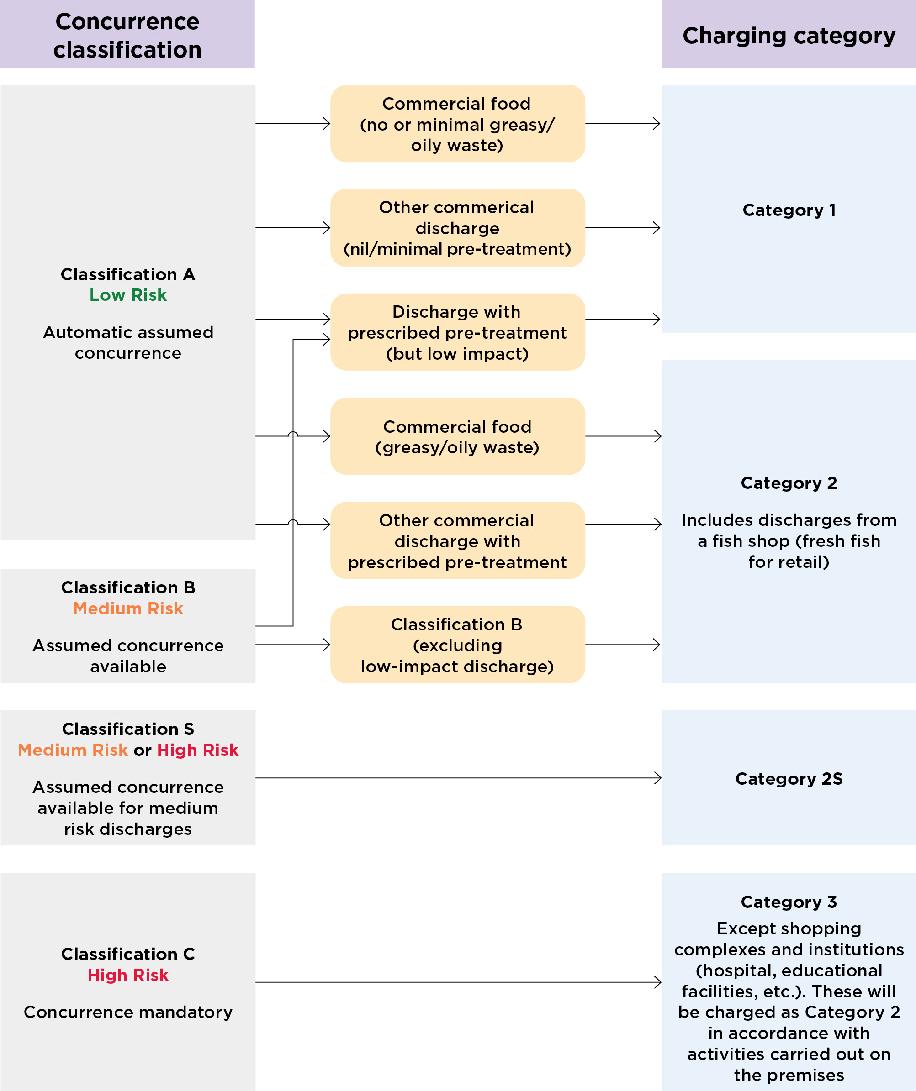
In summary, Classification A discharges fall into Charging Category 1 or Category 2. Classification B discharges fall into Charging Category 2, except for a few discharges with low impact on the sewerage system which fall into Category 1. Classification S discharges fall into Charging Category 2S and Classification C discharges fall into Charging Category 3.
Page 22
Federation Council – Local Approvals Policy – Liquid Trade Waste
Reference: CPOL -18/8628 Version No: 2
C 2.1 Description of various trade waste fees and charges
Following sections describe various trade waste fees and charges and the methodology of calculating them.
Application fee
The application fee recovers the costs of administration and technical services provided by Council in processing a liquid trade waste application. This fee varies for different charging categories to reflect the complexity of processing the application.
Annual trade waste fee
The purpose of this fee is to recover the costs incurred by council for ongoing administration and scheduled inspections, in order to ensure that the discharge complies with the approval conditions.
As part of an inspection, Council may undertake monitoring which may include, but is not limited to, flow measurement and the sampling. In general, the cost of one inspection is included in the annual fee, in particular for Category 1 and 2 discharges.
Annual liquid trade waste fee varies for different charging categories in order to reflect the complexity of their inspection and administration requirements. In particular, for Category 3 discharges, Council may opt to set the annual fee on a case-by-case basis to reflect the complexity of monitoring requirements and the extent of inspection.
Refer to section C 8.4 with regard to annual fees applicable to premises with multiple activities.
Council may require a discharger to pay for monitoring (quantity and quality) based on full cost recovery.
Inspection fee/re-inspection fee
The cost of one inspection is usually included in the annual liquid trade waste fee for charging categories 1 and 2
However, it may be required to conduct un-planned inspections or re-inspections of a premise (e.g., noncompliance with approved conditions, investigating an incident/accident or reviewing pre-treatment service schedules, etc.). Also, more frequent inspections may be necessary for large and industrial discharges.
Where more than one inspection is undertaken in a financial year and/or the cost of inspections is not included in the annual fee, the cost may be recovered from the discharger as the re-inspection fee.
Council may recover the cost of sample analysis from the discharger, in addition to the re-inspection fee.
Renewal fee
Council may apply a renewal fee if an existing approval needs to be renewed or modified.
Review of the Pre-Treatment Service Schedule
If an Approval Holder requests a review of the service Schedule that Council has applied to a pre – Treatment device, a re-inspection fee will be applied for each necessary visit. This fee will be as is described in councils’ revenue policy
Any tests or sampling costs associated with the service schedule review will attract additional costs in line with councils Revenue Policy.
Page 23
Federation Council – Local Approvals Policy – Liquid Trade Waste
Reference: CPOL -18/8628
Version No: 2
Sampling
Any required sampling that is conducted by Council will be at the cost of the discharger in line with Councils Revenue policy
Category specific charges
The following sections describe the charging categories and relevant fees and charges. If a discharger is not listed, the council will take a risk-based approach based on the quantity and quality of the discharge to determine the relevant charging category.
C3 Category 1 discharger
This charging category includes:
● Classification A discharges (both commercial retail non-oily/greasy food preparation and other commercial discharges, listed below)
● Classifications B discharges identified as low risk.
Some of the above discharges may require prescribed pre-treatment to be installed; however, the treated effluent is considered to have a low impact on the sewerage system.
Classification A discharges – commercial retail food preparation activities that do not generate or generate minimal oily/greasy waste: bakery (only bread baked on-site), bistro (sandwiches, coffee only), boarding/house/bed and breakfast/hostel kitchen < 10 persons, café/coffee shop/coffee lounge (no hot food), canteen/cafeteria (no hot food), community hall/civic centre (minimal food), day care centre (minimal hot food), delicatessen (minimal or no hot food), fruit and vegetable shop, hotel/motel (minimal hot food), ice cream parlour (take away only), juice bar, mobile food van (no hot food), mixed business (minimal hot food), nightclub (no hot food), nut shop, pie shop (re-heating only), pizza no cooking/reheating (pizza heated and sold for consumption off-site), potato peeling (small operation), sandwich shop/salad bar/snack bar (no hot food), take away food outlet (no hot food), school canteen with minimal hot food.
Classification A discharges from other commercial activities: animal wash, beautician/tanning booths/hairdressing, crafts ≤ 1,000 L/d, dental surgery/dental technician (plaster casts), dry cleaning, florist, funeral parlour, jewellery shop, medical centre/physiotherapy (plaster casts), mobile cleaning units, morgue, optical service, pet shop, plants retail (no nursery), non-residential swimming pool/hydrotherapy, veterinary.
Classification A or B discharges with prescribed pre-treatment and low impact on the sewerage system: boiler blowdown, cooling tower, industrial boilers, laboratory (analytical/pathology/tertiary institution), laundry/laundromat, primary and secondary school 10, vehicle washing/detailing (excluding truck washing).
C 3.1 Category 1 discharger - Liquid trade waste charges
C 3.1.1 “Deemed to be approved” discharges
For a discharger under “Deemed to be approved discharges” (refer to Appendix A), charges will be applicable as per Category 1 discharger.
C 3.1.2 Category 1 discharger
10 If significant hot food preparation is carried out, category 2 charges may be levied by council.
Page 24
Federation Council – Local Approvals Policy – Liquid Trade Waste
Reference: CPOL -18/8628
Version No: 2
Category 1 discharger who installs recommended appropriate pre-treatment equipment and maintains them regularly will be required to pay only the annual fee nominated for Category 1.
Liquid trade waste bill for Category 1 discharger (TW1)
��������1 = ����1
A1 = Annual liquid trade waste fee ($) for Category 1
C 4 Category 2 discharger
Category 2 liquid trade waste dischargers are those discharging waste generated by an activity listed below:
Classification A discharges – commercial retail food preparation/serving activities that generate oily/greasy waste: bakery (pies, sausage rolls, quiches, cakes, pastries with creams or custards), bistro, boarding house/bed and breakfast/hostel kitchen (exceeding 10 persons), butcher, café/coffee shop/coffee lounge (with hot food), cafeteria/ canteen (with hot food), chicken/poultry shop –fresh/roast, retail BBQ/charcoal chicken, day care centre with hot food, club, civic centre/community hall 11 , commercial kitchen/caterer, delicatessen with hot food, fast food outlet, fish shop (retail and cooking on-site), function centre, hotel, ice cream parlour, mixed business (hot food), mobile food van (base), motel, nightclub, nursing home, patisserie, pizza cooking, restaurant, sandwich shop/salad bar/snack bar (with hot food), supermarket, take away food outlet with hot food, school canteen with hot food.
Classification A discharges – other commercial discharges: car detailing, craft activities > 1000 L/d, lawnmower repairs, mechanical workshop, stone working, surfboard manufacture (wet process only).
Classification B discharges: auto dismantler, bus/coach depot, bakery (wholesale), butcher (wholesale) construction equipment maintenance and cleaning, boutique or artisan foods, engine reconditioning, equipment hire, maintenance and cleaning, fish co-op, graphic arts, hospital, micro-brewery, oyster processing – shucking, panel beating, radiator repairer, screen printing, service station forecourt, shopping complex, truck washing (platforms/flat beds) and truck washing (external).
C 4.1 Category 2 discharger - Liquid trade waste charges
Category 2 discharger who installs appropriate pre-treatment equipment and maintains them will pay annual fee nominated for Category 2 plus the trade waste usage charge.
Liquid trade waste bill for Category 2 discharger (TW2), ��������2 = ����2 + ������������ ���� ����2
A2 = Annual liquid trade waste fee ($) for Category 2
QTW = Total liquid trade waste discharge volume (kL)
C2 = Trade waste usage charge ($/kL)
The liquid trade waste discharge volume is generally estimated by applying a Trade Waste Discharge Factor (TWDF) to the total water consumption unless a discharge meter is installed at the direct source of the Trade Waste discharge. (As described in part 5.5)
C 5 Category 2S discharger
11 if the type and size of the kitchen fixtures installed enable catering for large functions.
Page 25
Federation Council – Local Approvals Policy – Liquid Trade Waste
Reference: CPOL -18/8628
Version No: 2
Category 2S dischargers include:
transporters who tanker human waste to council’s STWs - septic tank waste (effluent and septage), ablution block waste (blackwater and greywater), portable toilet waste, sludge from on-site aerated wastewater treatment systems (AWTS) for single households, waste from pit toilets, night soil.
ship-to-shore pump out facility owners/operators - toilet waste and/or grey water
owners/operators of ‘dump points’ directly connected to the sewer for disposal of toilet waste and/or grey water from a bus or a recreation vehicle (RV), e.g., caravan, motor home.
C 5.1 Category 2S discharger - Liquid trade waste charges
C 5.1.1 Transported human waste
The transporters of human waste will be required to pay a waste disposal charge ($/kL). Liquid trade waste bill for Category 2S waste transporter (TWTW),
ATW = Annual fee ($) for transported waste will be equal to that of a category 2 discharger as listed in Councils Revenue Policy.
QTW = Transported human waste volume (kL)
CTW = Charging rate ($/kL) for the transported waste (may vary based on the type of waste transported)
Note: Charging rate CTW can be varied for different type of waste, i.e., septic waste, ablution block waste, sludge from AWTS, pit toilets etc. Refer to Council’s Revenue Policy.
C 5.1.2 Ship-to-shore waste pump-out facility
The owner/operator of a ship-to-shore waste receival facility will be required to pay an annual fee and waste disposal charge based on the discharge volume ($/kL), if practical to estimate the discharge volume. If the discharge volume cannot be established, Council may negotiate the waste disposal charge based on the expected discharge volume.
Liquid trade waste bill for ship-to-shore pump-out facility owner (TWSTS),
ASTS = Annual fee ($)
QTW = Discharge volume (kL) (measured or negotiated)
CSTS = Charging rate ($/kL)
Note: The above charges are applicable to owners/operators of ship-to-shore pump out facility discharging such waste directly to council’s sewerage system and not to individual or commercial boat owners using the facility. This policy does not provide information on how to charge individual boat owners using a facility to dispose of their wastewater.
C 5.1.3 Waste dump points
Dump points are often located in public places (roadside); hence the monitoring of discharge volumes is not practical. Accordingly, only an annual fee is applied for stand-alone dump points.
Page 26
Federation Council – Local Approvals Policy – Liquid Trade Waste
Reference: CPOL -18/8628
Version No: 2
Liquid trade waste bill for dump point operator (TWDP) (if applicable), ���������������� = ������������
ADP = Annual fee for dump point ($)
C 6 Category 3 discharger
Category 3 liquid trade waste dischargers are those conducting an activity which is of an industrial nature and/or which results in the discharge of large volumes of liquid trade waste to the sewerage system. Any Category 1 or 2 discharger whose volume exceeds the limits shown below becomes a Category 3 discharger (excluding shopping centres and institutions):
Classification A discharge > 20 kL/d
Classification B discharge – as shown in Chapter 5 of the 2021 Liquid Trade Waste Management Guidelines.
Classification C discharges include: abattoir, acid pickling, adhesive/latex manufacture, agricultural and veterinary drugs, anodising, bitumen and tar, bottle washing, brewery, cardboard and carton manufacture, carpet manufacture, caustic degreasing, chemicals manufacture and repackaging, contaminated site treatment, cooling towers, cosmetics/perfumes manufacture, cyanide hardening, dairy processing* (milk/cheese/yoghurt/ice cream, etc.), detergent/soaps manufacture, drum washing, egg processing, electroplating, extrusion and moulding (plastic/metal), feather washing, fellmonger, felt manufacture, fertilisers manufacture, fibreglass manufacture, filter cleaning, foundry, food processing* (cereals/cannery/condiments/confectionary/edible oils/fats/essence/flavours/fish/fruit juice/gelatine/honey/meat/pickles/smallgoods/tea and coffee/vinegar/yeast manufacture, etc.), food waste processing unit (digester/composter), fruit and vegetable processing, flour milling, galvanising, glass manufacture, glue manufacturer, ink manufacture, laboratories (excluding those in Category 1 & 2), liquid wastewater treatment facility (grease trap receival depot and other pump-out waste depot), metal finishing, metal processing (refining/rumbling/non-cyanide heat treatment/phosphating/photo engraving/printed circuit etching/sheet metal fabrication etc.), mirrors manufacture, oil recycling (petrochemical) and refinery, paint stripping, paint manufacture, paper manufacture, pet food processing, plants nursery (open areas), pharmaceuticals manufacture, plaster manufacture, powder coating, potato processing, poultry processing, printing (newspaper, lithographic), saleyards, sandblasting, seafood processing, slipway, soft drink/cordial manufacture, starch manufacture, sugar refinery, tanker washing, tannery, timber processing (joinery and furniture/plywood/hardwood), textile manufacture (wool dyeing/spinning/scouring), tip leachate, transport depot/ terminal, truck washing (internal), waxes and polishes, water treatment backwash, wholesale meat processing, winery, distillery, wine/spirit bottling.
* Excluding small boutique, craft or artisan food industries not exceeding the discharge volume shown in the Liquid Trade Waste Management Guidelines, 2021
C 6.1 Category 3 discharger - Liquid trade waste charges
C 6.1.1 Excess mass charges
Category 3 discharger will be required to pay the annual liquid trade waste fee plus excess mass charges.
Liquid trade waste bill for Category 3 discharger (TW3),
��������3 = ����3 + ������������
A3 = Annual liquid trade waste fee ($)(refer Revenue Policy)
EMC = Excess mass charges ($)
Page 27
Federation Council – Local Approvals Policy – Liquid Trade Waste
Reference: CPOL -18/8628
Version No: 2
Note: The annual fee may vary for different business activities, depending on the complexity and time taken for inspection.
How excess mass charges are calculated
Excess mass charges will be applicable for substances discharged in excess of the ‘Deemed Concentrations’ in domestic sewage. For the purpose of excess mass charge calculation, the deemed concentrations of substances in domestic sewage are listed in Table C1.
Table C1
Deemed concentration of substances in domestic sewage
# The concentration in the potable water supply to be used if it is higher than 50 mg/L.
NB. Substances not listed above are deemed not to be present in domestic sewage. For excess mass charge calculation, equation (1) below will be applied for all parameters including for BOD5 up to 600 mg/L (but excluding COD and pH).
Where: S = Concentration (mg/L) of substance in sample
D = Concentration (mg/L) of substance deemed to be present in domestic sewage
QTW = Volume (kL) of liquid trade waste discharged to the sewerage system
U = Unit charging rate ($/kg) for the substance (note that this rate varies from substance to substance. Refer to council’s Revenue Policy for charging rates for various substances)
C 6.1.2 Excess mass charges for BOD
BOD up to 600 mg/L
Equation (1) applies for BOD5 up to 600 mg/L. Note that there are no excess mass charges if the BOD does not exceed 300 mg/L (deemed concentration of BOD in domestic sewage).
Excess mass charges for BOD exceeding 600mg/L
If council approves the acceptance limits for BOD5 higher than 600mg/L, an exponential type equation will be used for calculation of the charging rate Ue ($/kg) as shown in equation (2). This provides a strong incentive for dischargers to reduce the strength of waste. Note that equation (5) will be used where the discharger has failed to meet their approved BOD limit on more than two instances in a financial year.
Ue is the excess mass charging rate Ue ($/kg) for BOD is calculated as:
Page 28
Federation Council – Local Approvals Policy – Liquid Trade Waste
Reference: CPOL -18/8628
Version No: 2
Where: C = Charging rate ($/kg) for BOD5 600mg/L
Actual BOD = Concentration of BOD5 as measured in a sample
C 7 Non-compliance liquid trade waste charges
Non-compliance charges for Category 1 and 2 dischargers
If the discharger has not installed or maintained appropriate pre-treatment equipment, the following noncompliance trade waste usage charges will be applied for the relevant billing period:
C 7.1 Category 1 discharger - non-compliance charges
The trade waste usage charge ($/kL) as per Council’s Revenue Policy will be applied.
C 7.2 Category 2 discharger - non-compliance
charges
For Category 2 discharger, a non-compliance charge is outlined in Council’s Revenue Policy.
Dischargers who have an undersized grease arrestor and improved the effluent quality by other means (e.g., increased pump-outs, installing additional pre-treatment equipment, etc.) will pay trade waste usage charges in accordance with a Category 2 discharger.
Dischargers who cannot install a grease arrestor or those who have an arrestor with capacity significantly less than the required size and are unable to improve the effluent quality by means described above will have to pay the Category 2 Non-Compliance trade waste usage charge.
C
7.3 Non-compliance charges for Category 3 discharger
If a discharger in charging Category 3 fails to comply with the acceptance limits specified in council’s approval conditions, following non-compliance charges will be applicable.
C 7.3.1
Non-compliance pH charge
If the pH of the waste discharge by Category 3 discharger is outside the approved range, equation (3) is used for the calculation of non-compliance pH charges. This equation provides an incentive for dischargers to install and properly maintain a pH correction system, so their waste remains within the approved pH limits.
Charging rate for pH, if outside the approved range =
K x │actual pH – approved pH│# x 2 │actual pH – approved pH│# (3)
# Absolute value to be used.
K = pH coefficient in $
Example:
Council has approved the pH range 7.0 to 9.0 for a large discharger. pH coefficient (K) listed in council’s Management Plan is $0.45
Case 1: pH measured 6.0
Page 29
Federation Council – Local Approvals Policy – Liquid Trade Waste
Reference: CPOL -18/8628
Version No: 2 �������� = 2���� × (������������������������
Charging rate for pH ($/kL) = 0.45 x │6 – 7│# x 2 │6- 7│# = $0.90/kL
Case 2: pH measured 11.0
Charging rate for pH ($/kL) = 0.45 x │11 – 9│# x 2 │11 - 9│# = $3.60/kL
# Absolute value to be used.
C 7.3.2 Non-compliance excess mass charges
Equation (4) shall apply for non-compliance excess mass charges for various substances, except for BOD5 where equation (5) shall apply to calculate the charging rate. ������������ ����������������������������������������
Where: S = Concentration (mg/L) of a substance in sample
A = Approved maximum concentration (mg/L) of pollutant as specified in council’s approval (or liquid trade waste policy)
Q = Volume (kL) of liquid trade waste discharged for the period of non-compliance
U = Excess mass charging rate ($/kg) for the substance, as shown in council’s annual Management Plan
D = Concentration (mg/L) of the substance deemed to be present in domestic sewage
C 7.3.3 Non-compliance excess mass charges for BOD
The non-compliance excess mass charging rate (Un) for BOD5 is calculated by using equation (5):
Un is the BOD5 non-compliance excess mass charging rate in ($/kg).
C 8 Other applicable liquid trade waste charges
C 8.1 Garbage grinders - Food waste disposal charge 12
Additional charges will apply for a food waste disposal unit (in-sink food waste disposers/garbage grinders) in an existing hospital, nursing home or other eligible facility where council has permitted such installation.
These charges are in addition to category specific liquid trade waste fees and charges (e.g., Category 2 charges plus UF).as shown below:
Food waste disposal charge ($) = B x UF
Where: B = Number of beds in hospitals or nursing homes.
UF = Annual charging rate ($/bed) for a food waste disposal unit at a hospital or nursing home.
C 8.2 Solid food waste processing unit
12 For existing installations of garbage grinders only. New installations are not permitted.
Page 30
Federation Council – Local Approvals Policy – Liquid Trade Waste
Reference: CPOL -18/8628
Version No: 2
Discharge of waste from a solid food waste processing unit (digester/composter) is classified as Concurrence Classification C and is in charging Category 3.
Excess mass charges for all parameters in excess of the deemed concentrations in domestic sewage and noncompliance charges, above the council’s acceptance limits, will be applicable to the waste stream from such equipment (refer s. C5 & C6 for further information).
In addition, the discharger needs to bear the cost of frequent sampling as the quality of wastewater is dependent on the solid waste input to the processing unit and the effectiveness of the on-site pre-treatment equipment.
C 8.3 Discharge of stormwater from large open areas or large quantities of groundwater to the sewerage system
The discharge of roof, rain, surface, seepage or ground water to the sewerage system is prohibited under clause 137A of the Local Government (General) Regulation 2021 and this policy. Consideration will be given to the acceptance of limited quantities of contaminated stormwater (first flush stormwater) based on a case-by-case assessment.
If stormwater run-off from a large areas or groundwater is approved for discharge to sewer for a Category 3 discharger (e.g., saleyards), a volume-based charge similar to the non-compliance usage charging rate ($/kL) for Category 2 will be applied (e.g., 5 to 10 times of Usage charging rate listed in council’s Management Plan). Excess mass charges may be also applied to such discharges
C 8.4 Charges for premises
with multiple liquid trade waste streams
Examples of premises with multiple waste streams include:
shopping centres
commercial strata units
institutions, e.g., hospitals, tertiary educational facilities and correctional centres
other premises with multiple waste streams, e.g., premises comprising food cooking/serving activities and “Boutique/artisan food” businesses. For example, a liquid trade waste application may include a restaurant or a hotel, a microbrewery, a chocolate making and/or a cheese making shops, all located on the same site.
C 8.4.1 Shopping centre
Annual Fees: management of shopping centres will receive a bill that covers the annual fees for all discharges in accordance with the relevant charging category minus 20 % for the reduced administration costs
Usage: Where usage charges are applicable Council will apply trade waste usage charges based on the estimated trade waste discharge volume where separate Trade waste meters do not exist.
C 8.4.2 Commercial strata title units
Councils will issue individual liquid trade waste bills to each owner of the strata title unit
C 8.4.3 Hospitals, tertiary educational facilities and correctional centres
Council will generally issue a liquid trade waste bill to the management of the above premises.
Council will apply trade waste usage charge based on the estimated trade waste discharge volume.
If food preparation activities are carried out by an outside contractor, e.g., take away food outlets in the educational facilities. Council may issue a separate liquid trade waste bill to such individual shops, where practical. It may
Page 31
Federation Council – Local Approvals Policy – Liquid Trade Waste
Reference: CPOL -18/8628
Version No: 2
require an individual water meter or a check meter to be installed at the relevant service line. Where there is a requirement to install additional water meters, the full cost of any meter installation will be the responsibility of the discharger.
Fees and charges for additional meter installations and or meters and associated hardware (e.g., Taggle electronic meter tag) are described in councils revenue policy under Non-standard water connection fee.
C
8.4.4
Other premises with multiple waste streams
There are some premises where various “boutique type” businesses are located on the same site as restaurants, café, etc. For example, a premise may include a restaurant, a microbrewery, a chocolate making shop and a cheese making business, all owned by the same owner. When a liquid trade waste application includes a few different activities on the same site, council will assess the application and determine the relevant charging categories and applicable fees and charges.
Page 32
Federation Council – Local Approvals Policy – Liquid Trade Waste
Reference: CPOL -18/8628
Version No: 2
Appendix D – List of Discharges Council May Approve
D.1
Classification A
Discharges from activities that Council can process without seeking Department concurrence, subject to complying with certain requirements.
Food preparation/serving, generating liquid waste, up to 16 kL/day
Bakery (retail)
Bed and Breakfast (<10 persons)
Bistro
Boarding house/hostel kitchen
Butcher (retail)
Café/coffee shop/coffee lounge
Canteen
Cafeteria
Chicken/poultry shop (fresh chicken/game, retail, barbeque/roast chicken)
Club (kitchen wastes)
Commercial kitchen/caterer
Community hall/civic centre/function centre (kitchen waste)
Day care centre
Delicatessen
Doughnut shops
Fast food outlets (McDonalds, KFC, Burger King, Hungry Jack, Pizza Hut, Red Rooster, etc.)
Fish shop (retail fresh and/or cooked)
Fruit and vegetable shop (retail)
Other Activities generating liquid waste, up to 5 kL/day
Animal wash (pound, stables, racecourse, kennels, mobile animal wash)
Beautician
Boiler blowdown
Car detailing
Cooling towers
Craft activities (pottery, ceramics, cutting and polishing of gemstones or making of jewellery)
Dental surgery
Dental technician
Dry-cleaning (separator water, boiler)
Florist
Funeral parlour/morgue
Hairdressing
Jewellery shop
Laboratory (pathology/analytical)
Laundry or laundromat (coin operated)
Lawnmower repairs
Mechanical repairs/workshop
Medical centre/doctor
surgery/physiotherapy— plaster of paris casts, laboratory
Hotel Mobile cleaning units
Ice-cream parlour
Juice bar
Mixed business
Mobile food van
Nursing home (other than food related activities)
Optical services
Pet shop (retail)
Photographic tray work/manual development
Motel Plants retail (no nursery or open space)
Nightclub
Nursing home kitchen
Nut shop
Page 33
Federation Council – Local Approvals Policy – Liquid Trade Waste
Reference: CPOL -18/8628
School (other than kitchen waste)
Stone working
Surfboard manufacturing (wet process only)
Version No: 2
Patisserie Swimming pools/spas/hydrotherapy pools
Pie shop Vehicle (car) washing (by hand/wand, automatic car wash/bus wash/external truck wash or underbody/engine degrease only)
Pizza shop Venetian blind cleaning
Restaurant Veterinary surgery
Salad bar
Sandwich shop
School – canteen, home science
Snack bar
Supermarket
(With butcher/bakery/delicatessen/seafood or roasted chicken)
Take away food shop
Page 34
Federation Council – Local Approvals Policy – Liquid Trade Waste
Reference: CPOL -18/8628
Version No: 2
Appendix E – Legislative Provisions
Provisions in the Local Government (General) Regulation 2021 in regard to acceptance of liquid trade waste into the sewerage system
Clause 25 Matters to accompany applications relating to discharge into sewers
An application for approval to discharge trade waste into a sewer under the control of a Council or that connects with such a sewer must be accompanied by the information required by Table 1 of the Liquid Trade Waste Management Guidelines#.
Clause 28 Approval to discharge waste into sewers: concurrence required
A council must not grant an approval under section 68 of the Act to discharge trade waste (whether treated or not) into a sewer of the council unless the Director-General 13 of the Department of Trade and Investment, Regional Infrastructure and Services (or that Director-General’s nominee) has concurred with the approval.
Note: Section 90 (2) of the Act permits any person or authority whose concurrence is required before an approval may be granted to give the council notice that the concurrence may be assumed (with such qualifications or conditions as are specified in the notice).
Clause 32 Disposal of trade waste
An approval to dispose of trade waste into a sewer of the council is subject to such conditions (if any) as the council specifies in the approval.
In imposing any such conditions, the council is to have regard to the matter set out in Table 5 of the Liquid Trade Waste Management Guidelines#
137 A Substances prohibited from being discharged into public sewers
(1) For the purposes of section 638 of the Act (Discharge of prohibited matter into sewer or drain), roof, rain, surface, seepage or ground water is prescribed as prohibited matter.
(2) This clause does not apply in relation to:
(a) a discharge that is specifically approved under section 68 of the Act, or
(b) a discharge into a public drain or a gutter of a council, or
(c) a discharge in an area of operations within the meaning of the Sydney Water Act 1994 or the Hunter Water Act 1991
143 Inspection of pipes and drains and measurement of water and sewage
(1) The council may, at any reasonable time:
(a) inspect any service pipe connected to a water main, and
(b) inspect any drain connected to a sewer main, and
13In accordance with the Government Sector Employment Act 2013, this is the Secretary of the NSW Department of Planning and Environment.
Page 35
Federation Council – Local Approvals Policy – Liquid Trade Waste
Reference: CPOL -18/8628
Version No: 2
(c) install meters or other devices for measuring the quantity of water supplied to, or the quality and quantity of sewage discharged from, premises, and
(d) measure the quantity of water supplied to, or the quality and quantity of sewage discharged from, premises, and
(e) inspect any pre-treatment devices connected to the council’s sewerage system.
(2) The occupier of the relevant premises must provide to the council such information as it requires to enable it to estimate the quantity of water actually supplied to, or the quality and quantity of sewage actually discharged from, the premises.
(3) In this clause, "Pre-treatment device" means any device used to reduce or eliminate contaminants in trade waste, or to alter the waste’s nature, before it is discharged into a sewer.
Clause 159 Prevention of waste and misuse of water
The owner, occupier, or manager of premises to which water is supplied by the Council must:
a. Prevent waste of water by taking prompt action to repair leaking taps, pipes or fittings located on the premises, and
b. Take any other action that is reasonable to prevent waste or misuse of water
SCHEDULE 12 – Penalty notice offences
Column 1
Column 2
Offence under Local Government Act 1993 Penalty
Section 626 (3)-carry out without prior approval of council an activity specified in item 4 of Part C (Management of waste) of the Table to section 68 $330
Section 627 (3)-having obtained the council’s approval to the carrying out of an activity specified in item 4 of Part C (Management of waste) of the Table to section 68, carry out the activity otherwise than in accordance with the terms of that approval
$330
# “Liquid Trade Waste Management Guidelines” means the Guidelines of that name produced by the Department of Energy, Utilities and Sustainability in March 2005, as in force from time to time. The 2005 Guidelines have now been superseded by Liquid Trade Waste Management Guidelines, 2021
Page 36
Federation Council – Local Approvals Policy – Liquid Trade Waste
Reference: CPOL -18/8628
Version No: 2
Appendix F Standard Discharge Factors
A discharge factor represents the percentage of the metered water consumption, which is discharged to the sewerage system from a non-residential property. There are two types of discharge factors:
● Sewer (SDF); and
● Liquid Trade Waste (TWDF).
Sewer discharge factor
The sewer discharge factor is the ratio of all wastewater discharged from a premises to the sewerage system to the total water consumption expressed as a percentage.
SDF = (Domestic+ Trade Waste) x 100
Total Water Consumption
Sewer discharge factor is determined using the Standard Discharge Factors in Table F1.
Trade waste discharge factor
The trade waste discharge factor is the ratio of the volume of liquid trade waste discharged into the sewerage system to the total water consumption expressed as a percentage
TWDF = (Liquid Trade Waste) x l 00
Total Water Consumption
The trade waste discharge to the sewerage system can be determined using either metering or calculated using standard discharge factors or a water balance assessment
Determining Trade Waste Discharge Factor or Volume
This policy provides the following options to determine the trade waste discharge factor or volume of discharge to sewer it may be necessary to apply a combination of these options to determine a discharge factor from certain premises:
Option 1 – Metering by Flow Meter
A flow meter can be installed on the waste plumbing lines connected to sewer which measures the actual volume of trade waste discharge to sewer. A flow meter must be installed on all trade waste streams to sewer (and exclude non-trade waste streams). Such devices must be installed by a licensed plumber. Flow metering is the most accurate method to determine actual volume of trade waste discharged to sewer. This type of metering should be considered when planning for new constructions with a trade waste activity.
Note: any meter installations will be the responsibility of the property owner/approval holder. Council will not be liable for any installation costs.
Option 2 – Metering by Check Meters
Check meters may be installed on dedicated water supply lines for liquid trade waste areas and a suitable factor can be applied to the water consumption recorded by the check meter. For example, if a check meter is installed on a kitchen line, it only measures the water supplied to the kitchen area that generates liquid trade waste.
Note: any meter installations will be the responsibility of the property owner/approval holder. Council will not be liable for any installation costs.
Option 3 – Standard Discharge Factor
Standard discharge factors have been determined for certain industries. A standard discharge factor can be applied where
Page 37
Federation Council – Local Approvals Policy – Liquid Trade Waste
Reference: CPOL -18/8628
Version No: 2
activities are considered typical of the associated industry. Standard discharge factors are an estimation of the percentage of volume of the total water consumption that is attributed to the trade waste activity. Standard Discharge Factors are listed in Table F1.
Standard discharge factors will be the preferred option where no metering has been installed by the property owner/approval holder.
Option 4 – Non-Standard Discharge Factor
For non-standard activities and/or multiple waste streams, a site-specific water balance assessment of discharge can be conducted taking into account all water supply sources, uses and activities and determining a non-standard discharge factor. Non-standard discharge factors are an estimation of the percentage of volume of the total water consumption that is attributed to the trade waste activity. Where a non-standard discharge factor must be used, council will consult with the approval on with regards to how this non-standard discharge factor is determined. The approval holder will be notified of the discharge factor applied when the approval is issued.
Table F1: Standard Sewer and trade waste discharge factors
Page 38
Federation Council – Local Approvals Policy – Liquid Trade Waste
Reference: CPOL -18/8628 Version No: 2
Notes:
● 1 If a residence is attached, that has garden watering, the residential SDF should be applied.
● 2 A trade waste usage charge is not applicable for this activity.
● 3 Includes lawn mower repairer, equipment hire.
● 4 Includes café, canteen, bistro, etc.
● 5 A trade waste usage charge applies if appropriate pre-treatment equipment has not been installed or has not been properly operated or maintained.
● 6 A discharge factor to be applied on the basis of the relevant activity, e.g., food preparation/service, mechanical workshop, optical services, etc.
Appendix G – Glossary
Authorised assumed concurrence councils with significant experience in liquid trade waste regulation are encouraged to apply to the Secretary, Department of Climate Change, Environment the Environment and Water seeking to obtain concurrence for council’s approval for Classification B and Classification S discharges. If granted, Council will no longer need to forward such applications to the department for concurrence, provided that council complies with the conditions outlined in the notice of concurrence.
Automatic assumed concurrence—council has been granted assumed concurrence for approval for Classification A discharges, provided that council complies with conditions outlined in the notice of concurrence. Such applications may be approved by council without forwarding the application to the department for concurrence.
Biochemical Oxygen Demand (BOD5) —the amount of oxygen utilised by micro-organisms in the process of decomposition of organic material in wastewater over a period of five days at 20°C. In practical terms, BOD is a measure of biodegradable organic content of the waste.
Biosolids primarily organic solids produced by sewage processing. Until such solids are suitable for beneficial use, they are defined as wastewater solids or sewage sludge.
Blackwater wastewater containing human excrement (i.e., faeces, urine).
Bunding secondary containment provided for storage areas, particularly for materials with the propensity to cause environmental damage.
Chemical Oxygen Demand (COD) —a measure of oxygen required to oxidise organic and inorganic matter in wastewater by a strong chemical oxidant. Wastewaters containing high levels of readily oxidised compounds have a high COD.
Chemical toilet toilets in which wastes are deposited into a holding tank containing deodorizing or other chemicals. Stored wastes must be pumped out periodically.
Commercial retail discharge: commercial discharges can be described as wastes that are discharged from businesses dealing directly with the public.
Commercial caterer a commercial caterer is typically a stand-alone operation and prepares food for consumption off-site. These types of businesses typically cater to wedding functions, conferences, parties, etc. This definition does not apply to a food processing factory supplying pre-prepared meals to a third party.
Council for the purpose of this document, “council” refers to a local government body (including Local Water Utility) which provides water supply and sewerage services in regional NSW
Contingency plan a set of procedures for responding to an incident that will affect the quality of liquid trade waste discharged to the sewerage system. The plan also encompasses procedures to protect the environment from accidental and unauthorised discharges of liquid trade waste, leaks and spillages from stored products and chemicals.
Concurrence under s. 90(1) of the Local Government Act 1993 and cl. 28 of the Local Government (General) Regulation 2021, council must obtain the written concurrence of the Secretary of the Department of Climate Change, Energy, the Environment and Water prior to approving the discharge of liquid trade waste to council’s sewerage system. The department’s Water Group provides concurrence on behalf of the Secretary.
Due Diligence Program a plan that identifies potential health and safety, environmental or other hazards (e.g., spills, accidents or leaks) and appropriate corrective actions aimed at minimising or preventing the hazards.
Effluent the liquid discharged following a wastewater treatment process.
Page 40
Federation Council – Local Approvals Policy – Liquid Trade Waste
Reference: CPOL -18/8628
Version No: 2
Effluent Improvement Plan (EIP) the document required to be submitted by a discharger who fails to meet the acceptance limits set down in council’s approval conditions and/or liquid trade waste agreement. The document sets out measures taken by a discharger in order to meet the acceptance limits within the agreed timeframe.
Fast food outlet —a food retailing business featuring a very limited menu, precooked or quickly prepared food, and take-away operations. Premises of this nature include KFC, McDonalds, Red Rooster, Pizza Hut, Hungry Jack’s, Burger King, etc.
Galley waste —liquid waste from a kitchen or a food preparation area of a vessel; not including solid wastes.
Greywater wastewater from showers, baths, spas, hand basins, laundry tubs, washing machines, dishwashers or kitchen sinks.
Heavy Metals —metals of high atomic weight which in high concentrations can exert a toxic effect and may accumulate in the environment and the food chain. Examples include mercury, chromium, cadmium, arsenic, nickel, lead and zinc.
Housekeeping a general term, which covers all waste minimisation activities connected within the premises as part of its operation.
Industrial Discharges industrial liquid trade waste is defined as liquid waste generated by industrial or manufacturing processes. Examples are provided in Trade Waste Management Guidelines 2021.
Liquid Trade Waste all liquid waste other than sewage of a domestic nature discharged to the sewerage system.
Mandatory Concurrence for the liquid waste in Classification C, councils need to obtain concurrence for approval of each discharge. The Water Utilities Branch of the Department of Climate Change, Energy, the Environment and Water provides concurrence on behalf of the department’s Secretary.
Methylene Blue Active Substances (MBAS) —anionic surfactants. Their presence and concentration are detected by measuring colour change in a standard solution of methylene blue dye.
Minimal Pre-treatment for the purpose of this document this means sink strainers, basket arrestors for sink and floor waste, plaster arrestors and fixed or removable screens.
Mixed Business a general store that sells a variety of goods and may also prepare some food.
Open Area any unroofed process, storage, washing or transport area where rainwater potentially can be contaminated.
Pan any moveable receptacle kept in a closet and used for the reception of human waste.
PFAS group of manufactured chemicals, containing a component with multiple fluorine atoms, with many specialty applications. Examples are perfluoro octane sulfonate (PFOS) and perfluorooctanoic acid (PFOA). They are used in a range of products, such as textiles, leather, cosmetics, non-stick coatings in cookware, food packaging, and in some types of fire-fighting foam. These chemicals take a long time to break down in humans and the environment and their persistence and bioaccumulation potential pose concerns for the environment and for human health.
Pit latrines/long-drop toilet/pit toilet a type of toilet that collects faeces and urine directly into a tank or a hole in the ground
Portable Toilet toilet in which wastes are deposited into a holding tank used on construction sites, caravans, motor homes, boats, trains and at outdoor gatherings. If chemicals are used to control odours, it is referred to as a chemical toilet.
Page 41
Federation Council – Local Approvals Policy – Liquid Trade Waste
Reference: CPOL -18/8628
Version No: 2
pH a measure of acidity or alkalinity of an aqueous solution, expressed as the logarithm of the reciprocal of the hydrogen ion (H+) activity in moles per litre at a given temperature; pH 7 is neutral, below 7 is acidic and above 7 is alkaline.
Premises has the same meaning as defined in the Local Government Act Dictionary and includes any of the following:
a building of any description or any part of it and the appurtenances to it
land, whether built on or not
a shed or other structure
a tent
a swimming pool
a ship or vessel of any description (including a houseboat)
a van.
Prescribed Pre-treatment Equipment standard non-complex equipment used for pre-treatment of liquid trade waste, e.g., a grease arrestor, an oil arrestor/separator, solids arrestor, cooling pit.
Regional NSW the areas of the state that are not serviced by the Sydney Water Corporation or the Hunter Water Corporation.
Regulation Local Government (General) Regulation 2021 under the Local Government Act 1993
Secretary the head of the Department of Climate Change, Energy, the Environment and Water.
Septage material pumped out from a septic tank during desludging; contains partly decomposed scum, sludge and liquid.
Septic Tank wastewater treatment device that provides a preliminary form of treatment for wastewater. It provides sedimentation of settleable solids, flotation of oils and fats, and anaerobic digestion of sludge.
Septic Tank Effluent the liquid discharged from a septic tank after treatment.
Sewage Management Facility a human waste storage facility or a waste treatment device intended to process sewage and includes a drain connected to such a facility or device.
Sewage of a Domestic Nature human faecal matter and urine and wastewater associated with ordinary kitchen, laundry and ablution activities of a household, but does not include waste in or from a sewage management facility.
Sewerage System the network of sewage collection, transportation, treatment and by-products (effluent and biosolids) management facilities.
Sewage treatment works this is the facility designed to treat sewage. The level of treatment will vary based on the expected quality of the effluent.
Ship-to-Shore Pump-out liquid waste from a vessel that may be considered for disposal to the sewerage system. This includes on-board toilet waste; galley waste and dry dock cleaning waste from maintenance activities.
Sludge the solids that are removed from wastewater by treatment.
Stormwater Run-off run-off resulting from rainfall.
Page 42
Federation Council – Local Approvals Policy – Liquid Trade Waste
Reference: CPOL -18/8628
Version No: 2
Surfactants the key active ingredient of detergents, soaps, emulsifiers, wetting agents and penetrants. Anionic surfactants react with a chemical called methylene blue to form a blue-chloroform-soluble complex. The intensity of colour is proportional to concentration
Suspended Solids (SS) the insoluble solid matter suspended in wastewater that can be separated by laboratory filtration and is retained on a filter.
Total Dissolved Solids (TDS) total amount of dissolved material in the water.
Total Recoverable Hydrocarbons (TRH) Both biological and petroleum hydrocarbons which have been extracted (recovered) from a sample. TRH are equivalent to the previously reported Total Petroleum Hydrocarbons (TPH). TRH is reported in fractions with Carbon chain (C6 – C40). TRH with carbon chain C6 – C10 are flammable.
Waste Minimisation procedures and processes implemented by industry and business to modify, change, alter or substitute work practices and products that will result in a reduction in the volume and/or strength of waste discharged to sewer.
Page 43
Federation Council – Local Approvals Policy – Liquid Trade Waste
Reference: CPOL -18/8628
Version No: 2