![]()


by Falls Church News-Press
There is a moment in every introductory drawing class when the world quietly shifts.
It happens somewhere between the first awkward still life and the realization that you’ve been looking at things all wrong. The professor dims the lights, turns a single lamp toward a plaster cube or a crumpled piece of fabric, and says: “Don’t draw the object. Draw the shadows.”
At art school, that lesson felt almost mystical. We were not being taught how to copy a thing. We were being taught how to see.
The first technical skill you learn in drawing is not anatomy or perspective. It’s value, shadows and highlights. Light falls across an object and suddenly it isn’t a “cup” anymore. It becomes a series of tonal shifts, edges, gradations and contrasts. The brightest highlight might be no larger than a fingernail. The darkest shadow might hold the entire weight of the composition.
Once you learn to see that, you cannot unsee it.
You begin noticing how afternoon light turns sidewalks lavender. You study the way a face changes under a streetlamp. You realize that depth is not an illusion, it’s an observation. The world stops being flat. It becomes dimensional, layered, alive.
That training, the tactile discipline of pencil against paper, changes more than your artwork. It changes your worldview.
Recently, I read about parents opting their children out of school-issued laptops and asking for pen and paper instead. In an era when screens mediate nearly every experience, that decision struck me as more than nostalgic. It felt important.
There is something profoundly valuable about tactile objects, about the resistance of paper and the drag of graphite. When you draw, you are translating perception into motion. The instrument matters. The smudge of charcoal
matters. The mistake you cannot simply “undo” matters.
Art school drilled that into us. You sharpened pencils with a blade. You stretched your own canvases. You mixed your own paint and learned that ultramarine behaves differently than burnt sienna. These weren’t quaint rituals. They were lessons in attention.
Because when you are forced to slow down and truly look, you discover nuance.
And nuance is something we are in short supply of these days.
Maybe this is a metaphor for life in general, things aren’t always just black and white but have shadows and highlights, and are far more complex than a simple copy, paste, done, move on. They require us to pause, to really look, to sit in the uncertainty between extremes and notice the subtle transitions. Just as a drawing gains depth from the tones between the brightest highlight and the darkest shadow, our experiences gain meaning in the in-between moments, the doubts,

the contradictions, the layers we don’t immediately understand.
Seeing shadows and highlights trains your brain to recognize complexity. No object is one color. No person is one dimension. No issue is entirely light or entirely dark. There are gradations everywhere, and artists are trained to find them.
This is why I challenge everyone, not just aspiring artists, to study aesthetics. Take a drawing class. Visit a museum and stand in front of one painting for longer than feels comfortable. Pick up a pen, pencil, crayon, paintbrush, whatever it may be, and simply create.
It does not have to be good.
In fact, it probably won’t be. And that’s fine.
Everything every artist has ever made wasn’t perfect. Sketchbooks are full of awkward hands, crooked buildings and failed experiments. The masterpieces came later, and only because the imperfect pages came first.
Children understand this instinctively. They draw without apology.
They color outside lines. They build worlds with crayons and cardboard. Somewhere along the way, many adults lose that freedom.
But here’s a secret: adults who are artists are just kids who never let their creativity be beaten out of them.
For parents looking through camps and school programs, that idea matters. The best programs give kids time with real materials and the freedom to experiment. Those experiences build observation, patience and imagination. And those skills lead to real careers.
Not every child will grow up to be an AI hedge fund manager or a coder staring at a screen all day. Some will become architects, designers, filmmakers, engineers, illustrators, photographers, product designers, teachers or urban planners. If you want to understand the world more deeply, start by drawing it.
Look for the shadows. Find the highlights. Pick up something that leaves a mark and create.


Ages 4–14
10 Weeks of Programs
Pool on Site
40-Acre Wooded Campus
Lunch & Snacks Included


BY FALLS CHURCH NEWS-PRESS
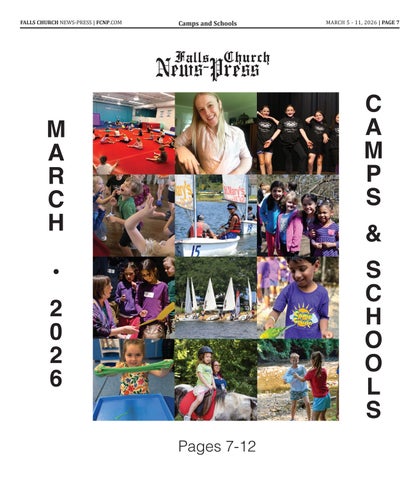
Across Falls Church, Alexandria and Northern Virginia, local camps give kids a chance to try new things from sailing and theater to music, gymnastics and outdoor adventure.
When the school year ends in Northern Virginia, classrooms empty out but learning doesn’t stop. It just moves somewhere else.
Some kids head for sailboats and learn to read the wind. Others step under stage lights for the first time. Some pick up instruments, tumble across gymnastics floors, or spend long summer afternoons running through fields and wooded trails.
Across Falls Church and nearby communities, a network of camps fills the summer months with a different kind of education — one built on exploration, creativity and confidence.
Programs run by organizations such as Congressional Camp, Westminster School, Capitol
Debate, Brendan Sailing, Choralis Foundation, Creative Cauldron, KiPS Family Gym, Ooorlaaamusic and the Little Theatre of Alexandria have become fixtures for families looking to give their children something more than just time off from school.
For many kids, summer camp is where they discover what they love.
A Falls Church Tradition
Few camps in the region have the history of Congressional Camp, held on the wooded campus of Congressional School in Falls Church.
Founded in 1940, the camp has welcomed generations of Northern Virginia families. Today, children ages four through fourteen spend their summer days swimming, playing sports, exploring nature and trying new activities across the school’s 40-acre campus.
A typical day might include time at the pool, arts and crafts, outdoor adventure activities and games on the athletic fields. Many campers return year after year, creating a tra-

EXPLORATIONS FOR CHILDREN
THROUGH 8 GRADE

dition that stretches across decades.
The formula is simple: give kids space to explore and the chance to try things they might not encounter during the school year.
Turning School Campuses Into Summer Playgrounds
Nearby, the Westminster School transforms its campus into a lively summer hub through its Camp Griffin programs.
The camps combine recreation with hands-on learning. Children rotate through sports, creative activities, science projects and outdoor games, often with weekly themes that keep each session fresh.
The idea is that summer should feel different from school while still offering meaningful experiences.
Kids try new activities, meet children from different schools and develop teamwork in a relaxed environment.
Capitol Debate: The Summer Argument That Actually Helps
Not every summer skill is physical — sometimes it’s learning how to think on your feet, speak clearly,


and hold your ground.
That’s the pitch behind Capitol Debate, which runs public speaking and debate camps in the region, including programs hosted on nearby college campuses such as American University in Washington, D.C. and Marymount University in Arlington.
For middle and high school students, the camp is built around argument structure, critical thinking, speech delivery, and confidence in front of a room — skills that travel well, whether a student ends up in student government, Model UN, presentations, interviews, or just wants to be less terrified of raising a hand.
In a summer landscape full of “try everything,” Capitol Debate is more like: try the thing that makes everything else easier speaking up.
For some campers, summer means heading for open water.
Brendan Sailing, a non-
profit organization serving the Washington region, teaches sailing to young people with learning differences such as ADHD or dyslexia.
The program uses sailing as a way to build confidence and independence. Participants learn to steer boats, manage sails and adjust to changing weather conditions while working closely with teammates.
Out on the water, every person plays a role. Success depends on communication, patience and cooperation.
For many participants, the lessons extend far beyond sailing.
Music That Brings Kids Together
Music programs also play an important role in the region’s summer offerings.
The Choralis Foundation, a Northern Virginia choral organization, provides opportunities for young singers to develop their voices while learning the discipline of ensemble performance.
Students work with professional
Continued on Page 11

Continued from Page 10
musicians and conductors while rehearsing music that often culminates in public performances.
Another opportunity for aspiring musicians comes from Ooorlaaamusic, which introduces children to instruments, rhythm and collaborative music-making.
For many students, summer music programs provide their first real chance to explore creative expression outside the classroom.
Sometimes those early lessons lead to lifelong interests.
When Creativity Takes the Stage Theater camps give young performers a chance to explore storytelling and performance.
In Falls Church, Creative Cauldron offers camps focused on acting, musical theater and stage production. Students rehearse scenes, learn choreography and develop characters before performing for family and friends.
Just down the road, the Little Theatre of Alexandria continues a long tradition of youth
theater education. One of the region’s oldest community theaters, it introduces children to acting, stagecraft and the teamwork that goes into producing a show.
High Energy Summer Days
Not every camper wants to spend the summer on stage or in a rehearsal room.
Programs like KiPS Family Gym offer a more active alternative. Known locally for its gymnastics and movement programs, KiPS runs camps that combine physical training with games, obstacle courses and open play.
Campers develop balance, strength and coordination while staying active throughout the day.For energetic kids, it’s an ideal outlet.
Why Camps Still Matter
Summer camps remain a staple for many families because they offer something increasingly rare: the freedom to try new things.
Away from screens and daily routines, children experiment. They meet new friends, tackle unfamiliar challenges and develop confidence in their abilities.
Emphasizing experience and discovery it’s more just a place to spend the day.


BY FALLS CHURCH NEWS-PRESS
Students today are growing up in a world shaped by rising temperatures, extreme weather and global debates about energy and the environment. Yet many students never learn the basics of climate science in school.
A widely cited NPR/Ipsos national survey found that 55 percent of teachers say they do not teach climate change in their classrooms, even though the scientific consensus on the issue is well established. At the same time, 84 percent of parents of children under 18 — roughly four in five — say schools should teach about climate change.
The numbers reveal a gap between what families expect schools to cover and what actually appears in the classroom.
Researchers say several factors contribute to the disconnect. Teachers often report a lack of time, training or curriculum materials. Some say they avoid the topic because it has become politically

sensitive in parts of the country.
“Teachers told us they worried about controversy or pushback from parents or administrators,” NPR reported in its coverage of the survey. “Others said they simply don’t feel adequately prepared to teach the science.”
Studies also suggest preparation is a real challenge. A study published in the journal Science found that while many science teachers attempt to cover climate topics, misunderstandings about climate systems and human influence can lead to incomplete or inaccurate explanations.
For students, the result can be confusing. Climate change is one of the most frequently discussed global issues in news coverage, online media and political debates, yet many students receive little structured instruction about the science behind it.
But climate change is only one example of topics that have become inconsistent or reduced in modern classrooms.
As schools focus heavily on standardized testing in reading and math, many subjects once considered essential to a well-rounded education have been pushed aside or reduced in scope.
Civics education is one of the most notable casualties.
According to the National Assessment of Educational Progress, often called the “Nation’s Report Card,” only 22 percent of eighth-grade students scored at or above the proficient level in civics on the most recent national assessment. Scores also declined compared with earlier years.
Educators warn that limited civic education leaves students less prepared to understand government, evaluate political information or participate effectively in democracy.
Media literacy is another subject gaining urgency but not always classroom time.
Students consume vast amounts of information through social media, video platforms and online
sources. Yet many schools still lack formal programs that teach students how to evaluate sources, detect misinformation or distinguish credible reporting from online rumors.
Personal finance education has also long been overlooked, although that is slowly changing.
A national survey by the Council for Economic Education found that 35 states now require a personal finance course for high school graduation, a major increase over the past decade.
Still, advocates say many students graduate without practical knowledge about credit cards, loans, savings or budgeting.
Life skills courses once grouped under “home economics” have also declined.
Today these classes, often called Family and Consumer Sciences, may teach cooking, nutrition, childcare, budgeting and career preparation. However, the programs face staffing shortages and reduced class offerings in many districts.
Educators say these practical courses help students build independence and prepare for adult responsibilities.
Taken together, the trends raise a broader question about what students should learn in school and what knowledge is essential for navigating modern life.
Parents, according to the NPR/Ipsos survey, appear ready for schools to step in.
Whether the subject is climate science, civic knowledge, financial literacy or media awareness, families increasingly want schools to equip students with the tools to understand the complex world they are inheriting.
The debate over what belongs in the curriculum will continue. But parents’ message in national surveys is increasingly clear: students need more than test preparation. They need the knowledge and skills to understand the world they are growing into — and the confidence to shape it.