Next Big One in F.C.

ONE NATION INDIVISIBLE
by Nicholas F.
By a 5-1 vote late Monday night, the Falls Church City Council acted to retain a consultant to begin what will be the Little City’s next arduous voyage into the fretfully-choppy waters of potentially significant affordable housing.
Going on four hours into its meeting that dealt mostly with its annual budget deliberations, the Council finally resolved to contract the Chicago-based firm of Jones, Lang and LaSalle (JLL) for a first baby step in an ambitious process advocates of the City’s affordable living policy hope could result in hundreds of new affordable dwellings that City employees, seniors and others could afford.
At issue, and what City residents can expect to hear a lot about in the coming months if not years is the Virginia Village development of 20 four-plex buildings on S. Maple Ave. The City and its Economic
Area Budgets Coping With Regional Economic Woes
Fairfax to a tiny, quarter-cent rate cut.
As the Falls Church City Council wrestled through a four-hour discussion this Monday night, unresolved as to whether to approve a new fiscal year budget with a halfcent tax rate reduction or no real estate tax rate increase, its board leaders of its neighbors in Fairfax and Arlington took action in the last week, Arlington moving to raise its tax rate by two cents, and
The Fairfax County Board of Supervisors informally adopted a $5.9 billion fiscal year 2027 budget this Tuesday that includes a small reduction in the real estate tax rate, more reserve funding and changes to proposed cuts that will eliminate over 100 positions. The 8-2 vote during the “markup” session is a precursor to the board’s final adoption of a new budget next Tuesday, May 5,
that will take effect on July
1. Under the plan, the county’s real estate tax rate will decline from $1.1225 per $100 of assessed valuation last year to $1.12 per $100 this year.
The tiny cut was effectively cosmetic, as the tax bill for an average Fairfax county homeowner will still rise $337 year-over-year due to higher assessments, compared to $357 if the rate remained unchanged, a $20 difference.
If its real estate tax rate
is unchanged, Falls Church homeowners will face an average $611 more in their tax bill, due to average increased assessments of 6.2 percent. If a half-cent is cut from the Falls Church rate, the savings will be on average $53.50 per taxpayer.
Falls Church will hold its final public forum on the proposed FY27 budget tonight (Thursday, April 30) at 7 p.m.
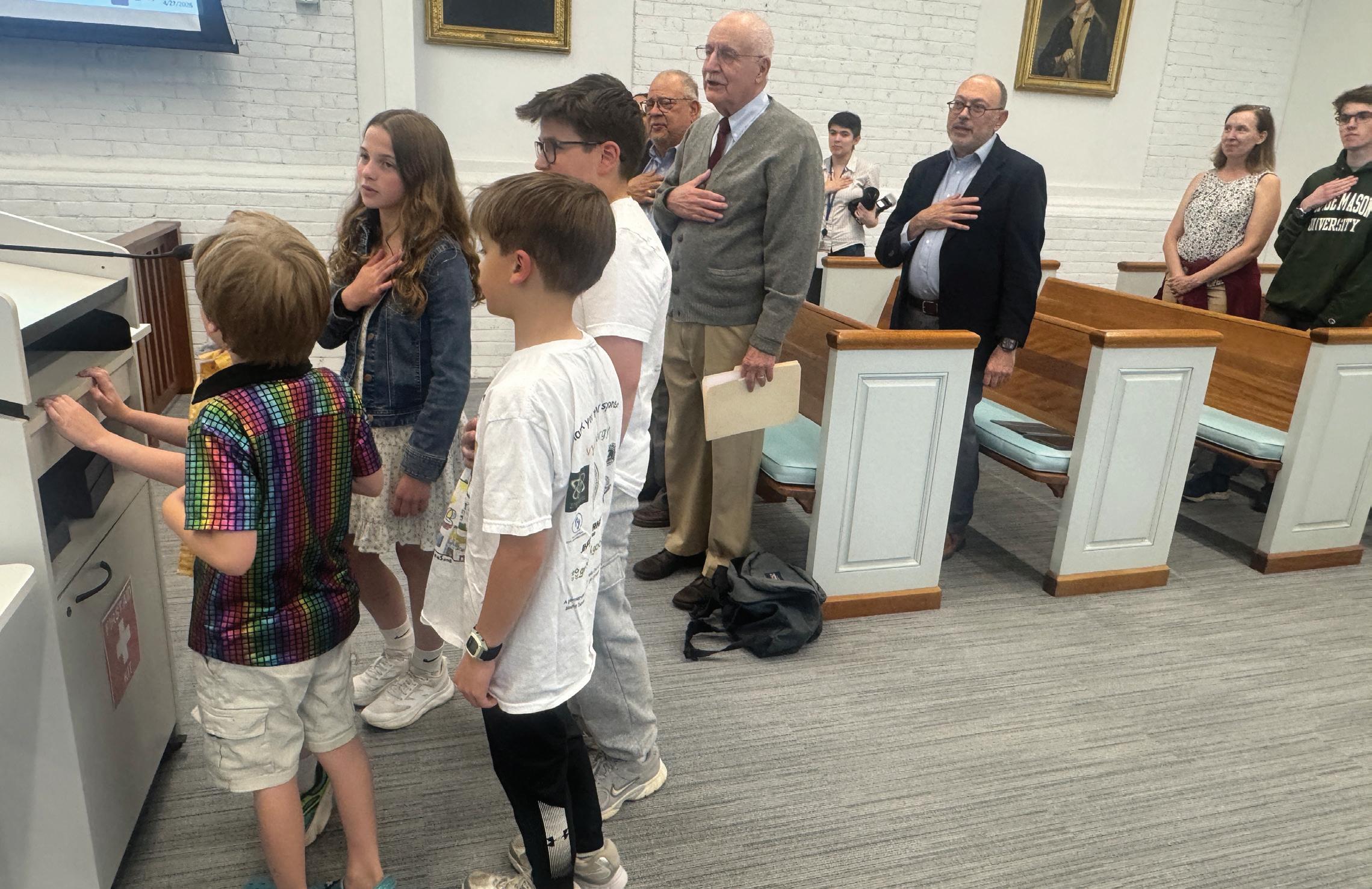
CHURCH CITY Council meeting, youthful members in the audience were invited by Mayor Letty Hardi to lead the Pledge of Allegiance opening the night. They performed flawlessly. (Photo: News-Press)
Benton Falls Church News-Press
by Nicholas F. Benton Falls Church News-Press
Falls Church News Briefs
‘Little Beast’ Pizza Finally Opens Adjacent Cauldron
Finally, the ‘Little Beast’ pizzeria was slated to open yesterday, adjacent the new Creative Cauldron theater digs in the first block of E. Broad St.
Known for its Detroit-style slices and playfully monstrous decor, the new restaurant’s owner Aaron Gordon says he plans to offer Detroit and deck oven-style pies, pastas, salads, sandwiches, and desserts in a casual, kid-friendly atmosphere.
“There’s so many wonderful restaurants in Falls Church, especially in the last four or five years — but oftentimes, they have a very sophisticated menu, and they’re very elegant,” Gordon told local media this week. “We’re elegant as well, but I think we’re just a lot more family-friendly than most other restaurants in the area, so we’re really proud of that.”
In Falls Church, in addition to pizza offerings, other highlights include a watermelon salad with fresh corn, avocado, tomato, cotija cheese, cilantro and a roasted jalapeño ranch. The bistro will initially only offer dinner service, before extending hours for lunch and brunch later this year.
The new eatery is also planning a daily happy hour with $9 martinis available in several variations, plus other cocktails with homemade syrups and juices, available alongside local beers and wines.
This is Little Beast’s third location, joining outposts in Chevy Chase, Md., and D.C.’s Palisades neighborhood (not including a Reston location that closed in 2023).
Favola Hails Veto-Proof Pro-Environmental Bill
Arlington State Sen. Barbara Favola commented on the one-day Richmond legislative session addressing Gov. Abigail Spanberger’s vetoes and alterations to bills passed in the recent session. “The only veto-proof bill returned to the governor,” she noted, was Sen. Russet Perry’s SB342, which requires developers to pay the state and localities when purchasing protected land on conservation easements.
The governor amended this bill by placing a re-enactment clause on the proposal. This meant that the bill would have to be passed by the General Assembly again in 2027 before it could become law. The General Assembly rejected the governor’s amendment. But a surprise second motion was offered to pass the bill in its enrolled form, notwithstanding the governor’s amendment, and it achieved two-thirds vote in each chamber. This means the bill is veto-proof and the governor must sign the bill into law, Favola noted.
She added, “I have received lots of positive feedback on closing the sales tax exemption on the computers and equipment used by data centers. This feedback is since electricity rates are rising for everyday Virginians with the emergence of data centers. Rest assured, I am committed to ensuring that data centers pay their ‘fair share’ when it comes to the consumption of valuable public goods such as energy and water. When data centers were given a sweetheart sales tax exemption deal in 2008 (to expire in 2035) as an incentive to locate in the Commonwealth, the full impact of their operations could not be foreseen.
“The Senate revenue target for closure of the tax exemption is $1.6 billion. The House of Delegates and the data centers did not initially embrace the idea of closing the tax exemption benefit, but it is possible that lawmakers may secure a compromise over the next few weeks that brings in some revenue but is not a complete erosion of the tax exemption benefit.”
She added, “One possibility that the data center industry is warming up to is the application of a usage fee. Adding new revenue streams to our proposed budget is imperative given the federal cuts to safety-net programs contained in the HR 1 Budget Reconciliation Act, crafted by President Trump and passed by the congressional Republicans.
Rt. 7 Widening in Tysons 1st Public Vetting This Week
Design work has been underway for about a year now on plans to widen the portion of Route 7 (Leesburg Pike) that runs through central Tysons.
The Virginia Department of Transportation was slated to present its initial concept for widening the road between Route 123 (Chain Bridge Road) and the Capital Beltway (I-495) to the community for the first time at a virtual public information meeting last night.
As amended by the Board of Supervisors in July 2023, Fairfax County’s com -
prehensive plan for Tysons envisions that segment of Leesburg Pike as a boulevard with six travel lanes and a guideway in the median reserved for bus rapid transit (BRT) service, Fairfax Board chair Jeff McKay has reported.
To accommodate the future bus service while preserving three travel lanes in each direction, the road would need to be widened by the equivalent of two lanes. The county’s guidelines also call for wider streetscapes that can comfortably fit both landscaping, including street trees, and sidewalks and other pedestrian amenities.
According to VDOT’s project page, improvements planned as part of the Route 7 widening include: Replacing the service roads in select locations with shared-use paths, adding turn lanes on Route 7 from Route 123 to International Drive/Gallows Road, replacing/upgrading traffic signals along the corridor as needed, improving vehicle safety and reducing congestion with access management, and installing high-visibility crosswalks, Americans with Disabilities Act (ADA) ramps, and Accessible Pedestrian Signals at numerous intersections and ramps throughout the corridor.
One More Page Books Hails Indy Bookstore Day
In a statement on its website this week, proprietors of the N. Arlington One More Page Books said, “We’re still catching up from our amazing Indie Bookstore Day! There was a long line outside waiting for us to open and it was busy all day. We gave out over 200 NOVA+ Bookstore Crawl passports, raffled off prizes, and had winners for our silver tickets and Libro.fm Golden Ticket. What a day!”
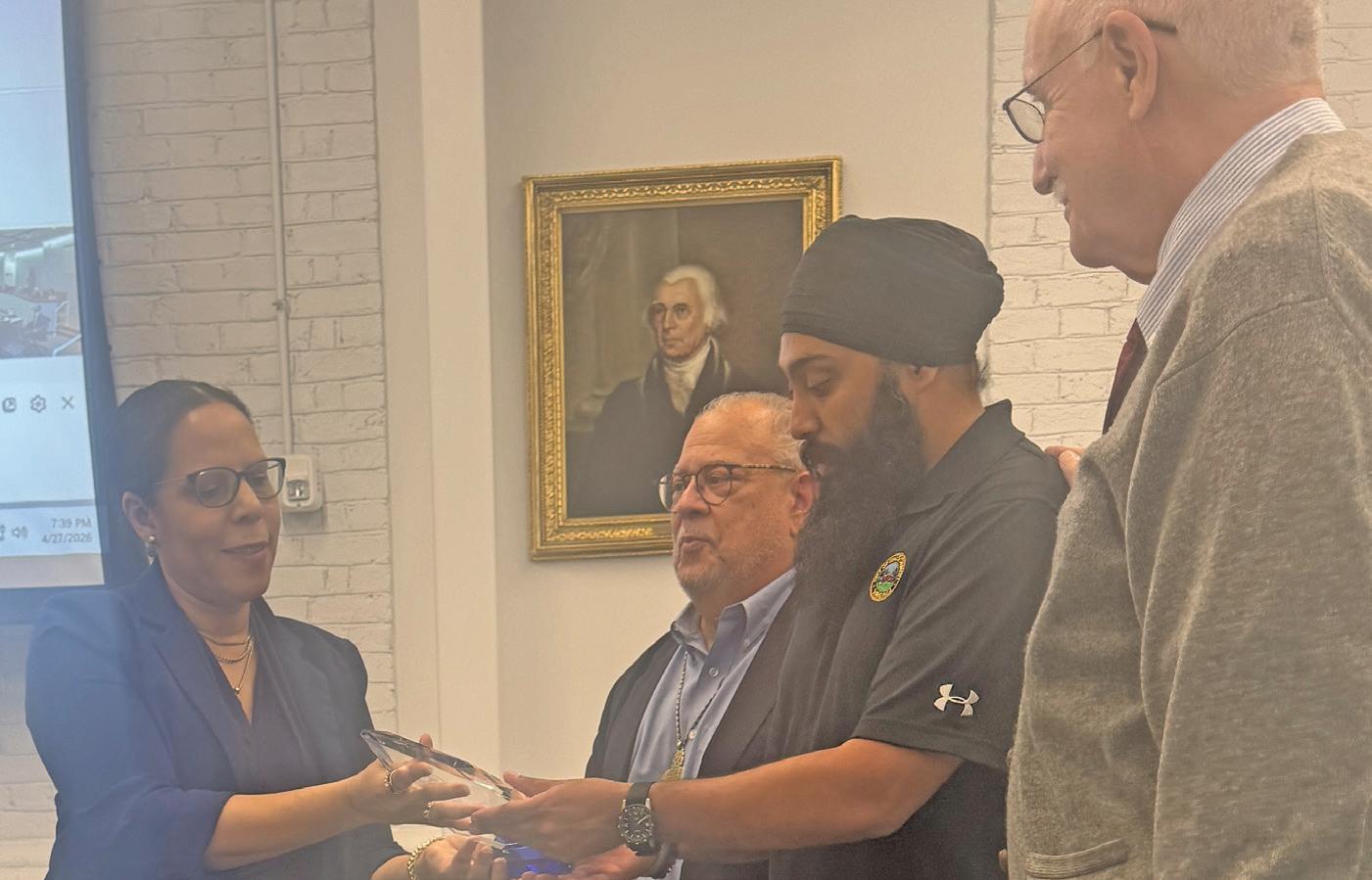
NAMED THE CITY OF FALLS CHURCH’S Employee of the Year for 2025 and honored at Monday’s night’s F.C. City Council meeting was deputy building inspector Dilraj Sidhu (second from right), flanked by Employee Review Board members Edwin Henderson and Joseph Rollo. (Photo: News-Press)
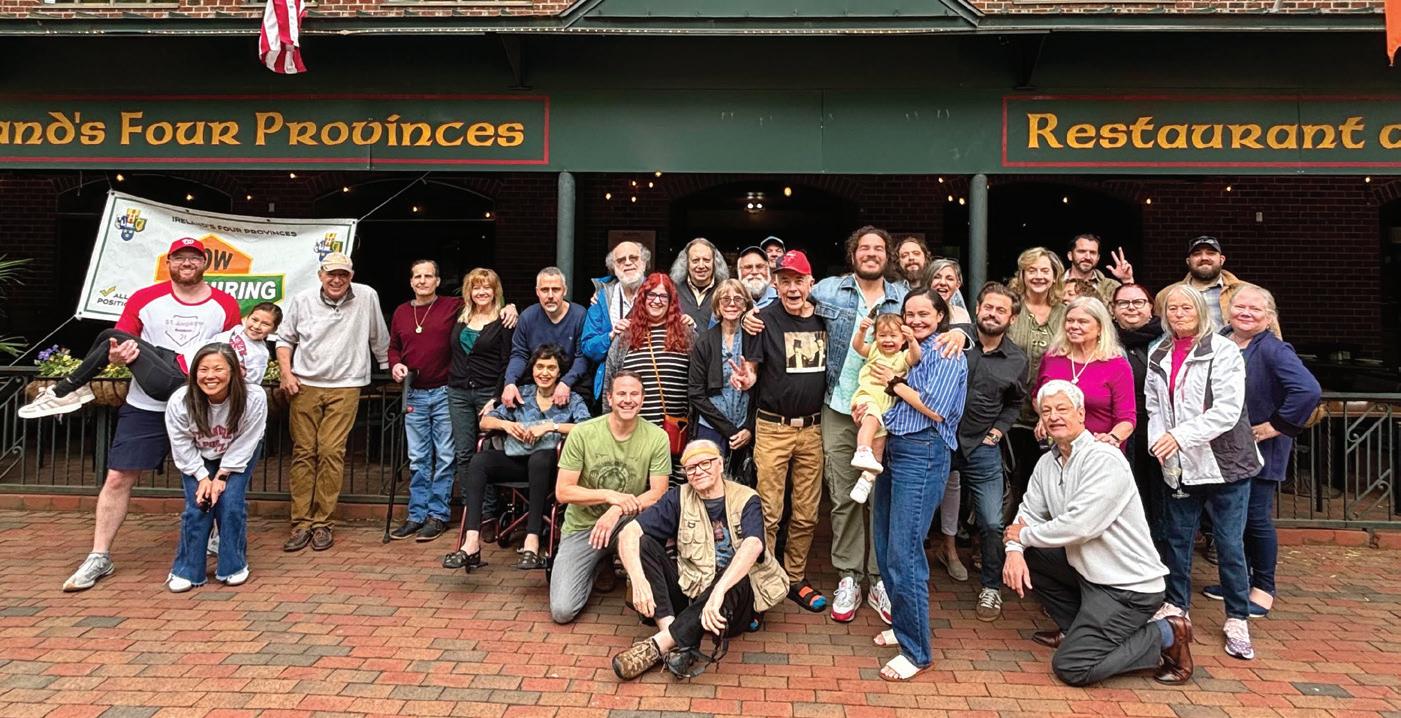
FRIENDS AND FAMILY of the late Uzi Awret gathered at the Ireland’s Four Provinces restaurant last week to honor his life. (Photo: Simon VanSteyn)
Va. Village Affordable Housing Challenge Now Gets Underway
Development Authority own nine of them, and have a vision of redeveloping the entire four-acre site to provide for a much greater number of units.
But clear from the extensive discussion of the board is the fact that there is going to be plenty of push-back aimed at restricting the realization of the project’s potential for achieving a marked increase in the City’s diminishing affordable housing stock.
The contending sides will be the push for a meaningful number of affordable units on the one hand, and so-called open space and “compatibility with neighborhoods” issues on the other.
“Compatibility with neighborhoods,” the term coined by Council member Erin Flynn Monday night, is also equated with “Not in My Back Yard” (or, NIMBY) sentiments of potential neighbors.
The affordable housing versus NIMBY pressures are not new to Falls Church. It goes back to zoning battles of the 19th century, when in the post-Civil War period, there was a major push in Falls Church to section off a large black population centered around Tinner Hill that led to an actual boundary modification leaving much of that neighborhood outside the Falls Church town limits.
But most recently, the initiative spearheaded by Carol Jackson of the Falls Church Housing Corporation through the better part of the first decade of this current century butted heads with NIMBY influencers at a number of prospective areas in the City, only to finally have a scaled-back plan for a Wilden Senior Housing plan, not far from the Virginia Village, go down in veritable flames 15 years ago.
Jackson resigned and moved to Charleston, South Carolina, where she got herself elected to
the City Council, the Housing Corporation disbanded here and the issue went radio silent for an extended period.
Already, the same language is being echoed in early sparring on this latest plan.
City Manager Wyatt Shields stressed that this week’s decision was to retain the services of a group qualified to deal with the fact that the Virginia Village project essentially involves a commercial transaction. Matters of scale, of building height or buffer issues would await what a second, bigger “request for proposal” will be addressing down the road.
So, when it came down to it, despite lengthy caveats issued by Council member Flynn, she joined the others in voting for the “little” request for proposal involved in the hiring of the JLL firm. The lone “no” vote came from veteran Council member David Snyder, who said he


derived from the discussion that the project would involve “120 to 150 units, and I am not on board with that.”
However, if the plan does not significantly increase the number of affordable units on the site, then its economic and policy justifications may not add up, anyway. With 80 affordable units in there now, should the plan not at least double that number, it might be financially or otherwise feasible, anyway.
“This is an unusual situa-
tion because it involves a public purpose being sought through a commercial transaction,” Shields said. The firm retained Monday will “help the committee be rigorous and thorough,” advising on economic and not aesthetic issues.
He assured the Council that the big decisions will be made on response to local community input, and the next date for serious attention being paid to this matter will be at a May 18 work session.
11


F.C. Budget Issues Compare Favorably to Arlington, Fairfax County
Continued from Page 1
at the City Council chambers. At its marathon meeting this Monday, there were only three citizens who spoke on the budget during the petition period, and all were advocating for slight adjustments to some environmental policies (such as adding a solar panel to the Community Center roof).
Fairfax Board Chair McKay said the ability to cut the rate, albeit marginally, was a result of the county’s new meals tax, which provided the local government an additional revenue source. Effective as of Jan. 1, the new 4 percent tax on prepared foods, on top of an existing 6 percent sales tax, “has begun to deliver on its intended purpose,” McKay said during about 90 minutes of budget discussion.
Meanwhile, Arlington adopted the region’s most aggressive response so far with
a $1.7 billion budget including a 2-cent increase in the real estate tax rate, from $1.033 to $1.053 per $100 of assessed value. Arlington County leaders said the increase was necessary to stabilize finances in the face of “ongoing economic uncertainty,” high office vacancy rates and increased demand for social services.
Even with the tax hike, the budget required tradeoffs. Earlier proposals included about $10.6 million in cuts and the elimination of dozens of positions.
The final plan restored some programs, but the underlying pressures remain. Officials warned the outlook for future budgets is “very uncertain,” suggesting additional tough decisions ahead.
Despite their different approaches, all Northern Virginia regional jurisdictions are grappling with the same underlying forces reshaping
local government finance: declining commercial real estate values, reducing a key tax base, rising labor and benefit costs for public employees, increasing demands for school funding and social services, and slower overall revenue growth compared to pre-pandemic years.
While Falls Church’s position is relatively stronger due to its aggressive economic growth efforts of the last two decades, it took a big hit this spring with the decision by the Hoffman Group developers of its West End project to postpone the Phase 2 development of the plan, which meant that a check for $10 million to kick that off has not been forthcoming.
While economic development has resulted in the region’s greatest reduction in the real estate tax rate in recent years, down from $1.355 to $1.18, the positive impact
has been offset by this year’s Hoffman Group decision to delay its Phase 2 at the West End, which is indicative of the wider region’s economic woes which saw, according to a report this week, the loss of 61,100 federal workforce positions in the region.
Regarding the 62,100 federal jobs lost from January 2025 to January 2026, a report by the Metropolitan Washington Council of Governments says the losses were part of approximately
103,900 jobs lost overall in the Washington metropolitan statistical area during that period. The report says those losses were part of about 103,900 jobs lost overall in the Washington Metropolitan Statistical Area during that period. The analysis, based on data from the U.S. Bureau of Labor Statistics and the U.S. Census Bureau, also found the region’s unemployment rate rose from 3.8 percent in December 2025 to 4.4 percent in January 2026.
The 1970s Roots of Trumpian Social Excess
Nicholas F. Benton
FALLS CHURCH NEWS-PRESS

In 2010, a full half dozen years prior to the onset of the Trump Era, I published an essay on what I called then a “kind of Rosetta stone” article from 1977 in the Village Voice newspaper that was a raw exchange between the playwright Tennessee Williams and the beat poet and philosopher William Burroughs.
One might wonder why such an ancient find would be considered important today. Yet it remains seminal in terms of how American culture turned in the 1970s into the kind of nihilistic morass that the current Trump administration represents from its Epstein side to its current foreign policy side.
The Williams–Burroughs exchange provides a key to understanding how a countercultural movement that began as a powerful force for affirmation and social transformation could, within less than a decade, be redirected toward patterns that would contribute to its own crisis.
The early years following Stonewall represented a moment of extraordinary possibility. With the collapse of long-standing barriers, homosexuals were suddenly able to live openly and to bring their creative, emotional, and intellectual capacities into the public sphere in unprecedented ways.
There was every reason to expect that this would lead to a flowering of contribution—a deepening of the very qualities that had, historically, allowed homosexual individuals to shape culture in humane and transformative ways.
But that is not what happened. Instead, the countercultural ethos that swept through American society in the late 1960s and 1970s took hold within the emerging gay communities with particular intensity. The language of liberation became intertwined with a culture defined increasingly by excess—by the pursuit of unrestrained sexual experience, by the widespread use of drugs, and by a turning away from sustained creative and professional endeavors.
The contrast between these two perspectives was captured in a con-
versation published in the Village Voice in May 1977. At the time, the cultural shift toward excess and detachment—particularly in urban gay communities—was already well underway. The exchange between Williams and Burroughs revealed, in stark terms, the philosophical divide at the heart of that shift.
Burroughs asserted: “Do what thou wilt is the whole of the law… Nothing is true, everything is permitted.”
Williams responded with hesitation, attempting to introduce a qualification: “Provided you want to do the right thing.”
But Burroughs rejected that premise outright: “If you really want to do it, then it’s the right thing.”
When Williams pressed further—asking whether this amounted to an amoral position—Burroughs answered plainly: “Completely.”
This exchange is more than an intellectual disagreement. It is a line of division.
On one side lies a view of identity grounded in meaning, responsibility, and relationship—a perspective that recognizes desire, but does not treat it as self-justifying.
On the other lies a view in which desire alone becomes the measure of truth—where the act of wanting is sufficient to define what is right.
The consequences of these two perspectives are not theoretical. They shape behavior. They shape culture. They shape outcomes.
In the decades that followed, the latter view—“everything is permitted”—gained significant influence within certain segments of American culture, particularly in urban environments, like Trump’s New York, where commercial and social structures reinforced it.
The results were profound. Patterns of excess became normalized. Boundaries eroded. And the conditions emerged in which the AIDS epidemic would later spread with devastating speed.
I wrote in 2010, “Nothing more clearly marks the departure from an earlier sensibility—the one represented by figures like Roosevelt and Williams—than this shift. It is the difference between a vision of identity that contributes to the shaping of a more humane world, and one that, in its most extreme form, becomes detached from any larger purpose.”
Who would have seen even in 2010 how the ethos of this brand of nihilism and unrestrained hedonistic excess would wind up in the White House, running America into the ground as it has.
A Penny for Your Thoughts
By Penny Gross Former Fairfax County Supervisor
Mention The Salvation Army and multiple images come to mind – bellringers with a red kettle at shopping centers during the Thanksgiving and Christmas holidays; a facility that accepts donations of used household goods, furniture, and clothing; Family Thrift Stores that sell those donated items to support community programs; or a place to get rid of an old vehicle and qualify for a tax deduction. All true, but often not seen, or realized by shoppers, are the services supported by those donations and thrift store purchases.
The Salvation Army has been helping people for more than 150 years, and its Adult Rehabilitation Centers (ARC) have been changing lives since the 1950s. In a world where second chances sometimes are hard to find, the ARC can be a place where hope is restored, lives are rebuilt, and transformation is happening every day. The Northern Virginia ARC, at 6528 Little River Turnpike in Alexandria, is a 111bed facility that began operating in 1984 and has made a difference
in the lives of hundreds, perhaps thousands, of men seeking recovery from addiction in a structured residential program. At monthly meetings of the ARC Advisory Council, residents are asked to relate their own story of struggle and restoration. Their stories often reveal earlier failed attempts at recovery but acknowledge that The Salvation Army program makes a significant difference in their path to success.
The program is built on faithbased counseling, paired with structure, work therapy, and personal accountability. A resident’s daily routine includes spiritual development, counseling sessions, and hands-on work experience. Residents learn to sort donations, rack the clothing, fix the furniture, and price the goods and serve as porters, check-out clerks, and other tasks needed by the ARC. Every donated item and every purchase made at a Family Thrift Store supports the men in the program, which has a graduation rate exceeding 40 percent. Some who fail the first time and are asked to leave
opt to come back and restart their program. That’s OK. The ARC program is not designed to be a temporary solution but a pathway to lasting change.
The impact of the ARC extends far beyond the walls of the facility. Families are restored. Children reconnect with fathers. Communities regain individuals who are ready to contribute in meaningful ways. Employers gain workers who understand discipline and responsibility. As Major Greg Davis, Administrator of the Northern Virginia ARC, noted at a recent Advisory Council meeting, “Transformation is not just an idea – it’s a daily reality. And it all begins with a simple act of generosity.”
Those looking to support the mission of the ARC can schedule a donation pick-up by calling 1-800-SATRUCK or visiting SATRUCK.ORG. Donations also are accepted at the facility Monday through Saturday from 8:15 a.m. to 4:15 p.m. Every donation helps fund recovery services and provides men with the opportunity for a fresh start. If you or someone you love needs help or would like to learn more about the program, the ARC can be reached at 703-6429270. A conversation could be the first step toward a changed life.
City of Falls Church Crime Report
Week of April 30 - May 6, 2026
Fraud – Identity Theft, Founders Ave, Apr 20, 1:44 p.m., victim reported multiple credit inquiries for loans and credit cards were made using their personal information.
Destruction of Property, W Broad St, Apr 21, 8:32 a.m., a report for graffiti was taken.
Shoplifting, Wilson Blvd, Apr 21, 5:35 p.m., an unknown male suspect stole merchandise. The suspect is described as a heavyset male, approximately 6’ in height, wearing a black jacket, gray shirt, black sweatpants and a red hat.
Shoplifting, S Washington St, Apr 23, 9:51 p.m., officers responded to a report of shoplifting. A male, 28, of no fixed address, was arrested for disorderly conduct.
Shoplifting, Wilson Blvd, Apr 24, 5:35 p.m., three male suspects stole merchandise; one suspect was located nearby and taken into custody. A black male, 31, of Washington, DC, was arrested for shoplifting.
Shoplifting, E Broad St, Apr 24, 12:30 p.m., an unknown male suspect stole merchadise. The suspect is described as a black male, approximately 6’1” in height with tattoos on
his right arm, wearing a black t-shirt, black sweatshirt, Jordan sneakers, and headphones.
Larceny, Hillwood Ave, Apr 24, between 8:30 a.m. and 6:30 p.m., an unknown suspect stole an unsecured black and red Schwinn mountain bike from the victim’s driveway.
Trespassing, S Washington St, Apr 24, 11:22 p.m., a white male, 30, of no fixed address, was arrested for trespassing and served with an outstanding warrant for another jurisdiction.
Driving Under the Influence, S Washington St, Apr 25, 2:05 a.m., a black male, 30, of Fairfax County, was arrested for driving under the influence and refusal to submit to breath test.
Trespassing, Wilson Blvd, Apr 25, 2:47 p.m., an Asian male, 55, of no fixed address, was arrested for trespassing.

Since 1991, an award-winning LGBT-owned general interest community newspaper.
Vol. XXXVI, No. 12 APRIL 30 - MAY 6, 2026
• City of Falls Church ‘Business of the Year’ 1991 & 2001 • • Member, Virginia Press Association •
Nicholas F. Benton Owner & Editor-In-Chief nfbenton@fcnp.com
Nick Gatz Managing Editor ngatz@fcnp.com
Sue Johnson Advertising Sales sjohnson@fcnp.com
Amy Bowker Copy Editor
Circulation delivery@fcnp.com
To Contact the News-Press
phone: 703-532-3267
email: fcnp@fcnp.com display advertising sjohnson@fcnp.com 703-587-1282 classified & Legal ads classads@fcnp.com letters to the editor letters@fcnp.com News & Notes newsandnotes@fcnp.com Obituaries obits@fcnp.com subscriptions distribution & delivery delivery@fcnp.com
www.fcnp.com
The News-Press is certified by the Commonwealth of Virginia to publish official legal notices including probate, abc notices, small and foreign estates. We will provide the appropriate paperwork. A comprehensive book on the 36 year history of the News-Press, “The Life and Times of the Falls Church NewsPress”: by Charlie Clark (History Press, 2023), can be purchased at local bookstores or online. The Falls Church News-Press is published weekly on Thursdays and is distributed free of charge throughout the City of Falls Church and the Greater Falls Church area to over 140 locations. Offices are at 105 N. Virginia Ave., #310, Falls Church, VA 22046. Reproduction of this publication in whole or part is prohibited except with the written permission of the publisher. ©2025 Benton Communications Inc. The News-Press is printed on recycled paper. A searchable archive of all issues of the Falls Church News-Press since 1991 can be found at bit.ly/44kt6Sc.
E ditorial
A New, Classic Affordability Challenge
Communities across the country—and especially in high-cost regions like Northern Virginia—are increasingly confronting a difficult tension: the urgent push to expand affordable housing and the equally persistent resistance from residents wary of change in their neighborhoods.
Often framed as a clash between policy goals and public sentiment, the divide is more complex than a simple “for or against” debate. On one side are local governments, housing advocates and many employers, all warning that rising housing costs are pricing out workers, straining families and undermining economic stability. On the other are residents who may support affordability in principle but oppose specific projects near their homes—a dynamic widely known as “Not In My Back Yard,” or NIMBYism.
The need for more affordable housing is well documented. In many metro areas, housing supply has failed to keep pace with population growth and job creation. The result has been steep increases in rents and home prices, pushing lower- and middle-income households farther from job centers or into financial precarity. Local governments have responded with policies aimed at increasing supply, including upzoning, density bonuses and public-private partnerships to build below-market units.
But these efforts frequently run into resistance at the neighborhood level. Residents often raise concerns about increased traffic, strain on schools and infrastructure, changes to neighborhood character and potential impacts on property values. In some cases, opposition is also rooted in distrust—of developers, of government decision-making, or of whether promised affordability will actually materialize.
Local officials find themselves navigating this divide. Many have set ambitious affordable housing targets, recognizing both the moral and economic stakes. Yet they also depend on public input and political support, making it difficult to advance projects that generate strong neighborhood opposition.
The conflict is especially pronounced in smaller jurisdictions like Falls Church or close-in suburbs, where land is limited and new development is highly visible. A single project—whether on a school site, a commercial parcel or public land—can become a test case for broader policy goals. Decisions about height, density and unit mix can take on outsized importance, as residents weigh the benefits of affordability against perceived changes to their community.
Some jurisdictions are experimenting with ways to bridge the divide. These include earlier community engagement, clearer affordability requirements, design standards intended to blend new developments into existing neighborhoods and investments in infrastructure to accompany growth. Others are exploring regional approaches, recognizing that housing shortages—and their solutions—extend beyond municipal boundaries.
Still, the underlying tension remains. Expanding affordable housing almost inevitably requires change—more density, different building types, or redevelopment of existing sites. For many residents, those changes can feel immediate and personal, even when the broader benefits are widely shared.
As housing pressures continue to mount, the challenge for local governments will be not only to adopt policies that increase supply, but also to build public trust and consensus around how—and where—that growth should occur.
Our Man In Arlington
Bill Fogarty
With recent columns about public playgrounds and public art, this week I thought I would tackle another “public” theme: public signage. It is a topic that has been a controversial challenge for County officials for one hundred years. Back in the late 1920’s, before there was a zoning ordinance, County officials and activists were concerned about the rapid increase in the number of billboards near the two bridges (Key Bridge and Long Bridge), and on the roads heading westward from those bridges (Lee Highway and Columbia Pike). This concern helped bring about the creation of our first zoning ordinance in 1930, which was sixteen pages in length, with only a few references to signs. By 1942, the zoning ordinance consisted of eighty-three pages, with a separate section devoted to signs. Billboards must have become a bit more complex by then, as this new provision was added: “Signs or billboards which involve motion or rotation of any part, or display flashing or intermittent lights, are prohibited.” Today the zoning ordinance is 437 pages, with sixty-six pages devoted to signs. Sign ordinances are changing constantly, to address new technology, and old issues. The most recent controversy relates to a long-standing concern about the proliferation of political signs in the public medians during each primary and general election cycle.
In March, the County staff proposed several changes to sign ordinances, including a proposal to ban political signs in our medians. At the March 14 County Board meeting, there was a spirited discussion about this proposal, which elicited some interesting perspectives during the public comment sessions. Two recent candidates, who were not successful in primary elections, offered differing viewpoints (ranging from free speech issues to safety concerns). One citizen complained that a ban favored incumbents; another citizen stated that the current system favored incumbents. During the Board discussion, Maureen Coffey was the only Board member to support a full ban on the signage,
pointing out safety and environmental concerns, and noting that other local jurisdictions had such signage bans. In the end, the County Board amended the current regulation, by a vote of 4 to 1, to continue to allow these signs, with a limit of one sign per median, allowing signs to be placed up to 45 days before an election.
The placement of political signs in medians was prohibited during the second half of the 20th century. There was a lawsuit challenging the ban, filed in federal court in 1985 by a Republican candidate, asserting the constitutional issue of free speech. Judge Albert Bryan ruled the prohibition was lawful, noting that Arlington had “an interest in preventing visual pollution... and protecting public safety.” The constitutionality of a ban has been upheld by the United States Supreme Court.
I would note that in 2003, the County Board amended the sign ordinance to allow for political signs in public medians (allowing two signs per median, up to 31 days before an election, with a requirement for removal within five days). It will be interesting to follow the results of this most recent amendment, as 2026 will have many opportunities for political signs, with a County Board election, and two separate Congressional elections (if the recent redistricting survives a lawsuit to overturn the referendum results). The primaries alone could give us more than two dozen candidates. And there are three constitutional amendments on the November ballot, which will no doubt increase the number of signs being placed on our public medians. Questions abound: How crowded will it get? Will candidates abide by the “one per median” law? Will the signs be removed on time? And will it be possible for County employees to mow the grass on those medians? Stay tuned.
Meanwhile, I came away with a new perspective on the safety issue, thanks to Maureen Coffey, who noted the danger of people running into a public median to place a sign. By allowing such signage, it seems to me that the County is enabling and encouraging thousands of instances of illegal activity – that is, jaywalking to get to the public median!


Camps & Schools Spring 2026

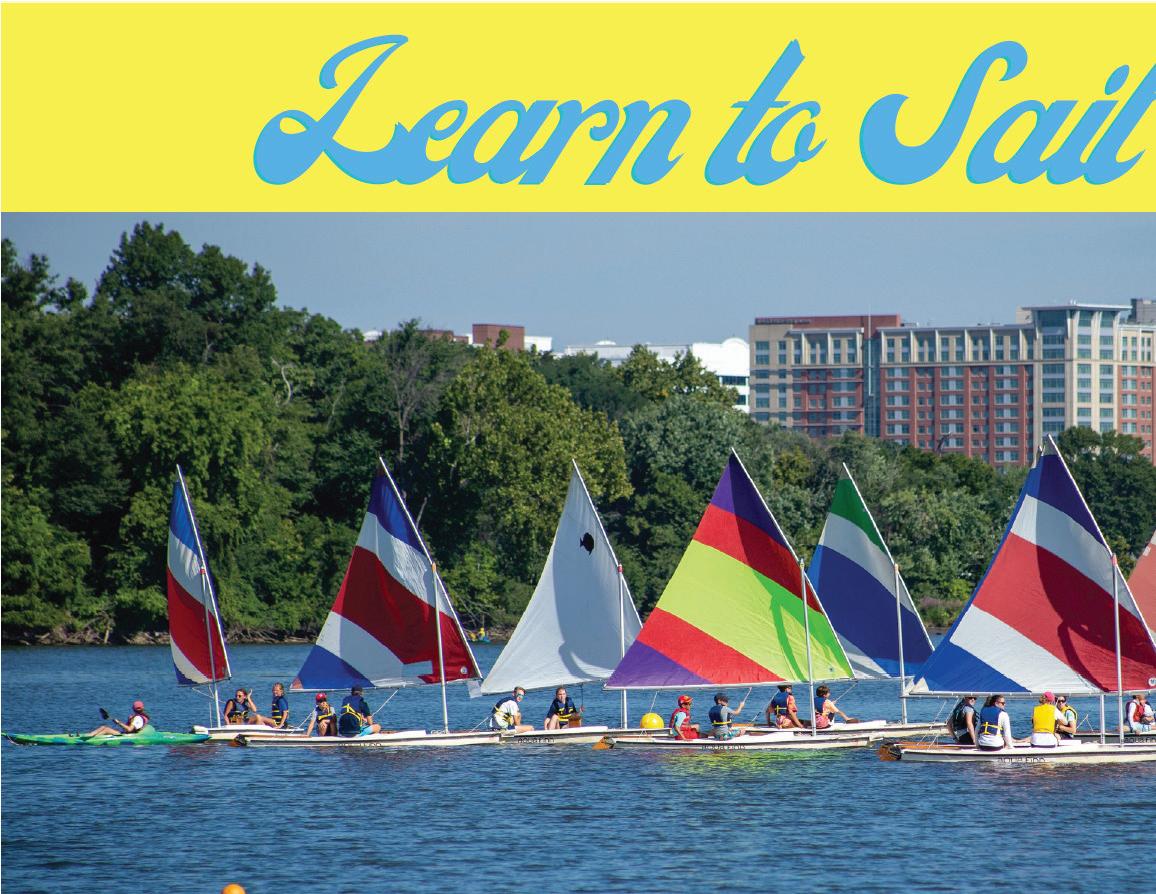
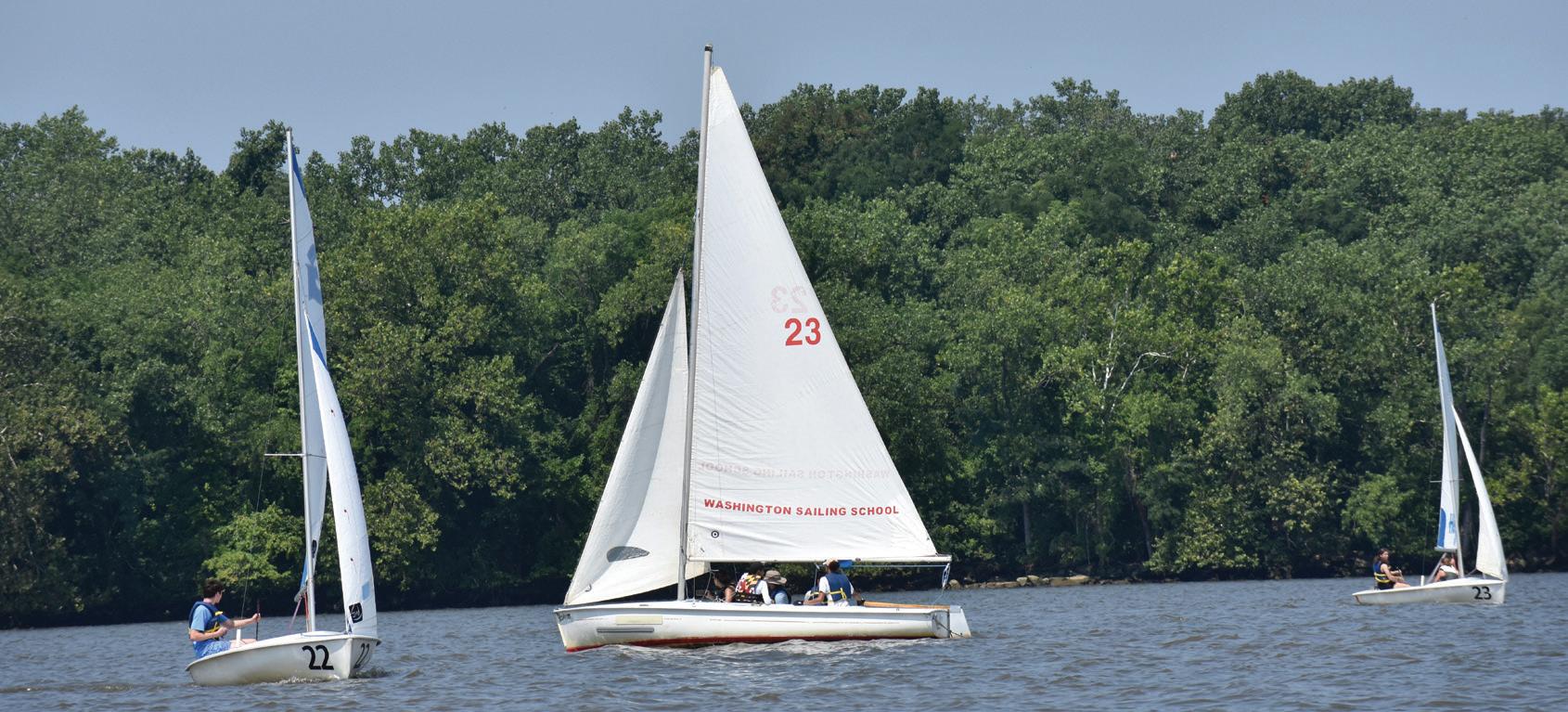
Learning to Sail Builds Life Skills
BY AMY ZANG SAILING SCHOOL DIRECTOR/OWNER
There’s a moment early in every young sailor’s experience when something clicks. The wind fills the sail, the boat responds, and suddenly they’re not just passengers — they’re in control. It’s a small moment, but it tends to stay with them.
That shift — from observer to operator, from uncertain to capable — is at the core of what youth sailing programs offer. On the surface, kids are learning to tack, trim sails, and read the wind. Underneath, they’re building something that lasts well past the dock.
Sailing is fundamentally a team sport, even in a single-handed boat. Young sailors learn early that success depends on communication, trust, and shared responsibility. Whether they’re rigging before launch or working through a problem on the water, everyone plays a role — and everyone knows
it. That sense of accountability to something larger than yourself is a difficult thing to teach in a classroom. On the water, it happens naturally.
Leadership develops the same way. Sailors rotate between skipper and crew, giving each person the chance to direct and to follow. They learn to make decisions quickly, communicate clearly, and stay calm when conditions change — skills that translate directly into school, athletics, and eventually the workplace. The confidence that comes from navigating a boat through shifting winds is the same confidence that raises a hand in class or steps up in a group project.
The mechanical side of sailing matters too, and it tends to surprise people. Young sailors develop a genuine understanding of how rigging systems work, how sail shape affects performance, and how to troubleshoot problems in real time. This isn’t abstract — it’s hands-on physics, engineering, and critical
thinking happening simultaneously. Sailing is STEM before students ever think of it that way.
Adversity is built into the sport. The wind doesn’t cooperate, capsizes happen, races don’t go as planned. What young sailors learn is that these moments aren’t failures — they’re feedback. Patience, perseverance, and the ability to reset and try again are practiced constantly, in an environment
where the consequences are real but manageable. Those lessons tend to stick.
Water safety is woven throughout. Sailors develop deep respect for the water alongside the skills to navigate it responsibly — from proper life jacket use to reading weather conditions and knowing emergency procedures. Awareness and confidence in and around the water become second nature.
What youth sailing ultimately offers is a sense of possibility. As
skills grow, so does a willingness to push past perceived limits, take on harder challenges, and approach uncertainty with curiosity rather than anxiety. The water has a way of expanding what young people believe they’re capable of.
That’s the point. Sailing is a sport, yes — but for the young people who learn it, it tends to become something more: a foundation for how they approach difficulty, responsibility, and growth for the rest of their lives.












DMV Area Camps & Schools Offer Diverse Experience
BY FALLS CHURCH NEWS-PRESS
Summer offers children a chance to explore new interests, build confidence and create lasting memories — and families in the Falls Church area have no shortage of strong camp options to choose from.
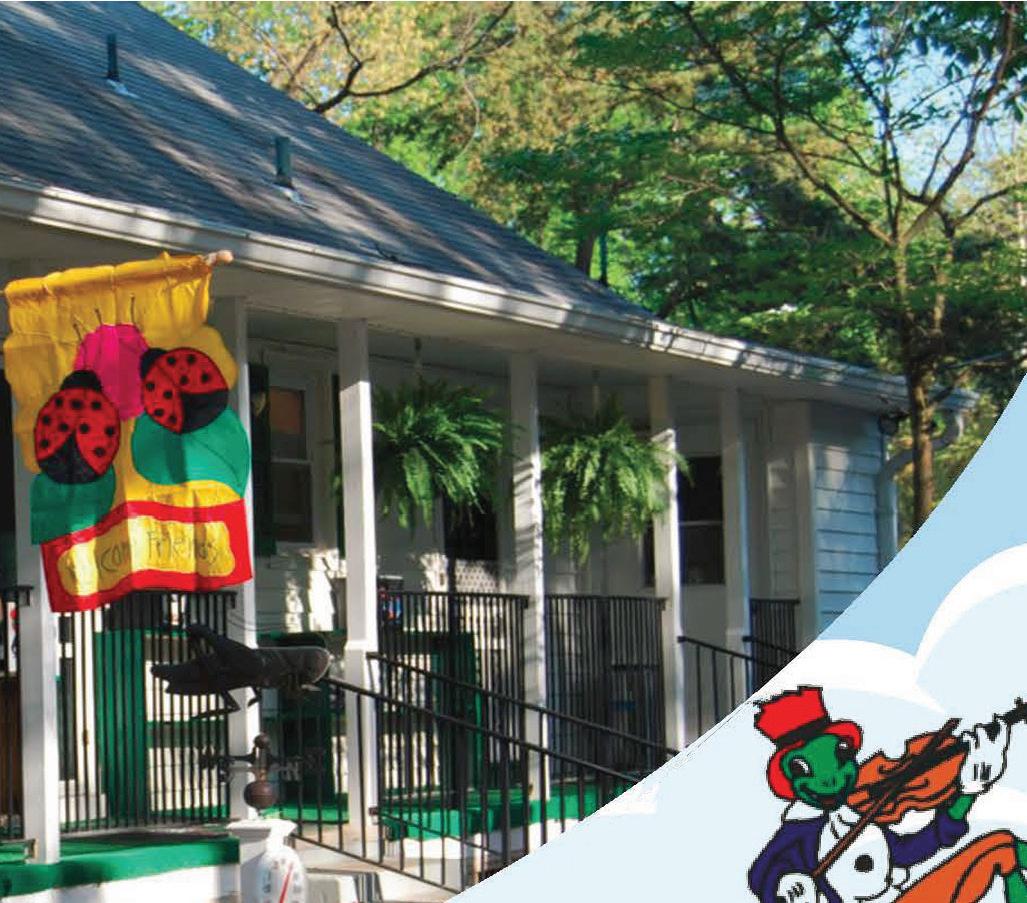
For younger children, Grasshopper Green School provides a warm, nurturing introduction to summer camp. Its program emphasizes hands-on learning, outdoor play and creative exploration, all in a supportive early childhood setting. Campers are encouraged to follow their curiosity while building social skills and independence in a gentle, engaging environment.
A similarly well-rounded approach can be found at Kenwood School, where summer programming blends academics, enrichment and recreation. Campers move through a thoughtfully structured day that keeps them both mentally engaged and physically active, balancing learning with creativity
and play. It’s an appealing option for families looking to maintain educational momentum while still embracing the spirit of summer.
For students eager to sharpen their voices and ideas, Capitol Debate offers a more specialized experience. Its programs focus on public speaking, critical thinking and persuasive argument, helping campers develop confidence while engaging with current events and collaborative challenges. The result is a dynamic environment where intellectual curiosity and communication skills take center stage.
Closer to home, the City of Falls Church Recreation and Parks delivers a wide array of traditional and specialty camps that serve a broad range of interests and age groups. From sports and games to arts and outdoor activities, these community-based programs emphasize accessibility, variety and fun, making them a reliable choice for many local families.
For children who thrive


on movement, KiPS Family Gymnastics provides an energetic outlet centered on gymnastics and active play. Campers spend their days tumbling, climbing and participating in group games that build strength, coordination and confidence — all within a lively, supportive atmosphere designed to keep kids engaged and moving.
Rounding out the options is
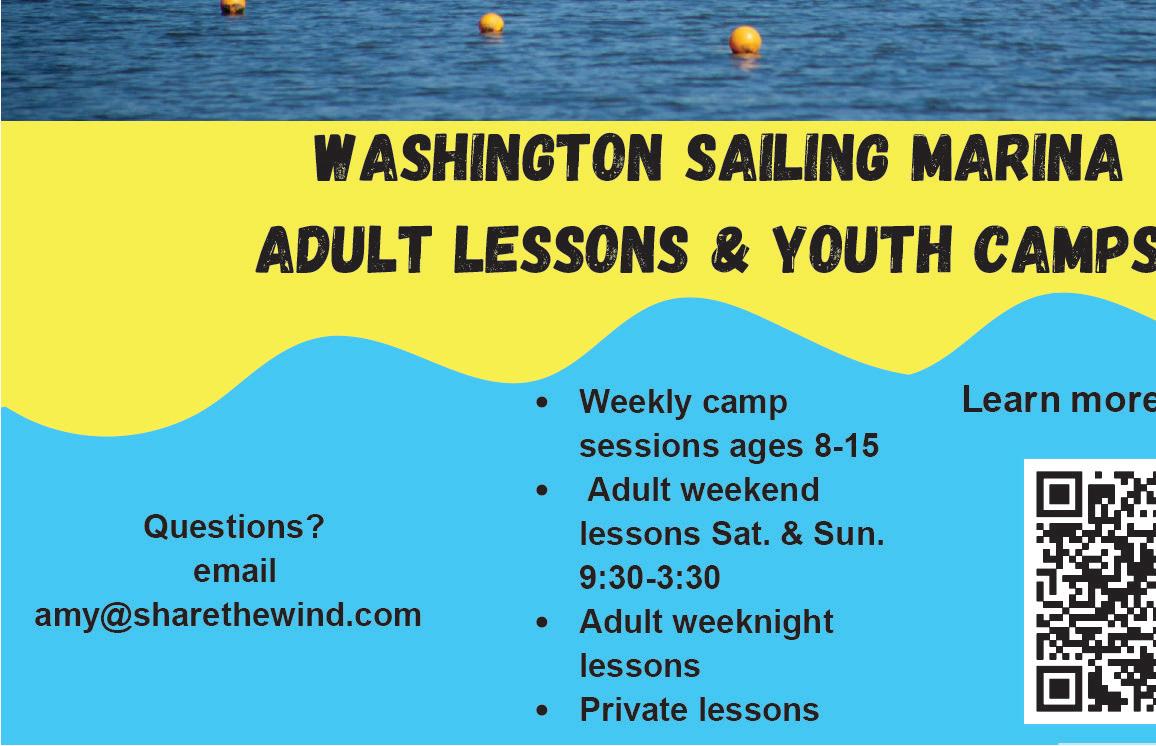
Washington Sailing Marina Camp, which offers a distinctly different summer experience along the Potomac River. Here, campers are introduced to sailing and boating safety while spending their days on the water. The program fosters independence, teamwork and a sense of adventure, making it especially appealing for those ready to try something new in an outdoor setting.
Taken together, these camps highlight the breadth of opportunities available in the area. Whether children are just beginning their camp journey, looking to stay active, eager to learn new skills or ready for a unique outdoor adventure, there is a program suited to nearly every interest.



















Open House: May 2nd 9am-12pm



LEARNING
•Small Class Sizes K-6th Grade
•Reading, writing, phonics, science, social studies, spelling & math
•Extracurricular classes in computers, art, music & gym
Play
•Spacious Playground


•Daily indoor/outdoor free play
•On-site gym for indoor exercise
EXTRAS
•Open Daily 7 a.m - 6 p.m.
•Before and after school care
•Hot catered lunch & snacks provided daily
•Variety of educational field trips
•Spring, Summer & Winter Camps




Cappies Review: Meridian High School, ‘Amadeus’
BY JULIAN HASSI McLean High School
As the final note of a sensational concerto resonates through the air, whispers bounce off the walls. Hushed but frantic utterings of “Salieri” and “poison” cloud the space with mystery. The lights dim, and Meridian High School’s production of Amadeus begins.
Written by Peter Shaffer in 1979, Amadeus was such a success it earned it a Tony Award and a movie adaptation. Amadeus tells an exaggerated tale of composer Antonio Salieri’s one-sided rivalry with the legendary Wolfgang Amadeus Mozart. Salieri struggles to face his self-perceived mediocrity and sabotages Mozart’s budding career.
Summoned by the murmurs, Salieri (Mia Schatz) emerged from the shadows. With expert annunciation, Schatz launched into an intense narration of Salieri’s obsession with Mozart.
Salieri shifted between narration and memories as he recalled each encounter he had with Mozart. Schatz smoothly switched between obvious disdain when addressing the audience and contrived cordiality when speaking directly to Mozart. Schatz demonstrated great resilience, particularly in an ability to memorize extensive amounts of dialogue. Throughout his performance, successfully conveyed both Salieri’s inner and outer conflicts, highlighting immense amounts of insecurity.
Tormenting Salieri’s memory with his talent was Mozart (Will Albaugh). To truly emulate Mozart, Albaugh mastered the arts of piano and conducting. He flawlessly executed these skills onstage, performing breathtaking solos and leading the orchestra with grandeur. Albaugh’s mannerisms conveyed his boyish inelegance, contrasting the proper, elitist individuals he was surrounded by. Despite his clumsiness when interacting with the

high-class, Albaugh delivered his lines with conviction that proved he knew exactly who he was; no amount of discouragement or failure could sway the fact that his brilliance was unlike any seen before.
Wide-eyed and sick with love was Constanze (Ella Stearns), Mozart’s fiancée. Her playful physicality and cheeky line delivery made her a great match for Albaugh’s impishness. Together, they rolled around onstage, which resulted in some rather public displays of affection. As the play progressed, their dynamic shifted, and tensions rose. Albaugh and Stearns began to speak bluntly to each other, seemingly forgetting how infatuated they had been before.
Framing the actors with platforms and fully functional box seats, the set, built by the Meridian Technical Theater Class, transported the audience into a classic eighteenth-century European opera house. A platform in the back helped to specify when characters

were performing. The box seats allowed the cast to play with levels as the audience shifted focus between different locations onstage. Decorated with elegant shades of red, brown, and black, the set was polished to perfection.
Hair and makeup were organized by Lauren Lewin and Tabby Hermann, who managed over 25 wigs. Almost every actor and orchestra member had a stylized eighteenth-century wig, ensuring nobody looked out of place in the era. Putting the orchestra in wigs kept the story consistent with its
setting, helping them blend in with the actors.
After the bone-chilling sounds of the chorus and orchestra weaving together during Mozart’s “Requiem” filled the space, Salieri and Mozart had taken their final descent into madness. The lights came back on, and the audience sat with the aftermath of Salieri and Mozart’s physiologically harrowing relationship. Intoxicating, thrilling, and just the right amount of horrifying, Amadeus at Meridian High School was a one-of-a-kind performance.
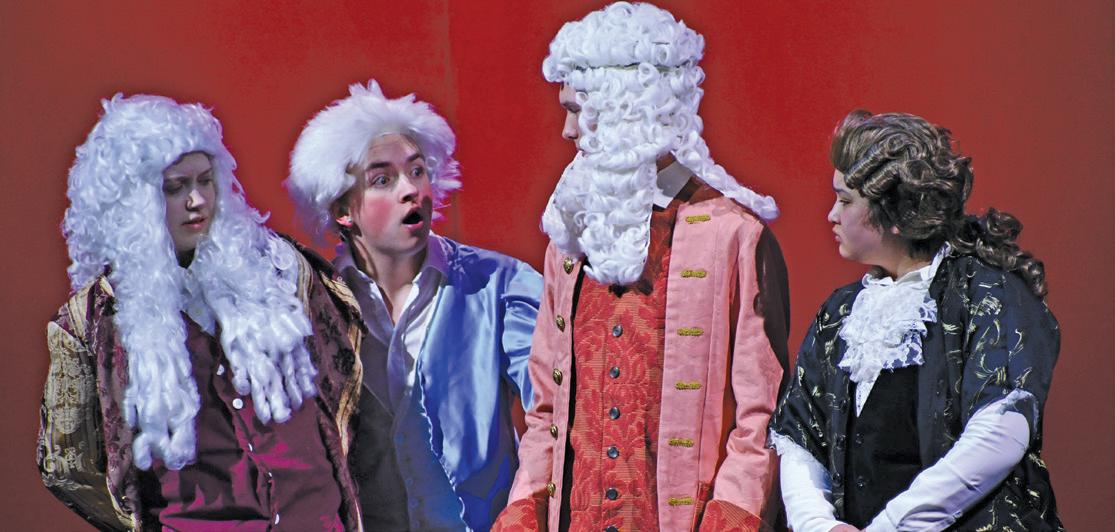
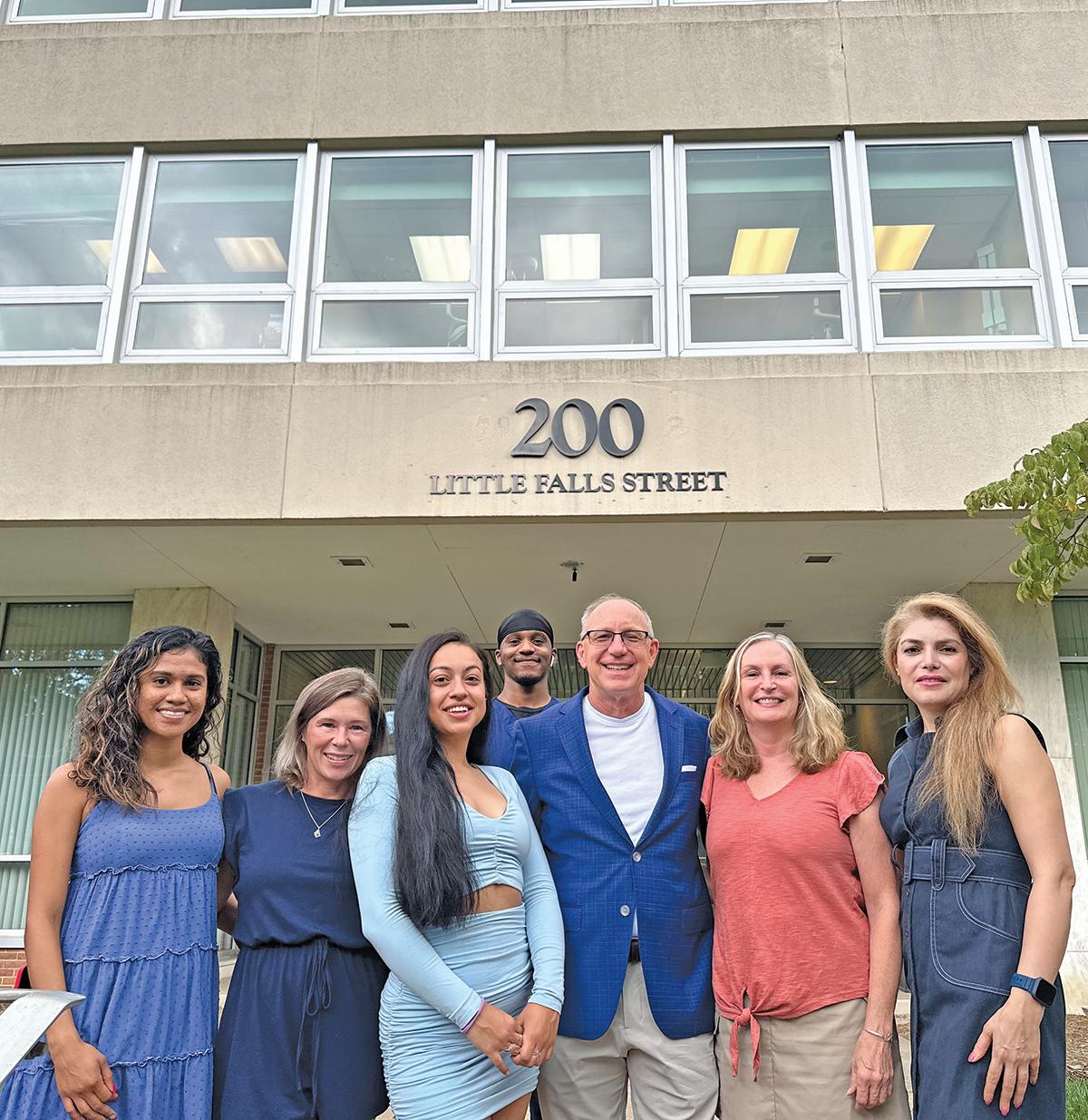
Raymond Cowan, Will Albaugh, JP Tysse, Mia Schatz. (Photo: Carol Sly)
Meridian Sports Recap: 4/21 -
by Dinos Simcox
Spring sports at Meridian have entered the latter half of their seasons, and the Mustang teams have put together a solid week of competition. The clubs have managed to combine for nine wins, two draws, and five losses.
Baseball unfortunately suffered two close losses this week, falling to Warren County 7-5 and Fauquier 3-1. These losses drop their record to 5-7 on the year, and they’ll need to improve quickly if they want to make the playoffs. The Mustangs are currently in ninth place in the Northwestern Region 3B, just outside the cutoff.
Boys lacrosse, as per usual, is perfect. The Mustangs played two games this week, one against Sidwell Friends and one against Dominion. The squad won both, 14-11 and 14-5, respectively. These victories brought the Mustangs’ record to 12-0, the best record in the
region. Their next game on April 30 will be their biggest test yet, as they go on the road to play Fauquier, who boasts an 8-1 record, also one of the best in the region.
Girls lacrosse dominated in its only game this week, beating Dominion 17-10. The win improved their record to 7-2, one of the best overall records in the region. Their next game on April 29 is against Yorktown, an excellent 6A team.
This won’t be the Mustangs’ first encounter with a 6A school, but it will undoubtedly be a difficult game for Meridian to win.
Softball has unfortunately failed to win any games this week or this season. They dropped both of their games this week, one to Fauquier and one to Falls Church. It’s simply been a poor season for the team, and hopefully they’ll be able to end on a positive note and bounce back next year.
Both boys and girls tennis won all their matches this week, notch-
4/27
ing two wins apiece. Both teams crushed Warren County 9-0. They then beat Falls Church two days later, with the girls winning 9-0 and the boys winning 8-1. The week’s success improved both squads’ records, the boys now sitting at 9-1 and the girls at a perfect 10-0.
Boys soccer won their first game of the week in dominant fashion, beating Warren County 6-0. Their
next game against Handley ended in a draw, bringing their record to 8-11. The Mustangs now have the best overall record in the region, one win better than Brentsville, which sits at 7-2-1.
Girls soccer played three games last week and covered every possible result. First, they crushed Warren County 7-0. Next, just like the boys team, they drew with Handley 2-2.
The Mustangs unfortunately lost their final game 2-1 against Kettle Run. With a Tuesday night loss to
James Wood, their record now sits at 6-5-1, with a difficult stretch of games ahead of them. Their next two opponents are both very strong programs in Maggie Walker and Kettle Run for the second time in four games. Kettle Run is the best team in the region, boasting an undefeated record of 9-0. The Mustangs came just short of ending Kettle Run’s perfect season, so the club will be itching for a rematch.


THE MERIDIAN GIRLS soccer team faces the flag during the national anthem. (Photo: Dinos Simcox)
In Memoriam: Chester “Chet” W. De Long
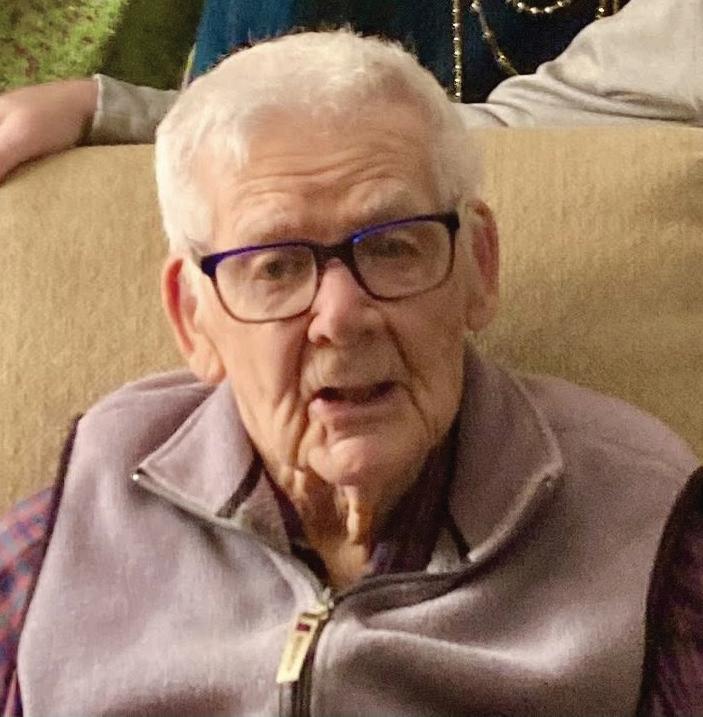
Chester “Chet” W. De Long (19252026). Long-time Falls Church resident Chester “Chet” W. De Long died on April 26, surrounded by his family.
Chet was born in 1925 in Seattle, Washington, the son of Jim (an engineer) and Pauline (an artist) De Long. He grew up in Seattle and in Lynden, where his grandparents’ farm was located. When he was a teenager, his family moved to Fairbanks, Alaska. Chet completed his final year of high school at Fairbanks High School, graduating in 1941.
Chet’s subsequent education was greatly disrupted by the war. He was drafted into basic Naval training in Michigan and was sent to continue his college coursework at Marquette University so that he could attend medical school and become a Navy doctor.
As a medical student at Washington University in St. Louis, Chet was entranced by his coursework in biochemistry. After WWII ended, he decided not to complete his medical degree, but to instead pursue a Ph.D.
He finished his Bachelor of Science coursework at the University of Washington and undertook research work at the Hanford Nuclear Reservation. He enrolled in the graduate program in Chemistry at the State College of Washington (now Washington State University) in Pullman, Washington.
While at WSU, he met Carol June Witte, who was then earning a Masters degree in Organic Chemistry. He completed his PhD work investigating penicillin biosynthesis in 1956.
Later that year, Chet and Carol married and Chet started a job as an analyst with the CIA. He worked there until 1967, when he moved to the Veterans Administration, working in (and soon leading) the Office of Academic Affairs, which supported the development of medical schools associated with VA hospitals, including the establishment of five new medical schools. Chet remained at the VA for the rest of his career, retiring in 1991.
Chet and Carol settled initially in Arlington, moving in 1960 to Falls Church, where they raised three daughters. They became active members of the Falls Church Presbyterian Church. Chet served as an elder and deacon and especially enjoyed serving on the organ selection committee when the church replaced its electronic instrument with a pipe organ.
He also was active on educational issues in Falls Church, playing a significant role in the development of an International Baccalaureate program at the high school in the 1980s.
He was tremendously proud of Carol’s leadership roles and accomplishments, enthusiastically cheering her on during her many years of service in Falls Church City government.
After his retirement, Chet supported the Mary Riley Styles Public Library in several ways, serving for over 25 years on the
Library Board of Trustees as a board member and vice-chairman. He played key roles in planning and advocating for the library renovation and expansion project that began in March 2020, spearheading efforts to pass the library bond referendum that financed the project.
He was also a founding member (and later financial officer and fundraiser) for the Mary Riley Styles Public Library Foundation, which provides annual assistance for library materials, services, programs and equipment.
In addition to these leadership roles, he was a dedicated library volunteer, working up to 300 hours per year behind the scenes. In 2020 the Foundation established an annual award named in his honor to recognize a library staff member or volunteer who has shown the qualities of dedication and public service Chet exemplified. He was also named the Grand Marshal for the 40th Annual City of Falls Church Memorial Day Parade in 2022.
Throughout their 67-year marriage, Chet and Carol were avid supporters of the performing arts, subscribing to classical music concert series in Washington for many years. They also loved to travel and toured extensively in the United States and around the world.
After Carol’s death in 2023, Chet moved to Chesterbrook Residences, where he celebrated his 100th birthday in 2025, surrounded by family and numerous friends. Chet quickly became a regular in the twice-weekly bridge club at Chesterbrook, continuing a life-long practice of good-humored but utterly merciless card-playing. Card games in the De Long family were often enjoyed with gin and tonics, and Chet taught his family and many of their friends how to mix the perfect G&T.
Chet is survived by three daughters: Leslie (Philip Duncan), Alison (John Sedivy), and Linda; and four grandchildren: Meredyth, Tyler (Dale Roehrig), Emma (Flo Vass), and Nico (Luke Waters).
A memorial service will be held on Saturday, May 30, starting at 3 p.m. at the Murphy Funeral Home, 1102 W. Broad St., Falls Church, VA. In lieu of flowers, the family suggests donations to the Mary Riley Styles Public Library Foundation.
Senator Saddam Salim
Every year that I have served, the month after returning from the legislative session has been a blur. After two or three months in Richmond, I come home to a packed schedule of community events and legislative updates. That has never been more true than this year, because on April 6, I made an exciting announcement, which won’t impact my commitment to the 37th Senate District.
Last week I returned to Richmond for the end of one legislative session and the beginning of another. On Wednesday, April 22nd, the Senate gaveled in for Reconvened Session to take up the governor’s amendments and vetoes of the legislation we had sent to her desk. While many of my bills were signed as they left the General Assembly, several of them were amended.
One of my bills was even vetoed: SB23, which prohibits prosecutors from seeking to strip defendants of their 4th amendment right against unreasonable searches and seizures. There were exceptions in the bill for certain offenders, but majorities in both the House and Senate agreed that as a general rule, once a convicted person has served their sentence, they should have their constitutional rights restored to them.
There were also amendments to consider on my bills about immigration enforcement in Virginia, as well as the ban on the sale of assault weapons. With the exception of the bill about cooperation agreements between local governments and ICE, I chose to reject the amendments after receiving legal advice stating the amendments could create constitutional issues and lead to the bills being struck down. My hope is that Governor Spanberger will recognize the importance of acting in this moment, sign these bills as they emerged from the legislative process, and that we can work together to refine these policies in the years to come.
The day after Reconvened, we
returned to the Senate to begin a special session so we can consider and ultimately pass a budget. The House and Senate each passed a balanced budget during the regular session, but there were significant differences between the two in terms of how revenues are raised and how we are spending them. Not only were the House and Senate unable to resolve our differences, but several of the governor’s decisions on legislation have major budget impacts, including her request to postpone the recreational marijuana market and her veto of legislation to tax and regulate skill games.
One of my requested budget amendments is for a Visitor’s Center in the Town of Vienna for the Washington and Old Dominion Trail. As an attraction enjoyed by Virginians from all across the Commonwealth, we felt the state should lend a hand in creating this central point for trail users. This amendment would provide $4 million from the state General Fund for this project, which has support in the federal budget as well. I will continue to advocate for the inclusion of this item in the final budget that goes to the governor’s desk.
Virginia’s current budget expires on July 1st. In 2023, the year before my first session, there was no budget agreement until September. At that time, Virginia was halfway through its biennial budget and was able to continue under the existing budget until an agreement was reached. This year, after July 1st there will be no budget at all. Localities and school systems cannot finalize their own budgets until the state does, and that means every day this goes on is a day that police and teachers are not hired, after-school programs are not delivered, and infrastructure projects do not move forward. For those reasons, I hope that the members of the House of Delegates quickly see the wisdom of the Senate’s position so we can come together around a budget that helps all Virginians get ahead.
This Week Around Falls Church
Thursday, April 30
Falls Church Fiber Artists
10 a.m.–noon
Mary Riley Styles Public Library, 120 N. Virginia Ave. Drop-in knitting and crochet group.
Spring Storytime
10:30–11 a.m.
Mary Riley Styles Public Library
Preschool program; tickets available at the children’s desk.
Playtime with Early Literacy Center
11 a.m.–noon
Mary Riley Styles Public Library
Drop-in free play following storytime.
250 Soapbox Series: Irish Immigrant Contributions
5–7 p.m.
Ireland’s Four Provinces, Falls Church
Part of the City’s FC250 programming.
City Manager’s Budget
Town Hall #2
7–8 p.m.
Falls Church City Hall Public meeting on the proposed city budget.
Friday, May 1
The Kitchen Herb Garden (Online)
10–11:30 a.m. Online
Learn how to grow, harvest, and use kitchen herbs.
Free; RSVP required.
Spring Baby Time
10:30–11 a.m.
Mary Riley Styles Public Library
Stories and songs for ages 0–24 months.
Saturday, May 2
Annual Civil War & Militaria Show and Sale
9 a.m.–4 p.m.
Elks Lodge, Rt. 50, Fairfax Admission $5. Vendors welcome. Info: Bud Mayo, 703-389-1505.
Poetry Reading & Workshop
2–3 p.m.
Mary Riley Styles Public Library
Poetry reading and workshop; registration required.
Virginia Gold Cup
9 a.m.–6 p.m.
Great Meadow, 5089 Old Tavern Rd., The Plains, VA
The 101st Virginia Gold Cup steeplechase races will be held Saturday, May 2, with gates opening at 10 a.m., wiener dog races at 11 a.m., tailgate contest at noon and the first of seven races at 1 p.m. Tickets and info at vagoldcup.com.
Sunday, May 3
Virginia Psychic Fair
9:30 a.m.–5 p.m.
Elks Lodge, 8421 Arlington Blvd., Fairfax 40+ vendors. Free entry; donations appreciated.
Board Game Sunday for Adults
1–4 p.m.
Mary Riley Styles Public Library
Play tabletop games and meet other players.
Artists’ Garage Sale
3–5 p.m.
Falls Church Community Center, 222 Little Falls St. Sponsored by Falls Church Arts.
Monday, May 4
Spring Storytime
10:30–11 a.m.
Mary Riley Styles Public Library
Preschool storytime.
Playtime with Early Literacy Center 11 a.m.–noon
Mary Riley Styles Public Library Drop-in free play.
Teen Craft Club — Painting
6:30–7:30 p.m.
Mary Riley Styles Public Library
Snacks and art activity; registration required.
English Conversation Class
6:30–8 p.m.
Mary Riley Styles Public Library
Practice English skills; walk-ins welcome.
City Council Work Session
7:30–11 p.m.
Dogwood Room A & B, Falls Church City Hall Council discussion of policy and legislation; open to public.
Tuesday, May 5
The Five Pillars of Wellness
6:30–7:30 p.m.
Mary Riley Styles Public Library
Adult wellness program; registration required.
Wednesday, May 6
Mindfulness Meditation 10:30–11:30 a.m.
Mary Riley Styles Public Library
Guided meditation session.
Silent Reading Club
6–7 p.m.
Mary Riley Styles Public Library
Author Talk: Nina Willner
6:30–7:30 p.m.
Mary Riley Styles Public Library
LEGAL NOTICE
NOTICE OF PUBLIC HEARING CITY COUNCIL CITY OF FALLS CHURCH, VIRGINIA
The ordinances referenced below were given first reading on April 13, 2026. Public hearings are scheduled for Monday, April 27, 2026 and Monday, May 11, 2026, with second reading and Council action scheduled for Monday, May 11, 2026. All meetings begin at 7:30 p.m.; public hearings will be held as soon thereafter as the matters may be heard.
(TO26-03) ORDINANCE FIXING AND DETERMINING THE BUDGET OF EXPENDITURES AND REVENUES AND APPROPRIATING FUNDS FOR EXPENDITURE FOR FISCAL YEAR 2027 ACROSS THE FOLLOWING FUNDS: GENERAL FUND; SEWER FUND; STORMWATER FUND; CABLE ACCESS FUND; AFFORDABLE HOUSING FUND; SCHOOL OPERATING FUND; SCHOOL COMMUNITY SERVICE FUND; SCHOOL FOOD SERVICE FUND; COMMUNITY DEVELOPMENT AUTHORITY; AND CAPITAL IMPROVEMENT PROGRAM FUNDS; AND ADOPTING THE FY2027-FY2032 CAPITAL IMPROVEMENTS PROGRAM
The FY2027 proposed budget and Capital Improvements Program (CIP) includes:
$134,334,059 for the General Fund revenues and expenditures.
$11,133,259 for the Sewer Fund revenues and expenditures.
$2,839,324 for the Stormwater Fund revenues and expenditures.
$290,815 for the Cable Access Fund revenues and expenditures.
$3,853,412 for the Affordable Housing Fund revenues and expenditures.
$71,591,629 for the School Operating Fund revenues and expenditures.
$3,058,845 School Community Service Fund revenues and expenditures.
$1,789,008 for the School Food Service Fund revenues and expenditures.
The proposed FY2027 budget and appropriation for the CIP includes $1,969,000 for the General Government and Schools, $9,435,208 for the Special Transportation Fund, $6,183,259 for the Sewer Fund, and $1,332,935 for the Stormwater Fund for a total of $18,920,402. The FY2027 CIP is funded with $8,704,909 in grants, $2,404,000 of General Fund revenues, $985,000 of General Fund Capital Reserves, and $6,183,259 of Sewer Fund revenues and fund balance; and $643,234 of Stormwater Fund revenues and fund balance.
The proposed FY2027-2032 CIP includes $19,916,000 for the General Government and Schools, $100,650,158 for the Special Transportation Fund, $33,465,330 for the Sewer Fund, and $8,694,035 for the Stormwater Fund for a total of $162,717,523 to be funded with $94,856,409 in grants, $13,940,000 of General Fund revenues, $4,860,000 of General Fund Capital Reserves, $13,673,259 of Sewer Fund revenues and fund balance, $2,084,734 of Stormwater Fund revenues and fund balance, and $27,281,121 of debt proceeds; $6,022,000 is unfunded.
The FY2027 budget and appropriation for the West Falls Community Development Authority Fund includes $885,057 in expenditures and revenues and revenues from prior year surplus of $10,917 and special assessments of $874,140 which will be levied and collected by the City in accordance with the request from the West Falls Community Development Authority (CDA) pursuant to the Memorandum of Understanding dated July 1, 2022 between the City, CDA, and other parties.
(TO26-04) ORDINANCE SETTING THE RATE OF TAX LEVY ON REAL ESTATE FOR TAX YEAR 2027 AND ON PERSONAL PROPERTY, MACHINERY AND TOOLS AND ALL OTHER PROPERTY SEGREGATED BY LAW FOR LOCAL TAXATION IN THE CITY OF FALLS CHURCH VIRGINIA FOR TAX YEAR 2026
The proposed real estate tax rate for the tax year beginning July 1, 2026 is:
• $1.185 upon each $100.00 of assessed value of real estate in the City of Falls
Church, which is no change from the current rate. (See display ad in this newspaper for more details.)
The proposed tax rate for tangible personal property, and machinery and tools, and all other property segregated by law for the tax year beginning January 1, 2026 are:
• $5.00 upon each $100.00 of assessed value on tangible personal property, and machinery and tools, and all other property segregated by law for local taxation within the City, including the property separately classified by § 58.1-3500 et seq. of the Code of Virginia, which is no change from the current rate;
• $5.00 upon each $100 of assessed value for vehicles classified under § 58.1-3506.A.48.a through 58.1-3506.A.48.d, which is an increase of $0.20 (4.2%) from the current rate;
• and pursuant to § 58.1-2606 of the Code of Virginia, a portion of assessed value of tangible personal property of public service corporations shall be taxed at the real estate rate.
(TO26-05) ORDINANCE SETTING THE STORMWATER UTILITY BILLING UNIT RATE IN ACCORDANCE WITH CHAPTER 42, ARTICLE VII OF THE CODE OF THE CITY OF FALLS CHURCH, VIRGINIA AS OF JULY 1, 2026
Under the legal authority granted by VA § 15.2-2114, an increase to the City stormwater utility unit billing rate from $21.83 per 200 square feet of impervious surface (billing unit) to $23.36 per billing unit annually is proposed, effective July 1, 2026, which would constitute an increase of 7% per billing unit, resulting in an approximately $23.00 annual increase to the stormwater fee for the average homeowner
(TO26-06) ORDINANCE TO AMEND THE CODE OF THE CITY OF FALLS CHURCH, CHAPTER 42, “UTILITIES,” ARTICLE III, “SEWERS,” SECTION 42-172, “AVAILABILITY CHARGE,” TO INCREASE SEWER SERVICE AND AVAILABILITY CHARGES
Under the legal authority granted by VA §15.22119, sewer rates and fees are proposed as follows: an increase to the sewer commodity rate from $11.15 per thousand gallons of water billed (billing unit) to $11.71 is proposed, effective July 1, 2026, which would constitute an increase of 5% per billing unit.
A 5% increase to sewer availability charges from $10,009 to $10,509 for single-family dwellings and detached and semi-detached duplexes or townhouses; from $8,008.00 to $8,408 for apartment or condominium buildings; from $2,503 to $2,628 for motel, hotel units; and from $500 to $525 for each drainage fixture unit for commercial, industrial, and other uses.
(TO26-07) ORDINANCE SETTING THE SOLID WASTE COLLECTION FEE IN ACCORDANCE WITH CHAPTER 34 “SOLID WASTE,” SECTION 34-3 “RESIDENTIAL SOLID WASTE COLLECTION,” OF THE CODE OF THE CITY OF FALLS CHURCH, VIRGINIA, TO BE EFFECTIVE JULY 1, 2026
Under the legal authority granted by VA §15.2928(A)(vi) solid waste fees are proposed as follows:
A $10 increase to the solid waste fee from $236 to $246 per year for a small (35-gallon) refuse cart; and A $12 increase to the solid waste fee from $336 to $348 per year for a large (64/65-gallon) refuse cart.
(TO26-12) ORDINANCE TO AMEND CHAPTER 15, “FEES;” ARTICLE I “IN GENERAL;” ARTICLE II, “DEPARTMENT OF DEVELOPMENT SERVICES;” AND ARTICLE III, “DEPARTMENT OF PUBLIC WORKS” OF THE CODE OF THE CITY OF FALLS CHURCH, TO ADJUST DEVELOPMENT-RELATED FEES; TO REMOVE REFERENCE TO COPY FEES; AND ADJUST THE FEE FOR RETURNED CHECKS
Under the legal authority granted by Virginia law to establish and adjust fees related to development, fees are proposed to be increased to recover the reasonable costs associated with administering, reviewing, and enforcing applicable building, fire, and zoning regulations.
All public hearings will be held in the Council Chambers, 300 Park Avenue, Falls Church, Virginia. Remote participation information at www.fallschurchva.gov/publiccomment. Comments may also be sent to cityclerk@ fallschurchva.gov. For copies of legislation, contact the City Clerk’s office at (703-2485014) or cityclerk@fallschurchva.gov or visit www.fallschurchva.gov/councilmeetings. The City of Falls Church is committed to the letter and spirit of the Americans with Disabilities Act. To request a reasonable accommodation for any type of disability, call 703-248-5014 (TTY 711).
CELESTE HEATH, CITY CLERK
NOTICE OF PUBLIC HEARING CITY COUNCIL CITY OF FALLS CHURCH, VIRGINIA
The ordinance referenced below was given first reading on April 27, 2026. A public hearing, second reading, and Council action is scheduled for Monday, May 11, 2026. All meetings begin at 7:30 p.m.; public hearings will be held as soon thereafter as the matters may be heard.
(TO26-13) ORDINANCE ADOPTING THE FISCAL YEAR 2027 PERMANENT POSITIONS COUNT, SALARY INCREASES, AND EMPLOYEE CLASSIFICATION PLANS FOR THE CITY OF FALLS CHURCH
All public hearings will be held in the Council Chambers, 300 Park Avenue, Falls Church, Virginia. Remote participation information at www.fallschurchva.gov/publiccomment. Comments may also be sent to cityclerk@ fallschurchva.gov. For copies of legislation, contact the City Clerk’s office at (703-2485014) or cityclerk@fallschurchva.gov or visit www.fallschurchva.gov/councilmeetings. The City of Falls Church is committed to the letter and spirit of the Americans with Disabilities Act. To request a reasonable accommodation for any type of disability, call 703-248-5014 (TTY 711).
CELESTE HEATH, CITY CLERK
ABC NOTICE
Kyuramen IAD LLC trading as Kyuramen, 2340 Silver Arrow Way, Herndon, VA 20171 is applying to the Virginia Alcoholic Beverage Control (ABC) Authority for a Restaurant, Beer and Wine and Mixed Beverage and Specialty Liqueurs, On and Off premises. Kam Wong, Managing Member. NOTE: Objections to the issuance of this license must be submitted to ABC no later than 30 days from the publishing date of the first of 2 required newspaper legal notice. Objections should be registered at www.abc.virginia.gov or 800-552-3200.
FOR SALE
Kimball Piano, Cherry Wood. Great Condition. Needs a new home. Please Call, 703-508-9936.
AUCTIONS
ATTN. AUCTIONEERS: Promote your upcoming auctions statewide! Affordable Print and Digital Solutions reaching your target audience. Call this paper or Commonwealth Media Solutions 804-521-7580, advertising@ commonwealthmediasolutions.com
Prepare for power outages today with a Generac Home Standby Generator. Act now to receive a FREE 7-Year warranty with qualifying purchase. Call 1-844-947-1479 today to schedule a free quote. It’s not just a generator. It’s a power move.
No more cleaning out gutters. Guaranteed! Leaf Filter is backed by a no-clog guarantee and lifetime transferable warranty. Call today 1-877-614-6667 to schedule a FREE inspection and no obligation estimate. Get 15% off your entire order. Plus, Military & Seniors get an additional 10% off. Limited time only. Restrictions apply, see representative for warranty and offer details.
Safe Step. North America’s #1 Walk-In Tub. Comprehensive lifetime warranty. Top-of-theline installation and service. Now featuring our FREE shower package and $1600 Off for a limited time! Call today! Financing available. Call Safe Step 1-877-591-9950
The bathroom of your dreams in as little as 1 day. Limited Time Offer - $1000 off or No Payments and No Interest for 18 months for customers who qualify. BCI Bath & Shower. Many options are available. Quality materials & professional installation. Senior & Military Discounts Available. Call Today! 1-844-945-1631
SunSetter. America’s Number One Awning! Instant shade at the touch of a button. Transform your deck or patio into an outdoor oasis. Up to 10-year limited warranty. Call now and SAVE $350 today! 1-844-746-2332
SERVICES
DIVORCE-Uncontested, $525.00 + $86.00 court cost. WILLS-$295.00. No court appearance. Estimated completion time twenty-one days. Hilton Oliver, Attorney (Facebook). 757490-0126. Se Habla Espanol. BBB Member. https://hiltonoliverattorneyva.com
Portable Oxygen Concentrator May Be Covered by Medicare! Reclaim independence and mobility with the compact design and long-lasting battery of Inogen One. Free information kit! Call 888-608-4974
We Buy Houses for Cash AS IS! No repairs. No fuss. Any condition. Easy three step process: Call, get cash offer and get paid. Get your fair cash offer today by calling Liz Buys Houses: 1-844-216-5028

We are pledged to the letter and spirit of Virginia’s policy for achieving equal housing opportunity throughout the Commonwealth. We encourage and support advertising and marketing programs in which there are no barriers to obtaining housing because of race, color, religion, national origin, sex, elderliness, familial status or handicap. All real estate advertised herein is subject to Virginia’s fair housing law which makes it illegal to advertise “any preference, limitation, or discrimination because of race, color, religion, national origin, sex, elderliness, familial status or handicap or intention to make any such preference, limitation, or discrimination.” This newspaper will not knowingly accept advertising for real estate that violates the fair housing law. Our readers are hereby informed that all dwellings advertised in this newspaper are available on an equal opportunity basis. For more information or to file a housing complaint call the Virginia Fair Housing Office at (804) 367-8530. Toll free call (888) 551-3247. For the hearing impaired call (804) 367-9753.
Falls Church Business News & Notes
Get on a Soapbox
Tonight, at The Four Provinces, 5:00 – 7:00 p.m., there will be a soapbox conversation on the Irish Experience in America. As part of the City’s 250th celebration of America, the public is invited to participate.
Caregiver Support Group
The Kensington hosts this caregiver meeting this afternoon, 2:00 – 3:00 p.m. to help you preserve your well-being by helping you stay positive, manage fatigue, and make the most of your time with your loved one. Colleen Duewel, Certified Geriatric Care Manager, joins the group. Connect with other caregivers to discuss common challenges and share resources in a welcoming, private setting. This is held on the last Thursday of the month.
Sign Up for Civic Jam
The City of Falls Church is celebrating its diverse community and civic engagement at Civic Jam on Friday, July 3, 6:00 p.m. – 10:00 p.m. They’re looking for community and non-profit groups that do good in The Little City to participate in this event. Those interested may attend a virtual information session on June 3,11:00 a.m. to hear details about getting involved. Join online or dial in at the time of the meeting. This is an opportunity for organizations to promote the mission needs, and solicit volunteers. Civic Jam will also feature local food, a beer garden and a Civic Cup competition. Contact cpayne@fallschurchva.gov with questions.
New Local 250 Video
In honor of Women’s History Month, Reflections at 250: Women in Preservation highlights some of the women who have worked tirelessly to preserve the stories, places, and history that shape the community of Falls Church. From safeguarding historic sites to ensuring the past remains part of our present, Women in Preservation have played a vital role in protecting the City’s heritage.
You may view Episode 3 of the City’s 250 video series here: https://youtu.be/1HHUZLRzDb4. Episode 4 will be released soon.
Inside OAR Tour: A Journey into Justice, Joy, and Liberation
Thursday, April 30, 5:00 - 6:00 p.m. - Tour OAR’s newly renovated Welcome Center where their shared vision of justice, joy, and liberation comes to life. See how dignity, restoration, and hope are woven into everything they do. You will also be greeted by our Ambassador of Happiness, therapy dog Charlie. Space is limited, and registration is required.
Open Mic Night at Solace Outpost
Calling all musicians and creat ors, musicians and writers, to Open Mic Night at Solace Outpost on Wednesday, May 6. Bring your voice, your guitar, your jokes, your poetry on the first Wednesday of the month, 7:00 – 10:00 p.m.. Sign up when you arrive.
Crash Course in Accounting
The Women’s Business Center of Northern Virginia is offering a crash course in business accounting and budgeting on Wednesday, May 6, 12:00 – 1:00 p.m. An expert from LeMay & Company will walk participants through small business accounting from tracking money to reading financial statements. There is no cost and the Zoom link will be shared upon registration at: https://wbcnova.centerdynamics.com/workshop.aspx?ekey=10460009
Webinar: Legal Essentials for Business
Learn the basic contracts and policies that every entrepreneur needs to know such as Nondisclosure Agreements, Website Privacy Policy, Confidentiality and Invention Assignment Agreement and more. The webinar is offered by the Women’s Business Center, facilitated by Bonnie Sanchez and offered free on Wednesday, May 6, 4:00 – 5:00 p.m. The link will be shared upon registration at: https://wbcnova.centerdynamics.com/workshop.aspx?ekey=10460024
Business News & Notes is compiled by Elise Neil Bengtson, Executive Director of the Greater Falls Church Chamber of Commerce. She may be emailed at elise@fallschurchchamber.org.
NOTICE OF PROPOSED REAL PROPERTY TAX INCREASE
(TO26-04) ORDINANCE SETTING THE RATE OF TAX LEVY ON REAL ESTATE FOR TAX YEAR 2027 AND ON PERSONAL PROPERTY, MACHINERY AND TOOLS AND ALL OTHER PROPERTY SEGREGATED BY LAW FOR LOCAL TAXATION IN THE CITY OF FALLS CHURCH VIRGINIA FOR TAX YEAR 2026
The City of Falls Church proposes to increase property tax levies.
Assessment Increase. Total assessed value of real property, excluding additional assessments due to new construction or improvements to property, exceeds last year’s total assessed value of real property by 5.35 percent.
Lowered Rate Necessary to Offset Increased Assessment. The tax rate which would levy the same amount of real estate tax as last year, when multiplied by the new total assessed value of real estate with the exclusions mentioned above would be $1.125 per $100 of assessed value. This rate will be known as the “lowered tax rate.”
Effective Rate Increase. The City of Falls Church proposes to adopt a tax rate of $1.185 per $100 of assessed value. The difference between the lowered tax rate and the proposed rate would be $0.060 per $100, or 5.33 percent. This difference will be known as the “effective tax rate increase.” Individual property taxes may, however, increase at a percentage greater than or less than the above percentage.
Proposed Total General Fund Budget Decrease. Based on the proposed real property tax rate and changes in other revenues, the total General Fund budget of the City of Falls Church will increase by 0.76 percent.
Public hearings on the increase will be held on April 27, 2026 and May 11, 2026 at 7:30 p.m., or as soon thereafter as they may be heard, in the Council Chambers, 300 Park Avenue, Falls Church, Virginia. The hearings shall be open to the public. The City Council will permit persons desiring to be heard an opportunity to present oral testimony within such reasonable time limits as shall be determined by the City Council.
For copies of legislation, contact the City Clerk's office at (703-248-5014) or cityclerk@fallschurchva.gov or visit www.fallschurchva.gov. The City of Falls Church is committed to the letter and spirit of the Americans with Disabilities Act. To request a reasonable accommodation for any type of disability, call 703-248-5014 (TTY 711).
CELESTE HEATH, CITY CLERK
affordable, well-planned group travel designed especially for mature travelers. Our guided tours include accommodations, transportation, baggage handling, sightseeing, entrance fees, a professional Tour Director, and select meals—so you can relax and enjoy the journey. Airfare can be added from your gateway city at an additional cost.


• Experience autumn in New York
• Tour one of Newport’s famous mansions
• Discover the Freedom Trail in Boston
• Tour Roswell with its fascinating exhibits of the alleged UFO crash
• Enjoy a guided city tour of Philadelphia
‘The Drama’ Movie Review
by Lisa Sinrod
This film, rated R, has been marketed as a romantic comedy and stars the singer and actress Zendaya and the British actor Robert Pattison in the lead roles. I would call this a dark comedy, as things go quickly from good to bad for the engaged couple (Emma and Charlie) as they plan their wedding. The film is abrupt in its pacing, with the first third showing the meet cute and whimsy of Emma and Charlie’s origin story and then it completely changes tone as we watch things unravel. This is the point of the script, apparently, and yet the downward descent is so swift that the potential nuance around what has happened is partially lost.
There is plenty to criticize about “The Drama”, and yet in a voyeuristic way I confess to enjoying watching the spectacle of the couple’s unraveling as love, ego, and pre-conceived notions collide. Clocking in at just 1 hour and 40 minutes, the film manages to provoke genuine reflection on a challenging subject, balance its darker themes with moments of humor, and still offer a sense of entertainment.
The film unfolds in New York City, with a backdrop of upscale restaurants and apartments where
Emma, Charlie and their two best friends (Rachel and Mike) live and work. The four are gathered at a tasting to select wines for the upcoming wedding. They challenge each other to share the worst thing they have ever done, supposedly in a non-judgmental friendship space.
When Emma reveals her worst thing, it involves the planning of a gun-related school crime as a teen. Her two friends and fiancé gasp in shock as she speaks of this event from her past. They wonder if she is kidding. Although the crime never succeeded to fruition, Charlie, Rachel and Mike react strongly to Emma’s revelation once they realize it is true. As each processes their reactions, Emma must navigate the fall-out.
Zendaya the versatile two-time Emmy Award-Winning actress, shines in these moments of candor, regret and dismay, as those closest to her now feel as if they never really knew her. Robert Pattison (Charlie) gives a nuanced performance as he tries, with great trouble, to sort out his feelings about what happened in Emma’s past. Rachel (Alana Haim) has a family member who was injured by gun violence and her shock becomes anger and moral outrage. Haim (“Licorice Pizza”) is riveting to watch in her rage.
The rest of the movie follows this early sharing over drinks
between friends and much more happens as the wedding date draws nearer. Some of it is truly comedic, much of it is way over the top, and aspects of the later scenes feel downright uncomfortable. There’s a strong dose of schadenfreude as one disaster seems to lead to another, all stemming back to Emma’s revelation.
Themes of bullying, school shootings, loyalty and redemption are explored, but mostly in a topical fashion. This film misses the opportunity to take the exploration deeper, even though the surface treatment is thought provoking. How well do we really know those close to us, and does a single action (as horrific as it may be) years ago change our understanding of who this person is now? The movie toggles between these serious topics and goofball consequences, as we wonder whether the wedding between Emma and Charlie will proceed.
The film is directed by Kristoffer Borgli, a Norwegian filmmaker who began his career making short, experimental works in Norway before moving into feature films that have since earned him international recognition. In this film, he addresses issues of gun violence that are deeply rooted in the cultural fabric of the United States.

C ritter C orner
Northern Virginia Gay News
House GOP Tries Again to Pass National “Don’t Say LGBTQ” Bill
Pro-equality forces are mobilized this week to voice strong opposition to H.R. 2616, the federal so-called ‘Stopping Indoctrination and Protecting Kids Act’, a bill that would strip schools of federal funds for even acknowledging the existence of transgender people.
H.R. 2616 would ban schools across the country from teaching about gender identity, having books with transgender characters, or using the correct names and pronouns for transgender students.
Trans students deserve to feel safe and welcome in school. Policies like these that denigrate them just make their lives immeasurably harder, advocates insist. “Transgender students exist and deserve to live their lives with dignity. H.R. 2616 would make their lives immeasurably harder,” according to a statement from the D.C.-based Human Rights Campaign. “Schools have a legal and moral duty to keep all students safe, and the data is clear: bills like this fail that test. They target kids for harassment and exclusion, put them at risk at home and in school, and tell teachers what they can and cannot teach. Beyond being completely out of touch with the priorities of the American public, it’s a deeply cynical – and harmful –piece of legislation.”
Section 2 of the bill would require parental consent before schools may update a student’s gender designation on records or allow bathroom/locker room access consistent with their gender identity. Schools that fail to comply lose federal ESEA funding.
According to the HRC, “for trans students whose families are unsupportive or unsafe, this would strip away one of the few spaces where they may have felt affirmed. It forces schools to out students to their parents if the student takes certain steps to affirm their identity, putting some youth in impossible and sometimes dangerous situations.”
Online Panel Discusses History of Gay Newspapers
Last weekend, the LGBTQ History Project led by August Bernardicou hosted an online panel of veterans of the earliest Stonewall era newspapers that arose to advance the equality movement. Participants included Martha Shelley of the Come Out! newspaper in New York, Allen Young, Perry Brass, Kevin McGirr of the Boston Fag Rag, and Gary Alinder of the San Francisco area Gay Sunshine.
After the Stonewall riots in June 1969, gays across the U.S. in an amazingly fast period of time arose to affirm their identities, ending eons of living double lives they affirmed a shared concern to stand against racism, for feminist goals, against the war in Vietnam, and for more progressive domestic policies, the panelists noted, which made identifying with something broader than gay rights, alone, a clear choice, thus forging the Gay Liberation Front movement.
Brass noted resistance to this came from some traditional closeted gay groups who wanted to perpetuate a “private club” approach to their lives. In New York, repression of gay gatherings and clubs had been in effect since 1964 when the New York mayor ordered gay bars closed for the World’s Fair there that year.
Shelley said her group’s Come Out newspaper said it all in its title, alone, and with a 4,000 circulation was republished and quoted worldwide. “Out of the closet and into the streets,” was the radical political cry of that period.
Alinder said that in the Bay Area, the movement dovetailed with wider causes for social change, the name of the Gay Sunshine being a takeoff from the wider consciousness-expanding movement of that era.
Gay newspapers were needed because a lot of the so-called underground press of that era were bastions of sexism and racism. Even so, it was the coverage of gay protests in the Berkeley Barb alternative newspaper in the years leading up to Stonewall that began the elevation of wider awareness of the movement.
–Nicholas F. Benton
Christopher Street Magazine Feted at Gay Book Awards
Tom Steele, Chuck Ortleb, Patrick Merla, and Michael Denneny were presented with the Publishing Triangle Leadership award last week for their work on the groundbreaking literary magazine Christopher Street.
The 38th annual Publishing Triangle awards were given out at the New School honoring writers, editors, agents, publishers, and readers recognizing achievement across the breadth of LGBTQ literature.
Founded in 1988, the Publishing Triangle presented its first awards in 1989 and has since worked to promote LGBTQ+ literature and support the LGBTQ+ publishing community. Through its annual awards, public programs, and networking opportunities, the organization fosters greater recognition, visibility, and appreciation for LGBTQ+ voices and stories.
Will TV Ratings Reflect LGBTQ Content? Inquiry Begins
Federal Communications Commission (FCC) Chairman Brendan Carr has announced a public inquiry into whether television ratings should be modified to specifically flag LGBTQ+ content.
The Gay and Lesbian Association Against Discrimination (GLAAD) has noted that 23 percent of Americans under 30 identify as LGBTQ+ and that “more than 5 million children have LGBTQ+ parents,” calling the move government overreach designed to “reshape culture, limit storytelling, and undermine free expression.“
Russian Court Designates LGBTQ Publication ‘Extremist’
A court in Russia’s Oryol region declared Parni+, an LGBTQ+ publication active for nearly 18 years, an extremist organization — meaning its organizers could face prison and are legally required to cease operations.
The outlet’s Telegram channel has more than 30,000 subscribers. Editor-in-Chief Yevgeny Pisemsky, already on Russia’s “foreign agents” list since 2020, said the ruling amounted to an admission that “the truth about LGBT people is more dangerous to the state than any propaganda.”
The ruling follows the designation of gay journalist Vadim Vaganov as an individual “extremist” — the first such designation for LGBTQ activism specifically.
LAST WEEKEND A PANEL of LGBTQ movement pioneers who were founders and participants of the early post-Stonewall gay newspapers was assembled for an online discussion, hosted by the LGBTQ History Project, whose organizer August Bernardicou is shown on the upper left. On the panel were (l. to r.) top row: Bernardicou, Allen Young, Martha Shelley and (l. to r. bottom row) Gary Alinder, Kevin McGirr and Perry Brass. (Photo: News-Press)