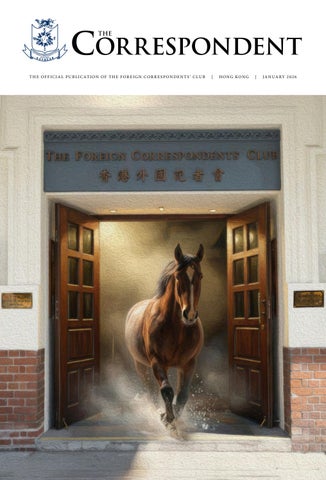
The Correspondent, January 2026

Page 1


The SOPA 2026 Awards for Editorial Excellence Call

The Society of Publishers in Asia (SOPA) is proud to recognize outstanding journalism across Asia Pacific through our annual Awards for Editorial Excellence, the region’s most prestigious awards and widely regarded as the Pulitzer Prizes of Asia

The SOPA Awards set the benchmark in the region for editorial excellence across digital, print, audio, video, photography, and multimedia in 21 categories.

We honor outstanding, independent journalism in English, Chinese, and Bahasa Indonesia – from media outlets big and small, long-established and newly founded, international and regional – that demonstrates exceptional storytelling, breaking news, exclusive coverage, investigative depth, and commitment to truth.

Don’t miss this opportunity to highlight your contributions to the world of great journalism. S hare your stories that inspire, inform and engage.

FROM THE PRESIDENT

Dear Members,

Happy New Year! We’re very lucky to be starting 2026 at the FCC with not only a fresh line-up of events and specials for our Members, but, more importantly, a new lease.

I know that many of us, myself included, spent the holiday season anxiously awaiting news of the renewal of our Club’s lease. Finding out that it had been granted for another three years was the best gift I could possibly ask for. Our Club is special in so many ways, and our historic building and its prime location are two of them. I look forward to toasting to the health of the FCC around the bar with you in the coming weeks.

Our lease did bring an expected adjustment to our rent. That, coupled with inflation and other operating costs, has led the Board of Governors to agree to some changes to subscriptions beginning in March. Individual Members will have a HK$55 increase per month, and couples will see a HK$100 increase. The minimum spend for couples will also be raised by HK$100 per quarter.

I know no one likes a price increase, but I believe that the FCC continues to offer incredible value to our Members at a price that is not insurmountable. One of the ways your money will be used is to facilitate the implementation of a long overdue transition to a five-day work week for our employees. This is the norm in Hong Kong and will now allow us to offer our much-beloved staff competitive conditions. I’m sure you all saw the work the staff put in over November and December to make the Club as festive as possible, and they’re now preparing for what will certainly be a joyous Lunar New Year holiday.

I hope you all take advantage of your membership in the coming months to enjoy the Club as much as possible. I often mention our events when I talk to non-members, and I truly believe they are a core part of what makes the FCC so special. We have some great food and beverage specials coming up, including those tied to Lunar New Year. (Did you know we have a fantastic mixologist in Bert’s? Be sure to try the cocktail specials!) We also have a line-up of speaker events that is sure to please everyone. In February we’ll be visited by SOPA award-winning journalist Qianer Liu, and in March we’ll be joined by Irish singer/songwriter legend Eleanor McEvoy, just to name a couple. In addition, we’re working on the programme for our annual journalism conference, set to return in May.

I have made a few New Year’s resolutions for myself at the FCC that I hope you will join me in. I’m going to try more menu items (as much as I love my usual orders!), take more breakfast meetings at the Club, attend a disco night at Bert’s, visit a reciprocal club on my next work trip, and bring in at least one non-member guest each month. What facets of the FCC are you going to tap into this year?

Wishing you all a very happy 2026 and upcoming Year of the Horse.

Best Regards,

The Foreign Correspondents’ Club, Hong Kong

2 Lower Albert Road, Central, Hong Kong

Tel: (852) 2521 1511

Fax: (852) 2868 4092

Email: fcc@fcchk.org

Website: www.fcchk.org

President Morgan M. Davis

First Vice President Karen Koh

Second Vice President Tim Huxley

Correspondent Member Governors

Jennifer Jett, Kristie Lu Stout, Peter Parks, Paul Tait, Laura Westbrook, Lee Williamson, Jing Yang, William Zheng

Journalist Member Governors Zela Chin, Joe Pan

Associate Member Governors

Liu Kin-ming, Lynne Mulholland, Christopher Slaughter, Barbara Yu Larsson

Club Treasurer Tim Huxley

Club Secretary Liu Kin-ming

Professional Committee

Co-Conveners: Morgan M. Davis, Jennifer Jett, Karen Koh, Lee Williamson, William Zheng

– Journalism Conference Sub-Committee

Co-Convenors: Karen Koh, Jing Yan

CONTRIBUTORS

John Batten

John Batten comments, broadcasts and writes on art, culture, urban planning, heritage and policy issues for Hong Kong newspapers and overseas magazines and is a former art critic and contributor for the South China Morning Post. He is also a director of the arts education group Rooftop Institute and currently President of AICAHK.

Hugo Novales

Hugo is originally from Chicago and joined the FCC just prior to graduating from HKU’s Master of Journalism programme. As the Club’s in-house journalist, he covers events for the website and social media, contributes to The Correspondent, and also helps organise and promote workshops for early/mid-career journalists.

Christina Pantin

Christina is a Malaysia-born, U.S. citizen who is fluent in financial journalism and corporate communications. She is the Founder of communications consultancy Toot and a founding member of Global Commtrepreneurs Network and Web3 Women.

Editor Ann Tsang Email: editor@fcchk.org

Design and Production Artmazing!

Cover Image Lakshmi Harilela/MidJourney

Printing Elite Printing Tel: 2558 0119

Advertising Enquiries FCC Front Office: Tel: 2521 1511

Press Freedom Committee

Co-Conveners: Morgan M. Davis, Karen Koh, Lee Williamson, Jing Yang, William Zheng

Constitutional Committee

Conveners: Liu Kin-ming, Peter Parks

Membership Committee

Conveners: Zela Chin, Jennifer Jett, Joe Pan

Communications Committee

Conveners: Zela Chin, Morgan M. Davis, Paul Tait

Finance Committee

Treasurer: Tim Huxley

Conveners: Karen Koh, Lynne Mulholland

House/Food and Beverage Committee

Conveners: Lynne Mulholland, Barbara Yu Larsson

– Wine Tasting Group

Chairperson: Cammy Yiu

Building – Project and Maintenance Committee

Conveners: Liu Kin-ming, Christopher Slaughter

Wall Committee

Conveners: Kristie Lu Stout, Peter Parks

Charity Committee

Conveners: Morgan M. Davis, Laura Westbrook

Aaron Busch

Aaron is the FCC’s first Social Media Journalist Member, writing on various online outlets since 2020. He splits his time between news reporting and cricket commentating, as well as broadcasting in Hong Kong and internationally. His nightly Substack on Hong Kong news can be found at tripperhead.com

Carsten Schael

Carsten is an award-winning German photographer based in Hong Kong. As a technical consultant and archivist, he advises on the set-ups of digital asset management systems and photo archives, among other consulting activities.

Kate Whitehead

Previously on staff at the SCMP and then editor of Discovery magazine, Kate now writes for local and international publications. She is also a qualified and practising psychotherapist. Kate is the author of two nonfiction crime books and Pandemic Minds, released by HKU Press in 2024.

The Foreign Correspondents’ Club Hong Kong was Incorporated in Hong Kong on 21 May, 1952. The Correspondent ©2026 is published four times a year by The Foreign Correspondents’ Club, Hong Kong. All views expressed in all articles are those of the authors and are not necessarily those of The Foreign Correspondents’ Club Hong Kong.  All content contained in The Correspondent may not be reproduced in any manner whatsoever without authorisation. Advertisers warrant and represent that the descriptions of the products or services advertised are true in all respects. The Foreign Correspondents’ Club Hong Kong assumes no responsibility for claims made by advertisers and  makes no recommendations as to the purchase or sale of any product, service or item. ©2026 by The Foreign Correspondents’ Club Hong Kong. All rights reserved.

Continuing our series of stories on the history of the FCC in 1951, with the three-room Stone House bursting at the seams, the Club urgently needed a new premises. David Roads of the Associated Press and President of the FCC in 1966, fortuitously received a call that would lead to the Club relocating to a mansion.

With her unforgettable starring role opposite William Holden in ‘The World of Suzie Wong’, Nancy Kwan became the first Chinese actress to achieve fame in Western cinema.

The FCC’s Clare Hollingworth Fellowship provides two early career journalists or current journalism students in Hong Kong with 12 months of complimentary membership and other associated benefits that can assist with their development.  The Correspondent speaks with the 2024-25 awardees who reflect on their activities over the past year, and to the two latest recipients of the Fellowship about what they aspire to achieve.

At an age when many of his contemporaries are kicking back with leisurely pursuits, former banker and FCC Member George So is diligently practising his acoustic guitar skills.. He usually performs at Bert’s on Tuesdays in between sets by the Allen Youngblood Trio.

His is likely to be the first face you see as you grab the door handle of the Club to enter, and will probably also be the last as you exit. The Correspondent meets the man behind the familiar face - Mall Prem Kumar.

Quiet Architecture of Hong Kong’s Art World

Two pioneering non-profit organisations in the Hong Kong art world are celebrating major milestones: the Asia Art Archive marked its 25th anniversary in 2025, while Para Site celebrates its 30th this year.

The late Gleb Derujinsky was a visual pioneer from a young age. Ahead of his time, his works remain as fashionable today as they were when they were taken beginning in the 1940s and 50s.

MENTORSHIP FOR JOURNALISTS

Are you an early-career journalist seeking guidance on your next professional move? Or an experienced one looking to give back and help cultivate the next generation of journalists? The FCC is a great place to start, as we launch a mentorship programme for our Members so they can benefit from each other’s rich and varied experience. This pilot programme, spearheaded by Correspondent Member Governor Jennifer Jett, will match selected Correspondent and Journalist Members based on their backgrounds and skill sets for a period of one year, during which they will be encouraged to meet regularly and discuss the mentee’s objectives. Watch your inbox for details on how to apply, or email membership@ fcchk.org to express your interest.

IT’S NOT JUST COFFEE, IT’S LAVAZZA!

November 2025 brought the much-anticipated arrival of Lavazza coffee at all the Club’s dining outlets. Prices are based on the portion of coffee beans used for each type of coffee – Espresso, Latte, Cappuccino and Americano. Oat milk and soy milk are also available for those who prefer an alternative to dairy milk with their preferred coffee fix.

SAVE THE DATE!

This year’s FCC Journalism Conference is scheduled to take place on 16 May, 2026 (Saturday). The day-long event will include keynote speakers, panels, workshops and networking opportunities for established reporters and editors, as well as early-career journalists.

Last year, more than 100 attendees packed into multiple venues throughout the Club for the event.

As the nature of news gathering is ever-evolving, the Conference will provide participants with the latest information related to the industry so they can continue to do their work accurately, fairly and ethically. The Conference theme, featured speakers, panellists and moderators will be announced soon.

GAME ON!

American football fans can celebrate the biggest game of the year at the FCC on 9 February with the live screening of the NFL Super Bowl LX from Levi’s Stadium in Santa Clara, California. The pre-game show will open with a trio of artists: Charlie Puth will sing the national anthem, Brandi Carlile will perform ‘America the Beautiful’ and Coco Jones will sing ‘Lift Every Voice and Sing’. One of the world’s most streamed artists, Bad Bunny, will take to the stage as the headline act in the halftime show. A buffet breakfast will be served in the Main Bar & Lounge from 7:00am - 10:30am.

ERIN GO BRAGH!

One of Ireland’s most accomplished singer-songwriters, Eleanor McEvoy, will grace the FCC on 16 March in a pre-celebration of St. Patrick’s Day. The composer of ‘Only a Woman’s Heart’, the title track from ‘A Woman’s Heart’ (the best-selling Irish album in history) will participate in a Fireside Chat with FCC President Morgan M. Davis.

Jennifer Jett

TYING THE KNOT AT THE FCC

Former Clare Hollingworth Fellow and now FCC Member, Eudora Wang married her partner James Allen at the FCC, the same location where they first crossed paths seven years ago.

Eudora Wang, Deputy Editor at DealStreetAsia and a former Clare Hollingworth Fellow (2023-2024), recently wed James Allen at the FCC’s Main Dining Room - completing a journey that began at Bert’s back in 2018.

Wang’s connection to the Club predates her fellowship. As a journalism Master’s student at Hong Kong Baptist University, she attended the FCC’s 2018 Journalism Conference at the invitation of her lecturer, Robin Ewing, also an FCC Member. During post-conference drinks at Bert’s, Allen, then a U.K. exchange student, introduced himself. After a brief conversation and exchanging Facebook contacts, they went their separate ways.

Their relationship didn’t begin in earnest until 2019, when Allen returned to Hong Kong to work as an English teacher. With limited social connections in the city, he messaged Wang on Facebook. Three months passed before she respondedwith a phone call.

“She called me, which I thought was unusual, but I found that very endearing, quite special,” says Allen.

Wang apologised for the delayed response, citing work commitments and her emphasis on “doing things properly”. They arranged to meet at the Nirvana Cafe in Sheung Wan, marking the start of their relationship. “My first impression of James was, ‘I like his accent,’” she laughs.

The couple’s ties to the FCC deepened when Wang applied for the Clare Hollingworth Fellowship in the autumn of 2023,

submitting her application just two weeks before the deadline. Selected as one of three Fellows that year, she became an FCC Member and began frequenting the Club with Allen and their friends, who repeatedly suggested they host their wedding there.

“It’s such a poetic location and we’ve come full circle. [Bert’s] is where we met, and [the Main Dining Room] above is where we got married,” says Allen.

Originally planning only a reception at the venue, the couple was able to conduct their official marriage registration ceremony on stage in the Main Dining Room, with family and friends present as witnesses.

When asked how marriage has changed their relationship, Wang says 99% remains unchanged, with one significant exception: “I can now legally refer to James as my husband.” Allen offers his own observation: “I think that she looks even more beautiful since we got married!”

The couple emphasises communication as being key to their relationship’s success. “What I cherish the most in our relationship is that we always talk about things,” notes Wang. “James always listens and I always feel comfortable talking about anything with him, no matter what it is.”

Allen’s advice focuses on mutual engagement: “Share your life with the other person, including your interests and your passions. If you can get them involved in just one or two of them, it’s a wonderful thing…”

Eudora Wang and James Allen say “I do!”

OUTREACH

STANDING TOGETHER

As part of the Hong Kong community, our hearts continue to go out to our neighbours in Tai Po during this extremely difficult time. The journey to recovery for the fire victims extends far beyond the initial emergency, and their need for support and stability is ongoing. Your thoughtful contributions through donations are vital in helping them find safety and a lasting home. We recommend that Members interested in donating do so through the following channels:

The Hong Kong Council of Social Service has been working on emergency support mechanisms, mobilising resources and expertise from the social service sector and other partners to provide comprehensive assistance to affected individuals and families. They are now focusing on co-ordinating support in the mid-to-later stages to ensure that all resources are utilised effectively.

Three of the FCC’s designated partner charities are also providing on-the-ground assistance.

ImpactHK is offering emergency accommodation for those in need. To make a donation, please visit impacthk.org

Enrich’s Giving Tuesday campaign is also supporting the Tai Po community, especially migrant domestic workers impacted by the fire. This organisation is providing immediate, practical relief, from emergency essentials to longer-term support.

SUPPORTING MIGRANT WORKERS

In mid-December, some of our dedicated Members volunteered at Enrich HK’s ‘Mission for Migrant Workers’ outreach event at St. John’s Cathedral. Enrich HK’s primary mission is to empower migrant domestic workers in Hong Kong by providing them with the tools to overcome financial difficulties and achieve their goals and dreams.

The FCC was proud to join the NGO in supporting the vital needs of the migrant domestic worker community. A heartfelt thank you goes out to all our volunteers and supporters—your contributions truly made a difference! n

The Amber Foundation is collecting unused toiletries, which they are distributing through trusted partners that are supporting affected residents. The FCC is one of the collection points and Members can drop off materials at the station next to the Concierge.

In addition to our charity partners, there are numerous other legitimate organisations and channels offering assistance. Every donation, regardless of size, has a meaningful impact on those affected.

*Please check updated lists from the NGOs and only provide financial assistance through their official websites and trusted channels.

For specific details on how you can help, please use the following FCC website link https://www.fcchk.org/standtogether-how-you-can-support-the-tai-po-recovery-efforts/

Produced written and hosted by Jarrod Watt with theme music composed and performed by the FCC’s Music Director Photo: Leung Man Hei/AFP

Produced written and hosted by Jarrod Watt with theme music composed and performed by the FCC’s Music Director Allen Youngblood, The Correspondent podcast is available on Apple Podcasts, Spotify, or wherever you listen to podcasts.

UNITED IN FELLOWSHIP

In this podcast, Jarrod Watt chats with some of the Gen Z journalists awarded the FCC’s 2025 and 2026 Clare Hollingworth Fellowship - Jay Ganglani (2025), Kriti Gandhi (2025), and Samra Zufalqar (2026). The Fellowship is named in honour of Clare Hollingworth, a legendary journalist and long-time member of the FCC most famously associated with what became known as the scoop of the century: as a rookie reporter back in 1939 travelling through Poland, she spotted and reported German army forces massing on the Polish border. She didn’t stop there and went on to travel to and report from Palestine, Algeria, China, Yemen and Vietnam, earning herself the moniker the “doyenne of the war correspondents”. Jay and Kriti have just spent the past 12 months as Hollingworth Fellowship awardees, and reflect on their experiences as well as what they’ve witnessed in the newsrooms they work in. They share the mic with Samra Zulfaqar, one of the recently announced Hollingworth Fellows for 2026.

REPORTING FROM THE FRONTLINE

FCC Board Member Laura Westbrook works for broadcast media channels all over the world, covering news across Southeast Asia, and has most recently and most prominently been reporting for Al Jazeera , while Elaine Lai is a fourth year journalism student at the Hong Kong Baptist University and an intern for the Associated Press. She also works as Editor-in-Chief of Hong Kong’s oldest student newspaper, The Young Reporter

“When I got there, it was after 6pm. I remember walking out of the MTR station and looking to my right and seeing the buildings on fire, and it took my breath away…”

Tai Po is where Elaine was born and raised, and where Laura started her first job in broadcast journalism. Both were among the first on the scene of the Wang Fuk Court fire, and subsequently worked for days on end covering what is now one of the worst disasters of its kind in Hong Kong’s history. In this FCC podcast, they discuss what was missed in the international media coverage of the tragedy, and what it was like to witness the beginning of what has become an unprecedented community response for the fire victims which was ultimately shut down by a government concerned about unidentified “hostile external forces”. The conversation also touches on the impact of the fire on the local community, the role of social media in shaping public perceptions, and how overseas media narratives - quick to blame Hong Kong’s historic tradition of bamboo scaffolding for the fire’s spread - led to a surge of Hongkongers taking to social media to refute these reports. Laura and Elaine also speak about their efforts to manage their own mental health and exhaustion through days-long shifts dominated by trying to keep track of social media activity. n

L-R: Kritii Gandhi, Samra Zufalqar, Jay Ganglani

MOVING INTO THE MANSION:

Continuing The Correspondent’s series of stories on the history of the FCC in 1951, with the three-room Stone House at 15 Kotewall Road bursting at the seams, the Club urgently needed a new premises. David Roads of the Associated Press (later a correspondent for the New York Herald Tribune and President of the FCC in 1966) fortuitously received a call that would lead to the Club subsequently relocating to a grand mansion at 41A Conduit Road where it took up residence for almost a decade.

41A Conduit Road façade circa 1950

Not long after the FCC had vacated the Stone House in Kotewall Road, sometime in 1951, David Roads of the Associated Press (AP) was sitting in the news agency’s office when he received a telephone call from Peppi Pauzen, the FCC’s recently hired manager, whose brother ran the Parisian Grill, an upmarket restaurant in Edinburgh House on Queen’s Road Central. He told Roads that he had found the ideal place for a clubhouse - the former residence of Mok Kon-Sang (the last comprador for Butterfield & Swire) at 41A Conduit Road in Mid-levels. The residence was built at Mr. Mok’s request in 1911 and it had, according to Peppi, everything – “Italian marble fireplaces, even a lift from the street level garage to the expansive lawn”. The place was also described as having been built in such a way that the “vulgar views” from Conduit Road down to the waterfront were “blotted out”.

Coincidentally, Mr. Mok was the maternal great grandfather of former Hong Kong Legislative Councillor, founder and CEO of Civic Exchange, founder of the Citizens Party and FCC Member, Professor Christine Loh, SBS, JP, OBE. “My great grandfather passed away when I was very young,” says Loh. “I never actually lived there, but my mother, aunt and uncle remember running happily around the place and being intrigued by the elevator, which was quite a thing in those days.”

“Along with Bob Sun, then with the Pan Asia News Agency and the Secretary of the Club (who later joined the government entertainment and censorship body), we set things in motion,” recalled Roads. “Marsh Stayner of the Civil Air Transport (CAT) started the ball rolling with an interest-free cash loan. The rest of us pitched in. The first funds were used to supplement the plates and silverware we inherited, along with a few antique chairs and other pieces of furniture.”

Roads considered the Conduit Road days as the heyday of the Club. “Hong Kong was really a cultural desert at the time,” he said. “And no matter where one went on Saturday nights, it was always a must to drift back to the club, if only for a nightcap. You never knew who would be visiting. There were times when it would be crawling with ONI (Office of Naval Intelligence) agents trying to see if the journalists and any shipping had infringed the Korean embargo.”

Roads also recalled that the Club would sometimes rent out a portion of the lawn to various organisations for their annual dinners and the few correspondents around would always have a table for a drink after the main function was over. There were also nine bedrooms upstairs that were available for rent to visiting journalists, and Roads himself stayed in one when he married his wife, Pacita.

He also described a typical Saturday night when “Peppi would start on the piano when the band left. Marvin Farkas would break out his ukulele, and everything from ‘A Ramblin’ Wreck from Georgia Tech’ to ‘Blue Hawaii’ was sung at the top of what was left of our voices until the sun peeped over the portals and we topped off with ‘Black Velvet’.”

For years, the Club was the venue for the diplomatic corps’ monthly luncheons and for a journalist, it was always a place to “coincidentally be” to just strike up a conversation with some of the diplomats before they sat down for lunch. “Even we were surprised at the tip-offs we picked up,” said Roads.

A beautiful moonlit night at 41A Conduit Road was enough to stir even the hardest of hack hearts to thoughts of romance and, according to the old timers, there were enough facilities there to turn thoughts into action in more ways than one. UPI Bureau Chief, and a former FCC President (in 1959), Bud Merick, for example, was married there.

The view from the terrace of 41A Conduit Road in the mid-1950s

Dr. Deric Daniel Waters (1920-2016), who arrived in Hong Kong in 1954 taught building at the Hong Kong Technical College (now the Hong Kong Polytechnic University) and became Head of the Building Department in 1963, recollected that in a study he did of the site 1951 to 1961 was a period that some Members described as the FCC’s heyday. “One could drive to the Club then and either drive up the slope or there was space for about three cars to park at street level. One could then take the lift (the first installed in a private dwelling in Hong Kong) up to the main entrance … The whole house had a wonderful ambience. One could sit under a cupola on the roof and partake of afternoon tea.”

Dr. Waters first came to live in Conduit Road in March 1955, and occasionally walked past the FCC when “boisterous parties” were in full swing. “On Saturday nights it was considered the place to be. The FCC had its own band, but it also hired bands from the armed forces. Private parties were common there as well as diplomatic corps and airline lunches,” he wrote in a study that he did of the site when it later became Realty Gardens.

But, in spite of the noise emanating at times from No. 41, Dr. Waters remembered Conduit Road as being generally quiet and peaceful. “At the western end especially it was almost like a country lane, with trees and undergrowth, and one could sometimes hear barking deer calling from Victoria Peak. At the time, one could still hire a sedan chair and four coolies to carry one up to Conduit Road. There were half a dozen or so parked in Wyndham Street, in Central up until the later 1950s. The fare was 30-cent for each 15 minutes with a 30-cent surcharge. The working life of a chair coolie was said to be eight years.”

Dr. Waters served as a Justice of the Peace in the 1970s and was made a Companion of the Imperial Service Order (ISO) by Her Majesty the Queen in 1981, largely for his work in technical education. He was awarded a Bronze Bauhinia Star in 1998 for his work in heritage conservation.

Perhaps the crowning glory of the FCC’s heady Conduit Road days was in 1955 when part of the film Love is a ManySplendored Thing, starring William Holden and Jennifer Jones, was filmed there. The grand mansion was disguised as the hospital where Han Suyin (played by Jones) worked. Holden became a regular visitor, always stopping by the Club whenever he came through town. The last time he visited the Conduit Road premises was when he starred in the classic romantic drama The World of Suzie Wong (1960) alongside Nancy Kwan, who also dropped in to the Club.

Prominent broadcaster at the time Edward R Murrow of CBS also visited the Club several times and even Clark Gable made an appearance at 41A Conduit Road.

Former Club President Guy Searls (1964) recalled that when he joined the FCC in 1953, the entrance fee was only HK$50 and monthly subscriptions were $30 or $35. Searls was a special correspondent for CBS News for 10 years, and later became the Mutual Broadcasting ’s man in Hong Kong.

Most of the Members were Associates, said Searls, and as is still the case today, these were essential for the economic stability of the Club. All the major news services had set up headquarters in Tokyo during the post-war occupation, and the Korean War correspondents were attached to the Japan bureaus. There was, however, a steady coming and going of correspondents on R and R from the Korean War that helped the Club tick over.

In later years, the Club could have purchased the property for merely a reported HK$125,000 (although Dr. Waters says the figure was HK$250,000). With some acrimony, particularly from Albert Ravenholt, the Club deferred. “We journalists claimed to know what was going to happen to Hong Kong, and we believed then that the territory’s position was precarious,” Roads said. “And subsequently, when we were asked to vacate the premises, we took the landlord to court in a bid to stay on. But the site was sold anyway for over HK$10 million.”

The building was purchased in 1960 by Cheng Hing Realty before being sold again in 1966 to Court Properties. The old building was demolished and the site remained empty for some time,” wrote Dr. Waters, who later purchased a flat at Realty Gardens which was built on the site. “In the summer of 1970, there were 1,200 applications to purchase the 400 flats (the first batch) at Realty Gardens. My wife and I were successful in a later ballot and we took possession of our newly completed flat in Venice Court, for which we paid the princely sum of HK$114,000 (HK$120,000 including solicitors fees) in mid-1972. Prices were still low after the property slump brought on largely by the drawn-out 1967 riots. My flat has been a splendid investment. We let it for the first four years, unfurnished, at HK$2,000 a month. We moved in ourselves on 1 March, 1976. As one neighbour living a few floors down from me not so long ago said, ‘I would not choose to live anywhere else other than Realty Gardens’.” n

FCC Members stepping down to the lawn at 41A Conduit Road

IF YOU KNEW SUZIE

With her unforgettable starring role opposite William Holden in ‘The World of Suzie Wong’, Nancy Kwan became the first Chinese actress to achieve fame in Western cinema.

Mention the name Nancy Kwan to any older expatriate living in Hong Kong and their reaction is one of instantaneous recognition. She may have starred in The World of Suzie Wong 65 years ago but, for many, she remains the embodiment of Hong Kong.

Born in 1939, Nancy Ka Shen Kwan became the first Asian actress to make it in Hollywood. A cross between a sexy Chinese Bardot and the gamine Audrey Hepburn, Kwan grew up in Hong Kong, living in Kowloon and studying at Maryknoll Convent School. Her mother, of English-Scottish descent, was a fashion model and her Chinese father was a successful Cambridge-educated architect who gave his daughter her exotic beauty.

Kwan left Hong Kong while she was still young to study at an exclusive public school in England, and her first love was dancing, not acting. At the age of 16, she was accepted into the Royal Ballet in London, eventually performing at the Royal Opera House in Covent Garden.

Cinematographic history was made during the summer that Kwan returned to Hong Kong for the holidays. She was scouted by Ray Stark, a Hollywood producer who was looking to make a film adaptation of Richard Mason’s best-selling novel, The World of Suzie Wong. As luck would have it – and luck is always important in most success stories – Kwan’s father had built the studio where Stark was auditioning young, aspiring Chinese actresses, and despite her lack of acting experience, the producer summoned Kwan for a screen test, which ultimately won her the title role.

The famous tale of an American expatriate’s love for a Chinese bar girl was adapted from the novel for the big screen as well as a stage production, and in Hong Kong it was produced as a ballet in 2006, the premiere of which Kwan herself attended.

At 5’2’ she is tiny but perfect; her skin is still flawless and she wears almost no makeup. As a spokesperson for Oriental Pearl Cream, she has reportedly sold US$650 million worth of the product. Even at the age of 86, she still has an ethereal, Eurasian delicacy about her features – something that translated all those years ago into “exotic Asian beauty”.

Suzie Wong was controversial during its time because of the interracial romance between Kwan and her lead actor Holden. But Kwan, herself the product of an interracial marriage, was perfectly comfortable in the role. She was 19 at the time and laughingly admits, “I was a girl playing a woman in a world I knew nothing about.” She modestly insists that the praise for carrying it off so successfully goes to Stark for directing and Holden for helping her through it all. She went on to star in many other movies including the award-winning Chinese film Spring Comes Not Again, but none of them brought her the fame of Suzie Wong.

The fact remains that to a generation of Asian-Americans, as well as young Hong Kong women who grew up in the shadow of the movie, Suzie Wong’s character single-handedly usurped the image of Asian womanhood in the imagination of Westerners everywhere.

In the movie, Kwan shimmied across the screen straight into Holden’s heart, but a far cry from the vulgar, girly bar images of a seedy Wanchai. Kwan’s portrayal of Suzie Wong, the irrepressible bar girl with a secret, was both sympathetic and mischievous. “What a nice girl you met on ferry doing in a place like this I like to know for goodness sake,” she asks the tall, puzzled American in the film, imparting to the role a necessary cocktail of energy, effervescence, vulnerability and coquettishness. Her fragile beauty and talent, as well as the rare chemistry between Kwan and Holden, made the movie the commercial hit it became. It also launched a thenunknown Eurasian into stardom.

Kwan herself shrugs off intimations that she was responsible for defining generations of Asian women as prostitutes. “It was just a role that happened to be very successful. Even today people remember (the film) and I still get fan mail from it!”

As for her other film roles, it’s not as if she hasn’t done anything since. Sizeable movie parts have included Cold Dog Soup, Miracle Landing, Dragon: The Bruce Lee Story and Flower Drum Song, but none of them captured the attention of the critics and public like The World of Suzie Wong

Kwan later branched out into scriptwriting and has done volunteer work for organisations such as the Association of Asian Pacific American Artists, as well as on behalf of the Vietnamese boat people. She also headed up public liaison for the Asian American Voters Coalition.

“I’m a very private person,” she once admitted in an interview, “and fame didn’t change me much.” Perhaps not, but there was a time that she couldn’t step into a shop in Hong Kong without being mobbed. “Fame is fleeting,” she said. “People forget.”

But the truth is, no-one has forgotten the name Suzie Wong. n

FOR THEY ARE JOLLY GOOD FELLOWS!

The FCC’s annually awarded Clare Hollingworth Fellowship provides two early career journalists or current journalism school students in Hong Kong with 12 months of complimentary membership and other associated benefits that can assist with either launching or further developing their careers. The Correspondent speaks with the 2024-25 awardees who reflect on their Fellowship-related activities over the past year, and to the two latest recipients of the Fellowship about what they aspire to achieve.

Clare Hollingworth, the “undisputed doyenne of war correspondents” whose name still resounds within the walls of the FCC, passed away at the age of 105 in Hong Kong in 2017. Her namesake Fellowship, awarded by the FCC and now in its seventh year, continues to bring a flood of applications from both early-career journalists and current journalism school students in Hong Kong. The Fellowship recently welcomed its two most recent awardees.

Trista Xinyi Luo is a reporter at Bloomberg News, where she covers the debt capital markets and the constantly evolving financial landscape in Greater China. She relocated to Hong Kong from New York in 2023 with Bloomberg snd holds a Bachelors degree in Journalism from the University of Missouri.

Samra Zulfaqar joined CNN as a freelance News Editorial Researcher and Planning Producer following her internship covering political and social issues across East and Southeast Asia. Before that she interned at NBC News, primarily contributing to the Israel-Gaza War live blogs. She recently graduated from The University of Hong Kong with a degree in Journalism and International Relations.

The panel of judges noted that this years winners offer clear potential as future leaders both within the FCC and in the wider Hong Kong journalism community.

On 13 November, the Club held a welcome reception for the new Fellows with Members of the Board and past Fellows in attendance to discuss how they can get involved in the Club’s numerous initiatives.

As the two incumbents embark on their 12-month journey, which promises a host of professional talks, official gatherings and networking opportunities, The Correspondent gathered reflections on the past year from their most recent predecessors, Kriti Gandhi and Jay Ganglani.

Gandhi currently freelances on the features team at CNN in Hong Kong and produces its monthly business show Marketplace Asia , covering a wide range of topics from tech to consumer trends, food and more, from a business perspective.

Ganglani is NBC News’s 2025-26 Asia Desk Fellow having previously been an NBC News Asia Desk intern and a Hong Kong-based freelance journalist who has contributed to news publications such as CNN, Fortune and the South China Morning Post. “I write on various topics, cover APAC

Trista Xinyi Luo
Samra Zulfaqar

news from Australia to China, India - whatever is happening on the day,” he says.

Both Gandhi and Ganglani benefitted from their (occasionally unexpected) experiences as 2024-25 Fellows, including contributing to editions of the Club’s podcast and moderating panel discussions.

“I wasn’t very strong at public speaking or being in front of a camera; I was out of my comfort zone,” recalls Gandhi, who subsequently overcame her fears and ended up participating in four podcasts, including one focusing on women in journalism to coincide with International Women’s Day. She also moderated a panel at the FCC’s 2025 Journalism Conference on how to pitch a story to editors. “It can be intimidating when you know people will ask questions,” she confesses.

For self-described introvert Ganglani, being on the receiving end of questions was similarly daunting. “I hosted two Club events and was surprised at how many people attended. One was about ethnic minorities in Hong Kong and I raised my hand because I view the topic as an underrepresented one, and it’s something I feel strongly about. The audience was very enthusiastic and had a lot of questions.”

Ganglani also credits the Fellowship for giving him the opportunity to meet a diversity of new contacts, including senior editors, some of whom hired him for assignments.

Gandhi, whose freelancing credits include the South China Morning Post ’s video desk, says the Fellowship also helped change her mindset about how to build a career in journalism.

“When I became a Fellow I was a fresh grad from HKU. I didn’t get a job immediately, but having the opportunity to be a part of the FCC, I have met people who have made me rethink my perception of success, which I had previously thought was simply having a full-time job,” she recalls. “I think that’s part of the Asian mentality of seeking stability, but then I discovered that some of the journalists I met at

the Club had also freelanced for a long time, and that had a positive impact on me.”

Ganglani also speaks of the benefits of joining the Club’s various committees, specifically the Professional and Communications Committees, which he became a part of during his Fellowship.

His advice for the current Fellows? “Get involved as much as you can; don’t be afraid to speak up at meetings even though the others are more experienced journalists; and don’t hesitate to pitch ideas.”

2025-26 Fellow Trista Xinhi Luo has taken her first steps towards being proactive, offering to help organise a mentorship programme to pair more senior journalists with mentees for a year. “Many young people feel that the FCC is distant,” she wrote in her Fellowship application. This could be a way to change these pre-conceived ideas and get them through the door and into the conversation,” suggests the journalism and communications graduate from the University of Missouri and the Communication University of China.

Gandhi also encourages current and future Fellows to fully immerse themselves in the experiences available to them. “It’s whatever you make of it,” she emphasises. “I would suggest that any Fellow should consider what they want to achieve and then work towards that. Meet as many new people as you can, expand your circle and try new things. This is a great platform to do all of this,” she enthuses.

For Zulfaqar, the opportunity to connect and converse with industry practitioners was a key factor in her decision to apply for the Fellowship. “There are many accomplished journalists in the FCC community which makes it an amazing platform for those of us still in the early stages of our career,” she notes, adding that she was not only keen to “learn and grow” during the year-long programme, but also to contribute to the Club in as many ways as possible. n

Welcome reception for the 2025-26 Clare Hollingworth Fellows

GEORGE SO: STRIKING A CHORD

At an age when many of his contemporaries are kicking back with leisurely pursuits or ticking off their “bucket lists”, former banker and FCC Member George So is diligently practising his acoustic guitar and preparing for public performances for no remuneration. 15 years ago, So discovered a second “job” as a guitarist and currently performs at Bert’s during intermissions of the house band led by Allen Youngblood, the Club’s Music Director.

At 74 years old, you have to be a bit crazy to play in public,” says FCC Member George So with a laugh just prior to playing his first set at Bert’s one Tuesday evening.

Crazy? Maybe, but the former banker and FCC Member has learned to roll with the punches.

Perhaps the boldness comes from the talent competitions that So entered – and won – during his secondary schooling at Wah Yan College for playing the guitar solo and also with a band called the Wah Yan College Hong Kong school band. He is spritely and spirited as he recounts a life that intersected money with music.

So’s CV lists all of his first prize wins at his secondary school’s ‘Talent Time’ contests from 1965 to 1968, as well as a proudly attained 2nd prize in the 1969 Inter-School Music Competition.

So recounts discovering his performer alter ego in 2011 at The Ritz Carlton Millenia Singapore’s Chihuly Lounge, after being invited by the band there to play his instrumental tunes during intermissions. At that time, he was CEO of EFG Bank, setting up the Wealth Solutions department in the city-state in 2001. He retired from banking in 2022, after a 44-year career.

But for a while, So was a financial professional by day and a musician on weekends. In Singapore, besides The Ritz Carlton, he performed on Saturday and Sunday afternoons for two years at the Sofitel. “It was somewhat stressful handling two different disciplines simultaneously - being a full-time money manager during weekdays and a part-time musician on weekends, but let’s be honest, nothing could be more stressful than running out of money,” he quips..

When his day job ended, So extended his musical performances to Singapore’s Tanglin Club, and in Hong Kong, to The Ritz Carlton’s evening happy hours.

It was at a Tanglin Club performance when So met now FCC General Manager David Brightling, then the General Manager of the Singapore club. So and his wife Linda joined the FCC in 2023.

“It was wonderful to reconnect with George and Linda when I returned to Hong Kong as General Manager of the FCC,” says Brightling, recalling So’s performances in the Tanglin’s Churchill Room, its formal dining room.

One night last December, So was preparing to play in between Allen Youngblood’s band sets in Bert’s, eschewing dinner, saying he prefers not to eat before he plays. Watched by Linda, his wife of more than 40 years, and a cluster of their friends, he played a dozen instrumental

pieces popularised by some of his music idols, including José Feliciano’s ‘Rain’, ‘And I Love Her’ by The Beatles, ‘Nights in White Satin’ by The Moody Blues and Santana’s ‘Moonflower’.

Youngblood, the Club’s Music Director, auditioned So for the gig. “George introduced himself to me as we have a mutual musician friend in Singapore,” Youngblood recalls. “He asked me if he could play between my sets on Tuesday nights.” So brought along a table of guests to Bert’s when he was performing, adding to the convivial audience who enthusiastically applauded after each number.

So doesn’t take performing lightly. Once he retired, he seized the opportunity to sharpen his skills, hiring a coach for a refresher. “To be a public performer, you need to have thick skin,” he notes. “Sometimes there’s no audience, but you can’t let it get personal.”

“It took me quite some time to get positive feedback,” So reveals. “You try to keep improving yourself.” Then why play for an audience instead of just for private pleasure? “If you don’t play in public, there’s no discipline,” is his reply, noting that knowing that he is performing makes him disciplined about regular rehearsals.

His musical journey began unexpectedly at age 10. A neighbour in his North Point apartment building who was a sailor brought back two Spanish guitars from a visit to Spain and gifted his brother and So with one each. So began trying to learn the instrument along with his younger neighbour in the days before YouTube – a slow process that involved buying paper song sheets “for a few dollars each”.

So’s family, comprising parents who had moved to Hong Kong in 1952 when he was a year old, and a sister two years his senior, was supportive of his musical interest, “so long as my school work wasn’t disturbed”. His parents grew up in Jiangxi Province where his father played the Chinese erhu and had friends who sang Beijing opera.

The family started out in Hong Kong by running a provision store in North Point, selling the most basic of food items – oil, salt, sugar and rice. Nine extended family members slept in two rooms, a living situation that So says taught him how to be thrifty, as well as the importance of managing money sensibly.

So was sent abroad to the United States for his higher education, and that period led to exposure to the lively music scene of the late 1960s. He vividly recalls attending live performances of popular groups such as Chicago. “My mind was blown,” he says of the variety of music styles he encountered during those days.

Later, armed with an industrial engineering degree and an MBA from Columbia University, So found himself in the finance sector, starting with the Bank of America in Hong Kong and moving to other major banking institutions before his final stop at Switzerland’s EFG Bank in Singapore.

He sees parallels between being a professional money manager and his journey into a music career. “You ride through the pains of many ups and downs of the market before reaching your goal of bringing meaningful returns to your clients on their investment portfolios after a good number of years.” In a similar vein: “My guitar practice involves spending many painstaking hours repeating the same few notes almost non-stop before you hear the results of delivering a good piece of instrumental music.”

So acknowledges that his career pivot is unusual, especially at his age. “Very, very few persist like I have,” he says. But in trademark modest fashion, he also insists that what people hear is mostly a result of hard practice, and not innate talent.

For someone with eclectic musical taste, So has to pause when asked who would be at the top of his list to

meet in person. “It has to be none other than the greatest composer in the history of mankind (in my personal opinion of course) Sir Paul McCartney,” he says, also listing José Feliciano, the Puerto Rican guitar legend, as another favourite.

While music (and watching soccer) is an integral part of his life, So sees relationships and money management as being two major sources of happiness. On the latter, he explains: “You don’t need to be rich, but you need to manage your personal finances well. Many taxi drivers are happy, while some successful businessmen are not.”

He counts his life now with his wife, three children and two grandchildren as his priority and splits his time between Hong Kong and Singapore, where his daughter Marilyn works at Sotheby’s and son Christopher is an accountant. Over in Paris, daughter Evelyn is an IT content writer and married to Richard, a maths professor. Their two children give George and Linda good reason to visit often.

It’s a full life, and So continues moving forward. “I like to work and study. I don’t like to waste a single moment,” he says. And be assured, he does not.  n

Portrait: Maksym Kvashyn

MALL PREM KUMAR: SECURITY GUARD

His is likely to be the first face you see as you grab the door handle of the Club to enter, and will probably also be the last as you exit onto Lower Albert Road. Through all kinds of weather, six days a week, Mall Prem Kumar is at his front door post, with a warm greeting to make the numerous entries and exits smooth and friendly. We continue our Staff Spotlight with his story.

Where are you from, and tell us about how you came to Hong Kong?

I am Nepalese and I was born in Hong Kong after my parents moved here from Nepal. Both my father and my uncle were Gurkhas serving under the British Army and they were based at the Shek Kong Barracks. My father also had postings in Singapore, Malaysia and India. My older sister was born in Hong Kong and my family moved back to Nepal before I turned two. I also have one younger sister and two younger brothers. When I was young, we worked on the family land near Kathmandu, tending to the rice fields and picking fruit.

I got married and we had three children before coming back to Hong Kong in 1997 with my sister, as it offered more opportunity and was a better place to earn a living. My wife and kids joined me later.

When I first arrived in Hong Kong, I worked in the construction industry, which I didn’t enjoy - it was very nerve-racking working on high-rise buildings more than 30 storeys up. So after seven months I looked for another job and was hired by a security company. There are many Nepalese people working in that industry in Hong Kong.

I was first posted to Tiffany & Co. at The Landmark, where I worked at the door and controlled the number of people allowed inside the boutique at one time. I was then assigned to a similar post at the Fendi boutique in Tsim Sha Tsui, and later to the Hong Kong Stadium where I stayed for eight years.

I have also worked as a bodyguard, but that involved a very unpredictable schedule as well as a lot of late night assignments, which meant spending less time with my wife and children.

When did you start working at the FCC?

I was assigned (by my security company) to the FCC in 2016 when I came back from visiting two of my children who now live in the U.K., so this will be my 10th year here. I like the staff, the Members and the environment; it’s like having many good friends.

What does a typical working day involve for you at the Club?

I have to leave home quite early as I live in Tin Shui Wai in the New Territories. My shift begins at 7:00 am and one of my first tasks in the morning is to fold all the delivered newspapers and put them neatly on the racks at the entrance to the Main Bar & Dining Room. Then I’m at the door to greet Members and guests coming in and out of the Club. I also do regular patrols around the premises to make sure everything is in order.

If the weather is particularly bad, like when there’s a rain storm warning or a typhoon, I need to be alert for any water leakage or any specific safety precautions that need to be put in place. When it’s raining and people come in with umbrellas, I help them to securely store them in the stand (which have locked clasps). I encourage everyone to use the locking system as it avoids confusion and possible mix-ups.

How has your job at the FCC changed over the years?

I think the younger and newer Members usually expect me to open the door for them (laughs). But I don’t mind and I don’t like to be standing too far inside the foyer, as I can’t see if someone coming in might be carrying a lot of things and needs extra help.

What do you enjoy doing when you’re not at work?

I like to be with my family whenever I can, although my wife regularly goes back to spend time in Nepal and my three children now all live overseas. I enjoy meeting up with friends and going to the gym. I also try to keep up with the latest news from Nepal, especially recently with the largescale anti-corruption protests and demonstrations and the temporary government ban on major social media platforms. On a lighter note, I like to cook, especially Nepalese dishes – mainly chicken and vegetable curries and of course, everyone’s favourite, momos. n

“Mall is excellent at greeting Members, guests and staff. Even though he’s a bit of an introvert, he always has a big smile for everyone who comes in and out.”
~ Stephanie Chan, FCC Human Resources Manager

THE QUIET ARCHITECTURE OF HONG KONG’S ART WORLD

While Hong Kong rivals New York as one of the world’s largest contemporary art markets, its success isn’t built on sales figures alone. Two pioneering non-profit organisations are celebrating major milestones: the Asia Art Archive (AAA) marked its 25th anniversary in 2025, while Para Site will celebrate its 30th in 2026.

Since their inception, the Asia Art Archive (AAA) and Para Site have quietly built the critical intellectual infrastructure and experimental platforms that underpin Hong Kong’s art market success, giving the city’s unique artistic voice global resonance.

“[The Asia Art Archive and Para Site] are crucial to the overall health of a good vibrant ecosystem. Para Site has been a pioneer of experimentation, bringing in emerging artists or artists who wouldn’t find a space in the commercial art world – performance art, film art or anything more experimental like sound art that doesn’t find an easy market space,” says Dr. Yeewan Koon, Professor in Art History at Hong Kong University, an adviser to the AAA and a board member at Para Site. “They try to work closely on community engagement and are active in bringing in young people into the art world. They have become places where these younger groups want to go, and provide a clearer understanding of what people who work in the cultural realm do.”

Both the AAA and Para Site were founded in a climate defined by an urgent need for an alternative to market speculation – feeding a need for accessible historical documents for contemporary Asian art and alternative, non-commercial platforms for experimental work. They don’t sell art; they nurture the very context and community that allows the market to thrive with depth and substance, demonstrating the crucial interplay between commerce and culture.

“The AAA was established at a time when there was little understanding or knowledge of the diverse and rich artistic expressions within 20th century Asia, marked by post

-colonial independence,” says Claire Hsu, Co-Founder and the former Executive Director of the AAA. “This stemmed from the lack of any systematic recording or sharing of these practices, which meant that these histories could not easily be shared.”

Hsu goes on to explain that most of the institutions where we can now see and learn more about contemporary Asian art did not exist before, nor was there any recognition at that time of the importance of these contributions from Asia to a global art history. “The AAA was set up as a direct response to this and to contribute towards a more generous art history being written, and one that included artists from outside the West.”

Celebrating 25 years in 2025, the AAA recently opened a new state-of-the-art archiving facility to preserve even more of the region’s diverse art histories, aiming to challenge Western-centric narratives and write new stories from the ground up.

The Archive’s approach was new in 2000 because it uniquely addressed an “urgent art historical need” for documentation that existing institutions and the market itself had completely failed to provide. The global art world was largely indifferent to contemporary Asian art at the time; materials were scattered, at risk of being lost or damaged, and no systematic collection existed. The AAA’s commitment to mass digitisation and free online access, combined with its collaborative, network-based model, was a stark contrast to traditional, restrictive archives, providing a vital new model for preserving a vanishing history and democratising knowledge in a non-Western context.

“Often times archives are perceived as repositories where the original materials are kept and only there for experts. We wanted to change this. We digitise archives to make them freely accessible to anyone, anywhere in the world … we don’t keep the originals, we give them back or help them find a custodian,” says current AAA Executive Director, Ozge Ersoy.

The AAA’s focus on scholarship and research forms the heart of its mission. It’s how the institution builds its collections and generates new knowledge — through grants, fellowships and monumental initiatives such as its decadelong focus on documenting Chinese contemporary art from the 1980s.

“We want to crack open the archive. It’s understanding this changing take of what the archive might be – the concept of shared custodianship. It’s about how we make it alive, so it doesn’t sit behind closed doors. Educators, researchers and writers come to the Archive – it is constantly used,” notes Ersoy.

This ongoing scholarship is vital because it creates the intellectual framework for the entire Asian art ecosystem.

“They brought a serious intention to the world of art outside of academia. They set themselves an interesting space between more formal places of research like universities and gallery spaces. They brought an importance to research,” says Koon.

The AAA’s commitment is not limited to a regional focus. It’s a critical ally to the local Hong Kong art scene. By systematically collecting and preserving exhibition ephemera, artist papers and interviews, the Archive ensures that Hong Kong’s complex and sometimes politically charged art history does not get lost or overshadowed by regional narratives. Without this institutional dedication, local artists would struggle even more for the visibility and recognition they deserve.

The founding mission of the AAA was clear: to document the fragmented histories of contemporary Asian art that were at risk of being erased. Without it, vast swaths of art history from both Hong Kong and Asia would remain invisible to future generations.

Two key examples highlight this vital work. The multiyear, focused project, ‘Materials of the Future’, was an urgent drive to preserve records from a critical decade in Chinese art history (1980–1990), systematically collecting hundreds of rare texts and conducting more than 75 video interviews with key artists and critics. The Archive also collaborated with various regional artist groups and estates, including the feminist collective ‘Womanifesto’ in Thailand, documenting grassroots, ephemeral practices such as performance art that rarely receive mainstream institutional attention or commercial documentation.

AAA Executive Director, Ozge Ersoy
Claire Hsu, Co-Founder and former Executive Director of the AAA

As the AAA preserves the past, Para Site has spent the past 30 years cultivating Hong Kong’s artistic present and future. Founded in 1996 by a collective of seven local artists, it was Hong Kong’s first non-profit, artist-run space, formed out of necessity when commercial galleries and established institutions refused to support experimental media such as installation or performance art. Para Site was the birthplace of an independent platform for artists, prioritising artistic freedom and critical discourse over market demands.

In 1996, Hong Kong’s art scene was defined by a booming market for saleable modernist painting, with little room for experimental art. What Para Site’s founders did was radical — they built a space by artists, for artists, a truly grassroots endeavour. In a city where commercial imperatives ruled, they dared to place value on freedom, experimentation and the critique of mainstream narratives.

In its early years, Para Site’s radicalism wasn’t about the works it exhibited, but simply about its existence. One important example was the 1998 ‘Coffee Shop’ exhibition, which transformed Para Site’s ground floor into a cha chaan teng (local Hong Kong diner). This act of blurring boundaries between everyday life and art was a sharp critique of hypercommercialised art spaces.

Para Site’s continued commitment to experimentation

is not defined by any single art form, but by its holistic approach. It has consistently championed site-specific and ephemeral works, such as Co-Founder Ellen Pau’s video installation ‘Recycling Cinema’, which utilised technology in ways that weren’t commercially viable at the time. These exhibitions didn’t simply reject traditional formats—they redefined what a gallery could be.

Today, Para Site has earned its reputation as a venue for “edgy”, thematically rigorous exhibitions. A standout example was the 2013 exhibition ‘A Journal of the Plague Year’, which examined the aftermath of Hong Kong’s 2003 SARS outbreak. The exhibition was not merely a look back at a health crisis; it was a deep cultural commentary on fear, governance and collective memory, showcasing Para Site’s ability to use art as a tool for engaging with the sociopolitical issues of the times.

“There has been a huge shift over the years. In the early 1990s we were talking about the Handover. For art organisations, it’s important to reflect on the current situations. Even today, when freedom of expression is far more restricted than five or six years ago, artists are still testing to see if their work can be a thermometer. That’s the nature of the platform on which art will be shown,” says Leung Chi Wo, a visual artist and Co-Founder of Para Site.

One of the most crucial roles played by both the AAA and

‘Becoming One and Many Through Your Soul’ by Junghun Kim from the Para Site exhibition ‘While We Are Embattled’ (2022)

Para Site, says Koon, is their ability to connect with the local community. Their smaller, more intimate scale allows people to freely engage and share their voices.

Beyond the gallery, Para Site has also worked to democratise art through community engagement. A striking example is its long-term initiative surrounding the 2016 exhibition ‘Afterwork’, which highlighted the realities of migrant domestic workers in Hong Kong. This initiative wasn’t confined to the gallery; it extended to workshops, photography programmes and literature classes, using art as a tool for social inclusion and advocacy, rather than spectacle.

Today, independent art spaces operate within an increasingly cautious environment, which has encouraged self-censorship across the cultural sector. Para Site, long associated with socio-political art, must now navigate shifting red lines while attempting to maintain its critical ethos.

Ultimately, a thriving commercial market must co-exist with constraints on independent, critical and politically engaged artistic expression, a duality that defines the current landscape.

“It’s about trying to find ways of being able to remain meaningful and to continue to serve the art community. There are so many things that still need to be protected,

and nurtured. There is a need for these art spaces to exist in order for people to feel that they have a place and a voice,” says Koon. “In terms of navigation, it’s an ongoing learning process. Hong Kong isn’t the only place that is facing certain issues, it’s worldwide.”

Looking ahead, the AAA’s future is centred on deepening accessibility and reinforcing its role as a collaborative, community-driven resource. The launch of its Digitisation Lab (D-Lab) enhances its capacity to preserve fragile materials and ensure free global access. Initiatives such as Archive for All emphasise shared custodianship, enabling communities to co-author and safeguard their own histories.

Ultimately, Hong Kong’s art ecosystem is defined by a tension between commercial success and cultural constraint. As international art fairs continue to flourish, institutions such as the AAA and Para Site remain engaged in slower, quieter work: research, preservation, and critical inquiry.

Together, their anniversaries serve as a reminder that while markets reward speed and scale, the cultural credibility of Hong Kong’s art world rests on independent thought, historical records and sustained intellectual manpower. Their continued work will ultimately shape the city’s artistic legacy. n

The Founders of Para Site (L-R): Patrick Lee, Leung Chi-wo, Phoebe Man Ching-ying, Sara Wong Chi-hang, Leung Mee-ping

FEATURE

STATE OF THE ARTS

As Hong Kong’s much-vaunted Art Week approaches, President of the International Association of Art Critics Hong Kong (AICHK) and long-time FCC Member, John Batten, traces the evolution of the local art scene and looks at one of the city’s lesser-known exhibition spaces, the Centre for Heritage, Art and Textile.

Spike art magazine chose the following words as a sub-title for its ‘Museum’ (Spring, 2023) issue and printed it on a T-shirt. CLOSED DUE TO COLONIALISM, ELITISM, AND A PRIVATE DINNER.

It’s no doubt inspired by one of the pioneers of textas-art, the American artist Barbara Kruger, whose words critique the world, especially of power and consumerism. Her epigram - “I shop therefore I am” - is probably the best known; similar pithy text have been seen worldwide in museums, on advertising billboards and, with intentional irony, on tote bags. Following her lead, this style of tonguein-cheek product is a staple for edgy art world merchandise - always termed “merch”, as if it’s an attitude rather than just a product.

Spike is a themed quarterly English-language print magazine based in Vienna and Berlin, with a strong digital presence. Its articles cover a range of art topics, accompanied by bright provocative photography, supported by online articles on fashion, food, cinema, music, design, architecture and urbanism. The key art centres of London, New York and Paris are featured, as well as the not-so-obvious, such as Turin.

It’s a worldly art magazine, so it’s no surprise that Kaitlin Chan, Hong Kong cartoonist and director of Empty Gallery in Tin Wan near Aberdeen, was asked to give her choices for the magazine’s ‘Tops and Flops 2025’ round-up - IN: ‘The Darkest Hour at 3am’, exhibition at Current Plans, Hong Kong / IN: ‘Minor Black Figures’, novel by Brandon Taylor / OUT: ‘Materialists’, film by Celine Song / OUT: Labubu birthday cakes.

Her selection reflects the Spike spirit – a magazine that is variously funny, nerdy, erudite, pretentious, fashionable and always informative of trends and what young people are

2023

thinking or doing. This attitude reflects a healthy aspect of the art world: adopting the eclectic, creative and worldly energy of artists. Too often it is the hype of the art marketplace that gets the mainstream media’s attention: global art auction prices, collectors’ fundraisers, the latest hot artists, big-name gallery gossip, expensive museum acquisitions or daring burglaries, or, March’s one-week buzz around Hong Kong’s Art Basel.

Hong Kong’s artists quietly do their art in studios or other spaces for the other 51 weeks of the year. They organise themselves or join exhibitions with museums, galleries, or independent art spaces throughout the year, invited by curators or gallery owners. The city also regularly sees the work of significant artists from around the world. Arts writers and critics write about what they see and experience, online or in print magazines and newspapers. Art teachers and their students offer experimentation and assessment when making art, while art historians and museums contribute necessary scholarship and academic enquiry. This art ecology is replicated in any mature city around the world, Hong Kong included.

In essence, it is not dissimilar to the workings of any industry or commercial activity that relies on layers of learning, research, expertise, manufacturing, marketing and sales, to prosper and continue. The government’s interest in the “creative industries” and “cultural tourism” acknowledges its niche economic importance for Hong Kong.

The origins of Hong Kong’s art infrastructure began slowly after 1949 as waves of people arrived in the city at the end

Spike magazine t-shirt,
‘Untitled (I Shop Therefore I Am)’, 1987 by Barbara Kruger

of China’s civil war. A regular flow of Chinese antiquities, including rare ceramics, ink paintings and other traditional art or literati objects also found their way to Hong Kong from the mainland – legitimately or illegally – over the following years.

The territory’s free port status, minimal taxes, open entry and exit of goods, generally unsupervised money flow, and a no-questions-asked environment were advantages quickly capitalised on by the antique market.

Amid Hong Kong’s booming post-war economy, astute buyers began building traditional Chinese art collections –many of international importance. By the 1970s, Hollywood Road antique dealers were well-established and international auction houses consolidated the secondary market with their seasonal auctions of important ceramics and ink paintings.

Benefiting from its geographical location with careful purchases and collector donations, the Hong Kong Museum of Art and The Chinese University of Hong Kong’s Museum now house world-class collections of traditional Chinese art and regularly feature superb exhibitions. The Palace Museum at West Kowloon and the Hong Kong Heritage Discovery Centre in Kowloon Park both now mount excellent temporary traditional art and archaeological exhibitions, working closely with mainland museums.

Hong Kong’s traditional art market was firmly in place by the 1980s and contemporary galleries began opening, including Galerie de Monde (now known as gdm), Hanart TZ Gallery and Alisan Fine Arts; all still going strong. Slowly, auction houses also began offering contemporary art and other collectables (notably wine, watches and handbags). Chinese domestic art collectors started visiting the city after the mainland’s economy opened in 1992 and travel was liberalised in the 2000s. Tapping into this new clientele and recognising Hong Kong’s advantageous business environment, large international commercial houses, including David Zwirner, White Cube, Hauser & Wirth and Gagosian all opened galleries, joining Hong Kong galleries with solid and diverse programmes, such as Blindspot Gallery, Kiang Malingue, Rossi & Rossi, Gallery Exit, de Sarthe Gallery and Empty Gallery.

The Hong Kong Museum of Art
Tang dynasty figurine dating from 730AD, exhibited by the Hong Kong Heritage Discovery Centre in Kowloon Park, 2026. Image: John Batten

Art Basel acquired the former Hong Kong Art Fair in 2014 to initiate its presence in Asia. Its current global business plan, spearheaded by new majority owner James Murdoch (son of Rupert), is for each of the five current Art Basel fairs to operate in different physical time zones around the world. Murdoch is following the Formula 1 car racing approach: strategically stage events on all continents for a global audience reach. Inevitably, each fair will then increasingly cater to a local and regional audience; for example, the new Art Basel Qatar will have a Middle East focus; Art Basel Miami Beach will cater to a predominantly South American clientele and Art Basel Hong Kong will appeal to mainland and other Asian art collectors and galleries.

The type of private donor-funded museum or art space that Spike is poking fun at on its t-shirt doesn’t really exist in Hong Kong, although Para Site and the Asia Art Archive do stage yearly fundraising dinners. Our low personal income tax precludes any incentive to make cash donations to a museum.

The Leisure & Cultural Service Department museumsincluding the Hong Kong Museum of Art, university museums, the Palace Museum, M+ and Tai Kwun Contemporary, are either mostly government-funded or receive funds through the Hong Kong Jockey Club Charity Trust  This also explains why Hong Kong has few private museums – there are few tax planning or philanthropic incentives to fund them.

However, one example does stand out. The former Nan Fung Textiles factory in Tsuen Wan is one building in a complex of factories built after the 1950s that made Nan Fung the world’s biggest textile manufacturer by the 1960s. In honour of that legacy, the old factory has been expertly preserved and converted as the Centre for Heritage, Art and Textile, or Mills6/CHAT. CHAT’s excellent heritage textile and manufacturing displays, art gallery and contemporary exhibitions are funded by on-site rental income, Nan Fung (now a property developer), and through the D.C. Chen Foundation, the family foundation of the company’s founder.

The readers of Spike would also be impressed by the building’s organic coffee outlets, funky design shops, rooftop

murals and veggie garden, and a dog-friendly venue where hundreds of dogs and their owners meet on weekends in the main hall. I recently visited Hong Kong artist Sara Tse’s latest mixed-media installation that had temporarily displaced the dogs in the venue.

Over the past five years, Tse has regularly visited and documented her former primary school - Kwai Chung Public School - founded in 1952 atop a hill surrounded by trees on Castle Peak Road. It was recently demolished, including all traces of the hill and vegetation. Over the years, Tse developed a community programme, interviewing the school’s alumni across generations, making videos, taking photographs and rubbings of the physical buildings. Her latest installation supported by CHAT brought older people, more than 2,000 volunteers, who dyed scarves, and younger students from Pak Heung Central Primary School “to connect nature, textiles and art”.

Tse’s large installation, sitting on school desks, comprised various naturally dyed materials and archival photographs woven onto branches and twigs gathered from local trees. The twigs were placed in ceramic moulds resembling candy jars and placed on red rubbings of the school’s classroom floors. Bringing everyone together, a songbook was also printed, and songs were sung by the project’s participants.

Tsuen Wan, reached by catching the 930X bus from Tin Hau, through Central, arriving close to CHAT, is the sort of offbeat art and retro neighbourhood that would sit comfortably in Spike magazine. Spike, of course, is Snoopy’s brother and the inspiration for the magazine – even he, despite living a solitary non-art life in the desert, might like to see other dogs and CHAT’s always stimulating exhibitions. n

CHAT (Centre for Heritage, Arts and Textile) 2/F, The Mills 45 Pak Tin Par Street Tsuen Wan Kowloon mill6chat.org

Sara Tse’s mixed-media installation, CHAT, Tsuen Wan, 2026. Image: John Batten

DESTINATION: VENICE

With the Hong Kong Museum of Art taking over from M+ as co-organiser and curator of the SAR’s participation in the Venice Biennale, the selection of two local artists as Hong Kong’s representatives marks a break from the solo artist format of the city’s past Venice outings.

The Leisure and Cultural Services Department (LCSD) in collaboration with the Hong Kong Arts Development Council (HKADC) and the Hong Kong Museum of Art (HKMoA), announced on 11 December that artists Kingsley Ng and Angel Hui Hoi-Kiu will represent Hong Kong at the 61st Venice Biennale, taking place from 9 May - 22 November 2026.

Both were born and raised in Hong Kong. Ng is a midcareer installation and media artist known for immersive, site-specific works that use light as a primary medium. His technologically advanced practice often conjures cultural memory and invites participatory engagement, resulting in contemplative, meditative experiences that allude to social issues and the textures of everyday life.

Hui is an emerging artist formally trained in Chinese delineative gongbi painting. Her experimental approach to this tradition integrates cultural symbols from different civilisations into contemporary quotidian objects. She is best known for intricate paintings on toilet paper and underglaze porcelain styled in kitsch forms, exemplified by ‘Make a Wish’ (2022), a commissioned site-specific installation at the HKMoA.

The HKMoA is co-organising and curating the Hong Kong exhibition at the Venice Biennale for the first time, taking over from M+, which had overseen the city’s participation since 2013. The HKADC, which appoints the curating institution, has not disclosed the reasons for the change. The HKMoA’s selection process involved inviting nominations from local tertiary institutions and professional art organisations, while also considering artists recently commissioned by LCSD museums. A seven-member selection panel, comprising curator and gallerist Johnson Chang; Fumio Nanjo, senior adviser at Tokyo’s Mori Art Museum; and collector William Lim, among others, then shortlisted candidates from a pool of more than 200 names which included artists who have received commissions from government-run museums, alongside others nominated by the Council and other tertiary institutions. Maria Mok Kar-wing, Director of the HKMoA, stated that Chinese traditional culture had not been a prerequisite for pavilion proposals.

Hong Kong’s participation at the 2026 Venice Biennale breaks from the solo artist format of the city’s past Venice outings, from Lee Kit in 2013 through to Trevor Yeung in 2024. n

‘Make a Wish’ (2022) installation at the HKMoA by Angel Hui Hoi-Kiu

RAYS OF LIFE IN MEMORY OF PHOTOJOURNALIST RAY CRANBOURNE

After covering the 1960 Olympic Games in Rome for the Herald Sun newspaper, the 27-year-old photographer Ray Cranbourne from Melbourne, Australia, bought a Vespa in Italy and documented his travels all over Europe and the U.K. Then he set sail with his scooter to New York City and travelled across the United States before returning to Melbourne in 1965. This spectacular journey marked the beginning of the story of the amazing life of Ray “Cuddles” Cranbourne. In 1966, he set off to cover the Vietnam War for the Black Star photo agency. Another Vespa took him around Saigon, including during the 1968 Tet Offensive, a co-ordinated attack by North Vietnamese forces aimed at weakening U.S. support for the war.

Ray moved to Hong Kong. In 1970, on an assignment covering the first visit of a Pope to Manila, he met Nida, and yet another Vespa transported them into married life in Hong Kong. Subsequently, they opened an office/studio in Wyndham Street and while Nida sold property at the front, Ray processed his film from assignments in a darkroom in the back.

Upon joining the FCC, Ray and Nida became part of its illustrious family and many of their lifelong friendships commenced there. Soon they had their first daughter, Loretta, and with the subsequent arrivals of Raeanna and Cheryle, their family life shifted their priorities.

(1933-2015)

Editorial and corporate assignments allowed Ray to pursue both his career and family life with a passion. Covering many celebrity visits to Hong Kong led him to capture the famous image of World Champion boxer Muhammad Ali, which is displayed at the entrance to the FCC Main Bar. The way we were. Through his assignments, Ray documented many aspects of Hong Kong life and eagerly followed its people as the city developed from a colonial trading hub into a thriving metropolis.

Through this Van Es Wall exhibition, curator Carsten Schael looks back at the career and life of Ray Cranbourne on the anniversary of his passing. It traces the photographer’s transition from hardcore frontline war reporting to capturing daily life and events in Hong Kong. Following a long professional career, Ray pursued his passion for golf with his large circle of friends and colleagues and became an institution at the FCC. n

Mid-Levels 1978: Seeking heavenly guidance. A young woman delivers her prayer at Lovers’ Rock off Bowen Road, with the ever-changing skyline of Hong Kong Island in the background. ©1978 Ray Cranbourne/HKTA
Causeway Bay 1976: Dame Edna Everage, aka Australian comedian and actor Barry Humphries, tours the Causeway Bay typhoon shelter on a sampan and discovers the delights of a floating Chinese kitchen. ©1976 Ray Cranbourne/HKTA
Kowloon Bay 1978: The past meets the future. A traditional Chinese junk sails into history while a Boeing 747 takes its place as the latest commercial carrier for the global trade. ©1978 Ray Cranbourne/HKTA

FRANCIS WU: HOURGLASS & SILHOUETTES: LENS ON A CHANGING CITY

Francis Wu (1911–1989) was a pioneering Chinese-born American photographer renowned for his profound impact on mid-20th-century Asian salon photography. His passion for photography led him to establish a successful studio in Hong Kong, where he excelled in commercial and journalistic photography. Following World War II, he became an official photographer for the Hong Kong government, capturing pivotal historical moments. By 1953, his evocative Chinese landscapes and portraits had been exhibited in 84 salons worldwide, making him one of the most exhibited pictorialists of his time. Celebrated with honorary fellowships and leadership roles in prestigious photographic organisations, Wu was not merely a visual storyteller; he was a cultural ambassador, sharing his expertise through lectures across the United States and through influential publications such as Chinese Photography, Beautiful Chinese Ladies Through My Lens, and Photographs of Women in Ancient Costumes. His legacy continues to inspire photographers and art enthusiasts worldwide.

Hourglass & Silhouettes: Lens on a Changing City invites viewers to step into a Hong Kong that no longer exists— yet lingers on in memory and monochrome. Featuring a curated selection of Wu’s black-and-white photographs from the 1940s to the 1960s, the exhibition traces the city’s transformation from colonial outpost to modern metropolis, capturing the delicate beauty of lives caught in the flow of change.

These images are more than historic records; they are moments suspended in time—cadet pilots flying over Hong Kong Island, the harbour meeting the cityscape at Connaught Road Praya, rickshaws and sedan chairs lining bustling streets—still steeped in tradition. Faces gaze from the past and look back at us: stoic, hopeful, weary, resilient.

Each image whispers of a city in transition, where old rhythms give way to new aspirations and the ordinary turns to extraordinary through Wu’s lens.

The decades between war and prosperity were years of reinvention. Hong Kong’s streets showcased migration, resilience and the subtle poetry of everyday life. In Wu’s images, time is not merely passing—it gathers in shadows, stretches across pavements, and lives through gestures that speak of both continuity and change.

This exhibition is not merely a reflection on the past; it invites you to listen—to the silence of vanished footsteps, the hum of long-gone markets, and the pulse of a city imagining its future. Here, history feels close – personal, vibrant, and ready for viewers to explore. n

A Ryan ST-M aircraft glides above Victoria City - civilian pilots in training as Hong Kong looks to the skies for a new chapter. circa. 1947
Professor Shum and his pipe circa. 1954
Rickshaws and sedan chairs line Wyndham Street— the city moves slowly, yet life persists. circa.1948
Images: Courtesy of Francis Ing, son of Francis Wu, and Tai Yip Cultural Group

VINCENT YU: TRACING DISASTER IN MODERN JAPAN

In 2011, Vincent Yu, representing the Associated Press, went on assignment to the site of the Fukushima nuclear disaster to document the aftermath. A selection from approximately 6,000 images forms the FCC’s Van Es Wall exhibition in March.

Photojournalist Vincent Yu was in Japan in March 2011 to cover the aftermath of the devastating Tōhoku earthquake and tsunami. A massive 9.0-magnitude undersea earthquake off the coast of Tōhoku became the most powerful tremor ever recorded in Japan and one of the most devastating natural disasters in modern history. The tsunami waves reached heights of up to 40 metres, sweeping inland and destroying entire communities along Japan’s northeastern coastline. The disaster killed 19,759 people, displaced hundreds of thousands, and caused unfathomable economic and environmental damage. One of the most critical impacts was the meltdown at the Fukushima Daiichi Nuclear Power Plant, which resulted in a crisis that forced mass evacuations and left areas uninhabitable due to radiation.

Yu shot thousands of photographs on his iPhone, marking the first time he used a smartphone in reportage. It was a new sensation for the veteran photojournalist who says he had never felt so intimately connected to his craft.

Representing the Associated Press, his use of the iPhone to shoot was unintentional. “With a regular camera, it’s not as direct or fast … Throughout the process, I took a lot of photos, I suspect six thousand … I became more and more passionate ... The equipment became very low-key. I was very focused, very ‘at the starting point’,” he said in an interview with Initium Media

Fifteen years have passed, but many in Japan continue to live with the trauma of this tragic event. The images on display in this exhibition trace the roots of a deep sense of insecurity that persists across the country.

Yu, born and raised in Hong Kong, has worked as a photojournalist since the 1980s, covering major news events across the Asia-Pacific region. He has received numerous local and international accolades, including a World Press Photo Award for his 2010 image of North Korea’s then leader, Kim Jong Il, alongside his son and designated successor, Kim Jong Un. Yu’s works are also in the permanent collection of the Hong Kong Heritage Museum. n

A family walks through the rubble following the Tōhoku disaster in 2011. © Vincent Yu

A TOUCH OF MAGIC

The late Gleb Derujinsky was a visual pioneer from a young age, inventing a photographic enlarger at the age of six, because the technology just wasn’t sufficiently up to date for him. Derujinsky was ahead of his time and his works remain as fashionable today as they were when they were taken beginning in the 1940s and ‘50s.

Acursory glance through Gleb Derujinsky’s body of work immediately strikes the viewer with its eclectic use of geometry and contrast. Nothing about his photography is predictable, and each image supersedes the previous with its focus on detail.

Born in 1925 in New York City to Russian immigrant parents, Derujinsky’s father was an acclaimed sculptor whose works are still exhibited today in museums and private collections. Derujinsky developed a healthy appetite for photography from an early age and once said that his interest in the medium was sparked so prematurely due to

“competition with [his] father.” When asked why he invented an enlarger at the age of six, he simply stated that he needed to “get the job done more quickly so I could produce images faster”.

During the course of his career, Derujinsky witnessed numerous technical developments in photography, including the invention of colour film. “I saw many changes,” he recalled, “and one of the most momentous ones for me was when film speed increased, which allowed me to use a larger variety of lenses. Also, contrast levels changed, which alleviated the need to use certain equipment.”

‘Shades of White’, Victoria Harbour, 1958

THROUGH THE LENS

Evidently well read and well versed in adages that have carried through generations as a testament to their truth and popularity, Derujinsky’s motto was, as Hemingway said, “Write an honest sentence”, and he applied this to his own art. His advice to himself was to take an honest picture and “eliminate any attempt at artsy forced nonsense”. From the outset, he was a hands-on, do-it-yourself, self-taught kind of man. “I learned every aspect of photography myself,” the master image-maker recalled. “I sought out many experienced people who taught me; members of the New York Camera Club, then situated on Broadway and 68th Street, around the corner from my home. My first mentor was Jon Hutchins; he offered to teach me and I agreed. From the very start, at his studio, he explained that we would work with large format. All his negatives were 8x10, the subjects were glamorous women, portraits of models and actors. Hutchins’ influence remained with Derujinsky throughout his life.

Highly dedicated and committed to his art, Derujinsky’s painstaking attention to detail led him to regular commissions for Harper’s Bazaar, Vogue and The New York Times Magazine. “We sat with viewfinders in front of us, side by side, using lead like you find i n pencils, on the surface of the negatives. The retouching was smoothing skin, erasing bags under the eyes, and putting shadow over the eyeballs of staring eyes. That’s how I learned from Jon how to correct lighting and to blend skin tones through lighting and shading,” he said. “This process with each negative took between one and three hours, and so I learned from what I corrected. Later I learned to make the corrections with the lighting and the camera instead of having to do it afterwards, b ut t hose e ndless h ours of retouching always remained in my memory; they taught me not to make the same mistakes twice.”

‘Greef’, Notre-Dame de Paris, 1957
‘Carmen in the Chandelier Shop’, 1958
Fashion shoot for Harper’s Bazaar, Paris, 1958

As a maverick and staunchly independent individual, it was perhaps this rogue approach to photography that enabled Derujinsky’s crossover into the cinematic medium. “Of all photographers, I consider George Hurrell to be the greatest portrait, glamour photographer ever; and above all, he is my hero. I look at Hurrell’s pictures and wonder what possessed him, the way he lit his subjects. I realised that what I was looking at, was the inside of Hurrell. It was his feeling, free from formula. And so, with Hurrell as an example, I followed Frank Sinatra’s advice and did it my way,” Derujinsky once said, with admiration for those who have inspired him. “Everyone said that still photographers didn’t understand film. I relied on my past experience from shooting fashion spreads of up to 20 pages. The graphics were taught to me by one of the world’s greatest art directors, Alexei Brodovitch, then of Harper’s Bazaar. Page after page of pictures had to work in harmony with the graphics, so in a way, each page was similar to each frame shot on film.”

Despite his groundbreaking achievements, Derujinsky never forgot the people who played support roles in his

career as both a photographer and filmmaker. “When I first started, the key to cross-over were the crews, and I insisted on hiring the best,” he said, explaining his uncompromising attitude to quality, consistency and value. “A key member of the crew is the grip, and I asked the grip to hire the best of the other crew members. I showed them a great deal of respect and they in turn did the same once they got to know me. I also consulted the film editors about their envisioned transitions so that the work really flowed from frame to frame in the end result.”

Unusual poses, composition and tonal gradation injected Derujinsky’s works with a certain kind of magic. For his forays into the world of film, he directed many television commercials and won Best Cinematography awards at the Cannes and Venice Film Festivals, as well as the New York Art Director’s Award. As evidenced by his lifetime’s work, Derujinsky never lost his touch, and without ever needing to rely on digital format or retouching to enhance his work, his magic was truly something more than skill and experience. n

Punalu’u Beach, Hawaii 1959

ZHOU BO: SHOULD THE WORLD FEAR CHINA?

‘Should the World Fear China?’ (Hong Kong University Press and Hurst Publishers), the latest book by retired Senior Colonel Zhou Bo, offers what may be one of the most direct attempts by a high-ranking Chinese military figure to address Western anxieties about China’s rise. Published at a time of heightened U.S.-China tensions, the book represents both a defence of Chinese policy and a window into how Beijing views its role in the world order. Zhou spoke at an FCC Club Lunch with William Zheng, a Senior China Correspondent at the South China Morning Post and an FCC Correspondent Board Governor.

Zhou Bo brought his unique credentials to ‘Should the World Fear China?, a Club Lunch discussion held on 5 November at the FCC. A senior colonel in the People’s Liberation Army (PLA), he served for decades in China’s military before his retirement. He has also held the position of director of the Centre for International Security Cooperation at the Office for International Military Cooperation in China’s Ministry of National Defence, a role that placed him at the intersection of military strategy and diplomacy.

Since retiring from active service, Zhou has become one of China’s most prominent military commentators in international forums. He is a senior fellow at the Centre for International Security and Strategy at Tsinghua University and a frequent contributor to English-language publications including The New York Times, the Financial Times and Foreign Policy. His willingness to engage with foreign media has made him a relatively familiar voice to Western audiences seeking to understand Chinese military thinking.

“The book [Should The World Fear China?] is actually not a ‘new’ book; it’s a collection of what I’ve written over the past 12 to 13 years. What makes me somewhat different is that I’m a Chinese [person] who writes only in English,” said Zhou, adding  that he has only written around 1,000 Chinese characters in the past 30 years.

Zhou’s thesis is that straightforward: that global fears about China are largely misplaced, rooted in misunderstanding, and are often deliberately exaggerated by those who choose to assume and maintain a confrontational posture. He argues that China’s military modernisation, economic expansion and diplomatic initiatives represent legitimate actions by a major power seeking security and prosperity, not the machinations of a revisionist state bent on hegemony.

Zhou endeavours to reframe several contentious issues. On military matters, he states that China’s defence spending, while growing, remains proportional to its economic size and far below U.S. levels. He characterises the PRC’s military buildup as being designed to protect the country and its development, rather than to overtly project power globally. The expansion of the PLA Navy, construction of military facilities in the South China Sea, and the development of advanced weapons systems are presented as responses to genuine security concerns, particularly the U.S. military presence in the Asia-Pacific region.

On Taiwan, Zhou reiterates Beijing’s official position while attempting to explain it in terms he believes will resonate with international audiences. He frames reunification as a matter of historical justice and territorial integrity, comparing it to issues that Western nations themselves would consider non-negotiable. He

acknowledges the sensitivity of the issue while maintaining that peaceful reunification remains China’s preferred outcome.

Zhou listed three factors that would result in China taking military action against Taiwan: if the Taiwanese government declares independence, if foreign forces attempt to separate Taiwan from mainland China, or if the Chinese government no longer believes that peaceful reunification is possible. He also points out that despite ongoing speculation, there is still no deadline for Taiwan’s reunification with the mainland, so he advises that the government’s belief is that peaceful reunification is possible and indeed if this is the case, “China will not lose patience”.

As a military veteran, Zhou knows that preparations for any type of potential conflict can include several different plans, or any combination of such plans. When asked about how exactly China might pursue reunification, Zhou admitted that even at his seniority, he doesn’t know, and that these plans can and will change as time goes on. “For us to speculate would be meaningless,” he stated.

Zhou’s book also addresses China’s governance model, with the author arguing that the Chinese system has delivered stability, economic growth and rising living standards for more than a billion people. He suggests that Western insistence on exporting its political model represents a form of ideological imperialism that China has no intention of reciprocating.

To the author’s credit, his book engages directly with Western criticisms rather than dismissing them. He demonstrates familiarity with Western strategic thinking and endeavours to address concerns using frameworks and references that international readers will recognise. The book offers valuable insights for those seeking to understand how China’s military and strategic establishment justifies policies that alarm many in the West.

“For peace to prevail in the Taiwan Strait, as I have written in Foreign Affairs, the United States should reassure China that it has no intention of straying from its professed commitment to the “One China” policy. US leaders have refused to enter into direct conflict with Russia over Ukraine despite the extent of Russian transgression. Equally, they should consider war with China a red line that cannot be crossed.”

Zhou’s insider perspective provides details about Chinese strategic calculations that are rarely articulated so explicitly in English-language publications. His discussion of how China views its security environment, particularly regarding U.S. alliances and military presence in Asia, helps to explain actions that might otherwise seem purely aggressive.

Zhou’s writing is generally accessible, avoiding the dense jargon that sometimes characterises this type of literature. He makes an effort to anticipate counter-arguments and address them, even if some readers may find his responses unconvincing.

For policymakers, researchers, and informed citizens trying to understand Chinese perspectives on contentious international issues, Zhou’s book provides useful materialnot because it offers unbiased truth, but because it articulates positions that drive Chinese policy. Understanding these arguments, even if one disagrees with them, is essential for anyone engaged with contemporary geopolitics.

The book ultimately reflects the challenge facing anyone attempting to bridge the U.S.-China divide: both sides operate from fundamentally different premises about legitimacy, sovereignty and international order. Zhou makes his case with clarity and conviction, but whether his arguments allay or confirm fears about China will likely depend on what readers believed before actually opening the book.

Zhou’s talk at the FCC ended on a humorous note as he addressed a question about news reports from the U.K. claiming that female Chinese spies are attempting to infiltrate Silicon Valley by marrying big tech leaders in order to gain access to valuable secrets. “If our people are really as good as described, then yes, I’m proud of them!” n

To watch the full discussion, please visit our YouTube channel.

CATHERINE LEROY: ONE WAY TICKET TO VIETNAM 1966 – 1968

Catherine Leroy flew to Saigon at just 21 years old, with a Leica camera slung over her shoulder and $100 dollars in her pocket. From 1966 to 1968, she broke all the rules to become one of the few female photographers covering the Vietnam War at the front lines.

As I sit at my desk writing this in Brooklyn, New York, hanging on the wall above me are three LIFE magazines: Henri Heut’s 11 February, 1966 issue with the cover photograph of two wounded soldiers with their heads wrapped in bandages; Larry Burrows’ 8 November, 1968 issue titled ‘This Girl Tron’ of Tron watching an artificial leg being made; and Catherine Leroy’s 16 February, 1968 issue titled ‘The enemy lets me take his picture’.

Of all of them, Leroy has always held a special place for me. Her ability to get as close as she could to the soldiers she documented, namely the Marines, both with her camera and through her friendship with them, gives much of her work an intimacy that draws you into her photographs.

Catherine Leroy: One Way Ticket to Vietnam 19661968 , published by Atelier EXB in both English and French editions, brings her images together. But it also goes further, including many letters that she wrote from Vietnam, and her notes, making this book a first-person account of the Vietnam War from a perspective that is rarely explored.

Leroy had no prior experience in the industry when she flew to Vietnam to cover the war as a freelance photographer. But in Saigon she met Horst Fass of the Associated Press (AP), who gave her a few rolls of film, told her she would be paid US$15 for each photo that the AP selected, and sent her off. Her work ended up not just with the AP, but with UPI, and in newspapers and magazine including LIFE, Look, TIME, The Times, The Daily Mirror, and The Telegraph .

“She was someone who knew no fear,” Robert Pledge, a founding member of the Dotation Catherine Leroy relates. The Dotation endeavours to preserve Leroy’s work and legacy. “She remained the only female ‘war photographer’ in Vietnam from 1966 to 1968. Others followed her from 1969 onwards, mainly French women such as Christine Spengler, Françoise Demulder and Marie-Laure de Decker.”

In 1967, Leroy became the only civilian woman to parachute with the U.S. Army during Operation Junction City. At the Battle of Hué, during the Têt Offensive, she was captured by North Vietnamese soldiers who she not only convinced to let her go, but to allow her to photograph them before she was released. She also became the first woman to win a George Polk Award in the news photography category for her 1967 coverage of the Battle of Hill 881. And she was seriously wounded in 1967 while embedded with the Marines in the demilitarised zone.

It wasn’t all awards and adventures though. When she first arrived, many of the male photographers in Vietnam were happy to have her around. But once they realised that she was going to be competing with them, their tones changed and some became hostile. Leroy went so far as to call them “bastards” in one of her letters.

Catherine Leroy before a training jump with American paratroopers, on the eve of her participation in the combat jump of Operation Junction City with the 173rd Airborne.© Bob Cole (courtesy collection DCL)
1st Cavalry soldier on an operation in the Central Highlands near the Cambodian border, mid-September. © Dotation Catherine Leroy (DCL)

After the war, unfortunately, Leroy was in many ways forgotten, even though she went on to cover many other conflict zones, including the Lebanese Civil War, for which she became the first woman to receive the Robert Capa Gold Medal in 1976. But Leroy was never one to brag about herself, and so never really put herself or her work from Vietnam forward.

Leroy, while only 4’10” and weighing roughly 85lbs, punched way above her weight. She followed patrols on missions, shared field rations, slept in the same conditions, and befriended the soldiers in doing so. She photographed the wounded and the dead, the heat and mud of the jungle, the violence of combat, and the despair of the Vietnamese caught up in all of it. In the

process, Leroy created a body of work that is unmatched.

“This book is hers. She is both its subject and its author. Because she was able to document the American war in Vietnam, almost from the beginning - the first troops arrived in 1965 - to the end, since she also returned there in 1975, when all the American photographers had left,” notes Pledge. “Catherine Leroy was certainly courageous, but her fierce determination was just as remarkable. She was one of the few journalists to return to Vietnam five years later to see the reunified country at peace, and to finally visit the north, which she had been unable to see during the conflict. She was determined to come full circle.” n

Two Vietcong suspects taken away for interrogation, Mekong Delta, September. © Dotation Catherine Leroy (DCL)
Civilians flee in panic as North Vietnamese forces approach Saigon in the last days of April. © Dotation Catherine Leroy (DCL)
‘My 85th jump’. First and only large-scale parachute assault during the war, the jump near the Cambodian border by the 173rd Airborne Brigade kicks-off Operation Junction City ((“locate, encircle, destroy”)). © Dotation Catherine Leroy (DCL)
Military support to the “Pacification Program” during Operation Pershing in Binh Dinh province, a major area of conflict. © Dotation Catherine Leroy (DCL)
Marine casualty during a “search and destroy” mission in the Da Nang region. © Dotation Catherine Leroy (DCL)

MEDIA, INTERNET, AND SOCIAL MOVEMENTS IN HONG KONG

Media, Internet, and Social Movements in Hong Kong is a recent addition from academic publisher Routledge in its Focus on Communication and Society series, written by Carol Lai, FCC Correspondent Member and retired Associate Professor in Global Communications at Akita International University in Japan, and Andrew To, retired Assistant Professor in the Department of Journalism at Hong Kong Baptist University. Their essays focus on the rise of Hong Kong’s social and political movements in the 1980s and – for the central government – the unnerving 2014 and 2019 street protests, spread of localism and increasing antigovernment sentiment.

The consequences of the protests, the introduction of the National Security Law in 2020 and a changed media and social landscape is discussed by looking at the rise and demise of pro-democracy groups and pressure on Hong Kong’s liberal media, the internet and social media. Also considered are institutions that previously had great freedom of organisation, such as trade unions and independent NGOs, including the Hong Kong Journalists’ Association. The role of Apple Daily in promoting democracy in Hong Kong, its forced closure, and the arrest and trial of its owner Jimmy Lai and the newspaper’s editors is a further focus of the book.

The authors analyse Hong Kong’s decline from having one of Asia’s most open media environments, to – as emphasised by the closures of the online House News, Stand News, Citizen News and Apple Daily – a landscape where media ‘red lines’ are ill-defined, journalists’ self-censorship has become increasingly common, and media proprietors hesitate to employ strongly opinionated columnists and cartoonists. The FCC’s annual survey of journalists corroborates this opinion.

There is a good summary of Hong Kong’s post-1989 political development and the rise of the pro-democracy camp and the support it garnered from the public in the Legislative Council geographical constituencies. There is less analysis about the city’s current political landscape and the strong role that the central government through the Liaison Office now plays, and its relationship with Hong Kong’s media.

Lai and To identify that local official tolerance for political satire has plummeted – as evidenced by the cancellation of satirical TV programmes and Hong Kong’s leading cartoonist Zunzi Wong losing his long-running daily newspaper cartoon in Ming Pao in 2023.

Lai identifies that after the 2014 umbrella protests, “... the promise of democracy was not delivered but also not gone,” and that Carrie Lam’s 2019 Extradition Law Amendment Bill “revived and reinvigorated” the pro-democracy camp. Also apparent, but possibly not by pro-democrat legislators at the time, was that the central government’s tolerance of public mass protests and Legislative Council disruptions by some legislators had begun to harden. The principle of holistic national security for China was first announced by President Xi Jinping in 2014 and in the following years has increasingly became a core policy which identifies 20 areas of national security, including cultural security and political security.

Following the 2019 protests, the efficient introduction of the National Security Law in 2020 and the city’s electoral changes of “patriots ruling Hong Kong” was of little surprise. Over the past decade and citing national security, mainland authorities had been tightening their oversight of organisations that collected or disseminated information. The reining-in of Alibaba’s expansion plans was the most high profile. Following a similar tightening on the mainland, Hong Kong’s media was inevitably caught in the cross-hairs.

In this light, Lai’s discussion of the city’s once vigorous culture of news-gathering and investigative journalism, including Apple Daily-style tabloid sensationalism, reads as a sad ode to the city’s recent, post-1989 media landscape. Jimmy Lai and his evolution as proprietor, spearheading the editorial line of Next Digital and Apple Daily and its positioning as a pro-democracy publication, but viewed by the central government as being “anti-China”, almost mirrors one reading of Hong Kong’s own societal and political events over those years. However, Lai does identify that InmediaHK and Hong Kong Free Press, both subscribersupported and online, have navigated the current media landscape well and that Hong Kong Free Press “upholds a relatively independent editorial policy, focused on selected local news mainly related to politics, court news, and minority news” and has assiduously covered the Jimmy Lai trial and other possibly sensitive news topics.

At the end of his contributing essay, To bluntly summarises his opinion of the consequences of the mainland response to the 2019 protests. These include: “…The political space for China and pro-democracy Hongkongers to co-exist and compete evaporated ... Representative politics has been abolished and the competitive race for directly elected seats ended. Hongkongers’ rights and powers of opposition and resistance have been uprooted ...The whole operation (for Beijing) is a success ... And the rest is history.”

And the future, of course, will see other stories yet to be written. n

Media, Internet, and Social Movements in Hong Kong Routledge, 2025, 119 pages. HK$500. Available at the FCC reception

DISSECTING ‘THE STRINGER’

With ‘The Stringer’ now streaming on Netflix, the debate surrounding the controversy about whether Nick Ut took the photo entitled ‘The Terror of War’ (also dubbed as ‘Napalm Girl’) continues. André Liohn looks closely at the facts presented in the documentary.

In The Stringer, Gary Knight states that in December 2022 he received an email from Carl Robinson. The narrative in this film shows that the communication is intense from the get-go, with long emails exchanged in the days leading up to Christmas. The central question remains unanswered: Why would Robinson, during such a busy time of year and after decades of silence, choose to contact Knight, someone he did not know, instead of the Associated Press (AP) itself, to reveal such a serious accusation about an agency where he once worked? And why would he treat an unexpected email from someone he had never heard of with such urgency at this specific time of the year? Had they truly never been introduced before? Did someone suggest that Robinson reach out to Knight, or alert Knight in advance that Robinson would be contacting him?

Robinson’s argument that he had remained silent to protect his job no longer applied once he was retired. At that point, choosing a documentarian rather than an internal AP procedure is a political decision, not just a personal one.

Public biographical information confirms that Robinson, born in 1943, worked for AP as a reporter and photo editor in Saigon during the Vietnam War. No-one has been able to determine the precise date of his departure from AP, but Santiago Lyon, also a former AP employee, appears in the film as a validator of Knight’s hypothesis. He served as Vice President and Director of Photography at AP from 2003 to 2016, overseeing the agency’s global photo operations and its network of photographers and editors worldwide. Did Santiago know of Carl Robinson? Had they ever worked together?

Between the early 2003 and the email in 2016, Robinson had ample time to formally raise his allegations with Lyon. Robinson says in the movie that he made informal comments among colleagues, but did any of these alleged conversations ever reach Lyon?

Another problematic point concerns the staging around Nick Ut. We now know, through public records, that Knight and Ut were together at a photojournalism workshop in Hanoi in March 2023 along with James Nachtwey. This was precisely three months after the first contact from Robinson to Knight in December 2022. In other words, Knight had at least three months of investigation and an entire week in close

professional and physical proximity to Ut to raise his doubts and to test directly with the main accused the narrative he was beginning to construct. Why did he not do so then?

Instead, Knight takes on the role of Pontius Pilate. He sends Ut a message inviting him for an interview and then goes to a hotel to wait for a meeting that Ut never confirmed. The scene is filmed from several angles, including one from high above, as if the camera setup had been prepared for a planned ambush. The visual logic leaves little room for doubt: this is the construction of a trap.

This leads to a sequence involving World Press Photo (WPP). In the version now available on Netflix, we see Nguyễn Thành Nghệ and his daughter watching at home the event titled “Authorship in Question: World Press Photo Investigation Update”, in which Joumana El Zein Khoury announces the institution’s decision. According to the organisation’s own agenda, this event took place on 17 May, 2025, as part of the programme ‘The Stories That Matter’. Yet the film premiered at the Sundance Film Festival on 25 January, 2025. This is an obvious chronological contradiction. The only way it is possible is if the film was re-edited after Sundance. This becomes even clearer when looking at the institutional timeline. The suspension of the attribution of the photograph to Nick Ut was communicated publicly by WPP in mid-May 2025, and a full report was published on 26 June, 2025, stating that while the original prize from 1973 remains, the authorship is suspended until new evidence emerges.

Did the VII Foundation pressure WPP into making that decision, and was this done with the intention of adding it to the documentary in an edit done after it had already been released?

There are therefore two serious ethical issues. First, the film appears to use the WPP decision, which is cautious and speaks of uncertain authorship rather than a definitive conclusion that Ut is not the author, as if it were a final verdict that reinforces the filmmakers’ narrative.

Second, this scene was incorporated later, at a moment when the documentary itself had prompted the organisation’s investigation. When viewers see Nguyễn and his daughter watching the announcement, the effect is that of a closed narrative that legitimises itself through a historical institution without revealing that behind-the-scenes there is dispute, open letters from photographers, an AP report stating that there is no conclusive evidence to alter the credit, and a WPP decision that is legally a suspension rather than a revocation.

Given this, the question becomes unavoidable. Are we seeing an honest investigation, or a narrative trap that reshapes itself to preserve its own thesis?

When the film places the image of Joumana El Zein Khoury and the WPP stage as a seal of confirmation, it enters an ethical grey zone in which montage begins to function as an argument of authority. This leads many to a direct question to Khoury: Did you authorise the use of your image and of this institutional moment of suspended attribution to support in the film the impression that Ut is definitively not the author of the photograph, a conclusion that the official position of WPP does not endorse? n

FENDING OFF THE COLD

Keep the cold at bay throughout the winter months until 3 March with the Club’s array of authentic and hearty Cantonese-style clay pot dishes. Menu highlights include Lamb stewed with bamboo shoots, mushrooms and beancurd sticks; Braised eel with roasted pork belly and garlic, Claypot fried rice with scallops, and more. Vegetarians can opt for Braised vegetables with red fermented bean curd or a seasonal favourite, pea shoots served in a choice of three different ways – stir-fried, garlic fried, or in soup. Main dishes are available in half (1 person) or full portions (2-3 people). Prices range from HK98 to HK$458. Takeaway options are also available with an additional charge for the pot.

Image: Maksym Kvashyn

THE TASTES OF DOWN UNDER

With Australia Day falling on 26 January, the Club will present a culinary celebration from 5-31 January (except Sundays). Starters include Prawn Cocktail or Roasted Pumpkin Salad with Balsamic Vinaigrette; a Split Pea Soup with Chorizo and Croutons; while Main Course selections include Grilled Australian D-Rump Steak, PanFried Barramundi with Lemon Butter Sauce and Lentil and Vegetable Cutlet with Tomato Sauce. An Aussie menu wouldn’t be complete without a serving of Pavlova.

Few desserts have sparked such passionate international rivalry as pavlova. This cloud-like meringue creation, with its crisp shell crowned with whipped cream and fresh fruit, sits at the centre of one of the culinary world’s most enduring debates: is it Australian or from New Zealand?

The dessert emerged in the 1920s, named after the Russian ballerina Anna Pavlova during her tour of Australasia. Both nations claim invention, with New Zealand pointing to

a 1926 recipe in a community cookbook, while Australia counters with a Perth hotel chef’s 1935 creation. The truth likely lies somewhere in between, with similar meringuebased desserts evolving simultaneously across the Tasman Sea.

What remains undisputed is Pavlova’s enduring appeal. The dessert perfectly balances textural contrasts - the shattering exterior gives way to a soft, yielding centre, while billows of cream provide richness against the meringue’s sweetness.

Its popularity has spread far beyond Australasia. British dinner parties embraced it decades ago, while American food culture discovered it more recently.

Pavlova’s adaptability helps - berries, tropical fruits, and even savoury variations allow endless reinvention while preserving its essential character.

AUSPICIOUS DINING

As the Year of The Fire Horse approaches, Members can partake of two traditional Lunar New Year specialities at the Club - Poon Choi and Lo Hei

Symbolising the hope for abundance in the year ahead, Poon Choi is a bountiful combination of ingredients including abalone, fish maw, dried scallops, dried oysters, sliced meats and vegetables served in a clay pot, which often takes centre stage during the Lunar New Year when families and friends gather around the dining table.

Another popular Chinese New Year dish is Lo Hei, which is revered for the fact that it is said to bring fortune and prosperity to those who partake of it. The origins of Lo Hei date back to the Song Dynasty, when fishermen along the coast of China would celebrate the seventh day of the Chinese New Year (also known as ‘everyone’s birthday’) with this dish.

According to tradition, the host of the table adds the condiments in order and then everyone at the table tosses the ingredients with their chopsticks, together shouting “Lo Hei! ”, which literally means “mix it up”, but also sounds like “prosper more!” Legend has it that the higher you toss, the more prosperous you will be. n

Image: Maksym Kvashyn
Image: Lakshmi Harilela

A NEW ERA OF WINE CULTURE AT THE FCC

Michael Chan has been shaping the wine programme at the FCC since July 2018, bringing with him a wealth of experience from his previous roles at the Grand Hyatt’s Champagne Bar and the Hong Kong Convention Centre. As the Club’s Beverage Manager and Sommelier, Michael holds a WSET Level 3 certification and has developed what he describes as a deep passion for wine’s storytelling ability.

FCC Beverage Manager and Sommelier Michael Chan’s journey into the complex world of wine began during his early bartending days, when curiosity led him to pursue formal WSET studies. “I was attracted to wine because it combines sensory discovery with storytelling - every bottle can tell you about a place, a season and the people behind its making,” he explains.

The decision to take the WSET certifications was a major factor in Michael’s professional development, and his palate has evolved considerably over the years. “At first, I gravitated towards wines that were fruit-forward, more approachable and immediately pleasant - wines that made social moments easy and required no deep knowledge to enjoy,” he recalls. “Now I prioritise balance and complexity. I care whether a wine’s acidity, tannin, alcohol level and fruit are in harmony, and whether the wine truly reflects its terroir and vintage.”

This personal evolution mirrors the broader transformation that Michael has observed at the FCC and across the wine industry over the past eight years. The most significant shift? A decisive move from volume to value. “The global market in general shows that consumers are buying higher-priced, quality-driven wines,” he notes. He has witnessed this trend first-hand at the FCC. “Now people tend to be more focused on the quality of the wine and often look for more premium labels.”

Another major industry (and FCC) trend that Michael is addressing is the rising demand for low-alcohol and alcohol-free options, driven primarily by younger and more health-conscious Members. “They value mindful drinking, social flexibility and products that taste sophisticated,” he explains. In response, he has carefully curated a selection of alcohol-free wines that he insists must taste like wine, not grape juice. His choices are organic, vegan and gluten-free, meeting multiple Member preferences simultaneously. The Club also stocks non-alcoholic beer and spirits, with sales steadily increasing since their introduction.

Member preferences at the FCC reveal a sophisticated, balanced palate. Michael estimates a 50-50 split between Old and New World wines, with quality rather than price driving decisions. “Members know the country, but they may not know the specific characteristics of the grape,” he observes. Our best-selling wines reflect this diverse appreciation: New Zealand’s Marlborough Sauvignon Blanc leads white wine sales, while an Argentinian Malbec consistently tops the red wine category.

Michael has introduced several key initiatives to elevate wine appreciation at the Club. Most notably, he was instrumental in upgrading the glassware to Riedel, with different glasses being provided for Bordeaux, Burgundy, Riesling, Sauvignon Blanc and Champagne. “The difference is notable,” he asserts. “The aroma is deeper and stronger when you serve wines in these glasses,” he explains, noting enthusiastic Member feedback. “The thinner rims and carefully designed shapes allow the wines to express themselves more fully.”

The initiative that Michael is most proud of to date was the blind tasting series launched last year in collaboration with Riedel. “We hosted blind tastings of Pinot Noir and sparkling wines with Riedel - events that were both fun and educational, and seeing everyone enjoy the dinner made me very happy,” he says. These events have yielded fascinating results that challenge conventional wine hierarchies. At a recent Pinot Noir tasting, a New Zealand wine claimed first place over French competitors, while an English sparkling wine beat French Champagne into second place, with a Tasmanian sparkler finishing third.

The Club’s regular wine social events remain particularly popular, held every one to two months with specific themes. These sessions, priced at HK$388, consistently sell out with 50-60 attendees. “At each event, Members vote for their favourite wines, and the most popular selection is then featured as the Club’s Wine of the Month,” explains Michael. “So the Members are directly shaping the FCC’s offerings.”

When asked about his personal favourite, Michael doesn’t hesitate. “My favourite wine is Riesling - I love its aromatic range, bright acidity and how it pairs well across cuisines.” It’s a choice that reflects his sophisticated palate, even if the varietal hasn’t quite caught on with Members yet. “Riesling can be quite acidic, so some people don’t like it. These are the people that tend to prefer more body to their wine,” he notes. But he still champions the grape’s versatility, particularly when paired with spicy Chinese dishes and strong cheeses, and hopes to gradually win converts.

Looking ahead, Michael has ambitious plans to position the FCC as a destination for premium wine culture. Starting after Chinese New Year, the Club will launch WSET wine courses for Members, offering globally recognised certification from Level 1 upward - an industry first among Hong Kong’s private clubs. He is also introducing bi-weekly Saturday afternoon wine appreciation sessions for novices, providing free tastings and informal education for those just embarking on their wine journey.

“I’m really excited about positioning the FCC as a place where storytelling, sustainability and inclusive drinking experiences come together,” says Michael, outlining his vision. This includes curated premium releases, stronger sustainability credentials, expanded low- and no-alcohol options, and the wine education opportunities. He’s also expanding the wine list to include more Italian selections, particularly fuller-bodied wines such as Barolo, alongside additional premium offerings and wines from emerging regions like Ningxia in China.

It’s a full agenda, but one that reflects Michael’s fundamental belief in wine as a cultural bridge. Under his stewardship, the FCC’s wine programme has evolved from simply providing bottles to creating experiences - ones that educate, surprise, and ultimately bring Members together over shared discovery. In Chan’s opinion, every glass tells a story worth savouring. n

Portrait: Maksym Kvashyn

SHAKING THINGS UP

With nearly two decades of experience at a number of prestigious bars and restaurants, Diwash Gurung has mow brought some serious cocktail credentials to his role as Bar Supervisor at Bert’s. Here he discusses the current trends in the cocktail world and his innovative plans for shaking things up at the FCC.

Portrait: Maksym Kvashyn

Diwash Gurung’s more than 20-year odyssey through the world of cocktails began during his student days in Melbourne, when he worked weekends as a bar back in various establishments. But it was upon his return to Hong Kong and subsequent position at Zuma that his mixology career truly began. Under the mentorship of James Shearer, Global Beverage Director for Zuma and Oblix, Gurung travelled to cities including Macau and Bangkok, helping to launch new venues and create menus inspired by local ingredients. “That’s when my interest really grew in mixology and the art of creating craft cocktails,” he recalls.

What has kept him passionate about the craft? “Having my creations listed on the menus of prestigious venues and receiving positive feedback from the clientele gave me a high level of motivation and pushes me to still further improve my craft,” explains Diwash. It’s a sentiment that also drives his approach at the FCC, where Member feedback plays a crucial role in shaping the cocktail offerings at Bert’s.

Like any skilled craftsman, Diwash’s philosophy has evolved with the times. His early cocktails were exercises in abundance - maximum ingredients, bright colours and embellishments. But today, he embraces a much more refined approach. “When I first started out mixing my own cocktails I used to work with too many ingredients and flavours and try to make my every drink look bright and colourful, but with time I have learned that sometimes ‘less is more’,” he says. “The spirits I use in my drinks have decades or sometimes hundreds of years of history and I feel like the end result should always highlight that instead of masking the base flavour with a multitude of unnecessary ingredients.”

This maturity in approach aligns with broader industry trends that Diwash has brought to Bert’s. The world’s top

cocktail bars are increasingly focusing on low-ABV cocktails and health-conscious ingredients such as kombucha, turmeric, ginger and teas. Savoury cocktails have also gained popularity among younger drinkers, while exotic spirits like Mezcal, Pisco, Cachaça, and Baijiu - once niche offerings - are now taking centre stage.

Diwash is addressing these trends head-on at the FCC. For the months of January and February, a Chinese cocktail promotion features three Baijiu-based drinks and one ginbased concoction created using local ingredients. He is also introducing advanced techniques like nitro-infusion, fat washing, clarification, sous vide, and smoke infusion to future promotions. “I’m excited to introduce new spirits, liquors, techniques and seasonal ingredients to our Members,” he says with his trademark warm smile.

Of all the promotions Diwash has created for Bert’s so far, he is most proud of his first: a jazz-themed cocktail menu that included a drink dedicated to the Club’s Music Director, Allen Youngblood. But the cocktail that has truly captured Members’ hearts is the ‘Cucumberbatch’ - a refreshing blend of white rum, fresh cucumber juice and salted coconut syrup. After one Board Member became an enthusiastic advocate, word spread quickly. “We have Members still requesting the drink even though that particular cocktail promotion ended many months ago,” notes Diwash with evident satisfaction.

Looking ahead, Diwash’s vision includes gathering Member feedback to help create a signature cocktail menu for the FCC - drinks that reflect both the Club’s unique character and its Members’ varying tastes and preferences. With his combination of technical expertise, creative vision and genuine respect for the spirits he works with, Bert’s Bar is clearly in excellent hands. n

Chinese Cocktail Menu

Main Lounge & Bert’s 2 January – 28 February, 2026

Jasmine Milk Punch

Baijiu Classic, Jasmine Tea, Clarified Milk

Peach & Lychee Martini

Baijiu Peach, Lychee, Cranberry, Fresh Lemon juice

Oriental Moon Sonic

Two Moons Gin infused with Lemon & Ginger Tea, Soda & Tonic

Honey Citron Sour

Baijiu Citrus, Citron Honey, Egg

White, Fresh Citrus Juice Mix

All cocktails are priced at HK$59

Image: Maksym Kvashyn

THE DENVER PRESS CLUB

If you find yourself in Denver at some point and want to fall in love with another version of the FCC, make a point of heading downtown and stopping in for a drink at our newest reciprocal club, The Denver Press Club.

Story and Images: Christopher Slaughter

The Denver Press Club at 1330 Glenarm Place

At some point during the two years he spent undergoing cancer treatment back home, my fellow Coloradan George Mitchell heard about the Denver Press Club (DPC) and mentioned it to me during one of our Zoom calls. “If it is even a little bit like the FCC, once I’m better, we ought to go have a drink and hang out there,” he told me optimistically. Unfortunately, when I visited him at Easter, he was too unwell to come with me, but he insisted that I go downtown and check out the Club anyway. So off I went.

Denver might seem an unusual location for the oldest journalists’ club in the United States, but the Denver Press Club was established in 1867, nine years before Colorado even became a state. The city itself was only founded after an 1859 gold rush brought more than 100,000 apparently newspaper-reading miners to the Rocky Mountains, which until that point had been about as far west as settlement across the Great Plains had reached. On the Press Club’s 10th anniversary in 1877, members formally incorporated the organisation, celebrating the occasion in fine journalistic style by “… tapping into a barrel of Taos Lightening …” (an artfully misspelled brand of tipple that is, sadly, no longer on the menu). And although Denver’s early population waxed and waned as mining fortunes rose and fell, until quite recently, the city has always boasted a lively media landscape.

The DPC is situated in a standalone building in the heart of downtown Denver, just a few blocks away from the gilded dome of the Colorado State Capitol (yes, tourists, it’s real 24K gold!). The clubhouse was built in 1925 to be the DPC’s permanent home, after its initial establishment in the basement of a grocery store, and almost six decades of meetings held in various downtown hotels (and we thought the FCC’s early years in Hong Kong were peripatetic). On 22 November 2025, the Club celebrated the 100th anniversary of the building’s opening.

Mid-week socialising with the usual suspects at the DPC

When I arrived at Glenarm Place for my recce in late April, I parked on the street just down from the club and took a moment to get some photos and breathe in the crisp Colorado spring air. As I stood there, clearly lingering with intent, a lady came to the clubhouse door and called out a welcome to me: “You should come in and have a look, it’s even nicer on the inside!” I was a few minutes early for my meeting with my contact but, having been invited in, it felt rude to just stand there.

A large fireplace, respectably distressed leather furniture, and the warm noise of conversation greeted me, as did a merry cluster of Tuesday after-work happy hour hangerson. They quickly identified me as “not from around here” (clearly, I’ve lost my Denver twang), so I explained my mission, accepted a refreshing zero beer, and did my best to answer questions about life as it’s lived a long way from the Mile High City.

DPC Board Member Jean-Luc Currie arrived soon after to act as my guide, and the tour began. A former Marine Corps officer and Naval Academy graduate, Jean-Luc is a budding software executive at data analytics and AI giant Palantir, who moonlights as an author (you can find his work online at https://www.thehartandthecur.com/). In our membership classification, he’d be a proud Associate, and he is passionate about the club he joined just a few years ago. “The DPC is historic and unique, and those assets attract people of all sorts,” he told me. “I love that it gets me out of my normal social bubble as it orients all of us around shared values.”

Current President Marianne Goodland is wrapping up her third (and last, she insists) one-year term, and is also the Dean of the Colorado Legislative Press Corps. She has covered the Capitol for 28 years, most recently as Chief Legislative Reporter for the Colorado Springs Gazette, the Denver Gazette, and Colorado Politics – “a proper hack”, she agrees. “A lot of our Board’s focus is on maintaining the Club’s legacy,” she said. “Ours is the last freestanding building of its sort in downtown Denver, and we’ve been listed in the National Register of Historic Places. Upkeep and maintenance of the building is a major undertaking,” Goodland continued, in this case singing to a choir that has spent years engaged in similar undertakings here in Hong Kong. (As you might imagine, our conversation has been truncated here, but suffice to say the FCC’s annual maintenance budget is no less impressive than the DCP’s.)

Vintage newspaper machines

The building is not the club’s only mission. Goodland says the DPC provides around US$20,000 (HK$156,000) in scholarships each year to university students enrolled in journalism programmes. “Between attacks on the media from the highest offices in the land, the destruction of newspapers in Denver and elsewhere by vulture capital companies, universities closing their journalism programmes or merging them with performing arts departments, and the changing nature of the job market, it’s critical that we do everything we can to support the new generation of journalists,” she notes, not even remotely standing on any sort of soapbox, regardless of how often I slide one over to her during our conversation.

And since we were talking shop, of course the subject of money came up – shock, horror, amazement – funding is as much of an issue in Denver as it is in Hong Kong. Just a decade ago, the DCP was facing possible foreclosure and winding-up after an ill-advised mortgage came due. The Club was rescued at the 11th hour by a timely bequest from a recently deceased member, Emmy Award-winning photojournalist Walter Baas, whose US$500,000 (HK$3.9 million) gift paid off the mortgage in full and bolstered the scholarship fund.

Club Treasurer Skyler McKinley, currently a public affairs adviser, was formerly deputy head of the Denver Mayor’s Office of Marijuana Coordination (unofficial motto: “If it’s weed, it leads!”), and also runs a bar in a mountain town west of Denver. These credentials arguably make him rather well-positioned to handle finances for the sort of innumerate scruffy misfits that frequent press clubs (and mountain bars), right?

“It’s no secret that the Press Club has been on the precipice of financial collapse some 30 times in the past hundred years,” McKinley confided. “We’re in okay shape now, with a regular influx of new members, both journalists and others, and we’re putting on more events than ever, so we have more ticket sales and more general revenue. However, overall liquor sales are down, as they are for everyone who sells booze these days,” he admitted, mildly deflecting idle speculation that his previous gig as ‘Deputy Pot Czar’ could have had anything to do with encouraging that trend.

Historic Site In Journalism plaque
Basement poker room
Table dedicated to former frequent visitor Dwight D. Eisenhower

“Make no mistake, the bar pays its own way, just,” McKinley insisted, “but when you’re operating a 100-year-old building, there is always a catastrophic event just around the corner.” With that in mind, the fundraising that Goodland referred to is critical to the DPC, and as McKinley puts it, “We have become a year-round fundraising organisation. Part of our appeal is that the DPC addresses a hunger for history in American cities, especially in the West, where development tends to cannibalise our built legacy.”

While the clubhouse is a bricks-and-mortar example of the DPC’s legacy, it has also amassed an impressive array of other memorabilia over its 158-year history, including a gallery of signed U.S. Presidential photos, a whole table dedicated to frequent visitor Dwight D. Eisenhower, an impressive mural in the basement poker and pool room featuring Jazz Age hacks, vintage newspaper machines (one of which carries the last issue of the late, lamented Rocky Mountain News), and a wall of caricatures of notable members going back decades.

Perhaps the Club’s most persistent living legacy is its annual Runyon Award, honouring a writer or broadcaster who invokes the spirit of the writer Damon Runyon (see ‘Guys and Dolls’ for examples of the adjective “Runyonesque”).  Runyon joined the Denver Press Club while honing his craft as a sportswriter in the early 1900s, before moving to

New York and cementing his fame in the Hearst newspaper empire. Past Runyon Award winners include such luminaries as Jimmy Breslin, Mike Royko, George Will, Tim Russert and Bob Costas.

The day before I left Denver, I put on one of my new DPC t-shirts, picked up a box of baklava, and went to pay George a last visit. Over coffee and sticky Greek pastries, I showed him my photos and confessed I had kind of developed a crush on the Denver Press Club: “…they remind me so much of us!” To which George replied, “Told ya so.” (There you go, the very definition of Runyonesque.)

And as Jean-Luc put it to me later, “Why do we fall in love with any place? For me, it’s always the people. This is why clubs work generally, and why I think they’ll keep working even as a lot of life moves online.”

So if you find yourself in Denver and want to fall in love with another version of the FCC, make a point of heading downtown and stopping in for a drink at our newest reciprocal club. And raise a glass to George, who started this whole ball rolling in the first place. n

The Denver Press Club 1330 Glenarm Pl, Denver, Colorado 80204, United States denverpressclub.org

Caricature wall

KEVIN DREW A KIND MAN WHO TAUGHT YOUNG JOURNALISTS THEY BELONG

When people talk about Kevin Drew, the word most often used is “kind”.

Drew was a lifelong journalist, digital pioneer and cherished mentor whose career included eight years in Hong Kong, where he was an FCC Correspondent Member from 2005 to 2007. He died on 6 December, 2025, of oesophageal cancer at age 64.

Early in his career, Drew — who was born in Oregon — worked for the Seattle Post-Intelligencer and The Associated Press (AP), including a stint as The AP’s correspondent in Slovakia.

He moved to Hong Kong in 2005 with CNN, after spending five years as a producer at its Atlanta bureau. In Hong Kong, Drew was CNN International’s supervising editor for the Asia-Pacific region, overseeing news of all kinds on the website.

In 2010 he moved to the International Herald Tribune, the international edition of The New York Times, where he worked as a reporter and editor as well as contributing to Rendezvous, a blog dedicated to global news and analysis at a time when blogging was relatively new to journalism.

During that time, Drew covered a range of Asia-Pacific news, including the 2010 Manila hostage crisis, tensions on the Korean Peninsula, and the 2011 Fukushima disaster in Japan. He also covered news in Hong Kong, including the 2012 Chief Executive election, domestic helpers’ fight for permanent residency and the 15th anniversary of the Hong Kong handover.

In addition to his own work, Drew was passionate about cultivating the next generation of journalists, teaching reporting and writing part-time at Hong Kong University’s (HKU) Journalism and Media Studies Centre.

Kevin Lau, who worked with Drew at HKU, said he was

a creative journalism teacher. Drew once asked Lau and another colleague at the journalism school to surprise his students by bursting into his classroom without notice. They then started saying random, unconnected sentences, leaving the students “shocked and confused by the scene”.

“After we departed, Kevin asked the students to recall what we had said and to describe our dress. As expected, the students’ recollections varied,” Lau said.

“At that moment, I knew Kevin was always willing to use whatever resources necessary to teach concepts,” he recalled. “In that instance, students understood that people’s memories of the same incident can vary, a key lesson in reporting and the need for journalists to write notes during an event and not to rely on recollection.”

Drew spent one year as a full-time Associate Journalism Professor at HKU before leaving Hong Kong in 2013.

From there, he went to the University of Missouri to pursue a Master’s in journalism, with his research focusing on the increasingly urgent question of how news organisations should evolve their business models.

After completing his degree, Drew spent more than six years at U.S. News & World Report, where he continued to report and edit international news.

A young colleague of Drew’s at U.S. News said his support changed her life, and that he never made her feel that she “didn’t belong in rooms that felt impossibly large — from Congress to corporate boardrooms”.

According to a tribute she posted on LinkedIn, Sintia Radu recalled that Drew told her “You’ll be fine. We all start somewhere.”

Since 2022, Drew had been working at the American public broadcaster NPR, where he was overnight supervising editor and “the man that took our urgent calls in the middle of the night,” said NPR host Leila Fadel on ‘Morning Edition’ on 10 December, 2025.

“Kevin lived as he reported,” his siblings Judith Bentley, Laura McKay and Keith Drew wrote, “with passion for people and a caring heart.” n

Donations in honour of Kevin Drew’s memory can be made to the Portland Shriner’s Hospital for Children, where he spent time as a child after being diagnosed with juvenile rheumatoid arthritis, at donate.shrinerschildrens.org/fundraiser/6870340

DAVID WEBB A RICH AND DUTIFUL LIFE

David Webb, who died on 13 January age 60, was a unique figure in the annals of the Hong Kong financial industry. It was not so much that he was highly intelligent, a “computer geek” from his teenage years with an Oxford degree in mathematics that led him to a career starting with Barclays Capital and early riches. At least as important was his commitment to long hours of work that got to truths which others missed. That combination in turn did two things. It created wealth for himself, most often by taking a fine-toothed comb to smaller listed companies, finding hidden gems and hidden traps in a market with plenty of both.

It also provided information that saved myriad others from losing money to scams, dodgy accounting and innocent ignorance. “Scientia Potentia Est”, Knowledge is Power, was the motto of his Webb-site.com, where he posted for free his investigations into companies, individuals and institutions. He assembled a vast and unsurpassed database of companies and their directors and analysed public issues, such as the

Hong Kong taxi business and the government’s annual budget. He was driven by two over-arching beliefs. Firstly, that capitalism was best served by free and open competition and serviced by ready access to information on which investors could base their decisions. Monopolies and oligopolies were a danger to economic health and individual prosperity, but all too often were protected by a government overly influenced by vested interests.

Secondly, that he had a public duty, as one who had used his knowledge to prosper, to pass it on to the public in general, and to confront issues when he found abuses, inaccuracies and flaws in laws and systems that deterred the free flow of competition and information. That principal applied in politics as well as business, and he publicly supported the pro-democracy 2014 Umbrella Movement. Making money by diligent investing provided a platform for pressing for reforms and accountability.

Nor did he just contribute from the sidelines. He was an elected member of the board of HK Exchanges for five years and later a member of the Takeovers Panel of the Securities and Futures Commission, always pressing for transparency and the protection of minority shareholders from abuse by dominant interests. David could be demanding and dogmatic and met sometimes fierce criticism from others in the financial sector, particularly the local broking industry on the subject of minimum commissions. He was not appreciated by the government for his detailed policy criticisms and what some saw as a quasipolitical agenda. But his combination of facts, clear goals and determination did help to raise standards of information and accountability, and he was mostly held in high regard by a public that always suspected it was being exploited by the financial sector at large, such as the costs of the Mandatory Provident Fund scheme. His exposure of the artificial trading that boosted the share prices of 50 interlinked listed companies -- which he named the Enigma Network -- led to charges against several executives, and also showed up the feeble performance of the frontline regulator. Even after the discovery of metastatic cancer in 2020, David continued to raise issues, including criticism of the excessive restrictions on movement imposed during Covid.

David was a longtime friend of the FCC and chose to make his last public appearance here on May 12, a lunch that broke attendance records and for which he received a prolonged standing ovation. Even staunch critics could not deny the public legacy of a life sadly shortened by cancer. Contributing to society was more important than his success at making money. Very visible for his Webb-site work and role as an activist investor, David was personally a quiet and unflamboyant family man. He is survived by his wife Karen and two children. n

David Webb at the FCC on 12 May, 2025

NEW ON THE BLOCK

The FCC extends a warm welcome its new Members who come from a wide range of sectors, further adding to the diversity of the Club. Here’s a summary of who they are and what they do.

JOURNALIST

AU PAK KUEN, ALBERT PHD.

Chief Editor / General Manager - Kinliu.hk《堅料網》Kinliu Magazine《堅雜誌》

I have been working in journalism in Hong Kong for 45 years, having served as a reporter, news editor, editor and news director at newspapers, radio stations and television stations. My responsibilities included managing the editing and coverage of local and Chinese political and social news. Over the decades, I have accumulated invaluable experience—from the closed news management system of the past in mainland China to today’s environment, where nearly every department has a public relations unit to handle inquiries and provide official responses. The gradual opening up of news management and the challenges that need to be considered and faced in this process represent a topic worthy of study.

I joined the Foreign Correspondents’ Club with the hope of sharing the above experiences with media professionals from different countries, while also listening to their views on this subject, with the eventual goal of compiling these insights into a book.

n.kinliu.hk/

CORRESPONDENT

RAYMOND LAM

Senior Writer - Buddhistdoor Global

I am a religion journalist and work as senior writer at Buddhistdoor Global, a website covering Buddhist events, people, and trends around the world. BDG was founded in Vancouver in 1995 by the late Robert H. N. Ho, a philanthropist of great scope and generosity and a benefactor of Buddhist causes. He led the  Kung Sheung Daily and Evening newspapers and served as Chairman of the Newspaper Society of Hong Kong, with an agenda for global exchange and social responsibility in journalism. As BDG’s senior writer, I interview Buddhist leaders and scholars, cover important trends in the Buddhist world and Buddhist studies, and comment on religion’s influence on society, politics, and diplomacy, as well as the interplay between religion, the arts and culture.

www.linkedin.com/in/raymond-lam-28aa7836/

ASSOCIATE

HENRY CHAMBERS

Managing Director - Alvarez & Marsal

I’m Henry Chambers, a Managing Director at Alvarez & Marsal’s Disputes and Investigations practice here in Hong Kong. This is essentially a fancy way of saying that I spend my days chasing bad actors, unravelling financial conspiracies, and tracking down money that doesn’t want to be found. I’ve been based in Hong Kong since February 2014, and on any given week I’m managing fraud investigations, tracing stolen assets, and supporting complex litigation. If there’s money involved and something’s gone wrong, I’m probably the person who figures out exactly what happened and why. It’s demanding, occasionally frustrating, frequently fascinating, and never dull. When I’m not knee-deep in investigations, I travel whenever I can, exploring new places and cuisines around the world, while also indulging in the slightly obsessive hobby of dry-aging my own meat and building increasingly elaborate kitchen gadgets.

You can read more about me here www.linkedin.com/in/henry-chambers-482a4726/

ASSOCIATE

PEONY CHIU

Solicitor

Born and raised in Hong Kong, I have a deep passion for law and its role in shaping public discourse. It is my pleasure to join the Foreign Correspondents’ Club, where I look forward to connecting with fellow Members to share insights and inspire impactful dialogue within our vibrant community.

ASSOCIATE

NATALIE M. SMITH

Lawyer - Trusts, Wealth Structuring & Fiduciary Advisory Services

After two decades of experience in England, across regional and city law firms, and at a leading Big 4 accountancy firm, I made my best move, across the globe to Hong Kong in the Autumn of 2019. I specialise in trusts, wealth structuring, asset preservation, business strategy and succession, as well as governance and regulatory matters. I provide bespoke advice and services to high-net-worth individuals, entrepreneurs, and companies across Asia, while guiding them through complex and strategic challenges and implementation with clarity and foresight. Outside of work, I am a football enthusiast, keen hiker, reader, water sports lover, and an active member of a vibrant local dragon boat team. I look forward to continuing to build a network of supportive connections at the FCC, a great way to share experiences and ideas!

OTHER NEW MEMBERS

FULL NAME COMPANY POSITION CATEGORY

CHEE Yolande Yu Lan CNBC

Supervising Producer Correspondent

GANDHI Kriti Ajay CNN Associate Producer Correspondent

LIU Qianer The Information Reporter Correspondent

ADAMS Mark Richard Cathay Pacific Airways Instructor Associate

ADAMS Rachel Nasdaq

Head, ESG & Governance Solutions Asia Pacific Associate

BADLANI Phatu Shamdas Set Way Industries Limited Managing Director Associate

CHAN Timothy BDO Limited

Director Associate

CHEN Gang Stars Group / Manulife CEO Founder / Regional Director Associate

CHEUNG Yee Lok Christopher Hays Hong Kong Limited Team Manager Associate

DUCREUX Cecile Reflects Ltd., Asia CEO / Director Associate

EARLE Gregory Douglas Bohan Group Director Associate

GE Wang Retired Retired Associate

GUPTA Sankalp Rostrum Grand Limited Co-Founder & Managing Partner Associate HO Sze Man Freelance Associate

KOW Rose The TJX Companies, Inc. Director of Sourcing Associate LAW Cheung Kwok The Chinese University of Hong Kong Honorary Senior Research Fellow Hong Kong Institute of Asia - Pacific Studies Associate

MAR Lisa Elaine Retired Consultant Associate

PICKARD George FSSA Investment Managers Investment Analyst Associate

SANTANA Lalaine Therese Laudico HSBC

Global Head of Corporate Communications Associate

SHIU Ming SG27 HK Co. Limited Founder & Creative Director Associate

SREEJESH Rajan Rostrum Grand Limited

Co-Founder & Managing Partner Associate

TAM Jeffrey Denis Chang’s Chambers Barrister Associate

VRACAS Basil Hugh Retired Retired Associate

WONG Fusheng Tenzan Transasia Private Capital

WONG Nelson Eclipse Trading

MEMBER MOVEMENTS

FULL NAME

STATUS CHANGE TO ABSENT MEMBER

SEPTEMBER 2025

Vice President, Investment Associate

Chief Financial Officer Associate

LINDSAY Craig B China Alpha Fund Management (HK) Limited CFO

BADLANI Priya Mahest Jones Day

LUI Wah Shing

W.S. Lui & Co. Certified Public Accountants

NGUYEN Trinh Natixis

WONG Hiu Yan Stepworks

CHARLTON-STEVENS

Isabella Eda

TAYLOR Madeleine Maud Financial Times

OCTOBER 2025

Associate

Proprietor

Senior Economist

Head of Account Servicing, Partner

Self-Employed / Stand-Up Comedian

Reporter - Ignites Asia

TAM Luisa H.M. Luisa Tam & Associates Founder

BORTON James William Robert Exclusively Connected Ltd Director

VALENZUELA CASTRO Adrian MCM Partners

MARRERO Jorge Luis BTIG Hong Kong Ltd

CHUGANI Rianna Manoj Forrester Hong Kong Limited

GRAHAM Mathew William

RAM Vivek HSBC

NOVEMBER 2025

MARTIN Simon Retired

WALKER Gavin John Singer Asia Limited

HARNAL Kismet Singh Bloomberg LP

Founder & CEO

Chief Operating Officer

Account Director / Co-Founder

General Manager - Chief Officer, Risk and Compliance HSBC-WPB

President & CEO

News Editor

FULL NAME COMPANY

POSITION

LAM Bo Sang Clement Consultant

WARMELINK Marco Oliver Wyman

WONG Wing Sze Ceicy Vegware

Partner, Actuarial Leader, APR

Managing Director DECEMBER 2025

QUONG Dennis Counsel

DAVIS Michele Mary EducationWise

Education & Curriculum Consultant RESIGNED CHI Edward

LIU Cavior Liu Chong Hing Investment Limited

CHAN Sai Kit Abbie Squina International Group Limited

ANTONOV Mladen Emilov AFP

Head of Human Resources

Managing Director

Photo Editor-in-Chef for Asia-Pacific

DEEGAN Thomas Sidley Austin Partner STATUS CHANGE DURING THE MONTH

BARRETT Peter F. Retired

Senior Editor REACTIVATED

CHARRINGTON Eric Retired

PONG Vivien Drs. Nicolson & Associates Office Manager

TUCKER Tina Vantage Asia Publishing Ltd

DE CHANGY Florence Le Monde and French National Radio Freelance

ASWANI NARI Monica SCMP Journalist

GENTLE Nicholas Robert Deutsche Bank Supervisory Analyst

YAMAMOTO Emiri Bloomberg Head of Asia TV

LI Chun Hin Justin

HEIKARI Pekka Elias Antero Eurasia Supply Chain Management Ltd CEO

CHUGANI Rianna Manoj Forrester Hong Kong Limited Account Director / Co-Founder

MCCLELLAN Philip International Herald Tribune Editor, Business Asia

LAI Pui Yee Carol Freelance

GARNAUT Michelle Anne M Restaurant Group CEO

PROFESSIONAL CONTACTS

PHOTOGRAPHERS

CARSTENSCHAEL.COM – Award-winning Photographer. People - Corporate - Stills - Food - Architecture - Transport Tel: (852) 9468 1404 Email: info@carstenschael.com

CHRISTIAAN HART PHOTOGRAPHY, providing professional sports, commercial, corporate and aerial photography in Hong Kong and throughout Asia. Studio portrait sessions available, for more information visit www.christiaanhart.com or call +852 96878282

DISCO INFERNO

DJ Keith played to a packed house at Bert’s on 4 October as Members and their guests dressed to impress on the dance floor at another popular FCC disco night featuring a great playlist of hit songs from the ‘70s through the ‘90s. An excellent night was had by all and we would like to extend a big thank you to all our fun-loving Members and creative staff who put on another memorable night of dancing and classic tunes!

ON CUE

October 11 saw the staging of the annual pool tournament organised by the FCC Pool Players’ Society. The Dr. Chi Feng Cup honours the late, great best-selling novelist and pool shark who was both loved and feared when he held court at the table. “His skill was a delight to watch, but perhaps not so if you were his opponent! notes Pool Player Society Chairman, Tony Chan, whose razor-sharp focus and precision led him to victory once again, with Kamal Daswani as Runner-Up. Cathy Hilborn Feng, wife of the late Dr. Chi Feng-shun, presented the prizes.

BINGO NEVER LOOKED THIS GOOD!

Taking place shortly after International Coming Out Day (11 October), on 14 October Bert’s was the setting for the FCC’s first ever Drag Queen Bingo Night, a glamorous evening of fun and games. Hosted by New York native and Hong Kong resident from the House of Mocha Diva, Freda Cox, the event was full of wit, humour, exotic dancing and more than a few drinks!

TURNING UP THE HEAT

The FCC was thrilled to welcome Sichuan Master Chef Chan Kai Tak, who curated a sumptuous à la carte menu and hosted an exclusive Guest Chef Dinner on 15 October to the delight of a packed house of diners. Highlights of the 10 dishes Chef Chan chose to present at the Guest Chef Dinner included Wood Ear Mushroom Salad in Spicy Vinegar, Mapo Tofu with Roasted Australian M6 Wagyu Beef Ribeye in a Numb & Spicy Butter Sauce and Traditional Smoked Dry-Aged Duck Breast with Camphor Tea and Pancake Wraps. Complementing the dishes perfectly were three excellent wines from the Xige Winery in Ningxia, a region that is showing increasing popularity among those in the know.

On 21 October our Shiraz Wine Dinner presented four exceptional wines from Australia, expertly paired with a menu by our culinary team. A special thank you goes to guest speaker, Vitor Lima, for his insights that further enriched the evening and to those who joined us for this special event. We look forward to bringing you more of these convivial events.

A DISTINGUISHED GATHERING THE PIZZAZZ OF SHIRAZ

On 3 November, the FCC held its first Diplomatic Cocktail with Morgan Davis as President. In her new role, Davis delivered the welcome speech, noting that events like this are a unique benefit of becoming a Correspondent or Journalist Member of the FCC. A total of 49 Consular representatives were in attendance. Journalist and Correspondent members exchanged thoughts on current affairs and expanding their networks, underscoring one of the FCC’s purposes as a place where people can connect. The Club hosts a Diplomatic Cocktail twice a year, For more information about Correspondent, Journalist and Diplomatic membership, please visit our website.

POP, SIP, REPEAT!

It was an evening full of bubbles on 11 November as Members tasted and graded more than 25 brands of Champagne. The top rated are on the Club’s Wine List until 31 January. Paul Dangin & Fils Champagne Cuvée Carte or Brut NV (Glass: $116 / Bottle: $580); Thiénot Brut NV (Glass: $116 / Bottle: $580); Paul Berthelot Cuvée de Réserve Brut (Glass: $116 / Bottle: $580); Jeeper Grand Assemblage Brut NV (Glass: $116 / Bottle: $580); Pertois Lebrun Extravertie Blanc de Blancs Grand Cru Extra Brut NV )Glass: $116 / Bottle: $580); and Champagne Drappier Rosé de Saignée Brut NV (Glass: $138 / Bottle: $690).

KICKING OFF THE SEASON

The holiday season got off to an early start on 8 December with Members, their friends and families enjoying a spectacular Festive Wine Buffet Dinner in the Main Dining Room and the Verandah featuring more than 20 excellent wines and a spread of delicious food prepared by our intrepid team of chefs. Special prices were also offered on wine packages for home delivery. A most enjoyable evening was had by all!

‘TWAS THE NIGHT BEFORE CHRISTMAS

On Christmas Eve, Members gathered in the Main Dining Room and Verandah to enjoy a festive 5-course dinner which began in style with a Caviar, Lobster & Scallop Ceviche and concluded with a Chestnut and Cassis Bavarois, the perfect sweet ending to a magical night! We raise a glass to the hard-working staff who pull out the stops to make this a truly wonderful time of the year!

FUN FOR THE KIDS

FCC parents and their children were treated to a fun-filled pre-Christmas Kids’ party on 14 December featuring face painting, balloon twisting and more. Naturally, Santa also popped in to offer photo opportunities and hand out gifts. We would like to say a big thank you to everyone who worked hard to make the event a resounding success and to all our Members and their families who came along to enjoy the festivities.

UNITED IN SONG

Members of the Hong Kong Welsh Male Voice Choir were in their usual fine form as they set the mood for the festive season on 17 December by treating Members to a repertoire of traditional Christmas carols. The choir also performed ‘Below the Lion Rock’, symbolising Hong Kong’s resilient spirit of perseverance and unity. A moment of silence was observed prior to the performance as a mark of respect for the victims and families of the Tai Po fire.

DANCING INTO 2026

As the disco ball sparkled and the Champagne corks popped, Members danced their way into 2026 at the FCCs ‘70s and ‘80s discotheque-themed New Year’s Eve countdown extravaganza. The event featured a Club-wide buffet dinner, beats from DJ Ivan (his 26th year in a row!) and music by Mary Jane & The Boyz and Wilson Piper. Prizes were awarded for the best costumes and it was a truly memorable start to the New Year.

CHRISTMAS DAY AT THE CLUB

Members, families and friends celebrated Christmas Day with the FCC’s Christmas Lunch Buffet, featuring traditional Roasted U.S. Butterball Turkey with all the trimmings, a freshly shucked oyster station, a bounty of seafood, sushi and sashimi, as well as sweet treats from the special Christmas dessert area.

THE LION ROCK SPIRIT

Normally Don’t Beat About The Busch is a satirical look at events in Hong Kong, with a touch of sass and, at times, grumpiness. But as the year turns, this column is not one of those.

Christmas. ‘Tis the season to be jolly as the famous carol goes. But Christmas 2025 in Hong Kong came with less jolly and holly, and more with grief and disbelief.

Less than a month from the Winter Solstice and Christmas, a time where families traditionally come together to celebrate and enjoy each other’s company, the terrible Tai Po fire struck. 26 November, 2025 will forever be etched in the memories of those in Hong Kong, with 168 people - friends, family members, neighbours, classmateslost forever, but never forgotten.

Those who died were a microcosm of Hong Kong society; someone’s grandparent, newly married couples, tireless working domestic helpers, small children who couldn’t fend for themselves – a travesty in every sense of the word.

Then there are the survivors. Hundreds of people displaced with their homes destroyed, unable to return.

For them, the Winter Solstice, Christmas, and New Year period was spent in half-way homes, hotels, and makeshift accommodation. Most lost all of their belongings, many barely escaping the inferno with nothing but the shirts on their backs. And while so many perished, those who survived not only mourn the family and friends they lost, but struggle with the guilt of being one of the “lucky” ones. The pain for these people will last for years.

So the normally joyous time in Hong Kong this year was one of remembrance; for those who perished, and for those looking to rebuild. And while those of us personally unaffected by the fire celebrated with loved ones, we too grieved. The people of Wang Fuk Court continue to, and will for a long time to come, need our assistance, especially throughout the winter months.

And with the tragedy came tales of heroics.

The firefighters who worked day, night, day, night, and

day again to extinguish the blaze, even after losing one of their own to the fire. Ho Wai-ho, who died fighting the fire on the first day, was due to be married in December. The domestic helpers who aided the young and elderly out of the inferno, some at the cost of their own lives. Neighbours, sounding the alarm going door-to-door when the fire alarms failed to ring out. True Lion Rock spirit.

But Hong Kong is notorious, for want of a better word, for one thing - resilience. Once the mourning passes, it’s time for us to find ways to help those who survived recover. The money has rolled in, whether from the government or corporations, and is being passed on to those affected. The general public also kicked into overdrive, collecting muchneeded essential supplies for the survivors, with numerous online collection drives put in place.

Here at the Foreign Correspondents’ Club Hong Kong, we too took up the collection plate, as did many social and sporting clubs around the city. It was the entire community, united by grief, but also stoic in the face of the tragic events, combining to assist those most in need. They say tragedy brings out the best and worst in people, but for Hong Kong, it only brings out the best. And we wouldn’t have it any other way.

Now, as we move into 2026, a new year and new challenges, we continue to think of those affected by the Tai Po tragedy, and to help the survivors rebuild their lives. While the season of giving is officially over, remember it doesn’t take a holiday to lend a hand.

Here’s hoping 2026 is a year to remember for all the right reasons. n

Aaron can be found online on Twitter/Threads/Instagram at @ tripperhead, and the free nightly Hong Kong news Substack at tripperhead.substack.com

Mourners attend the burial of firefighter Ho Wai-ho, who died in the deadly fire at the Wang Fuk Court residential estate in Tai Po district, at Gallant Garden in Hong Kong, on 19 December, 2025. LEUNG MAN HEI / AFP

24-H O UR E M E R GE NC Y CAR E

NORTH POINT 28118907

G/F & 1/F, Yan Wo Building, 70 Java Road, North Point

Con s ul t a t ion by A ppoin t men t .

MONG KOK 23092139 24-H O UR VET CARE SERVICE

1/F & 2/F Sun Ming Bldg. 484-488 Shanghai Street, Mong Kok, Hong Kong

Con s ul t a t ion by A ppoin t men t .

SAI KUNG 27920833

9:30AM-7:30PM

TSEUNG KWAN O 8:30AM-8:30PM 22446684

PARK ISLAND MOBILE CLINIC 11AM-7PM WED & 10AM-7PM SUN 62230903

Steve Vickers & Associates ("SVA") is a specialist risk mitigation, corporate intelligence and security consulting company. The company serves financial institutions, private equity funds, corporations, high net-worth individuals and insurance companies and underwriters around the world.

SVA exists to assist clients in mitigating risk and, where necessary to respond swiftly and effectively to incidents or crisis situations.

• Investigative Due Diligence

• Initial Public Offering & Reverse Takeover

• Political Risk Assessments

• Advice on Countering Staff Defections

• Supply Chain Risk, Decoupling & Derisking

• Corporate Investigations

• Financial Investigations

• Fraud Investigations

• Asset Searching Services

• Litigation Support Services

• Anti-Corruption Investigations

• Corporate Security & Technical Services

• Risk Assessment & Crisis Consulting Services

• Kidnap & Ransom Consulting & Response Services

• Aviation Consulting

• Resilience Consulting Services

Turn static files into dynamic content formats.

Create a flipbook
Issuu converts static files into: digital portfolios, online yearbooks, online catalogs, digital photo albums and more. Sign up and create your flipbook.