SPECIAL
making
photojournalism rt
now
lodged comfortably in the Information Services Department of Hong Kong Govem-
ment.
CRASH COURSE: It is a tribute to the man that he knew nothing about photojoumalism
HOTOJOURNALISM in Hong Kong, paradoxically, owes its origin not to photographers, but to an irascible, en-
terprising journalist, bom with
a
built-in an-
tenna to detect what sells newspapers.
Graham Jenkins, who celebrated his 72nd birthday last month, is the architect in Hong Kong of news through pictures. When he launched The Star on March 15, 1965, as Hong Kong's answerto The Daily Mirror and Sunday Pictorial, he was virtually laughed out oftown.
In the
hindsight
of
historY,
it
is
anybody's guess who is havingthe last laugh. The acerbic Jenkins, who has launched as many careers as he has foreclosed with his ruthless demand for the best at all times, is unquestionably the doyen of surviving edi and protors, a man with a sense of history portion. Digger Jenkins was already halfway into his career- a Reuter man who had done when he was the rounds inAsia and China tempted, after a brief fl in g with the H on gko n g Standard, then known as Hongkong Tiger Standard, into flying on his own wings. Given his low tolerance for incompetence and, as he called it, poor white trash on the editorial floor, it was not long before his establishment developed the reputation as the house with the revolving doors. But those who stayed behind, until the paper's demise in the '80s, will swear by The Star, the one and only star they know in Hong Kong.
12 THECORRESPONDENT JUNE 1 988
when he invited Mr Haigh, the picture editor
of
the
Daily Mirrortocoñeandhelp him
set
up
an aftemoon tabloid. That was the best brash course Jenkins had in photojournalism. "Haigh," Jenkins admits, "taught me all I knew. First, he told me how to get the pictures and select the one for the front page. Next, he taught me how to write the headline around it. Then, he taught me how to write the story in the briefest possible terms in the space left on that page." Afterafew hiccups,The Starwas up and running. Working on a basic format of 200 words, The S/ar was compulsive reading material for secondary-school Chinese students and the readership kept growing. - his good fortune came the most To tumultuous period of Hong Kong's growingup process the riots over the fare increase on the Sta¡- Ferry and the 1967 communistinspiredriots. With aminimum of verbiage and a maximum of photo projection,The Star was the instant source of information about what'¡/as going on.
SAUCY GOSSIP:
To
this, of course, was
added the most saucy society gossip column
by thelegendary San, and oodles ofcoverage on teen and nightlife, backed by masses of photographs, a trend other papers were to copy later without much success.
The Jenkins secret was his way with pictures. Augustine Chiu, who shot the pictures for Tåe S¡ar during the Star Ferry riots, is
Another GIS cameraman, who Jenkins knows only as Eddie, shot out of his office like a hare when he heard the sound of an explosion from Caroline Mansions in Causeway Bay. What he came back with was the picture of Inspecto¡ McEwen's battered face after he failed to shift a bomb-device planted in Yee Wo Street. "We ran that picture on page one and
prid;in
rheir
I
had a call from Nigel Watt, di¡ector of GIS, demanding that I take it offthe remaining editions. I asked him why and he said it would distress McEwen's widow. Itold himtokeep theeditionoutof the widow's view while the public had the chance to digest what the rioters were trying to do. I never heard f¡om the GIS again."
MEMORABLE: Never the editor to let down his team or people who supplied him with pictures, Jenkins recalls with pride the freelancers who came up with unsolicited but
exclusive pictures of stories in action. The most notable, Jenkins admits, was the explosion on the Jumbo Floating Restaurant when someone on a yacht passing by fired a whole roll of pictures and handed that To The Star. "We discovered that as many people died of the fire as those who jumped out to be boiled alive in the surrounding waters." The one that gives Jenkins a quiet giggle was thatedition in 1966 which featured the barefaced story of Hong Kong's first nudist cocktail party. There are not many editors who would have risked their judgment on that spread-and got a\ilay with it. Which is what makes Jenkins the grand-daddy of photojournalism in Hong Kong. Good on you mate.
that,
of the photographers out on assignment
Lll'],llit a portfolio of pictures for the ;J:Xiå:'i:i'lfilifmJii?J"j'ffJ news, sports and foreign editors make their
crafr.
fiiiåäî"äÏåiîü3iili;".Yìit?;,-.,i;T
story and lift it up front in the paper, they are worked on weekends as a darkroom aide and more than ever grateful and appreciative. My HongKong'sprintmedia: thefi¡st trainee-photographer at Sunday Press. He photographers get picture credits the same mantoratelistingasPictorialEdi- usedthe time to understudyprofessionalsin '"vay reporters get bylines for their stories, tor of the Hongkong Standard. And thereby the trade before he finally graduated to a and healthy competition builds up to see who hangs a success story. photographer's post in Australian Post, a scores the most during a week or a month." Fallander's title signals the closing of weekly newspaper, and then the Sun News the gap that has separated the picture-taker Pictorial. TEAM BUILDING: The recipe, in Fallander's from the editor, a chasm as it were between A national award for sports photogra- reckoning, has worked wonders already. professionals in the same trade graded in an phers in 1979 set Fallander on course. "Ourphotographers walk tall these days and unspoken caste system almost feudal in out- Moving 1o the Adelaide Advertiser in 1983, they have developed a new pride in their craft look. Fallander concentrated on its weekly colour and the profile they enjoy among other proIt was not until the mid-'60s and the magazine with exotic portfolios culled from fessionals. Ahappy team is a good team in advent in Hong Kong of competitive televi- visits to Tibet, China and other parts of Asia. any game and it is a great feeling to know that sion cameramen, the men who capture in- In 1986 Fallander clinched the Australian my menout on the jobgoforawinnerevery stant images of events, happenings and faces Grand Prix picture award, something akin to time they squeeze the trigger." on the small screen, that people in public life, the Oscar in the trade. The following year he Fallander(relrt)and nottomentioneditors,realisedthe trueworth earnedtheticketto his present post asPictoof informed exposure and the surefire hands rialEditorof theHongkongstandard. -- apasefromthe Hongkonssrandard' andeyesbehindthe camera, Equally,news- Into his job in Hong Kong for a year paper editors were jolted into the realisation now, Fallander can claim credit for having that the pictures they carried had to be as good fairly revolutionised the impact of visuals in as, if not better than, those seen on the TV rhe Standard. This he has accomplished not screens the night before. only by the sheer quality and innovative At the same time, the great leap in the range of his own pictures, but also through *æ,gÊ 'At\^ +'-^^ L^+ *^r^r +,,-^^^++:-- ^-¡ --:-Ê:-^ 4L^ *^*:,,^+:^- L^,nanaggs tO ARC FALLANO¡n
'il'j:
A
all
attuppy
new
s
rnxifi:::rii.;; triiå"*äiftr
Marc Fallander, who haS set out tO develOp a talented ream of photojournalisrs, says team iS a gOOd team. HiS COlleagues now take a
With maximum photo projection and a 200-word story, The Star, now defunct, set the path for the I development of photojournalism in Hong Kong.
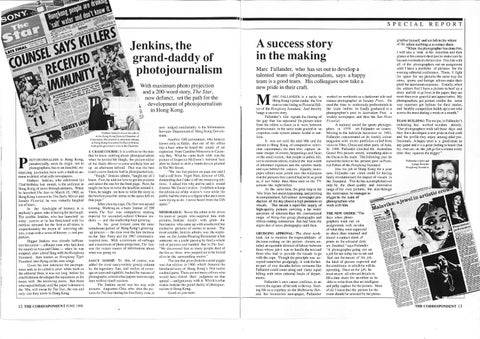
Graham Jenkins is now the editor at the Hong Kong General Chamber of Commerce. He (seal¿d) is seen here talking to Hong Kong Govemor Sir David Wilson during the govemor's visit to the Chamber.
:;1i:
A success story in the
Jenkins, the grand-daddy of
REPORT
is a rarity in
,,_-- ___-
spectrum
of
interests than
the conventional THE NEW ORDER:
"The '?-ø
range of firingJine group photographs and days when photoribbon-cutting ceremonies that had been the graphers went out on stapìe diet of news photography until then. assignments with no idea of what they were suppo ied GRUDGING APPROVAL: The sheer work- to shoot, then returned and load, not to mention the responsibilities of tossed a contact-sheet of decision making on the picture chosen, en- prints to the editorial desk tailed an equitable division of labour between are finished," says Fallander. thosewhose jobit was to handlethetextand "A photographergoing out on
thosewho had to provide thevisuals togo with the copy. Though the principle was accepted somewhat grudgingly, it took the better part of two decades before someone like Fallander could come along and claim equal billing with other editorial heads of depart-
ments.
an Starton the Melbourne Her-
Fallander's own career confirms, to
extent,therigours ofthetrektothetop. ing life as a copyboy
ald, his hometown newspaper, Fallander
^*tistic
-ûZÃ
ajobformetodayhastoaskand
find out the nature of his job, the kind of picture expected and the conditions in which he will be operating. Once on the job, he must secure all relevant details to fill a data sheet for an editor to be able to write f¡om that an intelligent andpithy caption forthepicture. Most of all, I insist that the picture for the event should be selected by the photoTHECORRESPONDENT 13