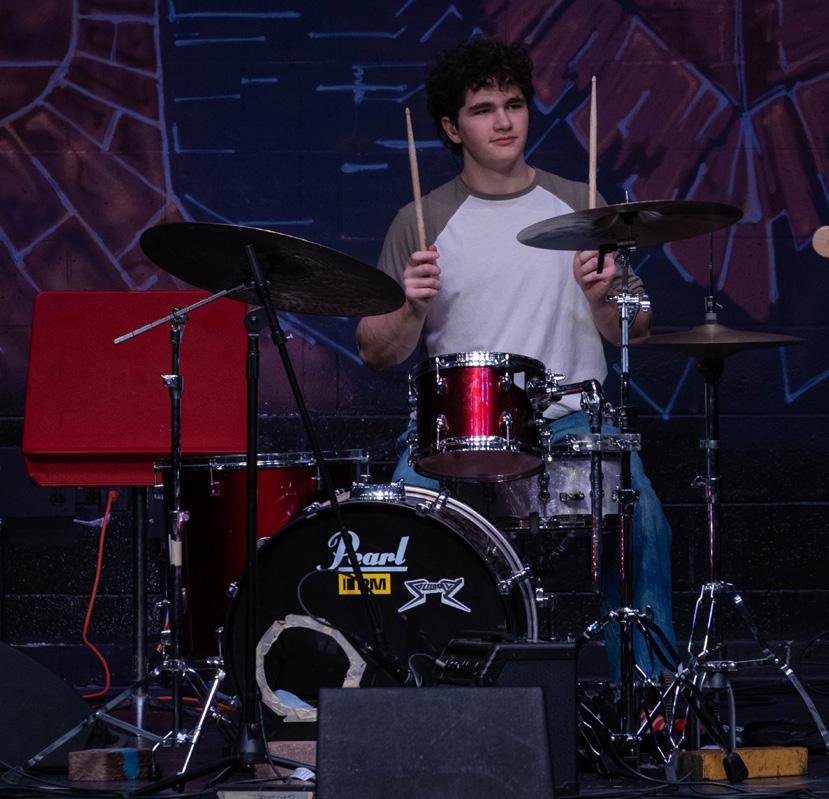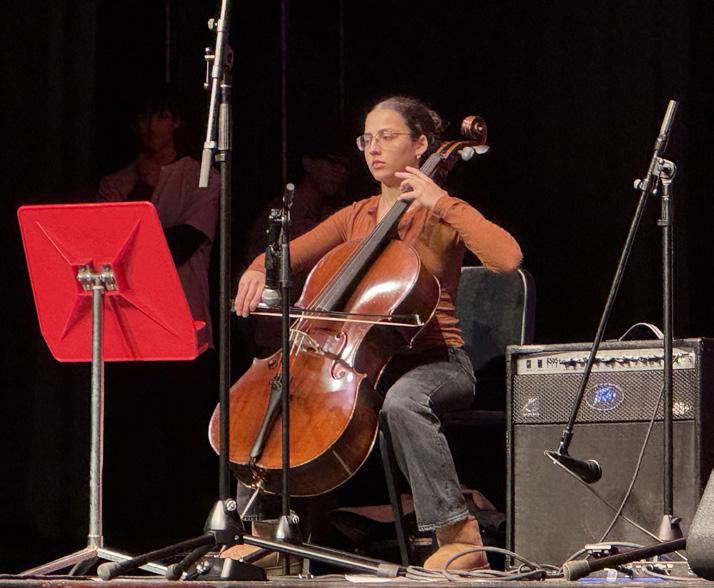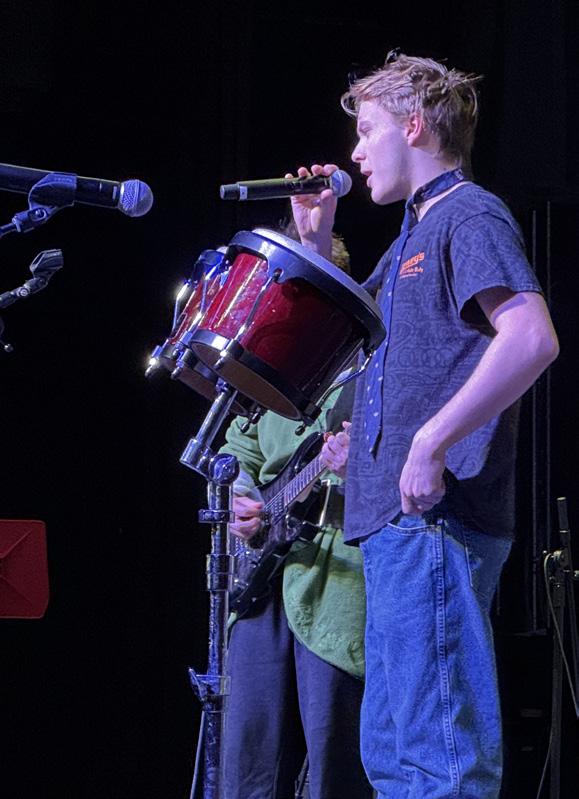

Telethon 2025 - Pg. 3
DECA Dominates Regional Conference - Pg. 2
Boys Basketball Looks to Continue Success - Pg. 17
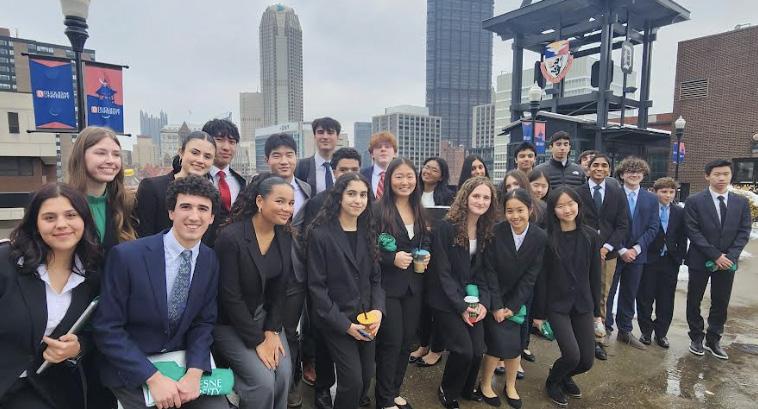
Mock Trial Team Places at Pitt Competition - Pg. 24

Telethon 2025 - Pg. 3
DECA Dominates Regional Conference - Pg. 2
Boys Basketball Looks to Continue Success - Pg. 17
Mock Trial Team Places at Pitt Competition - Pg. 24
Atotal of 18 Fox Chapel Area High School students placed in the 2025 Distributive Education Clubs of America (DECA) District Three (regional) competition and 10 qualified for the state competition. Fox Chapel Area first-place regional winners were sophomore Anna Chrissis and freshmen Isaac Drucker, Ario Homayoun, Olivia Richter, and Salam Saidi. Second-place regional winners were juniors Aiden Drucker, Cooper Fleming, and Noelle Fouron and freshmen Zoey Liu and Maya Vyas. These 10 students qualified for the 2026 DECA State Career Development Conference in Hershey, Pennsylvania, February 18-20.
competition were juniors Marianna Iannarelli, Joseph McGivney, and Nico Zgurzynski and freshmen Delaney Liu and Dyutit Patro. Fourth-place winners at the regional competition were junior Dashel Wilson and sophomores Lucas Ahern and Purv Patel.
The DECA District Three competition was held December 3rd at Duquesne University. Approximately 400 students from 12 high schools from across Allegheny and Westmoreland counties participated in the regional competition.
Students placing third at the regional DECA
DECA is a global nonprofit career and technical high school and college student organization that prepares emerging leaders and entrepreneurs for careers in marketing, finance, hospitality, and management.
By Zehra Ozkaya
The Fox Chapel Unified Bocce team has seen immense success over the past few seasons and have been continuing the trend, seeing growth this 20252026 season. They are looking forward to defending the undefeated records from the last several years and expanding off of it to continue their winning streak.
Bocce itself is a simple team sport where players will take turns rolling balls towards a smaller target ball that is called a pallina. The objective of the game is to get your team’s balls closer to the pallina than the other team’s balls. An easy to learn and low-impact sport, bocce emphasizes strategy, teamwork, and precision over strength.
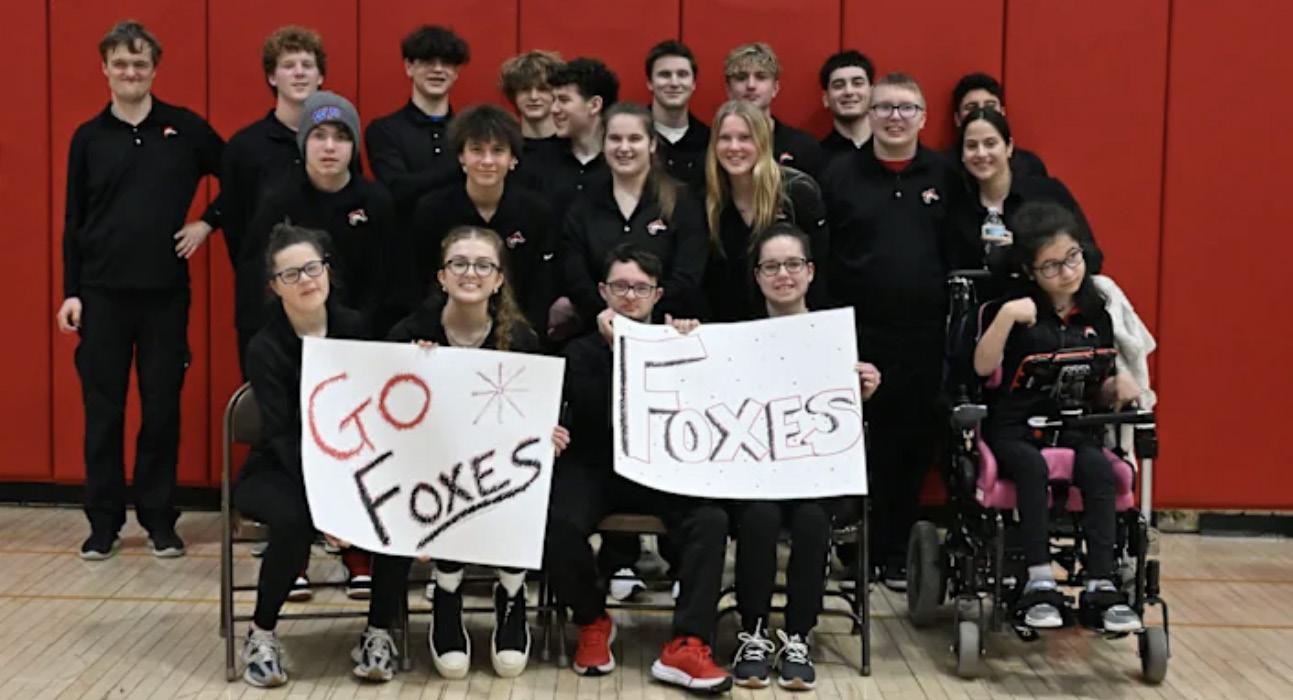
competitive environment. Players of all abilities and skill levels work alongside each other joined through communication, respect, and teamwork. Each athlete's strengths contribute to the strength of the entire team creating a sport that fosters shared joy and connection.
The Unified Bocce Team is a group of students who are working together to promote inclusion in a fun and
So far this season they have had one game which was won in a thriller overtime matchup against North Hills. Xander Czopek, Bethany Snook, Sean Regan, Joey Demartino, and John Jarvis are just a few of the many notable players who have made their mark and pushed Fox Chapel to their success. These are some of the players who will compete in the Shlaer, Pine Richland, Avonworth, and North Allegheny matches that are coming up soon later this winter – wish them luck!
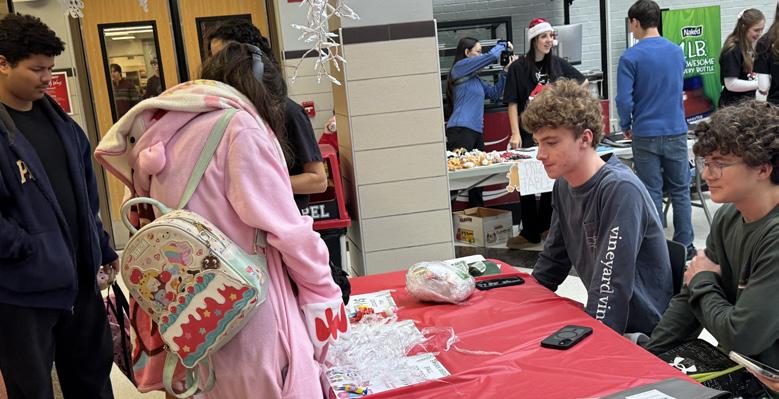
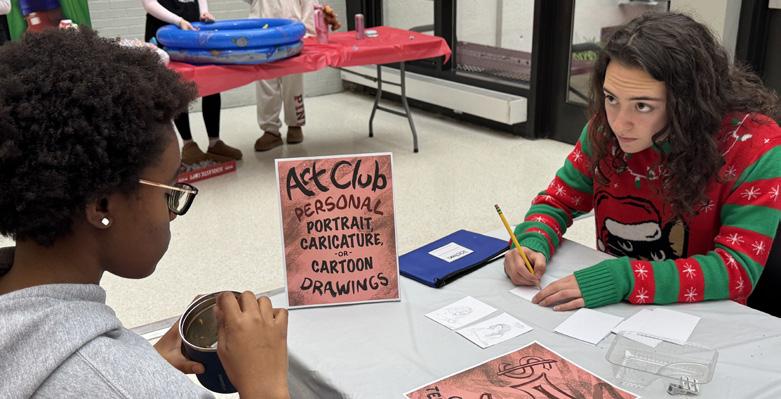
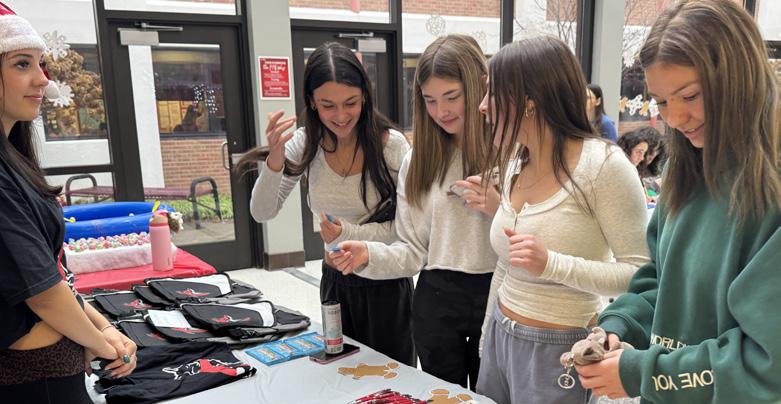
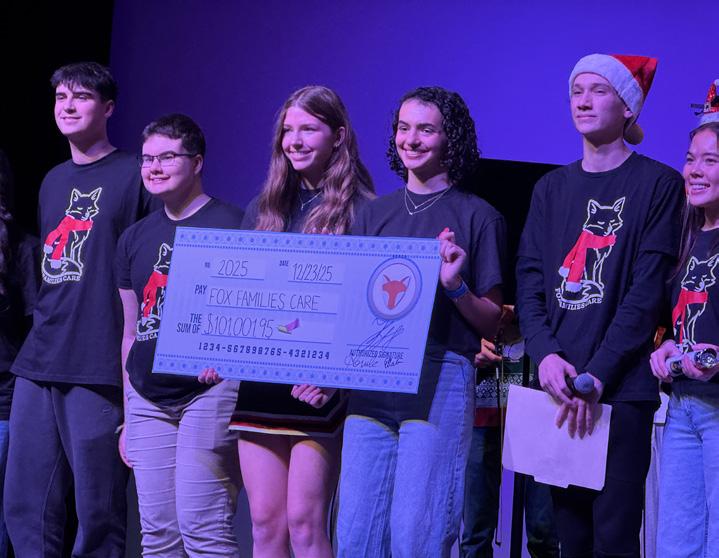
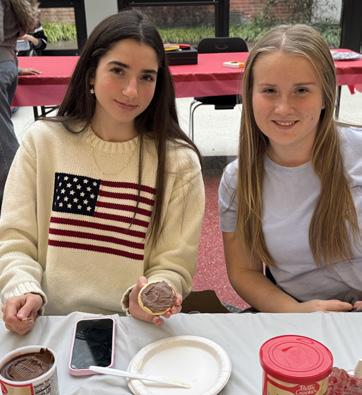
This year’s Telethon was a huge success, raising $101,001.95 for Fox Families Care. Fox Families Care is a local charity that helps provide resources to students and families in our district to thrive, including scholarships for additional schooling, summer camps, extracurriculars, freshman orientation, and books. Every club in the high school held incredible fundraisers helping us reach our goal, and we had 16 fundraisers that raised over $100! These clubs include German Club, Muslim Student Association (MSA), the Senior Class and National Honor Society (NHS) collaboration, the Class of 2027, Asian Cultural Club (ACC), Formula 1 Club, Drama Club, Cakes for Care, Future Business Leaders of America (FBLA), Health Occupation Students of America’s (HOSA) collaboration with Science
Club, Gratitude and Compassion Club (GCC), NHS, and Fox Tales, Busking Club, Class of 2028, Clash Royale Club, Black Student Union (BSU), & Mock Trial Club.
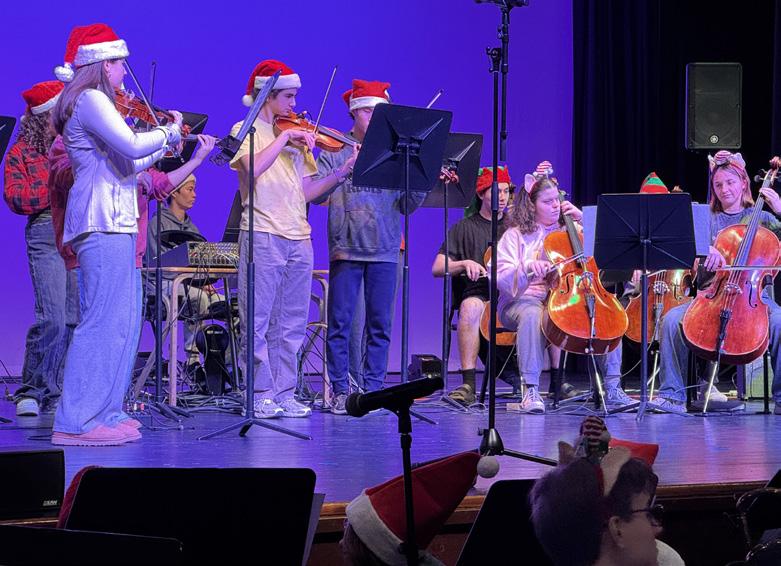
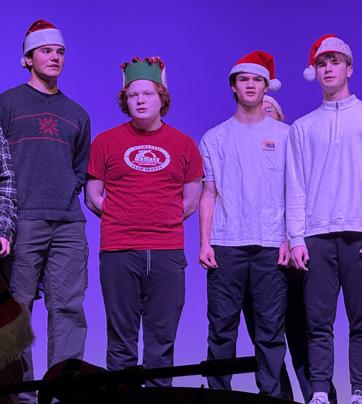
This year, we had some creative new fundraisers as well, including a Clash Royale Tournament, Jingle Jam by the Music Department, and even the Class of 2027’s Dirty Soda Bar. It was a December filled with cheer; each day had fun events for students to enjoy while contributing to the Telethon. Thank you to everyone who contributed to its success, whether that was buying goods from bake sales, planning fundraisers, performing at events, or helping with media and photography. We are so ecstatic with the outcome of this year’s Telethon, and cannot wait to see it excel again next year!


By Laila Golla


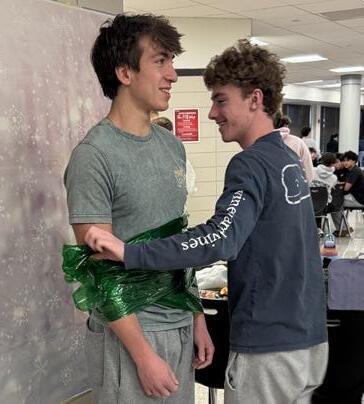

inter is a season full of cheer. The warmth and comfort lasts even after the holidays have passed. January marks a time where the holiday excitement settles for more quiet, meaningful moments. From dazzling lights to festive treats, the season is a great way to spread cheer. Imagine the smell of freshly baked cookies on a snowy winter day and the feeling of cozy sweaters on a snowy day. In this article, we explore how different students, families, and finally, our school celebrated the holidays through various activities and traditions.

By Zoey Liu and Olivia Arca
you can always count on these seasonal goodies to bring people closer and even add a touch of sweetness to the colder months.

On Wednesday, December 10th, our school hosted the Jingle Bell Bash, an event that has a lasting impact on the winter season. Many high school students volunteered for countless clubs to welcome elementary students. Clubs ran many activities, ranging from selling baked goods to performing holiday songs. It was wonderful to have so many students spreading holiday cheer! The Psychology Club and Class of 2029 also hosted a door decoration competition in which the different QRTs had their students decorate their doors with the holiday spirit in mind for a chance to win a special prize.
The holiday season would not be complete without tasty treats and cozy drinks, especially during the colder days of January. In our community, students and families enjoy treats all throughout the holiday season. Some of the more popular choices include hot chocolate, gingerbread cookies, and peppermint bark. Many families also share their special, family recipes such as spiced apple cider and holiday cookies.
Some even take part in fun food traditions at school such as selling baked goods and making treats for local charities. In the end, no matter what type of treat,
Beyond delicious treats and joyous school events, winter traditions and activities have a major role in bringing people together during the winter season. As the temperature dropped and snow began to fall, families and friends took advantage of classic winter activities that only come once a year. Many students enjoyed ice skating, sledding down snowy hills, and building snowmen after school. These simple activities contribute to moments of laughter and bond formation, making winter break even more special.
As we moved into January, and the December holiday season drew to a close, the transition provided time for reflection and looking ahead to the new year. 2026 brings new celebrations during the upcoming months, such as Valentines Day and Lunar New Year. Winter break not only allowed students to spend more time with their families, but also gave them a chance to slow down and think about the moments that made the past year meaningful. Whether it was academic achievements, personal accomplishments, or memorable experiences with their friends and families, the end of the year encouraged reflection.
On New Year’s Eve, New Year's resolutions are often written in order to set new goals and promises for the following year. These help to encourage a positive change for people to make for themselves, knowing that the new year gives them a fresh start. Overall, New Year’s resolutions represent hope, motivation, and the desire to grow. They encourage individuals to learn from the past year while looking ahead with optimism for the year to come.
Ingredients:
1 cup of butter, softened; 1 cup of sugar, 1 egg, 1 tsp of vanilla extract, 2 cups of all-purpose flour, ½ tsp of baking powder, Pinch of salt, Sprinkles or colored sugar for decoration
Instructions:
- Preheat the oven to 350°F (175°C).
- In a bowl, cream together butter and sugar until smooth.
- Add the egg and vanilla, and mix well.
- In a separate bowl, combine flour, baking powder, and salt.
- Gradually mix into the wet ingredients.
- Roll dough into small balls, place on a baking sheet, and flatten slightly.
- Sprinkle with festive sugar or sprinkles.
- Bake for 10–12 minutes or until the edges are lightly golden.
- Let the cookies cool and enjoy your festive treats!

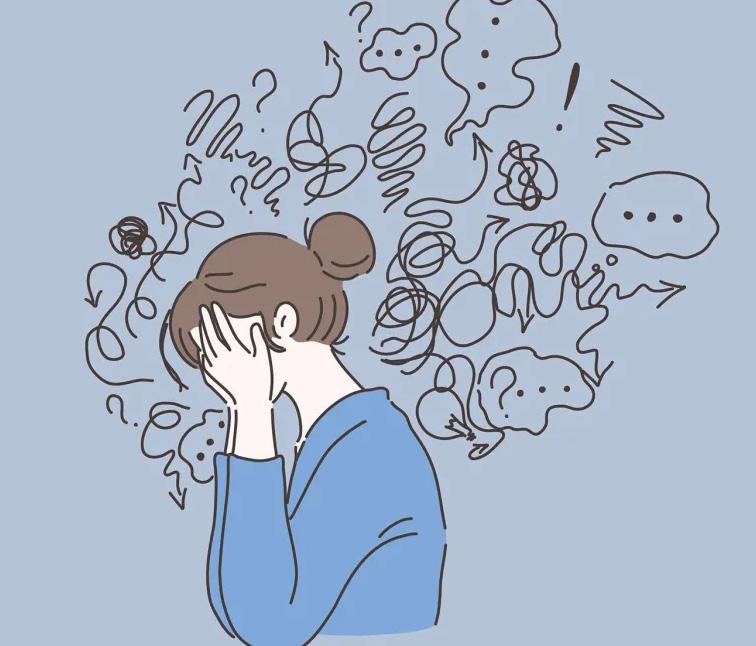
As the second semester ramps up, the stress begins to really set in. First, it is important to understand what stress really is. Stress is the physiological response to a perceived threat or challenge. Stress acts as an alert to your body and mind that you are facing a possible danger – it is a heads up to prepare yourself. Stress has many physical, psychological, and behavioral symptoms, none of which are healthy at a high level. Academic stress is high during exam times. Stress can sometimes become so overwhelming that it prevents you from doing things you must do, like studying.

One of the best ways to reduce or overcome stress is to maintain a basic level of self-care. Sleep is one of the most important things in this regard. According to Alvin Mantey, a student at the University of Cincinnati studying medicine and public health, “sleep is probably the most natural, healthiest thing a human can do.” Mantey describes how mental health greatly worsens with a lack of sleep. In the context of school, studying, and exams, sleep becomes vital in memory consolidation. This implies that studying pays off when you get a good night’s sleep, and that allnighters will only hurt your ability to recall information. It is also important to get good sleep before exams for this reason. Besides being good for your memory, sleep can also help you break out of the terrible trap of procrastination. If you feel you are putting off your work, a good strategy is to take a short nap before getting started. It has also been shown that you tire more quickly in warm places, so it is optimal to study in a cool location. In addition to getting good sleep, eating enough food is also very important. Fuel for your body is also fuel for your brain, and a tired brain doesn’t perform as well as an adequately fueled one.
The same goes for hydration. Some common symptoms include difficulty concentrating, tiredness, and headaches accompanied by dizziness. To combat this, you
By William Kelly
should be drinking plenty of water, around six to eight cups a day, and lots more as you exercise. Something important to consider when studying is caffeine intake. Most people drink caffeine to feel more awake or to enhance focus. Contrary to popular belief, studies show that caffeine only increases focus for early-morning tasks, not past the afternoon. For this reason, caffeine can be beneficial for early morning tests or studying, but not for late-night activity (allnighters, cramming, etc.). All caffeine will do for you is keep you awake and hamper your sleep if you have it later in the day. If you do choose to have coffee, you should be hydrating even more. Around two cups of water to one cup of coffee is recommended. When facing multiple exams, most people feel really crunched for time. To reduce anxiety, you should maximize the time spent studying. One helpful tip is to sit down with a calendar and plan all the work you need to do in the coming weeks. Plan realistically, though, with adequate time for breaks, friends, family, and extracurricular activities. If you don’t think you will have enough time to get everything done, maybe put other activities on the back burner, like sports, volunteering, or work (if you can).

If studying at late hours, it is actually best to avoid caffeinated drinks.
What you definitely should NOT do is sacrifice sleep, time with your family, or other basic needs. Your body only has so much to give, so be sure not to overwork yourself. At colleges and universities, research shows that mental health guidance is more sought during finals than at any other time of year. Ask for help if you need it. Many people would be willing to help you, such as counselors at school, family, friends, and teachers. As you journey toward the end of the semester, take note of effective study strategies. The 52-17 method is great for eliminating distractions. It involves studying for 52 minutes and taking a 17-minute break. Studies show that the brain focuses best in 52-minute bursts with 17-minute breaks. Set a timer, and put your phone away for the time you study. If you find yourself panicking, the
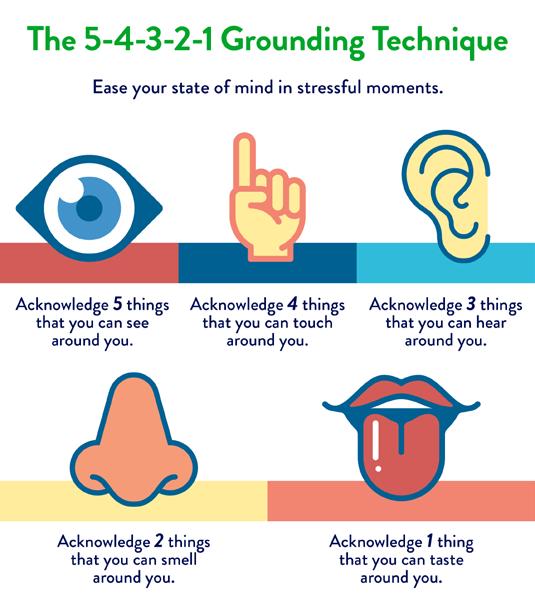
Grounding techniques, such as the 5-4-3-2-1 method, can be very effective for managing panic.
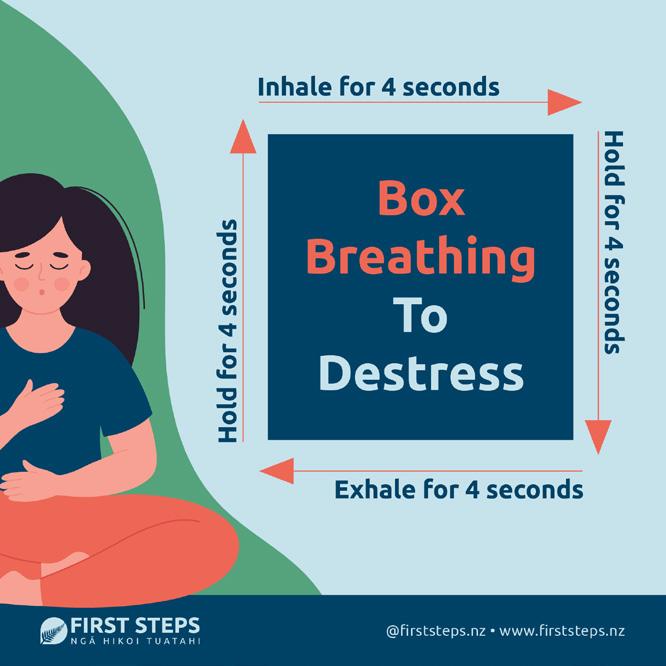
5-4-3-2-1 method resets your nervous system. Name five things you see, four you feel, three you hear, two you smell, and one you taste. Box breathing can also be beneficial for this purpose: inhale for four seconds, hold for four more, exhale for four seconds, and then hold for four (repeating). This lowers cortisol, which can be the root of stress.
Cortisol is also spiked by social media, so "doom-scrolling," especially before bed, can be detrimental in times of stress. Cong Zhang, a staff psychologist at Boston University Student Health Services, recommends finding a mantra to repeat to reinforce positive thinking. “Repeating a therapeutic word or phrase can ground you and bring you back to the present,” Zhang says. One of her suggestions is “I’m feeling stressed because I'm human, and anyone in my position would feel this way.” If you find yourself procrastinating, motivate yourself to study by promising a reward. This can be if you achieve a certain grade, study for a certain amount of time, or set


When stressed, especially before bed, it is best to avoid "doom-scrolling" on social media platforms.
any other goal. If you feel overwhelmed by the amount of content you need to study, a good strategy would be to break things down into smaller chunks, unit by unit, for example.
When you study, be gentle with yourself. Combat self-critical thoughts and remember that performance at school doesn’t define your worth or your success. As long as you put forth your best effort, results will take care of themselves.
References:
samaritanshope.org/blog/how-to-cope-withfinals-stress/ www.msj.edu/news/2025/04/Tips%20for%20 Coping-with%20the-Stress-of%20Finals-Week. htmlpsychologydegreeguide.org/resources/ managing-stress-during-finals/. advantagementalhealthcenter.com/how-tosurvive-finals-week/ www.nhsinform.scot/campaigns/hydration/ www.frontiersin.org/articles/10.3389/ fpsyg.2016.01764/full https://doi.org/10.3389/fpsyg.2016.01764 studentlife.tcnj.edu www.bu.edu/articles/2025/10-tips-to-help-youthrough-finals-season/
Hi! I am Elijah Turner, a freshman who immensely enjoys film because of the sets, thrill, and many genres. My three favorite movies are: Back To The Future: Part 2, Jaws, and The Mummy Returns. For each future issue of Fox Tales, I will be featuring a few of my friends’ top three movies! If you would like your favorite movies to be listed in a future issue, feel free

to email me at turner_ elijah@student.fcasd.edu.
Abigail Haas:
1. 12 Angry Men
2. The Batman (2022)
3. The Good, The Bad, and the Ugly
Brooklyn Wan:
1. Zootopia
2 Hunger games
3. Murder Mystery
London Miller: 1. Coraline
2. Wicked
3. Phantom of the Opera
Hunter Richardson: 1. Bad guys
2. Scream
3. It: Chapter 2
Sophia Geraci:
1. Mean girls
2. ET the extra terrestrial
3. Harry Potter
By Elijah Turner
Movie Quiz:
Where is the Men in Black film franchise set?
A. New York City
B. Tokyo’s Shibuya Ward
C. Buckingham Palace in London, England

By Linden Trac
Note: Cancer has been researched for hundreds of years, so it is impossible to provide all the information regarding cancer within this article. More information can be found through articles, websites, and books.
Cancer is a genetic disease characterized by some of the body’s cells growing uncontrollably and spreading to other parts of the body. It can start almost anywhere in the human body, which is made up of trillions of cells.
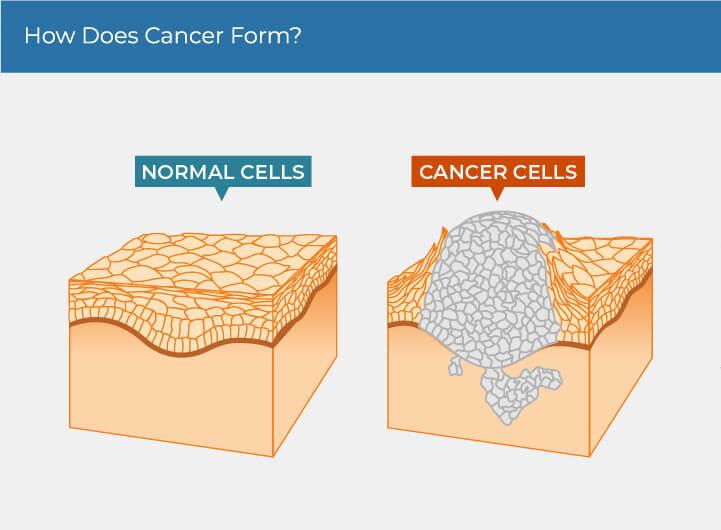
Cancer is a disease caused when cells divide uncontrollably and spread into surrounding tissue.
Cancer is a genetic disease, meaning it is caused by changes in our genes that control the way our cells function, especially how they grow and divide.
Genetic changes that cause cancer can happen due to:
- Inherited from parental genetic information.
- Errors during cell division.
- Damage to DNA caused by harmful substances in the environment (chemicals in tobacco smoke and ultraviolet rays).
The body normally eliminates cells with damaged DNA before they turn cancerous, but the body’s ability to function best declines with aging. This is part of the reason why there is a higher risk of cancer later in life.
Usually, human cells grow and multiply through “cell division” in order to form new cells. When cells grow old or become damaged, they die, and are replaced by the newly formed cells. Sometimes, this process breaks down, and abnormal or damaged cells grow and multiply when they should not. This is the fundamental process in which tumors, which are lumps of tissue, form. Tumors can be cancerous (malignant) or not cancerous (benign).
Cancerous tumors, also known as malignant tumors, spread/invade into nearby tissues and can travel to other parts of the body to form new tumors, a process called metastasis. Many cancers form solid tumors, but cancers of the blood, such as leukemias, generally do not.
Non-cancerous tumors, also known as benign tumors, do not spread/invade into nearby tissues. When
removed from the body, benign tumors usually fail to grow back, whereas cancerous tumors occasionally will regrow. Some benign tumors can become quite large, resulting in serious symptoms or threatening the patient’s life e.g. brain tumors.
Oftentimes, the word “stage” is associated with cancer. The “stage” in which one is diagnosed with cancer is relative to the size of the tumor and the extent to which it has spread.
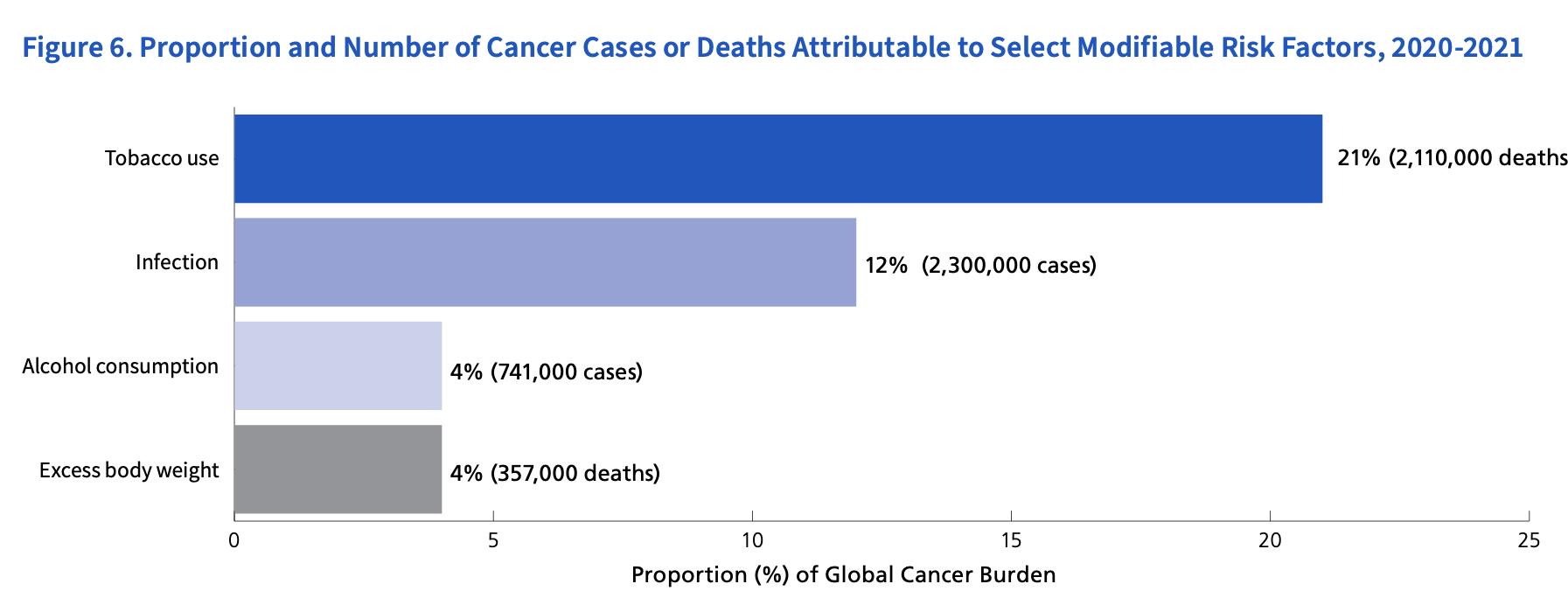
- Cancer is one of the leading causes of death worldwide, accounting for 10 million deaths each year.
- The most common cancers are breast, lung, colon/rectal, and prostate cancers.
- Around one-third of deaths from cancer are due to tobacco use, alcohol consumption, low fruit/vegetable intake, lack of physical activity, high body mass index (overweight), or air pollution.
- Many cancers can be cured if detected early and treated effectively. Unfortunately, not everybody has access to affordable cancer treatments.
Note: These treatments, among many others, are not always successful.
To learn more, visit: https://www.cancer.org/cancer/ managing-cancer/treatment-types.html
Systematic: Drug treatments that affect the entire body.
- Chemotherapy: a variety of chemical substances used to kill or stop the growth of cancer and other fast-growing cells (healthy and harmful alike). Often used on blood cancers or solid cancerous tumors.
- Immunotherapy: a variety of substances(body or lab produced) that assist the immune system with finding and attacking cancer cells. Often used on blood or skin cancers.
- Stem Cell or Bone Marrow Transplant: healthy blood stem cells back into the body after the bone marrow has been destroyed by disease(cancer or others), chemotherapy, or radiation. Often used on blood or bone marrow cancers.
Local: Targeting a specific tumor or section of the body.
- Cancer Surgery: a surgeon will remove some or all of the cancerous tumor depending on where it is located. Often used on solid cancerous and non-cancerous tumors but not blood cancers.
- Hyperthermia: the body is heated to as high as 113 degrees Fahrenheit (with radiowaves, lasers, heating fluids, and more) in order to damage or kill cancer cells but not harm normal tissue. Often used on solid cancerous tumors in combination with chemotherapy.
Cryotherapy: the use of very cold temperature to freeze and kill abnormal tissue. Often used on solid cancerous and non-cancerous tumors but not blood cancers.
Cancer research is constantly working towards better understanding how cancer works and finding better ways to treat patients with cancer. Recent advancements and innovations have been primarily focused on the improvement of immunotherapy drugs and substances that can contain and kill off cancer cells more effectively. Want To Support or Learn More About Cancer Research? Cancer treatments are expensive and not everybody is able to afford the necessary treatments. Donations help fund cancer research, treatment, and much more. Not only does funding go towards helping the patient, but also to the doctors, nurses, and caretakers.

- World Health Organization: https://www.who.int/healthtopics/cancer?tab=tab_1
National:
- Cancer Research Foundation: https://www. cancerresearchfdn.org/
- National Foundation for Cancer Research(NFCR): https:// www.nfcr.org/
- St. Jude Children’s Research Hospital: https://www. stjude.org/
Local:
- UPMC Hillman Cancer Center: https://hillmanresearch. upmc.edu/
- Magee-Womens Research Institute & Foundation: https://mageewomens.org/
Five Fox Chapel Area High School students were selected by audition to perform with the 2025 Pennsylvania Music Educators Association (PMEA) District 1 Honors Band. The students are seniors Jack MurrayKrezan (percussion) and Joshua Shah (flute); juniors Nadre Digbohou (clarinet) and Rachel Kim (clarinet); and freshman Celestial Hou (flute). The band was
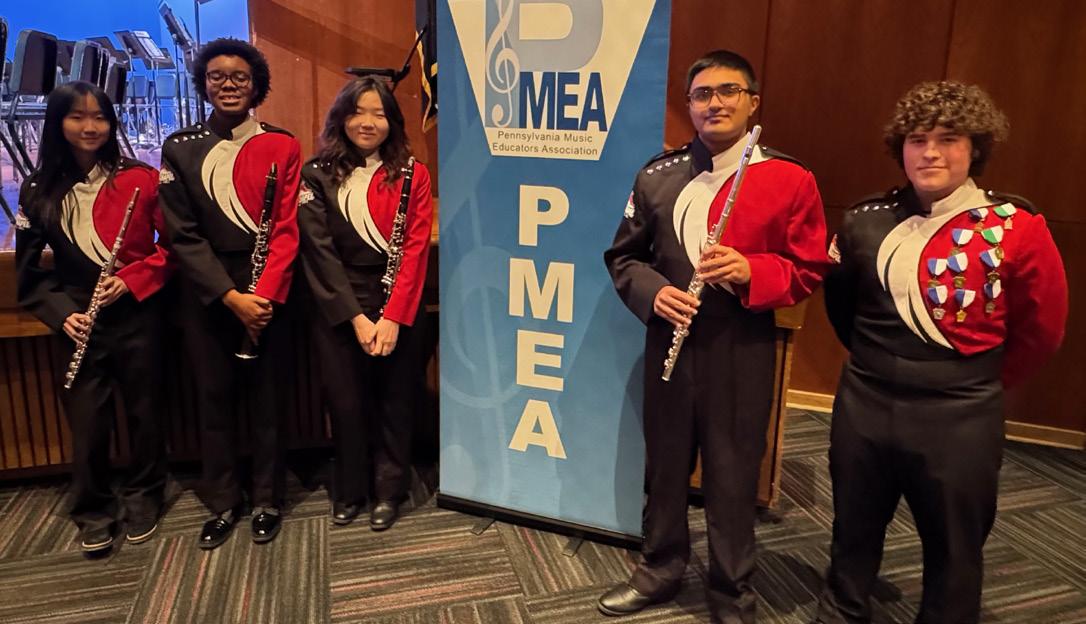
comprised of 120 of the best student-musicians from Allegheny, Fayette, Greene, Washington, and Westmoreland counties.
The PMEA District 1 Honors Band concert was held November 23 at North Hills Middle School and was conducted by Dr. Andrew Boysen Jr., professor of music at the University of New Hampshire.
By Karsten Buchert
In the United States, our government operates as a representative democracy with an elected executive as the head-of-state. The United Kingdom, despite the emphasis on being a “kingdom” and having a hereditary monarch, presently King Charles III, as head-of-state, is a parliamentary democracy at its core. This semester, I took Mrs. Modlin’s Advanced Placement European History course. As we progressed towards the modern era, the course content increasingly highlighted acts of Parliament and important prime ministers, which inspired me to do more research on U.K. civics.
The bill guaranteed Parliamentary Privilege: the right to sovereignty from the monarch and government, frequently-held meetings, free elections, approval of taxation, petition, and freedom of speech within Parliament. The English Bill of Rights secured Parliament’s power as an independent bicameral legislative body, similar to the United States’ Congress.
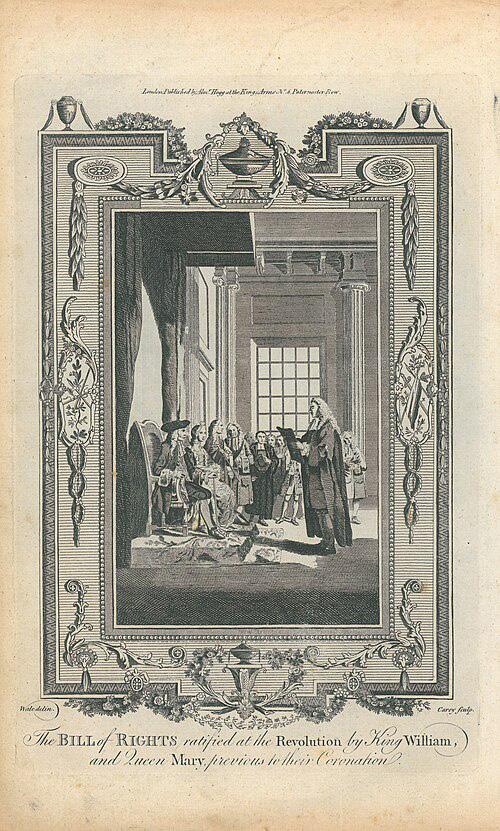
Before getting to the current Parliamentary system, here is a little history lesson to answer “Where does Parliament come from?” The word “parliament” itself dates back to the Middle Ages, having been used to describe a king's advisory council of nobility hailing from established communities in his territory. A crucial document to the creation of Parliament, is the Magna Carta. Issued in 1215 as the result of a rebellion against John, the King of England, the “Great Charter” dictated that monarchs are not above the law of the land, a critical step towards the creation of a body to establish said law. The first meeting between the king of England, atthe-time Henry III, and his advisors to be described as “Parliament” took place in 1236. This group of noble advisors eventually evolved into the House of Lords. King Henry III’s son, King Edward I, expanded English subjects’ representation in Parliament with each county, city, and town having two representatives. That whole idea of “what best represents the people governed” became the basis for the House of Commons, modern Parliament's lower house. The expansion of the electoral body is a recurring theme of reforms throughout British history. The other crucial document for Parliament came with the Glorious Revolution in 1689. Prince William of Orange and his English wife, Mary, who were called over from the Dutch United Provinces to lead England by noblemen upset at the, in their opinion, too Catholic and tyrannical, King James II, agreed to the English Bill of Rights.
Now that the basic concept of Parliament has been outlined, let's fast forward to the present day. The first key idea to understand is that the British Parliament is not the same as the British government. The “government” consists of the various departments essential to maintaining a functional state such as the Department of Health and Social Care, which runs the United Kingdom’s public healthcare system, the National Health Service (NHS). In simplest terms, the government carries out what Parliament creates. For example, if Parliament passes legislation that provides funding for the NHS to purchase more ambulances, then the Department of Health and Social Care is responsible for ensuring that said ambulances are purchased. The head of this bureaucracy is the Prime Minister.
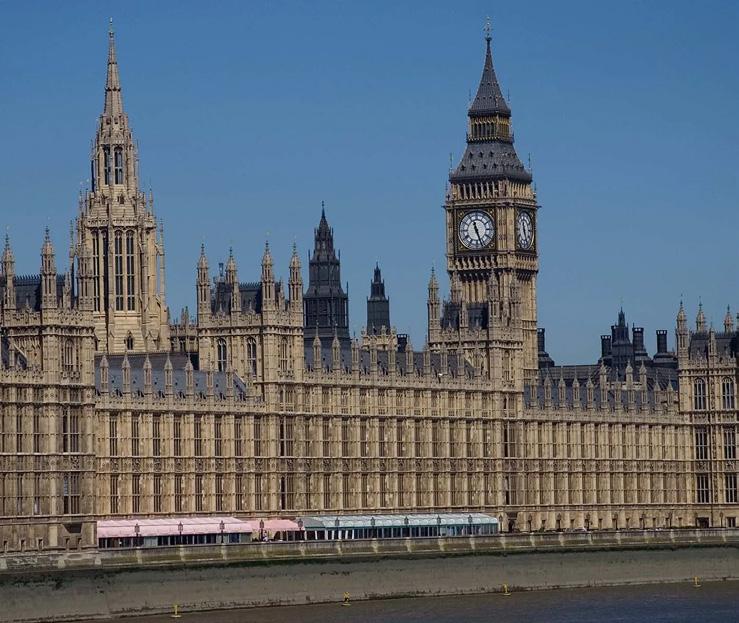
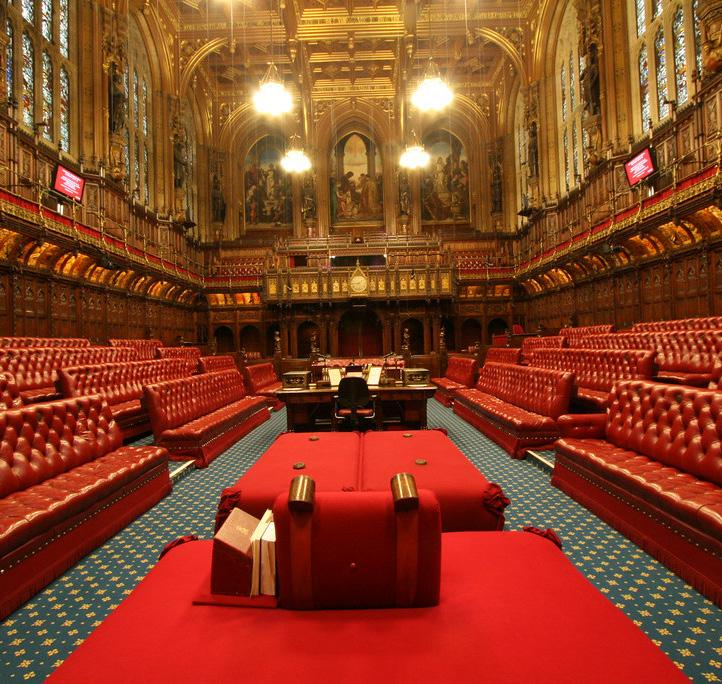
Parliament itself consists of two chambers, the House of Lords and the House of Commons. Both chambers are located within the Palace of Westminster in London, worldrenowned for its clock tower, nicknamed Big Ben. The House of Lords consists of politicians who hold their seats for life-long “peerages” and are appointed via a lengthy nomination process ending with approval by the Prime Minister and monarch. House of Lords members have titles that designate their seniority in the peerage hierarchy. The most common one is “Baron,” or “Baroness” for women. The House of Commons is made up of elected politicians, chosen by the U.K. citizenry in a general election. While the Prime Minister can call a general election anytime, one must occur every five years. During these elections, each of the 650 constituencies across England, Wales, Scotland, and Northern Ireland votes for a member of Parliament (MP) to represent the constituency. The candidates typically align themselves with one of the U.K.’s political parties. The general election

also indirectly serves as how the Prime Minister is chosen. The party with the most seats in the House of Commons after a general election has the privilege of their party leader becoming the new Prime Minister, who once in power, applies his or her party’s platform to the U.K.’s government and its policymaking. The basic requirements for voting in the U.K. are having British citizenship and being 18 years of age. Britain has announced its intention to lower the voter eligibility age to 16, though. In Scotland and Wales, 16-year olds can already vote in some local elections. So, for example, if you are 16 and happen to live in the Welsh village of Llanfairpwllgwyngyllgogerychwyrndrobwllllantysiliogogogoch, you can vote for your community council members, but you cannot currently vote for your MP.
Bills in Parliament can originate in either House. To become an Act, it must be passed in identical form via a simple majority vote in both Houses and approved by the monarch. A bill can be drafted by an MP or group of MPs. The process of introducing and debating a bill is the same in both Houses. The bill is read first without debate, then is ordered to be printed and published. It then heads to the second reading, where MPs are free to scrutinize the bill, question its creator(s), and suggest amendments. These amendments are voted on and added in the next stage, the committee stage. A group of MPs works together to meticulously review and edit the bill. The second to last stage is the report stage. In the House of Commons, this is the last chance for MPs to suggest changes to the bill. It then heads to the Third Reading. In the House of Lords, amendments can still
be made here. The final step is a culminating vote. If a simple majority to pass is reached, the bill proceeds to go through the same process in the House into which it was not introduced. Keep in mind that the bill can fail to pass and thus essentially be “thrown out” at any point during the second reading up through the committee stage. Once the bill passes both Houses, the Houses consider each other's amendments in a process referred to as “ping pong” due to the bill “bouncing” between both Houses. This is what ultimately ensures the bill is uniform before it becomes law. Order is kept in both Houses my their respective House speakers. This role is important as parliamentary debate can get heated, especially in the House of Commons. The current speaker for the House of Commons is Sir Lindsay Hoyle. He is an avid animal lover owning six pets all named after British politicians including a parrot named after former Prime Minister Boris Johnson who can apparently squawk "Order! Order!"

The term for the monarch’s agreement with the bill is “royal assent.” The monarch can technically refuse to approve a bill, but this has not happened in over 300 years. The monarch’s review of the bill is largely a manifestation of traditional etiquette. Speaking of
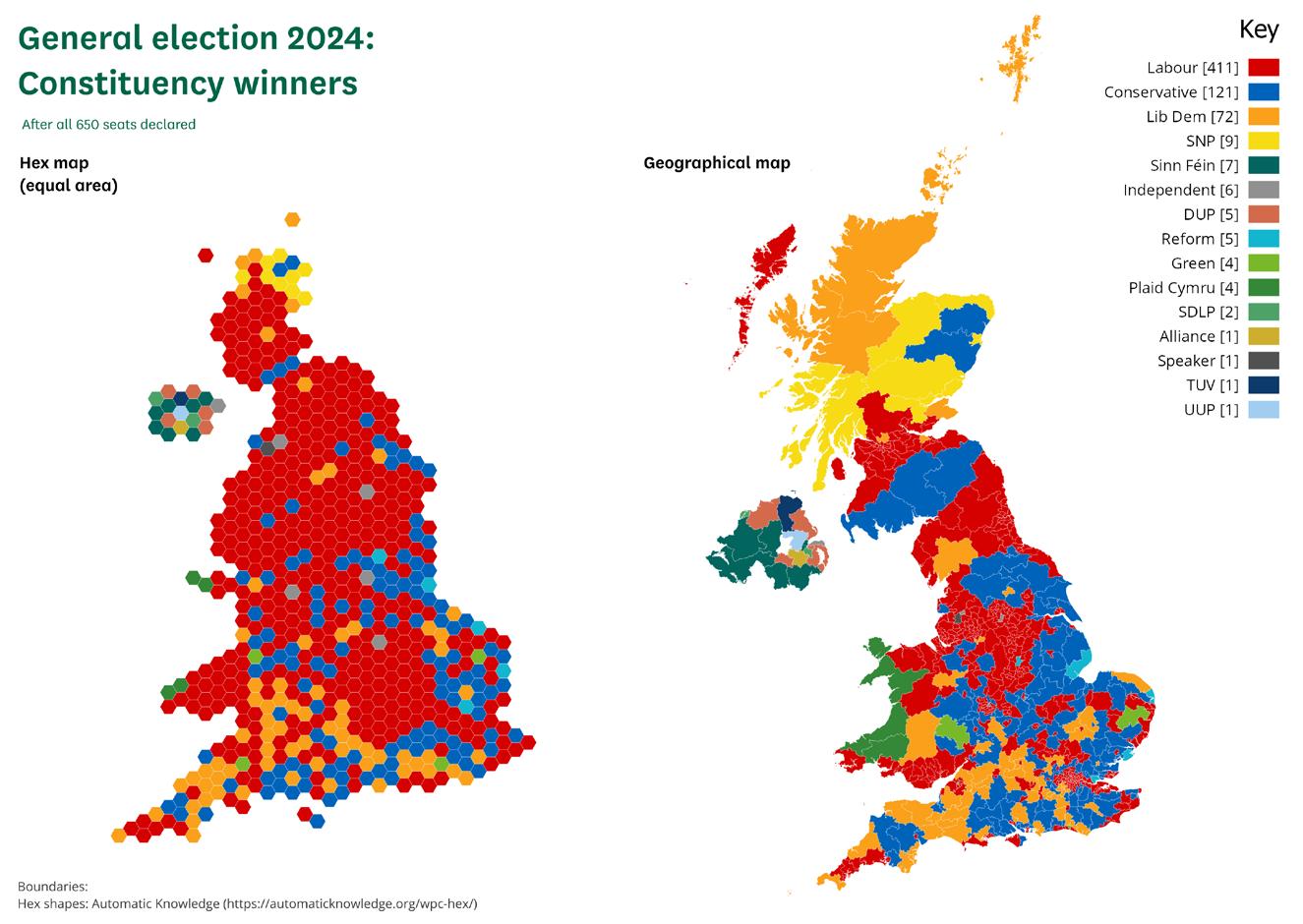
Map of the results for the United Kingdom's 2024 General Election. The map illustrates all 650 constituencies represented in the House of Commons.
the monarch, the king or queen’s other main role with Parliament is conducting the state opening. The opening occurs for each Parliamentary session and after general elections. The monarch travels in a ceremonial procession from Buckingham Palace to Westminster Palace and gives a speech in the House of Lords written by the
government outlining its policy agenda. It is common practice for the House of Commons to debate the agenda proposed in the speech and vote on whether or not to support said agenda. Anyone can watch Parliament’s proceedings on parliamentlive.tv.


Just for fun, let’s take a closer look at some of the U.K.’s political parties and their party leaders. You may hear British MPs referred to as Tories and Whigs. These are historical terms. Tories are generally rightleaning and Whigs are generally left-leaning. As of the 2024 General Election, the Labour Party is dominant. They are considered center-left in ideology, favoring liberal economic and social policies such as supporting the public healthcare and childcare systems as well as investing in green energy. With issues like crime immigration, however, the Labour Party takes a slightly more conservative approach emphasizing national security, reducing net migration (aim for less people moving both in and out of the country), and a tough-on-crime approach. Their party leader and current Prime Minister of the U.K. is Keir Starmer. He is a former government prosecutor and according to his party’s website, “is obsessed with football (soccer) and still plays every Sunday with friends.” Ironically for a man who is so adamant about reducing crime, Starmer has admitted to being arrested in France during his university years for illegally selling ice cream cones. Starmer has been criticized for being "mysterious," for lack of a better term. For instance, he has infamously declared that he does not dream.

a controversial disaster while he was serving as the Chancellor of the Exchequer, the head of the U.K.’s treasury. To promote the reduction of tariffs on petrol, he posted a photo of himself to social media fueling a Kia Rio hatchback. The car was later revealed to have been borrowed. In response to backlash, he claimed that he shuttled his family around in a Volkswagen Golf. People were quick to discover that while he did indeed own a Golf, Sunak also had a high-end Range Rover, Lexus, and BMW. It also did not help that leading up to the 2024 election, Sunak not only promoted unpopular policies such as conscripted “national service” for 18-year olds and sending illegal immigrants to Rwanda, but also gained international bad press for skipping the 80th Commemoration of D-Day to do an interview with a television channel.

Prior to the 2024 General Election, the Conservative and Unionist Party, commonly referred to as simply the Conservative Party, had been dominant for over a decade. They hold similar views on immigration and crime to the Labour Party, but differ strongly in the social and economic spheres. They have historically pursued austerity measures, pursuing tax cuts coupled with a decrease in government spending. They feel unemployment is driven by individuals’ reliance on welfare programs and thus want to reduce citizens’ dependency on the government. Their three most recent Prime Ministers are Rishi Sunak, Elizabeth “Liz” Truss, and Borris Johnson. Sunak himself admitted to being responsible for the Conservative Party’s massive 2024 loss. Given that Sunak and his wife are both millionaires, it is not hard to understand why he was widely perceived as out of touch. Perhaps nothing better exemplifies than Sunak’s hesitancy to disclose that he owns luxury cars. In 2022, Sunak performed a political stunt that turned into
Liz Truss was arguably even more of a disaster for the Conservative Party. Elected in September 2022, with promising experience in multiple government ministries, Truss ended up becoming the shortest-serving Prime Minister in British history. She resigned on October 20th after 45 days in office in the midst of mass displeasure regarding her economic policies that rapidly inflated the pound and enacted unfunded tax cuts. On October 19th, she had claimed in the House of Commons that she was “a fighter and not a quitter.” Before Truss, the blonde and bed-head haired Boris Johnson was in power. He resigned in the wake of scandal known as “Partygate” which saw him and other members of the Conservative Party accused of violating COVID-19 restrictions on hosting and attending gatherings. Johnson fessed up to violating restrictions including admitting to hosting parties at 10 Downing Street, the Prime Minister’s residence, and attending what was described in a leaked email as a “bring your own booze” party with the goal to “make the most of the lovely weather.” Perhaps Johnson’s most notable accomplishment during his time as Prime Minister was formally withdrawing the U.K. from the European Union, an initiative cleverly known as “Brexit,” a combination

of "Britain" and “exit.” Johnson’s previous political experience included serving as an MP, foreign secretary, and Mayor of London. He has since largely withdrawn himself from politics. Aside from obviously being a fan of partying, he has also said in an interview that in his free time he likes to make “models of buses” out of “old wooden crates,” specifically using the example of a crate for wine bottles. Johnson published Unleashed last year, a memoir about his premiership. If that title is not a reference to his activities during the COVID-19 lockdown, I am severely disappointed.

Boris Johnson was the Conservative Prime Minister from 2019 to 2022. He is known for taking Britain out of the European Union with his Brexit agreement in 2020.
The final party I will mention is the Reform Party. They are certainly worth mentioning as they are becoming increasingly popular and are predicted to gain more seats beyond their present five in Parliament in upcoming general elections. Politico Europe’s most recent poll reported 30% voter intention for the Reform Party, significantly higher than Labour’s 16%. The party is considerably right-wing, proposing sweeping tax cuts, ending “non-essential” immigration, introducing the private sector into the NHS, instituting zero-tolerance policing, a “patriotic” curriculum in British schools that downplays Britain's role in the slave trade, policies attacking transgender rights, no longer aiming to achieve net-zero environmental initiatives, empowering police to “stop and search,” and withdrawing from the European Convention on Human Rights. Their party leader is Nigel Farage. He bears some resemblance to the Grinch.
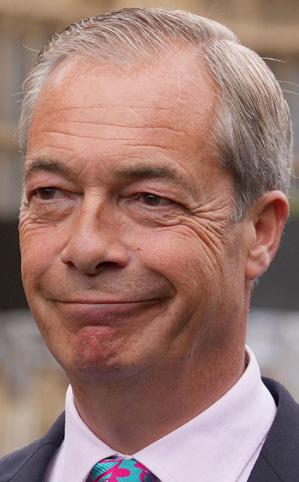

Farage’s former classmates and teachers have come out and described him as “a deeply unembarrassed racist,” “neo-fascist,” and a believer that “Hitler was right.” For perspective on who is voting for Farage’s party, a 2024 YouGov poll reported that 41% of Reform voters felt that climate change was not caused by human activity. Other U.K. parties currently holding Parliamentary seats include the Liberal Democrats, Scottish Nationals, Sinn Fein, Democratic Unionists, Green Party, Plaid Cymru, Social Democratic and Labour Party, Alliance Party of Northern Ireland, Ulster Unionist Party, Traditional Unionist Voice, and Your Party. Yes, the “Your Party” is an actual party name. They are socialists, so if you identify with that ideology, then they are indeed your party.
Why should we as Americans care about what is happening across the pond? The United Kingdom currently has the sixth largest GDP in the world. They are a critical trade partner for not just the United States, but hundreds of other nations. The U.K. is also one of the our closest allies and holds immense influence in international organizations like the North Atlantic Treaty Organization, United Nations, and World Trade Organization. Most importantly, the United Kingdom is reaching a political turning point. Keir Starmer is the most unpopular Prime Minister in British history with polls reporting that 79% of voters are unsatisfied with his premeirship. Many feel he and his Chancellor of the Exchequer Rachel Reeves have failed to fulfil his party's promises with issues like stagnation of the economy and high unemployment persisting. As aforementioned, many voters seem to be looking to the Reform Party as a probable vehicle for change, demonstrating that the United States is certainly not the only country with an increasingly prominent far-right populist movement. If the Reform Party is elected, civil liberties in the U.K. could be severely threatened.

Far-right nationalist protestors participate in a "Unite the Kingdom" rally on Westminister Bridge in front of the Palace of Westminister in September of 2025.
https://www.parliament.uk/ https://peo.gov.au/understand-our-parliament/history-of-parliament/ history-milestones/a-short-history-of-parliament https://labour.org.uk/people/keir-starmer/ https://www.theguardian.com/politics/2023/jun/23/keir-starmer-caughtillegally-selling-ice-creams-french-riviera https://www.conservatives.com/our-plan-for-britain https://www.bbc.com/news/articles/cd1xnzlzz99o https://www.bbc.com/news/uk-62750866
https://apnews.com/article/uk-election-national-service-rishi-sunakfdaf7e38793434e4f060c11735fef71e https://www.theguardian.com/politics/article/2024/jun/07/rishi-sunak-dday-blunder-uk-election
https://www.the-independent.com/news/uk/politics/rishi-sunak-springstatement-fuel-b2043138.html
https://www.mirror.co.uk/news/politics/millionaire-rishi-sunak-actuallyowns-26578755
https://www.britannica.com/biography/Boris-Johnson https://www.cnn.com/2022/01/10/uk/boris-johnson-number-10-drinkslockdown-intl-gbr
https://www.reformparty.uk/ https://yougov.co.uk/politics/articles/50971-what-do-reform-uk-votersbelieve-on-climate-change https://edition.cnn.com/2025/09/30/uk/keir-starmer-labour-partyconference-intl
https://commonslibrary.parliament.uk/research-briefings/cbp-8985/ https://www.politico.eu/europe-poll-of-polls/united-kingdom/#nationalparliament-voting-intention
By Simon Goode
Critics called it a money dump. Plagued by delays, technical challenges, and missed deadlines, NASA’s James Webb Space Telescope finally launched in late 2021—around nine billion dollars over budget and 14 years late. Honestly, it was a small miracle that James Webb launched at all. The resounding question in everyone’s heads: Was James Webb actually worth it, or were humans yet again victim to the sunkcost fallacy?
Webb was originally imagined as the “Next Generation Space Telescope,” immediately following the launch of the Hubble Space Telescope. Hubble suffered from a flaw in its mirror, causing initial images to appear blurry. NASA was terrified to repeat this mistake with Webb. Hubble could be repaired in a single space shuttle mission because it orbited relatively close to Earth. In contrast, Webb would be placed at the L2 Lagrange point, a special orbit roughly one million miles from Earth. While this orbit in deep space would increase picture quality significantly, it came with the increased risk that no rescue mission could be accomplished in the event that any of Webb’s systems failed. Webb is also much more complex than Hubble. While Hubble has a single circular mirror, Webb uses 18 hexagonal mirrors arranged to function as one large mirror. With that in mind, Webb’s development was inevitably wrought by tech issues, launch postponements, and rigorous testing–including tests under the cryogenic temperatures found in deep space.
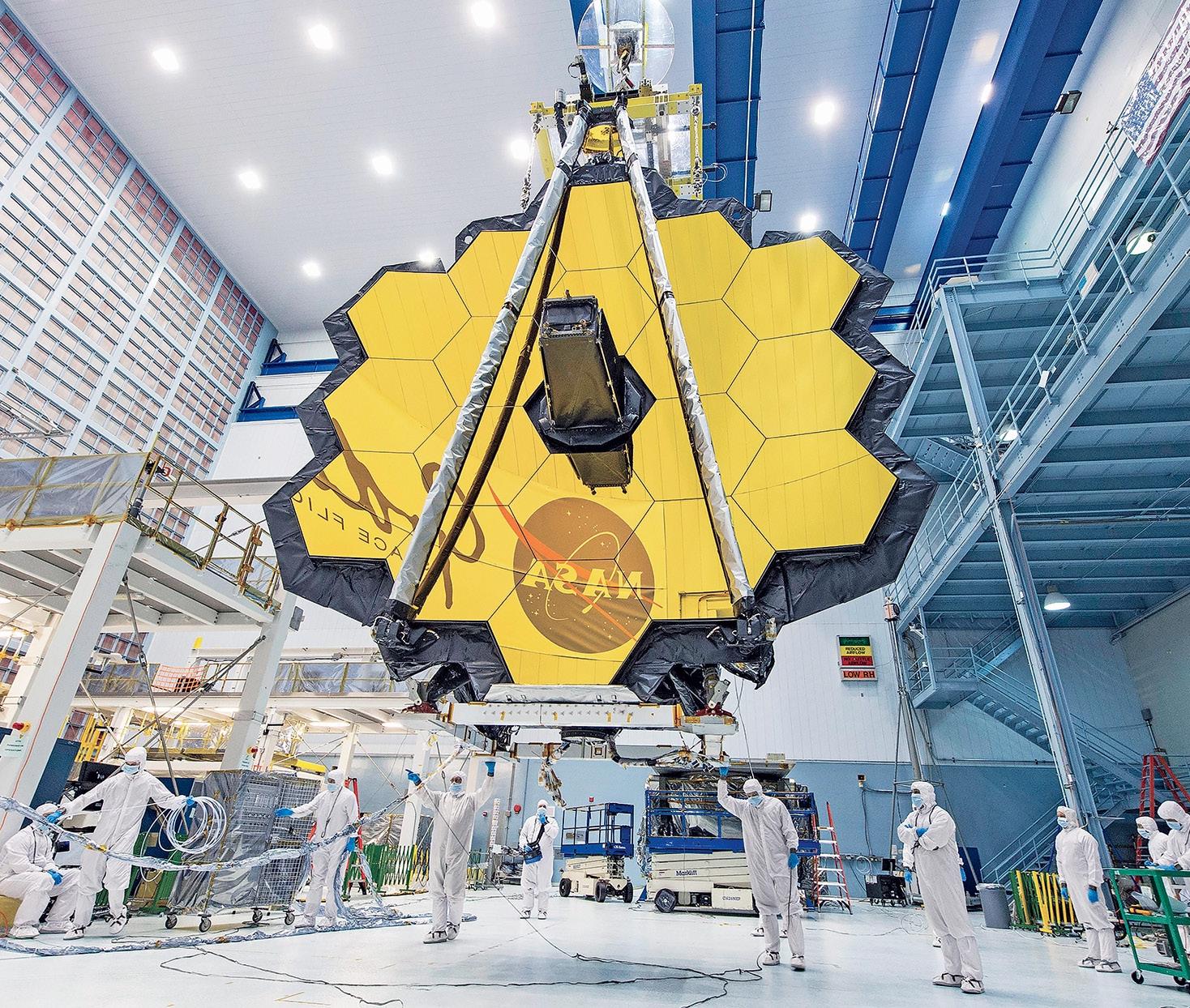
Despite these challenges, James Webb launched on December 21, 2021, carried aboard an Ariane 5 rocket. Webb reached the L2 point on January 24, 2022, and began releasing images less than 6 months later. Webb is different from Hubble in three major ways. Firstly, its aforementioned placement in the L2 Lagrange point, which both decreases disruption from heat and prevents the Earth from ever blocking observations. Secondly, its massive segmented mirror allows it to take in much more light than Hubble could, leading to a more sensitive telescope. Finally, Webb operates in the infrared range of light, whereas Hubble operates in mostly visible and ultraviolet light. Cosmic dust scatters shorter wavelengths of light, but the infrared light detected by Webb can pass through it much more easily.

With all that in mind, it’s no surprise that Webb was an instant success. On the same day Webb’s first observations were released, scientists announced that it had found clear evidence of water vapor on the exoplanet WASP96 b. Different molecules absorb different, distinct wavelengths of light. As an exoplanet passes in front of its star, measuring the light that isn’t absorbed by the atmosphere gives a picture of what molecules are and aren’t present. Just like any other molecule, water absorbs certain specific wavelengths of infrared light. Webb was able to clearly detect the presence of water vapor in the atmosphere of WASP-96 b. Previous
telescopes, like Hubble, have detected the presence of water on exoplanets in the past; however, these detections required long repeat observations and were still less precise. Webb was able to provide a clear picture of the composition of the atmosphere of an exoplanet hundreds of light-years away within a single observation. Beyond exoplanets, Webb also reshaped our understanding of the early universe. Because light travels at a finite speed, some light emitted billions of years ago is only reaching Earth today. To see back in time, all you have to do is look further away. Light from distant galaxies becomes fainter with distance and shifts toward redder wavelengths. Webb was specifically designed with this ability to see far into the past. At the distances Webb is viewing, light is incredibly faint and mostly in the infrared section of the spectrum. Webb’s large mirror and infrared sensitivity give it an advantage over telescopes of the past like Hubble, allowing it to see further than ever before. Its deep field images revealed galaxies forming less than 400 million years after the Big Bang, and some of these galaxies are surprisingly massive and bright. This is a major challenge to current models of cosmic evolution, which predicted a slower, more gradual assembly of the first galaxies.


of stellar nurseries within the Milky Way. Its infrared camera can penetrate dense dust clouds, allowing a clear view into the processes that birth new stars. One previously unseen phenomenon Webb saw was the presence of gas jets and outflows from protostars, which would then interact with the surrounding gas, having complex effects on the surrounding star formation. These observations have allowed scientists to refine their models of star formation, leading to more accurate predictions about how galaxies grow. So, was James Webb worth it? Absolutely. Despite the delays and costs, the science returned by Webb has been incredibly valuable. It has opened entirely new windows into the universe, from the detailed chemistry of distant exoplanet atmospheres to galaxies forming near the dawn of time.
James Webb has also captured detailed images
These discoveries were not as expected; they have forced scientists to rethink long-standing theories about how stars, planets, and galaxies form. Ambitious projects at the edge of human capability almost always face setbacks, but they also offer the potential for breakthroughs that smaller, safer missions cannot achieve. In Webb’s case, the gamble paid off. Rather than a tragic example of the sunk-cost fallacy, the James Webb Space Telescope showed that patience, precision, and long-term investment can pay off in the end.
In competitive swimming, where gold medals come down to the hundredths of a second, every detail matters, mostly because water is roughly 773 times denser than air and 55 times more viscous. To understand how a swimmer shatters a world record, looking into what swimmers wear while racing (a tech suit) will help. To move through a pool, a swimmer must overcome Hydrodynamic Drag (Fd). This force is the primary obstacle to speed and is defined below:
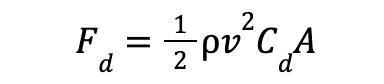
In this equation, represents the density of water, v is the swimmer’s velocity, Cd is the drag coefficient (which is determined by the texture and shape of a swimmer), and A is the front crosssectional area. Because drag increases with the square of velocity, a swimmer who wants to double their speed actually faces four times the resistance. Tech suits are engineered to manipulate the variables Cd and A to ascend past these physical limits. Before the invention of advanced polymers, swimmers relied on a biological solution to reduce Cd : shaving. By removing body hair and a thin layer of dead skin cells, swimmers create a smoother surface at a microscopic level, which maintains laminar flow.

By Arman Alborzi
these “Super-Suits” were made from non-permeable polyurethane panels. Polyurethane is essentially a thin sheet of plastic that traps a layer of air against the body. The LZR Racer provided two massive advantages. First, the air trapped in the suit increased the swimmer's displacement volume without adding mass, which increases buoyancy. Second, the suit acted as an exoskeleton, providing extreme compression that formed the human body into a nearly perfect hydrodynamic cylinder. This drastically reduced the frontal area (A). In 2008, 43 world records were broken at a single world championship, leading to a ban on these suits, which were labeled as “technological doping.”

Tech suits are swimsuits designed specificially for competitve events.

In fluid dynamics, the Reynolds Number ( ) determines whether water flows smoothly over the body (laminar) or breaks into chaotic swirls (turbulent). Shaving removes the “surface roughness,” which allows the boundary layer of water to stay attached to the body longer, delaying the transition to turbulence and reducing skin friction drag. A full shave-down can contribute to significant time drops (up to 5%).
The most radical shift in swimming physics occurred in 2008 with the introduction of the Speedo LZR Racer. Developed using NASA’s wind tunnel testing facilities,
Modern textile suits are now strictly regulated for buoyancy, but they still utilize physics to manage a swimmer’s torque. A swimmer can be thought of as a lever rotating around a center of buoyancy (the lungs), while their center of mass (the legs) naturally sinks. When legs sink, the frontal area (A) increases significantly, causing drag to rise drastically. To fix this, tech suits use high-tension bands across the glutes and lower back to assist in lifting the hips toward the surface. By maintaining this ideal body line, the swimmer ensures they retain a small frontal area to maximize speed. The complexity and many features of tech suits explain their high $400-$500 price tags. Tech suits are also custom to each swimmer.
Nate Agens, a swimmer on the FC swim team, prefers the Speedo Valor’s flexibility for dolphin kicks, while another swimmer, Hayden Kang, prefers the Mizuno for its stiffness in the 100-free.
While the “NASA era” of super-suits may be over, the underlying physics continues to drive brands like Speedo, Mizuno, and Arena to keep innovating. By manipulating the drag coefficients, managing buoyancy, and optimizing body position, the tech suit allows an athlete to reach their maximum velocity.
The question "Are we alone in this universe?" has been posed for centuries and has strongly influenced human exploration and culture. Hollywood has portrayed alien life as being extremely advanced and often a danger to Earth. The fact that you exist and are reading this makes such a portrayal almost certainly inaccurate. In their search, scientists have gone down a few paths in search of alien life. SETI (Search for Extraterrestrial Intelligence) primarily searches for alien technosignatures, such as narrowband radiowaves with complex patterns. Large telescopes, like the James Webb Space Telescope, look for atmospheres on exoplanets that either contain biological compounds, or industrial pollutants for clues of alien life; compounds such as CFCs do not form in nature and would indicate the presence of an industrialized society. Within our solar system, probes often carry instruments to analyze chemicals to see if life exists or has existed anywhere in our solar system. These probes have found every chemical needed for life as well as organic compounds. In the case of Mars, probes have found minerals usually formed by bacteria.


Although currently a dead world, Mars used to be quite hospitable to life. Last year, NASA’s rover, Perseverance, discovered a mudstone rock containing iron sulfate and iron phosphate, both of which are potential biosignatures. These minerals occurred as circular patches, similar to how they occur from biological processes on Earth. Additionally, in 2018, Curiosity, another Mars rover, discovered long organic compounds with 10–12 carbon atoms. These molecules require large amounts of energy to form, and as such are more commonly formed by life using them to store energy, or from the breakdown of larger molecules. More recently, Curiosity discovered sufficiently high concentrations of carbon in the ground to support life on Mars’ surface when Mars was covered in water and had a thick atmosphere. Additionally, over the 13 years that Curiosity has been on Mars, it has detected a seasonal fluctuation in the concentration of methane at the surface, with the highest levels being up to 40 times larger than the lowest levels. Methane breaks down into smaller molecules as
By Ian Wellman
a result of interactions with UV light, so increases come from a release of methane into the atmosphere, either from deposits, abiotic reactions, or life-based reactions. None of these discoveries prove that life exists on Mars or has ever existed on Mars; however, the combination of all of these potential biosignatures suggests that it is highly likely that life at least existed on Mars at some point.
While Mars is the easiest planet to study due to its proximity to Earth and “mild” conditions, it is far from the only object in our solar system that could, at some point, support life. Mars had liquid water for roughly a billion years before the atmosphere thinned too much for liquid water to remain, however it is not the only former wet world. Venus likely had water up until 700 million years ago, until a runaway greenhouse effect occurred, raising the surface temperature to melt lead. Currently, Venus’s upper atmosphere has mild Earth-like conditions, creating another potential region for life to exist in our solar system. Europa and Enceladus both have large global subsurface oceans and have been proven to contain organic molecules. Both have a high chance of having life around hydrothermal vents that form from tidal heating from the gas giants they orbit. When the Cassini orbiter traveled through Enceladus’s geysers, it detected the presence of complex organic compounds. Titan has a methane-based atmosphere as well as hydrocarbon oceans, creating the potential for a completely alien form of life based on completely different molecular structures. Organic compounds have even been found on asteroids. The sample returned from the asteroid Benny contains every single nucleic acid, and most of the amino acids. We have not yet found extraterrestrial life, but it is likely that life is not unique to Earth. Potential biosignatures across the solar system show the presence of many large organic molecules, as well as every single amino acid, and nucleic acid. This shows that the chemicals needed for life to start are common enough for life to have a chance to start wherever it can. Despite the potential reality that we never discover alien life, continued exploration will result in a deeper understanding of how life on Earth arose in the first place.

by eli olifson
The Fox Chapel Boys’ Basketball team has started their 2025-26 campaign on a high note. The season opened with a three-game win streak, beating Shaler, Greater Johnstown, and Chartiers Valley in a series of nailbiting affairs. The hot streak came to a close when the squad fell to Hempfield by a mere three points, in a 41 - 44 loss. However, they got right back on track three days later, beating Pine Richland before losing two in a row to challenging opponents, Woodland Hills and North Allegheny. However, the Foxes have been optimistic in facing their challenges. Senior John Rehak says, “These past two games have taught us many lessons, but the most important message to us is not taking anything for granted”, adding that “every possession matters, especially in the section we are in”. Rehak’s spirit is shared by the group, who at the time of writing, sits with a respectable 5-3 record, with three games to be played during winter break.

John Rehak
He leads the

proven
as
in
The Foxes are no stranger to success, as they haven’t had a losing season since before 2014. This means that simply finishing above .500 is not enough for the boys. The coaches and players expect to be playoff contenders every year, and this year is no exception. Rehak has now experienced four of these teams, and recognizes the same potential in this one, saying he believes they can make a run in the playoffs because of “the determination and the heart this team has. Everyone is willing to do what it takes to get the team a win.” The Foxes have their work cut out for them, with a tough upcoming
schedule, but with strong senior leadership and promising underclassmen, the squad is fit to get the job done. Although John Rehak has been the star for the Foxes thus far, leading the team in points per game, assists per game, rebounds per game, steals per game, and blocks per game, wins have still been a full team effort, with other key players like senior Viktor Golalic, junior Carson Rihn, and junior Grant Fenton carrying more than their weight for the Foxes.
Looking ahead, the Foxes will have 11 games to be played after winter break, with the final regular season match against Avonworth on February 9th. Other notable games in this stretch are rematches against Woodland Hills and North Allegheny, on January 23rd and 27th, respectively. Despite the upcoming schedule looking tough for the boys, resilience has been a core part of this team as far back as it goes. Examples of this have already shone through this season, like in the Foxes’ win over Chartiers Valley who were clear favorites in the affair. No matter how hard the Foxes’ schedule is, they will always stitch together a more than satisfactory season that is typically capped off with a good playoff run.
Through the first few weeks of the WPIAL basketball season, Fox Chapel looks to be on pace to continue their success on the basketball court. Nobody knows what the back half of the season holds, but the Foxes will continue to play winning basketball just like they have for years.
By Mary Clare Owens
Each year, new clubs are created at the high school to give students opportunities to participate in things that they are passionate about. There is a diverse variety of available clubs. Some focus on activities, like the Pickleball Club; others allow for cultural connection and awareness, like the Asian Culture Club. A new club for this year, co-founded by I, Mary Clare Owens, and Annabel Berkowitz, called Pittsburgh Care & Connection, or PCC, is focused on giving students the opportunity to help those who are unhoused in Pittsburgh. We both have always felt empathy towards people in need, so when Annabel came up with the idea of making PCC a club, I immediately said “yes!” Annabel, when asked about why she thought a club would be a good idea, said, “We recognized the extent to which people in Pittsburgh were struggling without housing and resources, and wanted to create opportunities for ourselves and others to help [them]”.
to faculty and staff to keep in their car to be handed to someone who is in need and asking for help. Within a few weeks, many teachers had given out their bags and were wondering when they could get more. We are aiming to do another collection on a larger scale later this year in order to pass out care packages to students to keep in their families’ cars.

Driving through Harmar, The Waterworks, and downtown, it is likely that you will see someone on the side of the road with a sign reading something along the lines of: “Homeless, anything helps!” It is also likely that most passing drivers will not provide assistance and just drive right by them. Our goal is to replace driving by with a caring exchange of rolling down the window and handing that person a care package. We started this year with the collecting of items such as tissues, pairs of socks, granola bars, etc. to put in gallonsized plastic bags. We then passed out the care packages
PCC’s sponsor is Dr. Ward, the high school’s librarian. She is excited to be a part of the club, and when asked about how she got involved with PCC, said, “Helping the unhoused is something that is important to my family. When Mary Clare mentioned that she and Annabel submitted a club proposal to make care packages for the homeless and had other ideas to help others in need, I asked if I could help.” Dr. Ward has been a huge help in the creation of this club, and continues to support PCC as we do various fundraisers, collect items for packages, and generate new ideas for the rest of the year. She said, “We are looking forward to partnering with other clubs to do more and help even more people in need.”
Compassion and empathy are a couple of the biggest ways to care for people. PCC wants to prioritize making connections with those who are less fortunate in our community through simple acts of compassion. Handing a care package to someone is just one example of a compassionate act, but as the new year begins, PCC is ready to expand their ways of giving everyone at the high school opportunities to help the unhoused.
Eight Fox Chapel Area High School students had pieces accepted and displayed at the 2025 FUSION Youth Metal Arts Showcase. The students are seniors Adele Grady, Raina Guzman, Riley Hemingray, Emma Kuhns, and Mary Lynch; junior Olivia Arca; sophomore Troy White, and freshman Elijah Turner. Additionally, Olivia won the top award, the Juror’s Grand Prize, for her piece, “Picnic for One,” and Adele won the prize for Best Use of Color for her piece, “Deep Sea Jewel.” The showcase was open to students in kindergarten through grade 12 from throughout the greater


Pittsburgh area, and all work must feature metal as a material or in the process of creating the art. The show featured small works in aluminum, pewter, copper, brass, and silver. The showcase was hosted by the Children’s Museum of Pittsburgh MuseumLab as part of FUSION Fest and ran November 23rd, 2025, through January 3rd, 2026. The show was located in the lobby of the MuseumLab and no musuem admission was required to view the show. The students were under the instruction of art teacher Sarah Stewart Vasquez.
By Matthew Bartolacci
In recent years, the NCAA has changed college sports. College Football has been one of if not the biggest recipient of these changes. There is now a transfer portal for athletes, NIL (Name, image, and likeness) contracts for athletes, expanded playoffs, and very relaxed rules in some areas like coaches taking new jobs. Some people like these changes, which give college players more freedom and even a more fair system for athletes to be compensated, especially considering the average annual revenue of college football is $14 billion. Having these changes is one thing, but the poor organization of the college football calendar creates a myriad of new issues for the NCAA.
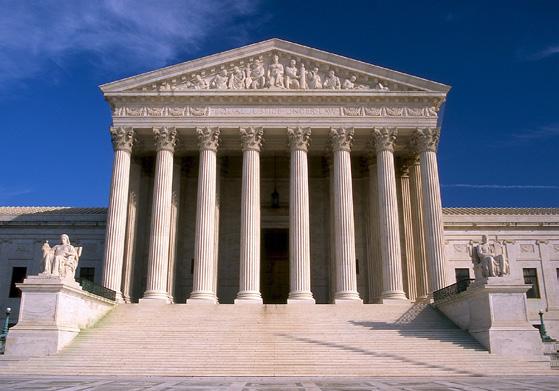
dominant program and got the top recruits. In one of his speeches to Congress, he described that he held a breakfast at the beginning of the year for new players at his house. Even his wife was involved: she would talk to the players' moms and let them know how they would develop players and make them NFL prospects and national championship contenders. In 2023, Saban’s last year of coaching, he said that the moms cared little about development and more about how much their sons were being paid through NIL. Saban used this example to show that as money took over, his culture meant less to his recruiting numbers ultimately leading to his retirement in 2023. If the NCAA fixes the rules regarding NIL, coaches will mean more to how players choose their college programs.

Although NIL is not an issue with the college football calendar, it is still a major issue. The loyalty to programs and the brand coaches set has become irrelevant to players who are seeking the most money they can get. Legendary Alabama coach and possibly the greatest college football coach of all time, Nick Saban, has spoken to small roundtable groups in congress a few times. During these roundtables, he stressed that there should be revenue sharing for players meaning each player gets paid the same out of a certain percentage of the total revenue brought in that year. Although this would be viewed as unfair for the top athletes, it would fix college football.
The Oregon Ducks, one of the best college football programs at the moment, spent $20-26 million in NIL money in 2024 which was in a top four budget for NIL. With four teams left in the College Football Playoff at the time of writing, Oregon is one of them. University of Texas El Paso (UTEP) had a budget of $600,000 until June of 2025. They went 2-10 in Conference USA, a conference with less competitive teams compared to the Big Ten, Oregon’s conference. This proves that the team that paid the most did the best. If NIL money is evenly distributed, not only do players still get paid, but they also commit to schools based on the culture of that program.
Nick Saban was known for developing players and creating a culture at Alabama that made them a
Every year the transfer portal has become a little bit more important. It started as a way for players to leave their school if they didn’t like the team or coaching staff. Now it has turned into a free for all with players trying to go for the most NIL money. In 2025, 4,000 players entered the portal. The teams that are losing players to the draft or portal are just rebuilding through the portal rather than developing talent. ESPN analyst Pete Thamel described the portal as a, “ridiculous free-for-all.” Although this aspect of the portal angers some fans, the most problematic part is when it happens.
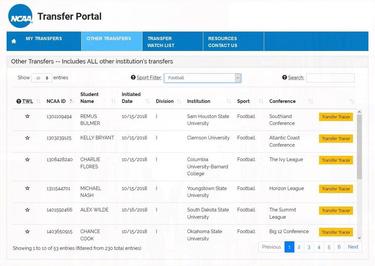
The transfer portal is open January 2nd through the 16th. The national championship is January 19th. There is an extended window for players in the national championship from January 20th-24th, but this leaves players limited time for visits and thorough decision making of where they want to play the next year. This is not the only reason that the portal needs to be pushed back. Coaches are currently allowed to sign a deal to coach at a different team mid season. The most notable of this issue was Lane Kiffin leaving Ole Miss for Louisiana State University (LSU) on November 30th, two days after Ole Miss completed an 11-1 season. There have been differing accounts about whether or not Ole Miss would let him stay to coach in
the playoff, but the most widely accepted is that the Ole Miss athletic director, Keith Carter, did not let him, considering he is now the coach of a conference rival. If there is a window after the season and before the transfer portal for coaches to sign new contracts to different teams, it prevents a coach from having to choose between possibly winning a national championship and advancing his career.
During the regular college football season, games are played every Saturday. Most fans would have assumed with the new 12 team playoff that this would be no different. Not even close! The four teams with byes all played a conference championship which all took place on December 6th. These teams did not play until December 31st or January 1st giving them almost a month off. This creates a severe disadvantage for these teams as they come out rusty and unprepared due to the lengthy break. This has been shown in the first two years of the expanded playoff because teams with a bye to the quarterfinal have gone 1-7 in their first game.
The number one ranked and Big Ten champion Indiana Hoosiers were the only team to break through the quarterfinal.
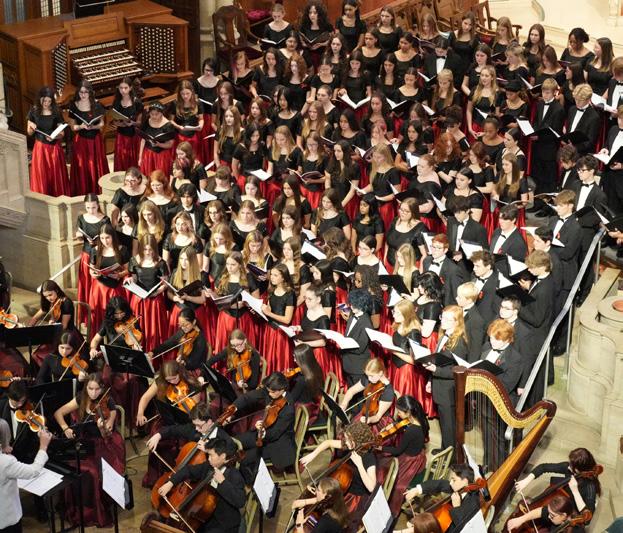
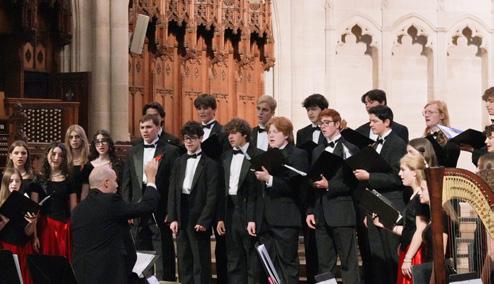
The Fox Chapel orchestra and choir combined forces at the biannual Major Works Concert at the East Liberty Presbyterian Church. They played Illuminare, a five movement piece for orchestra and choir. The piece represents the journey of life and dealing with hardships: the first movement, Splendor, is meant to be joyous and portray the happiness of life; however, as the piece continues through the second movement, Caritas, into the third movement, Nox, life’s struggles bring darkness; finally, the piece culminates with the fourth and fifth movements, Munera pacis and Illuminare his, which represent happiness after a time of hardship. Conducted by orchestra director Ms. Cooper, the piece also featured harpist Aislynn Senn. It was a great performance!

Moving these games up will create a more competitive quarterfinal round. For example, Ohio State, a team that has held an exemplary level of play all year, was trailing 14-0 at halftime against Miami. They looked flat and came out of halftime playing much stronger, but it was still too little to come back, losing 24-14. They came out playing like they just had a twenty-five day break. People even took to social media to voice their disapproval of the poor playoff schedule after seeing Ohio State’s lousy firsthalf performance. If the College Football Playoff Board moves the quarterfinals up, they will find an outstanding round of competitive football that encourages people to attend games or watch them on TV.

The Ohio State University Buckeyes were possibly disadvantaged by this year's college football schedule with a 24-14 loss to the University of Miami Hurricanes.
By Eloise Johnson
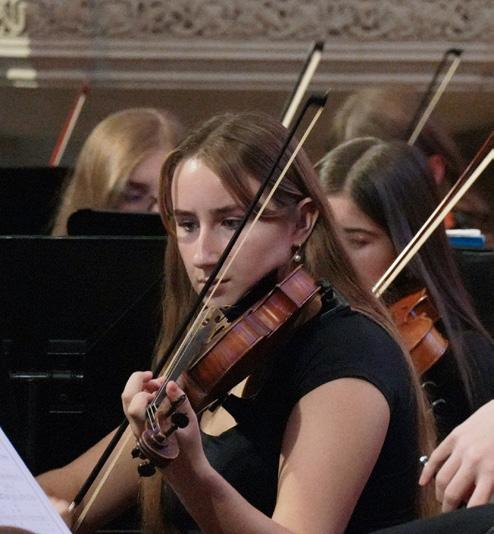
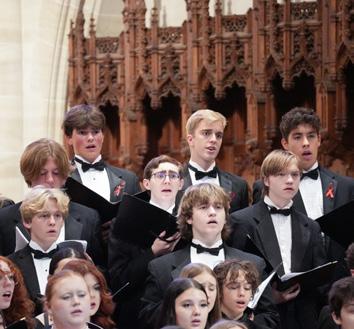
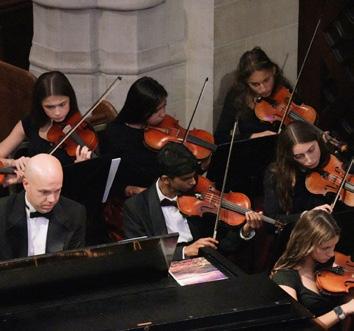
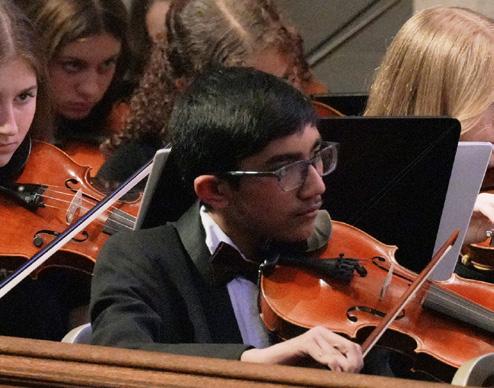
“I’m so excited about the Major Works concert being during my senior year. It was such a great collaboration with the choir. There was a lot of nuance and depth in the piece, and it really resonated with me.”- Zinta Jacob, violinist
“I loved performing with the choir. It was my first high school orchestra concert, and I’m so excited for future performances.” - Rishi Krishnamurthy, violinist

“AI helps all people connect to the privileged community of art.” That seems to be the main umbrella all excuses for using AI “art” fall under. Art is sometimes perceived as inaccessible to people who are not born with talent. Thus, the people that don’t have “talent” use AI programs to create art for them, but do the people using these programs understand how harmful AI truly is in the art community?
AI art is taking the world by storm currently. Companies are using it for advertisement, people are posting it online and claiming it as their own, even projects online use this form of AI. An example of this is Angel Engine, an analog horror series on TikTok that entirely uses AI for its art. No place is truly expelled from AI, in fact, many art stores like Michaels even sell AI art. You can even see it around the school. Many posters, club advertisements, and handouts around the school now feature AI generated art. You might not be able to tell at first, but tails forming into arms and an unusual amount of fingers might be a clear indication.

What is the harm, you may ask? Why do people always preach about how toxic AI art really is for art as a whole? It’s just fun and games, right? Well, the simplest answer that can be given to that is “no.” AI art ties into a more complex harm than what meets the eye.
To start, AI uses machine learning. It needs to learn the algorithm of art before it can actually produce a piece. These programs, however, don’t teach AI off of willing artists, who are being paid for their time and commissions to teach this algorithm. These programs learn off of other uncredited artists who did not give permission for their art to be used in this way. That is how AI knows how to draw in certain art styles, because it practices the styles of existing artists, many of whom likely don’t want their work to be used in this way. For example, the artist Viyaura had their art stolen by an AI scammer. They posted the original art online to promote the brushes they use on the drawing app, Procreate. This scammer was selling AI versions of Viyaura’s art on Etsy without their consent. Viyaura never consented to having their art used in this way, and especially not for profit.
Some people may say “so what?” “They aren’t training the model, so they aren’t responsible for it, and thus they aren’t in the wrong.” That could not be further from the truth. Even if you aren’t actually training the
By Giselle Silva
model, you are still condoning unethical practices. You are condoning theft. And yes, by the way, you are training the model. Every time you put in a prompt to AI, it gets more intelligent. It learns how to fix its algorithm even more so the product becomes better every single time. Like humans, it learns over time. This makes it so hands start having the right amount of fingers, faces the right amount of eyes, and folds become actually coherent. The harm of this is that if AI comes to have the same amount of intellect as artists who have put in years in their work, we will not be able to tell what is AI and what is human.
A few months ago, a post went around the internet of a drawing of Hatsune Miku, a manga character. The caption on the post was simple, “is this AI or not?” Almost nobody could tell at first glance because it looked exactly like something an artist would have made. In fact, you were only able to tell if it was AI or not by examining the tiniest details of the piece. @Aquonyx on X, the site formerly known as Twitter, was able to tell that this was AI because of the shading, shadows, and the fact it had two tails (it is almost unnoticeable though, unless you take a second look). Even actual artists were arguing about who made this piece. If AI gets to the point where not even an actual artist can tell if a work is AI, then art as a whole will not be sacred anymore. Who would want to learn how to draw if a computer can draw for you in under a minute?
Many people think artists are privileged people who have a high opinion of who can and cannot join their community. In some ways, they are correct. Some artists online ridicule younger artists who have more skill, because they shouldn’t be more talented. I can say this with a full chest: most people aren’t like that. Art is not something you are born with, like how you are not born knowing how to read or write. It is something you train yourself to do over time, a skill that requires a lot of patience and willingness to learn. Just because someone can’t draw right now does not mean they cannot learn how to. Until the 19th century, art was a privilege only to be enjoyed by the upper class. The art community, however, is no longer made of the “most elite.” Almost all artists will support you along your journey. But you need to take that journey yourself, not make a computer do it for you.
Because of a single click, AI is condemning millions of artists to a loss of passion. Voice actors are having their voice stolen for profit. Just this year, SAG-AFTRA
(Screen Actors Guild-American Federation of Television and Radio Artists) called a strike against the use of AI for digital voice replicas. Voice acting studios like Formosa Interactive and Artlist wanted to go forth with using AI to replicate the voices of paid actors. Games like Kingdom Hearts 4, Genshin Impact, Cookie Run Kingdom, Destiny 2, and League of Legends thus went without many of their actors for months because of the strike. Actual artists are losing business because nobody wants to commission them for something a computer can do. In an article written by Brian Merchant on the website Blood In the Machine, an anonymous artist said the following: “I've been out of work for a while now. I made children's book illustrations, stock art, and took various art commissions. Now I have several maxed out credit cards and use a donation bin for food. I haven't had a steady contract in over a year. Two weeks ago, when a client who has switched to AI found out about this he gave me $50 out of ‘a sense of guilt. Basically pity for the fact that Illustrator, as a job, does not exist anymore.” Disney is even making an application on Disney+ where you can make your own Disney short movie using generative AI!

OWhether we like it or not, a passion that has been around since the beginning of humanity is going to be lost to AI.
So, what can you do to help? It is simple, stop using these programs. Stop training generative AI to steal more people’s ideas and passions. AI use is based on profit, so if nobody uses AI, companies will stop promoting it. In addition, you should try to promote art as a whole. Maybe start following more artists online, or pay for a commission. If you want to promote more handmade art, the artist ExtremelyEllie on Instagram has started a series where she replaces AI art in her school with actual art. I would recommend following this trend in order to fill our school with more talented art! Artist alleys are also a very good way to promote art as a whole (I recommend Handmade Arcade – it is a convention that supports many indie artists!). You can also support the group Stop Killer Robots, which is a campaign that fights for legislation for the use of AI.
The easiest and most important thing to do to stop the spread of AI art, is to stop using it. Stop AI generatedart, and heal the passion of human-generated art once again.
n the tenth of December, Fox Chapel hosted the Jingle Bell Bash! We raised donations to support Backpack for Hunger! The Jingle Bell Bash was a wintery way to bring our community together this holiday season. Admittance to the event was free, but attendees were highly encouraged to make donations to the charitable cause. In the auditorium entrance, there were decorated donation boxes for people walking into the event. After making their way down the business hallway, families were met with a snowball toss and a pin the nose on frosty game. Moving past the hallway, the commons and cafeteria were filled with many more games and treats to enjoy!
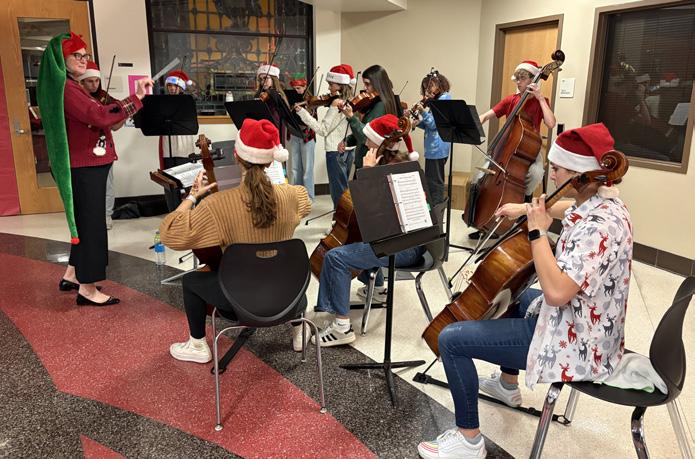
The Jingle Bell Bash was split into two parts, the activity room and the entertainment room. The commons area was filled with entertainment. In the commons, students from the orchestra performed beautiful pieces for eventgoers to enjoy while they grabbed treats and snapped some photos with Santa. The orchestra set a joyful mood for the



By Maeve Beresford
whole night! Kids were also welcome to take photos with Santa, Mrs. Claus, and even one of Santa's elves! There was hot chocolate and popcorn in the commons area to pair with the holiday fun! Past the commons, the cafeteria hosted plenty of winter-themed games and activities.
Popular offerings at the Jingle Bell Bash included hair tinsel, bingo, and snowman cup making. The hair tinsel included a huge range of colors. Tons of kids left with festively colored tinsel in their hair. Bingo ran through prizes quickly because of the amount of kids playing. There were plenty more crafts and games around the school, such as story time, face painting, and gingerbread house making! The Foxes Den was open for business too, and many parents stocked up on winter weather clothes for the cold season.
After lasting two enthralling hours, the Jingle Bell Bash ended at around 8:00! This event was a great way to raise money for an excellent cause, as well as bring the community together this holiday season!

By Rishi Krishnamurthy
Mathematics has significantly advanced due to rare thinkers who viewed the world through the lens of numbers and patterns. For that reason, I began a series last year exploring the lives of these remarkable mathematicians and their lasting contributions to mathematics. Throughout the first two parts of this series, I traced the paths of Euclid, Noether, Gauss, Hypatia and Pythagoras, Lagrange, and Turing. In the final part of this series, you will read about yet another group of masterminds whose ideas reshaped the field of mathematics.
My name is Rishi Krishnamurthy, and I am currently a freshman at Fox Chapel Area High School. Each quarter, I write an article about numbers and mathematics for Fox Tales Quarterly. I intend to continue A Math Minute through my senior year, so make sure to follow along in each issue!
In the last issue, I explored how probability shapes the way we interpret uncertainty. I explained how Bayes’ Rule can result in counterintuitive outcomes and discussed the ideas of mutual exclusivity and independence to show how different events interact. I also looked at the wide range of real-world applications of probability; for example, gambling is a familiar example of risk. Finally, I used expected value and variance to show why games with similar averages can carry dramatically different levels of uncertainty.
In this issue, I will continue my series, examining the work of Newton, Euler, Ramanujan, and Germain. Though some names will be more familiar than others, all four of these individuals had brilliant minds that forever changed the world of mathematics.


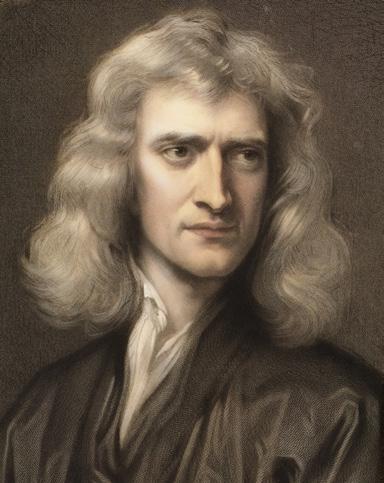
Isaac Newton (1642–1727) was an English mathematician, physicist, and astronomer. Born prematurely on Christmas and not expected to survive, he grew up to redefine nearly every scientific field he touched. Newton’s most famous mathematical accomplishment is the development of calculus, which he formulated while hiding out at his family farm during the Great Plague of 1665–1666. He also created the binomial theorem and made major contributions to numerical methods, optics, and algebra. His book Philosophiae Naturalis Principia Mathematica, often considered the most important scientific book ever written, introduced the three laws of motion and universal gravitation. I am confident that you have heard the famous story about Newton seeing an apple drop from a tree, inspiring his thinking on gravity. Newton was notoriously private and fiercely competitive. His feud with Gottfried Wilhelm Leibniz over who invented calculus first became so heated that Newton essentially oversaw the investigation into the dispute, which, unsurprisingly, concluded Newton was right. Ultimately, Newton’s work laid the foundation for classical mechanics and influenced centuries of mathematical development. Today, Newton is known as a brilliant icon of mathematics and science whose curiosity reshaped the world.
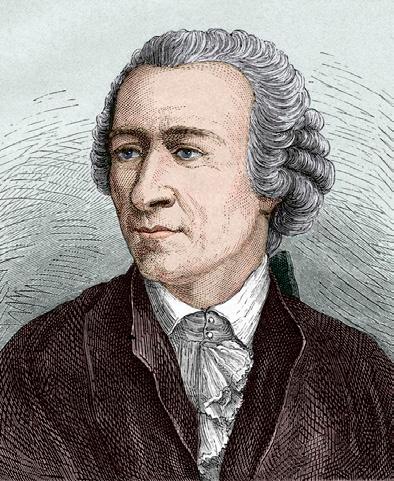
Leonhard Euler (1707–1783) was a Swiss mathematician whose productivity bordered on the unbelievable; he published more than five hundred papers during his lifetime, and another three hundred fifty appeared after his death. His work shaped nearly every major branch of mathematics. Euler introduced much of the notation used today, including ‘e’ for the base of the natural logarithm and the elegant identity eiπ + 1 = 0. He advanced calculus, number theory, graph theory, and differential equations,
and he solved the famous Königsberg bridge problem. Euler also produced influential textbooks that educated generations of mathematicians. Euler gradually lost sight in one eye and later became almost completely blind. Nevertheless, as some say, his vision merely freed up more of his mind for mathematics. Euler reportedly performed long calculations in his head while dictating multiple papers at once. It was his intellectual depth and endurance that secured his place as one of the central figures in the development of modern mathematics.
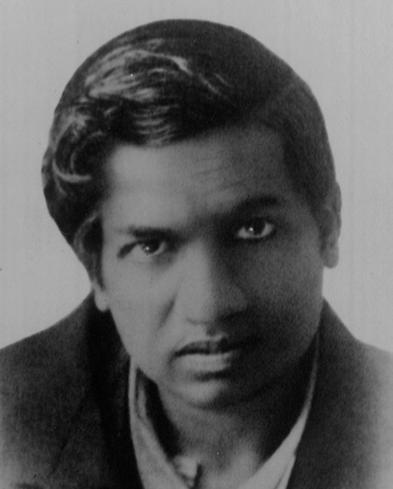
Srinivasa Ramanujan (1887–1920) was an Indian mathematician whose intuition for numbers was so extraordinary that even today many of his results remain astonishing. Growing up with little formal training, he filled notebooks with thousands of identities, formulas, and conjectures. He found astonishing infinite series for π and other irrational numbers, which I encourage you to explore. Ramanujan’s collaboration with G. H. Hardy at Cambridge produced deep work on continued fractions, elliptic functions, and modular forms. Despite chronic illness and the hardships he faced abroad, he continued producing results mindblowingly quickly, often deriving formulas that seemed to appear fully formed in his mind. Ramanujan passed away at only thirty-two, but he left behind a legacy of ideas that continue to inspire modern mathematics.
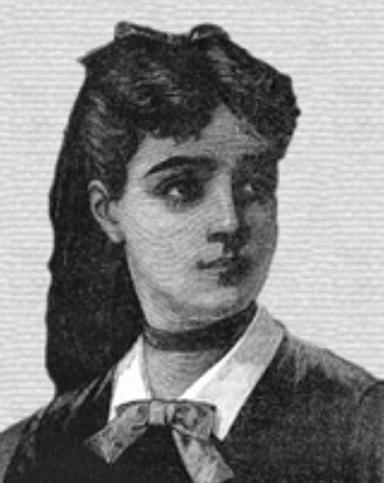
Sophie Germain (1776–1831) was a French mathematician whose determination became as renowned as her work. As a woman, Germain was barred from formal study, but she secretly borrowed lecture notes from the École Polytechnique and submitted assignments under the male pseudonym “M. LeBlanc.” Her talent quickly drew attention. When Lagrange, who I wrote about last year, discovered her true identity, he encouraged her to continue, impressed by the clarity of her reasoning. Germain made major contributions to number theory, especially in her work on Fermat’s Last Theorem, where her “Germain primes,” which I hope you will explore, provided one of the earliest substantial advances on the problem. She also won the Paris Academy of Sciences prize for her research on the vibration of elastic surfaces. Germain’s story remains a testament to intellectual courage.
I will end this article with my customary mathematics joke. This week’s story involves a teacher tree questioning a student tree about unfinished math work. The student replies, “I am quite afraid of mathematics. My grandfather was an exceptionally studious tree, and when he began studying radicals, he found himself developing Square Root Syndrome. Before long, all of his roots had become perfectly square.”
Over the weekend of January 10-11, 13 students from the Mock Trial Club competed at the University of Pittsburgh's 23rd annual Cathedral Classic Mock Trial tournament. Out of the 48 teams (representing 31 schools from across the state of PA), Fox Chapel Area finished in 9th place. This was their first time in recent years to attending this tournament and has been their best result from the past four years of competition. All of the students who competed, deserve massive congratulations for this achievement. The event was highly competitive, especially with previous state champions in attendance.
Plaintiff Team (Top Photo):
Lawyers: Aislynn Senn (11), Nadra Digbhou (11), and Anna Chrissis (10)
Witnesses: Maggie Handron (10), Gabriel Yassin (11), and Laila Golla (12)
Defense Team (Bottom Photo):
Lawyers: Noelle Fouron (11), Aiden Drucker (11), and David Zakrocki (11)
Witnesses: Ainsley Goode (11), Collin Fasanella (11), and Nico Zguryzynski (11)

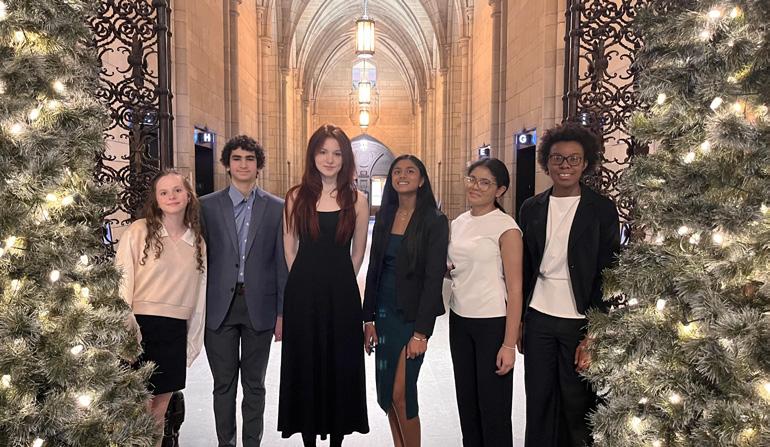
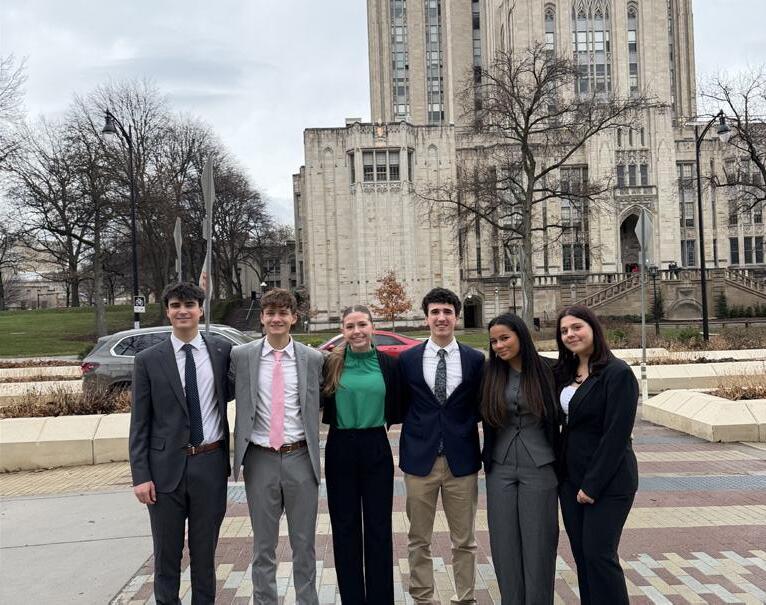


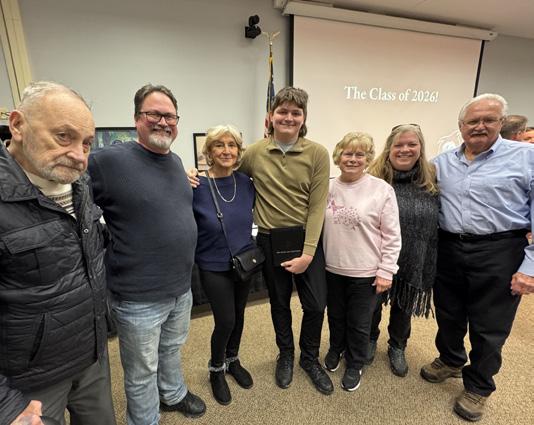
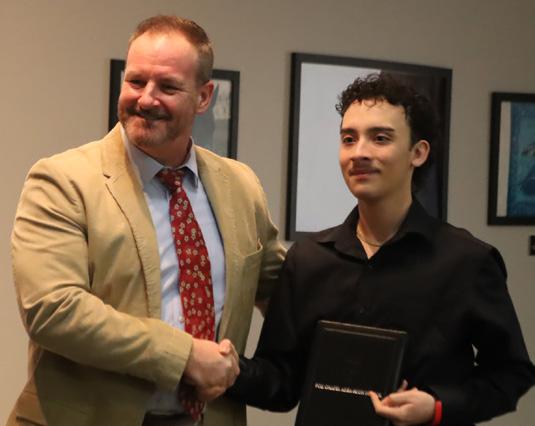
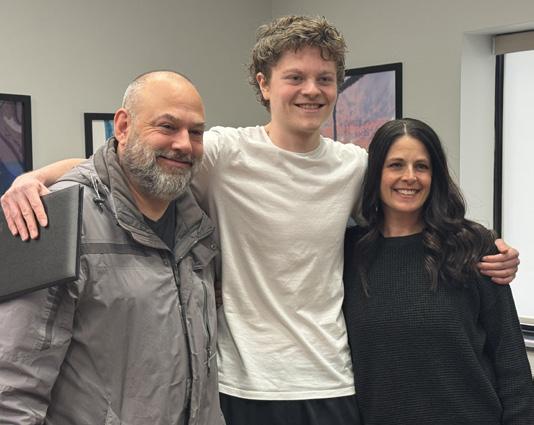

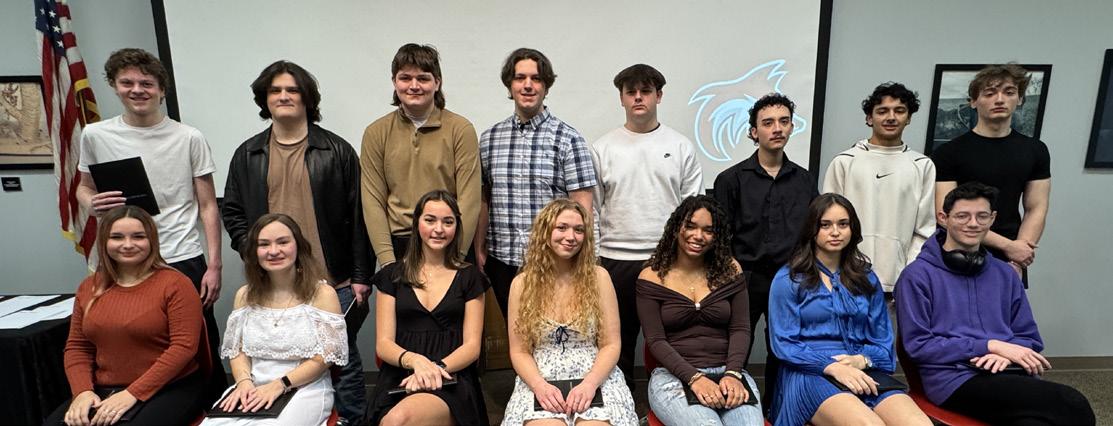


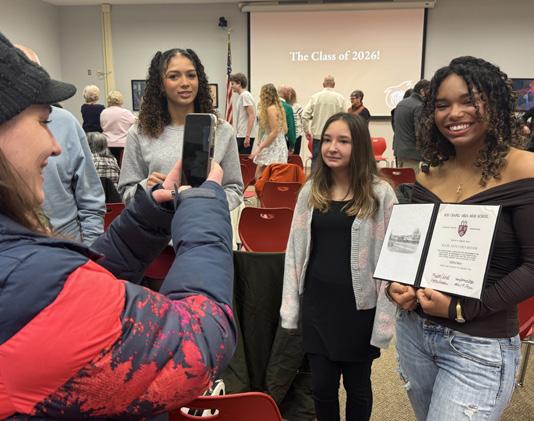

Fox Chapel Area High School students received eight nominations in Prime Stage Theatre’s 6th Annual High School Drama Awards. The students were nominated for their performances and/or involvement in “Our Town,” the high school’s fall play. The students nominated are senior Robert Svenson in the best actor category, senior Grace Gouwens in the best actress category, sophomore Solomon Edwards in the best supporting actor category, senior Faye Muller in the best supporting actress category, senior Lily Cannon in the best student stage manager category, juniors Erin Stein and Elias Zeiner in the best student sound design and/or
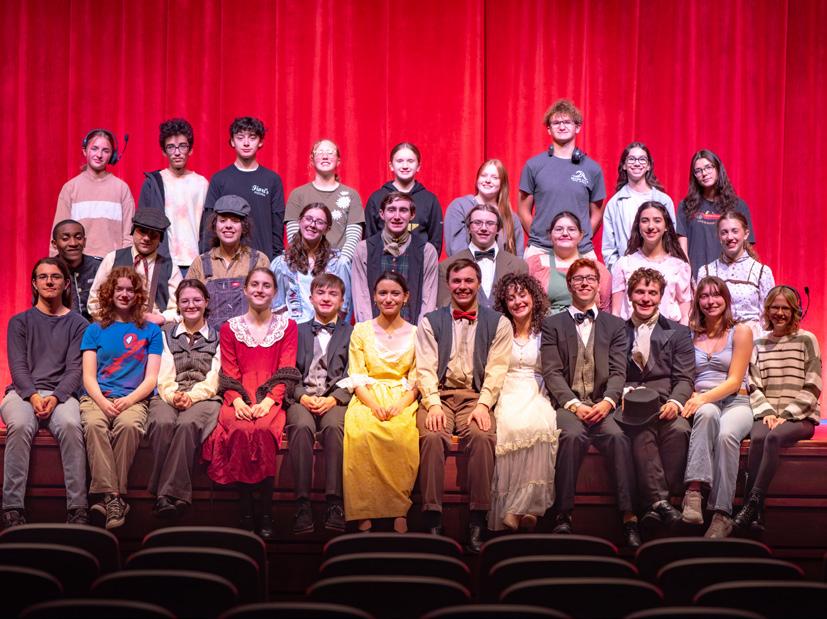
operation category, and seniors
Abigail Haas and Molly Krajcovic in the best student makeup design and/or application category.
Additionally, Fox Chapel Area’s fall play was nominated for the best student onstage run crew. The crew members were senior Josiah Woodard-Lehman; sophomore Patrick Svenson; and freshmen
Sidney George, Henry Muller, Audrey Seiler, and Rebecca Smith. The awards ceremony was held January 10th at the Hillman Center for Performing Arts on the campus of Shady Side Academy Senior School where the winners will be announced. The awards were open to schools from across Southwestern Pennsylvania.







Karsten Buchert Editor-in-Chief


Giselle












Special