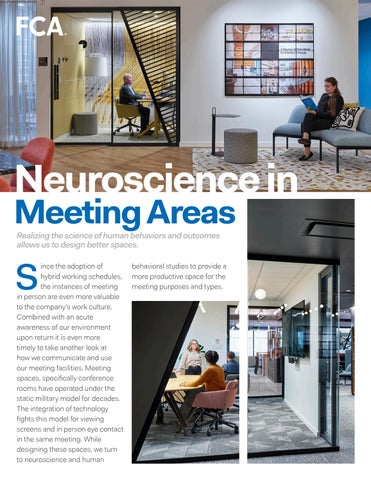
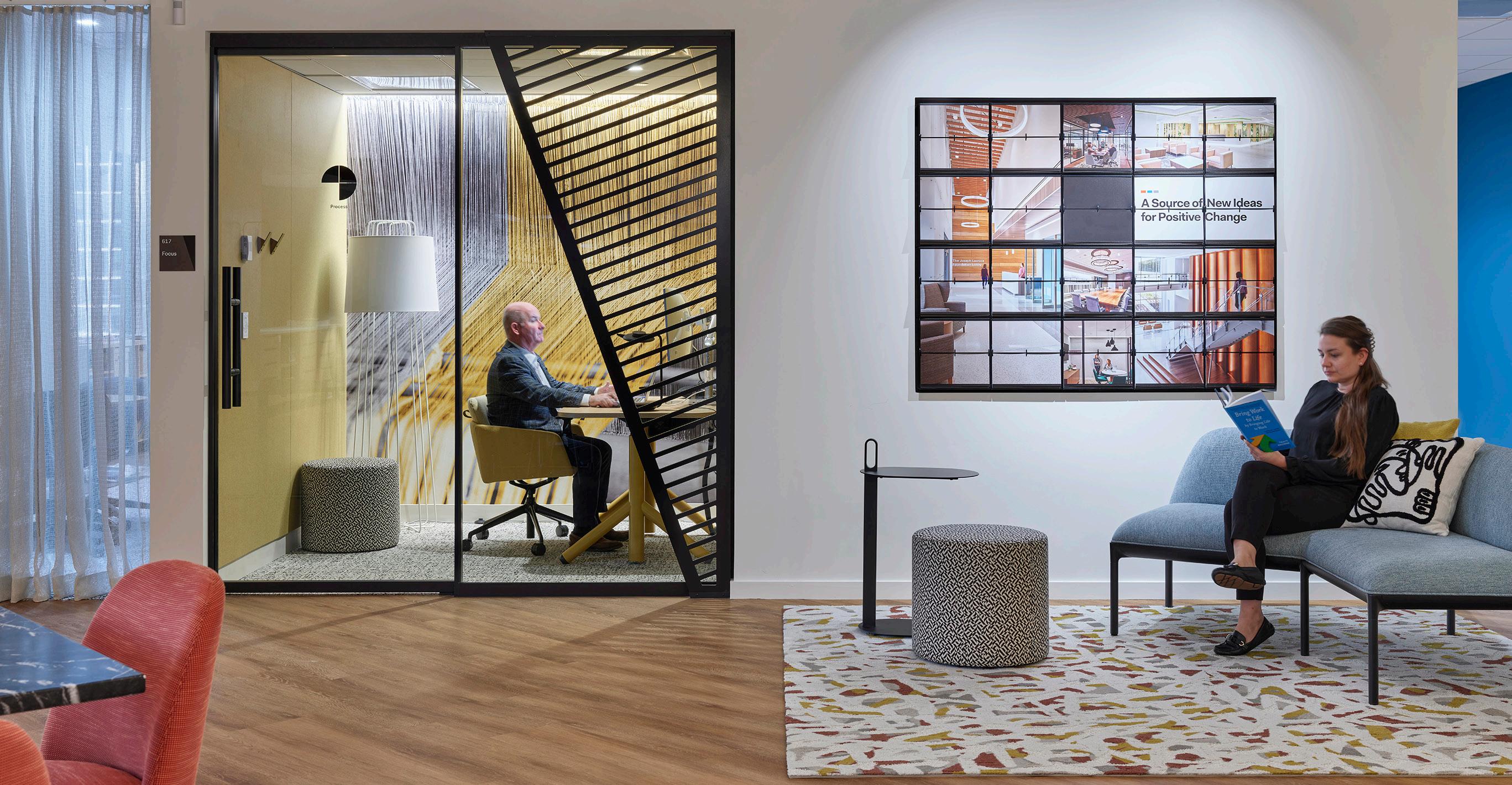
Meeting Areas Neuroscience in
Realizing the science of human behaviors and outcomes allows us to design better spaces.
Since the adoption of hybrid working schedules, the instances of meeting in person are even more valuable to the company’s work culture. Combined with an acute awareness of our environment upon return it is even more timely to take another look at how we communicate and use our meeting facilities. Meeting spaces, specifically conference rooms have operated under the static military model for decades. The integration of technology fights this model for viewing screens and in person eye contact in the same meeting. While designing these spaces, we turn to neuroscience and human
behavioral studies to provide a more productive space for the meeting purposes and types.
Spaces
Suggested minimum sizing for meeting areas:2

Meeting areas in open plan can be programmed at 20 SF per person
In meeting rooms, a minimum of 25 SF per person. (For formal meetings spaces, 35 SF) If a meeting space requires special equipment or events assume minimum of 35 SF per person.
Physical Space
When lunch tables are larger(up to 12 people), people interacted in larger groups, and “People who interacted in these large lunch groups were 36% more likely to interact with each other at some other point in the day.”7 Making Decisions Socializing Sharing Information Resolving Problems Generating Ideas
A space for standing interactions, such as town hall announcements assume 11 SF per person.*
*Building assembly codes may apply.

Conversational meetings require eye contact. When engaging others during a meeting it is important to have an object in line of sight that serve as a subject to take a “focal break”. Focal breaks are especially important for virtual meetings. Constant direct stares are subconsciously seen as threatening.3,5
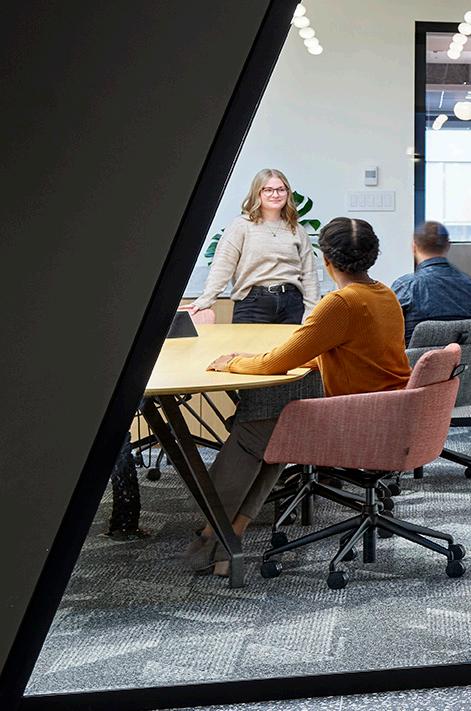
Group spaces are most effective when they seat 4 to 8 people for collaboration. Groups containing 3 to 8 members were significantly more productive and more than groups with 9 members or more. Once you’ve got 7 people in a decision-making group, each additional member reduces decision effectiveness by 10%.6,16
Round tables lead to more unrestricted conversations while rectangular tables naturally promote a group leader. If a group doesn’t have a leader when a conversation begins, someone will likely sit at the shorter end of a table and begin to act as a leader.3,5
People are most likely to participate if they can make eye contact with the other people present People in classroom style rows don’t participate at the same rate as people who are seated in a circular arrangement.
If all the leaders choose to sit along one side of the table during a meeting, they tend to dominate a conversation.
People are more likely to cooperate with someone they’re meeting with when they’re sitting across from them as opposed to being beside them.8
When people are speaking across the corner of a table—with edges of their chairs are at 90-degree angles to each other, they can better handle difficult topics.
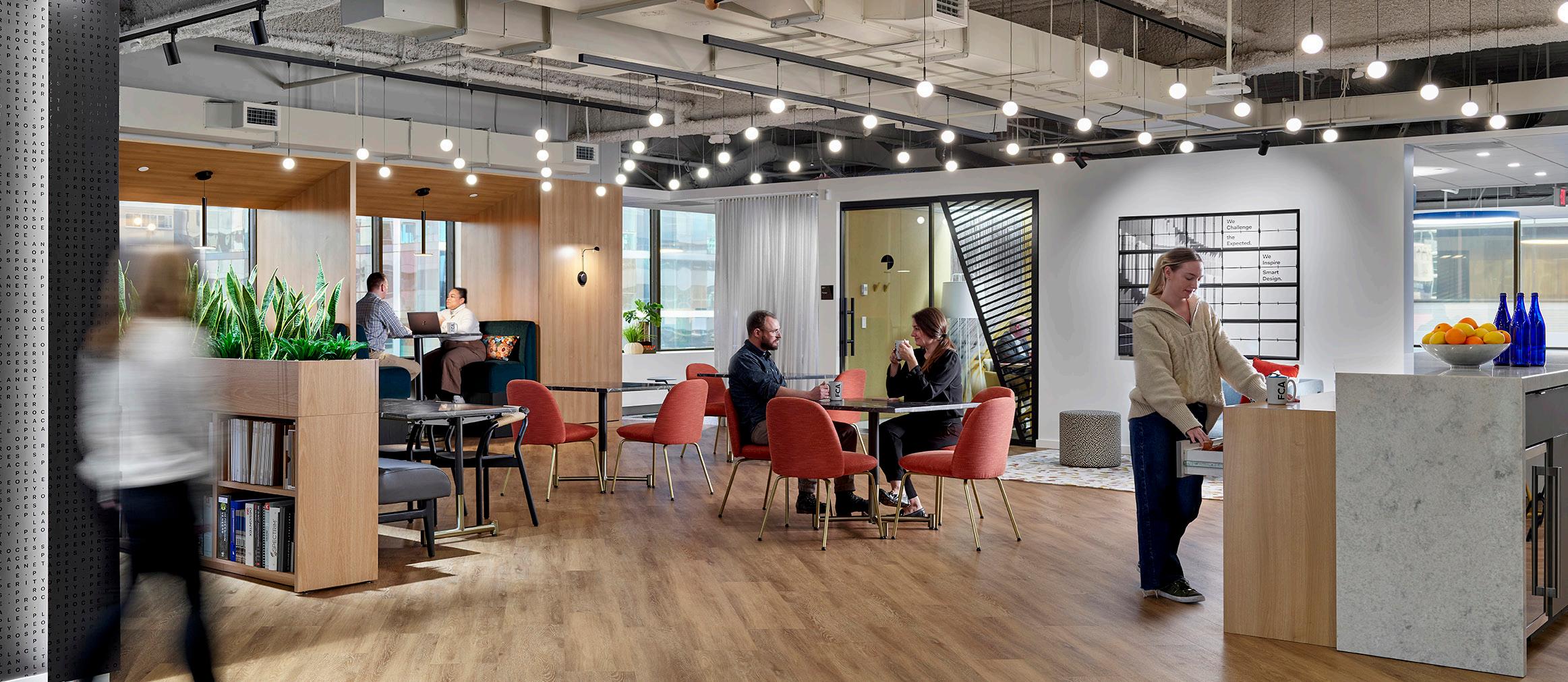
Typically, women are more comfortable when speaking with people who are sitting in front of them; men prefer to sit next to their conversation partners.4
Meeting rooms should give people the feeling that they have some control over their experiences. Psychological and physical wellbeing of people increases when they can apply control over their physical environment. ( i.e.: rearrangement or adjustments, lights, tables, chairs, blinds etc.)6
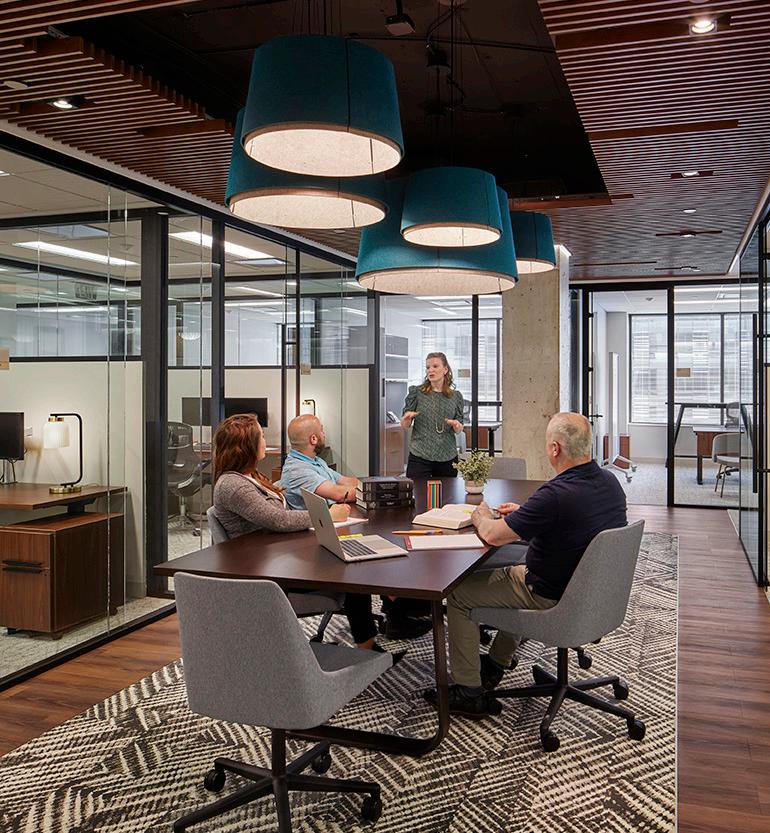
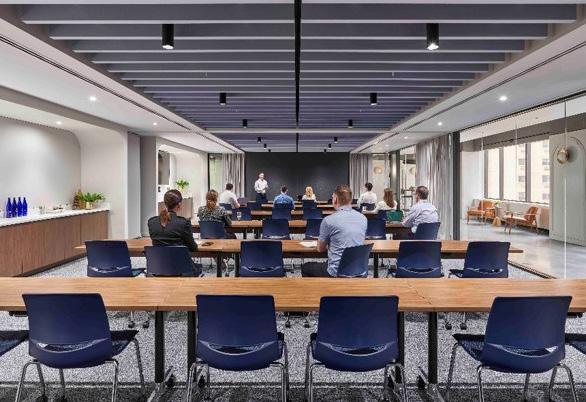
The heads of everyone involved in a conversation should be at approximately the same height above the floor. Applicable to physical and hybrid conversations (consider the angles at which cameras are framing). In a hybrid meeting the heads of those participating remotely need to be the same size as those on site and at the same distance from the floor.9,18
A study found that participants acting as negotiators and sitting in soft chairs did not drive as hard a bargain as ones sitting on harder chairs without cushions.19


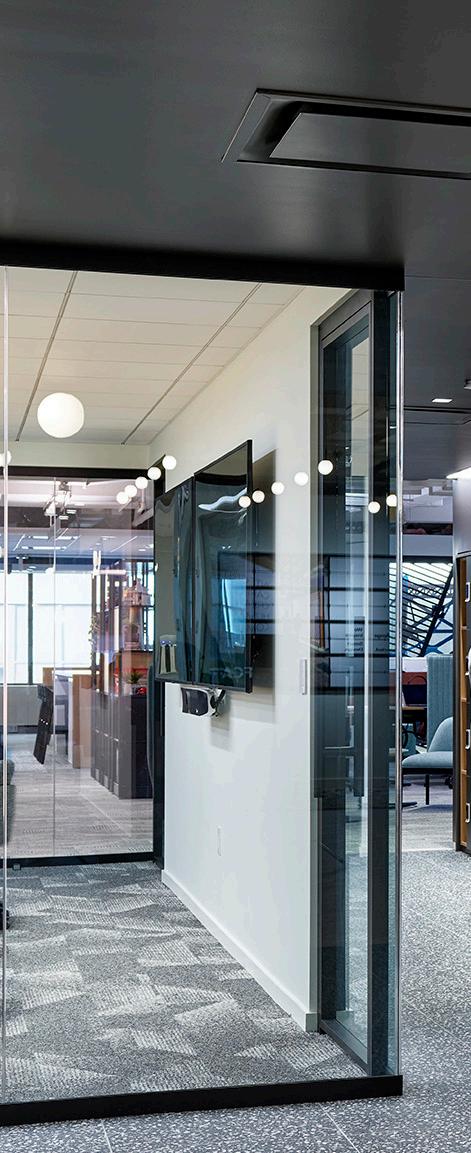
Zoom-type conversations pose the same challenges in communications as face-to-face meetings. Research argues for meeting in person, when possible. When there is a need for resolving difficult problems, doing tasks requiring group creativity and innovation and bonding with others, with our current systems of video conferencing, there is a neurological advantage to meeting in person. In person, eye-to-eye contact is what builds trust among workers. Those bonds of trust are what strengthens culture.
Compared with in-person meetings, 46% of participants feel that they paid less attention during the video meetings and 51% said that their interactions were worse.10
Just 10–15% of reviewers rated Zoom meetings as the better option across all criteria of review quality and reviewer participation.”10
“The more a person stares at themself while talking with a person in an online chat, the more their mood degrades over the course of the conversation.”12,17
“Video conferencing impedes the production of creative ideas”. In-person interactions, operating in a shared physical space are more creative naturally whereas virtual teams inhabit a virtual space that is limited by the screen box in front of each member. The physical difference in shared space compels virtual communicators to narrow their visual field by concentrating on the screen and filtering out peripheral visual stimuli.11
Movement is limited in ways that are not natural. Research says when people are moving, they’re performing better cognitively”. The expectation to stay in place during video calls, unlike in-person meetings where we move naturally, can contribute to fatigue and negatively impact cognitive function.13
People are much more likely to agree to help requests made in-person than those made in virtual meetings or digital media. Help- seekers, reinforced by eye contact and natural face expressions, can benefit from asking for help face-toface.13
The cognitive load is much higher in video chats. We must work harder to express emotions and agreements and in a more exaggerated way that uses our “mental calories”. This is another reason for “ZOOM fatigue”. “Videoconferencing is a good thing for remote communication, but just think about the medium – just because you can use video doesn’t mean you have to.”15
1. Nigel Oseland and Paige Hodsman. 2015. “Planning for Psychoacoustics: A Psychological Approach to Resolving Office Noise Distraction.”
2. Jurian van Meel, Yuri Martens, and Hermen van Ree. 2010. Planning Office Spaces: A Practical Guide for Managers and Designers. Lawrence King Publishing, Ltd.: London, England.
3. M. Argyle and J. Dean. 1965. “Eye Contact, Distance and Affiliation. Sociometry, vol. 28, pp. 289-304.
4. J. Fisher and D. Byrne. 1975. “Too Close for Comfort: Sex Differences in Response to Invasions of Personal Space.” Journal of Personality and Social Psychology, vol. 32, pp. 15-21.
5. Eric Sundstrom and Mary Sundstrom. 1986. Work Places: The Psychology of the Physical Environment in Offices and Factories. Cambridge University Press: New York.
6. Jacqueline Vischer. 2011. “Human Capital and The Organization-Accommodation Relationship.” In Alan Burton-Jones, JC Spender, and Gary Becker (editors). The Oxford Handbook of Human Capital. Oxford University Press: New York.
7. Ben Waber, 2013. People Analytics: How Social Sensing Technology Will Transform Business and What It Tells Us About the Future of Work. FT Press: Upper Saddle River, NJ.
8. Robert Gifford. 2014. Environmental Psychology, Fifth Edition, Optimal Books: Colville, WA.
9. Andreas Baranowski and Heiko Hecht. 2018. “Effect of Camera Angle on Perception of Trust and Attractiveness.” Empirical Studies of the Arts, vol. 36, no. 1, pp. 90-100.
10. D. Chawla. 2021. “Zoom Fatigue Saps Grant Reviewers’ Attention.” Nature, vol. 590, 7844,172.
11. Melanie Brucks and Jonathan Levav. 2022. “Virtual Communication Curbs Creative Idea Generation.” Nature, vol. 605, pp. 108-124, https://doi.org/10.1038/s41586- 022-04643-y
12. “Staring at Yourself During Virtual Chats May Worsen Your Mood, Research Finds.” 2022. Press release, University of Illinois, https://news.illinois.edu/ view/6367/117509126
13. Vignesh Ramachandran. 2021. “Stanford Researchers Identify Four Causes for ‘Zoom Fatigue’ and Their Simple Fixes.” Press release, Stanford University, https://news. stanford. edu/2021/02/23/four-causes-zoom-fatigue-solutions/
14. M. Roghanizad and Vanessa Bohns. 2022. “Should I Ask Over Zoom, Phone, or In-Person? Communication Channel and Predicted vs. Actual Compliance.” Social Psychological and Personality Science, vol. 13, pp. 1163-1172, https://doi. org/10.1177/19485506211063259
15. J. Bailenson. 2021. “Nonverbal Overload: A Theoretical Argument for the Causes of Zoom Fatigue.” Technology, Mind, and Behavior, vol. 2, no.
16. Research by Hackman and Vidmar (1970) on optimum group size
17. Jonne Hietanen, Mikko Peltola, and Jari Hietanen. 2020. “Psychophysiological Responses to Eye Contact in a Live Interaction and in Video Call.” Psychophysiology, vol. 57, no. 6, e13587, https://doi.org/10.1111/psyp.13587
18. Corey Schnobrich. 2012. “Furniture, Eye Level, and Communication.” Environmental Design Research Association Conference, May 30-June 2.
19. Joshua Ackerman, Christopher Nocera, and John Bargh. 2010. “Incidental Haptic Sensations Influence Social Judgments and Decisions.” Science, vol. 328, no. 5986, pp. 1712-1715.

Courtesy of: https://researchdesignconnections.com/