Binni Carter Senior Account Executive, Employee Benefits
Shawna Johnson Strategic Account Executive
Lisa Vasquez Account Manager, Employee Benefits
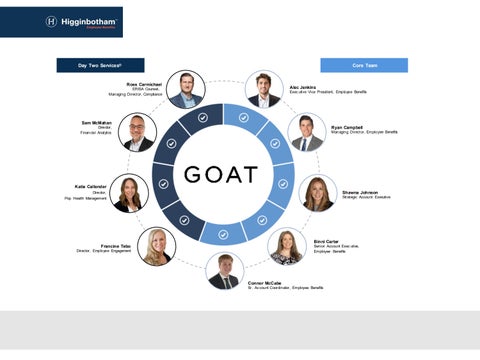
Alec Jenkins Vice President, Employee Benefits
Ryan Campbell Chief Sales Officer, Managing Director
Ryan Campbell Managing Director, Employee Benefits
Ryan began his career in employee benefits after transitioning from payroll and HRIS consulting, where he identified an opportunity to build deeper, long-term partnerships with employers. Over the past eight years, he has worked with both self-funded and fully insured organizations ranging from 100 to 1,000 employees across industries including digital marketing, government contracting, merchandising, and healthcare services.
Ryan is passionate about going beyond traditional service models, partnering with clients to elevate their benefits programs through innovative member engagement strategies, technology-driven solutions, and thoughtful longterm planning. Known for his creative, outsidethe-box approach, he focuses on controlling costs, improving health outcomes, and enhancing the overall employee experience.
Ryan lives in Southlake and is a proud father of three daughters, ages 15, 13, and 11. His greatest personal mission is raising them to be strong, compassionate women who lead with integrity and positively influence those around them.
Alec
Jenkins
EVP, Employee Benefits
After graduating from the University of Texas, Alec began his career in employee benefits and has spent the past eight years at Higginbotham. He’s versed in both fully insured and self funded organizations, partnering primarily with mid market organizations, such as BuzzBallz, the Dallas Stars, and the Texas Rangers.
Alec is passionate about building long term relationships and helping employers create a high-performing benefits program that is right for them. By focusing on thoughtful strategy, data driven insights, and benefits branding, his goal is to meet companies where they’re at and get employees to see the unique value in their benefits.
Alec got married in April of 2024 and now resides in Fort Worth. Outside of work, he enjoys golfing, making new friends, travelling with his wife to new countries and begrudgingly watching the Dallas Cowboys every Sunday.
Shawna Johnson Strategic Account Executive
With over 14 years of experience in employee benefits, Shawna started out at a third-party administrator (TPA), where she built a strong foundation in data analytics client services. She had early industry exposure to claims data, and funding mechanics, and plan performance, giving her a deep appreciation for how benefit decisions translate into real financial and employee outcomes.
In 2014, Shawna moved to the brokerage side where she has served larger complex organizations, operating self-funded health plans. Her focus has been in benefit strategy and emerging solutions.
Shawna has been married to her husband, Martin for 21 years. They have a 19-year-old son and a rescue chihuahua mix named Ozzie. She loves cooking and entertaining guests. She enjoys doing anything creative or artistic and spending time with family and friends, Her favorite quote is from her grandfather. “If you don’t make memories, you won’t have any.” –Jack McIntosh.
Binni Carter Strategic Account Executive, Operational Team Lead
Binni has been an integral part of the Higginbotham, strategy and service team. Binni oversees a $2M client portfolio and leads complex, multi-line implementations spanning across all facets of employee benefits.
Binni’s commitment to excellence is well known. She mentors high-performing teams and directs service operations to ensure exceptional client outcomes. She is a trusted partner, known for navigating complex regulatory landscapes, strengthening carrier and vendor relationships. Her approach blends strategic foresight with thoughtful execution, consistently elevating service standards and client deliverables.
Binni and her husband live in Joshua, Texas, with their three boys. She enjoys spending time outdoors, making homemade jams, and caring for her chickens. Deeply involved in her church, Binni serves on the Pastor’s Council and in youth ministry and has participated in three mission trips. She is passionate about giving back and actively supports local nonprofit organizations.
Lisa holds a Bachelor’s degree in Biology from the University of Texas at Arlington. She is a dedicated Account Manager with over a decade of experience in the employee benefits industry. She began her career in 2015, where she quickly advanced from Coordinator to Account Manager in under two years.
Lisa’s early experience managing small group clients laid the foundation for her work today supporting mid-sized to large organizations with complex benefit needs. Lisa is currently in her fourth year at Higginbotham, where she continues to serve as a trusted partner to her clients.
Lisa serves on two internal resource boards and is actively involved in her community. Lisa previously served for several years on the board of a local little league, where she helped lead fundraising, family engagement, and program retention efforts, and volunteered as a youth softball and soccer coach. Her volunteer work also includes supporting organizations such as Habitat for Humanity and her local Food Bank.
Alyssa brings a strong background in hospitality, grounded in a genuine passion for caring for and serving others in everything she does. While new to the insurance industry, she is eager to learn and grow in her role at Higginbotham, approaching each opportunity with curiosity, dedication, and a service-first mindset.
Known for her thoughtful and people-centered approach, Alyssa enjoys creating meaningful connections and delivering positive experiences.
Outside of work, she loves cooking, crafting, reading, going on walks, and enjoying a good cup of coffee—or a glass of wine, depending on the time of day. She also holds a Level 2 certification in wine from the Wine & Spirit Education Trust, though she jokingly admits the hobby can be an expensive one to keep up with.
Alyssa has lived in North Texas her entire life and is proud to call Fort Worth home. She married her best friend, Liam, two years ago, and together they adore their black-and-white corgi, Abby, who keeps them smiling and on the move.
What We Can Do For You
Robust Open Enrollment Toolkits
When it comes to creating best-in-class resources, we’re a trusted partner for our clients and their employees. They rely on us to create clear, concise, and accurate materials.
SCAN HERE TO LEARN MORE ABOUT WHAT WE CAN DO FOR YOU.
ABC Company
January 01, 2023 Through January 31, 2023
ABC Company
vs. Total Plan Cost
Large Claims Over $50,000
Claims
• ABC Company's year-to-date medical claims are $136,105 through January. Your 2023 medical cost is $318.00 on a PEPM basis. That is 57.5% lower than your $748.60 PEPM cost in 2022.
• ABC Company's year-to-date pharmacy claims are $112,478 through January. Your 2023 pharmacy cost is $262.80 on a PEPM basis. That is 12.2% lower than your $299.37 PEPM cost in 2022.
Claimants (October - September Plan Year)
• There are 2 claimant(s) exceeding the $150,000 individual stop loss level. There have been $183,878 in reimbursements for these 2 claimants year-to-date. Based on Oct 2021- Sep 2022 stop loss Plan Year
Medical/Rx Claims Budgeted vs. Total Plan Cost
• ABC Company's year-to-date net medical/Rx claims are $197,289 through January. Your 2023 medical/Rx cost is $460.96 on a PEPM basis. That is 46.8% lower than your $866.79 PEPM cost in 2022.
• ABC Company's
Note: Budgeted Plan Cost = Premium Equivalent Rates
are $873.90
Claims Claimants over $50K Reimbursements 7 - 44.2% Of Total Claims (Reimbursements Removed From Medical Claims) (Large Claimants Are Based On 2022-23 Stop Loss Contract)
Note: Medical claims include Run-Out claims; Pharmacy includes claims from Maxor, Cana Rx, Elect Rx, Payd Health Rx
$14,000
$10,000 $12,000
2019 PEPY 2020 PEPY 2021 PEPY 2022 PEPY
2023 PEPY
$2,000.00
$1,800.00
$1,600.00
$1,400.00
$1,200.00
ABC
ABC Company
ABC Company
ABC Company
2023
2023 Large Claimants
ABC Company
2022-23 Large Claimants
1
2
4
5
7
ABC Company
2022 Large Claimants
2021-22 Large Claimants
1
4
All Others Claimants Over $50,000
Large Claims by Membership
Employee Spouse Dependent
ABC Company
10/27/25
Prepared for: Sample Company
Executive Overview
Current Period: Jan 24 - Dec 24 (Paid)
Previous Period: Jan 23 - Dec 23
Cost Per Month Overview
Current Period: Jan 24 - Dec 24 (Paid)
Previous Period: Jan 23 - Dec 23
Current Period: Jan 24 - Dec 24 (Paid)
Previous Period: Jan 23 - Dec 23
Financial Overview
Current Period: Jan 24 - Dec 24 (Paid)
Previous Period: Jan 23 - Dec 23
High Cost Claimants Overview
Current Period: Jan 24 - Dec 24 (Paid)
Previous Period: Jan 23 - Dec 23
Current Period: Jan 24 - Dec 24 (Paid)
Previous Period: Jan 23 - Dec 23
Current Period: Jan 24 - Dec 24 (Paid)
Previous Period: Jan 23 - Dec 23
Potential Savings Opportunities
Overview
Current Period: Jan 24 - Dec 24 (Incurred)
Previous Period: Jan 23 - Dec 23
Current Period: Jan 24 - Dec 24 (Incurred)
Previous Period: Jan 23 - Dec 23
Workers Compensation Overview
Current Period: Jan 24 - Dec 24 (N/A)
Previous Period: N/A
Error: Claims data not available for this cohort.
Methodology and Definitions - Executive Overview
The widgets within the Executive Overview can be run on an incurred, paid or incurred and paid date basis and may behave differently based on the user’s selection.
Enrollment: The average number of subscribers (employees) and members (all plan participants including employee, spouses and dependents) in the current period. This analysis can be run on either an incurred or a paid period. If the incurred and paid date basis is selected, only the months of overlap between the two date ranges will be shown.
Cost Per Month: The amount of total claims paid by the employer on a per member per month (PMPM) and per employee per month (PEPM) basis. This analysis can be run on either an incurred or a paid period. If the date basis selected is incurred & paid, enrollment is calculated for the overlapping incurred and paid months. The dollars will reflect both the incurred and paid date filters.
Risk Score: The average concurrent global risk score in the current period. This score is generated against the overall Innovu benchmark distribution which has an average of 5.0 (with lower scores indicating healthier populations and higher scores indicating the opposite.) This analysis can be run on an incurred period only. If the incurred and paid date basis is selected, the incurred date range will be used. If the paid date basis is selected, those dates will be handled as an incurred date range.
High Cost Claimants: The number of members whose total claim costs exceeded the specific stop loss deductible in the current period (which may not coincide with the stop loss plan year). The total amount spent on those members over the specific deductible, and the amount that should have been reimbursed by the stop loss provider based on that deductible. Note that the stop loss deductible is identified from the most recent policy within the selected period. For those clients with no available stop loss information or for cohorts comprised of multiple organizations, a stop loss deductible of $100K is used.
Total Spend vs Budget: Net spend is the total claim costs less any specific stop loss reimbursements, plus the retention fees (including ASO, account, disease management, telehealth, wellness, PEPM related Rx rebates, etc.) and the stop loss premium. Note: Stop loss reimbursements are determined using the available stop loss information, and may be a result of coverage from the current plan year and/or the previous plan year's run-out period. Rx rebates returned directly to the client are not included in the net spend calculation as these do not go through Innovu for tracking purposes. Budget is the sum of the coverage tier rates multiplied by the number of contracts for each coverage tier. Total Spend vs Budget can be run on a paid period only. If the incurred and paid date basis is selected, only the paid date range will be used, and if the incurred date basis is selected, those dates will be handled as a paid date range.
Potential Savings Opportunities: Potential savings opportunities come from the following list of topics: Generic Dispensing Rate (GDR) Increase, Unenrolled Claims, Reducing Rx Waste, Overage Dependents with Claims, Site of Care Migration, ER Avoidance, Out of Network, Overage Dependents with Claims, End Stage Renal Disease (ESRD), Inappropriate Medical Services, and Duplicated Claims. The estimates are based on the provider's allowed amount. This analysis can be run on an incurred period only. If the incurred and paid date basis is selected, only the incurred date range will be used, and if the paid date basis is selected, those dates will be handled as an incurred date range.
Methodology and Definitions - Cost Per Month Overview
The Cost Per Month Overview can be run on an incurred, paid or an incurred & paid date basis. If the date basis selected is incurred & paid, enrollment is calculated for the overlapping incurred and paid months. The dollars will reflect both the incurred and paid date filters.
Cost Per Month: The amount of total claims paid by the employer on a per member per month (PMPM) and per employee per month (PEPM) basis.
PMPM by Relationship: The amount of total claims paid by the employer on a per member per month (PMPM) basis broken out by relationship to the employee (Self, Spouse or Child). Members whose relationship is unknown are excluded.
Enrollment: The average number of subscribers (employees) and members (all plan participants including employee, spouses and dependents) enrolled in the current period.
PEPM / PMPM History: The amount of total claims paid by the employer on a per member per month (PMPM) and per employee per month (PEPM) basis over the selected current period.
Chronic Conditions PMPM: The amount of total claims paid by the employer on a per member per month (PMPM) basis for members identified as having Diabetes, Asthma, Hypertension or Heart Failure compared against Innovu's aggregated dataset. Chronic conditions are assigned to each member monthly based on a diagnosis or a prescription in the recent medical history. (The PMPM includes all claims for the member with the identified condition, not just the claims for the condition.)
Methodology and Definitions - Enrollment Overview
The Enrollment Overview can be run on an incurred, paid or an incurred and paid date basis. If the date basis selected is incurred and paid only the overlapping incurred and paid months will be displayed.
Enrollment: The average number of subscribers (employees) and members (all plan participants including employee, spouses and dependents) enrolled in the current period.
Member Ratio: The ratio of the average number of members to the average number of subscribers in the current period.
Member Demographics: Age Distribution is the average number of members per age group in the current period. Members whose age is unknown are excluded. Gender Distribution is the average number of members by gender in the current period. Members whose gender is unknown are excluded.
Average Age: The average age of the subscribers, spouses, and dependents in the current period. Members whose relationship to the subscriber is unknown are excluded.
Member Distribution: The average number of members per state in the current period. Members whose home state is unknown are excluded.
Enrollment by Month: The average number of subscribers and members per month in the current period.
Methodology and Definitions - Financial Overview
The Financial Overview can be run on a paid basis only.
Total Spend vs Budget: Net spend is the total claim costs less any specific stop loss reimbursements, plus the retention fees (including ASO, account, disease management, telehealth, wellness, PEPM related Rx rebates, etc.) and the stop loss premium. Note: Stop loss reimbursements are determined using the available stop loss information, and may be a result of coverage from the current plan year and/or the previous plan year's run-out period. Rx rebates returned directly to the client are not included in the net spend calculation as these do not go through Innovu for tracking purposes. Budget is the sum of the coverage tier rates multiplied by the number of contracts for each coverage tier.
Spend Projection: Projected 12-months of net spend (total claims and retention less stop loss reimbursements). Forecast is generated using organization’s entire data history and an ensemble of 8 predictive models. The forecast line represents the median of the models and the shaded area is the median 80th and 20th percentiles.
Gross Claims: The amount of total claims paid by the employer prior to stop loss reimbursements.
Cost Share: Allowed claims represent the amount that the vendor has determined as appropriate through their claim adjudication process which takes into account items like plan design, provider discounts, erroneous charges, Reasonable & Customary (R&C) charge considerations, etc. (Note, amounts to be determined as excess of Allowed claims are not reported to or captured by Innovu.) The Allowed claims can be broken down as: Employer Portion = The amount of total claims paid by the employer less any stop loss reimbursements, Employee Portion (Member Liability) = The out-of-pocket claims paid by the employee. If a vendor does not provide allowed amounts and the allowed amount cannot be estimated from the employer-paid amount and member liability, this box will not populate.
Paid to Allowed Ratio: The amount of total claims paid by the employer prior to stop loss reimbursements compared to the allowed claims.
High Cost Claimants: Summary of high cost claimants reflects: the number of members whose total claim costs exceeded the specific stop loss deductible in the current period (which may not coincide with the stop loss plan year), the total amount spent on those members over the specific deductible, the amount that should have been reimbursed by the stop loss provider based on that deductible. Note that the stop loss deductible is identified from the most recent policy within the selected period. For those clients with no available stop loss information or for cohorts comprised of multiple organizations, a stop loss deductible of $100K is used.
Methodology and Definitions - High Cost Claimants Overview
The High Cost Claimants Overview can be run on an incurred, paid or incurred and paid date basis. Note that the stop loss deductible is identified from the most recent policy within the selected period. For those clients with no available stop loss information or for cohorts comprised of multiple organizations, a limit of $100K is used.
Top High Cost Claimants: Summary of the 9 members with the highest claim costs in the current period, including the primary diagnosis associated with the majority of costs, the enrollment status as of the last month of the current period, and the average concurrent global risk score.
High Cost Claimants: Summary of high cost claimants reflects: the number of members whose total claim costs exceeded the specific stop loss deductible in the current period (which may not coincide with the stop loss plan year), the total amount spent on those members over the specific deductible and, the amount that should have been reimbursed by the stop loss provider based on that deductible. Note that the stop loss deductible is identified from the most recent policy within the selected period.
Potential High Cost Claimants: Summary of potential high cost claimants reflects: number of members costing between 50% and 100% of the specific stop loss deductible, total amount spent on those members during the period, distribution of those members across spending "ranges". Please note that the stop loss deductible is identified from the most recent policy within the selected period.
HCC by Relationship: The number of the subscribers, spouses, and dependents whose total claim costs exceeded the specific stop loss deductible in the current period and the total amount spent on those members.
Methodology and Definitions - Medical Overview
The Medical Overview can be run on an incurred, paid or incurred and paid date basis.
Cost Share: Allowed claims represent the amount that the vendor has determined as appropriate through their claim adjudication process which takes into account items like plan design, provider discounts, erroneous charges, Reasonable and Customary (RandC) charge considerations, etc. (Note, amounts to be determined as excess of Allowed claims are not reported to or captured by Innovu.) The Allowed claims can be broken down as: Employer Portion = The amount of total claims paid by the employer, Employee Portion (Member Liability) = The out-of-pocket claims paid by the employee. If a vendor does not provide allowed amounts and the allowed amount cannot be estimated from the employer-paid amount and member liability, this box will not populate.
Medical Paid: The amount of medical claims paid by the employer, as well as the total number of claimants and claims. Note that all claims are counted, which can include adjustments and voids depending on the vendor.
ER Utilization: ER Visits is the total number of unique member and service date combinations flagged as "Emergency Room" in the current period based on Revenue, Current Procedures Terminology (CPT) and Place of Service Codes. Emergency room visits that result in a hospital admission are excluded. ER Amount Paid is the total amount paid by the employer for services flagged as "Emergency Room". This will account for both the professional and technical portions of the ER visit, but may not include all of the ancillary procedures associated with the visit due to coding inconsistencies. Note that visits are associated with the most recent paid date.
Network Status: The amount of claims paid by the employer and the percentage of this amount paid in-network and out-of-network as defined by the vendor. If the client does not have a network or if the vendor does not provide Innovu with a network indicator, the percentage of out-of-network claims will be 100%.
Claim Type Category: The amount paid by the employer for claims identified as Inpatient, Outpatient, Professional, or Other based on the vendor reported Claim Type Codes, as well as Place of Service, CPT, and Bill Type Codes.
Visits per 1,000: The total number of unique member and service date combinations flagged as Emergency, Inpatient or Outpatient converted to the standard "per 1,000" measure for comparison. (Defined as the total visits divided by the total months of enrollment, multiplied by 12 months, multiplied by 1,000 members).
Top Places of Services by Paid Amount: Summary of the top 9 Place of Services based on the amount of total claims paid by the employer in the current period.
Methodology and Definitions - Pharmacy Overview
The Pharmacy Overview can be run on an incurred, paid or incurred and paid date basis. The analysis for (1) Brand vs. Generic and (2) Benchmark Paid per Quantity are limited to pharmacy claims billed under the prescription benefit with a date of service incurred on or after 1/1/2018.
Cost Share: Allowed claims represent the amount that the vendor has determined as appropriate through their claim adjudication process which takes into account items like plan design, provider discounts, erroneous chargers, Reasonable and Customary (RandC) charge considerations, etc. (Note, amounts to be determined in excess of Allowed claims are not reported to or captured by Innovu.) The Allowed claims can be broken down as: Employer Portion = The amount of total claims paid by the employer, Employee Portion = The out-of-pocket claims paid by the employee. If a vendor does not provide allowed amounts and the allowed amount cannot be estimated from the employer-paid amount and member liability, this box will not populate.
Pharmacy Paid: The amount of Rx claims paid by the employer, as well as the total number of claimants and claims. Note that all claims are counted, which may include adjustments and voids depending on the vendor.
Benchmark: Cost per member per month is the amount of Rx claims paid by the employer on a per member per month (PMPM) basis compared against Innovu's aggregated dataset. Paid per quantity is the amount of Rx claims paid by the employer for brand and generic drugs per quantity dispensed compared against the Innovu benchmark.
Brand vs. Generic: The Generic Dispensing Rate (GDR), calculated as the number of claims for a generic drugs divided by the total number of claims. Also shown is the breakdown of the amount paid by the employer split between generic and brand. Note, drugs that could not be identified as brand or generic such as Durable Medical Equipment (DME) supplies are excluded from these statistics.
Specialty Rx Claims: Summary of specialty Rx claims broken down into: Total amount of claims paid by the employer for drugs on the Innovu-specialty drug list, Percentage of employer-paid claims for non-specialty versus specialty drugs, Total number of members taking specialty drugs (and the percentage against enrolled members). The percentage paid for specialty drugs is broken down into the actual employer-paid amount for the two most costly therapeutic class categories and all other categories.
Top Drugs by Paid Amount: Summary of the top 9 drugs based on the amount of total claims paid by the employer in the current period.
Methodology and Definitions - Potential Savings Opportunities Overview
The Potential Savings Opportunities Overview can be run on an incurred basis only. All potential savings opportunities are reported on an allowed cost basis. Pharmacy savings are limited to claims billed under the prescription benefit with a date of service incurred on or after 1/1/2018.
Duplicated Claims: Duplicate claims are identified, based on CMS guidelines, as claims with the same values for the following fields: Patient, Incurred date, Performing provider or Billing Provider, Procedure codes and modifiers, Place of service (Professional only), Type of service (Professional only), Bill Type Code (Facility only), Paid amount, submitted amount, or allowed amount
ER Avoidance: Estimate of medical savings from migrating Emergency Room (ER) visits to an Urgent Care setting based on the following migration assumptions based on severity level: 50% of Low Severity, 25% of Low to Moderate Severity, and 10% of Moderate Severity. A severity level is assigned to each ER visit according to the service code billed. If two different severity codes are identified for a member on the same visit, the CPT code that was paid more recently is reported, otherwise the one with the highest severity is reported. ER visits that result in an Inpatient admission are not considered.
ESRD: Total medical payments on dialysis claims for enrolled individuals diagnosed with End Stage Renal Disease (ESRD) in the last 12 months who have also received treatment in 30 of the last 35 months.
Improve Rx Discounts: Estimate of pharmacy savings from setting brand and generic discounts off the Average Wholesale Price (AWP) to the following levels based on Rx costs before rebates: Brand = AWP - 22%, Brand Specialty = AWP - 20%, Generic = AWP - 83%, and Generic Specialty = AWP - 83%. Individual prescription claim’s Brand or Generic status is derived from a combination of the Dispense as Written (DAW) codes provided on the claim and Medi-Span's multi-source descriptions attributed to the National Drug Code (NDC) at the time of dispensing, while specialty status is assigned based on a drugs membership on Innovu's list of Specialty Drugs.
Inappropriate Medical Services: Total medical payments for claims that include a service identified as inappropriate based on an enrolled individual's age or gender.
Increase GDR (Generic Dispensing Ratio): Estimate of pharmacy savings from a 1% increase in the Generic Dispensing Rate (GDR) based on applying a 2.5% decrease to total prescription drug costs. When GDR exceeds 90% the likelihood to further increase generic utilization is low and therefore the cost savings are assumed to be zero.
Out of Network: 30% of total medical claim payments to out-of-network providers. If a vendor does not provide an in-network indicator on claims, this box will not populate.
Overage Dependents with Claims: Total medical and pharmacy claim payments on enrolled dependents over the age of 26.
Reduce Rx Waste: Estimate of pharmacy savings from switching from higher to lower cost drug alternatives from a select list of drugs identified by Innovu that are targeted by intervention programs.
Site of Care: Estimate of medical savings from shifting 15% of radiology services and non-self-administered injectable drugs from an outpatient hospital setting to an office, independent laboratory, or in the case of injectables, home setting.
Unenrolled Claims: Total medical and pharmacy claim payments for individuals not included in the eligibility file for the month of service.
Methodology and Definitions - Risk Overview
The Risk Overview can be run on an incurred basis only.
Risk Score: The average concurrent global risk score in the current period. This score is generated against the overall Innovu benchmark distribution which has an average of 5.0 (with lower scores indicating healthier populations and higher scores indicating the opposite).
Risk by Relationship: Average current predicted risk expense broken down to subscriber, spouse, and dependent for the current period. Members whose relationship to the subscriber is unknown are excluded.
Risk by Factor: Summary of the top risk factors in the current period that are included in the determination of the risk score prediction for high risk members (members in the 95-100 percentile).
Risk Distribution: Average prospective global risk scores (Future) compared to the average concurrent global risk scores (Current) by individual member.
High Risk Members: Summary of the top 9 high risk members enrolled in the last month of the selected date range based on the average concurrent global risk score in the current period. For each member: demographic information, total amount allowed by the employer for those members for the 11 months prior to the last selected month (i.e., the current cost), members whose total claim costs exceed the specific stop loss deductible in the period (which may not coincide with the stop loss plan year) are flagged as a high cost claimant, and the expected allowed amount over the 12 months subsequent to the current period (i.e., the future cost). Note that the stop loss deductible is identified from the most recent policy within the selected period. For those clients with no available stop loss information or for cohorts comprised of multiple organizations, a stop loss deductible of $100K is used.
Methodology and Definitions - Workers Compensation Overview
The Workers Compensation Overview can be run on an incurred basis only.
Total Incurred Claims: The amount paid by the employer for indemnity, medical treatment and expenses for injuries occurring during the current period or for claims that remain open. In the case of open or reopened claims, the reserve is also included in the total. The number of open/closed claims for members with an opioid prescription within the 90 days prior to the date of injury. If a vendor does not provide claimant status, this box will not populate.
Open Claims: The number of open or reopened workers' compensation claims in the current period. The amount paid by the employer on opened or reopened claims for indemnity, medical treatment and expenses compared to the amount set aside to cover the anticipated cost of these claims (reserve). If a vendor does not provide claimant status, this box will not populate.
Health Risk Score: The average concurrent global risk score for worker's compensation claimants who were either injured during the current period or have an open claim compared to employees who did not incur a worker's compensation claim (Non WC Claimants). The risk score is generated against the overall Innovu benchmark distribution which has an average of 5.0 (with lower scores indicating healthier populations and higher scores indicating the opposite). The average risk score is only reported if there are at least 3 worker's compensation claimants enrolled in the medical plan, and therefore having a risk score.
Medical & Rx PMPM: The amount of medical and pharmacy claims paid by the employer on a per member per month (PMPM) basis for workers' compensation claimants who were injured during the current period or have an open claim compared to employees who did not incur a worker's compensation claim (Non WC Claimants).
Last WC Claimants: Summary of workers' compensation claimants for the 8 most recent workplace injuries. For each member: Demographic information including member age at injury and gender, Tenure calculated as the period between the date of injury and the date of hire. Injuries within the first 90 days of employment may point to a need for the review of training procedures, and are highlighted in red, Days to Report (Rpt) calculated as the period between the date of injury and the date the employer was given notice of the injury. Injuries reported after 21 days in PA may not receive retroactive benefits, and are highlighted in red, State, Injury Description, High Cost Claimant (HCC) identified as a member whose total medical and Rx claim costs exceed the specific stop loss deductible in the period (which may not coincide with the stop loss plan year) are flagged. Note that the stop loss deductible is identified from the most recent policy within the selected period. For those clients with no available stop loss information or for cohorts comprised of multiple organizations, a stop loss deductible of $100K is used, Comorbidity defined as the concurrence of one or more of the following 12 chronic diseases: Diabetes, COPD, Hypertension, Heart Failure, Asthma, Rheumatoid Arthritis, Inflammatory Bowel Disease, Kidney Disease (not including ESRD), HIV/AIDS, Parkinson’s Disease, End Stage Renal Disease (ESRD), Sleep Apnea, ER Visit 30 days prior to the injury or 14 days after the injury, Enrollment status as of the last month of the current period, The average concurrent global risk score in the current period, Closed WC claim Indicator, Total Incurred represents the amount paid by the employer for indemnity, medical treatment, and expenses. In the case of an open or reopened claim, the reserve is also included.
Higginbotham Partnership Commitment
Education & Guidance
• Bi-weekly calls to explain data, trends, and projections
• Help ABC Company become a more informed insurance consumer
Innovative Solutions
• Point-solution recommendations (PHM for chronic disease)
• Directing members to high-quality providers
• Improving outcomes and lowering cost
Reporting & Analytics
• Monthly/quarterly financial reporting
• Forecasting and ROI measurement
• Tracking preventive health and medication adherence
Holistic Collaboration
• Focus on preventive care and member engagement
• Improving workforce health, retention, and morale
• Turning data into actionable strategies
1.Medical/Rx Plan History (2019–2023 YTD)
• ABC Company moved from fully insured (BCBSTX) → self-funded ASO with Allied/Berkley using a TPA for flexibility and savings.