DON’T HOLD BACK
HEARTLAND: MAKING WHISKeY STARTS WITH HORSEPOWER » PAGE 28
Pulse Growers director urges women to » PAGE 3 get involved
Publications Mail Agreement # 40069240
V o l u m e 1 1 , n u m b e r 1 2 J u n e 9 , 2 0 1 4
McDonald’s pilot could be game-changer Straw Men say pilot’s detailed informationsharing system could revolutionize beef production
Local food movement continues to soar Visitors spent an estimated $878 million at farmers’ markets in Alberta in 2012, a jump of more than 50 per cent from four years earlier
By Alexis Kienlen af staff
M
cDonald’s decision to pilot its “sustainable beef” project in Canada, could lead to a sea change in the country’s beef industry, according to two members of the Straw Man task force. The task force was struck after a think-tank slammed the beef industry for being fractured, unable to develop a true Canada brand, and choosing to be reliant on the U.S. instead of pursuing high-value export opportunities. The McDonald’s pilot could change all of that by requiring cattle producers, feedlots, and packers to co-operate, said Kim McConnell and John Kolk, two of the three members of the Straw Man task force. “In my mind, it has the potential to happen whether we want it or not and if we have the potential to embrace it and work together, than that really does help bring synergy and everyone to come together,” said McConnell. “It’s somewhat intuitive that an industry with good clear communication, information exchange, and governance that goes to all
Interest is flourishing in farmers markets, and 126 Alberta-approved markets are now operating across the province. photo: alexis kienlen
see MCDONALD’S } page 6
By Alexis Kienlen af staff
J
ered Serben never planned to become part of the local food scene, but is glad he is. The fourth-generation farmer grew up on a traditional hog operation, which transitioned to grain and then exited pork production when hog prices plummeted in the early 2000s. But his heart was never in it. “We got into more grain farming, but if you grow up as a herdsman, or with livestock, then that’s what you want to do, I think,” said Serben. “I wasn’t necessarily very good at grain farming. I didn’t like it. There was no real passion there.” Serben quit farming for several years before returning to the family farm near Smoky Lake, wanting to get back into farm-
SPECIAL SECTION
ing but not knowing how. It came by accident — he wanted to raise a single pig but the breeder he contacted insisted he take 10. So he sold the extra meat, and his pork was such a hit, his customers asked him to raise chickens and turkeys. Today, he and wife Julia raise pasturebased pigs, poultry, eggs, and lamb along with vegetables, which they sell at farmers markets in Edmonton and Fort McMurray. He’s able to farm full time, and Julia also works on the farm save for an off-farm job in winter. “I’m a fairly stubborn person, so I just kept trying, and figuring it out,” said Serben. “I think what we’ve done in the last five years is incredible.” Incredible is also an apt term for the continued growth in local food. Alberta Agriculture and Rural Development periodically tracks consumer interest in local foods, and estimates sales at
farmers’ markets jumped to $878 million in 2012 — up more than 50 per cent from $561 million in 2008. The survey also found visitors to farmers markets in 2012 spent an average of about $55 (versus $34 in 2008). “In all of the venues that we looked at, interest has remained the same, or in most cases, has increased,” said Karen Goad, the province’s farm direct-marketing specialist and a member of the Explore Local initiative, which promotes local food. Interest is flourishing in both urban and rural areas, she said, and there are currently about 126 Alberta-approved farmers markets across the province. “We’re seeing growth across the board,” said Goad. “We’re probably seeing more CSAs (community-supported agriculture) in the last three to five years than we have in
see LOCAL FOOD } page 6
hay and forage } PAGES 24 - 26
news » inside this week
2
inside » Find a tick? Submit it to a vet or public health office
JUNE 9, 2014 • ALBERTAFARMEXPRESS.CA
livestock
crops
columNists
Low stress means higher profits
Root rot risk on the rise
15
NEWS Heard the latest buzz on protecting the environment? Cell Press release
R
esearchers have been monitoring honeybee “waggle dances” to track where they find the best nectar and pollen and measure the benefits of biodiverse landscapes. The results reported in the Cell Press journal Current Biology suggest that costly measures to set aside agricultural lands and let the wildflowers grow can be very beneficial to bees. “In the past two decades, the European Union has spent 41 billion euros on agri-environment schemes, which aim to improve the rural landscape health and are required for all EU-member states,” says Margaret Couvillon of the University of Sussex. “Our work uses a novel source of data — the honeybee, an organism that itself can benefit from a healthy rural landscape — to evaluate not only the environment, but also the schemes used to manage that environment.” Couvillon and her colleagues recorded and decoded the waggle dances of bees in three hives over a two-year period. Bees dance to tell their fellow bees where to find the good stuff: the best nectar and pollen. The angle of their dances conveys information about the direction of resources while the duration conveys distance. Researchers can measure those dance characteristics in a matter of minutes with a protractor and timer. The study shows that honeybees can serve as bioindicators to monitor large land areas and provide information relevant to better environmental management, the researchers say. It also gives new meaning to the term “worker bee.” “Imagine the time, manpower, and cost to survey such an area on foot — to monitor nectar sources for quality and quantity of production, to count the number of other flower-visiting insects to account for competition, and then to do this over and over for two foraging years,” Couvillon says. “Instead, we have let the honeybees do the hard work of surveying the landscape and integrating all relevant costs and then providing, through their dance communication, this biologically relevant information about landscape quality.”
5
Cattle prices high, but margins are tight
Carol Shwetz Obesity is not just a problem for humans
Pea leaf weevil popping up
Early-seeded peas or faba beans have lower risk
brenda schoepp
13
Daniel Bezte
19
“Cow whisperer” talks about cattle handling
12
Early detection and diagnosis is critical
17
How to be your own weather forecaster
16
Community comes together to save rare chickens Poultry centre now providing community with farm fresh eggs and heritage chicks
A group of Rhode Island Red chicks at the University of Alberta’s Poultry Research Centre, which has housed collections of heritage chickens for more than 20 years. Photos: Alexis Kienlen By Alexis Kienlen af staff / edmonton
A
n outpouring of community support has saved a rare — and potentially priceless — collection of heritage chickens. “It’s amazing how much the general population wants to support the chickens and how much they understand about genetic preservation,” said Agnes Kulinski, business director of the University of Alberta’s Poultry Research Centre. Two years ago, when the centre’s program to preserve heritage chickens was threatened by budget constraints, Kulinski did a market analysis and wondered if it could tap into interest in local food and the varieties grown or raised by generations past. “People signed up without even knowing what it was about,” she said. “They wanted to support the genetic preservation.” There are now 400 people in the Edmonton area — with another 400 on the waiting list — who pay $150 a year to “adopt” a heritage chicken. In return, they are rewarded with 24 dozen eggs in a 10-month period. The program is especially popular with retired farmers who have recently moved to the city and families with young children, said Kulinski.
“They want to pay extra to support the program,” she said. “The eggs that you get in a store are $3 a dozen and these are $6.25. People and the industry are very supportive. They understand the importance.” The centre houses several breeds on Rare Breeds Canada’s endangered species list: Barred Plymouth Rock, Light Sussex, New Hampshire, White Leghorn, and Brown Leghorn, as well as two varieties from the lines of famed Ontario chicken breeder Don Shaver used to breed the original commercial chicken. They are descended from birds that arrived at the centre two decades ago. They’ve never been bred for any specific trait, are suited for both meat and egg production, and are “the same kinds of chickens that our grandparents had on the farm,” said Kulinski. But they are not kept for nostalgic reasons. “They’re a backup if anything happens to the industry chickens,” she said. “They have the genetic variability, so if anything happens, you can look for the genes to help the commercial breeds.” Since modern commercial chickens are bred from just a few lines, older ones may one day be needed if, for example, a new strain of avian influenza threatened poultry production. “There hasn’t been too much research done on heritage breeds, so we don’t know if
Agnes Kulinski of the Poultry Research Centre, holds a Barred Plymouth Rock chick. The chicks are now available for sale through a new partnership with Peavy Mart. they are resistant,” said Kulinski. “But we do know that there is a potential that they have the disease-resistant gene.” Those who adopt heritage birds can’t actually visit them, but get updates through email and Facebook. “Because of the biosecurity, we can’t really take people into the barns. So we’re trying different methods. People just really enjoy the program.” However, this spring the centre started a pilot partnership with Peavy Mart to distribute day-old chicks to western Canadian farmers. Interested
farmers pre-ordered their chicks and picked them up at Peavy Mart stores in Spruce Grove, Leduc and Red Deer. “It’s another opportunity to create awareness and generate revenue,” said Kulinski. “I think it’s a great partnership for us because we can’t really bring farmers here because of the way that we’re set up, because of biosecurity reasons. It gives us another means of preserving these breeds and generating some revenue.” Anyone looking to pre-order heritage chickens can do so at www.heritagechickens.ca.
3
ALBERTAFARMEXPRESS.CA • JUNE 9, 2014
Farm leader urges her fellow women farmers not to hold back Alberta Pulse Growers vp Allison Ammeter has learned not being the ‘hands-on’ type isn’t a barrier for women in agriculture By Jennifer Blair af staff
Y
ou might not guess Allison Ammeter is a farmer just by looking at her. And you wouldn’t be alone. One time, she introduced herself as a farmer during a meeting with a Calgary design firm in a funky little downtown office. The designer took one look at Ammeter’s red high heels and said, “You don’t look like any farmer I’ve ever met.” And she replied, with her usual aplomb, “Well, you must not meet very many farmers then.” Ammeter is one of many women bucking the label of “farm wife”by being actively involved in agriculture, and making the industry better for it. “Agriculture does not only provide my paycheque. It’s my life,” she says. “I want to make sure my livelihood, my profession, grows and improves so that … agriculture is even better when my kids get involved.” Ammeter, husband Michael, and their three grown children farm a 2,300-acre straight grain operation near Sylvan Lake, including land homesteaded in the 1930s by his grandparents escaping Stalin’s Russia. Ammeter says she’s a Saskatchewan girl at heart, but despite having grown up on a “very similar” grain farm in Swift Current never envisioned farming. “The only way I would end up on a farm is if I married a farmer,” she says. “And I hadn’t met a farmer I wanted to marry until I met my husband.” In the early part of their marriage, Ammeter worked as a computer programmer — another male-dominated profession. “I was the only female analyst in my group of programmers, so I think I’m just accustomed
to being a person, rather than a woman working with men.” That mindset has served her well in her role as vice-president of the Alberta Pulse Growers’ board of directors, a group she has been involved with since 2011. “I think I felt more insecure about the fact that I wasn’t a hands-on, always-in-themachinery type of farmer when I got involved. I thought that would hold me back,” she says. “I’ve come to realize that, for the most part, it’s my desire to communicate and learn and challenge that’s been more important than my ability to change the oil.” She picked Alberta Pulse Growers because she thought it would be the “perfect fit.” “I just saw pulses as being something with so much potential ahead. They were like the new kid on the block.” So she phoned her zone’s commissioner, met him for coffee, and said she would like to get involved. Two weeks later, she was a zone advisor, and within six months, she was elected to the board (and the only female commissioner at the time). As vice-president, she’s testified before the House of Commons about the rail backlog and travelled internationally for conventions and conferences, including a sustainability conference in the U.S. last year. “It was very eye-opening … seeing how highly pulses were regarded by farmers and, also, by food processors,” she says. “I think as a farmer I had missed that link, that people in companies like Unilever really valued what pulses were doing for the land.” Earlier this year, Ammeter attended the World Pulses Convention, an annual meeting of global pulse traders, in Cape Town, South Africa.
Allison Ammeter represented Alberta Pulse Growers at the World Pulses Convention in South Africa earlier this year. photo: supplied “As soon as I think my eyes have been opened enough, they get opened more.” The travel is a perk, but the real draw is making a contribution. “It’s a really great place to be involved and give back and make sure I am part of what’s going on and making it better,” she says. “I would encourage everybody to make what they love better.” Getting to know and meet a wide range of people is “the best part of it.” “Where I initially thought I was getting involved in a commission and it was about the crop, I’ve really come to see it’s about the people.” While she’s content to let her husband (who is also vice-chairman of Alberta Barley) change the oil on the combine, that sort of thing shouldn’t be a consideration for women thinking of a career in agriculture or becoming involved in a farm organization, she says.
Farmers’ Day June 13th, 2014 014
“Know who you are, know what your strengths and giftings are, and get involved in the area of agriculture that maximizes those strengths and giftings,” she says. “That’s where you’ll have
the most joy in the work you’re doing.” The first article is a series showcasing women in agriculture in Alberta. jennifer.blair@fbcpublishing.com
Clarification — beef testing Re: DNA testing gives true ‘gate to plate’ traceability for beef consumers March 26 edition This article contained information on a research trial that successfully demonstrated DNA testing can be used to match a cut of meat with the animal it came from. The trial matched 37 per cent of the beef sampled with DNA obtained several months earlier from cattle in the Heritage Angus Beef program. The article did not make clear that
not all of the cattle in the program had been DNA sampled, and therefore 100 per cent matching was not possible. In fact, all beef sold under the Heritage Angus Beef label is from cattle in the program, which uses its own in-house data system to collect information on all of its animals from ranch to slaughter. The program is independently audited and all beef sold under the Heritage Angus Beef label is produced under that program.
1911: Local members begin gathering each year to celebrate the spirit of community and co-operation that binds us all together. 1945: We pass a resolution to lobby the Alberta government to declare Farmers’ Day a provincial holiday. 1951: Our efforts are successful and we begin observing Farmers’ Day, as a reminder of the contributions our members make to all of our communities. 2010: We revive Farmers’ Day, to honour and celebrate the tradition with our members.
UFA.com ©2014 UFA Co-operative Ltd. All rights reserved. 05/14-38469 AFE
4
JUNE 9, 2014 • ALBERTAFARMEXPRESS.CA
EDITOR Glenn Cheater Phone: 780-919-2320 Email: glenn.cheater@fbcpublishing.com twitter: @glenncheater
Reporters Alexis Kienlen, Edmonton 780-668-3121 Email: akienlen@fbcpublishing.com
So much for the ‘cheap food’ defence
Jennifer Blair, Red Deer 403-613-7573 Email: jennifer.blair@fbcpublishing.com
PRODUCTION director Shawna Gibson Email: shawna@fbcpublishing.com
U.S. obesity rates have reached the point where they actually threaten national security
Director of Sales & Circulation Lynda Tityk Email: lynda.tityk@fbcpublishing.com
CIRCULATION manager Heather Anderson Email: heather@fbcpublishing.com
By Laura Rance
national ADVERTISING SALES
editor, manitoba co-operator
James Shaw Phone: 416-231-1812 Fax: 416-233-4858 Email: jamesshaw@rogers.com
A
g boosters habitually fall back on two defences whenever someone questions why our farmers do things the way they do. The first mantra is that Canadian farmers need to feed the world, but increasing the productivity of small-scale farmers — most of whom are women, improving market access and reducing waste will go further towards feeding the world than squeezing an extra few bushels per acre out of a Prairie wheat field. Now it appears the second fallback defence — farmers have to farm this way in order to produce cheap food — is headed down the tubes faster than you can say “flush.” The question isn’t whether the food produced by the machine we call modern agriculture is cheap — at least for consumers. After all, the statistics show consumers in industrialized countries have never had it so good. “Americans are spending a smaller share of their income (or corresponding amount of effort) on food than any other society in history or anywhere else in the world, yet get more for it,” say the authors of a newly released study into the causes of obesity. Authors Roland Sturm, PhD of RAND Corporation and Ruopeng An, PhD, of the University of Illinois at Urbana-Champaign said that in the 1930s, Americans spent one-quarter of their disposable income on food. By the 1950s, that figure had dropped to one-fifth. The most recent data show the share of disposable income spent on food is now under one-tenth. The question is whether cheap food is
ADVERTISING sales Crystal McPeak Phone: 403-646-6211 or 403-360-3210 Email: crystal@fbcpublishing.com
classified ADVERTISING SALES Sharon Komoski Phone: 1-888-413-3325 Fax: 204-944-5562 Email: sharon.komoski@fbcpublishing.com
ADVERTISING Co-ordinator Arlene Bomback Phone: 204-944-5765 Fax: 204-944-5562 Email: ads@fbcpublishing.com
PUBLISHER Lynda Tityk Email: lynda.tityk@fbcpublishing.com
Associate PUBLISHER/ editorial director John Morriss Email: john.morriss@fbcpublishing.com
president Bob Willcox Glacier FarmMedia bwillcox@farmmedia.com 204-944-5751
The Alberta Farmer Express is published 26 times a year by Farm Business Communications. We acknowledge the financial support of the Government of Canada through the Canada Periodical Fund of the Department of Canadian Heritage.
Publications mail agreement number 40069240 Canadian Postmaster: Send address changes and undeliverable addresses (covers only) to Circulation Dept., P.O. Box 9800, Winnipeg, MB R3C 3K7
ISSN 1481-3157 Call
good. Increasingly, the answer — shockingly — appears to be no. The obesity study is one of two recent events that brought this into focus. Researchers reviewed the data on all the suspected causes of rising rates of obesity in the U.S. in search of an explanation for why two in three Americans are overweight or obese at a time when access to nutritious food, leisure time and activities have never been easier. They looked at things like snack food, fast food, automobile use, time spent viewing television or looking at computer screens, vending machines, suburban sprawl, increasing portion sizes, female labour force participation, poverty, affluence, supermarket availability and alternatively, so-called food deserts in the urban cores. They looked race and socio-economic factors. While it was true that people with low incomes tended to be more obese, they also found that they have been rising among all levels of society at about the same rates. “After examining available evidence, the authors say widespread availability of inexpensive food appears to have the strongest link to obesity,” their report says. This not just an American problem. The release of their data coincided with the release of another review collected from 188 countries worldwide. It concluded 2.1 billion people, or about 30 per cent of the global population, are either obese or overweight. The rise in obesity over the past three decades presents a “major public health epidemic in both the developed and developing world,” the report from the Institute for Health Metrics and Evaluation (IHME) at the University of Washington says.
It’s bad enough that cheap food is now seen as a key contributor to a global public health threat, but the real clincher was a press conference called by U.S. Agriculture Secretary Tom Vilsack and retired U.S. army generals to warn rising obesity levels are a threat to national security. How so? If the country went to war, it would be hard-pressed to find enough soldiers, because more than one in five American youth is too overweight to enlist. “An estimated 75 per cent of all young Americans between the ages of 17 and 24 are unable to join the military for various reasons including being physically unfit,” they said in a statement. If there ever really was a so-called cheap food “policy,” it has successfully failed. As farmers well know, even though the spectacular productivity of current practices has resulted in cheap food for consumers, it’s an expensive way to farm with its high capital costs and razorthin margins. As well, some of the other “costs” such as declining soil and water quality are externalized. The message in this for farmers, which we would argue should never have been promoting their role in producing cheap food in the first place, is they need to find a better value proposition to present to society. Farmers can offer a much more salient value proposition to society — one rooted in stewardship, social responsibility and producing foods that are a solution to public health issues, rather than a contributor. That’s something that could attract public “buy-in” like never before. laura@fbcpublishing.com
1-800-665-0502
or U.S. subscribers call 1-204-944-5568 For more information on The Alberta Farmer Express and subscriptions to other Farm Business Communications products, or visit our web site at:
www.albertafarmexpress.ca
Welfare is part of dairy industry breeding Longevity, health and fertility make up almost half the components of the herd improvement index
or email: subscription@fbcpublishing.com At Farm Business Communications we have a firm commitment to protecting your privacy and security as our customer. Farm Business Communications will only collect personal information if it is required for the proper functioning of our business. As part of our commitment to enhance customer service, we may share this personal information with other strategic business partners. For more information regarding our Customer Information Privacy Policy, write to: Information Protection Officer, Farm Business Communications, 1666 Dublin Ave., Wpg., MB R3H 0H1 Occasionally we make our list of subscribers available to other reputable firms whose products and services might be of interest to you. If you would prefer not to receive such offers, please contact us at the address in the preceding paragraph, or call 1-800-665-0502. The editors and journalists who write, contribute and provide opinions to Alberta Farmer Express and Farm Business Communications attempt to provide accurate and useful opinions, information and analysis. However, the editors, journalists and Alberta Farmer Express and Farm Business Communications, cannot and do not guarantee the accuracy of the information contained in this publication and the editors as well as Alberta Farmer Express and Farm Business Communications assume no responsibility for any actions or decisions taken by any reader for this publication based on any and all information provided.
By Laura Nanne Extension & Education Specialist, Holstein Canada
Re: “Expert says productivity has trumped welfare in breeding programs” (Alberta Farmer, May 12)
I
t is evident that there is a need to share information surrounding the many measures the dairy industry is taking to improve welfare through breeding — both traditionally and genomically. Producers cannot expect cows to endlessly increase output and conceive easily without equipping them to withstand the stresses of modern production, therefore this improvement is necessary and embraced by much of the industry. A breed improvement tool used by 68 per cent of Canadian producers is classification — functional conformation assessment — as offered by Holstein Canada. In accordance with breed goals, it aims to select cows with optimal workability, that are easy to work
with, more resistant to breakdown or disease, trouble-free and lower maintenance. Analysis has shown that each trait’s relationship to longevity and its weighting for final score are strongly related. For example, the mammary system which is 45 per cent genetically correlated to longevity and 13 per cent correlated to health and fertility also has the largest weight on the conformation scorecard. The article was correct in noting that health traits are complex, multifaceted and low in heritability. The industry has also been limited in the past by the shortage of consistent health record-keeping and genetic technologies. These records have been increasing — especially following the introduction of a voluntary health incidences reporting system in 2007. In 2008 genomic testing (molecular marker trait analysis) became commercially available to breeders which doubled the accuracy of genetic predictions. As the reference population for genomic calculations grows and as an increased variety of health events
become more commonly recorded, the depth and amount of data has facilitated meaningful research and development of increasingly accurate health trait scores for dairy cattle. The DairyGen council of the Canadian Dairy Network assigns industry partner funding to key genetic research priorities and has devoted funds to health trait and food science research. After the launch of the new mastitis resistance evaluation (August 2014), work will be underway for metabolic disease research and hoof health research. Noting the impossibility of conducting relevant and accurate genetic research without consistent data recording and large sample sizes, the dairy industry has committed funds towards a five-year dairy cluster research project where 10,000 cows in herds with consistent and comprehensive record-keeping are to be genotyped. This sample population will contribute a great deal of information to the — studies under way. A long-standing herd improvement tool has been the LPI index.
It is a combination of important genetic predictors calculated for every animal on the basis of three categories: production, durability, and health and fertility. Production is weighted at 51 per cent in the index, though this is likely to be reassessed as more health and fertility information and scores become available. The remaining 49 per cent is dedicated to components related to longevity and health and fertility. Leadership from Dairy Farmers of Canada (DFC) is apparent in the six objectives of their proAction plan — one of which is animal care. The proposed assessment plan projected for implementation in 2017 would provide an industry-wide recording and accountability platform that measures animal welfare. This could provide other industry partners and producers with additional benchmarking standards. The importance of balancing production with welfare is paramount. As more consideration is given to animal well-being, the more they can reach their productive potential, live longer and have fewer problems.
5
ALBERTAFARMEXPRESS.CA • JUNE 9, 2014
Cattle prices are strong, but margins remain very tight straight from the hip } Reducing feed costs, minimizing shrink,
and smart marketing are key ingredients to profitability By brenda schoepp
T
here is a lot of frothing at the mouth with cattle prices the way they are. Even the banker’s handshake is warming up with these returns. But a lot of young folks are asking the hard question as they enter into agriculture and farming: Will cows pay? I am a little hard on the bottom line and feel that in order for a cow to pay for herself when bought at the top of the market, she has three years to get the job done after expenses. So a $1,800 bred cow today at five per cent interest and costing $500 to feed annually will need to return a $1,190 calf over each of the next three years. As the market stands today, in combination with both the actual price and the ability to manage the risk on that calf through price insurance, this is possible. And although it would appear that I have already answered the question, there are variables to consider. The minute the annual
expenses rise on that cow to $650, she is now under pressure to produce a $1,340 calf — a price on the outer fringes of the price today. Managing her world or her costs, determines profitability as you weave through the next few years. To do this, consider that adding just 60 days to the grazing season will contribute significantly to a reduction in costs. If we use custom grazing rates for pairs at $1.50 per day and feeding costs for her at $2 per day, then the savings of extending the grazing season with her calf at $0.50 per day for 60 days is $30. If she has already weaned and is on the grass alone, then the savings over those 60 days is $60. The longer she can graze, with or without her calf, the less she costs to keep — which allows for some wiggle room in the price of the calf. And although it may not seem like much, that is a $6,000 feed-cost savings over 100 cows. Thirty-five years ago I led the charge and the discussion on shrinkage in cattle, identifying it as the measurement of stress.
Shrink, the weight an animal loses when stressed, is money thrown away. The key is to not stress the calf/yearling/heifer or cow. Typically, by the time calves are brought in, sorted, loaded and sold, the shrinkage is nine per cent. That is six per cent over what they would lose in gut fill. Six per cent of a 600-pound calf is 36 pounds — and at $2.50 cwt, that is a loss of $90. Putting animal welfare first in the marketing process is better for the cattle and your ranch. Over the last 35 years of working with shrinkage we have seen calves lose as much as 21 per cent of body weight. Imagine even a 17 per cent loss and the $255 that was thrown out the door. The cow that raised that calf should be respected for her work in having a live birth and raising her offspring. It is up to the owner to ensure that she is profitable by marketing the calf appropriately. The selling and delivery basis also make a difference to the profitability in the herd. This IS the year 2014 and everything can be sold electronically — without
stress to the cattle. This can be done in a formal way through an electronic auction via Skype, YouTube, cellphone, website or even Facebook. As long as there is an accurate description and weight, there is no need to further pressure the mother cow and her return to you. A $20 freight or sales charge is costing $0.03 cwt. So it is important to mitigate these risks as well as price risk by insuring the animals or entering into a forward contract, extending the grazing season (thus reducing feeding costs), and marketing in a way that puts animal welfare first. As for buying pairs, again with young pairs nosing $2,400 you need to go through the same math and consider the salvage value of the cow, which is currently the saving grace. A decent 1,300-pound cow is worth $115 cwt or $1,495, and her calf is worth $1,200 on the market today for a combined value of $2,695 at weaning. It would be wise to back that up with price insurance when the markets are at their peak.
There is a lot of excitement in the cattle industry and analysts are using the term “hope” in their interpretation of the market. But hope is not a strategic plan. As good as it is — the margins are very tight on cattle bought on current-day markets. Keeping feeding costs down is the primary focus for the cow-calf operator and careful consideration when marketing adds to the bottom line. The measurement of performance is always at the scale and before the farm buys a new tractor to deliver feed, consider the power of a livestock scale in knowing costs and reducing market stress. Collectively, all these considerations will help buyers determine the best course of action in this market. Brenda Schoepp is a farmer from Alberta who works as an international mentor and motivational speaker. She can be contacted through her website www.brendaschoepp.com. All rights reserved. Brenda Schoepp 2014
Expert lays out five steps for feeding nine billion Expert says farmers need to get more out of the resources they have, and waste of all sorts needs to be slashed By Daryll E. Ray and Harwood D. Schaffer
T
he challenge of feeding an expected world population of more than nine billion in 2050 — at least two billion more than today — has attracted considerable attention, resulting in a wide range of responses. A year and a half ago, the expectation was that the world’s agricultural production would have to increase by 70 per cent over the following 38 years. In a column then, we pointed out that by using conventional technology we were able to move from feeding a world population of four billion in 1974 to feeding seven billion — an increase of 75 per cent over a 38-year period. The expected population increase between 2012 and 2050 was 28 per cent. But the challenge is not simply one of meeting the needs of more than two billion additional people — plus the 850plus million who currently are unable to meet their nutritional needs. With rising incomes in the major developing countries, the demand for animal-based protein also increases the need for the production of grains and oilseeds. Taken together, it is now expected that crop production will need to double by 2050.
Another way
In the May 2014 issue of National Geographic, in an article titled A Five Step Plan
to Feed the World, Jonathan Foley argues, “It doesn’t have to be industrial farms versus small, organic ones. There’s another way.” Foley, director of the Institute on the Environment at the University of Chicago, begins by identifying the environmental problems created by current agricultural practices: release of methane from “cattle and rice fields, nitrous oxide from fertilized fields, and carbon dioxide from the cutting of forests to grow crops or raise livestock.” He also says that agriculture is both a big consumer and polluter of water and it “accelerates the loss of biodiversity.” He makes it clear agriculture needs to both reduce its negative environmental impact and increase its effective agricultural output if it is to feed the 2050 population in a more sustainable way. He also identifies the all-too-familiar battle between those who believe that conventional agriculture is the only way to meet the coming challenge and “the proponents of local and organic farms.” He argues elements of both arguments are part of the solution. He and a team of scientists analyzed reams of data on agriculture and the environment and proposed five steps that could solve the world’s food dilemma.
duction by, in part, converting forests and grasslands to farm fields and pastures for livestock production. This expansion must stop, he argues. Instead, and this is his second step, we need to “grow more on [the] farms we’ve got.” He sees the major gains coming from farmland “where there are ‘yield gaps’ between current production levels and those possible with improved farming practices.” Here he argues that both high-tech and organic techniques can contribute to increasing yields. He notes that “only 55 per cent of food-crop calories directly nourish people. Meat, dairy, and eggs from animals raised on feed supply another four per cent.” “Use resources more efficiently” is Foley’s third step. He notes the positive changes conventional agriculture has made in this direction with the targeted use of fertilizers and pesticides through the use of GPS and soil testing. He also notes the benefits organics can bring “by incorporating cover crops, mulches, and compost to improve soil quality, conserve water, and build up nutrients.” Foley argues that “advances in both conventional and organic farming can give us more ‘crop per drop’ from our water and nutrients.”
of animal protein, particularly beef, Foley calls for the adoption of a less meatintensive diet. And then by calling for a reduction in the use of food crops and land for biofuels, he will incur the wrath of crop farmers. Fifth, Foley argues for reducing waste — both in harvest and storage techniques in the developing world, as well as waste that occurs in homes, restaurants, or supermarkets in the developed world. He points out that “of all of the options for boosting food availability, tackling waste would be one of the most effective.” “Taken together, these five steps could more than double the world’s food supplies and dramatically cut the environmental impact of agriculture worldwide. But it won’t be easy. These solutions require a big shift in thinking. For most of our history we have been blinded by the overzealous imperative of more, more, more in agriculture — clearing more land, growing more crops, using more resources. We need to find a balance between producing more food and sustaining the planet for future generations,” Foley writes.
Freeze footprint
Waste less
The fourth step, “shift diets,” is in part targeted at consumers in the developed countries. In a call to change that certainly will draw the ire of the producers
Daryll E. Ray holds the Blasingame Chair of Excellence in Agricultural Policy, Institute of Agriculture, University of Tennessee, and is the director of UT’s Agricultural Policy Analysis Center. Harwood D. Schaffer is a research assistant professor at the centre.
The first step is to “freeze agriculture’s footprint.” In the past, agriculture responded to the need for increased pro-
6
Off the front
LOCAL FOOD } from page 1 the last 20, just because we started with fewer, initially. “The whole sector is certainly enjoying a growth.” The boom is attracting a wide variety of entrants. Some, like Serben, have a conventional farming background, while others have no agricultural background at all. “There is also a large number of people who are looking at farm direct marketing as a second career choice,” said Goad. “So they may have worked for 20 or 25 years as a doctor or a dentist or whatever and they just have an interest in food and getting back to the land.”
june 9, 2014 • Albertafarmexpress.ca
New immigrants who farmed in their homeland are also part of the mix. “It’s a diverse group, but that’s nice to see, because not everyone who is coming into the industry in Alberta is in the same age group or has the same background,” she said. Some farmers who produce commodities are also developing a local-food sideline. “A farmer doesn’t have to make a choice,” said Goad. “But it takes a specific personality and a specific family-support structure in order to participate in a successful farm direct operation. “You have to like people. Farm direct marketing is time consum-
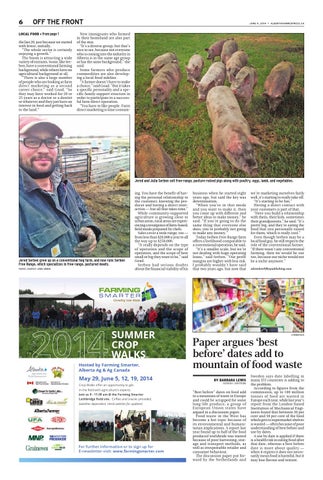
Jered and Julia Serben sell free-range, pasture-raised pigs along with poultry, eggs, lamb, and vegetables.
Jered Serben grew up on a conventional hog farm, and now runs Serben Free Range, which specializes in free-range, pastured meats. Photos: Courtesy Jered Serben
ing. You have the benefit of having the personal relationship to the customer, knowing the producer and having a direct interaction — but all that takes time.” While community-supported agriculture is growing close to urban areas, rural areas are experiencing a resurgence of farm-based, field meals prepared by chefs. Sales cover a wide range, too — from less than $20,000 a year to all the way up to $250,000. “It really depends on the type of operation and the scope of operation, and the scope of how small or big they want to be,” said Goad. Serben had serious doubts about the financial viability of his
SUMMER cRop walKS Hosted by Farming Smarter, alberta ag & ag canada
May 29, June 5, 12, 19, 2014 Crop Walks offer an opportunity to get in the field with agriculture’s experts. Join us 9 - 11:30 am @ the Farming Smarter lethbridge field site. Coffee and snacks provided. (weather dependent, check website for updates)
For further information or to sign up for E-newsletter visit: www.farmingsmarter.com
business when he started eight years ago, but said the key was determination. “When you’re in that mode and you want to make it, then you come up with different and better ideas to make money,” he said. “If you’re going to do the same thing that everyone else does, you’re probably not going to make any money.” Today Serben Free Range farm offers a livelihood comparable to a conventional operation, he said. “It’s a smaller scale, but we’re not dealing with huge operating loans,” said Serben. “Our profit margins are higher with less risk. I probably wouldn’t have said that two years ago, but now that
we’re marketing ourselves fairly well, it’s starting to really take off. “It’s starting to be fun.” Having a direct contact with your customers is part of that. “Here you build a relationship with them, their kids, sometimes their grandparents,” he said. “It’s pretty big, and they’re eating the food that you personally raised for them, which is really cool.” Even though Serben may be a local food guy, he still respects the role of the conventional farmer. “If there wasn’t any conventional farming, then we would be out too, because our niche would not be a niche anymore.” akienlen@fbcpublishing.com
©thinkstock
Paper argues ‘best before’ dates add to mountain of food waste By Barbara Lewis athens / reuters
“Best before” dates on food add to a mountain of waste in Europe and could be scrapped for some long-life produce, a group of European Union states have argued in a discussion paper. Food waste in the West has become a hot topic because of its environmental and humanitarian implications. A report last year found up to half of the food produced worldwide was wasted because of poor harvesting, storage and transport methods, as well as irresponsible retailer and consumer behaviour. The discussion paper put forward by the Netherlands and
Sweden says date labelling in many EU countries is adding to the problem. According to figures from the commission, up to 100 million tonnes of food are wasted in Europe each year, while last year’s report from the London-based Institution of Mechanical Engineers found that between 30 per cent and 50 per cent of the food which gets to supermarket shelves is wasted — often because of poor understanding of best before and use by dates. A use by date is applied if there is a health risk in eating food after that date, whereas a best before date is more about quality — when it expires it does not necessarily mean food is harmful, but it may lose flavour and texture.
7
Albertafarmexpress.ca • june 9, 2014
MCDONALD’s } from page 1 players it needs to, will be better equipped to chase opportunities than one where you have to chase around and talk to four different associations and five different industry supplier groups before you can get an answer,” added Kolk. “A less fragmented industry does not guarantee success, but it will be better able to grasp the opportunities that stand in front of it.” As reported in the last edition of Alberta Farmer, the McDonald’s pilot would require an extensive database, which would not only track production and carcass information but also data on environmental stewardship, animal health and welfare, and food safety. That database would allow buyers — such as restaurant or grocery chains — to select beef on specific attributes and that, in turn, could encourage producers, feedlots, and packers to work together to supply what the market is looking for, said McConnell. “The whole (food) system today is being consumer pulled, rather than supply pushed,” he said. “But this whole initiative is a good example of that because the consumer is telling McDonald’s and McDonald’s is telling the industry.”
IN Brief Australian organic farmer loses landmark GM contamination case sydney / reuters An organic farmer in Western Australia lost his bid to claim damages from a neighbour after genetically modified canola seed heads blew onto his property, causing him to lose his licence as an organic grower. The Supreme Court of Western Australia ruled against organic farmer Steve Marsh, who sued his former friend Michael Baxter after winds carried harvested Roundup Ready canola crop on to Marsh’s farm. The case has been closely watched internationally. Lawyers said a win for Marsh on the grounds of trespass could have led to new rules, such as larger buffer zones between GMO and organic farmers, potentially curbing the amount of GMO canola being planted. Unlike the U.S., EU, and Japan — which allow trace amounts of GM crops in organic foods in acknowledgment of contamination by wind or pollen transfer — Australia maintains a zero threshold. The ruling is expected to lead to calls for Australia’s national certification authority, Standards Australia, to ease its tight policy on contamination.
A greater level of co-operation between sectors and a detailed information-sharing system were key recommendations of both the Straw Man task force and the Canadian Agri-Food Policy Institute, which issued the highly critical report in 2012. That report accused the beef sector of falling behind its competitors, failing to grasp opportunities to grow the industry, and not doing enough to meet consumer expectations. It is expected this informationsharing system will be based on the recently relaunched BIXS (Beef InfoXchange System) that will be expanded to include data from the Verified Beef Production program. “In order for McDonald’s to do what they are after and the producers to accomplish this, we need a strong, robust, information system,” said McConnell. The McDonald’s pilot still hasn’t been officially announced, but the company said in an email it is working with the Canadian Cattlemen’s Association to develop the sustainable beef pilot. “At this time we do not have further details to share, but we plan on working directly with producers, feeders and packers around practical guidelines that address environmental stewardship, ani-
mal health and welfare, and food safety,” said Jeff Fitzpatrick-Stilwell, senior manager of sustainability for McDonald’s Canada. And while there is no definition of sustainable beef, the company has pledged it won’t be imposing new rules on beef production, but rather seeking ways to verify that current practices in Canada are sustainable when it comes to things such as the environment and animal welfare. “I think that Canada already has a lot of things that they’re looking for,” said Kolk. “The fact that they picked us tells us already that they felt the chances of success were higher working with the Canadian industry than some of the other choices they had.” “We have an exceptional beef product. In most cases, we’re doing all the right things,” added McConnell. The McDonald’s pilot can not only bring the various sectors within the beef industry together, but also show them that co-operation is good for the bottom line, said Kolk. “It’s no surprise that they’re going now this road — we see Walmart doing it, we see petroleum companies doing it, we see all kinds of companies doing it,” he said. “Whoever gets to work with these
McDonald’s pilot project will be good for the entire Canadian beef sector, said Kim McConnell, a member of the Straw Man task force. photo: supplied companies to set the metrics, the measurements, and the criteria has a better chance of being able to satisfy the customer over time. I’m of the opinion that he who sets the metrics will garner the profits. The chance that we have in Alberta and with the Canadian beef industry is
that McDonald’s has committed to working with industry to figure this out.” McDonald’s has promised to start using some sustainable beef by 2016. akienlen@fbcpublishing.com
PROTECT YOUR CROP. UNLEASH YIELDS.
Treat fungicide as an investment, not a cost. Today’s depressed (and depressing!) grain prices have many producers feeling squeezed for operating capital. But experts say reducing inputs on the upcoming crop in order to minimize expenditures could cost producers more in the long run. “Producers need to maintain a balanced approach, because the production of a successful crop requires all inputs in balance. You need to set out with an intention of what kind of yield is realistic and what kind of inputs are necessary to achieve that yield. If you have to cut back anywhere, you have to recalibrate to a lower yield goal and calculate corresponding inputs to achieve that revised goal,” says Sheri Strydhorst, an agronomy research scientist, with Alberta Agriculture and Rural Development (ARD). “Imagine if it’s a year where crops are susceptible to disease and someone loses 25 per cent of their yield because they choose not to apply a fungicide. That fungicide might cost $25/acre in input and application costs. But if wheat is $4 a bushel and the yield drops by 20 bushels per acre because of disease, they’ll lose $80 per acre to save $25 per acre. It’s a very dangerous thing to make a pest
management decision based solely on minimizing input costs rather than growing conditions.” In 2013, Strydhorst conducted the first of a four year small-plot research trial that compared various agronomic management systems. Jason Wood, a production crops economist with ARD, then took this production data and analyzed the cost of production
“It is complicated to get your head around, but the extra cost of fungicide application is divided across more bushels, resulting in a lower overall production cost per bushel. The cost of production economics are so dependent on yield,” explains Strydhorst.
“The extra cost of fungicide application is divided across more bushels, resulting in a lower overall production cost per bushel.”
It’s important to note that the per bushel costs from these trials are a result of a single year of data in a single location in a year with heavy disease pressure. Strydhorst cannot confirm that the findings represent a long term trend. That said, the benefit of slightly higher inputs resulting in significantly more yield is obvious, she says.
of various agronomic practices. At the Barrhead location – where growing conditions were favourable and high yields were achieved – the cost of production (including cost of inputs, land and labour) of a standard CPS wheat crop grown with basic agronomic management and no fungicide application was $2.66/bu. When sprayed at flag leaf with Headline® at full rate, the cost of production dropped to $2.51/bu. A single application of Prosaro® at head emergence dropped production cost further to $2.43/bu. Two applications of fungicide resulted in
The window to apply an effective fungicide is very small, particularly for farmers who opt to spray only a single application. Some diseases, especially stripe rust, move incredibly quickly and need to be attacked as soon as they first infect a field. Therefore, scout often, have a spray plan in place and supplies available, and be prepared to act quickly. It is always harder to scramble to apply an unplanned but necessary application than to cancel a planned application if weather conditions or crop growth are not conducive to disease.
UFA OFFERS TOP CEREAL FUNGICIDES INCLUDING:
UFA OFFERS TOP CANOLA AND PULSE FUNGICIDES INCLUDING: BRAND NAME
the highest yield, at a cost of $2.51/bu.
CROP
TARGET DISEASE
Sclerotinia
Wheat, Barley, Oats
Fusarium Head Blight, Rusts (Leaf, Stem & Stripe), Tan Spot
Canola
Black Leg, Black Spot
Wheat, Barley
Fusarium Head Blight, Septoria, Tan Spot, Leaf Rust, Stem Rust
Field Peas
Powdery Mildew, Mycosphaerella Blight
Wheat, Barley, Oats
Fusarium Head Blight, Leaf Rust, Tan Spot, Net Blotch
Canola
Sclerotinia, Black Spot
Wheat, Barley, Oats
Leaf Rust, Tan Spot, Stripe Rust, Septoria
Field Peas
Powdery Mildew, Mycosphaerella Blight, White Mould
Wheat, Barley, Oats
Leaf Rust, Tan Spot, Stripe Rust
Canola
Sclerotinia
Wheat, Barley, Oats
Leaf Rust, Tan Spot, Powdery Mildew
Field Peas
Sclerotinia Rot (white mould), Mycosphaerella Blight
Wheat, Barley, Oats
Fusarium Head Blight, Rusts (Leaf, Stem & Stripe)
Canola
Sclerotinia
Wheat, Barley, Oats
Rusts (Leaf, Stem & Stripe), Net Blotch, Septoria
Canola
Blackleg
Wheat, Barley, Oats
Rusts (Leaf, Stem & Stripe), Net Blotch, Septoria
Field Peas
Powdery Mildew, Mycosphaerella Blight
CROP
TARGET DISEASE
Canola
BRAND NAME
Note: this chart is not a complete listing of all crops and diseases controlled. For a complete list of all crop types and diseases controlled, consult the product label or talk with your local UFA Crop Sales Staff member. Always read and follow label directions.
© 2014 UFA Co-operative Ltd. All rights reserved. All other products are registered trademarks of their respective companies. 05/14-37758 AFE
UFA.com
8
JUNE 9, 2014 • ALBERTAFARMEXPRESS.CA
TO SPRAY
No visible disease present
No visible disease present
No visible disease present
No visible disease present
Leaf disease on upper leaves and/or flag leaf
–
Leaf disease on upper leaves and/or flag leaf
–
FL
AD TIMING E H
NG
EAF TIM I
L AG
When scouting your crop, starting at flag leaf stage, please consider the following steps to determine whether to spray or not.
The only time you shouldn’t spray is when you have a poor looking crop and you are not in an area where fusarium head blight (FHB) is present.
If your crop doesn’t look good, but there is FHB present, a fungicide application can still pay and safeguard the yield and quality of your grain. Do some calculations and if your potential disease risk and expected return exceed the cost of application – you should protect your crop with a fungicide.
S PR AY
S PR AY
If your crop looks good, you will definitely want to protect your investment with a fungicide application. Which product will provide the most bang for your buck? It depends on crop staging, current disease pressure and potential disease risks. Here is a quick chart to help make your fungicide decision easier.
Leaf disease only (lower to mid leaves)
Leaf disease only
Leaf disease only (lower to mid leaves)
Leaf disease only
S PR AY
S PR AY
To see how It Pays to Spray in your area visit BayerCropScience.ca/ItPaystoSpray BayerCropScience.ca/ItPaystoSpray or 1 888-283-6847 or contact your Bayer CropScience representative. Always read and follow label directions. Folicur® and Prosaro® are registered trademarks of the Bayer Group. Bayer CropScience is a member of CropLife Canada.
FS:10.55” F:10.8”
T:21.6”
9
Albertafarmexpress.ca • june 9, 2014
NOT TO SPRAY POTENTIAL FOR FHB?
WHAT SHOULD YOU SPRAY?
†
GAIN IN YIELD* SPRING WHEAT
+ 4.7 bu./ac.
NO
Even when you can’t see disease symptoms, there is no such thing as a disease-free crop. A good crop is worth protecting – consider spraying an application of Folicur® EW or Prosaro® applied at head timing to help ensure top grade, quality and yield.
Folicur EW 3/4 rate, flag leaf OR
+ 5.7 bu./ac. Folicur EW full rate, head OR
+ 8.4 bu./ac. Prosaro, head
+ 2.4 bu./ac. + 3.0 bu./ac.
Folicur EW full rate, head OR
+ 4.2 bu./ac. Prosaro, head
NO
Leaf disease damage to upper leaves or the flag leaf can cause irreparable injury to your crop and immediate action is required. Spray Folicur EW and reassess at head timing to determine whether a Prosaro application is required.
YES
Spray Folicur EW and re-assess at head timing to determine whether a Prosaro application is required. Consider following up with an application of Prosaro at head timing to help ensure top grade, quality and yield.
+ 9.5 bu./ac. Folicur EW 3/4 rate, flag leaf
+ 4.5 bu./ac. Folicur EW 3/4 rate, flag leaf
+ 7.0 bu./ac.
NO
When leaf disease is limited to lower/mid leaves at flag leaf timing, Bayer CropScience would suggest re-assessing at head timing and as disease pressure warrants, protect both your flag leaf and your head by spraying either Folicur EW or Prosaro.
Folicur EW 3/4 rate, flag leaf OR
+ 7.0 bu./ac.
Folicur EW full rate, head OR
+ 10.0 bu./ac.
Prosaro full rate, head
+ 5.2 bu./ac.
YES
Whenever you are in an FHB area, you should spray Prosaro or Folicur EW at head timing. However, if leaf disease is limited to the lower/mid leaves you have the ability to make your Prosaro or Folicur EW application at head timing to protect against both leaf disease and FHB.
Folicur EW 3/4 rate, flag leaf OR
+ 5.5 bu./ac.
Folicur EW full rate, head OR
+ 8.2 bu./ac. Prosaro, head
C-51-06/14-10191928-W
F:10.8”
T:15.5”
YES
There is no such thing as a disease-free crop. Even in the absence of disease symptoms, the mere fact that you are in an FHB area means you need to protect your crop. Apply Prosaro or Folicur EW at head timing.
Folicur EW 3/4 rate, flag leaf OR
*Gain in yield based on multi-year wheat Demonstration Strip Trial (DST) results in Western Canada, 107 replicated trials, 2008-2013. Results compared to yield of untreated check. †Yes FHB means yield data is derived from DST trials where both %FDK and DON ppm levels were greater than zero, indicating FHB was present within the trial. †No FHB means yield data is derived from DST trials where both %FDK and DON ppm were zero, indicating that no FHB was present within the trial.
T:21.6”
10
JUNE 9, 2014 • ALBERTAFARMEXPRESS.CA
Soybean market continues its decline market outlook } Double bottom alerts soybean producers
of impending rally, but rallies don’t last!
By david drozd
A
chart formation known as a double bottom developed on the weekly nearby soybean chart while South American producers were harvesting a record soybean crop. Chart formations signalling a trend reversal often appear at market bottoms when the news is bearish. Technical analysts rely on chart patterns, such as the double bottom to cut through the news.
Double bottom
A double bottom begins to take shape with prices advancing into new low ground for the current move, which is illustrated as (A) in the accompanying chart. An upward reaction then sets in during which a portion of the decline is retraced (B). A second decline (C) brings prices back down to approximately the lows of the first decline, followed by a price advance which eventually exceeds the reaction high (B). It is important that the two lows are not very close together, time wise. No strict rule exists as to how much time goes by for completion, but it should definitely be more on the order of three to five weeks or more. A time interval for completion measured in months, as with this example in the soybean market, would indicate a significant reversal of the major long-term trend. A double-bottom formation is completed after prices exceed the high (B) between the two lows. Once completed, a double-bottom formation provides
a minimum objective of the ensuing rally. This objective is derived by measuring the distance from the two lows to the reaction high, and extending this distance above the reaction high. In this illustration, the height was $.96 per bushel, resulting in an objective of $14.50 per bushel. This objective, illustrated as (D), was achieved soon after the double bottom formation was completed.
CBOT SOYBEAN WEEKLY NEARBY
Market psychology
The first low develops after a sustained price drop. It will coincide with a growing willingness on the part of shorts with large unrealized profits to cash in their earnings. As the price declines during this stage, the market starts losing downside momentum and stalls. The supply of contracts available for purchase exceeds the demand and the price begins to rise. Long buyers jump in, convinced that the downward move has gone far enough. Old shorts exit with their profits and are replaced by new longs. The market continues to go up until the price increase causes buyers to withdraw. From a longer-term perspective, the bear market is still intact, so when the price advance falters, sellers again step in and prices once again begin to move lower. Shorts who failed to take profits when prices made the first low and sat through the entire correction are watching more closely now that the market has come down to its prior lows. They won’t let the opportunity to cash in slip through their fingers this second time around. Finally, there are the ever-present potential long buyers, the bottom pick-
Chart as of May 30, 2014
ers who are waiting to buy the proverbial low of the move. At the low price level this buying surpasses whatever selling remains and the market begins to gain ground. Once prices fail to mount any sustainable decline, hope begins to wane and covering of short contracts becomes an inevitable reality. As prices rally with increasing acceleration, new longs also enter the market. For the past eight weeks, the soybean market has been consolidating between $15.25 (resistance) and $14.55 (support). A decisive close above $15.25 is needed to extend the recent rally. However, a decisive close below $14.50 would open
the door to additional weakness. I covered the significance of an area of resistance in last month’s column on wheat. Send your questions or comments about this article and chart to info@agchieve.ca. David Drozd is president and senior market analyst for Winnipeg-based Ag-Chieve Corporation. The opinions expressed are those of the writer and are solely intended to assist readers with a better understanding of technical analysis. Visit Ag-Chieve online at www.ag-chieve.ca for information about our grain marketing advisory service and to see our latest grain market analysis. You can call us toll free at 1-888-274-3138 for a free consultation.
BrieFS $50 million in adaptation funds over five years
The weather may be unpredictable in Alberta, but AFSC is not! AFSC knows what farming in Alberta is like, and has provided hail insurance for over 75 years. Protect your investment and be ready this growing season. AFSC has increased the coverage limits for 2014. For more information or to purchase Straight Hail Insurance, visit us online at www.AFSC.ca or at your local AFSC Branch.
www.AFSC.ca 1-877-899-AFSC (2372)
Staff / The federal government has renewed the five-year Canadian Agricultural Adaptation Program to assist industry organizations’ response to emerging issues and develop new opportunities. Under the program, over $50 million will be available over the next five years for investments in industry-led projects that will help the sector seize opportunities, respond to emerging issues, and investigate and pilot approaches to deal with new and ongoing challenges. The renewed program will enable the agricultural industry to proactively tap into opportunities and tackle unforeseen challenges, similar to the projects pursued by Pulse Canada and the Flax Council of Canada that received investments under the previous version of the program. The program is open and applications will be accepted on a continuous basis until funds are fully utilized. All projects must be either national or sector-wide in scope.
Pulse Canada secured funds under the previous program for a pulse flourmilling project aimed at developing processing techniques to produce pulse flours for food product applications. The flax sector turned to the program to develop and implement a comprehensive farm stewardship, export testing and market awareness program that was instrumental in reopening the export market in the EU, Japan and Brazil after the discovery an unwanted genetically modified variety was found in shipments.
McDonald new ARECA executive director Janette McDonald is the new executive director of the Agricultural Research and Extension Council of Alberta. The council is made up of 13 member organizations focused on both applied research and the forage industry. McDonald, formerly executive director of the Alberta Pulse Growers, succeeds Ty Faechner in the executive director role.
11
ALBERTAFARMEXPRESS.CA • JUNE 9, 2014
New carcass evaluation system key to moving lamb industry forward An accurate evaluation system would be a basis for providing economic incentives for high quality ALBERTA LIVESTOCK AND MEAT AGENCY RELEASE
A
key issue with Canadian lamb is the lack of homogeneity among lamb carcasses, resulting in inconsistent size of meat cuts. This is a challenge for retailers and restaurants as they strive to offer a consistent quality product to their customers. This challenge could be solved, in part, with an improved carcass evaluation system, something Agriculture and Agri-Food Canada researcher Manuel Juárez and his team is hoping to help create. “Alberta’s current lamb market consists mostly of small- and medium-size flocks and a wide diversity of breeds,” said Juárez. “Producers are looking for more uniform and reliable ways of evaluating carcasses as a basis for reliable economic incentives for high-quality carcasses. We hope that this research will help build that capacity. The industry needs new tools to assist Alberta’s sheep producers, processors, and retailers to fill more of the growing demand for high-quality lamb meat, both domestically and internationally.”
“We know that this is just the beginning, but once carcass quality standards are established, lamb producers will have more information on their product that they can use for on-farm genetic selection and lamb feeding.”
more information on their product that they can use for on-farm genetic selection and lamb feeding,” said Juárez. “Being able to select animals and manage them to produce quality lamb should help encourage this industry’s growth.” The research is being supported by Alberta Lamb Producers, Sungold Specialty Meats, Alberta Agriculture and Rural Development, and the Alberta Livestock and Meat Agency (ALMA). This project is another example of the lamb industry moving in the right direction, said ALMA president and CEO Gordon Cove. “The lamb industry has shown a commitment to traceability, so establishing improved carcass assessment technologies is another step forward,” he said. PHOTO: THINKSTOCK
www.farm-king.com
Cut it, Ted it, Rake it, Move it.
Sickle Bar Mower
Disc Mower
Tedder
Easy Rake
Easy Rake Superstar
Bat Rake
Round Bale Carrier Model 1450
Round Bale Carrier Model 2450
Square Bale Carrier Model 4480
MANUEL JUÁREZ AGRICULTURE AND AGRIFOOD CANADA RESEARCHER
The researchers are using two technologies to evaluate variability in carcasses and meat quality — Dual Energy X-Ray Absorptiometry (DEXA) and Near Infrared Reflectance Spectroscopy (NIRS). Both provide quick and accurate estimations of a carcass, and do not damage it. The research team will also use that benchmark information to establish relationships between production factors, processing systems, and carcass quality parameters. DEXA can also estimate bone density to determine age, which can be an important parameter for high-value market definition of ‘lamb.’ “We know that this is just the beginning, but once carcass quality standards are established, lamb producers will have
Getting your hay from the field to the yard has never been easier. Farm King offers a full line of hay tools designed to increase productivity of your operation and maintain the nutrient value of your crops. From first cut to the last move, Farm King meets your haying needs.
Visit www.farm-king.com to find a dealer near you.
Stretch your ADVERTISING DOLLAR!
1-800-665-1362
©2014 Buhler Trading Inc. | info@buhler.com | www.farm-king.com
12
news » livestock
JUNE 9, 2014 • ALBERTAFARMEXPRESS.CA
NEWapp for price forecasts
Program offers free egg quota
Canfax has created a new, free app to forecast market prices. By using historical Canfax data, CFXPro helps project, from current market conditions, what calf prices might look like in the fall. Included in this guide are prices of calves, a break-even calculator, futures market information and daily updates on the new price insurance numbers so producers can check what those numbers are at any given time. The app is only a guide, but brings “a Canadian perspective to market information,” said Brian Perillat, manager and senior analyst at Canfax. The CFXPro app is available through iTunes store and BlackBerry World.
The Egg Farmers of Alberta is now accepting applications under the New Entrant Program, which offers quota at no cost. Quota will be issued in lots of up to 1,500 birds. If there are more qualified candidates than available lots, a draw will be held. Applicants must be Canadian citizens or permanent residents, reside in Alberta, and cannot be a current or past quota holder. A New Entrant Plan application form, a comprehensive business plan, and a $1,000 fee are required. The deadline is June 27 and more information is available at www.eggs.ab.ca/nep.
‘Cow whisperer’ demonstrates low-stress cattle handling at Alberta workshop Understanding how your movements affect your cows makes it easier to manage them, whether in the pasture or in the pen By Jennifer Blair af staff / okotoks
“Working with stock is all about doing something that you think is right and then readjusting to where the cow tells you to be.”
W
atching Curt Pate work cattle is like watching a child tugging at a kite string on a windy day. At first, it seems he can’t possibly control the wild movement of this unpredictable thing he’s trying to direct. But soon enough, he has everything well in hand. When he approaches the small herd from the left, the cattle move right — exactly where he intended them to go. He moves right, the cattle veer left. When he runs, they run, and stop when he does — all the while watching this stranger intently for their next cue. The trick, he says, is pressure. “It is possible to completely change the way an animal thinks and feels and works off our pressure,” said the Montana native at a recent workshop in Okotoks. “Animal handling can make a big difference in the way animals respond to us.” Cattle handlers sometimes confuse stress and pressure, he said. Low-stress cattle handling is not the same as no-pressure cattle handling. “If you don’t put enough pressure on an animal and you’ve got to get him into a crowd of people, you can do all the low-stress handling you want and you’re going to fail. It’s got to be effective pressure.” Experienced stockmen create the right amount of pressure by understanding how their position affects a cow’s movement and responding accordingly. “Working with stock is all about doing something that you think is right and then readjusting to where the cow tells you to be.”
Getting the point
Finding the right position comes down to the “balance point” just behind a cow’s elbow, said Pate. Moving behind the balance point will cause the cow to go forward, while moving in front
CURT PATE
“Cow whisperer” Curt Pate demonstrated low-stress cattle-handling techniques at a recent workshop in Okotoks. Photos: Jennifer Blair of it will cause the cow to stop or turn away. But the balance point is different in every situation. “In a perfect vacuum world, that’s where it’s at, right behind the elbow. But in the real world, it’s always changing. And a stockman knows to change to fit the situation.” Instead of thinking about the balance point, producers should think about the “focus point.” “The farther back I get behind the cow’s tail, the less focus I’m going to have, and she wants to see me in clear focus.” A cow will turn her head to watch whoever is causing her stress, and where her nose turns, she follows. “If you want to put a cow in that red gate, if you can keep that animal’s nose pointed toward that red gate and keep it moving forward, you’re going to get it through the gate.”
Flight zone
In some cases, though, the cow will flee — a result of entering the flight zone.
Montana stockman Curt Pate shared his wisdom at a recent workshop hosted by Foothills Forage and Grazing Association. “If you penetrate the flight zone, the animal runs away. But we don’t want those animals running away. We want them to walk away,” he said. “If you penetrate the flight zone and they flee, you’ve done too much.” Pate calls it the “pressure zone,” which he describes as
“how close you are to that animal to get her to respond.” Cattle handlers can adjust their pressure by observing what the animal did just before she fled. “It’s what happened before it happened that made it happen,” he said, drawing on an old saying.
“If you just march in on them and yell and send the dog and hit them, you’re going to increase the flight zone. But if you walk in and, as they look at you, you step back, you’ll draw their mind, and pretty soon, you’ll be able to work those animals from a reasonable distance.” Like all animals, cattle have two parts of their brain: the thinking side and the reacting side, said Pate. “When there’s more pressure, that brain switches from the thinking side to the reacting side. All they’re doing is reacting to that pressure to get the heck out of there so they can get back to thinking about what to do.” The shift from thinking mode to survival mode creates stress in the animal, negatively impacting the cow’s health, productivity, and welfare. Effective stockmanship reduces some of these effects — which is ultimately better for the bottom line. “Stockmanship is about working with animals in a way that maximizes our forage use and our profit, plus quality of life,” said Pate. “Stress on cattle is hard to judge. But if we can keep the pressure or the stress off these cattle, they’ll be a lot better for it.” jennifer.blair@fbcpublishing.com
13
ALBERTAFARMEXPRESS.CA • JUNE 9, 2014
Seriousness of equine obesity often overlooked by owners HORSE HEALTH } But the treatment is the same as for humans,
diet modification, calorie restriction and exercise
BY CAROL SHWETZ, DVM
Most people readily recognize a thin horse and assume it is ill or has health risks, yet not so many owners are aware of the health risks and welfare issues associated with fat horses.
I
t is not healthy for horses to be overweight. It may be one of the most serious health conditions a horse can have. Unfortunately many animal owners deem a degree of obesity as normal, acceptable and even desirable. As a result, obesity is commonly disregarded. Nonetheless, as a horse moves from overweight to fat to obese the consequences to their health become dire. Most people readily recognize a thin horse and assume it is ill or has health risks, yet not so many owners are aware of the health risks and welfare issues associated with fat horses. Some of the obvious consequences of obesity can be attributed to the simple accumulation of excessive adipose tissue. These adverse effects include ease of fatigue, heat intolerance, abnormal reproductive performance, fatty tumours, and accelerated osteoarthritic conditions. That which is not so readily apparent about obesity is its devastating metabolic consequences. Adiposity alters insulin function in horses and it is through this pathophysiological pathway that many adverse medical consequences of obesity are being characterized. Insulin is a hormone which effectively moves glucose from the circulating blood, across the cell membrane and into the cells where it can be used for cell metabolism. When horses become insulin resistant or insensitive to the effects of insulin they can no longer control their blood glucose levels and perhaps more importantly they can no longer nourish their cellular tissue. Thus the consequences of insulin resistance for the entire body are profound. As insulin resistance progresses a number of health problems develop. Insulin resistance has been implicated in the pathogenesis of equine metabolic syndrome, pituitary pars intermedia dysfunction (also known as equine Cushing’s disease), developmental orthopedic diseases, systemic inflammation and laminitis/founder. Of these, laminitis is particularly concerning because of its painful and debilitating nature. Insulin resistance, obesity and laminitis are intricately intertwined. There is good evidence that diets containing high-energy
As a horse moves from overweight to fat to obese the consequences to their health become dire. rations increase both blood glucose and insulin levels following consumption. Horses consuming these diets show exaggerated post-feeding insulin levels. Presently it is thought that the cell membranes become insensitive to insulin as a result of frequent peaks in blood glucose and therefore insulin concentrations. The unnatural bombardment of cell membrane receptors with insulin appears to dull their sensitivity and interferes with the proper functioning. Over time insulin sensitivity within the body is significantly diminished. It is being proposed that such diets are responsible for altering insulin mechanisms in horses. Diets that contain substantial “refined” and processed cereal grains and thus carbohydrates are at odds with the nature of the foods for which horses are adapted. Forage sources that are relatively high in non-structural carbohydrates further aggravate the insulin resistance in affected individuals. In the healthy natural state, the acquisition of fat stores in preparation for winter is important for survival. When environmental conditions become harsh, fat stores are mobilized to sustain the horse. In nature, the period
of environmental harshness is finite and the acquired fat stores are depleted prior to spring and the growth of new grass. Today, most horses do not lose much weight in the winter and we have fat horses entering the winter whose bodies are prepar-
ing for a lean period that never arrives. Fat stores are not mobilized and become stagnant. In many cases, horses continue putting on weight at a time when their bodies are designed to be losing it. Undoubtedly this confusion contributes to meta-
bolic chaos, further disrupting the insulin messenger. It is important to understand that obese horses are living with some degree of metabolic dysfunction. Each obese horse is uniquely sick and therefore utmost care and kindness must be undertaken with diet, movement and lifestyle programs to restore these horses to a place of wellness. Interestingly, the management tools undertaken to treat obesity will be similar to those management tools utilized to effectively prevent the occurrence of obesity which include calorie restriction, diet modification, and movement. Carol Shwetz is a veterinarian specializing in equine practice at Westlock, Alberta.
Please join us on a 16 day agricultural tour to Australia’s national beef exposition. Beef Australia is one of the world’s great beef cattle events and is held just once every three years in Rockhampton, Queensland, Australia.
Departing Canada April 30th to May 16th 2015 5 nights Rockhampton - 5 nights Cairns - 4 nights Sydney For more tour information please visit Beef Australia webpage:
http://www.leadertours.ca/beefweek2015/
Space is limited please register your interest by contacting: Lawrence Rowley Phone: 403-270-7044 Email: lawrence@leadertours.ca Website: www.leadertours.ca
Network
SEARCH
Search news. Read stories. Find insight.
14
JUNE 9, 2014 • ALBERTAFARMEXPRESS.CA
Hog industry braces for PED re-infection A farm in Indiana has suffered a second outbreak of the deadly PED virus, and Canadian hog producers can expect the same risk in their own herds BY JENNIFER BLAIR AF STAFF
C
anadian hog producers could see increased mortality in their herds as the porcine epidemic diarrhea (PED) virus begins to re-infect hog herds, says an Alberta livestock veterinarian. “We have to be prepared to live in a world where this infection and this disease is going to continue to recycle throughout herds in the United States, the world, and potentially herds in Canada,” said Dr. Egan Brockhoff of Prairie Swine Health Services in Red Deer. In late May, an Indiana hog farm became the first to confirm that it has suffered a second outbreak of the deadly virus that has decimated American hog herds and left Canadian producers scrambling to limit the spread
FILE PHOTO
of the disease in this country’s herd. In a typical disease outbreak, veterinarians “expect the infec-
tious phase to pass and for the herd to build immunity,” said Brockhoff. But because PED remains in a
hog’s intestinal tract and sheds easily into the environment, veterinarians have anticipated a 20 to 30 per cent reinfection rate
105 YEARS OF CHAMPIONING FARM SAFETY.
AND LOTS MORE WHERE THAT CAME FROM.
jennifer.blair@fbcpublishing.com
For more than a century, UFA has been a big part of small towns. From the prairies to the foothills, from the badlands to the boreal forests, our co-operative is at the core of rural life in Alberta. And nothing is closer to our hearts than the safety of our members and their communities. That’s why UFA is a founding member of Ag For Life, a non-profit organization dedicated to farm safety education and building a genuine understanding and appreciation for the role of agriculture in the lives of all Albertans. To learn more about Ag for Life, go to agricultureforlife.ca.
“We have to be prepared to live in a world where this infection and this disease is going to continue to recycle throughout herds in the United States, the world, and potentially herds in Canada.” EGAN BROCKHOFF
05/14-38178_08
38178_08 AFL UFA_8.125x10-ABFE.indd 1
since the disease first became a problem in the U.S. last year. “The data we’re getting out of the United States right now seems to confirm those thoughts that we had right from the beginning,” he said. Last year, the number of PED cases in America dropped off during summer, but given the new risk of re-infection, Canadian hog producers shouldn’t rely on history to repeat itself this summer. “If we look at the data out of the United States, there’s no question that the number of new cases per week being reported has started to decline slightly, but they’re not going to zero,” said Brockhoff. “They’re not dropping down to low numbers like we saw last summer. We’re still looking at 200 new cases a week. “This virus will move and infect a species on a warm summer day almost as easily as it would any other day of the year. It’s still critical that we focus on maintaining good practices and biosecurity.” Canada’s new mandatory traceability program, which comes into effect on July 1, will help with that, he said. “Anytime animals move, all the bacteria and viruses that are with them move with them,” said Brockhoff. “Our traceability program is going to be another one of the cornerstones in understanding animal movement.” Under the new system, both hog shippers and receivers must report any animal movement within seven days of shipment, which will help the hog industry respond quickly to any future PED outbreaks on Canadian farms. “Traceability is just going to be another tool in the chest of many tools we have to maintain a high-health herd in Canada,” said Brockhoff. In the U.S., PED outbreaks seem to recur in about 30 per cent of infected farms, the American Association of Swine Veterinarians said. Piglets born to sows that were infected for a second time have a death rate of about 30 per cent, compared to neartotal death loss among newborn piglets during the first outbreak, a veterinarian working with the producers of the Indiana farm told the Reuters news agency. The news of reinfection may be bullish for hog prices, which are up more than 26 per cent since the first U.S. outbreak was confirmed last summer.
2014-05-21 3:40 PM
15
ALBERTAFARMEXPRESS.CA • JUNE 9, 2014
Find a tick? Submit it to your veterinarian or public health office Ticks can transmit Lyme disease to humans and dogs, but also anaplasmosis to cattle BY ALEXIS KIENLEN AF STAFF
S
pring brings sunny days and barbecues, but also nasty creepy crawlies, including
ticks. Provincial officials are running a tick surveillance program, and urging anyone who finds a tick to contact their local veterinarian or public health office so it can be tested. “Ticks can do a number of things — the biggest concern we have about ticks is that they can carry disease and are vectors of certain diseases,” said Dr. Gerald Hauer, provincial veterinarian with Alberta Agriculture. “Some examples of that are Lyme disease and anaplasmosis. But those aren’t the only diseases they can carry.”
There are several different varieties of ticks and some of them are more harmful than others. The ixodes tick, which carries Lyme disease, is thought to have arrived in Alberta in the last several years. “Certainly, we’ve had a couple cases of Lyme disease in dogs, specifically in the Edmonton area,” said Dalton. Dogs with Lyme disease may exhibit stiffness or lameness in their hind end. Horses, cattle and sheep can get Lyme disease, but it tends to be rare. “As far as I’m aware, we’ve never recognized that in Alberta, but there are some other diseases that could be spread to livestock through ticks,” said Hauer. Anaplasmosis, which affects cattle, is one. The bug is a parasite that
lives in red blood cells, eventually causing their death which results in production losses, severe anemia and even death. The disease is no longer classified as reportable by the Canadian Food Inspection Agency, but is still considered serious. Hauer cautions anyone buying cattle from another area to talk to their veterinarian about the risk of anaplasmosis. “What we don’t want to do is have someone bring anaplasmosis back with some cattle and spread it with the tick population that’s currently here,” said Hauer. For more information on ticks in humans and the ‘submit a tick’ program, see www.health.alberta. ca/health-info/lyme-disease. html. akienlen@fbcpublishing.com
The ixodes tick, pictured here, is one of the tick species that carries bacteria that causes Lyme disease. PHOTO: SUPPLIED
“The biggest concern we have about ticks is that they can carry disease and are vectors of certain diseases.” DR. GERALD HAUER
Anyone who notices a tick on an animal or themselves should pull it off with tweezers, getting as close to the skin as possible. Twisting or jerking the bug is not recommended. If a livestock animal has a large number of ticks, they can be treated with spray-on medications after a tick has been submitted. Ticks, which are found across the province, often feed on more than one animal, transferring bacteria and diseases along the way. The bodies of females can become so engorged “sometimes it looks like raisins on the back of the animal,” said Dr. Darrell Dalton, registrar with the Alberta Veterinary Medical Association. “You’ll see moose come out in the spring that are covered in little bumps because of all the ticks feeding off of them,” he said. “You get enough of them and it will drag the animal right down and they’ll become anemic. The same thing can happen with some of our livestock.”
Beef 2014: International Livestock Conference This year’s conference will focus on the opportunities of marketing the whole carcass. With the trends that are taking shape today, there are many opportunities for the future. Hear an update on the local and global economies and the market opportunities that exist for the entire carcass both here in Canada and around the world.
Register at www.ilccalgary.com
ILC Beef 2014: Wednesday July 09, 2014
Deerfoot Inn & Casino, 1000, 11500-35 Street SE, Calgary, Alberta
Submitting ticks to Alberta Agriculture and Alberta Health’s tick surveillance program helps authorities determine what kinds of ticks are found in the province. PHOTO: SUPPLIED
Cattle photo courtesy of Canada Beef Inc.
ILC_2014_AlbertaFarmer_JrPage
16
JUNE 9, 2014 • ALBERTAFARMEXPRESS.CA
Cold weather hits Brazil Parts of southern Brazil recorded below-freezing temperatures early on June 3, with frost posing a risk to some corn areas though not to sugar or coffee, meteorologists said. Various cities in Parana state saw temperatures drop below 0 C, the coldest of the year, according to the Semepar meteorological institute. The regions that were most at risk to frost in Parana were Campos Gerais, the centre-south part of the state and the city of Curitiba. “It’s still early to say what might have been the real damage caused by these temperatures,” Marco Antonio dos Santos, agro meteorologist at Somar, wrote in a note. — Reuters
Australia sees 70 per cent chance Of El Nino The chance of an El Nino weather event developing this year remains at least 70 per cent, the Australian Bureau of Meteorology (BOM) said June 3. The bureau, which has had this forecast since April, said half of the climate models monitored by the bureau indicate an El Nino could be established by August. El Nino — a warming of sea temperatures in the Pacific — affects wind patterns and can trigger both floods and drought in different parts of the globe, hitting crops and food supply. — Reuters
Becoming your own weather forecaster — part two By combining website data with your own experience you can predict weather for your region by daniel bezte
H
opefully some of you have been checking the weather models I mentioned two issues back. For those of you who still haven’t, the website that I have been referring to is: http://weather.unisys.com/ gfs/. This isn’t the only website that gives you access to weather models — I will point out some of the other sites over the next few months. In the last article we looked at two weather model plots that are probably the most useful, especially for the beginner. The first plot was the SL Pres/Prec, which is the Sea Level Pressure and Precipitation map. This plot shows where the surface highs and lows are located and where precipitation is forecasted to fall. The second plot we looked at was the 1000 mb map, which shows us the predicted temperatures and dew points near the Earth’s surface. There are several other plots or maps that you can look at, but for me, the next most useful plot is the 850 mb map. This map shows temperature, pressure (heights), along with wind speed and direction at the 850 mb level, or about 1,500 metres up (5,000 feet). The advantage of this plot compared to the 1000 mb plot is that the temperatures do not reflect the diurnal changes that occur at the surface from early morning to late afternoon. This allows you to see if warm or cold air is moving or advecting into a region. If you look at the 850 mb plot I have included, you will see that it is the forecast that was created on Monday June 2 and predicts the conditions for the afternoon on Monday, June 9. You can see that there is a weak ridge of high pressure building over Alberta with low pressure over Hudson Bay. This places Alberta in a southerly flow. Looking at the 850 mb temperature forecast you can see that most of Alberta is in the yellows (12 C) to red in the southwest corner (20 C). You can get a bit of an idea of how warm the surface temperatures will be by adding 10 to 12 C to these temperatures. So, according to this model run we should
see highs on June 9 around 30 C in the southwest, cooling to the low 20s over northeastern regions. Now onto the fourth and final plot — the 300 mb map. This shows the pressure contours or heights along with wind speed and direction. This map is looking at the upper portion of the troposphere and is located about 10,000 metres or 30,000 feet up. This is the level where the jet stream is usually located and this map helps to visualize where the jet stream is. Looking at the 300 mb map I have included, which is for the same time frame as the 850 mb map, you can see the areas with high wind speeds in light blue and green. You can see how the jet stream is coming through central B.C and doing a small arc over Alberta before diving southeastwards around the large low over Hudson Bay. This places southern and central Alberta to the south of the jet stream or on the warm side. That’s about it. With these four different weather model plots you can begin to start creating your own forecasts. The key is to check the weather models out at least daily, and watch which weather features are consistently hanging around and which are not. You can then get a feel for how good the model is handling the current weather pattern. Then, once you have gotten a feel for this you
can start to build in your own understanding of how weather patterns evolve from your past experiences and tweak what the models are showing you. This is the “art” of weather forecasting — looking at the weather models and then using your understanding and past
experiences to make changes. All of this does take time, but once you start checking the weather models on a regular basis, it should only take five or 10 minutes each day to get a fairly good idea of what the weather should be like over the next five to 10 days.
The key is to check the weather models out at least daily.
This shows the percentage of average precipitation across the Prairies during the 30 day period ending June 2. You’ll notice that there doesn’t seem to be any particular pattern to the wet and dry areas. The driest regions are in northwest Alberta and northeastern Saskatchewan into northwestern Manitoba, where precipitation was less than 40 per cent of average. North-central Saskatchewan, western Manitoba, and western/central Alberta saw above average amounts during this period.
17
T:10.25”
ALBERTAFARMEXPRESS.CA • JUNE 9, 2014
Funding for research projects
Root rot risk on the rise Root rot symptoms are often confused with other crop problems, so early detection and accurate diagnosis is critical “If the crop is already coming up out of the ground, it’s really too late to do much about what’s there. There’s no product you can apply now that’s going to help your root system recover.” Managing root rots comes down to “avoidance and prevention,” using good crop rotations, proper seeding depth, high-vigour seed, adequate fertility, and seed treatment. “Anything you can do to get the crop to come up out of the ground and get that seedling growing quickly will help you to avoid and prevent some of these root rot issues.”
By Jennifer Blair af staff
E
Symptoms and management
The first thing producers will notice if root rots have taken hold in their field is a lack of emergence or a reduction in stand establishment, said Harding.
Scouting critical
“You’re probably never going to have a season where you won’t see any of these soil-borne fungi causing problems.” Michael Harding
“Sometimes you’ll see patchy areas where the emergence just isn’t very good. You could start seeing that any time after the seedlings start coming up out of the ground.” After that, producers should watch for poor stand establishment and post-emergent yellowing or stunting. “They’re having a hard time pulling the moisture and nutrients out of the soil because of the attack on the root zone.” At that point, there’s very little producers can do to manage the disease, he said.
High Yield with
Clubroot Protection Pioneer brand 45H29 has been one of the highest yielding canola hybrids across Western Canada over the last few years. Not only does it have great standability and harvestability, it also has built-in Multi-race resistance to Clubroot. Call your local Pioneer Hi-Bred sales rep today to see how 45H29 can fit on your farm! ®
pioneer.com
But producers shouldn’t skip scouting just because there are no post-emergent management options for root rots. “There’s sometimes a tendency to use that as an excuse to not scout, but it is really important to get out there and scout.” Scouting will show any problems that are emerging and whether management techniques are making the situation better or worse. “Beginning early and frequently scouting can pay off by helping determine where these problem areas may be in your specific fields,” said Harding. “It’s good to scout at the beginning of emergence when the crops are coming up so that you can watch the establishment and look for patches that aren’t coming up. You can start to see that very early on.” Once a problem is identified, producers should consult with an agronomist to determine the likely cause, he said. “At the early stages of crop development, there’s lots of things that can cause patchiness and stand establishment issues. It’s not just diseases.” Things such as fertility, soil moisture, salinity, pH, and compaction can cause variation in emergence, making an accurate diagnosis essential for management. “Every time we see some yellowing or poor stand establishment, it may not be a disease. It may be something else, and we shouldn’t jump to conclusions.” jennifer.blair@fbcpublishing.com
T:15.58”
arly-season root rots could be on the rise in areas of the province that had a cool, wet start to seeding. “In the past few years, we’ve seen a lot of root disease issues, and I would say they’re primarily driven by environment,” said Michael Harding, research scientist with Alberta Agriculture and Rural Development. “These conditions will slow down germination and emergence and give some of those soil-borne fungi a greater chance to cause problems.” Early-season disease problems are primarily caused by soil-borne fungi that cause root rots, such as fusarium, rhizoctonia, pythium, and cochliobolus. These fungi are “present everywhere” in the province. “There’s always something in the soil that could potentially cause some disease on crops that are developing and becoming established,” said Harding. “It’s always something to think about, and it’s always something to watch for.” The level of disease pressure from root rots is “situational,” depending largely on crop rotations, soil conditions, seeding management, and weather. “If the environment is conducive to the disease, we can see lots of problems.” And each fungus thrives in a different environment. “You’ve got the triple combination punch of fusarium, pythium, and rhizoctonia,” he said. “If it’s cool and wet, pythium’s going to have its way. If it’s cool and dry, rhizoctonia is going to fare a little better. If it’s warmer and drier, fusarium may be a bigger problem.” “You’re probably never going to have a season where you won’t see any of these soil-borne fungi causing problems.”
Roundup Ready® is a registered trademark used under license from Monsanto Company. Pioneer® brand products are provided subject to the terms and conditions of purchase which are part of the labeling and purchase documents. The DuPont Oval Logo is a registered trademark of DuPont. ®, TM, SM Trademarks and service marks licensed to Pioneer Hi-Bred Limited. © 2014 PHL.
The Alberta Wheat Commission (AWC) and its partners in the Agriculture Funding Consortium are investing $1.5 million in 10 agronomic and breeding/genetic research projects. Five are focused on genetics, four on agronomic management, and one on both agronomy and genetics. “Research is a top priority for the commission with 40 per cent of AWC producer checkoff dollars going into research projects,” said commission chair Kent Erickson. In total, the Agriculture Funding Consortium — a group of 14 funding organizations — is investing $9 million in research.
18
JUNE 9, 2014 • ALBERTAFARMEXPRESS.CA
More Canadian Grain Commission changes
ON TOP OF THE WORLD
By Allan Dawson staff
T
Jessie, an Australian Shepherd, enjoys a walk through the wild flowers on a mountain ridge top, near Waterton Lakes National Park in southern Alberta. Photo: Wendy Dudley
FIELD SCHOOL June 24TH, 25TH, 26TH
SAME EVENT EACH DAY (CHOOSE ONE)
GROWING SOMETHING DIFFERENT TOPICS INCLUDE: • MAGIC BEANS Instructors: Patrick Fabian, Greg Stamp & Robyne Bowness • NIGHT SPRAYING Instructors: Dr. Bob Blackshaw, Dr. Mike Harding & Ken Coles • ON-FARM RESEARCH Instructors: Blaine Metzger, Joel Hubert, Ken Coles, Dr. Adil Akbar & Lewis Baarda • CORN AGRONOMY 101 Instructors: Nicole Rasmussen & Doug Moisey * This is a one day event repeated three times, starting at 8:00 am each day * CCA, CCSC & pesticide applicator credits available
Farming Smarter Field School will take place at the R&D site 2.6 km east of 43 St. S (Lethbridge) on Hwy 512/Jail Rd.
THE FIELDPREMIER SCHOO IN ALB ERTA! L
Don’t delay Register online today!
www.farmingsmarter.com
he Canadian Grain Commission (CGC) is looking for more ways to streamline its operations without compromising Canada’s reputation for highquality exports, says chief commissioner Elwin Hermanson. One option is to allow private grain inspectors to do outward inspections for willing exporters and grain buyers, with CGC oversight. However, CGC outward inspections would be available too, Hermanson said. “There are some customers who won’t accept Canadian grain unless it’s inspected by the CGC,” he said. “There are others who will. But to protect the Canada brand the (federal agriculture) minister has made it very clear that he wants CGC oversight.” Since last August, it’s been optional for grain companies to have grain inspected as it enters their export terminals, which is referred to as “inward inspection.” In the past, that was mandatory as well, and only done by CGC inspectors. Grain companies that want inward inspection must hire private inspectors at their own cost. Some in the grain industry want outward inspection made voluntary too. But outward grain inspection is too important to make it optional, Hermanson said. “It’s the country’s reputation and the industry that we have to be concerned about,” he said. “That’s our mandate... We work for companies, we work for farmers, but we work for Canada and for the benefit of the grain industry in Canada.” Higher CGC user fees took effect Aug. 1, 2013 aimed at making the CGC self-funding. Farmers and grain companies who pay those fees and are closely scrutinizing what the CGC does and how much it costs. Currently about $40 million, or two-thirds of its annual $60-million budget comes from the $1.82 a tonne charged for outward inspection on about 23 million tonnes of grain exports. Hermanson estimates outward inspection costs 50 or 60 cents a tonne, but it needs to charge $1.82 to cover most of the rest of its costs. What’s more, outward inspection is done on Canadian grain exported in ships, which accounts for only a third of the grain Canada produces. Grain sold domestically or exported to the U.S. doesn’t contribute. “So, we’re looking at how we might correct that,” he said. “It’s not easy to fix.” allan@fbcpublishing.com
Buy and Sell
anything you need through the
1-800-665-1362
19
ALBERTAFARMEXPRESS.CA • JUNE 9, 2014
Pea leaf weevil popping up in south Pea or faba bean crops seeded in mid- to late May will likely see a reduced risk of pea leaf weevil infestation this summer BY JENNIFER BLAIR AF STAFF
P
ea leaf weevils are starting to spring up in pea and faba bean crops in southern Alberta, but the cool, damp start to spring could keep infestation levels low this summer. “The years when we have the highest risk are actually years with early, warm springs,” said Hector Carcamo, research scientist with Agriculture and Agri-Food Canada. “This kind of spring is actually conducive to reduced risk of pea leaf weevil, except for those farmers who seeded very, very early before the snow fell. I suspect that in most of the fields planted in middle to late May, weevils are not going to accumulate in very high numbers.” At this point in the growing season, adult pea leaf weevils will be causing the most damage to crops, eating the foliage and creating distinct notches along the edges of the leaves.
“I suspect that in most of the fields planted in middle to late May, weevils are not going to accumulate in very high numbers.” HECTOR CARCAMO
“They’re quite easy to spot,” said Carcamo. “It looks almost like somebody came with a hole punch and made them. They’re quite uniform.” But that damage is “of very little consequence to the plant.” “It looks quite bad… but plants can compensate for the foliage that is removed by the weevil.” The “real damage” is going to happen later in the growing season, when the larva hatch and begin selectively eating the nitrogen-fixing nodules on the plant roots. “It’s the interference with the nitrogen fixation that can produce the yield losses,” said Carcamo. Once the plants are past the fifth or sixth node, pea leaf weevils present serious risk to the plant in terms of reducing yield. “A pea field that was planted in mid-April would still be between the second- and the fifth-node stage, and at that stage, it’s vulnerable to the insect because the larva will then be synchronized with the nodule production of the plant.” Damage to the nodules won’t cause any symptoms on the plant itself. “The only way to detect them is by pulling the roots and looking at the nodules closely. It’s more subtle damage,” he said. Producers can protect their crops from pea leaf weevils by using a seed treatment prior to seeding and insecticide at the two- to three-node stage, after establishing whether yield loss is likely to occur. “You want to establish an economic threshold when your crop is before the sixth-node stage,” said
Carcamo. “From emergence to the sixth node, that’s the crop stage of interest.” To determine if spraying is necessary, producers will need to scout at least 10 areas of their fields — five from the border and five from the middle — and look at the damage to the clam leaf from 10 different seedlings in each area. “If you have an average of 30 per cent of the seedlings with damage on the clam leaf, you know that you are near the threshold and there might be a risk of yield impacts from the weevil,” he said. And the time to start scouting for pea leaf weevil damage is now, especially in the Lethbridge area. “If growers have peas that were planted in mid-April, they should be looking at their crops now to see if they will need to make a decision about controlling them or not.” jennifer.blair@fbcpublishing.com
www.farm-king.com
Crucial details connecting your combine to the market
Grain Vac - PTO Model
Grain Vac - Diesel Model
Backsaver Auger 10/13/16
Backsaver Auger - Feterl Original 12/14
Backsaver Auger - Feterl Original 12
Conventional Auger
Conventional Auger - Feterl Original
Drive-over Hopper
Utility Auger / Unloading Auger
Rollermill / Hammermill
Grain Cleaner
Grain Cart - 1060/1360
Higher input costs and tighter margins require a complete grain management system to make your operation as profitable as possible. The complete line of Farm King grain handling equipment ensures you get top dollar for your crop. With decades of grain handling experience, Farm King offers everything you need to get your grain to market after it leaves the combine.
Visit www.farm-king.com to find a dealer near you.
©2014 Buhler Trading Inc. | info@buhler.com | www.farm-king.com
20
JUNE 9, 2014 • ALBERTAFARMEXPRESS.CA
Does the time of day matter when applying herbicides? Burn-down trials suggest applying herbicides at dawn may be less effective
…the verdict is, time of day can impact weed control more than you might think.
By Ken Coles FARMING SMARTER Have you ever evaluated your weed control and come across confusing differences between fields? Perhaps they were even sprayed on the same day with the same chemical? The good news is you might not be crazy. Well, at least not more than normal. We just rated our burn-down trials for a third year where we sprayed glyphosate and three tank mix partners at noon, midnight and early dawn. I have to admit that starting out I didn’t expect to see any differences. Having worked in research for many years, I know companies are very good at registering products that perform well in as many conditions as possible. It just makes good sense. But the verdict is, time of day can impact weed control more than you might think. For the most part, there isn’t too much to worry about, but we may have an opportunity to fine tune our spray timing especially in more difficult situations such as with hard-to-kill, larger weeds or dense infestations. We still need to collect weed biomass data this season and spend some time analyzing the results, but we’re seeing some trends that might be valuable. Since early weed control has proven to be important in protecting yield, it may impact your bottom line and help keep a few more weeds from setting seed in
The test plot on the left was sprayed with Carfentrazone at noon, while the side on the right was sprayed at dawn. PHOTO: FARMING SMARTER
your fields. The clearest trend so far is that spraying at the crack of dawn led to the poorest control in most cases. This was especially true for glyphosate alone and with the tank mix partner CleanStart, (Carfentrazone). Most farmers would
likely not see these differences when spraying entire fields but with small plots we can evaluate differences side by side. Carfentrazone is a contact herbicide and like Liberty, it is best sprayed midday (see picture).
Understandably, it’s most important to get the job done with narrow windows to get fields sprayed and seeded. But, it’s also important to get things done right. Honestly, high-clearance and high-speed sprayers, GPS guidance, and low-drift nozzles have drastically improved spraying capacity and flexibility. The next challenge for us is to determine what’s causing the differences that we are seeing. It seems likely temperature and relative humidity relationships are playing a significant role, as well as light intensity. The early-morning applications tend to occur at the coolest part of the day when relative humidity is the highest. Other studies have also shown that leaf orientation to the sun can play a role with certain weed species. We’ll explore this further with our incrop studies in peas, canola and wheat. But remember, in this case the early bird doesn’t get the worm. So you might as well catch a few more winks!
www.farmingsmarter.com
Canola growers file levelof-service complaint
> Empty Pesticide Container Recycling Program
There are many reasons to rinse. No excuse not to! #5
BY ALLAN DAWSON STAFF
A
Rinsing and recycling makes you a leader in agricultural stewardship Returning clean containers is the right thing to do.
{
For more information or to find a collection site near you visit cleanfarms.ca
allan@fbcpublishing.com
Search Canada’s top agriculture publications… with just a click. Network SEARCH
Now, take your empty fertilizer containers along for the ride! 10901A-CFM-1-5Reasons-AFE-6x6.625.indd 5
second legal complaint has been filed alleging the railways provided inadequate grain-shipping service this crop year. And more might be coming. The Canadian Canola Growers Association filed a level-of-service complaint with the Canadian Transportation Agency (CTA) in late May, accusing both CP and CN railways of failing to fulfil their common carrier obligations. “What we’re saying to the CTA is they (railways) didn’t even come close,” said Rick White, CEO of the canola growers association. “They didn’t do it on a weekly basis. They didn’t do it on monthly basis and they are not even going to do it on a yearly basis this year. We’re going to end up with a 23-million-tonne carry-out, (which is) totally unacceptable to farmers. That’s why we’re launching this.”
Louis Dreyfus Commodities filed a level-of-service complaint against CN April 16, and other grain companies are considering doing so, too, said Wade Sobkowich of the Western Grain Elevator Association. “This situation is about a 100year crop and the worst winter in decades, not about a level-of-service failure by CN,” CN spokesman Mark Hallman said in an email. The railways aren’t investing in increased capacity because grain is captive, according to White. As a result railways eventually get most of the business while keeping costs down to maximize shareholder returns. “But they have a statutory obligation to move the crop that is coming, not the five-year trailing average,” he said. “If we have this logistics system on five-year averages we are not going anywhere as an industry.”
3/27/14 2:22 PM
21
ALBERTAFARMEXPRESS.CA • JUNE 9, 2014
Give it a shot: Barley may be next big thing Consumers looking for nutritious alternatives to pop and bottled water BY SHANNON VANRAES STAFF
R
eaching for a refreshing beverage after a long, hot day could someday mean guzzling back a tall glass of barley water. And no, that doesn’t mean beer. Beverages are the fastest-growing category in food development with new products popping up all the time, says Roberta Irvine at the Food Development Centre in Portage la Prairie, Man. “For example, we’re also starting to see oat beverages, another trend is maple water, barley water, those sorts of things,” said Irvine. Soda pop consumption has dropped by about four per cent in North America in recent years, but according to Irvine, consumers are still looking for delicious beverages, but also ones that promise health and nutrition benefits, as well as added energy. A mere six years ago the “shot” beverage category — including products like 5-Hour Energy — didn’t even exist. Today it’s worth $1.2 billion.
Those kinds of market changes has Nancy Ames revisiting a study that began in 2007 that looked at the viability of barley beverages, including hot and cold teas, water and smoothies. “Maybe we did this too early in time, sometimes you can start a project and it’s not yet time for it, you can be ahead of the game,” said the research scientist with Agriculture and Agri-Food Canada and an adjunct professor in human nutritional sciences at the University of Manitoba’s Richardson Centre for Functional Foods. The goal of the study was to determine if the antioxidants and beta-glucan found in barley could be extracted using a hot water method. It turns out they can, although extraction methods, milling techniques and cultivars all affect the levels of betaglucan and other nutrients. While the project looked at taste, texture and examined how to best incorporate barley, its scope didn’t include developing or marketing actual products. “Usually we’re relying on industry, we’re not really product developers,” Ames said. “So we do this and industry doesn’t necessarily pick it up because of the timing.
But it’s good to have it, because now we do have a health claim for barley and today there may be more opportunities.” Grains and seeds don’t seem like a natural fit for beverages, but Irvine points to dairy-free milk substitutes made from things such as hemp and almonds. Ames adds that cereals can also be fermented and used as probiotics. “Cereals have a lot of potential,” she said. shannon.vanraes@fbcpublishing.com
“Maybe we did this too early in time, sometimes you can start a project and it’s not yet time for it, you can be ahead of the game.” NANCY AMES RESEARCH SCIENTIST WITH AGRICULTURE AND AGRI-FOOD CANADA
Researchers say barley beverage options in the future might include more than beer. PHOTO: THINKSTOCK
BRIEF Sanctions on Russian grain exports unlikely MOSCOW / REUTERS / Russia’s grain trade should escape Western sanctions as any move to punish the industry over Ukraine would hurt those countries which import grain via the Black Sea, according to Russian analytical firm SovEcon. Andrey Sizov, SovEcon’s head, said he did not expect the United States and European Union to extend sanctions on Russian officials and companies to grain trading as that would anger importers. Russia sells wheat mainly to Egypt, Turkey, Yemen and Iran. “The possibility (of grain trade sanctions) is zero,” Sizov told a private conference of traders and producers in Moscow. “We do not expect such limits as they would infuriate not so much Russia… as its importers. “For importers, who are not the richest countries, such limits would mean a price hike.” Washington and Brussels have threatened to ramp up sanctions on sectors of the Russian economy. The first rounds of sanctions against officials and some companies were triggered by Russia’s annexation of Ukraine’s region of Crimea, a move which has added to Russia’s potential grain exports. SovEcon said it had raised Russia’s 2014-15 grain export forecast by two million tonnes due to additional supplies from Crimea. However, supplies will be lower than this year and tightened by a low level of market stocks, it said. It expects Russia to export 24 million tonnes of grain in the 2014-15 marketing year which begins on July 1 — slightly down from the 25.6 million tonnes of grain expected to be exported in the current crop year. Russia harvested 92.4 million tonnes of grain, including 52.1 million tonnes of wheat, in 2013.
with
Run longer with Chevron lubricants and you could win. For every 50L of Chevron brand product that you buy from UFA, you will be automatically entered to win a new shop (ARV $65,000 CDN)! Your brand new UFA shop will come stocked with $1,000 of Chevron product. The more you buy, the more entries you get for this 42' x 60' x 16' insulated shop.
UFA.com
Your UFA Petroleum Agent or Farm & Ranch Supply Store has the details. Promotion runs June 1 – July 31, 2014.
© 2014 UFA Co-operative Limited. To enter and be eligible to win, a person must be a legal resident of Canada (excluding the province of Quebec) who has reached the age of majority at the time of entry into the province or territory in which he/she resides AND be a member of UFA Co-operative Ltd. (“UFA”). The building specifications are 42' x 60' x 16' engineered laminated post insulated shop. Contest applies to packaged goods only (includes tubes, jugs, pails and drums). No purchase necessary. Visit UFA.com for complete contest details. All other products are registered trademarks of their respective companies. 05/14-38153
38153 UFA_ChevronPromo_8.125x10.indd 1
5/27/14 2:04 PM
22
NEWS » Markets
JUNE 9, 2014 • ALBERTAFARMEXPRESS.CA
JoAnne Buth new Cigi CEO
Kazakhstan’s grain exports rise
JoAnne Buth has been hired as the new CEO of the Canadian International Grains Institute (Cigi), succeeding Earl Geddes who is retiring on Sept. 8, 2014. Buth served as vice-president of the Canola Council of Canada from 1999 to 2007 and president from 2007 to 2012, when she was appointed to the Canadian Senate. “This opportunity represents coming home to me as I come back to work in an industry that is so critical to Canada and to Canada’s reputation internationally. Cigi is a gem in the agriculture industry and I am very excited to be leading an organization that is in a growth phase,” Buth said in a release.
Kazakhstan’s exports by rail of mostly wheat and other grains rose to 8.21 million tonnes between July 1 and May 30 from 6.46 million in the same period of 2012/13, the Agriculture Ministry said in a statement. Railways account for most grain exports from Kazakhstan. The higher exports are due to a good harvest which rose to 18.2 million tonnes last year from 12.9 million tonnes in 2012 when the harvest was hit by a severe drought. In April the country’s grain trader, The Food Contract Corporation, said Kazakhstan could export 9.5 million tonnes of grain in the current crop season. — Reuters
Good seeding weather casts chill on canola values World wheat supplies appear reasonably comfortable By Phil Franz-Warkentin
T
he hot summer conditions across Western Canada during the week ended May 30 were welcomed after the seemingly endless winter and helped farmers make good seeding progress in most areas. However, with better weather comes cheaper prices, and most North American grain and oilseed futures markets posted large losses during the week. Canola futures on ICE Futures Canada dropped sharply on May 27 and never fully recovered, losing close to C$30 per tonne in the front month and $20 in the new-crop months as the market shifted back to a full carry. From a chart perspective, it definitely looks as if the highs may be in for canola — at least for the time being. The July contract finished the week well off its major upside resistance near C$500 per tonne, seen only a couple of weeks earlier. New-crop November also faces stiff resistance in the $490 to $500 per tonne level, and finished the week $30 lower at $466.30 per tonne.
Weather always takes precedence at this time of year, and in Canada conditions were generally described as favourable during the last week of May. While there are always areas of concern and there is still a long growing season ahead, the bulk of intended canola acres are expected to be in the ground within the next week.
Corn, soy declines
In the U.S. Midwest, weather conditions were also close to ideal for planting corn and soybeans during the week, with just enough rain falling to help the emergence of those fields already planted. Soybeans lost US20 to 30 cents per bushel during the week, while corn was down by US12 to 18 cents. The biggest declines in both commodities were in the new-crop months, with good enduser demand and tightening supplies still propping up the nearby months to some extent. Wheat futures found themselves in a steady downtrend for most of the month of May, losing US$1 per bushel
or more in all three U.S. contracts. Minneapolis and Kansas City futures finished the week near some major support levels, but the same can’t be said for Chicago’s soft wheat contracts. The dry southern Plains of Kansas, Oklahoma and Texas, where the bulk of the U.S. hard red winter wheat crop is grown, finally saw some much needed rain over the past week, which helped ease some of the drought concerns in the region. However, after six months with no discernible moisture, the rain
was likely “too little, too late” to be of much benefit for this year’s crop. The global wheat situation also remains reasonably comfortable, with large Canadian supplies, good Australian production prospects and a lack of disruptions out of the Black Sea region — so far. Phil Franz-Warkentin writes for Commodity News Service Canada, a Winnipeg company specializing in grain and commodity market reporting.
For three-times-daily market reports from Resource News International, visit “ICE Futures Canada updates” at www.albertafarmexpress.ca.
photo: thinkstock
23
ALBERTAFARMEXPRESS.CA • JUNE 9, 2014
June 18 - 20, 2014
Evraz Place, Regina, SK, Canada
farm Progress forum schedule Hear From The Experts Farm Progress Forum puts you in front of Canada’s leading presenters in agriculture and business. Admission is included with your show ticket.
Presented by 2014
fcc InnovatIons Presented by
Join us each day at FCC Crossing in the Canada Centre Building, Hall #10 WEDNESDAY, JUNE 18 10 am - Mike Jubinville President of Pro Farmer Canada Commodity Outlook: Where are prices headed?
Mike Jubinville
10:40 a.m. - Kevin Hursh Journalist and Agrologist Practical Farm Management Choices
A preview of the products that will be introduced in this years Innovations Program Clean Seed Capital Group
Peter Gredig
11:20 a.m. - J.P. Gervais FCC Chief Agricultural Economist Economic Outlook: Market Trends, Farmland Values and Interest Rates
Agrifac Machinery B.V.
1:30 p.m. - Greg Johnson, Tornado Hunter One of North America’s top storm-chasers Kevin Hursh
THURSDAY, JUNE 19 10 a.m. - Lance Stockbrugger Chartered Accountant and Farmer Minimize Taxes, Maximize Purchasing Power
Matt Van Dijk
11:20 a.m. - Matt Van Dijk Management Software Specialist Manage your farm from everywhere
Jim Hopson
Lance Stockbrugger
FRIDAY, JUNE 20 10 a.m. - Tyler Russell Cargill National Grain Marketing Solutions Manager Effective Grain Marketing: Using the Right Tool for the Job 1:30 p.m. - David Chilton The Wealthy Barber David will give you a common sense guide to your financial future, complete with insight, charm and humour.
Agribition Building, Hall #9 - Booth #93031 • Hit N Hitch New on road hitching system for farm trucks moving farm equipment. Power Pin has designed a completely new hitching system for on road with 5 new patents and 5 new products - from a safety chain that will not drag, to in-cab hook ups.
AGI - Ag Growth International
1:30 p.m. - Jim Hopson Saskatchewan Roughriders President and CEO How can you build and sustain a winning culture in your business Greg Johnson
Agribition Building, Hall #9 - Booth #93026 • Agrifac Condor Agrifac Condor crop sprayer equipped with 54 meter long boom plus 8000 litre tank, self propelled crop sprayer. Agrifac Condor can drive on the field up to 40km/h because of its super stabile boom and chassis with a pneumatic automation.
Power Pin Inc.
10:40 a.m. - Peter Gredig Agriculture and Technology Expert Mobile Technology for Agriculture J.P. Gervais
Agribition Building, Hall #9 Booth #93024 • Clean Seed CX-6 SMART Seeder (60ft Drill) The worlds first High Definition Variable Rate SMART Seeder. Our technology combines the latest in modern electronic metering and wireless connectivity solutions to provide the farmer with precision seeding tools.
Tyler Russel
Agribition Building, Hall #9 - Booth #93011, 93022 • The GULP The GULP is an ultra low profile drive over hopper that transports with your 13’ Westfield swing auger. This drive over hopper is only 4.5” high and features a large catchment area to unload all types of trucks or trailers. The GULP includes a powerful hydraulic motor, revolutionary chevron belt to auger transition and hydraulic powered swing to save time and back-breaking labor.
Elmer’s Mfg. Ltd.
Co-operators Centre, Hall #6 - Booth #60002 • Elmer’s Power Tracks Hydraulically Powered Track System, Available on Elmer’s Grain Carts or Fertilizer Caddy’s. David Chilton
Canada’s Farm Progress Show In partnership with Chevrolet, the Official Vehicle of Canada’s Farm Progress Show – Stayinregina.com is pleased to offer a first-class complimentary shuttle service to all guests staying at a Regina Hotel Association member hotel. During the Canada Farm Progress Show we take the lead in providing door to door service for our International guests and exhibitors. Guests that are staying at a member hotel of the Regina Hotel Association can catch the shuttle daily during the event. This service will operate from 7:00am to 6:30pm, please contact your hotel front desk for more information. Guests are also encouraged to ask their shuttle drivers for information on the show event and tourist attractions around Regina.
The Livestock Centre
Located in Winter Fair Building, Hall #13
Livestock Equipment Demonstrations · Industry Trade Show Booths
A Production of
www.myfarmshow.com
y l y
24
JUNE 9, 2014 • ALBERTAFARMEXPRESS.CA
Hay&Forage FOCUS ON
SPECIAL SECTION
Manufacturers say new haying equipment will boost productivity Updated models introduced last summer should make putting up quality hay a little easier and more efficient this year
BY SCOTT GARVEY AF CONTRIBUTOR
L
ast summer, marketing reps from all the major farm equipment brands invited members of the farm media to events in the U.S. to see — and in some cases try — newly introduced equipment, including hay tools and tractors. Much of the focus of last year’s new machine introductions were designed to appeal to livestock producers. In Texas, New Holland showed off its all-new 560 Roll-Belt round baler, which makes it possible to put up much better quality feed, said Abe Hughes II, vice-president of sales and marketing. “We’ve become much more sophisticated in making hay,” said Hughes. “Oftentimes, I think, people just roll the dice and bale. There’s really a science to it.” The 560 round baler gets a wider and sturdier pickup, and an entirely new rotating mechanism. A row of sickle knives also cuts the bale’s interior hay into seven-inch lengths. Marketing reps cited a Penn State University study that this helps to reduce waste and improve an animal’s feed intake. The 560 is also ISOBUS compatible, so if your tractor is equipped with an ISOBUS terminal you won’t need an additional monitor in the cab. NH was also eager to show off new centre-pivot Discbines, the 314 and 316, and the self-propelled Speedrower, available in three models, which can be equipped with a mowerconditioner header. The Speedrower is capable of an impressive 24 m.p.h. (38 km/h) on the road. That, according to the company, makes it the fastest swather on the market.
SEE HAY EQUIPMENT page 27
Case IH is targeting livestock producers with its four lines of Farmall utility tractors. The Farmalls are one of the few in this horsepower class that can be ordered with factory duals. PHOTOS: SCOTT GARVEY
Launch of the newly designed W235 coincides with the 50-year self-propelled windrower production milestone at John Deere.
25
ALBERTAFARMEXPRESS.CA • JUNE 9, 2014
FOCUS ON HAY & FORAGE
It takes more than sunshine to make high-quality and high-yielding hay Cutting at the right time, giving stands a chance to recover, and investing in nutrients can make a big difference to the bottom line By Tessa Nybo af contributor
P
roducers are becoming increasingly aware of how hay quality and productivity affect their bottom lines — whether they’re selling hay or feeding it to their livestock. The biggest factor in achieving these goals is the timing of cutting, says Barry Yaremcio, beef and forage specialist with Alberta Agriculture and Rural Development. “For every week a mixed alfalfa grass hay stand is let mature past prime, protein content drops one to 1.5 per cent and it loses five per cent energy content,” says Yaremcio. Evaluating the stage of bloom is key, but knowing the optimum time to cut can also depend on your feed requirements at that time of year, he says. For alfalfa, 10 per cent bloom (that is, 10 of every 100 blossoms in the crop are open) is considered ideal while 10 to 20 per cent is ideal for clovers. Farmers often take their second cut of hay in August or September, however, it is important to keep in mind that a stand needs 45 days of regrowth to fully recover and replenish food reserves in the plants. Therefore, you should not cut your stand if it’s less than 45 days to when you typically get your first frost. (For example, if the first frost in your area is Sept. 15, then the no-cut period begins Aug. 1.)
It is recommended that you cut alfalfa stands around the last week of September — after two good frosts — as waiting longer results in leaves becoming brittle and falling off. As leaves are high in protein, minimizing leaf loss is important. When it comes to baling, there are numerous considerations to take into account. Using biological inoculant is highly recommended as it is a cost-effective means of increasing yield, lengthening the window for baling, and preventing mould. Keeping your baler as full as possible by making a thicker windrow will result in less leaf loss. Keep in mind that every time you turn a crop of hay, you lose five per cent of yield — mainly because of leaf loss. A solution can be round bale silage, which will improve yield as the moisture keeps the hay together better and lowers leaf loss, however, costs also increase. Many hay producers say spending money to boost quality and yield is well worth it. Barr-Ag Ltd. in Olds is one of the country’s top hay exporters, selling compressed, non-GMO timothy hay and forage products to dairy operations and horse owners in Europe, Japan, Korea, Taiwan, and the U.S. The company uses “aggressive means” to improve quality and productivity, says president Barry Schmitt. “By adopting a similar mentality
to grain producers, Barr-Ag Ltd. increased yields on irrigated and dryland timothy and alfalfa stands with heavier rates of seeding and increased fertilizer application,” says Schmitt. Propionic acid and lactobacillus bacteria have been used by BarrAg to preserve and reduce yield loss in timothy and alfalfa crops, although the hay must still be put through a hay dryer for export. If you are seeding a new stand of hay, your first step should be to have a soil test done as getting the crop off to a good start is critical. Putting down extra phosphorus and potassium in initial years is ideal as both have a maximum movement of half an inch per year in soil — therefore they remain available to plants for several years. Phosphorus is necessary for growth, while potassium helps stands resist disease and improves winter hardiness. In established stands, nitrogen is often thought to be the first go-to nutrient when fertility comes into question. However, nitrogen is not always the nutrient lacking most in established hay stands. Pay attention to sulphur levels. A lack of this macronutrient causes yellowing that is often mistaken for nitrogen deficiency. For more information on improving the quality and productivity of your new or established hay stands, contact Barry Yaremcio or his fellow forage specialist Linda Hunt, who started in mid-April. Both can be reached at 310-FARM.
Whether you’re feeding your livestock or selling hay, boosting quality and yield can have a big impact on the bottom line.
Soil testing is the first step in establishing a productive stand. Photos: Tessa Nybo
GEORGE’S GFCL
››››››› › Local: 403.886.4222 www.georgesfarmcentre.com
H AY DA I RY B I O F E E D S TO C K S FARM CENTRE LTD.
26
JUNE 9, 2014 • ALBERTAFARMEXPRESS.CA
FOCUS ON HAY & FORAGE
Sainfoin story keeps getting better Sainfoin is a marvel when it comes to eliminating bloat, but earlier varieties were outcompeted by alfalfa BY HELEN MCMENAMIN AF CONTRIBUTOR
I
t’s been neglected for years, but sainfoin is poised to come into its own, with the first new variety that regrows quickly after cutting or grazing due to come onto the market in 2015. In rotational grazing trials at Lethbridge last year, sainfoinalfalfa pastures produced more than 400 kilograms of beef per hectare with no bloat over a 100day grazing season. In trials across Western Canada, the new variety of sainfoin, Mountainview — developed by Agriculture Canada forage breeder Surya Acharya — dramatically outperformed the older variety, Nova, in pure stands and mixed with alfalfa. And it persists well in grazed alfalfa-sainfoin stands. “It fits all the criteria cattle producers have for a reliable option for bloat-free alfalfa grazing,” says Acharya. “The rapid regrowth of Mountainview, and its ability to compete with alfalfa make it very different from earlier sainfoin varieties. I think cattle producers will like this variety.” Sainfoin is a forage legume like alfalfa, but it is generally slower to regrow after cutting for hay or grazing. It’s very palatable, and all kinds of animals eat it readily, even its coarse-looking (but hollow) stems. Its upright growth habit makes it easy to cut for hay and it cures faster than alfalfa. But sainfoin’s greatest advantage is its high concentration of condensed tannins that prevent bloat in cattle and other ruminants, even when it forms just part of the pasture. As little as 20
per cent sainfoin protects cattle on alfalfa pasture — giving high gains without the constant risk of losing animals to bloat. In Alberta Agriculture and Rural Development trials at Lethbridge some years ago, cattle did really well grazing alfalfa with some sainfoin. But even in the course of a single grazing season, grazing eliminated virtually all the sainfoin and the cattle were at risk of bloat by late summer. The traditional advice was to graze sainfoin before it flowered or to wait until it was at least 50 per cent flowering, so it shed some seed for pasture renewal. Even when it was cut for hay, it usually produced just one cut, typically after flowering. Some ranchers grazed the aftermath. But mixed in a pasture with alfalfa, sainfoin wasn’t able to compete. Its regrowth was just too slow and it was overwhelmed by the faster-growing alfalfa. Many people would have set aside the dream of high gains without the bloat risk from alfalfa, but Acharya took up the challenge of developing more competitive sainfoin. He’s always considered forages other than alfalfa unfairly neglected and says focusing on alfalfa — often called the “queen of forages” — meant missing out on the advantages of other forage species. “Alfalfa is so productive and so widely adapted, it gets all the attention,” he says. “It’s the only forage species with a worldwide trade. People say other legumes can’t produce even 75 per cent of alfalfa’s yields, but multi-cut types of sainfoin outyield alfalfa.” However, there is a challenge to using the two together. Sainfoin has much bigger seeds
Sainfoin is prized because it prevents bloat when seeded with alfalfa, but it has taken years of work by Agriculture Canada forage breeder Surya Acharya to develop a hardy variety. PHOTO: SUPPLIED than alfalfa, so you can’t simply seed a mixture of the two. Acharya advises seeding alternate rows of alfalfa and sainfoin by using two planter boxes with alternate runs blocked, or making two passes. In grazing research trials, sainfoin effectively protected against bloat when planted in alternate rows, and prevented bloat to a lesser extent when planted in strips with alfalfa. A seeding rate calculator (such as the one in the Decision-
IF SAVING TIME AND FUEL ARE CRITICAL TO YOU, CONSIDER THIS SOLUTION!
NEW!
Making Tools section of Ropin’ the Web) is required to achieve equal numbers of alfalfa and sainfoin plants. And, don’t forget the inoculant, a different one for each species. Sainfoin has one trait that might be considered a drawback. Every species of animal — from cows and deer to hamsters and rabbits — loves it. Some researchers have had trouble with wildlife congregating in their sainfoin plots. Bees also thrive on sainfoin. Sainfoin has traditionally been grown in the brown and dark-brown soil zones. Mountainview has done very well in trials across the Prairies, on dryland and under irrigation. To
encourage cattle producers to look at sainfoin-alfalfa pastures, Acharya and other researchers held a train-the-trainer session for applied research groups last summer. This year, he’ll be doing the same with industry people to spread the word. Acharya’s team is also testing sainfoin as a way to rejuvenate alfalfa stands without losing a year’s production. They’ll apply glyphosate and then seed sainfoin in strips of the old forage. A limited amount of Montainview sainfoin should be available from Northstar Seed in Neepawa, Man. in spring of 2015. Seed is expected to be more widely available in 2016.
Pull-Type Twin Rotary Rakes
Fransgård’s Combi-rakes offer a number of options. These machines rake into the centre (dry ground). The TI-6000 can make 2 swaths in one run. The rakes treat the material gently and produce a light, fluffy swath to the width you require.
Front Twin Rotor Rakes
Fransgård’s front-mounted twin-rotor rake is designed for mounting on the front hydraulic lift hitch or front-end loader. Hydraulically-operated front rake with hydraulic swath width adjustment ensure it fits the baler or chopper intake. The front mounted rake in combination with a following baler or loader wagon offers huge savings in time, fuel and operating costs.
We Have a Dealer Near You!
Specializing in skid steer attachments and tracks for all makes. 403-352-7268 www.wildcatequipment.ca Red Deer AB Products from Blue Diamond, BaumaLight, Wallenstien, MK Martin, Martatch, Talet, Virnig, Top Dog and more...
27
ALBERTAFARMEXPRESS.CA • JUNE 9, 2014
FOCUS ON HAY & FORAGE Survival of the fittest key to developing new variety BY HELEN MCMENAMIN AF CONTRIBUTOR
Plant breeders usually look at huge numbers of plants when searching for particular traits. But Agriculture Canada research scientist Surya Acharya took a survival-of-the-fittest approach to finding a hardy and competitive sainfoin variety for alfalfa-sainfoin pastures. He transplanted plugs of seedlings into pure alfalfa stands, and used those that thrived to create the new Mountainview variety. Forage breeders face another challenge: maintaining a variety of an open-pollinated species that breed true over time. Unlike selfpollinating species, such as wheat, that may be descended from a single plant, many forages must be cross-pollinated. The breeders’ answer is to develop synthetic cultivars, which include several genetic lines that combine well. Each parent must have good combining ability that means when intercrossed must produce vigorous offsping. Plants with this ability are then tested growing together. A synthetic variety has to include plants that maintain the characteristics the breeder wanted as they pollinate one another — producing seed for forage with consistent qualities. The next challenge for Acharya is to find a way to have future forage varieties appreciated for their ability to persist and produce in mixed species pastures. Current forage variety trials assess performance in pure stands cut twice a year. A new system is needed to assess the productivity of a new potential variety in pasture situations with other species and repeated harvests.
HAY EQUIPMENT } from page 24 Case IH
Back north in Denver, NH’s sister company Case IH showed off its haying equipment. The new RB565 round baler, DC133 and 163 discbines, and WD3 windrower are all Case IH versions of the New Holland models just mentioned. But the other red brand did have its own new Farmall Series utility tractors to introduce. “We’ve talked about CVT transmissions in the Magnums, today we’re bringing them to you in a compact tractor,” said Case IH’s Zach Hettrick. The new Farmalls are also among the lowest horsepower models from any brand to be available with factoryinstalled rear duals.
John Deere
In Ohio, market leader John Deere pulled the wraps off its new windrower, the W235. Available in two configurations, small grains and hay models, the windrower is compatible with two different mower-conditioner heads. The updated hydraulic steering system on the W235 better accommodates AutoTrac guidance than the mechanical system on previous models. “The windrower steers a lot differently than other vehicles (tractors and combines), so it’s a bit of a challenge to deliver accuracy with AutoTrac,” said James Petersen, senior marketing manager for windrowers. “We’ve now (updated the) hydraulic system which is much more accurate (than on previous models). We’re now seeing speeds up to 17 m.p.h. This thing is all new from the ground up.” The W235 boasts 35 more horsepower than Deere’s previous flagship model. And it has a new drive system
New Holland debuted its all-new 560 Roll-Belt baler in 2013. It can be equipped to make both dry and high-moisture bales. PHOTOS: SCOTT GARVEY that keeps even power flowing to the header in tough conditions, which adjusts to keep the header up to speed when the engine starts to lug.
AGCO
At its harvesting and haying equipment assembly plant in Hesston, Kansas, AGCO showed members of the media through its brand new $46-million painting facility, which is designed to put a much higher-quality finish on products rolling out the factory door, including its large square balers that wear the Challenger and Hesston by Massey Ferguson brands. Individual components pass through a series of 17 separate dip tanks to clean and prep them for final colour coats. And more components will get a durable powder coating than before. “We can say this paint shop is the most modern in all of the United
A new three-model line of windrowers joins the NH lineup for 2014. Each is available in a configuration suited for hay and forage growers or as a Prairie Special with a draper header designed specifically for canola. States. And we’re proud of that,” said Hans-Bernd Veltmaat, a senior AGCO vice-president. “With this paint centre we are in the same league as Daimler, BMW, Lexus and so on.”
STRONGER to the core. 9 Series Round Balers • MegaWide™ Plus pickup • BaleTrak™ Pro monitor-controller • Exclusive DiamondTough™ belts
0
% FOR
48 MONTHS on John Deere Hay Tools*
Mower-Conditioners • Urethane-roll, steel-roll, or impeller options available • Easy cutterbar removal provides simple, safe repair and replacement • Narrow design for maneuverability in tight spaces Check out our great selection of John Deere Disk Mowers, Square Balers, Frontier Wheel Rakes, Hay Tedders and Bale Spears! www.cervusequipment.com/johndeerealberta
OLDS 403.556.6961
CLARESHOLM 403.625.4421
CRANBROOK 250.417.0272
PONOKA 403.783.3337
CALGARY 403.280.2200
CORONATION 403.578.3744
PINCHER CREEK 403.627.4451
STETTLER 403.742.4427
TROCHU 403.442.3982 Agriculture • Turf & Acreage • Motorsports • Parts & Service • Training & Resources
*Offer valid from May 1, 2014 until July 31, 2014. Dealers are free to set individual prices. Additional dealer fees may apply. Financing on approved John Deere Financial credit only. See dealer for details. Limited time offer, which may not be combined with other offers. Discounts or other incentives may be available for cash purchases. By selecting the purchase financing offer, consumers may be forgoing such discounts and incentives which may result in a higher effective interest rate. 0% APR purchase financing for 4 years on new John Deere Select Hay Tools. Down payment may be required. Taxes, set-up, delivery, freight, preparation charges and a $50 documentation fee will apply. Representative Amount Financed: $50,000, at 0% APR, semi-annual payment is $6,250 for 4 years, total obligation is $50,000, cost of borrowing is $0. Semi-annual payments/cost of borrowing will vary depending on amount borrowed/down payment. MSRP cash price based on highest priced product in series: $64,149 (includes $50 documentation fee). Cost of borrowing based on Representative Amount Financed not MSRP cash price. Minimum finance amount may be required; representative amount does not guarantee offer applies. The charge for amounts past due is 24% per annum.
28
JUNE 9, 2014 • ALBERTAFARMEXPRESS.CA
Community news and events from across the province
Turner Valley to capitalize on its other claim to fame BY ALEXIS KIENLEN AF STAFF
I
t’s 100 years since oil was discovered just outside Turner Valley. And if you’d like to toast that pivotal moment in Alberta history, Turner Valley can help with that, too — if you’re willing to wait a while. The town is slated to become home to the Eau Claire Distillery, which aims to produce the first Alberta-made craft vodka, whiskey and gin in the same spot. Eau Claire is sourcing from local farmers, employing what it calls the “farm to glass concept.” “Our goal is to always source our grains from Alberta farmers,” said David Farran, one of the founders of the distillery. “We’re very unique in sourcing our grains direct from the farm rather than through grain brokers.” Farran farms northwest of Turner Valley, and has been a hobby draft horse enthusiast for years. He and his draft horse enthusiast friends have been producing, plowing, planting, harvesting and threshing their own grain for years. “We were thinking, ‘Wouldn’t it be fun if
Ken Pohl (above) and Bob Kale (below) ran two of the draft horse teams which seeded 10 acres this spring. PHOTOS SUBMITTED. we could go all the way through and complete the process and actually distill it?’” said Farran. “That was one of the impetuses behind starting the distillery.” On the last weekend in May, Farran and 13 other draft horse teams from across Alberta plowed and seeded 10 acres of grains at the historic Bar U ranch. In the fall, they’ll be harvesting the grains for distilling. The planters will have to hold their thirst for a long time, as the whiskey won’t be ready for another three years.
“The horse farming is only for special edition rye,” said Farran. “We will never be able to produce enough with horses to satiate the thirst of Albertans, we hope. But it’s fun to do it from grain to glass.” The Eau Claire Distillery is housed in the town’s historic movie theatre, which began life as the Turner Valley Theatre and Dance hall in 1929. “It has lots of history,” said Farran. “There’s actually an interesting convergence of history because the oil boom started in May 1914, and prohibition came in in 1916 and ended in 1924. The boom ended in 1929. So all the craziness of Canada’s biggest industrial project at the time was right in the heart of prohibition.” Turner Valley was known as a “wild town,” and featured an entire street of hidden bars, known as “Whiskey Row.” The movie theatre was located next to the brothel. “It’s a storied history in terms of prohibition and whiskey making. There were a lot of hillbilly stills that were up in the mountains during that time as well,” said Farran. akienlen@fbcpublishing.com
what’s
up
Send agriculture-related meeting and event announcements to: glenn.cheater@fbcpublishing.com June 10 - 11: The Original Grazing School for Women, register at Lamont Curling Club, Lamont. Contact: Flagstaff County 780-384-4100 June 14-15: English Horse Shows, Exhibition Park, Cold Lake. Contact: Tina 780-594-0667 June 16: Range Health Assessment Training — 1st Course, Agriculture and Ag-Food Substation, Stavely. Contact Donna Watt 403-563-8925 June 17: How to have More Grass, More Profit & a Better Quality of LIfe (workshop with Don Campbell), Valleyview (also June 18 in Fairview and June 19 in La Glace). Contact: Monika 780-523-4033 June 19-20: 2014 UCVM Beef Cattle Conference - 4th Annual, Deerfoot Inn & Casino, Calgary. Contact: Brenda Moore 403-210-7309 June 20: 61st Annual Beekeepers’ Field Day, Beaverlodge Research Farm, Beaverlodge. Contact Dr. Stephen Pernal 780-354-5135 June 21: Breakfast on the Dairy Farm, Van der Sluys Dairy, east of Olds. Contact: Arie VandenBroek 403-507-9129 June 24: Farming Smarter Field School, Farming Smarter field site, Lethbridge (also June 25 and 26). Contact: Jamie 403-381-5118 June 24: Range Health Assessment Training — 2nd Course, Elkwater. Contact Donna Watt 403-563-8925 July 10-12: Balancing the TradeOff between Productivity and Environmental Health, University of Lethbridge. Contact: Sheri Strydhorst 780-674-8248
Wheat commission offering ag scholarships
T
he Alberta Wheat Commission is offering two $1,000 scholarships for students entering the agriculture program at the universities of Alberta and Lethbridge. “These scholarships will encourage talented young students to start a career in agriculture and ensure continued success of Alberta’s wheat industry,” says commission chair Kent Erickson. The undergraduate scholarships will be awarded starting this fall and each fall thereafter, and will be based on academic achievement and community involvement. Each university will select one successful candidate. More information is available at www.albertawheat.com, or by contacting the department of agriculture, food and nutritional science at the U of A, and the faculty of agriculture at the U of L.
FCC giving out $1 million to community groups R ural community groups are invited to apply to the FCC AgriSpirit Fund. Farm Credit Canada will give a total of $1 million to rural community groups across Canada for capital projects. Registered charities and non-profit organizations interested in obtaining funding this year are encouraged to visit www.fccagrispiritfund.ca for eligibility requirements and to apply online. Every year, the FCC AgriSpirit Fund awards rural community groups between $5,000 and
$25,000 for community initiatives, ranging from purchasing equipment for emergency services and recreation centres to building care homes and playgrounds. All projects are based in communities with populations of less than 150,000. Projects considered must meet specific criteria and be completed before Dec. 31, 2016. Applications can be made until June 14, with the winners announced in September. Last year, 866 community groups applied for funding, and 93 were successful.
29
ALBERTAFARMEXPRESS.CA • JUNE 9, 2014
Angry mothers meet U.S. EPA over concerns with glyphosate herbicide
HUMMERS
Residues of the world’s most popular herbicide have been found in breast milk BY CAREY GILLAM
A female and male Calliope hummingbird (left) and a Rufous Hummingbird swarm a feeder full of sugar water in the village of Waterton in southern Alberta. PHOTO: WENDY DUDLEY
REUTERS
A group of mothers, scientists and environmentalists met with U.S. Environmental Protection Agency regulators over concerns that residues of glyphosate had been found in breast milk. The meeting followed a five-day phone call blitz of EPA offices by a group called “Moms Across America” demanding that the agency pay attention to their demands for a recall. “This is a poison and it’s in our food. And now they’ve found it in breast milk,” said Zen Honeycutt, founder of Moms Across America. “Numerous studies show serious harm to mammals. We want this toxic treadmill of chemical cocktails in our food to stop.” The agency has set a deadline of 2015 for determining if glyphosate use should continue as is, be limited or halted. The agency expects to have a preliminary risk assessment completed late this year, Neil Anderson, chief of the risk management and implementation branch at the EPA’s pesticide re-evaluation division, told the group. He said more than 100 studies have been reviewed, many of which were provided by chemical makers, that so far have shown no reason for new restrictions on the pesticide. Some studies that did show potential risks were not seen as valid, Anderson said. All of the information will be available for public review and comment later this year, he said. Monsanto and other chemical makers say glyphosate has been extensively studied and has a long track record of safe and effective use. But environmentalists, consumer groups and plant scientists from several countries have said in recent years that heavy use of glyphosate is causing problems for plants, people and animals. They say some tests have raised alarms about glyphosate levels found in urine samples and breast milk. In 2011, U.S. government scientists said they detected significant levels of glyphosate in air and water samples.
U.S. court critical of COOL
Judges say the law is too broad and gives regulators too much power over how products are labelled BY JULIA EDWARDS WASHINGTON / REUTERS
T
he Obama administration’s argument for keeping its labelling requirements in place for meat vendors is too broad and would give regulators too much power over how goods are labelled, the U.S. Appeals Court said. The court heard argument from the Obama administration and lawyers representing North American meat vendors about the revised country-of-origin labelling law. The administration argued it gives meat consumers information they want and need about which products originate solely within U.S. borders and which come from Canada or Mexico. The judges said the govern-
PRESENTS…
ment’s argument was too broad. Regulatory agencies could have too much power over what is printed on labels if they need only prove the information they seek is in consumers’ interest, they said. Meat vendors who do business with the two countries have challenged the regulation, saying it violates their free speech rights with burdensome wording that has no impact on consumer health and safety. In a rare move that signified the importance of any potential verdict, a three-judge panel that previously heard the case recommended it be heard by the entire court. Several judges asked the attorney arguing for the administration, Daniel Tenny, to suggest a test that could be used to establish when government agencies
can require companies to use certain labels on their products. Tenny said the government would always be justified in requiring labels so long as they are providing consumers with information they want or need to make informed decisions. To the courtroom audience’s amusement, several judges posed hypothetical situations to Tenny to exemplify how the law could be applied too broadly under his argument. Chief Judge Merrick Garland asked Tenny if he thought the government could force milk manufacturers to include missing children labels. Judge Janice Brown asked if the agencies could require a label telling consumers that beef production increases greenhouse gas emissions. The case is similar to one the court heard last month when it
PHOTO: THINKSTOCK
struck down parts of a regulation that required companies to disclose if their products contained certain “conflict minerals” from a wartorn part of Africa. The requirement was challenged as a violation of the First Amendment.
A FREE DEAL FOR CUSTOM FEEDLOT OPERATORS Make sure you take advantage of your free listing in the annual National Custom feedlot Guide in the September issue of Canadian Cattlemen — The Beef Magazine.
All you have to do is fill in the blanks below and mail, Fax or Email it back to us before August 1, 2014. We’ll do the rest, at no charge to you.
Feedlot name: ____________________________________________________________________________ Address: __________________________________________________________________________________ Postal code: _________________________ Email: ____________________________________________ Contacts: ________________________________________________________________________________ Phone:________________________ Fax:_______________________ Cell: _________________________ Lot capacity: _____________ Website: ____________________________________________________ Services:
custom order buying and selling
pen sharing
market analysis
trucking
backgrounding
hedging
health program
Don’t delay. Send us your free Custom feedlot Guide listing today to get national exposure for your business. Remember, the deadline is August 1, 2014.
SEND TO:
Gren Winslow Canadian Cattlemen 1666 Dublin Avenue Winnipeg, Manitoba R3H 0H6 Fax: 866-399-5710 Email: gren@fbcpublishing.com
30
JUNE 9, 2014 • ALBERTAFARMEXPRESS.CA
1-800-665-1362 • abclassifieds@fbcpublishing.com
inDEx Tributes/Memory Announcements_ Airplanes Alarms_&_Security_Systems ANTIqUES Antiques_For_Sale Antique_Equipment Antique_Vehicle_ Antiques_Wanted Arenas AUCTION SAlES BC_Auction AB_Auction_Peace_ AB_Auction_North AB_Auction_Central_ AB_Auction_South SK_Auction MB_Auction_Parkland MB_Auction_Westman_ MB_Auction_Interlake MB_Auction_Red_River_ Auction_Various_ U.S._Auctions Auction_Schools AUTO & TRANSPORT Auto_Service_&_Repairs Auto_&_Truck_Parts Autos Trucks Semi_Trucks Sport_Utilities_ Vans_ Vehicles_ Vehicles_Wanted BEEKEEPING Honey_Bees_ Cutter_Bees Bee_Equipment Belting_ Bio_Diesel_Equipment_ Books_&_Magazines_ BUIlDING & RENOVATIONS Concrete_Repair_ Doors_&_Windows_ Electrical_&_Plumbing Insulation Lumber_ Roofing_ Building_Supplies_ Buildings Business_Machines_ Business_Opportunities_ BUSINESS SERVICES Crop_Consulting Financial_&_Legal_ Insurance/Investments_ Butchers_Supply_ Chemicals Clothing/Work_wear_ Collectibles_ Compressors_ Computers_ CONTRACTING Custom_Baling_
Custom_Feeding_ Custom_Harvest_ Custom_Seeding_ Custom_Silage_ Custom_Spraying_ Custom_Trucking_ Custom_Tub_Grinding_ Custom_Work Construction_Equipment_ Dairy_Equipment_ Electrical_ Engines_ Entertainment_ Fertilizer FARM MAChINERy Aeration_ Conveyors_ Equipment_Monitors_ Fertilizer_Equip_ Grain_Augers_ Grains_Bins_ Grain_Carts_ Grain_Cleaners_ Grain_Dryers_ Grain_Elevators_ Grain_Handling_ Grain_Testers_ Grain_Vacuums_ haying & harvesting Baling_Equipment_ Mower_Conditioners_ Swathers_ Swather_Accessories_ Haying_&_Harvesting_Various_ Combines Belarus Case/IH Cl_ Caterpillar_Lexion Deutz Ford/NH_ Gleaner_ John_Deere_ Massey_Ferguson_ Versatile_ White_ Combines_Various Combine_Accessories Hydraulics_ Irrigation_Equipment_ Loaders_&_Dozers_ Parts_&_Accessories_ Salvage_ Potato_&_Row_Crop_Equipment_ Repairs_ Rockpickers_ Snowblowers/Plows_ Silage_Equipment_ Specialty_Equipment_ Spraying Sprayers Spray_Various_ Tillage & Seeding Air_Drills_ Air_Seeders_ Harrows_&_Packers_ Seeding_Various_ Tillage_Equipment_ Tillage_&_Seeding_Various_ Tractors Agco_ Allis/Deutz_
Belarus_ Case/IH_ Caterpillar_ Ford_ John_Deere_ Kubota_ Massey_Ferguson_ New_Holland_ Steiger_ Universal_ Versatile_ White_ Zetor_ Tractors_2WD_ Tractors_4WD_ Tractors_Various_ Farm_Machinery_Miscellaneous_ Farm_Machinery_Wanted_ Fencing_ Firewood_ Fish_Farm_ Forestry/Logging_ Fork_Lifts/Pallets_ Fur_Farming_ Generators_ GPS_ Health_Care_ Heat_&_Air_Conditioning_ Hides/Furs/Leathers_ Hobby_&_Handicrafts_ Household_Items_ lANDSCAPING Greenhouses_ Lawn_&_Garden_ lIVESTOCK Cattle Cattle_Auctions__ Angus_ Black_Angus_ Red_Angus_ Aryshire_ Belgian_Blue_ Blonde_d'Aquitaine_ Brahman_ Brangus_ Braunvieh_ BueLingo_ Charolais_ Dairy_ Dexter_ Excellerator_ Galloway_ Gelbvieh_ Guernsey_ Hereford_ Highland_ Holstein_ Jersey_ Limousin_ Lowline_ Luing_ Maine-Anjou_ Miniature_ Murray_Grey_ Piedmontese_ Pinzgauer_ Red_Poll_ Salers_ Santa_Gertrudis_ Shaver_Beefblend_ Shorthorn_ Simmental
South_Devon Speckle_Park Tarentaise_ Texas_Longhorn_ Wagyu_ Welsh_Black_ Cattle_Composite_ Cattle_Various_ Cattle_Wanted lIVESTOCK horses Horse_Auctions_ American_Saddlebred_ Appaloosa Arabian_ Belgian_ Canadian_ Clydesdale_ Draft_ Donkeys_ Haflinger_ Miniature_ Morgan_ Mules_ Norwegian_Ford_ Paint_ Palomino_ Percheron_ Peruvian_ Pinto_ Ponies_ Quarter_Horse_ Shetland_ Sport_Horses_ Standardbred_ Tennessee_Walker_ Thoroughbred_ Warmblood_ Welsh_ Horses_For_Sale_ Horses_Wanted_ lIVESTOCK Sheep Sheep_Auction_ Arcott_ Columbia_ Dorper_ Dorset_ Katahdin_ Lincoln_ Suffolk_ Texel_Sheep_ Sheep_For_Sale_ Sheep_Wanted_ lIVESTOCK Swine Swine_Auction_ Swine_For_Sale_ Swine_Wanted_ lIVESTOCK Poultry Poultry_For_Sale_ Poultry_Wanted_ lIVESTOCK Specialty Alpacas_ Bison_(Buffalo)_ Deer_ Elk_ Goats_ Llama_ Rabbits_ Emu_Ostrich_Rhea_ Yaks_ Specialty_Livestock_Various_ Livestock_Equipment_ Livestock_Services_&_Vet_Supplies_ Miscellaneous_Articles_
display Classified
• Minimum charge — $15.00 per week for first 25 words or less and an additional 60 cents per word for every word over 25. Additional bolding 75 cents per word. GST is extra. $2.50 billing charge is added to billed ads only. • Terms: Payment due upon receipt of invoice. • 10% discount for prepaid ads. If phoning in your ad you must pay with VISA or MasterCard to qualify for discount. • Ask about our Priority Placement • Prepayment Bonus: Prepay for 3 weeks and get a bonus of 2 weeks; bonus weeks run consecutively and cannot be used separately from original ad; additions and changes accepted only during first 3 weeks. • If you wish to have replies sent to a confidential box number, please add $5.00 per week to your total. Count eight words for your address. Example: Ad XXXX, Alberta Farmer Express , Box 9800, Winnipeg, R3C 3K7. • Your complete name & address must be submitted to our office before publication. (This information will be kept confidential & will not appear in the ad unless requested.)
• Advertising copy deviating in any way from the regular classified style will be considered display and charged at the display rate of $34.30 per column inch ($2.45 per agate line). • Minimum charge $34.30 per week. • Illustrations and logos are allowed with full border. • Advertising rates are flat with no discount for frequency of insertion or volume of space used. • Terms: Payment due upon receipt of invoice. • Price quoted does not include GST.
Published by Farm Business Communications, 1666 Dublin Avenue, Winnipeg, MB R3H 0H1 WINNIPEG OFFICE Alberta Farmer Express 1666 Dublin Avenue, Winnipeg, MB R3H 0H1 Toll-Free in Canada 1-800-665-1362 Phone 403-341-0442 in Winnipeg FAX 403-341-0615 Mailing Address: Box 9800, Winnipeg, Manitoba R3C 3K7 • •
•
AGREEMENT The publisher reserves the right to refuse any or all advertising for any reason stated or unstated. Advertisers requesting publication of either display or classified advertisements agree that should the advertisement be omitted from the issue ordered for whatever reason, the Alberta Farmer Express shall not be held liable. It is also agreed that in the event of an error appearing in the published advertisement, the Alberta Farmer Express accepts no liability beyond the amount paid for that portion of the advertisement in which the error appears or affects. Claims for adjustment are limited to errors appearing in the first insertion only. While every endeavor will be made to forward box number replies as soon as possible, we accept no liability in respect to loss or damage alleged to a rise through either failure or delay in forwarding such replies, however caused, whether by negligence or otherwise.
(2 weeks prior)
REAl ESTATE Vacation_Property_ Commercial_Buildings_ Condos_ Cottages_&_Lots_ Houses_&_Lots_ Mobile_Homes_ Motels_&_Hotels_ Resorts_ Farms & Ranches British_Columbia_ Alberta_ Saskatchewan_ Manitoba_ Pastures_ Farms_Wanted_ Acreages/Hobby_Farms_ Land_For_Sale_ Land_For_Rent_ RECREATIONAl VEhIClES All_Terrain_Vehicles_ Boats_&_Water_ Campers_&_Trailers_ Golf_Carts_ Motor_Homes_ Motorcycles_ Snowmobiles Recycling Refrigeration Restaurant_Supplies Sausage_Equipment_ Sawmills_ Scales_ SEED/FEED/GRAIN Pedigreed Cereal Seeds Barley_ Durum_ Oats_ Rye_ Triticale_ Wheat_ Cereals_Various_ Pedigreed Forage Seeds Alfalfa_ Annual_Forage_ Clover_ Forages_Various_ Grass_Seeds_ Pedigreed Oilseeds Canola_ Flax_ Oilseeds_Various_ Pedigreed Pulse Crops Beans_ Chickpeas_
TRAIlERS Grain_Trailers_ Livestock_Trailers_ Trailers_Miscellaneous_ Travel_ Water_Pumps_ Water_Treatment_ Welding_ Well_Drilling_ Well_&_Cistern__ Winches_ COMMUNITy CAlENDAR British_Columbia_ Alberta_ Saskatchewan_ Manitoba_ CAREERS Career_Training_ Child_Care_ Construction_ Domestic_Services_ Farm/Ranch_ Forestry/Log_ Health_Care_ Help_Wanted_ Management Mining_ Oil_Field_ Professional_ Resume_Services_ Sales/Marketing_ Trades/Tech_ Truck_Drivers_ Employment_Wanted_
MAiL TO: Alberta Farmer Express, Box 9800, Winnipeg, Manitoba R3C 3K7 FAx TO: 403-341-0615 PhOnE in: Toll-Free in Canada 1-800-665-1362 OR (403) 341-0442 in Alberta
NAME_ ___________________________________________________________ ______PHONE_#_______________________________ ADDRESS_____________________________________________ ______TOWN_____________________________________________ PROVINCE____________________________ _____POSTAL_CODE__________________________
All classified ads are non-commissionable.
advertising deadline Wednesday noon
ORGANIC Organic_Certified_ Organic_Food_ Organic_Grains_ Personal_ Pest_Control Pets_&_Supplies_ Photography_ Propane_ Pumps_ Radio,_TV_&_Satellite_
Lentil_ Peas_ Pulses_Various_ Pedigreed Specialty Crops Canary_Seeds_ Mustard_ Potatoes_ Sunflower_ Specialty_Crops_Various Common Seed_ Cereal_Seeds_ Forage_Seeds_ Grass_Seeds_ Oilseeds_ Pulse_Crops_ Common_Seed_Various_ Feed/Grain Feed_Grain_ Hay_&_Straw_ Hay_&_Feed_Wanted_ Feed_Wanted_ Grain_Wanted_ Seed_Wanted_ Sewing_Machines_ Sharpening_Services_ Silos_ Sporting_Goods_ Outfitters_ Stamps_&_Coins_ Swap_ Tanks_ Tarpaulins_ Tenders_ Tickets_ Tires_ Tools_
AD ORDER FORM
adveRtising Rates & infoRmation
RegulaR Classified
Miscellaneous_Articles_Wanted_ Musical_ Notices_ On-Line_Services_
Even if you do not want your name & address to appear in your ad, we need the information for our files.
PLEASE_PRINT_YOUR_AD_BELOW_ ______________________________________________________________________________ _________________________________________________________________________________________________________ _________________________________________________________________________________________________________
CAUTION The Alberta Farmer Express, while assuming no responsibility for advertisements appearing in its columns, exercises the greatest care in an endeavor to restrict advertising to wholly reliable firms or individuals. However, please do not send money to a Manitoba Co-operator box number. Buyers are advised to request shipment C.O.D. when ordering from an unknown advertiser, thus minimizing the chance of fraud and eliminating the necessity of a refund where the goods have already been sold. At Farm Business Communications we have a firm commitment to protecting your privacy and security as our customer. Farm Business Communications will only collect personal information if it is required for the proper functioning of our business. As part of our commitment to enhance customer service, we may share this personal information with other strategic business partners. For more information regarding our Customer Information Privacy Policy, write to: Information Protection Officer, Farm Business Communications, 1666 Dublin Ave., Winnipeg, MB R3H 0H1. Occasionally we make our list of subscribers available to other reputable firms whose products and services might be of interest to you. If you would prefer not to receive such offers, please contact us at the address in the preceding paragraph, or call (204)-954-1456. The editors and journalists who write, contribute and provide opinions to Alberta Farmer Express and Farm Business Communications attempt to provide accurate and useful opinions, information and analysis. However, the editors, journalists and Alberta Farmer Express and Farm Business Communications, cannot and do not guarantee the accuracy of the information contained in this publication and the editors as well as Alberta Farmer Express and Farm Business Communication assume no responsibility for any actions or decisions taken by any reader for this publication based on any and all information provided.
_________________________________________________________________________________________________________ _________________________________________________________________________________________________________ _________________________________________________________________________________________________________ _________________________________________________________________________________________________________ _________________________________________________________________________________________________________ CLASSIFICATION__________________________ ❏ I would like to take advantage of the Prepayment Bonus of 2 FREE weeks when I prepay for 3 weeks. _
No._of_words_______________________x____$0.60____x_____No._of_weeks___ ______________ __=____ ______________ _ Minimum charge $15.00 per week
❏
VISA
❏
MASTERCARD
Card_No.___/__/__/__/____/__/__/__/____/__/__/__/____/__/__/__/____
Add $2.50 if being billed / Minus 10% if prepaying ________________ Expiry_Date___/__/_____/__/
Add 5% GST ________________
Signature_________________________________________________________________________ _
TOTAL _____________
31
ALBERTAFARMEXPRESS.CA • JUNE 9, 2014
BUILDINGS
BUILDINGS
FARM MACHINERY Machinery Miscellaneous ACREAGE EQUIPMENT: CULTIVATORS, DISCS, Plows, Blades, Post pounders, Haying Equipment, Etc. (780)892-3092, Wabamun, Ab.
40’ X 60’ X 16’ RIGID FRAME STEEL BUILDING
$28,418 When you go with steel you get the right deals!
Pioneer One Steel Buildings
Call toll free 1 (877) 525-2004 or see us online at www.pioneeronesteel.com FARM MACHINERY Parts & Accessories
REAL ESTATE/RENTALS Land For Sale WANTED: ACCESS TO LAND in Central AB for gopher hunting purposes, willing to travel. Phone (780)542-0323.
BUSINESS SERVICES
RECONDITIONED COMBINE HEADERS. RIGID & flex, most makes & sizes; also header transports. Ed Lorenz, (306)344-4811 or Website: www.straightcutheaders.com Paradise Hill, SK.
Tillage & Seeding
BUSINESS SERVICES Crop Consulting
FARM CHEMICAL SEED COMPLAINTS We also specialize in: Crop Insurance appeals; Chemical drift; Residual herbicide; Custom operator issues; Equipment malfunction; Yield comparisons, Plus Private Investigations of any nature. With our assistance the majority of our clients have received compensation previously denied. Back-Track Investigations investigates, documents your loss and assists in settling your claim. Licensed Agrologist on Staff. For more information Please call 1-866-882-4779
FARM MACHINERY HAYING & HARVESTING Baling Equipment WANTED: JD 7810 c/w FEL & 3-PTH; sp or PTO bale wagon; JD or IHC end wheel drills. Small square baler. (403)394-4401
Combines COMBINES Combines - Various
FARM MACHINERY Tillage & Seeding – Tillage MORRIS B3-48 RODWEEDER, $650; Morris 519-ft csisel plow, single wing $950; CCIL circulra harrow, 3 ring 27-ft $350, 1 ring, 10-ft $200 Phone:(403)782-2545.
TracTors FARM MACHINERY Tractors – Various Degelman 10 ft. Snow Pusher Blade JD 2950 complete with ldr. with 3 pth hitch JD 4440 ldr. available JD 4240 complete with ldr. JD 4020 c/w ldr. & new motor JD 2550, FWA JD 3155 FWA, ldr. with 3 pth hitch JD 7700, 740 ldr. JD 7210 FWA, 3 with pth hitch ST 250 Steiger, tires new 20.8 x 38 Clamp on Duals, 20.8x38-18.4x38 158, 148, 265, 725, 740, 280, JD ldr. FINANCE, TRADES WELCOME 780-696-3527, BRETON, AB
Big Tractor Parts, Inc. Geared For The Future
COMBINE WORLD located 20 min. E of Saskatoon, SK on Hwy. #16. 1 year warranty on all new, used, and rebuilt parts. Canada’s largest inventory of late model combines & swathers. 1-800-667-4515 www.combineworld.com
Combine ACCessories FARM MACHINERY Combine – Accessories
STEIGER TRACTOR SPECIALIST
RED OR GREEN 1. 10-25% savings on new replacement parts for your Steiger drive train. 2. We rebuild axles, transmissions and dropboxes with ONE YEAR WARRANTY. 3. 50% savings on used parts.
1-800-982-1769 www.bigtractorparts.com
QUONSET NEW, 35X52X18; JD 2420 DSL, 25-ft & 16-ft hay; JD 7410 FWA, w/loader; MF 860 p/u & 20-ft straight cut; Ford 5000 w/loader; Vac, sewer tank & pump; Rotex SR7 power parachute for parts; Chev tandem gravel box & hoist; C7 tree farmer skidder; Bison head squeeze (complete); 2004 Rumblebee shortbox; 24-ft dual axle cattle trailer gooseneck, like new. Cyclone PTO Fert spreader; Skid mount Cummins motor w/transmission; D343 CAT motor for parts; Bantam C366 w/471 Track hoe for parts; 21-ft Carter Hart PU/reel; MH 13-ft 26 run seed drill w/fert, like new; 1-tonne truck hoist; Ford 6-ft, 3-PT angle blade for 40-HP & bigger tractor; CAT IT 28G loader, 2.5-yd. (306)236-8023.
RON SAUER
MACHINERY LTD. (403) 540-7691 ronsauer@shaw.ca
846 Ford Versatile Designation 6, 4WD Tractor 1990, newer 18.4 x 38 dualled tires,12 speed manual, 4 hyds., 6036 hrs., looks & runs good .............................. $27,500 555 JD Crawler Loader, 250 hrs. on rebuilt engine, good condition ................................................... $17,500 8070 AC Tractor, FWA, wheel base extended, with duals........................................................... $22,500 275 MF Tractor, diesel, multi power, 3 pth, new 18.4 x 30, front weights, loader available, looks and runs great .. $12,500 B 275 IHC Diesel Tractor, 3 pth, pto, runs good ......$3,500 51’ Degelman Landroller, only done 3,000 acres, as new.... .......................................................... $40,000 Degelman Dozer Frame MF 4000 Series 4WD .$1,000 31’ Flexicoil B Chisel Plow,3 bar harrows, extensions to 41’ incl., excellent condition ............. $12,500 Flexicoil 6 Run Seed Treater .............................. $1,000 134’ Flexicoil S68XL Sprayer, 2007, suspended boom, auto rate, joystick, rinse tank, triple quick jets, auto boom height, electric end nozzle & foam marker............. $39,500 100’ 65XL Flexicoil Sprayer, complete with windguards,elec. end nozzles single tips, auto rate, excellent condition .............................................. $12,500 30’ 8230 CIH PT Swather, PU reel, nice shape, . $10,000 25’ 8225 CIH PT Swather, PU reel, nice shape .... $9,500 25’ 1200 Hesston PT Swather, bat reel, good .... $5,500 10 Wheel MATR (Italy) Trailer Type V-Hayrake, hyd. fold, as new.................................................. $5,000 14 Wheel Enorossi V-Hayrake extra contour wheels, as new .............................................................. $11,500 8 x 1000 Sakundiak Auger, new 30 HP Koehler engine, Hawes mover, gear box clutch, spout ....... CNT $9,000 8 x 1200 Sakundiak Auger, 25 HP Koehler engine, Hawes mover, clutch, runs good ................................... $8,500 7 x 1200 Sakundiak Auger, 18 HP Koehler engine, looks and runs good, ......................................... CNT $3,500 8 x 1400 Sakundiak Auger, 25 HP Robin engine, Hawes mover, clutch, spout, excellent condition, ...........CNT $10,000 New E-Kay 7” Bin Sweep .............**In Stock** $1,785 New E-Kay 7”, 8”, 9” Bin Sweeps available.........Call 8” Wheat Heart Transfer Auger, hydraulic drive.. $1,500 New Outback S3, guidance & mapping ....................$3,000 18.4 x 30, tractor tire & tube .....................................$350 New Outback MAX & STX guidance & mapping ...In Stock New Outback E-Drive, TC’s .................................In Stock New Outback E-Drive X, c/w free E turns ............In Stock New Outback S-Lite guidance ............ **In Stock** $900 New Outback VSI Swather Steering Kit...........In Stock New Outback E-Drive Hyd. kit, JD 40 series ........ $1,000 Used Outback E-Drive Hyd. kits..............................$500
BUYING SPRING THRASHED CANOLA & GRAIN “On Farm Pickup” Westcan Feed & Grain 1-877-250-5252
BUYING:
HEATED & GREEN CANOLA
ORGANIC ORGANIC Organic – Grains
• Competitive Prices • Prompt Movement • Spring Thrashed “ON FARM PICK UP”
1-877-250-5252
Bioriginal Food & Science Corp., based in Saskatoon, is actively buying Organic Flax from the 2013 crop year. If interested, please send an 8lb sample* to the following address: Attn: Sandy Jolicoeur Bioriginal Food & Science Corp. 102 Melville Street Saskatoon, Saskatchewan S7J 0R1 *Please state the Variety & Quantity for Sale
For more information, please contact Sandy at:
306-975-9251 306-975-1166 purchasing@bioriginal.com
CANOLA WANTED Buying Tough, Heated, Green, Canola, Freight Options, Prompt Payment Bonded and Insured
CALL 1-866-388-6284 www.milliganbiofuels.com TIRES
REAL ESTATE REAL ESTATE Land For Rent Parklands East Ranch 2600-acres of good grazing & hay land available immediately. Land in a block near Kelwood MB. Good fences & water. Residence also available if req’d. Call Grant Tweed, (204)761-6884 grant@granttweed.com WANTED: ACCESS TO LAND in Central AB for gopher hunting purposes, willing to travel. Phone (780)542-0323.
TRAILERS Trailers Miscellaneous
BUYING ALL TYPES OF feed grain. Also have market for light offgrade or heated, picked up on the farm. Eisses Grain Marketing 1-888-882-7803, Lacombe.
TANDEM GERRY’S BOOSTER, $7,900 OBO; 16 wheel Whillock jeep, $8,900; Bottom dump Super B grain trailer, $19,500; TA belly dump, $15,900; (403)704-3509.
FEED GRAIN WANTED! ALSO buying; Light, tough, or offgrade grains. “On Farm Pickup” Westcan Feed & Grain 1-877-250-5252
TRAVEL
FARM MACHINERY Machinery Wanted
SEED/FEED/GRAIN Grain Wanted
AGRICULTURAL TOURS
WANTED: NH BALE WAGONS & retrievers, any condition. Farm Equipment Finding Service, P.O. Box 1363, Polson, MT 59860. (406)883-2118
BOW VALLEY TRADING LTD.
**NuVision (Spray Air) & Meridian-Sakundiak Augers, Outback GPS Systems, EK Auger Movers, Belt Tighteners, Bin Sweeps & Crop Dividers, Kohler, Robin Subaru, Generac Engines, Headsight Harvesting Solutions, Greentronics Sprayer Boom Auto Height, Kello-Bilt Discs**
WE BUY DAMAGED GRAIN
HEAT & AIR CONDITIONING
The Icynene Insulation System® • Sprayed foam insulation • Ideal for shops, barns or homes • Healthier, Quieter, More Energy Efficient®
www.penta.ca
Wheat, Barley, Oats, Peas, etc. Green or Heated Canola/Flax
1-877-641-2798
NWT/Yukon/Alaska ~ July 2014 Midwest USA/Branson ~ Oct 2014 Panama Canal Cruise ~ Nov 2014 Dubai to Cape Town Cruise ~ Nov 2014 Australia/New Zealand ~ Jan 2015 Kenya/Tanzania ~ Feb 2015 South Africa/Zambia ~ Feb 2015 South America ~ Feb 2015 *Portion of tours may be Tax Deductible
Select Holidays 1-800-661-4326
Hit our readers where it counts… in the classifieds. Place your ad in the Alberta Farmer Express classifed section. 1-800-665-1362.
www.selectholidays.com
1-800-587-4711
Round up the cash! Advertise your unwanted equipment in the Alberta Farmer Express classifieds.
LIVESTOCK
1999 CAT 460 1,400 sep. hrs, rake up $68,000; Road King ground loadstock trailer, 8 x 42.5-ft, will haul 25 cows, $7,500; 2013 Highline 651 Bale Pro, chain floor, twine cutter, big tires, $14,000. Call:(403)665-2341, Craigmyle, AB.
YEARLING BLACK ANGUS BULLS, $2500 each, free delivery within 100-miles. Phone (403)578-3312
FARM MACHINERY Sprayers
FARM MACHINERY Sprayers
“LIKE MANY BEFORE, WE’LL HAVE YOU SAYING THERE’S NO DEAL LIKE A KEN DEAL” • Phone: (403)526-9644 • Cell: (403)504-4929 • Email: kendeal@shaw.ca
Horse & Bird feed Cleaned & bagged, black oil sunflowers, 36-lbs & 50-lbs bags. Great for bird & horse feed! One of the cheapest & healthiest feed sources! Delivery can be arranged. Cheaper than buying in store! (204)324-3658 m_kehler@hotmail.com
BUYING HEATED/DAMAGED PEAS, FLAX & GRAIN “On Farm Pickup” Westcan Feed & Grain 1-877-250-5252
SEED/FEED MISCELLANEOUS Feed Grain
NEW WOBBLE BOXES for JD, IH, MacDon headers. Made in Europe, factory quality. Get it direct from Western Canada’s sole distributor starting at $1,095. 1-800-667-4515. www.combineworld.com
GOOD SELECTION OF JD & CASE SP SPRAYERS AND 4WD TRACTORS
LIVESTOCK Livestock Services & Vet Supplies
SEED / FEED / GRAIN
LIVESTOCK Cattle – Black Angus
9280 12 speed with 80% rubber 4720 JD Sprayer w/ boom track autosteer, 4700 90 ft very clean 4955 JD low hrs, 3 pth, very clean S680 JD combine low hrs 936 Versatile
SEED/FEED/GRAIN Grain Wanted
New 30.5L-32 16 ply, $1,995; 20.8-38 12 ply $795; 24.5-32 14 ply, $1,495; 14.9-24 12 ply, $486; 16.9-28 12 ply $558; 23.1-30 12 ply, $1,495; 18.4-26 10 ply, $890; 11R22.5 16 ply, $299. Factory direct. More sizes available new and used. 1-800-667-4515. www.combineworld.com
FARM MACHINERY Machinery Miscellaneous
JD 9400, 9420, 9520, 8970 JD 9860, 9760, 9750, 9650, 9600 JD 9430, 9530, 9630 Case STX 375, 425, 430, 450, 480, 500, 530 CIH 8010-2388, 2188 combine CIH 435Q, 535Q, 450Q, 550Q, 600Q pto avail. JD 4710, 4720, 4730, 4830, 4920, 4930 SP sprayers JD 9770 & 9870 w/CM & duals CIH 3185, 3230, 3330, 4430, 4420 sprayers
Specialty
LIVESTOCK Cattle – Red Angus 41 REGISTERED RED ANGUS BULLS Quiet, Easy Calving, Low to Moderate Birth Weights, Good Growth, E.P.D’s available Guaranteed Breeders (Vet Checked & Semen Tested). Excellent Bulls for Heifers or Cows. Cleveley Cattle Company (780)689-2754.
LIVESTOCK Cattle – Limousin
Prairie-Wide Display Classifieds
MORE OPTIONS TO SAVE YOU MONEY
Buy one province, buy two provinces or buy all three. Great rates whatever you choose
WILLOWCREST LIMOUSIN. REASONABLY PRICED guaranteed yearling & 2-yr old Limousin bulls for sale. Quiet, polled, semen checked, delivery available, 27-yrs in the business. Call Harvey (780)623-2468.
LIVESTOCK Cattle Various Cow calf pairs. I have 19 cow calf pairs. I am asking $2500 a pair or take all 19 pairs for $2400 each (204)250-4796 grumpeltgarry@yahoo.com We know that farming is enough of a gamble so if you want to sell it fast place your ad in the Alberta Farmer Express classifieds. It’s a Sure Thing. Call our toll-free number today. We have friendly staff ready to help. 1-800-665-1362.
Contact Sharon
Email: sharon.komoski@fbcpublishing.com
32
T:10.25”
JUNE 9, 2014 • ALBERTAFARMEXPRESS.CA
Bon Voyage, Sclerotinia!
For countless ages, sclerotinia “The Pirate of the Prairies” has ravaged the countryside, butchering canola yields and plundering grower profits. But now, thanks to Proline® fungicide, the hunter has now become the prey. A single application of Proline can reduce sclerotinia infection rates by up to 80%. Say goodbye to sclerotinia and enter for a chance to WIN* 1 of 3 - $5,000 travel vouchers. For more information visit BayerCropScience.ca/EndOfPirates
T:15.5”
BayerCropScience.ca/Proline or 1 888-283-6847 or contact your Bayer CropScience representative. Always read and follow label directions. Proline® is a registered trademark of the Bayer Group. Bayer CropScience is a member of CropLife Canada. *Contest will be subject to eligibility requirements. See online for contest details, contest ends June 27, 2014.
R-29-10184469-04/14-E