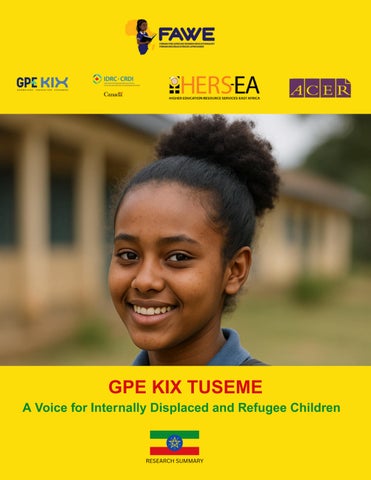
Voice for Internally Displaced and Refugee Children
Overview:
The Phase 1 study of the GPE KIX Tuseme Innovation Project assessed the implementation of the Tuseme empowerment model, Gender Responsive Pedagogy (GRP), and Centres of Excellence (CoEs) across primary and secondary schools in Ethiopia, Kenya, and Uganda, aiming to adapt these initiatives for refugee and IDP communities. Using qualitative methods, including focus groups, interviews, and validation workshops, the study found that Tuseme strengthened students’ self-esteem, leadership, and social skills. However, challenges such as resource shortages, gaps in stakeholder awareness, and sustainability concerns were identified. Overall, the findings emphasizes the need for community-driven, context-sensitive strategies to empower marginalized youth
What is Tuseme?
In crowded classrooms and dusty schoolyards, Tuseme, Swahili for "Let us speak out" is changing the story for young people across Africa Launched by FAWE and the University of Dar es Salaam, the Tuseme model gives students, especially girls, the mic they have too often been denied. Through plays, poems, debates, and action plans, girls step forward to voice their struggles from early marriage to gender violence and lead change in their communities. In one rural school, a skit about a girl forced into marriage sparked real conversations that convinced village elders to rethink old customs In another, poems pinned to classroom walls spoke louder than textbooks ever could Tuseme is not just about talking; it is about transforming fear into confidence, problems into projects, and silence into leadership. Across Ethiopia, Kenya, and Uganda, students are no longer waiting for change. They are making it happen one voice, one story, one bold step at a time.
Research Location:
The pilot study was conducted in December 2024 at Bashewam Primary and Secondary School, located in the Kolfe Keraniyo Sub-City of Addis Ababa to test the tools, methods, and assumptions of the research before rolling out full-scale data collection.
This study focused on understanding how the Tuseme model is being used in four secondary schools across Ethiopia: Millennium Secondary School in Addis Ababa, Nafyad Secondary School in Adama (Oromia), Tabor Secondary School in Hawassa (Sidama), and Bahir Dar Academy in Bahir Dar (Amhara) These schools provided a diverse representation of Ethiopia's educational landscape, ranging from large government schools to private institutions, urban to regional schools. The research team engaged with teachers, students, and administrators to assess the impact of Tuseme and gather data on its implementation, challenges, and successes
3 | GPE KIX Tuseme - A Voice for Internally Displaced and Refugee Children
Key Findings:
The findings from Ethiopian schools highlight the challenges and opportunities for adapting the Tuseme model. Factors such as urban versus regional locations, private versus government schools, and language diversity (particularly Amharic and Oromo) influence the implementation process The shift system at large government schools like Tabor Secondary School and the unique K-12 structure at Bahir Dar Academy require tailored scheduling and flexible activity formats Key implications for adaptation include developing linguistically appropriate materials in Amharic and Oromo, accommodating school structures, addressing resource disparities between school types, and leveraging the K-12 system to foster long-term impact on student confidence and expression.
Enabling Factors:
Enabling factors for the successful adaptation of the Tuseme model in Ethiopia include strong institutional support, particularly from schools like Bahir Dar Academy, which offer a K-12 structure that facilitates phased and integrated implementation The flexibility of the Tuseme model itself, with its focus on open expression and leadership, can be tailored to different educational levels. Additionally, the growing interest in gender equality and empowerment within Ethiopian educational institutions supports the model's uptake. The linguistic diversity of the country also presents an opportunity to adapt the model's materials in Amharic and Oromo, ensuring accessibility and relevance to a broader audience Finally, the presence of active community and parental engagement in certain regions provides a strong foundation for sustaining the model’s impact.
Voices from Ethiopia:
“I joined the club because I was inspired by the idea of empowering women”
“We are seeing evidence of influence on women in social media. As men, we should protect them; that's why I joined this club”
“Before we called it TUSEME, we were already doing what TUSEME is about, such as organizing events for March 8 ”
"A positive aspect of the school's infrastructure is a library built by FAWE, which is wellestablished..."
"FAWE’s direct support includes 'financial assistance, tutorial sessions, and reference books to these students, especially female students "
Research Summary at a Glance:
Collaborating Institutions:
Forum for African Women Educationalists (FAWE)
Chania Avenue off Wood Avenue, Kilimani P O Box 21394-00505, Ngong Road, Nairobi, Kenya Office Tel: +254 714 606 629
Higher Education Resource Services-East Africa (HERS-EA)
Makerere University, Senate Building Room 401, Email: Info@HERSEA.org
Phone: +256 704 493818/ +256 772 082011
ACER United Kingdom
1EdCity, Edcity Walk, London, W12 7TF, United Kingdom
Email: aceruk@aceruk.org
Disclaimer:
This work was carried out with the aid of a grant from the International Development Research Centre (IDRC), Ottawa, Canada. The views expressed herein do not necessarily represent those of IDRC or its Board of Governors.