APPLICATION TECHNOLOGY
Overcoming galling issues with premium stainless steel fasteners By Anders Söderman, technical director, BUMAX AB Galling is a common issue with standard stainless steel bolts and can pose serious problems for critical fastener applications. However, galling can be overcome even in the most challenging of applications – particularly by selecting premium quality stainless steel fasteners.
What is galling?
Galling is a form of adhesive wear caused by excessive friction between two moving surfaces. The process involves material being torn up and transferred between the two surfaces, when they are under sufficient load, that compress the surfaces together.
Standard stainless steel fasteners are prone to galling
Standard stainless steels have a tendency to gall under certain conditions due to their properties. Thread galling can occur with standard fasteners when pressure and friction cause the bolt threads to seize to the threads of a nut or tapped hole. Severe galling, known as ‘cold welding’, can cause the two surfaces to fuse together, which makes the joint impossible to be removed without cutting the bolt or splitting the nut.
The potentially disastrous implications of galling
The consequences and implications of galling should not be underestimated. A galled fastener may not be able to achieve the necessary
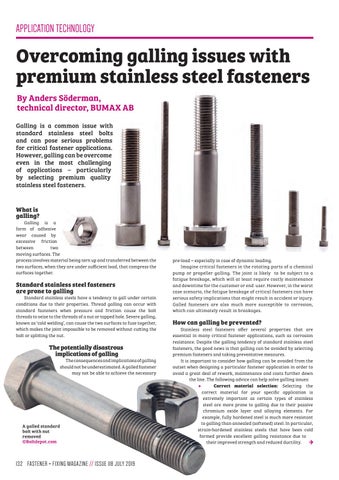
A galled standard bolt with nut removed ©Boltdepot.com
132 FASTENER + FIXING MAGAZINE // ISSUE 118 JULY 2019
pre-load – especially in case of dynamic loading. Imagine critical fasteners in the rotating parts of a chemical pump or propeller galling. The joint is likely to be subject to a fatigue breakage, which will at least require costly maintenance and downtime for the customer or end user. However, in the worst case scenario, the fatigue breakage of critical fasteners can have serious safety implications that might result in accident or injury. Galled fasteners are also much more susceptible to corrosion, which can ultimately result in breakages.
How can galling be prevented?
Stainless steel fasteners offer several properties that are essential in many critical fastener applications, such as corrosion resistance. Despite the galling tendency of standard stainless steel fasteners, the good news is that galling can be avoided by selecting premium fasteners and taking preventative measures. It is important to consider how galling can be avoided from the outset when designing a particular fastener application in order to avoid a great deal of rework, maintenance and costs further down the line. The following advice can help solve galling issues: Correct material selection: Selecting the correct material for your specific application is extremely important as certain types of stainless steel are more prone to galling due to their passive chromium oxide layer and alloying elements. For example, fully hardened steel is much more resistant to galling than annealed (softened) steel. In particular, strain-hardened stainless steels that have been cold formed provide excellent galling resistance due to their improved strength and reduced ductility.