FASHION REVOLUTION | FASHION TRANSPARENCY INDEX 2018
25
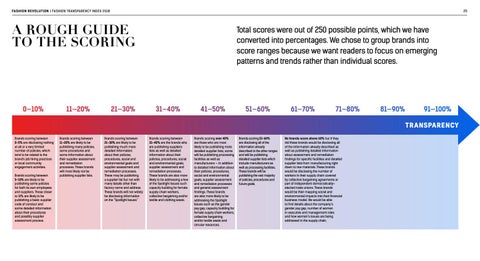
A ROUGH GUIDE TO THE SCORING
0—10%
11—20%
21—30%
Total scores were out of 250 possible points, which we have converted into percentages. We chose to group brands into score ranges because we want readers to focus on emerging patterns and trends rather than individual scores.
31—40%
41—50%
51—60%
61—70%
71—80%
81—90%
91—100% TRANSPARENCY
Brands scoring between 0-5% are disclosing nothing at all or a very limited number of policies, which tend to be related to the brand's job hiring practices or local community engagement activities. Brands scoring between 5-10% are likely to be publishing some policies for both its own employees and suppliers. Those closer to 10% are likely to be publishing a basic supplier code of conduct and some detailed information about their procedures and possibly supplier assessment process.
Brands scoring between 11-20% are likely to be publishing many policies, some procedures and some information about their supplier assessment and remediation processes. These brands will most likely not be publishing supplier lists.
Brands scoring between 21-30% are likely to be publishing much more detailed information about their policies, procedures, social and environmental goals and supplier assessment and remediation processes. These may be publishing a supplier list but not with many details other than factory name and address. These brands will not widely be disclosing information on the “Spotlight Issues.”
Brands scoring between 31-40% are the brands who are publishing suppliers lists as well as detailed information about their policies, procedures, social and environmental goals, supplier assessment and remediation processes. These brands are also more likely to be addressing a few of the Spotlight Issues such capacity building for female supply chain workers, collective bargaining and/or textile and clothing waste.
Brands scoring over 40% are those who are most likely to be publishing more detailed supplier lists, some will be publishing processing facilities as well as manufacturers — in addition to detailed information about their policies, procedures, social and environmental goals, supplier assessment and remediation processes and general assessment findings. These brands are also more likely to be addressing the Spotlight Issues such as the gender pay gap, capacity building for female supply chain workers, collective bargaining and/or textile waste and circular resources.
Brands scoring 51-60% are disclosing all of the information already described in the other ranges and will be publishing detailed supplier lists which include manufacturers as well as processing facilities. These brands will be publishing the vast majority of policies, procedures and future goals.
No brands score above 60% but if they did these brands would be disclosing all of the information already described as well as publishing detailed information about assessment and remediation findings for specific facilities and detailed supplier lists from manufacturing right down to raw materials. These brands would be disclosing the number of workers in their supply chain covered by collective bargaining agreements or part of independent democraticallyelected trade unions. These brands would be their mapping social and environmental impacts into their financial business model. We would be able to find details about the company’s gender pay gap, number of women in executive and management roles and how women’s issues are being addressed in the supply chain.