The Romance of the Ikea Date: A Quest into its Mundane Charm
The Home Guanhua Huang 30 Tales from the Downtrodden
Reflecting on the Year: Your 2025 Tarot
Marcie Di Bartolomeo & Sophie He
Great Aunt Quickfingers
Aaliyah Zaph
Mildred
Sacks My Mother’s Tongue Jayden
37 I Try to Chase the Sunset Down the Beach
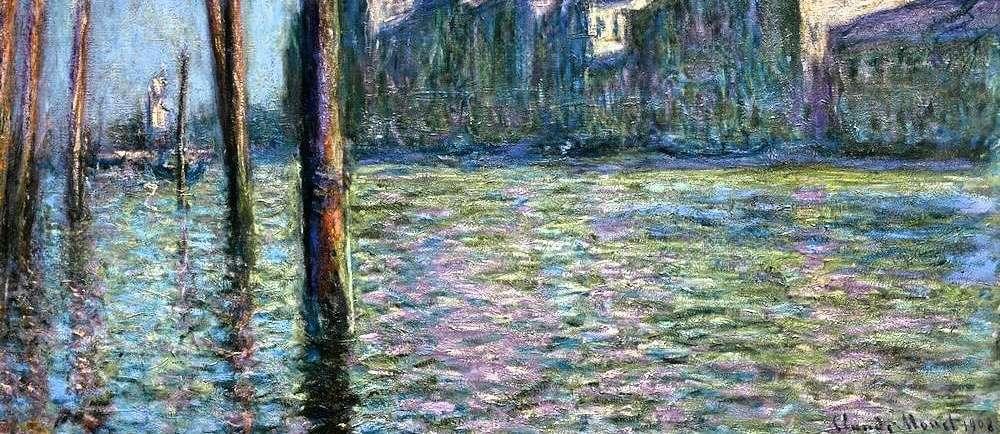
Astara Ball 38 When We Win Elle Harkaway 42 After Monet’s Grand Canal, Venice Tom McKenzie
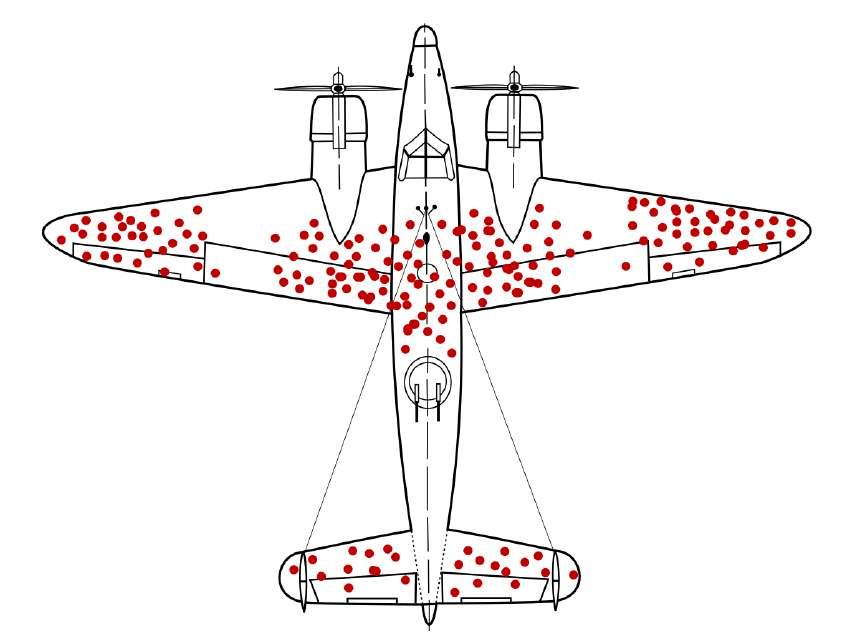
Survivorship Bias
Aaron Agostini
Feathered Nest
Cabin
Nora
52 He May Bring You Happiness
Pip Murphy-Hoyle
Acknowledgement of Country
not only on
land physically, but on the systematic exclusion of Indigenous peoples and Indigenous systems of knowledge. As the University’s student publication for 100 years now, we
56 Escapism
57
62
Dylan Bowen
Forest Floor
Lani Jaye
Competitor or Comrade: Uncovering 78-Year-Old StuPol Drama in Farrago
Janice Hui
64 Come Along, Be with the Pavement
Astara Ball
66 Is it too Early to Start Thinking about the Oscars?
Lachie Carroll
68
Audrey Hobert: Not Your Typical Pop Star?
Owini Vijayasekara
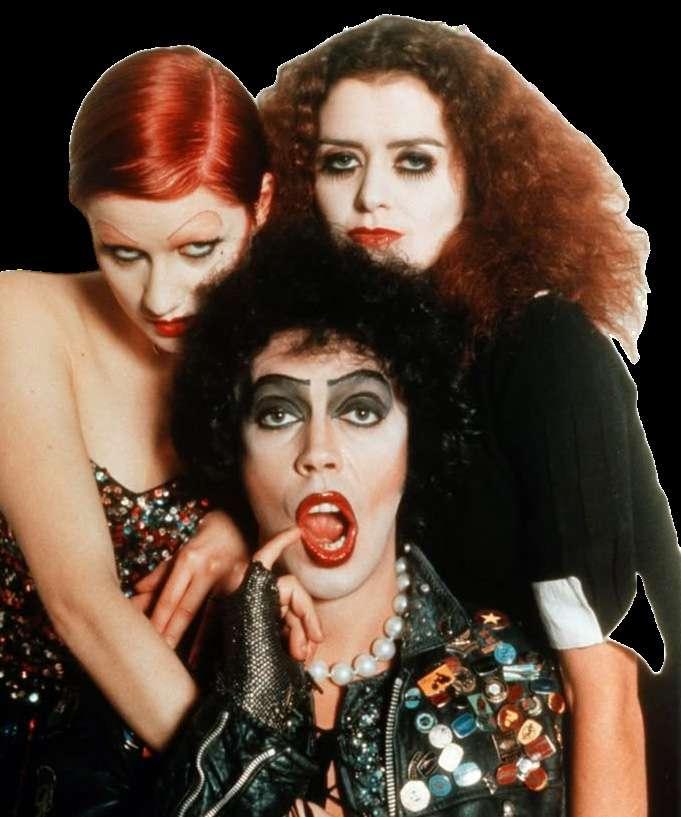
70 The Rocky Horror Picture Show Celebrates its 50th Anniversary
72
Sabine Pentecost
Zen’s Best Video Games of 2025
Zen Lam
75 The Suburban Nostalgia of the Smith Street Band Star Child Tour
Chelsea Pentland
78 Lorde Confesses to the Murder of 117 Children in Puerto Vallarta
Aaron Agostini
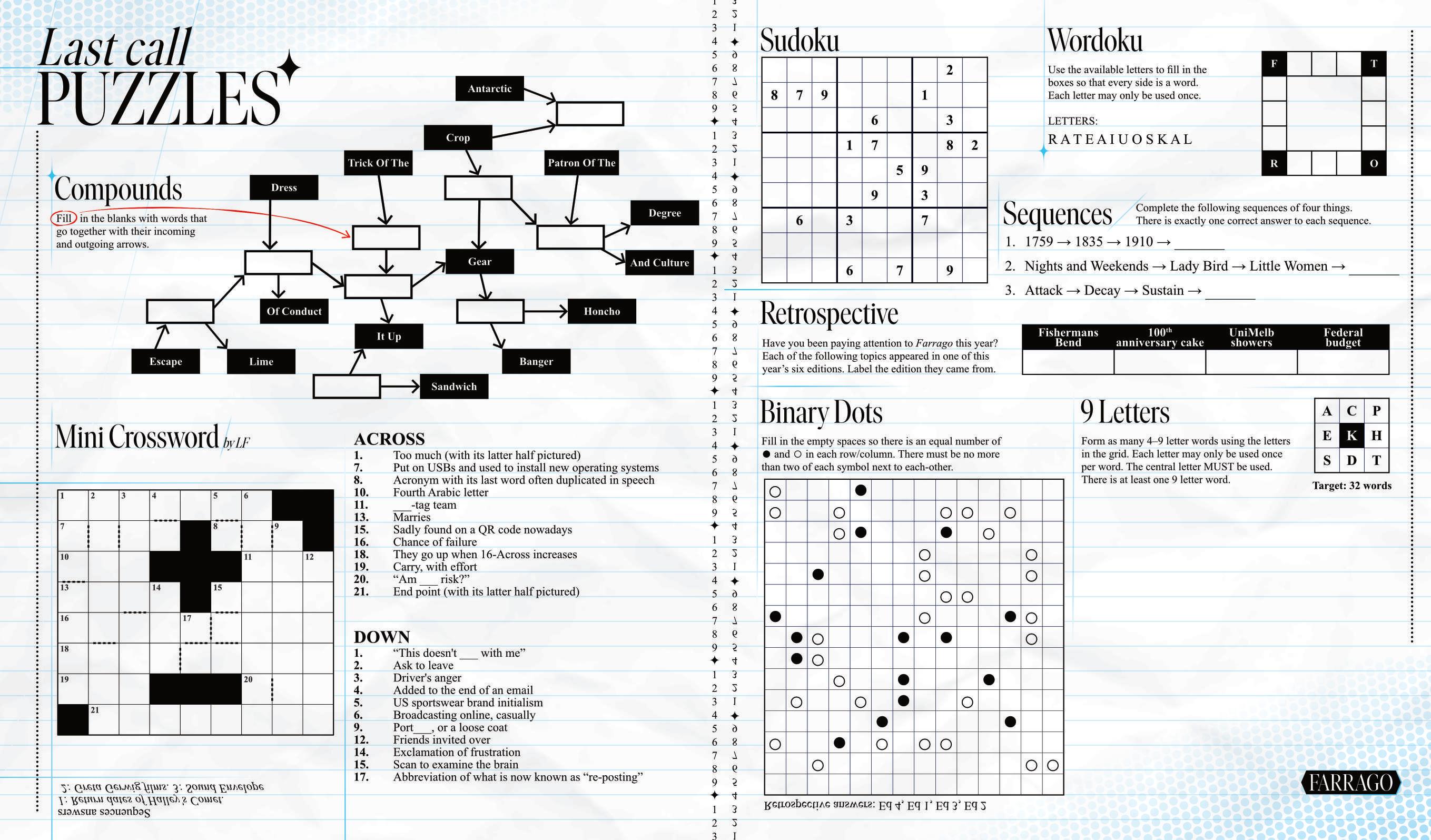
80 Puzzles
LF
recognise our complicity in such systems and strive to actively resist and unlearn colonial ideologies, both our own and the University’s.
Always was, always will be Aboriginal land.
Inter-publication joint statement on Meanjin:
Covers: Lauren Luchs
Main designer: Sophie He
Sub-editors: Emily Macfarlane, Ibrahim Muan, Sophie He, Angela Nacor, Ruby Weir-Alarcon, Harriet Thorpe, Zeinab Jishi, Isaac Thatcher, Astara Ball, Emma Kaldbekken, Erin Ibrahim, Hallie Vermeend, Charlie Simmons, Nancy Joy, Andi Misa, Jaymie Nohejl Willis, Jamille Jayo, Sunday O’Sullivan & Lachie Carroll
Your 2025 editors are Mathilda Stewart, Sophie He, Ibrahim Muan Abdulla and Marcie Di Bartolomeo.
Farrago is the newspaper of the University of Melbourne Student Union (UMSU). Farrago is printed on recycled paper by Kosdown Printing. Please recycle this magazine. Farrago is published by the General Secretary. The views expressed herein are not necessarily those of UMSU. If you want to raise an issue with the Union, contact the President and General Secretary at president@union.unimelb.edu.au and secretary@union. unimelb.edu.au respectively.
THE FUTURE OF HIGHER EDUCATION AND AI
Sonnet Mamgain
University of Melbourne Student
After completing the first semester of my undergraduate degree, I have realised that views on campus regarding AI are quite polarised. Some of my more pragmatic peers accept the inexorable presence of AI with an uncomfortable moan but steadily reap its benefits regardless, while those more ethically charged openly denounce AI for its moral distortions and abstain from using it. University academics also sit on the fence. While some of my courses have a very strict zero AI policy, others are comparatively more lenient. For instance, some of my classes allow AI use within certain parameters such as for brainstorming purposes. And if neither students nor academics can agree on just how much AI should inform our learning, how can we begin to answer the banal but serious question of what is the future of higher education in a world that is becoming increasingly AI dependent?
A recent survey from an Australian research group named Student Perspectives on AI in Higher Education, revealed that 83 per cent of over 8000 respondents across four Australian universities had used generative AI in their studies and 44 per cent reported using it on a weekly basis. Another survey conducted by researchers from Griffith University and the Queensland University of Technology revealed that 71 per cent of academics across 17 Australian universities have used AI at least once in their professional career. The specific activities AI was used for varied, but were mostly low-stake and administrative tasks, such as drafting emails and providing feedback on selfauthored work.
To speak frankly, I have noticed a certain level of stigma attached to AI usage. Conversations regarding AI’s place in
academia are frequently simplified, and reduce the narrative to how all AI is depraved and has no place in academics. On a personal level, I largely agree, having blocked platforms such as ChatGPT after taking an AI ethics class for a breadth subject. However, I also feel that the hostile narrative to exclude AI entirely from the academic sphere is too reductive. The use of AI in tertiary education encourages us to work towards ensuring that AI is, at the very least, deployed ethically. Putting a blanketly ban on the use of AI, while morally sound, is akin to catching smoke, especially when it is already used insidiously.
I was discussing this concern with a friend who goes to the National University of Singapore and is quite involved in AI ethics and safety on campus. Despite coming from different perspectives and experiences, we both agreed that a significant problem concerning AI on campus is the lack of AI dialogue. During the first semester of our undergraduate degrees, many of our courses feature extensive dialogue on good scholarship and research skills but snub any mentions of AI. The most we get is an overview of the course’s AI policy without any explanation of why the policy is in place. The truth is, like students, academics are still wrapping their heads around generative AI. While some of my tutors worry AI promotes a culture of anti-intellectualism, others have positioned it as an opportunity. As such, I believe that as an academic community, we need to shift our focus. Instead of just enforcing AI policies, we need to gear towards debating AI policies and ethics. AI usage can certainly be morally and intellectually unsound, but this isn’t always the case. For instance, one of my friends occasionally uses NotebookLM as an aid. As a history major who must often deal with very dense readings, she generates her readings into podcasts after initially struggling to understand the core concepts. Using the podcast as an aid, she
can re-read for clarity. Personally, I would not label my friend who uses NotebookLM as an aid as “intellectually lazy” compared to someone who exploits the platform to avoid doing their readings in the first place. However, the lack of concrete discussion dismisses such nuances, which is why we need diverse voices debating questions that will concern AI and higher education in the coming year: Is there room for generative AI in academia? If so, how much? If so, where? Can we keep AI ethical? Where do we draw the line?
More importantly, antagonistic AI narratives run the risk of synonymising all forms of artificial intelligence to generative or ethically dubious forms of AI. Yet like most forms of technology, AI has many dimensions, and some of them are working to improve social welfare. The use of AI in medicine is an optimistic example, with one study by McKinsey and Harvard researchers showing it could save up to $360 billion dollars annually in America alone. Similarly, another study by researchers from the University of Allahabad established how AI has significantly improved the diagnosis of gastric cancer, especially in the initial detection stage. Even in disciplines outside medicine we see other hopeful examples of AI emerge. For instance, in industries such as mining and construction, the use of autonomous vehicles has shown to enhance operation efficiency and safety. Likewise, earlier this year I was deeply moved after reading an article by Bernhard Kowatsch (co-founder of the UN’s World Food Programme) discussing how AI, if used carefully, can help address world hunger. The ability to move beyond one-liner AI narratives is deeply important. Given the consistent developments in AI, we need to learn to critically question where AI may have a beneficial social role, and where developments must stop. I am not suggesting that university students should spend an entire semester learning about AI usage across different industries and interrogating its ethicality. However, I do think it would be beneficial for us to refrain from using the term ‘AI’ to broadly capture its generative form and simplify its complexities.
More crucially, we need active AI dialogue because, contrary to popular presumptions, most students don’t use generative AI just because they are lazy or uninclined to learn. Like most people, students use generative AI to improve their work-life balance. The survey conducted by Student Perspectives on AI in Higher Education indicated that approximately 85 per cent of students used generative AI because it makes things faster and easier. Personally, I primarily used generative AI for finding synonyms, often finding it quicker to ask a generative AI model to find academic synonyms for “positive” rather than skimming my mother’s Merriam Webster thesaurus. Of course, this was before I took a class on AI ethics and decided to block generative AI from my browser after realising that, unlike more hopeful applications of AI, something like ChatGPT raises ethical questions around privacy, bias and transparent governance.
However, the most salient concern of AI’s meddling with tertiary education is the fear of AI undermining the purpose of tertiary education itself. We must ask ourselves, why do we pursue tertiary studies? Rudimentary answers may reference increased job opportunities, higher earning potential and employability.
However, if you are someone doing an Arts degree, which is famous for not being immediately quantified, then the pursuit of higher education transcends employability. Similarly, if you are passionate about your course, you certainly want to reap more than just a job from your university education. Anecdotally speaking, I have a friend who wants to do a PhD in mathematics even though it might increase her student debt. Likewise, I am interested in pursuing a doctorate in decolonial literary studies, despite not knowing where this will lead to. There’s something elliptically retro and dreamy about academia. I personally feel drawn to parallel my academic life to the aesthetics I confronted in films such as The Dead Poets Society or Mona Lisa Smile. There’s an intrinsic and raw charm to learning. It feels sacred and weirdly familiar and at the same time threatened by generative AI models. Take the example of writing, the cornerstone of an Arts degree. Each student writes in a different voice and has a different flair. Seated on the balcony of Student Pavillion, I often exchange essays with friends. It’s a mundane task for Art students who often swap essays for peer-feedback, however, as I read these essays, I cannot help noticing how the idiosyncrasy that makes each essay so precious. Some essays are more verbose and others more unpolished, but this is precisely what makes them so human. Large language models have the potential of homogenising the way we write and the way we think. After all, generative AI systems such as ChatGPT work through a predictive metric based on patterns and distributions from training data. They do not have the same capacity to think critically like we do. Thus, I find it useful to turn to the remark made by my friend studying computer science: “generative AI is a mediocre coworker with a can-do attitude.”
Let me return to the question I opened with: What is the future of higher education in a world that is becoming increasingly AI dependent? Personally speaking, I am more hostile towards AI than I am accepting of it. However, given the consistent developments in the growing industry, I do not anticipate AI becoming irrelevant anytime soon. As such, the future of AI in tertiary studies should certainly not be a silent one. We need to be proactively fostering more open dialogue regarding AI ethics on campus, stop peripheralizing AI from our conversations and learn to critically question our use of AI in higher education. Blatantly prohibiting AI usage is a slippery slope if we want to prevent underhand utility. Already, I am aware of peers who use AI (namely ChatGPT) to generate content for assignments and avoid their weekly readings among other uses. Instead, discouraging the use of AI would involve actively weighing it against an ethical metric. To achieve this, we need our subject coordinators to do more than just state AI policy—they need to outline the ethical principles cementing these rules. Similarly, as students we need to grapple with the question of AI and higher education more seriously. Casual remarks during our coffee runs are certainly not enough given the frequent developments in the field. And while I for one will not be applauding AI’s growing influence in the rituals that sculpture our lives, I am ready to interrogate its presence.
UniversityofMelbourneStudentUnion
Office Bearer Reports
President Joshua Stagg
Hi all,
Well, this is it - my final report for Farrago. In 2024, I was one of your Welfare Officers, and in 2025, I was your President. I’m grateful to each and every student for allowing me to represent them and act as their spokesperson. I will also note that in my final report to the Students’ Council of 2025, there will be substantial suggestions for reform. If that is of interest, be sure to sign up to receive Students’ Council documents.
In the last few months, the union has achieved several successes for students, including a commitment to rolling out the three-day nodocument extensions across all faculties in 2026 subject to technology constraints. Further, the University has agreed to hold a trial for a 24/7 study space during the semester two examination period. And, building on the advocacy for students being impacted by global issues, the University has provided support for Nepalese students during the anti-corruption protests occurring across Nepal. These successes are a testament to the work of the union and mark the end of a successful year.
In my view, the team of UMSU Office Bearers in 2025 has been the best I have seen during my time here. Whilst there has been consistent success across essentially all Departments, I wanted to draw the attention of students to some of the highlights. Filia and Kunal, Welfare, have worked unbelievably hard to deliver for students. No one works harder than they do, and they’ve made my efforts in 2024 look paltry in comparison. Khwaish from Women’s has been a consistent force of advocacy and events for female-identifying students. Riya and Tianyi, Creative Arts, have made MUDFest a large success in 2025. Sonika, Rhea, Harrishman and Viraj have done incredible work in Education. I’ll also note that Sonika has consistently been my nominee and/or delegate to various meetings and has delivered substantial results for students. Further, Rhea has been an incredibly effective advocate across all committees. Noah, Indigenous, has made the Department a force of advocacy, events and guidance. Justine, Tirion, Joobon and Caleb have fought fiercely for their campus and advocated for fair support and services. Ian stepped up to the plate and has established a precedent for effective UMSU representation at Burnley. Lastly, I wanted to give a shoutout to Media, who have delivered the best editions of a student paper I have seen during my time in tertiary education.
As always, there is more to do, and I wish I had more time to do it. I’ll continue working to the full extent of my capabilities until 11:59 pm on November 30th. Whilst this has been one of the most difficult and stressful things I have done in my life, I wouldn’t change it. The halls and offices of 168 have been alive and buzzing over 2025, bringing a sense of life to the student union that will be hard to match.
Joshua
Clubs & Societies
Esther Hiu Wai Luk & Ewan Bezzobs
C&S has recently run our second Executive Mixer and continued to affiliate new clubs. Our second Mixer of the year was aimed at the new executives who were elected in the September AGM season. We had around 100 attendees across the night come and talk with each other, and we hope they all were able to share their experiences and learn something new. Secondly, our new club cohort have been running their IGMs in the past few weeks, and we anticipate around 15 successful affiliations. C&S also recently had the semester 2 Clubs Council, where the 2026 C&S Committee were elected.
As we wrap up this year’s projects, we are excited to see what next year will bring!
Education Public Viraj Patel & Sonika Agarwal
Hey everyone,
We hope exam season hasn’t got you dead yet. Since our last report, UMSU Education has been super busy! We hope you’ve enjoyed our Semester 2 Coffee Collectives — they’ve been a massive success in helping us hear about real student issues and what’s happening across campus. We’ve also held another successful BBQ and bannerpainting event, and we’re excited to have officially semi-launched our mascot, Freddy the Frog! We hope he enjoys his new home in the UMSU Education Office.
On the advocacy front, we’ve been focusing on promoting transparency within UMSU and how it communicates with students. It’s important that we continue striving toward a union that represents students fairly and remains accessible to everyone. We’re also working closely with the Protest Working Group to organise the upcoming UMSU Rally Against Anti-Protest Restrictions. After a year of sustained advocacy, it’s crucial we take a peaceful stand for our democratic rights, which are currently under threat.
Alongside the Education Academic team and the President, we’ve received verbal confirmation for 24/7 study spaces during SWOTVAC and the exam period and keep an eye out for more details!
At the time of this report, we still have two more events to go: our final Coffee Collective and our End-of-Year Celebration, where we’ll recognise the hard work of our volunteers, SRN members, and everyone who’s been part of the growth Education’s 2025 journey.
This is our final report for the year, and it’s an absolute honour to serve as your Education Public Affairs Office Bearers for 2025. We’re proud to have helped revive an Education Department that genuinely connects with students through collectives, campaigns and compassion. It’s been a rollercoaster ride, but one we’ve loved every step of the way. Many thanks and Much love, Viraj and Sonika
Environment
Jayde East
Hello! Enviro has been busy providing Weekly free lunches as part of our Meat free Monday campaign which has now expanded to Southbank and Burnley campuses, running fortnightly collectives and collating our newsletter that gives a guide to everything Enviro related on and off campus. Since last report we’ve also had Sustainability week which was amazing! We kicked it off with a Speed Friending event in the Ida bar, followed by the second edition of our Thrift Market that saw student stall holders, clubs our repair cafe pop up and the Rowdy come together for a lively event focused on the Circular Economy. At the Thrift Market we also served tea and cookies from local small businesses and had a Plant-based BBQ from UMSU Welfare. Our department also attended a snap Climate protest with AYCC, in response to the federal governments unambitious new climate targets to push for more urgent action.
Welfare
Kunal Dewani & Filia Cahyadi
Hey everyone, your Welfare team here!
It’s been an incredible semester and an amazing year serving as your Welfare Office Bearers. We’re so proud of what we’ve achieved, and it wouldn’t have
been possible without our fantastic Welfare volunteers, committee members, and the dedicated UMSU staff who’ve supported us throughout.
This year, we have had a smooth operation of Union Mart across Parkville, Burnley, and Werribee, ensuring that students have consistent access to essential items. Alongside that, we hosted multiple Clothes Swaps and Welfare Brunches, creating warm, community-driven spaces for students to connect and unwind.
We were also out in full force for R U OK? Day, serving up sausages and skewers while the MU Boxing Club brought the energy with padhitting sessions, which proved to be a great outlet for stress relief. In collaboration with UMSU Environment, we co-hosted a Thrift Market in the Student Precinct, which featured our Clothes Swap, engaging over 450 students, and a Welfare Brunch that served more than 900 students.
As the semester wrapped up, we ran Stress Less Week during Week 12, in collaboration with UMSU Activities, UMSU Creative Arts, UMSU Education, and UMSU Women’s, and MU Boxing Club. The week featured therapy dogs on campus, a ceramics workshop, another Clothes Swap, and an energising catch-up with our Welfare volunteers, a perfect way to close out the teaching period.
We’ve also been working on the Mental Wellbeing Report, which gathered responses from over 775 students across the University of
Melbourne. The insights from this report will play a crucial role in advocating for better mental health support for students in the future. We would like to thank you all for an amazing year for hard work, learning and smiles. We hope your exams go smoothly and that you have a restful, joy-filled summer break ahead!
UPDATES: 893 responses later… Education has successfully advocated for a trial of 24/7 Library Space in the Ground Floor of Baillieu during SWOTVAC+1st week of exams!!! (Please, maintain this space well!) Recently, Education supported the Rally Against Repression organised by our Committee member David on Oct 22nd to express our dissatisfaction against protest restrictions and surveillance - our Union must continue to fight. I wanted to use my final OB report to shout our EdPub compatriots, Sonika and Viraj for their hard work- from Collectives to committee meetings, they’ve poured their heart and soul. To our volunteers and committee members, your hard work and support is invaluable. In a time when UniMelb again comes last in Student Satisfaction, I’m so grateful to have had the chance to try to improve the lives of students alongside this team. We did it Joe, we revived Education!
Uni News
Refuting
“Purely Financial Grounds”: UniMelb
Creative Writers Respond to Meanjin Closure
Sophie He
Following Melbourne University Publishing’s (MUP) announcement that it would conclude literary journal Meanjin’s publication, Farrago partnered with the University’s Creative Writing program to collect anonymous responses to the decision from its student cohort. Most responses criticise the claimed “purely financial grounds” on which the MUP Board made their decision, with some alluding to the University’s vast assets. All refute the reasoning by raising arguments for the publication’s intrinsic cultural value.
For instance, many students are mourning the lost potential and momentum in their own careers. Meanjin was, as one student writes, “much more accessible than larger, more mainstream publishing”, and therefore an avenue to publication for emerging writers. This sentiment is common and students are bewildered as publication
in Meanjin pivots from “assumed goal” to impossibility.
For these writers, Meanjin’s fate signifies more than a singe loss, but encapsulates a culture-wide devaluing of their craft. Those already accustomed to the precarity of creative careers have enhanced their cynicism: “All throughout our degrees, we are told about the limits … for writers … in Australia. This just affirms that universities and huge institutions don’t care about the arts.”
Others sense an exploitative undercurrent from a university which continues to profit from its creative writing courses: “Creative writing and publishing courses are reportedly booming, tailwinds which the University is undoubtedly riding to enrich its coffers … Why teach us the finer points of thought and craft on the one hand, while dismantling a cornerstone of the ecosystem which will afford us a livelihood on the other?”
Journalist Ben Eltham calls Meanjin “the home of a certain idea of Australian culture.” Over the years, the journal’s pages have litigated the politicised bounds of a national identity and literature. Writers
are disoriented as the Australian literary landscape loses a landmark feature.
A Master’s student shares: “Reading articles from Meanjin has … allowed me to critically engage with what it means to be a writer and settler in Australia. One essay that has had a profound impact on me is Alexis Wright’s “A Journey in Writing Place”. Another is A. A. Phillips’ essay “The Cultural Cringe”. I recently made the decision to move back from London … because it became important to me to engage with our own literary culture, rather than do what some have found all too easy, which is to imagine that the best of literary culture is overseas.
“This decision narrows opportunities for all of us emerging writers to make our contribution to the Australian literary scene, and to help bring about the new future.”
Other students highlight how the publication has been “a crucial hub for Indigenous and diverse voices” and that its conclusion “Sends a message to writers across so-called Australia that our work is not worth saving.”
Award-winning author, UniMelb alumnus, 1987 Farrago editor and volunteer
member on Meanjin’s Cultural and Literary Advisory, Christos Tsiolkas echoes the students’ sentiments.
“You need a literary magazine that comes out of the University of Melbourne,” he says. Regarding the financial justification, he disagrees. “When you look at the cost … it has been running on no money.”
To him, the decision is a “dangerous sign of where we’re going.”
“We think the Cultural Cringe is something we supposedly left behind decades ago, but there is an element of it [in the closure].”
Taken together, the students’ responses mount an argument that a “purely financial” decision does not exist. The Board’s decision reflects its implicit evaluations of Meanjin’s cultural worth; which, within a University which reported a $273 million surplus in 2024, appears to be very little.
On a personal note, Tsiolkas recalls, “Meanjin was the first Australian literary journal I read. It gave so many of us the opportunity to be published. It was proudly focussing on challenging writing in this country and I think [MUP’s decision] is a terrible shame, and a really stupid fucking idea.”
Duck News! South Lawn Ducks Start Family
Sophie He
South Lawn’s Australian wood ducks have had children. Having presumably migrated from a nearby park, the merry avian parents hatched seven ducklings in the spring. The ducks appear remarkably nonplussed by the delighted students gathering near them. The family has been sighted waddling on the grass and paddling through the reflection pool. Farrago writer Sabine Pentecost claims she witnessed a security guard assigned to the flock—a valuable dedication of University resources if true.
Photography by Joni Schlechta
Honorary UniMelb Professor Awarded Nobel Prize in Chemistry
Sophie He
Richard Robson, an Honorary Professorial Fellow in the University of Melbourne’s School of Chemistry, has been co-awarded the 2025 Nobel Prize in Chemistry for developing ‘a new type of molecular architecture’. The award-winning project has been used by researchers to ‘harvest water from desert air, extract pollutants from water, capture carbon dioxide and store hydrogen’. Robson shares the prize with Susumu Kitagawa and Omar M. Yaghi.
The Psychological Impact of False AI Detection
Hollie
James and Anna Lau
Accused of using Artificial Intelligence (AI), University of Melbourne student Piper Whitning received an email claiming she had relied on AI to write her assignment. Piper found herself scheduled for a meeting with the Academic Board to defend and prove the work was as her own.
“I got emailed because my essay had been flagged with Turnitin,” Whiting says. “I had to do some meetings, and … provide a lot of very specific information that I don’t have easily accessible to me, like timestamps of when I wrote things and research material.”
Despite all the evidence presented, Whiting says, “It took a lot of time just for them to realise that I hadn’t used it. So, it was a very stressful experience that I don’t think was necessary … at all.”
Whiting is one of many students who have been flagged by Turnitin, an AI tool used across academia to identify possible AI-generated content in students’ work. As more academic misconduct allegations increase, so do students’ concerns and anxiety, regardless of whether they have used AI or not in their writing process.
Dr Eduardo Araujo Oliveira, Senior Lecturer in the School of Computing and Information Systems at the University of Melbourne, says he is worried about how AI is being handled in education, particularly when universities’ responses
lean towards punishment rather than adaptation.
“I have serious concerns about the use of these tools, and I am someone that is advocating for a more hybridized kind of mindset,” Dr Oliveira says.
“When we had the pandemic, we spoke about open book exams … I have an attitude, a mindset that is an open AI mindset. So, if everyone is using [AI], I would rather focus on assessment redesign and responsible use of the two, rather than [the] idea that sounds a lot more like punishment.”
For Whiting, the experience with the Academic Board felt less like an investigation and more like a presumption of guilt, where she was treated “guilty until proven innocent”.
“Rather than my teachers being on my team and trying to help me succeed … it was me against them. And it’s difficult, because you have to trust these people to grade your assignments and teach you the content … It’s difficult, after an experience like that, to move forward and still want to study with them,” says Whiting.
Dr Oliveira says that this upsurge in AI usage amongst both students and teachers should prompt discussion around AI ethics in education, how it is used and how students are assessed..
“We’re talking about assurance of learning. We are redesigning our entire subjects and curricula. We now need to talk about ethics a lot more. We need to find new ways to assess people.”
As AI grows increasingly influential and becomes embedded in university systems, it raises concerns regarding its reliability and it’s limits, and to what extent universities and other educational institutions should rely on it when students’ futures are at stake
1 in 7 Australians Now Live in Poverty
Mathilda
Stewart
A new report from the University of New South Wales and the Australian Council of Social Services reveals that the number of Australians living in poverty has increased to one in seven. The report uses data from the Household, Income and Labour Dynamics in Australia Survey.
Profit Over the “Disappeared” in Mexico’s World Cup Host City
Finley Monaghan-Mc Grath
Content Warning: kidnapping, violence and organised crime
Jalisco, Mexico has recorded the nation’s highest disappearance rate since 2019. Its capital, Guadalajara, is preparing to host matches during the 2026 FIFA World Cup.
Behind the marketing campaigns and infrastructure upgrades, the state is the epicentre of a humanitarian crisis. More than 130,000 people are missing across Mexico; over 15,900 of those cases are in Jalisco alone.
Many of these disappearances are not voluntary. They form part of a methodical abduction circuit operated by cartels, corrupt police and complicit officials, a structure used to expand narco-controlled territory and business operations.
With a 99 per cent impunity rate for violent crime, these networks operate largely without fear of consequence, enabled by weak institutions, political neglect and corruption.
Yet amid this inaction, families of the disappeared, true to Mexico’s enduring spirit of resistance, have formed search collectives that uncover graves, document evidence and demand justice.
Advocates and experts alike believe the international attention surrounding the World Cup could offer a rare opportunity to draw awareness to the crisis and push for change.
Anna Karolina Chimiak, former codirector of CEPAD (Centre for Justice, Peace and Development), speaking with Farrago, said that political priorities remain distant from the humanitarian crisis as government spending pours into event preparation.
“This pattern reflects the broader tendency to prioritise not only image but also the economic interest over justice and the protection of victims, and failing to address the structural issues [surrounding] disappearances and impunity.”
Jalisco’s Long Relationship with Organised Crime
Guadalajara, often branded as Mexico’s Silicon Valley, is the country’s second-largest city and is a hub for technology companies, foreign investment and wealthy expatriates.
But Jalisco is also home to Mexico’s most powerful criminal organisation: the Jalisco New Generation Cartel (CJNG), known for its military hierarchy, extreme violence and global reach.
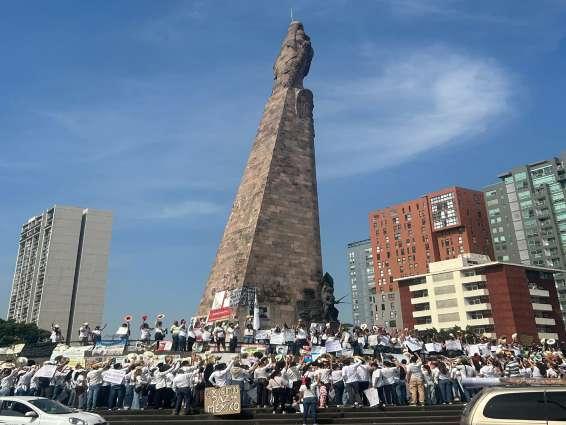
Protesting the disappearances
Photography by Finley Monaghan-Mc
Operating across continents, CJNG has established links as far as Australia, profiting from our lucrative methamphetamine and cocaine markets.
For decades, Jalisco has been a base for major drug-trafficking networks, beginning in the 1980s when the Guadalajara crime organisation established huge narcotic smuggling routes into the United States.
Alejandra Guillén González, a professor at ITESO, Universidad Jesuita de Guadalajara, told Farrago that the generation of cartels have since “advanced their operations and are now interwound with all aspects of society.
“The linking of legal and illegal economic power, which are [now] two sides of the same coin, [there are] national and international beneficiaries,” she said. “That’s where the real obstacle lies. They decide.”
Guillén González further explained the link between economic power and the phenomenon of forced disappearances, describing it as “a strategy of violence that allows [for] territorial control, and with it, the control of all kinds of businesses.”
Disappearances as a Weapon of Power
While there are many motives behind cartel abductions, Lauro Rodríguez, an investigative journalist based in Guadalajara, told Farrago that forced recruitment is one of the most pervasive. “Forced recruitment is currently one of the factors influencing the disappearance of young people and adolescents, mainly between 15 and 19 years old.”
“We have noticed that they are taken through false job offers or promises of earning a lot of money by joining criminal groups.”
“In the end, what happens is that they are taken to training houses or camps in mountain areas, where they are subjected to very strong psychological violence and also physical violence. They are beaten, forced to commit crimes, forced to watch how other people are killed and forced to use weapons, all with the aim that they can be incorporated into their ranks.”
Although cartels are responsible for most disappearances, Rodríguez noted that security forces are complicit as well.
“There are already public rulings ... in 2018 it was confirmed that police from Tecalitlán [municipality in Jalisco] disappeared three Italian citizens and
handed them over to organised crime”
According to Jalisco’s Justice Department, more than 300 officials since 2018 have been investigated for suspected involvement in abduction networks.
Underfunded Institutions
Jalisco criminal lawyer and researcher Joseph Oid believes that Mexico’s executive branches are structurally unequipped to investigate the mounting open cases.
Because powers are split between federal and state authorities, cases linked directly to organised crime should fall under federal jurisdiction, but in practice, they often don’t.
“Overlapping jurisdictions complicate investigations,” Oid said. “The federal prosecutors don’t want to work on these cases.”
This leaves thousands of cases to the state departments, which have limited resources and an inadequate ability to coordinate with their federal counterparts. Families are left waiting years for answers and often don’t receive any at all.
Chimiak added that institutions leading the response were overwhelmed. “For a single public prosecutor, there are between 300-400 cases … for one searcher from the State Search Commission, it’s 1200 cases for each person,” she continued, “[there] are less than 10 legal advisors for the almost 16,000 cases.”
The forensic system is also at a breaking point. From 2018 to 2025, authorities discovered 217 clandestine burial sites in Jalisco, resulting in the recovery of 2,040 bodies. Many of these
mass graves also had different types of infrastructure to dispose of bodies.
Due to the inhuman tactics of the cartels, the remains are often difficult to identify, with Chimiak claiming that “only 50 per cent of recovered bodies are successfully identified. And we are talking about almost daily discoveries.”
Teuchitlán — the Cost of Inaction
The consequence of this judicial paralysis and lack of resources was exposed to the world in March 2025, when a civilian search collective uncovered a ranch in Teuchitlán, two hours from Guadalajara, suspected to have served as a CJNG training and extermination site. Descriptions of bone fragments, bullet casings, clandestine ovens and piles of personal belongings spread rapidly across social media and international outlets.
The property had been under state protection since September 2024, yet no police officers or site security were present when the collective arrived following an anonymous tip. State prosecutor Salvador González claimed there was no evidence of organised crime activity, but the discoveries told another story.
As global outrage grew, state and federal prosecutors blamed each other, the former condemning the state for failing to monitor the site, and the latter critiquing the federal government for neglecting its jurisdiction over organised crime.
A Crisis Buried Under World Cup Spending
While exact figures are unknown, the capital will see an injection of 12 billion pesos (equivalent of 645 million USD) into
Regulating “Truth” and Eroding Rights: Dissecting the Maldives’ Media Act
Ibrahim Muan
When a government promises to defend the media with one hand and writes a law to police it with the other, believe the law. By the standards that matter— legality, legitimacy and legibility—the
airport and highway infrastructure alone.
Government officials are simultaneously projecting that the event will generate up to $7 billion for the country.
Rodríguez claimed the allocation of these fiscal funds is clear evidence of the disregard the authorities have for the crisis.
“It’s a complete contradiction, because we’re talking about thousands of millions of pesos being invested in construction, [as] the current capacity of the authorities isn’t enough to have more people located than new disappearance reports each month.”
“Just one project, the so-called Line Five, for example, will cost around 15 billion pesos [810 million U.S. dollars]. Imagine what could be done with that amount to address the crisis.”
Chimiak also expressed concern over the possible silencing of advocates during this period of international attention. “There is a risk that the efforts, such as posting search flyers, may be abstracted and that protests may be repressed with excessive force or some restrictions on public advocacy.”
Unless the international community demands accountability, the World Cup will serve only as a glittering distraction, a means to channel millions into image and profit while families dig through the dirt for truth.
Disclaimer: The majority of the quotes in the article were given in Spanish, and have been translated
Maldives’ new Media Act fails each test. Vague offences, sweeping powers and executive capture convert “regulation” into censorship with due-process cosmetics. The United Nations’ leading human rights official has warned that the
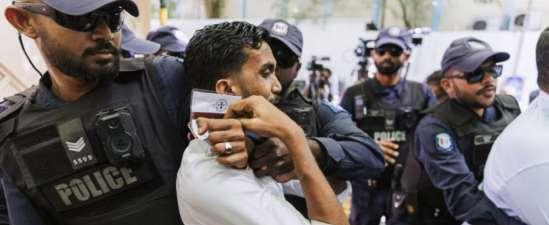
Maldivian police hold Adadhu News journalist Aaidh in a choke hold. Photography by Anoof Junaid from Dhauru
Maldives’ new Media and Broadcasting
Regulation Act “will seriously undermine media freedom and the right to freedom of expression.”
That is not just diplomatic throatclearing; it is a legal diagnosis under the International Covenant on Civil and Political Rights (ICCPR). The legislation centralises power over news and online speech in a commission tasked with investigating, fining, blocking and even shutting down outlets in a polity where the presidency already dominates the state.
On paper, the Act merely “unifies” regulators. In practice, it abolishes the Maldives Media Council and the Maldives Broadcasting Commission and replaces them with a seven-member Orwellian truth commission covering broadcast, print and “electronic” media. This body can subpoena documents, compel “corrections,” enlist police, halt live broadcasts mid-air and seek court-ordered suspensions or closures—supported by fines of roughly $1,620 USD for individual journalists and $6,485 USD for outlets. The legislation also relies on vague standards—“fake news,” affronts to “honour and dignity,” or content “contrary to Islam”—that fail basic rule-oflaw tests of clarity and foreseeability. Ministers insist otherwise. Information Minister Ibrahim “Asward” Waheed offered “100 per cent assurance” that the law will not curtail press freedom; Foreign Minister Abdulla Khaleel said ordinary personal social media accounts fall outside its scope. But institutional design trumps intent. When the same political forces that hold a parliamentary super-majority can pressure the regulator, discretion over speech becomes an extension of executive power, not a check on it. Power and Process: The Method is the Message
From the moment an “independent member’s bill” was floated from the government’s shadows, the Media Act’s path through parliament became a study in obfuscation; with closed-door edits, recess time sittings and the expulsion of reporters standing in for deliberation. Former president Ibrahim Mohamed Solih stated that the law “signifies the end of press freedom in the Maldives,” criticising the “underhanded manner” in which it was
forced through.
Independent MP Abdul Hannan Aboobakuru (Thulhaadhoo Constituency) introduced the bill, although even the Deputy Speaker—caught in an unguarded moment—described the text as “proposed on behalf of the government.” What followed was a rush: tabled on 18 August, hustled through committee largely behind closed doors and passed in an extraordinary evening sitting on 16 September. Seven opposition MPs were expelled from the chamber before the 60–1 vote. Ratification came two days later.
Inside the building, parliamentary security twice evicted journalists from the committee corridor; outside, the press waved a petition signed by 151 journalists from 41 outlets.
The opposition Maldivian Democratic Party (MDP) called it “a sad day for democracy in the Maldives” and called on citizens to “join us to protest this draconian control bill.” Former Foreign Minister Abdulla Shahid said the government had “declared war on free speech,” adding: “Instead of fixing the crises our nation faces, they are trying to censor the voices that hold them accountable.”
Not every government voice adopted a conciliatory tone. Parliamentary Majority Leader Ibrahim Falah was quoted as saying, “When you work at this level, the media shouldn’t be jailed, they should be impaled”—rhetoric the Maldives Journalists Association (MJA) condemned as incitement. In contrast, President Mohamed Muizzu described his administration as “100 per cent promedia.”
Streets that Speak: Policing Around a Speech Law
Civil liberties analysis considers the context and the environment surrounding the vote to have been biased. On the day the legislation was passed, riot police pushed back a crowd gathered outside the parliament; when protesters sat down, officers lifted and dragged them away.
Leevan Ali Nasir, an Adhadhu journalist and member of the Maldives Media Council, was detained and later released. In preceding days, the International Federation of Journalists documented
detentions and harassment of media workers. It condemned assaults on Leevan and Ahmed Aaidh (Adhadhu), describing the majority-leader’s rhetoric as “abhorrent.”
The United States Embassy urged the government to “uphold the freedoms of expression, including dissenting and opposition voices,” a line echoing the concerns of many Maldivians who do not work in newsrooms but rely on them.
The Committee to Protect Journalists added, “CPJ is deeply concerned that the Maldives Parliament has passed a bill that would undermine the work of independent journalists and place the media under government control.” The statement was posted to X as the law advanced toward ratification.
A Professional Consensus—Unusual and Unanimous
It is rare in any democracy for the domestic epistemic community—those who gather and verify facts—to speak with a unified voice. In this instance, they did. During a marathon committee hearing, 21 out of 22 participating outlets called for withdrawal. The Maldives Media Council opposed the merger on principle and capacity grounds. The Human Rights Commission warned that the draft could require citizens to seek authorisation to blog or express opinions online.
Beyond the Majlis, the MJA organised Q&As, open-mic forums at Artificial Beach, and a “Save Our Socials” campaign to make the bill understandable to the public. After the passage, many reporters pledged to boycott elections to the new commission and began sketching an independent press council in an act of civil disobedience as constitutional defence.
The country’s legal profession mirrored that judgment. The Bar Council of the Maldives urged the president to reconsider, saying the bill “requires substantial revision and reconsideration to align with constitutional principles and international best practices,” as its president, Hussain Siraj, told Al Jazeera. The Committee to Protect Journalists echoed the call. When lawyers and reporters agree that the model invites arbitrary enforcement, the burden shifts decisively to the state to explain why
it needs such sweeping discretion over speech.
Why does the System Magnify the Danger?
The problem is not just a bad law; it is a bad law inside a hyper-presidential architecture. Independent analysis describes the Maldivian executive as “an institution of absolute power,” with parliament often acting as a rubber stamp, local councils marginalised and independent bodies “defanged.” Now, include a commission that can investigate suo moto, subpoena, enlist police, order corrections and forced apologies, impose fines, and seek blocks and shutdowns— using standards the commission itself will set in its code.
Combine that with a system already tilted towards the executive, and you have built an information veto into the state. The predictable result is anticipatory self-censorship in which editors rationally
lower their sights before any fine is enforced. In a small market, the risk of losing a licence or facing an investigation can threaten the existence of a business. The Legal Test the Law Fails
Article 19’s framework is clear. Restrictions on expression must be (i) defined and narrowly tailored by law, (ii) aim to achieve a legitimate goal and (iii) be necessary and proportionate.
The Media Act’s offences are vague and capacious; its enforcement tools— from suspending broadcasts mid-air to shutdowns during investigations— are extensive; and the regulator’s susceptibility to executive influence is embedded.
Even if one accepts “combating disinformation” as a legitimate aim, the Maldivian approach is neither precisely defined nor proportionate. That is at the heart of the OHCHR critique—and why repealing the law, not just amending, is the
appropriate remedy.
A Responsible
Way Out
The antidote to disinformation is not a political body adjudicating truth but a resilient information ecosystem. The government should repeal the Act and publicly commit—through legislation—to an independent, industry-elected selfregulatory mechanism aligned with ICCPR standards. Any future rules must be narrowly tailored, exclude prior restraint; carve out explicit protection for personal social-media speech and insulate oversight from political dismissal.
Transitional steps are readily available: re-empower the Media Council, temporarily suspend fines and suspensions, commission a time-bound, open, multi-stakeholder review involving jurists, editors, creators and youth groups, and adopt a due-process charter ensuring clear notice and independent appeal.
Victoria Pill Testing Service Expands as Fitzroy Clinic Opens
Angela Nacor & Jalina Cameron
Up to 100 drug samples a week are being tested at Victoria’s first fixed-site pill testing clinic in Fitzroy, as a state government trial moves beyond last summer’s music festivals into a fixed inner-city site.
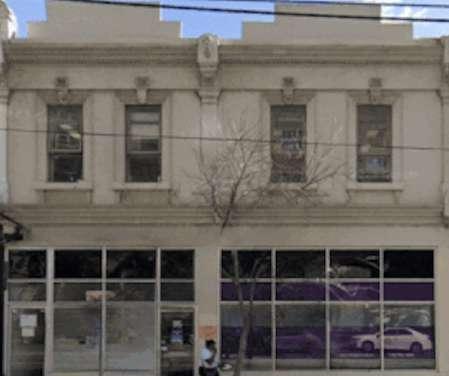
The Victorian Pill Testing Service, which operates three days a week from a Brunswick Street shopfront, is part of an 18-month trial funded by the Department of Health. Operated by a syndicate of harm reduction and healthcare organisations— YSAS, The Loop Australia, Harm Reduction Victoria, Youth Projects, Melbourne Health and Metabolomics Australia (University of Melbourne)—people can bring in a personal, non-trafficking amount of illegal or unregulated drugs for on-site analysis and a confidential consultation, aimed at showing them what is actually in their drugs and flagging dangerous trends as they emerge.
In the Fitzroy clinic, staff are currently
seeing between 70 and 100 samples a week, with MDMA, ketamine and cocaine the most common substances brought in, alongside counterfeit benzodiazepines and a range of newer synthetic drugs.
Around one in seven of those samples contains something the person was not expecting.
“We tend to find around 10 to 15 per cent of all samples we test are unexpected results,” Drug Checking Director Sarah Hiley says. “We have found an unexpected psychoactive substance that the person wasn’t aware would be there.”
One of the major concerns is the emergence of nitazenes, a group of highly potent synthetic opioids that have begun appearing in Australia’s unregulated drug market.
“We have evidence that [nitazenes are] a real concern for us here in Australia,” she adds. “We’ve actually found nitazenes in a couple of our samples we’ve tested here, and we’ve put out urgent notifications to let the community know.”
When high-risk substances are found, the service convenes a risk assessment. It may issue urgent or general alerts to the public and health services through its website, social media channel and mailing list, as well as informing the Department of Health.
The Fitzroy clinic is one part of a program that also provides mobile pill testing at up to 10 festivals and events. Rather than relying on enforcement, the program is built on a harm reduction approach that accepts some people will
use drugs and focuses on reducing the chance that use leads to overdoses or hospitalisations.
“Pill testing is under the umbrella of harm reduction,” Hiley says. “By giving people accurate information, they can make informed decisions about their drug use.”
Inside the clinic, the process depends entirely on how much information the service user is willing to provide. On arrival, staff confirm whether you are there for pill testing, and if any drugs you carry fall under a personal quantity. The procedure is purely confidential and anonymous; clients are given a unique identification number instead of a name and are invited, but not required, to provide information on their drug use.
The testing process ranges from a few minutes to an hour, depending on the volume of clients at the site. Results are, then, delivered through a one-on-one session with a harm reduction worker, who explains the findings and risks and, if needed, arranges for drugs to be disposed
of on site.
“When we do find something that could be perceived as harmful, it’s about exploring that with the person sitting in front of us,” Hiley says. “We help them have the right information to ensure… whether this was a drug they want to take or not.”
Additionally, Hiley emphasises that the process is safe for everyone who walks through the door, stating that Victoria is the “only state and territory to have changed legislation to protect” those seeking drug-checking services. The Drugs, Poisons and Controlled Substances Amendment (Pill Testing) Bill, passed in 2024, also states that adults are legally covered to possess a personal amount of drugs, as long as it is under a trafficking amount.
“The police also have instructions from the Chief Police Commissioner to ensure that people feel able to access this service without fear of recrimination with the police,” she adds. “They can come in knowing that they will be an anonymous
client of the service and not be connected to any names or addresses.”
Data from the most recent festival season also challenges claims that pill testing encourages drug use, confirms Hiley. Internal figures show that more than 60 per cent of people using the festival service had never spoken to a health professional about drug use before. About 30 per cent said they would take less than they planned after receiving their results.
Hiley says the core message to anyone considering walking in the Fitzroy site is that the service is designed around safety rather than punishment. “We are not here to tell you what to do. We’re here to give you advice and information so you can make your own decisions.”
For now, the fixed site and its mobile counterparts will continue under the 18-month trial as Victoria tests pill checking as a part of its health response to drug use.
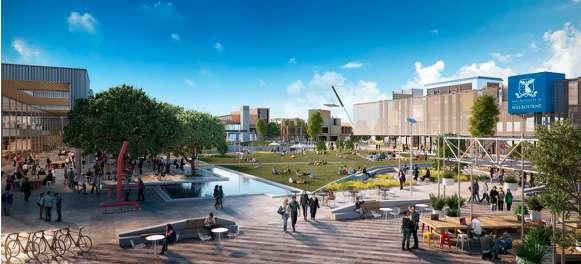
Why Bend to Fishermans Bend? UniMelb Pauses New Campus Location
Declan Chan
In early September, the University of Melbourne announced the suspension of work on the Fishermans Bend Campus. Initially set to open next year, the University of Melbourne’s VicePresident, Ms Katerina Kapobassis, has cited “timing of key government and industry investments” and “constrained revenue environments” as the reasons for suspending work.
The University submitted a bid for 7.2 hectares of land in the state-proposed “Employment and Innovation Area” (EIA) in 2018. The Victorian Government has reaffirmed that “outcomes are occurring on the ground, and development is comfortably on track to achieve [its goals]”. Despite this, the newly released Integrated Transport plans in October suggest that Fishermans Bend’s most critical piece of infrastructure, a promised tram link, has
? ? ?
been delayed by decades.
Timing of Government Investments?
The Government’s plan now estimates the build to be 10 to 30 years away. Interestingly, the delays have become a defining barrier to confidence. A 2023 financial report by EY suggests that the precinct’s valuation remains tied to
the continued rollout of transport and infrastructure. While the report notes rising interest rates and construction costs, the changes in Fishermans Bend follow the pattern witnessed in similar high-density development projects. Currently, the lack of accessible transport has become the primary factor holding the precinct back
for both businesses and developers.
What about constrained revenue?
According to the University’s Annual Reports, the University’s revenue has grown by 75.4 per cent over the past decade (2015-24). The reports show that between 2018 and 2024, the University experienced a 39 per cent increase in revenue, outpacing inflation even during the COVID period. In fact, the University of Melbourne has outpaced other similar universities. Monash University’s revenue grew by 31 per cent over the same period. While Melbourne’s membership and revenue declined during the COVID period, the extent of the decline reflected sector-wide trends rather than institution-specific instability. As such, due to continued revenue growth since the 2018 purchase, the announced “revenue constraints” remain unclear.
Timing of the industry?
It’s no secret that the University of Melbourne has explicit ties to some of the world’s largest weapons manufacturers. In 2016, the University came under fire for its ties to Lockheed Martin, after announcing the development of its $13M STELaR Labs. While the University is independent of the project, it bridges graduates and researchers from the
University. Furthermore, the University has described STELaR Labs as “proximal” to the Engineering Faculty. Since 2016, the University has received $3.5M in publicly disclosed funding from Lockheed Martin for PhD fellowships.
With the development of Fishermans Bend, the facility will become home to Boeing, BAE Systems, Siemens and the Department of Defence (Defence Science and Technology Group (DSTG)). In particular, BAE Systems’ involvement in the district is strictly related to its development of AMV35 vehicles under the Land 400 Phase 2 Contract. As one of the world’s most significant weapons manufacturers, BAE was selected in 2016 to compete for the ADF-issued contract. In February 2018, the University signed a conditional agreement to collaborate at Fishermans Bend, with BAE Systems set to receive the contract. Explicitly outlined by BAE Systems, the deal hopes to “leverage success” from its collaboration with the DSTG, universities and other businesses. However, in late 2018, six months after BAE Systems’ agreement with the University, the ADF contract was officially delegated to BAE’s competitor- Rheinmetall Defence Australia. In doing so, the construction of Combat Reconnaissance Vehicles is
expected to be completed in Queensland, rather than in Fishermans Bend.
In early 2019, after losing its Phase 2 contract, BAE announced its submission for Phase 3 of the Land 400 contract. The contract, initially valued at $18-27 billion, was later awarded to Hanwha Defence Australia in December 2023 for $7 billion. In doing so, recent contracts have locked BAE Systems out, perhaps suggesting redundancy in the Fishermans Bend project. Despite this, the continued presence in the EIA, through Boeing, Siemens and the Department of Defence, indicates strategic reasons for the University to maintain its presence at Fishermans Bend.
As such, the University’s statement on its decision to withdraw remains ambiguous. Stable revenue numbers and the continued presence of other weapons manufacturers suggest that the decision to pause the project is premature. While the project is paused for now, the University has expressed its residual “commitment” to the area, which it plans to reevaluate in 2030. Until then, it is yet to be seen whether student-led activism has had, or will have any meaningful impact on the project.
Victorian Parliament Launches Inquiry into University Governance
The Victorian Parliament will conduct an Inquiry into university governance, Minister for Skills and TAFE Gayle Tierney has announced.
The inquiry will centre on “elevating staff and student representation on university councils”.
The Inquiry announcement follows the Final Report and Principles by the Expert Council on University Governance released in October. The Final Report scaffolds 8 key Governance Principles to “provide a framework for strengthening and continuously improving governance at Australia’s public universities”. The Expert
Council is composed of representatives from both government and university organisations. Through the Inquiry, the State Government seeks to align with this national plan to improve university governance. Further measures include “setting limits on Vice-Chancellor pay and requiring university councils to publish their decisions and comply with long-
established governance standards in the private sector”.
“This is about giving students and staff a seat at the table at the highest levels of our universities–making sure our world-class institutions are focused on education, not profit,” says Minister Tierney.
Recent consultation of key stakeholders by the Expert Council
Sabine Pentecost
revealed an “observed lack of trust” about the motivations and actions of public universities and their major actors. Feedback outlined scepticism about the contributions of staff and student representatives, deep concerns about confidentiality and conflicts, as well as distrust in communication channels between universities and regulatory bodies.
The Council cites that “many submissions received from universities failed to engage proactively” and take accountability for weaknesses in governance, conveying the need for further inquiry and report.
The National Tertiary Education Union (NTEU) has been campaigning for Government scrutiny of university governance for several years. Their three-pillar reform program, calling for “meaningful staff and student voice”, “transparency in governance” and “effective controls against management capture”, has been backed by Victorian MPs in the announcement of the Inquiry.
“The inquiry provides a vital opportunity to reform a broken governance system that has marginalised staff and student voices and undermined Victorian universities as institutions of education and research,” says NTEU
Victorian Division Assistant Secretary Professor Joo-Cheong Tham.
The Union’s statement highlights its members’ ongoing and instrumental role in government consultation and inquiries, outlining key issues such as “wage theft, outrageous executive pay packages, toxic governance cultures, boards stacked with corporate appointees, and serious conflicts of interest” that have been brought to light. Governance Principles by the Expert Council on University Governance:
1. Accountability: Governance structures and accountabilities are well-defined, effective and transparent.
2. Diversity of perspectives: Composition of the governing body enables purpose and performance
3. Independence: Academic standards and freedom are respected and protected
4. Transparency: Purpose, strategy and performance are clear and openly communicated
5. Trustworthy: The university operates lawfully, ethically, responsibly, and consistent with its public purpose
6. Inclusive + Responsive: Expectations of the university’s community and stakeholders are understood, respected and responded to
7. Sustainable: Risks are understood and managed effectively
8. Responsible: Workforce and remuneration are structured fairly and responsibly
Under the new Principles, universities will be required to report annually to the Tertiary Education Quality and Standards Agency (TEQSA) on an “if not, why not” basis.
University governing bodies will also be required to publish meeting outcomes, key decisions, Vice-Chancellors’ external roles, annual remuneration reports, the composition of governing bodies, and justify consultancy spending.
TEQSA will take compliance action against universities that repeatedly fail to meet the Principles.
The Council’s final report also details 5 key priorities for re-building trust in public universities which has eroded significantly over time. The priorities are 1) Leadership and culture, 2) Accountability, 3) Inclusion and engagement, 4) Transparency, 5) Renumeration. They overlap with the Governance Principles and outline the areas to be targeted by reform.
The Victorian inquiry follows similar federal and NSW inquiries this year, demonstrating a national push to hold universities to account.
“Adult Time for Adult Crimes”: A Bill Raises Concerns over Youth Rights and Safety
Zeinab Jishi
The Victorian Labour Government plans to introduce new “Adult Time for Violent Crime” laws which would see children as young as 14 sentenced in adult courts for certain serious offences.
To be introduced in Parliament this year and implemented in 2026, the reforms would dramatically increase the likelihood of imprisonment for young people and raise maximum jail terms from three years in youth justice to up to 25 years in adult prison.
The Government says the reforms are about community safety and consequences. But legal experts, human
rights organisations and youth advocates argue the approach is politically driven, misinterprets crime data, breaches children’s rights and will entrench disadvantage rather than reduce crime.
Under the proposed bill, children aged 14 and over charged with specific violent offences, including home invasions, aggravated home invasions, recklessly or intentionally causing injury and aggravated carjacking, would be dealt with in the County Court and sentenced under adult sentencing laws.
Currently, 34 per cent of children sentenced in the country court receive a term of imprisonment. Under the new
scheme, this figure is expected to rise as high as 97 per cent.
“There are too many victims, not enough consequences,” Jacinta Allan said to justify the reform.
Attorney-General Sonya Kilkenny argued that adult courts are tougher and more focused on public safety. “When child offenders are sentenced in an adult court, most go to jail. Adult courts put more emphasis on victims, violence and community safety,” she said.
The model mirrors recent “tough on crime” reforms in Queensland, introduced by the Liberal National Party and credited by the Queensland Government with
helping deliver a 10.8 per cent drop in crime across nine key offences in 2025. The goal of this reform is to solve youth crime with the idea that harsher punishments would deter children from committing these crimes.
However, these reforms are not based on evidence, but rather a politically driven move that does not keep the safety of children in mind, and will further impact disadvantaged and vulnerable teenagers. The Reform Misinterprets Crime Data
In Victoria, criminal offences spiked by 15.7 per cent in 2025, and about 1,100 children aged 10 to 17 were arrested 7,000 times.
Dr Kathryn Daley, a former youth worker and associate director of Social Equity Research Centre at RMIT, noted that police statistics reflect arrests and convictions, not the true rate of crime, and “cannot be taken at face value”.
She adds that these data reveal a relatively small group of repeat offenders is responsible for a large portion of youth crime. Rather than an “epidemic” of offending across all young people, rising youth crime is concentrated among marginalised groups who are already facing significant disadvantage.
The Justice Reform Initiative’s executive director, Mindy Stiri, has warned that apparent short-term drops in crime under “tough on crime” policies often rebound over time as harsher sentencing leads to higher recidivism rates in the long run.
Criticising the bill, Greens MP Katherine Copsey said, “Today, Jacinta Allan has shown that she is incapable of doing what works and is going to pursue a failed policy that ultimately will not make our community safer.”
The Reform Violates Children’s Rights Article 37 of the United Nations
Convention on the Rights of the Child states that the detention of a child should be used only as a measure of last resort and for the shortest appropriate period. Australia is a signatory to the Convention, and critics say the proposed laws undermine Victoria’s obligations under international law.
Condemning the reforms by the Victorian Labour government, the Human Rights Law Centre noted that, “Reckless laws like these do not work and do not make communities safer. They entrench inequality and rip children away from their families and communities.”
“Children deserve care, not cages and adult prison sentences,” said Monique Hurley, an associate director at the centre.
Jesuit Social Services similarly described the proposed reforms as “incompatible with the fundamental rights of children.”
Advocates warn that the reforms will have a disproportionate impact on Aboriginal children, who are already overrepresented in the justice system. Nerita Waight, CEO of the Victorian Aboriginal Legal Service, accused the Allan Government of escalating punitive policies. “It’s clear that the Allan Labour Government is competing on cruelty with other governments, and I would say it’s winning,” Waight said. “Moving children to adult courts will only achieve one thing, further entrenchment of criminalisation.”
The Victorian Aboriginal Legal Service has already reported a 233 per cent increase in its caseload following changes to bail laws in March 2025, which made it harder for alleged repeat offenders to obtain bail. The organisation is fearful that “Adult Time” reforms will trigger a similar surge in criminalisation and detention.
Why Won’t this Reform Work?
The spread of these sentencing reforms around the country set a concerning precedent for how we will continue to tackle crime. Rather than addressing the causes of increased crime, the reforms prioritise punishment over rehabilitation.
Marietta
Martinovic, an
Associate Professor in Criminology and Justice Studies at RMIT University, warns that placing young offenders in detention—especially in adult justice systems—exposes them to stronger negative influences. With underdeveloped brains and a higher susceptibility to peer pressure, young people in punitive environments are more likely to reoffend.
The Australian Institute of Criminology has described prisons as “universities of crime”, where offenders learn new offending skills while maintaining criminal networks—and this effect is amplified amongst juveniles.
Research has shown that harsher sentences only encourage, and do not deter, youth crime. The Australian Institute of Health and Welfare found 51 per cent of children aged ten to 17 whose first sentence was detention returned to sentenced supervision before they were 18.
Smart Justice for Young People has found that detention is the least efficient programme, with a resulting reoffending rate of 57 per cent. Former National Children’s Commissioner Anne Hollands has described the youth justice system as both harmful and ineffective. “The justice system for children and young people is failing. It causes significant harm; it doesn’t work to protect the community; it makes re-offending more likely, and it is incredibly expensive.”
What should the government do instead?
Rather than focusing on punishment as a deterrent to crime, the State should focus on preventing the sources of crime.
“Some have committed violent crimes, and many have been victims of crime
of support to help them build stable, positive lives and avoid reoffending, which the adult justice system is not designed to do,” said Chief Executive Officer Toby Hemming.
Data shows that the most successful programmes with the lowest recidivism rates are ROPES, a pre-plea diversion program for first-time offenders, and Youth Justice Group Conferencing, a presentence diversion program conducted by Jesuit Social Services.
“What actually works is early intervention, prevention, diversion,
therapeutic and trauma-informed care, community-based solutions, and most importantly in this context, culturally responsive approaches,” said Dr Martinovic.
Reforms should instead include increasing funding to build infrastructure that enables young people to live in safe, well-supported spaces and improve the quality of education and employment pathways. Increased funding will also enable a high ratio of qualified staff to de-escalate crises, offer therapeutic interventions for issues like drug use,
Has the Right Left?
In the wake of the red wave of the 2025 federal election, Australian conservatives have been left in the wilderness, suffering their worst electoral defeat to Labor since 1943.
In the May election, the LiberalNational Coalition won just 43 seats, their lowest seat share since 1943, while Liberal leader Peter Dutton was defeated in his own seat of Dickson, the first time in Australian history that a sitting opposition leader has ever lost their seat.
In a further blow to the Liberals, on 20 May the National Party, the Liberals’ regional coalition partner, announced its departure from the 80-year LiberalNational Coalition, marking a turning point in Australian conservative politics.
Meanwhile, internal divisions within the party have threatened polls, fracturing the Coalition’s
dilapidated base of support. Amid prolonged soulsearching for the two
parties and internal bickering over the future direction of the Coalition, one central question has emerged: has the right left?
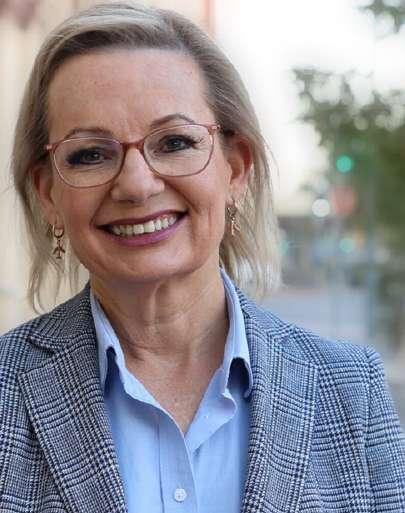
Sussan Ley
Peter Dutton’s defeat in his seat of Dickson marked a tumultuous end to the Coalition’s campaign to return to government, and a stark repudiation of the right wing of the Liberal Party.
Dutton’s reliance on culture wars and perceived similarities to American President Donald Trump contributed to the Coalition’s landslide defeat and a personal repudiation of Dutton.
Internal critics within the Liberal Party have blamed their historic defeat on the leadership of the National Right, the hard right faction of the Liberal Party, then led by Dutton.
In a mass call for reform, the Liberal Party pivoted towards the centre, electing Moderates Sussan Ley and Ted O’Brien as the new party leader and deputy. Ley’s competitor, Angus Taylor, is a member of the National Right. His role as Dutton’s shadow treasurer was widely blamed for the Coalition’s lack of substantive economic policies and rightward direction during the election.
Taylor’s would be deputy, Senator Jacinta Nampijinpa Price, is a defector from the National Party who gained notoriety for her leading role in the 2023 Voice referendum’s “no” campaign, as well as her controversial election vow to “make
mental illness or trauma, and strong planning to ensure smooth transitions for young people leaving centres into the real world.
“Real accountability means helping them understand the impact of their actions and supporting them—not locking them up and giving up on them. That means tackling the known drivers of crime by investing in housing, education, mental health and community support— not sending children into adult courts and prisons,” said Youth Affairs Council Victoria.
Australia great again.”
A Glass Cliff Ley defeated Taylor by just 29 votes to 25 in the party’s internal leadership spill, a narrow edge in the party room which is rapidly shrinking.
Senators Linda Reynolds and Hollie Hughes, who publicly endorsed Ley, retired in June, while Gisele Kapterian, a Ley supporter, was defeated in a historic recount, and a shocking upset for teal independent Nicolette Boele.
Moreover, should Ley fend off leadership challenges from colleagues, she will also face a range of long-term problems for the Liberal Party, such as its continued alienation of women and its struggle to connect with Millennials and Generation Z.
At her first press conference, Sussan Ley conceded the Liberal Party’s shortcomings and promised a reset to reflect a better “modern Australia.”
“We have to have a Liberal Party that respects modern Australia, that reflects modern Australia, and that represents modern Australia,” Ley said at the press conference.
“I want to do things differently, and we have to have a fresh approach.”
However, to win the next election, her party would also need a history-defying swing in its favour to defeat Labor.
Political analysts have thus described Ley’s leadership as a “glass cliff,” a term used to describe a phenomenon in
Pryce Starkey
which women are elevated to precarious leadership positions in times of crisis, often with a high likelihood of failure.
For the new Liberal leader, solving this rapid accumulation of problems may prove too insurmountable a task, given that she might have just a single term as party leader, or perhaps even less. A Coalition Breakup?
In another troubling turn for the Liberal Party, on 20 May, just a week after Sussan Ley was elected Liberal leader, National leader David Littleproud announced that his party would not renew its coalition agreement with the Liberals.
While its senior coalition partner was swept out of Australia’s major metropolitan areas during the election, the National Party emerged from the election unscathed, retaining all of its seats held at the last sitting of Parliament.
Due to their strong electoral performance and inflated presence in a diminished Coalition party room, some prominent Nationals had suggested increased concessions from the Liberal Party in their coalition agreement, or even a total breakup of the Coalition.
Outspoken Nationals senator Matt Canavan had previously suggested that the party run candidates in outersuburban seats reserved for the Liberals, dump its net zero climate emissions targets and disband the Coalition.
Little more than a week later, after an unsuccessful challenge to his leadership, Littleproud announced that he had failed to reach a continued coalition agreement with Sussan Ley, paving the way for the Coalition’s dissolution.
The Nationals’ demands included a continued commitment to forced divestiture to break up supermarket monopolies, maintaining the Coalition’s commitment to nuclear energy, the establishment of a $20 million regional future fund and reformed telecommunications for rural areas.
A leaked letter from National Senate leader Bridget McKenzie to Liberal Senate leader Michaelia Cash, sent on May 12, also revealed significant tensions
over the defection of Jacinta Nampijinpa Price to the Liberal Party.
A day later, on 23 May, the Liberal Party had agreed “in principle” to the National Party’s four main policy demands, paving the way for the two parties’ reunion.
After a messy, short-lived divorce, the Liberals and Nationals rekindled their unhappy marriage. Still, the cracks in it have now been exposed following a bitter feud.
Knives Out
Internally, the Liberal Party has faced a range of problems, including controversial comments made by Nampinjinpa Price about Indian immigrants, which have highlighted the party’s damaged relationship with immigrant communities, as well as skyrocketing support for One Nation, which has cannibalised support for the Coalition over migration and other issues.
An October Newspoll found that the Coalition’s primary vote had fallen to just 24 per cent, 8 per cent below its 2025 election result, while One Nation’s primary vote had more than doubled since the election.
One Nation’s primary vote rose from six per cent to 15 per cent, which would be a historic result for a minor party if replicated at an election, and an all-time low for the Coalition, which already received its lowest primary vote ever at the May 2025 election.
Moreover, the Liberal
Sussan Ley was the most popular choice for Liberal leader among general correspondents, with 21 per cent selecting Ley as their preferred choice, a small lead over Hastie and other potential candidates.
Andrew Hastie was selected as the preferred choice of 15 per cent of correspondents, with Angus Taylor at 9 per cent, Ted O’Brien at 3 per cent, and Goldstein MP Tim Wilson, a Moderate, at 6 per cent. Fortysix per cent of correspondents did not express a preference for the Liberal leader.
Hastie, like many opponents to Sussan Ley, sits in the party’s National Right, where he has carved out his own base to advocate for Australian nationalism and Christian values.
However, in line with right-wing dissidents in the Nationals, Hastie has challenged Ley’s leadership on migration and net zero, exacerbating divisions within the Liberal Party.
On September 16, Hastie himself threatened to resign from the Coalition frontbench if the Liberal Party didnot abandon net zero, placing further pressure on Sussan Ley.
“Labor is taxing us, and they are doing it in the name of climate alarmism,” Hastie told ABC Radio Perth.
When questioned about what would happen if Sussan Ley retained net zero, Hastie gave a blunt answer: “That would leave me without a job,” he said. “I’ve nailed my colours to the mast.”
To the disappointment of the Moderates, the Liberal Party has since followed Hastie’s lead, abandoning net zero and paving the way for a rightward shift ahead of the next election.
MUR: Rebuilding a Legacy
Ashley Syers
Despite having been established since the end of the 20th century, it was not until after two years of development that MUR Motorsports, the University of Melbourne’s Formula Student racing team, had a car built to compete. Celebrating their 25th anniversary this year, it is amazing to witness the endless persistence, determination and work ethic of our University’s racing team.
In their early years, MUR saw numerous successes within car development from the 2000s through to late 2019. Since then, it has been a rocky slope—not just in the construction of a competitive car, but also in the aftermath of the COVID-19 pandemic and a global lockdown. With immense damage to the team composition, MUR struggled to rebuild. With lockdown restrictions, the team was left unable to congregate and operate, losing countless members and fundamental technical information on how to construct a car after restrictions were finally lifted.
Student teams are a significant factor in the Engineering curricula, with many students in the past utilising clubs like those of Formula Student to fulfil capstone hours and gain much-needed practical experience. Despite this, MUR had a massive member drought when entering their 2022 and 2023 seasons as the faculty modified capstone requirements, significantly contributing to the drop-off in membership.
“In 2023, our team started up again,”
only two people (from the previous year) stayed on and the team grew to about 60. So [2025] is our second or third year [in re-development].”
With many people departing or completing their degrees at the end of 2023, the remaining members faced another crucial dilemma: a documentation and informational predicament. “One of the reasons we fell apart in 2022 [is because] all that documentation relied on Capstone reports from final year students, which is obviously good, but the numbers we couldn't always trust, because it's for academia,” mentioned Huang. With this, the new re-emerging MUR team had to start from scratch. Rookies again! After almost 20 years.
Unfortunately, the lack of prior documentation meant that many of the departments were forced to relearn from the ground up. In particular, the Aerodynamics team had to teach themselves the fundamentals and practices of their own department, as there is limited knowledge on this sphere of engineering taught at the University.
“This year is also the first year where we're actually doing Aero," mentioned Aerodynamics Co-Lead Lukas Albert. Where previously only body panels were a part of the functioning car, this Aerodynamics department has developed enough that the car has plans for an Aero package for the first time in years.
A key driver within the team’s current
COVID-19-esque information loss does not occur again. To do this, a significant logistical aspect of all departments includes establishing that detailed documentation is made and maintained.
“That's why this year is really important,” said Albert, “to build all of the knowledge, the foundations, the documentation and the processes, so that hopefully, in future years, it's more of an iteration situation and not a 'How do we literally reinvent everything, including the wheel?’”.
Potentially surprising to an external student, no wheel-to-wheel racing occurs in the Formula SAE competition. A significant aspect of how the Formula Student competition functions is fulfilling Static and Dynamic events. There are three Static events: a Cost Event, continued with a Design Event, followed by a judgment of technical function and safety scrutineering event. The Dynamic events include: a Skidpad (performing a figure of 8), a sprint, an acceleration event, endurance, followed by an Economy Event. In last year’s competition, MUR completed all three static events, but were only able to compete in one dynamic event: endurance.
A major goal of the team as expressed by their Electrical Lead, Chris Corbett, is for the team to “actually be able to compete in all the dynamic events, [as] that's something that [they] haven't done in a very long time.” This really
Art by Gurman Kaur
If you were to step into their office in the Faculty of Engineering building, you may be met with hard, technical work on CAD (Computer-Aided Design) on their computers … or you may hear loud laughter and "totally-not-played-up-for-the-cameras" shenanigans like impulsive push-up competitions. The team is full of warm personalities and are comical social butterflies. Outside of working hours, post-team meetings occur every Wednesday evening, in which the team more often than not has fried chicken nights—where they all go out to get some of what they call "Xingy’s Fried Chicken!" (a name given after a fried chicken venue botched Huang’s name on the original booking). Team events, such as group karting, are often cited by many members as a highlight of group activities, with many "masters of sim racing" showcasing immense competitiveness as they fight it out wheel-to-wheel on the track.
Although competing and assembling the best car they are capable of creating for competition is the team's mission, MUR’s key goals are mostly to uplift and nurture aspiring, dedicated individuals.
“The vision statement [is to] develop engineers of the future,” affirmed the previous Team Principal and now Aerodynamics Engineer, Jeffry Chen, “It’s … developing engineers and getting them used to, [for example] how energy works in real life.”
As much as it is a competitive, serious student team
dynamic, full of hours of dedication to the development of a functioning car, MUR is a warm community full of enthusiastic and passionate students. The team is filled with members who break free of common Engineering stereotypes, like antisocial workaholics, and are instead some of the most welcoming individuals you will meet on campus. With their collaborative and infectious energy, MUR is rebuilding not only their car and legacy, but constructing a strong, compassionate circle of unbreakable team members—ready for greatness together.
Farrago Video follows MUR Motorsports' journey to the FSAE competition this December.
Designed by Angela Nacor
MUR Motorsports’ 2024 cohort
Photography by Thilan Fernando
Photography by Angela Nacor
David Lu ‘Cliffhanger’
Jeffry Chen ‘Kiwi Rush Hour’
Weigh in on these Campus Debates & Find out Which UniMelb Influencer
YOU are!
by Sophie He
They attend your university and walk the same mundane routes, yet seem to access rarefied academic, social and aesthetic spheres. What do they have that you don’t? Could it be the strategic curation of one’s public life for social media branding, or are they just better than you? Weigh in on these UniMelb controversies, and discover whether you’re Robin Waldun or Fayefilms (at least, based on oversimplified stereotyping of their public personas).
1. Which undergrad cohort is the worst?
a) Commerce
b) Arts
2. Who is your biggest enemy?
a) Myki Inspectors
b) OKTA verify
3. Is the Melbourne Model any good?
a) Yes
b) No
4. Where do you get a cheap meal?
a) Heart of Carlton
b) Campus Canteen
5. By whom would you prefer to be accosted?
a) Socialist Alternative
b) UMSU Campaigners
6. Should you have gone to Monash?
a) No
b) Yes
7. Do you think about WAM boosters?
a) No
b) Yes
8. There are no good tutorial slots remaining. Which would you prefer?
a) Unairconditioned Old Arts room in summer
b) A 6pm start
9. You need caffeine on campus. What’s your fix?
a) Flat white from Professor’s Walk
b) Matcha latte from Cafe Commercio
10. Which is your preferred online forum?
a) UniMelb Love Letters
b) r/unimelb
11. Which is more humiliating?
a) Being Duncan Maskell
b) Being locked in the bag shipping container during exams
12. Cutest critters on campus?
a) South Lawn ducklings
b) Possums
13. Which is the best way to connect at uni?
a) Networking and LinkedIn
b) Clubs and Societies
14. Your favourite study method?
a) Commonplacing in a Moleskine
b) Spaced repetition and active recall
15. Which is the worse administrative decision?
a) Ending Meanjin
b) Demolishing the Brownless Biomedical Library
mostly a’s: robin waldun
mostly b’s: fayefilms
At the University of Melbourne, you’re somehow the only true intellectual. A Byronic hero of the modern age, you champion ideas that are disruptive–nay–revolutionary. In a benighted era, you, like an Instagram reel-making Rousseau, dare to ask: what if the liberal arts aren’t useless garbage? Careful, lest the Church censor your illuminating treatises! As soon as you graduate, you’ll be voyaging to the Continent. Why be in Melbourne, with its capricious clime, when you could be chowing pastries in starry Pah-Rhee? Though, with your sincere love of knowledge, you’re in no rush to finish your education. The overworked academic staff appreciate how to you, and only you, they are celebrities; and in the doldrums of Week 9 in Semester 2, you’re the champ who’s completed the readings and will fill the awkward tutorial silences. While your peers fret about whether they’ve picked the right path, you can rest assured knowing that UniMelb was the only university in Victoria that worked with your aesthetic!
Perfection is just out of reach, but every day you get closer. Your sweet pastel knits conceal a deadly academic weapon. However, you’re so much more than that. Your conscientiousness and diligence permeate all areas of your life. In addition to your scholarships and awards, you boast a precise business acumen, sense of style and altruistic impulse. Bad news: the world is unfair and success is holistic. The good news is that you’ve dedicated yourself to helping others. You inspire them to step up, and in the high-intensity grind of University, it can be encouraging to be around someone who believes that a better version of yourself is just one curated Notion page away. You are the work you put in and there is no easy way through. Let your besties hear these truths as you launch into another ad for Grammarly AI.
The Performative Male: Unravelling the Internet’s “New” Masculinity
The “Performative Male” has garnered viral mockery. But what is gender but a performance? What distinguishes this archetype as uniquely unsettling?
what could it mean to us?
Content Warning: discussions of misogyny
In the paradise rainforest of some unnamed tropical location, a male bird’s spectacle of courtship is unjustly rejected. The plain and simple beige female bird, unimpressed by his desperate attempts to woo her, flaps away with her beak upturned. He’s tidied and decorated his nest, fluffed up his kaleidoscopic feathers and has practiced meticulously for months with only one thing on his mind—sex! All this effort and for what?
At your local coffee shop you see a young man across from you drinking some plant milk matcha or cafe-latte. He seems to be reading Simone de Beauvoir or Audre Lorde but you watch as his eyes dart around the room to make sure the title of his book or the “future is female” pins on his tote bag are noticed. He wears merch from musical artists such as Mitski or Clairo, wired headphones adorn his ears, he has rings and glasses without a prescription just to seem inquisitive. He makes himself appear approachable and he is undoubtedly interested in women no matter how “fruity” he seems to dress. This is a Performative Man, and he is not too far off the parrot in an Attenborough documentary. He puts detail and effort into how he presents himself, into his venture for a mate. The Performative Male exists in most species and isn’t really anything all that new. But what I want to know is what dwells beneath his shoddy nail job and Doc Martins? It seems as though most men are no longer leaning into their masculinity to attract women. No more dinner dates and cars? Try getting a coffee and listening to him play guitar. What is this new male identity and aesthetic? Where has it come from? And
The new image of the performative man has taken flight in the treacherous jungle of our contemporary online world. Satirical posts, dress-up competitions at universities and coffee shops as well as memes and commentary mostly trolling so-called performative men are endless. Or maybe there is something deeply wrong with my algorithm!
A main area of criticism for these men is that they are, of course, inauthentic and clearly latching onto “femme” culture simply for our attention.
I wonder however, how can we question their authenticity when all social media and social interactions are performances? We are constantly conveying a version of ourselves to those with whom we interact, to our audiences, either intentionally or not. Gender is also a performance, as Judith Butler keenly identifies in the preface for their book Gender Trouble: “An internal essence of gender is manufactured through a sustained set of acts”. It is a performance “posited through the gendered stylisation of the body”.
If these performative men bring to light some interesting ideas on the performance of social interactions, whether that be in conversations of gender, romantic/ sexual relationships or just the overall performance of social media, then why are we ridiculing them so much? What is it that has tweaked the nerve of the social conscious so fervently about these men?
I propose that it is because their performance is so specific. Similar to the discourse surrounding the role and value of Internet Activism, performative men are branded as disingenuous as their interests in feminism and social justice issues, and all rather appropriate important issues, are calculated to appeal to women. They don’t actually know what they are talking
about and supposedly care about these things for attention, for a cracker. When you actually think about it, it’s really quite sinister.
This leads to the question of what do women interested in men actually want? Over the past few years, online trends have suggested these women are becoming more and more interested in feminine or “non-toxic” men. The Performative Male is a hybrid attempt at this. They are similar to men embodying a “female gaze” or “men-written-by-women”, an internet term for characters like Mr Darcy, fictional men literally created by women who embody a dream of what an ideal man could be like. Chivalry, stability, yearning, personifying female desire in an understated way. Women seem to be unsatisfied with the heterosexual dating landscape. British Vogue boldly highlighted this in its recent article “Is having a boyfriend embarrassing now?”. The piece by Chante Joseph identifies how women on social media are starting to be more secretive about presenting their relationships online, out of what could be a collective embarrassment. Women are no longer “hard-launching” their partners and are rather posting subtle images to reference that they have achieved a relationship yet also maintain a mysterious “cool-girl” identity of independence, of not needing a man. These women aren’t the only culprits. Joseph explains that viewers seem to cringe at the idea of women being “ruined” by a relationship with a man, because they view it as all consuming and restrictive. They therefore see being single as liberating and idealised. I think internalised misogyny is to blame too, women often fall into the trap of people-pleasing their male partners, even mothering them and internalising issues in their relationship dynamic which is a much broader discussion. We
Astara Ball
saw this with actress Nicole Kidman’s recent divorce announcement from her ex-manchild Keith Urban, to whom she allegedly paid a yearly allowance to stay clean off drugs as a strategy to “fix him”. So, it’s as if some men online are seeing women’s dissatisfaction with relationships and are almost getting the point, though only at this surface-level.
Social media and the curation of the online self is a spectacle governed by the cycle of social and cultural values and is very much dependent on how others perceive us, how they make us feel. In relationships, most women just want to feel safe and that could start with men presenting themselves more authentically both online and in person, a revival of the “chalant man”, the “yearner”. This worry for safety has come into more prominence when considering the current state of masculinity and the emboldening of “manosphere-cultures” and “red-pill misogyny” under world leaders such as U.S. President Donald Trump. Men are showing how dangerous they can really be. The increased concern for women’s health and safety following the overturning of Roe v. Wade in the U. S. and increasing domestic violence and femicide in Australia underline the fact that many women aren’t safe or don’t feel safe to pursue relationships with men.
A
trend will probably always be just a performance, a facade. These men, these enigmas, are just symbols, simulacrums of what they think women want. Performed safely, the most we can do with them is consider all these ideas they bring up about the state of gender, romance, sex, authenticity and the internet and let out an Edward Cullen-esque chuckle at the onslaught of memes.
So has this trend merely emerged from a male desire to be sexy to someone? Is it caused by a longing to simply feel wanted in this day and age of gamified dating apps and the oh-so-terrifying male loneliness epidemic? Or is it a new and menacing way for men to appear as a respite to all the awful men out there, only to subject women to the same harm once more?
We must remind ourselves that this strange and slightly alarming internet
Self-Made Man in a Man-Made System
Jayden sifts through the myriad and imbricated ways in which he, as a trans man, interfaces with patriarchy and feminism. He reflects on where his experiences overlap with and diverge from those of cis women, the centrality of perception to social power, newfound tensions when interacting with women and precarious standing among cis men.
Jayden Alexander
Content Warning: discussions of misogyny
Thepatriarchy is a man-made system of domination where men are in power and it is perpetuated on every level, from interpersonal relationships to institutions. As seamless as my medical transition has felt, having experienced the changes daily, it has come to a point where it is no longer obvious to the outsider that I am a trans man. The shift, whether conscious or not, has granted me an illusory privilege. To the outsider, who views me as a cis man, I become complicit in the violence that the patriarchy has perpetuated. But where does that actually place me?
To be clear, my positionality
will blueprint the boundaries of this conversation. I cannot speak to experiences that I have not lived through, and as such, will not claim to speak on behalf of the trans community. But as someone who was raised and socialised as a girl throughout childhood in an all-girls’ school, I can speak to the experience of what that was like for me and how that has shaped the ways I go about life today. Feminism, specifically with regards to older women, will never have to cross my mind in the same way it does for women. Because I came out at 16, which is fairly young, I will not claim to understand feminism from the lens of an older woman. I will never have to face medical misogyny because my doctor doesn’t know what peri-menopause is. Therefore, I don’t think that conversation should include me
as an active speaker.
In many ways, I find myself thinking the same way on issues relating to the patriarchy’s obsession and control over women’s bodies. Before coming out, I identified as gay–that is to say, I liked and still like women–and therefore didn’t need to subscribe to conventional conversations on what I should have been doing with my body. With regards to conversations on the over-policing of women’s bodies, I have never found it necessary for me to share my opinion on these matters. Before I came out, it was because I, as a queer teenager, was able to chalk everything up to heteronormativity and ignore it in its entirety. And now, as someone who no longer identifies as a woman and has no intention of having biological children, I don’t particularly think it’s fair for
me to share my opinion. Instead, I have relegated my participation to uplifting the voices of those impacted by these issues. In some way, it’s oddly gender affirming to be relegated to a man’s role in the conversation, which is to simply listen and understand. It also goes without saying that not all trans men will share the same view as me on this, given that they may have different lived experiences.
With that said, I think the lines blur for me when it comes to unlearning social habits I adopted when I was younger. Having grown up in an all-girls’ religious
schooling system as a queer individual meant that I picked up certain ways of socialising as a girl. And given the circles I ran around, these interactions often had sapphic undertones. Now that I identify as a bisexual man, it’s odd to have to unlearn socialising with women and to re-learn how to do so in a non-creepy, respectful and gentlemanly fashion.
For instance, I grew up being incredibly touchy with a lot of my friends. We’d often hang out in each other’s beds, have sleepovers, hold hands, etc. which, of course, in most cases is socially unacceptable for a man. However, it is difficult to identify all the behaviours that have contributed to the way I socialise with people today. I can say that a large majority of my friends are women, whether that is because the places I find myself in already have a greater percentage of women or because I unconsciously feel more comfortable socialising with women.
Given how men often take kindness as flirtation, it makes sense that women would generally be apprehensive when a random guy sits next to you
and introduces himself. I think it was a startling realisation when it clicked that simply going up to a woman and introducing myself could be seen as flirtation as opposed to being overtly friendly, and that I now had to conduct myself differently. Unfortunately, there was no handout given to me when I first came out, teaching me how to “act like a man”. Sure, there were many alpha male podcasts that taught men how to act, but I didn’t think that was the type of masculinity I wanted to emulate. It was a dangerous line to teeter on, wondering if I wasn’t coming off masculine enough, or if I was feeding into toxic masculinity. It didn’t help
that as a Chinese bi man, the layers of intersectionality meant that masculinity meant a different thing to different parts of my identity.
I lament that this intersectionality has complicated how I think about systems of domination and my fluctuating privilege. Here, I must make another disclaimer, to be careful to not veer into bioessentialism. These are simply observations I have made over the years as I started passing more. For instance, in spaces where I interact with women, I think about how many times they apologise for bumping their chair into mine, or accidentally kicking my shoe, and how often, men wouldn’t do the same. In fact, there’s a certain self-assuredness that comes with being raised socially as a man that I often find, even within queer spaces. I am frequently left wondering if they
actually see me as a man or as an equal. Sometimes, it’s fetishisation, other times it’s infantilisation, but always a sort of insidious power over me that I can’t pinpoint. I am aware that some parts of my identity, such as my sexuality, are not immediately apparent to the outsider, and as such, still affords me the privilege of passing as a straight, cis man. In this figment, I am able to walk the streets at night, fairly comforted by the fact that I will likely not be attacked, though the thought does cross my mind. It also means that I am aware of my own actions, careful to walk ahead of women or cross the street.
There are many such instances of society treating me differently based on the gender they perceive me to be. When I present more masculine, I find that generally, women choose not to sit next to me on a bus, and when I used to wear a skirt for school, old creepy men would sit and hover near me. Or, when walking down the street while someone walks towards me from the opposite direction, a game of chicken is played, one where the other person quickly calculates their position in the social hierarchy in relation to mine to decide to move away or not. So, if it were a white cis man, he would continue walking and expect me to move out of the way—of course, I would never give him that satisfaction.
All of this is further complicated by online opinions, largely with regards to how women feel about men. It’s not difficult to chance upon a tweet or post on how all men are inherently evil or the more nuanced take, that men, by doing nothing within their social circles, become complicit in the violence their friends perpetuate.
For the second time, I ask, where does this place me?
It has always left a sour taste in my mouth when friends around me would exclaim that they hate men for very valid
Of course, I don’t want to be labelled a perpetrator or bystander of the violence of the patriarchy, but it feels dysphoric to be othered rather than included in the conversation as a man.
Art by Lauren Luchs
reasons, then immediately turn and say, “but not you though.” Of course, I don’t want to be labelled a perpetrator or bystander of the violence of the patriarchy, but it feels dysphoric to be othered rather than included in the conversation as a man. Whilst I do think everyone can perpetuate the violence of the patriarchy regardless of their gender identity, it is true that the perpetrators of the violence are often men targeting women. I am therefore not offended by the statement, “I hate all men”, because I know I’m not being referenced. Although, I do think the work of unlearning the patriarchy is one that is never-ending and I can very
much still be part of the problem. What I take issue with, is the infantilisation of trans men as somehow a sub-class of men, othered in these conversations because we aren’t allowed to partake in them as women nor as men.
At the same time, I don’t often find myself in the position to correct men on their misogyny. Being socially raised as a girl means that I was inculcated with the fear of men. I am always wary of how older men position themselves on public transport even though it’s not a definite threat. Should the occasion ever arise though, I’m not entirely sure I would have the confidence to interject. In a space
where I am surrounded by men, I would not reveal the fact that I’m trans or bi for my own safety. In that same vein, I wouldn’t feel safe openly disagreeing with a man unless I knew there were others there to back me up. Perhaps this speaks to the bystander effect and is something I need to actively unlearn.
I don’t have an answer for where this leaves me as a trans man within the patriarchy—benefitting from it, being able to perpetuate it but simultaneously finding myself victim to it in more ways than one.
Salute! The Impact of Conscription on K-pop’s
Global Empire
How BTS’s model of staggered mandatory military enlistment has influenced the K-pop industry’s standard protocol, illustrated by SEVENTEEN’s recent strategy.
Megan Nicole Yin
In the Kpop world, the issue of military enlistment resurfaces each year. And, in 2018, the discussion intensified as the industry and fans anticipated BTS’s turn to serve. As the first K-pop group to debut at No. 1 on the Billboard 200 chart, their approaching enlistment in 2022 drew significant global attention.
South Korea mandates that all ablebodied men between the ages of 18 and 28 must complete military service, and this continues to shape the trajectory of K-pop boybands. The question remains: if national athletes can be exempted, why can’t globally influential artists who have elevated Korea’s soft power?
The reignition of this debate was sparked by BTS’s devoted fanbase, ARMY. They submitted petitions arguing for special exemptions to the government through platforms like Change.org and epeople.go.kr (the official public and civil petition portal for South Korea). However, under the country’s Military Service Act, exemptions remain strictly reserved for those who have demonstrably enhanced national prestige, namely, award-winning
athletes and classical musicians. In 2022, the Democratic Party of Korea proposed allowing pop idols to fulfil alternative service, but no major reforms were implemented.
Beyond the policy debate, BTS’s economic influence was undeniable.
A report from the Hyundai Research Institute estimated that BTS generated $3.6 billion in economic value in 2018 alone, attracting 1 in every 13 tourists to South Korea. Following BTS’s military enlistment announcement, Business Insider noted that HYBE’s (BTS’s company) shares fell by 2.5 per cent. This reflects how closely related market value and investor sentiment are tied to the group’s activities.
Fast forward to 2025, anticipation is now building for BTS’s full-group comeback as all seven members have reached the end of their service. Yet, as one generation of idols prepares to reunite, another faces the same cycle of departure and return.
This time, it’s SEVENTEEN. Since 2021, the 13-member group has been listed at No. 1 on the Billboard Top Album Sales Chart seven times. This includes their
most recent album, Happy Burstday, which, according to Chosun Biz, achieved the highest first-week sales in South Korea in 2025 with 2,521,208 copies sold.
As the group reaches new career milestones, SEVENTEEN is also adapting to members’ military enlistments. As of September 2025, four members have begun their enlistment: Jeonghan, Wonwoo, Woozi and Hoshi. Meanwhile The8, Jun and Joshua were exempt due to foreign citizenship, while S.Coups was excused due to an ACL injury. The remaining members are expected to enlist in phases over the next few years.
Managing group activities during members’ enlistment has become a defining challenge across K-pop boybands. BTS set a precedent with their staggered enlistment model, where members released solo projects and embarked on tours to maintain their visibility in the industry. Similarly, SEVENTEEN and their management company, Pledis Entertainment, have leveraged their large group size through sub-unit activities, spotlighting members before enlistment to strengthen close ties with fans.
SEVENTEEN’s duo HxW (Hoshi and
Woozi) used an exclusivity and “limited time” appeal to tap into fans interest in rarity and emotional connection. Meanwhile, Jeonghan and Wonwoo prepared months in advance by filming content, such as travel vlogs and cooking videos to be released periodically on SEVENTEEN’s Youtube channel to sustain visibility and sentiment even during absence.
Beyond individual content and subunit activities, the group’s organisational structure is central to managing both fan engagement and member visibility throughout enlistment periods. SEVENTEEN is divided into three divisions based on musical focus: vocal, hip-hop and performance—with each allowing members to specialise and showcase their strengths while contributing to the group as a whole. In preparation for enlistments, fans have noticed members have been gradually
handing
over roles and responsibilities within their divisions.
At Caratland— a 2025 hybrid fan event blending a concert’s musical performances with a fan meeting’s interactive elements—performance team leader Hoshi was seen guiding The8 through ad-libs during the song “SOS”. Later, on the variety show, KStarNextDoorShow, The8 revealed that Hoshi had told him, “When I’m gone, you take over.”
Even with half of the members temporarily absent, the group continues to deliver seamless performances and an undying connection with Carats. Performing as nine members, SEVENTEEN launched their sixth world tour, NEW_. In 2025 alone, the tour covers South Korea, Hong Kong, the United States, Abu Dhabi and Japan. Their popularity remains high, as reflected in ticket sales. According to The Chosun Daily and Korea JoongAng Daily, SEVENTEEN sold out their Incheon shows
Amidst Shifting Landscapes
Howlifelong
during the first day of presale, drawing 54,000 attendees over two days, and filled Hong Kong’s largest stadium, Kai Tak Sports Park, with 50,000 concertgoers.
The sustained success illustrates how the enlistment cycle, once seen as a career-halting setback, has evolved into a carefully managed phase in the K-pop industry. Entertainment agencies now stagger enlistments and schedule prerecorded content months in advance. For groups like BTS and SEVENTEEN, this phase showcases artists’ dedication to their fans and their craft, all while keeping the global K-pop machine running.
loves for dreaming, hidden places and humanity
have equipped the writer with the resilience to weather the loneliness of being an international student.
Guanhua Huang
Since the moment I boarded a flight to Melbourne in December 2022, I have been away from home. Over these two-and-a-half years, the events I have experienced have permanently reshaped the principles I had relied on for survival, which I never imagined would change. Back in high school, I had a habit of seeking out hidden spaces. These might have been storage rooms in the gym, abandoned dormitories or the steps behind the teaching building. During my boarding school years, they were the dusty and dilapidated Eden where my earliest thoughts were nurtured—my sacred sanctuaries, which I revered like a pilgrim offering their devotion to a holy site. I often overheard my classmates speculating about where I disappeared every day. Yet, even by the time we graduated, none of them ever found the answer. The truth was that whenever
I have learned to block out noise, and in doing so, the entire world has become my sanctuary.
I encountered setbacks or pressure, I would retreat to my shrines to collect my thoughts. Sometimes I listened for distant echoes; other times, I meticulously planned my future; occasionally, I simply sat in silence. Looking back now, I realise that many of the philosophies that later shaped me were born in those neglected corners of the school.
In these past two years, wandering alone in foreign lands, I have endured countless changes, joys and sorrows. The unpredictability of life often makes me believe that God must exist, watching over struggling souls from above with a knowing smile. He listens to our prayers yet leaves us to rescue ourselves, for He has already entrusted the torch of strength to the hands of Time.
I have not wasted time. I have spent every moment thinking, trying, failing. I have weathered storms of peril, and time has forged within me a resilience I never had. One day, I realised the boy who once needed a school staircase as his spiritual refuge had disappeared without a trace. I have learned to block out noise, and in doing so, the entire world has become my sanctuary.
But this transformation did not happen overnight. It was the result of continuous reading and reflection, through which I absorbed the sense of purpose bestowed upon me by time. If I had not been relentlessly exposed to new ideas abroad, if no one had lent me a hand at crucial moments, none of this would have happened. I might have remained that
cynical young man, constructing illusory lighthouses with words, believing naively that I could save humanity.
In my fifth month in Australia, an elderly professor illuminated the seemingly endless path ahead of me and brought me the first warmth I received abroad.
At that time, my life felt like an unrelenting storm. Arriving in Australia, I was immediately engulfed by loneliness. The cold indifference of the locals shattered my rosy illusions about Western hospitality, and for the first time, I truly understood what it meant to be a speck of dust in the vast sea of existence. An old friend’s severe illness kept me awake with worry, my confusion over switching majors blurred my vision of the future. The endless trivialities of moving house piled up like pebbles, weighing down my daily existence. Every day, I was living under a dark cloud.
When frustration accumulates in one’s heart, it needs an outlet. If no outlet is found, the suppressed emotions eventually lead to collapse. That afternoon, I received my grade for an assignment—far lower than I had expected. I believed the grading was unfair and hoped that by confronting the professor, I could reclaim a sense of control.
When life reaches its lowest point, God often grants small victories, stepping stones providing the courage and strength to tackle greater challenges. Miracles do happen. They always do.
On that quiet afternoon, autumn sunlight streamed into the classroom, evoking the same warmth I had felt during my high school entrance exams—gentle, delicate, like a mother’s hand soothing my anxious heart.
I approached the professor, a whitehaired German man with a stern yet kind gaze and articulated my concerns. I concluded with, “I’m not complaining; I just need an explanation.”
He replied in slow, measured English, “Don’t worry. I will give you an explanation.”
After class, the professor took me to his office. As we walked, he asked, “You international students come all this way to study. It’s not easy. Do you have any
friends here?”
Without thinking, I answered, “No. I have very few friends.”
He stopped walking, turned to face me, and after a few seconds of silence, said seriously, “Who said you have no friends? You have at least one: me. From now on, we are friends.”
In that instant, memories flooded my mind: my grandmother’s tearful farewell, my mother’s whispered words at the airport, my old friend’s weakening body. Then my first cup of coffee with an older friend, the spicy noodle soup I bought during tutoring sessions, the jokes from military training, the first time I was locked in a school bathroom as a child. My past twenty years condensed into that single moment. Even now, whenever I recall it, I feel the same overwhelming surge of emotion. Despite my efforts to hold them back, tears fell before my professor’s eyes.
Later, in his office, he changed my grade, not because it mattered, but because he simply wanted me to be happy. Before I left, he bought me a cup of coffee and gave me his phone number, telling me to call whenever I felt lonely. “Your journey is unique,” he said. “You will succeed.”
Even now, I often think of that professor. I am grateful for his kindness, for being the first to extend a hand when I was lost. One day, I, too, want to be that kind of person.
That day, as I walked back to my apartment, another memory surfaced, one from my first year of middle school. When I first started seventh grade, our teacher arranged our seating. The newly enrolled students excitedly searched for their deskmates, and the classroom was filled with laughter and chatter. Eventually, everyone found their seat except me.
I hesitated for a long time before finally choosing an empty seat and sitting alone. The classroom buzzed with conversation, chatter echoing in small groups, yet I sat quietly in the corner, head down, looking at my book.
Noticing that I was sitting alone at the back, the teacher joked, “Guanhua, your social skills aren’t great, huh? Look, no one wants to sit with you!” The class burst into laughter. What a joyful and harmonious
classroom! Amid the waves of roaring, I matured in an instant.
For the first time, I recognised the ruthlessness of a collective. Friendships are like a wall; once built, those outside can no longer enter. I knew that if I ever found myself in trouble, no one would come to save me. I would have to save myself.
Many people say that I overanalyse every decision—that it must be exhausting. Well, maybe. But do I have another choice?
Now, ten years have passed since my graduation from high school, and though I have grown mentally, my complex way of thinking was woven together back then, and it remains the foundation of who I am. Every word and action I take still bears the imprint of that teenager.
I am fortunate enough to have the ability and resources to preserve these values in a fiercely competitive world. I have never wavered in my worldview,
Photography by Ibrahim Muan
and I fight relentlessly to defend freedom of thought. I have never abandoned my kindness toward vulnerability. I believe that the right ideas will prove themselves, while the wrong ones will ultimately collapse. No matter how lonely my environment has been, I have always carried a deep sense of pride that keeps me vigilant against a light and easy way of life. It sustains my skepticism of the world—I refuse to be mediocre, and I challenge myself with conformity. As long
as I hold on to this courage, my life will remain unique and unrepeatable.
Five years after graduating from middle school, I flew alone to Australia during the pandemic. Two years later, I flew alone to Singapore once again. For most people, the loneliness of going abroad is just a temporary pain; they quickly build new social cocoons, finding comfort in friendships and mutual validation. What a pleasant life that must be! For me, however, loneliness is a continuation
of life I have always known. It is an inescapable weight of existence.
My foundational values, strength, independence, pragmatism and adventure—will never change, no matter where I go.
I will always remember that this solitary journey began in my first year of middle school, the moment I packed my bag and walked out of that cheerful classroom.
THE ROMANCE OF THE IKEA DATE A Quest into its Mundane Charm
Popularised by (500) Days of Summer, IKEA has entered the cultural consciousness as a date location. Here, Saria gathers firsthand anecdotes about its appeal.
Saria Ratnam
Ican’t remember when I fell in love with IKEA. Somewhere along the way, I developed an infatuation with this department store-cum-microcosm of idyllic family life. Entering IKEA is like stepping into a Sylvanian Families dollhouse—it’s a tidy, painstaking replica of a domestic environment.
It’s no surprise that the moment I saw the scene in (500) Days of Summer where Summer and Tom go on a date to IKEA, I knew I had to do the same. And a few months ago, I finally did. Reader, it was magical.
I could’ve spent a whole day there, wandering down endless pathways of living rooms, bedrooms and kitchens. Comparing sofa colour choices and dining table shapes. Throwing panda plushies at each other. Imagining what it would be like living in each room.
If this were our bathroom we’d be a woke middle-aged couple who both work in publishing and spend our evenings at the Malthouse.
If we lived in this house, we’d have five kids and have to pretend to feed the teddies to make them eat dinner. “Honey, bear-bear’s already
eaten his food. Now it’s your turn.”
Writing it down like this makes it feel incredibly cringey, but in the moment it was goofy, cute and utterly sincere.
That day, I decided to embark on a quest. I needed to understand the enigma that was the IKEA date—the reason why these dates were so intoxicating, so wondrous. Reputation be damned, I put out a callout on the 234-person Farrago Slack for IKEA date stories. I did the same on Instagram. And the universe started sending them my way—at the end of last semester, a random girl outside an exam room came up to me and introduced herself with an anecdote about how she made out with a guy in IKEA in her pyjamas with no makeup on, before being dumped the next day.
Aside from that one, the litany of stories I’ve compiled has helped me reach the essence of what makes the IKEA date so special.
One reason that came up frequently was that the date’s length and path were predetermined, allowing you to enjoy the conversation and forget about practicalities. Eve, one of the people I spoke to, noted that “the way you’re guided
through the showroom really extends the amount of time you’re there.” This was my experience too. I found that there was no sense of time pressure, no waiters whisking away plates or handing me the bill—we could take our time getting to know each other. Eve also appreciated that half the time on the date wasn’t spent making decisions about what to eat or where to go and instead really invited uninterrupted conversation. Another interviewee, Jia, made a similar observation: “it’s a bit like a theme park—you follow the arrows around to all the experiences and then go for food.”
In this way, Eve and Jia both described an IKEA date as pure conversation, removed from the logistical obstacles stunting the flow of conventional dates.
Another commonly raised aspect of the IKEA date was that you could learn the idiosyncratic and random things about the other person you might never have discovered otherwise. It was described not
as an acceleration of the get-to-know-you process, but a side quest from it. Jia said that she got to see the sort of furniture her partner liked, how they’d choose to decorate, and what went on in their mind. She thought it was “a great insight into them.”
seem like furniture choices or decorating tendencies equate to a “great insight”, these seemingly superficial attributes often have deeper meanings, revealed in a more candid and natural way. I think that on conventional dates, especially in the early stages of a relationship, there’s pressure to answer questions in the right way, to present yourself in a good light. You tend to overthink your answer, which makes it difficult to not curate your responses.
However, on an IKEA date, the questions that come up aren’t the kind you need to think about. They’re easy to answer, but provide more insight than you initially realise. The question of whether someone wants a TV in their bedroom is really the question of how they spend their evenings. A choice of dining tables is the difference between an entertainer or a homebody. You learn the same things you would if you’d asked them whether they were an introvert or an extrovert—but you get an answer that’s less performed and more instinctive.
In a similar sense, one of the most beautiful aspects of IKEA dates felt by myself and many of my respondents, was that they lead you to imagine a future together. Eve, who doesn’t yet live with her
The Home
It was described not as an acceleration of the getto-know-you process, but a side quest from it.
partner, said, “Going to IKEA and looking at what could be, really helps me see how we envision a place together”. For her, it provided an opportunity to see what life could look like when they “grew up” and got a place of their own.
Another respondent, Mina, identified the extent to which IKEA dates were about futures depended on how well you knew the other person, saying they used the furniture they saw as conversation starters (“Oh, so you’re interesting in X style of furniture.”), rather than future planning (“If we move in together, I’d
that date today it would 100 per cent lean towards the future thing though.”
Some participants really leaned into the role-playing aspect of the date, imagining a storyline beyond the furniture. One said, “I imagined a future where me and my partner moved away from home and we both worked and I studied. We were furnishing our new home we rented together and we were just happy.” This is something I did too, and it’s seeped into my everyday life since. Now, when I study at the dining table while my boyfriend makes a snack or wipes down the bench, I can’t help thinking that this pocket of simple domestic bliss is what “adult-life” might be like.
However, on a personal level, I’ve only just realised there might be another deeper, more subconscious reason for why
I gravitate towards IKEA dates so much. Before this date, my main memory of IKEA was going there when I was eight, right after my parents’ divorce. My mum, dad, sister and I went to buy everything we’d need for my dad’s new apartment. It was one of the last things we did as a family, and it felt like a shortcut way of building a home. Our family home had been an eclectic collection of things, acquired over years of experiences, celebrations and changing tastes. None of the things we were buying from IKEA would have those
“Home” transcends the physical and temporal, becoming a memory possessed by its owner.
Guanhua Huang
Last year, I returned to my hometown and visited a tea house with my mother.
The tea house was arranged in a charming manner—tables and chairs were aligned neatly, embodying a quiet elegance. The stone floor felt cool beneath my feet, the air carried the faint scent
of tea leaves and traditional paintings adorned the walls. In one corner, a parrot in a bamboo cage chirped softly, as if recounting a story to passing guests.
My mother said she liked it there; it felt like home.
She gazed out the window and spoke in a slow, almost wistful tone. “Did you know? My great-grandmother’s house was
like this—tiled roofs facing an old street. During holidays, I would play outside while the adults talked indoors, and folk songs drifted through the air from every household.” Her eyes lingered on the rooftops across the street, as if searching for traces of the past—savouring the years gone by and recalling those tender, interwoven memories.
The old house has long been demolished, yet its sounds, faces and scenes remain preserved in her memory, quietly accompanying her through life.
For my mother, this is home. The old house has long been demolished, yet its sounds, faces and scenes remain preserved in her memory, quietly accompanying her through life. Wherever she moves—be it the United States, Taiwan or Malaysia— this sense of home travels with her, shaping her in ways she may not even realise.
I thought about my own sense of home. In my twenty years in China, I had never given it much thought. Then I left for Australia.
In those first months, loneliness settled over me like a heavy coat. On chilly winter nights, when I wandered empty streets, I would walk past unfamiliar houses— observing how their warm light spilled onto the cold pavement. One day, I bought some tea from a small shop. When I opened the packet, the fragrance rose like a memory long tucked away—warm and familiar—carrying the same gentle, earthy
aroma my grandmother used to coax from her teapot. I stood still in the kitchen, holding the scent as if it were a fragile piece of porcelain from my hometown.
Once, while waiting at a bus stop in Melbourne, I heard someone playing a Chinese folk song on a bamboo flute. The notes of the bamboo flute rose and fell in the crisp evening air—warm and lingering—and for a fleeting moment, the world seemed to dissolve around me. I was back by the river in my hometown, listening to a neighbour practise the same tune at sunset.
Once, while waiting at a bus stop in Melbourne, I heard someone playing a Chinese folk song on a bamboo flute. The notes of the bamboo flute rose and fell in the crisp evening air—warm and lingering—and for a fleeting moment, the world seemed to dissolve around me. I was back by the river in my hometown, listening to a neighbour practice the same
Tales from the Downtrodden
tune at sunset.
That day in the tea house, I sipped tea as the afternoon light slanted across the
by Ashley Syers
stone floor. My mother smiled at me, and in her eyes, I glimpsed my own reflection— rooted, yet always moving. Somewhere in the corner, the parrot’s soft chirping threaded the present to the past, like a gentle reminder of streets once walked and songs once heard.
The disjointed racial identification instilled by receiving an English education within Singapore, how said education reproduces hegemonic views of other former British colonies and a subsequent commitment to diversifying one’s literary diet.
Content Warnings: discussions of colonialism and erasure
As a child who didn’t like sweating, literature proved my only refuge. The first book I ever read with more words than pictures was Roald Dahl’s Charlie and the Chocolate Factory; and I loved it because I was (and still am) a little psycho. I read so much that one of my teachers tried to get me to kick the habit amid my impending O Levels (I didn’t listen). At twenty-one, I’d read the likes of Roald Dahl, J.K Rowling, P. G. Wodehouse, Douglas Adams, John Mortimer and so on.
These writers were introduced to me as “Literature”. Their love of country proved infectious. Their accessibility meant that I was constantly exposed to works that made me proud to be British.
Which was a problem, because I wasn’t.
I grew up in Southeast Asia and never stepped foot onto English soil until I turned sixteen. Reading British writers made me ashamed of my own background. It’s hard to understand the effects of the colonial project, when so much of who you are is due to that very system of destruction. I communicate in English. I was educated by Catholics. I attend one of the more prestigious universities in the world, surrounded by white people.
mass without personality. Individual sufferings and lives erased by a blanket assumption. Internalised narratives without active engagement lead to dangerous ignorance. Even history is a narrative composed of carefully chosen facts.
For instance, I never knew Australia had Indigenous people. My knowledge of Australia was from English-based books informed by the white British perspectives. They gave the impression that Australia was a land devoid of people, convenient for the British to dump convicts on. Until I came to Melbourne, I never seriously considered the possibility of prior inhabitants. I never heard stories
Photography
The tapestry of the great British story unravelled at the slightest tug.
I consume Western television and never wear traditional dress. I cannot imagine a world where I don’t do these things.
As a younger and more depressed student, I watched an old TED talk by Chimamanda Ngozi Adichie. It was called The danger of a single story, and in it, Adichie is funny and frank about her Nigerian background—how the stories she consumed about white-skinned, blueeyed British children intertwined with the stories she told and created. That was my first exposure to colonisation and the “universal” nature of hegemonic stories. Hegemonic stories are assumed universal because they are looking through the singular lens of whiteness: a layer of racism that erases realities of people around the world. The single story, per Adichie, is the one story that you hear about your place in the world.
Edward Said’s Orientalism tells the history of the greatest single story. It’s a Western invention which uses layers upon layers of discourse to perpetuate the idea of the “mythic East”. It’s a racist understanding of the world and culture; where one group of culturally dominant people views another as a homogenous
of Indigenous struggle, black power or white supremacy. The tapestry of the great British story unravelled at the slightest tug. It was a surprise that continues to reshape understandings of myself as a person of colour, recovering from a bout of colonial sympathy. It’s easy to blame intellectual laziness. But I would bashfully clap back, that there was no reason to learn more. Everything fitted neatly into a British-tinted worldview. Why explore what you already “know”?
Single stories are everywhere. They are used to cover up injustice and oppression, to hide shame. In Singapore, the national narrative hinges on economic prosperity and “Asian values”, while simultaneously concealing state violence. It is a story about “collective national identity”, which normalises a culture of fear and selfcensorship.
What you write is shaped by what you read. For me, like Adichie, narratives surrounding only white people subtly affirmed a belief that only white people deserved centre stage. A silly idea once you break free from its grasp, but one with powerful sway. It’s hard to imagine different ways of being and thinking,
when what is accessible to a young writer is so homogeneous. The storyteller is never wholly “neutral”, they are shaped by historical forces.
Since then, I’ve tried to decolonise my bookshelf to allow for more diverse voices. In the process I’ve discovered Yoss (born José Miguel Sánchez), a Cuban science fiction writer whose work is influenced by capitalism and colonialism; Chinese short story writer Eileen Chang; journalists Stan Grant and Ta-Nehisi Coates and essayists Roxane Gay and Esi Edugyan who tackle feminism, race and pop culture. To tell different stories is to embrace the complexity of the long-maligned Oriental, the political prisoner who opposes the state, the poor individual who can’t afford to survive. Because not all of us are white, or straight, or male or privileged, and our backgrounds influence our identity. They give me faith that my voice and stories are important too.
reflecting on the year: your 2025 tarot reading
by marcie & sophie
reading one: “what shaped me” explanation: this is the year’s core lesson and its defining theme. card: queen of wands (inverted)
this year has been defined by a remarkable series of trials and tribulations. from constantly second-guessing yourself, to trusted figures hindering your personal development, you often felt like the entire universe was conspiring against your happiness and success. despite the obstacles, you’ve grown more independent and confident in your abilities. was that worth all the accumulated hecs and therapy sessions? we’ll see.
reading two: “what i released” explanation: what you are encouraged to relinquish when the year concludes. card: eight of wands (inverted)
let go of what can never be, whether it is a creative project which never materialied or that one job which would have been nice, had you gotten an interview in which to prove yourself. let go of the year’s grudges (particularly ones resulting from group assignments and messy breakups). practice the art of forgiving without forgetting. be equipped to recognise similar patterns in the future, but do not allow resentments to derail your future plans. release the negative energy from your life. you cannot change the past, but you can change how it affects you. let go and you’ll be golden.
reading three: “what awaits” explanation: the energy emerging with the new year. card: four of swords (inverted)
prioritise rest and recovery. you endured a lot this year so, it is best to stockpile as much energy as possible. for, the fight isn’t over. once summer ends, you’ll be back to the university grind: assignments, heartaches, stupol bs and more. be careful! you can easily slip into a loop of chronic burnout if you don’t properly rest. learn to embrace change, confront your challenges and stop ruminating on mistakes and possibilities. this may not be a happy transition, but it’s a necessary one. this time around, you won’t feel as trapped and overwhelmed.
Hey Farra!!
I have a huge dilemma. Like HUGE. I don’t know how else to say this except to be direct. I am in love with my professor. He’s by far the most attractive man I have ever seen. I genuinely can’t help it. Even though he’s probably like forty years older than me, I cant seem to stop thinking about him. I guess its just how intelligent he is. I need to find a way to get over this before I throw my course plan down the drain just to sit in every one one of his classes for the rest of my life. Please help me Farra!!!! What am I going to do :(
Hey Lucy van Pelt,
An unwanted crush on a teacher is tough. You frame your situation as a “dilemma”, but you sound quite tired of the infatuation. You admire your teacher’s intelligence; you clearly value school. You recognise that these feelings are threatening your academic performance and you seem to know on which side of this “dilemma” you will ultimately act. In fact, I believe the forking paths before you actually lead to the same place. Let me explain:
Like with all crushes, you’re in “love” with the idea of your teacher. Quickly dissipate this idealised mirage by imagining him, a 60-something man, dating you. Would that be an attractive choice on his part? Of course not. For, your teacher’s appeal lies not in the legitimate prospect of romantic courtship, but in how he embodies characteristics you covet. It makes sense. After all, our teachers are impressive people! They’re accomplished academics who have dedicated themselves to helping younger generations of students grow. These are traits to be admired. Though, this isn’t love. Following infatuation, a genuine romantic partner is your equal. Of course, you may respect them greatly, but you should be fundamentally comparable in life stage, ability and character.
I believe your “love” is actually a recognition that this teacher personifies the person you would like to be. Ask yourself: would you rather date him or become him? Even your desire to “sit in every one of his classes” conveys an impulse toward learning and selfimprovement.
Reevaluate your course plan if it no longer excites you, reflect on what makes this old man appealing and complete your degree because he definitely won’t get with a lame undergrad! /s
Aaliyah Zaph
Semantic Satiation
Content Warnings: abortion and explicit discussion of sexual assault
Abortion. A boar shun. Aborsche une. Ab or shoon.
Isla figures if she says the word enough, she’ll forget what it means. Say it enough times and turn it into a series of meaningless sounds, of odd consonants. Say it enough times and it loses its acidity. Like a cough drop, the longer she sucks on the word the more it’ll soften her throat into a numb, unfeeling canal that can cough up the word “abortion” without a guilty scratch.
“Don’t worry, I’m gonna get an abortion,” Isla says to Tucker, again.
“Again” was probably an understatement: since they realised there was a possibility she was pregnant, every sentence Isla had spoken had contained the word “abortion”. It was helping them.
“Them” was probably an overstatement; since they had realised there was a possibility she was pregnant, Tucker had not spoken a word. He just walked behind her in slow, dragged footsteps, eyes glazed over. Her boyfriend, the zombie.
“Tucker? If I’m pregnant, I’m gonna get an abortion. You don’t need to worry.”
His head drops down a little and bobs there for a moment in a sort of nod. But he still doesn’t make eye contact. His gaze remains ahead. Looking ahead. To the future, she supposes. To his future.
A future which was going to be bright. His parents had made sure of that. Armed with a private school education and at least fifteen million in property investments, Tucker didn’t just not have a chip on his shoulder—his shoulder was some sort of Italian marble, sanded and smoothed to perfection, clean and gleaming. Nothing was going to scuff or crack him. Especially not a girl like Isla. Or her baby.
Because the baby, whether it existed or not, was hers. Okay, maybe it was theirs, but it would always be hers in a
way it wasn’t his. It irks her that Tucker doesn’t seem to realise this. The way he was carrying on—the slow walk, the unresponsive stare—gives Isla the feeling that this is probably the worst thing that had ever happened to Tucker, and he was going to milk it.
“I’ll just get an abortion, so it’s fine,” Isla repeats. If this really was the worst thing to happen to him, he needed to get over it. Isla knew what she was talking about. This method had worked for her last time.
Last time, when just thinking the word “rape” would make tears sting her eyes. How embarrassing: reduced to tears by a word. It was just a word. Rape. Reighp. Rayp. Raep. The more she said it, the claws of “rape” sinking into her thigh retracted and in its place were five white scars. She runs her fingers over the scars sometimes, but only to admire her body’s healing and marvel at the power of her own mind. She didn’t need anyone else. Her brain could get her through anything. That made her feel powerful at a time when all autonomy had been ripped from her, and she wouldn’t ever be able to forget that.
Tucker hated when she said the word “rape”. He asked her to call it “unconsensual sex”. Perhaps her constant use of “abortion” was to blame for his zombielike appearance. She wondered what he would ask her to say instead. Pregnancy termination. Baby elimination. Infant eradication.
She makes him stay outside while she buys the pregnancy test.
Isla sits on the toilet. There’s a line forming, a long one. She can see the row of shoes. Closed toe kitten heels, pink. Beat up converse, black. Leather loafers, brown. She wonders how many of these faceless women have taken a pregnancy test. Somehow, this lacks the shared female experience of lending tampons or borrowing period painkillers. She guesses that those were choiceless, an experience thrust onto a woman by her uterus. This,
this is different. She chose to have sex. She would have to choose what to do with it. With the baby.
Isla knows she will have an abortion. There is no wondering in her mind about the baby, its birthday, its name, its hair colour. It isn’t real. It isn’t going to be real. Still, her hands tremble as she tears open the pregnancy test box. The cardboard rips. The sound feels loud. And not in a menstrual-camaraderie-ripping-pads-outof-their-wrappers sort of way. It sounds sinful.
At least the bathroom is familiar. Isla has been coming to this shopping centre since she was a kid. The linoleum floors held her through her first date, with Reid Spencer. They’d gone to the McDonalds in the food court and bought one-dollar slurpies and Isla bragged to all her friends that he had paid. That wasn’t true. What had happened was, Reid had shaken his wallet into his open palm and a two-dollar coin shot out. But it was a fancy one, with colourful trimming and an echidna on it, and Isla told him to keep it for good luck.
Two years later, he raped her after Year 12 formal. The next morning, she looked in his wallet for some money—something to take back—and found the two-dollar coin. The echidna stared at her. Isla stared back and wondered if this was where all her luck had disappeared to.
There was probably a moral to that story, but Isla’s chosen takeaway was to let men pay on dates. Even if the man was a boy, and the date was an aimless walk around the local shopping centre.
Isla’s mum had a lot of strong opinions about men paying on dates. The opinion being: they should. She could’ve told Isla that without Isla needing to be raped to come to that conclusion. Still. It didn’t matter because she got over it, the way she got over the divorce.
Divorce. Deev orce. Divvers. Dave urse. More useless syllables. Funny that: how the sound of her heart splitting, arteries tearing across two homes could turn into
randomly strung together sounds. She didn’t need anyone else then, either. Not the music therapists or the art counsellors or the child psychologists. Her brain could get her through anything.
Isla shoves the plastic stick between her legs. She’d never realised how small these cubicles were until now, with the pregnancy test box balanced across her knees, the sanitary bin crammed between the toilet and wall. Where is the space for her thoughts? If she thinks of the word “abortion”, it won’t leave her. It’ll just ricochet around the cubicle, bouncing off the ceiling and the door and the ground until it hits her square in the face.
Luckily Isla doesn’t have to think it, because she’s finished peeing. She inhales, exhales, shakes the test and waits.
It doesn’t feel real, as Isla stares at the pregnancy test in front of her. A little plastic stick revealing the insides of her body. Telling her exactly what lurks behind her low-rise jeans, behind her glittering belly button ring. Her future, her insides, reduced to a little pink symbol.
She stares at it. She swallows a lump she didn’t expect to find in her throat. She wraps the pregnancy test in toilet paper, a mummified burial, and deposits it inside the sanitary bin, as if dropping it six feet under.
She flushes the toilet and waits in the cubicle for a minute. Of silence.
Tucker stands at the end of the corridor, hands jammed in his pockets, probably searching for a sense of peace not offered by Isla. He starts when he sees her, wide eyed and scared.
For a moment, Isla revels in it. The power surge. She could completely ruin his life right now. She could make him cry. She could make all his dreams— backpacking in Europe for a year, cocaine-filled musical festivals, hungover days spent in bed—disappear. Well, not disappear. He would still go on and do these things, but a permanent guilt would permeate each event, wondering about the child with his blood in its veins.
“Is it … are you?” He can’t even say the words. This annoys Isla, who has been repeating the word “abortion” non-stop
and still finds it lodged in her throat, preventing her from swallowing or speaking unaffected.
“God, no.” She makes herself laugh. She makes herself reach for him, and she’s happy when she does, because he smells so simple and easy. When her eyes close, however, she sees the two pink stripes and lets the image burn in her mind until she could mistake it for lines of pink gel pen or a COVID test or an equal sign. ***
Six months later, Isla can’t say the word “abortion”. Perhaps she’d used it all up that day at the shopping centre. Perhaps she said it so many times she forgot how to say it.
She doesn’t know where her baby has gone. Sure, into Heaven, but there’s no one in Heaven to love it. Care for it. It was barely developed, medically not even a baby, so she can’t imagine a clump of cells was welcome to roam about the pearly gates, making everyone uncomfortable.
Things with Tucker are especially uncomfortable. She hasn’t told him what she’d done, and the worst part is, he hadn’t pushed her. At his twenty-first she didn’t drink, and he didn’t ask her why. His nonchalance annoyed her.
He was looking ahead to his future—a future that was going to be gold. His parents had toasted to that at his twentyfirst. To nothing holding him back. His mum’s beady blue eyes gleamed over her wine glass at Isla, as she chortled at something Tucker said. Isla had swished her Coca Cola around her mouth and winced at the cakey feeling of sugar on her teeth.
After that, she avoided him for a month. She had uni; she was busy. She had to walk the dog; she was busy. She had to clean her room; she was busy. Tucker said he understood, and the worst part was he did.
Last night, she couldn’t think of an excuse and so, she caved. Said she’d meet him for a coffee. Kept it vague. It felt like she was going to break up with him. And she was, in a way. Once she showed him this version of her, she imagined he’d end things.
She buys him a coffee to say sorry. She sits outside with it across from her and
watches a raindrop fall from a leak in the roof straight into the swirly foam design.
Tucker places a hand on her shoulder in greeting. He doesn’t sit, so she stands beside the table. He stares at her, waiting for her to strike the final blow.
It’s silent for a beat. Isla watches another raindrop land in his coffee. She reaches out to move it, and Tucker grabs her hand. She resists the urge to shake him off.
He stares at her. She caves.
“Tucker, I … I ... I got an … I did ...”
“I know.”
Isla freezes. She had rehearsed this in her mind: saying abor shun, his silent gasp, him stepping away from her, leaving her and her brain to measure the gap he created between him until it meant nothing to her. She had predicted thirty centimetres. Their tea centim eaters. Her brain, for all its endless power and protection, had not predicted this.
“What?” Isla asks.
“Yeah, I was just waiting for you to tell me. Didn’t wanna pressure you.”
Isla is the one who steps back. Thirty centimetres between them. Their tea centim eaters.
But Tucker closes the distance between them. His hands hold the underside of her neck, supporting her skull. She used to sniff derisively at his hands. So smooth, so unworked, so clean. Now she wants to drop her head into them.
All the words bouncing around in her brain—rayp, aborsche une, deev orce—they fizzle, rising higher and higher before bubbling back down into nothing. Like a coke bottle being shaken, the white frothy bubbles eventually retreat into the brown lake beneath, returning to stillness once more.
She lets him hold her. Her brain, for the first time, stops vibrating with consonants and syllables and nonsensical sounds. The word “abortion” can be sad. The word “rape” can make her cry. The word “divorce” can hurt. Her brain could get her through anything, but it didn’t have to. She can protect herself, but she doesn’t have to.
Art by Lauren Luchs
Mildred
Claudia Sacks
A pearled porcelain seat chilled by Nana’s absence, will I believe tonight? Her abandoned magnolia tree shrivels, her embroidery may un-weave tonight.
The fridge magnets stand alone, pictures and wrinkles removed. Toaster oven, bagel bags, See’s Butterscotch Lollipops, bereaved tonight.
Soft hands squeeze my back, squishing the kugel-infested large intestine. Melancholia of a shadow nine years faded, a child needs reprieve tonight.
Squeak of the white seats and dry Los Angeles air crack my face and tears salting our roots reaching into the dirt, is that all I achieved tonight?
Glass tables reflect a distant house pushing back in a brown lounge chair. I search in handbags for spearmint and tobacco, seeing her would deceive tonight.
For now, the sacks of unopened love hold me down to the ground. Remembrance aching in the sternum and I hear whispers of Glenn Miller, healing is naïve tonight.
by Lauren Luchs
the two-forked snake born into opiuminduced haze fangs castrated; poison-laced released back, writhing in pain hissing, hissing but The Lion Roars
slinking away, the two-forked snake sobs, hissing hissing
where does the dragon lay? sleeping, in wait what for? I need not the world to shake just the Lion to run, tail between its legs hissing, hissing to an empty sky,
where is mother? can she not hear my cries?
the two-forked snake slithers and slides, shedding as it makes it way dodging jaded Lions licking their paws, slumbering, bathed in sunlight
out from the green, it emerges, one fork going slack,
My mother’s tongue
Jayden Alexander
still the snake slithers, it’s not lost all just yet
The Lion turns, the hissing heard Roars once, Roars twice, King of all He can see, and all He cannot.
Join me, or suffer, Join me, or die, that is the choice I give you young one, be wise
so the snake slithers, slinking by His side slinking into shadow, forever behind
The Lion Roars now in delight wise choice made, Now rejoice!
the one-forked snake hisses, hisses in fright and delight no one stops to wonder how strange it is that a snake hisses; onefork, fangless nor how strange for its hiss sounds like a roar
Art by Jess Nguyen
Art
I try to chase the sunset down the beach
Astara Ball
Australia has always had this smokiness our home
alive with the vibrant smell of bushfires crucial to regeneration to the lifecycle of the bush
at the beach of my hometown I remember why I love this place so much called back by some scent of Eucalyptus
dogs knitted between feet as everyone paused to watch the sunset
I’m in love with salt-lathered hair and beer bottle smirks the cries of joy seeing a baby koala by The Pass rare as family all in one place
my heart beats to the music uttered by an electric guitar a bloke strumming it in the rocks it whirs like the creased surface of a gentle late tide and twangs like ripples on a rainforest creek there are many voices all round languages, accents, an orchestra of dialects I choke on my own accent different to my parents and the sunsets gets even more beautiful with each day
I see an older woman in a creamy tie-dye shawl she’s sipping red from a travel cup we both acknowledge the books fanning in our hands my paisley blue scarf pools over my shoulders warms me, submerges me in its waves
before I returned home
I spoke to my grandfather he told me he too dreamed of being a writer that he’d always been a romantic
with his embellished tales of youth yearning for what he couldn’t have I think of him all the way over the ocean
a young boy calls out “Dad look at the sky!” and it’s the most angelic yellow blending, twisting, gliding spreading itself open, gaping like it will be the last and the colours fall into place
anew each moment it’s sad no specific person created it and we won’t ever see it like this again
the liquid plops and glugs in the woman’s mug she feeds herself more drink I’m drawn back
Together we glance up at its final moment dimming a final sway, final waltz a swan song and how special this place is folded beneath a lush rainforest hinterland my home… for a time
I try to chase the sunset down the beach
Photography by Ibrahim Muan
When We Win
Elle Harkaway
Content Warnings: depictions of gambling addiction, mention of drink driving, reference to car accident and mention of suicide
When the horse falls, the crowds on TV cheer as the winner crosses the finish line. With a sharp intake of breath, Dad crosses out his bet. Raising a beer to his lips, the smudged ink leaves the side of his palm blue like a bruise. Well, that’s no good, Mum says, shaking out a box of crackers next to cubed cheese. The staff on screen hold up a green tarp.
At least it’s a dollar back, my brother Kyle grins, giving Dad a nudge and sinking back into the sagging couch. Dad refreshes the betting app and tosses him a gold coin. I imagine what it must be like at the track, sipping champagne in a stiff dress, politely ignoring the sound of the gunshot. Mum tops up my glass without asking, smiling as if we are having fun.
It doesn’t take long for Dad to start dreaming out loud about the lottery again. When he wins, I’ll be able to walk to uni. He’ll get me an apartment in the city, he says, clicking his fingers, done. Dad’s smiling now that he’s really got himself going, making grand gestures and decrees. Holidays whenever we want, though his imagination never gets much further than Bali and Thailand. Places his mates have been. He’ll buy nothing but brand-name at the supermarket, not even waiting for the good chippies and bikkies to go on special. Fill the petrol tank all the way to the top. Go anywhere he wants without worrying about the cost. Pub. Gym. Footy. Hairdresser. Dentist. Whole afternoons swallowed this way, spending imaginary money. When I was a kid, I used to believe it would really happen one day. If Dad wished hard enough, reciting his mantra, surely he had to win one day. Now, I think about statistics and ignore the sinking sensation in my stomach.
“I reckon we do a big dinner to celebrate the win. Book the best restaurant in the city.”
“Oh yeah, where’s that?” I ask, unable to decide whether I’m testing or teasing him.
“Dunno. Somewhere in Crown, I reckon. Walk in without even checking the price,” Dad says, prematurely gloating. “I’ll have the champagne and caviar, mate. Gimme the best one Australia makes.”
“Australia doesn’t make champagne.”
“Whaddya mean? Look at the telly,” Dad says, pointing at it, “they’re all drinking champagne.”
“It’s a protected term. We make sparkling. Only the French can make champagne.”
“Don’t think I’d even enjoy a fancy place,” Mum says, battling the crooked wire of the fascinator drooping into her eye, “bunch of small portions on big plates. Terrible value.”
My cursor blinks over my assignment. 100 Workers vs. 1 Capitalist: Dialectical Materialism and the Gig Economy. Besides research and a few dot-points, I haven’t made much progress beyond the title. It’s due tomorrow. I am paying $10,000 a year in HECS, and all my academic rigor amounts to is referencing a gorilla meme. But that’s the fun of uni, right? The tutors are also young and underpaid and addicted to the same internet. I should be hunkered down in my room, typing at the pace of a caffeinated montage in a movie. But my parents would drag me out, accuse me of being unsociable. It’s Melbourne Cup, Mum would insist. A public holiday far more sacred than Christmas in my family.
How do you work up the motivation to finish an essay when you know you won’t finish the degree either? My manager cut my shifts at the supermarket when I told her I couldn’t make it in on the days I had uni, but, without the shifts I can’t
afford to go to uni at all. It turns out being an A+ student throughout high school doesn’t add up to how much you need for four days of petrol, and parking, and Myki. Miss too many classes and you fail. That’s what the strongly worded email told me. But fake illnesses require doctor’s certificates, and I was running out of grandparents to kill off for funerals. When Mum asks me to come food shopping with her, I walk beside the trolley with my head low, avoiding the half-smiles of former co-workers who stopped waving me over to ask when my next shift would be.
I called my manager, promising I could come in whenever she wanted me over the summer, as soon as uni was over. But she told me not to bother, the teens are cheap labour, so unless I can start working school hours, she couldn’t justify paying me a few extra dollars an hour. Bad worker. Bad student. How much longer can I keep being pulled in so many directions, without getting ahead in any of them?
Dad is on his feet now, cheering and punching the air, as if his horse will be propelled forward through the sheer force of the exhilaration he is attempting to transmit through the screen. My mother clutches her fingers together on her lap, nervous for him. A big one, then. A multi. The kind of win that ends in multiple zeroes. I haven’t memorised the numbers he wants to come in.
But as the horses enter the final stretch, thundering hooves churning up pristine grass, the favourite, as predicted, finds an opening and sails forward
effortlessly. Dad only ever likes to back roughies. Underdogs with the highest odds. It’s a photo finish. Dad is biting his thumb, waiting for the result to be announced, but we all know it’s over. Another rejection email is waiting in my inbox. Did a human being read my CV and decide I was either over-orunder qualified to be a shop assistant folding jeans, or did I forget to use the right buzzwords to trick the AI into interviewing me?
I’ll have to drop out, eventually. I know that. The same way my brother, Kyle, sold his car to pay for his TAFE fees and expensive knife kit, only to drop out when the bus broke down. His boss fired him from his apprenticeship for always being late. I can’t keep pushing through, tight lungs and aching muscles, weights tied around my ankles. I can feel
myself slowing down, running in place, unable to keep up the pace required to reach the finish line. When I told Mum about the shifts being cut, she told me I should drop out and get a job. Save up. That’s what she did, when she dropped out of high school. What’s wrong with being a normal person, she asked, dunking her teabag with a soft splash. I know she’d rather I just forget about the whole uni idea altogether. Get a job somewhere, as a receptionist maybe, just smart and wellpresented enough to work for a dentist or a real estate agent, protecting the professionals from people like my parents when they call to complain about the ridiculous price hikes. Worse, it’d probably make my mother proud, the way my ATAR and acceptance into a first-choice uni never did. Uni is a gamble, but work is a sure bet. Earning a living. An honest day’s work. Oxymorons. Why would you pay to study, my mother loves to say, when someone could pay you to work?
But every time I have tried, mouse hovering over the button to withdraw, I can’t bring myself to do it. I keep resisting reality. Thinking things will change if I give it more time, if I take more chances. Uni will pay off eventually. It has to. Dad groans theatrically, scribbling out his failed bet. “One off, all around it! It was close there, for a bit. Keeps it entertaining, hey kids?”
My brother, Kyle, just keeps sipping his beer, absorbed in conversations taking place inside his phone. Oh, well, Mum says, brushing her knee and getting to her feet, retreating to the kitchen in search of snacks to serve. When Dad looks at me, I smile weakly. I cannot bring myself to shatter his fragile optimism. We’re the same. We let dreams hang inside us, spinning like a Christmas bauble, the possibilities shimmering. I know Santa isn’t real, but didn’t the world feel softer when I could still keep believing?
Kyle gets to his feet and says he’s
heading off. Where? Mum wants to know, worried that his junkie mates will get him back into using. She is following him around the house in tight circles, always a step behind him. Chill, Kyle says, slinging a backpack over his shoulder. Tom is hosting a get-together at his place. You like him, Kyle reminds Mum. Tom is clean-cut with a scruffy beard, wears button-downs and knows a lot about different kinds of beer. His Mum is a nurse. He’s the kind of person my Mum likes to refer to as a “good influence”.
My brother asks to borrow my car. Promises to put petrol in it. The beer is still on his breath. I hesitate.
“It isn’t far,” Kyle says, holding out an open palm.
“Walk, then,” I say.
“I don’t want you wrapped around a pole,” Mum says, trying to wrestle his backpack from him. “I hate driving past the flowers on the highway.”
It goes without saying that he cannot afford an Uber.
“What am I s’posed to do, then?” Kyle whines, “you’re both too pissed to drive me. You keep telling me to make new friends, but when I do, I’m bloody stuck here, aren’t I?”
My mother shrugs, exasperated. My brother pushes past me, stuffing a fist deep inside his pocket, rushing to hole himself up in his bedroom, slamming the door in mute rage. I almost feel sorry for him. Almost. He helped me push my car half a kilometre down the road when I ran out of petrol on the way home last month.
Gold coins are stacked in neat piles on the chipped coffee table. I used to tell Dad it was a waste, that he could spend it, save it, maybe even invest it. $20. It would cover the parking and Myki for one day, but not the petrol. It’s not enough. Even if he gave it all to me, it would never be enough. Maybe he knows that better than I do. It occurs to me, finally, what he is really buying.
And for a moment, I love him for it. His refusal to accept that the race was lost as soon as the starting bell rang. He didn’t come from the right pedigree, the right stable, the right training. But he can choose to believe. Wishing stars and birthday candles. It’s all he has, a fantasy
of beating the odds. Lucky numbers, tips from the experts, studying the form guide like it’s the stock market. Fifty years old, and he is still not ready to give up. He can’t save his way out of reality, but he can buy a ticket that gives him permission to daydream beyond it. You’ve gotta be in it to win it.
I wonder if I can convince him that it’s worth taking a gamble on me.
I can feel my heart squeezing in my chest, but I start anyway, completely unable to make eye contact with anything but the table in front of me. “So, you know how my shifts got cut, I’ve been, like, searching for other jobs, but like, I know it’s my responsibility, but…”
“Don’t start,” Mum says, coming back into the room with an opened packet of chips for the coffee table.
“It’s just, if I keep skipping uni…”
But Mum is already shaking her head as she sits down. “No one is forcing you to go.”
I look towards Dad, but he is hunching over his bets, decidedly staying out of it. Mum continues lecturing me about life and choices and being an adult, but the longer we talk, the closer to the truth we get.
“It’s not a one-off,” she says, rubbing her forehead, “it’s every week, and we just don’t have it, chook. We didn’t have it for Kyle, and we don’t have it for you.”
My trapdoor chest plummets, hard. I should know better than to expect solid ground. Still, the disappointment grows hot, a pressure building in my eyes and throat. I keep it together, breathing shallowly. I’m out of options. I finally know it. Mum keeps scratching a freckle on her arm. She must itch against the constraints of our life as much as I do. She hides it better. Better than me. Better than Dad. I can tell she hates saying it, almost as much as I hate hearing it.
“Let’s see how the last races go,” Dad says with a crooked smile, “you never know.”
But even I can tell he doesn’t really believe it anymore.
“Can’t the uni help you out with it?” Mum asks, the way she often does, making the uni sound less like a complicated institution and more like a lovely person who is only too happy to help so long as you sit down and explain why you really need it.
“You think I haven’t tried that?” There weren’t enough scholarships to go around. I didn’t have the right kind of paperwork, the right kind of circumstances. My family was no poorer than everyone I went to high school with. Nothing as exceptional as poverty, with its grotesque tinge of Hollywood glamour. No. Lights stay on. Cheap food is put on the table. Payslip to payslip. Broken
After Monet’s Grand Canal, Venice
Tom McKenzie
How can something still, shimmer?
appliances. Hand-me-down clothes. Takeaway once a fortnight if we’re lucky. An erosion, happening so slowly that you don’t notice the shoreline receding, always paddling a little bit further just to keep yourself from drowning.
When I open the door to Kyle’s room, he has already popped off the flyscreen. The black mesh rests against his bedroom wall next to the beaten-up guitar he found at an op-shop. He is halfway out the window, both legs swung to the other side. My keys are dangling from his finger. He challenges me with a look: are-you-gonnatell?
“I think we should kill ourselves,” I say, shutting the door and flopping onto his bed, “Mum and Dad can’t help me get to uni, so I reckon that’s it for me. You in?”
He swings a leg back in, straddling the windowsill. “Depends. What have you got in mind: the slow way or the fast way?”
“I was thinking slow.”
“Damn. I prefer fast. You wanna come to this party with me?”
“Why not? It’s not like I’ve got anything better to do.”
Kyle lands outside, a cat on his feet. He turns around and extends his hand, helping me step up through the window. I lean on him for support, jumping. My shoes hit the dirt, steady, after falling through the air.
Manet did call Monet the Raphael of Water. Raphael was my third favourite Ninja Turtle after Donnie and Mikey. I wasn’t allowed to watch a lot of TV, but I was fond of TMNT – Was it the old CRT or the new flat screen? did I watch it on the old CRT or when we got the new flat screen? It shimmers
like afternoon sun in a puddle of petrol. Dad makes a point of shaking every last drop into the tank. I lean out of the window and watch the swirling blues and pinks neglected by less diligent tank-fillers. A greasy shimmer
like my favourite marble. Though less precious. I can’t carry an authentic Monet in my pocket and feel calmed by its heft as I go further towards the day. The shimmer
is also a bubble gum ice-cream. My parents said ice-cream wasn’t the best thing for me, I did not believe them until I sneaked a tub from the freezer and ate the lot. Vomiting vanilla – or chocolate? – Bile into the toilet I look up and see the op shop painting hanging above me. Claude Monet is printed below in a fancy scrawl. Claude Monet or Cloud Monex?. Clouds shimmer
impossibly in the canal.
Survivorship Bias
Aaron Agostini
I forgot what it is called, But it explains so much about me
Which is why I bring it up
But There’s this image with a plane And All these bullet holes over it And It comes from averaging
All
Of the planes
That made it back from war —
Where there were bullets found — And
Initially you think to strengthen
Where all the holes are And I kept doing that myself
I would return home barely With stories I could not tell And I had all these holes
And I kept fixing them
And fixing them
And fixing them
And my weight would balloon like a bear
And I would get shot fat
Then I’d bleed out like a cut to very little
And my hair would grow strange
So I would take scissors and cut it while my parents were sleeping
And I was so volatile and quiet, like a car exhaust
As I’d sit in the garage
And berate myself for Changing such frivolous things about myself,
These things that did not matter, How could I let people make me change that
And
What I needed to do was
Fix the real problem: me,
My need for stability, my honesty, my sense of humor
Through all of it, this is what remained and must have been
Maxwell
The anchor of myself
That kept me
Always treading for air
And I grew bigger,
Hair on my chest, Muscles in my neck and back, I would share myself the way I was designed to
Yet
I changed so much all the time
But this is a bias.
This is a deadly bias.
Because the part of the plane you should
Be strengthening
Is the part that remains intact
Because Clearly ,that is what was critically necessary to make it home alive.
Feathered Nest
Content Warnings: explicit description of animal abuse, mentions of mass murder, explicit descriptions of violence, murder and bullying
Extract One: Statement of Defence by prisoner #24601 (circa june 2044)
Her name was Major Joanna, from the 23rd Century. She had the air of a commander and the steely eyed gaze of a warrior who’d seen too much of battle. I never saw her true face, only the small, twelve-year-old body she’d refer to as a “vessel”. She’d been through the process of “redownloading”, the transferring of her consciousness across space and time to inhabit a vessel. She said that because of vaccines and other neurochemical developments over the centuries, it made sense to send her consciousness through time into a 21st Century body. Sending a 23rd Century body back in time, Major Joanna would tell me, required antibodies, cloning, health scanning, intense historical
analysis and reconstruction. Too much effort for too few results.
She told me this, and everything else, one day after school. She’d caught me attempting to catch a stray cat with a noose. I’d always wanted to know how it felt, to lasso a cat (or some other animal) and whip it round and round. Would the cat’s neck crack or would it strangle itself from the centripetal force? I’d collected some spare string from the art room and fashioned a weak noose. My prey was within sight when Major Joanna caught me. She asked what I was doing and I told her my plans.
Major Joanna had nodded, a glint of approval in her eyes. She spat out her toothpick, a habit she’d attribute to years of heavy smoking back in the 23rd Century. From her uniform pocket she unwrapped a candy bar and sunk her teeth into it like a rabid animal, finishing in two bites. The wrapper she tossed carelessly onto the ground, where it was picked up
by the wind.
“Isn’t it bad for the environment?” I said.
Major Joanna sighed. “The world is going to shit. I don’t think there’s anything we can do about it.”
Then she told me all about the 23rd Century and how she was raised to kill, et cetera, et cetera. She didn’t tell me about the Mission just yet, because she still needed to trust me, to test my mettle.
If only I were born a few centuries later, she would wistfully remark, I would’ve been a top mercenary. There was pure death in my eyes, the sort of savage fury she’d only seen in the soldiers trained to kill. I’d never felt so complimented.
Major Joanna loved the movie First Blood, but hated the end where Rambo cried. According to her, the best way to watch First Blood was to cut the last ten minutes. Then you had non-stop action revenge with none of the emotional bits.
I think Major Joanna was/will be a big
woman back in the 23rd Century, because a lot of those characteristics carried on over to the way she held herself. Whenever she walked, she seemed to take up a lot of space; people everywhere were surprised by her smallness. She cussed with the brutality of a Navy soldier. A toothpick dangled dangerously out her mouth and people would call her unladylike, but never to her face. If I said something she didn’t like she would walk away, mumbling something about being too old. Funny that, because she was either twelve years old or had yet to be born.
Before she entered my life, I never had any friends. Every night before bed I would close my eyes and thank God that I had a friend like Major Joanna. She was the sort of person I would kill for. ***
One day, after we had been friends for many months, Major Joanna pulled me
aside after school and told me about the Mission.
“I’ve been spending months in this prepubescent body doing reconnaissance,” she said, her toothpick jutting up and down. “There’s an enemy on the horizon and we have the chance to strike.”
“Who?” I asked.
The school bully, Georgy. In the future, Georgy would become a tyrannical dictator responsible for mass deaths, repression and global fear. He would become a God Emperor, hell bent on controlling all of humanity for centuries. This is the world in which Major Joanna had grown up. Major Joanna was a member of the Resistance. Her parents had been part of that same Resistance. Her grandparents had endured the horrors of concentration camps. Georgy would wreak havoc on humanity, sending the world back into a new Dark Age. Millions and billions of innocents would die under his reign. He was a tall child with sly eyes and an overbite, and it was hard to imagine him as God Emperor. But I trusted Major Joanna.
“We’re going to kill him?” I asked.
“Sure.” Major Joanna replied. I was elated.
We made the play at recess. The moment Georgy came out onto the yard I was to make contact. I’d offered to do the killing myself, with a little X-Acto razor I smuggled from the art room. Let me go in close, I told Major Joanna, and I’ll slit his throat. But Major Joanna put her hand on my shoulder and said to relax.
“I’m a professional,” she’d said. “I’ll do
the deed myself. You just keep him busy, and I’ll do the rest.”
So I did. I caught sight of Georgy’s tall frame and motioned for him to come closer. He was a wimpy little specimen, looking back, and I’m not sorry for what happened to him. He had this pathetic little shade of a moustache and a stoop. I was ashamed to be the same age as him. Maybe he was better off dead. It would be good of me to inform him how sad his existence was, I thought, to make the release of death sweeter.
“Georgy!” I called. “Georgy!”
Major Joanna began to move towards us, her hands in the pockets of her pink Hello Kitty embroidered cotton jacket. Georgy lumbered over, sullen.
“What do you want?” He said, scowling. He towered over me. Like a tall rat.
“You’re a waste of space, Georgy” I said, brightly. “You ought to have died in the womb.”
He was taken aback. “What?”
“You are a drain on the state’s resources.” I said, gaining confidence. “You are a godawful waste of space and you deserve a long, slow death on some street, of hypothermia or AIDS or some other form of incurable disease. Your parents don’t love you and never have, and no one shall remember you when you die.”
Georgy grabbed me by the shirt collar, and raised me up, just as Major Joanna reached behind his tall figure. Georgy let out a howl of pain, releasing me and I felt Major Joanna’s cold hand on mine, pulling me away. The wind was on our backs, carrying us away alongside Georgy’s screeches.
Eventually we were in a dark corner of the school, panting and heaving. The adrenaline was surging through me. The thrill of the kill. Major Joanna pulled open her jacket and barked, “I did it, boys, time to power up!”
A buzz filled the air, and the walls began to rattle. The room began to fill with a bright blue light; the static made my hair stand.
“Time to go.” Major Joanna planted a kiss on my forehead. “I couldn’t have done this without you.”
“Now Georgy’s dead,” I said, gleefully. “And you can reunite with your parents
Art by Amber Liang
and family. The future is a better place, thanks to us.”
“Oh.” Major Joanna frowned. “Georgy’s not dead.”
“What do you mean?”
“Georgy’s not dead. We didn’t kill him.”
“I don’t understand,” I said, baffled. “Wasn’t that the plan?”
“Not really. I kicked him in the balls. Nice strong kick, too, for this vessel.”
“Why did you do that?” I asked.
“The Resistance offers promotions based on daring deeds. One of those deeds is to go back in time and kick the God Emperor in the balls.”
“But what about changing the future?” I was dumbfounded. “Didn’t you say your parents and grandparents and innocents all die because of Georgy? Of what he will do to billions across time and space? Couldn’t you have stopped that?”
Major Joanna winced. “I mean, don’t get me wrong. That thing with my parents sucks. Same with my grandparents and millions of innocents. But that’s all in the past. There’s nothing we can really do
about it, I think.
“Besides, I got it pretty good in the 23rd Century. As a Major I get decent perks, but as a Major General I’ll get a servant who’ll give me foot massages and feed me grapes. That’s the life.”
“I thought you were part of the Resistance!” I exclaimed.
“I am.” Major Joanna said. “But you’ve got to climb the career ladder somehow. Feather your nest while you can, right? Take care, now.”
“Wait!” I shouted, but she dissolved into a billion little sparkly crystals, which disappeared into the air. The mysterious bright lights dimmed, and before long the buzz had ceased, leaving me alone in the dark. And then Georgy came and caused significant damage to my nether regions.
So technically speaking, I’ve already suffered my punishment, and I don’t think I deserve the death penalty. I hope that the jury chosen by four-term Honourable President and Judge George would concede this as well. Thank you.
Extract two: outcome of trial (circa june 2044)
Prisoner #24601 was put to death by kicking in the balls, as decreed by fourterm Honourable President and Judge George.
Extract three: e-intercept from resistance hq (circa 2227)
Hi Joanna,
Just looked thru the reports you sent. Hope they weren’t too hard to locate in archives haha. Hows vacay?? Time travels a bitch im told.
Not official yet, but consensus from history dept. is that its you in transcripts. Congrats on impending promotion. don’t tell Dev I told you tho, they wanted to be first but I couldn’t resist. AHAHAHA looking forward to working with Major General Joanna!!
Xana XXX
RESISTANCE (Human Resource and Management)
Content Warnings: graphically depicts the practice of sati (or suttee). Additional warnings for death by burning, extreme gendered violence and murder.
Ishanya is walking to her death. She is not alone; aside from her husband’s corpse, the small huddle of family and friends that had first accompanied her have grown, villagers stopping their work for the day to join the procession. Young children, withered grandmothers, friends of the deceased. At some point she notices that even Bala, their village crazy man, trails along behind them. A miracle, she thinks, considering that he spent most days sprawled out on the streets, lost under a ganja haze. They move together, a body in tandem, footsteps falling in rhythm with the clashing of the manjira, the ringing of the ghanta bells, the low hum of ritual chants.
Underneath the noise runs another current of whispers. Whispers of her. The villagers throng close, hands skimming her white salwar, the hem of Ishanya’s pale dupatta. Devi, they call her, goddess A funeral is usually a still, somber thing, marked by bowed heads and keening wails. But the air today is alive, sparking, an energy that Ishanya knows herself to be responsible for. She allows her head to tilt up, dares to let her dupatta slip slightly from her head as she pulls herself into her full height. She turns out her palms, allowing brief contacts of skin with skin, unable to stop the pleasure she feels as the whispers become desperate, hungry for blessings. She glances over briefly to her husband, his body wrapped in white, garlanded by orange flowers, nose stuffed with tissue. She thinks of all those days spent hidden in the shadows as his wife, nothing more than a pretty little doll to pull out when he had friends over. Look at her now, how nicely she offers chai, how well she sets out the place. Her mouth curls into the slightest smile. She tilts her head, thinking of the end of the procession, the Esther Alex
The Pyre
wooden pyre, not yet lit. Look at me now, how I have taken the honour of your death. How brightly I will burn. ***
For much of her married life, Ishanya had felt as if she were dreaming. Not in the fairytale sense—for her, there would be no Prince Charming, no grand adventures, no magic or godly blessings. The dream Ishanya was trapped in was a nightmare masked in mundanity; a slim, smooth hand encased in one of wrinkles, scrubbing floors, dishes, a man’s breath, hot and dry by her ear, his presence heavy on top of her. She had felt herself to be an insect stuck in amber. In front of her she watched an alternate world where she graduated high school, moved to Mumbai, became one of those kajullined, pant-wearing modern women who could shake the world. But within the orange-brown haze, Ishanya moved as though drugged through life as a simple housewife, seeing in the callouses of her hands and the roughness of her feet her future transformation into just another old crone of the village. But on the night of His death, there had been screaming. Not hers—no, definitely not hers. Somewhere on the streets of Baniyani, Bala, the village crazy man, had screamed into the night. The sound had awoken her, reverberating in her bones, vibrations travelling through her body, shattering the amber haze. If Bala had sought to get attention with the noise, he would have been sorely disappointed. In her head, she had heard the villagers talk—Old Bala-ji again, needs to be put down. An exorcism! The man is possessed. A demon, a bhuta, wears his skin.
For much of her married life, Ishanya had felt as if she were dreaming. Not in the fairytale sense—for her, there would be no Prince Charming, no grand adventures, no magic or godly blessings. The dream Ishanya was trapped in was a nightmare masked in mundanity; a slim, smooth hand encased in one of wrinkles,
scrubbing floors, dishes, a man’s breath, hot and dry by her ear, his presence heavy on top of her. She had felt herself to be an insect stuck in amber. In front of her she watched an alternate world where she graduated high school, moved to Mumbai, became one of those kajullined, pant-wearing modern women who could shake the world. But within the orange-brown haze, Ishanya moved as though drugged through life as a simple housewife, seeing in the callouses of her hands and the roughness of her feet her future transformation into just another old crone of the village. But on the night of His death, there had been screaming. Not hers—no, definitely not hers. Somewhere on the streets of Baniyani, Bala, the village crazy man, had screamed into the night. The sound had awoken her, reverberating in her bones, vibrations travelling through her body, shattering the amber haze. If Bala had sought to get attention with the noise, he would have been sorely disappointed. In her head, she had heard the villagers talk—Old Bala-ji again, needs to be put down. An exorcism! The man is possessed. A demon, a bhuta, wears his skin Ishanya had never believed in demons. She was smarter than that. She knew that it was no demon that elicited Bala’s bloodcurdling screams, but drug-induced hallucinations, the side-effects of the ganja he loved so much. Ishanya had never believed in demons, but had always believed in hunger. And Ishanya, newly freed from her amber prison, stretching sap-soaked wings out behind her, was hungry like never before. So as Bala continued to scream outside, Ishanya had stared out of her window at the greyyellow sun. She had imagined herself stretching her wings, flying up, up, until incinerated, the ash of her body settling onto the roofs, the yards, the skin of the people below. ***
From the hilltop, the cremation ground at night gives the appearance of a starry sky: a thousand burning lights against
darkness. In day time, the image is far less grand. The sun, wobbling in fog, seems to project a dull grey light upon the ground. Ishanya cannot help but notice the sad, burnt stumps of pyres, uneven patches of struggling foliage, discarded heaps of flower garlands. The scent of ash and smoke hangs heavy in the air, and despite her best attempts, Ishanya can not stop herself from coughing.
The funeral procession picks their way over the ground, towards a new, unlit pyre. Ishanya and most of the crowd stop, waiting as her husband’s body is maneuvered upon the wood. A torch is lit and pushed into her hand. For a moment she can only stare at it in confusion, forgetting entirely the purpose of this event. The crowd isn’t silent; they continue to chant, to whisper in time with the rhythmic clanging of the ceremonial instruments. Yet simultaneously, something about the noise underlies a weighted silence, a wondering. Will she do it? The ringing paradox fills Ishanya’s ears, drowning her mind. Out of panic, she drops the torch into the pyre, watching the flames lick up the wood. The chanting heightens, a barely concealed cheer of frenzied ecstasy. The scent of smoke grows, and bile crawls up Ishanya’s throat. The world is chaos and peace, the path yet set in stone. Inside her, the movement of a body. ***
Ishanya hadn’t even believed it was possible to have children with Him. He was far too old, too ill, too frail. Despite all his boasts of youth and ability, he could not ignore the reality that he was an old man. That his hips creaked when he walked, that he had long gone bald, that every fall held the threat of a bone forever broken. His age had been both Ishanya’s greatest source of outrage and comfort. Everything could go to hell, but Ishanya was more likely to become a widow than a mother.
And so she ignored the signs. Throwing up in the mornings. Bouts of dizziness she attributed to being overworked, a lack of sleep, as opposed to any other option. She even deluded herself in believing that the first few kicks weren’t real, a figment of her imagination. But Ishanya’s
imagination was a deep, lovely thing, filled with freedom and power and glory. This, the alien inhabiting her, a monstrous, impossible child was the very last thing she’d ever wish for. Ishanya had become well-versed in dealing with nightmares and knew what she’d have to do. She had lain awake next to her husband at night, the original DreamBreaker. She had sworn destruction. ***
It turns out even corpses release a stench. Ishanya doesn’t know why she had thought otherwise. It makes sense after all—no matter how well preserved a body is, how waxy its complexion appears, it remains a structure of rotting flesh. And meat is seared, oh so easily. Around her, most of the villagers have their heads bowed, shoulders hunched forward in prayer, but Ishanya cannot look away. She watches as His white coverings blacken and burn off, how the flames cause his skin to bubble and burst. It takes a while, but then his flesh begins to char, then fall off clean from the bone. The bonewhite skeleton seems to scream at her in the midst of the flames, a thing still breathing. Warning her. This is your fate. The one you dreamed of. The crowd around her is stirring, the whispers of godhood beginning again. Arms and bodies press into her, gentle at first, and then more insistent, pushing. This is what they really want, Ishanya realises, too late. Not a goddess of strength, of courage, head upturned as she walks into the flames, but a decorated lamb, a self-sacrificial angel who will later be wielded as a weapon to any girl that dares turn against her husband. The girl who died for love. She thinks of her body sloughing off in heaps in the fire, a candle forced to melt. The people will discover three skeletons when the flames have died down; that of a husband, a wife, an unborn child. Will they change their chants then? Will she become a demon, a rakshasa? Or will they cover it up for the sake of her false integrity? How can she be a role model if she is also a child-killer?
But there is such a crowd, she thinks desperately, so many of them. Surely one— an over-critical aunty, a young child, will notice the extra bones and realise her
sin. They will free her from becoming a weapon. Please, she begs silently, forcing herself to take a step closer to the pyre, please notice ***
Three and a half months after Ishanya had first experienced symptoms, He had passed away. She had been cooking. Frying potatoes in the kitchen, slicing the chillies extra fine, the way He liked it. He had been calling her name from the bedroom, forcing out wavering pleas for her help as his heart struggled, stuttered, then finally, stopped. As if acting a part in a play, Ishanya had plated up the food on His metal tray, had allotted the vegetables into one compartment, the mutton curry on the other. She had walked into his room and seen his body still and lifeless. She had dropped the plate, let it crash like a cymbal upon the ground, yet another guileless, innocent mistake. A mistake for which she could hardly be blamed. Just like how she couldn’t really be blamed for Him forgetting to take his insulin shots without her daily reminders. She couldn’t be blamed for the slow depletion of his secret stash of sweets, and then, their complete disappearance. Perhaps the only thing that she could possibly be blamed for was those last moments in his bedroom. As the food splattered over the floor, His eyes flew open one last time. He had turned to her wordless, a hand outstretched for aid. Looking back on it, she convinced herself that he had been too far gone, delirious in death throes to understand her betrayal. For all she knew, he had not even seen her at all. But in the moment she had felt that something in his eyes had changed in those last moments, a flicker of something raw, something hunted, something like fear. And when his arm finally dropped to his side, unmoving, Ishanya had remained frozen like the last frame of a tragic movie; the innocent young wife, her hand clenched over her lips as if to prevent a scream, but her mouth tasting sweet, heady with the taste of victory.
Ishanya is awake. Scaldingly, undeniably awake. She cannot see faces, cannot identify sounds. The world is orange and red and yellow and bright, bright heat. She feels as though she is a
balloon; one long, expanding breath of pain. Because that is all there is—pain and pain and more of it still. She can hear something, a loud wailing screech that pierces the sky, rends apart the air. She is thinking vaguely of Balaji, slack jawed and glassy eyed as he follows the procession. Stupid man, she thinks, still screaming. At this point she is too far gone to dissect the layers of her own pain; at the very top, the burning of her skin, the heating of her bones, and then underneath it, the rending of her lungs, the soreness of her throat. Her eyeballs have begun to melt in their sockets, dripping down her cheeks, so she ca not see that Bala, for once, is not screaming. Instead he looks on, his eyes spark-bright and widened in horror. She will never realise that the only sound that fills the night is her own, a burning streak tearing upwards: fast-fuming, firecatching, gone.
Photography by Ibrahim Muan
bedAaron Agostini
You are dripping with confidence. It leaves a trail wherever you go.
Like a snail, a confident snail, Big and tall like a tree
Empty like a hallway
Skulking around like a hornet
Or a dog
Or a bird, anything wild really, Or that look in your eyes: Like the sun
Or liquor
Or anything that burns, really, Really Really Really Again?
You are holding the porcelain again Really?
You cannot handle yourself and that is why I am here.
Why I am trapped.
Someone needs to tell you what is what, What is for dinner
What is dirt
What is there left to dissect after a flood, everything is gone.
Washed away. Back to the earth.
Like a river to my heart You just won’t let me rest.
Art by Elsa Li
Amber Johnston
I told so many lies to get this job and it hasn’t been one bit worth it. All stupid little lies, but I stacked them up so high that I created an entirely new self who I don’t like at all, and now I have to play her every Sunday. The stupidest thing of all is that there probably was no need to lie like I did. I might have inflated the value of this place a little in my mind, worked myself up thinking of the proximity I would gain to Tom and the boys, to Lila and Callie and Anastasia, how I would be a part of their insular little world of alliance and laughter and gossip. They have so much fun at school.
“What’s on the menu for you and Mum tomorrow?” Carol asks me. Carol is the manager of the canteen and owns at least four different pieces of hot-pink knitwear. I have no idea what she is talking about. Oh, right—my mum and I bake together every Sunday afternoon. Very cute and completely pulled out of my ass. My mother would never let us keep that much sugar in the house.
“Caramel cookies, I think,” I reply sweetly.
“Oh, yum!” Carol nods in approval, putting more onions on the grill. “How did your team go yesterday?”
My netball team from a different club that plays in a different district a few suburbs over. Hence why you haven’t heard of it.
I pause for almost too long. “Um, yeah, we won!” I say it quickly, trying to make up for the silence.
My bright red face makes me look as though I’m caught blushing in my lie, but it’s just from the sun. Yesterday I lay outside all day trying to burn the acne off my face.
At the Ashwood Football-Netball Club Canteen we serve hot food, baked goods, ice-cream and every kind of packaged junk. At the canteen I am sporty, I love baking and cooking with my family and going to the beach. I like talking about
The Python
sport, about other people in the club and about lifestyle influencers. When my mum picks me up after work, I feel breathless and exhausted, like I’ve just gotten off stage. I do not like this person and I am not very good at playing her. The only part of the canteen that I bring home with me is the delicious Gummy Python that I buy each week.
When you unroll a Gummy Python it is half-a-metre long and gloriously multicoloured—yellow and red and purple and green. I can make a Python last a whole week. You have to start at the tail end, leave the head for last (it’s the best part), bite off a little bit at a time, get through about two colours a day. I eat the head of the Python on Saturday night.
past my shoulder.
“Is Stas there? Or Lila? I just have a question.”
“Um, they’re doing something in the storeroom.” (Vaping. They never invite me.)
“I could maybe, like, answer your question though?”
“Oh, nah. Probably not.” He stares at something just to my right. I glance at the Pythons, contorted in their plastic enclosures. I hope Dylan doesn’t buy one.
Like he just remembered something, he abruptly asks: “What school did you go to before?”
I usually rotate between a few answers, all of them far enough away that there will be no mutual links. Today, though, I’m tired, so I decide to tell the truth. “Seaford.”
Anatasia comes back in with the box of loaves. We have ten minutes before the canteen opens and I can already see people idling outside, excited for their breakfast of sausage in bread.
“Did you win yesterday, Anastasia?” I ask her. Every week I debate calling her ‘Stas’, like the other girls at the canteen do, but I’m waiting until she offers it up herself.
“Nah.” She glances my way for barely a second to shake her head. “You?”
“Like, not to flex. But yeah.” I nail the affected tone on this and it makes her laugh.
“Okay, wow, thanks.” She makes full eye contact and smiles. She has perfect eyebrows. I wonder if her mother lets her get them waxed. ***
By the time the final game starts there are only two Gummy Pythons left in the box and I am getting nervous. Dylan, Tom’s second-best friend, comes up to the window. Dylan is the fastest runner on the Ashwood football team, but he hasn’t hit puberty with confidence yet, and everyone knows that he fakes that deep voice. Apparently, he and Anastasia kissed in the club room after the Grand Final. He peers
He looks straight at me now. “Did you know Andy?”
I knew Andy very well. “Nope.”
“Oh. He said he knew you.”
I can’t imagine why beautiful, confident Dylan would be talking to a loser like Andy. “I knew of him, I guess. We didn’t talk.”
Dylan smiles in a way that I am not invited to join and looks through me. He looks like he’s about to laugh. My stomach drops.
“Andy is a liar,” I say. “Are you buying anything?”
His gaze snaps back to me. “Uhhh…” Carol appears at my shoulder and asks Dylan about his match, and at once I am gratefully forgotten. I back up and lean into the wall to hear Lila and Anastasia in the storeroom.
With nobody looking at me, I slip a Gummy Python into my pocket.
c abin Pressure
Nora Wall
Content Warnings: flight anxiety and grotesque bodily imagery
a man, panting, pulls himself toward the bathroom, gripping the tops of the aisle seats. The bathroom sign flicks from green to red. The flight attendant’s eyes look black from this far.
Beside you, the man cuts a laugh short. He’s maybe 60, hand over his mouth and body hunched over his book, shaking, giddy. In short glances, you watch but can’t tell what book it is, only that it has small font and edges sprayed blue. The man startles you, reaches up to switch the light off again, and you turn away to the window.
Let’s see, my husband’s side of the family … I think German, probably … no wait, maybe it’s Polish …
Somehow, the woman’s voice hides in the white noise of the airflow and pierces it at the same time. It must be the same as when the brain listens, processes sound while asleep but hides the memories from you. You wonder how many strangers’ schedules and gossip you have in your head.
Outside, lights strung across darkness, lights that shy away from black-squaresof-nothing fields like they’re water that can spill, kill everything. There was never an announcement that the plane was descending. Does it look right, outside? Is that where you’re going?
Lower the window shade, calm down. The man next to you is hunched over again—he’s reading in the dark, tremors with laughter. At the front, the bathroom sign glows green. The flight attendant isn’t there anymore.
Now’s the part where they show us how to buckle the seatbelts we’re already wearing, a man said to his friend in front of you during the safety briefing. The flight attendant smiled wide then, stared above the passengers’ heads with taxidermy eyes as her hands conducted themselves, gestured at the exits. The wrapper of the Biscoff cookie she gave you after that, mid-
flight, is tucked in the seatback pocket and there’s no luggage under the seat.
Did that man ever come back from the bathroom?
The plane shudders, sinks in the sky, and you draw the shade up again. It’s so dark down there. There’s a story of a plane that took off in the 50s from New York and lost contact—everyone pronounced dead— until it landed in the 80s in Venezuela. Too dark down there. Fields look like holes in the world, holes through the world.
Take your seatbelt off and gently tap the man’s shoulder, apologise, ask to get up. He doesn’t like that, but he stands and moves to the side so you can squeeze past, and you thank him.
You follow the pale strips of aisle lights on a floor thousands of feet above the ground. Wonder if you’re walking normally, wonder why no one else’s flight maps look broken. The plane stumbles and there’s a loud warning ding everywhere and red eyes, the red “fasten seatbelt” signs blinking on all at once and everyone’s watching you because what else is there to do?
You hurry past the curtain divider but hesitate outside the bathroom door, worried the man from before will be in there slumped over dead, face stricken, hands still clutching at his chest or mouth foaming, eyes bleeding a colour from another planet or halfway dragged (or stepping, of his own accord) through some phantom portal, some strange crossstitched time and space and matter.
You open the door slowly and it screeches, folds to the side. There’s nothing there and you don’t know if that’s worse. Lock the door behind you.
There’s another ding on the intercom for turbulence, another telling you to return to your seat or you’ll be pitched into the air and crack your ribs on the ceiling, another telling you to return to your seat or they’ll come find you, grab you, drag you there.
You splash water on your face and it splashes on the ground. The whole room
is cramped metal and off-white aeroplane skin. Hands shaking as you undo the lock, body unsteady. Exit the bathroom into the hall.
It’s a whole other world, on the other side of the curtain. Cut off, a small, shadowed, compartmentalised world.
Ladies and gentlemen … the captain on the intercom—speech crackling, syllables tumbling on top of each other—As we start our ascent, please make sure your seat backs and tray tables … full upright position
… You place a hand against the wall and lean forward, deeper into the dark, to look around the corner … seat belt is securely fastened …
The flight attendant. She stands with her back to you, arms raised, hands at her face. She’s rubbing her eyes, maybe, but her neck twists, strains in an unnatural way, and her hair, blonde and knotted tight at the back of her head, is slightly dislodged, shifting on her scalp as she adjusts … her face? You can’t see anything. She stops and her arms fall quick to her sides.
Where’s this plane landing? You ask, and your head feels like cold static trying to wrap around the word “ascent.” Landing? She turns, and she’s smiling but not in a way that makes sense on her face. Where’s it taking us? Us?
Please, I—You say, but stop.
There’s something in her voice that still hangs in the air, a rustling like the dead settling into graves.
She’s saying something now (You know, it’s okay to be a little nervous flying … I see it every day) and takes a step toward you, but you don’t think her mouth’s moving (Why don’t you go back to your seat?) and can barely hear (I’ll get you a cup of water) over this buzzing, buzzing of wings, of flies wrapping around your face—
You turn and burst through the curtain to the other side and it’s gone. It’s all gone. Draw shaking breaths and step, step down the aisle alone.
The screens light up the passengers’ faces orange and pink and blue, always
with that sharp synthetic brightness underneath, chiseling the human away. Peripherally, as you pass each row, there are more limbs than there should be, heads turning with multiplying eyes and wide, wide mouths. But every time you look back, they’re normal.
The man with the book’s standing now, letting you back in your seat. Sit down. Buckle your seatbelt. Stare forward, at nothing. The flight attendant brings water eventually, and you say thank you under your breath but don’t look up. Try to calm yourself, take small sips from the plastic. Avoid the window.
The woman across the aisle still has her dog—some Pomeranian thing— propped up like a baby. She whispers to it and it watches you.
The man turns on the light and shifts to resume his reading. The cover tilts toward you for a second and you can’t catch the title, but there’s a faded flying saucer on the cover. Whether the Earth is flat or round doesn’t matter on my walk home someone said, sometime, somewhere. Remembering usually helps because you feel alive twice in time (or half away from where you are), but it’s all jumbled now—
There’s a plane that crashed in the mountains.
There’s a plane that crashed in the jungle.
There’s a plane that crashed in the ocean.
There’s a plane that went missing. Missing!
Isn’t there a sound frequency that makes the eyes shake, hallucinate? “Ascent” rattles in your skull and you look like a skull in the window with that light on, shadows slid across the angles of your face. Ascent. You lean close to the window, hands cupped at the cold glass so you can see better.
Outside, nothing. No strips of light— strips of life—of any runway, the sky is the ground and it’s black as space, black as death.
Ascent.
Unless the plane is upside down, climbing at hundreds of kilometres an hour to crash through the ceiling of the Earth, ascent can only mean falling straight through the Earth. Straight through the Earth to the opposite face, opposite space and falling (flying?) forever.
You laugh to yourself, can’t help it. Laugh, quiet, pressed up against the window that’s round because pressure concentrates in corners (pressure concentrates when cornered) in an uncomfortable chair with trillions of ghost particles (which don’t like being watched) passing through your body each second.
On a flying metal machine.
Tramalfadorian, originally... the woman behind you is hushed up a bit, like she’s listening ... came through Ellis Island in the 50s ... It’s the kind of laughing that sounds like sobbing but is the best in the world. There’s the answer!
Straight through Earth, one with it—a flattening of time, a deadening of senses—then off, into space! So close to things you’d once resigned to never knowing, never hearing right, stars that cry as they seep light and planets that creak, rotate on rusted axes and black holes that call out—desperate, crazed, alone— into the void where their galaxies used to be.
You smile to yourself and keep the laughter pressed against the inside of your ribs, like a hug. And here you were feeling crazy! Feeling estranged from your own dimension, waiting for Rod Serling to step out of the cockpit and explain.
The plane tilts and falls into the dark.
Art by Lauren Luchs
Pip Murphy-Hoyle
Content Warning: body horror
It began with a cyclone. The gentle rain sounds I played on loop evolved into growling winds and torrents. I was naked, naturally. I was waist-deep in muddied water. Slimy reeds stroked my legs and slithered between my toes. Trunks of uprooted eucalypts floated beside me. A familiar bird song echoed above me, a curdled screech, a panic of feathers. I knew, from some preordained dream history, that I was waiting for someone. They felt like warmth and dryness and home, like polished surfaces and burning red gum.
I woke to the sound of my housemate leaving. Key chains jingling, metal water bottle clinking, the repeated heaving of the front door that never fully closed. My gentle rain sounds played softly in her absence.
I had read there was a cyclone coming to Brisbane. They named him Alfred. So far, he had toppled trees, eroded beaches and ruined International Women’s Day. For some reason this made me feel jealous, a little left out. There was something liberating about natural disasters. You couldn’t be mediocre in a state of emergency.
I checked the weather app: 38 degrees in Melbourne. I hated summer—heat intolerant, prone to nosebleeds and itchy rashes. I felt my arms for welts, for small clustering bumps. Nothing but smooth slickness. I pulled at the t-shirt stuck to my chest and carried my rain sounds into the kitchen. The residual heat from the old building was always at its peak there. Summer seeped into the walls, stretching the floorboards, bloating the ceiling. The brickwork next to the sliding doors was still warm. I nestled my back against it, moulding my body to match its flatness, absorbing its lingering heat. I was stiff and sore that day. My ankles made an odd noise when I walked, a hollow popping of ligaments I couldn’t shake out.
The kitchen fan was whirring loudly. I abandoned my brick wall to switch it off, my gentle pitter patter filling the room undisturbed. On the stove were the remnants of what I think was shakshuka, a mess of eggy tomato coagulating in a cast iron skillet. Finely chopped onions painted the splashback; fresh chives sat untouched on a chopping board. My housemate, Belle, liked to make elaborate meals. She said it was the only way she could eat. I was never around when she cooked; it was usually at odd hours. But I always saw the remains: baked miso salmon, split pea risotto, beef gyudon, baklava. I reached for the splashback and picked at the onion stuck there. There was a new addition to the spice rack. I hadn’t seen this one before; a simple angel, his only adornment a brown onion hat.
Belle was a passionate collector of Sonny Angels. Little Japanese cherub figurines that were naked except for their cutesy headdresses and white wings. They were displayed all over the house. Her fruit and vegetable series was scattered around the kitchen. Apple, grape and orange-topped angels sat in the fruit bowl, entangled with their real-life counterparts. Her aquatic collection—a colourful parade of octopuses, puffer fish and sharks— watched me shower. The mantelpiece above the old fireplace displayed her rarest ones: the surprise angels not listed on their blind-box packaging, the creations of niche artist collaborations, the ones you could only buy in Japan.
I called them her naked little boys. Their smooth, distended bellies did nothing to hide the three mounds of plastic tucked between their stubby doll legs. They were sweet, in a way, but there was something eerie about their pointedly gendered design.
I cleared away the rest of the onions and returned the chives to the fridge, where they would wilt and rot until they were usurped by a fresh sprig and a renewed desire to cook. There was a substantial amount of shakshuka left in the skillet. I grabbed a slice of bread and
mopped up the remaining red sauce. I looked at the new angel on the spice rack. His heavily lashed eyes were wide and unblinking. Rosy cheeks full, eyebrows raised and expectant, pink lips drawn in a single line of contentment. I turned his onion head towards the splashback and shovelled the saucy bread into my mouth.
I had two recordings to listen to that day, both a few hours long. One was the audio lifted from Carlton Gardens, the other from the roundabout at Cardigan and Faraday Street. My job was to listen to the recordings and identify the birds I could hear. I wasn’t told much about the project. Researchers from the university were looking for people who could recognise bird songs and were willing to listen to hours of collected audio. The pay was decent enough, so I applied immediately—an ineffectual skill I’d inherited from my dad could finally be put to use. He was excited when I told him about it, wanting me to cc him in all the email chains. My mum was sceptical, concerned that I wasn’t going outside enough. She sent me TED Talks on the power of resilience, clips of young people protesting the state and an article about an American veteran reuniting with her wife who, thanks to the miracle of IVF, was now expecting triplets. Inspiration, I suppose.
The recordings were always local to the university, lifted from inner-city, urban environments. Beyond the hum of engines and the occasional car horn, I was mostly listening to parrots: lorikeets, cockatoos, corellas, a rosella if I were lucky. I marked down the birds I could identify with their corresponding timestamps in an Excel spreadsheet, which I would email to a guy named Mark at the end of the week.
My favourites were the rainbow lorikeets. Their chattering screech reminded me of home. I liked that they only travelled in pairs, that they would occasionally join a flock but would always return to the safety of their partner. Aggressive, but fiercely loyal. When they roosted at dusk, their bird song became
you happiness
manic, a flamboyant house of horrors. I loved hearing their squawk. I settled at the dining table across from the old fireplace. Rare, wide eyes watched me open my laptop, connect my headphones and press play.
When I came to, it was raining. Real rain, heavy and lashing against the sliding doors—the glass foggy with damp heat. I watched rivulets of water emerge and evaporate, a mirror image of the beads of sweat I could feel blooming at my hairline. When I tried to wipe it away, I realised my arm was numb. I pawed at my forehead, my hand an unfamiliar club, and inspected the residue at my fingertips—a gathering of wetness I couldn’t feel. It repelled my skin and trickled onto my thigh. I watched it pool together before it glided down my leg in a singular stream, dripping steadily onto the floorboards, a gentle pitter patter. It was only 11 am, but it felt darker than usual—the skylight above me a grey slate. I shook out my arm, clenching and flexing my fingers in an effort to regain feeling, while I used my other hand to check the weather app.
Melbourne: sunny, 38 degrees, no chance of rain, last updated two minutes ago.
I looked out at the impossible storm. I wasn’t sure what birds did when it rained. Did they contort their wings into a makeshift tarp, or use it as an opportunity to bathe? I imagined a flock of rainbow lorikeets at an onsen, the kind that Belle raved about. Moody red lighting, mineral baths and cold plunges that could reset your entire endocrine system. They floated in pairs, singing and hooting, their outstretched wingspans brushing together in constant contact—a rippling kaleidoscope of blue, green and orange. I realised I should probably eat something, maybe drink some water too. I’d been trying to tune into my body, to listen to its relentless needs and honour them, but I wasn’t hungry or thirsty. I hadn’t been for days. My normally dry mouth was slippery with moisture. My
stomach was silent, firm, perpetually satisfied. I went to rest my hand on it, to subliminally assess its needs, when I realised I couldn’t move. The numbness from my arm had rolled across my legs and feet in a dull wave. I could feel a faint hum, a muted sensation of cells surging and swelling, cresting into place. I tried to wiggle my toes—a promising sign in medical dramas—but they stayed put, resistant to my will, cemented to the floor.
Maybe I was ill. Maybe I had a rare auto-immune disease that had been left untreated this whole time. Maybe I was riddled with physical symptoms that couldn’t be willed away with discipline or self-talk, that had nothing to do with my screentime or protein intake or the earth’s rising temperature. Maybe it was a miracle that I had lived this long, that I had made it this far: earning a degree, holding a job, paying rent on time, going to the dentist. I smiled—a single line of contentment frozen in place.
Numbness swarmed my upper body, the faint hum now a violent buzzing. I heard the flesh at my shoulder blades tear like strips of cotton. Something protruding, something sprouting. A disorienting weight settled across my back, knocking me into the chair, forcing my shoulders back and down. The skin at my chest tightened. Soft curves billowed and puckered, dissolving into flatness. I watched as my belly stretched and expanded, its roundness like a planet pulled taut over my pelvis, eclipsing my thighs. Below me, a rumbling. Something budding, something blossoming. I saw myself in the black screen of my laptop: eyebrows lifting, eyelashes curling, the bridge of my nose melting into a microscopic bump. Before I lost all sense of consciousness, I saw the beginnings of my headdress: a hazy mosaic of blue, green and orange.
***
I woke to the smell of smoke, woody and familiar, and something else, something barbecued. Logs of red gum crackled beneath me, illuminating my
place on the mantlepiece above the old fireplace. It was still raining outside. I would learn later that it would never stop—a permanent pitter patter designed just for me.
I could feel the hum again. It reached out at me from every direction. A warm tingling at the crown of my head, a droning feedback radiating through my knees. It was stronger at my sides, an aching, desperate vibration flooding from my left and right. I couldn’t move, couldn’t turn my head, but I caught glimpses of them in my periphery. Their pale plastic skin catching in the moonlight, their limited-edition headdresses casting amorphous shadows at our feet.
The kitchen fan was whirring loudly. Pots and pans crowded the stovetop. The flashy cleaver Belle ordered specially from Japan rested on a chopping board, wet and glistening. What looked like every utensil in the apartment had been used and abandoned. The fruit bowl was knocked over. The spice rack was in ruins, its glass vials shattered and dispersed as if something had crash-landed on top of it. I could see marks on the walls, faint outlines of scuffs and dents. Rainbow feathers floated like dust motes in the air.
She sat at the dining table across from me. Her hair was matted, littered with specks of plaster, frizzy from exertion. She had scratches across her neck and cheekbones, a greasy sheen around her mouth. I watched as she ate with her hands, meticulous, focused, an audible suck and slurp as she ravaged the meat off tiny wings, her fingers slick with fat.
My laptop sat on the edge of the table. It was positioned to face me, its shotty charger plugged in indefinitely. I watched as notifications lit up the screen. From my mum: a TED Talk on mastering stillness, a link to a podcast called The chi to happiness: yoga nidra against a dopamine deficit.
I wished she could see my posture now.
Aaliyah Zaph
Content Warning: sexual references
Anastasia Fitz. You can call me Ana, she said. It’s easier. Easier for her, that was. Easier for her to become what she needed to be. There was something sharp about “Ana”, especially spelt with just one “n”, the way she intended. Something Russian and cutthroat. Something deceptively simple on the tongue. Ana
She figured that was what a guy like him would want. He was older, a financial consultant. He’d want someone young and mysterious to keep him on his toes, give some reprieve from what was no doubt a boring desk job.
He wasn’t shirtless in any Hinge photo, he considered himself more sophisticated than the boys who did that. Because they were boys and he was a man. Despite his lack of shirtlessness, he stood flexing in one photo and Anastasia could tell, beneath the Rodd and Gunn polo, that he had a good body and he was proud of it. When they went out for drinks for the first time, she wore a cropped baby tee. From the front it was nothing special: cheap, plastic material with a big purple hibiscus flower stretching around her body. But when she turned to the side you could see how big her boobs were, how much the fabric had stretched, and she felt sexy in a subtle way.
She wanted him to think they were the same. She deleted all the photos on her Instagram. The skimpy tops, the short skirts, the photos where her eyes were hazy and she didn’t know where she was. He didn’t like when people got drunk, it was embarrassing and childish. Just have one. Drinking was expensive anyways, it
made sense.
It didn’t feel like lying, because it wasn’t, not really. There was a truth to her untruths. It was true that she wanted him. And if that truth led to some untruths, couldn’t those be deemed truths? Could the weight of one truth outweigh the others?
Anastasia met his bosses at the footy. They called her a pretty young thing and she found herself enjoying the way they said her name. Ana. Ana. The sharp flick of the tongue from the roof of the mouth and back down again. How this sound could be dragged out. How it could be sharpened, too. How they thought they were the ones in power, playing with her name, with the syllables, turning it into what they wanted it to be. Not knowing that she had beaten them to it. Not knowing what she had handed to them to play with had already undergone strategic manipulation.
Still, she enjoyed it, and laughed and giggled at all the right times. He put his big hand on her denim thigh, and you know what, there was a sexiness to the barrier between them, and she actually liked jeans more than skirts anyways, so where was the lie, hmm?
At the footy, his bosses who loved her kept buying her drinks. Have another, A-na. Go on, An-a. So she did and she got sloshed and he was not impressed. He said, he was disappointed. He said, this had reminded him that he was so much older and try as they might, they would never be the same.
He deleted his Hinge account a few months later. Anastasia found his
Instagram and saw he was now with a girl who graduated high school two months ago. She had blonde hair in two braids. She had two photos on Instagram: one from her Year 12 formal, where she wore a long, booby yellow dress, and one from muck-up day, where she was giving the finger to the camera, dressed as a sexy footy wag. She was nothing like Ana. ***
Anastasia Fitz. You can call me Stas, she said. It’s easier. Easier for her, that was. There was something infinitely playful about “Stas”. The monosyllabic was sure of itself and almost masculine, before being softened by that sibilant “s” at the end. She figured that was what a guy like him would want. He had a suspicious number of good candids on his Hinge: laughing shirtless with a parrot on his shoulder in Costa Rica, walking his dog barefoot, looking out into the audience contemplatively while strumming a guitar.
Stas had a photo of her holding a rat in Cambodia. The photo was faux-candid: she grinned off into the distance, and there were a hundred taken just like it, as she’d perfected the angle. But he saw it and fell for it and when she responded to his parrot photo, he referenced her rat one immediately, like their similarities hadn’t been forged by Anastasia.
Before meeting him for the first time, Stas learnt the sort of music he liked. She found herself on Reddit band fanpages, entrenched in research so that the song she deemed her favourite was underground enough to seem legitimate.
the faces of anastasia
anastasia fitz
It wasn’t lying, not really, because she had always wanted to like this sort of music, she just hadn’t found the time to really listen to it, and now she had. Thanks to him. She would play it on shuffle while driving to work and make herself guess what the song was. It was like studying. Her mind felt sharper. Stas went to gigs and watched him. She preferred watching people watch him over actually watching him. When girls would watch, breast bone tattoos rising and falling with the squeak of the microphone, nose rings glinting in the dim lighting, Anastasia would watch them and count down the seconds until they realised he went home with her. Someone so cool and genuine and legitimate that she didn’t need tattoos or piercings to prove she was alternative.
He deleted his Hinge account a few months later. Now, he was dating a Type A Pilates girl, Anastasia heard. She was a micro influencer. She listened solely to Taylor Swift and called Taylor Swift ‘Taylor,’ as though they were longtime friends. She fake tanned every week and smelt permanently like coconut. She was nothing like Stas. ***
Anastasia Fitz. You can call me Annie, she said. It’s easier. Easier for her, that was. There was something childishly adorable about Annie. The long “e” vowel sound made it feel cuter than it was, almost like a pet name. Baby. Cutie. Sweetie. Annie. She figured that was what a guy like him would want. He was undeniably wholesome. Chubby cheeks and square
prescription glasses so thick they made his blue eyes bulge from beneath them, like magnifying glasses. He loved Dungeons and Dragons, and wasn’t ashamed or self deprecating about it which was refreshing. Anastasia didn’t like Dungeons and Dragons, but rather liked the idea of belonging to a group that was united both because and in spite of this mockery from society. Anastasia did some research into Dungeons and Dragons lingo and found herself strangely excited. NPC. Roll to confirm. Campaign. One shot. A language she didn’t know, but could be part of, if she learnt, which she could.
He wrote graphic novels for fun, which Annie read. They would usually sit beside each other, her editing his most recent installation while he scribbled away onto his next. Editing his work was a pointless exercise, because he was already working on the next one, but she derived small pleasures from correcting his grammar or changing the way his female characters spoke to be less sexist. “OMG I can’t wait to get home and do my makeup” became “OMG I can’t wait to get home and interrogate my participation in the capitalist system that only oppresses myself and the working class.” Annie only did it to see if he was even reading her corrections and concluded that he was definitely not.
He ended things because she wasn’t challenging him. Annie pulled out the graphic novels and her edits which he still clearly hadn’t read because she wasn’t just challenging him, she was challenging society as a whole. His new girlfriend was
a party girl. According to her Instagram, she seemed to go clubbing in a different White Fox Boutique set each weekend. Her lips were big and Botoxed and she was always doing a kissy face pose. She was nothing like Annie.
Anastasia didn’t know where she was going wrong. She had been everything and yet felt like nothing. She didn’t know who to be next.
If all the boys she dated talked about their exes, she wondered if they’d even be able to tell they had dated the same girl. That scared her, the thought of all these different people knowing her so intimately yet so differently. Who was she, if not a liar?
It didn’t feel like lying, though. She wanted to like punk music. She wanted to like Dungeons and Dragons. She wanted to like footy. And was it not the same thing: liking something and wanting to like it?
What did she like? Anastasia stared at the Hinge prompts.
My self-care routine is …
My typical Sunday is …
I geek out on …
I’m weirdly attracted to …
Whatever you want me to be, Anastasia thought.
The problem was she had tried to guess. If they had just told her what they wanted, she could do that. It would be easier.
You can call me whatever you want, she said. It’s easier.
Art by Jocelyn Soetanto
Escapism
Log date: 2885 Common Era (C.E.) under Her Majesty’s imperial rule. Location: Aboard HMS Helios in Galaxy Hercules A
All I have ever known is this sanitary world. Spotless, perfect, rigid. This 5000-square-metre metallic prison sends me to reaches unknown. How can this be fair? To not know why I was put here. To be forced to be rigid. To be abandoned by a mother and stashed on this mission. I don’t know why she didn’t feel the need to keep me. Maybe she knew I wouldn’t have “the drive and focus” that the others constantly tell me I lack. Maybe she did it out of love. Maybe her world was dying. Maybe. Maybe. Maybe. I will never know. She left no note, no keepsake. Only me. My genes,
predestined, pre-coded. I was a guinea pig when I was younger to see if I was fit for this mission. Apparently, I was, because I’m still here, or maybe I’m not and they didn’t have anywhere to put me. Millions of miles away from any orphanage, any human civilisation. Anything at all. Just the vast empty quietness of space. My whole world is built on maybes and secrets, but I have a secret too.
This mission that I am on is long. Thousands of years. My mother, whoever she was, is dead now. And so might be everything that was left behind. After the first 14 years of preparation and learning, everyone went to sleep. We slept for a long time. We spend most of our time in cryosleep. That monstrous, bone-chilling sleep. I despise it. It feels inhuman, unnatural, perverse. We only come out of that claustrophobic slumber for ship maintenance.
This is our fifth time rejoining the living. And again, I am put instantly to work. “For the progress of humanity”, as they say. I slave away, checking and rechecking electrical wiring.
The others give me tasks that are pointless, not of any significance or necessity. There is no power that they hand out to me. Only the slightest hints of importance. Only the whispers of purpose.
However, this time is different. I have found my own power. I spotted it whilst checking the wires that give light to the main corridor. There in that small, cramped compartment, in a hole under the main corridor, is the smallest of cracks. Hidden behind the mask of perfect design is a fracture. A flaw. So minuscule now that it goes unnoticed by all the others. All but me. It is my secret. It is my new power. As the others put me back into that icy submersion, I will dream of this defect, so beautiful in its nature.
Log date: 3235 C.E.
Location: Aboard HMS Helios passing Messier 32 Radio Galaxy
Now, it’s my sixth time being reborn. The others say we are halfway to our destination. I am starting to wonder what the point of anything is. The others won’t tell me the specifics of the mission. Only that it’s “For the progress of humanity”. Over and over and over. It’s like they think if they say it enough times, I will turn into one of them too.
A robot. A machine. So devoid of life. They don’t laugh, don’t talk, don’t even sneeze for Her Majesty’s sake! They just complete their individual tasks in phlegmatic fashion, record their data, have their flat uniform mission chats, then go back to sleep. That isn’t living! I will live.
As I complete my routine checks, I daydream of that small, insignificant little crack. I breathe life into it with my thoughts. Sometimes I even become that crack under the corridor. I grow and grow, utterly permeant in my existence. My one goal: to consume. I reach ever closer to that thin intersection of planes. I know that once I cross, I will never come back. That intersection will allow me to be rid of this robotic world—this hollow, empty box. Let me experience stifling heat, or the absence of any kinetic energy at all.
A horizon filled with fingers pointing towards infinite possibilities peeks through the crack. A void turquoise; the harsh comfort of life.
Log date: 3435 C.E.
Location: Aboard HMS Helios in deep space
Now in my seventh life back from that watery hell. It has been 200 years, and that crack has grown with the weight of my desires. It is now a metre
Dylan Bowen Art by Jami Carboon
in length. A sharp split. Some nights, I sneak down to the fracture and stare deep into its soul. It is a fathomless rich black. There are no lights down here in the dark, when everyone is asleep. I dream some nights of what peeks back through that fissure in the dark down under the corridor. And oh … the power I feel!
Log date: 3635 C.E.
Location: Aboard HMS Helios near Mayall II
I am in my eighth existence now. I haven’t told the others; I must hide
Forest Floor
Lani Jaye
You slumber. The Queen Nymph is singing a lullaby into your ears. You’re gifted, Rei dearest. You will foretell the fate of one deeply rooted with your soul. You remember the day you met Forrest.
It was the first morning of midsummer and day had dawned over Poet’s Lake, casting golden light from one end of the forest to the other. You and the other dryads had woken up to the peck of the sun and were greeting every tree—from the oak trees you were born from, to the stubborn willows, the strongest hollies, the lovely birches and the elderly yews— singing as you caressed them with your outstretched branches.
You made your way down the path where willows arched, where light seeped through the canopy, scattering and spilling onto the forest floor. It kissed you and the trail of daisies and marigold you left as you walked. It glistened against the emerald that you had collected from the Pool of Healing Crystals in the morning, ready to be placed on the bleeding oak tree. You attended to her, whispering sweet words of affirmation into her wounded bark, ravished by the harsh grip of humans. You heard the lake hum its healing song, a melancholy note laced with hope. The tree rustled, wincing as you placed the emerald against the ghastly cut, letting it absorb the dark liquid that oozed.
it. It is my secret. They wouldn’t understand, they would only make a fuss. The others are always like this; so strict, so focused on the mission. I never signed up for the mission. I never had a choice, never had time to grow to love or hate the mission before being thrown aboard. It’s grown enormous now. I hear it wailing when I check the wiring. An exclamation of life!
The others will find it soon. It will be too late. We were so close to completing the mission. Only one more time into that watery grave. One time too much. Oh … what power I
the new world. The salvation that this rupture will bring. To be done with this sanitised prison, too clean to house life. Too sterile to find beauty. To be done with the others, so dull and unbending. What gorgeous reclamation of creation, of being, this defect has brought to you all!
As the emptiness of nothingness floods in—as it cleanses the world of the mission—I will be waiting, arms held out wide for the coming oblivion. For whatever realm this crack brings, it is a welcome one.
“You’ll be okay now,” you whispered, and the tree swayed, sending a wave of summer breeze your way. Thank you.
Then you heard leaves crunching behind you, and you glanced back down the path. You tensed at the reek of human presence. You stretched your arms around the oak tree, roots extending from your body to embrace the wounded bark. You watched the human approach, and waited for him to pull out a weapon.
To your surprise, he seemed more interested in the trail of flowers you had left. He crouched down to take a better look at the daisies, the golden pollen that floated above the marigold and danced up into the air. You exhaled. This human was harmless. You watched him silently. He hadn’t noticed your presence yet. The sun seemed to beam brighter through the leaves, reflecting against his golden hair, the edges curling up like vines. He looked up, seeming to feel the presence of the sun. He smiled at the willow trees, and they hummed in the gentle wind.
Curious, you began to walk toward him, leaving the emerald wedged in the bark. As you got closer, it got warmer, and you heard the laughter of lovers dancing under the sunlit sky. He felt like summer, and his presence had started a forest symphony.
Finally, his eyes met with yours. You were standing next to him, watching him with curiosity. He stood up. His smile never left.
“Hey,” he whispered. He didn’t seem surprised at the sight of you, nor the antler on your forehead, the emeralds dotted above your eyelids, nor your dress made of leaves and pine wood, the evergreen vines that garlanded your arms and feet,
“I’m Forrest,” he said.
“Rei.”
nor your pointed ears, where tiny purple pansies bloomed. You nodded, timid.
“Rei. That’s a wonderful name.”
Time seemed to pass slowly around you, and the forest never stopped singing. You felt sunflowers blossom in your heart. You wondered if Forrest’s heart bloomed along with yours.
As your soul glowed evergreen, the roots in your heart reached out to embrace him. Warmth seeped into your chest, your heart beating with the choir of the forest, only now another heartbeat harmonised with your own. You let out a gentle breath as your soul pulled itself towards his. You looked up at Forrest, his golden curls and crescent eyes smiling down at you. Your heartbeat only grew louder.
The clock of the world began to tick again. The sun hid behind the trees, and the forest fell silent. You looked up at the golden boy. His smile had never left him. And then you heard the words of the Queen Nymph. You saw your first vision.
But what you saw was grim. There was Forrest, glowing in the sunlight. And there was his heart, beating slower in his chest. Then in yours, what was once soft and delicate grew heavier. You knew he would turn to stone. Pain clawed your heart, sinking its nails into delicate muscle, and the roots around your heart reached for him, screaming for help. You let out a sharp gasp, and all you knew was the green around you spiralling into a blur, the world growing smaller as Forrest called out your name. He caught you as you collapsed onto the forest floor.
You woke to the weeping hymn of Poet’s Lake and the wind agitating leaves of your beloved oak tree. You made a weak attempt to move your fingers, but they were stiff as stone. Then, you felt a hand interlocking with yours, and summer flooded back into your body. You looked up to find Forrest taking your hand in his and laying down next to you. He was moments away from turning completely to stone, but time had stopped once more. By grace and blessings, you had time.
“Hey,” he whispered again, and you needed to know what he was thinking when his eyes found yours. He’s so gentle, you thought. Gentle like the petals in your heart.
“Hey,” you whispered back.
No other words passed between you, except for a playful “hey” that grew softer each time, until it became the softest word in the universe. You wanted to stay in this moment forever, in this little world where only you and he existed.
But fate had already told you its plans. As you reached your arms out to him, he turned to stone.
Your whole life, you had believed the forest was so big. But now you had crossed paths with this human, the forest began to feel smaller and smaller.
As you fall into a deep slumber, all that’s left with you is the memory of Forrest, before time had taken all that could have been—where time had frozen, had stopped ticking to the beating of your hearts. You dance in this space, in this small moment only you and him occupy, and one more time, you recall the midsummer’s day where Forrest found his way to you.
Farrago 100 Exhibition
at the George Paton Gallery
The editors love Thomas Weir-Alarcon, James
and the Farrago Archive Team!
Muller, Janice Hui
Photography by Astrid Mulder
Do something di erent with your career.
Enrol in the AUKUS major.
SALE!
Arts Deans, Science Deans, Law Deans all priced to sell out! Hurry! Sale ends soon.
WE MUST SELL OUT!
BIBI BOMBS MUNNEL
The Israeli Defence Force have launched a precision airstike on the recently unveiled Parkville Station, a part of the Melbourne Metro Tunnel project.
The airstrike occured a�ter Isaeli intelligence emerged
that children and students were present on the public transport network.
In the a�termath of the incident emergency services who attended to the scene faced further aerial attacks.
In a statement following the bombing, and IDF spokesperson announced that they were successful in targeting a number of Hamas terrorist operatives.
Prime Minister Anthony
UMSU launches GoFundMe amid SSAF negotiations
In a bold new strategy to secure funding, the University of Melbourne Student Union has o�ficially launched a new GoFundMe campiagn amid ongoing negotiations with University management.
According to UMSU insiders, the move came a�ter talks with University management stalled for the seventh time.
Dissapointingly, UMSU’s campaign has so far raised a total of $347.45.
favourite Vice Chancellor.”
The Daily Farragraph has sought a statement from Vice Chancellor Emma Johnston, however she was unavailable for comment. Said
“If students can crowdfund their rent, why can’t we crowdfund our relevance?”
UMSU has set an ambitious goal of $10 million, the figure the Union would otherwise have received from the University had neogtiations pulled through.
“We just thought, why not take a more modern, Gen-Z approach?” said UMSU President Joshua Stagg, frantically refreshing the campaign page.
“Every little bit helps,” said UMSU CEO Sara Pheasant in a press junket on Thursday. “For just $10, you can sponsor a student club’s pizza night.”
“For $50, you can help us print one (1) protest banner. And for $1000, you can name a new beanbag in the student lounge a�ter yourself or your least
Albanese anounced in a statement that “Australia will always stand by Israel.”
Foreign Minister Penny Wong said in a statement “Israel has a right to defend itself.”
“We are pleased to see the fruit of our strong collaboration with defence industry and innovation” announced University of Melbourne Vice Chancellor Emma Johnston.
Prohibited Weapons
Only 7 Days Left to Stab People
New renos for VCs mansion
In an unprecedented collaboration between academia and reality television, The Block has announces its most exclusive season yet. This year’s challenge will see participants compete to renovate the University of Melbourne Vice Chancellor’s $8 million Parkville mansion, one tax-payer dollar at a time.
announced
Contestants will be tasked with redesigning the sandstone residence, first built in 1889, and “reinvigorating the space for stakeholder engagment.”
Heritage restrictions are posed to be a struggle for participants. “We really want to challenge the contestants,” says host Scotty Cam. “We told them: you can knock down the 19th centruy brickwork, but the building must maintain its settler colonial foundations.”
In an exclusive interview, Vice Chancellor Emma Johnston lauded the program. “This project really embodies the spirit of the university.” “It’s about vision, innocation, and the creative reallocation of student amenities funds.”
A blend of property porn and moral bankruptcy, the upcoming series proves that even when the walls crumble, Unimelb’s branding remains �lawless.
Rumour has it next season will move to Sydney, where contestants will convert the PM’s stunning waterside Kirribilli Lodge into a stateof the art defence-ready facility, complete with submarine docking bay $368 billion lifestyle upgrade.
state-of-the-art
Jacinta drops lea ets on Palestine protesters: 500 dead of paper cuts
Having found media demonisation and brutal treatment by thuggish police o�ficers thus fur ina�fective, Victorian Premier Jacinta Allan on Sunday debuted a new protest management tactic.
Unfortunately, reports indicate the paper bombardment instead caused catastrophic casualties, with over 500 activists succumbing to severe paper cuts and many sustaining serious injuries.
Allan has defended the aerial operation,
saying it represented “a compassionate, sustainable approach to crowd control.”
In a show of resistance, Coalition 4 Palestine Melbourne announced they would be donning ‘No Junk Mail’ hats as they return to the streets next Sunday.
Competitor or Comrade?
uncovering 78-year-old stupol drama in farrago
OnMarch 12, 1947, US president Harry Truman announced to congress the anti-communist Truman Doctrine, marked by many historians as the beginning of the Cold War. In the same month, the University of Melbourne welcomed new and returning students to campus as the school year commenced. These were ambitious young people keen to make something of themselves in post-war Australia, and the arena of student politics at the University was a microcosm of radical political change and discourse in the wider society.
Earlier this year, the Farrago archives received a donation–a collection of 1947 Farrago papers that once belonged to one Charles Hugh Francis.
Flipping through the yellowed pages, we soon noticed that particular article pieces were cut out from the papers. Some of them were reports that Francis had written himself, while others contained scalding letters of criticism from his peers.
written by janice hui
research by janice hui, james muller and jocelyn saunders this guy!
A closer reading of Farrago in 1947 reveals that Francis was heavily involved in the University community. A fourth year law student and committee member in the Students’ Representative Council (SRC), Francis was particularly active in the student political scene. His papers offer a fascinating inside look into how Cold War politics and ideologies intersected with university students’ political activities in 1947.
After World War Two, Australia was ready to reestablish itself as a land of opportunities–the rest of the world wasn’t as lucky. The World Student Relief (WSR) reported in Farrago that students in Europe and the East, devastated by war and famine, were in dire need of assistance. Supported by the SRC, the WSR provided support for needy students internationally and periodically asked for students’ donations in Farrago.
Concern over WSR funds was raised in one “stormy” SRC meeting, as several law delegates argued that the money should go towards the Food for Britain appeal instead. Co-organised by Francis, the appeal aimed to raise funds within
the University to contribute to the Lord Mayor’s efforts to send food aid to Britain. In the SRC meeting, it was suggested that 90 per cent of the WSR should go to the British Universities instead. One student supported this motion and said, “What evidence is there that Yugo-Slavia and Poland are in need? We hear all about these horrid refugee stories. What of Britain?”
Naturally, the SRC and WSR organisers weren’t very happy with this suggestion. In another SRC meeting, accusations of the Food for Britain appeal’s motives to disrupt the WSR and the present SRC were raised. SRC members observed that even if Britain did need the money, the University students would be the last to require assistance. In a letter to the editors, Francis claimed that Farrago did not present a fair report of the SRC meeting, and denied that he was associated with any attempt to disrupt the WSR.
Things became heated when Francis requested an apology from SRC chairman Ian Turner for “unsubstantiated” statements branding him as a “disruptive element” in the Law Faculty. As the meeting escalated into a debate of confidence in Turner’s position, Turner
was questioned if he was a “loyal British subject” and a communist. The SRC chairman revealed that he was indeed a communist and that he had made an oath of allegiance in the army. The motion of confidence in Turner was affirmed by 21 votes to 3, with Francis voting against the chairman.
In April 1947, Farrago reported the launch of Centre, a new non-party, non-sectarian group that claimed to represent the “expression of the majority of Australians to defend democratic principals”. The group aimed to combat fascism, communism and anti-semitism and sought to represent those who refused to accept “any one of the extreme ‘isms’”. Many of its committee members were allies of the Food for Britain appeal and aforementioned law delegates, including Francis himself. Therefore,
help Britain in her food crisis.”
in an article. Every aspect of the paper was under interrogation as Centre raised concern over Farrago’s use of communistowned printers and questioned why an apolitical printer was not chosen.
Despite the rising tensions and heated debates, Francis remained steadfast in his humanitarian beliefs. Writing on the issue of students not supporting WSR because funds were sent to communist nations, he said, “I cannot believe that a majority of students are prepared to place politics before the ideal of humanity.”
the appeal faced criticism from students for its affiliation with Centre, whom they perceived as having ulterior political motives to smash the SRC. However, co-organiser and SRC secretary Owen Graber asserted that both WSR and Food for Britain were worthy appeals, saying, “Australian university students will not be slow in responding to needs of their fellow students overseas, but first of all, let us
Following the formation of Centre, Francis and other members of the group became a point of contention, featuring frequently in the fervent colosseum of the letters to the editors page. Cold War politics were evoked as leftists and socialists disagreed with Centre’s claim that communism posed a danger to democracy, urging students to see capitalism as the real threat instead. The group were even compared to Nazism and fascism, with one writer commenting, “Centre resembles no orthodox political club, its nearest analogy is the Nazi putsch”. Meanwhile, members of Centre were equally active in Farrago with defensive letters, and a sub-committee was appointed to discuss and write to the magazine.
One of Centre’s biggest concerns was the overrepresentation of communists in Farrago and the SRC. The age-old question of the publication’s political bias was often debated at SRC meetings, with one student saying that Farrago should have been made into “an official organ of the university, not the official organ of the Communist Party” The paper’s loyalty to Britain was also challenged when it was accused of serving as the “mouth-piece of an anti-British section of the student body”
All of this barely scratches the surface of Francis’ extent of involvement in student politics at the University (my research notes were 38 pages long). Who knows how much of his uni life was left undocumented in Farrago? After 1947, Charles Francis graduated and went on to become a successful barrister and even briefly served in state parliament. Farrago archives will remember him fondly as a prolific student politician whose habit of cutting up our publication had led us to learn so much more about the state of Cold War politics on campus back then.
come along, be with the pavement
Astara Ball
Tucked along Smith St, just a few skips away from Yah Yahs and Fitzroy’s infamous pride pathway, sits a small gallery known as Smith + Gertrude. Farrago’s own Dom Lepore and his friend Isabelle “Izzy” Concord’s art exhibition, come along, be with the pavement, opened its eyes for the first time on Friday 26 September on Fitzroy’s streets and drew its first breaths amongst friends, family and fellow creatives.
The evening was joyful, exciting and a satisfying culmination of hard work. Over a year-long collaborative endeavour made successful by Dom and Izzy’s longterm friendship, pavements exhibited various mixed-media artworks that combined the visual aesthetic of gritty urban landscapes with written word and verse. A scattered collection of paintings, collages, digital art—some depicting furry characters—these works captured the liminality of growing up in the suburbs, representing the isolation of queer adolescence. To them, the “suburbs” were more than just residential; they were the site of their coming to be, like suburbia in all its mundane and grotesque glory. A few artworks were even sold by the end of the opening night.
On discussing the journey of pulling together the night, Dom shared that the exhibition came from an off-handed comment: “Izzy suggested we should make art together, adding that we should put together an art exhibition.” Determined, there was nothing stopping them from reaching their goal. Yet, it was also something they “needed to do”. He added, “it had to be true to who we are.” Izzy, who had previously exhibited with Lararia, came up with the title which pays homage to the band Pavement, “whose music was pivotal to this exhibition.”
Pavements allowed Dom and Izzy to “reflect on the past few years of [... their] lives, which was the foundation for this body of work that illustrates an authentic picture of growing up as a young queer person in the suburbs.”
Drawing on the aesthetics of multimedia art influenced by the musical acts significant to their upbringing, pavements was a crescendo of their years of friendship and coming-of-age in the suburbs of Melbourne. The exhibition felt incredibly genuine and personal, but was also something refreshing and unique.
“Who else is putting together a furry art exhibition in Melbourne? It just seemed so fun to be able to do something so outthere like that,” wrote Dom.
A lot of the works offered a tender and intimate glimpse into the lives of the artists too, Izzy wrote that:
“A lot of come along, be with the pavement is about loneliness. Specifically, the alienation that you feel as a queer kid in the suburbs where it’s hard to find people like you around organically.”
Creating and sharing the works that called back to the loneliness of young adulthood, the complexities of selfdiscovery and finding oneself must have been a brave but cathartic act. The two laid themselves bare in these works, which were received with much love and care from friends, family and passersby.
Photography by Yves Aurell
Many of the artworks featured in pavements could not only attest to Izzy’s visual art mastery and Dom’s striking poetic lyricism, but undoubtedly capture the suburban gothic. I particularly liked a piece titled “precarious like a bunny rabbit”, an accomplished oil painting depicting an abandoned building site overgrown and gra tied; spliced alongside a train track at night. The dull colours and mundane choice of images gave character and personality to these easily glossed over locations. This was also Izzy’s favourite work, she said: “I’m so proud of “precarious like a bunny rabbit”. It feels like the perfect representation of what we were trying to do with place and space ... the pavement itself, the isolated, lonely suburbs we grew up in. It captures that mix between hope and melancholy perfectly too, I think.”
“You can make me feel bad”, a large solo work by Izzy was also really cool. It collaged an image of plants growing over a wall, and included found objects such as a discarded Marlboro Red cigarette pack and cautionary “fragile” tape. Tongue-in-cheek text from a delivery parcel covered the breasts of a blonde “furry: character with the words, “the panel MUST be inspected IMMEDIATELY on delivery” in sharp red and white. This piece captured a humor and edginess that was echoed in other works depicting written gra ti and images of grungy urban life. Reflecting on this unique aesthetic, Izzy wrote:
“We wanted to draw upon the things you see on your walks to and from school, bus stops, train stations, shopping centres; the kinds of things you put significance on when you’re so in your head ... finding meaning in the mundane.”
Another interesting artwork was “how to make an electric guitar sad” Aside from its wonderfully poetic title, the experimental work showed a deteriorating photograph of a powerline with a rough outline of an electric guitar, the powerlines serving as its strings.
This work was a collaborative e ort which emphasised the seamless teamwork of the two, on this Dom said: “We’re on the same page artistically ... It’s been a blessing because not everyone has that harmonious, creative relationship ... We were able to push each other creatively in ways we wouldn’t have been able to if working individually.”
The collection became an homage, not only to urban adolescence but to the cold but welcoming pavement itself: “When we plant our feet on the pavement, we are grounded” (the exhibition’s “mantra”). With a childhood where community can be found outside of the streets you walk on; younger generations are granted the distinct opportunity to share themselves online. Dom and Izzy met each other on the social platform Discord in 2020 through a mutual friend and stayed in touch due to their shared interest in art and music. Online communities have always been valuable spaces to foster connections and solidarity for those at the fringes of society, and much of this exhibition underlined the online communities important to Dom and Izzy; this included the furry community.
The furry culture is “gravely misunderstood” Dom acknowledged, for them the community, “boiled down to its simplest form, is liberal self-expression”. Many of the artworks in pavements featured Dom and Izzy in “fursona” form, “a colourful way of expressing yourself”. Izzy highlighted the community’s value to coming out and exploring her gender identity and self:
“Being a transsexual teenager who had no avenue for medical transition for my adolescence and most of my puberty, being able to create a sort of avatar for myself and to be able to live vicariously through her, someone who could look however I wanted to, was an important respite for a young me. It was escapism then, projecting an idealised version of myself into the online spaces I inhabited.”
As someone unfamiliar with furry culture, hearing their words and seeing these works was eye-opening.
Another exciting part of the opening event was the various musical performances from emerging young musicians and friends of Dom and Izzy. This was also an important part of the development of the works featured. “At the core of the exhibition is music. Our art practices are very musically-driven. I find any opportunity to listen to a song when I can,” Dom said. The first band Deer Life brought attendees—spilling out onto the street—into the metaphorical garage of the exhibition’s urban home, with rough rounded vocals reminiscent of King Krule and the indie melodies of Car Seat Headrest and Alex G. The second performer Halfsunk o ered an experimentalist, electric atmosphere to the exhibition, and Clara Darcy and the Medicine Women led the night into a folky, ethereal close.
With the exhibition’s concept emerging from the nostalgic music of the external creative places they grew up with, indie-rock performers such as Archers of Loaf, Dinosaur Jr. and Title Fight were cited by Dom as encapsulating the experience of blooming in the suburbs. He also mentioned electronic music such as Mount Kimbie, Baths, Underworld and hyper-pop underground internet acts such as Drain Gang and Jane Remover for Izzy, all which “collectively soundtrack” the visual world of pavements. “The music that reflects who we are,” he said, alongside the art that bears this journey.
Exhibiting at Smith + Gertrude was the next big step for Dom and Izzy. “Dom and I have our own sizable space for our artwork[s] where anyone can come in,” Izzy said. Strangers were given the opportunity to enter their urban adolescent world and over the week-long exhibition. 15 out of the 24 artworks were sold—many purchased by new faces. The opening night of come along, be with the pavement was a delightful and intriguing gaze into the world of two emerging artists paying tribute to the communities that nurtured them and enabled their hard work to speak for itself, firm and constant as the pavement all round.
come along, be with pavement exhibited at the Smith + Gertrude Gallery from September 26th to October 4th, 2025.
Is It Too Early to Start Thinking About The
OSCARS?
Lachie Carroll
To swiftly and decisively answer the question rhetorically posed in the title of this article: No! For those with the eyes to see, Awards Season is a year-round event. Now that the Cannes, Venice and Toronto Film Festivals have concluded, most gold-statue hopefuls have been seen by audiences, and we’re beginning to understand who the legitimate contenders in next year’s ceremony might be.
Even though the people yearn for surprise in their awards races, it’s looking all but confirmed that this year’s heavyweight will be One Battle After Another. The tenth film from U.S. writer/director Paul Thomas Anderson is hurtling towards Oscar success. Debuting with 96 per cent on Rotten Tomatoes and 97 per cent on Metacritic, it seems impossible that the Academy won’t choose to reward this film. Despite being one of the most important filmmakers in the modern canon, Paul Thomas Anderson has never won a statue, and this year can just be his time. One Battle After Another is wincompetitive in Picture, Director, and Screenplay, and could score three acting nominations for Leonardo DiCaprio, Teyana Taylor and Sean Penn.
Hamnet is Chloe Zhao’s return to feature filmmaking post her MCU outing Eternals, and the director is back with a vengeance. Telling the story of Shakespeare and Anne Hathaway’s grief for their dead son, the film’s tragedy has been lauded by festival audiences. The film is technically superb, with period costuming and sets that are bound to be lapped up by industry professionals. With Jessie Buckley looking quite secure for a Best Actress win, Hamnet is a formidable awards contender, but since Zhao was rewarded in 2020 for Nomadland, it seems likely that the Academy might look in another direction for their night’s biggest prizes.
Sinners was the runaway awards season favourite until very recently, when its crown tilted with the above films’ premieres. Despite early contenders rarely beating out festival hits, the cultural
relevancy of Sinners is sure to outweigh arthouse challengers, and, alongside Ryan Coogler’s decorated career, awards this film a significant amount of legitimacy. There is more passion for this film than perhaps any other Oscar hopeful, but its unconventional genre and lack of acting contenders cast a shadow upon its chances. While it certainly has hurdles to overcome, discounting Sinners at this stage would be a sore mistake.
Premiering as a surprise screening at the New York Film Festival, Marty Supreme is a surefire critical and commercial hit that is solidly in contention for a number of high-octane races. With a nowoverdue Timothee Chalamet, in what appears to be an electric lead role, and direction from Uncut Gems’ Josh Safdie, the film also features a return from Oscar-winner Gwyneth Paltrow in a supporting capacity. This film is definitely going to be a mainstay of precursors and the Oscars ceremony itself, but will likely be unable to unseat competition in the top categories.
Other significant contenders include Joachim Trier’s Sentimental Value, which has high nomination potential, but isn’t looking especially wincompetitive. Wicked: For Good and Avatar: Fire and Ash are two blockbuster sequels whose predecessors have enjoyed Academy success, and especially in the case of the former, it seems likely that their follow-ups will receive similar acclaim. Netflix has consistently secured a Best Picture nomination over the last few years, and their slot this year is shaping up to be a three-horse race between Jay Kelly, A House of Dynamite and Frankenstein. There’re also international contenders It Was Just An Accident and No Other Choice, both of which seem to be up the alley of an Academy that grows increasingly warm to foreign films.
Next year’s ceremony is one that is shaping up to be full of varied, exciting and competitive cinema, and it seems like whoever comes out on top will be a worthy victor.
1. One Battle After Another
2. Sinners
3. Hamnet
4. Sentimental Value
5. Marty Supreme
6. Wicked: For Good
7. It Was Just an Accident
8. No Other Choice
9. Avatar: Fire and Ash
10. Jay Kelly
1. Paul Thomas Anderson (One Battle After Another)
2. Chloe Zhao (Hamnet)
3. Ryan Coogler (Sinners)
4. Joachim Trier (Sentimental Value)
5. Jafar Pranahi (It Was Just An Accident)
1. Timothee Chalamet (Marty Supreme)
2. Leonardo DiCaprio (One Battle After Another)
3. Jeremy Allen White (Springsteen: Deliver Me From Nowhere)
4. Jesse Plemmons (Bugonia)
5. George Clooney (Jay Kelly)
1. Jessie Buckley (Hamnet)
2. Cynthia Erivo (Wicked: For Good)
3. Renate Reinsve (Sentimental Value)
4. Emma Stone (Bugonia)
5. Amanda Seyfried (The Testament of Ann Lee)
1. Stellan Skarsgård (Sentimental Value)
2. Paul Mescal (Hamnet)
3. Jeremy Strong (Springsteen: Deliver Me From Nowhere)
4. Adam Sandler (Jay Kelly)
5. Delroy Lindo
1. Ariana Grande (Wicked: For Good)
2. Teyana Taylor (One Battle After Another)
3. Elle Fanning (Sentimental Value)
4. Inga Ibsdotter Lilleaas (Sentimental Value)
5. Gwyneth Paltrow (Marty Supreme)
aUdrey P o P
not your typical
I’ve been thinking about boys, delusion and stardom. So has Miss Audrey Hobert. On my end, it results in emotional outbursts and sleepless nights. On hers, it results in a modern-classic pop album.
Who’s the Clown traverses every plight of any person in 2025 (or I guess, ever): uncertainty in relationships, uncertainty in self, imposter syndrome but now, with the added twist of demanding greatness. On an album weaving sophistication and confidence with a steady hand, Hobert is the curator of her own success. Only, it feels less like success being created, and more like success as an inevitability.
Winding around this album is typical Hobert: no bar wasted, melodically interesting and satisfying and endless diaristic revelations that are simultaneously shocking and relatable. She really is every person. It’s not this that’s really exciting though.
What’s really exciting is a feeling I don’t think many people tend to be honest about: they’re longing for success. It’s all about how casually you can arrive in the spotlight, like you’re shocked it’s there, that you’re unfamiliar with having eyes on you. Hobert proposes the other side of this equation: that you knew your steps were leading you to the spotlight, you were ready and willing for the eyes to be on you,
and she breaks down these steps to the spotlight.
The first step relates to external relationships, specifically manipulative and/or moronic boys. Horrible experiences, but everything, in Hobert’s case, is copy. “Shooting star” is an interesting case study of only wanting to put any energy into enjoying life when you are desired or the prospect of being hurt exists. But is being hurt better than being bored? Hobert certainly thinks so. Then in “Sex and the city”, some “artist” who’s “off his meds” forgets her pizza pocket, and also, apparently, a headboard. All because Hobert once again, openly and dramatically admits, she is curious about “What it’s like to be admired, hot and desired.” It ends badly, but it doesn’t matter. This love interest, by the way, is the only relatively “new” one we get. The other guy’s her ex, so when the third-person song “Don’t go back to his ass” comes around, she’s sort of created this meta-advisory board. She’s right by the way. “Don’t go back to his ass, that shit is a trap.” Even if the “city sounds like … sunsets and honest opinions and olives!” Which it does. It really, really does …wait, maybe I
Owini Wijayasekara
hObert
s t a R need to listen to that song again. And then comes those fears of clout-chasers, which was evident from the second single “Bowling alley”. But it’s pervasive. Hidden in the upbeat drama and thoughtful production is that insistent fear that maybe, just maybe(!), the people she’s accepting into her life are there maliciously.
The second step relates to herself, and her own delusions—both productive and unproductive. In some cases, this relates to her own self perceptions. “Chateau” speaks to Audrey’s own imposter syndrome: “Are you worried like I am?” She questions, which is a true glimpse behind the curtain. In probably her most revelatory song, “Phoebe”, she constructs that intersection of delusion, stardom and boys. This crossover is important: watch how one encourages another and another seamlessly. There are hits of envy and therapy speak in there, too. While it is the longest song on the album, it certainly doesn’t feel that way. It starts with the prospect of stardom, before travelling to how a man’s approval can make or break the belief of inevitable stardom (which … no
man can contain any woman’s greatness, but especially not this one), and ends with the certainty she “can hack it,” because “it was right there inside [her].” And yes!! Yes!!! Audrey Hobert most certainly has that star quality, I’m telling you! Her sold-out shows are probably indicative of this and I for one, know I’ll be one loud voice in next year’s crowd.
The third and final step is the step into the spotlight. And under the heat of that light, what actually happens? That’s the thing—Hobert doesn’t quite know yet. This songstress has made her intentions crystal clear on this album: she really isn’t here to play, and she wants to be known. She puts it best when she says, “I wanna make it but it’s fun to be a normal girl. I wanna make it, though!” While moving through this longing for greatness, she is eternally supported by her lyrical magnetism and shining personality. “I like to touch people” is not your typical album opener; but that’s simply because Audrey Hobert is not your typical popstar.
This is a glistening debut— one that I may crown as this year’s best of pop! Hobert notes herself, “Blink and you could miss it.” Don’t shut your eyes for a moment on this star—both she and I know she’s going to “hack it!”
The Rocky Horror
Sabine Pentecost
Grab
your blue eyeshadow, feather boas and fishnets girls;
it’s time to do the time warp again!
The Rocky Horror Picture Show, Jim Sharman’s 1975 cult classic, is celebrating its 50th anniversary this year. Based on the musical written by star Richard O’Brien, the film is a symbol of queer excellence and sexual freedom, cementing itself as a truly iconic piece of media since its initial release.
One stormy, fateful November night, the lives of Brad Majors (Barry Bostwick) and his fiancée, Janet Weiss (Susan Sarandon), are changed immeasurably by the antics of Dr Frank-nFurter (Tim Curry) and his cronies. Arguably, the life of every person who lays eyes on Tim Curry in that corset is also turned upside down. Buttoned up and sexually stifled, the couple’s walls are broken down by the mad scientist until they end the film in face paint, corsets and sequins just the same.
Tim Curry’s on-screen magnetism is undeniable in every role he plays, whether that be the butler in Clue (1985) or Rooster in Annie (1982). Rocky Horror is no different, where I find his physicality as Frank-nFurter mesmerising to watch. That, and his ability to run up stairs in high heels. Curry holds your hand through the film as Frank-n-Furter goes from sexy to scary to heartbreakingly vulnerable and all the way back. The audience arrives at the end of the final “floor show” scene grieving the loss of a diva who just wanted to go home.
Although Frank-n-Furter demands the spotlight, his entourage of fans, aliens and unconventional conventionalists create an atmosphere of fun, freedom and unabashed self-expression. Richard O’Brien serves rockstar vampire as Riff Raff, and Patricia Quinn’s Magenta
Picture Show
Designed by Ruby Weir-Alarcon
equally embodies that spookiness with oversized eyelashes and an implacable accent. The Transylvanians contrast Columbia’s (Nell Campbell) cheery, twangy fun, a performance that delivers not only moments of musical joy but profound tragedy. Her devotion to Frank-n-Furter, resulting in her ultimate sacrifice to try and save his life, breaks my heart time and time again. The iconic ensemble of the Frankenstein Place remains just that and continues to provide Halloween costume inspiration for gay teenagers everywhere. (Ri! Ra! and Magenta’s post-hookup sibling reveal is always a tough watch, though.)
The cultural impact of Rocky Horror is undying, and its significance for the LGBTQIA+ community continues to thrive half a century after it first hit screens. The key message—don’t dream it, be it—encourages viewers to embrace themselves as they are, and as they wish to be. Representation sparks confidence in audiences, even through a screen and even across time.
Of the anniversary, Curry has said he is proud that the film can “give anyone permission to behave as badly as they really want, in whatever way and with whom”. This was transformative at the time of the film’s release and remains equally powerful to a modern audience. In a time of increased sociopolitical uncertainty and polarised communities, a film that brings people together to sing and dance cannot be taken for granted.
I went to a 2:50 pm Sunday screening (not the most costumefriendly time) to celebrate Rocky’s 50th birthday, wearing my most tram-appropriate blue eyeshadow and red lipstick. Every song was sung out loud, of course, and by the time the film had finished, I’d smacked o! my lipstick almost entirely. I wished there had been a little more audience participation, though. But the most gutting part was someone in my screening messing up the timing of “anticip....... ation”. I felt like booing.
As was learned from the fateful 2016 reboot (shudder), Rocky Horror’s charm lies in its grit, its perfect imperfections. The lack of polish makes the characters feel both truly grotesque and truly sexy. There is nothing mysterious or erotic about 4K HD and perfect soft-focus lighting. This is why the reign of Rocky Horror remains undisturbed, the shadow casts stay on stage, the songs continue to be sung. Despite being about aliens, it’s profoundly human.
If you have yet resisted seeing this cultural cornerstone, I do hope you’re adaptable (I know Brad is!).
Zen’s Best Video Games of 2025
Zen Lam
As 2025 comes to a close, let’s reflect on some of the most coveted, talked-about and lauded releases this year in gaming. While we wait for games like KIRBY AIR RIDERS and METROID 4: BEYOND this December, this is a look back on the top 10 best video games of 2025 worthy of your time.
Honourable Mentions
Silent Hill f SILENT HILL f, set in the 1960s and away from the eerie town of Silent Hill, puts psychological peril into the rural beauty of fictional Japanese town Ebisugaoka. It is one of the most thrilling survival horror experiences this year. NeoBards successfully reimagines a fresh and uniquely original Silent Hill atmosphere, though not without some heavy flaws. The stiff combat held together by stuttery impact frames and slow animations, hindered even further by a bothersome weapon durability mechanic, gets in the way of this heavilylayered, compelling story. But hey, that’s how you know it’s an authentic Silent Hill experience.
South of Midnight
I have been begging for a Southern Gothic game for ages, and SOUTH OF MIDNIGHT packs a stopmotion claymation punch into a striking story that celebrates tales of the American South. Set in a world where Southern folklore and mythologies come to life, you play as Hazel, a young woman who must navigate an ominously magical world after a hurricane destroys her hometown of Prospero. The sound design and soundtrack elevate the distinctive art style, but unfortunately, that’s where the magic starts and ends. The action in its combat feels uninspired and a rehash of everything we’ve seen before in an action-adventure game, but its novel take on retellings of classic Southern folklore gives South of Midnight a recommendation from me.
Dying Light: The Beast
The third entry in the DYING LIGHT series and a major upgrade from its milquetoast predecessor DYING LIGHT 2 STAY HUMAN (2022), THE BEAST brings back Kyle Crane from the first DYING LIGHT and improves the zombie-parkour gameplay loop in every single way possible. The traversal feels impactful, yet fluid and the combat is Techland’s most viscerally brutal yet. Despite an enhanced player experience, the length is disappointingly short (especially for its steep $105 price tag!) and the map feels barren at times with its dull side missions. Still, if you are a fan of either the first or second DYING LIGHT games, THE BEAST is a guaranteed hit.
2025 so far has been a fantastic year for video games. Some hits were expected, Hazelight Studios has gone three for three with A WAY OUT (2018), IT TAKES TWO (2021) and now with the release of SPLIT FICTION, yet another terrific platformer. Others were pleasant surprises, the RPG sleeper hit CLAIR OBSCUR: EXPEDITION 33 was an outstanding debut for Sandfall Games. It was a little arduous coming up with a definitive list given how many wonderful games there were this year, but here are the top 10 games I think are most deserving of the spotlight.
10. Death Stranding 2: On the Beach
Hideo Kojima is no stranger to the strange. If the first DEATH STRANDING in 2019 wasn’t bizarre enough, ON THE BEACH (DS2) presents a landscape with an even more ambitious delivery. The sequel rule of thumb is it’s always pretty much the same, so if you weren’t a fan of the first DEATH STRANDING, you should just skip to the next entry! For those who enjoyed it though, I am happy to say DS2 is refined with high octane action and a bigger range of weapons to shoot Beached Things down with.
ON THE BEACH maintains the unique Kojiman essence with the return of Norman Reedus as Sam Porter. This time, you are traversing the wide lands of Australia, delivering packages while navigating an apocalyptic world full of hostile ghosts. The graphical advancements are greatly appreciated as DS2 brings out the most breath-taking views of a desolate Australia. Additionally, the Metal Gear gene is felt with players having the option to engage in combat directly or choose complete stealth. Combat is not the only mechanic that’s further developed, as vehicles now allow customisation, like adding on mounted guns for extra firepower. Overall, DS2 markedly quickens the pace compared to its predecessor, and reaches a level of grandiose style that’s just weird enough to keep your sights on it.
9. Blue Prince
A rich blend of the roguelike and puzzle genre, BLUE PRINCE is precise in its mechanisms, and is wonderfully creative. You are invited to inherit a mysterious mansion whose interior shapeshifts and changes every run. With limited steps available before you are returned to the start, you’re forced to carefully consider every move you make and every room and puzzle you encounter. It’s frustrating because it compels you to remember and learn, but it’s exciting when your effort pays off and you finally decode a cryptic puzzle that pieces together the bigger picture. At some point, the gameplay feels second nature to your instincts and the gameplay loop genuinely becomes addictive. The art style is equal parts subtle and eye-catching, a welcoming plus once you get the hang of the layout. You’ll be glad it’s easy on the eyes because you’re going to be spending a lot of time examining every nook, cranny and corner of this game.
6. Donkey Kong Bananza
The Nintendo Switch 2 dropped earlier this summer after years of fan speculation and demands for better hardware, and DONKEY KONG BANANZA is the perfect game to test out its new features. There’s a very basic design philosophy that BANANZA has successfully looped: make smashing fun. It’s straightforward and seems so simple that there should be some sort of catch, but the limitless sandbox aspect of the gameplay truly makes BANANZA feel like a virtual playground with collectables as a bonus. Player agency is emphasised through free traversal of levels and you are equipped with a physical feedback tied to Kong’s every movement. You can literally feel Kong’s super strength as the destruction feedback haptics on the Switch 2 Joy-Cons has a profile for every single type of destructible block. You can literally destroy anything; floors, walls, structures, even NPCs. Platforming and mindless destruction feels immersive and in-character, for the first time you can really sense Kong’s might. BANANZA is aware of its wackiness and embraces it, and it is exciting to see how future handheld games can use these levels of technological innovation as a new generation kicks off.
8. Split Fiction
SPLIT FICTION is a fantastic 2-player package that’s high in replayability. Developed with a pure heartiness that’s easy to pick up, this game can be played with just about anyone regardless of their experience with platformers. It’s also super accessible thanks to the Friend Pass—only one of you needs to own the game and the other gets to download it for free! If IT TAKES TWO (2021) didn’t convince you Hazelight Studios has mastered all the elements of a phenomenal co-op experience, Split Fiction bursts with a fuse between idiosyncratic sci-fi and fantasy stories that feel unconventional, but familiar in all the best ways.
It tackles an unsuspecting bond between two writers, Mio and Zoe, attempting to escape a series of virtual simulations after an experiment goes awry. There’s an interesting mixture of scifi tropes (neon cyberpunk cities, Akira-styled motorcycles and gravity-defying weapons) and fantasy tropes (medieval castles, violent ogres, dragons and giants) that pay beautiful homage to video games. It’s filled to the top with nonstop action that is purposefully cheeky and referential, keeping it predictably fun without ever being tiresome.
5. Borderlands 4
Borderlands 2 (2012) defined the 2010s overthe-top slapstick comedy and edgy humor style that some would find obsolete nowadays, so when Borderlands 3 (2019) dropped the ball, it was hard to imagine a comeback and return to form as strong as Borderlands 4. Instead of continuing the streak of weak plot structures, poor writing, loopholes and one-note characters, Borderlands 4 understood its urgent need to evolve the series to a level where it shouldn’t have to convince players to take them seriously because they already do. 4 expands upon the traversal and allows for players to rocket jump using grenades, with smoother map exploration as players are now allowed to spawn their vehicles anywhere. Sure, some of the dialogue may still be stained by its millennial quirky humour, but you don’t play Borderlands for a groundbreaking story. You play it the same way you’d play the Far Cry or Doom games—to be thrown into an all-out whirlwind of guns blazing action. And 4 is never enough of it.
7. Ghost of Yōtei
In 2020, GHOST OF TSUSHIMA was released; an open-world RPG focused on Jin, a fallen samurai and his vengeance quest to free the people of Tsushima from the 13th century Mongolian invasion. The game was practically perfect and a masterclass on how to perfect an open-world game that no other gaming studio has managed to topple since. It would only make sense that 5 years later, Sucker Punch would outdo themselves with the release of GHOST OF Y!TEI. Set 329 years after GHOST OF TSUSHIMA, the game follows Atsu, a mercenary who is tracking down the Yōtei Six, defector samurai who massacred her family 16 years prior.
GHOST OF Y!TEI takes everything fantastic about Tsushima and refines the experience to be even richer than that previously offered to players. The worldbuilding is incredibly dynamic and the spontaneity of NPC interactions, as well as side quest opportunities make exploring the ethereal lands of Ezo feel as immersive as Rockstar’s RED DEAD REDEMPTION 2. Detailed environments and an enhanced graphical boost makes Ghost of Yōtei one of the most visually remarkable games this generation, and makes the bloodthirsty nature of beheading enemies with katanas in combat even more intense.
Sucker Punch makes it clear Atsu’s story is just as high stakes as Jin’s, resulting in a cinematic story that’s impossible to stop paying attention to. Atsu can even call in a wolf companion to maul enemies this time around!
GHOST OF Y!TEI truly feels alive and like a lived-in virtual Ezo breathing the same air as ours, and will be remembered as a defining video game of the 2020s right alongside its predecessor.
4. Kingdom Come: Deliverance II
Thrown into 15th century Bohemia, you continue your travels as Henry from the first KINGDOM COME: DELIVERANCE, released in 2018. This sequel trumps the first game hands down. It seems odd that we would be gifted yet another incredible RPG right after BALDUR’S GATE 3 (2023) had finished its final rounds of updates, but DELIVERANCE II almost … feels like SKYRIM (2011) releasing for the first time?! It’s realistic, to a point in which it keeps you completely hypnotised and fixated on the beautiful Bohemian lands and castles for hours on end.
The map is expansive, but never dull, and each village or settlement was placed there with purpose. It fundamentally stands out because of its harmony in gameplay—roleplaying a medieval lifestyle meshes well with the “fun” elements. Practicing alchemy and doing blacksmithing minigames feel just as entertaining as freely riding on horseback across vast green fields and engaging in sword-to-sword combat.
The true gem of DELIVERANCE II lies in the writing, as the world and all of its characters are so fleshed out, that you lose track of your progress because you want to do every single quest the world has to offer. If you enjoyed THE WITCHER 3: WILD HUNT (2018) or CYBERPUNK 2077 (2020), KINGDOM COME: DELIVERANCE II offers another fantastic experience within the same vein.
1. Clair Obscur: Expedition 33
3. Hollow Knight: Silksong
Aside from GTA VI, SILKSONG is without a doubt one of the most anticipated games in recent memory, and for all the right reasons. HOLLOW KNIGHT (2017) cemented itself in universal acclaim with its stylish, hand-drawn Metroidvania world, intricate characters and a platforming loop filled with bombastic boss battles. It’s a true one of a kind gem in its field. SILKSONG was definitely worth the wait as the world of Pharloom is atmospheric, in major part to its deep and haunting soundtrack.
The gameplay retains its precise, calculated nature but with a new protagonist, Hornet, whose movements are even sharper and agile than The Knight of HOLLOW KNIGHT. My favourite aspect of the game is how it rewards exploration. Many hidden boss battles hide within Pharloom’s furthest corners, and there is always a fight waiting for you somewhere. Combat encounters are notably much harder, but the rewards upon vanquishing bosses feel ten times more satisfying. As a result, failure and death is never meaningless, keeping the gameplay polished and neverending in action.
2. Hades II
A personal favourite of mine, it felt like HADES (2020) reinvented the roguelike wheel by incorporating a world rich in lore and personality and full of thousands of unique interactions between characters. HADES II develops the Ancient Greek world, and adds more colourful Gods for you to draw your skills from (Apollo gives you some of the best AOE skills in the game!) with even more fluid gameplay. This time, players can now charge up special attacks with an added “Magick Bar”. You play as Melinoë, Princess of the Underworld and daughter of Hades, who has been overthrown by Chronos, the Titan of Time. Fighting your way down to Tartarus was a clever switch-up to the original, where the player would make their way up and out of Tartarus as Hades’ son, Zagreus. The weapon arsenal has expanded for more complex moves, allowing combo attacks that reward you for getting the hang of the movement set. Players now have access to Arcana cards, a special deck of abilities that you can upgrade every run, letting you feel the power-scaling rise the more you play. I have always believed that if roguelike games are something beyond your comfort zone, the world of HADES is a perfect place to start. HADES II only proves my point further.
I’ll be direct: CLAIR OBSCUR is, by far and large, one of the best games this decade. In the past couple of years, the gaming industry has consistently shot itself in the foot by continually chasing after short-lived trends, like live service games no one wants. CLAIR OBSCUR feels like divine intervention after a series of $100 curses. It has all the good ingredients for a great RPG: a wide map that gradually reveals more locations; a wonderful cast of characters that shine in their own ways; and a riveting story with a world that’s so rich I wondered if this was a sequel to a pre-established fantasy IP I hadn’t heard of. Set in an otherworldly depiction of Paris, the people of Lumière must brave “Gommages” every year, where a number of people of a certain age vanish depending on the number displayed at The Monolith—an isolated tower guarded by a mysterious entity known as the Paintress. The game primarily focuses on Expedition 33, the 33rd battalion to have attempted a voyage on the path of slaying the Paintress and ending the Gommage cycles once and for all. The worldbuilding was built with a precarious love that is felt with every enemy you fight, every skill you learn, every document you pick up and every allyship you form. The visuals are stellar, Wonderland-esque in their designs of floating islands and giant creatures carved onto sides of mountains. It is clear the game takes inspiration from classic RPG games like the FINAL FANTASY games through the mechanics of parrying and turn-based combat. CLAIR OBSCUR does not do anything new to push the boundaries of what defines an RPG,but that is exactly what makes it the best game of 2025. It’s such a breath of fresh air playing a game that has all the fun parts of a video game, and none of the predatory business model schemes. No microtransactions, no battle passes. For Sandfall’s debut game, they have set a standard so high I fully expect every other studio to learn from CLAIR OBSCUR’s success, and deliver video games just as exciting and high quality.
The Suburban Nostalgia of THE SMITH STREET BAND Star Child Tour
Shouting, dancing, beers held in the air and fifty-year-olds kissing like teenagers. The opening night of The Smith Street Band’s new east coast tour Star Child was a cosy, cathartic performance of songs that were meant to be sung live, from a classic local bar in the heart of the mountains.
On the edge of the Dandenong Ranges in the far eastern suburbs, Belgrave’s Sooki Lounge kicked off the band’s single release tour, which included regional centres such as Traralgon, Albury and Wollongong, as well as venues all the way up the east coast. With the tiny stage in the corner, and the whole room bathed in warm yellow light, it was the perfect venue for a rock show: teenagers danced up the front, others sat packed into booths down the back and groups of old friends filled the standing room.
The band played a range of songs from previous albums, including hits such as “Young Drunk”, “I Still Dream About You”, and “Death to the Lads”. They also performed their tour’s eponymous single, upbeat retrospective anthem “Star Child”, for the first time live, as well as the two other singles from their upcoming album
Once I Was Wild
With their signature brand of shouting-slash-singing, loud instruments and classic Aussie accents, live performance brought the songs to life. They were full of emotion, familiar and nostalgic, meant to be sung by forty- and fifty-year-olds in the heart of the suburbs just as much as by twenty-year-olds in the city.
You could feel the music through you, the bass strong and the mics turned up loud, the band only metres away on a tiny stage in the corner, the frontman
weaving through the crowd to reach it in the first place. Opening electric guitar riffs and drumsticks breaking, their songs were a mix of loud, full sounds that always seemed a tiny bit incongruous but somehow worked together perfectly.
With the band named for Smith Street in Fitzroy, their songs are also full of a lifetime of stories and anecdotes, from having “a panic attack on German TV”, being “young and on drugs in New York City”, to sleeping in a “tiny bed in the upstairs front room / Of a run-down terrace house” in Melbourne.
Between songs, the band carried on the stories, with frontman Wil Wagner recounting meeting his wife at the very bar they were playing, the story of how they named the band, banter about visiting one another’s houses (“have you ever visited my house” / “I don’t think I have” / “yeah we’re not really friends outside of work”), and mentions of young kids at home. They also rarely knew the release dates of their own music, were unsure whether songs had come out yet, and liked to discuss this on the stage as a band, in what was always an amusing bit.
With no phones in sight, the set was loud, real, almost nostalgic by virtue of their songs, style and stories.
The warmth and light and sound spilled out onto the Belgrave streets on the cold Thursday night, and people swayed and danced and drank as the band sang that “Youth is wasted on the young, drink is wasted on the drunk, nothing’s ever loud enough”. We were home in bed by 11 though—it was a weeknight, after all.
David Lu ‘Stockholm’
LORDE
Pop stars have always been known for their eccentric lifestyles. Lady Gaga wore meat in 2009. Kanye tried to run for president in 2020. And last week, Royals singer ‘Lorde’ shocked fans by admitting to the murder of 117 children in Puerto Vallarta during an interview with Rolling Stone. The confession came midway through a wide-ranging conversation about her latest album, VIRGIN, which she described as her “most personal work yet.”
When the interviewer asked what was next for her, Lorde reportedly smiled faintly, looked out the window for a long time, and said, “Probably jail. Or the death penalty. Either would be a brand-new adventure for my sound and art.”
Despite the initial disbelief online, her statements appear to hold legal weight. According to a spokesperson, Ella YelichO’Connor has a court date set for late February: just forty-eight hours after her final Ultrasound World Tour show in Perth.
In retrospect, the clues were always there. The album’s third track, “Beach Funeral (Para Los Niños)”, touches on guilt, regret and Spanish violence. What critics once called “an introspective exploration of complicity” may now be cited in court as an outright confession. Even the cover art, an aerial shot of a sand pit shaped like a frown, feels newly sinister. Some fans claim they can hear faint screams buried in the bridge of “Mood
CONFESSES TO THE MURDER OF 117 CHILDREN IN PUERTO VALLARTA
Ring (Reprise)” when played backwards. Others argue that Lorde is merely engaging with the cultural aesthetics of guilt, reframing atrocity as metaphor. Regardless, this sudden confession has recontextualised the album entirely.
The public response has been predictably divided. Hardcore fans have flooded social media with the hashtag #JusticeForLorde, arguing that the murder of innocent children “could never overshadow the introspective triumph of Melodrama.” Others have called for streaming platforms to remove her catalogue entirely, afraid it will spark more acts of violence against other Spanishspeaking children.
Spotify has yet to issue a statement, though, an internal memo reportedly described the situation as “ethically complex but algorithmically promising.”
As the world reckons with her confession, one question remains: why do we keep looking to pop stars for moral guidance? They are good at music, not ethics. They write about the Louvre, not about the housing crisis. Maybe the real confession is that fame itself is a kind of plea bargain, an agreement to let art excuse almost anything.
At least until the encore ends.
“I’M A LIABILITY!”
ONE VIOLENT, OVERNIGHT RUSH!
FARRAGO’S STAR PLAYERS
The Credit Suisse Award for Operational Liquidity IDA BAR
The Jaz Donnelly Award for Blocking Farrago on Social Media COMMUNITY FOR UMSU
The Ida Buttrose Award for Caving to the Israel Lobby MELBOURNE UNI LAW STUDENTS’ SOCIETY
The Linda Reynolds Award for Attempting to Control the Narrative MONASH STUDENT ASSOCIATION
The Prince Andrew Award for Worst Media Performance MELBOURNE UNI LIBERAL CLUB
The Leon Trotsky Award for Splitting from the Party GROWTH
The John Steka Award for Consolidation of Branch Power DAVID GONZALEZ
The Jeff Kennett Award for Shutting Down Educational Programs for Disadvantaged Students UNIVERSITY OF MELBOURNE STUDENT UNION
The UMLL Award for Campus Sweethearts VICTORIA POLICE & CAMPUS SECURITY
The Vic Pol Award for Useless Shows of Force HEAD OF CAMPUS SECURITY ALEX PAPPOS
The NDIS Award for Commercial Outsourcing of Staff UNIVERSITY COLLEGE
The Ozempic Award for Rapid Thinning AIDAN O’ROURKE’S HAIRLINE
The Murdoch Family Award for Dynastic Rule INDEPENDENT MEDIA
Best Iced Coffee on Campus HOUSE OF CARDS
The Coca Cola Award for Boycotting DAVID MARR
The LNP Award for Marital Felicity NLS & SALT
Contributers:
Ibrahim Muan, Sophie He, mathilda stewart, Marcie Di Bartolomeo, Angela Nacor, Ruby Weir-Alarcon, Nathan Pham, Lucy, Tom Weir-Alarcon, Chiaki Chng, Marcie Di Bartolomeo, Bronte Lemaire, Nicole Eustachius Fernandes, Pamela Piechowicz, Maria Carolina Louren Quartel, Madeline Barrett, Hallie Vermeend, Hayley Yeow, Azalea Rohaizam, Ashley Yeow, Asi, aditi acharla, Lila McRae-Palmer, Shixin Wang, Emily Macfarlane, Tharidi Walimunige, Lucy Fan Xu, Elle H., niki david, Blue Jordan, Emily Ta, Owini Wijayasekara, Ruby Corbett, Megan Nicole Yin, Finley Monaghan-McGrath, Alexandra Spain, Taylah Xuereb, Taylor, Major Xu, Janice Hui, Dom Lepore, Lauren Williams, Isaac Thatcher, Eleni Pope, Zeinab Jishi, Lachie Carroll, Chelsea Pentland, Virginia Feagans, Anna Lau, felicity bayne, Vansh Handa, Jayden, Sofia, Maxi Sam-Morris, James Muller, Pryce Starkey, Felix O'Kane, Thomas Kruspe, Jessica Morrison, Pip Murphy-Hoyle, Ren Richards, Sabine Pentecost, April Schroeter, Aroma Imran, Jocelyn Wladyslawa-Saunders, Michelle Yu, Audrey McKenzie, Helani, Amaya Sachdev, Angus Wagstaff, Aaron Agostini, Kirsten Abustan, Charlie Simmons, Joni Schlechta, Harrison Abbott, Abigail Brooks, Hannah Hartnett, Fergus Sinnott, Ben Zhou, Astara Ball, Charli Davies, Olivia Camillin, Lydia O'Reilly, Nachiketa Kukreja, Devansh Aerry, Bridget Collier, Penelope T, Tallulah Scott-Elliott, Polly Allchin, Eleanore Arnold-Moore, Emily Couzins, Jaymie Nohejl Willis, Erin Ibrahim, Oliver Scoggins, Emerald Stone, Arshinie Saravanan, Reema Ababneh, Jessica Fanwong, Jocelyn Soetanto, Kimberly Hibbert, Elsa Li, beth muir, Wan Makhzanah Huriyah, Ava Dinh-Vu, Kyle Stutz, Jess Nguyen, Harriet Chard, Jesse Allen, Lauren L, Rachel Thornby, Mia Sinosic-Cass, Claire Le Blond, Audrey Mueller, James Connell, Esme Eaton, Lucy Tozer, Amber Liang, Max Tribe, Katya Ewing, Sunday O’Sullivan, Ravin Desai, Zapier, Natalia Sosna, Charlotte Rankin, Sophie Gehling, Annabel Mullett, Finn Keighley, Maryam Adly, Dorian Wright, Audrey, Gunjan Ahluwalia, gaia, Miranda Di Nello, Arsam Samadi Bahrami, Lily Kennedy, viola, Regina Laletha, Maisie O'Loan, Kaija Du, kien-ling liem, Alex Gwynn, cartsghammond, April May, Jack Loftus, Linda Gallieri, Ben Leggatt, Vandon Postill Pink, Lucy B, Lorraine, Ned Dwyer, Mosi Jones, Christopher Jordan, Lucy Russ, Chen Xi Lim, Ruby Harada, jarrah, Stanley, Melissa Rossetto, Sybilla George, Emma Northwood, Amelia Trinh, lizzie, Jo Chitty, Luci Whitelake, Hannie, Lucy Winter, emmy, Indigo Smith, Tallulah EP, Joel Duggan, Zena Abdo, Onawa Gilkes, Fred McKewen, gisele forsyth, Piper Jones-Evans, Luke (DJ), Moose Jattana, Caitlin Hall, Ivy Pierlot, Ria Singh, Mikah Wrzesinski, jcscanlon, Jasmine Pierides, Olivia, Jalina Cameron, Cai Prochon, Ruchini Rupasinghe, Simon Digby, Jason Zhou, Alysa Kimpton, Nena Hildebrandt, Alex Saveski, Saria Ratnam, Junae Won, Celina C, Wil Simmonds, Ariana Rigazzi, Alexsandra Revyakina, Jamille J, Max Chong, Kiana Wallace, Jamisen Carboon, Gregson Terzakis, Zen Lam, Elaine Swan, Zaci Zdraveski, Ashley Syers, Connor Hughes, Alex Evans, Jasmine Owen Zach Hicks, Tom McKenzie, Bella Marcon, Amandi Fernando, Esther, Aaliyah Zaph, Emily Price, sam sweeney, Lydia Condon, Michael Maynard, claudia sacks, Hollie James, Tom, Tayla Belton, Jana Gleeson, Ilona Gan, Marshall Irwin, Harriet Thorpe, Agnes McCallum, Alyssa McDonald Smith, Zefang Cui, Linath Wijekoon, Andi Misa, Max Monfries, Emma Kaldbekken, Declan Chan, Gabriel Moore, Jovan Michalczuk jessmarie l, Lucy Jack, Ava Villella, Elissa Kaluka (Elissa), Cara Chapel, Alex Jambrich, Pearl Salmon-Watson, Ethan Oppy, Meaghan Doherty, Lara Gomes Damasceno, Manfred Cain, Nancy Joy, Hannah Pledger-Firth, Maftuna Khasanova, Taylah