Welcome to the September issue of The Farmlander magazine. It’s been a very cold month around the country and hopefully your late winter/early spring checklists are on target.
The theme for the September issue is “Being Prepared”. It is a timely theme, given the challenges faced for some and planning required to maximise opportunities for others. We’re no different at Farmlands, which is why we are in the middle of a “Regional Round Up” with staff throughout the country.
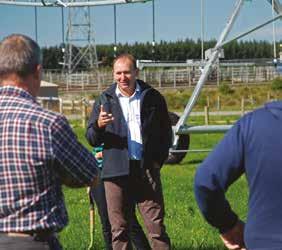
I have been joined by members of our leadership team as we talk to our teams about how we can improve our performance across the board. Whether we are discussing health and safety or helping shareholders on-farm, the main discussion point is how we deal with things together –both the staff as one team and with our shareholders as one community.
It’s been a challenging year for most sectors throughout New Zealand and Farmlands isn’t immune to these challenges. But as with any challenge it is there to be met. We’ve made changes to our business model to ensure we deliver the best services, products and price to our shareholders. On my journey around the country we are articulating this vision to our teams you see on every visit.
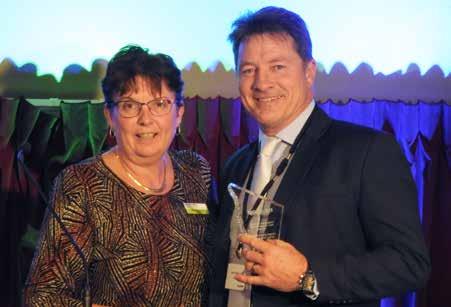
Finally, I’d like to congratulate Mark McHardy on being named Cooperative Leader of the Year at last month’s Cooperative Business New Zealand awards. Mark’s award coincides with the great feedback and interaction we’ve received from last month’s health and safety-themed issue of The Farmlander. We are not content with following anyone – and you can expect to see a lot more leading from us in the future.
www.farmlands.co.nz/ladiesnight
for
INTEREST
ON YOUR FARMLANDS CARD
4-5
28 SEPTEMBER
Whangarei
Ladies
29 SEPTEMBER
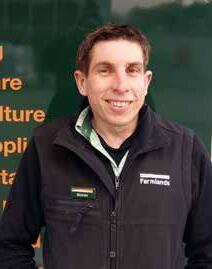
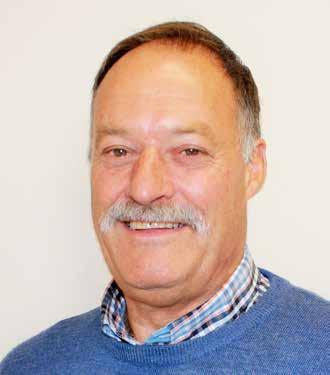
Duncan Nicolson
Q: What is your current role at Farmlands?
A: Business Manager, Farmlands Ranfurly.
Q: What do you enjoy about your job?
A: Meeting people and being able to help them through their farming decisions. Seeing the developments come together.
Q: What type of work were you doing before you started at Farmlands?
A: Hospitality for 9 years and then over to Australia driving machinery for 18 months, before completing a stint at a woolstore in Omakau.
Q: Where is your favourite New Zealand getaway?
A: Poolburn Dam – no phone reception and scarcely populated!
Q: What do you like to do most in your spare time?
A: Play cricket, manage the Matakanui rugby team, fishing and hunting.
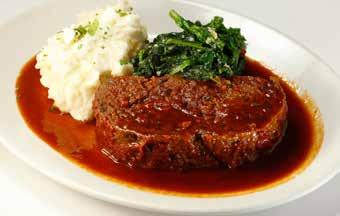
Duncan’s Meat Loaf
Tap into the huge amount of knowledge and experience at your local Farmlands store. Drop in, call 0800 200 600 or visit www.farmlands.co.nz
750g lean beef mince
1 red onion, peeled and finely chopped
1-2 tsp crushed garlic
1 Tbsp freshly chopped thyme
2 Tbsp freshly chopped parsley
Method Ingredients
1. Preheat oven to 180°C (fan bake).
1 ¼ cups fresh white breadcrumbs
2 eggs, beaten
4 Tbsp Worcestershire sauce
400g can tinned tomatoes
½ cup beef stock, wine or water
2. In a large bowl, combine beef mince, onion, garlic, thyme, parsley, breadcrumbs, eggs, 3 tablespoons Worcestershire sauce and half a can of tinned tomatoes. Season well with salt and pepper.
3. Using your hands or a wooden spoon, mix well. Shape the mixture into a loaf shape and place in a 7-8 cup capacity lasagne-style dish.
4. Combine the remaining half a can tinned tomatoes with 1 tablespoon Worcestershire sauce and beef stock, mix well and pour over the loaf. Bake for 45 minutes, or until golden brown and cooked through. Rest the meatloaf for 5 minutes before carving thick slices.
5. Serve with mashed potatoes and steamed green vegetables.
Farmlands store.
Horticultural Advisory Service available.
Check out our Facebook page to see what’s happening at Farmlands www.fb.com/farmlandsnz
Swann One Soundview HD
Farmlands Card Price $224.00. An indoor, wireless home camera that sends alerts to your smartphone. Available from Noel Leeming.
Remington Trade Professional Dehumidifier, Farmlands Card Price $799.20, Save $199.80. Ideal for rooms up to 65m2 Available from Mitre 10 or by order.
Full Boar Inverter Generator 3100W, Farmlands Card Price $1,396.35. Available from Bunnings.
Belkin Wemo Bulb Kit, Farmlands Card Price $172.95. Control your lights from your smartphone. Available from Noel Leeming.
44kW Diesel Heater
Farmlands Card Price $964.75, Save $170.25. Available from Mitre 10 or by order.
The secrets to succession Planning
for the next generation
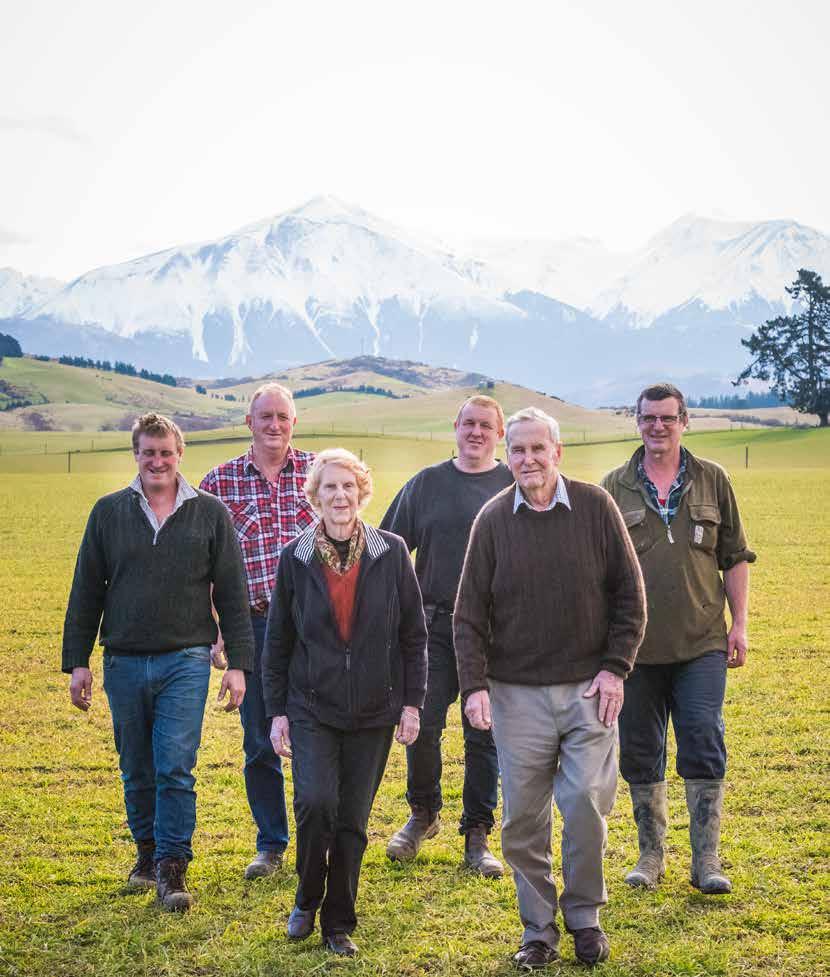
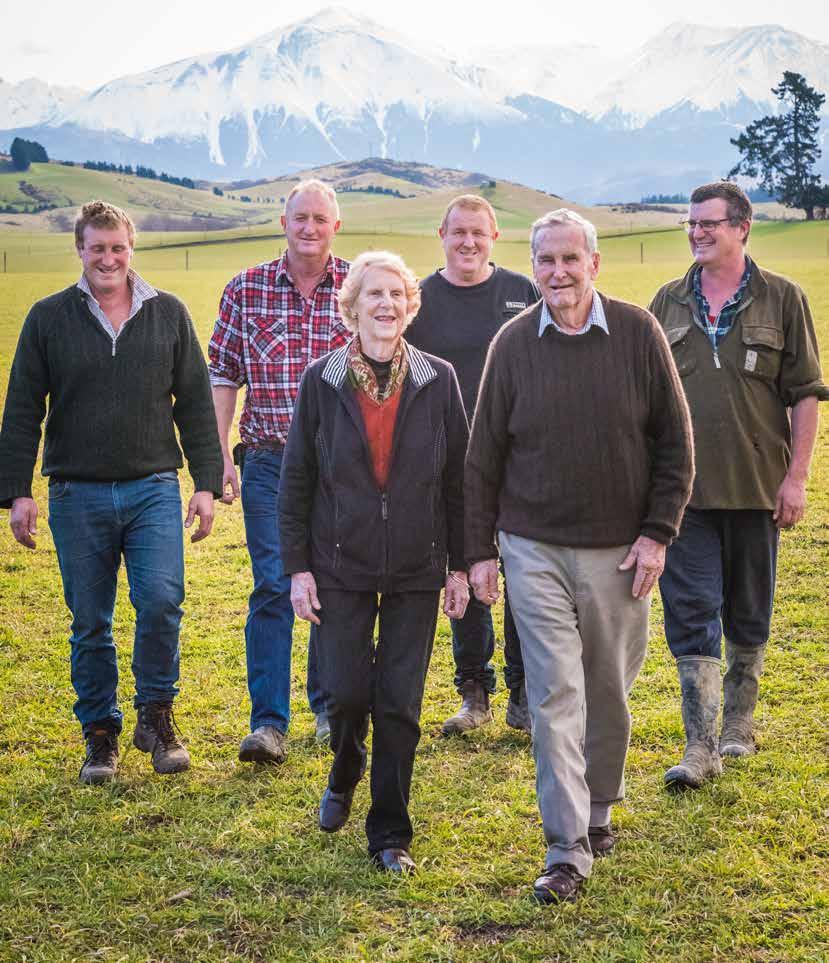
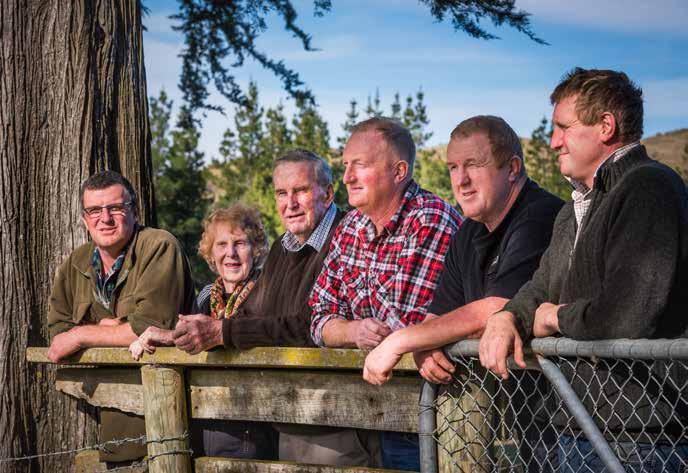
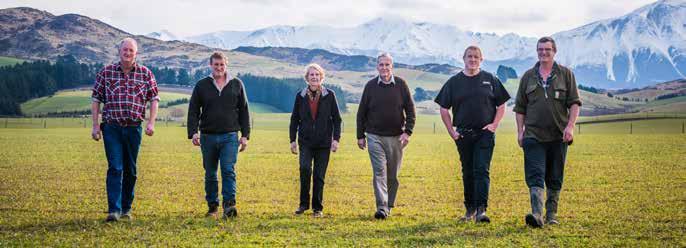
| Patricia and Bruce Stokes (front), with their four children (from left) Andrew, David, Tim and Stuart.
It’s a tricky subject for a lot of families – what happens to the family farm when the current guardians decide to step aside?
The main sticking point always seems to be the maths –multiple siblings running one property does not always ‘go’. Succession planning is a methodical process that rarely is an overnight arrangement. Years, even decades of preparation lead to the eventual handover. For Bruce Stokes, who lives at Cust in Inland Canterbury, the seeds of succession were planted by his father 67 years ago.
Stanley Stokes purchased the first 2,521 acres of his farm Sinai in 1949, for the princely sum of $4 per acre. Three years later, he added an additional 580 acres for $1 per acre. The farm, near Oxford, would be complemented by another farm in
the Lees Valley. Eventually Bruce would run Sinai and his twin brother Ian would run the Lees Valley farm, in partnership with each other.
“Between us we had the perfect balance of country – I could winter far more than I could summer and he could summer far more than he could winter,” Bruce says. “We would do drives in the 70s and 80s and we would bring more than 6,000 sheep through here, hoggets and old ewes.
“The hoggets would go back in the spring and we would bring out mobs of about 600 cattle – calves, cull cows and fat steers – the sort of clean up for that year.”
As the years went on Bruce and his wife Patricia had four sons – David, Stuart, Tim and Andrew. The interest in farming
| The Stokes family.
remained strong through his sons, so Bruce and Patricia started planning for the future.
“We started purchasing more land with the idea of succession,” Bruce says. “The oldest boy would have been 20 and I was looking at all the boys going farming, so we just kept purchasing land. But we probably got half way through before it became clear that I needed to ask myself – what did I do wrong to make four sons want to go farming?”
Bruce likes to joke about it now but at the time the expansion involved seven land purchases between 1984 and 2001. Six of those purchases totalling 2,725 acres made up a separate property – Russell Flat – while an additional 830 acres was added to Sinai.
“Because of how well Ian and I worked together, we said we were going to split (the partnership) while we were alive, so there would be no arguing,” Bruce explains. “I needed some wet, high rainfall country to replace what he had been doing for me. So that was really why we started off up at Russell Flat.”
“After I split with my brother, my sons farmed in partnership with the land that was left and we purchased more as we went along,” he says. “They did 10 years all as one big partnership and then they split the land. They accepted the advantages of having a partnership early on – getting the land to do what it does best, shifting stock, planting, getting machinery and getting everything going.”
“
Between us we had the perfect balance of country – I could winter far more than I could summer and he could summer far more than he could winter.
These days David and Stuart farm Russell Flat, while Tim and Andrew man the fort at Sinai. Bruce and Patricia live on a quarter acre section between Russell Flat and Sinai, with the roughly 25km difference between the two farms described by Bruce as “a big day’s driving for a mob of sheep”.
Bruce says the land was more or less split but in some cases the livestock and farm machinery partnerships continued for a while during the transition phase. Today both farms consist of sheep, beef, deer, hinds and velvetting stags, cropping and dairy grazing.
In regards to organising the fourth generation of Stokes family to farm the land, Bruce says he is happy to leave the next lot of succession planning to his sons. He says seeing the results of decades of planning leaves him with a good sense of accomplishment.
“I think it needs to be added that they had a Mum and an uncle that supported them,” he says.
Rather than slowing down, Bruce is quick to point out “there’s always a full time job going somewhere” for him between the two properties. Phone calls between the three properties flow thick and fast and Bruce is always on call when advice is required.
“I’m very lucky they still involve me in their decision making, almost to the point if it’s not right, it’s Dad’s fault,” he says, with a chuckle. “Stu said that when we went to a deer field day recently, he had four advisors as we did the trip around – three brothers and one Dad.”
Bruce has helped his family prepare for a future on-farm. The Stokes family is sorted – and in the heart of the Wairarapa, Phil Guscott is helping many more families achieve the same goal. When The Farmlander called around to find the right Farmlands shareholder to appear in a story about succession planning, more than one response referred to Phil as “the guru”. In his 30 years at his professional consulting business, Phil has balanced farming and consultancy – with succession planning taking up a decent chunk of his business. He says the bulk of his clients are those that are urgently trying to organise succession, which is the opposite of his own personal experience.
“I had a farm of my own that has now been passed on to my son – so I know how it (succession planning) feels,” he says. “But most people don’t really think about succession
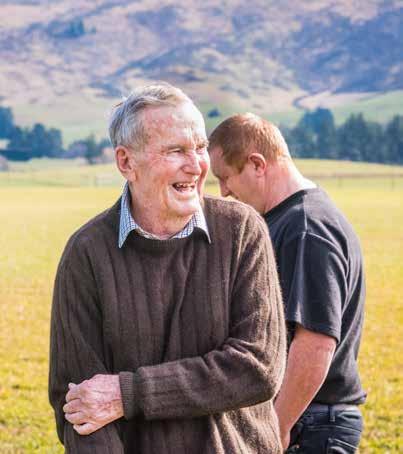
| Bruce says seeing the results of decades of planning leaves him with a good sense of accomplishment.
until they get into their 50s or 60s and that’s when they start thinking about it.
“That’s not when they should be thinking about it – it should be a lot earlier.”
Phil says the most common approach to him follows farmers reaching an “impasse” with their other advisors – accountants, lawyers and alike.
“Mostly it’s where mum and dad know something has to happen but they can’t see a way through it. It’s not always like that but that’s usually the case,” he says.
“There are four principles of what has to happen. The first is it has to be economic for the retiring people. Second, it has to be economic for the ones that take the farm on – it has to be backable.
“Third, there has to be a plan for those that are not going to go farming and lastly, the result has to be able to be lived with by all members of the family.”
Having been helping people around the Wairarapa with their succession planning for a number of years, Phil describes his own family’s transition as “not difficult”.
The sheep and beef farm, just north of Martinborough, grew to 1,600 acres by the end of Phil’s time there. He now resides on an additional 400 acres that he leases back to his son on the original farm.
“
There are four principles of what has to happen. The first is it has to be economic for the retiring people. Second, it has to be economic for the ones that take the farm on – it has to be backable.
“It is significantly easier to lease the land I’m on back because I have another job, so I can be out of his hair,” Phil says. “I started from a much lower base and only had 1/3 share of 3,000 stock units. I had to get the business to a reasonable size, to make sure it was worth the next generation putting their life into it.
“I schooled everybody up on that from the day they were born, so there were no surprises. The day you buy the farm or have your first child is when you should think about how you’re going to get out and pass it on to your children. If you don’t plan for it, it won’t happen.”
Phil says one of the first things he asks a client is whether they are looking for a succession plan or an exit plan. Phil believes some of these farms are simply not big enough to support the parents, while being viable enough for the children to succeed on.
“When we talk about the old 1,000 acre hill country farm, the backbone of the sheep and beef industry, they can be very hard to pass on,” he says. “There’s simply not enough there to support two families.”
To combat this trend, Phil urges those thinking of succession planning to start straight away. He feels if you plan where you need to be – and you put it in action decades before you need it – the chances of success are much higher.
“He who plans for nothing gets nothing,” he says. “The principles I mentioned earlier are the main ones but there’s a lot of things that go with it. Every situation is different and every person is different.”
As for letting slip all of his business tips to Farmlands shareholders for free? “If it helps one farmer make a better decision, I’m all for it.”
Phil’s top tips for succession planning
• Start the plan early.
• Bring up your children with realistic expectations.
• Keep refining the plan over the years.
• Remember that you’re a tenant of the farm for your lifetime – and that applies to the next generation as well.
| Succession ‘guru’ Phil Guscott.
Young calf regulations now in place
The implementation of seven new regulations will strengthen the rules around young calf welfare via a range of fines and infringements. Four of the seven regulations took effect at the start of August, with another three taking effect next year.
While the majority of these new regulations are similar to the minimum standards in the codes of welfare, they also introduce new penalties for non-compliance.
The new regulations include:
Prohibition on killing calves by blunt force to the head
Applying to any calf that has not been weaned off milk, or a milk replacement, a person must not kill a calf by using blunt force to the head unless:
• the calf is in severe pain or distress and, as a result, requires immediate humane destruction; and
• there is no reasonably practicable alternative to the use of blunt force available.
Fitness for transport
Applying to any young calf that is up to 14 days old and has been separated from its mother, this regulation provides a list of physical and behavioural requirements that a calf must reach before permission can be given for transportation. The responsibility for ensuring calves meet all of the requirements in the list falls to the owner or person in charge of young calves who permits the animals to be transported, along with the transporters who load the calves.
Maximum duration of transport
This regulation applies to any young calf that is up to 14 days old and has been separated from its mother.
A person in charge of a young calf must not transport the calf unless the total duration of the journey from the point of loading the calf onto the vehicle to the point of arrival at the final destination of the journey is no more than 12 hours.
Prohibition on transport by sea across Cook Strait
Applying to any young calf that is up to 14 days old and has been separated from its mother, this regulation states that a person in charge of a young calf on a vehicle must not permit the calf to be transported by sea across Cook Strait.
Three more regulations will be introduced next year. They are:
• Maximum time off feed before slaughter (no more than 24 hours after the calf was last fed on-farm) –effective 1st February 2017.
• Requirements for loading and unloading facilities –effective 1st August 2017.
• Shelter requirements before and during transportation and at points of sale or slaughter –effective on 1st August 2017.
Several of these regulations require you to have systems in place to ensure all of the rules are followed. For more information on the new legislation, visit www.mpi.govt.nz/calves
Take back your tax
For those that work on the land, fuel can be one of the larger expenses every month. Machinery and offroad vehicles are used daily to keep the business running. But some people are unaware they can get a refund on excise tax for petrol used by a business on off-road vehicles and machinery.
Businesses can claim upwards of $0.66 per litre on petrol and can claim for the previous 2 years’ worth of off-road petrol use. Calculations are done on a quarterly basis – so it is worth it to try and claim back your share!
According to the New Zealand Transport Agency website (www.nzta.govt.nz), you are entitled to a refund of the excise duty and the GST charged on “motor spirits” (which doesn’t include diesel) when used in an “exempted vehicle”. NZTA explains that “in general, agricultural vehicles, some mobile machinery and commercial
“
in general, agricultural vehicles, some mobile machinery and commercial vehicles that don’t travel on the road are exempt vehicles.
vehicles that don’t travel on the road are exempt vehicles”.
To claim back on a quarter, the delivery or purchase dates on the receipts must fall within the dates of the quarter you are claiming for. Shareholders can recoup some excise tax back via claims up to 2 years after the close of a quarter – any later and the claims will only be accepted if NZTA is satisfied that special circumstances exist.
Farmlands Card Partners can do all the work for you when it comes to claiming back on an excise tax refund. For more information, call the Farmlands Fuel team on 0800 666 626.
66¢ per litre* + GST Claim back
*On petrol used off-road in your business.
Steaking claim to country’s best
A lot of farmers endure trial and error to find the right mix for their operation. But when you work full time as well as farm, time for trial and error is in short supply.
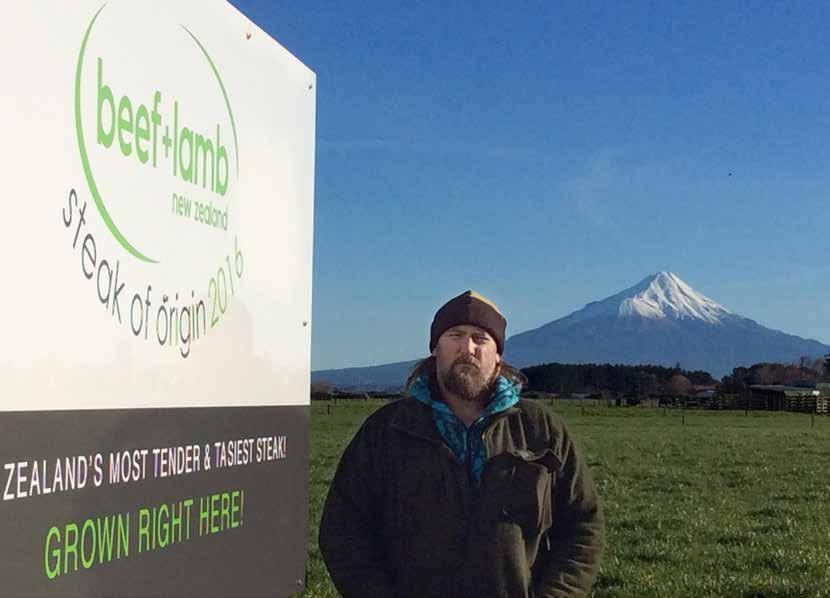
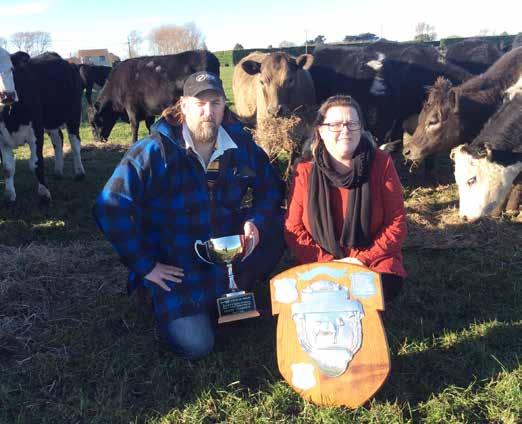
That’s why Brendon and Hayley Robinson feel so vindicated by their win in the 2016 Beef + Lamb NZ Steak of Origin contest. The Farmlands Hawera shareholders’ two entries finished first and second in the Crossbreed and Other class, with their Angus Cross going on to win the New Zealand title and trophy. As Brendon and Hayley put on the farming hats only when they get home from work, the title is a hard-earned reward following years of attempting to find the right balance.
“We originally started bringing in and rearing 4 day old calves,” Brendon explains. “As Hayley and I both work full
time, our priority is the full time jobs – so the farming we do is more of a hobby, a good thing to do on the sidelines.”
The calf rearing lasted for 12 months on the leased block, before they gave in to the inevitable – juggling their calf rearing aspirations and full time work was impossible. Dairy herd grazing brought
It was their investment, rather than us making our own decisions. I had to suck it up and I didn’t like it. “
the same results – a combination of exhaustion from the preparation involved and broken fences.
“We grew maize silage for a while but
there was no money in it for us. We were making other people rich through our labour of love,” Brendon says. “At the end of it, we wanted our farming to be enjoyable and to make it enjoyable, we’ve got to make it as easy as possible to get a return on our investment.
“We were also working for other people. We certainly got a lot of advice about everything we were doing wrong. Everybody was telling you what to do, because you had their stock on your farm. It was their investment, rather than us making our own decisions. I had to suck it up and I didn’t like it.
“But then we probably found our niche – buying in weaners from local farmers, Stratford sale yards, at times Trade Me and taking them through to being processed at our local Silver Fern Farms processing site.”
The niche has produced both results and rewards. Their last line of autumnborn White-face steers were taken July to July, bought at 100kg and sold at 410kg. The liveweight gain has been a consistent success – Brendon says even when he and Hayley were doing dairy heifer grazing, they were producing staggering results but the farmer was getting the benefits.
A turning point for these gains came from sowing a grass and plantain mix recommended by their Farmlands Technical Field Officer, Ian Robinson. Although they are not related Brendon refers to him as “Cousin Ian”, having worked together for close to 10 years. Ian agrees that Brendon’s struggles early on came from a combination of advice, trial and error.
“He took over the block from his mother 2 years after his father’s death and I don’t think he had a lot of farming experience himself, he just had a lot of people telling him a lot of different things,” Ian says. “But he’s found out the things that worked for him by himself.
“They started subdividing and getting water to the paddocks. They’ve got better at managing grass and fertilisers and pasture species, so they’re growing that much faster. Getting the younger stock to grow faster is where you’ll get that top quality mix and because the farm is on a smaller scale, they can tend to look after the animals better.”
Ian chose the new mix because as a dry stock farm, Brendon and Hayley were able to look after their paddocks a bit better than the average dairy farm in the region. The mix also contained cocksfoot and red clover and Ian is delighted to see the results.
“I asked Brendon what he wanted and he said to grow cattle as well as possible. A lot of people like more than just grass and clover, from an animal
health point of view. It can be real rocket fuel to get the animals growing,” Ian says. “It’s always great to see when our shareholders back themselves to enter competitions like this and win.”
“
Getting the younger stock to grow faster is where you’ll get that top quality mix and because the farm is on a smaller scale, they can tend to look after the animals better.
Ian’s advice for any shareholder looking at pasture renewal is to prepare yourself to spend time ensuring it is managed
effectively during establishment, as well as managing the threat of weeds.
“I think you would want to put in a good mix of seasonal growth and also species that can handle the climate, especially as the climate seems to be getting more variable,” he says.
“You need something that can handle the dry but also grow right through.
“Then you can get results like Brendon and Hayley, which is one of the more satisfying parts of the job.”
Brendon agrees. With the help of pasture selection, years of perseverance have produced more than just liveweight gain.
“Now we’ve got the most tender and tastiest steak in New Zealand, so we’re doing something right and we’re doing it well.”
|
Brendon and Hayley Robinson with their silverware and supporters.
5 minutes with … Richard and Dianne Kidd
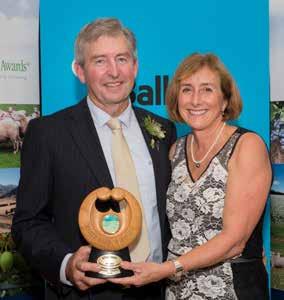
You are the Supreme Winners of the Ballance Farm Environment Awards –what does the award mean to you? It was a tremendous thrill for us to win this very prestigious award and the Gordon Stephenson Trophy. We feel it is recognition and endorsement of over 35 years’ farming that has successfully blended efficient and profitable farming with our love of the environment. We are excited that Auckland farms were eligible to enter the Awards this year (for the first time) and that Auckland is now on the radar as a relevant and significant New Zealand farming region. As ambassadors for the Ballance Farm Environment Awards, we look forward to the opportunities of telling our story of Whenuanui Farm both within New Zealand and abroad in the coming year and assisting and encouraging other farmers to work towards and enjoy the rewards of sustainable farming, in and for New Zealand.
Tell us a bit about your farm. Whenuanui Farm is a 376ha (331ha effective) flat to easy rolling sheep and beef farm on the outskirts of Auckland. It includes a mature pine woodlot of 18ha and has 15.3ha of fenced off regenerating native bush and wetlands. Carrying 4,820 stock units, the farm has 300 Angus breeding cows and 1,600 ewes. Cows are wintered off the farm in the adjoining Woodhill forest with leased grazing of pine forested land. Whenuanui is a family farm and enjoyed by our three sons David, Hamish and Geoffrey, who were born and raised here. With natural water springs sourced on the farm, all waterways have been fenced and water is reticulated to troughs in every paddock.
What processes and practices do you have in place that contributed to this award?
We are fortunate to have an excellent farm manager, Jeffrey Bradly (also a Farmlands shareholder) who has been here for 17 years and shares our vision of a high producing, environmentally sustainable farm. Livestock are managed to enhance animal health and production through high genetic performance with minimal drenching. We use summer crops, have an active programme of pasture rejuvenation and apply fertiliser based on soil testing results and advice. We were pleased that our Coopworth ewes showed a strong resistance to facial eczema (reflecting many years of breeding for such resistance) in a summer, which proved to be challenging for many farmers.
This isn’t the first award your family has picked up over the past few years …
Yes, the Kidd family has certainly enjoyed some very special wins in recent times. Our eldest son David won the 2014 NZ Young Farmer Competition, successfully breaking a drought for Northland, which had never managed a national winner before –even though Richard had given it a nudge himself in 1984 with a 3rd in the national final! So fair to say that we have enjoyed the opportunities of participating in such awards. But as we all know, you get to meet some fantastic people and learn a lot from these experiences that you can take back to your farm. Dianne was also acknowledged in this year’s Queen’s Birthday Honours for her services to
health administration over the last 27 years.
What’s the plan for your farm for the coming 12 months? How do you improve an award-winning farm?
A farmer never rests. There is always more to do. We have an active pest and weed management programme to protect our native flora and fauna. This summer and autumn a new gully has been fenced off. A voucher we won at the National Awards has been used to purchase several hundred trees, which are now planted and we look forward to seeing them grow along with the regeneration from existing natives that will quickly follow. On the productivity front, the focus is on lifting the weights of our weaner calves and building the success and recognition of the Kaipara Lamb brand with Countdown and our other farmer suppliers in the South Kaipara.
| Supreme Winners of the Ballance Farm Environment Awards.
Tony’s Top tips for growing great gardens
Join Farmlands and our host, Tony Murrell for a great evening focused on all things gardening.
Happiest outside enjoying the seasons and sharing stories and advice with like-minded garden enthusiasts, Tony is a household name in New Zealand, synonymous with all things growing. Upon his return from 7 years overseas designing and building gardens for the rich and famous, Tony hit our TV screens in shows such as Ground Force and Mucking In. He currently hosts the hugely popular radio show, The Home and Garden Show, on Radio Live and lends his advice as the resident gardening expert on TV One’s Kiwi Living
Don’t miss this chance to catch up with old friends, learn some top tips and grab some great gardening deals. Ticket prices are incredible value, so don’t delay – make sure you book yours early, as they’re sure to sell out!
$25
LIMIT OF 4 PER SHAREHOLDER
Ticket includes a drink on arrival and light supper.
Dates
Whangarei
Wednesday 28th September, Toll Stadium
Hamilton
Thursday 29 th September, Claudelands Arena
Gisborne
Wednesday 5th October, Quality Hotel Emerald
Hastings
Thursday 6th October, Hawke’s Bay Racing Centre
Palmerston North
Wednesday 12 th October, Awapuni Race Course
Hawera
Thursday 13th October, TSB Hub Start
Focus and motivation
Management is nothing more than motivating other people.
Talk to any good calf rearer and watch their expressions as they talk about their bouncy, bright eyed calves with passion and pride. Spring time can bring out the best or worst in people, as you come out of the busy, cold winter/ spring calving.
If you’re still collecting calves in your sheds then be vigilant with your barn’s bedding health and remember that ‘ammonia = pneumonia’ as well –there will be high bug burdens in your barn. Best practice for us is to get the calves aged anywhere from 16-21 days outside. Make sure you have a few days of sunshine ahead and with access to good shelter. A shivering calf uses much more energy – then the energy that’s needed for growing and reaching targets has been compromised.
Quality is pride of workmanship, just as much planning that has happened in the calf barn needs to be followed through to the paddock and then into preparation for transitioning your calf off milk.
For my team, we have already marked and grouped the fast or slow drinkers while still in the sheds. They have now been prepared for their first major transition of moving to the big, wide world outside.
For some people your programme may be once a day from quite early on, otherwise it’s a good chance to move the calves onto ‘once a day’ before they head outside.
This helps to identify any calves that aren’t coping with their new feeding plan, as well as having them wanting to eat more of their meal, which in turn has them well established with meal intake before heading to grass.
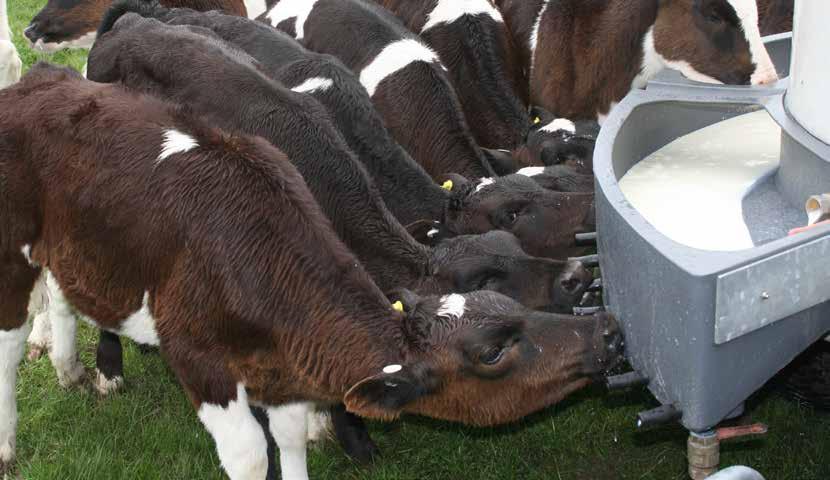
Each transition is costly in time, health/wellbeing and checks to growth. Taking time and pride in your workmanship during this phase is of utmost importance. Things change quickly while a calf is transitioning, as long as you have prepared and separated the fast/slow drinkers, moving to the trailer feeders should go smoothly. Taking a proactive eye off
the calves at this stage could result in poor performance to both the calves and your overall management. Take time when feeding milk to observe each calf critically, checking for missed navel infections, being vigilant and contemplating their progress. For myself, I find this time to be one of the most important times to the success of the individual calf’s future. I would not recommend to drop the feeder and run – missing a calf that is slow at feeding or disinterested to drink is your first warning of something possibly more sinister. Missing key warnings means you, being a proactive planner, will soon be needing to be reactive and this comes at a cost – poor performing calves and management oversight. There is nothing more special than returning later in the spring day to observe your healthy, happy future herd galloping around or lying about sunbathing. That has you knowing that you and your team can take pride in the quality of these outstanding calves.
Article supplied by Karen Fraser, Young Stock Manager.
A great fibre option
Fibre is of key importance in the equine diet. Adequate fibre intake ensures maintenance of a healthy digestive system and also reduces the risk of colic and gastric ulcers, as well as behavioural issues associated with a lack of fibre.
As a rule of thumb, the bare minimum fibre requirement for horse health is 1 percent of their body weight in hay/chaff or pasture daily (in dry matter), however a minimum of 1.5 percent is more ideal. When horses are living out on adequate pasture we can happily assume they are receiving this required intake, however when they are boxed or yarded, more attention needs to be paid to ensure this is provided through their supplementary feed. During winter, supplementary fibre is often required, as pasture is often lost to wet conditions under foot and subsequent pasture growth is slow. In addition, there is often a shortfall in fibre intake when horses are travelling and away competing, with more time spent in yards and stables than usual. Hay is a great substitute for pasture and at almost 100 percent dry matter it can easily assist in meeting fibre requirements. Further fibre can be added to the ration
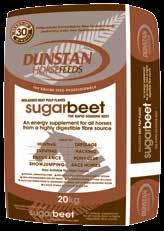
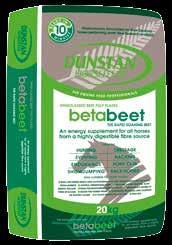
by incorporating a Dunstan Beet –Dunstan Betabeet Flakes or Dunstan Sugarbeet Flakes. Dunstan Beets are a premium fibre source and are known as ‘super fibres’, as they have a much higher calorie content than traditional fibre sources, with an energy level close to oats. Not only do beets add additional fibre to the ration to assist with maintaining digestive health, aiding to reduce the incidence of colic and gastric ulcers but also more calories than most other fibre sources for weight gain. Dunstan Beets are also naturally high in calcium, making them ideal in the inclusion of high grain diets to balance the calcium : phosphorus ratio. Providing soaked Dunstan Betabeet Flakes or Dunstan Sugarbeet Flakes also assists in increasing water intake, beneficial when horses may not be drinking well and water consumption may be compromised.
Dunstan Beets have many applications in equine diets and with two beet options, horse owners can choose the beet product that best suits the requirements of their individual equine. The slow release of energy provided by Dunstan Beets makes them a suitable option for horses with behavioural issues associated with high grain diets – a portion of the grain can be substituted with this calorie dense fibre source.
For horse owners that wish to avoid any additional molasses in the ration and are looking for a super ‘cool’ calorie source, Dunstan Betabeet Flakes provide non-molassed, non-heating,
rapid soaking beet flakes, ready in just 10 minutes. Dunstan Betabeet Flakes are also ideal for inclusion in rations of horses susceptible to laminitis or tying-up. Alternatively for the very fussy eater, or those requiring more calories per kg from their beet, Dunstan Sugarbeet Flakes provide the ideal solution. With the added molasses in Dunstan Sugarbeet Flakes, this product is highly palatable and with an increased calorie contribution, is more fattening. Dunstan Sugarbeet Flakes are ready in just 30 minutes.
Dunstan Beets are quality beet pulp products sourced from GM-free crops. Being pure beet pulp with no added vitamins and minerals means they can be added to your existing ration without concerns of doubling up on vitamins and minerals, simply providing a quality, calorie dense fibre source for improved body condition and performance.
For further information, contact your Farmlands Technical Field Officer or the friendly team at your local Farmlands store.
Article supplied by Dunstan Nutrition Limited.
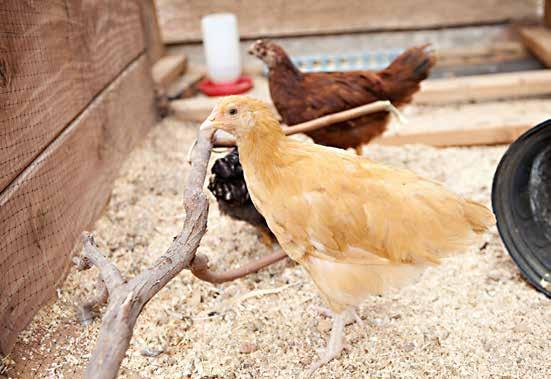
Rearing layer pullets for optimum egg production
If you do the basics well, raising modern layer pullets can be relatively simple and if you get it right, the mature laying hen will reward you handsomely in terms of egg production.
There are three golden rules to getting pullet rearing right. Firstly, ensure that the correct feed and clean water is supplied with sufficient feeder and drinker space for the birds. The modern pullet should not be restricted with feed or water during rearing. Secondly, appropriate shelter and housing is essential in helping to maintain a suitable environment for the birds during rearing. Thirdly, management of the birds is essential in rearing a successful commercial layer.
The age at which laying pullets reach maturity has been decreasing by about 1 day per year, with first eggs typically produced at between 18 and 19 weeks of age. The genetic improvement of the commercial layer has produced a bird that is about 150g lower in body weight at 18 weeks compared to 20 years ago and it is far more prolific at laying eggs. The key to successful rearing of the modern pullet is through maximising body weight for age without producing over-fat pullets. Pullets that are on target or slightly above target weight at 18 weeks of age and are uniform in weight are likely to be the best producing birds during the laying period.
Selecting the correct feed is the easy part and NRM Chick Starter Crumbles are specially formulated for birds from day-old to 6 or 8 weeks of age. If at this stage birds have met target weight for
age, they should be switched to the NRM Pullet Grower Pellets until point of lay. Do not feed a layer type feed during rearing – it’s too high in calcium and could result in permanent damage or even death. Supplementing the pullet feed with kitchen greens is acceptable, providing the pullets have free access to the NRM feed. Pullets are remarkably good at selecting the correct feed balance when provided the opportunity to do so. A good source of clean water should always be available.
Housing for the pullets should be dry, free from draughts and light tight if possible. The day-old pullet needs to be kept above 33°C from day-old to 3 days of age, followed by a gradual decline in temperature to 21°C by 35 days of age. Allow a minimum floor space of 850cm² and a minimum of
5cm of feeder space per bird. One nipple (or cup) drinker is required per 15 birds, or one fountain drinker (46cm diameter) per 125 birds.
Finally, lighting management during rearing is worth consideration and layers that are coming into lay during an increasing day-length will lay far better than those that are not light stimulated. The ideal programme is to rear from 0 to between 7 and 12 weeks on a decreasing day length, followed by a period of constant day-length up to the time of light stimulation into lay. If the housing is not light tight, the constant period needs to be set at the longest natural day-length the bird will have. More information on appropriate lighting programmes for laying hens is available from the different breeding companies.
Article supplied by NRM.
Avoiding major issues
Once the fear of metabolic problems around calving has passed, it can be easy to forget the importance of the big four major minerals –magnesium, calcium, sodium and phosphorus on animal health, performance and fertility.
Ration programmes are seemingly able to quantify to the gram the supplementary magnesium requirement of any cow at any particular stage of lactation or production level. It is important to remember however, that computer programs are only as good as the information put into them – the magnesium level in pasture can be variable and the availability of the magnesium they contain can vary –especially if potassium levels are high. Forage magnesium levels can change depending on the pasture species, soil type and even climate, with low daily radiation reducing levels and is higher in stems than leaves. Magnesium absorption by ruminants is increased by ionophores and readily degradable carbohydrates. Magnesium increases rumen pH, so delivering magnesium in a compound feed containing grains rich in carbohydrates is a win-win combination. Milking cows that are lacking magnesium may have a depressed appetite and be dull and lethargic but at the same time nervous
and irritable during milking. Excess magnesium intake can increase the need for phosphorus and calcium and can cause diarrhoea and weight loss, which may be difficult to distinguish when cows are on high quality pasture. It is worth checking the percentage of elemental magnesium in the supplements you are using and using multiple routes during riskier periods, rather than just relying on dusting the paddocks or trough treatment.
Milking cows typically require a diet containing about 6-8g calcium/kgDM, which is normally met by pasture, especially clover rich pasture but not supplements like grains, whole crop silages (cereals and maize) and palm kernel. Calcium is a relatively safe nutrient not associated with specific toxicity – higher yielding older cows may deplete their own calcium reserves in early lactation, so adding lime flour to supplements can be a relatively low cost insurance even outside of the colostrum mob.
Cattle have virtually no stores of sodium, which in addition to helping control osmotic balance, enables more efficient utilisation of digestion of sugars and amino acids. High producing cows and those with mastitis or high somatic cell counts will lose more sodium in the milk than they can
conserve by recycling or reducing losses elsewhere. Most supplementary feeds including palm kernel expeller, lucerne, red clover, maize silage and cereals are a poor source of sodium and fast growing, well fertilised grass tends to be low in sodium compared to clover rich swards. Sodium chloride or salt is the main source of supplementary sodium in the diet – salt is very palatable and animals will seek it out if they are deficient.
Phosphorus is involved in almost all metabolic reactions and is required by rumen microorganisms for cellulose digestion and microbial protein synthesis. A deficiency is associated with poor fertility and poor feed conversion. Wintering on fodder beet increases the risk that cows will have calved down with their phosphorus levels depleted and thin cows in particular may benefit from extra phosphorus in early lactation. The analysis of bone samples from fallen or culled stock can help to confirm the phosphorus status of a herd. Continuing supplementation through mating may be worthwhile, especially if herbage tests indicate lower phosphorus levels than might be expected.
Article supplied by Dr. Rob Derrick, Nutritionist, Farmlands Nutrition.
Water in the ruminant diet
Adequate water intake is needed to sustain vital bodily functions for all living organisms. Although water itself does not contain any nutrients such as energy or protein, water does have essential functions in the body, acting as a solvent in which nutrients are dissolved and carried around the body. It is also used for temperature regulation, to excrete waste products and is important for brain functionality.
Animals obtain water through three different ways – firstly physically drinking water, secondly through water present in food and lastly metabolic water, which is water that is created from biochemical reactions taking place in the body. The amount of water required for animals to consume is dependent on temperature, humidity, health status and level of milk production. The more water that is lost through perspiration, panting, scouring or milk production then the more water will be required to be consumed. For ruminant animals, water is also essential for rumen function, as rumen microorganisms need water to survive. An adult cow needs to physically consume around 60 litres of water per day on top of any water present in food/ metabolic water – and even more than this if lactating (up to 150 litres per day for very high producing cows). Milk is a product that contains a high amount of water (about 87 percent), so it’s easy to see why a cow producing more milk will be required to consume more water in order to support milk production. Young animals consuming milk, such as calves, also require adequate access to water in pens, as water intake is important for stimulating hard feed intake and rumen development.
Water can also be a carrier of minerals, either added through a dosing system or found naturally as a result of the water source. It is important to take this into consideration, as this may affect water intake. For example, water high in a particular mineral may bind-up other minerals making them less available to the animal. Highly saline water (salty) can reduce water intake, as can levels of bitter minerals, e.g. magnesium. So when water is used as a carrier of minerals, care must be taken to not make the water unpalatable. Water intake is highly linked to water quality, so water must be kept as fresh and clean as possible to encourage intake. Bacterial growth in water may increase during warmer weather. A good rough rule of thumb is that if you wouldn’t want to drink the water yourself, neither will your stock. Water samples can be sent to a laboratory for testing if there is any concern about water quality –annual testing can sometimes highlight unexpected contamination.
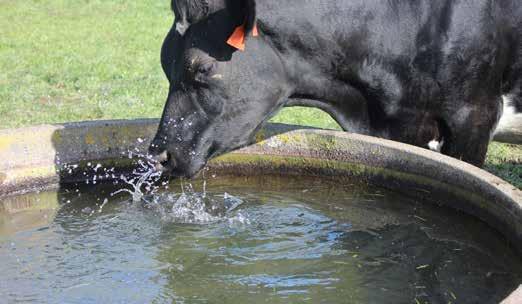
Water availability is also very important and all animals must have adequate access to troughs. Cows prefer to drink from a large water surface at a low level and like to be able to stand quietly and safely while drinking. This requires adequate trough numbers and trough space. If trough space is not adequate, the more dominant animals may prevent others from consuming water. Cows are able to drink fast, up to 20 litres in 1 minute, so water troughs must have adequate flow rates to match cow drinking rates. Cows will drink the most just after milking, so they must have access to water at this time.
Water is vital to survival, growth and production of animals. Without it, feed intake and production is reduced. It is important that animals have an unlimited source of clean, fresh water available at all times.
Article supplied by Stacey Cosnett, Assistant Nutritionist, Farmlands Nutrition.
Problems with horses grazing spring pasture
For horse owners, there is often nothing more satisfying than seeing the mud in the paddocks turn green with fresh pasture after a cold and wet winter. In New Zealand pasture growth can happen rapidly after only a few days of sun, following what seems like endless weeks of cold and wet weather.
Though forage in the form of pasture, hay and other fibre sources should always be the largest part of the horse’s diet – and pasture is what horses evolved to eat – cool-season grass contains a form of sugar called fructans, which can lead to problems for grazing horses. Consumption of fructans can cause various digestive and behavioural problems, as well as a painful and debilitating condition of the hooves called laminitis. Where most sugars and starches are easily digested in the horse’s small intestine, the strong bonds in fructans mean that they pass undigested into the cecum and colon, causing shifts in the microbial population, upsetting hindgut pH and producing endotoxins that can cause laminitis. For particularly sensitive horses, even a small amount of fructan-rich grass can quickly trigger laminitis, which can be highly debilitating if left untreated. Heavier types such as quarter horses and many pony breeds seem to be more susceptible than other horses to fructan-caused problems, however it is important to understand that all horses with unrestricted access to lush pasture can be at risk, even after years of grazing freely without consequences.
To avoid problems when turning horses out on spring pastures, introduce pasture access in small segments several times a day and gradually increase the number and length of these access periods.
Continue to offer hay to horses turned out on fresh pasture to ensure they are consuming enough fibre and monitor manure consistency and hoof temperature. Take the horse off pasture and call the veterinarian if the horse shows signs of hoof discomfort like reluctance to move, shifting from one foot to another, or assuming a leaning-back posture. When horses are restricted from pasture, it is essential that they are provided with additional hay and alternative forage sources to ensure optimum digestive health. Super fibres such as beet pulp and soy hulls are ideal for this situation. McMillan Grain Free is a blend of beet pulp and soy hulls, which also contains balanced levels of vitamins and minerals and is a great way of ensuring fibre and nutrient requirements are met. The low starch, high fibre formulation is ideal for horses and ponies at risk of laminitis. Laminitis is a serious and potentially life-ending ailment and management through preventing the disease will always be more beneficial than treating the condition. Managing horses to limit access to spring grass may be inconvenient at times but it’s in the best interests of equines and their owners.
For further information on spring grass and the prevention and management of laminitis in your horse, consult with an experienced equine nutrition advisor.
A global leader in the manufacture of marine-plant extracts is partnering with Farmlands to offer plant health products for New Zealand crop applications.
Acadian Seaplants Limited is a diversified, technology‐based manufacturer that delivers premium products to global agricultural, animal feed, health and beauty and food service industries. With more than 30 years of experience in the agricultural industry, Acadian Seaplants is a fully integrated company – from the sustainable harvest of Ascophyllum nodosum seaweed, to product and application development, manufacturing and technical customer support.
Acadian’s products are sold around the world as specialty fertilisers and biostimulants for continuous crop improvement. For crops, Acadian products have met with success in improving plant, fruit and vegetable quality in a number of economically important crops. Acadian has gained experience in crops as diverse as grapes, avocados, tomatoes, strawberries and turf and ornamentals by pin-pointing the benefits associated with specific rates, timings and application types (foliar and soil). From a research standpoint, in addition to its own complement of scientists including 12 PhDs, Acadian has chosen to work with the best research scientists around the world in order to identify specific
crop challenges to improve overall yield, quality or post-harvest life. These research findings are most often published in peer-reviewed science journals and immediately made available to growers. Some of the more exciting recent advances include a better understanding of how Acadian products elicit hormonal responses in the plant and stimulate rooting support for early plant establishment. Published evidence also show beneficial effects for soil health by encouraging soil microbes such as beneficial bacteria and mycorrhizae. These organisms help plants by mineralising nutrients to make them more available to the plant as well as producing various compounds to further stimulate plant roots.
Given the importance of soil health and nutrient availability, the application of Acadian products into soils via drip and root drench treatments can provide a jumpstart for your crops. If we combine these with well-known benefits of rachis stretch in grapes, a stimulation of antioxidant activity in a number of crops and improved chlorophyll content and photosynthesis, Ascophyllum nodosum extracts can provide benefits in many integrated programmes, be they sustainable, organic or conventional.
To dig even deeper, some of the ground-breaking information coming from Acadian science is the identification of how its products
up-regulate and down-regulate the plant’s own genetic mechanisms, to allow them to produce a number of stimulatory and protective compounds.
environmental (abiotic) and some biotic stresses. Evidence suggests the treated
drought, salinity and high temperatures.
allowing them to sustain growth and production under these biotic or abiotic challenges.
For further information, contact your Farmlands Technical Advisor or the friendly team at your local Farmlands store.
Article supplied Dr. Jeff Norrie, Agricultural Research Scientist.
Soluble Seaweed Powder
Beating porina in Southland
Northern Southland dairy farmer
Calum Andrews has been sharemilking on Moorabool Farm, located just out of Dipton, since 2013, milking 640 cows on the 292ha property. The older pastures have been one of the biggest challenges for him, with the farm being converted 12-13 years ago. Faced with dry summers and porina issues, Calum has found a solution that has been improving his farming system for the past 4 years.
The year prior to moving onto this farm, some of the re-grassing was put into perennial ryegrass ONE50 with AR37 endophyte. Calum now describes those paddocks as “absolute stand outs.”
ONE50 AR37 is a late heading diploid perennial ryegrass (+20 days relative to Nui). Growth rates peak in late spring and continue to solidly perform throughout the summer and autumn. With November being the biggest feed pinch of the year, ONE50 has been able to close that gap significantly. Since 2013, more than half of Moorabool Farm has been re-grassed, with 30-40ha/year going into ONE50 AR37. The farm will produce on average 10t ha/year of pasture, as it can get really dry in the summer. Calum has been very impressed with the superior growth of ONE50 and how well it hangs on in terms of growth and quality over these crucial months. “ONE50 does really well in the dry, it has great persistence,” he says.
ONE50 AR37 is one of the highest performing cultivars available and is extensively trialled throughout New Zealand. The DairyNZ forage value index (FVI) is a great tool for dairy farmers when selecting what pasture is
right for their system. The FVI compares cultivars based on performance regionally, giving them an economic value. ONE50 AR37 has been rated in the top five star category across all regions in New Zealand.
Having trialled a couple of paddocks with ONE50 AR1, Calum noticed performance was slightly back on the AR37. This prompted the discovery of porina in the paddocks, so now only AR37 varieties are used. Porina is one of the worst insect pests in Southland, causing significant pasture damage throughout the region, most noticeably from April through to spring. One or two porina per spade can eat the equivalent dry matter of one stock unit. AR37 novel endophyte is the best commercial endophyte available to protect ryegrass plants from porina.
On Moorabool Farm, 10ha of summer turnips are also sowed each year. This
helps with management of the pastures, especially during the dry. Aiming for 1,750kgDM/ha grazing residual rather than the average 1,550, the rounds never get below 30 days. On average the rounds are 5-10 days quicker on the ONE50 paddocks due to their performance all season – “we milk far better off the ONE50 paddocks, always seeing the response in the vat”. Calum pre-graze mows (first round up until seed head) and post-graze mows where required to maintain quality. “I don’t have to mow the ONE50 paddocks as much, as the cows clean it up really well.”
For further information, contact your Farmlands Technical Field Officer or the friendly team at your local Farmlands store.
Article supplied by Agricom.
| Calum Andrews (left), with Jim Beer from Farmlands.
Powerful, convenient weed control in fodder beet crops
Fodder beet is a slow growing crop and is very susceptible to weed competition during its establishment phase. Fast growing weeds can quickly out-compete and smother beet seedlings, which can dramatically reduce yields. To maximise yields in fodder beet, a robust weed control programme is required.
An effective programme approach should be used for weed control in beet crops. Good seed bed preparation is important for minimising soil clods. Immediately after planting a preemergence herbicide (e.g. Nortron®) should be applied along with a knockdown (e.g. glyphosate) herbicide, if required to remove any weed seedlings. Nortron should be used at 2L/ha and can be tank mixed with other pre-emergent herbicides to broaden the spectrum of weeds controlled.
Betanal quattro is a flexible and easy to use “four-in-one” post-emergence herbicide for beet crops. It is the only
product that contains the four most commonly used active ingredients in one complete formulation. This not only makes Betanal quattro easy to use but reduces the chances of mixing and tank filling errors and leaves fewer containers to dispose of. The formulation technology and rates of the combination of the active ingredients are optimised in Betanal quattro to provide maximum herbicidal activity, while being safe to the crop. The combination of active ingredients provides contact, knockdown and residual activity.
Timing of Betanal quattro applications is critical, especially in relation to crop growth stage and weed size. Betanal quattro has flexible timings and use rates to suit most weed challenge scenarios in beet crops. If weeds emerge with the beet crop, Betanal quattro can be used (at 2L/ha) once the beet crop has two fully expanded cotyledon leaves. At this timing, the 2L/ha rate will effectively control seedling cotyledon stage weeds and
be safe to the crop. Once the beet crop has reached the fully expanded two true leaf stage onwards, the Betanal quattro rate can be increased to 3-5L/ha depending on the situation. Use the higher rate on larger weeds or more difficult to control species. Two applications timed 10-14 days apart are often required and will provide excellent control in most circumstances.
To get the best results from using Betanal quattro:
• Target small weeds – more easily controlled at lower rates
• Ensure weeds are actively growing
• Use the appropriate rate for the beet growth stage and the weed size
• Use a water rate to ensure good coverage of target weeds
• Do not use Betanal quattro on stressed or damaged crops (e.g. drought conditions, frost etc.)
Betanal quattro is available in 5L and 15L packs.
For further information, contact your Farmlands Technical Field Officer or the friendly team at your local Farmlands store.
Article supplied by Bayer. ®Registered trademarks of the Bayer Group.
| Untreated.
| Treated 2x Betanal quattro at 3L/ha.
An evolution in plant growth regulator
Moddus was introduced by Syngenta in New Zealand 16 years ago. It revolutionised ryegrass seed production in New Zealand by increasing seed yields by more than 50 percent.
Now Syngenta has developed Moddus Evo, a new and improved dispersible concentrate (DC) formulation of Moddus containing 250g/litre of trinexapacethyl, with an enhanced built-in adjuvant system. Moddus Evo offers environmental and agronomic benefits compared to the current Moddus EC formulation and it will soon replace the EC formulation in New Zealand.
Syngenta chemists have replaced the solvents in Moddus EC with a new
adjuvant system designed to improve the coverage and uptake of trinexapacethyl into the leaf. The images below show the improvement in coverage from a single droplet of Moddus Evo applied to a wheat leaf compared to Moddus EC.
Moddus Evo also has better leaf retention once dried on the leaf. This can reduce the effect of wash-off from rainfall (or irrigation) after application, thereby reducing the risk of disappointing results in difficult weather conditions.
Maintaining formulation quality is important in freeze thaw situations, which are common in parts of New Zealand where Moddus Evo will be used. Syngenta tests have shown some formulations of trinexapac-ethyl can start to crystalise in cold temperatures, while Moddus Evo is not adversely affected at temperatures of minus 5 degrees.
Moddus Evo mixes easily in water (including cold water) and generates less foam in the spray tank compared to some trinexapac-ethyl formulations, which makes it easier to apply. When it comes to performance, the yield response from Moddus Evo is at least as good as Moddus EC, with a trend of better lodging control in cereals at the 400ml/ha use rate. In ryegrass
seed crops, the timing and use rate of trinexapac-ethyl has a significant impact on ryegrass seed yields, as highlighted by trials generated by Syngenta and FAR over many seasons. The use rates of Moddus Evo in ryegrass and cereals are the same for Moddus EC, with both formulations containing 250g/L of trinexapac-ethyl.
Moddus Evo has shown no issues with crop safety, although minor leaf scorch can sometimes occur in ryegrass seed crops when applied in mixture with prothioconazole. However, this has shown not to have a negative impact on yield.
In addition to reducing the risk of lodging in ryegrass and cereal crops, Moddus Evo can also enhance the root system of plants, which can improve nutrient and water uptake to improve yields, even in the absence of lodging.
Moddus Evo will be available in 20L packs this season, while next season it will be available in both 5L and 20L packs when it replaces the current Moddus EC formulation on the market.
For further information, contact your Farmlands Technical Field Officer or the friendly team at your local Farmlands store.
Article supplied by Syngenta.
| Droplet of Moddus Evo | shows improved coverage.
| Droplet of Moddus EC | on wheat leaf.
Ryegrass raises the bar in Central Otago
A robust perennial ryegrass developed for sheep and beef is exceeding expectations in terms of both grazing and baleage on a difficult dryland site in Central Otago.
Spennymoor has been in the Naylor family since 1910 and today totals 970 hectares of rolling to hill country, with light terraces and heavy valley floor flats near Matakanui, at the base of the Dunstan Mountains, north of Alexandra.
Ross, Honey and George Naylor farm the property, this year wintering approximately 11,000 stock units, including two commercial ewe flocks totalling 4,700 head plus replacements and a 50 cow beef herd.
Centre pivot irrigation developed 3 years ago has significantly lifted farm carrying capacity and productivity and allowed the Naylors to grow out and finish much more stock, particularly lambs (prior to the pivots, the farm carried approximately 8,500 stock units and yields from dryland feed crops were unreliable).
However, the harsh Central Otago climate remains a limiting factor on their dryland areas, with average annual rainfall less than 500mm. It is in this context that they introduced Rohan SPR (spreading perennial ryegrass) to their system 2 years ago.
Spring sown ex ryecorn in 2014 and well fertilised, it has since produced excellent yields of baleage as well as plenty of grazing for both sheep and beef cattle.
George says the 15 hectare paddock chosen for Rohan is at the base of a hill block and can get very dry, as it did in
last season’s Central Otago drought. Nonetheless, 2 years after sowing it is performing better than they expected and its spreading habit – which helps Rohan cover the ground and persist in tough conditions – is clearly evident.
Farmlands Technical Field Officer Scot Pollard says he recommended Rohan for this situation because of its ability to handle dry conditions better than other perennial ryegrass cultivars, withstand hard grazing and be cut for baleage.
Bred specifically to provide persistent, resilient, easy care pasture for sheep and beef, Rohan has unusually fine leaves and very high tiller density as well as the unique ability to spread across the ground after it is established. This means it fills in the spaces between drill rows and covers bare soil
to reduce competition from weeds or low-value grasses such as browntop.
According to Agriseeds Pasture Systems Manager Graham Kerr, Spennymoor is a good example of the type of property Rohan is well suited to.
“It’s not indestructible – like all ryegrasses it needs reasonable soil fertility and shouldn’t be bared right out in extended dry conditions. But it does bring a welcome opportunity to enhance the long-term productive capacity of some country that has previously been under-utilised for want of an appropriate ryegrass,” he says.
For further information, contact your Farmlands Technical Field Officer or the friendly team at your local Farmlands store.
Article supplied by Agriseeds.
| Farmlands Technical Field Officer, Scot Pollard (left), with Ross and George Naylor.
Set the stage for success with spring sowing
If broadleaf weeds like mallow, storksbill and nettle have limited the performance of your spring sown crop or grass paddocks in previous years, take heart – now there’s a contact herbicide that will help eradicate them before you plant, without slowing you down.
Nail EC® from Nufarm is an ideal tank mix partner for WeedMaster TS540® and Pulse Penetrant® when you’re spraying out for spring sowing. Importantly, it has a nil plant back period, so it won’t disrupt your schedule – when you add Nail EC you can get new crop or pasture in the ground as quickly as you can using the combination of WeedMaster and Pulse on its own.
For farmers sowing fodder beet crops, this is worth noting. Fodder beet seed is notoriously sensitive to any residual soil herbicides, with potential plantback delays of months or even years depending on which herbicide is used. Regardless of what you’re sowing, getting rid of as many weeds as possible before the drill enters the paddock is a key step in achieving good results. Weeds can out-compete crop or pasture seedlings from day 1, robbing them of vital resources and compromising yield and performance.
cultivated prior to sowing, the cultivation process itself can help control weeds –without this, you are more dependent on a good herbicide kill.
In any case, WeedMaster TS540 is the foundation of your spring spray-out programme, providing a proven tool to control perennial weeds. It also leads to quicker turf and root breakdown of old pasture, which in turn makes for easier tillage if you are working the paddock, saving time and fuel and helps provide a better seedbed.
For farmers sowing fodder beet crops, this is worth noting. Fodder beet seed is notoriously sensitive to any residual soil herbicides... “
Different weeds require different rates of WeedMaster TS540, so it’s a good idea to check which species are present (e.g. browntop, couch, perennial ryegrass etc.) before spraying. Pulse Penetrant is always essential. It improves the penetration and uptake of WeedMaster TS540 and reduces the rainfast period to 20 minutes.
As a tank mix partner, Nail EC both broadens the spectrum of weed control and speeds up brownout. It contains the active ingredient carfentrazoneethyl, which boosts control of several broadleaf weed species for which glyphosate alone is not always adequate, particularly creeping mallow, seedling storksbill and nettles.
Nail EC has rapid foliar uptake, so it is rainfast in 1 hour and there is no stock grazing withholding period.
A clean slate is especially critical if you’re using some form of conservation tillage planting technique for crops or new grass, such as direct drilling, or notill. Where paddocks are mechanically
For further information, contact your Farmlands Technical Field Officer or the friendly team at your local Farmlands store.
Article supplied by Nufarm.
| Mallow.
| Storksbill.
Pasture preparation solution
Brassica development or pasture renovation is an important part in the ongoing process of maximising farmer returns.
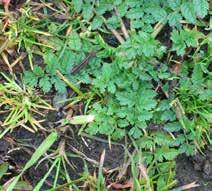
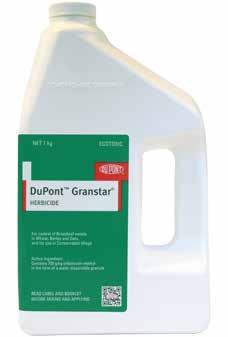
Part of this is to ensure that new brassica, grass and legume varieties are given their very best opportunity to establish well. Poor establishment is often associated with incomplete removal of the existing sward, which leads to poor seedling survival and high plant mortality during establishment. While glyphosate will control grasses and some broadleaf weeds, it is very important to remove the old clovers and hard to control broadleaf weeds including shepherd’s purse, thistles, ragwort, yarrow and dandelions. DuPontTM Granstar ® herbicide, with your glyphosate and organo silicone (Input® Penetrant) can help to achieve this.
Granstar herbicide is primarily absorbed through plant foliage and inhibits cell division within the plant, which is why you should ensure active growing leaf area at spraying – rank pasture or vegetation should be grazed and freshened before application.
Article supplied by DuPont.
One simple step of adding Granstar herbicide to your glyphosate mix gives important benefits:
• Improved establishment and subsequent yield of your following brassica or pasture crops
• Grazing and/or cultivation can follow after 3 days and drilling after 14 days
• Eliminate competitive weeds to establish a quality crop and promote moisture conservation
• Rainfast within 1 hour when used with Input Penetrant
• Granstar herbicide can be used in hormone sensitive areas
For further information, contact your Farmlands Technical Field Officer or the friendly team at your local Farmlands store.
Trials show that fungicide programmes pay
Last year Bayer Crop Science carried out trials evaluating fungicide programmes based on Aviator Xpro® and Prosaro® for wheat and Delaro® and Aviator Xpro® for barley. As before, these showed that applying robust fungicide programmes pays handsomely.
The most spectacular trial was a North Island wheat trial, heavily infected with septoria leaf blotch and leaf rust, where a yield increase of 5.85t/ha was recorded compared to the untreated. The result was a very profitable return of $1,174/ha over input costs, even with wheat priced at $250/t.
In Canterbury, Bayer’s trials reflected the more common situation encountered last year – very low disease pressure. Even in these trials, fungicide programmes resulted in
2t/ha increases for wheat and 1t/ha increases for winter barley. In both crops, these fungicide programmes were very profitable.
This season, early disease pressure is higher than last year in both wheat and barley, with septoria levels perhaps on par with those of 2-3 years ago. So now is the time to walk your paddocks and plan your disease management for this spring.
The good news is that not only can you protect your crop’s yield potential but now you can also earn triple Choices Rewards Points* on purchases of Aviator Xpro, Delaro, Proline® and Prosaro.
For further information, contact your Farmlands Technical Field Officer or the friendly team at your local Farmlands store.
Article supplied by Bayer. ®Registered trademarks of the Bayer Group. *Terms and Conditions apply. For a limited time only.
| Septoria leaf spot can easily be found in Canterbury this spring.
Know your enemy –velvetleaf and pea weevil
Velvetleaf and the pea weevil have both appeared in New Zealand in 2016 and could have devastating impacts for growers across the country. While steps are already in place to contain the pea weevil to the Wairarapa region, velvetleaf, if left unmanaged, is a threat to arable crops nationwide.
First confirmed on a Canterbury property in February, velvetleaf competes with crops for nutrients, space and water. Velvetleaf had been detected here before – in Waikato during 2011 – and was under the management of the regional council. However the latest discovery has affected a number of regions, in particular Canterbury, Southland and Otago.
As of last month, velvetleaf had been discovered on more than 250 properties. Its entry to New Zealand was traced back to contaminated imported fodder beet seed and as a result, the Ministry for Primary Industries (MPI) has reviewed its importing rules for seed.
MPI is now encouraging all farmers that have sown fodder beet seed in the past two seasons to check their crops for velvetleaf. A significant biosecurity response has been launched, involving regional councils and other primary industry bodies.
Farmlands Co-operative has been proactive in the response to velvetleaf and has been urging shareholders to check their own crops for signs of the pest weed. Tim O’Sullivan from Farmlands Grain and Seed says “control
measures now will go a long way to minimising the effect in the future”.
“It’s like any weed – if it’s not controlled it is a major inhibitor of yield,” Tim says.
“In the Canterbury region, where there is the biggest area of seed production in New Zealand, the biggest risk is the economic impact if it cannot be controlled effectively now.”
“After cultivation, wash down machinery to minimise the risk of spreading the weed. This is one of the many measures that can be taken to help minimise the impact.
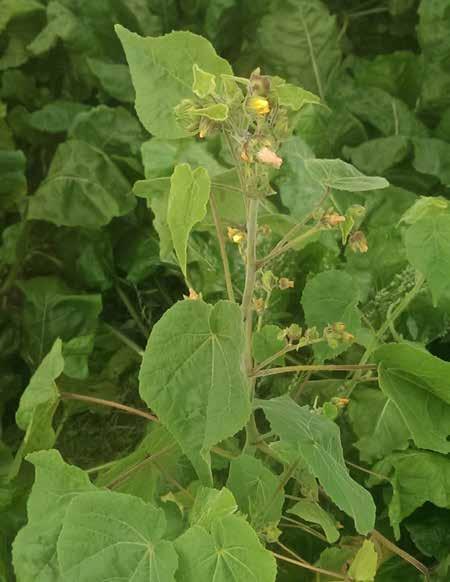
“Part of the mallow family of weeds, the key to stopping the spread of velvetleaf is ongoing vigilance. While it may seem overbearing, continuing to check your
While it may be like any other weed, its nuisance value is high. Tim says it is a serious weed due to the number of seeds it can drop – up to 17,000 per plant – which can be viable in the soil for up to 50 years.
“Particularly where it has been identified, it’s a case of keeping an eye out and continually checking your paddock to make sure there is no velvetleaf. Where plants are found, pull them out and carefully dispose of. You can find full information to help identify it and about disposal at: www.mpi.govt.nz/alerts.
property is the only way to keep the weed under control. The worst thing that can happen is for this plant to go to seed,” Tim says.
Farmlands has been working with growers to discuss management of their paddocks, both in terms of minimising the spread and preventative measures. The ‘ute guide’ and farm management plans created by MPI are the starting point for any best practice approach.
“Our Technical Field Officers will be able to help with planning the next steps for the infected paddock.
Understanding the plan for the paddock’s use in the future will help determine how to treat the paddock now for the most effective control.”
If shareholders require more information, Farmlands can provide documentation that has been presented at local MPI meetings, as well as Technical Field Officer expert advice.
“Particularly where it has been identified, it’s a case of keeping an eye out and continually checking your paddock to make sure there is no velvetleaf.
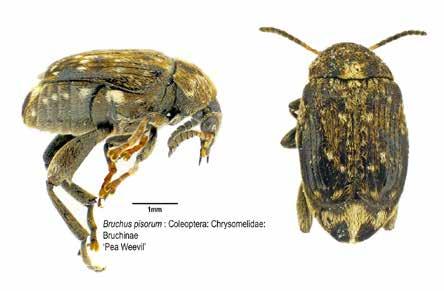
While more localised at the time of writing, pea weevil is another nasty incursion that threatens the livelihood of New Zealand growers. First discovered in Wairarapa in April, pea weevils damage growing peas and have the potential to create long-term implications for local pea production. However, MPI is confident pea weevils can be eradicated. This involves temporarily banning the growing of peas in Wairarapa – a selfless act from commercial and home growers in the region. The 2 year ban will stop the weevils from breeding, as they need pea pods for their larvae to survive. In the no-grow area, all pea material is unable to enter or leave, including pea plants, seeds and straw. It may seem drastic but the decision to ban growing of peas in the area was identified as having the greatest chance of success and was made after consultation with industry heads and international scientific experts.
Farmlands Grain and Seed Agronomist Elton Mayo says pea growers in the
area are “taking a hit for the team” by ceasing their pea growing operations. While it is a move to safeguard the health of New Zealand’s pea industry, that doesn’t mean it is an easy decision.
“Most of the growers aren’t happy about it, in the sense that no crop comes close to doing what peas can do for them,” he says. “I’m getting calls about what options there are but the majority are not quite as profitable.”
While the embargo exists on all pea material, MPI is working with growers and representatives to reduce the
financial impacts associated with the move. Until then, the focus is on raising awareness, to make sure the pea weevil doesn’t weave its way through the rest of New Zealand.
For more information on velvetleaf, pea weevil and how to notify MPI of any sightings, visit www.mpi.govt.nz/alerts
| Velvetleaf in flower. Photo courtesy of Ministry of Primary Industries.
You can’t farm mud!
Out of sight, out of mind, as the saying goes. This is certainly true of land drainage systems, in terms of production benefits and regular maintenance. Installing land drainage is an expensive capital investment. Any other infrastructure asset on-farm of this value would quite rightly have a management plan, assessing performance and scheduling annual upkeep. But not so in New Zealand, where drainage systems tend to be forgotten, until problems appear.
Drainage systems not performing to their designed potential will adversely affect pasture production: in the short-term, with less growth and stomping good feed into the ground and in the longterm, with compacted soils providing less than ideal growing conditions. Observable signs of drainage issues are wet spots, poor pasture growth with yellowish colour and sluggish flow at the system’s outlets. Causes may range from pipe siltation or collapse to root infiltration, outlet blockage or
the panning-out of the soil above the pipe. Some of the “fixes” are relatively easy – reinforce pipe outlets, regularly clear surrounding vegetation and spear through compacted soil down into the backfill surrounding the drainage pipe. Replace drainage lines prone to root infiltration with un-punched (no-holes) pipe and reinvigorate mole-drains where required.
Prevention is better than cure – the key considerations being good system design and installation. Incorrect pipe grade or diameter can cause slow flow, with soil not being flushed through. Sedimentation then further reduces flow, eventually blocking the pipe, leading to a waterlogged soil profile. Back-filling the trench with native soil, rather than using an imported aggregate backfill can also leave pipes prone to siltation. Following manufacturer and contractor recommendations in regard to pipe selection and installation will result in fewer issues and deliver better results than taking perceived cost cutting shortcuts.
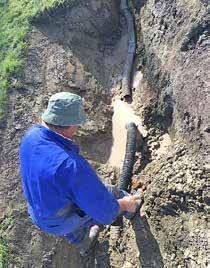
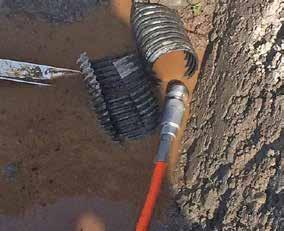
Water jet cleaning is an important component of drainage system maintenance. Hayes Jetting is a Wairarapa based contracting firm that offers this type of service. “Our jetting machine delivers high water volumes at pressure to dislodge sediment build-up in field tiles and NovafloTM and can also cut through roots blocking the pipe”, says business owner Greg Hayes.
“Although our jetting hose can travel 225 metres up the pipe, it’s much easier to clean systems where flushing points have been built in, with an access pipe brought to the surface. We also have a tracking head, which is used to find the position of existing drainage lines
and locate issues such as squashed or blocked pipes.”
“I highly recommend regular pipe jetting,” says Carterton dairy farmer Chris Engel. “We used Greg’s services to find our drainage pipelines, identify system junctions and locate root and soil blockages. By cleaning the pipes, I now have a system operating like brand new for a fraction of the replacement cost.”
Initial ground settlement post pipe installation will see soil infiltrate into drainage pipes. Jetting is recommended around 12 months after the install to flush this out and then every 3 to 5 years for optimum performance. Products such Nexus™ land drainage pipe, with its smooth bore increasing the flow velocity, can negate or reduce the severity of siltation. GPS mapping of new systems using services such as Farmtrac™, will make pipe location easier for routine maintenance.
For further information, contact your Farmlands Technical Field Officer or the friendly team at your local Farmlands store.
Article supplied by Iplex Pipelines.
| Carterton dairy farmer, Chris Engel.
| A jetting nozzle.
Installing your water tank
So winter is over, things are starting to dry out and spring has sprung! Many of you will be looking to get new water tanks to ensure an uninterrupted water supply for the summer ahead.
Here’s some handy hints and tips:
• Ensure that the tank site is flat and level, free from any foreign matter that may damage the tank’s base.
• Ensure the tank site is well compacted if fill is used to prepare or level the site.
• Ensure that the tank site is at least 300mm larger in diameter than the tank.
• If a sand base is used, a retaining cover should be used to prevent sand from washing away after installation.
Remember that a full tank will weigh up to 30 tonnes – so it is important that the surface it sits on is stable and firm.
If it’s windy or stormy your tank can easily be blown away if not secured down. Adding 200mm of water to the bottom of the tank is usually enough to weigh it down.
Planning how you will install and plumb the tank is important – and it is highly recommended you run your project past a drainlayer or plumber to ensure your plans will work!
To take advantage of the maximum catchment of water, downpipes can be fed from both gutters into the one tank. The overflow capacity must match the downpipe capacity.
Important considerations when plumbing a tank are:
1. Ensure a flexible hose is installed after the gate or ball valve with a minimum 300mm length.
2. The tank outlet must NOT be subjected to extra force, e.g. over-tightening of fittings.
3. Overflow must be piped clear of base to avoid erosion.
4. The number of inlet pipes, their sizes and capacities must equal the number of overflow pipes, their sizes and capacities.
5. Do not allow the tank site to deteriorate after installation due to any form of erosion or site destruction caused by vermin such as rabbits.
300mm FLEXIBLE PIPE
WHEN PIPE WORK IS EXPOSED OR OVER A LONGER DISTANCE, INSERT A 300mm LENGTH OF FLEXIBLE PIPE TO ABSORB SHOCKS AND MOVEMENTS. ALTERNATIVELY LAY PIPEWORK INTO GROUND JUST AFTER THE 300mm FLEXIBLE PIPE TO AVOID RUNNING OVER AND DAMAGE FITTING AND/OR TANK.
300mm SAND OR EQUIVALENT
AVOID FREE HANGING UNSUPPORTED PIPE WORK. IT PUTS EXTRA STRAIN ON FITTINGS AND TANK WALL.
Promax corrugated tanks can be buried up to 1 metre in the ground – and still retain their 20 year warranty. Burying your Promax tank is a great way to avoid height restriction issues – also a buried tank with shrubs planted around it is more attractive in your backyard!
When you are planning to bury a Promax corrugated tank, you should prepare the base with 100mm minimum of compacted sand, just as you would if installing the tank above ground.
For further information, contact your Farmlands Technical Field Officer or the friendly team at your local Farmlands store.
Article supplied by Promax.
Scan the QR code to watch a water tank installation video from Promax.
A simple system for cost effective heat detection
Achieving a good calving pattern relies on getting cows in-calf quickly. Accurate heat detection, pre-mating heats and staff training are key ingredients for a successful mating season.
The first thing you need to determine is the level of detection skill within staff – are they up to scratch and does everyone involved know exactly what to look for? Do they know how to tail paint? What is your heat detection colour system and are all staff aware of it and understand?
Tail painting is the most commonly used and cost effective form of heat detection. Tail painting provides a visual indication of when a cow has stood to be mounted and consequently rubbed, showing that she is in heat.
How to paint correctly
1. Ensure the area is clean and dry and remove loose hair.
2. Apply paint forward along the spine from the tail head in a strip 15cm long x 5cm wide.
GEA|FIL’s range of easy to use, cost effective and New Zealand made tail paint products are specifically designed for dairy cow heat detection.
Healthy cows and heifers, free from infection, can expect to show signs of heat every 18–24 days with an average of around 21 days. Cows often have a short cycle after their first heat and are in heat again 8–12 days later.
The average interval from calving to first heat in pasture-fed cows in good body condition is 35–45 days. It is about 10 days longer than this in first calving heifers1
1 Heat Detection: Dairy NZ InCalf 2007 (Editors: Chris Burke, Mark Blackwell and Steve Little).
Here is a simple colour process for heat detection:
1. Begin with pre-mating heats, paint all cows with RED tail paint approximately 3 weeks after calving. Observe the painted area for signs of the paint being rubbed. This will indicate the cow has started her cycle. In cases where the paint has not been rubbed, seek advice from your animal health professional.
2. Paint cows with GREEN tail paint prior to commencing your artificial insemination programme. Cows with rubbed paint indicate they are on heat and should be put up for AI.
3. After inseminating, paint BLUE. This will tell you if she has held to the service (if the paint rubs off, the cow is not pregnant). It may pay to wait until the afternoon milking to paint newly serviced cows, as paint may be rubbed off during the day.
4. Paint all cows with YELLOW tail paint when pregnancy is confirmed.
Empower your team – train them in effective and accurate heat detection, helping them to understand why accurate heat detection is important, what to look for and how to tail paint correctly.
For further information, contact your Farmlands Technical Field Officer or the friendly team at your local Farmlands store.
Article supplied by GEA|FIL.
P Competitive rates that adjust to the seasons
P Pay your Meridian bill through your Farmlands Account and receive a 12% prompt payment discount, plus 2% shareholder rebate*
P Dedicated ITO trained Agribusiness specialists who come to you and provide advice on getting the most out of your farm electricity
For a tailored package that suits your farm call Meridian today on
Protect your irrigator with FMG
The 10 th of September 2013 will remain etched in the memory of many a Canterbury irrigator owner after a severe windstorm hit the region causing millions of dollars’ worth of damage and countless hours of disrupted productivity.
As a specialist rural insurer, FMG saw much of the wind storms’ damage first-hand – and in particular worked through some 260 irrigator claims at a cost of around $7.5 million.
“It was a pretty tough time”, FMG’s Scott Harvey recalls. “The winds were incredibly unforgiving. I remember going from client to client and seeing a similar scene of twisted irrigators lying on the ground with the wheels in the air – it was quite unsettling.
“Working through claims and getting clients back up and running as quickly as possible is always our priority. Given the size of this event however, we felt we had to look further at this particular storm, so irrigator owners across the country could learn from it.
“To do this we teamed up with Lincoln University, who surveyed and spoke with farmers and growers directly impacted by the storms. We then used that data and information to create the Irrigator Advice Guide,” Scott says.
The free guide provides three key findings to help protect irrigators from strong winds:
• POINT - point the irrigator downward from the prevailing wind.
• PARK - create a parking space for the irrigator – if possible away from any other objects.
• ANCHOR - along the parking space, install anchor points to tie the irrigator down.
The guide goes in to greater details around Point, Park and Anchor and also offers wider irrigation protection tips.
IrrigationNZ Project Manager Steven Breneger says following FMG’s risk advice is likely to minimise the impact of any wind event.
“The guide is a key resource that irrigating farmers should take heed of. IrrigationNZ offers complementary resources on our website. These outline other pre-season advice that irrigating farmers should employ before the season kicks off.”
In addition to the guide and noting that 50 percent of FMG’s irrigator claims are ‘impact related’, the rural insurer also provides wider advice around irrigation protection.
This includes:
• Walk the track your irrigator will travel to check for any foreign objects or changes to the track that could topple your machine.
• While you’re at it, why not check wider surroundings for any overhanging trees, new growth to shelter belts or new power poles that may have been installed since last season.
• Keep your workers safe. Make sure all staff know how to use the irrigator properly.
• FMG receives a considerable number of claims related to irrigators hitting machinery as it travels through the paddock. Given this, why not implement a 'No-Vehicles-Left-Behind' policy. Keep other farm machinery such as quad bikes and motorbikes away from the irrigator.
If you’d like a free hard copy of the Irrigator Advice Guide, give FMG a call on 0800 366 466 or download it from their website www.fmg.co.nz/advice
Article supplied by FMG.
| Paul Reece, on behalf of IrrigationNZ, talking to | farmers about pre-season maintenance.
Fuel Distributors Industry Safety Committee to deliver best practice
Farmlands Fuel is proud to have one of its own, Farmlands Fuel National Operations Manager, Derek Foley, chairing a new committee tasked with improving safety standards in the fuel distribution industry.
A group of New Zealand fuel distributors, with support from the Road Transport Forum, have announced the formation of the new industry body, which represents the interests of the fuel distribution sector and will establish best practice standards for the industry.
The mission statement states that the Committee’s objective is to provide a forum where fuel distributors and stakeholders can collaboratively work towards establishing best practice industry standards to ensure the safe, compliant and environmentally
responsible delivery and storage of fuel.
Participating companies include Allied Petroleum, Farmlands Co-operative, Farmlands Fuel, Waitomo Group, North & South Fuels, McFall Fuel, Rural Fuel, RD Petroleum, Pacific Fuel Haul, Northern Southland Transport, South Fuels and Toll Group.
“Together these companies represent over 80 percent of volume transported by the industry and it is envisioned that the remaining parts of the sector will come on board in the near future,” Derek Foley says.
“In terms of addressing issues such as workplace health and safety, it makes it far easier for the industry to have information disseminated down through our Committee and on to the individual organisations, rather than having company’s resources stretched trying to engage with WorkSafe NZ individually.
“
In terms of addressing issues such as workplace health and safety, it makes it far easier for the industry to have information disseminated down through our Committee and on to the individual organisations...
“I’d like to thank WorkSafe NZ for their input into the Committee’s work so far – I am encouraged that this will lead to good safe outcomes for our sector.”
Mark leads from the front
Cooperative Business New Zealand has this year announced Farmlands Fuel’s General Manager, Mark McHardy, as the winner of the Cooperative Leader of the Year Award.
The award honours an individual who has shown significant leadership, commitment and support of well recognised and accepted co-operative principles, along with vision and courage for the co-operative model. Other criteria included demonstrating successful initiatives that benefited their co-operative or the co-operative sector.
Cooperative Business New Zealand CEO, Craig Presland, says that Mark was the stand out nominee for the award.
“His business’ successes as General Manager of Farmlands Fuel ... have been based in strong co-operative principles. These include leveraging the collective buying power of the group, displaying a strong vision and determination in ensuring full health and safety compliance, implementing systems and procedures that have ensured the efficient and sustainable supply of fuel and leading the long term survival and growth of Farmlands’ fuel business,” he says. Hailing from a dairy farm in the North Island, Mark completed a Diploma in Horticultural Management at Lincoln University, before spending time working in trading roles within the grain and agricultural chemical industries. Mark has a strong affinity to rural New Zealand and says he was both surprised and humbled to win the award.
“I want to thank Craig and Cooperative Business New Zealand for giving me this award. It’s safe to say I was caught off guard,” he says.
“Farmlands is a great co-operative and I am proud to be part of that team. It is the hard work of that extended team that makes these prestigious awards possible. Farmlands’ mission is simply to enhance the profitability of our shareholders through the provision of rural services and supplies, which obviously includes fuel. Hearing my name called out is to me an acknowledgement that we are probably on the right track, though fully aware there’s still so much more scope for improvement.”
Farmlands Co-operative CEO, Peter Reidie says Mark has been at the forefront of growth for Farmlands Fuel for the past 10 years. Displaying decisive leadership around the expansion and delivery of the Farmlands Fuel business to shareholder customers and the wider rural New Zealand community, Mark has helped to offer innovative solutions throughout the fuel and lubricant sector.
“Mark has contributed to not only the success of Farmlands Fuel but also Farmlands Co-operative as a whole,” he says.
“Mark has excellent focus on customer service, has implemented a leading environmental awareness plan and has been a champion in the health and safety arena, not only within Farmlands but in the wider fuel industry. This is a big challenge when you are responsible for more than 45 fuel tankers on the road every day. He is focused on keeping people and the environment safe and working to the Farmlands motto – work safe, home safe, every day. All this is complemented by the latest delivery technology being utilised through our delivery fleet under his guidance, ensuring farmers get their fuel on time.”
| Kim DeGarnham, Cooperative Business NZ Director (left), with Mark McHardy, General Manager, Farmlands Fuel.
Joyce’s shareholder journey
As long as I’m alive I’ll be a shareholder. And when I’m not here anymore I intend to give my shares to my granddaughter.
Joyce Fitzgibbon has clocked up nearly 50 years as a Farmlands shareholder – and still has the original membership card to prove it.
“I’ve used it so much, as you can see. I’ve carried the little ticket round in my handbag,” she says.
Joyce and her late husband Maurice joined the-then North Canterbury Rural Co-operative Society Limited in 1967, purchasing their shares for 200 pounds.
Joyce and Maurice farmed 350 acres of land at Spotswood, Cheviot. “We had a mixed farm,” Joyce says. “We had sheep and a few cattle and cropping – grass seed, wheat, barley, peas, red clover, white clover. I drove the tractor too at times when I was needed, an extra pair of hands to help out. I also, when it was lambing time, tailed the lambs.”
Joyce was no stranger to farming life – when she was young, she worked in the shearing sheds in North Canterbury. “My father was a shearer and my
brother was a shearer, so my sister and I became the shed hands,” she says. “I did that all during the war years. Then I went to Christchurch and did wool classing. I was well-equipped to help in the shed.”
As well as helping on the farm, Joyce recalls that there were always men to feed. “There was always somebody coming in, stock agents would come in and they would always seem to arrive at morning or afternoon tea time.” Joyce says she spent lots of time cooking, baking, feeding shearers and harvesters, knitting and sewing, as well as preserving fruit, making butter, tomato sauce and pickles.
“When we (Maurice and I) were first married we were almost self-sufficient. We grew everything – we had our own meat, we had potatoes, carrots, corn, cabbages, tomatoes – we always had a good vege garden. It didn’t cost us a heck of a lot to live.”
Joyce reared turkeys that she sold to butcher shops in Christchurch. And has also reared a number of calves over the years.
“We made our own hay too,” Joyce says. “We built a great big hay shed and we knew that if we didn’t have that shed full of hay for the stock in the winter time, we would be in trouble. We found that by stocking up and being prepared, we were organised.”
In 1980, Joyce and Maurice sold the farm and moved to Cheviot, before retiring to Darfield in 1987. Though that didn’t stop them from keeping busy – playing golf, bowls, gardening and looking after their grandchildren. Joyce has made the most of her membership over the years and at 92, she still uses her Farmlands Card at local restaurants and hotels, to get her groceries, pay the bills and fill up her car. And of course, she still pops into her local Farmlands store, Farmlands Darfield, every now and again.
“As long as I’m alive I’ll be a shareholder. And when I’m not here anymore I intend to give my shares to my granddaughter,” she says.
Planning and understanding mating targets
As this goes to print there will be a new generation of dairy heifers on the ground. When we decided to provide grazing services to our shareholders a few years ago, as many as 30 percent of heifers born failed to make it through to the start of their second lactation.
One area I believe we need to pay attention to is the rearing of later born calves. Too often we are sending calves off to grazing with a greater than 50kg difference from heaviest to lightest.
As we know, the early born calves get the best of everything. Clean sheds, loads of colostrum, clean equipment and enthusiastic calf rearers. However, the later born calves don’t always get to enjoy all of the benefits mentioned. LIC has been doing some great work with the MINDA Weights programme, which identifies the problems with later born calves by using PSM (Planned Start of Mating) targets and working back from there. These targets show exactly how much weight heifers need to gain to be at an ideal weight for mating regardless of age. In other words, an early born heifer has 15 months from birth to reach PSM while the later born heifers have the same PSM but only have 14 months to get there. Here’s the math – working on a 320kg minimum PSM target, an early born calf needs to grow at 0.6kg per day from birth, while the younger calf (by 35 days) needs to grow at 0.65kg per day. What makes things even worse is the late calves often have to compete with the earlier calves in the same mob and inevitably the gap widens rather than closing up.
Heifers that are mated at below mating targets will still get in calf no problem but if they are behind at mating, they will most likely be behind entering the herd, therefore increasing their chances of not being able to compete in the herd and risk not getting back in calf.
I’m not suggesting not to rear later born calves but it is a regular problem that gets brought up at this time of year when mating is approaching. Later calves can still make PSM targets but a plan needs to be in place from the get go. My personal experience is to keep the later and lighter calves back from grazing until May and run them on the milking platform (where the highest ME feed is), or treat them as a separate
mob and graze them on a different contract from the main mob.
Sending a line of well reared, healthy calves to grazing with a tight weight range shows the grazier that you care a lot for your replacements and sets the bar for them to follow.
Now is the time to plan grazing for your calves, so give us a call as we have grazing available for all classes of livestock. For further information contact your local Farmlands Livestock Representative.
Article supplied by Richard van Wynbergen, Grazing Manager, Farmlands Livestock.
| Farmlands Livestock Representative Andy Stringer (left) weighing R1 year heifers at Springfield, Canterbury.
| These heifers showed consistent weight gains through the winter on a diet of fodder beet and silage.
recently
- Irrigation system (replacement engine)
- Power generation
- Lighting towers
- Hydraulic and water pump solutions
- Replacement engines
SOLE AUTHORISED DISTRIBUTOR FOR:
Hitachi Construction Machinery
Scania Trucks & Buses
John Deere Construction & Forestry Equipment
13 branches nationwide
24/7 parts and service support
OUR SERVICES INCLUDE:NATIONWIDE DEALER FOR:
Routine machine servicing Repairs
Maintenance and repair contracts
Oil analysis
Fixed priced servicing
Isuzu Industrial Engines and Parts
Donaldson Filtration Solutions
Berco Track Undercarriage
Whangarei: Ph 09-470 0433
North Shore: Ph 09-426 1280
Auckland: Ph 09-270 1360
Hamilton: Ph 07-850 8429
Rotorua: Ph 07-349 0610
Gisborne: Ph 06-867 0928
Hastings: Ph 06-879 8170
Palmerston North: Ph 06-356 1880
Wellington-(HO): Ph 04-568 4289
Nelson: Ph 03-541 0200
Christchurch: Ph 03-349 0610
Greymouth: Ph 03-769 9005
Invercargill: Ph 03-211 0256
Building safety planning into preparations for spring
Preparations for spring are in full swing. Lambing is underway, milking is ramping up and there are summer feed crops to be sown.
Building time into your work for health and safety planning will ensure you and your team are best prepared to handle the heavy workload without accidents occurring.
Between 2011-2015, incidents involving tractors and quads accounted for more than 60 percent of workplace fatalities on farms. Quad bikes alone were a factor in nine of the 19 deaths on New Zealand farms last year.
Al McCone, Agricultural Programme Manager for WorkSafe New Zealand’s Safer Farms programme, says the key to reducing the high accident toll in New Zealand farming is simply identifying the risks on the farms, establishing whether they can be eliminated and if not, the best ways to manage these and communicating them well to staff and contractors.
“Involving your workers is the best way to identify risks on your farm. In terms of vehicle-use, talk about which areas might be too steep to take some, or all, vehicles and locations of ditches, ruts and overhead wires or narrow gaps.
“One farmer printed maps of the farm and got staff together to discuss and colour-code it. He divided the farm into categories – a red area must be accessed on foot only, orange you can take a two-wheeled motorbike but no quad bikes or tractors and a green area you can take those vehicles but ‘go with care’. These have become farm rules and a copy of the colour-coded map is provided to all contractors too.
“Before someone takes a vehicle out, discuss conditions – have they made the surface slippery, which ridges are dangerous in high winds, is the vehicle suitable for the depth of water and so forth.
"Make sure the vehicle is right for the job and correctly set up for it – should you get the tractor out rather than tow heavy spraying equipment or feed bins with a quad?” It is vital PTO shafts and connections are guarded and kept clear when it is engaged – and never jump on or off a moving tractor.
Operators of any farm vehicle must always be trained and experienced enough to do the job. Helmets should always be worn when using a quad bike and children should not be allowed to ride adult quad bikes.
“If you include these things in health and safety inductions and reinforce them through everyday planning and at team meetings, they will become second nature,” Al says.
“Leadership is crucial. If you make clear these are the workplace rules and expectations and are there to make sure everyone goes home healthy and
safe and if you walk the walk yourself, it will be more effective than someone rolling their eyes and going through the motions.
“These may be ‘routine’ tasks you are all familiar with – but statistics show that many serious accidents occur when experienced farmers and farm workers are carrying out tasks they have done countless times.
“A common myth in farming is that ‘health and safety is just common sense’ – but if that really was the case then we would not have the accident and death rates that we do,” Al says.
WorkSafe’s updated Keep Safe, Keep Farming toolkit provides simple advice and resources for farmers to establish the systems, processes and culture necessary to keep people safe on-farm. Download a copy at www.saferfarms.org.nz
You may have gumboots at the back door, lots of cows to milk and chickens in the pen or a newly built country home with acres of pasture and lush gardens.
Either way, you may have decided that the exterior of your home may need to reflect the natural environment. And with the warm weather coming, it’s the perfect time to plan your exterior paint jobs.
Here are some ideas to get you started to enhance your home and fit in with your surrounding landscape…
If you have views of rock strewn mountain peaks etched against the bright blue skies above bleached crop fields – try Resene Quarter Craigieburn, Resene Half Merino and Resene New Denim Blue, or Resene Eighth Arrowtown, Resene Double Black White and Resene Groundbreaker.
If you have views of grapevines marching to the horizon, orchards and traditional hedgerows – try Resene Villa White, Resene Quarter Villa White and Resene Scoria, or Resene Double Ash, Resene Helium and Resene Twizel.
If you have views of rolling hills and a soft merging of house and bush –try Resene Half Linen, Resene Quarter Rice Cake and Resene Karaka, or Resene Half Fossil, Resene Double Alabaster and Resene Canyon.
If you need help to decide on the right products and colours for your project, use the free online Resene Colour and Technical Expert services – visit www.resene.co.nz/colourexpert or www.resene.co.nz/techexpert Resene experts will provide tailor-made advice for your project direct to your inbox. Or visit your nearest Resene ColorShop for free helpful and friendly advice.
Good sense on the farm
In this article we explore the benefits of wearing quality safety boots on the farm.
Back when I served my time as an apprentice, safety boots were hard, uncomfortable, heavy, there was very little choice and they took an age to ‘break in’. Your body knew you were wearing safety boots. That’s a few ‘haircuts’ ago and compared with what’s available now, is chalk and cheese. Nowadays wearer expectations have also changed: what we put up with way back then is now not even close to being acceptable. Now we have an expectation that safety boots must be comfortable, functional, safe, fit for purpose, long lasting, reasonably priced and we also expect them to look great. That’s a long list of boxes to tick! So exactly how have they changed?
Let’s take a look at how the popular Italian manufacturer, Grisport, has achieved this.
Grisport manufacture safety footwear in Italy and distribute it very successfully around the world. They produce an extensive range that meet requirements across a wide range of industries, including a huge outdoor range for
tramping, hunting, hiking, etc. You might ask “what’s their outdoor range got to do with safety footwear”? Good question! There’s good reason for this, so please read on. Expectations of outdoor footwear are very demanding – they must be comfortable, light, stable, suitable for a wide variety of terrain, strong, last well, keep the wearer dry, be reasonably priced and in many instances also needs to look great. Grisport outdoor footwear is popular and generally meets these expectations. This is due largely to many years of experience and ongoing research and development. Their industry experience, research and technology is also utilised within the development of their safety range. This fact is significant and sets
Grisport safety footwear apart from many other companies who produce only safety footwear. Here’s an interesting story from a farmer/builder/hunter, my brother Dave. Back in 2006 we did our very first thar hunt, in the Macaulay. Dave chose to wear a pair of well worn Grisport contractor's safety boots. We responded “you don’t wear safety boots up there mate”. He replied, “I will be, as they are my most comfortable boots” – and he did.
On the farm, Grisport safety boots make good sense. Grisport safety boots are well designed and made with quality materials, they provide added protection and meet obligations under health and safety, are very cost effective and can take a lot of abuse. They are also comfortable to wear all day and look good to boot.
Article supplied by Ed Leenders, Director, Footwear and Apparel NZ Ltd.
Home is where the heart is. This year, we asked you to share your best photos of the parts of paradise you call home and we’ve received so many fantastic entries!
We’ve created the shortlist and now it’s your turn to vote for your favourite.
The 12 winning photos will receive a place in the calendar and a $200 Farmlands voucher, with the photo selected for the cover receiving an additional $300 Farmlands voucher!
Head to www.farmlands.co.nz/calendar right now to vote.
Philips AirFryer
4,000 Choices Points
Audio Technica Active 90% Noise Cancelling Headphones
Sodastream Source Elements Starter Pack
1,900 Choices Points
Bush Digital Alarm Clock Radio with Bluetooth and USB Fast Charge
Delonghi Dolce Gusto Jovia
1,800 Choices Points
2,400 Choices Points 4,000 Choices Points
800 Choices Points
Smartseries Electric Toothbrush
Choices Points
Choices Points 1,700 Choices Points
To redeem your Choices Rewards Points, visit us online at www.farmlands.co.nz/choices or simply call the Choices Rewards team on 0800 200 600, option 4.
Huawei 13000mAh Portable Power Bank
Panasonic 49” Full HD LED TV
Panasonic DMC-FZ70 Ultra Zoom Camera Oral-B Pro 3000
Real Estate Update
All the talk and media focus has been on the negativity in the dairy sector, yes we are seeing some re-adjustment in farm values but over the past few weeks we have begun negotiations on several dairy farms with families seeking to purchase. This is a distinct change from really only corporate buyers seeking farms with scale. Interestingly, our management team is continuing to receive enquiries seeking UK investment options in New Zealand’s farming industry post Brexit over and above European, Asian and the American entities.
The booming residential market continues. At some point it will slow down but until such time our residential and lifestyle teams in provincial towns are enjoying brisk trading. We always need listings to satisfy buyer demand, so please consider calling our team to sell your investment and town properties.
Over winter our team in the Hawke’s Bay has grown. I welcome Mark Johnson and Paul Evans who have joined our team based in Hastings. Mark and Paul’s rural careers commenced in the banking sector before both made the transition to real estate
Unparalleled perfection
over the last decade. Being experienced industry professionals, Mark and Paul’s addition makes a formidable team in the bay, the North Island home of Farmlands.
While traditional marketing methods are still favoured by a number of our shareholders, our social media strategy has evolved for the new selling season. Shareholders have more opportunity than ever to use social media to promote their properties far and wide via the Farmlands App, real estate Facebook and Instagram pages, plus weekly Hot Deals shareholder email. You can also visit farmlandsrealestate.co.nz to view the wide range of properties we have to offer.
If you are considering selling, please call to discuss your options with your local Farmlands Salesperson.
Calvin Leen General Manager Real Estate 027 453 0950 calvin.leen@farmlands.co.nz
Located in Putaruru, Oxford Farm comprises 409 hectares and has been developed to the highest level with superior infrastructure. The gentle rolling contoured rich fertile and free draining Tirau Ash soils is well raced and fenced into approximately 180 paddocks. Production under the present farming system milking between 600-650 cows, autumn calving and a further 500-580 spring calving sees production around 538,000kgMS. For sale on a walk in walk out basis or land and buildings only. Price by negotiation. Property ID: MT1003 www.farmlandsrealestate.co.nz
Ian Morgan Lifestyle/Rural - Waikato 027 492 5878 ian.morgan@farmlands.co.nz
Opportunity knocks - dairy farm and lease
• Entry level dairy farm located at Geraldine, South Canterbury
• 97 hectares for sale and lease of adjoining 108 hectares
• 38 aside herringbone shed and yards, good effluent system
• Irrigation by way of pivot and gun
• Pastures and fertility have been well-maintained
• Large modernised, four bedroom home with sizeable living
• Both properties have excellent soils and lend themselves to be farmed together as they have been for many years
Deadline sale closing 1pm, Wednesday 19 October 2016
Coastal paradise
For a peaceful, serene, quality lifestyle with income, this one ticks all the boxes! Situated just north of Dunedin city boundary in close proximity to both Palmerston and Waikouaiti. This tidy 23 hectare unit offers 8 main paddocks with trough water, holding paddock, sheep yards and a new 4-bay shed with one bay converted to a small woolshed. The four bedroom plus fifth/ office homestead, boasts modern spacious kitchen and living areas. The large four car garage is a major plus.
Price by negotiation
TU10830
Simon Richards
Lifestyle/Rural - South Canterbury 027 457 0990 simon.richards@farmlands.co.nz