

































































5 Farmlands staff profile
5 From the CEO
6 5 minutes with Katrina Berry
8
18
59 BNZ Crusaders, crowd and charity win at Farmlands Cup 61 Century Farms – Gardner family’s farming legacy
62 Farmlands Card
65 Best of both worlds in
Improve nitrogen efficiency
Slug monitoring efforts must improve
Mixed clover finishing systems gaining traction Plan365 Animal Management
Feed efficiency in lactating cows
Healthy calves key to successful calf rearing
Rural Infrastructure 45 Prepare your pool now to avoid algae
Family legacy drives innovation
Why choose solar? 51 Bait selection important for rodent control 53 Get your rabbit population under control




MARCH Horse of the Year Visit us at site F15 at the Hawke’s Bay A&P Showgrounds for nutritional advice and hot deals on everything equine.
MARCH Central Districts Field Days
Head to Manfeild Park in Feilding and see us for great deals, innovative on-farm solutions and expert advice from the whole co-operative.
L ON THE COVER

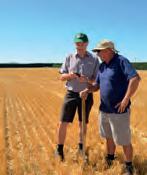

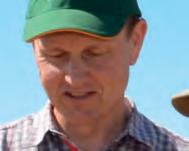
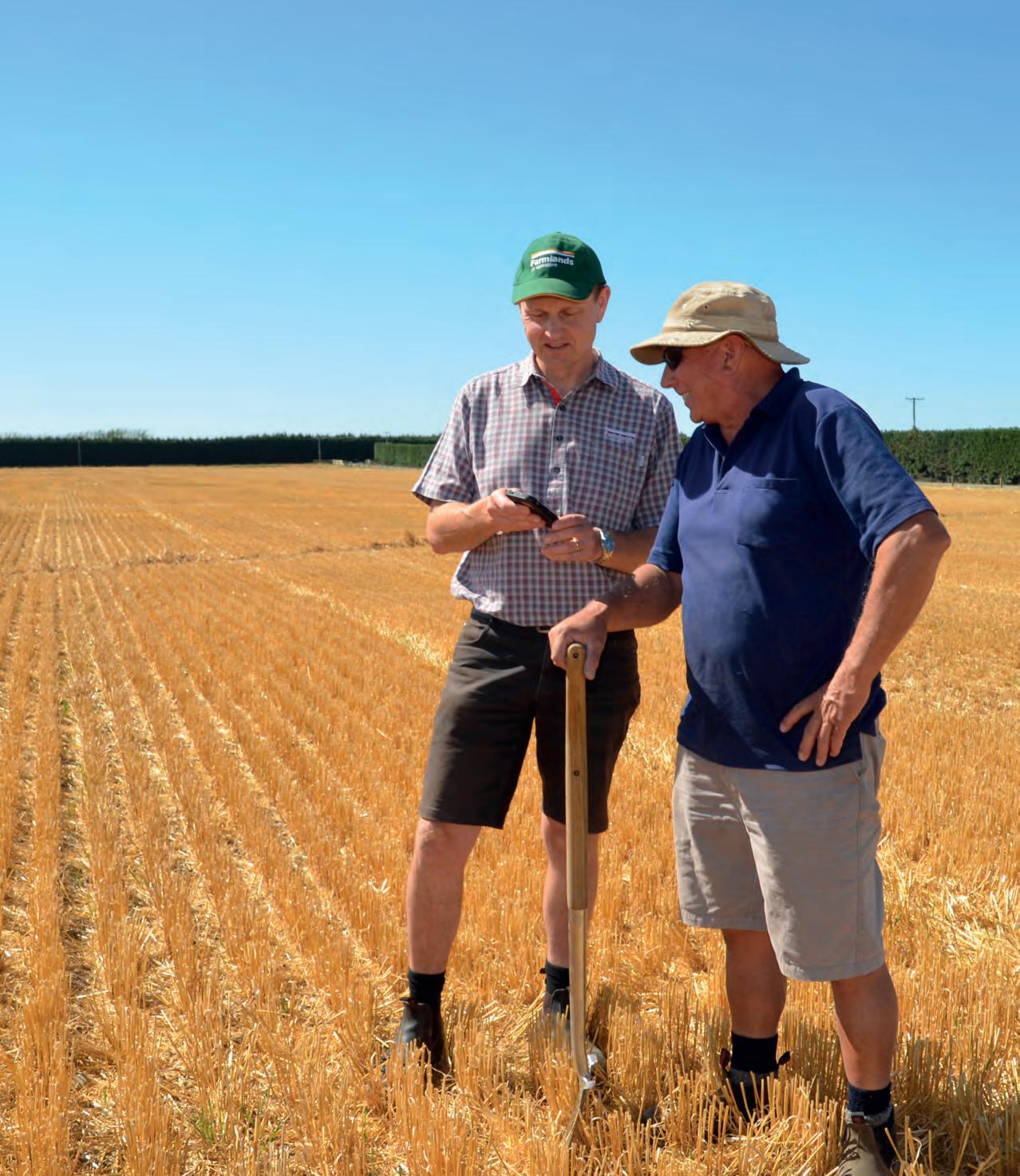
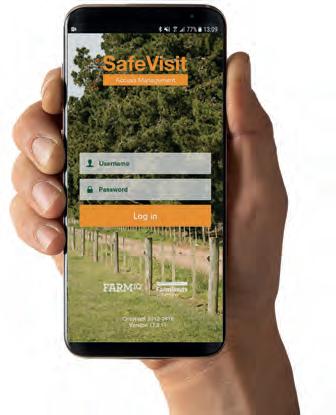
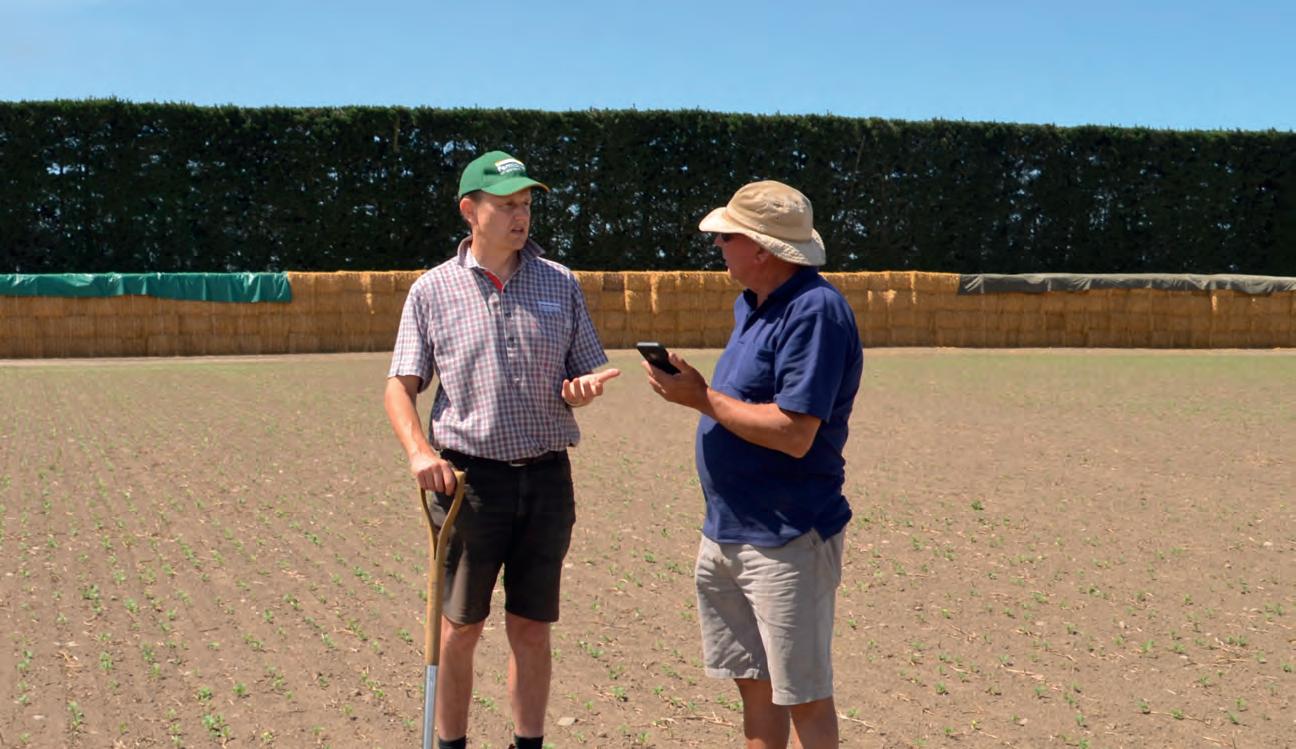
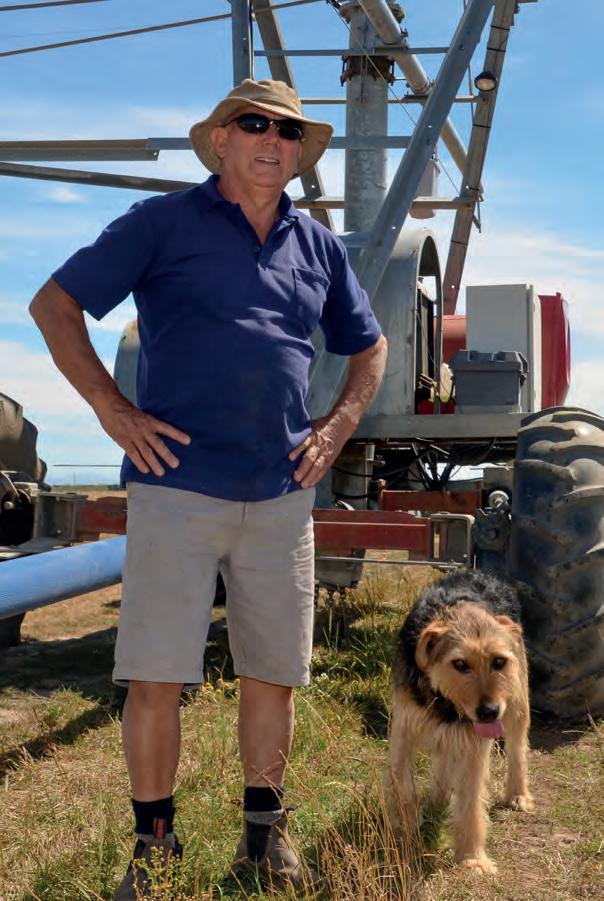
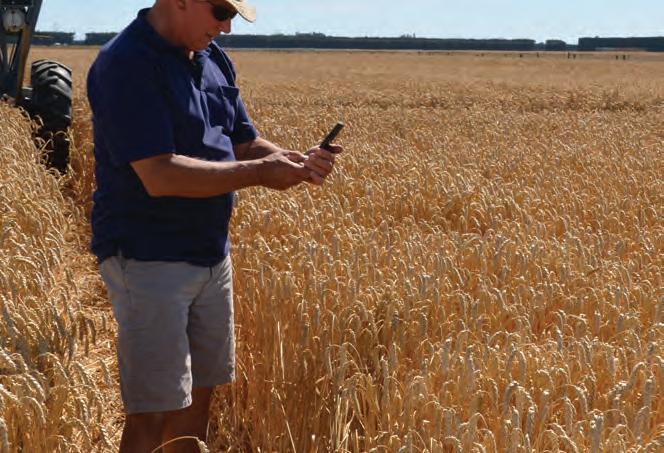
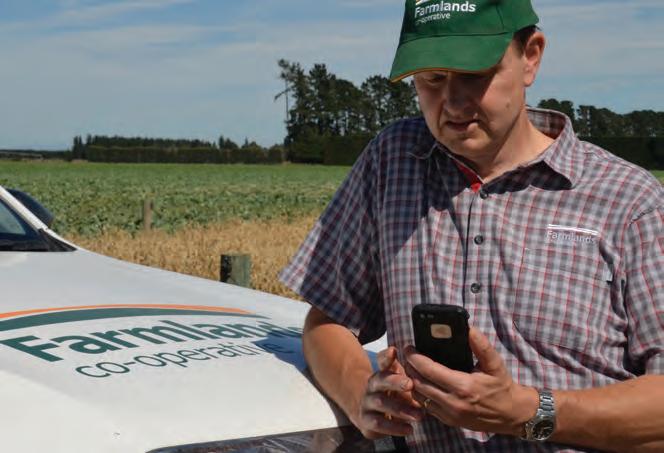
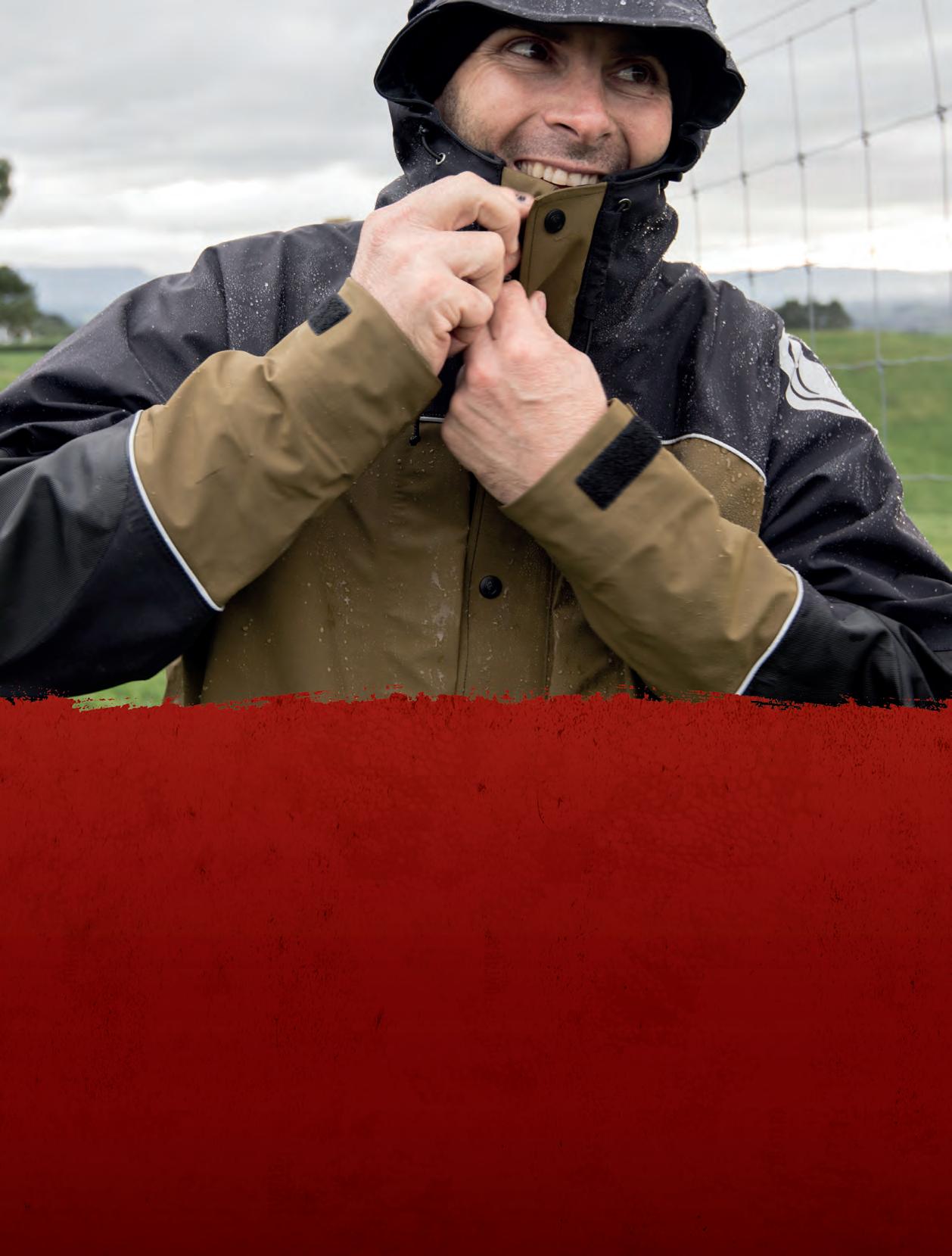
Canterbury shareholder Mike Byrnes and Farmlands Senior Technical Advisor Anthony White use the SafeVisit app, a new visitor management tool, on Mike’s Aylesbury property. Read more about the SafeVisit app on page 8.
27-29
MARCH
Winner of the 2019 Farmlands Health and Safety Excellence Award
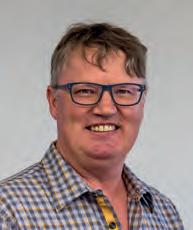
Q: What is your current role at Farmlands?
A: Assistant Manager at Farmlands Te Awamutu.
Q: What do you enjoy about your job?
A: Meeting our shareholders and helping to meet their needs.

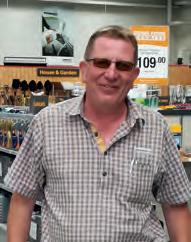
Q: What type of work were you doing before you started at Farmlands?
A: My last job was working at the V-Dub Shoppe, working on air-cooled VWs. Before that I worked for Carlsberg, managed a pub, worked on crosschannel ferries and was in the British Royal Navy.
Q: Where are you from originally?
A: Basingstoke-born but lived mostly in Portsmouth, England.
Q: What do you like to do most in your spare time?
A: I am involved in the sport of rowing and am active in three roles – President of the Hamilton Rowing Club, Secretary of the Waikato Rowing Association and an Umpire for Rowing New Zealand.
Q: What is the most interesting trip you have ever taken?
A: We did a South Island tour from north to south, east to west – and back again – in my old ‘96 Navara (because the VW Kombi conked out). We stayed at places using our Farmlands Card of course!


• Bread of your choice, sliced
• Ham, sliced
• Cheese of your choice (cheddar is best)
• Eggs
• English mustard
1. Toast bread lightly on one side.
• Chilli (if desired)
• Butter
• Salt and pepper to taste
• Chopped parsley
2. Grate cheese into a mixing machine then add an egg, mustard, chilli, salt and pepper and mix until creamy.
3. Butter bread on untoasted side.
4. Add ham slice (can be added in, chopped, to the cheese mix).
5. Smooth creamed cheese over ham.
6. Grill the topped toast until bubbling or golden.
7. Fry an egg and pop on top of the topped toast.
8. Garnish with parsley and serve.

Welcome to the March edition of The Farmlander magazine. This month’s issue touches on some initiatives in the Health and Safety space – including the launch of the SafeVisit app. SafeVisit is free for everyone and will help you manage your farm’s visitors.
While our sector has come some distance on safety, we still have a long way to go. We have not transitioned yet from safety is something we “have” to do to safety is something we “want” to do. There remains many flawed “unsafe” behaviours. Unsafe practices occur without comment or intervention, with many of us participating because we have to.
We know we injure too many people in New Zealand. We know by far the majority of these are preventable through protective attire, appropriate tools, the right methods and work practices. These are available and taught – yet we continue to have injuries. Why?
One word – attitude. Have to versus want to. Too busy. It’s different on the land. Them not me.
At our National Conference in Lincoln last month, I told our people that “For things to change, I must change”. The same goes for rural New Zealand – for safety results to change, we have to change.
No matter who, no matter what – if you see a way of preventing a risk or doing something safer, please intervene to make that happen. Two questions that I urge you to ask yourself when an opportunity to intervene to make our workplace safer occurs: If not me, then who?
If not now, when?
Take the responsibility. Take action as incidents happen and before someone gets hurt. “For things to change, I must change.”
Stay safe everyone.
Kind regards,

Peter Reidie Chief Executive Officer
Farmlands Co-operative Society Limited
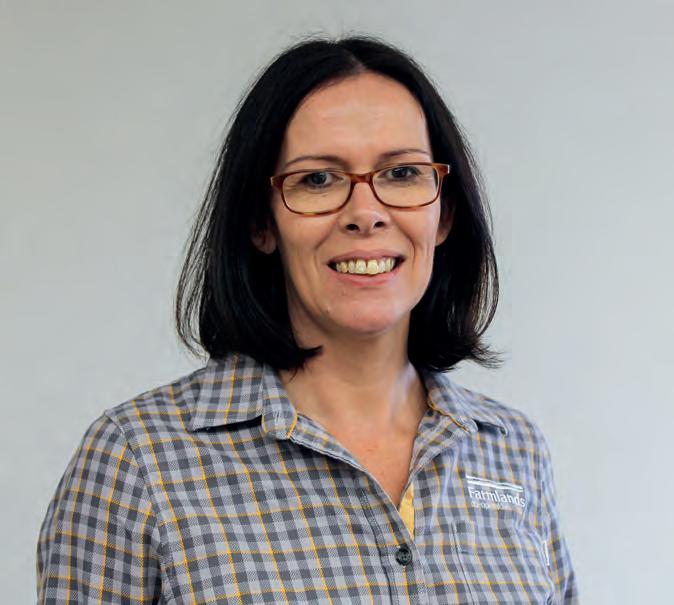
Katrina has been with Farmlands for a year and leads the advancement of safety and wellbeing across the organisation. Katrina was responsible for the development of Farmlands’ new tool – the SafeVisit app – which launched last month.
Who do you have in your team?
We are a team of four and our job is to support Farmlands in managing risk, ensuring compliance and doing right by our people.
What do you love the most about your role?
I love working with our shareholders and this has really brought my job to life. For instance, the SafeFarm app was tested on farms by shareholders last year and is helping hundreds of New Zealand farmers to manage safety more effectively. We are so connected with our shareholders and this helps us to produce tools that can make a real difference to reducing harm on farms in New Zealand. That is raw, it is real and it’s so important.
What appealed to you about working at Farmlands?
I grew up on a sheep and beef farm in Otorohanga, so it is like coming home for me. The main appeal for me though was the opportunity
to work in a place where it’s in the organisational DNA to care. It’s easy to have a conversation about safety when people care about each other.
Tell us about the SafeFarm app software launch in September –what was your role in that project?
I was responsible for the technical development of the SafeFarm app, in conjunction with FarmIQ, which was a 6 month project all up. The FarmIQ platform already existed but we enhanced it considerably to suit shareholder needs within a rural environment and to support New Zealand’s legal requirements. We did
rigorous testing too – shareholders tried it out on-farm before we launched it. It was important that it not only supported legal requirements but it was robust and followed best practice. I wasn’t prepared to be involved with something that wasn’t fit-for-purpose. I’m also really pleased that it is free for Farmlands shareholders and easy-touse. To my knowledge, it is the first software tool of its kind that is available at no cost to the user. It is designed so that people can learn how to use it on their own – so really, there’s no reason why farmers shouldn’t download it and start protecting themselves and others.
What is the difference between SafeFarm and the new SafeVisit app?
The SafeFarm app enables total farm management of Health and Safety. It is based on the successful FarmIQ platform and caters specifically to farmers and farm managers. We’re stoked to be able to provide this management and insight tool free to Farmlands shareholders.
SafeVisit is the second application in the Health and Safety suite of farm management software. This is a fantastic app. It enables safety-critical information to be exchanged between the farmer and visitors or contractors, seamlessly and easily. Important safety messages can be shared, such as incident or hazard/risk reporting. This is free to everyone and we will be communicating this widely to industry organisations, so that their employee’s safety is considered while visiting farms.
How does the SafeVisit tool work?
With the 2015 Health and Safety at Work Act, this tool helps to cover the farmer and minimise risks by way of communicating, raising awareness and sharing responsibility.
Features and functions of the app include:
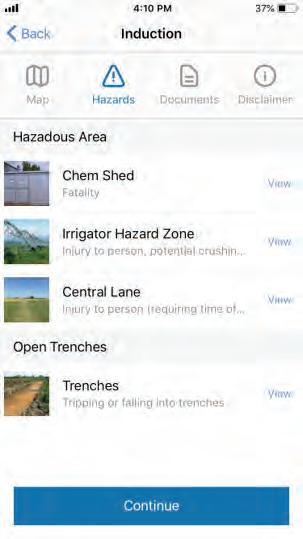
• Visits can be scheduled and visitors complete a Health and Safety induction using their mobile device before entering the farm.
• It notifies visitors of any logged hazards, a view of the property map and any safety instructions.
• Digital records of induction completion and acknowledgement.
• GPS tracking of visitors when on-site (subject to network connectivity).
• Sign-in and sign-out notifications.
• New hazard notification, including a visitor’s ability to notify the farmer of a risk.
• Notification if a visitor is still on property after they were scheduled to leave.
Anyone can get the SafeVisit app for free. It is designed to be self-teaching, with videos and tutorials to help. Users can simply download the app from the Apple App Store or Google Play and create an account. Farmers will need to set themselves up on SafeFarm first in order to use SafeVisit – SafeFarm can also be downloaded from the Apple App Store or Google Play.
Some people view safety personnel as the “fun police”. What do you say to that?
Safety makes good business sense. Businesses that manage safety well are more productive and more competitive. Good safety management is an enabler, not a barrier. It’s not about taking away the fun, it’s actually about caring for each other. In rural communities, where people can be isolated, they look out for each other. And that’s what we do at Farmlands. It’s as much about wellbeing and mental health as it is about safety. Just as rural neighbours check in on each other, Farmlands stores are visible community hubs. So, we need to be part of the rural wellbeing conversation as much as we can.
Businesses that manage safety well are more productive and more competitive. Good safety management is an enabler, not a barrier. “
You’ve worked in challenging environments before – how have those experiences helped you here?
Working up through the Health and Safety ranks at the Department of Corrections for 10 years was useful as it is geographically spread out, like Farmlands. I learned that collaboration and relationships are key. By positively influencing people to do the right thing because they want to – that is a game changer. I also worked at Christchurch Airport for 7 years and like Farmlands, it is complex in the number of people who need to work together. We not only had to manage employees and tenants but the public as well. I was there when we built the new terminal and throughout the seismic activity. It was often a construction site, so we all had to work together to keep the doors open, no matter what. In the aviation industry, there is an acceptance that good people make mistakes, so leaders are always assessing how they can build systems and processes to mitigate human error. Coming from this “no-tolerance” approach to safety has definitely informed my work at Farmlands. Find out more about the SafeVisit app on page 14 or at www.farmlands.co.nz/safevisit




Last month, Farmlands and FarmIQ launched the second tool in their Health and Safety suite of farm management software. The free SafeVisit app will help farmers manage visitors simply, while meeting their compliance obligations.
To understand why Health and Safety compliance is so important for people visiting properties, The Farmlander caught up with a Farmlands shareholder, an on-farm educator and a Chief Executive lending her voice to the cause.
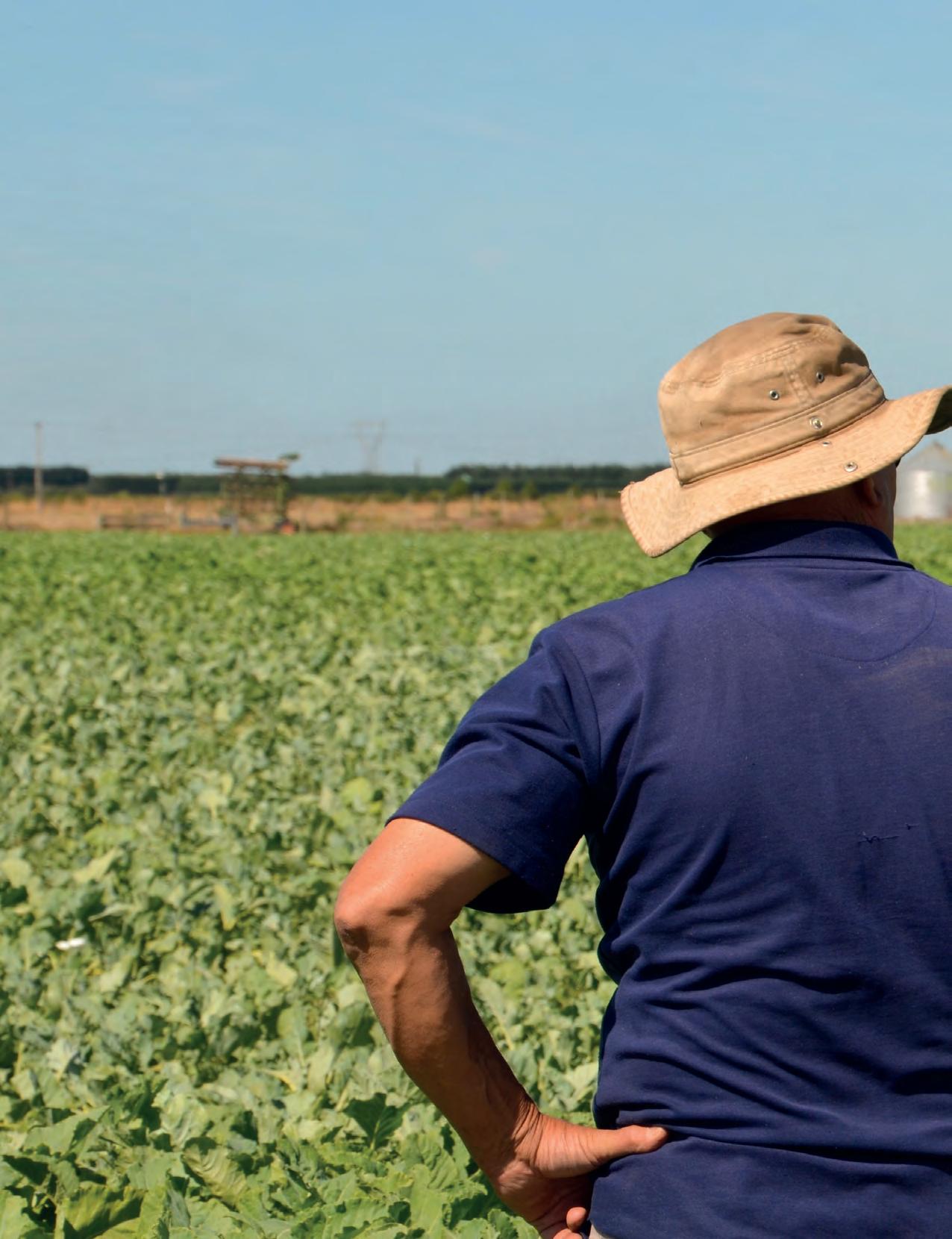
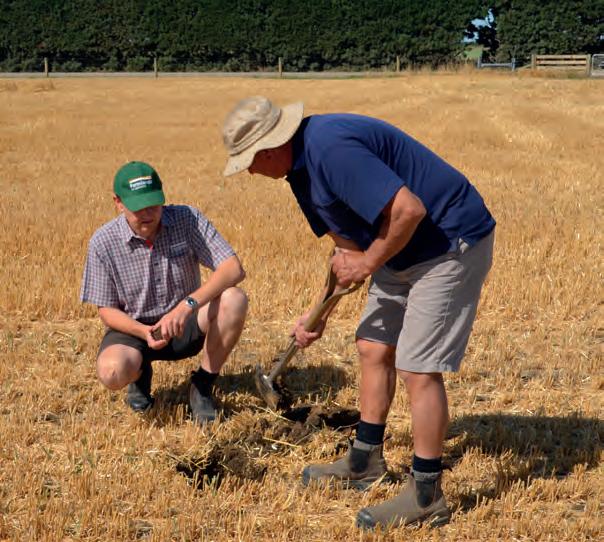
Canterbury farmer Mike Byrnes appreciates the importance of keeping people safe on his property. He is an advocate for embracing the new wave of Health and Safety practices, including farm management software. For Mike, the urge to learn is part compliance for the future – and part lessons from the past.
“From my experience in prior occupations, I’m allergic to paper-based systems, stuck away in an office somewhere,” he says. “I think that smartphone technology and good software apps give us an opportunity to avoid those cumbersome, paper-based systems.”
He jokes about the “allergy” – but not about the dislike. Mike says that he had decided there had to be a better way than paper-based compliance, “10 years before this technology became available”.
Mike owns 50 acres at his home property near West Melton – and another 300 acres further along the line in Aylesbury. Both properties have been loaded on to SafeFarm, which means they can be found in SafeVisit. SafeFarm is a Health and Safety app for farmers and is available free for Farmlands shareholders. SafeVisit is free for anyone and caters to all farm visitors.
“
Most farmers are doing the best they can when they walk out the door but there are so many factors they are juggling. That is why a simple system that supports safety of those on-farm needs to be easy and quick to use.
Mike says with the advent of the smartphone and apps, products like SafeVisit have the potential to make it easier to operate the farm’s Health and Safety system. With winter lamb finishing at the home property complemented by arable crops, winter lambs and winter dairy grazing at Aylesbury, there is plenty of traffic popping onto his property.
“In a farming situation where your property has multiple points of entry and you have contractors arriving with large items of plant – if we’ve got a paper-based system, contractors arriving with heavy machinery have to drive up to your house or shed to sign induction documents,”
Mike explains. “We can avoid that by using something like this. People arriving in tractors, trucks and harvesters
– we don’t want them making unnecessary incursions onto the property just to sign in. We want them to go to the part of the farm they have to and that’s it.”
Mike believes the success of SafeVisit is dependent on uptake by the farming community. He says by making the software free to everyone, hopefully contractors and other visitors will come on-board.
“I’ve had a smartphone since the (2011) earthquake but it’s not my competence with technology that would be the issue – it would be the apps,” he says. “New apps and integration keep coming along – for instance I can check and have some limited control of my irrigator via an app on my smartphone. But it’s the development of those apps more than my own capabilities, because the apps themselves are reasonably easy to use.”
Mike says there are proactive people in the industry “well ahead of me” when it comes to embracing technology. His passion to use the app is not only to address serious injury but other aspects of Health and Safety as well.
“I think it’s two things – we’ve got to focus on not only the safety but also we’ve got to avoid injuries caused by repetitive or unnecessary strain. Both accidents and strain injuries affect your working life and also your personal life.”
Whatever the method of keeping our farmers safe, attitude needs to be the first step. In addition, other business owners also need to understand that when they are performing tasks on someone else’s farm, there are requirements they need to meet.
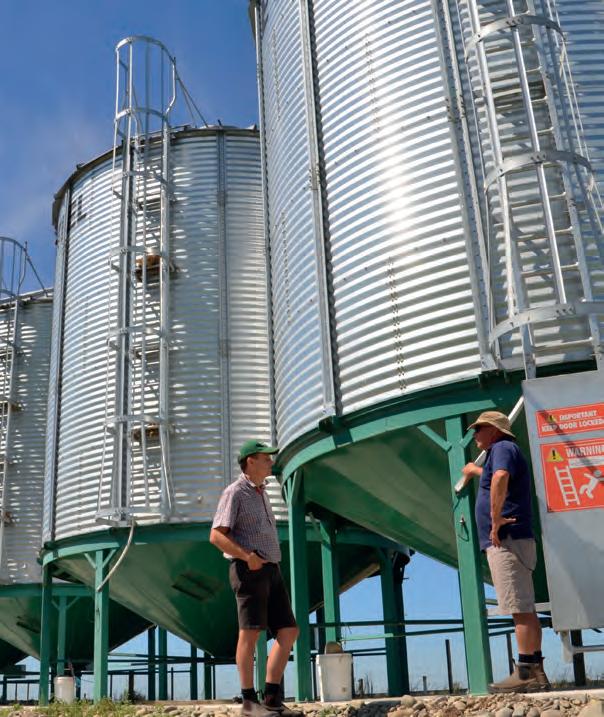
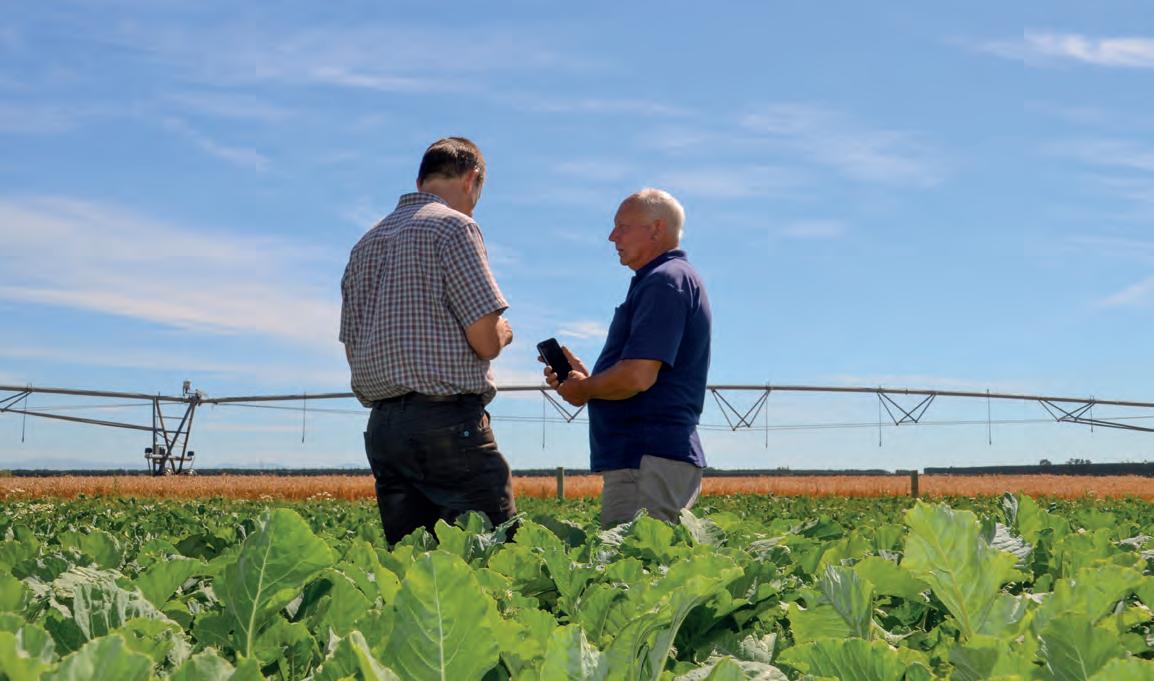
Having educated farmers on the benefits of farm safety for a decade, Bronwyn Muir has a busy résumé – Dairy Farmer, Health and Safety Trainer, Managing Director of OnFarmSafety New Zealand and immediate past President of Taranaki Federated Farmers. As both an implementer and an advocate, Bronwyn is ideally placed to comment on where visitor management sits in the wider scheme of on-farm compliance – and where the rural sector is at in terms of getting its safety sorted.
“Many farmers are challenged by how they keep the way of life that they love, while managing potentially risky situations with multiple stakeholders,” Bronwyn says. “If you consider holidays and weekends, interorganisational projects, or seasonal and environmental factors, the shifting of risk can become quite murky.
“Most farmers are doing the best they can when they walk out the door but there are so many factors they are juggling. That is why a simple system that supports safety of those on-farm needs to be easy and quick to use. The bottom line is, it also needs to produce the evidence necessary in a court of law.
“Compliance may seem costly and resource-heavy but aside from the potentially devastating human cost of failing, one’s business and livelihood could be sacrificed.”
Bronwyn says she was recently on the phone with a farm owner, who liked the digital Health and Safety systems but
didn’t understand the “why”. In his situation, Bronwyn says it was relevant to discuss the crossover in responsibility when a stakeholder comes onto his property, such as a contractor or another landowner using his land for grazing. “The consultative duty is a joint one and he didn’t realise that. Farmers need to be able to communicate this to visitors,” she says. “Other business owners need to understand that when they are performing tasks on someone else’s farm there are requirements they need to meet. It’s hard to have that conversation with them at the right time and to make sure it is recorded. That’s where SafeVisit can help.”
“
We are all responsible for Health and Safety. It is time for the farming sector to speak up and step up.
Bronwyn says the case law in New Zealand around safety scenarios is growing, particularly in terms of cross-duty application. In 2018, the first defended hearing under the Health and Safety at Work Act took place regarding the death of a contractor on a kiwifruit orchard in 2016. The court found it significant the victim was not a “worker” over whom the defendant had any control. The situation might have been different for an employee and that is where visitor management is crucial. The court indicated any business engaging with others should consider the influence or control it might have, as it may mean unexpected Health and Safety duties apply, even for non-employees working at offsite locations. This case emphasised that individual businesses cannot be seen in isolation when they are part of a wider project or industry structure.
Bronwyn estimates that about 50 percent of the agricultural and horticultural community didn’t make any categoric changes or investment when the legislation came out in 2015. “Unfortunately, their word doesn’t carry a lot of weight when under investigation. It’s not just about farming and it’s not about covering yourself. It’s about every business backing up what they are already thinking about, what they may already be doing,” she says. “Most people are thinking it, doing it, saying it. They just haven’t got evidence of it. Farmers need to get the thinking out of their head and record it.”
WorkSafe’s Chief Executive Nicole Rosie recently released an open letter to the agricultural and farming communities of New Zealand urging them to “step up and speak up” on the sector’s Health and Safety performance. She was also interviewed on TVNZ’s Breakfast show on the same issue. Following her comments, Federated Farmers President Katie Milne appeared on Breakfast and Beef + Lamb NZ posted that “talking about farm Health and Safety is never a popular topic but we need to place the same priority on Health and Safety as we do with fertiliser or any input as part of on-farm business as usual activity – we cannot take our foot off the pedal”.
An edited version of Nicole’s open letter is below.
“I watched in amazement last week a TV item about stock rustling in Northland. Amazed that this was going on. But, amazed too that four farmers were filmed for the item riding their quad bikes with not one wearing a safety helmet or with rollover protection. And then by Sunday night we had one farmer killed using a quad and another killed using a side by side. One incident was reported to involve one quad bike, three people and a trailer.
In the last 2 months there have been six fatalities in agriculture – all involved vehicles or machinery – and there lies the fundamental problem. You know the safety risks on your farm, particularly around vehicles, and you know the way to avoid them but too many of you are not doing so. And don’t tell me you don’t know
or that you need more facts before you change.
In the 2 years I have been in this job, the media and communications around safe use of quads, tractors and vehicles on farms has been repetitive and relentless – from the Medical Association strongly advocating no kids under 16 on quad bikes, to Coroners asking for a focus on safer vehicles and roll protection, to the extensive work by ACC, WorkSafe and others to raise awareness of these issues.
To be frank, the farming sector is not different from other high risk sectors that operate vehicles and machinery in hazardous environments. We need to deal with our mindsets, beliefs and practise – the things that really need to change and will make the most difference. This is about leadership, risk management and care for you, your family and your community. The leadership comes from firstly accepting there is a problem and that you need to change to address it.
What is different about agriculture is that there isn’t consistent leadership or focus on wanting to change. Unlike other sectors, there is no sector outcry when six people die in 6 weeks. Sectors that have focused on reducing risks and therefore harm not only have had innovation and Health and Safety improvements but performance and outcomes for their sectors have accelerated. This change will only happen when you individually decide to change and put your focus on solutions, not avoidance. We are all responsible for Health and Safety. It is time for the farming sector to speak up and step up.”
Help make your farm safer with SafeFarm and SafeVisit.
Join us on our mission to make New Zealand farms the safest in the world by using SafeFarm and SafeVisit, the on-farm Health and Safety Management apps that are FREE to Farmlands shareholders.

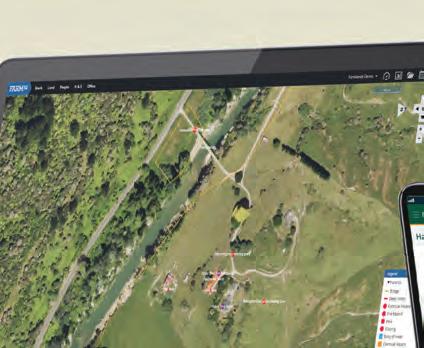


SafeFarm is a complete online Health and Safety system designed for New Zealand farms. It is free to shareholders and only takes a few minutes to set up. Available on desktop and as a mobile app.

SafeVisit is a free visitor management application that works with both SafeFarm and FarmIQ. It allows visitors to book visits and be properly inducted before arriving on-farm. It’s free to everyone in New Zealand.


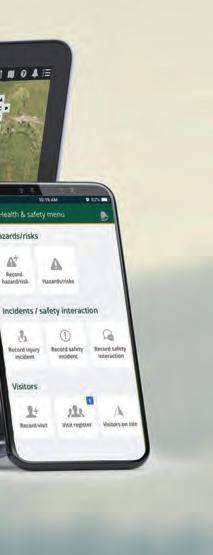
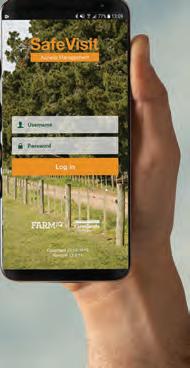







• Access farm health and safety induction material electronically.
• View where other visitors are.
• Pre-book visits and notify property owner of your arrival.
• Learn about new hazards.


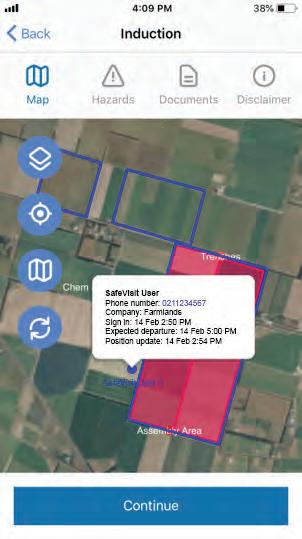



• See who is on your property.
• Notify visitors of hazards during their visit.
• Send broadcast messages in case of emergency.
• See pre-planned visits ahead of time.




To find out more visit www.farmlands.co.nz/safefarms or visit your local Farmlands store. 0800 200 600



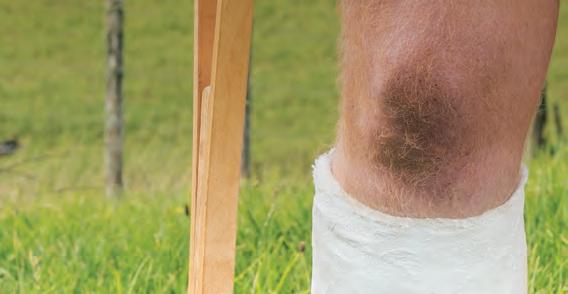
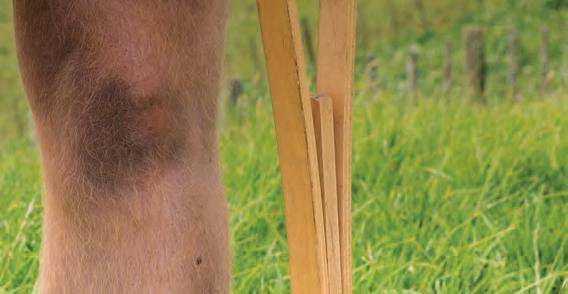
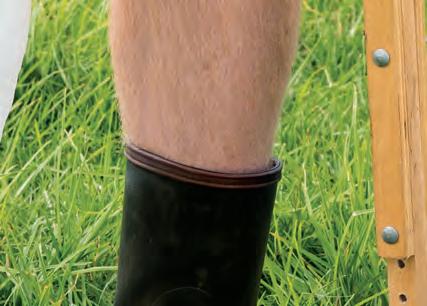
At FMG, we’ve been looking after rural people for over 100 years now. So we’ve become really good at recommending the kind of cover that looks after the most important piece of equipment on the farm – you. It’s the sort of advice that really makes a difference in the country. If you’d like to know more about it, go to fmg.co.nz. Or better still, call us directly on 0800 366 466.
We’re here for the good of the country.


General Manager for Agricultural Leaders Health and Safety Action Group, Tony Watson, says more farmers are starting to make health and safety measures part and parcel of everyday work activities on their farms.
“A common theme now, when I talk with rural merchants, is that they tell me more farmers are providing inductions when they call in at farms,” he says.
“It’s not a long-winded process – but more farmers are expecting people to sign in and giving them a brief outline of what the risks are on the farm and the farm’s rules and safety expectations. Sometimes it’s just a chat, other farmers are using phone apps to make it easy to go over the things they need to. However they do it, it’s good to see that it’s happening.”
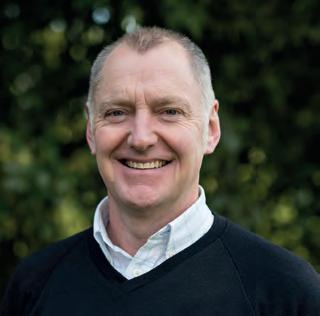
| Tony Watson, General Manager for Agricultural Leaders Health and Safety Action Group.
ACC statistics also suggest that more farms are developing a more effective health and safety culture. Fewer farmers died in workplace accidents in 2017 than in any year since 2009. The numbers of people injured on farms and needing more than a week off work is also declining. However, despite the downward trend, farm workplace fatalities in 2018 were back to the longterm average of 17 people per year. However, while the figures are starting to go in the right direction, Al McCone, Engagement Lead Agriculture for WorkSafe, says the number of accidents occurring on farms is still too high.
March sees the highest number of ACC claims for falls from height on farms and among the highest figures for being trapped in vehicles or machinery, chemical incidents, muscular strains, hitting stationary objects and being hit by falling objects.
“Last summer, almost 550 farmers suffered injuries serious enough to require at least a week off work,” Al says.
“This period going into autumn is often a time when farmers are not as busy with stock and keen to get through a bunch of tasks and maintenance jobs before winter sets in. There are big jobs to do, such as harvesting the winter crops you sowed in summer
– which means using large vehicles or having contractors on-farm.
“So it’s a good time to also take stock around health and safety. Think about the jobs ahead and what the risks might be. If you’ve got people working with you, talk with them about that – including any safety issues they’ve encountered in previous years or anything that’s changed – like new tomos.”
Al advises farmers to keep talking.
“Before you or any of your workers do any job, take a few moments to think it through. What are the likely risks, how are you going to manage them and what are the best tools for it – be it machinery or a vehicle. Choosing the right vehicle for the job – for instance, if you are going to be towing a heavy load – and always wearing a seatbelt in a vehicle are two of the biggest factors in addressing serious accidents on farms.”
Tony says it comes down to a few minutes of your working day.
“It’s about asking yourself: What could go wrong? What am I doing about that? And, is it enough?”
For guidance on developing good health and safety practices on farms, download the Keep Safe, Keep Farming toolkit from www.worksafe.govt.nz
Article supplied by WorkSafe.
















See us for great deals, innovative on-farm solutions, expert advice from the whole co-operative and great subscription offers
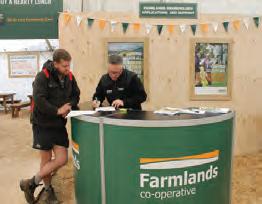




Have a light bite to eat on us
Just show us your Farmlands Card
Available from 11am – 1pm daily



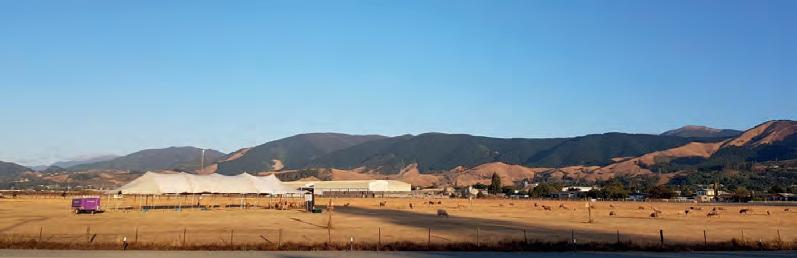
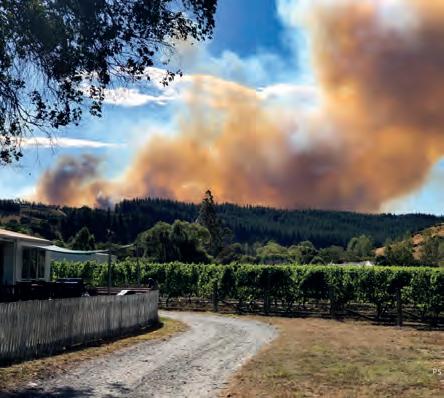
At the time of The Farmlander going to print, the fire which broke out in Pigeon Valley, Wakefield on 4th February was still hampering more than 2,400ha of land – much of it lifestyle blocks – and only some of the more than 2,600 people who had been evacuated from their homes had returned.
With the state of emergency still in place, we touched base with some Farmlands staff to uncover how they had co-ordinated Farmlands’ disaster response and supported our shareholders during this difficult time.
Setting up a hub
Farmlands Sales Manager (Upper South), Frazer Clarke soon found himself the man in the middle of the spinning wheel, co-ordinating multiple relief efforts on the ground. Ex-military and having served in the Middle East, Frazer is experienced in emergency communications and management and these skills quickly came to the fore.
“At the Showgrounds, there were loads of industry groups and response teams milling about – they were keen to help but weren’t always sure how. So, Jan [Federated Farmers] and I started to
take a lead, getting people talking to each other and organising things a bit.”
His multi-pronged approach, in partnership with other membership and voluntary organisations, initiated:
• A large animal housing hub based at the Richmond A&P Showgrounds –holding everything from pet rabbits to mobs of 80 sheep.
• Efficient management of animal feed donations (including afterhours support) to the Farmlands Richmond and Motueka stores and the Showgrounds.
• A call-to-arms for local shareholders to volunteer animal-moving capability, grazing land and animal accommodation.
“The response from Tasman shareholders was very generous, it’s been awesome. We received hundreds of emails and phone calls from those wishing to help in a variety of ways including that all-important shifting of stock from evacuating areas. Many people turned up to the store too –dropping off feed, socks for firefighters, biscuits – you name it,” Frazer says.
Local support was matched from further afield. For example, the
Nelson Fires Hay Convoy was a group setup on social media to move mass donations of hay from businesses in Canterbury and the West Coast to the region. “At last count, we had received eight truckloads from those areas, which was amazing,” Frazer says.
Mobilising together
Farmlands General Manager –Operations, Mal Scrymgeour recalled the successful partnership with Federated Farmers during the Kaikoura earthquakes and so acted quickly to replicate this setup in Nelson. This saw Frazer working closely as a team with Jan Gillanders, Provincial Support for Federated Farmers. When organisations like the Ministry of Primary Industries flew in, Jan and Frazer could provide a cohesive and powerful voice on behalf of farmers. The category team at the support office moved quickly to arrange the movement of product to the region. Extra tanks, water supplies, fencing and animal feed were sourced and distributed to the Richmond Farmlands store as a matter of priority. It was encouraging too, to see suppliers donating product to the cause.
Frazer says the Richmond store was inundated on the Thursday and Friday when the fire turned for the worse and many people had to evacuate. “Unfortunately, another fire broke out in central Nelson on the Friday too. There were hundreds of members of the public coming in and the Richmond team was fantastic, helping everyone out as much as they could. The urgent requests were mainly for
stock and pet feed and sanitisation at that stage. We kept normal store hours but operated on an after-hours call-out basis where needed,” he says.
Our own Farmlanders evacuated
One staff member and Farmlands shareholder who had a frightening first-hand experience of the evacuation was Peggy Storer, a Salesperson from the Richmond store. As a Teapot Valley resident, her rented lifestyle block and pet horse, goats, chickens and dog were only a few kilometres from the fire’s outbreak.
“We were watching the smoke from the store then I got a call from my husband, Alex, saying, ‘we need to get home now’,” she recalls.
“When we arrived, there was smoke all around the house. The kids were upset and it was so hard to work out what we should pack to take with us.
My son took his photos off the wall, my daughter grabbed a lamp and I took a tiki pole that was given to us when we were married – it made me realise we really need an emergency list!”
They managed to get the horse and goats off safely to Peggy’s sister’s property in Ruby Bay but she says it was touch and go rescuing some horses whose owners were away, before the cordon set in.
“Everyone just pitched in and was amazing. I know a shareholder who has 27 refugee horses at her place!”
Having evacuated on Tuesday then returned on Wednesday, they were dismayed to see the fire get quickly and completely out of control. Rikki, the Storer’s beloved dog was trapped at home.
“We were all on the corner of the street trying to get in, with the glow coming over the hill and you could feel the heat. The police let us get in for 5 minutes and thankfully we could rescue her. We were so on edge.”
Safely ensconced at her parents’
place in Nelson, Peggy and Alex set about being useful. Alex used his building and management skills to help Farmlands and Federated Farmers at the Showgrounds with everything from animal handling to fence erecting duties.
Peggy co-ordinated volunteers – taking offers of support and matchmaking with those in need. She found her Health and Safety Officer skills came in handy – such as reminding people to have appropriate sun protection or sturdy footwear to avoid risking injury to themselves and hampering the support effort.
“Alex worked long hours at the grounds and was on-call throughout. My 8 year old daughter, Aspen, was off school and came down to the Showgrounds with me, acting as a runner and pointing people in the right direction,” Peggy says.
“Frazer’s support of everyone was amazing. He put everything into it and his presence of mind was incredible. Even when his family couldn’t get back from Blenheim, when he had to look after his son while doing his job and he missed out on part of his 3 year old’s birthday party, he held everything together.”
When people return to their properties Richmond Business Manager, Mel Aitken predicts that they will evaluate the damage and may then need water piping, troughs, fencing and other maintenance supplies. “We have already shipped in extra stock and so are well placed to meet future need. It is just a waiting game now to see what things look like once the fire has been put out,” she says.
Federated Farmers is still taking offers of assistance – call 0800 327 646 and select option 2.
Assistance appreciated
• Sockworks sent 90 pairs of gumboot socks to the firefighters.
• Gallagher supplied flexi nets to the temporary animal hold at the Showgrounds.
• NRM and Ballance provided extra stock food.
• Humes donated water troughs.
• Purvis Chaff donated 90 bags of lucerne chaff to support the fire horses that were housed at the Richmond A&P Showgrounds.
• Every farmer that required animals to be evacuated or animal feed was made known to Frazer Clarke and was passed on to the Federated Farmers/MPI database. This equated to about 90 cases where farmers/lifestylers required help of some description.
• Hundreds of members of the public came into the Farmlands Richmond and Motueka stores to donate goods and services.
• Hundreds of animals were housed at the A&P Showgrounds in Richmond for a number of days.
• Hundreds of animals were moved to safe grazing land.



















Farmlands has made some significant appointments in key roles within the Farmlands Leadership Team.
The appointments provide proven experience to the Leadership Team, with two of the four from outside of Farmlands. The other appointments provide insight into the clear development pathways within our own business.
Richard Wilkinson has joined Farmlands as Chief Digital Officer, responsible for the Technology team and the growing role technology plays in the co-operative.
With extensive experience, Richard will be instrumental in leading our digital journey – and he’s excited about how much scope there is.
“Whether it’s stuff like e-commerce, IOT widgets or even our shareholders being able to interact with us howthey-want/when-they-want. The opportunities are never-ending and always evolving,” Richard says.
Richard joins Farmlands from New Zealand Rugby, where he was Chief Technology Officer. He has also worked at Fairfax Media, Tourism
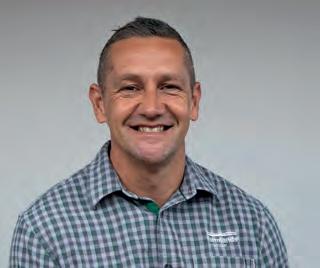
New Zealand, Fonterra and Spark.
He says Farmlands’ transformation programme, Braveheart, drew him to the role.
“In the ‘techo’ world very rarely do you come across true ‘digital transformations’ like what’s being undertaken here at Farmlands. Being able to have that platform to build lots of digital goodness off of was a huge attraction for me and will help us create oodles of cool, new stuff!”
Meanwhile, John Campbell has started in the role of General Manager –Energy. Previously known as General Manager – Fuel, the name change of John’s role has been made to position us for the future, something John says he’s looking forward to.
“Being part of a forward-focused co-operative team that is willing to invest in alternative energy options to meet our shareholders’ future energy requirements is what drew me into this role.”
John has significant experience in the New Zealand Fuel industry, most recently, as Chief Executive of Southfuels Limited and has a strong procurement background.
“On the back of a strong legacy of delivering great fuel and lubricant solutions, I am looking forward to working with the team to build and execute a new strategy which will meet our shareholder and customers’ changing energy requirements,” he says.
Former General Manager – Fuel, Mark McHardy has remained with our co-operative and has moved into the newly created role of Director –
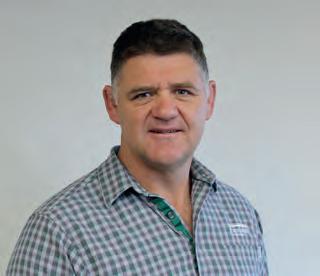
External Relations. This role will involve creating and growing relationships with stakeholders who help us achieve our strategies and fulfil our purpose.
After a decade with the Farmlands Marketing team, most recently as Director – Marketing, Jess Strange has now taken over as General Manager – Card.
Jess says she’s always been passionate about Farmlands Card since starting with the co-operative.
“It is an amazing tool for our shareholders to use with access to over 7,000 Card Partners nationwide. I’m a huge fan of my personal Farmlands Card and I’m constantly amazed by the value that I receive – I just saved $2,000 on a bed at Smiths City!”
Jess excelled in her previous role, which involved looking after the marketing interests of 16 separate brands. She knows our co-operative well and is passionate about helping our shareholders and staff.
“I’m looking forward to providing further value back to our shareholders and there are some exciting developments in the pipeline –watch this space!” Jess says.












Articles in the Plan365 section allow Farmlands suppliers to share best practice and the latest advances in rural technology, to help shareholders with their farming needs all year round.
The later summer months of February and March are a common time for equine breeders to begin the process of separating foals from their dams – and correct nutrition is essential for what can be a stressful time.
Planning is required and strategies for weaning will differ according to facilities available, as well as procedures adopted to minimise stress and make the process as smooth as possible. The herd nature of the horse means they are required to have constant company and while larger establishments will often wean foals so they are paddocked together, owners with single foals will require another equine companion for them.
To meet the increased energy and nutrient requirements of the lactating mare prior to weaning, in most cases a balanced broodmare feed such as NRM Evolve or McMillan Broodmare along with adequate forage in the form of pasture, hay or other fibre products is required. It is essential that the foal becomes accustomed to eating the hard feed before weaning, as this minimises complications associated with introducing a new feed at the same time as the stress of separation. This often occurs naturally by sharing the mare’s feed. In most cases, broodmares are less affected by weaning and some will be more than ready to be separated from their young, energetic offspring. This is often the time when mares will gain weight, as lactation gradually ceases and energy is no longer required
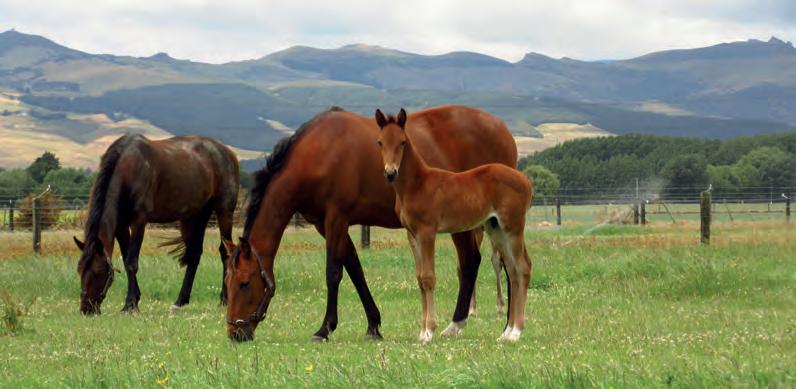
for milk production. Mare dietary alterations should therefore occur according to body condition and most mares will require less hard feed than when they had a foal at foot. Mares who gain weight easily can be transitioned onto a balancer pellet such as NRM Mare Balancer to ensure nutrients are still supplied in the diet without adding calories and contributing to weight gain. Most foals are weaned from at least 5 to 6 months of age and by this stage they are independent and able to consume any forage or hard feed required. The time of growth between 6 and 12 months is crucial for skeletal development, as the risk of developmental orthopaedic diseases is high. Research has shown that to minimise the risk of conditions such as osteochondritis, physitis and wobblers developing, the most important considerations are to achieve steady growth and to provide a low glycaemic diet that is balanced with all
essential vitamins and trace minerals. Steady growth in weanlings is achieved by monitoring condition carefully and avoiding any rapid changes to energy intake. While many stud managers have a highly experienced eye and can spot changes in body condition quickly enough, weighing and measuring weanlings gives much more accurate readings, as well as the ability to compare values as they grow and to look for any significant changes. Providing the best diet for the growing horse requires adequate forage and the selection of a breeding feed that has a low glycaemic index (to avoid peaks in blood glucose) and is balanced with all the nutrients essential for optimum growth and development. For assistance with feeding plans for growing horses and broodmares at any stage of pregnancy, consult with an experienced equine nutritionist.
Article supplied by Luisa Wood, Equine Nutritionist.
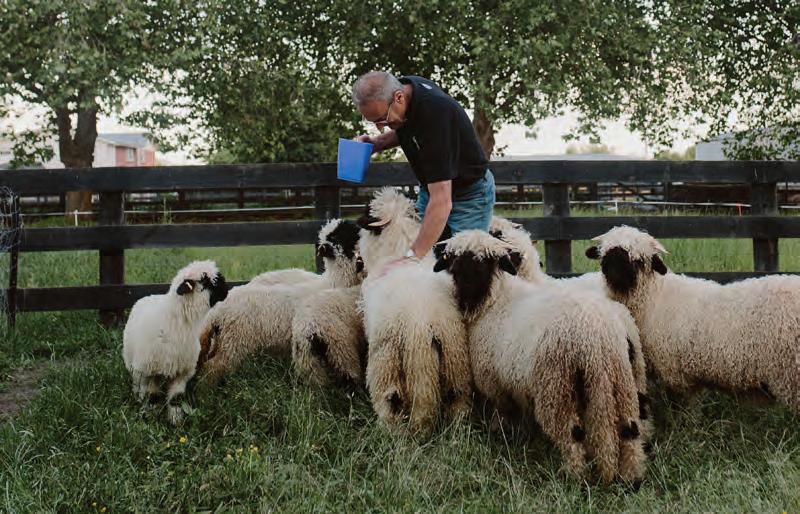
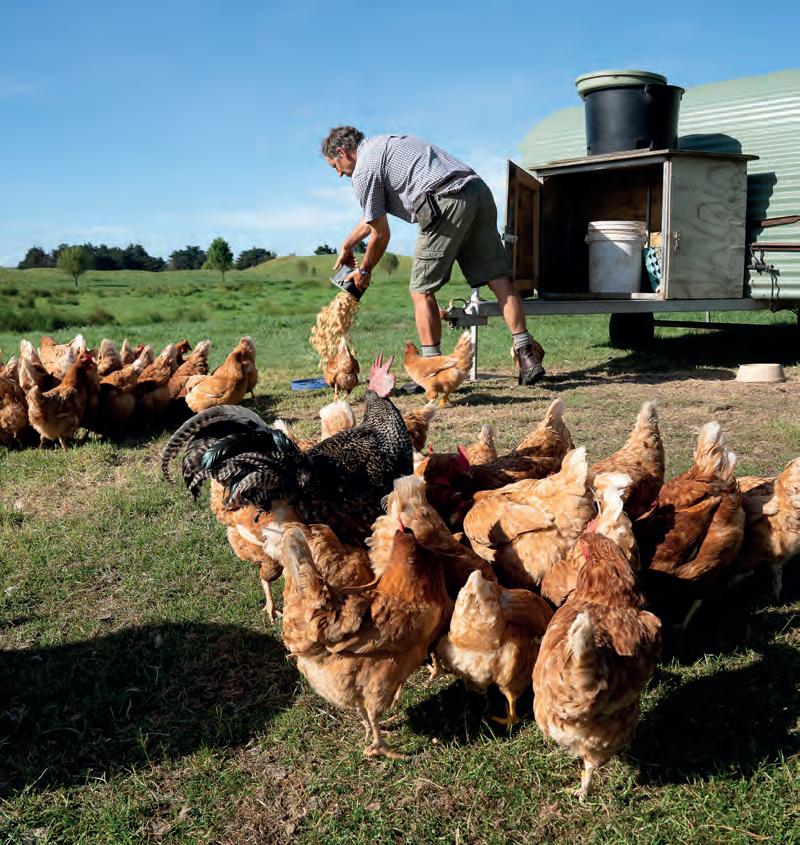
Health and Safety on farms can extend to what is fed to animals to keep them as healthy and safe as possible. Some animal feeds are surprisingly dangerous to some classes of stock, so it pays to read and understand the label when feed arrives.
There are a few things to be aware of when choosing a feed for your animal.
Coccidiostats
Coccidiostats are often found in calf, lamb, chick, dairy and some rabbit feeds and are important for these species to prevent a common parasitic issue. There are different forms of coccidiostat with different names such as Bovatec®, Rumensin®, Deccox® and Cycostat®. If a feed
contains a coccidiostat, it should be stated on the label along with clear feeding instructions. Coccidiostats are classed as ACVM registered additives, meaning they can only be fed to approved species and may have withholding periods for eggs and milk, so it is important to check the label for this information. One major thing to note when it comes to coccidiostats is that some animals are very sensitive to them and it may cause health issues, or even death, if consumed. These animals include dogs, horses, donkeys and all camelids such as alpacas and llamas – it is therefore extremely important to ensure these animals cannot access coccidiostatcontaining feeds. If accidental ingestion occurs, contact your vet.
Calcium, magnesium, sodium and phosphorus are classed as macrominerals and the level required per day by an animal can differ greatly depending on their physiological state. For example, a laying chicken making an eggshell a day needs a lot more calcium than a young chick and a lactating animal needs more calcium than a non-lactating animal to make milk. Growing animals also need the correct balance of macrominerals to support skeletal growth. If an animal is fed too much of a macromineral it can cause health issues. For example, feeding too much calcium to an animal that doesn’t require it can cause kidney damage. On the other hand, too little of a macromineral can also cause issues. For example, low calcium in a dairy cow diet causes milk fever. It is therefore important to stick to feeding recommendations and give an animal the correct feed for its current state and change feeds as they move from one stage to the next.
Micronutrients include trace elements such as copper, selenium, iodine, zinc and manganese, as well as vitamins such as vitamins A, D and E. These nutrients need to be consumed in small quantities a day but can have a big impact on health. Just as with the macrominerals, the requirement for micronutrients varies with the species and physiological state. A good example of this is copper requirements. Cattle require more copper per kilogram of body weight compared to
sheep, so if a cattle feed with a high level of copper is fed to a sheep for an extended period, it can cause copper toxicity (this is the same with calf vs. lamb feed). Even within some species the requirements may be different. For example, lactating cow feed will often contain high rates of copper, which makes it inappropriate for calves. Some multi-feed options such as NRM MultiFeed Nuts have a safe level for a wider range of species. Always check the product label to ensure a feed is approved for use by your target animal.
“Some animal feeds are surprisingly dangerous to some classes of stock, so it pays to read and understand the label when
feed arrives.
Ruminant protein-containing feeds
Is it against the law in New Zealand to feed ruminant protein to ruminant animals (this includes cattle, buffalo, sheep, goats and deer). This is due to the risk of bovine spongiform encephalopathy, also known as “Mad Cow Disease”. Ruminant protein can be included in some animal feeds such as dog and cat food, plus some pig and poultry feeds. Even feeds that do not contain ruminant protein in the formulation but are made in a feed mill that handles ruminant protein still cannot be fed to ruminants,
due to the risk of contamination during manufacture. All products that fit into this category must be labelled on the front of the bag. Small differences can make big differences, so be aware of this when making feed choices for
your animals to ensure they are as happy and healthy as possible.
Contact your local Nutrition Specialist if you are considering feeding something that is not detailed on a product label.
Article supplied by Stacey Cosnett, Nutritionist.




























If you have studied the DairyNZ Economic Survey data over a number of years like Wales and Kolver (2017) and concluded that supplementary feeding cows is good for profitability/ha, return on assets and equity growth, when is a good time to increase supplementary feeding?
Whatever system you currently follow, I think the last 3 months of lactation are an ideal time to give cows more feed because they are:
• Free from the metabolic issues and slow rise in dry matter intake which limits them in early lactation.
• Free from the pressures of trying to mate whilst eating pasture, which is also trying to reproduce.
• Past the challenges of summer such as heat stress and facial eczema.
Late lactation provides a great opportunity to increase milk volumes and set cows up better for the next lactation.
As indicated by the DairyNZ Key Performance Indicator table (see below), a key benefit of increased feeding is increasing the days in milk. Although cows fed more produce more milk, they typically have additional
energy and protein to partition to recovering weight (from muscle, fat and bone density) and can be dried off later, provided supplements are high quality.
A 500kg cow needing to gain 0.5 BSC over 90 days needs to gain about 200g/day, requiring about an additional 10MJ ME per day, so high quality supplementary feed is usually the best complement to high quality autumn pasture.
Substitution will mean that when fed supplements, the pasture intake per cow will drop slightly but managed properly, in the long-term, the pasture eaten per hectare should be the same across all systems.
DairyNZ’s Dairy Cow Annual Requirement table suggests that cows giving 400kgMS need to eat an extra 700kgDM at 11 MJME/ kgDM to increase milk production by 100kgMS – a response of 142gMS/ kgDM – which is why supplementary feeding has been so beneficial in terms of profits and efficiency.
Where herds have never received supplementary feed before, the response in the vat may be subdued as they divert more of the additional
nutrients into growing and body condition. I think it is better to introduce cows to supplements in late lactation to increase income, rather than leaving improvements to the dry period or early lactation when conditions may work against you. Where cows have been fed supplements in the spring, feeding in the autumn is likely to increase the days in milk and reduce the decline in milk produced per day. System 4 and 5 farmers should be planning to feed through autumn but may wish to review which supplements and feeding levels are most appropriate this year. In-shed feeding provides a convenient, low-waste and reliable way to deliver high quality supplements to cows.
With the introduction of Fonterra’s FEI and exceptional grass growth in some regions this season, we are seeing a move away from straight PKE towards blends and compound feed. For further information, contact your local Nutrition Specialist who can recommend the best available options in each region.
Wales and Kolver. (2017). Challenges of feeding dairy cows in Australia and New Zealand. Animal Production Science, 57, 1366-1383.
Article supplied by Dr. Rob Derrick, Lead Nutritionist.
kgMS320-340 kgMS340-360 kgMS360-420 kgMS 500375-400 kgMS375-400 kgMS400-425 kgMS425-450 kgMS450-525 kgMS Canterbury and Southland 400-320-340 kgMS340-360 kgMS360-380 kgMS360-420 kgMS
500-400-425 kgMS425-450 kgMS450-475 kgMS450-525








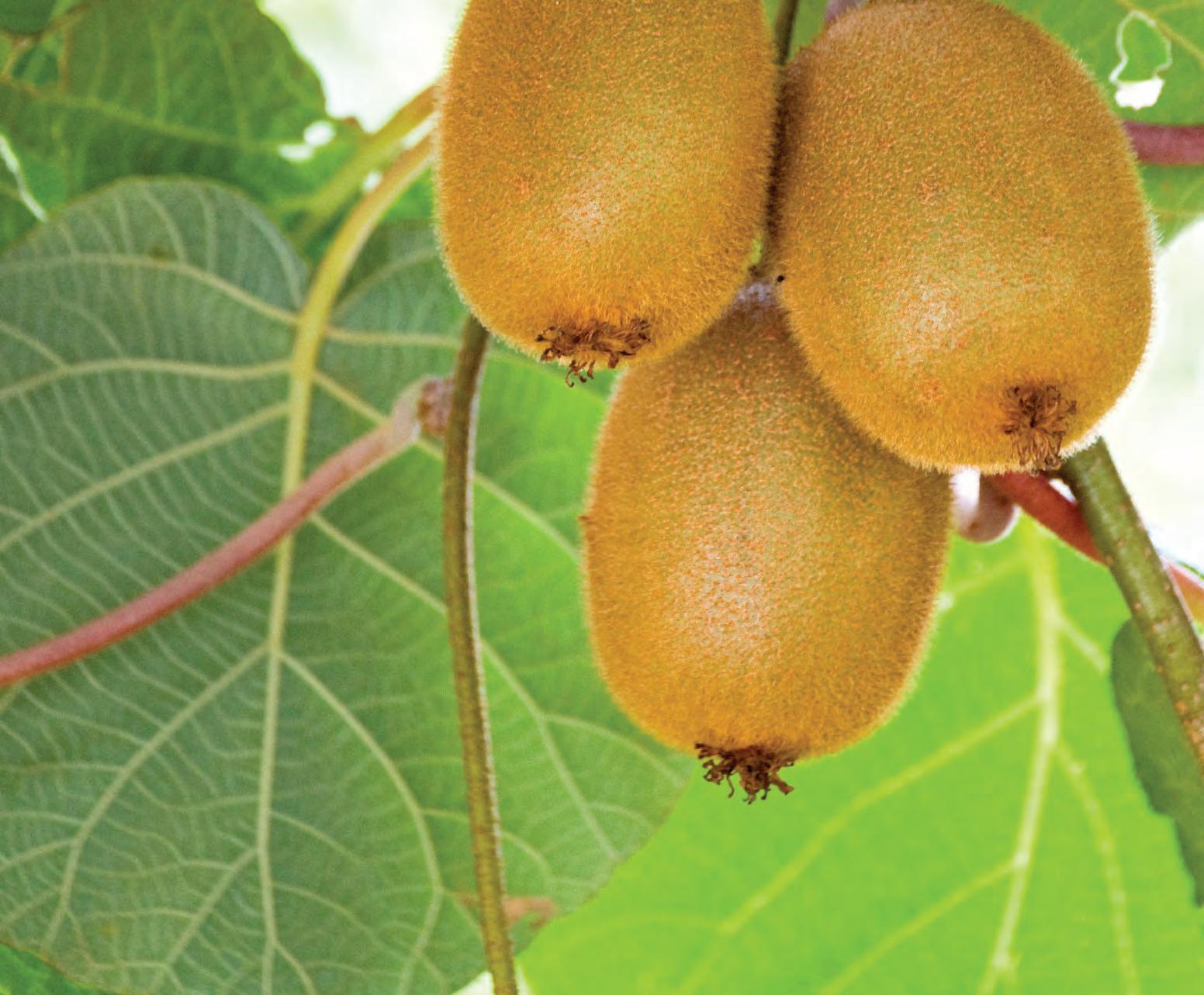

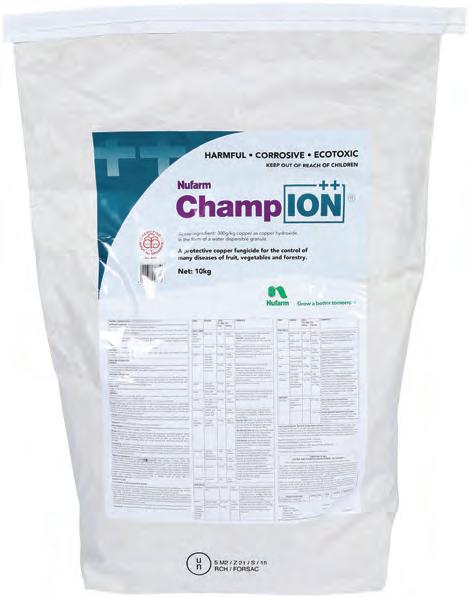
ChampION® ++ is a unique copper formulation developed by Nufarm® to control a range of bacterial diseases on fruit, vegetable and brassica crops. Its small particles give excellent coverage and disease control at low use rates. ChampION® ++ contains a highly efficient environmentally friendly bio-dispersant suitable for conventional or organic use.

Available in a user-friendly 10kg bag exclusively from Farmlands.

For further information, contact your Farmlands Technical Advisor or the friendly team at your local Farmlands store.

Plan nitrogen applications more effectively with a new tool.
With farmers facing increasing pressure to use nutrients more efficiently, nitrogen is increasingly in the spotlight. Nitrogen efficiency is all about minimising nitrogen losses, so the nitrogen can be used on-farm and negative environmental impacts avoided.
“Improving your nitrogen efficiency isn’t just about reducing your environmental footprint – it’s also about improving your financial returns,” Ballance Agri-Nutrients Precision Agriculture Specialist, Ollie Knowles says.
To help pastoral farmers improve their nitrogen use efficiency, Ballance has developed a software tool, My Pasture Planner. It helps farmers identify the most responsive areas to apply nitrogen fertiliser and at the optimum rate. “My Pasture Planner incorporates the expertise of AgResearch scientists, giving you the best nitrogen application solutions, right at your fingertips,” Ollie says.
The software uses total soil nitrogen test (soil Total N test) information. A soil Total N test, done to a depth of 75mm, determines a soil’s potential to supply nitrogen for pasture growth. It identifies areas that will be more responsive to nitrogen fertiliser, so nitrogen application rates can be tailored accordingly.
My Pasture Planner helps you explore the possibilities and check or adjust your nitrogen application rates. “If some areas have low and some have high soil Total N, you can use the same amount
of nitrogen fertiliser but apply more where response is likely to be greater and less in other areas,” Ollie says.
“If all areas have high soil Total N, My Pasture Planner can help you to predict likely responses, rather than assuming a typical year-round average of 10kg DM/kg N. You can also identify which months give a greater return from nitrogen application, by using soil nitrogen levels combined with built-in pasture growth rate data.
“If all areas have low soil Total N, you can get a better idea of responses, instead of using industry averages. You can improve feed budgeting and economical use of nitrogen fertiliser as a low cost supplementary feed. You can also explore the opportunity to support pasture growth and persistence by increasing your nitrogen application rate.”
Farmers can easily access outputs from My Pasture Planner, as it is integrated with MyBallance, an online secure place to keep farm fertiliser information. “Mapping capability makes it simple to create a 12 month nitrogen plan.
The MyBallance integration means you see a fertiliser recommendation mapped out for your farm,” Ollie adds. Ballance has updated and enhanced N-Guru to produce My Pasture Planner. My Pasture Planner is owned exclusively by Ballance and is available to Ballance customers registered with MyBallance. Existing Ballance customers can register at www.myballance.co.nz.
For further information, contact your Farmlands Technical Field Officer or the friendly team at your local Farmlands store.
Article supplied by Ballance Agri-Nutrients.








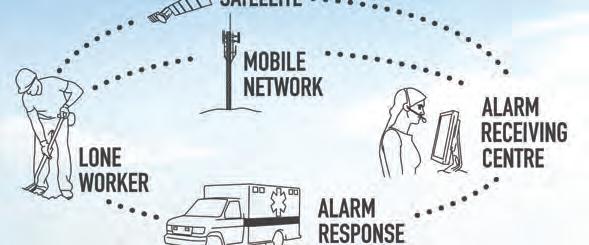
and ManDown detection, which senses if you are
In the event of an incident, a phone call and location text is sent to our St John monitoring team who will send the appropriate help to your location. The ManDown feature means that even if you are unable to raise the alarm, the St John team will receive your location via an alert within two minutes of you being down.



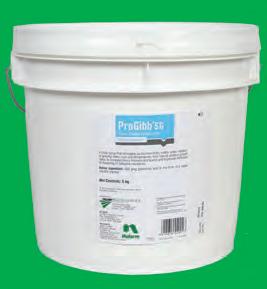
This autumn boost your pasture growth and improve your milk solids production with ProGibb SG. It’s proven to boost dry matter yield in ryegrass and clover pastures by 30-60% within just 3-4 weeks of application. Tested for New Zealand’s tough climatatic conditions, ProGibb SG, stimulates rapid pasture growth so you can improve your livestock performance and condition.
Talk to your TFO today about how ProGIbb SG can help you become a pasture pro. nufarm.co.nz
® ProGibb is a registered trademark of Valent








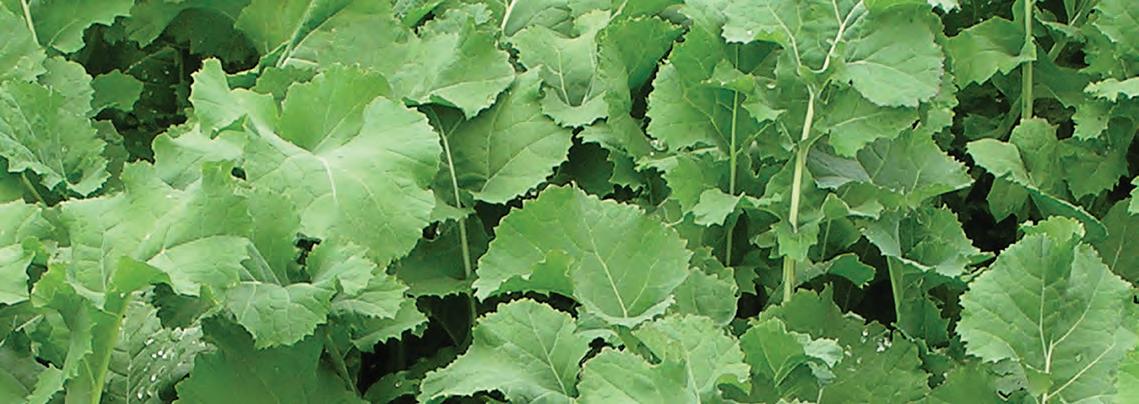


















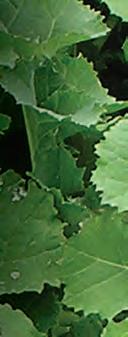



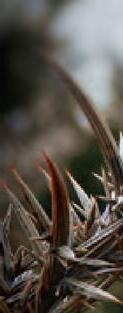









Crop farmers in New Zealand must put more effort into monitoring their crops for slug damage to avoid a repeat of the damage seen in the past.
Abie Horrocks, Research Manager (Environment) at the Foundation for Arable Research (FAR), warns that while spring’s weather will ultimately dictate the impact of slugs on this year’s crops, the current trend embracing reduced tillage means slugs are now an increasingly troublesome pest.
“Don’t wait until you can see slug damage in the crop, by then the slug population will likely be so high that you’ll be on the back foot with control,” she says.
“Regardless of slug problems in the past, monitoring the in-crop populations – especially through the all-important establishment phase – is crucial. It’s so easy to get complacent and then you’ll get taken by surprise when the slug population erupts. It is not uncommon for slugs to outnumber baiting points, so managing before populations escalate can help.”
Monitoring is particularly important in susceptible crops such as clover, seed grasses and brassicas but all other crops, including cereals, can also suffer damage. “Establishment is when crops usually face slug problems, so warning bells should go off if the crop is being drilled in generally wet weather, or if it is slow to emerge or grow through the early vulnerable stages,” Abie says.
“It’s important to think about incorporating a slug control strategy into your overall cropping plan, which involves much more than monitoring
alone. For example, pay attention to seedbed quality. Aim for good seed and soil contact and coverage, which prevents slugs from moving through crevices in the soil where they can readily access the seed.”
Natural predators are worth encouraging. Carabid beetles – of which New Zealand has three native species that are commonly found in the paddock – are keen slug predators, especially at the immature stage. “Carabid beetles can make a valuable contribution to slug control, reducing the need for, and frequency of, pellet applications. But you’ll need to be careful with insecticide use to encourage populations,” Abie notes. “Carbamate-based products, for example, are not ‘beetle-friendly’.”
Including the grey field slug, four species of slugs are agronomically significant in New Zealand agriculture – research carried out by FAR and Plant and Food Research (as part of a Sustainable Farming Fund project titled “Integrated management of slugs in New Zealand cropping systems”) suggests the two that are the most common are the grey field slug (Deroceras reticulatum) and the brown field slug (Deroceras panormitanum). “The grey field slug is the one to look out for,” Abie warns. “Lab trials suggest the grey field slug responds most quickly to changes in moisture and causes up to four times more feeding damage.”
While knowing which species are present in a crop won’t affect the overall strategy, Abie encourages farmers to identify species during monitoring so they can react accordingly.
FAR’s recommendation on slug monitoring has been welcomed by crop protection company
Lonza. Lonza’s Business Development Manager, Mike Swift says there has been a big change in Europe over the last 10 years, with much greater emphasis on awareness and pre-emptive control strategies that involve population monitoring to stay ahead of the game and a move away from the “one-size-fitsall” approach to slug control.
“There’s a growing realisation that slug control should be part of the same, modern precision-led approach to crop protection that we adopt with products such as fungicides,” he explains. “Where several factors contribute to an effective decision-support system. European farmers are now much more aware of the importance of monitoring and understanding slug populations.”
Lonza is the leading supplier of solutions for professional growers and amateur gardeners alike across all the main continents, including the control of mollusc pests.
Axcela® is the new slug and snail product manufactured via a unique wet-extrusion process by Lonza. It combines the advantages of the specific mode of action of Meta® Metaldehyde with the latest formulation techniques, to give these pellets the highest level of control over slugs and snails under a wide range of conditions. For further information, contact your Farmlands Technical Field Officer or the friendly team at your local Farmlands store.
Article supplied by Lonza.







The use of flexible mixed clover finishing systems has recently been gaining traction with New Zealand farmers.
The increased persistency and rapid liveweight gains achievable with the addition of clover has helped Taumarunui farmer Scott Hill achieve far greater farm gate returns.
Scott is the owner and manager of a 98ha lamb finishing and dairy grazing block near Taumarunui. He faces a number of challenges on his farm from pest pressure (commonly found in the King Country), along with free draining pumice (which although good in the winter months, proves to be a challenge in the summer months).
Following advice from other farmers and his local Farmlands Technical Field Officer Vanessa Hughes, Scott put a mix of Relish red clover and Asset AR37 Italian ryegrass into his system at a rate of Asset AR37 18kg/ ha, Relish red clover 4kg/ha and an addition of Tribute white clover 3kg/ha. Relish red clover has had multiple years of proven outcomes as a high powered specialised feed for lamb finishing. In the past, red clover has been viewed as a short-term option, however Relish red clover is a major advancement in persistence and is an option that can be considered for 2-3 years plus.
The addition of Asset AR37 to the Relish proved valuable for Scott in the winter, providing a muchneeded punch in productivity.
Asset’s density is a significant trait for making it user friendly and persistent especially with winter
grazing under trying wet conditions, which normally has a big impact on the success of short-term pastures. It didn’t take long to see the benefits gained through this mix. “It was very fast to establish and the production has already been impressive – the first cut we did harvested 3,000kg DM/ ha of high quality feed. The Asset Relish mix produced a lot of very high quality feed, which is why I wanted to cut and bail it,” Scott says.
The King Country is challenged by a number of pests including Argentine stem weevil and black beetle, which can dramatically affect the persistence and production of forage grasses. “Anything without endophyte hardly lasts 12 months,” Scott says. AR37 endophyte provides the best longterm, natural protection to several pasture pests not only in the King Country but right across the country. To maximise the production and
persistence of the Relish red clover Asset mix, best management practices suggest rotational grazing with pregrazing heights of 20-25cm leaving a residual of 4-5cm. The spring growth of Relish is very rapid and being well prepared to utilise this growth is key. This requires an increased stocking rate to maintain quality, or as Scott has done, utilise this for high quality silage. Coming into the autumn months it is important to give it a tidy up before shutting it up for winter feed. If too much dead material builds up in the second autumn or winter, ongoing productivity can be compromised.
The flexibility and the user-friendliness of the Relish red clover and Asset mix has made it a good option for a number of farm systems. For further information, contact your Farmlands Technical Field Officer or the friendly team at your local Farmlands store.
Article supplied by Agricom.



Nufarm’s WeedMaster® TS540 with Twin Salt™ technology is a powerful non-selective herbicide that is 50% stronger than 360g/L glyphosate formulations.
• Excellent control of target species.
• Fast uptake and brownout.
AS WELL AS PRACTICAL BENEFITS:
• Lower per hectare application rates.
• Low temperature storage stability.
• A free flowing easy to pour formulation, which speeds up mixing and turn-around time.
• Stability for at least five days after mixing in the tank. This ensures a quality job even when the weather delays spraying.
1
2
Identify your weed problems and apply WeedMaster TS540 rate per ha for the hardest to kill species (as per label instructions).
Decide when you will be spraying i.e. allow adequate time for a successful spray.
Decide if a Nufarm companion herbicide is required. 3
4
5
6
Ensure you mix your chemical(s) in a clean tank.
Ensure you know the right mixing order – i.e. If adding Pulse® Penetrant or any companion herbicides.
Check plant back periods as well as grazing, milk and meat withholding periods post application.
































Feed efficiency measures the ability of cows to turn feed nutrients into milk or milk components. In the simplest terms, it is the kilograms of milk produced per kilogram of dry matter consumed1. With our mainly pasture-based systems, this is not something we think about a lot in New Zealand. But perhaps we should.
Feed efficiency becomes increasingly important during times of decreased profit margins (high input and low returns) and with New Zealand no longer being regarded as a low-cost producer of milk by world standards, profits will be getting squeezed. A way to combat these decreased profit margins is to increase the milk made from every kilogram of dry matter fed. An added benefit to increasing cows’ feed efficiency is that fewer nutrients will be excreted in manure, so feed efficiency affects both economic and environmental efficiency. This is of considerable importance to farms struggling with nutrient and waste management1. It has been shown that feed efficiency is directly related to forage digestibility, in that the more digestible it is, the greater the feed efficiency. Since energy density has the same relationship with feed efficiency, the greatest effort should be applied to ensuring only feeds and forages of the highest quality are fed to lactating cows. Making improvements in feed efficiency will almost always be profitable as it means getting more milk per unit of dry matter fed1
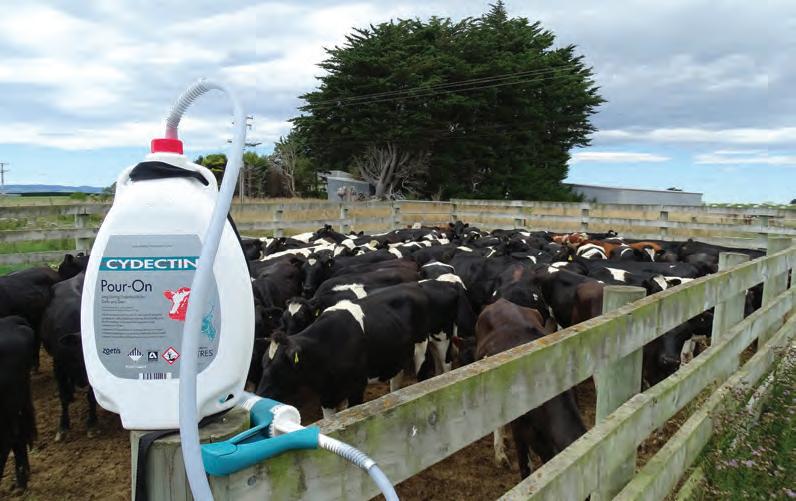
Gastrointestinal parasites can negatively affect feed efficiency 2 . With each mouthful of pasture, infective L3 larvae are also ingested. The parasites decrease appetite and induce an immune response that costs the host animal energy and protein. This parasite challenge is generally highest in the autumn. An analysis of 75 published trials3 has shown that treating cows for parasites can increase production by 0.35kg milk per cow per day. The analysis also found that the endectocides (such as Cydectin® Pour-On) produced better results than the other drenches and that trials where treatment was given in mid-lactation produced better responses than when given at drying off or calving. Cydectin Pour-On has nil milk and
meat withholding periods, allowing you to use it during lactation. It also removes the effects of parasites for as long, or longer than any other pour-on endectocide available in New Zealand (e.g. Ostertagia ostertagi for 35 days), improving feed efficiency for longer. For further information, contact your Farmlands Technical Field Officer or the friendly team at your local Farmlands store.
1. VanSaun, R and White, R. (2016). Feed efficiency in lactating cows and relationship to income over feed costs. Penn State Extension
2. Gibson, T.E. (1963). The influence of nutrition on the relationships between gastro-intestinal parasites and their hosts. Nutrition and the host-parasite relationship. Symposium proceedings, 22, 15-20.
3. Sanchez, J., et al. (2004). A meta-analysis of the milk-production response after anthelmintic treatment in naturally infected adult dairy cows. Prev Vet Med, 63 (3-4), p. 237-56.
Cydectin is a registered trade mark of Zoetis. ACVM No. A6203.
Article supplied by Zoetis.






Physical address: Contact phone number: Shareholder number: Farmlands store:Order number (if required):
Please tick (✓)
Please tick one, defaults to Cattle unless otherwise specified
Cattle tags white only Cattle Deer
Please



Cattle tags white only. For animals that lose their birth tag.
Please tick one, defaults to Cattle unless otherwise specified
Cattle Deer
Qty required
Indicate colour:
Note: NAIT Deer Tags – female is orange and male has a colour choice other than white.
Please

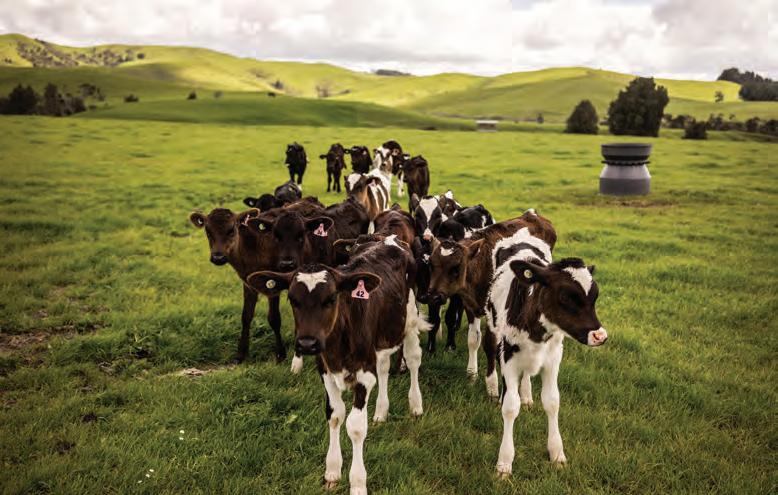
Whether you’re a dairy farm rearing calves for heifer replacement or a dry stock farm growing beef animals, your goals are similar –to produce quality replacement heifers that become high producing cows and will last over time in the herd, or to grow beef animals to target weights faster and in better condition, so they achieve slaughter dates earlier, or on time, at better weights.
One of the simplest and most efficient ways to ensure calves are hitting target weights is regular weighing and monitoring throughout the season. There’s a range of hardware and software solutions available that make life easy for you when it comes to weighing and EID, adding value to your bottom line and ensuring you
meet your compliance obligation too.
Tracking growth using a Tru-Test weighing platform, weigh scales and EID stick reader connected to a livestock management software package like FarmIQ helps improve productivity and animal management within your farming operation.
The process of getting data from weigh scales is simple and effective and the performance benefits can be significant. Once connected to your livestock management software, files containing trait and production data (breed, sex, weight, condition score) can flow in. You can pull data in by EID or mob and use it to drive a range of features and reports, including:
• Tracking animal weights against targets to identify not only top performers but also those calves
that aren’t tracking to weight, so you can separate them out from the main herd and concentrate on extra food or get them vet checked for underlying health issues.
• Performing on-farm trials to compare groups of animals to determine the impact of alternate farm management decisions (e.g. sire genetics) on liveweight production.
• Building a performance history against individual dams within a flock or herd to help identify those animals to retain, mate and terminate.
• Meet NAIT and processor compliance requirements.
Regular weighing allows you to manage animals individually and make the decision to sell at the optimum time to achieve the best price.
It also gives total herd traceability and livestock management software helps record, track weight growth and manage herd genetics, providing an easy to understand graphical snapshot of where your animals are at. Plus, it helps identify trends and lets you make timely decisions on-farm.
You can even download sessions from your Tru-Test devices and upload them directly to your livestock management software, or share them directly with your NAIT account.
For further information, contact your Farmlands Technical Field Officer or the friendly team at your local Farmlands store.
Article supplied by Tru-Test.

At Genesis, we’re putting our energy into rural business. That means we’re making a promise to keep things simple, like being the only supplier for all your energy needs, for all your sites. We promise to health check your plan once a year and move you to a better one if needed. And we promise to develop tools that will make it easier to manage your energy more efficiently. Find out more about the promises we’re making to NZ farmers at www.genesisenergy.co.nz/rural
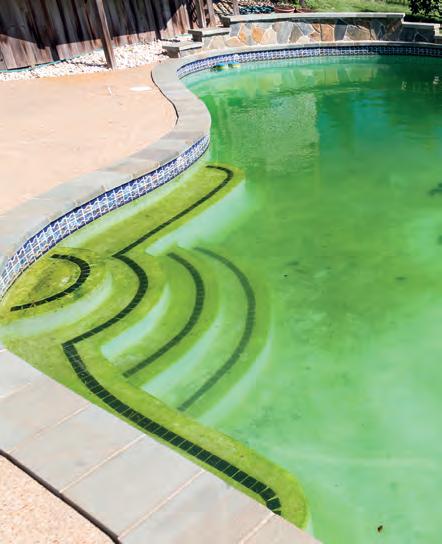
It seems to happen every year – the rain comes, summer memories fade and the pool gets abandoned. Then spring rolls around and you race over to the pool for a pre-season plunge – only to find the frogs and algae have beaten you to it.
At this stage, getting the pool back into top condition for swimming can be expensive and an unnecessary waste of valuable time. However, a little bit of work up-front when you decide to close the pool for winter will help you beat the seasonal changes. It is usually essential to maintain a balanced level of chlorine in your pool over the winter months in order to prevent bacteria and algae growth – but winterising the pool water can replace the need for this. Winteriser is a long-lasting winter solution for swimming pools that provides a low level of sanitation and a high level of algaecide control. Lasting up to 5 months, it is an effective barrier against algae growth through pool hibernation.
Winterisation can save energy, meaning you can save money on electricity bills, while also ensuring your pool is ready for swimming when the weather turns warm again. Take the following steps to keep your pool clean throughout the winter when it is not being used. When you decide to close the pool for winter:
• Vacuum and brush the pool thoroughly.
• Backwash the filter.
• Check that the water is balanced and adjust if necessary.
• Shock with chlorine to lift the level to 10ppm.
• The next day, add Crystal Water Winteriser to extend the properties of the sanitiser. With the filter running, add Crystal Water Winteriser directly to the water around the edges of the pool at the rate of 400ml per 10,000L. Run the filter for 3 hours.
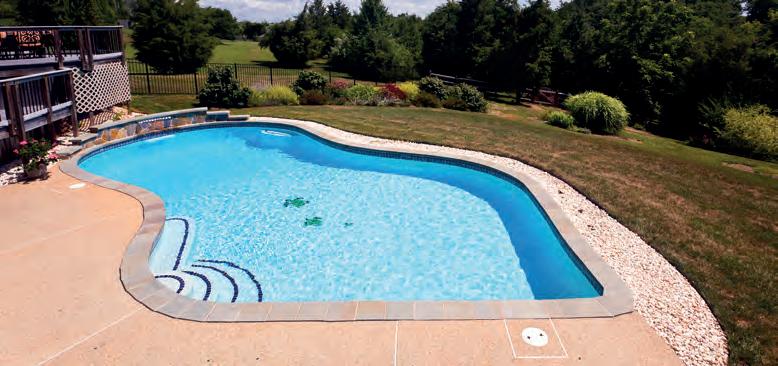
| It is essential to winterise your pool before you close it for winter in order to prevent bacteria and algae growth.
During winter when the pool is closed, for best results:
• Shock with chlorine once a month.
• Run the filter for 2-3 hours per day through winter (or one full day, once a week).
• Backwash filter fortnightly.
• Cover the pool to prevent leaves or debris build up in the pool.
• Prevent frost damage to pool and accessories.
Winterising treatment may need to be topped up depending on conditions and rain splash out. For further information, contact the friendly team at your local Farmlands store.
Article supplied by Space Industries.

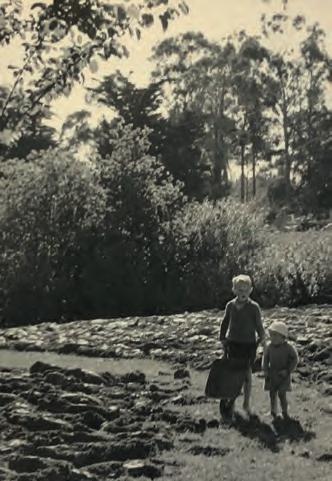
The agriculture, construction and manufacturing industries are the backbone of New Zealand.
Working in New Zealand’s unique and varied climates and landscapes comes with its own set of challenges – but supporting the industries that are at our country’s core has been the focus for one Kiwi family for generations.
“Growing up in our family has taught me to work hard, to innovate and to care about the people,” Delfast National Sales Manager, James Currie says.
“We’re proud to be kiwis. It shapes our family and it shapes our brand.”
James says that his Grandfather, Colin Currie, has always been hardworking.
“He’s always had a passion for people and he’s always put family first.” Several generations on, these commitments have never changed.
Colin, affectionately known to the family as “Papa”, had been farming since high school and in 1960 he took over the family sheep and beef farm in Bunnythorpe, Manawatu.
“Farming sheep means high quality fencing – it’s been in our blood, right from the beginning,” James explains.
“Family comes first for Papa, so in 1964 he made the decision to sell the farm to better support his family. From the farm, Papa moved his family to Palmerston North, where he developed his sales skills with an outdoor clothing company.”
Eventually, Delfast was started by Colin’s sons, Andrew and Ian, in 1992.
“Papa’s ‘sheer hard work’ has definitely been engrained in all of us
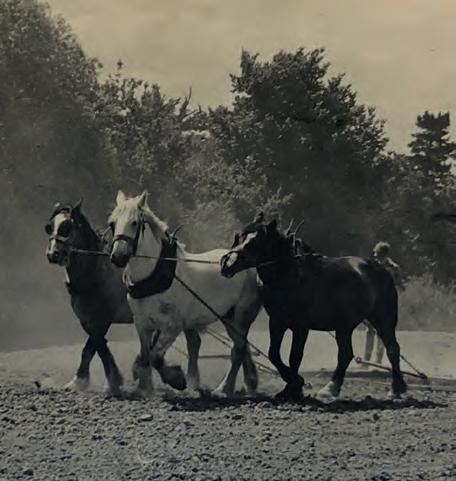
in the family. From the beginning, the Delfast team has consistently worked hard to create relationships with our product users and a reputation of providing every Delfast user with the best service for their products. This commitment to serving our product users has never changed, it has been a key part of who we are,” James says.
“In 1998, we developed a contractors’ stapler that has changed fencing for the better – something we couldn’t have done without the relationships we’ve built with our end users. We saw that our end users needed a better product than what was on the local market. They needed something that would last and worked with the unique conditions they were working in. We saw that our product users were frustrated and we wanted to do something about that.”
The result was a staple product that became a pivotal point for Delfast.
“Not only that, we’ve developed over 1,000 product lines that are ideally suited to our product users’ needs and to the unique challenges of New Zealand’s climate,” James says.
“Papa’s care and commitment to people has remained a foundation of Delfast today. We’re dedicated to bettering the experience for our end users. Our goal is to create an environment where people are confident to own the Delfast products they have. We want to think smarter, not harder for our end-users – to make building the best, effortlessly.”
For further information, contact the friendly team at your local Farmlands store.
Article supplied by Delfast.




“So easy, friendly and helpful” Bridget, Good Eggs, Northland
“Delivery is next day and we are rural”
Carol, John Austin Ltd, Te Awamutu
“Great, easy delivery and superior products”
Sarah-lee, Man O’ War Vineyards, Waiheke
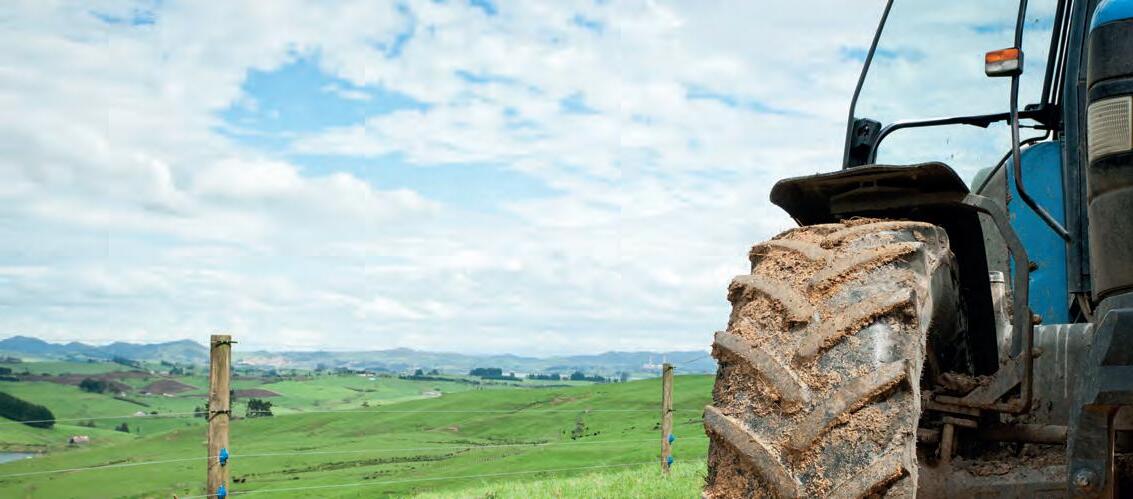
In recent years, portable solar fence energizers have developed as the most convenient and versatile energizers on the market. Innovations in solar technology mean it is now a practical and cost effective solution for electric fencing where mains power is unavailable or portability is required.
Solar energizers are a gamechanger for all farmers wanting to capitalise on the benefits of solar power for temporary or even permanent electric fencing.
Compact, robust and fully integrated with an internal rechargeable battery and solar panel, these energizers are a convenient alternative to batterypowered fence systems. Solar energizers are fully self-sufficient, using solar power to charge an internal battery, meaning it does not require a constant supply of batteries to keep it functioning.
Ease of use really sets solar energizers apart. In the past, you could buy a solar powered energizer but then would have to purchase a separate solar panel and battery to integrate into it. All of which was heavy and hard to transport around the farm. Now, you get the energizer, the battery and the solar panel in one easy to carry package. With a convenient carry handle, they are extremely portable and easy to set up in any location. With only one control switch, you do not have to be an expert in electric fencing to operate it. These solar energizers are incredibly simple to set up and operate.
You just hook it up to the fence and earth stake, turn it on and walk away. There is very little maintenance required, occasionally, the solar panel may need to be cleaned and the connection wires should be checked for damage – but otherwise the energizer will continue ticking without any need to charge or replace the battery. Gallagher Solar Energizers are made using only high quality batteries, which typically last 3 to 5 years.
Gallagher Fence Energizers all undergo significant stress tests to ensure they provide longevity and reliability to farmers. These portable solar energizers are designed to withstand the harshest of farming environments. A super-tough plastic casing and lightning protection ensure they provide continuous pasture, stock and fence protection in all weather conditions. The reliability of the power supply is where the solar range really starts to show its worth. With built-in battery management algorithms, the energizer monitors its power based on how much battery voltage is left. If the energizer experiences periods of little or no sunlight, it will adjust its pulse rate and power output to ensure operation for up to 3 weeks without sunlight.
Each of the Gallagher Solar Energizers can be installed in many different ways – they can be installed on the base of a Gallagher Ring Top Post for portable fencing options or for longer term scenarios, they can be nailed to a wood post or sit on top of a
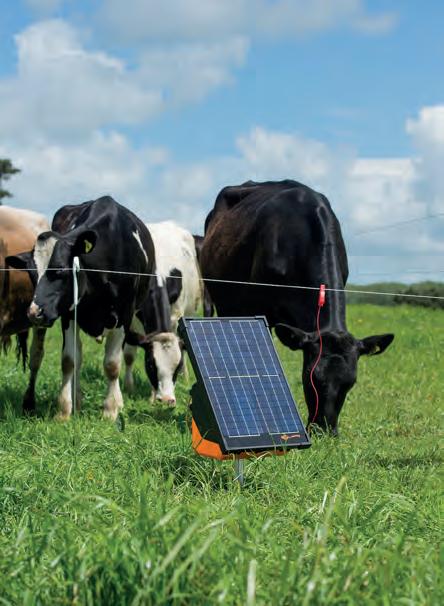
steel post. The base of the energizers allow for 360 degree placement, so that the solar panel can always be positioned towards the sun, regardless of which way the post is facing.
The Gallagher Portable Solar range offers unparalleled convenience, reliability and versatility. With options from 0.1 up to 2 stored joules, these energizers offer an electric fencing solution that works wherever you do. For further information, contact your Farmlands Technical Field Officer or the friendly team at your local Farmlands store.
Article supplied by Gallagher.













Rodents spoil food, spread disease and cause damage by fouling and gnawing. Rodents become more visible and annoying in autumn when they are out looking for new food sources and homes to escape the cooler temperatures.
Rodents are prolific breeders, which means your home and farm buildings could soon be overrun with large number of rats and mice.
As soon as you see evidence of a rodent invasion, that is the time to implement a sensible rodent control plan to keep populations in check. Choosing a bait that is highly palatable with a suitable sized bait station will help you control the situation.
Rats and mice prefer fresh, high quality foods and will reject spoiled or low palatability foods when given a choice, so bait selection is important. A bait with a chocolate lure is very effective –a single feed can become a lethal dose. For successful rodent control, it is
best practice to use a suitable bait station. A well designed bait station ensures the bait is kept dry and fresh, therefore ensuring the feed source is desirable to the rodent. Bait stations secure bait in place and prevent the rodents from removing it to store elsewhere. They also protect non-target species from accessing the bait.
A quality bait station should be lockable, robust, easy to use and well designed to accommodate both rats and mice.
The design should allow for either indoor or outdoor use. Some can be pegged/nailed or screwed down and the wire hoops provided will prevent rodents from removing the bait. The larger designed bait stations can be located along a wall or building to take advantage of the typical hunting characteristics of rodents. Larger sized bait stations allow the rodent to feed inside without the fear of being discovered.
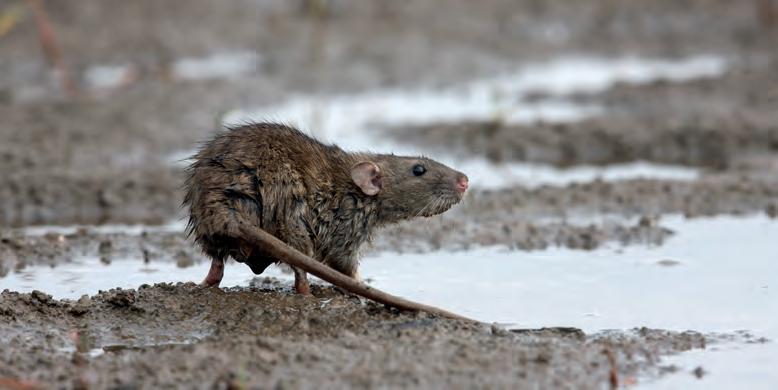
Tips for successful eradication:
1. Do not handle bait with bare hands, as rodents are suspicious of human scent and may avoid baits that have been touched.
2. Ensure rodents do not have access to alternative foods such as stock feed, garbage or human food scraps.
3. Maintain fresh baits by checking and replacing them every two to three days initially and later, every week or two.
4. Be particularly vigilant during autumn when the first cold and wet weather arrives, as this usually drives rodents indoors to find shelter and food.
5. To protect non-target animals from secondary poisoning, collect any dead rodent bodies and burn or bury them. Spoiled or unwanted bait should be disposed of in a similar manner.
Available at your local Farmlands store, PestOff offers a range of bait stations to suit different rodent control requirements. Where infestation is heavy and localised, use up to five bait stations per 100 square metres and in areas where infestation is light and extensive, use one PestOff Dead Rat Café per 100 square metres. For further information, contact your Farmlands Technical Field Officer or the friendly team at your local Farmlands store.






The Grisport Safety Range - Superior comfort and protection. The Hunter Safety (pictured) features a WATERPROOF membrane, steel toe cap and steel anti-penetration midsole, kevlar stitched all leather upper and rugged VIBRAM rubber sole. These features combined help keep you safe and comfortable in the hazards and challenges of farming. That’s why we recommend Grisport.












The vast majority of the New Zealand public recognise the nationwide problem of feral rabbits –especially the damage caused to the environment and to farm production.
Rabbits are New Zealand’s second major vertebrate pest problem after possums. Introduced into New Zealand in the early part of the 18th century for food and sport, rabbits reached plague proportions by the 1880s, seriously affecting the viability of farming in some areas.
Rabbit predators, such as stoats, weasels and ferrets, were introduced by the Government in the 1880s without success and the rabbit problem still remains. Methods such as trapping, shooting, poisoning, gassing and rabbit-proof fencing have become the main means of control. As rabbits are nocturnal they spend most of their day underground in the safety of their burrow, living in colonies or warrens before venturing
out at twilight to feed for most of the night. These warrens usually consist of a series of tunnels and burrows, interconnecting with several entrances. Often when rabbits are observed out and about during the day this indicates an even higher population. The home range of the rabbit is generally 2 to 3 hectares, however they will stray further in search of food.
Pindone is a first-generation anticoagulant poison designed for the control of rabbits in rural and urban areas. The cereal-based pellet is designed to be consumed over several days to be effective. The toxin in Pindone reduces the clotting power of the blood, thereby causing internal haemorrhage. Death occurs 4 to 11 days after bait consumption. While rabbits may be active in the treated area for 4 to 5 days after taking the poison, very few rabbit carcasses will be found as rabbits will usually go back to their burrows to die, making it safer for any off-target consumption.
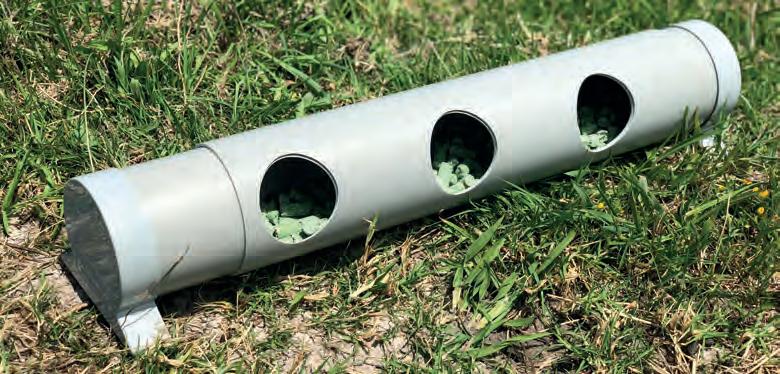
The placement of the bait is vital, so for a successful operation it is critical that farmers lay the bait appropriately.
• Locate rabbit sightings, usually identified via their droppings, short grazing and scrapes or scratchings in the pasture.
• Rabbits are neophobic (they don’t like new things), so place bait stations in all areas where the rabbits are grazing without bait for several days before baiting.
• When applying bait, allow more than enough bait for all the rabbits in the area.
• If all bait is gone after the first night, you have not put enough bait down in the area.
• For the first 4 days, check the bait stations each day to ensure a continuous supply of bait.
• Following this check for further signs at 10 to 14 days and if there are still signs of rabbits, repeat the application.
• Do not lay bait if heavy rain is expected within a day of laying out the bait.
• Bait should always be applied using bait stations. In cases where there is concern about bait being accessible during the day time, use a bait station that can be closed off to stop non-target species getting access to the bait.
For further information, contact your Farmlands Technical Field Officer or the friendly team at your local Farmlands store.
Article supplied by Key Industries.




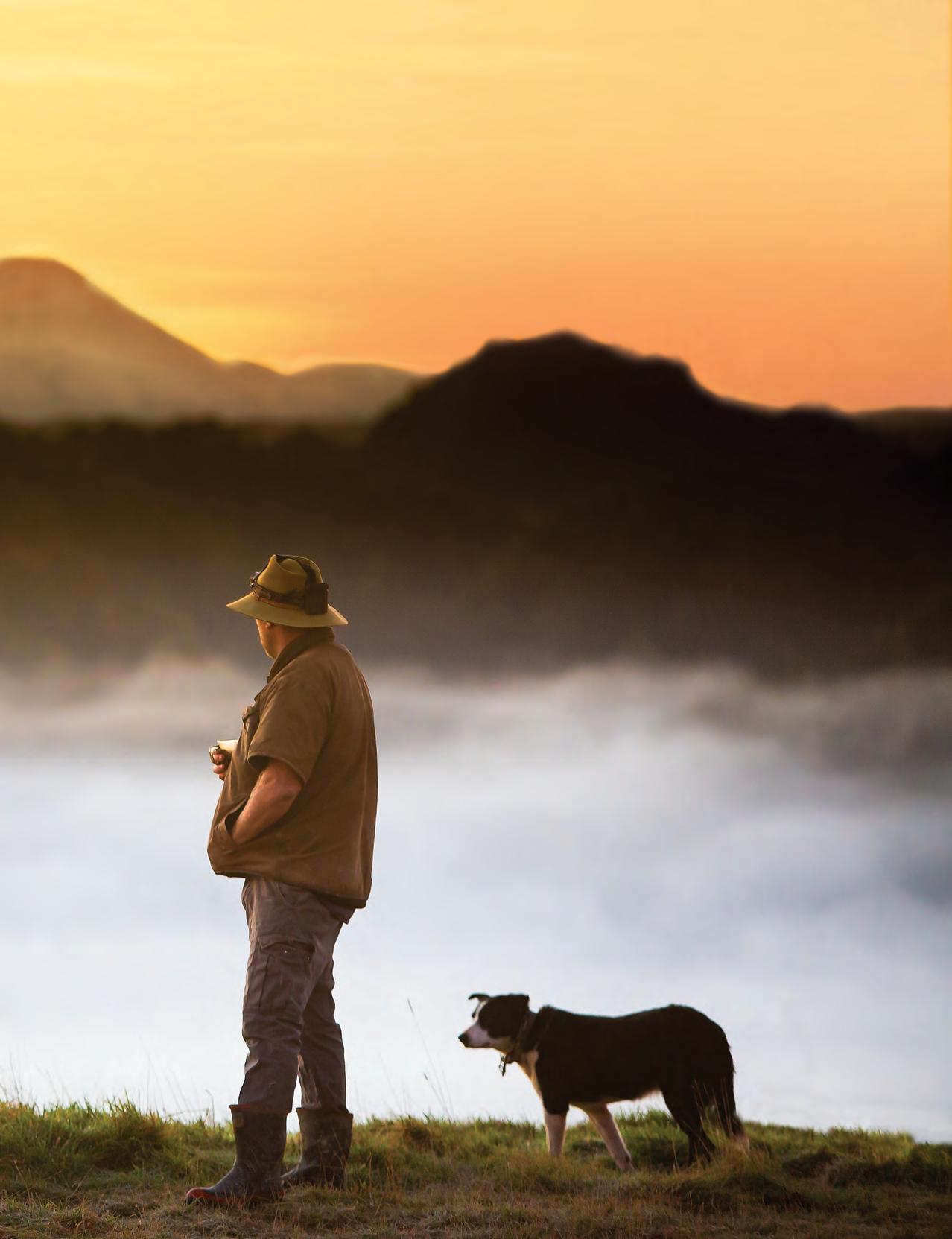






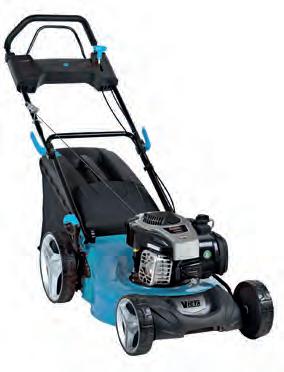


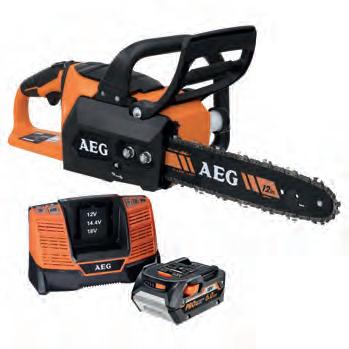
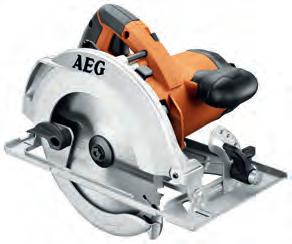
Is there spill waste below your tank? Is your tank being over-filled above its safe fill level and overflowing with heat expansion? Is your tank lacking a dipstick for the fuel tanker driver to accurately gauge refuelling quantities to avoid over-filling and spills? Are your tapes, hoses and nozzles or filter leaking?
If you have answered yes to any of these questions, contact the Farmlands Fuel team now for assistance in fixing your tank situation. Many farm tanks have been in service
for a number of years and may have had little or no maintenance. Problems can be avoided by performing regular basic checks to make your fuel storage safer and reduce the risk of any fuel contamination. Regular checks should include hoses, tap outlet, filters and nozzles. Farmlands Fuel can organise the supply of replacement accessories. Don’t wait for your fuel tanker driver to say your tank is unfit or unsafe to fill. A tank leaking one drop every 30 seconds equates to lost fuel of more than 500 litres per year. Check your
insurance policy to ensure spills, fires and compliance are covered. It is possible that in the event of a fuel incident, your insurance company may not cover you if you are found to be non-compliant. Farmlands Fuel has the expertise to assist you in avoiding environmental hazards and waste. Talk to your local representative or contact the Farmlands Fuel team on 0800 666 626 if you would like to discuss any environmental or tank compliance support.
Site safety checklist
Farmlands Fuel is focused on safety and the environment. This checklist will help confirm if your fuel storage site is meeting good access, safety and environmental standards.
Safe access from road
Access track in good condition
Access has good clearance (trees, electric fences)
Overhead clearance (power and telephone lines)
Sufficient turning area
Tank area clear of equipment and debris
Bridges and culverts sound and suitable
Tank, hose, nozzle and pumps not leaking
Tank painted, free of rust and clearly and correctly labelled
Does your tank have a calibrated dipstick and ventilation pipe?
Tank and surrounding area clear of any tank contamination
Fuel usage recorded and balanced wet stock
Are you able to contain any spills from drains or waterways?
Does the tank have any secondary containment?
Is the tank stable and secured to the ground?
Does the tank have a ladder and is it sound and secure?
Is the tank fill point easy to access without over-reaching?
Is the area around the tank level and free of debris, so access is clear and safe?
Are site hazards identified and the driver informed?
Have you replaced your non-compliant tripod?
Are you confident that your site and tank are safe?

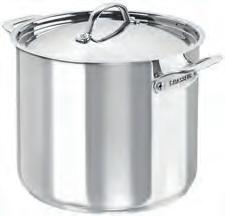













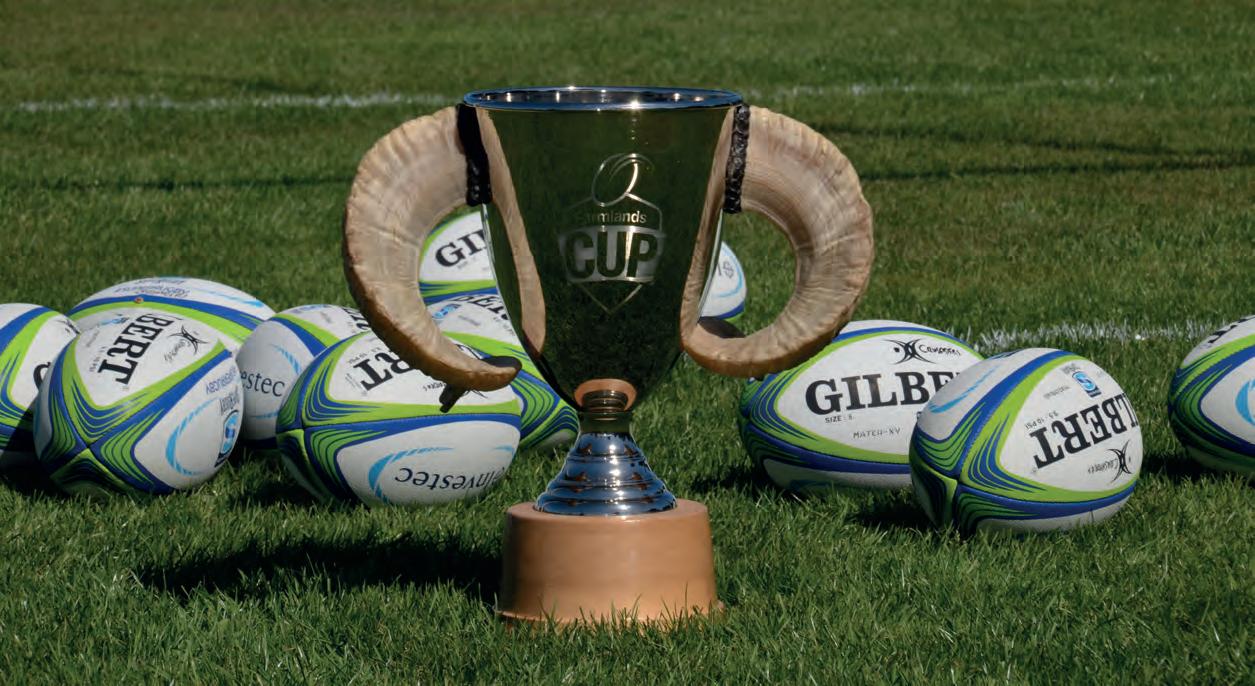
A 4,000-strong crowd witnessed a classic southern derby at the Farmlands Cup as the BNZ Crusaders and the Pulse Energy Highlanders went head to head at Southbridge Rugby Football Club. And spectators couldn’t have asked for a more thrilling finish. Crusaders fullback Will Jordan scored a try in the 78th minute to snatch the 43-38 win from the Highlanders at the fourth annual pre-season fixture on 8th February.
Farmlands pledged $5,000 to be given to a charity of the winning team’s choice. The Crusaders’
efforts meant St John Selwyn Central benefitted on the day.
The Farmlands Cup brings our rugby heroes back to their roots and is a great chance for our rural clubs to get to see them in action.
Everyone at Southbridge, the home club of former All Black Dan Carter, certainly made the most of the opportunity and enjoyed watching the arm wrestle, which saw the match go down to the wire. While the back-to-back Super Rugby champions were victorious at the final whistle, off the field, the crowd and St John were winners too.
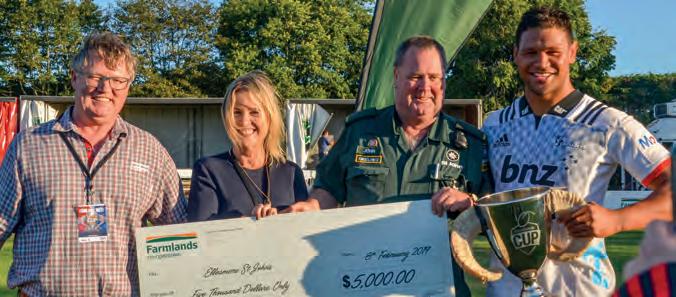
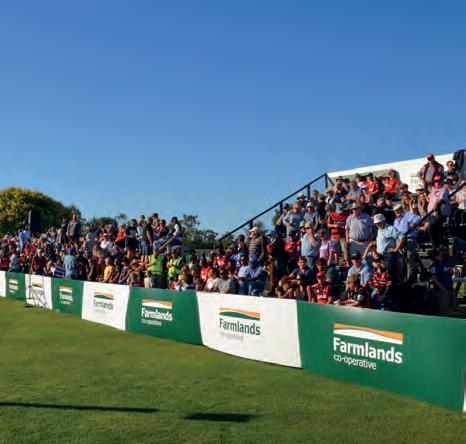









The New Zealand Century Farm and Station Awards aim to capture and preserve the history of our country’s farming families. Each month we will share stories from Farmlands shareholders who have worked their land for 100 years or more.
William and Flora Gardner brought their family from Pauatahanui (near Wellington) to Riverlea, Taranaki in 1899. With their seven children they stayed at first with their cousins, the Collins family, at Te Kiri before they settled on land at Riverlea. At the age of 12 years old, William and Flora’s second son, John, did most of the wagon driving from Wellington to Taranaki. William and his eldest son, James spent time extending the existing house from one room so it was large enough to take a family. There was no running water in the house, so Flora washed all the clothes in a box that was set up in the small creek beside the house. James married Elizabeth in 1907 and had five children. James went on to modernise the farm, including setting up a Hutchinson pump to work the first vacuum pump to milk cows so he no longer had to milk them by hand, which was very labour intensive. When WWI broke, John and his brother, Noel enlisted with both going to Gallipoli and then on to France. During this time John developed an infection in his arm, which had to be amputated and he eventually died when he returned home.
In 1920, William and Flora sold the farm to James. James farmed the land until 1935 when he died at the age of 49. Upon James’ death, the farm
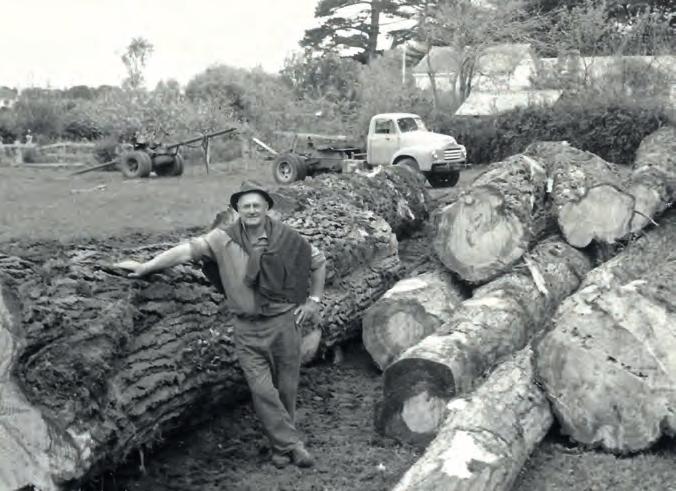
became an estate and was managed by trustees while Elizabeth was living. With the shortage of labour to milk the cows during WWII, it was decided to run sheep instead on the 270 acre farm. When Elizabeth died in 1968, James’ son, William Harold bought the farm and gradually converted back to cows.
In 1971, William Gardner sold the farm to his son, Kenneth and his wife, Jennifer.
In 2008, Kenneth’s son, William and his wife, Megan bought the farm and they continue to farm it today. The farm is currently milking 450 cows with a 60 bail rotary and a herd shelter. It is hoped that one of their children, Nicayla, Alexandria or David, will become the sixth generation to farm the land.
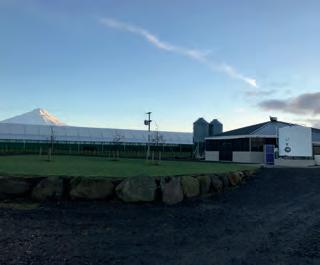
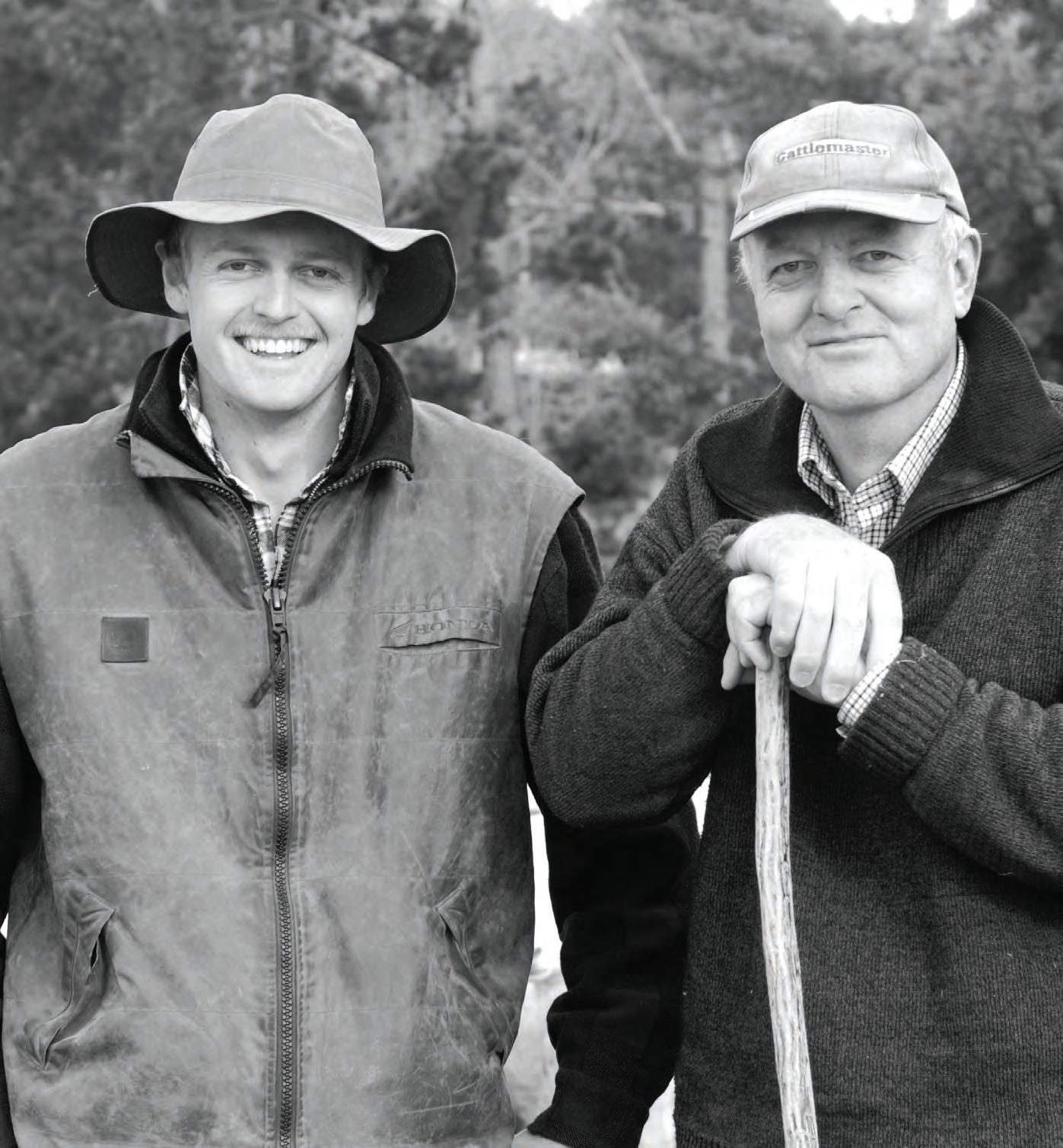



























Two of Farmlands Real Estate’s newest agents are teaming up to bring more benefits to the Bay of Plenty.
Vanessa Charman-Moore fondly remembers growing up on a 10 acre nectarine and blueberry orchard in Tauriko and is delighted that her teenage children are now enjoying Tauranga’s lifestyle benefits on the very same property.
Brett Ashworth carved out his 35 year farming career in the Bay of Plenty, spanning deer, beef and sheep properties. A holiday home kept the family coming back to the coast and now Brett is based at the Farmlands Te Puke store, which he says is part of a “vibrant rural community”.
Evidently, the pair have a mutual love for the Bay of Plenty. This pride of place and local knowledge puts them in good stead to help prospective buyers, sellers and developers of rural, lifestyle and horticultural
property and subdivision. Both have been Farmlands shareholders for years, so have experienced the co-operative’s “customer-service focused brand” for themselves.
The pair came to real estate from different backgrounds. Vanessa was a telecommunications engineer in Auckland and Tauranga with roles in both project management and business development. Brett says he has been working the land most of his life, starting with dairy and progressing into large-scale sheep, beef and deer farming on the central plateau.
“Even when other regions show caution, the Bay of Plenty real estate market continues to go ahead.
Demand is strong for that little bit of country. Good contoured land continues to be sought after for horticulture development creating opportunities for larger properties to be subdivided,” Brett says.
Vanessa says the number of lifestyle blocks continues to grow.
“It’s such a nice place to live that the large lifestyle market continues to thrive here. As well as retirees, we see many families moving here. As a local lifestyle advocate, I am well placed to give those relocating some insider advice.”
Both agents are sold on the Farmlands Real Estate advantage over other companies.
“We can be part of a whole range of services for a Farmlands shareholder. They have a trusted relationship with the co-operative, so it makes sense to extend that friendship to provide a positive real estate experience too,” Vanessa says.
Brett agrees. “When I’m talking to a non-shareholder I do mention all the benefits they can get from being part of Farmlands, as there is so much on offer.”
Brett will cover the central Bay of Plenty region, from the Papamoa Hills to Opotiki and Vanessa will cover Tauranga and the Western Bay of Plenty.
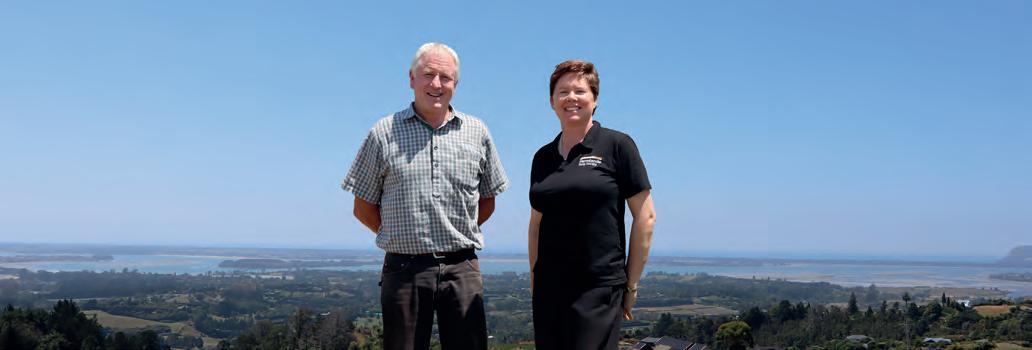
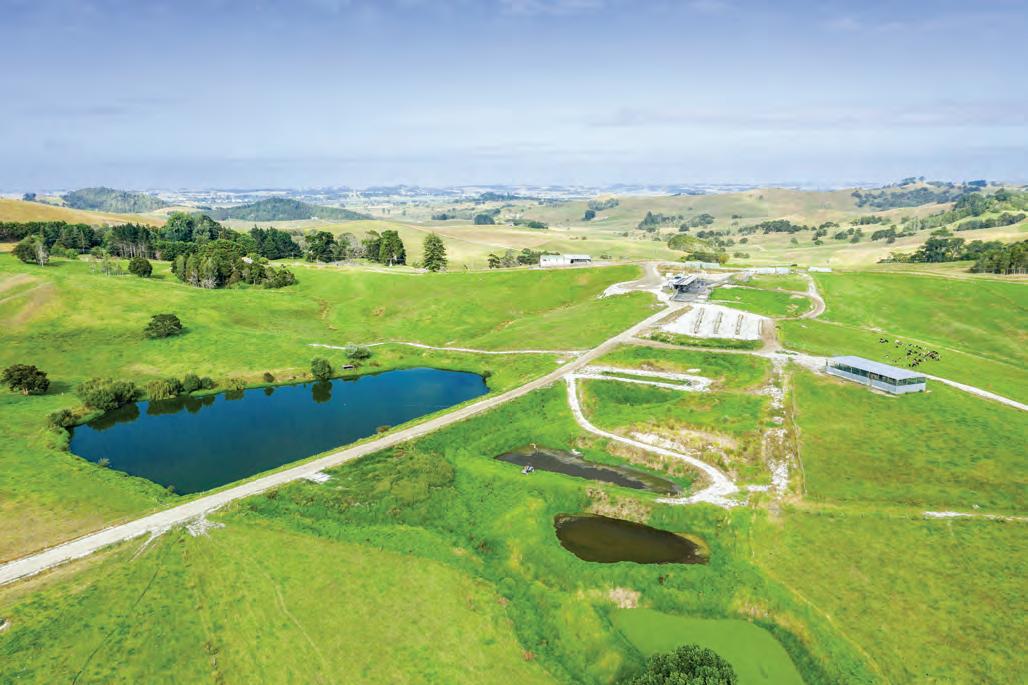
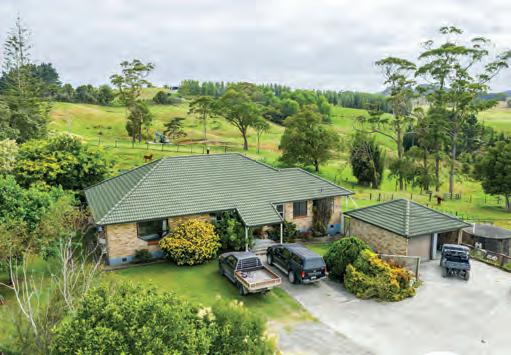
This property is EU Certified Organic and comprises 206 hectares of easy rolling and flat pasture, which makes for an effective area of 180 hectares. The yard has a holding capacity of 400 cows with a herringbone 40 aside plant equipped with Milfos cup removers. There are three ponds with a weeping wall effluent system. Presently milking 250 cows with a further 64 rising twos for next season. The main home is a 5 bedroom, early 1970s contemporary dwelling. The second home has three bedrooms. Tender closing 4pm, Thursday 28 March 2019 (unless sold by private treaty).
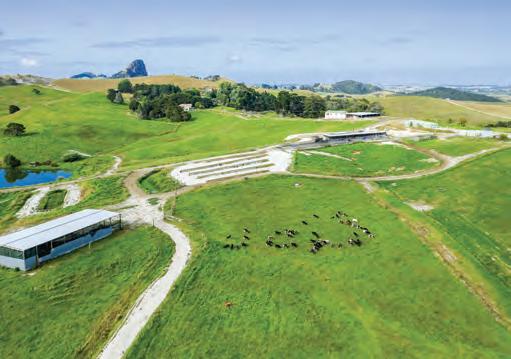


Kim Gyton
Lifestyle / Rural – Whangarei 021 728 408 kim.gyton@farmlands.co.nz
Tom Hackett
Lifestyle / Rural – Whangarei 027 498 2908 tom.hackett@farmlands.co.nz
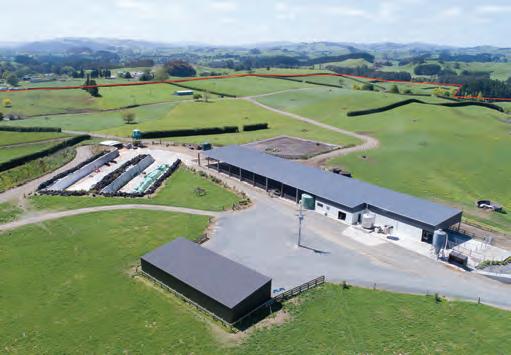
260 cows, 150,000kgMS, 5-bay calf shed, 30 aside herringbone dairy, DeLaval plant with automatic cup removers. Property is subdivided into approximately 48 paddocks, with a four bedroom two bathroom home. 1213 Maungatautari Road is a great location – only a short distance from Cambridge – and enjoys the backdrop of the Maungatautari Reserve. With the established avocado production orchard opposite the property, there could be horticultural opportunities. Price by negotiation.
Located only 5km from Paeroa, this tidy dairy unit is ready to go for a new sharemilker or as a run-off block. 30 years of hard work and dedication by the retiring Vendors gives you plenty of options. The property is in two titles, being 31 hectares and 21 hectares (more or less) and has a 1.5 kilometre road frontage. The 18 aside herringbone dairy shed with 220 cow yard capacity makes for an easy one-man operation. The main dwelling boasts four large bedrooms and quality chattels, making for easy living. Price by negotiation.
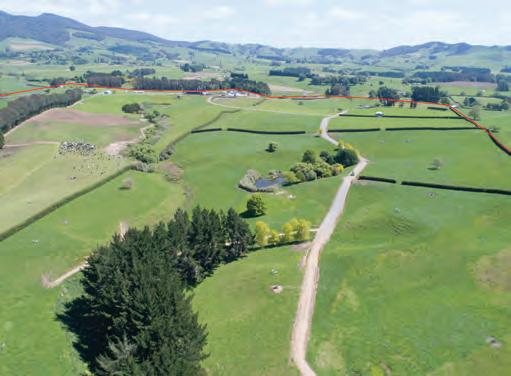


Ian Morgan
Lifestyle / Rural – Matamata 027 492 5878 ian.morgan@farmlands.co.nz
Glen Murray
Lifestyle / Rural – Matamata 027 488 6138 glen.murray@farmlands.co.nz
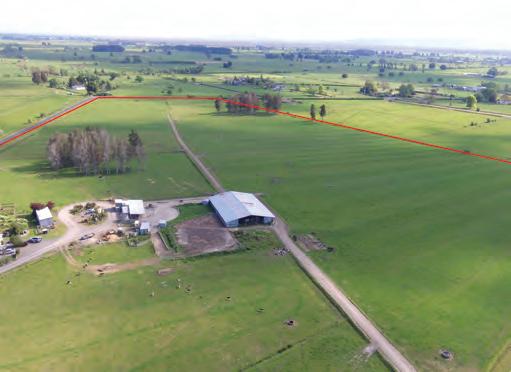
Glen Murray
Lifestyle / Rural – Matamata 027 488 6138 glen.murray@farmlands.co.nz
Ian Morgan
Lifestyle / Rural – Matamata 027 492 5878 ian.morgan@farmlands.co.nz
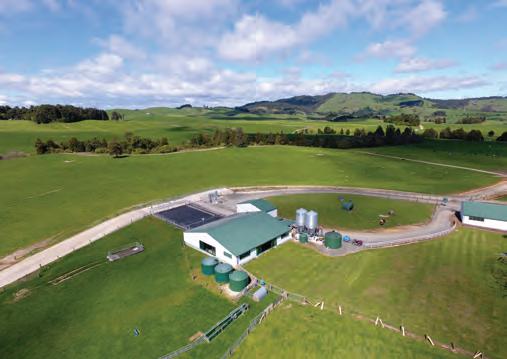
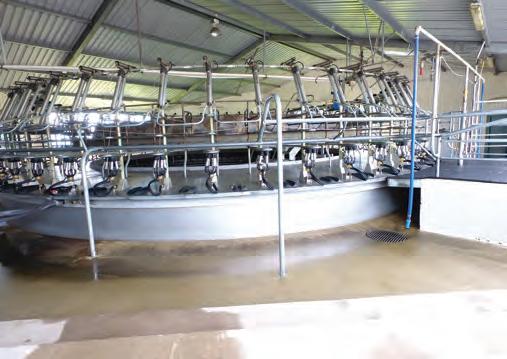
Narrandera Farms Limited is a highly developed and nurtured dairy farm located at 116-118 Huirimu Road in the popular and reliable Arohena District. Cow numbers are approximately 530 with production being consistent around 260,000kgMS. The contour of the farm is all flat to gentle rolling with wide and well formed laneways providing access to approximately 58 paddocks. Narrandera Farms Limited is outstanding in every aspect and it is a real credit to the Vendor’s meticulous eye to detail. Price by negotiation.
Culverden | Commercial investment with further development opportunity
4,790m2 in two titles. Possible landbank or redevelopment with cash flow. Is zoned Commercial/Business 1. Has great access with two road frontages. Income from lease to national tenant and weighbridge. Great opportunity in popular, fast-growing, rural service town. Deadline sale closing 2pm, Thursday 28 March 2019.
Ian Morgan Lifestyle / Rural – Matamata 027 492 5878 ian.morgan@farmlands.co.nz
Glen Murray Lifestyle / Rural – Matamata 027 488 6138 glen.murray@farmlands.co.nz
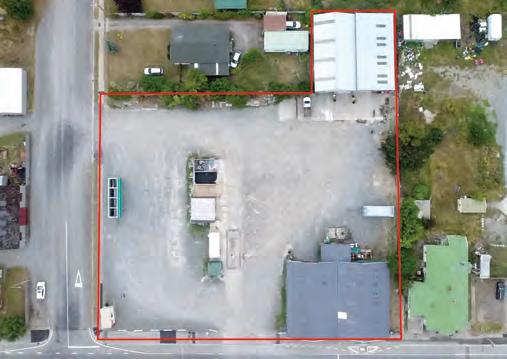

John Davison Lifestyle / Rural – Lincoln 027 436 4464 john.davison@farmlands.co.nz
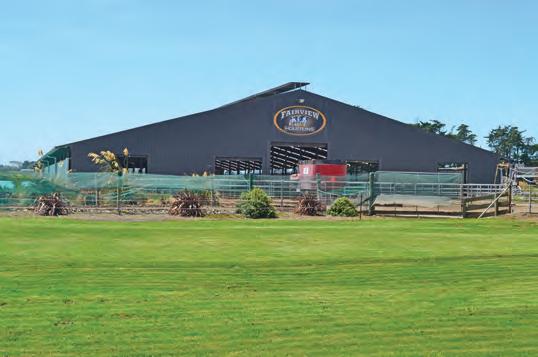
| Production and location
A superb 417 hectare dairy farm irrigated by pivots and guns, self-contained with room to grow. 440 cows milking all year round. 36-bail rotary dairy shed with autodrafting, automatic cup removers and GEA Westfalia DairyPlan plus a 454-stall barn. Could be utilised to grow crops as well as dairy. Located approximately 12km from Timaru. Available as a whole property or in separate titles, neighbouring dairy farm also available. Deadline sale closing 1pm, Wednesday 27 March 2019 (unless sold prior).
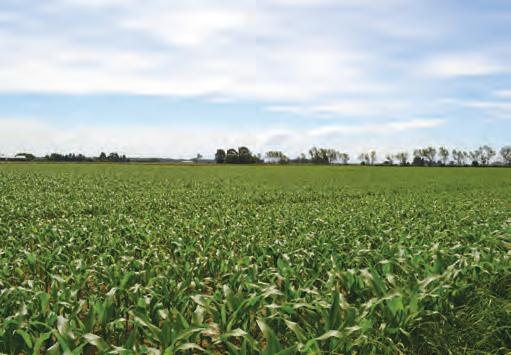
Seadown | Quality opportunity
A quality dairy property with great location, self-contained, milking 500 Friesian cows (average 450) all year round through a 50-bail rotary dairy shed. 462 hectares in multiple titles with consents to irrigate the entire property. Located approximately 12km from Timaru with options to grow horticulture or arable crops, as well as dairy. Available as a whole property or in separate titles, neighbouring dairy farm also available. Deadline sale closing 4pm, Wednesday 27 March 2019 (unless sold prior).
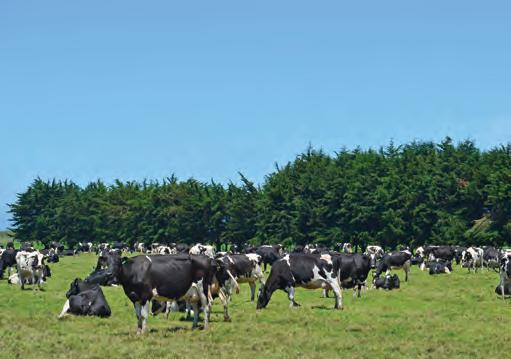


Eddie Moir
Lifestyle / Rural – Timaru 021 731 199 eddie.moir@farmlands.co.nz
Ian Moore
Lifestyle / Rural – Waimate 027 539 8152 ian.moore@farmlands.co.nz
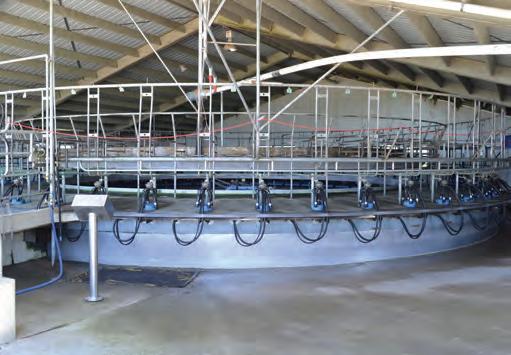
Eddie Moir
Lifestyle / Rural – Timaru 021 731 199 eddie.moir@farmlands.co.nz
Ian Moore
Lifestyle / Rural – Waimate 027 539 8152 ian.moore@farmlands.co.nz