Arable ...from previous page
Benchmark your soil to identify it’s true potential With plateauing yields and organic matter depletion there is now a scientific solution that will help restore the health of your soil.
A TEG TR
Y
In the first autumn without insecticide seed treatment Deter, growers should place added emphasis on seedbed quality. While it was primarily used to protect cereal crops from barley yellow dwarf virus (BYDV), Deter also had a repellent effect against slugs around treated seed, reducing feeding and the subsequent hollowing which can compromise establishment. For agronomy group Hutchinsons’ technical manager Dick Neale, seed hollowing is often the result of poor, cloddy seedbeds, which growers using Deter could get away with. That is no longer the case. “Now growers need to think about cultural methods, which includes addressing seedbed quality. Slug control is about a good, friable seedbed and good seed-to-soil contact to limit movement,” he explains. In addition to cultural methods, Herefordshire agronomist Antony Wade (right) advises monitoring with traps in stubbles or cultivated ground ahead of establishment and treating with a ferric phosphate-based pellet immediately after drilling if slug risk is identified. “I have moved over to ferric phosphate from metaldehyde over the past two years and have been very happy with its performance. There are also no concerns when using the product around watercourses. “I would recommend going with a premium pasta-based type, as the pellets are much more resilient in wet conditions,” adds Mr Wade. This durability may be needed according to Certis western regional technical manager Geoffrey Bastard, who says the wet autumn is likely to increase slug pressure considerably. “Sluxx HP pellets contain an anti-mould agent, which will maintain palatability and protect the crop, even after periods of heavy or prolonged rainfall. Keep monitoring after initial applications, as follow up treatments will be needed where Seed hollowing is often the result of poor, cloddy seedbeds. slug risk remains high.”
CHMAR EN
K
Seedbed quality key to reducing slug seed hollowing this autumn
B
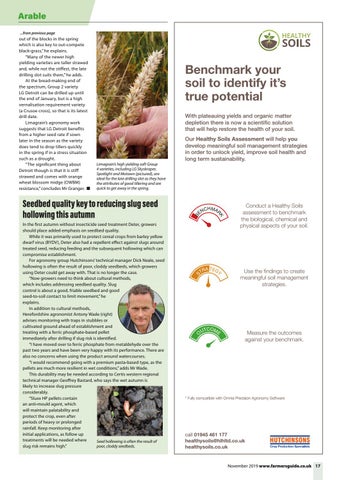
Limagrain’s high yielding soft Group 4 varieties, including LG Skyskraper, Spotlight and Motown (pictured), are ideal for the late drilling slot as they have the attributes of good tillering and are quick to get away in the spring.
Our Healthy Soils Assessment will help you develop meaningful soil management strategies in order to unlock yield, improve soil health and long term sustainability.
S
out of the blocks in the spring which is also key to out-compete black-grass,” he explains. “Many of the newer high yielding varieties are taller strawed and, while not the stiffest, the late drilling slot suits them,” he adds. At the bread-making end of the spectrum, Group 2 variety LG Detroit can be drilled up until the end of January, but is a high vernalisation requirement variety (a Crusoe cross), so that is its latest drill date. Limagrain’s agronomy work suggests that LG Detroit benefits from a higher seed rate if sown later in the season as the variety does tend to drop tillers quickly in the spring if in a stress situation such as a drought. “The significant thing about Detroit though is that it is stiff strawed and comes with orange wheat blossom midge (OWBM) resistance,” concludes Mr Granger. ■
TCOME OU
Conduct a Healthy Soils assessment to benchmark the biological, chemical and physical aspects of your soil.
Use the findings to create meaningful soil management strategies.
Measure the outcomes against your benchmark.
* Fully compatible with Omnia Precision Agronomy Software
call 01945 461 177 healthysoils@hlhltd.co.uk healthysoils.co.uk
November 2019 www.farmersguide.co.uk 17
1-27 Nov.indd 17
13/10/2019 17:34