Farm Credit East offices, including online banking and payroll processing, will be closed on the following dates:
• Monday, May 25
• Friday, June 19
Upcoming Scholarship Deadline
Farm Credit East is committed to supporting the next generation of agriculture. Our FFA Supervised Agricultural Experience (SAE) Scholarship supports FFA members across the Northeast. $1,000 scholarships are awarded to support students’ current SAE projects, fund new SAE projects or be put toward enhancing their knowledge of the agriculture, commercial fishing or forest products industries. The deadline to apply is Tuesday, June 30.
Learn more at FarmCreditEast.com/FFA.
Salute
to Retiring Director
In 2026, one director is retiring from board service.
Dave Folino, of Bristol, Vt., was elected to the Farm Credit East Board in 2022. He was formerly a director of Yankee Farm Credit, first elected in 2018. With his wife, he developed Hillsboro Sugarworks from a small maple syrup hobby to a successful business which harvested sap from over 16,300 taps. In addition, Dave teaches classes to other sugarmakers on maple economics and management.
We thank Dave for his unique perspective and years of service to the cooperative. Your leadership has helped to position the cooperative for the future and your lasting impact will be enjoyed by Farm Credit members for generations to come.
Calling All Talented
Photographers! Submit your photos for a chance to win $100.
We invite customers, employees and friends to submit creative photos depicting modern Northeast agriculture, rural life, commercial fishing and forest products during every season. Upload your unique images for a chance to be featured in our 2027 calendar.
Ready! Aim! Shoot!
Upload photos at FarmCreditEast.com/Calendar Deadline: July 31, 2026
Mike Reynolds CEO, Farm Credit East
FULLY FOCUSED ON SUPPORTING YOUR
Agriculture has never been a static industry. Each year brings new variables — markets shift, weather remains unpredictable, regulations evolve and costs rise. As we look ahead, there continues to be uncertainty in some industries. In times like these, Farm Credit East’s experience matters — and so does our commitment.
For more than a century, Farm Credit East has served one mission: supporting agriculture and rural communities. That focus gives us a depth of understanding that cannot be replicated. We know agriculture because we live it alongside you, through cycles of growth and challenge. During times of industry stress, that firsthand experience allows us to provide insight, stability and perspective when it matters most.
In this issue’s cover story, we tapped into our extended network of industry experts to provide their outlook for various agricultural sectors and highlight considerations for producers to be thinking about in the year ahead. As a relationship lender, our role is not simply to provide financing, but to provide the knowledge and resources that help you navigate uncertainty with confidence.
Providing continued value is central to that commitment. Farm Credit East’s financial strength allows us to return value to customer-owners while continuing to reinvest in the business. Earlier this year, the board approved $145 million in patronage dividends. This record return reflects the
strength of our cooperative model and our ability to remain a reliable, long-term partner for Northeast agriculture.
Strong governance is another cornerstone of our cooperative. Later in this issue, meet the five candidates who seek your vote for three open seats in the 2026 director election. Those customers who are elected will help guide the direction of your cooperative in the years ahead. I encourage you all to learn about this year’s talented candidates and cast your vote in April.
Earlier this year, the board approved $145 million in patronage dividends. This record return reflects the strength of our cooperative model and our ability to remain a reliable, long-term partner for Northeast agriculture.
As we move your cooperative forward, we are focused on strengthening our ability to support customers today, while ensuring Farm Credit East remains strong for generations to come. We are guided by enduring values: a commitment to relationships, our cooperative spirit and our shared passion for growing Northeast agriculture and rural communities. We will continue to deliver industry knowledge, personalized support and tangible value to every interaction — because your success is, and always will be, our purpose.
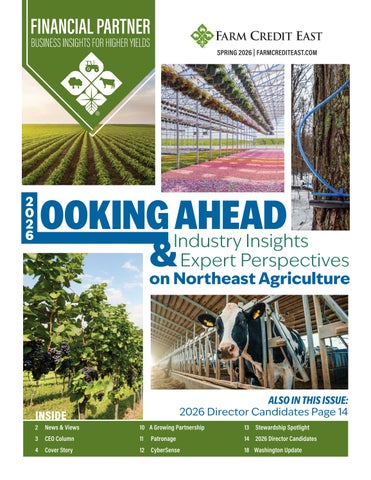
As you plan for 2026, you’re balancing more than budgets — you're weighing markets, labor and input costs, and how customer demand may shift. From wine and grapes to field crops, dairy and everything in between, Northeast agriculture signals in the year ahead are mixed: pressure in some places, opportunity in others and plenty of change in between.
To help producers plan their strategy for the year ahead, we asked leading industry experts across key sectors to share their 2026 outlook: what’s changing, what’s holding steady and where new opportunities may be emerging. The pages that follow highlight takeaways from several of those outlooks, brought to you by Farm Credit East Knowledge Exchange. Explore the corresponding links and QR codes to read full articles, register for upcoming webinars or watch webinar recordings on demand.
WINE AND GRAPE: Challenging Market Offers Unique Opportunity
A flat and increasingly competitive U.S. wine market is creating both challenges and opportunities, particularly for wineries east of the Rocky Mountains, according to Andrew Adams of WineBusiness Analytics.
While the overall value of the U.S. wine market has grown modestly, total volume has declined as consumption drops, especially among Baby Boomers, who have historically been the industry’s most loyal customers. Younger generations are drinking less wine, and lower-priced wines sold through retail channels have seen the steepest declines, putting pressure on margins and distribution strategies.
Against this backdrop, Adams suggests that Eastern U.S. wineries are uniquely positioned to strengthen their identities and market presence. Although California still dominates wine production, its share of wineries and harvest volumes has been shrinking, while many Eastern states have experienced steady growth in winery numbers. These wineries tend to be smaller and more locally focused, which has helped them succeed in building direct relationships with consumers.
Direct-to-consumer sales, especially through tasting rooms, have performed better in the East than in other regions, even as overall shipment volumes have softened due to weaker visitor traffic and reduced tourism from Canada and abroad. Adams emphasizes that relying solely on direct sales carries risks, particularly as the core wine-drinking population continues to age.
He recommends a balanced sales approach that combines direct‑to‑consumer efforts with local and regional distribution to maintain brand visibility and revenue stability. He also points to opportunities in alternative packaging, expanded wine club programs, targeted digital and SMS marketing, and creative on‑premise partnerships beyond fine dining.
Overall, Adams concludes that while the era of easy growth in U.S. wine is over, the industry’s transformation may allow Eastern and Midwestern wineries to differentiate themselves more clearly and tell their own regional stories in a changing market.
Read the full article: FarmCreditEast.com/Fruit
FIELD CROPS:
Navigating Surpluses, Trade Shifts and Biofuel Opportunities
Global surpluses of corn, soybeans and wheat are driving down prices and squeezing margins for U.S. producers. CoBank lead economists, Tanner Ehmke and Jacqui Fatka, examine how record U.S. harvests and high production costs are straining farm finances, even as cheaper grain benefits livestock operators. Farmer reluctance to sell at low prices has helped stabilize local basis levels.
Trade uncertainty persists. Corn and wheat exports are strong thanks to a weaker dollar and competitive shipping, especially to Mexico, while soybean exports lag due to reduced Chinese demand and competition from Brazil.
Corn output is projected at a record 16.8 billion bushels, though disease and dryness could lower estimates. Export demand for corn is high, but domestic demand is weakening as ethanol producers shift to grain sorghum and livestock herds shrink. Expanded crush capacity and strong demand for soybean oil in renewable diesel support soybean markets, but not enough to offset lost Chinese demand. Ample soybean meal has depressed prices, boosting exports and lowering feed costs.
Wheat producers are planting the next crop with slightly reduced acreage expectations as low prices make wheat less competitive with other crops, though good moisture conditions could encourage some acreage expansion. Exports remain strong to Mexico, Southeast Asia and Japan, but competition from Australia and Argentina looms.
Biofuels offer hope amid policy uncertainty. Delays in renewable fuel mandates and refinery exemptions create questions, but proposed increases in biomass-based diesel could drive feedstock demand. Renewable diesel supply is tight, producers are adapting to new tax credits, and ethanol margins are positive. Ethanol exports are on track for a record year, especially to Canada and the Netherlands. Overall, the outlook is pressured by low prices but buoyed by export strength and biofuel demand, which may provide longer-term stability.
DAIRY:
Read the full article: FarmCreditEast.com/CashGrain
Growth Opportunities and Protein Demand
CoBank dairy lead economist Corey Geiger and industry analyst Abbi Prins provided an overview of the dairy industry in 2025, emphasizing major processing investments — nearly $12 billion in new and expanded cheese, fluid milk and yogurt facilities. While these investments promise long-term growth, many dairy farmers haven’t seen immediate gains, especially where milk is channeled into butter and nonfat dry milk.
Consumer demand is rising for protein-rich dairy products. Processing investments reflect this, with cheese plants leading the way and increasingly treating whey protein as a valuable co-product rather than a byproduct. Fluid milk plants are also evolving to produce high-protein and lactose-free products, though these changes have contributed to excess butterfat supplies.
“ ”
Consumer demand is rising for protein-rich dairy products.
A major theme is the growing imbalance between butterfat and protein. Butterfat production has risen rapidly in recent years as farmers responded to financial incentives, pushing butterfat content in milk to record levels. As a result, processors are now facing butterfat oversupply and have begun placing limits on butterfat payments, even though consumer demand for butter, creamers and whole milk remains strong and exports have increased significantly. In contrast, protein markets remain strong, with protein becoming the leading driver of milk pricing, driven by both domestic and international demand.
Geiger and Prins describe that protein supply is more difficult to increase on the farm, relying largely on genetics rather than feeding strategies, which suggests protein will remain relatively scarce and valuable. Changes in Federal Milk Marketing Order rules have reset protein benchmarks, making protein supply more valuable.
The beef-on-dairy movement has also boosted farm income through calf and cull cow sales, in some cases rivaling or exceeding returns from milk. This trend has contributed to growth in the dairy cow herd and could lead to localized milk and butterfat surpluses in the near term.
Overall, despite short-term butterfat imbalances, the industry’s long-term outlook is positive, shaped by strong demand for dairy protein and new market opportunities.
MAPLE:
Read the full article: FarmCreditEast.com/Dairy
Balancing Growth, Competition and Quality
2025 U.S. maple syrup production held steady just under six million gallons, according to Mark Cannella, extension associate professor at the University of Vermont. National tap counts and average yield per tap were largely unchanged, and while some regions saw below-average harvests due to weather sensitivity, overall supply has now remained level for two consecutive years.
Vermont continues to dominate domestic production, accounting for roughly half of all U.S. syrup, while Maine and Wisconsin have shown sustained long-term growth.
2025 market conditions created significant price pressure for bulk syrup producers. A strong U.S. dollar relative to the Canadian dollar made Canadian imports — representing more than half of U.S. consumption — more competitive, prompting aggressive pricing from grocery and club stores. While direct-to-consumer sellers have gradually raised prices since 2020, even through high inflation, bulk syrup prices have been more volatile and have not consistently kept pace with rising, inflation‑adjusted production costs.
Long-term price trends remain cyclical, shaped by broader economic forces and trade policy. In Canada, Quebec producers have negotiated modest price increases, and continued tap expansion is expected to add supply, keeping pressure on North American markets.
On the demand side, inflation has restrained discretionary spending but increased interest in natural foods. Small producers saw the strongest growth through direct, in-person sales, while online and regional wholesale gains were more modest. Larger national sellers reported solid volume growth but remain concerned about ongoing competition from Canadian syrup and limited room for retail price increases.
Looking ahead to 2026, currency pressures may ease if the Canadian dollar strengthens, but near-term conditions remain challenging. Planned expansion could further strain markets if demand does not keep pace, leaving overall sentiment cautiously mixed.
Read the full article: FarmCreditEast.com/Maple
GREEN INDUSTRY:
Proactive Positioning is Key
Texas A&M’s Dr. Charlie Hall describes a year marked by cautious optimism alongside ongoing structural challenges. After uncertainty in 2025, the industry is entering a period where firms that have adapted to new market conditions and invested strategically are better positioned for sustainable growth.
The broader economic environment is expected to be supportive but restrained. Gradual interest rate cuts by the Federal Reserve may ease financing pressures for capital‑intensive operations, though mortgage rates are projected to remain high enough to slow a full housing market recovery. As a result, growth tied to housing-related demand is likely to be steady rather than rapid.
Economic growth is forecast to exceed 2%, with unemployment stabilizing around 4.5%. This environment should support consumer spending, but labor markets are expected to remain tight due to long-standing workforce shifts, including retirements and participation challenges. Input costs such as fertilizer, chemicals and fuel have stabilized but remain elevated compared to pre-pandemic levels, making pricing discipline and clear value communication increasingly important.
Among industry segments, landscape services are expected to perform strong, supported by latent housing demand, commercial investment in office environments, municipal green infrastructure projects and growing interest in therapeutic landscapes for healthcare and senior living facilities.
Nursery and greenhouse producers face a more uneven outlook, with improved supply chain reliability offset by inventory imbalances and rising labor costs. Automation investments are a key competitive advantage in this segment. Retail garden centers are becoming more polarized, with successful independents differentiating through experiential retail, education and digital engagement rather than price alone.
Dr. Hall emphasizes that technology adoption, value differentiation and strategic planning will define success in 2026. While growth may be moderate, well‑managed firms that focus on operational excellence, workforce development and clear value propositions are positioned to strengthen their market positions in an increasingly competitive industry.
Read the full article: FarmCreditEast.com/Green
FOREST PRODUCTS:
Gradual Recovery and Supply Constraints in 2026
North American forest products markets face a pivotal moment as they emerge from a challenging year, with markets poised for gradual stabilization in 2026, according to Paul Jannke of Forest Economic Advisors. Lumber demand declined in 2025 as high interest rates and inflation weighed on housing activity, and while housing starts are projected to grow modestly in 2026, this gain will be largely offset by continued weakness in residential-improvement spending. As a result,
Overall lumber consumption is forecast to rise only slightly before strengthening more meaningfully in 2027. “ ”
overall lumber consumption is forecast to rise only slightly before strengthening more meaningfully in 2027.
On the supply side, production capacity continues to contract resulting from mill closures, tight margins and especially high tariffs on Canadian lumber. These constraints, combined with reduced imports and rising exports, are expected to push production modestly higher and support gradual price increases.
Lumber prices are projected to continue rising in 2026, primarily due
to supply-side pressures, with further gains anticipated in 2027 as consumption growth begins to outpace supply.
Meanwhile, the pulp and paper sector faces a more mixed outlook. Weak paper consumption and strong offshore competition have driven significant mill closures, particularly in the Southern U.S., leaving production well below recent historical levels. Although packaging demand and e-commerce growth provide some support, recovery in pulp production is expected to be modest. In the Northeast, pulpwood demand and pricing may improve slightly as operating rates stabilize, though overall demand is projected to remain below late-2010s levels for the remainder of the decade.
Read the full article: FarmCreditEast.com/Forestry
KEY TAKEAWAYS FOR PRODUCERS
TO CONSIDER
Diversify sales channels to reduce reliance on any single market.
Differentiate beyond price through regional identity, storytelling and clear value.
Match production to demand to avoid oversupply driven by past incentives.
Plan for uncertainty by closely tracking trade, policy and currency shifts.
Position for growth areas tied to protein demand, biofuels and energy markets.
Improve labor efficiency through automation and technology adoption.
Pace investments carefully, expecting gradual — not rapid — market recovery.
Check out these additional articles online!
OYSTER OUTLOOK
Bob Rheault of East Coast Shellfish Growers Association shares an outlook on the oyster industry. Oyster farming approaches, challenges and markets are discussed.
Read the full article: FarmCreditEast.com/Fishing
APPLE OUTLOOK
Chris Gerlach of U.S. Apple Association discusses the future of the apple industry. Take a deep dive into the prevailing trends and forces shaping the U.S. apple industry now and for years to come.
Read the full article: FarmCreditEast.com/Fruit
A GROWING PARTNERSHIP
Fishing has always been a part of Hudson Frye’s life. Growing up in Bedford, Mass., Hudson was out on fishing boats at a young age, learning the trade long before owning a boat of his own. At 18, with a strong passion for the industry but little credit, Hudson was able to buy his first boat with the help of Farm Credit East’s FarmStart program.
As with many in agriculture, fishing isn’t simply Hudson’s job, it’s his way of life. Having a partner like Farm Credit East provides him the confidence to keep doing what he loves. “It feels good knowing that they have my back no matter what. They work with you to get through it all,” said Hudson.
Scan here to watch a video about Hudson Frye and his partnership with Farm Credit East over the years.
For Farm Credit East, helping young entrepreneurs like Hudson isn’t just about financing; it’s about setting them up to thrive. “We try to be forward thinking for our customers,” said Katelyn Landers, Farm Credit East loan officer. “We want to build the relationship for years to come.”
With the long-term support of Farm Credit East, Hudson now owns and operates several boats. “My relationship with Farm Credit is more than just a bank. They understand that you have changes and that some years are bad, some years are good,” said Hudson. “They understand fishing.”
SHARED VISION. SHARED SUCCESS.
As a financial cooperative, our customer owners share in the financial cooperative’s success through patronage dividends. This cooperative model enables Farm Credit East to offer competitive interest rates up front, and then through continued success, return a share of net earnings to our owners via patronage dividends.
Resulting from strong 2025 financial results, customer owners received a total of $145 million in patronage dividends. On average, this reflects a 1.25% reduction in eligible customers’ effective interest rate.
Sharing a portion of our earnings is just one way Farm Credit East supports your vision for what’s next.
No other lender delivers more value than Farm Credit East.
Patronage payments are paid entirely in cash. Payments are taxable, so we encourage recipients to consult with their tax advisors about their specific situations.
7 BILLION IN
Smart Habits for Today’s Connected World Protecting Your Personal and Professional Lives: CyberSense
By Deanna Becker, Director of Information Security, Farm Credit East
In today’s connected world, more of your daily farm and business operations rely on digital tools. From financial records and personal details to operational data, the information you use every day has never been more valuable. Protecting it isn’t just a technical task — it’s about safeguarding your business, your family and your peace of mind.
Digital tools make communication, banking and recordkeeping faster and more convenient. But with that convenience comes new challenges: confusing or unfamiliar notifications, emails that don’t seem quite right and apps that request more access than they need. These moments of uncertainty can disrupt your day, especially when you’re trying to determine what’s legitimate and what isn’t. The good news? With a few simple habits, you can stay secure without slowing down your work.
1. Watch for Spoofed Emails and Calls
Scammers have become increasingly sophisticated. Some messages closely resemble invoices, contracts or vendor notices. With AI tools, fraudsters can even mimic familiar faces or voices, making requests seem more believable.
Smart habit: If someone contacts you asking for sensitive information — like banking details — don’t respond directly. Instead, hang up and call back using a verified number. By initiating the communication yourself, you ensure you’re talking to the right person.
2. Keep Your Devices Updated
Devices that aren’t regularly updated become more vulnerable to criminals who exploit older software versions. Missing updates can leave important data at risk.
Smart habit: Enable automatic updates on all devices and keep your security tools current. Updated systems not only protect your information — they also run more efficiently, helping you work without interruption.
3. Be Selective with App Permissions
Some mobile apps request access to far more information than they need, including your location, contacts or files. Approving unnecessary permissions can expose personal or business data.
Smart habit: Review app permissions before installing. Grant only what the app truly requires to function, and
download from trusted sources. A few extra seconds of scrutiny can protect your privacy in the long run.
4. Strengthen Your Password Practices
Password reuse is one of the most common — and most preventable — security risks. Credentials stolen from one site are often sold or reused to access accounts elsewhere.
Smart habit: Use strong, unique passwords for every account. A password manager can help you generate and securely store them. When possible, consider using passkeys, which offer an added layer of protection.
Security Is a Shared Responsibility
While organizations, like Farm Credit East, continue investing in secure systems and tools, the most effective protection comes from staying vigilant of current scams and following best practices. By combining strong security with simple habits, you can confidently embrace digital tools while keeping your personal and professional data safe.
Protecting your data protects your business, your future and the people who depend on it.
LEAVING A LEGACY:
22025 was the fifth and final year of the Lipinski Rural Initiatives Award, created by Farm Credit East’s Board of Directors to recognize former Farm Credit East CEO Bill Lipinski. After five years, the award has recognized a dozen innovative and transformational efforts across the Northeast working to revitalize rural communities.
Stewardship
The final recipients of the award are Coastal Enterprises, Inc. (CEI) and The New York Center for Agricultural Medicine and Health (NYCAMH). Each organization was awarded $40,000 to support their innovative approaches for investing in rural business and economic development.
CEI, based in Brunswick, Maine, is a Community Development Financial Institution focused on building a more equitable economy for rural Maine communities by investing in local businesses and creating jobs. CEI’s services include business loans, oneon-one, no-cost business advising and support for homeownership and financial wellness education.
NYCAMH, based in Cooperstown, N.Y., facilitates the prevention, diagnosis and treatment of occupational diseases and work-related injuries and illnesses for New York agricultural, fishing and forestry workers. Through a variety of on-farm health and safety services, NYCAMH works with farmers to address and eliminate hazards.
To learn more about the award and past recipients, visit FarmCreditEast.com/Rural.
Bill Lipinski, former Farm Credit East CEO
CANDIDATES FOR THE BOARD OF DIRECTORS
THE BOARD
The Farm Credit East Board sets a clear direction for the cooperative on behalf of all customer-owners. The board works closely with CEO Mike Reynolds to set policy, establish long-term business plans, evaluate business results and provide feedback to the management team. It does not make day-to-day management decisions, including actions on individual loans or matters relating to employees.
THE NOMINATING COMMITTEE
On behalf of the nominating committee, Farm Credit East is pleased to present the 2026 candidates for the association’s board of directors. There are three open director seats to be filled in 2026, and five qualified candidates seeking election to these seats.
• One 4-year seat from the Eastern Region*
• One 4-year seat from the Central Region
• One 4-year seat from the Western Region
*For 2026, Eastern region candidates must be from the former Yankee Farm Credit territory.
At the completion of the 2026 director election cycle, the board will consist of 12 elected directors, one appointed customer director and two appointed outside directors.
Candidate ages are listed as of May 1, 2026
Starting with the 2027 election cycle, the Farm Credit East Board of Directors has made a strategic decision to reduce the size of the Farm Credit East Nominating Committee to include two voting members and two alternates per marketplace region, for a total of 14 voting members and 14 alternate members. The association membership elects the nominating committee at the annual stockholders meeting. This committee works hard to identify qualified candidates to ensure that the association attracts a skilled and diverse board. In addition, the committee makes every effort to recommend two qualified candidates for each open seat.
ELECTION PROCESS
You’ll find the information you need to make an informed voting choice for the 2026 Farm Credit East Board of Directors, including:
• An annual meeting information statement, which voting members received either electronically or in the mail
• This article’s profile of each candidate
• Information on our website at FarmCreditEast.com/DirectorElections
Ballots are mailed to voting members after the annual meeting on March 23, 2026.
EVERY VOTE COUNTS!
This is your opportunity to express your voice in ownership and direction of the cooperative. By voting, you convey your continued commitment to Farm Credit East and thanks to fellow members who are seeking election to the board.
The following overview information is provided by each candidate.
NOMINATED FROM The Eastern Region*
Auburn, Bedford, Dayville, Derby, Enfield, Middleboro, Middlebury, Potsdam, Presque Isle, Riverhead, St. Albans and White River Junction offices.
Business Experience: Owner and manager of Champlain Orchards Inc., which employs up to 100 staff, seasonally, and manages 384 acres of orchards. The vertically integrated business grows apples, cherries, peaches, nectarines, plums, pears and other fruit. Bill oversees two retail markets, a pick-your-own operation and online sales, as well as delivery of fresh apples, sweet cider, hard cider, apple pies, cider donuts and other valueadded products.
Leadership/Community Experience: Bill has served on the Farm Credit East Regional Advisory Committee and the Vermont Farm Viability Board. He also contributed to the SODEXO Board to source more locally produced Vermont products.
Why Farm Credit is critical to my business: I have been very impressed at the depth of resources available to members through Farm Credit East. Champlain Orchards has been making significant investments to modernize our orchards to prepare for further automation and precision agriculture. Very few lenders understand ag investments and have the resources available to support unique business models.
Why I am seeking election to the board: I have had the good fortune of being able to dream and pursue expansion goals with capital and guidance from Farm Credit East. It has taken 27 years to hire and retain capable managers, and it now feels like a good time to take on a new challenge and share the business, life knowledge and experience I have gained to help other producers pursue their dreams or navigate their next business decision.
Kyle Thygesen of Tunbridge, VT
Business:
Farmstead at Falls Hill, LLC 104 Falls Hill Road Tunbridge, VT 05077
Business Experience: Managing member of the Farmstead at Falls Hill, LLC, which is home to a diversified hay and purebred dairy cattle marketing business, as well as ag entertainment. Kyle additionally provides fractional leadership in a consulting capacity in the consumer packaged goods space. He has worked with international companies, cooperatives and a publicly traded company, converting milk into value-added products.
Leadership/Community Experience: Kyle is currently a member of the Farm Credit East Board, serving as chair of the Business Risk Committee. He has been a 4-H leader for more than 20 years. He has also been involved in the Vermont Dairy Task Force, and is a graduate of the only class of LEAD New England.
Why Farm Credit is critical to my business: Farm Credit provides the needed capital and support services that our business needs to be successful. In addition, if we need ancillary services such as tax preparation or generational transition consulting, Farm Credit has the people that can help us.
Why I am seeking reelection to the board: My reason for seeking reelection is to continue to serve our members and provide leadership on the direction of Farm Credit East to be ready to serve the needs of future generations. I love the fact that as an agricultural cooperative, we return value to our customers day in and day out!
NOMINATED FROM The Central Region
Bridgeton, Claverack, Cooperstown, Flemington and Greenwich offices.
Seat Two
Two candidates are running for a four-year term.
Kurt W. Alstede of Chester, NJ
Business:
Alstede Farms, LLC
1 Alstede Farms Lane
Chester, NJ 07930
AlstedeFarms.com
Business Experience: Founder, co-owner and general manager of Alstede Farms, LLC, an 800-acre vertically integrated fruit, vegetable and Christmas tree farm employing 30 year-round employees, and up to 200 seasonal employees. Kurt is responsible for the farm’s compliance efforts, administration, financial management and maintenance. All farm output is sold direct-to-consumer through several farm stores, farmers markets, pick-your-own and community supported agriculture.
Leadership/Community Experience: Kurt was previously on the Farm Credit East Board of Directors from 2019-2023, serving on the Governance and Business Risk committees. He currently serves on the Regional Advisory Committee. Additionally, Kurt is a past member of the NJ State Board of Agriculture and USDA NJ State Farm Service Agency Committee. He is an active member of NJ Farm Bureau and multiple commodity organizations. Kurt serves as captain on the Chester Volunteer Fire Company and is the vice chair of the NJ Highlands Council.
Why Farm Credit is critical to my business: I am a first generation farmer and have been a member and borrower of the Farm Credit System for most of the 44 years that I have been in business. Farm Credit East has provided my family and me with the financial resources and business consulting and accounting services that allowed us to grow our business from a pickup truck and a Ford 9N tractor to the complex and multifaceted 800-acre farm business that we now own and operate. Had it not been for Farm Credit East, we may not be farming today.
Why I am seeking election to the board: I am seeking to once again serve as an elected director to represent the members of our financial cooperative. I wish to maintain and enhance member value in lending and associated financial services by ensuring adequate capital is available when members need it. Farm Credit East is an essential business resource for Northeast farmers, and I would actively represent a broad diversity of crops and farm owners of every size and complexity. Most importantly, I am passionate about enhancing the owner/member governance of our cooperative. My deep commitment to our industry, combined with my extensive agricultural policy knowledge, allows me to be a valuable member of the board of directors.
Philip “Jamie” Jones of Shelton, CT
Business:
Jones Family Farms LLC;
Jones Family Farms Winery LLC
606 Walnut Tree Hill Road
Shelton, CT 06484 JonesFamilyFarms.com
Business Experience: Co-owner and manager of Jones Family Farms and Jones Family Farms Winery, a 530-acre specialty crop farm growing strawberries, blueberries, pumpkins and Christmas trees. Jamie directs the entire farm operation, while focusing on crop management and winery production for the 6,000-case winery he established. The farm also recently acquired a greenhouse operation, producing spring annuals for wholesale and retail sales.
Leadership/Community Experience: Jamie currently serves on the Farm Credit East Board of Directors and as a member of the Audit Committee. He has previously served on the Business Risk, Audit and Executive committees, and as chair of the Governance/Stewardship Committee. Jamie is also a member of the Farm Credit Council Board of Directors and the CoBank Nominating Committee. Outside of Farm Credit, he has served as Vice President of CT Farm Bureau, President of the CT Vineyard and Winery Association, and in numerous other ag organizations. He also serves on the Shelton Zoning Board of Appeals.
Why Farm Credit is critical to my business: Farm Credit East is crucially important to our farm’s success. We rely on financial services such as consulting and tax preparation to streamline our office operations. The ability to finance capital expansion projects has enabled us to expand quickly to meet market demands. Participation in benchmark programs and working with consultants help guide the strategic direction of our business. I want to ensure these services remain viable and potentially strengthened to enable Northeast agricultural, forestry and fishing enterprises to thrive.
Why I am seeking reelection to the board: Farm Credit has been vital to my farm’s growth over the past 75 years. I first ran for the board to contribute my perspective to the cooperative’s future direction. After serving three terms as director, my appreciation for what Farm Credit East provides to Northeast farmers has only deepened. I feel confident in combining my passion for advancing agricultural progress with the experience I have gained as a director. This perspective has strengthened my leadership on the board and enabled me to contribute strategic insight, helping ensure our association delivers the services essential to the success of Northeast agriculture.
NOMINATED FROM The Western Region
Batavia, Burrville, Cortland, Geneva, Hornell and Mayville offices.
Seat Three
One candidate is running for a four-year term.
Terry R. Zittel of Eden, NY
Business: Amos Zittel & Sons, Inc.
3275 Webster Road Eden, NY 14057 Zittels.com
Business Experience: Business manager and accounting and systems analyst of Amos Zittel & Sons, Inc., a fifth generation wholesale vegetable and flower business, growing fresh market, hand harvested vegetables on 400 acres, and flower crops in 3.5 acres of greenhouses. Terry implements IT and accounting systems across enterprises, handles strategic planning, oversees human resources and serves as comptroller.
Leadership/Community Experience: Terry currently serves on the Farm Credit East Board of Directors as a member of the Governance/ Stewardship and Technology committees. She has previously served on the Audit and Business Risk committees as well. Terry currently serves on the Harvest Malawi board of directors and has previously served as a director and past president of the Eden Community Foundation. Additionally, she worked as a Farm Business Management Agent on a dairy team for Cooperative Extension.
Why Farm Credit is critical to my business: Farm Credit has long supported us with loans and financial guidance, but after our 2014 snow disaster and again in 2022, we truly realized the value of a strong relationship between a credit institution and a farmer. Their support during those challenging times was invaluable. Access to knowledge exchange, networking opportunities, available grants and keeping us up to date on current agricultural issues has helped our business stay relevant.
Why I am seeking reelection to the board: Farm Credit has been an important part of our business for more than 45 years. I have profound respect for Farm Credit East, especially after serving two terms on the board and seeing firsthand how dedicated the organization is to providing members with exceptional service and affordable funding. I believe strongly in giving back to our industry, and now that we have raised four children, I have more time to engage in activities beyond our farm. I am confident I can contribute positively to the board by applying my experience in production agriculture and my years of prior board service.
4Year
We have been writing about a new farm bill in this column for over four years now. Last fall, I wrote about the uncertainty of a farm bill ever being passed and the importance of advocacy. On February 13, 2026, House Agriculture Committee Chairman Glenn “GT” Thompson (R-PA) released the long anticipated draft of the 2026 Farm Bill, formally titled The Farm, Food, and National Security Act of 2026. Sometimes referred to as “Farm Bill 2.0” or the “skinny farm bill,” it will address critical policy areas left out of The One Big Beautiful Bill and respond to demand by U.S. farmers and ranchers to pass a farm bill.
The bill passed the House Agriculture Committee on March 5, with seven Democratic members joining all Republicans, giving the bill solid bipartisan support. The bill includes several bipartisan Farm Credit priorities modified from the bills as originally introduced:
• H.R. 1991, Producer and Agriculture Credit Enhancement (PACE) Act which would increase the amounts for USDA’s Farm Service Agency (FSA) direct loans and loan guarantees to address the increased capital needs of agriculture.
• H.R. 1246, Investing in Rural America Act which would give Farm Credit institutions authority to partner with community banks and other lenders to finance essential community facilities.
• H.R. 2518, Fishing Industry Enhancement Act which expands the flow of capital to the aquaculture and fishing industries by allowing Farm Credit to finance businesses that provide services such as vessel and gear repair, fuel, ice, bait and other dock services, and cold storage facilities.
• H.R. 6779, USDA Loan Modernization Act which would expand eligibility for direct loans to individuals or entity members that hold at least a 50% interest and that are or will become bona fide operators of the farm real estate acquired, improved or supported with farm ownership, operating or emergency loans, and for other purposes.
• H.R. 7426, USDA Express Loan Act which would support the prompt approval of certain loans and loan guarantees.
• A simplified version of H.R. 1063, Farm Credit Administration Independent Authority Act which reasserts the Agriculture Committee’s jurisdiction over the Farm Credit System (FCS) and the Farm Credit Administration (FCA).
WASHINGTON Update
Dave Lane
Senior VP for Public Relations and Sustainability
Additional improvements supported by Farm Credit include: a new pilot program designed to help Farm Credit institutions explore options for making loans that bridge the gap caused by the sometimes-lengthy FSA approval process; increasing FCS investment threshold of Rural Business Investment Companies (RBICs) to 75%; important changes to agriculture export financing, rural water and waste programs; and language strengthening Farmer Mac safety and soundness.
Farm Credit’s rural housing legislation and the Farm Credit Adjustment Act were not included in the Chairman’s draft. During the committee consideration, two amendments were offered to address the following:
• H.R. 6720 FARM Home Loan Act which modifies rural housing financing under the Farm Credit Act of 1971 by raising the population limit for communities eligible for Farm Credit home loan financing from 2,500 to 10,000 residents, allowing significantly more rural homebuyers to qualify. This would allow Farm Credit, a lender who knows rural lending, to finance much needed housing for family members and neighbors in greater rural communities. While the amendment received positive remarks by Chairman Thompson, it was ultimately withdrawn.
• H.R. 5010 Farm Credit Adjustment Act proposes targeted reforms to reduce regulatory burden on certain FCS institutions allowing the Farm Credit to examine low risk FCS institutions every 24 months, rather than the current requirement of more frequent (generally 12 or 18-month) examinations. This was adopted by voice vote and was included in the version of the legislation passed by the committee.
These Farm Credit priorities are important to the FCS but more significantly they are vital to the customer members and the rural communities in which they work and live. Several of the priorities (H.R. 1991, H.R. 6779 and H.R. 7426) will ensure access to credit for young and beginning farmers, to grow customers’ businesses and provide capital to customers facing financial challenges. H.R. 2518 will strengthen services essential for the fishing industry.
H.R. 1246 will support vital rural services like senior and childcare centers and healthcare facilities critical to rural communities.
H.R. 1063 and H.R. 5010 will ultimately provide clarity and reduce the regulatory burden to Farm Credit banks and associations which will reduce operating costs. This benefits customer members by assuring strong patronage payments and capital for growth ensuring that members’ needs can be met in the future.
It is still a long road ahead for the farm bill. In order to pass, the bill must go to the House floor, pass in the House of Representatives, be taken up by the Senate Agriculture Committee, go the Senate floor for passage, and be signed by the President.
Your advocacy is needed to help it pass. Call your representative and senators and let them know why the farm bill is important to you. Call the House of Representatives at (202) 225-3121 or the Senate at (202) 224-3121 and ask for your representative or senators. Once connected, please tell your story about how modernization of farm policy will help your business and rural community.
FINANCIAL PARTNER is for the customers, employees and friends of Farm Credit East. Farm Credit East is a customerowned lending cooperative serving the farm, commercial fishing and forest products businesses in Connecticut, Maine, Massachusetts, New Hampshire, New Jersey, New York, Rhode Island and Vermont. Part of the national Farm Credit System, Farm Credit East is a full-service lender dedicated to the growth and prosperity of agriculture.
HOW TO REACH US: Whether you want to praise us, complain, ask our advice or just let us know what’s on your mind, we’d like to hear from you.