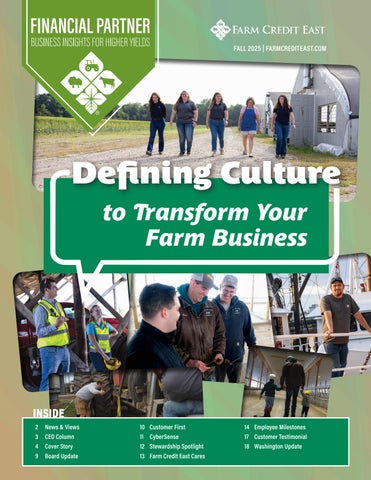
Fall 2025 Financial Partner

Page 1


Important Dates!

Farm Credit East offices, including online banking and payroll processing, will be closed on the following dates:

• Thursday, December 25

• Friday, December 26

• Thursday, January 1

• Monday, January 19

• Monday, February 16

Save the Date!

Farm Credit East will host a series of business dinner meetings this March to provide members with an update on their cooperative. Be on the lookout for formal invites in early 2026.

Monday, March 2: Hermon, Maine

Tuesday, March 3:

South Burlington, Vt.

Wednesday, March 4: Newport, R.I.

Monday, March 9: Akron, N.Y.

Tuesday, March 10: Geneva, N.Y.

Wednesday, March 11: Watertown, N.Y.

Thursday, March 12: Saugerties, N.Y.

Monday, March 23:

Virtual Annual Meeting

SCHOLARSHIP DEADLINES

Learn more at

As 2025 comes to an end, it is time to plan for 2026. Farm Credit East has gathered insights from industry experts to help you best prepare for the year ahead. Save the dates for our industry insights webinars:

• Wine and Grape: Thursday, December 18

• Cash Field: Tuesday, January 13

• Cybersecurity: Thursday, January 15

• Maple: Tuesday, January 20

• Dairy: Thursday, January 29

• Green: Monday, February 23

• Forest Products: Tuesday, March 17

• Apple: Thursday, April 16

To learn more and register, visit FarmCreditEast.com/Webinars.

As part of the Executive Order requiring federal payments be transacted electronically, please verify your bank account information with our team by December 15, 2025, to avoid any delays in your tax processing. Reach out to your tax preparer for more information.

DELIVERING VALUE through Culture

Last fall, Farm Credit East embarked on a project to define who we are as a team. Over the past year, you may have heard our team refer to “The Farm Credit East Way.” As we developed The Farm Credit East Way, we quickly realized we weren’t creating anything new — we were just defining the parts of our day-to-day business interactions that we do well. Defining those fundamentals was key to being able to hold each other accountable and move our cooperative forward.

One year into The Farm Credit East Way and I’m a strong proponent for defining an organization’s culture. Please take the time to read this issue’s cover story as it provides tips to embark on your own culture journey. I’ve experienced firsthand the value a defined culture can bring to the collective team and customers. And if you need further encouragement, you’ll also hear from some customers who have defined culture in their own businesses and the positive impact it has had on their employees and business results.

As a relationship lender, the first fundamental in The Farm Credit East Way is to invest in relationships. As the agricultural industry begins to face some challenges, this fundamental is core to who we are. Despite some of the industry challenges stemming from agricultural economics and the broader

political and trade impacts, I assure everyone that Farm Credit East remains strong and we will continue to be a reliable partner to our customers. But as weather and industry conditions could impact your business, it’s important to keep your relationship team informed so we can work together toward the best solution.

“Farm Credit East remains strong and we will continue to be a reliable partner to our customers.”

Our last Financial Partner covered how we’re purposefully evolving our cooperative to provide more value to customers. In this issue, we’ll provide a deeper dive into how we’re modernizing our credit delivery to reduce turnaround time for loan decisions and create a more consistent lending experience. Our team is working hard to implement the tools and define the processes to provide the speed you desire, but we also need accurate, up-to-date financial information from our customers.

In early 2026, your relationship team will be reaching out to collect this information. Let’s work together to deliver on this promise in 2026.

Later in this issue, you’ll also read about some of our recent stewardship activities. This is another of our Farm Credit East Way fundamentals – make a difference in local communities. This summer, in coordination with Farm Credit East Cares, our employeeinitiated and employee-funded charitable giving program, our team volunteered their time at several organizations across the Northeast. Our team’s commitment to local communities is at the heart of our organization.

As we head into 2026, we will continue to utilize The Farm Credit East Way — the fundamentals that are core to who we are — to create value for customers. As year-end is often a time for reflection and planning, I encourage all of you to consider the values that are core to your business and see if there are opportunities to integrate them into your day-to-day operations. Thank you for being part of our journey and for helping shape the culture that has enabled Farm Credit East to be a partner to Northeast agriculture for more than 100 years.

to Transform Your Farm Business Defining Culture

We’ve all experienced times when it’s just easier to do something ourselves rather than train someone else. You think, “It’ll be easier and it’ll get done the way I want.” But the reality is, especially as your business grows, you can’t do everything yourself. You need to build up those around you to accomplish what you thought only you could. When taking the time to train others on not only day-to-day tasks, but also expectations on how those tasks are performed, you empower your team to work more effectively.

In workplaces across America, companies, including Farm Credit East, are defining their internal culture. A company’s culture translates to a definition of its core values. These core values establish expectations to inspire employees to perform at their best.

When leaders take the time to define and live by their core values, they create a work environment where employees have a shared purpose. Culture shapes how decisions are made, how coworkers collaborate and how challenges are met. It’s the invisible force that can either stall progress or propel a business forward. By identifying and intentionally nurturing your company’s culture, you lay the groundwork for long-term resilience and growth.

What is Culture?

When we talk about implementing a company culture and core values, it’s important to define a healthy culture. A healthy culture empowers employees to not only do their jobs, but also to foster candid and respectful communication; versus an unhealthy culture of fear, command and control that is not productive.

4Steps to Define Culture

We recently spoke with Jennifer Voss, Business Consultant with Elevate LLC and The Voss Group. Jennifer works closely with family businesses and farms of all types, and stresses the importance of defining a healthy company culture that is practical and actionable. She affirms, “The most valuable asset you have as a business owner is people. There’s only so much money you can pay a person to get them to stay in an environment where they aren’t thriving.”

It’s important to cultivate a culture where people can thrive, grow and develop. People should be passionate about the work they’re doing and believe they’re making a difference.

Defining your Culture

Start with your best employee(s). Which of those individuals’ characteristics would you clone if given the opportunity?

They may have a good work ethic, but dig deeper. What things do they do that make them a great worker? These traits don’t need to be revolutionary — in fact, they shouldn’t be. They’re the things that you’re already doing well to drive results, make tasks more efficient or just make the day-to-day more enjoyable. For example, maybe it’s that your best employee is punctual, maybe they go above and beyond to get the job done, maybe they challenge the normal way of doing things, or maybe they ask questions up front to make sure they complete a task correctly the first time around.

Jennifer advised to choose about five traits and transform them into your core values or fundamentals. Try to choose things that are actionable and measurable, not just fluffy, feel-good words.

She provided the example of a dairy farm whose core fundamental is Choose Joy. “The farmer makes this core value real by saying ‘If someone

drives onto my farm, I expect every employee to smile and say hello,’” said Jennifer. “If you’re not warm and friendly, you don’t fit on that farm.”

Culture in Action

Neil Rejman of Sunnyside Farms, a 5,600-cow dairy in Scipio Center, N.Y., that employs about 75 people, implemented culture in their operation several years ago. He says it has helped immensely from a management perspective.

“The idea of being able to lean on the core values and use them as a way of managing people and holding to expectations has been helpful,” said Neil. “Instead of implementing tons of rules and policies, we’ve defined our culture and then given our management team the freedom to operate within it.”

For example, if someone is coming in late, we won’t say they have a tardiness problem,” Neil continued. “We’ll tie it back to our core value of Respect and say, ‘you have a respect issue with your coworkers, because if you’re late, somebody else has to do your job, and that’s not respectful to them.

“For example, if someone is coming in late, we won’t say they have a tardiness problem,” Neil continued. “We’ll tie it back to our core value of Respect and say, ‘you have a respect issue with your coworkers, because if you’re late, somebody else has to do your job, and that’s not respectful to them.

”Set the Stage for Productive Communication

Defining culture sets the stage for open and honest communication to better the collective organization. Neil acknowledges that most day-to-day tasks and operations can relate back to their culture. That allows a shift in conversation from a menial example to a more strategic, meaningful conversation to better the employee and the business.

Back to Sunnyside’s Respect value, it’s not about being late, it’s a conversation about the respect an employee has for their team. Or back to Jennifer’s Joy example, it pivots a conversation about not smiling, to one about how someone’s attitude impacts their team and the organization.

On the flip side, a defined culture also empowers employees to challenge management. Neil says he’s had employees call him out on not upholding a core value. “It was a quick conversation,” he laughed. “Because I quickly acknowledged the employee was 100% right, and because of that employee feeling empowered to call me out, we could work toward bettering the business as a whole.”

What if my Employee Doesn’t Fit My Culture?

“We don’t expect everyone to be good at everything,” said Neil. “But most employees exhibit some core values, and then we use the others to acknowledge weaknesses, set areas to improve and empower our team to operate within those values.”

But there may be employees who don’t fit the mold. “If you’re not following the core values, even after coaching, then you probably don’t fit in that culture,” said Jennifer. “It doesn’t mean the person isn’t doing a great, technical job, or wouldn’t have value in another environment, but not at that operation.”

It may be hard to have those conversations. Take the time to coach those employees and try to get them on the right track with your culture. But when you define a culture, and have employees working in direct opposition to it, it’s going to create an unhealthy environment in the long run.

It Starts with Leadership

Defining culture is a leadership decision, but it doesn’t end by just making the decision and defining the culture. As a leader, you need to exemplify your core values.

Neil’s advice to others considering this management style: “Your values are unique to you. They can’t be copied and they should not be aspirational. They should define who you really are as an organization and allow you to grow within them. And once you’ve defined them, you need to be all in.”

In Jennifer’s work with many farms, she acknowledges that, by nature, farmers are already incredibly hardworking. However, defining their culture gets them to work more effectively. “Of course, the technical aspects of the job are still of the utmost importance, but having the correct attitude and bringing people along on your culture journey allows them to thrive.”

Continually Evaluate

Defining culture is not an overnight process. Neil acknowledged that it took close to six months to really define who they were. It took about the same amount of time at Farm Credit East. So why bother putting in all that work? And how can you ensure it’s working?

After your core values have been implemented and employees have had time to adjust, take the time to evaluate: Are your leaders leading productively? Are your employees working together effectively and constructively?

Neil said at Sunnyside Farms, one of the greatest indicators that their culture is working is the great people they’ve recruited. “They may have heard that we were a great place to work, but when they saw our core values posted up on the wall, they were able to make the career change because they believe in the culture of our business,” said Neil.

Retention is another indicator. When employees have bought in to your culture, they’re vested in the organization’s purpose. They’re more likely to take pride in their work and work more efficiently.

While it is important to call out behavior that doesn’t fit in with your culture, it’s equally, if not more important to recognize employees who represent your values well. Encourage your employees to be better versions of themselves, and they’ll be more likely to take your feedback with sincerity.

Culture Drives Success

As you consider the next steps for your business, remember that the most valuable asset is your people. Investing in culture is investing in your team’s growth, satisfaction and the resilience of your operation.

Ultimately, a well-defined culture is more than a set of words — it’s a living framework that guides daily actions and decisions. By embracing this approach, you lay the foundation for a workplace where everyone can contribute, grow and find meaning in their work.

A Veteran Perspective On Defining Culture

Stemming from his background in the U.S. Marine Corps, Regional Financial Services Leader, Josh Volta, was no stranger to a defined culture. So when Farm Credit East began implementing The Farm Credit East Way, he was quickly on board.

“The Marine Corps has been around for 250 years, and Farm Credit has been around for about half that time,” said Josh. “Both are successful organizations with different purposes, but the underlying culture is key to both organizations’ success.”

He said the biggest takeaway for him in implementing The Farm Credit East Way has been it’s gotten people to talk more. “Our culture opened the door for people to speak up and share ideas.”

Josh also noted that as Farm Credit East defined its culture, most fundamentals were things everybody was already doing.

The Farm Credit East Way just added definition to who we already were and set expectations. “With that definition, we can better hold each other accountable and have productive conversations to further the organization,” he said.

“Most veterans, myself included, can struggle when transitioning back to the civilian world,” Josh continued. “But having the structure of our fundamentals, and the ability to hold ourselves and others accountable, ensures nobody is left behind and we can all work together to deliver on our mission.”

Advancing our Customer-First Strategy

An update from Board Chair John Knopf

Last year at this time I wrote about Board priorities to improve engagement with our customers. Included were plans to keep members better informed about Farm Credit East strategy through evolved customer council groups and the creation of regional business meetings with senior management and your Board of Directors. I would like to provide an update on our progress thus far and plans for the coming year.

March Business Meetings

We were pleased with the strong turnout and positive feedback from the March business meetings. We will continue these regional meetings in March 2026 to keep customer owners informed.

Editor’s note: See meeting dates/locations on the inside front cover.

Regional Advisory Committees

Earlier this year, we refreshed our former Customer Service Councils into seven Regional Advisory Committees (RAC). This restructuring allowed us to concentrate executive leadership and Board resources at each event. Following two meetings in 2025, we will continue to share Farm Credit East’s vision and business progress with committee members, while simultaneously gaining valuable feedback from the customer’s point of view. In addition, a quarterly Board communication for RAC members will continue.

Sourcing Customer Feedback

This spring, a customer feedback survey revealed Farm Credit East agriculture industry expertise, local feel of the cooperative, competitive interest rates, and members’ sharing in our financial success through patronage, as the attributes most important to our customers.

To further delve into the Farm Credit East value proposition, this fall, we surveyed Regional Advisory Committee members about what matters most to them in their Farm Credit East relationship. The responses of this collective representation of membership will help us further evolve our cooperative in the best interest of cooperative owners.

Next Generation Board Representation

Also this spring, we established a Young, Beginning, Small, Veteran (YBSV) Board Advisor role to bring additional perspective to the boardroom. We were pleased by the large

number of applicants this program received. In July, Cate Kennedy and John Kelder were designated Board Advisors to provide next generation perspective while gaining exposure to Farm Credit East governance. Both Cate and John continue to be incredibly engaged during Board meetings, providing insight from their diverse backgrounds.

Commitment to Information Security

The security of sensitive customer information is top priority. In April, the Board received results from a cybersecurity assessment, indicating Farm Credit East is taking proactive steps to build out our cybersecurity posture. In July, the Board formed a technology committee to keep focus on this area. As a Board, we have supported the addition of staff talent and training in areas of data management, innovation, IT and cybersecurity. Farm Credit East continues to grow staff in support of our customer business needs.

Evolving Our Cooperative with Purpose

As Farm Credit East members running our own agriculturebased businesses, most of us have found it necessary to embrace disruptive innovation as the tuition for staying competitive and capitalizing on the future. That holds true for Farm Credit East as well.

Management has not shied away from evolving systems and processes in response to competitive threats to our traditional business model. The Board remains aligned with a management team focused on safeguarding the long-term competitiveness of Farm Credit East and our farming interests. That focus includes reevaluating how the cooperative delivers its financial services, ensuring expertise is focused on where the team provides the most value. This innovative mindset will be critical to unlocking new types of customer value, business efficiencies and growth opportunities that support association earnings, capital strength and patronage.

In closing, I’ll note that I had the opportunity to engage with the full Farm Credit East team at an all-staff event in September. It was a great privilege to interact with a talented team so uplifting and sincerely focused on helping us be successful. I look forward to continued progress for our cooperative and Northeast agriculture.

At Farm Credit East, we believe agriculture deserves financing that can keep up, which is why we’re evolving how we deliver credit to match stride. Quicker loan decisions and more insight into loan activity are coming your way, backed by the same personalized service our customer-owners have always known.

To meet these expectations, we’re putting the technology, processes and structure in place to deliver the speed and convenience you’ve asked for, while maintaining the personal, relationship-driven service you value. Faster loan decisions and a more consultative approach require the most up-to-date financial information from our customers in a timely manner.

FASTER. STRONGER. AND STILL CUSTOMER-FIRST.

FIRST QUARTER FINANCIAL COLLECTION: KEY TO FASTER DECISIONS

In January 2026, your Farm Credit East team will be working with you to collect your balance sheet. A yearend balance sheet is the most important tool you have to measure your business performance.

Collecting this information in the first quarter allows you to plan your financial needs and ensures that Farm Credit East has your financial information on file to support your financing. Ultimately, it will allow us to deliver faster credit decisions and create a smoother, more consistent borrowing experience for our customers, while also enabling your loan officer to spend more time having meaningful conversations about your business goals.

NEXT STEPS

In the coming weeks, your loan officer will be reaching out to guide you through this process and answer any questions. Financial documents may be submitted via the following methods:

• Upload through Farm Credit Connect

• Work directly with your loan officer by phone or in person.

Thank you for your continued partnership as we optimize our credit process to bring you a faster, more convenient lending experience. We look forward to continuing to support your lending needs.

Tips to Strengthen Your Digital Security CyberSense

Why Multi-Factor Authentication Is Essential

One of the most important tools available to protect your financial information is Multi-Factor Authentication (MFA). I’m sure you already use MFA to login to a number of platforms, including Farm Credit East’s customer portal, Farm Credit Connect. But do you know why it’s there, and how it helps protect your account from today’s most serious cyber threats?

Authentication

MFA is a security feature that requires you to verify your identity using two or more methods before accessing your account. These methods typically include:

• Something you know, like your password

• Something you have, such as a one-time code sent to your phone or email

• Something you are, such as a fingerprint, facial recognition, etc.

For example, when logging into Farm Credit Connect, after entering your username and password, you’re prompted to enter a verification code sent to your phone or email. This secondary verification makes it much harder for cybercriminals to gain access, even if they’ve somehow obtained

your password. This process takes just a few seconds but adds a powerful layer of protection.

Importance of MFA

Cyber threats are growing more sophisticated every day. Criminals use phishing emails, fake login pages and stolen credentials to try to break into accounts. In the financial sector, and especially in agriculture, where operations are often family-run and community-based, these attacks can have devastating consequences. MFA is an added layer of protection to help prevent unauthorized access to your accounts, identity theft and fraud, and disruptions to your business or personal finances.

Strengthening your Security and Trust

Farm Credit East has implemented MFA not just because it’s a best practice, but because this extra step protects the trust you place in us and ensures your information remains secure. Farm Credit East is continually strengthening our information security systems to stay ahead of evolving risks, ensuring your business, your information and the integrity of our cooperative is protected for the long term.

As part of this ongoing effort, MFA may be extended to additional applications in the future to further safeguard sensitive information. This enhanced security reflects our ongoing commitment to keeping customer information secure.

We strongly encourage you to make MFA a standard part of your personal digital practices, not just your business accounts. Whether you’re managing email, social media or online banking, enabling MFA adds an extra layer of protection against unauthorized access and identity theft.

Additional Resources

MFA is just one of the many ways we’re working to keep your data safe, your account secure and your future protected. For additional insights on the measures Farm Credit East has in place to protect customer information, please visit FarmCreditEast.com/ InformationSecurity. Additionally, if you ever notice suspicious activity, be sure to take action immediately by sending an email to security@farmcrediteast.com.

FFarm Credit East launched the Food Access Infrastructure Initiative Grant last year to financially support organizations such as food banks, food hubs and other non-profit food distribution and infrastructure organizations, as they implement new projects to further food access in the Northeast. Since inception, this grant program has awarded four $50,000 grants to further organizations food security efforts.

The New York State Regional Food Hub, located in Bronx, New York, connects the region’s small to mid-size farms with 370 food distribution partners in New York City. Grant funds helped get this multi-year project to the finish line, with the food hub officially opening its doors in June 2025.

The Regional Food Bank of the Hudson Valley, based in Montgomery, New York, collects and distributes food to communities in need throughout 23 counties in northeastern New York. Their grant funds supported installation of a new cold storage unit.

Urban Agriculture Cooperative, based in Newark, New Jersey, is a food hub working to connect urban growers and underserved

consumers by providing access to local, fresh produce. Their grant funds are improving Urban Agriculture Cooperative’s cold storage capacity.

The Burlington Food Pantry, based in Burlington, Maine, works to combat food insecurity in rural communities, many of which are considered food deserts with limited access to nutritious foods. They are using their funds to invest in a walk-in freezer.

Watch a short video on 2024 recipients, Regional Food Bank of the Hudson Valley, who used their $50,000 grant to install new refrigeration.

SPOTLIGHTStewardship

Pictured left to right, Jamie Jones, Farm Credit East Director and owner and founder of Jones Family Farms Winery, LLC, in Shelton, Conn., along with NYS Commissioner of Agriculture
Richard Ball, Farm Credit East Director of Knowledge Exchange, Chris Laughton, and Communications Specialist, Dallas Kriebel, at the grand opening of the GrowNYC New York State Regional Food Hub in the Bronx.

AT FARM CREDIT EAST, We Care!

This summer, Farm Credit East launched Farm Credit East Cares Community Days, a coordinated volunteer effort to give back to the Northeast communities we serve. This initiative originates from Farm Credit East Cares, a charitable fund established and funded by employees, which has donated more than $1.5 million to charitable causes over the past 15 years. More specifically, Farm Credit East Cares Community Days aimed to bring together employees from across offices to volunteer their time with important causes.

Watch a short video to learn more about how our employee team volunteers their time to make a difference in the local communities we serve.

To celebrate employee volunteer efforts, Farm Credit East provided a dollar match for each volunteer hour. These earned dollars, totaling to $22,500, were donated to various charitable causes across the Northeast, further amplifying the impact of this effort. We’re proud of our team’s commitment to making a difference and look forward to continuing these meaningful volunteer efforts.

Celebrating Farm Credit East Employee Milestones

Farm Credit East is proud of the longevity of its employee team, with many employees having been with us for 5, 10, 15, 20 years and greater. This tenure brings a depth of knowledge and understanding of our customers and the industries we serve. Team members collaborate across all tenures to share knowledge and expertise to ensure the whole team

35 Years

Cooperstown, NY

is equipped to best serve Northeast agriculture, commercial fishing and forest products.

In the pages that follow, we recognize those employees who surpassed exciting milestones in 2025. Thank you for your commitment to Farm Credit East and our members.

Cooperstown, NY

30 YEARS

Kimberly Chappell Senior Credit Analyst Bedford, NH

Beth Cummings Tax Manager Mayville, NY

Rachel Curtis Money Desk Specialist Enfield, CT

Triva Haycook Crop Growers Leader Potsdam, NY

Annmarie LaZazzera* Executive Assistant Enfield, CT

Cathy Lemay Operations Specialist Auburn, ME

Gretchen Pohlman Tax Specialist Enfield, CT

Owen Raymond Senior Loan Officer Cortland, NY

Cynthia Stiglitz Regional Credit Leader Middleboro, MA

Tina Thomas Tax Specialist Burrville, NY

25 YEARS

Dennis Eckel Senior Loan Officer Geneva, NY

Cristi Flanigan Credit Administrator Greenwich, NY

Jason Hoagland Senior Loan Officer Enfield, CT

Clarissa Kniskern Senior Credit Analyst Cooperstown, NY

Patti Laurie Operations Specialist Potsdam, NY

Paticia Lockwood Analyst Leader Greenwich, NY

Kathryn McGuire* Senior Tax Specialist Enfield, CT

20 YEARS

Julie Conklin Operations Specialist Cortland, NY

Vincent Engelmann Senior Tax Specialist Flemington, NJ

Abigail Fenlason Manager of Business Process Optimization Enfield, CT

Joshua Garretson Senior State Certified General Appraiser Bridgeton, NJ

Jason Hart Senior Mortgage Specialist Flemington, NJ

Leigh-Ann Harvatine Senior Mortgage Specialist Cortland, NY

Stephanie MacPherson Director of Crop Insurance Operations Cortland, NY

Samantha Stoddard Senior Loan Officer Bedford, NH

Patricia Stover Operations Leader Flemington, NJ

Shannon Webber Regional Credit Leader Auburn, ME

15 YEARS

Jill Cecere Operations Specialist Batavia, NY

Andrew Desiderio Senior Tax Specialist Enfield, CT

Rella Getty Customer Experience Leader Greenwich, NY

Michael Johel* Mortgage Specialist Batavia, NY

Martha Johnson Director of Employee Engagement and Culture Enfield, CT

Kristin Kraszewski Tax Specialist Riverhead, NY

Kristie Matuszewski Director of Marketing and Communications Riverhead, NY

Timothy Slavin Regional Financial Services Leader Claverack, NY

10 YEARS

Robert Andrews Loan Officer Riverhead, NY

Amy Baird Accounting Associate Claverack, NY

Dawn Bird State Certified General Appraiser Flemington, NJ

Justin Clough Mortgage Specialist St. Albans, VT

Pamela Custeau Documentation Specialist St. Albans, VT

Krista Flammia Business Analyst Riverhead, NY

Nina Forringer Mortgage Assistant Claverack NY

Betsey Gerber Senior Credit Analyst Hornell, NY

Cory Haggett Capital Markets Loan Officer White River Junction, VT

Lynn Horton Operations Specialist Greenwich, NY

Nicole Ingram Crop Insurance Senior Advisor Burrville, NY

Marianne Kukulka* Operations Associate Enfield, CT

Heather LaPierre Consulting Associate –Grant Coordinator Greenwich, NY

Kate McDowell Senior State Certified General Appraiser Hornell, NY

Catherine Mest Operations Specialist Batavia, NY

Kristen Murray Director of Internal Review White River Junction, VT

Stacy Newton Capital Markets Loan Operations Associate Derby, VT

Erika Quick Marketing Coordinator St. Albans, VT

Donald Rawling Senior Credit Analyst Enfield, CT

Benjamin Rockcastle Tax Specialist Batavia, NY

Laura Shoemaker Senior State Certified General Appraiser Cooperstown, NY

Mitchell Teplick State Certified General Appraiser Bridgeton, NJ

*Retired in 2025

5 YEARS

Megan Bradley Senior Tax Specialist Cortland, NY

Amanda Bramer Mortgage Assistant Cooperstown, NY

William Britt Loan Officer Geneva, NY

Barbara Brockett Operations Specialist Enfield, CT

Daianera Cashman GRC & Resiliency Analyst Enfield, CT

Dalton Cassidy Credit Analyst Specialist Auburn, ME

Stephen Clarke Loan Officer Cooperstown, NY

Malik Davis Tax Manager Batavia, NY

Lindsey Delles Loan Officer Mayville, NY

Kirsten Dolan Loan Officer Claverack, NY

Meghan English Loan Officer Greenwich, NY

Bailey Forrett Mortgage Specialist Burrville, NY

Linda Gonnella Operations Associate Claverack, NY

Chandler Goodhue Loan Officer St. Albans, VT

Niki Grogan CLL Loan Coordinator Cooperstown, NY

Alyssa Jellison Loan Coordinator Cortland, NY

Benjamin Leduc Loan Officer Middlebury, VT

Emily Lipinski Learning and Development Specialist Enfield, CT

Bianca Marlow Capital Markets Loan Operations Specialist Enfield, CT

Eddie Maslin Crop Insurance Associate Cortland, NY

Arla Masson Tax Specialist Derby, VT

Mckenna Maycock Tax Specialist Mayville, NY

Zachery Mundy Manager Data and Reporting Enfield, CT

Gwendolyn Miner Operations Associate Cooperstown, NY

Elisabeth Olcott Loan Officer Cooperstown, NY

Ashley Patterson Business Analyst Greenwich, NY

Carol Pelletier Technology Support Specialist Derby, VT

Justin Perez Learning and Development Associate Enfield, CT

Andrea Piscione Accounting Specialist Cooperstown, NY

Jessica Prosper Appraiser Potsdam, NY

Lidia Ramos Payroll Specialist Enfield, CT

Faith Randall Tax Specialist Cortland, NY

Nakeya Stedman Crop Insurance Operations Associate Cortland, NY

Matthew Stenger Credit Analyst Specialist Auburn, ME

Carlise Tardibone Payroll Associate Batavia, NY

Elizabeth Vachon Crop Insurance Associate St. Albans, VT

Cassidy Webster Operations Associate Derby, VT

Sherrie Yost Payroll Specialist Enfield, CT

“ A Family Affair

40 years ago, Brian Souers started Treeline, Inc. Located in Lincoln, Maine, Treeline started as a logging company but has evolved to encompass so much more. By diversifying and growing the business, Brian paved the way for the next generation to join. Whitney Souers Goodmen, Brian’s daughter, is now a proud partner helping run Treeline’s day-to-day operations.

With the support of Farm Credit East, Treeline has grown exponentially since its early days, now employing close to 100 people. “Farm Credit is very different than a traditional bank. They know our business, and they’re specialized in our business,” said Brian.

Farm Credit East also understands the forest products industry. “The best part about being a loan officer is when the customer comes up with an idea, you get to work with them to figure out how to make their idea reality,” said Jacob Vainio, a Farm Credit East loan officer who has worked with Treeline in various capacities for more than 10 years.

Brian and Whitney are excited for the future of their business. “My commitment is to set this company up for the long haul and Farm Credit is going to be part of our future forever,” said Brian.

Scan here to watch a video about Treeline and their partnership with Farm Credit East over the years.

Navigating Uncertainty The Importance of Advocacy on the Road to a New Farm Bill

As the dust settles from the passage of the “One Big Beautiful Bill Act” (OBBBA), the prospect of a standalone 2025 Farm Bill remains uncertain. Despite bipartisan calls for action, and bold statements from House Agriculture Committee Chair, Congressman GT Thompson, there are doubts when a new farm bill will be passed. There are deep political divides, budget constraints, the recent government shutdown, and a crowded congressional calendar, including Fiscal Year 2026 appropriation bills.

The biggest roadblock is disagreement over SNAP funding. The reconciliation process used

to pass the OBBBA included $186 billion in cuts to the Supplemental Nutrition Assistance Program (SNAP), a move that fractured the traditional bipartisan coalition supporting farm bills. Democrats have signaled reluctance to support any new bill that doesn’t restore nutrition funding.

In addition, there is pressure to reduce federal spending, leaving little room to expand farm programs. This could affect subsidies, conservation payments and rural development grants. Finally, there is timing to consider. Between government shutdown, the need for appropriations and upcoming election-

year politics, lawmakers have limited time to negotiate a new farm bill.

The largest concern for agriculture is that funding for conservation programs, such as EQIP and CSP, could be delayed or reduced. New investments in rural development and broadband will be stalled. And while the OBBBA addressed crop insurance and commodity programs, any new improvements or expansion will be on hold.

Also on hold are Farm Credit System enhancements that will allow the System to better serve rural communities. The farm bill is the legislation that will allow Farm Credit to increase financing for community facilities, rural housing and the fishing industry, as well as increase FSA lending and loan guarantee limits.

But given all that, there is cautious optimism that grassroots advocacy can have a positive influence in getting a new bill passed. Calling, emailing or reaching out to your members in any way creates momentum. Sharing your stories is the best way to move Congress.

WASHINGTON Update

To that end, in November 2025, more than 800 Farm Credit directors, employees and customers gathered in Washington, D.C. to share their stories on Capitol Hill. The Farm Credit East contingent included two board members, four staff and four young farmers. The group attended 29 meetings with members of Congress and their staff. The stories that were shared showcased real-world impacts of proposed legislation and the need for a farm bill. Without question, Fly-In events in Washington D.C. are highly influential in the legislative process as the impact of policy issues becomes tangible and relationships with decision-makers are strengthened.

In summary, we are hopeful there will be a new farm bill in 2026, but it will take considerable effort to have a positive outcome. Political gridlock, fiscal austerity and partisan wounds have created a legislative environment where compromise is elusive. As we brace for continued uncertainty, advocacy, being heard and sharing our stories is your opportunity to impact the passage of the next farm bill.

HOW CAN YOU HELP?

Call your representative and senators to share your story and ask them to support the farm bill.

TO TAKE ACTION , call the House of Representatives at (202) 225-3121 or the Senate at (202) 224-3121 and ask for your representative or senators.

FINANCIAL PARTNER is for the customers, employees and friends of Farm Credit East. Farm Credit East is a customerowned lending cooperative serving the farm, commercial fishing and forest products businesses in Connecticut, Maine, Massachusetts, New Hampshire, New Jersey, New York, Rhode Island and Vermont. Part of the national Farm Credit System, Farm Credit East is a full-service lender dedicated to the growth and prosperity of agriculture.

HOW TO REACH US: Whether you want to praise us, complain, ask our advice or just let us know what’s on your mind, we’d like to hear from you.

WRITE: Kristie Matuszewski, Editor, Farm Credit East, 240 South Road, Enfield, CT 06082-4451 CALL: 860.741.4380

E-MAIL: kristie.matuszewski@farmcrediteast.com

©2025 by Farm Credit East, ACA. All rights reserved. Farm Credit East is an affirmative action, equal opportunity employer.

FINANCIAL PARTNER is printed on recycled paper.

Farm Credit East

240 South Road

Enfield, CT 06082-4451

Change Service Requested

Turn static files into dynamic content formats.

Create a flipbook
Issuu converts static files into: digital portfolios, online yearbooks, online catalogs, digital photo albums and more. Sign up and create your flipbook.
Fall 2025 Financial Partner by Farm Credit East - Issuu